WO2021059939A1 - 酸化物、固体電解質、および全固体リチウムイオン二次電池 - Google Patents
酸化物、固体電解質、および全固体リチウムイオン二次電池 Download PDFInfo
- Publication number
- WO2021059939A1 WO2021059939A1 PCT/JP2020/033751 JP2020033751W WO2021059939A1 WO 2021059939 A1 WO2021059939 A1 WO 2021059939A1 JP 2020033751 W JP2020033751 W JP 2020033751W WO 2021059939 A1 WO2021059939 A1 WO 2021059939A1
- Authority
- WO
- WIPO (PCT)
- Prior art keywords
- oxide
- solid
- llz
- substitution
- solid electrolyte
- Prior art date
- Legal status (The legal status is an assumption and is not a legal conclusion. Google has not performed a legal analysis and makes no representation as to the accuracy of the status listed.)
- Ceased
Links
Images




Classifications
-
- H—ELECTRICITY
- H01—ELECTRIC ELEMENTS
- H01M—PROCESSES OR MEANS, e.g. BATTERIES, FOR THE DIRECT CONVERSION OF CHEMICAL ENERGY INTO ELECTRICAL ENERGY
- H01M10/00—Secondary cells; Manufacture thereof
- H01M10/05—Accumulators with non-aqueous electrolyte
- H01M10/056—Accumulators with non-aqueous electrolyte characterised by the materials used as electrolytes, e.g. mixed inorganic/organic electrolytes
- H01M10/0561—Accumulators with non-aqueous electrolyte characterised by the materials used as electrolytes, e.g. mixed inorganic/organic electrolytes the electrolyte being constituted of inorganic materials only
- H01M10/0562—Solid materials
-
- C—CHEMISTRY; METALLURGY
- C01—INORGANIC CHEMISTRY
- C01G—COMPOUNDS CONTAINING METALS NOT COVERED BY SUBCLASSES C01D OR C01F
- C01G29/00—Compounds of bismuth
- C01G29/006—Compounds containing bismuth, with or without oxygen or hydrogen, and containing two or more other elements
-
- C—CHEMISTRY; METALLURGY
- C01—INORGANIC CHEMISTRY
- C01G—COMPOUNDS CONTAINING METALS NOT COVERED BY SUBCLASSES C01D OR C01F
- C01G33/00—Compounds of niobium
- C01G33/006—Compounds containing niobium, with or without oxygen or hydrogen, and containing two or more other elements
-
- C—CHEMISTRY; METALLURGY
- C04—CEMENTS; CONCRETE; ARTIFICIAL STONE; CERAMICS; REFRACTORIES
- C04B—LIME, MAGNESIA; SLAG; CEMENTS; COMPOSITIONS THEREOF, e.g. MORTARS, CONCRETE OR LIKE BUILDING MATERIALS; ARTIFICIAL STONE; CERAMICS; REFRACTORIES; TREATMENT OF NATURAL STONE
- C04B35/00—Shaped ceramic products characterised by their composition; Ceramics compositions; Processing powders of inorganic compounds preparatory to the manufacturing of ceramic products
- C04B35/01—Shaped ceramic products characterised by their composition; Ceramics compositions; Processing powders of inorganic compounds preparatory to the manufacturing of ceramic products based on oxide ceramics
- C04B35/48—Shaped ceramic products characterised by their composition; Ceramics compositions; Processing powders of inorganic compounds preparatory to the manufacturing of ceramic products based on oxide ceramics based on zirconium or hafnium oxides, zirconates, zircon or hafnates
- C04B35/486—Fine ceramics
-
- C—CHEMISTRY; METALLURGY
- C04—CEMENTS; CONCRETE; ARTIFICIAL STONE; CERAMICS; REFRACTORIES
- C04B—LIME, MAGNESIA; SLAG; CEMENTS; COMPOSITIONS THEREOF, e.g. MORTARS, CONCRETE OR LIKE BUILDING MATERIALS; ARTIFICIAL STONE; CERAMICS; REFRACTORIES; TREATMENT OF NATURAL STONE
- C04B35/00—Shaped ceramic products characterised by their composition; Ceramics compositions; Processing powders of inorganic compounds preparatory to the manufacturing of ceramic products
- C04B35/50—Shaped ceramic products characterised by their composition; Ceramics compositions; Processing powders of inorganic compounds preparatory to the manufacturing of ceramic products based on rare-earth compounds
-
- C—CHEMISTRY; METALLURGY
- C04—CEMENTS; CONCRETE; ARTIFICIAL STONE; CERAMICS; REFRACTORIES
- C04B—LIME, MAGNESIA; SLAG; CEMENTS; COMPOSITIONS THEREOF, e.g. MORTARS, CONCRETE OR LIKE BUILDING MATERIALS; ARTIFICIAL STONE; CERAMICS; REFRACTORIES; TREATMENT OF NATURAL STONE
- C04B35/00—Shaped ceramic products characterised by their composition; Ceramics compositions; Processing powders of inorganic compounds preparatory to the manufacturing of ceramic products
- C04B35/622—Forming processes; Processing powders of inorganic compounds preparatory to the manufacturing of ceramic products
- C04B35/626—Preparing or treating the powders individually or as batches ; preparing or treating macroscopic reinforcing agents for ceramic products, e.g. fibres; mechanical aspects section B
- C04B35/62605—Treating the starting powders individually or as mixtures
- C04B35/6261—Milling
- C04B35/6262—Milling of calcined, sintered clinker or ceramics
-
- H—ELECTRICITY
- H01—ELECTRIC ELEMENTS
- H01B—CABLES; CONDUCTORS; INSULATORS; SELECTION OF MATERIALS FOR THEIR CONDUCTIVE, INSULATING OR DIELECTRIC PROPERTIES
- H01B1/00—Conductors or conductive bodies characterised by the conductive materials; Selection of materials as conductors
- H01B1/06—Conductors or conductive bodies characterised by the conductive materials; Selection of materials as conductors mainly consisting of other non-metallic substances
- H01B1/08—Conductors or conductive bodies characterised by the conductive materials; Selection of materials as conductors mainly consisting of other non-metallic substances oxides
-
- H—ELECTRICITY
- H01—ELECTRIC ELEMENTS
- H01M—PROCESSES OR MEANS, e.g. BATTERIES, FOR THE DIRECT CONVERSION OF CHEMICAL ENERGY INTO ELECTRICAL ENERGY
- H01M10/00—Secondary cells; Manufacture thereof
- H01M10/05—Accumulators with non-aqueous electrolyte
- H01M10/052—Li-accumulators
- H01M10/0525—Rocking-chair batteries, i.e. batteries with lithium insertion or intercalation in both electrodes; Lithium-ion batteries
-
- H—ELECTRICITY
- H01—ELECTRIC ELEMENTS
- H01M—PROCESSES OR MEANS, e.g. BATTERIES, FOR THE DIRECT CONVERSION OF CHEMICAL ENERGY INTO ELECTRICAL ENERGY
- H01M10/00—Secondary cells; Manufacture thereof
- H01M10/05—Accumulators with non-aqueous electrolyte
- H01M10/058—Construction or manufacture
- H01M10/0585—Construction or manufacture of accumulators having only flat construction elements, i.e. flat positive electrodes, flat negative electrodes and flat separators
-
- C—CHEMISTRY; METALLURGY
- C01—INORGANIC CHEMISTRY
- C01P—INDEXING SCHEME RELATING TO STRUCTURAL AND PHYSICAL ASPECTS OF SOLID INORGANIC COMPOUNDS
- C01P2002/00—Crystal-structural characteristics
- C01P2002/30—Three-dimensional structures
-
- C—CHEMISTRY; METALLURGY
- C01—INORGANIC CHEMISTRY
- C01P—INDEXING SCHEME RELATING TO STRUCTURAL AND PHYSICAL ASPECTS OF SOLID INORGANIC COMPOUNDS
- C01P2002/00—Crystal-structural characteristics
- C01P2002/70—Crystal-structural characteristics defined by measured X-ray, neutron or electron diffraction data
- C01P2002/72—Crystal-structural characteristics defined by measured X-ray, neutron or electron diffraction data by d-values or two theta-values, e.g. as X-ray diagram
-
- C—CHEMISTRY; METALLURGY
- C04—CEMENTS; CONCRETE; ARTIFICIAL STONE; CERAMICS; REFRACTORIES
- C04B—LIME, MAGNESIA; SLAG; CEMENTS; COMPOSITIONS THEREOF, e.g. MORTARS, CONCRETE OR LIKE BUILDING MATERIALS; ARTIFICIAL STONE; CERAMICS; REFRACTORIES; TREATMENT OF NATURAL STONE
- C04B2235/00—Aspects relating to ceramic starting mixtures or sintered ceramic products
- C04B2235/02—Composition of constituents of the starting material or of secondary phases of the final product
- C04B2235/30—Constituents and secondary phases not being of a fibrous nature
- C04B2235/32—Metal oxides, mixed metal oxides, or oxide-forming salts thereof, e.g. carbonates, nitrates, (oxy)hydroxides, chlorides
- C04B2235/3201—Alkali metal oxides or oxide-forming salts thereof
- C04B2235/3203—Lithium oxide or oxide-forming salts thereof
-
- C—CHEMISTRY; METALLURGY
- C04—CEMENTS; CONCRETE; ARTIFICIAL STONE; CERAMICS; REFRACTORIES
- C04B—LIME, MAGNESIA; SLAG; CEMENTS; COMPOSITIONS THEREOF, e.g. MORTARS, CONCRETE OR LIKE BUILDING MATERIALS; ARTIFICIAL STONE; CERAMICS; REFRACTORIES; TREATMENT OF NATURAL STONE
- C04B2235/00—Aspects relating to ceramic starting mixtures or sintered ceramic products
- C04B2235/02—Composition of constituents of the starting material or of secondary phases of the final product
- C04B2235/30—Constituents and secondary phases not being of a fibrous nature
- C04B2235/32—Metal oxides, mixed metal oxides, or oxide-forming salts thereof, e.g. carbonates, nitrates, (oxy)hydroxides, chlorides
- C04B2235/3224—Rare earth oxide or oxide forming salts thereof, e.g. scandium oxide
- C04B2235/3227—Lanthanum oxide or oxide-forming salts thereof
-
- C—CHEMISTRY; METALLURGY
- C04—CEMENTS; CONCRETE; ARTIFICIAL STONE; CERAMICS; REFRACTORIES
- C04B—LIME, MAGNESIA; SLAG; CEMENTS; COMPOSITIONS THEREOF, e.g. MORTARS, CONCRETE OR LIKE BUILDING MATERIALS; ARTIFICIAL STONE; CERAMICS; REFRACTORIES; TREATMENT OF NATURAL STONE
- C04B2235/00—Aspects relating to ceramic starting mixtures or sintered ceramic products
- C04B2235/02—Composition of constituents of the starting material or of secondary phases of the final product
- C04B2235/30—Constituents and secondary phases not being of a fibrous nature
- C04B2235/32—Metal oxides, mixed metal oxides, or oxide-forming salts thereof, e.g. carbonates, nitrates, (oxy)hydroxides, chlorides
- C04B2235/3231—Refractory metal oxides, their mixed metal oxides, or oxide-forming salts thereof
- C04B2235/3244—Zirconium oxides, zirconates, hafnium oxides, hafnates, or oxide-forming salts thereof
-
- C—CHEMISTRY; METALLURGY
- C04—CEMENTS; CONCRETE; ARTIFICIAL STONE; CERAMICS; REFRACTORIES
- C04B—LIME, MAGNESIA; SLAG; CEMENTS; COMPOSITIONS THEREOF, e.g. MORTARS, CONCRETE OR LIKE BUILDING MATERIALS; ARTIFICIAL STONE; CERAMICS; REFRACTORIES; TREATMENT OF NATURAL STONE
- C04B2235/00—Aspects relating to ceramic starting mixtures or sintered ceramic products
- C04B2235/02—Composition of constituents of the starting material or of secondary phases of the final product
- C04B2235/30—Constituents and secondary phases not being of a fibrous nature
- C04B2235/32—Metal oxides, mixed metal oxides, or oxide-forming salts thereof, e.g. carbonates, nitrates, (oxy)hydroxides, chlorides
- C04B2235/3231—Refractory metal oxides, their mixed metal oxides, or oxide-forming salts thereof
- C04B2235/3251—Niobium oxides, niobates, tantalum oxides, tantalates, or oxide-forming salts thereof
-
- C—CHEMISTRY; METALLURGY
- C04—CEMENTS; CONCRETE; ARTIFICIAL STONE; CERAMICS; REFRACTORIES
- C04B—LIME, MAGNESIA; SLAG; CEMENTS; COMPOSITIONS THEREOF, e.g. MORTARS, CONCRETE OR LIKE BUILDING MATERIALS; ARTIFICIAL STONE; CERAMICS; REFRACTORIES; TREATMENT OF NATURAL STONE
- C04B2235/00—Aspects relating to ceramic starting mixtures or sintered ceramic products
- C04B2235/02—Composition of constituents of the starting material or of secondary phases of the final product
- C04B2235/30—Constituents and secondary phases not being of a fibrous nature
- C04B2235/32—Metal oxides, mixed metal oxides, or oxide-forming salts thereof, e.g. carbonates, nitrates, (oxy)hydroxides, chlorides
- C04B2235/3284—Zinc oxides, zincates, cadmium oxides, cadmiates, mercury oxides, mercurates or oxide forming salts thereof
-
- C—CHEMISTRY; METALLURGY
- C04—CEMENTS; CONCRETE; ARTIFICIAL STONE; CERAMICS; REFRACTORIES
- C04B—LIME, MAGNESIA; SLAG; CEMENTS; COMPOSITIONS THEREOF, e.g. MORTARS, CONCRETE OR LIKE BUILDING MATERIALS; ARTIFICIAL STONE; CERAMICS; REFRACTORIES; TREATMENT OF NATURAL STONE
- C04B2235/00—Aspects relating to ceramic starting mixtures or sintered ceramic products
- C04B2235/02—Composition of constituents of the starting material or of secondary phases of the final product
- C04B2235/30—Constituents and secondary phases not being of a fibrous nature
- C04B2235/32—Metal oxides, mixed metal oxides, or oxide-forming salts thereof, e.g. carbonates, nitrates, (oxy)hydroxides, chlorides
- C04B2235/3298—Bismuth oxides, bismuthates or oxide forming salts thereof, e.g. zinc bismuthate
-
- C—CHEMISTRY; METALLURGY
- C04—CEMENTS; CONCRETE; ARTIFICIAL STONE; CERAMICS; REFRACTORIES
- C04B—LIME, MAGNESIA; SLAG; CEMENTS; COMPOSITIONS THEREOF, e.g. MORTARS, CONCRETE OR LIKE BUILDING MATERIALS; ARTIFICIAL STONE; CERAMICS; REFRACTORIES; TREATMENT OF NATURAL STONE
- C04B2235/00—Aspects relating to ceramic starting mixtures or sintered ceramic products
- C04B2235/65—Aspects relating to heat treatments of ceramic bodies such as green ceramics or pre-sintered ceramics, e.g. burning, sintering or melting processes
- C04B2235/656—Aspects relating to heat treatments of ceramic bodies such as green ceramics or pre-sintered ceramics, e.g. burning, sintering or melting processes characterised by specific heating conditions during heat treatment
- C04B2235/6567—Treatment time
-
- C—CHEMISTRY; METALLURGY
- C04—CEMENTS; CONCRETE; ARTIFICIAL STONE; CERAMICS; REFRACTORIES
- C04B—LIME, MAGNESIA; SLAG; CEMENTS; COMPOSITIONS THEREOF, e.g. MORTARS, CONCRETE OR LIKE BUILDING MATERIALS; ARTIFICIAL STONE; CERAMICS; REFRACTORIES; TREATMENT OF NATURAL STONE
- C04B2235/00—Aspects relating to ceramic starting mixtures or sintered ceramic products
- C04B2235/65—Aspects relating to heat treatments of ceramic bodies such as green ceramics or pre-sintered ceramics, e.g. burning, sintering or melting processes
- C04B2235/658—Atmosphere during thermal treatment
- C04B2235/6587—Influencing the atmosphere by vaporising a solid material, e.g. by using a burying of sacrificial powder
-
- C—CHEMISTRY; METALLURGY
- C04—CEMENTS; CONCRETE; ARTIFICIAL STONE; CERAMICS; REFRACTORIES
- C04B—LIME, MAGNESIA; SLAG; CEMENTS; COMPOSITIONS THEREOF, e.g. MORTARS, CONCRETE OR LIKE BUILDING MATERIALS; ARTIFICIAL STONE; CERAMICS; REFRACTORIES; TREATMENT OF NATURAL STONE
- C04B2235/00—Aspects relating to ceramic starting mixtures or sintered ceramic products
- C04B2235/70—Aspects relating to sintered or melt-casted ceramic products
- C04B2235/74—Physical characteristics
- C04B2235/76—Crystal structural characteristics, e.g. symmetry
- C04B2235/762—Cubic symmetry, e.g. beta-SiC
- C04B2235/764—Garnet structure A3B2(CO4)3
-
- H—ELECTRICITY
- H01—ELECTRIC ELEMENTS
- H01M—PROCESSES OR MEANS, e.g. BATTERIES, FOR THE DIRECT CONVERSION OF CHEMICAL ENERGY INTO ELECTRICAL ENERGY
- H01M2300/00—Electrolytes
- H01M2300/0017—Non-aqueous electrolytes
- H01M2300/0065—Solid electrolytes
- H01M2300/0068—Solid electrolytes inorganic
- H01M2300/0071—Oxides
-
- Y—GENERAL TAGGING OF NEW TECHNOLOGICAL DEVELOPMENTS; GENERAL TAGGING OF CROSS-SECTIONAL TECHNOLOGIES SPANNING OVER SEVERAL SECTIONS OF THE IPC; TECHNICAL SUBJECTS COVERED BY FORMER USPC CROSS-REFERENCE ART COLLECTIONS [XRACs] AND DIGESTS
- Y02—TECHNOLOGIES OR APPLICATIONS FOR MITIGATION OR ADAPTATION AGAINST CLIMATE CHANGE
- Y02E—REDUCTION OF GREENHOUSE GAS [GHG] EMISSIONS, RELATED TO ENERGY GENERATION, TRANSMISSION OR DISTRIBUTION
- Y02E60/00—Enabling technologies; Technologies with a potential or indirect contribution to GHG emissions mitigation
- Y02E60/10—Energy storage using batteries
Definitions
- the present invention relates to oxides, solid electrolytes containing the oxides, and all-solid-state lithium-ion secondary batteries.
- Lithium-ion secondary batteries are widely used as a power source for mobile phones and laptop computers.
- liquid electrolytes electrolytes
- they are highly safe and have higher capacity and output as secondary batteries for expanding applications such as in-vehicle use.
- Development of all-solid secondary batteries using solid electrolytes is underway.
- Li 7 La 3 Zr 2 O 12 which is a garnet-type oxide, is attracting attention as a candidate for a solid electrolyte of an all-solid-state lithium-ion secondary battery.
- the garnet-type oxide is generally represented by the composition formula of A 3 B 2 C 3 O 12 and has a cubic structure.
- a site decahedron coordination
- B site hexahedron coordination
- Zr 4+ occupied by Zr 4+
- C site (tetrahedral coordination) and interstitial position (octahedron coordination) are occupied by Li +. It contains an excess of Li as compared with a general garnet-type structure, and has a unique crystal structure, which is considered to be one of the reasons for exhibiting high lithium ion conductivity in the solid state.
- Patent Document 1 reports that by adding Al as a substitution element in addition to Li, La, and Zr, which are the basic elements of LLZ, the compactness and lithium ion conductivity are improved.
- Patent Document 2 reports that the addition of Nb and / or Ta as a substituent further improves the lithium ion conductivity.
- the LLZ-based oxide is a garnet-type oxide containing Li, La, Zr and O as main constituent elements, and contains a substituent such as Zn in addition to the main constituent elements.
- the substitution element of the LLZ-based oxide may contain Bi in addition to Zn.
- Bi in addition to Zn.
- the substitution element of the LLZ-based oxide may contain one or more elements selected from the group consisting of Nb and Hf, for example, Li (7-4x + z) Hf x La (3-). 2y / 3) Zn y Zr (2-z) Nb z O (12- ⁇ ) (0 ⁇ x ⁇ 1.75, 0 ⁇ y ⁇ 3, 0 ⁇ z ⁇ 2, 0 ⁇ ⁇ ⁇ 1, but y And z, at least one of them is not 0).
- the above LLZ-based oxide can be used as a solid electrolyte for an all-solid-state lithium-ion secondary battery.
- garnet-type oxide containing Li, La, Zr and O as main constituent elements.
- the garnet-type crystal structure is cubic
- the garnet-type oxide (LLZ) represented by the composition formula Li 7 La 3 Zr 2 O 12 ⁇ ⁇ has a cubic phase and a tetragonal phase.
- LLZ-based oxides the crystal structure of LLZ and oxides in which some of the metal elements of LLZ are replaced with other metal elements
- LLZ-based oxides is a crystal similar to garnet type in addition to the general garnet type crystal structure.
- it is described as "garnet-type oxide” including the case where it has a crystal structure similar to garnet-type.
- the garnet-type oxide may be a single phase or a mixed phase of two or more phases.
- the LLZ may have an oxygen deficiency.
- ⁇ indicates the amount of oxygen deficiency.
- ⁇ may be 0. Although it is difficult to accurately measure the oxygen deficiency amount ⁇ , ⁇ is generally less than 1.
- the LLZ-based oxide having a substituent may also have an oxygen deficiency.
- the LLZ-based oxide of the present invention contains at least Zn as a substitution element in addition to Li, La, Zr and O as main constituent elements.
- Zn as a substituent is considered to be introduced into the Li and / or Zr sites of LLZ. The introduction of Zn as a substituent tends to improve the ionic conductivity of the oxide.
- the LLZ-based oxide may contain a substituent other than Zn.
- Substitution elements other than Zn include Bi, Nb, Ta, Na, K, Rb, Mg, Ca, Ba, Sr, Ce, B, Al, Ti, V, Cr, Fe, Ni, Sn, Ga, Ge, In, Sc, Y, Lu, Hf, Pr, Nd, Pm, Sm, Eu, W, Gd, Tb, Dy, Ho, Er, Tm, Yb, Lu and the like can be mentioned.
- the LLZ-based oxide of the present invention is contained as a substitution element other than Zn. Bi as a substituent is considered to be introduced into the La site. When Zn and Bi are contained as substitution elements, it is considered that Zn is preferentially introduced into the Li site. Therefore, the LLZ-based oxide of the first embodiment containing Zn and Bi as substitution elements is represented by the composition formula Li (7-2j) Zn j La (3-k) Bi k Zr 2 O (12- ⁇ ). Can be done. Here, 0 ⁇ j ⁇ 3.5 and 0 ⁇ k ⁇ 3. ⁇ is the amount of oxygen deficiency, which is generally less than 1 as described above.
- the amount j of Zn substitution is preferably 0.05 or more, more preferably 0.08 or more, further preferably 0.1 or more, and 0.12 or more or 0.15 or more. You may.
- j is preferably 1 or less, more preferably 0.7 or less, further preferably 0.5 or less, and may be 0.4 or less, 0.3 or less, or 0.2 or less.
- the 8-coordination Bi 3+ (ionic radius: 1.17 ⁇ ) and the 8-coordination La 3+ (ionic radius: 1.16 ⁇ ) have substantially the same ionic radius, so even if the Bi substitution amount k changes, the LLZ There is no significant difference in the crystal structure of the system oxides. Therefore, the substitution amount k of Bi can be in any range of less than 3.
- k may be 0.05 or more, 0.075 or more, 0.1 or more or 0.12 or more, and may be 1 or less, 0.75 or less, 0.5 or less, 0.3 or less or 0.2 or less. It may be.
- Nb and / or Hf is contained as a substitution element other than Zn.
- Nb as a substituent is considered to be introduced into the Zr site.
- Hf as a substituent is considered to be introduced into the Li site.
- Zn and Nb and / or Hf are contained as substitution elements, it is considered that Zn is preferentially introduced into the La site. Therefore, the LLZ-based oxide of the second embodiment containing Nb and / or Hf in addition to Zn as a substitution element has a composition formula Li (7-4x + z) Hf x La (3-2y / 3) Zn y Zr (2). -Z) It can be represented by Nb z O (12- ⁇ ).
- ⁇ is the amount of oxygen deficiency, which is generally less than 1 as described above.
- the amount y of Zn substitution is preferably 0.05 or more, more preferably 0.08 or more, further preferably 0.1 or more, and 0.12 or more or 0.15 or more. You may.
- y is preferably 1 or less, more preferably 0.7 or less, further preferably 0.5 or less, and may be 0.4 or less, 0.3 or less, or 0.2 or less.
- Hf Since Hf has a smaller ionic radius than Li, it is considered that the lattice spacing tends to become smaller as the substitution amount x of Hf becomes larger, and the diffusion path of lithium ions becomes narrower. Further, when the substitution amount x of Hf becomes large, the ionic conductivity may decrease as the amount of Li in the oxide decreases. Therefore, x is preferably 1 or less, more preferably 0.7 or less, further preferably 0.5 or less, and may be 0.4 or less, 0.3 or less, or 0.2 or less. From the viewpoint of obtaining the substitution effect by Hf, the substitution amount x of Hf may be 0.01 or more, 0.05 or more, 0.08 or more, or 0.1 or more.
- substitution amount z of Nb When the substitution amount z of Nb becomes large, the ionic conductivity may be improved as the amount of Li in the oxide increases. On the other hand, when the substitution amount z of Nb becomes large, the lattice spacing tends to be small, and it is considered that the diffusion path of lithium ions is narrowed.
- the substitution amount z of Nb may be 0.01 or more, 0.05 or more, 0.1 or more, 0.2 or more, 0.3 or more or 0.4 or more, and 1 or less, 0.8 or less, It may be 0.7 or less or 0.6 or less.
- the LLZ-based oxide contains Zn, Bi, Hf, Nb, etc. as substitution elements, the crystal structure (crystal phase and lattice constant) changes, and the Li ion content changes. It is considered that this is a factor that changes the ionic conductivity of the LLZ-based oxide.
- the LLZ-based oxide is preferably cubic. Legislative LLZ-based oxides tend to exhibit high ionic conductivity, especially when the crystal is single-phase.
- a substituent may suppress the occurrence of defects such as vacancies and abnormal grain growth in the sintered body. That is, a substituent such as Zn has an action of a sintering aid, a particle growth inhibitor, etc., and an increase in the density of the sintered body of the LLZ-based oxide also contributes to the improvement of the ionic conductivity. It is thought that there is.
- Density of LLZ based oxide is preferably at 3.5 g / cm 3 or more, 3.8 g / cm 3 or more, 4.0 g / cm 3 or more, 4.2 g / cm 3 or more, or 4.4 g / It may be cm 3 or more.
- the oxide density can be calculated based on the mass and volume of the pellet. For example, in the case of a columnar pellet, measure the diameter of the pellet at several points with a micrometer and use it as an average value, and similarly measure the thickness at multiple points with a micrometer and use it as an average value to calculate the volume from these values. Just do it.
- the lithium ion conductivity of the LLZ-based oxide is preferably 5.0 ⁇ 10 -5 S / cm or more, more preferably 1.0 ⁇ 10 -4 S / cm or more, and 3.0 ⁇ 10 -4 S / cm or more. The above is more preferable.
- Lithium ion conductivity can be measured by the AC impedance method.
- a plurality of resistance components may be detected. For example, when the resistance of the crystal grain boundary is large, the bulk resistance indicating the resistance of the crystal grain portion and the grain boundary resistance indicating the resistance of the crystal grain boundary portion are detected. In this case, the bulk resistance (generally showing a relatively low resistance) may be regarded as the resistance component of the oxide, and the ionic conductivity may be calculated.
- the above-mentioned LLZ-based oxide is obtained by mixing and firing a compound containing a substitution element such as Li compound, La compound, Zr compound, and Zn, which are main constituent element sources.
- a method of producing an oxide sintered body by mixing raw materials, pre-baking, molding, and performing main firing (sintering) will be described.
- the starting material containing each element so that the stoichiometric ratio of the composition formula of the target oxide is obtained.
- oxides, hydroxides, chlorides, carbonates, sulfates, nitrates, oxalates and the like of each element may be used.
- the mixing method may be dry mixing and pulverization, or wet mixing and pulverization by adding a solvent.
- a planetary mill, an attritor, a ball mill or the like may be used for mixing.
- the solvent for wet mixing and pulverization a solvent in which Li is difficult to dissolve is preferable, and an organic solvent such as ethanol may be used.
- the tentative firing of the mixed powder is at a temperature equal to or higher than the temperature at which the state change of the starting material (for example, gas generation or phase change) occurs and lower than the sintering temperature.
- the temporary firing temperature is preferably about 800 to 1200 ° C.
- Temporary firing is generally performed in an air atmosphere (oxidizing atmosphere).
- the material obtained by tentative firing is molded into a predetermined shape.
- the materials after calcination may be pulverized and mixed.
- the molding method include a method of adding a binder to powder to perform mold molding, cold isotropic molding (CIP), hot isotropic molding (HIP), hot pressing and the like.
- Sintering may be carried out in an atmospheric atmosphere or in an atmosphere of an inert gas such as nitrogen or argon. If necessary, firing may be performed in a reducing atmosphere.
- the sintering temperature may be higher than the temporary firing temperature, and specifically, 1100 ° C. or higher is preferable, and 1150 ° C. or higher is more preferable.
- an LLZ-based oxide can be obtained by another method.
- a raw material powder and a flux can be mixed to produce an LLZ-based oxide having a desired composition by a mechanochemical method.
- the above-mentioned LLZ-based oxide can be used as a solid electrolyte of an all-solid-state battery, and is particularly preferable to be used as a solid electrolyte of an all-solid-state lithium ion secondary battery.
- the all-solid-state battery comprises a positive electrode, a negative electrode, and a solid electrolyte, and contains the above oxides as the solid electrolyte.
- the solid electrolyte is contained in the separator arranged between the positive electrode and the negative electrode, and may be contained in the positive electrode and / or the negative electrode.
- the positive electrode and the negative electrode contain an active material.
- the active material any known active material for an all-solid-state battery can be used.
- LiCoO 2 LiNi x Co 1-x O 2 (0 ⁇ x ⁇ 1); LiNi 1/3 Co 1/3 Mn 1/3 O 2 ; LiMnO 2 ; Element-substituted Li-Mn spinel; Lithium titanate; Lithium metal phosphate; Transition metal oxide; Carbon materials such as TiS 2 v graphite and hard carbon; LiCoN; SiO 2 ; Li 2 SiO 3 ; Li 4 SiO 4 ; Metallic lithium Lithium alloys such as LiSn, LiSi, LiAl, LiGe, LiSb, LiP; Lithium-storing metal-metal compounds such as Mg 2 Sn, Mg 2 Ge, Mg 2 Sb, Cu 3 Sb can be mentioned.
- a lithium all-solid-state battery two substances having different potentials (charge / discharge potentials) for storing and releasing lithium ions are selected, and the substance showing a noble potential is used as the positive electrode active material and the material showing a low potential is used as the negative electrode active material. Just do it.
- the electrode mixture constituting the positive electrode and the negative electrode may contain a solid electrolyte, a conductive auxiliary agent, a binder, etc. in addition to the active material.
- the above-mentioned LLZ-based oxide may be used as the solid electrolyte contained in the electrode mixture. Further, LLZ-based oxides other than the above and sulfide-based solid electrolytes may be used.
- the conductive auxiliary agent for example, carbon materials such as vapor-grown carbon fiber, acetylene black, ketjen black, carbon nanotubes, and carbon nanofibers, as well as metal materials that can withstand the environment when using an all-solid-state battery are used. ..
- the binder include rubber-based polymers such as acrylonitrile-butadiene rubber, butadiene rubber, polyvinylidene fluoride, and styrene-butadiene rubber.
- the positive electrode and the negative electrode each have a current collector.
- a metal such as Cu, Ni, Al, V, Au, Pt, Mg, Fe, Ti, Co, Cr, Zn, Ge, In or an alloy material containing two or more of these elements is preferable.
- the shape of the current collector is not particularly limited, and may be foil-shaped or mesh-shaped.
- the positive electrode and the negative electrode are formed, for example, by applying a slurry-shaped electrode mixture composition to the surface of a current collector and then drying the mixture.
- a positive electrode and a negative electrode may be manufactured by dry molding the electrode mixture and the current collector.
- the all-solid-state battery may contain a solid electrolyte in the positive electrode and the negative electrode. Further, the all-solid-state battery includes a solid electrolyte layer as a separator between the positive electrode and the negative electrode. It is preferable that the solid electrolyte layer also contains the above-mentioned LLZ-based oxide. Further, the solid electrolyte layer may contain a binder. The solid electrolyte layer can be produced by either a wet method or a dry method.
- Example preparation Lithium oxide, lanthanum oxide, zirconium oxide, zinc oxide, hafnium oxide, niobium oxide and bismuth oxide were blended as raw material components in the amounts shown in Table 1.
- the raw materials were mixed and pulverized by a rolling ball mill, and then press-molded into cylindrical pellets using a mold.
- the pellet was placed in an alumina crucible and the pellet was covered with a tetragonal Li 7 La 3 Zr 2 O 12 (LLZ) powder for the purpose of suppressing Li volatilization during calcination.
- Baking was carried out at 1100 ° C. for 12 hours in an atmosphere in which dry nitrogen was flowed.
- the calcined pellets were crushed and mixed in a mortar, and press-molded again into cylindrical pellets using a mold.
- the molded product was placed in an alumina crucible, the pellets were covered with tetragonal LLZ powder in the same manner as during firing, and held at 1230 ° C. for 20 hours in an atmosphere in which dry nitrogen was flowed to obtain sintered products (samples 1 to 13). It was.
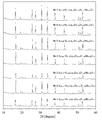
- X-ray diffraction measurements were performed on Samples 1 to 11 using CuK ⁇ as a radiation source.
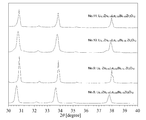
- the X-ray diffraction charts of Samples 1 to 7 are shown in FIGS. 3 and 4, and the X-ray diffraction charts of Samples 8 to 11 are shown in FIGS. 5 and 6.
- Electrodes having a diameter of 8 mm were formed on both surfaces of Samples 1 to 13 by Au sputtering to prepare a sample for measuring ionic conductivity.
- This sample was set in an all-solid-state battery evaluation cell (manufactured by Hosen Co., Ltd.) in a glove box with an argon atmosphere, connected to Potency Galvanosdat, and the ionic conductivity was evaluated by AC impedance measurement.
- the conditions for measuring the AC impedance were a frequency of 0.01 Hz to 1 MHz and a voltage of 50 mV. When two resistance components (bulk resistance and grain boundary resistance) were observed at the time of measurement, the ionic conductivity ⁇ Bulk of the bulk resistance was adopted.
- Table 1 shows the amount and composition of the raw materials charged in Samples 1 to 13 and the lithium ion conductivity ⁇ Bulk.
- Samples 1 to 13 all show lithium ion conductivity on the order of 10-5 S / cm or 10-4 S / cm, and by introducing a substituent, unsubstituted LLZ (lithium ion conductivity: 10-6). Compared with S / cm to 10-7 S / cm), the conductivity was improved.
- sample 1 showed the highest lithium ion conductivity.
- the conductivity was lower than that in the sample 1.
- the voids in Samples 2 and 3 are larger than those in Sample 1.
- the lattice constant is smaller
- the lattice constant becomes smaller and the diffusion path of lithium ions becomes narrower as the amount of substitution by Hf increases, and the Li content decreases, so that the conductivity is smaller than that of Sample 1. It is probable that it has become.
- Samples 4 and 5 in which the amount of Zn substitution was larger than that in sample 1 also had a lower conductivity than sample 1.
- the diffraction peaks of Samples 4 and 5 are shifted to the higher angle side as compared with Sample 1, and the diffusion path of lithium ions is narrowed, which means that the conductivity is lower than that of Sample 1. It is thought that this is one of the reasons why
- Samples 6 and 7 in which the amount of substitution by Nb was increased as compared with sample 1 showed a slight decrease in conductivity as compared with sample 1.
- Zr was replaced with Nb
- the Li content would increase and the conductivity would increase in order to compensate for the difference in charge, but such a phenomenon was not observed.
- the diffraction peaks of Samples 6 and 7 were slightly shifted to the higher angle side as compared with Sample 1.
- Nb introduced as a substitution element was introduced as a factor that caused a high angle shift in samples 6 and 7 having a large Nb substitution amount.
- Nb 5+ is La site and / or Zr. It is thought that the lattice constant will become smaller when introduced to the site. In addition, the decrease in Li content due to the introduction of Nb as Nb 5+ may also be a factor in the decrease in ionic conductivity.
- sample 8 showed the highest ionic conductivity.
- the samples 12 and 13 it is considered that the effect of introducing the substituent by Zn is small.
- the diffraction peak of sample 9 is shifted to the higher angle side as compared with sample 8, and the lattice constant becomes smaller and the diffusion path of Li ions becomes narrower, which is one of the causes of the decrease in conductivity. Is considered to be.
- the LLZ-based oxide containing Zn as a substituent has excellent lithium ion conductivity. Further, by adjusting the amount of Zn substitution and the type and amount of substitution elements other than Zn, there is a possibility that the lithium conductivity can be further improved.
Landscapes
- Chemical & Material Sciences (AREA)
- Engineering & Computer Science (AREA)
- Organic Chemistry (AREA)
- Manufacturing & Machinery (AREA)
- Inorganic Chemistry (AREA)
- Ceramic Engineering (AREA)
- Chemical Kinetics & Catalysis (AREA)
- General Chemical & Material Sciences (AREA)
- Electrochemistry (AREA)
- Materials Engineering (AREA)
- Structural Engineering (AREA)
- Physics & Mathematics (AREA)
- Condensed Matter Physics & Semiconductors (AREA)
- General Physics & Mathematics (AREA)
- Composite Materials (AREA)
- Secondary Cells (AREA)
- Conductive Materials (AREA)
Priority Applications (3)
| Application Number | Priority Date | Filing Date | Title |
|---|---|---|---|
| CN202080067464.8A CN114466822B (zh) | 2019-09-27 | 2020-09-07 | 氧化物、固体电解质、及全固态锂离子二次电池 |
| JP2021548753A JP7583730B2 (ja) | 2019-09-27 | 2020-09-07 | 酸化物、固体電解質、および全固体リチウムイオン二次電池 |
| US17/703,087 US12249686B2 (en) | 2019-09-27 | 2022-03-24 | Oxide, solid electrolyte and all-solid-state lithium ion secondary battery |
Applications Claiming Priority (2)
| Application Number | Priority Date | Filing Date | Title |
|---|---|---|---|
| JP2019-177871 | 2019-09-27 | ||
| JP2019177871 | 2019-09-27 |
Related Child Applications (1)
| Application Number | Title | Priority Date | Filing Date |
|---|---|---|---|
| US17/703,087 Continuation US12249686B2 (en) | 2019-09-27 | 2022-03-24 | Oxide, solid electrolyte and all-solid-state lithium ion secondary battery |
Publications (1)
| Publication Number | Publication Date |
|---|---|
| WO2021059939A1 true WO2021059939A1 (ja) | 2021-04-01 |
Family
ID=75165699
Family Applications (1)
| Application Number | Title | Priority Date | Filing Date |
|---|---|---|---|
| PCT/JP2020/033751 Ceased WO2021059939A1 (ja) | 2019-09-27 | 2020-09-07 | 酸化物、固体電解質、および全固体リチウムイオン二次電池 |
Country Status (4)
| Country | Link |
|---|---|
| US (1) | US12249686B2 (https=) |
| JP (1) | JP7583730B2 (https=) |
| CN (1) | CN114466822B (https=) |
| WO (1) | WO2021059939A1 (https=) |
Families Citing this family (3)
| Publication number | Priority date | Publication date | Assignee | Title |
|---|---|---|---|---|
| EP4129909A4 (en) * | 2020-03-31 | 2023-09-27 | Denka Company Limited | CARBON-CONTAINING ALUMINA POWDER, RESIN COMPOSITION, HEAT DISSIPATION COMPONENT, AND METHOD FOR PRODUCING CARBON-CONTAINING ALUMINA POWDER |
| CN117263701B (zh) * | 2022-06-15 | 2025-08-12 | 中国科学院上海硅酸盐研究所 | 一种锂石榴石型电解质烧结用埋粉和使用该埋粉制备锂石榴石型电解质的方法 |
| CN115458800A (zh) * | 2022-08-30 | 2022-12-09 | 淄博火炬能源有限责任公司 | 石榴石型固态电解质压片工艺 |
Citations (7)
| Publication number | Priority date | Publication date | Assignee | Title |
|---|---|---|---|---|
| JP2013243111A (ja) * | 2012-05-17 | 2013-12-05 | Ngk Insulators Ltd | 正極−固体電解質複合体の製造方法 |
| US20160064785A1 (en) * | 2014-08-27 | 2016-03-03 | Samsung Electronics Co., Ltd. | Lithium air battery and method of preparing the same |
| JP2016171068A (ja) * | 2015-03-10 | 2016-09-23 | Tdk株式会社 | ガーネット型リチウムイオン伝導性酸化物 |
| WO2017135461A1 (ja) * | 2016-02-05 | 2017-08-10 | 株式会社村田製作所 | 固体電解質及び全固体電池 |
| WO2018085847A1 (en) * | 2016-11-07 | 2018-05-11 | University Of Maryland, College Park | Lithium solid state electrolyte interface treatment |
| WO2019032514A1 (en) * | 2017-08-07 | 2019-02-14 | The Regents Of The University Of Michigan | IONIC AND ELECTRONIC MIXED DRIVER FOR SOLID BATTERY |
| CN109888374A (zh) * | 2019-01-22 | 2019-06-14 | 华南理工大学 | 一种多掺杂的石榴石型固体电解质材料及其制备方法 |
Family Cites Families (3)
| Publication number | Priority date | Publication date | Assignee | Title |
|---|---|---|---|---|
| JP5132639B2 (ja) | 2008-08-21 | 2013-01-30 | 日本碍子株式会社 | セラミックス材料及びその製造方法 |
| JP5525388B2 (ja) | 2009-09-03 | 2014-06-18 | 日本碍子株式会社 | セラミックス材料及びその製造方法 |
| US9991556B2 (en) | 2015-03-10 | 2018-06-05 | Tdk Corporation | Garnet-type li-ion conductive oxide |
-
2020
- 2020-09-07 CN CN202080067464.8A patent/CN114466822B/zh active Active
- 2020-09-07 WO PCT/JP2020/033751 patent/WO2021059939A1/ja not_active Ceased
- 2020-09-07 JP JP2021548753A patent/JP7583730B2/ja active Active
-
2022
- 2022-03-24 US US17/703,087 patent/US12249686B2/en active Active
Patent Citations (7)
| Publication number | Priority date | Publication date | Assignee | Title |
|---|---|---|---|---|
| JP2013243111A (ja) * | 2012-05-17 | 2013-12-05 | Ngk Insulators Ltd | 正極−固体電解質複合体の製造方法 |
| US20160064785A1 (en) * | 2014-08-27 | 2016-03-03 | Samsung Electronics Co., Ltd. | Lithium air battery and method of preparing the same |
| JP2016171068A (ja) * | 2015-03-10 | 2016-09-23 | Tdk株式会社 | ガーネット型リチウムイオン伝導性酸化物 |
| WO2017135461A1 (ja) * | 2016-02-05 | 2017-08-10 | 株式会社村田製作所 | 固体電解質及び全固体電池 |
| WO2018085847A1 (en) * | 2016-11-07 | 2018-05-11 | University Of Maryland, College Park | Lithium solid state electrolyte interface treatment |
| WO2019032514A1 (en) * | 2017-08-07 | 2019-02-14 | The Regents Of The University Of Michigan | IONIC AND ELECTRONIC MIXED DRIVER FOR SOLID BATTERY |
| CN109888374A (zh) * | 2019-01-22 | 2019-06-14 | 华南理工大学 | 一种多掺杂的石榴石型固体电解质材料及其制备方法 |
Non-Patent Citations (2)
| Title |
|---|
| YAN CHEN, RANGASAMY EZHIYLMURUGAN, LIANG CHENGDU, AN KE: "Origin of High Li+ Conduction in Doped Li7La3Zr2012 Garnets", CHEM. MATER., vol. 27, no. 16, 2015, pages 5491 - 5494, XP055807008, DOI: 10.1021/acs.chemmater.5b02521 * |
| YUE JIANG, ZHU XIAOHONG; QIN SHIYING; LING MING'EN; ZHU JILIANG: "Investigation of Mg2 +, Sc3 + and Zn2 + doping effects on densification and ionic conductivity of low-temperature sintered Li7La3Zr2O12 garnets", SOLID STATE IONICS, vol. 300, February 2017 (2017-02-01), pages 73 - 77, XP029893656, DOI: 10.1016/j.ssi.2016.12.005 * |
Also Published As
| Publication number | Publication date |
|---|---|
| US20220216510A1 (en) | 2022-07-07 |
| JPWO2021059939A1 (https=) | 2021-04-01 |
| JP7583730B2 (ja) | 2024-11-14 |
| CN114466822B (zh) | 2024-07-09 |
| US12249686B2 (en) | 2025-03-11 |
| CN114466822A (zh) | 2022-05-10 |
Similar Documents
| Publication | Publication Date | Title |
|---|---|---|
| US12438183B2 (en) | Solid electrolyte sheet, method for manufacturing same, and sodium ion all-solid-state secondary cell | |
| JP6672848B2 (ja) | ガーネット型又はガーネット型類似の結晶構造を有するリチウムイオン伝導性酸化物セラミックス材料 | |
| JP5617417B2 (ja) | ガーネット型リチウムイオン伝導性酸化物及びその製法 | |
| CN102010182B (zh) | 陶瓷材料及其利用 | |
| JP6242620B2 (ja) | 全固体電池 | |
| JP6735425B2 (ja) | イオン伝導性粉末、イオン伝導性成形体および蓄電デバイス | |
| JP6451672B2 (ja) | ペロブスカイト型イオン伝導性酸化物、複合体及びリチウム二次電池 | |
| EP4145559A1 (en) | Positive electrode material, and battery | |
| JP2016171068A (ja) | ガーネット型リチウムイオン伝導性酸化物 | |
| CN111033859A (zh) | 固体电解质及全固体电池 | |
| US12249686B2 (en) | Oxide, solid electrolyte and all-solid-state lithium ion secondary battery | |
| EP3736832A1 (en) | Solid electrolyte material, and battery | |
| EP4187639A1 (en) | Positive electrode material and battery | |
| JP2023021987A (ja) | リチウムイオン伝導性固体電解質およびリチウムイオン伝導性固体電解質の製造方法 | |
| US20250112270A1 (en) | Solid electrolyte, preparation method thereof, and electrochemical device including the same | |
| JP2019125547A (ja) | 固体電解質粉末、並びにそれを用いてなる電極合材及び全固体ナトリウムイオン二次電池 | |
| WO2021251405A1 (ja) | 固体電解質材料、固体電解質、これらの製造方法および全固体電池 | |
| JP7150650B2 (ja) | リチウムイオン伝導性材料、全固体二次電池および固体電解質の製造方法 | |
| WO2020194823A1 (ja) | 全固体二次電池 | |
| CN113439311A (zh) | 离子传导体、蓄电装置和离子传导体的制造方法 | |
| CN117895061A (zh) | 具有优异湿度稳定性的固体电解质及其制备方法 | |
| JP7595621B2 (ja) | イオン伝導性物質、電解質、及び電池 | |
| KR20240161038A (ko) | 세라믹 시트, 그 제조방법 및 이를 포함하는 전고체 이차전지 | |
| JP7445504B2 (ja) | リチウムイオン伝導体、蓄電デバイス、および、リチウムイオン伝導体の製造方法 | |
| EP4270546A1 (en) | Positive electrode active material and lithium-ion secondary battery |
Legal Events
| Date | Code | Title | Description |
|---|---|---|---|
| 121 | Ep: the epo has been informed by wipo that ep was designated in this application |
Ref document number: 20870309 Country of ref document: EP Kind code of ref document: A1 |
|
| ENP | Entry into the national phase |
Ref document number: 2021548753 Country of ref document: JP Kind code of ref document: A |
|
| NENP | Non-entry into the national phase |
Ref country code: DE |
|
| 122 | Ep: pct application non-entry in european phase |
Ref document number: 20870309 Country of ref document: EP Kind code of ref document: A1 |