WO2021010366A1 - ポリカーボネート樹脂組成物 - Google Patents
ポリカーボネート樹脂組成物 Download PDFInfo
- Publication number
- WO2021010366A1 WO2021010366A1 PCT/JP2020/027189 JP2020027189W WO2021010366A1 WO 2021010366 A1 WO2021010366 A1 WO 2021010366A1 JP 2020027189 W JP2020027189 W JP 2020027189W WO 2021010366 A1 WO2021010366 A1 WO 2021010366A1
- Authority
- WO
- WIPO (PCT)
- Prior art keywords
- resin composition
- polycarbonate resin
- mass
- parts
- filler
- Prior art date
- Legal status (The legal status is an assumption and is not a legal conclusion. Google has not performed a legal analysis and makes no representation as to the accuracy of the status listed.)
- Ceased
Links
Classifications
-
- C—CHEMISTRY; METALLURGY
- C08—ORGANIC MACROMOLECULAR COMPOUNDS; THEIR PREPARATION OR CHEMICAL WORKING-UP; COMPOSITIONS BASED THEREON
- C08L—COMPOSITIONS OF MACROMOLECULAR COMPOUNDS
- C08L69/00—Compositions of polycarbonates; Compositions of derivatives of polycarbonates
-
- C—CHEMISTRY; METALLURGY
- C08—ORGANIC MACROMOLECULAR COMPOUNDS; THEIR PREPARATION OR CHEMICAL WORKING-UP; COMPOSITIONS BASED THEREON
- C08K—Use of inorganic or non-macromolecular organic substances as compounding ingredients
- C08K3/00—Use of inorganic substances as compounding ingredients
- C08K3/01—Use of inorganic substances as compounding ingredients characterized by their specific function
- C08K3/013—Fillers, pigments or reinforcing additives
-
- C—CHEMISTRY; METALLURGY
- C08—ORGANIC MACROMOLECULAR COMPOUNDS; THEIR PREPARATION OR CHEMICAL WORKING-UP; COMPOSITIONS BASED THEREON
- C08K—Use of inorganic or non-macromolecular organic substances as compounding ingredients
- C08K3/00—Use of inorganic substances as compounding ingredients
- C08K3/34—Silicon-containing compounds
-
- C—CHEMISTRY; METALLURGY
- C08—ORGANIC MACROMOLECULAR COMPOUNDS; THEIR PREPARATION OR CHEMICAL WORKING-UP; COMPOSITIONS BASED THEREON
- C08K—Use of inorganic or non-macromolecular organic substances as compounding ingredients
- C08K7/00—Use of ingredients characterised by shape
-
- C—CHEMISTRY; METALLURGY
- C08—ORGANIC MACROMOLECULAR COMPOUNDS; THEIR PREPARATION OR CHEMICAL WORKING-UP; COMPOSITIONS BASED THEREON
- C08L—COMPOSITIONS OF MACROMOLECULAR COMPOUNDS
- C08L21/00—Compositions of unspecified rubbers
-
- C—CHEMISTRY; METALLURGY
- C08—ORGANIC MACROMOLECULAR COMPOUNDS; THEIR PREPARATION OR CHEMICAL WORKING-UP; COMPOSITIONS BASED THEREON
- C08L—COMPOSITIONS OF MACROMOLECULAR COMPOUNDS
- C08L23/00—Compositions of homopolymers or copolymers of unsaturated aliphatic hydrocarbons having only one carbon-to-carbon double bond; Compositions of derivatives of such polymers
- C08L23/02—Compositions of homopolymers or copolymers of unsaturated aliphatic hydrocarbons having only one carbon-to-carbon double bond; Compositions of derivatives of such polymers not modified by chemical after-treatment
-
- C—CHEMISTRY; METALLURGY
- C08—ORGANIC MACROMOLECULAR COMPOUNDS; THEIR PREPARATION OR CHEMICAL WORKING-UP; COMPOSITIONS BASED THEREON
- C08L—COMPOSITIONS OF MACROMOLECULAR COMPOUNDS
- C08L23/00—Compositions of homopolymers or copolymers of unsaturated aliphatic hydrocarbons having only one carbon-to-carbon double bond; Compositions of derivatives of such polymers
- C08L23/26—Compositions of homopolymers or copolymers of unsaturated aliphatic hydrocarbons having only one carbon-to-carbon double bond; Compositions of derivatives of such polymers modified by chemical after-treatment
-
- C—CHEMISTRY; METALLURGY
- C08—ORGANIC MACROMOLECULAR COMPOUNDS; THEIR PREPARATION OR CHEMICAL WORKING-UP; COMPOSITIONS BASED THEREON
- C08L—COMPOSITIONS OF MACROMOLECULAR COMPOUNDS
- C08L27/00—Compositions of homopolymers or copolymers of compounds having one or more unsaturated aliphatic radicals, each having only one carbon-to-carbon double bond, and at least one being terminated by a halogen; Compositions of derivatives of such polymers
- C08L27/02—Compositions of homopolymers or copolymers of compounds having one or more unsaturated aliphatic radicals, each having only one carbon-to-carbon double bond, and at least one being terminated by a halogen; Compositions of derivatives of such polymers not modified by chemical after-treatment
- C08L27/12—Compositions of homopolymers or copolymers of compounds having one or more unsaturated aliphatic radicals, each having only one carbon-to-carbon double bond, and at least one being terminated by a halogen; Compositions of derivatives of such polymers not modified by chemical after-treatment containing fluorine atoms
-
- C—CHEMISTRY; METALLURGY
- C08—ORGANIC MACROMOLECULAR COMPOUNDS; THEIR PREPARATION OR CHEMICAL WORKING-UP; COMPOSITIONS BASED THEREON
- C08L—COMPOSITIONS OF MACROMOLECULAR COMPOUNDS
- C08L27/00—Compositions of homopolymers or copolymers of compounds having one or more unsaturated aliphatic radicals, each having only one carbon-to-carbon double bond, and at least one being terminated by a halogen; Compositions of derivatives of such polymers
- C08L27/02—Compositions of homopolymers or copolymers of compounds having one or more unsaturated aliphatic radicals, each having only one carbon-to-carbon double bond, and at least one being terminated by a halogen; Compositions of derivatives of such polymers not modified by chemical after-treatment
- C08L27/12—Compositions of homopolymers or copolymers of compounds having one or more unsaturated aliphatic radicals, each having only one carbon-to-carbon double bond, and at least one being terminated by a halogen; Compositions of derivatives of such polymers not modified by chemical after-treatment containing fluorine atoms
- C08L27/18—Homopolymers or copolymers or tetrafluoroethene
-
- C—CHEMISTRY; METALLURGY
- C08—ORGANIC MACROMOLECULAR COMPOUNDS; THEIR PREPARATION OR CHEMICAL WORKING-UP; COMPOSITIONS BASED THEREON
- C08L—COMPOSITIONS OF MACROMOLECULAR COMPOUNDS
- C08L51/00—Compositions of graft polymers in which the grafted component is obtained by reactions only involving carbon-to-carbon unsaturated bonds; Compositions of derivatives of such polymers
- C08L51/04—Compositions of graft polymers in which the grafted component is obtained by reactions only involving carbon-to-carbon unsaturated bonds; Compositions of derivatives of such polymers grafted on to rubbers
-
- C—CHEMISTRY; METALLURGY
- C08—ORGANIC MACROMOLECULAR COMPOUNDS; THEIR PREPARATION OR CHEMICAL WORKING-UP; COMPOSITIONS BASED THEREON
- C08L—COMPOSITIONS OF MACROMOLECULAR COMPOUNDS
- C08L9/00—Compositions of homopolymers or copolymers of conjugated diene hydrocarbons
-
- C—CHEMISTRY; METALLURGY
- C08—ORGANIC MACROMOLECULAR COMPOUNDS; THEIR PREPARATION OR CHEMICAL WORKING-UP; COMPOSITIONS BASED THEREON
- C08L—COMPOSITIONS OF MACROMOLECULAR COMPOUNDS
- C08L2201/00—Properties
- C08L2201/08—Stabilised against heat, light or radiation or oxydation
Definitions
- the present invention relates to a polycarbonate resin composition and an optical module, and more particularly to a polycarbonate resin composition and an optical module which are excellent in rigidity and impact resistance, exhibit low anisotropy, and are also excellent in moisture and heat resistance.
- Polycarbonate resin has excellent mechanical properties and is widely used as an engineering plastic, and depending on the field of application, various strengthening agents and additives may be added for the purpose of improving the properties, especially the mechanical properties. It has been broken. In fields where high mechanical strength and rigidity are required, fibrous reinforcing materials such as glass fibers are used. However, although the resin composition obtained by blending the glass fiber with the polycarbonate resin has excellent mechanical strength and rigidity, it has a drawback that anisotropy of the molding shrinkage rate occurs due to the orientation of the fiber.
- optical modules such as a lens barrel tubular body (lens barrel) have been made into a resin in order to reduce the weight and cost. Materials reinforced with fiberglass are also used.
- the lens barrel sufficient rigidity and high dimensional accuracy are required for the material of the lens barrel so that the optical axis of the optical system does not shift during focusing or zoom driving.
- Patent Document 1 proposes an aromatic polycarbonate resin composition having improved mechanical strength and flame retardancy, which comprises a polycarbonate resin, a flat cross-sectional glass fiber having a specific cross-sectional shape, and a phosphoric acid ester flame retardant.
- a polycarbonate resin composition in which flat cross-section glass fiber and glass flakes having a thickness of 5 ⁇ m are blended in a specific amount ratio and further contains a phosphate ester flame retardant and polytetrafluoroethylene is described.
- the anisotropy is not sufficiently satisfactory, and since a phosphorus-based flame retardant is used, the impact strength and heat resistance are likely to decrease due to the plasticization of the polycarbonate resin.
- the heat resistance and anisotropy were insufficient and unsatisfactory.
- the resin material needs to have low anisotropy, and the resin material and aluminum, magnesium, etc. Since it is composited with a metal (or alloy), it is necessary to prevent the optical axis from shifting due to the difference in thermal expansion even at a wide operating environment temperature, and the resin material is required to have a linear expansion coefficient close to those of these metals.
- the lens and lens barrel are integrated due to their structure, and the resin material of the lens barrel expands linearly to prevent optical axis deviation. It is required to match the coefficient with the lens.
- the present invention has been made in view of the above circumstances, and an object (problem) thereof is to provide a polycarbonate resin composition and an optical module having excellent rigidity and impact resistance and further exhibiting low anisotropy.
- the inventor of the present invention improves rigidity and low anisotropy by blending a polycarbonate resin with a fine filler having a specific average particle size, and at that time, a filler having a large average particle diameter of 10 ⁇ m or more. It was found that it is better not to add more than a specific amount of or phosphorus-based flame retardants. Furthermore, by combining an olefin / maleic anhydride copolymer, an elastomer, and a fluororesin in a specific amount ratio, the impact strength is dramatically improved, and the characteristics of high rigidity and high impact resistance are exhibited.
- the present invention relates to the following polycarbonate resin compositions, molded articles, and optical modules.
- the filler exceeds the content, the content is less than 10% by mass in the resin composition, and when the phosphorus-based flame retardant is contained, the content is 2% or less in the resin composition.
- Polycarbonate resin composition containing 1 to 50 parts by mass of a filler (B) having an average particle size of 0.1 to 10 ⁇ m with respect to 100 parts by mass of the polycarbonate resin (A), wherein the average particle size is 10 ⁇ m.
- the filler (B) is a plate-shaped filler, and is at least one selected from talc, mica, glass flakes, montmorillonite, hydrotalcite, sericite, kaolin, alumina, clay, and graphite.
- a notched Charpy made of a resin composition containing 1 to 50 parts by mass of a filler (B) having an average particle size of 0.1 to 10 ⁇ m with respect to 100 parts by mass of the polycarbonate resin (A), and measured based on ISO179.
- An optical module including a molded body having an impact strength of 20 kJ / m 2 or more.
- the resin composition further contains 0.1 to 5 parts by mass of the olefin / maleic anhydride copolymer (C) and 1 to 25 parts by mass of the elastomer (D) with respect to 100 parts by mass of the polycarbonate resin (A).
- the resin composition has a notched Charpy impact strength of 10 kJ / m 2 or more after 100 hours of treatment under the conditions of a temperature of 85 ° C.
- the polycarbonate resin composition of the present invention is excellent in rigidity and impact resistance, exhibits low anisotropy, and is also excellent in moisture and heat resistance.
- a fine filler (B) having an average particle size of 0.1 to 10 ⁇ m rigidity and low anisotropy are improved, and optical performance is deteriorated even when used in an optical module or the like. Can be suppressed.
- the olefin / maleic anhydride copolymer (C) is blended to suppress the resin deterioration of the polycarbonate resin due to the filler (B), the impact resistance is further improved by the elastomer (D), and further.
- the compounding of the fluororesin (E) acts like a surfactant to improve the impact resistance, and can exhibit rigidity, impact resistance, low anisotropy, and moist heat resistance.
- the optical module of the present invention is an optical module containing a molded body made of the above polycarbonate resin composition, and is excellent in rigidity, impact resistance and low anisotropy, so that it does not deform and has extremely good dimensional accuracy. It is effective as a high-performance optical module that does not break even if dropped.
- X is generally a hydrocarbon, but X with a heteroatom or a heterobond introduced may be used to impart various properties.
- the polycarbonate resin can be classified into an aromatic polycarbonate resin in which the carbon directly bonded to the carbonic acid bond is an aromatic carbon and an aliphatic polycarbonate resin in which the carbon is an aliphatic carbon, and any of them can be used. Of these, aromatic polycarbonate resins are preferable from the viewpoints of heat resistance, mechanical properties, electrical properties, and the like.
- the specific type of the polycarbonate resin is not limited, and examples thereof include a polycarbonate polymer obtained by reacting a dihydroxy compound with a carbonate precursor. At this time, in addition to the dihydroxy compound and the carbonate precursor, a polyhydroxy compound or the like may be reacted. Alternatively, a method of reacting carbon dioxide with cyclic ether using carbon dioxide as a carbonate precursor may be used. Further, the polycarbonate polymer may be linear or branched. Further, the polycarbonate polymer may be a copolymer composed of one type of repeating unit or a copolymer having two or more types of repeating units. At this time, as the copolymer, various copolymer forms such as a random copolymer and a block copolymer can be selected. Usually, such a polycarbonate polymer becomes a thermoplastic resin.
- aromatic dihydroxy compounds include Dihydroxybenzenes such as 1,2-dihydroxybenzene, 1,3-dihydroxybenzene (ie resorcinol), 1,4-dihydroxybenzene; Dihydroxybiphenyls such as 2,5-dihydroxybiphenyl, 2,2'-dihydroxybiphenyl, 4,4'-dihydroxybiphenyl;
- 1,1-bis (4-hydroxyphenyl) cyclopentane 1,1-bis (4-hydroxyphenyl) cyclohexane, 1,1-bis (4-hydroxyphenyl) -3,3-dimethylcyclohexane, 1,1-bis (4-hydroxyphenyl) -3,4-dimethylcyclohexane, 1,1-bis (4-hydroxyphenyl) -3,5-dimethylcyclohexane, 1,1-bis (4-hydroxyphenyl) -3,3,5-trimethylcyclohexane, 1,1-bis (4-hydroxy-3,5-dimethylphenyl) -3,3,5-trimethylcyclohexane, 1,1-bis (4-hydroxyphenyl) -3-propyl-5-methylcyclohexane, 1,1-bis (4-hydroxyphenyl) -3-tert-butyl-cyclohexane, 1,1-bis (4-hydroxyphenyl) -4-tert-butyl-cyclohexan
- Dihydroxydiarylsulfoxides such as 4,4'-dihydroxydiphenylsulfoxide, 4,4'-dihydroxy-3,3'-dimethyldiphenylsulfoxide;
- bis (hydroxyaryl) alkanes are preferable, and bis (4-hydroxyphenyl) alkanes are particularly preferable, and 2,2-bis (4-hydroxyphenyl) propane (particularly from the viewpoint of impact resistance and heat resistance). That is, bisphenol A) and 2,2-bis (3-methyl-4-hydroxyphenyl) propane (that is, bisphenol C) are preferable.
- the aromatic dihydroxy compound one type may be used, or two or more types may be used in any combination and ratio.
- Ethan-1,2-diol propane-1,2-diol, propane-1,3-diol, 2,2-dimethylpropane-1,3-diol, 2-methyl-2-propylpropane-1,3- Alkanediols such as diols, butane-1,4-diols, pentane-1,5-diols, hexane-1,6-diols and decane-1,10-diols;
- Glycols such as ethylene glycol, 2,2'-oxydiethanol (that is, diethylene glycol), triethylene glycol, propylene glycol, and spiroglycol;
- 1,2-Epoxide ethane ie, ethylene oxide
- 1,2-epoxide propane ie, propylene oxide
- 1,2-epoxycyclopentane 1,2-epoxycyclohexane
- 1,4-epoxide cyclohexane 1-methyl Cyclic ethers such as -1,2-epoxycyclohexane, 2,3-epoxide norbornane, and 1,3-epoxide propane; and the like.
- carbonate precursors examples of carbonate precursors.
- the carbonate precursor one kind may be used, or two or more kinds may be used in any combination and ratio.
- carbonyl halide examples include phosgene; a bischloroformate of a dihydroxy compound, a haloformate of a monochloroformate of a dihydroxy compound, and the like.
- carbonate ester examples include diaryl carbonates such as diphenyl carbonate and ditril carbonate; dialkyl carbonates such as dimethyl carbonate and diethyl carbonate; biscarbonate of dihydroxy compound, monocarbonate of dihydroxy compound, and cyclic carbonate. Examples thereof include carbonates of dihydroxy compounds such as.
- the method for producing the polycarbonate resin is not particularly limited, and any method can be adopted. Examples thereof include an interfacial polymerization method, a melt transesterification method, a pyridine method, a ring-opening polymerization method of a cyclic carbonate compound, and a solid phase transesterification method of a prepolymer.
- a preferred example of the polycarbonate resin is a polycarbonate resin in which bisphenol A or bisphenol A is used in combination with another aromatic dihydroxy compound, or bisphenol C or bisphenol C is used in combination with another aromatic dihydroxy compound (particularly bisphenol A).
- Examples thereof include a polycarbonate resin obtained from the above, and a blend of these resins.
- the molecular weight of the polycarbonate resin (A) is preferably in the range of 16,000 to 50,000, more preferably 18,000 or more, still more preferably 20,000 or more, still more preferably 45,000 or less, still more preferably 45,000 or less, in terms of viscosity average molecular weight (Mv). Is 40,000, particularly preferably 38,000 or less. If the viscosity average molecular weight is smaller than 16000, the impact resistance of the molded product is likely to decrease and cracks may occur, which is not preferable. If the viscosity average molecular weight is larger than 50,000, the fluidity deteriorates and the moldability becomes a problem. It is not preferable because it is easy.
- the polycarbonate resin (A) may be used by mixing two or more types of polycarbonate resins having different viscosity average molecular weights. In this case, a polycarbonate resin having a viscosity average molecular weight outside the above-mentioned suitable range is mixed. You may.
- the viscosity average molecular weight [Mv] of the polycarbonate resin is the ultimate viscosity [ ⁇ ] (unit: dl / g) at a temperature of 25 ° C. using a Ubbelohde viscometer using methylene chloride as a solvent.
- Schnell's viscosity formula, ie ⁇ 1.23 ⁇ 10 -4 Mv It means a value calculated from 0.83 .
- the ultimate viscosity [ ⁇ ] is a value calculated by the following formula by measuring the specific viscosity [ ⁇ sp ] at each solution concentration [C] (g / dl).
- a polycarbonate resin is used as a copolymer with an oligomer or polymer having a siloxane structure; thermal oxidation stability and flame retardancy.
- the polycarbonate resin may contain a polycarbonate oligomer in order to improve the appearance and fluidity of the molded product.
- the viscosity average molecular weight (Mv) of this polycarbonate oligomer is usually 1500 or more, preferably 2000 or more, and usually 9500 or less, preferably 9000 or less.
- the content is preferably 30 parts by mass or less, more preferably 20 parts by mass or less, and particularly preferably 10 parts by mass or less, based on 100 parts by mass of the polycarbonate resin (A).
- the lower limit is preferably 1 part by mass or more, more preferably 2 parts by mass or more, and particularly preferably 3 parts by mass or more.
- the polycarbonate resin may be not only a virgin raw material but also a polycarbonate resin recycled from a used product (so-called material recycled polycarbonate resin).
- the regenerated polycarbonate resin is preferably 80% by mass or less, and more preferably 50% by mass or less of the polycarbonate resin (A). Since the regenerated polycarbonate resin is likely to be deteriorated by heat deterioration, aging deterioration, etc., if such a polycarbonate resin is used in a larger amount than the above range, the hue and mechanical properties can be deteriorated. Because it has sexual characteristics.
- filler (B) As the filler (B), a filler having an average particle size of 0.1 to 10 ⁇ m is used.
- the average particle size of the filler (B) is preferably 9 ⁇ m or less, more preferably 8 ⁇ m or less, 7 ⁇ m or less, 6 ⁇ m or less, 5 ⁇ m or less, 4 ⁇ m or less, and particularly preferably 3 ⁇ m or less, particularly 2.5 ⁇ m or less. Further, it is preferably 0.12 ⁇ m or more, more preferably 0.15 ⁇ m or more, 0.18 ⁇ m or more, and particularly preferably 0.2 ⁇ m or more, particularly 0.25 ⁇ m or more.
- the average particle size of the filler (B) is a D 50 average particle size determined by laser diffraction.
- the filler (B) is preferably an inorganic filler, more preferably a plate-shaped filler, specifically talc, mica, glass flakes, montmorillonite, hydrotalc stone, sericite, kaolin, alumina, clay, graphite and the like. Is preferable, one type may be used alone, or two or more types may be mixed and used. Of these, talc and mica are preferred.
- the polycarbonate resin composition of the present invention preferably contains talc as the filler (B).
- talc the filler
- the resin composition can be made to have lower anisotropy and low linear expansion, and the rigidity can be further improved.
- talc is a hydrous magnesium silicate having a layered structure.
- the talc one having an average particle size of 0.1 to 10 ⁇ m is used.
- the average particle size is preferably 0.3 to 8 ⁇ m, more preferably 0.7 to 5 ⁇ m.
- the thermal stability of the resin composition tends to be further improved by setting the average particle size to 0.1 ⁇ m or more, and the appearance and rigidity of the molded product of the resin composition are further improved by setting the average particle size to less than 10 ⁇ m. To do.
- the talc is surface-treated in order to enhance the affinity with the polycarbonate resin (A).
- the surface treatment agent include alcohols such as trimethylolethane, trimethylolpropane, and pentaerythritol, alkanolamines such as triethylamine, and organic silicone compounds such as organopolysiloxane.
- Higher fatty acids such as stearic acid, fatty acid metal salts such as calcium stearate and magnesium stearate, hydrocarbon lubricants such as polyethylene wax and liquid paraffin, basic amino acids such as lysine and arginine, polyglycerin and derivatives thereof, and silanes.
- At least one selected from coupling agents such as coupling agents, titanate-based coupling agents, and aluminum-based coupling agents can be mentioned.
- the talc is preferably in the form of granules granulated using a binder from the viewpoint of surface appearance and thermal stability when contained in the resin composition.
- the bulk density of the granular talc is preferably 0.4 to 1.5 g / ml.
- the preferable content of the filler (B) is 1 to 50 parts by mass with respect to 100 parts by mass of the polycarbonate resin fat (A). Within such a range, low-line expansion and sufficient mechanical properties can be obtained. If the content of the filler (B) is less than 1 part by mass, low linear expansion cannot be achieved and the rigidity is insufficient, and if it exceeds 50 parts by mass, the production stability is lowered and the toughness is also lowered. To do.
- the content of the filler is preferably 3 parts by mass or more, more preferably 5 parts by mass or more, preferably 45 parts by mass or less, more preferably 40 parts by mass or less, and further 35 parts by mass or less, particularly 30 parts by mass. Part or less is preferable.
- the polycarbonate resin composition of the present invention is characterized in that, when a filler having an average particle size of more than 10 ⁇ m is contained, the content thereof is less than 10% by mass in the resin composition.
- a filler having an average particle size of more than 10 ⁇ m hereinafter, also referred to as a filler (BX)
- BX the filler having an average particle size of more than 10 ⁇ m
- a filler of the same type as the filler (B) used and having an average particle diameter of more than 10 ⁇ m is used. It may be blended, or it may be a filler different from the filler used (B) and having an average particle size of more than 10 ⁇ m.
- the filler (BX) is not contained, or when it is contained, the content is less than 10% by mass in the resin composition.
- the filler (BX) different from the filler (B) for example, a whisker-like filler such as potassium titanate or aluminum borate, a fibrous filler such as carbon fiber or glass fiber, or the like is preferable. It can be illustrated. In the present invention, when the filler (BX) is whisker-shaped, needle-shaped, fibrous, or the like, the average fiber length of the filler (BX) is applied.
- the proportion in the polycarbonate resin composition is less than 10% by mass, preferably less than 0% by mass or less than 10% by mass, more preferably 0% by mass or in the resin composition. It is less than 7% by mass, 0% by mass or less than 5% by mass, 0% by mass or less than 3% by mass.
- the content ratio of the filler (BX) exceeds the above upper limit value, problems such as deterioration of the optical performance of the lens unit of the optical module occur.
- an olefin / maleic anhydride copolymer and / or a maleic anhydride-modified olefin polymer is preferable.
- the olefin / maleic anhydride copolymer is a copolymer of maleic anhydride and ⁇ -olefin, a copolymer of a conjugated diene-based monomer, and a copolymer of a conjugated diene / aromatic vinyl-based monomer. And so on.
- ⁇ -olefins having 2 to 10 carbon atoms such as ethylene, propylene, butene-1, penten-1, hexene-1, 4-methylpentene-1, octene-1, 1-decene and the like are preferably mentioned. These may be used alone or in combination of two or more. Among these, ethylene, propylene, butene-1, hexene-1, and octene-1 are more preferable, and a combination of ethylene with propylene, butene-1, hexene-1, or octene-1 is particularly preferable.
- Conjugated diene-based monomers include conjugates of 1,3-butadiene, isoprene (ie, 2-methyl-1,3-butadiene), 2,3-dimethyl-1,3-butadiene, and 1,3-pentadiene. Diene monomers can be used alone or in combination of two or more. As these, those in which a part or all of the unsaturated bonds existing in the polymer are reduced by hydrogenation can also be preferably used.
- aromatic vinyl-based monomer examples include styrene, ⁇ -methylstyrene, o-methylstyrene, p-methylstyrene, 1,3-dimethylstyrene, vinylnaphthalene and the like, and among them, styrene can be preferably used.
- maleic anhydride-ethylene-propylene copolymer and maleic anhydride-ethylene-butene-1 copolymer are particularly preferable.
- olefin-based polymer in the maleic anhydride-modified olefin polymer examples include homopolymers of ⁇ -olefins such as ethylene, propylene, butene-1, penten-1, hexene-1, 4-methylpentene-1, and octene-1.
- ethylene-based copolymers, conjugated diene-based polymers (monopolymers or copolymers of diolefin-based monomers), conjugated diene / aromatic vinyl hydrocarbon-based copolymers, non-conjugated diene, etc. can be mentioned. , These can be used by mixing two or more kinds.
- the homopolymer referred to here examples include polyethylene, polypropylene, polybutene and the like.
- polyethylene those having any molecular structure such as LDPE, LLDPE and HDPE can be preferably used.
- the ethylene-based copolymer refers to a copolymer of ethylene and another monomer and a multiple copolymer. In the ethylene-based copolymer, the copolymerization amount of ethylene is preferably 50 to 99 mol%.
- the other monomer copolymerized with ethylene can be selected from ⁇ -olefins having 3 or more carbon atoms, non-conjugated diene, vinyl acetate and the like. Examples of the ⁇ -olefin having 3 or more carbon atoms include propylene, butene-1, penten-1, 3-methylpentene-1, octene-1, and propylene and butene-1 can be preferably used.
- ethylene-based copolymers a copolymer of ethylene and an ⁇ -olefin having 3 or more carbon atoms is preferable, and specifically, an ethylene-propylene copolymer, an ethylene-butene-1 copolymer and the like are used. Particularly preferred.
- Non-conjugated dienes include 5-methyriden-2-norbornene, 5-ethylidene-2-norbornene, 5-vinyl-2-norbornene, 5-propenyl-2-norbornene, 5-isopropenyl-2-norbornene, 5-.
- Norbornene compounds such as crotyl-2-norbornene, 5- (2-methyl-2-butenyl) -2-norbornene, 5- (2-ethyl-2-butenyl) -2-norbornene, 5-methyl-5-vinylnorbornene , Dicyclopentadiene, methyltetrahydroinden, 4,7,8,9-tetrahydroinden, 1,5-cyclooctadiene, 1,4-hexadiene, isoprene, 6-methyl-1,5-heptadiene, 11-tridecadien, etc.
- 5-Methylidene-2-norbornene, 5-ethylidene-2-norbornene, dicyclopentadiene, 1,4-hexadien and the like are preferable.
- conjugated diene polymer a single amount of conjugated diene such as 1,3-butadiene, isoprene (2-methyl-1,3-butadiene), 2,3-dimethyl-1,3-butadiene, and 1,3-pentadiene. Examples thereof include homopolymers and copolymers of the compound. Those in which some or all of the unsaturated bonds present in these polymers are reduced by hydrogenation can also be preferably used.
- a copolymer of a conjugated diene and an aromatic vinyl hydrocarbon can also be used.
- block copolymers or random copolymers having various ratios of conjugated diene to aromatic vinyl hydrocarbons include the above-mentioned monomers as examples of the conjugated diene constituting the block copolymers or random copolymers. 3-butadiene and isoprene are preferable.
- aromatic vinyl hydrocarbons include styrene, ⁇ -methylstyrene, o-methylstyrene, p-methylstyrene, 1,3-dimethylstyrene, vinylnaphthalene and the like, and among them, styrene can be preferably used.
- a conjugated diene / aromatic vinyl hydrocarbon-based copolymer in which a part or all of unsaturated bonds other than the aromatic ring is reduced by hydrogenation.
- Preferred examples include a styrene-butadiene-styrene block copolymer and a copolymer obtained by partially adding a styrene-butadiene-styrene block copolymer.
- Preferred examples of the olefin-based polymer described above include an ethylene / propylene copolymer, an ethylene / butene-1 copolymer, and a copolymer obtained by partially hydrolyzing a styrene / butadiene / styrene block copolymer. It can be mentioned, and an ethylene / propylene copolymer is particularly preferable.
- the maleic anhydride-modified olefin polymer is obtained by graft-modifying maleic anhydride to the olefin-based polymer.
- a known method can be used for the method of graft modification.
- an extruder can be used to mix and react a predetermined amount of unsaturated carboxylic acids with a molten olefin polymer.
- the amount of maleic anhydride to be graft-reacted is usually in the range of 0.005 to 25% by mass, preferably 0.01 to 20% by mass, based on 100% by mass of the maleic anhydride-modified olefin polymer.
- the preferable content of the olefin / maleic anhydride copolymer (C) is 0.1 to 5 parts by mass with respect to 100 parts by mass of the polycarbonate resin fat (A). Within such a range, deterioration of the polycarbonate resin can be suppressed, impact resistance is high, and mold contamination due to generated gas is reduced. If the content of the copolymer (C) is less than 0.1 parts by mass, the impact resistance of the molded product is lowered, and if it exceeds 5 parts by mass, the rigidity of the molded product is lowered, and it is generated during molding. Mold contamination caused by gas increases.
- the content of the copolymer (C) is preferably 0.3 parts by mass or more, more preferably 0.5 parts by mass or more, preferably 4.5 parts by mass or less, and more preferably 4 parts by mass or less. Further, 3.5 parts by mass or less, particularly 3 parts by mass or less, particularly 2.5 parts by mass or less, particularly 2 parts by mass or less is preferable.
- the elastomer used in the present invention is preferably a graft copolymer obtained by graft-copolymerizing a rubber component with a copolymerizable monomer component.
- the method for producing the graft copolymer may be any of bulk polymerization, solution polymerization, suspension polymerization, emulsion polymerization and the like, and the copolymerization method may be a one-step graft or a multi-step graft.
- the glass transition temperature is usually 0 ° C. or lower, particularly preferably ⁇ 20 ° C. or lower, and further preferably ⁇ 30 ° C. or lower.
- the rubber component include polybutadiene rubber, polyisoprene rubber, polybutyl acrylate and poly (2-ethylhexyl acrylate), polyalkyl acrylate rubber such as butyl acrylate and 2-ethylhexyl acrylate copolymer, and polyorganosiloxane rubber.
- IPN Interpentrating Polymer Network
- silicone rubber butadiene-acrylic composite rubber, polyorganosiloxane rubber and polyalkylacrylate rubber, styrene-butadiene rubber, ethylene-propylene rubber, ethylene-butene rubber, ethylene-octene rubber, etc.
- examples thereof include ethylene- ⁇ -olefin rubber, ethylene-acrylic rubber, and fluororubber. These may be used alone or in combination of two or more.
- polybutadiene rubber polyalkyl acrylate rubber, polyorganosiloxane rubber, IPN type composite rubber composed of polyorganosiloxane rubber and polyalkylacrylate rubber, and styrene-butadiene rubber are preferable from the viewpoint of mechanical properties and surface appearance. ..
- the rubber component and the monomer component that can be graft-copolymerized include aromatic vinyl compounds, vinyl cyanide compounds, (meth) acrylic acid ester compounds, (meth) acrylic acid compounds, and glycidyl (meth) acrylate.
- One of these monomer components may be used alone, or two or more thereof may be used in combination.
- aromatic vinyl compounds, vinyl cyanide compounds, (meth) acrylic acid ester compounds, and (meth) acrylic acid compounds are preferable, and (meth) acrylic acid ester is more preferable, from the viewpoint of mechanical properties and surface appearance. It is a compound.
- Specific examples of the (meth) acrylic acid ester compound include methyl (meth) acrylate, ethyl (meth) acrylate, butyl (meth) acrylate, cyclohexyl (meth) acrylate, and octyl (meth) acrylate. be able to.
- the graft copolymer obtained by copolymerizing the rubber component is preferably a core / shell type graft copolymer type from the viewpoint of impact resistance and surface appearance.
- at least one rubber component selected from an IPN type composite rubber composed of polybutadiene-containing rubber, polybutyl acrylate-containing rubber, polyorganosiloxane rubber, polyorganosiloxane rubber and polyalkylacrylate rubber is used as a core layer, and around it.
- a core / shell type graft copolymer composed of a shell layer formed by copolymerizing a (meth) acrylic acid ester is particularly preferable.
- the core / shell type graft copolymers those containing 40% by mass or more of the rubber component are preferable, and those containing 60% by mass or more are more preferable.
- the (meth) acrylic acid preferably contains 10% by mass or more.
- the elastomer (D) is preferably a core / shell type elastomer, and among them, a core / shell type elastomer having a silicone / acrylic composite type, an acrylic rubber, or a butadiene type rubber as a core is preferable, and a butadiene type is particularly preferable.
- a core / shell type elastomer with a rubber core is preferable.
- the core / shell type in the present invention does not necessarily mean that the core layer and the shell layer can be clearly distinguished, and the purpose is to broadly include a compound obtained by graft-polymerizing a rubber component around the core portion. Is.
- these core / shell type graft copolymers are methyl methacrylate-butadiene-styrene copolymer (MBS), methyl methacrylate-acrylonitrile-butadiene-styrene copolymer (MABS), and methyl methacrylate-butadiene copolymer.
- MB Methyl Methacrylate-Acrylic Rubber Copolymer
- MA Methyl Methacrylate-Acrylic Rubber-Styline Copolymer
- MAS Methyl Methacrylate-Acrylic-butadiene Rubber Copolymer
- Methyl Methacrylate-Acrylic-butadiene Rubber- Examples thereof include styrene copolymers, methyl methacrylate- (acrylic silicone IPN rubber) copolymers, silicone-acrylic composite rubbers containing polyorganosiloxane and polyalkyl (meth) acrylate, and polyorganosiloxane and polyalkyl (meth).
- Silicone-acrylic composite rubber containing acrylate and methyl methacrylate-butadiene copolymer (MB) are particularly preferred.
- Such a rubbery polymer may be used alone or in combination of two or more.
- the preferable content of the elastomer (D) is 1 to 25 parts by mass, more preferably 2 parts by mass or more, still more preferably 2.5 parts by mass or more, and particularly preferably 2.5 parts by mass or more, based on 100 parts by mass of the polycarbonate resin (A). It is 3 parts by mass or more, more preferably 20 parts by mass or less, further preferably 18 parts by mass or less, and particularly preferably 15 parts by mass or less. Only one type of elastomer (D) may be contained, or two or more types may be contained. When two or more types are included, the total amount is within the above range.
- the fluororesin acts like a surfactant to improve the impact resistance, and the mechanical properties of the resin composition can be further improved. It is possible to improve the drip prevention property at the time of combustion and further improve the flame retardancy.
- the ratio (D) / (E) of the contents of the elastomer (D) and the fluororesin (E) is preferably more than 1 to 250, the impact strength is dramatically improved, and high rigidity and high rigidity are achieved. Impact resistance can be exhibited.
- the fluoroolefin resin a fluoroolefin resin is preferable.
- the fluoroolefin resin is usually a polymer or copolymer containing a fluoroethylene structure, and specific examples thereof include difluoroethylene resin, tetrafluoroethylene resin, tetrafluoroethylene / hexafluoropropylene copolymer resin, and the like. Of these, tetrafluoroethylene resin is preferable.
- the fluororesin those having a fibril-forming ability are preferable, and specific examples thereof include fluoroolefin resins having a fibril-forming ability. By having the ability to form fibrils, the impact resistance and flexural modulus are remarkably improved, and the drip prevention property at the time of combustion tends to be improved.
- an organic polymer-coated fluoroolefin resin can also be preferably used.
- the organic polymer-coated fluoroolefin resin can be produced by various known methods. For example, (1) a polyfluoroethylene particle aqueous dispersion and an organic polymer particle aqueous dispersion are mixed and coagulated or spray-dried into powder.
- Method of producing by embodying (2) Method of polymerizing the monomers constituting the organic polymer in the presence of an aqueous dispersion of polyfluoroethylene particles, and then powdering by coagulation or spray drying.
- a dispersion obtained by mixing an aqueous dispersion of polyfluoroethylene particles and an aqueous dispersion of organic polymer particles a monomer having an ethylenically unsaturated bond is emulsion-polymerized and then coagulated or spray-dried into powder. Examples thereof include a method of polymerizing and manufacturing.
- the monomer for producing the organic polymer that coats the fluoroolefin resin one having a high affinity with the polycarbonate resin is preferable from the viewpoint of dispersibility when blended with the polycarbonate resin, and it is an aromatic vinyl type. More preferably, a monomer, a (meth) acrylic acid ester-based monomer, and a vinyl cyanide-based monomer.
- One type of the fluororesin (E) may be used, or two or more types may be used in any combination and in any ratio.
- the preferable content of the fluororesin (E) is 0.05 to 10 parts by mass with respect to 100 parts by mass of the polycarbonate resin (A), and the upper limit thereof is preferably 8 parts by mass or less, more preferably 5 parts by mass or less. Further, it is preferably 3 parts by mass or less, particularly 2 parts by mass or less.
- the ratio (D) / (E) of the contents of the elastomer (D) and the fluororesin (E) is preferably more than 1 to 250, but more preferably 2 or more. Yes, more preferably 200 or less, further 150 or less, and particularly preferably 100 or less.
- the ratio (B) / (E) of the content of the filler (B) to the fluororesin (E) is preferably more than 1 to 500, preferably from the viewpoint of exhibiting impact resistance, and more preferably 400 or less. Further, it is 300 or less, particularly preferably 250 or less.
- the ratio (D) / (C) of the contents of the elastomer (D) and the olefin / maleic anhydride copolymer (C) is preferably 0.2 to 250 from the viewpoint of exhibiting impact resistance, and more preferably. Is more than 1, more preferably 200 or less, further 100 or less, particularly 50 or less, particularly 30 or less, and particularly preferably 10 or less.
- the ratio (C) / (E) of the content of the olefin / maleic anhydride copolymer (C) to the fluororesin (E) is preferably 0.1 to 50 from the viewpoint of exhibiting impact resistance. It is more preferably 0.5 or more, more preferably 30 or less, further 20 or less, and particularly preferably 15 or less.
- the polycarbonate resin composition also preferably contains a flame retardant.
- the preferable content is 0.01 to 30 parts by mass, and more preferably 0.03 to 20 parts by mass with respect to 100 parts by mass of the polycarbonate resin (A).
- the flame retardant include an organic metal salt-based flame retardant, a siloxane-based flame retardant, a phosphorus-based flame retardant, a boron-based flame retardant, a nitrogen-based flame retardant, a halogen-based flame retardant, and the like. Salt flame retardants are preferred.
- an organosulfonic acid metal salt is particularly preferable.
- the metal of the metal salt compound is preferably an alkali metal or an alkaline earth metal, and is an alkali such as lithium (Li), sodium (Na), potassium (K), rubidium (Rb), and cesium (Cs).
- Metals Alkaline earth metals such as magnesium (Mg), calcium (Ca), strontium (Sr), and barium (Ba). Of these, sodium, potassium, and cesium are particularly preferable.
- organic sulfonic acid metal salts include organic sulfonic acid lithium salt, organic sulfonic acid sodium salt, organic sulfonic acid potassium salt, organic sulfonic acid rubidium salt, organic sulfonic acid cesium salt, organic sulfonic acid magnesium salt, and organic sulfonic acid.
- Calcium salt, organic sulfonic acid strontium salt, organic sulfonic acid barium salt and the like can be mentioned.
- organic sulfonic acid alkali metal salts such as organic sulfonic acid sodium salt, organic sulfonic acid potassium salt, and organic sulfonic acid cesium salt are particularly preferable.
- a preferable example is a metal salt of a fluoroaliphatic sulfonic acid or an aromatic sulfonic acid.
- Specific examples of the preferred ones include at least one CF bond in the molecule, such as potassium perfluorobutane sulfonate, lithium perfluorobutane sulfonate, sodium perfluorobutane sulfonate, cesium perfluoro butane sulfonate, and the like.
- Alkali metal salt of fluoroaliphatic sulfonic acid having; magnesium perfluorobutane sulfonate, calcium perfluorobutane sulfonate, barium perfluorobutane sulfonate, magnesium trifluoromethanesulfonate, calcium trifluoromethanesulfonate, barium trifluoromethanesulfonate Alkaline earth metal salt of fluoroaliphatic sulfonic acid having at least one CF bond in the molecule; etc .;
- At least one in the molecule such as magnesium paratoluenesulfonate, calcium paratoluenesulfonate, strontium paratoluenesulfonate, barium paratoluenesulfonate, (branched) magnesium dodecylbenzenesulfonate, (branched) calcium dodecylbenzenesulfonate, etc.
- an alkali metal salt of a fluorine-containing aliphatic sulfonic acid and an alkali metal salt of an aromatic sulfonic acid are more preferable, and an alkali metal salt of a fluorine-containing aliphatic sulfonic acid is particularly preferable, and perfluoroalkane sulfonic acid is particularly preferable.
- the alkali metal salt of the above is more preferable, and specifically, potassium perfluorobutanesulfonate and the like are preferable.
- one kind of metal salt compound may be used, or two or more kinds may be used in any combination and ratio.
- the content is preferably 0.01 to 1.5 parts by mass, more preferably 0.02 parts by mass or more with respect to 100 parts by mass of the polycarbonate resin (A). It is more preferably 0.03 parts by mass or more, more preferably 1 part by mass or less, further preferably 0.5 parts by mass or less, and particularly preferably 0.3 parts by mass or less, and particularly preferably 0.15 parts by mass or less. ..
- the polycarbonate resin composition also preferably contains a colorant.
- dyeing pigments as colorants include inorganic pigments, organic pigments, and organic dyes.
- inorganic pigments for example, sulfide pigments such as carbon black, cadmium red, and cadmium yellow; silicate pigments such as Prussian blue; titanium oxide, zinc flower, petals, chromium oxide, iron black, titanium yellow, zinc-iron.
- Oxide pigments such as brown, titanium cobalt green, cobalt green, cobalt blue, copper-chromium black, copper-iron black; chrome acid pigments such as chrome yellow and molybdate orange; ferrussian such as navy blue Examples include system pigments.
- organic pigments and organic dyes as colorants, for example, phthalocyanine dyes such as copper phthalocyanine blue and copper phthalocyanine green; azo dyes such as nickel azo yellow; thioindigo, perinone, perylene, and quinacridone.
- phthalocyanine dyes such as copper phthalocyanine blue and copper phthalocyanine green
- azo dyes such as nickel azo yellow
- thioindigo perinone, perylene, and quinacridone.
- Dioxazine-based, isoindolinone-based, quinophthalone-based condensed polycyclic dyes; quinoline-based, anthraquinone-based, heterocyclic, methyl-based dyes and the like can be mentioned.
- the dyeing pigment may contain one type or two or more types in any combination and ratio.
- the dyeing pigment may be master-batched with polystyrene-based resin, polycarbonate-based resin, or acrylic-based resin for the purpose of improving handleability at the time of extrusion and improving dispersibility in the resin composition. Good.
- the amount of the colorant contained is, for example, 5 parts by mass or less, preferably 4.8 parts by mass or less, and more preferably 4.5 parts by mass or less with respect to 100 parts by mass of the polycarbonate resin (A). If the content of the colorant is too large, the impact resistance may not be sufficient.
- the polycarbonate resin composition can contain additives other than those described above, such as stabilizers, mold release agents, fluorescent whitening agents, antistatic agents, plasticizers, and compatibilizers. These additives or other resins may be used alone or in combination of two or more.
- the polycarbonate resin composition may contain a resin other than the polycarbonate resin (A), the olefin / maleic anhydride copolymer (C), and the elastomer (D).
- resins include thermoplastic polyester resins such as polyethylene terephthalate resin, polytrimethylene terephthalate, and polybutylene terephthalate resin; polyolefin resins such as polyethylene resin and polypropylene resin; polyamide resin; polyimide resin; polyetherimide resin; polyphenylene. Examples thereof include ether resin; polyphenylene sulfide resin; polysulfone resin and the like.
- the other resin one type may be contained, or two or more types may be contained in any combination and ratio.
- the content is preferably 20 parts by mass or less, more preferably 10 parts by mass or less, based on 100 parts by mass of the polycarbonate resin (A). Further, it is preferably 5 parts by mass or less, particularly preferably 3 parts by mass or less.
- melt-kneading is not particularly limited, but is usually in the range of 260 to 320 ° C.
- the polycarbonate resin composition of the present invention can produce various molded products by molding pellets obtained by pelletizing the above-mentioned polycarbonate resin composition by various molding methods. Further, the resin melt-kneaded by an extruder can be directly molded into a molded product without passing through pellets.
- the polycarbonate resin composition has a notched Charpy impact strength measured based on ISO179, preferably 20 kJ / m 2 or more, more preferably 25 kJ / m 2 or more, preferably 100 kJ / m 2 or less, more preferably 80 kJ /. It is m 2 or less. Further, the polycarbonate resin composition of the present invention has a flexural modulus measured based on ISO178, preferably 2500 MPa or more, more preferably 2800 MPa or more, and preferably 5000 MPa or less.
- the polycarbonate resin composition has excellent moisture and heat resistance, and the notched Charpy impact strength after treatment for 100 hours under the conditions of a temperature of 85 ° C. and a relative humidity of 85% measured based on ISO179 is preferably 10 kJ / m 2 or more, more preferably. Is 15 kJ / m 2 or more.
- the polycarbonate resin composition has excellent heat resistance, and the deflection temperature under load DTUL measured based on the ISO75A method is preferably 120 ° C. or higher, more preferably 121 ° C. or higher, further preferably 122 ° C. or higher, and particularly preferably 123 ° C. That is all.
- the polycarbonate resin composition has a linear expansion coefficient ratio in the MD direction and the TD direction measured based on ISO 11359-2, that is, anisotropy (MD / TD), preferably 0.92 or more, more preferably 0. It is 94 or more, preferably 1.08 or less, and more preferably 1.06 or less.
- the molded product obtained from the polycarbonate resin composition of the present invention is excellent in impact resistance and flexural modulus, and exhibits low anisotropy. Therefore, its applications include, for example, housing parts such as cameras, telescopes, microscopes, projection exposure devices, optical measuring devices, lens barrels, mobile phone cameras, smartphone cameras, tablet cameras, in-vehicle cameras, and actions.
- Cameras notebook PC cameras, drive recorders, surveillance cameras, small camera mounts for drones, housing parts and mechanical parts, car collision prevention sensors, back monitor sensors, vehicle speed sensors, temperature sensors, security sensors, games Sensor housings and mechanical parts such as motion sensors for machines, frame members and outer panel members for automobiles, bikes, bicycles, wheelchairs, etc., home TVs, personal computer displays, in-vehicle monitors, smartphones, head mount display panel members, etc.
- Mechanical parts, housings and mechanical parts of reading devices such as bar code readers and scanners, housings and mechanical parts such as air conditioners, air purifiers, compressors, wired / wireless LAN routers, WIFI receivers, WIFI storage, USB memory , Memory cards, card readers, housings and mechanical parts of information equipment such as data server storage equipment, optical equipment, semiconductor package substrates, manufacturing / processing equipment parts such as semiconductor manufacturing equipment, measuring equipment parts and the like are preferable.
- the molded body obtained from the polycarbonate resin composition of the present invention can be suitably used for optical equipment parts, and is particularly suitable for an optical module, particularly an optical module having a lens holding portion, and particularly a camera including the molded body. It is suitably used for a module, for example, a lens barrel (Barrel) constituting a lens unit, a lens holder, a spacer, a stopper, and a camera module such as a sleeve, a pedestal, and a housing constituting an actuator unit.
- a lens barrel Barrel
- a camera module such as a sleeve, a pedestal, and a housing constituting an actuator unit.
- the optical module of the present invention comprises a resin composition containing 1 to 50 parts by mass of a filler (B) having an average particle size of 0.1 to 10 ⁇ m with respect to 100 parts by mass of the polycarbonate resin (A), and is measured based on ISO179. It is characterized by including a molded body having a notched Charpy impact strength of 20 kJ / m 2 or more.
- the optical module of the present invention includes a molded body obtained by molding the above-mentioned polycarbonate resin composition as a constituent member thereof, and particularly supports a lens barrel (Barrel) constituting the lens unit, a lens holder, a spacer, a stopper, and the like. It is used for sleeves, pedestals, housings, etc. that make up members and actuator units.
- the optical module of the present invention is suitable for an imaging module mounted on various mobile terminals such as a mobile phone and a mobile personal computer, an LED light module, and the like.
- the polycarbonate resin composition for molding the molded product included in the optical module of the present invention is as described above.
- the molded body is a molded body having a high impact resistance made of a polycarbonate resin composition having a notched Charpy impact strength of 20 kJ / m 2 or more measured based on ISO179, and is preferably measured based on ISO179.
- High moisture resistance with a notched Charpy impact strength of 10 kJ / m 2 or more after 100 hours of treatment under the conditions of temperature 85 ° C and relative humidity 85%, and deflection temperature under load measured based on the ISO75 A method is 120 ° C or more. Since it has high heat resistance and is excellent in rigidity, impact resistance and low anisotropy, it is effective as a high-performance optical module that does not deform, has extremely good dimensional accuracy, and does not break even if dropped.
- the pellets obtained by the above manufacturing method are dried at 120 ° C. for 5 hours, and then used by a NEX80 injection molding machine manufactured by Nissei Resin Industry Co., Ltd., a cylinder temperature of 280 ° C., a mold temperature of 100 ° C., and an injection speed of 30 mm / s.
- An ISO dumbbell test piece molded product having a thickness of 4 mm was molded under the condition of holding pressure of 90 MPa.
- a flat plate molded product having a length of 100 mm, a width of 100 mm, and a thickness of 2 mm was molded under the conditions of a cylinder temperature of 300 ° C., a mold temperature of 100 ° C., an injection speed of 100 mm / s, and a holding pressure of 80 MPa. ..
- a test piece was obtained by cutting out the central portion of the flat plate-shaped molded product obtained above into a length of 15 mm, a width of 10 mm, and a thickness of 2 mm in the MD / TD direction, respectively, and used for the measurement of anisotropy.
- TMA / SS6100 manufactured by Hitachi High-Tech Science Co., Ltd. is used, the length part of the test piece is targeted for measurement, the temperature is raised from -30 to + 120 ° C at a rate of 20 ° C / min, and the dimension with respect to the amount of temperature change.
- the coefficient of linear expansion (unit: / K) was calculated from the slope of the amount of change in.
- the ratio of the coefficient of linear expansion between the MD direction and the TD direction calculated above, that is, the anisotropy (MD / TD) was calculated. The closer the MD / TD is to 1, the less anisotropy is.
- Table 2-Table 3 The above evaluation results are shown in Table 2-Table 3 below.
- the polycarbonate resin composition of the present invention is excellent in rigidity and impact resistance, exhibits low anisotropy, and is also excellent in moisture and heat resistance, it can be suitably used for various applications such as optical equipment parts, and the present invention.
- the optical module of is not deformed, has extremely high dimensional accuracy, and is effective as various high-performance optical modules that do not break even if dropped.
Landscapes
- Chemical & Material Sciences (AREA)
- Health & Medical Sciences (AREA)
- Chemical Kinetics & Catalysis (AREA)
- Medicinal Chemistry (AREA)
- Polymers & Plastics (AREA)
- Organic Chemistry (AREA)
- General Chemical & Material Sciences (AREA)
- Compositions Of Macromolecular Compounds (AREA)
Abstract
ポリカーボネート樹脂(A)100質量部に対し、平均粒径0.1~10μmの充填材(B)1~50質量部を含有するポリカーボネート樹脂組成物であって、平均粒径が10μmを超える充填材を含有する場合はその含有量が樹脂組成物中10質量%未満であり、かつリン系難燃剤を含有する場合の含有量が樹脂組成物中2%以下であることを特徴とするポリカーボネート樹脂組成物。
Description
本発明は、ポリカーボネート樹脂組成物及び光学モジュールに関し、詳しくは、剛性と耐衝撃性に優れ、且つ低異方性を示し、さらに耐湿熱性に優れるポリカーボネート樹脂組成物及び光学モジュールに関する。
ポリカーボネート樹脂は優れた機械特性を有し、エンジニアリングプラスチックとして広く使用されており、利用分野によってはその性質、特に機械的物性を改善する目的で、様々の強化剤、添加剤を配合することが行われてきた。そして高い機械的強度、剛性の要求される分野においては、ガラス繊維等の繊維状の強化材を用いることが行われている。しかし、ポリカーボネート樹脂にガラス繊維を配合した樹脂組成物は機械的強度、剛性は優れるものの、繊維の配向による成形収縮率の異方性が生じてしまう欠点を有している。
近年、例えばカメラ等のレンズを備える撮像又は光学機器においては、軽量化や低コスト化のため鏡胴用筒状体(鏡筒)等の光学モジュールの樹脂化が図られており、ポリカーボネート樹脂をガラス繊維で強化された材料も使用されている。レンズ鏡筒においては、合焦やズーム駆動時において、光学系の光軸がずれないように、鏡筒の材質には十分な剛性と高い寸法精度が要求される。
特定の断面形状を有するガラス繊維を用いて寸法精度を改善することも行われている。
特許文献1ではポリカーボネート樹脂と特定の断面形状を有する扁平断面ガラス繊維とリン酸エステル系難燃剤からなる機械強度と難燃性の改良された芳香族ポリカーボネート樹脂組成物が提案されている。その実施例では、扁平断面ガラス繊維と厚さ5μmのガラスフレークを特定の量比で配合し、さらにリン酸エステル系難燃剤及びポリテトラフルオロエチレンを含有するポリカーボネート樹脂組成物が記載されているが、その異方性は十分満足できるものとはいえず、またリン系難燃剤を使用しているためポリカーボネート樹脂を可塑化することによる衝撃強度及び耐熱性の低下が発生しやすいことから、衝撃強度と耐熱性と異方性は不十分であり満足できるものではなかった。
特許文献1ではポリカーボネート樹脂と特定の断面形状を有する扁平断面ガラス繊維とリン酸エステル系難燃剤からなる機械強度と難燃性の改良された芳香族ポリカーボネート樹脂組成物が提案されている。その実施例では、扁平断面ガラス繊維と厚さ5μmのガラスフレークを特定の量比で配合し、さらにリン酸エステル系難燃剤及びポリテトラフルオロエチレンを含有するポリカーボネート樹脂組成物が記載されているが、その異方性は十分満足できるものとはいえず、またリン系難燃剤を使用しているためポリカーボネート樹脂を可塑化することによる衝撃強度及び耐熱性の低下が発生しやすいことから、衝撃強度と耐熱性と異方性は不十分であり満足できるものではなかった。
そして、鏡筒等では筒状に成形した際の円周方向の均一性(真円度)が求められるため樹脂材料には低異方性が必要であり、さらに樹脂材料とアルミニウムやマグネシウム等の金属(または合金)と複合化されているため、広い使用環境温度においても熱膨脹差に基づく光軸のずれを防止する必要があり、樹脂材料はこれら金属に線膨脹係数を近づけることが求められる。一方で、スマートフォンなど携帯デバイスのカメラモジュールに用いられるような光学モジュールでは、その構造からレンズと鏡筒が一体化した形をとり、光軸ずれを防止する為に鏡筒の樹脂材料は線膨張係数をレンズに合わせることが求められる。このような光学モジュールのレンズは殆どがポリカーボネートのような樹脂で構成されていることから、この用途においては、線膨張係数はそれら樹脂に近づけることが望ましい。このように、鏡筒用途では、デバイスによって線膨張係数を制御できるような材料系が求められている。
本発明は、上記状況に鑑みなされたものであり、その目的(課題)は剛性と耐衝撃性に優れ、さらに低異方性を示すポリカーボネート樹脂組成物及び光学モジュールを提供することにある。
本発明者は、ポリカーボネート樹脂に平均粒径が特定の微小な充填材を配合すると剛性と低異方性が向上すること、そしてその際、平均粒径が10μm以上という大きい平均粒径の充填材やリン系難燃剤は特定の量以上は配合しないことがよいことを見出した。
また、さらに、オレフィン・無水マレイン酸共重合体、エラストマー及び含フッ素樹脂を特定の量比で組み合わせることにより、衝撃強度が飛躍的に向上し、高剛性と高耐衝撃性の特性が発現すること、且つ低異方性を示すこと、さらにはポリカーボネート樹脂の劣化が抑制され耐湿熱性に優れることを見出し、本発明を完成するに至った。
本発明は、以下のポリカーボネート樹脂組成物、成形体、及び光学モジュールに関する。
また、さらに、オレフィン・無水マレイン酸共重合体、エラストマー及び含フッ素樹脂を特定の量比で組み合わせることにより、衝撃強度が飛躍的に向上し、高剛性と高耐衝撃性の特性が発現すること、且つ低異方性を示すこと、さらにはポリカーボネート樹脂の劣化が抑制され耐湿熱性に優れることを見出し、本発明を完成するに至った。
本発明は、以下のポリカーボネート樹脂組成物、成形体、及び光学モジュールに関する。
[1]ポリカーボネート樹脂(A)100質量部に対し、平均粒径0.1~10μmの充填材(B)1~50質量部を含有するポリカーボネート樹脂組成物であって、平均粒径が10μmを超える充填材を含有する場合はその含有量が樹脂組成物中10質量%未満であり、かつリン系難燃剤を含有する場合の含有量が樹脂組成物中2%以下であることを特徴とするポリカーボネート樹脂組成物。
[2]さらに、ポリカーボネート樹脂(A)100質量部に対し、オレフィン・無水マレイン酸共重合体(C)0.1~5質量部、エラストマー(D)1~25質量部、及び含フッ素樹脂(E)0.05~10質量部を含有し、
エラストマー(D)と含フッ素樹脂(E)の含有量の比(D)/(E)が1を超え250以下であることを特徴とする上記[1]に記載のポリカーボネート樹脂組成物。
[3]充填材(B)と含フッ素樹脂(E)の含有量の比(B)/(E)が1を超え500以下である上記[2]に記載のポリカーボネート樹脂組成物。
[4]充填材(B)が板状の充填材である上記[1]~[3]のいずれかに記載のポリカーボネート樹脂組成物。
[5]充填材(B)が板状の充填剤であり、タルク、マイカ、ガラスフレーク、モンモリロナイト、ハイドロタルク石、セリサイト、カオリン、アルミナ、クレー、グラファイトから選ばれる少なくとも1種である上記[1]~[4]のいずれかに記載のポリカーボネート樹脂組成物。
[6]充填材(B)がタルクである上記[1]~[5]のいずれかに記載のポリカーボネート樹脂組成物。
[7]エラストマー(D)がコア/シェル型エラストマーである上記[2]~[6]のいずれかに記載のポリカーボネート樹脂組成物。
[8]エラストマー(D)が、ブタジエン系ゴムコアのコア/シェル型エラストマーである上記[2]~[7]のいずれかに記載のポリカーボネート樹脂組成物。
[9]ISO179に基づき測定したノッチ付きシャルピー衝撃強度が20kJ/m2以上である上記[1]~[8]のいずれかに記載のポリカーボネート樹脂組成物。
[10]ISO179に基づき測定した、温度85℃、相対湿度85%の条件で100時間処理後のノッチ付きシャルピー衝撃強度が10kJ/m2以上である上記[1]~[9]のいずれかに記載のポリカーボネート樹脂組成物。
[11]ISO75 A法に基づき測定した荷重たわみ温度が120℃以上である上記[1]~[10]のいずれかに記載のポリカーボネート樹脂組成物。
[12]上記[1]~[11]のいずれかに記載のポリカーボネート樹脂組成物からなる成形体。
[13]上記[12]に記載の成形体を含む光学モジュール。
[2]さらに、ポリカーボネート樹脂(A)100質量部に対し、オレフィン・無水マレイン酸共重合体(C)0.1~5質量部、エラストマー(D)1~25質量部、及び含フッ素樹脂(E)0.05~10質量部を含有し、
エラストマー(D)と含フッ素樹脂(E)の含有量の比(D)/(E)が1を超え250以下であることを特徴とする上記[1]に記載のポリカーボネート樹脂組成物。
[3]充填材(B)と含フッ素樹脂(E)の含有量の比(B)/(E)が1を超え500以下である上記[2]に記載のポリカーボネート樹脂組成物。
[4]充填材(B)が板状の充填材である上記[1]~[3]のいずれかに記載のポリカーボネート樹脂組成物。
[5]充填材(B)が板状の充填剤であり、タルク、マイカ、ガラスフレーク、モンモリロナイト、ハイドロタルク石、セリサイト、カオリン、アルミナ、クレー、グラファイトから選ばれる少なくとも1種である上記[1]~[4]のいずれかに記載のポリカーボネート樹脂組成物。
[6]充填材(B)がタルクである上記[1]~[5]のいずれかに記載のポリカーボネート樹脂組成物。
[7]エラストマー(D)がコア/シェル型エラストマーである上記[2]~[6]のいずれかに記載のポリカーボネート樹脂組成物。
[8]エラストマー(D)が、ブタジエン系ゴムコアのコア/シェル型エラストマーである上記[2]~[7]のいずれかに記載のポリカーボネート樹脂組成物。
[9]ISO179に基づき測定したノッチ付きシャルピー衝撃強度が20kJ/m2以上である上記[1]~[8]のいずれかに記載のポリカーボネート樹脂組成物。
[10]ISO179に基づき測定した、温度85℃、相対湿度85%の条件で100時間処理後のノッチ付きシャルピー衝撃強度が10kJ/m2以上である上記[1]~[9]のいずれかに記載のポリカーボネート樹脂組成物。
[11]ISO75 A法に基づき測定した荷重たわみ温度が120℃以上である上記[1]~[10]のいずれかに記載のポリカーボネート樹脂組成物。
[12]上記[1]~[11]のいずれかに記載のポリカーボネート樹脂組成物からなる成形体。
[13]上記[12]に記載の成形体を含む光学モジュール。
[14]ポリカーボネート樹脂(A)100質量部に対し、平均粒径0.1~10μmの充填材(B)1~50質量部を含有する樹脂組成物からなり、ISO179に基づき測定したノッチ付きシャルピー衝撃強度が20kJ/m2以上である成形体を含むことを特徴とする光学モジュール。
[15]前記樹脂組成物が、さらに、ポリカーボネート樹脂(A)100質量部に対し、オレフィン・無水マレイン酸共重合体(C)0.1~5質量部、エラストマー(D)1~25質量部、及び含フッ素樹脂(E)0.05~10質量部を含有し、エラストマー(D)と含フッ素樹脂(E)の含有量の比(D)/(E)が1を超え250以下である上記[14]に記載の光学モジュール。
[16]前記樹脂組成物が、平均粒径が10μmを超える充填材を含有する場合はその含有量が樹脂組成物中10質量%未満である上記[15]に記載の光学モジュール。
[17]充填材(B)と含フッ素樹脂(E)の含有量の比(B)/(E)が1を超え500以下である上記[15]または[16]に記載の光学モジュール。
[18]充填剤(B)がタルクである上記[14]~[17]のいずれかに記載の光学モジュール。
[19]エラストマー(D)がコア/シェル型エラストマーである上記[15]~[18]のいずれかに記載の光学モジュール。
[20]エラストマー(D)が、ブタジエン系ゴムコアのコア/シェル型エラストマーである上記[15]~[19]のいずれかに記載の光学モジュール。
[21]前記樹脂組成物は、ISO179に基づき測定した、温度85℃、相対湿度85%の条件で100時間処理後のノッチ付きシャルピー衝撃強度が10kJ/m2以上である上記[14]~[20]のいずれかに記載の光学モジュール。
[22]前記樹脂組成物は、ISO75 A法に基づき測定した荷重たわみ温度が120℃以上である上記[14]~[21]のいずれかに記載の光学モジュール。
[15]前記樹脂組成物が、さらに、ポリカーボネート樹脂(A)100質量部に対し、オレフィン・無水マレイン酸共重合体(C)0.1~5質量部、エラストマー(D)1~25質量部、及び含フッ素樹脂(E)0.05~10質量部を含有し、エラストマー(D)と含フッ素樹脂(E)の含有量の比(D)/(E)が1を超え250以下である上記[14]に記載の光学モジュール。
[16]前記樹脂組成物が、平均粒径が10μmを超える充填材を含有する場合はその含有量が樹脂組成物中10質量%未満である上記[15]に記載の光学モジュール。
[17]充填材(B)と含フッ素樹脂(E)の含有量の比(B)/(E)が1を超え500以下である上記[15]または[16]に記載の光学モジュール。
[18]充填剤(B)がタルクである上記[14]~[17]のいずれかに記載の光学モジュール。
[19]エラストマー(D)がコア/シェル型エラストマーである上記[15]~[18]のいずれかに記載の光学モジュール。
[20]エラストマー(D)が、ブタジエン系ゴムコアのコア/シェル型エラストマーである上記[15]~[19]のいずれかに記載の光学モジュール。
[21]前記樹脂組成物は、ISO179に基づき測定した、温度85℃、相対湿度85%の条件で100時間処理後のノッチ付きシャルピー衝撃強度が10kJ/m2以上である上記[14]~[20]のいずれかに記載の光学モジュール。
[22]前記樹脂組成物は、ISO75 A法に基づき測定した荷重たわみ温度が120℃以上である上記[14]~[21]のいずれかに記載の光学モジュール。
本発明のポリカーボネート樹脂組成物は、剛性と耐衝撃性に優れ、且つ低異方性を示し、さらに耐湿熱性にも優れる。
本発明において、平均粒径が0.1~10μmの微小な充填材(B)を配合することと剛性と低異方性が向上し、光学モジュール等に使用された場合でも光学性能の低下を抑制できる。そして、好ましくは、オレフィン・無水マレイン酸共重合体(C)を配合して充填材(B)によるポリカーボネート樹脂の樹脂劣化を抑制し、エラストマー(D)によりさらに耐衝撃性を向上させ、さらには含フッ素樹脂(E)の配合は界面活性剤のような作用を奏し耐衝撃性の向上をさせ、剛性と耐衝撃性、低異方性、さらに耐湿熱性を発現させることができる。
そして、本発明の光学モジュールは、上記ポリカーボネート樹脂組成物からなる成形体を含む光学モジュールであり、剛性、耐衝撃性と低異方性に優れるため、変形しない、寸法精度が極めて良好であり、落としても割れない高性能の光学モジュールとして有効である。
本発明において、平均粒径が0.1~10μmの微小な充填材(B)を配合することと剛性と低異方性が向上し、光学モジュール等に使用された場合でも光学性能の低下を抑制できる。そして、好ましくは、オレフィン・無水マレイン酸共重合体(C)を配合して充填材(B)によるポリカーボネート樹脂の樹脂劣化を抑制し、エラストマー(D)によりさらに耐衝撃性を向上させ、さらには含フッ素樹脂(E)の配合は界面活性剤のような作用を奏し耐衝撃性の向上をさせ、剛性と耐衝撃性、低異方性、さらに耐湿熱性を発現させることができる。
そして、本発明の光学モジュールは、上記ポリカーボネート樹脂組成物からなる成形体を含む光学モジュールであり、剛性、耐衝撃性と低異方性に優れるため、変形しない、寸法精度が極めて良好であり、落としても割れない高性能の光学モジュールとして有効である。
以下、本発明のポリカーボネート樹脂組成物、及び光学モジュールを構成する樹脂組成物に使用する各成分等につき、詳細に説明する。
なお、本明細書において、「~」を用いてその前後を数値又は物性値で挟んで範囲を表現する場合、その前後の値を含む範囲を意味する。
なお、本明細書において、「~」を用いてその前後を数値又は物性値で挟んで範囲を表現する場合、その前後の値を含む範囲を意味する。
[ポリカーボネート樹脂(A)]
ポリカーボネート樹脂は、式:-[-O-X-O-C(=O)-]-で示される炭酸結合を有する基本構造の重合体である。式中、Xは一般には炭化水素であるが、種々の特性付与のためヘテロ原子、ヘテロ結合の導入されたXを用いてもよい。
また、ポリカーボネート樹脂は、炭酸結合に直接結合する炭素がそれぞれ芳香族炭素である芳香族ポリカーボネート樹脂、及び脂肪族炭素である脂肪族ポリカーボネート樹脂に分類できるが、いずれを用いることもできる。中でも、耐熱性、機械的物性、電気的特性等の観点から、芳香族ポリカーボネート樹脂が好ましい。
ポリカーボネート樹脂は、式:-[-O-X-O-C(=O)-]-で示される炭酸結合を有する基本構造の重合体である。式中、Xは一般には炭化水素であるが、種々の特性付与のためヘテロ原子、ヘテロ結合の導入されたXを用いてもよい。
また、ポリカーボネート樹脂は、炭酸結合に直接結合する炭素がそれぞれ芳香族炭素である芳香族ポリカーボネート樹脂、及び脂肪族炭素である脂肪族ポリカーボネート樹脂に分類できるが、いずれを用いることもできる。中でも、耐熱性、機械的物性、電気的特性等の観点から、芳香族ポリカーボネート樹脂が好ましい。
ポリカーボネート樹脂の具体的な種類に制限はないが、例えば、ジヒドロキシ化合物とカーボネート前駆体とを反応させてなるポリカーボネート重合体が挙げられる。この際、ジヒドロキシ化合物及びカーボネート前駆体に加えて、ポリヒドロキシ化合物等を反応させるようにしてもよい。また、二酸化炭素をカーボネート前駆体として、環状エーテルと反応させる方法を用いてもよい。またポリカーボネート重合体は、直鎖状でもよく、分岐鎖状でもよい。さらに、ポリカーボネート重合体は1種の繰り返し単位からなる単重合体であってもよく、2種以上の繰り返し単位を有する共重合体であってもよい。このとき共重合体は、ランダム共重合体、ブロック共重合体等、種々の共重合形態を選択することができる。なお、通常、このようなポリカーボネート重合体は、熱可塑性の樹脂となる。
芳香族ポリカーボネート樹脂の原料となるモノマーのうち、芳香族ジヒドロキシ化合物の例を挙げると、
1,2-ジヒドロキシベンゼン、1,3-ジヒドロキシベンゼン(即ち、レゾルシノール)、1,4-ジヒドロキシベンゼン等のジヒドロキシベンゼン類;
2,5-ジヒドロキシビフェニル、2,2’-ジヒドロキシビフェニル、4,4’-ジヒドロキシビフェニル等のジヒドロキシビフェニル類;
1,2-ジヒドロキシベンゼン、1,3-ジヒドロキシベンゼン(即ち、レゾルシノール)、1,4-ジヒドロキシベンゼン等のジヒドロキシベンゼン類;
2,5-ジヒドロキシビフェニル、2,2’-ジヒドロキシビフェニル、4,4’-ジヒドロキシビフェニル等のジヒドロキシビフェニル類;
2,2’-ジヒドロキシ-1,1’-ビナフチル、1,2-ジヒドロキシナフタレン、1,3-ジヒドロキシナフタレン、2,3-ジヒドロキシナフタレン、1,6-ジヒドロキシナフタレン、2,6-ジヒドロキシナフタレン、1,7-ジヒドロキシナフタレン、2,7-ジヒドロキシナフタレン等のジヒドロキシナフタレン類;
2,2’-ジヒドロキシジフェニルエーテル、3,3’-ジヒドロキシジフェニルエーテル、4,4’-ジヒドロキシジフェニルエーテル、4,4’-ジヒドロキシ-3,3’-ジメチルジフェニルエーテル、1,4-ビス(3-ヒドロキシフェノキシ)ベンゼン、1,3-ビス(4-ヒドロキシフェノキシ)ベンゼン等のジヒドロキシジアリールエーテル類;
2,2-ビス(4-ヒドロキシフェニル)プロパン(即ち、ビスフェノールA)、
1,1-ビス(4-ヒドロキシフェニル)プロパン、
2,2-ビス(3-メチル-4-ヒドロキシフェニル)プロパン(即ち、ビスフェノールC)、
2,2-ビス(3-メトキシ-4-ヒドロキシフェニル)プロパン、
2-(4-ヒドロキシフェニル)-2-(3-メトキシ-4-ヒドロキシフェニル)プロパン、
1,1-ビス(3-tert-ブチル-4-ヒドロキシフェニル)プロパン、
2,2-ビス(3,5-ジメチル-4-ヒドロキシフェニル)プロパン、
2,2-ビス(3-シクロヘキシル-4-ヒドロキシフェニル)プロパン、
2-(4-ヒドロキシフェニル)-2-(3-シクロヘキシル-4-ヒドロキシフェニル)プロパン、
α,α’-ビス(4-ヒドロキシフェニル)-1,4-ジイソプロピルベンゼン、
1,3-ビス[2-(4-ヒドロキシフェニル)-2-プロピル]ベンゼン、
ビス(4-ヒドロキシフェニル)メタン、
ビス(4-ヒドロキシフェニル)シクロヘキシルメタン、
ビス(4-ヒドロキシフェニル)フェニルメタン、
ビス(4-ヒドロキシフェニル)(4-プロペニルフェニル)メタン、
ビス(4-ヒドロキシフェニル)ジフェニルメタン、
ビス(4-ヒドロキシフェニル)ナフチルメタン、
1,1-ビス(4-ヒドロキシフェニル)エタン、
1,1-ビス(4-ヒドロキシフェニル)-1-フェニルエタン、
1,1-ビス(4-ヒドロキシフェニル)-1-ナフチルエタン、
1,1-ビス(4-ヒドロキシフェニル)ブタン、
2,2-ビス(4-ヒドロキシフェニル)ブタン、
2,2-ビス(4-ヒドロキシフェニル)ペンタン、
1,1-ビス(4-ヒドロキシフェニル)ヘキサン、
2,2-ビス(4-ヒドロキシフェニル)ヘキサン、
1,1-ビス(4-ヒドロキシフェニル)オクタン、
2,2-ビス(4-ヒドロキシフェニル)オクタン、
4,4-ビス(4-ヒドロキシフェニル)ヘプタン、
2,2-ビス(4-ヒドロキシフェニル)ノナン、
1,1-ビス(4-ヒドロキシフェニル)デカン、
1,1-ビス(4-ヒドロキシフェニル)ドデカン、
等のビス(ヒドロキシアリール)アルカン類;
1,1-ビス(4-ヒドロキシフェニル)プロパン、
2,2-ビス(3-メチル-4-ヒドロキシフェニル)プロパン(即ち、ビスフェノールC)、
2,2-ビス(3-メトキシ-4-ヒドロキシフェニル)プロパン、
2-(4-ヒドロキシフェニル)-2-(3-メトキシ-4-ヒドロキシフェニル)プロパン、
1,1-ビス(3-tert-ブチル-4-ヒドロキシフェニル)プロパン、
2,2-ビス(3,5-ジメチル-4-ヒドロキシフェニル)プロパン、
2,2-ビス(3-シクロヘキシル-4-ヒドロキシフェニル)プロパン、
2-(4-ヒドロキシフェニル)-2-(3-シクロヘキシル-4-ヒドロキシフェニル)プロパン、
α,α’-ビス(4-ヒドロキシフェニル)-1,4-ジイソプロピルベンゼン、
1,3-ビス[2-(4-ヒドロキシフェニル)-2-プロピル]ベンゼン、
ビス(4-ヒドロキシフェニル)メタン、
ビス(4-ヒドロキシフェニル)シクロヘキシルメタン、
ビス(4-ヒドロキシフェニル)フェニルメタン、
ビス(4-ヒドロキシフェニル)(4-プロペニルフェニル)メタン、
ビス(4-ヒドロキシフェニル)ジフェニルメタン、
ビス(4-ヒドロキシフェニル)ナフチルメタン、
1,1-ビス(4-ヒドロキシフェニル)エタン、
1,1-ビス(4-ヒドロキシフェニル)-1-フェニルエタン、
1,1-ビス(4-ヒドロキシフェニル)-1-ナフチルエタン、
1,1-ビス(4-ヒドロキシフェニル)ブタン、
2,2-ビス(4-ヒドロキシフェニル)ブタン、
2,2-ビス(4-ヒドロキシフェニル)ペンタン、
1,1-ビス(4-ヒドロキシフェニル)ヘキサン、
2,2-ビス(4-ヒドロキシフェニル)ヘキサン、
1,1-ビス(4-ヒドロキシフェニル)オクタン、
2,2-ビス(4-ヒドロキシフェニル)オクタン、
4,4-ビス(4-ヒドロキシフェニル)ヘプタン、
2,2-ビス(4-ヒドロキシフェニル)ノナン、
1,1-ビス(4-ヒドロキシフェニル)デカン、
1,1-ビス(4-ヒドロキシフェニル)ドデカン、
等のビス(ヒドロキシアリール)アルカン類;
1,1-ビス(4-ヒドロキシフェニル)シクロペンタン、
1,1-ビス(4-ヒドロキシフェニル)シクロヘキサン、
1,1-ビス(4-ヒドロキシフェニル)-3,3-ジメチルシクロヘキサン、
1,1-ビス(4-ヒドロキシフェニル)-3,4-ジメチルシクロヘキサン、
1,1-ビス(4-ヒドロキシフェニル)-3,5-ジメチルシクロヘキサン、
1,1-ビス(4-ヒドロキシフェニル)-3,3,5-トリメチルシクロヘキサン、
1,1-ビス(4-ヒドロキシ-3,5-ジメチルフェニル)-3,3,5-トリメチルシクロヘキサン、
1,1-ビス(4-ヒドロキシフェニル)-3-プロピル-5-メチルシクロヘキサン、1,1-ビス(4-ヒドロキシフェニル)-3-tert-ブチル-シクロヘキサン、
1,1-ビス(4-ヒドロキシフェニル)-4-tert-ブチル-シクロヘキサン、
1,1-ビス(4-ヒドロキシフェニル)-3-フェニルシクロヘキサン、
1,1-ビス(4-ヒドロキシフェニル)-4-フェニルシクロヘキサン、
等のビス(ヒドロキシアリール)シクロアルカン類;
1,1-ビス(4-ヒドロキシフェニル)シクロヘキサン、
1,1-ビス(4-ヒドロキシフェニル)-3,3-ジメチルシクロヘキサン、
1,1-ビス(4-ヒドロキシフェニル)-3,4-ジメチルシクロヘキサン、
1,1-ビス(4-ヒドロキシフェニル)-3,5-ジメチルシクロヘキサン、
1,1-ビス(4-ヒドロキシフェニル)-3,3,5-トリメチルシクロヘキサン、
1,1-ビス(4-ヒドロキシ-3,5-ジメチルフェニル)-3,3,5-トリメチルシクロヘキサン、
1,1-ビス(4-ヒドロキシフェニル)-3-プロピル-5-メチルシクロヘキサン、1,1-ビス(4-ヒドロキシフェニル)-3-tert-ブチル-シクロヘキサン、
1,1-ビス(4-ヒドロキシフェニル)-4-tert-ブチル-シクロヘキサン、
1,1-ビス(4-ヒドロキシフェニル)-3-フェニルシクロヘキサン、
1,1-ビス(4-ヒドロキシフェニル)-4-フェニルシクロヘキサン、
等のビス(ヒドロキシアリール)シクロアルカン類;
9,9-ビス(4-ヒドロキシフェニル)フルオレン、
9,9-ビス(4-ヒドロキシ-3-メチルフェニル)フルオレン等のカルド構造含有ビスフェノール類;
9,9-ビス(4-ヒドロキシ-3-メチルフェニル)フルオレン等のカルド構造含有ビスフェノール類;
4,4’-ジヒドロキシジフェニルスルフィド、
4,4’-ジヒドロキシ-3,3’-ジメチルジフェニルスルフィド等のジヒドロキシジアリールスルフィド類;
4,4’-ジヒドロキシ-3,3’-ジメチルジフェニルスルフィド等のジヒドロキシジアリールスルフィド類;
4,4’-ジヒドロキシジフェニルスルホキシド、4,4’-ジヒドロキシ-3,3’-ジメチルジフェニルスルホキシド等のジヒドロキシジアリールスルホキシド類;
4,4’-ジヒドロキシジフェニルスルホン、
4,4’-ジヒドロキシ-3,3’-ジメチルジフェニルスルホン等のジヒドロキシジアリールスルホン類;
等が挙げられる。
4,4’-ジヒドロキシ-3,3’-ジメチルジフェニルスルホン等のジヒドロキシジアリールスルホン類;
等が挙げられる。
これらの中ではビス(ヒドロキシアリール)アルカン類が好ましく、中でもビス(4-ヒドロキシフェニル)アルカン類が好ましく、特に耐衝撃性、耐熱性の点から2,2-ビス(4-ヒドロキシフェニル)プロパン(即ち、ビスフェノールA)、2,2-ビス(3-メチル-4-ヒドロキシフェニル)プロパン(即ち、ビスフェノールC)が好ましい。
なお、芳香族ジヒドロキシ化合物は、1種を用いてもよく、2種以上を任意の組み合わせ及び比率で併用してもよい。
なお、芳香族ジヒドロキシ化合物は、1種を用いてもよく、2種以上を任意の組み合わせ及び比率で併用してもよい。
また、脂肪族ポリカーボネート樹脂の原料となるモノマーの例を挙げると、
エタン-1,2-ジオール、プロパン-1,2-ジオール、プロパン-1,3-ジオール、2,2-ジメチルプロパン-1,3-ジオール、2-メチル-2-プロピルプロパン-1,3-ジオール、ブタン-1,4-ジオール、ペンタン-1,5-ジオール、ヘキサン-1,6-ジオール、デカン-1,10-ジオール等のアルカンジオール類;
エタン-1,2-ジオール、プロパン-1,2-ジオール、プロパン-1,3-ジオール、2,2-ジメチルプロパン-1,3-ジオール、2-メチル-2-プロピルプロパン-1,3-ジオール、ブタン-1,4-ジオール、ペンタン-1,5-ジオール、ヘキサン-1,6-ジオール、デカン-1,10-ジオール等のアルカンジオール類;
シクロペンタン-1,2-ジオール、シクロヘキサン-1,2-ジオール、シクロヘキサン-1,4-ジオール、1,4-シクロヘキサンジメタノール、4-(2-ヒドロキシエチル)シクロヘキサノール、2,2,4,4-テトラメチル-シクロブタン-1,3-ジオール等のシクロアルカンジオール類;
エチレングリコール、2,2’-オキシジエタノール(即ち、ジエチレングリコール)、トリエチレングリコール、プロピレングリコール、スピログリコール等のグリコール類;
1,2-ベンゼンジメタノール、1,3-ベンゼンジメタノール、1,4-ベンゼンジメタノール、1,4-ベンゼンジエタノール、1,3-ビス(2-ヒドロキシエトキシ)ベンゼン、1,4-ビス(2-ヒドロキシエトキシ)ベンゼン、2,3-ビス(ヒドロキシメチル)ナフタレン、1,6-ビス(ヒドロキシエトキシ)ナフタレン、4,4’-ビフェニルジメタノール、4,4’-ビフェニルジエタノール、1,4-ビス(2-ヒドロキシエトキシ)ビフェニル、ビスフェノールAビス(2-ヒドロキシエチル)エーテル、ビスフェノールSビス(2-ヒドロキシエチル)エーテル等のアラルキルジオール類;
1,2-エポキシエタン(即ち、エチレンオキシド)、1,2-エポキシプロパン(即ち、プロピレンオキシド)、1,2-エポキシシクロペンタン、1,2-エポキシシクロヘキサン、1,4-エポキシシクロヘキサン、1-メチル-1,2-エポキシシクロヘキサン、2,3-エポキシノルボルナン、1,3-エポキシプロパン等の環状エーテル類;等が挙げられる。
ポリカーボネート樹脂の原料となるモノマーのうち、カーボネート前駆体の例を挙げると、カルボニルハライド、カーボネートエステル等が使用される。なお、カーボネート前駆体は、1種を用いてもよく、2種以上を任意の組み合わせ及び比率で併用してもよい。
カルボニルハライドとしては、具体的には例えば、ホスゲン;ジヒドロキシ化合物のビスクロロホルメート体、ジヒドロキシ化合物のモノクロロホルメート体等のハロホルメート等が挙げられる。
カーボネートエステルとしては、具体的には例えば、ジフェニルカーボネート、ジトリルカーボネート等のジアリールカーボネート類;ジメチルカーボネート、ジエチルカーボネート等のジアルキルカーボネート類;ジヒドロキシ化合物のビスカーボネート体、ジヒドロキシ化合物のモノカーボネート体、環状カーボネート等のジヒドロキシ化合物のカーボネート体等が挙げられる。
ポリカーボネート樹脂の製造方法は、特に限定されるものではなく、任意の方法を採用できる。その例を挙げると、界面重合法、溶融エステル交換法、ピリジン法、環状カーボネート化合物の開環重合法、プレポリマーの固相エステル交換法などを挙げることができる。
ポリカーボネート樹脂の好ましい例としては、ジヒドロキシ化合物としてビスフェノールA又はビスフェノールAと他の芳香族ジヒドロキシ化合物とを併用したポリカーボネート樹脂、ビスフェノールC又はビスフェノールCと他の芳香族ジヒドロキシ化合物(特にビスフェノールA)とを併用したポリカーボネート樹脂、さらにこれら樹脂のブレンド物が挙げられる。
ポリカーボネート樹脂(A)の分子量は、粘度平均分子量(Mv)で、16000~50000の範囲にあることが好ましく、より好ましくは18000以上、さらに好ましくは20000以上であり、より好ましくは45000以下、さらに好ましくは40000、特に好ましくは38000以下である。粘度平均分子量を粘度平均分子量が16000より小さいと、成形品の耐衝撃性が低下しやすく、割れが発生する虞があるので好ましくなく、50000より大きいと流動性が悪くなり成形性に問題が生じやすいので好ましくない。
なお、ポリカーボネート樹脂(A)は、粘度平均分子量の異なる2種類以上のポリカーボネート樹脂を混合して用いてもよく、この場合には、粘度平均分子量が上記の好適な範囲外であるポリカーボネート樹脂を混合してもよい。
なお、ポリカーボネート樹脂(A)は、粘度平均分子量の異なる2種類以上のポリカーボネート樹脂を混合して用いてもよく、この場合には、粘度平均分子量が上記の好適な範囲外であるポリカーボネート樹脂を混合してもよい。
なお、本発明において、ポリカーボネート樹脂の粘度平均分子量[Mv]とは、溶媒としてメチレンクロライドを使用し、ウベローデ粘度計を用いて温度25℃での極限粘度[η](単位dl/g)を求め、Schnellの粘度式、すなわち、
η=1.23×10⁻⁴Mv0.83 から算出される値を意味する。また極限粘度[η]は、各溶液濃度[C](g/dl)での比粘度[ηsp]を測定し、下記式により算出した値である。

η=1.23×10⁻⁴Mv0.83 から算出される値を意味する。また極限粘度[η]は、各溶液濃度[C](g/dl)での比粘度[ηsp]を測定し、下記式により算出した値である。
また、本発明においては、さらに、例えば、難燃性や耐衝撃性をさらに高める目的で、ポリカーボネート樹脂を、シロキサン構造を有するオリゴマー又はポリマーとの共重合体;熱酸化安定性や難燃性をさらに向上させる目的でリン原子を有するモノマー、オリゴマー又はポリマーとの共重合体;熱酸化安定性を向上させる目的で、ジヒドロキシアントラキノン構造を有するモノマー、オリゴマー又はポリマーとの共重合体;光学的性質を改良するためにポリスチレン等のオレフィン系構造を有するオリゴマー又はポリマーとの共重合体;耐薬品性を向上させる目的でポリエステル樹脂オリゴマー又はポリマーとの共重合体;等の、ポリカーボネート樹脂を主体とする共重合体として構成してもよい。
また、成形品の外観の向上や流動性の向上を図るため、ポリカーボネート樹脂は、ポリカーボネートオリゴマーを含有していてもよい。このポリカーボネートオリゴマーの粘度平均分子量(Mv)は、通常1500以上、好ましくは2000以上であり、また、通常9500以下、好ましくは9000以下である。ポリカーボネートオリゴマーを含有する場合の含有量は、ポリカーボネート樹脂(A)100質量部に対して、好ましくは30質量部以下、より好ましくは20質量部以下、特に10質量部以下とすることが好ましく、含有する際の下限としては、好ましくは1質量部以上、より好ましくは2質量部以上、特に好ましくは3質量部以上である。
さらにポリカーボネート樹脂は、バージン原料だけでなく、使用済みの製品から再生されたポリカーボネート樹脂(いわゆるマテリアルリサイクルされたポリカーボネート樹脂)であってもよい。
ただし、再生されたポリカーボネート樹脂は、ポリカーボネート樹脂(A)のうち、80質量%以下であることが好ましく、中でも50質量%以下であることがより好ましい。再生されたポリカーボネート樹脂は、熱劣化や経年劣化等の劣化を受けている可能性が高いため、このようなポリカーボネート樹脂を前記の範囲よりも多く用いた場合、色相や機械的物性を低下させる可能性があるためである。
ただし、再生されたポリカーボネート樹脂は、ポリカーボネート樹脂(A)のうち、80質量%以下であることが好ましく、中でも50質量%以下であることがより好ましい。再生されたポリカーボネート樹脂は、熱劣化や経年劣化等の劣化を受けている可能性が高いため、このようなポリカーボネート樹脂を前記の範囲よりも多く用いた場合、色相や機械的物性を低下させる可能性があるためである。
[充填材(B)]
充填材(B)としては、平均粒径が0.1~10μmの充填材を使用する。充填材(B)の平均粒径は、好ましくは9μm以下、より好ましくは8μm以下、7μm以下、6μm以下、5μm以下、4μm以下、中でも3μm以下、特には2.5μm以下が好ましい。
また、好ましくは0.12μm以上、より好ましくは0.15μm以上、0.18μm以上、中でも0.2μm以上、特には0.25μm以上が好ましい。
充填材(B)としては、平均粒径が0.1~10μmの充填材を使用する。充填材(B)の平均粒径は、好ましくは9μm以下、より好ましくは8μm以下、7μm以下、6μm以下、5μm以下、4μm以下、中でも3μm以下、特には2.5μm以下が好ましい。
また、好ましくは0.12μm以上、より好ましくは0.15μm以上、0.18μm以上、中でも0.2μm以上、特には0.25μm以上が好ましい。
なお、充填材(B)の平均粒子径はレーザー回折法により求めるD50平均粒径である。
充填材(B)は、無機充填材が好ましく、板状の充填材がより好ましく、具体的にはタルク、マイカ、ガラスフレーク、モンモリロナイト、ハイドロタルク石、セリサイト、カオリン、アルミナ、クレー、グラファイト等が好ましく、1種を単独で用いても良く、2種以上を混合して用いても良い。
これらの中では、タルクやマイカが好ましい。
これらの中では、タルクやマイカが好ましい。
[タルク]
本発明のポリカーボネート樹脂組成物は、充填材(B)として、特にタルクを含有することが好ましい。タルクを後記する各成分と共に含有することで、樹脂組成物をより低異方性かつ低線膨張とすることができ、より剛性も向上させることができる。
本発明のポリカーボネート樹脂組成物は、充填材(B)として、特にタルクを含有することが好ましい。タルクを後記する各成分と共に含有することで、樹脂組成物をより低異方性かつ低線膨張とすることができ、より剛性も向上させることができる。
タルクは、周知のとおり、層状構造を持つ含水ケイ酸マグネシウムである。
タルクとしては、平均粒子径が0.1~10μmであるものが使用される。平均粒径は、好ましくは0.3~8μm、特に0.7~5μmであれば更に好ましい。平均粒子径を0.1μm以上とすることで樹脂組成物の熱安定性がより向上する傾向にあり、また平均粒子径を10μm未満とすることで樹脂組成物の成形品外観や剛性がより向上する。
タルクとしては、平均粒子径が0.1~10μmであるものが使用される。平均粒径は、好ましくは0.3~8μm、特に0.7~5μmであれば更に好ましい。平均粒子径を0.1μm以上とすることで樹脂組成物の熱安定性がより向上する傾向にあり、また平均粒子径を10μm未満とすることで樹脂組成物の成形品外観や剛性がより向上する。
タルクは、ポリカーボネート樹脂(A)との親和性を高めるために、表面処理が施されていることも好ましい。表面処理剤としては、具体的には例えば、トリメチロ-ルエタン、トリメチロ-ルプロパン、ペンタエリスリト-ル等のアルコ-ル類、トリエチルアミン等のアルカノ-ルアミン、オルガノポリシロキサン等の有機シリコ-ン系化合物、ステアリン酸等の高級脂肪酸、ステアリン酸カルシウムやステアリン酸マグネシウム等の脂肪酸金属塩、ポリエチレンワックス、流動パラフィン等の炭化水素系滑剤、リジン、アルギニン等の塩基性アミノ酸、ポリグリセリン及びそれらの誘導体、シラン系カップリング剤、チタネ-ト系カップリング剤、アルミニウム系カップリング剤等のカップリング剤から選ばれる少なくとも一種が挙げられる。
また、タルクは、樹脂組成物に含有させたときの表面外観性および熱安定性の観点から、バインダーを用いて造粒した顆粒状のものであることも好ましい。顆粒状タルクである場合の嵩密度は0.4~1.5g/mlであることが好ましい。
充填材(B)の好ましい含有量は、ポリカーボネート樹脂脂(A)100質量部に対し、1~50質量部である。このような範囲であることで、低線膨張かつ十分な機械物性が得られる。充填材(B)の含有量が、1質量部を下回ると、低線膨張とすることができず、また剛性が不足し、50質量部を上回ると、生産安定性が低下しまた靱性も低下する。充填材の含有量は、好ましくは3質量部以上、より好ましくは5質量部以上であり、好ましくは45質量部以下、より好ましくは40質量部以下、さらには35質量部以下、特には30質量部以下が好ましい。
本発明のポリカーボネート樹脂組成物は、平均粒径が10μmを超える充填材を含有する場合はその含有量が樹脂組成物中10質量%未満であることを特徴とする。
ここで、平均粒径が10μmを超える充填材(以下、充填材(BX)ということもある)としては、使用された充填材(B)と同種のもので平均粒径が10μmを超えるものが配合される場合であってもよく、また、使用された充填材(B)とは別種の充填材で平均粒径が10μmを超える充填材であってもよい。充填材(BX)を含有しないか、含有する場合の含有量が樹脂組成物中10質量%未満とする。
ここで、平均粒径が10μmを超える充填材(以下、充填材(BX)ということもある)としては、使用された充填材(B)と同種のもので平均粒径が10μmを超えるものが配合される場合であってもよく、また、使用された充填材(B)とは別種の充填材で平均粒径が10μmを超える充填材であってもよい。充填材(BX)を含有しないか、含有する場合の含有量が樹脂組成物中10質量%未満とする。
充填材(BX)は、充填材(B)とは別種のものの例としては、例えばチタン酸カリウム、ホウ酸アルミニウム等のウィスカー状充填材、炭素繊維やガラス繊維等の繊維状充填材等が好ましく例示できる。本発明では、充填材(BX)の平均粒径は、充填材(BX)がウィスカー状、針状、繊維状等の場合は、その平均繊維長が適用される。
充填材(BX)を含有する場合、ポリカーボネート樹脂組成物中の割合は、樹脂組成物中10質量%未満であり、好ましくは0質量%または10質量%未満であり、より好ましくは0質量%または7質量%未満、0質量%または5質量%未満、0質量%または3質量%未満、である。充填材(BX)の含有割合が上記上限値以上になると、光学モジュールのレンズユニットの光学性能を悪化させるなどの問題が生じる。
[オレフィン・無水マレイン酸共重合体(C)]
オレフィン・無水マレイン酸共重合体(C)を上記及び後記各成分と共に含有することにより、ポリカーボネート樹脂と充填材(B)の直接的な接触が阻害され、樹脂組成物の熱安定性や機械物性を改良することができ、耐衝撃性をより向上させることができる。
オレフィン・無水マレイン酸共重合体(C)を上記及び後記各成分と共に含有することにより、ポリカーボネート樹脂と充填材(B)の直接的な接触が阻害され、樹脂組成物の熱安定性や機械物性を改良することができ、耐衝撃性をより向上させることができる。
オレフィン・無水マレイン酸共重合体(C)としては、オレフィン・無水マレイン酸共重合体及び/又は無水マレイン酸変性オレフィン重合体が好ましい。
オレフィン・無水マレイン酸共重合体は、無水マレイン酸と、α-オレフィンの共重合体、共役ジエン系単量体との共重合体、共役ジエン・芳香族ビニル系単量体との共重合体などが挙げられる。
α-オレフィンとしては、エチレン、プロピレン、ブテン-1、ペンテン-1、ヘキセン-1、4-メチルペンテン-1、オクテン-1、1-デセン等の炭素数2~10のα-オレフィンが好ましく挙げられ、これらを単独または複数以上であってもよい。これらの中でもエチレン、プロピレン、ブテン-1、ヘキセン-1、オクテン-1がより好ましく、エチレンにプロピレン、ブテン-1、ヘキセン-1またはオクテン-1を組み合わせたものが特に好ましい。
共役ジエン系単量体としては、1,3-ブタジエン、イソプレン(すなわち、2-メチル-1,3-ブタジエン)、2,3-ジメチル-1,3-ブタジエン、1,3-ペンタジエン等の共役ジエン単量体が単独あるいは複数組み合わせて使用できる。これらはその重合体中に存在する不飽和結合の一部または全部が水添により還元されたものも好ましく使用できる。
芳香族ビニル系単量体としては、スチレン、α-メチルスチレン、o-メチルスチレン、p-メチルスチレン、1,3-ジメチルスチレン、ビニルナフタレンなどが挙げられ、なかでもスチレンが好ましく使用できる。
芳香族ビニル系単量体としては、スチレン、α-メチルスチレン、o-メチルスチレン、p-メチルスチレン、1,3-ジメチルスチレン、ビニルナフタレンなどが挙げられ、なかでもスチレンが好ましく使用できる。
α-オレフィン・無水マレイン酸共重合体としては、無水マレイン酸-エチレン-プロピレン共重合体、無水マレイン酸-エチレン-ブテン-1共重合体が特に好ましい。
無水マレイン酸変性オレフィン重合体におけるオレフィン系重合体としては、エチレン、プロピレン、ブテン-1、ペンテン-1、ヘキセン-1、4-メチルペンテン-1、オクテン-1等のα-オレフィンの単独重合体もしくはエチレン系共重合体、共役ジエン系重合体(ジオレフィン系単量体の単独重合体又は共重合体)、共役ジエン・芳香族ビニル炭化水素系共重合体、非共役系ジエンなどが挙げられ、これらは2種以上混合して用いることができる。
ここでいう単独重合体としてはポリエチレン、ポリプロピレン、ポリブテン等が挙げられる。ポリエチレンとしてはLDPE、LLDPE、HDPEなどいずれの分子構造を持ったものも好ましく使用できる。
さらにエチレン系共重合体とは、エチレンと他の単量体との共重合体および多元共重合体を指す。エチレン系共重合体において、エチレンの共重合量は50~99モル%であることが好ましい。エチレンと共重合する他の単量体としては炭素数3以上のα-オレフィン、非共役ジエン、酢酸ビニルなどの中から選択することができる。
炭素数3以上のα-オレフィンとしては、プロピレン、ブテン-1、ペンテン-1、3-メチルペンテン-1、オクテン-1などであり、プロピレン、ブテン-1が好ましく使用できる。
さらにエチレン系共重合体とは、エチレンと他の単量体との共重合体および多元共重合体を指す。エチレン系共重合体において、エチレンの共重合量は50~99モル%であることが好ましい。エチレンと共重合する他の単量体としては炭素数3以上のα-オレフィン、非共役ジエン、酢酸ビニルなどの中から選択することができる。
炭素数3以上のα-オレフィンとしては、プロピレン、ブテン-1、ペンテン-1、3-メチルペンテン-1、オクテン-1などであり、プロピレン、ブテン-1が好ましく使用できる。
これらのエチレン系共重合体の中では、エチレンと炭素数3以上のα-オレフィンとの共重合体が好ましく、具体的にはエチレン-プロピレン共重合体、エチレン-ブテン-1共重合体などが特に好ましく挙げられる。
非共役系ジエンとしては、5-メチリデン-2-ノルボルネン、5-エチリデン-2-ノルボルネン、5-ビニル-2-ノルボルネン、5-プロペニル-2-ノルボルネン、5-イソプロペニル-2-ノルボルネン、5-クロチル-2-ノルボルネン、5-(2-メチル-2-ブテニル)-2-ノルボルネン、5-(2-エチル-2-ブテニル)-2-ノルボルネン、5-メチル-5-ビニルノルボルネンなどのノルボルネン化合物、ジシクロペンタジエン、メチルテトラヒドロインデン、4,7,8,9-テトラヒドロインデン、1,5-シクロオクタジエン、1,4-ヘキサジエン、イソプレン、6-メチル-1,5-ヘプタジエン、11-トリデカジエンなどであり、好ましくは5-メチリデン-2-ノルボルネン、5-エチリデン-2-ノルボルネン、ジシクロペンタジエン、1,4-ヘキサジエンなどが挙げられる。
共役ジエン系重合体としては、1,3-ブタジエン、イソプレン(2-メチル-1,3-ブタジエン)、2,3-ジメチル-1,3-ブタジエン、1,3-ペンタジエン等の共役ジエン単量体の単独重合体あるいは共重合体が挙げられる。これらの重合体中に存在する不飽和結合の一部または全部が水添により還元されたものも好ましく使用できる。
さらに、共役ジエンと芳香族ビニル炭化水素との共重合体を使用することもできる。例えば、共役ジエンと芳香族ビニル炭化水素との比がさまざまのブロック共重合体またはランダム共重合体であり、これを構成する共役ジエンの例としては前記の単量体が挙げられ、特に1,3-ブタジエン、イソプレンが好ましい。芳香族ビニル炭化水素の例としては、スチレン、α-メチルスチレン、o-メチルスチレン、p-メチルスチレン、1,3-ジメチルスチレン、ビニルナフタレンなどが挙げられ、なかでもスチレンが好ましく使用できる。また、共役ジエン・芳香族ビニル炭化水素系共重合体の芳香環以外の不飽和結合の一部または全部が水添により還元されているものも好ましく使用できる。好ましい例として、スチレン・ブタジエン・スチレンブロック共重合体、スチレン・ブタジエン・スチレンブロック共重合体を部分水添してなる共重合体が挙げられる。
以上説明したオレフィン系重合体としては、エチレン・プロピレン共重合体、エチレン・ブテン-1共重合体、スチレン・ブタジエン・スチレンブロック共重合体を部分水添してなる共重合体等を好ましい例として挙げることができ、エチレン・プロピレン共重合体が特に好ましい。
無水マレイン酸変性オレフィン重合体は、前記オレフィン系重合体に、無水マレイン酸をグラフト変性したものである。グラフト変性の方法については公知の手法を用いることができる。例えば、押出機を用いて溶融状態のオレフィン系重合体に所定量の不飽和カルボン酸類を混合して反応させることができる。
グラフト反応する無水マレイン酸の量は、無水マレイン酸変性オレフィン重合体100質量%基準で、通常0.005~25質量%、好ましくは0.01~20質量%の範囲である。
グラフト反応する無水マレイン酸の量は、無水マレイン酸変性オレフィン重合体100質量%基準で、通常0.005~25質量%、好ましくは0.01~20質量%の範囲である。
オレフィン・無水マレイン酸共重合体(C)の好ましい含有量は、ポリカーボネート樹脂脂(A)100質量部に対し、0.1~5質量部である。このような範囲であることで、ポリカーボネート樹脂の樹脂劣化を抑制でき、耐衝撃性が高く、また発生ガスによる金型汚染が少なくなる。共重合体(C)の含有量が、0.1質量部を下回ると、成形品の耐衝撃性が低下し、5質量部を上回ると、成形品の剛性が低下し、また成形時の発生ガスに起因する金型汚染が増加する。共重合体(C)の好ましい含有量は、好ましくは0.3質量部以上、より好ましくは0.5質量部以上であり、好ましくは4.5質量部以下、より好ましくは4質量部以下、さらには3.5質量部以下、中でも3質量部以下、とりわけ2.5質量部以下、特には2質量部以下が好ましい。
[エラストマー(D)]
エラストマー(D)を上記各成分と含フッ素樹脂(E)と組み合わせて含有することで、樹脂組成物の耐衝撃性を改良することができ、そして、エラストマー(D)と含フッ素樹脂(E)の含有量の比(D)/(E)を好ましくは1超~250とすることで、衝撃強度が飛躍的に向上し、高剛性と高耐衝撃性のポリカーボネート樹脂組成物とすることができる。
エラストマー(D)を上記各成分と含フッ素樹脂(E)と組み合わせて含有することで、樹脂組成物の耐衝撃性を改良することができ、そして、エラストマー(D)と含フッ素樹脂(E)の含有量の比(D)/(E)を好ましくは1超~250とすることで、衝撃強度が飛躍的に向上し、高剛性と高耐衝撃性のポリカーボネート樹脂組成物とすることができる。
本発明に用いるエラストマーは、ゴム成分にこれと共重合可能な単量体成分とをグラフト共重合したグラフト共重合体が好ましい。グラフト共重合体の製造方法としては、塊状重合、溶液重合、懸濁重合、乳化重合などのいずれの製造方法であってもよく、共重合の方式は一段グラフトでも多段グラフトであってもよい。
ゴム成分は、ガラス転移温度が通常0℃以下、中でも-20℃以下が好ましく、更には-30℃以下が好ましい。ゴム成分の具体例としては、ポリブタジエンゴム、ポリイソプレンゴム、ポリブチルアクリレートやポリ(2-エチルヘキシルアクリレート)、ブチルアクリレート・2-エチルヘキシルアクリレート共重合体などのポリアルキルアクリレートゴム、ポリオルガノシロキサンゴムなどのシリコーン系ゴム、ブタジエン-アクリル複合ゴム、ポリオルガノシロキサンゴムとポリアルキルアクリレートゴムとからなるIPN(Interpenetrating Polymer Network)型複合ゴム、スチレン-ブタジエンゴム、エチレン-プロピレンゴムやエチレン-ブテンゴム、エチレン-オクテンゴムなどのエチレン-α-オレフィン系ゴム、エチレン-アクリルゴム、フッ素ゴムなど挙げることができる。これらは、単独でも2種以上を混合して使用してもよい。
これらの中でも、機械的特性や表面外観の面から、ポリブタジエンゴム、ポリアルキルアクリレートゴム、ポリオルガノシロキサンゴム、ポリオルガノシロキサンゴムとポリアルキルアクリレートゴムとからなるIPN型複合ゴム、スチレン-ブタジエンゴムが好ましい。
これらの中でも、機械的特性や表面外観の面から、ポリブタジエンゴム、ポリアルキルアクリレートゴム、ポリオルガノシロキサンゴム、ポリオルガノシロキサンゴムとポリアルキルアクリレートゴムとからなるIPN型複合ゴム、スチレン-ブタジエンゴムが好ましい。
ゴム成分とグラフト共重合可能な単量体成分の具体例としては、芳香族ビニル化合物、シアン化ビニル化合物、(メタ)アクリル酸エステル化合物、(メタ)アクリル酸化合物、グリシジル(メタ)アクリレート等のエポキシ基含有(メタ)アクリル酸エステル化合物;マレイミド、N-メチルマレイミド、N-フェニルマレイミド等のマレイミド化合物;マレイン酸、フタル酸、イタコン酸等のα,β-不飽和カルボン酸化合物やそれらの無水物(例えば無水マレイン酸等)などが挙げられる。これらの単量体成分は1種を単独で用いても2種以上を併用してもよい。これらの中でも、機械的特性や表面外観の面から、芳香族ビニル化合物、シアン化ビニル化合物、(メタ)アクリル酸エステル化合物、(メタ)アクリル酸化合物が好ましく、より好ましくは(メタ)アクリル酸エステル化合物である。(メタ)アクリル酸エステル化合物の具体例としては、(メタ)アクリル酸メチル、(メタ)アクリル酸エチル、(メタ)アクリル酸ブチル、(メタ)アクリル酸シクロヘキシル、(メタ)アクリル酸オクチル等を挙げることができる。
ゴム成分を共重合したグラフト共重合体は、耐衝撃性や表面外観の点からコア/シェル型グラフト共重合体タイプのものが好ましい。なかでもポリブタジエン含有ゴム、ポリブチルアクリレート含有ゴム、ポリオルガノシロキサンゴム、ポリオルガノシロキサンゴムとポリアルキルアクリレートゴムとからなるIPN型複合ゴムから選ばれる少なくとも1種のゴム成分をコア層とし、その周囲に(メタ)アクリル酸エステルを共重合して形成されたシェル層からなる、コア/シェル型グラフト共重合体が特に好ましい。上記コア/シェル型グラフト共重合体において、ゴム成分を40質量%以上含有するものが好ましく、60質量%以上含有するものがさらに好ましい。また、(メタ)アクリル酸は、10質量%以上含有するものが好ましい。
エラストマー(D)は、上記した中でも、コア/シェル型エラストマーであることが好ましく、中でもシリコーン・アクリル複合系、アクリル系ゴム、またはブタジエン系ゴムがコアのコア/シェル型エラストマーが好ましく、特にブタジエン系ゴムがコアのコア/シェル型エラストマーが好ましい。
尚、本発明におけるコア/シェル型とは必ずしもコア層とシェル層が明確に区別できるものではなくてもよく、コアとなる部分の周囲にゴム成分をグラフト重合して得られる化合物を広く含む趣旨である。
これらコア/シェル型グラフト共重合体の好ましい具体例としては、メチルメタクリレート-ブタジエン-スチレン共重合体(MBS)、メチルメタクリレート-アクリロニトリル-ブタジエン-スチレン共重合体(MABS)、メチルメタクリレート-ブタジエン共重合体(MB)、メチルメタクリレート-アクリルゴム共重合体(MA)、メチルメタクリレート-アクリルゴム-スチレン共重合体(MAS)、メチルメタクリレート-アクリル・ブタジエンゴム共重合体、メチルメタクリレート-アクリル・ブタジエンゴム-スチレン共重合体、メチルメタクリレート-(アクリル・シリコーンIPNゴム)共重合体、ポリオルガノシロキサンとポリアルキル(メタ)アクリレートとを含むシリコーン-アクリル複合ゴム等が挙げられ、ポリオルガノシロキサンとポリアルキル(メタ)アクリレートとを含むシリコーン-アクリル複合ゴムおよびメチルメタクリレート-ブタジエン共重合体(MB)が特に好ましい。このようなゴム性重合体は、1種を単独で用いても2種以上を併用してもよい。
エラストマー(D)の好ましい含有量は、ポリカーボネート樹脂(A)100質量部に対し、1~25質量部であり、より好ましくは2質量部以上、さらに好ましくは2.5質量部以上、特に好ましくは3質量部以上であり、より好ましくは20質量部以下、さらに好ましくは18質量部以下、特に好ましくは15質量部以下である。
エラストマー(D)は1種類のみ含んでいてもよいし、2種類以上含んでいてもよい。2種類以上含む場合は、合計量が上記範囲となる。
エラストマー(D)は1種類のみ含んでいてもよいし、2種類以上含んでいてもよい。2種類以上含む場合は、合計量が上記範囲となる。
[含フッ素樹脂(E)]
含フッ素樹脂を上記した各成分と共に含有することで、含フッ素樹脂は界面活性剤のような作用を奏し耐衝撃性の向上をさせ、樹脂組成物の機械物性をより改良することができ、また燃焼時の滴下防止性を向上させ難燃性をより向上させることができる。そして、エラストマー(D)と含フッ素樹脂(E)の含有量の比(D)/(E)を好ましくは1超~250とすることで、衝撃強度が飛躍的に向上し、高剛性と高耐衝撃性を発現させることができる。
含フッ素樹脂を上記した各成分と共に含有することで、含フッ素樹脂は界面活性剤のような作用を奏し耐衝撃性の向上をさせ、樹脂組成物の機械物性をより改良することができ、また燃焼時の滴下防止性を向上させ難燃性をより向上させることができる。そして、エラストマー(D)と含フッ素樹脂(E)の含有量の比(D)/(E)を好ましくは1超~250とすることで、衝撃強度が飛躍的に向上し、高剛性と高耐衝撃性を発現させることができる。
含フッ素樹脂としては、フルオロオレフィン樹脂が好ましい。フルオロオレフィン樹脂は、通常フルオロエチレン構造を含む重合体あるいは共重合体であり、具体例としては、ジフルオロエチレン樹脂、テトラフルオロエチレン樹脂、テトラフルオロエチレン/ヘキサフルオロプロピレン共重合樹脂等が挙げられるが、なかでもテトラフルオロエチレン樹脂が好ましい。
また、この含フッ素樹脂としては、フィブリル形成能を有するものが好ましく、具体的には、フィブリル形成能を有するフルオロオレフィン樹脂が挙げられる。フィブリル形成能を有することで、耐衝撃性、曲げ弾性率が著しく向上し、また燃焼時の滴下防止性が向上する傾向にある。
また、この含フッ素樹脂としては、フィブリル形成能を有するものが好ましく、具体的には、フィブリル形成能を有するフルオロオレフィン樹脂が挙げられる。フィブリル形成能を有することで、耐衝撃性、曲げ弾性率が著しく向上し、また燃焼時の滴下防止性が向上する傾向にある。
また、含フッ素樹脂として、有機重合体被覆フルオロオレフィン樹脂も好適に使用することができる。有機重合体被覆フルオロオレフィン樹脂を用いることで、分散性が向上し、成形品の表面外観が向上し、表面異物を抑制できる。
有機重合体被覆フルオロオレフィン樹脂は、公知の種々の方法により製造でき、例えば(1)ポリフルオロエチレン粒子水性分散液と有機系重合体粒子水性分散液とを混合して、凝固またはスプレードライにより粉体化して製造する方法、(2)ポリフルオロエチレン粒子水性分散液存在下で、有機系重合体を構成する単量体を重合した後、凝固またはスプレードライにより粉体化して製造する方法、(3)ポリフルオロエチレン粒子水性分散液と有機系重合体粒子水性分散液とを混合した分散液中で、エチレン性不飽和結合を有する単量体を乳化重合した後、凝固またはスプレードライにより粉体化して製造する方法、等が挙げられる。
有機重合体被覆フルオロオレフィン樹脂は、公知の種々の方法により製造でき、例えば(1)ポリフルオロエチレン粒子水性分散液と有機系重合体粒子水性分散液とを混合して、凝固またはスプレードライにより粉体化して製造する方法、(2)ポリフルオロエチレン粒子水性分散液存在下で、有機系重合体を構成する単量体を重合した後、凝固またはスプレードライにより粉体化して製造する方法、(3)ポリフルオロエチレン粒子水性分散液と有機系重合体粒子水性分散液とを混合した分散液中で、エチレン性不飽和結合を有する単量体を乳化重合した後、凝固またはスプレードライにより粉体化して製造する方法、等が挙げられる。
フルオロオレフィン樹脂を被覆する有機系重合体を生成するための単量体としては、ポリカーボネート樹脂に配合する際の分散性の観点から、ポリカーボネート樹脂との親和性が高いものが好ましく、芳香族ビニル系単量体、(メタ)アクリル酸エステル系単量体、シアン化ビニル系単量体がより好ましい。
含フッ素樹脂(E)は、1種類を用いてもよく、2種類以上を任意の組み合わせ及び任意の比率で併用してもよい。
含フッ素樹脂(E)の好ましい含有量は、ポリカーボネート樹脂(A)100質量部に対し、0.05~10質量部であり、その上限は好ましくは8質量部以下、より好ましくは5質量部以下、さらには3質量部以下、特には2質量部以下が好ましい。
含フッ素樹脂(E)の含有量を0.05質量部以上とすることで、十分な機械物性向上効果が得られ、10質量部以下とすることにより樹脂組成物を成形した成形品の含フッ素樹脂の分散不良に起因する外観不良が起こりにくく、機械的強度を高く保つことができる。
含フッ素樹脂(E)の含有量を0.05質量部以上とすることで、十分な機械物性向上効果が得られ、10質量部以下とすることにより樹脂組成物を成形した成形品の含フッ素樹脂の分散不良に起因する外観不良が起こりにくく、機械的強度を高く保つことができる。
[各成分の含有量の比]
本発明のポリカーボネート樹脂組成物において、エラストマー(D)と含フッ素樹脂(E)の含有量の比(D)/(E)は、好ましくは1超~250であるが、より好ましくは2以上であり、より好ましくは200以下、さらには150以下、特に好ましくは100以下である。
充填材(B)と含フッ素樹脂(E)の含有量の比(B)/(E)は好ましくは1超~500であることが、耐衝撃性発現の点から好ましく、より好ましくは400以下、さらには300以下、特に好ましくは250以下である。
エラストマー(D)とオレフィン・無水マレイン酸共重合体(C)の含有量の比(D)/(C)は0.2~250であることが、耐衝撃性発現の点から好ましく、より好ましくは1超であり、より好ましくは200以下、さらには100以下、中でも50以下、とりわけ30以下、特に好ましくは10以下である。
オレフィン・無水マレイン酸共重合体(C)と含フッ素樹脂(E)の含有量の比(C)/(E)は0.1~50であることが、耐衝撃性発現の点から好ましく、より好ましくは0.5以上であり、より好ましくは30以下、さらには20以下、特には15以下であることが好ましい。
本発明のポリカーボネート樹脂組成物において、エラストマー(D)と含フッ素樹脂(E)の含有量の比(D)/(E)は、好ましくは1超~250であるが、より好ましくは2以上であり、より好ましくは200以下、さらには150以下、特に好ましくは100以下である。
充填材(B)と含フッ素樹脂(E)の含有量の比(B)/(E)は好ましくは1超~500であることが、耐衝撃性発現の点から好ましく、より好ましくは400以下、さらには300以下、特に好ましくは250以下である。
エラストマー(D)とオレフィン・無水マレイン酸共重合体(C)の含有量の比(D)/(C)は0.2~250であることが、耐衝撃性発現の点から好ましく、より好ましくは1超であり、より好ましくは200以下、さらには100以下、中でも50以下、とりわけ30以下、特に好ましくは10以下である。
オレフィン・無水マレイン酸共重合体(C)と含フッ素樹脂(E)の含有量の比(C)/(E)は0.1~50であることが、耐衝撃性発現の点から好ましく、より好ましくは0.5以上であり、より好ましくは30以下、さらには20以下、特には15以下であることが好ましい。
[難燃剤]
ポリカーボネート樹脂組成物は、難燃剤を含有することも好ましい。好ましい含有量は、ポリカーボネート樹脂(A)100質量部に対し、0.01~30質量部、より好ましくは0.03~20質量部である。
難燃剤としては、例えば、有機金属塩系難燃剤、シロキサン系難燃剤、リン系難燃剤、ホウ素系難燃剤、窒素系難燃剤、ハロゲン系難燃剤等が挙げられるが、本発明では特に有機金属塩系難燃剤が好ましい。
ポリカーボネート樹脂組成物は、難燃剤を含有することも好ましい。好ましい含有量は、ポリカーボネート樹脂(A)100質量部に対し、0.01~30質量部、より好ましくは0.03~20質量部である。
難燃剤としては、例えば、有機金属塩系難燃剤、シロキサン系難燃剤、リン系難燃剤、ホウ素系難燃剤、窒素系難燃剤、ハロゲン系難燃剤等が挙げられるが、本発明では特に有機金属塩系難燃剤が好ましい。
有機金属塩化合物としては、有機スルホン酸金属塩が特に好ましい。
また、金属塩化合物の金属としては、アルカリ金属又はアルカリ土類金属であることが好ましく、リチウム(Li)、ナトリウム(Na)、カリウム(K)、ルビジウム(Rb)、セシウム(Cs)等のアルカリ金属;マグネシウム(Mg)、カルシウム(Ca)、ストロンチウム(Sr)、バリウム(Ba)等のアルカリ土類金属が挙げられる。なかでも特に、ナトリウム、カリウム、セシウムが好ましい。
また、金属塩化合物の金属としては、アルカリ金属又はアルカリ土類金属であることが好ましく、リチウム(Li)、ナトリウム(Na)、カリウム(K)、ルビジウム(Rb)、セシウム(Cs)等のアルカリ金属;マグネシウム(Mg)、カルシウム(Ca)、ストロンチウム(Sr)、バリウム(Ba)等のアルカリ土類金属が挙げられる。なかでも特に、ナトリウム、カリウム、セシウムが好ましい。
有機スルホン酸金属塩の例を挙げると、有機スルホン酸リチウム塩、有機スルホン酸ナトリウム塩、有機スルホン酸カリウム塩、有機スルホン酸ルビジウム塩、有機スルホン酸セシウム塩、有機スルホン酸マグネシウム塩、有機スルホン酸カルシウム塩、有機スルホン酸ストロンチウム塩、有機スルホン酸バリウム塩等が挙げられる。このなかでも特に、有機スルホン酸ナトリウム塩、有機スルホン酸カリウム塩、有機スルホン酸セシウム塩等の有機スルホン酸アルカリ金属塩が好ましい。
有機スルホン酸金属塩化合物のうち、好ましいものの例としては、含フッ素脂肪族スルホン酸又は芳香族スルホン酸の金属塩が挙げられる。中でも好ましいものの具体例を挙げると、パーフルオロブタンスルホン酸カリウム、パーフルオロブタンスルホン酸リチウム、パーフルオロブタンスルホン酸ナトリウム、パーフルオロブタンスルホン酸セシウム等の、分子中に少なくとも1つのC-F結合を有する含フッ素脂肪族スルホン酸のアルカリ金属塩;パーフルオロブタンスルホン酸マグネシウム、パーフルオロブタンスルホン酸カルシウム、パーフルオロブタンスルホン酸バリウム、トリフルオロメタンスルホン酸マグネシウム、トリフルオロメタンスルホン酸カルシウム、トリフルオロメタンスルホン酸バリウム等の、分子中に少なくとも1つのC-F結合を有する含フッ素脂肪族スルホン酸のアルカリ土類金属塩;等の、含フッ素脂肪族スルホン酸金属塩、
ジフェニルスルホン-3,3’-ジスルホン酸ジカリウム、ジフェニルスルホン-3-スルホン酸カリウム、ベンゼンスルホン酸ナトリウム、(ポリ)スチレンスルホン酸ナトリウム、パラトルエンスルホン酸ナトリウム、(分岐)ドデシルベンゼンスルホン酸ナトリウム、トリクロロベンゼンスルホン酸ナトリウム、ベンゼンスルホン酸カリウム、スチレンスルホン酸カリウム、(ポリ)スチレンスルホン酸カリウム、パラトルエンスルホン酸カリウム、(分岐)ドデシルベンゼンスルホン酸カリウム、トリクロロベンゼンスルホン酸カリウム、ベンゼンスルホン酸セシウム、(ポリ)スチレンスルホン酸セシウム、パラトルエンスルホン酸セシウム、(分岐)ドデシルベンゼンスルホン酸セシウム、トリクロロベンゼンスルホン酸セシウム等の、分子中に少なくとも1種の芳香族基を有する芳香族スルホン酸のアルカリ金属塩;パラトルエンスルホン酸マグネシウム、パラトルエンスルホン酸カルシウム、パラトルエンスルホン酸ストロンチウム、パラトルエンスルホン酸バリウム、(分岐)ドデシルベンゼンスルホン酸マグネシウム、(分岐)ドデシルベンゼンスルホン酸カルシウム等の、分子中に少なくとも1種の芳香族基を有する芳香族スルホン酸のアルカリ土類金属塩;等の、芳香族スルホン酸金属塩等が挙げられる。
上述した例示物のなかでも、含フッ素脂肪族スルホン酸のアルカリ金属塩、芳香族スルホン酸のアルカリ金属塩がより好ましく、含フッ素脂肪族スルホン酸のアルカリ金属塩が特に好ましく、パーフルオロアルカンスルホン酸のアルカリ金属塩がさらに好ましく、具体的にはパーフルオロブタンスルホン酸カリウム等が好ましい。
なお、金属塩化合物は1種を用いてもよく、2種以上を任意の組み合わせ及び比率で併用してもよい。
なお、金属塩化合物は1種を用いてもよく、2種以上を任意の組み合わせ及び比率で併用してもよい。
有機金属塩系難燃剤を含有する場合の含有量は、ポリカーボネート樹脂(A)100質量部に対して、0.01~1.5質量部が好ましく、より好ましくは0.02質量部以上であり、さらに好ましくは0.03質量部以上であり、より好ましくは1質量部以下、さらに好ましくは0.5質量部以下、中でも0.3質量部以下、特に好ましくは0.15質量部以下である。
[着色剤]
ポリカーボネート樹脂組成物は、着色剤を含有することも好ましい。
着色剤としての染顔料として、例えば、無機顔料、有機顔料、有機染料等を挙げることができる。
ポリカーボネート樹脂組成物は、着色剤を含有することも好ましい。
着色剤としての染顔料として、例えば、無機顔料、有機顔料、有機染料等を挙げることができる。
無機顔料として、例えば、カーボンブラック、カドミウムレッド、カドミウムイエロー等の硫化物系顔料;群青等の珪酸塩系顔料;酸化チタン、亜鉛華、弁柄、酸化クロム、鉄黒、チタンイエロー、亜鉛-鉄系ブラウン、チタンコバルト系グリーン、コバルトグリーン、コバルトブルー、銅-クロム系ブラック、銅-鉄系ブラック等の酸化物系顔料;黄鉛、モリブデートオレンジ等のクロム酸系顔料;紺青等のフェロシアン系顔料等を挙げることができる。
また、着色剤としての有機顔料および有機染料として、例えば、銅フタロシアニンブルー、銅フタロシアニングリーン等のフタロシアニン系染顔料;ニッケルアゾイエロー等のアゾ系染顔料;チオインジゴ系、ペリノン系、ペリレン系、キナクリドン系、ジオキサジン系、イソインドリノン系、キノフタロン系等の縮合多環染顔料;キノリン系、アンスラキノン系、複素環系、メチル系の染顔料等を挙げることができる。
そして、これらの中では、熱安定性の点から、カーボンブラック、酸化チタン、シアニン系、キノリン系、アンスラキノン系、フタロシアニン系染顔料等が好ましい。尚、染顔料は、1種が含有されていてもよく、2種以上が任意の組み合わせおよび比率で含有されていてもよい。
また、着色剤としての有機顔料および有機染料として、例えば、銅フタロシアニンブルー、銅フタロシアニングリーン等のフタロシアニン系染顔料;ニッケルアゾイエロー等のアゾ系染顔料;チオインジゴ系、ペリノン系、ペリレン系、キナクリドン系、ジオキサジン系、イソインドリノン系、キノフタロン系等の縮合多環染顔料;キノリン系、アンスラキノン系、複素環系、メチル系の染顔料等を挙げることができる。
そして、これらの中では、熱安定性の点から、カーボンブラック、酸化チタン、シアニン系、キノリン系、アンスラキノン系、フタロシアニン系染顔料等が好ましい。尚、染顔料は、1種が含有されていてもよく、2種以上が任意の組み合わせおよび比率で含有されていてもよい。
また、染顔料は、押出時のハンドリング性改良、樹脂組成物中への分散性改良の目的のために、ポリスチレン系樹脂、ポリカーボネート系樹脂、アクリル系樹脂とマスターバッチ化されたものも用いてもよい。
着色剤を含有する場合の量は、ポリカーボネート樹脂(A)100質量部に対し、例えば5質量部以下、好ましくは4.8質量部以下、より好ましくは4.5質量部以下である。着色剤の含有割合が多すぎると耐衝撃性が十分でなくなる可能性がある。
[添加剤等]
ポリカーボネート樹脂組成物は、上記した以外の他の添加剤、例えば、安定剤、離型剤、蛍光増白剤、帯電防止剤、可塑剤、相溶化剤などの添加剤を含有することができる。これらの添加剤あるいは他の樹脂は1種または2種以上を配合してもよい。
ポリカーボネート樹脂組成物は、上記した以外の他の添加剤、例えば、安定剤、離型剤、蛍光増白剤、帯電防止剤、可塑剤、相溶化剤などの添加剤を含有することができる。これらの添加剤あるいは他の樹脂は1種または2種以上を配合してもよい。
また、ポリカーボネート樹脂組成物は、ポリカーボネート樹脂(A)及びオレフィン・無水マレイン酸共重合体(C)、エラストマー(D)以外の他の樹脂を含有することもできる。その他の樹脂としては、例えば、ポリエチレンテレフタレート樹脂、ポリトリメチレンテレフタレート、ポリブチレンテレフタレート樹脂などの熱可塑性ポリエステル樹脂;ポリエチレン樹脂、ポリプロピレン樹脂等のポリオレフィン樹脂;ポリアミド樹脂;ポリイミド樹脂;ポリエーテルイミド樹脂;ポリフェニレンエーテル樹脂;ポリフェニレンサルファイド樹脂;ポリスルホン樹脂等が挙げられる。その他の樹脂は、1種が含有されていてもよく、2種以上が任意の組み合わせ及び比率で含有されていても良い。
ただし、ポリカーボネート樹脂(A)以外の他の樹脂を含有する場合の含有量は、ポリカーボネート樹脂(A)100質量部に対し、20質量部以下とすることが好ましく、10質量部以下がより好ましく、さらには5質量部以下、特には3質量部以下が好ましい。
ただし、ポリカーボネート樹脂(A)以外の他の樹脂を含有する場合の含有量は、ポリカーボネート樹脂(A)100質量部に対し、20質量部以下とすることが好ましく、10質量部以下がより好ましく、さらには5質量部以下、特には3質量部以下が好ましい。
[ポリカーボネート樹脂組成物の製造]
ポリカーボネート樹脂組成物の製造方法に制限はなく、公知のポリカーボネート樹脂組成物の製造方法を広く採用でき、上記した必須成分、並びに、必要に応じて配合されるその他の成分を、例えばタンブラーやヘンシェルミキサーなどの各種混合機を用い予め混合した後、バンバリーミキサー、ロール、ブラベンダー、単軸混練押出機、二軸混練押出機、ニーダーなどの混合機で溶融混練する方法が挙げられる。なお、溶融混練の温度は特に制限されないが、通常260~320℃の範囲である。
ポリカーボネート樹脂組成物の製造方法に制限はなく、公知のポリカーボネート樹脂組成物の製造方法を広く採用でき、上記した必須成分、並びに、必要に応じて配合されるその他の成分を、例えばタンブラーやヘンシェルミキサーなどの各種混合機を用い予め混合した後、バンバリーミキサー、ロール、ブラベンダー、単軸混練押出機、二軸混練押出機、ニーダーなどの混合機で溶融混練する方法が挙げられる。なお、溶融混練の温度は特に制限されないが、通常260~320℃の範囲である。
本発明のポリカーボネート樹脂組成物は、上記したポリカーボネート樹脂組成物をペレタイズしたペレットを各種の成形法で成形して各種成形品を製造することができる。またペレットを経由せずに、押出機で溶融混練された樹脂を直接、成形して成形品にすることもできる。
ポリカーボネート樹脂組成物は、ISO179に基づき測定したノッチ付きシャルピー衝撃強度が、好ましくは20kJ/m2以上、より好ましくは25kJ/m2以上であり、好ましくは100kJ/m2以下、より好ましくは80kJ/m2以下である。
また、本発明のポリカーボネート樹脂組成物は、ISO178に基づき測定した曲げ弾性率が、好ましくは2500MPa以上であり、より好ましくは2800MPa以上であり、好ましくは5000MPa以下である。
また、本発明のポリカーボネート樹脂組成物は、ISO178に基づき測定した曲げ弾性率が、好ましくは2500MPa以上であり、より好ましくは2800MPa以上であり、好ましくは5000MPa以下である。
ポリカーボネート樹脂組成物は、耐湿熱性に優れ、ISO179に基づき測定した、温度85℃、相対湿度85%の条件で100時間処理後のノッチ付きシャルピー衝撃強度が、好ましくは10kJ/m2以上、より好ましくは15kJ/m2以上である。
ポリカーボネート樹脂組成物は、耐熱性に優れ、ISO75 A法に基づき測定した荷重たわみ温度DTULが好ましくは120℃以上であり、より好ましくは121℃以上、さらに好ましくは122℃以上、特に好ましくは123℃以上である。
ポリカーボネート樹脂組成物は、ISO 11359-2に基づいて測定されるMD方向とTD方向の線膨張係数比、すなわち異方性(MD/TD)が、好ましくは0.92以上、より好ましくは0.94以上であり、また、好ましくは1.08以下、より好ましくは1.06以下である。このように異方性を低くすることで、広い使用環境温度においても熱膨脹差に基づく真円度や光軸のずれ等を防止することが可能となる。
本発明のポリカーボネート樹脂組成物から得られた成形体は、耐衝撃性と曲げ弾性率に優れ、さらに低異方性を示すものである。
従って、その用途としては、例えば、カメラ、望遠鏡、顕微鏡、投影露光装置、光学測定装置等の筐体部品やレンズ鏡筒等、携帯電話用カメラ、スマートフォン用カメラ、タブレット用カメラ、車載カメラ、アクションカメラ、ノートPC用カメラ、ドライブレコーダー、監視カメラ、ドローン搭載用小型カメラ等の筐体部品や機構部品等、車の衝突防止センサー、バックモニター用センサー、車速センサー、温度センサー、防犯用センサー、ゲーム機用モーションセンサー等のセンサーの筐体や機構部品、自動車、バイク、自転車、車椅子等のフレーム部材や外板部材、家庭用テレビ、パソコン用ディスプレイ、車載モニター、スマートフォン、ヘッドマウントディスプレイのパネル部材や機構部品等、バーコードリーダー、スキャナー等の読み取り装置の筐体や機構部品、エアコン、空気清浄器、コンプレッサー等の筐体や機構部品、有線・無線LANルーター、WIFI受信機、WIFIストレージ、USBメモリ、メモリーカード、カードリーダー、データーサーバー保存機器等の情報機器の筐体や機構部品、光学機器、半導体パッケージ基板、半導体製造装置などの製造・加工設備部品、計測機器部品等が好ましく挙げられる。
従って、その用途としては、例えば、カメラ、望遠鏡、顕微鏡、投影露光装置、光学測定装置等の筐体部品やレンズ鏡筒等、携帯電話用カメラ、スマートフォン用カメラ、タブレット用カメラ、車載カメラ、アクションカメラ、ノートPC用カメラ、ドライブレコーダー、監視カメラ、ドローン搭載用小型カメラ等の筐体部品や機構部品等、車の衝突防止センサー、バックモニター用センサー、車速センサー、温度センサー、防犯用センサー、ゲーム機用モーションセンサー等のセンサーの筐体や機構部品、自動車、バイク、自転車、車椅子等のフレーム部材や外板部材、家庭用テレビ、パソコン用ディスプレイ、車載モニター、スマートフォン、ヘッドマウントディスプレイのパネル部材や機構部品等、バーコードリーダー、スキャナー等の読み取り装置の筐体や機構部品、エアコン、空気清浄器、コンプレッサー等の筐体や機構部品、有線・無線LANルーター、WIFI受信機、WIFIストレージ、USBメモリ、メモリーカード、カードリーダー、データーサーバー保存機器等の情報機器の筐体や機構部品、光学機器、半導体パッケージ基板、半導体製造装置などの製造・加工設備部品、計測機器部品等が好ましく挙げられる。
特に、本発明のポリカーボネート樹脂組成物から得られた成形体は、光学機器部品に好適に用いることができ、光学モジュール、中でもレンズ保持部を有する光学モジュールに好適であり、特に成形体を含むカメラモジュール、例えばレンズユニットを構成するレンズ鏡筒(Barrel)や、レンズのホルダー、スペーサー、ストッパー等、アクチュエーターユニットを構成するスリーブや台座、ハウジング等のカメラモジュールに好適に用いられる。
本発明の光学モジュールは、ポリカーボネート樹脂(A)100質量部に対し、平均粒径0.1~10μmの充填材(B)1~50質量部を含有する樹脂組成物からなり、ISO179に基づき測定したノッチ付きシャルピー衝撃強度が20kJ/m2以上である成形体を含むことを特徴とする。
本発明の光学モジュールは、上記したポリカーボネート樹脂組成物を成形した成形体をその構成部材として含み、特にレンズユニットを構成するレンズ鏡筒(Barrel)や、レンズのホルダー、スペーサー、ストッパー等のレンズ支持部材、アクチュエーターユニットを構成するスリーブや台座、ハウジング等に用いられる。特に、本発明の光学モジュールは、携帯電話、モバイルパソコン等のような各種携帯端末に搭載される撮像モジュールや、LEDライトモジュール等に好適である。
本発明の光学モジュールは、上記したポリカーボネート樹脂組成物を成形した成形体をその構成部材として含み、特にレンズユニットを構成するレンズ鏡筒(Barrel)や、レンズのホルダー、スペーサー、ストッパー等のレンズ支持部材、アクチュエーターユニットを構成するスリーブや台座、ハウジング等に用いられる。特に、本発明の光学モジュールは、携帯電話、モバイルパソコン等のような各種携帯端末に搭載される撮像モジュールや、LEDライトモジュール等に好適である。
本発明の光学モジュールが含む成形体を成型するためのポリカーボネート樹脂組成物は、前述した通りである。
成型体は、ISO179に基づき測定したノッチ付きシャルピー衝撃強度が20kJ/m2以上であるポリカーボネート樹脂組成物からなる高度の耐衝撃性を有する成形体であり、また、好ましくは、ISO179に基づき測定した、温度85℃、相対湿度85%の条件で100時間処理後のノッチ付きシャルピー衝撃強度が10kJ/m2以上という高度の耐湿熱性や、ISO75 A法に基づき測定した荷重たわみ温度が120℃以上という高い耐熱性を有し、剛性、耐衝撃性と低異方性に優れるため、変形しない、寸法精度が極めてよい、落としても割れない高性能の光学モジュールとして有効である。
以下、本発明を実施例により、更に具体的に説明する。ただし、本発明は以下の実施例に限定して解釈されるものではない。
以下の実施例及び比較例で使用した原料は、以下の表1の通りである。
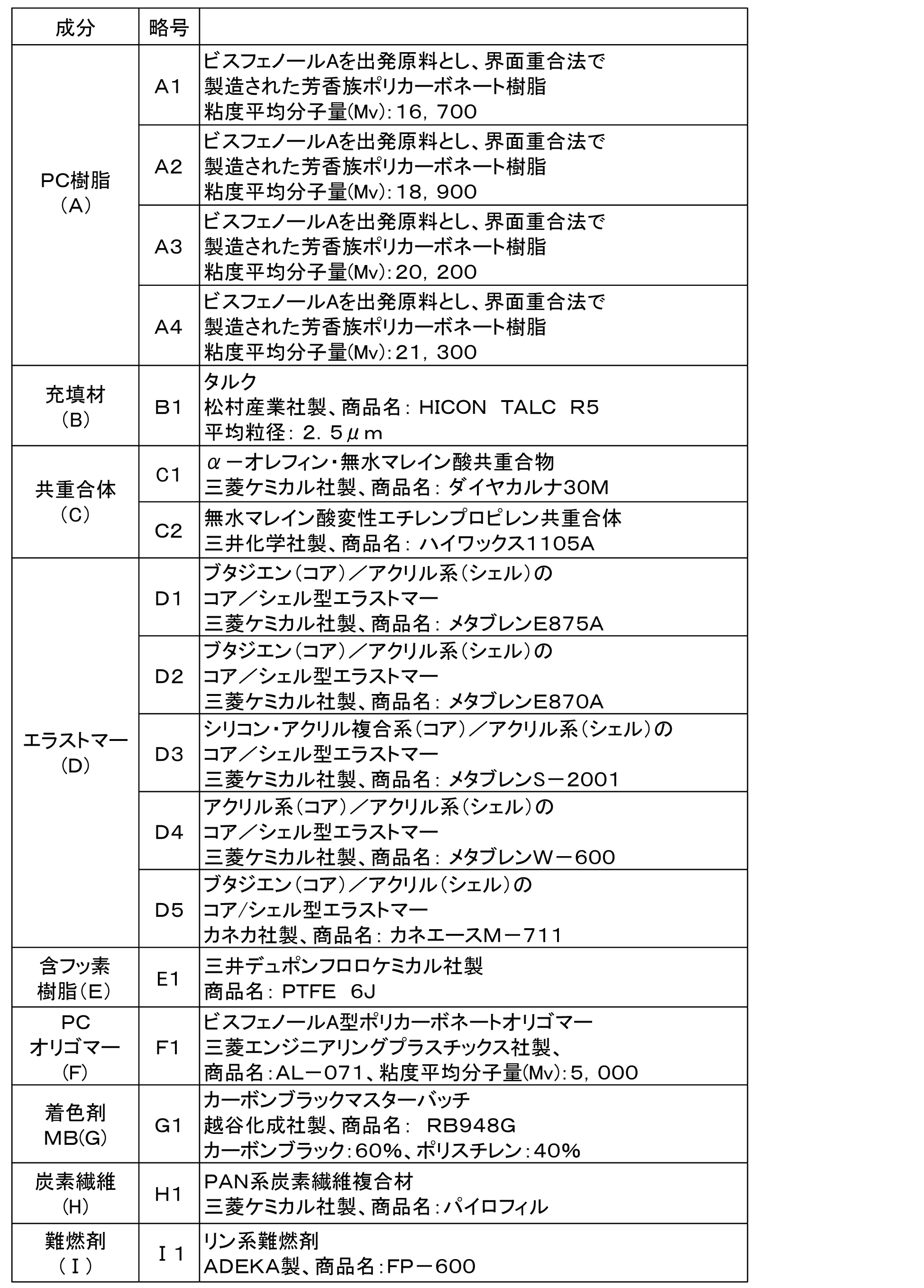
(実施例1~11、比較例1~11)
[樹脂組成物ペレットの製造]
上記した各成分を、表2-3に記載した割合(全て質量部)で配合し、タンブラーミキサーにて均一混合した後、ホッパーから、押出機にフィードして溶融混練した。
押出機としては、日本製鋼所社製二軸押出機(TEX25αIII、L/D=52.5)を用い、スクリュー回転数200rpm、シリンダー温度280℃、吐出量25kg/hrの条件で溶融押出した。押出されたストランドを水槽にて急冷し、ペレタイザーを用いてペレット化した。
[樹脂組成物ペレットの製造]
上記した各成分を、表2-3に記載した割合(全て質量部)で配合し、タンブラーミキサーにて均一混合した後、ホッパーから、押出機にフィードして溶融混練した。
押出機としては、日本製鋼所社製二軸押出機(TEX25αIII、L/D=52.5)を用い、スクリュー回転数200rpm、シリンダー温度280℃、吐出量25kg/hrの条件で溶融押出した。押出されたストランドを水槽にて急冷し、ペレタイザーを用いてペレット化した。
上記製造方法で得られたペレットを、120℃で5時間乾燥させた後、日精樹脂工業社製のNEX80射出成形機を用いて、シリンダー温度280℃、金型温度100℃、射出速度30mm/s、保圧90MPaの条件で、厚さ4mmのISOダンベル試験片成形品を成形した。また、同機種を用いて、シリンダー温度300℃、金型温度100℃、射出速度100mm/s、保圧80MPaの条件で、長さ100mm×幅100mm×厚さ2mmの平板状成形品を成形した。
[曲げ弾性率の測定]
上記で得られたISOダンベル試験片(厚さ4mm)を用い、ISO178に基づき、曲げ弾性率(単位:MPa)を測定した。
上記で得られたISOダンベル試験片(厚さ4mm)を用い、ISO178に基づき、曲げ弾性率(単位:MPa)を測定した。
[シャルピー衝撃強度(ノッチ付き)の測定と耐湿熱性の評価]
上記で得られたISOダンベル片(厚さ4mm)を用い、ISO179に基づき、ノッチ付きシャルピー強度(単位:kJ/m2)を測定した。
また、上記で得られたISOダンベル片(厚さ4mm)を、恒温恒湿槽を用いて、温度85℃、相対湿度85%の条件で、100時間処理し、ノッチつきシャルピー衝撃強度(単位:kJ/m2))を測定した。湿熱試験処理後のシャルピー衝撃強度の値の低下が小さいほど耐湿熱性に優れることを意味する。
上記で得られたISOダンベル片(厚さ4mm)を用い、ISO179に基づき、ノッチ付きシャルピー強度(単位:kJ/m2)を測定した。
また、上記で得られたISOダンベル片(厚さ4mm)を、恒温恒湿槽を用いて、温度85℃、相対湿度85%の条件で、100時間処理し、ノッチつきシャルピー衝撃強度(単位:kJ/m2))を測定した。湿熱試験処理後のシャルピー衝撃強度の値の低下が小さいほど耐湿熱性に優れることを意味する。
[耐熱性(荷重たわみ温度、DTUL)の測定]
上記で得られたISOダンベル片(厚さ4mm)を用い、ISO75 A法に基づき、荷重1.80MPaの条件で荷重たわみ温度(DTUL、単位:℃)を測定した。
上記で得られたISOダンベル片(厚さ4mm)を用い、ISO75 A法に基づき、荷重1.80MPaの条件で荷重たわみ温度(DTUL、単位:℃)を測定した。
[異方性(MD/TD)の測定]
上記で得られた平板状成形品の中心部を、MD/TD方向にそれぞれ長さ15mm×幅10mm×厚さ2mmに切り出すことで試験片を得、異方性の測定に用いた。
測定機器としては、日立ハイテクサイエンス社製TMA/SS6100を用い、試験片の長さ部分を測定の対象にし、-30~+120℃まで20℃/分の速度で昇温し、温度変化量に対する寸法の変化量の傾きから線膨張係数(単位:/K)を算出した。
また、上記で算出したMD方向とTD方向との線膨張係数の比、すなわち異方性(MD/TD)を算出した。MD/TDが1に近いほど、異方性が少ないことを表す。
以上の評価結果を、以下の表2-表3に示す。
上記で得られた平板状成形品の中心部を、MD/TD方向にそれぞれ長さ15mm×幅10mm×厚さ2mmに切り出すことで試験片を得、異方性の測定に用いた。
測定機器としては、日立ハイテクサイエンス社製TMA/SS6100を用い、試験片の長さ部分を測定の対象にし、-30~+120℃まで20℃/分の速度で昇温し、温度変化量に対する寸法の変化量の傾きから線膨張係数(単位:/K)を算出した。
また、上記で算出したMD方向とTD方向との線膨張係数の比、すなわち異方性(MD/TD)を算出した。MD/TDが1に近いほど、異方性が少ないことを表す。
以上の評価結果を、以下の表2-表3に示す。

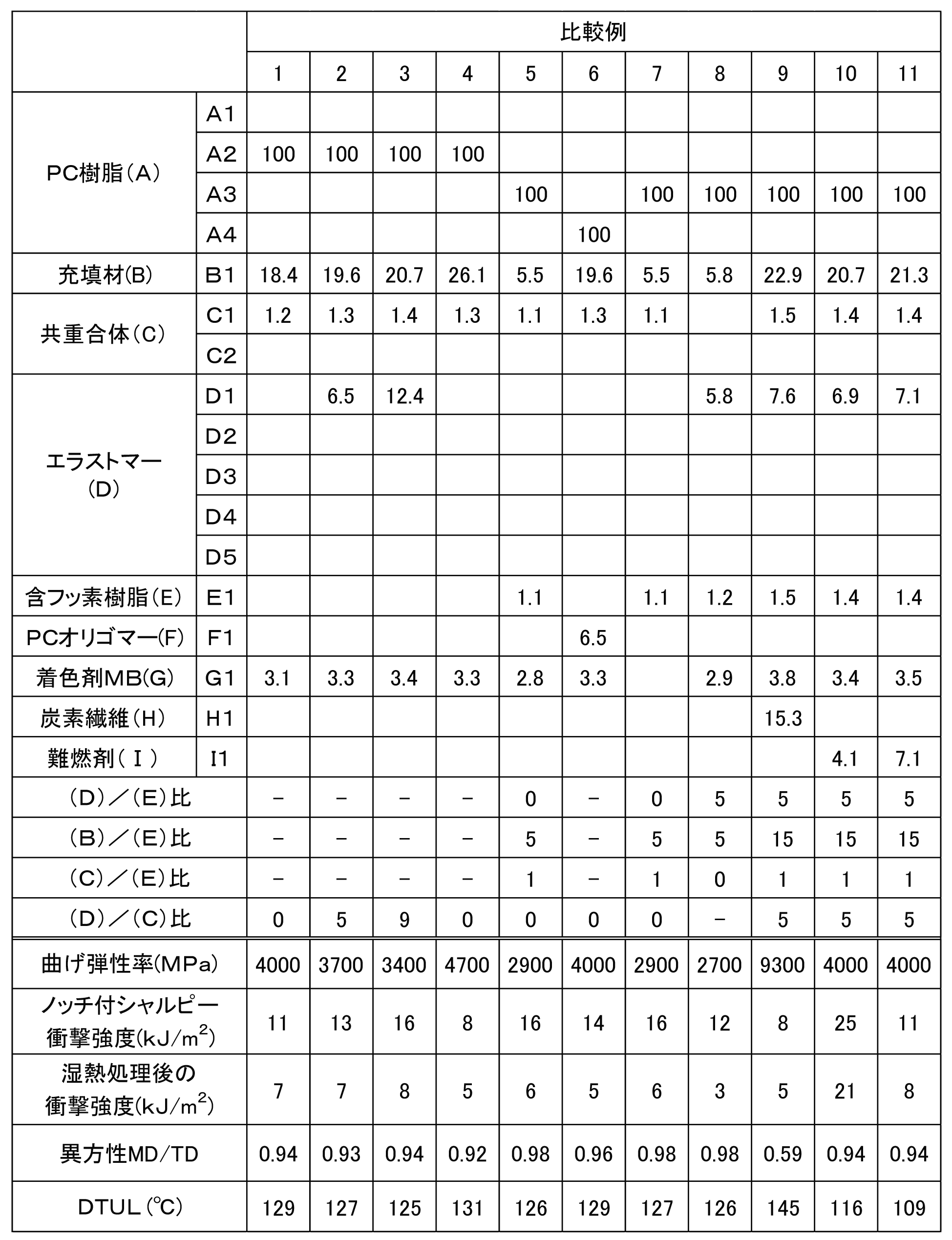
本発明のポリカーボネート樹脂組成物は、剛性と耐衝撃性に優れ、且つ低異方性を示し、さらに耐湿熱性に優れるので、光学機器部品他、各種の用途に好適に使用でき、また、本発明の光学モジュールは変形せず、寸法精度が極めて高く、落としても割れない高性能の各種光学モジュールとして有効である。
Claims (22)
- ポリカーボネート樹脂(A)100質量部に対し、平均粒径0.1~10μmの充填材(B)1~50質量部を含有するポリカーボネート樹脂組成物であって、平均粒径が10μmを超える充填材を含有する場合はその含有量が樹脂組成物中10質量%未満であり、かつリン系難燃剤を含有する場合の含有量が樹脂組成物中2%以下であることを特徴とするポリカーボネート樹脂組成物。
- さらに、ポリカーボネート樹脂(A)100質量部に対し、オレフィン・無水マレイン酸共重合体(C)0.1~5質量部、エラストマー(D)1~25質量部、及び含フッ素樹脂(E)0.05~10質量部を含有し、
エラストマー(D)と含フッ素樹脂(E)の含有量の比(D)/(E)が1を超え250以下であることを特徴とする請求項1に記載のポリカーボネート樹脂組成物。 - 充填材(B)と含フッ素樹脂(E)の含有量の比(B)/(E)が1を超え500以下である請求項2に記載のポリカーボネート樹脂組成物。
- 充填材(B)が板状の充填材である請求項1~3のいずれかに記載のポリカーボネート樹脂組成物。
- 充填材(B)が板状の充填剤であり、タルク、マイカ、ガラスフレーク、モンモリロナイト、ハイドロタルク石、セリサイト、カオリン、アルミナ、クレー、グラファイトから選ばれる少なくとも1種である請求項1~4のいずれかに記載のポリカーボネート樹脂組成物。
- 充填材(B)がタルクである請求項1~5のいずれかに記載のポリカーボネート樹脂組成物。
- エラストマー(D)がコア/シェル型エラストマーである請求項2~6のいずれかに記載のポリカーボネート樹脂組成物。
- エラストマー(D)が、ブタジエン系ゴムコアのコア/シェル型エラストマーである請求項2~7のいずれかに記載のポリカーボネート樹脂組成物。
- ISO179に基づき測定したノッチ付きシャルピー衝撃強度が20kJ/m2以上である請求項1~8のいずれかに記載のポリカーボネート樹脂組成物。
- ISO179に基づき測定した、温度85℃、相対湿度85%の条件で100時間処理後のノッチ付きシャルピー衝撃強度が10kJ/m2以上である請求項1~9のいずれかに記載のポリカーボネート樹脂組成物。
- ISO75 A法に基づき測定した荷重たわみ温度が120℃以上である請求項1~10のいずれかに記載のポリカーボネート樹脂組成物。
- 請求項1~11のいずれかに記載のポリカーボネート樹脂組成物からなる成形体。
- 請求項12に記載の成形体を含む光学モジュール。
- ポリカーボネート樹脂(A)100質量部に対し、平均粒径0.1~10μmの充填材(B)1~50質量部を含有する樹脂組成物からなり、ISO179に基づき測定したノッチ付きシャルピー衝撃強度が20kJ/m2以上である成形体を含むことを特徴とする光学モジュール。
- 前記樹脂組成物が、さらに、ポリカーボネート樹脂(A)100質量部に対し、オレフィン・無水マレイン酸共重合体(C)0.1~5質量部、エラストマー(D)1~25質量部、及び含フッ素樹脂(E)0.05~10質量部を含有し、エラストマー(D)と含フッ素樹脂(E)の含有量の比(D)/(E)が1を超え250以下である請求項14に記載の光学モジュール。
- 前記樹脂組成物が、平均粒径が10μmを超える充填材を含有する場合はその含有量が樹脂組成物中10質量%未満である請求項15に記載の光学モジュール。
- 充填材(B)と含フッ素樹脂(E)の含有量の比(B)/(E)が1を超え500以下である請求項15または16に記載の光学モジュール。
- 充填剤(B)がタルクである請求項14~17のいずれかに記載の光学モジュール。
- エラストマー(D)がコア/シェル型エラストマーである請求項15~18のいずれかに記載の光学モジュール。
- エラストマー(D)が、ブタジエン系ゴムコアのコア/シェル型エラストマーである請求項15~19のいずれかに記載の光学モジュール。
- 前記樹脂組成物は、ISO179に基づき測定した、温度85℃、相対湿度85%の条件で100時間処理後のノッチ付きシャルピー衝撃強度が10kJ/m2以上である請求項14~20のいずれかに記載の光学モジュール。
- 前記樹脂組成物は、ISO75 A法に基づき測定した荷重たわみ温度が120℃以上である請求項14~21のいずれかに記載の光学モジュール。
Priority Applications (3)
| Application Number | Priority Date | Filing Date | Title |
|---|---|---|---|
| JP2021533063A JP7500566B2 (ja) | 2019-07-17 | 2020-07-13 | ポリカーボネート樹脂組成物 |
| CN202080051075.6A CN114127190A (zh) | 2019-07-17 | 2020-07-13 | 聚碳酸酯树脂组合物 |
| KR1020217041921A KR20220035876A (ko) | 2019-07-17 | 2020-07-13 | 폴리카보네이트 수지 조성물 |
Applications Claiming Priority (4)
| Application Number | Priority Date | Filing Date | Title |
|---|---|---|---|
| JP2019131720 | 2019-07-17 | ||
| JP2019-131720 | 2019-07-17 | ||
| JP2019169277 | 2019-09-18 | ||
| JP2019-169277 | 2019-09-18 |
Publications (1)
| Publication Number | Publication Date |
|---|---|
| WO2021010366A1 true WO2021010366A1 (ja) | 2021-01-21 |
Family
ID=74210767
Family Applications (1)
| Application Number | Title | Priority Date | Filing Date |
|---|---|---|---|
| PCT/JP2020/027189 Ceased WO2021010366A1 (ja) | 2019-07-17 | 2020-07-13 | ポリカーボネート樹脂組成物 |
Country Status (5)
| Country | Link |
|---|---|
| JP (1) | JP7500566B2 (ja) |
| KR (1) | KR20220035876A (ja) |
| CN (1) | CN114127190A (ja) |
| TW (1) | TWI849182B (ja) |
| WO (1) | WO2021010366A1 (ja) |
Cited By (2)
| Publication number | Priority date | Publication date | Assignee | Title |
|---|---|---|---|---|
| WO2023085297A1 (ja) * | 2021-11-10 | 2023-05-19 | 三菱エンジニアリングプラスチックス株式会社 | ペレット、成形品、および、ペレットの製造方法 |
| EP4317306A4 (en) * | 2021-04-02 | 2025-04-02 | Daikin Industries, Ltd. | COMPOSITION FOR FLUORUBBER CROSS-LINKING, MOLDED PRODUCT AND SEALING MATERIAL |
Citations (5)
| Publication number | Priority date | Publication date | Assignee | Title |
|---|---|---|---|---|
| JP2007308529A (ja) * | 2006-05-16 | 2007-11-29 | Teijin Chem Ltd | 帯電防止性に優れた難燃性ポリカーボネート樹脂組成物 |
| JP2007320980A (ja) * | 2006-05-30 | 2007-12-13 | Teijin Chem Ltd | 帯電防止性に優れた難燃性ポリカーボネート樹脂組成物 |
| JP2010174121A (ja) * | 2009-01-29 | 2010-08-12 | Teijin Chem Ltd | 難燃性芳香族ポリカーボネート樹脂組成物 |
| JP2014185262A (ja) * | 2013-03-25 | 2014-10-02 | Teijin Ltd | 高剛性・高耐衝撃性樹脂組成物 |
| WO2017033783A1 (ja) * | 2015-08-21 | 2017-03-02 | 帝人株式会社 | ポリカーボネート樹脂組成物 |
Family Cites Families (7)
| Publication number | Priority date | Publication date | Assignee | Title |
|---|---|---|---|---|
| JPS5021918B1 (ja) | 1969-08-06 | 1975-07-26 | ||
| JPH1171316A (ja) * | 1996-07-31 | 1999-03-16 | Mitsui Chem Inc | 低複屈折性有機光学部品およびスピロビインダン系ポリマー |
| JP2011168633A (ja) * | 2010-02-16 | 2011-09-01 | Mitsubishi Engineering Plastics Corp | ポリカーボネート樹脂組成物の製造方法、およびそれからなる成形品 |
| JP6252181B2 (ja) * | 2014-01-09 | 2017-12-27 | 三菱エンジニアリングプラスチックス株式会社 | 芳香族ポリカーボネート樹脂組成物及びその成形品 |
| JP2015203049A (ja) * | 2014-04-11 | 2015-11-16 | テクノポリマー株式会社 | 鏡胴用筒状体及び鏡胴 |
| JP2019059813A (ja) * | 2017-09-25 | 2019-04-18 | 三菱エンジニアリングプラスチックス株式会社 | ポリカーボネート樹脂組成物 |
| US11198785B2 (en) * | 2017-10-13 | 2021-12-14 | Mitsubishi Engineering-Plastics Corporation | Polycarbonate resin composition |
-
2020
- 2020-07-13 WO PCT/JP2020/027189 patent/WO2021010366A1/ja not_active Ceased
- 2020-07-13 JP JP2021533063A patent/JP7500566B2/ja active Active
- 2020-07-13 KR KR1020217041921A patent/KR20220035876A/ko not_active Ceased
- 2020-07-13 CN CN202080051075.6A patent/CN114127190A/zh active Pending
- 2020-07-16 TW TW109123984A patent/TWI849182B/zh active
Patent Citations (5)
| Publication number | Priority date | Publication date | Assignee | Title |
|---|---|---|---|---|
| JP2007308529A (ja) * | 2006-05-16 | 2007-11-29 | Teijin Chem Ltd | 帯電防止性に優れた難燃性ポリカーボネート樹脂組成物 |
| JP2007320980A (ja) * | 2006-05-30 | 2007-12-13 | Teijin Chem Ltd | 帯電防止性に優れた難燃性ポリカーボネート樹脂組成物 |
| JP2010174121A (ja) * | 2009-01-29 | 2010-08-12 | Teijin Chem Ltd | 難燃性芳香族ポリカーボネート樹脂組成物 |
| JP2014185262A (ja) * | 2013-03-25 | 2014-10-02 | Teijin Ltd | 高剛性・高耐衝撃性樹脂組成物 |
| WO2017033783A1 (ja) * | 2015-08-21 | 2017-03-02 | 帝人株式会社 | ポリカーボネート樹脂組成物 |
Cited By (2)
| Publication number | Priority date | Publication date | Assignee | Title |
|---|---|---|---|---|
| EP4317306A4 (en) * | 2021-04-02 | 2025-04-02 | Daikin Industries, Ltd. | COMPOSITION FOR FLUORUBBER CROSS-LINKING, MOLDED PRODUCT AND SEALING MATERIAL |
| WO2023085297A1 (ja) * | 2021-11-10 | 2023-05-19 | 三菱エンジニアリングプラスチックス株式会社 | ペレット、成形品、および、ペレットの製造方法 |
Also Published As
| Publication number | Publication date |
|---|---|
| KR20220035876A (ko) | 2022-03-22 |
| JPWO2021010366A1 (ja) | 2021-01-21 |
| JP7500566B2 (ja) | 2024-06-17 |
| TWI849182B (zh) | 2024-07-21 |
| TW202110996A (zh) | 2021-03-16 |
| CN114127190A (zh) | 2022-03-01 |
Similar Documents
| Publication | Publication Date | Title |
|---|---|---|
| CN101899205B (zh) | 玻璃纤维增强树脂组合物 | |
| JP4700770B2 (ja) | ポリカーボネート樹脂組成物及び成形体 | |
| JP5540758B2 (ja) | ポリカーボネート樹脂組成物及び成形体 | |
| CN101845211B (zh) | 聚碳酸酯树脂组合物 | |
| JP5555588B2 (ja) | ポリカーボネート樹脂組成物およびそれからなる成形品 | |
| CN101625447A (zh) | 由玻璃纤维增强树脂组合物制成的镜筒 | |
| CN101962471A (zh) | 玻璃纤维增强树脂组合物 | |
| JP6147595B2 (ja) | ポリカーボネート樹脂組成物、それからなる成形体およびその製造方法 | |
| CN101928451A (zh) | 将玻璃纤维增强树脂组合物注射成型而得到的电气电子设备部件 | |
| JP2011057888A (ja) | 電池パック用ポリカーボネート樹脂組成物及び電池パック | |
| CN101451012A (zh) | 防静电性优异的阻燃性聚碳酸酯树脂组合物 | |
| JP2011168633A (ja) | ポリカーボネート樹脂組成物の製造方法、およびそれからなる成形品 | |
| JP7500566B2 (ja) | ポリカーボネート樹脂組成物 | |
| JP5660015B2 (ja) | 芳香族ポリカーボネート樹脂組成物及びそれからなる成形品 | |
| JP5893848B2 (ja) | 芳香族ポリカーボネート樹脂組成物およびその成形品 | |
| JP2003277597A (ja) | ガラス繊維強化ポリカーボネート樹脂組成物 | |
| CN101397397B (zh) | 阻燃性芳香族聚碳酸酯树脂组合物 | |
| JP6367039B2 (ja) | ポリカーボネート樹脂組成物および成形品 | |
| JP2020158663A (ja) | ポリカーボネート樹脂組成物 | |
| JP5673509B2 (ja) | 芳香族ポリカーボネート樹脂組成物及びそれからなる成形品 | |
| JP7680943B2 (ja) | ポリカーボネート樹脂組成物 | |
| JP2013112752A (ja) | 芳香族ポリカーボネート樹脂組成物及びそれからなる成形品 | |
| JP6471433B2 (ja) | 樹脂被覆金属長繊維ペレットの製造方法 | |
| JP5655765B2 (ja) | 芳香族ポリカーボネート樹脂組成物及びそれからなる成形品 | |
| JPH07242781A (ja) | 樹脂組成物 |
Legal Events
| Date | Code | Title | Description |
|---|---|---|---|
| 121 | Ep: the epo has been informed by wipo that ep was designated in this application |
Ref document number: 20840139 Country of ref document: EP Kind code of ref document: A1 |
|
| ENP | Entry into the national phase |
Ref document number: 2021533063 Country of ref document: JP Kind code of ref document: A |
|
| NENP | Non-entry into the national phase |
Ref country code: DE |
|
| 122 | Ep: pct application non-entry in european phase |
Ref document number: 20840139 Country of ref document: EP Kind code of ref document: A1 |