WO2020241658A1 - 電子写真感光体、プロセスカートリッジ、及び画像形成装置 - Google Patents
電子写真感光体、プロセスカートリッジ、及び画像形成装置 Download PDFInfo
- Publication number
- WO2020241658A1 WO2020241658A1 PCT/JP2020/020825 JP2020020825W WO2020241658A1 WO 2020241658 A1 WO2020241658 A1 WO 2020241658A1 JP 2020020825 W JP2020020825 W JP 2020020825W WO 2020241658 A1 WO2020241658 A1 WO 2020241658A1
- Authority
- WO
- WIPO (PCT)
- Prior art keywords
- carbon atoms
- group
- less
- general formula
- alkyl group
- Prior art date
- Legal status (The legal status is an assumption and is not a legal conclusion. Google has not performed a legal analysis and makes no representation as to the accuracy of the status listed.)
- Ceased
Links
Images
Classifications
-
- G—PHYSICS
- G03—PHOTOGRAPHY; CINEMATOGRAPHY; ANALOGOUS TECHNIQUES USING WAVES OTHER THAN OPTICAL WAVES; ELECTROGRAPHY; HOLOGRAPHY
- G03G—ELECTROGRAPHY; ELECTROPHOTOGRAPHY; MAGNETOGRAPHY
- G03G5/00—Recording-members for original recording by exposure, e.g. to light, to heat or to electrons; Manufacture thereof; Selection of materials therefor
- G03G5/02—Charge-receiving layers
- G03G5/04—Photoconductive layers; Charge-generation layers or charge-transporting layers; Additives therefor; Binders therefor
- G03G5/05—Organic bonding materials; Methods for coating a substrate with a photoconductive layer; Inert supplements for use in photoconductive layers
- G03G5/0528—Macromolecular bonding materials
- G03G5/0557—Macromolecular bonding materials obtained otherwise than by reactions only involving carbon-to-carbon unsatured bonds
- G03G5/056—Polyesters
-
- G—PHYSICS
- G03—PHOTOGRAPHY; CINEMATOGRAPHY; ANALOGOUS TECHNIQUES USING WAVES OTHER THAN OPTICAL WAVES; ELECTROGRAPHY; HOLOGRAPHY
- G03G—ELECTROGRAPHY; ELECTROPHOTOGRAPHY; MAGNETOGRAPHY
- G03G5/00—Recording-members for original recording by exposure, e.g. to light, to heat or to electrons; Manufacture thereof; Selection of materials therefor
- G03G5/02—Charge-receiving layers
- G03G5/04—Photoconductive layers; Charge-generation layers or charge-transporting layers; Additives therefor; Binders therefor
-
- G—PHYSICS
- G03—PHOTOGRAPHY; CINEMATOGRAPHY; ANALOGOUS TECHNIQUES USING WAVES OTHER THAN OPTICAL WAVES; ELECTROGRAPHY; HOLOGRAPHY
- G03G—ELECTROGRAPHY; ELECTROPHOTOGRAPHY; MAGNETOGRAPHY
- G03G5/00—Recording-members for original recording by exposure, e.g. to light, to heat or to electrons; Manufacture thereof; Selection of materials therefor
- G03G5/02—Charge-receiving layers
- G03G5/04—Photoconductive layers; Charge-generation layers or charge-transporting layers; Additives therefor; Binders therefor
- G03G5/05—Organic bonding materials; Methods for coating a substrate with a photoconductive layer; Inert supplements for use in photoconductive layers
-
- G—PHYSICS
- G03—PHOTOGRAPHY; CINEMATOGRAPHY; ANALOGOUS TECHNIQUES USING WAVES OTHER THAN OPTICAL WAVES; ELECTROGRAPHY; HOLOGRAPHY
- G03G—ELECTROGRAPHY; ELECTROPHOTOGRAPHY; MAGNETOGRAPHY
- G03G5/00—Recording-members for original recording by exposure, e.g. to light, to heat or to electrons; Manufacture thereof; Selection of materials therefor
- G03G5/02—Charge-receiving layers
- G03G5/04—Photoconductive layers; Charge-generation layers or charge-transporting layers; Additives therefor; Binders therefor
- G03G5/06—Photoconductive layers; Charge-generation layers or charge-transporting layers; Additives therefor; Binders therefor characterised by the photoconductive material being organic
Definitions
- the present invention relates to an electrophotographic photosensitive member, a process cartridge, and an image forming apparatus.
- the electrophotographic photosensitive member is used as an image carrier in an electrophotographic image forming apparatus (for example, a printer or a multifunction device).
- the electrophotographic photosensitive member includes a photosensitive layer.
- As the electrophotographic photosensitive member for example, a single-layer electrophotographic photosensitive member and a laminated electrophotographic photosensitive member are used.
- the single-layer electrophotographic photosensitive member includes a single-layer photosensitive layer having a function of generating charges and a function of transporting charges.
- the laminated electrophotographic photosensitive member includes a photosensitive layer including a charge generating layer having a charge generating function and a charge transporting layer having a charge transporting function.
- the electrophotographic photosensitive member included in the image forming apparatus described in Patent Document 1 contains a bisphenol Z-type polycarbonate resin, which is a binder resin, at least in its surface layer.
- the present invention has been made in view of the above problems, and an object of the present invention is to provide an electrophotographic photosensitive member having excellent wear resistance and charge stability. Another object of the present invention is to provide a process cartridge and an image forming apparatus which are excellent in durability and capable of forming a good image by providing such an electrophotographic photosensitive member.
- the electrophotographic photosensitive member of the present invention includes a conductive substrate and a photosensitive layer.
- the photosensitive layer is a single layer.
- the photosensitive layer contains a charge generator, a hole transport agent, an electron transport agent, a binder resin, and an additive.
- the binder resin contains a polyarylate resin.
- the polyarylate resin contains at least one repeating unit represented by the general formula (1) and at least one repeating unit represented by the general formula (2).
- the additive contains at least one compound among the compounds represented by the general formulas (50), (51), and (52).
- R 1 and R 2 each represent a methyl group.
- W represents a divalent group represented by the general formula (W2).
- X represents a divalent group represented by the chemical formulas (X1), (X2), (X3), (X4), or (X6).
- a 1 or 2.
- R 51 represents an alkyl group having 1 or more and 6 or less carbon atoms substituted with a halogen atom, or a halogen atom.
- R 52 represents an alkyl group having 1 or more and 10 or less carbon atoms, an aralkyl group having 7 or more and 20 or less carbon atoms, or an aryl group having 6 or more and 22 or less carbon atoms.
- n and m each independently represent an integer of 0 or more and 4 or less. When n represents an integer of 2 or more and 4 or less, the plurality of R 51s may be the same or different from each other. When m represents an integer of 2 or more and 4 or less, a plurality of R 52s may be the same or different from each other.
- R 53 represents an alkyl group having 3 or more carbon atoms and 10 or less carbon atoms.
- p represents an integer of 1 or more and 4 or less.
- q and r each independently represent an integer of 1 or more and 3 or less.
- s represents an integer of 1 or more and 4 or less.
- the plurality of R 53s may be the same or different from each other.
- a plurality of ps may be the same or different from each other
- a plurality of qs may be the same or different from each other
- a plurality of r are the same as each other. It may be different.
- R 55 represents an alkyl group having 3 or more carbon atoms and 10 or less carbon atoms.
- R 56 represents an alkyl group having 10 or more and 30 or less carbon atoms.
- u represents an integer of 1 or more and 3 or less.
- t represents an integer of 1 or more and 4 or less. When t represents an integer of 2 or more and 4 or less, the plurality of R 55s may be the same or different from each other.
- the process cartridge of the present invention includes the above electrophotographic photosensitive member.
- the image forming apparatus of the present invention includes an image carrier, a charging device, an exposure device, a developing device, and a transfer device.
- the image carrier is rotatably provided.
- the charging device positively charges the surface of the image carrier.
- the exposure apparatus irradiates the surface of the charged image carrier with light to form an electrostatic latent image on the surface of the image carrier.
- the developing device develops the electrostatic latent image as a toner image.
- the transfer device transfers the toner image from the image carrier to the transfer target.
- the image carrier is the electrophotographic photosensitive member.
- the electrophotographic photosensitive member of the present invention is excellent in abrasion resistance and charge stability. Further, the process cartridge and the image forming apparatus of the present invention provided with such an electrophotographic photosensitive member have excellent durability and can form a good image.
- the present invention is not limited to the following embodiments.
- the present invention can be carried out with appropriate modifications within the scope of the object of the present invention.
- the description may be omitted as appropriate for the parts where the description is duplicated, the gist of the invention is not limited.
- the compound and its derivative may be collectively referred to by adding "system” after the compound name.
- the polymer name is represented by adding "system” after the compound name, it means that the repeating unit of the polymer is derived from the compound or its derivative.
- halogen group examples include a fluorine atom (fluoro group), a chlorine atom (chloro group), a bromine atom (bromo group), and an iodine atom (iodine group).
- Alkyl groups with 1 to 10 carbon atoms, alkyl groups with 1 to 8 carbon atoms, alkyl groups with 1 to 6 carbon atoms, alkyl groups with 1 to 5 carbon atoms, 1 to 4 carbon atoms The following alkyl groups, alkyl groups with 1 to 3 carbon atoms, alkyl groups with 1, 4, or 8 carbon atoms, alkyl groups with 3 to 10 carbon atoms, alkyl groups with 2 to 4 carbon atoms And, unless otherwise specified, the alkyl groups having 3 or more and 5 or less carbon atoms are linear or branched and unsubstituted.
- alkyl group having 1 or more and 10 or less carbon atoms examples include a methyl group, an ethyl group, an n-propyl group, an isopropyl group, an n-butyl group, a sec-butyl group, a tert-butyl group, an n-pentyl group, and 1 -Methylbutyl group, 2-methylbutyl group, 3-methylbutyl group, 1-ethylpropyl group, 2-ethylpropyl group, 1,1-dimethylpropyl group, 1,2-dimethylpropyl group, 2,2-dimethylpropyl group, 1,2-dimethylpropyl group, n-hexyl group, 1-methylpentyl group, 2-methylpentyl group, 3-methylpentyl group, 4-methylpentyl group, 1,1-dimethylbutyl group, 1,2-dimethyl Butyl group, 1,3-dimethylbutyl group, 2,2-dimethyl
- groups are groups having the corresponding number of carbon atoms among the groups described as examples of alkyl groups having 1 or more and 10 or less carbon atoms, respectively.
- the alkyl group having 10 or more and 30 or less carbon atoms and the alkyl group having 15 or more and 25 or less carbon atoms are linear or branched and unsubstituted.
- Examples of the alkyl group having 10 or more and 30 or less carbon atoms include a linear and branched-chain decyl group, a straight-chain and branched-chain undecyl group, and a linear and branched-chain dodecyl group.
- Straight-chain and branched-chain tridecyl groups straight-chain and branched-chain tetradecyl groups, straight-chain and branched-chain pentadecyl groups, straight-chain and branched-chain hexadecyl groups, straight Chained and branched heptadecyl groups, straight and branched octadecyl groups, straight and branched nonadecil groups, straight and branched icosyl groups, straight chain And branched-chain henicosyl groups, straight-chain and branched-chain dococil groups, straight-chain and branched-chain tricosyl groups, straight-chain and branched-chain tetracosyl groups, straight-chain and branched-chain Examples include branched-chain pentacosyl groups and straight-chain and branched-chain triacontyl groups.
- An example of an alkyl group having 15 or more and 25 or less carbon atoms is a group having
- the alkoxy groups having 1 or more and 8 or less carbon atoms, the alkoxy groups having 1 or more and 6 or less carbon atoms, and the alkoxy groups having 1 or more and 4 or less carbon atoms are linear or branched, respectively. It is not substituted.
- Examples of the alkoxy group having 1 or more and 6 or less carbon atoms include a methoxy group, an ethoxy group, an n-propoxy group, an isopropoxy group, an n-butoxy group, a sec-butoxy group, a tert-butoxy group and an n-pentoxy group.
- Examples of the alkoxy group having 1 or more and 6 or less carbon atoms and the alkoxy group having 1 or more and 4 or less carbon atoms correspond to the number of carbon atoms among the groups described as examples of the alkoxy group having 1 or more and 8 or less carbon atoms. It is a group having.
- the aryl group having 6 or more and 22 or less carbon atoms and the aryl group having 6 or more and 14 or less carbon atoms are unsubstituted.
- the aryl group having 6 or more and 22 or less carbon atoms include a phenyl group, a naphthyl group, an indacenyl group, a biphenylenyl group, an acenaphthylenyl group, an anthryl group and a phenanthryl group, a tetrasenyl group, a tetraphenyl group, a chrysenyl group, a pyrenyl group and a triphenylenyl group.
- Examples include groups, benzophenanthrenyl groups, pisenyl groups, perylenyl groups, and pentaphenyl groups.
- Examples of the aryl group having 6 to 14 carbon atoms include a phenyl group, a naphthyl group, an indasenyl group, a biphenylenyl group, an acenaphthylenyl group, an anthryl group, and a phenanthryl group.
- Aryloxy groups having 6 to 14 carbon atoms are unsubstituted unless otherwise specified.
- Examples of the aryloxy group having 6 to 14 carbon atoms include a phenoxy group, a naphthoxy group, an indacenyloxy group, a biphenylenyloxy group, an acenaphthylenyloxy group, an anthryloxy group, and a phenanthryloxy group.
- Groups and fluorenyloxy groups are mentioned.
- alkenyl groups having 2 or more and 6 or less carbon atoms are linear or branched and unsubstituted.
- An alkenyl group having 2 or more and 6 or less carbon atoms has one or more and three or less double bonds.
- Examples of the alkenyl group having 2 or more and 6 or less carbon atoms include an ethenyl group, a propenyl group, a butenyl group, a butadienyl group, a pentenyl group, a hexenyl group, a hexadienyl group, and a hexatrinyl group.
- Heterocyclic groups having 3 or more and 14 or less carbon atoms are unsubstituted unless otherwise specified.
- Examples of the heterocyclic group having 3 to 14 carbon atoms include a piperidinyl group, a piperazinyl group, a morpholinyl group, a thiophenyl group, a furanyl group, a pyrrolyl group, an imidazolyl group, a pyrazolyl group, an isothiazolyl group, an isooxazolyl group, an oxazolyl group and an isooxazolyl group.
- thiazolyl group isothiazolyl group, frazayl group, pyranyl group, pyridyl group, pyridadinyl group, pyrimidinyl group, pyrazinyl group, indyl group, 1H-indazolyl group, isoindyl group, chromenyl group, quinolinyl group, isoquinolinyl group, prynyl group, pteridinyl Group, triazolyl group, tetrazolyl group, 4H-quinolidinyl group, naphthyldinyl group, benzofuranyl group, 1,3-benzodioxolyl group, benzoxazolyl group, benzothiazolyl group, benzimidazolyl group, carbazolyl group, phenanthridinyl group , Acridinyl group, phenazinyl group, and phenanthrolinyl group.
- the aralkyl group having 7 or more and 20 or less carbon atoms and the aralkyl group having 7 or more and 10 or less carbon atoms are unsubstituted.
- the aralkyl group having 7 or more and 20 or less carbon atoms is, for example, an alkyl group having 1 or more and 6 or less carbon atoms substituted with an aryl group having 6 or more and 14 or less carbon atoms.
- the aralkyl group having 7 or more and 10 or less carbon atoms is, for example, an alkyl group having 1 or more and 4 or less carbon atoms substituted with a phenyl group.
- the aralkyloxy group having 7 or more and 20 or less carbon atoms and the aralkyloxy group having 7 or more and 10 or less carbon atoms are unsubstituted.
- the aralkyloxy group having 7 or more and 20 or less carbon atoms is, for example, an alkoxy group having 1 or more and 6 or less carbon atoms substituted with an aryl group having 6 or more and 14 or less carbon atoms.
- the aralkyl group having 7 or more and 10 or less carbon atoms is, for example, an alkoxy group having 1 or more and 4 or less carbon atoms substituted with a phenyl group.
- the present embodiment relates to an electrophotographic photosensitive member (hereinafter, may be referred to as a photosensitive member).
- a photosensitive member an electrophotographic photosensitive member
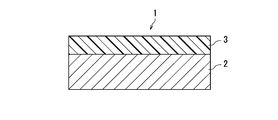
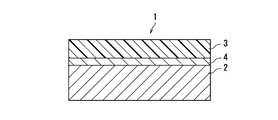
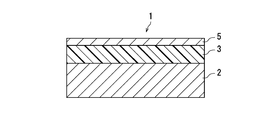
- FIGS. 1 to 3. 1 to 3 show partial cross-sectional views of the photoconductor 1.
- the photoconductor 1 includes, for example, a conductive substrate 2 and a photosensitive layer 3.
- the photosensitive layer 3 is a single layer.
- the photoconductor 1 is a single-layer electrophotographic photosensitive member including a single-layer photosensitive layer 3.
- the photosensitive member 1 may include a conductive substrate 2, a photosensitive layer 3, and an intermediate layer 4 (undercoat layer).
- the intermediate layer 4 is provided between the conductive substrate 2 and the photosensitive layer 3.
- the photosensitive layer 3 may be provided directly on the conductive substrate 2.
- the photosensitive layer 3 may be provided on the conductive substrate 2 via the intermediate layer 4.
- the photosensitive member 1 may include a conductive substrate 2, a photosensitive layer 3, and a protective layer 5.
- the protective layer 5 is provided on the photosensitive layer 3.
- the photosensitive layer 3 may be provided as the outermost surface layer of the photosensitive member 1.
- the protective layer 5 may be provided as the outermost surface layer of the photoconductor 1.
- the photosensitive layer 3 contains a charge generator, a hole transport agent, an electron transport agent, a binder resin, and an additive.
- the thickness of the photosensitive layer 3 is not particularly limited, but is preferably 5 ⁇ m or more and 100 ⁇ m or less, and more preferably 10 ⁇ m or more and 50 ⁇ m or less.
- the structure of the photoconductor 1 has been described above with reference to FIGS. 1 to 3. Hereinafter, the photoconductor will be further described.
- the photosensitive layer contains a polyarylate resin as a binder resin.
- the polyarylate resin contains at least one repeating unit represented by the general formula (1) and at least one repeating unit represented by the general formula (2).
- a polyarylate resin containing at least one repeating unit represented by the general formula (1) and at least one repeating unit represented by the general formula (2) is referred to as a polyarylate resin (PA). I have something to do.
- the repeating units represented by the general formulas (1) and (2) may be described as repeating units (1) and (2), respectively.
- R 1 and R 2 each represent a methyl group.
- W represents a divalent group represented by the general formula (W2).
- W2 a represents 1 or 2.
- X represents a divalent group represented by the chemical formulas (X1), (X2), (X3), (X4), or (X6).
- Polyarylate resin (PA) has a predetermined chemical structure.
- the photosensitive layer contains such a polyarylate resin (PA)
- the abrasion resistance of the photoconductor can be improved.
- the polyarylate resin (PA) has a predetermined chemical structure, the density of the photosensitive layer can be increased. Therefore, it becomes difficult for a substance (for example, gas) that lowers the charging potential to enter the photosensitive layer, and the charging stability of the photoconductor is improved.
- a preferably represents 2.
- X preferably represents a divalent group represented by the chemical formulas (X1), (X3), (X4), or (X6).
- repeating unit (1) include repeating units represented by the chemical formulas (1-1) and (1-2).
- the repeating units represented by the chemical formulas (1-1) and (1-2) may be described as repeating units (1-1) and (1-2), respectively.
- repeating unit (2) include repeating units represented by the chemical formulas (2-X1), (2-X2), (2-X3), (2-X4), and (2-X6). Can be mentioned.
- the repeating units represented by the chemical formulas (2-X1), (2-X2), (2-X3), (2-X4), and (2-X6) are each repeated unit (2-X1). , (2-X2), (2-X3), (2-X4), and (2-X6).
- More preferred examples of the repeating unit (2) include repeating units (2-X1), (2-X3), (2-X4), and (2-X6).
- polyarylate resin (PA) is a polyarylate resin containing a repeating unit (1-2) and (2-X3) (hereinafter, referred to as a polyarylate resin (V)).
- a polyarylate resin (V) As the polyarylate resin (V), as the repeating unit, a polyarylate resin containing only the repeating unit (1-2) and (2-X3) (hereinafter, referred to as polyarylate resin (V')) is preferable.
- polyarylate resin (PA) is a polyarylate resin containing a repeating unit (1-2) and (2-X6) (hereinafter, referred to as a polyarylate resin (IX)).
- a polyarylate resin (IX) a polyarylate resin containing only the repeating unit (1-2) and (2-X6) (hereinafter referred to as polyarylate resin (IX')) is preferable as the repeating unit.
- polyarylate resin (PA) is a polyarylate resin containing the repeating units (1-2), (2-X1), and (2-X4) (hereinafter referred to as polyarylate resin (I)). Is.
- polyarylate resin (PA) is a polyarylate resin containing the repeating units (1-2), (2-X1), and (2-X3) (hereinafter referred to as polyarylate resin (II)).
- the polyarylate resin (II) includes a polyarylate resin containing only the repeating units (1-2), (2-X1), and (2-X3) as the repeating unit (hereinafter, polyarylate resin (II')). Describe) is preferable.
- polyarylate resin is a polyarylate resin containing repeating units (1-2), (2-X4), and (2-X3) (hereinafter referred to as polyarylate resin (III)). Is.
- polyarylate resin is a polyarylate resin containing repeating units (1-2), (2-X6), and (2-X3) (hereinafter referred to as polyarylate resin (VIII)). Is.
- polyarylate resin PA
- a polyarylate resin containing repeating units 1-2
- (2-X6) 2, and (2-X1
- polyarylate resin (VI) Another example of a polyarylate resin (PA) is a polyarylate resin containing repeating units (1-2), (2-X6), and (2-X1) (hereinafter referred to as polyarylate resin (VI)). Is.
- polyarylate resin (PA) is a polyarylate resin containing the repeating units (1-1), (2-X1), and (2-X3) (hereinafter referred to as polyarylate resin (X)). Is.
- polyarylate resin is a polyarylate resin containing repeating units (1-1), (1-2), (2-X1), and (2-X3) (hereinafter, polyarylate resin (hereinafter, polyarylate resin). It is described as XII)).
- the polyarylate resins represented by the chemical formulas (R1) to (R12) may be described as polyarylate resins (R1) to (R12).
- the number attached to the lower right of each repeating unit indicates the percentage (%) of the number of each repeating unit with respect to the total number of repeating units contained in the polyarylate resin.
- the total number of repeating units is the sum of the number of bisphenol-derived repeating units and the number of dicarboxylic acid-derived repeating units.
- the polyarylate resin (PA) may contain 1 type, 2 types, or 3 or more types of repeating units (1).
- the polyarylate resin (PA) contains two types of repeating units (1), the ratio of the number of one repeating unit (1) to the total number of one repeating unit (1) and the other repeating unit (1). Is preferably 10% or more and 90% or less, more preferably 30% or more and 70% or less, further preferably 40% or more and 60% or less, and 55% or more and 60% or less. Especially preferable.
- the two types of repeating units (1) are the repeating unit (1-1) and (1-2)
- one repeating unit (1) is the repeating unit (1-2) and the other repeating unit (1).
- the polyarylate resin (PA) may contain 1 type, 2 types, or 3 or more types of repeating units (2).
- the ratio of the number of one repeating unit (2) to the total number of one repeating unit (2) and the other repeating unit (2). Is preferably 10% or more and 90% or less, more preferably 30% or more and 80% or less, further preferably 50% or more and 80% or less, and preferably 50% or more and 70% or less.
- two types of repeating units (2) are repeating units (2-X3) and (2-X4)
- one repeating unit (2) is a repeating unit (2-X3) and the other repeating unit (2).
- the two repeating units (2) are the repeating unit (2-X1) and (2-X3)
- one repeating unit (2) is the repeating unit (2-X3) and the other repeating unit (2).
- the ratio of the number of the one repeating unit (1) and the ratio of the number of the one repeating unit (2) are obtained by using a proton nuclear magnetic resonance spectrometer to obtain a 1 H-NMR spectrum of the polyarylate resin (PA). It can be obtained by measuring and calculating the ratio of peaks characteristic of each repeating unit in the obtained 1 H-NMR spectrum.
- PA polyarylate resin
- the polyarylate resin (PA) may contain only the repeating units (1) and (2) as the repeating unit, or may further contain other repeating units.
- the photosensitive layer may contain only one type of polyarylate resin (PA) as the binder resin, or may contain two or more types of polyarylate resin (PA).
- the bisphenol-derived repeating unit and the dicarboxylic acid-derived repeating unit are adjacent to each other and bonded to each other.
- the bisphenol-derived repeating unit is, for example, the repeating unit (1).
- the repeating unit derived from dicarboxylic acid is, for example, the repeating unit (2).
- the polyarylate resin (PA) may be, for example, a random copolymer, an alternating copolymer, a periodic copolymer, or a block copolymer.
- the viscosity average molecular weight of the polyarylate resin (PA) is preferably 10,000 or more, more preferably 20,000 or more, further preferably 30,000 or more, and 40,000 or more. More preferably, it is particularly preferably 50,000 or more. When the viscosity average molecular weight of the polyarylate resin (PA) is 10,000 or more, the abrasion resistance of the photoconductor can be improved. On the other hand, the viscosity average molecular weight of the polyarylate resin (PA) is preferably 80,000 or less, and more preferably 70,000 or less. When the viscosity average molecular weight of the polyarylate resin (PA) is 80,000 or less, the polyarylate resin (PA) is easily dissolved in the solvent for forming the photosensitive layer.
- the manufacturing method of polyarylate resin (PA) is not particularly limited.
- Examples of the method for producing a polyarylate resin (PA) include a method of polycondensing a bisphenol for forming a bisphenol-derived repeating unit and a dicarboxylic acid for forming a dicarboxylic acid-derived repeating unit.
- a known synthesis method for example, solution polymerization, melt polymerization or interfacial polymerization
- Examples of the bisphenol for constituting the bisphenol repeating unit include a compound represented by the general formula (BP-1).
- Examples of the dicarboxylic acid for forming the dicarboxylic acid repeating unit include compounds represented by the general formula (DC-2).
- R 1, R 2, and W in the general formula (BP-1) has the same meaning as R 1, R 2, and W in the formula (1).
- X in the general formula (DC-2) is synonymous with X in the general formula (2).
- one or both of the base and the catalyst may be added.
- bases include sodium hydroxide.
- catalysts include benzyltributylammonium chloride, ammonium chloride, ammonium bromide, quaternary ammonium salts, triethylamine, and trimethylamine.
- the photosensitive layer may further contain a binder resin (hereinafter, referred to as other binder resin) other than the polyarylate resin (PA) in addition to the polyarylate resin (PA).
- binder resins include thermoplastic resins (more specifically, polycarbonate resins, styrene resins, styrene-butadiene copolymers, styrene-acrylonitrile copolymers, styrene-maleic acid copolymers, and styrene-.
- Acrylic acid copolymer acrylic copolymer, polyethylene resin, ethylene-vinyl acetate copolymer, chlorinated polyethylene resin, polyvinyl chloride resin, polypropylene resin, ionomer, vinyl chloride-vinyl acetate copolymer, polyester resin, alkyd Resins, polyamide resins, polyurethane resins, polysulfone resins, diallyl phthalate resins, ketone resins, polyvinyl butyral resins, and polyether resins), thermosetting resins (more specifically, silicone resins, epoxy resins, phenol resins, urea resins) , Melamine resin, and other crosslinkable thermosetting resins), and photocurable resins (more specifically, epoxy-acrylic acid-based resins and urethane-acrylic acid-based copolymers).
- the photosensitive layer contains at least one of the compounds represented by the general formulas (50), (51), and (52) as an additive. That is, the photosensitive layer contains at least one compound selected as an additive from the group consisting of the compounds represented by the general formulas (50), (51), and (52).
- the compound represented by the general formula (50) is a benzotriazole-based ultraviolet absorber.
- the compound represented by the general formula (50) may be referred to as an ultraviolet absorber (50).
- the compounds represented by the general formulas (51) and (52) are hindered phenolic antioxidants, respectively.
- the compounds represented by the general formulas (51) and (52) may be referred to as antioxidants (51) and (52), respectively.
- the compounds represented by the general formulas (50), (51), and (52) may be comprehensively referred to as "predetermined additives".
- the photosensitive layer contains a predetermined additive, the first and second advantages shown below can be obtained.
- the charge stability of the photoconductor can be improved.
- the charge stability of the photoconductor is a characteristic that the charge potential of the photoconductor does not easily decrease even when a large number of sheets are printed.
- the reason why the charge stability of the photoconductor can be improved is presumed as follows.
- ultraviolet rays are generated by a recombination reaction between ions and electrons. The generated ultraviolet rays may cause deterioration of the hole transporting agent and the like.
- the photosensitive layer contains the ultraviolet absorber (50), deterioration of the hole transporting agent and the like caused by ultraviolet rays can be suppressed, and the charging stability of the photoconductor is improved. Further, when radicals are generated in the photosensitive layer, the transport of electric charges in the photosensitive layer is trapped by the radicals to generate residual charges, and the surface of the photoconductor is less likely to be charged. Since the antioxidants (51) and (52) capture the radicals generated in the photosensitive layer, the radicals in the photosensitive layer can be reduced. Therefore, the charging stability of the photoconductor is improved.
- the wear resistance of the photoconductor is improved by containing the polyarylate resin (PA) in the photosensitive layer. Since the predetermined additive has a predetermined chemical structure, the abrasion resistance of the photoconductor improved by the polyarylate resin (PA) can be maintained without being lowered.
- the ultraviolet absorber (50) is represented by the following general formula (50).
- R 51 represents an alkyl group having 1 to 6 carbon atoms substituted with a halogen atom, or a halogen atom.
- R 52 represents an alkyl group having 1 or more and 10 or less carbon atoms, an aralkyl group having 7 or more and 20 or less carbon atoms, or an aryl group having 6 or more and 22 or less carbon atoms.
- n and m each independently represent an integer of 0 or more and 4 or less. When n represents an integer of 2 or more and 4 or less, a plurality of R 51s (that is, the groups represented by R 51 ) may be the same or different from each other. When m represents an integer of 2 or more and 4 or less, a plurality of R 52s (that is, the groups represented by R 52 ) may be the same or different from each other.
- alkyl group having 1 or more and 6 or less carbon atoms substituted with a halogen atom represented by R 51 in the general formula (50) an alkyl group having 1 or more and 3 or less carbon atoms substituted with a halogen atom is preferable, and chlorine.
- Alkyl groups having 1 or more and 3 or less carbon atoms substituted with atoms are preferable.
- halogen atom represented by R 51 a fluorine atom or a chlorine atom is preferable, and a chlorine atom is more preferable.
- alkyl group having 1 or more and 10 or less carbon atoms represented by R 52 in the general formula (50) an alkyl group having 1 or more and 8 or less carbon atoms is preferable, and an alkyl group having 1, 4, or 8 carbon atoms is preferable. More preferably, a methyl group, a tert-butyl group, or a 1,1,3,3-tetramethylbutyl group is even more preferable.
- aralkyl group having 7 or more and 20 or less carbon atoms represented by R 52 an aralkyl group having 7 or more and 10 or less carbon atoms is preferable.
- aryl group represented by R 52 having 6 or more and 22 or less carbon atoms an aryl group having 6 or more and 14 or less carbon atoms is preferable.
- R 51 preferably represents a halogen atom.
- R 52 preferably represents an alkyl group having 1 or more and 10 or less carbon atoms.
- n preferably represents 0 or 1.
- m preferably represents 1 or 2. When m represents 2, the two R 52s may be the same or different from each other.
- the ultraviolet absorber (50) include compounds represented by the general formulas (50-1) and (50-2).
- R 51 and R 52, in formula (50-1) in is R 51 in the general formula (50), and the R 52 synonymous.
- the two R 52s in the general formula (50-1) may be the same or different from each other.
- R 52 in the general formula (50-2) has the same meaning as R 52 in the general formula (50).
- the antioxidant (51) is represented by the following general formula (51).
- R 53 represents an alkyl group having 3 or more and 10 or less carbon atoms.
- p represents an integer of 1 or more and 4 or less.
- q and r each independently represent an integer of 1 or more and 3 or less.
- s represents an integer of 1 or more and 4 or less.
- p is an integer of 2 or more and 4 or less
- a plurality of R 53s (that is, the groups represented by R 53 ) may be the same or different from each other.
- s represents an integer of 2 or more and 4 or less
- a plurality of ps that is, an integer represented by p
- a plurality of qs that is, an integer represented by q
- the plurality of r that is, the integers represented by r
- the plurality of r that is, the integers represented by r
- alkyl group having 3 or more and 10 or less carbon atoms represented by R 53 in the general formula (51) an alkyl group having 3 or more and 5 or less carbon atoms is preferable, and a branched chain having 3 or more and 5 or less carbon atoms is used.
- Alkyl groups are more preferred, and tert-butyl groups are particularly preferred.
- p preferably represents an integer of 1 or more and 3 or less, and more preferably represents 2.
- q and r preferably independently represent 1 or 2, respectively. It is more preferable that q represents 2. It is more preferable that r represents 1.
- s preferably represents 3 or 4, and more preferably 4.
- R 53 preferably represents an alkyl group having 3 or more and 10 or less carbon atoms.
- p preferably represents 2.
- q preferably represents 2.
- r preferably represents 1.
- s preferably represents 4.
- the eight R 53s may be the same or different from each other.
- Preferable examples of the antioxidant (51) include compounds represented by the general formula (51-3).
- R 53 , q, and r in the general formula (51-3) are synonymous with R 53 , q, and r in the general formula (51), respectively.
- the eight R 53s in the general formula (51-3) may be the same or different from each other.
- the integers represented by the four qs in the general formula (51-3) may be the same or different from each other.
- the integers represented by the four r in the general formula (51-3) may be the same or different from each other.
- the antioxidant (52) is represented by the following general formula (52).
- R 55 represents an alkyl group having 3 or more and 10 or less carbon atoms.
- R 56 represents an alkyl group having 10 or more and 30 or less carbon atoms.
- u represents an integer of 1 or more and 3 or less.
- t represents an integer of 1 or more and 4 or less. When t represents an integer of 2 or more and 4 or less, the plurality of R 55s may be the same or different from each other.
- alkyl group having 3 or more and 10 or less carbon atoms represented by R 55 an alkyl group having 3 or more and 5 or less carbon atoms is preferable, and a branched chain having 3 or more and 5 or less carbon atoms is used.
- Alkyl groups are more preferred, and tert-butyl groups are particularly preferred.
- alkyl group having 10 or more and 30 or less carbon atoms represented by R 56 an alkyl group having 15 or more and 25 or less carbon atoms is preferable, and an octadecyl group is more preferable.
- t preferably represents an integer of 1 or more and 3 or less, and more preferably represents 2.
- u preferably represents 1 or 2, and more preferably 2.
- R 55 represents an alkyl group having 3 or more and 10 or less carbon atoms
- R 56 represents an alkyl group having 10 or more and 30 or less carbon atoms.
- u preferably represents 2.
- t preferably represents 2.
- the two R 55s ie, the groups represented by R 55
- Preferable examples of the antioxidant (52) include compounds represented by the general formula (52-4).
- R 55 , R 56 , and u in the general formula (52-4) are synonymous with R 55 , R 56 , and u in the general formula (52), respectively.
- the two R 55s in the general formula (52-4) may be the same or different from each other.
- At least one of the predetermined compounds is a compound represented by the chemical formulas (AD1), (AD2), (AD3), and (AD4).
- at least one compound that is, at least one compound selected from the group consisting of the compounds represented by the chemical formulas (AD1), (AD2), (AD3), and (AD4)).
- the compounds represented by the chemical formulas (AD1), (AD2), (AD3), and (AD4) are used as an ultraviolet absorber (AD1), an ultraviolet absorber (AD2), an antioxidant (AD3), and an antioxidant, respectively. It may be described as an antioxidant (AD4).
- the UV absorbers (AD1) and (AD2) are good examples of the UV absorber (50), respectively.
- the antioxidant (AD3) is a good example of the antioxidant (51).
- the antioxidant (AD4) is a good example of the antioxidant (52).
- the content of at least one of the predetermined additives is preferably 0.1 part by mass or more with respect to 100 parts by mass of the binder resin. , 0.5 parts by mass or more, more preferably 3 parts by mass or more.
- the content of at least one of the predetermined additives is preferably 15 parts by mass or less, more preferably 10 parts by mass or less, and 7 parts by mass with respect to 100 parts by mass of the binder resin. More preferably, it is less than or equal to a portion.
- this content means the total content of at least two kinds of predetermined additives.
- the photosensitive layer contains, for example, one, two, or three of the predetermined additives.
- the photosensitive layer preferably contains one of the predetermined additives.
- the photosensitive layer may contain at least one of the predetermined additives as an additive, and further contains an additive other than the predetermined additive (hereinafter, may be referred to as another additive). You may.
- additives include, for example, singlet quenchers, softeners, surface modifiers, bulking agents, thickeners, dispersion stabilizers, waxes, donors, surfactants, plasticizers, sensitizers, electrons. Examples include acceptor compounds and leveling agents.
- charge generator examples include phthalocyanine pigments, perylene pigments, bisazo pigments, trisazo pigments, dithioketopyrrolopyrrole pigments, metal-free naphthalocyanine pigments, metal naphthalocyanine pigments, squaline pigments, indigo pigments, azulenium pigments, and cyanine.
- Pigments powders of inorganic photoconductive materials (eg, selenium, selenium-tellu, selenium-arsenic, cadmium sulfide, and amorphous silicon), pyririum pigments, anthanthrone pigments, triphenylmethane pigments, slen pigments, toluidine pigments , Pyrazoline pigments, and quinacridone pigments.
- the photosensitive layer may contain only one type of charge generating agent, or may contain two or more types.
- Examples of the phthalocyanine pigment include metal-free phthalocyanine and metal phthalocyanine.
- Examples of the metallic phthalocyanine include titanyl phthalocyanine, hydroxygallium phthalocyanine, and chlorogallium phthalocyanine.
- Metal-free phthalocyanines are represented by the chemical formula (CGM-1). Titanyl phthalocyanine is represented by the chemical formula (CGM-2).
- the phthalocyanine pigment may be crystalline or non-crystalline.
- Examples of the crystal of the metal-free phthalocyanine include an X-type crystal of the metal-free phthalocyanine (hereinafter, may be referred to as an X-type metal-free phthalocyanine).
- Examples of the crystals of titanyl phthalocyanine include ⁇ -type, ⁇ -type, and Y-type crystals of titanyl phthalocyanine (hereinafter, they may be referred to as ⁇ -type, ⁇ -type, and Y-type titanyl phthalocyanine, respectively).
- a photoconductor having a sensitivity in a wavelength region of 700 nm or more for a digital optical image forming apparatus (for example, a laser beam printer or a facsimile using a light source such as a semiconductor laser). Since it has a high quantum yield in the wavelength region of 700 nm or more, the phthalocyanine pigment is preferable as the charge generator, metal-free phthalocyanine or titanyl phthalocyanine is more preferable, and X-type metal-free phthalocyanine or Y-type titanyl phthalocyanine is further preferable. , Y-type titanyl phthalocyanine is particularly preferable.
- Y-type titanyl phthalocyanine has a main peak at 27.2 ° of Bragg angle (2 ⁇ ⁇ 0.2 °) in the CuK ⁇ characteristic X-ray diffraction spectrum, for example.
- the main peak in the CuK ⁇ characteristic X-ray diffraction spectrum is the peak having the first or second highest intensity in the range where the Bragg angle (2 ⁇ ⁇ 0.2 °) is 3 ° or more and 40 ° or less.
- Y-type titanyl phthalocyanine does not have a peak at 26.2 ° C. in the CuK ⁇ characteristic X-ray diffraction spectrum.
- the CuK ⁇ characteristic X-ray diffraction spectrum can be measured by, for example, the following method. First, a sample (titanyl phthalocyanine) is filled in a sample holder of an X-ray diffractometer (for example, "RINT (registered trademark) 1100" manufactured by Rigaku Co., Ltd.), and an X-ray tube Cu, tube voltage 40 kV, tube current 30 mA, The X-ray diffraction spectrum is measured under the condition that the wavelength of CuK ⁇ characteristic X-ray is 1.542 ⁇ .
- an X-ray diffractometer for example, "RINT (registered trademark) 1100” manufactured by Rigaku Co., Ltd.
- the measurement range (2 ⁇ ) is, for example, 3 ° or more and 40 ° or less (start angle 3 °, stop angle 40 °), and the scanning speed is, for example, 10 ° / min.
- the main peak is determined from the obtained X-ray diffraction spectrum, and the Bragg angle of the main peak is read.
- the content of the charge generator is preferably 0.1 part by mass or more and 50 parts by mass or less, and more preferably 0.5 parts by mass or more and 5 parts by mass or less with respect to 100 parts by mass of the binder resin.
- Examples of the electron transporting agent include quinone compounds, diimide compounds, hydrazone compounds, malononitrile compounds, thiopyran compounds, trinitrothioxanthone compounds, 3,4,5,7-tetranitro-9-fluorenone compounds, and the like.
- Examples thereof include dinitroanthracene-based compounds, dinitroacridine-based compounds, tetracyanoethylene, 2,4,8-trinitrothioxanthone, dinitrobenzene, dinitroaclydin, succinic anhydride, maleic anhydride, and dibromomaleic anhydride.
- the quinone compound examples include a diphenoquinone compound, an azoquinone compound, an anthraquinone compound, a naphthoquinone compound, a nitroanthraquinone compound, and a dinitroanthraquinone compound.
- the photosensitive layer may contain only one kind of electron transporting agent, or may contain two or more kinds of electron transporting agents.
- suitable examples of the electron transporting agent include the following general formulas (10), (11), (12), (13), and (14). Examples thereof include compounds represented by (hereinafter, each of which may be referred to as an electron transporting agent (10), (11), (12), (13), and (14)).
- Q 1 , Q 2 , Q 3 and Q 4 are independently hydrogen atoms, alkyl groups having 1 to 6 carbon atoms, and alkoxy groups having 1 to 6 carbon atoms. It represents an aryl group having 6 or more and 14 or less carbon atoms, or an alkoxyl group having 7 or more and 20 or less carbon atoms.
- Q 1 , Q 2 , Q 3 and Q 4 each independently preferably represent a hydrogen atom or an alkyl group having 1 or more and 6 or less carbon atoms. It is more preferable that Q 1 and Q 4 independently represent an alkyl group having 1 or more carbon atoms and 6 or less carbon atoms, and Q 2 and Q 3 each represent a hydrogen atom.
- the alkyl group having 1 or more and 6 or less carbon atoms represented by Q 1 , Q 2 , Q 3 and Q 4 an alkyl group having 1 or more and 5 or less carbon atoms is preferable, and a 1,1-dimethylpropyl group is more preferable. ..
- Q 5 represents an alkyl group having 1 or more and 6 or less carbon atoms, or an aryl group having 6 or more and 14 or less carbon atoms.
- Q 6 is an alkyl group having 1 to 6 carbon atoms, an aryl group having 6 to 14 carbon atoms, an alkoxy group having 1 to 6 carbon atoms, an aralkyl group having 7 to 20 carbon atoms, and a carbon atom. It represents an aryloxy group having a number of 6 or more and 14 or less, or an aralkyloxy group having 7 or more and 20 or less carbon atoms.
- Q 7 represents an alkyl group having 1 or more carbon atoms and 6 or less carbon atoms.
- v represents an integer of 0 or more and 4 or less.
- Q 5 is preferably an aryl group having 6 to 14 carbon atoms, and more preferably a phenyl group.
- Q 6 is preferably an aralkyl group having 7 to 20 carbon atoms, more preferably represents an aralkyloxy group having a carbon number of 7 to 10, and more preferably a benzyl group.
- v preferably represents 0.
- Q 8 and Q 9 are each independently substituted with at least one alkyl group having 1 to 6 carbon atoms, and an aryl group having 6 to 14 carbon atoms. Represents.
- Q 8 and Q 9 each independently have 6 or more carbon atoms substituted with an alkyl group having 2 or more and 5 or less (for example, 2) carbon atoms of 1 or more and 6 or less. It is preferable to represent an aryl group of 14 or less, and more preferably to represent a phenyl group substituted with an alkyl group having 2 or more and 5 or less (for example, 2) carbon atoms of 1 or more and 3 or less, and ethyl methylphenyl. It is more preferable to represent a group, and it is particularly preferable to represent a 2-ethyl-6-methylphenyl group.
- Q 10, Q 11, Q 12, and Q 13 are each independently a hydrogen atom, an alkyl group having 1 to 6 carbon atoms, an alkenyl group having 2 to 6 carbon atoms, It represents an alkoxy group having 1 or more and 6 or less carbon atoms, an aryl group having 6 or more and 14 or less carbon atoms, an aralkyl group having 7 or more and 20 or less carbon atoms, or a heterocyclic group having 3 or more and 14 or less carbon atoms.
- Q 10, Q 11, Q 12 and Q 13 each independently preferably represents an alkyl group having 1 to 6 carbon atoms, alkyl of 1 to 4 carbon atoms It is more preferable to represent a group, and even more preferably to represent a methyl group or a tert-butyl group.
- Q 14, Q 15, and Q 16 each independently represents an alkyl group having 1 to 6 carbon atoms, or an optionally substituted carbon atom number of 6 or more at a halogen atom 14 or less Represents the aryl group of.
- Q 14 and Q 15 each independently preferably represent an alkyl group having 1 or more and 6 or less carbon atoms, and more preferably an alkyl group having 1 or more and 4 or less carbon atoms. Preferably, it represents a tert-butyl group, even more preferably.
- Q 16 preferably represents an aryl group having 6 or more and 14 or less carbon atoms substituted with a halogen atom, more preferably representing a phenyl substituted with a halogen atom, and even more preferably a chlorophenyl group. -It is particularly preferable to represent a chlorophenyl group.
- the electron transporting agent In order to improve the abrasion resistance and charge stability of the photoconductor, more preferable examples of the electron transporting agent are the chemical formulas (ET1), (ET2), (ET3), (ET4), and (ET5). Examples thereof include compounds represented (hereinafter, each of which may be referred to as an electron transporting agent (ET1), (ET2), (ET3), (ET4), and (ET5)).
- the electron transporting agent (ET1) is a suitable example of the electron transporting agent (10).
- the electron transport agent (ET2) is a good example of the electron transport agent (11).
- the electron transport agent (ET3) is a good example of the electron transport agent (12).
- the electron transport agent (ET4) is a good example of the electron transport agent (13).
- the electron transport agent (ET5) is a good example of the electron transport agent (14).
- the content of the electron transporting agent is preferably 5 parts by mass or more and 150 parts by mass or less, and preferably 10 parts by mass or more and 50 parts by mass or less with respect to 100 parts by mass of the binder resin.
- hole transporting agent examples include oxadiazole compounds (for example, 2,5-di (4-methylaminophenyl) -1,3,4-oxadiazole) and styryl compounds (for example, 9- (4).
- the photosensitive layer may contain only one kind of hole transporting agent, or may contain two or more kinds of hole transporting agents.
- suitable examples of the hole transporting agent are the following general formulas (20), (21), (22), (23), (24). , (25), (26), and (27) (hereinafter, each of them is a hole transporting agent (20), (21), (22), (23), (24), (25). ), (26), and (27)).
- R 11 , R 12 , R 13 , R 14 , R 15 and R 16 each independently represent an alkyl group or a phenyl group having 1 to 8 carbon atoms.
- R 17 and R 18 each independently represent a hydrogen atom, an alkyl group having 1 to 8 carbon atoms, or a phenyl group.
- b1, b2, b3, and b4 each independently represent an integer of 0 or more and 5 or less.
- b5 and b6 each independently represent an integer of 0 or more and 4 or less.
- d and e independently represent 0 or 1, respectively.
- a plurality of R 11s may be the same as each other or may be different from each other.
- a plurality of R 12s may be the same as each other or may be different from each other.
- b3 represents an integer of 2 or more and 5 or less
- the plurality of R 13s may be the same as or different from each other.
- b4 represents an integer of 2 or more and 5 or less
- a plurality of R 14s may be the same as each other or may be different from each other.
- b5 represents an integer of 2 or more and 4 or less
- the plurality of R 15s may be the same as or different from each other.
- b6 represents an integer of 2 or more and 4 or less
- a plurality of R 16s may be the same as each other or may be different from each other.
- R 11 , R 12 , R 13 , R 14 , R 15 and R 16 each independently preferably represent an alkyl group having 1 or more and 8 or less carbon atoms, and preferably has 8 or less carbon atoms. It is more preferable to represent an alkyl group of 1 or more and 3 or less, and further preferably to represent a methyl group or an ethyl group.
- R 17 and R 18 preferably represent a hydrogen atom. It is preferable that b1, b2, b3, and b4 each independently represent an integer of 0 or more and 2 or less. b5 and b6 preferably represent 0. As already mentioned, d and e independently represent 0 or 1, respectively.
- R 20 is substituted with a hydrogen atom, an alkyl group having 1 to 8 carbon atoms, an alkoxy group having 1 to 8 carbon atoms, or an alkyl group having 1 to 8 carbon atoms.
- R 21 , R 22 , and R 23 each independently represent an alkyl group having 1 to 8 carbon atoms or an alkoxy group having 1 to 8 carbon atoms.
- f1, f2, and f3 each independently represent an integer of 0 or more and 5 or less.
- f4 represents 0 or 1.
- a plurality of R 21s may be the same as each other or may be different from each other.
- f2 represents an integer of 2 or more and 5 or less
- the plurality of R 22s may be the same as or different from each other.
- f3 represents an integer of 2 or more and 5 or less
- a plurality of R 23s may be the same as each other or may be different from each other.
- R 20 preferably represents a phenyl group which may be substituted with an alkyl group having 1 or more and 8 or less carbon atoms, and more preferably represents a phenyl group.
- R 21 , R 22 and R 23 each independently preferably represent an alkyl group having 1 or more and 8 or less carbon atoms, more preferably an alkyl group having 1 or more and 3 or less carbon atoms, and a methyl group. It is more preferable to represent. It is preferable that f1, f2, and f3 independently represent 0 or 1, respectively. As already mentioned, f4 represents 0 or 1.
- R 31 , R 32 , R 33 , R 34 , and R 35 each independently contain an alkyl group having 1 to 8 carbon atoms or an alkoxy group having 1 to 8 carbon atoms.
- Represent. g1, g2, g3, g4, and g5 each independently represent an integer of 0 or more and 5 or less.
- a plurality of R 31s may be the same as each other or may be different from each other.
- the plurality of R 32s may be the same as or different from each other.
- the plurality of R 33s may be the same as or different from each other.
- the plurality of R 34s may be the same as or different from each other.
- g5 represents an integer of 2 or more and 5 or less
- the plurality of R 35s may be the same as or different from each other.
- R 31 , R 32 , R 33 , R 34 , and R 35 each independently preferably represent an alkyl group having 1 to 8 carbon atoms, and 1 to 3 carbon atoms. It is more preferable to represent the following alkyl group, and further preferably to represent a methyl group.
- g1, g2, g3, g4, and g5 preferably represent 1.
- R 41 , R 42 , R 43 , R 44 , R 45 , and R 46 each independently have an alkyl group having 1 or more and 8 or less carbon atoms, a phenyl group, or 1 carbon atom. It represents an alkoxy group of 8 or more and 8 or less.
- h1, h2, h4, and h5 each independently represent an integer of 0 or more and 5 or less.
- h3 and h6 each independently represent an integer of 0 or more and 4 or less.
- a plurality of R 41s may be the same as each other or may be different from each other.
- the plurality of R 42s may be the same as or different from each other.
- h4 represents an integer of 2 or more and 5 or less
- a plurality of R 44s may be the same as each other or may be different from each other.
- h5 represents an integer of 2 or more and 5 or less
- the plurality of R 45s may be the same as or different from each other.
- h3 represents an integer of 2 or more and 4 or less
- a plurality of R 43s may be the same as each other or may be different from each other.
- h6 represents an integer of 2 or more and 4 or less
- the plurality of R 46s may be the same as or different from each other.
- R 41 , R 42 , R 43 , R 44 , R 45 , and R 46 each independently preferably represent an alkyl group having 1 or more and 8 or less carbon atoms, and preferably has 8 or less carbon atoms. It is more preferable to represent an alkyl group of 1 or more and 3 or less, and further preferably to represent a methyl group or an ethyl group. It is preferable that h1, h2, h4, and h5 each independently represent an integer of 0 or more and 2 or less. h3 and h6 preferably represent 0.
- R 61 , R 62 , and R 63 each independently represent an alkyl group having 1 to 8 carbon atoms.
- R 64 , R 65 , and R 66 each independently represent a hydrogen atom or an alkyl group having 1 to 8 carbon atoms.
- R 61 , R 62 , and R 63 each independently preferably represent an alkyl group having 1 or more and 8 or less carbon atoms, and represent an alkyl group having 1 or more and 3 or less carbon atoms. It is more preferable, and it is further preferable to represent a methyl group.
- R 64 , R 65 , and R 66 preferably represent a hydrogen atom.
- R 71 , R 72 , R 73 , and R 74 each independently represent an alkyl group having 1 to 8 carbon atoms.
- j1, j2, j3, and j4 each independently represent an integer of 0 or more and 5 or less.
- j5 represents 0 or 1.
- a plurality of R 71s may be the same as each other or may be different from each other.
- a plurality of R 72s may be the same as each other or may be different from each other.
- j3 represents an integer of 2 to 5
- a plurality of R 73 may be the same as each other or may be different.
- j4 represents an integer of 2 or more and 5 or less
- a plurality of R 74s may be the same as each other or may be different from each other.
- R 71 , R 72 , R 73 , and R 74 each independently preferably represent an alkyl group having 1 or more carbon atoms and 3 or less carbon atoms, and may represent a methyl group or an ethyl group. More preferred. It is preferable that j1, j2, j3, and j4 each independently represent 0 or 1. As already mentioned, j5 represents 0 or 1.
- R 81 , R 82 , and R 83 each independently represent an alkyl group having 1 or more and 8 or less carbon atoms, a phenyl group, or an alkoxy group having 1 or more and 8 or less carbon atoms.
- R 84 and R 85 are each independently substituted with an alkyl group having 1 or more and 8 or less carbon atoms, a phenyl group, a hydrogen atom, an alkyl group having 1 or more and 8 or less carbon atoms, or 1 or more carbon atoms.
- Each of k1, k2, and k3 independently represents an integer of 0 or more and 5 or less.
- k4 and k5 independently represent 1 or 2, respectively.
- a plurality of R 81s may be the same as each other or may be different from each other.
- a plurality of R 82s may be the same as each other or may be different from each other.
- k3 represents an integer of 2 or more and 5 or less, a plurality of R 83s may be the same as or different from each other.
- R 81 , R 82 , and R 83 each independently preferably represent an alkyl group having 1 or more and 8 or less carbon atoms, and each represent an alkyl group having 1 or more and 6 or less carbon atoms. More preferably, it represents a methyl group, an ethyl group, or an n-butyl group.
- R 84 and R 85 preferably represent a hydrogen atom. It is preferable that k1, k2, and k3 each independently represent an integer of 0 or more and 2 or less. As already mentioned, k4 and k5 independently represent 1 or 2, respectively.
- R 91 , R 92 , and R 93 each independently represent an alkyl group having 1 to 8 carbon atoms.
- R 94 represents an alkyl group or a hydrogen atom having 1 or more and 8 or less carbon atoms.
- v1, v2, and v3 each independently represent an integer of 0 or more and 5 or less.
- v1 represents an integer of 2 or more and 5 or less
- a plurality of R 91s may be the same or different from each other.
- v2 represents an integer of 2 or more and 5 or less
- the plurality of R 92s may be the same as or different from each other.
- v3 represents an integer of 2 or more and 5 or less
- the plurality of R 93s may be the same as or different from each other.
- R 94 preferably represents a hydrogen atom.
- v1, v2, and v3 preferably represent 0.
- the electron transporting agent include chemical formulas (HT1), (HT2), (HT3), (HT4), (HT5), and (.
- Compounds represented by (HT6), (HT7), (HT8), (HT9), (HT10), (HT11), (HT12), (HT13), and (HT14) (hereinafter, each of them is a hole transporting agent).
- the hole transporting agent (HT1) and (HT2) are each preferable examples of the hole transporting agent (20).
- the hole transport agents (HT3) and (HT4) are good examples of the hole transport agent (21), respectively.
- the hole transport agent (HT5) is a good example of the hole transport agent (22).
- the hole transport agents (HT6) and (HT7) are, respectively, good examples of the hole transport agent (23).
- the hole transport agent (HT8) is a good example of the hole transport agent (24).
- the hole transport agent (HT9), (HT10), and (HT11) are each a good example of the hole transport agent (25).
- the hole transport agents (HT12) and (HT13) are, respectively, good examples of the hole transport agent (26).
- the hole transport agent (HT14) is a good example of the hole transport agent (27).
- the content of the hole transporting agent is preferably 10 parts by mass or more, more preferably 50 parts by mass or more, and further preferably 65 parts by mass or more with respect to 100 parts by mass of the binder resin.
- the content of the hole transporting agent is preferably 300 parts by mass or less, more preferably 100 parts by mass or less, and further preferably 75 parts by mass or less with respect to 100 parts by mass of the binder resin.
- the combination of the additive and the binder resin is the combination No. 1 shown in Table 1. It is preferably each of D1 to D27. For the same reason, the combination of the additive and the binder resin is the combination No. 1 shown in Table 1.
- Each of D1 to D27, and the charge generator is preferably Y-type titanyl phthalocyanine.
- the combination of the hole transporting agent, the additive, and the binder resin is the combination No. 2 shown in Table 2. It is preferably each of E1 to E53. For the same reason, the combination of the hole transporting agent, the additive, and the binder resin is the combination No. 2 shown in Table 2.
- Each of E1 to E53, and the charge generator is preferably Y-type titanyl phthalocyanine.
- the combination of the hole transporting agent, the electron transporting agent, the additive, and the binder resin is the combination No. 2 shown in Table 3. It is preferably each of F1 to F61.
- the combinations of the hole transporting agent, the electron transporting agent, the additive, and the binder resin are the combination Nos. shown in Table 3.
- Each of F1 to F61, and the charge generator is preferably Y-type titanyl phthalocyanine.
- the conductive substrate is not particularly limited as long as it can be used as the conductive substrate of the photoconductor.
- the conductive substrate may be made of a material having a conductive surface at least.
- An example of a conductive substrate is a conductive substrate made of a conductive material.
- Another example of a conductive substrate is a conductive substrate coated with a conductive material.
- Materials having conductivity include, for example, aluminum, iron, copper, tin, platinum, silver, vanadium, molybdenum, chromium, cadmium, titanium, nickel, palladium, indium, stainless steel, and brass. These conductive materials may be used alone or in combination of two or more (for example, as an alloy). Among these conductive materials, aluminum and aluminum alloys are preferable because the transfer of electric charges from the photosensitive layer to the conductive substrate is good.
- the shape of the conductive substrate is appropriately selected according to the structure of the image forming apparatus.
- Examples of the shape of the conductive substrate include a sheet shape and a drum shape.
- the thickness of the conductive substrate is appropriately selected according to the shape of the conductive substrate.
- the intermediate layer (undercoat layer) contains, for example, inorganic particles and a resin (resin for the intermediate layer) used for the intermediate layer.
- the presence of the intermediate layer makes it possible to smooth the flow of current generated when the photoconductor is exposed and suppress an increase in resistance while maintaining an insulating state to the extent that leakage can be suppressed.
- Inorganic particles include, for example, metal (eg, aluminum, iron, and copper) particles, metal oxide (eg, titanium oxide, alumina, zirconium oxide, tin oxide, and zinc oxide) particles, and non-metal oxides. (For example, silica) particles can be mentioned.
- metal eg, aluminum, iron, and copper
- metal oxide eg, titanium oxide, alumina, zirconium oxide, tin oxide, and zinc oxide
- non-metal oxides e.g, silica particles can be mentioned.
- silica particles can be mentioned.
- One type of these inorganic particles may be used alone, or two or more types may be used in combination.
- the example of the resin for the intermediate layer is the same as the example of the binder resin already described. In order to form the intermediate layer and the photosensitive layer well, it is preferable that the resin for the intermediate layer is different from the binder resin contained in the photosensitive layer.
- the intermediate layer may contain additives. The examples of the additives contained in the intermediate layer are the same as the examples of other additives contained in the photosensitive layer.
- the method for producing a photoconductor includes a step of forming a photosensitive layer.
- a coating liquid for forming the photosensitive layer (hereinafter, may be referred to as a coating liquid for a photosensitive layer) is prepared.
- the coating liquid for the photosensitive layer is applied onto the conductive substrate.
- at least a part of the solvent contained in the coated liquid for the photosensitive layer is removed to form the photosensitive layer.
- the coating liquid for the photosensitive layer contains, for example, a charge generator, a hole transport agent, an electron transport agent, a binder resin, an additive, and a solvent.
- the coating liquid for the photosensitive layer is prepared by dissolving or dispersing a charge generator, a hole transporting agent, an electron transporting agent, a binder resin, and an additive in a solvent.
- the solvent contained in the coating liquid for the photosensitive layer is not particularly limited as long as each component contained in the coating liquid for the photosensitive layer can be dissolved or dispersed.
- Solvents include, for example, alcohols (more specifically methanol, ethanol, isopropanol, butanol, etc.), aliphatic hydrocarbons (more specifically n-hexane, octane, cyclohexane, etc.), aromatic hydrocarbons, etc.
- Hydrogen more specifically, benzene, toluene, xylene, etc.
- halogenated hydrocarbons more specifically, dichloromethane, dichloroethane, carbon tetrachloride, and chlorobenzene, etc.
- ethers more specifically, dimethyl ether.
- the coating liquid for the photosensitive layer is prepared by mixing each component and dispersing it in a solvent.
- a bead mill, a roll mill, a ball mill, an attritor, a paint shaker, or an ultrasonic disperser can be used.
- the method of applying the coating liquid for the photosensitive layer is not particularly limited as long as the coating liquid for the photosensitive layer can be applied uniformly.
- Examples of the coating method include a dip coating method, a spray coating method, a spin coating method, and a bar coating method.
- Examples of the method for removing at least a part of the solvent contained in the coating liquid for the photosensitive layer include heating, depressurization, or combined use of heating and depressurization. More specifically, a method of heat treatment (hot air drying) using a high temperature dryer or a vacuum dryer can be mentioned.
- the temperature of the heat treatment is, for example, 40 ° C. or higher and 150 ° C. or lower.
- the heat treatment time is, for example, 3 minutes or more and 120 minutes or less.
- the method for producing a photoconductor may further include a step of forming an intermediate layer, if necessary.
- a known method can be appropriately selected for the step of forming the intermediate layer.
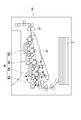
- FIG. 4 is a cross-sectional view showing an example of an image forming apparatus.
- the image forming apparatus 110 shown in FIG. 4 includes image forming units 40a, 40b, 40c, and 40d, a transfer belt 50, and a fixing device 52.
- image forming units 40a, 40b, 40c, and 40d each of the image forming units 40a, 40b, 40c, and 40d will be referred to as an image forming unit 40.
- the image forming unit 40 includes an image carrier 100, a charging device 42, an exposure device 44, a developing device 46, a transfer device 48, and a cleaning device 54.
- the image carrier 100 is the photoconductor 1 of the present embodiment.
- the photoconductor 1 of the present embodiment is excellent in abrasion resistance and charge stability. Therefore, by providing the photoconductor 1 as the image carrier 100, the image forming apparatus 110 has excellent durability and can form a good image on the recording medium P.
- the image carrier 100 is provided at the center position of the image forming unit 40.
- the image carrier 100 is rotatably provided in the arrow direction (counterclockwise).
- a charging device 42, an exposure device 44, a developing device 46, a transfer device 48, and a cleaning device 54 are arranged in the order described from the upstream side in the rotation direction of the image carrier 100. Provided.
- Each of the image forming units 40a to 40d superimposes toner images of a plurality of colors (for example, four colors of black, cyan, magenta, and yellow) on the recording medium P on the transfer belt 50 in order.
- a plurality of colors for example, four colors of black, cyan, magenta, and yellow
- the charging device 42 charges the surface (for example, the peripheral surface) of the image carrier 100 positively.
- the charging device 42 is, for example, a scorotron charging device.
- the exposure apparatus 44 irradiates (exposes) light on the surface of the charged image carrier 100. That is, the exposure apparatus 44 exposes the surface of the charged image carrier 100. As a result, an electrostatic latent image is formed on the surface of the image carrier 100. The electrostatic latent image is formed based on the image data input to the image forming apparatus 110.
- the developing device 46 supplies toner to the surface of the image carrier 100 and develops the electrostatic latent image as a toner image.
- the developing device 46 is in contact with the surface of the image carrier 100. That is, the image forming apparatus 110 employs a contact developing method.
- the developing device 46 is, for example, a developing roller.
- the developing apparatus 46 supplies toner, which is a one-component developer, to the electrostatic latent image formed on the image carrier 100.
- the developer is a two-component developer
- the developing device 46 supplies the electrostatic latent image formed on the image carrier 100 with the toner among the toner and the carrier contained in the two-component developer. In this way, the image carrier 100 carries the toner image.
- the time from when a predetermined region on the surface of the image carrier 100 passes through the exposure position PA to when it reaches the development position PB (hereinafter, may be referred to as exposure-development time) is 100 milliseconds or less. is there.
- the exposure position PA is a position where the light emitted from the exposure apparatus 44 is incident on the surface of the image carrier 100.
- the developing position PB is a position where the surface of the image carrier 100 comes into contact with the developing device 46 or is the position closest to the developing device 46.
- the predetermined region is, for example, a point on the surface of the image carrier 100.
- the transfer belt 50 conveys the recording medium P between the image carrier 100 and the transfer device 48.
- the transfer belt 50 is an endless belt.
- the transfer belt 50 is provided so as to be rotatable in the arrow direction (clockwise).
- the transfer device 48 transfers the toner image developed by the developing device 46 from the surface of the image carrier 100 to the recording medium P which is the transfer target. Specifically, when the transfer device 48 transfers the toner image from the surface of the image carrier 100 to the recording medium P, the surface of the image carrier 100 and the recording medium P are in contact with each other. That is, the image forming apparatus 110 employs a direct transfer method.
- the transfer device 48 is, for example, a transfer roller.
- the cleaning device 54 collects the toner adhering to the surface of the image carrier 100.
- the cleaning device 54 includes a housing 541 and a cleaning roller 542.
- the cleaning device 54 does not include a cleaning blade.
- the cleaning roller 542 is arranged in the housing 541.
- the cleaning roller 542 is arranged so as to come into contact with the surface of the image carrier 100.
- the cleaning roller 542 polishes the surface of the image carrier 100 and collects the toner adhering to the surface of the image carrier 100 into the housing 541.
- the recording medium P on which the toner image is transferred by the transfer device 48 is conveyed to the fixing device 52 by the transfer belt 50.
- the fixing device 52 is, for example, a heating roller and / or a pressure roller.
- the unfixed toner image transferred by the transfer device 48 is heated and / or pressurized by the fixing device 52.
- the toner image is heated and / or pressurized, the toner image is fixed on the recording medium P. As a result, an image is formed on the recording medium P.
- the image forming apparatus is not limited to the image forming apparatus 110.
- the image forming apparatus 110 was a color image forming apparatus, the image forming apparatus may be a monochrome image forming apparatus. In this case, the image forming apparatus may include, for example, only one image forming unit.
- the image forming apparatus 110 has adopted the tandem method, the image forming apparatus may adopt, for example, a rotary method.
- the Scorotron charging device has been described as an example of the charging device 42, the charging device may be a charging device other than the Scorotron charging device (for example, a charging roller, a charging brush, or a Corotron charging device).
- the image forming apparatus 110 may adopt the non-contact developing method.
- the image forming apparatus 110 has adopted the direct transfer method, the image forming apparatus may adopt an intermediate transfer method.
- the transferred body corresponds to the intermediate transfer belt.
- the cleaning device 54 includes a cleaning roller 542 and does not have a cleaning blade, it may be a cleaning device including a cleaning roller 542 and a cleaning blade.
- the image forming unit 40 was not provided with the static elimination device, the image forming unit may be further provided with the static elimination device.
- the process cartridge corresponds to each of the image forming units 40a to 40d.
- the process cartridge comprises an image carrier 100.
- the image carrier 100 is the photoconductor 1 of the present embodiment.
- the photoconductor 1 of the present embodiment is excellent in abrasion resistance and charge stability. Therefore, by providing the photoconductor 1 as the image carrier 100, the process cartridge has excellent durability and can form a good image on the recording medium P.
- the process cartridge includes at least one of the charging device 42, the exposure device 44, the developing device 46, the transfer device 48, and the cleaning device 54 (that is, the charging device 42, the exposure device 44, and the developing device). At least one selected from the group consisting of the device 46, the transfer device 48, and the cleaning device 54) may be further provided.
- the process cartridge may be further equipped with a static elimination device (not shown).
- the process cartridge is designed to be detachably attached to the image forming apparatus 110. Therefore, the process cartridge is easy to handle, and when the sensitivity characteristics of the image carrier 100 deteriorates, the process cartridge including the image carrier 100 can be easily and quickly replaced.
- the process cartridge including the photoconductor 1 of the present embodiment has been described with reference to FIG.
- each of the electron transporting agents (ET1) to (ET-5) described in the embodiment was prepared.
- the hole transporting agents (HT1) to (HT14) described in the embodiment were prepared.
- Binder resin As the binder resin, each of the polyarylate resins (R1) to (R12) described in the embodiment was prepared. The viscosity average molecular weights of the polyarylate resins (R1) to (R12) were all 60,000.
- a polycarbonate resin having a repeating unit represented by the chemical formulas (R13), (R14), and (R15) (hereinafter, each of which is a polycarbonate resin (R13), (R14), And (described as (R15)) were prepared.
- the viscosity average molecular weights of the polycarbonate resins (R13), (R14), and (R15) were all 60,000.
- the polycarbonate resin (R13) corresponds to the bisphenol Z-type polycarbonate resin described in the prior art document.
- additives As additives, the ultraviolet absorbers (AD1) and (AD2) described in the embodiment, and the antioxidants (AD3) and (AD4) were prepared.
- an antioxidant represented by the following chemical formula (AD5) (hereinafter referred to as an antioxidant (AD5)) was prepared.
- a coating liquid for a photosensitive layer was applied onto a conductive substrate (aluminum drum-shaped support) by a dip coating method. The applied coating liquid for the photosensitive layer was dried with hot air at 120 ° C.
- a photosensitive layer (thickness 28 ⁇ m) was formed on the conductive substrate to obtain a photosensitive member (A-1).
- a single-layer photosensitive layer was provided directly on the conductive substrate.
- the photoconductor (A-) was produced in the same manner as in the production of the photoconductor (A-1), except that the hole transporting agents, electron transporting agents, additives, and binder resins shown in Tables 4 and 5 were used. 2)-(A-32) and (B-2)-(B-5) were each produced.
- the photoconductor (B-1) was produced in the same manner as in the production of the photoconductor (A-1) except that no additive was added.
- the coating liquid for the photosensitive layer prepared in the above ⁇ Manufacturing of Photoconductor> was applied to a polypropylene sheet wound around an aluminum pipe.
- the coated coating liquid for the photosensitive layer was dried at 120 ° C. for 60 minutes to prepare a polypropylene sheet on which the photosensitive layer (thickness 28 ⁇ m) was formed.
- the photosensitive layer was peeled off from the polypropylene sheet.
- the peeled photosensitive layer was attached to a card-shaped member (“S-36” manufactured by Taber).
- the mass M A of the pasted card-like member of the photosensitive layer was measured.
- Evaluation A Abrasion weight loss is less than 5 mg.
- Evaluation B Abrasion weight loss is 5 mg or more and less than 8 mg.
- Evaluation C Abrasion weight loss is 8 mg or more.
- the evaluation environment for the charge stability of the photoconductor was an environment with a temperature of 10 ° C. and a relative humidity of 15% RH.
- An evaluation machine (a modified machine of "FS-C5250DN” manufactured by Kyocera Document Solutions Co., Ltd.) was used for the evaluation of charge stability.
- the evaluation machine was equipped with a scorotron charger and a cleaning roller, and was not equipped with a cleaning blade.
- the polarity of the circle of the Scorotron charger was positive.
- the rotation speed of the photoconductor was set so that the exposure-development time was 70 milliseconds.
- an image A (full blank image) was printed on three recording media (A4 size paper) using an evaluation machine.
- the surface potential of the photoconductor was measured at the developing position. Since no exposure is performed when printing a blank image, the measured surface potential corresponds to the charging potential.
- the surface potential was measured once for each printing of one sheet of paper, three times in total. The average value of the measured three surface potentials was defined as the charging potential V 01 (unit: + V) before the printing test.
- the printing test was a test in which image B (printing pattern image with a printing rate of 5%) was printed on 10,000 sheets of recording medium (A4 size paper) at intervals of 15 seconds using an evaluation machine. Immediately after the printing test, image A (full blank image) was printed on three recording media (A4 size paper).
- image B printing pattern image with a printing rate of 5%
- image A full blank image
- the surface potential of the photoconductor was measured at the developing position. The surface potential was measured once for each printing of one sheet of paper, three times in total. The average value of the measured three surface potentials was defined as the charging potential V 02 (unit: + V) after the printing test.
- the value (V 01 ⁇ V 02 ) obtained by subtracting the charging potential V 02 after the printing test from the charging potential V 01 before the printing test was defined as the charge potential decrease amount ⁇ V 0 (unit: V).
- the charge stability of the photoconductor was evaluated from the charge potential decrease amount ⁇ V 0 based on the following criteria. The evaluation results of charge stability are shown in Tables 4 and 5. A photoconductor having an evaluation of charge stability of C was evaluated as having poor charge stability.
- Evaluation A The charge potential decrease amount ⁇ V 0 is 0 V or more and less than 60 V.
- Evaluation B The charge potential decrease amount ⁇ V 0 is 60 V or more and less than 110 V.
- Evaluation C The charge potential decrease amount ⁇ V 0 is 110 V or more.
- HTM refers to a hole transport agent.
- ETM refers to an electron transport agent.
- Resin refers to a binder resin.
- the photosensitive layers of the photoconductors (A-1) to (A-32) each contain one of polyarylate resins (R1) to (R12) as a binder resin. It was.
- the polyarylate resins (R1) to (R12) are polyarylate resins included in the polyarylate resin (PA) containing at least one repeating unit (1) and at least one repeating unit (2), respectively. there were.
- the photosensitive layers of the photoconductors (A-1) to (A-32) are, as additives, one of a predetermined additive (more specifically, an ultraviolet absorber (AD1), an ultraviolet absorber (more specifically, an ultraviolet absorber (AD1)). AD2), an antioxidant (AD3), and one of the antioxidants (AD4)).
- the evaluation of the abrasion resistance of the photoconductors (A-1) to (A-32) was evaluation A or B, and the abrasion resistance of these photoconductors was good. Further, the evaluation of the charge stability of the photoconductors (A-1) to (A-32) was evaluation A, and the charge stability of these photoconductors was good.
- the photoconductor according to the present invention is excellent in abrasion resistance and charge stability. Since the photoconductor according to the present invention is excellent in abrasion resistance and charge stability, the process cartridge and the image forming apparatus provided with the photoconductor according to the present invention are excellent in durability and can form a good image.
- the photoconductor and process cartridge according to the present invention can be used in an image forming apparatus.
- the image forming apparatus according to the present invention can be used to form an image on a recording medium.
Landscapes
- Physics & Mathematics (AREA)
- General Physics & Mathematics (AREA)
- Chemical & Material Sciences (AREA)
- Chemical Kinetics & Catalysis (AREA)
- Spectroscopy & Molecular Physics (AREA)
- Photoreceptors In Electrophotography (AREA)
Priority Applications (2)
| Application Number | Priority Date | Filing Date | Title |
|---|---|---|---|
| JP2021522796A JPWO2020241658A1 (https=) | 2019-05-28 | 2020-05-27 | |
| CN202080038159.6A CN113874791A (zh) | 2019-05-28 | 2020-05-27 | 电子照相感光体、处理盒和图像形成装置 |
Applications Claiming Priority (2)
| Application Number | Priority Date | Filing Date | Title |
|---|---|---|---|
| JP2019-099500 | 2019-05-28 | ||
| JP2019099500 | 2019-05-28 |
Publications (1)
| Publication Number | Publication Date |
|---|---|
| WO2020241658A1 true WO2020241658A1 (ja) | 2020-12-03 |
Family
ID=73552242
Family Applications (1)
| Application Number | Title | Priority Date | Filing Date |
|---|---|---|---|
| PCT/JP2020/020825 Ceased WO2020241658A1 (ja) | 2019-05-28 | 2020-05-27 | 電子写真感光体、プロセスカートリッジ、及び画像形成装置 |
Country Status (3)
| Country | Link |
|---|---|
| JP (1) | JPWO2020241658A1 (https=) |
| CN (1) | CN113874791A (https=) |
| WO (1) | WO2020241658A1 (https=) |
Citations (7)
| Publication number | Priority date | Publication date | Assignee | Title |
|---|---|---|---|---|
| JP2007193309A (ja) * | 2005-12-20 | 2007-08-02 | Canon Inc | 電子写真感光体、電子写真感光体の製造方法、プロセスカートリッジおよび電子写真装置 |
| JP2008281805A (ja) * | 2007-05-11 | 2008-11-20 | Ricoh Co Ltd | 画像形成装置及び画像形成装置用プロセスカートリッジ |
| JP2018025656A (ja) * | 2016-08-10 | 2018-02-15 | 京セラドキュメントソリューションズ株式会社 | 電子写真感光体、プロセスカートリッジ、及び画像形成装置 |
| JP2018054744A (ja) * | 2016-09-27 | 2018-04-05 | 京セラドキュメントソリューションズ株式会社 | 電子写真感光体、プロセスカートリッジ及び画像形成装置 |
| JP2018194702A (ja) * | 2017-05-18 | 2018-12-06 | 京セラドキュメントソリューションズ株式会社 | 電子写真感光体、プロセスカートリッジ及び画像形成装置 |
| JP2018194703A (ja) * | 2017-05-18 | 2018-12-06 | 京セラドキュメントソリューションズ株式会社 | 電子写真感光体、プロセスカートリッジ及び画像形成装置 |
| JP2019061205A (ja) * | 2017-09-28 | 2019-04-18 | 京セラドキュメントソリューションズ株式会社 | 電子写真感光体、プロセスカートリッジ、及び画像形成装置 |
Family Cites Families (2)
| Publication number | Priority date | Publication date | Assignee | Title |
|---|---|---|---|---|
| JP2002328480A (ja) * | 2001-04-27 | 2002-11-15 | Hodogaya Chem Co Ltd | 電子写真用感光体 |
| JP6747514B2 (ja) * | 2016-10-28 | 2020-08-26 | 京セラドキュメントソリューションズ株式会社 | 電子写真感光体、プロセスカートリッジ及び画像形成装置 |
-
2020
- 2020-05-27 JP JP2021522796A patent/JPWO2020241658A1/ja active Pending
- 2020-05-27 WO PCT/JP2020/020825 patent/WO2020241658A1/ja not_active Ceased
- 2020-05-27 CN CN202080038159.6A patent/CN113874791A/zh active Pending
Patent Citations (7)
| Publication number | Priority date | Publication date | Assignee | Title |
|---|---|---|---|---|
| JP2007193309A (ja) * | 2005-12-20 | 2007-08-02 | Canon Inc | 電子写真感光体、電子写真感光体の製造方法、プロセスカートリッジおよび電子写真装置 |
| JP2008281805A (ja) * | 2007-05-11 | 2008-11-20 | Ricoh Co Ltd | 画像形成装置及び画像形成装置用プロセスカートリッジ |
| JP2018025656A (ja) * | 2016-08-10 | 2018-02-15 | 京セラドキュメントソリューションズ株式会社 | 電子写真感光体、プロセスカートリッジ、及び画像形成装置 |
| JP2018054744A (ja) * | 2016-09-27 | 2018-04-05 | 京セラドキュメントソリューションズ株式会社 | 電子写真感光体、プロセスカートリッジ及び画像形成装置 |
| JP2018194702A (ja) * | 2017-05-18 | 2018-12-06 | 京セラドキュメントソリューションズ株式会社 | 電子写真感光体、プロセスカートリッジ及び画像形成装置 |
| JP2018194703A (ja) * | 2017-05-18 | 2018-12-06 | 京セラドキュメントソリューションズ株式会社 | 電子写真感光体、プロセスカートリッジ及び画像形成装置 |
| JP2019061205A (ja) * | 2017-09-28 | 2019-04-18 | 京セラドキュメントソリューションズ株式会社 | 電子写真感光体、プロセスカートリッジ、及び画像形成装置 |
Also Published As
| Publication number | Publication date |
|---|---|
| JPWO2020241658A1 (https=) | 2020-12-03 |
| CN113874791A (zh) | 2021-12-31 |
Similar Documents
| Publication | Publication Date | Title |
|---|---|---|
| JP6747514B2 (ja) | 電子写真感光体、プロセスカートリッジ及び画像形成装置 | |
| CN111458992A (zh) | 电子照相感光体、处理盒和图像形成装置 | |
| CN111458993A (zh) | 电子照相感光体、处理盒和图像形成装置 | |
| JP6812947B2 (ja) | 電子写真感光体、画像形成装置及びプロセスカートリッジ | |
| JP5622673B2 (ja) | 電子写真感光体及び画像形成装置 | |
| CN115407625A (zh) | 电子照相感光体、处理盒和图像形成装置 | |
| CN111830799B (zh) | 电子照相感光体、处理盒和图像形成装置 | |
| JP6760207B2 (ja) | 電子写真感光体、プロセスカートリッジ及び画像形成装置 | |
| JP7331434B2 (ja) | 電子写真感光体、プロセスカートリッジ、及び画像形成装置 | |
| JP6760240B2 (ja) | 電子写真感光体、プロセスカートリッジ、及び画像形成装置 | |
| JP2020181013A (ja) | 電子写真感光体 | |
| JP7215577B2 (ja) | 電子写真感光体、プロセスカートリッジ、及び画像形成装置 | |
| JP2021071564A (ja) | 電子写真感光体 | |
| JP6724855B2 (ja) | 電子写真感光体、画像形成装置及びプロセスカートリッジ | |
| WO2020241658A1 (ja) | 電子写真感光体、プロセスカートリッジ、及び画像形成装置 | |
| JP7287108B2 (ja) | 電子写真感光体、プロセスカートリッジ、及び画像形成装置 | |
| JP6784238B2 (ja) | 電子写真感光体、プロセスカートリッジ及び画像形成装置 | |
| JP6741145B2 (ja) | 電子写真感光体及び画像形成装置 | |
| JP7230522B2 (ja) | 電子写真感光体、プロセスカートリッジ、及び画像形成装置 | |
| JP7286976B2 (ja) | 電子写真感光体、プロセスカートリッジ、及び画像形成装置 | |
| JP2021081508A (ja) | 電子写真感光体、プロセスカートリッジ、及び画像形成装置 | |
| JP5526082B2 (ja) | 電子写真感光体及び画像形成装置 | |
| JP2012247498A (ja) | 電子写真感光体及び画像形成装置 | |
| JP7211098B2 (ja) | 電子写真感光体、プロセスカートリッジ、及び画像形成装置 | |
| JP2022069077A (ja) | 電子写真感光体、プロセスカートリッジ、及び画像形成装置 |
Legal Events
| Date | Code | Title | Description |
|---|---|---|---|
| 121 | Ep: the epo has been informed by wipo that ep was designated in this application |
Ref document number: 20813715 Country of ref document: EP Kind code of ref document: A1 |
|
| ENP | Entry into the national phase |
Ref document number: 2021522796 Country of ref document: JP Kind code of ref document: A |
|
| NENP | Non-entry into the national phase |
Ref country code: DE |
|
| 122 | Ep: pct application non-entry in european phase |
Ref document number: 20813715 Country of ref document: EP Kind code of ref document: A1 |