WO2020213499A1 - 非水電解質二次電池用の負極、及び非水電解質二次電池 - Google Patents
非水電解質二次電池用の負極、及び非水電解質二次電池 Download PDFInfo
- Publication number
- WO2020213499A1 WO2020213499A1 PCT/JP2020/015865 JP2020015865W WO2020213499A1 WO 2020213499 A1 WO2020213499 A1 WO 2020213499A1 JP 2020015865 W JP2020015865 W JP 2020015865W WO 2020213499 A1 WO2020213499 A1 WO 2020213499A1
- Authority
- WO
- WIPO (PCT)
- Prior art keywords
- negative electrode
- layer
- aqueous electrolyte
- electrolyte secondary
- secondary battery
- Prior art date
- Legal status (The legal status is an assumption and is not a legal conclusion. Google has not performed a legal analysis and makes no representation as to the accuracy of the status listed.)
- Ceased
Links
Images

Classifications
-
- H—ELECTRICITY
- H01—ELECTRIC ELEMENTS
- H01M—PROCESSES OR MEANS, e.g. BATTERIES, FOR THE DIRECT CONVERSION OF CHEMICAL ENERGY INTO ELECTRICAL ENERGY
- H01M4/00—Electrodes
- H01M4/02—Electrodes composed of, or comprising, active material
- H01M4/13—Electrodes for accumulators with non-aqueous electrolyte, e.g. for lithium-accumulators; Processes of manufacture thereof
- H01M4/134—Electrodes based on metals, Si or alloys
-
- H—ELECTRICITY
- H01—ELECTRIC ELEMENTS
- H01M—PROCESSES OR MEANS, e.g. BATTERIES, FOR THE DIRECT CONVERSION OF CHEMICAL ENERGY INTO ELECTRICAL ENERGY
- H01M4/00—Electrodes
- H01M4/02—Electrodes composed of, or comprising, active material
- H01M4/36—Selection of substances as active materials, active masses, active liquids
- H01M4/58—Selection of substances as active materials, active masses, active liquids of inorganic compounds other than oxides or hydroxides, e.g. sulfides, selenides, tellurides, halogenides or LiCoFy; of polyanionic structures, e.g. phosphates, silicates or borates
- H01M4/583—Carbonaceous material, e.g. graphite-intercalation compounds or CFx
-
- H—ELECTRICITY
- H01—ELECTRIC ELEMENTS
- H01M—PROCESSES OR MEANS, e.g. BATTERIES, FOR THE DIRECT CONVERSION OF CHEMICAL ENERGY INTO ELECTRICAL ENERGY
- H01M4/00—Electrodes
- H01M4/02—Electrodes composed of, or comprising, active material
- H01M4/13—Electrodes for accumulators with non-aqueous electrolyte, e.g. for lithium-accumulators; Processes of manufacture thereof
- H01M4/133—Electrodes based on carbonaceous material, e.g. graphite-intercalation compounds or CFx
-
- H—ELECTRICITY
- H01—ELECTRIC ELEMENTS
- H01M—PROCESSES OR MEANS, e.g. BATTERIES, FOR THE DIRECT CONVERSION OF CHEMICAL ENERGY INTO ELECTRICAL ENERGY
- H01M4/00—Electrodes
- H01M4/02—Electrodes composed of, or comprising, active material
- H01M4/36—Selection of substances as active materials, active masses, active liquids
- H01M4/362—Composites
- H01M4/364—Composites as mixtures
-
- H—ELECTRICITY
- H01—ELECTRIC ELEMENTS
- H01M—PROCESSES OR MEANS, e.g. BATTERIES, FOR THE DIRECT CONVERSION OF CHEMICAL ENERGY INTO ELECTRICAL ENERGY
- H01M4/00—Electrodes
- H01M4/02—Electrodes composed of, or comprising, active material
- H01M4/36—Selection of substances as active materials, active masses, active liquids
- H01M4/362—Composites
- H01M4/366—Composites as layered products
-
- H—ELECTRICITY
- H01—ELECTRIC ELEMENTS
- H01M—PROCESSES OR MEANS, e.g. BATTERIES, FOR THE DIRECT CONVERSION OF CHEMICAL ENERGY INTO ELECTRICAL ENERGY
- H01M4/00—Electrodes
- H01M4/02—Electrodes composed of, or comprising, active material
- H01M2004/026—Electrodes composed of, or comprising, active material characterised by the polarity
- H01M2004/027—Negative electrodes
-
- H—ELECTRICITY
- H01—ELECTRIC ELEMENTS
- H01M—PROCESSES OR MEANS, e.g. BATTERIES, FOR THE DIRECT CONVERSION OF CHEMICAL ENERGY INTO ELECTRICAL ENERGY
- H01M4/00—Electrodes
- H01M4/02—Electrodes composed of, or comprising, active material
- H01M4/13—Electrodes for accumulators with non-aqueous electrolyte, e.g. for lithium-accumulators; Processes of manufacture thereof
- H01M4/139—Processes of manufacture
- H01M4/1393—Processes of manufacture of electrodes based on carbonaceous material, e.g. graphite-intercalation compounds or CFx
-
- Y—GENERAL TAGGING OF NEW TECHNOLOGICAL DEVELOPMENTS; GENERAL TAGGING OF CROSS-SECTIONAL TECHNOLOGIES SPANNING OVER SEVERAL SECTIONS OF THE IPC; TECHNICAL SUBJECTS COVERED BY FORMER USPC CROSS-REFERENCE ART COLLECTIONS [XRACs] AND DIGESTS
- Y02—TECHNOLOGIES OR APPLICATIONS FOR MITIGATION OR ADAPTATION AGAINST CLIMATE CHANGE
- Y02E—REDUCTION OF GREENHOUSE GAS [GHG] EMISSIONS, RELATED TO ENERGY GENERATION, TRANSMISSION OR DISTRIBUTION
- Y02E60/00—Enabling technologies; Technologies with a potential or indirect contribution to GHG emissions mitigation
- Y02E60/10—Energy storage using batteries
Definitions
- the present disclosure relates to a negative electrode for a non-aqueous electrolyte secondary battery and a non-aqueous electrolyte secondary battery using the negative electrode.
- an element that alloys with lithium such as silicon and tin or a compound containing the element can occlude more lithium ions per unit volume than a carbon material such as graphite. Therefore, by using these as the negative electrode active material, it is possible to increase the capacity of the battery. Further, as a negative electrode active material, a negative electrode in which a carbon material and a compound such as a silicon material are used in combination is also known.
- Patent Documents 1 and 2 contain an element that alloys with lithium or a compound containing the element, and include a first layer provided on the surface of the negative electrode core and a carbon material such as graphite.
- a negative electrode for a non-aqueous electrolyte secondary battery provided with a negative electrode mixture layer having a two-layer structure composed of a second layer provided on the surface of the first layer is disclosed.
- As the carbon material graphite having a BET specific surface area of 3 to 5 m 2 / g is generally used.
- An object of the present disclosure is to improve high temperature storage characteristics in a non-aqueous electrolyte secondary battery using a high-capacity negative electrode active material.
- the negative electrode for a non-aqueous electrolyte secondary battery which is one aspect of the present disclosure, is a negative electrode including a negative electrode core and a negative electrode mixture layer containing a negative electrode active material provided on the surface of the negative electrode core.
- the negative electrode mixture layer is a first layer containing graphite having a BET specific surface area of 0.5 to 2.5 m 2 / g as the negative electrode active material, and an element that alloys with lithium as the negative electrode active material. And a second layer containing at least one of the compounds containing the element.
- the non-aqueous electrolyte secondary battery according to one aspect of the present disclosure includes the negative electrode, the positive electrode, and the non-aqueous electrolyte.
- the negative electrode according to the present disclosure it is possible to provide a non-aqueous electrolyte secondary battery having excellent high temperature storage characteristics.
- the present inventors have conducted a first layer containing graphite having a BET specific surface area of 0.5 to 2.5 m 2 / g, an element alloying with lithium, and the above-mentioned elements.
- a negative electrode having a two-layer structure negative electrode mixture layer having a second layer containing at least one of the elements-containing compounds we succeeded in significantly suppressing a decrease in battery capacity during high-temperature storage. .. It is considered that such an effect is largely due to the fact that the side reaction of the electrolytic solution at the negative electrode is suppressed by making the BET specific surface area of graphite smaller than before.
- the negative electrode active material only graphite is present in the first layer, and at least one of the element alloying with lithium and the compound containing the element is present in the second layer, and the active materials are not mixed. As a result, it was found that the high temperature storage characteristics were further improved.
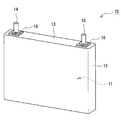
- FIG. 1 is a perspective view showing a non-aqueous electrolyte secondary battery 10 which is an example of the embodiment.
- the non-aqueous electrolyte secondary battery 10 illustrated in FIG. 1 is a square battery including a square outer can 12, but the outer body is not limited to the outer can 12, and may be, for example, a cylindrical outer can. It may be an exterior body composed of a laminated sheet including a metal layer and a resin layer.
- the non-aqueous electrolyte secondary battery 10 includes an electrode body 11, a non-aqueous electrolyte, and a rectangular outer can 12 for accommodating them.
- the outer can 12 is a flat, substantially rectangular parallelepiped-shaped metal container with one side open.
- the electrode body 11 has, for example, a positive electrode, a negative electrode, and a separator, and the positive electrode and the negative electrode are spirally wound through the separator and formed into a flat shape. Further, the electrode body 11 has a positive electrode lead connected to the positive electrode by welding or the like and a negative electrode lead connected to the negative electrode by welding or the like.
- the electrode body 11 may be a laminated electrode body in which a plurality of positive electrodes and a plurality of negative electrodes are alternately laminated one by one via a separator.
- the non-aqueous electrolyte contains a non-aqueous solvent and an electrolyte salt dissolved in the non-aqueous solvent.
- the non-aqueous solvent for example, esters, ethers, nitriles, amides, and a mixed solvent of two or more of these may be used.
- the non-aqueous solvent may contain a halogen substituent in which at least a part of hydrogen in these solvents is substituted with a halogen atom such as fluorine.
- the non-aqueous electrolyte is not limited to the liquid electrolyte, and may be a solid electrolyte using a gel polymer or the like.
- the electrolyte salt for example, a lithium salt such as LiPF 6 is used.
- the non-aqueous electrolyte secondary battery 10 is electrically connected to the negative electrode through the sealing body 13 that closes the opening of the outer can 12, the positive electrode terminal 14 that is electrically connected to the positive electrode via the positive electrode lead, and the negative electrode lead. It has a negative electrode terminal 15 to be formed.
- the outer can 12 and the sealing body 13 are made of, for example, a metal material containing aluminum as a main component.
- the positive electrode terminal 14 and the negative electrode terminal 15 are fixed to the sealing body 13 via the insulating member 16.
- the sealing body 13 is provided with a gas discharge mechanism (not shown).
- the positive electrode, the negative electrode, and the separator constituting the electrode body 11 will be described in detail, particularly the negative electrode.
- the positive electrode has a positive electrode core body and a positive electrode mixture layer provided on the surface of the positive electrode core body.
- a foil of a metal stable in the potential range of the positive electrode such as aluminum or an aluminum alloy, a film in which the metal is arranged on the surface layer, or the like can be used.
- the positive electrode mixture layer contains the positive electrode active material, the conductive material, and the binder, and is preferably provided on both sides of the positive electrode core body excluding the exposed core body portion where the positive electrode leads are connected.
- the thickness of the positive electrode mixture layer is, for example, 50 ⁇ m to 150 ⁇ m on one side of the positive electrode core body.
- a positive electrode mixture slurry containing a positive electrode active material, a conductive material, a binder, etc. is applied to the surface of the positive electrode core, the coating film is dried, and then compressed to form the positive electrode mixture layer into the positive electrode core. It can be produced by forming on both sides of.
- the positive electrode active material is composed mainly of a lithium transition metal composite oxide.
- metal elements other than Li contained in the lithium transition metal composite oxide include Ni, Co, Mn, Al, B, Mg, Ti, V, Cr, Fe, Cu, Zn, Ga, Sr, Zr, and Nb. , In, Sn, Ta, W and the like.
- An example of a suitable lithium transition metal composite oxide is a composite oxide containing at least one of Ni, Co, and Mn. Specific examples include a lithium transition metal composite oxide containing Ni, Co and Mn, and a lithium transition metal composite oxide containing Ni, Co and Al.
- Examples of the conductive material contained in the positive electrode mixture layer include carbon materials such as carbon black, acetylene black, ketjen black, and graphite.
- Examples of the binder contained in the positive electrode mixture layer include fluororesins such as polytetrafluoroethylene (PTFE) and polyvinylidene fluoride (PVdF), polyacrylonitrile (PAN), polyimide resins, acrylic resins, and polyolefin resins. .. These resins may be used in combination with cellulose derivatives such as carboxymethyl cellulose (CMC) or salts thereof, polyethylene oxide (PEO) and the like.
- FIG. 2 is a cross-sectional view of the negative electrode 20.
- the negative electrode 20 has a negative electrode core body 21 and a negative electrode mixture layer 22 provided on the surface of the negative electrode core body 21.
- a foil of a metal stable in the potential range of the negative electrode such as copper or a copper alloy, a film in which the metal is arranged on the surface layer, or the like can be used.
- the negative electrode mixture layer 22 is preferably provided on both sides of the negative electrode core body 21 excluding the exposed core body portion where the negative electrode leads are connected.
- the thickness of the negative electrode mixture layer 22 is, for example, 50 ⁇ m to 150 ⁇ m on one side of the negative electrode core body 21.
- the negative electrode mixture layer 22 contains a negative electrode active material and has a first layer 22A and a second layer 22B.
- the first layer 22A contains graphite 23 having a BET specific surface area of 0.5 to 2.5 m 2 / g as a negative electrode active material.
- the second layer 22B contains a compound 24 containing an element that alloys with lithium as a negative electrode active material.
- the second layer 22B may contain a simple substance composed of one kind of element that alloys with lithium instead of or together with the compound 24.
- the first layer 22A may contain the compound 24 and the second layer 22B may contain the graphite 23, but preferably the first layer 22A contains only the graphite 23 as the negative electrode active material and the second layer 22A.
- Layer 22B contains only compound 24 as the negative electrode active material.
- FIG. 2 in the negative electrode mixture layer 22, there is no region in which graphite 23 and compound 24 coexist at the interface between the first layer 22A and the second layer 22B and in the vicinity thereof, for example, a plurality of regions. It is preferable that there are no particles of the compound 24 surrounded by the particles of the graphite 23. In this case, the isolation of the compound 24 is suppressed, and the high temperature storage property is further improved.
- the negative electrode 20 can be produced by using a first negative electrode mixture slurry containing graphite 23 and a second negative electrode mixture slurry containing compound 24.
- a second negative electrode mixture slurry is applied to the surface of the negative electrode core body 21, the coating film is dried and compressed, and then the first negative electrode mixture slurry is applied onto the coating film to form a second layer.
- the negative electrode 20 can be produced by drying and compressing the coating film of.
- the second layer 22B is provided on the surface of the negative electrode core body 21, and the first layer 22A is provided on the surface of the second layer 22B. That is, the negative electrode mixture layer 22 has a two-layer structure in which a second layer 22B / a first layer 22A is formed in order from the negative electrode core body 21 side.
- the negative electrode mixture layer 22 may have a two-layer structure in which the first layer 22A / the second layer 22B are formed in order from the negative electrode core body 21 side. In any of the layer structures, the same effect can be obtained with respect to the high temperature storage characteristics of the battery.
- the layer formed on the surface of the negative electrode core 21 may be referred to as a “lower layer”, and the layer formed on the surface of the negative electrode core 21 via the lower layer may be referred to as an “upper layer”.
- the negative electrode active material contained in the second layer 22B is present in an amount of 0.03 to 9.6 times that of the negative electrode active material contained in the first layer 22A. Since it is preferable that the first layer 22A contains only graphite 23 as the negative electrode active material and the second layer 22B contains only the compound 24 as the negative electrode active material, the compound 24 is contained in the negative electrode mixture layer 22 as graphite 23. It can be said that it exists in an amount of 0.03 to 9.6 times that of. In this case, it is easy to achieve both high capacity and good high temperature storage characteristics.
- the thickness of the first layer 22A and the second layer 22B is not particularly limited, but is preferably 10 ⁇ m to 120 ⁇ m, and more preferably 15 ⁇ m to 80 ⁇ m, respectively.
- the thickness of the second layer 22B may be thinner than the thickness of the first layer 22A, or may be substantially the same.
- the graphite 23 contained in the first layer 22A is, for example, natural graphite such as scaly graphite, or artificial graphite such as massive artificial graphite or graphitized mesophase carbon microbeads.
- Graphite 23 may be a mixture of two or more types of graphite.
- a conductive coating layer such as amorphous carbon may be formed on the particle surface of graphite 23.
- Graphite 23 is a particle having a volume-based median diameter (D50) of, for example, 5 ⁇ m to 30 ⁇ m, preferably 10 ⁇ m to 25 ⁇ m.
- D50 means a particle diameter in which the cumulative frequency is 50% from the smallest particle diameter in the volume-based particle size distribution, and is also called a medium diameter.
- the D50 can be measured using water as a dispersion medium using a laser diffraction type particle size distribution measuring device (for example, Microtrac HRA manufactured by Nikkiso Co., Ltd.).
- the BET specific surface area of graphite 23 is 0.5 to 2.5 m 2 / g, more preferably 0.7 to 1.5 m 2 / g. If the BET specific surface area exceeds 2.5 m 2 / g, the decrease in battery capacity during high-temperature storage cannot be suppressed. On the other hand, if the BET specific surface area is less than 0.5 m 2 / g, a sufficient capacity cannot be secured.
- the BET specific surface area is measured according to the BET method (nitrogen adsorption method) described in JIS R1626.
- the compound 24 contained in the second layer 22B is a compound containing an element that alloys with lithium.
- Compound 24 may be a mixture of two or more compounds.
- the element that alloys with lithium that can be applied to the negative electrode active material include Al, Ga, In, Si, Ge, Sn, Pb, As, Sb, and Bi. Among them, Si and Sn are preferable, and Si is particularly preferable, from the viewpoint of increasing the capacity.
- Si-containing compound 24 examples include a silicon oxide phase, a Si-containing compound dispersed in the silicon oxide phase (hereinafter referred to as “SiO”), a lithium silicate phase, and a lithium silicate phase dispersed therein. Examples thereof include compounds containing Si (hereinafter referred to as “LSX”).
- the second layer 22B may contain either SiO or LSX as the compound 24, or may contain both SiO and LSX.
- SiO and LSX are particles in which, for example, D50 is smaller than D50 of graphite 23.
- the volume-based D50 of SiO and LSX is preferably 1 ⁇ m to 15 ⁇ m, more preferably 4 ⁇ m to 10 ⁇ m.
- a conductive layer made of a highly conductive material may be formed on the surface of the SiO and LSX particles.
- An example of a suitable conductive layer is a carbon coating made of a carbon material.
- the thickness of the conductive layer is preferably 1 nm to 200 nm, more preferably 5 nm to 100 nm, in consideration of ensuring conductivity and diffusing lithium ions into the particles.
- the second layer 22B may contain a conductive material.
- the carbon film is composed of, for example, carbon black, acetylene black, ketjen black, graphite, and a mixture of two or more of these.
- Examples of the method of carbon-coating the particle surfaces of SiO and LSX include a CVD method using acetylene and methane, and a method of mixing coal pitch, petroleum pitch, phenol resin and the like with SiO and LSX particles and performing heat treatment. it can.
- a carbon film may be formed by fixing carbon powder such as carbon black to the surface of the particles using a binder.
- a suitable SiO has a sea-island structure in which fine Si particles are substantially uniformly dispersed in an amorphous silicon oxide matrix, and is represented by the general formula SiO x (0.5 ⁇ x ⁇ 1.6). ..
- the content of Si particles is preferably 35 to 75% by mass with respect to the total mass of SiO, from the viewpoint of achieving both battery capacity and cycle characteristics. For example, if the content of Si particles is too low, the capacity decreases, and if the content of Si particles is too high, some of the exposed Si particles that are not covered with silicon oxide come into contact with the electrolytic solution, resulting in cycle characteristics. descend.
- the average particle size of the Si particles dispersed in the silicon oxide phase is generally 500 nm or less, preferably 200 nm or less, and more preferably 50 nm or less before charging / discharging. After charging and discharging, 400 nm or less is preferable, and 100 nm or less is more preferable. By making the Si particles finer, the volume change during charging and discharging becomes smaller and the cycle characteristics are improved.
- the average particle size of the Si particles is measured by observing the cross section of SiO using a scanning electron microscope (SEM) or a transmission electron microscope (TEM), and specifically, the longest diameter of 100 Si particles. Obtained as an average value.
- the silicon oxide phase is composed of, for example, a set of particles finer than Si particles.
- a suitable LSX has a sea-island structure in which fine Si particles are substantially uniformly dispersed in a matrix of lithium silicate represented by the general formula Li 2z SiO (2 + z) (0 ⁇ z ⁇ 2).
- the content of Si particles is preferably 35 to 75% by mass with respect to the total mass of LSX, as in the case of SiO.
- the average particle size of the Si particles is generally 500 nm or less, preferably 200 nm or less, and more preferably 50 nm or less before charging / discharging.
- the lithium silicate phase is composed of, for example, an aggregate of particles finer than Si particles.
- SiO can be produced by the following steps. (1) Si and silicon oxide are mixed at a weight ratio of, for example, 20:80 to 95: 5 to prepare a mixture. (2) At least before or after the preparation of the above mixture, Si and silicon oxide are pulverized into fine particles by, for example, a ball mill. (3) The pulverized mixture is heat-treated at 600 to 1000 ° C., for example, in an inert atmosphere.
- LSX can be produced by using lithium silicate instead of silicon oxide.
- the first layer 22A and the second layer 22B each include a binder.
- a binder contained in the first layer 22A and the second layer 22B fluororesin, PAN, polyimide, acrylic resin, polyolefin or the like can be used as in the case of the positive electrode 11, but styrene-butadiene rubber. (SBR) is preferably used.
- the first layer 22A and the second layer 22B preferably further contain CMC or a salt thereof, polyacrylic acid (PAA) or a salt thereof, polyvinyl alcohol (PVA) and the like.
- the first layer 22A and the second layer 22B may contain different binders from each other, but preferably contain SBR and CMC or a salt thereof.
- the CMC or a salt thereof functions as a binder for binding the negative electrode active materials to each other and the negative electrode active material and the negative electrode core body 21, and also functions as a thickener for the negative electrode mixture slurry.
- the content ratio of SBR and CMC may be different in each layer.
- Weight ratio of binder for the negative electrode active material in the second layer 22B is 1 times the proportion by weight of binder for the negative electrode active material in the first layer 22A (R A), i.e. the The mass ratio may be the same, but is preferably 1.5 to 10 times, more preferably 2 to 7 times.
- R B / R A 1.5 to 10 Compound 24 graphite 23 in the interface and in the vicinity of the first layer 22A and the second layer 22B that is miscible is suppressed, as a result, high-temperature The storage characteristics are further improved.
- R B / R A is more than 10, unfavorably causing a decrease in capacity.
- the content of the binder in the first layer 22A is, for example, 0.5 to 5% by mass, preferably 1 to 3% by mass.
- the content of the binder in the second layer 22B is, for example, 0.5 to 15% by mass, preferably 1 to 10% by mass, and more preferably 1.5 to 6% by mass.
- An example of a suitable first layer 22A comprises substantially only graphite 23, SBR, CMC or a salt thereof.
- an example of a suitable second layer 22B comprises substantially only compound 24, SBR, CMC or a salt thereof.
- a porous sheet having ion permeability and insulating property is used as the separator.
- Specific examples of the porous sheet include a microporous thin film, a woven fabric, and a non-woven fabric.
- olefin resin such as polyethylene and polypropylene, cellulose and the like are suitable.
- the separator may have either a single-layer structure or a laminated structure. A heat-resistant layer or the like may be formed on the surface of the separator.
- a lithium transition metal composite oxide represented by LiCo 1/3 Mn 1/3 Ni 1/3 O 2 was used as the positive electrode active material. 98 parts by mass of positive electrode active material, 1 part by mass of acetylene black, and 1 part by mass of polyvinylidene fluoride are mixed, and N-methyl-2-pyrrolidone (NMP) is used as a dispersion medium.
- NMP N-methyl-2-pyrrolidone
- the positive electrode mixture slurry is applied to both sides of the positive electrode core made of aluminum foil, the coating film is dried and compressed, and then cut into a predetermined electrode size to form positive electrode mixture layers on both sides of the positive electrode core. The formed positive electrode was produced. An exposed portion with an exposed core surface was provided at the center of the positive electrode in the longitudinal direction, and the positive electrode lead was welded to the exposed portion.
- first negative electrode mixture slurry As the negative electrode active material, graphite having a BET specific surface area of 1.0 m 2 / g was used. 98 parts by mass of graphite, 1 part by mass of carboxymethyl cellulose (CMC), and 1 part by mass of styrene-butadiene rubber (SBR) are mixed, and water is used as a dispersion medium to prepare a first negative electrode mixture slurry. did.
- CMC carboxymethyl cellulose
- SBR styrene-butadiene rubber
- a second negative electrode mixture slurry was prepared by mixing 98 parts by mass of SiO, 1 part by mass of CMC, and 1 part by mass of SBR, and using water as a dispersion medium.
- the second negative electrode mixture slurry is applied to both sides of the negative electrode core made of copper foil, the coating film is dried and compressed, and then the first negative electrode mixture slurry is applied onto the coating film to form the second layer.
- the coating film was dried and compressed.
- each slurry was applied so that the mass of graphite was 70 g / m 2 and the mass of SiO was 30 g / m 2 (the mass ratio of SiO and graphite in the negative electrode mixture layer was 0.43).
- it is cut into a predetermined electrode size, and a lower layer (second layer) containing SiO and an upper layer (first layer) containing graphite are formed on both sides of the negative electrode core body from the core body side.
- a negative electrode having the negative electrode mixture layer of the above was prepared. An exposed portion with an exposed core surface was provided at the longitudinal end of the negative electrode, and a negative electrode lead was welded to the exposed portion.
- a non-aqueous electrolyte solution was prepared by dissolving LiPF 6 at a concentration of 1 mol / L in a mixed solvent in which ethylene carbonate (EC) and ethyl methyl carbonate (EMC) were mixed at a mass ratio of 1: 3.
- EC ethylene carbonate
- EMC ethyl methyl carbonate
- the positive electrode and the negative electrode were spirally wound via a polyethylene separator and formed into a flat shape to prepare a wound electrode body.
- the electrode body and the non-aqueous electrolyte solution were sealed in an exterior body made of an aluminum laminate film to prepare a non-aqueous electrolyte secondary battery.
- Example 2 As the negative electrode active material of the upper layer, the same as in Example 1 except that graphite having a BET specific surface area of 0.5 m 2 / g was used instead of graphite having a BET specific surface area of 1.0 m 2 / g. A negative electrode and a non-aqueous electrolyte secondary battery were manufactured.
- Example 3 As the negative electrode active material of the upper layer, the same as in Example 1 except that graphite having a BET specific surface area of 2.5 m 2 / g was used instead of graphite having a BET specific surface area of 1.0 m 2 / g. A negative electrode and a non-aqueous electrolyte secondary battery were manufactured.
- Example 4 A negative electrode and a non-aqueous electrolyte secondary battery were produced in the same manner as in Example 1 except that the mass of graphite was changed to 97 g / m 2 and the mass of SiO was changed to 3 g / m 2 in the production of the negative electrode.
- Example 5 In the production of the negative electrode, the negative electrode and the non-aqueous electrolyte secondary battery were produced in the same manner as in Example 1 except that the mass of graphite was 9.5 g / m 2 and the mass of SiO was 91.5 g / m 2. did.
- Example 5 In the production of the negative electrode, the negative electrode and the non-aqueous electrolyte secondary battery were produced in the same manner as in Example 1 except that the first layer containing graphite was used as the lower layer and the second layer containing SiO was used as the upper layer.
- Example 7 In the preparation of the second negative electrode mixture slurry, the same as in Example 1 except that the amount of the binder (CMC / SBR) added was 3% by mass and the mass ratio of CMC and SBR was 2: 1. A negative electrode and a non-aqueous electrolyte secondary battery were prepared.
- Example 8 In the preparation of the second negative electrode mixture slurry, a negative electrode and a non-aqueous electrolyte secondary battery were produced in the same manner as in Example 7 except that the mass ratio of CMC and SBR was 1: 2.
- Example 9 In the preparation of the second negative electrode mixture slurry, the same as in Example 1 except that the amount of the binder (CMC / SBR) added was 10% by mass and the mass ratio of CMC and SBR was 9: 1. A negative electrode and a non-aqueous electrolyte secondary battery were prepared.
- Example 10 A negative electrode and a non-aqueous electrolyte secondary battery were produced in the same manner as in Example 9 except that the mass ratio of CMC and SBR was 5: 5 in the preparation of the second negative electrode mixture slurry.
- Example 11 In the preparation of the second negative electrode mixture slurry, a negative electrode and a non-aqueous electrolyte secondary battery were produced in the same manner as in Example 9 except that the mass ratio of CMC and SBR was 1: 9.
- Capacity retention rate (%) (capacity after storage ⁇ capacity before storage) x 100
- the calculated capacity retention rate is shown in Tables 1 and 2 together with the type and amount of the negative electrode active material or the binder.
- Non-aqueous electrolyte secondary battery 11
Landscapes
- Chemical & Material Sciences (AREA)
- Composite Materials (AREA)
- Chemical Kinetics & Catalysis (AREA)
- Electrochemistry (AREA)
- General Chemical & Material Sciences (AREA)
- Engineering & Computer Science (AREA)
- Materials Engineering (AREA)
- Inorganic Chemistry (AREA)
- Battery Electrode And Active Subsutance (AREA)
- Secondary Cells (AREA)
Priority Applications (4)
| Application Number | Priority Date | Filing Date | Title |
|---|---|---|---|
| CN202080029538.9A CN113711382B (zh) | 2019-04-19 | 2020-04-08 | 非水电解质二次电池用的负极及非水电解质二次电池 |
| EP20791342.7A EP3958349A4 (en) | 2019-04-19 | 2020-04-08 | Negative electrode for non-aqueous electrolyte secondary battery and non-aqueous electrolyte secondary battery |
| US17/603,466 US20220216474A1 (en) | 2019-04-19 | 2020-04-08 | Negative electrode for non-aqueous electrolyte secondary battery and non-aqueous electrolyte secondary battery |
| JP2021514907A JP7454559B2 (ja) | 2019-04-19 | 2020-04-08 | 非水電解質二次電池用の負極、及び非水電解質二次電池 |
Applications Claiming Priority (2)
| Application Number | Priority Date | Filing Date | Title |
|---|---|---|---|
| JP2019-079959 | 2019-04-19 | ||
| JP2019079959 | 2019-04-19 |
Publications (1)
| Publication Number | Publication Date |
|---|---|
| WO2020213499A1 true WO2020213499A1 (ja) | 2020-10-22 |
Family
ID=72837321
Family Applications (1)
| Application Number | Title | Priority Date | Filing Date |
|---|---|---|---|
| PCT/JP2020/015865 Ceased WO2020213499A1 (ja) | 2019-04-19 | 2020-04-08 | 非水電解質二次電池用の負極、及び非水電解質二次電池 |
Country Status (5)
| Country | Link |
|---|---|
| US (1) | US20220216474A1 (https=) |
| EP (1) | EP3958349A4 (https=) |
| JP (1) | JP7454559B2 (https=) |
| CN (1) | CN113711382B (https=) |
| WO (1) | WO2020213499A1 (https=) |
Cited By (3)
| Publication number | Priority date | Publication date | Assignee | Title |
|---|---|---|---|---|
| WO2023032558A1 (ja) | 2021-08-31 | 2023-03-09 | パナソニックホールディングス株式会社 | 二次電池用負極および二次電池 |
| JP2023157080A (ja) * | 2022-04-14 | 2023-10-26 | プライムプラネットエナジー&ソリューションズ株式会社 | 負極及び非水電解質二次電池 |
| EP4391110A4 (en) * | 2021-08-16 | 2026-01-21 | Shinetsu Chemical Co | NEGATIVE ELECTRODE AND METHOD FOR PRODUCING NEGATIVE ELECTRODE |
Families Citing this family (2)
| Publication number | Priority date | Publication date | Assignee | Title |
|---|---|---|---|---|
| CN115148955B (zh) * | 2021-03-29 | 2025-05-13 | 北京小米移动软件有限公司 | 负极极片及其制作方法、电芯、电池和电子设备 |
| JP7822985B2 (ja) * | 2023-03-02 | 2026-03-03 | プライムプラネットエナジー&ソリューションズ株式会社 | 非水電解液二次電池および、非水電解液二次電池用の負極の検査方法 |
Citations (5)
| Publication number | Priority date | Publication date | Assignee | Title |
|---|---|---|---|---|
| JP2009266705A (ja) | 2008-04-28 | 2009-11-12 | Hitachi Maxell Ltd | リチウム二次電池 |
| JP2015026579A (ja) * | 2013-07-29 | 2015-02-05 | 三菱化学株式会社 | 非水系二次電池負極用炭素材、非水系二次電池用負極及び非水系二次電池 |
| JP2015069711A (ja) | 2013-09-26 | 2015-04-13 | 凸版印刷株式会社 | 非水電解液二次電池用負極、その製造方法、及び非水電解液二次電池 |
| JP2015135811A (ja) * | 2013-12-18 | 2015-07-27 | 三菱化学株式会社 | 非水系二次電池負極用炭素材、それを用いた非水系二次電池用負極及び非水系二次電池 |
| JP2015164127A (ja) * | 2014-01-31 | 2015-09-10 | 三菱化学株式会社 | 非水系二次電池負極用炭素材、非水系二次電池用負極及び非水系二次電池 |
Family Cites Families (17)
| Publication number | Priority date | Publication date | Assignee | Title |
|---|---|---|---|---|
| JP4945029B2 (ja) * | 2001-03-06 | 2012-06-06 | 新日鐵化学株式会社 | リチウム二次電池負極用材料とその製造方法およびリチウム二次電池 |
| JP4944341B2 (ja) * | 2002-02-26 | 2012-05-30 | 日本電気株式会社 | リチウムイオン二次電池用負極の製造方法 |
| US7052803B2 (en) * | 2002-07-31 | 2006-05-30 | Matsushita Electric Industrial Co., Ltd. | Lithium rechargeable battery |
| JP5246747B2 (ja) * | 2008-02-18 | 2013-07-24 | Necエナジーデバイス株式会社 | リチウムイオン二次電池用負極、およびそれを用いたリチウムイオン二次電池 |
| US9590249B2 (en) * | 2010-01-15 | 2017-03-07 | Semiconductor Energy Laboratory Co., Ltd. | Electricity storage device |
| JP2012003997A (ja) * | 2010-06-18 | 2012-01-05 | Hitachi Maxell Energy Ltd | 非水電解液二次電池 |
| JP6085994B2 (ja) * | 2012-04-27 | 2017-03-01 | 日産自動車株式会社 | 非水電解質二次電池の製造方法 |
| JP2015011959A (ja) * | 2013-07-02 | 2015-01-19 | 三菱マテリアル株式会社 | リチウムイオン二次電池 |
| JPWO2015045314A1 (ja) * | 2013-09-30 | 2017-03-09 | 三洋電機株式会社 | 非水電解質二次電池 |
| CN106797020B (zh) * | 2014-09-05 | 2019-05-10 | 三洋电机株式会社 | 非水电解质二次电池用负极和非水电解质二次电池 |
| US10516153B2 (en) * | 2015-01-28 | 2019-12-24 | Sanyo Electric Co., Ltd. | Negative-electrode active material for non-aqueous electrolyte secondary battery and non-aqueous electrolyte secondary battery |
| US10490812B2 (en) * | 2015-02-25 | 2019-11-26 | Sanyo Electric Co., Ltd. | Negative electrode including SiOx particles having carbon coating, carbonaceous active material particles, and compound having carboxyl or hydroxyl group and nonaqueous electrolyte secondary batteries |
| JP2017142932A (ja) * | 2016-02-09 | 2017-08-17 | トヨタ自動車株式会社 | 非水電解液二次電池 |
| US11005090B2 (en) * | 2016-12-08 | 2021-05-11 | Panasonic Intellectual Property Management Co., Ltd. | Negative electrode for non-aqueous electrolyte secondary batteries, and non-aqueous electrolyte secondary battery |
| JP6848644B2 (ja) * | 2017-04-20 | 2021-03-24 | トヨタ自動車株式会社 | リチウムイオン二次電池 |
| PL3654423T3 (pl) * | 2017-08-18 | 2022-06-13 | Lg Chem, Ltd. | Elektroda ujemna dla akumulatora litowego i zawierający ją akumulator litowy |
| CN108258193A (zh) * | 2017-12-28 | 2018-07-06 | 湖南三迅新能源科技有限公司 | 一种负极片及其制备方法、锂离子电池 |
-
2020
- 2020-04-08 JP JP2021514907A patent/JP7454559B2/ja active Active
- 2020-04-08 US US17/603,466 patent/US20220216474A1/en active Pending
- 2020-04-08 WO PCT/JP2020/015865 patent/WO2020213499A1/ja not_active Ceased
- 2020-04-08 EP EP20791342.7A patent/EP3958349A4/en active Pending
- 2020-04-08 CN CN202080029538.9A patent/CN113711382B/zh active Active
Patent Citations (5)
| Publication number | Priority date | Publication date | Assignee | Title |
|---|---|---|---|---|
| JP2009266705A (ja) | 2008-04-28 | 2009-11-12 | Hitachi Maxell Ltd | リチウム二次電池 |
| JP2015026579A (ja) * | 2013-07-29 | 2015-02-05 | 三菱化学株式会社 | 非水系二次電池負極用炭素材、非水系二次電池用負極及び非水系二次電池 |
| JP2015069711A (ja) | 2013-09-26 | 2015-04-13 | 凸版印刷株式会社 | 非水電解液二次電池用負極、その製造方法、及び非水電解液二次電池 |
| JP2015135811A (ja) * | 2013-12-18 | 2015-07-27 | 三菱化学株式会社 | 非水系二次電池負極用炭素材、それを用いた非水系二次電池用負極及び非水系二次電池 |
| JP2015164127A (ja) * | 2014-01-31 | 2015-09-10 | 三菱化学株式会社 | 非水系二次電池負極用炭素材、非水系二次電池用負極及び非水系二次電池 |
Non-Patent Citations (1)
| Title |
|---|
| See also references of EP3958349A4 |
Cited By (4)
| Publication number | Priority date | Publication date | Assignee | Title |
|---|---|---|---|---|
| EP4391110A4 (en) * | 2021-08-16 | 2026-01-21 | Shinetsu Chemical Co | NEGATIVE ELECTRODE AND METHOD FOR PRODUCING NEGATIVE ELECTRODE |
| WO2023032558A1 (ja) | 2021-08-31 | 2023-03-09 | パナソニックホールディングス株式会社 | 二次電池用負極および二次電池 |
| JP2023157080A (ja) * | 2022-04-14 | 2023-10-26 | プライムプラネットエナジー&ソリューションズ株式会社 | 負極及び非水電解質二次電池 |
| JP7592043B2 (ja) | 2022-04-14 | 2024-11-29 | プライムプラネットエナジー&ソリューションズ株式会社 | 負極及び非水電解質二次電池 |
Also Published As
| Publication number | Publication date |
|---|---|
| JP7454559B2 (ja) | 2024-03-22 |
| EP3958349A4 (en) | 2022-07-13 |
| CN113711382A (zh) | 2021-11-26 |
| EP3958349A1 (en) | 2022-02-23 |
| CN113711382B (zh) | 2024-07-23 |
| JPWO2020213499A1 (https=) | 2020-10-22 |
| US20220216474A1 (en) | 2022-07-07 |
Similar Documents
| Publication | Publication Date | Title |
|---|---|---|
| CN110313089B (zh) | 非水电解质二次电池用负极和非水电解质二次电池 | |
| CN112385059B (zh) | 非水电解质二次电池用负极和非水电解质二次电池 | |
| JP7454559B2 (ja) | 非水電解質二次電池用の負極、及び非水電解質二次電池 | |
| WO2021059706A1 (ja) | リチウムイオン二次電池用負極及びリチウムイオン二次電池 | |
| JP7317526B2 (ja) | 非水電解質二次電池 | |
| US20220037643A1 (en) | Nonaqueous electrolyte secondary battery negative electrode and nonaqueous electrolyte secondary battery | |
| CN113054160B (zh) | 非水电解质二次电池用负极、和非水电解质二次电池 | |
| CN112602212B (zh) | 非水电解质二次电池 | |
| EP4300617A1 (en) | Electrode mixture for batteries and nonaqueous electrolyte secondary battery | |
| CN113054159B (zh) | 非水电解质二次电池用负极和非水电解质二次电池 | |
| WO2024042871A1 (ja) | 非水電解質二次電池 | |
| WO2021241027A1 (ja) | 非水電解質二次電池用正極活物質および非水電解質二次電池 | |
| WO2020213617A1 (ja) | 非水電解質二次電池 | |
| WO2025164417A1 (ja) | 負極および電池 | |
| WO2025164418A1 (ja) | 負極および電池 | |
| WO2024090148A1 (ja) | 非水電解質二次電池 | |
| WO2026048818A1 (ja) | 負極および電池 | |
| WO2024062848A1 (ja) | 二次電池用正極活物質および二次電池 | |
| WO2023189507A1 (ja) | 非水電解質二次電池用正極活物質および非水電解質二次電池 | |
| WO2023189467A1 (ja) | 非水電解質二次電池用負極活物質及び非水電解質二次電池 | |
| WO2023053582A1 (ja) | 二次電池用正極、及びそれを用いた二次電池 | |
| WO2025225584A1 (ja) | 負極および電池 | |
| WO2023204077A1 (ja) | 非水電解質二次電池用正極活物質および非水電解質二次電池 | |
| WO2024247965A1 (ja) | 非水電解質二次電池 | |
| WO2023181912A1 (ja) | 非水電解質二次電池用正極および非水電解質二次電池 |
Legal Events
| Date | Code | Title | Description |
|---|---|---|---|
| 121 | Ep: the epo has been informed by wipo that ep was designated in this application |
Ref document number: 20791342 Country of ref document: EP Kind code of ref document: A1 |
|
| ENP | Entry into the national phase |
Ref document number: 2021514907 Country of ref document: JP Kind code of ref document: A |
|
| NENP | Non-entry into the national phase |
Ref country code: DE |
|
| WWE | Wipo information: entry into national phase |
Ref document number: 2020791342 Country of ref document: EP |