WO2020204674A2 - Cfdna를 이용한 암 진단방법 - Google Patents
Cfdna를 이용한 암 진단방법 Download PDFInfo
- Publication number
- WO2020204674A2 WO2020204674A2 PCT/KR2020/004602 KR2020004602W WO2020204674A2 WO 2020204674 A2 WO2020204674 A2 WO 2020204674A2 KR 2020004602 W KR2020004602 W KR 2020004602W WO 2020204674 A2 WO2020204674 A2 WO 2020204674A2
- Authority
- WO
- WIPO (PCT)
- Prior art keywords
- cancer
- cfdna
- diagnosing
- marker
- poly
- Prior art date
- Legal status (The legal status is an assumption and is not a legal conclusion. Google has not performed a legal analysis and makes no representation as to the accuracy of the status listed.)
- Ceased
Links
Images








Classifications
-
- C—CHEMISTRY; METALLURGY
- C12—BIOCHEMISTRY; BEER; SPIRITS; WINE; VINEGAR; MICROBIOLOGY; ENZYMOLOGY; MUTATION OR GENETIC ENGINEERING
- C12Q—MEASURING OR TESTING PROCESSES INVOLVING ENZYMES, NUCLEIC ACIDS OR MICROORGANISMS; COMPOSITIONS OR TEST PAPERS THEREFOR; PROCESSES OF PREPARING SUCH COMPOSITIONS; CONDITION-RESPONSIVE CONTROL IN MICROBIOLOGICAL OR ENZYMOLOGICAL PROCESSES
- C12Q1/00—Measuring or testing processes involving enzymes, nucleic acids or microorganisms; Compositions therefor; Processes of preparing such compositions
- C12Q1/68—Measuring or testing processes involving enzymes, nucleic acids or microorganisms; Compositions therefor; Processes of preparing such compositions involving nucleic acids
- C12Q1/6876—Nucleic acid products used in the analysis of nucleic acids, e.g. primers or probes
- C12Q1/6883—Nucleic acid products used in the analysis of nucleic acids, e.g. primers or probes for diseases caused by alterations of genetic material
- C12Q1/6886—Nucleic acid products used in the analysis of nucleic acids, e.g. primers or probes for diseases caused by alterations of genetic material for cancer
-
- C—CHEMISTRY; METALLURGY
- C12—BIOCHEMISTRY; BEER; SPIRITS; WINE; VINEGAR; MICROBIOLOGY; ENZYMOLOGY; MUTATION OR GENETIC ENGINEERING
- C12Q—MEASURING OR TESTING PROCESSES INVOLVING ENZYMES, NUCLEIC ACIDS OR MICROORGANISMS; COMPOSITIONS OR TEST PAPERS THEREFOR; PROCESSES OF PREPARING SUCH COMPOSITIONS; CONDITION-RESPONSIVE CONTROL IN MICROBIOLOGICAL OR ENZYMOLOGICAL PROCESSES
- C12Q1/00—Measuring or testing processes involving enzymes, nucleic acids or microorganisms; Compositions therefor; Processes of preparing such compositions
- C12Q1/68—Measuring or testing processes involving enzymes, nucleic acids or microorganisms; Compositions therefor; Processes of preparing such compositions involving nucleic acids
- C12Q1/6806—Preparing nucleic acids for analysis, e.g. for polymerase chain reaction [PCR] assay
-
- C—CHEMISTRY; METALLURGY
- C12—BIOCHEMISTRY; BEER; SPIRITS; WINE; VINEGAR; MICROBIOLOGY; ENZYMOLOGY; MUTATION OR GENETIC ENGINEERING
- C12Q—MEASURING OR TESTING PROCESSES INVOLVING ENZYMES, NUCLEIC ACIDS OR MICROORGANISMS; COMPOSITIONS OR TEST PAPERS THEREFOR; PROCESSES OF PREPARING SUCH COMPOSITIONS; CONDITION-RESPONSIVE CONTROL IN MICROBIOLOGICAL OR ENZYMOLOGICAL PROCESSES
- C12Q1/00—Measuring or testing processes involving enzymes, nucleic acids or microorganisms; Compositions therefor; Processes of preparing such compositions
- C12Q1/68—Measuring or testing processes involving enzymes, nucleic acids or microorganisms; Compositions therefor; Processes of preparing such compositions involving nucleic acids
- C12Q1/6813—Hybridisation assays
-
- C—CHEMISTRY; METALLURGY
- C12—BIOCHEMISTRY; BEER; SPIRITS; WINE; VINEGAR; MICROBIOLOGY; ENZYMOLOGY; MUTATION OR GENETIC ENGINEERING
- C12Q—MEASURING OR TESTING PROCESSES INVOLVING ENZYMES, NUCLEIC ACIDS OR MICROORGANISMS; COMPOSITIONS OR TEST PAPERS THEREFOR; PROCESSES OF PREPARING SUCH COMPOSITIONS; CONDITION-RESPONSIVE CONTROL IN MICROBIOLOGICAL OR ENZYMOLOGICAL PROCESSES
- C12Q1/00—Measuring or testing processes involving enzymes, nucleic acids or microorganisms; Compositions therefor; Processes of preparing such compositions
- C12Q1/68—Measuring or testing processes involving enzymes, nucleic acids or microorganisms; Compositions therefor; Processes of preparing such compositions involving nucleic acids
- C12Q1/6813—Hybridisation assays
- C12Q1/6816—Hybridisation assays characterised by the detection means
-
- C—CHEMISTRY; METALLURGY
- C12—BIOCHEMISTRY; BEER; SPIRITS; WINE; VINEGAR; MICROBIOLOGY; ENZYMOLOGY; MUTATION OR GENETIC ENGINEERING
- C12Q—MEASURING OR TESTING PROCESSES INVOLVING ENZYMES, NUCLEIC ACIDS OR MICROORGANISMS; COMPOSITIONS OR TEST PAPERS THEREFOR; PROCESSES OF PREPARING SUCH COMPOSITIONS; CONDITION-RESPONSIVE CONTROL IN MICROBIOLOGICAL OR ENZYMOLOGICAL PROCESSES
- C12Q2527/00—Reactions demanding special reaction conditions
- C12Q2527/101—Temperature
-
- C—CHEMISTRY; METALLURGY
- C12—BIOCHEMISTRY; BEER; SPIRITS; WINE; VINEGAR; MICROBIOLOGY; ENZYMOLOGY; MUTATION OR GENETIC ENGINEERING
- C12Q—MEASURING OR TESTING PROCESSES INVOLVING ENZYMES, NUCLEIC ACIDS OR MICROORGANISMS; COMPOSITIONS OR TEST PAPERS THEREFOR; PROCESSES OF PREPARING SUCH COMPOSITIONS; CONDITION-RESPONSIVE CONTROL IN MICROBIOLOGICAL OR ENZYMOLOGICAL PROCESSES
- C12Q2563/00—Nucleic acid detection characterized by the use of physical, structural and functional properties
- C12Q2563/125—Nucleic acid detection characterized by the use of physical, structural and functional properties the label being enzymatic, i.e. proteins, and non proteins, such as nucleic acid with enzymatic activity
-
- C—CHEMISTRY; METALLURGY
- C12—BIOCHEMISTRY; BEER; SPIRITS; WINE; VINEGAR; MICROBIOLOGY; ENZYMOLOGY; MUTATION OR GENETIC ENGINEERING
- C12Q—MEASURING OR TESTING PROCESSES INVOLVING ENZYMES, NUCLEIC ACIDS OR MICROORGANISMS; COMPOSITIONS OR TEST PAPERS THEREFOR; PROCESSES OF PREPARING SUCH COMPOSITIONS; CONDITION-RESPONSIVE CONTROL IN MICROBIOLOGICAL OR ENZYMOLOGICAL PROCESSES
- C12Q2563/00—Nucleic acid detection characterized by the use of physical, structural and functional properties
- C12Q2563/131—Nucleic acid detection characterized by the use of physical, structural and functional properties the label being a member of a cognate binding pair, i.e. extends to antibodies, haptens, avidin
-
- C—CHEMISTRY; METALLURGY
- C12—BIOCHEMISTRY; BEER; SPIRITS; WINE; VINEGAR; MICROBIOLOGY; ENZYMOLOGY; MUTATION OR GENETIC ENGINEERING
- C12Q—MEASURING OR TESTING PROCESSES INVOLVING ENZYMES, NUCLEIC ACIDS OR MICROORGANISMS; COMPOSITIONS OR TEST PAPERS THEREFOR; PROCESSES OF PREPARING SUCH COMPOSITIONS; CONDITION-RESPONSIVE CONTROL IN MICROBIOLOGICAL OR ENZYMOLOGICAL PROCESSES
- C12Q2563/00—Nucleic acid detection characterized by the use of physical, structural and functional properties
- C12Q2563/155—Particles of a defined size, e.g. nanoparticles
-
- C—CHEMISTRY; METALLURGY
- C12—BIOCHEMISTRY; BEER; SPIRITS; WINE; VINEGAR; MICROBIOLOGY; ENZYMOLOGY; MUTATION OR GENETIC ENGINEERING
- C12Q—MEASURING OR TESTING PROCESSES INVOLVING ENZYMES, NUCLEIC ACIDS OR MICROORGANISMS; COMPOSITIONS OR TEST PAPERS THEREFOR; PROCESSES OF PREPARING SUCH COMPOSITIONS; CONDITION-RESPONSIVE CONTROL IN MICROBIOLOGICAL OR ENZYMOLOGICAL PROCESSES
- C12Q2600/00—Oligonucleotides characterized by their use
- C12Q2600/118—Prognosis of disease development
-
- C—CHEMISTRY; METALLURGY
- C12—BIOCHEMISTRY; BEER; SPIRITS; WINE; VINEGAR; MICROBIOLOGY; ENZYMOLOGY; MUTATION OR GENETIC ENGINEERING
- C12Q—MEASURING OR TESTING PROCESSES INVOLVING ENZYMES, NUCLEIC ACIDS OR MICROORGANISMS; COMPOSITIONS OR TEST PAPERS THEREFOR; PROCESSES OF PREPARING SUCH COMPOSITIONS; CONDITION-RESPONSIVE CONTROL IN MICROBIOLOGICAL OR ENZYMOLOGICAL PROCESSES
- C12Q2600/00—Oligonucleotides characterized by their use
- C12Q2600/158—Expression markers
Definitions
- the present invention relates to a method for diagnosing cancer using cell-free DNA having a double helix structure, and more particularly, a method for detecting a gene of a biomarker that is specifically expressed or overexpressed in cancer without amplifying the gene and using the same It relates to a device for.
- cancer diagnosis methods have been performed by invasive methods such as tissue sample collection and endoscopy.
- the biopsy is performed by extracting a part of the suspected disease area and observing it under a microscope. Therefore, in order to use a needle or punch, an endoscope or a laparoscope to collect a tissue sample, since the human body must be incised, not only the discomfort felt by the patient is not small, but also the scar remains and it takes a long time to recover.
- a molecular diagnostic method using a liquid biopsy is drawing attention. Since the liquid biopsy uses a non-invasive method, the test results can be quickly confirmed. In addition, unlike tissue samples that could only analyze a portion of a disease, a liquid biopsy can perform analysis on a disease from multiple angles. In particular, liquid biopsy is expected to exhibit excellent efficacy in the diagnosis of cancer. In particular, it is predicted that detailed observation of cancer occurrence and metastasis will be possible by analyzing cancer cell-derived DNA present in the blood of each body part only by body fluid tests such as blood and urine.
- Molecular diagnostics is a representative technique for in vitro diagnostics, and is a technique that detects changes in DNA or RNA from samples containing genetic information such as blood and urine through numerical or images. Since this has the advantage of high accuracy and does not require a biopsy, attempts have been made to apply it to cancer diagnosis technology based on the advantage of cost reduction along with rapid development of genome analysis technology.
- cell-free DNA refers to DNA derived from cells present in plasma.
- the cfDNA usually has a double helix structure as well as a coiled coil structure in many cases.
- the cfDNA may be derived from tumor cells.
- cfDNA derived from tumor cells can be found in body fluids such as blood, plasma or urine obtained from cancer patients.
- the cfDNA found in cancer patients is often derived from cell necrosis, apoptosis, or normal cells and/or cancer cells of the urinary organs. Such cfDNA is released into urine and blood through various processes. Therefore, as technology for separating and detecting cfDNA in biological samples such as blood, plasma, or urine, it is predicted that a liquid biopsy will become a more effective and reliable tool for monitoring cancer-risk patients.
- biological samples such as blood, plasma, or urine
- CSF cerebrospinal fluid
- plasma pleural fluid
- ascites, blood, or body fluids are easily obtained samples, so it is possible to collect large amounts of samples in a simple and non-invasive method through repeated sampling.
- Korean Patent Registration No. 10-1751962 discloses that a chain polymerization reaction is performed using a primer to detect cfDNA, and at this time, cfDNA can be quantified using a probe capable of complementary binding to cfDNA. have.
- a separate polymerase and experimental equipment are required to perform the chain polymerization reaction, and there is a problem that on-site diagnosis is not easy.
- Korean Patent Registration No. 10-1701618 discloses a nanostructure in which the properties of a surface can be changed through a change in an electric field in order to effectively separate cfDNA.
- the nanostructure can bind or dissociate cfDNA through electrical change, so that cfDNA can be easily separated from a sample.
- a denaturation process of making double-stranded cfDNA into single-stranded DNA is essential so that cfDNA and complementary primers can be combined. Therefore, in order to detect cfDNA, a process of applying heat is essential, and a process of reacting with a polymerase or the like is essential.
- an aspect of the present invention is to detect a biomarker that is specifically expressed or overexpressed in cancer cells present in a liquid sample such as plasma or urine using a probe having a sequence complementary to cfDNA without PCR or amplifying nucleic acid. Provides a way to do it.
- a method of detecting a mutation (eg, SNP) of a cancer cell biomarker without PCR or amplifying a nucleic acid without PCR or amplifying a nucleic acid.
- an aspect of the present invention includes: a) mixing a biological sample isolated from an individual containing cell-free DNA (cfDNA) and a material having a positive charge; b) separating the positively charged material to which cfDNA is bound; c) sequentially or simultaneously mixing probes and markers having a sequence complementary to the cfDNA in the mixture; d) removing probes and markers not bound to cfDNA; And e) a method for diagnosing cancer by detecting a gene derived from cancer cells from the sample, without amplification, comprising the step of detecting the marker, wherein the cfDNA is derived from cancer cells, and a sequence complementary to the cfDNA
- a probe having a cancer biomarker complementarily binds to a gene known as a cancer biomarker, and provides a method for diagnosing cancer or predicting the prognosis of cancer.
- a biomarker specifically or overexpressed in cancer without PCR is detected with ultra high sensitivity. It is about the technology to do.
- the detection method according to an embodiment of the present invention can greatly reduce the time taken to diagnose cancer as the PCR amplification reaction is eliminated.
- it can be analyzed directly in the field, and can be used as point-of-care testing (POCT) that can simultaneously search for multiple genes within a short time.
- POCT point-of-care testing
- FIG. 1A shows a scanning electron microscope (SEM) image of a positively charged nanowire (PEI/Ppy NW).
- 1B shows a scanning electron microscope image of HRP/streptavidin-conjugated nanoparticles.
- Figure 2a is a view showing a conceptual schematic diagram of the preparation of a nanostructure (PEI/mPpy NW) in which a cationic polymer, polyethyleneimine (PEI) is bound to the surface, and a method of detecting and recovering cfDNA using the same.
- PEI polyethyleneimine
- FIG. 2B is a diagram illustrating a process of detecting and recovering cfDNA using a magnetic nanostructure (PEI/mPpy NW) in which polyethyleneimine (PEI), which is a cationic polymer, is bonded to the surface.
- PEI polyethyleneimine
- FIG. 3 is a diagram schematically illustrating a process of recovering cfDNA using an Eppendorf tube.
- FIGS. 4 and 5 are diagrams showing the measurement of PD-L1 DNA expression (PD-L1 DNA expression) and PD-L1 mRNA expression level from cfDNA of a PD-L1 positive cancer cell line or a PD-L1 negative cancer cell line.
- 6 and 7 are diagrams showing EpCAM DNA expression and EpCAM mRNA expression levels measured from cfDNA of an EpCAM-positive cancer cell line or an EpCAM-negative cancer cell line.
- FOLR1 DNA expression FOLR1 DNA expression
- FOLR1 mRNA expression levels measured from cfDNA of a FOLR1 positive cancer cell line or a FOLR1 negative cancer cell line.
- FIGS. 10 and 11 are diagrams showing EGFR DNA expression and EGFR mRNA expression levels measured from cfDNA of an EGFR-positive cancer cell line or an EGFR-negative cancer cell line.
- FIGS. 12 and 13 are diagrams showing ERBB2 DNA expression and ERBB2 mRNA expression levels measured from cfDNA of an ERBB2 positive cancer cell line or an ERBB2 negative cancer cell line.
- FIGS. 14 and 15 are diagrams showing the degree of OGT DNA expression measured from cfDNA of an OGT positive cancer cell line or an OGT negative cancer cell line.
- 16 to 18 are diagrams showing the degree of CEA DNA expression measured from cfDNA of a CEA-positive cancer cell line or a CEA-negative cancer cell line.
- 19 and 20 are diagrams showing the degree of PSA DNA expression measured from cfDNA of a PSA-positive cancer cell line or a PSA-negative cancer cell line.
- 21 and 22 are diagrams showing the degree of CA19-9 DNA expression (CA19-9 DNA expression) measured from cfDNA of a CA19-9 positive cancer cell line or a CA19-9 negative cancer cell line.
- 23 and 24 are diagrams showing the degree of CA125 DNA expression measured from cfDNA of a CA125 positive cancer cell line or a CA125 negative cancer cell line.
- 25 and 26 are diagrams showing the degree of AFP DNA expression measured from cfDNA of an AFP positive cancer cell line or an AFP negative cancer cell line.
- 27 to 29 are diagrams showing the measurement of DNA expression levels of PSA, PSMA, PAP, and PAC3 using plasma obtained from a patient with prostate cancer.
- 30 to 32 are diagrams showing the measurement of DNA expression levels of PSA, PSMA, PAP, and PAC3 using plasma obtained from a normal person.
- 33 and 34 are diagrams showing the measurement of DNA expression levels of NSE, SCC, CEA, Cyfra21-1, and TPA using plasma obtained from lung cancer patients.
- 35 is a diagram showing the measurement of DNA expression levels of NSE, SCC, CEA, Cyfra21-1 and TPA using plasma obtained from a normal person.
- 36 to 38 are diagrams showing the measurement of DNA expression levels of CEA, NSE, TG and CALCA using plasma obtained from thyroid cancer patients.
- 39 and 40 are diagrams showing the measurement of DNA expression levels of CEA, NSE, TG and CALCA using plasma obtained from a normal person.
- 41 and 42 are diagrams showing the measurement of DNA expression levels of OGT, FGFR3, TP53, NMP22 and Cyfra21-1 using urine obtained from a bladder cancer patient.
- 43 and 44 are diagrams showing the measurement of DNA expression levels of OGT, FGFR3, TP53, NMP22 and Cyfra21-1 using urine obtained from a bladder inflammation patient.
- 45 and 46 are diagrams showing the measurement of DNA expression levels of OGT, FGFR3, TP53, NMP22 and Cyfra21-1 using urine obtained from a normal person.
- 47 and 48 are diagrams showing the measurement of DNA expression levels of CA27-29, CA15-3, and CEA using plasma obtained from breast cancer patients.
- 49 and 50 are diagrams showing the degree of DNA expression of CA27-29, CA15-3, and CEA measured using plasma obtained from a normal person.
- 51 and 52 are diagrams showing the measurement of DNA expression levels of CEA and CA19-9 using plasma obtained from a colon cancer patient.
- 53 to 55 are diagrams showing the measurement of DNA expression levels of CEA and CA19-9 using plasma obtained from a normal person.
- 56 is a diagram showing the measurement of DNA expression levels of CA19-9, CA125, and CEA using plasma obtained from a patient with biliary tract cancer.
- 57 and 58 are diagrams showing the measurement of DNA expression levels of CA19-9, CA125 and CEA using plasma obtained from a normal person.
- 59 is a diagram showing the measurement of DNA expression levels of CEA, CA19-9, CGB and Cyfra21-1 using plasma obtained from a gastric cancer patient.
- 60 and 61 are diagrams showing the measurement of DNA expression levels of CEA, CA19-9, CGB and Cyfra21-1 using plasma obtained from a normal person.
- 62 to 65 are diagrams showing the measurement of DNA expression levels of CA19-9, CA125, and CEA using plasma obtained from a patient with pancreatic cancer.
- 66 to 69 are diagrams showing the measurement of DNA expression levels of CA19-9, CA125 and CEA using plasma obtained from a normal person.
- FIG. 70 is a diagram showing the degree of DNA expression of CPT1A using plasma obtained from a lung cancer patient.
- Fig. 71 is a diagram showing the degree of DNA expression of CPT1A using plasma obtained from a normal person.
- 72 is a view showing the measurement of the DNA expression level of CPT1A using urine obtained from a bladder cancer patient.
- 73 is a view showing the measurement of the DNA expression level of CPT1A using urine obtained from a normal person.
- 74 shows the DNA expression level of PD-L1 from the cfDNA of a PD-L1 positive cancer cell line or a PD-L1 negative cancer cell line not treated with IFN- ⁇ and whether PD-L1 is detected by the method of an embodiment of the present invention. It is a figure shown.
- FIG. 75 is a diagram showing the DNA expression level of IFNG (IFN- ⁇ ) from cfDNA of a PD-L1 positive cancer cell line or a PD-L1 negative cancer cell line not treated with IFN- ⁇ .
- FIG. 76 is a diagram showing the DNA expression level of IFNR1 (IFN- ⁇ receptor) from cfDNA of a PD-L1 positive cancer cell line or a PD-L1 negative cancer cell line not treated with IFN- ⁇ .
- IFNR1 IFN- ⁇ receptor
- 77 to 79 are diagrams showing the measurement of DNA expression levels of PD-L1, IFNG, and IFNR1 from cfDNA of a PD-L1 positive cancer cell line or a PD-L1 negative cancer cell line treated with IFN- ⁇ .
- FIG. 80 is a diagram showing the degree of DNA expression of PD-L1 measured from cfDNA of a PD-L1 positive cancer cell line or a PD-L1 negative cancer cell line according to treatment with or without IFN- ⁇ .
- 81 is a graph showing the measurement of the DNA expression level of IFN- ⁇ from cfDNA of a PD-L1 positive cancer cell line or a PD-L1 negative cancer cell line according to the treatment with or without IFN- ⁇ .
- FIG. 82 is a diagram showing the measurement of the DNA expression level of IFNR1 from cfDNA of a PD-L1 positive cancer cell line or a PD-L1 negative cancer cell line according to treatment with or without IFN- ⁇ .
- 83 is a view showing the measurement of the DNA expression level of PD-L1 from cfDNA of a PD-L1 positive cancer cell line or a PD-L1 negative cancer cell line according to the treatment with or without IFN- ⁇ .
- HRP/st-tagged NP shows a probe and HRP/streptavidin-nanoparticles (HRP/st-tagged NP) after obtaining cfDNA from a patient's body fluid using a polyethylenimine (PEI)-bound nanowire (PEI/Ppy NW).
- PEI polyethylenimine
- PEI/Ppy NW polyethylenimine-bound nanowire
- 84B is a schematic diagram of a method of detecting unstable cfDNA using nanowires, probes, and HRP/streptavidin nanoparticles.
- 84C is a diagram showing a process of detecting a genetic mutation through a spin column using a nanowire that does not contain magnetic nanoparticles. In one embodiment of the present invention, it may further include the step of processing the Lysis buffer.
- 84D shows a method for detecting unstable cfDNA in a sample such as blood, cerebrospinal fluid or pleural fluid as a time series flow.
- 84E shows a method for detecting unstable cfDNA in a sample such as urine in a time series flow.
- 84F is a schematic diagram of differences in denaturation conditions according to the state of cfDNA obtained from blood.
- 84G is a schematic diagram of differences in denaturing conditions according to the states of cfDNA obtained from urine, saliva, and sputum.
- 85 is a view showing separation of cfDNA through a spin column using nanowires that do not contain magnetic nanoparticles.
- the photo above is an SEM image of the spin column before centrifugation, and the photo below is an SEM image of the spin column from which cfDNA was separated after centrifugation.
- Fig. 86 is a diagram showing the degree of DNA expression of cancer-related biomarkers such as AKL Fusion and PIK3CA from blood obtained from lung cancer patients using an injection needle.
- Fig. 87 is a diagram showing the degree of DNA expression of cancer-related biomarkers such as AKL Fusion and PIK3CA from blood obtained from lung cancer patients using a lancet.
- Fig. 88 is a diagram showing the level of DNA expression of cancer-related biomarkers such as AKL Fusion from blood obtained from a normal person using an injection needle.
- FIG. 89 is a diagram showing the level of DNA expression of cancer-related biomarkers such as AKL Fusion from blood obtained from a normal person using a lancet.
- Figure 90 is a view confirming the expression level of EML4-ALK from cfDNA of EML4-ALK variant 3a/b positive cell (H2228) and EML4-ALK negative cell (A549, H1993, PC9, RT4) cancer cell lines through RT-PCR.
- EML4-ALK variant 3a/b positive cell H22278
- EML4-ALK negative cell A549, H1993, PC9, RT4
- Figure 92 shows the expression level of EML4-ALK from cfDNA of EML4-ALK variant 3a/b positive cell (H2228) and EML4-ALK negative cell (A549, H1993, PC9, RT4) cancer cell lines confirmed through RT-PCR and Western blot. This is a graph showing the results.
- EML4-ALK fusion var.1 or EML4-ALK fusion var.3 from cfDNA of EML4-ALK variant 3a/b positive cell (H2228) and EML4-ALK negative cell (A549, H1993, PC9, RT4) cancer cell lines It is a diagram showing by measuring the DNA expression level.
- EML4-ALK fusion var.1 or EML4-ALK fusion var.3 from cfDNA of EML4-ALK variant 3a/b positive cell (H2228) and EML4-ALK negative cell (A549, H1993, PC9, RT4) cancer cell lines It is a graph showing the degree of DNA expression measured.
- FIG. 95 is a diagram measuring the DNA expression level of cancer-related biomarkers such as EML4-ALK fusion var.3, KRAS, SYP, NCAM1, and NKX2-1 from blood obtained from small cell lung cancer patients.
- cancer-related biomarkers such as EML4-ALK fusion var.3, KRAS, SYP, NCAM1, and NKX2-1 from blood obtained from small cell lung cancer patients.
- EML4-ALK fusion was found identically in ctDNA in cancer tissues and blood, and as a result of ctDNA, it was found that EML4-ALK fusion was var.3 instead of var.1, indicating that Crizotinib, ALK TKI, did not respond well. Got to know.
- FIG. 96 is a diagram illustrating the degree of DNA expression of cancer-related biomarkers such as EML4-ALK fusion var.1 from blood obtained from a cancer patient.
- EML4-ALK fusion was found identically in ctDNA in cancer tissues and blood, and as a result of ctDNA, it was found that EML4-ALK fusion was var.1 instead of var.3.
- ALK TKI, Crizotinib reacted well and partial response A patient response of (PR) was obtained.
- Fig. 97 is a diagram showing the degree of DNA expression of cancer-related biomarkers such as EML4-ALK fusion var.3 from blood obtained from a cancer patient.
- cancer-related biomarkers such as EML4-ALK fusion var.3 from blood obtained from a cancer patient.
- EML4-ALK fusion was found equally in ctDNA in cancer tissues and blood, and as a result of ctDNA, it was found that EML4-ALK fusion was not var.1 but var.3, so that ALK TKI, Crizotinib, would not respond well. Therefore, alectinib is prescribed from the beginning and a patient's response is awaited.
- FIG. 98 is a diagram showing the degree of DNA expression of cancer-related biomarkers such as EML4-ALK fusion var.3, BRAFV800E, and TP53 from blood obtained from a cancer patient.
- cancer-related biomarkers such as EML4-ALK fusion var.3, BRAFV800E, and TP53 from blood obtained from a cancer patient.
- EML4-ALK fusion was found identically in ctDNA in cancer tissues and blood, and as a result of ctDNA, it was found that EML4-ALK fusion was not var.1 but var.3, indicating that Crizotinib, ALK TKI, did not respond well. I got to know (PD).
- FIG. 99 is a diagram showing the level of DNA expression of cancer-related biomarkers such as EML4-ALK fusion var.1 from blood obtained from a cancer patient.
- cancer-related biomarkers such as EML4-ALK fusion var.1 from blood obtained from a cancer patient.
- EML4-ALK fusion was found identically in ctDNA in cancer tissues and blood, and as a result of ctDNA, it was found that EML4-ALK fusion was var.1 instead of var.3.
- ALK TKI, Crizotinib reacted well and partial response
- a patient response of (PR) was obtained.
- FIG. 100 is a diagram showing the degree of DNA expression of cancer-related biomarkers such as EML4-ALK fusion var.1 from blood obtained from a cancer patient.
- cancer-related biomarkers such as EML4-ALK fusion var.1 from blood obtained from a cancer patient.
- EML4-ALK fusion was found identically in ctDNA in cancer tissues and blood, and as a result of ctDNA, it was found that EML4-ALK fusion was var.1 instead of var.3.
- ALK TKI responded well and partial response (PR PR) ), a patient response was obtained.
- 101 is a view confirming the expression level of OGT protein from cfDNA of each cancer cell line in vitro through Western blot.
- FIG. 102 is a diagram confirming the level of mRNA expression of OGT from cfDNA of each cancer cell line in vitro through RT-PCR.
- 103 is a graph showing the results of confirming the mRNA expression level of OGT from cfDNA of each cancer cell line in vitro through RT-PCR.
- 104 is a diagram showing the degree of expression of OGT DNA from cfDNA of each cell line in vitro .
- 105 is a graph showing the results of measuring the DNA expression level of OGT from cfDNA of each cell line in vitro .
- 106 is a diagram showing the results of confirming the expression level of OGT from each cell line in vitro through Western blot, RT-PCR, and cfDNA detection.
- 107 is a photograph of the cfDNA of OGT detected on nanowires containing no magnetic nanoparticles from each cell line in vitro .
- 108 is a graph quantifying cfDNA obtained from urine of a normal person, a cystitis patient, and a bladder cancer patient.
- 109 is a graph analyzing the level of DNA expression of OGT from cfDNA obtained from urine of a normal person, a cystitis patient, and a bladder cancer patient.
- 111 to 113 are diagrams analyzing the degree of DNA expression of OGT from cfDNA obtained from urine of several cancer patients by a blind test.
- 114 to 116 are diagrams analyzing the levels of DNA expression of BRAF V600E and TERT C250T from cfDNA obtained from tissues of thyroid cancer patients.
- 117 and 121 are diagrams measuring the DNA expression level of cancer-related biomarkers such as SYP, CgA, NCAM1, and NKX2-1 using blood obtained from small cell lung cancer patients.
- cancer-related biomarkers such as SYP, CgA, NCAM1, and NKX2-1
- SCLC small-cell-lung cancer
- FIG. 122 is a diagram illustrating the degree of DNA expression of SYP, CgA, NCAM1, and NKX2-1 using blood obtained from a patient with non-small cell lung cancer.
- 123 is a diagram showing the degree of DNA expression of CEA and the patient's prognosis using blood obtained from lung cancer patients before and after chemotherapy.
- 124 to 128 are diagrams measuring the DNA expression level of cancer-related biomarkers such as NSE and CEA using blood obtained from lung cancer patients.
- 129 to 133 are diagrams for measuring the level of DNA expression of cancer-related biomarkers such as NSE and CEA using blood obtained from a normal person.
- FIG. 134 is a diagram showing the degree of DNA expression of cancer-related biomarkers such as PSA, PSMA, PAP, and PCA3 using blood obtained from a patient with prostate cancer.
- Fig. 135 is a diagram showing the degree of DNA expression of cancer-related biomarkers such as PSA, PSMA, PAP, and PCA3 using blood obtained from a normal person.
- Figure 136 is a diagram showing the degree of DNA expression of TMPRSS2-ERG fusion using blood obtained from prostate cancer patients and normal people.
- Figure 137 is a diagram showing the measurement of DNA expression levels of CEA, NSE, TG (Thyroglobulin) and CALCA using blood obtained from thyroid cancer patients.
- Figure 138 is a diagram showing the level of DNA expression of CEA, NSE, TG (Thyroglobulin) and CALCA using blood obtained from a normal person.
- Figure 139 is a diagram measuring the DNA expression level of BRAF mutation (V600E) and TERT Promotor mutation (C228T, C250T) using blood obtained from thyroid cancer patients and normal people.
- FIG. 140 is a diagram showing the levels of DNA expression of OGT, FGFR3, TP53, NMP22 and Cyfra21-1 using urine obtained from bladder cancer patients, hematuria patients, and normal people.
- Figure 141 is a diagram measuring the DNA expression levels of CA27-29 and CEA using blood obtained from breast cancer patients and normal people.
- Figure 142 is a diagram measuring the DNA expression levels of CEA and CA19-9 using blood obtained from colon cancer patients and normal people.
- 143 and 144 are diagrams for measuring the DNA expression levels of CA 19-9, CEA and CA123 using blood obtained from patients with biliary tract cancer and normal people.
- Figure 145 is a diagram measuring the DNA expression levels of CEA, CA19-9, CGB and Cyfra21-1 using blood obtained from gastric cancer patients and normal people.
- Figure 146 is a diagram showing the degree of DNA expression of CA125 and CEA using blood obtained from ovarian cancer patients and normal people.
- Figure 147 is a diagram showing the degree of DNA expression of CEA, CA19-9 and CA125 using blood obtained from a pancreatic cancer patient.
- 148 is a diagram showing the degree of DNA expression of CEA, CA19-9, and CA125 using blood obtained from a normal person.
- 149 and 150 are results of early diagnosis by measuring the DNA expression level of cancer-related biomarkers using blood obtained from a normal person (PC: Positive control, PC is a tool for confirming whether the early cancer diagnosis experiment has been accurately performed. , Regardless of the results of early cancer diagnosis).
- 151 and 152 are diagrams illustrating biomarkers for each cancer type used in an embodiment of the present invention.
- Figure 153 shows whether cfDNA present in the urine of HPV-positive cervical cancer patients (HPV16(+) and HPV18(+)) and HPV-negative healthy control group (HPV-) and a probe specific for HPV 18 or HPV 16 are combined with absorbance. It was confirmed through.
- Figure 154 shows the cfDNA isolated from the urine of a cervical cancer patient, after sequentially reacting probes specific to HPV 16, EGFR19 deletion, HPV 18, and EGFR 21 L858R, it is confirmed whether cfDNA and each probe are bound.
- 155 is a table analyzing genetic mutations in lung cancer patients using cfDNA obtained from plasma of 151 lung cancer patients.
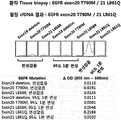
- Figure 156 is after obtaining cfDNA from plasma of a patient without EGFR mutation (Wild type), a patient with EGFR exon19 deletion, and a lung cancer patient with EGFR exon 21 L858R, after mixing a probe specific to EGFR exon19 Del, UV Through analysis of the absorbance ( ⁇ OD, 500 nm to 650 nm) value of the spectrum, the genetic mutation in lung cancer patients was confirmed.
- FIG. 157 shows cfDNA obtained from plasma of a lung cancer patient with EGFR exon19 deletion, followed by mixing a probe specific to EGFR exon19 Del, and then analyzing the specificity and sensitivity of the genetic mutation.
- 158 shows cfDNA obtained from plasma of a patient without EGFR mutation (Wild type), a patient with EGFR exon19 deletion, and a lung cancer patient with EGFR exon 21 L858R, after adding a probe specific to EGFR exon21 L858R, UV
- the patient's genetic mutation was confirmed through analysis of the absorbance ( ⁇ OD, 500 nm to 650 nm) of the spectrum.
- FIG. 159 shows cfDNA obtained from plasma of a lung cancer patient with EGFR exon 21 L858R, and after adding a specific probe to EGFR exon 21 L858R, the specificity and sensitivity of the patient's genetic mutation were analyzed.
- Figure 160 shows the sequence of CP and DP of EGFR exon 19 deletion.
- CP_1 and DP were used to analyze cfDNA gene mutations in lung cancer patients.
- CP is a probe designed to bind complementarily to a sequence that includes or is adjacent to a mutant
- DP refers to a probe designed to bind complementarily to a portion separated from the mutant sequence.
- Figure 161 shows the sequence of CP and DP of EGFR exon 20 T790M.
- CP2 and DP were used to analyze cfDNA gene mutations in lung cancer patients.
- Figure 162 shows the sequence of CP and DP of EGFR exon 21 L858R.
- CP2 and DP were used to analyze cfDNA gene mutations in lung cancer patients.
- Figure 163 shows cfDNA obtained from plasma of a lung cancer patient with EGFR exon 19 deletion and EGFR exon 20 T790M gene mutation in response using probes specific for EGFR exon 19 deletion (Del19), EGFR exon 20 T790M and EGFR exon 21 L858R After that, HRP/streptavidin nanoparticles (including a large amount of HRP) were added to determine whether cfDNA was detected by color change and UV absorbance.
- Figure 164 is a probe specific to EGFR exon 19 deletion (Del19), EGFR exon 20 T790M and EGFR exon 21 L858R obtained from plasma of a lung cancer patient having the same EGFR exon 19 deletion and EGFR exon 20 T790M gene mutation as in Figure 163
- HRP/streptavidin complex a complex in which HRP and streptavidin were combined in a ratio of 1:1
- Figure 165 is a probe specific for EGFR exon 19 Del, EGFR exon 20 T790M, EGFR exon 21 L858R and HRP/streptavidin nanoparticles after extracting cfDNA from plasma of lung cancer patients with five EGFR exon19 deletion and exon20 T790M gene mutations.
- HRP/st-tagged NP reaction results and probes specific to EGFR exon19 Del, EGFR exon 20 T790M, EGFR exon 21 L858R and HRP/streptavidin complex (HRP and streptavidin are 1:1 combined)
- Figure 166 is EGFR exon 19 deletion (19 Del), EGFR exon 20 T790M, EGFR exon 21 L858R and EGFR As a result of mixing exon L861Q-specific probe and HRP/st-tagged NP at once, it was confirmed by UV absorbance that genetic mutations were observed only in EGFR exon 20 T790M and EGFR exon 21 L861Q in the same manner as in cancer tissues.
- Figure 167 shows ALK-EML4 fusion and ALK point mutations (T1151, L1152P, L1152R, C1156Y) for detection of genetic mutations in cfDNA obtained from plasma of lung cancer patients with ALK-EML4 fusion and ALK point mutation (I1171N/T) gene mutations.
- I1171N/T specific probe and HRP/st-tagged NP were mixed at once, and it was confirmed that ALK-EML4 fusion and ALK point mutation (I1171N/T) genotypes were detected in the same manner as in cancer tissues.
- Figure 168 is a BRAF V600E-specific probe and HRP/st-tagged NP were mixed at once for detection of genetic mutations in cfDNA obtained from plasma of thyroid cancer patients with BRAF V600E mutation. As a result, it was confirmed that the BRAF V600E gene mutation was detected in the same manner as the patient's genotype.
- 169 shows the detection results of unstable cfDNA according to treatment conditions after denatured samples collected from normal human blood under various temperature conditions.
- 170 shows the detection result of unstable cfDNA according to treatment conditions after denatured samples collected from patient's blood under various temperature conditions.
- 171 shows the detection results of unstable cfDNA according to treatment conditions after fDNA obtained from a mutant cell line was denatured under various temperature conditions.
- 172 shows the detection results of unstable cfDNA according to treatment conditions after treatment of fDNA obtained from a mutant cell line with DNase at 37° C. for 30 minutes.
- 173 shows the detection results of unstable cfDNA according to treatment conditions after treatment of fDNA obtained from a mutant cell line with DNase at 37° C. for 60 minutes.
- 174 shows the detection results of unstable cfDNA according to treatment conditions after treatment of fDNA obtained from a mutant cell line with DNase at 37° C. for 120 minutes.
- Figure 175 shows the results of treatment with 1 ⁇ l or 2 ⁇ l of DNase at 24°C for 120 minutes in order to confirm the difference between unstable cfDNA and stable cfDNA according to DNase activity.
- Figure 176 shows the results of treatment with 1 ⁇ l or 2 ⁇ l of DNase at 3°C for 120 minutes in order to confirm the difference between unstable cfDNA and stable cfDNA according to DNase activity.
- 177 shows a specific example of a cutoff value when detecting an EML4-ALK fusion gene using cfDNA in plasma of a lung cancer patient as an embodiment of the present invention.
- cfDNA may be circulating tumor DNA (ctDNA), which is cancer cell-derived DNA that can be found in biological samples such as urine, cerebrospinal fluid, plasma, blood, or body fluid derived from cancer patients due to tumor cells.
- cfDNA may be present in biological samples such as urine, cerebrospinal fluid, pleural fluid, ascites, plasma, blood, saliva, sputum, or body fluid.
- the cfDNA may have a size of about 80 bp to about 10 kbp, about 100 bp to about 1 kbp, and about 120 bp to about 500 bp.
- cfDNA may have a size of about 150 bp to about 200 bp, and generally, may have a size of about 165 bp to about 170 bp.
- the cfDNA may include cfDNA having a small size of about 80 bp or less.
- stable cfDNA refers to cfDNA that is thermodynamically unstable compared to "stable cfDNA". That is, unstable cfDNA can be denatured under conditions that are less severe than conditions in which stable cfDNA is denatured. The reason why the unstable cfDNA is generated is that the unstable cfDNA has an unstable double helix structure. Specifically, cfDNA derived from a gene overexpressed in cancer cells may be a specific example of unstable cfDNA.
- cfDNA having an unstable double-helix structure means that cfDNA having a stable double-helix structure has a lower Tm value than cfDNA having a stable double-helix structure, or that cfDNA having a stable double-helix structure is denatured under conditions that are not denatured. It is characterized.
- the Tm refers to a melting temperature, and refers to a temperature at which 50% of double-stranded DNA is converted into single-stranded DNA.
- the Tm value is proportional to the length of the DNA and may differ depending on the nucleotide sequence.
- genomic DNA since a large number of nucleotides are hydrogen-bonded, it must be heated at about 92°C to about 95°C for 5 minutes or more, or at about 98°C for 2 minutes or more. In addition, at temperatures lower than about 90° C., denaturation of genomic DNA does not occur easily. At this time, assuming that cfDNA having a stable double helix structure has an average of about 170 bp nucleotides, it may have a Tm value similar to that of genomic DNA.
- cfDNA having an unstable double-helix structure has a lower Tm value than cfDNA having a stable double-helix structure. Accordingly, cfDNA having a stable double helix structure i) under the condition of leaving about 1 minute to about 120 minutes at room temperature; ii) heating at about 90° C. to about 95° C. for about 1 second to about 3 minutes; iii) heating at about 75°C to about 90°C for about 1 second to about 5 minutes; iv) heating at about 60° C. to about 75° C. for about 30 seconds to about 60 minutes; v) a condition of heating at about 25° C. to about 40° C.
- room temperature means room temperature, and may be about 18 °C to about 25 °C. Further, in addition to the above conditions, a condition of heating at about 40°C to about 65°C for about 5 minutes to about 80 minutes may be further included.
- the probe may be about 15 mer to about 30 mer, or about 20 mer to about 25 mer, and may be about 21 mer, about 22 mer, about 23 mer, or about 24 mer probe.
- the cfDNA having the unstable double helix structure may be circulating tumor DNA (hereinafter ctDNA).
- the term "probe” refers to DNA or RNA for detecting a target cfDNA.
- the probe may have a sequence designed to allow complementary binding to an unstable cfDNA.
- the term "probe having a sequence complementary to cfDNA” refers to a probe having a nucleic acid sequence capable of complementarily binding to cfDNA having a target double helix to be detected present in a fluid sample such as plasma. do.
- the probe can be manufactured in two ways. One is the first probe (hereinafter referred to as CP) designed to bind to the damaged portion of the gene, and the other is a second probe (hereinafter referred to as DP) designed to bind to the periphery of the damaged portion.
- CP first probe
- DP second probe
- the DP may be designed to bind complementarily to a target DNA sequence or a sequence at a position from about 10 bp to about 100 bp, about 20 bp to about 50 bp away from the damaged region.
- complementary binding means that the probe can bind to the target cfDNA and form a duplex under appropriate hybridization conditions, and at least about 75%, at least about 80%, to the target sequence of cfDNA, At least about 85%, at least about 90%, at least about 95%, or about 100% complementary sequence.
- Hybridization conditions can be determined experimentally by a person skilled in the art, such as, for example, the length of the probe, the complementarity of the probe, and the salt concentration (ie, ionic strength) in the hybridization buffer.
- stringent hybridization conditions are those in which a polynucleotide can preferentially bind to its complementary sequence and also bind with a high affinity compared to any other region on the target.
- Exemplary stringent conditions for hybridization of a polynucleotide sequence with 20 bases to the complement may be about 50% G+C content, 50 mM salt (Na+) and an annealing temperature of 60°C. For longer sequences, hybridization can be performed at higher temperatures.
- stringent conditions are those in which annealing is performed at less than about 5° C. at the melting temperature of the polynucleotide.
- the “melting point” is the temperature at which 50% of the polynucleotide complementary to the target polynucleotide at a given ionic strength, pH and polynucleotide concentration binds complementarily.
- the probe may be in a form in which a material such as biotin is bound to bind to a marker.
- the probe may have a marker directly bonded or bonded through a linker.
- the marker may be a nanoparticle, a fluorescent dye, a fluorescent protein, or an enzyme.
- the probe may be added at the same time as the marker, and may be added sequentially.
- a probe capable of complementary binding to a target cfDNA may be complementarily bound to a region containing a sequence specific to the following cancer cells.
- a sequence specific for ovarian cancer or breast cancer it may be a SNP present in BRCA1 exon 7, BRCA1 exon 10, BRCA1 exon 11, and BRCA1 exon 15.
- TP53 may be a SNP present in MSH2 for colon cancer.
- a sequence specific for lung cancer it may be a SNP present in EGFR.
- a sequence specific for liver cancer it may be selected from SNPs present in FGFR3.
- Biomarker genes derived from cancer cells and specific for cancer cells are known to those skilled in the art. See, for example, the following literature: Circulating Cell-Free DNA in Plasma/Serum of Lung Cancer Patients as a Potential Screening and Prognostic Tool, Pathak et al, Clinical Chemistry October 2006 vol. 52 no. 10 1833-1842; Cell-free Tumor DNA in Blood Plasma As a Marker for Circulating Tumor Cells in Prostate Cancer, Schwarzenbach et al, Clin Cancer Res Feb.
- a probe capable of complementary binding to a target cfDNA can complementarily bind to a region overexpressed in the following cancer cells.
- a region overexpressed in cancer cells may be a biomarker of cancer cells.
- the biomarkers of such cancer cells may be genes shown in FIGS. 151 and 152, but are not limited thereto.
- exemplary probes that complementarily bind various biomarker genes and biomarker genes for specific tumor/cancer cells are described by way of examples.
- the probe may further include a biotin or avidin-based protein.
- the marker may further include any one selected from the group consisting of avidin, streptavidin, or a combination thereof.
- the probe may be in a form in which biotin is bound.
- the term "separated biological sample” refers to a sample of urine, saliva, cerebrospinal fluid, pleural fluid, ascites, plasma, blood, sputum or body fluid isolated from a human body.
- the separated biological sample may be a liquid sample separated from the human body. At this time, plasma can be obtained from blood.
- positively charged material is a positively charged material, and may be used in the form of nanoparticles, nanowires, network structures, or filters, but is not limited to the shape.
- One specific example of the "positively charged material” may be a nanowire or a membrane having a positively charged surface.
- the nanowire or membrane may be prepared using a conductive polymer.
- the conductive polymer is polyacetylene (poly(acetylene)), polypyrrole (poly(pyrrole)), polythiophene (poly(thiophene)), poly(para-phenylene)), poly(3,4- Ethylenedioxythiophene (poly(3,4-ethylenedioxythiophene)), poly(phenylene sulfide), poly(para-phenylene vinylene)) and polyaniline ) May be any one selected from the group consisting of) Length and diameter may be appropriately adjusted depending on the manufacturing method, but in the case of nanowires, the diameter is about 50 nm to about 500 nm, about 100 nm to about 500 nm , From about 100 nm to about 400 nm, from about 150 nm to about 350 nm, from about 200 nm to about 400 nm, or from about 100 nm to about 300 nm, the length may be from several ⁇ m to about 100 ⁇ m, It
- the diameter may be about 200 nm and the length may be a nanowire having a length of about 18 ⁇ m.
- the nanowire may be manufactured in a form in which biotin is combined.
- the surface of the nanowire or membrane may be modified by a cationic polymer.
- the cationic polymer is not limited in its kind.
- One specific example of the cationic polymer may be polyethyleneimine (PEI) or polylysine (PLL).
- PEI polyethyleneimine
- PLA polylysine
- Nanowires or membranes modified with such cationic polymers may have a positive charge on their surface.
- the surface charge of the nanowire or membrane may be about 20 mV to about 80 mV, about 30 mV to about 60 mV, and about 35 mV to about 50 mV.
- the surface charge may be about 36 mV, about 37 mV, about 38 mV, about 39 mV, about 40 mV, about 41 mV, about 42 mV, about 43 mV, or about 44 mV.
- a positively charged nanowire can successfully capture cfDNA efficiently even at a low concentration.
- cfDNA due to the characteristics of nanowires, such as a large surface area for binding to a target molecule such as DNA, and improved mobility for promoting an interaction with DNA, cfDNA can be effectively captured.
- the term "marker” is a substance for effectively detecting and/or quantifying cfDNA having a double helix derived from cancer cells, specifically, a quantum dot, a substance that decomposes a specific substrate to exhibit a color reaction, a specific It may be a material that emits light when irradiated with a wavelength.
- the marker is GFP (Green Fluorescent Protein). It may be a fluorescent protein such as YFP (Yellow Fluorescent Protein), RFP (Red Fluorescent Protein), or CFP (Cyan Fluorescent Protein).
- the marker may be a chromogenic or bioluminescent enzyme such as alkaline phosphatase (AP), Horseradish peroxidase (HRP), or beta-galactosidase (BGAL).
- the color developing enzyme reacts with the substrate to mediate a color development reaction or a light emission reaction.
- a substrate for HRP, ABTS, OPD, AmplexRed, DAB, AEC, TMB, homovanillic acid, and Luminol may be used, and for AP, BCIP (5-Bromo-4-Chloro-3-Indolyl Phosphate)/NBT ( nitriblue tetrazolium), pNPP (p-Nitrophenyl Phosphate), Fast Red TR/Naphthol AS-MX and CDP-Star (Disodium 2-chloro-5-(4-methoxyspiro[1,2-dioxetane-3,2'-(5)) -chlorotricyclo[3.3.1.1 3.7 ]decan])-4-yl]-1-phenyl phosphate) can be used, and in the case of BGAL, X-gal(5-bromo-4-chlor
- the marker may further include a substance capable of binding to the probe. Specifically, when biotin is bound to the probe, the marker may further include an avidin-based protein. Specifically, the marker may further include any one selected from the group consisting of avidin, streptavidin, or a combination thereof.
- the marker may include biotin.
- the probe may further include an avidin-based protein.
- the marker may further include any one selected from the group consisting of avidin, streptavidin, or a combination thereof.
- such a marker it may be used in the form of nanoparticles in which streptavidin and HRP are bound to nanoparticles composed of a conductive polymer and hyaluronic acid.
- the conductive polymer is as described above, and may preferably be polypyrrole.
- it may be used in the form of nanoparticles in which streptavidin and a fluorescent protein are bound to nanoparticles composed of a conductive polymer and hyaluronic acid.
- the size of the HRP nanoparticles may be about 20 nm to about 150 nm, about 30 nm to about 120 nm, and about 40 nm to about 100 nm.
- the HRP nanoparticles may be about 50 nm, about 60 nm, about 65 nm, about 70 nm, about 75 nm, or about 80 nm.
- a substrate suitable for the marker may be used together.
- the substrate may be added at the same time as the marker, but may be added before or after the marker is added.
- the use of a marker and a substrate can be used by a known method.
- ABTS (2,2'-Azinobis [3-ethylbenzothiazoline-6-sulfonic acid]-diammonium salt), OPD (o-Phenylenediamine dihydrochloride), AmplexRed, DAB(3,3' -diaminobenzidine tetrahydrochloride), 3-Amino-9-ethylcarbazole (AEC), TMB (3,3',5,5'-Tetramethylbenzidine), homovanillic acid or Luminol can be used as substrates.
- a marker may be detected by the presence or absence of light having a wavelength emitted after irradiating light of a specific wavelength other than a substrate.
- the present diagnostic method can detect target cfDNA with high precision and accuracy, and for example, it is possible to detect effectively even when a biological sample contains a very small amount of target cfDNA. Therefore, it can be usefully used for detection of early stage cancer cells.
- a biomarker of a specific cancer present in a biological sample By detecting the presence or absence of cfDNA encoding a specific abnormal cell/tissue, for example, a biomarker of a specific cancer present in a biological sample, the diagnosis, prognosis, or metastatis status of the cancer can be determined, and the existing treatment method Resistance/tolerance can also be predicted.
- the probe having a sequence complementary to the cfDNA is KLK3, FOLH1, PCA3, PDE4D7, SFMBT2, EFEMP1, RETN, ACADL, AGR2, COL1A1, FAM13C, GPX8, GRHL2, HNF1A, HOXB13, KLK2, MYBPC1, NR0B1, PITX2 , SFRP4 , SLCO1B3 , TMEFF2 , TMPRSS2-ERG, and combinations thereof may be complementarily bound in at least one gene selected from the group consisting of.
- a nitrocellulose membrane having strong affinity for nucleic acids may be used.
- a material having a positive charge may be used to collect cfDNA having a negative charge.
- the material having a positive charge may be a nanoparticle, a nanowire, a network structure, or a filter having a positive charge, but the shape is not limited thereto.
- One specific example of the “positively charged material” may be a positively charged nanostructure or a positively charged membrane.
- An embodiment of the nanostructure may include a cationic polymer.
- the cationic polymer is not limited in its kind.
- One specific example of the cationic polymer may be polyethyleneimine (PEI), and may be a cationic branched polymer polyethyleneimene.
- a cationic branched polyethyleneimine (cationic branched PEI) can be further bound to the nanowire through the interaction of the biotin-avidin-based protein. I can.
- nanoparticles may be irregularly distributed and buried at a high density in a nanostructure (PEI/mPpy NW) in which polyethyleneimine, a cationic polymer, is bound to the surface.
- nanowires can successfully capture genomic DNA and cfDNA even at low concentrations with high efficiency.
- characteristics of nanowires such as a large surface area for binding to a target molecule such as DNA, and improved mobility for promoting an interaction with DNA, it is possible to efficiently and effectively capture the target cfDNA.
- the target cfDNA means a target cfDNA to be detected.
- cfDNA has a double strand.
- a part of the cfDNA may be unwrapped.
- the cfDNA may be derived from a gene of prostate cancer cells.
- cfDNA may include a nucleic acid sequence overexpressed in prostate cancer cells.
- the nucleic acid sequence overexpressed in the cancer cell refers to a nucleic acid sequence that shows an appropriate level of expression in normal cells, but is overexpressed in a specific cancer cell.
- the degree of overexpression or cutoff of the nucleic acid sequence in cancer cells may be a case where the OD value is 0.007 or more when optical density is measured using a marker. More specifically, the degree or criterion of overexpression of the nucleic acid sequence in cancer cells is an OD value determined from the maximum values of sensitivity and specificity by drawing a receiver manipulation characteristic curve after measuring absorbance using a marker. In this case, the wavelength irradiated to measure the absorbance may be appropriately determined according to the label.
- the cfDNA may be an unwinding of DNA (DNA). In addition, cfDNA may be appropriately determined according to the purpose.
- the cfDNA derived from prostate cancer cells i) has a lower Tm value than cfDNA having a double helix structure derived from normal cells, or ii) a condition in which cfDNA having a double helix structure derived from normal cells is not denatured It may be characterized by being denatured in.
- the cfDNA may bind to about 15 to about 30 mer probes capable of complementarily binding cfDNA under any one of the following conditions: i) at room temperature for about 1 minute to about 120 minutes; ii) heating at about 90° C. to about 95° C. for about 1 second to about 3 minutes; iii) heating at about 75°C to about 90°C for about 1 second to about 5 minutes; iv) heating at about 60° C. to about 75° C.
- KLK3 NCBI Gene ID: 354), FOLH1 (NCBI Gene ID: 2346), ACPP (NCBI Gene ID: 55), PCA3 (NCBI Gene ID: 50652), PDE4D7 (NCBI Gene ID: 5144), SFMBT2 (NCBI Gene ID: 57713 ), EFEMP1 (NCBI Gene ID: 2202), RETN (NCBI Gene ID: 56729), ACADL (NCBI Gene ID: 33), AGR2 (NCBI Gene ID: 10551), COL1A1 ( NCBI Gene ID: 1277), FAM13C (NCBI Gene ID: 220965), GPX8 (NCBI Gene ID: 493869), GRHL2 (NCBI Gene ID: 79977), HNF1A (NCBI Gene ID: 6927), HOXB13 (NCBI Gene ID: 10481 ), KLK2 (NCBI Gene ID: 3817), MYBPC1 (NCBI Gene ID: 4604), NR0B1
- genes specifically present in prostate cancer are KLK3, FOLH1, PCA3, PDE4D7, SFMBT2, EFEMP1, RETN, ACADL, AGR2, COL1A1, FAM13C, GPX8, GRHL2, HNF1A, HOXB13, KLK2, MYBPC1, NR0 , PITX2, SFRP4, SLCO1B3, TMEFF2, TMPRSS2-ERG genes may be, Additionally, prostate cancer can be diagnosed by additionally detecting one or more additional marker genes selected from the group consisting of ACPP , CPT1A, IFNG, CD279, CD274, ERBB2, EGFR, FOLR1 and EPCAM .
- the additional marker gene is not a prostate cancer-specific marker gene, but when used in combination with a gene specifically present in the prostate cancer, the sensitivity and specificity of the prostate cancer diagnosis method can be significantly improved.
- KLK3 refers to a gene encoding kallikrein-3, gamma-seminoprotein, or prostate specific antigen (PSA).
- PSA prostate specific antigen
- the PSA is a proteolytic enzyme synthesized in epithelial cells of the prostate and is rarely expressed in tissues other than the prostate, and thus is a useful tumor marker used for screening prostate cancer.
- PSA is useful not only for screening prostate cancer but also for determining recurrence after surgery.
- FOLH1 refers to a gene encoding a prostate-specific membrane antigen (PSMA).
- PSMA prostate-specific membrane antigen
- the PSMA is highly expressed in the prostate, and it is known that the expression of PSMA in prostate cancer cells is increased by about 8 to about 12 times that of normal prostate cells. This PSMA is used as a tumor marker for the diagnosis of prostate cancer.
- ACPP prostatic acid phosphatase
- PCA3 refers to a gene expressed in the form of non-coding RNA in human prostate tissue.
- the PCA3 is expressed only in human prostate tissue, and is highly overexpressed in prostate cancer cells. Such PCA3 is used as a tumor marker for prostate cancer.
- the term "probe” refers to DNA or RNA for detecting cfDNA.
- the probe may have a specific sequence to allow complementary binding to cfDNA.
- the probe having a sequence complementary to cfDNA refers to a probe having a nucleic acid sequence capable of complementary binding to a target double-stranded cfDNA present in plasma.
- the probe may be biotin-coupled.
- the probe may be bound to a marker bound to a biotin binding protein.
- the term “label” refers to a substance used to detect a probe bound to cfDNA.
- the marker may be a nanoparticle, a fluorescent dye, a fluorescent protein, or an enzyme.
- the marker may be any one selected from the group consisting of quantum dots, HRP, and fluorescent protein.
- the marker may be a green fluorescent protein (GFP), a blue fluorescent protein (BFP), a cyan fluorescent protein (BFP), a yellow fluorescent protein (YFP), or horse radish peroxidase (HRP), but is limited thereto. It is not.
- the marker may be a biotin binding protein bound.
- the biotin binding protein may be avidin, streptavidin, traptavidin, or neutravidin, which are avidin-based proteins, but any protein capable of specifically binding to biotin is not limited. Can be used.
- the marker may be streptavidin-bound.
- avidin is a homotetrameric protein produced in the oviduct of algae, reptiles and amphibians, distributed in egg white, and binds with baotin with high affinity, and its function in nature is azimuth. Although not identified, it is presumed to be used to inhibit the growth of bacteria by binding to biotin, which is essential for the growth of bacteria.
- streptavidin such as Thermo Scientific Pierce Streptavidin
- the lack of glycosylation and low pi of streptavidin leads to a low level of nonspecific binding (especially lectin binding) compared to avidin.
- traptavidin refers to a variant or mutein of streptavidin, and indicates a dissociation rate for biotin that is about 10 times slower, and mechanical strength is increased. , It is a protein with improved thermal stability. Treptavidin also specifically binds to biotin.
- the term "neutravidin” of the present invention is also referred to as "deglycosylated avidin” and is prepared to avoid the main disadvantages of natural avidin and streptavidin.
- avidin is produced by deglycosylation of avidin. It is a protein that maintains a high biotin binding ability while having a reduced molecular weight (about 60 kDa) than that.
- detecting a marker refers to a step of detecting a marker bound through a reaction between a probe and biotin-avidin.
- the detection of the marker may be measured by color change, UV absorbance change, bioluminescence, fluorescence reaction change, or electrochemical change.
- the method of detecting the marker may be performed differently depending on the marker used. For example, when HRP is used as a marker, the marker may be detected by observing a color reaction through reaction between hydrogen peroxide and a substrate. .
- the marker is a fluorescent protein such as GFP, the presence of the marker may be detected by observing the detected light emitted after irradiating light of a specific wavelength.
- the marker is luciferase
- the presence of the marker may be detected by measuring bioluminescence that appears after adding a substrate such as luciferin with a bioluminescence meter.
- the diagnostic method of the present invention may further include a step of denaturing cfDNA.
- the degeneration step may not denature the normal double-stranded cfDNA, but may be performed so that only cfDNA derived from prostate cancer can be selectively denatured.
- the conditions of the denaturation step may be performed at about 50° C. to about 100° C. for about 0.1 seconds to about 5 minutes.
- One specific example of the denaturation temperature may be about 95°C
- the denaturation time may be performed for about 0.1 seconds to about 8 minutes.
- it may be denatured for about 1 second, about 5 seconds, about 10 seconds, about 30 seconds, about 60 seconds or about 90 seconds.
- the step of denaturing the cfDNA may be performed before step c).
- the cfDNA bound to a sample or a material having a positive charge before step c) i) is allowed to stand at room temperature for about 1 minute to about 10 minutes; ii) a condition of heating at about 90°C to about 95°C for 1 second to 1 minute; iii) a condition of heating at about 75°C to about 90°C for about 10 seconds to about 3 minutes; iv) heating at about 60° C. to about 75° C. for about 1 minute to about 30 minutes; v) a condition of heating at about 25° C. to about 40° C.
- the denaturation conditions of i) to vii) may be performed after obtaining a sample.
- the denaturation conditions of i) to vii) may be performed after obtaining cfDNA bound to a material having a positive charge.
- the temperature of the denaturing conditions i) to vii), the protease and DNase treatment time may be appropriately adjusted as long as stable cfDNA is not denatured.
- Another aspect of the present invention is a probe to which biotin is complementarily bound to a gene specifically expressed for prostate cancer; Substances with a positive charge; It is to provide a diagnostic kit for prostate cancer comprising a marker and instructions to which avidin-based protein is bound.
- a gene specifically expressed in the prostate cancer is KLK3, FOLH1, PCA3, PDE4D7, SFMBT2, EFEMP1, RETN, ACADL, AGR2, COL1A1, FAM13C, GPX8, GRHL2, HNF1A, HOXB13, KLK2, MYBPC1, NR0B1, PITX2 , SFRP4 , SLCO1B3 , TMEFF2 , TMPRSS2-ERG, and may be any one or more selected from the group consisting of a combination thereof.
- the instructions may be described as that the kit configuration is capable of diagnosing prostate cancer by the following protocol: a) cfDNA using a positively charged material contained in the kit from a biological sample isolated from an individual Separate; b) mix the isolated cfDNA sequentially or simultaneously with the probe to which biotin contained in the kit is bound and the marker contained in the kit; c) Remove probes and markers that do not bind to cfDNA; And d) detect the signal of the marker.
- a probe to which biotin complementarily binds to at least one gene selected from the group consisting of ACPP , CPT1A , IFNG , CD274, FOLR1, EPCAM, OGT, and combinations thereof may be additionally included.
- the probe a material having a positive charge, and a marker are as described above.
- Another aspect of the present invention includes: a) a mixing unit for mixing a biological sample isolated from an individual containing cfDNA and a material having a positive charge; b) a obtaining unit for removing a sample except for a substance having a positive charge to which cfDNA is bound; c) a probe in which biotin capable of complementarily binding to a gene specifically expressed in the prostate cancer is bound to a substance having a positive charge to which the cfDNA is bound; And a reaction unit for sequentially or simultaneously adding nanoparticles including streptavidin and a marker.
- a detection unit for detecting a marker a detection unit for detecting a marker
- an information processing unit that has a sequence complementary to the probe in the sample according to whether a marker is detected, and determines that cfDNA derived from prostate cancer is present, from the sample, without amplification, a gene derived from prostate cancer cells. It is to provide a device that detects and diagnoses prostate cancer.
- a gene specifically expressed in the prostate cancer is KLK3, FOLH1, PCA3, PDE4D7, SFMBT2, EFEMP1, RETN, ACADL, AGR2, COL1A1, FAM13C, GPX8, GRHL2, HNF1A, HOXB13, KLK2, MYBPC1, NR0B1, PITX2 , SFRP4 , SLCO1B3 , TMEFF2 , TMPRSS2-ERG, and may be any one or more selected from the group consisting of a combination thereof.
- a probe to which biotin complementarily binds to at least one gene selected from the group consisting of ACPP , CPT1A , IFNG , CD274, FOLR1, EPCAM, OGT, and combinations thereof may be additionally included.
- probes having a sequence complementary to the cfDNA are ENO2 , SART3 , KRT19 , PLAT , EGFR, ALK, ROS1, RET, ERBB2, PI3K, S100P, MMP11, CDCA7, S100A2, ETV4, TOP2A, UBE2C, and combinations thereof It may be complementary binding in at least one gene selected from the group consisting of.
- a nitrocellulose membrane having strong affinity for nucleic acids may be used.
- a material having a positive charge may be used to collect cfDNA having a negative charge.
- the material having a positive charge may be a nanoparticle, a nanowire, a network structure, or a filter having a positive charge, but the shape is not limited thereto.
- One specific example of the “positively charged material” may be a positively charged nanostructure or a positively charged membrane.
- An embodiment of the nanostructure may include a cationic polymer.
- the cationic polymer is not limited in its kind.
- One specific example of the cationic polymer may be polyethyleneimine (PEI), and may be a cationic branched polymer polyethyleneimene.
- cationic branched polyethyleneimine can be further bound to the nanowire through the interaction of biotin-streptavidin. I can.
- nanoparticles may be irregularly distributed and buried at a high density in a nanostructure (PEI/mPpy NW) in which polyethyleneimine, a cationic polymer, is bound to the surface.
- nanowires can successfully capture genomic DNA and cfDNA even at low concentrations with high efficiency.
- characteristics of nanowires such as a large surface area for binding to a target molecule such as DNA, and improved mobility for promoting an interaction with DNA, it is possible to efficiently and effectively capture the target cfDNA.
- the target cfDNA means a target cfDNA to be detected.
- cfDNA has a double strand.
- a part of the cfDNA may be unwrapped.
- the cfDNA may be derived from a gene of a lung cancer cell.
- cfDNA may include a nucleic acid sequence overexpressed in lung cancer cells.
- the nucleic acid sequence overexpressed in the cancer cell refers to a nucleic acid sequence that shows an appropriate level of expression in normal cells, but is overexpressed in a specific cancer cell.
- the degree or cutoff of overexpression of the nucleic acid sequence in cancer cells may be the case where the OD value is about 0.010 or more when the optical density is measured using a marker. More specifically, the degree or criterion of overexpression of the nucleic acid sequence in cancer cells may be the case where the OD value is about 0.012 or about 0.015 or more when absorbance is measured using a marker. In this case, the wavelength irradiated to measure the absorbance may be appropriately determined according to the label.
- the cfDNA may be an unwinding of DNA (DNA). In addition, cfDNA may be appropriately determined according to the purpose.
- the cfDNA derived from the lung cancer cells i) has a lower Tm value than cfDNA having a double helix structure derived from normal cells, or ii) a condition in which cfDNA having a double helix structure derived from normal cells is not denatured It may be characterized by being denatured in.
- the cfDNA may bind to about 15 to about 30 mer probes capable of complementarily binding cfDNA under any one of the following conditions: i) at room temperature for about 1 minute to about 120 minutes; ii) heating at about 90° C. to about 95° C. for about 1 second to about 3 minutes; iii) heating at about 75°C to about 90°C for about 1 second to about 5 minutes; iv) heating at about 60° C. to about 75° C. for about 30 seconds to about 30 minutes; v) heating at about 25°C to about 40°C for 10 to 120 minutes; vi) conditions of about 1 minute to about 30 minutes treatment with protease; And vii) about 1 minute to about 30 minutes of treatment with DNase.
- NCBI Genes overexpressed in the lung cancer cells are ENO2 (NCBI Gene ID: 2026), SART3 (NCBI Gene ID: 9733), ACPP (NCBI Gene ID: 55), KRT19 (NCBI Gene ID: 3880), PLAT (NCBI Gene ID: 5327), EGFR (NCBI Gene ID: 1956), KRAS (NCBI Gene ID: 3845), ALK (NCBI Gene ID: 238), ROS1 (NCBI Gene ID: 6098), RET (NCBI Gene ID: 5979), ERBB2 ( NCBI Gene ID: 2064), PI3K (NCBI Gene ID: 5291), S100P (NCBI Gene ID: 6286), MMP11 (NCBI Gene ID: 4320), CDCA7 (NCBI Gene ID: 83879), S100A2 (NCBI Gene ID: 6273 ), ETV4 (NCBI Gene ID: 2118), TOP2A (NCBI Gene ID: 7153), UBE2C (NCBI Gene ID: 11065), CPT1A (NCBI Gene ID
- the genes specifically present in lung cancer may be SART3, PLAT, ALK, ROS1, PI3K, S100P, CDCA7, S100A2, ETV4 genes, Additionally, ENO2 , ACPP, KRT19, EGFR, KRAS, RET, ERBB2, MMP11, TOP2A, UBE2C, CPT1A, IFNG, CD279, CD274, ERBB2, EGFR, FOLR1, or EPCAM genes can be detected to diagnose lung cancer.
- ENO2 refers to a gene encoding an enzyme known as Gamma-enolase or enolase 2 or NSE (neuron specific enolase).
- NSE neuron specific enolase
- the NSE is used as a tumor marker for small cell lung cancer (small cell lung cancer), neuroblastoma, and medical thyroid cancer.
- SART3 refers to a gene encoding Squamous Cell Carcinoma Antigen (SCCA).
- SCCA Squamous Cell Carcinoma Antigen
- the SCCA has been used as a tumor marker because the blood levels of patients with squamous cell carcinoma of the cervix, as well as vulvar cancer, vaginal cancer, esophageal cancer, tongue cancer, pharyngeal cancer, etc., are positive.
- KRT19 refers to a gene encoding a protein known as Cyfra 21-1, CK-19 (cytokeratin-19) or K19 (keratin-19). It is known that Cyfra 21-1 is associated with cancers of epithelial cell origin such as lung cancer and head and neck cancer. In addition, Cyfra 21-1 has been reported to increase blood levels in patients suffering from pneumonia or pulmonary disease compared to normal subjects, and is used as a tumor indicator.
- PLAT refers to a gene encoding TPA (Tissue plasminogen activator), a protein involved in blood clot disruption.
- the term "probe” refers to DNA or RNA for detecting cfDNA.
- the probe may have a specific sequence to allow complementary binding to cfDNA.
- the probe having a sequence complementary to cfDNA refers to a probe having a nucleic acid sequence capable of complementary binding to a target double-stranded cfDNA present in plasma.
- the probe may be biotin-coupled.
- the probe may be bound to a marker bound to a biotin binding protein.
- the term “label” refers to a substance used to detect a probe bound to cfDNA.
- the marker may be a nanoparticle, a fluorescent dye, a fluorescent protein, or an enzyme.
- the marker may be any one selected from the group consisting of quantum dots, HRP, and fluorescent protein.
- the marker may be a green fluorescent protein (GFP), a blue fluorescent protein (BFP), a cyan fluorescent protein (CFP), a yellow fluorescent protein (YFP), or horse radish peroxidase (HRP), but is limited thereto. It is not.
- the marker may be a biotin binding protein bound.
- the biotin binding protein may be streptavidin, traptavidin, or neutravidin, which are avidin-based proteins, but any protein capable of specifically binding to biotin may be used without limitation.
- the marker may be streptavidin-bound.
- streptavidin such as Thermo Scientific Pierce Streptavidin
- pI about 6.8 to about 7.5
- the lack of glycosylation and low pi of streptavidin leads to a low level of nonspecific binding (especially lectin binding) compared to avidin.
- traptavidin refers to a variant or mutein of streptavidin, and indicates a dissociation rate for biotin that is about 10 times slower, and mechanical strength is increased. , It is a protein with improved thermal stability. Treptavidin also specifically binds to biotin.
- the term "neutravidin” of the present invention is also referred to as "deglycosylated avidin” and is prepared to avoid the main disadvantages of natural avidin and streptavidin.
- avidin is produced by deglycosylation of avidin. It is a protein that maintains high biotin binding ability while having a reduced molecular weight (60 kDa) compared to.
- detecting a marker refers to a step of detecting a marker bound through a reaction between a probe and biotin-avidin.
- the detection of the marker may be measured by color change, UV absorbance change, bioluminescence, fluorescence reaction change, or electrochemical change.
- the method of detecting the marker may be performed differently depending on the marker used. For example, when HRP is used as a marker, the marker may be detected by observing a color reaction through reaction between hydrogen peroxide and a substrate. .
- the marker is a fluorescent protein such as GFP, the presence of the marker may be detected by observing the detected light emitted after irradiating light of a specific wavelength.
- the marker is luciferase
- the presence of the marker may be detected by measuring bioluminescence that appears after adding a substrate such as luciferin with a bioluminescence meter.
- the diagnostic method of the present invention may further include a step of denaturing cfDNA.
- the denaturation step does not denature the normal double-stranded cfDNA, but may be performed so that only cfDNA derived from lung cancer can be selectively denatured.
- the conditions of the denaturation step may be performed at about 50° C. to about 100° C. for about 0.1 seconds to about 5 minutes.
- One specific example of the denaturation temperature may be about 95°C
- the denaturation time may be performed for about 0.1 seconds to about 8 minutes.
- it may be denatured for about 1 second, about 5 seconds, about 10 seconds, about 30 seconds, about 60 seconds or about 90 seconds.
- the step of denaturing the cfDNA may be performed before step c).
- the cfDNA bound to a sample or a material having a positive charge before step c) i) is allowed to stand at room temperature for about 1 minute to about 10 minutes; ii) heating at about 90° C. to about 95° C. for about 1 second to about 1 minute; iii) a condition of heating at about 75°C to about 90°C for about 10 seconds to about 3 minutes; iv) heating at about 60° C. to about 75° C.
- This degeneration step does not denature the double-stranded cfDNA derived from normal cells, but selectively denatures only cfDNA derived from cancer cells, thereby facilitating the binding with probu.
- the denaturation conditions of i) to vii) may be performed after obtaining a sample.
- the denaturation conditions of i) to vii) may be performed after obtaining cfDNA bound to a material having a positive charge.
- the temperature of the denaturing conditions i) to vii), the protease and DNase treatment time may be appropriately adjusted as long as stable cfDNA is not denatured.
- Another aspect of the present invention is a probe to which biotin is bound complementarily to a gene specifically expressed for lung cancer; Substances with a positive charge; It is to provide a diagnostic kit for lung cancer comprising a marker and instructions to which avidin-based protein is bound.
- the gene specifically expressed for lung cancer may be any one or more selected from the group consisting of SART3, PLAT, ALK, ROS1, PI3K, S100P, CDCA7, S100A2, ETV4, and combinations thereof.
- the kit configuration is capable of diagnosing lung cancer by the following protocol: a) Using a positively charged material contained in the kit from a biological sample isolated from an individual, cfDNA Separate; b) mix the isolated cfDNA sequentially or simultaneously with the probe to which biotin contained in the kit is bound and the marker contained in the kit; c) Remove probes and markers that do not bind to cfDNA; And d) detect the signal of the marker.
- a probe to which biotin complementarily binds to a gene may be further included.
- the probe a material having a positive charge, and a marker are as described above.
- Another aspect of the present invention includes: a) a mixing unit for mixing a biological sample isolated from an individual containing cfDNA and a material having a positive charge; b) a obtaining unit for removing a sample except for a substance having a positive charge to which cfDNA is bound; c) a probe in which biotin capable of complementarily binding to a gene specifically expressed in lung cancer is bound to a substance having a positive charge to which the cfDNA is bound; And a reaction unit for sequentially or simultaneously adding nanoparticles including streptavidin and a marker.
- a detection unit for detecting a marker a detection unit for detecting a marker
- an information processing unit that has a sequence complementary to the probe in the sample according to whether a marker is detected, and determines that cfDNA derived from lung cancer is present, from the sample, without amplification, to detect a gene derived from lung cancer cells.
- the gene specifically expressed for lung cancer may be any one or more selected from the group consisting of SART3, PLAT, ALK, ROS1, PI3K, S100P, CDCA7, S100A2, ETV4, and combinations thereof.
- a probe to which biotin complementarily binds to a gene may be further included.
- the probe having a sequence complementary to the cfDNA may be complementarily bound in at least one gene selected from the group consisting of TG , CALCA , APOC1, HIG2, and combinations thereof.
- a nitrocellulose membrane having strong affinity for nucleic acids may be used.
- a material having a positive charge may be used to collect cfDNA having a negative charge.
- the material having a positive charge may be a nanoparticle, a nanowire, a network structure, or a filter having a positive charge, but the shape is not limited thereto.
- One specific example of the “positively charged material” may be a positively charged nanostructure or a positively charged membrane.
- An embodiment of the nanostructure may include a cationic polymer.
- the cationic polymer is not limited in its kind.
- One specific example of the cationic polymer may be polyethyleneimine (PEI), and may be a cationic branched polymer polyethyleneimene.
- cationic branched polyethyleneimine can be further bound to the nanowire through the interaction of biotin-streptavidin. I can.
- nanoparticles may be irregularly distributed and buried at a high density in a nanostructure (PEI/mPpy NW) in which polyethyleneimine, a cationic polymer, is bound to the surface.
- nanowires can successfully capture genomic DNA and cfDNA even at low concentrations with high efficiency.
- characteristics of nanowires such as a large surface area for binding to a target molecule such as DNA, and improved mobility for promoting an interaction with DNA, it is possible to efficiently and effectively capture the target cfDNA.
- the target cfDNA means a target cfDNA to be detected.
- cfDNA has a double strand.
- a part of the cfDNA may be unwrapped.
- the cfDNA may be derived from a thyroid cancer cell gene.
- cfDNA may include a nucleic acid sequence overexpressed in thyroid cancer cells.
- the nucleic acid sequence overexpressed in the cancer cell refers to a nucleic acid sequence that shows an appropriate level of expression in normal cells, but is overexpressed in a specific cancer cell.
- the degree of overexpression or cutoff of the nucleic acid sequence in cancer cells may be a case where the OD value is 0.010 or more when optical density is measured using a marker. More specifically, the degree or criterion of overexpression of the nucleic acid sequence in cancer cells may be the case where the OD value is 0.012 or 0.015 or higher when absorbance is measured using a marker. In this case, the wavelength irradiated to measure the absorbance may be appropriately determined according to the label.
- the cfDNA may be an unwinding of DNA (DNA). In addition, cfDNA may be appropriately determined according to the purpose.
- the cfDNA derived from thyroid cancer cells i) has a lower Tm value than cfDNA having a double helix structure derived from normal cells, or ii) a condition in which cfDNA having a double helix structure derived from normal cells is not denatured It may be characterized by being denatured in.
- the cfDNA may bind to about 15 to about 30 mer probes capable of complementarily binding cfDNA under any one of the following conditions: i) at room temperature for about 1 minute to about 120 minutes; ii) heating at about 90° C. to about 95° C. for about 1 second to about 3 minutes; iii) heating at about 75°C to about 90°C for about 1 second to about 5 minutes; iv) heating at about 60° C. to about 75° C.
- ACPP NCBI Gene ID: 55
- ENO2 NCBI Gene ID: 2026
- TG NCBI Gene ID: 7038
- CALCA NCBI Gene ID: 796
- APOC1 NCBI Gene ID: 341
- HIG2 NCBI Gene ID: 29923
- TYRO3 NCBI Gene ID: 7301
- CPT1A NCBI Gene ID: 1374
- IFNG NCBI Gene ID: 3458
- CD274 NCBI Gene ID: 29126
- FOLR1 NCBI Gene ID: 2348
- EPCAM NCBI Gene ID: 4072
- the genes specifically present in thyroid cancer may be TG , CALCA , APOC1, HIG2 genes, Additionally, thyroid cancer can be diagnosed by detecting ENO2 , ACPP, TYRO3, CPT1A, IFNG, CD279, CD274, ERBB2, EGFR, FOLR1 or EPCAM genes.
- TG refers to a gene encoding thyroglobulin (Tg).
- Tg thyroglobulin
- the thyroglobulin is produced only in the thyroid gland in the human body, and when thyroid cancer develops or metastases, the level of thyroglobulin in the blood increases. Thyroglobulin levels in the blood have been used as a marker for thyroid cancer.
- CALCA refers to a gene encoding a calcitonin gene-related peptide.
- the term "probe” refers to DNA or RNA for detecting cfDNA.
- the probe may have a specific sequence to allow complementary binding to cfDNA.
- the probe having a sequence complementary to cfDNA refers to a probe having a nucleic acid sequence capable of complementary binding to a target double-stranded cfDNA present in plasma.
- the probe may be biotin-coupled.
- the probe may be bound to a marker bound to a biotin binding protein.
- the term “label” refers to a substance used to detect a probe bound to cfDNA.
- the marker may be a nanoparticle, a fluorescent dye, a fluorescent protein, or an enzyme.
- the marker may be any one selected from the group consisting of quantum dots, HRP, and fluorescent protein.
- the marker may be a green fluorescent protein (GFP), a blue fluorescent protein (BFP), a cyan fluorescent protein (CFP), a yellow fluorescent protein (YFP), or horse radish peroxidase (HRP), but is limited thereto. It is not.
- the marker may be a biotin binding protein bound.
- the biotin binding protein may be streptavidin, traptavidin, or neutravidin, which are avidin-based proteins, but any protein capable of specifically binding to biotin may be used without limitation.
- the marker may be streptavidin-bound.
- streptavidin such as Thermo Scientific Pierce Streptavidin
- the lack of glycosylation and low pi of streptavidin leads to a low level of nonspecific binding (especially lectin binding) compared to avidin.
- traptavidin refers to a variant or mutein of streptavidin, and indicates a dissociation rate for biotin that is about 10 times slower, and mechanical strength is increased. , It is a protein with improved thermal stability. Treptavidin also specifically binds to biotin.
- the term "neutravidin” of the present invention is also referred to as "deglycosylated avidin” and is prepared to avoid the main disadvantages of natural avidin and streptavidin.
- avidin is produced by deglycosylation of avidin. It is a protein that maintains high biotin binding ability while having a reduced molecular weight (60 kDa) compared to.
- detecting a marker refers to a step of detecting a marker bound through a reaction between a probe and biotin-avidin.
- the detection of the marker may be measured by color change, UV absorbance change, bioluminescence, fluorescence reaction change, or electrochemical change.
- the method of detecting the marker may be performed differently depending on the marker used. For example, when HRP is used as a marker, the marker may be detected by observing a color reaction through reaction between hydrogen peroxide and a substrate. .
- the marker is a fluorescent protein such as GFP, the presence of the marker may be detected by observing the detected light emitted after irradiating light of a specific wavelength.
- the marker is luciferase
- the presence of the marker may be detected by measuring bioluminescence that appears after adding a substrate such as luciferin with a bioluminescence meter.
- the diagnostic method of the present invention may further include a step of denaturing cfDNA.
- the denaturation step does not denature the normal double-stranded cfDNA, but for this purpose, the conditions of the denaturation step may be performed at about 50°C to about 100°C for about 0.1 seconds to about 5 minutes.
- the denaturation temperature may be about 95°C
- the denaturation time may be performed for about 0.1 seconds to about 8 minutes.
- it may be denatured for about 1 second, about 5 seconds, about 10 seconds, about 30 seconds, about 60 seconds or about 90 seconds.
- the step of denaturing the cfDNA may be performed before step c).
- the cfDNA bound to a sample or a material having a positive charge before step c) i) is allowed to stand at room temperature for about 1 minute to about 10 minutes; ii) a condition of heating at about 90°C to about 95°C for 1 second to 1 minute; iii) a condition of heating at about 75°C to about 90°C for about 10 seconds to about 3 minutes; iv) heating at about 60° C. to about 75° C. for about 1 minute to about 30 minutes; v) a condition of heating at about 25° C. to about 40° C.
- the denaturation conditions of i) to vii) may be performed after obtaining a sample.
- the denaturation conditions of i) to vii) may be performed after obtaining cfDNA bound to a material having a positive charge.
- the temperature of the denaturing conditions i) to vii), the protease and DNase treatment time may be appropriately adjusted as long as stable cfDNA is not denatured.
- Another aspect of the present invention is a probe to which biotin is bound complementarily to a gene specifically expressed in thyroid cancer; Substances with a positive charge; It is to provide a thyroid cancer diagnostic kit comprising a marker and instructions to which avidin-based protein is bound.
- the gene specifically expressed for thyroid cancer may be any one or more selected from the group consisting of TG , CALCA , APOC1, HIG2, and combinations thereof.
- the kit configuration is capable of diagnosing thyroid cancer by the following protocol: a) Using a positively charged material contained in the kit from a biological sample isolated from an individual, cfDNA Separate; b) mix the isolated cfDNA sequentially or simultaneously with the probe to which biotin contained in the kit is bound and the marker contained in the kit; c) Remove probes and markers that do not bind to cfDNA; And d) detect the signal of the marker.
- ENO2 , ACPP, TYRO3, CPT1A, IFNG, CD279, CD274, ERBB2, EGFR, FOLR1, EPCAM, and a biotin-binding probe that complementarily binds to at least one gene selected from the group consisting of a combination thereof Can include.
- the probe a material having a positive charge, and a marker are as described above.
- Another aspect of the present invention includes: a) a mixing unit for mixing a biological sample isolated from an individual containing cfDNA and a material having a positive charge; b) a obtaining unit for removing a sample except for a substance having a positive charge to which cfDNA is bound; c) a probe in which biotin capable of complementarily binding to a gene specifically expressed for thyroid cancer is bound to a substance having a positive charge to which the cfDNA is bound; And a reaction unit for sequentially or simultaneously adding nanoparticles including streptavidin and a marker.
- a detector for detecting a marker a detector for detecting a marker
- an information processing unit that has a sequence complementary to the probe in the sample according to whether or not a marker is detected, and determines that cfDNA derived from thyroid cancer is present, from the sample, without amplification, detecting a gene derived from thyroid cancer cells.
- the gene specifically expressed for thyroid cancer may be any one or more selected from the group consisting of TG , CALCA , APOC1, HIG2, and combinations thereof.
- ENO2 , ACPP, TYRO3, CPT1A, IFNG, CD279, CD274, ERBB2, EGFR, FOLR1, EPCAM, and a biotin-binding probe that complementarily binds to at least one gene selected from the group consisting of a combination thereof Can include.
- the gene known as a bladder cancer biomarker may be a gene encoding a protein overexpressed in bladder cancer.
- probes having a sequence complementary to the cfDNA are OGT, FGFR3, TP53, NUMA1, COCH, CELSR3, HMOX1, KIF1A, MGC17624, MTAP, PFKFB4, S100A8, RSPH9, FOXM1, FANCB, FANCC, FANCD2, RUSC1-AS1, RUSC1-AS1, , CACNA1B, IMP-1, PDE3A, POU3F4, SOX3, DMC1, PLXDC2, ZNF312, SYCP2L, HOXA9, ISL1, ALDH1A3, and combinations thereof may be complementarily bound in at least one gene selected from the group consisting of .
- a nitrocellulose membrane having strong affinity for nucleic acids may be used.
- a material having a positive charge may be used to collect cfDNA having a negative charge.
- the material having a positive charge may be a nanoparticle, a nanowire, a network structure, or a filter having a positive charge, but the shape is not limited thereto.
- One specific example of the “positively charged material” may be a positively charged nanostructure or a positively charged membrane.
- An embodiment of the nanostructure may include a cationic polymer.
- the cationic polymer is not limited in its kind.
- One specific example of the cationic polymer may be polyethyleneimine (PEI), and may be a cationic branched polymer polyethyleneimene.
- cationic branched polyethyleneimine can be further bound to the nanowire through the interaction of biotin-streptavidin. I can.
- nanoparticles may be irregularly distributed and buried at a high density in a nanostructure (PEI/mPpy NW) in which polyethyleneimine, a cationic polymer, is bound to the surface.
- nanowires can successfully capture genomic DNA and cfDNA even at low concentrations with high efficiency.
- characteristics of nanowires such as a large surface area for binding to a target molecule such as DNA, and improved mobility for promoting an interaction with DNA, it is possible to efficiently and effectively capture the target cfDNA.
- the target cfDNA means a target cfDNA to be detected.
- cfDNA has a double strand.
- a part of the cfDNA may be unwrapped.
- the cfDNA may be derived from a bladder cancer cell gene.
- cfDNA may include a nucleic acid sequence overexpressed in bladder cancer cells.
- the nucleic acid sequence overexpressed in the cancer cell refers to a nucleic acid sequence that shows an appropriate level of expression in normal cells, but is overexpressed in a specific cancer cell.
- the degree of overexpression or cutoff of the nucleic acid sequence in cancer cells may be a case where the OD value is 0.010 or more when optical density is measured using a marker. More specifically, the degree or criterion of overexpression of the nucleic acid sequence in cancer cells may be the case where the OD value is 0.012 or 0.015 or higher when absorbance is measured using a marker. In this case, the wavelength irradiated to measure the absorbance may be appropriately determined according to the label.
- the cfDNA may be an unwinding of DNA (DNA). In addition, cfDNA may be appropriately determined according to the purpose.
- the cfDNA derived from the bladder cancer cells i) has a lower Tm value than cfDNA having a double helix structure derived from normal cells, or ii) a condition in which cfDNA having a double helix structure derived from normal cells is not denatured It may be characterized by being denatured in.
- the cfDNA may bind to about 15 to about 30 mer probes capable of complementarily binding cfDNA under any one of the following conditions: i) at room temperature for about 1 minute to about 120 minutes; ii) heating at about 90° C. to about 95° C. for about 1 second to about 3 minutes; iii) heating at about 75°C to about 90°C for about 1 second to about 5 minutes; iv) heating at about 60° C. to about 75° C.
- NCBI Genes overexpressed in the bladder cancer cells are OGT (NCBI Gene ID: 8473) , FGFR3 (NCBI Gene ID: 2261) , TP53 (NCBI Gene ID: 7157) , NUMA1 (NCBI Gene ID: 4926) , KRT19 (NCBI Gene ID: 3880) , COCH (NCBI Gene ID: 1690) , CELSR3 (NCBI Gene ID: 1951) , HMOX1 (NCBI Gene ID: 3162) , KIF1A (NCBI Gene ID: 547) , MGC17624 (NCBI Gene ID: 404550) , MTAP ( NCBI Gene ID: 4507) , PFKFB4 (NCBI Gene ID: 5210) , S100A8 (NCBI Gene ID: 6279) , RSPH9 (NCBI Gene ID: 221421) , CCNB1 (NCBI Gene ID: 891) , FOXM1 (NCBI Gene ID: 2305 ) , FANCB (NCBI Gene
- genes specifically present in bladder cancer are OGT, FGFR3, TP53, NUMA1, COCH, CELSR3, HMOX1, KIF1A, MGC17624, MTAP, PFKFB4, S100A8, RSPH9, FOXM1, FANCB, FANCC, FANCD2, RUSC1- AS1, CACNA1B, IMP-1, PDE3A, POU3F4, SOX3, DMC1, PLXDC2, ZNF312, SYCP2L, HOXA9, ISL1, ALDH1A3 genes, Additionally, bladder cancer can be diagnosed by detecting KRT19, CCNB1, CPT1A, IFNG, CD279, CD274, ERBB2, EGFR, FOLR1 or EPCAM genes.
- OGT refers to a gene encoding O-GlcNAc transferase.
- FGFR1 refers to a gene encoding fibroblast growth factor receptor 1.
- NUMA1 refers to a gene encoding NMP22 (nuclear matrix protein-22).
- NMP22 is found to be higher than the normal level in the urine of patients with some types of cancer, including bladder cancer, and is widely used as a bladder cancer marker.
- the term "probe” refers to DNA or RNA for detecting cfDNA.
- the probe may have a specific sequence to allow complementary binding to cfDNA.
- the probe having a sequence complementary to cfDNA refers to a probe having a nucleic acid sequence capable of complementary binding to a target double-stranded cfDNA present in plasma.
- the probe may be biotin-coupled.
- the probe may be bound to a marker bound to a biotin binding protein.
- the term “label” refers to a substance used to detect a probe bound to cfDNA.
- the marker may be a nanoparticle, a fluorescent dye, a fluorescent protein, or an enzyme.
- the marker may be any one selected from the group consisting of quantum dots, HRP, and fluorescent protein.
- the marker may be a green fluorescent protein (GFP), a blue fluorescent protein (BFP), a cyan fluorescent protein (CFP), a yellow fluorescent protein (YFP), or horse radish peroxidase (HRP), but is limited thereto. It is not.
- the marker may be a biotin binding protein bound.
- the biotin binding protein may be streptavidin, traptavidin, or neutravidin, which are avidin-based proteins, but any protein capable of specifically binding to biotin may be used without limitation.
- the marker may be streptavidin-bound.
- streptavidin such as Thermo Scientific Pierce Streptavidin
- the lack of glycosylation and low pi of streptavidin leads to a low level of nonspecific binding (especially lectin binding) compared to avidin.
- traptavidin refers to a variant or mutein of streptavidin, and indicates a dissociation rate for biotin that is about 10 times slower, and mechanical strength is increased. , It is a protein with improved thermal stability. Treptavidin also specifically binds to biotin.
- the term "neutravidin” of the present invention is also referred to as "deglycosylated avidin” and is prepared to avoid the main disadvantages of natural avidin and streptavidin.
- avidin is produced by deglycosylation of avidin. It is a protein that maintains high biotin binding ability while having a reduced molecular weight (60 kDa) compared to.
- detecting a marker refers to a step of detecting a marker bound through a reaction between a probe and biotin-avidin.
- the detection of the marker may be measured by color change, UV absorbance change, bioluminescence, fluorescence reaction change, or electrochemical change.
- the method of detecting the marker may be performed differently depending on the marker used. For example, when HRP is used as a marker, the marker may be detected by observing a color reaction through reaction between hydrogen peroxide and a substrate. .
- the marker is a fluorescent protein such as GFP, the presence of the marker may be detected by observing the detected light emitted after irradiating light of a specific wavelength.
- the marker is luciferase
- the presence of the marker may be detected by measuring bioluminescence that appears after adding a substrate such as luciferin with a bioluminescence meter.
- the diagnostic method of the present invention may further include a step of denaturing cfDNA.
- the denaturation step may be performed so that normal double-stranded cfDNA is not denatured, but only cfDNA derived from bladder cancer can be selectively denatured.
- the conditions of the denaturation step may be performed at about 50° C. to about 100° C. for about 0.1 seconds to about 5 minutes.
- One specific example of the denaturation temperature may be about 95°C
- the denaturation time may be performed for about 0.1 seconds to about 8 minutes.
- it may be denatured for about 1 second, about 5 seconds, about 10 seconds, about 30 seconds, about 60 seconds or about 90 seconds.
- the step of denaturing the cfDNA may be performed before step c).
- the cfDNA bound to a sample or a material having a positive charge before step c) i) is allowed to stand at room temperature for about 1 minute to about 10 minutes; ii) a condition of heating at about 90°C to about 95°C for 1 second to 1 minute; iii) a condition of heating at about 75°C to about 90°C for about 10 seconds to about 3 minutes; iv) heating at about 60° C. to about 75° C. for about 1 minute to about 30 minutes; v) a condition of heating at about 25° C. to about 40° C.
- the denaturation conditions of i) to vii) may be performed after obtaining a sample.
- the denaturation conditions of i) to vii) may be performed after obtaining cfDNA bound to a material having a positive charge.
- the temperature of the denaturing conditions i) to vii), the protease and DNase treatment time may be appropriately adjusted as long as stable cfDNA is not denatured.
- Another aspect of the present invention is a probe to which biotin is bound complementarily to a gene specifically expressed for bladder cancer; Substances with a positive charge; It is to provide a bladder cancer diagnostic kit comprising a marker and instructions to which avidin-based protein is bound.
- the genes specifically expressed in bladder cancer are OGT, FGFR3, TP53, NUMA1, COCH, CELSR3, HMOX1, KIF1A, MGC17624, MTAP, PFKFB4, S100A8, RSPH9, FOXM1, FANCB, FANCC, FANCD2, RUSC1-AS1, CACNA1B, IMP-1, PDE3A, POU3F4, SOX3, DMC1, PLXDC2, ZNF312, SYCP2L, HOXA9, ISL1, ALDH1A3, and any one or more selected from the group consisting of a combination thereof.
- the kit configuration is capable of diagnosing bladder cancer by the following protocol: a) Using a positively charged material contained in the kit from a biological sample isolated from an individual, cfDNA Separate; b) mix the isolated cfDNA sequentially or simultaneously with the probe to which biotin contained in the kit is bound and the marker contained in the kit; c) Remove probes and markers that do not bind to cfDNA; And d) detect the signal of the marker.
- a probe to which biotin that binds complementarily to at least one gene selected from the group consisting of KRT19, CCNB1, CPT1A, IFNG, CD279, CD274, ERBB2, EGFR, FOLR1, EPCAM, and combinations thereof is additionally included. I can.
- the probe a material having a positive charge, and a marker are as described above.
- Another aspect of the present invention includes: a) a mixing unit for mixing a biological sample isolated from an individual containing cfDNA and a material having a positive charge; b) a obtaining unit for removing a sample except for a substance having a positive charge to which cfDNA is bound; c) a probe in which biotin capable of complementarily binding to a gene specifically expressed in bladder cancer is bound to a material having a positive charge to which the cfDNA is bound; And a reaction unit for sequentially or simultaneously adding nanoparticles including streptavidin and a marker.
- a detector for detecting a marker a detector for detecting a marker
- an information processing unit that has a sequence complementary to the probe in the sample according to whether or not a marker is detected, and determines that cfDNA derived from bladder cancer is present, from the sample, without amplification, detecting a gene derived from bladder cancer cells.
- the genes specifically expressed in bladder cancer are OGT, FGFR3, TP53, NUMA1, COCH, CELSR3, HMOX1, KIF1A, MGC17624, MTAP, PFKFB4, S100A8, RSPH9, FOXM1, FANCB, FANCC, FANCD2, RUSC1-AS1, CACNA1B, IMP-1, PDE3A, POU3F4, SOX3, DMC1, PLXDC2, ZNF312, SYCP2L, HOXA9, ISL1, ALDH1A3, and any one or more selected from the group consisting of a combination thereof.
- a probe to which biotin that binds complementarily to at least one gene selected from the group consisting of KRT19, CCNB1, CPT1A, IFNG, CD279, CD274, ERBB2, EGFR, FOLR1, EPCAM, and combinations thereof is additionally included. I can.
- the probe having a sequence complementary to the cfDNA is MEST, NR1D1, BIRC5, RACGAP1, DHCR7, STC2, AZGP1, RBBP8, IL6ST, MGP, TRBC1, MMP11, COL10A1, C10orf64, COL11A1, POTEG, FSIP1, HER2, and these It may be complementarily bound in at least one gene selected from the group consisting of a combination of.
- a nitrocellulose membrane having strong affinity for nucleic acids may be used.
- a material having a positive charge may be used to collect cfDNA having a negative charge.
- the material having a positive charge may be a nanoparticle, a nanowire, a network structure, or a filter having a positive charge, but the shape is not limited thereto.
- One specific example of the “positively charged material” may be a positively charged nanostructure or a positively charged membrane.
- An embodiment of the nanostructure may include a cationic polymer.
- the cationic polymer is not limited in its kind.
- One specific example of the cationic polymer may be polyethyleneimine (PEI), and may be a cationic branched polymer polyethyleneimene.
- cationic branched polyethyleneimine can be further bound to the nanowire through the interaction of biotin-streptavidin. I can.
- nanoparticles may be irregularly distributed and buried at a high density in a nanostructure (PEI/mPpy NW) in which polyethyleneimine, a cationic polymer, is bound to the surface.
- nanowires can successfully capture genomic DNA and cfDNA even at low concentrations with high efficiency.
- characteristics of nanowires such as a large surface area for binding to a target molecule such as DNA, and improved mobility for promoting an interaction with DNA, it is possible to efficiently and effectively capture the target cfDNA.
- the target cfDNA means a target cfDNA to be detected.
- cfDNA has a double strand.
- a part of the cfDNA may be unwrapped.
- the cfDNA may be derived from a breast cancer cell gene.
- cfDNA may include a nucleic acid sequence overexpressed in breast cancer cells.
- the nucleic acid sequence overexpressed in the cancer cell refers to a nucleic acid sequence that shows an appropriate level of expression in normal cells, but is overexpressed in a specific cancer cell.
- the degree of overexpression or cutoff of the nucleic acid sequence in cancer cells may be a case where the OD value is 0.010 or more when optical density is measured using a marker. More specifically, the degree or criterion of overexpression of the nucleic acid sequence in cancer cells may be the case where the OD value is 0.012 or 0.015 or higher when absorbance is measured using a marker. In this case, the wavelength irradiated to measure the absorbance may be appropriately determined according to the label.
- the cfDNA may be an unwinding of DNA (DNA). In addition, cfDNA may be appropriately determined according to the purpose.
- the cfDNA derived from breast cancer cells i) has a lower Tm value than cfDNA having a double helix structure derived from normal cells, or ii) a condition in which cfDNA having a double helix structure derived from normal cells is not denatured It may be characterized by being denatured in.
- the cfDNA may bind to about 15 to about 30 mer probes capable of complementarily binding cfDNA under any one of the following conditions: i) at room temperature for about 1 minute to about 120 minutes; ii) heating at about 90° C. to about 95° C. for about 1 second to about 3 minutes; iii) heating at about 75°C to about 90°C for about 1 second to about 5 minutes; iv) heating at about 60° C. to about 75° C.
- NUC1 NCBI Gene ID: 4582
- ACPP NCBI Gene ID: 55
- MEST NCBI Gene ID: 4232
- TYRO3 NCBI Gene ID: 7301
- NR1D1 NCBI Gene ID: 9572
- UBE2C NCBI Gene ID: 11065
- BIRC5 NCBI Gene ID: 332
- RACGAP1 NCBI Gene ID: 29127
- DHCR7 NCBI Gene ID: 1717
- STC2 NCBI Gene ID: 8614
- AZGP1 NCBI Gene ID: 563
- RBBP8 NCBI Gene ID: 5932
- IL6ST NCBI Gene ID: 3572)
- MGP NCBI Gene ID: 4256
- TRBC1 NCBI Gene ID: 28639)
- MMP11 NCBI Gene ID: 4320
- COL10A1 NCBI Gene ID: 1
- the genes specifically present in breast cancer are MEST, NR1D1, BIRC5, RACGAP1, DHCR7, STC2, AZGP1, RBBP8, IL6ST, MGP, TRBC1, MMP11, COL10A1, C10orf64, COL11A1, POTEG, FSIP1, HER2 genes.
- breast cancer can be diagnosed by detecting MUC1, ACPP, TYRO3, UBE2C, CPT1A, IFNG, CD279, CD274, ERBB2, EGFR, FOLR1 or EPCAM genes.
- MUC1 refers to a breast cancer-related gene encoding a protein including CA 15-3 (Carcinoma Antigen 15-3) and CA 27-29.
- CA15-3 has been shown to increase the likelihood of early recurrence in breast cancer, and is used as a breast cancer marker.
- the term "probe” refers to DNA or RNA for detecting cfDNA.
- the probe may have a specific sequence to allow complementary binding to cfDNA.
- the probe having a sequence complementary to cfDNA refers to a probe having a nucleic acid sequence capable of complementary binding to a target double-stranded cfDNA present in plasma.
- the probe may be biotin-coupled.
- the probe may be bound to a marker bound to a biotin binding protein.
- the term “label” refers to a substance used to detect a probe bound to cfDNA.
- the marker may be a nanoparticle, a fluorescent dye, a fluorescent protein, or an enzyme.
- the marker may be any one selected from the group consisting of quantum dots, HRP, and fluorescent protein.
- the marker may be a green fluorescent protein (GFP), a blue fluorescent protein (BFP), a cyan fluorescent protein (CFP), a yellow fluorescent protein (YFP), or horse radish peroxidase (HRP), but is limited thereto. It is not.
- the marker may be a biotin binding protein bound.
- the biotin binding protein may be streptavidin, traptavidin, or neutravidin, which are avidin-based proteins, but any protein capable of specifically binding to biotin may be used without limitation.
- the marker may be streptavidin-bound.
- streptavidin such as Thermo Scientific Pierce Streptavidin
- the lack of glycosylation and low pi of streptavidin leads to a low level of nonspecific binding (especially lectin binding) compared to avidin.
- traptavidin refers to a variant or mutein of streptavidin, and indicates a dissociation rate for biotin that is about 10 times slower, and mechanical strength is increased. , It is a protein with improved thermal stability. Treptavidin also specifically binds to biotin.
- the term "neutravidin” of the present invention is also referred to as "deglycosylated avidin” and is prepared to avoid the main disadvantages of natural avidin and streptavidin.
- avidin is produced by deglycosylation of avidin. It is a protein that maintains high biotin binding ability while having a reduced molecular weight (60 kDa) compared to.
- detecting a marker refers to a step of detecting a marker bound through a reaction between a probe and biotin-avidin.
- the detection of the marker may be measured by color change, UV absorbance change, bioluminescence, fluorescence reaction change, or electrochemical change.
- the method of detecting the marker may be performed differently depending on the marker used. For example, when HRP is used as a marker, the marker may be detected by observing a color reaction through reaction between hydrogen peroxide and a substrate. .
- the marker is a fluorescent protein such as GFP, the presence of the marker may be detected by observing the detected light emitted after irradiating light of a specific wavelength.
- the marker is luciferase
- the presence of the marker may be detected by measuring bioluminescence that appears after adding a substrate such as luciferin with a bioluminescence meter.
- the diagnostic method of the present invention may further include a step of denaturing cfDNA.
- the denaturation step does not denature the normal double-stranded cfDNA, but may be performed so that only cfDNA derived from breast cancer can be selectively denatured.
- the conditions of the denaturation step may be performed at about 50° C. to about 100° C. for about 0.1 seconds to about 5 minutes.
- One specific example of the denaturation temperature may be about 95°C
- the denaturation time may be performed for about 0.1 seconds to about 8 minutes.
- it may be denatured for about 1 second, about 5 seconds, about 10 seconds, about 30 seconds, about 60 seconds or about 90 seconds.
- the step of denaturing the cfDNA may be performed before step c).
- the cfDNA bound to a sample or a material having a positive charge before step c) i) is allowed to stand at room temperature for about 1 minute to about 10 minutes; ii) a condition of heating at about 90°C to about 95°C for 1 second to 1 minute; iii) a condition of heating at about 75°C to about 90°C for about 10 seconds to about 3 minutes; iv) heating at about 60° C. to about 75° C. for about 1 minute to about 30 minutes; v) a condition of heating at about 25° C. to about 40° C.
- the denaturation conditions of i) to vii) may be performed after obtaining a sample.
- the denaturation conditions of i) to vii) may be performed after obtaining cfDNA bound to a material having a positive charge.
- the temperature of the denaturing conditions i) to vii), the protease and DNase treatment time may be appropriately adjusted as long as stable cfDNA is not denatured.
- Another aspect of the present invention is a probe to which biotin is bound complementarily to a gene specifically expressed in breast cancer; Substances with a positive charge; It is to provide a breast cancer diagnostic kit comprising a marker and instructions to which avidin-based protein is bound.
- the genes specifically expressed in breast cancer are MEST, NR1D1, BIRC5, RACGAP1, DHCR7, STC2, AZGP1, RBBP8, IL6ST, MGP, TRBC1, MMP11, COL10A1, C10orf64, COL11A1, POTEG, FSIP1, HER2 and their It may be any one or more selected from the group consisting of combinations.
- the kit configuration is capable of diagnosing breast cancer by the following protocol: a) Using a positively charged material contained in the kit from a biological sample isolated from an individual, cfDNA Separate; b) mix the isolated cfDNA sequentially or simultaneously with the probe to which biotin contained in the kit is bound and the marker contained in the kit; c) Remove probes and markers that do not bind to cfDNA; And d) detect the signal of the marker.
- a probe with biotin binding complementarily to at least one gene selected from the group consisting of MUC1, ACPP, TYRO3, UBE2C, CPT1A, IFNG, CD279, CD274, ERBB2, EGFR, FOLR1, EPCAM, and combinations thereof It may additionally include.
- the probe a material having a positive charge, and a marker are as described above.
- Another aspect of the present invention includes: a) a mixing unit for mixing a biological sample isolated from an individual containing cfDNA and a material having a positive charge; b) a obtaining unit for removing a sample except for a substance having a positive charge to which cfDNA is bound; c) a probe in which biotin capable of complementarily binding to a gene specifically expressed in breast cancer is bound to a material having a positive charge to which the cfDNA is bound; And a reaction unit for sequentially or simultaneously adding nanoparticles including streptavidin and a marker.
- a detector for detecting a marker a detector for detecting a marker
- an information processing unit that has a sequence complementary to the probe in the sample according to whether a marker is detected, and determines that cfDNA derived from breast cancer is present, from the sample, without amplification, to detect a gene derived from breast cancer cells. This is to provide a device for diagnosing breast cancer.
- the genes complementarily expressed in breast cancer are MEST, NR1D1, BIRC5, RACGAP1, DHCR7, STC2, AZGP1, RBBP8, IL6ST, MGP, TRBC1, MMP11, COL10A1, C10orf64, COL11A1, POTEG, FSIP1, HER2 and their It may be any one or more selected from the group consisting of combinations.
- a probe with biotin binding complementarily to at least one gene selected from the group consisting of MUC1, ACPP, TYRO3, UBE2C, CPT1A, IFNG, CD279, CD274, ERBB2, EGFR, FOLR1, EPCAM, and combinations thereof It may additionally include.
- probes having a sequence complementary to the cfDNA are NCKAP1, AUNIP, NOTUM, KRT5, TUBB, COL6A1, JUP, CDX2, MELTF, EFEMP2, DEFA5 , CHEK1, MAD2L1, ENC1, CSE1L, RAD51AP1, ERICH3, SLC7A11, KRT23 , PLAU, CDCA1, KLK6, DPEP1, CDH3, ANLN, CXCL1, CTHRC1, LCN2, HS6ST2, EGFL6, CXCL3, CA9, PROX1, SPP1, CST1, CXCL2, TSTA3, RRM2, MMP3, MMP7, MMP10, CXCLNB
- a nitrocellulose membrane having strong affinity for nucleic acids may be used.
- a material having a positive charge may be used to collect cfDNA having a negative charge.
- the material having a positive charge may be a nanoparticle, a nanowire, a network structure, or a filter having a positive charge, but the shape is not limited thereto.
- One specific example of the “positively charged material” may be a positively charged nanostructure or a positively charged membrane.
- An embodiment of the nanostructure may include a cationic polymer.
- the cationic polymer is not limited in its kind.
- One specific example of the cationic polymer may be polyethyleneimine (PEI), and may be a cationic branched polymer polyethyleneimene.
- cationic branched polyethyleneimine can be further bound to the nanowire through the interaction of biotin-streptavidin. I can.
- nanoparticles may be irregularly distributed and buried at a high density in a nanostructure (PEI/mPpy NW) in which polyethyleneimine, a cationic polymer, is bound to the surface.
- nanowires can successfully capture genomic DNA and cfDNA even at low concentrations with high efficiency.
- characteristics of nanowires such as a large surface area for binding to a target molecule such as DNA, and improved mobility for promoting an interaction with DNA, it is possible to efficiently and effectively capture the target cfDNA.
- the target cfDNA means a target cfDNA to be detected.
- cfDNA has a double strand.
- a part of the cfDNA may be unwrapped.
- the cfDNA may be derived from a gene of colon cancer cells.
- cfDNA may include a nucleic acid sequence overexpressed in colon cancer cells.
- the nucleic acid sequence overexpressed in the cancer cell refers to a nucleic acid sequence that shows an appropriate level of expression in normal cells, but is overexpressed in a specific cancer cell.
- the degree of overexpression or cutoff of the nucleic acid sequence in cancer cells may be a case where the OD value is 0.010 or more when optical density is measured using a marker. More specifically, the degree or criterion of overexpression of the nucleic acid sequence in cancer cells may be the case where the OD value is 0.012 or 0.015 or higher when absorbance is measured using a marker. In this case, the wavelength irradiated to measure the absorbance may be appropriately determined according to the label.
- the cfDNA may be an unwinding of DNA (DNA). In addition, cfDNA may be appropriately determined according to the purpose.
- the cfDNA derived from the colon cancer cells i) has a lower Tm value than cfDNA having a double helix structure derived from normal cells, or ii) a condition in which cfDNA having a double helix structure derived from normal cells is not denatured It may be characterized by being denatured in.
- the cfDNA may bind to about 15 to about 30 mer probes capable of complementarily binding cfDNA under any one of the following conditions: i) at room temperature for about 1 minute to about 120 minutes; ii) heating at about 90° C. to about 95° C. for about 1 second to about 3 minutes; iii) heating at about 75°C to about 90°C for about 1 second to about 5 minutes; iv) heating at about 60° C. to about 75° C.
- NCBI Genes overexpressed in the colon cancer cells are ACPP (NCBI Gene ID: 55) , FLU3 (NCBI Gene ID: 837968) , TYRO3 (NCBI Gene ID: 7301) , NCKAP1 (NCBI Gene ID: 10787) , AUNIP (NCBI Gene ID: 79000) , NOTUM (NCBI Gene ID: 147111) , KRT5 (NCBI Gene ID: 3852) , TUBB (NCBI Gene ID: 203068) , COL6A1 (NCBI Gene ID: 1291) , JUP (NCBI Gene ID: 3728) , COTL1 ( NCBI Gene ID: 23406) , CK7 (NCBI Gene ID: 3855) , CK20 (NCBI Gene ID: 54474) , CDX2 (NCBI Gene ID: 1045) , MUC2 (NCBI Gene ID: 4583) , MELTF (NCBI Gene ID: 4241 ), SDC2 (NCBI Gene ID: 6383), E
- genes specifically present in colon cancer are NCKAP1, AUNIP, NOTUM, KRT5, TUBB, COL6A1, JUP, CDX2, MELTF, EFEMP2, DEFA5 , CHEK1, MAD2L1, ENC1, CSE1L, RAD51AP1, ERICH3, SLC7A11 , KRT23, PLAU, CDCA1, KLK6, DPEP1, CDH3, ANLN, CXCL1, CTHRC1, LCN2, HS6ST2, EGFL6, CXCL3, CA9, PROX1, SPP1, CST1, CXCL2, TPISTA3, RRM2, MMP3, MMP7, SERPINB5, MMP10 , TEAD4, BUB1, CDC2, CLDN2, HSPH1, LY6G6D, PRC1, PUS1, SQLE, TTK, ECT2, RNF183, FBXO39, TEX38, TTLL2, PRR7, CANP, KIAA010 genes.
- FLU3 refers to a gene encoding a protein containing CA19-9 (Carcinoma Antigen 19-9).
- the term "probe” refers to DNA or RNA for detecting cfDNA.
- the probe may have a specific sequence to allow complementary binding to cfDNA.
- the probe having a sequence complementary to cfDNA refers to a probe having a nucleic acid sequence capable of complementary binding to a target double-stranded cfDNA present in plasma.
- the probe may be biotin-coupled.
- the probe may be bound to a marker bound to a biotin binding protein.
- the term “label” refers to a substance used to detect a probe bound to cfDNA.
- the marker may be a nanoparticle, a fluorescent dye, a fluorescent protein, or an enzyme.
- the marker may be any one selected from the group consisting of quantum dots, HRP, and fluorescent protein.
- the marker may be a green fluorescent protein (GFP), a blue fluorescent protein (BFP), a cyan fluorescent protein (CFP), a yellow fluorescent protein (YFP), or horse radish peroxidase (HRP), but is limited thereto. It is not.
- the marker may be a biotin binding protein bound.
- the biotin binding protein may be streptavidin, traptavidin, or neutravidin, which are avidin-based proteins, but any protein capable of specifically binding to biotin may be used without limitation.
- the marker may be streptavidin-bound.
- streptavidin such as Thermo Scientific Pierce Streptavidin
- the lack of glycosylation and low pi of streptavidin leads to a low level of nonspecific binding (especially lectin binding) compared to avidin.
- traptavidin refers to a variant or mutein of streptavidin, and indicates a dissociation rate for biotin that is about 10 times slower, and mechanical strength is increased. , It is a protein with improved thermal stability. Treptavidin also specifically binds to biotin.
- the term "neutravidin” of the present invention is also referred to as "deglycosylated avidin” and is prepared to avoid the main disadvantages of natural avidin and streptavidin.
- avidin is produced by deglycosylation of avidin. It is a protein that maintains high biotin binding ability while having a reduced molecular weight (60 kDa) compared to.
- detecting a marker refers to a step of detecting a marker bound through a reaction between a probe and biotin-avidin.
- the detection of the marker may be measured by color change, UV absorbance change, bioluminescence, fluorescence reaction change, or electrochemical change.
- the method of detecting the marker may be performed differently depending on the marker used. For example, when HRP is used as a marker, the marker may be detected by observing a color reaction through reaction between hydrogen peroxide and a substrate. .
- the marker is a fluorescent protein such as GFP, the presence of the marker may be detected by observing the detected light emitted after irradiating light of a specific wavelength.
- the marker is luciferase
- the presence of the marker may be detected by measuring bioluminescence that appears after adding a substrate such as luciferin with a bioluminescence meter.
- the diagnostic method of the present invention may further include a step of denaturing cfDNA.
- the denaturation step does not denature the normal double-stranded cfDNA, but may be performed so that only cfDNA derived from colon cancer can be selectively denatured.
- the conditions of the denaturation step may be performed at about 50° C. to about 100° C. for about 0.1 seconds to about 5 minutes.
- One specific example of the denaturation temperature may be about 95°C
- the denaturation time may be performed for about 0.1 seconds to about 8 minutes.
- it may be denatured for about 1 second, about 5 seconds, about 10 seconds, about 30 seconds, about 60 seconds or about 90 seconds.
- the step of denaturing the cfDNA may be performed before step c).
- the cfDNA bound to a sample or a material having a positive charge before step c) i) is allowed to stand at room temperature for about 1 minute to about 10 minutes; ii) a condition of heating at about 90°C to about 95°C for 1 second to 1 minute; iii) a condition of heating at about 75°C to about 90°C for about 10 seconds to about 3 minutes; iv) heating at about 60° C. to about 75° C. for about 1 minute to about 30 minutes; v) a condition of heating at about 25° C. to about 40° C.
- the denaturation conditions of i) to vii) may be performed after obtaining a sample.
- the denaturation conditions of i) to vii) may be performed after obtaining cfDNA bound to a material having a positive charge.
- the temperature of the denaturing conditions i) to vii), the protease and DNase treatment time may be appropriately adjusted as long as stable cfDNA is not denatured.
- Another aspect of the present invention is a probe to which biotin is bound complementarily to a gene specifically expressed for colon cancer; Substances with a positive charge; It is to provide a colon cancer diagnostic kit comprising a marker and instructions to which avidin-based protein is bound.
- the genes specifically expressed for colon cancer are NCKAP1, AUNIP, NOTUM, KRT5, TUBB, COL6A1, JUP, CDX2, MELTF, EFEMP2, DEFA5 , CHEK1, MAD2L1, ENC1, CSE1L, RAD51AP1, ERICH3, SLC7A11, KRT23 , PLAU, CDCA1, KLK6, DPEP1, CDH3, ANLN, CXCL1, CTHRC1, LCN2, HS6ST2, EGFL6, CXCL3, CA9, PROX1, SPP1, CST1, CXCL2, TSTA3, RRM2, MMP3, MMP7, MMP10, CXCLNB , BUB1, CDC2, CLDN2, HSPH1, LY6G6D, PRC1, PUS1, SQLE, TTK, ECT2, RNF183, FBXO39, TEX38, TTLL2, PRR7, CANP, KIAA0101, and any one or more selected from the group consisting of combinations
- the instructions may be described as that the kit configuration is capable of diagnosing colorectal cancer by the following protocol: a) cfDNA using a positively charged material contained in the kit from a biological sample isolated from an individual Separate; b) mix the isolated cfDNA sequentially or simultaneously with the probe to which biotin contained in the kit is bound and the marker contained in the kit; c) Remove probes and markers that do not bind to cfDNA; And d) detect the signal of the marker.
- ACPP ACPP, FLU3, TYRO3, COTL1, CK7, CK20, MUC2, SDC2 , ASB9, CCNB1, MELK, CKS2, IFITM1, CEACAM6, ATAD2, TOP2A, CPT1A, DSCC1, IFNG, CD279, CD274, ERBB1, EGFR, FOLR It may further include a probe to which biotin complementarily binds to at least one gene selected from the group consisting of EPCAM and a combination thereof.
- the probe a material having a positive charge, and a marker are as described above.
- Another aspect of the present invention includes: a) a mixing unit for mixing a biological sample isolated from an individual containing cfDNA and a material having a positive charge; b) a obtaining unit for removing a sample except for a substance having a positive charge to which cfDNA is bound; c) a probe in which biotin capable of complementarily binding to a gene specifically expressed in colorectal cancer is bound to a substance having a positive charge to which the cfDNA is bound; And a reaction unit for sequentially or simultaneously adding nanoparticles including streptavidin and a marker.
- a detector for detecting a marker a detector for detecting a marker
- an information processing unit that has a sequence complementary to the probe in the sample according to whether or not a marker is detected, and determines that cfDNA derived from colon cancer is present, from the sample, without amplification, a gene derived from colon cancer cells. It is to provide a device for diagnosing colon cancer by detecting.
- the genes specifically expressed for colon cancer are NCKAP1, AUNIP, NOTUM, KRT5, TUBB, COL6A1, JUP, CDX2, MELTF, EFEMP2, DEFA5 , CHEK1, MAD2L1, ENC1, CSE1L, RAD51AP1, ERICH3, SLC7A11, KRT23 , PLAU, CDCA1, KLK6, DPEP1, CDH3, ANLN, CXCL1, CTHRC1, LCN2, HS6ST2, EGFL6, CXCL3, CA9, PROX1, SPP1, CST1, CXCL2, TSTA3, RRM2, MMP3, MMP7, MMP10, CXCLNB , BUB1, CDC2, CLDN2, HSPH1, LY6G6D, PRC1, PUS1, SQLE, TTK, ECT2, RNF183, FBXO39, TEX38, TTLL2, PRR7, CANP, KIAA0101, and any one or more selected from the group consisting of combinations
- ACPP ACPP, FLU3, TYRO3, COTL1, CK7, CK20, MUC2, SDC2 , ASB9, CCNB1, MELK, CKS2, IFITM1, CEACAM6, ATAD2, TOP2A, CPT1A, DSCC1, IFNG, CD279, CD274, ERBB1, EGFR, FOLR It may further include a probe to which biotin complementarily binds to at least one gene selected from the group consisting of EPCAM and a combination thereof.
- the gene known as a biliary tract cancer biomarker may be a gene encoding a protein overexpressed in biliary tract cancer.
- the probe having a sequence complementary to cfDNA may be one that complementarily binds to at least one gene selected from the group consisting of MUC16, ASH1L, DOCK70, and combinations thereof.
- a nitrocellulose membrane having strong affinity for nucleic acids may be used.
- a material having a positive charge may be used to collect cfDNA having a negative charge.
- the material having a positive charge may be a nanoparticle, a nanowire, a network structure, or a filter having a positive charge, but the shape is not limited thereto.
- One specific example of the “positively charged material” may be a positively charged nanostructure or a positively charged membrane.
- An embodiment of the nanostructure may include a cationic polymer.
- the cationic polymer is not limited in its kind.
- One specific example of the cationic polymer may be polyethyleneimine (PEI), and may be a cationic branched polymer polyethyleneimene.
- cationic branched polyethyleneimine can be further bound to the nanowire through the interaction of biotin-streptavidin. I can.
- nanoparticles may be irregularly distributed and buried at a high density in a nanostructure (PEI/mPpy NW) in which polyethyleneimine, a cationic polymer, is bound to the surface.
- nanowires can successfully capture genomic DNA and cfDNA even at low concentrations with high efficiency.
- characteristics of nanowires such as a large surface area for binding to a target molecule such as DNA, and improved mobility for promoting an interaction with DNA, it is possible to efficiently and effectively capture the target cfDNA.
- the target cfDNA means a target cfDNA to be detected.
- cfDNA has a double strand.
- a part of the cfDNA may be unwrapped.
- the cfDNA may be derived from a gene of a biliary tract cancer cell.
- cfDNA may include a nucleic acid sequence overexpressed in biliary tract cancer cells.
- the nucleic acid sequence overexpressed in the cancer cell refers to a nucleic acid sequence that shows an appropriate level of expression in normal cells, but is overexpressed in a specific cancer cell.
- the degree of overexpression or cutoff of the nucleic acid sequence in cancer cells may be a case where the OD value is 0.010 or more when optical density is measured using a marker. More specifically, the degree or criterion of overexpression of the nucleic acid sequence in cancer cells may be the case where the OD value is 0.012 or 0.015 or higher when absorbance is measured using a marker. In this case, the wavelength irradiated to measure the absorbance may be appropriately determined according to the label.
- the cfDNA may be an unwinding of DNA (DNA). In addition, cfDNA may be appropriately determined according to the purpose.
- the cfDNA derived from the biliary tract cancer cells i) has a lower Tm value than cfDNA having a double helix structure derived from normal cells, or ii) a condition in which cfDNA having a double helix structure derived from normal cells is not denatured. It may be characterized by being denatured in.
- the cfDNA may bind to about 15 to about 30 mer probes capable of complementarily binding cfDNA under any one of the following conditions: i) at room temperature for about 1 minute to about 120 minutes; ii) heating at about 90° C. to about 95° C. for about 1 second to about 3 minutes; iii) heating at about 75°C to about 90°C for about 1 second to about 5 minutes; iv) heating at about 60° C. to about 75° C.
- NCBI Genes overexpressed in the biliary tract cancer cells are ACPP (NCBI Gene ID: 55) , FLU3 (NCBI Gene ID: 837968) , MUC16 (NCBI Gene ID: 94025) , ASH1L (NCBI Gene ID: 55870) , DOCK7 (NCBI Gene ID: 85440 ) , CPT1A (NCBI Gene ID: 1374), IFNG (NCBI Gene ID: 3458), CD274 (NCBI Gene ID: 29126) , FOLR1 (NCBI Gene ID: 2348) , EPCAM (NCBI Gene ID: 4072), CA125 ( NCBI Gene ID: 94025) , CEACAM5 (NCBI Gene ID: 1048) And it may be any one selected from the group consisting of a combination thereof.
- the genes specifically present in biliary tract cancer may be MUC16, ASH1L, DOCK70 genes, Additionally, ACPP, FLU3, CPT1A, DSCC1, IFNG, CD279, CD274, ERBB2, EGFR, FOLR1, or EPCAM genes can be detected to diagnose biliary tract cancer.
- MUC16 refers to a gene encoding CA-125 (Carcinoma Antigen 125).
- CA-125 is used as a positive tumor marker or biomarker in the blood of some patients with specific types of cancer.
- the term "probe” refers to DNA or RNA for detecting cfDNA.
- the probe may have a specific sequence to allow complementary binding to cfDNA.
- the probe having a sequence complementary to cfDNA refers to a probe having a nucleic acid sequence capable of complementary binding to a target double-stranded cfDNA present in plasma.
- the probe may be biotin-coupled.
- the probe may be bound to a marker bound to a biotin binding protein.
- the term “label” refers to a substance used to detect a probe bound to cfDNA.
- the marker may be a nanoparticle, a fluorescent dye, a fluorescent protein, or an enzyme.
- the marker may be any one selected from the group consisting of quantum dots, HRP, and fluorescent protein.
- the marker may be a green fluorescent protein (GFP), a blue fluorescent protein (BFP), a cyan fluorescent protein (CFP), a yellow fluorescent protein (YFP), or horse radish peroxidase (HRP), but is limited thereto. It is not.
- the marker may be a biotin binding protein bound.
- the biotin binding protein may be streptavidin, traptavidin, or neutravidin, which are avidin-based proteins, but any protein capable of specifically binding to biotin may be used without limitation.
- the marker may be streptavidin-bound.
- streptavidin such as Thermo Scientific Pierce Streptavidin
- the lack of glycosylation and low pi of streptavidin leads to a low level of nonspecific binding (especially lectin binding) compared to avidin.
- traptavidin refers to a variant or mutein of streptavidin, and indicates a dissociation rate for biotin that is about 10 times slower, and mechanical strength is increased. , It is a protein with improved thermal stability. Treptavidin also specifically binds to biotin.
- the term "neutravidin” of the present invention is also referred to as "deglycosylated avidin” and is prepared to avoid the main disadvantages of natural avidin and streptavidin.
- avidin is produced by deglycosylation of avidin. It is a protein that maintains high biotin binding ability while having a reduced molecular weight (60 kDa) compared to.
- detecting a marker refers to a step of detecting a marker bound through a reaction between a probe and biotin-avidin.
- the detection of the marker may be measured by color change, UV absorbance change, bioluminescence, fluorescence reaction change, or electrochemical change.
- the method of detecting the marker may be performed differently depending on the marker used. For example, when HRP is used as a marker, the marker may be detected by observing a color reaction through reaction between hydrogen peroxide and a substrate. .
- the marker is a fluorescent protein such as GFP, the presence of the marker may be detected by observing the detected light emitted after irradiating light of a specific wavelength.
- the marker is luciferase
- the presence of the marker may be detected by measuring bioluminescence that appears after adding a substrate such as luciferin with a bioluminescence meter.
- the diagnostic method of the present invention may further include a step of denaturing cfDNA.
- the denaturation step does not denature the normal double-stranded cfDNA, but may be performed so that only cfDNA derived from biliary tract cancer can be selectively denatured.
- the conditions of the denaturation step may be performed at about 50° C. to about 100° C. for about 0.1 seconds to about 5 minutes.
- One specific example of the denaturation temperature may be about 95°C, and the denaturation time may be performed for about 0.1 seconds to about 8 minutes.
- it may be denatured for about 1 second, about 5 seconds, about 10 seconds, about 30 seconds, about 60 seconds or about 90 seconds.
- the step of denaturing the cfDNA may be performed before step c).
- the cfDNA bound to a sample or a material having a positive charge before step c) i) is allowed to stand at room temperature for about 1 minute to about 10 minutes; ii) a condition of heating at about 90°C to about 95°C for 1 second to 1 minute; iii) a condition of heating at about 75°C to about 90°C for about 10 seconds to about 3 minutes; iv) heating at about 60° C. to about 75° C. for about 1 minute to about 30 minutes; v) a condition of heating at about 25° C. to about 40° C.
- the denaturation conditions of i) to vii) may be performed after obtaining a sample.
- the denaturation conditions of i) to vii) may be performed after obtaining cfDNA bound to a material having a positive charge.
- the temperature of the denaturing conditions i) to vii), the protease and DNase treatment time may be appropriately adjusted as long as stable cfDNA is not denatured.
- Another aspect of the present invention is a probe to which biotin is bound complementarily to a gene specifically expressed in biliary tract cancer; Substances with a positive charge; It is to provide a diagnostic kit for biliary tract cancer comprising an avidin-based protein-bound marker and instructions.
- the gene specifically expressed for biliary tract cancer may be any one or more selected from the group consisting of MUC16, ASH1L, DOCK7, and combinations thereof.
- the instructions may be described as that the kit configuration is capable of diagnosing biliary tract cancer by the following protocol: a) cfDNA using a positively charged material contained in the kit from a biological sample isolated from an individual Separate; b) mix the isolated cfDNA sequentially or simultaneously with the probe to which biotin contained in the kit is bound and the marker contained in the kit; c) Remove probes and markers that do not bind to cfDNA; And d) detect the signal of the marker.
- a probe to which biotin complementarily binds to at least one gene selected from the group consisting of ACPP, FLU3, CPT1A, DSCC1, IFNG, CD279, CD274, ERBB2, EGFR, FOLR1 , EPCAM, and combinations thereof is additionally added.
- the probe a material having a positive charge, and a marker are as described above.
- Another aspect of the present invention includes: a) a mixing unit for mixing a biological sample isolated from an individual containing cfDNA and a material having a positive charge; b) a obtaining unit for removing a sample except for a substance having a positive charge to which cfDNA is bound; c) a probe in which biotin capable of complementarily binding to a gene specifically expressed in the biliary tract cancer is bound to a substance having a positive charge to which the cfDNA is bound; And a reaction unit for sequentially or simultaneously adding nanoparticles including streptavidin and a marker.
- a detector for detecting a marker e) an information processing unit that has a sequence complementary to the probe in the sample according to whether or not a marker is detected, and determines that cfDNA derived from biliary tract cancer is present, from the sample, without amplification, a gene derived from biliary tract cancer cells. It is to provide a device that detects and diagnoses biliary tract cancer.
- the gene specifically expressed in biliary tract cancer may be any one or more selected from the group consisting of ACPP, FLU3, CPT1A, DSCC1, IFNG, CD279, CD274, ERBB2, EGFR, FOLR1, EPCAM, and combinations thereof.
- a biotin-binding probe that specifically binds to at least one gene selected from the group consisting of ACPP, FLU3, CPT1A, DSCC1, IFNG, CD279, CD274, ERBB2, EGFR, FOLR1, EPCAM, and combinations thereof Can include.
- the gene known as a gastric cancer biomarker may be a gene encoding a protein overexpressed in gastric cancer.
- probes having a sequence complementary to the cfDNA are CGB, PARP1, FOXO3A, MED30, CCNE1, MYC, TFF1, FABP1, LAMP5, MATN3, CLIP4, NOX4, ADRA2C, CSK, FZD9, GALR1, GRM6, INSR, LPHN1 , LYN, MRGPRX3, ADCY3, HDAC2, CFL1, NRP2, ANXA10, TFF2, CDCA5, NUSAP1, and combinations thereof may be complementarily bound in at least one gene selected from the group consisting of.
- a nitrocellulose membrane having strong affinity for nucleic acids may be used.
- a material having a positive charge may be used to collect cfDNA having a negative charge.
- the material having a positive charge may be a nanoparticle, a nanowire, a network structure, or a filter having a positive charge, but the shape is not limited thereto.
- One specific example of the “positively charged material” may be a positively charged nanostructure or a positively charged membrane.
- An embodiment of the nanostructure may include a cationic polymer.
- the cationic polymer is not limited in its kind.
- One specific example of the cationic polymer may be polyethyleneimine (PEI), and may be a cationic branched polymer polyethyleneimene.
- cationic branched polyethyleneimine can be further bound to the nanowire through the interaction of biotin-streptavidin. I can.
- nanoparticles may be irregularly distributed and buried at a high density in a nanostructure (PEI/mPpy NW) in which polyethyleneimine, a cationic polymer, is bound to the surface.
- nanowires can successfully capture genomic DNA and cfDNA even at low concentrations with high efficiency.
- characteristics of nanowires such as a large surface area for binding to a target molecule such as DNA, and improved mobility for promoting an interaction with DNA, it is possible to efficiently and effectively capture the target cfDNA.
- the target cfDNA means a target cfDNA to be detected.
- cfDNA has a double strand.
- a part of the cfDNA may be unwrapped.
- the cfDNA may be derived from a gene of gastric cancer cells.
- cfDNA may include a nucleic acid sequence overexpressed in gastric cancer cells.
- the nucleic acid sequence overexpressed in the cancer cell refers to a nucleic acid sequence that shows an appropriate level of expression in normal cells, but is overexpressed in a specific cancer cell.
- the degree of overexpression or cutoff of the nucleic acid sequence in cancer cells may be a case where the OD value is 0.010 or more when optical density is measured using a marker. More specifically, the degree or criterion of overexpression of the nucleic acid sequence in cancer cells may be the case where the OD value is 0.012 or 0.015 or higher when absorbance is measured using a marker. In this case, the wavelength irradiated to measure the absorbance may be appropriately determined according to the label.
- the cfDNA may be an unwinding of DNA (DNA). In addition, cfDNA may be appropriately determined according to the purpose.
- the cfDNA derived from gastric cancer cells i) has a lower Tm value than cfDNA having a double helix structure derived from normal cells, or ii) a condition in which cfDNA having a double helix structure derived from normal cells is not denatured It may be characterized by being denatured in.
- the cfDNA may bind to about 15 to about 30 mer probes capable of complementarily binding cfDNA under any one of the following conditions: i) at room temperature for about 1 minute to about 120 minutes; ii) heating at about 90° C. to about 95° C. for about 1 second to about 3 minutes; iii) heating at about 75°C to about 90°C for about 1 second to about 5 minutes; iv) heating at about 60° C. to about 75° C.
- NCBI Genes overexpressed in the gastric cancer cells are ACPP (NCBI Gene ID: 55) , FLU3 (Gene ID: 837968) , CGB (NCBI Gene ID: 1082) , KRT19 (NCBI Gene ID: 3880) , PARP1 (NCBI Gene ID: 142) ) , FOXO3A (NCBI Gene ID: 2309) , MED30 (NCBI Gene ID: 90390) , ERBB2 (NCBI Gene ID: 2064) , CCNE1 (NCBI Gene ID: 898) , MYC (NCBI Gene ID: 4609) , EGFR (NCBI Gene ID: 1956) , KRAS (NCBI Gene ID: 3845) , TFF1 (NCBI Gene ID: 7031) , FABP1 (NCBI Gene ID: 2168) , CK20 (NCBI Gene ID: 54474) , MUC2 (NCBI Gene ID: 4583) , SDC2 (NCBI Gene ID: 6383)
- genes specifically present in gastric cancer are CGB, PARP1, FOXO3A, MED30, CCNE1, MYC, TFF1, FABP1, LAMP5, MATN3, CLIP4, NOX4, ADRA2C, CSK, FZD9, GALR1, GRM6, INSR, LPHN1, LYN, MRGPRX3, ADCY3, HDAC2, CFL1, NRP2, ANXA10, TFF2, CDCA5, NUSAP1 genes can be, Additionally, ACPP, FLU3, KRT19, ERBB2, EGFR, KRAS, DSCC1, CK20, MUC2, SDC2, COTL1, ATAD2, ASB9, MMP1, CEACAM6, DSCC1, CKS2, CST1, IFITM1, MELK, LGALS3NGBP, CPT1A, IF Gastric cancer can be diagnosed by detecting CD274, ERBB2, EGFR, FOLR1 or EPCAM genes.
- CGB refers to a gene encoding the hormone hCG (Human chorionic gonadotropin). Some cancers also produce the hCG hormone. Therefore, if the hCG hormone level measured when the patient is not pregnant can be diagnosed with cancer.
- hCG Human chorionic gonadotropin
- the term "probe” refers to DNA or RNA for detecting cfDNA.
- the probe may have a specific sequence to allow complementary binding to cfDNA.
- the probe having a sequence complementary to cfDNA refers to a probe having a nucleic acid sequence capable of complementary binding to a target double-stranded cfDNA present in plasma.
- the probe may be biotin-coupled.
- the probe may be bound to a marker bound to a biotin binding protein.
- the term “label” refers to a substance used to detect a probe bound to cfDNA.
- the marker may be a nanoparticle, a fluorescent dye, a fluorescent protein, or an enzyme.
- the marker may be any one selected from the group consisting of quantum dots, HRP, and fluorescent protein.
- the marker may be a green fluorescent protein (GFP), a blue fluorescent protein (BFP), a cyan fluorescent protein (CFP), a yellow fluorescent protein (YFP), or horse radish peroxidase (HRP), but is limited thereto. It is not.
- the marker may be a biotin binding protein bound.
- the biotin binding protein may be streptavidin, traptavidin, or neutravidin, which are avidin-based proteins, but any protein capable of specifically binding to biotin may be used without limitation.
- the marker may be streptavidin-bound.
- streptavidin such as Thermo Scientific Pierce Streptavidin
- the lack of glycosylation and low pi of streptavidin leads to a low level of nonspecific binding (especially lectin binding) compared to avidin.
- traptavidin refers to a variant or mutein of streptavidin, and indicates a dissociation rate for biotin that is about 10 times slower, and mechanical strength is increased. , It is a protein with improved thermal stability. Treptavidin also specifically binds to biotin.
- the term "neutravidin” of the present invention is also referred to as "deglycosylated avidin” and is prepared to avoid the main disadvantages of natural avidin and streptavidin.
- avidin is produced by deglycosylation of avidin. It is a protein that maintains high biotin binding ability while having a reduced molecular weight (60 kDa) compared to.
- detecting a marker refers to a step of detecting a marker bound through a reaction between a probe and biotin-avidin.
- the detection of the marker may be measured by color change, UV absorbance change, bioluminescence, fluorescence reaction change, or electrochemical change.
- the method of detecting the marker may be performed differently depending on the marker used. For example, when HRP is used as a marker, the marker may be detected by observing a color reaction through reaction between hydrogen peroxide and a substrate. .
- the marker is a fluorescent protein such as GFP, the presence of the marker may be detected by observing the detected light emitted after irradiating light of a specific wavelength.
- the marker is luciferase
- the presence of the marker may be detected by measuring bioluminescence that appears after adding a substrate such as luciferin with a bioluminescence meter.
- the diagnostic method of the present invention may further include a step of denaturing cfDNA.
- the degeneration step does not denature the normal double-stranded cfDNA, but may be performed so that only cfDNA derived from gastric cancer can be selectively denatured.
- the conditions of the denaturation step may be performed at about 50° C. to about 100° C. for about 0.1 seconds to about 5 minutes.
- One specific example of the denaturation temperature may be about 95°C
- the denaturation time may be performed for about 0.1 seconds to about 8 minutes.
- it may be denatured for about 1 second, about 5 seconds, about 10 seconds, about 30 seconds, about 60 seconds or about 90 seconds.
- the step of denaturing the cfDNA may be performed before step c).
- the cfDNA bound to a sample or a material having a positive charge before step c) i) is allowed to stand at room temperature for about 1 minute to about 10 minutes; ii) a condition of heating at about 90°C to about 95°C for 1 second to 1 minute; iii) a condition of heating at about 75°C to about 90°C for about 10 seconds to about 3 minutes; iv) heating at about 60° C. to about 75° C. for about 1 minute to about 30 minutes; v) a condition of heating at about 25° C. to about 40° C.
- the denaturation conditions of i) to vii) may be performed after obtaining a sample.
- the denaturation conditions of i) to vii) may be performed after obtaining cfDNA bound to a material having a positive charge.
- the temperature of the denaturing conditions i) to vii), the protease and DNase treatment time may be appropriately adjusted as long as stable cfDNA is not denatured.
- Another aspect of the present invention is a probe to which biotin is complementarily bound to a gene specifically expressed for gastric cancer; Substances with a positive charge; It is to provide a gastric cancer diagnostic kit comprising a marker and instructions to which avidin-based protein is bound.
- the genes specifically expressed for gastric cancer are CGB, PARP1, FOXO3A, MED30, CCNE1, MYC, TFF1, FABP1, LAMP5, MATN3, CLIP4, NOX4, ADRA2C, CSK, FZD9, GALR1, GRM6, INSR, LPHN1, LYN, MRGPRX3, ADCY3, HDAC2, CFL1, NRP2, ANXA10, TFF2, CDCA5, NUSAP1, and may be any one or more selected from the group consisting of a combination thereof.
- the instructions may be described as that the kit configuration is capable of diagnosing gastric cancer by the following protocol: a) Using a positively charged material contained in the kit from a biological sample isolated from an individual, cfDNA Separate; b) mix the isolated cfDNA sequentially or simultaneously with the probe to which biotin contained in the kit is bound and the marker contained in the kit; c) Remove probes and markers that do not bind to cfDNA; And d) detect the signal of the marker.
- ACPP ACPP, FLU3, KRT19, ERBB2, EGFR, KRAS, DSCC1, CK20, MUC2, SDC2, COTL1, ATAD2, ASB9, MMP1, CEACAM6, DSCC1, CKS2, CST1, IFITM1, MELK, LGALS3BP, CPT1A, IFNG, CD279, IFNG
- a probe to which biotin that complementarily binds to at least one gene selected from the group consisting of CD274, ERBB2, EGFR, FOLR1, EPCAM, and combinations thereof may be additionally included.
- the probe a material having a positive charge, and a marker are as described above.
- Another aspect of the present invention includes: a) a mixing unit for mixing a biological sample isolated from an individual containing cfDNA and a material having a positive charge; b) a obtaining unit for removing a sample except for a substance having a positive charge to which cfDNA is bound; c) a probe in which biotin capable of complementarily binding to a gene specifically expressed for gastric cancer is bound to a substance having a positive charge to which the cfDNA is bound; And a reaction unit for sequentially or simultaneously adding nanoparticles including streptavidin and a marker.
- a detector for detecting a marker a detector for detecting a marker
- an information processing unit that has a sequence complementary to the probe in the sample according to whether a marker is detected, and determines that cfDNA derived from gastric cancer is present, from the sample, without amplification, to detect a gene derived from gastric cancer cells.
- the genes specifically expressed for gastric cancer are CGB, PARP1, FOXO3A, MED30, CCNE1, MYC, TFF1, FABP1, LAMP5, MATN3, CLIP4, NOX4, ADRA2C, CSK, FZD9, GALR1, GRM6, INSR, LPHN1, LYN, MRGPRX3, ADCY3, HDAC2, CFL1, NRP2, ANXA10, TFF2, CDCA5, NUSAP1, and may be any one or more selected from the group consisting of a combination thereof.
- ACPP ACPP, FLU3, KRT19, ERBB2, EGFR, KRAS, DSCC1, CK20, MUC2, SDC2, COTL1, ATAD2, ASB9, MMP1, CEACAM6, DSCC1, CKS2, CST1, IFITM1, MELK, LGALS3BP, CPT1A, IFNG, CD279, IFNG
- a probe to which biotin that complementarily binds to at least one gene selected from the group consisting of CD274, ERBB2, EGFR, FOLR1, EPCAM, and combinations thereof may be additionally included.
- the probe having a sequence complementary to cfDNA may be one that complementarily binds to at least one gene selected from the group consisting of SMAD4, APC, GNAS, and combinations thereof.
- a nitrocellulose membrane having strong affinity for nucleic acids may be used.
- a material having a positive charge may be used to collect cfDNA having a negative charge.
- the material having a positive charge may be a nanoparticle, a nanowire, a network structure, or a filter having a positive charge, but the shape is not limited thereto.
- One specific example of the “positively charged material” may be a positively charged nanostructure or a positively charged membrane.
- An embodiment of the nanostructure may include a cationic polymer.
- the cationic polymer is not limited in its kind.
- One specific example of the cationic polymer may be polyethyleneimine (PEI), and may be a cationic branched polymer polyethyleneimene.
- cationic branched polyethyleneimine can be further bound to the nanowire through the interaction of biotin-streptavidin. I can.
- nanoparticles may be irregularly distributed and buried at a high density in a nanostructure (PEI/mPpy NW) in which polyethyleneimine, a cationic polymer, is bound to the surface.
- nanowires can successfully capture genomic DNA and cfDNA even at low concentrations with high efficiency.
- characteristics of nanowires such as a large surface area for binding to a target molecule such as DNA, and improved mobility for promoting an interaction with DNA, it is possible to efficiently and effectively capture the target cfDNA.
- the target cfDNA means a target cfDNA to be detected.
- cfDNA has a double strand.
- a part of the cfDNA may be unwrapped.
- the cfDNA may be derived from a pancreatic cancer cell gene.
- cfDNA may include a nucleic acid sequence overexpressed in pancreatic cancer cells.
- the nucleic acid sequence overexpressed in the cancer cell refers to a nucleic acid sequence that shows an appropriate level of expression in normal cells, but is overexpressed in a specific cancer cell.
- the degree of overexpression or cutoff of the nucleic acid sequence in cancer cells may be a case where the OD value is 0.010 or more when optical density is measured using a marker. More specifically, the degree or criterion of overexpression of the nucleic acid sequence in cancer cells may be the case where the OD value is 0.012 or 0.015 or higher when absorbance is measured using a marker. In this case, the wavelength irradiated to measure the absorbance may be appropriately determined according to the label.
- the cfDNA may be an unwinding of DNA (DNA). In addition, cfDNA may be appropriately determined according to the purpose.
- the cfDNA derived from the pancreatic cancer cells i) has a lower Tm value than cfDNA having a double helix structure derived from normal cells, or ii) a condition in which cfDNA having a double helix structure derived from normal cells is not denatured It may be characterized by being denatured in.
- the cfDNA may bind to about 15 to about 30 mer probes capable of complementarily binding cfDNA under any one of the following conditions: i) at room temperature for about 1 minute to about 120 minutes; ii) heating at about 90° C. to about 95° C. for about 1 second to about 3 minutes; iii) heating at about 75°C to about 90°C for about 1 second to about 5 minutes; iv) heating at about 60° C. to about 75° C.
- Genes overexpressed in the pancreatic cancer cells are KRAS (NCBI Gene ID: 3845), SMADA4 (NCBI Gene ID: 4089), APC (NCBI Gene ID: 324) , GNAS (NCBI Gene ID: 2788) , MUC1 (NCBI Gene ID: 4582) , CEACAM5 (NCBI Gene ID: 1048), CEACAM1 (NCBI Gene ID: 634), MUC16 (NCBI Gene ID: 94025) And it may be any one selected from the group consisting of a combination thereof.
- genes specifically present in pancreatic cancer may be SMAD4, APC, and GNAS genes, Additionally, it is possible to diagnose pancreatic cancer by detecting the KRAS, MUC1, MSLN, CEACAM1, CEACAM5 or MUC16 genes.
- the term "probe” refers to DNA or RNA for detecting cfDNA.
- the probe may have a specific sequence to allow complementary binding to cfDNA.
- the probe having a sequence complementary to cfDNA refers to a probe having a nucleic acid sequence capable of complementary binding to a target double-stranded cfDNA present in plasma.
- the probe may be biotin-coupled.
- the probe may be bound to a marker bound to a biotin binding protein.
- the term “label” refers to a substance used to detect a probe bound to cfDNA.
- the marker may be a nanoparticle, a fluorescent dye, a fluorescent protein, or an enzyme.
- the marker may be any one selected from the group consisting of quantum dots, HRP, and fluorescent protein.
- the marker may be a green fluorescent protein (GFP), a blue fluorescent protein (BFP), a cyan fluorescent protein (CFP), a yellow fluorescent protein (YFP), or horse radish peroxidase (HRP), but is limited thereto. It is not.
- the marker may be a biotin binding protein bound.
- the biotin binding protein may be streptavidin, traptavidin, or neutravidin, which are avidin-based proteins, but any protein capable of specifically binding to biotin may be used without limitation.
- the marker may be streptavidin-bound.
- streptavidin such as Thermo Scientific Pierce Streptavidin
- the lack of glycosylation and low pi of streptavidin leads to a low level of nonspecific binding (especially lectin binding) compared to avidin.
- traptavidin refers to a variant or mutein of streptavidin, and indicates a dissociation rate for biotin that is about 10 times slower, and mechanical strength is increased. , It is a protein with improved thermal stability. Treptavidin also specifically binds to biotin.
- the term "neutravidin” of the present invention is also referred to as "deglycosylated avidin” and is prepared to avoid the main disadvantages of natural avidin and streptavidin.
- avidin is produced by deglycosylation of avidin. It is a protein that maintains high biotin binding ability while having a reduced molecular weight (60 kDa) compared to.
- detecting a marker refers to a step of detecting a marker bound through a reaction between a probe and biotin-avidin.
- the detection of the marker may be measured by color change, UV absorbance change, bioluminescence, fluorescence reaction change, or electrochemical change.
- the method of detecting the marker may be performed differently depending on the marker used. For example, when HRP is used as a marker, the marker may be detected by observing a color reaction through reaction between hydrogen peroxide and a substrate. .
- the marker is a fluorescent protein such as GFP, the presence of the marker may be detected by observing the detected light emitted after irradiating light of a specific wavelength.
- the marker is luciferase
- the presence of the marker may be detected by measuring bioluminescence that appears after adding a substrate such as luciferin with a bioluminescence meter.
- the diagnostic method of the present invention may further include a step of denaturing cfDNA.
- the denaturation step may be performed so that normal double-stranded cfDNA is not denatured, but only cfDNA derived from pancreatic cancer can be selectively denatured.
- the conditions of the denaturation step may be performed at about 50° C. to about 100° C. for about 0.1 seconds to about 5 minutes.
- One specific example of the denaturation temperature may be about 95°C
- the denaturation time may be performed for about 0.1 seconds to about 8 minutes.
- it may be denatured for about 1 second, about 5 seconds, about 10 seconds, about 30 seconds, about 60 seconds or about 90 seconds.
- the step of denaturing the cfDNA may be performed before step c).
- the cfDNA bound to a sample or a material having a positive charge before step c) i) is allowed to stand at room temperature for about 1 minute to about 10 minutes; ii) a condition of heating at about 90°C to about 95°C for 1 second to 1 minute; iii) a condition of heating at about 75°C to about 90°C for about 10 seconds to about 3 minutes; iv) heating at about 60° C. to about 75° C. for about 1 minute to about 30 minutes; v) a condition of heating at about 25° C. to about 40° C.
- the denaturation conditions of i) to vii) may be performed after obtaining a sample.
- the denaturation conditions of i) to vii) may be performed after obtaining cfDNA bound to a material having a positive charge.
- the temperature of the denaturing conditions i) to vii), the protease and DNase treatment time may be appropriately adjusted as long as stable cfDNA is not denatured.
- Another aspect of the present invention is a probe to which biotin is bound complementarily to a gene specifically expressed for pancreatic cancer; Substances with a positive charge; It is to provide a pancreatic cancer diagnostic kit comprising a marker and instructions to which avidin-based protein is bound.
- the gene specifically expressed for pancreatic cancer may be any one or more selected from the group consisting of SMAD4, APC, GNAS, and combinations thereof.
- the instructions may be described as that the kit configuration is capable of diagnosing pancreatic cancer by the following protocol: a) cfDNA using a positively charged material contained in the kit from a biological sample isolated from an individual Separate; b) mix the isolated cfDNA sequentially or simultaneously with the probe to which biotin contained in the kit is bound and the marker contained in the kit; c) Remove probes and markers that do not bind to cfDNA; And d) detect the signal of the marker.
- a probe to which biotin complementarily binds to at least one gene selected from the group consisting of KRAS, MUC1, MSLN, CEACAM1, CEACAM5 or MUC16 and combinations thereof may be additionally included.
- the probe a material having a positive charge, and a marker are as described above.
- Another aspect of the present invention includes: a) a mixing unit for mixing a biological sample isolated from an individual containing cfDNA and a material having a positive charge; b) a obtaining unit for removing a sample except for a substance having a positive charge to which cfDNA is bound; c) a probe in which biotin capable of complementarily binding to a gene specifically expressed in pancreatic cancer is bound to a substance having a positive charge to which the cfDNA is bound; And a reaction unit for sequentially or simultaneously adding nanoparticles including streptavidin and a marker.
- a detector for detecting a marker a detector for detecting a marker
- an information processing unit having a sequence complementary to the probe in the sample according to whether or not a marker is detected, and determining that cfDNA derived from pancreatic cancer is present, from the sample, without amplification, detecting a gene derived from pancreatic cancer cells.
- the gene specifically expressed for pancreatic cancer may be any one or more selected from the group consisting of SMAD4, APC, GNAS, and combinations thereof.
- a probe to which biotin complementarily binds to at least one gene selected from the group consisting of KRAS, MUC1, MSLN, CEACAM1, CEACAM5 or MUC16 and combinations thereof may be additionally included.
- the probe having a sequence complementary to cfDNA may be one that binds complementarily in at least one gene selected from the group consisting of CPT1A, IFNG, IFNGR1, CD279, CD274, and combinations thereof. In this case, preferably, two or more genes selected from the group may be combined.
- the cancer is lung cancer, colon cancer, prostate cancer, thyroid cancer, breast cancer, brain cancer, head and neck cancer, esophageal cancer, skin cancer, thymus pressure, gastric cancer, colon cancer, liver pressure, ovarian cancer, uterine cancer, bladder cancer, rectal cancer, gallbladder cancer, biliary tract cancer, pancreatic cancer, lymphoma , Acute leukemia, multiple myeloma, and may be any one selected from the group consisting of a combination thereof.
- a nitrocellulose membrane having strong affinity for nucleic acids may be used.
- a material having a positive charge may be used to collect cfDNA having a negative charge.
- the material having a positive charge may be a nanoparticle, a nanowire, a network structure, or a filter having a positive charge, but the shape is not limited thereto.
- One specific example of the “positively charged material” may be a positively charged nanostructure or a positively charged membrane.
- An embodiment of the nanostructure may include a cationic polymer.
- the cationic polymer is not limited in its kind.
- One specific example of the cationic polymer may be polyethyleneimine (PEI), and may be a cationic branched polymer polyethyleneimene.
- cationic branched polyethyleneimine can be further bound to the nanowire through the interaction of biotin-streptavidin. I can.
- nanoparticles may be irregularly distributed and buried at a high density in a nanostructure (PEI/mPpy NW) in which polyethyleneimine, a cationic polymer, is bound to the surface.
- nanowires can successfully capture genomic DNA and cfDNA even at low concentrations with high efficiency.
- characteristics of nanowires such as a large surface area for binding to a target molecule such as DNA, and improved mobility for promoting an interaction with DNA, it is possible to efficiently and effectively capture the target cfDNA.
- the target cfDNA means a target cfDNA to be detected.
- cfDNA has a double strand.
- a part of the cfDNA may be unwrapped.
- the cfDNA may be derived from a gene of a cancer cell.
- cfDNA may include a nucleic acid sequence overexpressed in cancer cells.
- the nucleic acid sequence overexpressed in the cancer cell refers to a nucleic acid sequence that shows an appropriate level of expression in normal cells, but is overexpressed in a specific cancer cell.
- the degree of overexpression or cutoff of the nucleic acid sequence in cancer cells may be a case where the OD value is 0.010 or more when optical density is measured using a marker. More specifically, the degree or criterion of overexpression of the nucleic acid sequence in cancer cells may be the case where the OD value is 0.012 or 0.015 or higher when absorbance is measured using a marker. In this case, the wavelength irradiated to measure the absorbance may be appropriately determined according to the label.
- the cfDNA may be an unwinding of DNA (DNA). In addition, cfDNA may be appropriately determined according to the purpose.
- cfDNA derived from cancer cells i) has a lower Tm value than cfDNA having a double helix structure derived from normal cells, or ii) cfDNA having a double helix structure derived from normal cells is not denatured It may be characterized by being denatured.
- the cfDNA may bind to about 15 to about 30 mer probes capable of complementarily binding cfDNA under any one of the following conditions: i) at room temperature for about 1 minute to about 120 minutes; ii) heating at about 90° C. to about 95° C. for about 1 second to about 3 minutes; iii) heating at about 75°C to about 90°C for about 1 second to about 5 minutes; iv) heating at about 60° C. to about 75° C.
- FNG NCBI Gene ID: 3458
- IFNGR1 NCBI Gene ID: 3459
- CD279 NCBI Gene ID: 5133
- CD274 NCBI Gene ID: 29126
- FNG NCBI Gene ID: 3458
- IFNGR1 NCBI Gene ID: 3459
- CD279 NCBI Gene ID: 5133
- CD274 NCBI Gene ID: 29126
- FNG NCBI Gene ID: 3458
- IFNGR1 NCBI Gene ID: 3459
- CD279 NCBI Gene ID: 5133
- CD274 NCBI Gene ID: 29126
- IFNG/IFNGR1, IFNG/CD274 or IFNG/CD279 may be used, and if the combination of genes overexpressed in the cancer cell is three, IFNG/IFNGR1/CD274 , IFNG/CD274/CD279 or IFNGR1/CD274/CD279, and INFG/IFNGR1/CD274/CD279 when there are 4 combinations of genes overexpressed in the cancer cells.
- reliability of the analysis result may be improved.
- IFN interferon gamma
- IFNGR1 refers to a gene encoding interferon gamma receptor 1.
- CD274 refers to a gene encoding PD-L1 (Programmed death-ligand 1).
- the term "probe” refers to DNA or RNA for detecting cfDNA.
- the probe may have a specific sequence to allow complementary binding to cfDNA.
- the probe having a sequence complementary to cfDNA refers to a probe having a nucleic acid sequence capable of complementary binding to a target double-stranded cfDNA present in plasma.
- the probe may be biotin-coupled.
- the probe may be bound to a marker bound to a biotin binding protein.
- the term “label” refers to a substance used to detect a probe bound to cfDNA.
- the marker may be a nanoparticle, a fluorescent dye, a fluorescent protein, or an enzyme.
- the marker may be any one selected from the group consisting of quantum dots, HRP, and fluorescent protein.
- the marker may be a green fluorescent protein (GFP), a blue fluorescent protein (BFP), a cyan fluorescent protein (CFP), a yellow fluorescent protein (YFP), or horse radish peroxidase (HRP), but is limited thereto. It is not.
- the marker may be a biotin binding protein bound.
- the biotin binding protein may be streptavidin, traptavidin, or neutravidin, which are avidin-based proteins, but any protein capable of specifically binding to biotin may be used without limitation.
- the marker may be streptavidin-bound.
- streptavidin such as Thermo Scientific Pierce Streptavidin
- the lack of glycosylation and low pi of streptavidin leads to a low level of nonspecific binding (especially lectin binding) compared to avidin.
- traptavidin refers to a variant or mutein of streptavidin, and indicates a dissociation rate for biotin that is about 10 times slower, and mechanical strength is increased. , It is a protein with improved thermal stability. Treptavidin also specifically binds to biotin.
- the term "neutravidin” of the present invention is also referred to as "deglycosylated avidin” and is prepared to avoid the main disadvantages of natural avidin and streptavidin.
- avidin is produced by deglycosylation of avidin. It is a protein that maintains high biotin binding ability while having a reduced molecular weight (60 kDa) compared to.
- detecting a marker refers to a step of detecting a marker bound through a reaction between a probe and biotin-avidin.
- the detection of the marker may be measured by color change, UV absorbance change, bioluminescence, fluorescence reaction change, or electrochemical change.
- the method of detecting the marker may be performed differently depending on the marker used. For example, when HRP is used as a marker, the marker may be detected by observing a color reaction through reaction between hydrogen peroxide and a substrate. .
- the marker is a fluorescent protein such as GFP, the presence of the marker may be detected by observing the detected light emitted after irradiating light of a specific wavelength.
- the marker is luciferase
- the presence of the marker may be detected by measuring bioluminescence that appears after adding a substrate such as luciferin with a bioluminescence meter.
- the diagnostic method of the present invention may further include a step of denaturing cfDNA.
- the denaturation step does not denature the normal double-stranded cfDNA, but may be performed to selectively denature only cfDNA derived from cancer.
- the conditions of the denaturation step may be performed at about 50° C. to about 100° C. for about 0.1 seconds to about 5 minutes.
- One specific example of the denaturation temperature may be about 95°C
- the denaturation time may be performed for about 0.1 seconds to about 8 minutes.
- it may be denatured for about 1 second, about 5 seconds, about 10 seconds, about 30 seconds, about 60 seconds or about 90 seconds.
- the step of denaturing the cfDNA may be performed before step c).
- the cfDNA bound to a sample or a material having a positive charge before step c) i) is allowed to stand at room temperature for about 1 minute to about 10 minutes; ii) a condition of heating at about 90°C to about 95°C for 1 second to 1 minute; iii) a condition of heating at about 75°C to about 90°C for about 10 seconds to about 3 minutes; iv) heating at about 60° C. to about 75° C. for about 1 minute to about 30 minutes; v) a condition of heating at about 25° C. to about 40° C.
- the denaturation conditions of i) to vii) may be performed after obtaining a sample.
- the denaturation conditions of i) to vii) may be performed after obtaining cfDNA bound to a material having a positive charge.
- the temperature of the denaturing conditions i) to vii), the protease and DNase treatment time may be appropriately adjusted as long as stable cfDNA is not denatured.
- Another aspect of the present invention is a probe to which biotin is bound complementarily to a gene specifically expressed in cancer; Substances with a positive charge; It is to provide a kit for early diagnosis or prognosis of cancer including a marker and instructions to which avidin-based protein is bound.
- the gene specifically expressed for the cancer may be any one or more selected from the group consisting of CPT1A, IFNG, IFNGR1, CD279 and CD274, and combinations thereof.
- the instructions may be described as that the kit configuration is capable of early diagnosis of cancer or predicting the prognosis of cancer by the following protocol: a) positively charged contained in the kit from a biological sample isolated from an individual Isolate cfDNA using material; b) mix the isolated cfDNA sequentially or simultaneously with the probe to which biotin contained in the kit is bound and the marker contained in the kit; c) Remove probes and markers that do not bind to cfDNA; And d) detect the signal of the marker.
- the probe a material having a positive charge, and a marker are as described above.
- Another aspect of the present invention includes: a) a mixing unit for mixing a biological sample isolated from an individual containing cfDNA and a material having a positive charge; b) a obtaining unit for removing a sample except for a substance having a positive charge to which cfDNA is bound; c) a probe in which biotin capable of complementarily binding to a gene specifically expressed in the cancer is bound to a substance having a positive charge to which the cfDNA is bound; And a reaction unit for sequentially or simultaneously adding nanoparticles including streptavidin and a marker.
- a detector for detecting a marker a detector for detecting a marker
- an information processing unit that has a sequence complementary to the probe in the sample according to whether a marker is detected, and determines that cfDNA derived from cancer is present, from the sample, without amplification, by detecting a gene derived from cancer cells It is to provide a device for early diagnosis of cancer or predicting the prognosis of cancer.
- the gene specifically expressed for the cancer may be any one or more selected from the group consisting of CPT1A, IFNG, IFNGR1, CD279, CD274, and combinations thereof.
- Cancer cancer metastasis, and a method of confirming resistance to drugs of cancer
- the gene known as cancer, metastasis of cancer, or resistance biomarker may be a gene including single
- the probe having a sequence complementary to cfDNA may be one that binds complementarily in at least one gene selected from the group consisting of CPT1A, IFNG, IFNGR1, CD279, CD274G, and combinations thereof.
- the probe having a sequence complementary to cfDNA may be complementarily bound to a gene overexpressed in cancer cells, a gene specifically present in cancer, a gene related to metastasis, or a gene related to drug resistance.
- the genes overexpressed in cancer cells are CPT1A, IFNG, IFNGR1, CD279, CD274, NSE, SCC, CEA, cyfra21-1, TPA, NMP22, OGT, Thyroglobulin (TG), Calcitonin (CALCA), BRAF V600E , TERT C228T/C250T, AFP, ⁇ -HCG (CGB).
- the genes specifically present in the cancer may be CPT1A, IFNG, IFNGR1, CD279, CD274 genes, Additionally, NSE, SCC, CEA, cyfra21-1, TPA, NMP22, OGT, Thyroglobulin (TG), Calcitonin (CALCA), BRAF V600E, TERT C228T/C250T, AFP, ⁇ -HCG (CGB).
- the type of cancer can be diagnosed by detecting the HE4 (WEDC2) gene.
- the genes related to metastasis of cancer may be "proliferation” and “invasion” related genes, for example, Ki67, STK15, Survivin, Cyclin B1, MYBL2, Stromelysin3, Cathepsin L2.
- the gene related to the drug resistance may be determined according to the drug and carcinoma.
- the gene related to the acquired resistance to EGFR-TKI may be any one selected from the group consisting of EGFR T790M, PI3K, BRAF, MAPK1, HER2, KRAS, NRAS, RB deletion, p53 deletion, PTEN and NFkB.
- a nitrocellulose membrane having strong affinity for nucleic acids may be used.
- a material having a positive charge may be used to collect cfDNA having a negative charge.
- the material having a positive charge may be a nanoparticle, a nanowire, a network structure, or a filter having a positive charge, but the shape is not limited thereto.
- One specific example of the “positively charged material” may be a positively charged nanostructure or a positively charged membrane.
- An embodiment of the nanostructure may include a cationic polymer.
- the cationic polymer is not limited in its kind.
- One specific example of the cationic polymer may be polyethyleneimine (PEI), and may be a cationic branched polymer polyethyleneimene.
- cationic branched polyethyleneimine can be further bound to the nanowire through the interaction of biotin-streptavidin. I can.
- nanoparticles may be irregularly distributed and buried at a high density in a nanostructure (PEI/mPpy NW) in which polyethyleneimine, a cationic polymer, is bound to the surface.
- nanowires can successfully capture genomic DNA and cfDNA even at low concentrations with high efficiency.
- characteristics of nanowires such as a large surface area for binding to a target molecule such as DNA, and improved mobility for promoting an interaction with DNA, it is possible to efficiently and effectively capture the target cfDNA.
- the target cfDNA means a target cfDNA to be detected.
- cfDNA has a double strand.
- a part of the cfDNA may be unwrapped.
- the cfDNA may be derived from a gene of a cancer cell.
- cfDNA may include a nucleic acid sequence overexpressed in cancer cells.
- the nucleic acid sequence overexpressed in the cancer cell refers to a nucleic acid sequence that shows an appropriate level of expression in normal cells, but is overexpressed in a specific cancer cell.
- the degree of overexpression or cutoff of the nucleic acid sequence in cancer cells may be a case where the OD value is 0.010 or more when optical density is measured using a marker. More specifically, the degree or criterion of overexpression of the nucleic acid sequence in cancer cells may be the case where the OD value is 0.012 or 0.015 or higher when absorbance is measured using a marker. In this case, the wavelength irradiated to measure the absorbance may be appropriately determined according to the label.
- the cfDNA may be an unwinding of DNA (DNA). In addition, cfDNA may be appropriately determined according to the purpose.
- cfDNA derived from cancer cells i) has a lower Tm value than cfDNA having a double helix structure derived from normal cells, or ii) cfDNA having a double helix structure derived from normal cells is not denatured It may be characterized by being denatured.
- the cfDNA may bind to about 15 to about 30 mer probes capable of complementarily binding cfDNA under any one of the following conditions: i) at room temperature for about 1 minute to about 120 minutes; ii) heating at about 90° C. to about 95° C. for about 1 second to about 3 minutes; iii) heating at about 75°C to about 90°C for about 1 second to about 5 minutes; iv) heating at about 60° C. to about 75° C.
- the term "probe” refers to DNA or RNA for detecting cfDNA.
- the probe may have a specific sequence to allow complementary binding to cfDNA.
- the probe having a sequence complementary to cfDNA refers to a probe having a nucleic acid sequence capable of complementary binding to a target double-stranded cfDNA present in plasma.
- the probe may be biotin-coupled.
- the probe may be bound to a marker bound to a biotin binding protein.
- the term “label” refers to a substance used to detect a probe bound to cfDNA.
- the marker may be a nanoparticle, a fluorescent dye, a fluorescent protein, or an enzyme.
- the marker may be any one selected from the group consisting of quantum dots, HRP, and fluorescent protein.
- the marker may be a green fluorescent protein (GFP), a blue fluorescent protein (BFP), a cyan fluorescent protein (CFP), a yellow fluorescent protein (YFP), or horse radish peroxidase (HRP), but is limited thereto. It is not.
- the marker may be a biotin binding protein bound.
- the biotin binding protein may be streptavidin, traptavidin, or neutravidin, which are avidin-based proteins, but any protein capable of specifically binding to biotin may be used without limitation.
- the marker may be streptavidin-bound.
- streptavidin such as Thermo Scientific Pierce Streptavidin
- the lack of glycosylation and low pi of streptavidin leads to a low level of nonspecific binding (especially lectin binding) compared to avidin.
- traptavidin refers to a variant or mutein of streptavidin, and indicates a dissociation rate for biotin that is about 10 times slower, and mechanical strength is increased. , It is a protein with improved thermal stability. Treptavidin also specifically binds to biotin.
- the term "neutravidin” of the present invention is also referred to as "deglycosylated avidin” and is prepared to avoid the main disadvantages of natural avidin and streptavidin.
- avidin is produced by deglycosylation of avidin. It is a protein that maintains high biotin binding ability while having a reduced molecular weight (60 kDa) compared to.
- detecting a marker refers to a step of detecting a marker bound through a reaction between a probe and biotin-avidin.
- the detection of the marker may be measured by color change, UV absorbance change, bioluminescence, fluorescence reaction change, or electrochemical change.
- the method of detecting the marker may be performed differently depending on the marker used. For example, when HRP is used as a marker, the marker may be detected by observing a color reaction through reaction between hydrogen peroxide and a substrate. .
- the marker is a fluorescent protein such as GFP, the presence of the marker may be detected by observing the detected light emitted after irradiating light of a specific wavelength.
- the marker is luciferase
- the presence of the marker may be detected by measuring bioluminescence that appears after adding a substrate such as luciferin with a bioluminescence meter.
- the diagnostic method of the present invention may further include a step of denaturing cfDNA.
- the denaturation step does not denature the normal double-stranded cfDNA, but may be performed to selectively denature only cfDNA derived from cancer.
- the conditions of the denaturation step may be performed at about 50° C. to about 100° C. for about 0.1 seconds to about 5 minutes.
- One specific example of the denaturation temperature may be about 95°C
- the denaturation time may be performed for about 0.1 seconds to about 8 minutes.
- it may be denatured for about 1 second, about 5 seconds, about 10 seconds, about 30 seconds, about 60 seconds or about 90 seconds.
- the step of denaturing the cfDNA may be performed before step c).
- the cfDNA bound to a sample or a material having a positive charge before step c) i) is allowed to stand at room temperature for about 1 minute to about 10 minutes; ii) a condition of heating at about 90°C to about 95°C for 1 second to 1 minute; iii) a condition of heating at about 75°C to about 90°C for about 10 seconds to about 3 minutes; iv) heating at about 60° C. to about 75° C. for about 1 minute to about 30 minutes; v) a condition of heating at about 25° C. to about 40° C.
- the denaturation conditions of i) to vii) may be performed after obtaining a sample.
- the denaturation conditions of i) to vii) may be performed after obtaining cfDNA bound to a material having a positive charge.
- the temperature of the denaturing conditions i) to vii), the protease and DNase treatment time may be appropriately adjusted as long as stable cfDNA is not denatured.
- Another aspect of the present invention is a probe to which biotin is bound complementarily to a gene specifically expressed in cancer; Substances with a positive charge; It is to provide a cancer diagnostic kit comprising a marker and instructions to which avidin-based protein is bound.
- the gene specifically expressed for the cancer may be any one or more selected from the group consisting of CPT1A, IFNG, IFNGR1, CD279, CD274G, and combinations thereof.
- the instructions may be described as that the kit configuration is capable of diagnosing cancer by the following protocol: a) cfDNA using a positively charged material contained in the kit from a biological sample isolated from an individual Separate; b) mix the isolated cfDNA sequentially or simultaneously with the probe to which biotin contained in the kit is bound and the marker contained in the kit; c) Remove probes and markers that do not bind to cfDNA; And d) detect the signal of the marker.
- NSE NSE, SCC, CEA, cyfra21-1, TPA, NMP22, OGT, Thyroglobulin (TG), Calcitonin (CALCA), BRAF V600E, TERT C228T/C250T, AFP, ⁇ -HCG (CGB).
- the probe a material having a positive charge, and a marker are as described above.
- Another aspect of the present invention includes: a) a mixing unit for mixing a biological sample isolated from an individual containing cfDNA and a material having a positive charge; b) a obtaining unit for removing a sample except for a substance having a positive charge to which cfDNA is bound; c) a probe in which biotin capable of complementarily binding to a gene specifically expressed in the cancer is bound to a substance having a positive charge to which the cfDNA is bound; And a reaction unit for sequentially or simultaneously adding nanoparticles including streptavidin and a marker.
- a detector for detecting a marker a detector for detecting a marker
- an information processing unit that has a sequence complementary to the probe in the sample according to whether a marker is detected, and determines that cfDNA derived from cancer is present, from the sample, without amplification, by detecting a gene derived from cancer cells It is to provide a device for diagnosing cancer.
- the gene specifically expressed for the cancer may be any one or more selected from the group consisting of CPT1A, IFNG, IFNGR1, CD279 and CD274, and combinations thereof.
- NSE NSE, SCC, CEA, cyfra21-1, TPA, NMP22, OGT, Thyroglobulin (TG), Calcitonin (CALCA), BRAF V600E, TERT C228T/C250T, AFP, ⁇ -HCG (CGB).
- Step 1 sample preparation and adding nanowires
- Step 2 Vacuum/Washing/Temperature modification
- Step 3 add probes and HRP/STR NPs
- Probe (200 ⁇ l) and HRP/STR NPs solution (200 ⁇ l) suitable for the experiment were respectively added to the spin column.
- the mixture was mixed at room temperature for 30 minutes at a speed of 850 rpm to 1,000 rpm using a thermomixer. After attaching the spin column to a vacuum device, suction was performed. 400 ⁇ l of 1x DPBS was added and suction was performed again. The same process was repeated once more.
- Step 4 TMB reaction to detect genetic mutation
- FIGS. 84A to 85G The detection step of the present invention is schematically illustrated in FIGS. 84A to 85G.
- Figure 84a is a polypyrrole nanowire (PEI / Ppy NW) to which polyethyleneimine (PEI) is bound to the surface of the patient's body fluids after obtaining cfDNA, a probe that complementarily binds to the target cfDNA and HRP / streptavidin -
- PEI polyethyleneimine
- HRP / streptavidin This is a schematic diagram of a method of analyzing genes derived from cancer cells within 60 minutes through reaction with nanoparticles (HRP/st-tagged NP).
- a method of detecting cfDNA derived from cancer cells using nanowires, probes, and HRP/streptavidin nanoparticles is schematically illustrated (FIG. 84B).
- FIG. 84C A diagram showing a process of detecting a gene derived from cancer cells through a spin column using a nanowire (FIG. 84C).
- it may additionally include the step of processing the Lysis buffer.
- a method for detecting cfDNA derived from cancer cells in samples such as blood, cerebrospinal fluid or pleural fluid is shown in a time series flow (FIG. 84D).
- a method for detecting cfDNA derived from cancer cells in a sample such as urine is shown in a time series flow (Fig. 84e).
- the difference in denaturing conditions according to the state of cfDNA obtained from blood is schematically shown (Fig. 84F).
- the difference in denaturing conditions according to the state of cfDNA obtained from urine, saliva, and sputum is schematically shown (Fig. 84g).
- a cationic polymer polyethyleneimine (polyethyleneimine, PEI) was prepared a nanowire bonded to the surface.
- PEI polyethyleneimine
- One side of anodic aluminum oxide (AAO) was coated with a layer of gold (approximately 150 nm thick) for 600 seconds at 5 ⁇ 10 -3 mbar and 50 mA using a Q150T modular coating system (Quorum Technologies, UK). Coated. All electrochemical experiments were measured using a potentiostat/galvanostat (BioLogic SP-150) equipped with a platinum wire counter electrode and Ag/AgCl (3.0 M NaCl type) comparison electrode in a gold (Au) coated AAO template.
- nanowires PEI/Ppy NW surface-treated with a cationic polymer
- 0.01 M poly(4-styrene sulfonic acid) and 1 mg/ml were added to the pores of the AAO template.
- Electrochemical deposition was performed by applying chronoamperometry for 7 minutes at 1.0 V (vs. Ag/AgCl) with a 0.01 M pyrrole solution containing biotin.
- the resulting AAO template was washed several times with distilled water, immersed in a 2 M sodium hydroxide (NaOH) solution for 3 hours, and then put into a biotin molecule-doped free-standing system for ultrasonic treatment (Bioruptor UCD-200, Diagenode).
- Polypyrrole nanowires (free-standing Ppy NWs) were obtained. Thereafter, 30 mM N-(3-dimethylaminopropyl)-N-ethylcarbodiimide hydrochloride (EDC) and 6 mM N-hydroxysuccinimide (NHS) were added to the resulting nanowires to activate a carboxylic acid (-COOH, carboxylic acid) group.
- EDC N-(3-dimethylaminopropyl)-N-ethylcarbodiimide hydrochloride
- NHS N-hydroxysuccinimide
- PEI solution was added, it was reacted at room temperature for 1 hour and washed with water to obtain a nanostructure (PEI/Ppy NW) in which polyethyleneimine was bonded to the surface.
- the obtained nanostructure (PEI/Ppy NW) was dispersed in deionized water and stored at room temperature until use.
- each polypyrrole (Ppy) nanowire is released from the AAO template, and through the interaction of biotin-streptavidin on the nanowire, cationic branched polyethyleneimine ( cationic branched PEI, 25 kDa) was further conjugated.
- MWCO Dialysis is performed for 2 days in tertiary distilled water using a 50,000 pore-size membrane. Large-sized particles aggregates were removed by centrifugation at 1,200 rpm for 3 minutes and then freeze-dried. 200 ⁇ g of Ppy-HA-NPs prepared above was added to 1 ml of distilled water, and then 100 mM EDC/50 mM NHS solution was added and reacted for 45 minutes to activate the carboxy group of hyaluronic acid. Washing was performed twice while removing the supernatant by centrifugation at 15,000 rpm for 10 minutes. 1 mg of HRP and 1 mg of streptavidin were added to Ppy-HA-NPs, followed by mixing at 4°C.
- a probe was constructed to detect cfDNA having an unstable double helix structure. Probe was fabricated differently according to the carcinoma cfDNA to be detected. At this time, the probe bound biotin.
- the specific nucleic acid sequence information of the probe is as shown in Tables 1, 5, 9, and 11 to 28 according to the carcinoma to be diagnosed.
- Example 1.1 PD-L1 detection accuracy check
- the accuracy of detection of PD-L1 was confirmed using a note.
- the PD-L1 positive cancer cell line and the PD-L1 negative cancer cell line were classified based on the mRNA level of PD-L1 of each cancer cell line provided by CCLE (Cancer Cell Line Encyclopedia).
- genomic DNA was extracted from each PD-L1 positive cancer cell line and PD-L1 negative cancer cell line, and then sonicated to form fDNA (fragmented DNA).
- fDNA fragment DNA
- the nanowires prepared in Preparation Example 1 were added and reacted for 20 minutes to isolate (isolation).
- a biotinylated PD-L1 probe was added and reacted for another 20 minutes.
- the probes used are shown in Table 1 below.
- PD-L1 DNA expression results of each cancer cell line were compared with the PD-L1 (CD274) mRNA expression results of each cancer cell line obtained from CCLE (cancer cell line encyclopedia).
- PD-L1 (CD274) mRNA values of each cancer cell line are shown in Table 2 below.
- MDA-MB-231, HCC827, H1975, PC9 and H460 cancer cell lines showed high mRNA expression.
- A549, MDA-MB-461, HeLa and MCF7 cancer cell lines showed little mRNA expression.
- EpCAM detection accuracy was confirmed using MDA-MB468, HCC827, MCF7, H1975 and MDA-MB-231 cancer cell lines known as EpCAM-positive cancer cell lines obtained from ATCC and Korea Cell Line Bank, and A549, H460 and Hela cancer cell lines known as EpCAM negative cancer cell lines. I did. At this time, the EpCAM-positive cancer cell line and the EpCAM-negative cancer cell line were classified based on the mRNA level of EpCAM of each cancer cell line provided by CCLE (Cancer Cell Line Encyclopedia).
- genomic DNA was extracted from the EpCAM-positive cancer cell line and the EpCAM-negative cancer cell line, and then subjected to sonication to form fDNA.
- 50 ng/ ⁇ l fDNA was added to PBS, the nanowires prepared in Preparation Example 1 were added and reacted for 20 minutes to separate. Thereafter, after undergoing a temperature denaturation process at 95° C. for 1 minute, a biotinylated EpCAM probe was added and reacted for another 20 minutes. At this time, the probes used are shown in Table 3 below.
- EpCAM DNA expression results of each of the cancer cell lines and the EpCAM mRNA expression results of each cancer cell line obtained from CCLE (cancer cell line encyclopedia) were compared.
- EpCAM mRNA values of each cancer cell line are shown in Table 4 below.
- FOLR1-positive cancer cell lines obtained from ATCC and Korea Cell Line Bank
- H460, PC9, H1975 and A549 cancer cell lines known as FOLR1-negative cancer cell lines.
- FOLR1 detection accuracy was confirmed.
- the FOLR1-positive cancer cell line and the FOLR1-negative cancer cell line were classified based on the mRNA level of FOLR1 in each cancer cell line provided by CCLE (Cancer Cell Line Encyclopedia).
- genomic DNA was extracted from the FOLR1-positive cancer cell line and the FOLR1-negative cancer cell line, and then subjected to sonication to form fDNA.
- 50 ng/ ⁇ l fDNA was added to PBS, the nanowires prepared in Preparation Example 1 were added and reacted for 20 minutes to separate. Thereafter, after undergoing a temperature denaturation process at 95° C. for 1 minute, a biotinylated FOLR1 probe was added and reacted for another 20 minutes. At this time, the probes used are shown in Table 5 below.
- FOLR1 DNA expression results of each cancer cell line and the FOLR1 mRNA results of each cancer cell line obtained from CCLE (cancer cell line encyclopedia) were compared.
- the FOLR1 mRNA values of each cancer cell line are shown in Table 6 below.
- EGFR-positive cancer cell lines obtained from ATCC and Korea Cell Line Bank
- MCF7 cancer cell lines known as EGFR-negative cancer cell lines.
- EGFR detection accuracy was confirmed.
- EGFR-positive cancer cell lines and EGFR-negative cancer cell lines were classified based on the mRNA level of EGFR of each cancer cell line provided by CCLE (Cancer Cell Line Encyclopedia).
- genomic DNA was extracted from EGFR-positive cancer cell lines and EGFR-negative cancer cell lines, and then subjected to sonication to form fDNA.
- 50 ng/ ⁇ l fDNA was added to PBS, the nanowires prepared in Preparation Example 1 were added and reacted for 20 minutes to separate.
- a biotinylated EGFR probe was added and reacted for another 20 minutes. At this time, the probes used are shown in Table 7 below.
- genomic DNA was extracted from the ERBB2-positive cancer cell line and the ERBB2-negative cancer cell line, and then subjected to sonication to form fDNA.
- 50 ng/ ⁇ l fDNA was added to PBS, the nanowires prepared in Preparation Example 1 were added and reacted for 20 minutes to separate. Thereafter, after undergoing a temperature denaturation process at 95° C. for 1 minute, a biotinylated ERBB2 probe was added and reacted for another 20 minutes. At this time, the probes used are shown in Table 9 below.
- OGT-positive cancer cell lines obtained from ATCC and Korea Cell Line Bank and RT4, MDCK, HBL EpC, and Jurkat cancer cell lines known as OGT negative cancer cell lines Confirmed.
- OGT-positive cancer cell line and the OGT-negative cancer cell line were classified based on the mRNA level of OGT of each cancer cell line provided by CCLE (Cancer Cell Line Encyclopedia).
- genomic DNA was extracted from OGT-positive cancer cell lines and OGT-negative cancer cell lines, and then subjected to sonication to form fDNA.
- 50 ng/ ⁇ l fDNA was added to PBS, the nanowires prepared in Preparation Example 1 were added and reacted for 20 minutes to separate.
- a biotinylated OGT probe was added and reacted for another 20 minutes. At this time, the probes used are shown in Table 11 below.
- CEA was detected using LoVo, MKN45, and SW1116 cancer cell lines known as CEA-positive cancer cell lines obtained from ATCC and Korea Cell Line Bank, and HCT8, HCT15, HeLa and MDA-MB-231 cancer cell lines known as CEA-negative cancer cell lines. At this time, CEA-positive cancer cell lines and CEA-negative cancer cell lines were classified based on the level of CEA of each cancer cell line provided by CCLE (Cancer Cell Line Encyclopedia).
- genomic DNA was extracted from CEA-positive cancer cell lines and CEA-negative cancer cell lines, and then subjected to sound wave treatment to form fDNA. After 50 ng/ ⁇ l fDNA was added to PBS, a nanowire was added to react for 20 minutes to separate. Thereafter, after undergoing a temperature denaturation process at 95° C. for 1 minute, a biotinylated CEA probe was added and reacted for another 20 minutes. At this time, the probes used are shown in Table 12 below.
- Sequence information (5'->3') Sequence number biotinylated CEA (Prostatic Acid Phosphatase; ACPP gene) probe 1 AATCTGAACCTCTCCTGCCAC 23 biotinylated CEA (Prostatic Acid Phosphatase; ACPP gene) probe 2 ACCCTTCATCACCAGCAACAA 24 biotinylated CEA (Prostatic Acid Phosphatase; ACPP gene) probe 3 TATTCTTGGCTGATTGATGGG 25 biotinylated CEA (Prostatic Acid Phosphatase; ACPP gene) probe 4 CAGCAACAACTCCAAACCCGT 26
- PSA was detected using LNE and LNCaP cancer cell lines known as PSA-positive cancer cell lines obtained from ATCC and Korea Cell Line Bank, and PC3, DU145 and MCF7 cancer cell lines known as PSA negative cancer cell lines. At this time, PSA-positive cancer cell lines and PSA-negative cancer cell lines were classified based on the mRNA level of PSA of each cancer cell line provided by CCLE (Cancer Cell Line Encyclopedia).
- genomic DNA was extracted from PSA-positive cancer cell lines and PSA-negative cancer cell lines, and then subjected to sonication to form fDNA.
- 50 ng/ ⁇ l fDNA was added to PBS, the nanowires prepared in Preparation Example 1 were added and reacted for 20 minutes to separate. Thereafter, after undergoing a temperature denaturation process at 95° C. for 1 minute, a biotinylated PSA probe was added and reacted for another 20 minutes. At this time, the probes used are shown in Table 13 below.
- CA19-9 was detected using Capan1, Capn2 and AsPC1 cancer cell lines known as CA19-9 positive cancer cell lines obtained from ATCC and Korea Cell Line Bank, and MIA-PaCa2 and Panc1 cancer cell lines known as CA19-9 negative cancer cell lines. At this time, the CA19-9 positive cancer cell line and the CA19-9 negative cancer cell line were classified based on the mRNA level of CA19-9 of each cancer cell line provided by CCLE (Cancer Cell Line Encyclopedia).
- genomic DNA was extracted from the CA19-9-positive cancer cell line and the CA19-9-negative cancer cell line, and then subjected to sonication to form fDNA. After 50 ng/ ⁇ l fDNA was added to PBS, a nanowire was added to react for 20 minutes to separate. Thereafter, after undergoing a temperature denaturation process at 95° C. for 1 minute, a biotinylated CA19-9 probe was added and reacted for another 20 minutes. At this time, the probes used are shown in Table 14 below.
- CA125 was detected using A549 cancer cell line known as CA125 positive cancer cell line and A431 cancer cell line known as CA125 negative cancer cell line obtained from ATCC and Korea Cell Line Bank. At this time, CA125-positive cancer cell line and CA125-negative cancer cell line were classified based on the mRNA level of CA125 of each cancer cell line provided by CCLE (Cancer Cell Line Encyclopedia).
- genomic DNA was extracted from the CA125-positive cancer cell line and the CA125-negative cancer cell line, and then subjected to sonication to form fDNA. After 50 ng/ ⁇ l fDNA was added to PBS, nanowires were added and reacted for 20 minutes to separate. Thereafter, after undergoing a temperature denaturation process at 95° C. for 1 minute, a biotinylated CA125 probe was added and reacted for another 20 minutes. At this time, the probes used are shown in Table 15 below.
- AFP was detected using Huh7, HepG2, Hep3B, and PLC cancer cell lines known as AFP-positive cancer cell lines obtained from ATCC and Korea Cell Line Bank, and SNU475, SNU387, SNU423, SNU449, SK Hep1 and HeLa cancer cell lines known as AFP-negative cancer cell lines.
- the AFP-positive cancer cell line and the AFP-negative cancer cell line were classified based on the mRNA level of AFP of each cancer cell line provided by CCLE (Cancer Cell Line Encyclopedia).
- genomic DNA was extracted from AFP-positive cancer cell lines and AFP-negative cancer cell lines, and then subjected to sonication to form fDNA. After 50 ng/ ⁇ l fDNA was added to PBS, nanowires were added and reacted for 20 minutes to separate. Thereafter, after undergoing a temperature denaturation process at 95°C for 1 minute, a biotinylated AFP probe was added and reacted for another 20 minutes. At this time, the probes used are shown in Table 16 below.
- PSA, PSMA, PAP, PCA3 prostate cancer tumor markers were detected from plasma obtained from normal persons or patients with prostate cancer.
- PSA, PSMA, PAP, and PAC3 are highly expressed in prostate cancer patients, and are currently used to discriminate prostate cancer by confirming the levels of prostate cancer antigens (PSA, PSMA, PAP, PAC3) through cancer tissue and blood tests. have.
- a nanowire was added and reacted for 20 minutes to separate ctDNA (circulating tumor DNA).
- ctDNA is attached to the nanowire to form a complex.
- the experiment was carried out by dividing the ctDNA and nanowire complex into i) use at 27°C without temperature denaturation and ii) use after temperature denaturation at 95°C for 1 minute. Thereafter, each of the biotin-labeled probes and HRP and streptavidin-labeled polypyrrole nanoparticles (HRP/st-tagged NPs) were added and reacted for an additional 20 minutes. At this time, the probes used are shown in Table 17 below.
- NSE, SCC, CEA, Cyfra21-1, and TPA lung cancer tumor markers were detected from plasma obtained from normal or lung cancer patients.
- lung cancer markers NSE, SCC, CEA, Cyfra21-1, and TPA are highly expressed in lung cancer patients, and by checking the levels of lung cancer antigens (NSE, SCC, CEA, Cyfra21-1, TPA) through cancer tissue and blood tests. It is used for the differentiation of lung cancer.
- a nanowire was added and reacted for 20 minutes to separate ctDNA (circulating tumor DNA).
- ctDNA is attached to the nanowire to form a complex.
- the experiment was carried out by dividing the ctDNA and nanowire complex into i) use at 27°C without temperature denaturation and ii) use after temperature denaturation at 95°C for 1 minute. Thereafter, each of the biotin-labeled probes and HRP and streptavidin-labeled polypyrrole nanoparticles (HRP/st-tagged NPs) were added and reacted for an additional 20 minutes. At this time, the probes used are shown in Table 18 below.
- NSE, SCC, CEA, Cyfra21-1, and TPA ctDNA expression did not appear in normal subjects in the absence of temperature denaturation and in the case of temperature denaturation process (FIGS. 33 to 35 ).
- Example 3.3 Detection of tumor markers using plasma from thyroid cancer patients
- CEA, NSE, TG, CALCA thyroid cancer tumor markers were detected from plasma obtained from normal subjects or patients with thyroid cancer.
- As thyroid cancer markers, CEA, NSE, TG, and CALCA are highly expressed in thyroid cancer patients, and are currently used for thyroid cancer discrimination by confirming the levels of thyroid cancer antigens (CEA, NSE, TG, CALCA) through cancer tissue and blood tests.
- circulating tumor DNA was isolated by adding nanowires and reacting for 20 minutes. At this time, ctDNA is attached to the nanowire to form a complex.
- the experiment was carried out by dividing the ctDNA and nanowire complex into i) use at 27°C without temperature denaturation and ii) use after temperature denaturation at 95°C for 1 minute. Thereafter, each of the biotin-labeled probes and HRP and streptavidin-labeled polypyrrole nanoparticles (HRP/st-tagged NPs) were added and reacted for an additional 20 minutes. At this time, the probes used are shown in Table 19 below.
- OGT, FGFR3, TP53, NMP22, Cyfra21-1 bladder cancer tumor markers were detected from urine obtained from normal or bladder cancer patients.
- bladder cancer markers OGT, FGFR3, TP53, NMP22, and Cyfra21-1 show high levels in the urine of bladder cancer patients, so they can be used to discriminate bladder cancer.
- circulating tumor DNA was isolated by adding a nanowire and reacting for 20 minutes. At this time, ctDNA is attached to the nanowire to form a complex.
- the experiment was carried out by dividing the ctDNA and nanowire complex into i) use at 27°C without temperature denaturation and ii) use after temperature denaturation at 95°C for 1 minute. Thereafter, each of the biotin-labeled probes and HRP and streptavidin-labeled polypyrrole nanoparticles (HRP/st-tagged NPs) were added and reacted for an additional 20 minutes. At this time, the probes used are shown in Table 20 below.
- CA27-29, CA15-3, CEA breast cancer tumor markers were detected from plasma obtained from normal subjects or breast cancer patients.
- breast cancer markers CA27-29, CA15-3, and CEA are highly expressed in breast cancer patients, and are currently used to differentiate breast cancer by checking the levels of breast cancer antigens (CA27-29, CA15-3, CEA) through cancer tissue and blood tests. have.
- circulating tumor DNA was isolated by adding nanowires and reacting for 20 minutes. At this time, ctDNA is attached to the nanowire to form a complex.
- the experiment was carried out by dividing the ctDNA and nanowire complex into i) use at 27°C without temperature denaturation and ii) use after temperature denaturation at 95°C for 1 minute. Thereafter, each of the biotin-labeled probes and HRP and streptavidin-labeled polypyrrole nanoparticles (HRP/st-tagged NPs) were added and reacted for an additional 20 minutes. At this time, the probes used are shown in Table 21 below.
- CEA, CA19-9 colorectal cancer tumor markers were detected from plasma obtained from normal or colorectal cancer patients.
- colorectal cancer markers CEA and CA19-9 are highly expressed in colorectal cancer patients, and are currently used in colorectal cancer discrimination by checking the level of colorectal cancer antigens (CEA, CA19-9) through cancer tissue and blood tests.
- circulating tumor DNA (ctDNA) was isolated by adding nanowires and reacting for 20 minutes. At this time, ctDNA is attached to the nanowire to form a complex. The experiment was carried out by dividing the ctDNA and nanowire complex into i) use at 27°C without temperature denaturation and ii) use after temperature denaturation at 95°C for 1 minute. Thereafter, each of the biotin-labeled probes and HRP and streptavidin-labeled polypyrrole nanoparticles (HRP/st-tagged NPs) were added and reacted for an additional 20 minutes. At this time, the probes used are shown in Table 22 below.
- CEA, CA19-9, and CA125 biliary cancer tumor markers were detected from plasma obtained from normal subjects or patients with biliary tract cancer.
- As biliary tract cancer markers, CA19-9, CA125, and CEA are highly expressed in biliary tract cancer patients, and can be used to differentiate biliary tract cancer by confirming the level of biliary tract cancer antigens (CA19-9, CA125, CEA) through blood tests.
- a nanowire was added and reacted for 20 minutes to isolate ctDNA (circulating tumor DNA).
- ctDNA is attached to the nanowire to form a complex.
- the experiment was carried out by dividing the ctDNA and nanowire complex into i) use at 27°C without temperature denaturation and ii) use after temperature denaturation at 95°C for 1 minute. Thereafter, each of the biotin-labeled probes and HRP and streptavidin-labeled polypyrrole nanoparticles (HRP/st-tagged NPs) were added and reacted for an additional 20 minutes. At this time, the probes used are shown in Table 23 below.
- CEA, CA19-9, CGB, Cyfra21-1 gastric cancer tumor markers were detected from plasma obtained from normal persons or gastric cancer patients.
- gastric cancer markers CEA, CA19-9, CGB, and Cyfra21-1 are highly expressed in gastric cancer patients, and can be used for gastric cancer detection by confirming the levels of gastric cancer antigens (CEA, CA19-9, CGB, Cyfra21-1) through blood tests. I can.
- circulating tumor DNA was isolated by adding nanowires and reacting for 20 minutes. At this time, ctDNA is attached to the nanowire to form a complex.
- the experiment was carried out by dividing the ctDNA and nanowire complex into i) use at 27°C without temperature denaturation and ii) use after temperature denaturation at 95°C for 1 minute. Thereafter, each of the biotin-labeled probes and HRP and streptavidin-labeled polypyrrole nanoparticles (HRP/st-tagged NPs) were added and reacted for an additional 20 minutes. At this time, the probes used are shown in Table 24 below.
- a solution in which TMB and H 2 O 2 were added to sodium acetate buffer was treated to confirm the expression of CEA, CA19-9, CGB, and Cyfra21-1.
- ctDNA-based CEA, CA19-9, CGB, Cyfra21-1 As a result of analyzing ctDNA expression ( ⁇ OD), clear CEA, CA19-9, CGB, Cyfra21- when there is no temperature degeneration in gastric cancer patients or when undergoing a temperature degeneration process. 1 ctDNA expression ( ⁇ OD; cutoff OD> 0.010) was observed.
- CEA, CA19-9, CGB, and Cyfra21-1 ctDNA expression did not appear in normal subjects even when there was no temperature denaturation and after the temperature denaturation process (FIGS.
- Example 3.9 Detection of tumor markers using plasma from pancreatic cancer patients
- CA19-9, CA125, and CEA pancreatic cancer tumor markers were detected from plasma obtained from normal or pancreatic cancer patients.
- circulating tumor DNA was isolated by adding nanowires and reacting for 20 minutes. At this time, ctDNA is attached to the nanowire to form a complex.
- the experiment was carried out by dividing the ctDNA and nanowire complex into i) use at 27°C without temperature denaturation and ii) use after temperature denaturation at 95°C for 1 minute. Thereafter, each of the biotin-labeled probes and HRP and streptavidin-labeled polypyrrole nanoparticles (HRP/st-tagged NPs) were added and reacted for an additional 20 minutes. At this time, the probes used are shown in Table 25 below.
- Example 4.1 CPT1A detection using plasma or urine of cancer patients
- CPT1A Carnitine palmitoyltransferase 1A
- nanowires were added and reacted for 20 minutes to separate ctDNA (circulating tumor DNA).
- ctDNA is attached to the nanowire to form a complex.
- the experiment was carried out by dividing the ctDNA and nanowire complex into i) use at 27°C without temperature denaturation and ii) use after temperature denaturation at 95°C for 1 minute. Thereafter, each of the biotin-labeled probes and HRP and streptavidin-labeled polypyrrole nanoparticles (HRP/st-tagged NPs) were added and reacted for an additional 20 minutes. At this time, the probes used are shown in Table 26 below.
- CPT1A ctDNA expression a solution of TMB and H 2 O 2 added to sodium acetate buffer was treated to confirm the expression of CPT1A.
- clear CPT1A ctDNA expression ⁇ OD; cutoff OD> 0.010 was found in lung cancer or bladder cancer patients without temperature degeneration or when undergoing a temperature degeneration process.
- CPT1A ctDNA expression ⁇ OD; cutoff OD> 0.010 did not appear even when there was no temperature denaturation and when the temperature denaturation process was performed (FIGS. 70 to 73 ).
- Example 4.2 Confirmation of IFN- ⁇ , IFN- ⁇ receptor and PD-L1 expression using cancer cell lines
- the detection accuracy of IFN- ⁇ , IFN- ⁇ receptor, and PD-L1 was evaluated using the strain.
- the PD-L1 positive cancer cell line and the PD-L1 negative cancer cell line were classified based on the mRNA level of PD-L1 of each cancer cell line provided by CCLE (Cancer Cell Line Encyclopedia).
- CfDNA was detected in lung cancer patients and normal subjects by the same method as described above.
- the collection method was collected from venous blood using an injection needle, and collected from capillary blood using a lancet.
- Nanowires and probes used were prepared according to Preparation Example 1 and Preparation Example 3.
- DNA expression levels of cancer-related biomarkers such as AKL Fusion and PIK3CA were shown from blood obtained from lung cancer patients using an injection needle (FIG. 86).
- DNA expression levels of cancer-related biomarkers such as AKL Fusion and PIK3CA were shown from blood obtained from lung cancer patients using a lancet (FIG. 87).
- DNA expression levels of cancer-related biomarkers such as AKL Fusion and PIK3CA were shown from blood obtained from normal people using a needle (FIG. 88).
- DNA expression levels of cancer-related biomarkers such as AKL Fusion and PIK3CA were measured from blood obtained from normal individuals using a lancet (FIG. 89). As a result, it was confirmed that cancer-derived biomarkers can be detected in venous blood and capillary blood in the same manner.
- snp a mutation occurring in a cancer-specific gene provides useful information to determine whether resistance to a specific treatment method exists or to have resistance, and to find an appropriate treatment method accordingly.
- the EML4-ALK gene was analyzed to confirm whether the mutation of the lung cancer cell line was also detectable.
- the expression level of the EML4-ALK gene was confirmed by RT-PCR.
- the expression level of EML4-ALK from cfDNA of EML4-ALK variant 3a/b positive cell (H2228) and EML4-ALK negative cell (A549, H1993, PC9, RT4) cancer cell lines was confirmed through RT-PCR (FIG. 90).
- EML4-ALK from cfDNA of EML4-ALK variant 3a/b positive cell (H2228) and EML4-ALK negative cell (A549, H1993, PC9, RT4) cancer cell lines was confirmed through Western blot (Fig. 91).
- the expression level of EML4-ALK from cfDNA of EML4-ALK variant 3a/b positive cell (H2228) and EML4-ALK negative cell (A549, H1993, PC9, RT4) cancer cell lines was confirmed through RT-PCR and Western blot. Is shown (Fig. 92).
- EML4-ALK was detected by the method using fDNA described herein.
- the detection method was performed in the same manner as the above-described method.
- EML4-ALK can also be detected using the fDNA detection method.
- EML4-ALK variant 3a/b positive cell (H2228) and EML4-ALK negative cell (A549, H1993, PC9, RT4) from the cfDNA of cancer cell lines, EML4-ALK fusion var.1 or EML4-ALK fusion var.3 DNA expression level was measured and shown (FIG. 93).
- EML4-ALK fusion var.1 or EML4-ALK fusion var.3 from cfDNA of EML4-ALK variant 3a/b positive cell (H2228) and EML4-ALK negative cell (A549, H1993, PC9, RT4) cancer cell lines The expression level was measured and shown (FIG. 94).
- KRAS exon2-probe CP1 AAATGACTGAATATAAACTTG (SEQ ID NO: 127) DP: GAGTGCCTTGACGATACAGCT (SEQ ID NO: 128) ALK-EML4 variant 1-probe CP2: TAGAGCCCACACCTGGGAAA (SEQ ID NO: 129) DP: CGGAGCTTGCTCAGCTTGTA (SEQ ID NO: 130)
- EML4-ALK fusion var.3, KRAS, SYP, NCAM1, and NKX2-1 were measured from blood obtained from small cell lung cancer patients (FIG. 95).
- EML4-ALK fusion was found identically in ctDNA in cancer tissues and blood, and as a result of ctDNA, it was found that EML4-ALK fusion was var.3 instead of var.1, indicating that Crizotinib, ALK TKI, did not respond well. Got to know.
- EML4-ALK fusion var.1 DNA expression level of cancer-related biomarkers such as EML4-ALK fusion var.1 was measured from blood obtained from cancer patients (FIG. 96).
- EML4-ALK fusion was found identically in ctDNA in cancer tissues and blood, and as a result of ctDNA, it was found that EML4-ALK fusion was var.1 instead of var.3.
- EML4-ALK fusion var.3 DNA expression levels of cancer-related biomarkers such as EML4-ALK fusion var.3 were measured from blood obtained from cancer patients (FIG. 97).
- EML4-ALK fusion was found equally in ctDNA in cancer tissues and blood, and as a result of ctDNA, it was found that EML4-ALK fusion was not var.1 but var.3, so that ALK TKI, Crizotinib, would not respond well. Therefore, alectinib is prescribed from the beginning and a patient's response is awaited.
- EML4-ALK fusion var.3, BRAFV800E, and TP53 were measured from blood obtained from cancer patients (FIG. 98).
- EML4-ALK fusion was found identically in ctDNA in cancer tissues and blood, and as a result of ctDNA, it was found that EML4-ALK fusion was not var.1 but var.3, indicating that Crizotinib, ALK TKI, did not respond well. I got to know (PD).
- EML4-ALK fusion var.1 DNA expression level of cancer-related biomarkers such as EML4-ALK fusion var.1 was measured from blood obtained from cancer patients (FIG. 99).
- EML4-ALK fusion was found identically in ctDNA in cancer tissues and blood, and as a result of ctDNA, it was found that EML4-ALK fusion was var.1 instead of var.3.
- EML4-ALK fusion var.1 DNA expression levels of cancer-related biomarkers such as EML4-ALK fusion var.1 were measured from blood obtained from cancer patients (FIG. 100).
- EML4-ALK fusion was found identically in ctDNA in cancer tissues and blood, and as a result of ctDNA, it was found that EML4-ALK fusion was var.1 instead of var.3.
- ALK TKI responded well and partial response (PR PR) ), a patient response was obtained.
- FIG. 101 shows the results of confirming the protein expression level of OGT from cfDNA of each cancer cell line in vitro through Western blot.
- FIG. 102 shows the results of confirming the level of mRNA expression of OGT from cfDNA of each cancer cell line in vitro through RT-PCR.
- 103 shows the results of confirming the mRNA expression level of OGT from cfDNA of each cancer cell line in vitro through RT-PCR.
- 104 shows the results of measuring the DNA expression level of OGT from cfDNA of each cell line in vitro.
- FIG. 105 shows the results of measuring the DNA expression level of OGT from cfDNA of each cell line in vitro.
- 106 shows the results of confirming the expression level of OGT from each cell line in vitro through Western blot, RT-PCR and cfDNA detection.
- FIG. 107 shows a photograph of OGT cfDNA detected on nanowires containing no magnetic nanoparticles from each cell line in vitro.
- FIGS. 108 to 113 show a graph of quantification of cfDNA obtained from urine of a normal person, a cystitis patient, and a bladder cancer patient.
- 109 shows the results of analyzing the degree of DNA expression of OGT from cfDNA obtained from urine of normal persons, cystitis patients, and bladder cancer patients.
- 110 shows the results of analyzing the DNA expression level of OGT from cfDNA obtained from urine of normal persons, cystitis patients, and bladder cancer patients.
- 111 to 113 show the results of analyzing the DNA expression level of OGT from cfDNA obtained from urine of several cancer patients by a blind test. As a result, it was confirmed that bladder cancer can be diagnosed by detecting OGT using the above-described method.
- the patient's cfDNA was detected to confirm whether it was possible to diagnose thyroid cancer.
- 114 to 116 show the results of analyzing the DNA expression levels of BRAF V600E and TERT C250T from cfDNA obtained from tissues of thyroid cancer patients. As a result of the analysis, it was confirmed that thyroid cancer can be accurately diagnosed through the analysis method of the present invention.
- cancer-related biomarkers such as SYP, CgA, NCAM1, and NKX2-1 were analyzed using blood obtained from small cell lung cancer patients (FIGS. 117 to 121 ). Patient information and sample information are as shown in the drawing. As a result of the analysis, it was confirmed that small cell lung cancer can be accurately diagnosed through the analysis method of the present invention.
- Biomarkers of SYP, CgA, NCAM1, and NKX2-1 were analyzed using blood obtained from patients with non-small cell lung cancer using the same method as described above (FIG. 122). Patient information and sample information are as shown in the drawing. As a result of the analysis, it was confirmed that non-small cell lung cancer can be accurately diagnosed through the analysis method of the present invention.
- cancer-related biomarkers such as PSA, PSMA, PAP, and PCA3 were analyzed using blood obtained from prostate cancer patients (FIG. 134).
- cancer-related biomarkers such as PSA, PSMA, PAP, and PCA3 were analyzed using blood obtained from normal people (FIG. 135).
- biomarkers of TMPRSS2-ERG fusion were analyzed using blood obtained from prostate cancer patients and normal people (FIG. 136). As a result of the analysis, it was confirmed that prostate cancer can be accurately diagnosed through the analysis method of the present invention.
- the DNA expression levels of CEA, CA19-9 and CA125 were measured using blood obtained from a pancreatic cancer patient (FIG. 147).
- the DNA expression levels of CEA, CA19-9, and CA125 were measured using blood obtained from a normal person (Fig. 148). It was confirmed that pancreatic cancer can be accurately diagnosed through the analysis method of the present invention.
- Example 24 Accuracy confirmation of detection method using cfDNA through detection of various cancer biomarkers in normal human samples
- lung cancer biomarkers were detected using blood from lung cancer patients.
- 155 is a table analyzing genetic mutations in lung cancer patients using cfDNA obtained from plasma of 151 lung cancer patients.
- cfDNA obtained from plasma of 151 lung cancer patients.
- UV spectrum After obtaining cfDNA from plasma of patients without EGFR mutation (Wild type), patients with EGFR exon19 deletion, and lung cancer patients with EGFR exon 21 L858R, after mixing a probe specific to EGFR exon19 Del, UV spectrum Through the analysis of the absorbance ( ⁇ OD, 500 nm to 650 nm) value of the lung cancer patient's genetic mutation was confirmed (Fig. 156).
- CP_1 and DP were used to analyze cfDNA gene mutations in lung cancer patients.
- CP is a probe designed to bind complementarily to a sequence that includes or is adjacent to a mutant
- DP refers to a probe designed to bind complementarily to a portion separated from the mutant sequence.
- cfDNA obtained from plasma of a lung cancer patient with EGFR exon 19 deletion and EGFR exon 20 T790M gene mutation was reacted using probes specific for EGFR exon 19 deletion (Del19), EGFR exon 20 T790M and EGFR exon 21 L858R. After that, HRP/streptavidin nanoparticles (including a large amount of HRP) were added to determine whether cfDNA was detected by color change and UV absorbance (FIG. 163).
- Figure 164 is cfDNA obtained from the plasma of a lung cancer patient having the same EGFR exon 19 deletion and EGFR exon 20 T790M gene mutation as in Figure 47 EGFR exon 19 deletion (Del19), EGFR exon 20 T790M and EGFR exon 21 L858R specific
- HRP/streptavidin complex a complex in which HRP and streptavidin are combined 1:1
- Figure 165 is a probe specific for EGFR exon 19 Del, EGFR exon 20 T790M, EGFR exon 21 L858R and HRP/streptavidin after extracting cfDNA from plasma of lung cancer patients with five EGFR exon19 deletion and exon20 T790M gene mutations.
- Figure 166 shows EGFR exon 19 deletion (19 Del), EGFR exon 20 T790M, EGFR exon 21 L858R for detection of genetic mutations in cfDNA obtained from plasma of lung cancer patients with EGFR exon 20 T790M and EGFR exon 21 L861Q gene mutations.
- EGFR exon L861Q-specific probe and HRP / st-tagged NP were mixed at once, the same as in cancer tissues, EGFR exon 20 T790M and EGFR exon 21 L861Q only the genetic mutation was observed by UV absorbance confirmed.
- Figure 167 shows ALK-EML4 fusion and ALK point mutations (T1151, L1152P, L1152R) for detection of genetic mutations in cfDNA obtained from plasma of lung cancer patients with ALK-EML4 fusion and ALK point mutation (I1171N/T) gene mutations.
- C1156Y, I1171N/T)-specific probe and HRP/st-tagged NP were mixed at once, and it was confirmed that ALK-EML4 fusion and ALK point mutation (I1171N/T) genotypes were detected in the same manner as in cancer tissues.
- FIG. 168 shows a BRAF V600E-specific probe and HRP/st-tagged NP were mixed at once for detection of genetic mutations in cfDNA obtained from plasma of thyroid cancer patients with BRAF V600E mutations. As a result, it was confirmed that the BRAF V600E gene mutation was detected in the same manner as the patient's genotype.
- Example 27 cfDNA detection after denaturation of samples obtained from cancer patients according to temperature conditions
- EGFR exon 19 As a probe, EGFR exon 19, a probe capable of detecting deletion, ggaattaaga gaagcaacat ctcc (SEQ ID NO: 105) was used. At this time, the probe to which biotin was used was used. PEI/Ppy nanowires were used, and HRP/streptavidin-aggregated nanoparticles were used as markers.
- samples were treated under various conditions as follows. The sample was heated at 30° C. for 15 minutes and 0 minutes. Moreover, it heated at 60 degreeC, 5 minutes and 0 minutes. Moreover, it heated at 95 degreeC for 1 minute and 0 minutes. Other steps were performed in the same manner as described above.
- Example 28 Detection of cfDNA derived from cancer cell lines according to temperature conditions
- fDNA having a size similar to that of cfDNA was obtained from HCC2279 (Exon19Del), HCC827 (Exon19Del), H1975 (T790M, L858R) and A549 (EGFR wildtype).
- the reactivity with the probe after DNase treatment with unstable and stable cfDNA was confirmed. At this time, the sample was not denatured using high temperature.
- fDNA obtained using PEI/Ppy nanowires from HCC2279 (Exon19Del), HCC827 (Exon19Del), H1975 (T790M, L858R) and A549 (EGFR wildtype) was suspended in PBS and then treated with DNase 1 ⁇ l. .
- DNase 1 ⁇ l. As a result of treatment at 37° C. for 60 minutes, it was confirmed that there was a difference between the unstable cfDNA and the stable cfDNA in reactivity with the probe (FIG. 172).
- FIG. 173 shows that the same effect appeared even when the DNase treatment time was treated at 37° C. and 60 minutes. Based on these results, it was confirmed that stable cfDNA was not easily degraded by the DNase enzyme.
Landscapes
- Chemical & Material Sciences (AREA)
- Life Sciences & Earth Sciences (AREA)
- Organic Chemistry (AREA)
- Health & Medical Sciences (AREA)
- Proteomics, Peptides & Aminoacids (AREA)
- Zoology (AREA)
- Wood Science & Technology (AREA)
- Engineering & Computer Science (AREA)
- Analytical Chemistry (AREA)
- Genetics & Genomics (AREA)
- Immunology (AREA)
- Molecular Biology (AREA)
- General Engineering & Computer Science (AREA)
- Biotechnology (AREA)
- Biophysics (AREA)
- Physics & Mathematics (AREA)
- Biochemistry (AREA)
- Bioinformatics & Cheminformatics (AREA)
- Microbiology (AREA)
- General Health & Medical Sciences (AREA)
- Pathology (AREA)
- Hospice & Palliative Care (AREA)
- Oncology (AREA)
- Chemical Kinetics & Catalysis (AREA)
- Measuring Or Testing Involving Enzymes Or Micro-Organisms (AREA)
- Apparatus Associated With Microorganisms And Enzymes (AREA)
- Investigating Or Analysing Biological Materials (AREA)
Priority Applications (5)
| Application Number | Priority Date | Filing Date | Title |
|---|---|---|---|
| JP2021560412A JP7782835B2 (ja) | 2019-04-05 | 2020-04-03 | Cfdnaを用いたがん診断方法 |
| EP20782477.2A EP3950962A4 (en) | 2019-04-05 | 2020-04-03 | CANCER DIAGNOSTIC METHOD USING ADNCF |
| US17/594,063 US20220170108A1 (en) | 2019-04-05 | 2020-04-03 | Method for diagnosing cancer using cfdna |
| CN202080027434.4A CN113677808A (zh) | 2019-04-05 | 2020-04-03 | 用于使用cfDNA诊断癌症的方法 |
| JP2025179760A JP2026021394A (ja) | 2019-04-05 | 2025-10-24 | Cfdnaを用いたがん診断方法 |
Applications Claiming Priority (4)
| Application Number | Priority Date | Filing Date | Title |
|---|---|---|---|
| KR20190039974 | 2019-04-05 | ||
| KR10-2019-0039974 | 2019-04-05 | ||
| KR20190157368 | 2019-11-29 | ||
| KR10-2019-0157368 | 2019-11-29 |
Publications (2)
| Publication Number | Publication Date |
|---|---|
| WO2020204674A2 true WO2020204674A2 (ko) | 2020-10-08 |
| WO2020204674A3 WO2020204674A3 (ko) | 2020-12-17 |
Family
ID=72666861
Family Applications (1)
| Application Number | Title | Priority Date | Filing Date |
|---|---|---|---|
| PCT/KR2020/004602 Ceased WO2020204674A2 (ko) | 2019-04-05 | 2020-04-03 | Cfdna를 이용한 암 진단방법 |
Country Status (7)
| Country | Link |
|---|---|
| US (1) | US20220170108A1 (enExample) |
| EP (1) | EP3950962A4 (enExample) |
| JP (2) | JP7782835B2 (enExample) |
| KR (10) | KR102526906B1 (enExample) |
| CN (1) | CN113677808A (enExample) |
| TW (1) | TW202104598A (enExample) |
| WO (1) | WO2020204674A2 (enExample) |
Cited By (3)
| Publication number | Priority date | Publication date | Assignee | Title |
|---|---|---|---|---|
| CN113718031A (zh) * | 2021-08-17 | 2021-11-30 | 浙江大学医学院附属妇产科医院 | 一种卵巢癌早期诊断组合物的建立 |
| GB2613427A (en) * | 2019-11-06 | 2023-06-07 | Univ Leland Stanford Junior | Methods and Systems for Analyzing Nucleic Acid Molecules |
| US11783912B2 (en) | 2021-05-05 | 2023-10-10 | The Board Of Trustees Of The Leland Stanford Junior University | Methods and systems for analyzing nucleic acid molecules |
Families Citing this family (7)
| Publication number | Priority date | Publication date | Assignee | Title |
|---|---|---|---|---|
| WO2022203093A1 (ko) * | 2021-03-22 | 2022-09-29 | 이원다이애그노믹스(주) | 암 발생여부를 진단 또는 예측하는 방법 |
| CN116219012A (zh) * | 2022-12-15 | 2023-06-06 | 华中科技大学同济医学院附属同济医院 | 基于血浆cfDNA片段分布特征预测宫颈癌新辅助化疗效果或复发高危分类的系统及方法 |
| KR20250030880A (ko) | 2023-08-25 | 2025-03-05 | 경상국립대학교병원 | 폐암 치료 예후 예측을 위한 정보제공방법 및 폐암 치료 예후 예측용 조성물 |
| KR20250074714A (ko) * | 2023-11-15 | 2025-05-28 | 주식회사 진캐스트 | Rna를 이용한 폐암 변이 유전자의 대규모 다중 검출 방법 및 이를 이용한 폐암 변이 유전자의 대규모 다중 검출 키트 |
| WO2025127193A1 (ko) * | 2023-12-13 | 2025-06-19 | 연세대학교 산학협력단 | 높은 sfrp4의 발현을 보이는 암의 치료방법 |
| WO2025213150A1 (en) * | 2024-04-06 | 2025-10-09 | Precede Biosciences, Inc. | Methods, kits and systems for measuring psa and psma expression and methods for treating cancer based on same |
| CN118497344A (zh) * | 2024-05-11 | 2024-08-16 | 青岛可立生物医药有限公司 | 用于结直肠癌诊断及分型的生物标志物及筛选方法 |
Citations (2)
| Publication number | Priority date | Publication date | Assignee | Title |
|---|---|---|---|---|
| KR101701618B1 (ko) | 2015-06-23 | 2017-02-13 | 국립암센터 | 전도성 고분자를 이용한 세포 유리 dna 검출용 구조체 및 이의 용도 |
| KR101751962B1 (ko) | 2015-04-30 | 2017-06-30 | 주식회사 넥스바이오 | 세포-유리형 dna의 위암 진단 용도 |
Family Cites Families (14)
| Publication number | Priority date | Publication date | Assignee | Title |
|---|---|---|---|---|
| KR20070044048A (ko) * | 2004-08-11 | 2007-04-26 | 더 클리브랜드 클리닉 파운데이션 | 갑상선암의 검출방법 |
| US9315802B2 (en) * | 2009-12-30 | 2016-04-19 | Quest Diagnostics Investments Incorporated | RNA isolation from soluble urine fractions |
| EP3218523B1 (en) * | 2014-11-14 | 2020-02-12 | Liquid Genomics Inc. | Use of circulating cell-free rna for diagnosis and/or monitoring cancer |
| WO2016145323A1 (en) * | 2015-03-11 | 2016-09-15 | The Governing Council Of The University Of Toronto | An electrochemical clamp assay |
| MA45480A (fr) * | 2015-03-12 | 2018-01-17 | Janssen Pharmaceutica Nv | Marqueurs d'arnm à base de sang total pour prédire un cancer de la prostate, et leurs procédés de détection |
| US11149299B2 (en) * | 2015-06-25 | 2021-10-19 | Ramesh Vallabhaneni | Method and system for multiplex profiling of chromosomes in biological samples using target-specific DNA probes |
| KR20170124683A (ko) * | 2016-05-02 | 2017-11-13 | 연세대학교 산학협력단 | 담도암 진단용 신규 바이오마커로서의 융합 유전자 및 융합 단백질 |
| KR101925125B1 (ko) | 2016-06-16 | 2018-12-04 | 울산대학교 산학협력단 | Nckap1을 유효성분으로 포함하는 대장암 진단 또는 대장암 전이 예후 예측용 바이오마커 조성물 |
| KR101818352B1 (ko) * | 2016-06-30 | 2018-01-15 | 충북대학교 산학협력단 | 방광암의 진단 및 예후 예측용 바이오 마커 및 그의 용도 |
| KR101980819B1 (ko) * | 2016-12-23 | 2019-05-21 | 주식회사 제놉시 | 자성 나노 입자가 탑재된 전도성 고분자 및 양이온성 고분자를 포함하는 세포-유리(cell-free) DNA 검출 및 회수용 자성 나노 구조체 |
| US10870891B2 (en) * | 2017-01-05 | 2020-12-22 | Biodesix, Inc. | Diagnostic test system for specific, sensitive and reproducible detection of circulating nucleic acids in whole blood |
| KR20200003917A (ko) * | 2017-05-10 | 2020-01-10 | 난토믹스, 엘엘씨 | 암의 검출, 예측, 및 모니터링을 위한 순환 rna(circulating rna for detection, prediction, and monitoring of cancer) |
| CN107164543A (zh) | 2017-06-16 | 2017-09-15 | 上海长海医院 | Kras 作为胰腺癌中生物标志物的用途 |
| JP2021526029A (ja) * | 2018-06-01 | 2021-09-30 | ジェノプシー・カンパニー・リミテッドGenopsy Co., Ltd. | 不安定セルフリーdnaを検出する方法およびそれを使用するデバイス |
-
2020
- 2020-04-03 KR KR1020200041228A patent/KR102526906B1/ko active Active
- 2020-04-03 KR KR1020200041220A patent/KR102745852B1/ko active Active
- 2020-04-03 KR KR1020200041243A patent/KR102745906B1/ko active Active
- 2020-04-03 KR KR1020200041245A patent/KR102745908B1/ko active Active
- 2020-04-03 KR KR1020200041230A patent/KR102526913B1/ko active Active
- 2020-04-03 US US17/594,063 patent/US20220170108A1/en active Pending
- 2020-04-03 KR KR1020200041223A patent/KR102372425B1/ko active Active
- 2020-04-03 KR KR1020200041226A patent/KR102745889B1/ko active Active
- 2020-04-03 JP JP2021560412A patent/JP7782835B2/ja active Active
- 2020-04-03 CN CN202080027434.4A patent/CN113677808A/zh active Pending
- 2020-04-03 EP EP20782477.2A patent/EP3950962A4/en active Pending
- 2020-04-03 KR KR1020200041227A patent/KR102745894B1/ko active Active
- 2020-04-03 WO PCT/KR2020/004602 patent/WO2020204674A2/ko not_active Ceased
- 2020-04-03 KR KR1020200041239A patent/KR102526916B1/ko active Active
- 2020-04-03 KR KR1020200041233A patent/KR102745900B1/ko active Active
- 2020-04-06 TW TW109111543A patent/TW202104598A/zh unknown
-
2025
- 2025-10-24 JP JP2025179760A patent/JP2026021394A/ja active Pending
Patent Citations (2)
| Publication number | Priority date | Publication date | Assignee | Title |
|---|---|---|---|---|
| KR101751962B1 (ko) | 2015-04-30 | 2017-06-30 | 주식회사 넥스바이오 | 세포-유리형 dna의 위암 진단 용도 |
| KR101701618B1 (ko) | 2015-06-23 | 2017-02-13 | 국립암센터 | 전도성 고분자를 이용한 세포 유리 dna 검출용 구조체 및 이의 용도 |
Non-Patent Citations (7)
| Title |
|---|
| ANKER ET AL.: "Detection of Circulating Tumour DNA in the Blood (Plasma/Serum) of Cancer Patients", CANCER AND METASTASIS REVIEWS, vol. 18, 1999, pages 65 - 73, XP009002719, DOI: 10.1023/A:1006260319913 |
| FIEGL ET AL.: "Circulating Tumor-Specific DNA: A Marker for Monitoring Efficacy of Adjuvant Therapy in Cancer Patients", CANCER RES, vol. 65, 15 February 2005 (2005-02-15), pages 1141, XP003014512, DOI: 10.1158/0008-5472.CAN-04-2438 |
| PATHAK ET AL.: "Plasma/Serum of Lung Cancer Patients as a Potential Screening and Prognostic Tool", CLINICAL CHEMISTRY, vol. 52, no. 10, October 2006 (2006-10-01), pages 1833 - 1842 |
| SCHWARZENBACH ET AL.: "Cell-free nucleic acids as biomarkers in cancer patients", NATURE REVIEWS CANCER, vol. 11, June 2011 (2011-06-01), pages 426 - 437, XP055247315, DOI: 10.1038/nrc3066 |
| SCHWARZENBACH ET AL.: "Cell-free Tumor DNA in Blood Plasma As a Marker for Circulating Tumor Cells in Prostate Cancer", CLIN CANCER RES, vol. 15, 1 February 2009 (2009-02-01), pages 1032, XP055083221, DOI: 10.1158/1078-0432.CCR-08-1910 |
| See also references of EP3950962A4 |
| WUA ET AL.: "Cell-free DNA: measurement in various carcinomas and establishment of normal reference range", CLINICA CHIMICA ACTA, vol. 321, July 2002 (2002-07-01), pages 77 - 87, XP002994784, DOI: 10.1016/S0009-8981(02)00091-8 |
Cited By (8)
| Publication number | Priority date | Publication date | Assignee | Title |
|---|---|---|---|---|
| GB2613427A (en) * | 2019-11-06 | 2023-06-07 | Univ Leland Stanford Junior | Methods and Systems for Analyzing Nucleic Acid Molecules |
| US11851716B2 (en) | 2019-11-06 | 2023-12-26 | The Board Of Trustees Of The Leland Stanford Junior University | Methods and systems for analyzing nucleic acid molecules |
| GB2613427B (en) * | 2019-11-06 | 2024-01-17 | Univ Leland Stanford Junior | Methods and Systems for Analyzing Nucleic Acid Molecules |
| US11965215B2 (en) | 2019-11-06 | 2024-04-23 | The Board Of Trustees Of The Leland Stanford Junior University | Methods and systems for analyzing nucleic acid molecules |
| US12492434B2 (en) | 2019-11-06 | 2025-12-09 | The Board Of Trustees Of The Leland Stanford Junior University | Methods and systems for analyzing nucleic acid molecules |
| US11783912B2 (en) | 2021-05-05 | 2023-10-10 | The Board Of Trustees Of The Leland Stanford Junior University | Methods and systems for analyzing nucleic acid molecules |
| CN113718031A (zh) * | 2021-08-17 | 2021-11-30 | 浙江大学医学院附属妇产科医院 | 一种卵巢癌早期诊断组合物的建立 |
| CN113718031B (zh) * | 2021-08-17 | 2022-05-20 | 浙江大学医学院附属妇产科医院 | 一种卵巢癌早期诊断组合物的建立 |
Also Published As
| Publication number | Publication date |
|---|---|
| KR102745889B1 (ko) | 2024-12-23 |
| KR20200117914A (ko) | 2020-10-14 |
| KR20200117907A (ko) | 2020-10-14 |
| KR20200117912A (ko) | 2020-10-14 |
| KR102745852B1 (ko) | 2024-12-23 |
| US20220170108A1 (en) | 2022-06-02 |
| KR102372425B1 (ko) | 2022-03-10 |
| KR102745908B1 (ko) | 2024-12-23 |
| KR102526913B1 (ko) | 2023-05-02 |
| WO2020204674A3 (ko) | 2020-12-17 |
| JP2026021394A (ja) | 2026-02-10 |
| KR102526906B1 (ko) | 2023-05-02 |
| EP3950962A2 (en) | 2022-02-09 |
| KR20200117915A (ko) | 2020-10-14 |
| KR20200117909A (ko) | 2020-10-14 |
| KR102745906B1 (ko) | 2024-12-23 |
| CN113677808A (zh) | 2021-11-19 |
| TW202104598A (zh) | 2021-02-01 |
| KR20200117911A (ko) | 2020-10-14 |
| KR102745894B1 (ko) | 2024-12-23 |
| KR102745900B1 (ko) | 2024-12-23 |
| KR20200117913A (ko) | 2020-10-14 |
| JP2022528278A (ja) | 2022-06-09 |
| KR102526916B1 (ko) | 2023-05-02 |
| JP7782835B2 (ja) | 2025-12-09 |
| EP3950962A4 (en) | 2023-01-11 |
| KR20200117917A (ko) | 2020-10-14 |
| KR20200117916A (ko) | 2020-10-14 |
| KR20200117910A (ko) | 2020-10-14 |
Similar Documents
| Publication | Publication Date | Title |
|---|---|---|
| WO2020204674A2 (ko) | Cfdna를 이용한 암 진단방법 | |
| WO2012081898A2 (ko) | 위암의 예후 예측용 마커 및 이를 이용하는 위암의 예후 예측 방법 | |
| MX2014014356A (es) | Metodo para la identificacion del origen de un cancer de origen primario desconocido. | |
| EP2912176A1 (en) | Method for the detection of multiple target nucleic acids using clamping probes and detection probes | |
| WO2020080891A1 (ko) | 유방암 재발 예측 방법 | |
| WO2011081421A2 (en) | Complement c9 as markers for the diagnosis of cancer | |
| WO2015108328A1 (ko) | 대장암 마커로서의 신규 ntrk1 융합유전자 및 이의 용도 | |
| CN114150061A (zh) | 一种用于诊断癌症的分子标志物及试剂盒 | |
| WO2022191566A1 (ko) | 췌장암의 진단용 조성물 | |
| WO2011142646A2 (ko) | 인유두종바이러스 검출 및 유전형 확인 방법 | |
| WO2009131366A2 (ko) | 위암 또는 대장암 진단 마커 및 치료제로서의 cdca5 | |
| WO2024072158A1 (ko) | 췌장암 진단용 조성물 | |
| WO2020004904A1 (ko) | Rna 은 제자리 혼성화 방법을 통한 aimp2-dx2 신호 자동화 검출 방법 | |
| WO2025234733A1 (ko) | 엑손-접합부를 포함하는 암 진단용 마커 및 레퍼런스 마커 | |
| WO2013103197A1 (ko) | 암 진단 장치 | |
| WO2024072161A1 (ko) | Ca19-9 수준이 낮은 환자의 췌장암 진단용 조성물 | |
| WO2025258901A1 (ko) | 대사체를 포함하는 다중 암 진단용 바이오마커 조성물 및 다중 암 진단을 위한 인공지능 기반 정보 제공 방법 | |
| WO2026071809A1 (ko) | 간내 담관암 진단 마커로서의 이중 특이적 탈인산화 효소 dual-specificity phosphatase 23 및 이의 용도 | |
| WO2025174071A1 (ko) | 플라즈모닉 마이크로어레이 기반 유전자 변이 다중검출 키트 및 이를 이용한 유전자 변이 다중검출 방법 | |
| WO2026079933A1 (ko) | 디지털 pcr을 위한 암 진단용 조성물 및 암 진단을 위한 정보제공 방법 | |
| WO2022139114A1 (ko) | 췌장관 선암 아형 판별방법 및 아형 판별키트 | |
| WO2021145479A1 (ko) | 암의 진단용 조성물 | |
| WO2026084497A1 (ko) | 단일 가닥 dna 복구에서 rpa 억제제로서의 fox 단백질 |
Legal Events
| Date | Code | Title | Description |
|---|---|---|---|
| 121 | Ep: the epo has been informed by wipo that ep was designated in this application |
Ref document number: 20782477 Country of ref document: EP Kind code of ref document: A2 |
|
| ENP | Entry into the national phase |
Ref document number: 2021560412 Country of ref document: JP Kind code of ref document: A |
|
| NENP | Non-entry into the national phase |
Ref country code: DE |
|
| ENP | Entry into the national phase |
Ref document number: 2020782477 Country of ref document: EP Effective date: 20211105 |