WO2020196833A1 - 水溶性重合体の製造方法 - Google Patents
水溶性重合体の製造方法 Download PDFInfo
- Publication number
- WO2020196833A1 WO2020196833A1 PCT/JP2020/014024 JP2020014024W WO2020196833A1 WO 2020196833 A1 WO2020196833 A1 WO 2020196833A1 JP 2020014024 W JP2020014024 W JP 2020014024W WO 2020196833 A1 WO2020196833 A1 WO 2020196833A1
- Authority
- WO
- WIPO (PCT)
- Prior art keywords
- water
- acid amide
- hydrolysis
- polymer
- gas
- Prior art date
- Legal status (The legal status is an assumption and is not a legal conclusion. Google has not performed a legal analysis and makes no representation as to the accuracy of the status listed.)
- Ceased
Links
Classifications
-
- C—CHEMISTRY; METALLURGY
- C08—ORGANIC MACROMOLECULAR COMPOUNDS; THEIR PREPARATION OR CHEMICAL WORKING-UP; COMPOSITIONS BASED THEREON
- C08F—MACROMOLECULAR COMPOUNDS OBTAINED BY REACTIONS ONLY INVOLVING CARBON-TO-CARBON UNSATURATED BONDS
- C08F26/00—Homopolymers and copolymers of compounds having one or more unsaturated aliphatic radicals, each having only one carbon-to-carbon double bond, and at least one being terminated by a single or double bond to nitrogen or by a heterocyclic ring containing nitrogen
- C08F26/02—Homopolymers and copolymers of compounds having one or more unsaturated aliphatic radicals, each having only one carbon-to-carbon double bond, and at least one being terminated by a single or double bond to nitrogen or by a heterocyclic ring containing nitrogen by a single or double bond to nitrogen
-
- C—CHEMISTRY; METALLURGY
- C08—ORGANIC MACROMOLECULAR COMPOUNDS; THEIR PREPARATION OR CHEMICAL WORKING-UP; COMPOSITIONS BASED THEREON
- C08F—MACROMOLECULAR COMPOUNDS OBTAINED BY REACTIONS ONLY INVOLVING CARBON-TO-CARBON UNSATURATED BONDS
- C08F8/00—Chemical modification by after-treatment
- C08F8/12—Hydrolysis
Definitions
- the present invention relates to a method for producing a water-soluble polymer. More specifically, the present invention relates to a method for producing a hydrolyzate of a water-soluble N-vinylcarboxylic acid amide (co) polymer.
- the water-soluble polymer containing a vinylamine unit is expected to be used as a coagulant and a paper agent having an outstanding effect on conventional products.
- the water-soluble polymer is generally obtained by polymerizing N-vinylcarboxylic acid amide alone or another ethylenically unsaturated monomer, and then hydrolyzing under acidic or basic conditions. Yes (Patent Documents 1 to 3).
- Patent Documents 1 to 3 water insolubilization of the hydrolyzate is likely to occur in the hydrolysis step, and it is difficult to efficiently produce a high-quality water-soluble polymer.
- the present invention provides a method for producing a hydrolyzate that is unlikely to cause water insolubilization.
- the present inventor has circulated a gas such as a gas having low solubility in water at the time of hydrolysis, so that impurities such as aldehydes, which are causative substances of water insolubilization, are circulated.
- impurities such as aldehydes, which are causative substances of water insolubilization
- the present invention has the following aspects.
- the present invention is a method for producing a water-soluble polymer obtained by hydrolyzing an N-vinylcarboxylic acid amide (co) polymer, and hydrolyzes the N-vinylcarboxylic acid amide (co) polymer.
- the hydrolysis step includes a hydrolysis step of removing aldehydes from the hydrolysis reaction solution, and the hydrolysis rate X (%) of the N-vinylcarboxylic acid amide (co) polymer is high.
- the present invention relates to a method for producing a water-soluble polymer, which starts the removal step at the timing of 0 ⁇ X ⁇ 40.
- the method for producing a water-soluble polymer of the present invention is a method for producing a water-soluble polymer obtained by hydrolyzing an N-vinylcarboxylic acid amide (co) polymer, and is a method for producing an N-vinylcarboxylic acid amide (co).
- the hydrolysis step (step (II)) of hydrolyzing the polymer is included, and the hydrolysis step includes a removal step of removing aldehydes from the hydrolysis reaction solution, and the N-vinylcarboxylic acid amide (co-).
- the removal step is started at the timing when the hydrolysis rate X (%) of the polymer is 0 ⁇ X ⁇ 40.
- one aspect of the method for producing a water-soluble polymer of the present invention is a polymerization step (step (I)) of polymerizing an N-vinylcarboxylic acid amide to obtain an N-vinylcarboxylic acid amide (co) polymer. Further included, in the hydrolysis step, the N-vinylcarboxylic acid amide (co) polymer obtained in the polymerization step may be hydrolyzed.
- step (I) the N-vinylcarboxylic acid amide is polymerized to obtain an N-vinylcarboxylic acid amide (co) polymer.
- the N-vinylcarboxylic acid amide include those represented by the following formula (1).
- CH 2 CHNHCOR ... (1)
- R represents a hydrogen atom or an alkyl group (1 to 5 carbon atoms).
- the N-vinylcarboxylic acid amide include N-vinylformamide and N-vinylacetamide. Of these, N-vinylformamide is preferable because the hydrolyzability of the polymer is better for the purpose of obtaining a hydrolyzate of the N-vinylcarboxylic acid amide polymer.
- N-vinylcarboxylic acid amide alone or a mixture of N-vinylcarboxylic acid amide and another vinyl compound is used.
- the vinyl compound a compound that is copolymerizable with N-vinylcarboxylic acid amide and is substantially insoluble in the hydrocarbon solvent used in the present invention is used.
- the vinyl compound include vinyl compounds such as acrylonitrile, metaacrylonitrile, acrylamide, metaacrylamide, acrylic acid, methacrylic acid, acryloyloxyethyltrimethylammonium chloride, and metaacryloyloxyethyltrimethylammonium chloride.
- the N-vinylcarboxylic acid amide (co) polymer is a polymer of N-vinylcarboxylic acid amide alone, or an N-vinylcarboxylic acid amide and another vinyl compound copolymerizable with the N-vinylcarboxylic acid amide. Means a copolymer with.
- the copolymerization molar ratio of (A) and (B) is not particularly limited to this range.
- the molar ratio is, for example, 20:80 to 95: 5, preferably 30:70 to 90:10, and more preferably 40:60 to 80:20.
- any of bulk polymerization, aqueous solution precipitation polymerization, and suspension polymerization can be carried out, but a method of polymerizing the monomer in a solvent.
- a method of polymerizing in an aqueous solution a method of starting polymerization in a solution state under conditions of a monomer concentration of 5 to 20% by mass to obtain a polymer as a precipitate, and a method of obtaining a polymer as a precipitate, and conditions of a monomer concentration of 20 to 60% by mass.
- An example is a method of initiating polymerization and obtaining the polymer as a hydrogel or a precipitate of the polymer.
- the suspension polymerization method in the present invention generally polymerizes in a water-in-oil suspension state, and the concentration of the aqueous solution of the raw material monomer is, for example, 5 to 95% by mass, preferably 20.
- a water-insoluble hydrocarbon solvent having an amount of about 80% by mass, for example 0.5 to 10 times by mass, preferably 1 to 5 times by mass, of the aqueous solution is used as the dispersion medium.
- chain saturated hydrocarbons such as n-hexane, n-heptane, n-octane, nonane, decane, undecane, dodecane, and paraffin
- petroleum distillates having a boiling point of 65 to 250 ° C., preferably petroleum distillates having a boiling point of 80 ° C. to 180 ° C.
- alicyclic hydrocarbons such as min, cyclohexane and methylcyclohexane
- aromatic hydrocarbons such as benzene, toluene, xylene and ethylbenzene.
- a non-emulsifying oil-soluble polymer or a general surfactant is used as a dispersion stabilizer.
- the non-emulsifying oil-soluble polymer include oil-soluble cellulose such as ethyl cellulose and hydroxyethyl cellulose, and adducts of olefins and maleic anhydride.
- the surfactant preferably, a nonionic surfactant having an HLB value of about 9 or more, for example, polyoxyethylene alkyl ether, polyoxyethylene alkyl phenyl ether, or the like is used.
- the amount of the above dispersion stabilizer used is, for example, 0.01 to 5% by mass, preferably 0.05 to 3% by mass, based on the dispersion medium.
- the polymer obtained by the above method is obtained in the form of particles, for example, the hydrolysis and treatment with hydroxylamine described in step (II) can be efficiently performed.
- an additive such as ammonium chloride as a polymerization stabilizer.
- These additives are used, for example, 0.1 to 20% by mass, preferably 1 to 15% by mass, based on all the monomers.
- a general radical polymerization initiator can be used, but an azo compound is preferable.
- water-soluble azo compounds such as 2,2'-azobis-2-amidinopropane hydrochloride, sulfate and acetate, azobis-N, N'-dimethyleneisoptylamidin hydrochloride, sulfate.
- acetates, alkali metal salts and ammonium salts of 4,4'-azobis-4-cyanovaleric acid and the like are exemplified.
- the radical polymerization initiator is used in the range of, for example, 100 to 10000 ppm, preferably 500 to 5000 ppm on a mass basis with respect to the raw material vinyl compound.
- the polymerization temperature is, for example, 0 to 100 ° C., preferably 30 to 100 ° C., and the pH is, for example, 5 to 9.
- the polymerization time is 0.5 to 10 hours, preferably 1 to 8 hours. Since heat of polymerization is generated during polymerization, for example, the polymerization temperature is adjusted so as to be kept within the above range by cooling the polymerization system.
- Step (II) the polymer obtained in step (I) is hydrolyzed.
- Step (II) includes a removal step of removing aldehydes from the hydrolysis reaction solution.
- Specific methods for removing aldehydes in the removal step include, for example, a method of circulating a gas during hydrolysis, a method of reducing the pressure, a method of extracting aldehydes, and a method of precipitating aldehydes with a poor solvent. , A method of adsorbing aldehydes and the like. Above all, a method of circulating a gas at the time of hydrolysis is preferable.
- impurities such as aldehydes, which are the causative substances of water insolubilization, can be removed.
- the impurities to be removed are, for example, volatile impurities, and it is more preferable to remove aldehydes among them.
- an N-vinylcarboxylic acid amide (co) polymer is produced using an N-vinylcarboxylic acid amide that has not been purified in step (I)
- it is a subordinate to the production of N-vinylcarboxylic acid amide in the hydrolysis step.
- Degradation of the product produces aldehydes.
- the water solubility of the polymer obtained by removing the aldehydes is further improved.
- hydrolysis in step (II) include, for example, a method of hydrolyzing the reaction solution after polymerization in step (I) under heating using an acid or a base.
- the acid include hydrogen chloride, hydrogen bromide, hydrogen fluoride, sulfuric acid, nitric acid, sulfamic acid, alkane sulfonic acid and the like, but hydrogen chloride is preferable, and the reaction system may be introduced in a gaseous state. It may be in the form of an aqueous solution of hydrochloric acid.
- the base sodium hydroxide, potassium hydroxide and the like can be used.
- after polymerization means, for example, after 90% or more, preferably 95% or more of the raw material monomer has been polymerized.
- the residual monomer produces aldehyde by hydrolysis and causes water insolubilization. Therefore, it is preferable to use as little residual monomer as possible.
- the amount of acid or base used is appropriately determined according to the target hydrolysis rate, and is, for example, 1 to 2 times the equivalent of the amide group at the target hydrolysis rate.
- the hydrolysis temperature is, for example, 20 to 130 ° C., preferably 50 to 120 ° C., and more preferably 50 to 80 ° C.
- the N-vinylacetamide polymer for example, it is 50 to 150 ° C., preferably 90 to 150 ° C., more preferably 90 to 140 ° C., and further preferably 90 to 130 ° C.
- Volatility refers to a substance with a saturated vapor pressure of 2.4 kPa or more at 20 ° C.
- the timing for starting the removal step in the step (II), that is, the timing for starting the removal of aldehydes from the hydrolysis reaction solution is when the hydrolysis rate X (%) is 0 ⁇ X ⁇ 40. That is, the timing is when the hydrolysis rate is 0% or more and 40% or less. Further, the timing is preferably 0% or more and 30% or less.
- Water insolubilization of the hydrolyzate occurs when the hydrolyzate reacts with aldehydes to form crosslinks.
- unreacted N-vinylcarboxylic acid amide monomer and by-products during the production of N-vinylcarboxylic acid amide are compared with hydrolysis of N-vinylcarboxylic acid amide (co) polymer.
- Hydrolysis of low molecular weight compounds such as, etc. is easy to proceed.
- Aldehydes generated by hydrolysis of N-vinylcarboxylic acid amide monomer and by-products are removed from the system before reacting with the hydrolyzate of N-vinylcarboxylic acid amide (co) polymer. It is possible to prevent the hydrolyzate from being insoluble in water.
- aldehydes which are the main factors of water insolubilization, can be efficiently taken out of the system. As a result, a higher quality hydrolyzate can be stably produced.
- the gas used for distribution is more preferably one having low solubility in water.
- the polymer at the time of hydrolysis contains a large amount of water, and if the solubility is high, it is absorbed in the polymer, and the effect as a carrier gas for expelling aldehydes is reduced.
- the solubility of the gas is more preferably 0.001 to 2 mL, still more preferably 0.001 to 1 mL with respect to 1 mL of water. If the solubility is 0.001 mL or more with respect to 1 mL of water, it is easy to handle, and if the solubility is 2 mL or less with respect to 1 mL of water, the effect of removing aldehydes is high. For this reason, the gas used for distribution preferably contains at least one type of gas having a solubility in water of 2 mL / 1 mL H 2 O or less, and the gas used for distribution has a solubility in water of 2 mL / 1 mL /.
- the gas used for distribution includes a gas having a solubility in water of 2 mL / 1 mL H 2 O or less, it is one of the preferred embodiments even if it contains a gas that does not correspond to this, and water is used as the gas for distribution. It is more preferable to use only a gas having a solubility in 2 mL / 1 mL H 2 O or less.
- the gas examples include hydrogen, oxygen, nitrogen, and carbon dioxide. Nitrogen is most preferred from an economic and safety standpoint. Further, the gas may be used in a mixed state. For example, a small amount of hydrogen added to hydrogen chloride gas used for hydrolysis can be mentioned.
- hydrolysis may be carried out by contacting the N-vinylcarboxylic acid amide (co) polymer with an acid or a base.
- the timing at which the gas flow is started in the removal step is not particularly limited, but is, for example, within 60 minutes, preferably within 40 minutes, and more preferably within 20 minutes from the start of contact with the acid or base. More preferably, the gas flow is started within 10 minutes, particularly preferably at the same time as the contact.
- the aldehydes generated by the hydrolysis of the N-vinylcarboxylic acid amide monomer and by-products are converted into the N-vinylcarboxylic acid amide (co) polymer. It can be removed out of the system before reacting with the hydrolyzate of.
- the effective linear velocity of the gas is preferably 5 mm / min or more, more preferably 10 mm / min or more, preferably 1500 mm / min or less, further preferably 1200 mm / min or less. If the effective linear velocity is 5 mm / min or more, there is no gas retention point in the reactor and the gas can be circulated throughout the apparatus. If the effective linear velocity is 1500 mm / min or less, the gas can be practically and reasonably circulated in the reactor. Since the gas flow rate is represented by the product of the effective linear velocity, the effective cross section, and the flow time, the gas flow rate increases as the effective linear velocity increases.
- the flow rate of the gas is an amount that replaces the internal volume of the reactor preferably 1 to 20 times, more preferably 3 to 20 times.
- the effect of preventing water insolubilization of the hydrolyzate of the target polymer is more excellent when the amount is once or more. Further, since the effect is about the same as 20 times even if it is more than 20 times, it is economically excellent to set it to 20 times or less. Further, if the amount of gas flowing is within the above range, water insolubilization of the hydrolyzate of the polymer can be economically prevented.
- one of the effects obtained by the flow of gas is, for example, positively expelling impurities such as volatile impurities from the system.
- volatile impurities include impurities such as aldehydes produced by hydrolysis of residual monomers and by-products in the production of N-vinylcarboxylic acid. Possible by-products include N- ( ⁇ -alkoxyethyl) formamide, N- ( ⁇ -cyanoethyl) formamide, N, N'-ethylidene bisformamide and the like.
- Impurities refer to substances contained in trace amounts.
- Aldehydes refers to aldehydes and condensates of aldehydes.
- the "gas linear velocity” is the value obtained by dividing the volume of gas used per minute of the gas to be circulated by the effective cross-sectional area of the reactor.
- the "effective linear velocity” refers to a value obtained by dividing the volume of gas used per minute of a gas having a solubility in water of 2 ml / 1 mlH 2 O or less by the effective cross section of the reactor.
- Effective cross-section means the value obtained by subtracting the cross-section of instrumentation such as agitator and gas introduction pipe from the cross-section of the reactor.
- a cooler When reacting in a solvent, a cooler may be attached to the reactor for the purpose of preventing the solvent from volatilizing. At that time, the temperature of the cooler is appropriately determined according to the solvent used, but the temperature at which aldehydes can be volatilized and the solvent is refluxed into the system is a guide. Since the volatilization effect of the target aldehydes is improved, it is preferable that the cooler temperature is high within the range where the solvent does not volatilize.
- Additives such as hydroxylamine may be used as an aldehyde scavenger in the hydrolyzed solution or in the dispersion. After the addition, the solution or dispersion is stirred for, for example, 5 minutes to 4 hours, particularly preferably 30 minutes to 2 hours, from room temperature to around the polymerization reaction temperature.
- the hydroxylamine used is unstable in the air by itself, so it is generally added in the form of hydroxylamine salts such as sulfates, hydrochlorides, nitrates. It is presumed that the effect of adding hydroxylamine is due to the reaction with the unreacted monomer of N-vinylcarboxylic acid amide to change to a stable compound such as oxime. Therefore, when the raw material monomer contains impurities capable of generating aldehydes as in the case of N-binicarboxylic acid amide, hydroxylamine also reacts with these impurities to further prevent water insolubilization.
- the amount of hydroxylamine added is, for example, 0.5 to 10 times the molar amount, preferably 1 to 3 times the molar amount of the residual monomer in the polymer, and the amount of the hydroxylamine salt added is, for example, the total amount of the polymer. 0.1 to 20% by mass, preferably 1 to 10% by mass may be added.
- the hydrolyzate obtained by the above method may be directly or neutralized, separated from the solvent by solvent dehydration or azeotropic distillation of a dispersion medium and water, and recovered as a powdery water-soluble polymer. ..
- a method for producing a water-soluble polymer obtained by hydrolyzing an N-vinylcarboxylic acid amide (co) polymer which is a hydrolysis step of hydrolyzing the N-vinylcarboxylic acid amide (co) polymer.
- the hydrolysis step includes a removal step of removing aldehydes from the hydrolysis reaction solution, and the hydrolysis rate X (%) of the N-vinylcarboxylic acid amide (co) polymer is 0 ⁇ X.
- a water-soluble polymer comprising a polymerization step of polymerizing an N-vinylcarboxylic acid amide and a hydrolysis step of hydrolyzing the polymer obtained in the polymerization step, and circulating a gas in the hydrolysis step.
- Manufacturing method ⁇ 2> The method for producing a water-soluble polymer according to ⁇ 1>, wherein in the polymerization step, an N-vinylcarboxylic acid amide and a monomer copolymerizable with the N-vinylcarboxylic acid amide are polymerized.
- ⁇ 3> The method for producing a water-soluble polymer according to ⁇ 1> or ⁇ 2>, wherein in the hydrolysis step, hydrolysis is carried out using an acid or a base.
- ⁇ 4> The method for producing a water-soluble polymer according to any one of ⁇ 1> to ⁇ 3>, which removes volatile impurities by circulating a gas in the hydrolysis step.
- ⁇ 5> The method for producing a water-soluble polymer according to ⁇ 4>, wherein the volatile impurity is at least one of aldehydes and a condensate of aldehydes.
- ⁇ 6> The water-soluble substance according to any one of ⁇ 1> to ⁇ 5>, wherein the gas circulated in the hydrolysis step contains at least one gas having a solubility in water of 2 mL / 1 mL H 2 O or less.
- Method for producing a sex polymer Method for producing a sex polymer.
- ⁇ 7> The method for producing a water-soluble polymer according to any one of ⁇ 1> to ⁇ 6>, wherein the solubility of the gas circulated in the hydrolysis step in water is 2 mL / 1 mL H 2 O or less.
- ⁇ 8> The method for producing a water-soluble polymer according to any one of ⁇ 1> to ⁇ 7>, wherein the gas flow rate in the hydrolysis step is an effective linear velocity of 5 mm / min or more.
- Kv Ion equivalent value [meq / g] a: Amount of PVSK required for sample titration [mL] b: Amount of PVSK required for blank titration [mL]
- the hydrolysis rate was calculated from the following formula (3) using the ion equivalent value obtained by titration.
- X (Kv ⁇ 100) / ⁇ 1000- (Kv ⁇ 44) / 71 + Kv ⁇ ... (3)
- X Hydrolysis rate [%]
- Kv Ion equivalent value [meq / g]
- saturated hydrocarbon TeonenGeneral Sekiyu Co., Ltd. trade name "Isopar M”
- No. 1 polyoxyethylene oleyl ether
- Step (II) 380 g of the above reaction solution was transferred to a 2 L four-necked flask and kept at 50 ° C. under stirring. Next, 53 g of a 35 mass% hydrochloric acid aqueous solution was added dropwise to the dispersion over 1 hour while flowing nitrogen gas at an effective linear velocity of 60 mm / min. That is, the distribution of nitrogen gas was started at the same time as the contact between the polymer and hydrochloric acid was started. At this time, the amount of nitrogen gas flowing was 36 L. Subsequently, the temperature was raised to 80 ° C., and the mixture was hydrolyzed for 2 hours with stirring.
- the temperature was lowered to 75 ° C., 90 g of ethanol was added, and the mixture was stirred and washed, cooled to room temperature, filtered and dried to recover the water-soluble polymer.
- Example 2 A water-soluble polymer was produced in the same manner as in Example 1 except that the effective linear velocity of the gas was changed to 10 mm / min. At this time, the amount of nitrogen gas flowing was 6 L. The results are shown in Table 1.
- Example 4 A water-soluble polymer was produced in the same manner as in Example 1 except that the gas flow was started 10 minutes after the polymer was brought into contact with the acid. The results are shown in Table 1.
- Example 5 A water-soluble polymer was produced in the same manner as in Example 1 except that the gas flow was started 30 minutes after the polymer was brought into contact with the acid. The results are shown in Table 1.
- Example 1 A water-soluble polymer was produced by operating in the same manner as in Example 1 without passing a gas during hydrolysis. At this time, the inside of the reactor is not replaced with gas. The results are shown in Table 1.
- Example 2 A water-soluble polymer was produced in the same manner as in Example 1 except that the gas flow was started 90 minutes after the polymer was brought into contact with the acid. The results are shown in Table 1.
Landscapes
- Chemical & Material Sciences (AREA)
- Health & Medical Sciences (AREA)
- Chemical Kinetics & Catalysis (AREA)
- Medicinal Chemistry (AREA)
- Polymers & Plastics (AREA)
- Organic Chemistry (AREA)
- General Chemical & Material Sciences (AREA)
- Addition Polymer Or Copolymer, Post-Treatments, Or Chemical Modifications (AREA)
Abstract
本発明の水溶性重合体の製造方法は、N-ビニルカルボン酸アミド(共)重合体を加水分解する加水分解工程を含み、前記加水分解工程は、加水分解反応液中からアルデヒド類の除去を行う除去工程を含み、前記重合体の加水分解率X(%)が0≦X≦40のタイミングで、前記除去工程を開始する。
Description
本発明は水溶性重合体の製造方法に関する。詳しくは、水溶性のN-ビニルカルボン酸アミド(共)重合体の加水分解物を製造する方法に関するものである。
ビニルアミン単位を含有する水溶性重合体は、従来品に対して卓越した効果を有する凝集剤、紙用薬剤としての利用が期待されている。該水溶性重合体は、N-ビニルカルボン酸アミド単独、または、それと他のエチレン性不飽和単量体を重合し、次いで、酸性または塩基性下で加水分解することにより得る方法が一般的である(特許文献1~3)。しかしながら、従来の方法においては、加水分解工程において加水分解物の水不溶化が生じやすく、品質の良い水溶性重合体を効率よく製造することが困難であった。水不溶化の主な原因のひとつは、未反応のN-ビニルカルボン酸アミドの単量体やN-ビニルカルボン酸アミドを製造する際の副生成物の分解によって発生するアルデヒド類がポリマーと反応し、架橋を形成することで生じることが分かっている。水不溶化を防止するには、アルデヒド類と反応する添加剤を加える方法が知られている(特許文献4~6)。しかし、これらの手法では水不溶化を十分に防止するために多量の添加剤を必要とし、コスト増加などの欠点があった。
本発明は、水不溶化を生じ難い加水分解物を製造する方法を提供する。
本発明者は、上記の問題点につき鋭意検討を続けた結果、加水分解時に、例えば水への溶解度が低い気体等の気体を流通することで、水不溶化の原因物質であるアルデヒド類等の不純物が著しく減少し、加水分解物の水不溶化が防止されることを見出し、本発明に到達した。本発明は、以下の態様を有する。
すなわち、本発明は、N-ビニルカルボン酸アミド(共)重合体を加水分解して得られる水溶性重合体の製造方法であって、N-ビニルカルボン酸アミド(共)重合体を加水分解する加水分解工程を含み、前記加水分解工程は、加水分解反応液中からアルデヒド類の除去を行う除去工程を含み、前記N-ビニルカルボン酸アミド(共)重合体の加水分解率X(%)が0≦X≦40のタイミングで、前記除去工程を開始する、水溶性重合体の製造方法に関する。
本発明の一態様によれば、水不溶化を生じ難い、加水分解物を製造する方法を提供できる。
本発明の水溶性重合体の製造方法は、N-ビニルカルボン酸アミド(共)重合体を加水分解して得られる水溶性重合体の製造方法であって、N-ビニルカルボン酸アミド(共)重合体を加水分解する加水分解工程(工程(II))を含み、前記加水分解工程は、加水分解反応液中からアルデヒド類の除去を行う除去工程を含み、前記N-ビニルカルボン酸アミド(共)重合体の加水分解率X(%)が0≦X≦40のタイミングで、前記除去工程を開始する。また、本発明の水溶性重合体の製造方法の一態様は、N-ビニルカルボン酸アミドを重合させて、N-ビニルカルボン酸アミド(共)重合体を得る重合工程(工程(I))をさらに含み、前記加水分解工程において、前記重合工程で得られたN-ビニルカルボン酸アミド(共)重合体を加水分解してもよい。
(工程(I))
工程(I)では、N-ビニルカルボン酸アミドを重合させて、N-ビニルカルボン酸アミド(共)重合体を得る。N-ビニルカルボン酸アミドとしては、例えば、以下の式(1)で示されるものが挙げられる。
CH2=CHNHCOR・・・(1)
(式中、Rは水素原子またはアルキル基(炭素数1~5)を表す。)
また、N-ビニルカルボン酸アミドとしては、N-ビニルホルムアミドおよびN-ビニルアセトアミドが挙げられる。中でも、N-ビニルカルボン酸アミド重合体の加水分解物を得る目的のために、重合体の加水分解性がより良いことからN-ビニルホルムアミドが好ましい。
工程(I)では、N-ビニルカルボン酸アミドを重合させて、N-ビニルカルボン酸アミド(共)重合体を得る。N-ビニルカルボン酸アミドとしては、例えば、以下の式(1)で示されるものが挙げられる。
CH2=CHNHCOR・・・(1)
(式中、Rは水素原子またはアルキル基(炭素数1~5)を表す。)
また、N-ビニルカルボン酸アミドとしては、N-ビニルホルムアミドおよびN-ビニルアセトアミドが挙げられる。中でも、N-ビニルカルボン酸アミド重合体の加水分解物を得る目的のために、重合体の加水分解性がより良いことからN-ビニルホルムアミドが好ましい。
本発明の重合工程の一態様には、N-ビニルカルボン酸アミド単独またはN-ビニルカルボン酸アミドと他のビニル化合物との混合物が用いられる。ビニル化合物としてはN-ビニルカルボン酸アミドと共重合可能で、本発明に用いられる炭化水素系溶媒に実質的に不溶性である化合物が用いられる。ビニル化合物としては、例えば、アクリロニトリル、メタアクリロニトリル、アクリルアミド、メタアクリルアミド、アクリル酸、メタクリル酸、アクリロイルオキシエチルトリメチルアンモニウムクロライド、メタアクリロイルオキシエチルトリメチルアンモニウムクロライドなどのビニル化合物が例示される。N-ビニルカルボン酸アミド(共)重合体とは、N-ビニルカルボン酸アミド単独の重合体、またはN-ビニルカルボン酸アミドと、当該N-ビニルカルボン酸アミドと共重合可能な他のビニル化合物との共重合体を意味する。
N-ビニルカルボン酸アミド(A)を上記のビニル化合物(B)と共重合する場合は、(A)と(B)の共重合モル比はこの範囲に特に限定されるものではない。当該モル比は、例えば20:80~95:5、好ましくは30:70~90:10、更に好ましくは40:60~80:20である。
上記のN-ビニルカルボン酸アミドを含む単量体成分を重合する方法としては、塊状重合、水溶液沈殿重合、懸濁重合のいずれも行なうことができるが、単量体を溶媒中で重合させる方法が好ましい。水溶液中で重合する方法としては、単量体濃度5~20質量%の条件下溶液状で重合を開始し、重合体を沈殿物として得る方法、単量体濃度20~60質量%の条件下重合を開始し、重合体の含水ゲル状物または重合体の析出物として得る方法が例示される。
また、本発明における懸濁重合法としては、一般的に油中水型の懸濁状態で重合させるものであって、原料単量体の水溶液濃度を、例えば5~95質量%、好ましくは20~80質量%とし、該水溶液に対して、例えば0.5~10質量倍、好ましくは1~5質量倍の水不溶性炭化水素溶媒が、分散媒として使用される。例えばn-ヘキサン、n-ヘプタン、n-オクタン、ノナン、デカン、ウンデカン、ドデカン、パラフィンなどの鎖状飽和炭化水素、沸点65~250℃の石油留分好ましくは沸点80℃~180℃の石油留分、シクロヘキサン、メチルシクロヘキサンなどの脂環式炭化水素、ベンゼン、トルエン、キシレン、エチルベンゼンなどの芳香族炭化水素が挙げられる。
懸濁重合に際しては、更に、例えば、分散安定剤として、非乳化性油溶性高分子、または、一般的な界面活性剤が使用される。非乳化性油溶性高分子としては、エチルセルロースやヒドロキシエチルセルロース等の油溶性セルロース、オレフィン類と無水マレイン酸との付加物が例示される。また、界面活性剤としては、好ましくはHLB値が9以上程度のノニオン系界面活性剤、例えば、ポリオキシエチレンアルキルエーテル、ポリオキシエチレンアルキルフェニルエーテル等が用いられる。以上の分散安定剤の使用量は、分散媒に対して、例えば0.01~5質量%、好ましくは0.05~3質量%である。
以上の方法で得られた重合体は、例えば粒子状で得られるので、工程(II)で説明する加水分解およびヒドロキシルアミンによる処理が効率的に行なわれる。また、重合安定剤として塩化アンモニウム等の添加物を使用しても良い。これらの添加物は、全単量体に対して、例えば0.1~20質量%、好ましくは1~15質量%使用される。これらの添加物を後述するヒドロキシルアミンと併用することにより、ヒドロキシルアミン自体の添加量を少なくできる。
次に重合開始剤としては、一般的なラジカル重合開始剤を用いることができるが、アゾ化合物が好ましい。特に好ましくは水溶性のアゾ化合物であり、2,2’-アゾビス-2-アミジノプロパンの塩酸塩、硫酸塩および酢酸塩、アゾビス-N,N’-ジメチレンイソプチルアミジンの塩酸塩、硫酸塩および酢酸塩、4,4’-アゾビス-4-シアノ吉草酸のアルカリ金属塩およびアンモニウム塩などが例示される。ラジカル重合開始剤は、原料ビニル化合物に対して質量基準で例えば100~10000ppm、好ましくは、500~5000ppmの範囲で用いられる。
重合温度は、例えば0~100℃であり、好ましくは30~100℃であり、pHは例えば5~9である。pHがこの範囲内であれば、N-ビニルカルボン酸アミド、特にN-ビニルホルムアミドの加水分解を防ぐことができる。また、重合時間は、0.5~10時間、好ましくは1~8時間である。なお、重合に際しては、重合熱が発生するので、例えば、重合系を冷却することにより、重合温度が前記範囲内に保持されるように調節する。
(工程(II))
工程(II)では、工程(I)で得られた重合体を加水分解する。工程(II)は、加水分解反応液中からアルデヒド類の除去を行う除去工程を含む。除去工程におけるアルデヒド類を除去するための具体的な方法としては、例えば、加水分解するときに気体を流通させる方法、減圧する方法、アルデヒド類を抽出する方法、貧溶媒によってアルデヒド類を沈殿させる方法、アルデヒド類を吸着する方法等が挙げられる。中でも、加水分解するときに気体を流通させる方法が好ましい。気体を流通させることにより、水不溶化の原因物質であるアルデヒド類等の不純物を除去することができる。除去する対象の不純物は、例えば、揮発性不純物であり、中でもアルデヒド類を除去することがより好ましい。特に、工程(I)において精製していないN-ビニルカルボン酸アミドを用いてN-ビニルカルボン酸アミド(共)重合体を製造した場合、加水分解工程においてN-ビニルカルボン酸アミド製造時の副生成物の分解によってアルデヒド類が発生する。アルデヒド類を除去することにより得られる重合体の水溶性がより向上する。よって、本発明の水溶性重合体の製造方法によれば、水不溶化を生じ難いので、高品質な水溶性重合体の加水分解物を製造することができ、かつ、このような加水分解物を安定的に製造できる。
工程(II)では、工程(I)で得られた重合体を加水分解する。工程(II)は、加水分解反応液中からアルデヒド類の除去を行う除去工程を含む。除去工程におけるアルデヒド類を除去するための具体的な方法としては、例えば、加水分解するときに気体を流通させる方法、減圧する方法、アルデヒド類を抽出する方法、貧溶媒によってアルデヒド類を沈殿させる方法、アルデヒド類を吸着する方法等が挙げられる。中でも、加水分解するときに気体を流通させる方法が好ましい。気体を流通させることにより、水不溶化の原因物質であるアルデヒド類等の不純物を除去することができる。除去する対象の不純物は、例えば、揮発性不純物であり、中でもアルデヒド類を除去することがより好ましい。特に、工程(I)において精製していないN-ビニルカルボン酸アミドを用いてN-ビニルカルボン酸アミド(共)重合体を製造した場合、加水分解工程においてN-ビニルカルボン酸アミド製造時の副生成物の分解によってアルデヒド類が発生する。アルデヒド類を除去することにより得られる重合体の水溶性がより向上する。よって、本発明の水溶性重合体の製造方法によれば、水不溶化を生じ難いので、高品質な水溶性重合体の加水分解物を製造することができ、かつ、このような加水分解物を安定的に製造できる。
工程(II)における加水分解の具体的な態様は、例えば、工程(I)の重合後の反応液に、酸または塩基を用いて加熱下で加水分解を行なう方法が挙げられる。酸としては、例えば、塩化水素、臭化水素、フッ化水素、硫酸、硝酸、スルファミン酸、アルカンスルホン酸等が挙げられるが、好ましくは塩化水素であり、反応系の導入形態はガス状でも、塩酸水溶液状でもよい。塩基としては、水酸化ナトリウム、水酸化カリウム等が使用され得る。
ここで、「重合後」とは、例えば、原料単量体の90%以上、好ましくは95%以上が重合した後をいう。残存単量体は加水分解によりアルデヒドを生じ、水不溶化の原因となるため、残存単量体をできるかぎり少なくことが好ましい。
酸または塩基の使用量は、目的とする加水分解率に応じ適宜決定されるが、例えば目的とする加水分解率のアミド基の当量に対し1~2倍である。加水分解の温度は、N-ビニルホルムアミド重合体の場合、例えば、20~130℃、好ましくは50~120℃であり、更に好ましくは50~80℃である。N-ビニルアセトアミド重合体の場合、例えば50~150℃、好ましくは90~150℃であり、より好ましくは90~140℃であり、更に好ましくは90~130℃である。副反応を抑制するため、低い温度で効率よく揮発性不純物を除去することが良い。必要に応じ加圧反応系で実施される。
「揮発性」とは、20℃において飽和蒸気圧が2.4kPa以上の物質を指す。
工程(II)において除去工程を開始するタイミング、つまり、加水分解反応液中からアルデヒド類の除去を開始するタイミングは、加水分解率X(%)が0≦X≦40であるときである。つまり、当該タイミングは、加水分解率が0%以上40%以下であるときである。また、当該タイミングは、0%以上30%以下であることが好ましい。このタイミングで加水分解反応液中からアルデヒド類の除去を開始することにより、加水分解物の水不溶化を防ぐことができる。
加水分解物の水不溶化は、加水分解物とアルデヒド類とが反応して架橋を形成することで生じる。加水分解の開始当初は、N-ビニルカルボン酸アミド(共)重合体の加水分解に比べて、未反応のN-ビニルカルボン酸アミド単量体やN-ビニルカルボン酸アミド製造時の副生成物等の低分子化合物の加水分解が進みやすい。N-ビニルカルボン酸アミド単量体や副生成物の加水分解により発生したアルデヒド類を、N-ビニルカルボン酸アミド(共)重合体の加水分解物と反応する前に、系外に除去することで加水分解物の水不溶化を防ぐことができる。
本発明の一態様によれば、加水分解時に反応液に気体を流通させることで、水不溶化の主要因となるアルデヒド類を効率よく系外に出すことができる。これにより、より高品質な加水分解物を安定的に製造することができる。
また、流通に用いる気体は、水への溶解度が低いものがより好ましい。加水分解時の重合体は水を多量に含んでおり、溶解度が高いと重合体中に吸収され、アルデヒド類を追い出すキャリアーガスとしての効果が低減する。
気体の溶解度は水1mLに対して0.001~2mLがより好ましく、0.001~1mLがさらに好ましい。溶解度が水1mLに対して0.001mL以上であれば取り扱いが容易であり、溶解度が水1mLに対して2mL以下であればアルデヒド類の除去効果が高くなる。また、このような理由から、流通に用いる気体は、水への溶解度が2mL/1mL H2O以下である気体を少なくとも一種類含むことが好ましく、流通に用いる気体が水への溶解度が2mL/1mL H2O以下であることがより好ましい。つまり、流通に用いる気体が、水への溶解度が2mL/1mL H2O以下である気体を含めば、これに該当しない気体を含んでも好ましい態様の一態様であり、流通に用いる気体として、水への溶解度が2mL/1mL H2O以下である気体のみを用いることがより好ましい。
具体的な気体として、例えば、水素、酸素、窒素、二酸化炭素が挙げられる。経済面および安全面から窒素が最も好ましい。また、気体は混合状態で用いても良い。例えば加水分解に用いる塩化水素ガスに水素を少量加えたものが挙げられる。
加水分解工程においては、前述の通り、前記N-ビニルカルボン酸アミド(共)重合体と酸または塩基との接触によって加水分解を行なってもよい。この態様の場合、除去工程において気体の流通を開始するタイミングは、特に制限されないが、酸又は塩基の接触開始から、例えば60分以内であり、好ましくは40分以内、より好ましくは20分以内、さらに好ましくは10分以内、特に好ましくは接触と同時に気体の流通を開始する。接触開始から60分以内に気体の流通を開始することで、N-ビニルカルボン酸アミド単量体や副生成物の加水分解により発生したアルデヒド類を、N-ビニルカルボン酸アミド(共)重合体の加水分解物と反応する前に、系外に除去することができる。
気体の流通速度は、有効線速度が5mm/分以上が好ましく、10mm/分以上がさらに好ましく、また、1500mm/分以下が好ましく、1200mm/分以下がさらに好ましい。有効線速度が5mm/分以上であれば、反応装置内に気体の滞留箇所ができず装置内全体にわたって気体を流通させることができる。有効線速度が1500mm/分以下であれば現実的に無理なく気体を反応装置内に流通させることができる。気体の流通量は有効線速度と有効断面積と流通時間の積で表されるため、有効線速度が向上すると気体の流通量も増加する。気体の流通量は、反応装置の内容積を好ましくは1~20回、より好ましくは3~20回置換する量である。1回以上であることにより目的とする重合体の加水分解物の水不溶化防止の効果がより優れる。また、20回より多くしても20回と同程度の効果であるため、20回以下とすることで経済的に優れる。また、気体の流通量が前記範囲内であれば、経済的に重合体の加水分解物の水不溶化を防止できる。気体の流通によって得られる効果の一つとしては、例えば、揮発性不純物等の不純物を系外に積極的に追い出すことによるものと推定される。揮発性不純物としては、例えば、残存単量体およびN-ビニルカルボン酸を製造する際の副生成物が加水分解することによって生じるアルデヒド類等の不純物等が挙げられる。副生成物としてはN-(α-アルコキシエチル)ホルムアミド、N-(α-シアノエチル)ホルムアミド、N,N’-エチリデンビスホルムアミド等が考えられる。
「不純物」とは、微量に含まれる物質を指す。
「アルデヒド類」とは、アルデヒド及びアルデヒドの縮合物を指す。
「気体線速度」とは、流通させる気体の一分あたりの使用ガス体積を反応装置の有効断面積で除した値をいう。
「有効線速度」とは、流通させる気体のうち水への溶解度が2ml/1mlH2O以下である気体の一分あたりの使用ガス体積を反応装置の有効断面積で除した値をいう。
「有効断面積」とは、反応装置の断面積から撹拌機やガス導入管等の計装類の断面積を減じた値をいう。
溶媒中で反応させる場合には、溶媒の揮散を防ぐ目的で冷却器を反応器につけても良い。その際、冷却器の温度としては、使用する溶媒に応じ適宜決定されるが、アルデヒド類の揮散が可能であり、なおかつ溶媒が系内に還流される温度が目安である。目的とするアルデヒド類の揮散効果が向上することから、溶媒が揮散しない範囲で冷却器温度は高いほど好ましい。
加水分解後の溶液中、または分散液中にアルデヒド捕捉剤としてヒドロキシルアミン等の添加物を使用してもよい。該添加の後、例えば、5分~4時間、特に好ましくは、30分~2時間、室温から重合反応温度付近で、溶液または、分散液を撹拌処理する。
使用されるヒドロキシルアミンは、それ自身は空気中で不安定であるので、一般的には、硫酸塩、塩酸塩、硝酸塩のようなヒドロキシルアミン塩の形で添加される。ヒドロキシルアミンの添加効果としては、未反応のN-ビニルカルボン酸アミドの単量体と反応してオキシム等の安定な化合物に変化することによるものと推定される。従って原料単量体中にN-ビニカルボン酸アミドと同様に、アルデヒド類を発生し得る不純物が含まれる場合には、ヒドロキシルアミンがこれらとも反応し、より水不溶化を防ぐ事ができる。ヒドロキシルアミンの添加量は、重合体中の残存単量体に対して例えば0.5~10倍モル、好ましくは1~3倍モルであり、ヒドロキシルアミンの塩を全重合体量に対し、例えば0.1~20質量%、好ましくは、1~10質量%を添加すればよい。
以上の方法で得られた加水分解物は、そのまま、または中和処理し、溶媒脱水または分散媒と水の共沸蒸留等により溶媒と分離し、粉末状水溶性重合体として回収してもよい。
〔まとめ〕
本発明の一態様は下記の通りである。
(1)N-ビニルカルボン酸アミド(共)重合体を加水分解して得られる水溶性重合体の製造方法であって、N-ビニルカルボン酸アミド(共)重合体を加水分解する加水分解工程を含み、前記加水分解工程は、加水分解反応液中からアルデヒド類の除去を行う除去工程を含み、前記N-ビニルカルボン酸アミド(共)重合体の加水分解率X(%)が0≦X≦40のタイミングで、前記除去工程を開始する、水溶性重合体の製造方法。
(2)前記除去工程において、気体を流通させることで、前記加水分解反応液中から前記アルデヒド類を除去する、(1)に記載の水溶性重合体の製造方法。
(3)前記加水分解工程において、前記N-ビニルカルボン酸アミド(共)重合体を酸または塩基と接触させることで加水分解を行い、前記除去工程において、前記接触開始から60分以内に気体の流通を開始する(2)に記載の水溶性重合体の製造方法。
(4)前記除去工程において流通させる気体が、水への溶解度が2mL/1mL H2O以下である気体を少なくとも一種類含む、(2)または(3)に記載の水溶性重合体の製造方法。
(5)前記除去工程において流通させる気体の流通速度が、有効線速度5mm/分以上である(2)~(4)のいずれか一項に記載の水溶性重合体の製造方法。
(6)N-ビニルカルボン酸アミドを重合させて、前記N-ビニルカルボン酸アミド(共)重合体を得る重合工程をさらに含み、
前記加水分解工程において、前記重合工程で得られたN-ビニルカルボン酸アミド(共)重合体を加水分解する、(1)~(5)のいずれか一項に記載の水溶性重合体の製造方法。
(7)前記重合工程では、N-ビニルカルボン酸アミドと、当該N-ビニルカルボン酸アミドと共重合可能な単量体と、を重合させる、(6)に記載の水溶性重合体の製造方法。
本発明の別の一態様は、下記の通りである。
<1>N-ビニルカルボン酸アミドを重合させる重合工程と、前記重合工程で得られた重合体を加水分解する加水分解工程と、を含み、前記加水分解工程において気体を流通させる水溶性重合体の製造方法。
<2>前記重合工程では、N-ビニルカルボン酸アミドと、N-ビニルカルボン酸アミドと共重合可能な単量体と、を重合させる、<1>に記載の水溶性重合体の製造方法。
<3>前記加水分解工程では、酸または塩基を用いて加水分解を行なう、<1>又は<2>に記載の水溶性重合体の製造方法。
<4>前記加水分解工程において気体を流通させることによって、揮発性不純物を除去する<1>~<3>のいずれか一項に記載の水溶性重合体の製造方法。
<5>前記揮発性不純物がアルデヒド類及びアルデヒド類の縮合物のうち少なくとも一つである<4>に記載の水溶性重合体の製造方法。
<6>前記加水分解工程において流通させる気体が、水への溶解度が2mL/1mL H2O以下である気体を少なくとも一種類含む、<1>~<5>のいずれか一項に記載の水溶性重合体の製造方法。
<7>前記加水分解工程において流通させる気体の水への溶解度が2mL/1mL H2O以下である、<1>~<6>のいずれか一項に記載の水溶性重合体の製造方法。
<8>前記加水分解工程における気体の流通速度が、有効線速度5mm/分以上である<1>~<7>のいずれか一項に記載の水溶性重合体の製造方法。
本発明は上述した各実施形態に限定されるものではなく、請求項に示した範囲で種々の変更が可能であり、異なる実施形態にそれぞれ開示された技術的手段を適宜組み合わせて得られる実施形態についても本発明の技術的範囲に含まれる。
以下、本発明を実施例によりさらに詳しく説明するが、本発明はその要旨を越えない限り以下の実施例に制約されない。また、水に対する溶解性の評価は以下の手法で行った。
(水に対する溶解性の評価)
乾燥した重合体試料1.5gを500gの水にて室温で4時間撹拌処理し、溶解させた場合の不溶解物の質量を測定し、下記基準により判定した。
◎0~10g
○11~20g
△21~100g
×101g以上
乾燥した重合体試料1.5gを500gの水にて室温で4時間撹拌処理し、溶解させた場合の不溶解物の質量を測定し、下記基準により判定した。
◎0~10g
○11~20g
△21~100g
×101g以上
(N-ビニルカルボン酸アミド(共)重合体の加水分解率の測定方法)
加水分解反応液中から反応液を少量抜き出し、ろ過した後、固形分を80℃で2時間乾燥したポリマー試料2.5gを497.5gの純水にて室温で4時間撹拌溶解した。得られた0.5質量%水溶液を200mLビーカーに0.5g採取し、純水を加えて100gとした。0.1N塩酸水溶液を用いてpHを2.3に調整し、指示薬として0.1%トルイジンブルー溶液を3滴加えて、N/400ポリビニル硫酸カリウム溶液(PVSK)で滴定した。溶液の色が青から赤紫に変化し、赤紫色が10秒以上持続した時点を滴定終点とした。以下の式(2)によりイオン当量を求めた。
Kv=(a-b)・・・(2)
Kv:イオン当量値[meq/g]
a:試料の滴定に要したPVSKの量[mL]
b:ブランクの滴定に要したPVSKの量[mL]
滴定により得られたイオン当量値を用いて、以下の式(3)から加水分解率を算出した。
X=(Kv×100)/{1000-(Kv×44)/71+Kv}・・・(3)
X:加水分解率[%]
Kv:イオン当量値[meq/g]
(実施例1)
(工程(I))
撹拌機、冷却管、滴下ロートおよび窒素ガス導入管を備えた2Lの4ツ口フラスコに、飽和炭化水素(東燃ゼネラル石油(株)商品名「アイソパーM」)400g、ポリオキシエチレンオレイルエーテル(第一工業製薬(株)商品名「ノイゲンET140E」、HLB値=14.0)7g、水45g、塩化アンモニウム6gを入れ、撹拌下55℃に昇温した。
(工程(I))
撹拌機、冷却管、滴下ロートおよび窒素ガス導入管を備えた2Lの4ツ口フラスコに、飽和炭化水素(東燃ゼネラル石油(株)商品名「アイソパーM」)400g、ポリオキシエチレンオレイルエーテル(第一工業製薬(株)商品名「ノイゲンET140E」、HLB値=14.0)7g、水45g、塩化アンモニウム6gを入れ、撹拌下55℃に昇温した。
次に、窒素ガス気流下、2,2’-アゾビス-2-アミジノプロパン2塩酸塩10質量%水溶液4.0gを添加後、N-ビニルホルムアミド(純度92.5%)130g、PEG(和光純薬工業(株)商品名「ポリエチレングリコール 20,000」)4.2g、水30gを混合した溶液を3時間かけて、撹拌下55℃に保持した上記分散液中に滴下した。その後、窒素ガス気流下撹拌下57℃で2時間反応を行った。
(工程(II))
以上の反応液380gを2Lの四ツ口フラスコに移し、撹拌下50℃に保持した。次に、窒素ガスを有効線速度60mm/分で流通させながら35質量%塩酸水溶液53gを1時間かけて上記分散液中に滴下した。つまり、重合体と塩酸との接触開始と同時に窒素ガスの流通を開始した。この時、流した窒素ガスの量は36Lであった。続いて80℃まで昇温し、撹拌下で2時間加水分解した。
以上の反応液380gを2Lの四ツ口フラスコに移し、撹拌下50℃に保持した。次に、窒素ガスを有効線速度60mm/分で流通させながら35質量%塩酸水溶液53gを1時間かけて上記分散液中に滴下した。つまり、重合体と塩酸との接触開始と同時に窒素ガスの流通を開始した。この時、流した窒素ガスの量は36Lであった。続いて80℃まで昇温し、撹拌下で2時間加水分解した。
75℃まで降温し、エタノール90gを加えて撹拌洗浄後、室温まで冷却してからろ過、乾燥を行い、水溶性重合体を回収した。
(実施例2)
気体の有効線速度を10mm/分に変えた以外は実施例1と同様に操作して水溶性重合体の製造を行った。この時、流した窒素ガスの量は6Lであった。その結果を表1に示す。
気体の有効線速度を10mm/分に変えた以外は実施例1と同様に操作して水溶性重合体の製造を行った。この時、流した窒素ガスの量は6Lであった。その結果を表1に示す。
(実施例3)
35質量%塩酸水溶液の代わりに塩化水素/水素=95/5混合ガス53gを1時間かけて流通させて加水分解を行った以外は、実施例1と同様に操作して水溶性重合体の製造を行った。この時、流した水素ガスの量は36Lであった。その結果を表1に示す。
35質量%塩酸水溶液の代わりに塩化水素/水素=95/5混合ガス53gを1時間かけて流通させて加水分解を行った以外は、実施例1と同様に操作して水溶性重合体の製造を行った。この時、流した水素ガスの量は36Lであった。その結果を表1に示す。
(実施例4)
重合体を酸と接触させてから10分後に気体の流通を開始した以外は、実施例1と同様に操作して水溶性重合体の製造を行った。その結果を表1に示す。
重合体を酸と接触させてから10分後に気体の流通を開始した以外は、実施例1と同様に操作して水溶性重合体の製造を行った。その結果を表1に示す。
(実施例5)
重合体を酸と接触させてから30分後に気体の流通を開始した以外は、実施例1と同様に操作して水溶性重合体の製造を行った。その結果を表1に示す。
重合体を酸と接触させてから30分後に気体の流通を開始した以外は、実施例1と同様に操作して水溶性重合体の製造を行った。その結果を表1に示す。
(比較例1)
加水分解時に気体を流通させず、実施例1と同様に操作して水溶性重合体の製造を行った。この時、反応装置内は気体で置換されていない。その結果を表1に示す。
加水分解時に気体を流通させず、実施例1と同様に操作して水溶性重合体の製造を行った。この時、反応装置内は気体で置換されていない。その結果を表1に示す。
(比較例2)
重合体を酸と接触させてから90分後に気体の流通を開始した以外は、実施例1と同様に操作して水溶性重合体の製造を行った。その結果を表1に示す。
重合体を酸と接触させてから90分後に気体の流通を開始した以外は、実施例1と同様に操作して水溶性重合体の製造を行った。その結果を表1に示す。
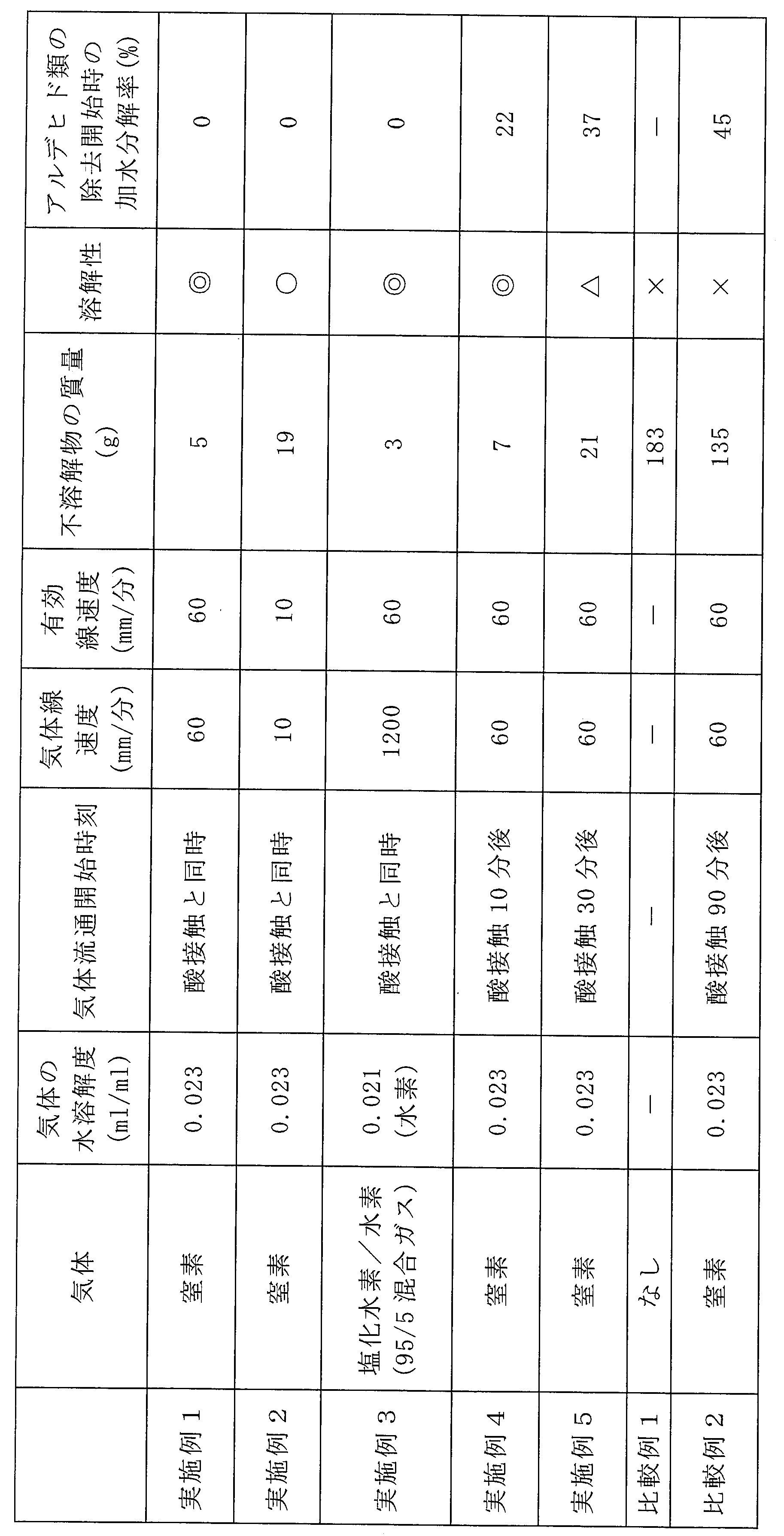
実施例1~5はいずれもN-ビニルカルボン酸アミド(共)重合体の加水分解率が40%以下で気体の流通を開始しているため溶解性の良い重合体が得られた。一方、加水分解率が45%で気体の流通を開始した比較例2は溶解性が悪かった。実施例1~5は水への溶解度が2mL/mLH2O以下である窒素または水素を流通させることでアルデヒドを追い出したため、溶解性の良い重合体が得られた。一方、気体を流通させなかった比較例1では系内にアルデヒドが残存し、重合体と架橋を形成したために不溶解となった。
Claims (7)
- N-ビニルカルボン酸アミド(共)重合体を加水分解して得られる水溶性重合体の製造方法であって、
N-ビニルカルボン酸アミド(共)重合体を加水分解する加水分解工程を含み、
前記加水分解工程は、加水分解反応液中からアルデヒド類の除去を行う除去工程を含み、
前記N-ビニルカルボン酸アミド(共)重合体の加水分解率X(%)が0≦X≦40のタイミングで、前記除去工程を開始する、水溶性重合体の製造方法。 - 前記除去工程において、気体を流通させることで、前記加水分解反応液中から前記アルデヒド類を除去する、請求項1に記載の水溶性重合体の製造方法。
- 前記加水分解工程において、前記N-ビニルカルボン酸アミド(共)重合体を酸または塩基と接触させることで加水分解を行い、
前記除去工程において、前記接触開始から60分以内に気体の流通を開始する請求項2に記載の水溶性重合体の製造方法。 - 前記除去工程において流通させる気体が、水への溶解度が2mL/1mL H2O以下である気体を少なくとも一種類含む、請求項2または3に記載の水溶性重合体の製造方法。
- 前記除去工程において流通させる気体の流通速度が、有効線速度5mm/分以上である請求項2~4のいずれか一項に記載の水溶性重合体の製造方法。
- N-ビニルカルボン酸アミドを重合させて、前記N-ビニルカルボン酸アミド(共)重合体を得る重合工程をさらに含み、
前記加水分解工程において、前記重合工程で得られたN-ビニルカルボン酸アミド(共)重合体を加水分解する、請求項1~5のいずれか一項に記載の水溶性重合体の製造方法。 - 前記重合工程では、N-ビニルカルボン酸アミドと、当該N-ビニルカルボン酸アミドと共重合可能な単量体と、を重合させる、請求項6に記載の水溶性重合体の製造方法。
Priority Applications (1)
| Application Number | Priority Date | Filing Date | Title |
|---|---|---|---|
| JP2021509635A JPWO2020196833A1 (ja) | 2019-03-27 | 2020-03-27 |
Applications Claiming Priority (2)
| Application Number | Priority Date | Filing Date | Title |
|---|---|---|---|
| JP2019061788 | 2019-03-27 | ||
| JP2019-061788 | 2019-03-27 |
Publications (1)
| Publication Number | Publication Date |
|---|---|
| WO2020196833A1 true WO2020196833A1 (ja) | 2020-10-01 |
Family
ID=72611588
Family Applications (1)
| Application Number | Title | Priority Date | Filing Date |
|---|---|---|---|
| PCT/JP2020/014024 Ceased WO2020196833A1 (ja) | 2019-03-27 | 2020-03-27 | 水溶性重合体の製造方法 |
Country Status (2)
| Country | Link |
|---|---|
| JP (1) | JPWO2020196833A1 (ja) |
| WO (1) | WO2020196833A1 (ja) |
Citations (3)
| Publication number | Priority date | Publication date | Assignee | Title |
|---|---|---|---|---|
| JPH0586127A (ja) * | 1991-09-27 | 1993-04-06 | Mitsubishi Kasei Corp | 水溶性ポリマーの製造法 |
| JP2003128724A (ja) * | 2001-10-18 | 2003-05-08 | Mitsubishi Chemicals Corp | N−ビニルアミド−酢酸ビニル系共重合体加水分解物の製造方法 |
| JP2012077099A (ja) * | 2010-09-30 | 2012-04-19 | Daiyanitorikkusu Kk | ポリビニルアミン又はポリアミジンの製造方法 |
-
2020
- 2020-03-27 JP JP2021509635A patent/JPWO2020196833A1/ja active Pending
- 2020-03-27 WO PCT/JP2020/014024 patent/WO2020196833A1/ja not_active Ceased
Patent Citations (3)
| Publication number | Priority date | Publication date | Assignee | Title |
|---|---|---|---|---|
| JPH0586127A (ja) * | 1991-09-27 | 1993-04-06 | Mitsubishi Kasei Corp | 水溶性ポリマーの製造法 |
| JP2003128724A (ja) * | 2001-10-18 | 2003-05-08 | Mitsubishi Chemicals Corp | N−ビニルアミド−酢酸ビニル系共重合体加水分解物の製造方法 |
| JP2012077099A (ja) * | 2010-09-30 | 2012-04-19 | Daiyanitorikkusu Kk | ポリビニルアミン又はポリアミジンの製造方法 |
Also Published As
| Publication number | Publication date |
|---|---|
| JPWO2020196833A1 (ja) | 2020-10-01 |
Similar Documents
| Publication | Publication Date | Title |
|---|---|---|
| US20180215879A1 (en) | N,N-Dialkyl glucamine for stabilising polymer dispersions | |
| US5464908A (en) | Process for preparing water-soluble polymers | |
| JPS61118406A (ja) | 水溶性ポリビニルアミンの製造方法 | |
| JPH1128476A (ja) | 酸素脱除剤としての4−アルキルセミカルバジド | |
| JP3412167B2 (ja) | N−ビニルホルムアミド組成物 | |
| JP3189315B2 (ja) | N−ビニルカルボン酸アミド重合体の製造法 | |
| EP2617742B1 (en) | N-vinyl lactam polymer and method for producing same | |
| JP3147440B2 (ja) | 水溶性ポリマーの製造法 | |
| DE19652040A1 (de) | Verfahren zur Herstellung einer ein kationisches Polymer enthaltenden wäßrigen Lösung oder Dispersion | |
| JP5991432B2 (ja) | ビニルアミン単位含有重合体の製造方法 | |
| WO2000042079A1 (en) | Sterically-hindered alkyl hydroxylamines for scavenging of free radicals | |
| JPH0554482B2 (ja) | ||
| JP4744170B2 (ja) | 水溶性ビニルアミン重合体の製造方法 | |
| JP3156342B2 (ja) | 粉末状のカチオン系水溶性ポリマー組成物とその製造法 | |
| JP5609576B2 (ja) | N−ビニルカルボン酸アミド系重合体、及びカチオン系水溶性重合体の製造方法 | |
| JP3479996B2 (ja) | N−メチルビニルアミン重合体の製造方法 | |
| JP4642316B2 (ja) | (メタ)アクリル酸系重合体の製造方法 | |
| JP5625846B2 (ja) | 水溶性ポリマーの製造方法 | |
| JP3094552B2 (ja) | 水溶性ポリマーの製造法 | |
| US4536326A (en) | Treatment of acrylamide and related compounds | |
| JP4748844B2 (ja) | 塩含有量の低いポリビニルアミン溶液の製造方法 | |
| JP7510595B2 (ja) | 高純度カチオン系重合体の製造方法 | |
| JPS6335167B2 (ja) | ||
| JPH09296013A (ja) | カチオン系重合体含有水性液の製造法 | |
| WO2021037969A1 (en) | Treatment process of polymeric dispersions based on the use of specific organic peroxides |
Legal Events
| Date | Code | Title | Description |
|---|---|---|---|
| 121 | Ep: the epo has been informed by wipo that ep was designated in this application |
Ref document number: 20776552 Country of ref document: EP Kind code of ref document: A1 |
|
| ENP | Entry into the national phase |
Ref document number: 2021509635 Country of ref document: JP Kind code of ref document: A |
|
| NENP | Non-entry into the national phase |
Ref country code: DE |
|
| 122 | Ep: pct application non-entry in european phase |
Ref document number: 20776552 Country of ref document: EP Kind code of ref document: A1 |