WO2020196705A1 - 硬化性組成物、硬化物、及び、硬化性組成物の使用方法 - Google Patents
硬化性組成物、硬化物、及び、硬化性組成物の使用方法 Download PDFInfo
- Publication number
- WO2020196705A1 WO2020196705A1 PCT/JP2020/013529 JP2020013529W WO2020196705A1 WO 2020196705 A1 WO2020196705 A1 WO 2020196705A1 JP 2020013529 W JP2020013529 W JP 2020013529W WO 2020196705 A1 WO2020196705 A1 WO 2020196705A1
- Authority
- WO
- WIPO (PCT)
- Prior art keywords
- group
- curable composition
- component
- carbon atoms
- compound
- Prior art date
- Legal status (The legal status is an assumption and is not a legal conclusion. Google has not performed a legal analysis and makes no representation as to the accuracy of the status listed.)
- Ceased
Links
Classifications
-
- C—CHEMISTRY; METALLURGY
- C08—ORGANIC MACROMOLECULAR COMPOUNDS; THEIR PREPARATION OR CHEMICAL WORKING-UP; COMPOSITIONS BASED THEREON
- C08K—Use of inorganic or non-macromolecular organic substances as compounding ingredients
- C08K5/00—Use of organic ingredients
- C08K5/54—Silicon-containing compounds
- C08K5/541—Silicon-containing compounds containing oxygen
- C08K5/5435—Silicon-containing compounds containing oxygen containing oxygen in a ring
-
- C—CHEMISTRY; METALLURGY
- C08—ORGANIC MACROMOLECULAR COMPOUNDS; THEIR PREPARATION OR CHEMICAL WORKING-UP; COMPOSITIONS BASED THEREON
- C08G—MACROMOLECULAR COMPOUNDS OBTAINED OTHERWISE THAN BY REACTIONS ONLY INVOLVING UNSATURATED CARBON-TO-CARBON BONDS
- C08G77/00—Macromolecular compounds obtained by reactions forming a linkage containing silicon with or without sulfur, nitrogen, oxygen or carbon in the main chain of the macromolecule
- C08G77/04—Polysiloxanes
- C08G77/14—Polysiloxanes containing silicon bound to oxygen-containing groups
-
- C—CHEMISTRY; METALLURGY
- C08—ORGANIC MACROMOLECULAR COMPOUNDS; THEIR PREPARATION OR CHEMICAL WORKING-UP; COMPOSITIONS BASED THEREON
- C08K—Use of inorganic or non-macromolecular organic substances as compounding ingredients
- C08K5/00—Use of organic ingredients
- C08K5/54—Silicon-containing compounds
-
- C—CHEMISTRY; METALLURGY
- C08—ORGANIC MACROMOLECULAR COMPOUNDS; THEIR PREPARATION OR CHEMICAL WORKING-UP; COMPOSITIONS BASED THEREON
- C08L—COMPOSITIONS OF MACROMOLECULAR COMPOUNDS
- C08L83/00—Compositions of macromolecular compounds obtained by reactions forming in the main chain of the macromolecule a linkage containing silicon with or without sulfur, nitrogen, oxygen or carbon only; Compositions of derivatives of such polymers
- C08L83/04—Polysiloxanes
- C08L83/06—Polysiloxanes containing silicon bound to oxygen-containing groups
-
- C—CHEMISTRY; METALLURGY
- C09—DYES; PAINTS; POLISHES; NATURAL RESINS; ADHESIVES; COMPOSITIONS NOT OTHERWISE PROVIDED FOR; APPLICATIONS OF MATERIALS NOT OTHERWISE PROVIDED FOR
- C09J—ADHESIVES; NON-MECHANICAL ASPECTS OF ADHESIVE PROCESSES IN GENERAL; ADHESIVE PROCESSES NOT PROVIDED FOR ELSEWHERE; USE OF MATERIALS AS ADHESIVES
- C09J11/00—Features of adhesives not provided for in group C09J9/00, e.g. additives
- C09J11/02—Non-macromolecular additives
- C09J11/06—Non-macromolecular additives organic
-
- C—CHEMISTRY; METALLURGY
- C09—DYES; PAINTS; POLISHES; NATURAL RESINS; ADHESIVES; COMPOSITIONS NOT OTHERWISE PROVIDED FOR; APPLICATIONS OF MATERIALS NOT OTHERWISE PROVIDED FOR
- C09J—ADHESIVES; NON-MECHANICAL ASPECTS OF ADHESIVE PROCESSES IN GENERAL; ADHESIVE PROCESSES NOT PROVIDED FOR ELSEWHERE; USE OF MATERIALS AS ADHESIVES
- C09J183/00—Adhesives based on macromolecular compounds obtained by reactions forming in the main chain of the macromolecule a linkage containing silicon, with or without sulfur, nitrogen, oxygen, or carbon only; Adhesives based on derivatives of such polymers
- C09J183/04—Polysiloxanes
- C09J183/06—Polysiloxanes containing silicon bound to oxygen-containing groups
-
- H—ELECTRICITY
- H10—SEMICONDUCTOR DEVICES; ELECTRIC SOLID-STATE DEVICES NOT OTHERWISE PROVIDED FOR
- H10H—INORGANIC LIGHT-EMITTING SEMICONDUCTOR DEVICES HAVING POTENTIAL BARRIERS
- H10H20/00—Individual inorganic light-emitting semiconductor devices having potential barriers, e.g. light-emitting diodes [LED]
- H10H20/80—Constructional details
- H10H20/85—Packages
- H10H20/852—Encapsulations
- H10H20/854—Encapsulations characterised by their material, e.g. epoxy or silicone resins
-
- H—ELECTRICITY
- H10—SEMICONDUCTOR DEVICES; ELECTRIC SOLID-STATE DEVICES NOT OTHERWISE PROVIDED FOR
- H10W—GENERIC PACKAGES, INTERCONNECTIONS, CONNECTORS OR OTHER CONSTRUCTIONAL DETAILS OF DEVICES COVERED BY CLASS H10
- H10W74/00—Encapsulations, e.g. protective coatings
- H10W74/01—Manufacture or treatment
-
- H—ELECTRICITY
- H10—SEMICONDUCTOR DEVICES; ELECTRIC SOLID-STATE DEVICES NOT OTHERWISE PROVIDED FOR
- H10W—GENERIC PACKAGES, INTERCONNECTIONS, CONNECTORS OR OTHER CONSTRUCTIONAL DETAILS OF DEVICES COVERED BY CLASS H10
- H10W74/00—Encapsulations, e.g. protective coatings
- H10W74/10—Encapsulations, e.g. protective coatings characterised by their shape or disposition
-
- H—ELECTRICITY
- H10—SEMICONDUCTOR DEVICES; ELECTRIC SOLID-STATE DEVICES NOT OTHERWISE PROVIDED FOR
- H10W—GENERIC PACKAGES, INTERCONNECTIONS, CONNECTORS OR OTHER CONSTRUCTIONAL DETAILS OF DEVICES COVERED BY CLASS H10
- H10W74/00—Encapsulations, e.g. protective coatings
- H10W74/40—Encapsulations, e.g. protective coatings characterised by their materials
-
- H—ELECTRICITY
- H10—SEMICONDUCTOR DEVICES; ELECTRIC SOLID-STATE DEVICES NOT OTHERWISE PROVIDED FOR
- H10W—GENERIC PACKAGES, INTERCONNECTIONS, CONNECTORS OR OTHER CONSTRUCTIONAL DETAILS OF DEVICES COVERED BY CLASS H10
- H10W74/00—Encapsulations, e.g. protective coatings
- H10W74/40—Encapsulations, e.g. protective coatings characterised by their materials
- H10W74/47—Encapsulations, e.g. protective coatings characterised by their materials comprising organic materials, e.g. plastics or resins
- H10W74/476—Organic materials comprising silicon
Definitions
- a curable composition having excellent curability, a cured product obtained by curing the curable composition, and the curable composition are sealed with an adhesive for an optical element fixing material or a sealing material for an optical element fixing material. Regarding the method of using it as a material.
- the curable composition has been variously improved according to the application, and has been widely used industrially as a raw material for optical parts and molded articles, an adhesive, a coating agent, and the like. Further, the curable composition has also attracted attention as a composition for an optical element fixing material such as an adhesive for an optical element fixing material and a sealing material for an optical element fixing material.
- Optical elements include various lasers such as semiconductor lasers (LDs), light emitting elements such as light emitting diodes (LEDs), light receiving elements, composite optical elements, optical integrated circuits, and the like.
- LDs semiconductor lasers
- LEDs light emitting diodes
- optical elements of blue light and white light having a shorter peak wavelength of light emission have been developed and widely used. The brightness of such a light emitting element having a short peak wavelength of light emission is dramatically increased, and the amount of heat generated by the optical element tends to be further increased accordingly.
- Patent Documents 1 to 3 propose compositions for optical device fixing materials containing a polysilsesquioxane compound as a main component.
- Japanese Unexamined Patent Publication No. 2004-359933 Japanese Unexamined Patent Publication No. 2005-263869 Japanese Unexamined Patent Publication No. 2006-328231
- the present invention has been made in view of the above-mentioned actual conditions of the prior art, and a curable composition having excellent curability, a cured product obtained by curing the curable composition, and the curable composition. It is an object of the present invention to provide a method for use as an adhesive for an optical element fixing material or a sealing material for an optical element fixing material.
- the present inventors have made extensive studies on a curable composition containing a curable polysilsesquioxane compound. As a result, they have found that a curable composition containing a curable polysilsesquioxane compound and a specific silicone oligomer having an epoxy ring has excellent curability, and have completed the present invention.
- excellent in curability means that the curable composition is cured in a short time.
- the following methods of using the curable compositions [1] to [7], the cured products [8] and [9], and the curable compositions [10] and [11] are provided. Will be done.
- R 1 is an unsubstituted alkyl group having 1 to 10 carbon atoms, an alkyl group having 1 to 10 carbon atoms having a substituent (excluding a group having an epoxy ring), and an unsubstituted aryl group having 6 to 12 carbon atoms. , And at least one selected from the group consisting of an aryl group having 6 to 12 carbon atoms having a substituent (excluding a group having an epoxy ring).
- the total amount of the repeating units derived from the silane compound is 80 mol% or more in all the repeating units, and at least one of the trifunctional silane compounds is a silicone oligomer which is a trifunctional silane compound having a group having an epoxy ring [2].
- [8] A cured product obtained by curing the curable composition according to any one of the above [1] to [7].
- [10] A method in which the curable composition according to any one of [1] to [7] above is used as an adhesive for an optical element fixing material.
- a curable composition having excellent curability, a cured product obtained by curing the curable composition, and the curable composition can be used as an adhesive for a light element fixing material or a light element fixing material.
- a method of use as a sealing material is provided.
- the present invention will be described in detail by dividing it into 1) a curable composition, 2) a cured product, and 3) a method of using the curable composition.
- Curable composition contains the following component (A) and component (B).
- the "curable polysilsesquioxane compound” satisfies a predetermined condition such as heating. It refers to a polysilsesquioxane compound that changes into a cured product by itself, or a polysilsesquioxane compound that functions as a curable component in a curable composition.
- the component (A) constituting the curable composition of the present invention is a curable polysilsesquioxane compound having a repeating unit represented by the following formula (a-1) (hereinafter, "polysilsesquioxane compound (A)”. ) ”.).
- R 1 is an unsubstituted alkyl group having 1 to 10 carbon atoms, an alkyl group having 1 to 10 carbon atoms having a substituent (excluding a group having an epoxy ring), and an unsubstituted carbon. It is at least one selected from the group consisting of an aryl group of number 6 to 12 and an aryl group having 6 to 12 carbon atoms having a substituent (excluding a group having an epoxy ring).
- the number of carbon atoms of the "alkyl group unsubstituted 1 to 10 carbon atoms" represented by R 1 is preferably from 1 to 6, 1 to 3 more preferred.
- Examples of the "unsubstituted alkyl group having 1 to 10 carbon atoms” include methyl group, ethyl group, n-propyl group, isopropyl group, n-butyl group, isobutyl group, s-butyl group, t-butyl group and n-. Examples thereof include a pentyl group, an n-hexyl group, an n-octyl group, an n-nonyl group and an n-decyl group.
- R carbon number of 1 represented by "optionally substituted alkyl group having 1 to 10 carbon atoms having a (excluding a group having an epoxy ring)" is preferably 1 to 6, 1 to 3 more preferred. It should be noted that this carbon number means the carbon number of the portion excluding the substituent (the portion of the alkyl group). Therefore, when R 1 is an "alkyl group having 1 to 10 carbon atoms having a substituent (excluding a group having an epoxy ring)", the carbon number of R 1 may exceed 10.
- the alkyl group of the "alkyl group having 1 to 10 carbon atoms having a substituent (excluding the group having an epoxy ring)" is the same as that shown as the "unsubstituted alkyl group having 1 to 10 carbon atoms". Can be mentioned.
- the number of atoms (excluding the number of hydrogen atoms) of the substituent of the "alkyl group having 1 to 10 carbon atoms having a substituent (excluding the group having an epoxy ring)" is usually 1 to 30, preferably 1 to 20. Is.
- the substituent of the "alkyl group having 1 to 10 carbon atoms having a substituent (excluding the group having an epoxy ring)" is a halogen atom such as a fluorine atom, a chlorine atom or a bromine atom; a cyano group; a formula: represented by OG. Groups to be; etc.
- G represents a hydroxyl-protecting group.
- the hydroxyl-protecting group is not particularly limited, and examples thereof include known protecting groups known as hydroxyl-protecting groups.
- acyl-based protecting groups trimethylsilyl groups, triethylsilyl groups, t-butyldimethylsilyl groups, t-butyldiphenylsilyl groups and other silyl protecting groups; methoxymethyl groups, methoxyethoxymethyl groups, 1-ethoxyethyl groups.
- Acetal-based protecting groups such as tetrahydropyran-2-yl group and tetrahydrofuran-2-yl group; alkoxycarbonyl-based protecting groups such as t-butoxycarbonyl group; methyl group, ethyl group, t-butyl group, octyl group , Allyl group, triphenylmethyl group, benzyl group, p-methoxybenzyl group, fluorenyl group, trityl group, benzhydryl group and other ether-based protecting groups; and the like.
- the number of carbon atoms of the "unsubstituted aryl group having 6 to 12 carbon atoms" represented by R 1 6 is preferred.
- Examples of the "unsubstituted aryl group having 6 to 12 carbon atoms” include a phenyl group, a 1-naphthyl group, a 2-naphthyl group and the like.
- Carbon number of represented by R 1 "substituted aryl group having 6 to 12 carbon atoms having a (excluding a group having an epoxy ring)" 6 are preferred.
- this carbon number means the carbon number of the portion (the portion of an aryl group) excluding the substituent. Therefore, when R 1 is an "aryl group having 6 to 12 carbon atoms having a substituent (excluding a group having an epoxy ring)", the carbon number of R 1 may exceed 12.
- the aryl group of the "aryl group having 6 to 12 carbon atoms having a substituent (excluding the group having an epoxy ring)" is the same as that shown as "an unsubstituted aryl group having 6 to 12 carbon atoms". Can be mentioned.
- the number of atoms (excluding the number of hydrogen atoms) of the substituent of the "aryl group having 6 to 12 carbon atoms having a substituent (excluding the group having an epoxy ring)" is usually 1 to 30, preferably 1 to 20. Is.
- Examples of the substituent of the "aryl group having 6 to 12 carbon atoms having a substituent (excluding the group having an epoxy ring)" include a methyl group, an ethyl group, an n-propyl group, an isopropyl group, an n-butyl group and s-.
- Alkyl groups such as butyl group, isobutyl group, t-butyl group, n-pentyl group, n-hexyl group, n-heptyl group, n-octyl group and isooctyl group; halogen atoms such as fluorine atom, chlorine atom and bromine atom.
- An alkoxy group such as a methoxy group and an ethoxy group; and the like.
- R 1 is an unsubstituted alkyl group having 1 to 10 carbon atoms, an alkyl group having a fluorine atom having 1 to 10 carbon atoms, an unsubstituted aryl group having 6 to 12 carbon atoms, or a cyano group.
- An alkyl group having 1 to 10 carbon atoms is preferable.
- the repeating unit represented by the above formula (a-1) is represented by the following formula.
- O 1/2 means that an oxygen atom is shared with adjacent repeating units.
- the polysilsesquioxane compound (A) has three oxygen atoms bonded to a silicon atom, which is generally called a T site, and other groups (R 1 ). Has a partial structure in which one is bonded.
- T-site contained in the polysilsesquioxane compound (A) include those represented by the following formulas (a-3) to (a-5).
- R 1 has the same meaning as described above.
- R 2 represents a hydrogen atom or an alkyl group having 1 to 10 carbon atoms. Examples of the alkyl group having 1 to 10 carbon atoms R 2, a methyl group, an ethyl group, n- propyl group, an isopropyl group, n- butyl group, s- butyl group, an isobutyl group, a t- butyl group and the like can be mentioned. A plurality of R 2 to each other may all be different mutually be the same. Further, in the above formulas (a-3) to (a-5), a Si atom is bonded to *.
- the polysilsesquioxane compound (A) is a ketone solvent such as acetone; an aromatic hydrocarbon solvent such as benzene; a sulfur-containing solvent such as dimethyl sulfoxide; an ether solvent such as tetrahydrofuran; an ester solvent such as ethyl acetate. Since it is soluble in various organic solvents such as a solvent; a halogen-containing solvent such as chloroform; and a mixed solvent composed of two or more of these, these solvents are used to prepare the polysilsesquioxane compound (A). 29 Si-NMR in a solution state can be measured.
- the polysilsesquioxane compound (A) used in the present invention preferably contains 10 to 45 mol% of T2 sites, more preferably 15 to 40 mol%, and 20 to 40 mol%, from the viewpoint of improving the adhesive strength. Those containing 35 mol% are even more preferable.
- the polysilsesquioxane compound (A) used in the present invention preferably contains 50 to 90 mol% of T3 sites, preferably 55 to 85 mol%, from the viewpoint of obtaining a hard and cured product having excellent heat resistance. Those containing 60 to 80 mol% are more preferable, and those containing 60 to 80 mol% are even more preferable.
- the content ratio of the repeating unit represented by the above formula (a-1) in the polysilsesquioxane compound (A) is preferably 40 to 100 mol%, more preferably 70 to 100 mol%, based on all the repeating units. 90 to 100 mol% is more preferable, and 100 mol% is particularly preferable.
- T3 is observed in the region of -82 ppm or more and less than -73 ppm
- T2 is observed in the region of -73 ppm or more and less than -65 ppm
- T1 is observed in the region of -65 ppm or more and less than -65 ppm. It is observed in the region of less than 55 ppm.
- the integral value of T3 of the polysilsesquioxane compound (A) is 60 to 90% of the total value of the integral values of T1, T2, and T3.
- the 29 Si-NMR spectrum can be measured, for example, by the method described in Examples.
- "T1", “T2", “T3” and the like may represent a structure of a repeating unit or an NMR peak corresponding to the structure.
- the content ratio of the repeating unit represented by the formula (a-1) in the polysilsesquioxane compound (A) is preferably 40 mol% or more, more preferably 70 mol% or more, and 90 mol, based on all the repeating units. % Or more is more preferable, and 100 mol% is particularly preferable.
- the content ratio of the repeating unit represented by the above formula (a-1) in the polysilsesquioxane compound (A) can be determined, for example, by measuring 29 Si-NMR of the polysilsesquioxane compound (A). Can be sought.
- the polysilsesquioxane compound (A) has a repeating unit other than the repeating unit represented by the formula (a-1), the polysilsesquioxane compound (A) has an epoxy ring. It does not have a group having. In this respect, the polysilsesquioxane compound (A) and the silicone oligomer of the component (B) are clearly distinguished.
- the polysilsesquioxane compound (A) may be one having one kind of R 1 (monopolymer) or one having two or more kinds of R 1 (copolymer).
- the polysilsesquioxane compound (A) is a copolymer
- the polysilsesquioxane compound (A) is any of a random copolymer, a block copolymer, a graft copolymer, an alternating copolymer and the like.
- a random copolymer is preferable.
- the structure of the polysilsesquioxane compound (A) may be any of a ladder type structure, a double decker type structure, a cage type structure, a partially cleaved cage type structure, a cyclic type structure, and a random type structure. ..
- the mass average molecular weight (Mw) of the polysilsesquioxane compound (A) is not particularly limited, but is usually 800 to 30,000, preferably 1,200 to 20,000, and more preferably 1,500 to 18,000. It is more preferably 2,500 to 16,000, and particularly preferably 4,000 to 14,000.
- Mw mass average molecular weight
- the molecular weight distribution (Mw / Mn) of the polysilsesquioxane compound (A) is not particularly limited, but is usually 1.0 to 10.0, preferably 1.1 to 6.0.
- Mw / Mn molecular weight distribution
- the mass average molecular weight (Mw) and the number average molecular weight (Mn) can be determined, for example, as standard polystyrene-equivalent values by gel permeation chromatography (GPC) using tetrahydrofuran (THF) as a solvent.
- the polysilsesquioxane compound (A) can be used alone or in combination of two or more.
- the method for producing the polysilsesquioxane compound (A) is not particularly limited.
- the following equation (a-6) is not particularly limited.
- the following equation (a-6) is not particularly limited.
- R 1 has the same meaning as described above.
- R 3 represents an alkyl group having 1 to 10 carbon atoms
- X 1 represents a halogen atom
- p represents an integer of 0 to 3. Multiple R 3 and a plurality of X 1 are each, be the same as each other, may be different from each other.
- the polysilsesquioxane compound (A) can be produced by polycondensing at least one of the silane compounds (1) represented by (1).
- Examples of the alkyl group having 1 to 10 carbon atoms of R 3 include those similar to those shown as the alkyl group having 1 to 10 carbon atoms of R 2 .
- the halogen atom of X 1 include a chlorine atom and a bromine atom.
- silane compound (1) examples include alkyltrialkoxysilane compounds such as methyltrimethoxysilane, methyltriethoxysilane, ethyltrimethoxysilane, ethyltriethoxysilane, and ethyltripropoxysilane; Alkylhalogenoalkoxysilane compounds such as methylchlorodimethoxysilane, methylchlorodiethoxysilane, methyldichloromethoxysilane, methylbromodimethoxysilane, ethylchlorodimethoxysilane, ethylchlorodiethoxysilane, ethyldichloromethoxysilane, ethylbromodimethoxysilane; Alkyltrihalogenosilane compounds such as methyltrichlorosilane, methyltribromosilane, ethyltrichlorosilane, and ethyltripropoxy
- Substituted alkyltrialkoxysilane compounds such as 3,3,3-trifluoropropyltrimethoxysilane, 3,3,3-trifluoropropyltriethoxysilane, 2-cyanoethyltrimethoxysilane, and 2-cyanoethyltriethoxysilane; 3,3,3-Trifluoropropylchlorodimethoxysilane, 3,3,3-trifluoropropylchlorodiethoxysilane, 3,3,3-trifluoropropyldichloromethoxysilane, 3,3,3-trifluoropropyldichloro Substituted alkylhalogenoalkoxysilane compounds such as ethoxysilane, 2-cyanoethylchlorodimethoxysilane, 2-cyanoethylchlorodiethoxysilane, 2-cyanoethyldichloromethoxysilane, 2-cyanoethyld
- Phenyltrialkoxysilane compounds having or not having a substituent such as phenyltrimethoxysilane and 4-methoxyphenyltrimethoxysilane
- Phenylhalogenoalkoxysilane compounds having or not having a substituent such as phenylchlorodimethoxysilane, phenyldichloromethoxysilane, 4-methoxyphenylchlorodimethoxysilane, 4-methoxyphenyldichloromethoxysilane
- Phenyltrihalogenosilane compounds having or not having a substituent such as phenyltrichlorosilane and 4-methoxyphenyltrichlorosilane; and the like can be mentioned.
- These silane compounds (1) can be used alone or in combination of two or more.
- the method for polycondensing the silane compound (1) is not particularly limited.
- a method of adding a predetermined amount of a polycondensation catalyst to the silane compound (1) in a solvent or without a solvent and stirring at a predetermined temperature can be mentioned. More specifically, (a) a method of adding a predetermined amount of an acid catalyst to the silane compound (1) and stirring at a predetermined temperature, and (b) adding a predetermined amount of a base catalyst to the silane compound (1).
- a method of stirring at a predetermined temperature, (c) a predetermined amount of acid catalyst is added to the silane compound (1), and after stirring at a predetermined temperature, an excess amount of base catalyst is added to make the reaction system basic.
- a method of stirring at a predetermined temperature and the like is preferable because the desired polysilsesquioxane compound (A) can be efficiently obtained.
- the polycondensation catalyst used may be either an acid catalyst or a base catalyst. Further, two or more polycondensation catalysts may be used in combination, but at least an acid catalyst is preferably used.
- the acid catalyst include inorganic acids such as phosphoric acid, hydrochloric acid, boric acid, sulfuric acid and nitric acid; and organic acids such as citric acid, acetic acid, methanesulfonic acid, trifluoromethanesulfonic acid, benzenesulfonic acid and p-toluenesulfonic acid; Can be mentioned.
- at least one selected from phosphoric acid, hydrochloric acid, boric acid, sulfuric acid, citric acid, acetic acid, and methanesulfonic acid is preferable.
- aqueous ammonia As the base catalyst, aqueous ammonia; trimethylamine, triethylamine, lithium diisopropylamide, lithium bis (trimethylsilyl) amide, pyridine, 1,8-diazabicyclo [5.4.0] -7-undecene, aniline, picolin, 1,4- Diazabicyclo [2.2.2]
- Organic bases such as octane and imidazole; organic hydroxides such as tetramethylammonium hydroxide and tetraethylammonium hydroxide; sodium methoxydone, sodium alkoxide, sodium t-butoxide, potassium t-butoxide
- Metal alkoxides such as; metal hydrides such as sodium hydride and calcium hydride; metal hydroxides such as sodium hydroxide, potassium hydroxide and calcium hydroxide; metal carbonates such as sodium carbonate, potassium carbonate and magnesium carbonate; Metallic hydrogen carbonates such as sodium hydrogen carbonate and potassium hydrogen carbon
- the amount of the polycondensation catalyst used is usually in the range of 0.05 to 10 mol%, preferably 0.1 to 5 mol%, based on the total mol amount of the silane compound (1).
- the solvent to be used can be appropriately selected according to the type of the silane compound (1) and the like.
- water aromatic hydrocarbons such as benzene, toluene and xylene
- esters such as methyl acetate, ethyl acetate, propyl acetate, butyl acetate and methyl propionate
- ketones such as acetone, methyl ethyl ketone, methyl isobutyl ketone and cyclohexanone.
- Alcohols such as methyl alcohol, ethyl alcohol, n-propyl alcohol, isopropyl alcohol, n-butyl alcohol, isobutyl alcohol, s-butyl alcohol, t-butyl alcohol; and the like. These solvents can be used alone or in combination of two or more.
- a polycondensation reaction is carried out in an aqueous system in the presence of an acid catalyst, and then an organic solvent and an excessive amount of a base catalyst (ammonia water, etc.) are added to the reaction solution.
- the polycondensation reaction may be further carried out under basic conditions.
- the amount of the solvent used is 0.1 liter or more and 10 liters or less, preferably 0.1 liter or more and 2 liters or less, per 1 mol of the total mol amount of the silane compound (1).
- the temperature at which the silane compound (1) is polycondensed is usually in the temperature range from 0 ° C. to the boiling point of the solvent used, preferably in the range of 20 ° C. or higher and 100 ° C. or lower. If the reaction temperature is too low, the progress of the polycondensation reaction may be insufficient. On the other hand, if the reaction temperature becomes too high, it becomes difficult to suppress gelation. The reaction is usually complete in 30 minutes to 30 hours.
- the monomer R 1 is an alkyl group having a fluorine atom, it tends to be inferior in reactivity than the monomer wherein R 1 is normal alkyl group.
- the polysilsesquioxane compound (A) having the desired molecular weight can be easily obtained.
- the portion of OR 3 or X 1 of the silane compound (1) in which dealcoholization or the like does not occur is the polysilsesquioxane compound (A).
- the repeating unit represented by the formula (a-3) in addition to the repeating unit represented by the formula (a-3), the repeating unit represented by the formulas (a-4) and (a-5) is contained. May be included.
- the component (B) constituting the curable composition of the present invention is a silicone oligomer having or not having a repeating unit derived from a trifunctional silane compound and having or not having a repeating unit derived from a tetrafunctional silane compound.
- the total amount of the repeating unit derived from the trifunctional silane compound and the repeating unit derived from the tetrafunctional silane compound is 80 mol% or more in all the repeating units of the component (B), and at least one of the trifunctional silane compounds is an epoxy ring.
- the silicone oligomer refers to a silane compound polymer having a low degree of polymerization. The degree of polymerization of the silicone oligomer (B) is usually 2 to 100.
- the silicone oligomer (B) has a repeating unit derived from a trifunctional silane compound.
- the trifunctional silane compound is a compound having one silicon atom and three hydrolyzable groups bonded to the silicon atom.
- the hydrolyzable group refers to a group having hydrolyzable / polycondensable properties such as an alkoxy group and a halogen atom.
- Examples of the trifunctional silane compound include the silane compound (1) represented by the formula (a-6) shown as a raw material for producing the polysilsesquioxane compound (A).
- the silicone oligomer (B) may or may not have a repeating unit derived from a tetrafunctional silane compound.
- the tetrafunctional silane compound is a compound having one silicon atom and four hydrolyzable groups bonded to the silicon atom.
- Examples of the tetrafunctional silane compound include tetramethoxysilane, tetraethoxysilane, methoxytriethoxysilane, dimethoxydiethoxysilane, trimethoxyethoxysilane, trimethoxychlorosilane, triethoxychlorosilane, dimethoxydichlorosilane, diethoxydichlorosilane, and methoxytrichlorosilane. , Ethoxytrichlorosilane, tetrachlorosilane, tetrabromosilane and the like.
- the total of the repeating unit derived from the trifunctional silane compound and the repeating unit derived from the tetrafunctional silane compound contained in the silicone oligomer (B) is 80 mol% or more, preferably 80 to 100 mol%, more preferably 80 mol% or more in all the repeating units. It is 90 to 100 mol%.
- a curable composition in which the total of the repeating unit derived from the trifunctional silane compound and the repeating unit derived from the tetrafunctional silane compound is less than 80 mol% in all the repeating units is inferior in curability.
- the amount of the repeating unit derived from the trifunctional silane compound contained in the silicone oligomer (B) is preferably 5 to 40 mol% of the total of the repeating unit derived from the trifunctional silane compound and the repeating unit derived from the tetrafunctional silane compound. , More preferably 10 to 30 mol%.
- each repeating unit contained in the silicone oligomer (B) and its content ratio are the same as those described above as the method for determining the structure of the polysilsesquioxane compound (A) (measurement result of 29 Si-NMR). It can be obtained by the method based on).
- the silicone oligomer (B) has a repeating unit derived from a trifunctional silane compound having a group having an epoxy ring. That is, at least one of the trifunctional silane compounds used in synthesizing the silicone oligomer (B) is a compound having a group having an epoxy ring.
- Examples of the trifunctional silane compound having a group having an epoxy ring include 3-glycidoxypropyltrimethoxysilane, 3-glycidoxypropyltriethoxysilane, 2- (3,4-epoxycyclohexyl) ethyltrimethoxysilane, and 2 -(3,4-Epoxycyclohexyl) ethyltriethoxysilane, 8-glycidoxyoctyltrimethoxysilane, 8-glycidoxyoctyltriethoxysilane, and the like can be mentioned.
- the silicone oligomer (B) has an epoxy ring in the molecule.
- a curable composition having excellent curability can be obtained.
- Such an effect cannot be obtained by using a silicone oligomer having a functional group (for example, a thiol group) other than the epoxy ring-containing group or a monomer having an epoxy ring instead of the silicone oligomer (B).
- the combined use of the polysilsesquioxane compound (A) and the silicone oligomer (B) requires a smaller amount of epoxy ring to be introduced than the introduction of the epoxy ring into the polysilsesquioxane compound (A). Sufficient curability can be realized.
- the mass average molecular weight (Mw) of the silicone oligomer (B) is not particularly limited, but is usually 500 to 5,000, preferably 1,000 to 4,500, more preferably 1,500 to 4,000, and even more preferably 2. It is 000 to 3,500.
- Mw mass average molecular weight
- the molecular weight distribution (Mw / Mn) of the silicone oligomer (B) is not particularly limited, but is usually 1.0 to 10.0, preferably 1.1 to 6.0.
- Mw / Mn molecular weight distribution
- the mass average molecular weight (Mw) and the number average molecular weight (Mn) can be determined, for example, as standard polystyrene-equivalent values by gel permeation chromatography (GPC) using tetrahydrofuran (THF) as a solvent.
- the epoxy equivalent of the silicone oligomer (B) is not particularly limited, but is usually 50 to 2,000 g / eq, preferably 100 to 1,500 g / eq, more preferably 150 to 1,200 g / eq, still more preferably 200 to 1. It is 000 g / eq.
- the epoxy equivalent of the silicone oligomer (B) can be measured according to JIS K7236 (2001).
- the silicone oligomer (B) can be used alone or in combination of two or more.
- the method for producing the silicone oligomer (B) is not particularly limited.
- the target silicone oligomer (B) can be produced by appropriately changing the reaction conditions and the like in the same method as described as the method for producing the polysilsesquioxane compound (A). Further, as the silicone oligomer (B), a commercially available silicone oligomer may be used.
- the curable composition of the present invention contains a polysilsesquioxane compound (A) and a silicone oligomer (B).
- the total amount of the polysilsesquioxane compound (A) and the silicone oligomer (B) is preferably 30 to 100% by mass, more preferably 40 to 95% by mass, still more preferably 40% by mass, based on the solid content of the curable composition. Is 50 to 90% by mass, particularly preferably 55 to 85% by mass.
- the "solid content” refers to a component other than the solvent in the curable composition.
- the content of the silicone oligomer (B) is preferably 0.1 to 100 parts by mass, more preferably 0.5 to 80 parts by mass, still more preferably, with respect to 100 parts by mass of the polysilsesquioxane compound (A). It is 1.0 to 60 parts by mass, particularly preferably 1.5 to 40 parts by mass. If the content of the component (B) is too small, the effect of the present invention may not be obtained, and if it is too large, gelation may occur.
- the curable composition of the present invention may contain a silane coupling agent as the component (C).
- a silane coupling agent refers to a silane compound having a silicon atom, a functional group, and a hydrolyzable group bonded to the silicon atom.
- the functional group means a group having a reactivity with another compound (mainly an organic substance), for example, a group having a nitrogen atom such as an amino group, a substituted amino group, an isocyanate group, a ureido group, and a group having an isocyanurate skeleton.
- the silane coupling agent can be used alone or in combination of two or more.
- the content thereof is not particularly limited and can be appropriately determined depending on the intended purpose.
- silane coupling agent a silane coupling agent having a nitrogen atom in the molecule or a silane coupling agent having an acid anhydride structure in the molecule is preferable.
- a curable composition containing a silane coupling agent having a nitrogen atom in the molecule or a silane coupling agent having an acid anhydride structure in the molecule tends to give a cured product having better heat resistance and adhesiveness.
- silane coupling agent having a nitrogen atom in the molecule examples include a trialkoxysilane compound represented by the following formula (c-1), a dialkoxyalkylsilane compound represented by the formula (c-2), or dialkoxy. Examples thereof include arylsilane compounds.
- R a represents a methoxy group, an ethoxy group, n- propoxy group, isopropoxy group, n- butoxy group, an alkoxy group having 1 to 6 carbon atoms such as t- butoxy.
- R b is an alkyl group having 1 to 6 carbon atoms such as a methyl group, an ethyl group, an n-propyl group, an isopropyl group, an n-butyl group and a t-butyl group; or a phenyl group, a 4-chlorophenyl group and a 4-.
- R c represents an organic group having 1 to 10 carbon atoms and having a nitrogen atom. Further, R c may be bonded to a group containing another silicon atom. Specific examples of the organic group having 1 to 10 carbon atoms R c is, N-2- (aminoethyl) -3-aminopropyl group, 3-aminopropyl group, N-(1,3-dimethyl - butylidene) amino Examples thereof include a propyl group, a 3-ureidopropyl group and an N-phenyl-aminopropyl group.
- R c is, as the compound where an organic group bonded with groups containing other silicon atoms, having an isocyanurate skeleton
- examples thereof include a silane coupling agent (isocyanurate-based silane coupling agent) and a silane coupling agent having a urea skeleton (urea-based silane coupling agent).
- the silane coupling agent having a nitrogen atom in the molecule an isocyanurate-based silane coupling agent and a urea-based silane coupling agent are preferable because a cured product having better adhesiveness can be easily obtained.
- the molecule has 4 or more alkoxy groups bonded to a silicon atom. Having 4 or more alkoxy groups bonded to a silicon atom means that the total count of the alkoxy groups bonded to the same silicon atom and the alkoxy groups bonded to different silicon atoms is 4 or more.
- Examples of the isocyanurate-based silane coupling agent having 4 or more alkoxy groups bonded to a silicon atom include a compound represented by the following formula (c-3).
- Examples of the urea-based silane coupling agent having 4 or more alkoxy groups bonded to a silicon atom include compounds represented by the following formula (c-4).
- Ra has the same meaning as above.
- t1 to t5 independently represents an integer of 1 to 10, preferably an integer of 1 to 6, and particularly preferably 3.
- 1,3,5-N-tris (3-trimethoxysilylpropyl) isocyanurate and 1,3,5-N-tris (3-) are examples of the silane coupling agent having a nitrogen atom in the molecule.
- Triethoxysilylpropyl) isocyanurate hereinafter referred to as "isocyanurate compound”
- N, N'-bis (3-trimethoxysilylpropyl) urea N, N'-bis (3-triethoxysilylpropyl) urea
- urea compound a combination of the above isocyanurate compound and urea compound is preferably used.
- the content thereof is not particularly limited, but the amount thereof has the above component (A) and a nitrogen atom in the molecule.
- the mass ratio of the silane coupling agent [(A component: silane coupling agent having a nitrogen atom in the molecule], preferably 100: 0.1 to 100: 90, more preferably 100: 0.3 to 100:
- the amount is 60, more preferably 100: 1 to 100: 50, still more preferably 100: 3 to 100: 40, and particularly preferably 100: 5 to 100: 35.
- the cured product of the curable composition containing the component (A) and the silane coupling agent having a nitrogen atom in the molecule at such a ratio becomes excellent in heat resistance and adhesiveness.
- a silane coupling agent having an acid anhydride structure in a molecule is an organosilicon compound having both a group having an acid anhydride structure and a hydrolyzable group in one molecule. Specific examples thereof include compounds represented by the following formula (c-5).
- Q represents a group having an acid anhydride structure
- R d represents an alkyl group, or have a substituent, or having no substituent phenyl group having 1 to 6 carbon atoms
- R e is a carbon It represents an alkoxy group or a halogen atom of the number 1 to 6
- i and k represent an integer of 1 to 3
- j represents an integer of 0 to 2
- i + j + k 4.
- R ds may be the same or different from each other.
- k is 2 or 3
- among a plurality of R e may be different from each be the same.
- i 2 or 3
- a plurality of Qs may be the same or different from each other.
- the following formula is used as Q
- h represents an integer of 0 to 10) and the like, and the group represented by (Q1) is particularly preferable.
- silane coupling agent having an acid anhydride structure in the molecule examples include 2- (trimethoxysilyl) ethyl anhydride succinic anhydride, 2- (triethoxysilyl) ethyl anhydride succinic anhydride, and 3- (trimethoxysilyl) propyl anhydride succinic anhydride.
- Tri (1 to 6 carbon atoms) alkoxysilyl (2 to 8 carbon atoms) alkyl succinic anhydride such as acids, 3- (triethoxysilyl) propyl succinic anhydride;
- Di (1 to 6 carbon atoms) alkoxymethylsilyl (2 to 8 carbon atoms) alkyl succinic anhydride such as 2- (dimethoxymethylsilyl) ethyl succinic anhydride; 2- (Methoxydimethylsilyl) ethyl succinic anhydride, etc.
- Trihalogenosilyl (2-8 carbon atoms) alkyl succinic anhydride such as 2- (trichlorosilyl) ethyl succinic anhydride, 2- (tribromosilyl) ethyl succinic anhydride;
- Dihalogenomethylsilyl (2-8 carbon atoms) alkyl succinic anhydride such as 2- (dichloromethylsilyl) ethyl succinic anhydride;
- Examples thereof include halogenodimethylsilyl (2 to 8 carbon atoms) alkyl succinic anhydride, such as 2- (chlorodimethylsilyl) ethyl succinic anhydride.
- silane coupling agent having an acid anhydride structure in the molecule tri (1 to 6 carbon atoms) alkoxysilyl (2 to 8 carbon atoms) alkyl succinic anhydride is preferable, and 3- (trimethoxysilyl) is preferable.
- silane coupling agent having an acid anhydride structure in the molecule tri (1 to 6 carbon atoms) alkoxysilyl (2 to 8 carbon atoms) alkyl succinic anhydride is preferable, and 3- (trimethoxysilyl) is preferable.
- Succinic anhydride or 3- (triethoxysilyl) propyl succinic anhydride is particularly preferred.
- the content thereof is not particularly limited, but the amount thereof is acid anhydride in the above component (A) and the molecule.
- the mass ratio of the silane coupling agent having a physical structure [(A component: silane coupling agent having an acid anhydride structure in the molecule], preferably 100: 0.1 to 100:30, more preferably 100: The amount is 0.3 to 100: 20, more preferably 100: 0.5 to 100: 15, and even more preferably 100: 1 to 100:10.
- the cured product of the curable composition containing the component (A) and the silane coupling agent having an acid anhydride structure in the molecule at such a ratio becomes more excellent in adhesiveness.
- the curable composition of the present invention may contain other components as long as the object of the present invention is not impaired.
- other components include fine particles, antioxidants, ultraviolet absorbers, light stabilizers and the like.
- the materials of the fine particles include metals; metal oxides; minerals; metal carbonates such as calcium carbonate and magnesium carbonate; metal sulfates such as calcium sulfate and barium sulfate; metal hydroxides such as aluminum hydroxide; aluminum silicate and silicic acid.
- metal silicates such as calcium and magnesium silicate; inorganic components such as silica; silicones; organic components such as acrylic polymers; and the like.
- the fine particles used may have a modified surface.
- fine particles can be used alone or in combination of two or more.
- the content of the fine particles is not particularly limited, but is usually preferably 50% by mass or less, more preferably 40% by mass or less, still more preferably 35% by mass or less, based on the component (A).
- Antioxidant is added to prevent oxidative deterioration during heating.
- examples of the antioxidant include phosphorus-based antioxidants, phenol-based antioxidants, sulfur-based antioxidants, and the like.
- Examples of phosphorus-based antioxidants include phosphites, oxaphosphaphenanthrene oxides, and the like.
- Examples of the phenolic antioxidant include monophenols, bisphenols, and high molecular weight phenols.
- Examples of the sulfur-based antioxidant include dilauryl-3,3'-thiodipropionate, dimyristyl-3,3'-thiodipropionate, and distearyl-3,3'-thiodipropionate.
- antioxidants can be used alone or in combination of two or more.
- the content of the antioxidant is not particularly limited, but is usually 10% by mass or less with respect to the component (A).
- the UV absorber is added for the purpose of improving the light resistance of the obtained cured product.
- examples of the ultraviolet absorber include salicylic acids, benzophenones, benzotriazoles, hindered amines and the like.
- the ultraviolet absorber may be used alone or in combination of two or more.
- the content of the ultraviolet absorber is not particularly limited, but is usually 10% by mass or less with respect to the component (A).
- the light stabilizer is added for the purpose of improving the light resistance of the obtained cured product.
- the light stabilizer include poly [ ⁇ 6- (1,1,3,3, -tetramethylbutyl) amino-1,3,5-triazine-2,4-diyl ⁇ ⁇ (2,2,6). , 6-Tetramethyl-4-piperidin) imino ⁇ hexamethylene ⁇ (2,2,6,6-tetramethyl-4-piperidine) imino ⁇ ] and other hindered amines.
- These light stabilizers can be used alone or in combination of two or more.
- the content of the light stabilizer is usually 20% by mass or less with respect to the component (A).
- the curable composition of the present invention may contain a solvent.
- the solvent is not particularly limited as long as it can dissolve or disperse the components of the curable composition of the present invention.
- the solvent include acetates such as diethylene glycol monobutyl ether acetate and 1,6-hexanediol diacetate; tripropylene glycol-n-butyl ether; glycerin diglycidyl ether, butanediol diglycidyl ether, diglycidyl aniline, neopentyl glycol glycidyl ether.
- the solvent can be used alone or in combination of two or more.
- the content thereof is such that the solid content concentration is preferably 50 to 95% by mass, more preferably 60 to 85% by mass.
- the solid content concentration is within this range, it becomes easy to obtain a curable composition having excellent workability in the coating process.
- a curable composition that satisfies these requirements regarding the amount of solvent has an appropriate balance of adhesiveness and wettability (the above-mentioned characteristics regarding the spread of droplets).
- the curable composition of the present invention can be prepared, for example, by mixing the above-mentioned component (A), component (B), and, if desired, other components at a predetermined ratio and defoaming.
- the mixing method and defoaming method are not particularly limited, and known methods can be used.
- the curable composition of the present invention contains a polysilsesquioxane compound (A) and a silicone oligomer (B). Therefore, the curable composition of the present invention is excellent in curability. It can be confirmed, for example, that the curable composition of the present invention has excellent curability as follows. That is, using an automatic curing time measuring device (manufactured by Cyber Co., Ltd., trade name "Madoka"), a sample of the curable composition is placed on a stainless steel plate heated to 150 ° C., and then the charged sample is stirred. Then, the time until the stirring torque increases to 0.049 N ⁇ cm is measured. The time until it reaches 0.049 N ⁇ cm is usually preferably 1200 seconds or less, more preferably 1000 seconds or less, and more preferably 600 seconds or less.
- the curable composition of the present invention has excellent curability. Therefore, by using the curable composition of the present invention, the working time can be shortened as compared with the case of using the conventional curable composition.
- the cured product of the present invention is obtained by curing the curable composition of the present invention.
- Examples of the method for curing the curable composition of the present invention include heat curing.
- the heating temperature at the time of curing is usually 100 to 200 ° C., and the heating time is usually 10 minutes to 20 hours, preferably 30 minutes to 10 hours.
- the cured product of the present invention is excellent in heat resistance and adhesiveness. It can be confirmed that the cured product of the present invention has these characteristics, for example, as follows. That is, a predetermined amount of the curable composition of the present invention is applied to the mirror surface of the silicon chip, the coated surface is placed on the adherend, pressure-bonded, and heat-treated to cure. This is left on the measurement stage of a bond tester preheated to a predetermined temperature (for example, 100 ° C.) for 30 seconds, and from a position at a height of 100 ⁇ m from the adherend, in the horizontal direction (shear direction) with respect to the adhesive surface. Apply stress and measure the adhesive force between the test piece and the adherend.
- a predetermined amount of the curable composition of the present invention is applied to the mirror surface of the silicon chip, the coated surface is placed on the adherend, pressure-bonded, and heat-treated to cure. This is left on the measurement stage of a bond tester preheated to a predetermined temperature (for example, 100 ° C.
- Adhesion of the cured product of the present invention is preferably at 100 ° C. is 30 N / 4 mm 2 or more, more preferably 35N / 4 mm 2 or more, and still more preferably 40N / 4 mm 2 or more.
- “4 mm 2” means "2 mm square", that is, 2 mm x 2 mm (a square having a side of 2 mm).
- the cured product of the present invention is preferably used as an optical element fixing material.
- the method of the present invention is a method of using the curable composition of the present invention as an adhesive for an optical element fixing material or a sealing material for an optical element fixing material.
- the optical element include a light emitting element such as an LED and an LD, a light receiving element, a composite optical element, and an optical integrated circuit.
- the curable composition of the present invention can be suitably used as an adhesive for an optical element fixing material.
- the composition is applied to one or both adhesive surfaces of a material to be adhered (optical element and its substrate, etc.). , After crimping, heat-curing to firmly bond the materials to be bonded to each other.
- the amount of the curable composition of the present invention applied is not particularly limited as long as it can firmly bond the materials to be bonded to each other by curing.
- the thickness of the coating film of the curable composition is 0.5 to 5 ⁇ m, preferably 1 to 3 ⁇ m.
- Substrate materials for adhering optical elements include glasses such as soda lime glass and heat-resistant hard glass; ceramics; sapphire; iron, copper, aluminum, gold, silver, platinum, chromium, titanium and alloys of these metals. , Stainless steel (SUS302, SUS304, SUS304L, SUS309, etc.); polyethylene terephthalate, polybutylene terephthalate, polyethylene naphthalate, ethylene-vinyl acetate copolymer, polystyrene, polycarbonate, polymethylpentene, polysulfone, polyether ether ketone , Polyethersulfone, polyphenylene sulfide, polyetherimide, polyimide, polyamide, acrylic resin, norbornene-based resin, cycloolefin resin, synthetic resin such as glass epoxy resin; and the like.
- glasses such as soda lime glass and heat-resistant hard glass
- ceramics such as soda lime glass and heat-resistant hard glass
- sapphire iron,
- the heating temperature at the time of heat curing is usually 100 to 200 ° C., although it depends on the curable composition used.
- the heating time is usually 10 minutes to 20 hours, preferably 30 minutes to 10 hours.
- the curable composition of the present invention can be suitably used as a sealing material for an optical element fixing material.
- a method of using the curable composition of the present invention as a sealing material for an optical element fixing material for example, the composition is molded into a desired shape to obtain a molded body containing an optical element, and then this Examples thereof include a method of manufacturing an optical device encapsulant by heating and curing the material.
- the method for molding the curable composition of the present invention into a desired shape is not particularly limited, and a known molding method such as a normal transfer molding method or a casting method can be adopted.
- the heating temperature for heat curing depends on the curable composition used and the like, but is usually 100 to 200 ° C.
- the heating time is usually 10 minutes to 20 hours, preferably 30 minutes to 10 hours.
- the obtained optical device encapsulant uses the curable composition of the present invention, it is excellent in heat resistance and adhesiveness.
- the mass average molecular weight (Mw) and number average molecular weight (Mn) of the curable polysilsesquioxane compound obtained in the production example and the silicone oligomer of component B are standard polystyrene conversion values, and are set to the following equipment and conditions. It was measured.
- Solvent tetrahydrofuran Injection amount: 80 ⁇ l Measurement temperature: 40 ° C Flow velocity: 1 ml / min Detector: Differential refractometer
- the IR spectrum of the curable polysilsesquioxane compound obtained in the production example was measured using a Fourier transform infrared spectrophotometer (Spectrum 100, manufactured by PerkinElmer).
- 29 Si-NMR measurement In order to investigate the repeating unit of the silane compound polymer [component (A) and component (B)] and its amount, 29 Si-NMR measurement was performed under the following conditions.
- Measurement method inverse gate decoupling method 29 Si flip angle: 90 ° 29 Si 90 ° pulse width: 8.0 ⁇ s
- Repeat time 5s Number of integrations: 9200 observation width: 30 kHz
- the mass average molecular weight (Mw) of this product was 7,800, and the molecular weight distribution (Mw / Mn) was 4.52.
- the IR spectral data of the curable polysilsesquioxane compound (A1) is shown below. Si-CH 3 : 1272 cm -1 , 1409 cm -1 , Si-O: 1132 cm -1 Moreover, as a result of performing 29 Si-NMR spectrum measurement, the peak integral value ratio of T1, T2, and T3 was 0:24:76.
- the organic layer was concentrated by an evaporator, and then the obtained concentrate was vacuum-dried to obtain a curable polysilsesquioxane compound (A2).
- Mw mass average molecular weight
- the IR spectral data of the curable polysilsesquioxane compound (A2) is shown below. Si-CH 3 : 1272 cm -1 , 1409 cm -1 , Si-O: 1132 cm -1 , CF: 1213 cm -1 Moreover, as a result of performing 29 Si-NMR spectrum measurement, the peak integral value ratio of T1, T2, and T3 was 2:27:71.
- the reaction solution was concentrated to 50 ml with an evaporator, 100 ml of ethyl acetate was added to the concentrate, and the mixture was neutralized with saturated aqueous sodium hydrogen carbonate solution. After allowing to stand for a while, the organic layer was separated. Then, the organic layer was washed twice with distilled water and then dried over anhydrous magnesium sulfate. After the magnesium sulfate was filtered off, the filtrate was concentrated to 50 ml with an evaporator, the obtained concentrate was added dropwise to a large amount of n-hexane to precipitate, and the precipitate was separated by decantation.
- curable polysilsesquioxane compound (A3) was dissolved in methyl ethyl ketone (MEK) and recovered, and the solvent was distilled off under reduced pressure with an evaporator. The residue was vacuum dried to give 13.5 g of curable polysilsesquioxane compound (A3).
- Mw mass average molecular weight
- Mw / Mn molecular weight distribution
- the IR spectral data of the curable polysilsesquioxane compound (A3) is shown below.
- Curable polysilsesquioxane compound (A1) [curable PSQ (A1)]: Curable polysilsesquioxane compound obtained in Production Example 1
- Curable polysilsesquioxane compound (A2) [curable PSQ (A2)]: Curable polysilsesquioxane compound obtained in Production Example 2
- Curable polysilsesquioxane compound (A3) [Curable PSQ (A3)]: Curable polysis obtained in Production Example 3.
- Curable PSQ (A3) Curable PSQ (A3)
- M, D, T and Q indicate that the number of oxygen atoms bonded to the silicon atom is 1, 2, 3 and 4, respectively.
- the numbers after M, D, T and Q represent the number of Si—O— bonds attached to the silicon atom. Therefore, for example, in the case of a silicone oligomer in which the non-hydrolyzable group is a methyl group and the hydrolyzable group is a methoxy group, the specific structure is as follows. In the formula, "Me" represents a methyl group.
- Silane Coupling Agent (C1) 1,3,5-N-Tris [3- (trimethoxysilyl) propyl] Isocyanurate Silane Coupling Agent (C2): 3- (Trimethoxysilyl) Propyl succinic anhydride
- Example 2 Comparative Examples 1 to 8
- a curable composition was obtained in the same manner as in Example 1 except that each component was changed to that shown in Table 2.
- the curable compositions of Examples 1 to 8 were obtained in a short time of 1000 seconds or less, and are excellent in curability. Further, in the evaluation test of the adhesive strength of the cured product obtained in Examples 1 to 8, the adhesive strength is 30 N / 4 mm 2 or more, and the adhesive strength is excellent. Further, the cured product of the curable composition of the example has sufficient light transmittance even after heating. On the other hand, the curable compositions of Comparative Examples 1 to 8 are inferior in curability because they require a curing time of more than 1000 seconds in the curability evaluation test. Further, in the evaluation test of the adhesive strength of the cured product obtained in Comparative Examples 1 to 8, the adhesive strength was less than 30 N / 4 mm 2 , and the adhesive strength was inferior.
Landscapes
- Chemical & Material Sciences (AREA)
- Organic Chemistry (AREA)
- Chemical Kinetics & Catalysis (AREA)
- Health & Medical Sciences (AREA)
- Medicinal Chemistry (AREA)
- Polymers & Plastics (AREA)
- Silicon Polymers (AREA)
- Compositions Of Macromolecular Compounds (AREA)
- Epoxy Resins (AREA)
- Adhesives Or Adhesive Processes (AREA)
- Structures Or Materials For Encapsulating Or Coating Semiconductor Devices Or Solid State Devices (AREA)
- Encapsulation Of And Coatings For Semiconductor Or Solid State Devices (AREA)
- Led Device Packages (AREA)
Abstract
本発明は、下記(A)成分及び(B)成分を含有する硬化性組成物、この硬化性組成物が硬化してなる硬化物、並びに、前記硬化性組成物を、光素子固定材用接着剤又は光素子固定材用封止材として使用する方法である。本発明の硬化性組成物は、硬化性に優れる。 (A)成分:下記式(a-1)で示される繰り返し単位を有する硬化性ポリシルセスキオキサン化合物 R1SiO3/2 (a-1) 〔R1は、無置換の炭素数1~10のアルキル基、置換基(エポキシ環を有する基を除く)を有する炭素数1~10のアルキル基、無置換の炭素数6~12のアリール基、及び、置換基(エポキシ環を有する基を除く)を有する炭素数6~12のアリール基からなる群から選ばれる少なくとも1つである。〕 (B)成分:3官能シラン化合物由来の繰り返し単位を有する特定のシリコーンオリゴマー
Description
本発明は、硬化性に優れる硬化性組成物、前記硬化性組成物が硬化してなる硬化物、及び、前記硬化性組成物を、光素子固定材用接着剤又は光素子固定材用封止材として使用する方法に関する。
従来、硬化性組成物は用途に応じて様々な改良がなされ、光学部品や成形体の原料、接着剤、コーティング剤等として産業上広く利用されてきている。
また、硬化性組成物は、光素子固定材用接着剤や光素子固定材用封止材等の光素子固定材用組成物としても注目を浴びてきている。
また、硬化性組成物は、光素子固定材用接着剤や光素子固定材用封止材等の光素子固定材用組成物としても注目を浴びてきている。
光素子には、半導体レーザー(LD)等の各種レーザーや発光ダイオード(LED)等の発光素子、受光素子、複合光素子、光集積回路等がある。
近年においては、発光のピーク波長がより短波長である青色光や白色光の光素子が開発され広く使用されてきている。このような発光のピーク波長の短い発光素子の高輝度化が飛躍的に進み、これに伴い、光素子の発熱量がさらに大きくなっていく傾向にある。
近年においては、発光のピーク波長がより短波長である青色光や白色光の光素子が開発され広く使用されてきている。このような発光のピーク波長の短い発光素子の高輝度化が飛躍的に進み、これに伴い、光素子の発熱量がさらに大きくなっていく傾向にある。
ところが、近年における光素子の高輝度化に伴い、光素子固定材用組成物の硬化物が、より高いエネルギーの光や光素子から発生するより高温の熱に長時間さらされ、接着力が低下するという問題が生じた。
この問題を解決するべく、特許文献1~3には、ポリシルセスキオキサン化合物を主成分とする光素子固定材用組成物が提案されている。
ところで、硬化性組成物を用いて光素子等を固定するような場合、作業時間の短縮化や、汚染の防止のために、より短時間で硬化させることができる硬化性組成物が求められていた。
本発明は、上記した従来技術の実情に鑑みてなされたものであり、硬化性に優れる硬化性組成物、前記硬化性組成物が硬化してなる硬化物、及び、前記硬化性組成物を、光素子固定材用接着剤又は光素子固定材用封止材として使用する方法を提供することを目的とする。
本発明者らは、上記課題を解決すべく、硬化性ポリシルセスキオキサン化合物を含有する硬化性組成物について鋭意検討を重ねた。
その結果、硬化性ポリシルセスキオキサン化合物と、エポキシ環を有する特定のシリコーンオリゴマーを含有する硬化性組成物は、硬化性に優れることを見出し、本発明を完成するに至った。
なお、本発明において、「硬化性に優れる」とは、硬化性組成物が短時間で硬化するという特性を意味する。
その結果、硬化性ポリシルセスキオキサン化合物と、エポキシ環を有する特定のシリコーンオリゴマーを含有する硬化性組成物は、硬化性に優れることを見出し、本発明を完成するに至った。
なお、本発明において、「硬化性に優れる」とは、硬化性組成物が短時間で硬化するという特性を意味する。
かくして本発明によれば、下記〔1〕~〔7〕の硬化性組成物、〔8〕、〔9〕の硬化物、及び〔10〕、〔11〕の硬化性組成物の使用方法が提供される。
〔1〕下記(A)成分、及び、(B)成分を含有する硬化性組成物。
(A)成分:下記式(a-1)で示される繰り返し単位を有する硬化性ポリシルセスキオキサン化合物
(A)成分:下記式(a-1)で示される繰り返し単位を有する硬化性ポリシルセスキオキサン化合物

〔R1は、無置換の炭素数1~10のアルキル基、置換基(エポキシ環を有する基を除く)を有する炭素数1~10のアルキル基、無置換の炭素数6~12のアリール基、及び、置換基(エポキシ環を有する基を除く)を有する炭素数6~12のアリール基からなる群から選ばれる少なくとも1つである。〕
(B)成分:3官能シラン化合物由来の繰り返し単位を有し、かつ、4官能シラン化合物由来の繰り返し単位を有する、又は有しないシリコーンオリゴマーであって、3官能シラン化合物由来の繰り返し単位と4官能シラン化合物由来の繰り返し単位の合計量が、全繰り返し単位中80mol%以上であり、前記3官能シラン化合物の少なくとも1種が、エポキシ環を有する基を有する3官能シラン化合物であるシリコーンオリゴマー
〔2〕(A)成分の質量平均分子量(Mw)が、800~30,000である、〔1〕に記載の硬化性組成物。
〔3〕(B)成分の質量平均分子量(Mw)が、500~5,000である、〔1〕又は〔2〕に記載の硬化性組成物。
〔4〕(B)成分のエポキシ当量が、50~2,000g/eqである、〔1〕~〔3〕のいずれかに記載の硬化性組成物。
〔5〕(B)成分の含有量が、(A)成分100質量部に対して、0.1~100質量部である、〔1〕~〔4〕のいずれかに記載の硬化性組成物。
〔6〕(A)成分と(B)成分の合計量が、硬化性組成物の固形分中30~100質量%である、〔1〕~〔5〕のいずれかに記載の硬化性組成物。
〔7〕さらに、下記(C)成分を含有する、〔1〕~〔6〕のいずれかに記載の硬化性組成物。
(C)成分:シランカップリング剤
〔8〕前記〔1〕~〔7〕のいずれかに記載の硬化性組成物を硬化させて得られる硬化物。
〔9〕光素子固定材である〔8〕に記載の硬化物。
〔10〕前記〔1〕~〔7〕のいずれかに記載の硬化性組成物を、光素子固定材用接着剤として使用する方法。
〔11〕前記〔1〕~〔7〕のいずれかに記載の硬化性組成物を、光素子固定材用封止材として使用する方法。
(B)成分:3官能シラン化合物由来の繰り返し単位を有し、かつ、4官能シラン化合物由来の繰り返し単位を有する、又は有しないシリコーンオリゴマーであって、3官能シラン化合物由来の繰り返し単位と4官能シラン化合物由来の繰り返し単位の合計量が、全繰り返し単位中80mol%以上であり、前記3官能シラン化合物の少なくとも1種が、エポキシ環を有する基を有する3官能シラン化合物であるシリコーンオリゴマー
〔2〕(A)成分の質量平均分子量(Mw)が、800~30,000である、〔1〕に記載の硬化性組成物。
〔3〕(B)成分の質量平均分子量(Mw)が、500~5,000である、〔1〕又は〔2〕に記載の硬化性組成物。
〔4〕(B)成分のエポキシ当量が、50~2,000g/eqである、〔1〕~〔3〕のいずれかに記載の硬化性組成物。
〔5〕(B)成分の含有量が、(A)成分100質量部に対して、0.1~100質量部である、〔1〕~〔4〕のいずれかに記載の硬化性組成物。
〔6〕(A)成分と(B)成分の合計量が、硬化性組成物の固形分中30~100質量%である、〔1〕~〔5〕のいずれかに記載の硬化性組成物。
〔7〕さらに、下記(C)成分を含有する、〔1〕~〔6〕のいずれかに記載の硬化性組成物。
(C)成分:シランカップリング剤
〔8〕前記〔1〕~〔7〕のいずれかに記載の硬化性組成物を硬化させて得られる硬化物。
〔9〕光素子固定材である〔8〕に記載の硬化物。
〔10〕前記〔1〕~〔7〕のいずれかに記載の硬化性組成物を、光素子固定材用接着剤として使用する方法。
〔11〕前記〔1〕~〔7〕のいずれかに記載の硬化性組成物を、光素子固定材用封止材として使用する方法。
本発明によれば、硬化性に優れる硬化性組成物、前記硬化性組成物が硬化してなる硬化物、及び、前記硬化性組成物を、光素子固定材用接着剤又は光素子固定材用封止材として使用する方法が提供される。
以下、本発明を、1)硬化性組成物、2)硬化物、及び、3)硬化性組成物の使用方法、に項分けして詳細に説明する。
1)硬化性組成物
本発明の硬化性組成物は、下記(A)成分、及び、(B)成分を含有する。
(A)成分:上記式(a-1)で示される繰り返し単位を有する硬化性ポリシルセスキオキサン化合物
(B)成分:3官能シラン化合物由来の繰り返し単位を有し、かつ、4官能シラン化合物由来の繰り返し単位を有する、又は有しないシリコーンオリゴマーであって、3官能シラン化合物由来の繰り返し単位と4官能シラン化合物由来の繰り返し単位の合計量が、全繰り返し単位中80mol%以上であり、前記3官能シラン化合物の少なくとも1種が、エポキシ環を有する基を有する3官能シラン化合物であるシリコーンオリゴマー
本発明において、「硬化性ポリシルセスキオキサン化合物」とは、加熱等の所定の条件を満たすことにより、単独で硬化物に変化するポリシルセスキオキサン化合物、又は、硬化性組成物において硬化性成分として機能するポリシルセスキオキサン化合物をいう。
本発明の硬化性組成物は、下記(A)成分、及び、(B)成分を含有する。
(A)成分:上記式(a-1)で示される繰り返し単位を有する硬化性ポリシルセスキオキサン化合物
(B)成分:3官能シラン化合物由来の繰り返し単位を有し、かつ、4官能シラン化合物由来の繰り返し単位を有する、又は有しないシリコーンオリゴマーであって、3官能シラン化合物由来の繰り返し単位と4官能シラン化合物由来の繰り返し単位の合計量が、全繰り返し単位中80mol%以上であり、前記3官能シラン化合物の少なくとも1種が、エポキシ環を有する基を有する3官能シラン化合物であるシリコーンオリゴマー
本発明において、「硬化性ポリシルセスキオキサン化合物」とは、加熱等の所定の条件を満たすことにより、単独で硬化物に変化するポリシルセスキオキサン化合物、又は、硬化性組成物において硬化性成分として機能するポリシルセスキオキサン化合物をいう。
〔(A)成分〕
本発明の硬化性組成物を構成する(A)成分は、下記式(a-1)で示される繰り返し単位を有する硬化性ポリシルセスキオキサン化合物(以下、「ポリシルセスキオキサン化合物(A)」と表すことがある。)である。
本発明の硬化性組成物を構成する(A)成分は、下記式(a-1)で示される繰り返し単位を有する硬化性ポリシルセスキオキサン化合物(以下、「ポリシルセスキオキサン化合物(A)」と表すことがある。)である。

式(a-1)中、R1は、無置換の炭素数1~10のアルキル基、置換基(エポキシ環を有する基を除く)を有する炭素数1~10のアルキル基、無置換の炭素数6~12のアリール基、及び、置換基(エポキシ環を有する基を除く)を有する炭素数6~12のアリール基からなる群から選ばれる少なくとも1つである。
R1で表される「無置換の炭素数1~10のアルキル基」の炭素数は、1~6が好ましく、1~3がより好ましい。
「無置換の炭素数1~10のアルキル基」としては、メチル基、エチル基、n-プロピル基、イソプロピル基、n-ブチル基、イソブチル基、s-ブチル基、t-ブチル基、n-ペンチル基、n-ヘキシル基、n-オクチル基、n-ノニル基、n-デシル基等が挙げられる。
「無置換の炭素数1~10のアルキル基」としては、メチル基、エチル基、n-プロピル基、イソプロピル基、n-ブチル基、イソブチル基、s-ブチル基、t-ブチル基、n-ペンチル基、n-ヘキシル基、n-オクチル基、n-ノニル基、n-デシル基等が挙げられる。
R1で表される「置換基(エポキシ環を有する基を除く)を有する炭素数1~10のアルキル基」の炭素数は、1~6が好ましく、1~3がより好ましい。なお、この炭素数は、置換基を除いた部分(アルキル基の部分)の炭素数を意味するものである。したがって、R1が「置換基(エポキシ環を有する基を除く)を有する炭素数1~10のアルキル基」である場合、R1の炭素数は10を超える場合もあり得る。
「置換基(エポキシ環を有する基を除く)を有する炭素数1~10のアルキル基」のアルキル基としては、「無置換の炭素数1~10のアルキル基」として示したものと同様のものが挙げられる。
「置換基(エポキシ環を有する基を除く)を有する炭素数1~10のアルキル基」のアルキル基としては、「無置換の炭素数1~10のアルキル基」として示したものと同様のものが挙げられる。
「置換基(エポキシ環を有する基を除く)を有する炭素数1~10のアルキル基」の置換基の原子数(ただし水素原子の数を除く)は、通常1~30、好ましくは1~20である。
「置換基(エポキシ環を有する基を除く)を有する炭素数1~10のアルキル基」の置換基としては、フッ素原子、塩素原子、臭素原子等のハロゲン原子;シアノ基;式:OGで表される基;等が挙げられる。
ここで、Gは水酸基の保護基を表す。水酸基の保護基としては、特に制約はなく、水酸基の保護基として知られている公知の保護基が挙げられる。例えば、アシル系の保護基;トリメチルシリル基、トリエチルシリル基、t-ブチルジメチルシリル基、t-ブチルジフェニルシリル基等のシリル系の保護基;メトキシメチル基、メトキシエトキシメチル基、1-エトキシエチル基、テトラヒドロピラン-2-イル基、テトラヒドロフラン-2-イル基等のアセタール系の保護基;t-ブトキシカルボニル基等のアルコキシカルボニル系の保護基;メチル基、エチル基、t-ブチル基、オクチル基、アリル基、トリフェニルメチル基、ベンジル基、p-メトキシベンジル基、フルオレニル基、トリチル基、ベンズヒドリル基等のエーテル系の保護基;等が挙げられる。
「置換基(エポキシ環を有する基を除く)を有する炭素数1~10のアルキル基」の置換基としては、フッ素原子、塩素原子、臭素原子等のハロゲン原子;シアノ基;式:OGで表される基;等が挙げられる。
ここで、Gは水酸基の保護基を表す。水酸基の保護基としては、特に制約はなく、水酸基の保護基として知られている公知の保護基が挙げられる。例えば、アシル系の保護基;トリメチルシリル基、トリエチルシリル基、t-ブチルジメチルシリル基、t-ブチルジフェニルシリル基等のシリル系の保護基;メトキシメチル基、メトキシエトキシメチル基、1-エトキシエチル基、テトラヒドロピラン-2-イル基、テトラヒドロフラン-2-イル基等のアセタール系の保護基;t-ブトキシカルボニル基等のアルコキシカルボニル系の保護基;メチル基、エチル基、t-ブチル基、オクチル基、アリル基、トリフェニルメチル基、ベンジル基、p-メトキシベンジル基、フルオレニル基、トリチル基、ベンズヒドリル基等のエーテル系の保護基;等が挙げられる。
R1で表される「無置換の炭素数6~12のアリール基」の炭素数は6が好ましい。
「無置換の炭素数6~12のアリール基」としては、フェニル基、1-ナフチル基、2-ナフチル基等が挙げられる。
「無置換の炭素数6~12のアリール基」としては、フェニル基、1-ナフチル基、2-ナフチル基等が挙げられる。
R1で表される「置換基(エポキシ環を有する基を除く)を有する炭素数6~12のアリール基」の炭素数は6が好ましい。なお、この炭素数は、置換基を除いた部分(アリール基の部分)の炭素数を意味するものである。したがって、R1が「置換基(エポキシ環を有する基を除く)を有する炭素数6~12のアリール基」である場合、R1の炭素数は12を超える場合もあり得る。
「置換基(エポキシ環を有する基を除く)を有する炭素数6~12のアリール基」のアリール基としては、「無置換の炭素数6~12のアリール基」として示したものと同様のものが挙げられる。
「置換基(エポキシ環を有する基を除く)を有する炭素数6~12のアリール基」のアリール基としては、「無置換の炭素数6~12のアリール基」として示したものと同様のものが挙げられる。
「置換基(エポキシ環を有する基を除く)を有する炭素数6~12のアリール基」の置換基の原子数(ただし水素原子の数を除く)は、通常1~30、好ましくは1~20である。
「置換基(エポキシ環を有する基を除く)を有する炭素数6~12のアリール基」の置換基としては、メチル基、エチル基、n-プロピル基、イソプロピル基、n-ブチル基、s-ブチル基、イソブチル基、t-ブチル基、n-ペンチル基、n-ヘキシル基、n-ヘプチル基、n-オクチル基、イソオクチル基等のアルキル基;フッ素原子、塩素原子、臭素原子等のハロゲン原子;メトキシ基、エトキシ基等のアルコキシ基;等が挙げられる。
「置換基(エポキシ環を有する基を除く)を有する炭素数6~12のアリール基」の置換基としては、メチル基、エチル基、n-プロピル基、イソプロピル基、n-ブチル基、s-ブチル基、イソブチル基、t-ブチル基、n-ペンチル基、n-ヘキシル基、n-ヘプチル基、n-オクチル基、イソオクチル基等のアルキル基;フッ素原子、塩素原子、臭素原子等のハロゲン原子;メトキシ基、エトキシ基等のアルコキシ基;等が挙げられる。
これらの中でも、R1としては、無置換の炭素数1~10のアルキル基、フッ素原子を有する炭素数1~10のアルキル基、無置換の炭素数6~12のアリール基、又は、シアノ基を有する炭素数1~10のアルキル基が好ましい。
R1が、無置換の炭素数1~10のアルキル基であるポリシルセスキオキサン化合物(A)を用いることで、耐熱性及び接着性により優れる硬化物となる硬化性組成物が得られ易くなる。
本明細書において、「接着性に優れる硬化物」とは、「接着強度が高い硬化物」を意味する。
R1が、フッ素原子を有する炭素数1~10のアルキル基であるポリシルセスキオキサン化合物(A)を用いることで、屈折率が低い硬化性組成物や硬化物が得られ易くなる。
R1が、無置換の炭素数6~12のアリール基であるポリシルセスキオキサン化合物(A)を用いることで、屈折率が高い硬化性組成物や硬化物が得られ易くなる。
R1が、シアノ基を有する炭素数1~10のアルキル基であるポリシルセスキオキサン化合物(A)を用いることで、高極性被着体に対する接着強度が高い硬化性組成物が得られ易くなる。
R1が、無置換の炭素数1~10のアルキル基であるポリシルセスキオキサン化合物(A)を用いることで、耐熱性及び接着性により優れる硬化物となる硬化性組成物が得られ易くなる。
本明細書において、「接着性に優れる硬化物」とは、「接着強度が高い硬化物」を意味する。
R1が、フッ素原子を有する炭素数1~10のアルキル基であるポリシルセスキオキサン化合物(A)を用いることで、屈折率が低い硬化性組成物や硬化物が得られ易くなる。
R1が、無置換の炭素数6~12のアリール基であるポリシルセスキオキサン化合物(A)を用いることで、屈折率が高い硬化性組成物や硬化物が得られ易くなる。
R1が、シアノ基を有する炭素数1~10のアルキル基であるポリシルセスキオキサン化合物(A)を用いることで、高極性被着体に対する接着強度が高い硬化性組成物が得られ易くなる。
前記式(a-1)で示される繰り返し単位は、下記式で示されるものである。本明細書において、O1/2とは、酸素原子が隣接する繰り返し単位と共有されていることを表す。
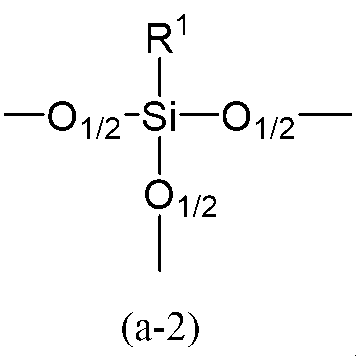
式(a-2)で示されるように、ポリシルセスキオキサン化合物(A)は、一般にTサイトと総称される、ケイ素原子に酸素原子が3つ結合し、それ以外の基(R1)が1つ結合してなる部分構造を有する。
ポリシルセスキオキサン化合物(A)に含まれるTサイトとしては、下記式(a-3)~(a-5)で示されるものが挙げられる。
ポリシルセスキオキサン化合物(A)に含まれるTサイトとしては、下記式(a-3)~(a-5)で示されるものが挙げられる。

式(a-3)~(a-5)中、R1は、前記と同じ意味を表す。R2は、水素原子又は炭素数1~10のアルキル基を表す。R2の炭素数1~10のアルキル基としては、メチル基、エチル基、n-プロピル基、イソプロピル基、n-ブチル基、s-ブチル基、イソブチル基、t-ブチル基等が挙げられる。複数のR2同士は、すべて同一であっても相異なっていてもよい。また、上記式(a-3)~(a-5)中、*には、Si原子が結合している。
ポリシルセスキオキサン化合物(A)は、アセトン等のケトン系溶媒;ベンゼン等の芳香族炭化水素系溶媒;ジメチルスルホキシド等の含硫黄系溶媒;テトラヒドロフラン等のエーテル系溶媒;酢酸エチル等のエステル系溶媒;クロロホルム等の含ハロゲン系溶媒;及びこれらの2種以上からなる混合溶媒;等の各種有機溶媒に可溶であるため、これらの溶媒を用いて、ポリシルセスキオキサン化合物(A)の溶液状態での29Si-NMRを測定することができる。
ポリシルセスキオキサン化合物(A)の溶液状態での29Si-NMRを測定することにより、前記式(a-3)で示されるT3サイト、式(a-4)で示されるT2サイト、式(a-5)で示されるT1サイトの含有割合を求めることができる。
本発明で用いるポリシルセスキオキサン化合物(A)は、接着強度を向上させる観点から、T2サイトを、10~45mol%含有するものが好ましく、15~40mol%含有するものがより好ましく、20~35mol%含有するものがより更に好ましい。
また、本発明で用いるポリシルセスキオキサン化合物(A)は、硬く、耐熱性に優れる硬化物を得る観点から、T3サイトを、50~90mol%含有するものが好ましく、55~85mol%含有するものがより好ましく、60~80mol%含有するものがより更に好ましい。
本発明で用いるポリシルセスキオキサン化合物(A)は、接着強度を向上させる観点から、T2サイトを、10~45mol%含有するものが好ましく、15~40mol%含有するものがより好ましく、20~35mol%含有するものがより更に好ましい。
また、本発明で用いるポリシルセスキオキサン化合物(A)は、硬く、耐熱性に優れる硬化物を得る観点から、T3サイトを、50~90mol%含有するものが好ましく、55~85mol%含有するものがより好ましく、60~80mol%含有するものがより更に好ましい。
ポリシルセスキオキサン化合物(A)中の前記式(a-1)で示される繰り返し単位の含有割合は、全繰り返し単位に対して、40~100mol%が好ましく、70~100mol%がより好ましく、90~100mol%がさらに好ましく、100mol%が特に好ましい。
ポリシルセスキオキサン化合物(A)の溶液状態での29Si-NMRを測定すると、例えばR1がメチル基の場合、前記式(a-3)で示される構造中のケイ素原子に由来するピーク(T3)は、-70ppm以上、-61ppm未満の領域に観測され、式(a-4)で示される構造中のケイ素原子に由来するピーク(T2)は、-60ppm以上、-54ppm未満の領域に観測され、前記式(a-5)で示される構造中のケイ素原子に由来するピーク(T1)は、-53ppm以上、-45ppm未満の領域に観測される。
また、R1がフェニル基の場合、T3は、-82ppm以上、-73ppm未満の領域に観測され、T2は、-73ppm以上、-65ppm未満の領域に観測され、T1は、-65ppm以上、-55ppm未満の領域に観測される。
本願発明のより優れた効果を得る観点から、ポリシルセスキオキサン化合物(A)は、T3の積分値が、T1、T2、およびT3の積分値の合計値に対して、60~90%のものが好ましい。
29Si-NMRスペクトルは、例えば、実施例に記載の方法で測定することができる。
なお、本明細書において、「T1」、「T2」、「T3」等は、繰り返し単位の構造を表す場合と、その構造に対応するNMRのピークを表す場合とがある。
また、R1がフェニル基の場合、T3は、-82ppm以上、-73ppm未満の領域に観測され、T2は、-73ppm以上、-65ppm未満の領域に観測され、T1は、-65ppm以上、-55ppm未満の領域に観測される。
本願発明のより優れた効果を得る観点から、ポリシルセスキオキサン化合物(A)は、T3の積分値が、T1、T2、およびT3の積分値の合計値に対して、60~90%のものが好ましい。
29Si-NMRスペクトルは、例えば、実施例に記載の方法で測定することができる。
なお、本明細書において、「T1」、「T2」、「T3」等は、繰り返し単位の構造を表す場合と、その構造に対応するNMRのピークを表す場合とがある。
ポリシルセスキオキサン化合物(A)中の、前記式(a-1)で示される繰り返し単位の含有割合は、全繰り返し単位に対して、40mol%以上が好ましく、70mol%以上がより好ましく、90mol%以上がさらに好ましく、100mol%が特に好ましい。
ポリシルセスキオキサン化合物(A)中の、前記式(a-1)で示される繰り返し単位の含有割合は、例えば、ポリシルセスキオキサン化合物(A)の29Si-NMRを測定することにより求めることができる。
ポリシルセスキオキサン化合物(A)中の、前記式(a-1)で示される繰り返し単位の含有割合は、例えば、ポリシルセスキオキサン化合物(A)の29Si-NMRを測定することにより求めることができる。
なお、ポリシルセスキオキサン化合物(A)が、前記式(a-1)で示される繰り返し単位以外の繰り返し単位を有する場合であっても、ポリシルセスキオキサン化合物(A)は、エポキシ環を有する基を有しないものである。この点で、ポリシルセスキオキサン化合物(A)と、(B)成分のシリコーンオリゴマーとは明確に区別される。
ポリシルセスキオキサン化合物(A)は、1種のR1を有するもの(単独重合体)であってもよく、2種以上のR1を有するもの(共重合体)であってもよい。
ポリシルセスキオキサン化合物(A)が共重合体である場合、ポリシルセスキオキサン化合物(A)は、ランダム共重合体、ブロック共重合体、グラフト共重合体、交互共重合体等のいずれであってもよいが、製造容易性等の観点からは、ランダム共重合体が好ましい。
また、ポリシルセスキオキサン化合物(A)の構造は、ラダー型構造、ダブルデッカー型構造、籠型構造、部分開裂籠型構造、環状型構造、ランダム型構造のいずれの構造であってもよい。
また、ポリシルセスキオキサン化合物(A)の構造は、ラダー型構造、ダブルデッカー型構造、籠型構造、部分開裂籠型構造、環状型構造、ランダム型構造のいずれの構造であってもよい。
ポリシルセスキオキサン化合物(A)の質量平均分子量(Mw)は特に限定されないが、通常800~30,000、好ましくは1,200~20,000、より好ましくは1,500~18,000、さらに好ましくは2,500~16,000、特に好ましくは4,000~14,000である。質量平均分子量(Mw)が上記範囲内にあるポリシルセスキオキサン化合物(A)を用いることで、耐熱性及び接着性により優れる硬化物を与える硬化性組成物が得られ易くなる。
ポリシルセスキオキサン化合物(A)の分子量分布(Mw/Mn)は特に限定されないが、通常1.0~10.0、好ましくは1.1~6.0である。分子量分布(Mw/Mn)が上記範囲内にあるポリシルセスキオキサン化合物(A)を用いることで、耐熱性及び接着性により優れる硬化物を与える硬化性組成物が得られ易くなる。
質量平均分子量(Mw)及び数平均分子量(Mn)は、例えば、テトラヒドロフラン(THF)を溶媒とするゲル・パーミエーション・クロマトグラフィー(GPC)による標準ポリスチレン換算値として求めることができる。
質量平均分子量(Mw)及び数平均分子量(Mn)は、例えば、テトラヒドロフラン(THF)を溶媒とするゲル・パーミエーション・クロマトグラフィー(GPC)による標準ポリスチレン換算値として求めることができる。
本発明において、ポリシルセスキオキサン化合物(A)は1種単独で、あるいは2種以上を組み合わせて用いることができる。
ポリシルセスキオキサン化合物(A)の製造方法は特に限定されない。例えば、下記式(a-6)

(式中、R1は前記と同じ意味を表す。R3は炭素数1~10のアルキル基を表し、X1はハロゲン原子を表し、pは0~3の整数を表す。複数のR3、及び複数のX1は、それぞれ、互いに同一であっても、相異なっていてもよい。)
で示されるシラン化合物(1)の少なくとも1種を重縮合させることにより、ポリシルセスキオキサン化合物(A)を製造することができる。
R3の炭素数1~10のアルキル基としては、R2の炭素数1~10のアルキル基として示したものと同様のものが挙げられる。
X1のハロゲン原子としては、塩素原子、及び臭素原子等が挙げられる。
で示されるシラン化合物(1)の少なくとも1種を重縮合させることにより、ポリシルセスキオキサン化合物(A)を製造することができる。
R3の炭素数1~10のアルキル基としては、R2の炭素数1~10のアルキル基として示したものと同様のものが挙げられる。
X1のハロゲン原子としては、塩素原子、及び臭素原子等が挙げられる。
シラン化合物(1)の具体例としては、メチルトリメトキシシラン、メチルトリエトキシシラン、エチルトリメトキシシラン、エチルトリエトキシシラン、エチルトリプロポキシシラン等のアルキルトリアルコキシシラン化合物類;
メチルクロロジメトキシシラン、メチルクロロジエトキシシラン、メチルジクロロメトキシシラン、メチルブロモジメトキシシラン、エチルクロロジメトキシシラン、エチルクロロジエトキシシラン、エチルジクロロメトキシシラン、エチルブロモジメトキシシラン等のアルキルハロゲノアルコキシシラン化合物類;
メチルトリクロロシラン、メチルトリブロモシラン、エチルトリクロロシラン、エチルトリブロモシラン等のアルキルトリハロゲノシラン化合物類;
メチルクロロジメトキシシラン、メチルクロロジエトキシシラン、メチルジクロロメトキシシラン、メチルブロモジメトキシシラン、エチルクロロジメトキシシラン、エチルクロロジエトキシシラン、エチルジクロロメトキシシラン、エチルブロモジメトキシシラン等のアルキルハロゲノアルコキシシラン化合物類;
メチルトリクロロシラン、メチルトリブロモシラン、エチルトリクロロシラン、エチルトリブロモシラン等のアルキルトリハロゲノシラン化合物類;
3,3,3-トリフルオロプロピルトリメトキシシラン、3,3,3-トリフルオロプロピルトリエトキシシラン、2-シアノエチルトリメトキシシラン、2-シアノエチルトリエトキシシラン等の置換アルキルトリアルコキシシラン化合物類;
3,3,3-トリフルオロプロピルクロロジメトキシシラン、3,3,3-トリフルオロプロピルクロロジエトキシシラン、3,3,3-トリフルオロプロピルジクロロメトキシシラン、3,3,3-トリフルオロプロピルジクロロエトキシシラン、2-シアノエチルクロロジメトキシシラン、2-シアノエチルクロロジエトキシシラン、2-シアノエチルジクロロメトキシシラン、2-シアノエチルジクロロエトキシシラン等の置換アルキルハロゲノアルコキシシラン化合物類;
3,3,3-トリフルオロプロピルトリクロロシラン、2-シアノエチルトリクロロシラン等の置換アルキルトリハロゲノシラン化合物類;
3,3,3-トリフルオロプロピルクロロジメトキシシラン、3,3,3-トリフルオロプロピルクロロジエトキシシラン、3,3,3-トリフルオロプロピルジクロロメトキシシラン、3,3,3-トリフルオロプロピルジクロロエトキシシラン、2-シアノエチルクロロジメトキシシラン、2-シアノエチルクロロジエトキシシラン、2-シアノエチルジクロロメトキシシラン、2-シアノエチルジクロロエトキシシラン等の置換アルキルハロゲノアルコキシシラン化合物類;
3,3,3-トリフルオロプロピルトリクロロシラン、2-シアノエチルトリクロロシラン等の置換アルキルトリハロゲノシラン化合物類;
フェニルトリメトキシシラン、4-メトキシフェニルトリメトキシシラン等の、置換基を有する、又は置換基を有さないフェニルトリアルコキシシラン化合物類;
フェニルクロロジメトキシシラン、フェニルジクロロメトキシシラン、4-メトキシフェニルクロロジメトキシシラン、4-メトキシフェニルジクロロメトキシシラン等の、置換基を有する、又は置換基を有さないフェニルハロゲノアルコキシシラン化合物類;
フェニルトリクロロシラン、4-メトキシフェニルトリクロロシラン等の、置換基を有する、又は置換基を有さないフェニルトリハロゲノシラン化合物類;等が挙げられる。
これらのシラン化合物(1)は、1種単独で、あるいは2種以上を組み合わせて用いることができる。
フェニルクロロジメトキシシラン、フェニルジクロロメトキシシラン、4-メトキシフェニルクロロジメトキシシラン、4-メトキシフェニルジクロロメトキシシラン等の、置換基を有する、又は置換基を有さないフェニルハロゲノアルコキシシラン化合物類;
フェニルトリクロロシラン、4-メトキシフェニルトリクロロシラン等の、置換基を有する、又は置換基を有さないフェニルトリハロゲノシラン化合物類;等が挙げられる。
これらのシラン化合物(1)は、1種単独で、あるいは2種以上を組み合わせて用いることができる。
前記シラン化合物(1)を重縮合させる方法は特に限定されない。例えば、溶媒中、又は無溶媒で、シラン化合物(1)に、所定量の重縮合触媒を添加し、所定温度で撹拌する方法が挙げられる。より具体的には、(a)シラン化合物(1)に、所定量の酸触媒を添加し、所定温度で撹拌する方法、(b)シラン化合物(1)に、所定量の塩基触媒を添加し、所定温度で撹拌する方法、(c)シラン化合物(1)に、所定量の酸触媒を添加し、所定温度で撹拌した後、過剰量の塩基触媒を添加して、反応系を塩基性とし、所定温度で撹拌する方法等が挙げられる。これらの中でも、効率よく目的とするポリシルセスキオキサン化合物(A)を得ることができることから、(a)又は(c)の方法が好ましい。
用いる重縮合触媒は、酸触媒及び塩基触媒のいずれであってもよい。また、2以上の重縮合触媒を組み合わせて用いてもよいが、少なくとも酸触媒を用いることが好ましい。
酸触媒としては、リン酸、塩酸、ホウ酸、硫酸、硝酸等の無機酸;クエン酸、酢酸、メタンスルホン酸、トリフルオロメタンスルホン酸、ベンゼンスルホン酸、p-トルエンスルホン酸等の有機酸;等が挙げられる。これらの中でも、リン酸、塩酸、ホウ酸、硫酸、クエン酸、酢酸、及びメタンスルホン酸から選ばれる少なくとも1種が好ましい。
酸触媒としては、リン酸、塩酸、ホウ酸、硫酸、硝酸等の無機酸;クエン酸、酢酸、メタンスルホン酸、トリフルオロメタンスルホン酸、ベンゼンスルホン酸、p-トルエンスルホン酸等の有機酸;等が挙げられる。これらの中でも、リン酸、塩酸、ホウ酸、硫酸、クエン酸、酢酸、及びメタンスルホン酸から選ばれる少なくとも1種が好ましい。
塩基触媒としては、アンモニア水;トリメチルアミン、トリエチルアミン、リチウムジイソプロピルアミド、リチウムビス(トリメチルシリル)アミド、ピリジン、1,8-ジアザビシクロ[5.4.0]-7-ウンデセン、アニリン、ピコリン、1,4-ジアザビシクロ[2.2.2]オクタン、イミダゾール等の有機塩基;水酸化テトラメチルアンモニウム、水酸化テトラエチルアンモニウム等の有機水酸化物;ナトリウムメトキシド、ナトリウムエトキシド、ナトリウムt-ブトキシド、カリウムt-ブトキシド等の金属アルコキシド;水素化ナトリウム、水素化カルシウム等の金属水素化物;水酸化ナトリウム、水酸化カリウム、水酸化カルシウム等の金属水酸化物;炭酸ナトリウム、炭酸カリウム、炭酸マグネシウム等の金属炭酸塩;炭酸水素ナトリウム、炭酸水素カリウム等の金属炭酸水素塩;等が挙げられる。
重縮合触媒の使用量は、シラン化合物(1)の総mol量に対して、通常、0.05~10mol%、好ましくは0.1~5mol%の範囲である。
重縮合時に溶媒を用いる場合、用いる溶媒は、シラン化合物(1)の種類等に応じて、適宜選択することができる。例えば、水;ベンゼン、トルエン、キシレン等の芳香族炭化水素類;酢酸メチル、酢酸エチル、酢酸プロピル、酢酸ブチル、プロピオン酸メチル等のエステル類;アセトン、メチルエチルケトン、メチルイソブチルケトン、シクロヘキサノン等のケトン類;メチルアルコール、エチルアルコール、n-プロピルアルコール、イソプロピルアルコール、n-ブチルアルコール、イソブチルアルコール、s-ブチルアルコール、t-ブチルアルコール等のアルコール類;等が挙げられる。これらの溶媒は1種単独で、あるいは2種以上を組み合わせて用いることができる。また、上記(c)の方法を採用する場合、酸触媒の存在下、水系で重縮合反応を行った後、反応液に、有機溶媒と過剰量の塩基触媒(アンモニア水など)を添加し、塩基性条件下で、更に重縮合反応を行うようにしてもよい。
溶媒の使用量は、シラン化合物(1)の総mol量1mol当たり、0.1リットル以上10リットル以下、好ましくは0.1リットル以上2リットル以下である。
シラン化合物(1)を重縮合させるときの温度は、通常0℃から用いる溶媒の沸点までの温度範囲、好ましくは20℃以上100℃以下の範囲である。反応温度があまりに低いと重縮合反応の進行が不十分となる場合がある。一方、反応温度が高くなりすぎるとゲル化抑制が困難となる。反応は、通常30分から30時間で完結する。
なお、用いるモノマーの種類によっては、高分子量化が困難な場合がある。例えば、R1がフッ素原子を有するアルキル基であるモノマーは、R1が通常のアルキル基であるモノマーよりも反応性に劣る傾向がある。このような場合、触媒量を減らし、かつ、穏やかな条件で長時間反応を行うことにより、目的の分子量のポリシルセスキオキサン化合物(A)が得られ易くなる。
反応終了後は、酸触媒を用いた場合は、反応溶液に炭酸水素ナトリウム等のアルカリ水溶液を添加することにより中和を行い、また、塩基触媒を用いた場合は、反応溶液に塩酸等の酸を添加することにより中和を行い、その際に生じる塩をろ別又は水洗等により除去し、目的とするポリシルセスキオキサン化合物(A)を得ることができる。
上記方法により、ポリシルセスキオキサン化合物(A)を製造する際、シラン化合物(1)のOR3又はX1のうち、脱アルコール等が起こらなかった部分は、ポリシルセスキオキサン化合物(A)中に残存する。このため、ポリシルセスキオキサン化合物(A)中に、前記式(a-3)で示される繰り返し単位以外に、前記式(a-4)、式(a-5)で示される繰り返し単位が含まれることがある。
〔(B)成分〕
本発明の硬化性組成物を構成する(B)成分は、3官能シラン化合物由来の繰り返し単位を有し、かつ、4官能シラン化合物由来の繰り返し単位を有する、又は有しないシリコーンオリゴマーであって、3官能シラン化合物由来の繰り返し単位と4官能シラン化合物由来の繰り返し単位の合計量が、(B)成分の全繰り返し単位中80mol%以上であり、前記3官能シラン化合物の少なくとも1種が、エポキシ環を有する基を有する3官能シラン化合物であるシリコーンオリゴマー(以下、「シリコーンオリゴマー(B)」と表すことがある。)である。
本発明において、シリコーンオリゴマーとは、シラン化合物重合体であって重合度が高くないものをいう。シリコーンオリゴマー(B)の重合度は、通常2~100である。
本発明の硬化性組成物を構成する(B)成分は、3官能シラン化合物由来の繰り返し単位を有し、かつ、4官能シラン化合物由来の繰り返し単位を有する、又は有しないシリコーンオリゴマーであって、3官能シラン化合物由来の繰り返し単位と4官能シラン化合物由来の繰り返し単位の合計量が、(B)成分の全繰り返し単位中80mol%以上であり、前記3官能シラン化合物の少なくとも1種が、エポキシ環を有する基を有する3官能シラン化合物であるシリコーンオリゴマー(以下、「シリコーンオリゴマー(B)」と表すことがある。)である。
本発明において、シリコーンオリゴマーとは、シラン化合物重合体であって重合度が高くないものをいう。シリコーンオリゴマー(B)の重合度は、通常2~100である。
シリコーンオリゴマー(B)は、3官能シラン化合物由来の繰り返し単位を有する。
3官能シラン化合物とは、ケイ素原子1個と、このケイ素原子に結合した加水分解性基3個とを有する化合物である。本明細書において、加水分解性基とは、アルコキシ基、ハロゲン原子等の加水分解・重縮合性を有する基をいう。
3官能シラン化合物としては、ポリシルセスキオキサン化合物(A)の製造原料として示した、式(a-6)で示されるシラン化合物(1)が挙げられる。
3官能シラン化合物とは、ケイ素原子1個と、このケイ素原子に結合した加水分解性基3個とを有する化合物である。本明細書において、加水分解性基とは、アルコキシ基、ハロゲン原子等の加水分解・重縮合性を有する基をいう。
3官能シラン化合物としては、ポリシルセスキオキサン化合物(A)の製造原料として示した、式(a-6)で示されるシラン化合物(1)が挙げられる。
シリコーンオリゴマー(B)は、4官能シラン化合物由来の繰り返し単位を有していてもよいし、有していなくてもよい。
4官能シラン化合物とは、ケイ素原子1個と、このケイ素原子に結合した加水分解性基4個とを有する化合物である。
4官能シラン化合物としては、テトラメトキシシラン、テトラエトキシシラン、メトキシトリエトキシシラン、ジメトキシジエトキシシラン、トリメトキシエトキシシラン、トリメトキシクロロシラン、トリエトキシクロロシラン、ジメトキシジクロロシラン、ジエトキシジクロロシラン、メトキシトリクロロシラン、エトキシトリクロロシラン、テトラクロロシラン、テトラブロモシラン等が挙げられる。
4官能シラン化合物とは、ケイ素原子1個と、このケイ素原子に結合した加水分解性基4個とを有する化合物である。
4官能シラン化合物としては、テトラメトキシシラン、テトラエトキシシラン、メトキシトリエトキシシラン、ジメトキシジエトキシシラン、トリメトキシエトキシシラン、トリメトキシクロロシラン、トリエトキシクロロシラン、ジメトキシジクロロシラン、ジエトキシジクロロシラン、メトキシトリクロロシラン、エトキシトリクロロシラン、テトラクロロシラン、テトラブロモシラン等が挙げられる。
シリコーンオリゴマー(B)に含まれる、3官能シラン化合物由来の繰り返し単位と4官能シラン化合物由来の繰り返し単位の合計は、全繰り返し単位中80mol%以上であり、好ましくは80~100mol%、より好ましくは90~100mol%である。
3官能シラン化合物由来の繰り返し単位と4官能シラン化合物由来の繰り返し単位の合計が全繰り返し単位中80mol%未満の硬化性組成物は硬化性に劣る。
3官能シラン化合物由来の繰り返し単位と4官能シラン化合物由来の繰り返し単位の合計が全繰り返し単位中80mol%未満の硬化性組成物は硬化性に劣る。
シリコーンオリゴマー(B)に含まれる、3官能シラン化合物由来の繰り返し単位の量は、3官能シラン化合物由来の繰り返し単位と4官能シラン化合物由来の繰り返し単位の合計中、好ましくは5~40mol%であり、より好ましくは10~30mol%である。
3官能シラン化合物由来の繰り返し単位を多く含有することで、シリコーンオリゴマー(B)は、ポリシルセスキオキサン化合物(A)との相溶性が高まる。一方、4官能シラン化合物由来の繰り返し単位を多く含有するシリコーンオリゴマー(B)を含有する硬化性組成物を硬化させることで、硬く、耐熱性に優れる硬化物が得られ易くなる。
3官能シラン化合物由来の繰り返し単位を多く含有することで、シリコーンオリゴマー(B)は、ポリシルセスキオキサン化合物(A)との相溶性が高まる。一方、4官能シラン化合物由来の繰り返し単位を多く含有するシリコーンオリゴマー(B)を含有する硬化性組成物を硬化させることで、硬く、耐熱性に優れる硬化物が得られ易くなる。
シリコーンオリゴマー(B)に含まれる各繰り返し単位の種類とその含有割合は、ポリシルセスキオキサン化合物(A)の構造決定方法として先に説明したものと同様の方法(29Si-NMRの測定結果に基づく方法)により求めることができる。
シリコーンオリゴマー(B)は、エポキシ環を有する基を有する3官能シラン化合物由来の繰り返し単位を有する。すなわち、シリコーンオリゴマー(B)を合成する際に用いる3官能シラン化合物のうち少なくとも1種は、エポキシ環を有する基を有する化合物である。
エポキシ環を有する基を有する3官能シラン化合物としては、3-グリシドキシプロピルトリメトキシシラン、3-グリシドキシプロピルトリエトキシシラン、2-(3,4-エポキシシクロヘキシル)エチルトリメトキシシラン、2-(3,4-エポキシシクロヘキシル)エチルトリエトキシシラン、8-グリシドキシオクチルトリメトキシシラン、8-グリシドキシオクチルトリエトキシシラン等が挙げられる。
このように、シリコーンオリゴマー(B)は、分子内にエポキシ環を有するものである。本発明においては、このようなオリゴマーを、硬化性ポリシルセスキオキサン化合物(A)とともに用いることで、硬化性に優れる硬化性組成物を得ることができる。
このような効果は、シリコーンオリゴマー(B)に代えて、エポキシ環含有基以外の官能基(例えば、チオール基)を有するシリコーンオリゴマーや、エポキシ環を有するモノマーを用いても得ることはできない。
このような効果は、シリコーンオリゴマー(B)に代えて、エポキシ環含有基以外の官能基(例えば、チオール基)を有するシリコーンオリゴマーや、エポキシ環を有するモノマーを用いても得ることはできない。
また、ポリシルセスキオキサン化合物(A)にエポキシ環を導入するよりも、ポリシルセスキオキサン化合物(A)とシリコーンオリゴマー(B)を併用する方が、より少ないエポキシ環の導入量で、十分な硬化性を実現することができる。
シリコーンオリゴマー(B)の質量平均分子量(Mw)は特に限定されないが、通常500~5,000、好ましくは1,000~4,500、より好ましくは1,500~4,000、さらに好ましくは2,000~3,500である。質量平均分子量(Mw)が上記範囲内にあるシリコーンオリゴマー(B)を用いることで、硬化性により優れる硬化性組成物が得られ易くなる。さらに、そのような硬化性組成物の硬化物は、接着性に優れる傾向がある。
シリコーンオリゴマー(B)の分子量分布(Mw/Mn)は特に限定されないが、通常1.0~10.0、好ましくは1.1~6.0である。分子量分布(Mw/Mn)が上記範囲内にあるシリコーンオリゴマー(B)を用いることで、硬化性により優れる硬化性組成物が得られ易くなる。さらに、そのような硬化性組成物の硬化物は、接着性に優れる傾向がある。
質量平均分子量(Mw)及び数平均分子量(Mn)は、例えば、テトラヒドロフラン(THF)を溶媒とするゲル・パーミエーション・クロマトグラフィー(GPC)による標準ポリスチレン換算値として求めることができる。
質量平均分子量(Mw)及び数平均分子量(Mn)は、例えば、テトラヒドロフラン(THF)を溶媒とするゲル・パーミエーション・クロマトグラフィー(GPC)による標準ポリスチレン換算値として求めることができる。
シリコーンオリゴマー(B)のエポキシ当量は特に限定されないが、通常50~2,000g/eq、好ましくは100~1,500g/eq、より好ましくは150~1,200g/eq、さらに好ましくは200~1,000g/eqである。エポキシ当量が上記範囲内にあるシリコーンオリゴマー(B)を用いることで、硬化性により優れる硬化性組成物が得られ易くなる。さらに、そのような硬化性組成物の硬化物は、接着性に優れる傾向がある。
シリコーンオリゴマー(B)のエポキシ当量は、JIS K7236(2001)に従って測定することができる。
シリコーンオリゴマー(B)のエポキシ当量は、JIS K7236(2001)に従って測定することができる。
本発明において、シリコーンオリゴマー(B)は1種単独で、あるいは2種以上を組み合わせて用いることができる。
シリコーンオリゴマー(B)の製造方法は特に限定されない。ポリシルセスキオキサン化合物(A)の製造方法として説明したものと同様の方法において、適宜、反応条件等を変更することにより、目的のシリコーンオリゴマー(B)を製造することができる。
また、シリコーンオリゴマー(B)として、市販のシリコーンオリゴマーを利用してもよい。
また、シリコーンオリゴマー(B)として、市販のシリコーンオリゴマーを利用してもよい。
〔硬化性組成物〕
本発明の硬化性組成物は、ポリシルセスキオキサン化合物(A)及びシリコーンオリゴマー(B)を含有する。
ポリシルセスキオキサン化合物(A)とシリコーンオリゴマー(B)の合計量は、硬化性組成物の固形分中、好ましくは30~100質量%であり、より好ましくは40~95質量%、さらに好ましくは50~90質量%、特に好ましくは55~85質量%である。
本発明において、「固形分」とは、硬化性組成物中の溶媒以外の成分をいう。
本発明の硬化性組成物は、ポリシルセスキオキサン化合物(A)及びシリコーンオリゴマー(B)を含有する。
ポリシルセスキオキサン化合物(A)とシリコーンオリゴマー(B)の合計量は、硬化性組成物の固形分中、好ましくは30~100質量%であり、より好ましくは40~95質量%、さらに好ましくは50~90質量%、特に好ましくは55~85質量%である。
本発明において、「固形分」とは、硬化性組成物中の溶媒以外の成分をいう。
シリコーンオリゴマー(B)の含有量は、ポリシルセスキオキサン化合物(A)100質量部に対して、好ましくは0.1~100質量部、より好ましくは0.5~80質量部、さらに好ましくは1.0~60質量部、特に好ましくは1.5~40質量部である。(B)成分の含有量が少な過ぎると、本発明の効果が得られないおそれがあり、多過ぎるとゲル化のおそれがある。
本発明の硬化性組成物は、(C)成分として、シランカップリング剤を含有してもよい。シランカップリング剤を含有する硬化性組成物を用いることで、接着性により優れる硬化物を形成し易くなる。
シランカップリング剤とは、ケイ素原子と、官能基と、前記ケイ素原子に結合した加水分解性基とを有するシラン化合物をいう。
官能基とは、他の化合物(主に有機物)と反応性を有する基をいい、例えば、アミノ基、置換アミノ基、イソシアネート基、ウレイド基、イソシアヌレート骨格を有する基等の窒素原子を有する基;酸無水物基(酸無水物構造);ビニル基;アリル基;エポキシ基;(メタ)アクリル基;メルカプト基;等が挙げられる。
本発明において、シランカップリング剤は、1種単独で、あるいは2種以上を組み合わせて用いることができる。
本発明の硬化性組成物がシランカップリング剤を含有する場合、その含有量は特に限定されず、目的に応じて適宜決定することができる。
シランカップリング剤とは、ケイ素原子と、官能基と、前記ケイ素原子に結合した加水分解性基とを有するシラン化合物をいう。
官能基とは、他の化合物(主に有機物)と反応性を有する基をいい、例えば、アミノ基、置換アミノ基、イソシアネート基、ウレイド基、イソシアヌレート骨格を有する基等の窒素原子を有する基;酸無水物基(酸無水物構造);ビニル基;アリル基;エポキシ基;(メタ)アクリル基;メルカプト基;等が挙げられる。
本発明において、シランカップリング剤は、1種単独で、あるいは2種以上を組み合わせて用いることができる。
本発明の硬化性組成物がシランカップリング剤を含有する場合、その含有量は特に限定されず、目的に応じて適宜決定することができる。
シランカップリング剤としては、分子内に窒素原子を有するシランカップリング剤や分子内に酸無水物構造を有するシランカップリング剤が好ましい。
分子内に窒素原子を有するシランカップリング剤や分子内に酸無水物構造を有するシランカップリング剤を含有する硬化性組成物は、耐熱性及び接着性により優れる硬化物を与える傾向がある。
分子内に窒素原子を有するシランカップリング剤としては、例えば、下記式(c-1)で表されるトリアルコキシシラン化合物、式(c-2)で表されるジアルコキシアルキルシラン化合物又はジアルコキシアリールシラン化合物等が挙げられる。

上記式中、Raは、メトキシ基、エトキシ基、n-プロポキシ基、イソプロポキシ基、n-ブトキシ基、t-ブトキシ基等の炭素数1~6のアルコキシ基を表す。複数のRa同士は同一であっても相異なっていてもよい。
Rbは、メチル基、エチル基、n-プロピル基、イソプロピル基、n-ブチル基、t-ブチル基等の炭素数1~6のアルキル基;又は、フェニル基、4-クロロフェニル基、4-メチルフェニル基、1-ナフチル基等の、置換基を有する、又は置換基を有さないアリール基;を表す。
Rbは、メチル基、エチル基、n-プロピル基、イソプロピル基、n-ブチル基、t-ブチル基等の炭素数1~6のアルキル基;又は、フェニル基、4-クロロフェニル基、4-メチルフェニル基、1-ナフチル基等の、置換基を有する、又は置換基を有さないアリール基;を表す。
Rcは、窒素原子を有する、炭素数1~10の有機基を表す。また、Rcは、さらに他のケイ素原子を含む基と結合していてもよい。
Rcの炭素数1~10の有機基の具体例としては、N-2-(アミノエチル)-3-アミノプロピル基、3-アミノプロピル基、N-(1,3-ジメチル-ブチリデン)アミノプロピル基、3-ウレイドプロピル基、N-フェニル-アミノプロピル基等が挙げられる。
Rcの炭素数1~10の有機基の具体例としては、N-2-(アミノエチル)-3-アミノプロピル基、3-アミノプロピル基、N-(1,3-ジメチル-ブチリデン)アミノプロピル基、3-ウレイドプロピル基、N-フェニル-アミノプロピル基等が挙げられる。
上記式(c-1)又は(c-2)で表される化合物のうち、Rcが、他のケイ素原子を含む基と結合した有機基である場合の化合物としては、イソシアヌレート骨格を有するシランカップリング剤(イソシアヌレート系シランカップリング剤)や、ウレア骨格を有するシランカップリング剤(ウレア系シランカップリング剤)が挙げられる。
これらの中でも、分子内に窒素原子を有するシランカップリング剤としては、接着性により優れる硬化物が得られ易いことから、イソシアヌレート系シランカップリング剤、及びウレア系シランカップリング剤が好ましく、さらに、分子内に、ケイ素原子に結合したアルコキシ基を4以上有するものが好ましい。
ケイ素原子に結合したアルコキシ基を4以上有するとは、同一のケイ素原子に結合したアルコキシ基と、異なるケイ素原子に結合したアルコキシ基との総合計数が4以上という意味である。
ケイ素原子に結合したアルコキシ基を4以上有するとは、同一のケイ素原子に結合したアルコキシ基と、異なるケイ素原子に結合したアルコキシ基との総合計数が4以上という意味である。
ケイ素原子に結合したアルコキシ基を4以上有するイソシアヌレート系シランカップリング剤としては、下記式(c-3)で表される化合物が挙げられる。ケイ素原子に結合したアルコキシ基を4以上有するウレア系シランカップリング剤としては、下記式(c-4)で表される化合物が挙げられる。

式中、Raは上記と同じ意味を表す。t1~t5はそれぞれ独立して、1~10の整数を表し、1~6の整数であるのが好ましく、3であるのが特に好ましい。
これらの中でも、分子内に窒素原子を有するシランカップリング剤としては、1,3,5-N-トリス(3-トリメトキシシリルプロピル)イソシアヌレート、1,3,5-N-トリス(3-トリエトキシシリルプロピル)イソシアヌレート(以下、「イソシアヌレート化合物」という。)、N,N’-ビス(3-トリメトキシシリルプロピル)ウレア、N,N’-ビス(3-トリエトキシシリルプロピル)ウレア(以下、「ウレア化合物」という。)、及び、上記イソシアヌレート化合物とウレア化合物との組み合わせを用いるのが好ましい。
本発明の硬化性組成物が分子内に窒素原子を有するシランカップリング剤を含有する場合、その含有量は特に限定されないが、その量は、上記(A)成分と分子内に窒素原子を有するシランカップリング剤の質量比〔(A)成分:分子内に窒素原子を有するシランカップリング剤〕で、好ましくは100:0.1~100:90、より好ましくは100:0.3~100:60、より好ましくは100:1~100:50、さらに好ましくは100:3~100:40、特に好ましくは100:5~100:35となる量である。
このような割合で(A)成分及び分子内に窒素原子を有するシランカップリング剤を含有する硬化性組成物の硬化物は、耐熱性及び接着性により優れたものになる。
このような割合で(A)成分及び分子内に窒素原子を有するシランカップリング剤を含有する硬化性組成物の硬化物は、耐熱性及び接着性により優れたものになる。
分子内に酸無水物構造を有するシランカップリング剤は、一つの分子中に、酸無水物構造を有する基と、加水分解性基の両者を併せ持つ有機ケイ素化合物である。具体的には下記式(c-5)で表される化合物が挙げられる。
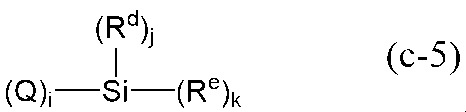
式中、Qは酸無水物構造を有する基を表し、Rdは炭素数1~6のアルキル基、又は、置換基を有する、若しくは置換基を有さないフェニル基を表し、Reは炭素数1~6のアルコキシ基又はハロゲン原子を表し、i、kは1~3の整数を表し、jは0~2の整数を表し、i+j+k=4である。jが2であるとき、Rd同士は同一であっても相異なっていてもよい。kが2又は3のとき、複数のRe同士は同一であっても相異なっていてもよい。iが2又は3のとき、複数のQ同士は同一であっても相異なっていてもよい。
Qとしては、下記式
Qとしては、下記式
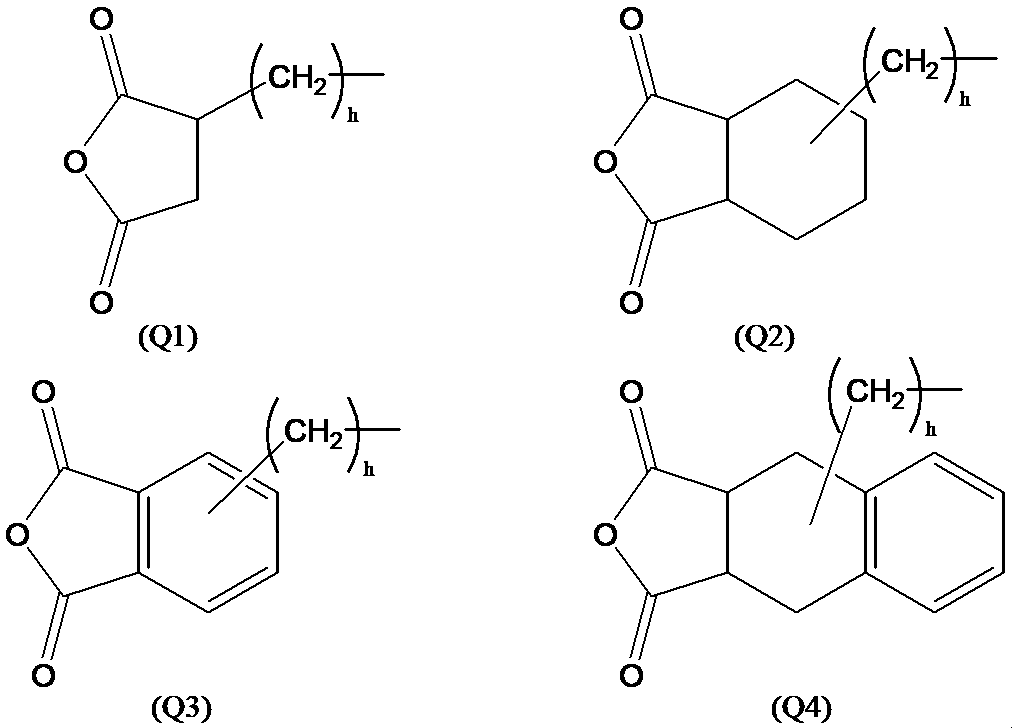
(式中、hは0~10の整数を表す。)で表される基等が挙げられ、(Q1)で表される基が特に好ましい。
分子内に酸無水物構造を有するシランカップリング剤としては、2-(トリメトキシシリル)エチル無水コハク酸、2-(トリエトキシシリル)エチル無水コハク酸、3-(トリメトキシシリル)プロピル無水コハク酸、3-(トリエトキシシリル)プロピル無水コハク酸等の、トリ(炭素数1~6)アルコキシシリル(炭素数2~8)アルキル無水コハク酸;
2-(ジメトキシメチルシリル)エチル無水コハク酸等の、ジ(炭素数1~6)アルコキシメチルシリル(炭素数2~8)アルキル無水コハク酸;
2-(メトキシジメチルシリル)エチル無水コハク酸等の、(炭素数1~6)アルコキシジメチルシリル(炭素数2~8)アルキル無水コハク酸;
2-(ジメトキシメチルシリル)エチル無水コハク酸等の、ジ(炭素数1~6)アルコキシメチルシリル(炭素数2~8)アルキル無水コハク酸;
2-(メトキシジメチルシリル)エチル無水コハク酸等の、(炭素数1~6)アルコキシジメチルシリル(炭素数2~8)アルキル無水コハク酸;
2-(トリクロロシリル)エチル無水コハク酸、2-(トリブロモシリル)エチル無水コハク酸等の、トリハロゲノシリル(炭素数2~8)アルキル無水コハク酸;
2-(ジクロロメチルシリル)エチル無水コハク酸等の、ジハロゲノメチルシリル(炭素数2~8)アルキル無水コハク酸;
2-(クロロジメチルシリル)エチル無水コハク酸等の、ハロゲノジメチルシリル(炭素数2~8)アルキル無水コハク酸;等が挙げられる。
2-(ジクロロメチルシリル)エチル無水コハク酸等の、ジハロゲノメチルシリル(炭素数2~8)アルキル無水コハク酸;
2-(クロロジメチルシリル)エチル無水コハク酸等の、ハロゲノジメチルシリル(炭素数2~8)アルキル無水コハク酸;等が挙げられる。
これらの中でも、分子内に酸無水物構造を有するシランカップリング剤としては、トリ(炭素数1~6)アルコキシシリル(炭素数2~8)アルキル無水コハク酸が好ましく、3-(トリメトキシシリル)プロピル無水コハク酸又は3-(トリエトキシシリル)プロピル無水コハク酸が特に好ましい。
本発明の硬化性組成物が分子内に酸無水物構造を有するシランカップリング剤を含有する場合、その含有量は特に限定されないが、その量は、上記(A)成分と分子内に酸無水物構造を有するシランカップリング剤の質量比〔(A)成分:分子内に酸無水物構造を有するシランカップリング剤〕で、好ましくは100:0.1~100:30、より好ましくは100:0.3~100:20、より好ましくは100:0.5~100:15、さらに好ましくは100:1~100:10となる量である。
このような割合で(A)成分及び分子内に酸無水物構造を有するシランカップリング剤を含有する硬化性組成物の硬化物は、接着性により優れたものになる。
このような割合で(A)成分及び分子内に酸無水物構造を有するシランカップリング剤を含有する硬化性組成物の硬化物は、接着性により優れたものになる。
本発明の硬化性組成物は、本発明の目的を阻害しない範囲で、他の成分を含有してもよい。
他の成分としては、微粒子、酸化防止剤、紫外線吸収剤、光安定剤等が挙げられる。
他の成分としては、微粒子、酸化防止剤、紫外線吸収剤、光安定剤等が挙げられる。
微粒子を添加すると、塗布工程における作業性に優れる硬化性組成物を得ることができる場合がある。微粒子の材質としては、金属;金属酸化物;鉱物;炭酸カルシウム、炭酸マグネシウム等の金属炭酸塩;硫酸カルシウム、硫酸バリウム等の金属硫酸塩;水酸化アルミニウム等の金属水酸化物;珪酸アルミニウム、珪酸カルシウム、珪酸マグネシウム等の金属珪酸塩;シリカ等の無機成分;シリコーン;アクリル系重合体等の有機成分;等が挙げられる。
また、用いる微粒子は表面が修飾されたものであってもよい。
また、用いる微粒子は表面が修飾されたものであってもよい。
これらの微粒子は1種単独で、あるいは2種以上を組み合わせて用いることができる。微粒子の含有量は特に限定されないが、(A)成分に対して、通常50質量%以下が好ましく、40質量%以下がより好ましく、35質量%以下がより更に好ましい。
酸化防止剤は、加熱時の酸化劣化を防止するために添加される。酸化防止剤としては、リン系酸化防止剤、フェノール系酸化防止剤、硫黄系酸化防止剤等が挙げられる。
リン系酸化防止剤としては、ホスファイト類、オキサホスファフェナントレンオキサイド類等が挙げられる。フェノール系酸化防止剤としては、モノフェノール類、ビスフェノール類、高分子型フェノール類等が挙げられる。硫黄系酸化防止剤としては、ジラウリル-3,3’-チオジプロピオネート、ジミリスチル-3,3’-チオジプロピオネート、ジステアリル-3,3’-チオジプロピオネート等が挙げられる。
これらの酸化防止剤は1種単独で、あるいは2種以上を組み合わせて用いることができる。酸化防止剤の含有量は特に限定されないが、(A)成分に対して、通常10質量%以下である。
紫外線吸収剤は、得られる硬化物の耐光性を向上させる目的で添加される。
紫外線吸収剤としては、サリチル酸類、ベンゾフェノン類、ベンゾトリアゾール類、ヒンダードアミン類等が挙げられる。
紫外線吸収剤は1種単独で、あるいは2種以上を組み合わせて用いることができる。紫外線吸収剤の含有量は特に限定されないが、(A)成分に対して、通常10質量%以下である。
紫外線吸収剤としては、サリチル酸類、ベンゾフェノン類、ベンゾトリアゾール類、ヒンダードアミン類等が挙げられる。
紫外線吸収剤は1種単独で、あるいは2種以上を組み合わせて用いることができる。紫外線吸収剤の含有量は特に限定されないが、(A)成分に対して、通常10質量%以下である。
光安定剤は、得られる硬化物の耐光性を向上させる目的で添加される。
光安定剤としては、例えば、ポリ[{6-(1,1,3,3,-テトラメチルブチル)アミノ-1,3,5-トリアジン-2,4-ジイル}{(2,2,6,6-テトラメチル-4-ピペリジン)イミノ}ヘキサメチレン{(2,2,6,6-テトラメチル-4-ピペリジン)イミノ}]等のヒンダードアミン類等が挙げられる。
これらの光安定剤は1種単独で、あるいは2種以上を組み合わせて用いることができる。光安定剤の含有量は、(A)成分に対して、通常20質量%以下である。
光安定剤としては、例えば、ポリ[{6-(1,1,3,3,-テトラメチルブチル)アミノ-1,3,5-トリアジン-2,4-ジイル}{(2,2,6,6-テトラメチル-4-ピペリジン)イミノ}ヘキサメチレン{(2,2,6,6-テトラメチル-4-ピペリジン)イミノ}]等のヒンダードアミン類等が挙げられる。
これらの光安定剤は1種単独で、あるいは2種以上を組み合わせて用いることができる。光安定剤の含有量は、(A)成分に対して、通常20質量%以下である。
本発明の硬化性組成物は、溶媒を含有してもよい。溶媒は、本発明の硬化性組成物の成分を溶解又は分散し得るものであれば特に限定されない。
溶媒としては、ジエチレングリコールモノブチルエーテルアセテート、1,6-ヘキサンジオールジアセテート等のアセテート類;トリプロピレングリコール-n-ブチルエーテル;グリセリンジグリシジルエーテル、ブタンジオールジグリシジルエーテル、ジグリシジルアニリン、ネオペンチルグリコールグリシジルエーテル、シクロヘキサンジメタノールジグリシジルエーテル、アルキレンジグリシジルエーテル、ポリグリコールジグリシジルエーテル、ポリプロピレングリコールジグリシジルエーテル等のジグリシジルエーテル類;トリメチロールプロパントリグリシジルエーテル、グリセリントリグリシジルエーテル等のトリグリシジルエーテル類;4-ビニルシクロヘキセンモノオキサイド、ビニルシクロヘキセンジオキサイド、メチル化ビニルシクロヘキセンジオキサイド等のビニルヘキセンオキサイド類;等が挙げられる。
溶媒は1種単独で、あるいは2種以上を組み合わせて用いることができる。
溶媒としては、ジエチレングリコールモノブチルエーテルアセテート、1,6-ヘキサンジオールジアセテート等のアセテート類;トリプロピレングリコール-n-ブチルエーテル;グリセリンジグリシジルエーテル、ブタンジオールジグリシジルエーテル、ジグリシジルアニリン、ネオペンチルグリコールグリシジルエーテル、シクロヘキサンジメタノールジグリシジルエーテル、アルキレンジグリシジルエーテル、ポリグリコールジグリシジルエーテル、ポリプロピレングリコールジグリシジルエーテル等のジグリシジルエーテル類;トリメチロールプロパントリグリシジルエーテル、グリセリントリグリシジルエーテル等のトリグリシジルエーテル類;4-ビニルシクロヘキセンモノオキサイド、ビニルシクロヘキセンジオキサイド、メチル化ビニルシクロヘキセンジオキサイド等のビニルヘキセンオキサイド類;等が挙げられる。
溶媒は1種単独で、あるいは2種以上を組み合わせて用いることができる。
本発明の硬化性組成物が溶媒を含有する場合、その含有量は、固形分濃度が、好ましくは50~95質量%、より好ましくは60~85質量%になる量である。固形分濃度がこの範囲内であることで、塗布工程における作業性に優れる硬化性組成物が得られ易くなる。
溶媒量に関するこれらの要件を満たす硬化性組成物は、接着性、及び、濡れ広がり性(前記した、液滴の広がりに関する特性)が適度にバランスされたものとなる。
本発明の硬化性組成物は、例えば、上記(A)成分と(B)成分、及び、所望により他の成分を所定割合で混合し、脱泡することにより調製することができる。
混合方法、脱泡方法は特に限定されず、公知の方法を利用することができる。
混合方法、脱泡方法は特に限定されず、公知の方法を利用することができる。
本発明の硬化性組成物は、ポリシルセスキオキサン化合物(A)及びシリコーンオリゴマー(B)を含有する。このため、本発明の硬化性組成物は硬化性に優れる。
本発明の硬化性組成物が硬化性に優れることは、例えば、次のようにして確認することができる。
すなわち、自動硬化時間測定装置(株式会社サイバー製、商品名「まどか」)を用い、150℃に加熱されたステンレス板上に、硬化性組成物のサンプルを投入してから、投入したサンプルを撹拌し、撹拌トルクが上昇して、0.049N・cmとなるまでの時間を測定する。
0.049N・cmとなるまでの時間は、通常1200秒以下であるのが好ましく、1000秒以下であるのがより好ましく、600秒以下であるのがより好ましい。
本発明の硬化性組成物が硬化性に優れることは、例えば、次のようにして確認することができる。
すなわち、自動硬化時間測定装置(株式会社サイバー製、商品名「まどか」)を用い、150℃に加熱されたステンレス板上に、硬化性組成物のサンプルを投入してから、投入したサンプルを撹拌し、撹拌トルクが上昇して、0.049N・cmとなるまでの時間を測定する。
0.049N・cmとなるまでの時間は、通常1200秒以下であるのが好ましく、1000秒以下であるのがより好ましく、600秒以下であるのがより好ましい。
上記のように、本発明の硬化性組成物は硬化性に優れる。したがって、本発明の硬化性組成物を使用することで、従来の硬化性組成物を使用する場合に比べて、作業時間を短縮することができる。
2)硬化物
本発明の硬化物は、本発明の硬化性組成物を硬化させて得られるものである。
本発明の硬化性組成物を硬化させる方法としては加熱硬化が挙げられる。硬化させるときの加熱温度は、通常100~200℃であり、加熱時間は、通常10分から20時間、好ましくは30分から10時間である。
本発明の硬化物は、本発明の硬化性組成物を硬化させて得られるものである。
本発明の硬化性組成物を硬化させる方法としては加熱硬化が挙げられる。硬化させるときの加熱温度は、通常100~200℃であり、加熱時間は、通常10分から20時間、好ましくは30分から10時間である。
本発明の硬化物は、耐熱性及び接着性に優れるものである。
本発明の硬化物がこれらの特性を有することは、例えば、次のようにして確認することができる。すなわち、シリコンチップのミラー面に、本発明の硬化性組成物を所定量塗布し、塗布面を被着体の上に載せ、圧着し、加熱処理して硬化させる。これを、予め所定温度(例えば、100℃)に加熱したボンドテスターの測定ステージ上に30秒間放置し、被着体から100μmの高さの位置より、接着面に対し水平方向(せん断方向)に応力をかけ、試験片と被着体との接着力を測定する。
本発明の硬化物がこれらの特性を有することは、例えば、次のようにして確認することができる。すなわち、シリコンチップのミラー面に、本発明の硬化性組成物を所定量塗布し、塗布面を被着体の上に載せ、圧着し、加熱処理して硬化させる。これを、予め所定温度(例えば、100℃)に加熱したボンドテスターの測定ステージ上に30秒間放置し、被着体から100μmの高さの位置より、接着面に対し水平方向(せん断方向)に応力をかけ、試験片と被着体との接着力を測定する。
本発明の硬化物の接着力は、100℃において30N/4mm2以上であることが好ましく、35N/4mm2以上であることがより好ましく、40N/4mm2以上であることがさらに好ましい。
本明細書において、「4mm2」とは、「2mm square」、すなわち、2mm×2mm(1辺が2mmの正方形)を意味する。
本明細書において、「4mm2」とは、「2mm square」、すなわち、2mm×2mm(1辺が2mmの正方形)を意味する。
上記特性を有することから、本発明の硬化物は、光素子固定材として好ましく用いられる。
3)硬化性組成物の使用方法
本発明の方法は、本発明の硬化性組成物を、光素子固定材用接着剤又は光素子固定材用封止材として使用する方法である。
光素子としては、LED、LD等の発光素子、受光素子、複合光素子、光集積回路等が挙げられる。
本発明の方法は、本発明の硬化性組成物を、光素子固定材用接着剤又は光素子固定材用封止材として使用する方法である。
光素子としては、LED、LD等の発光素子、受光素子、複合光素子、光集積回路等が挙げられる。
〈光素子固定材用接着剤〉
本発明の硬化性組成物は、光素子固定材用接着剤として好適に使用することができる。
本発明の硬化性組成物を光素子固定材用接着剤として使用する方法としては、接着の対象とする材料(光素子とその基板等)の一方又は両方の接着面に該組成物を塗布し、圧着した後、加熱硬化させ、接着の対象とする材料同士を強固に接着させる方法が挙げられる。本発明の硬化性組成物の塗布量は、特に限定されず、硬化させることにより、接着の対象とする材料同士を強固に接着することができる量であればよい。通常、硬化性組成物の塗膜の厚みが0.5~5μm、好ましくは1~3μmとなる量である。
本発明の硬化性組成物は、光素子固定材用接着剤として好適に使用することができる。
本発明の硬化性組成物を光素子固定材用接着剤として使用する方法としては、接着の対象とする材料(光素子とその基板等)の一方又は両方の接着面に該組成物を塗布し、圧着した後、加熱硬化させ、接着の対象とする材料同士を強固に接着させる方法が挙げられる。本発明の硬化性組成物の塗布量は、特に限定されず、硬化させることにより、接着の対象とする材料同士を強固に接着することができる量であればよい。通常、硬化性組成物の塗膜の厚みが0.5~5μm、好ましくは1~3μmとなる量である。
光素子を接着するための基板材料としては、ソーダライムガラス、耐熱性硬質ガラス等のガラス類;セラミックス;サファイア;鉄、銅、アルミニウム、金、銀、白金、クロム、チタン及びこれらの金属の合金、ステンレス(SUS302、SUS304、SUS304L、SUS309等)等の金属類;ポリエチレンテレフタレート、ポリブチレンテレフタレート、ポリエチレンナフタレート、エチレン-酢酸ビニル共重合体、ポリスチレン、ポリカーボネート、ポリメチルペンテン、ポリスルホン、ポリエーテルエーテルケトン、ポリエーテルスルホン、ポリフェニレンスルフィド、ポリエーテルイミド、ポリイミド、ポリアミド、アクリル樹脂、ノルボルネン系樹脂、シクロオレフィン樹脂、ガラスエポキシ樹脂等の合成樹脂;等が挙げられる。
加熱硬化させる際の加熱温度は、用いる硬化性組成物等にもよるが、通常100~200℃である。加熱時間は、通常10分から20時間、好ましくは30分から10時間である。
〈光素子固定材用封止材〉
本発明の硬化性組成物は、光素子固定材用封止材として好適に用いることができる。
本発明の硬化性組成物を光素子固定材用封止材として使用する方法としては、例えば、該組成物を所望の形状に成形して、光素子を内包した成形体を得た後、このものを加熱硬化させることにより、光素子封止体を製造する方法等が挙げられる。
本発明の硬化性組成物を所望の形状に成形する方法としては、特に限定されるものではなく、通常のトランスファー成形法や、注型法等の公知のモールド法を採用できる。
本発明の硬化性組成物は、光素子固定材用封止材として好適に用いることができる。
本発明の硬化性組成物を光素子固定材用封止材として使用する方法としては、例えば、該組成物を所望の形状に成形して、光素子を内包した成形体を得た後、このものを加熱硬化させることにより、光素子封止体を製造する方法等が挙げられる。
本発明の硬化性組成物を所望の形状に成形する方法としては、特に限定されるものではなく、通常のトランスファー成形法や、注型法等の公知のモールド法を採用できる。
加熱硬化させる際の加熱温度は、用いる硬化性組成物等にもよるが、通常、100~200℃である。加熱時間は、通常10分から20時間、好ましくは30分から10時間である。
得られる光素子封止体は、本発明の硬化性組成物を用いているので、耐熱性及び接着性に優れる。
以下、実施例を挙げて本発明を更に詳細に説明する。但し、本発明は、以下の実施例になんら限定されるものではない。
(平均分子量測定)
製造例で得た硬化性ポリシルセスキオキサン化合物、及び、B成分のシリコーンオリゴマーの質量平均分子量(Mw)及び数平均分子量(Mn)は、標準ポリスチレン換算値とし、以下の装置及び条件にて測定した。
装置名:HLC-8220GPC、東ソー株式会社製
カラム:TSKgelGMHXL、TSKgelGMHXL、及び、TSKgel2000HXLを順次連結したもの
溶媒:テトラヒドロフラン
注入量:80μl
測定温度:40℃
流速:1ml/分
検出器:示差屈折計
製造例で得た硬化性ポリシルセスキオキサン化合物、及び、B成分のシリコーンオリゴマーの質量平均分子量(Mw)及び数平均分子量(Mn)は、標準ポリスチレン換算値とし、以下の装置及び条件にて測定した。
装置名:HLC-8220GPC、東ソー株式会社製
カラム:TSKgelGMHXL、TSKgelGMHXL、及び、TSKgel2000HXLを順次連結したもの
溶媒:テトラヒドロフラン
注入量:80μl
測定温度:40℃
流速:1ml/分
検出器:示差屈折計
(IRスペクトルの測定)
製造例で得た硬化性ポリシルセスキオキサン化合物のIRスペクトルは、フーリエ変換赤外分光光度計(パーキンエルマー社製、Spectrum100)を使用して測定した。
製造例で得た硬化性ポリシルセスキオキサン化合物のIRスペクトルは、フーリエ変換赤外分光光度計(パーキンエルマー社製、Spectrum100)を使用して測定した。
(29Si-NMR測定)
シラン化合物重合体〔(A)成分及び(B)成分〕の繰り返し単位とその量を調べるために、以下の条件で29Si-NMR測定を行った。
装置:ブルカー・バイオスピン社製 AV-500
29Si-NMR共鳴周波数:99.352MHz
プローブ:5mmφ溶液プローブ
測定温度:室温(25℃)
試料回転数:20kHz
測定法:インバースゲートデカップリング法
29Si フリップ角:90°
29Si 90°パルス幅:8.0μs
繰り返し時間:5s
積算回数:9200回
観測幅:30kHz
シラン化合物重合体〔(A)成分及び(B)成分〕の繰り返し単位とその量を調べるために、以下の条件で29Si-NMR測定を行った。
装置:ブルカー・バイオスピン社製 AV-500
29Si-NMR共鳴周波数:99.352MHz
プローブ:5mmφ溶液プローブ
測定温度:室温(25℃)
試料回転数:20kHz
測定法:インバースゲートデカップリング法
29Si フリップ角:90°
29Si 90°パルス幅:8.0μs
繰り返し時間:5s
積算回数:9200回
観測幅:30kHz
(29Si-NMR試料作製方法)
緩和時間短縮のため、緩和試薬としてFe(acac)3を添加し測定した。
シラン化合物重合体濃度:30質量%
Fe(acac)3濃度:0.7質量%
測定溶媒:アセトン
内部標準:TMS
緩和時間短縮のため、緩和試薬としてFe(acac)3を添加し測定した。
シラン化合物重合体濃度:30質量%
Fe(acac)3濃度:0.7質量%
測定溶媒:アセトン
内部標準:TMS
(波形処理解析)
フーリエ変換後のスペクトルの各ピークについて、ピークトップの位置によりケミカルシフトを求め、積分を行った。
フーリエ変換後のスペクトルの各ピークについて、ピークトップの位置によりケミカルシフトを求め、積分を行った。
(製造例1)
300mlのナス型フラスコに、メチルトリエトキシシラン71.37g(400mmol)を仕込んだ後、これを撹拌しながら、蒸留水21.6mlに35質量%塩酸0.10g(メチルトリエトキシシランに対して0.25mol%)を溶解した水溶液を加え、全容を30℃にて2時間、次いで70℃に昇温して5時間撹拌した。
内容物の撹拌を継続しながら、そこに、酢酸プロピル140gと、28質量%アンモニア水0.12g(メチルトリエトキシシランに対して0.5mol%)を加え、そのまま70℃で3時間撹拌した。
反応液を室温まで放冷した後、そこに精製水を加えて分液処理を行い、水層のpHが7になるまでこの操作を繰り返した。有機層をエバポレーターで濃縮し、濃縮物を真空乾燥することにより、硬化性ポリシルセスキオキサン化合物(A1)を55.7g得た。このものの質量平均分子量(Mw)は7,800、分子量分布(Mw/Mn)は4.52であった。
硬化性ポリシルセスキオキサン化合物(A1)のIRスペクトルデータを以下に示す。
Si-CH3:1272cm-1,1409cm-1,Si-O:1132cm-1
また、29Si-NMRスペクトル測定を行った結果、T1、T2、T3のピーク積分値比は、0:24:76であった。
300mlのナス型フラスコに、メチルトリエトキシシラン71.37g(400mmol)を仕込んだ後、これを撹拌しながら、蒸留水21.6mlに35質量%塩酸0.10g(メチルトリエトキシシランに対して0.25mol%)を溶解した水溶液を加え、全容を30℃にて2時間、次いで70℃に昇温して5時間撹拌した。
内容物の撹拌を継続しながら、そこに、酢酸プロピル140gと、28質量%アンモニア水0.12g(メチルトリエトキシシランに対して0.5mol%)を加え、そのまま70℃で3時間撹拌した。
反応液を室温まで放冷した後、そこに精製水を加えて分液処理を行い、水層のpHが7になるまでこの操作を繰り返した。有機層をエバポレーターで濃縮し、濃縮物を真空乾燥することにより、硬化性ポリシルセスキオキサン化合物(A1)を55.7g得た。このものの質量平均分子量(Mw)は7,800、分子量分布(Mw/Mn)は4.52であった。
硬化性ポリシルセスキオキサン化合物(A1)のIRスペクトルデータを以下に示す。
Si-CH3:1272cm-1,1409cm-1,Si-O:1132cm-1
また、29Si-NMRスペクトル測定を行った結果、T1、T2、T3のピーク積分値比は、0:24:76であった。
(製造例2)
300mLのナス型フラスコに、3,3,3-トリフルオロプロピルトリメトキシシラン17.0g(77.7mmol)、及び、メチルトリエトキシシラン32.33g(181.3mmol)を仕込んだ後、これを撹拌しながら、蒸留水14.0gに35質量%塩酸0.0675g(HClの量が0.65mmol,シラン化合物の合計量に対して、0.25mol%)を溶解して得られた水溶液を加え、全容を30℃にて2時間、次いで70℃に昇温して20時間撹拌した。
内容物の撹拌を継続しながら、そこに、28質量%アンモニア水0.0394g(NH3の量が0.65mmol)と酢酸プロピル46.1gの混合溶液を加えて反応液のpHを6.9にし、そのまま70℃で40分間撹拌した。
反応液を室温まで放冷した後、そこに、酢酸プロピル50g及び水100gを加えて分液処理を行い、反応生成物を含む有機層を得た。この有機層に硫酸マグネシウムを加えて乾燥処理を行った。硫酸マグネシウムを濾別除去した後、有機層をエバポレーターで濃縮し、次いで、得られた濃縮物を真空乾燥することにより、硬化性ポリシルセスキオキサン化合物(A2)を得た。このものの質量平均分子量(Mw)は5,500、分子量分布は3.40であった。
硬化性ポリシルセスキオキサン化合物(A2)のIRスペクトルデータを以下に示す。
Si-CH3:1272cm-1,1409cm-1,Si-O:1132cm-1,C-F:1213cm-1
また、29Si-NMRスペクトル測定を行った結果、T1、T2、T3のピーク積分値比は、2:27:71であった。
300mLのナス型フラスコに、3,3,3-トリフルオロプロピルトリメトキシシラン17.0g(77.7mmol)、及び、メチルトリエトキシシラン32.33g(181.3mmol)を仕込んだ後、これを撹拌しながら、蒸留水14.0gに35質量%塩酸0.0675g(HClの量が0.65mmol,シラン化合物の合計量に対して、0.25mol%)を溶解して得られた水溶液を加え、全容を30℃にて2時間、次いで70℃に昇温して20時間撹拌した。
内容物の撹拌を継続しながら、そこに、28質量%アンモニア水0.0394g(NH3の量が0.65mmol)と酢酸プロピル46.1gの混合溶液を加えて反応液のpHを6.9にし、そのまま70℃で40分間撹拌した。
反応液を室温まで放冷した後、そこに、酢酸プロピル50g及び水100gを加えて分液処理を行い、反応生成物を含む有機層を得た。この有機層に硫酸マグネシウムを加えて乾燥処理を行った。硫酸マグネシウムを濾別除去した後、有機層をエバポレーターで濃縮し、次いで、得られた濃縮物を真空乾燥することにより、硬化性ポリシルセスキオキサン化合物(A2)を得た。このものの質量平均分子量(Mw)は5,500、分子量分布は3.40であった。
硬化性ポリシルセスキオキサン化合物(A2)のIRスペクトルデータを以下に示す。
Si-CH3:1272cm-1,1409cm-1,Si-O:1132cm-1,C-F:1213cm-1
また、29Si-NMRスペクトル測定を行った結果、T1、T2、T3のピーク積分値比は、2:27:71であった。
(製造例3)
300mlのナス型フラスコに、フェニルトリメトキシシラン20.2g(102mmol)、2-シアノエチルトリメトキシシラン3.15g(18mmol)、並びに、溶媒として、アセトン96ml及び蒸留水24mlを仕込んだ後、内容物を撹拌しながら、触媒としてリン酸0.15g(1.5mmol)を加え、25℃でさらに16時間撹拌した。
反応終了後、反応液をエバポレーターで50mlまで濃縮し、濃縮物に酢酸エチル100mlを加え、飽和炭酸水素ナトリウム水溶液にて中和した。しばらく静置した後、有機層を分取した。次いで、有機層を蒸留水にて2回洗浄した後、無水硫酸マグネシウムで乾燥した。硫酸マグネシウムをろ別後、ろ液をエバポレーターにて50mlまで濃縮し、得られた濃縮物を多量のn-ヘキサン中に滴下して沈殿させ、沈殿物をデカンテーションにより分離した。得られた沈殿物をメチルエチルケトン(MEK)に溶解させて回収し、エバポレーターで溶媒を減圧留去した。残留物を真空乾燥することにより、硬化性ポリシルセスキオキサン化合物(A3)を13.5g得た。このものの質量平均分子量(Mw)は1,870、分子量分布(Mw/Mn)は1.42であった。
硬化性ポリシルセスキオキサン化合物(A3)のIRスペクトルデータを以下に示す。
Si-Ph:698cm-1,740cm-1,Si-O:1132cm-1,-CN:2259cm-1
また、29Si-NMRスペクトル測定を行った結果、T1、T2、T3のピーク積分値比は、0:33:67であった
300mlのナス型フラスコに、フェニルトリメトキシシラン20.2g(102mmol)、2-シアノエチルトリメトキシシラン3.15g(18mmol)、並びに、溶媒として、アセトン96ml及び蒸留水24mlを仕込んだ後、内容物を撹拌しながら、触媒としてリン酸0.15g(1.5mmol)を加え、25℃でさらに16時間撹拌した。
反応終了後、反応液をエバポレーターで50mlまで濃縮し、濃縮物に酢酸エチル100mlを加え、飽和炭酸水素ナトリウム水溶液にて中和した。しばらく静置した後、有機層を分取した。次いで、有機層を蒸留水にて2回洗浄した後、無水硫酸マグネシウムで乾燥した。硫酸マグネシウムをろ別後、ろ液をエバポレーターにて50mlまで濃縮し、得られた濃縮物を多量のn-ヘキサン中に滴下して沈殿させ、沈殿物をデカンテーションにより分離した。得られた沈殿物をメチルエチルケトン(MEK)に溶解させて回収し、エバポレーターで溶媒を減圧留去した。残留物を真空乾燥することにより、硬化性ポリシルセスキオキサン化合物(A3)を13.5g得た。このものの質量平均分子量(Mw)は1,870、分子量分布(Mw/Mn)は1.42であった。
硬化性ポリシルセスキオキサン化合物(A3)のIRスペクトルデータを以下に示す。
Si-Ph:698cm-1,740cm-1,Si-O:1132cm-1,-CN:2259cm-1
また、29Si-NMRスペクトル測定を行った結果、T1、T2、T3のピーク積分値比は、0:33:67であった
実施例及び比較例で用いた化合物を以下に示す。
(A成分)
硬化性ポリシルセスキオキサン化合物(A1)〔硬化性PSQ(A1)〕:製造例1で得られた硬化性ポリシルセスキオキサン化合物
硬化性ポリシルセスキオキサン化合物(A2)〔硬化性PSQ(A2)〕:製造例2で得られた硬化性ポリシルセスキオキサン化合物
硬化性ポリシルセスキオキサン化合物(A3)〔硬化性PSQ(A3)〕:製造例3で得られた硬化性ポリシルセスキオキサン化合物
(A成分)
硬化性ポリシルセスキオキサン化合物(A1)〔硬化性PSQ(A1)〕:製造例1で得られた硬化性ポリシルセスキオキサン化合物
硬化性ポリシルセスキオキサン化合物(A2)〔硬化性PSQ(A2)〕:製造例2で得られた硬化性ポリシルセスキオキサン化合物
硬化性ポリシルセスキオキサン化合物(A3)〔硬化性PSQ(A3)〕:製造例3で得られた硬化性ポリシルセスキオキサン化合物
(B成分及び比較用化合物)
シリコーンオリゴマー(B1):市販のエポキシ環含有シリコーンオリゴマー、質量平均分子量(Mw)2,400、分子量分布(Mw/Mn)1.53、エポキシ当量830g/eq
シリコーンオリゴマー(B2):市販のエポキシ環含有シリコーンオリゴマー、質量平均分子量(Mw)2,300、分子量分布(Mw/Mn)1.48、エポキシ当量350g/eq
シリコーンオリゴマー(B3):市販のメルカプト基含有シリコーンオリゴマー、質量平均分子量(Mw)1,800、分子量分布(Mw/Mn)1.79、メルカプト当量800g/eq
シリコーンオリゴマー(B4):市販のエポキシ環を含有しないシリコーンオリゴマー、質量平均分子量(Mw)2,200、分子量分布(Mw/Mn)2.24
シリコーンオリゴマー(B5):市販のエポキシ環含有シリコーンオリゴマー、質量平均分子量(Mw)1,500、分子量分布(Mw/Mn)1.39、エポキシ当量490g/eq
シリコーンオリゴマー(B6):市販のエポキシ環含有シリコーンオリゴマー〔2-(3,4-エポキシシクロヘキシル)エチルメチルジメトキシシランの重縮合物(環状4量体)〕、エポキシ当量200g/eq
シランカップリング剤(B7):3-グリシドキシプロピルトリメトキシシラン
シリコーンオリゴマー(B1):市販のエポキシ環含有シリコーンオリゴマー、質量平均分子量(Mw)2,400、分子量分布(Mw/Mn)1.53、エポキシ当量830g/eq
シリコーンオリゴマー(B2):市販のエポキシ環含有シリコーンオリゴマー、質量平均分子量(Mw)2,300、分子量分布(Mw/Mn)1.48、エポキシ当量350g/eq
シリコーンオリゴマー(B3):市販のメルカプト基含有シリコーンオリゴマー、質量平均分子量(Mw)1,800、分子量分布(Mw/Mn)1.79、メルカプト当量800g/eq
シリコーンオリゴマー(B4):市販のエポキシ環を含有しないシリコーンオリゴマー、質量平均分子量(Mw)2,200、分子量分布(Mw/Mn)2.24
シリコーンオリゴマー(B5):市販のエポキシ環含有シリコーンオリゴマー、質量平均分子量(Mw)1,500、分子量分布(Mw/Mn)1.39、エポキシ当量490g/eq
シリコーンオリゴマー(B6):市販のエポキシ環含有シリコーンオリゴマー〔2-(3,4-エポキシシクロヘキシル)エチルメチルジメトキシシランの重縮合物(環状4量体)〕、エポキシ当量200g/eq
シランカップリング剤(B7):3-グリシドキシプロピルトリメトキシシラン
29Si-NMR測定結果から算出した、シリコーンオリゴマー(B1)~(B6)の繰り返し単位の種類とその含有割合を以下に示す。

なお、上記表中、M、D、T及びQは、ケイ素原子に結合している酸素原子の数が、それぞれ、1、2、3、4であることを表す。また、M、D、T及びQの後の数字は、ケイ素原子に結合している、Si-O-結合の数を表す。したがって、例えば、非加水分解性基がメチル基であり、加水分解性基がメトキシ基であるシリコーンオリゴマーの場合、具体的な構造は以下の通りである。式中、「Me」はメチル基を表す。

(C成分)
シランカップリング剤(C1):1,3,5-N-トリス〔3-(トリメトキシシリル)プロピル〕イソシアヌレート
シランカップリング剤(C2):3-(トリメトキシシリル)プロピルコハク酸無水物
シランカップリング剤(C1):1,3,5-N-トリス〔3-(トリメトキシシリル)プロピル〕イソシアヌレート
シランカップリング剤(C2):3-(トリメトキシシリル)プロピルコハク酸無水物
(実施例1)
硬化性ポリシルセスキオキサン化合物(A1)100質量部に、ジエチレングリコールモノブチルエーテルアセテート:トリプロピレングリコール-n-ブチルエーテル=40:60(質量比)の混合溶剤を加え、全容を撹拌した。このものに、シリコーンオリゴマー(B1)5質量部、シランカップリング剤(C1)30質量部、シランカップリング剤(C2)3質量部を加え、全容を十分に混合、脱泡することにより、硬化性組成物を得た。
硬化性ポリシルセスキオキサン化合物(A1)100質量部に、ジエチレングリコールモノブチルエーテルアセテート:トリプロピレングリコール-n-ブチルエーテル=40:60(質量比)の混合溶剤を加え、全容を撹拌した。このものに、シリコーンオリゴマー(B1)5質量部、シランカップリング剤(C1)30質量部、シランカップリング剤(C2)3質量部を加え、全容を十分に混合、脱泡することにより、硬化性組成物を得た。
(実施例2~8、比較例1~8)
実施例1において、各成分を第2表に示すものに変更したこと以外は、実施例1と同様にして硬化性組成物を得た。
実施例1において、各成分を第2表に示すものに変更したこと以外は、実施例1と同様にして硬化性組成物を得た。
実施例、及び比較例で得た硬化性組成物を用いて、それぞれ以下の測定、試験を行った。結果を第2表に示す。
[硬化性評価]
以下に記載するように、自動硬化時間測定装置「まどか」(株式会社サイバー製)を用いて硬化性組成物の硬化時間を測定した。
150℃に加熱されたステンレス板上に、0.30mLのサンプルを投入し、撹拌した。経時的に撹拌トルクが上昇するため、撹拌トルクが0.049N・cmとなるまでの時間(秒)を測定した。撹拌条件は以下のとおりである。
・撹拌翼の自転回転数: 200rpm
・撹拌翼の公転回転数: 80rpm
・ギャップ(加熱板と撹拌翼間の距離): 0.3mm
以下に記載するように、自動硬化時間測定装置「まどか」(株式会社サイバー製)を用いて硬化性組成物の硬化時間を測定した。
150℃に加熱されたステンレス板上に、0.30mLのサンプルを投入し、撹拌した。経時的に撹拌トルクが上昇するため、撹拌トルクが0.049N・cmとなるまでの時間(秒)を測定した。撹拌条件は以下のとおりである。
・撹拌翼の自転回転数: 200rpm
・撹拌翼の公転回転数: 80rpm
・ギャップ(加熱板と撹拌翼間の距離): 0.3mm
[接着強度評価]
一辺の長さが2mmの正方形(面積が4mm2)のシリコンチップのミラー面に、実施例及び比較例で得た硬化性組成物を、それぞれ、厚さが約2μmになるように塗布し、塗布面を被着体(銀メッキ銅板)の上に載せ圧着した。その後、130℃で2時間加熱処理して硬化させて試験片付被着体を得た。この試験片付被着体を、予め100℃に加熱したボンドテスター(デイジ社製、シリーズ4000)の測定ステージ上に30秒間放置し、被着体から100μmの高さの位置より、スピード200μm/sで接着面に対し水平方向(せん断方向)に応力をかけ、100℃における、試験片と被着体との接着力(N/4mm2)を測定した。
一辺の長さが2mmの正方形(面積が4mm2)のシリコンチップのミラー面に、実施例及び比較例で得た硬化性組成物を、それぞれ、厚さが約2μmになるように塗布し、塗布面を被着体(銀メッキ銅板)の上に載せ圧着した。その後、130℃で2時間加熱処理して硬化させて試験片付被着体を得た。この試験片付被着体を、予め100℃に加熱したボンドテスター(デイジ社製、シリーズ4000)の測定ステージ上に30秒間放置し、被着体から100μmの高さの位置より、スピード200μm/sで接着面に対し水平方向(せん断方向)に応力をかけ、100℃における、試験片と被着体との接着力(N/4mm2)を測定した。
[加熱後透過率]
実施例及び比較例で得た硬化性組成物を、それぞれ、長さ25mm、幅20mmの型内に、厚みが1mmとなるように流し込み、150℃で3時間加熱して硬化させて試験片を得た。この試験片を200℃で100時間加熱した後、分光光度計を用いて波長450nmの透過率を測定した。
実施例及び比較例で得た硬化性組成物を、それぞれ、長さ25mm、幅20mmの型内に、厚みが1mmとなるように流し込み、150℃で3時間加熱して硬化させて試験片を得た。この試験片を200℃で100時間加熱した後、分光光度計を用いて波長450nmの透過率を測定した。
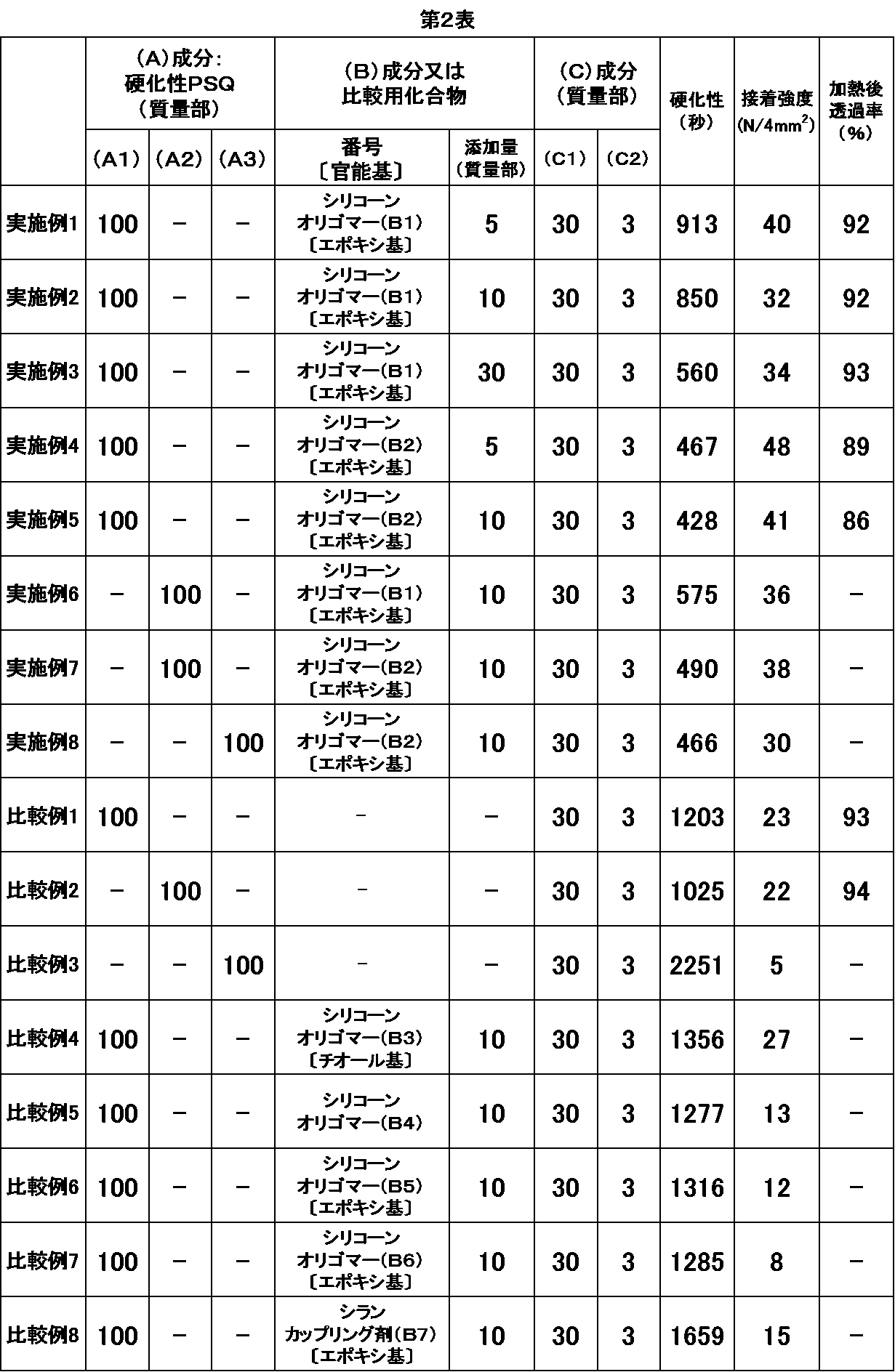
第2表から以下のことが分かる。
実施例1~8の硬化性組成物は硬化性評価試験において、1000秒以下という短い時間で硬化物が得られており、硬化性に優れている。
また、実施例1~8で得られた硬化物の接着強度の評価試験では、接着強度は30N/4mm2以上であり、接着性に優れている。
さらに、実施例の硬化性組成物の硬化物は、加熱後においても十分な光透過性を有している。
一方、比較例1~8の硬化性組成物は硬化性評価試験において、1000秒を超える硬化時間が必要であり、硬化性に劣っている。
また、比較例1~8で得られた硬化物の接着強度の評価試験では、接着強度は30N/4mm2未満であり、接着性に劣っている。
実施例1~8の硬化性組成物は硬化性評価試験において、1000秒以下という短い時間で硬化物が得られており、硬化性に優れている。
また、実施例1~8で得られた硬化物の接着強度の評価試験では、接着強度は30N/4mm2以上であり、接着性に優れている。
さらに、実施例の硬化性組成物の硬化物は、加熱後においても十分な光透過性を有している。
一方、比較例1~8の硬化性組成物は硬化性評価試験において、1000秒を超える硬化時間が必要であり、硬化性に劣っている。
また、比較例1~8で得られた硬化物の接着強度の評価試験では、接着強度は30N/4mm2未満であり、接着性に劣っている。
Claims (11)
- 下記(A)成分、及び、(B)成分を含有する硬化性組成物。
(A)成分:下記式(a-1)で示される繰り返し単位を有する硬化性ポリシルセスキオキサン化合物

(B)成分:3官能シラン化合物由来の繰り返し単位を有し、かつ、4官能シラン化合物由来の繰り返し単位を有する、又は有しないシリコーンオリゴマーであって、3官能シラン化合物由来の繰り返し単位と4官能シラン化合物由来の繰り返し単位の合計量が、全繰り返し単位中80mol%以上であり、前記3官能シラン化合物の少なくとも1種が、エポキシ環を有する基を有する3官能シラン化合物であるシリコーンオリゴマー - (A)成分の質量平均分子量(Mw)が、800~30,000である、請求項1に記載の硬化性組成物。
- (B)成分の質量平均分子量(Mw)が、500~5,000である、請求項1又は2に記載の硬化性組成物。
- (B)成分のエポキシ当量が、50~2,000g/eqである、請求項1~3のいずれかに記載の硬化性組成物。
- (B)成分の含有量が、(A)成分100質量部に対して、0.1~100質量部である、請求項1~4のいずれかに記載の硬化性組成物。
- (A)成分と(B)成分の合計量が、硬化性組成物の固形分中30~100質量%である、請求項1~5のいずれかに記載の硬化性組成物。
- さらに、下記(C)成分を含有する、請求項1~6のいずれかに記載の硬化性組成物。
(C)成分:シランカップリング剤 - 請求項1~7のいずれかに記載の硬化性組成物を硬化させて得られる硬化物。
- 光素子固定材である請求項8に記載の硬化物。
- 請求項1~7のいずれかに記載の硬化性組成物を、光素子固定材用接着剤として使用する方法。
- 請求項1~7のいずれかに記載の硬化性組成物を、光素子固定材用封止材として使用する方法。
Priority Applications (3)
| Application Number | Priority Date | Filing Date | Title |
|---|---|---|---|
| JP2020539865A JP6830565B1 (ja) | 2019-03-26 | 2020-03-26 | 硬化性組成物、硬化物、及び、硬化性組成物の使用方法 |
| KR1020217010697A KR20210148069A (ko) | 2019-03-26 | 2020-03-26 | 경화성 조성물, 경화물, 및, 경화성 조성물의 사용 방법 |
| CN202080023925.1A CN113574117B (zh) | 2019-03-26 | 2020-03-26 | 固化性组合物、固化物和固化性组合物的使用方法 |
Applications Claiming Priority (2)
| Application Number | Priority Date | Filing Date | Title |
|---|---|---|---|
| JP2019-058614 | 2019-03-26 | ||
| JP2019058614 | 2019-03-26 |
Publications (1)
| Publication Number | Publication Date |
|---|---|
| WO2020196705A1 true WO2020196705A1 (ja) | 2020-10-01 |
Family
ID=72611011
Family Applications (1)
| Application Number | Title | Priority Date | Filing Date |
|---|---|---|---|
| PCT/JP2020/013529 Ceased WO2020196705A1 (ja) | 2019-03-26 | 2020-03-26 | 硬化性組成物、硬化物、及び、硬化性組成物の使用方法 |
Country Status (5)
| Country | Link |
|---|---|
| JP (1) | JP6830565B1 (ja) |
| KR (1) | KR20210148069A (ja) |
| CN (1) | CN113574117B (ja) |
| TW (1) | TWI825299B (ja) |
| WO (1) | WO2020196705A1 (ja) |
Cited By (2)
| Publication number | Priority date | Publication date | Assignee | Title |
|---|---|---|---|---|
| WO2022202846A1 (ja) * | 2021-03-26 | 2022-09-29 | リンテック株式会社 | 接着ペースト、接着ペーストの使用方法及び半導体装置の製造方法 |
| JP2023139659A (ja) * | 2022-03-22 | 2023-10-04 | リンテック株式会社 | 接着ペースト、接着ペーストの使用方法及び半導体装置の製造方法 |
Citations (5)
| Publication number | Priority date | Publication date | Assignee | Title |
|---|---|---|---|---|
| JP2015503005A (ja) * | 2011-11-25 | 2015-01-29 | エルジー・ケム・リミテッド | 硬化性組成物 |
| JP2015515529A (ja) * | 2012-07-27 | 2015-05-28 | エルジー・ケム・リミテッド | 硬化性組成物 |
| WO2017110948A1 (ja) * | 2015-12-22 | 2017-06-29 | リンテック株式会社 | 硬化性組成物、硬化性組成物の製造方法、硬化物、硬化性組成物の使用方法、および光デバイス |
| JP2018178003A (ja) * | 2017-04-17 | 2018-11-15 | 株式会社ダイセル | フッ素含有エポキシ変性シルセスキオキサン、及びそれを含む硬化性組成物 |
| WO2018212233A1 (ja) * | 2017-05-17 | 2018-11-22 | 株式会社ダイセル | 接着剤用硬化性組成物、接着シート、硬化物、積層物、及び装置 |
Family Cites Families (8)
| Publication number | Priority date | Publication date | Assignee | Title |
|---|---|---|---|---|
| JP4734832B2 (ja) | 2003-05-14 | 2011-07-27 | ナガセケムテックス株式会社 | 光素子用封止材 |
| JP2005263869A (ja) | 2004-03-16 | 2005-09-29 | Nagase Chemtex Corp | 光半導体封止用樹脂組成物 |
| JP2006328231A (ja) | 2005-05-26 | 2006-12-07 | Nagase Chemtex Corp | 光素子用封止樹脂組成物 |
| CN101638517B (zh) * | 2009-09-10 | 2012-04-25 | 苏州大学 | 一种有机硅树脂组合物 |
| KR101824289B1 (ko) * | 2010-11-30 | 2018-01-31 | 린텍 가부시키가이샤 | 경화성 조성물, 경화물 및 경화성 조성물의 사용 방법 |
| JP5830201B2 (ja) * | 2013-08-06 | 2015-12-09 | 株式会社ダイセル | 硬化性樹脂組成物及びそれを用いた半導体装置 |
| TWI663213B (zh) * | 2014-07-23 | 2019-06-21 | 日商琳得科股份有限公司 | 硬化性組成物、硬化性組成物的製造方法、硬化物、硬化性組成物的使用方法及光裝置 |
| TWI678387B (zh) * | 2014-08-26 | 2019-12-01 | 日商琳得科股份有限公司 | 硬化性組合物、硬化性組合物之製造方法、硬化物、硬化性組合物之使用方法以及光裝置 |
-
2020
- 2020-03-26 WO PCT/JP2020/013529 patent/WO2020196705A1/ja not_active Ceased
- 2020-03-26 JP JP2020539865A patent/JP6830565B1/ja active Active
- 2020-03-26 CN CN202080023925.1A patent/CN113574117B/zh active Active
- 2020-03-26 TW TW109110343A patent/TWI825299B/zh active
- 2020-03-26 KR KR1020217010697A patent/KR20210148069A/ko active Pending
Patent Citations (5)
| Publication number | Priority date | Publication date | Assignee | Title |
|---|---|---|---|---|
| JP2015503005A (ja) * | 2011-11-25 | 2015-01-29 | エルジー・ケム・リミテッド | 硬化性組成物 |
| JP2015515529A (ja) * | 2012-07-27 | 2015-05-28 | エルジー・ケム・リミテッド | 硬化性組成物 |
| WO2017110948A1 (ja) * | 2015-12-22 | 2017-06-29 | リンテック株式会社 | 硬化性組成物、硬化性組成物の製造方法、硬化物、硬化性組成物の使用方法、および光デバイス |
| JP2018178003A (ja) * | 2017-04-17 | 2018-11-15 | 株式会社ダイセル | フッ素含有エポキシ変性シルセスキオキサン、及びそれを含む硬化性組成物 |
| WO2018212233A1 (ja) * | 2017-05-17 | 2018-11-22 | 株式会社ダイセル | 接着剤用硬化性組成物、接着シート、硬化物、積層物、及び装置 |
Cited By (3)
| Publication number | Priority date | Publication date | Assignee | Title |
|---|---|---|---|---|
| WO2022202846A1 (ja) * | 2021-03-26 | 2022-09-29 | リンテック株式会社 | 接着ペースト、接着ペーストの使用方法及び半導体装置の製造方法 |
| JPWO2022202846A1 (ja) * | 2021-03-26 | 2022-09-29 | ||
| JP2023139659A (ja) * | 2022-03-22 | 2023-10-04 | リンテック株式会社 | 接着ペースト、接着ペーストの使用方法及び半導体装置の製造方法 |
Also Published As
| Publication number | Publication date |
|---|---|
| CN113574117B (zh) | 2023-09-12 |
| TWI825299B (zh) | 2023-12-11 |
| JP6830565B1 (ja) | 2021-02-17 |
| TW202100662A (zh) | 2021-01-01 |
| KR20210148069A (ko) | 2021-12-07 |
| JPWO2020196705A1 (ja) | 2021-04-08 |
| CN113574117A (zh) | 2021-10-29 |
Similar Documents
| Publication | Publication Date | Title |
|---|---|---|
| JP6761491B2 (ja) | 硬化性組成物、硬化物および硬化性組成物の使用方法 | |
| KR102672356B1 (ko) | 경화성 조성물, 경화성 조성물의 제조 방법, 경화물, 경화성 조성물의 사용 방법, 및 광 디바이스 | |
| WO2013141360A1 (ja) | 硬化性組成物、硬化物および硬化性組成物の使用方法 | |
| JP6830565B1 (ja) | 硬化性組成物、硬化物、及び、硬化性組成物の使用方法 | |
| JP6990033B2 (ja) | 光素子用接着剤及びその製造方法 | |
| JP6821600B2 (ja) | 硬化性組成物、硬化性組成物の製造方法、硬化物、及び硬化性組成物の使用方法 | |
| JPWO2016031731A1 (ja) | 硬化性組成物、硬化物、硬化性組成物の使用方法、及び光デバイス | |
| JP6840901B2 (ja) | 硬化性組成物、硬化物、及び、硬化性組成物の使用方法 | |
| JP7569794B2 (ja) | 硬化性組成物、硬化物、及び、硬化性組成物の使用方法 | |
| JP6830563B2 (ja) | 硬化性ポリシルセスキオキサン化合物、硬化性組成物、硬化物、及び、硬化性組成物の使用方法 | |
| JP7487175B2 (ja) | 硬化性組成物、硬化物、及び、硬化性組成物の使用方法 | |
| JP7420610B2 (ja) | 硬化性組成物、硬化物、及び、硬化性組成物の使用方法 | |
| WO2021193452A1 (ja) | 硬化性組成物、硬化物、及び、硬化性組成物の使用方法 | |
| JP7569793B2 (ja) | 硬化性組成物、硬化物、及び、硬化性組成物の使用方法 | |
| JP2020158609A (ja) | 硬化性組成物、硬化物、及び、硬化性組成物の使用方法 | |
| JP6840900B2 (ja) | 硬化性組成物、硬化物、及び、硬化性組成物の使用方法 | |
| JP2026060313A (ja) | 熱硬化性組成物、半導体素子固定用組成物、及び熱伝導性膜形成用組成物 | |
| JP2024136509A (ja) | 熱硬化性組成物、半導体素子固定用組成物、及び硬化物 | |
| WO2015041344A1 (ja) | 硬化性組成物、硬化物および硬化性組成物の使用方法 | |
| JP2024136510A (ja) | シラン化合物重合体、熱硬化性組成物、半導体素子固定用組成物、及び硬化物 | |
| JPWO2019176828A1 (ja) | 硬化性組成物、硬化物、硬化物の製造方法、及び、硬化性組成物の使用方法 |
Legal Events
| Date | Code | Title | Description |
|---|---|---|---|
| ENP | Entry into the national phase |
Ref document number: 2020539865 Country of ref document: JP Kind code of ref document: A |
|
| 121 | Ep: the epo has been informed by wipo that ep was designated in this application |
Ref document number: 20779059 Country of ref document: EP Kind code of ref document: A1 |
|
| NENP | Non-entry into the national phase |
Ref country code: DE |
|
| 122 | Ep: pct application non-entry in european phase |
Ref document number: 20779059 Country of ref document: EP Kind code of ref document: A1 |