WO2020189644A1 - 充填材用分散剤及び分散液 - Google Patents
充填材用分散剤及び分散液 Download PDFInfo
- Publication number
- WO2020189644A1 WO2020189644A1 PCT/JP2020/011552 JP2020011552W WO2020189644A1 WO 2020189644 A1 WO2020189644 A1 WO 2020189644A1 JP 2020011552 W JP2020011552 W JP 2020011552W WO 2020189644 A1 WO2020189644 A1 WO 2020189644A1
- Authority
- WO
- WIPO (PCT)
- Prior art keywords
- group
- filler
- boron nitride
- unsubstituted
- dispersant
- Prior art date
- Legal status (The legal status is an assumption and is not a legal conclusion. Google has not performed a legal analysis and makes no representation as to the accuracy of the status listed.)
- Ceased
Links
Images
Classifications
-
- C—CHEMISTRY; METALLURGY
- C08—ORGANIC MACROMOLECULAR COMPOUNDS; THEIR PREPARATION OR CHEMICAL WORKING-UP; COMPOSITIONS BASED THEREON
- C08F—MACROMOLECULAR COMPOUNDS OBTAINED BY REACTIONS ONLY INVOLVING CARBON-TO-CARBON UNSATURATED BONDS
- C08F216/00—Copolymers of compounds having one or more unsaturated aliphatic radicals, each having only one carbon-to-carbon double bond, and at least one being terminated by an alcohol, ether, aldehydo, ketonic, acetal or ketal radical
- C08F216/38—Copolymers of compounds having one or more unsaturated aliphatic radicals, each having only one carbon-to-carbon double bond, and at least one being terminated by an alcohol, ether, aldehydo, ketonic, acetal or ketal radical by an acetal or ketal radical
-
- C—CHEMISTRY; METALLURGY
- C08—ORGANIC MACROMOLECULAR COMPOUNDS; THEIR PREPARATION OR CHEMICAL WORKING-UP; COMPOSITIONS BASED THEREON
- C08K—Use of inorganic or non-macromolecular organic substances as compounding ingredients
- C08K3/00—Use of inorganic substances as compounding ingredients
- C08K3/02—Elements
- C08K3/04—Carbon
-
- C—CHEMISTRY; METALLURGY
- C08—ORGANIC MACROMOLECULAR COMPOUNDS; THEIR PREPARATION OR CHEMICAL WORKING-UP; COMPOSITIONS BASED THEREON
- C08K—Use of inorganic or non-macromolecular organic substances as compounding ingredients
- C08K3/00—Use of inorganic substances as compounding ingredients
- C08K3/38—Boron-containing compounds
-
- C—CHEMISTRY; METALLURGY
- C08—ORGANIC MACROMOLECULAR COMPOUNDS; THEIR PREPARATION OR CHEMICAL WORKING-UP; COMPOSITIONS BASED THEREON
- C08L—COMPOSITIONS OF MACROMOLECULAR COMPOUNDS
- C08L101/00—Compositions of unspecified macromolecular compounds
-
- C—CHEMISTRY; METALLURGY
- C08—ORGANIC MACROMOLECULAR COMPOUNDS; THEIR PREPARATION OR CHEMICAL WORKING-UP; COMPOSITIONS BASED THEREON
- C08L—COMPOSITIONS OF MACROMOLECULAR COMPOUNDS
- C08L29/00—Compositions of homopolymers or copolymers of compounds having one or more unsaturated aliphatic radicals, each having only one carbon-to-carbon double bond, and at least one being terminated by an alcohol, ether, aldehydo, ketonic, acetal or ketal radical; Compositions of hydrolysed polymers of esters of unsaturated alcohols with saturated carboxylic acids; Compositions of derivatives of such polymers
- C08L29/14—Homopolymers or copolymers of acetals or ketals obtained by polymerisation of unsaturated acetals or ketals or by after-treatment of polymers of unsaturated alcohols
-
- C—CHEMISTRY; METALLURGY
- C09—DYES; PAINTS; POLISHES; NATURAL RESINS; ADHESIVES; COMPOSITIONS NOT OTHERWISE PROVIDED FOR; APPLICATIONS OF MATERIALS NOT OTHERWISE PROVIDED FOR
- C09J—ADHESIVES; NON-MECHANICAL ASPECTS OF ADHESIVE PROCESSES IN GENERAL; ADHESIVE PROCESSES NOT PROVIDED FOR ELSEWHERE; USE OF MATERIALS AS ADHESIVES
- C09J7/00—Adhesives in the form of films or foils
- C09J7/30—Adhesives in the form of films or foils characterised by the adhesive composition
- C09J7/38—Pressure-sensitive adhesives [PSA]
Definitions
- the present invention relates to a dispersant for a filler and a dispersion liquid using the dispersant.
- Compounds having a hexagonal network structure such as carbon nanotubes and boron nitride nanotubes have excellent properties such as conductivity and thermal conductivity, and are used for various purposes.
- a technique for producing a conductive film using a carbon nanotube dispersion liquid in which carbon nanotubes are dispersed in a dispersion medium (solvent) is known (Patent Document 1).
- a technique of further containing a resin in a dispersion liquid, applying the resin, and drying the resin to form a film in which carbon nanotubes are retained in the resin Patent Document 2.
- Patent Document 3 describes a dispersant having a specific structural unit added in order to improve dispersibility when carbon fibers are dispersed in an organic solvent solution of an organic solvent-soluble resin. ing.
- An object of the present invention is to provide a dispersant for a filler from which a sheet having good surface properties can be obtained, and a dispersion liquid containing the dispersant for the filler.
- a dispersant for a filler composed of the compound (A) having a structural unit represented by the following general formula (1).
- R 1 , R 2 , R 3 and R 4 are independently hydrogen atoms, hydroxyl groups, alkyl groups having 1 to 30 unsubstituted or substituted carbon atoms, and unsubstituted or substituted hydroxyalkyl.
- R 5 and R 6 independently represent a hydrogen atom, an alkyl group having 1 to 30 unsubstituted or substituted carbon atoms, an unsubstituted or substituted aryl group, an unsubstituted or substituted heterocyclic group, or R 5 and R 6 may be bonded to form a ring.
- R 7 is a hydrogen atom, an alkyl group having 1 to 30 unsubstituted or substituted carbon atoms, an unsubstituted or substituted hydroxyalkyl group, or an alkyloxy group. , Acyloxy group, carbonyl group, carboxyl group, primary to tertiary amino group, unsubstituted or substituted aryl group, unsubstituted or substituted aryloxy group or unsubstituted or substituted heterocyclic group.
- n represents a percentage of the number of each constituent unit, the sum of l, m, and n is 100%, l is greater than 0%, and n is 31-80%.
- the dispersant for a filler according to the above [1] or [2] which has an average degree of polymerization of 200 or more and 2000 or less.
- the dispersion liquid according to the above [6] wherein the organic solvent is at least one selected from an alcohol solvent and a ketone solvent.
- At least the filler having the hexagonal network structure is selected from the group consisting of carbon nanotubes, boron nitride nanotubes, boron nitride nanosheets, boron nitride (excluding boron nitride nanotubes and boron nitride nanosheets), and graphene.
- the dispersion according to any one of the above [6] to [9] which is one or more.
- An adhesive tape comprising an adhesive composed of the dispersion liquid according to any one of [6] to [10] above.
- the dispersibility of the filler can be improved, and a sheet having a good surface property can be obtained when a sheet is formed from the dispersion liquid containing the filler. It is possible to provide a dispersant for a filler that can be used.
- the dispersant for a filler of the present invention (hereinafter, may be simply referred to as a dispersant) is a dispersant composed of a compound (A) having a structural unit represented by the following general formula (1).
- R 1 , R 2 , R 3 and R 4 are independently hydrogen atoms, hydroxyl groups, alkyl groups having 1 to 30 unsubstituted or substituted carbon atoms, and unsubstituted or substituted hydroxyalkyl.
- R 5 and R 6 independently represent a hydrogen atom, an alkyl group having 1 to 30 unsubstituted or substituted carbon atoms, an unsubstituted or substituted aryl group, and an unsubstituted or substituted heterocyclic group, respectively.
- R 5 and R 6 may be bonded to form a ring.
- R 7 is a hydrogen atom, an alkyl group having 1 to 30 unsubstituted or substituted carbon atoms, an unsubstituted or substituted hydroxyalkyl group, or an alkyloxy group. , Acyloxy group, carbonyl group, carboxyl group, primary to tertiary amino group, unsubstituted or substituted aryl group, unsubstituted or substituted aryloxy group or unsubstituted or substituted heterocyclic group.
- n represents a percentage of the number of each constituent unit, the sum of l, m, and n is 100%, l is greater than 0%, and n is 31-80%.
- the compound (A) represented by the general formula (1) in the present invention has each structural unit as described above, and the ratio of the structural unit may be as described above, and each of them in the molecular chain It does not limit the arrangement of structural units. That is, each structural unit may exist in a block in the molecule, or may exist randomly.
- Compound (A) contains a structural unit having an acetal group. This improves the dispersibility of the filler, particularly the filler having a hexagonal network structure. It is presumed that this is because the acetal group and the hexagonal network structure of the filler easily interact with each other to suppress the aggregation of the filler. From the viewpoint of further improving the dispersibility of the filler, particularly the filler having a hexagonal network structure, the compound (A) preferably contains a structural unit having a butyral group.
- N in the compound (A) represented by the general formula (1) is 31 to 80%. That is, a certain number of structural units having hydroxyl groups are present in the compound.
- n is less than 31%, when the sheet is formed from the dispersion liquid containing the dispersant for a filler, the surface of the sheet is liable to be uneven and the surface property is liable to be deteriorated.
- n exceeds 80%, the number of structural units having an acetal group in the compound decreases, and the dispersibility of the filler deteriorates.
- l is preferably 30 to 69%, m is 0 to 20%, and n is 31. It is -50%, more preferably l is 40-68%, m is 0.1-20%, and n is 32-40%.
- R 1 to R 7 in the compound (A) represented by the general formula (1) can be as follows from the viewpoint of further improving the dispersibility of the filler and further improving the surface property of the sheet.
- R 1 , R 2 , R 3 and R 4 are all hydrogen atoms.
- R 5 and R 6 are independently hydrogen atoms or alkyl groups having an unsubstituted or substituted carbon atom of 1 to 30, respectively, R 5 is a hydrogen atom, and R 6 is an unsubstituted or substituted.
- the carbon atom is an alkyl group of 1 to 8
- R 5 is a hydrogen atom
- R 6 is an n-propyl group (-C 3 H 7 ).
- R 7 is preferably an acyloxy group, more preferably an acetoxy group.
- the compound represented by the general formula (1) (A) from the viewpoint of further improving the dispersibility of the filler and obtaining a sheet having better surface properties when forming a sheet from the dispersion liquid containing the filler.
- l, m, and n represent percentages of the number of each constituent unit, the total of l, m, and n is 100%, l is larger than 0%, and n is 31 to 31 to. It is 80%.
- the preferred ranges of l, m, and n are the same as those in the general formula (1).
- the compound (A) may have a structural unit other than the structural unit represented by the general formula (1) as long as the effect of the present invention is not impaired.
- the other structural units are preferably 2 mol% or less, more preferably 1 mol% or less, based on the total structural units of the compound (A). , 0 is more preferable.
- the ratio of each structural unit in compound (A) can be measured by nuclear magnetic resonance spectroscopy (NMR).
- the average degree of polymerization of compound (A) is preferably 50 or more and 3000 or less, more preferably 100 or more and 2500 or less, 200 or more and 2000 or less.
- the average degree of polymerization of compound (A) is more preferably 200 or more and 800 or less, and particularly preferably 200 or more and 400 or less.
- the average degree of polymerization of compound (A) can be determined by the average degree of polymerization of polyvinyl alcohol as a raw material.
- the filler dispersant composed of the compound (A) of the present invention is preferably used to disperse the filler having a hexagonal network structure.
- the filler having a hexagonal network structure is at least one selected from the group consisting of, for example, carbon nanotubes, boron nitride nanotubes, boron nitride nanosheets, boron nitride (excluding boron nitride nanotubes and boron nitride nanosheets), and graphene. Is. Details of these fillers will be described later.
- the method for producing the compound (A) in the present invention is not particularly limited, and for example, it can be produced by the following method.
- Polyvinyl acetate is saponified with alkali, acid, aqueous ammonia or the like to obtain polyvinyl alcohol.
- all the esters of polyvinyl acetate may be saponified, or some esters may remain.
- the degree of saponification of polyvinyl alcohol is generally in the range of 70 to 99.9 mol%, preferably not in the range of 80 to 99.8 mol%.
- the average degree of polymerization of polyvinyl alcohol is preferably 100 or more and 1500 or less, more preferably 200 or more and 1300 or less, 220 or more and 900 or less.
- the average degree of polymerization of polyvinyl alcohol is determined by a method based on JIS K6726 "Polyvinyl alcohol test method". After obtaining polyvinyl alcohol, a part of the hydroxyl groups of the polyvinyl alcohol is acetalized with n-butyraldehyde. In the production method, l, m, and n in compound (A) can be adjusted by adjusting the saponification conditions and the acetalization conditions. Products satisfying the structure of the compound (A) of the present invention are commercially available.
- the dispersant of the present invention can be used to produce a dispersion in which the filler is dispersed.
- the dispersion liquid preferably contains a resin component or a polymerizable monomer in order to form a sheet or the like made of a composite material containing a resin and a filler from the dispersion liquid.
- the dispersion liquid containing the resin component will be described as the first dispersion liquid
- the dispersion liquid containing the polymerizable monomer will be described as the second dispersion liquid.
- the first dispersion of the present invention contains a dispersant, a filler, a resin component, and an organic solvent. By removing the solvent from the first dispersion liquid by drying or the like, a sheet made of a composite material containing a resin and a filler can be obtained.
- individual components contained in the first dispersion will be described.
- a dispersant for a filler made of the above-mentioned compound (A) can be used as the dispersant contained in the first dispersion liquid.
- the amount of the dispersant in the first dispersion is preferably 0.1 to 30% by mass, more preferably 0.5 to 20% by mass, still more preferably 1 to 15% by mass, based on the total amount of the dispersion. %.
- the dispersibility of the filler is enhanced, and when it is at least these upper limit values, the dispersibility can be improved according to the amount of addition.
- the amount of the dispersant in the first dispersion is preferably 50 to 1500 parts by mass, more preferably 100 to 1000 parts by mass, and 200 to 400 parts by mass with respect to 100 parts by mass of the filler. It is more preferable to have.
- the type of the filler contained in the first dispersion is not particularly limited, but a filler having a hexagonal network structure is preferable.
- a filler having a hexagonal network structure has excellent properties such as conductivity and thermal conductivity, but is generally known as a filler that is difficult to disperse. When the dispersant of the present invention is used, even when a filler having a hexagonal network structure is used, it can be dispersed well.
- the filler having a hexagonal network structure is at least one selected from the group consisting of carbon nanotubes, boron nitride nanotubes, boron nitride nanosheets, boron nitride (excluding boron nitride nanotubes and boron nitride nanosheets), and graphene. Is preferable.
- Carbon nanotubes are tubular materials formed from carbon. Carbon nanotubes have excellent electrical properties, and when combined with a resin or the like, a highly conductive sheet or the like can be formed.
- a carbon nanotube is a substance having a structure in which a graphite sheet having a hexagonal network of carbon atoms is wound in a cylindrical shape.
- a single-walled carbon nanotube is a single-walled carbon nanotube, and a multi-walled carbon nanotube is a multi-walled carbon nanotube. ..
- the type of carbon nanotubes is not particularly limited, and may be any of single-wall carbon nanotubes, multi-wall carbon nanotubes, and a mixture containing these in an arbitrary ratio. Further, carbon nanotubes produced by various methods such as an arc discharge method, a laser evaporation method, and a chemical vapor deposition method (CVD method) can be used.
- the average diameter of the carbon nanotubes is preferably 1 to 100 nm, more preferably 2 to 15 nm.
- the average length of the carbon nanotubes is preferably 0.1 to 1000 ⁇ m, more preferably 10 to 500 ⁇ m.
- the aspect ratio of the carbon nanotubes is preferably 10 to 100,000, more preferably 500 to 30,000.
- the dispersant of the present invention can be dispersed regardless of the aspect ratio of the carbon nanotubes. Normally, carbon nanotubes having a large aspect ratio are difficult to disperse, but by using the dispersant for a filler of the present invention, even carbon nanotubes having a large aspect ratio can be dispersed.
- the diameter of the carbon nanotubes indicates the outer diameter in the case of single-wall carbon nanotubes, and means the outer diameter of the outermost tube in the case of multi-wall carbon nanotubes.
- the diameter and length of the carbon nanotubes may be measured, for example, in an image obtained by observation with a TEM (transmission electron microscope), and the average diameter and average length can be determined by an arbitrary 50 arithmetic mean. Good.
- Boron nitride nanotubes are tubular materials formed from boron nitride and are fillers with excellent thermal conductivity. Boron nitride nanotubes form a tube so that the surface of the hexagonal mesh is parallel to the tube axis, and becomes a single tube or a multiple tube. Boron nitride nanotubes are called single-walled tubes for single-walled tubes and multi-walled tubes for multiple-walled tubes. In the present invention, either a single wall tube or a multi-wall tube may be used as the boron nitride nanotube, or both may be used in combination, but it is preferable to use a multi-wall tube.
- the average diameter of the boron nitride nanotubes is preferably 1 nm or more and 50 nm or less, and the average length is preferably 100 nm or more and 50 ⁇ m or less. By setting the average diameter and the average length within the above ranges, the viscosity when mixed with the resin is lowered, the dispersibility is improved, and the thermal conductivity is also easily improved.
- the average diameter of the boron nitride nanotubes is preferably 3 nm or more, more preferably 4 nm or more.
- the average diameter of the boron nitride nanotubes is preferably 10 nm or less, more preferably 8 nm or less.
- the average length of the boron nitride nanotubes is preferably 500 nm or more, more preferably 1 ⁇ m or more, more preferably 20 ⁇ m or less, still more preferably 8 ⁇ m or less, still more preferably 5 ⁇ m or less.
- the diameter of the boron nitride nanotubes indicates the outer diameter in the case of a single-walled tube, and means the outer diameter of the outermost tube in the case of a multi-walled tube.
- the diameter and length of the boron nitride nanotubes may be measured, for example, in an image obtained by observation with a TEM (transmission electron microscope), and the average diameter and average length are determined by an arbitrary 50 arithmetic mean. It is good.
- Boron nitride nanosheets have an ultra-thin two-dimensional sheet structure, have a large specific surface area, and are a filler having excellent thermal conductivity.
- the boron nitride nanosheet is obtained, for example, by peeling the layers of hexagonal boron nitride, and has a structure in which layers forming hexagonal boron nitride are single-layered or a plurality of layers are laminated.
- Hexagonal boron nitride has a structure in which hexagonal network-like planes in which boron atoms and nitrogen atoms are alternately covalently bonded are loosely bonded to each other by van der Waals force and stacked, so that boron nitride nanosheets are also available. Similarly, it has a hexagonal mesh-like planar structure.
- the boron nitride nanosheet used in the present invention preferably has an average thickness of less than 10 nm. When the average thickness is less than 10 nm, the viscosity when mixed with the resin is lowered, the dispersibility is improved, and the thermal conductivity is easily improved.
- the average thickness of the boron nitride nanosheet is more preferably 6 nm or less, still more preferably 4 nm or less.
- the lower limit of the average thickness of the boron nitride nanosheet is not particularly limited, but is, for example, 1 nm.
- the size of the boron nitride nanosheet is not particularly limited, but the average longest diameter is, for example, 200 nm or more and 10 ⁇ m or less, preferably 500 nm or more and 6 ⁇ m or less.
- the thickness and maximum diameter of the boron nitride nanosheet can be measured in an image obtained by observation with, for example, a TEM (transmission electron microscope), and the average thickness and average longest diameter of each boron nitride nanosheet can be measured by an electron microscope. It may be calculated by the arithmetic mean of any 50 pieces in the image.
- the boron nitride used in the present invention is boron nitride other than the above-mentioned boron nitride nanotubes and boron nitride nanosheets.
- Boron nitride is preferably hexagonal boron nitride particles.
- the average particle size of the hexagonal boron nitride particles is not particularly limited, but is, for example, 0.5 ⁇ m or more and 80 ⁇ m or less, preferably 1 ⁇ m or more and 70 ⁇ m or less.
- the maximum diameter of the particles is measured in an image obtained by observation with a TEM (transmission electron microscope), and the average particle size is calculated by the arithmetic mean of the maximum diameters of any 50 particles. You should ask for.
- ⁇ Graphene ⁇ Graphene has a hexagonal mesh-like flat layer, and is obtained, for example, by peeling layers of graphite having a layered structure in which hexagonal mesh-like flat layers are laminated by van der Waals force.
- the average thickness of graphene is, for example, 3 nm or more and 100 nm or less, preferably 7 nm or more and 50 nm or less.
- the average thickness can be measured, for example, in an image obtained by observation with a TEM (transmission electron microscope), and may be determined by an arithmetic mean of any 50 pieces in the image of the electron microscope.
- filler other fillers other than the above-mentioned filler may be used.
- examples of other fillers include carbides, nitrides, oxides, hydroxides, metal carbonates, and the like.
- Examples of the carbide include silicon carbide, boron carbide, aluminum carbide, titanium carbide, tungsten carbide and the like.
- Examples of the nitride include silicon nitride, aluminum nitride, gallium nitride, chromium nitride, tungsten nitride, magnesium nitride, molybdenum nitride, and lithium nitride.
- the oxide include iron oxide, zinc oxide, silicon oxide (silica), alumina, aluminum oxide such as boehmite, magnesium oxide, titanium oxide, cerium oxide, zirconium oxide and the like.
- Examples of the hydroxide include aluminum hydroxide, calcium hydroxide, magnesium hydroxide and the like.
- Examples of the metal carbonate include synthetic magnesite and magnesium carbonate.
- As the filler contained in the first dispersion liquid one kind may be used alone, or a plurality of kinds may be used in combination.
- the amount of the filler in the first dispersion is preferably 0.1 to 10% by mass, more preferably 0.5 to 5% by mass, and further preferably 1 to 3% by mass based on the total amount of the dispersion. %.
- it becomes easy to impart functions such as conductivity and thermal conductivity according to the type of filler, and when it is at least these upper limit values, the dispersibility of the filler is improved. Since the dispersant of the present invention tends to improve the dispersibility in the filler, particularly the filler having a hexagonal network structure, the dispersant can be well dispersed even when the amount of the filler is relatively high as described above. be able to.
- the filler in the first dispersion is preferably 2 to 20 parts by mass and more preferably 5 to 15 parts by mass with respect to 100 parts by mass of the resin component. Within such a range, when a sheet or the like is formed using the dispersion liquid, the filler is likely to be uniformly dispersed in the resin.
- the resin component contained in the first dispersion liquid retains the filler after removing the organic solvent from the dispersion liquid by drying or the like.
- the resin component is not particularly limited, and examples thereof include a curable resin, a thermoplastic resin, and an elastomer resin.
- examples of the curable resin include epoxy resin, silicone resin, urethane resin, phenol resin, unsaturated polyester resin, polyimide resin, and oxetane resin.
- thermoplastic resin examples include polypropylene resins, polyethylene resins, poly (1-) butene resins, polyolefin resins such as polypentene resins, polyester resins such as polyethylene terephthalate, polystyrene resins, acrylonitrile-butadiene-styrene (ABS) resins, and the like.
- examples thereof include ethylene vinyl acetate copolymer (EVA), (meth) acrylic resin, polyamide resin, and polyvinyl chloride resin (PVC).
- the elastomer resin examples include acrylonitrile butadiene rubber, ethylene-propylene-diene rubber, ethylene-propylene rubber, natural rubber, polybutadiene rubber, and polyisoprene rubber. These elastomer resins may be liquid elastomers that become liquid at room temperature (23 ° C.) and normal pressure (1 atm), may be solid, or may be a mixture thereof. Further, as the elastomer resin, thermoplastic elastomers such as polyester-based thermoplastic elastomers, polyurethane-based thermoplastic elastomers, and styrene-based thermoplastic elastomers can also be used.
- the resin component may be a liquid resin component such as silicone oil or process oil.
- the liquid resin component is a component that is liquid at room temperature and under normal pressure at the time of compounding and becomes liquid or gel-like even at the time of use. That is, the liquid resin component is a polymer component that is not cured by a curing agent or the like, and even if it is cured, it becomes a liquid or gel-like polymer component after curing.
- One type of resin component may be used alone, or two or more types may be used in combination.
- a curable resin is preferable, and a thermosetting resin is more preferable.
- the curable resin is generally a resin component that is cured by curing the main agent with a curing agent, and the main agent may be a polymer component or a monomer component. In such a case, the resin component is composed of the main agent and the curing agent. Further, among the curable resins, epoxy resin, silicone resin and the like are preferable.
- an epoxy compound having at least one epoxy group, preferably two or more epoxy groups may be used.
- the epoxy compound include bisphenol type, novolak type, naphthalene type, triphenol alkane type, biphenyl type, cyclic aliphatic type, halides thereof, hydrogenated products thereof and the like.
- the epoxy resin the epoxy compound may be used alone, but in general, the epoxy resin is used as the main component and a curing agent is further added.
- a curing agent a heavy addition type or a catalytic type is used.
- Examples of the heavy addition type curing agent include polyamine-based curing agents, acid anhydride-based curing agents, polyphenol-based curing agents, polymercaptans, dicyandiamides, and the like.
- Examples of the catalyst-type curing agent include tertiary amines, imidazoles, and Lewis acid complexes. This may be used alone or in combination of two or more.
- the silicone resin a condensation curable silicone resin, an addition reaction curable silicone resin, or the like is preferable, and an addition reaction curable silicone resin is more preferable.
- the addition reaction curable silicone resin is preferably composed of a silicone compound as a main agent and a curing agent that cures the main agent.
- the silicone compound used as the main agent is preferably an organopolysiloxane having an alkenyl group.
- the curing agent used in the addition reaction curing type silicone resin is not particularly limited as long as it can cure the silicone compound which is the main agent described above, but is an organopolysiloxane having two or more hydrosilyl groups (SiH). , Organohydrogenpolysiloxane is preferred. It is preferable to use a platinum-based catalyst or the like as a curing catalyst for curing the silicone compound and the curing agent.
- the amount of the resin component in the first dispersion is preferably 10 to 98% by mass, more preferably 20 to 90% by mass, still more preferably 30 to 80% by mass, based on the total amount of the dispersion.
- Organic solvent The type of the organic solvent contained in the first dispersion is not particularly limited, and examples thereof include alcohol-based solvents, ketone-based solvents, ester-based solvents, ether-based solvents, amide-based solvents, and hydrocarbon-based solvents.
- alcohol solvent examples include methanol, ethanol, propanol, isopropanol, butanol and the like.
- ketone solvent examples include methyl ethyl ketone, acetone, methyl isobutyl ketone, cyclohexanone and the like.
- ester solvent examples include ethyl acetate, butyl acetate, isopropyl acetate, ethylene glycol diacetate, propylene glycol monomethyl ether acetate and the like.
- ether solvent examples include diethyl ether, isopropyl ether, tetrahydrofuran, dioxane, ethylene glycol dimethyl ether, ethylene glycol diethyl ether, diethylene glycol dimethyl ether, diethylene glycol diethyl ether, anisole, and phenetol.
- amide solvent examples include dimethylformamide, diethylformamide, N-methylpyrrolidone and the like.
- hydrocarbon solvent examples include n-hexane, n-heptane, n-octane, n-decane, n-dodecane, 2,3-dimethylhexane, 2-methylheptane, 2-methylhexane, and 3-methylhexane. , Cyclohexane and the like.
- One of these organic solvents may be used alone, or two or more thereof may be combined. Among these, at least one selected from an alcohol solvent and a ketone solvent is preferable, and an alcohol solvent is more preferable.
- a dispersion liquid using an alcohol-based solvent or a ketone solvent makes it easy to obtain a sheet having good surface properties with few irregularities when the solvent is volatilized from the dispersion liquid to form a sheet. The reason for this is not clear, but these solvents have hydroxyl groups and ketone groups, which easily interact with the hydroxyl groups of the above compound (A), which is a dispersant, so that the volatilization rate of the solvent is reduced, and as a result. It is presumed that a sheet having good surface properties can be obtained.
- the amount of the organic solvent in the first dispersion is preferably 10 to 90% by mass, more preferably 20 to 80% by mass, and further preferably 30 to 70% by mass based on the total amount of the dispersion.
- the first dispersion may contain an antioxidant, a heat stabilizer, a colorant, a flame retardant, an antistatic agent and the like as other additives. Further, when a thermosetting resin is used as the resin component, a reaction retarder may be contained.
- the method for preparing the first dispersion is not particularly limited, but from the viewpoint of enhancing the dispersibility of the filler, first, the dispersant and the organic solvent are mixed, and then the filler is further added and mixed to mix the mixture. After obtaining the above, it is preferable to add a resin component to the mixed solution and mix the mixture to obtain a dispersion. In addition, other additives may be added when preparing the mixed solution or the dispersion solution, if necessary.
- the second dispersion of the present invention contains a dispersant, a filler, and a polymerizable monomer.
- a sheet or the like made of a composite material containing a resin and a filler can be obtained.
- the dispersant and filler in the second dispersion the same type as those described in the first dispersion can be used, and the amounts used are also the same.
- the polymerizable monomer contained in the second dispersion is not particularly limited, and examples thereof include monomers having an ethylenically unsaturated double bond such as a vinyl group, an allyl group, and a (meth) acryloyl group.
- a styrene-based monomer, a (meth) acrylic-based monomer, or the like can be used. Of these, (meth) acrylic monomers are preferable.
- the styrene-based monomer include styrene, o-methylstyrene, m-methylstyrene, p-methylstyrene, ⁇ -methylstyrene and the like.
- Examples of the (meth) acrylic monomer include acrylic acid, methyl acrylate, ethyl acrylate, n-butyl acrylate, isobutyl acrylate, dodecyl acrylate, stearyl acrylate, 2-ethylhexyl acrylate, and acrylic acid. Tetrahydrofurfuryl, methacrylic acid, methyl methacrylate, ethyl methacrylate, propyl methacrylate, n-butyl methacrylate, isobutyl methacrylate, n-octyl methacrylate, dodecyl methacrylate, 2-ethylhexyl methacrylate, stearyl methacrylate And so on.
- a (meth) acrylic monomer having a hydroxyl group a (meth) acrylic monomer having two or more (meth) acryloyl groups, or the like may be used as the (meth) acrylic monomer.
- vinyl chloride, vinyl acetate, acrylonitrile, acrylamide, methacrylamide, N-vinylpyrrolidone and the like can be mentioned.
- the polymerizable monomer may be used alone or in combination of two or more.
- the amount of the polymerizable monomer in the second dispersion is preferably 10 to 98% by mass, more preferably 40 to 95% by mass, based on the total amount of the dispersion.
- the amount ratio of the polymerizable monomer to the filler is within a certain range. That is, the filler in the second dispersion is preferably 2 to 20 parts by mass and more preferably 5 to 15 parts by mass with respect to 100 parts by mass of the polymerizable monomer. Within such a range, when a sheet or the like is formed using the dispersion liquid, the filler is likely to be uniformly dispersed in the resin.
- the second dispersion liquid preferably contains a polymerization initiator for polymerizing the polymerizable monomer.
- a polymerization initiator for polymerizing the polymerizable monomer.
- the polymerization initiator include a photopolymerization initiator and a thermal polymerization initiator.
- the photopolymerization initiator examples include those that are activated by irradiating light having a wavelength of 250 to 800 nm, for example, an acetophenone derivative compound such as methoxyacetophenone, or benzoin such as benzoinpropyl ether or benzoin isobutyl ether.
- Ether compounds such as benzyl dimethyl ketal and acetophenone diethyl ketal, phosphine oxide derivative compounds, bis ( ⁇ 5-cyclopentadienyl) titanosen derivative compounds, benzophenone, Michler ketone, chlorothioxanthone, todecylthioxanthone, dimethylthioxanthone, Examples thereof include diethylthioxanthone, ⁇ -hydroxycyclohexylphenylketone, 2-hydroxymethylphenylpropane, 2,2-dimethoxy-1,2-diphenylethane-1-one and the like.
- thermal polymerization initiator examples include those that generate active radicals that are decomposed by heat and initiate polymerization curing. For example, dicumyl peroxide, di-t-butyl peroxide, t-butyl peroxybenzoale, and the like. Examples thereof include t-butyl hydroperoxide, benzoyl peroxide, cumene hydroperoxide, diisopropylbenzene hydroperoxide, paramentan hydroperoxide, and di-t-butyl peroxide.
- the amount of the polymerization initiator in the second dispersion is preferably 0.01 to 5% by mass based on the total amount of the dispersion.
- the second dispersion may contain an organic solvent.
- the organic solvent the same solvent as the organic solvent in the first dispersion can be used, and the amount thereof is also the same.
- the second dispersion may contain, as other additives, an antioxidant, a heat stabilizer, a colorant, a flame retardant, an antistatic agent, and the like.
- the second dispersion can be prepared by mixing a polymerizable monomer, a filler, a dispersant, a polymerization initiator and other additives, if necessary.
- the dispersion liquid of the present invention uses a dispersant composed of the compound (A), and a dispersion liquid having good dispersibility of the filler can be obtained. Therefore, the dispersibility of the filler is good even in the sheet made of the composite material containing the resin and the filler, which is produced by using the dispersion liquid. Therefore, the dispersion liquid of the present invention can be used to form a sheet, film or the like having excellent conductivity, thermal conductivity and the like. For example, when a dispersion liquid containing carbon nanotubes, graphene, or the like is used as the filler, a sheet or the like having excellent conductivity can be obtained.
- the dispersion liquid of the present invention may be used to form a pressure-sensitive adhesive having excellent conductivity and thermal conductivity.
- a second dispersion liquid containing a (meth) acrylic monomer or the like a pressure-sensitive adhesive having excellent conductivity and thermal conductivity can be formed.
- the fillers contained in the dispersion carbon nanotubes are particularly preferable.
- the amount of the compound (A) added of the present invention is preferably 10 to 400 parts by mass, more preferably 50 to 300 parts by mass with respect to 100 parts by mass of the carbon nanotubes.
- a pressure-sensitive adhesive made of the dispersion liquid of the present invention can be formed, and an adhesive tape provided with the pressure-sensitive adhesive can be further formed.
- the adhesive tape of the present invention includes the above-mentioned adhesive layer.
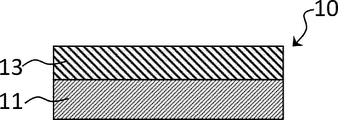
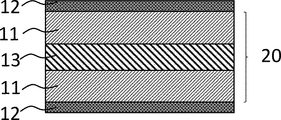
- the adhesive tape may be a support 13 and a single-sided adhesive tape 10 having an adhesive layer 11 provided on one side of the support 13, or may be supported as shown in FIG.
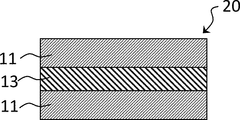
- the double-sided adhesive tape 20 may be provided with adhesive layers 11 on both sides of the body 13 and the support 13.
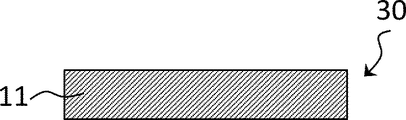
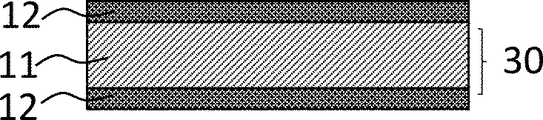
- the adhesive tape may be a double-sided adhesive tape 30 composed of only the adhesive layer 11 (that is, the adhesive layer alone), which is a so-called base material-less double-sided adhesive tape.
- the adhesive tape of the present invention is preferably a double-sided adhesive tape composed of only an adhesive layer.
- Supports for single-sided adhesive tape and double-sided adhesive tape include non-woven fabric, paper such as Japanese paper, woven fabric made of natural fibers, synthetic fibers, etc., polyester, polyolefin, soft polyvinyl chloride, hard polyvinyl chloride, acetate, etc.
- Examples include film and flat yarn cloth.
- the flat yarn cloth is made by arranging flat yarns made of synthetic resin such as polyolefin resin in a grid pattern of two axes, three axes, or four axes and adhering intersections.
- a release sheet is generally attached to the surface of the pressure-sensitive adhesive layer of the adhesive tape, and the release sheet is peeled off and then attached to the adherend.
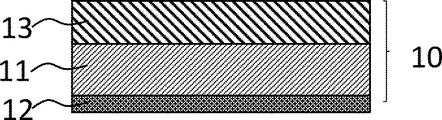
- the adhesive layer surface of the single-sided adhesive tape 10 both surfaces of the double-sided adhesive tape 20 as shown in FIG. 5, and both surfaces of the double-sided adhesive tape 30 as shown in FIG. May be provided.
- the release sheet for example, one in which at least one surface of a base material such as a resin film is peeled off with a silicone-based release agent or the like is used.
- boron nitride nanosheet After giving and obtaining flaky boron nitride, it was separated and recovered to obtain a boron nitride nanosheet.
- the average thickness of the boron nitride nanosheet was 7 nm, and the average longest diameter was 5 ⁇ m.
- Percentage of structural units with butyral groups l (mol%) 66 Percentage of structural units having an acetyl group: m (mol%) 3 or less Percentage of structural units having a hydroxyl group: n (mol%) 33 Average degree of polymerization 1720 ⁇ Polyvinyl butyral resin 5 ⁇ ⁇ "Eslek BL-2H" manufactured by Sekisui Chemical Co., Ltd.
- Example 1 The dispersant and organic solvent of the type and amount shown in Table 1 were mixed, and then the filler of the type and amount shown in Table 1 was added and mixed to obtain a mixed solution. The resin components shown in Table 1 were further added to the mixed solution and mixed to obtain a dispersion. Mixing was carried out at room temperature (25 ° C.) for 60 minutes at a stirring speed of 125 rpm using a rotating / ultrasonic nanodispersor "PR-1" manufactured by Shinky. The obtained dispersion was applied onto a PET sheet to a thickness of 50 ⁇ m and heated at 50 ° C. for 5 hours to obtain a sheet formed from the dispersion.
- Examples 2 to 14, Comparative Examples 1 to 5 A mixed solution, a dispersion, and a sheet were obtained in the same manner as in Example 1 except that the types and amounts of each component were as shown in Table 1.
- Examples 15 to 16, Comparative Example 6 After mixing the types and amounts of the dispersants and polymerizable monomers shown in Table 1, a filler and a photopolymerization initiator were further added and mixed to obtain a dispersion. Mixing was carried out at room temperature (25 ° C.) for 60 minutes at a stirring speed of 125 rpm using a rotating / ultrasonic nanodispersor "PR-1" manufactured by Shinky. As the photopolymerization initiator, 2,2-dimethoxy-1,2-diphenylethane-1-one was used. The amount of the photopolymerization initiator compounded was 0.5 parts by mass with respect to 100 parts by mass of the polymerizable monomer. The dispersion was applied onto a PET sheet to a thickness of 100 ⁇ m to form a coating film, and the coating film was irradiated with light (365 nm) for 10 minutes to cure the coating film to form a sheet.
- a filler and a photopolymerization initiator were further added
- Dispersibility evaluation Dispersibility of the filler was measured by measuring the viscosity of the mixed solution before mixing the resins for Examples 1 to 14 and Comparative Examples 1 to 5, and the viscosity of the dispersion for Examples 15 to 16 and Comparative Example 6. Was evaluated. The lower the viscosity, the better the dispersibility. The viscosity was measured at room temperature ° C. using a viscometer (“LV-DV-E” manufactured by BROOKFIELD). Dispersibility was evaluated according to the following criteria. Dispersibility S ... Viscosity 100 cp or less Dispersive A ... Viscosity Over 100 150 cp or less Dispersible B ... Viscosity Over 150 200 cp or less Dispersive C ... Viscosity Over 200 cp
- Sheet quality evaluation The surface of the sheet was observed with a laser microscope (“VK-8700” manufactured by KEYENCE CORPORATION), and the arithmetic mean roughness (Ra) was calculated and evaluated.
- Sheet property A ... Ra 3.0 ⁇ m or less
- Sheet property B ... Ra More than 3.0 ⁇ m 5.0 ⁇ m or less
- Sheet property C ... Ra More than 5.0 ⁇ m
- Double-sided adhesive tape 10 Single-sided adhesive tape 11 Adhesive layer 12 Release sheet 13 Support 20 Double-sided adhesive tape 30 Double-sided adhesive tape
Landscapes
- Chemical & Material Sciences (AREA)
- Organic Chemistry (AREA)
- Health & Medical Sciences (AREA)
- Chemical Kinetics & Catalysis (AREA)
- Medicinal Chemistry (AREA)
- Polymers & Plastics (AREA)
- Compositions Of Macromolecular Compounds (AREA)
Abstract
本発明は、下記一般式(1)で表される構造単位を有する化合物(A)からなる充填材用分散剤である。本発明によれば、充填材の分散性を向上させることができ、かつ分散液からシートを形成する際に、表面性の良好なシートを得ることができる充填材用分散剤を提供することができる。
Description
本発明は、充填材用分散剤及びこれを用いた分散液に関する。
カーボンナノチューブ、窒化ホウ素ナノチューブなどの六角網目状構造を有する化合物は、導電性、熱伝導性など優れた特性を有しており、種々の用途に用いられている。例えば、カーボンナノチューブを分散媒(溶媒)に分散させたカーボンナノチューブ分散液を用いて導電性フィルムを製造する技術などが知られている(特許文献1)。また、分散液に樹脂を更に含有させ、これを塗工し、乾燥させることで、樹脂中にカーボンナノチューブが保持されたフィルムを形成させる技術も知られている(特許文献2)。
一般に、六角網目状構造を有する化合物は、表面積が大きいため、凝集が生じやすく、溶液への均一な分散が難しい。そのため、分散剤を用いて、分散性を向上させる試みがなされている。このような観点から、特許文献3には、有機溶剤可溶性樹脂の有機溶剤溶液中に炭素繊維を分散させる際に、分散性を向上させるために添加する特定の構造単位を有する分散剤が記載されている。
一般に、六角網目状構造を有する化合物は、表面積が大きいため、凝集が生じやすく、溶液への均一な分散が難しい。そのため、分散剤を用いて、分散性を向上させる試みがなされている。このような観点から、特許文献3には、有機溶剤可溶性樹脂の有機溶剤溶液中に炭素繊維を分散させる際に、分散性を向上させるために添加する特定の構造単位を有する分散剤が記載されている。
しかしながら、従来用いられている分散剤は、カーボンナノチューブ等の充填剤の分散性を十分向上させることが難しく、また、比較的分散性が良好である場合でも、分散液から溶媒を揮発させるなどしてシート状にする際に、シート表面に凸凹が生じるなどの表面性の悪化が確認され、改善の余地があった。
したがって、本発明は、六角網目状構造を有する化合物などの充填材の分散性を向上させることができ、かつ該充填材を含む分散液から溶媒を揮発させるなどしてシートを形成する際に、表面性の良好なシートの得られる充填材用分散剤、及び該充填材用分散剤を含む分散液を提供することを課題とする。
したがって、本発明は、六角網目状構造を有する化合物などの充填材の分散性を向上させることができ、かつ該充填材を含む分散液から溶媒を揮発させるなどしてシートを形成する際に、表面性の良好なシートの得られる充填材用分散剤、及び該充填材用分散剤を含む分散液を提供することを課題とする。
本発明者は、鋭意検討の結果、水酸基を有する構造単位を一定量有する特定の化合物を分散剤として用いることで、上記課題が解決できることを見出し、以下の本発明を完成させた。本発明は、以下の[1]~[11]を提供する。
[1]下記一般式(1)で表される構造単位を有する化合物(A)からなる充填材用分散剤。
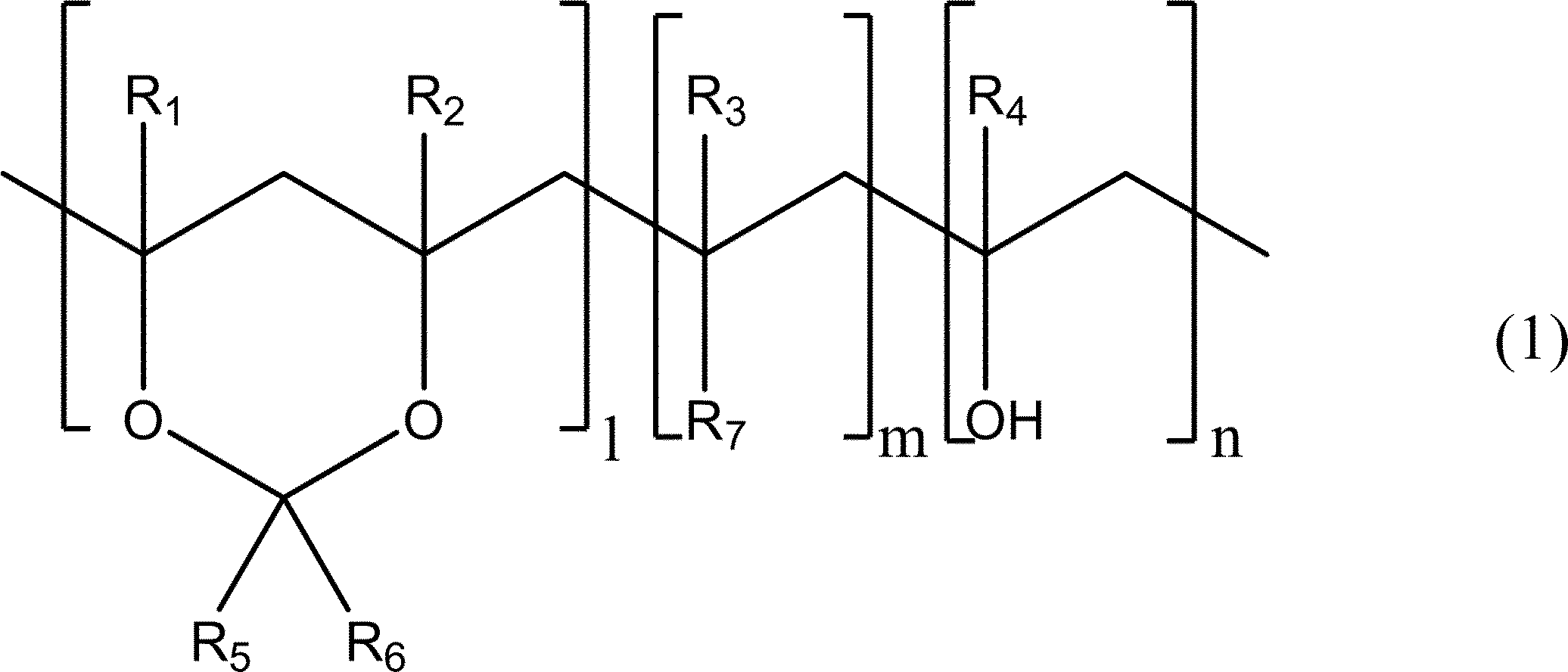
(一般式(1)において、R1、R2、R3およびR4はそれぞれ独立に水素原子、水酸基、無置換もしくは置換の炭素原子が1~30のアルキル基、無置換もしくは置換のヒドロキシアルキル基、アルキルオキシ基、アシルオキシ基、カルボキシル基、アシル基、第1~3級アミノ基、無置換もしくは置換のアリール基、無置換もしくは置換のアリールオキシ基、または無置換もしくは置換の複素環基を表す。R5およびR6はそれぞれ独立に水素原子、無置換もしくは置換の炭素原子が1~30のアルキル基、無置換もしくは置換のアリール基、無置換もしくは置換の複素環基を表すか、またはR5とR6が結合して環を形成してもよい。R7は水素原子、無置換もしくは置換の炭素原子が1~30のアルキル基、無置換もしくは置換のヒドロキシアルキル基、アルキルオキシ基、アシルオキシ基、カルボニル基、カルボキシル基、第1~3級アミノ基、無置換もしくは置換のアリール基、無置換もしくは置換のアリールオキシ基または無置換もしくは置換の複素環基を表す。l、m、nは、それぞれの構成単位の数の百分率を表し、l、m、nの合計は100%であり、lは0%より大きく、nは31~80%である。)
[2]前記一般式(1)において、lが30~69%であり、mが0~20%であり、nが31~50%である、上記[1]に記載の充填材用分散剤。
[3]平均重合度が200以上2000以下である、上記[1]又は[2]に記載の充填材用分散剤。
[4]六角網目状構造を有する充填材を分散させるために用いる上記[1]~[3]のいずれかに記載の充填材用分散剤。
[5]六角網目状構造を有する充填材が、カーボンナノチューブ、窒化ホウ素ナノチューブ、窒化ホウ素ナノシート、窒化ホウ素(ただし窒化ホウ素ナノチューブ及び窒化ホウ素ナノシートは除く)、及びグラフェンからなる群から選択される少なくとも1種である、上記[4]に記載の充填材用分散剤。
[6]上記[1]~[5]のいずれかに記載の分散剤、充填材、樹脂成分、及び有機溶媒を含有する分散液。
[7]前記有機溶媒が、アルコール系溶媒及びケトン系溶媒から選択される少なくとも一種である、上記[6]に記載の分散液。
[8]上記[1]~[5]のいずれかに記載の分散剤、充填材、及び重合性単量体を含有する分散液。
[9]前記充填材が、六角網目状構造を有する充填材である、上記[6]~[8]のいずれかに記載の分散液。
[10]前記六角網目状構造を有する充填材が、カーボンナノチューブ、窒化ホウ素ナノチューブ、窒化ホウ素ナノシート、窒化ホウ素(ただし窒化ホウ素ナノチューブ及び窒化ホウ素ナノシートは除く)、及びグラフェンからなる群から選択される少なくとも1種以上である、上記[6]~[9]のいずれかに記載の分散液。
[11]上記[6]~[10]のいずれかに記載の分散液からなる粘着剤を備える、粘着テープ。
[1]下記一般式(1)で表される構造単位を有する化合物(A)からなる充填材用分散剤。
(一般式(1)において、R1、R2、R3およびR4はそれぞれ独立に水素原子、水酸基、無置換もしくは置換の炭素原子が1~30のアルキル基、無置換もしくは置換のヒドロキシアルキル基、アルキルオキシ基、アシルオキシ基、カルボキシル基、アシル基、第1~3級アミノ基、無置換もしくは置換のアリール基、無置換もしくは置換のアリールオキシ基、または無置換もしくは置換の複素環基を表す。R5およびR6はそれぞれ独立に水素原子、無置換もしくは置換の炭素原子が1~30のアルキル基、無置換もしくは置換のアリール基、無置換もしくは置換の複素環基を表すか、またはR5とR6が結合して環を形成してもよい。R7は水素原子、無置換もしくは置換の炭素原子が1~30のアルキル基、無置換もしくは置換のヒドロキシアルキル基、アルキルオキシ基、アシルオキシ基、カルボニル基、カルボキシル基、第1~3級アミノ基、無置換もしくは置換のアリール基、無置換もしくは置換のアリールオキシ基または無置換もしくは置換の複素環基を表す。l、m、nは、それぞれの構成単位の数の百分率を表し、l、m、nの合計は100%であり、lは0%より大きく、nは31~80%である。)
[2]前記一般式(1)において、lが30~69%であり、mが0~20%であり、nが31~50%である、上記[1]に記載の充填材用分散剤。
[3]平均重合度が200以上2000以下である、上記[1]又は[2]に記載の充填材用分散剤。
[4]六角網目状構造を有する充填材を分散させるために用いる上記[1]~[3]のいずれかに記載の充填材用分散剤。
[5]六角網目状構造を有する充填材が、カーボンナノチューブ、窒化ホウ素ナノチューブ、窒化ホウ素ナノシート、窒化ホウ素(ただし窒化ホウ素ナノチューブ及び窒化ホウ素ナノシートは除く)、及びグラフェンからなる群から選択される少なくとも1種である、上記[4]に記載の充填材用分散剤。
[6]上記[1]~[5]のいずれかに記載の分散剤、充填材、樹脂成分、及び有機溶媒を含有する分散液。
[7]前記有機溶媒が、アルコール系溶媒及びケトン系溶媒から選択される少なくとも一種である、上記[6]に記載の分散液。
[8]上記[1]~[5]のいずれかに記載の分散剤、充填材、及び重合性単量体を含有する分散液。
[9]前記充填材が、六角網目状構造を有する充填材である、上記[6]~[8]のいずれかに記載の分散液。
[10]前記六角網目状構造を有する充填材が、カーボンナノチューブ、窒化ホウ素ナノチューブ、窒化ホウ素ナノシート、窒化ホウ素(ただし窒化ホウ素ナノチューブ及び窒化ホウ素ナノシートは除く)、及びグラフェンからなる群から選択される少なくとも1種以上である、上記[6]~[9]のいずれかに記載の分散液。
[11]上記[6]~[10]のいずれかに記載の分散液からなる粘着剤を備える、粘着テープ。
本発明の充填材用分散剤によれば、充填材の分散性を向上させることができ、かつ該充填材を含む分散液からシートを形成する際に、表面性の良好なシートを得ることができる充填材用分散剤を提供することができる。
以下、本発明について詳細に説明する。
[充填材用分散剤]
本発明の充填材用分散剤(以下単に分散剤ということもある)は、下記一般式(1)で表される構造単位を有する化合物(A)からなる分散剤である。
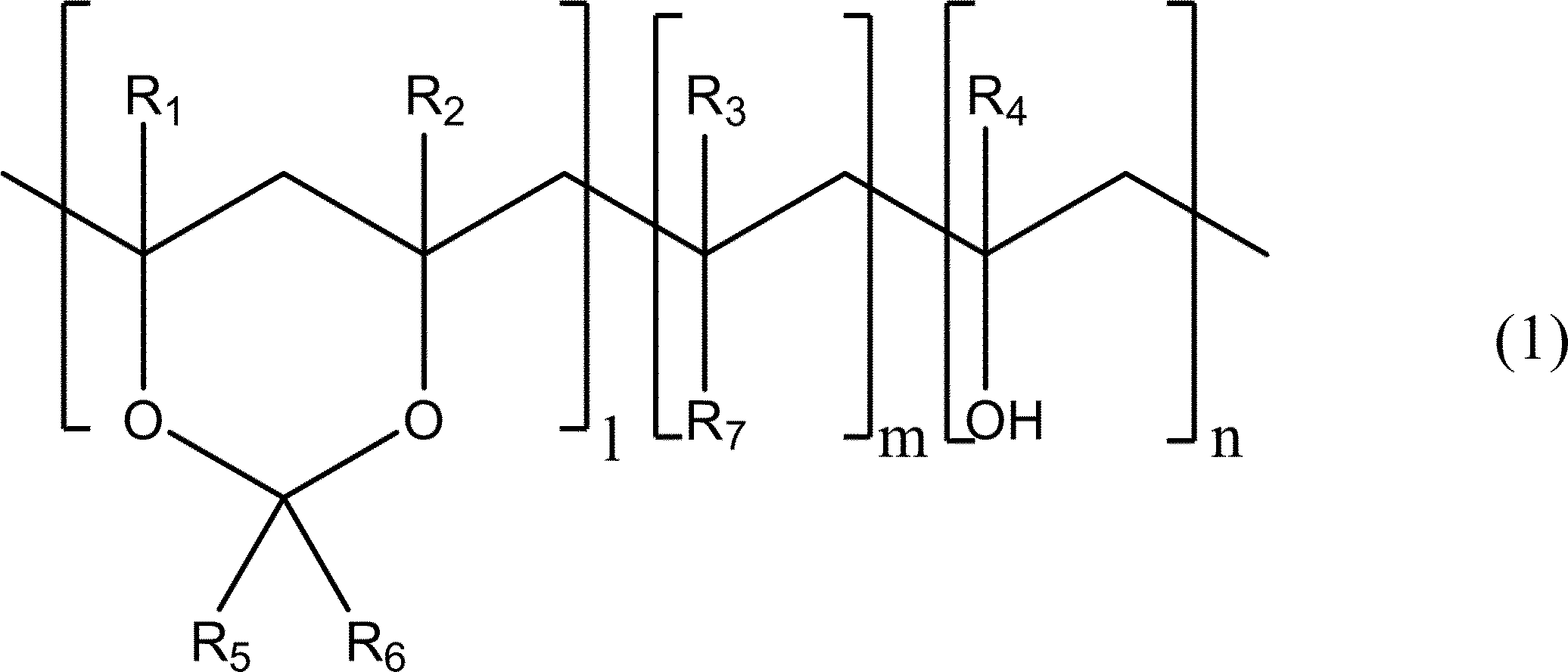
(一般式(1)において、R1、R2、R3およびR4はそれぞれ独立に水素原子、水酸基、無置換もしくは置換の炭素原子が1~30のアルキル基、無置換もしくは置換のヒドロキシアルキル基、アルキルオキシ基、アシルオキシ基、カルボキシル基、アシル基、第1~3級アミノ基、無置換もしくは置換のアリール基、無置換もしくは置換のアリールオキシ基、または無置換もしくは置換の複素環基を表す。R5およびR6はそれぞれ独立に水素原子、無置換もしくは置換の炭素原子が1~30のアルキル基、無置換もしくは置換のアリール基、無置換もしくは置換の複素環基を表すか、またR5とR6が結合して環を形成してもよい。R7は水素原子、無置換もしくは置換の炭素原子が1~30のアルキル基、無置換もしくは置換のヒドロキシアルキル基、アルキルオキシ基、アシルオキシ基、カルボニル基、カルボキシル基、第1~3級アミノ基、無置換もしくは置換のアリール基、無置換もしくは置換のアリールオキシ基または無置換もしくは置換の複素環基を表す。l、m、nは、それぞれの構成単位の数の百分率を表し、l、m、nの合計は100%であり、lは0%より大きく、nは31~80%である。)
[充填材用分散剤]
本発明の充填材用分散剤(以下単に分散剤ということもある)は、下記一般式(1)で表される構造単位を有する化合物(A)からなる分散剤である。
(一般式(1)において、R1、R2、R3およびR4はそれぞれ独立に水素原子、水酸基、無置換もしくは置換の炭素原子が1~30のアルキル基、無置換もしくは置換のヒドロキシアルキル基、アルキルオキシ基、アシルオキシ基、カルボキシル基、アシル基、第1~3級アミノ基、無置換もしくは置換のアリール基、無置換もしくは置換のアリールオキシ基、または無置換もしくは置換の複素環基を表す。R5およびR6はそれぞれ独立に水素原子、無置換もしくは置換の炭素原子が1~30のアルキル基、無置換もしくは置換のアリール基、無置換もしくは置換の複素環基を表すか、またR5とR6が結合して環を形成してもよい。R7は水素原子、無置換もしくは置換の炭素原子が1~30のアルキル基、無置換もしくは置換のヒドロキシアルキル基、アルキルオキシ基、アシルオキシ基、カルボニル基、カルボキシル基、第1~3級アミノ基、無置換もしくは置換のアリール基、無置換もしくは置換のアリールオキシ基または無置換もしくは置換の複素環基を表す。l、m、nは、それぞれの構成単位の数の百分率を表し、l、m、nの合計は100%であり、lは0%より大きく、nは31~80%である。)
本発明における一般式(1)で表される化合物(A)は、上記のように各構造単位を有しており、構造単位の割合が上記のとおりであればよく、分子鎖内での各構造単位の並び方を限定するものではない。すなわち、分子内に各構造単位がブロック的に存在してしてもよいし、ランダム的に存在してもよい。
化合物(A)は、アセタール基を有する構造単位を含んでいる。これにより、充填材、特に、六角網目状構造を有する充填材の分散性が向上する。これは、アセタール基と、充填材の六角網目状構造が相互作用しやすいことで、充填材の凝集を抑制するからと推定される。充填材、特に、六角網目状構造を有する充填材の分散性をより向上させる観点から、化合物(A)は、ブチラール基を有する構造単位を含むことが好ましい。
一般式(1)で表される化合物(A)におけるnは31~80%である。すなわち、化合物中に、水酸基を有する構造単位が一定の数存在している。nが31%未満であると、充填材用分散剤を含む分散液からシートを形成する際に、シートの表面に凹凸が生じやすくなり、表面性が悪化しやすくなる。nが80%を超えると、化合物中のアセタール基を有する構造単位が少なくなり、充填材の分散性が悪くなる。
一般式(1)で表される化合物(A)におけるnは31~80%である。すなわち、化合物中に、水酸基を有する構造単位が一定の数存在している。nが31%未満であると、充填材用分散剤を含む分散液からシートを形成する際に、シートの表面に凹凸が生じやすくなり、表面性が悪化しやすくなる。nが80%を超えると、化合物中のアセタール基を有する構造単位が少なくなり、充填材の分散性が悪くなる。
これら、充填材の分散性と、シートの表面性をより向上させる観点から、一般式(1)において、好ましくはlが30~69%であり、mが0~20%であり、nが31~50%であり、より好ましくはlが40~68%であり、mが0.1~20%であり、nが32~40%である。
一般式(1)で表される化合物(A)におけるR1~R7は、充填剤の分散性をより向上させる観点、及びシートの表面性をより向上させる観点から以下のとおりにすることが好ましい。R1、R2、R3およびR4は、いずれも水素原子であることが好ましい。R5およびR6は、それぞれ独立に水素原子、または無置換もしくは置換の炭素原子が1~30のアルキル基であることが好ましく、R5が水素原子であり、R6が無置換もしくは置換の炭素原子が1~8のアルキル基であることがより好ましく、R5が水素原子であり、R6がn-プロピル基(-C3H7)であることがより好ましい。
R7は、アシルオキシ基が好ましく、アセトキシ基がより好ましい。
R7は、アシルオキシ基が好ましく、アセトキシ基がより好ましい。
充填材の分散性をより向上させ、かつ該充填材を含む分散液からシートを形成する際に、表面性のより良好なシートを得る観点から、一般式(1)で表される化合物(A)は、下記一般式(2)で表される化合物(A)であることが好ましい。
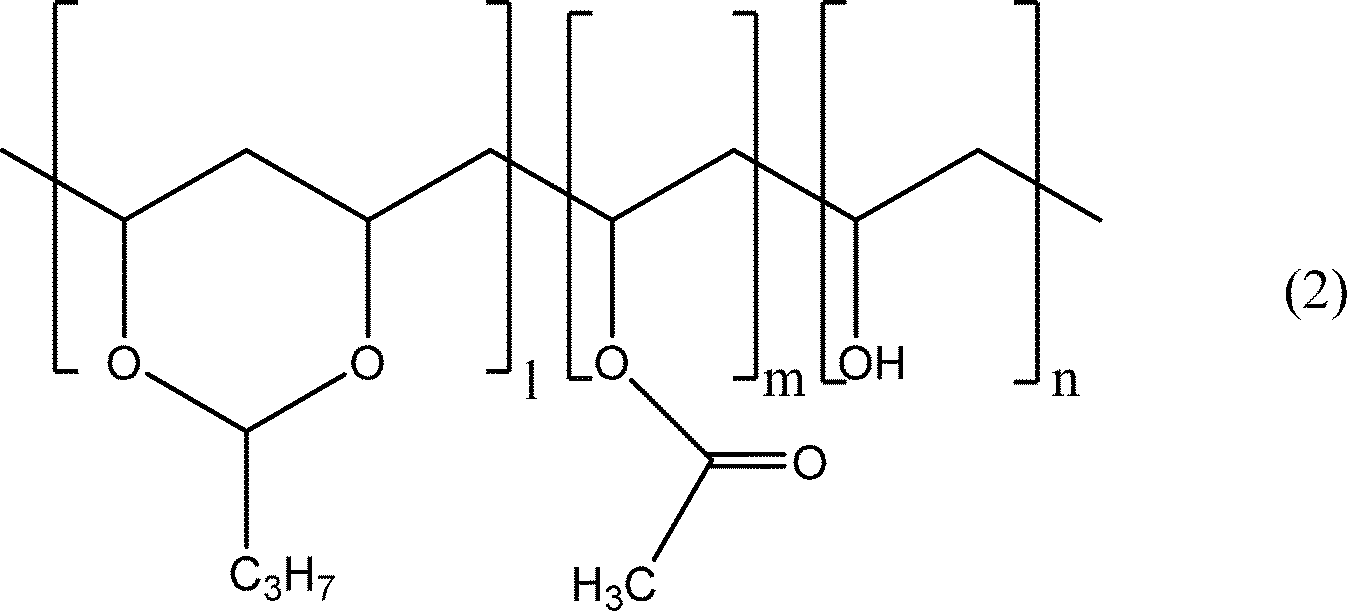
上記一般式(2)において、l、m、nは、それぞれの構成単位の数の百分率を表し、l、m、nの合計は100%であり、lは0%より大きく、nは31~80%である。なお、l、m、nの好適な範囲は、上記一般式(1)と同様である。
上記一般式(2)において、l、m、nは、それぞれの構成単位の数の百分率を表し、l、m、nの合計は100%であり、lは0%より大きく、nは31~80%である。なお、l、m、nの好適な範囲は、上記一般式(1)と同様である。
化合物(A)は、本発明の効果を阻害しない範囲で、一般式(1)で表される構造単位以外のその他の構造単位を有してもよい。化合物(A)がその他の構造単位を有する場合、その他の構造単位は、化合物(A)の全構造単位を基準として2モル%以下であることが好ましく、1モル%以下であることがより好ましく、0であることが更に好ましい。
なお、化合物(A)における各構造単位の割合は、核磁気共鳴法(NMR)により測定できる。
なお、化合物(A)における各構造単位の割合は、核磁気共鳴法(NMR)により測定できる。
化合物(A)の平均重合度は、好ましくは50以上3000以下であり、より好ましくは100以上2500以下であり、200以上であり2000以下である。平均重合度が50以上では分子鎖は長く、ナノフィラーとの相互作用が大きくなり、3000以下では分散媒に溶解し易くなり、ナノフィラーの分散性が向上する。
化合物(A)の平均重合度は、さらに好ましくは200以上800以下であり、特に好ましくは200以上400以下である。
なお、化合物(A)の平均重合度は、原料となるポリビニルアルコールの平均重合度によって求めることができる。
化合物(A)の平均重合度は、さらに好ましくは200以上800以下であり、特に好ましくは200以上400以下である。
なお、化合物(A)の平均重合度は、原料となるポリビニルアルコールの平均重合度によって求めることができる。
本発明の化合物(A)からなる充填材用分散剤は、六角網目状構造を有する充填材を分散させるために用いることが好ましい。六角網目状構造を有する充填材は、例えば、カーボンナノチューブ、窒化ホウ素ナノチューブ、窒化ホウ素ナノシート、窒化ホウ素(ただし窒化ホウ素ナノチューブ及び窒化ホウ素ナノシートは除く)、及びグラフェンからなる群から選択される少なくとも1種である。これら充填材の詳細は後述する。
本発明における化合物(A)の製造方法は、特に限定されず、例えば、次のような方法で製造できる。
ポリ酢酸ビニルをアルカリ、酸、アンモニア水等によりけん化して、ポリビニルアルコールを得る。このとき、ポリ酢酸ビニルのエステルの全てがけん化させる場合もあるし、一部エステルが残存する場合もある。ポリビニルアルコールのけん化度は一般に、70~99.9モル%の範囲内であり、80~99.8モル%の範囲ないであることが好ましい。
ポリビニルアルコールの平均重合度は、好ましくは100以上1500以下であり、より好ましくは200以上1300以下であり、220以上であり900以下である。
ポリビニルアルコールの平均重合度は、JIS K6726「ポリビニルアルコール試験方法」に準拠した方法により求められる。
ポリビニルアルコールを得た後、該ポリビニルアルコールの水酸基の一部をn-ブチルアルデヒドでアセタール化する。
該製造方法において、けん化の条件、及びアセタール化の条件を調節することにより、化合物(A)におけるl、m、nを調整することができる。
本発明の化合物(A)の構造を満足する製品は市販されており、例えば、積水化学工業社製のエスレックBL-1、エスレックBL-2、エスレックBM-1、エスレックBM-2、エスレックBM-5、エスレックBX-L、エスレックBH-3、エスレックBX-1、エスレックBX-5などが挙げられる。
ポリ酢酸ビニルをアルカリ、酸、アンモニア水等によりけん化して、ポリビニルアルコールを得る。このとき、ポリ酢酸ビニルのエステルの全てがけん化させる場合もあるし、一部エステルが残存する場合もある。ポリビニルアルコールのけん化度は一般に、70~99.9モル%の範囲内であり、80~99.8モル%の範囲ないであることが好ましい。
ポリビニルアルコールの平均重合度は、好ましくは100以上1500以下であり、より好ましくは200以上1300以下であり、220以上であり900以下である。
ポリビニルアルコールの平均重合度は、JIS K6726「ポリビニルアルコール試験方法」に準拠した方法により求められる。
ポリビニルアルコールを得た後、該ポリビニルアルコールの水酸基の一部をn-ブチルアルデヒドでアセタール化する。
該製造方法において、けん化の条件、及びアセタール化の条件を調節することにより、化合物(A)におけるl、m、nを調整することができる。
本発明の化合物(A)の構造を満足する製品は市販されており、例えば、積水化学工業社製のエスレックBL-1、エスレックBL-2、エスレックBM-1、エスレックBM-2、エスレックBM-5、エスレックBX-L、エスレックBH-3、エスレックBX-1、エスレックBX-5などが挙げられる。
[分散液]
本発明の分散剤を使用して、充填材を分散させた分散液を製造することができる。分散液は、該分散液から、樹脂と充填材とを含む複合材からなるシートなどを形成するため、樹脂成分又は重合性単量体を含有することが好ましい。以下、樹脂成分を含む分散液を第1の分散液、重合性単量体を含む分散液を第2の分散液として説明する。
<第1の分散液>
本発明の第1の分散液は、分散剤、充填材、樹脂成分、及び有機溶媒を含有する。第1の分散液から、乾燥などにより溶媒を除去することにより、樹脂と充填材とを含む複合材からなるシートなどを得ることができる。
以下、第1の分散液に含まれる個々の成分について説明する。
本発明の分散剤を使用して、充填材を分散させた分散液を製造することができる。分散液は、該分散液から、樹脂と充填材とを含む複合材からなるシートなどを形成するため、樹脂成分又は重合性単量体を含有することが好ましい。以下、樹脂成分を含む分散液を第1の分散液、重合性単量体を含む分散液を第2の分散液として説明する。
<第1の分散液>
本発明の第1の分散液は、分散剤、充填材、樹脂成分、及び有機溶媒を含有する。第1の分散液から、乾燥などにより溶媒を除去することにより、樹脂と充填材とを含む複合材からなるシートなどを得ることができる。
以下、第1の分散液に含まれる個々の成分について説明する。
(分散剤)
第1の分散液に含有される分散剤としては、上記した化合物(A)からなる充填材用分散剤を使用することができる。該分散剤を用いることで、充填材の分散性を向上させることができ、また、分散液から溶媒を揮発させてシートを形成する際に、表面性の良好なシートを得ることできる。
第1の分散液における分散剤の量は、分散液全量基準で、好ましくは0.1~30質量%であり、より好ましくは0.5~20質量%であり、更に好ましくは1~15質量%である。これら下限値以上であると、充填材の分散性が高まり、これら上限値以下であると添加量に応じて分散性を向上させることができる。
第1の分散液に含有される分散剤としては、上記した化合物(A)からなる充填材用分散剤を使用することができる。該分散剤を用いることで、充填材の分散性を向上させることができ、また、分散液から溶媒を揮発させてシートを形成する際に、表面性の良好なシートを得ることできる。
第1の分散液における分散剤の量は、分散液全量基準で、好ましくは0.1~30質量%であり、より好ましくは0.5~20質量%であり、更に好ましくは1~15質量%である。これら下限値以上であると、充填材の分散性が高まり、これら上限値以下であると添加量に応じて分散性を向上させることができる。
第1の分散液における分散剤の量は、充填材100質量部に対して、50~1500質量部であることが好ましく、100~1000質量部であることがより好ましく、200~400質量部であることが更に好ましい。
(充填材)
第1の分散液に含有される充填材の種類は特に限定されるものではないが、六角網目状構造を有する充填材が好ましい。六角網目状構造を有する充填材は導電性、熱伝導性など優れた特性を有するものの、一般的には、分散しにくい充填材として知られている。本発明の分散剤を用いると、六角網目状構造を有する充填材を用いた場合であっても、良好に分散させることができる。
六角網目状構造を有する充填材は、カーボンナノチューブ、窒化ホウ素ナノチューブ、窒化ホウ素ナノシート、窒化ホウ素(ただし窒化ホウ素ナノチューブ及び窒化ホウ素ナノシートは除く)、及びグラフェンからなる群から選択される少なくとも1種であることが好ましい。
第1の分散液に含有される充填材の種類は特に限定されるものではないが、六角網目状構造を有する充填材が好ましい。六角網目状構造を有する充填材は導電性、熱伝導性など優れた特性を有するものの、一般的には、分散しにくい充填材として知られている。本発明の分散剤を用いると、六角網目状構造を有する充填材を用いた場合であっても、良好に分散させることができる。
六角網目状構造を有する充填材は、カーボンナノチューブ、窒化ホウ素ナノチューブ、窒化ホウ素ナノシート、窒化ホウ素(ただし窒化ホウ素ナノチューブ及び窒化ホウ素ナノシートは除く)、及びグラフェンからなる群から選択される少なくとも1種であることが好ましい。
≪カーボンナノチューブ≫
カーボンナノチューブは、炭素から形成されるチューブ状の材料である。カーボンナノチューブは電気的特性に優れており、樹脂などと複合化すると、導電性の高いシートなどを形成できる。カーボンナノチューブは、六角網目状の炭素原子配列のグラファイトシートが円筒状に巻かれた構造を有する物質であり、一層に巻いたものをシングルウオールカーボンナノチューブ、多層に巻いたものをマルチウオールカーボンナノチューブという。
本発明では、カーボンナノチューブの種類は特に限定されず、シングルウオールカーボンナノチューブ、マルチウオールカーボンナノチューブ、及びこれらを任意の割合で含む混合物のいずれでもよい。また、アーク放電法、レーザー蒸発法、化学気相成長法(CVD法)等の各種方法により製造されたカーボンナノチューブを用いることができる。
カーボンナノチューブは、炭素から形成されるチューブ状の材料である。カーボンナノチューブは電気的特性に優れており、樹脂などと複合化すると、導電性の高いシートなどを形成できる。カーボンナノチューブは、六角網目状の炭素原子配列のグラファイトシートが円筒状に巻かれた構造を有する物質であり、一層に巻いたものをシングルウオールカーボンナノチューブ、多層に巻いたものをマルチウオールカーボンナノチューブという。
本発明では、カーボンナノチューブの種類は特に限定されず、シングルウオールカーボンナノチューブ、マルチウオールカーボンナノチューブ、及びこれらを任意の割合で含む混合物のいずれでもよい。また、アーク放電法、レーザー蒸発法、化学気相成長法(CVD法)等の各種方法により製造されたカーボンナノチューブを用いることができる。
カーボンナノチューブの平均直径は好ましくは1~100nmであり、より好ましくは2~15nmである。カーボンナノチューブの平均長さは好ましくは0.1~1000μmであり、より好ましくは10~500μmである。カーボンナノチューブのアスペクト比は、好ましくは10~100000であり、より好ましくは500~30000である。本発明の分散剤は、カーボンナノチューブのアスペクト比の大小に関わらず、分散させることができる。通常は、アスペクト比の大きいカーボンナノチューブは、分散させにくいが、本発明の充填材用分散剤を用いると、アスペクト比の大きいカーボンナノチューブでも分散させることが可能となる。
なお、カーボンナノチューブの直径とは、シングルウオールカーボンナノチューブの場合には外径を示し、マルチウオールカーボンナノチューブの場合には最も外側に位置するチューブの外径を意味する。カーボンナノチューブの直径、及び長さは、例えばTEM(透過型電子顕微鏡)による観察によって得られた画像において測定すればよく、平均直径、及び平均長さとは、任意の50個の算術平均により求めるとよい。
なお、カーボンナノチューブの直径とは、シングルウオールカーボンナノチューブの場合には外径を示し、マルチウオールカーボンナノチューブの場合には最も外側に位置するチューブの外径を意味する。カーボンナノチューブの直径、及び長さは、例えばTEM(透過型電子顕微鏡)による観察によって得られた画像において測定すればよく、平均直径、及び平均長さとは、任意の50個の算術平均により求めるとよい。
≪窒化ホウ素ナノチューブ≫
窒化ホウ素ナノチューブは、窒化ホウ素から形成されるチューブ状材料であり、熱伝導性に優れる充填材である。窒化ホウ素ナノチューブは、六角網目の面がチューブ軸に平行となるように管を形成し、一重管もしくは多重管になるものである。窒化ホウ素ナノチューブは、一重管となるものをシングルウォールチューブ、多重管となるものをマルチウォールチューブという。本発明では、窒化ホウ素ナノチューブとして、シングルウォールチューブ及びマルチウォールチューブのいずれを使用してもよいし、両者を併用してもよいが、マルチウォールチューブを用いることが好ましい。
窒化ホウ素ナノチューブは、窒化ホウ素から形成されるチューブ状材料であり、熱伝導性に優れる充填材である。窒化ホウ素ナノチューブは、六角網目の面がチューブ軸に平行となるように管を形成し、一重管もしくは多重管になるものである。窒化ホウ素ナノチューブは、一重管となるものをシングルウォールチューブ、多重管となるものをマルチウォールチューブという。本発明では、窒化ホウ素ナノチューブとして、シングルウォールチューブ及びマルチウォールチューブのいずれを使用してもよいし、両者を併用してもよいが、マルチウォールチューブを用いることが好ましい。
窒化ホウ素ナノチューブは、平均直径が好ましくは1nm以上50nm以下であり、平均長さが好ましくは100nm以上50μm以下である。平均直径及び平均長さを上記範囲内とすることで、樹脂と混合した際の粘度が低くなり、分散性が向上し、かつ熱伝導率も向上しやすくなる。
窒化ホウ素ナノチューブの平均直径は、好ましくは3nm以上、より好ましくは4nm以上である。また、窒化ホウ素ナノチューブの平均直径は、好ましくは10nm以下、より好ましくは8nm以下である。
また、窒化ホウ素ナノチューブの平均長さは、500nm以上が好ましく、1μm以上がより好ましく、また、20μm以下が好ましく、8μm以下がより好ましく、5μm以下がさらに好ましい。
窒化ホウ素ナノチューブの平均直径は、好ましくは3nm以上、より好ましくは4nm以上である。また、窒化ホウ素ナノチューブの平均直径は、好ましくは10nm以下、より好ましくは8nm以下である。
また、窒化ホウ素ナノチューブの平均長さは、500nm以上が好ましく、1μm以上がより好ましく、また、20μm以下が好ましく、8μm以下がより好ましく、5μm以下がさらに好ましい。
なお、窒化ホウ素ナノチューブの直径とは、シングルウォールチューブの場合には外径を示し、マルチウォールチューブの場合には最も外側に位置するチューブの外径を意味する。窒化ホウ素ナノチューブの直径、及び長さは、例えばTEM(透過型電子顕微鏡)による観察によって得られた画像において測定すればよく、平均直径、及び平均長さとは、任意の50個の算術平均により求めるとよい。
≪窒化ホウ素ナノシート≫
窒化ホウ素ナノシートは、超極薄の二次元シート構造を有するものであり、大きな比表面積を有し、熱伝導性に優れる充填材である。窒化ホウ素ナノシートは、例えば、六方晶系窒化ホウ素の層間を剥離することで得られるものであり、六方晶系窒化ホウ素を形成している層が単層、又は複数積層された構造を有する。
六方晶系窒化ホウ素は、ホウ素原子と窒素原子が交互に共有結合した六角網目状の平面同士が、相互にファンデルワールス力で緩く結合して積み重なった構造をしているため、窒化ホウ素ナノシートも同様に、六角網目状の平面構造を有している。
本発明で使用する窒化ホウ素ナノシートは、平均厚さが10nm未満であることが好ましい。平均厚さが10nm未満であると、樹脂と混合した際の粘度が低くなり、分散性が向上し、かつ熱伝導率も向上しやすくなる。これら観点から、窒化ホウ素ナノシートの平均厚さは、より好ましくは6nm以下、さらに好ましくは4nm以下である。また、窒化ホウ素ナノシートの平均厚さの下限は、特に限定されないが、例えば1nmである。
窒化ホウ素ナノシートは、超極薄の二次元シート構造を有するものであり、大きな比表面積を有し、熱伝導性に優れる充填材である。窒化ホウ素ナノシートは、例えば、六方晶系窒化ホウ素の層間を剥離することで得られるものであり、六方晶系窒化ホウ素を形成している層が単層、又は複数積層された構造を有する。
六方晶系窒化ホウ素は、ホウ素原子と窒素原子が交互に共有結合した六角網目状の平面同士が、相互にファンデルワールス力で緩く結合して積み重なった構造をしているため、窒化ホウ素ナノシートも同様に、六角網目状の平面構造を有している。
本発明で使用する窒化ホウ素ナノシートは、平均厚さが10nm未満であることが好ましい。平均厚さが10nm未満であると、樹脂と混合した際の粘度が低くなり、分散性が向上し、かつ熱伝導率も向上しやすくなる。これら観点から、窒化ホウ素ナノシートの平均厚さは、より好ましくは6nm以下、さらに好ましくは4nm以下である。また、窒化ホウ素ナノシートの平均厚さの下限は、特に限定されないが、例えば1nmである。
窒化ホウ素ナノシートの大きさは、特に限定されないが、平均最長径が例えば200nm以上10μm以下、好ましくは500nm以上6μm以下である。
なお、窒化ホウ素ナノシートの厚さ及び最長径は、例えばTEM(透過型電子顕微鏡)による観察によって得られた画像において測定でき、各窒化ホウ素ナノシートの平均厚さ、及び平均最長径は、電子顕微鏡の画像中の任意の50個の算術平均により求めるとよい。
なお、窒化ホウ素ナノシートの厚さ及び最長径は、例えばTEM(透過型電子顕微鏡)による観察によって得られた画像において測定でき、各窒化ホウ素ナノシートの平均厚さ、及び平均最長径は、電子顕微鏡の画像中の任意の50個の算術平均により求めるとよい。
≪窒化ホウ素≫
本発明において使用する窒化ホウ素は、上記した窒化ホウ素ナノチューブ及び窒化ホウ素ナノシート以外の窒化ホウ素である。窒化ホウ素は好ましくは、六方晶窒化ホウ素粒子である。六方晶窒化ホウ素粒子の平均粒径は、特に限定されないが、例えば0.5μm以上80μm以下、好ましくは1μm以上70μm以下である。
本発明において使用する窒化ホウ素は、上記した窒化ホウ素ナノチューブ及び窒化ホウ素ナノシート以外の窒化ホウ素である。窒化ホウ素は好ましくは、六方晶窒化ホウ素粒子である。六方晶窒化ホウ素粒子の平均粒径は、特に限定されないが、例えば0.5μm以上80μm以下、好ましくは1μm以上70μm以下である。
六方晶窒化ホウ素粒子の粒径は、例えばTEM(透過型電子顕微鏡)による観察によって得られた画像において粒子の最大径を測定し、任意の50個の粒子の最大径の算術平均により平均粒径を求めるとよい。
≪グラフェン≫
グラフェンは、六角網目状の平面層を有しており、例えば、六角網目状の平面層がファンデルワールス力により積層された層状構造を有するグラファイトの層間を剥離することにより得られる。グラフェンの平均厚みは、例えば、3nm以上100nm以下、好ましくは7nm以上50nm以下である。平均厚みは、例えばTEM(透過型電子顕微鏡)による観察によって得られた画像において測定でき、電子顕微鏡の画像中の任意の50個の算術平均により求めるとよい。
グラフェンは、六角網目状の平面層を有しており、例えば、六角網目状の平面層がファンデルワールス力により積層された層状構造を有するグラファイトの層間を剥離することにより得られる。グラフェンの平均厚みは、例えば、3nm以上100nm以下、好ましくは7nm以上50nm以下である。平均厚みは、例えばTEM(透過型電子顕微鏡)による観察によって得られた画像において測定でき、電子顕微鏡の画像中の任意の50個の算術平均により求めるとよい。
≪その他の充填材≫
充填材としては、上記した充填材以外のその他の充填材を用いてもよい。
その他の充填材としては、例えば、炭化物、窒化物、酸化物、水酸化物、金属炭酸塩、などが挙げられる。
充填材としては、上記した充填材以外のその他の充填材を用いてもよい。
その他の充填材としては、例えば、炭化物、窒化物、酸化物、水酸化物、金属炭酸塩、などが挙げられる。
炭化物としては、例えば、炭化ケイ素、炭化ホウ素、炭化アルミニウム、炭化チタン、炭化タングステンなどが挙げられる。窒化物としては、例えば、窒化ケイ素、窒化アルミニウム、窒化ガリウム、窒化クロム、窒化タングステン、窒化マグネシウム、窒化モリブデン、窒化リチウムなどが挙げられる。
酸化物としては、例えば、酸化鉄、酸化亜鉛、酸化ケイ素(シリカ)、アルミナ、ベーマイトなどの酸化アルミニウム、酸化マグネシウム、酸化チタン、酸化セリウム、酸化ジルコニウムなどが挙げられる。水酸化物としては、例えば、水酸化アルミニウム、水酸化カルシウム、水酸化マグネシウムなどが挙げられる。金属炭酸塩としては、合成マグネサイト、マグネシウム炭酸塩などが挙げられる。
第1の分散液に含まれる充填材は、1種を単独で用いてもよいし、複数を併用してもよい。
酸化物としては、例えば、酸化鉄、酸化亜鉛、酸化ケイ素(シリカ)、アルミナ、ベーマイトなどの酸化アルミニウム、酸化マグネシウム、酸化チタン、酸化セリウム、酸化ジルコニウムなどが挙げられる。水酸化物としては、例えば、水酸化アルミニウム、水酸化カルシウム、水酸化マグネシウムなどが挙げられる。金属炭酸塩としては、合成マグネサイト、マグネシウム炭酸塩などが挙げられる。
第1の分散液に含まれる充填材は、1種を単独で用いてもよいし、複数を併用してもよい。
第1の分散液における充填材の量は、分散液全量基準で、好ましくは0.1~10質量%であり、より好ましくは0.5~5質量%であり、更に好ましくは1~3質量%である。
これら下限値以上であると、充填材の種類に応じた導電性、熱伝導性などの機能を付与しやすくなり、これら上限値以下であると、充填材の分散性が向上する。本発明の分散剤は、充填材、特に六角網目状構造を有する充填材に対する分散性を向上させやすいため、該充填材の量が上記のとおり比較的高い場合であっても、良好に分散させることができる。
これら下限値以上であると、充填材の種類に応じた導電性、熱伝導性などの機能を付与しやすくなり、これら上限値以下であると、充填材の分散性が向上する。本発明の分散剤は、充填材、特に六角網目状構造を有する充填材に対する分散性を向上させやすいため、該充填材の量が上記のとおり比較的高い場合であっても、良好に分散させることができる。
第1の分散液における充填材は、樹脂成分100質量部に対して、2~20質量部であることが好ましく、5~15質量部であることがより好ましい。このような範囲であると、分散液を用いてシート等を形成させたとき、充填材が樹脂中に均一に分散しやすくなる。
(樹脂成分)
第1の分散液に含有される樹脂成分は、分散液から有機溶媒を乾燥などにより除去したのち、充填材を保持する。樹脂成分は、特に限定されないが、硬化性樹脂、熱可塑性樹脂、エラストマー樹脂などが挙げられる。硬化性樹脂としては、エポキシ樹脂、シリコーン樹脂、ウレタン樹脂、フェノール樹脂、不飽和ポリエステル樹脂、ポリイミド樹脂、オキセタン樹脂等が挙げられる。
また、熱可塑性樹脂としては、ポリプロピレン樹脂、ポリエチレン樹脂、ポリ(1-)ブテン樹脂、及びポリペンテン樹脂等のポリオレフィン樹脂、ポリエチレンテレフタレート等のポリエステル樹脂、ポリスチレン樹脂、アクリロニトリル-ブタジエン-スチレン(ABS)樹脂、エチレン酢酸ビニル共重合体(EVA)、(メタ)アクリル系樹脂、ポリアミド樹脂、ポリ塩化ビニル樹脂(PVC)等が挙げられる。
第1の分散液に含有される樹脂成分は、分散液から有機溶媒を乾燥などにより除去したのち、充填材を保持する。樹脂成分は、特に限定されないが、硬化性樹脂、熱可塑性樹脂、エラストマー樹脂などが挙げられる。硬化性樹脂としては、エポキシ樹脂、シリコーン樹脂、ウレタン樹脂、フェノール樹脂、不飽和ポリエステル樹脂、ポリイミド樹脂、オキセタン樹脂等が挙げられる。
また、熱可塑性樹脂としては、ポリプロピレン樹脂、ポリエチレン樹脂、ポリ(1-)ブテン樹脂、及びポリペンテン樹脂等のポリオレフィン樹脂、ポリエチレンテレフタレート等のポリエステル樹脂、ポリスチレン樹脂、アクリロニトリル-ブタジエン-スチレン(ABS)樹脂、エチレン酢酸ビニル共重合体(EVA)、(メタ)アクリル系樹脂、ポリアミド樹脂、ポリ塩化ビニル樹脂(PVC)等が挙げられる。
また、エラストマー樹脂としては、アクリロニトリルブタジエンゴム、エチレン-プロピレン-ジエンゴム、エチレン-プロピレンゴム、天然ゴム、ポリブタジエンゴム、ポリイソプレンゴム等が挙げられる。これらエラストマー樹脂は、室温(23℃)、常圧(1気圧)で液状となる液状エラストマーであってもよいし、固体状のものであってもよいし、これらの混合物であってもよい。
また、エラストマー樹脂としては、ポリエステル系熱可塑性エラストマー、ポリウレタン系熱可塑性エラストマー、スチレン系熱可塑性エラストマーなどの熱可塑性エラストマーも使用できる。
また、エラストマー樹脂としては、ポリエステル系熱可塑性エラストマー、ポリウレタン系熱可塑性エラストマー、スチレン系熱可塑性エラストマーなどの熱可塑性エラストマーも使用できる。
樹脂成分としては、シリコーンオイル、プロセスオイルなどの液状樹脂成分でもよい。液状樹脂成分とは、配合時に室温かつ常圧下に液状であり、かつ使用時においても液状ないしゲル状となる成分である。すなわち、液状樹脂成分は、硬化剤などにより硬化されない高分子成分であり、また、硬化されるものであっても硬化後、液状ないしゲル状の高分子成分となるものである。
樹脂成分は、1種単独で使用してもよいし、2種以上を併用してもよい。
樹脂成分は、1種単独で使用してもよいし、2種以上を併用してもよい。
樹脂成分としては上記した中では、硬化性樹脂が好ましく、熱硬化性樹脂がより好ましい。なお、硬化性樹脂は、一般的に主剤を硬化剤により硬化させることで、硬化する樹脂成分であり、主剤は高分子成分であってもよいし、モノマー成分であってもよい。このような場合、主剤と硬化剤により樹脂成分が構成される。また、硬化性樹脂の中でもエポキシ樹脂、シリコーン樹脂などが好ましい。
エポキシ樹脂としては、エポキシ基を少なくとも1つ、好ましくは2つ以上有するエポキシ化合物を使用するとよい。エポキシ化合物としては、例えばビスフェノール型、ノボラック型、ナフタレン型、トリフェノールアルカン型、ビフェニル型、環状脂肪族型、これらのハロゲン化物、これらの水素添加物等が挙げられる。
また、エポキシ樹脂としては、エポキシ化合物単独で使用されてもよいが、一般的には、上記エポキシ化合物を主剤とし、さらに硬化剤が加えられたものが使用される。硬化剤としては、重付加型又は触媒型のものが用いられる。重付加型の硬化剤としては、例えば、ポリアミン系硬化剤、酸無水物系硬化剤、ポリフェノール系硬化剤、ポリメルカプタン、ジシアンジアミド等が挙げられる。また、上記触媒型の硬化剤としては、例えば、3級アミン、イミダゾール類、ルイス酸錯体等が例示される。これは1種単独で使用してもよいし、2種以上を併用してもよい。
また、エポキシ樹脂としては、エポキシ化合物単独で使用されてもよいが、一般的には、上記エポキシ化合物を主剤とし、さらに硬化剤が加えられたものが使用される。硬化剤としては、重付加型又は触媒型のものが用いられる。重付加型の硬化剤としては、例えば、ポリアミン系硬化剤、酸無水物系硬化剤、ポリフェノール系硬化剤、ポリメルカプタン、ジシアンジアミド等が挙げられる。また、上記触媒型の硬化剤としては、例えば、3級アミン、イミダゾール類、ルイス酸錯体等が例示される。これは1種単独で使用してもよいし、2種以上を併用してもよい。
シリコーン樹脂としては、縮合硬化型シリコーン樹脂、付加反応硬化型シリコーン樹脂などが好ましく、付加反応硬化型シリコーン樹脂がより好ましい。付加反応硬化型シリコーン樹脂は、主剤となるシリコーン化合物と、主剤を硬化させる硬化剤とからなることが好ましい。主剤として使用されるシリコーン化合物は、アルケニル基を有するオルガノポリシロキサンが好ましい。付加反応硬化型シリコーン樹脂に使用される硬化剤としては、上記した主剤であるシリコーン化合物を硬化できるものであれば、特に限定されないが、ヒドロシリル基(SiH)を2つ以上有するオルガノポリシロキサンである、オルガノハイドロジェンポリシロキサンが好ましい。これら、シリコーン化合物と硬化剤とを硬化させる硬化触媒として白金系触媒などを用いることが好ましい。
第1の分散液における樹脂成分の量は、分散液全量基準で、好ましくは10~98質量%であり、より好ましくは20~90質量%であり、さらに好ましくは30~80質量%である。
(有機溶媒)
第1の分散液に含有される有機溶媒の種類は特に限定されず、アルコール系溶媒、ケトン系溶媒、エステル系溶媒、エーテル系溶媒、アミド系溶媒、炭化水素系溶媒などが挙げられる。
第1の分散液に含有される有機溶媒の種類は特に限定されず、アルコール系溶媒、ケトン系溶媒、エステル系溶媒、エーテル系溶媒、アミド系溶媒、炭化水素系溶媒などが挙げられる。
アルコール系溶媒としては、例えば、メタノール、エタノール、プロパノール、イソプロパノール、ブタノール等が挙げられる。
ケトン系溶媒としては、例えば、メチルエチルケトン、アセトン、メチルイソブチルケトン、シクロヘキサノンなどが挙げられる。
エステル系溶媒としては、例えば、酢酸エチル、酢酸ブチル、酢酸イソプロピル、エチレングリコールジアセテート、プロピレングリコールモノメチルエーテルアセテートなどが挙げられる。
エーテル系溶媒としては、例えば、ジエチルエーテル、イソプロピルエーテル、テトラヒドロフラン、ジオキサン、エチレングリコールジメチルエーテル、エチレングリコールジエチルエーテル、ジエチレングリコールジメチルエーテル、ジエチレングリコールジエチルエーテル、アニソール、フェネトールなどが挙げられる。
アミド系溶媒としては、ジメチルホルムアミド、ジエチルホルムアミド、N-メチルピロリドンなどが挙げられる。
炭化水素系溶媒としては、例えば、n-ヘキサン、n-ヘプタン、n-オクタン、n-デカン、n-ドデカン、2,3-ジメチルヘキサン、2-メチルヘプタン、2-メチルヘキサン、3-メチルヘキサン、シクロヘキサンなどが挙げられる。
これらの有機溶媒は1種を単独で使用してもよく、また2種以上を組み合わせてもよい。これらの中でも、アルコール系溶媒及びケトン系溶媒から選択される少なくとも一種が好ましく、アルコール系溶媒がさらに好ましい。アルコール系溶媒、ケトン溶媒を用いた分散液は、分散液から溶媒を揮発させてシートを形成する際に、凹凸の少ない表面性の良好なシートを得やすくなる。この理由は定かではないが、これら溶媒は水酸基、ケトン基を有しており、これが分散剤である上記化合物(A)の水酸基と相互作用しやすいため、溶媒の揮発速度が低減され、その結果、表面性の良好なシートが得られるからと推定される。
第1の分散液における有機溶媒の量は、分散液全量基準で、好ましくは10~90質量%であり、より好ましくは20~80質量%であり、更に好ましくは30~70質量%である。
第1の分散液は、その他の添加剤として、酸化防止剤、熱安定剤、着色剤、難燃剤、帯電防止剤などを含有してもよい。また、樹脂成分として、熱硬化性樹脂を使用する場合には、反応遅延剤を含有させてもよい。
第1の分散液の調製方法は、特に限定されないが、充填材の分散性を高める観点から、最初に、分散剤及び有機溶媒を混合し、その後、充填剤をさらに加えて混合して混合液を得た後、該混合液に樹脂成分を加え混合して、分散液を得ることが好ましい。また、必要に応じてその他の添加剤を混合液又は分散液を調製する際に添加すればよい。
<第2の分散液>
本発明の第2の分散液は、分散剤、充填材、及び重合性単量体を含有する。第2の分散液中の重合性単量体を重合させることにより、樹脂と充填材とを含む複合材からなるシートなどを得ることができる。
第2の分散液における分散剤、充填材は、上記第1の分散液において説明したものと同種のものを使用でき、その使用量も同等である。
本発明の第2の分散液は、分散剤、充填材、及び重合性単量体を含有する。第2の分散液中の重合性単量体を重合させることにより、樹脂と充填材とを含む複合材からなるシートなどを得ることができる。
第2の分散液における分散剤、充填材は、上記第1の分散液において説明したものと同種のものを使用でき、その使用量も同等である。
(重合性単量体)
第2の分散液に含有される重合性単量体は、特に限定されないが、ビニル基、アリル基、(メタ)アクリロイル基などのエチレン性不飽和二重結合を有する単量体が挙げられ、例えば、スチレン系単量体、(メタ)アクリル系単量体などを使用することができる。中でも(メタ)アクリル系単量体が好ましい。
スチレン系単量体としては、例えば、スチレン、o-メチルスチレン、m-メチルスチレン、p-メチルスチレン、α-メチルスチレン等が挙げられる。
(メタ)アクリル系単量体としては、例えば、アクリル酸、アクリル酸メチル、アクリル酸エチル、アクリル酸n-ブチル、アクリル酸イソブチル、アクリル酸ドデシル、アクリル酸ステアリル、アクリル酸2-エチルヘキシル、アクリル酸テトラヒドロフルフリル、メタクリル酸、メタクリル酸メチル、メタクリル酸エチル、メタクリル酸プロピル、メタクリル酸n-ブチル、メタクリル酸イソブチル、メタクリル酸n-オクチル、メタクリル酸ドデシル、メタクリル酸2-エチルへキシル、メタクリル酸ステアリル等が挙げられる。(メタ)アクリル系単量体として上記以外にも、水酸基を有する(メタ)アクリル系単量体や、2以上の(メタ)アクリロイル基を有する(メタ)アクリル系単量体などを用いてもよい。
これら以外にも、塩化ビニル、酢酸ビニル、アクリロニトリル、アクリルアミド、メタクリルアミド、N-ビニルピロリドン等が挙げられる。
重合性単量体は、1種単独で用いても、2種以上を併用してもよい。
第2の分散液に含有される重合性単量体は、特に限定されないが、ビニル基、アリル基、(メタ)アクリロイル基などのエチレン性不飽和二重結合を有する単量体が挙げられ、例えば、スチレン系単量体、(メタ)アクリル系単量体などを使用することができる。中でも(メタ)アクリル系単量体が好ましい。
スチレン系単量体としては、例えば、スチレン、o-メチルスチレン、m-メチルスチレン、p-メチルスチレン、α-メチルスチレン等が挙げられる。
(メタ)アクリル系単量体としては、例えば、アクリル酸、アクリル酸メチル、アクリル酸エチル、アクリル酸n-ブチル、アクリル酸イソブチル、アクリル酸ドデシル、アクリル酸ステアリル、アクリル酸2-エチルヘキシル、アクリル酸テトラヒドロフルフリル、メタクリル酸、メタクリル酸メチル、メタクリル酸エチル、メタクリル酸プロピル、メタクリル酸n-ブチル、メタクリル酸イソブチル、メタクリル酸n-オクチル、メタクリル酸ドデシル、メタクリル酸2-エチルへキシル、メタクリル酸ステアリル等が挙げられる。(メタ)アクリル系単量体として上記以外にも、水酸基を有する(メタ)アクリル系単量体や、2以上の(メタ)アクリロイル基を有する(メタ)アクリル系単量体などを用いてもよい。
これら以外にも、塩化ビニル、酢酸ビニル、アクリロニトリル、アクリルアミド、メタクリルアミド、N-ビニルピロリドン等が挙げられる。
重合性単量体は、1種単独で用いても、2種以上を併用してもよい。
第2の分散液における重合性単量体の量は、分散液全量基準で、好ましくは10~98質量%であり、より好ましくは40~95質量%である。
また、重合性単量体は、充填材との量比を一定範囲とすることが好ましい。すなわち、第2の分散液における充填材は、重合性単量体100質量部に対して、2~20質量部であることが好ましく、5~15質量部であることがより好ましい。このような範囲であると、分散液を用いてシート等を形成させたとき、充填材が樹脂中に均一に分散しやすくなる。
(重合開始剤)
第2の分散液は、重合性単量体を重合するための重合開始剤を含有することが好ましい。重合開始剤としては、光重合開始剤、熱重合開始剤などが挙げられる。
第2の分散液は、重合性単量体を重合するための重合開始剤を含有することが好ましい。重合開始剤としては、光重合開始剤、熱重合開始剤などが挙げられる。
光重合開始剤は、例えば、250~800nmの波長の光を照射することにより活性化されるものが挙げられ、例えば、メトキシアセトフェノン等のアセトフェノン誘導体化合物や、ベンゾインプロピルエーテル、ベンゾインイソブチルエーテル等のベンゾインエーテル系化合物、ベンジルジメチルケタール、アセトフェノンジエチルケタール等のケタール誘導体化合物、フォスフィンオキシド誘導体化合物、ビス(η5-シクロペンタジエニル)チタノセン誘導体化合物、ベンゾフェノン、ミヒラーケトン、クロロチオキサントン、トデシルチオキサントン、ジメチルチオキサントン、ジエチルチオキサントン、α-ヒドロキシシクロヘキシルフェニルケトン、2-ヒドロキシメチルフェニルプロパン、2,2-ジメトキシ-1,2-ジフェニルエタン-1-オン等が挙げられる。
熱重合開始剤としては、熱により分解し、重合硬化を開始する活性ラジカルを発生するものが挙げられ、例えば、ジクミルパーオキサイド、ジ-t-ブチルパーオキサイド、t-ブチルパーオキシベンゾエール、t-ブチルハイドロパーオキサイド、ベンゾイルパーオキサイド、クメンハイドロパーオキサイド、ジイソプロピルベンゼンハイドロパーオキサイド、パラメンタンハイドロパーオキサイド、ジ-t-ブチルパーオキサイド等が挙げられる。
第2の分散液における重合開始剤量は、分散液全量基準で、好ましくは0.01~5質量%である。
第2の分散液における重合開始剤量は、分散液全量基準で、好ましくは0.01~5質量%である。
第2の分散液は、有機溶媒を含有してもよい。有機溶媒としては第1の分散液における有機溶媒と同様のものが使用でき、その量も同等である。
第2の分散液は、その他の添加剤として、酸化防止剤、熱安定剤、着色剤、難燃剤、帯電防止剤などを含有してもよい。
第2の分散液は、重合性単量体、充填材、分散剤、必要に応じて重合開始剤及びその他の添加剤を混合して調製することができる。
第2の分散液は、重合性単量体、充填材、分散剤、必要に応じて重合開始剤及びその他の添加剤を混合して調製することができる。
本発明の分散液は、化合物(A)からなる分散剤を用いており、充填材の分散性のよい分散液が得られる。そのため、該分散液を用いて作製される、樹脂と充填材とを含む複合材からなるシートにおいても充填材の分散性がよい。
したがって、本発明の分散液を用いて、導電性、熱伝導性などに優れるシート、フィルムなどを形成させることができる。例えば、充填材としてカーボンナノチューブ、グラフェンなどを含む分散液を用いた場合には導電性に優れるシート等を得ることができる。充填材として、窒化ホウ素ナノチューブ、窒化ホウ素ナノシート、窒化ホウ素(ただし窒化ホウ素ナノチューブ及び窒化ホウ素ナノシートは除く)などを含む分散液を用いた場合は、熱伝導性に優れるシート等を得ることができる。
したがって、本発明の分散液を用いて、導電性、熱伝導性などに優れるシート、フィルムなどを形成させることができる。例えば、充填材としてカーボンナノチューブ、グラフェンなどを含む分散液を用いた場合には導電性に優れるシート等を得ることができる。充填材として、窒化ホウ素ナノチューブ、窒化ホウ素ナノシート、窒化ホウ素(ただし窒化ホウ素ナノチューブ及び窒化ホウ素ナノシートは除く)などを含む分散液を用いた場合は、熱伝導性に優れるシート等を得ることができる。
また、本発明の分散液を用いて、導電性、熱伝導性に優れる粘着剤を形成させてもよい。例えば、(メタ)アクリル系単量体などを含有した第2の分散液を用いることで、導電性、熱伝導性に優れる粘着剤を形成することができる。分散液に含有される充填剤の中でも特にカーボンナノチューブが好ましい。カーボンナノチューブを使用する場合、本発明の化合物(A)の添加量はカーボンナノチューブ100質量部に対して10~400質量部であることが好ましく、50~300質量部であることがより好ましい。
本発明の分散液からなる粘着剤を形成でき、さらに該粘着剤を備える粘着テープを形成することができる。
本発明の粘着テープは、上記した粘着剤層を備えるものである。該粘着テープは、図1に示すように、支持体13と、該支持体13の片面に粘着剤層11が設けられた片面粘着テープ10であってもよいし、図2に示すように支持体13と、該支持体13の両面に粘着剤層11が設けられた両面粘着テープ20であってもよい。また、粘着テープは、いわゆる基材レスの両面粘着テープと呼ばれる、粘着剤層11のみ(すなわち、粘着剤層単体)からなる両面粘着テープ30であってもよい。中でも、本発明の粘着テープは、粘着剤層のみからなる両面粘着テープが好ましい。
本発明の粘着テープは、上記した粘着剤層を備えるものである。該粘着テープは、図1に示すように、支持体13と、該支持体13の片面に粘着剤層11が設けられた片面粘着テープ10であってもよいし、図2に示すように支持体13と、該支持体13の両面に粘着剤層11が設けられた両面粘着テープ20であってもよい。また、粘着テープは、いわゆる基材レスの両面粘着テープと呼ばれる、粘着剤層11のみ(すなわち、粘着剤層単体)からなる両面粘着テープ30であってもよい。中でも、本発明の粘着テープは、粘着剤層のみからなる両面粘着テープが好ましい。
片面粘着テープ及び両面粘着テープの支持体としては、不織布、和紙等の紙、天然繊維、合成繊維等からなる織布、ポリエステル、ポリオレフィン、軟質ポリ塩化ビニル、硬質ポリ塩化ビニル、アセテート等からなる樹脂フィルム、フラットヤーンクロスなどが挙げられる。フラットヤーンクロスは、ポリオレフィン樹脂などの合成樹脂製のフラットヤーンを、2軸、3軸、又は4軸などの格子目状に配置させ交点を接着させたものである。
なお、粘着テープの粘着剤層の表面には、一般的に、剥離シートが貼付されており、その剥離シートを剥離した後に被着体に貼着されるものである。例えば、図4に示すように片面粘着テープ10の粘着剤層表面、図5に示すように両面粘着テープ20の両表面、図6に示すように両面粘着テープ30の両表面にそれぞれ剥離シート12を設けてもよい。
剥離シートは、例えば、樹脂フィルムなどの基材の少なくとも一方の面をシリコーン系剥離剤などで剥離処理したものなどが使用される。
剥離シートは、例えば、樹脂フィルムなどの基材の少なくとも一方の面をシリコーン系剥離剤などで剥離処理したものなどが使用される。
以下に本発明の実施例を説明する。ただし、本発明は以下の実施例に限定されるものではない。
実施例及び比較例で用いた各成分は以下のとおりである。
[樹脂成分]
・エポキシ樹脂 主剤:三菱ケミカル製「JER828」
硬化剤:和光純薬株式会社購入「MXDA」
主剤と硬化剤の配合比は、重量比で、主剤2に対して硬化剤1とした。
[重合性単量体]
・アクリル酸メチル 三菱ケミカル製
[樹脂成分]
・エポキシ樹脂 主剤:三菱ケミカル製「JER828」
硬化剤:和光純薬株式会社購入「MXDA」
主剤と硬化剤の配合比は、重量比で、主剤2に対して硬化剤1とした。
[重合性単量体]
・アクリル酸メチル 三菱ケミカル製
[充填材]
・カーボンナノチューブ JEIO製 カーボンナノチューブ「Jeno Tube 8A」平均直径 6~9nm、平均長さ 100~200μm
・窒化ホウ素ナノチューブ シグマアルドリッチ製
平均直径 3-7nm
・窒化ホウ素ナノシート
六方晶窒化ホウ素(水島合金鉄社製「HP-60」)を硝酸水溶液中で1質量%の濃度で分散し、超音波ホモジナイザー(SMT社製:UH-600)で超音波を与えて、剥片窒化ホウ素を得た後、これを分離回収することにより、窒化ホウ素ナノシートを得た。
窒化ホウ素ナノシートの平均厚さは7nmであり、平均最長径は5μmであった。
・六方晶窒化ホウ素粒子
水島合金鉄社「HP-60」 平均粒径60μm
・グラフェン「i-Grafen」 平均厚さ10nm
・カーボンナノチューブ JEIO製 カーボンナノチューブ「Jeno Tube 8A」平均直径 6~9nm、平均長さ 100~200μm
・窒化ホウ素ナノチューブ シグマアルドリッチ製
平均直径 3-7nm
・窒化ホウ素ナノシート
六方晶窒化ホウ素(水島合金鉄社製「HP-60」)を硝酸水溶液中で1質量%の濃度で分散し、超音波ホモジナイザー(SMT社製:UH-600)で超音波を与えて、剥片窒化ホウ素を得た後、これを分離回収することにより、窒化ホウ素ナノシートを得た。
窒化ホウ素ナノシートの平均厚さは7nmであり、平均最長径は5μmであった。
・六方晶窒化ホウ素粒子
水島合金鉄社「HP-60」 平均粒径60μm
・グラフェン「i-Grafen」 平均厚さ10nm
[分散剤]
・ポリビニルブチラール樹脂1・・積水化学株式会社製「エスレックBX-L」
アセタール基を有する構造単位の割合:l(mol%) 61
アセチル基を有する構造単位の割合:m(mol%) 3以下
水酸基を有する構造単位の割合:n(mol%) 37
平均重合度 310
・ポリビニルブチラール樹脂2・・積水化学株式会社製「エスレックBL-2」
ブチラール基を有する構造単位の割合:l(mol%) 63±3
アセチル基を有する構造単位の割合:m(mol%) 3以下
水酸基を有する構造単位の割合:n(mol%) 36
平均重合度 440
・ポリビニルブチラール樹脂3・・積水化学株式会社製「エスレックBM-2」
ブチラール基を有する構造単位の割合:l(mol%) 68±3
アセチル基を有する構造単位の割合:m(mol%) 3以下
水酸基を有する構造単位の割合:n(mol%) 31
平均重合度 830
・ポリビニルブチラール樹脂4・・積水化学株式会社製「エスレックBX-1」
ブチラール基を有する構造単位の割合:l(mol%) 66
アセチル基を有する構造単位の割合:m(mol%) 3以下
水酸基を有する構造単位の割合:n(mol%) 33
平均重合度 1720
・ポリビニルブチラール樹脂5・・積水化学株式会社製「エスレックBL-2H」
ブチラール基を有する構造単位の割合:l(mol%) 70±3
アセチル基を有する構造単位の割合:m(mol%) 3以下
水酸基を有する構造単位の割合:n(mol%) 29
平均重合度 440
・ポリビニルブチラール樹脂6・・積水化学株式会社製「エスレックBL-5」
ブチラール基を有する構造単位の割合:l(mol%) 77以上
アセチル基を有する構造単位の割合:m(mol%) 3~5
水酸基を有する構造単位の割合:n(mol%) 21
平均重合度 490
・N-フェニル-3-アミノプロピルトリメトキシシラン・・信越化学工業社製「KBM573」
・ポリビニルブチラール樹脂1・・積水化学株式会社製「エスレックBX-L」
アセタール基を有する構造単位の割合:l(mol%) 61
アセチル基を有する構造単位の割合:m(mol%) 3以下
水酸基を有する構造単位の割合:n(mol%) 37
平均重合度 310
・ポリビニルブチラール樹脂2・・積水化学株式会社製「エスレックBL-2」
ブチラール基を有する構造単位の割合:l(mol%) 63±3
アセチル基を有する構造単位の割合:m(mol%) 3以下
水酸基を有する構造単位の割合:n(mol%) 36
平均重合度 440
・ポリビニルブチラール樹脂3・・積水化学株式会社製「エスレックBM-2」
ブチラール基を有する構造単位の割合:l(mol%) 68±3
アセチル基を有する構造単位の割合:m(mol%) 3以下
水酸基を有する構造単位の割合:n(mol%) 31
平均重合度 830
・ポリビニルブチラール樹脂4・・積水化学株式会社製「エスレックBX-1」
ブチラール基を有する構造単位の割合:l(mol%) 66
アセチル基を有する構造単位の割合:m(mol%) 3以下
水酸基を有する構造単位の割合:n(mol%) 33
平均重合度 1720
・ポリビニルブチラール樹脂5・・積水化学株式会社製「エスレックBL-2H」
ブチラール基を有する構造単位の割合:l(mol%) 70±3
アセチル基を有する構造単位の割合:m(mol%) 3以下
水酸基を有する構造単位の割合:n(mol%) 29
平均重合度 440
・ポリビニルブチラール樹脂6・・積水化学株式会社製「エスレックBL-5」
ブチラール基を有する構造単位の割合:l(mol%) 77以上
アセチル基を有する構造単位の割合:m(mol%) 3~5
水酸基を有する構造単位の割合:n(mol%) 21
平均重合度 490
・N-フェニル-3-アミノプロピルトリメトキシシラン・・信越化学工業社製「KBM573」
[有機溶媒]
エタノール 和光純薬株式会社
エタノール 和光純薬株式会社
[実施例1]
表1に示す種類及び量の分散剤及び有機溶媒を混合し、次いで表1に示す種類及び量の充填剤を加えて混合し、混合液を得た。該混合液にさらに、表1に示す樹脂成分を添加し、混合して分散液を得た。混合は、室温(25℃)で、シンキー社製の自転・超音波ナノ分散機「PR-1」により攪拌速度125rpmで、60分間行った。
得られた分散液をPETシート上に厚み50μm塗布して、50℃で5時間加熱することで、分散液より形成されたシートを得た。
表1に示す種類及び量の分散剤及び有機溶媒を混合し、次いで表1に示す種類及び量の充填剤を加えて混合し、混合液を得た。該混合液にさらに、表1に示す樹脂成分を添加し、混合して分散液を得た。混合は、室温(25℃)で、シンキー社製の自転・超音波ナノ分散機「PR-1」により攪拌速度125rpmで、60分間行った。
得られた分散液をPETシート上に厚み50μm塗布して、50℃で5時間加熱することで、分散液より形成されたシートを得た。
[実施例2~14、比較例1~5]
各成分の種類・量を表1のとおりにした以外は、実施例1と同様にして、混合液、分散液、シートを得た。
各成分の種類・量を表1のとおりにした以外は、実施例1と同様にして、混合液、分散液、シートを得た。
[実施例15~16、比較例6]
表1に示す種類及び量の分散剤、重合性単量体を混合した後、充填剤及び光重合開始剤をさらに加えて混合し分散液を得た。混合は、室温(25℃)で、シンキー社製の自転・超音波ナノ分散機「PR-1」により攪拌速度125rpmで、60分間行った。なお、上記光重合開始剤は、2,2-ジメトキシ-1,2-ジフェニルエタン-1-オンを用いた。また、光重合開始剤の配合量は重合性単量体100質量部に対して0.5質量部とした。
分散液をPETシート上に厚み100μmになるように塗布して塗膜を形成させ、該塗膜に対して光照射(365nm)を10分間行い、塗膜を硬化させてシートを形成させた。
表1に示す種類及び量の分散剤、重合性単量体を混合した後、充填剤及び光重合開始剤をさらに加えて混合し分散液を得た。混合は、室温(25℃)で、シンキー社製の自転・超音波ナノ分散機「PR-1」により攪拌速度125rpmで、60分間行った。なお、上記光重合開始剤は、2,2-ジメトキシ-1,2-ジフェニルエタン-1-オンを用いた。また、光重合開始剤の配合量は重合性単量体100質量部に対して0.5質量部とした。
分散液をPETシート上に厚み100μmになるように塗布して塗膜を形成させ、該塗膜に対して光照射(365nm)を10分間行い、塗膜を硬化させてシートを形成させた。
(分散性評価)
実施例1~14、比較例1~5については樹脂を混合する前の混合液の粘度、実施例15~16、比較例6については分散液の粘度を測定することで、充填材の分散性を評価した。粘度が低いほど、分散性が良好であることを示している。
粘度の測定は、粘度計(BROOKFIELD社製「LV-DV-E」)を用いて、室温℃において行った。
以下の基準で分散性を評価した。
分散性S・・粘度 100cp以下
分散性A・・粘度 100超150cp以下
分散性B・・粘度 150超200cp以下
分散性C・・粘度 200cp超
実施例1~14、比較例1~5については樹脂を混合する前の混合液の粘度、実施例15~16、比較例6については分散液の粘度を測定することで、充填材の分散性を評価した。粘度が低いほど、分散性が良好であることを示している。
粘度の測定は、粘度計(BROOKFIELD社製「LV-DV-E」)を用いて、室温℃において行った。
以下の基準で分散性を評価した。
分散性S・・粘度 100cp以下
分散性A・・粘度 100超150cp以下
分散性B・・粘度 150超200cp以下
分散性C・・粘度 200cp超
(シート性評価)
シートの表面をレーザー顕微鏡(キーエンス社製「VK-8700」)により観察し、算術平均粗さ(Ra)を算出し評価した。
シート性A・・Ra 3.0μm以下
シート性B・・Ra 3.0μm超5.0μm以下
シート性C・・Ra 5.0μm超
シートの表面をレーザー顕微鏡(キーエンス社製「VK-8700」)により観察し、算術平均粗さ(Ra)を算出し評価した。
シート性A・・Ra 3.0μm以下
シート性B・・Ra 3.0μm超5.0μm以下
シート性C・・Ra 5.0μm超
(導電性評価)
実施例15~16、比較例6については塗膜を硬化させたシートの体積抵抗率をロレスターGP(三菱化学アナリテック社製)により評価した。
導電性A・・体積抵抗率 2Ω・cm以下
導電性B・・体積抵抗率 2Ω・cm超5Ω・cm以下
導電性C・・体積抵抗率 5Ω・cm超
実施例15~16、比較例6については塗膜を硬化させたシートの体積抵抗率をロレスターGP(三菱化学アナリテック社製)により評価した。
導電性A・・体積抵抗率 2Ω・cm以下
導電性B・・体積抵抗率 2Ω・cm超5Ω・cm以下
導電性C・・体積抵抗率 5Ω・cm超

表1の各実施例に示すとおり、本発明の特定の分散剤を用いると、充填材の分散性が高く、得られるシートの表面性も良好であった。一方、比較例1~5に示すとおり、本発明の特定の分散剤を用いない場合は、分散性及びシート性の両方が悪いか、又は分散性がよくてもシート性に劣る結果となった。
10 片面粘着テープ
11 粘着剤層
12 剥離シート
13 支持体
20 両面粘着テープ
30 両面粘着テープ
11 粘着剤層
12 剥離シート
13 支持体
20 両面粘着テープ
30 両面粘着テープ
Claims (11)
- 下記一般式(1)で表される構造単位を有する化合物(A)からなる充填材用分散剤。

(一般式(1)において、R1、R2、R3およびR4はそれぞれ独立に水素原子、水酸基、無置換もしくは置換の炭素原子が1~30のアルキル基、無置換もしくは置換のヒドロキシアルキル基、アルキルオキシ基、アシルオキシ基、カルボキシル基、アシル基、第1~3級アミノ基、無置換もしくは置換のアリール基、無置換もしくは置換のアリールオキシ基、または無置換もしくは置換の複素環基を表す。R5およびR6はそれぞれ独立に水素原子、無置換もしくは置換の炭素原子が1~30のアルキル基、無置換もしくは置換のアリール基、無置換もしくは置換の複素環基を表すか、またはR5とR6が結合して環を形成してもよい。R7は水素原子、無置換もしくは置換の炭素原子が1~30のアルキル基、無置換もしくは置換のヒドロキシアルキル基、アルキルオキシ基、アシルオキシ基、カルボニル基、カルボキシル基、第1~3級アミノ基、無置換もしくは置換のアリール基、無置換もしくは置換のアリールオキシ基または無置換もしくは置換の複素環基を表す。l、m、nは、それぞれの構成単位の数の百分率を表し、l、m、nの合計は100%であり、lは0%より大きく、nは31~80%である。) - 前記一般式(1)において、lが30~69%であり、mが0~20%であり、nが31~50%である、請求項1に記載の充填材用分散剤。
- 平均重合度が200以上2000以下である、請求項1又は2に記載の充填材用分散剤。
- 六角網目状構造を有する充填材を分散させるために用いる請求項1~3のいずれかに記載の充填材用分散剤。
- 六角網目状構造を有する充填材が、カーボンナノチューブ、窒化ホウ素ナノチューブ、窒化ホウ素ナノシート、窒化ホウ素(ただし窒化ホウ素ナノチューブ及び窒化ホウ素ナノシートは除く)、及びグラフェンからなる群から選択される少なくとも1種である、請求項4に記載の充填材用分散剤。
- 請求項1~5のいずれかに記載の分散剤、充填材、樹脂成分、及び有機溶媒を含有する分散液。
- 前記有機溶媒が、アルコール系溶媒及びケトン系溶媒から選択される少なくとも一種である、請求項6に記載の分散液。
- 請求項1~5のいずれかに記載の分散剤、充填材、及び重合性単量体を含有する分散液。
- 前記充填材が、六角網目状構造を有する充填材である、請求項6~8のいずれかに記載の分散液。
- 前記六角網目状構造を有する充填材が、カーボンナノチューブ、窒化ホウ素ナノチューブ、窒化ホウ素ナノシート、窒化ホウ素(ただし窒化ホウ素ナノチューブ及び窒化ホウ素ナノシートは除く)、及びグラフェンからなる群から選択される少なくとも1種以上である、請求項6~9のいずれかに記載の分散液。
- 請求項6~10のいずれかに記載の分散液からなる粘着剤を備える、粘着テープ。
Applications Claiming Priority (2)
| Application Number | Priority Date | Filing Date | Title |
|---|---|---|---|
| JP2019050353 | 2019-03-18 | ||
| JP2019-050353 | 2019-03-18 |
Publications (1)
| Publication Number | Publication Date |
|---|---|
| WO2020189644A1 true WO2020189644A1 (ja) | 2020-09-24 |
Family
ID=72519863
Family Applications (1)
| Application Number | Title | Priority Date | Filing Date |
|---|---|---|---|
| PCT/JP2020/011552 Ceased WO2020189644A1 (ja) | 2019-03-18 | 2020-03-16 | 充填材用分散剤及び分散液 |
Country Status (2)
| Country | Link |
|---|---|
| TW (1) | TW202045566A (ja) |
| WO (1) | WO2020189644A1 (ja) |
Cited By (3)
| Publication number | Priority date | Publication date | Assignee | Title |
|---|---|---|---|---|
| JPWO2022163027A1 (ja) * | 2021-01-26 | 2022-08-04 | ||
| WO2023074652A1 (ja) * | 2021-11-01 | 2023-05-04 | 東レ株式会社 | 組成物および塗料 |
| JP2024030584A (ja) * | 2022-08-24 | 2024-03-07 | 三菱鉛筆株式会社 | カーボンナノチューブ分散体 |
Citations (9)
| Publication number | Priority date | Publication date | Assignee | Title |
|---|---|---|---|---|
| JP2004075705A (ja) * | 2002-08-09 | 2004-03-11 | Sekisui Chem Co Ltd | 樹脂組成物 |
| JP2006348215A (ja) * | 2005-06-17 | 2006-12-28 | Mitsubishi Pencil Co Ltd | 筆記具用分散体及び該分散体を添加したボールペン用インク |
| WO2012036172A1 (ja) * | 2010-09-13 | 2012-03-22 | 保土谷化学工業株式会社 | 微細炭素繊維分散液 |
| JP2013155366A (ja) * | 2012-01-04 | 2013-08-15 | Jnc Corp | 熱拡散性樹脂組成物および該組成物を含むワニス |
| JP2014028900A (ja) * | 2012-07-31 | 2014-02-13 | Showa Denko Kk | 導電性樹脂組成物及びこれを用いた導電性塗料並びに導電性接着剤 |
| JP2014181140A (ja) * | 2013-03-18 | 2014-09-29 | Ube Ind Ltd | 微細炭素繊維分散液およびその製造方法 |
| JP2015109288A (ja) * | 2013-08-21 | 2015-06-11 | 積水化学工業株式会社 | 微生物燃料電池用電極、微生物燃料電池用電極の製造方法及び微生物燃料電池 |
| JP2017066327A (ja) * | 2015-10-01 | 2017-04-06 | 三菱鉛筆株式会社 | ポリテトラフルオロエチレンマイクロパウダーの非水系分散体 |
| JP2018073603A (ja) * | 2016-10-28 | 2018-05-10 | 東洋インキScホールディングス株式会社 | コーティング用組成物、コート層付セパレータ、コート層付集電板及び燃料電池 |
-
2020
- 2020-03-16 WO PCT/JP2020/011552 patent/WO2020189644A1/ja not_active Ceased
- 2020-03-17 TW TW109108770A patent/TW202045566A/zh unknown
Patent Citations (9)
| Publication number | Priority date | Publication date | Assignee | Title |
|---|---|---|---|---|
| JP2004075705A (ja) * | 2002-08-09 | 2004-03-11 | Sekisui Chem Co Ltd | 樹脂組成物 |
| JP2006348215A (ja) * | 2005-06-17 | 2006-12-28 | Mitsubishi Pencil Co Ltd | 筆記具用分散体及び該分散体を添加したボールペン用インク |
| WO2012036172A1 (ja) * | 2010-09-13 | 2012-03-22 | 保土谷化学工業株式会社 | 微細炭素繊維分散液 |
| JP2013155366A (ja) * | 2012-01-04 | 2013-08-15 | Jnc Corp | 熱拡散性樹脂組成物および該組成物を含むワニス |
| JP2014028900A (ja) * | 2012-07-31 | 2014-02-13 | Showa Denko Kk | 導電性樹脂組成物及びこれを用いた導電性塗料並びに導電性接着剤 |
| JP2014181140A (ja) * | 2013-03-18 | 2014-09-29 | Ube Ind Ltd | 微細炭素繊維分散液およびその製造方法 |
| JP2015109288A (ja) * | 2013-08-21 | 2015-06-11 | 積水化学工業株式会社 | 微生物燃料電池用電極、微生物燃料電池用電極の製造方法及び微生物燃料電池 |
| JP2017066327A (ja) * | 2015-10-01 | 2017-04-06 | 三菱鉛筆株式会社 | ポリテトラフルオロエチレンマイクロパウダーの非水系分散体 |
| JP2018073603A (ja) * | 2016-10-28 | 2018-05-10 | 東洋インキScホールディングス株式会社 | コーティング用組成物、コート層付セパレータ、コート層付集電板及び燃料電池 |
Cited By (3)
| Publication number | Priority date | Publication date | Assignee | Title |
|---|---|---|---|---|
| JPWO2022163027A1 (ja) * | 2021-01-26 | 2022-08-04 | ||
| WO2023074652A1 (ja) * | 2021-11-01 | 2023-05-04 | 東レ株式会社 | 組成物および塗料 |
| JP2024030584A (ja) * | 2022-08-24 | 2024-03-07 | 三菱鉛筆株式会社 | カーボンナノチューブ分散体 |
Also Published As
| Publication number | Publication date |
|---|---|
| TW202045566A (zh) | 2020-12-16 |
Similar Documents
| Publication | Publication Date | Title |
|---|---|---|
| WO2020189644A1 (ja) | 充填材用分散剤及び分散液 | |
| JP6746540B2 (ja) | 熱伝導シート | |
| US10049784B2 (en) | Nanocomposite films with conducting and insulating surfaces | |
| TWI405801B (zh) | 具有電磁波干擾遮蔽效應之多壁碳奈米管/高分子奈米複合材之製備方法 | |
| CN106458599B (zh) | 碳纳米管分散液及制造方法、复合材料用组合物制造方法、复合材料及其制造方法及成型体 | |
| KR101722069B1 (ko) | 열전도성 박막 시트 및 이의 제조방법 | |
| JP2004124086A (ja) | ナノスケールカーボンを含有する樹脂組成物、導電性ないし制電性樹脂成形体、導電性ないし制電性樹脂コーティング組成物及び帯電防止膜及びこれらの製造法 | |
| JP6321894B2 (ja) | 導電性膜およびその製造方法 | |
| TW201731673A (zh) | 薄片、發熱體、及發熱裝置 | |
| WO2020090796A1 (ja) | 窒化ホウ素ナノ材料、及び樹脂組成物 | |
| JP6124099B1 (ja) | 導電積層体、それを用いた成型体、静電容量式タッチセンサーおよび面状発熱体、ならびに成型体の製造方法 | |
| JP2006167710A (ja) | 薄膜の製造方法及び薄膜が形成された基材、電子放出材料及びその製造方法並びに電子放出装置 | |
| CN102753476A (zh) | 碳纳米管片材及其制造方法 | |
| CN103709752B (zh) | 顺向排列石墨烯片高分子复合材料及其制造方法 | |
| JP6176431B2 (ja) | 活性エネルギー線硬化性コーティング組成物及びコーティング剤 | |
| JP2016035883A (ja) | 伸縮性導電体およびその製造方法 | |
| TW201539482A (zh) | 透明導電層形成用組合物 | |
| JP5572062B2 (ja) | 熱伝導性シート | |
| KR20120052605A (ko) | 열전도성 점착제의 제조방법 및 이에 의해 제조된 열전도성 점착제를 이용한 열전도성 점착제 쉬트 | |
| JP7083148B2 (ja) | 導電性塗料、および導電性皮膜 | |
| WO2020189173A1 (ja) | シート状導電部材及びその製造方法 | |
| KR20060127049A (ko) | 열전도성 감압 접착제 조성물, 열전도성 발포 시트상성형체 및 그 제조 방법 | |
| JP5004338B2 (ja) | 透明導電膜および透明導電膜の製造方法 | |
| KR20130000803A (ko) | 인쇄용 도전성 잉크 및 그 제조방법 | |
| US12606731B2 (en) | Resin composition and heat-dissipating member |
Legal Events
| Date | Code | Title | Description |
|---|---|---|---|
| 121 | Ep: the epo has been informed by wipo that ep was designated in this application |
Ref document number: 20774028 Country of ref document: EP Kind code of ref document: A1 |
|
| NENP | Non-entry into the national phase |
Ref country code: DE |
|
| 122 | Ep: pct application non-entry in european phase |
Ref document number: 20774028 Country of ref document: EP Kind code of ref document: A1 |
|
| NENP | Non-entry into the national phase |
Ref country code: JP |