WO2020179428A1 - 薬液、リンス液、レジストパターン形成方法 - Google Patents
薬液、リンス液、レジストパターン形成方法 Download PDFInfo
- Publication number
- WO2020179428A1 WO2020179428A1 PCT/JP2020/006173 JP2020006173W WO2020179428A1 WO 2020179428 A1 WO2020179428 A1 WO 2020179428A1 JP 2020006173 W JP2020006173 W JP 2020006173W WO 2020179428 A1 WO2020179428 A1 WO 2020179428A1
- Authority
- WO
- WIPO (PCT)
- Prior art keywords
- group
- preferable
- mass
- acid
- repeating unit
- Prior art date
- Legal status (The legal status is an assumption and is not a legal conclusion. Google has not performed a legal analysis and makes no representation as to the accuracy of the status listed.)
- Ceased
Links
Classifications
-
- G—PHYSICS
- G03—PHOTOGRAPHY; CINEMATOGRAPHY; ANALOGOUS TECHNIQUES USING WAVES OTHER THAN OPTICAL WAVES; ELECTROGRAPHY; HOLOGRAPHY
- G03F—PHOTOMECHANICAL PRODUCTION OF TEXTURED OR PATTERNED SURFACES, e.g. FOR PRINTING, FOR PROCESSING OF SEMICONDUCTOR DEVICES; MATERIALS THEREFOR; ORIGINALS THEREFOR; APPARATUS SPECIALLY ADAPTED THEREFOR
- G03F7/00—Photomechanical, e.g. photolithographic, production of textured or patterned surfaces, e.g. printing surfaces; Materials therefor, e.g. comprising photoresists; Apparatus specially adapted therefor
- G03F7/26—Processing photosensitive materials; Apparatus therefor
- G03F7/42—Stripping or agents therefor
- G03F7/422—Stripping or agents therefor using liquids only
- G03F7/425—Stripping or agents therefor using liquids only containing mineral alkaline compounds; containing organic basic compounds, e.g. quaternary ammonium compounds; containing heterocyclic basic compounds containing nitrogen
-
- G—PHYSICS
- G03—PHOTOGRAPHY; CINEMATOGRAPHY; ANALOGOUS TECHNIQUES USING WAVES OTHER THAN OPTICAL WAVES; ELECTROGRAPHY; HOLOGRAPHY
- G03F—PHOTOMECHANICAL PRODUCTION OF TEXTURED OR PATTERNED SURFACES, e.g. FOR PRINTING, FOR PROCESSING OF SEMICONDUCTOR DEVICES; MATERIALS THEREFOR; ORIGINALS THEREFOR; APPARATUS SPECIALLY ADAPTED THEREFOR
- G03F7/00—Photomechanical, e.g. photolithographic, production of textured or patterned surfaces, e.g. printing surfaces; Materials therefor, e.g. comprising photoresists; Apparatus specially adapted therefor
- G03F7/26—Processing photosensitive materials; Apparatus therefor
- G03F7/40—Treatment after imagewise removal, e.g. baking
-
- G—PHYSICS
- G03—PHOTOGRAPHY; CINEMATOGRAPHY; ANALOGOUS TECHNIQUES USING WAVES OTHER THAN OPTICAL WAVES; ELECTROGRAPHY; HOLOGRAPHY
- G03F—PHOTOMECHANICAL PRODUCTION OF TEXTURED OR PATTERNED SURFACES, e.g. FOR PRINTING, FOR PROCESSING OF SEMICONDUCTOR DEVICES; MATERIALS THEREFOR; ORIGINALS THEREFOR; APPARATUS SPECIALLY ADAPTED THEREFOR
- G03F7/00—Photomechanical, e.g. photolithographic, production of textured or patterned surfaces, e.g. printing surfaces; Materials therefor, e.g. comprising photoresists; Apparatus specially adapted therefor
- G03F7/26—Processing photosensitive materials; Apparatus therefor
- G03F7/30—Imagewise removal using liquid means
- G03F7/32—Liquid compositions therefor, e.g. developers
- G03F7/322—Aqueous alkaline compositions
-
- G—PHYSICS
- G03—PHOTOGRAPHY; CINEMATOGRAPHY; ANALOGOUS TECHNIQUES USING WAVES OTHER THAN OPTICAL WAVES; ELECTROGRAPHY; HOLOGRAPHY
- G03F—PHOTOMECHANICAL PRODUCTION OF TEXTURED OR PATTERNED SURFACES, e.g. FOR PRINTING, FOR PROCESSING OF SEMICONDUCTOR DEVICES; MATERIALS THEREFOR; ORIGINALS THEREFOR; APPARATUS SPECIALLY ADAPTED THEREFOR
- G03F7/00—Photomechanical, e.g. photolithographic, production of textured or patterned surfaces, e.g. printing surfaces; Materials therefor, e.g. comprising photoresists; Apparatus specially adapted therefor
- G03F7/26—Processing photosensitive materials; Apparatus therefor
- G03F7/42—Stripping or agents therefor
- G03F7/422—Stripping or agents therefor using liquids only
-
- H—ELECTRICITY
- H10—SEMICONDUCTOR DEVICES; ELECTRIC SOLID-STATE DEVICES NOT OTHERWISE PROVIDED FOR
- H10P—GENERIC PROCESSES OR APPARATUS FOR THE MANUFACTURE OR TREATMENT OF DEVICES COVERED BY CLASS H10
- H10P76/00—Manufacture or treatment of masks on semiconductor bodies, e.g. by lithography or photolithography
- H10P76/20—Manufacture or treatment of masks on semiconductor bodies, e.g. by lithography or photolithography of masks comprising organic materials
- H10P76/204—Manufacture or treatment of masks on semiconductor bodies, e.g. by lithography or photolithography of masks comprising organic materials of organic photoresist masks
- H10P76/2041—Photolithographic processes
Definitions
- the present invention relates to a chemical solution, a rinse solution, and a resist pattern forming method.
- a chemical solution containing water and/or an organic solvent is used as a processing solution such as a developing solution and a rinsing solution when manufacturing a semiconductor device by a wiring forming process including photolithography.
- Patent Document 1 states, "In a pattern forming technique, a method for producing an organic treatment liquid for patterning a chemically amplified resist film, which can reduce the generation of particles (paragraph [0010]”. ])” is disclosed. Patent Document 1 discloses a mode in which the organic processing solution is used as a developing solution or a rinsing solution.
- An object of the present invention is to provide a chemical solution having excellent residue removing performance.
- Another object of the present invention is to provide a rinsing solution and a resist pattern forming method.
- An alcohol solvent having a ClogP value of more than -1.00 and not more than 3.00 A chemical solution containing a compound represented by the formula (1) described below and a specific compound selected from the group consisting of compounds represented by the formula (2) described below, A chemical solution in which the content of the specific compound is 0.0010 to 10 mass ppb with respect to the total mass of the chemical solution.
- the alcohol solvent is methylisobutylcarbinol, 2,6-dimethyl-4-heptanol, 2,4-diethyl-1,5-pentanediol, 2-ethyl-1-hexanol, 3-methyl-1, 5-pentanediol, 2-octanol, 3-methyl-1-butanol, 2,4-dimethyl-3-pentanol, 2-methylpentane-2,4-diol, 3,5,5-trimethyl-1-hexanol , 2-methylcyclohexanol, 1,3-butanediol, 2-ethyl-1,3-hexanediol, 2-butyl-2-ethyl-1,3-propanediol, 3-methyl-1,3-butanediol , And the drug solution according to any one of (1) to (5) selected from the group consisting of trimethylol propane.
- a resist pattern forming method comprising the step D of washing the developed film with the rinse solution according to (10).
- a chemical solution having excellent residue removing performance it is possible to provide a chemical solution having excellent residue removing performance. Further, according to the present invention, a rinse liquid and a resist pattern forming method can also be provided.
- the numerical range represented by “to” means the range including the numerical values before and after “to” as the lower limit value and the upper limit value.
- ppm means “parts-per-million (10 ⁇ 6 )”
- ppb means “parts-per-billion (10 ⁇ 9 )”
- ppt means It means “parts-per-trillion (10 ⁇ 12 )”.
- the notation that does not indicate substitution and non-substitution is a range that does not impair the effects of the present invention, refers to a group containing a substituent together with a group having no substituent.
- the "hydrocarbon group” includes not only a hydrocarbon group having no substituent (unsubstituted hydrocarbon group) but also a hydrocarbon group containing a substituent (substituted hydrocarbon group). This point is also synonymous with each compound.
- the “radiation” in the present invention means, for example, deep ultraviolet rays, extreme ultraviolet rays (EUV), X-rays, electron beams, or the like.
- light means actinic rays or radiation.
- exposure in the present invention includes not only exposure with deep ultraviolet rays, X-rays, EUV and the like, but also drawing with particle beams such as electron beams and ion beams.
- the inventors of the present invention have studied the characteristics of the alcohol-based solvent, and have found that by mixing a predetermined amount of a specific compound with the alcohol-based solvent, a chemical solution having excellent residue removal performance can be obtained. ..
- the chemical solution of the present invention includes an alcohol solvent having a ClogP value of more than ⁇ 1.00 and 3.00 or less, a compound represented by the formula (1) described later, and It is a chemical solution containing a specific compound selected from the group consisting of compounds represented by the formula (2) described later.
- chemical solution includes an alcohol solvent having a ClogP value of more than ⁇ 1.00 and 3.00 or less, a compound represented by the formula (1) described later, and It is a chemical solution containing a specific compound selected from the group consisting of compounds represented by the formula (2) described later.
- the chemical solution contains an alcohol solvent having a ClogP value of more than -1.00 and not more than 3.00.
- the ClogP value of the alcohol-based solvent is more than -1.00 and 3.00 or less, and the residue removal performance is more excellent (hereinafter, also simply referred to as "the effect of the present invention is more excellent"). 3.00 is more preferable, ⁇ 0.50 to 2.50 is further preferable, and 0.00 to 2.00 is particularly preferable.
- the ClogP value is a value obtained by calculating the common logarithm logP of the partition coefficient P between 1-octanol and water.
- Known methods and software can be used for calculating the ClogP value, but unless otherwise specified, the present invention uses the ClogP program incorporated into ChemBioDraw Ultra 12.0 of Cambridge soft.
- the alcoholic solvent contains hydroxyl groups, but the number of hydroxyl groups contained is not particularly limited, but from the viewpoint that the effect of the present invention is more excellent, 1 to 3 is preferable, and 1 is more preferable.
- the alcohol solvent may be linear or branched chain. Further, the alcohol solvent may have a ring structure.
- the number of carbon atoms contained in the alcoholic solvent is not particularly limited, but from the viewpoint that the effect of the present invention is more excellent, it is preferably 3 to 12, more preferably 4 to 10, and further preferably 5 to 9.
- the ratio of the number of carbon atoms (C / O ratio) to the number of oxygen atoms contained in the alcohol solvent is not particularly limited, and is often 2.0 or more, and 3.0 or more in that the effect of the present invention is more excellent.
- the upper limit is not particularly limited, but is preferably 10.0 or less, more preferably 9.0 or less, and further preferably 8.0 or less, from the viewpoint that the effect of the present invention is more excellent.
- the vapor pressure of the alcohol solvent at 25 ° C. is not particularly limited and is often 0.01 to 15 kPa, and 0.01 to 10.0 kPa is more preferable and 0.10 to 0.10 to 10.0 kPa in that the effect of the present invention is more excellent.
- 1.0 kPa is more preferable, and 0.30 to 0.60 kPa is particularly preferable.
- the type of alcohol solvent is not particularly limited, but methylisobutylcarbinol, 2,6-dimethyl-4-heptanol, 2,4-diethyl-1,5-pentanediol, and 2 are preferred because the effect of the present invention is more excellent.
- -Ethyl-1-hexanol 3-methyl-1,5-pentanediol, 2-octanol, 3-methyl-1-butanol, 2,4-dimethyl-3-pentanol, 2-methylpentane-2,4- Diol, 3,5,5-trimethyl-1-hexanol, 2-methylcyclohexanol, 1,3-butanediol, 2-ethyl-1,3-hexanediol, 2-butyl-2-ethyl-1,3- Propanediol, 3-methyl-1,3-butanediol, or trimethylolpropane is preferable, and methylisobutylcarbinol, 3-methyl-1-butanol, or 2,4-dimethyl-3-pentanol is more preferable. ..
- the content of the alcohol solvent in the chemical solution is not particularly limited, but is preferably 85.000 to 99.999% by mass, preferably 95.000 to 99.99% by mass, based on the total mass of the chemical solution, in that the effect of the present invention is more excellent. 999% by mass is more preferable, 99.500 to 99.995% by mass is further preferable, 99.700 to 99.990% by mass is particularly preferable, and 99.900 to 99.990% by mass is most preferable.
- the chemical solution contains a specific compound selected from the group consisting of the compound represented by the formula (1) and the compound represented by the formula (2).
- R 1 and R 2 each independently represent an alkyl group.
- the alkyl group represented by R 1 and R 2 may be linear or branched.
- the number of carbon atoms contained in the alkyl group represented by R 1 and R 2 is not particularly limited, but is preferably 2 to 10 and more preferably 3 to 8 from the viewpoint that the effect of the present invention is more excellent.
- R 3 and R 5 each independently represent a hydrogen atom or an alkyl group.
- the alkyl group represented by R 3 and R 5 may be linear or branched.
- the number of carbon atoms contained in the alkyl group represented by R 3 and R 5 is not particularly limited, but is preferably 1 to 10 and more preferably 2 to 5 from the viewpoint that the effect of the present invention is more excellent.
- R 4 represents a hydrogen atom or a hydroxyl group.
- R 6 represents a hydrogen atom or an alkoxy group.
- the number of carbon atoms contained in the alkoxy group represented by R 6 is not particularly limited, but is preferably 3 to 10 and more preferably 4 to 8 from the viewpoint that the effect of the present invention is more excellent.
- Specific examples of the compound represented by the formula (1) and the compound represented by the formula (2) include the following specific compounds A to D.
- the content (total content) of the specific compound in the chemical liquid is 0.0010 to 10 mass ppb with respect to the total mass of the chemical liquid, and the effect of the present invention is more excellent. ppb is preferable, and 0.10 to 2.0 mass ppb is more preferable. When a plurality of compounds are contained in the chemical solution as specific compounds, the total amount thereof is within the above range.
- the chemical solution may contain an alcohol-based solvent and other components other than the specific compound.
- the other components will be described in detail.
- the chemical solution may contain a metal component.
- the metal component include metal particles and metal ions.
- the content of the metal component indicates the total content of the metal particles and metal ions.
- the chemical solution may contain either one of the metal particles or the metal ions, or may contain both of them.
- the metal element in the metal component is, for example, Na (sodium), K (potassium), Ca (calcium), Fe (iron), Cu (copper), Mg (magnesium), Mn (manganese), Li (lithium), Examples thereof include Al (aluminum), Cr (chromium), Ni (nickel), Ti (titanium), and Zr (zirconium).
- the metal component may contain one kind of metal element or two or more kinds.
- the metal particles may be a simple substance or an alloy.
- the metal component may be a metal component unavoidably contained in each component (raw material) contained in the chemical liquid, or may be a metal component unavoidably contained during the production, storage, and/or transfer of the chemical liquid, It may be added intentionally.
- the content thereof is not particularly limited, and 0.01 to 500 mass ppt can be mentioned with respect to the total mass of the chemical solution. Among them, 0.10 to 100 mass ppt is preferable from the viewpoint that the effect of the present invention is more excellent.
- the types and contents of metal ions and metal particles in the chemical solution can be measured by the SP-ICP-MS method (Single Nano Particle Inductively Coupled Plasma Mass Spectrometry).
- the SP-ICP-MS method uses an apparatus similar to the ordinary ICP-MS method (inductively coupled plasma mass spectrometry), and only the data analysis is different. Data analysis of the SP-ICP-MS method can be performed by commercially available software.
- the content of the metal component to be measured is measured regardless of its existing form. Therefore, the total mass of the metal particles to be measured and the metal ions is quantified as the content of the metal component.
- the content of metal particles can be measured. Therefore, the content of metal ions in the sample can be calculated by subtracting the content of the metal particles from the content of the metal component in the sample.
- the apparatus for the SP-ICP-MS method include Agilent 8800 triple quadrupole ICP-MS (inductively coupled plasma mass spectrometry, for semiconductor analysis, option #200) manufactured by Agilent Technologies, and described in Examples. It can be measured by the method described above.
- the Agilent 8900 manufactured by Agilent Technologies can also be used.
- the chemical liquid may contain water other than the above.
- the method for producing the above-mentioned chemical solution is not particularly limited, and examples thereof include known production methods.
- a specific amount of a specific compound may be added to an alcohol solvent to produce a chemical solution, or a commercially available product may be purchased and purified to produce a chemical solution.
- examples of the method for producing the chemical liquid include a method including at least one of a step of distilling the substance to be purified (distillation step) and a step of filtering the substance to be purified (filtration step).
- the product to be purified may be a commercially available alcohol solvent.
- the distillation step is a step of distilling a product to be purified (for example, a solution containing an alcohol solvent and a specific compound) to obtain a distilled product to be purified.
- the method for distilling the product to be purified is not particularly limited, and a known method can be used.
- a distillation column is arranged on the primary side of a purifying device used in a filtration step described below, and the distilled substance to be purified is introduced into a production tank.
- the liquid contact part of the distillation column is not particularly limited, but is preferably formed of a corrosion resistant material described later.
- the product to be purified may be passed through the same distillation column multiple times, or the product to be purified may be passed through different distillation columns.
- the object to be purified is passed through a different distillation column, for example, the object to be purified is passed through the distillation column to perform a crude distillation treatment for removing components having a low boiling point, and then the distillation column is passed through a different distillation column from the crude distillation process.
- a method of performing a rectification treatment for removing other components and the like can be mentioned.
- the distillation column include a shelf-stage distillation column and a decompression shelf-type. Further, vacuum distillation may be carried out for the purpose of achieving both thermal stability during distillation and accuracy of purification.
- the filtration step is a step of filtering the product to be purified using a filter.
- the method of filtering the substance to be purified using a filter is not particularly limited, but the substance to be purified is passed through a filter unit having a housing and a filter cartridge housed in the housing with or without pressure. Liquid) is preferred.
- the pore size of the filter is not particularly limited, and a filter having a pore size usually used for filtering the substance to be purified can be used.
- the pore size of the filter is preferably 200 nm or less, more preferably 20 nm or less, still more preferably 10 nm or less.
- the lower limit is not particularly limited, but generally 1 nm or more is preferable from the viewpoint of productivity.
- the pore diameter of a filter means the pore diameter determined by the bubble point of isopropanol.
- the form in which two or more types of filters having different pore diameters are sequentially used is not particularly limited, but a method of arranging a plurality of filter units containing the filters along the pipeline to which the object to be purified is transferred can be mentioned.
- a filter having a smaller pore size may be subjected to a larger pressure than a filter having a larger pore size. ..
- a pressure regulating valve, a damper, etc. are arranged between the filters to make the pressure applied to the filter having a small pore diameter constant, or to install a filter unit containing the same filter along the pipe line. It is preferable to increase the filtration area by arranging them in parallel.
- the material of the filter is not particularly limited, and examples of the material of the filter include known materials.
- a resin a polyamide such as nylon (for example, 6-nylon and 6,6-nylon); polyethylene, and a polyolefin such as polypropylene; polystyrene; polyimide; polyamideimide; poly (meth).
- Acrylate polytetrafluoroethylene, perfluoroalkoxyalkane, perfluoroethylenepropene copolymer, ethylene-tetrafluoroethylene copolymer, ethylene-chlorotrifluoroethylene copolymer, polychlorotrifluoroethylene, polyvinylidene fluoride, polyvinyl fluoride, etc.
- Fluorine resin polyvinyl alcohol; polyester; cellulose; cellulose acetate and the like.
- nylon among others, 6,6-nylon is preferable
- polyolefin among others, polyethylene is preferable
- poly are preferable because they have more excellent solvent resistance and the resulting chemical liquid has more excellent defect suppressing performance.
- At least one selected from the group consisting of (meth)acrylate and a fluororesin (among which, polytetrafluoroethylene (PTFE) or perfluoroalkoxyalkane (PFA) is preferable) is preferable.
- PTFE polytetrafluoroethylene
- PFA perfluoroalkoxyalkane
- a polymer obtained by graft-copolymerizing a polyamide (for example, nylon such as nylon-6 or nylon-6,6) with a polyolefin (UPE (ultra high molecular weight polyethylene) described later) is used as a filter. May be used as the material.
- a polyamide for example, nylon such as nylon-6 or nylon-6,6
- UPE ultra high molecular weight polyethylene
- the filter may be a surface-treated filter.
- the surface treatment method is not particularly limited, and a known method can be used. Examples of the surface treatment method include chemical modification treatment, plasma treatment, hydrophobic treatment, coating, gas treatment, sintering and the like.
- a method of introducing an ion exchange group into the filter is preferable. That is, a filter having an ion exchange group may be used as the filter.
- the ion exchange group includes a cation exchange group and an anion exchange group
- the cation exchange group includes a sulfonic acid group, a carboxy group, and a phosphoric acid group
- the anion exchange group includes a quaternary ammonium group. ..
- the method of introducing the ion-exchange group into the filter is not particularly limited, and examples thereof include a method of reacting a compound containing an ion-exchange group and a polymerizable group with the filter (typically a method of grafting).
- the method of introducing the ion exchange group is not particularly limited, but the filter is irradiated with ionizing radiation ( ⁇ -ray, ⁇ -ray, ⁇ -ray, X-ray, electron beam, etc.) to generate an active portion (radical).
- ionizing radiation ⁇ -ray, ⁇ -ray, ⁇ -ray, X-ray, electron beam, etc.
- the filter after irradiation is immersed in a monomer-containing solution, and the monomer is graft-polymerized on the filter.
- the polymer obtained by polymerizing this monomer is grafted on the filter.
- the produced polymer can be reacted with a compound containing an anion exchange group or a cation exchange group to introduce an ion exchange group into the polymer.
- the use of a filter having an ion exchange group makes it easy to control the content of metal particles and metal ions in a chemical solution within a desired range.
- the material constituting the filter having an ion exchange group is not particularly limited, and examples thereof include a fluorine-based resin and a material in which an ion exchange group is introduced into a polyolefin, and a material in which an ion exchange group is introduced into a fluorine-based resin is more preferable.
- the pore size of the filter having an ion exchange group is not particularly limited, but is preferably 1 to 30 nm, more preferably 5 to 20 nm.
- the filter used in the filtration step two or more kinds of filters having different materials may be used, and for example, it is composed of a polyolefin, a fluororesin, a polyamide, and a filter of a material obtained by introducing an ion exchange group into these. You may use 2 or more types selected from the group.
- the pore structure of the filter is not particularly limited and may be appropriately selected depending on the components in the substance to be purified.
- the pore structure of the filter means the pore diameter distribution, the positional distribution of the pores in the filter, the shape of the pores, etc., and is typically controlled by the method of manufacturing the filter. It is possible.
- a porous film can be obtained by sintering a powder such as a resin to form a porous film, and a fiber film can be obtained by forming by a method such as electrospinning, electroblowing, or melt blowing. These have different pore structures.
- a “porous membrane” retains components in the substance to be purified, such as gels, particles, colloids, cells, and oligomers, but components that are substantially smaller than the pores are membranes that pass through the pores. means. Retention of components in the object to be purified by the porous membrane may depend on operating conditions, such as surface velocity, surfactant use, pH, and combinations thereof, and the pore size of the porous membrane, It may depend on the structure and size of the particles to be removed and the structure (whether hard particles or gel etc.).
- the pore structure of the porous membrane is not particularly limited, but the shape of the pores may be, for example, lace-like, string-like, node-like, or the like. Can be mentioned.
- the size distribution of pores in the porous film and the position distribution in the film are not particularly limited. The size distribution may be smaller and the distribution position in the film may be symmetrical. Further, the size distribution may be larger and the distribution position in the membrane may be asymmetric (the above-mentioned membrane is also referred to as "asymmetric porous membrane").
- asymmetric porous membrane the pore size varies within the membrane and typically increases in pore size from one surface of the membrane to the other surface of the membrane.
- the surface on the side with many pores having a large pore diameter is called the "open side”
- the surface on the side with many pores with a small pore diameter is also called the "tight side”.
- asymmetric porous membrane for example, a membrane in which the size of pores is minimized at a certain position within the thickness of the membrane (this is also referred to as “hourglass shape”) can be mentioned.
- the filter is thoroughly washed before use.
- impurities contained in the filter are likely to be carried into the chemical solution.
- the filtration step may be a multi-stage filtration step in which the object to be purified is passed through two or more different types of filters.
- the different filter means that at least one kind of pore diameter, pore structure, and material is different.
- the same filter may be passed through the product to be purified a plurality of times, or a plurality of filters of the same type may be passed through the product to be purified.
- the filter containing the above-mentioned fluororesin is preferably a multi-stage filter using a plurality of sheets.
- a filter having a pore diameter of 20 nm or less is preferable.
- a first filtration step of filtering a substance to be purified using a filter having a pore size of 100 nm or more, and a filter containing a fluororesin having a pore size of 10 nm or less (preferably from PTFE It is preferable to carry out the second filtration step of filtering the substance to be purified by using this filter) in this order.
- coarse particles are removed.
- non-metallic materials such as fluororesin
- corrosion resistant material at least one selected from the group consisting of electropolished metal materials (stainless steel and the like) (hereinafter, these are also collectively referred to as “corrosion resistant material”).
- the non-metallic material is not particularly limited, and known materials can be used.
- the non-metallic material include polyethylene resin, polypropylene resin, polyethylene-polypropylene resin, and fluororesin (for example, tetrafluoroethylene resin, tetrafluoroethylene-perfluoroalkyl vinyl ether copolymer resin, tetrafluoride ethylene).
- the metal material is not particularly limited, and known materials can be mentioned.
- the metal material include metal materials having a total content of chromium and nickel of more than 25 mass% with respect to the total mass of the metal material, and among them, 30 mass% or more is more preferable.
- the upper limit of the total content of chromium and nickel in the metal material is not particularly limited, but is generally preferably 90% by mass or less.
- the metal material include stainless steel and nickel-chromium alloy.
- the stainless steel is not particularly limited, and known stainless steel can be used. Among them, an alloy containing 8% by mass or more of nickel is preferable, and an austenitic stainless steel containing 8% by mass or more of nickel is more preferable.
- austenitic stainless steel include SUS (Steel Use Stainless) 304 (Ni content 8% by mass, Cr content 18% by mass), SUS304L (Ni content 9% by mass, Cr content 18% by mass), SUS316 ( Ni content 10 mass %, Cr content 16 mass %), SUS316L (Ni content 12 mass %, Cr content 16 mass %) and the like can be mentioned.
- the nickel-chromium alloy is not particularly limited, and examples thereof include known nickel-chromium alloys. Of these, nickel-chromium alloys having a nickel content of 40 to 75% by mass and a chromium content of 1 to 30% by mass are preferable. Examples of the nickel-chromium alloy include Hastelloy (trade name, the same shall apply hereinafter), Monel (trade name, the same shall apply hereinafter), and Inconel (trade name, the same shall apply hereinafter).
- Hastelloy C-276 Ni content 63% by mass, Cr content 16% by mass
- Hastelloy-C Ni content 60% by mass, Cr content 17% by mass
- Hastelloy C- 22 Ni content 61 mass %, Cr content 22 mass %).
- the nickel-chromium alloy may further contain boron, silicon, tungsten, molybdenum, copper, cobalt, and the like, in addition to the above alloys, if necessary.
- the method of electropolishing a metal material is not particularly limited, and a known method can be used.
- a known method can be used.
- the methods described in paragraphs [0011] to [0014] of JP2015-227501 and paragraphs [0036] to [0042] of JP2008-264929 can be used.
- the content of chromium in the passivation layer on the surface of the metal material is higher than the content of chromium in the parent phase by electrolytic polishing. Therefore, it is presumed that metal particles are unlikely to flow out into the object to be purified if a purification apparatus in which the wetted portion is formed of an electrolytically polished metal material is used.
- the metal material may be buffed.
- the buffing method is not particularly limited, and a known method can be used.
- the size of the abrasive grains used for finishing the buffing is not particularly limited, but # 400 or less is preferable because the unevenness on the surface of the metal material tends to be smaller.
- the buffing is preferably performed before the electrolytic polishing.
- the clean room is preferably a clean room having a cleanliness of class 4 or higher defined by the international standard ISO 14644-1: 2015 established by the International Organization for Standardization. Specifically, it is preferable to satisfy any one of ISO class 1, ISO class 2, ISO class 3, and ISO class 4, more preferably to satisfy ISO class 1 or ISO class 2, and to satisfy ISO class 1. Is more preferable.
- the drug solution may be contained in a container and stored until use. Such a container and the drug solution contained in the container are collectively referred to as a drug solution container. The drug solution is taken out from the stored drug solution container and used.
- a container having a high degree of cleanliness in the container and less elution of impurities is preferable for semiconductor device manufacturing applications.
- the containers that can be used are not particularly limited, and examples thereof include the "clean bottle” series manufactured by Aicello Chemical Corporation and the “pure bottle” manufactured by Kodama Resin Industry.
- a multi-layer bottle having a 6-layer structure with 6 types of resin on the inner wall of the container or a multi-layer bottle with a 7-layer structure with 6 types of resin is used. Is also preferable. Examples of these containers include the containers described in JP-A-2015-123351.
- the wetted portion of the container may be the corrosion-resistant material (preferably electropolished stainless steel or fluororesin) or glass described above. From the viewpoint that the effect of the present invention is more excellent, it is preferable that 90% or more of the area of the liquid contact part is made of the above material, and it is more preferable that the entire liquid contact part is made of the above material.
- the corrosion-resistant material preferably electropolished stainless steel or fluororesin
- the porosity of the drug solution container in the container is preferably 2 to 35% by volume, more preferably 5 to 30% by volume. That is, in the method for producing a chemical solution container, it is preferable to carry out a storage step of accommodating the obtained chemical solution in the container so that the porosity in the container is 2 to 35% by volume.
- the porosity is calculated according to the formula (1).
- Formula (1): Porosity ⁇ 1-(volume of drug solution in container/container volume of container) ⁇ 100
- the container volume is synonymous with the internal volume (capacity) of the container.
- the chemical solution of the present invention is preferably used for producing a semiconductor device (preferably a semiconductor chip). Further, the above-mentioned chemical solution can be used for other purposes than the production of semiconductor devices, and can also be used as a developing solution such as polyimide, a resist for sensors, a resist for lenses, and a rinse solution.
- the chemical solution can also be used as a solvent for medical use or cleaning use. For example, it can be suitably used for cleaning pipes, containers, substrates (for example, wafers, glass, etc.) and the like.
- a cleaning liquid a pipe cleaning liquid, a container cleaning liquid, etc.
- a cleaning liquid for cleaning the pipes, containers, etc. in contact with the liquid such as the above-mentioned pre-wet liquid.
- the chemical solution of the present invention is preferably used as a rinsing solution, and more preferably used as a rinsing solution for forming a resist pattern.
- the resist pattern forming method having the following steps A to E, it is preferable to use the above-mentioned chemical solution as the rinsing solution.
- step E is an arbitrary step and does not have to be carried out.
- the process D corresponds to the process of cleaning the film developed using the chemical solution of the present invention (the film obtained in the process C).
- Step A Step of forming a film on a substrate using an actinic ray-sensitive or radiation-sensitive resin composition
- Step B Step of exposing the film
- Step C Step of developing the exposed film using an alkali developing solution
- E Step of washing the developed film with water
- Step D Step of washing the film washed in step D with the above-mentioned chemical solution of the present invention
- Step A is a step of forming a film on a substrate using a sensitive light-sensitive or radiation-sensitive resin composition.
- the actinic ray-sensitive or radiation-sensitive resin composition will be described in detail later.
- the method for forming a film on the substrate using the actinic ray-sensitive or radiation-sensitive resin composition is not particularly limited, and a known method can be adopted. Among them, a method of forming a film by coating the substrate with an actinic ray-sensitive or radiation-sensitive resin composition from the viewpoint of easier adjustment of the film thickness is mentioned.
- the coating method is not particularly limited, and a known method can be adopted. Of these, spin coating is preferably used in the field of semiconductor manufacturing.
- a drying treatment for removing the solvent may be carried out, if necessary.
- the method of drying treatment is not particularly limited, and examples thereof include heat treatment and air drying treatment.
- the substrate on which the film is formed is not particularly limited, and inorganic substrates such as silicon, SiN, SiO 2 and SiN, coating type inorganic substrates such as SOG (Spin On Glass), and semiconductor manufacturing such as IC (Integrated Circuit). Substrates generally used in the process, the process of manufacturing a circuit board such as a liquid crystal and a thermal head, and other lithography process of photofabrication can be used. Further, if necessary, an organic antireflection film may be arranged between the film and the substrate.
- the receding contact angle of the film (resist film) formed by using the actinic ray-sensitive or radiation-sensitive resin composition is preferably 70° or more at a temperature of 23 ⁇ 3° C. and a humidity of 45 ⁇ 5%, and 75° or more. Is more preferable, and it is further preferable that it is from 75 to 85°.
- the receding contact angle of the resist film is within the above range, it is suitable for exposure through an immersion medium.
- the receding contact angle may be improved by forming a coating layer (so-called “top coat”) of a hydrophobic resin composition on the resist film.
- the top coat As the top coat, those known in the art can be appropriately used. Further, the top coat contains not only a resin but also a basic compound (quencher) as described in JP2013-061647A, in particular, OC-5 to OC-11 of Example Table 3. It is also preferable to apply a top coat.
- the thickness of the resist film is not particularly limited, but it is preferably 1 to 500 nm, more preferably 1 to 100 nm, because a highly precise fine pattern can be formed.
- the resist pattern forming method preferably has a pre-heating step (PB; Prebake) after film formation and before step B described later.
- the heating temperature is preferably 70 to 130°C, more preferably 80 to 120°C.
- the heating time is preferably 30 to 300 seconds, more preferably 30 to 180 seconds.
- the heating can be carried out by a means provided in a usual exposing machine and/or developing machine, and may be carried out using a hot plate or the like.
- the bake accelerates the reaction in the exposed area and improves the sensitivity and/or the pattern profile.
- Step B is a step of exposing the film formed in Step A. More specifically, it is a step of selectively exposing the film so that a desired pattern is formed. As a result, the film is exposed in a pattern, and the solubility of the resist film changes only in the exposed portion.
- exposure intends to irradiate actinic rays or radiation.
- the wavelength of the light source used for exposure is not particularly limited, and examples thereof include infrared light, visible light, ultraviolet light, far ultraviolet light, extreme ultraviolet light, X-ray, and electron beam, preferably 250 nm or less, more preferably.
- Far-ultraviolet light having a wavelength of 220 nm or less, more preferably 1 to 200 nm, specifically, KrF excimer laser (248 nm), ArF excimer laser (193 nm), F 2 excimer laser (157 nm), X-ray, EUV (13 nm). , And electron beams, and the like.
- KrF excimer laser, ArF excimer laser, EUV or electron beam is preferable, and ArF excimer laser is more preferable.
- the method of selectively exposing the film is not particularly limited, and a known method can be used.
- a binary mask Boary-Mask
- HT-Mask halftone phase shift mask
- the binary mask generally, a quartz glass substrate on which a chromium film and / or a chromium oxide film or the like is formed as a light-shielding portion is used.
- a halftone type phase shift mask is generally a quartz glass substrate on which a MoSi (molybdenum / VDD) film, a chromium film, a chromium oxide film, and / or a silicon oxynitride film or the like is formed as a light-shielding portion. Is used.
- the exposure is not limited to the exposure through the photomask, and the exposure without the photomask, for example, selective exposure (pattern exposure) by drawing with an electron beam or the like may be performed. This step may include multiple exposures.
- a suitable mode of exposure includes, for example, liquid immersion exposure.
- immersion exposure By using immersion exposure, a finer pattern can be formed.
- the immersion exposure can be combined with a super-resolution technique such as a phase shift method and a modified illumination method.
- the immersion liquid used for immersion exposure is transparent to the exposure wavelength and has a temperature coefficient of refractive index as much as possible so as to minimize distortion of the optical image projected on the resist film. Small liquids are preferred.
- the exposure light source is an ArF excimer laser (wavelength; 193 nm)
- an additive liquid that reduces the surface tension of water and increases the surface activity may be added in a small proportion. It is preferable that this additive does not dissolve the resist film and has a negligible effect on the optical coating on the lower surface of the lens element.
- an aliphatic alcohol having a refractive index substantially equal to that of water is preferable, and specific examples thereof include methyl alcohol, ethyl alcohol, and isopropyl alcohol.
- alcohol having a refractive index almost equal to that of water is added to the immersion liquid, there is an advantage that the change in the refractive index of the liquid as a whole can be made extremely small even if the alcohol component in the water evaporates and the content concentration changes.
- the water used is preferably distilled water. Further, pure water filtered through an ion exchange filter or the like may be used. Water used as the immersion liquid preferably has an electric resistance of 18.3 M ⁇ cm or more.
- the TOC (organic matter concentration) in the water is preferably 20 mass ppb or less.
- the water is preferably degassed. Further, it is possible to improve the lithography performance by increasing the refractive index of the immersion liquid. From this point of view, an additive that increases the refractive index may be added to water, or heavy water (D 2 O) may be used instead of water.
- the surface of the resist film may be washed with an aqueous chemical solution before exposure and / or after exposure (before heat treatment).
- the resist pattern forming method preferably includes a post-exposure heating step (PEB; Post Exposure Bake) after the step B and before the step C.
- the heating temperature is preferably 70 to 130 ° C., more preferably 80 to 120 ° C.
- the heating time is preferably 30 to 300 seconds, more preferably 30 to 180 seconds, and even more preferably 30 to 90 seconds.
- the heating can be performed by a means provided in a normal exposure/developing machine, and may be performed using a hot plate or the like.
- the bake accelerates the reaction in the exposed area and improves the sensitivity or pattern profile.
- Step C is a step of developing the exposed film with an alkali developing solution. By carrying out this step, a desired pattern is formed. By this method, a portion having a strong exposure intensity is removed.
- alkali contained in the alkaline developer examples include inorganic alkalis such as sodium hydroxide, potassium hydroxide, sodium carbonate, sodium silicate, sodium metasilicate, and ammonia water; ethylamine and n-propylamine.
- Primary amines such as; diethylamine and secondary amines such as di-n-butylamine; tertiary amines such as triethylamine and methyldiethylamine; alcohol amines such as dimethylethanolamine and triethanolamine Tetramethylammonium hydroxide, tetraethylammonium hydroxide, tetrapropylammonium hydroxide, tetrabutylammonium hydroxide, tetrapentylammonium hydroxide, tetrahexylammonium hydroxide, tetraoctylammonium hydroxide, ethyltrimethylammonium hydroxide, butyl Tetraalkylammonium hydroxide such as trimethylammonium hydroxide, methyltriamylammonium hydroxide, and dibutyldipentylammonium hydroxide, trimethylphenylammonium hydroxide, trimethylbenzylammonium hydro
- the alkali concentration of the alkali developer is preferably 0.1 to 20% by mass, more preferably 0.75 to 15% by mass, and further preferably 0.75 to 7.5% by mass from the viewpoint that the effect of the present invention is more excellent. preferable.
- the pH of the alkaline developer is preferably 10.0 to 15.0.
- the alkaline developer may contain a chelating agent.
- the chelating agent is a compound having a function of chelating with a metal ion. Among these, compounds having two or more functional groups (coordinating groups) that coordinate-bond with a metal ion in one molecule are preferable.
- the coordination group include a carboxyl group.
- the coordinating group contained in the chelating agent include an acid group and a cationic group.
- the acid group include a carboxy group, a phosphonic acid group, a sulfo group, and a phenolic hydroxy group.
- the chelating agent examples include an organic chelating agent and an inorganic chelating agent.
- the organic chelating agent is a chelating agent composed of an organic compound, and examples thereof include a carboxylic acid chelating agent having a carboxy group as a coordinating group and a phosphonic acid chelating agent having a phosphonic acid group as a coordinating group.
- a carboxylic acid chelating agent is preferable.
- the inorganic chelating agent include condensed phosphate.
- the carboxylic acid type chelating agent is a chelating agent having a carboxy group as a coordinating group in the molecule, and examples thereof include aminopolycarboxylic acid type chelating agents (for example, butylenediaminetetraacetic acid and diethylenetriaminepentaacetic acid), amino acid type Chelating agents (eg, glycine, etc.), hydroxycarboxylic acid-based chelating agents (eg, malic acid, citric acid, etc.), and aliphatic carboxylic acid-based chelating agents (eg, oxalic acid, malonic acid, etc.) Can be mentioned.
- aminopolycarboxylic acid type chelating agents for example, butylenediaminetetraacetic acid and diethylenetriaminepentaacetic acid
- amino acid type Chelating agents eg, glycine, etc.
- hydroxycarboxylic acid-based chelating agents eg, malic acid, citric acid, etc.
- the content of the chelating agent is preferably 10 to 10000 mass ppm, more preferably 100 to 1000 mass ppm, based on the total mass of the alkaline developer.
- the alkaline developer may contain a surfactant.
- the surfactant contained in the alkaline developer is not particularly limited, and examples thereof include a cationic surfactant, an anionic surfactant, and a nonionic surfactant, and an anionic surfactant or a nonionic surfactant. Activators are preferred.
- the content of the surfactant is preferably 0.001 to 5% by mass, more preferably 0.005 to 2% by mass, and further preferably 0.01 to 0.5% by mass, based on the total mass of the alkaline developer. ..
- Examples of the developing method include a method of immersing the substrate in a tank filled with a developing solution for a certain period of time (dip method), and a method of developing by raising the developing solution on the surface of the substrate by surface tension and allowing it to stand still for a certain period of time (paddle).
- dip method a method of immersing the substrate in a tank filled with a developing solution for a certain period of time
- piddle a method of developing by raising the developing solution on the surface of the substrate by surface tension and allowing it to stand still for a certain period of time
- Method a method of spraying a developing solution on the substrate surface
- spray method a method of continuously discharging the developing solution while scanning the developing solution discharge nozzle at a constant speed on a substrate rotating at a constant speed
- the above various developing methods include a step of ejecting the developing solution from the developing nozzle of the developing device toward the resist film, the ejection pressure of the ejected developing solution (the flow rate per unit area of the ejected developing solution).
- the flow rate per unit area of the ejected developing solution Is preferably 2 mL / sec / mm 2 or less, more preferably 1.5 mL / sec / mm 2 or less, and even more preferably 1 mL / sec / mm 2 or less.
- the lower limit of the flow rate is not particularly limited, but 0.2 mL/sec/mm 2 or more is preferable from the viewpoint of throughput.
- the details of this mechanism are not clear, but it is possible that the developer pressure on the resist film becomes small and the resist film/resist pattern is inadvertently scraped or broken by setting the discharge pressure in the above range. Is considered to be suppressed.
- the discharge pressure of the developing solution (mL / sec / mm 2 ) is a value at the outlet of the developing nozzle in the developing device.
- a method of adjusting the discharge pressure of the developing solution for example, a method of adjusting the discharge pressure with a pump or the like, and a method of changing the pressure by adjusting the pressure with supply from a pressure tank can be mentioned.
- Step E is a step of washing the developed film with water.
- the step E is an arbitrary step, and by carrying out the step E, the effect of the present invention is more excellent.
- the type of water used is not particularly limited, and ultrapure water generally used in the semiconductor process is preferable.
- the method of cleaning treatment is not particularly limited, and for example, a method of continuously discharging water onto a substrate rotating at a constant speed (spin coating method), a method of immersing the substrate in a tank filled with water for a certain period of time ( The dip method) and the method of spraying water on the surface of the substrate (spray method) can be mentioned.
- spin coating method a method of continuously discharging water onto a substrate rotating at a constant speed
- the dip method a method of immersing the substrate in a tank filled with water for a certain period of time
- the dip method the method of spraying water on the surface of the substrate
- a method in which the cleaning treatment is performed by the rotary coating method, and after cleaning,
- Step D is a step of cleaning the membrane washed in step E using the chemical solution of the present invention.
- the chemicals used are as described above.
- the method of cleaning treatment is not particularly limited, and, for example, a method of continuously discharging the chemical solution of the present invention onto a substrate rotating at a constant speed (spin coating method), a substrate filled in a tank filled with the chemical solution of the present invention, Examples thereof include a method of immersing for a certain period of time (dip method) and a method of spraying the chemical solution of the present invention on the surface of the substrate (spray method).
- a step of drying the resist pattern may be carried out.
- a heat treatment Post Bake
- the heating temperature during the heat treatment is preferably 40 to 250°C, more preferably 150 to 220°C.
- the heating time is preferably 10 seconds to 10 minutes, more preferably 100 to 360 seconds.
- the actinic ray-sensitive or radiation-sensitive resin composition (hereinafter, also simply referred to as “composition”) used in the above pattern forming method includes a resin (A) whose polarity is increased by the action of an acid and a photoacid generator. At least the agent (P) is contained.
- composition used in the above pattern forming method includes a resin (A) whose polarity is increased by the action of an acid and a photoacid generator.
- At least the agent (P) is contained.
- the components that can be contained in the actinic light-sensitive or radiation-sensitive resin composition will be described in detail.
- the actinic light-sensitive or radiation-sensitive resin composition contains a resin (A) whose polarity is increased by the action of an acid.
- the resin (A) has a repeating unit (Aa) having an acid-degradable group (hereinafter, also simply referred to as “repeating unit (Aa)”).
- An acid-degradable group is a group that is decomposed by the action of an acid to produce a polar group.
- the acid-degradable group preferably has a structure in which the polar group is protected by a leaving group that is eliminated by the action of an acid. That is, the resin (A) has a repeating unit (Aa) having a group that decomposes by the action of an acid to generate a polar group.
- the resin having this repeating unit (Aa) has an increased polarity due to the action of an acid, an increased solubility in an alkali developing solution, and a reduced solubility in an organic solvent.
- an alkali-soluble group is preferable, and for example, a carboxyl group, a phenolic hydroxyl group, a fluorinated alcohol group, a sulfonic acid group, a sulfonylamide group, a sulfonylimide group, a (alkylsulfonyl) (alkylcarbonyl) methylene group, and (alkyl).
- Sulfonyl) (alkylcarbonyl) imide group bis (alkylcarbonyl) methylene group, bis (alkylcarbonyl) imide group, bis (alkylsulfonyl) methylene group, bis (alkylsulfonyl) imide group, tris (alkylcarbonyl) methylene group, and And acidic groups such as tris(alkylsulfonyl)methylene group, and alcoholic hydroxyl group.
- a carboxyl group a phenolic hydroxyl group, a fluorinated alcohol group (preferably a hexafluoroisopropanol group), or a sulfonic acid group is preferable.
- Examples of the leaving group that are eliminated by the action of an acid include groups represented by the formulas (Y1) to (Y4).
- Formula (Y3) -C(R 36 )(R 37 )(OR 38 ).
- Rx 1 to Rx 3 independently represent an alkyl group (linear or branched chain) or a cycloalkyl group (monocyclic or polycyclic), respectively.
- Rx 1 to Rx 3 are alkyl groups (linear or branched)
- at least two of Rx 1 to Rx 3 are preferably methyl groups.
- Rx 1 ⁇ Rx 3 are each independently preferably represents a linear or branched alkyl group
- Rx 1 ⁇ Rx 3 are each independently, may represent a linear alkyl group More preferable. Two of Rx 1 to Rx 3 may combine to form a monocyclic or polycyclic ring.
- Examples of the alkyl group of Rx 1 to Rx 3 include a methyl group, an ethyl group, an n-propyl group, an isopropyl group, an n-butyl group, an isobutyl group, and an alkyl group having 1 to 4 carbon atoms such as a t-butyl group. preferable.
- the cycloalkyl group of Rx 1 to Rx 3 includes a cyclopentyl group, a monocyclic cycloalkyl group such as a cyclohexyl group, a norbornyl group, a tetracyclodecanyl group, a tetracyclododecanyl group, and an adamantyl group.
- the polycyclic cycloalkyl group of is preferable.
- the cycloalkyl group formed by combining two members of Rx 1 to Rx 3 includes a cyclopentyl group, a monocyclic cycloalkyl group such as a cyclohexyl group, a norbornyl group, a tetracyclodecanyl group and a tetracyclododeca group.
- a polycyclic cycloalkyl group such as a nyl group and an adamantyl group is preferable, and a monocyclic cycloalkyl group having 5 to 6 carbon atoms is more preferable.
- the cycloalkyl group formed by bonding two of Rx 1 to Rx 3 is, for example, a group in which one of the methylene groups constituting the ring has a hetero atom such as an oxygen atom or a hetero atom such as a carbonyl group. It may be replaced.
- Rx 1 is a methyl group or an ethyl group, and Rx 2 and Rx 3 are bonded to each other to form the above cycloalkyl group. Is preferred.
- R 36 to R 38 each independently represent a hydrogen atom or a monovalent organic group.
- R 37 and R 38 may combine with each other to form a ring.
- the monovalent organic group include an alkyl group, a cycloalkyl group, an aryl group, an aralkyl group, an alkenyl group and the like.
- R 36 is also preferably a hydrogen atom.
- L 1 and L 2 independently represent a hydrogen atom, an alkyl group, a cycloalkyl group, an aryl group, or a group in which these are combined (for example, a group in which an alkyl group and an aryl group are combined).
- .. M represents a single bond or a divalent linking group.
- Q is an alkyl group which may have a hetero atom, a cycloalkyl group which may have a hetero atom, an aryl group which may have a hetero atom, an amino group, an ammonium group, a mercapto group, or a cyano.
- the alkyl group and the cycloalkyl group for example, one of the methylene groups may be replaced with a group having a hetero atom such as an oxygen atom or a hetero atom such as a carbonyl group.
- one of L 1 and L 2 is a hydrogen atom and the other is an alkyl group, a cycloalkyl group, an aryl group, or a group in which an alkylene group and an aryl group are combined.
- L 2 is preferably a secondary or tertiary alkyl group, and more preferably a tertiary alkyl group.
- the secondary alkyl group include isopropyl group, cyclohexyl group and norbornyl group
- examples of the tertiary alkyl group include tert-butyl group and adamantane ring group.
- Ar represents an aromatic ring group.
- Rn represents an alkyl group, a cycloalkyl group or an aryl group.
- Rn and Ar may combine with each other to form a non-aromatic ring.
- Ar is more preferably an aryl group.
- repeating unit (Aa) the repeating unit represented by the formula (A) is also preferable.
- L 1 represents a divalent linking group which may have a fluorine atom or an iodine atom
- R 1 represents a hydrogen atom, a fluorine atom, an iodine atom, an alkyl group which may have a fluorine atom or an iodine atom.
- R 2 represents a desorbing group which is eliminated by the action of an acid and may have a fluorine atom or an iodine atom.
- at least one of L 1 , R 1 , and R 2 has a fluorine atom or an iodine atom.
- L 1 represents a divalent linking group which may have a fluorine atom or an iodine atom.
- the fluorine atom or a linking group may divalent have a iodine atom, -CO -, - O -, - S -, - SO -, - SO 2 -, have a fluorine atom or an iodine atom
- a hydrocarbon group for example, an alkylene group, a cycloalkylene group, an alkenylene group, an arylene group, etc.
- L 1 is preferably —CO—, —arylene group—alkylene group having fluorine atom or iodine atom.
- the arylene group is preferably a phenylene group.
- the alkylene group may be linear or branched.
- the number of carbon atoms of the alkylene group is not particularly limited, but it is preferably 1-10, more preferably 1-3.
- the total number of fluorine atoms and iodine atoms contained in the alkylene group having a fluorine atom or an iodine atom is not particularly limited, but is preferably 2 or more, more preferably 2 to 10, and even more preferably 3 to 6.
- R 1 represents a hydrogen atom, a fluorine atom, an iodine atom, an alkyl group optionally having a fluorine atom or an iodine atom, or an aryl group optionally having a fluorine atom or an iodine atom.
- the alkyl group may be linear or branched.
- the number of carbon atoms of the alkyl group is not particularly limited, but is preferably 1-10 and more preferably 1-3.
- the total number of fluorine atoms and iodine atoms contained in the alkyl group having a fluorine atom or an iodine atom is not particularly limited, but is preferably 1 or more, more preferably 1 to 5, and even more preferably 1 to 3.
- the alkyl group may have a hetero atom such as an oxygen atom other than a halogen atom.
- R 2 represents a leaving group which is eliminated by the action of an acid and may have a fluorine atom or an iodine atom.
- examples of the leaving group include groups represented by formulas (Z1) to (Z4).
- Formula (Z1) -C(Rx 11 )(Rx 12 )(Rx 13 ).
- Equation (Z2): - C ( O) OC (Rx 11) (Rx 12) (Rx 13)
- Formula (Z3) -C(R 136 )(R 137 )(OR 138 ).
- Rx 11 to Rx 13 are alkyl groups (linear or branched) or fluorine atoms which may independently have a fluorine atom or an iodine atom, respectively. It represents a cycloalkyl group (monocyclic or polycyclic) which may have an iodine atom. When all of Rx 11 to Rx 13 are alkyl groups (linear or branched), at least two of Rx 11 to Rx 13 are preferably methyl groups.
- Rx 11 to Rx 13 are the same as Rx 1 to Rx 3 in (Y1) and (Y2) described above except that they may have a fluorine atom or an iodine atom, and an alkyl group and a cycloalkyl group It is the same as the definition and the preferable range of.
- R 136 to R 138 each independently represent a monovalent organic group which may have a hydrogen atom, a fluorine atom or an iodine atom.
- R 137 and R 138 may combine with each other to form a ring.
- the monovalent organic group which may have a fluorine atom or an iodine atom includes an alkyl group which may have a fluorine atom or an iodine atom, and a cycloalkyl group which may have a fluorine atom or an iodine atom.
- An aryl group which may have a fluorine atom or an iodine atom, an aralkyl group which may have a fluorine atom or an iodine atom, and a group in which these are combined for example, an alkyl group and a cycloalkyl group are combined. Group).
- the alkyl group, cycloalkyl group, aryl group, and aralkyl group may contain a hetero atom such as an oxygen atom in addition to the fluorine atom and the iodine atom.
- alkyl group cycloalkyl group, aryl group, and aralkyl group, for example, even if one of the methylene groups is replaced with a hetero atom such as an oxygen atom or a group having a hetero atom such as a carbonyl group.
- a hetero atom such as an oxygen atom or a group having a hetero atom such as a carbonyl group.
- L 11 and L 12 are each independently a hydrogen atom; an alkyl group which may have a hetero atom selected from the group consisting of a fluorine atom, an iodine atom and an oxygen atom; a fluorine atom, an iodine atom and A cycloalkyl group which may have a hetero atom selected from the group consisting of oxygen atoms; an aryl group which may have a hetero atom selected from the group consisting of a fluorine atom, an iodine atom and an oxygen atom; or , A group in which these are combined (for example, a group in which an alkyl group and a cycloalkyl group are combined, which may have a hetero atom selected from the group consisting of a fluorine atom, an iodine atom and an oxygen atom).
- M 1 represents a single bond or a divalent linking group.
- Q 1 represents an alkyl group which may have a hetero atom selected from the group consisting of a fluorine atom, an iodine atom and an oxygen atom; a hetero atom selected from the group consisting of a fluorine atom, an iodine atom and an oxygen atom.
- Cycloalkyl group which may be; aryl group selected from the group consisting of fluorine atom, iodine atom and oxygen atom; amino group; ammonium group; mercapto group; cyano group; aldehyde group; or a group combining these ( For example, it represents a group in which an alkyl group and a cycloalkyl group are combined, which may have a heteroatom selected from the group consisting of a fluorine atom, an iodine atom and an oxygen atom).
- Ar 1 represents an aromatic ring group which may have a fluorine atom or an iodine atom.
- Rn 1 may have an alkyl group which may have a fluorine atom or an iodine atom, a cycloalkyl group which may have a fluorine atom or an iodine atom, or an aryl which may have a fluorine atom or an iodine atom.
- Rn 1 and Ar 1 may be combined with each other to form a non-aromatic ring.
- the repeating unit represented by the general formula (AI) is also preferable.
- Xa 1 represents a hydrogen atom or an alkyl group which may have a substituent.
- T represents a single bond or a divalent linking group.
- Rx 1 to Rx 3 independently represent an alkyl group (linear or branched chain) or a cycloalkyl group (monocyclic or polycyclic). However, when all of Rx 1 to Rx 3 are alkyl groups (linear or branched chain), it is preferable that at least two of Rx 1 to Rx 3 are methyl groups. Two of Rx 1 to Rx 3 may be bonded to form a cycloalkyl group (monocyclic or polycyclic).
- Examples of the optionally substituted alkyl group represented by Xa 1 include a methyl group and a group represented by —CH 2 —R 11 .
- R 11 represents a halogen atom (fluorine atom or the like), a hydroxyl group or a monovalent organic group, for example, an alkyl group having 5 or less carbon atoms which may be substituted by a halogen atom, or a halogen atom may be substituted.
- Examples thereof include an acyl group having 5 or less carbon atoms and an alkoxy group having 5 or less carbon atoms which may be substituted with a halogen atom, and an alkyl group having 3 or less carbon atoms is preferable, and a methyl group is more preferable.
- Xa 1 is preferably a hydrogen atom, a methyl group, a trifluoromethyl group or a hydroxymethyl group.
- Examples of the divalent linking group of T include an alkylene group, an aromatic ring group, a -COO-Rt- group, and a -O-Rt- group.
- Rt represents an alkylene group or a cycloalkylene group.
- T is preferably a single bond or a —COO—Rt— group.
- Rt is preferably an alkylene group having 1 to 5 carbon atoms, a —CH 2 — group, a —(CH 2 ) 2 — group, or a —(CH 2 ) 3 — group. Groups are more preferred.
- Examples of the alkyl group of Rx 1 to Rx 3 include a methyl group, an ethyl group, an n-propyl group, an isopropyl group, an n-butyl group, an isobutyl group, and an alkyl group having 1 to 4 carbon atoms such as a t-butyl group. preferable.
- the cycloalkyl group of Rx 1 to Rx 3 is a cyclopentyl group, a monocyclic cycloalkyl group such as a cyclohexyl group, or a norbornyl group, a tetracyclodecanyl group, a tetracyclododecanyl group, an adamantyl group, or the like.
- the polycyclic cycloalkyl group of is preferable.
- the cycloalkyl group formed by combining two members of Rx 1 to Rx 3 is preferably a cyclopentyl group, a monocyclic cycloalkyl group such as a cyclohexyl group, or a norbornyl group or a tetracyclodecanyl group.
- a polycyclic cycloalkyl group such as a tetracyclododecanyl group and an adamantyl group is preferable.
- a monocyclic cycloalkyl group having 5 to 6 carbon atoms is preferable.
- the cycloalkyl group formed by bonding two of Rx 1 to Rx 3 is, for example, a group in which one of the methylene groups constituting the ring has a hetero atom such as an oxygen atom or a hetero atom such as a carbonyl group. It may be replaced.
- the repeating unit represented by the general formula (AI) for example, it is preferable that Rx 1 is a methyl group or an ethyl group, and Rx 2 and Rx 3 are bonded to form the above-mentioned cycloalkyl group.
- the substituents include, for example, an alkyl group (1 to 4 carbon atoms), a halogen atom, a hydroxyl group, an alkoxy group (1 to 4 carbon atoms), a carboxyl group, and an alkoxycarbonyl group. (C2-C6) and the like.
- the number of carbon atoms in the substituent is preferably 8 or less.
- the repeating unit represented by the general formula (AI) is preferably an acid-decomposable (meth) acrylic acid tertiary alkyl ester-based repeating unit (Xa 1 represents a hydrogen atom or a methyl group, and T is a single bond. Is a repeating unit).
- the resin (A) may have one type of repeating unit (Aa) alone, or may have two or more types.
- the content of the repeating unit (Aa) (the total content when two or more kinds of repeating units (Aa) are present) is 15 to 80 mol% based on all the repeating units in the resin (A). Is preferable, and 20 to 70 mol% is more preferable.
- the content of the repeating unit in the resin (A), which is decomposed by the action of an acid to generate a carboxy group, is preferably 25 to 70 mol% with respect to all the repeating units in the resin (A).
- the resin (A) has, as the repeating unit (Aa), at least one repeating unit selected from the group consisting of repeating units represented by the following general formulas (A-VIII) to (AXII). Is preferable.
- R 5 represents a tert-butyl group or a —CO—O—(tert-butyl) group.
- R 6 and R 7 each independently represent a monovalent organic group. Examples of the monovalent organic group include an alkyl group, a cycloalkyl group, an aryl group, an aralkyl group, an alkenyl group and the like.
- p represents 1 or 2.
- R 8 represents a hydrogen atom or an alkyl group having 1 to 3 carbon atoms
- R 9 represents an alkyl group having 1 to 3 carbon atoms.
- R 10 represents an alkyl group having 1 to 3 carbon atoms or an adamantyl group.
- Xa 1 represents any of H, CH 3 , CF 3 , and CH 2 OH
- Rxa and Rxb each represent a linear or branched alkyl group having 1 to 4 carbon atoms.
- the resin (A) may have a repeating unit having an acid group.
- the repeating unit having an acid group is preferably a repeating unit represented by the following general formula (B).
- R 3 represents a hydrogen atom or a monovalent organic group which may have a fluorine atom or an iodine atom.
- the fluorine atom or an organic group may monovalent optionally having iodine atom, a group represented by -L 4 -R 8 are preferred.
- L 4 represents a single bond or an ester group.
- R 8 is an alkyl group which may have a fluorine atom or an iodine atom, a cycloalkyl group which may have a fluorine atom or an iodine atom, an aryl group which may have a fluorine atom or an iodine atom, Alternatively, a group combining these can be mentioned.
- R 4 and R 5 each independently represent a hydrogen atom, a fluorine atom, an iodine atom, or an alkyl group which may have a fluorine atom or an iodine atom.
- L 2 represents a single bond or an ester group.
- L 3 represents a (n+m+1)-valent aromatic hydrocarbon ring group or a (n+m+1)-valent alicyclic hydrocarbon ring group.
- the aromatic hydrocarbon ring group include a benzene ring group and a naphthalene ring group.
- the alicyclic hydrocarbon ring group may be monocyclic or polycyclic, and examples thereof include a cycloalkyl ring group.
- R 6 represents a hydroxyl group or a fluorinated alcohol group (preferably a hexafluoroisopropanol group).
- L 3 is preferably an aromatic hydrocarbon ring group having a (n + m + 1) valence.
- R 7 represents a halogen atom.
- the halogen atom include a fluorine atom, a chlorine atom, a bromine atom, and an iodine atom.
- m represents an integer of 1 or more.
- m is preferably an integer of 1 to 3 and more preferably an integer of 1 to 2.
- n represents an integer of 0 or 1 or more.
- n is preferably an integer of 1 to 4. Note that (n+m+1) is preferably an integer of 1 to 5.
- repeating unit having an acid group a repeating unit represented by the following general formula (I) is also preferable.
- R 41 , R 42 and R 43 independently represent a hydrogen atom, an alkyl group, a cycloalkyl group, a halogen atom, a cyano group or an alkoxycarbonyl group.
- R 42 may combine with Ar 4 to form a ring, in which case R 42 represents a single bond or an alkylene group.
- X 4 represents a single bond, —COO—, or —CONR 64 —, and R 64 represents a hydrogen atom or an alkyl group.
- L 4 represents a single bond or an alkylene group.
- Ar 4 represents an (n+1)-valent aromatic ring group, and represents a (n+2)-valent aromatic ring group when it is bonded to R 42 to form a ring.
- n represents an integer from 1 to 5.
- Examples of the alkyl group represented by R 41 , R 42 , and R 43 in the general formula (I) include a methyl group, an ethyl group, a propyl group, an isopropyl group, an n-butyl group, a sec-butyl group, a hexyl group, and a 2-ethylhexyl group.
- An alkyl group having 20 or less carbon atoms such as a group, an octyl group, and a dodecyl group is preferable, an alkyl group having 8 or less carbon atoms is more preferable, and an alkyl group having 3 or less carbon atoms is further preferable.
- the cycloalkyl groups of R 41 , R 42 , and R 43 in the general formula (I) may be monocyclic or polycyclic. Of these, a monocyclic cycloalkyl group having 3 to 8 carbon atoms such as a cyclopropyl group, a cyclopentyl group, and a cyclohexyl group is preferable.
- Examples of the halogen atom represented by R 41 , R 42 , and R 43 in formula (I) include a fluorine atom, a chlorine atom, a bromine atom, and an iodine atom, and a fluorine atom is preferable.
- the alkyl group contained in the alkoxycarbonyl group of R 41 , R 42 , and R 43 in the general formula (I) is preferably the same as the alkyl group in R 41 , R 42 , and R 43 above.
- Ar 4 represents an (n+1)-valent aromatic ring group.
- the divalent aromatic ring group in the case where n is 1 may have a substituent, and examples thereof include a phenylene group, a tolylene group, a naphthylene group, and an arylene group having 6 to 18 carbon atoms such as an anthracenylene group.
- an aromatic containing a heterocycle such as a thiophene ring, a furan ring, a pyrrole ring, a benzothiophene ring, a benzofuran ring, a benzopyrrole ring, a triazine ring, an imidazole ring, a benzimidazole ring, a triazole ring, a thiadiazole ring, and a thiazole ring. Ring groups are preferred.
- n is an integer of 2 or more
- specific examples of the (n+1)-valent aromatic ring group include (n-1) arbitrary hydrogen atoms from the above-mentioned specific examples of the divalent aromatic ring group.
- the group that consists of The (n + 1) -valent aromatic ring group may further have a substituent.
- Examples of the substituents that the above-mentioned alkyl group, cycloalkyl group, alkoxycarbonyl group, alkylene group, and (n + 1) -valent aromatic ring group can have include R 41 , R 42 , and R 41 in the general formula (I).
- An alkyl group represented by R 43 a methoxy group, an ethoxy group, a hydroxyethoxy group, a propoxy group, a hydroxypropoxy group, and an alkoxy group such as a butoxy group; an aryl group such as a phenyl group; -CONR 64 represented by X 4 - (R 64 represents a hydrogen atom or an alkyl group)
- R 64 represents a hydrogen atom or an alkyl group
- the alkyl group for R 64 in, a methyl group, an ethyl group, a propyl group, an isopropyl group, n- butyl group, sec- Examples thereof include alkyl groups having 20 or less carbon atoms such as a butyl group, a hexyl group, a 2-ethylhexyl group, an octyl group, and a dodecyl group, and an alkyl group having 8 or less carbon atoms is preferable.
- the alkylene group for L 4, a methylene group, an ethylene group, a propylene group, butylene group, hexylene group, and is preferably an alkylene group having 1 to 8 carbon atoms such as octylene group.
- Ar 4 an aromatic ring group having 6 to 18 carbon atoms is preferable, and a benzene ring group, a naphthalene ring group and a biphenylene ring group are more preferable.
- the resin (A) preferably has a repeating unit (A-1) derived from hydroxystyrene as a repeating unit having an acid group.
- the repeating unit (A-1) derived from hydroxystyrene include a repeating unit represented by the following general formula (1).
- A represents a hydrogen atom, an alkyl group, a cycloalkyl group, a halogen atom, or a cyano group.
- R represents a halogen atom, an alkyl group, a cycloalkyl group, an aryl group, an alkenyl group, an aralkyl group, an alkoxy group, an alkylcarbonyloxy group, an alkylsulfonyloxy group, an alkyloxycarbonyl group or an aryloxycarbonyl group, and there are a plurality of them. In some cases, they may be the same or different. When a plurality of R's are included, they may be combined with each other to form a ring.
- R is preferably a hydrogen atom.
- a represents an integer of 1 to 3
- b represents an integer of 0 to (5-a).
- the repeating unit (A-1) is preferably a repeating unit represented by the following general formula (AI).
- the composition containing the resin (A) having the repeating unit (A-1) is preferable for KrF exposure, EB exposure, or EUV exposure.
- the content of the repeating unit (A-1) is preferably 30 to 100 mol%, more preferably 40 to 100 mol%, and even more preferably 50 to 100 mol% with respect to the total repeating units in the resin (A). Is more preferable.
- the resin (A) may have a repeating unit (A-2) having at least one selected from the group consisting of a lactone structure, a carbonate structure, a sultone structure, and a hydroxyadamantane structure.
- the lactone structure or sultone structure in the repeating unit having a lactone structure or sultone structure is not particularly limited, but a 5- to 7-membered ring lactone structure or a 5- to 7-membered ring sultone structure is preferable, and the 5- to 7-membered ring lactone structure is a bicyclo structure.
- the other ring structure is fused in the form of forming a spiro structure, or the other ring structure is fused in the form of a bicyclo structure or a spiro structure in a 5- to 7-membered sultone structure. Is more preferable.
- lactone structure represented by any of the following general formulas (LC1-1) to (LC1-21) or a sultone structure represented by any of the following general formulas (SL1-1) to (SL1-3). It is more preferable to have a repeating unit. Further, the lactone structure or the sultone structure may be directly bonded to the main chain.
- Preferred structures include general formula (LC1-1), general formula (LC1-4), general formula (LC1-5), general formula (LC1-8), general formula (LC1-16), and general formula (LC1-21 ) Or the general formula (SL1-1).
- the lactone structure part or the sultone structure part may or may not have a substituent (Rb 2 ).
- substituent (Rb 2 ) include an alkyl group having 1 to 8 carbon atoms, a cycloalkyl group having 4 to 7 carbon atoms, an alkoxy group having 1 to 8 carbon atoms, an alkoxycarbonyl group having 2 to 8 carbon atoms, and a carboxyl group.
- a halogen atom other than a fluorine atom, a hydroxyl group, a cyano group, or an acid-decomposable group is preferable, and an alkyl group having 1 to 4 carbon atoms, a cyano group, or an acid-decomposable group is more preferable.
- n2 represents an integer of 0 to 4.
- a plurality of substituents (Rb 2 ) may be the same or different. Further, a plurality of substituents (Rb 2 ) may be bonded to each other to form a ring.
- the repeating unit having a lactone structure or a sultone structure a repeating unit represented by the following formula III is preferable from the viewpoint of the tolerance of the depth of focus and the pattern linearity.
- the resin having a repeating unit having an acid-decomposable group preferably has a repeating unit represented by the following formula III from the viewpoint of the depth of focus tolerance and the pattern linearity.
- A represents an ester bond (group represented by —COO—) or an amide bond (group represented by —CONH—).
- n is the number of repetitions of the structure represented by ⁇ R 0 ⁇ Z ⁇ , represents an integer of 0 to 5, is preferably 0 or 1, and more preferably 0.
- R 0 represents an alkylene group, a cycloalkylene group, or a combination thereof.
- Z represents a single bond, an ether bond, an ester bond, an amide bond, a urethane bond or a urea bond.
- each independently represents a single bond, an ether bond, an ester bond, an amide bond, a urethane bond or a urea bond.
- R 8 represents a monovalent organic group having a lactone structure or a sultone structure.
- R 7 represents a hydrogen atom, a halogen atom other than a fluorine atom, or a monovalent organic group (preferably a methyl group).
- the alkylene group or cycloalkylene group of R 0 may have a substituent.
- Z is preferably an ether bond or an ester bond, and more preferably an ester bond.
- the repeating unit having a lactone structure or a sultone structure is also preferably at least one repeating unit selected from the group consisting of repeating units represented by the following general formulas (A-II) to (AV).
- R 1 represents a hydrogen atom or an alkyl group having 1 to 3 carbon atoms.
- R 2 represents an alkyl group having 1 to 4 carbon atoms, a cyano group, or -CO-OR 21 .
- R 21 represents an alkyl group having 1 to 4 carbon atoms.
- X 1 represents a single bond, an alkylene group having 1 to 3 carbon atoms, or -R 3- CO-O-, and R 3 represents an alkylene group having 1 to 3 carbon atoms.
- m represents 0 or 1.
- the following monomers are also preferably used as the repeating unit having a lactone structure or a sultone structure.
- the resin (A) may have a repeating unit having a carbonate structure.
- the carbonate structure is preferably a cyclic carbonate structure.
- the repeating unit having a cyclic carbonic acid ester structure is preferably a repeating unit represented by the following formula A-1.
- R A 1 represents a halogen atom other than a hydrogen atom and a fluorine atom or a monovalent organic group (preferably a methyl group), n represents an integer of 0 or more, and R A 2 is a substitution. Represents a group.
- R A 2 independently represents a substituent when n is 2 or more, A represents a single bond or a divalent linking group, and Z represents —O—C( ⁇ O) in the formula.
- the repeating unit having a carbonate structure is more preferably a repeating unit represented by the following general formula (A-VI).
- R 1 represents a hydrogen atom or an alkyl group having 1 to 3 carbon atoms.
- X 1 represents a single bond, an alkylene group having 1 to 3 carbon atoms, or -R 3- CO-O-, and
- R 3 represents an alkylene group having 1 to 3 carbon atoms.
- the resin (A) is described in paragraphs 0370-0414 of U.S. Patent Application Publication No. 2016/0070167 as a repeating unit having at least one selected from the group consisting of a lactone structure, a sultone structure, and a carbonate structure. It is also preferable to have a repeating unit.
- the resin (A) may have a repeating unit having a hydroxyadamantane structure.
- the repeating unit having a hydroxyadamantane structure include the repeating unit represented by the following general formula (AIIa).
- R 1c represents a hydrogen atom, a methyl group, a trifluoromethyl group or a hydrochimethyl group.
- R 2c to R 4c each independently represent a hydrogen atom or a hydroxyl group. However, at least one of R 2c to R 4c represents a hydroxyl group. It is preferable that one or two of R 2c to R 4c be a hydroxyl group and the rest be a hydrogen atom.
- the repeating unit having a hydroxyadamantane structure is more preferably a repeating unit represented by the following general formula (A-VII).
- R 1 represents a hydrogen atom or an alkyl group having 1 to 3 carbon atoms.
- n represents 0 or 1.
- repeating unit having a hydroxyadamantane structure Specific examples of the repeating unit having a hydroxyadamantane structure are shown below, but the present invention is not limited thereto.
- the content of the repeating unit having a hydroxyadamantane structure is preferably 5 to 40 mol% with respect to all the repeating units in the resin (A). It is more preferably ⁇ 30 mol %, still more preferably 10-25 mol %.
- the resin (A) may have only one type of repeating unit (A-2) having at least one type selected from the group consisting of a lactone structure, a carbonate structure, a sultone structure, and a hydroxyadamantane structure. You may have two or more kinds in combination.
- the repeating unit (A-2) a repeating unit derived from a (meth) acrylic acid ester containing at least one selected from the group consisting of a lactone structure, a carbonate structure, a sultone structure and a hydroxyadamantane structure is preferable.
- the content of the repeating unit (A-2) contained in the resin (A) (the total content when a plurality of repeating units (A-2) are present) is based on all the repeating units of the resin (A). 5 to 70 mol% is preferable, 10 to 65 mol% is more preferable, and 20 to 60 mol% is further preferable.
- the resin (A) is a repeating unit containing the above-mentioned repeating unit (A-1) derived from hydroxystyrene and at least one selected from the group consisting of a lactone structure, a carbonate structure, a sultone structure and a hydroxyadamantane structure. It is preferable to have at least one of (A-2).
- the repeating unit (A-1) is the repeating unit represented by the above-mentioned general formula (AI)
- the repeating unit (A-2) is the above-mentioned general formula (A-II) to. It preferably contains at least one selected from the group consisting of repeating units represented by (A-VII).
- the repeating unit (A-1), the repeating unit (A-2) and the repeating units represented by the general formulas (AI) to (AVII) are as described above, including the preferable embodiments. ..
- the resin (A) may have a repeating unit (Aa) having an acid-degradable group, a repeating unit having an acid group, and a repeating unit other than the repeating unit (A-2) described above.
- the resin (A) may have a repeating unit having a fluorine atom or an iodine atom.
- the repeating unit having a fluorine atom or an iodine atom does not include the repeating unit having an acid-degradable group (Aa), the repeating unit having an acid group, and the repeating unit (A-2) described above.
- the repeating unit having a fluorine atom or an iodine atom is preferably a repeating unit represented by the formula (C).
- L 5 represents a single bond or an ester group.
- R 9 represents a hydrogen atom or an alkyl group which may have a fluorine atom or an iodine atom.
- R 10 may have an alkyl group which may have a hydrogen atom, a fluorine atom or an iodine atom, a cycloalkyl group which may have a fluorine atom or an iodine atom, a fluorine atom or an iodine atom.
- the content of the repeating unit having a fluorine atom or an iodine atom is preferably 0 to 50 mol%, more preferably 5 to 45 mol%, and further preferably 10 to 40 mol% with respect to all the repeating units in the resin (A). preferable.
- the resin (A) may have, as a repeating unit other than the above, a repeating unit having a group capable of generating an acid upon irradiation with radiation (hereinafter, also referred to as “photoacid generating group”).
- a repeating unit having a group capable of generating an acid upon irradiation with radiation hereinafter, also referred to as “photoacid generating group”.
- the repeating unit having the photo-acid generating group corresponds to the photo-acid generating agent (P).
- Examples of such a repeating unit include a repeating unit represented by the following general formula (4).
- R 41 represents a hydrogen atom or a methyl group.
- L 41 represents a single bond or a divalent linking group.
- L 42 represents a divalent linking group.
- R 40 represents a structural site that is decomposed by irradiation with radiation to generate an acid in the side chain.
- examples of the repeating unit represented by the general formula (4) include the repeating units described in paragraphs [0094] to [0105] of JP-A-04041327.
- the content of the repeating unit having a photoacid-generating group is preferably from 1 to 40 mol%, more preferably from 5 to 35 mol%, further preferably from 5 to 30 mol%, based on all the repeating units in the resin (A). preferable.
- the resin (A) may have a repeating unit having an alkali-soluble group.
- the alkali-soluble group include a carboxyl group, a sulfonamide group, a sulfonylimide group, a bisulsulfonylimide group, and an aliphatic alcohol in which the ⁇ -position is substituted with an electron-withdrawing group (for example, hexafluoroisopropanol group). Is preferred.
- the resin (A) has a repeating unit having an alkali-soluble group, the resolution for use in contact holes is increased.
- the repeating unit having an alkali-soluble group includes a repeating unit in which an alkali-soluble group is directly bonded to the main chain of the resin, such as a repeating unit made of acrylic acid and methacrylic acid, or a repeating unit of the resin via a linking group. Repeat units to which an alkali-soluble group is attached can be mentioned.
- the linking group may have a monocyclic or polycyclic cyclic hydrocarbon structure.
- a repeating unit made of acrylic acid or methacrylic acid is preferable.
- the content of the repeating unit having an alkali-soluble group is preferably 0 to 20 mol%, more preferably 3 to 15 mol%, and further preferably 5 to 10 mol% based on all the repeating units in the resin (A). ..
- Rx represents H, CH 3 , CH 2 OH or CF 3 .
- the resin (A) may further have a repeating unit that has neither an acid degradable group nor a polar group.
- the repeating unit having neither an acid-decomposable group nor a polar group preferably has an alicyclic hydrocarbon structure.
- Examples of the repeating unit having neither an acid-decomposable group nor a polar group include the repeating unit described in paragraphs 0236 to 0237 of U.S. Patent Application Publication No. 2016/0026038 and the U.S. Patent Application Publication No. The repeating unit described in paragraph 0433 of the specification of 2016/0070167 is mentioned.
- the resin (A) may have one type of repeating unit having neither an acid-decomposable group nor a polar group, or may have two or more types in combination.
- the content of the repeating unit having neither an acid-degradable group nor a polar group is preferably 5 to 40 mol%, more preferably 5 to 30 mol%, based on all the repeating units in the resin (A). 5 to 25 mol% is more preferable.
- the resin (A) contains various repeating structural units for the purpose of adjusting dry etching resistance, standard developer suitability, substrate adhesion, resist profile, resolution, heat resistance, sensitivity, and the like. You may have.
- all repeating units are composed of repeating units derived from a (meth)acrylate-based monomer.
- any resin is used, in which all of the repeating units are derived from a methacrylate-based monomer, all of the repeating units are derived from an acrylate-based monomer, and all of the repeating units are derived from a methacrylate-based monomer and an acrylate-based monomer. be able to.
- the repeating unit derived from the acrylate-based monomer is preferably 50 mol% or less based on all repeating units in the resin (A).
- the resin (A) When the composition is for exposure to fluorine-argon (ArF), it is preferable that the resin (A) has substantially no aromatic group from the viewpoint of ArF light transmission. More specifically, the repeating unit having an aromatic group is preferably 5 mol% or less, more preferably 3 mol% or less, and ideally with respect to all the repeating units of the resin (A). Is more preferably 0 mol%, i.e. not having a repeating unit having an aromatic group. Further, when the composition is for ArF exposure, the resin (A) preferably has a monocyclic or polycyclic alicyclic hydrocarbon structure, and preferably does not contain either a fluorine atom or a silicon atom. ..
- the resin (A) When the composition is for krypton difluoride (KrF) exposure, EB exposure or EUV exposure, the resin (A) preferably has a repeating unit having an aromatic hydrocarbon group, preferably a repeating unit having a phenolic hydroxyl group. It is more preferable to have Examples of the repeating unit having a phenolic hydroxyl group include the repeating unit derived from hydroxystyrene (A-1) and the repeating unit derived from hydroxystyrene (meth) acrylate.
- the resin (A) is a group (leaving group) in which the hydrogen atom of the phenolic hydroxyl group is decomposed and eliminated by the action of an acid. It is also preferred to have repeating units with a protected structure.
- the content of the repeating unit having an aromatic hydrocarbon group contained in the resin (A) is the total repeating unit in the resin (A). On the other hand, 30 to 100 mol% is preferable, 40 to 100 mol% is more preferable, and 50 to 100 mol% is further preferable.
- the resin (A) can be synthesized according to a conventional method (for example, radical polymerization).
- the weight average molecular weight (Mw) of the resin (A) is preferably 1,000 to 200,000, more preferably 3,000 to 20,000, and even more preferably 5,000 to 15,000.
- the weight average molecular weight (Mw) of the resin (A) is a polystyrene conversion value measured by the above-mentioned GPC method.
- the dispersity (molecular weight distribution) of the resin (A) is usually 1 to 5, preferably 1 to 3, and more preferably 1.1 to 2.0.
- the content of the resin (A) is preferably 50 to 99.9% by mass, more preferably 60 to 99.0% by mass based on the total solid content of the composition. Further, the resin (A) may be used alone or in combination of two or more.
- the actinic ray-sensitive or radiation-sensitive resin composition contains a photoacid generator (P).
- the photoacid generator (P) is not particularly limited as long as it is a compound that generates an acid upon irradiation with radiation.
- the photo-acid generator (P) may be in the form of a low molecular weight compound or may be incorporated in a part of the polymer. Further, the form of the low molecular weight compound and the form incorporated in a part of the polymer may be used in combination.
- the weight average molecular weight (Mw) is preferably 3000 or less, more preferably 2000 or less, and further preferably 1000 or less.
- the photoacid generator (P) When the photoacid generator (P) is incorporated in a part of the polymer, it may be incorporated in a part of the resin (A) or in a resin different from the resin (A). Good. In the present invention, the photoacid generator (P) is preferably in the form of a low molecular compound.
- the photoacid generator (P) is not particularly limited as long as it is known, but a compound that generates an organic acid by irradiation with radiation is preferable, and a photoacid generator having a fluorine atom or an iodine atom in the molecule is preferable. More preferable.
- organic acid examples include sulfonic acid (aliphatic sulfonic acid, aromatic sulfonic acid, camphor sulfonic acid, etc.), carboxylic acid (aliphatic carboxylic acid, aromatic carboxylic acid, aralkylcarboxylic acid, etc.), carbonyl.
- sulfonic acid aliphatic sulfonic acid, aromatic sulfonic acid, camphor sulfonic acid, etc.
- carboxylic acid aliphatic carboxylic acid, aromatic carboxylic acid, aralkylcarboxylic acid, etc.
- carbonyl examples thereof include sulfonylimidic acid, bis(alkylsulfonyl)imidic acid, and tris(alkylsulfonyl)methide acid.
- the volume of the acid generated by the photoacid generator (P) is not particularly limited, but 240 ⁇ 3 or more is preferable from the viewpoint of suppressing the diffusion of the acid generated by exposure to the non-exposed portion and improving the resolution. , 305 ⁇ 3 or more is more preferable, 350 ⁇ 3 or more is further preferable, and 400 ⁇ 3 or more is particularly preferable.
- the volume of the acid generated from the photoacid generator (P) is preferably 1500 ⁇ 3 or less, more preferably 1000 ⁇ 3 or less, 700 ⁇ 3 or less is more preferable. The value of the volume is obtained by using "WinMOPAC" manufactured by Fujitsu Limited.
- the volume value In calculating the volume value, first, the chemical structure of the acid according to each example is input, and then each acid is calculated by molecular mechanics using the MM (Molecular Mechanics) 3 method with this structure as the initial structure. By determining the most stable conformation of each acid and then performing the molecular orbital calculation using the PM (Parameterized Model number) 3 method for these most stable conformations, the “accessible volume” of each acid can be calculated.
- the structure of the acid generated from the photoacid generator (P) is not particularly limited, but the acid generated from the photoacid generator (P) and the resin (in terms of suppressing the diffusion of the acid and improving the resolution). It is preferred that the interaction with A) is strong.
- the acid generated from the photo-acid generator (P) is an organic acid, for example, a sulfonic acid group, a carboxylic acid group, a carbonylsulfonylimidic acid group, a bissulfonylimidic acid group, and trissulfonylmethide It is preferable to have a polar group in addition to an organic acid group such as an acid group.
- polar group for example, ether group, ester group, amide group, acyl group, sulfo group, sulfonyloxy group, sulfonamide group, thioether group, thioester group, urea group, carbonate group, carbamate group, hydroxyl group, and, Examples include mercapto groups.
- the number of polar groups contained in the generated acid is not particularly limited, and is preferably 1 or more, more preferably 2 or more. However, from the viewpoint of suppressing excessive development, the number of polar groups is preferably less than 6, and more preferably less than 4.
- the photo-acid generator (P) the compounds exemplified below are preferable.
- the calculated value of the volume of the acid generated from each compound upon exposure is added to each compound (unit: ⁇ 3 ).
- the photoacid generator (P) is preferably a photoacid generator composed of an anion part and a cation part.
- photoacid generator (P) a compound represented by the following general formula (ZI) or a compound represented by the general formula (ZII) is preferable.
- R 201 , R 202 and R 203 each independently represent an organic group.
- the organic group as R 201 , R 202 and R 203 preferably has 1 to 30 carbon atoms, more preferably 1 to 20 carbon atoms.
- two of R 201 to R 203 may be bonded to form a ring structure, or may have an oxygen atom, a sulfur atom, an ester bond, an amide bond, or a carbonyl group in the ring.
- Examples of the group formed by combining two members out of R 201 to R 203 include an alkylene group (eg, butylene group, pentylene group, etc.).
- Z ⁇ represents a non-nucleophilic anion (an anion having an extremely low ability to cause a nucleophilic reaction).
- non-nucleophilic anion examples include sulfonate anion (aliphatic sulfonate anion, aromatic sulfonate anion, camphorsulfonate anion, etc.), carboxylate anion (aliphatic carboxylate anion, aromatic carboxylate anion). , And aralkylcarboxylic acid anions), sulfonylimide anions, bis(alkylsulfonyl)imide anions, and tris(alkylsulfonyl)methide anions.
- the aliphatic moiety in the aliphatic sulfonate anion and aliphatic carboxylate anion may be an alkyl group or a cycloalkyl group, and has a linear or branched alkyl group having 1 to 30 carbon atoms, and A cycloalkyl group having 3 to 30 carbon atoms is preferable.
- the aromatic ring group in the aromatic sulfonate anion and aromatic carboxylate anion is preferably an aryl group having 6 to 14 carbon atoms, and examples thereof include a phenyl group, a tolyl group, and a naphthyl group.
- substituents that the alkyl group, cycloalkyl group, and aryl group mentioned above can have include halogen atoms such as nitro group and fluorine atom, carboxyl group, hydroxyl group, amino group, cyano group, and alkoxy.
- Group preferably having 1 to 15 carbon atoms
- cycloalkyl group preferably having 3 to 15 carbon atoms
- aryl group preferably having 6 to 14 carbon atoms
- alkoxycarbonyl group preferably having 2 to 7 carbon atoms
- acyl A group preferably having 2 to 12 carbon atoms
- an alkoxycarbonyloxy group preferably having 2 to 7 carbon atoms
- an alkylthio group preferably having 1 to 15 carbon atoms
- an alkylsulfonyl group preferably having 1 to 15 carbon atoms
- Alkyliminosulfonyl group preferably having 1 to 15 carbon atoms
- aryloxysulfonyl group preferably having 6 to 20 carbon atoms
- alkylaryloxysulfonyl group preferably having 7 to 20 carbon atoms
- cycloalkylaryloxysulfonyl group Preferred are C10-20), alkyloxyalkyloxy groups (preferably C5-20),
- the aralkyl group in the aralkyl carboxylic acid anion is preferably an aralkyl group having 7 to 12 carbon atoms, and examples thereof include a benzyl group, a phenethyl group, a naphthylmethyl group, a naphthylethyl group, and a naphthylbutyl group.
- Examples of the sulfonylimide anion include saccharin anion.
- the alkyl group in the bis(alkylsulfonyl)imide anion and the tris(alkylsulfonyl)methide anion is preferably an alkyl group having 1 to 5 carbon atoms.
- substituent of these alkyl groups include a halogen atom, an alkyl group substituted with a halogen atom, an alkoxy group, an alkylthio group, an alkyloxysulfonyl group, an aryloxysulfonyl group, and a cycloalkylaryloxysulfonyl group.
- a fluorine atom or an alkyl group substituted with a fluorine atom is preferable.
- the alkyl groups in the bis(alkylsulfonyl)imide anion may be bonded to each other to form a ring structure. This increases the acid strength.
- non-nucleophilic anions include, for example, phosphorus fluorinated (eg, PF 6 ⁇ ), boron fluorinated (eg, BF 4 ⁇ ), and fluorinated antimony (eg, SbF 6 ⁇ ).
- an aliphatic sulfonate anion in which at least ⁇ -position of sulfonic acid is substituted with a fluorine atom an aromatic sulfonate anion substituted with a fluorine atom or a group having a fluorine atom, and an alkyl group is a fluorine atom.
- a bis (alkylsulfonyl) imide anion substituted with, or a tris (alkylsulfonyl) methide anion in which the alkyl group is substituted with a fluorine atom is preferable.
- perfluoroaliphatic sulfonic acid anion preferably 4 to 8 carbon atoms
- benzenesulfonic acid anion having a fluorine atom is more preferable
- nonafluorobutanesulfonic acid anion, perfluorooctanesulfonic acid anion, and pentafluorobenzenesulfone are preferable.
- An acid anion or a 3,5-bis (trifluoromethyl) benzenesulfonic acid anion is more preferred.
- the pKa of the generated acid is -1 or less for improving the sensitivity.
- an anion represented by the following general formula (AN1) is also preferable.
- Xf each independently represents a fluorine atom or an alkyl group substituted with at least one fluorine atom.
- R 1 and R 2 independently represent a hydrogen atom, a fluorine atom, or an alkyl group, and when a plurality of them are present, R 1 and R 2 may be the same or different, respectively.
- L represents a divalent linking group, and when a plurality of L are present, L may be the same or different.
- A represents a cyclic organic group.
- x represents an integer of 1 to 20
- y represents an integer of 0 to 10
- z represents an integer of 0 to 10.
- the carbon number of the alkyl group in the alkyl group substituted with a fluorine atom of Xf is preferably 1-10, more preferably 1-4. Further, as the alkyl group substituted with the fluorine atom of Xf, a perfluoroalkyl group is preferable. As Xf, a fluorine atom or a perfluoroalkyl group having 1 to 4 carbon atoms is preferable.
- Xf fluorine atom
- CF 3 C 2 F 5 , C 3 F 7, C 4 F 9, CH 2 CF 3, CH 2 CH 2 CF 3, CH 2 C 2 F 5, CH 2 CH 2 C 2 F 5, CH 2 C 3 F 7, CH 2 CH 2 C 3 F 7, CH 2 C 4 F 9, and, like CH 2 CH 2 C 4 F 9.
- a fluorine atom, or , CF 3 is preferred.
- both Xf are fluorine atoms.
- the alkyl group of R 1 and R 2 may have a substituent (preferably a fluorine atom), and the carbon number in the substituent is preferably 1 to 4.
- a perfluoroalkyl group having 1 to 4 carbon atoms is preferable.
- alkyl group having a substituent of R 1 and R 2 include CF 3 , C 2 F 5 , C 3 F 7 , C 4 F 9 , C 5 F 11 , C 6 F 13 , C 7 F 15 , C 8 F 17 , CH 2 CF 3 , CH 2 CH 2 CF 3 , CH 2 C 2 F 5 , CH 2 CH 2 C 2 F 5 , CH 2 C 3 F 7 , CH 2 CH 2 C 3 F 7 , CH 2 C 4 F 9 and CH 2 CH 2 C 4 F 9 and the like can be mentioned, and CF 3 is preferable.
- R 1 and R 2 a fluorine atom or CF 3 is preferable.
- x is preferably an integer of 1 to 10, and more preferably 1 to 5.
- y is preferably an integer of 0 to 4, more preferably 0.
- z is preferably an integer of 0 to 5, and more preferably an integer of 0 to 3.
- the divalent linking group of L is not particularly limited, and is: -COO-, -CO-, -O-, -S-, -SO-, -SO 2- , alkylene group, cycloalkylene group, alkenylene group, and , Such as a linking group in which a plurality of these are linked, and a linking group having a total carbon number of 12 or less is preferable. Among them, -COO-, -OCO-, -CO-, or -O- is preferable, and -COO- or -OCO- is more preferable.
- the cyclic organic group of A is not particularly limited as long as it has a cyclic structure, and includes an alicyclic group, an aromatic ring group, and a heterocyclic group (not only those having aromaticity but also aromaticity). (Including those that do not have) and the like.
- the alicyclic group may be monocyclic or polycyclic, and a cyclopentyl group, a cyclohexyl group, and a monocyclic cycloalkyl group such as a cyclooctyl group are preferable, and also a norbornyl group, a tricyclodecanyl group, and a tetracyclic group.
- a polycyclic cycloalkyl group such as a cyclodecanyl group, a tetracyclododecanyl group, and an adamantyl group is preferable.
- norbornyl group, tricyclodecanyl group, tetracyclodecanyl group, tetracyclododecanyl group, and alicyclic group having a bulky structure having 7 or more carbon atoms, such as adamantyl group are used in the post-exposure heating step. It is preferable from the viewpoint of suppressing the diffusivity in the film and improving MEEF (Mask Error Enhancement Factor).
- Examples of the aromatic ring group include a benzene ring, a naphthalene ring, a phenanthrene ring, and an anthracene ring.
- Examples of the heterocyclic group include groups derived from a furan ring, a thiophene ring, a benzofuran ring, a benzothiophene ring, a dibenzofuran ring, a dibenzothiophene ring, a pyridine ring and the like. Of these, groups derived from the furan ring, the thiophene ring, and the pyridine ring are preferable.
- examples of the cyclic organic group include a group having a lactone structure, and specific examples thereof include a group having a lactone structure represented by the above-mentioned general formulas (LC1-1) to (LC1-17). ..
- the above cyclic organic group may have a substituent.
- an alkyl group (which may be linear, branched or cyclic, and preferably has 1 to 12 carbon atoms), a cycloalkyl group (monocyclic or polycyclic) It may be a spiro ring when it is a polycyclic ring.
- the carbon number is preferably 3 to 20), an aryl group (preferably 6 to 14 carbon atoms), a hydroxyl group, an alkoxy group, an ester group, and an amide.
- the carbon constituting the cyclic organic group (carbon contributing to ring formation) may be carbonyl carbon.
- Examples of the organic group of R 201 , R 202, and R 203 include an aryl group, an alkyl group, and a cycloalkyl group. At least one of R 201 , R 202, and R 203 is preferably an aryl group, and more preferably all three are aryl groups.
- aryl group in addition to a phenyl group and a naphthyl group, a heteroaryl group such as an indole residue and a pyrrole residue can be used.
- alkyl group of R 201 to R 203 a linear or branched alkyl group having 1 to 10 carbon atoms is preferable, and a methyl group, an ethyl group, an n-propyl group, an i-propyl group, or an n-butyl group is preferable. Groups are more preferred.
- a cycloalkyl group of R 201 to R 203 a cycloalkyl group having 3 to 10 carbon atoms is preferable, and a cyclopropyl group, a cyclobutyl group, a cyclopentyl group, a cyclohexyl group, or a cycloheptyl group is more preferable.
- substituents that these groups may have, halogen atoms such as nitro group and fluorine atom, carboxyl group, hydroxyl group, amino group, cyano group, alkoxy group (preferably having 1 to 15 carbon atoms) and cycloalkyl group. (Preferably having 3 to 15 carbon atoms), aryl group (preferably having 6 to 14 carbon atoms), alkoxycarbonyl group (preferably having 2 to 7 carbon atoms), acyl group (preferably having 2 to 12 carbon atoms), and alkoxy Examples thereof include a carbonyloxy group (preferably having 2 to 7 carbon atoms).
- R 204 to R 205 each independently represents an aryl group, an alkyl group, or a cycloalkyl group.
- the aryl group, alkyl group, and cycloalkyl group of R 204 to R 205 include the aryl group, alkyl group, and cycloalkyl group of R 201 to R 203 in the above general formula (ZI). It is the same.
- Examples of the substituents that the aryl group, alkyl group, and cycloalkyl group of R 204 to R 205 may have include the aryl group, alkyl group, and alkyl group of R 201 to R 203 in the above-mentioned compound (ZI). Examples thereof include those that the cycloalkyl group may have.
- Z ⁇ represents a non-nucleophilic anion, and examples thereof include the same non-nucleophilic anions as Z ⁇ in the general formula (ZI).
- Suitable photoacid generators (P) include compounds represented by the following general formulas (BI) to (BV).
- M + represents a sulfonium cation or an iodonium cation.
- M + in the general formulas (BI) to (BV) a sulfonium cation in the general formula (ZI) or an iodonium cation in the general formula (ZII) is preferable, including its preferable embodiment.
- R 11 represents an alkyl group having 1 to 8 carbon atoms which may be substituted with a fluorine atom.
- R 11 an alkyl group having 1 to 8 carbon atoms substituted with at least one fluorine atom is preferable, a perfluoroalkyl group having 1 to 8 carbon atoms is more preferable, and a perfluoroalkyl group having 2 to 4 carbon atoms is preferable. More preferable.
- R 12 represents a hydrogen atom, an alkyl group having 1 to 6 carbon atoms, or —CF 3 .
- R 12 is preferably an alkyl group having 3 to 6 carbon atoms, preferably a linear or branched alkyl group having 3 to 6 carbon atoms, or a cyclohexyl group. Further, R 12 is preferably located at the ortho position or the para position with respect to the (—SO 3 ⁇ ) group.
- q represents an integer of 1 to 5.
- q is preferably an integer of 2 to 4, preferably 2 or 3.
- R 13 represents a hydrogen atom, a fluorine atom, or CF 3 . It is preferred that at least one of R 13 represents a fluorine atom or CF 3 .
- X 2 is, -CO-O -, - CH 2 -CO-O-, or represents -CH 2 -O-CO-.
- r represents an integer of 0 to 2. r is preferably 0 or 1.
- s represents an integer of 1 to 3. s is preferably 1 or 2.
- R 13 represents a hydrogen atom, a fluorine atom, or CF 3 .
- at least one of R 13, preferably represents a fluorine atom or CF 3, 2 or more R 13 is more preferably representing a fluorine atom or CF 3.
- R 14 represents a monovalent polycyclic group which may have a substituent.
- the monovalent polycyclic group is not particularly limited as long as it is a group composed of a plurality of ring structures. For example, it has a polycyclic structure among the cyclic organic groups represented by A in the above general formula (AN1). Groups.
- a norbornane ring group, a tetracyclodecane ring group, a tetracyclododecane ring group, and a polycyclic cycloalkyl group such as an adamantane ring group are mentioned, and a norbornane ring group or an adamantane ring group is preferable.
- R 13 represents a hydrogen atom, a fluorine atom, or CF 3 .
- at least one of R 13, preferably represents a fluorine atom or CF 3, 2 or more R 13 is more preferably representing a fluorine atom or CF 3.
- R 15 represents a monovalent organic group. Examples of the monovalent organic group represented by R 15 include an alkyl group, a cycloalkyl group, an aryl group, an aralkyl group and an alkenyl group, and an alkyl group having 1 to 6 carbon atoms is preferable.
- X 3 is, -O-CO-O -, - SO 2 - or -SO 2 -NR 16 - represents a.
- R 16 represents a hydrogen atom or an alkyl group, or represents an alkylene group which is bonded to R 15 to form a ring structure.
- X 3 represents -SO 2- NR 16- , and an alkylene group having 4 to 6 carbon atoms formed by bonding R 15 and R 16 is used. It is preferable to form a heterocycle which may have a substituent with the nitrogen atom in the ⁇ NR 16 ⁇ group.
- composition preferably contains, as the photoacid generator (P), at least one selected from the group consisting of the compounds represented by the above general formulas (BI) to (VV).
- photoacid generator (P) examples include paragraphs [0368] to [0377] of JP2014-41328 and paragraphs [0240] to [0262] of JP2013-228681 (corresponding US patents). [0339]) of Publication No. 2015/004533 can be incorporated, the contents of which are incorporated herein. In addition, the following compounds can be mentioned as preferable specific examples, but the present invention is not limited thereto.
- the content of the photoacid generator (P) is not particularly limited, but is preferably 5 to 50% by mass, more preferably 10 to 40% by mass, and 10 to 35% based on the total solid content of the composition. Mass% is more preferable.
- the photoacid generator (P) may be used alone or in combination of two or more. When two or more photoacid generators (P) are used in combination, the total amount thereof is preferably within the above range.
- the composition may contain an acid diffusion controller (Q).
- the acid diffusion control agent (Q) acts as a quencher that traps the acid generated from the photo-acid generator (P) or the like during exposure and suppresses the reaction of the acid-decomposable resin in the unexposed portion due to excess generated acid.
- Examples of the acid diffusion control agent (Q) include a basic compound (DA), a basic compound (DB) whose basicity is reduced or eliminated by irradiation with radiation, and a photoacid generator (P).
- Onium salt (DC) that becomes a weak acid, low molecular weight compound (DD) that has a nitrogen atom and has a group that is eliminated by the action of acid, and onium salt compound (DE) that has a nitrogen atom in the cation part are used.
- a known acid diffusion control agent can be appropriately used.
- the known compounds disclosed in paragraphs [0403] to [0423] of the specification and paragraphs [0259] to [0328] of US Patent Application Publication No. 2016/0274458 are used as acid diffusion control agents (Q). It can be preferably used.
- the content of the acid diffusion control agent (Q) (the total of multiple types, if present) is 0.1 with respect to the total solid content of the composition. It is preferably ⁇ 10.0% by mass, more preferably 0.1 ⁇ 5.0% by mass.
- the acid diffusion controller (Q) may be used alone or in combination of two or more.
- the composition may contain, as the hydrophobic resin (E), a hydrophobic resin different from the above resin (A).
- the hydrophobic resin (E) is preferably designed so as to be unevenly distributed on the surface of the resist film, but unlike a surfactant, it does not necessarily have to have a hydrophilic group in the molecule, and a polar substance and a non-polar substance Does not have to contribute to uniform mixing.
- the effects of adding the hydrophobic resin (E) include controlling the static and dynamic contact angles of the resist film surface with respect to water, suppressing outgas, and the like.
- Hydrophobic resin (E) from the viewpoint of uneven distribution in the film surface layer, "fluorine atom”, “silicon atom”, and, any one of “includes the CH 3 moiety to the side chain portion of the resin” It is preferable to have the above, and it is more preferable to have two or more kinds. Further, the hydrophobic resin (E) preferably has a hydrocarbon group having 5 or more carbon atoms. These groups may be contained in the main chain of the resin or may be substituted in the side chain.
- the fluorine atoms and / or silicon atoms in the hydrophobic resin may be contained in the main chain of the resin, and may be contained in the side chain. It may be included.
- the partial structure having a fluorine atom is preferably an alkyl group having a fluorine atom, a cycloalkyl group having a fluorine atom, or an aryl group having a fluorine atom. ..
- the alkyl group having a fluorine atom (preferably having 1 to 10 carbon atoms, more preferably having 1 to 4 carbon atoms) is a linear or branched alkyl group in which at least one hydrogen atom is substituted with a fluorine atom. Further, it may have a substituent other than a fluorine atom.
- the cycloalkyl group having a fluorine atom is a monocyclic or polycyclic cycloalkyl group in which at least one hydrogen atom is substituted with a fluorine atom, and may further have a substituent other than the fluorine atom.
- the aryl group having a fluorine atom include a phenyl group and a group in which at least one hydrogen atom of an aryl group such as a naphthyl group is substituted with a fluorine atom, and further has a substituent other than the fluorine atom.
- the repeating unit having a fluorine atom or a silicon atom include those exemplified in paragraph [0519] of US2012/0251948.
- the hydrophobic resin (E) has a CH 3 partial structure in the side chain portion.
- CH 3 partial structure contained in the side chain portion in the hydrophobic resin comprises ethyl group, and a CH 3 partial structure having a propyl group.
- the methyl group directly bonded to the main chain of the hydrophobic resin (E) (for example, the ⁇ -methyl group of a repeating unit having a methacrylic acid structure) is on the surface of the hydrophobic resin (E) due to the influence of the main chain. for contribution to uneven distribution is small, it shall not be included in the CH 3 partial structures in the present invention.
- the content of the hydrophobic resin (E) is preferably 0.01 to 20% by mass, and 0.1 to 15% by mass based on the total solid content of the composition. More preferably by mass.
- the composition may contain a solvent (F).
- the solvent (F) is (M1) propylene glycol monoalkyl ether carboxylate, and (M2) propylene glycol monoalkyl ether, lactic acid ester, acetate, etc. It preferably contains at least one selected from the group consisting of alkoxypropionic acid esters, chain ketones, cyclic ketones, lactones, and alkylene carbonates.
- the solvent in this case may further contain components other than the components (M1) and (M2).
- the solvent containing the component (M1) or (M2) is used in combination with the above-mentioned resin (A), the coatability of the composition is improved and a pattern with a small number of development defects can be formed. preferable.
- the component (M1) at least one selected from the group consisting of propylene glycol monomethyl ether acetate (PGMEA: propylene glycol monomethyl ether acetate), propylene glycol monomethyl ether propionate, and propylene glycol monoethyl ether acetate is preferable, and propylene. More preferred is glycol monomethyl ether acetate (PGMEA).
- the components (M2) are preferably as follows.
- the propylene glycol monoalkyl ether is preferably propylene glycol monomethyl ether (PGME) or propylene glycol monoethyl ether.
- the lactate ester is preferably ethyl lactate, butyl lactate or propyl lactate.
- acetic acid ester methyl acetate, ethyl acetate, butyl acetate, isobutyl acetate, propyl acetate, isoamyl acetate, methyl formate, ethyl formate, butyl formate, propyl acetate, or 3-methoxybutyl acetate are preferable.
- Butyl butyrate is also preferred.
- methyl 3-methoxypropionate MMP: methyl 3-Methoxypropionate
- ethyl 3-ethoxypropionate ethyl 3-ethoxypropionate
- chain ketones include 1-octanone, 2-octanone, 1-nonanone, 2-nonanone, acetone, 2-heptanone, 4-heptanone, 1-hexanone, 2-hexanone, diisobutyl ketone, phenylacetone, methyl ethyl ketone, methyl isobutyl.
- Ketones acetylacetones, acetonylacetones, ionones, diacetonyl alcohols, acetylcarbinol, acetophenones, methylnaphthyl ketones, or methyl amyl ketones are preferred.
- cyclic ketone methylcyclohexanone, isophorone, or cyclohexanone is preferable.
- lactone ⁇ -butyrolactone is preferable.
- Propylene carbonate is preferred as the alkylene carbonate.
- propylene glycol monomethyl ether PGME
- ethyl lactate ethyl 3-ethoxypropionate
- methyl amyl ketone cyclohexanone
- butyl acetate pentyl acetate
- ⁇ -butyrolactone propylene carbonate
- the solvent (F) is preferably a mixed solvent of two or more kinds containing propylene glycol monomethyl ether acetate.
- the content of the solvent (F) in the composition is preferably set so that the solid content concentration is 0.5 to 30% by mass, and more preferably 1 to 20% by mass. In this case, the coating property of the composition is more excellent.
- the composition comprises a surfactant, an alkali-soluble resin having a phenolic hydroxyl group, a dissolution-inhibiting compound, a dye, a plasticizer, a photosensitizer, a light absorber, and / or a compound that promotes solubility in a developing solution (for example, , A phenol compound having a weight average molecular weight (Mw) of 1000 or less, or an alicyclic or aliphatic compound having a carboxyl group) may be further contained. Phenolic compounds having a weight average molecular weight (Mw) of 1000 or less are disclosed in, for example, JP-A-4-122938, JP-A-2-28531, US Pat. No.
- alicyclic or aliphatic compound having a carboxyl group include cholic acid, deoxycholic acid, and carboxylic acid derivatives having a steroid structure such as lithocholic acid, adamantanecarboxylic acid derivatives, adamantanedicarboxylic acid, and cyclohexanecarboxylic acid. , Cyclohexanedicarboxylic acid.
- filters The following filters were used as filters.
- -"PP 200nm Polypropylene filter, made by Pole, pore diameter 200nm -"IEX 50nm”: ion exchange resin filter, manufactured by Entegris, pore size 50nm -"PTFE 30 nm”: polytetrafluoroethylene filter, Entegris, pore size 30 nm -"PTFE 50 nm”: polytetrafluoroethylene filter, Entegris, pore size 50 nm -"UPE 1 nm”: Ultra high molecular weight polyethylene filter, made by Pall, pore diameter 1 nm -"UPE 3 nm”: Ultra high molecular weight polyethylene filter, made by Pall, pore diameter 3 nm
- the distilled and purified product to be purified is stored in a storage tank, and the product to be purified stored in the storage tank is passed through filters 1 to 3 shown in Table 1 in this order, filtered, and stored. Stored in tank.
- the substances to be purified stored in the storage tank were treated with the filters 4 to 5 (filters) shown in Table 1.
- the product to be purified is circulated to the upstream side of the filter 4 after filtering with the filter 4) and after filtering with the filter 5 (in the case of only the filter 4, after filtering with the filter 4).
- a circulation filtration process of filtering with filters 4 to 5 was carried out.
- the chemical solution was contained in a container.
- the products to be purified stored in the storage tank are shown in Table 1 without performing the circulation treatment. It was filtered with the described filter 4.
- liquid contact parts of various devices for example, distillation towers, pipes, storage tanks, etc.
- various devices for example, distillation towers, pipes, storage tanks, etc.
- the drug solution obtained above contained the following four specific compounds.
- the specific compounds A and B correspond to the compounds represented by the formula (1), and the specific compounds C and D correspond to the compounds represented by the formula (2).
- the content of organic and metal components in the chemical solution was measured by the method shown below.
- ⁇ Content of specific compound> The content of the specific compound in the drug solution was measured using a gas chromatography mass spectrometry (GC/MS) apparatus (GC: 7890B, MS: 5977B EI/CI MSD manufactured by Agilent).
- GC/MS gas chromatography mass spectrometry
- the “specific compound A” column represents the content of the specific compound A in the chemical solution
- the “specific compound B” column represents the content of the specific compound B in the chemical solution.
- “Specific compound C” column represents the content of the specific compound C in the chemical liquid
- “Specific compound D” column represents the content of the specific compound D in the chemical liquid.
- ⁇ Content of metal components The content of metal components (metal ions, metal-containing particles) in the chemical solution was measured by a method using ICP-MS and SP-ICP-MS. The equipment used was the following equipment. ⁇ Manufacturer: PerkinElmer ⁇ Model: NexION350S The following analysis software was used for the analysis. -Singistix nano-application module dedicated to "SP-ICP-MS" -Singistix for ICP-MS software
- the organic antireflection film forming composition ARC29SR (manufactured by Nissan Chemical Industries, Ltd.) was applied to a silicon substrate having a diameter of 300 mm and baked at 205 ° C. for 60 seconds to form an antireflection film having a film thickness of 78 nm.
- a pre-wetting liquid (Cyclohexanone manufactured by FFEM) was dropped on the surface of the silicon substrate on which the antireflection film was formed on the antireflection film side, and spin coating was performed.
- any of the compositions 1 to 4 described later was applied onto the antireflection film, and prebaking was performed according to the conditions described in the "prebaking" column shown in Table 1 to form a coating film having a film thickness of 50 nm.
- the ArF excimer laser scanner NA 0.75
- the coating film was formed at 25 [mJ/cm 2 ].
- it heated at 120 degreeC for 60 second.
- paddling was performed for 30 seconds for development.
- the silicon substrate was rotated at a rotation speed of 4000 rpm for 30 seconds to form a positive resist pattern.
- the positive resist pattern was washed with water.
- the positive resist pattern was washed using the chemical liquid described in each of the examples and comparative examples. Then, the obtained positive resist pattern was post-baked at 200 ° C. for 300 seconds. Through the above steps, an L / S pattern having a line / space of 1: 1 was obtained. The line width was 65 nm.
- the space portion of the L/S pattern obtained above was observed, and the residue defect (residual residue) was evaluated according to the following criteria.
- “A” The number of residue defects was 5/wafer or less.
- “B” The number of residue defects exceeded 5/wafer and was 10 or less/wafer.
- C The number of residue defects exceeded 10/wafer and was 20/wafer or less.
- D The number of residue defects exceeded 20/wafer and was 30/wafer or less.
- E The number of residue defects exceeded 30/wafer.
- composition 1 Acid-degradable resin (resin represented by the following formula (weight average molecular weight (Mw): 7500): the numerical value described in each repeating unit means mol%): 100 parts by mass.
- Quencher shown below 5 parts by mass (mass ratio is 0.1:0.3:0.3:0.2 in order from the left).
- the polymer type quencher has a weight average molecular weight (Mw) of 5,000.
- the numerical value described in each repeating unit means a molar ratio.
- Hydrophobic resin shown below 4 parts by mass (mass ratio is 0.5:0.5 from left to right).
- the hydrophobic resin on the left side is the weight average molecular weight. (Mw) is 7,000, and the weight average molecular weight (Mw) of the hydrophobic resin on the right is 8000.
- the numerical value described in each repeating unit means the molar ratio.
- composition 2 Acid-degradable resin (resin represented by the following formula (weight average molecular weight (Mw): 8000): the numerical value described in each repeating unit means mol%): 100 parts by mass.
- Photo-acid generator shown below: 12 parts by mass (mass ratio is 0.5:0.5 from left to right)
- Quencher shown below 5 parts by mass (mass ratio is 0.3:0.7 from left to right)
- Hydrophobic resin shown below 5 parts by mass (mass ratio was 0.8:0.2 in order from the top.)
- the weight average molecular weight of the upper hydrophobic resin ( Mw) is 8000
- the weight average molecular weight (Mw) of the lower hydrophobic resin is 6000.
- the numerical value described in each repeating unit means the molar ratio.
- composition 3 Acid-degradable resin (resin represented by the following formula (weight average molecular weight (Mw): 8000): the numerical value described in each repeating unit means mol%): 100 parts by mass.
- Hydrophobic resin shown below 20 parts by mass (mass ratio was 3:7 in order from the top).
- the weight average molecular weight (Mw) of the upper hydrophobic resin is 10,000.
- the weight average molecular weight (Mw) of the lower hydrophobic resin is 7,000.
- the molar ratio of each repeating unit is 0.67 and 0.33 in order from the left.
- composition 4 Acid decomposable resin (resin represented by the following formula (weight average molecular weight (Mw): 6500): the numerical value described in each repeating unit means mol%): 80 parts by mass
- Hydrophobic resin shown below (weight average molecular weight (Mw) 5000): 60 parts by mass
- the "Alkaline developer” column represents the components contained in the alkaline developer, and each symbol represents the following.
- TMAH tetramethylammonium hydroxide
- EDTA ethylenediaminetetraacetic acid
- DTPA diethylenetriaminepentaacetic acid
- DBSA p-dodecylbenzenesulfonic acid
- Surfynol 440 Surfynol 440
- Surfynol 480 Surfinol 480
- concentration in the "Alkaline developer” column represents the concentration of each compound with respect to the total amount of the alkaline developer. In each alkaline developer, water is contained except for the components shown in Table 1.
- the “ClogP” column shown in Table 1 represents the ClogP value of the solvent used (for example, methylisobutylcarbinol in Example 1). However, regarding Example 25, the ClogP value of "isopropyl alcohol” is shown.
- the “vapor pressure (kPa)” shown in Table 1 represents the vapor pressure of the solvent used at 25°C. However, with regard to Example 25, the vapor pressure of "isopropyl alcohol” at 25°C is shown.
- the "carbon number” shown in Table 1 represents the carbon number contained in the solvent used. However, regarding Example 25, the carbon number of "isopropyl alcohol” is represented.
- the “C/O ratio” shown in Table 1 represents the ratio of the number of carbon atoms to the number of oxygen atoms contained in the solvent used. However, with respect to Example 25, the above ratio of “isopropyl alcohol” is represented.
- the "solvent concentration (mass %)" column in Table 1 represents the content (mass %) of the solvent (alcohol-based solvent) with respect to the total mass of the chemical liquid in the chemical liquids of Examples and Comparative Examples. However, with regard to Example 25, the content of "isopropyl alcohol” is shown.
- the “metal component (mass ppt)” column in Table 1 represents the content (mass ppt) of the metal component with respect to the total mass of the chemical liquids in the chemical liquids of Examples and Comparative Examples.
- the “specific compound A concentration (mass ppb)” column in Table 1 represents the content (mass ppb) of the specific compound A with respect to the total mass of the chemical liquid in the chemical liquids of Examples and Comparative Examples.
- the “specific compound B concentration (mass ppb)” column in Table 1 represents the content (mass ppb) of the specific compound B with respect to the total mass of the chemical liquid in the chemical liquids of Examples and Comparative Examples.
- the “specific compound C concentration (mass ppb)” column in Table 1 represents the content (mass ppb) of the specific compound C with respect to the total mass of the chemical liquid in the chemical liquids of Examples and Comparative Examples.
- the “specific compound D concentration (mass ppb)” column in Table 1 represents the content (mass ppb) of the specific compound D with respect to the total mass of the chemical liquid in the chemical liquids of Examples and Comparative Examples. Further, the “total amount (mass ppb)” column in Table 1 represents the total content (mass ppb) of the specific compounds A to D.
- Example 1 methylisobutylcarbinol was used as shown in Table 1 (No. 1), and the distillation condition was “Condition 1” as shown in Table 1 (No. 2).
- the solvent concentration (mass %) of the chemical solution is 99.95% by mass, and as shown in Table 1 (No. 4), the type of composition is "composition 1".
- the evaluation of the residue is “A”. The same applies to other examples and comparative examples.
- the drug solution of the present invention provides desired effects.
- the effect was more excellent when the content of the metal component was 0.10 to 100 mass ppt with respect to the total mass of the chemical solution.
- Examples 5 and 6 when the content (total content) of the specific compound is 0.010 to 5.0 mass ppb with respect to the total mass of the chemical liquid, It was confirmed that the effect was excellent.
- Examples 7 to 10 it was confirmed that the effect was more excellent when the content of the quaternary ammonium salt was 0.75 to 7.5 mass% with respect to the total mass of the alkali developer. Was done.
Landscapes
- Physics & Mathematics (AREA)
- General Physics & Mathematics (AREA)
- Photosensitive Polymer And Photoresist Processing (AREA)
Abstract
Description
本発明者らは、従来のアルコール系溶剤の残渣除去性能について検討したところ、更なる改善の余地があることを見出した。
本発明は、残渣除去性能に優れる薬液を提供することを課題とする。
また、本発明は、リンス液、及び、レジストパターン形成方法を提供することも課題とする。
後述する式(1)で表される化合物、及び、後述する式(2)で表される化合物からなる群から選択される特定化合物と、を含有する薬液であって、
特定化合物の含有量が、薬液全質量に対して、0.0010~10質量ppbである、薬液。
(2) 特定化合物の含有量が、薬液全質量に対して、0.010~5.0質量ppbである、(1)に記載の薬液。
(3) アルコール系溶剤に含まれる炭素数が3~12である、(1)又は(2)に記載の薬液。
(4) アルコール系溶剤に含まれる酸素原子数に対する炭素原子数の比が3.0以上である、(1)~(3)のいずれかに記載の薬液。
(5) アルコール系溶剤の25℃における蒸気圧が、0.01~10.0kPaである、(1)~(4)のいずれかに記載の薬液。
(6) アルコール系溶剤が、メチルイソブチルカルビノール、2,6-ジメチル-4-ヘプタノール、2,4-ジエチル-1,5-ペンタンジオール、2-エチル-1-ヘキサノール、3-メチル-1,5-ペンタンジオール、2-オクタノール、3-メチル-1-ブタノール、2,4-ジメチル-3-ペンタノール、2-メチルペンタン-2,4-ジオール、3,5,5-トリメチル-1-ヘキサノール、2-メチルシクロヘキサノール、1,3-ブタンジオール、2-エチル-1,3-ヘキサンジオール、2-ブチル-2-エチル-1,3-プロパンジオール、3-メチル-1,3-ブタンジオール、及び、トリメチロールプロパンからなる群から選択される、(1)~(5)のいずれかに記載の薬液。
(7) アルコール系溶剤の含有量が、薬液全質量に対して、85.000~99.999質量%である、(1)~(6)のいずれかに記載の薬液。
(8) アルコール系溶剤が、メチルイソブチルカルビノール、3-メチル-1-ブタノール、または、2,4-ジメチル-3-ペンタノールである、(1)~(7)のいずれかに記載の薬液。
(9) 更に、金属成分を含有し、
金属成分の含有量が、薬液全質量に対して、0.10~100質量pptである、(1)~(8)のいずれかに記載の薬液。
(10) (1)~(9)のいずれかに記載の薬液を含有する、リンス液。
(11) 感活性光線性又は感放射線性樹脂組成物を用いて基板上に膜を形成する工程Aと、膜を露光する工程Bと、アルカリ現像液を用いて露光した膜を現像する工程Cと、(10)に記載のリンス液を用いて現像された膜を洗浄する工程Dと、を有するレジストパターン形成方法。
(12) 工程Cと工程Dとの間に、水を用いて、現像された膜を洗浄する工程Eを更に有する、(11)に記載のレジストパターン形成方法。
(13) アルカリ現像液が、第4級アンモニウム塩を含有する、(11)又は(12)に記載のレジストパターン形成方法。
(14) 第4級アンモニウム塩の含有量が、アルカリ現像液全質量に対して、0.75~7.5質量%である、(13)に記載のレジストパターン形成方法。
また、本発明によれば、リンス液、及び、レジストパターン形成方法を提供することもできる。
以下に記載する構成要件の説明は、本発明の代表的な実施形態に基づいてなされる場合があるが、本発明はそのような実施形態に限定されない。
なお、本明細書において、「~」を用いて表される数値範囲は、「~」の前後に記載される数値を下限値及び上限値として含む範囲を意味する。
また、本発明において、「ppm」は「parts-per-million(10-6)」を意味し、「ppb」は「parts-per-billion(10-9)」を意味し、「ppt」は「parts-per-trillion(10-12)」を意味する。
また、本発明における基(原子群)の表記において、置換及び無置換を記していない表記は、本発明の効果を損ねない範囲で、置換基を有さない基と共に置換基を含有する基をも包含する。例えば、「炭化水素基」とは、置換基を有さない炭化水素基(無置換炭化水素基)のみならず、置換基を含有する炭化水素基(置換炭化水素基)をも包含する。この点は、各化合物についても同義である。
また、本発明における「放射線」とは、例えば、遠紫外線、極紫外線(EUV;Extreme ultraviolet)、X線、又は、電子線等を意味する。また、本発明において光とは、活性光線又は放射線を意味する。本発明中における「露光」とは、特に断らない限り、遠紫外線、X線又はEUV等による露光のみならず、電子線又はイオンビーム等の粒子線による描画も露光に含める。
以下、本発明の薬液に含有される成分について詳述する。
薬液は、ClogP値が-1.00超3.00以下であるアルコール系溶剤を含有する。
アルコール系溶剤のClogP値は-1.00超3.00以下であり、残渣除去性能がより優れる点(以下、単に「本発明の効果がより優れる点」ともいう)で、-0.50~3.00がより好ましく、-0.50~2.50が更に好ましく、0.00~2.00が特に好ましい。
ClogP値とは、1-オクタノールと水への分配係数Pの常用対数logPを計算によって求めた値である。ClogP値の計算に用いる方法及びソフトウェアについては公知の物を使用できるが、特に断らない限り、本発明ではCambridge soft社の ChemBioDraw Ultra 12.0に組み込まれたClogPプログラムを用いる。
アルコール系溶剤は、直鎖状であっても、分岐鎖状であってもよい。また、アルコール系溶剤は、環構造を有していてもよい。
アルコール系溶剤に含まれる炭素数は特に制限されないが、本発明の効果がより優れる点で、3~12が好ましく、4~10がより好ましく、5~9が更に好ましい。
アルコール系溶剤に含まれる酸素原子数に対する炭素原子数の比(C/O比)は特に制限されず、2.0以上の場合が多く、本発明の効果がより優れる点で、3.0以上が好ましく、4.0以上がより好ましく、5.0以上がより好ましい。上限は特に制限されないが、本発明の効果がより優れる点で、10.0以下が好ましく、9.0以下がより好ましく、8.0以下が更に好ましい。
薬液は、式(1)で表される化合物、及び、式(2)で表される化合物からなる群から選択される特定化合物を含有する。
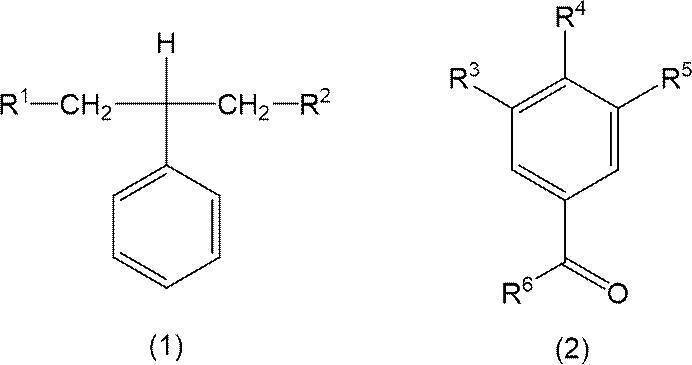
R1及びR2で表されるアルキル基は、直鎖状であっても、分岐鎖状であってもよい。
R1及びR2で表されるアルキル基に含まれる炭素数は特に制限されないが、本発明の効果がより優れる点で、2~10が好ましく、3~8がより好ましい。
R3及びR5で表されるアルキル基は、直鎖状であっても、分岐鎖状であってもよい。
R3及びR5で表されるアルキル基に含まれる炭素数は特に制限されないが、本発明の効果がより優れる点で、1~10が好ましく、2~5がより好ましい。
R6は、水素原子又はアルコキシ基を表す。
R6で表されるアルコキシ基に含まれる炭素数は特に制限されないが、本発明の効果がより優れる点で、3~10が好ましく、4~8がより好ましい。
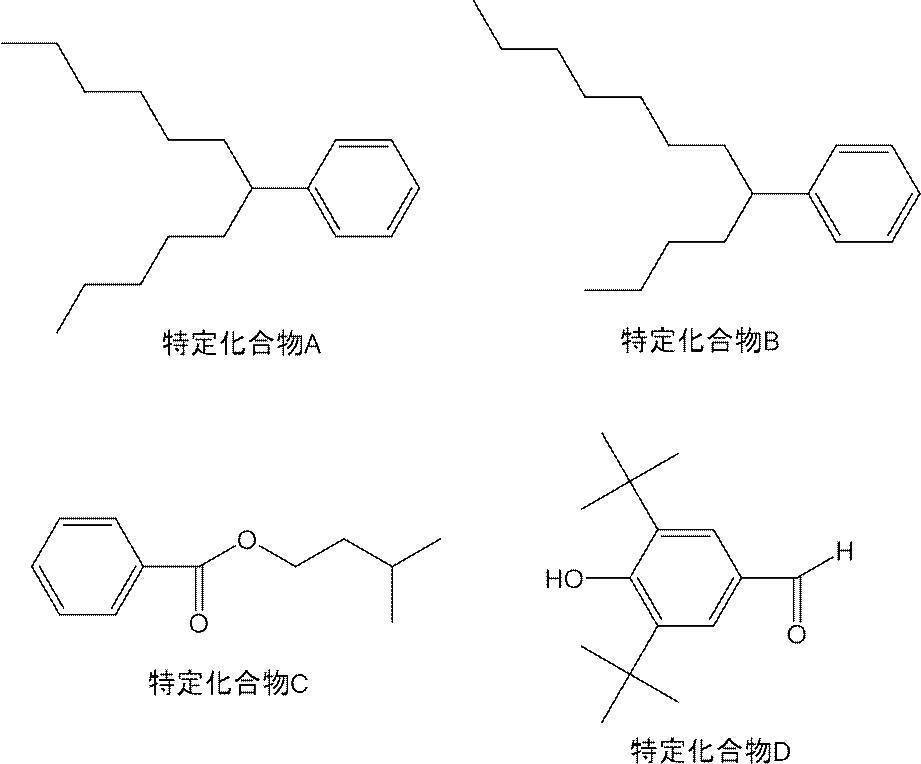
特定化合物として複数の化合物が薬液に含有される場合、その合計量が上記範囲である。
以下、他の成分について詳述する。
薬液は、金属成分を含有してもよい。
本発明において、金属成分としては、金属粒子及び金属イオンが挙げられ、例えば、金属成分の含有量という場合、金属粒子及び金属イオンの合計含有量を示す。
薬液は、金属粒子及び金属イオンのいずれか一方が含有してもよく、両方を含有してもよい。
金属粒子は、単体でも合金でもよい。
金属成分は、薬液に含まれる各成分(原料)に不可避的に含まれている金属成分でもよいし、薬液の製造、貯蔵、及び/又は、移送時に不可避的に含まれる金属成分でもよいし、意図的に添加してもよい。
ここで、SP-ICP-MS法とは、通常のICP-MS法(誘導結合プラズマ質量分析法)と同様の装置を使用し、データ分析のみが異なる。SP-ICP-MS法のデータ分析は、市販のソフトウェアにより実施できる。
ICP-MS法では、測定対象とされた金属成分の含有量が、その存在形態に関わらず、測定される。従って、測定対象とされた金属粒子と、金属イオンとの合計質量が、金属成分の含有量として定量される。
SP-ICP-MS法の装置としては、例えば、アジレントテクノロジー社製、Agilent 8800 トリプル四重極ICP-MS(inductively coupled plasma mass spectrometry、半導体分析用、オプション#200)が挙げられ、実施例に記載した方法により測定できる。上記以外の他の装置としては、PerkinElmer社製 NexION350Sのほか、アジレントテクノロジー社製、Agilent 8900も使用できる。
上記薬液の製造方法は特に制限されず、公知の製造方法が挙げられる。
例えば、アルコール系溶剤に特定化合物を所定量添加して薬液を製造してもよいし、市販品を購入して精製処理を施して薬液を製造してもよい。なかでも、薬液の製造方法としては、被精製物を蒸留する工程(蒸留工程)、及び、被精製物をろ過する工程(ろ過工程)の少なくとも一方を含有する方法が挙げられる。なお、被精製物としては、市販品のアルコール系溶剤が挙げられる。市販品には不純物が含まれる場合が多く、例えば、アルコール系溶剤(特に、メチルイソブチルカルビノール)の不純物として特定化合物が過剰に含まれる場合がある。
以下、上記蒸留工程及びろ過工程の手順について詳述する。
蒸留工程は、被精製物(例えば、アルコール系溶剤及び特定化合物を含有する溶液)を蒸留して、蒸留済み被精製物を得る工程である。
被精製物を蒸留する方法は特に制限されず、公知の方法が使用できる。典型的には、後述するろ過工程に供される精製装置の一次側に、蒸留塔を配置し、蒸留された被精製物を製造タンクに導入する方法が挙げられる。
このとき、蒸留塔の接液部は特に制限されないが、後述する耐腐食材料で形成されるのが好ましい。
蒸留塔としては、棚段式蒸留塔、及び、減圧棚段式が挙げられる。
また、蒸留時の熱的な安定性と精製の精度とを両立する目的で、減圧蒸留を実施してもよい。
ろ過工程は、フィルターを用いて上記被精製物をろ過する工程である。
フィルターを用いて被精製物をろ過する方法は特に制限されないが、ハウジングと、ハウジングに収納されたフィルターカートリッジと、を有するフィルターユニットに、被精製物を加圧又は無加圧で通過させる(通液する)のが好ましい。
なお、本明細書において、フィルターの細孔径とは、イソプロパノールのバブルポイントによって決定される細孔径を意味する。
中でも、より優れた耐溶剤性を有し、得られる薬液がより優れた欠陥抑制性能を有する点で、ナイロン(中でも、6,6-ナイロンが好ましい)、ポリオレフィン(中でも、ポリエチレンが好ましい)、ポリ(メタ)アクリレート、及び、フッ素系樹脂(中でも、ポリテトラフルオロエチレン(PTFE)、又は、パーフルオロアルコキシアルカン(PFA)が好ましい。)からなる群から選択される少なくとも1種が好ましい。これらの重合体は単独で又は二種以上を組み合わせて使用できる。
また、樹脂以外にも、ケイソウ土、及び、ガラス等であってもよい。
他にも、ポリオレフィン(後述するUPE(超高分子量ポリエチレン)等)にポリアミド(例えば、ナイロン-6又はナイロン-6,6等のナイロン)をグラフト共重合させたポリマー(ナイロングラフトUPE等)をフィルターの材料としてもよい。
すなわち、フィルターとしては、イオン交換基を有するフィルターを用いてもよい。
イオン交換基としては、カチオン交換基及びアニオン交換基が挙げられ、カチオン交換基として、スルホン酸基、カルボキシ基、及び、リン酸基が挙げられ、アニオン交換基として、4級アンモニウム基が挙げられる。イオン交換基をフィルターに導入する方法は特に制限されないが、イオン交換基と重合性基とを含有する化合物をフィルターと反応させる方法(典型的にはグラフト化する方法)が挙げられる。
イオン交換基を有するフィルターの細孔径は特に制限されないが、1~30nmが好ましく、5~20nmがより好ましい。
例えば、樹脂等の粉末を焼結して形成すれば多孔質膜が得られ、エレクトロスピニング、エレクトロブローイング、及び、メルトブローイング等の方法により形成すれば繊維膜が得られる。これらは、それぞれ細孔構造が異なる。
多孔質膜における細孔の大きさの分布とその膜中における位置の分布は、特に制限されない。大きさの分布がより小さく、かつ、その膜中における分布位置が対称であってもよい。また、大きさの分布がより大きく、かつ、その膜中における分布位置が非対称であってもよい(上記の膜を「非対称多孔質膜」ともいう。)。非対称多孔質膜では、孔の大きさは膜中で変化し、典型的には、膜一方の表面から膜の他方の表面に向かって孔径が大きくなる。このとき、孔径の大きい細孔が多い側の表面を「オープン側」といい、孔径が小さい細孔が多い側の表面を「タイト側」ともいう。
また、非対称多孔質膜としては、例えば、細孔の大きさが膜の厚さ内のある位置においてで最小となる膜(これを「砂時計形状」ともいう。)が挙げられる。
未洗浄のフィルター(又は十分な洗浄がされていないフィルター)を使用する場合、フィルターが含有する不純物が薬液に持ち込まれやすい。
また、同一のフィルターに被精製物を複数回通過させてもよく、同種のフィルターの複数に、被精製物を通過させてもよい。
また、本発明の薬液が製造しやすい点で、フッ素系樹脂を含有するフィルターを用いることが好ましい。なかでも、上記フッ素系樹脂を含有するフィルターは、複数枚使用する多段ろ過が好ましい。上記フッ素系樹脂を含有するフィルターとしては、細孔径が20nm以下のフィルターが好ましい。
なかでも、本発明の薬液が製造しやすい点で、孔径100nm以上のフィルターを用いて被精製物をろ過する第1ろ過工程と、孔径10nm以下のフッ素系樹脂を含有するフィルター(好ましく、PTFEからなるフィルター)を用いて被精製物をろ過する第2ろ過工程とをこの順で実施することが好ましい。第1ろ過工程において、粗大粒子が除去される。
非金属材料としては、例えば、ポリエチレン樹脂、ポリプロピレン樹脂、ポリエチレン-ポリプロピレン樹脂、並びに、フッ素系樹脂(例えば、四フッ化エチレン樹脂、四フッ化エチレン-パーフルオロアルキルビニルエーテル共重合樹脂、四フッ化エチレン-六フッ化プロピレン共重合樹脂、四フッ化エチレン-エチレン共重合樹脂、三フッ化塩化エチレン-エチレン共重合樹脂、フッ化ビニリデン樹脂、三フッ化塩化エチレン共重合樹脂、及び、フッ化ビニル樹脂等)からなる群から選択される少なくとも1種が挙げられる。
金属材料としては、例えば、クロム及びニッケルの含有量の合計が金属材料全質量に対して25質量%超である金属材料が挙げられ、中でも、30質量%以上がより好ましい。金属材料におけるクロム及びニッケルの含有量の合計の上限値は特に制限されないが、一般に90質量%以下が好ましい。
金属材料としては、例えば、ステンレス鋼、及びニッケル-クロム合金が挙げられる。
ニッケル-クロム合金としては、例えば、ハステロイ(商品名、以下同じ。)、モネル(商品名、以下同じ)、及び、インコネル(商品名、以下同じ)が挙げられる。より具体的には、ハステロイC-276(Ni含有量63質量%、Cr含有量16質量%)、ハステロイ-C(Ni含有量60質量%、Cr含有量17質量%)、及び、ハステロイC-22(Ni含有量61質量%、Cr含有量22質量%)が挙げられる。
また、ニッケル-クロム合金は、必要に応じて、上記した合金の他に、更に、ホウ素、ケイ素、タングステン、モリブデン、銅、及び、コバルト等を含有していてもよい。
なお、金属材料はバフ研磨されていてもよい。バフ研磨の方法は特に制限されず、公知の方法を使用できる。バフ研磨の仕上げに用いられる研磨砥粒のサイズは特に制限されないが、金属材料の表面の凹凸がより小さくなりやすい点で、#400以下が好ましい。なお、バフ研磨は、電解研磨の前に行われるのが好ましい。
上記薬液は、容器に収容されて使用時まで保管してもよい。このような容器と、容器に収容された薬液とをあわせて薬液収容体という。保管された薬液収容体からは、薬液が取り出され使用される。
使用可能な容器は特に制限されないが、例えば、アイセロ化学(株)製の「クリーンボトル」シリーズ、及び、コダマ樹脂工業製の「ピュアボトル」等が挙げられる。
なお、上記空隙率は、式(1)に従って計算される。
式(1):空隙率={1-(容器内の薬液の体積/容器の容器体積)}×100
上記容器体積とは、容器の内容積(容量)と同義である。
空隙率をこの範囲に設定することで、不純物等のコンタミを制限する事で保管安定性を確保できる。
本発明の薬液は、半導体デバイス(好ましくは、半導体チップ)の製造に用いられるのが好ましい。
また、上記薬液は、半導体デバイスの製造用以外の、他の用途にも使用でき、ポリイミド、センサー用レジスト、及び、レンズ用レジスト等の現像液、及び、リンス液としても使用できる。
また、上記薬液は、医療用途又は洗浄用途の溶剤としても使用できる。例えば、配管、容器、及び、基板(例えば、ウェハ、及び、ガラス等)等の洗浄に好適に使用できる。
上記洗浄用途としては、上述のプリウェット液等の液が接する配管及び容器等を洗浄する、洗浄液(配管洗浄液及び容器洗浄液等)として使用するのも好ましい。
本発明の薬液は、リンス液として用いられることが好ましく、レジストパターンを形成する際のリンス液に用いられるのがより好ましい。
具体的には、以下の工程A~Eを有するレジストパターン形成方法において、リンス液として上記薬液を用いることが好ましい。なお、工程Eは任意の工程であり、実施しなくてもよい。なお、工程Eを実施しない場合は、工程Dでは、上述した本発明の薬液を用いて現像された膜(工程Cで得られた膜)を洗浄する工程に該当する。
工程A:感活性光線性又は感放射線性樹脂組成物を用いて基板上に膜を形成する工程
工程B:膜を露光する工程
工程C:アルカリ現像液を用いて露光した膜を現像する工程
工程E:水を用いて現像された膜を洗浄する工程
工程D:上述した本発明の薬液を用いて工程Dで洗浄された膜を洗浄する工程
なお、後述するように、工程Aと、工程Bとの間には加熱工程(PB;Prebake)が、工程(B)と工程(C)との間には加熱工程(PEB;Post Exposure Bake)を、それぞれ実施してもよい。
以下においては、これらの工程について説明する。
工程Aは、感活性光線性又は感放射線性樹脂組成物を用いて基板上に膜を形成する工程である。
感活性光線性又は感放射線性樹脂組成物については、後段で詳述する。
感活性光線性又は感放射線性樹脂組成物を用いて基板上に膜を形成する方法は特に制限されず、公知の方法を採用できる。なかでも、膜の厚みの調整がより容易である観点から、基板上に感活性光線性又は感放射線性樹脂組成物を塗布して、膜を形成する方法が挙げられる。
なお、塗布の方法は特に制限されず、公知の方法を採用できる。なかでも、半導体製造分野においてはスピンコートが好ましく用いられる。
また、感活性光線性又は感放射線性樹脂組成物を塗布後、必要に応じて、溶剤を除去するための乾燥処理を実施してもよい。乾燥処理の方法は特に制限されず、加熱処理または風乾処理等が挙げられる。
更に、必要に応じて有機反射防止膜を膜と基板の間に配置してもよい。
好ましい後退接触角を実現する為には、疎水性樹脂を上記感活性光線性又は放射線性組成物に含ませることが好ましい。あるいは、レジスト膜の上に、疎水性の樹脂組成物によるコーティング層(いわゆる「トップコート」)を形成することにより後退接触角を向上させてもよい。トップコートとしては本分野で公知のものを適宜使用することができる。
また、トップコートとしては、特開2013-061647号公報、特にその実施例表3のOC-5~OC-11に記載されているような、樹脂だけでなく塩基性化合物(クエンチャー)も含有するトップコートを適用することも好ましい。
レジスト膜の厚みは特に制限されないが、より高精度な微細パターンを形成することができる理由から、1~500nmであることが好ましく、1~100nmであることがより好ましい。
レジストパターン形成方法は、製膜後、後述する工程Bの前に、前加熱工程(PB;Prebake)を有することも好ましい。
加熱温度は70~130℃が好ましく、80~120℃がより好ましい。加熱時間は30~300秒が好ましく、30~180秒がより好ましい。
加熱は通常の露光機及び/又は現像機に備わっている手段で行うことができ、ホットプレート等を用いて行ってもよい。ベークにより露光部の反応が促進され、感度及び/又はパターンプロファイルが改善する。
工程Bは、工程Aで形成された膜を露光する工程である。より具体的には、所望のパターンが形成されるように、膜を選択的に露光する工程である。これにより、膜がパターン状に露光され、露光された部分のみレジスト膜の溶解性が変化する。
なお、「露光する」とは、活性光線又は放射線を照射することを意図する。
バイナリーマスクは、一般的には石英ガラス基板上に、遮光部としてクロム膜、及び/又は、酸化クロム膜等が形成されたものが用いられる。
ハーフトーン型位相シフトマスクは、一般的には石英ガラス基板上に、遮光部としてMoSi(モリブデン・シリサイド)膜、クロム膜、酸化クロム膜、及び/又は、酸窒化シリコン膜等が形成されたものが用いられる。
なお、本発明では、フォトマスクを介して行う露光に制限されず、フォトマスクを介さない露光、例えば、電子線等による描画により選択的露光(パターン露光)を行ってもよい。
本工程は複数回の露光を含んでいてもよい。
露光の好適な態様として、例えば、液浸露光が挙げられる。液浸露光を用いることで、より微細なパターンを形成できる。なお、液浸露光は、位相シフト法及び変形照明法等の超解像技術と組み合わせることが可能である。
液浸液として水を用いる場合、水の表面張力を減少させると共に界面活性力を増大させる添加剤(液体)を僅かな割合で添加してもよい。この添加剤はレジスト膜を溶解させず、かつレンズ素子の下面の光学コートに対する影響が無視できるものが好ましい。
このような添加剤としては、例えば、水とほぼ等しい屈折率を有する脂肪族系のアルコールが好ましく、具体的には、メチルアルコール、エチルアルコール、及び、イソプロピルアルコールが挙げられる。水とほぼ等しい屈折率を有するアルコールを液浸液に添加することにより、水中のアルコール成分が蒸発して含有濃度が変化しても、液体全体としての屈折率変化を極めて小さくできるといった利点が得られる。
使用する水としては、蒸留水が好ましい。更に、イオン交換フィルター等を通して濾過を行った純水を用いてもよい。
液浸液として用いる水は、電気抵抗が18.3MΩcm以上であることが好ましい。又は、水中のTOC(有機物濃度)が20質量ppb以下であることが好ましい。また、水は、脱気処理されていることが好ましい。
また、液浸液の屈折率を高めることにより、リソグラフィー性能を高めることが可能である。このような観点から、屈折率を高めるような添加剤を水に加えたり、水の代わりに重水(D2O)を用いたりしてもよい。
レジストパターン形成方法は、上記工程Bの後かつ工程Cの前に、露光後加熱工程(PEB;Post Exposure Bake)を有することが好ましい。
加熱温度は70~130℃で行うことが好ましく、80~120℃で行うことがより好ましい。加熱時間は30~300秒間が好ましく、30~180秒間がより好ましく、30~90秒が更に好ましい。
加熱は通常の露光・現像機に備わっている手段で行うことができ、ホットプレート等を用いて行ってもよい。ベークにより露光部の反応が促進され、感度又はパターンプロファイルが改善する。
工程Cは、アルカリ現像液を用いて露光した膜を現像する工程である。本工程を実施することにより、所望のパターンが形成される。本方法により、露光強度の強い部分が除去される。
アルカリ現像液のアルカリ濃度は、0.1~20質量%が好ましく、本発明の効果がより優れる点で、0.75~15質量%がより好ましく、0.75~7.5質量%が更に好ましい。
アルカリ現像液のpHは、10.0~15.0が好ましい。
キレート剤は、金属イオンとキレート化する機能を有する化合物である。中でも、1分子中に金属イオンと配位結合する官能基(配位基)を2つ以上有する化合物が好ましい。
配位基としては、カルボキシル基等が挙げられる。
キレート剤が有する配位基としては、例えば、酸基及びカチオン性基が挙げられる。酸基としては、例えば、カルボキシ基、ホスホン酸基、スルホ基、及び、フェノール性ヒドロキシ基が挙げられる。
有機系キレート剤は、有機化合物からなるキレート剤であり、例えば、配位基としてカルボキシ基を有するカルボン酸系キレート剤、及び、配位基としてホスホン酸基を有するホスホン酸系キレート剤が挙げられ、カルボン酸系キレート剤が好ましい。
無機系キレート剤としては、縮合リン酸塩が挙げられる。
カルボン酸系キレート剤は、分子内に配位基としてカルボキシ基を有するキレート剤であり、例えば、アミノポリカルボン酸系キレート剤(例えば、ブチレンジアミン四酢酸、及び、ジエチレントリアミン五酢酸等)、アミノ酸系キレート剤(例えば、グリシン等)、ヒドロキシカルボン酸系キレート剤(例えば、リンゴ酸、及び、クエン酸等)、及び、脂肪族カルボン酸系キレート剤(例えば、シュウ酸、及び、マロン酸等)が挙げられる。
アルカリ現像液に含有される界面活性剤は特に制限されないが、カチオン系界面活性剤、アニオン系界面活性剤、及び、ノニオン系界面活性剤が挙げられ、アニオン系界面活性剤、又は、ノニオン系界面活性剤が好ましい。
界面活性剤の含有量は、アルカリ現像液全質量に対して、0.001~5質量%が好ましく、0.005~2質量%がより好ましく、0.01~0.5質量%が更に好ましい。
吐出される現像液の吐出圧を上記の範囲とすることにより、現像後のレジスト残渣に由来するパターンの欠陥を著しく低減できる。
このメカニズムの詳細は定かではないが、恐らくは、吐出圧を上記範囲とすることで、現像液がレジスト膜に与える圧力が小さくなり、レジスト膜・レジストパターンが不用意に削られたり崩れたりすることが抑制されるためと考えられる。
なお、現像液の吐出圧(mL/sec/mm2)は、現像装置中の現像ノズル出口における値である。
工程Eは、水を用いて現像された膜を洗浄する工程である。上述したように、工程Eは任意の工程であり、工程Eを実施することにより、本発明の効果がより優れる。
使用される水の種類は特に制限されず、半導体工程で一般的に使用される超純水が好ましい。
洗浄処理の方法は特に制限されず、例えば、一定速度で回転している基板上に水を吐出しつづける方法(回転塗布法)、水が満たされた槽中に基板を一定時間浸漬する方法(ディップ法)、及び、基板表面に水を噴霧する方法(スプレー法)が挙げられる。
この中でも回転塗布方法で洗浄処理を行い、洗浄後に基板を2000~4000rpmの回転数で回転させ、水を基板上から除去する方法が好ましい。
工程Dは、本発明の薬液を用いて工程Eで洗浄された膜を洗浄する工程である。
使用される薬液は、上述した通りである。
洗浄処理の方法は特に制限されず、例えば、一定速度で回転している基板上に本発明の薬液を吐出しつづける方法(回転塗布法)、本発明の薬液が満たされた槽中に基板を一定時間浸漬する方法(ディップ法)、及び、基板表面に本発明の薬液を噴霧する方法(スプレー法)が挙げられる。
乾燥処理の方法としては、加熱処理(Post Bake)が挙げられる。
本工程を実施することにより、パターン間及びパターン内部に残留した現像液及びリンス液等が除去される。
乾燥処理として加熱処理を実施する場合、加熱処理の際の加熱温度は、40~250℃が好ましく、150~220℃がより好ましい。加熱時間は、10秒間~10分間が好ましく、100~360秒間がより好ましい。
上記パターン形成方法で用いられる感活性光線性又は感放射線性樹脂組成物(以下、単に「組成物」ともいう。)には、酸の作用により極性が増大する樹脂(A)と、光酸発生剤(P)とが少なくとも含有される。
以下、感活性光線性又は感放射線性樹脂組成物に含有され得る成分について詳述する。
感活性光線性又は感放射線性樹脂組成物は、酸の作用により極性が増大する樹脂(A)を含有する。
樹脂(A)は、酸分解性基を有する繰り返し単位(A-a)(以下、単に「繰り返し単位(A-a)」とも記載する)を有する。
酸分解性基とは、酸の作用により分解し、極性基を生じる基をいう。酸分解性基は、酸の作用により脱離する脱離基で極性基が保護された構造を有することが好ましい。つまり、樹脂(A)は、酸の作用により分解し、極性基を生じる基を有する繰り返し単位(A-a)を有する。この繰り返し単位(A-a)を有する樹脂は、酸の作用により極性が増大してアルカリ現像液に対する溶解度が増大し、有機溶剤に対する溶解度が減少する。
中でも、極性基としては、カルボキシル基、フェノール性水酸基、フッ素化アルコール基(好ましくはヘキサフルオロイソプロパノール基)、又は、スルホン酸基が好ましい。
式(Y1):-C(Rx1)(Rx2)(Rx3)
式(Y2):-C(=O)OC(Rx1)(Rx2)(Rx3)
式(Y3):-C(R36)(R37)(OR38)
式(Y4):-C(Rn)(H)(Ar)
中でも、Rx1~Rx3は、それぞれ独立に、直鎖状又は分岐鎖状のアルキル基を表すことが好ましく、Rx1~Rx3は、それぞれ独立に、直鎖状のアルキル基を表すことがより好ましい。
Rx1~Rx3の2つが結合して、単環又は多環を形成してもよい。
Rx1~Rx3のアルキル基としては、メチル基、エチル基、n-プロピル基、イソプロピル基、n-ブチル基、イソブチル基、及び、t-ブチル基等の炭素数1~4のアルキル基が好ましい。
Rx1~Rx3のシクロアルキル基としては、シクロペンチル基、及び、シクロヘキシル基等の単環のシクロアルキル基、並びに、ノルボルニル基、テトラシクロデカニル基、テトラシクロドデカニル基、及び、アダマンチル基等の多環のシクロアルキル基が好ましい。
Rx1~Rx3の2つが結合して形成されるシクロアルキル基としては、シクロペンチル基、及び、シクロヘキシル基等の単環のシクロアルキル基、並びに、ノルボルニル基、テトラシクロデカニル基、テトラシクロドデカニル基、及び、アダマンチル基等の多環のシクロアルキル基が好ましく、炭素数5~6の単環のシクロアルキル基がより好ましい。
Rx1~Rx3の2つが結合して形成されるシクロアルキル基は、例えば、環を構成するメチレン基の1つが、酸素原子等のヘテロ原子、又は、カルボニル基等のヘテロ原子を有する基で置き換わっていてもよい。
式(Y1)又は式(Y2)で表される基は、例えば、Rx1がメチル基又はエチル基であり、Rx2とRx3とが結合して上述のシクロアルキル基を形成している態様が好ましい。
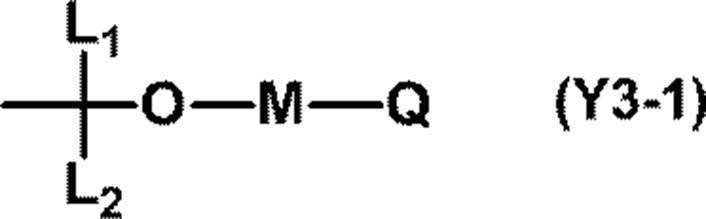
Mは、単結合又は2価の連結基を表す。
Qは、ヘテロ原子を有していてもよいアルキル基、ヘテロ原子を有していてもよいシクロアルキル基、ヘテロ原子を有していてもよいアリール基、アミノ基、アンモニウム基、メルカプト基、シアノ基、アルデヒド基、又は、これらを組み合わせた基(例えば、アルキル基とシクロアルキル基とを組み合わせた基)を表す。
アルキル基及びシクロアルキル基は、例えば、メチレン基の1つが、酸素原子等のヘテロ原子、又は、カルボニル基等のヘテロ原子を有する基で置き換わっていてもよい。
なお、L1及びL2のうち一方は水素原子であり、他方はアルキル基、シクロアルキル基、アリール基、又は、アルキレン基とアリール基とを組み合わせた基であることが好ましい。
Q、M、及び、L1の少なくとも2つが結合して環(好ましくは、5員もしくは6員環)を形成してもよい。
パターンの微細化の点では、L2が2級又は3級アルキル基であることが好ましく、3級アルキル基であることがより好ましい。2級アルキル基としては、イソプロピル基、シクロヘキシル基又はノルボルニル基が挙げられ、3級アルキル基としては、tert-ブチル基又はアダマンタン環基が挙げられる。これらの態様では、Tg(ガラス転移温度)及び活性化エネルギーが高くなるため、膜強度の担保に加え、かぶりの抑制ができる。

L1は、フッ素原子又はヨウ素原子を有していてもよい2価の連結基を表す。フッ素原子又はヨウ素原子を有していてもよい2価の連結基としては、-CO-、-O-、-S-、-SO-、-SO2-、フッ素原子又はヨウ素原子を有していてもよい炭化水素基(例えば、アルキレン基、シクロアルキレン基、アルケニレン基、アリーレン基等)、及び、これらの複数が連結した連結基等が挙げられる。中でも、L1としては、-CO-、-アリーレン基-フッ素原子又はヨウ素原子を有するアルキレン基-が好ましい。
アリーレン基としては、フェニレン基が好ましい。
アルキレン基は、直鎖状であっても、分岐鎖状であってもよい。アルキレン基の炭素数は特に制限されないが、1~10が好ましく、1~3がより好ましい。
フッ素原子又はヨウ素原子を有するアルキレン基に含まれるフッ素原子及びヨウ素原子の合計数は特に制限されないが、2以上が好ましく、2~10がより好ましく、3~6が更に好ましい。
アルキル基は、直鎖状であっても、分岐鎖状であってもよい。アルキル基の炭素数は特に制限されないが、1~10が好ましく、1~3がより好ましい。
フッ素原子又はヨウ素原子を有するアルキル基に含まれるフッ素原子及びヨウ素原子の合計数は特に制限されないが、1以上が好ましく、1~5がより好ましく、1~3が更に好ましい。
上記アルキル基は、ハロゲン原子以外の酸素原子等のヘテロ原子を有していてもよい。
中でも、脱離基としては、式(Z1)~(Z4)で表される基が挙げられる。
式(Z1):-C(Rx11)(Rx12)(Rx13)
式(Z2):-C(=O)OC(Rx11)(Rx12)(Rx13)
式(Z3):-C(R136)(R137)(OR138)
式(Z4):-C(Rn1)(H)(Ar1)
Rx11~Rx13は、フッ素原子又はヨウ素原子を有していてもよい点以外は、上述した(Y1)、(Y2)中のRx1~Rx3と同じであり、アルキル基及びシクロアルキル基の定義及び好適範囲と同じである。
なお、上記アルキル基、シクロアルキル基、アリール基、及び、アラルキル基には、フッ素原子及びヨウ素原子以外に、酸素原子等のヘテロ原子が含まれていてもよい。つまり、上記アルキル基、シクロアルキル基、アリール基、及び、アラルキル基は、例えば、メチレン基の1つが、酸素原子等のヘテロ原子、又は、カルボニル基等のヘテロ原子を有する基で置き換わっていてもよい。
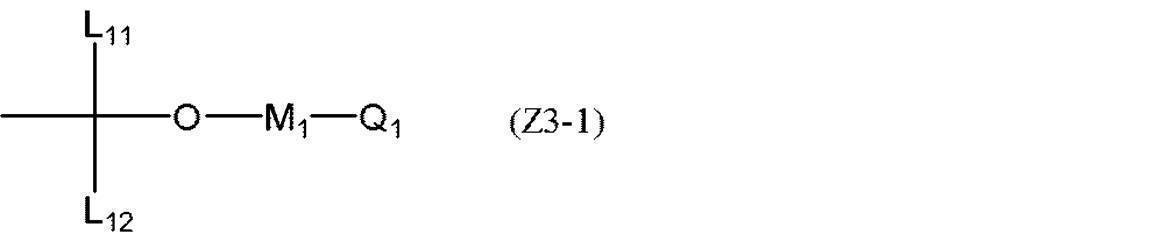
M1は、単結合又は2価の連結基を表す。
Q1は、フッ素原子、ヨウ素原子及び酸素原子からなる群より選択されるヘテロ原子を有していてもよいアルキル基;フッ素原子、ヨウ素原子及び酸素原子からなる群より選択されるヘテロ原子を有していてもよいシクロアルキル基;フッ素原子、ヨウ素原子及び酸素原子からなる群より選択されるアリール基;アミノ基;アンモニウム基;メルカプト基;シアノ基;アルデヒド基;又は、これらを組み合わせた基(例えば、フッ素原子、ヨウ素原子及び酸素原子からなる群より選択されるヘテロ原子を有していてもよい、アルキル基とシクロアルキル基とを組み合わせた基)を表す。
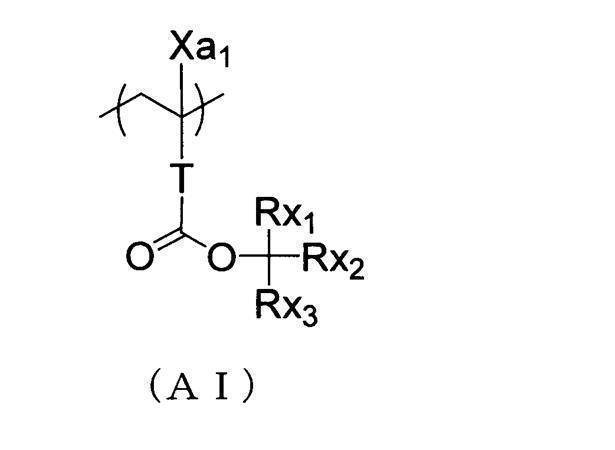
Xa1は、水素原子、又は、置換基を有していてもよいアルキル基を表す。
Tは、単結合、又は、2価の連結基を表す。
Rx1~Rx3は、それぞれ独立に、アルキル基(直鎖状、又は、分岐鎖状)、又は、シクロアルキル基(単環、又は、多環)を表す。ただし、Rx1~Rx3の全てがアルキル基(直鎖状、又は、分岐鎖状)である場合、Rx1~Rx3のうち少なくとも2つはメチル基であることが好ましい。
Rx1~Rx3の2つが結合して、シクロアルキル基(単環又は多環)を形成してもよい。
Tは、単結合又は-COO-Rt-基が好ましい。Tが-COO-Rt-基を表す場合、Rtは、炭素数1~5のアルキレン基が好ましく、-CH2-基、-(CH2)2-基、又は、-(CH2)3-基がより好ましい。
Rx1~Rx3のシクロアルキル基としては、シクロペンチル基、及び、シクロヘキシル基等の単環のシクロアルキル基、又は、ノルボルニル基、テトラシクロデカニル基、テトラシクロドデカニル基、及び、アダマンチル基等の多環のシクロアルキル基が好ましい。
Rx1~Rx3の2つが結合して形成されるシクロアルキル基としては、シクロペンチル基、及び、シクロヘキシル基等の単環のシクロアルキル基が好ましく、その他にも、ノルボルニル基、テトラシクロデカニル基、テトラシクロドデカニル基、及び、アダマンチル基等の多環のシクロアルキル基が好ましい。中でも、炭素数5~6の単環のシクロアルキル基が好ましい。
Rx1~Rx3の2つが結合して形成されるシクロアルキル基は、例えば、環を構成するメチレン基の1つが、酸素原子等のヘテロ原子、又は、カルボニル基等のヘテロ原子を有する基で置き換わっていてもよい。
一般式(AI)で表される繰り返し単位は、例えば、Rx1がメチル基又はエチル基であり、Rx2とRx3とが結合して上述のシクロアルキル基を形成している態様が好ましい。
繰り返し単位(A-a)の含有量(2種以上の繰り返し単位(A-a)が存在する場合は合計含有量)は、樹脂(A)中の全繰り返し単位に対し、15~80モル%が好ましく、20~70モル%がより好ましい。
また、樹脂(A)中において、酸の作用によって分解して、カルボキシ基を生じる繰り返し単位の含有量は、樹脂(A)中の全繰り返し単位に対して、25~70モル%が好ましい。
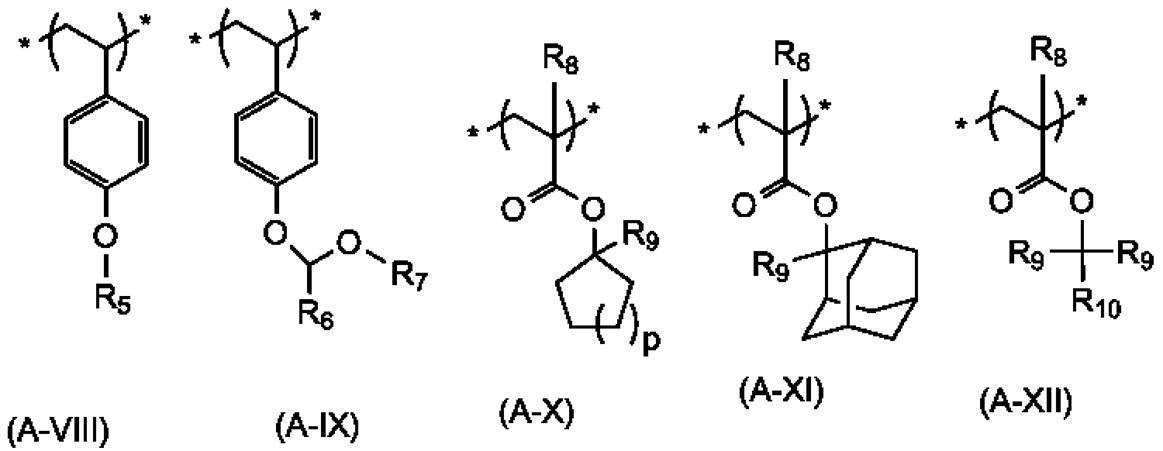
一般式(A-IX)中、R6及びR7は、それぞれ独立に、1価の有機基を表す。1価の有機基としては、アルキル基、シクロアルキル基、アリール基、アラルキル基、及び、アルケニル基等が挙げられる。
一般式(A-X)中、pは、1又は2を表す。
一般式(A-X)~(A-XII)中、R8は、水素原子又は炭素数1~3のアルキル基を表し、R9は、炭素数1~3のアルキル基を表す。
一般式(A-XII)中、R10は、炭素数1~3のアルキル基又はアダマンチル基を表す。
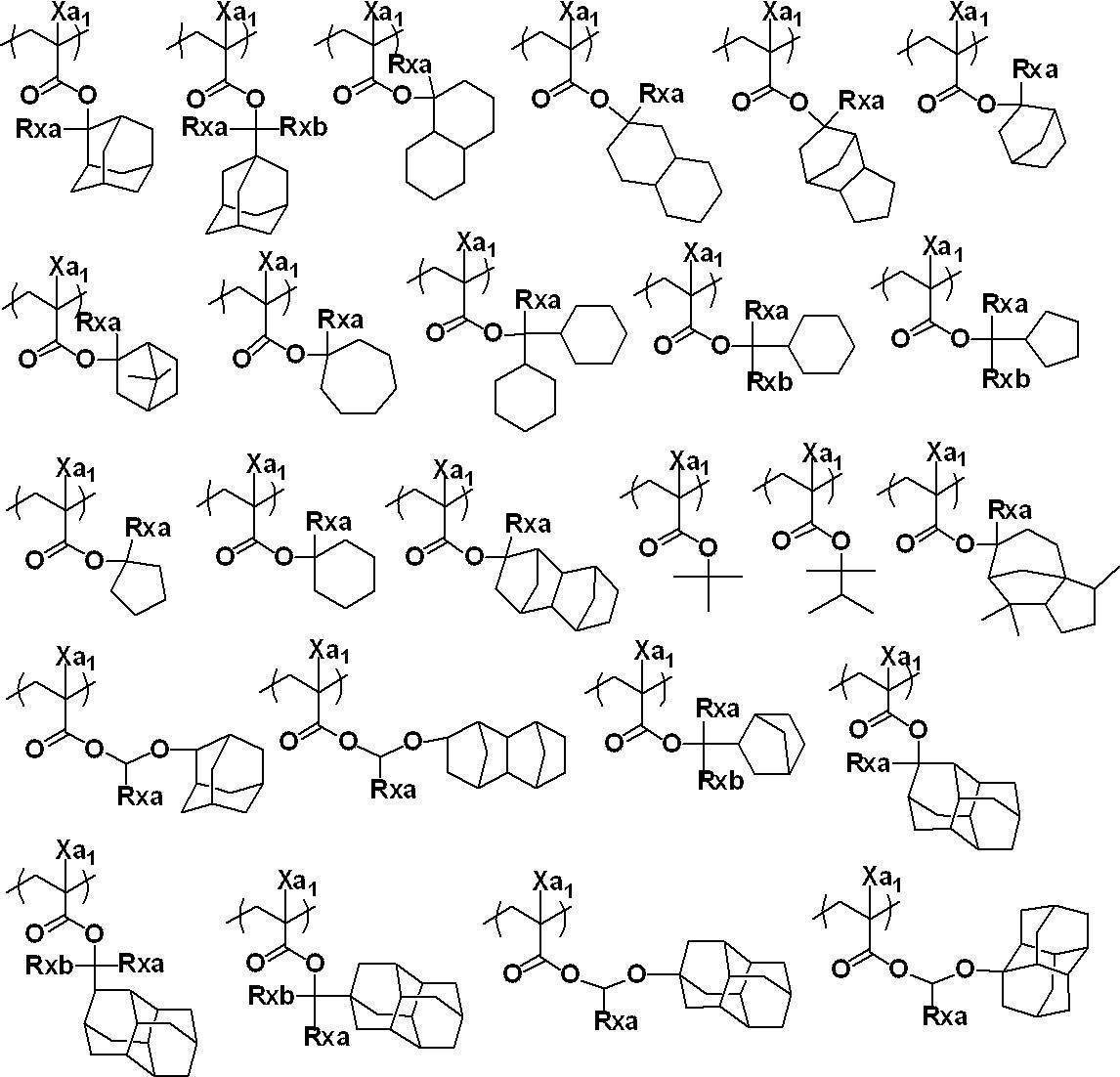


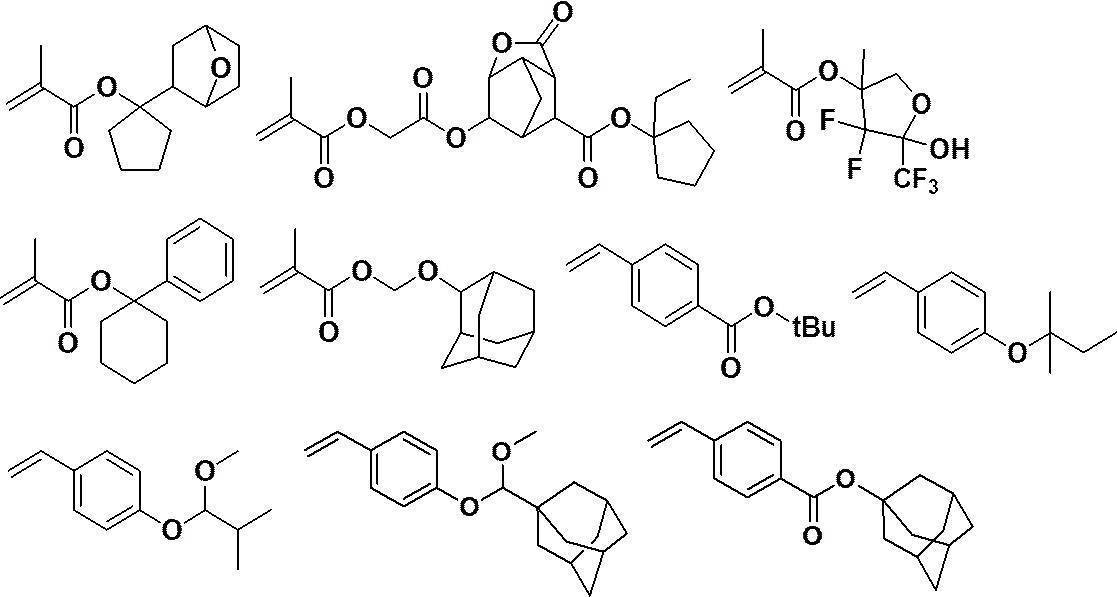
樹脂(A)は、酸基を有する繰り返し単位を有してもよい。
酸基を有する繰り返し単位としては、下記一般式(B)で表される繰り返し単位が好ましい。
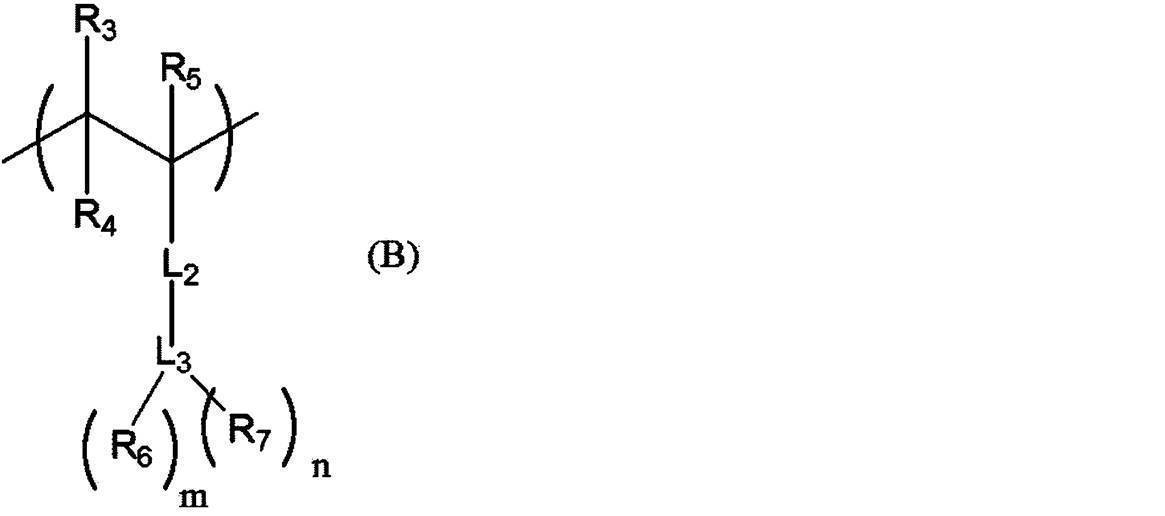
L3は、(n+m+1)価の芳香族炭化水素環基、又は、(n+m+1)価の脂環式炭化水素環基を表す。芳香族炭化水素環基としては、ベンゼン環基、及び、ナフタレン環基が挙げられる。脂環式炭化水素環基としては、単環であっても、多環であってもよく、例えば、シクロアルキル環基が挙げられる。
R6は、水酸基、又は、フッ素化アルコール基(好ましくは、ヘキサフルオロイソプロパノール基)を表す。なお、R6が水酸基の場合、L3は(n+m+1)価の芳香族炭化水素環基であることが好ましい。
R7は、ハロゲン原子を表す。ハロゲン原子としては、フッ素原子、塩素原子、臭素原子、又は、ヨウ素原子が挙げられる。
mは、1以上の整数を表す。mは、1~3の整数が好ましく、1~2の整数が好ましい。
nは、0又は1以上の整数を表す。nは、1~4の整数が好ましい。
なお、(n+m+1)は、1~5の整数が好ましい。

R41、R42及びR43は、それぞれ独立に、水素原子、アルキル基、シクロアルキル基、ハロゲン原子、シアノ基又はアルコキシカルボニル基を表す。但し、R42はAr4と結合して環を形成していてもよく、その場合のR42は単結合又はアルキレン基を表す。
X4は、単結合、-COO-、又は-CONR64-を表し、R64は、水素原子又はアルキル基を表す。
L4は、単結合又はアルキレン基を表す。
Ar4は、(n+1)価の芳香環基を表し、R42と結合して環を形成する場合には(n+2)価の芳香環基を表す。
nは、1~5の整数を表す。
一般式(I)におけるR41、R42、及び、R43のハロゲン原子としては、フッ素原子、塩素原子、臭素原子、及び、ヨウ素原子が挙げられ、フッ素原子が好ましい。
一般式(I)におけるR41、R42、及び、R43のアルコキシカルボニル基に含まれるアルキル基としては、上記R41、R42、R43におけるアルキル基と同様のものが好ましい。
X4により表わされる-CONR64-(R64は、水素原子又はアルキル基を表す)におけるR64のアルキル基としては、メチル基、エチル基、プロピル基、イソプロピル基、n-ブチル基、sec-ブチル基、ヘキシル基、2-エチルヘキシル基、オクチル基、及び、ドデシル基等の炭素数20以下のアルキル基が挙げられ、炭素数8以下のアルキル基が好ましい。
X4としては、単結合、-COO-、又は、-CONH-が好ましく、単結合、又は、-COO-がより好ましい。
Ar4としては、炭素数6~18の芳香環基が好ましく、ベンゼン環基、ナフタレン環基、及び、ビフェニレン環基がより好ましい。

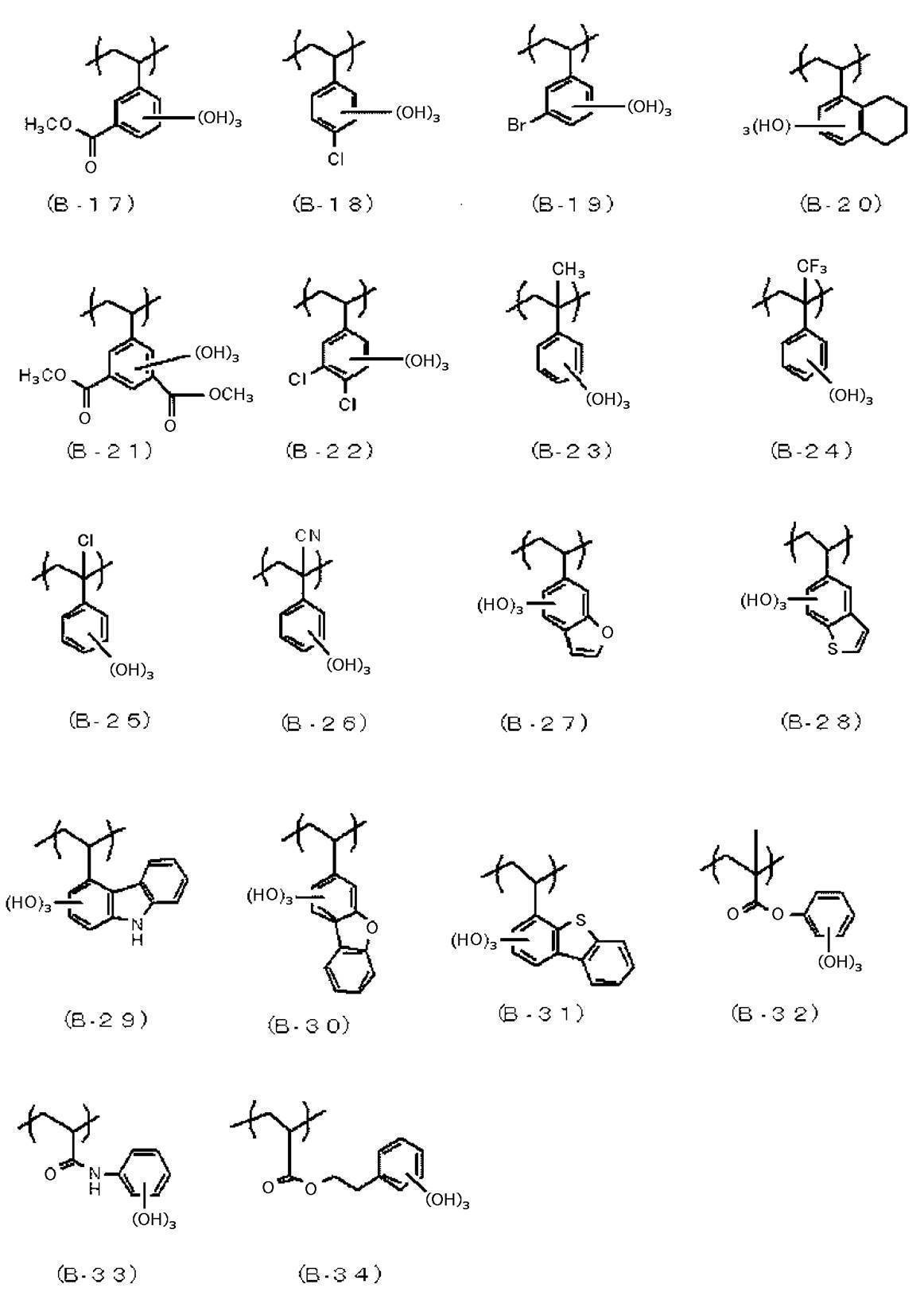

樹脂(A)は、酸基を有する繰り返し単位として、ヒドロキシスチレンに由来する繰り返し単位(A-1)を有することが好ましい。
ヒドロキシスチレンに由来する繰り返し単位(A-1)としては、下記一般式(1)で表される繰り返し単位が挙げられる。
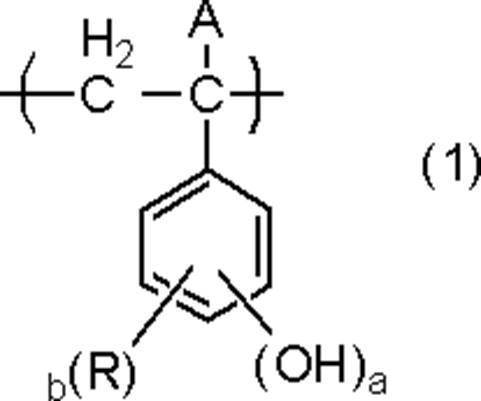
Aは水素原子、アルキル基、シクロアルキル基、ハロゲン原子、又はシアノ基を表す。
Rは、ハロゲン原子、アルキル基、シクロアルキル基、アリール基、アルケニル基、アラルキル基、アルコキシ基、アルキルカルボニルオキシ基、アルキルスルホニルオキシ基、アルキルオキシカルボニル基又はアリールオキシカルボニル基を表し、複数個ある場合には同じであっても異なっていてもよい。複数のRを有する場合には、互いに共同して環を形成していてもよい。Rとしては水素原子が好ましい。
aは1~3の整数を表し、bは0~(5-a)の整数を表す。

樹脂(A)は、ラクトン構造、カーボネート構造、スルトン構造、及びヒドロキシアダマンタン構造からなる群より選択される少なくとも1種を有する繰り返し単位(A-2)を有していてもよい。
ラクトン構造又はスルトン構造を有する繰り返し単位におけるラクトン構造又はスルトン構造は、特に制限されないが、5~7員環ラクトン構造又は5~7員環スルトン構造が好ましく、5~7員環ラクトン構造にビシクロ構造、スピロ構造を形成する形で他の環構造が縮環しているもの、又は5~7員環スルトン構造にビシクロ構造、スピロ構造を形成する形で他の環構造が縮環しているものがより好ましい。下記一般式(LC1-1)~(LC1-21)のいずれかで表されるラクトン構造、又は下記一般式(SL1-1)~(SL1-3)のいずれかで表されるスルトン構造を有する繰り返し単位を有することが更に好ましい。また、ラクトン構造又はスルトン構造が主鎖に直接結合していてもよい。好ましい構造としては一般式(LC1-1)、一般式(LC1-4)、一般式(LC1-5)、一般式(LC1-8)、一般式(LC1-16)、一般式(LC1-21)、又は、一般式(SL1-1)である。
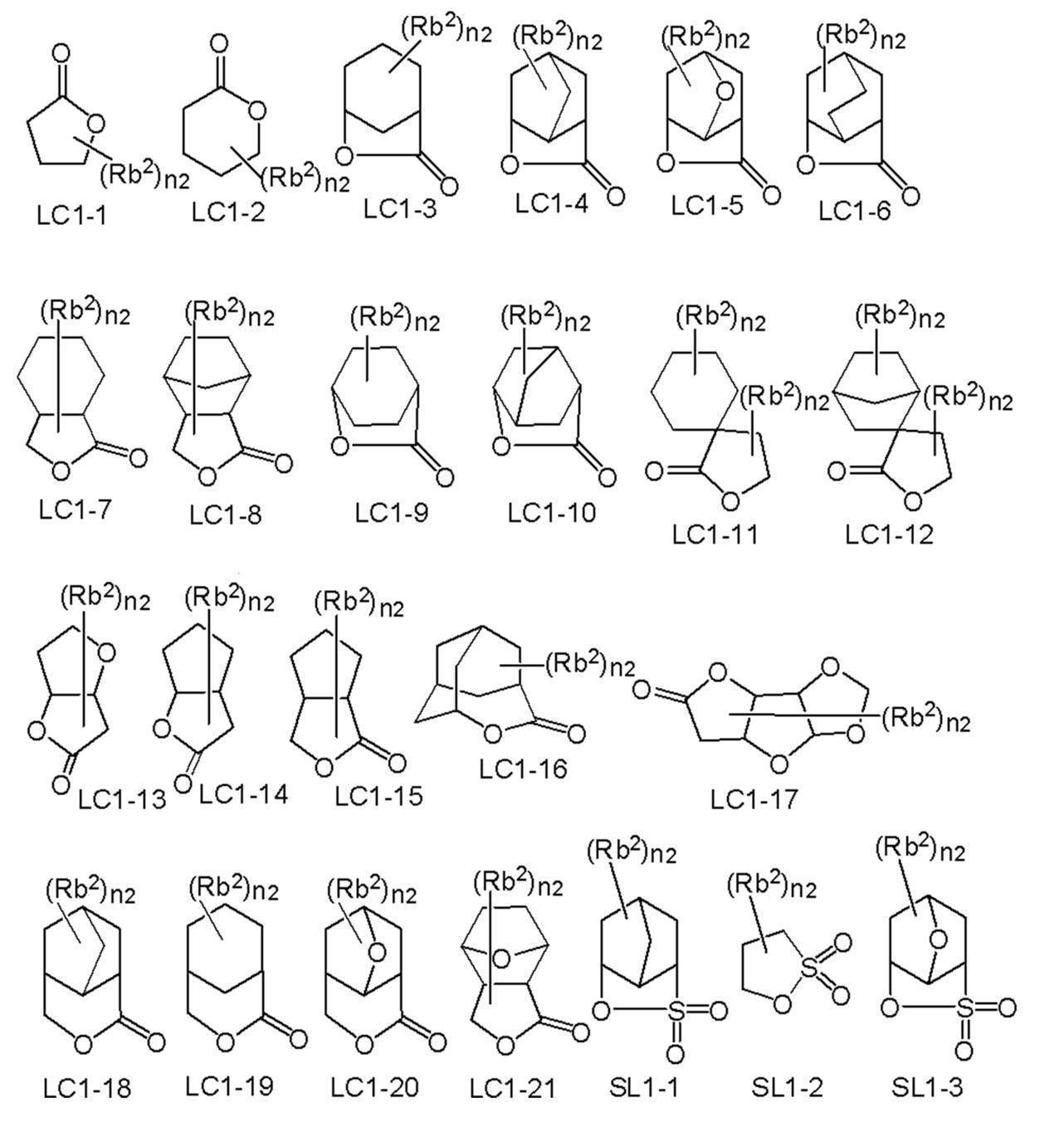
また、酸分解性基を有する繰り返し単位を有する樹脂は、焦点深度の許容度及びパターン直線性の観点から、下記式IIIで表される繰り返し単位を有することが好ましい。
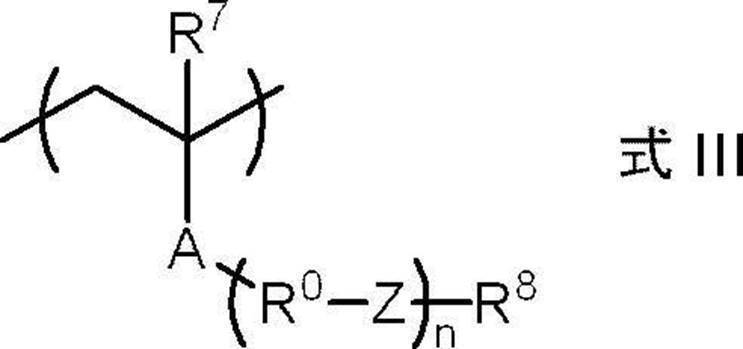
Aは、エステル結合(-COO-で表される基)又はアミド結合(-CONH-で表される基)を表す。
nは、-R0-Z-で表される構造の繰り返し数であり、0~5の整数を表し、0又は1であることが好ましく、0であることがより好ましい。nが0である場合、-R0-Z-は存在せず、AとR8とが単結合により結合される。
R0は、アルキレン基、シクロアルキレン基、又はその組み合わせを表す。R0は、複数個ある場合にはそれぞれ独立に、アルキレン基、シクロアルキレン基、又はその組み合わせを表す。
Zは、単結合、エーテル結合、エステル結合、アミド結合、ウレタン結合又はウレア結合を表す。Zは、複数個ある場合にはそれぞれ独立に、単結合、エーテル結合、エステル結合、アミド結合、ウレタン結合又はウレア結合を表す。
R8は、ラクトン構造又はスルトン構造を有する1価の有機基を表す。
R7は、水素原子、フッ素原子以外のハロゲン原子又は1価の有機基(好ましくはメチル基)を表す。
Zは好ましくは、エーテル結合、又はエステル結合であり、より好ましくはエステル結合である。

R2は、炭素数1~4のアルキル基、シアノ基、又は、-CO-O-R21を表す。R21は、炭素数1~4のアルキル基を表す。
X1は、単結合、炭素数1~3のアルキレン基、又は、-R3-CO-O-を表し、R3は、炭素数1~3のアルキレン基を表す。
mは、0又は1を表す。
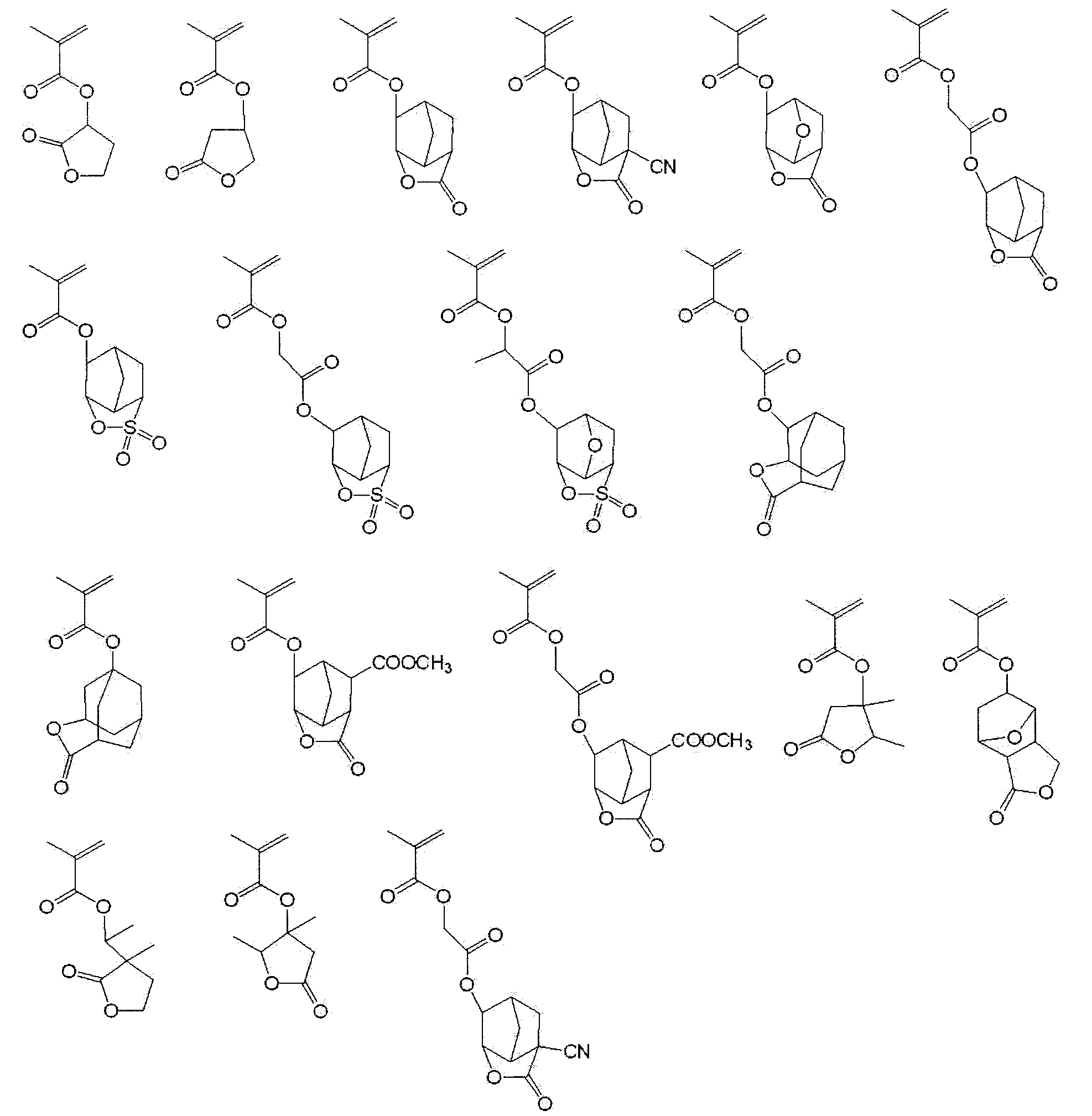
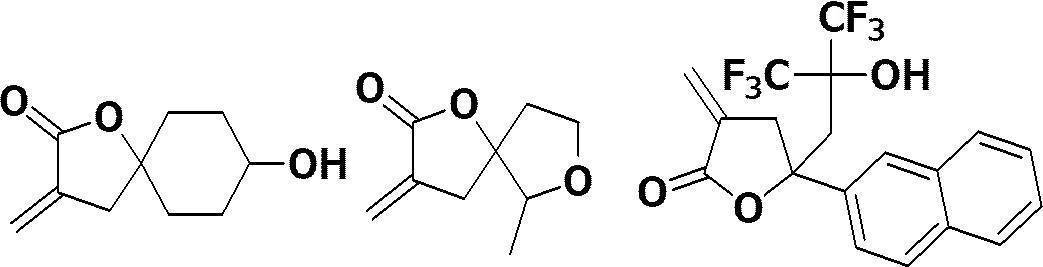
樹脂(A)は、カーボネート構造を有する繰り返し単位を有していてもよい。カーボネート構造は、環状炭酸エステル構造であることが好ましい。
環状炭酸エステル構造を有する繰り返し単位は、下記式A-1で表される繰り返し単位であることが好ましい。
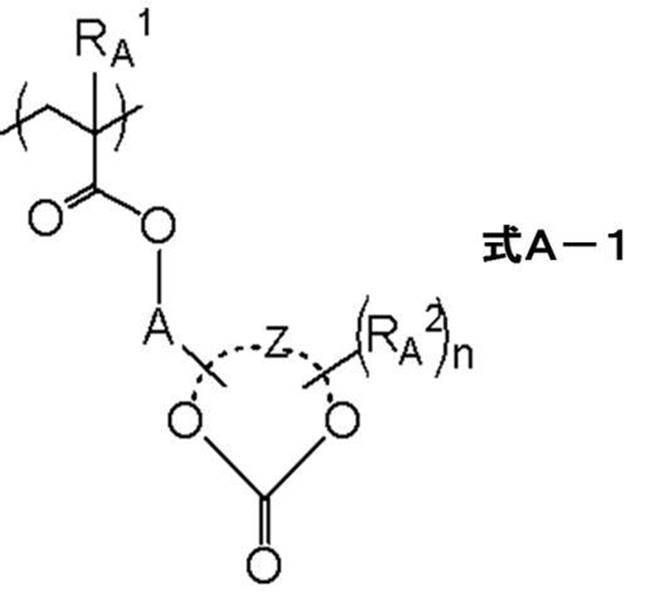
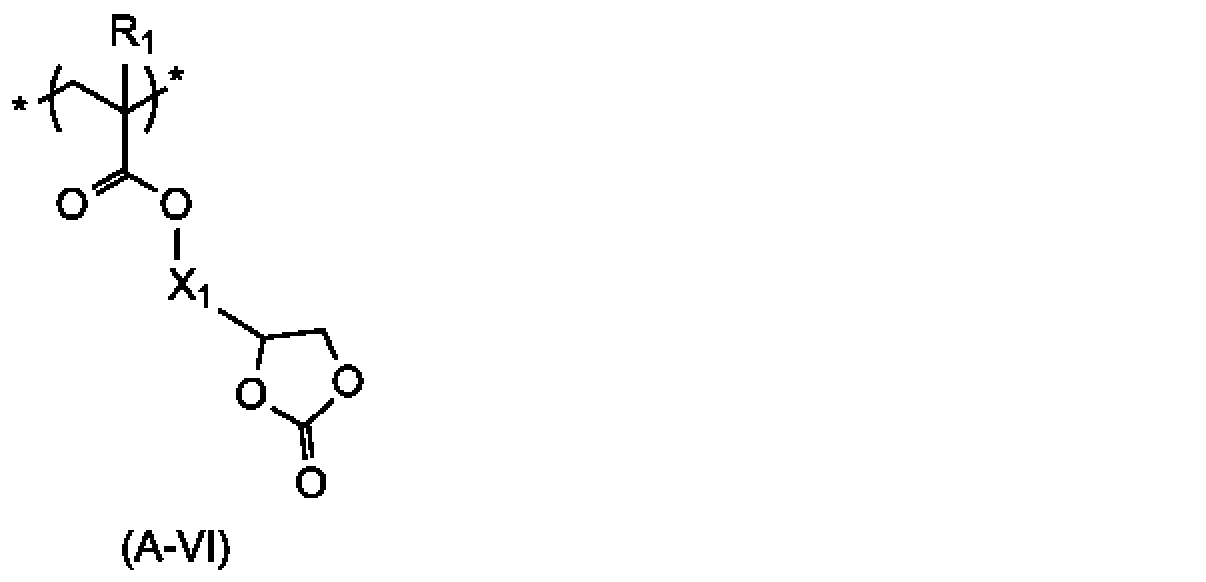
X1は、単結合、炭素数1~3のアルキレン基、又は、-R3-CO-O-を表し、R3は、炭素数1~3のアルキレン基を表す。
樹脂(A)は、ヒドロキシアダマンタン構造を有する繰り返し単位を有していてもよい。ヒドロキシアダマンタン構造を有する繰り返し単位としては、下記一般式(AIIa)で表される繰り返し単位が挙げられる。
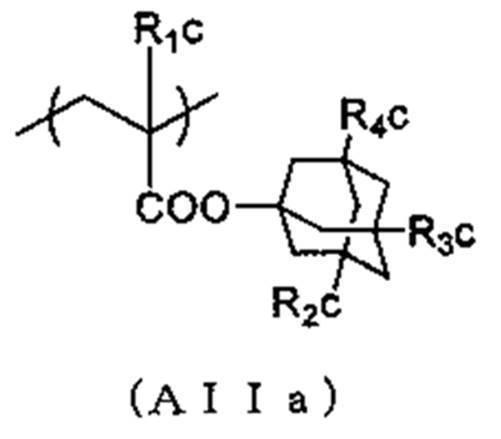
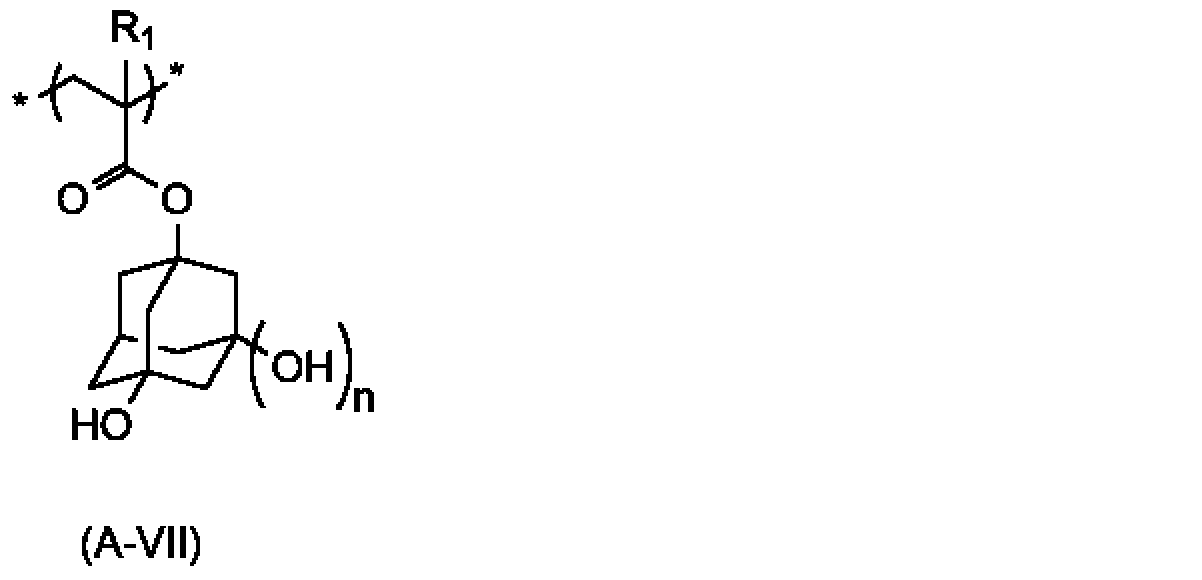

上記繰り返し単位(A-2)としては、ラクトン構造、カーボネート構造、スルトン構造及びヒドロキシアダマンタン構造からなる群より選択される少なくとも1種を含有する(メタ)アクリル酸エステルに由来する繰り返し単位が好ましい。
中でも、繰り返し単位(A-1)が、上述の一般式(A-I)で表される繰り返し単位であり、かつ、繰り返し単位(A-2)が、上述の一般式(A-II)~(A-VII)で表される繰り返し単位からなる群より選択される少なくとも1種を含有することが好ましい。
繰り返し単位(A-1)、繰り返し単位(A-2)及び一般式(A-I)~(A-VII)で表される繰り返し単位については、その好ましい態様も含めて、上述のとおりである。
樹脂(A)は、上述した酸分解性基を有する繰り返し単位(A-a)、酸基を有する繰り返し単位、及び繰り返し単位(A-2)以外の繰り返し単位を有していてもよい。
樹脂(A)は、フッ素原子又はヨウ素原子を有する繰り返し単位を有していてもよい。但し、フッ素原子又はヨウ素原子を有する繰り返し単位には、上述した酸分解性基を有する繰り返し単位(A-a)、酸基を有する繰り返し単位、及び繰り返し単位(A-2)は含まれない。
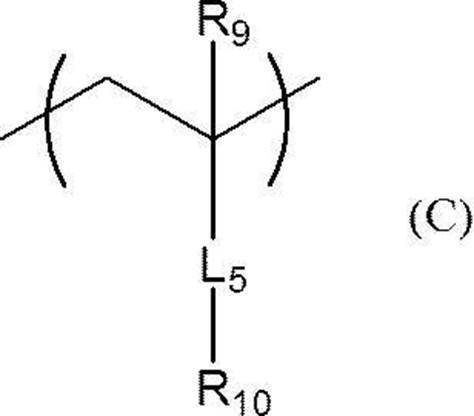
R9は、水素原子、又は、フッ素原子もしくはヨウ素原子を有していてもよいアルキル基を表す。
R10は、水素原子、フッ素原子もしくはヨウ素原子を有していてもよいアルキル基、フッ素原子もしくはヨウ素原子を有していてもよいシクロアルキル基、フッ素原子もしくはヨウ素原子を有していてもよいアリール基、又は、これらを組み合わせた基を表す。
樹脂(A)は、上記以外の繰り返し単位として、放射線の照射により酸を発生する基(以下「光酸発生基」とも言う)を有する繰り返し単位を有していてもよい。
この場合、この光酸発生基を有する繰り返し単位が、光酸発生剤(P)にあたると考えることができる。
このような繰り返し単位としては、例えば、下記一般式(4)で表される繰り返し単位が挙げられる。
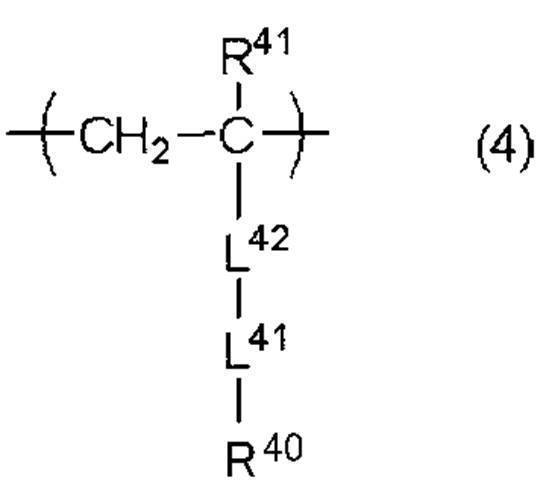

樹脂(A)は、アルカリ可溶性基を有する繰り返し単位を有していてもよい。
アルカリ可溶性基としては、カルボキシル基、スルホンアミド基、スルホニルイミド基、ビスルスルホニルイミド基、α位が電子吸引性基で置換された脂肪族アルコール(例えば、ヘキサフロロイソプロパノール基)が挙げられ、カルボキシル基が好ましい。樹脂(A)がアルカリ可溶性基を有する繰り返し単位を有することにより、コンタクトホール用途での解像性が増す。
アルカリ可溶性基を有する繰り返し単位としては、アクリル酸及びメタクリル酸による繰り返し単位のような樹脂の主鎖に直接アルカリ可溶性基が結合している繰り返し単位、又は、連結基を介して樹脂の主鎖にアルカリ可溶性基が結合している繰り返し単位が挙げられる。なお、連結基は、単環又は多環の環状炭化水素構造を有していてもよい。
アルカリ可溶性基を有する繰り返し単位としては、アクリル酸又はメタクリル酸による繰り返し単位が好ましい。
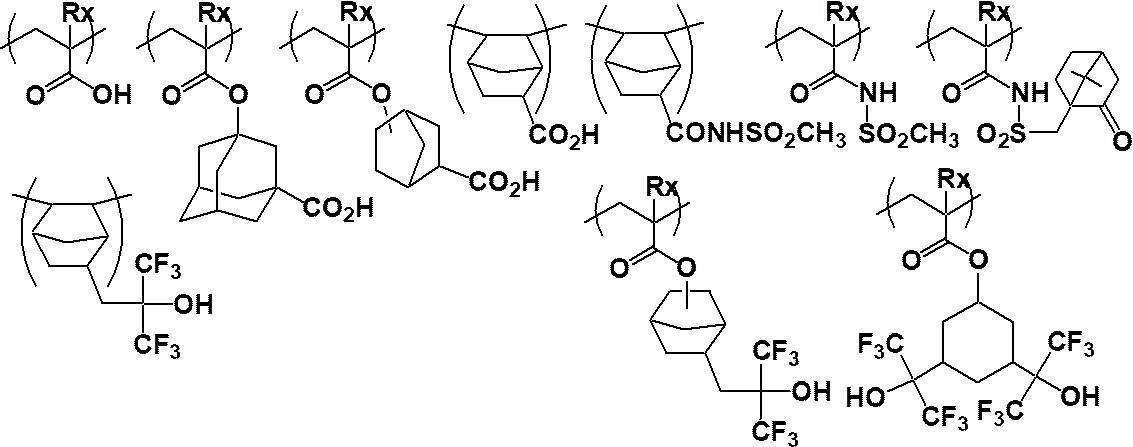
樹脂(A)は、更に、酸分解性基及び極性基のいずれも有さない繰り返し単位を有してもよい。酸分解性基及び極性基のいずれも有さない繰り返し単位は、脂環炭化水素構造を有することが好ましい。

酸分解性基及び極性基のいずれも有さない繰り返し単位の含有量は、樹脂(A)中の全繰り返し単位に対して、5~40モル%が好ましく、5~30モル%がより好ましく、5~25モル%が更に好ましい。
樹脂(A)としては、繰り返し単位のすべてが(メタ)アクリレート系モノマーに由来する繰り返し単位で構成されることが好ましい。この場合、繰り返し単位のすべてがメタクリレート系モノマーに由来するもの、繰り返し単位のすべてがアクリレート系モノマーに由来するもの、繰り返し単位のすべてがメタクリレート系モノマー及びアクリレート系モノマーに由来するもののいずれの樹脂でも用いることができる。アクリレート系モノマーに由来する繰り返し単位が、樹脂(A)中の全繰り返し単位に対して50モル%以下であることが好ましい。
また、組成物がArF露光用であるとき、樹脂(A)は、単環又は多環の脂環炭化水素構造を有することが好ましく、また、フッ素原子及び珪素原子のいずれも含まないことが好ましい。
フェノール性水酸基を有する繰り返し単位としては、上記ヒドロキシスチレン由来の繰り返し単位(A-1)、及び、ヒドロキシスチレン(メタ)アクリレート由来の繰り返し単位を挙げることができる。
また、組成物が、KrF露光用、EB露光用又はEUV露光用であるとき、樹脂(A)は、フェノール性水酸基の水素原子が酸の作用により分解し脱離する基(脱離基)で保護された構造を有する繰り返し単位を有することも好ましい。
組成物が、KrF露光用、EB露光用又はEUV露光用であるとき、樹脂(A)に含まれる芳香族炭化水素基を有する繰り返し単位の含有量は、樹脂(A)中の全繰り返し単位に対して、30~100モル%が好ましく、40~100モル%がより好ましく、50~100モル%が更に好ましい。
樹脂(A)の重量平均分子量(Mw)は、1,000~200,000が好ましく、3,000~20,000がより好ましく、5,000~15,000が更に好ましい。樹脂(A)の重量平均分子量(Mw)を、1,000~200,000とすることにより、耐熱性及びドライエッチング耐性の劣化を防ぐことができ、更に、現像性の劣化、及び、粘度が高くなって製膜性が劣化することを防ぐことができる。なお、樹脂(A)の重量平均分子量(Mw)は、上述のGPC法により測定されたポリスチレン換算値である。
樹脂(A)の分散度(分子量分布)は、通常1~5であり、1~3が好ましく、1.1~2.0がより好ましい。分散度が小さいものほど、解像度、及び、レジスト形状が優れ、更に、パターンの側壁がスムーズであり、ラフネス性に優れる。
また、樹脂(A)は、1種単独で使用してもよいし、2種以上を併用してもよい。
感活性光線性又は感放射線性樹脂組成物は、光酸発生剤(P)を含有する。光酸発生剤(P)は、放射線の照射により酸を発生する化合物であれば特に制限されない。
光酸発生剤(P)は、低分子化合物の形態であってもよく、重合体の一部に組み込まれた形態であってもよい。また、低分子化合物の形態と重合体の一部に組み込まれた形態を併用してもよい。
光酸発生剤(P)が、低分子化合物の形態である場合、重量平均分子量(Mw)が3000以下であることが好ましく、2000以下であることがより好ましく、1000以下であることが更に好ましい。
光酸発生剤(P)が、重合体の一部に組み込まれた形態である場合、樹脂(A)の一部に組み込まれてもよく、樹脂(A)とは異なる樹脂に組み込まれてもよい。
本発明において、光酸発生剤(P)は、低分子化合物の形態であることが好ましい。
光酸発生剤(P)としては、公知のものであれば特に制限されないが、放射線の照射により、有機酸を発生する化合物が好ましく、分子中にフッ素原子又はヨウ素原子を有する光酸発生剤がより好ましい。
上記有機酸として、例えば、スルホン酸(脂肪族スルホン酸、芳香族スルホン酸、及び、カンファースルホン酸等)、カルボン酸(脂肪族カルボン酸、芳香族カルボン酸、及び、アラルキルカルボン酸等)、カルボニルスルホニルイミド酸、ビス(アルキルスルホニル)イミド酸、及び、トリス(アルキルスルホニル)メチド酸等が挙げられる。
上記体積の値は、富士通株式会社製の「WinMOPAC」を用いて求める。上記体積の値の計算にあたっては、まず、各例に係る酸の化学構造を入力し、次に、この構造を初期構造としてMM(Molecular Mechanics)3法を用いた分子力場計算により、各酸の最安定立体配座を決定し、その後、これら最安定立体配座についてPM(Parameterized Model number)3法を用いた分子軌道計算を行うことにより、各酸の「accessible volume」を計算できる。
極性基としては、例えば、エーテル基、エステル基、アミド基、アシル基、スルホ基、スルホニルオキシ基、スルホンアミド基、チオエーテル基、チオエステル基、ウレア基、カーボネート基、カーバメート基、ヒドロキシル基、及び、メルカプト基が挙げられる。
発生する酸が有する極性基の数は特に制限されず、1個以上であることが好ましく、2個以上であることがより好ましい。ただし、過剰な現像を抑制する観点から、極性基の数は、6個未満であることが好ましく、4個未満であることがより好ましい。
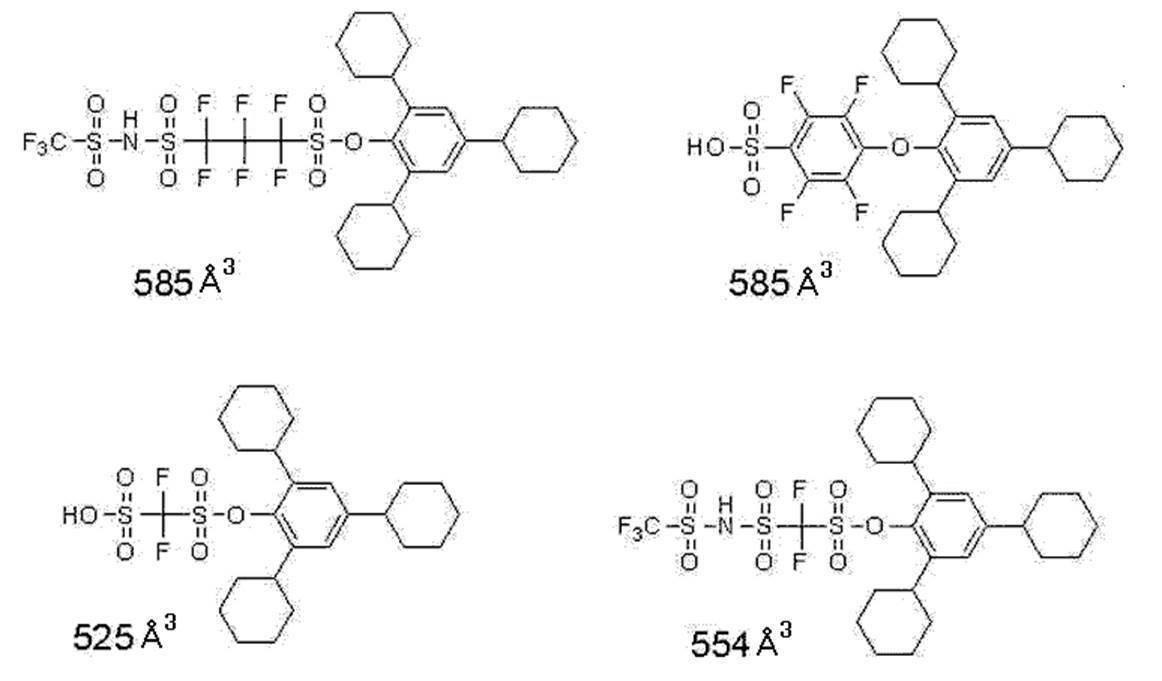
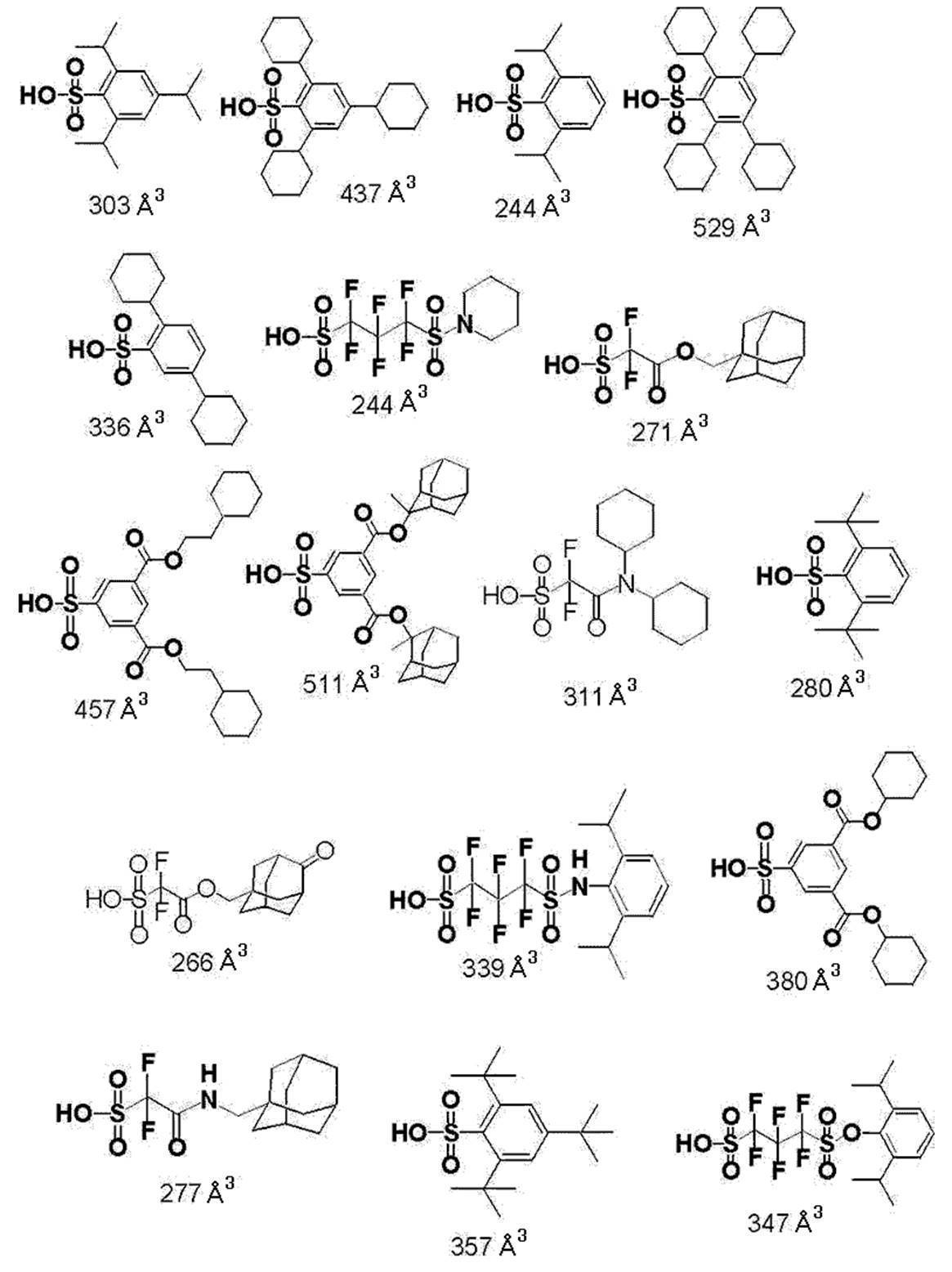
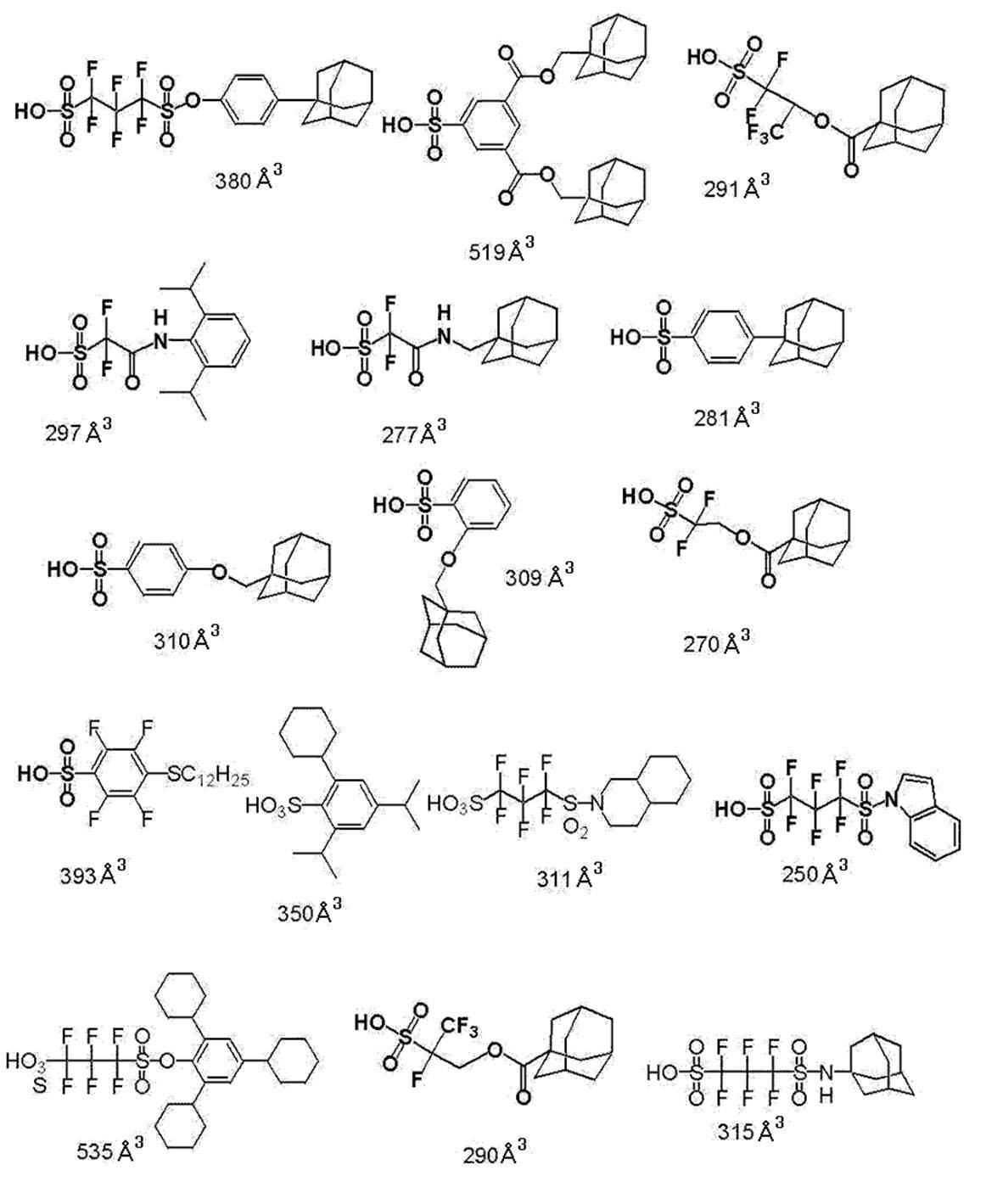

R201、R202及びR203は、それぞれ独立に、有機基を表す。
R201、R202及びR203としての有機基の炭素数は、1~30が好ましく、1~20がより好ましい。
また、R201~R203のうち2つが結合して環構造を形成してもよく、環内に酸素原子、硫黄原子、エステル結合、アミド結合、又は、カルボニル基を有していてもよい。R201~R203の内の2つが結合して形成する基としては、アルキレン基(例えば、ブチレン基、又は、ペンチレン基等)を挙げることができる。
Z-は、非求核性アニオン(求核反応を起こす能力が著しく低いアニオン)を表す。
また、ビス(アルキルスルホニル)イミドアニオンにおけるアルキル基は、互いに結合して環構造を形成してもよい。これにより、酸強度が増加する。

Xfは、それぞれ独立に、フッ素原子、又は、少なくとも1つのフッ素原子で置換されたアルキル基を表す。
R1及びR2は、それぞれ独立に、水素原子、フッ素原子、又は、アルキル基を表し、複数存在する場合のR1及びR2は、それぞれ同一でも異なっていてもよい。
Lは、二価の連結基を表し、複数存在する場合のLは同一でも異なっていてもよい。
Aは、環状の有機基を表す。
xは1~20の整数を表し、yは0~10の整数を表し、zは0~10の整数を表す。
Xfのフッ素原子で置換されたアルキル基におけるアルキル基の炭素数は、1~10が好ましく、1~4がより好ましい。また、Xfのフッ素原子で置換されたアルキル基としては、パーフルオロアルキル基が好ましい。
Xfとしては、フッ素原子又は炭素数1~4のパーフルオロアルキル基が好ましい。Xfの具体的としては、フッ素原子、CF3、C2F5、C3F7、C4F9、CH2CF3、CH2CH2CF3、CH2C2F5、CH2CH2C2F5、CH2C3F7、CH2CH2C3F7、CH2C4F9、及び、CH2CH2C4F9等が挙げられ、中でも、フッ素原子、又は、CF3が好ましい。特に、両者のXfがフッ素原子であることが好ましい。
R1及びR2としては、フッ素原子又はCF3が好ましい。
yは0~4の整数が好ましく、0がより好ましい。
zは0~5の整数が好ましく、0~3の整数がより好ましい。
Lの2価の連結基としては特に制限されず、-COO-、-CO-、-O-、-S-、-SO-、-SO2-、アルキレン基、シクロアルキレン基、アルケニレン基、及び、これらの複数が連結した連結基等が挙げられ、総炭素数12以下の連結基が好ましい。中でも、-COO-、-OCO-、-CO-、又は、-O-が好ましく、-COO-、又は、-OCO-がより好ましい。
脂環基としては、単環でも多環でもよく、シクロペンチル基、シクロヘキシル基、及び、シクロオクチル基等の単環のシクロアルキル基が好ましく、その他にも、ノルボルニル基、トリシクロデカニル基、テトラシクロデカニル基、テトラシクロドデカニル基、及び、アダマンチル基等の多環のシクロアルキル基が好ましい。中でも、ノルボルニル基、トリシクロデカニル基、テトラシクロデカニル基、テトラシクロドデカニル基、及び、アダマンチル基等の炭素数7以上のかさ高い構造を有する脂環基が、露光後加熱工程での膜中拡散性を抑制でき、MEEF(Mask Error Enhancement Factor)向上の観点から好ましい。
芳香環基としては、ベンゼン環、ナフタレン環、フェナンスレン環、及び、アントラセン環等が挙げられる。
複素環基としては、フラン環、チオフェン環、ベンゾフラン環、ベンゾチオフェン環、ジベンゾフラン環、ジベンゾチオフェン環、及び、ピリジン環等由来の基が挙げられる。中でも、フラン環、チオフェン環、及び、ピリジン環由来の基が好ましい。
R201、R202及びR203のうち、少なくとも1つがアリール基であることが好ましく、三つ全てがアリール基であることがより好ましい。アリール基としては、フェニル基、及び、ナフチル基等の他に、インドール残基、及び、ピロール残基等のヘテロアリール基も可能である。
R201~R203のアルキル基としては、炭素数1~10の直鎖状又は分岐鎖状アルキル基が好ましく、メチル基、エチル基、n-プロピル基、i-プロピル基、又は、n-ブチル基がより好ましい。
R201~R203のシクロアルキル基としては、炭素数3~10のシクロアルキル基が好ましく、シクロプロピル基、シクロブチル基、シクロペンチル基、シクロヘキシル基、又は、シクロへプチル基がより好ましい。
これらの基が有してもよい置換基としては、ニトロ基、フッ素原子等のハロゲン原子、カルボキシル基、水酸基、アミノ基、シアノ基、アルコキシ基(好ましくは炭素数1~15)、シクロアルキル基(好ましくは炭素数3~15)、アリール基(好ましくは炭素数6~14)、アルコキシカルボニル基(好ましくは炭素数2~7)、アシル基(好ましくは炭素数2~12)、及び、アルコキシカルボニルオキシ基(好ましくは炭素数2~7)等が挙げられる。
R204~R205は、それぞれ独立に、アリール基、アルキル基、又は、シクロアルキル基を表す。
R204~R205のアリール基、アルキル基、及び、シクロアルキル基が有していてもよい置換基としては、前述の化合物(ZI)におけるR201~R203のアリール基、アルキル基、及び、シクロアルキル基が有していてもよいものが挙げられる。
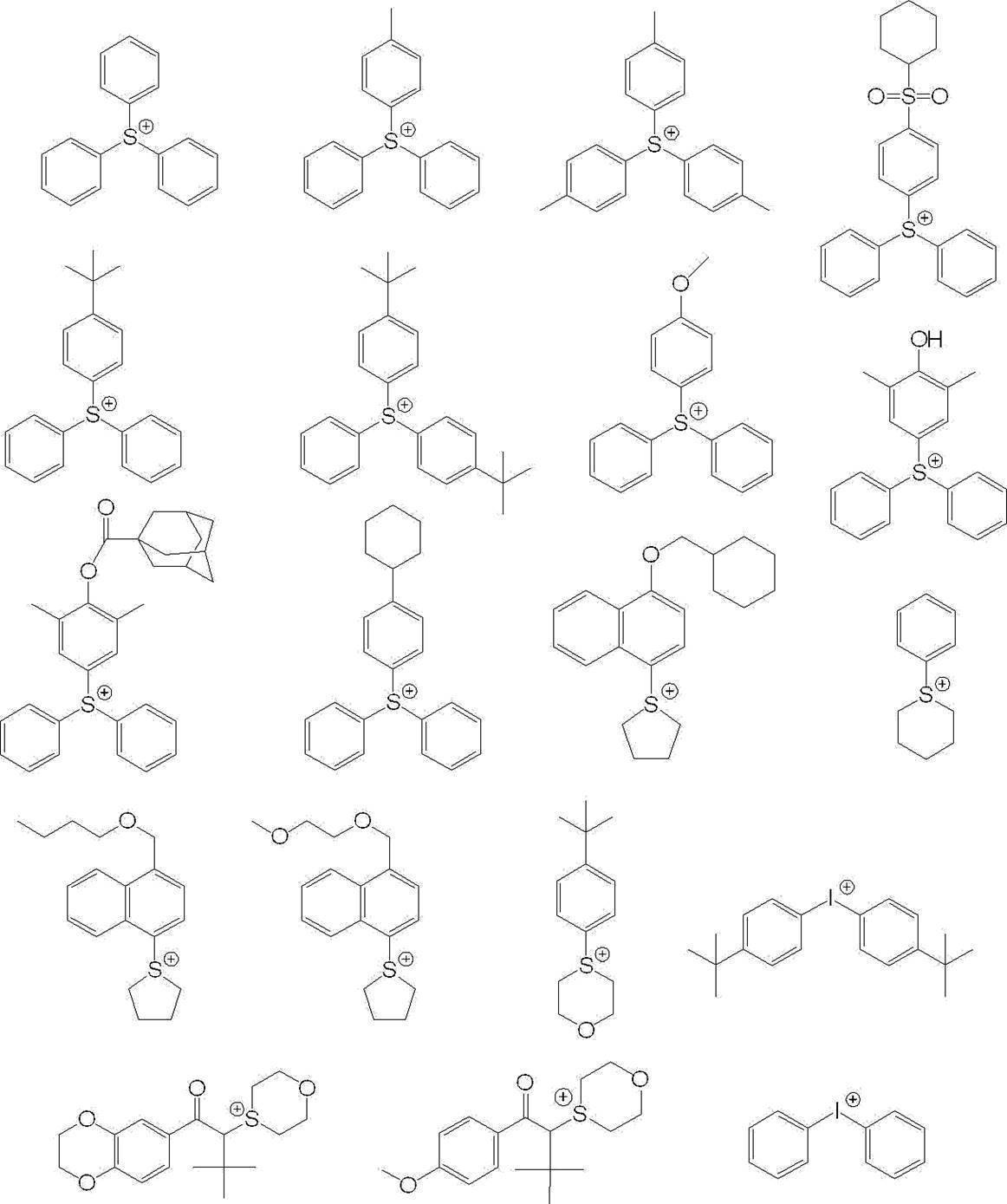
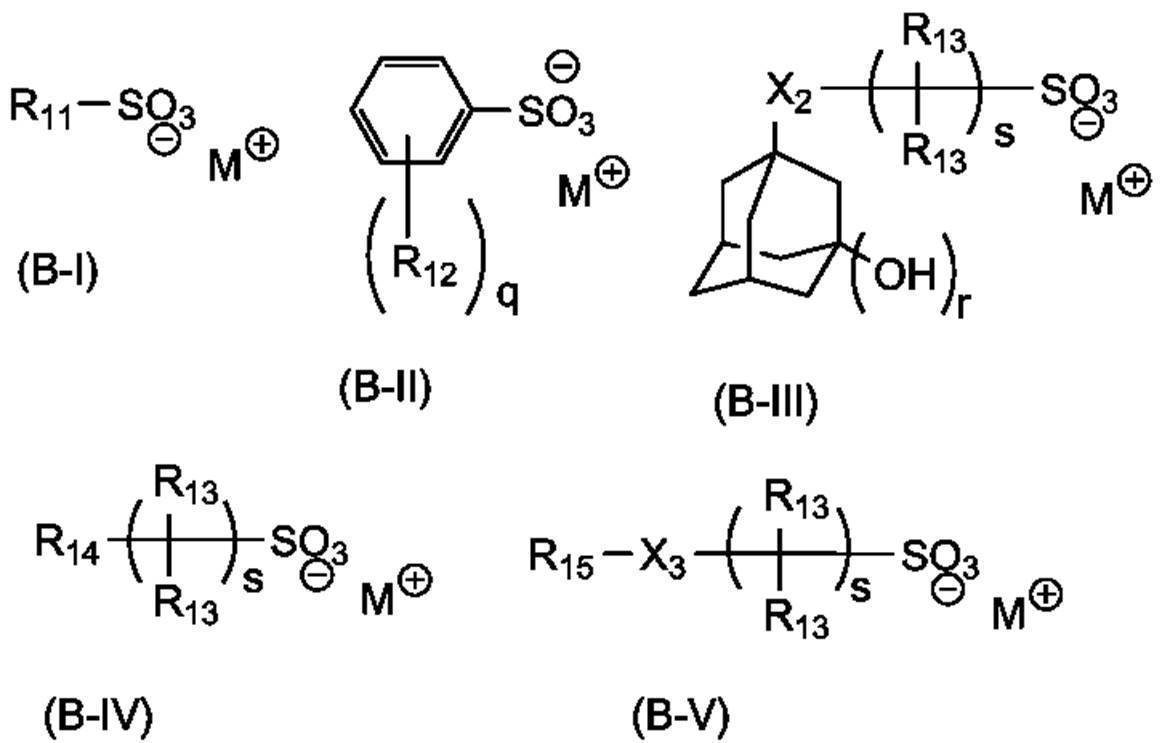
一般式(B-II)中、qは、1~5の整数を表す。qは、2~4の整数が好ましく、2又は3が好ましい。
一般式(B-III)中、X2は、-CO-O-、-CH2-CO-O-、又は、-CH2-O-CO-を表す。
一般式(B-III)中、rは、0~2の整数を表す。rは、0又は1が好ましい。
一般式(B-III)中、sは、1~3の整数を表す。sは、1又は2が好ましい。
一般式(B-IV)中、R14は、置換基を有していてもよい1価の多環基を表す。1価の多環基としては、複数の環構造からなる基であれば特に制限されず、例えば、上述の一般式(AN1)においてAで表される環状の有機基のうち多環構造を有する基が挙げられる。より具体的には、ノルボルナン環基、テトラシクロデカン環基、テトラシクロドデカン環基、及び、アダマンタン環基等の多環のシクロアルキル基が挙げられ、ノルボルナン環基又はアダマンタン環基が好ましい。
一般式(B-V)中、R15は、1価の有機基を表す。R15で表される1価の有機基としては、アルキル基、シクロアルキル基、アリール基、アラルキル基及びアルケニル基が挙げられ、炭素数1~6のアルキル基が好ましい。
一般式(B-V)中、X3は、-O-CO-O-、-SO2-又は-SO2-NR16-を表す。R16は、水素原子もしくはアルキル基を表すか、又は、R15と結合して環構造を形成するアルキレン基を表す。
一般式(B-V)で表される化合物においては、X3が-SO2-NR16-を表し、R15及びR16が結合して形成された炭素数4~6のアルキレン基と、-NR16-基中の窒素原子とで、置換基を有してもよいヘテロ環を形成することが好ましい。

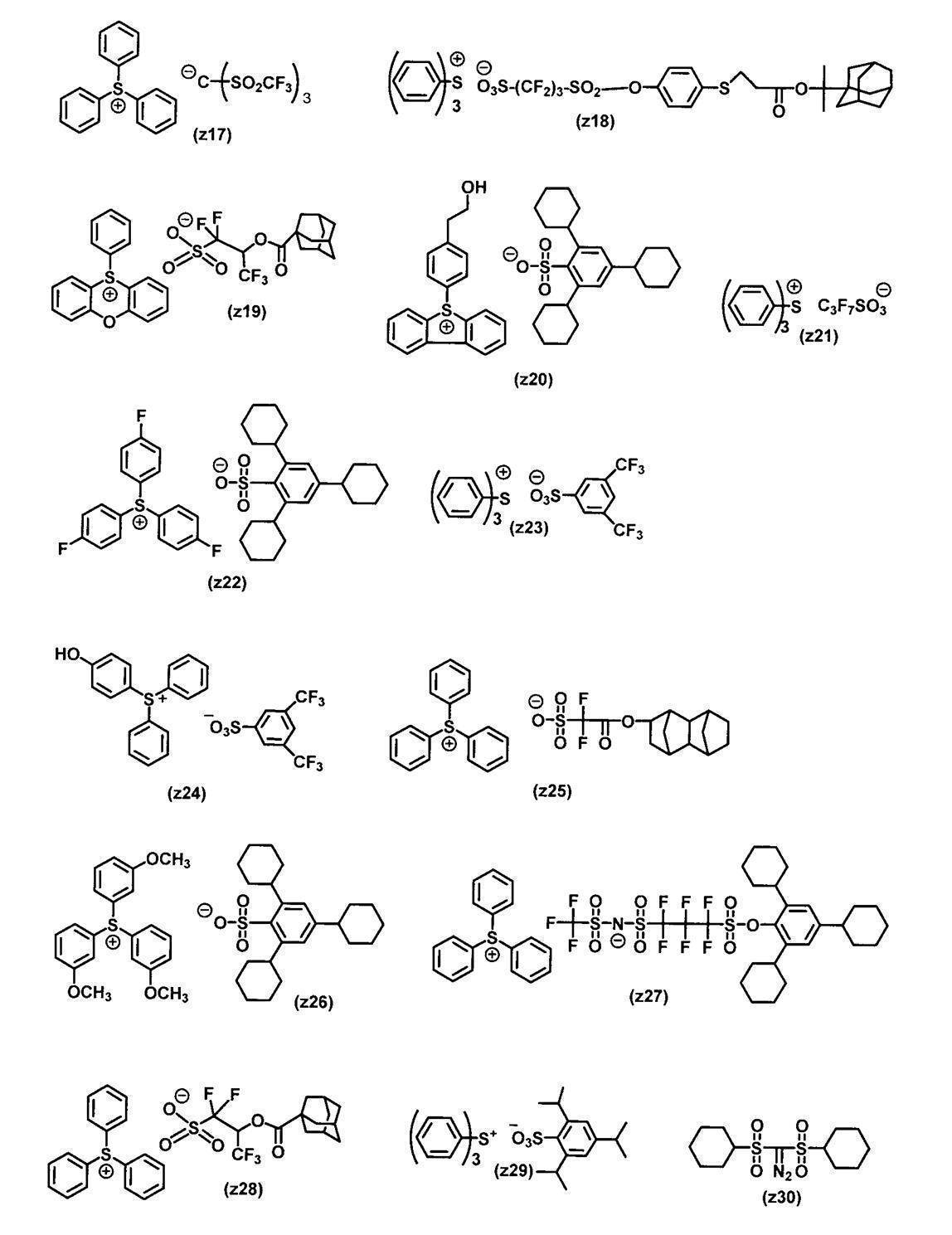

光酸発生剤(P)は、1種単独で使用してもよいし、2種以上を併用してもよい。光酸発生剤(P)を2種以上併用する場合は、その合計量が上記範囲内であることが好ましい。
組成物は、酸拡散制御剤(Q)を含有していてもよい。
酸拡散制御剤(Q)は、露光時に光酸発生剤(P)等から発生する酸をトラップし、余分な発生酸による、未露光部における酸分解性樹脂の反応を抑制するクエンチャーとして作用するものである。酸拡散制御剤(Q)としては、例えば、塩基性化合物(DA)、放射線の照射により塩基性が低下又は消失する塩基性化合物(DB)、光酸発生剤(P)に対して相対的に弱酸となるオニウム塩(DC)、窒素原子を有し、酸の作用により脱離する基を有する低分子化合物(DD)、及び、カチオン部に窒素原子を有するオニウム塩化合物(DE)等が使用できる。
組成物においては、公知の酸拡散制御剤を適宜使用できる。例えば、米国特許出願公開2016/0070167号明細書の段落[0627]~[0664]、米国特許出願公開2015/0004544号明細書の段落[0095]~[0187]、米国特許出願公開2016/0237190号明細書の段落[0403]~[0423]、及び、米国特許出願公開2016/0274458号明細書の段落[0259]~[0328]に開示された公知の化合物を、酸拡散制御剤(Q)として好適に使用できる。
組成物において、酸拡散制御剤(Q)は1種単独で使用してもよいし、2種以上を併用してもよい。
組成物は、疎水性樹脂(E)として、上記樹脂(A)とは異なる疎水性の樹脂を含有していてもよい。
疎水性樹脂(E)は、レジスト膜の表面に偏在するように設計されることが好ましいが、界面活性剤とは異なり、必ずしも分子内に親水基を有する必要はなく、極性物質及び非極性物質を均一に混合することに寄与しなくてもよい。
疎水性樹脂(E)を添加することの効果として、水に対するレジスト膜表面の静的及び動的な接触角の制御、並びに、アウトガスの抑制等が挙げられる。
フッ素原子を有するアルキル基(好ましくは炭素数1~10、より好ましくは炭素数1~4)は、少なくとも1つの水素原子がフッ素原子で置換された直鎖状又は分岐鎖状のアルキル基であり、更にフッ素原子以外の置換基を有していてもよい。
フッ素原子を有するシクロアルキル基は、少なくとも1つの水素原子がフッ素原子で置換された単環又は多環のシクロアルキル基であり、更にフッ素原子以外の置換基を有していてもよい。
フッ素原子を有するアリール基としては、フェニル基、及び、ナフチル基等のアリール基の少なくとも1つの水素原子がフッ素原子で置換されたものが挙げられ、更にフッ素原子以外の置換基を有していてもよい。
フッ素原子又は珪素原子を有する繰り返し単位の例としては、US2012/0251948の段落[0519]に例示されたものが挙げられる。
ここで、疎水性樹脂中の側鎖部分が有するCH3部分構造は、エチル基、及び、プロピル基等を有するCH3部分構造を含む。
一方、疎水性樹脂(E)の主鎖に直接結合しているメチル基(例えば、メタクリル酸構造を有する繰り返し単位のα-メチル基)は、主鎖の影響により疎水性樹脂(E)の表面偏在化への寄与が小さいため、本発明におけるCH3部分構造に含まれないものとする。
組成物は、溶剤(F)を含有してもよい。
組成物がEUV用の感放射線性樹脂組成物である場合、溶剤(F)は、(M1)プロピレングリコールモノアルキルエーテルカルボキシレート、並びに、(M2)プロピレングリコールモノアルキルエーテル、乳酸エステル、酢酸エステル、アルコキシプロピオン酸エステル、鎖状ケトン、環状ケトン、ラクトン、及び、アルキレンカーボネートからなる群より選択される少なくとも1つの少なくとも一方を含有していることが好ましい。この場合の溶剤は、成分(M1)及び(M2)以外の成分を更に含有していてもよい。
成分(M1)又は(M2)を含有する溶剤は、上述した樹脂(A)とを組み合わせて用いると、組成物の塗布性が向上すると共に、現像欠陥数の少ないパターンが形成可能となるため、好ましい。
プロピレングリコールモノアルキルエーテルとしては、プロピレングリコールモノメチルエーテル(PGME:propylene glycol monomethylether)、又は、プロピレングリコールモノエチルエーテルが好ましい。
乳酸エステルとしては、乳酸エチル、乳酸ブチル、又は、乳酸プロピルが好ましい。
酢酸エステルとしては、酢酸メチル、酢酸エチル、酢酸ブチル、酢酸イソブチル、酢酸プロピル、酢酸イソアミル、蟻酸メチル、蟻酸エチル、蟻酸ブチル、蟻酸プロピル、又は、酢酸3-メトキシブチルが好ましい。
また、酪酸ブチルも好ましい。
アルコキシプロピオン酸エステルとしては、3-メトキシプロピオン酸メチル(MMP:methyl 3-Methoxypropionate)、又は、3-エトキシプロピオン酸エチル(EEP:ethyl 3-ethoxypropionate)が好ましい。
鎖状ケトンとしては、1-オクタノン、2-オクタノン、1-ノナノン、2-ノナノン、アセトン、2-ヘプタノン、4-ヘプタノン、1-ヘキサノン、2-ヘキサノン、ジイソブチルケトン、フェニルアセトン、メチルエチルケトン、メチルイソブチルケトン、アセチルアセトン、アセトニルアセトン、イオノン、ジアセトニルアルコール、アセチルカービノール、アセトフェノン、メチルナフチルケトン、又は、メチルアミルケトンが好ましい。
環状ケトンとしては、メチルシクロヘキサノン、イソホロン、又は、シクロヘキサノンが好ましい。
ラクトンとしては、γ-ブチロラクトンが好ましい。
アルキレンカーボネートとしては、プロピレンカーボネートが好ましい。
組成物は、界面活性剤、フェノール性水酸基を有するアルカリ可溶性樹脂、溶解阻止化合物、染料、可塑剤、光増感剤、光吸収剤、及び/又は、現像液に対する溶解性を促進させる化合物(例えば、重量平均分子量(Mw)が1000以下であるフェノール化合物、又はカルボキシル基を有する脂環族もしくは脂肪族化合物)を更に含有していてもよい。
重量平均分子量(Mw)が1000以下であるフェノール化合物は、例えば、特開平4-122938号公報、特開平2-28531号公報、米国特許第4,916,210号明細書、欧州特許第219294号明細書等に記載の方法を参考にして、当業者において容易に合成できる。
カルボキシル基を有する脂環族又は脂肪族化合物の具体例としては、コール酸、デオキシコール酸、及び、リトコール酸等のステロイド構造を有するカルボン酸誘導体、アダマンタンカルボン酸誘導体、アダマンタンジカルボン酸、シクロヘキサンカルボン酸、シクロヘキサンジカルボン酸が挙げられる。
フィルターとしては、以下のフィルターを使用した。
・「PP 200nm」:ポリプロピレン製フィルター、ポール社製、孔径200nm
・「IEX 50nm」:イオン交換樹脂フィルター、Entegris社製、孔径50nm
・「PTFE 30nm」:ポリテトラフルオロエチレン製フィルター、Entegris社製、孔径30nm
・「PTFE 50nm」:ポリテトラフルオロエチレン製フィルター、Entegris社製、孔径50nm
・「UPE 1nm」:超高分子量ポリエチレン製フィルター、Pall社製、孔径1nm
・「UPE 3nm」:超高分子量ポリエチレン製フィルター、Pall社製、孔径3nm
実施例、及び、比較例の薬液の製造のために、表1の「原料」欄の「溶剤種類」欄に記載の溶剤を被精製物として使用した。なお、各溶剤は、市販品を使用した。
上記被精製物に対して、表1に記載の蒸留精製処理を行った。
なお、表1中の「蒸留」欄の「条件1」は蒸留塔(理論段数:15段)を用いた常圧蒸留を1回実施したことを表し、「条件2」は蒸留塔(理論段数:10段)を用いた常圧蒸留を1回実施したことを表し、「条件3」は蒸留塔(理論段数:25段)を用いた常圧蒸留を1回実施したことを表し、「条件4」は蒸留塔(理論段数:30段)を用いた常圧蒸留を1回実施したことを表し、「条件5」は蒸留塔(理論段数:5段)を用いた常圧蒸留を1回実施したことを表す。
次に、後述する表1に示すように、「第1循環」欄が「あり」の実施例においては、貯蔵タンクに貯蔵された被精製物を、表1に記載のフィルター4~5(フィルター4のみの場合は、フィルター4)でろ過して、フィルター5でろ過した後(フィルター4のみの場合は、フィルター4でろ過した後)の被精製物をフィルター4の上流側に循環し、再度フィルター4~5でろ過する循環ろ過処理を実施した。循環ろ過処理の後、容器に薬液を収容した。
なお、後述する表1に示すように、「第1循環」欄が「なし」の実施例においては、上記循環処理を実施せずに、貯蔵タンクに貯蔵された被精製物を、表1に記載のフィルター4でろ過した。
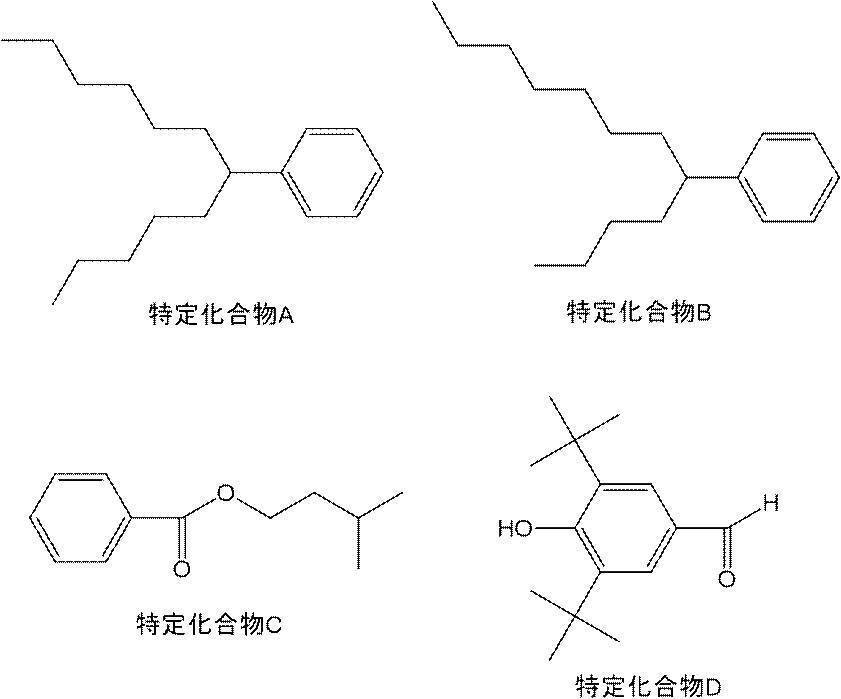
薬液における特定化合物の含有量は、ガスクロマトグラフィー質量分析(GC/MS)装置(Agilent社製、GC:7890B、MS:5977B EI/CI MSD)を使用して測定した。
なお、後述するように、表1中の「特定化合物A」欄は、特定化合物Aの薬液中における含有量を表し、「特定化合物B」欄は、特定化合物Bの薬液中における含有量を表し、「特定化合物C」欄は、特定化合物Cの薬液中における含有量を表し、「特定化合物D」欄は、特定化合物Dの薬液中における含有量を表す。
薬液中の金属成分(金属イオン、金属含有粒子)の含有量は、ICP-MS及びSP-ICP-MSを用いる方法により測定した。
装置は以下の装置を使用した。
・メーカー:PerkinElmer
・型式:NexION350S
解析には以下の解析ソフトを使用した。
・“SP-ICP-MS”専用Syngistix ナノアプリケーションモジュール
・Syngistix for ICP-MS ソフトウェア
まず、直径300mmのシリコン基板に有機反射防止膜形成用組成物ARC29SR(日産化学社製)を塗布し、205℃で60秒間ベークを行い、膜厚78nmの反射防止膜を形成した。
塗布性の改良のため、反射防止膜を形成したシリコン基板の反射防止膜側の表面にプリウェット液(FFEM製、シクロヘキサノン)を滴下し、スピン塗布を実施した。
次いで、反射防止膜上に、後述する組成物1~4のいずれかを塗布し、表1に記載の「プリベーク」欄に記載の条件に従ってプリベークを行い、膜厚50nmの塗膜を形成した。
次に、ArFエキシマレーザースキャナー(NA0.75)を用い、塗膜に対して25[mJ/cm2]でパターン露光を行った。その後、120℃で60秒間加熱した。次いで、表1に記載のアルカリ現像液を用いて、30秒間パドルして現像した。次いで、4000rpmの回転数で30秒間シリコン基板を回転させることにより、ポジ型レジストパターンを形成した。次に、ポジ型レジストパターンを水で洗浄した。次に、各実施例及び比較例に記載の薬液を用いて、ポジ型レジストパターンを洗浄した。その後、得られたポジ型レジストパターンを、200℃で300秒間ポストベークした。上記の工程を経て、ライン/スペースが1:1のL/Sパターンを得た。なお、ライン幅は65nmであった。
「A」:残渣物欠陥の数が5個/ウエハ以下だった。
「B」:残渣物欠陥の数が5個/ウエハを超え、10個/ウエハ以下だった。
「C」:残渣物欠陥の数が10個/ウエハを超え、20個/ウエハ以下だった。
「D」:残渣物欠陥の数が20個/ウエハを超え、30個/ウエハ以下だった。
「E」:残渣物欠陥の数が30個/ウエハを超えた。
酸分解性樹脂(下記式で表される樹脂(重量平均分子量(Mw):7500):各繰り返し単位に記載される数値はモル%を意味する。):100質量部
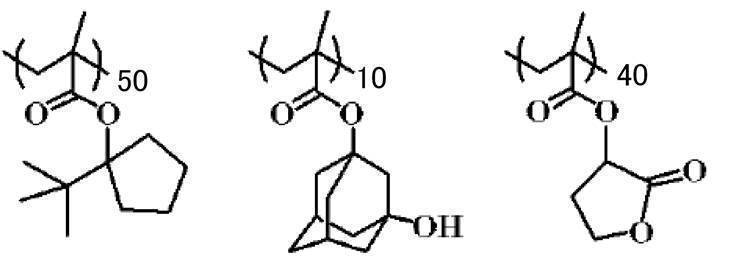

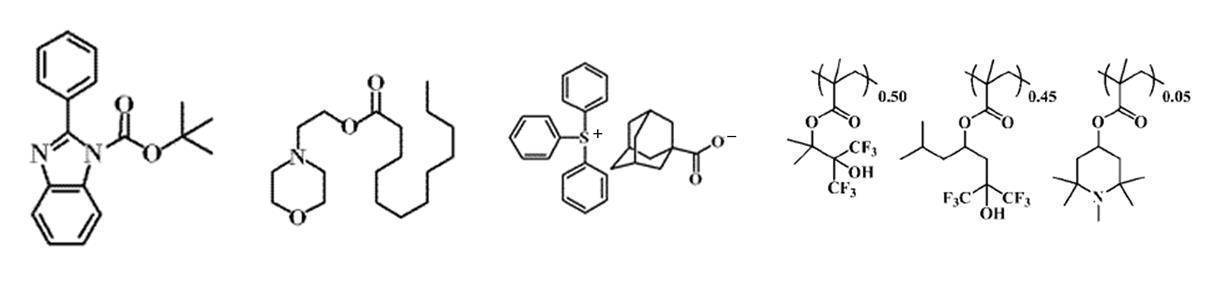
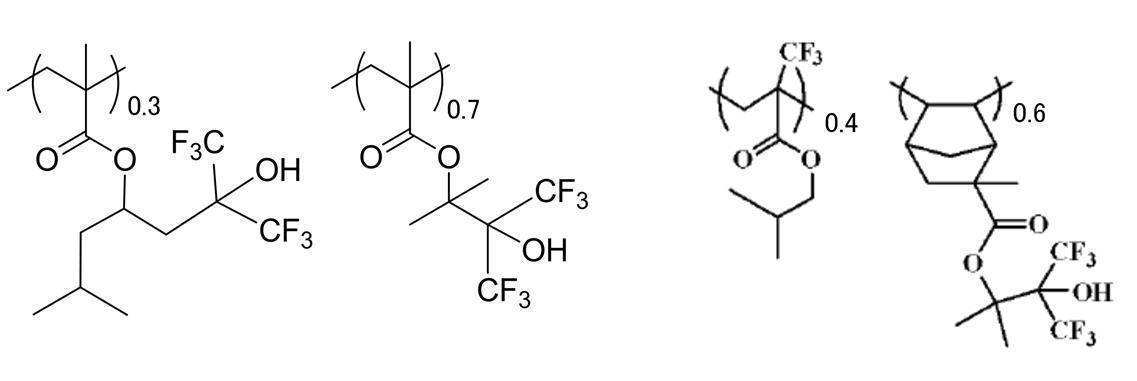
PGMEA(プロピレングリコールモノメチルエーテルアセテート):3質量部
シクロヘキサノン:600質量部
γ-BL(γ-ブチロラクトン):100質量部
酸分解性樹脂(下記式で表される樹脂(重量平均分子量(Mw):8000):各繰り返し単位に記載される数値はモル%を意味する。):100質量部


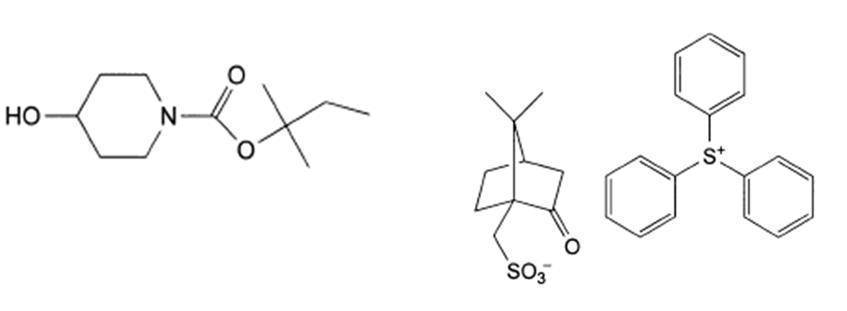

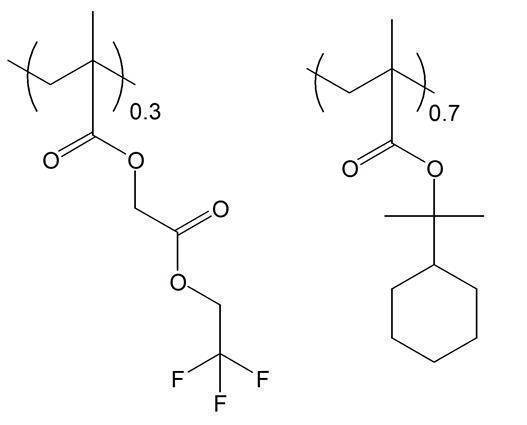
PGMEA(プロピレングリコールモノメチルエーテルアセテート):3質量部
シクロヘキサノン:600質量部
γ-BL(γ-ブチロラクトン):100質量部
酸分解性樹脂(下記式で表される樹脂(重量平均分子量(Mw):8000):各繰り返し単位に記載される数値はモル%を意味する。):100質量部


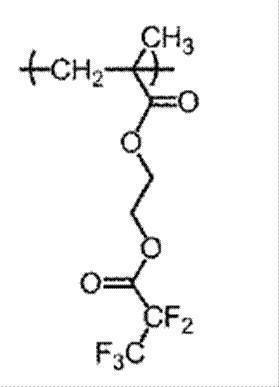

PGMEA(プロピレングリコールモノメチルエーテルアセテート):50質量部
PGME(プロピレングリコールモノメチルエーテル):100質量部
2-ヘプタノン:100質量部
γ-BL(γ-ブチロラクトン):500質量部
酸分解性樹脂(下記式で表される樹脂(重量平均分子量(Mw):6500):各繰り返し単位に記載される数値はモル%を意味する。):80質量部
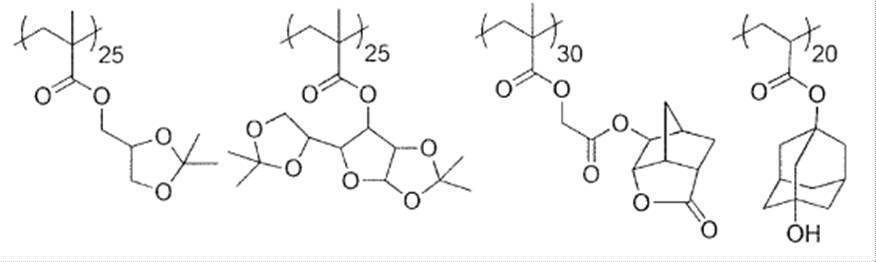
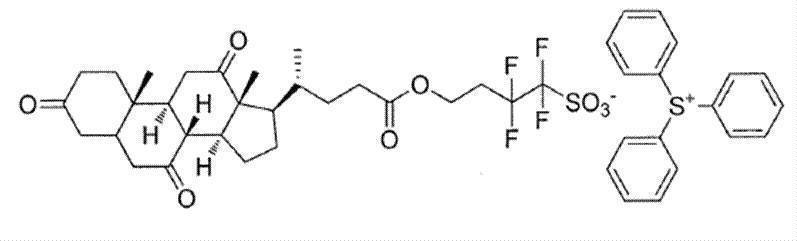
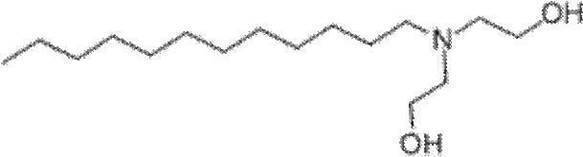
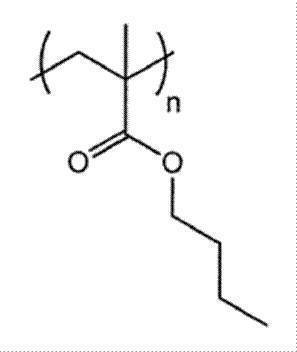
PGMEA(プロピレングリコールモノメチルエーテルアセテート):70質量部
HBM(メチル-2-ヒドロキシブチラート):100質量部
シクロヘキサノン:700質量部
「TMAH」:テトラメチルアンモニウムヒドロキシド
「EDTA」:エチレンジアミン四酢酸
「DTPA」:ジエチレントリアミン5酢酸
「DBSA」:p-ドデシルベンゼンスルホン酸
「Surfynol 440」:サーフィノール 440
「Surfynol 480」:サーフィノール 480
「アルカリ現像液」欄の濃度は、各化合物のアルカリ現像液全量に対する濃度を表す。
なお、各アルカリ現像液において、表1に記載の成分以外は、水が含有される。
また、表1に記載の「蒸気圧(kPa)」は、使用される溶剤の25℃における蒸気圧を表す。ただし、実施例25に関しては、「イソプロピルアルコール」の25℃における蒸気圧を表す。
また、表1に記載の「炭素数」は、使用される溶剤に含有される炭素数を表す。ただし、実施例25に関しては、「イソプロピルアルコール」の炭素数を表す。
また、表1に記載の「C/O比」は、使用される溶剤に含有される酸素原子の数に対する炭素原子の数の比を表す。ただし、実施例25に関しては、「イソプロピルアルコール」の上記比を表す。
また、表1に記載の「溶剤濃度(質量%)」欄は、各実施例及び比較例の薬液における、薬液全質量に対する溶剤(アルコール系溶剤)の含有量(質量%)を表す。ただし、実施例25に関しては、「イソプロピルアルコール」の含有量を表す。
また、表1に記載の「金属成分(質量ppt)」欄は、各実施例及び比較例の薬液における、薬液全質量に対する金属成分の含有量(質量ppt)を表す。
また、表1に記載の「特定化合物A濃度(質量ppb)」欄は、各実施例及び比較例の薬液における、薬液全質量に対する特定化合物Aの含有量(質量ppb)を表す。
また、表1に記載の「特定化合物B濃度(質量ppb)」欄は、各実施例及び比較例の薬液における、薬液全質量に対する特定化合物Bの含有量(質量ppb)を表す。
また、表1に記載の「特定化合物C濃度(質量ppb)」欄は、各実施例及び比較例の薬液における、薬液全質量に対する特定化合物Cの含有量(質量ppb)を表す。
また、表1に記載の「特定化合物D濃度(質量ppb)」欄は、各実施例及び比較例の薬液における、薬液全質量に対する特定化合物Dの含有量(質量ppb)を表す。
また、表1に記載の「合計量(質量ppb)」欄は、特定化合物A~Dの合計含有量(質量ppb)を表す。

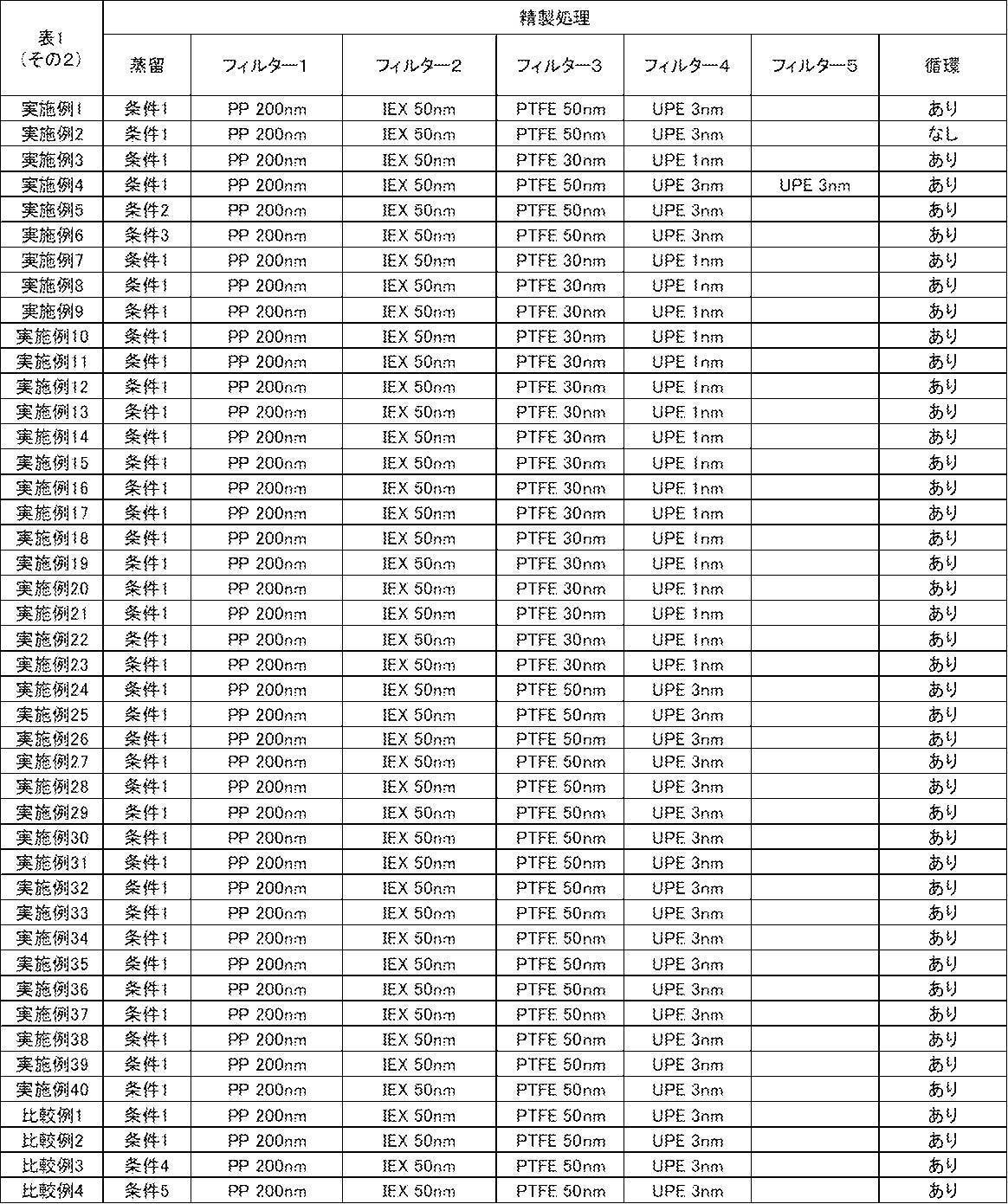

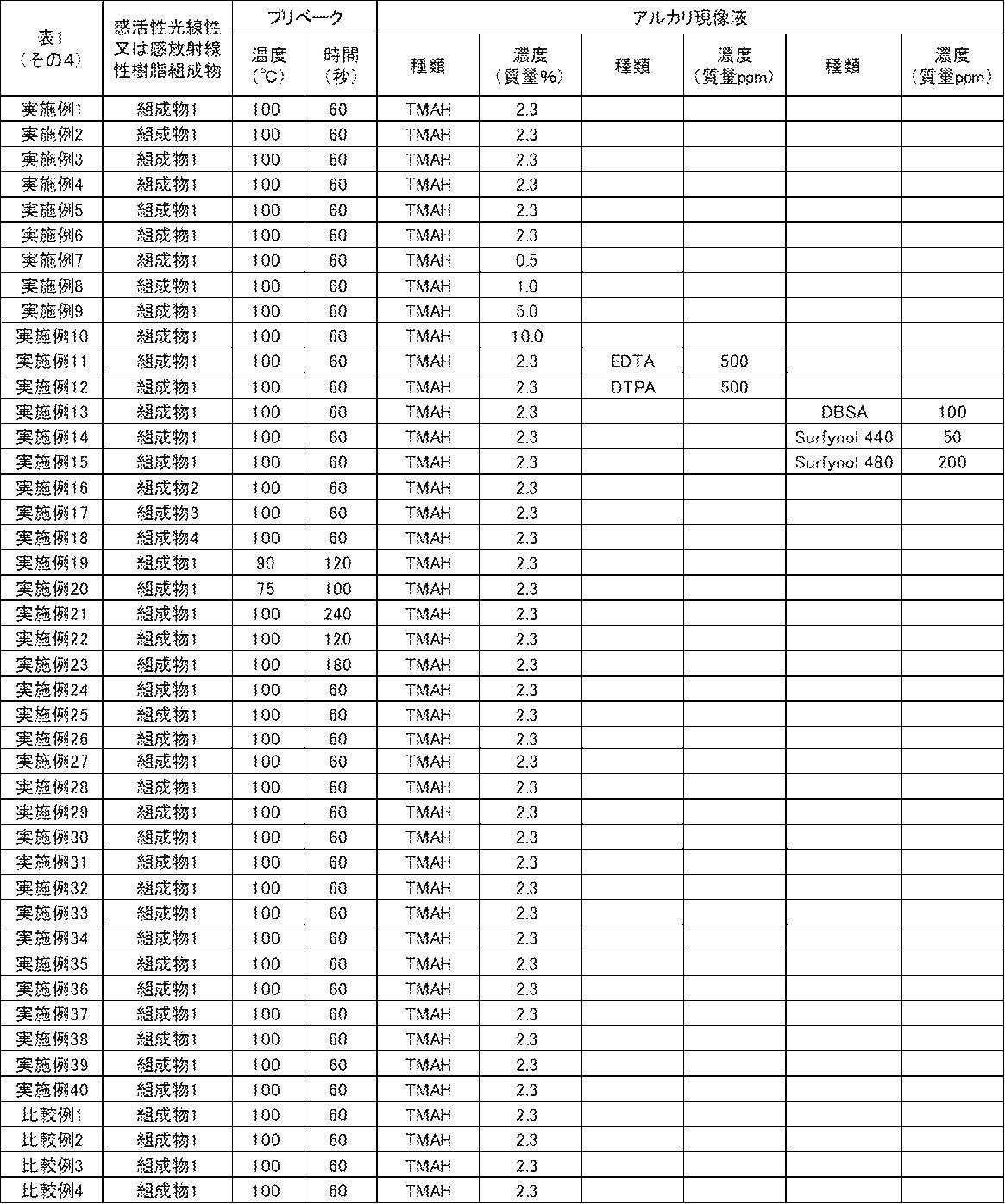

例えば、実施例1においては、表1(その1)に示すように、メチルイソブチルカルビノールを使用し、表1(その2)に示すように、蒸留の条件は「条件1」であり、表1(その3)に示すように、薬液の溶剤濃度(質量%)は99.95質量%であり、表1(その4)に示すように、組成物の種類は「組成物1」であり、表1(その5)に示すように、残渣の評価は「A」である。その他実施例及び比較例についても同様である。
なかでも、実施例1~4の比較より、金属成分の含有量が、薬液全質量に対して、0.10~100質量pptである場合、より効果が優れることが確認された。
また、実施例5および6と他の実施例との比較より、特定化合物の含有量(合計含有量)が、薬液全質量に対して、0.010~5.0質量ppbである場合、より効果が優れることが確認された。
また、実施例7~10の比較より、第4級アンモニウム塩の含有量が、アルカリ現像液全質量に対して、0.75~7.5質量%である場合、より効果が優れることが確認された。
また、実施例19~23の比較より、工程G(プリベーク)の加熱温度が80~120℃で、加熱時間が30~180秒間である場合、より効果が優れることが確認された。
また、実施例24と25との比較より、アルコール系溶剤の含有量が、薬液全質量に対して、85.000~99.999質量%である場合、より効果が優れることが確認された。
また、実施例36および40と、他の実施例との比較より、アルコール系溶剤に含まれる酸素原子数に対する炭素原子数の比が3.0以上である場合(アルコール系溶剤のClogP値が-0.50~3.00である場合)、より効果が優れることが確認された。
上記表1より、アルコール系溶剤が、メチルイソブチルカルビノール、3-メチル-1-ブタノール、または、2,4-ジメチル-3-ペンタノールである場合、より効果が優れることが確認された。
Claims (14)
- ClogP値が-1.00超3.00以下であるアルコール系溶剤と、
式(1)で表される化合物、及び、式(2)で表される化合物からなる群から選択される特定化合物と、を含有する薬液であって、
前記特定化合物の含有量が、前記薬液全質量に対して、0.0010~10質量ppbである、薬液。

R1及びR2は、それぞれ独立に、アルキル基を表す。
R3及びR5は、それぞれ独立に、水素原子又はアルキル基を表す。
R4は、水素原子又は水酸基を表す。
R6は、水素原子又はアルコキシ基を表す。 - 前記特定化合物の含有量が、前記薬液全質量に対して、0.010~5.0質量ppbである、請求項1に記載の薬液。
- 前記アルコール系溶剤に含まれる炭素数が3~12である、請求項1又は2に記載の薬液。
- 前記アルコール系溶剤に含まれる酸素原子数に対する炭素原子数の比が3.0以上である、請求項1~3のいずれか1項に記載の薬液。
- 前記アルコール系溶剤の25℃における蒸気圧が、0.01~10.0kPaである、請求項1~4のいずれか1項に記載の薬液。
- 前記アルコール系溶剤が、メチルイソブチルカルビノール、2,6-ジメチル-4-ヘプタノール、2,4-ジエチル-1,5-ペンタンジオール、2-エチル-1-ヘキサノール、3-メチル-1,5-ペンタンジオール、2-オクタノール、3-メチル-1-ブタノール、2,4-ジメチル-3-ペンタノール、2-メチルペンタン-2,4-ジオール、3,5,5-トリメチル-1-ヘキサノール、2-メチルシクロヘキサノール、1,3-ブタンジオール、2-エチル-1,3-ヘキサンジオール、2-ブチル-2-エチル-1,3-プロパンジオール、3-メチル-1,3-ブタンジオール、及び、トリメチロールプロパンからなる群から選択される、請求項1~5のいずれか1項に記載の薬液。
- 前記アルコール系溶剤の含有量が、前記薬液全質量に対して、85.000~99.999質量%である、請求項1~6のいずれか1項に記載の薬液。
- 前記アルコール系溶剤が、メチルイソブチルカルビノール、3-メチル-1-ブタノール、または、2,4-ジメチル-3-ペンタノールである、請求項1~7のいずれか1項に記載の薬液。
- 更に、金属成分を含有し、
前記金属成分の含有量が、前記薬液全質量に対して、0.10~100質量pptである、請求項1~8のいずれか1項に記載の薬液。 - 請求項1~9のいずれか1項に記載の薬液を含有する、リンス液。
- 感活性光線性又は感放射線性樹脂組成物を用いて基板上に膜を形成する工程Aと、前記膜を露光する工程Bと、アルカリ現像液を用いて露光した膜を現像する工程Cと、請求項10に記載のリンス液を用いて現像された膜を洗浄する工程Dと、を有するレジストパターン形成方法。
- 前記工程Cと前記工程Dとの間に、水を用いて、現像された膜を洗浄する工程Eを更に有する、請求項11に記載のレジストパターン形成方法。
- 前記アルカリ現像液が、第4級アンモニウム塩を含有する、請求項11又は12に記載のレジストパターン形成方法。
- 前記第4級アンモニウム塩の含有量が、前記アルカリ現像液全質量に対して、0.75~7.5質量%である、請求項13に記載のレジストパターン形成方法。
Priority Applications (5)
| Application Number | Priority Date | Filing Date | Title |
|---|---|---|---|
| KR1020247010472A KR20240050420A (ko) | 2019-03-04 | 2020-02-18 | 약액, 린스액, 레지스트 패턴 형성 방법 |
| CN202080018697.9A CN113544593A (zh) | 2019-03-04 | 2020-02-18 | 药液、冲洗液、抗蚀剂图案形成方法 |
| KR1020217028133A KR20210123363A (ko) | 2019-03-04 | 2020-02-18 | 약액, 린스액, 레지스트 패턴 형성 방법 |
| JP2021503518A JPWO2020179428A1 (ja) | 2019-03-04 | 2020-02-18 | |
| US17/465,828 US12366805B2 (en) | 2019-03-04 | 2021-09-02 | Chemical liquid, rinsing solution, and resist pattern forming method |
Applications Claiming Priority (2)
| Application Number | Priority Date | Filing Date | Title |
|---|---|---|---|
| JP2019-038295 | 2019-03-04 | ||
| JP2019038295 | 2019-03-04 |
Related Child Applications (1)
| Application Number | Title | Priority Date | Filing Date |
|---|---|---|---|
| US17/465,828 Continuation US12366805B2 (en) | 2019-03-04 | 2021-09-02 | Chemical liquid, rinsing solution, and resist pattern forming method |
Publications (1)
| Publication Number | Publication Date |
|---|---|
| WO2020179428A1 true WO2020179428A1 (ja) | 2020-09-10 |
Family
ID=72338373
Family Applications (1)
| Application Number | Title | Priority Date | Filing Date |
|---|---|---|---|
| PCT/JP2020/006173 Ceased WO2020179428A1 (ja) | 2019-03-04 | 2020-02-18 | 薬液、リンス液、レジストパターン形成方法 |
Country Status (6)
| Country | Link |
|---|---|
| US (1) | US12366805B2 (ja) |
| JP (1) | JPWO2020179428A1 (ja) |
| KR (2) | KR20240050420A (ja) |
| CN (1) | CN113544593A (ja) |
| TW (1) | TWI834825B (ja) |
| WO (1) | WO2020179428A1 (ja) |
Cited By (1)
| Publication number | Priority date | Publication date | Assignee | Title |
|---|---|---|---|---|
| WO2023189371A1 (ja) * | 2022-03-29 | 2023-10-05 | 富士フイルム株式会社 | 薬液 |
Families Citing this family (1)
| Publication number | Priority date | Publication date | Assignee | Title |
|---|---|---|---|---|
| KR102745003B1 (ko) * | 2024-01-23 | 2024-12-20 | 동우 화인켐 주식회사 | 세정액 조성물 및 이를 이용한 포토레지스트 패턴 형성 방법 |
Citations (5)
| Publication number | Priority date | Publication date | Assignee | Title |
|---|---|---|---|---|
| WO2014141876A1 (ja) * | 2013-03-15 | 2014-09-18 | 富士フイルム株式会社 | パターン形成方法、これに用いられる有機溶剤現像用の感活性光線性又は感放射線性樹脂組成物及びその製造方法、電子デバイスの製造方法、並びに、電子デバイス |
| WO2018043690A1 (ja) * | 2016-09-02 | 2018-03-08 | 富士フイルム株式会社 | 溶液、溶液収容体、感活性光線性又は感放射線性樹脂組成物、パターン形成方法、半導体デバイスの製造方法 |
| WO2018062470A1 (ja) * | 2016-09-30 | 2018-04-05 | 富士フイルム株式会社 | 半導体チップの製造方法、キット |
| WO2018062471A1 (ja) * | 2016-09-30 | 2018-04-05 | 富士フイルム株式会社 | パターン形成方法、電子デバイスの製造方法、キット |
| JP2018163188A (ja) * | 2017-03-24 | 2018-10-18 | 住友化学株式会社 | レジスト組成物 |
Family Cites Families (5)
| Publication number | Priority date | Publication date | Assignee | Title |
|---|---|---|---|---|
| US9256133B2 (en) * | 2012-07-13 | 2016-02-09 | Taiwan Semiconductor Manufacturing Company, Ltd. | Apparatus and method for developing process |
| JP2015084122A (ja) | 2015-01-08 | 2015-04-30 | 富士フイルム株式会社 | 化学増幅型レジスト膜のパターニング用有機系処理液 |
| WO2016181753A1 (ja) * | 2015-05-13 | 2016-11-17 | 富士フイルム株式会社 | プレリンス液、プレリンス処理方法、及び、パターン形成方法 |
| JP6794462B2 (ja) | 2016-09-28 | 2020-12-02 | 富士フイルム株式会社 | 薬液、薬液収容体、薬液の製造方法、及び、薬液収容体の製造方法 |
| JP6890610B2 (ja) * | 2016-11-18 | 2021-06-18 | 富士フイルム株式会社 | 薬液、薬液収容体、パターン形成方法、及び、キット |
-
2020
- 2020-02-18 KR KR1020247010472A patent/KR20240050420A/ko active Pending
- 2020-02-18 KR KR1020217028133A patent/KR20210123363A/ko not_active Ceased
- 2020-02-18 JP JP2021503518A patent/JPWO2020179428A1/ja active Pending
- 2020-02-18 WO PCT/JP2020/006173 patent/WO2020179428A1/ja not_active Ceased
- 2020-02-18 CN CN202080018697.9A patent/CN113544593A/zh active Pending
- 2020-02-27 TW TW109106411A patent/TWI834825B/zh active
-
2021
- 2021-09-02 US US17/465,828 patent/US12366805B2/en active Active
Patent Citations (5)
| Publication number | Priority date | Publication date | Assignee | Title |
|---|---|---|---|---|
| WO2014141876A1 (ja) * | 2013-03-15 | 2014-09-18 | 富士フイルム株式会社 | パターン形成方法、これに用いられる有機溶剤現像用の感活性光線性又は感放射線性樹脂組成物及びその製造方法、電子デバイスの製造方法、並びに、電子デバイス |
| WO2018043690A1 (ja) * | 2016-09-02 | 2018-03-08 | 富士フイルム株式会社 | 溶液、溶液収容体、感活性光線性又は感放射線性樹脂組成物、パターン形成方法、半導体デバイスの製造方法 |
| WO2018062470A1 (ja) * | 2016-09-30 | 2018-04-05 | 富士フイルム株式会社 | 半導体チップの製造方法、キット |
| WO2018062471A1 (ja) * | 2016-09-30 | 2018-04-05 | 富士フイルム株式会社 | パターン形成方法、電子デバイスの製造方法、キット |
| JP2018163188A (ja) * | 2017-03-24 | 2018-10-18 | 住友化学株式会社 | レジスト組成物 |
Cited By (1)
| Publication number | Priority date | Publication date | Assignee | Title |
|---|---|---|---|---|
| WO2023189371A1 (ja) * | 2022-03-29 | 2023-10-05 | 富士フイルム株式会社 | 薬液 |
Also Published As
| Publication number | Publication date |
|---|---|
| KR20240050420A (ko) | 2024-04-18 |
| JPWO2020179428A1 (ja) | 2020-09-10 |
| TW202035346A (zh) | 2020-10-01 |
| TWI834825B (zh) | 2024-03-11 |
| US20210397098A1 (en) | 2021-12-23 |
| CN113544593A (zh) | 2021-10-22 |
| US12366805B2 (en) | 2025-07-22 |
| KR20210123363A (ko) | 2021-10-13 |
Similar Documents
| Publication | Publication Date | Title |
|---|---|---|
| US12560861B2 (en) | Method of manufacturing chemical fluid for manufacturing electronic material, pattern forming method, method of manufacturing semiconductor device, chemical fluid for manufacturing electronic material, container, and quality inspection method | |
| JP6618613B2 (ja) | 処理液及び処理液収容体 | |
| JP7029462B2 (ja) | 感活性光線性又は感放射線性樹脂組成物、レジスト膜、パターン形成方法、電子デバイスの製造方法 | |
| JP6961573B2 (ja) | 処理液、その製造方法、パターン形成方法及び電子デバイスの製造方法 | |
| JP6427670B2 (ja) | パターン形成方法、及び電子デバイスの製造方法 | |
| WO2021200056A1 (ja) | 感活性光線性又は感放射線性樹脂組成物、感活性光線性又は感放射線性膜、パターン形成方法、電子デバイスの製造方法、フォトマスク製造用感活性光線性又は感放射線性樹脂組成物、及びフォトマスクの製造方法 | |
| WO2019123842A1 (ja) | 感活性光線性又は感放射線性樹脂組成物、レジスト膜、パターン形成方法、レジスト膜付きマスクブランクス、フォトマスクの製造方法、電子デバイスの製造方法 | |
| JP6845222B2 (ja) | 半導体製造用処理液、半導体製造用処理液が収容された収容容器、パターン形成方法及び電子デバイスの製造方法 | |
| JP2021077905A (ja) | 半導体製造用処理液を収容する収容容器 | |
| CN108351592A (zh) | 感光化射线性或感放射线性树脂组合物、图案形成方法及电子器件的制造方法 | |
| US12366805B2 (en) | Chemical liquid, rinsing solution, and resist pattern forming method | |
| JP6633103B2 (ja) | パターン形成方法、電子デバイスの製造方法 | |
| JPWO2016121535A1 (ja) | 感放射線性又は感活性光線性組成物、並びに、それを用いた膜、マスクブランクス、レジストパターン形成方法、及び電子デバイスの製造方法 | |
| WO2017110658A1 (ja) | パターン形成方法、電子デバイスの製造方法及びパターン反転用樹脂組成物 | |
| WO2021060071A1 (ja) | 感放射線性樹脂組成物の製造方法、パターン形成方法、電子デバイスの製造方法 | |
| JP7308922B2 (ja) | レジストパターン形成方法、半導体チップの製造方法 | |
| WO2022054721A1 (ja) | パターン形成方法 |
Legal Events
| Date | Code | Title | Description |
|---|---|---|---|
| 121 | Ep: the epo has been informed by wipo that ep was designated in this application |
Ref document number: 20767343 Country of ref document: EP Kind code of ref document: A1 |
|
| ENP | Entry into the national phase |
Ref document number: 2021503518 Country of ref document: JP Kind code of ref document: A |
|
| ENP | Entry into the national phase |
Ref document number: 20217028133 Country of ref document: KR Kind code of ref document: A |
|
| NENP | Non-entry into the national phase |
Ref country code: DE |
|
| 122 | Ep: pct application non-entry in european phase |
Ref document number: 20767343 Country of ref document: EP Kind code of ref document: A1 |