WO2020153382A1 - ハイドロゲル形成用組成物、ハイドロゲル、及びハイドロゲル形成用組成物の製造方法 - Google Patents
ハイドロゲル形成用組成物、ハイドロゲル、及びハイドロゲル形成用組成物の製造方法 Download PDFInfo
- Publication number
- WO2020153382A1 WO2020153382A1 PCT/JP2020/002007 JP2020002007W WO2020153382A1 WO 2020153382 A1 WO2020153382 A1 WO 2020153382A1 JP 2020002007 W JP2020002007 W JP 2020002007W WO 2020153382 A1 WO2020153382 A1 WO 2020153382A1
- Authority
- WO
- WIPO (PCT)
- Prior art keywords
- hydrogel
- cells
- group
- composition
- vinyl
- Prior art date
- Legal status (The legal status is an assumption and is not a legal conclusion. Google has not performed a legal analysis and makes no representation as to the accuracy of the status listed.)
- Ceased
Links
Classifications
-
- C—CHEMISTRY; METALLURGY
- C08—ORGANIC MACROMOLECULAR COMPOUNDS; THEIR PREPARATION OR CHEMICAL WORKING-UP; COMPOSITIONS BASED THEREON
- C08F—MACROMOLECULAR COMPOUNDS OBTAINED BY REACTIONS ONLY INVOLVING CARBON-TO-CARBON UNSATURATED BONDS
- C08F261/00—Macromolecular compounds obtained by polymerising monomers on to polymers of oxygen-containing monomers as defined in group C08F16/00
- C08F261/02—Macromolecular compounds obtained by polymerising monomers on to polymers of oxygen-containing monomers as defined in group C08F16/00 on to polymers of unsaturated alcohols
- C08F261/04—Macromolecular compounds obtained by polymerising monomers on to polymers of oxygen-containing monomers as defined in group C08F16/00 on to polymers of unsaturated alcohols on to polymers of vinyl alcohol
-
- C—CHEMISTRY; METALLURGY
- C08—ORGANIC MACROMOLECULAR COMPOUNDS; THEIR PREPARATION OR CHEMICAL WORKING-UP; COMPOSITIONS BASED THEREON
- C08J—WORKING-UP; GENERAL PROCESSES OF COMPOUNDING; AFTER-TREATMENT NOT COVERED BY SUBCLASSES C08B, C08C, C08F, C08G or C08H
- C08J3/00—Processes of treating or compounding macromolecular substances
- C08J3/02—Making solutions, dispersions, lattices or gels by other methods than by solution, emulsion or suspension polymerisation techniques
- C08J3/03—Making solutions, dispersions, lattices or gels by other methods than by solution, emulsion or suspension polymerisation techniques in aqueous media
- C08J3/075—Macromolecular gels
-
- C—CHEMISTRY; METALLURGY
- C08—ORGANIC MACROMOLECULAR COMPOUNDS; THEIR PREPARATION OR CHEMICAL WORKING-UP; COMPOSITIONS BASED THEREON
- C08F—MACROMOLECULAR COMPOUNDS OBTAINED BY REACTIONS ONLY INVOLVING CARBON-TO-CARBON UNSATURATED BONDS
- C08F290/00—Macromolecular compounds obtained by polymerising monomers on to polymers modified by introduction of aliphatic unsaturated end or side groups
- C08F290/02—Macromolecular compounds obtained by polymerising monomers on to polymers modified by introduction of aliphatic unsaturated end or side groups on to polymers modified by introduction of unsaturated end groups
- C08F290/04—Polymers provided for in subclasses C08C or C08F
-
- C—CHEMISTRY; METALLURGY
- C08—ORGANIC MACROMOLECULAR COMPOUNDS; THEIR PREPARATION OR CHEMICAL WORKING-UP; COMPOSITIONS BASED THEREON
- C08F—MACROMOLECULAR COMPOUNDS OBTAINED BY REACTIONS ONLY INVOLVING CARBON-TO-CARBON UNSATURATED BONDS
- C08F299/00—Macromolecular compounds obtained by interreacting polymers involving only carbon-to-carbon unsaturated bond reactions, in the absence of non-macromolecular monomers
-
- C—CHEMISTRY; METALLURGY
- C08—ORGANIC MACROMOLECULAR COMPOUNDS; THEIR PREPARATION OR CHEMICAL WORKING-UP; COMPOSITIONS BASED THEREON
- C08F—MACROMOLECULAR COMPOUNDS OBTAINED BY REACTIONS ONLY INVOLVING CARBON-TO-CARBON UNSATURATED BONDS
- C08F6/00—Post-polymerisation treatments
- C08F6/008—Treatment of solid polymer wetted by water or organic solvents, e.g. coagulum, filter cakes
-
- C—CHEMISTRY; METALLURGY
- C08—ORGANIC MACROMOLECULAR COMPOUNDS; THEIR PREPARATION OR CHEMICAL WORKING-UP; COMPOSITIONS BASED THEREON
- C08F—MACROMOLECULAR COMPOUNDS OBTAINED BY REACTIONS ONLY INVOLVING CARBON-TO-CARBON UNSATURATED BONDS
- C08F8/00—Chemical modification by after-treatment
-
- C—CHEMISTRY; METALLURGY
- C08—ORGANIC MACROMOLECULAR COMPOUNDS; THEIR PREPARATION OR CHEMICAL WORKING-UP; COMPOSITIONS BASED THEREON
- C08F—MACROMOLECULAR COMPOUNDS OBTAINED BY REACTIONS ONLY INVOLVING CARBON-TO-CARBON UNSATURATED BONDS
- C08F8/00—Chemical modification by after-treatment
- C08F8/14—Esterification
-
- C—CHEMISTRY; METALLURGY
- C08—ORGANIC MACROMOLECULAR COMPOUNDS; THEIR PREPARATION OR CHEMICAL WORKING-UP; COMPOSITIONS BASED THEREON
- C08F—MACROMOLECULAR COMPOUNDS OBTAINED BY REACTIONS ONLY INVOLVING CARBON-TO-CARBON UNSATURATED BONDS
- C08F8/00—Chemical modification by after-treatment
- C08F8/28—Condensation with aldehydes or ketones
-
- C—CHEMISTRY; METALLURGY
- C08—ORGANIC MACROMOLECULAR COMPOUNDS; THEIR PREPARATION OR CHEMICAL WORKING-UP; COMPOSITIONS BASED THEREON
- C08K—Use of inorganic or non-macromolecular organic substances as compounding ingredients
- C08K3/00—Use of inorganic substances as compounding ingredients
- C08K3/30—Sulfur-, selenium- or tellurium-containing compounds
-
- C—CHEMISTRY; METALLURGY
- C08—ORGANIC MACROMOLECULAR COMPOUNDS; THEIR PREPARATION OR CHEMICAL WORKING-UP; COMPOSITIONS BASED THEREON
- C08K—Use of inorganic or non-macromolecular organic substances as compounding ingredients
- C08K5/00—Use of organic ingredients
- C08K5/04—Oxygen-containing compounds
- C08K5/07—Aldehydes; Ketones
-
- C—CHEMISTRY; METALLURGY
- C08—ORGANIC MACROMOLECULAR COMPOUNDS; THEIR PREPARATION OR CHEMICAL WORKING-UP; COMPOSITIONS BASED THEREON
- C08K—Use of inorganic or non-macromolecular organic substances as compounding ingredients
- C08K5/00—Use of organic ingredients
- C08K5/36—Sulfur-, selenium-, or tellurium-containing compounds
- C08K5/37—Thiols
-
- C—CHEMISTRY; METALLURGY
- C08—ORGANIC MACROMOLECULAR COMPOUNDS; THEIR PREPARATION OR CHEMICAL WORKING-UP; COMPOSITIONS BASED THEREON
- C08K—Use of inorganic or non-macromolecular organic substances as compounding ingredients
- C08K5/00—Use of organic ingredients
- C08K5/49—Phosphorus-containing compounds
- C08K5/51—Phosphorus bound to oxygen
- C08K5/53—Phosphorus bound to oxygen bound to oxygen and to carbon only
- C08K5/5313—Phosphinic compounds, e.g. R2=P(:O)OR'
-
- C—CHEMISTRY; METALLURGY
- C08—ORGANIC MACROMOLECULAR COMPOUNDS; THEIR PREPARATION OR CHEMICAL WORKING-UP; COMPOSITIONS BASED THEREON
- C08L—COMPOSITIONS OF MACROMOLECULAR COMPOUNDS
- C08L29/00—Compositions of homopolymers or copolymers of compounds having one or more unsaturated aliphatic radicals, each having only one carbon-to-carbon double bond, and at least one being terminated by an alcohol, ether, aldehydo, ketonic, acetal or ketal radical; Compositions of hydrolysed polymers of esters of unsaturated alcohols with saturated carboxylic acids; Compositions of derivatives of such polymers
- C08L29/02—Homopolymers or copolymers of unsaturated alcohols
- C08L29/04—Polyvinyl alcohol; Partially hydrolysed homopolymers or copolymers of esters of unsaturated alcohols with saturated carboxylic acids
-
- C—CHEMISTRY; METALLURGY
- C08—ORGANIC MACROMOLECULAR COMPOUNDS; THEIR PREPARATION OR CHEMICAL WORKING-UP; COMPOSITIONS BASED THEREON
- C08L—COMPOSITIONS OF MACROMOLECULAR COMPOUNDS
- C08L51/00—Compositions of graft polymers in which the grafted component is obtained by reactions only involving carbon-to-carbon unsaturated bonds; Compositions of derivatives of such polymers
- C08L51/003—Compositions of graft polymers in which the grafted component is obtained by reactions only involving carbon-to-carbon unsaturated bonds; Compositions of derivatives of such polymers grafted on to macromolecular compounds obtained by reactions only involving unsaturated carbon-to-carbon bonds
-
- C—CHEMISTRY; METALLURGY
- C08—ORGANIC MACROMOLECULAR COMPOUNDS; THEIR PREPARATION OR CHEMICAL WORKING-UP; COMPOSITIONS BASED THEREON
- C08F—MACROMOLECULAR COMPOUNDS OBTAINED BY REACTIONS ONLY INVOLVING CARBON-TO-CARBON UNSATURATED BONDS
- C08F220/00—Copolymers of compounds having one or more unsaturated aliphatic radicals, each having only one carbon-to-carbon double bond, and only one being terminated by only one carboxyl radical or a salt, anhydride ester, amide, imide or nitrile thereof
- C08F220/02—Monocarboxylic acids having less than ten carbon atoms; Derivatives thereof
- C08F220/10—Esters
- C08F220/12—Esters of monohydric alcohols or phenols
- C08F220/16—Esters of monohydric alcohols or phenols of phenols or of alcohols containing two or more carbon atoms
- C08F220/18—Esters of monohydric alcohols or phenols of phenols or of alcohols containing two or more carbon atoms with acrylic or methacrylic acids
- C08F220/1804—C4-(meth)acrylate, e.g. butyl (meth)acrylate, isobutyl (meth)acrylate or tert-butyl (meth)acrylate
-
- C—CHEMISTRY; METALLURGY
- C08—ORGANIC MACROMOLECULAR COMPOUNDS; THEIR PREPARATION OR CHEMICAL WORKING-UP; COMPOSITIONS BASED THEREON
- C08F—MACROMOLECULAR COMPOUNDS OBTAINED BY REACTIONS ONLY INVOLVING CARBON-TO-CARBON UNSATURATED BONDS
- C08F2810/00—Chemical modification of a polymer
- C08F2810/20—Chemical modification of a polymer leading to a crosslinking, either explicitly or inherently
-
- C—CHEMISTRY; METALLURGY
- C08—ORGANIC MACROMOLECULAR COMPOUNDS; THEIR PREPARATION OR CHEMICAL WORKING-UP; COMPOSITIONS BASED THEREON
- C08F—MACROMOLECULAR COMPOUNDS OBTAINED BY REACTIONS ONLY INVOLVING CARBON-TO-CARBON UNSATURATED BONDS
- C08F2810/00—Chemical modification of a polymer
- C08F2810/30—Chemical modification of a polymer leading to the formation or introduction of aliphatic or alicyclic unsaturated groups
-
- C—CHEMISTRY; METALLURGY
- C08—ORGANIC MACROMOLECULAR COMPOUNDS; THEIR PREPARATION OR CHEMICAL WORKING-UP; COMPOSITIONS BASED THEREON
- C08J—WORKING-UP; GENERAL PROCESSES OF COMPOUNDING; AFTER-TREATMENT NOT COVERED BY SUBCLASSES C08B, C08C, C08F, C08G or C08H
- C08J2329/00—Characterised by the use of homopolymers or copolymers of compounds having one or more unsaturated aliphatic radicals, each having only one carbon-to-carbon double bond, and at least one being terminated by an alcohol, ether, aldehydo, ketonic, acetal, or ketal radical; Hydrolysed polymers of esters of unsaturated alcohols with saturated carboxylic acids; Derivatives of such polymer
- C08J2329/02—Homopolymers or copolymers of unsaturated alcohols
- C08J2329/04—Polyvinyl alcohol; Partially hydrolysed homopolymers or copolymers of esters of unsaturated alcohols with saturated carboxylic acids
Definitions
- the present invention relates to a sterilized hydrogel-forming composition containing a vinyl alcohol polymer having an ethylenically unsaturated group.
- the present invention also relates to a hydrogel using the hydrogel-forming composition and a method for producing the hydrogel-forming composition.
- Polyvinyl alcohol (hereinafter sometimes abbreviated as "PVA”) is a water-soluble synthetic polymer having excellent properties such as hydrophilicity, reactivity, biodegradability, biocompatibility, and low toxicity, and is crosslinked. As a result, a gel having high flexibility and strength is formed.
- a hydrogel material made of polyvinyl alcohol is molded into various shapes using a 3D printer or a mold, and thus a contact lens (for example, Patent Document 1), an organ model (for example, Patent Document 2), a drug delivery carrier (for example, Non-Patent Document). 1), it can be used as an encapsulation carrier for cells or microorganisms (for example, Non-Patent Document 2).
- Patent Document 3 It is also possible to impart physical properties such as blood compatibility by coating a medical device with PVA hydrogel (for example, Patent Document 3). Furthermore, applications such as injecting PVA hydrogel at a specific site on site, for example, artificial spinal disc nucleus (for example, Patent Document 4), ground improvement material (for example, Patent Document 5), antifouling paint (for example, Patent Document Various uses such as 6) have been proposed.
- an ink prepared by dissolving a PVA macromer having an ethylenically unsaturated group in a pendant in an aqueous solvent is first prepared.
- the ink produced in a normal environment is moldy due to long-term storage including a distribution stage. There is a problem that occurs.
- a drug delivery carrier, a carrier for encapsulating cells or microorganisms, an artificial nucleus pulposus, or the like forms PVA hydrogel in the body, or is introduced into the body as it is after forming the PVA hydrogel. It is necessary to sterilize itself in advance.
- Non-Patent Documents 4 and 5 include a method of sterilizing by filtration by passing the PVA ink through a 0.22 ⁇ m pore size filter. It is disclosed.
- Non-Patent Documents 4 and 5 it is possible to produce a sterilized PVA ink, but only PVA having a degree of polymerization of less than 450 due to the pressure loss during filtration. There is a problem that it cannot be used.
- the PVA hydrogel using a PVA macromer having a degree of polymerization of less than 450 as a raw material has a problem that its mechanical strength is weak.
- sterilization methods other than filtration sterilization include methods using energy rays such as gamma ray sterilization and electron beam sterilization, there is a problem that an ethylenically unsaturated group reacts to crosslink the PVA macromer.
- energy rays such as gamma ray sterilization and electron beam sterilization
- an ethylenically unsaturated group reacts to crosslink the PVA macromer.
- there is also a method of producing a PVA ink by sterilizing a solid PVA macromer with ethylene oxide gas and dissolving it in a sterilized aqueous solvent under an isolated aseptic environment.
- this method makes the operation extremely complicated and requires a device.
- Non-Patent Document 1 and the like disclose only a method of sterilizing by autoclave for already cross-linked PVA hydrogel, and sterilizing a PVA ink is disclosed. Absent.
- the techniques of Non-Patent Document 1 and the like sterilize the crosslinked PVA hydrogel. For example, when the crosslinked PVA hydrogel containing cells and microorganisms is autoclave sterilized, the contained cells and microorganisms also die.
- the PVA ink is injected into the body to be cured, and therefore it is necessary to sterilize the PVA ink in a fluid state, but the technique of Non-Patent Document 1 or the like cannot cope with this.
- An object of the present invention is to provide a hydrogel-forming composition having high mechanical strength and capable of forming a sterilized hydrogel.
- the present invention also provides a hydrogel using the hydrogel-forming composition and a method for producing the hydrogel-forming composition.
- a composition for hydrogel formation which comprises a vinyl alcohol polymer having an ethylenically unsaturated group and a degree of polymerization of 450 or more, wherein the introduction ratio of the ethylenically unsaturated group constitutes a vinyl alcohol polymer.
- a composition for hydrogel formation characterized in that it is 0.01 to 10 mol% in all structural units, and that there are no microorganisms detectable by the sterility test method (direct method) specified in the Japanese Pharmacopoeia General Test Method. ..
- the ethylenically unsaturated group is at least one selected from the group consisting of vinyl group, (meth)acryloyloxy group, (meth)acryloylamino group, vinylphenyl group, norbornenyl group and derivatives thereof.
- a method for producing a hydrogel-forming composition comprising: [4] The method for producing the hydrogel-forming composition according to the above [3], wherein the sterilization is sterilization by an autoclave.
- the present invention it is possible to provide a hydrogel-forming composition having high mechanical strength and capable of forming a sterilized hydrogel. Further, the present invention can provide a hydrogel using the hydrogel-forming composition and a method for producing the hydrogel-forming composition.
- (meth)acryl means a generic term of "methacryl” and “acryl”
- (meth)acryloyl means a generic term of "methacryloyl” and “acryloyl”.
- the hydrogel-forming composition of the present invention is a hydrogel-forming composition containing a vinyl alcohol polymer having a degree of polymerization of 450 or more and having an ethylenically unsaturated group, and the introduction rate of the ethylenically unsaturated group is It is 0.01 to 10 mol% in all structural units constituting the vinyl alcohol polymer, and there is no microorganism that can be detected by the sterility test method (direct method) specified in the Japanese Pharmacopoeia General Test Method.
- the hydrogel-forming composition of the present invention uses a vinyl alcohol polymer having an ethylenically unsaturated group and a degree of polymerization of 450 or more, it is possible to obtain a hydrogel having excellent mechanical strength. Further, since the PVA macromer having a low density of ethylenically unsaturated groups in the forming composition is used, it can be sterilized by an autoclave or the like.
- the hydrogel-forming composition of the present invention uses a vinyl alcohol polymer having an ethylenically unsaturated group and a degree of polymerization of 450 or more (hereinafter, also simply referred to as “vinyl alcohol polymer”).
- the vinyl alcohol polymer used in the present invention has an ethylenically unsaturated group, has a degree of polymerization of 450 or more, and contains a structural unit derived from vinyl alcohol in an amount of more than 50 mol% in the polymer. There is no particular limitation as long as it is a vinyl ester-derived structural unit.
- the total amount of vinyl alcohol-derived structural units and vinyl ester-derived structural units based on all structural units constituting the vinyl alcohol-based polymer is preferably 80 mol% or more, more preferably 90 mol% or more, and further preferably 95 mol%. It is at least mol %.
- the ethylenically unsaturated group is not particularly limited and can be freely selected, but groups capable of forming crosslinks between vinyl alcohol polymer chains by the active energy rays, heat, redox initiators and the like described below are preferable. .. It is more preferable to use a radical polymerizable group as the ethylenically unsaturated group, for example, a vinyl group, a (meth)acryloyloxy group, a (meth)acryloylamino group, a vinylphenyl group, a cyclohexenyl group, a cyclopentenyl group, Examples thereof include cyclic unsaturated hydrocarbon groups such as norbornenyl group and dicyclopentenyl group, and derivatives thereof.
- a radical polymerizable group for example, a vinyl group, a (meth)acryloyloxy group, a (meth)acryloylamino group, a vinylphenyl group, a cyclohexeny
- ethylenically unsaturated groups may be present on either the side chain or the terminal of the vinyl alcohol polymer chain.
- the “vinyl group” in the present invention includes not only an ethenyl group, but also a chain unsaturated hydrocarbon group such as an allyl group and an alkenyl group, a vinyloxycarbonyl group, and the like.
- radically polymerizable groups from the viewpoint of improving the mechanical strength of the hydrogel, a group consisting of vinyl group, (meth)acryloyloxy group, (meth)acryloylamino group, vinylphenyl group, norbornenyl group and derivatives thereof. At least one selected from the above is preferable. Further, from the viewpoint of reactivity, a functional group having a terminal unsaturated carbon bond is preferable, and a (meth)acryloyloxy group is more preferable.
- the degree of polymerization of the vinyl alcohol-based polymer is required to be 450 or more from the viewpoint of suppressing brittleness of the hydrogel obtained by crosslinking the composition for forming a hydrogel. This is because if the degree of polymerization is less than 450, the mechanical strength of the hydrogel is extremely reduced, and if the degree of polymerization is 450 or more, good mechanical strength is exhibited.
- the degree of polymerization of the vinyl alcohol-based polymer is preferably 10,000 or less, more preferably 5,000 or less, and further preferably from the viewpoint of suppressing the increase in viscosity of the composition for forming a hydrogel and improving the processability. Is 3,000 or less, preferably 500 or more, more preferably 1,000 or more, still more preferably 1,500 or more.
- the vinyl alcohol-based polymers may be used by mixing two or more kinds having different polymerization degrees.
- the degree of polymerization of the vinyl alcohol-based polymer in the present specification refers to the degree of polymerization measured according to JIS K 6726:1994. Specifically, since the degree of polymerization of the vinyl alcohol-based polymer and the degree of polymerization of the polyvinyl alcohol as a raw material to be described later can be regarded as the same, it can be obtained from the intrinsic viscosity measured in water at 30° C. after purifying the polyvinyl alcohol as a raw material. it can.
- a method for producing a vinyl alcohol polymer used in the present invention that is, a vinyl alcohol polymer having an ethylenically unsaturated group and a degree of polymerization of 450 or more, polyvinyl alcohol as a raw material (hereinafter, also referred to as “raw material PVA”)
- raw material PVA a raw material
- the raw material PVA can be produced by saponifying a polyvinyl ester obtained by polymerizing a vinyl ester-based monomer and converting an ester group in the polyvinyl ester into a hydroxyl group.
- the vinyl ester-based monomer include vinyl formate, vinyl acetate, vinyl propionate, vinyl n-butyrate, vinyl isobutyrate, vinyl pivalate, vinyl versatate, vinyl caproate, vinyl caprylate, vinyl caprate.
- the polyvinyl ester is polyvinyl acetate obtained by polymerizing vinyl acetate.
- the polyvinyl ester may optionally contain a structural unit derived from a monomer other than the vinyl ester-based monomer as long as the effect of the present invention is not impaired.
- the other monomer include ⁇ -olefins such as ethylene, propylene, n-butene, and isobutylene; (meth)acrylic acid or a salt thereof; methyl (meth)acrylate, ethyl (meth)acrylate, ( N-propyl (meth)acrylate, i-propyl (meth)acrylate, n-butyl (meth)acrylate, i-butyl (meth)acrylate, t-butyl (meth)acrylate, (meth)acrylic acid 2 -(Meth)acrylic acid alkyl esters such as ethylhexyl, dodecyl (meth)acrylate, octadecyl (meth)acrylate; (meth)acrylamide, N-
- the content of the structural unit derived from another monomer is less than 20 mol% with respect to all structural units constituting the polyvinyl ester. It is preferably present, more preferably less than 10 mol%, and even more preferably less than 5 mol%.
- the method for saponifying the polyvinyl ester is not particularly limited, and the same method as the conventional method can be used.
- an alcoholysis method using an alkali catalyst or an acid catalyst, a hydrolysis method and the like can be applied.
- the saponification reaction using methanol as a solvent and a caustic soda (NaOH) catalyst is simple and preferable.
- the degree of polymerization of the raw material PVA is 450 or more, and the specific preferred range is the same as the degree of polymerization of the vinyl alcohol polymer. Further, as the raw material PVA, two or more kinds having different polymerization degrees may be mixed and used.
- the degree of polymerization of the raw material PVA in this specification means the degree of polymerization measured according to JIS K 6726:1994, as described above. Specifically, it can be determined from the intrinsic viscosity measured in water at 30° C. after saponifying and purifying the raw material PVA.
- the saponification degree of the raw material PVA is preferably 50 mol% or more, more preferably 60 mol% or more, still more preferably 65 mol% or more.
- the saponification degree of the raw material PVA is preferably 99 mol% or less from the viewpoint of suppressing the increase in viscosity of the hydrogel-forming composition described below and improving the storage stability of the hydrogel-forming composition. ..
- the saponification degree of the raw material PVA refers to the vinyl alcohol based on the total number of moles of structural units (for example, vinyl acetate units) and vinyl alcohol units which constitute the raw material PVA and can be converted into vinyl alcohol units by saponification. It means the ratio (mol %) occupied by the number of moles of the unit, and can be measured according to JIS K 6726:1994.
- the 4% by mass viscosity of the raw material PVA at 20° C. is preferably 0.5 to 100 mPa ⁇ s, more preferably 1 to 80 mPa ⁇ s, and further preferably 2 to 60 mPa ⁇ s.
- the viscosity in the present specification refers to an aqueous solution containing 4% by mass of raw material PVA at a temperature of 20° C. using a B-type viscometer (rotation speed 12 rpm) according to the rotational viscometer method of JIS K 6726:1994.
- the introduction of the ethylenically unsaturated group into the raw material PVA is preferably carried out via a side chain or a terminal functional group of the raw material PVA, and a compound containing an ethylenically unsaturated group in the hydroxyl group of the side chain of the raw material PVA ( Hereinafter, it is more preferable to react "an ethylenically unsaturated group-containing compound".
- the ethylenically unsaturated group-containing compound that reacts with the hydroxyl group that is the side chain of the raw material PVA include (meth)acrylic acid, (meth)acrylic anhydride, (meth)acrylic acid halide, and (meth)acrylic.
- Examples thereof include (meth)acrylic acid and its derivatives such as acid esters, and a (meth)acryloyl group can be introduced by subjecting these compounds to an esterification reaction or a transesterification reaction in the presence of a base.
- a (meth)acryloyl group can be introduced by subjecting these compounds to an esterification reaction or a transesterification reaction in the presence of a base.
- (meth)acrylic acid, (meth)acrylic anhydride, and (meth)acrylic acid ester are preferable, (meth)acrylic acid ester is more preferable, and (meth)acrylic acid is Vinyl is more preferred.
- Examples of the ethylenically unsaturated group-containing compound that reacts with the hydroxyl group, which is the side chain of the raw material PVA include compounds containing an ethylenically unsaturated group and a glycidyl group in the molecule, such as glycidyl (meth). Examples thereof include acrylate and allyl glycidyl ether. By etherifying these compounds in the presence of a base, a (meth)acryloyl group or an allyl group can be introduced into the raw material PVA.
- examples of the ethylenically unsaturated group-containing compound reacted with the 1,3-diol group of the raw material PVA include acrylaldehyde (acrolein), methacrylaldehyde (methacrolein), 5-norbornene-2-carboxaldehyde, Examples thereof include compounds containing an ethylenically unsaturated group and an aldehyde group in the molecule such as 7-octenal, 3-vinylbenzaldehyde, and 4-vinylbenzaldehyde. By acetalizing these compounds in the presence of an acid catalyst, an ethylenically unsaturated group can be introduced into the raw material PVA.
- 5-norbornene-2-carboxaldehyde, 3-vinylbenzaldehyde, 4-vinylbenzaldehyde or the like can be acetalized to introduce a norbornenyl group or a vinylphenyl group into the raw material PVA. .. Further, it is possible to introduce a (meth)acryloylamino group into the raw material PVA by reacting N-(2,2-dimethoxyethyl)(meth)acrylamide or the like.
- the method of introducing an ethylenically unsaturated group using the raw material PVA can be used in addition to the above-exemplified reaction, and two or more kinds of reactions may be used in combination.
- a vinyl ester-based monomer and a polymerizable monomer other than the vinyl ester-based monomer, which is a hydroxyl group may be used in the production process of the raw material PVA.
- copolymerization modified polyvinyl alcohol (hereinafter, also abbreviated as "copolymerization modified PVA") is obtained by copolymerizing with a monomer having a reactive substituent other than A method of reacting an ethylenically unsaturated group-containing compound with a carboxy group present in ##STR2## or an amino group present in the copolymer-modified PVA and the like.
- the copolymer-modified PVA having a carboxy group may be referred to as “carboxylic acid-modified PVA”, and the copolymer having an amino group may be referred to as “amino-modified PVA”.
- Examples of the monomer constituting the carboxylic acid-modified PVA include ⁇ , ⁇ -unsaturated carboxylic acids such as (meth)acrylic acid, maleic acid, fumaric acid, and itaconic acid; methyl (meth)acrylate, (meth)acrylic acid (Meth)acrylic acid alkyl esters such as ethyl; ⁇ , ⁇ -unsaturated carboxylic acid anhydrides such as maleic anhydride and itaconic anhydride, and derivatives thereof.
- ⁇ , ⁇ -unsaturated carboxylic acids such as (meth)acrylic acid, maleic acid, fumaric acid, and itaconic acid
- methyl (meth)acrylate (meth)acrylic acid (Meth)acrylic acid alkyl esters such as ethyl
- ⁇ , ⁇ -unsaturated carboxylic acid anhydrides such as maleic anhydride and itaconic anhydride, and derivatives thereof.
- the carboxylic acid-modified PVA is obtained by, for example, copolymerizing a vinyl ester-based monomer with an ⁇ , ⁇ -unsaturated carboxylic acid anhydride or the like or a derivative thereof, and then saponifying the carboxylic acid with respect to the introduced carboxy group. Can be reacted under acidic conditions to form an ester bond and introduce a methacryloyl group.
- the amino-modified PVA is obtained by copolymerizing a vinyl ester-based monomer with N-vinylformamide and the like, and then saponifying the resulting amino group, and amidating the introduced amino group with, for example, acrylic acid anhydride in the presence of a base. By reacting, an acryloylamino group can be introduced. Further, a vinyloxycarbonyl group can be introduced by subjecting the amino group of the amino-modified PVA to an amidation reaction with, for example, divinyl adipate.
- the method of introducing an ethylenically unsaturated group via copolymerization-modified PVA can be used in addition to the above-exemplified reaction, and two or more kinds of reactions may be used in combination.
- the vinyl alcohol-based polymer having an ethylenically unsaturated group is a vinyl alcohol having an ethylenically unsaturated group introduced through a side chain hydroxyl group of the raw material PVA such as a 1,3-diol group from the viewpoint of ease of production.
- a polymer based polymer is preferable, and a vinyl alcohol polymer obtained by esterifying or transesterifying (meth)acrylic acid or a derivative thereof with a hydroxyl group of a side chain of the raw material PVA, or a 1,3-diol group of the raw material PVA.
- a vinyl alcohol polymer obtained by acetalizing a compound containing an ethylenically unsaturated group and an aldehyde group in the molecule is more preferable.
- the introduction rate of the ethylenically unsaturated group is 0.01 to 10 mol% in all the structural units constituting the vinyl alcohol polymer.
- the introduction ratio of the ethylenically unsaturated group is not less than the lower limit value, the crosslinking reaction can be promoted and the hydrogel can be rapidly formed.
- the introduction ratio of the ethylenically unsaturated group is not more than the upper limit value, the elastic modulus of the resulting hydrogel can be improved.
- the introduction rate of the ethylenically unsaturated group is preferably 0.05 mol% or more, more preferably 0.1 mol% or more, and further preferably, in all the structural units constituting the vinyl alcohol polymer. It is 0.5 mol% or more. From the viewpoint of suppressing the embrittlement of the hydrogel, it is preferably 8 mol% or less, more preferably 5 mol% or less, still more preferably 3 mol% or less, still more preferably 2 mol% or less, still more preferably 1 mol% or less. It is 0.5 mol% or less.
- the method for producing the hydrogel-forming composition of the present invention is not particularly limited, for example, a method of aseptically mixing the sterilized vinyl alcohol polymer and a sterilized solvent (hereinafter, "pre-sterilization method”). And a method of sterilizing a composition preparation liquid obtained by mixing the vinyl alcohol-based polymer and a solvent (hereinafter, may be abbreviated as “post-sterilization method”) and the like. The specific method will be described below.
- any method may be used as long as it can be sterilized so that no microorganism can be detected.
- Specific sterilization methods include, for example, autoclave sterilization method, ethylene oxide gas sterilization method, hydrogen peroxide low temperature plasma sterilization method, dry heat sterilization method, chemical sterilization method using glutaraldehyde, etc., radiation sterilization method using gamma rays or electron beams, etc. Can be used.
- the filtration sterilization method since a vinyl alcohol polymer having a degree of polymerization of 450 or more is used, it is difficult to adopt the filtration sterilization method, but as a method for sterilizing the solvent used in the pre-sterilization method, The filtration sterilization method can be adopted.
- the post-sterilization method is preferable, and the autoclave sterilization method is preferably used, from the viewpoints of easy operation and stability of the vinyl alcohol polymer.
- the conditions for autoclave sterilization are not particularly limited, but for example, it is preferably carried out in saturated steam at 110 to 135° C. for 10 to 40 minutes.
- the autoclave sterilization condition is more preferably 115 to 130° C. for 15 to 35 minutes, further preferably 120 to 130° C. for 15 to 30 minutes, and 120 to 130° C. It is preferably carried out at 125° C. for 15 to 20 minutes.
- the autoclave sterilization of the present invention refers to a method of sterilizing with heated steam in a high-pressure steam sterilizer.
- autoclave sterilization is carried out for 30 minutes when the temperature of the heating steam is 115°C, 20 minutes when it is 121°C, or 15 minutes when it is 126°C, but under the above-mentioned conditions as appropriate depending on the scale of the autoclave and the formulation. It can be carried out.
- the solvent that can be used in the composition for forming a hydrogel of the present invention is preferably water, and may contain a water-soluble organic solvent.
- the water-soluble organic solvent include aprotic polar solvents such as dimethylformamide, dimethylacetamide, dimethylsulfoxide, and N-methylpyrrolidone, monoalcohols such as methanol, ethanol, propanol, and isopropanol; ethylene glycol, diethylene glycol, triethylene glycol, glycerin.
- a water-soluble organic solvent such as a polyhydric alcohol may be mixed and used.
- the hydrogel-forming composition contains the water-soluble organic solvent
- the content thereof is preferably 30% by mass or less, more preferably 20% by mass or less, and further preferably 10% by mass or less.
- the content of the solvent in the composition for forming a hydrogel is preferably 50% by mass or more, more preferably 55% by mass or more, further preferably 60% by mass or more, and preferably 99% by mass or less, 98% by mass. The following is more preferable, and 95% by mass or less is still more preferable.
- the content of the vinyl alcohol polymer in the hydrogel-forming composition is preferably 1% by mass or more, more preferably 2% by mass or more, and further preferably 5% by mass or more. Further, from the viewpoint of suppressing the increase in viscosity of the hydrogel-forming composition and obtaining good moldability, it is preferably 50% by mass or less, more preferably 45% by mass or less, further preferably 40% by mass or less, 30% by mass. % Or less is even more preferable.
- the content of the vinyl alcohol polymer is less than 1% by mass, the strength of the gel obtained is low, and when it exceeds 50% by mass, the viscosity of the hydrogel-forming composition increases.
- the solvent may be a buffer solution or a medium.
- the above-mentioned buffer or medium is not particularly limited as long as it is generally used for cell culture, and examples of the buffer include citrate buffer, phthalate buffer, and 3,3-dimethylglutar.
- Common buffers such as acid buffers, acetate buffers, cacodylate buffers, phosphate buffers, tris buffers, N-ethylmorpholine buffers, borate buffers, carbonate buffers; phosphate buffered saline Water, 2-morpholinoethanesulfonic acid (MES) buffer, 2-[4-(2-hydroxyethyl)-1-piperazinyl]ethanesulfonic acid (HEPES) buffer, 4-(2-hydroxyethyl)-1- Biochemical buffers such as piperazine propane sulfonic acid (HEPPS) buffer, Earle's solution, Hanks' solution; mediums such as Eagle's minimum essential medium (E-MEM), Dulbecco'
- the hydrogel-forming composition of the present invention may contain the following components as appropriate depending on the application of the hydrogel.
- Polythiol The hydrogel-forming composition of the present invention may contain polythiol.
- a vinyl alcohol polymer having a vinyl group as the ethylenically unsaturated group is used, from the viewpoint of accelerating curing, for example, polythiol having two or more thiol groups in the molecule is added to carry out a thiol-ene reaction. It may be used to crosslink.
- polythiols having a hydroxyl group such as dithiothreitol; terminals of 3,6-dioxa-1,8-octanedithiol, polyethylene glycol dithiol, multi-arm polyethylene glycol, etc.
- polythiols containing ether bonds such as thiol compounds.
- the vinyl group and the thiol group are in principle one-to-one reaction, so it is preferable to add the polythiol so that the thiol group does not become a large excess with respect to the vinyl group.
- the amount of the thiol group relative to 1 mol of the vinyl group is preferably 0.1 to 5 mol, more preferably 0.3 to 2 mol, and further preferably 0.5 to 1 mol.
- the amount of the thiol group with respect to 1 mol of the vinyl group is in the above range, the mechanical strength of the hydrogel is improved.
- the curing by the thiol-ene reaction may be applied to a vinyl alcohol polymer having a vinyloxycarbonyl group as an ethylenically unsaturated group.
- the hydrogel-forming composition of the present invention may include polymer particles.
- the polymer particles hard and soft polymer particles that can be produced by ordinary emulsion polymerization can be used.
- the composition for forming a hydrogel contains polymer particles, when the hydrogel is subjected to an external stress, the polymer particles relieve the stress and/or disintegrate, and the stress is dissipated to generate the hydrogel. The progress of minute cracks can be stopped. Therefore, the gel is prevented from collapsing as a whole, and the toughness of the gel is increased.
- the polymer constituting the polymer particles may be a polymer composed of one kind of monomer unit or a copolymer composed of plural kinds of monomer units. It may also be a mixture of a plurality of polymers.
- the monomer include conjugated dienes such as butadiene and isoprene; aromatic vinyl compounds such as styrene, ⁇ -methylstyrene and tert-butylstyrene; (meth)acrylic acid and salts thereof; methyl (meth)acrylate, ( Ethyl (meth)acrylate, n-propyl (meth)acrylate, n-butyl (meth)acrylate, isopropyl (meth)acrylate, dicyclopentanyl (meth)acrylate, trimethylolpropane tri(meth)acrylate, allyl (Meth)acrylic acid ester such as (meth)acrylate; (meth)acrylamide; (meth)acrylamide derivative such as N-methyl(me
- Monoolefins such as ethene, propene, n-butene, isobutene; halogenated ethylenes such as vinyl bromide, vinylidene bromide, vinyl chloride, vinylidene chloride, vinyl fluoride, vinylidene fluoride; allyl acetate, allyl chloride, etc. Allyl compounds; unsaturated dicarboxylic acids such as maleic acid, fumaric acid, itaconic acid and salts thereof; unsaturated dicarboxylic acid esters such as maleic acid esters, itaconic acid esters; vinylsilyl compounds such as trimethoxysilane; cyclopentadiene, norbornadiene, etc.
- Cyclic dienes Indenes such as indene and tetrahydroindene; Cyclic ethers such as ethylene oxide, propylene oxide, oxetane and tetrahydrofuran; Cyclic sulfides such as thiirane and thietane; Cyclic amines such as aziridine and azetidine; 1,3-dioxolane, 1,3 , Cyclic triacetals such as 5-trioxane and spiroorthoester; cyclic iminoethers such as 2-oxozaline and iminoether; lactones such as ⁇ -propiolactone, ⁇ -valerolactone and ⁇ -caprolactone; ethylene carbonate, propylene carbonate, etc.
- Indenes such as indene and tetrahydroindene
- Cyclic ethers such as ethylene oxide, propylene oxide, oxetane and t
- Cyclic carbonates cyclic siloxanes such as hexamethylcyclotrisiloxane, octamethylcyclotetrasiloxane, decamethylcyclopentasiloxane; and the like.
- at least one monomer selected from the group consisting of a conjugated diene, an aromatic vinyl compound and a (meth)acrylic acid ester is preferable from the viewpoint of productivity, and n-butyl (meth)acrylate and dicyclohexyl are preferable. Pentanyl (meth)acrylate is more preferred.
- the polymer particles contained in the hydrogel-forming composition of the present invention a polymer whose surface is hydrophilized with a surfactant or the like is preferable from the viewpoint of dispersibility in water.
- the method for producing the polymer particles is not particularly limited, but the polymer particles can be produced by, for example, emulsion polymerization, suspension polymerization, resin self-emulsification, mechanical emulsification, or the like.
- the average particle size of the polymer particles is preferably 0.01 to 10 ⁇ m, more preferably 0.02 to 1 ⁇ m, and further preferably 0.04 to 0.5 ⁇ m.
- the average particle diameter in the present invention refers to the average particle diameter measured by a dynamic light scattering measuring device.
- a surfactant is usually used in the emulsion polymerization according to the method for producing polymer particles.
- surfactants include anionic surfactants such as sodium alkylbenzene sulfonate, sodium lauryl sulfate, sodium higher fatty acid, and rosin soap; nonionic surfactants such as alkyl polyethylene glycol and nonylphenol ethoxylate; distearyl chloride.
- Cationic surfactants such as dimethylammonium and benzalkonium chloride; amphoteric surfactants such as cocamidopropyl betaine and cocamidopropyl hydroxysultaine can be used.
- Polymer interfaces such as partially saponified PVA (saponification degree 70 to 90 mol %), mercapto group-modified PVA (saponification degree 70 to 90 mol %), ⁇ -naphthalene sulfonic acid formalin condensate salt, ethyl (meth)acrylate copolymer It is also possible to use activators.
- a radical polymerization initiator is usually used.
- radical polymerization initiators include water-soluble inorganic polymerization initiators, water-soluble azo polymerization initiators, oil-soluble azo polymerization initiators and organic peroxides.
- a redox polymerization initiator may be used as the radical polymerization initiator.
- a metal ion chelating agent, an electrolyte as a thickening inhibitor, and a chain transfer agent may be added to the emulsion polymerization system.
- the method for producing polymer particles includes natural rubber, styrene-butadiene copolymer, polybutadiene, polyisoprene, isobutylene-isoprene copolymer, styrene-isoprene copolymer, styrene-isoprene-butadiene copolymer, halogenated A polymer such as an isobutylene-isoprene copolymer, an ethylene-propylene-butadiene copolymer, an acrylonitrile-butadiene copolymer, a partially hydrogenated product of an acrylonitrile-butadiene copolymer, and a rubber such as polychloroprene is manufactured in advance.
- Emulsification is the preferred method.
- the content thereof is preferably 2 to 20% by mass, more preferably 3 to 18% by mass, and further preferably 5 to 15% by mass.
- the content of the polymer particles is within the above range, the mechanical strength of the hydrogel formed by crosslinking the composition for forming a hydrogel is improved.
- the hydrogel-forming composition of the present invention may contain water-insoluble inorganic particles.
- water-insoluble inorganic particles include silica such as precipitated silica, gel-like silica, vapor-phase process silica and colloidal silica; ceramics such as alumina, hydroxyapatite, zirconia, zinc oxide and barium titanate; zeolite, talc, montmorillonite, etc. Minerals; gypsum such as calcium sulfate; metal oxides such as calcium oxide and iron oxide; metal carbonates such as calcium carbonate and magnesium carbonate; diatomaceous earth, soil, clay, sand, and gravel. These inorganic particles may be used alone or in combination of two or more.
- the gel By adding the water-insoluble inorganic particles, the gel can be provided with functions such as high mechanical properties and magnetism. It is also possible to obtain a molded inorganic sintered body by drying the molded hydrogel containing the inorganic particles and further sintering it.
- the content thereof is preferably 2 to 20% by mass, more preferably 3 to 18% by mass, and further preferably 5 to 15% by mass.
- the content of the inorganic particles is within the above range, the mechanical strength of the hydrogel formed by crosslinking the composition for forming a hydrogel is improved.
- the hydrogel-forming composition of the present invention may contain a water-soluble polymer having a carboxy group.
- a naturally-occurring polysaccharide is preferable from the viewpoint of safety, and examples thereof include alginic acid, carboxymethyl cellulose, LM pectin, carboxymethyl starch, and derivatives thereof.
- the hydrogel-forming composition of the present invention containing a water-soluble polymer having a carboxy group is cured by the above method, and then a water-soluble polymer having a carboxy group is magnesium, calcium, barium, strontium, copper, iron, manganese, You may crosslink by polyvalent metal ions, such as zinc.
- a hydrogel machine is formed by forming an interpenetrating gel of PVA having an ethylenically unsaturated group crosslinked with a radical polymerization initiator and a water-soluble polymer having a carboxy group crosslinked with a polyvalent metal ion. It is possible to dramatically increase the dynamic strength.
- the hydrogel-forming composition contains the water-soluble polymer
- its content is preferably 0.1 to 10% by mass, more preferably 0.5 to 8% by mass, and further preferably 1 to 4% by mass. ..
- the content of the water-soluble synthetic polymer is within the above range, the mechanical strength of the hydrogel formed by crosslinking the hydrogel-forming composition is improved.
- the hydrogel-forming composition may further contain a monomer.
- the monomer include acrylamides such as acrylamide, N-isopropylacrylamide, 2-acrylamido-2-methylpropanesulfonic acid and N,N-dimethylacrylamide; (meth)acrylic acid, crotonic acid, itaconic acid, maleic acid, ⁇ , ⁇ -Unsaturated carboxylic acids such as fumaric acid; vinyl pyridine; hydroxyethyl (meth)acrylate; styrene sulfonic acid; water-soluble radically polymerizable monomers such as polyethylene glycol mono(meth)acrylate; and N,N' -Crosslinking agents having two or more ethylenically unsaturated groups in the molecule, such as methylenebisacrylamide, ethylene glycol di(meth)acrylate, diethylene glycol di(meth)acrylate, and polyethylene glycol di(meth)acrylate. From the viewpoint of improving
- the hydrogel-forming composition of the present invention may contain cells, physiologically active substances and enzymes.
- the term "cell” according to the present specification is not particularly limited, but preferably derived from mammals used for production or treatment of useful substances such as pluripotent stem cells, tissue stem cells, somatic cells, and pharmaceuticals. Cell lines and insect cells.
- Cells include, but are not limited to, adherent cells and suspension cells.
- Adherent cells refer to cells that proliferate by adhering to a culture container, a carrier or the like during cell culture.
- Free-floating cells refer to cells that basically do not require attachment to a culture container, a carrier or the like in cell growth. Free-floating cells include cells that can weakly adhere to culture vessels, carriers and the like.
- the pluripotent stem cells are stem cells having the ability to differentiate into cells of any tissue (pluripotency), and include, for example, embryonic stem cells (ES cells), induced pluripotent stem cells (iPS cells), embryos. These include sex germline stem cells (EG cells) and germline stem cells (GS cells).
- ES cells embryonic stem cells
- iPS cells induced pluripotent stem cells
- EG cells sex germline stem cells
- GS cells germline stem cells
- the above-mentioned tissue stem cell means a stem cell having a limited ability to differentiate but having the ability to be differentiated into various cell types (pluripotency).
- the tissue stem cell is a bone marrow undifferentiated mesenchymal stem cell.
- Skeletal muscle stem cells, hematopoietic stem cells, neural stem cells, liver stem cells, adipose tissue stem cells, epidermal stem cells, intestinal stem cells, sperm stem cells, pancreatic stem cells (pancreatic duct epithelial stem cells, etc.), leukocyte stem cells, lymphoid stem cells, corneal stem cells, etc. are listed.
- the somatic cells refer to cells that constitute a multicellular organism, and include, for example, osteoblasts, chondrocytes, hematopoietic cells, epithelial cells (mammary epithelial cells, etc.), endothelial cells (vascular endothelial cells, etc.), epidermal cells.
- Fibroblasts mesenchymal-derived cells, cardiomyocytes, myogenic cells, smooth muscle cells, living body-derived skeletal muscle cells, human tumor cells, fiber cells, EB virus mutant cells, hepatocytes, kidney cells, bone marrow cells, macrophages, Liver parenchymal cells, small intestinal cells, mammary gland cells, salivary gland cells, thyroid cells, skin cells, plasma cells, T cells, B cells, killer cells, lymphoblasts, pancreatic ⁇ cells, and the like are included, but are not limited thereto.
- the above-mentioned cell lines derived from mammals include CRFK cells, 3T3 cells, A549 cells, AH130 cells, B95-8 cells, BHK cells, BOSC23 cells, BS-C-1 cells, C3H10T1/2 cells, C-6 cells. , CHO cells, COS cells, CV-1 cells, F9 cells, FL cells, FL5-1 cells, FM3A cells, G-361 cells, GP+E-86 cells, GP+envAm12 cells, H4-II-E cells, HEK293 cells, HeLa.
- Cells HEp-2 cells, HL-60 cells, HTC cells, HUVEC cells, IMR-32 cells, IMR-90 cells, K562 cells, KB cells, L cells, L5178Y cells, L-929 cells, MA104 cells, MDBK cells , MDCK cells, MIA PaCG-2 cells, N18 cells, Namalwa cells, NG108-15 cells, NRK cells, OC10 cells, OTT6050 cells, P388 cells, PA12 cells, PA317 cells, PC-12 cells, PER.
- C6 cells C6 cells, PG13 cells, QGH cells, Raji cells, RPMI-1788 cells, SGE1 cells, Sp2/O-Ag14 cells, ST2 cells, THP-1 cells, U-937 cells, V79 cells, VERO cells, WI-38 cells.
- ⁇ 2 cells, ⁇ CRE cells, and the like ⁇ cell culture technology (edited by the Japan Tissue Culture Society, published by Asakura Shoten Co., Ltd., 1999) ⁇ .
- insect cells examples include silkworm cells (BmN cells, BoMo cells, etc.), mulberry cells, saxan cells, synjusan cells, syringa cells (Sf9 cells, Sf21 cells, etc.), medaka hidari cells, stag beetle cells, fruit fly cells, centimeters
- silkworm cells BmN cells, BoMo cells, etc.
- mulberry cells saxan cells
- synjusan cells syringa cells
- syringa cells Sf9 cells, Sf21 cells, etc.
- medaka hidari cells examples include flesh fly cells, Aedes albopictus cells, swallowtail cells, cockroach cells, and nettle buckwheat cells (Tn-5 cells, HIGH FIVE cells, MG1 cells, etc.) ⁇ insect bio plant (edited by Shigeru Kimura, published by Kogyo Kenkyukai Co., Ltd., 2000) ⁇ .
- the above cells may be aggregated or differentiated from each other.
- the aggregated cells may have a function as an organ.
- the cells may be immediately after being collected from a living body or may be cultured. Cells taken from a living body may form an organ.
- physiologically active substance examples include cell adhesion proteins or peptides such as gelatin, collagen, laminin, fibronectin, and synthetic RGD peptide; fibroblast growth factor (FGF), epidermal growth factor (EGF), vascular endothelial cell growth factor (VEGF). ) And other growth factors; acidic polysaccharides such as heparin and hyaluronic acid, and various pharmaceuticals.
- cell adhesion proteins or peptides such as gelatin, collagen, laminin, fibronectin, and synthetic RGD peptide
- FGF fibroblast growth factor
- EGF epidermal growth factor
- VEGF vascular endothelial cell growth factor
- enzyme examples include protease, lipase, amylase, cellulase and the like.
- the hydrogel-forming composition may further contain additives such as a light absorber, a polymerization inhibitor, a chain transfer agent, a colorant, and a preservative within the range that does not impair the effects of the present invention. These may be used alone or in combination of two or more.
- the hydrogel-forming composition of the present invention can be gelled by cross-linking the vinyl alcohol polymer with an active energy ray or heat in the cross-linking step described later, thereby obtaining the hydro-gel of the present invention.
- the active energy rays include gamma rays, ultraviolet rays, visible rays, infrared rays (heat rays), radio waves, alpha rays, beta rays, electron rays, plasma flows, ionizing rays, and particle rays.
- the hydrogel-forming composition preferably contains a radical polymerization initiator.
- the radical polymerization initiator include a photo radical polymerization initiator and a thermal radical polymerization initiator.
- the thermal radical polymerization initiator causes radical polymerization by using heat as a trigger
- a vinyl alcohol polymer having an ethylenically unsaturated group is sterilized by an autoclave to prepare a composition for hydrogel formation, and then the thermal radical polymerization initiator. Need to be added.
- the thermal radical polymerization initiator is sterilized by an optimum method among the sterilization methods.
- the sterilization method of the thermal radical polymerization initiator include a method of sterilizing a solid of the thermal radical polymerization initiator with ethylene oxide gas and a method of sterilizing an aqueous solution of the thermal radical polymerization initiator by filtration.
- the thermal radical polymerization initiator is not particularly limited as long as it initiates radical polymerization by heat, and examples thereof include azo initiators and peroxide initiators generally used in radical polymerization. From the viewpoint of improving transparency and physical properties of the hydrogel, a peroxide-based initiator that does not generate gas is preferable, and from the viewpoint that the hydrogel-forming composition is an aqueous solvent, a highly water-soluble peroxide-based initiator. Agents are more preferred. Specific examples thereof include inorganic peroxides such as ammonium persulfate, potassium persulfate, and sodium persulfate. Among them, sodium persulfate is preferable, and sodium peroxodisulfate is more preferable.
- a redox initiator combined with a reducing agent may be used. If it is a redox initiator, the first polymer network can be formed and cured by the stimulus of mixing the peroxide initiator and the reducing agent.
- Known reducing agents can be used as the reducing agent to be combined as the redox initiator, and among them, N,N,N′,N′-tetramethylethylenediamine having high water solubility, sodium sulfite, sodium hydrogen sulfite, hydro Sodium sulfite and the like are preferable.
- a water-soluble azo initiator may be used as long as it does not impair the transparency and physical properties of the hydrogel.
- a water-soluble azo initiator may be used as long as it does not impair the transparency and physical properties of the hydrogel.
- 2,2′-azobis[2-(2-imidazolin-2-yl)propane]dihydrochloride (trade name “VA-044”), 2,2′-azobis[2-(2 -Imidazolin-2-yl)propane]disulfate dihydrate (trade name “VA-044B”), 2,2'-azobis[2-methylpropionamidine]dihydrochloride (trade name "V-50”) ), 2,2′-azobis[N-(2-carboxyethyl)-2-methylpropionamidine] tetrahydrate (trade name “VA-057”), 2,2′-azobis[2-(2- Imidazolin-2-yl)propane] (trade name “VA-061”), 2,2'-azo
- the hydrogel-forming composition of the present invention contains a thermal radical polymerization initiator, it is preferably heated at a temperature of less than 100°C.
- the heating temperature can be appropriately adjusted depending on the type of thermal radical polymerization initiator used, and is preferably 30 to 90°C, more preferably 35 to 80°C.
- Radical polymerization initiators are often stable against heat because they initiate radical polymerization with light as a trigger. Therefore, the photoradical polymerization initiator may be mixed with the vinyl alcohol polymer and the solvent, and then autoclave sterilized to prepare the hydrogel-forming composition. Of course, like the thermal radical polymerization initiator, the composition preparation liquid may be sterilized by autoclave to prepare a hydrogel-forming composition, and then the photoradical polymerization initiator may be appropriately sterilized and added.
- the photoradical polymerization initiator is not particularly limited as long as it initiates radical polymerization by irradiation with active energy rays such as ultraviolet rays and visible light, and a water-soluble one is preferable.
- active energy rays such as ultraviolet rays and visible light
- a water-soluble one is preferable.
- ⁇ -ketoglutaric acid 1-[4-(2-hydroxyethoxy)-phenyl]-2-hydroxy-2-methyl-1-propan-1-one (trade name “IRGACURE 2959”, BASF Japan Ltd.), phenyl(2,4,6-trimethylbenzoyl)phosphinic acid lithium salt (trade name "L0290", manufactured by Tokyo Chemical Industry Co., Ltd.), 2,2'-azobis[2-methyl-N] -(2-hydroxyethyl)propionamide] (trade name "VA-086", manufactured by Wako Pure Chemical Industries, Ltd.), eosin Y and the like.
- the active energy ray that can be used for the irradiation treatment includes visible rays, ultraviolet rays, etc., preferably a high pressure mercury lamp, a low pressure mercury lamp, a xenon lamp, a metal halide lamp, etc.
- the ultraviolet rays preferably a high pressure mercury lamp, a low pressure mercury lamp, a xenon lamp, a metal halide lamp, etc.
- the content of the radical polymerization initiator in the hydrogel-forming composition can be appropriately adjusted depending on the type of the radical polymerization initiator, but from the viewpoint of promoting the crosslinking reaction and improving the mechanical strength of the hydrogel. 5 ⁇ 10 ⁇ 6 mass% or more is preferable, and 1 ⁇ 10 ⁇ 5 mass% or more is more preferable.
- the content of the radical polymerization initiator is preferably 3% by mass or less, more preferably 1% by mass or less, from the viewpoint of reducing the amount of radical polymerization initiator remaining in the gel and suppressing the embrittlement of the hydrogel. It is more preferably 0.5% by mass or less.
- the hydrogel of the present invention is obtained by cross-linking the hydrogel-forming composition, and more specifically, by curing the sterilized hydrogel-forming composition, a hydrogel of any shape is obtained.
- a hydrogel having a shape can be produced by pouring a sterilized composition for forming a hydrogel into a predetermined mold or the like and then curing the composition according to the above method.
- a material extrusion deposition method or an inkjet method is used as in a 3D printer, after a sterilized hydrogel-forming composition is discharged from a syringe or a printer head, it is cured by a stimulus such as light or heat to have a desired shape.
- a sterilized composition for hydrogel formation containing a photopolymerization initiator is placed in a container of a desired mold and stereolithography can be performed to form a desired shape.
- the hydrogel can also be formed into particles by a known technique such as a suspension polymerization method, a film emulsification method, a microfluidic method, a nozzle extrusion method, and a spray drying method (spray drying).
- the hydrogel of the present invention and the composition for forming a hydrogel are excellent in hydrophilicity, reactivity, biodegradability, biocompatibility, low toxicity and the like, and have high mechanical strength while being sterilized. Therefore, by molding into various shapes using 3D printers and molds, contact lenses; organ models; drug delivery carriers; cell and microbial encapsulation carriers; medical device coatings; artificial spinal disc nuclei; ground improvement materials; antifouling paints. It can be preferably used in various fields such as.
- PVA117 polyvinyl alcohol (trade name "PVA117", degree of polymerization 1700, degree of saponification about 98 to 99 mol%, viscosity (4%, 20°C) 25 to 31 mPa ⁇ s, manufactured by Kuraray Co., Ltd.)
- PVA217 polyvinyl alcohol (trade name "PVA217", degree of polymerization 1700, degree of saponification 87-89 mol%, viscosity (4%, 20°C) 20.5-24.5 mPas, manufactured by Kuraray Co., Ltd.)
- PVA105 polyvinyl alcohol (trade name "PVA105", degree of polymerization 500, degree of saponification about 98 to 99 mol%, viscosity (4%, 20°C) 5.2 to 6 mPa ⁇ s, manufactured by Kuraray Co., Ltd.) -PVA
- NSPLLR Water-soluble polymer having carboxy group> -Sodium alginate
- Irgacure 2959 1-[4-(2-hydroxyethoxy)-phenyl]-2-hydroxy-2-methyl-1-propan-1-one (trade name "IRGACURE2959", manufactured by BASF Japan Ltd.)
- -L0290 phenyl (2,4,6-trimethylbenzoyl)phosphinic acid lithium salt (trade name "L0290", manufactured by Tokyo Chemical Industry Co., Ltd.)
- Thermal radical polymerization initiator > ⁇ Sodium peroxodisulfate: Wako Pure Chemical Industries, Ltd.
- ⁇ Introduction rate of ethylenically unsaturated group The introduction ratio of ethylenically unsaturated groups in the vinyl alcohol-based polymer having ethylenically unsaturated groups obtained in the following synthesis example was measured by proton NMR. The introduction rate can be determined from the ratio of the integral value of the signal of the ethylenically unsaturated group and the signal of the vinyl alcohol polymer.
- Device Nuclear magnetic resonance device “JNM-ECX400” manufactured by JEOL Ltd. Temperature: 25°C
- ⁇ Average particle size in emulsion> Using a dynamic light scattering measuring device (device name: FPAR-1000, manufactured by Otsuka Electronics Co., Ltd.), a mixture of polymer particle emulsion (0.1 mL) and ion-exchanged water (10 mL) was used for particle size distribution. It was measured on a volume basis, and the median diameter was measured as an average particle diameter.
- FPAR-1000 dynamic light scattering measuring device
- the introduction rate of the ethylenically unsaturated group (methacryloyloxy group) in the methacryloylated PVA117 was 1.2 mol% with respect to the repeating unit of PVA (hereinafter, abbreviated as "MA-PVA117(1.2)”. ).
- Nor-PVA117(1.3) The introduction ratio of norbornene was 1.3 mol% with respect to the monomer repeating unit of PVA (hereinafter, abbreviated as Nor-PVA117(1.3)).
- Example 1 90 mL of ion-exchanged water was added to 10 g of MA-PVA117 (1.2) and dissolved at 80° C. for 4 hours with stirring to obtain a solution of a vinyl alcohol polymer. After cooling to room temperature, "Irgacure 2959", which is a water-soluble photopolymerization initiator, was dissolved in the solution to 0.1% by mass, and autoclave sterilization (121°C, 20 minutes, referred to as "AC” in Table 2). This produced a fluid hydrogel-forming composition. The presence of microorganisms was confirmed by observing the presence of microorganisms by the sterility test method (direct method) specified in the Japanese Pharmacopoeia General Test Method.
- UV ultraviolet rays
- Example 2 To 20 g of MA-PVA117 (1.2), 80 mL of ion-exchanged water was added and dissolved while stirring at 80° C. for 4 hours to obtain a vinyl alcohol polymer solution. To 15 g of this solution, 9 g of an emulsion of BA/TCDMA particles of Synthesis Example A (concentration of solid content: 28% by mass) and 6 g of ion-exchanged water were added and stirred. Subsequently, the water-soluble photopolymerization initiator "Irgacure 2959" was dissolved to be 0.1% by mass and autoclave sterilized (121°C, 20 minutes) to obtain a fluid hydrogel-forming composition. It was made.
- microorganisms The presence of microorganisms was confirmed by observing the presence of microorganisms by the sterility test method (direct method) specified in the Japanese Pharmacopoeia General Test Method.
- this solution was irradiated with UV in the same manner as in Example 1, it was sufficiently cured and a tough gel having a unity feeling was obtained.
- Example 3 90 mL of ion-exchanged water was added to 10 g of MA-PVA117 (1.2) and dissolved at 80° C. for 4 hours with stirring to obtain a vinyl alcohol polymer solution. After cooling to room temperature, the water-soluble photopolymerization initiator "L0290" was dissolved to be 0.1% by mass, and autoclave sterilized (121°C, 20 minutes) to obtain a fluid hydrogel. A forming composition was prepared. The presence of microorganisms was confirmed by observing the presence of microorganisms by the sterility test method (direct method) specified in the Japanese Pharmacopoeia General Test Method.
- Example 4 90 mL of ion-exchanged water was added to 10 g of MA-PVA117 (1.2) and dissolved at 80° C. for 4 hours with stirring to obtain a vinyl alcohol polymer solution.
- This PVA solution containing an ethylenically unsaturated group was autoclaved (121° C., 20 minutes) to prepare a fluid hydrogel-forming composition.
- the presence of microorganisms was confirmed by observing the presence of microorganisms by the sterility test method (direct method) specified in the Japanese Pharmacopoeia General Test Method.
- thermal radical polymerization initiator solution prepared by dissolving 0.2 g of sodium peroxodisulfate in 2 mL of ion-exchanged water was sterilized by filtration with a 0.22 ⁇ m filter, and 1 mL of a sterilized thermal radical polymerization initiator solution was added. It was added to the composition for hydrogel formation. Then, this solution was poured between glass plates sandwiching a 1 mm-thick spacer and cured at 80° C. for 30 minutes, whereby it was sufficiently cured and a gel with a strong sense of unity was obtained.
- Example 5 90 mL of ion-exchanged water was added to 10 g of MA-PVA117 (1.2) and dissolved at 80° C. for 4 hours with stirring to obtain an ethylenically unsaturated group-containing PVA solution. After cooling to room temperature, 2 g of sodium alginate (NSPLLR) was added to the ethylenically unsaturated group-containing PVA solution, and the mixture was stirred at room temperature for 3 hours.
- a water-soluble photopolymerization initiator "Irgacure 2959” is dissolved in an MA-PVA aqueous solution containing alginic acid to a concentration of 0.1% by mass, and autoclave sterilized (121°C, 20 minutes) to obtain fluidity.
- a hydrogel-forming composition was prepared. The presence of microorganisms was confirmed by observing the presence of microorganisms by the sterility test method (direct method) specified in the Japanese Pharmacopoeia General Test Method. Next, this solution was poured between glass plates sandwiching a 1 mm thick spacer, and ultraviolet rays (UV) of 30 seconds (irradiation energy amount: 1200 mJ/cm 2 ) were applied at 145 mW/cm 2 using a GS Yuasa metal halide lamp. Irradiated. The obtained hydrogel was immersed in a calcium chloride aqueous solution (1 g calcium chloride/100 mL water) for 30 minutes to obtain a hydrogel composed of an interpenetrating gel.
- UV ultraviolet rays
- Example 6 A hydrogel-forming composition was prepared in the same manner as in Example 1 except that MA-PVA217 (2.0) was used instead of MA-PVA117 (1.2), and UV irradiation was performed sufficiently. A hardened, tough, cohesive gel was obtained. The presence of microorganisms in the hydrogel-forming composition was observed by a sterility test method (direct method) specified in the Japanese Pharmacopoeia General Test Method, and it was confirmed that no microorganisms were present.
- Example 7 A hydrogel-forming composition was prepared in the same manner as in Example 3 except that MA-PVA105 (2.0) was used instead of MA-PVA117 (1.2), and UV irradiation was performed sufficiently. A hardened, tough, cohesive gel was obtained. The presence of microorganisms in the hydrogel-forming composition was observed by a sterility test method (direct method) specified in the Japanese Pharmacopoeia General Test Method, and it was confirmed that no microorganisms were present.
- Example 8 90 mL of ion-exchanged water was added to 10 g of Nor-PVA117 (1.3), dissolved with stirring at 80° C. for 4 hours and cooled to room temperature, and 3,6-dioxa-1,8-octane as polythiol was further added. 0.26 g of dithiol was added to obtain a vinyl alcohol polymer solution.
- microorganisms The presence of microorganisms was confirmed by observing the presence of microorganisms by the sterility test method (direct method) specified in the Japanese Pharmacopoeia General Test Method.
- this forming composition was irradiated with UV in the same manner as in Example 1, it was sufficiently cured and a tough gel having a unity feeling was obtained.
- Comparative Example 3 A hydrogel-forming composition was produced in the same manner as in Comparative Example 1 except that autoclave sterilization was used instead of filtration sterilization. When this was irradiated with UV, an extremely brittle gel was obtained although it hardened. The presence of microorganisms in the hydrogel-forming composition was observed by a sterility test method (direct method) specified in the Japanese Pharmacopoeia General Test Method, and it was confirmed that no microorganisms were present.
- the tensile strengths of the gels obtained in Examples 1 to 8 and Comparative Examples 1 to 4 were measured by the following procedure.
- the 1 mm-thick hydrogels produced in Examples 1 to 8 and Comparative Examples 1 to 4 were taken out and a dumbbell cutter of JIS K 6251:2017 No. 3 standard was used in accordance with the method described in JP-A-2005-004059.
- the test piece was cut out by using Two mark points were attached to the test piece using the correction liquid, and the distance between the mark points was measured with a caliper.
- the width and thickness of the test piece were measured using a micrometer.
- the test piece was set in a tensile tester (5566 type) manufactured by Easton Co., Ltd., and the breaking stress and the breaking strain were measured while acquiring image data. In this evaluation, the larger the value, the higher the mechanical strength of the gel.
- Examples 1 to 8 have higher tensile rupture strength and better mechanical strength than Comparative Examples 1 to 4.
- polymer particles and a water-soluble polymer having a carboxy group were added, respectively, and particularly in Example 5, an interpenetrating hydrogel was formed, so that the tensile breaking strength can be significantly increased. It was possible. Since all of Comparative Examples 1 to 3 use a vinyl alcohol polymer having a degree of polymerization of 450 or less, the tensile rupture strength is low and the mechanical strength is overwhelmingly poor as compared with Examples 1 to 8.
- the introduction rate of the ethylenically unsaturated group exceeded the range of the present invention, so that the gel itself could not be formed.
- the hydrogel-forming composition of the present invention is excellent in hydrophilicity, reactivity, biodegradability, biocompatibility, low toxicity, and the like, and has high mechanical strength while being sterilized. Therefore, by molding into various shapes using a 3D printer or mold, contact lens; organ model; drug delivery carrier; cell or microorganism encapsulation carrier; medical device coating; artificial nucleus pulposus; ground improvement material; antifouling paint, etc. Can be suitably used in various fields.
Landscapes
- Chemical & Material Sciences (AREA)
- Health & Medical Sciences (AREA)
- Chemical Kinetics & Catalysis (AREA)
- Medicinal Chemistry (AREA)
- Polymers & Plastics (AREA)
- Organic Chemistry (AREA)
- General Chemical & Material Sciences (AREA)
- Dispersion Chemistry (AREA)
- Addition Polymer Or Copolymer, Post-Treatments, Or Chemical Modifications (AREA)
- Compositions Of Macromolecular Compounds (AREA)
- Processes Of Treating Macromolecular Substances (AREA)
- Macromonomer-Based Addition Polymer (AREA)
Abstract
Description
前記PVAマクロマーを用いる場合、まずエチレン性不飽和基をペンダントに有するPVAマクロマーを水系溶媒に溶解したインクを製造するが、通常の環境で製造されたインクは流通段階を含む長期間の貯蔵によりカビが発生するという問題ある。そして、前記用途のうち、ドラッグデリバリー担体、細胞や微生物のカプセル化担体、人工髄核等は体内でPVAハイドロゲルを形成させるか、PVAハイドロゲルを形成させた後にそのまま体内へ導入することからインク自体を事前に滅菌しておく必要がある。
一方、PVAマクロマーの固体をエチレンオキサイドガス滅菌して、隔離された無菌環境下で滅菌された水系溶媒に溶解してPVAインクを製造する方法もあるが、この方法では操作が極めて煩雑となり、装置を含めて多大なコストがかかる。
更に、オートクレーブにより滅菌する方法が挙げられるが、非特許文献1等には既に架橋したPVAハイドロゲルに対してオートクレーブ滅菌する方法のみが開示されており、PVAインクを滅菌する点については開示されていない。非特許文献1等の技術は架橋後のPVAハイドロゲルを滅菌するものであり、例えば細胞や微生物を含む架橋したPVAハイドロゲルをオートクレーブ滅菌すると、含有させた細胞や微生物も死滅してしまう。さらに人工髄核では体内にPVAインクを注入して硬化させるため、流動性のあるPVAインクの状態で滅菌しておく必要があるが、非特許文献1等の技術ではこれに対応できない。
[1]エチレン性不飽和基を有する重合度450以上のビニルアルコール系重合体を含むハイドロゲル形成用組成物であり、前記エチレン性不飽和基の導入率が、ビニルアルコール系重合体を構成する全構造単位中0.01~10モル%であり、且つ日本薬局方一般試験法に規定する無菌試験法(直接法)にて検出できる微生物が存在しないことを特徴とするハイドロゲル形成用組成物。
[2]前記エチレン性不飽和基が、ビニル基、(メタ)アクリロイルオキシ基、(メタ)アクリロイルアミノ基、ビニルフェニル基、ノルボルネニル基及びこれらの誘導体からなる群より選択される少なくとも1種である、前記[1]に記載のハイドロゲル形成用組成物。
[3]前記[1]又は[2]に記載のハイドロゲル形成用組成物の製造方法であって、前記ビニルアルコール系重合体と溶媒とを混合した組成物調製液を滅菌することを特徴とするハイドロゲル形成用組成物の製造方法。
[4]前記滅菌がオートクレーブによる滅菌である、前記[3]に記載のハイドロゲル形成用組成物の製造方法。
[5]前記[1]又は[2]に記載のハイドロゲル形成用組成物を架橋したハイドロゲル。
なお、本明細書において「(メタ)アクリル」とは、「メタクリル」と「アクリル」との総称を意味し、「(メタ)アクリロイル」とは、「メタクリロイル」と「アクリロイル」との総称を意味する。
本発明のハイドロゲル形成用組成物は、エチレン性不飽和基を有する重合度450以上のビニルアルコール系重合体を含むハイドロゲル形成用組成物であり、前記エチレン性不飽和基の導入率が、ビニルアルコール系重合体を構成する全構造単位中0.01~10モル%であり、且つ日本薬局方一般試験法に規定する無菌試験法(直接法)にて検出できる微生物が存在しないことを特徴とするものである。
本発明のハイドロゲル形成用組成物は、エチレン性不飽和基を有する重合度450以上のビニルアルコール系重合体を用いているため、機械強度に優れるハイドロゲルを得ることが可能である。また、形成用組成物中のエチレン性不飽和基の密度が低いPVAマクロマーを用いているためオートクレーブ等により滅菌できる。
本発明のハイドロゲル形成用組成物は、エチレン性不飽和基を有する重合度450以上のビニルアルコール系重合体(以下、単に「ビニルアルコール系重合体」ともいう)を用いるものである。
本発明において用いる前記ビニルアルコール系重合体としては、エチレン性不飽和基を有し、重合度が450以上であって、ビニルアルコール由来の構造単位を重合体中に50モル%超含有するものであれば特に制限はなく、ビニルエステル由来の構造単位を含有してもよい。前記ビニルアルコール系重合体を構成する全構造単位に対するビニルアルコール由来の構造単位及びビニルエステル由来の構造単位の合計量は、好ましくは80モル%以上、より好ましくは90モル%以上、更に好ましくは95モル%以上である。
なお、本発明における「ビニル基」には、エテニル基だけでなく、アリル基やアルケニル基等の鎖式不飽和炭化水素基、ビニルオキシカルボニル基等も含む。
本明細書におけるビニルアルコール系重合体の重合度は、JIS K 6726:1994に準じて測定される重合度をいう。具体的には、ビニルアルコール系重合体と後述する原料となるポリビニルアルコールとの重合度は同一とみなせるため、原料となるポリビニルアルコールを精製した後に30℃の水中で測定した極限粘度から求めることができる。
本発明において用いるビニルアルコール系重合体、すなわちエチレン性不飽和基を有する重合度450以上のビニルアルコール系重合体の製造方法としては、原料となるポリビニルアルコール(以下、「原料PVA」とも略称する)の側鎖や末端官能基等を介してエチレン性不飽和基を導入する方法や、原料PVAの製造過程でビニルエステル系単量体と、ビニルエステル系単量体以外の他の単量体であって、水酸基以外の反応性置換基を有する単量体とを共重合した後、該共重合体中の前記反応性置換基とエチレン性不飽和基を有する化合物とを反応させることにより、エチレン性不飽和基を導入する方法等が挙げられる。
前記ビニルエステル系単量体としては、例えば、ギ酸ビニル、酢酸ビニル、プロピオン酸ビニル、n-酪酸ビニル、イソ酪酸ビニル、ピバリン酸ビニル、バーサチック酸ビニル、カプロン酸ビニル、カプリル酸ビニル、カプリン酸ビニル、ラウリン酸ビニル、ミリスチン酸ビニル、パルミチン酸ビニル、ステアリン酸ビニル、及びオレイン酸ビニル等の脂肪族ビニルエステル;安息香酸ビニル等の芳香族ビニルエステル等が挙げられる。これらの1種を単独で又は2種以上を併用してもよい。
前記ビニルエステル系単量体の中でも、脂肪族ビニルエステルが好ましく、製造コストの観点から、酢酸ビニルがより好ましい。すなわち前記ポリビニルエステルは、酢酸ビニルを重合したポリ酢酸ビニルであることが好ましい。
なお、本明細書における原料PVAの重合度は、前述のとおり、JIS K 6726:1994に準じて測定される重合度をいう。具体的には、原料PVAをけん化し、精製した後に30℃の水中で測定した極限粘度から求めることができる。
また、後述するハイドロゲル形成用組成物の高粘度化を抑制し、該ハイドロゲル形成用組成物の保存安定性を向上させる観点から、原料PVAのけん化度は、好ましくは99モル%以下である。
本明細書において、原料PVAのけん化度は、原料PVAを構成する、けん化によりビニルアルコール単位に変換されうる構造単位(例えば酢酸ビニル単位)とビニルアルコール単位との合計モル数に対して該ビニルアルコール単位のモル数が占める割合(モル%)を意味し、JIS K 6726:1994に準じて測定することができる。
なお、本明細書における粘度は、原料PVAが4質量%の水溶液について、JIS K 6726:1994の回転粘度計法に準じてB型粘度計(回転数12rpm)を用いて温度20℃での粘度をいう。
原料PVAの側鎖である水酸基に対して反応させるエチレン性不飽和基含有化合物として、例えば、(メタ)アクリル酸、(メタ)アクリル酸無水物、(メタ)アクリル酸ハロゲン化物、(メタ)アクリル酸エステル等の(メタ)アクリル酸又はその誘導体が挙げられ、これらの化合物を塩基存在下で、エステル化反応又はエステル交換反応させることにより、(メタ)アクリロイル基を導入できる。前記エチレン性不飽和基含有化合物の中でも、(メタ)アクリル酸、(メタ)アクリル酸無水物、及び(メタ)アクリル酸エステルが好ましく、(メタ)アクリル酸エステルがより好ましく、(メタ)アクリル酸ビニルが更に好ましい。
原料PVAを用いてエチレン性不飽和基を導入する方法は例示された前記反応以外も用いることができ、2種以上の反応を組み合わせて使用してもよい。
エチレン性不飽和基の導入率は、ビニルアルコール系重合体を構成する全構造単位中0.01~10モル%である。エチレン性不飽和基の導入率が前記下限値以上であると架橋反応を促進しハイドロゲルを迅速に形成することができる。一方、エチレン性不飽和基の導入率が前記上限値以下であると、得られるハイドロゲルの弾性率を向上させることができる。これらの観点から、エチレン性不飽和基の導入率は、ビニルアルコール系重合体を構成する全構造単位中、好ましくは0.05モル%以上、より好ましくは0.1モル%以上、更に好ましくは0.5モル%以上である。そして、ハイドロゲルの脆化を抑制する観点から、好ましくは8モル%以下、より好ましくは5モル%以下、更に好ましくは3モル%以下、より更に好ましくは2モル%以下、より更に好ましくは1.5モル%以下である。
本発明のハイドロゲル形成用組成物の製造方法に特に制限はないが、例えば、滅菌した前記ビニルアルコール系重合体と、滅菌した溶媒とを無菌下で混合する方法(以下、「前滅菌法」と略称することがある)や、前記ビニルアルコール系重合体と溶媒とを混合した組成物調製液を滅菌する方法(以下、「後滅菌法」と略称することがある)等が挙げられる。以下に具体的な方法を説明する。
具体的な滅菌方法としては、例えば、オートクレーブ滅菌法、エチレンオキサイドガス滅菌法、過酸化水素低温プラズマ滅菌法、乾熱滅菌法、グルタルアルデヒド等による化学滅菌法、ガンマ線又は電子線による放射線滅菌法等を用いることが可能である。なお、本発明においては、重合度が450以上のビニルアルコール系重合体を用いているため、ろ過滅菌法を採用することは困難であるが、前記前滅菌法に用いる溶媒を滅菌する方法としては、ろ過滅菌法を採用することができる。
これらの中でも、操作の簡便さ、ビニルアルコール系重合体の安定性の観点から、後滅菌法が好ましく、オートクレーブ滅菌法を採用することが好ましい。
なお、本発明のオートクレーブ滅菌とは、高圧蒸気滅菌器中で加熱蒸気により滅菌処理する方法を指す。通常、オートクレーブ滅菌は加熱蒸気の温度が115℃の場合30分間、121℃の場合20分間、あるいは126℃の場合15分間行うが、高圧蒸気滅菌器及び製剤のスケールに応じて適宜前記条件にて行うことができる。
前記ハイドロゲル形成用組成物中の溶媒の含有量は、50質量%以上が好ましく、55質量%以上がより好ましく、60質量%以上が更に好ましく、そして、99質量%以下が好ましく、98質量%以下がより好ましく、95質量%以下が更に好ましい。
本発明のハイドロゲル形成用組成物は、ハイドロゲルの用途に応じて適宜下記成分を含有することができる。
〔ポリチオール〕
本発明のハイドロゲル形成用組成物は、ポリチオールを含んでもよい。前記エチレン性不飽和基としてビニル基を有するビニルアルコール系重合体を用いる場合、硬化を促進する観点から、例えば分子内に2つ以上のチオール基を有するポリチオールを添加して、チオール-エン反応を利用して架橋してもよい。このようなポリチオールとしては、水溶性を示すものが好ましく、例えばジチオスレイトール等の水酸基を有するポリチオール;3,6-ジオキサ-1,8-オクタンジチオール、ポリエチレングリコールジチオール、マルチアームポリエチレングリコール等の末端チオール化物等のエーテル結合を含有するポリチオール等が挙げられる。
本発明のハイドロゲル形成用組成物は、ポリマー粒子を含んでもよい。ポリマー粒子は通常の乳化重合により製造できる硬質及び軟質のポリマー粒子を用いることができる。ハイドロゲル形成用組成物がポリマー粒子を含有すると、ハイドロゲルに外的な応力がかかった際にポリマー粒子が応力を緩和し、及び/又は崩壊し、応力を散逸することでハイドロゲルに発生する微小なクラックの進展を止めることができる。このため、ゲル全体が崩壊することを防ぎ、ゲルの強靭性が増す。
前記単量体としては、ブタジエン、イソプレン等の共役ジエン;スチレン、α-メチルスチレン、tert-ブチルスチレン等の芳香族ビニル化合物;(メタ)アクリル酸及びその塩;(メタ)アクリル酸メチル、(メタ)アクリル酸エチル、(メタ)アクリル酸n-プロピル、(メタ)アクリル酸n-ブチル、(メタ)アクリル酸イソプロピル、ジシクロペンタニル(メタ)アクリレート、トリメチロールプロパントリ(メタ)アクリレート、アリル(メタ)アクリレート等の(メタ)アクリル酸エステル;(メタ)アクリルアミド;N-メチル(メタ)アクリルアミド、N-エチル(メタ)アクリルアミド等の(メタ)アクリルアミド誘導体;(メタ)アクリロニトリル等のニトリル;メチルビニルエーテル、エチルビニルエーテル、n-ブチルビニルエーテル、イソブチルビニルエーテル等のビニルエーテル;酢酸ビニル、n-プロピオン酸ビニル、酪酸ビニル、ピバリン酸ビニル等のビニルエステル;無水マレイン酸、無水イタコン酸等の不飽和ジカルボン酸無水物;エテン、プロペン、n-ブテン、イソブテン等のモノオレフィン;臭化ビニル、臭化ビニリデン、塩化ビニル、塩化ビニリデン、フッ化ビニル、フッ化ビニリデン等のハロゲン化エチレン;酢酸アリル、塩化アリル等のアリル化合物;マレイン酸、フマル酸、イタコン酸等の不飽和ジカルボン酸及びその塩;マレイン酸エステル、イタコン酸エステル等の不飽和ジカルボン酸エステル;トリメトキシシラン等のビニルシリル化合物;シクロペンタジエン、ノルボルナジエン等の環状ジエン;インデン、テトラヒドロインデン等のインデン類;エチレンオキシド、プロピレンオキシド、オキセタン、テトラヒドロフラン等の環状エーテル;チイラン、チエタン等の環状スルフィド;アジリジン、アゼチジン等の環状アミン;1,3-ジオキソラン、1,3,5-トリオキサン、スピロオルソエステル等の環状アセタール;2-オキソザリン、イミノエーテル等の環状イミノエーテル;β-プロピオラクトン、δ-バレロラクトン、ε-カプロラクトン等のラクトン;エチレンカーボネート、プロピレンカーボネート等の環状カーボネート;ヘキサメチルシクロトリシロキサン、オクタメチルシクロテトラシロキサン、デカメチルシクロペンタシロキサン等の環状シロキサン;等が挙げられる。
これらの中でも、生産性の観点から共役ジエン、芳香族ビニル化合物及び(メタ)アクリル酸エステルからなる群から選ばれる少なくとも1種の単量体が好ましく、(メタ)アクリル酸n-ブチル、ジシクロペンタニル(メタ)アクリレートがより好ましい。
なお、本発明における平均粒子径とは、動的光散乱測定装置で測定した平均粒子径を指す。
本発明のハイドロゲル形成用組成物は、水不溶性の無機粒子が含まれてもよい。水不溶性の無機粒子としては、例えば沈降シリカ、ゲル状シリカ、気相法シリカ、コロイダルシリカ等のシリカ;アルミナ、ヒドロキシアパタイト、ジルコニア、酸化亜鉛、チタン酸バリウム等のセラミック;ゼオライト、タルク、モンモリロナイト等の鉱物;硫酸カルシウム等の石膏;酸化カルシウム、酸化鉄等の金属酸化物;炭酸カルシウム、炭酸マグネシウム等の金属炭酸塩;ケイソウ土、土壌、粘土、砂、砂利等が挙げられる。これらの無機粒子は1種を単独で使用しても、2種以上を併用してもよい。水不溶性の無機粒子を添加することで、ゲルに高い機械物性や磁性等の機能を付与することができる。また、無機粒子を含む成形されたハイドロゲルを乾燥、更には焼結等を行うことにより成形された無機焼結体を得ることも可能である。
本発明のハイドロゲル形成用組成物は、カルボキシ基を含有する水溶性ポリマーが含まれていてもよい。カルボキシ基を含有する水溶性ポリマーとしては、特に安全性の観点から、天然由来の多糖類が好ましく、アルギン酸、カルボキシメチルセルロース、LMペクチン、カルボキシメチルデンプン及びこれらの誘導体等が挙げられる。
カルボキシ基を含有する水溶性ポリマーを含む本発明のハイドロゲル形成用組成物を前記方法により硬化させ、その後、カルボキシ基を有する水溶性ポリマーをマグネシウム、カルシウム、バリウム、ストロンチウム、銅、鉄、マンガン、亜鉛等の多価金属イオンにより架橋してもよい。以上のようにラジカル重合開始剤によって架橋されたエチレン性不飽和基を有するPVAと多価金属イオンによって架橋されたカルボキシ基を有する水溶性ポリマーとの相互貫入型ゲルとすることでハイドロゲルの機械的強度を飛躍的に高めることが可能である。
前記ハイドロゲル形成用組成物は、更に単量体を含有してもよい。該単量体としてはアクリルアミド、N-イソプロピルアクリルアミド、2-アクリルアミド-2-メチルプロパンスルホン酸、N,N-ジメチルアクリルアミド等のアクリルアミド類;(メタ)アクリル酸、クロトン酸、イタコン酸、マレイン酸、フマル酸等のα,β-不飽和カルボン酸;ビニルピリジン;ヒドロキシエチル(メタ)アクリレート;スチレンスルホン酸;ポリエチレングリコールモノ(メタ)アクリレート等の水溶性ラジカル重合性単量体や、N,N’-メチレンビスアクリルアミド、エチレングリコールジ(メタ)アクリレート、ジエチレングリコールジ(メタ)アクリレート、ポリエチレングリコールジ(メタ)アクリレート等のエチレン性不飽和基を分子内に2つ以上有する架橋剤等が挙げられる。
前記ハイドロゲル形成用組成物中の単量体の含有量は、ハイドロゲルの機械的強度を向上させる観点から、20質量%以下が好ましく、10質量%以下がより好ましく、5質量%以下が更に好ましい。
本発明のハイドロゲル形成用組成物は、細胞、生理活性物質や酵素が含まれてもよい。本明細書に係る用語「細胞」には、特に限定されるわけではないが、好ましくは、多能性幹細胞、組織幹細胞、体細胞、医薬品等の有用物質生産や治療等に用いられる哺乳動物由来の株化細胞及び昆虫細胞が含まれる。
本発明のハイドロゲル形成用組成物は、後述する架橋工程において活性エネルギー線や熱により前記ビニルアルコール系重合体を架橋させることによりゲル化させることができ、これにより本発明のハイドロゲルを得ることができる。活性エネルギー線としては、例えば、ガンマ線、紫外線、可視光線、赤外線(熱線)、ラジオ波、アルファ線、ベータ線、電子線、プラズマ流、電離線、粒子線等が挙げられる。
前記活性エネルギー線のうち、紫外線、可視光線、赤外線(熱線)等や熱により前記ビニルアルコール系重合体を架橋する場合、ハイドロゲル形成用組成物がラジカル重合開始剤を含有することが好ましい。ラジカル重合開始剤としては、光ラジカル重合開始剤、及び熱ラジカル重合開始剤が挙げられる。
本発明のハイドロゲルは、前記ハイドロゲル形成用組成物を架橋したものであり、より具体的には、滅菌された前記ハイドロゲル形成用組成物を硬化させることで任意の形状のハイドロゲルを得ることができる。
例えば滅菌されたハイドロゲル形成用組成物を所定の型枠等に流し込んだ後、前記の方法に従って硬化させることで形状が付与されたハイドロゲルを製造できる。また3Dプリンターのように材料押出堆積法やインクジェット法を用いる場合は、滅菌されたハイドロゲル形成用組成物をシリンジやプリンターヘッドから吐出した後に、光や熱等の刺激により硬化させ、所望の形状に成形することが可能である。更に光造形法では光重合開始剤を含む滅菌されたハイドロゲル形成用組成物を所望の型の容器に入れ、光造形することで所望の形状に成形することが可能である。またハイドロゲルは公知の技術、例えば懸濁重合法、膜乳化法、微小流体法、ノズル押出法、噴霧乾燥法(スプレードライ)等によって粒子状に成形することも可能である。
合成例、実施例及び比較例において使用した主な成分を以下に示す。
<原料ポリビニルアルコール>
・PVA117:ポリビニルアルコール(商品名「PVA117」、重合度1700、けん化度約98~99モル%、粘度(4%,20℃)25~31mPa・s、(株)クラレ製)
・PVA217:ポリビニルアルコール(商品名「PVA217」、重合度1700、けん化度約87~89モル%、粘度(4%,20℃)20.5~24.5 mPa・s、(株)クラレ製)
・PVA105:ポリビニルアルコール(商品名「PVA105」、重合度500、けん化度約98~99mol%、粘度(4%,20℃)5.2~6 mPa・s、(株)クラレ製)
・PVA103:ポリビニルアルコール(商品名「PVA103」、重合度300、けん化度約98~99モル%、粘度(4%,20℃)3.2~3.8mPa・s、(株)クラレ製)
なお、原料PVAの重合度は、JIS K 6726:1994に準じて測定される。
・メタクリル酸ビニル:東京化成工業(株)製
・5-ノルボルネン-2-カルボキシアルデヒド:東京化成工業(株)製
・アルギン酸ナトリウム(NSPLLR):商品名「ダックアルギンNSPLLR」、1質量%水溶液の粘度(温度:20℃)40~50mPa・s、キッコーマンバイオケミファ(株)製
・Irgacure2959:1-[4-(2-ヒドロキシエトキシ)-フェニル]-2-ヒドロキシ-2-メチル-1-プロパン-1-オン(商品名「IRGACURE2959」、BASFジャパン(株)製)
・L0290:フェニル(2,4,6-トリメチルベンゾイル)ホスフィン酸リチウム塩(商品名「L0290」、東京化成工業(株)製)
・ペルオキソ二硫酸ナトリウム:和光純薬工業(株)製
・3,6-ジオキサ-1,8-オクタンジチオール:東京化成工業(株)製
・アクリル酸n-ブチル:日本触媒(株)製
・トリメチロールプロパントリメタクリレート:商品名「ライトエステルTMP」、共栄社化学(株)製
・アリルメタクリレート:東京化成工業(株)製
・ジシクロペンタニルメタクリレート:商品名「ファンクリルFA-513M」、日立化成(株)製
・商品名「エレミノールJS-20」三洋化成工業(株)製
<溶媒>
・イオン交換水:電気伝導率0.08×10⁻⁴S/m以下のイオン交換水
<エチレン性不飽和基を有するビニルアルコール系重合体の重合度>
下記合成例において得られたエチレン性不飽和基を有するビニルアルコール系重合体の重合度は、JIS K 6726:1994に準じて測定した。
下記合成例において得られたエチレン性不飽和基を有するビニルアルコール系重合体のエチレン性不飽和基の導入率は、プロトンNMRにより測定した。エチレン性不飽和基のシグナルとビニルアルコール系重合体のシグナルの積分値の比から導入率が求められる。
〔プロトンNMR測定条件〕
装置:日本電子株式会社製 核磁気共鳴装置「JNM-ECX400」
温度:25℃
ポリマー粒子の乳化液(0.1mL)とイオン交換水(10mL)の混合液を動的光散乱測定装置(装置名:FPAR-1000、大塚電子(株)製)を用いて粒子の粒度分布を体積基準で測定し、メディアン径を平均粒子径として測定した。
(オートクレーブ滅菌)
アルプ(株)製オートクレーブ滅菌器(KTS-2322型)を用いて121℃、20分間で滅菌を行った。
〔合成例1〕
40g(単量体繰り返し単位:908mmol)のPVA117を1Lのジムロート冷却管を備えたセパラブルフラスコに入れ、350mLのジメチルスルホキシド(DMSO)を加えてメカニカルスターラーにて撹拌を開始した。ウオーターバスにより80℃まで昇温後、80℃で撹拌を4時間続けた。前記原料PVAが溶解したことを目視で確認した後、80℃で加熱撹拌しながらメタクリル酸ビニル1.2g(10.8mmol)を加え、更に80℃で3時間撹拌した。放冷後、2Lのメタノール中に撹拌しながら反応溶液を注ぎいれた。撹拌を止め、1時間そのまま放置した。得られた固体を回収した後、更に1Lのメタノールに1時間浸漬して洗浄した。この洗浄作業を合計3回行った。回収した固体を室温で一晩真空乾燥してメタクリロイル化PVA117を得た。該メタクリロイル化PVA117のエチレン性不飽和基(メタクリロイルオキシ基)の導入率はPVAの繰り返し単位に対して1.2モル%であった(以下、「MA-PVA117(1.2)」と略称する)。
表1に示すとおり、原料PVA又はメタクリロイルオキシ基の導入率を変更したこと以外は合成例1と同様にしてメタクリロイル化PVAを製造した。
60g(モノマー繰り返し単位:1.36mol)の「PVA117」を1Lのジムロート冷却管を備えたセパラブルフラスコに入れ、540mLのイオン交換水を加えてメカニカルスターラーにて撹拌を開始した。ウオーターバスにより80℃まで温度を上昇させて、撹拌を4時間続けた。原料PVAが溶解したことを目視で確認し、40℃まで温度を低下させた。40℃で撹拌しながら5-ノルボルネン-2-カルボキシアルデヒド2.5g(20.5mmol)、10体積%硫酸水溶液22mLを直接加え、更に40℃で4時間撹拌した。放冷後、1規定NaOH水溶液を80mL添加して中和し、分画分子量3500の透析膜に入れて脱塩した(5Lのイオン交換水に対して4回実施)。2Lのメタノール中に撹拌しながら脱塩後の水溶液を注ぎいれ、1時間そのまま放置した。得られた固体を回収した後、更に1Lのメタノールに1時間浸漬して洗浄した。回収した固体を室温で一晩真空乾燥してノルボルネン化PVAを得た。ノルボルネン導入率はPVAのモノマー繰り返し単位に対して1.3モル%であった(以下、Nor-PVA117(1.3)と略称する)。
表1に示すとおり、原料PVA又はメタクリロイルオキシ基の導入率を変更したこと以外は合成例1と同様にして、MA-PVA103(2.0)及びMA-PVA117(12)を製造した。

〔合成例A;アクリル酸n-ブチル(BA)/ジシクロペンタニルメタクリレート(TCDMA)粒子〕
(工程1)
乾燥させた2Lの耐圧重合槽にイオン交換水240g、「エレミノールJS-20」91.368g、ペルオキソ二硫酸ナトリウム1.08gを添加した後、30分間窒素ガスにてバブリングすることで脱酸素処理を行い、水溶液を得た。
該水溶液を60℃に昇温した後、ポリマー粒子を形成する単量体混合物(アクリル酸n-ブチル:トリメチロールプロパントリメタクリレート:アリルメタクリレート=360:1.8:3.6(重量比))365.4gを脱酸素処理した後、10mL/分の速度で連続的に添加した。
総単量体転化率が99質量%を超えたことを確認した時点で、前記工程1で得られた乳化液に、ジシクロペンタニルメタクリレート45gを脱酸素処理した後、10mL/分の速度で連続的に添加した。
総単量体転化率が99質量%を超えたことを確認した時点で、前記工程2で得られた乳化液を100℃に昇温し、2時間撹拌することで残留重合開始剤の分解処理を行った。重合槽を25℃まで冷却して、ポリマー粒子(BA/TCDMA粒子)の乳化液を取り出した。乳化液中の平均粒子径は47.4nm、固形分濃度は28質量%であった。
10gのMA-PVA117(1.2)に90mLのイオン交換水を加えて80℃にて4時間撹拌しながら溶解し、ビニルアルコール系重合体の溶液を得た。室温まで冷却後、この溶液に水溶性光重合開始剤である「Irgacure2959」を0.1質量%となるように溶解し、オートクレーブ滅菌(121℃、20分間、表2中「AC」と表記)することで流動性のあるハイドロゲル形成用組成物を作製した。日本薬局方一般試験法に規定する無菌試験法(直接法)にて微生物の存在を観察したところ、微生物が存在しないことが確認できた。
次いで、1mm厚のスペーサーを挟み込んだガラス板間にこの溶液を流し込み、GSユアサ製メタルハライドランプを用いて145mW/cm2にて30秒(照射エネルギー量:1200mJ/cm2)の紫外線(UV)を照射したところ十分に硬化し、強靭な一体感のあるゲルが得られた。
20gのMA-PVA117(1.2)に80mLのイオン交換水を加えて80℃にて4時間撹拌しながら溶解し、ビニルアルコール系重合体溶液を得た。この溶液15gに合成例AのBA/TCDMA粒子の乳化液(固形分濃度28質量%)を9g、イオン交換水を6g加えて撹拌した。続けて、水溶性光重合開始剤である「Irgacure2959」を0.1質量%となるように溶解し、オートクレーブ滅菌(121℃、20分間)することで流動性のあるハイドロゲル形成用組成物を作製した。日本薬局方一般試験法に規定する無菌試験法(直接法)にて微生物の存在を観察したところ、微生物が存在しないことが確認できた。
この溶液を実施例1と同様にUVを照射したところ十分に硬化し、強靭な一体感のあるゲルが得られた。
10gのMA-PVA117(1.2)に90mLのイオン交換水を加えて80℃にて4時間撹拌しながら溶解し、ビニルアルコール系重合体溶液を得た。室温まで冷却後、この溶液に水溶性光重合開始剤である「L0290」を0.1質量%となるように溶解し、オートクレーブ滅菌(121℃、20分間)することで流動性のあるハイドロゲル形成用組成物を作製した。日本薬局方一般試験法に規定する無菌試験法(直接法)にて微生物の存在を観察したところ、微生物が存在しないことが確認できた。
次いで、1mm厚のスペーサーを挟み込んだガラス板間にこの溶液を流し込み、DWS社製UV Curing Unit S2にてUV光を4分照射したところ十分に硬化し、強靭な一体感のあるゲルが得られた。
10gのMA-PVA117(1.2)に90mLのイオン交換水を加えて80℃にて4時間撹拌しながら溶解し、ビニルアルコール系重合体溶液を得た。このエチレン性不飽和基含有PVA溶液をオートクレーブ滅菌(121℃、20分間)することで流動性のあるハイドロゲル形成用組成物を作製した。日本薬局方一般試験法に規定する無菌試験法(直接法)にて微生物の存在を観察したところ、微生物が存在しないことが確認できた。
次に0.2gのペルオキソ二硫酸ナトリウムを2mLのイオン交換水に溶解して作製した熱ラジカル重合開始剤溶液を0.22μmフィルターでろ過滅菌し、1mLの滅菌された熱ラジカル重合開始剤溶液をハイドロゲル形成用組成物に添加した。
次いで、1mm厚のスペーサーを挟み込んだガラス板間にこの溶液を流し込み、80℃にて30分間硬化させたところ十分に硬化し、強靭な一体感のあるゲルが得られた。
10gのMA-PVA117(1.2)に90mLのイオン交換水を加えて80℃にて4時間撹拌しながら溶解し、エチレン性不飽和基含有PVA溶液を得た。室温まで冷却後、このエチレン性不飽和基含有PVA溶液に2gのアルギン酸ナトリウム(NSPLLR)を加えて室温で3時間撹拌した。アルギン酸を含むMA-PVA水溶液に対して水溶性光重合開始剤である「Irgacure2959」を0.1質量%となるように溶解し、オートクレーブ滅菌(121℃、20分間)することで流動性のあるハイドロゲル形成用組成物を作製した。日本薬局方一般試験法に規定する無菌試験法(直接法)にて微生物の存在を観察したところ、微生物が存在しないことが確認できた。
次いで、1mm厚のスペーサーを挟み込んだガラス板間にこの溶液を流し込み、GSユアサ製メタルハライドランプを用いて145mW/cm2にて30秒(照射エネルギー量:1200mJ/cm2)の紫外線(UV)を照射した。得られたハイドロゲルを塩化カルシウム水溶液(1g塩化カルシウム/100mL水)に30分浸漬し、相互貫入型ゲルからなるハイドロゲルを得た。
MA-PVA117(1.2)にかえて、MA-PVA217(2.0)を使用したこと以外は実施例1と同様にしてハイドロゲル形成用組成物を作製し、UVを照射したところ十分に硬化し、強靭な一体感のあるゲルが得られた。なお、前記ハイドロゲル形成用組成物について、日本薬局方一般試験法に規定する無菌試験法(直接法)にて微生物の存在を観察したところ、微生物が存在しないことが確認できた。
MA-PVA117(1.2)にかえて、MA-PVA105(2.0)を使用したこと以外は実施例3と同様にしてハイドロゲル形成用組成物を作製し、UVを照射したところ十分に硬化し、強靭な一体感のあるゲルが得られた。なお、前記ハイドロゲル形成用組成物について、日本薬局方一般試験法に規定する無菌試験法(直接法)にて微生物の存在を観察したところ、微生物が存在しないことが確認できた。
10gのNor-PVA117(1.3)に90mLのイオン交換水を加えて80℃にて4時間撹拌しながら溶解して室温まで冷却し、更にポリチオールとして3,6-ジオキサ-1,8-オクタンジチオールを0.26g加えビニルアルコール系重合体溶液を得た。この溶液に対して水溶性光重合開始剤である「Irgacure2959」を0.1質量%となるように溶解し、オートクレーブ滅菌(121℃、20分間)することで流動性のあるハイドロゲル形成用組成物を作製した。日本薬局方一般試験法に規定する無菌試験法(直接法)にて微生物の存在を観察したところ、微生物が存在しないことが確認できた。
この形成用組成物を実施例1と同様にUVを照射したところ十分に硬化し、強靭な一体感のあるゲルが得られた。
10gのMA-PVA103(2.0)に90mLのイオン交換水を加えて80℃にて4時間撹拌しながら溶解した。室温まで冷却後、水溶性光重合開始剤である「Irgacure2959」を0.1質量%となるように溶解した。この溶液を0.22μmフィルターでろ過滅菌し、ハイドロゲル形成用組成物を調製した。日本薬局方一般試験法に規定する無菌試験法(直接法)にて微生物の存在を観察したところ、微生物が存在しないことが確認できた。
この溶液を実施例1と同様にUVを照射したところ硬化するものの、きわめて脆弱なゲルが得られた。
10gのMA-PVA103(2.0)に90mLのイオン交換水を加えて80℃にて4時間撹拌しながら溶解した。室温まで冷却後、水溶性光重合開始剤である「L0290」を0.1質量%となるように溶解した。この溶液を0.22μmフィルターでろ過滅菌し、ハイドロゲル形成用組成物を調製した。日本薬局方一般試験法に規定する無菌試験法(直接法)にて微生物の存在を観察したところ、微生物が存在しないことが確認できた。
この溶液を実施例3と同様にUVを照射したところ、硬化するものの、極めて脆弱なゲルが得られた。
ろ過滅菌にかえてオートクレーブ滅菌を使用したこと以外は比較例1と同様にしてハイドロゲル形成用組成物を作製した。これにUVを照射したところ、硬化するものの、極めて脆弱なゲルが得られた。なお、前記ハイドロゲル形成用組成物について、日本薬局方一般試験法に規定する無菌試験法(直接法)にて微生物の存在を観察したところ、微生物が存在しないことが確認できた。
10gのMA-PVA117(12)に90mLのイオン交換水を加えて80℃にて4時間撹拌しながら溶解した(溶解しない固形分が溶液中に残留していた)。室温まで冷却後、この溶液に水溶性光重合開始剤である「Irgacure2959」を0.1質量%となるように溶解し、オートクレーブ滅菌(121℃、20分間、表2中「AC」と表記)することで流動性のあるハイドロゲル形成用組成物を作製した。日本薬局方一般試験法に規定する無菌試験法(直接法)にて微生物の存在を観察したところ、微生物が存在しないことが確認できた。
この溶液を実施例3と同様にUVを照射したところ、ゲルが得られなかった。
実施例1~8及び比較例1~4で得られたゲルの引張強度を次の手順により測定した。実施例1~8及び比較例1~4にて作製した1mm厚のハイドロゲルを取り出し、特開2015-004059号公報に記載された方法に従ってJIS K 6251:2017の3号規格のダンベルカッターを用いて試験片を切り出した。修正液を使用して試験片に標点を2つ付け、ノギスでその標点間距離を測定した。マイクロメータを使用して、試験片の幅と厚みを測定した。イーストン社製引張試験機(5566型)に試験片をセットして、画像データを取得しながら破断応力及び破断歪を測定した。本評価においては、数値が大きいほどゲルの機械強度が高いことを示す。
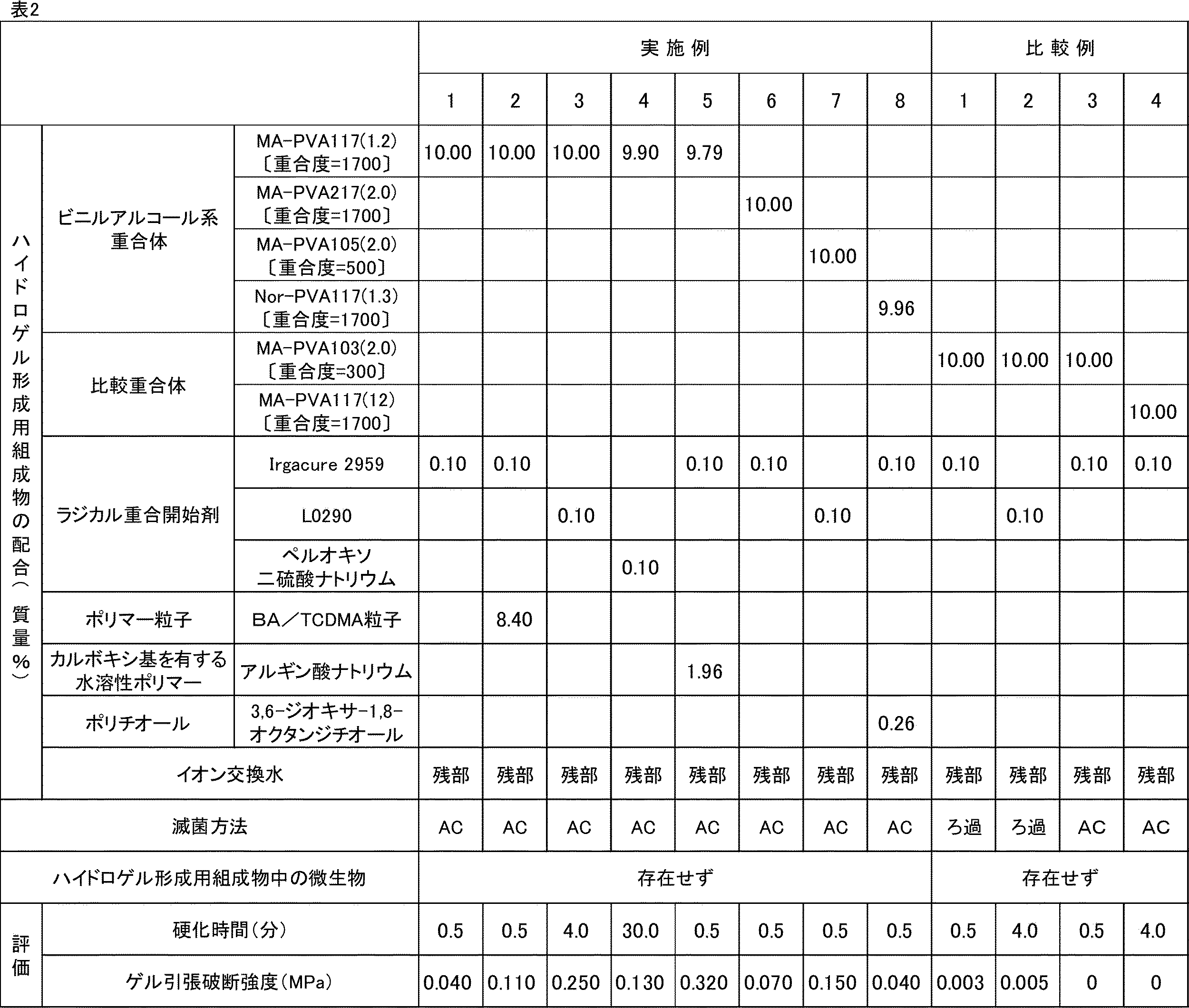
比較例1~3は、いずれも重合度450以下のビニルアルコール系重合体を用いているため、実施例1~8と比べて引張破断強度が低く、機械的強度が圧倒的に劣る。比較例4はエチレン性不飽和基の導入率が本発明の範囲を超えるため、ゲル自体が形成できなかった。
Claims (5)
- エチレン性不飽和基を有する重合度450以上のビニルアルコール系重合体を含むハイドロゲル形成用組成物であり、前記エチレン性不飽和基の導入率が、ビニルアルコール系重合体を構成する全構造単位中0.01~10モル%であり、且つ日本薬局方一般試験法に規定する無菌試験法(直接法)にて検出できる微生物が存在しないことを特徴とするハイドロゲル形成用組成物。
- 前記エチレン性不飽和基が、ビニル基、(メタ)アクリロイルオキシ基、(メタ)アクリロイルアミノ基、ビニルフェニル基、ノルボルネニル基及びこれらの誘導体からなる群より選択される少なくとも1種である、請求項1に記載のハイドロゲル形成用組成物。
- 請求項1又は2に記載のハイドロゲル形成用組成物の製造方法であって、前記ビニルアルコール系重合体と溶媒とを混合した組成物調製液を滅菌することを特徴とするハイドロゲル形成用組成物の製造方法。
- 前記滅菌がオートクレーブによる滅菌である、請求項3に記載のハイドロゲル形成用組成物の製造方法。
- 請求項1又は2に記載のハイドロゲル形成用組成物を架橋したハイドロゲル。
Priority Applications (5)
| Application Number | Priority Date | Filing Date | Title |
|---|---|---|---|
| JP2020568176A JP7463299B2 (ja) | 2019-01-22 | 2020-01-21 | ハイドロゲル形成用組成物、ハイドロゲル、及びハイドロゲル形成用組成物の製造方法 |
| CA3127530A CA3127530A1 (en) | 2019-01-22 | 2020-01-21 | Composition for forming hydrogel, hydrogel, and method for producing composition for forming hydrogel |
| US17/424,575 US12312430B2 (en) | 2019-01-22 | 2020-01-21 | Composition for forming hydrogel, hydrogel, and method for producing composition for forming hydrogel |
| EP20744912.5A EP3916024A4 (en) | 2019-01-22 | 2020-01-21 | COMPOSITION FOR MAKING A HYDROGEL, HYDROGEL AND METHOD FOR MAKING A COMPOSITION FOR MAKING A HYDROGEL |
| CN202080010434.3A CN113316593A (zh) | 2019-01-22 | 2020-01-21 | 用于形成水凝胶的组合物、水凝胶、和用于形成水凝胶的组合物的制备方法 |
Applications Claiming Priority (2)
| Application Number | Priority Date | Filing Date | Title |
|---|---|---|---|
| JP2019-008738 | 2019-01-22 | ||
| JP2019008738 | 2019-01-22 |
Publications (1)
| Publication Number | Publication Date |
|---|---|
| WO2020153382A1 true WO2020153382A1 (ja) | 2020-07-30 |
Family
ID=71736195
Family Applications (1)
| Application Number | Title | Priority Date | Filing Date |
|---|---|---|---|
| PCT/JP2020/002007 Ceased WO2020153382A1 (ja) | 2019-01-22 | 2020-01-21 | ハイドロゲル形成用組成物、ハイドロゲル、及びハイドロゲル形成用組成物の製造方法 |
Country Status (6)
| Country | Link |
|---|---|
| US (1) | US12312430B2 (ja) |
| EP (1) | EP3916024A4 (ja) |
| JP (1) | JP7463299B2 (ja) |
| CN (1) | CN113316593A (ja) |
| CA (1) | CA3127530A1 (ja) |
| WO (1) | WO2020153382A1 (ja) |
Cited By (4)
| Publication number | Priority date | Publication date | Assignee | Title |
|---|---|---|---|---|
| JPWO2022092211A1 (ja) * | 2020-10-28 | 2022-05-05 | ||
| JP2022086079A (ja) * | 2020-11-30 | 2022-06-09 | 三菱ケミカル株式会社 | 貼着シート、及び貼着シートと導電性物質層との積層体 |
| WO2023022181A1 (ja) * | 2021-08-18 | 2023-02-23 | 株式会社クラレ | ハイドロゲル及び滅菌された乾燥ハイドロゲル形成性物品 |
| WO2024176915A1 (ja) | 2023-02-22 | 2024-08-29 | 株式会社クラレ | 乾燥ハイドロゲル形成性物品、ハイドロゲル、及び乾燥ハイドロゲル形成性物品の製造方法 |
Families Citing this family (1)
| Publication number | Priority date | Publication date | Assignee | Title |
|---|---|---|---|---|
| CN115109367B (zh) * | 2022-07-22 | 2023-11-24 | 苏州凝智新材料发展有限公司 | 一种可注射水凝胶及其制备方法与应用 |
Citations (10)
| Publication number | Priority date | Publication date | Assignee | Title |
|---|---|---|---|---|
| JPH047302A (ja) * | 1990-04-25 | 1992-01-10 | Japan Synthetic Rubber Co Ltd | ゲルの製造方法 |
| JPH04222892A (ja) * | 1990-12-24 | 1992-08-12 | Kuraray Co Ltd | 保冷剤および滅菌ゲル |
| JPH08206188A (ja) * | 1994-12-08 | 1996-08-13 | Kuraray Co Ltd | 創傷被覆材 |
| JPH10513408A (ja) | 1995-02-03 | 1998-12-22 | ノバルティス アクチエンゲゼルシャフト | 架橋されたポリマー |
| JP2002506813A (ja) | 1998-03-19 | 2002-03-05 | サーモディックス,インコーポレイティド | 重合開始剤基を担持する架橋可能なマクロマー |
| JP2007246770A (ja) | 2006-03-17 | 2007-09-27 | Denki Kagaku Kogyo Kk | ヒドロゲル組成物およびそれを用いた地盤改良方法 |
| JP2008510021A (ja) | 2004-06-29 | 2008-04-03 | バイオキュア・インコーポレーテッド | バイオマテリアル |
| JP2011008213A (ja) | 2009-05-29 | 2011-01-13 | Hitoo Okano | 血管モデル |
| JP2015004059A (ja) | 2013-05-24 | 2015-01-08 | 国立大学法人横浜国立大学 | Pvaハイドロゲルの製造方法およびpvaハイドロゲル積層体の製造方法 |
| WO2017010459A1 (ja) | 2015-07-13 | 2017-01-19 | 富士シリシア化学株式会社 | 複合ゲル、塗料、塗膜、及び複合ゲルの製造方法 |
Family Cites Families (11)
| Publication number | Priority date | Publication date | Assignee | Title |
|---|---|---|---|---|
| WO1982001006A1 (en) * | 1980-09-24 | 1982-04-01 | Causton B | Radio-opaque material |
| US4598122A (en) * | 1985-01-22 | 1986-07-01 | Ciba-Geigy Corporation | Polyoxirane crosslinked polyvinyl alcohol hydrogel contact lens |
| US4665123A (en) * | 1985-12-13 | 1987-05-12 | Ciba-Geigy Corporation | Polyvinyl alcohol derivatives containing pendant (meth)acryloylvinylic monomer reaction product units bound through urethane groups and hydrogel contact lenses made therefrom |
| JPH04292169A (ja) * | 1991-03-19 | 1992-10-16 | Sekisui Chem Co Ltd | ハイブリッド型人工膵臓 |
| EP0716098B1 (en) | 1994-12-08 | 1999-03-17 | Kuraray Co., Ltd. | Wound dressing |
| JP3519832B2 (ja) * | 1995-09-18 | 2004-04-19 | 積水化学工業株式会社 | 生体反応検査方法 |
| US5880216A (en) * | 1995-12-22 | 1999-03-09 | Kuraray Co., Ltd. | Polyvinyl alcohol and gel containing the same |
| JPH1192524A (ja) * | 1997-09-25 | 1999-04-06 | Kuraray Co Ltd | ポリビニルアルコール系重合体含水ゲルの製造方法 |
| US9232805B2 (en) * | 2010-06-29 | 2016-01-12 | Biocure, Inc. | In-situ forming hydrogel wound dressings containing antimicrobial agents |
| EP3058003B8 (en) | 2013-10-17 | 2020-08-26 | Alcon Inc. | Crosslinkable polyacetal for contact lenses |
| US20160324148A1 (en) | 2015-05-06 | 2016-11-10 | Biocure, Inc. | Hydrogel formulation with mild adhesion |
-
2020
- 2020-01-21 CN CN202080010434.3A patent/CN113316593A/zh active Pending
- 2020-01-21 CA CA3127530A patent/CA3127530A1/en active Pending
- 2020-01-21 WO PCT/JP2020/002007 patent/WO2020153382A1/ja not_active Ceased
- 2020-01-21 JP JP2020568176A patent/JP7463299B2/ja active Active
- 2020-01-21 US US17/424,575 patent/US12312430B2/en active Active
- 2020-01-21 EP EP20744912.5A patent/EP3916024A4/en active Pending
Patent Citations (10)
| Publication number | Priority date | Publication date | Assignee | Title |
|---|---|---|---|---|
| JPH047302A (ja) * | 1990-04-25 | 1992-01-10 | Japan Synthetic Rubber Co Ltd | ゲルの製造方法 |
| JPH04222892A (ja) * | 1990-12-24 | 1992-08-12 | Kuraray Co Ltd | 保冷剤および滅菌ゲル |
| JPH08206188A (ja) * | 1994-12-08 | 1996-08-13 | Kuraray Co Ltd | 創傷被覆材 |
| JPH10513408A (ja) | 1995-02-03 | 1998-12-22 | ノバルティス アクチエンゲゼルシャフト | 架橋されたポリマー |
| JP2002506813A (ja) | 1998-03-19 | 2002-03-05 | サーモディックス,インコーポレイティド | 重合開始剤基を担持する架橋可能なマクロマー |
| JP2008510021A (ja) | 2004-06-29 | 2008-04-03 | バイオキュア・インコーポレーテッド | バイオマテリアル |
| JP2007246770A (ja) | 2006-03-17 | 2007-09-27 | Denki Kagaku Kogyo Kk | ヒドロゲル組成物およびそれを用いた地盤改良方法 |
| JP2011008213A (ja) | 2009-05-29 | 2011-01-13 | Hitoo Okano | 血管モデル |
| JP2015004059A (ja) | 2013-05-24 | 2015-01-08 | 国立大学法人横浜国立大学 | Pvaハイドロゲルの製造方法およびpvaハイドロゲル積層体の製造方法 |
| WO2017010459A1 (ja) | 2015-07-13 | 2017-01-19 | 富士シリシア化学株式会社 | 複合ゲル、塗料、塗膜、及び複合ゲルの製造方法 |
Non-Patent Citations (9)
| Title |
|---|
| "Cell Culture Technology", 1999, ASAKURA PUBLISHING CO. |
| "Polymer Chemistry", JOURNAL OF POLYMER SCIENCE, vol. 35, 1997, pages 3603 - 3611 |
| BIOMATERIALS, vol. 23, 2002, pages 4325 - 4332 |
| BRYANT STEPHANIE J., DAVIS-AREHART KELLY A., LUO NING, SHOEMAKER RICHARD K., ARTHUR JEFFREY A., ANSETH KRISTI S.: "Synthesis and Characterization of Photopolymerized Multifunctional Hydrogels: Water-Soluble Poly(Vinyl Alcohol) and Chondroitin Sulfate Macromers for Chondrocyte Encapsulation", MACROMOLECULES, vol. 37, no. 18, 8 July 2004 (2004-07-08), Washington DC United States, pages 6726 - 6733, XP009529085, ISSN: 0024-9297, DOI: 10.1021/ma0499324 * |
| CTA BIOMATERIALIA, vol. 6, 2010, pages 3899 - 3907 |
| JOURNAL OF CHEMICAL TECHNOLOGY AND BIOTECHNOLOGY, vol. 75, 2000, pages 541 - 546 |
| MACROMOLECULES, vol. 37, 2004, pages 6726 - 6733 |
| See also references of EP3916024A4 |
| SHIGERU KIMURA: "Insect Biological Factory", 2000, KOGYO CHOSAKAI PUBLISHING CO., LTD. |
Cited By (7)
| Publication number | Priority date | Publication date | Assignee | Title |
|---|---|---|---|---|
| JPWO2022092211A1 (ja) * | 2020-10-28 | 2022-05-05 | ||
| WO2022092211A1 (ja) * | 2020-10-28 | 2022-05-05 | 株式会社クラレ | 細胞包埋用ハイドロゲル、免疫隔離デバイス及び移植材料 |
| JP2022086079A (ja) * | 2020-11-30 | 2022-06-09 | 三菱ケミカル株式会社 | 貼着シート、及び貼着シートと導電性物質層との積層体 |
| WO2023022181A1 (ja) * | 2021-08-18 | 2023-02-23 | 株式会社クラレ | ハイドロゲル及び滅菌された乾燥ハイドロゲル形成性物品 |
| JPWO2023022181A1 (ja) * | 2021-08-18 | 2023-02-23 | ||
| WO2024176915A1 (ja) | 2023-02-22 | 2024-08-29 | 株式会社クラレ | 乾燥ハイドロゲル形成性物品、ハイドロゲル、及び乾燥ハイドロゲル形成性物品の製造方法 |
| EP4671292A1 (en) | 2023-02-22 | 2025-12-31 | Kuraray Co., Ltd. | ARTICLE FORMING A DRY HYDROGEL, HYDROGEL AND PROCESS FOR PRODUCING AN ARTICLE FORMING A DRY HYDROGEL |
Also Published As
| Publication number | Publication date |
|---|---|
| JP7463299B2 (ja) | 2024-04-08 |
| US20220098347A1 (en) | 2022-03-31 |
| CA3127530A1 (en) | 2020-07-30 |
| EP3916024A4 (en) | 2022-10-12 |
| US12312430B2 (en) | 2025-05-27 |
| JPWO2020153382A1 (ja) | 2021-12-02 |
| CN113316593A (zh) | 2021-08-27 |
| EP3916024A1 (en) | 2021-12-01 |
Similar Documents
| Publication | Publication Date | Title |
|---|---|---|
| JP7463299B2 (ja) | ハイドロゲル形成用組成物、ハイドロゲル、及びハイドロゲル形成用組成物の製造方法 | |
| JP7410871B2 (ja) | 単分散性ハイドロゲル粒子 | |
| He et al. | A photocurable hybrid chitosan/acrylamide bioink for DLP based 3D bioprinting | |
| KR101983741B1 (ko) | 바이오 잉크 및 이의 제조방법 | |
| JP4430124B2 (ja) | 有機無機複合体分散液及びその製造方法 | |
| CN102056983A (zh) | 有机无机复合物分散液及使用该分散液制造的细胞培养基材以及它们的制造方法 | |
| Kim et al. | Bio-inspired smart hydrogel with temperature-dependent properties and enhanced cell attachment | |
| JP6884068B2 (ja) | 刺激硬化性ゲル | |
| JP2019085521A (ja) | ポリビニルアルコール系相互貫入型ゲル | |
| CN104548196B (zh) | 一种基于乙烯基‑巯基交联的组织工程支架材料及其制备方法 | |
| WO2006064810A1 (ja) | 有機無機複合ヒドロゲルの製造方法、有機無機複合ヒドロゲルからなる細胞培養基材、及び有機無機複合ヒドロゲルの乾燥体からなる防曇材料 | |
| Kafili et al. | Development of bioinspired nanocomposite bioinks based on decellularized amniotic membrane and hydroxyethyl cellulose for skin tissue engineering | |
| US20200063094A1 (en) | Cell culture substrate | |
| WO2021132303A1 (ja) | ハイドロゲル造形用インク及びそれを用いたハイドロゲル | |
| JP2011132345A (ja) | 有機無機複合体分散液の製造方法 | |
| JP2011213793A (ja) | 有機無機複合ヒドロゲルの製造方法 | |
| JP7518773B2 (ja) | ポリマー組成物、ゲル、フィルムおよび粒子 | |
| Xu et al. | Paper title: Effect of irgacure 2959 and lithium phenyl-2, 4, 6-trimethylbenzoylphosphinate on cell viability Published in: Biomedical Materials 15 (5), 055021 | |
| WO2023022181A1 (ja) | ハイドロゲル及び滅菌された乾燥ハイドロゲル形成性物品 | |
| WO2023100974A1 (ja) | 無血清培地による細胞培養方法 | |
| EP4338763A1 (en) | A process for 3d bioprinting utilizing a hydrogel comprising a water-soluble elastin derivative | |
| JP2018062591A (ja) | 高分子ゲルおよびその製造方法、高分子ゲル前駆体溶液、並びに成形体およびその用途 | |
| WO2024237222A1 (ja) | 細胞の製造方法 | |
| CN112480337A (zh) | 一种用于细胞培养的凝胶材料 | |
| Espinoza et al. | Riboflavin-5’-Phosphate Mediated Blue-light Photocrosslinking of Poly (α-amino acid) Bioinks for 3D Bioprinting Applications |
Legal Events
| Date | Code | Title | Description |
|---|---|---|---|
| 121 | Ep: the epo has been informed by wipo that ep was designated in this application |
Ref document number: 20744912 Country of ref document: EP Kind code of ref document: A1 |
|
| ENP | Entry into the national phase |
Ref document number: 2020568176 Country of ref document: JP Kind code of ref document: A |
|
| ENP | Entry into the national phase |
Ref document number: 3127530 Country of ref document: CA |
|
| NENP | Non-entry into the national phase |
Ref country code: DE |
|
| ENP | Entry into the national phase |
Ref document number: 2020744912 Country of ref document: EP Effective date: 20210823 |
|
| WWG | Wipo information: grant in national office |
Ref document number: 17424575 Country of ref document: US |