WO2020121640A1 - 偏光膜の製造方法、光学素子及び液晶素子 - Google Patents
偏光膜の製造方法、光学素子及び液晶素子 Download PDFInfo
- Publication number
- WO2020121640A1 WO2020121640A1 PCT/JP2019/040024 JP2019040024W WO2020121640A1 WO 2020121640 A1 WO2020121640 A1 WO 2020121640A1 JP 2019040024 W JP2019040024 W JP 2019040024W WO 2020121640 A1 WO2020121640 A1 WO 2020121640A1
- Authority
- WO
- WIPO (PCT)
- Prior art keywords
- polymer
- polarizing film
- film
- group
- organic
- Prior art date
- Legal status (The legal status is an assumption and is not a legal conclusion. Google has not performed a legal analysis and makes no representation as to the accuracy of the status listed.)
- Ceased
Links
Images


Classifications
-
- C—CHEMISTRY; METALLURGY
- C08—ORGANIC MACROMOLECULAR COMPOUNDS; THEIR PREPARATION OR CHEMICAL WORKING-UP; COMPOSITIONS BASED THEREON
- C08G—MACROMOLECULAR COMPOUNDS OBTAINED OTHERWISE THAN BY REACTIONS ONLY INVOLVING UNSATURATED CARBON-TO-CARBON BONDS
- C08G73/00—Macromolecular compounds obtained by reactions forming a linkage containing nitrogen with or without oxygen or carbon in the main chain of the macromolecule, not provided for in groups C08G12/00 - C08G71/00
- C08G73/06—Polycondensates having nitrogen-containing heterocyclic rings in the main chain of the macromolecule
- C08G73/10—Polyimides; Polyester-imides; Polyamide-imides; Polyamide acids or similar polyimide precursors
-
- G—PHYSICS
- G02—OPTICS
- G02B—OPTICAL ELEMENTS, SYSTEMS OR APPARATUS
- G02B5/00—Optical elements other than lenses
- G02B5/30—Polarising elements
-
- G—PHYSICS
- G02—OPTICS
- G02F—OPTICAL DEVICES OR ARRANGEMENTS FOR THE CONTROL OF LIGHT BY MODIFICATION OF THE OPTICAL PROPERTIES OF THE MEDIA OF THE ELEMENTS INVOLVED THEREIN; NON-LINEAR OPTICS; FREQUENCY-CHANGING OF LIGHT; OPTICAL LOGIC ELEMENTS; OPTICAL ANALOGUE/DIGITAL CONVERTERS
- G02F1/00—Devices or arrangements for the control of the intensity, colour, phase, polarisation or direction of light arriving from an independent light source, e.g. switching, gating or modulating; Non-linear optics
- G02F1/01—Devices or arrangements for the control of the intensity, colour, phase, polarisation or direction of light arriving from an independent light source, e.g. switching, gating or modulating; Non-linear optics for the control of the intensity, phase, polarisation or colour
- G02F1/13—Devices or arrangements for the control of the intensity, colour, phase, polarisation or direction of light arriving from an independent light source, e.g. switching, gating or modulating; Non-linear optics for the control of the intensity, phase, polarisation or colour based on liquid crystals, e.g. single liquid crystal display cells
- G02F1/133—Constructional arrangements; Operation of liquid crystal cells; Circuit arrangements
- G02F1/1333—Constructional arrangements; Manufacturing methods
- G02F1/1335—Structural association of cells with optical devices, e.g. polarisers or reflectors
-
- G—PHYSICS
- G02—OPTICS
- G02F—OPTICAL DEVICES OR ARRANGEMENTS FOR THE CONTROL OF LIGHT BY MODIFICATION OF THE OPTICAL PROPERTIES OF THE MEDIA OF THE ELEMENTS INVOLVED THEREIN; NON-LINEAR OPTICS; FREQUENCY-CHANGING OF LIGHT; OPTICAL LOGIC ELEMENTS; OPTICAL ANALOGUE/DIGITAL CONVERTERS
- G02F1/00—Devices or arrangements for the control of the intensity, colour, phase, polarisation or direction of light arriving from an independent light source, e.g. switching, gating or modulating; Non-linear optics
- G02F1/01—Devices or arrangements for the control of the intensity, colour, phase, polarisation or direction of light arriving from an independent light source, e.g. switching, gating or modulating; Non-linear optics for the control of the intensity, phase, polarisation or colour
- G02F1/13—Devices or arrangements for the control of the intensity, colour, phase, polarisation or direction of light arriving from an independent light source, e.g. switching, gating or modulating; Non-linear optics for the control of the intensity, phase, polarisation or colour based on liquid crystals, e.g. single liquid crystal display cells
- G02F1/133—Constructional arrangements; Operation of liquid crystal cells; Circuit arrangements
- G02F1/1333—Constructional arrangements; Manufacturing methods
- G02F1/1337—Surface-induced orientation of the liquid crystal molecules, e.g. by alignment layers
Definitions
- the present disclosure relates to a method for manufacturing a polarizing film, an optical element, and a liquid crystal element.
- a polarizing plate using polyiodine is one of the absorption type polarizing plates and is widely used because it has excellent polarization characteristics.
- a polarizing plate using polyiodine does not have sufficient heat resistance, light resistance, and water resistance, and when it is applied to a field where heat resistance is required, the performance is likely to deteriorate or the product life is short. There's a problem.
- a wire grid polarizing plate utilizing polarization separation by a metal nanowire grid has been proposed as a scattering/reflection type polarizing plate (for example, refer to Patent Document 1).
- a wire grid polarizing plate can be manufactured by a method of vapor-depositing a conductor (aluminum or the like) on a side surface of a convex portion of a base material using an oblique vapor deposition method on a surface of a base material having an uneven shape. It is disclosed.
- Wire-grid polarizers generally exhibit heat resistance and light resistance compared to absorption-type polarizers that use polyiodine, because multiple thin metal wires exhibit polarization characteristics with a diffraction grating arranged at intervals shorter than the wavelength of light. Good property.
- the present disclosure has been made in view of the above problems, and it is an object of the present disclosure to provide a method for manufacturing a polarizing film that can manufacture a polarizing film having excellent polarization characteristics by a simple coating process.
- ⁇ 1> A formation step of forming an organic film in which the polymer is oriented by applying a composition containing a polymer and water and exhibiting lyotropic liquid crystallinity onto a substrate in a liquid crystal phase state, And a reduction step of reducing metal ions in the organic film containing metal ions obtained by the forming step.
- ⁇ 3> A liquid crystal element having a polarizing film obtained by the manufacturing method according to ⁇ 1> above.
- a polarizing film exhibiting excellent polarization characteristics can be manufactured by a simple coating process. Further, by performing the production of the polarizing film by a coating process, the polymer and the metal ions can be uniformly oriented in a large area region or a narrow region, and a polarizing film exhibiting excellent polarization characteristics can be produced. ..
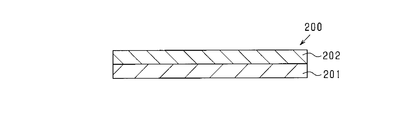
- FIG. 1 is a diagram showing a schematic configuration of a polarizing plate.
- FIG. 2 is a 1 H-NMR spectrum of the polymer (PI-1).
- FIG. 3 is a 1 H-NMR spectrum of the polymer (PI-2).
- a "hydrocarbon group” is a meaning containing a chain hydrocarbon group, an alicyclic hydrocarbon group, and an aromatic hydrocarbon group.
- the “chain hydrocarbon group” means a straight chain hydrocarbon group or a branched chain hydrocarbon group which does not include a cyclic structure in the main chain and is composed of only a chain structure. However, it may be saturated or unsaturated.
- the “alicyclic hydrocarbon group” means a hydrocarbon group containing only an alicyclic hydrocarbon structure as a ring structure and not containing an aromatic ring structure.
- the “aromatic hydrocarbon group” means a hydrocarbon group containing an aromatic ring structure as a ring structure.
- the structure need not be composed of only the aromatic ring structure, and a part thereof may include a chain structure or an alicyclic hydrocarbon structure.
- the “organic group” means a group containing a hydrocarbon group, and may contain a hetero atom in the structure.
- the polarizing film of the present disclosure is a thin film containing a polymer having lyotropic liquid crystallinity and metal particles, and exhibits absorption-type or reflection-type polarization characteristics.
- the polarizing film can be manufactured by the following manufacturing method 1 or manufacturing method 2.
- Step A-1 A step of forming an organic film in which the polymer is oriented by applying a composition containing a polymer and water and exhibiting lyotropic liquid crystallinity onto a substrate in a liquid crystal phase state.
- Step B A step of bringing the organic film obtained in Step A-1 into contact with the metal ion-containing aqueous solution.
- Step C a step of reducing the metal ions contained in the organic film after the step B.
- Step A-2 A step of forming an organic film in which the polymer is oriented by applying a composition containing a polymer, water and a metal ion and exhibiting lyotropic liquid crystallinity onto a substrate in a liquid crystal phase state.
- Step C A step of reducing metal ions contained in the organic film obtained in Step A-2.
- the process A-1 and the process A-2 are collectively referred to as “process A”.
- step A a composition having lyotropic liquid crystallinity for forming an organic film (hereinafter, also referred to as “lyotropic liquid crystalline composition”) is prepared.
- the lyotropic liquid crystalline composition contains a polymer and water.
- a polymer As the polymer contained in the lyotropic liquid crystalline composition (hereinafter, also referred to as “polymer (P)”), a water-soluble polymer having liquid crystallinity and capable of self-assembly can be used. Specific examples thereof include polymers having a rigid main chain and a water-soluble hydrophilic group in a side chain, such as a conjugated polymer. Specific examples of such polymers are described in International Publication No.
- the polymer (P) is preferably polyimide, because a polarizing film having excellent heat resistance and light resistance can be obtained, and a polarizing film having excellent optical anisotropy can be obtained.
- a polymer having an anionic acidic functional group can be preferably used from the viewpoint of molecularly orienting a cationic metal ion in the film.
- the acidic functional group is preferably a sulfonic acid group, a phosphonic acid group or a carboxylic acid group, or a salt obtained by neutralizing them, from the viewpoint of higher solubility of the polymer (P) in water. It is preferably an acid group or a salt thereof.
- examples of the counter ion include Li + , Na + , K + , Rb + , Cs + , Cu + , Ag + , ammonium ion, pyridinium ion, imidazolium ion, guanidinium ion, Examples include phosphonium ions.
- the counter ion when the counter ion is an inorganic ion, it may be complexed with an organic ligand, and when the counter ion is an organic ion, it may be modified with an organic group.
- the acidic functional group is a carboxylic acid group
- the acid dissociation constant of the carboxylic acid is low, and it is difficult for protons to dissociate under acidic conditions and the ionicity decreases, so it is preferable to form a salt with a strong base.
- the content thereof is preferably 50 with respect to 100 parts by mole of repeating units constituting the polymer (P), from the viewpoint of obtaining a polarizing film having excellent polarization characteristics. It is more than 100 parts by mole, more preferably more than 100 parts by mole.
- the upper limit of the content of the acidic functional group is not particularly limited and can be set arbitrarily. From the viewpoint of ease of synthesis, the content of the acidic functional group is preferably 300 parts by mol or less, more preferably 200 parts by mol or less, relative to 100 parts by mol of the repeating unit constituting the polymer (P).
- the acidic functional group contained in the polymer (P) may be one type or two or more types.
- the polymer (P) is a polymer having a partial structure represented by the following formula (0) in that the coating process can be further simplified by exhibiting lyotropic liquid crystallinity under mild conditions of temperature, solvent and concentration.
- polymer (PI) it is also referred to as “polymer (PI)”), and particularly preferably a polymer having a partial structure represented by the following formula (1).
- the acidic functional group of the polymer (PI) dissolves in water, and the excluded volume effect derived from the rigid rod-like skeleton and the electrostatic repulsion derived from the acidic functional group are generated.
- a 1 is the following formula (ar-1) or formula (ar-2) Wherein at least one of R 1 to R 10 and R 43 to R 46 is a monovalent group having an acidic functional group, and the rest are each independently a hydrogen atom or a halogen. It is an atom or a monovalent organic group.
- k is 0 or 1. However, it has at least one acidic functional group in the formula (0).
- R 1 to R 10 is a monovalent group having an acidic functional group, and the rest are each independently a hydrogen atom, a halogen atom or a monovalent organic group.
- k is 0 or 1, provided that at least one acidic functional group is contained in the formula (1).
- the monovalent organic group is preferably a hydrocarbon group, more preferably an alkyl group having 1 to 5 carbon atoms. It is a base.
- the monovalent group having an acidic functional group is "*-L 1 -X 1 "(wherein L 1 is a single bond or a divalent linking group, and X 1 is an acidic functional group. "*" is It represents a bond that bonds to the benzene ring).
- L 1 is a divalent linking group
- specific examples of L 1 include an alkanediyl group having 1 to 5 carbon atoms and a group containing —O— between carbon-carbon bonds of the alkanediyl group.
- L 1 is preferably a single bond or an alkanediyl group having 1 to 3 carbon atoms, and more preferably a single bond.
- the number of acidic functional groups respectively contained in the partial structure represented by the above formula (0) and the partial structure represented by the above formula (1) is preferably 1 to 4, and more preferably 1 or 2 Is.
- the partial structure represented by the above formula (0) and the partial structure represented by the above formula (1) are derived from diamines in that they exhibit good lyotropic liquid crystallinity and the degree of freedom of material selectivity is high. It is preferable that the partial structure (that is, at least a part of R 3 to R 10 ) has an acidic functional group.
- k is 0 in that liquid crystallinity is exhibited at a lower polymer concentration. Is preferred.
- Specific preferred examples of the partial structure represented by the above formula (0) include partial structures represented by the following formulas (A-1) to (A-8).
- Preferred specific examples of the partial structure represented by the above formula (1) include partial structures represented by the following formulas (A-1) to (A-4).
- M is a cation. A plurality of Ms in the formula are the same or different groups from each other.
- M the illustration of the counter ion when the acidic functional group is a salt is applied.
- M is preferably a monovalent cation, of these, an ammonium ion is preferable, and a tertiary ammonium ion is more preferable.
- the polymer (PI) preferably has at least one selected from the group consisting of the partial structures represented by the formulas (A-1) to (A-6).
- the content of the partial structure represented by the above formula (0) is preferably 50 mol% or more, and 75 mol% based on the total amount of repeating units contained in the polymer (P). % Or more, and more preferably 90 mol% or more.
- the repeating unit contained in the polymer (P) is particularly preferably only the partial structure represented by the above formula (0).
- the repeating unit is a basic unit of the chemical structure of the polymer (P).
- the monomer unit of the polymer (PI) has a structure formed by the reaction of one tetracarboxylic acid derivative and one diamine.
- the polymer (P) can be synthesized according to a standard method of organic chemistry depending on its main chain.
- the polymer (PI) will be described in detail.
- the polymer (PI) is obtained by polymerizing at least one tetracarboxylic acid derivative selected from the group consisting of tetracarboxylic acid dianhydride, tetracarboxylic acid diester and tetracarboxylic acid diester dihalide, and diamine as a raw material composition. It can be obtained by imidizing the obtained polyimide precursor.
- tetracarboxylic acid diester as used herein means a compound in which two of the four carboxyl groups of tetracarboxylic acid are esterified and the remaining two are carboxyl groups.
- tetracarboxylic acid diester dihalide means a compound in which two of the four carboxyl groups of tetracarboxylic acid are esterified and the remaining two are halogenated.
- polyimide precursor includes polyamic acid and polyamic acid ester.
- the tetracarboxylic dianhydride is at least selected from the group consisting of a compound represented by the following formula (t-1) and a compound represented by the following formula (t-2). It is preferable to use one kind of compound (hereinafter, also referred to as “specific acid dianhydride”), and it is more preferable to use a compound represented by the following formula (t-1).
- R 1 and R 2 are each independently a hydrogen atom, a halogen atom, an acidic functional group or a monovalent organic group.
- R 43 to R 46 Are each independently a hydrogen atom, a halogen atom, an acidic functional group or a monovalent organic group.
- the monovalent organic group is a hydrocarbon group having 1 to 20 carbon atoms, Examples thereof include a group in which a hydrogen atom of a hydrocarbon group is replaced with an acidic functional group.
- R 1 , R 2 , and R 43 to R 46 are preferably hydrogen atoms, halogen atoms, methyl groups or trifluoromethyl groups, and more preferably hydrogen atoms.
- the specific acid dianhydrides may be used alone or in combination of two or more.
- a tetracarboxylic acid diester used in the synthesis of the polymer (PI) As a preferred specific example of the tetracarboxylic acid diester used in the synthesis of the polymer (PI), a tetracarboxylic acid dianhydride represented by the above formula (t-1) or the above formula (t-2) is replaced with methanol or Examples thereof include compounds obtained by ring-opening using alcohols such as ethanol.
- Specific preferred examples of the tetracarboxylic acid diester dihalide used in the synthesis of the polymer (PI) include compounds obtained by reacting the tetracarboxylic acid diester with a chlorinating agent such as thionyl chloride.
- the tetracarboxylic acid diester and the tetracarboxylic acid diester dihalide may be used alone or in combination of two or more.
- a diamine having an acidic functional group hereinafter, also referred to as “specific diamine”
- an aromatic diamine having an acidic functional group hereinafter, also referred to as “specific diamine”
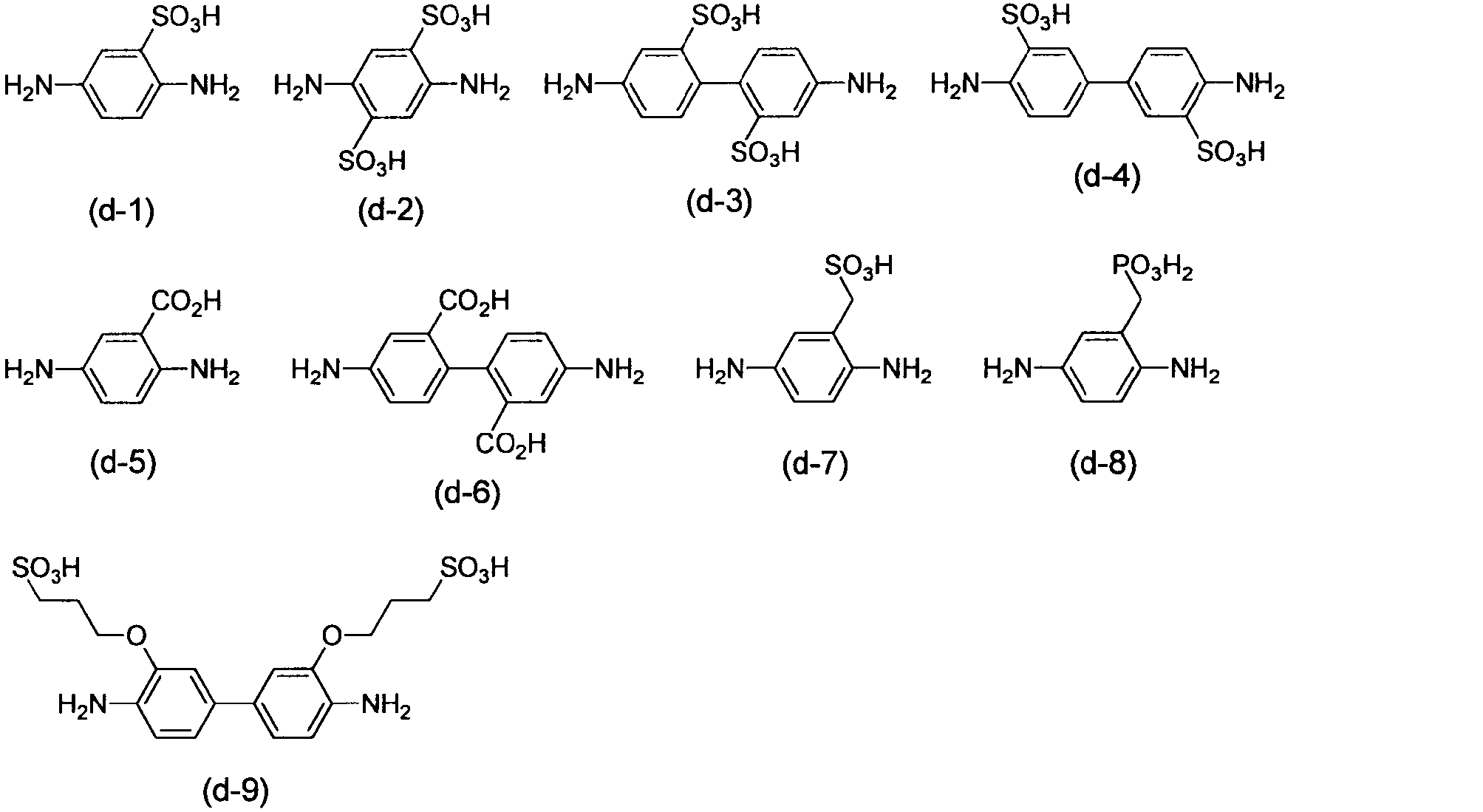
- Preferred specific examples of the specific diamine include compounds represented by the following formulas (d-1) to (d-9).
- a specific diamine can be used individually by 1 type or in combination of 2 or more types.
- the polyamic acid (hereinafter, also referred to as “polyamic acid (P)”) that is a precursor of the polymer (PI) can be obtained by reacting tetracarboxylic dianhydride and diamine, for example. Specifically, a method of directly reacting [i] a tetracarboxylic dianhydride and a diamine; [ii] a tetracarboxylic dianhydride or a diamine is neutralized with a base, and then a tetracarboxylic dianhydride and a diamine are neutralized. And a method of reacting with.
- a tetracarboxylic dianhydride other than the specific acid dianhydride hereinafter, also referred to as “other acid dianhydride”
- a diamine other than the specific diamine hereinafter, “other diamine”. It is also possible to use together.
- other acid dianhydrides include aliphatic tetracarboxylic acid dianhydrides, alicyclic tetracarboxylic acid dianhydrides, and aromatic tetracarboxylic acid dianhydrides.
- aliphatic tetracarboxylic acid dianhydrides such as butanetetracarboxylic acid dianhydride and ethylenediaminetetraacetic acid dianhydride
- alicyclic tetracarboxylic acid dianhydrides such as 1,2.
- other acid dianhydride can be used individually by 1 type or in combination of 2 or more types.
- Examples of other diamines include aliphatic diamines, alicyclic diamines, aromatic diamines, and diaminoorganosiloxanes. Specific examples thereof include aliphatic diamines such as metaxylylenediamine and hexamethylenediamine; and alicyclic diamines such as 1,4-diaminocyclohexane and 4,4′-methylenebis(cyclohexylamine).
- An aromatic diamine such as p-phenylenediamine, 2,4-diaminobenzenesulfonic acid, 3,5-diaminobenzoic acid, 4,4′-diaminostilbene-2,2′-disulfonic acid, 2,2′-
- diaminoorganosiloxane examples include dimethyl-4,4′-diaminobiphenyl and the like; for example, 1,3-bis(3-aminopropyl)-tetramethyldisiloxane; and the like.
- the diamine described in 97188 can be used.
- the ratio of the specific acid dianhydride used is lyotropic to the polyamic acid (P).
- the amount is preferably 50 mol% or more, and more preferably 75 mol% or more, based on the total amount of the tetracarboxylic dianhydride used in the synthesis of the polyamic acid (P). More preferably, it is particularly preferably 90 mol% or more.
- the upper limit of the use ratio is not particularly limited and can be arbitrarily set within the range of 100 mol% or less.
- the ratio of the specific diamine used is, with respect to the polyamic acid (P), from the viewpoint of sufficiently imparting solubility in an aqueous solvent and lyotropic liquid crystallinity, to the total amount of the diamine used for the synthesis of the polyamic acid (P), It is preferably 50 mol% or more, more preferably 75 mol% or more, further preferably 90 mol% or more, and particularly preferably 100 mol%.
- the polyamic acid (P) can be obtained by reacting the above-mentioned tetracarboxylic dianhydride and diamine together with a molecular weight modifier, if necessary.
- the ratio of the tetracarboxylic dianhydride and the diamine used for the synthesis reaction of the polyamic acid (P) is such that the acid anhydride group of the tetracarboxylic dianhydride is 0.
- a ratio of 5 to 2 equivalents is preferable, and a ratio of 0.8 to 1.2 equivalents is more preferable.
- various bases can be used, but in an organic solvent.
- an organic base is preferable, a tertiary amine is more preferable, and triethylamine is particularly preferable.
- the ratio of the base used is preferably 0.5 to 5 equivalents, more preferably 1 to 2 equivalents, relative to the acidic functional group.
- the molecular weight modifier examples include acid monoanhydrides such as maleic anhydride, phthalic anhydride and itaconic anhydride, monoamine compounds such as aniline, cyclohexylamine and n-butylamine, monoisocyanate compounds such as phenyl isocyanate and naphthyl isocyanate. Can be mentioned.
- the proportion of the molecular weight modifier used is preferably 20 parts by mass or less, and more preferably 10 parts by mass or less, based on 100 parts by mass of the total tetracarboxylic dianhydride and diamine used.
- the synthesis reaction of the polyamic acid (P) is preferably carried out in an organic solvent.
- the reaction temperature at this time is preferably ⁇ 20° C. to 150° C., more preferably 0 to 100° C.
- the reaction time is preferably 0.1 to 24 hours, more preferably 0.5 to 12 hours.
- the organic solvent used in the reaction include aprotic polar solvents, phenolic solvents, alcohols, ketones, esters, ethers, halogenated hydrocarbons and hydrocarbons. Of these organic solvents, one or more selected from the group consisting of an aprotic polar solvent and a phenolic solvent (first group of organic solvents), or one or more selected from the first group of organic solvents.
- the use ratio of the second group organic solvent is preferably 50 mass% or less, and more preferably 40 mass% with respect to the total amount of the first group organic solvent and the second group organic solvent. It is below, and more preferably 30% by mass or less.
- organic solvents are N-methyl-2-pyrrolidone, N,N-dimethylacetamide, N,N-dimethylformamide, dimethylsulfoxide, ⁇ -butyrolactone, tetramethylurea, hexamethylphosphortriamide, m-cresol, xylenol. It is preferable to use one or more selected from the group consisting of and halogenated phenols as a solvent, or to use a mixture of one or more of these with other organic solvents in the range of the above ratio.
- the amount (a) of the organic solvent used is preferably such that the total amount (b) of the tetracarboxylic dianhydride and the diamine becomes 1 to 50% by mass with respect to the total amount (a+b) of the reaction solution. ..
- the reaction solution containing the polyamic acid (P) may be subjected to the dehydration ring closure reaction as it is, or may be subjected to the dehydration ring closure reaction after isolating the polyamic acid (P).
- polyamic acid ester The polyamic acid ester (hereinafter, also referred to as “polyamic acid ester (P)” that is a polymer (PI) precursor is, for example, [I] a polyamic acid (P) obtained by the above polymerization reaction and an esterifying agent. Can be obtained by a method of reacting with, a method of reacting [II] tetracarboxylic acid diester with diamine, a method of reacting [III] tetracarboxylic acid diester dihalide with diamine, and the like.
- the polymer (PI) can be obtained by subjecting the polyimide precursor synthesized as described above to dehydration ring closure and imidization.
- the polymer (PI) may be a complete imidized product obtained by dehydrating and ring-closing all of the amic acid structure or amic acid ester structure of the polyimide precursor that is the precursor, and the amic acid structure and amic acid ester may be used.
- a partial imidized product in which only a part of the structure is dehydrated and ring-closed to have an amic acid structure or an amic acid ester structure and an imide ring structure may be used.
- the polymer (PI) has an imidization ratio of preferably 50% or more, more preferably 75% or more, and more preferably 90% or more, from the viewpoint of obtaining a polarizing film having sufficiently high polarization characteristics. Is more preferable, and 95% or more is particularly preferable.
- the imidization ratio is a percentage of the ratio of the number of imide ring structures to the total number of amic acid structures and amic acid ester structures of polyimide and the number of imide ring structures.
- Dehydration ring closure of the polyimide precursor preferably by a method of heating a polyamic acid, or dissolve the polyamic acid in an organic solvent, if necessary by adding at least one of a dehydrating agent and dehydration ring-closing catalyst in this solution. It is carried out by a heating method.
- a heating method in the latter method, as the dehydrating agent, acid anhydrides such as acetic anhydride, propionic anhydride, and trifluoroacetic anhydride can be used.
- the amount of the dehydrating agent used is preferably 0.01 to 20 mol per mol of the amic acid structure of the polyamic acid.
- the dehydration ring-closing catalyst for example, a base catalyst such as pyridine, triethylamine, 1-methylpiperidine, or an acid catalyst such as methanesulfonic acid or benzoic acid can be used.
- the amount of the dehydration ring-closing catalyst used is preferably 0.01 to 10 mol per 1 mol of the dehydrating agent used.
- the organic solvent used for the dehydration ring closure reaction include the organic solvents exemplified as those used for the synthesis of the polyamic acid (P).
- the reaction temperature for the dehydration ring closure reaction is preferably 0 to 200° C., and the reaction time is preferably 1.0 to 120 hours.
- the reaction solution containing the polymer may be directly used for the preparation of the composition, or the polymer may be isolated and then used for the preparation of the composition.
- the polymer (P) preferably has a solution viscosity of 10 to 2000 mPa ⁇ s, and a solution viscosity of 20 to 1000 mPa ⁇ s when the polymer (P) is made into a solution having a concentration of 10% by mass. It is more preferable to have one.
- the solution viscosity (mPa ⁇ s) of the polymer is 25 using an E-type rotational viscometer for a polymer solution having a concentration of 10 mass% prepared by using a good solvent (for example, water) for the polymer. It is a value measured at °C.
- the polystyrene equivalent weight average molecular weight (M w ) of the polymer (P) measured by gel permeation chromatography (GPC) is preferably 1,000 or more, more preferably 2,000 or more. Further, M w is preferably 500,000 or less, more preferably 100,000 or less.
- the molecular weight distribution ( Mw / Mn ) represented by the ratio of Mw and the polystyrene-equivalent number average molecular weight ( Mn ) measured by GPC is preferably 10 or less, and more preferably 5 or less. .. By having such a molecular weight range, it is possible to easily secure a concentration range and a temperature range in which the composition exhibits lyotropic liquid crystallinity.
- the polymer (P) preferably exhibits lyotropic liquid crystallinity at at least a part of the temperature in the range from 0°C to less than 100°C.
- the temperature range in which the polymer (P) exhibits lyotropic liquid crystallinity is preferably a temperature range including 20 to 40° C., more preferably a temperature range including 20 to 60° C., in a range of 0° C. or higher and lower than 100° C. And more preferably in a temperature range including 20 to 80° C.
- the lyotropic liquid crystalline composition is a liquid composition in which a water-soluble polymer (P) is dissolved in an aqueous solvent.
- the content ratio of water is lyotropic liquid crystalline composition. It is preferably 40% by mass or more, more preferably 60% by mass or more, and further preferably 80% by mass or more based on the total amount (100% by mass) of the solvent contained in the substance.
- the content ratio of water can be 100% by mass or less based on the total amount of the solvent contained in the lyotropic liquid crystalline composition.
- the lyotropic liquid crystalline composition used in production method 2 contains a metal ion.
- a metal ion a silver ion, a gold ion, a copper ion, a platinum ion, a titanium ion, a nickel ion or a chromium ion is preferable since it has a small absorption in the visible region and causes a strong localized surface plasmon resonance.
- silver ion, gold ion or copper ion is more preferable, silver ion or gold ion is further preferable, and silver ion is particularly preferable, in that the standard electrode potential is positive and easily reduced.
- the extinction (absorption+scattering) cross section reaches about 10 times the physical cross section. Therefore, it is preferable in that the amount of silver ions introduced into the film is small and a polarizing film that exhibits sufficient polarization characteristics can be obtained even if the silver particles are sparse with respect to the film.
- the counter ion can be appropriately selected according to the type of the metal ion.
- metal salts for containing silver ions in the composition include silver nitrate, silver oxalate, silver acetate, silver carbonate, silver oxide, silver nitrite, silver benzoate, silver cyanate, silver citrate and silver lactate. At least one selected from the group consisting of the following can be preferably used.
- introducing a reducing agent into the organic film it is preferable to use at least one of silver oxalate and silver citrate as the metal salt.
- the content ratio is preferably 5 parts by mole or more with respect to 100 parts by mole of the amount of the acidic functional group contained in the polymer (P) in the lyotropic liquid crystalline composition. And more preferably 10 parts by mole or more.
- the upper limit of the content ratio of the metal ion is preferably 200 parts by mole or less, more preferably 100 parts by mole with respect to 100 parts by mole of the amount of the acidic functional group contained in the polymer (P) in the lyotropic liquid crystalline composition. It is below.
- the metal ion blended in the lyotropic liquid crystalline composition may be only one kind or two or more kinds.
- another metal ion is further added in order to promote the expression of anisotropic shape (anisotropic growth) when the silver ions are reduced in the film. It may be contained.
- copper (II) ions are preferable as the other metal ions in terms of increasing the axial ratio of silver particles produced in the film by reduction of silver ions.
- the mixing ratio of the other metal ions is preferably 1 mol% or more based on the total amount of silver ions in the lyotropic liquid crystalline composition, More preferably, it is 2 mol% or more.
- the mixing ratio of other metal ions is preferably 20 mol %.
- a ligand may be contained in the composition because the stability of the metal ion can be increased by complex formation.
- the ligand include primary amines such as ethylamine, ethylenediamine and ethanolamine; secondary amines such as diethylamine and diethanolamine; tertiary amines such as triethylamine and dimethylaminoethanol, and 2,2′-thiodiethanol, Thioacetamide or the like can be used.
- the compounding ratio thereof is preferably 10 mol% or more, and more preferably based on the total amount of metal ions contained in the lyotropic liquid crystalline composition. It is 50 to 400 mol %.
- the lyotropic liquid crystalline composition may contain other components other than the components described above within the range not impairing the objects and effects of the present disclosure.
- a reducing agent may be contained in the lyotropic liquid crystalline composition for the purpose of performing the reduction treatment of the metal ions in the step C under more mild conditions.
- the reducing agent include oxalic acid, ethylene glycol, citric acid, sodium sulfite, and paraphenylenediamine.
- the mixing ratio thereof is preferably 10 parts by mole or more, more preferably 50 to 400 parts by mole, relative to 100 parts by mole of the metal ion in the composition. is there.
- solvent As a solvent component of the lyotropic liquid crystalline composition, a solvent other than water (hereinafter, also referred to as "other solvent”) may be used.
- the other solvent may be any solvent that can be mixed uniformly with water, and examples thereof include methanol, ethanol, n-propanol, i-propanol, n-butanol, ethylene glycol, acetone, methyl ethyl ketone, tetrahydrofuran, N- Methyl-2-pyrrolidone, ⁇ -butyrolactone, 1-butoxy-2-propanol, diacetone alcohol, dipropylene glycol monomethyl ether, ethyl lactate, ethylene glycol methyl ether, ethylene glycol-n-butyl ether (butyl cellosolve), diethylene glycol monomethyl ether, Examples thereof include diethylene glycol monoethyl ether, diethylene glycol monomethyl ether acetate, diethylene glycol monoethy
- the organic solvent used is preferably an organic solvent having a lower boiling point than that of water, and comprises methanol, ethanol, n-propanol, i-propanol, acetone and tetrahydrofuran. More preferably, it is at least one selected from the group.
- the content ratio of the organic solvent is preferably 50% by mass or less, more preferably 25% by mass or less, based on the total amount of the mixed solvent. It is more preferable to set it to 10% by mass or less.
- other components include, for example, compounds having at least one epoxy group in the molecule, functional silane compounds, surfactants, fillers, pigments, defoamers, sensitizers, dispersants, antioxidants.
- the compounding ratio of these compounds can be appropriately set according to each compound to be compounded within a range that does not impair the effects of the present disclosure.
- the concentration of the polymer (P) in the lyotropic liquid crystalline composition may be any concentration as long as the composition exhibits lyotropic liquid crystalline properties.
- the concentration of the polymer (P) is preferably 1 to 30% by mass with respect to the total amount of the solvent and the polymer (P) from the viewpoint of sufficiently ensuring good coatability on the substrate.
- the concentration of the polymer (P) with respect to the total amount of the solvent and the polymer (P) is more preferably 1 to 20% by mass, further preferably 2 to 20% by mass, and particularly preferably 2 to 10% by mass. %.
- the polymer (PI) is preferable in that a composition exhibiting lyotropic liquid crystallinity can be obtained at a relatively low polymer concentration. Therefore, the coating property when forming a coating film on a substrate is good, a thin film having a film thickness of about 0.1 to 10 ⁇ m can be produced, and the industrial productivity is excellent.
- the solid content concentration of the lyotropic liquid crystalline composition (the ratio of the total mass of components other than the solvent of the composition to the total mass of the composition) is appropriately selected in consideration of viscosity, volatility, etc., but is preferably It is 1 to 30% by mass, more preferably 1 to 20% by mass, and particularly preferably 2 to 10% by mass.
- the solid content concentration is 1% by mass or more, the composition tends to exhibit lyotropic liquid crystallinity, which is preferable.
- the film thickness of the coating film becomes an appropriate thickness and a good coating film is easily obtained, and the viscosity of the composition becomes appropriate and the coating property tends to be good. It is in.
- the temperature at which the composition is prepared may be a temperature at which the lyotropic liquid crystalline composition maintains a liquid crystal phase, but it is preferably 10 to 90°C, and more preferably 20 to 80°C.
- step A the lyotropic liquid crystalline composition prepared above is applied onto a substrate while being shear-flowed in the liquid crystal phase, and the molecular chains of the polymer (P) are oriented by the flow due to shear stress. dry. This makes it possible to obtain a coating film in which the molecular chains of the polymer (P) are uniaxially oriented in a shearing direction in a self-organizing manner.
- the base material used examples include a glass substrate; a resin substrate such as triacetyl cellulose (TAC), polyethylene terephthalate, and polymethyl methacrylate.
- TAC triacetyl cellulose
- the lyotropic liquid crystalline composition is preferably applied by a bar coater method, an applicator method, a die coater method or a blade coater method. These methods are preferable because the molecular chains of the polymer (P) are easily oriented by the flow due to shear stress.
- the relative speed between the substrate and the coater (hereinafter referred to as shearing speed) is preferably 1 to 200 cm/s, more preferably 2 to 100 cm/s from the viewpoint of controlling the molecular orientation of the coating film. s, particularly preferably 5 to 50 cm/s.
- the drying after coating the above composition on the substrate is preferably performed by heat treatment from the viewpoint of obtaining a film exhibiting good optical anisotropy.
- the heating temperature at this time is preferably 30 to 100°C, and more preferably 40 to 80°C.
- the heating time is preferably 0.25 to 20 minutes, more preferably 0.5 to 15 minutes.
- the molecular chains of the polymer (P) in the composition applied on the substrate are brought into a state of being oriented by the flow due to shear stress, and then dried in that state.
- the optical anisotropy is imparted to the coating film by a simple operation, and the polarizing film can be formed.
- a polarizing film exhibiting excellent polarization characteristics can be manufactured at low cost by a simple coating process.
- the film thickness of the formed film is preferably 0.1 to 50 ⁇ m, and more preferably 1 to 10 ⁇ m.
- the lyotropic liquid crystalline composition When the lyotropic liquid crystalline composition is applied and dried, it is preferable to control the composition so as not to deviate from the temperature range and concentration range in which the composition exhibits lyotropic liquid crystallinity. In this step, when the temperature or concentration at which the composition has fluidity but does not exhibit lyotropic liquid crystallinity is reached, the orientation is relaxed and the anisotropy of the coating film may disappear.
- the manufacturing method 1 includes the step B.
- the step B is an optional step.
- the description of the lyotropic liquid crystalline composition of the production method 2 is applied to the description of specific examples and preferable examples of the metal ion contained in the aqueous solution.
- the metal ion concentration in the metal ion-containing aqueous solution is preferably 0.01 mol/L or more, more preferably 0.1 mol/L or more.
- the metal ion concentration is preferably 2.0 mol/L or less, more preferably 1.5 mol/L or less.
- the metal ion contained in the metal ion-containing aqueous solution may be only one kind or two or more kinds.
- a ligand may be contained together with the metal ion in order to enhance the stability of the metal ion by complex formation.
- a reducing agent may be contained in the metal ion-containing aqueous solution so that the metal ion reduction treatment can be carried out under milder conditions. The above description is applied to specific conditions and the like in these modes.
- a method of contacting the organic film with the metal ion-containing aqueous solution for example, spray treatment, shower treatment, dipping treatment, liquid pour treatment and the like can be mentioned.
- a series of treatments of supplying and contacting the metal ion-containing aqueous solution to the organic film on the base material are performed multiple times, It is also effective to stir or shake.
- the contact time between the organic film and the metal ion-containing aqueous solution is not particularly limited, but is preferably 5 seconds to 20 minutes.
- a treatment of washing the organic film with an organic solvent for example, methanol or acetone
- a treatment of drying the organic film after the contact step for example, an air blow treatment or Heat treatment
- these treatments may be combined.
- Step C reduction step
- the metal ions in the organic film that is, the metal ions contained in the film by using the metal ion-containing lyotropic liquid crystalline composition, or introduced into the film by contact with the metal ion-containing aqueous solution.
- Reduce metal ions The method for reducing the metal ions in the film is not particularly limited, but at least one of the treatment of heating the coating film and the treatment of exposing the coating film is performed in that the metal ions in the film can be simply and efficiently reduced. Is preferred, and heat treatment is particularly preferred.
- the heating temperature is preferably 200° C. or higher, more preferably 230° C. or higher, from the viewpoint of sufficiently thermally decomposing the metal salt in the film. More preferably, the temperature is 250° C. or higher.
- the upper limit of the heating temperature is preferably 300°C or lower, and more preferably 280°C or lower.
- the heating time is preferably 5 to 100 minutes, more preferably 10 to 60 minutes.
- the heat resistance of the base material is low, as in the case of using a resin base material, for example, it is preferable to introduce a reducing agent into the organic film at a stage prior to the reduction step. It is preferable to allow a reducing agent to coexist in the film because the reduction treatment of metal ions can be performed under milder conditions.
- the heating temperature may be preferably 160° C. or lower, more preferably 150° C. or lower, though it depends on the types of the metal ion and the reducing agent.
- a method for obtaining an organic film containing a reducing agent (1) a method in which a reducing agent is contained in a lyotropic liquid crystalline composition and a coating film is formed using the composition, (2) a substrate in step A
- a treatment reducing agent introduction treatment
- the reducing agent introduction treatment of the above (2) prepares an aqueous solution containing a metal ion and a reducing agent (for example, silver oxalate aqueous solution, silver citrate aqueous solution, etc.), and By using the aqueous solution as the reducing agent-containing aqueous solution, it may be carried out simultaneously with the metal ion introduction in the step B.
- the reducing agent-containing aqueous solution is also a metal ion-containing aqueous solution.
- the treatment of bringing the metal ion-containing aqueous solution into contact with the organic film and the treatment of bringing the reducing agent-containing aqueous solution into contact with the organic film may be performed separately.
- the description of the reducing agent to be contained in the lyotropic liquid crystalline composition is applied to the description of specific examples and preferable examples of the reducing agent used in the reducing agent introduction treatment.
- the reducing agent concentration in the reducing agent-containing aqueous solution is preferably 0.01 mol/L or more, more preferably 0.1 mol/L or more.
- the reducing agent concentration is preferably 2.0 mol/L or less, more preferably 1.5 mol/L or less.
- the manufacturing method of the present disclosure may further include the following steps in addition to the above steps.
- ⁇ Additional reduction process> Treatment for supplying metal ions from the outside by bringing the organic film, which has reduced the metal ions in the film in step C (reduction step), into contact with the metal ion-containing aqueous solution, and then reducing the metal ions in the organic film again. You may go.
- the metal particles in the organic film grow into nuclei, and the size of the metal particles can be changed while maintaining the shape anisotropy to control the absorption wavelength and reflection characteristics. is there. Further, by controlling the absorption wavelength, the reflection characteristics, etc., both absorption type and reflection type polarizing plates can be produced.
- the explanation of step C is applied.
- the substrate having the organic film formed thereon may be subjected to an ionic crosslinking treatment by immersing the substrate in a polyvalent cation aqueous solution.
- a polyvalent cation By exchanging the counter cation of the polymer (P) with a polyvalent cation, water resistance and mechanical properties of the polarizing film can be improved, which is preferable.
- the polyvalent cation is not particularly limited as long as it is a divalent or higher valent metal cation or an organic polycation, but is preferably an alkaline earth metal ion, and particularly preferably Ca 2+ , Sr 2+ , or Ba 2+ .
- the counter ion of the polyvalent cation is not particularly limited as long as it is water-soluble, but is preferably a hydroxide ion, a carbonate ion or a halide ion.
- the immersion time in the polyvalent cation aqueous solution is preferably 1 to 20 minutes, more preferably 2 to 10 minutes. After immersing the base material in the polyvalent cation aqueous solution, it is preferable to rinse the taken-out base material with pure water and further immerse it in pure water to remove excess ionic components.
- the polymer (P) is a rigid rod-shaped polymer and acts as a mesogen in a solvent.
- the polymer (PI) is a rigid and highly uniaxially linear aromatic polyimide having a structure in which a benzene ring and an imide ring are linked or a structure in which a naphthalene ring and an imide ring are linked in the main chain.
- liquid crystal composition containing the polymer (PI) as a polymer component it is possible to realize molecular orientation with a high degree of orientational order in the organic film, and to obtain metal particles having shape anisotropy. It is possible to obtain a polarizing film that is well oriented.
- the polarizing film obtained by the above-mentioned production method has a polymer having molecular orientation, and metal particles having molecular orientation along the orientation direction of the polymer and having shape anisotropy.
- the optical element and the liquid crystal element of the present disclosure include the polarizing film obtained by the above manufacturing method. It is presumed that the polarizing film exhibits polarization characteristics by absorption or scattering by localized surface plasmon resonance of metal nanoparticles or by reflection by metal particles.
- the polarizing plate 200 has a base material 201 and a polarizing film 202, and is formed by stacking these.
- a lyotropic liquid crystalline composition containing the polymer (P) and water is applied onto the base material 201 while being shear-flowed in a liquid crystal phase state.
- the molecular chains of the polymer (P) are dried in a state of being oriented by shear flow to form a coating film (corresponding to the polarizing film 202) on the substrate 201.
- the coating film and the metal ion-containing aqueous solution are brought into contact with each other after the coating film is formed.
- a coating film containing metal ions is obtained by the above-mentioned coating and drying treatments. Then, the metal ions are reduced in the coating film.
- the guest-host type polarizing plate 200 can be obtained.
- a resin film (protective film) may be attached to one surface or both surfaces of the base material 201 on which the polarizing film 202 is formed.
- a protective film having an optical function such as a retardation film may be used as the protective film.
- the size and shape (axial ratio) of the metal particles in the polarizing film are appropriately selected according to the desired resonance wavelength. can do.
- the size of the metal particles is preferably 10 to 100 nm from the viewpoint of matching the resonance wavelength of localized surface plasmon resonance with the visible region.
- the polarizing film may contain metal particles of different sizes. preferable.
- the shape of the metal particles is preferably a nanorod shape or a nanowire shape from the viewpoint of exhibiting anisotropic absorption/scattering characteristics with respect to the electric field vector of light.
- the metal nanorods or the metal nanowires are uniaxially oriented, they are suitable for anisotropically absorbing, scattering, or reflecting light.
- the electric field vector of light is parallel to the orientation direction of the metal particles, the light is absorbed or scattered by or reflected by the polarizing film, and when it is vertical, it is transmitted through the polarizing film.
- an alignment field orientation field formed by the lyotropic liquid crystal or the organic film
- the metal ion (guest) is localized in the anisotropic nano space as a host generated by the molecular chain of the polymer (P) being uniaxially oriented in the shear flow direction.
- the metal particles are molecularly oriented along the orientation direction of the polymer by reducing the localized metal ions, and the polarizing property is imparted to the film.
- Localized surface plasmon resonance is a phenomenon in which free electrons on the surface of metal particles oscillate collectively with respect to the electric field of light, and absorbs and scatters light near the resonance wavelength.
- the resonance wavelength changes depending on the metal species and the size and shape of the particles. Therefore, by controlling the size and shape anisotropy of the metal particles formed in the polarizing film, it is possible to control the absorption/scattering characteristics and reflection characteristics of the metal particles. Therefore, according to the above manufacturing method, it is suitable in that both absorption type and reflection type polarizing plates can be manufactured.
- the size of the metal particles contained in the film is set to about 100 nm or less from the viewpoint of imparting absorption/scattering characteristics by localized surface plasmon resonance to the film.
- the absorption type polarizing plate can be suitably used as a linear polarizing plate for a liquid crystal display device, an in-cell polarizing plate also having a function of a liquid crystal alignment film, a circular polarizing plate (antireflection film) for an organic light emitting diode display device, and the like.
- the size of silver particles contained in the film is about 100 nm or more, from the viewpoint of imparting the film with the reflection characteristic of the metal particles.
- the reflective polarizing plate can be preferably used as a brightness enhancement film for liquid crystal display devices.
- the polarizing film is manufactured by the coating process, it is possible to form the polarizing film even in a fine region by using the above manufacturing method. Therefore, for example, in a wire grid polarizing plate, it is suitable as a method of forming a polarizing film in a non-arranged region of a metal wire grid layer.
- a non-arranged region of the metal wire grid layer that is, a metal wire grid layer
- the above-mentioned lyotropic liquid crystal composition is applied to the gap area between the metal wire grid layer) under shear flow in the liquid crystal phase state, and the application liquid is dried. Then, the metal ions in the film are reduced. Thereby, the polarization characteristics can be imparted to the non-arranged region of the metal wire grid layer. In this case, it is possible to manufacture a wire grid polarizing plate having polarization characteristics on the entire surface of the substrate.
- the polarizing film obtained by the above manufacturing method and the optical element including the polarizing film can be effectively applied to various uses.
- polarization of various liquid crystal display devices such as watches, portable games, word processors, notebook computers, car navigation systems, camcorders, PDAs, digital cameras, mobile phones, smartphones, various monitors, liquid crystal televisions, information displays, etc.
- the film can be applied to a linear polarizing plate for a liquid crystal display device or a brightness enhancement film; a circular polarizing plate or an antireflection film for an organic light emitting diode display device.
- examples of the liquid crystal device including the polarizing film obtained by the above manufacturing method include the above-exemplified various liquid crystal display devices.
- FIG. 2 shows the measurement results of the 1 H-NMR spectrum (DMSO-d 6 , 700 MHz) of the polymer (PI-1).
- Imidization rate [%] (1-A NH 2 /A ArH ⁇ ) ⁇ 100 (a)
- a NH is the peak area derived from the proton of the amide group appearing in the vicinity of 10 ppm
- a ArH is the peak area originating from the aromatic proton appearing in the range of 7 to 9 ppm
- ⁇ is the polymer (The ratio of the number of aromatic protons to one proton of the amide group in the precursor polyamic acid.)
- the imidation ratio of the polymer (PI-1) was 99% or more.
- the liquid crystallinity was evaluated as “good”.
- the liquid crystal was a liquid crystal in at least a part of the temperature range of the aqueous solution of 50 to 80° C. When it was cooled to (°C.), it showed a sol-gel transition and changed into a non-flowable gel.
- FIG. 2 shows the measurement results of 1 H-NMR spectrum (DMSO-d 6 , 700 MHz) of the polymer (PI-2). Furthermore, the liquid crystallinity was evaluated in the same manner as in Synthesis Example 1, and as a result, the solid content concentration of the polymer (PI-2) was in the concentration range of 4 to 10% by mass, and the temperature of the aqueous solution was 20° C. to 80° C. Optical anisotropy was observed in the temperature range, and the liquid crystallinity of the polymer (PI-2) aqueous solution was evaluated as “good”.
- a polymer (PI-3) was synthesized in the same manner as in Synthesis Example 1 except that the type of tetracarboxylic dianhydride was changed from (TA-1) to (TA-2) in Synthesis Example 1 above.
- the imidization ratio of the polymer (PI-3) was 99% or more.
- the liquid crystallinity no optical anisotropy was observed, and the liquid crystallinity of the aqueous solution of the polymer (PI-3) was evaluated as "poor".
- Example 1 (1) Preparation of Composition The polymer (PI-1) obtained in Synthesis Example 1 was added to water and heated and stirred at 60° C. to dissolve the polymer (polymer), and the solid content concentration became 2.5% by mass ( An aqueous solution of PI-1) was obtained.
- This substrate was immersed in a 0.5 mol/L silver nitrate aqueous solution for 5 minutes and then pulled up to remove excess liquid by air blow.
- a polarizing film was obtained by baking this substrate at 260° C. for 20 minutes.
- the polarization property of the polarization film was evaluated by the single transmittance (T) and the polarization degree (P) of the polarization film. First, using a spectrophotometer (V-670, manufactured by JASCO Corporation) equipped with a Glan-Taylor prism polarizer, the transmittance in the absorption axis direction and the transmittance in the transmission axis direction of the polarizing film were measured. The polarization degree of the analyzer was assumed to be 100%.
- Tp is the transmittance in the transmission axis direction of the sample
- Tc is the transmittance in the absorption axis direction of the sample.
- Example 2 and Comparative Example 1 In Example 1 above, except that the polymer contained in the composition was changed as shown in Table 1 below, a composition was prepared to prepare a polarizing film and evaluation of polarization characteristics was performed in the same manner as in Example 1. I went. The evaluation results are shown in Table 1 below.
- Example 3 In the same manner as in Example 1 except that the silver ion-containing aqueous solution in which the substrate is immersed is changed to an aqueous solution containing 0.5 mol/L silver nitrate and 0.01 mol/L copper(II) chloride. The composition was prepared to prepare a polarizing film, and the polarization characteristics were evaluated. The evaluation results are shown in Table 1 below.
- Example 4 A composition was prepared in the same manner as in Example 1 except that the silver ion-containing aqueous solution in which the substrate was dipped was changed to a 0.5 mol/L silver oxalate aqueous solution and the firing temperature was changed to 120°C.
- the polarizing film was prepared and the polarizing film was evaluated. The evaluation results are shown in Table 1 below.
- Example 5 In Example 1, after the polarizing film was prepared, the substrate was further immersed in a 0.5 mol/L silver nitrate aqueous solution for 5 minutes, and then pulled up to remove excess liquid by air blow. By baking this substrate at 260° C. for 20 minutes, a polarizing film with a large amount of silver introduced was produced and the polarization characteristics were evaluated. The evaluation results are shown in Table 1 below.
- Example 6 (1) Preparation of Composition The polymer (PI-2) obtained in Synthesis Example 2 was added to water and heated and stirred at 60° C. to dissolve the polymer, and 25 mol% of the acidic functional group in the polymer was dissolved. The composition was diluted by adding it to an aqueous solution containing silver nitrate to obtain a composition having a polymer solid content concentration of 8% by mass.
- (2) Preparation of Polarizing Film The composition prepared in (1) above was applied onto a substrate using a bar coater at a speed of 10 cm/s. The substrate was dried with warm air at 60° C. for 10 minutes to obtain a coating film having a film thickness of 3 ⁇ m. A polarizing film was obtained by baking this substrate at 260° C. for 20 minutes. (3) Evaluation of Polarization Property The polarization property of the polarizing film was evaluated in the same manner as in “(3) Evaluation of polarization property” in Example 1 above. The evaluation results are shown in Table 1 below.
- Example 2 A composition was prepared in the same manner as in Example 6 except that the solid content concentration of the polymer (PI-2) in the composition was changed to 3% by mass at which lyotropic liquid crystallinity was not exhibited. A polarizing film was produced by the above method and the polarization characteristics were evaluated. The evaluation results are shown in Table 1 below.
- the polarizing films of Examples 1 to 6 have a single transmittance of 25% or more and a polarization degree of 50% or more, and show excellent polarization characteristics.
- Comparative Example 1 in which a polymer having no liquid crystallinity (PI-3) was used, and Comparative Example in which a coating film was formed by coating a polymer composition in a concentration having no liquid crystallinity on a substrate In No. 2, the degree of polarization of the film was less than 50%, and the polarization characteristics were inferior to the examples.
Landscapes
- Physics & Mathematics (AREA)
- Chemical & Material Sciences (AREA)
- Nonlinear Science (AREA)
- Optics & Photonics (AREA)
- General Physics & Mathematics (AREA)
- Mathematical Physics (AREA)
- Crystallography & Structural Chemistry (AREA)
- Polymers & Plastics (AREA)
- Organic Chemistry (AREA)
- Health & Medical Sciences (AREA)
- Medicinal Chemistry (AREA)
- Chemical Kinetics & Catalysis (AREA)
- Spectroscopy & Molecular Physics (AREA)
- Polarising Elements (AREA)
- Macromolecular Compounds Obtained By Forming Nitrogen-Containing Linkages In General (AREA)
- Liquid Crystal (AREA)
Abstract
優れた偏光特性を示す偏光膜を簡易な塗布プロセスによって製造することができる偏光膜の製造方法を提供する。重合体と水とを含有しリオトロピック液晶性を示す組成物を、液晶相の状態で基材上に塗布することにより、重合体が配向した有機膜を形成する形成工程と、当該形成工程により得られ且つ金属イオンを含有する有機膜中において金属イオンを還元する還元工程と、を含む方法により偏光膜を製造する。
Description
本出願は、2018年12月10日に出願された日本特許出願番号2018-230869号に基づくもので、ここにその記載内容を援用する。
本開示は、偏光膜の製造方法、光学素子及び液晶素子に関する。
ポリヨウ素を用いた偏光板は吸収型偏光板の一つであり、優れた偏光特性を有しているため幅広く使用されている。しかしながら、ポリヨウ素を用いた偏光板は耐熱性や耐光性、耐水性が十分でなく、耐熱性等が要求される分野に適用した場合に性能が低下しやすかったり、製品寿命が短かったりするといった問題がある。
また偏光板としては、散乱型/反射型偏光板として、金属ナノワイヤーグリッドによる偏光分離を利用したワイヤーグリッド偏光板が提案されている(例えば、特許文献1参照)。特許文献1には、凹凸形状を有する基材表面に対し、斜め蒸着法を利用して基材凸部の側面に導電体(アルミニウム等)を蒸着する方法によりワイヤーグリッド偏光板を作製することが開示されている。ワイヤーグリッド偏光板は、複数の金属細線が光の波長よりも短い間隔で配置された回折格子により偏光特性を発現するため、ポリヨウ素を用いた吸収型偏光板に比べて、一般に耐熱性や耐光性が良好である。
しかしながら、特許文献1に記載のワイヤーグリッド偏光板を得るためには、凹凸形状を有する基材を準備したり、基材凸部の側面に導電体(アルミニウム等)を蒸着したりする等、微細加工プロセスが必要である。そのため、偏光板の製造工程が複雑になり、製品コストが高くなることが懸念される。
本開示は、上記課題に鑑みなされたものであり、優れた偏光特性を示す偏光膜を簡易な塗布プロセスによって製造することができる偏光膜の製造方法を提供することを一つの目的とする。
本開示によれば、以下の手段が提供される。
<1>重合体と水とを含有しリオトロピック液晶性を示す組成物を、液晶相の状態で基材上に塗布することにより、前記重合体が配向した有機膜を形成する形成工程と、前記形成工程により得られ且つ金属イオンを含有する有機膜中において金属イオンを還元する還元工程と、を含む、偏光膜の製造方法。
<2>上記<1>の製造方法により得られた偏光膜を有する光学素子。
<3>上記<1>の製造方法により得られた偏光膜を有する液晶素子。
<1>重合体と水とを含有しリオトロピック液晶性を示す組成物を、液晶相の状態で基材上に塗布することにより、前記重合体が配向した有機膜を形成する形成工程と、前記形成工程により得られ且つ金属イオンを含有する有機膜中において金属イオンを還元する還元工程と、を含む、偏光膜の製造方法。
<2>上記<1>の製造方法により得られた偏光膜を有する光学素子。
<3>上記<1>の製造方法により得られた偏光膜を有する液晶素子。
本開示によれば、優れた偏光特性を示す偏光膜を簡易な塗布プロセスによって作製することができる。また、偏光膜の作製を塗布プロセスにより行うことにより、重合体及び金属イオンを大面積の領域又は狭小領域において均一に配向させることができ、優れた偏光特性を示す偏光膜を製造することができる。
≪偏光膜及びその製造方法≫
以下、本開示の偏光膜及びその製造方法について詳述する。
なお、本明細書において「炭化水素基」とは、鎖状炭化水素基、脂環式炭化水素基及び芳香族炭化水素基を含む意味である。「鎖状炭化水素基」とは、主鎖に環状構造を含まず、鎖状構造のみで構成された直鎖状炭化水素基及び分岐状炭化水素基を意味する。ただし、飽和でも不飽和でもよい。「脂環式炭化水素基」とは、環構造としては脂環式炭化水素の構造のみを含み、芳香環構造を含まない炭化水素基を意味する。ただし、脂環式炭化水素の構造のみで構成されている必要はなく、その一部に鎖状構造を有するものも含む。「芳香族炭化水素基」とは、環構造として芳香環構造を含む炭化水素基を意味する。ただし、芳香環構造のみで構成されている必要はなく、その一部に鎖状構造や脂環式炭化水素の構造を含んでいてもよい。「有機基」とは、炭化水素基を含む基を意味し、構造中にヘテロ原子を含んでいてもよい。
以下、本開示の偏光膜及びその製造方法について詳述する。
なお、本明細書において「炭化水素基」とは、鎖状炭化水素基、脂環式炭化水素基及び芳香族炭化水素基を含む意味である。「鎖状炭化水素基」とは、主鎖に環状構造を含まず、鎖状構造のみで構成された直鎖状炭化水素基及び分岐状炭化水素基を意味する。ただし、飽和でも不飽和でもよい。「脂環式炭化水素基」とは、環構造としては脂環式炭化水素の構造のみを含み、芳香環構造を含まない炭化水素基を意味する。ただし、脂環式炭化水素の構造のみで構成されている必要はなく、その一部に鎖状構造を有するものも含む。「芳香族炭化水素基」とは、環構造として芳香環構造を含む炭化水素基を意味する。ただし、芳香環構造のみで構成されている必要はなく、その一部に鎖状構造や脂環式炭化水素の構造を含んでいてもよい。「有機基」とは、炭化水素基を含む基を意味し、構造中にヘテロ原子を含んでいてもよい。
本開示の偏光膜は、リオトロピック液晶性を示す重合体と金属粒子とを含む薄膜であり、吸収型又は反射型の偏光特性を示す。当該偏光膜は、以下の製法1又は製法2により製造することができる。
(製法1)
工程A-1:重合体と水とを含有しリオトロピック液晶性を示す組成物を、液晶相の状態で基材上に塗布することにより重合体が配向した有機膜を形成する工程。
工程B:工程A-1で得られた有機膜と、金属イオン含有水溶液とを接触させる工程。
工程C:工程Bの後、有機膜中に含まれる金属イオンを還元する工程。
(製法2)
工程A-2:重合体と水と金属イオンとを含有しリオトロピック液晶性を示す組成物を、液晶相の状態で基材上に塗布することにより重合体が配向した有機膜を形成する工程。
工程C:工程A-2で得られた有機膜中に含まれる金属イオンを還元する工程。
なお、以下の説明では、工程A-1及び工程A-2を合わせて「工程A」という。
(製法1)
工程A-1:重合体と水とを含有しリオトロピック液晶性を示す組成物を、液晶相の状態で基材上に塗布することにより重合体が配向した有機膜を形成する工程。
工程B:工程A-1で得られた有機膜と、金属イオン含有水溶液とを接触させる工程。
工程C:工程Bの後、有機膜中に含まれる金属イオンを還元する工程。
(製法2)
工程A-2:重合体と水と金属イオンとを含有しリオトロピック液晶性を示す組成物を、液晶相の状態で基材上に塗布することにより重合体が配向した有機膜を形成する工程。
工程C:工程A-2で得られた有機膜中に含まれる金属イオンを還元する工程。
なお、以下の説明では、工程A-1及び工程A-2を合わせて「工程A」という。
[工程A:形成工程]
工程Aではまず、有機膜を形成するためのリオトロピック液晶性を示す組成物(以下、「リオトロピック液晶性組成物」ともいう。)を準備する。当該リオトロピック液晶性組成物は、重合体と水とを含有する。
<重合体>
リオトロピック液晶性組成物中に含有させる重合体(以下、「重合体(P)」ともいう。)としては、液晶性を有し自己組織化できる水溶性ポリマーを用いることができる。具体的には、共役系ポリマー等のように、主鎖が剛直で、かつ側鎖に水溶性を示す親水性基を有する重合体が挙げられる。こうした重合体の具体例としては、国際公開第2007/080419号、国際公開第2009/130675号、国際公開第2012/007923号、国際公開第2014/174381号、国際公開第2015/162495号に記載の重合体等を挙げることができる。重合体(P)としては、耐熱性及び耐光性に優れた偏光膜を得ることができる点、並びに光学異方性に優れた偏光膜を得ることができる点で、ポリイミドであることが好ましい。
工程Aではまず、有機膜を形成するためのリオトロピック液晶性を示す組成物(以下、「リオトロピック液晶性組成物」ともいう。)を準備する。当該リオトロピック液晶性組成物は、重合体と水とを含有する。
<重合体>
リオトロピック液晶性組成物中に含有させる重合体(以下、「重合体(P)」ともいう。)としては、液晶性を有し自己組織化できる水溶性ポリマーを用いることができる。具体的には、共役系ポリマー等のように、主鎖が剛直で、かつ側鎖に水溶性を示す親水性基を有する重合体が挙げられる。こうした重合体の具体例としては、国際公開第2007/080419号、国際公開第2009/130675号、国際公開第2012/007923号、国際公開第2014/174381号、国際公開第2015/162495号に記載の重合体等を挙げることができる。重合体(P)としては、耐熱性及び耐光性に優れた偏光膜を得ることができる点、並びに光学異方性に優れた偏光膜を得ることができる点で、ポリイミドであることが好ましい。
重合体(P)としては、カチオン性の金属イオンを膜中で分子配向させる観点から、アニオン性の酸性官能基を有する重合体を好ましく用いることができる。酸性官能基としては、水に対する重合体(P)の溶解性がより高い点で、スルホン酸基、ホスホン酸基若しくはカルボン酸基、又はそれらが中和された塩であることが好ましく、特にスルホン酸基又はその塩であることが好ましい。
酸性官能基が塩である場合、対イオンとしては、例えばLi+、Na+、K+、Rb+、Cs+、Cu+、Ag+、アンモニウムイオン、ピリジニウムイオン、イミダゾリウムイオン、グアニジニウムイオン、ホスホニウムイオン等が挙げられる。ただし、対イオンが無機イオンである場合、有機配位子によって錯形成されていてもよく、対イオンが有機イオンである場合、有機基によって修飾されていてもよい。酸性官能基がカルボン酸基である場合、カルボン酸の酸解離定数が低く、酸性条件でプロトンが解離しにくくイオン性が低下するため、強塩基と塩を形成していることが好ましい。
重合体(P)が酸性官能基を有する場合、その含有量は、優れた偏光特性を示す偏光膜を得る観点から、重合体(P)を構成する繰り返し単位100モル部に対し、好ましくは50モル部以上であり、より好ましくは100モル部以上である。また、酸性官能基の含有量の上限値については特に制限されず、任意に設定することができる。合成容易性の観点から、酸性官能基の含有量は、重合体(P)を構成する繰り返し単位100モル部に対し、好ましくは300モル部以下、より好ましくは200モル部以下である。なお、重合体(P)が有する酸性官能基は、1種でもよく2種以上でもよい。
温度、溶剤及び濃度において穏和な条件でリオトロピック液晶性を示すことによって塗布プロセスをより簡素化できる点で、重合体(P)は、下記式(0)で表される部分構造を有する重合体(以下、「重合体(PI)」ともいう。)であることが好ましく、下記式(1)で表される部分構造を有する重合体であることが特に好ましい。重合体(PI)と水との混合物によれば、重合体(PI)が有する酸性官能基により水に溶解し、剛直棒状骨格に由来する排除体積効果及び酸性官能基に由来する静電反発を駆動力とした自己組織化が促進され、希薄水溶液においても液晶性の発現及び配向秩序度の増大に寄与すると推測される。

(式(0)中、A1は、下記式(ar-1)又は式(ar-2)
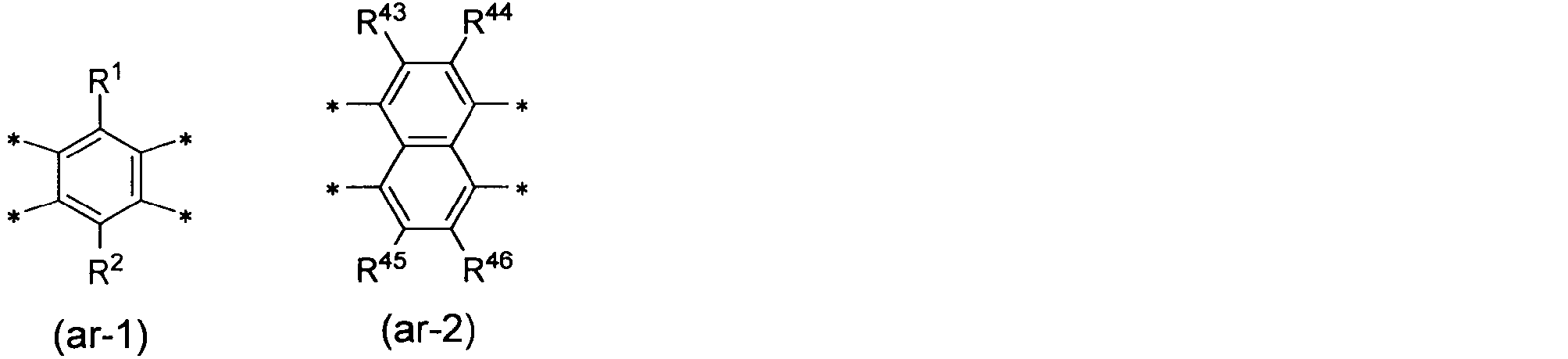
で表される部分構造であり、R1~R10及びR43~R46のうち少なくとも一つは酸性官能基を有する1価の基であり、残りは、それぞれ独立して、水素原子、ハロゲン原子又は1価の有機基である。kは0又は1である。ただし、式(0)中に酸性官能基を少なくとも1個有する。)

(式(1)中、R1~R10のうち少なくとも一つは酸性官能基を有する1価の基であり、残りは、それぞれ独立して、水素原子、ハロゲン原子又は1価の有機基である。kは0又は1である。ただし、式(1)中に酸性官能基を少なくとも1個有する。)
上記式(0)及び式(1)中のR1~R10、R43~R46について、1価の有機基は、好ましくは炭化水素基であり、より好ましくは炭素数1~5のアルキル基である。酸性官能基を有する1価の基は、「*-L1-X1」(ただし、L1は単結合又は2価の連結基であり、X1は酸性官能基である。「*」はベンゼン環に結合する結合手であることを表す。)で表すことができる。ここで、L1が2価の連結基である場合、L1の具体例としては、炭素数1~5のアルカンジイル基、当該アルカンジイル基の炭素-炭素結合間に-O-を含む基、-O-R13-**(ただし、R13は2価の炭化水素基であり、「**」はX1に結合する結合手であることを表す。)等が挙げられる。L1は、好ましくは単結合又は炭素数1~3のアルカンジイル基であり、より好ましくは単結合である。
上記式(0)で表される部分構造及び上記式(1)で表される部分構造がそれぞれ有する酸性官能基の個数は、好ましくは1~4個であり、より好ましくは1個又は2個である。良好なリオトロピック液晶性を示す点及び材料の選択性の自由度が高い点で、上記式(0)で表される部分構造及び上記式(1)で表される部分構造は、ジアミンに由来する部分構造(すなわち、R3~R10の少なくとも一部)が酸性官能基を有していることが好ましい。上記式(0)で表される部分構造中、A1が上記式(ar-2)で表される部分構造である場合、より低い重合体濃度で液晶性を発現する点で、kは0であることが好ましい。
上記式(0)で表される部分構造の好ましい具体例としては、下記式(A-1)~式(A-8)のそれぞれで表される部分構造等が挙げられる。上記式(1)で表される部分構造の好ましい具体例としては、下記式(A-1)~式(A-4)のそれぞれで表される部分構造等が挙げられる。
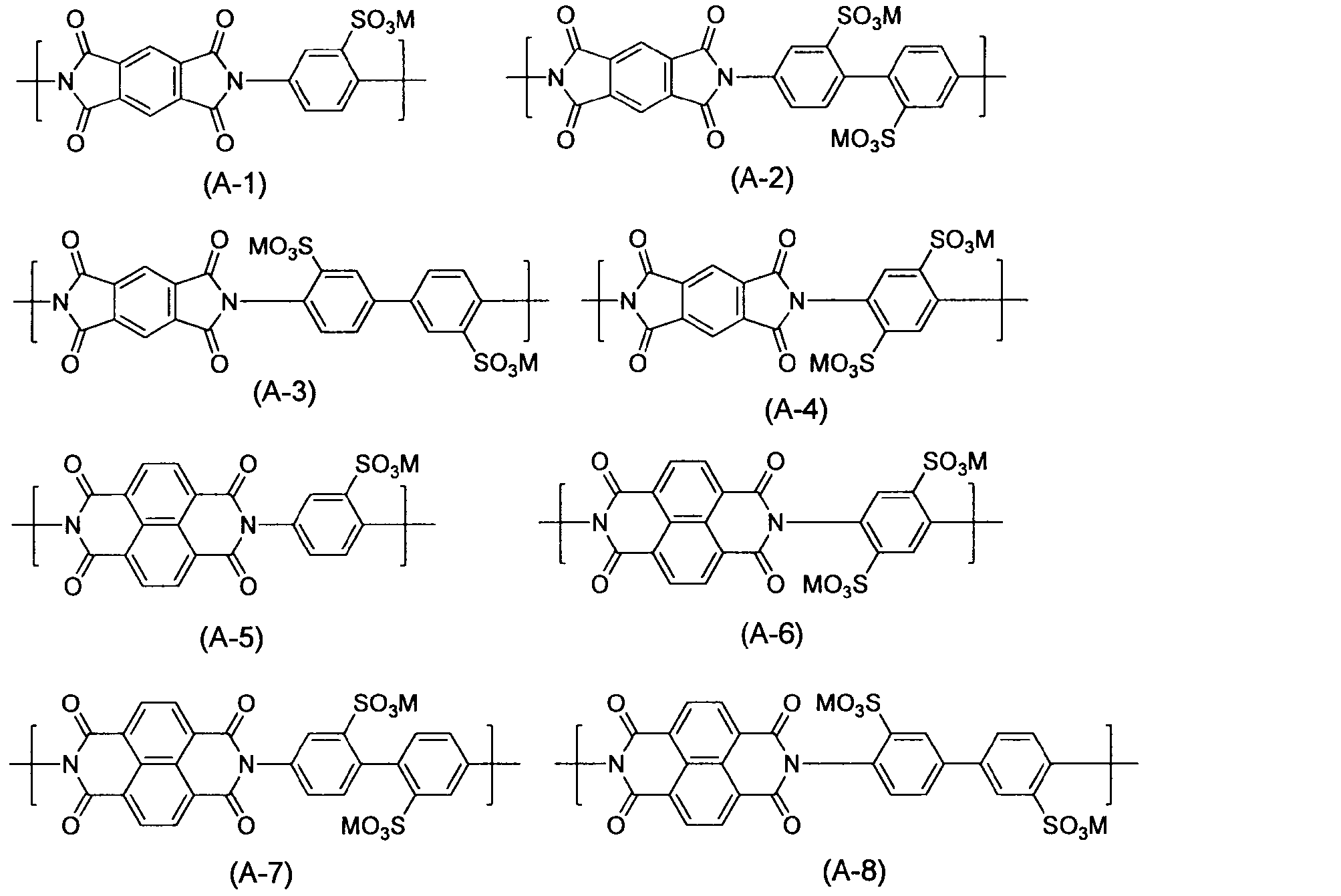
(式(A-1)~式(A-8)中、Mはカチオンである。式中の複数のMは、互いに同一の基又は異なる基である。)
Mのカチオンとしては、酸性官能基が塩である場合の対イオンの例示が適用される。水系の溶剤に対する重合体(PI)の溶解性をより高くできる点で、Mは1価のカチオンが好ましく、これらの中でもアンモニウムイオンが好ましく、第三級アンモニウムイオンがより好ましい。重合体(PI)は、上記式(A-1)~式(A-6)のそれぞれで表される部分構造よりなる群から選ばれる少なくとも一種を有していることが好ましく、上記式(A-1)~式(A-4)のそれぞれで表される部分構造よりなる群から選ばれる少なくとも一種を有していることがより好ましく、上記式(A-1)で表される部分構造及び上記式(A-2)で表される部分構造よりなる群から選ばれる少なくとも一種を有していることが特に好ましい。
重合体(P)において、上記式(0)で表される部分構造の含有量は、重合体(P)が有する繰り返し単位の全量に対して、50モル%以上であることが好ましく、75モル%以上であることがより好ましく、90モル%以上であることがさらに好ましい。重合体(P)が有する繰り返し単位は、上記式(0)で表される部分構造のみであることが特に好ましい。なお、繰り返し単位は、重合体(P)の化学構造の基本単位である。例えば重合体(PI)の単量体単位は、テトラカルボン酸誘導体1個とジアミン1個との反応により形成される構造である。
(重合体(P)の合成)
重合体(P)は、その主鎖に応じて、有機化学の定法に従って合成することができる。以下では、重合体(PI)について詳細に説明する。重合体(PI)は、テトラカルボン酸二無水物、テトラカルボン酸ジエステル及びテトラカルボン酸ジエステルジハロゲン化物よりなる群から選ばれる少なくとも一種のテトラカルボン酸誘導体と、ジアミンとを原料組成に用いた重合により得られるポリイミド前駆体をイミド化することにより得ることができる。
重合体(P)は、その主鎖に応じて、有機化学の定法に従って合成することができる。以下では、重合体(PI)について詳細に説明する。重合体(PI)は、テトラカルボン酸二無水物、テトラカルボン酸ジエステル及びテトラカルボン酸ジエステルジハロゲン化物よりなる群から選ばれる少なくとも一種のテトラカルボン酸誘導体と、ジアミンとを原料組成に用いた重合により得られるポリイミド前駆体をイミド化することにより得ることができる。
なお、本明細書において「テトラカルボン酸ジエステル」とは、テトラカルボン酸が有する4個のカルボキシル基のうち2個がエステル化され、残りの2個がカルボキシル基である化合物を意味する。「テトラカルボン酸ジエステルジハロゲン化物」とは、テトラカルボン酸が有する4個のカルボキシル基のうち2個がエステル化され、残りの2個がハロゲン化された化合物を意味する。「ポリイミド前駆体」には、ポリアミック酸及びポリアミック酸エステルが含まれる。
重合体(PI)の合成に際し、テトラカルボン酸二無水物としては、下記式(t-1)で表される化合物及び下記式(t-2)で表される化合物よりなる群から選ばれる少なくとも一種の化合物(以下、「特定酸二無水物」ともいう。)を使用することが好ましく、下記式(t-1)で表される化合物を使用することがより好ましい。
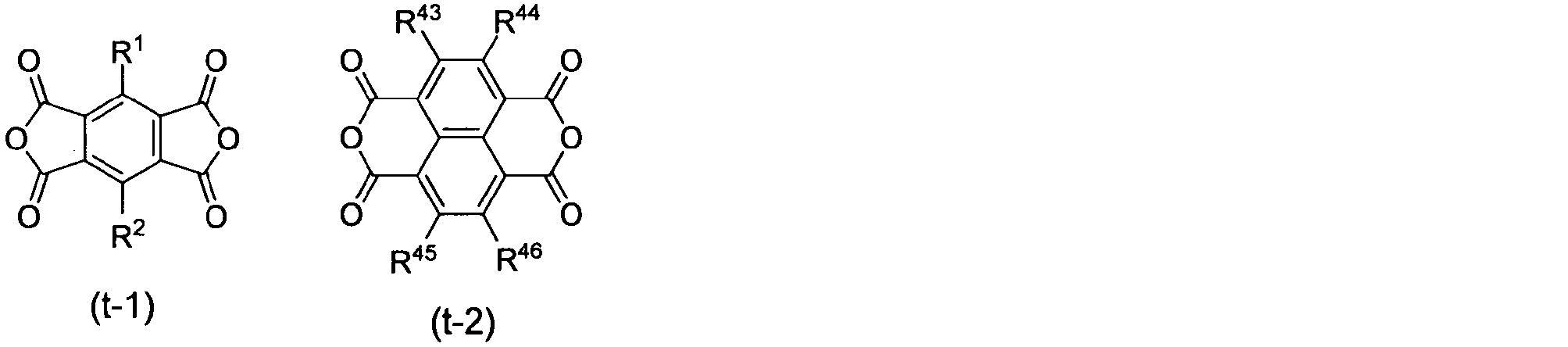
(式(t-1)中、R1及びR2は、それぞれ独立に水素原子、ハロゲン原子、酸性官能基又は1価の有機基である。式(t-2)中、R43~R46は、それぞれ独立に水素原子、ハロゲン原子、酸性官能基又は1価の有機基である。)
上記式(t-1)中のR1及びR2並びに上記式(t-2)中のR43~R46において、1価の有機基としては、炭素数1~20の炭化水素基、当該炭化水素基が有する水素原子が酸性官能基で置換された基等が挙げられる。これらのうち、R1、R2、R43~R46は、水素原子、ハロゲン原子、メチル基又はトリフルオロメチル基であることが好ましく、水素原子であることがより好ましい。なお、特定酸二無水物は、1種を単独で又は2種以上を組み合わせて使用することができる。
重合体(PI)の合成に際して使用するテトラカルボン酸ジエステルの好ましい具体例としては、上記式(t-1)又は上記式(t-2)で表されるテトラカルボン酸二無水物を、メタノールやエタノール等のアルコール類を用いて開環して得られる化合物等が挙げられる。重合体(PI)の合成に際して使用するテトラカルボン酸ジエステルジハロゲン化物の好ましい具体例としては、上記テトラカルボン酸ジエステルを、塩化チオニル等の塩素化剤と反応させて得られる化合物等が挙げられる。なお、テトラカルボン酸ジエステル及びテトラカルボン酸ジエステルジハロゲン化物は、それぞれ1種を単独で又は2種以上を組み合わせて使用することができる。
重合体(PI)の合成に際し、ジアミンとしては、酸性官能基を有するジアミン(以下、「特定ジアミン」ともいう。)を用いることが好ましく、酸性官能基を有する芳香族ジアミンを用いることがより好ましい。特定ジアミンの好ましい具体例としては、下記式(d-1)~(d-9)のそれぞれで表される化合物が挙げられる。なお、特定ジアミンは、1種を単独で又は2種以上を組み合わせて使用できる。
[ポリアミック酸]
重合体(PI)の前駆体であるポリアミック酸(以下、「ポリアミック酸(P)」ともいう。)は、例えばテトラカルボン酸二無水物とジアミンとを反応させることにより得ることができる。具体的には、[i]テトラカルボン酸二無水物とジアミンとを直接反応させる方法;[ii]テトラカルボン酸二無水物又はジアミンを塩基で中和した後に、テトラカルボン酸二無水物とジアミンとを反応させる方法、などが挙げられる。
重合体(PI)の前駆体であるポリアミック酸(以下、「ポリアミック酸(P)」ともいう。)は、例えばテトラカルボン酸二無水物とジアミンとを反応させることにより得ることができる。具体的には、[i]テトラカルボン酸二無水物とジアミンとを直接反応させる方法;[ii]テトラカルボン酸二無水物又はジアミンを塩基で中和した後に、テトラカルボン酸二無水物とジアミンとを反応させる方法、などが挙げられる。
重合体(PI)の合成に際しては、特定酸二無水物以外のテトラカルボン酸二無水物(以下、「その他の酸二無水物」ともいう)、特定ジアミン以外のジアミン(以下、「その他のジアミン」ともいう。)を併用することもできる。
(その他の酸二無水物)
その他の酸二無水物としては、例えば脂肪族テトラカルボン酸二無水物、脂環式テトラカルボン酸二無水物、芳香族テトラカルボン酸二無水物などを挙げることができる。これらの具体例としては、脂肪族テトラカルボン酸二無水物として、例えばブタンテトラカルボン酸二無水物、エチレンジアミン四酢酸二無水物などを;脂環式テトラカルボン酸二無水物として、例えば1,2,3,4-シクロブタンテトラカルボン酸二無水物、1,2,4,5-シクロヘキサンテトラカルボン酸二無水物などを;芳香族テトラカルボン酸二無水物として、例えばナフタレン-2,3,6,7-テトラカルボン酸二無水物、4,4’-ビフタル酸二無水物などを、それぞれ挙げることができるほか、特開2010-97188号公報に記載のテトラカルボン酸二無水物を用いることができる。なお、その他の酸二無水物は、これらの1種を単独で又は2種以上を組み合わせて使用することができる。
(その他の酸二無水物)
その他の酸二無水物としては、例えば脂肪族テトラカルボン酸二無水物、脂環式テトラカルボン酸二無水物、芳香族テトラカルボン酸二無水物などを挙げることができる。これらの具体例としては、脂肪族テトラカルボン酸二無水物として、例えばブタンテトラカルボン酸二無水物、エチレンジアミン四酢酸二無水物などを;脂環式テトラカルボン酸二無水物として、例えば1,2,3,4-シクロブタンテトラカルボン酸二無水物、1,2,4,5-シクロヘキサンテトラカルボン酸二無水物などを;芳香族テトラカルボン酸二無水物として、例えばナフタレン-2,3,6,7-テトラカルボン酸二無水物、4,4’-ビフタル酸二無水物などを、それぞれ挙げることができるほか、特開2010-97188号公報に記載のテトラカルボン酸二無水物を用いることができる。なお、その他の酸二無水物は、これらの1種を単独で又は2種以上を組み合わせて使用することができる。
(その他のジアミン)
その他のジアミンとしては、例えば脂肪族ジアミン、脂環式ジアミン、芳香族ジアミン、ジアミノオルガノシロキサンなどを挙げることができる。これらの具体例としては、脂肪族ジアミンとして、例えばメタキシリレンジアミン、ヘキサメチレンジアミンなどを;脂環式ジアミンとして、例えば1,4-ジアミノシクロヘキサン、4,4’-メチレンビス(シクロヘキシルアミン)などを;芳香族ジアミンとして、例えばp-フェニレンジアミン、2,4-ジアミノベンゼンスルホン酸、3,5-ジアミノ安息香酸、4,4’-ジアミノスチルベン-2,2’-ジスルホン酸、2,2’-ジメチル-4,4’-ジアミノビフェニル、などを;ジアミノオルガノシロキサンとして、例えば、1,3-ビス(3-アミノプロピル)-テトラメチルジシロキサンなどを;それぞれ挙げることができるほか、特開2010-97188号公報に記載のジアミンを用いることができる。
その他のジアミンとしては、例えば脂肪族ジアミン、脂環式ジアミン、芳香族ジアミン、ジアミノオルガノシロキサンなどを挙げることができる。これらの具体例としては、脂肪族ジアミンとして、例えばメタキシリレンジアミン、ヘキサメチレンジアミンなどを;脂環式ジアミンとして、例えば1,4-ジアミノシクロヘキサン、4,4’-メチレンビス(シクロヘキシルアミン)などを;芳香族ジアミンとして、例えばp-フェニレンジアミン、2,4-ジアミノベンゼンスルホン酸、3,5-ジアミノ安息香酸、4,4’-ジアミノスチルベン-2,2’-ジスルホン酸、2,2’-ジメチル-4,4’-ジアミノビフェニル、などを;ジアミノオルガノシロキサンとして、例えば、1,3-ビス(3-アミノプロピル)-テトラメチルジシロキサンなどを;それぞれ挙げることができるほか、特開2010-97188号公報に記載のジアミンを用いることができる。
ポリアミック酸(P)の合成に際し、特定酸二無水物を使用することによりポリアミック酸(P)にリオトロピック液晶性を付与する場合、特定酸二無水物の使用割合は、ポリアミック酸(P)にリオトロピック液晶性を十分に付与する観点から、ポリアミック酸(P)の合成に使用するテトラカルボン酸二無水物の全体量に対し、50モル%以上とすることが好ましく、75モル%以上とすることがより好ましく、90モル%以上とすることが特に好ましい。当該使用割合の上限値は特に制限されず、100モル%以下の範囲で任意に設定できる。
特定ジアミンの使用割合は、ポリアミック酸(P)に対し、水系溶剤への溶解性及びリオトロピック液晶性を十分に付与する観点から、ポリアミック酸(P)の合成に使用するジアミンの全体量に対し、50モル%以上とすることが好ましく、75モル%以上とすることがさらに好ましく、90モル%以上とすることがさらに好ましく、100モル%とすることが特に好ましい。
(ポリアミック酸の合成)
ポリアミック酸(P)は、上記のようなテトラカルボン酸二無水物とジアミンとを、必要に応じて分子量調整剤とともに反応させることによって得ることができる。ポリアミック酸(P)の合成反応に供されるテトラカルボン酸二無水物とジアミンとの使用割合は、ジアミンのアミノ基1当量に対して、テトラカルボン酸二無水物の酸無水物基が0.5~2当量となる割合が好ましく、0.8~1.2当量となる割合がより好ましい。
ポリアミック酸(P)は、上記のようなテトラカルボン酸二無水物とジアミンとを、必要に応じて分子量調整剤とともに反応させることによって得ることができる。ポリアミック酸(P)の合成反応に供されるテトラカルボン酸二無水物とジアミンとの使用割合は、ジアミンのアミノ基1当量に対して、テトラカルボン酸二無水物の酸無水物基が0.5~2当量となる割合が好ましく、0.8~1.2当量となる割合がより好ましい。
酸性官能基を有するモノマーを塩基で中和した後に、テトラカルボン酸二無水物とジアミンとを反応させる場合(上記[ii]の場合)、種々の塩基を用いることができるが、有機溶媒中での溶解性を担保する観点で、有機塩基が好ましく、第三級アミンがより好ましく、トリエチルアミンが特に好ましい。塩基の使用割合は、酸性官能基に対して0.5~5当量となる割合が好ましく、1~2当量となる割合がさらに好ましい。分子量調整剤としては、例えば無水マレイン酸、無水フタル酸、無水イタコン酸などの酸一無水物、アニリン、シクロヘキシルアミン、n-ブチルアミンなどのモノアミン化合物、フェニルイソシアネート、ナフチルイソシアネートなどのモノイソシアネート化合物等が挙げられる。分子量調整剤の使用割合は、使用するテトラカルボン酸二無水物及びジアミンの合計100質量部に対して、好ましくは20質量部以下であり、より好ましくは10質量部以下である。
ポリアミック酸(P)の合成反応は、好ましくは有機溶媒中において行われる。このときの反応温度は、-20℃~150℃が好ましく、0~100℃がより好ましい。また、反応時間は、0.1~24時間が好ましく、0.5~12時間がより好ましい。反応に使用する有機溶媒としては、例えば非プロトン性極性溶媒、フェノール系溶媒、アルコール、ケトン、エステル、エーテル、ハロゲン化炭化水素、炭化水素などを挙げることができる。これらの有機溶媒のうち、非プロトン性極性溶媒及びフェノール系溶媒よりなる群(第一群の有機溶媒)から選択される1種以上、又は、第一群の有機溶媒から選択される1種以上と、アルコール、ケトン、エステル、エーテル、ハロゲン化炭化水素及び炭化水素よりなる群(第二群の有機溶媒)から選択される1種以上との混合物を使用することが好ましい。後者の場合、第二群の有機溶媒の使用割合は、第一群の有機溶媒及び第二群の有機溶媒の合計量に対して、好ましくは50質量%以下であり、より好ましくは40質量%以下であり、更に好ましくは30質量%以下である。
特に好ましい有機溶媒は、N-メチル-2-ピロリドン、N,N-ジメチルアセトアミド、N,N-ジメチルホルムアミド、ジメチルスルホキシド、γ-ブチロラクトン、テトラメチル尿素、ヘキサメチルホスホルトリアミド、m-クレゾール、キシレノール及びハロゲン化フェノールよりなる群から選択される1種以上を溶媒として使用するか、あるいはこれらの1種以上と他の有機溶媒との混合物を、上記割合の範囲で使用することが好ましい。有機溶媒の使用量(a)は、テトラカルボン酸二無水物及びジアミンの合計量(b)が、反応溶液の全量(a+b)に対して、1~50質量%になる量とすることが好ましい。ポリアミック酸(P)を含有する反応溶液は、そのまま脱水閉環反応に供してもよく、ポリアミック酸(P)を単離したうえで脱水閉環反応に供してもよい。
[ポリアミック酸エステル]
重合体(PI)前駆体であるポリアミック酸エステル(以下、「ポリアミック酸エステル(P)」ともいう。)は、例えば、[I]上記重合反応により得られたポリアミック酸(P)とエステル化剤とを反応させる方法、[II]テトラカルボン酸ジエステルとジアミンとを反応させる方法、[III]テトラカルボン酸ジエステルジハロゲン化物とジアミンとを反応させる方法、などによって得ることができる。
重合体(PI)前駆体であるポリアミック酸エステル(以下、「ポリアミック酸エステル(P)」ともいう。)は、例えば、[I]上記重合反応により得られたポリアミック酸(P)とエステル化剤とを反応させる方法、[II]テトラカルボン酸ジエステルとジアミンとを反応させる方法、[III]テトラカルボン酸ジエステルジハロゲン化物とジアミンとを反応させる方法、などによって得ることができる。
[イミド化]
重合体(PI)は、上記の如くして合成されたポリイミド前駆体を脱水閉環してイミド化することにより得ることができる。重合体(PI)は、その前駆体であるポリイミド前駆体が有していたアミック酸構造又はアミック酸エステル構造のすべてを脱水閉環した完全イミド化物であってもよく、アミック酸構造及びアミック酸エステル構造の一部のみを脱水閉環し、アミック酸構造又はアミック酸エステル構造とイミド環構造とが併存する部分イミド化物であってもよい。重合体(PI)は、偏光特性が十分に高い偏光膜を得る観点から、そのイミド化率が50%以上であることが好ましく、75%以上であることがより好ましく、90%以上であることがさらに好ましく、95%以上であることが特に好ましい。このイミド化率は、ポリイミドのアミック酸構造及びアミック酸エステル構造の数とイミド環構造の数との合計に対するイミド環構造の数の占める割合を百分率で表したものである。
重合体(PI)は、上記の如くして合成されたポリイミド前駆体を脱水閉環してイミド化することにより得ることができる。重合体(PI)は、その前駆体であるポリイミド前駆体が有していたアミック酸構造又はアミック酸エステル構造のすべてを脱水閉環した完全イミド化物であってもよく、アミック酸構造及びアミック酸エステル構造の一部のみを脱水閉環し、アミック酸構造又はアミック酸エステル構造とイミド環構造とが併存する部分イミド化物であってもよい。重合体(PI)は、偏光特性が十分に高い偏光膜を得る観点から、そのイミド化率が50%以上であることが好ましく、75%以上であることがより好ましく、90%以上であることがさらに好ましく、95%以上であることが特に好ましい。このイミド化率は、ポリイミドのアミック酸構造及びアミック酸エステル構造の数とイミド環構造の数との合計に対するイミド環構造の数の占める割合を百分率で表したものである。
ポリイミド前駆体の脱水閉環は、好ましくはポリアミック酸を加熱する方法により、又はポリアミック酸を有機溶媒に溶解し、この溶液中に脱水剤及び脱水閉環触媒の少なくともいずれかを添加して必要に応じて加熱する方法により行われる。後者の方法において、脱水剤としては、例えば無水酢酸、無水プロピオン酸、無水トリフルオロ酢酸等の酸無水物を用いることができる。脱水剤の使用量は、ポリアミック酸のアミック酸構造の1モルに対して0.01~20モルとすることが好ましい。脱水閉環触媒としては、例えばピリジン、トリエチルアミン、1-メチルピペリジン等の塩基触媒、メタンスルホン酸、安息香酸等の酸触媒を用いることができる。脱水閉環触媒の使用量は、使用する脱水剤1モルに対して0.01~10モルとすることが好ましい。脱水閉環反応に用いられる有機溶媒としては、ポリアミック酸(P)の合成に用いられるものとして例示した有機溶媒を挙げることができる。脱水閉環反応の反応温度は、好ましくは0~200℃であり、反応時間は、好ましくは1.0~120時間である。重合体を含有する反応溶液は、そのまま組成物の調製に供してもよく、重合体を単離したうえで組成物の調製に供してもよい。
[重合体(P)の物性]
重合体(P)は、重合体(P)を濃度10質量%の溶液としたときに、10~2000mPa・sの溶液粘度を持つものであることが好ましく、20~1000mPa・sの溶液粘度を持つものであることがより好ましい。なお、上記重合体の溶液粘度(mPa・s)は、当該重合体の良溶媒(例えば水など)を用いて調製した濃度10質量%の重合体溶液につき、E型回転粘度計を用いて25℃において測定した値である。
重合体(P)は、重合体(P)を濃度10質量%の溶液としたときに、10~2000mPa・sの溶液粘度を持つものであることが好ましく、20~1000mPa・sの溶液粘度を持つものであることがより好ましい。なお、上記重合体の溶液粘度(mPa・s)は、当該重合体の良溶媒(例えば水など)を用いて調製した濃度10質量%の重合体溶液につき、E型回転粘度計を用いて25℃において測定した値である。
重合体(P)のゲルパーミエーションクロマトグラフィー(GPC)により測定したポリスチレン換算の重量平均分子量(Mw)は、好ましくは1,000以上であり、より好ましくは2,000以上である。また、Mwは、好ましくは500,000以下であり、より好ましくは100,000以下である。Mwと、GPCにより測定したポリスチレン換算の数平均分子量(Mn)との比で表される分子量分布(Mw/Mn)は、好ましくは10以下であり、より好ましくは5以下である。このような分子量範囲にあることで、上記組成物がリオトロピック液晶性を示す濃度範囲及び温度範囲を確保しやすくすることができる。
重合体(P)は、0℃以上100℃未満の範囲の少なくとも一部の温度でリオトロピック液晶性を示すことが好ましい。重合体(P)がリオトロピック液晶性を示す温度範囲は、0℃以上100℃未満の範囲のうち、好ましくは20~40℃を含む温度範囲であり、より好ましくは20~60℃を含む温度範囲であり、さらに好ましくは20~80℃を含む温度範囲である。
<水>
リオトロピック液晶性組成物は、水溶性の重合体(P)が水系溶媒に溶解された液状の組成物である。重合体(P)の酸性官能基が解離して電荷を持ち、分子間の静電反発を誘起し、より低濃度においても液晶性を発現させる観点から、水の含有割合は、リオトロピック液晶性組成物に含まれる溶媒の全体量(100質量%)に対し、好ましくは40質量%以上であり、より好ましくは60質量%以上であり、さらに好ましくは80質量%以上である。水の含有割合は、リオトロピック液晶性組成物に含まれる溶媒の全量に対し、100質量%以下とすることができる。
リオトロピック液晶性組成物は、水溶性の重合体(P)が水系溶媒に溶解された液状の組成物である。重合体(P)の酸性官能基が解離して電荷を持ち、分子間の静電反発を誘起し、より低濃度においても液晶性を発現させる観点から、水の含有割合は、リオトロピック液晶性組成物に含まれる溶媒の全体量(100質量%)に対し、好ましくは40質量%以上であり、より好ましくは60質量%以上であり、さらに好ましくは80質量%以上である。水の含有割合は、リオトロピック液晶性組成物に含まれる溶媒の全量に対し、100質量%以下とすることができる。
<金属イオン>
製法2で用いるリオトロピック液晶性組成物は金属イオンを含有する。金属イオンとしては、可視領域での吸収が少なく、かつ強い局在表面プラズモン共鳴を起こす点で、銀イオン、金イオン、銅イオン、白金イオン、チタンイオン、ニッケルイオン又はクロムイオンが好ましい。これらのうち、標準電極電位が正であり還元されやすい点で、銀イオン、金イオン又は銅イオンがより好ましく、銀イオン又は金イオンがさらに好ましく、銀イオンが特に好ましい。銀ナノ粒子において、消光(吸収+散乱)断面積は物理的断面積のおよそ10倍に達する。そのため、膜中への銀イオンの導入量が少なく、膜に対して銀粒子が疎であっても、十分な偏光特性を示す偏光膜を得ることができる点で好ましい。
製法2で用いるリオトロピック液晶性組成物は金属イオンを含有する。金属イオンとしては、可視領域での吸収が少なく、かつ強い局在表面プラズモン共鳴を起こす点で、銀イオン、金イオン、銅イオン、白金イオン、チタンイオン、ニッケルイオン又はクロムイオンが好ましい。これらのうち、標準電極電位が正であり還元されやすい点で、銀イオン、金イオン又は銅イオンがより好ましく、銀イオン又は金イオンがさらに好ましく、銀イオンが特に好ましい。銀ナノ粒子において、消光(吸収+散乱)断面積は物理的断面積のおよそ10倍に達する。そのため、膜中への銀イオンの導入量が少なく、膜に対して銀粒子が疎であっても、十分な偏光特性を示す偏光膜を得ることができる点で好ましい。
金属イオンが塩の形態でリオトロピック液晶性組成物中に含有される場合、対イオンとしては、金属イオンの種類に応じて適宜選択することができる。例えば、銀イオンを組成物中に含有させるための金属塩としては、硝酸銀、シュウ酸銀、酢酸銀、炭酸銀、酸化銀、亜硝酸銀、安息香酸銀、シアン酸銀、クエン酸銀及び乳酸銀よりなる群から選ばれる少なくとも一種を好ましく用いることができる。有機膜中に還元剤を導入する場合、当該金属塩としてシュウ酸銀及びクエン酸銀の少なくとも一方を用いることが好ましい。
リオトロピック液晶性組成物が金属イオンを含有する場合、その含有割合は、リオトロピック液晶性組成物中の重合体(P)が有する酸性官能基量100モル部に対して、好ましくは5モル部以上であり、より好ましくは10モル部以上である。また金属イオンの含有割合の上限は、リオトロピック液晶性組成物中の重合体(P)が有する酸性官能基量100モル部に対して、好ましくは200モル部以下であり、より好ましくは100モル部以下である。
リオトロピック液晶性組成物中に配合される金属イオンは、1種のみでもよいし2種以上でもよい。リオトロピック液晶性組成物中に銀イオンを配合する場合、膜中で銀イオンが還元される際に形状異方性の発現(非等方的成長)を促進するために、さらに他の金属イオンを含有させてもよい。この場合、銀イオンの還元により膜中に生成される銀粒子の軸比を大きくする点で、他の金属イオンは銅(II)イオンが好ましい。銀イオンと他の金属イオンとを組成物中に配合させる場合、他の金属イオンの配合割合は、リオトロピック液晶性組成物中の銀イオンの合計量に対し、好ましくは1モル%以上であり、より好ましくは2モル%以上である。また、他の金属イオンの配合割合は、好ましくは20モル%である。
リオトロピック液晶性組成物中に金属イオンを含有させる場合、錯形成により金属イオンの安定性を高めることができる点で、当該組成物中に配位子を含有させてもよい。配位子としては、例えば、エチルアミン、エチレンジアミン、エタノールアミン等の1級アミン;ジエチルアミン、ジエタノールアミン等の2級アミン;トリエチルアミン、ジメチルアミノエタノール等の3級アミンのほか、2,2’-チオジエタノール、チオアセトアミド等を用いることができる。リオトロピック液晶性組成物中に配位子を含有させる場合、その配合割合は、リオトロピック液晶性組成物中に含有される金属イオンの合計量に対し、好ましくは10モル%以上であり、より好ましくは50~400モル%である。
<その他の成分>
リオトロピック液晶性組成物は、本開示の目的及び効果を妨げない範囲内において、上記で説明した成分以外のその他の成分を含有していてもよい。
リオトロピック液晶性組成物は、本開示の目的及び効果を妨げない範囲内において、上記で説明した成分以外のその他の成分を含有していてもよい。
(還元剤)
工程Cにおける金属イオンの還元処理をより穏和な条件で行うことを目的として、リオトロピック液晶性組成物中に還元剤を含有させてもよい。還元剤としては、例えばシュウ酸、エチレングリコール、クエン酸、亜硫酸ナトリウム、パラフェニレンジアミン等が挙げられる。リオトロピック液晶性組成物中に還元剤を配合する場合、その配合割合は、当該組成物中の金属イオン100モル部に対し、好ましくは10モル部以上であり、より好ましくは50~400モル部である。
工程Cにおける金属イオンの還元処理をより穏和な条件で行うことを目的として、リオトロピック液晶性組成物中に還元剤を含有させてもよい。還元剤としては、例えばシュウ酸、エチレングリコール、クエン酸、亜硫酸ナトリウム、パラフェニレンジアミン等が挙げられる。リオトロピック液晶性組成物中に還元剤を配合する場合、その配合割合は、当該組成物中の金属イオン100モル部に対し、好ましくは10モル部以上であり、より好ましくは50~400モル部である。
(溶剤)
リオトロピック液晶性組成物の溶剤成分として、水以外の溶剤(以下、「その他の溶剤」ともいう。)を使用してもよい。その他の溶剤としては、水と均一に混ざり合うことが可能な溶剤であればよく、例えばメタノール、エタノール、n-プロパノール、i-プロパノール、n-ブタノール、エチレングリコール、アセトン、メチルエチルケトン、テトラヒドロフラン、N-メチル-2-ピロリドン、γ-ブチロラクトン、1-ブトキシ-2-プロパノール、ダイアセトンアルコール、ジプロピレングリコールモノメチルエーテル、乳酸エチル、エチレングリコールメチルエーテル、エチレングリコール-n-ブチルエーテル(ブチルセロソルブ)、ジエチレングリコールモノメチルエーテル、ジエチレングリコールモノエチルエーテル、ジエチレングリコールモノメチルエーテルアセテート、ジエチレングリコールモノエチルエーテルアセテート等を挙げることができる。その他の溶剤としては、一種を単独で又は2種以上を混合して使用できる。
リオトロピック液晶性組成物の溶剤成分として、水以外の溶剤(以下、「その他の溶剤」ともいう。)を使用してもよい。その他の溶剤としては、水と均一に混ざり合うことが可能な溶剤であればよく、例えばメタノール、エタノール、n-プロパノール、i-プロパノール、n-ブタノール、エチレングリコール、アセトン、メチルエチルケトン、テトラヒドロフラン、N-メチル-2-ピロリドン、γ-ブチロラクトン、1-ブトキシ-2-プロパノール、ダイアセトンアルコール、ジプロピレングリコールモノメチルエーテル、乳酸エチル、エチレングリコールメチルエーテル、エチレングリコール-n-ブチルエーテル(ブチルセロソルブ)、ジエチレングリコールモノメチルエーテル、ジエチレングリコールモノエチルエーテル、ジエチレングリコールモノメチルエーテルアセテート、ジエチレングリコールモノエチルエーテルアセテート等を挙げることができる。その他の溶剤としては、一種を単独で又は2種以上を混合して使用できる。
溶剤として、水と有機溶媒との混合溶剤を使用する場合、使用する有機溶媒は、水よりも沸点が低い有機溶媒が好ましく、メタノール、エタノール、n-プロパノール、i-プロパノール、アセトン及びテトラヒドロフランよりなる群から選ばれる少なくとも一種であることがより好ましい。水と有機溶媒との混合溶剤を使用する場合、有機溶媒の含有割合は、混合溶剤の全体量に対して、50質量%以下とすることが好ましく、25質量%以下とすることがより好ましく、10質量%以下とすることがさらに好ましい。
その他の成分としては、上記のほか、例えば分子内に少なくとも一つのエポキシ基を有する化合物、官能性シラン化合物、界面活性剤、充填剤、顔料、消泡剤、増感剤、分散剤、酸化防止剤、密着助剤、帯電防止剤、レベリング剤、抗菌剤、棒状ナノ構造体(例えば、色素会合体、量子ロッド、カーボンナノチューブ、タンパク質、核酸、ウィルスなど)等が挙げられる。これらの化合物の配合割合は、配合する各化合物に応じて、本開示の効果を妨げない範囲で適宜設定することができる。
リオトロピック液晶性組成物中の重合体(P)の濃度は、当該組成物がリオトロピック液晶性を示す濃度であればよい。基材に対する良好な塗布性を十分に確保できる点で、重合体(P)の濃度は、好ましくは、溶剤と重合体(P)との合計量に対して1~30質量%である。溶剤と重合体(P)との合計量に対する重合体(P)の濃度は、より好ましくは1~20質量%であり、さらに好ましくは2~20質量%であり、特に好ましくは2~10質量%である。特に重合体(PI)によれば、比較的低い重合体濃度でリオトロピック液晶性を示す組成物を得ることができる点で好ましい。このため、基材上に塗膜を形成する際の塗布性が良好であり、膜厚が0.1~10μm程度の薄膜を作製でき、工業的生産性に優れている。
リオトロピック液晶性組成物の固形分濃度(組成物の溶剤以外の成分の合計質量が組成物の全質量に占める割合)は、粘性、揮発性などを考慮して適宜に選択されるが、好ましくは1~30質量%であり、より好ましくは1~20質量%、特に好ましくは2~10質量%の範囲である。固形分濃度が1質量%以上であると、組成物がリオトロピック液晶性を示しやすくなる点で好ましい。また、固形分濃度が30質量%以下であると、塗膜の膜厚が適度な厚さとなって良好な塗膜が得やすく、また、組成物の粘性が適度となり塗布性を良好にできる傾向にある。組成物を調製する際の温度は、リオトロピック液晶性組成物が液晶相を保つ温度であればよいが、好ましくは10~90℃であり、より好ましくは20~80℃である。
<塗布及び乾燥処理>
工程Aでは、上記で調製したリオトロピック液晶性組成物を、液晶相の状態でせん断流動させながら基材上に塗布し、重合体(P)の分子鎖をせん断応力による流動により配向させた状態で乾燥する。これにより、重合体(P)の分子鎖がせん断方向に自己組織的に一軸配向した塗膜を得ることができる。
工程Aでは、上記で調製したリオトロピック液晶性組成物を、液晶相の状態でせん断流動させながら基材上に塗布し、重合体(P)の分子鎖をせん断応力による流動により配向させた状態で乾燥する。これにより、重合体(P)の分子鎖がせん断方向に自己組織的に一軸配向した塗膜を得ることができる。
使用する基材としては、例えばガラス基板;トリアセチルセルロース(TAC)、ポリエチレンテレフタレート、ポリメチルメタクリレート等の樹脂基板等が挙げられる。リオトロピック液晶性組成物の塗布は、バーコーター法、アプリケーター法、ダイコーター法又はブレードコーター法により行うことが好ましい。これらの方法は、重合体(P)の分子鎖をせん断応力による流動により配向させやすい点で好ましい。液晶性組成物の塗布において、基板とコーターとの相対速度(以下、せん断速度という)は、塗膜の分子配向を制御する観点から、好ましくは1~200cm/s、より好ましくは2~100cm/s、特に好ましくは5~50cm/sである。
上記組成物を基材上に塗布した後の乾燥は、良好な光学異方性を示す膜を得る観点から、加熱処理によることが好ましい。このときの加熱温度は、好ましくは30~100℃であり、より好ましくは40~80℃である。加熱時間は、好ましくは0.25~20分であり、より好ましくは0.5~15分である。加熱の際には、基材上に塗布した組成物中の重合体(P)の分子鎖をせん断応力による流動により配向させた状態とし、その状態で乾燥させる。これにより、簡易な操作により塗膜に光学異方性が付与され、偏光膜を形成することができる。また、優れた偏光特性を示す偏光膜を簡易な塗布プロセスによって低コストで製造することができる。形成される膜の膜厚は、好ましくは0.1~50μmであり、より好ましくは1~10μmである。
リオトロピック液晶性組成物の塗布及び乾燥の際には、当該組成物がリオトロピック液晶性を示す温度範囲及び濃度範囲を逸脱しないように制御することが好ましい。本工程において、組成物の流動性があるにもかかわらずリオトロピック液晶性を示さない温度又は濃度に達すると、配向が緩和して塗膜の異方性が消失する可能性がある。
[工程B:接触工程]
本工程では、上記膜形成工程により基材上に形成した有機膜と、金属イオン含有水溶液とを接触させる。この工程により、金属イオンを有機膜中に導入することができる。なお、製法1は工程Bを含む。製法2では、工程Bは任意の工程である。
本工程では、上記膜形成工程により基材上に形成した有機膜と、金属イオン含有水溶液とを接触させる。この工程により、金属イオンを有機膜中に導入することができる。なお、製法1は工程Bを含む。製法2では、工程Bは任意の工程である。
上記金属イオン含有水溶液において、当該水溶液に含有される金属イオンの具体例及び好ましい例についての説明は、製法2のリオトロピック液晶性組成物の説明が適用される。金属イオン含有水溶液中における金属イオン濃度は、好ましくは0.01モル/L以上であり、より好ましくは0.1モル/L以上である。また、当該金属イオン濃度は、好ましくは2.0モル/L以下であり、より好ましくは1.5モル/L以下である。
上記説明と同様の理由から、金属イオン含有水溶液中に配合される金属イオンは、1種のみでもよいし2種以上でもよい。また、金属イオン含有水溶液において、錯形成により金属イオンの安定性を高めるために、金属イオンと共に配位子を含有させてもよい。また更に、続く工程Cにおいて金属イオンの還元処理をより温和な条件で実施できるようにするために、金属イオン含有水溶液中に還元剤を含有させてもよい。これらの形態における具体的な条件等については上記の説明が適用される。
有機膜と金属イオン含有水溶液との接触方法としては、例えば噴霧(スプレー)処理、シャワー処理、浸漬処理、液盛り処理等が挙げられる。このとき、有機膜と金属イオン含有水溶液とを十分に接触させるために、例えば基材上の有機膜への金属イオン含有水溶液の供給及び接触の一連の処理を複数回行ったり、金属イオン含有水溶液を撹拌又は振盪したりすることも有効である。有機膜と金属イオン含有水溶液との接触時間は、特に限定されないが、好ましくは5秒~20分である。接触させた液を有機膜から除去することを目的として、有機膜を有機溶媒(例えば、メタノールやアセトン等)で洗浄する処理や、接触工程の後に有機膜を乾燥する処理(例えば、エアブロー処理や加熱処理等)をさらに行ってもよく、これらの処理を組み合わせて行ってもよい。
[工程C:還元工程]
本工程では、上記有機膜中の金属イオン、すなわち、金属イオン含有のリオトロピック液晶性組成物を用いることにより膜中に含有される金属イオン、又は金属イオン含有水溶液との接触により膜中に導入された金属イオンを還元する。膜中の金属イオンを還元する方法は特に限定されないが、膜中の金属イオンを簡便に、かつ効率良く還元できる点で、塗膜を加熱する処理及び塗膜を露光する処理の少なくとも一方によることが好ましく、加熱処理によることが特に好ましい。
本工程では、上記有機膜中の金属イオン、すなわち、金属イオン含有のリオトロピック液晶性組成物を用いることにより膜中に含有される金属イオン、又は金属イオン含有水溶液との接触により膜中に導入された金属イオンを還元する。膜中の金属イオンを還元する方法は特に限定されないが、膜中の金属イオンを簡便に、かつ効率良く還元できる点で、塗膜を加熱する処理及び塗膜を露光する処理の少なくとも一方によることが好ましく、加熱処理によることが特に好ましい。
金属イオンの還元処理を加熱処理により行う場合、加熱温度は、膜中の金属塩の熱分解を十分に行わせる観点から、200℃以上とすることが好ましく、230℃以上とすることがより好ましく、250℃以上とすることがさらに好ましい。当該加熱温度の上限は、好ましくは300℃以下であり、より好ましくは280℃以下である。加熱時間は、好ましくは5~100分であり、より好ましくは10~60分である。
例えば樹脂基材を用いる場合のように、基材の耐熱性が低い場合、還元工程より前の段階において有機膜中に還元剤を導入しておくことが好ましい。膜中に還元剤を併存させておくことにより、金属イオンの還元処理をより穏和な条件で行うことができる点で好ましい。膜中に還元剤を導入した場合、金属イオン及び還元剤の種類にもよるが、加熱温度を好ましくは160℃以下、より好ましくは150℃以下とすることもできる。
還元剤を含有する有機膜を得る方法としては、(1)リオトロピック液晶性組成物中に還元剤を含有させ、当該組成物を用いて塗膜を形成する方法、(2)工程Aで基材上に形成した有機膜と還元剤含有水溶液とを接触させる処理(還元剤導入処理)を行う方法、が挙げられる。製法1により偏光膜を作製する場合、上記(2)の還元剤導入処理は、金属イオンと還元剤とを含有する水溶液(例えば、シュウ酸銀水溶液、クエン酸銀水溶液等)を調製し、この水溶液を還元剤含有水溶液として用いることにより、上記工程Bによる金属イオン導入と同時に行ってもよい。この場合、還元剤含有水溶液は金属イオン含有水溶液でもある。あるいは、金属イオン含有水溶液と有機膜とを接触させる処理と、還元剤含有水溶液と有機膜とを接触させる処理とを別々に行ってもよい。
還元剤導入処理で用いる還元剤の具体例及び好ましい例についての説明は、リオトロピック液晶性組成物に含有させる還元剤の説明が適用される。還元剤含有水溶液中における還元剤濃度は、好ましくは0.01モル/L以上であり、より好ましくは0.1モル/L以上である。また、当該還元剤濃度は、好ましくは2.0モル/L以下であり、より好ましくは1.5モル/L以下である。
[その他の工程]
本開示の製造方法は、上記の各工程に加え、以下の工程をさらに含んでいてもよい。
<追加還元工程>
工程C(還元工程)により膜中の金属イオンを還元した有機膜と、金属イオン含有水溶液とを接触させることにより金属イオンを外部から供給し、その後、有機膜中の金属イオンを再度還元する処理を行ってもよい。こうした追加還元処理により、有機膜中の金属粒子を核に成長させ、形状異方性を保持したまま金属粒子の大きさを変化させることにより、吸収波長や反射特性等を制御することが可能である。また、吸収波長や反射特性等を制御することにより、吸収型及び反射型のいずれの偏光板も作製することができる。追加還元処理で使用する金属イオン含有水溶液や処理条件の詳細については、工程Cの説明が適用される。
本開示の製造方法は、上記の各工程に加え、以下の工程をさらに含んでいてもよい。
<追加還元工程>
工程C(還元工程)により膜中の金属イオンを還元した有機膜と、金属イオン含有水溶液とを接触させることにより金属イオンを外部から供給し、その後、有機膜中の金属イオンを再度還元する処理を行ってもよい。こうした追加還元処理により、有機膜中の金属粒子を核に成長させ、形状異方性を保持したまま金属粒子の大きさを変化させることにより、吸収波長や反射特性等を制御することが可能である。また、吸収波長や反射特性等を制御することにより、吸収型及び反射型のいずれの偏光板も作製することができる。追加還元処理で使用する金属イオン含有水溶液や処理条件の詳細については、工程Cの説明が適用される。
<イオン架橋処理工程>
工程C(還元工程)の後に、必要に応じて、有機膜が形成された基材を多価カチオン水溶液に浸漬することによりイオン架橋処理を行ってもよい。重合体(P)の対カチオンが多価カチオンと交換されることにより、偏光膜の耐水性や力学特性の向上を図ることができる点で好ましい。多価カチオンは、二価以上の金属カチオンや有機ポリカチオンであれば特に制限されないが、好ましくはアルカリ土類金属イオンであり、特に好ましくはCa2+、Sr2+、又はBa2+である。多価カチオンの対イオンは、水溶性であれば特に制限されないが、好ましくは水酸化物イオン、炭酸イオン又はハロゲン化物イオンである。多価カチオン水溶液への浸漬時間は、好ましくは1~20分であり、より好ましくは2~10分である。基材を多価カチオン水溶液に浸漬させた後は、取り出した基材を純水ですすぎ、さらに純水中に浸漬させることによって余分なイオン性成分を除去することが好ましい。
工程C(還元工程)の後に、必要に応じて、有機膜が形成された基材を多価カチオン水溶液に浸漬することによりイオン架橋処理を行ってもよい。重合体(P)の対カチオンが多価カチオンと交換されることにより、偏光膜の耐水性や力学特性の向上を図ることができる点で好ましい。多価カチオンは、二価以上の金属カチオンや有機ポリカチオンであれば特に制限されないが、好ましくはアルカリ土類金属イオンであり、特に好ましくはCa2+、Sr2+、又はBa2+である。多価カチオンの対イオンは、水溶性であれば特に制限されないが、好ましくは水酸化物イオン、炭酸イオン又はハロゲン化物イオンである。多価カチオン水溶液への浸漬時間は、好ましくは1~20分であり、より好ましくは2~10分である。基材を多価カチオン水溶液に浸漬させた後は、取り出した基材を純水ですすぎ、さらに純水中に浸漬させることによって余分なイオン性成分を除去することが好ましい。
上記の形成工程及び還元工程を含み、さらに必要に応じてその他の工程を含む上記製造方法によれば、偏光特性に優れた偏光膜を得ることができる。ここで、重合体(P)は剛直棒状高分子であり、溶剤中でメソゲンとして作用する。特に、重合体(PI)は、ベンゼン環及びイミド環が連結した構造、又はナフタレン環及びイミド環が連結した構造を主鎖中に有し、剛直かつ一軸直線性の高い芳香族ポリイミドである。このため、重合体成分として重合体(PI)を含有する液晶性組成物によれば、有機膜中で高い配向秩序度の分子配向を実現することができ、形状異方性を有する金属粒子が良好に配向した偏光膜を得ることができる。
≪偏光膜、光学素子及び液晶素子≫
上記製造方法によって得られる偏光膜は、分子配向した重合体と、当該重合体の配向方向に沿って分子配向し形状異方性を有する金属粒子とを有する。また、本開示の光学素子及び液晶素子は、上記製造方法により得られた偏光膜を具備する。当該偏光膜は、金属ナノ粒子の局在表面プラズモン共鳴による吸収又は散乱により、あるいは金属粒子による反射により偏光特性を発現すると推測される。
上記製造方法によって得られる偏光膜は、分子配向した重合体と、当該重合体の配向方向に沿って分子配向し形状異方性を有する金属粒子とを有する。また、本開示の光学素子及び液晶素子は、上記製造方法により得られた偏光膜を具備する。当該偏光膜は、金属ナノ粒子の局在表面プラズモン共鳴による吸収又は散乱により、あるいは金属粒子による反射により偏光特性を発現すると推測される。
光学素子の具体例としては、図1に示す偏光板200が挙げられる。偏光板200は、基材201と偏光膜202とを有し、これらが積層されることにより形成されている。
偏光板200を作製するには、まず、重合体(P)及び水を含有するリオトロピック液晶性組成物を、液晶相の状態でせん断流動させながら基材201上に塗布する。次いで、重合体(P)の分子鎖をせん断流動により配向させた状態で乾燥し、基材201上に塗膜(偏光膜202に相当)を形成する。製法1の場合には、塗膜形成後に塗膜と金属イオン含有水溶液とを接触させる。また、製法2の場合には、上記塗布及び乾燥の処理により、金属イオンを含有する塗膜が得られる。その後、塗膜中で金属イオンを還元する。これにより、ゲスト-ホスト型の偏光板200を得ることができる。また必要に応じて、偏光膜202が形成された基材201における一方の面又は両方の面に樹脂フィルム(保護フィルム)を貼り合わせてもよい。このとき、保護フィルムとして位相差フィルム等のような光学機能を有する保護フィルムを用いてもよい。
金属ナノ粒子の局在表面プラズモン共鳴による吸収又は散乱を利用して偏光特性を発現させる場合、偏光膜中における金属粒子の大きさや形状(軸比)は、所望とする共鳴波長に応じて適宜選択することができる。金属粒子の大きさは、局在表面プラズモン共鳴の共鳴波長を可視領域に一致させる観点から、好ましくは10~100nmである。吸収型偏光板とする場合、可視領域の全域で吸収を示す(すなわち、様々な波長の光を吸収する)ようにするために、異なる大きさの金属粒子が偏光膜に含有されていることが好ましい。
金属粒子の形状は、光の電場ベクトルに対して異方的な吸収・散乱特性を発現させる観点から、ナノロッド状又はナノワイヤー状であることが好ましい。金属ナノロッド又は金属ナノワイヤーが一軸配向した場合、異方的に光を吸収・散乱又は反射させる上で好適である。光の電場ベクトルが金属粒子の配向方位に対して平行な場合には、その光は偏光膜に吸収若しくは散乱されるか又は反射し、垂直な場合は偏光膜を透過する。
ここで、リオトロピック液晶性を示す水溶性の重合体を含有する組成物又は当該組成物を用いて形成された有機膜に対し金属イオンを導入することにより、リオトロピック液晶や有機膜が作る配向場(すなわち、重合体(P)の分子鎖がせん断流動方向に一軸配向することによって生じたホストとしての異方的なナノ空間)に金属イオン(ゲスト)が局在化すると推測される。本開示の偏光膜においては、この局在化した金属イオンを還元することにより金属粒子が重合体の配向方向に沿って分子配向し、これにより膜に偏光特性が付与されたと推測される。なお、局在表面プラズモン共鳴は、金属粒子表面の自由電子が光の電場に対して集団的に振動する現象であり、共鳴波長付近では光を吸収・散乱する。共鳴波長は、金属種や粒子の大きさや形状によって変化する。したがって、偏光膜中に形成される金属粒子の大きさや形状異方性を制御することにより、金属粒子の吸収・散乱特性や反射特性を制御することが可能である。よって、上記製造方法によれば、吸収型及び反射型のいずれの偏光板も作製できる点で好適である。
具体的には、吸収型偏光板を製造する場合には、局在表面プラズモン共鳴による吸収・散乱特性を膜に付与する観点から、膜中に含まれる金属粒子の大きさを約100nm以下とすることが好ましい。吸収型偏光板は、液晶表示素子用の線偏光板、液晶配向膜の機能を兼ね備えるインセル偏光板、有機発光ダイオード表示装置用の円偏光板(反射防止フィルム)等として好適に用いることができる。また、反射型偏光板を製造する場合には、金属粒子による反射特性を膜に付与する観点から、膜中に含まれる銀粒子の大きさを約100nm以上とすることが好ましい。反射型偏光板は、液晶表示装置用の輝度向上フィルム等として好適に用いることができる。
上記製造方法では塗布プロセスにより偏光膜を作製することから、上記製造方法を用いることにより微細な領域に対しても偏光膜を形成することができる。したがって、例えばワイヤーグリッド偏光板において、金属ワイヤーグリッド層の未配置領域に偏光膜を形成する方法として好適である。その具体例としては、金属ワイヤーグリッド層を有する偏光子を基材上に複数個並設して大型の偏光板を得る場合に、金属ワイヤーグリッド層の未配置領域(すなわち、金属ワイヤーグリッド層と金属ワイヤーグリッド層との間の隙間領域)に、上記リオトロピック液晶組成物を液晶相の状態でせん断流動させながら塗布し、塗布液を乾燥させる。その後、膜中の金属イオンを還元する。これにより、金属ワイヤーグリッド層の未配置領域にも偏光特性を付与できる。この場合、基材全面に偏光特性を有するワイヤーグリッド偏光板を製造することができる。
上記製造方法により得られる偏光膜、及び当該偏光膜を備える光学素子は、種々の用途に有効に適用することができる。具体的には、例えば時計、携帯型ゲーム、ワープロ、ノート型パソコン、カーナビゲーションシステム、カムコーダー、PDA、デジタルカメラ、携帯電話、スマートフォン、各種モニター、液晶テレビ、インフォメーションディスプレイなどの各種液晶表示装置の偏光膜;液晶表示装置用の線偏光板や輝度向上フィルム;有機発光ダイオード表示装置用の円偏光板や反射防止フィルム、等に適用することができる。また、上記製造方法により得られる偏光膜を備える液晶素子としては、上記例示の各種液晶表示装置が挙げられる。
以下、実施例により更に具体的に説明するが、本開示はこれらの実施例に限定されるものではない。
以下の例で使用した主な化合物の構造と略号は以下の通りである。
(テトラカルボン酸二無水物)
TA-1;ピロメリット酸二無水物
TA-2;4,4’-ビフタル酸二無水物
(ジアミン)
DA-1;2,5-ジアミノベンゼンスルホン酸
DA-2;4,4’-ジアミノ-2,2’-ビフェニルジスルホン酸

(テトラカルボン酸二無水物)
TA-1;ピロメリット酸二無水物
TA-2;4,4’-ビフタル酸二無水物
(ジアミン)
DA-1;2,5-ジアミノベンゼンスルホン酸
DA-2;4,4’-ジアミノ-2,2’-ビフェニルジスルホン酸
[合成例1]
(1)重合体の合成
還流管、温度計及び窒素導入管を備えた3つ口フラスコに、ジアミン(DA-1)(1.88g,10.0mmol)、m-クレゾール(30mL)、及びトリエチルアミン(2.43g,24.0mmol)を入れ、窒素下80℃で撹拌した。ジアミン溶解後、酸二無水物(TA-1)(2.09g,9.6mmol)、及び安息香酸(1.71g,14.0mmol)を加えて80℃で3時間撹拌した後、180℃で12時間撹拌した。イミド閉環反応に伴いポリマーが徐々に析出し、反応混合物は黒黄色の溶液から赤橙色のスラリーに変化した。反応終了後、反応混合物を放冷し、アセトン中に注いで凝固させた。得られた凝固物をろ過し、アセトン中で撹拌洗浄し、次いでイソプロパノール中で撹拌洗浄した後、120℃で真空乾燥させることにより、重合体が有する繰り返し単位が下記式(PI-1)で表される構造からなる重合体(4.06g,収率72%,赤橙色粉末)を得た。図2に、重合体(PI-1)の1H-NMRスペクトル(DMSO-d6,700MHz)の測定結果を示す。

(1)重合体の合成
還流管、温度計及び窒素導入管を備えた3つ口フラスコに、ジアミン(DA-1)(1.88g,10.0mmol)、m-クレゾール(30mL)、及びトリエチルアミン(2.43g,24.0mmol)を入れ、窒素下80℃で撹拌した。ジアミン溶解後、酸二無水物(TA-1)(2.09g,9.6mmol)、及び安息香酸(1.71g,14.0mmol)を加えて80℃で3時間撹拌した後、180℃で12時間撹拌した。イミド閉環反応に伴いポリマーが徐々に析出し、反応混合物は黒黄色の溶液から赤橙色のスラリーに変化した。反応終了後、反応混合物を放冷し、アセトン中に注いで凝固させた。得られた凝固物をろ過し、アセトン中で撹拌洗浄し、次いでイソプロパノール中で撹拌洗浄した後、120℃で真空乾燥させることにより、重合体が有する繰り返し単位が下記式(PI-1)で表される構造からなる重合体(4.06g,収率72%,赤橙色粉末)を得た。図2に、重合体(PI-1)の1H-NMRスペクトル(DMSO-d6,700MHz)の測定結果を示す。
(2)イミド化率の測定
重合体を重水素化ジメチルスルホキシドに溶解し、テトラメチルシランを基準物質として室温で1H-NMRを測定した。重合体のイミド化率[%]は、得られた1H-NMRスペクトルから、下記数式(a)により求めた。
イミド化率[%]=(1-ANH/AArH×α)×100 …(a)
(数式(a)中、ANHは10ppm付近に現れるアミド基のプロトン由来のピーク面積であり、AArHは7~9ppmの範囲に現れる芳香族プロトン由来のピーク面積であり、αは重合体の前駆体であるポリアミック酸におけるアミド基のプロトン1個に対する芳香族プロトンの個数割合である。)
その結果、重合体(PI-1)のイミド化率は99%以上であった。
重合体を重水素化ジメチルスルホキシドに溶解し、テトラメチルシランを基準物質として室温で1H-NMRを測定した。重合体のイミド化率[%]は、得られた1H-NMRスペクトルから、下記数式(a)により求めた。
イミド化率[%]=(1-ANH/AArH×α)×100 …(a)
(数式(a)中、ANHは10ppm付近に現れるアミド基のプロトン由来のピーク面積であり、AArHは7~9ppmの範囲に現れる芳香族プロトン由来のピーク面積であり、αは重合体の前駆体であるポリアミック酸におけるアミド基のプロトン1個に対する芳香族プロトンの個数割合である。)
その結果、重合体(PI-1)のイミド化率は99%以上であった。
(3)液晶性の評価
重合体を水に加えて60℃で加熱撹拌し、重合体の水溶液を調製した。得られた水溶液をガラス基板上に滴下して、偏光顕微鏡により光学異方性を観察した。液晶性の評価は、重合体の固形分濃度が1質量%以上10質量%未満の濃度範囲、かつ水溶液の温度が20℃以上80℃未満の温度範囲の少なくとも一部の領域で、光学異方性が観察された場合を「良好」とし、上記濃度範囲及び上記温度範囲で光学異方性が観察されなかった場合を「不良」とした。その結果、重合体の固形分濃度が1~5質量%の濃度範囲、かつ水溶液の温度が20~80℃の温度範囲で光学異方性が観察され、重合体(PI-1)の水溶液の液晶性は「良好」の評価であった。なお、重合体の固形分濃度が3~5質量%の濃度範囲では、水溶液の温度が50~80℃の温度範囲の少なくとも一部の領域で流動性のある液晶であったが、室温(20℃)まで冷却するとゾル-ゲル転移を示し流動性のないゲルに変化した。
重合体を水に加えて60℃で加熱撹拌し、重合体の水溶液を調製した。得られた水溶液をガラス基板上に滴下して、偏光顕微鏡により光学異方性を観察した。液晶性の評価は、重合体の固形分濃度が1質量%以上10質量%未満の濃度範囲、かつ水溶液の温度が20℃以上80℃未満の温度範囲の少なくとも一部の領域で、光学異方性が観察された場合を「良好」とし、上記濃度範囲及び上記温度範囲で光学異方性が観察されなかった場合を「不良」とした。その結果、重合体の固形分濃度が1~5質量%の濃度範囲、かつ水溶液の温度が20~80℃の温度範囲で光学異方性が観察され、重合体(PI-1)の水溶液の液晶性は「良好」の評価であった。なお、重合体の固形分濃度が3~5質量%の濃度範囲では、水溶液の温度が50~80℃の温度範囲の少なくとも一部の領域で流動性のある液晶であったが、室温(20℃)まで冷却するとゾル-ゲル転移を示し流動性のないゲルに変化した。
[合成例2]
上記合成例1において、ジアミンの種類を(DA-1)から(DA-2)に変更した以外は合成例1と同様にして、重合体(PI-2)を合成した。イミド化率の評価を行った結果、重合体(PI-2)のイミド化率は99%以上であった。図3に、重合体(PI-2)の1H-NMRスペクトル(DMSO-d6,700MHz)の測定結果を示す。さらに、合成例1と同様にして液晶性の評価を行った結果、重合体(PI-2)の固形分濃度が4~10質量%の濃度範囲、かつ水溶液の温度が20℃~80℃の温度範囲で光学異方性が観察され、重合体(PI-2)の水溶液の液晶性は「良好」の評価であった。
上記合成例1において、ジアミンの種類を(DA-1)から(DA-2)に変更した以外は合成例1と同様にして、重合体(PI-2)を合成した。イミド化率の評価を行った結果、重合体(PI-2)のイミド化率は99%以上であった。図3に、重合体(PI-2)の1H-NMRスペクトル(DMSO-d6,700MHz)の測定結果を示す。さらに、合成例1と同様にして液晶性の評価を行った結果、重合体(PI-2)の固形分濃度が4~10質量%の濃度範囲、かつ水溶液の温度が20℃~80℃の温度範囲で光学異方性が観察され、重合体(PI-2)の水溶液の液晶性は「良好」の評価であった。
[比較合成例1]
上記合成例1において、テトラカルボン酸二無水物の種類を(TA-1)から(TA-2)に変更した以外は合成例1と同様にして、重合体(PI-3)を合成した。イミド化率の評価を行った結果、重合体(PI-3)のイミド化率は99%以上であった。さらに、液晶性の評価を行った結果、光学異方性が観察されず、重合体(PI-3)の水溶液の液晶性は「不良」の評価であった。
上記合成例1において、テトラカルボン酸二無水物の種類を(TA-1)から(TA-2)に変更した以外は合成例1と同様にして、重合体(PI-3)を合成した。イミド化率の評価を行った結果、重合体(PI-3)のイミド化率は99%以上であった。さらに、液晶性の評価を行った結果、光学異方性が観察されず、重合体(PI-3)の水溶液の液晶性は「不良」の評価であった。
[実施例1]
(1)組成物の調製
合成例1で得た重合体(PI-1)を水に加えて60℃で加熱撹拌することで溶解させ、固形分濃度が2.5質量%となる重合体(PI-1)の水溶液を得た。
(2)偏光膜の作製
上記(1)で調製した組成物を50℃に加温して室温のゲル相から液晶相に相転移させた後、バーコーターを用いて10cm/sの速度で基板上に塗布した。この基板を60℃の温風で10分乾燥することにより膜厚3μmの塗膜を得た。この基板を0.5mol/Lの硝酸銀水溶液に5分間浸漬した後、引き上げて余剰の液をエアブローで除いた。この基板を260℃で20分間焼成することにより偏光膜を得た。
(3)偏光特性の評価
偏光膜の単体透過率(T)及び偏光度(P)により偏光膜の偏光特性を評価した。まず、グランテーラープリズム偏光子を装着した分光光度計(V-670、日本分光(株)製)を用いて、偏光膜の吸収軸方位及び透過軸方位の透過率をそれぞれ測定した。検光子の偏光度は100%であると仮定した。透過率の測定値を用いて、下記数式(b)により単体透過率(T)を求めた。単体透過率(T)の評価は、得られた偏光膜の単体透過率(T)が25%以上を「良好」、25%未満を「不良」とした。
T[%]=(Tp+Tc)/2×100 …(b)
また、透過率の測定値を用いて、下記数式(c)により偏光度(P)を求めた。偏光度(P)の評価は、偏光膜の偏光度(P)が50%以上を「良好」、50%未満を「不良」とした。
P[%]={(Tp-Tc)/(Tp+Tc)}0.5×100 …(c)
なお、上記数式(b)及び(c)中、Tpは試料の透過軸方位の透過率であり、Tcは試料の吸収軸方位の透過率である。その結果、この実施例では、単体透過率(T)及び偏光度(P)はいずれも「良好」の評価であった。
(1)組成物の調製
合成例1で得た重合体(PI-1)を水に加えて60℃で加熱撹拌することで溶解させ、固形分濃度が2.5質量%となる重合体(PI-1)の水溶液を得た。
(2)偏光膜の作製
上記(1)で調製した組成物を50℃に加温して室温のゲル相から液晶相に相転移させた後、バーコーターを用いて10cm/sの速度で基板上に塗布した。この基板を60℃の温風で10分乾燥することにより膜厚3μmの塗膜を得た。この基板を0.5mol/Lの硝酸銀水溶液に5分間浸漬した後、引き上げて余剰の液をエアブローで除いた。この基板を260℃で20分間焼成することにより偏光膜を得た。
(3)偏光特性の評価
偏光膜の単体透過率(T)及び偏光度(P)により偏光膜の偏光特性を評価した。まず、グランテーラープリズム偏光子を装着した分光光度計(V-670、日本分光(株)製)を用いて、偏光膜の吸収軸方位及び透過軸方位の透過率をそれぞれ測定した。検光子の偏光度は100%であると仮定した。透過率の測定値を用いて、下記数式(b)により単体透過率(T)を求めた。単体透過率(T)の評価は、得られた偏光膜の単体透過率(T)が25%以上を「良好」、25%未満を「不良」とした。
T[%]=(Tp+Tc)/2×100 …(b)
また、透過率の測定値を用いて、下記数式(c)により偏光度(P)を求めた。偏光度(P)の評価は、偏光膜の偏光度(P)が50%以上を「良好」、50%未満を「不良」とした。
P[%]={(Tp-Tc)/(Tp+Tc)}0.5×100 …(c)
なお、上記数式(b)及び(c)中、Tpは試料の透過軸方位の透過率であり、Tcは試料の吸収軸方位の透過率である。その結果、この実施例では、単体透過率(T)及び偏光度(P)はいずれも「良好」の評価であった。
[実施例2及び比較例1]
上記実施例1において、組成物に含有させる重合体を下記表1に記載の通りに変更した以外は実施例1と同様にして、組成物を調製して偏光膜を作製するとともに偏光特性の評価を行った。評価結果を下記表1に示した。
[実施例3]
上記実施例1において、基板を浸漬させる銀イオン含有水溶液を0.5mol/Lの硝酸銀及び0.01mol/Lの塩化銅(II)を含有する水溶液に変更した以外は実施例1と同様にして、組成物を調製して偏光膜を作製するとともに偏光特性の評価を行った。評価結果を下記表1に示した。
上記実施例1において、組成物に含有させる重合体を下記表1に記載の通りに変更した以外は実施例1と同様にして、組成物を調製して偏光膜を作製するとともに偏光特性の評価を行った。評価結果を下記表1に示した。
[実施例3]
上記実施例1において、基板を浸漬させる銀イオン含有水溶液を0.5mol/Lの硝酸銀及び0.01mol/Lの塩化銅(II)を含有する水溶液に変更した以外は実施例1と同様にして、組成物を調製して偏光膜を作製するとともに偏光特性の評価を行った。評価結果を下記表1に示した。
[実施例4]
上記実施例1において、基板を浸漬させる銀イオン含有水溶液を0.5mol/Lのシュウ酸銀水溶液に変更し、焼成温度を120℃に変更した以外は実施例1と同様にして、組成物を調製して偏光膜を作製するとともに偏光特性の評価を行った。評価結果を下記表1に示した。
[実施例5]
上記実施例1において、偏光膜を作製した後、さらに基板を0.5mol/Lの硝酸銀水溶液に5分間浸漬した後、引き上げて余剰の液をエアブローで除いた。この基板を260℃で20分焼成することにより、銀導入量が多い偏光膜を作製し、偏光特性の評価を行った。評価結果を下記表1に示した。
上記実施例1において、基板を浸漬させる銀イオン含有水溶液を0.5mol/Lのシュウ酸銀水溶液に変更し、焼成温度を120℃に変更した以外は実施例1と同様にして、組成物を調製して偏光膜を作製するとともに偏光特性の評価を行った。評価結果を下記表1に示した。
[実施例5]
上記実施例1において、偏光膜を作製した後、さらに基板を0.5mol/Lの硝酸銀水溶液に5分間浸漬した後、引き上げて余剰の液をエアブローで除いた。この基板を260℃で20分焼成することにより、銀導入量が多い偏光膜を作製し、偏光特性の評価を行った。評価結果を下記表1に示した。
[実施例6]
(1)組成物の調製
合成例2で得た重合体(PI-2)を水に加えて60℃で加熱撹拌することで溶解させ、重合体中の酸性官能基量に対して25mol%の硝酸銀を含有する水溶液に加えて希釈し、重合体の固形分濃度が8質量%となる組成物を得た。
(2)偏光膜の作製
上記(1)で調製した組成物をバーコーターを用いて10cm/sの速度で基板上に塗布した。この基板を60℃の温風で10分乾燥することにより膜厚3μmの塗膜を得た。この基板を260℃で20分焼成することにより偏光膜を得た。
(3)偏光特性の評価
上記実施例1の「(3)偏光特性の評価」と同様にして偏光膜の偏光特性の評価を行った。評価結果を下記表1に示した。
(1)組成物の調製
合成例2で得た重合体(PI-2)を水に加えて60℃で加熱撹拌することで溶解させ、重合体中の酸性官能基量に対して25mol%の硝酸銀を含有する水溶液に加えて希釈し、重合体の固形分濃度が8質量%となる組成物を得た。
(2)偏光膜の作製
上記(1)で調製した組成物をバーコーターを用いて10cm/sの速度で基板上に塗布した。この基板を60℃の温風で10分乾燥することにより膜厚3μmの塗膜を得た。この基板を260℃で20分焼成することにより偏光膜を得た。
(3)偏光特性の評価
上記実施例1の「(3)偏光特性の評価」と同様にして偏光膜の偏光特性の評価を行った。評価結果を下記表1に示した。
[比較例2]
上記実施例6において、組成物中の重合体(PI-2)の固形分濃度を、リオトロピック液晶性を示さなくなる3質量%に変更した以外は実施例6と同様にして、組成物を調製して偏光膜を作製するとともに偏光特性の評価を行った。評価結果を下記表1に示した。
上記実施例6において、組成物中の重合体(PI-2)の固形分濃度を、リオトロピック液晶性を示さなくなる3質量%に変更した以外は実施例6と同様にして、組成物を調製して偏光膜を作製するとともに偏光特性の評価を行った。評価結果を下記表1に示した。
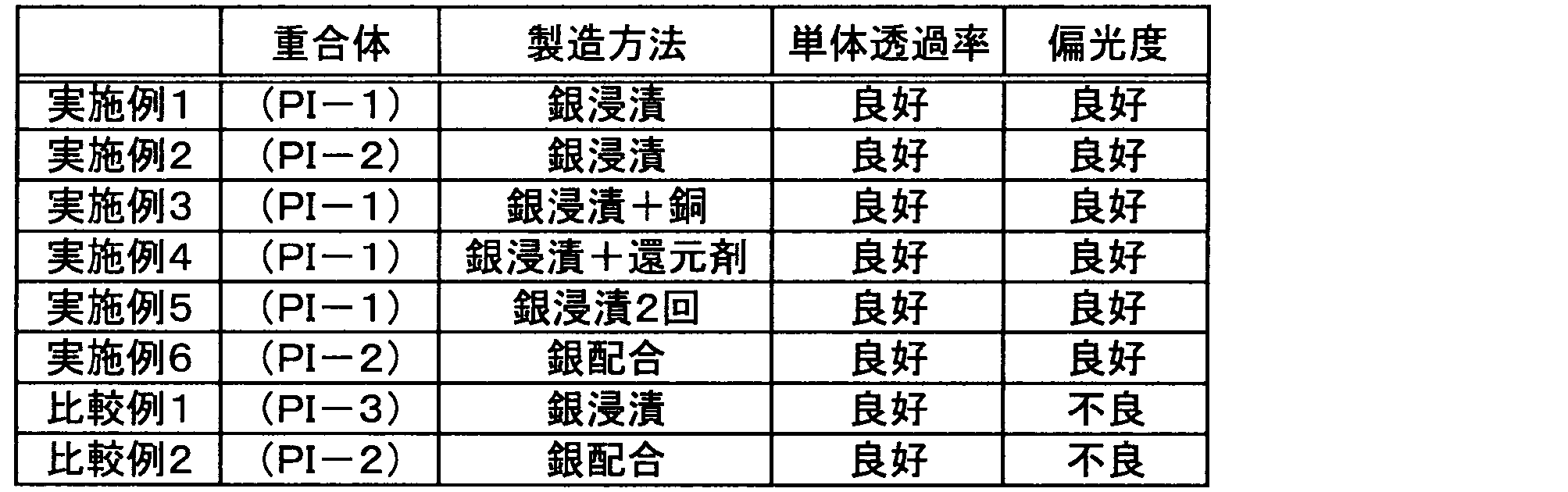
以上の結果から、実施例1~6の偏光膜は、単体透過率が25%以上であって、かつ偏光度が50%以上であり、優れた偏光特性を示した。これに対し、液晶性を示さない重合体(PI-3)を用いた比較例1、及び液晶性を示さない濃度の重合体組成物を基材上に塗布して塗膜を形成した比較例2では、膜の偏光度が50%未満であり、偏光特性が実施例よりも劣っていた。これらの結果から、リオトロピック液晶性を有する重合体の分子鎖をせん断流動により配向させて塗膜を形成し、その塗膜中に含まれる金属イオンを還元して単体金属を析出させることにより、偏光特性に優れた光学異方性膜が得られることが明らかとなった。
Claims (11)
- 重合体と水とを含有しリオトロピック液晶性を示す組成物を、液晶相の状態で基材上に塗布することにより、前記重合体が配向した有機膜を形成する形成工程と、
前記形成工程により得られ且つ金属イオンを含有する有機膜中において金属イオンを還元する還元工程と、
を含む、偏光膜の製造方法。 - 前記重合体は酸性官能基を有する、請求項1に記載の偏光膜の製造方法。
- 前記形成工程により得られた有機膜と金属イオン含有水溶液とを前記還元工程の前に接触させる接触工程をさらに含む、請求項1又は2に記載の偏光膜の製造方法。
- 前記組成物中に金属イオンが含有されている、請求項1~3のいずれか一項に記載の偏光膜の製造方法。
- 前記形成工程により得られた有機膜と還元剤含有水溶液とを前記還元工程の前に接触させるか、又は前記組成物中に還元剤を含有させる、請求項1~4のいずれか一項に記載の偏光膜の製造方法。
- 前記還元工程による金属イオン還元後の有機膜と金属イオン含有水溶液とを接触させ、当該接触させた後の有機膜中の金属イオンを還元する工程をさらに含む、請求項1~5のいずれか一項に記載の偏光膜の製造方法。
- 前記重合体はポリイミドである、請求項1~6のいずれか一項に記載の偏光膜の製造方法。
- 前記重合体は、下記式(0)で表される部分構造を有する重合体である、請求項1~7のいずれか一項に記載の偏光膜の製造方法。

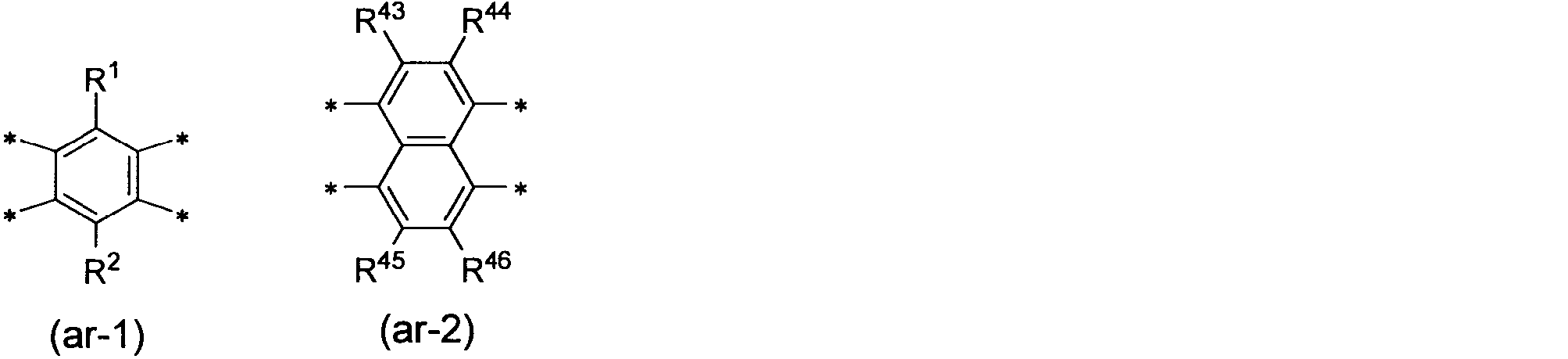
- 前記重合体は、下記式(1)で表される部分構造を有する重合体である、請求項1~8のいずれか一項に記載の偏光膜の製造方法。

- 請求項1~9のいずれか一項に記載の製造方法により得られた偏光膜を有する光学素子。
- 請求項1~9のいずれか一項に記載の製造方法により得られた偏光膜を有する液晶素子。
Priority Applications (1)
| Application Number | Priority Date | Filing Date | Title |
|---|---|---|---|
| JP2020559757A JPWO2020121640A1 (ja) | 2018-12-10 | 2019-10-10 | 偏光膜の製造方法、光学素子及び液晶素子 |
Applications Claiming Priority (2)
| Application Number | Priority Date | Filing Date | Title |
|---|---|---|---|
| JP2018-230869 | 2018-12-10 | ||
| JP2018230869 | 2018-12-10 |
Publications (1)
| Publication Number | Publication Date |
|---|---|
| WO2020121640A1 true WO2020121640A1 (ja) | 2020-06-18 |
Family
ID=71077197
Family Applications (1)
| Application Number | Title | Priority Date | Filing Date |
|---|---|---|---|
| PCT/JP2019/040024 Ceased WO2020121640A1 (ja) | 2018-12-10 | 2019-10-10 | 偏光膜の製造方法、光学素子及び液晶素子 |
Country Status (3)
| Country | Link |
|---|---|
| JP (1) | JPWO2020121640A1 (ja) |
| TW (1) | TW202031747A (ja) |
| WO (1) | WO2020121640A1 (ja) |
Families Citing this family (1)
| Publication number | Priority date | Publication date | Assignee | Title |
|---|---|---|---|---|
| TWI747648B (zh) * | 2020-12-08 | 2021-11-21 | 友達光電股份有限公司 | 顯示面板 |
Citations (8)
| Publication number | Priority date | Publication date | Assignee | Title |
|---|---|---|---|---|
| JP2002527786A (ja) * | 1998-10-14 | 2002-08-27 | ミネソタ マイニング アンド マニュファクチャリング カンパニー | ゲスト・ホスト偏光子 |
| JP2002294239A (ja) * | 2001-03-30 | 2002-10-09 | Fuji Photo Film Co Ltd | リオトロピック液晶組成物および光学異方性薄膜 |
| JP2002357718A (ja) * | 2001-03-30 | 2002-12-13 | Fuji Photo Film Co Ltd | リオトロピック液晶組成物および光学異方性薄膜 |
| JP2006284921A (ja) * | 2005-03-31 | 2006-10-19 | Fuji Photo Film Co Ltd | 偏光膜の製造方法 |
| JP2009134017A (ja) * | 2007-11-29 | 2009-06-18 | Hitachi Maxell Ltd | 光学異方性フィルムの製造方法及び光学異方性フィルム |
| JP2010156720A (ja) * | 2008-09-09 | 2010-07-15 | Fujifilm Corp | 偏光板及びその製造方法、並びに自動車用前窓 |
| JP2014044397A (ja) * | 2012-08-03 | 2014-03-13 | Jsr Corp | 液晶配向剤、液晶配向膜、液晶表示素子及び液晶配向膜の製造方法 |
| WO2018230222A1 (ja) * | 2017-06-12 | 2018-12-20 | Jsr株式会社 | 組成物、液晶配向膜、位相差板、偏光板、配向膜の製造方法及び液晶素子 |
-
2019
- 2019-10-10 JP JP2020559757A patent/JPWO2020121640A1/ja active Pending
- 2019-10-10 WO PCT/JP2019/040024 patent/WO2020121640A1/ja not_active Ceased
- 2019-11-19 TW TW108142000A patent/TW202031747A/zh unknown
Patent Citations (8)
| Publication number | Priority date | Publication date | Assignee | Title |
|---|---|---|---|---|
| JP2002527786A (ja) * | 1998-10-14 | 2002-08-27 | ミネソタ マイニング アンド マニュファクチャリング カンパニー | ゲスト・ホスト偏光子 |
| JP2002294239A (ja) * | 2001-03-30 | 2002-10-09 | Fuji Photo Film Co Ltd | リオトロピック液晶組成物および光学異方性薄膜 |
| JP2002357718A (ja) * | 2001-03-30 | 2002-12-13 | Fuji Photo Film Co Ltd | リオトロピック液晶組成物および光学異方性薄膜 |
| JP2006284921A (ja) * | 2005-03-31 | 2006-10-19 | Fuji Photo Film Co Ltd | 偏光膜の製造方法 |
| JP2009134017A (ja) * | 2007-11-29 | 2009-06-18 | Hitachi Maxell Ltd | 光学異方性フィルムの製造方法及び光学異方性フィルム |
| JP2010156720A (ja) * | 2008-09-09 | 2010-07-15 | Fujifilm Corp | 偏光板及びその製造方法、並びに自動車用前窓 |
| JP2014044397A (ja) * | 2012-08-03 | 2014-03-13 | Jsr Corp | 液晶配向剤、液晶配向膜、液晶表示素子及び液晶配向膜の製造方法 |
| WO2018230222A1 (ja) * | 2017-06-12 | 2018-12-20 | Jsr株式会社 | 組成物、液晶配向膜、位相差板、偏光板、配向膜の製造方法及び液晶素子 |
Also Published As
| Publication number | Publication date |
|---|---|
| TW202031747A (zh) | 2020-09-01 |
| JPWO2020121640A1 (ja) | 2021-10-21 |
Similar Documents
| Publication | Publication Date | Title |
|---|---|---|
| JP5428336B2 (ja) | 塗布液並びにそれを用いた液晶配向膜及び液晶表示素子 | |
| CN100538478C (zh) | 液晶取向处理剂及使用该处理剂的液晶显示元件 | |
| JP6187457B2 (ja) | 光配向法用の液晶配向剤、液晶配向膜、及び液晶表示素子 | |
| CN110662789B (zh) | 组合物、聚合物、液晶取向剂、液晶取向膜及其制造方法、相位差板、偏光板及液晶元件 | |
| TWI650345B (zh) | 液晶配向處理劑、液晶配向膜及液晶顯示元件 | |
| TW201302859A (zh) | 聚醯胺酸、聚醯亞胺、聚醯胺酸溶液、聚醯亞胺溶液、由此等溶液所得之聚醯亞胺膜及聚醯亞胺膜之利用 | |
| WO2015033922A1 (ja) | 液晶配向処理剤、液晶配向膜及び液晶表示素子 | |
| CN103687911B (zh) | 组合物、液晶取向处理剂、液晶取向膜及液晶显示元件 | |
| TWI649362B (zh) | 組成物、液晶配向處理劑、液晶配向膜及液晶顯示元件 | |
| CN108700777A (zh) | 液晶取向剂、液晶取向膜和液晶表示元件 | |
| JP5874646B2 (ja) | 液晶配向処理剤、液晶配向膜および液晶表示素子 | |
| US20210277185A1 (en) | Composition and use thereof | |
| CN104718492A (zh) | 液晶取向剂、液晶取向膜及液晶显示元件 | |
| CN106462010A (zh) | 液晶取向剂、液晶取向膜和液晶表示元件 | |
| CN105122128B (zh) | 液晶取向膜的制造方法、液晶取向膜、液晶表示元件和液晶取向剂 | |
| CN105940343B (zh) | 液晶取向剂和使用了其的液晶表示元件 | |
| JPWO2020121640A1 (ja) | 偏光膜の製造方法、光学素子及び液晶素子 | |
| CN102858850B (zh) | 二胺化合物、液晶取向剂以及液晶显示元件 | |
| JP5298398B2 (ja) | 液晶配向処理剤およびこれを用いた液晶表示素子 | |
| JP7392663B2 (ja) | 液晶配向処理剤、液晶配向膜及び液晶表示素子 | |
| JP2004163724A (ja) | 新規な液晶配向処理剤 | |
| JPH07301806A (ja) | 新規な液晶配向膜 | |
| JPH07301805A (ja) | 液晶配向膜 |
Legal Events
| Date | Code | Title | Description |
|---|---|---|---|
| 121 | Ep: the epo has been informed by wipo that ep was designated in this application |
Ref document number: 19894856 Country of ref document: EP Kind code of ref document: A1 |
|
| ENP | Entry into the national phase |
Ref document number: 2020559757 Country of ref document: JP Kind code of ref document: A |
|
| NENP | Non-entry into the national phase |
Ref country code: DE |
|
| 122 | Ep: pct application non-entry in european phase |
Ref document number: 19894856 Country of ref document: EP Kind code of ref document: A1 |