WO2020105371A1 - 変性天然ゴム、それを用いたゴム組成物、並びに変性天然ゴムの製造方法 - Google Patents
変性天然ゴム、それを用いたゴム組成物、並びに変性天然ゴムの製造方法Info
- Publication number
- WO2020105371A1 WO2020105371A1 PCT/JP2019/042156 JP2019042156W WO2020105371A1 WO 2020105371 A1 WO2020105371 A1 WO 2020105371A1 JP 2019042156 W JP2019042156 W JP 2019042156W WO 2020105371 A1 WO2020105371 A1 WO 2020105371A1
- Authority
- WO
- WIPO (PCT)
- Prior art keywords
- natural rubber
- modified natural
- rubber
- general formula
- mass
- Prior art date
- Legal status (The legal status is an assumption and is not a legal conclusion. Google has not performed a legal analysis and makes no representation as to the accuracy of the status listed.)
- Ceased
Links
Classifications
-
- C—CHEMISTRY; METALLURGY
- C08—ORGANIC MACROMOLECULAR COMPOUNDS; THEIR PREPARATION OR CHEMICAL WORKING-UP; COMPOSITIONS BASED THEREON
- C08C—TREATMENT OR CHEMICAL MODIFICATION OF RUBBERS
- C08C19/00—Chemical modification of rubber
- C08C19/22—Incorporating nitrogen atoms into the molecule
-
- B—PERFORMING OPERATIONS; TRANSPORTING
- B60—VEHICLES IN GENERAL
- B60C—VEHICLE TYRES; TYRE INFLATION; TYRE CHANGING; CONNECTING VALVES TO INFLATABLE ELASTIC BODIES IN GENERAL; DEVICES OR ARRANGEMENTS RELATED TO TYRES
- B60C1/00—Tyres characterised by the chemical composition or the physical arrangement or mixture of the composition
- B60C1/0016—Compositions of the tread
-
- B—PERFORMING OPERATIONS; TRANSPORTING
- B60—VEHICLES IN GENERAL
- B60C—VEHICLE TYRES; TYRE INFLATION; TYRE CHANGING; CONNECTING VALVES TO INFLATABLE ELASTIC BODIES IN GENERAL; DEVICES OR ARRANGEMENTS RELATED TO TYRES
- B60C1/00—Tyres characterised by the chemical composition or the physical arrangement or mixture of the composition
- B60C1/0025—Compositions of the sidewalls
-
- C—CHEMISTRY; METALLURGY
- C08—ORGANIC MACROMOLECULAR COMPOUNDS; THEIR PREPARATION OR CHEMICAL WORKING-UP; COMPOSITIONS BASED THEREON
- C08F—MACROMOLECULAR COMPOUNDS OBTAINED BY REACTIONS ONLY INVOLVING CARBON-TO-CARBON UNSATURATED BONDS
- C08F8/00—Chemical modification by after-treatment
- C08F8/30—Introducing nitrogen atoms or nitrogen-containing groups
-
- C—CHEMISTRY; METALLURGY
- C08—ORGANIC MACROMOLECULAR COMPOUNDS; THEIR PREPARATION OR CHEMICAL WORKING-UP; COMPOSITIONS BASED THEREON
- C08K—Use of inorganic or non-macromolecular organic substances as compounding ingredients
- C08K3/00—Use of inorganic substances as compounding ingredients
- C08K3/01—Use of inorganic substances as compounding ingredients characterized by their specific function
- C08K3/013—Fillers, pigments or reinforcing additives
-
- C—CHEMISTRY; METALLURGY
- C08—ORGANIC MACROMOLECULAR COMPOUNDS; THEIR PREPARATION OR CHEMICAL WORKING-UP; COMPOSITIONS BASED THEREON
- C08K—Use of inorganic or non-macromolecular organic substances as compounding ingredients
- C08K3/00—Use of inorganic substances as compounding ingredients
- C08K3/02—Elements
- C08K3/04—Carbon
-
- C—CHEMISTRY; METALLURGY
- C08—ORGANIC MACROMOLECULAR COMPOUNDS; THEIR PREPARATION OR CHEMICAL WORKING-UP; COMPOSITIONS BASED THEREON
- C08K—Use of inorganic or non-macromolecular organic substances as compounding ingredients
- C08K3/00—Use of inorganic substances as compounding ingredients
- C08K3/34—Silicon-containing compounds
- C08K3/36—Silica
-
- C—CHEMISTRY; METALLURGY
- C08—ORGANIC MACROMOLECULAR COMPOUNDS; THEIR PREPARATION OR CHEMICAL WORKING-UP; COMPOSITIONS BASED THEREON
- C08K—Use of inorganic or non-macromolecular organic substances as compounding ingredients
- C08K5/00—Use of organic ingredients
- C08K5/54—Silicon-containing compounds
- C08K5/548—Silicon-containing compounds containing sulfur
Definitions
- the present invention relates to a modified natural rubber, a rubber composition using the same, and a method for producing a modified natural rubber.
- Patent Document 1 After the diene rubber latex is oxidized, a polar group-containing hydrazide compound can be produced for the purpose of improving the low loss property and the abrasion resistance of the rubber composition, which can be produced at a low cost.
- a modified diene rubber is described in which the diene rubber is added to the end of the molecular chain.
- Patent Document 2 for the purpose of obtaining a polymer composition having excellent abrasion resistance, a monomer having a specific structure having a monomer unit based on a conjugated diene and a benzene ring substituted with a nitrogen atom or the like is used.
- a conjugated diene-based polymer having a base monomer unit, in which at least one end of the polymer is modified with an organosilicon compound having a specific structure, and the like are described.
- Patent Document 3 for the purpose of improving the compatibility of the filler with the rubber component, a modification having a linking group having a predetermined structure in the molecule and a diene polymer chain linked through the linking group.
- a rubber composition for tires containing a diene rubber is described.
- the present invention provides a modified natural rubber having better fuel economy and tensile strength than unmodified natural rubber, a rubber composition using the same, and a method for producing a modified natural rubber. To aim.
- the modified natural rubber according to the present invention has two or more polyisoprenes having a structure represented by the general formula (A) and / or the general formula (B) in these structural portions. It has a linking structure represented by the general formula (C), which is formed by bonding with an amino compound having a primary amino group.
- X represents a hydrogen atom or a methyl group
- P represents a polyisoprene unit
- P in each formula may be the same or different.
- W represents a residue obtained by removing the terminal amino group from the above amino compound
- Q is at least one selected from the group consisting of the following general formulas (Q-1) to (Q-4).
- m is 2 to 4.
- * 1 indicates that the carbon atom of the polyisoprene unit is bonded
- * 2 indicates that the carbon atom of the residue represented by W is bonded.
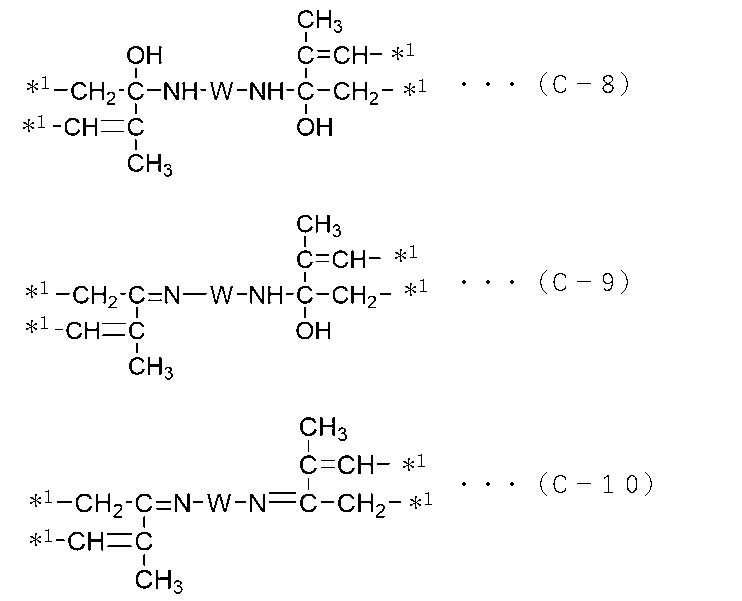
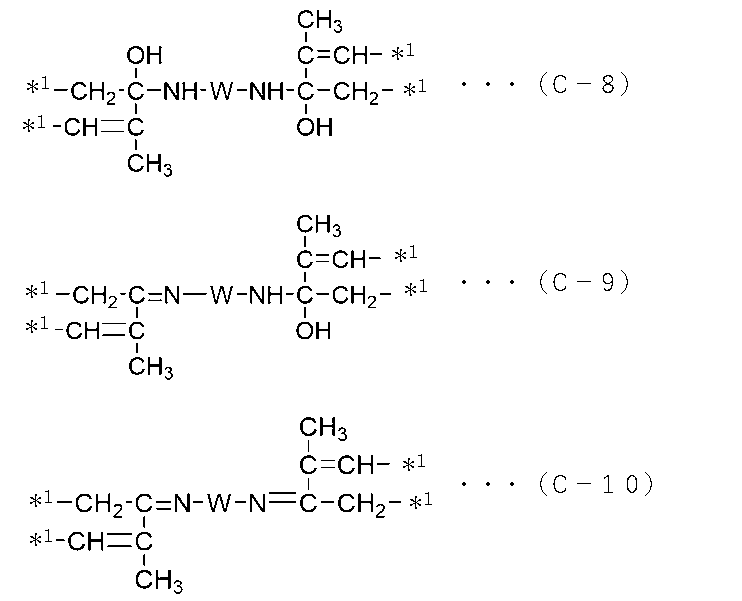
- the linked structure represented by the general formula (C) may have at least one selected from the group consisting of the following general formulas (C-1) to (C-10).
- the weight average molecular weight of the modified natural rubber can be 1 to 2,000,000.
- the rubber composition according to the present invention contains 10 to 100 parts by mass of the modified natural rubber in 100 parts by mass of the rubber component, and 10 to 150 parts by mass of the inorganic filler with respect to 100 parts by mass of the rubber component. I shall.
- the pneumatic tire according to the present invention is manufactured using the above rubber composition.
- the method for producing a modified natural rubber according to the present invention comprises a step of adding an oxidizing agent to a natural rubber polymer to oxidatively cleave a carbon-carbon double bond to obtain an oxidatively decomposed natural rubber polymer, and the obtained oxidatively decomposed natural rubber.
- the present invention it is possible to provide a modified natural rubber having better fuel economy and tensile strength than unmodified natural rubber, a rubber composition using the same, and a method for producing the modified natural rubber.
- the polyisoprene having the structure of the general formula (A) and / or the general formula (B) is an amino compound having two or more primary amino groups in these structural parts. It has a connecting structure represented by the general formula (C), which is formed by bonding.
- X represents a hydrogen atom or a methyl group
- P represents a polyisoprene unit
- P in each formula may be the same or different.
- W represents a residue obtained by removing the terminal amino group from the above amino compound
- Q is at least one selected from the group consisting of the following general formulas (Q-1) to (Q-4).
- m is 2 to 4.
- * 1 indicates that the carbon atom of the polyisoprene unit is bonded
- * 2 indicates that the ethylene group of W is bonded. ..
- the method for producing the modified natural rubber according to the present embodiment is not particularly limited, but a step of adding an oxidizing agent to the natural rubber polymer to oxidatively cleave the carbon-carbon double bond to obtain an oxidatively decomposed natural rubber polymer And a step of adding an amino compound having two or more primary amino groups to the resulting oxidatively-decomposed natural rubber polymer to cause a recombination reaction. That is, the modified natural rubber according to the present embodiment is decomposed by oxidatively cleaving the carbon-carbon double bond existing in the main chain of the natural rubber polymer to reduce the molecular weight, and contains the decomposed polymer. It is obtained by reacting the system with an amino compound and recombining.
- the natural rubber polymer to be modified may be one that is dissolved in a solvent, and it is preferable to use an aqueous emulsion in the form of micelle in water, which is a protic solvent, that is, a latex.
- an aqueous emulsion By using an aqueous emulsion, a recombination reaction can be caused by decomposing the polymer and then blending the amino compound in that state.
- the concentration of the aqueous emulsion is not particularly limited, but is preferably 5 to 70% by mass, and more preferably 10 to 50% by mass. If the solids concentration is too high, the emulsion stability will be reduced, and if the solids concentration is too low, the reaction rate will be slow and the practicality will be impaired.
- the amino compound is not particularly limited as long as it has two or more primary amino groups, and examples thereof include a compound represented by NH 2 (CH 2 CH 2 NH) n H, and n Is preferably an integer of 1 to 4. That is, ethylenediamine, diethylenetriamine, triethylenetetraamine, and tetraethylenepentamine can be preferably used.
- a polymer having a structure represented by the following formula (A) at the terminal and a polymer having a structure represented by the following formula (B) in the molecular chain are produced.
- the polyisoprene unit means polyisoprene derived from natural rubber, specifically, cis-1,4-polyisoprene.
- X is a hydrogen atom or a methyl group, and when the isoprene unit is cleaved, X is a methyl group at one cleavage terminal and X is a hydrogen atom at the other cleavage terminal.
- An oxidant can be used for oxidatively cleaving the carbon-carbon double bond of the natural rubber polymer.
- the oxidative cleavage can be carried out by adding the oxidant to an aqueous emulsion of the natural rubber polymer and stirring the mixture. ..
- the oxidizing agent for example, potassium permanganate, manganese compounds such as manganese oxide, chromic acid, chromium compounds such as chromium trioxide, peroxides such as hydrogen peroxide, perhalogen acids such as periodic acid, ozone, Oxygen such as oxygen is included. Among these, it is preferable to use periodic acid.
- a metal-based oxidation catalyst such as a salt or complex with a chloride of a metal such as cobalt, copper, or iron, or a salt or complex with an organic compound may be used in combination, for example, air oxidation in the presence of the metal-based oxidation catalyst. You may.
- the molecular weight is lowered by decomposing the polymer by the above oxidative cleavage.
- the weight average molecular weight of the polymer after decomposition is not particularly limited, but is preferably from 900 to 500,000, more preferably from 5,000 to 100,000, and further preferably from 10,000 to 50,000.
- the amount of the functional group after recombining can be adjusted by the magnitude of the molecular weight after decomposition, but if the molecular weight at the time of decomposition is too small, a binding reaction within the same molecule is likely to occur.
- the weight average molecular weight is a value obtained by measuring the polystyrene-equivalent weight average molecular weight by measurement by gel permeation chromatography (GPC).
- the reaction system containing the decomposed polymer is allowed to react with the above amino compound to re-bond.
- the aqueous emulsion is coagulated and dried to obtain a modified natural rubber which is solid at room temperature.
- the connecting structure represented by the above formula (C) is introduced into the main chain by a recombination reaction, and the main chain structure is modified.
- a primary amino group of an amino compound undergoes a nucleophilic addition reaction with a carbonyl group or a formyl group having a structure represented by the general formula (A) to give a compound represented by the general formula (Q-1).
- the linked structure is changed to the linked structure represented by the general formula (Q-2).
- the primary amino group of the amino compound undergoes a nucleophilic addition reaction with the carbonyl group having the structure represented by the general formula (B) to form a linked structure represented by the general formula (Q-3).
- the linked structure represented by the general formula (Q-4) is obtained.
- the modified natural rubber used in the present embodiment has at least one of the connecting structures represented by the above formula (C) in the molecule, and the polyisoprene chain composed of the repeating structure of the isoprene unit has the connecting structure interposed therebetween. It has a structure directly connected.
- the number of moles (m) of Q bonded to W is 2, which is represented by the formula (C).
- the connected structure is any of the connected structures represented by the following general formulas (C-1) to (C-10). That is, for example, when a compound represented by NH 2 (CH 2 CH 2 NH) n H is used as the amino compound, a linked structure represented by the following general formulas (C-1) to (C-10) is used. Among them, the residue W of the amino compound becomes — (CH 2 CH 2 NH) n-1 CH 2 CH 2 —.
- the linked structures represented by the general formulas (C-1) to (C-3) are those in which polyisoprene units having the structure represented by the general formula (A) are bound to each other via an amino compound.
- the connecting structure represented by the general formula (C-1) is a connecting structure in which the connecting structures represented by the general formula (Q-1) are bonded to each other via the residue W of the amino compound. ..
- the linking structure represented by the general formula (C-2) the linking structure represented by the general formula (Q-1) and the linking structure represented by the general formula (Q-2) are residues W of an amino compound. It is a linked structure that is bound via.
- the linking structure represented by the general formula (C-3) is a linking structure in which the linking structures represented by the general formula (Q-2) are bonded via the residue W of the amino compound.
- the connecting structures represented by the general formulas (C-4) to (C-7) include a polyisoprene unit having a structure represented by the general formula (A) and a structure represented by the general formula (B). And a polyisoprene unit having is attached via an amino compound.
- the linking structure represented by the general formula (C-4) the linking structure represented by the general formula (Q-1) and the linking structure represented by the general formula (Q-3) are amino. It is a linking structure linked via the residue W of the compound.
- the linking structure represented by the general formula (C-5) the linking structure represented by the general formula (Q-2) and the linking structure represented by the general formula (Q-3) are residues W of an amino compound. It is a linked structure that is bound via.
- the linking structure represented by the general formula (C-6) are residues W of an amino compound. It is a linked structure that is bound via.
- the linking structure represented by the general formula (C-7) is a residue W of an amino compound having a linking structure represented by the general formula (Q-2) and a linking structure represented by the general formula (Q-4). It is a linked structure that is bound via.
- the linked structures represented by the general formulas (C-8) to (C-10) are those in which polyisoprene units having the structure represented by the general formula (B) are bound to each other via an amino compound.
- the connecting structure represented by the general formula (C-8) is a connecting structure in which the connecting structures represented by the general formula (Q-3) are bonded to each other via the residue W of the amino compound. ..
- the linking structure represented by the general formula (C-9) the linking structure represented by the general formula (Q-3) and the linking structure represented by the general formula (Q-4) are residues W of an amino compound. It is a linked structure that is bound via.
- the linking structure represented by the general formula (C-10) is a linking structure in which the linking structures represented by the general formula (Q-4) are bonded via the residue W of the amino compound.
- the content rate of the linked structure represented by the general formula (C) (when two or more linked structures are contained, the total content rate thereof is not particularly limited, but is 0.1 to 1.0 mol%. It is preferable that the amount is 0.1 to 0.7 mol%, more preferably 0.1 to 0.6 mol%.
- the content of the connecting structure is the ratio of the number of moles of the connecting structure to the number of moles of all the constituent units that make up the modified natural rubber, and is a value measured by NMR.
- the NMR spectrum was measured by "400 ULTRASHIELDTM PLUS" manufactured by BRUKER, using TMS as a standard.
- the weight average molecular weight of the modified natural rubber is not particularly limited, but is preferably 800,000 to 2,000,000, more preferably 1,000,000 to 2,000,000.
- the reaction of oxidative cleavage can be controlled by adjusting the type and amount of the oxidizing agent, which is a drug that dissociates the double bond, the reaction time, and the like.
- the binding reaction can be controlled by adjusting the compounding amount of the amino compound, the reaction time and the like at the time of rebinding.
- the molecular weight of the modified natural rubber can be controlled by these controls. Therefore, the weight average molecular weight of the modified natural rubber can be set equal to that of the original polymer, or can be set lower than that of the original polymer.
- the compounding amount of the oxidizing agent is not particularly limited, but is preferably 0.1 to 1.0 part by mass, and 0.2 to 0.5 part by mass with respect to 100 parts by mass of the natural rubber polymer (solid content). More preferably.
- the compounding amount of the amino compound is not particularly limited, but is preferably 0.01 to 1.0 mol, and more preferably 0.1 to 0.5 mol with respect to 1 mol of the oxidatively decomposed natural rubber polymer. ..
- the connecting structure represented by the above formula (C) is inserted as a structure different from the main chain, and the bonding point of the segment of the main chain structure is functionalized. That is, a highly reactive structure can be introduced into the main chain of the molecule to change the properties of the original polymer.
- the main chain structure itself of natural rubber is changed without grafting, direct addition, or ring opening, and a functional group can be easily introduced into the main chain structure.
- the interaction between the polymer and the filler is changed, and the composition of the polymer is changed.
- the compatibility or dispersibility of is improved. Due to the effect, the fuel economy is improved.
- the rubber composition according to the present embodiment may contain a diene rubber other than the modified natural rubber as a rubber component, and the type thereof is not particularly limited, and examples thereof include unmodified natural rubber (NR) and isoprene. Examples thereof include rubber (IR), butadiene rubber (BR), styrene-butadiene rubber (SBR), styrene-isoprene copolymer rubber, butadiene-isoprene copolymer rubber, and styrene-isoprene-butadiene copolymer rubber. These diene rubbers may be used alone or in a blend of two or more.
- the content of the modified natural rubber in 100 parts by mass of the rubber component is not particularly limited, but it is preferably 10 to 100 parts by mass, and 30 to 100 parts by mass. It is preferably 50 to 100 parts by mass.
- a reinforcing filler such as carbon black or silica can be used as an inorganic filler. That is, the inorganic filler may be silica alone or a combination of carbon black and silica. A combination of carbon black and silica is preferable.
- the content of the inorganic filler is not particularly limited and is, for example, preferably 10 to 150 parts by mass, more preferably 20 to 100 parts by mass, and further preferably 30 to 100 parts by mass with respect to 100 parts by mass of the rubber component. 80 parts by mass.
- the silica is not particularly limited, but wet silica such as wet precipitation silica and wet gel silica is preferably used.
- the content of silica is preferably 10 to 150 parts by mass, more preferably 15 to 100 parts by mass with respect to 100 parts by mass of the rubber component, from the viewpoint of the balance of tan ⁇ of the rubber and the reinforcing property. It is preferably 20 to 80 parts by mass.
- silica When containing silica, it may further contain a silane coupling agent such as sulfide silane or mercapto silane.
- a silane coupling agent such as sulfide silane or mercapto silane.
- the silane coupling agent When the silane coupling agent is contained, its content is preferably 2 to 20 parts by mass with respect to 100 parts by mass of silica.
- the carbon black is not particularly limited, and various known varieties can be used.
- the content of carbon black is preferably 1 to 70 parts by mass, and more preferably 1 to 30 parts by mass with respect to 100 parts by mass of the rubber component.
- additives such as process oil, zinc white, stearic acid, a softening agent, a plasticizer, a wax, and an antioxidant used in ordinary rubber industry.
- a vulcanizing compounding agent such as a vulcanizing agent or a vulcanization accelerator may be appropriately mixed within the usual range.
- Vulcanizing agents include sulfur components such as powdered sulfur, precipitated sulfur, colloidal sulfur, insoluble sulfur and highly dispersible sulfur. Further, the content of the vulcanizing agent is preferably 0.1 to 10 parts by mass, and more preferably 0.5 to 5 parts by mass with respect to 100 parts by mass of the rubber component. Further, the content of the vulcanization accelerator is preferably 0.1 to 7 parts by mass, and more preferably 0.5 to 5 parts by mass with respect to 100 parts by mass of the rubber component.
- the rubber composition according to the present embodiment can be produced using a mixer such as a Banbury mixer, a kneader, or a roll that is commonly used.
- the obtained rubber composition can be used for tires, and it should be applied to various parts of tires such as tread parts and sidewall parts of pneumatic tires for various uses and sizes, such as large tires for passenger cars and trucks and buses.
- the rubber composition is molded into a predetermined shape by, for example, extrusion processing according to a conventional method, and after being combined with other parts, vulcanized and molded at 140 to 180 ° C. to manufacture a pneumatic tire. it can.
- the type of the pneumatic tire according to the present embodiment is not particularly limited, and various tires such as tires for passenger cars and heavy duty tires used for trucks, buses, etc. can be mentioned as described above.
- the polystyrene-converted Mw was determined by measurement by gel permeation chromatography (GPC). Specifically, the measurement sample used was 0.2 mg dissolved in 1 mL of THF. Using “LC-20DA” manufactured by Shimadzu Corporation, the sample was passed through a filter, and then passed through a column (“PL Gel 3 ⁇ m Guard ⁇ 2” manufactured by Polymer Laboratories) at a temperature of 40 ° C. and a flow rate of 0.7 mL / min. It was detected by "RI Detector” manufactured by System.
- the peak of the carbon adjacent to the nitrogen is 85 ppm in 13 C-NMR.
- the peak of the carbon adjacent to the nitrogen is at 167 ppm in 13 C-NMR.
- the peak of the carbon adjacent to the nitrogen is at 96 ppm in 13 C-NMR.
- the peak of the carbon adjacent to the nitrogen is at 165 ppm in 13 C-NMR. For each of these peaks, the content of the linked structure was determined from the ratio with the natural rubber polymer component (mol%).
- Non-modified NR Natural ammonia latex "HA-NR" manufactured by REGITEX, with high ammonia content
- Modified natural rubber 1 Modified natural rubber synthesized in Synthesis Example 2
- Modified natural rubber 2 Modified natural rubber synthesized in Synthesis example 3
- Modified natural rubber 3 Modified natural rubber synthesized in Synthesis example 4
- Modified natural rubber 4 Modified natural rubber / modified natural rubber 5 synthesized in Synthesis Example 5: modified natural rubber / modified natural rubber synthesized in Synthesis Example 6 6: modified natural rubber / modified natural rubber 7 synthesized in Synthesis
- Synthetic modified natural rubber / silica “Nipseal AQ” manufactured by Tosoh Silica Co., Ltd.
- Low fuel consumption loss coefficient tan ⁇ was measured under the conditions of frequency 50 Hz, static strain 10%, dynamic strain 2%, temperature 60 ° C. using USM Rheometer E4000, and the value of Comparative Example 1 was set to 100. It was displayed by the index.
- the tan ⁇ at 60 ° C. is generally used as an index of low exothermicity in a rubber composition for tires, and the larger the above-mentioned index, the smaller tan ⁇ . Is shown to be excellent.
- -Tensile strength A tensile test (dumbbell-shaped No. 3 type) according to JIS K6251 was performed to measure the strength at break, and the strength was expressed as an index with the value of Comparative Example 1 as 100. The larger the index, the higher the tensile strength and the better.
- Comparative Example 2 using modified natural rubber having a different connecting structure from that of the present invention and Examples 1 to 6 shows that when the modified natural rubber of the present invention is used, fuel consumption is equal to or higher than that of Comparative Example 2. It is understood that the tensile strength and the tensile strength superior to those of Comparative Example 2 are obtained.
- the rubber composition using the modified natural rubber of the present invention can be used for various tires of passenger cars, light trucks, buses and the like.
Landscapes
- Chemical & Material Sciences (AREA)
- Engineering & Computer Science (AREA)
- Mechanical Engineering (AREA)
- Health & Medical Sciences (AREA)
- Chemical Kinetics & Catalysis (AREA)
- Medicinal Chemistry (AREA)
- Polymers & Plastics (AREA)
- Organic Chemistry (AREA)
- General Chemical & Material Sciences (AREA)
- Addition Polymer Or Copolymer, Post-Treatments, Or Chemical Modifications (AREA)
- Compositions Of Macromolecular Compounds (AREA)
Abstract
未変性天然ゴムよりも優れた低燃費性及び引張強度を有する変性天然ゴム、それを用いたゴム組成物、並びに変性天然ゴムの製造方法を提供する。 一般式(A)及び/又は一般式(B)で表される構造を有するポリイソプレンが、これらの構造部分において2つ以上の第一級アミノ基を有するアミノ化合物と結合してなる、一般式(C)で表される連結構造を有する、変性天然ゴムとする。 ただし、式(A)及び(B)中、Xは水素原子又はメチル基を示し、Pはポリイソプレンユニットを示し、各式におけるPはそれぞれ同じでも異なっていてもよい。 式(C)中、Wは上記アミノ化合物から末端のアミノ基を除いた残基を示し、Qは次の一般式(Q-1)~(Q-4)からなる群より選択される少なくとも一つを示し、mは2~4を示す。また、一般式(Q-1)から(Q-4)において、*1はポリイソプレンユニットの炭素原子と結合していることを示し、*2はWで表される残基の炭素原子と結合していることを示す。
Description
本発明は、変性天然ゴム、それを用いたゴム組成物、並びに変性天然ゴムの製造方法に関するものである。
ゴムポリマーの物性を高める手段が、従来から種々検討されている。例えば、特許文献1では、安価に製造することができ、かつゴム組成物の低ロス性及び耐摩耗性を向上させることを目的として、ジエン系ゴムラテックスを酸化した後、極性基含有ヒドラジド化合物をジエン系ゴムの分子鎖の末端に付加させてなる変性ジエン系ゴムが記載されている。
また、特許文献2では、耐摩耗性に優れる重合体組成物を得ることを目的として、共役ジエンに基づく単量体単位と窒素原子等で置換されたベンゼン環を有する特定構造の単量体に基づく単量体単位とを有する共役ジエン系重合体であって、特定構造の有機ケイ素化合物によって重合体の少なくとも一端が変性されている共役ジエン系重合体等が記載されている。
また、特許文献3では、ゴム成分に対するフィラーの相溶性を向上させることを目的として、所定構造を有する連結基を分子内に有してジエン系ポリマー鎖が連結基を介して連結されてなる変性ジエン系ゴムを含有するタイヤ用ゴム組成物が記載されている。
しかしながら、天然ゴムポリマーの物性の向上、特に低燃費性や引張強度の向上についてさらなる改善の余地があった。
本発明は、以上の点に鑑み、未変性天然ゴムよりも優れた低燃費性及び引張強度を有する変性天然ゴム、それを用いたゴム組成物、並びに変性天然ゴムの製造方法を提供することを目的とする。
本発明に係る変性天然ゴムは、上記課題を解決するために、一般式(A)及び/又は一般式(B)で表される構造を有するポリイソプレンが、これらの構造部分において2つ以上の第一級アミノ基を有するアミノ化合物と結合してなる、一般式(C)で表される連結構造を有するものとする。
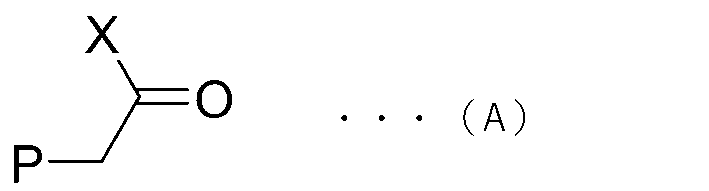
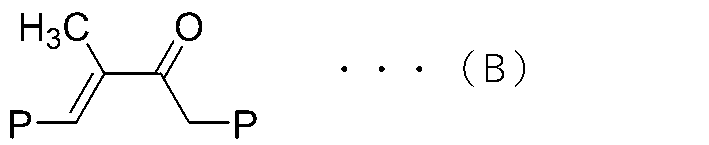
ただし、式(A)及び(B)中、Xは水素原子又はメチル基を示し、Pはポリイソプレンユニットを示し、各式におけるPはそれぞれ同じでも異なっていてもよい。

式(C)中、Wは上記アミノ化合物から末端のアミノ基を除いた残基を示し、Qは次の一般式(Q-1)~(Q-4)からなる群より選択される少なくとも一つを示し、mは2~4を示す。また、一般式(Q-1)~(Q-4)において、*1はポリイソプレンユニットの炭素原子と結合していることを示し、*2はWで表される残基の炭素原子と結合していることを示す。
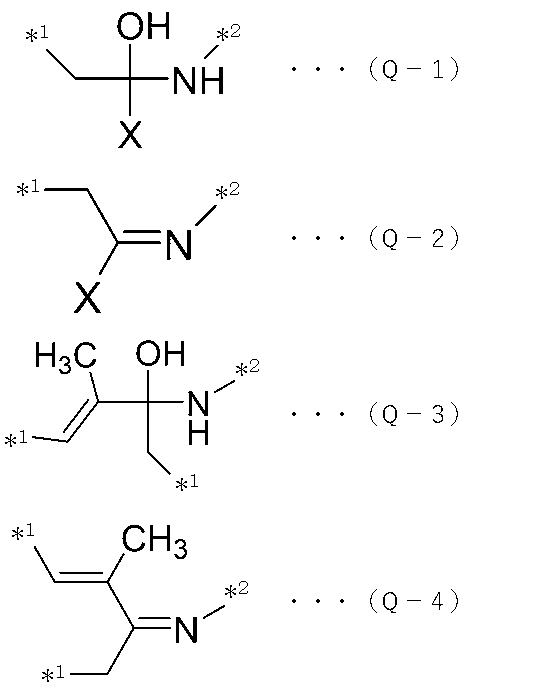
上記一般式(C)で表される連結構造が、次の一般式(C-1)~(C-10)からなる群より選択される少なくとも一つを有するものとすることができる。
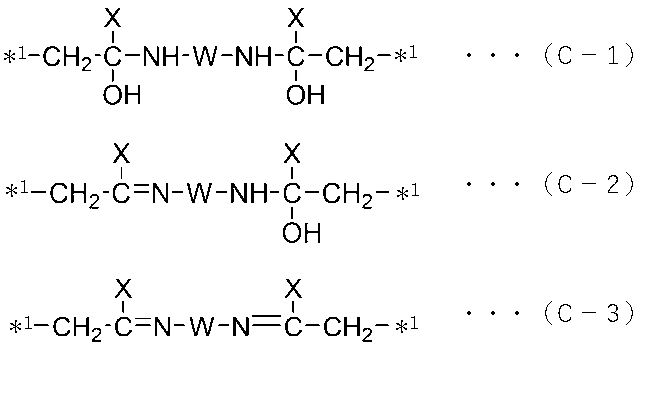


上記変性天然ゴムの重量平均分子量は、100万~200万であるものとすることができる。
本発明に係るゴム組成物は、ゴム成分100質量部中に、上記変性天然ゴムを10~100質量部含有し、このゴム成分100質量部に対して無機充填剤を10~150質量部含有するものとする。
本発明に係る空気入りタイヤは、上記ゴム組成物を用いて作製したものとする。
本発明に係る変性天然ゴムの製造方法は、天然ゴムポリマーに酸化剤を添加し、炭素-炭素二重結合を酸化開裂させて酸化分解天然ゴムポリマーを得る工程と、得られた酸化分解天然ゴムポリマーに、2つ以上の第一級アミノ基を有するアミノ化合物を添加して、再結合反応させる工程とを有するものとする。
本発明によれば、未変性天然ゴムよりも優れた低燃費性及び引張強度を有する変性天然ゴム、それを用いたゴム組成物、並びに変性天然ゴムの製造方法を提供することができる。
以下、本発明の実施に関連する事項について詳細に説明する。
本実施形態に係る変性天然ゴムは、一般式(A)及び/又は一般式(B)の構造を有するポリイソプレンが、これらの構造部分において2つ以上の第一級アミノ基を有するアミノ化合物と結合してなる、一般式(C)で表される連結構造を有するものである。

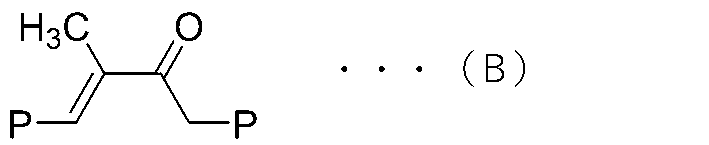
ただし、式(A)及び(B)中、Xは水素原子又はメチル基を示し、Pはポリイソプレンユニットを示し、各式におけるPはそれぞれ同じでも異なっていてもよい。

式(C)中、Wは上記アミノ化合物から末端のアミノ基を除いた残基を示し、Qは次の一般式(Q-1)~(Q-4)からなる群より選択される少なくとも一つを示し、mは2~4を示す。また、一般式(Q-1)~(Q-4)において、*1はポリイソプレンユニットの炭素原子と結合していることを示し、*2はWのエチレン基と結合していることを示す。
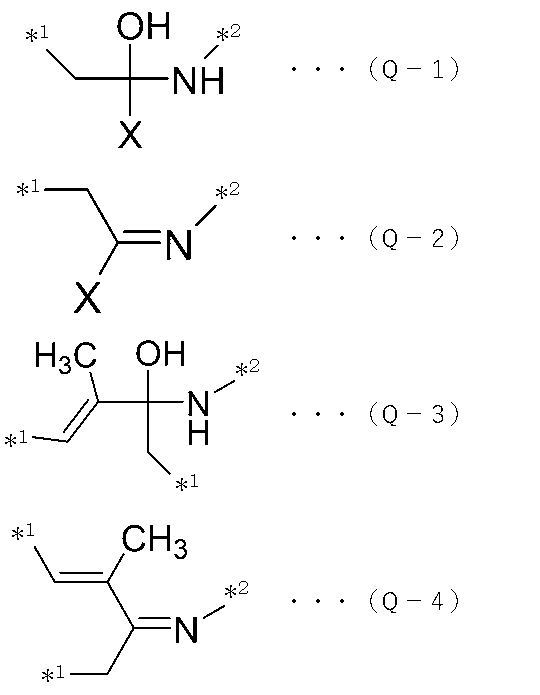
本実施形態に係る変性天然ゴムの製造方法は、特に限定するものではないが、天然ゴムポリマーに酸化剤を添加し、炭素-炭素二重結合を酸化開裂させて酸化分解天然ゴムポリマーを得る工程と、得られた酸化分解天然ゴムポリマーに、2つ以上の第一級アミノ基を有するアミノ化合物を添加して、再結合反応させる工程とを有するものとすることができる。すなわち、本実施形態に係る変性天然ゴムは、天然ゴムポリマーを、その主鎖中に存在する炭素-炭素二重結合を酸化開裂させることで分解して分子量を低下させ、該分解したポリマーを含む系をアミノ化合物と反応させて再結合させることにより得られる。
変性対象となる天然ゴムポリマーとしては、溶媒に溶解したものであれば良く、プロトン性溶媒である水中にミセル状になった水系エマルション、すなわちラテックスを用いることが好ましい。水系エマルションを用いることにより、ポリマーを分解させた後に、その状態のまま、アミノ化合物を配合することで再結合反応を生じさせることができる。水系エマルションの濃度(ポリマーの固形分濃度)は、特に限定されないが、5~70質量%であることが好ましく、より好ましくは10~50質量%である。固形分濃度が高くなりすぎるとエマルジョン安定性が低下してしまい、固形分濃度が小さすぎる場合は反応速度が遅くなり、実用性に欠ける。
アミノ化合物としては、2つ以上の第一級アミノ基を有するものであれば特に限定されないが、例えば、NH2(CH2CH2NH)nHで表される化合物を挙げることができ、nは1~4の整数であることが好ましい。すなわち、エチレンジアミン、ジエチレントリアミン、トリエチレンテトラアミン、テトラエチレンペンタアミンを好適に用いることができる。
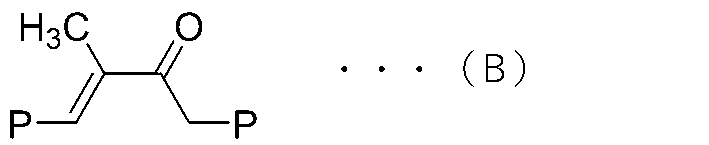
上記酸化開裂により天然ゴムポリマーが分解し、末端にカルボニル基(>C=O)やホルミル基(-CHO)を持つポリマーが得られる。詳細には、下記式(A)で表される構造を末端に持つポリマーと、下記式(B)で表される構造を分子鎖中に持つポリマーが生成される。なお、本明細書において、ポリイソプレンユニットとは、天然ゴム由来のポリイソプレンのことであり、詳細には、シス-1,4-ポリイソプレンのことをいう。


式(A)中、Xは、水素原子又はメチル基であり、イソプレンユニットが開裂した場合、一方の開裂末端ではXがメチル基、他方の開裂末端ではXが水素原子となる。
天然ゴムポリマーの炭素-炭素二重結合を酸化開裂させるためには、酸化剤を用いることができ、例えば、天然ゴムポリマーの水系エマルションに酸化剤を添加し攪拌することにより酸化開裂させることができる。酸化剤としては、例えば、過マンガン酸カリウム、酸化マンガンなどのマンガン化合物、クロム酸、三酸化クロムなどのクロム化合物、過酸化水素などの過酸化物、過ヨウ素酸などの過ハロゲン酸、オゾン、酸素などの酸素類などが挙げられる。これらの中でも、過ヨウ素酸を用いることが好ましい。酸化開裂に際しては、コバルト、銅、鉄などの金属の塩化物や有機化合物との塩や錯体などの金属系酸化触媒を併用してもよく、例えば、該金属系酸化触媒の存在下で空気酸化してもよい。
上記酸化開裂によりポリマーを分解することで、分子量が低下する。分解後のポリマーの重量平均分子量は、特に限定されないが、9百~50万であることが好ましく、より好ましくは5千~10万であり、更に好ましくは1万~5万である。なお、分解後の分子量の大きさにより、再結合後の官能基量を調節することができるが、分解時の分子量が小さすぎると、同一分子内での結合反応が生じやすくなる。ここで、本明細書において、重量平均分子量とは、ゲルパーミエーションクロマトグラフィ(GPC)での測定により、ポリスチレン換算の重量平均分子量を測定した値とする。
以上のようにしてポリマーを分解させた後、分解したポリマーを含む反応系を上記アミノ化合物と反応させることにより再結合させる。結合反応させた後、水系エマルションを凝固乾燥させることにより、常温で固形状の変性天然ゴムが得られる。得られた変性天然ゴムは、再結合反応により上記式(C)で表される連結構造が主鎖中に導入され、主鎖構造が変性される。
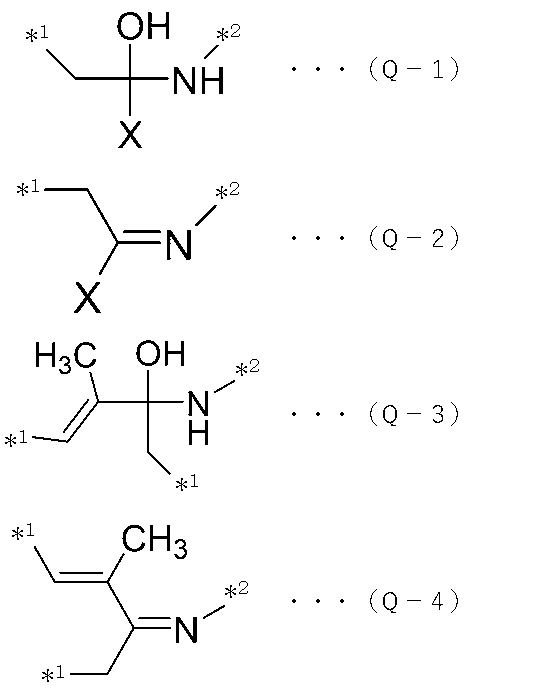
具体的には、一般式(A)で表される構造のカルボニル基又はホルミル基に対して、アミノ化合物の第一級アミノ基が求核付加反応することにより、一般式(Q-1)で表される連結構造となり、さらに脱水反応が起こると一般式(Q-2)で表される連結構造となる。また、一般式(B)で表される構造のカルボニル基に対して、アミノ化合物の第一級アミノ基が求核付加反応することにより、一般式(Q-3)で表される連結構造となり、さらに脱水反応が起こると一般式(Q-4)で表される連結構造となる。
すなわち、本実施形態で用いる変性天然ゴムは、上記式(C)で表される連結構造の少なくとも1つを分子内に有し、イソプレンユニットの繰り返し構造からなるポリイソプレン鎖が該連結構造を介して直接連結された構造を有する。
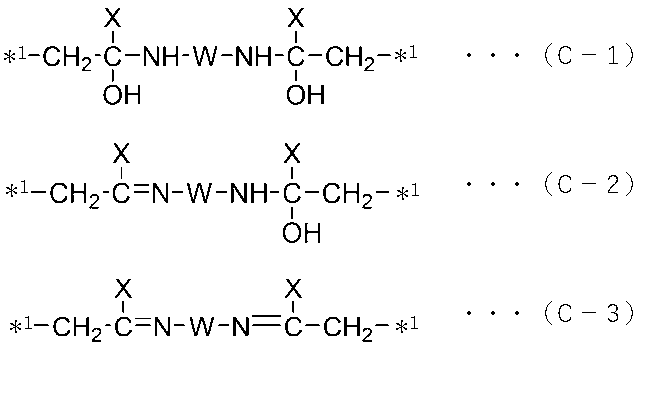
アミノ化合物として、第一級アミノ基が2つであるものを用いた場合、上記式(C)において、Wに対して結合するQのモル数(m)は2となり、式(C)で表される連結構造は、次の一般式(C-1)~(C-10)で表される連結構造のいずれかとなる。すなわち、例えば、アミノ化合物として、NH2(CH2CH2NH)nHで表される化合物を用いた場合、次の一般式(C-1)~(C-10)で表される連結構造のうち、アミノ化合物の残基Wは、-(CH2CH2NH)n-1CH2CH2-となる。
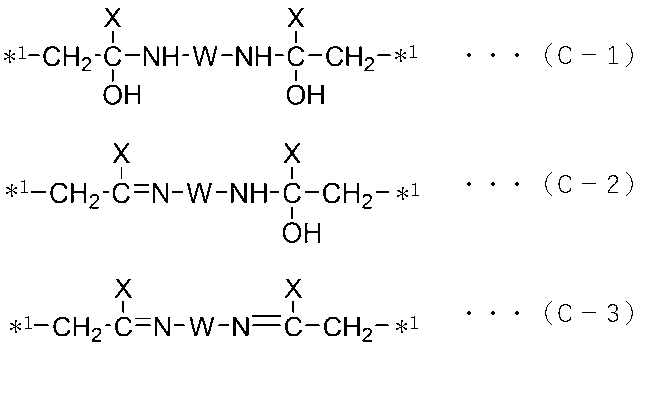

一般式(C-1)~(C-3)で表される連結構造は、一般式(A)で表される構造を有するポリイソプレンユニット同士が、アミノ化合物を介して結合したものである。具体的には、一般式(C-1)で表される連結構造は、一般式(Q-1)で表される連結構造同士がアミノ化合物の残基Wを介して結合した連結構造である。一般式(C-2)で表される連結構造は、一般式(Q-1)で表される連結構造と一般式(Q-2)で表される連結構造とがアミノ化合物の残基Wを介して結合した連結構造である。一般式(C-3)で表される連結構造は、一般式(Q-2)で表される連結構造同士がアミノ化合物の残基Wを介して結合した連結構造である。
また、一般式(C-4)~(C-7)で表される連結構造は、一般式(A)で表される構造を有するポリイソプレンユニットと、一般式(B)で表される構造を有するポリイソプレンユニットとが、アミノ化合物を介して結合したものである。具体的には、一般式(C-4)で表される連結構造は、一般式(Q-1)で表される連結構造と一般式(Q-3)で表される連結構造とがアミノ化合物の残基Wを介して結合した連結構造である。一般式(C-5)で表される連結構造は、一般式(Q-2)で表される連結構造と一般式(Q-3)で表される連結構造とがアミノ化合物の残基Wを介して結合した連結構造である。一般式(C-6)で表される連結構造は、一般式(Q-1)で表される連結構造と一般式(Q-4)で表される連結構造とがアミノ化合物の残基Wを介して結合した連結構造である。一般式(C-7)で表される連結構造は、一般式(Q-2)で表される連結構造と一般式(Q-4)で表される連結構造とがアミノ化合物の残基Wを介して結合した連結構造である。
一般式(C-8)~(C-10)で表される連結構造は、一般式(B)で表される構造を有するポリイソプレンユニット同士が、アミノ化合物を介して結合したものである。具体的には、一般式(C-8)で表される連結構造は、一般式(Q-3)で表される連結構造同士がアミノ化合物の残基Wを介して結合した連結構造である。一般式(C-9)で表される連結構造は、一般式(Q-3)で表される連結構造と一般式(Q-4)で表される連結構造とがアミノ化合物の残基Wを介して結合した連結構造である。一般式(C-10)で表される連結構造は、一般式(Q-4)で表される連結構造同士がアミノ化合物の残基Wを介して結合した連結構造である。
上記一般式(C)で表される連結構造の含有率(2種以上の連結構造を有する場合、それらの合計の含有率)は、特に限定されないが、0.1~1.0モル%であることが好ましく、0.1~0.7モル%であることがより好ましく、0.1~0.6モル%であることがさらに好ましい。ここで、連結構造の含有率とは、変性天然ゴムを構成する全構成ユニットのモル数に対する連結構造のモル数の比率であり、NMRにより測定した値とする。NMRスペクトルは、BRUKER社製「400ULTRASHIELDTM PLUS」によりTMSを標準とし測定した。
上記変性天然ゴムの重量平均分子量は、特に限定されないが、80万~200万であることが好ましく、100万~200万であることがより好ましい。酸化分解した天然ゴムポリマーを再結合させることにより、分子量が高くなることで、分子鎖の絡み合いが増え、引張強度が増大する。
また、本実施形態によれば、二重結合を解離させる薬剤である酸化剤の種類や量、反応時間などを調整することにより酸化開裂させる反応を制御できる。また、再結合させる際のアミノ化合物の配合量、反応時間などを調整することにより結合反応を制御できる。これらの制御によって変性天然ゴムの分子量を制御することができる。そのため、変性天然ゴムの重量平均分子量を元のポリマーと同等に設定することができ、また元のポリマーよりも低く設定することもできる。
酸化剤の配合量は特に限定されないが、天然ゴムポリマー(固形分量)100質量部に対して、0.1~1.0質量部であることが好ましく、0.2~0.5質量部であることがより好ましい。
アミノ化合物の配合量は特に限定されないが、酸化分解天然ゴムポリマー1モルに対して、0.01~1.0モルであることが好ましく、0.1~0.5モルであることがより好ましい。
また、ポリマー主鎖を分解し再結合させる際に、主鎖とは異なる構造として上記式(C)で表される連結構造が挿入され、主鎖構造のセグメントの結合点が官能基化する。すなわち、反応性の高い構造が分子主鎖中に導入され、元のポリマーの特性を変化させることができる。このように、本実施形態は、グラフトでも直接付加でもなく開環でもなく、天然ゴムの主鎖構造そのものを変化させるものであり、主鎖構造に簡易的に官能基を導入することができる。
詳細には、上記変性天然ゴムであると、そのポリマーとフィラーとの間での相互作用(分子間力、極性や反応性)が変化することや、ポリマーの組成が変化することにより、フィラーとの相溶性ないし分散性が向上する。その効果により、低燃費性の向上が見られる。
本実施形態に係るゴム組成物は、ゴム成分として、上記変性天然ゴム以外のジエン系ゴムを含有していてもよく、その種類は特に限定されないが、例えば、未変性天然ゴム(NR)、イソプレンゴム(IR)、ブタジエンゴム(BR)、スチレンブタジエンゴム(SBR)、スチレン-イソプレン共重合体ゴム、ブタジエン-イソプレン共重合体ゴム、スチレン-イソプレン-ブタジエン共重合体ゴムなどが挙げられる。これらジエン系ゴムは、いずれか1種単独で、又は2種以上ブレンドして用いることができる。
本実施形態に係るゴム組成物において、ゴム成分100質量部中の変性天然ゴムの含有量は、特に限定されないが、10~100質量部であることが好ましく、30~100質量部であることが好ましく、50~100質量部であることがさらに好ましい。
本実施形態に係るゴム組成物には、無機充填剤として、カーボンブラック、シリカ等の補強性充填剤を用いることができる。すなわち、無機充填剤は、シリカ単独でも、カーボンブラックとシリカの併用でもよい。好ましくは、カーボンブラックとシリカの併用である。無機充填剤の含有量は、特に限定されず、例えばゴム成分100質量部に対して、10~150質量部であることが好ましく、より好ましくは20~100質量部であり、さらに好ましくは30~80質量部である。
シリカとしては、特に限定されないが、湿式沈降法シリカや湿式ゲル法シリカなどの湿式シリカが好ましく用いられる。シリカの含有量は、ゴムのtanδのバランスや補強性などの観点からゴム成分100質量部に対して、10~150質量部であることが好ましく、より好ましくは15~100質量部であり、さらに好ましくは20~80質量部である。
シリカを含有する場合、スルフィドシラン、メルカプトシランなどのシランカップリング剤をさらに含有してもよい。シランカップリング剤を含有する場合、その含有量はシリカ100質量部に対して2~20質量部であることが好ましい。
カーボンブラックとしては、特に限定されず、公知の種々の品種を用いることができる。カーボンブラックの含有量は、ゴム成分100質量部に対して、1~70質量部であることが好ましく、より好ましくは1~30質量部である。
本実施形態に係るゴム組成物では、上記した各成分に加え、通常のゴム工業で使用されているプロセスオイル、亜鉛華、ステアリン酸、軟化剤、可塑剤、ワックス、老化防止剤などの添加剤や、加硫剤、加硫促進剤などの加硫系配合剤を通常の範囲内で適宜配合することができる。
加硫剤としては、粉末硫黄、沈降硫黄、コロイド硫黄、不溶性硫黄、高分散性硫黄などの硫黄成分が挙げられる。また、加硫剤の含有量はゴム成分100質量部に対して0.1~10質量部であることが好ましく、より好ましくは0.5~5質量部である。また、加硫促進剤の含有量は、ゴム成分100質量部に対して0.1~7質量部であることが好ましく、より好ましくは0.5~5質量部である。
本実施形態に係るゴム組成物は、通常用いられるバンバリーミキサーやニーダー、ロール等の混合機を用いて作製することができる。
得られるゴム組成物は、タイヤ用として用いることができ、乗用車用、トラックやバスの大型タイヤなど、各種用途・サイズの空気入りタイヤのトレッド部やサイドウォール部などタイヤの各部位に適用することができる。ゴム組成物は、常法に従い、例えば、押出加工によって所定の形状に成形され、他の部品と組み合わせた後、例えば140~180℃で加硫成形することにより、空気入りタイヤを製造することができる。
本実施形態に係る空気入りタイヤの種類としては、特に限定されず、上述の通り、乗用車用タイヤ、トラックやバスなどに用いられる重荷重用タイヤなどの各種のタイヤが挙げられる。
以下、本発明の実施例を示すが、本発明はこれらの実施例に限定されるものではない。
変性ジエン系ゴムに関する各測定方法は、以下の通りである。
[重量平均分子量(Mw)]
ゲルパーミエーションクロマトグラフィ(GPC)での測定により、ポリスチレン換算のMwを求めた。詳細には、測定試料は0.2mgをTHF1mLに溶解させたものを用いた。(株)島津製作所製「LC-20DA」を使用し、試料をフィルター透過後、温度40℃、流量0.7mL/分でカラム(Polymer Laboratories社製「PL Gel3μm Guard×2」)を通し、Spectra System社製「RI Detector」で検出した。
ゲルパーミエーションクロマトグラフィ(GPC)での測定により、ポリスチレン換算のMwを求めた。詳細には、測定試料は0.2mgをTHF1mLに溶解させたものを用いた。(株)島津製作所製「LC-20DA」を使用し、試料をフィルター透過後、温度40℃、流量0.7mL/分でカラム(Polymer Laboratories社製「PL Gel3μm Guard×2」)を通し、Spectra System社製「RI Detector」で検出した。
[連結構造の含有率]
13C-NMR、及び1H-NMRにより、連結基の含有率を測定した。NMRスペクトルは、BRUKER社製「400ULTRASHIELDTM PLUS」によりTMSを標準とし測定した。ポリマー1gを重クロロホルム5mLに溶解し、緩和試薬としてアセチルアセトンクロム塩87mgを加え、NMR10mm管にて測定した。
13C-NMR、及び1H-NMRにより、連結基の含有率を測定した。NMRスペクトルは、BRUKER社製「400ULTRASHIELDTM PLUS」によりTMSを標準とし測定した。ポリマー1gを重クロロホルム5mLに溶解し、緩和試薬としてアセチルアセトンクロム塩87mgを加え、NMR10mm管にて測定した。
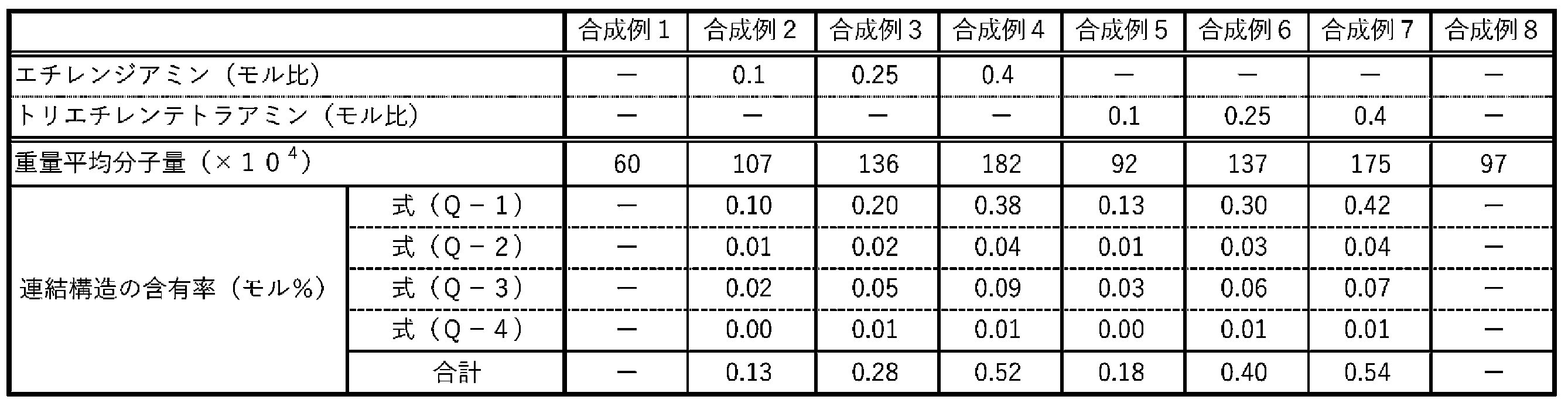
式(Q-1)で表される連結構造については13C-NMRにおいて窒素に隣接した炭素のピークが85ppmにある。式(Q-2)で表される連結構造については13C-NMRにおいて窒素に隣接した炭素のピークが167ppmにある。式(Q-3)については13C-NMRにおいて窒素に隣接した炭素のピークが96ppmにある。式(Q-4)で表される連結構造については13C-NMRにおいて窒素に隣接した炭素のピークが165ppmにある。これら各ピークについて天然ゴムポリマー成分との比から連結構造の含有量を決定した(モル%)。
なお、天然ゴムポリマー成分におけるイソプレンユニットのモル数については、二重結合を挟んでメチル基と反対側の炭素及びそれに結合した水素(=CH-)のピーク、即ち13C-NMRによる122ppm、1H-NMRによる5.2ppmに基づいて算出した。
[合成例1:酸化分解天然ゴムの合成]
(酸化分解天然ゴム合成工程)
DRC(Dry Rubber Content)を30質量%に調整した天然ゴムラテックス(レジテックス社製、高アンモニア含有天然ゴムラテックス「HA-NR」)中のポリマー質量100gに対し過硫酸カリウム0.5g、リン酸三ナトリウム0.34gを加え、30℃で3時間撹拌することで酸化分解天然ゴムラテックスを得た。酸化分解天然ゴムラテックスの重量平均分子量は、60万であった。
(酸化分解天然ゴム合成工程)
DRC(Dry Rubber Content)を30質量%に調整した天然ゴムラテックス(レジテックス社製、高アンモニア含有天然ゴムラテックス「HA-NR」)中のポリマー質量100gに対し過硫酸カリウム0.5g、リン酸三ナトリウム0.34gを加え、30℃で3時間撹拌することで酸化分解天然ゴムラテックスを得た。酸化分解天然ゴムラテックスの重量平均分子量は、60万であった。
[合成例2:変性天然ゴム1の合成]
(再結合反応工程)
得られた酸化分解天然ゴムラテックス中のポリマー質量100g(1.47モル)に対し、エチレンジアミン8.8g(0.147モル)を加え、30℃で2時間撹拌した。次に、ギ酸を1%含むメタノールに反応溶液を注ぎ凝固させた。固形物を真空乾燥させることで変性天然ゴム1を得た。
(再結合反応工程)
得られた酸化分解天然ゴムラテックス中のポリマー質量100g(1.47モル)に対し、エチレンジアミン8.8g(0.147モル)を加え、30℃で2時間撹拌した。次に、ギ酸を1%含むメタノールに反応溶液を注ぎ凝固させた。固形物を真空乾燥させることで変性天然ゴム1を得た。
[合成例3~7:変性天然ゴム2~6の合成]
エチレンジアミン8.8gに代えて、表1に示す配合(ポリマー1モルに対するモル比)に従い、アミノ化合物を添加した以外は合成例2と同様に調製し、変性天然ゴム2~6を得た。
エチレンジアミン8.8gに代えて、表1に示す配合(ポリマー1モルに対するモル比)に従い、アミノ化合物を添加した以外は合成例2と同様に調製し、変性天然ゴム2~6を得た。
[合成例8:変性天然ゴム7の合成]
DRC(Dry Rubber Content)を30質量%に調整した天然ゴムラテックス(レジテックス社製、高アンモニア含有天然ゴムラテックス「HA-NR」)中のポリマー質量100gに対し過ヨウ素酸(H5IO6)3.3gを加え、23℃で3時間撹拌した。次に、触媒としてピロリジン-2-カルボン酸0.1gを加え、1規定の水酸化ナトリウムを反応溶液のpHが10になるように加え、23℃で12時間撹拌した。次に、ギ酸を1%含むメタノールに反応溶液を注ぎ凝固させた。固形物を真空乾燥させることで変性天然ゴム7(特許文献3の合成例1で合成した変性ジエン系ゴムAに相当)を得た。
DRC(Dry Rubber Content)を30質量%に調整した天然ゴムラテックス(レジテックス社製、高アンモニア含有天然ゴムラテックス「HA-NR」)中のポリマー質量100gに対し過ヨウ素酸(H5IO6)3.3gを加え、23℃で3時間撹拌した。次に、触媒としてピロリジン-2-カルボン酸0.1gを加え、1規定の水酸化ナトリウムを反応溶液のpHが10になるように加え、23℃で12時間撹拌した。次に、ギ酸を1%含むメタノールに反応溶液を注ぎ凝固させた。固形物を真空乾燥させることで変性天然ゴム7(特許文献3の合成例1で合成した変性ジエン系ゴムAに相当)を得た。
バンバリーミキサーを使用し、下記表2に示す配合(質量部)に従い、まず、ノンプロ練り工程で、加硫促進剤及び硫黄を除く成分を添加混合し(排出温度=150℃)、プロ練り工程で、加硫促進剤及び硫黄を添加混合して(排出温度=90℃)、ゴム組成物を調製した。
表2中の各成分の詳細は以下の通りである。
・未変性NR:レジテックス社製、高アンモニア含有天然ゴムラテックス「HA-NR」
・変性天然ゴム1:合成例2で合成した変性天然ゴム
・変性天然ゴム2:合成例3で合成した変性天然ゴム
・変性天然ゴム3:合成例4で合成した変性天然ゴム
・変性天然ゴム4:合成例5で合成した変性天然ゴム
・変性天然ゴム5:合成例6で合成した変性天然ゴム
・変性天然ゴム6:合成例7で合成した変性天然ゴム
・変性天然ゴム7:合成例8で合成した変性天然ゴム
・シリカ:東ソー・シリカ(株)製「ニップシールAQ」(BET=200m2/g)
・カーボンブラック:東海カーボン(株)製「シースト3」
・シランカップリング剤:ビス(3-トリエトキシシリルプロピル)テトラスルフィド、エボニックジャパン(株)製「Si69」
・亜鉛華:三井金属鉱業(株)製「亜鉛華1種」
・プロセスオイル:株式会社ジャパンエナジー製「X-140」
・老化防止剤:大内新興化学工業(株)製「ノクラック6C」
・ステアリン酸:花王(株)製「ルナックS-20」
・硫黄:細井化学工業(株)製「ゴム用粉末硫黄150メッシュ」
・加硫促進剤:大内新興化学工業(株)製「ノクセラーCZ」
・変性天然ゴム1:合成例2で合成した変性天然ゴム
・変性天然ゴム2:合成例3で合成した変性天然ゴム
・変性天然ゴム3:合成例4で合成した変性天然ゴム
・変性天然ゴム4:合成例5で合成した変性天然ゴム
・変性天然ゴム5:合成例6で合成した変性天然ゴム
・変性天然ゴム6:合成例7で合成した変性天然ゴム
・変性天然ゴム7:合成例8で合成した変性天然ゴム
・シリカ:東ソー・シリカ(株)製「ニップシールAQ」(BET=200m2/g)
・カーボンブラック:東海カーボン(株)製「シースト3」
・シランカップリング剤:ビス(3-トリエトキシシリルプロピル)テトラスルフィド、エボニックジャパン(株)製「Si69」
・亜鉛華:三井金属鉱業(株)製「亜鉛華1種」
・プロセスオイル:株式会社ジャパンエナジー製「X-140」
・老化防止剤:大内新興化学工業(株)製「ノクラック6C」
・ステアリン酸:花王(株)製「ルナックS-20」
・硫黄:細井化学工業(株)製「ゴム用粉末硫黄150メッシュ」
・加硫促進剤:大内新興化学工業(株)製「ノクセラーCZ」
得られた各ゴム組成物について、低燃費性、及び引張強度を評価した。評価方法は次の通りである。
・低燃費性:USM社製レオスペクトロメーターE4000を用いて、周波数50Hz、静歪み10%、動歪み2%、温度60℃の条件で損失係数tanδを測定し、比較例1の値を100とした指数で表示した。60℃でのtanδは、タイヤ用ゴム組成物において、低発熱性の指標として一般に用いられているものであり、上記指数が大きいほどtanδが小さく、従って、発熱しにくく、タイヤとしての低燃費性能に優れることを示す。
・引張強度:JIS K6251に準拠した引張試験(ダンベル状3号形)を行って破断時の強度を測定し、比較例1の値を100とした指数で表示した。指数が大きいほど、引張強度が高く、良好であることを示す。

結果は、表2に示す通りであり、比較例1と実施例1~6との対比より、本発明の変性天然ゴムを用いた場合、優れた低燃費性及び引張強度が得られることがわかる。
また、連結構造が本発明とは異なる変性天然ゴムを用いた比較例2と実施例1~6との対比より、本発明の変性天然ゴムを用いた場合、比較例2と同等以上の低燃費性、及び比較例2よりも優れた引張強度が得られることがわかる。
本発明の変性天然ゴムを用いたゴム組成物は、乗用車、ライトトラック・バス等の各種タイヤに用いることができる。
Claims (6)
- 一般式(A)及び/又は一般式(B)で表される構造を有するポリイソプレンが、これらの構造部分において2つ以上の第一級アミノ基を有するアミノ化合物のアミノ基と結合してなる、一般式(C)で表される連結構造を有する、変性天然ゴム。


- 一般式(C)で表される連結構造が、次の一般式(C-1)~(C-10)からなる群より選択される少なくとも一つを有する、請求項1に記載の変性天然ゴム。

- 重量平均分子量が100万~200万である、請求項1又は2に記載の変性天然ゴム。
- ゴム成分100質量部中に、請求項1~3のいずれか1項に記載の変性天然ゴムを10~100質量部含有し、このゴム成分100質量部に対して無機充填剤を10~150質量部含有する、ゴム組成物。
- 請求項4に記載のゴム組成物を用いて作製した、空気入りタイヤ。
- 天然ゴムポリマーに酸化剤を添加し、炭素-炭素二重結合を酸化開裂させて酸化分解天然ゴムポリマーを得る工程と、
得られた酸化分解天然ゴムポリマーに、2つ以上の第一級アミノ基を有するアミノ化合物を添加して、再結合反応させる工程とを有する、変性天然ゴムの製造方法。
Priority Applications (2)
| Application Number | Priority Date | Filing Date | Title |
|---|---|---|---|
| US17/253,292 US11897971B2 (en) | 2018-11-19 | 2019-10-28 | Modified natural rubber, rubber composition using same, and method for producing modified natural rubber |
| JP2020558200A JP6946574B2 (ja) | 2018-11-19 | 2019-10-28 | 変性天然ゴム、それを用いたゴム組成物、並びに変性天然ゴムの製造方法 |
Applications Claiming Priority (2)
| Application Number | Priority Date | Filing Date | Title |
|---|---|---|---|
| JP2018-216854 | 2018-11-19 | ||
| JP2018216854 | 2018-11-19 |
Publications (1)
| Publication Number | Publication Date |
|---|---|
| WO2020105371A1 true WO2020105371A1 (ja) | 2020-05-28 |
Family
ID=70773584
Family Applications (1)
| Application Number | Title | Priority Date | Filing Date |
|---|---|---|---|
| PCT/JP2019/042156 Ceased WO2020105371A1 (ja) | 2018-11-19 | 2019-10-28 | 変性天然ゴム、それを用いたゴム組成物、並びに変性天然ゴムの製造方法 |
Country Status (3)
| Country | Link |
|---|---|
| US (1) | US11897971B2 (ja) |
| JP (1) | JP6946574B2 (ja) |
| WO (1) | WO2020105371A1 (ja) |
Citations (4)
| Publication number | Priority date | Publication date | Assignee | Title |
|---|---|---|---|---|
| JP2011089066A (ja) * | 2009-10-23 | 2011-05-06 | Bridgestone Corp | タイヤ |
| JP2012051969A (ja) * | 2010-08-31 | 2012-03-15 | Toyo Tire & Rubber Co Ltd | 変性ジエン系ゴムポリマーの製造方法 |
| JP2012140512A (ja) * | 2010-12-28 | 2012-07-26 | Toyo Tire & Rubber Co Ltd | 変性ジエン系ゴムポリマーの製造方法 |
| JP2018123260A (ja) * | 2017-02-02 | 2018-08-09 | 住友ゴム工業株式会社 | タイヤ用ゴム組成物及び空気入りタイヤ |
Family Cites Families (3)
| Publication number | Priority date | Publication date | Assignee | Title |
|---|---|---|---|---|
| CN102099380B (zh) | 2008-02-18 | 2014-03-12 | 株式会社普利司通 | 改性二烯橡胶、其生产方法和使用该橡胶的橡胶组合物及轮胎 |
| JP2011195802A (ja) | 2010-02-25 | 2011-10-06 | Sumitomo Chemical Co Ltd | 共役ジエン系重合体、共役ジエン系重合体組成物及び共役ジエン系重合体の製造方法 |
| JP5802569B2 (ja) | 2012-02-10 | 2015-10-28 | 東洋ゴム工業株式会社 | タイヤ用ゴム組成物及び空気入りタイヤ |
-
2019
- 2019-10-28 US US17/253,292 patent/US11897971B2/en active Active
- 2019-10-28 JP JP2020558200A patent/JP6946574B2/ja not_active Expired - Fee Related
- 2019-10-28 WO PCT/JP2019/042156 patent/WO2020105371A1/ja not_active Ceased
Patent Citations (4)
| Publication number | Priority date | Publication date | Assignee | Title |
|---|---|---|---|---|
| JP2011089066A (ja) * | 2009-10-23 | 2011-05-06 | Bridgestone Corp | タイヤ |
| JP2012051969A (ja) * | 2010-08-31 | 2012-03-15 | Toyo Tire & Rubber Co Ltd | 変性ジエン系ゴムポリマーの製造方法 |
| JP2012140512A (ja) * | 2010-12-28 | 2012-07-26 | Toyo Tire & Rubber Co Ltd | 変性ジエン系ゴムポリマーの製造方法 |
| JP2018123260A (ja) * | 2017-02-02 | 2018-08-09 | 住友ゴム工業株式会社 | タイヤ用ゴム組成物及び空気入りタイヤ |
Also Published As
| Publication number | Publication date |
|---|---|
| JP6946574B2 (ja) | 2021-10-06 |
| US20210269557A1 (en) | 2021-09-02 |
| JPWO2020105371A1 (ja) | 2021-04-08 |
| US11897971B2 (en) | 2024-02-13 |
Similar Documents
| Publication | Publication Date | Title |
|---|---|---|
| WO2013118496A1 (ja) | 変性ポリマーの製造方法、並びにジエン系ポリマー、ゴム組成物及び空気入りタイヤ | |
| CN105189565B (zh) | 改性聚合物的制造方法及橡胶组合物 | |
| JP5802569B2 (ja) | タイヤ用ゴム組成物及び空気入りタイヤ | |
| JP6205204B2 (ja) | 変性天然ゴム及びそれを用いたゴム組成物 | |
| US9725562B2 (en) | Modified diene polymer, method for producing same, rubber composition, and pneumatic tire | |
| US6653409B2 (en) | Radical-modified polymer and polymer composition containing the same | |
| JP7427438B2 (ja) | 変性天然ゴム、それを用いたゴム組成物、並びにそれを用いた空気入りタイヤ | |
| JP6946574B2 (ja) | 変性天然ゴム、それを用いたゴム組成物、並びに変性天然ゴムの製造方法 | |
| CN105452343B (zh) | 橡胶-二氧化硅复合物及其制造方法、以及橡胶组合物及充气轮胎 | |
| JP2014172958A (ja) | ゴム組成物及び空気入りタイヤ | |
| JP7365852B2 (ja) | 末端変性ジエン系ポリマー、及びその製造方法 | |
| JP2023063831A (ja) | 末端変性ジエン系ポリマー、及びその製造方法 | |
| JP6242719B2 (ja) | タイヤ用ゴム組成物及び空気入りタイヤ | |
| JP6242720B2 (ja) | タイヤ用ゴム組成物及び空気入りタイヤ | |
| JP2013010871A (ja) | 変性ジエン系ゴム及びその製造方法、並びにゴム組成物 | |
| JP2023063829A (ja) | 末端変性ジエン系ポリマー、及びその製造方法 | |
| JP6062772B2 (ja) | 変性ポリマー組成物 | |
| JP5968794B2 (ja) | ゴム組成物及び空気入りタイヤ | |
| JP6087177B2 (ja) | シリカマスターバッチ及びその製造方法 | |
| JP6352003B2 (ja) | 変性ポリマーの製造方法及びジエン系ポリマー | |
| JP6047459B2 (ja) | ゴム−シリカ複合体及びその製造方法 | |
| JP6091918B2 (ja) | シリカマスターバッチ及びその製造方法 | |
| JP2014141579A (ja) | タイヤ用ゴム組成物及び空気入りタイヤ | |
| JP2012140512A (ja) | 変性ジエン系ゴムポリマーの製造方法 | |
| JP2014133792A (ja) | ゴム組成物及び空気入りタイヤ |
Legal Events
| Date | Code | Title | Description |
|---|---|---|---|
| 121 | Ep: the epo has been informed by wipo that ep was designated in this application |
Ref document number: 19887817 Country of ref document: EP Kind code of ref document: A1 |
|
| ENP | Entry into the national phase |
Ref document number: 2020558200 Country of ref document: JP Kind code of ref document: A |
|
| NENP | Non-entry into the national phase |
Ref country code: DE |
|
| 122 | Ep: pct application non-entry in european phase |
Ref document number: 19887817 Country of ref document: EP Kind code of ref document: A1 |