WO2020050144A1 - 色変換材料、色変換部材、光源ユニット、ディスプレイ、照明装置、色変換基板およびインク - Google Patents
色変換材料、色変換部材、光源ユニット、ディスプレイ、照明装置、色変換基板およびインク Download PDFInfo
- Publication number
- WO2020050144A1 WO2020050144A1 PCT/JP2019/034006 JP2019034006W WO2020050144A1 WO 2020050144 A1 WO2020050144 A1 WO 2020050144A1 JP 2019034006 W JP2019034006 W JP 2019034006W WO 2020050144 A1 WO2020050144 A1 WO 2020050144A1
- Authority
- WO
- WIPO (PCT)
- Prior art keywords
- group
- color conversion
- particulate
- light
- conversion material
- Prior art date
- Legal status (The legal status is an assumption and is not a legal conclusion. Google has not performed a legal analysis and makes no representation as to the accuracy of the status listed.)
- Ceased
Links
- PZWRVRKTXDPGRQ-UHFFFAOYSA-N CC(C=C1C)[N]([B]([n]2c3c(C)cc2C)(F)F)(C)C1=C3c1cc2ccccc2c2ccccc12 Chemical compound CC(C=C1C)[N]([B]([n]2c3c(C)cc2C)(F)F)(C)C1=C3c1cc2ccccc2c2ccccc12 PZWRVRKTXDPGRQ-UHFFFAOYSA-N 0.000 description 1
Images


Classifications
-
- C—CHEMISTRY; METALLURGY
- C08—ORGANIC MACROMOLECULAR COMPOUNDS; THEIR PREPARATION OR CHEMICAL WORKING-UP; COMPOSITIONS BASED THEREON
- C08K—Use of inorganic or non-macromolecular organic substances as compounding ingredients
- C08K5/00—Use of organic ingredients
- C08K5/0008—Organic ingredients according to more than one of the "one dot" groups of C08K5/01 - C08K5/59
- C08K5/0041—Optical brightening agents, organic pigments
-
- C—CHEMISTRY; METALLURGY
- C08—ORGANIC MACROMOLECULAR COMPOUNDS; THEIR PREPARATION OR CHEMICAL WORKING-UP; COMPOSITIONS BASED THEREON
- C08K—Use of inorganic or non-macromolecular organic substances as compounding ingredients
- C08K5/00—Use of organic ingredients
- C08K5/55—Boron-containing compounds
-
- C—CHEMISTRY; METALLURGY
- C08—ORGANIC MACROMOLECULAR COMPOUNDS; THEIR PREPARATION OR CHEMICAL WORKING-UP; COMPOSITIONS BASED THEREON
- C08L—COMPOSITIONS OF MACROMOLECULAR COMPOUNDS
- C08L101/00—Compositions of unspecified macromolecular compounds
-
- C—CHEMISTRY; METALLURGY
- C09—DYES; PAINTS; POLISHES; NATURAL RESINS; ADHESIVES; COMPOSITIONS NOT OTHERWISE PROVIDED FOR; APPLICATIONS OF MATERIALS NOT OTHERWISE PROVIDED FOR
- C09K—MATERIALS FOR MISCELLANEOUS APPLICATIONS, NOT PROVIDED FOR ELSEWHERE
- C09K11/00—Luminescent materials, e.g. electroluminescent or chemiluminescent
- C09K11/02—Use of particular materials as binders, particle coatings or suspension media therefor
-
- C—CHEMISTRY; METALLURGY
- C09—DYES; PAINTS; POLISHES; NATURAL RESINS; ADHESIVES; COMPOSITIONS NOT OTHERWISE PROVIDED FOR; APPLICATIONS OF MATERIALS NOT OTHERWISE PROVIDED FOR
- C09K—MATERIALS FOR MISCELLANEOUS APPLICATIONS, NOT PROVIDED FOR ELSEWHERE
- C09K11/00—Luminescent materials, e.g. electroluminescent or chemiluminescent
- C09K11/06—Luminescent materials, e.g. electroluminescent or chemiluminescent containing organic luminescent materials
-
- F—MECHANICAL ENGINEERING; LIGHTING; HEATING; WEAPONS; BLASTING
- F21—LIGHTING
- F21V—FUNCTIONAL FEATURES OR DETAILS OF LIGHTING DEVICES OR SYSTEMS THEREOF; STRUCTURAL COMBINATIONS OF LIGHTING DEVICES WITH OTHER ARTICLES, NOT OTHERWISE PROVIDED FOR
- F21V9/00—Elements for modifying spectral properties, polarisation or intensity of the light emitted, e.g. filters
- F21V9/30—Elements containing photoluminescent material distinct from or spaced from the light source
- F21V9/38—Combination of two or more photoluminescent elements of different materials
-
- G—PHYSICS
- G02—OPTICS
- G02B—OPTICAL ELEMENTS, SYSTEMS OR APPARATUS
- G02B1/00—Optical elements characterised by the material of which they are made; Optical coatings for optical elements
- G02B1/04—Optical elements characterised by the material of which they are made; Optical coatings for optical elements made of organic materials, e.g. plastics
-
- G—PHYSICS
- G02—OPTICS
- G02B—OPTICAL ELEMENTS, SYSTEMS OR APPARATUS
- G02B5/00—Optical elements other than lenses
- G02B5/20—Filters
-
- G—PHYSICS
- G02—OPTICS
- G02B—OPTICAL ELEMENTS, SYSTEMS OR APPARATUS
- G02B5/00—Optical elements other than lenses
- G02B5/20—Filters
- G02B5/206—Filters comprising particles embedded in a solid matrix
-
- C—CHEMISTRY; METALLURGY
- C09—DYES; PAINTS; POLISHES; NATURAL RESINS; ADHESIVES; COMPOSITIONS NOT OTHERWISE PROVIDED FOR; APPLICATIONS OF MATERIALS NOT OTHERWISE PROVIDED FOR
- C09K—MATERIALS FOR MISCELLANEOUS APPLICATIONS, NOT PROVIDED FOR ELSEWHERE
- C09K2211/00—Chemical nature of organic luminescent or tenebrescent compounds
- C09K2211/10—Non-macromolecular compounds
- C09K2211/1018—Heterocyclic compounds
- C09K2211/1025—Heterocyclic compounds characterised by ligands
- C09K2211/1044—Heterocyclic compounds characterised by ligands containing two nitrogen atoms as heteroatoms
-
- C—CHEMISTRY; METALLURGY
- C09—DYES; PAINTS; POLISHES; NATURAL RESINS; ADHESIVES; COMPOSITIONS NOT OTHERWISE PROVIDED FOR; APPLICATIONS OF MATERIALS NOT OTHERWISE PROVIDED FOR
- C09K—MATERIALS FOR MISCELLANEOUS APPLICATIONS, NOT PROVIDED FOR ELSEWHERE
- C09K2211/00—Chemical nature of organic luminescent or tenebrescent compounds
- C09K2211/18—Metal complexes
- C09K2211/188—Metal complexes of other metals not provided for in one of the previous groups
Definitions
- the present invention relates to a color conversion material, a color conversion member, a light source unit, a display, a lighting device, a color conversion substrate, and ink.
- the application of the multi-color conversion technology based on the color conversion method to liquid crystal displays, organic EL displays, lighting devices, and the like has been actively studied.
- the color conversion is to convert light emitted from a light emitter to light having a longer wavelength, for example, to convert blue light to green or red light.
- the composition having the color conversion function (hereinafter, referred to as “color conversion composition”) is formed into a sheet and combined with, for example, a blue light source to extract three primary colors of blue, green, and red from the blue light source, ie, white light. Can be taken out.
- a white light source combining such a blue light source and a sheet having a color conversion function (hereinafter, referred to as a “color conversion sheet”) is used as a backlight unit, and this backlight unit, a liquid crystal driving portion, and a color filter are combined.
- a full-color display can be manufactured.
- if there is no liquid crystal driving portion it can be used as it is as a white light source, and can be applied as a white light source such as LED lighting.
- One of the problems with liquid crystal displays that use the color conversion method is to improve color reproducibility.
- To improve the color reproducibility it is effective to narrow the half width of each of the blue, green, and red emission spectra of the backlight unit and increase the color purity of each of the blue, green, and red colors.
- a technique using quantum dots made of inorganic semiconductor fine particles as a component of a color conversion composition has been proposed (for example, see Patent Document 1).
- a technique has been proposed in which an organic light emitting material is used as a component of a color conversion composition instead of a quantum dot.
- examples of techniques using an organic light emitting material as a component of a color conversion composition include those using a coumarin derivative (for example, see Patent Document 2), those using a rhodamine derivative (for example, see Patent Document 3), and pyromethene derivatives. (For example, see Patent Document 4).
- a technique of adding a light stabilizer to prevent deterioration of an organic light emitting material and improve durability has been disclosed (for example, see Patent Document 5).
- JP 2012-22028 A JP 2007-273440 A JP 2001-164245 A JP 2011-241160 A International Publication No. 2011/149028
- the technology using quantum dots described in Document 1 certainly has narrow half-widths of green and red emission spectra, and improves color reproducibility.
- the quantum dots were weak to heat, moisture and oxygen in the air, and had insufficient durability.
- problems such as containing cadmium.
- high definition such as 4K and 8K, high dynamic range (HDR), and high contrast by local dimming
- the illuminance required for a backlight unit of a liquid crystal display is increasing, and the backlight unit by driving heat is used. Has become hot.
- existing techniques such as the light stabilizer described in Patent Document 5 have an effect of improving durability, but are insufficient as techniques for improving durability at high temperatures.
- a color conversion material using an organic light emitting material has a problem that durability is significantly deteriorated at a high temperature, and the existing technology has not been able to sufficiently solve this problem.
- the problem to be solved by the present invention is to achieve both improved color reproducibility and durability in a color conversion material used for a liquid crystal display or LED lighting. It is to make them compatible.
- an object of the present invention is to provide a color conversion material and a color conversion member having improved durability at high temperatures.
- the present invention is a particulate color conversion material having a matrix resin and at least one luminescent material, wherein the luminescent material is represented by a general formula (1).
- a particulate color conversion material containing X is CR 7 or N.
- R 1 to R 9 may be the same or different and each may be hydrogen, an alkyl group, a cycloalkyl group, a heterocyclic group, an alkenyl group, a cycloalkenyl group, an alkynyl group, a hydroxyl group, a thiol group, an alkoxy group, an alkylthio group, or an aryl group.
- the color conversion material and the color conversion member using the same according to the present invention have both high color purity and durability, so that both color reproducibility and durability can be achieved.
- FIG. 2 is a schematic sectional view illustrating an example of the color conversion member of the present invention.
- FIG. 2 is a schematic sectional view illustrating an example of the color conversion member of the present invention.
- FIG. 2 is a schematic sectional view illustrating an example of the color conversion member of the present invention.
- 9 is an emission spectrum in Example 2 of the present invention.
- the particulate color conversion material according to the embodiment of the present invention contains at least one kind of luminescent material.
- the light-emitting material in the present invention refers to a material that emits light having a different wavelength from the light when the light is irradiated.
- the organic light emitting material is an organic light emitting material.
- the light-emitting material is a material exhibiting high emission quantum yield and high emission characteristics.
- known light-emitting materials such as inorganic phosphors, fluorescent pigments, fluorescent dyes, and quantum dots are used as the light-emitting materials.
- an organic luminescent material is preferable from the viewpoint of uniformity of dispersion, reduction of the amount of use, and reduction of environmental load.
- organic light emitting material examples include the following.
- a compound having a condensed aryl ring such as naphthalene, anthracene, phenanthrene, pyrene, chrysene, naphthacene, triphenylene, perylene, fluoranthene, fluorene, or indene, or a derivative thereof may be mentioned as a suitable organic light emitting material.
- Suitable organic light-emitting materials include compounds having a heteroaryl ring such as pyrrolopyridine, derivatives thereof, and borane derivatives.
- Suitable organic light-emitting materials include stilbene derivatives such as amino) stilbene, aromatic acetylene derivatives, tetraphenylbutadiene derivatives, aldazine derivatives, pyromethene derivatives, and diketopyrrolo [3,4-c] pyrrole derivatives.
- coumarin derivatives such as coumarin 6, coumarin 7, coumarin 153
- azole derivatives such as imidazole, thiazole, thiadiazole, carbazole, oxazole, oxadiazole, and triazole and metal complexes thereof
- cyanine compounds such as indocyanine green, fluorescein, Xanthene-based compounds such as eosin and rhodamine, thioxanthene-based compounds, and the like are mentioned as suitable organic light-emitting materials.
- Suitable organic light emitting materials include aromatic amine derivatives such as -di (3-methylphenyl) -4,4'-diphenyl-1,1'-diamine.
- organic metal complex compounds such as iridium (Ir), ruthenium (Ru), rhodium (Rh), palladium (Pd), platinum (Pt), osmium (Os), and rhenium (Re) are suitable for organic light emission.
- Ir iridium
- Ru ruthenium
- Rh rhodium
- Pd palladium
- Pt platinum
- Os osmium
- Re rhenium
- Re rhenium
- the organic light emitting material in the present invention is not limited to those described above.
- a compound having a coordination bond is preferable from the viewpoint of solubility and diversity of molecular structure.
- a boron-containing compound such as a boron fluoride complex is also preferable in that the half width is small and light emission with high efficiency is possible.
- a pyrromethene derivative can be suitably used because it gives a high fluorescence quantum yield and has good durability. More preferably, it is a compound represented by the general formula (1).
- the particulate color conversion material according to the embodiment of the present invention preferably contains at least a compound represented by the general formula (1) as a light emitting material.
- R 1 to R 9 may be the same or different and each may be hydrogen, an alkyl group, a cycloalkyl group, a heterocyclic group, an alkenyl group, a cycloalkenyl group, an alkynyl group, a hydroxyl group, a thiol group, an alkoxy group, an alkylthio group, or an aryl group.
- Ether arylthioether, aryl, heteroaryl, halogen, cyano, aldehyde, carbonyl, carboxyl, ester, carbamoyl, amino, nitro, silyl, siloxanyl, boryl, sulfo Group, a phosphine oxide group, and a condensed ring and an aliphatic ring formed between adjacent groups.
- hydrogen may be deuterium.
- a substituted or unsubstituted aryl group having 6 to 40 carbon atoms has 6 to 40 carbon atoms including the number of carbon atoms contained in the substituent substituted with the aryl group.
- An aryl group The same applies to other substituents defining the number of carbon atoms.
- Aryl ether, aryl thioether, aryl, heteroaryl, halogen, cyano, aldehyde, carbonyl, carboxyl, ester, carbamoyl, amino, nitro, silyl, siloxanyl, boryl , A sulfo group, and a phosphine oxide group are preferable, and specific substituents which are preferable in the description of each substituent are preferable. Further, these substituents may be further substituted by the above-mentioned substituents.
- the alkyl group means, for example, a saturated aliphatic hydrocarbon such as a methyl group, an ethyl group, an n-propyl group, an isopropyl group, an n-butyl group, a sec-butyl group and a tert-butyl group.
- a saturated aliphatic hydrocarbon such as a methyl group, an ethyl group, an n-propyl group, an isopropyl group, an n-butyl group, a sec-butyl group and a tert-butyl group.
- the number of carbon atoms in the alkyl group is not particularly limited, but is preferably 1 to 20 and more preferably 1 to 8 from the viewpoint of availability and cost.
- the cycloalkyl group refers to, for example, a saturated alicyclic hydrocarbon group such as a cyclopropyl group, a cyclohexyl group, a norbornyl group, an adamantyl group, which may or may not have a substituent.
- the number of carbon atoms in the alkyl group portion is not particularly limited, but is preferably in the range of 3 or more and 20 or less.
- the heterocyclic group refers to, for example, an aliphatic ring having atoms other than carbon in the ring, such as a pyran ring, a piperidine ring, and a cyclic amide, which may or may not have a substituent. Good.
- the carbon number of the heterocyclic group is not particularly limited, but is preferably in the range of 2 or more and 20 or less.
- alkenyl group refers to, for example, an unsaturated aliphatic hydrocarbon group containing a double bond such as a vinyl group, an allyl group, or a butadienyl group, which may or may not have a substituent. .
- the carbon number of the alkenyl group is not particularly limited, but is preferably in the range of 2 or more and 20 or less.
- the cycloalkenyl group refers to, for example, an unsaturated alicyclic hydrocarbon group containing a double bond such as a cyclopentenyl group, a cyclopentadienyl group, and a cyclohexenyl group, which may have a substituent. It is not necessary to have.
- Alkynyl group means, for example, an unsaturated aliphatic hydrocarbon group containing a triple bond such as an ethynyl group, which may or may not have a substituent.
- the number of carbon atoms of the alkynyl group is not particularly limited, but is preferably in the range of 2 or more and 20 or less.
- the alkoxy group refers to, for example, a functional group in which an aliphatic hydrocarbon group is bonded via an ether bond such as a methoxy group, an ethoxy group, and a propoxy group.
- the aliphatic hydrocarbon group has a substituent. May not be included.
- the carbon number of the alkoxy group is not particularly limited, but is preferably in the range of 1 or more and 20 or less.
- An alkylthio group is a group in which an oxygen atom of an ether bond of an alkoxy group is substituted with a sulfur atom.
- the hydrocarbon group of the alkylthio group may or may not have a substituent.
- the carbon number of the alkylthio group is not particularly limited, but is preferably in the range of 1 to 20.
- An aryl ether group refers to, for example, a functional group in which an aromatic hydrocarbon group is bonded via an ether bond, such as a phenoxy group, and the aromatic hydrocarbon group may or may not have a substituent. Is also good.
- the carbon number of the aryl ether group is not particularly limited, but is preferably in the range of 6 or more and 40 or less.
- the arylthioether group is a group in which an oxygen atom of an ether bond of the arylether group is substituted with a sulfur atom.
- the aromatic hydrocarbon group in the arylthioether group may or may not have a substituent.
- the number of carbon atoms of the arylthioether group is not particularly limited, but is preferably in the range of 6 or more and 40 or less.
- a phenyl group a biphenyl group, a terphenyl group, a naphthyl group, a fluorenyl group, a phenanthryl group, an anthracenyl group, a pyrenyl group, a fluoranthenyl group, and a triphenylenyl group are preferred.
- the aryl group may or may not have a substituent.
- the carbon number of the aryl group is not particularly limited, but is preferably in the range of 6 or more and 40 or less, and more preferably in the range of 6 or more and 30 or less.
- the aryl group is preferably a phenyl group, a biphenyl group, a terphenyl group, a naphthyl group, a fluorenyl group, a phenanthryl group or an anthracenyl group, and a phenyl group, a biphenyl group Groups, terphenyl groups and naphthyl groups are more preferred. More preferred are phenyl, biphenyl and terphenyl, with phenyl being particularly preferred.
- the aryl group is preferably a phenyl group, a biphenyl group, a terphenyl group, a naphthyl group, a fluorenyl group, a phenanthryl group, or an anthracenyl group, and a phenyl group, a biphenyl group, A phenyl group and a naphthyl group are more preferred. Particularly preferred is a phenyl group.
- Heteroaryl group for example, pyridyl group, furanyl group, thienyl group, quinolinyl group, isoquinolinyl group, pyrazinyl group, pyrimidyl group, pyridazinyl group, triazinyl group, naphthyridinyl group, cinnolinyl group, phthalazinyl group, quinoxalinyl group, quinazolinyl group, Benzofuranyl, benzothienyl, indolyl, dibenzofuranyl, dibenzothienyl, carbazolyl, benzocarbazolyl, carbolinyl, indolocarbazolyl, benzofurcarbazolyl, benzothienocarbazolyl Group, dihydroindenocarbazolyl group, benzoquinolinyl group, acridinyl group, dibenzoacridinyl group, benzimidazolyl group, imid
- Atoms other than carbon shows a cyclic aromatic group having a single or a plurality of rings.
- naphthyridinyl means any of 1,5-naphthyridinyl, 1,6-naphthyridinyl, 1,7-naphthyridinyl, 1,8-naphthyridinyl, 2,6-naphthyridinyl, and 2,7-naphthyridinyl.
- the heteroaryl group may or may not have a substituent. Although the carbon number of the heteroaryl group is not particularly limited, it is preferably in the range of 2 or more and 40 or less, more preferably 2 or more and 30 or less.
- R 1 to R 9 are a substituted or unsubstituted heteroaryl group
- examples of the heteroaryl group include pyridyl, furanyl, thienyl, quinolinyl, pyrimidyl, triazinyl, benzofuranyl, benzothienyl, and indolyl.
- Group, dibenzofuranyl group, dibenzothienyl group, carbazolyl group, benzimidazolyl group, imidazopyridyl group, benzoxazolyl group, benzothiazolyl group, phenanthrolinyl group is preferred, and pyridyl group, furanyl group, thienyl group, quinolinyl group is preferred. More preferred. Particularly preferred is a pyridyl group.
- heteroaryl group examples include pyridyl, furanyl, thienyl, quinolinyl, pyrimidyl, triazinyl, benzofuranyl, benzothienyl, indolyl, and dibenzoyl.
- a furanyl group, a dibenzothienyl group, a carbazolyl group, a benzimidazolyl group, an imidazopyridyl group, a benzoxazolyl group, a benzothiazolyl group, and a phenanthrolinyl group are preferred, and a pyridyl group, a furanyl group, a thienyl group, and a quinolinyl group are more preferred. Particularly preferred is a pyridyl group.
- Halogen indicates an atom selected from fluorine, chlorine, bromine and iodine.
- the ester group is, for example, a functional group in which an alkyl group, a cycloalkyl group, an aryl group, a heteroaryl group and the like are bonded via an ester bond, and the substituent may be further substituted.
- the carbon number of the ester group is not particularly limited, but is preferably in the range of 1 or more and 20 or less.
- a methyl ester group such as a methoxycarbonyl group, an ethyl ester group such as an ethoxycarbonyl group, a propyl ester group such as a propoxycarbonyl group, a butyl ester group such as a butoxycarbonyl group, and an isopropyl group such as an isopropoxymethoxycarbonyl group.
- Examples include an ester group, a hexyl ester group such as a hexyloxycarbonyl group, and a phenyl ester group such as a phenoxycarbonyl group.
- the carbonyl group, carboxyl group, ester group, and carbamoyl group may or may not have a substituent.
- Amino group is a substituted or unsubstituted amino group.
- substituent in the case of substitution include an aryl group, a heteroaryl group, a linear alkyl group, and a branched alkyl group.
- aryl group and the heteroaryl group a phenyl group, a naphthyl group, a pyridyl group, and a quinolinyl group are preferable. These substituents may be further substituted.
- the carbon number is not particularly limited, but is preferably in the range of 2 to 50, more preferably 6 to 40, and particularly preferably 6 to 30.
- the silyl group includes, for example, an alkylsilyl group such as a trimethylsilyl group, a triethylsilyl group, a tert-butyldimethylsilyl group, a propyldimethylsilyl group, a vinyldimethylsilyl group, a phenyldimethylsilyl group, a tert-butyldiphenylsilyl group, And an arylsilyl group such as a phenylsilyl group and a trinaphthylsilyl group. Substituents on silicon may be further substituted.
- the carbon number of the silyl group is not particularly limited, but is preferably in the range of 1 to 30.
- the siloxanyl group indicates, for example, a silicon compound group via an ether bond such as a trimethylsiloxanyl group. Substituents on silicon may be further substituted.
- the boryl group is a substituted or unsubstituted boryl group. Examples of the substituent in the case of substitution include an aryl group, a heteroaryl group, a linear alkyl group, a branched alkyl group, an aryl ether group, an alkoxy group, and a hydroxyl group. Among them, an aryl group and an aryl ether group are preferable.
- the sulfo group is a substituted or unsubstituted sulfo group.
- substituent in the case of substitution include an aryl group, a heteroaryl group, a linear alkyl group, a branched alkyl group, an aryl ether group, and an alkoxy group.
- a linear alkyl group and an aryl group are preferable.
- R 10 R 11 is selected from the same group as R 1 to R 9 .
- a condensed ring and an aliphatic ring formed between adjacent substituents are conjugated or non-conjugated when any two adjacent substituents (for example, R 1 and R 2 in the general formula (1)) are bonded to each other.
- Such a constitutive element of the condensed ring and the aliphatic ring may include an element selected from nitrogen, oxygen, sulfur, phosphorus, and silicon, in addition to carbon. Further, these condensed ring and aliphatic ring may be further condensed with another ring.
- the compound represented by the general formula (1) exhibits a high emission quantum yield and has a small half width of the emission spectrum, so that both efficient color conversion and high color purity can be achieved. Furthermore, the compound represented by the general formula (1) has various characteristics such as luminous efficiency, color purity, thermal stability, light stability and dispersibility by introducing an appropriate substituent at an appropriate position. And physical properties can be adjusted. For example, compared to the case where all of R 1 , R 3 , R 4 and R 6 are hydrogen, at least one of R 1 , R 3 , R 4 and R 6 is a substituted or unsubstituted alkyl group or a substituted or unsubstituted alkyl group. An aryl group or a substituted or unsubstituted heteroaryl group shows better thermal stability and light stability.
- the alkyl group includes a methyl group, an ethyl group, an n-propyl group, an isopropyl group, an n-butyl group,
- An alkyl group having 1 to 6 carbon atoms such as a sec-butyl group, a tert-butyl group, a pentyl group and a hexyl group is preferred.
- a methyl group, an ethyl group, an n-propyl group, an isopropyl group, an n-butyl group, a sec-butyl group, and a tert-butyl group are preferable from the viewpoint of excellent thermal stability.
- a sterically bulky tert-butyl group is more preferred as the alkyl group.
- a methyl group is also preferably used as the alkyl group.
- the aryl group is preferably a phenyl group, a biphenyl group, a terphenyl group or a naphthyl group, more preferably, A phenyl group and a biphenyl group. Particularly preferred is a phenyl group.
- the heteroaryl group is preferably a pyridyl group, a quinolinyl group or a thienyl group, more preferably a pyridyl group.
- Quinolinyl group Particularly preferred is a pyridyl group.
- R 1 , R 3 , R 4 and R 6 are all the same or different and are each a substituted or unsubstituted aryl group or a substituted or unsubstituted heteroaryl group, better thermal stability and It is preferable because it shows light stability.
- all of R 1 , R 3 , R 4 and R 6 may be the same or different, and are more preferably a substituted or unsubstituted aryl group.
- R 1 , R 3 , R 4 and R 6 may be the same or different, and in the case of a substituted or unsubstituted aryl group, for example, R 1 ⁇ R 4 , R 3 ⁇ R 6 , R It is preferable to introduce a plurality of types of substituents such as 1 ⁇ R 3 or R 4 ⁇ R 6 .
- “ ⁇ ” indicates a group having a different structure.
- R 1 ⁇ R 4 indicates that R 1 and R 4 are groups having different structures.
- an aryl group substituted with an electron donating group is preferable.
- the electron donating group is an atomic group that provides an electron to a substituted atomic group due to an induction effect or a resonance effect in organic electron theory.
- Examples of the electron donating group include those having a negative value as a substituent constant ( ⁇ p (para)) according to the Hammett rule.
- the substituent constant ( ⁇ p (para)) of the Hammett's rule can be quoted from Chemical Handbook Basic Edition, Revised 5th Edition (page II-380).
- electron donating groups for example, an alkyl group (.sigma.p methyl group: -0.17) and alkoxy groups (.sigma.p methoxy groups: -0.27), .sigma.p amino group (-NH 2: - 0.66).
- an alkyl group having 1 to 8 carbon atoms or an alkoxy group having 1 to 8 carbon atoms is preferable, and a methyl group, an ethyl group, a tert-butyl group, and a methoxy group are more preferable. From the viewpoint of dispersibility, a tert-butyl group and a methoxy group are particularly preferred.
- the substitution position of the substituent is not particularly limited, it is necessary to suppress the twist of the bond in order to enhance the photostability of the compound represented by the general formula (1). It is preferred to attach to the position or para.
- an aryl group that mainly affects luminous efficiency an aryl group having a bulky substituent such as a tert-butyl group, an adamantyl group, and a methoxy group is preferable.
- X it is preferable from the viewpoint of light stability is C-R 7.
- the substituent R 7 has a great effect on the durability of the compound represented by the general formula (1), that is, the decrease over time in the emission intensity of the compound.
- R 7 is hydrogen
- the reactivity of this site is high, and this site easily reacts with moisture or oxygen in the air. This causes decomposition of the compound represented by the general formula (1).
- R 7 is a substituent having a large degree of freedom of movement of a molecular chain such as an alkyl group, the reactivity certainly decreases, but the compounds aggregate over time in the color conversion material, As a result, the emission intensity is reduced due to concentration quenching.
- R 7 is preferably a group that is rigid, has a small degree of freedom of movement, and hardly causes aggregation.
- R 7 is preferably a substituted or unsubstituted aryl group or a substituted or unsubstituted heteroaryl group. Preferably, it is either one.
- R 7 is preferably a substituted or unsubstituted phenyl group, a substituted or unsubstituted biphenyl group, a substituted or unsubstituted terphenyl group, or a substituted or unsubstituted naphthyl group, and is preferably a substituted or unsubstituted naphthyl group.
- R 7 is preferably a suitably bulky substituent.
- R 7 is, it is possible to prevent aggregation of the molecules to have some bulkiness, as a result, emission efficiency and durability of the compound represented by the general formula (1) is further improved.
- a more preferable example of such a bulky substituent includes a structure of R 7 represented by the following general formula (2).
- r is hydrogen, an alkyl group, a cycloalkyl group, a heterocyclic group, an alkenyl group, a cycloalkenyl group, an alkynyl group, a hydroxyl group, a thiol group, an alkoxy group, an alkylthio group, an arylether group, or an arylthioether.
- aryl group aryl group, heteroaryl group, halogen, cyano group, aldehyde group, carbonyl group, carboxyl group, ester group, carbamoyl group, amino group, nitro group, silyl group, siloxanyl group, boryl group, sulfo group, phosphine oxide group Selected from the group consisting of k is an integer of 1 to 3. When k is 2 or more, r may be the same or different.
- r is preferably a substituted or unsubstituted aryl group.
- aryl groups particularly preferred are a phenyl group and a naphthyl group.
- k in the general formula (2) is preferably 1 or 2, and more preferably 2 from the viewpoint of further preventing aggregation of molecules. Further, when k is 2 or more, it is preferable that at least one of r is substituted with an alkyl group.
- the alkyl group in this case, a methyl group, an ethyl group, and a tert-butyl group are particularly preferable examples from the viewpoint of thermal stability.
- r is preferably a substituted or unsubstituted alkyl group, a substituted or unsubstituted alkoxy group or a halogen.
- a methyl group, an ethyl group, a tert-butyl group and a methoxy group are more preferred.
- a tert-butyl group and a methoxy group are particularly preferred.
- R 1 to R 7 is an electron withdrawing group.
- R 1 to R 6 is an electron withdrawing group
- R 7 is an electron withdrawing group
- An electron-withdrawing group is also called an electron-accepting group, and is an atomic group that attracts electrons from a substituted atomic group due to an induction effect or a resonance effect in organic electron theory.
- Examples of the electron withdrawing group include those having a positive value as a substituent constant ( ⁇ p (para)) according to the Hammett rule.
- the substituent constant ( ⁇ p (para)) of the Hammett's rule can be quoted from Chemical Handbook Basic Edition, Revised 5th Edition (page II-380).
- the phenyl group may have a positive value as described above, the electron-withdrawing group does not include the phenyl group in the present invention.
- electron withdrawing groups include, for example, -F ( ⁇ p: +0.06), -Cl ( ⁇ p: +0.23), -Br ( ⁇ p: +0.23), -I ( ⁇ p: +0.18), —CO 2 R 12 ( ⁇ p: +0.45 when R 12 is an ethyl group), —CONH 2 ( ⁇ p: +0.38), —COR 12 ( ⁇ p: +0.49 when R 12 is a methyl group), ⁇ CF 3 ( ⁇ p: +0.50), - SO 2 R 12 ( ⁇ p: when R 12 is a methyl group +0.69), - NO 2 ( ⁇ p : +0.81) , and the like.
- R 12 is each independently a hydrogen atom, a substituted or unsubstituted aromatic hydrocarbon group having 6 to 30 ring carbon atoms, a substituted or unsubstituted heterocyclic group having 5 to 30 ring atom atoms, a substituted or unsubstituted heterocyclic group.
- Preferred electron withdrawing groups include fluorine, a fluorinated aryl group, a fluorinated heteroaryl group, a fluorinated alkyl group, a substituted or unsubstituted carbonyl group, a substituted or unsubstituted ester group, a substituted or unsubstituted amide group, Examples thereof include a substituted or unsubstituted sulfonyl group or a cyano group. This is because they are hardly chemically decomposed.
- More preferred electron withdrawing groups include fluorinated alkyl groups, substituted or unsubstituted carbonyl groups, substituted or unsubstituted ester groups, and cyano groups. This is because these lead to the effect of preventing concentration quenching and improving the emission quantum yield. Particularly preferred electron withdrawing groups are substituted or unsubstituted ester groups.
- R 2 and R 5 are preferably hydrogen, an alkyl group, or an aryl group from the viewpoint of thermal stability, and more preferably hydrogen from the viewpoint that a narrow half-value width is easily obtained in an emission spectrum.
- At least one of R 2 and R 5 may be the same or different, and is preferably an electron-withdrawing group.
- at least one of R 2 and R 5 may be the same or different, and a substituted or unsubstituted ester group can improve durability without reducing color purity.
- both R 2 and R 5 may be the same or different, and it is particularly preferable that they are substituted or unsubstituted ester groups from the viewpoint of improving durability.
- R 8 and R 9 are preferably an alkyl group, an aryl group, a heteroaryl group, fluorine, a fluorine-containing alkyl group, a fluorine-containing heteroaryl group or a fluorine-containing aryl group, and a cyano group.
- R 8 and R 9 are more preferably fluorine, a fluorine-containing aryl group, or a cyano group because they are stable to excitation light and can obtain a higher fluorescence quantum yield.
- the fluorine-containing aryl group is an aryl group containing fluorine, and examples thereof include a fluorophenyl group, a trifluoromethylphenyl group, and a pentafluorophenyl group.
- the fluorine-containing heteroaryl group is a fluorine-containing heteroaryl group, and examples thereof include a fluoropyridyl group, a trifluoromethylpyridyl group, and a trifluoropyridyl group.
- the fluorine-containing alkyl group is an alkyl group containing fluorine, and examples thereof include a trifluoromethyl group and a pentafluoroethyl group.
- the stability of the compound represented by the general formula (1) to oxygen is further improved, and as a result, the durability of the compound can be further improved.
- it is a cyano group.
- it is preferable that at least one of R 8 and R 9 is a cyano group, because the electron density on the boron atom is further reduced.
- R 8 and R 9 are also preferably fluorine from the viewpoint of obtaining a high fluorescence quantum yield and the ease of synthesis.
- R 1 , R 3 , R 4 and R 6 may be the same or different, and the above-mentioned Ar-1 To Ar-6, wherein X is CR 7 and R 7 is a group represented by the general formula (2).
- R 7 is more preferably a group represented by the general formula (2) in which r is contained as a tert-butyl group or a methoxy group, and represented by a general formula (2) in which r is contained as a methoxy group. It is particularly preferred that the group is
- R 1 , R 3 , R 4 and R 6 may be the same or different, and may be substituted or unsubstituted.
- An alkyl group, and R 2 and R 5 may be the same or different, each being a substituted or unsubstituted ester group, X is C—R 7 , and R 7 is a general formula
- R 7 is particularly preferably a group represented by the general formula (2) in which r is contained as a substituted or unsubstituted phenyl group.
- R 1 , R 3 , R 4 and R 6 may be the same or different, and the above-mentioned Ar-1 To R-6, and R 2 and R 5 may be the same or different, each being a substituted or unsubstituted ester group, X is CR 7 , and R 7 is Examples thereof include a group represented by the general formula (2).
- R 7 is more preferably a group represented by the general formula (2) in which r is contained as a tert-butyl group or a methoxy group, and represented by a general formula (2) in which r is contained as a methoxy group. It is particularly preferred that the group is
- the compound represented by the general formula (1) can be synthesized, for example, by the method described in Japanese Patent Application Laid-Open No. Hei 8-509471 or JP-A-2000-208262. That is, by reacting a pyromethene compound with a metal salt in the presence of a base, the intended pyrromethene-based metal complex can be obtained.
- a method of generating a carbon-carbon bond by using a coupling reaction between a halogenated derivative and a boronic acid or a boronic esterified derivative may be mentioned.
- the present invention is not limited to this.
- an amino group or a carbazolyl group for example, a method of generating a carbon-nitrogen bond by using a coupling reaction between a halogenated derivative and an amine or a carbazole derivative under a metal catalyst such as palladium.
- the present invention is not limited to this.
- organic light-emitting materials other than the compound represented by the general formula (1) are shown below, but the present invention is not particularly limited thereto.
- the particulate color conversion material according to the embodiment of the present invention includes a light-emitting material exhibiting light emission observed in a region having a peak wavelength of 500 nm or more and less than 580 nm (hereinafter, referred to as “first light-emitting material”).
- first light-emitting material a light-emitting material exhibiting light emission observed in a region having a peak wavelength of 500 nm or more and less than 580 nm
- green light emission light emission observed in a region having a peak wavelength of 500 nm or more and less than 580 nm
- the particulate color conversion material according to the embodiment of the present invention may include a light-emitting material which emits light whose peak wavelength is observed in a range of 580 nm to 750 nm (hereinafter, referred to as “second light-emitting material”).
- second light-emitting material a light-emitting material which emits light whose peak wavelength is observed in a range of 580 nm to 750 nm
- the emission observed in the region where the peak wavelength is 580 nm or more and 750 nm or less is referred to as “red emission”.
- excitation light having a wavelength of 400 nm or more and 500 nm or less is preferable because the excitation energy is relatively small.
- either the first light emitting material and / or the second light emitting material may be included, or both may be included. Further, only one kind of the first light emitting material may be used alone, or a plurality of kinds of the first light emitting materials may be used in combination. Similarly, only one kind of the second light emitting material may be used alone, or a plurality of kinds of second light emitting materials may be used in combination.
- the particulate color conversion material according to the embodiment of the present invention includes a first light emitting material emitting green light and a second light emitting material emitting red light, and uses a blue LED having a sharp emission peak as blue light.
- a sharp emission spectrum is shown in each of the blue, green, and red colors, and white light with good color purity can be obtained.
- colors can be more vivid and a larger color gamut can be efficiently created.
- the emission characteristics particularly in the green and red regions, are improved. A light source can be obtained.
- Examples of the first light emitting material include coumarin derivatives such as coumarin 6, coumarin 7, and coumarin 153, cyanine derivatives such as indocyanine green, fluorescein derivatives such as fluorescein, fluorescein isothiocyanate, carboxyfluorescein diacetate, and phthalocyanine derivatives such as phthalocyanine green.
- coumarin derivatives such as coumarin 6, coumarin 7, and coumarin 153
- cyanine derivatives such as indocyanine green
- fluorescein derivatives such as fluorescein, fluorescein isothiocyanate, carboxyfluorescein diacetate
- phthalocyanine derivatives such as phthalocyanine green.
- Perylene derivatives such as diisobutyl-4,10-dicyanoperylene-3,9-dicarboxylate, as well as pyromethene derivatives, stilbene derivatives, oxazine derivatives, naphthalimide derivatives, pyrazine derivatives, benzimidazole derivatives, benzoxazole derivatives, benzothiazole derivatives , Imidazopyridine derivatives, azole derivatives, compounds having fused aryl rings such as anthracene and derivatives thereof, aromatic amine derivatives, organic Metal complex compounds, and the like as preferred.
- the first light emitting material is not particularly limited to these.
- the pyrromethene derivative is a particularly suitable compound because it gives a high emission quantum yield and has good durability.
- a compound represented by the general formula (1) is preferable because it emits light with high color purity.
- Examples of the second light emitting material include cyanine derivatives such as 4-dicyanomethylene-2-methyl-6- (p-dimethylaminostyryl) -4H-pyran, and rhodamine derivatives such as rhodamine B, rhodamine 6G, rhodamine 101, and sulfolhodamine 101.
- cyanine derivatives such as 4-dicyanomethylene-2-methyl-6- (p-dimethylaminostyryl) -4H-pyran
- rhodamine derivatives such as rhodamine B, rhodamine 6G, rhodamine 101, and sulfolhodamine 101.
- Pyridine derivatives such as N, N-N'-bis (2,6-diisopropylphenyl) -1, 1-ethyl-2- (4- (p-dimethylaminophenyl) -1,3-butadienyl) -pyridinium-perchlorate
- Derivatives such as, 6,7,12-tetraphenoxyperylene-3,4,9,10-bisdicarboximide, porphyrin derivatives, pyromethene derivatives, oxazine derivatives, pyrazine derivatives, naphthacene and dibenzodiindenoperylene, etc. Having a condensed aryl ring, derivatives thereof, and organometallic complexes Compounds and the like as preferred.
- the second light emitting material is not particularly limited to these.
- the pyrromethene derivative is a particularly suitable compound because it gives a high emission quantum yield and has good durability.
- a compound represented by the general formula (1) is preferable because it emits light with high color purity.
- the content of the luminescent material in the particulate color conversion material according to the embodiment of the present invention is the molar extinction coefficient of the compound, the emission quantum yield and the absorption intensity at the excitation wavelength, and the size of the color conversion material or color conversion member to be produced
- the amount is 1.0 ⁇ 10 ⁇ 4 parts by mass to 30 parts by mass with respect to 100 parts by mass of the matrix resin, though it depends on the thickness, transmittance and the like.
- the amount is more preferably 1.0 ⁇ 10 ⁇ 3 parts by mass to 10 parts by mass, and particularly preferably 5.0 ⁇ 10 ⁇ 3 parts by mass to 5 parts by mass.
- a material having excellent moldability, transparency, heat resistance, and the like is suitably used as the matrix resin.
- the matrix resin include, for example, a photocurable resist material having a reactive vinyl group such as an acrylic acid type, a methacrylic acid type, a polyvinyl cinnamate type, a ring rubber type, an epoxy resin, a silicone resin (silicone rubber, silicone Organopolysiloxane cured products such as gels (including crosslinked products), urea resins, fluorine resins, polycarbonate resins, acrylic resins, urethane resins, melamine resins, polyvinyl resins, polyamide resins, phenol resins, polyvinyl alcohol resins, polyvinyl butyral resins And polyester resins such as cellulose resins, aliphatic ester resins and aromatic ester resins, aliphatic polyolefin resins such as
- an acrylic resin a copolymer resin containing an acrylate or methacrylate portion, a polyester resin, a cycloolefin resin, or an epoxy resin is used. Is preferred.
- the glass transition temperature (Tg) of the matrix resin is not particularly limited, but is preferably from 30 ° C to 180 ° C.
- Tg is 30 ° C. or higher, the molecular motion of the matrix resin due to the heat due to the incident light from the light source or the driving heat of the device is suppressed, and the change in the dispersion state of the light emitting material is suppressed, thereby preventing the deterioration of the durability. Can be.
- Tg is 180 ° C. or lower, flexibility when formed into a sheet or the like can be ensured.
- the Tg of the matrix resin is more preferably from 50 ° C to 170 ° C, further preferably from 70 ° C to 160 ° C, and particularly preferably from 90 ° C to 150 ° C.
- the molecular weight of the matrix resin is not particularly limited depending on the type of the resin, but is preferably 3,000 to 1500,000. When the molecular weight is smaller than 3000, the resin becomes brittle, and the flexibility when molded becomes low. Further, when the molecular weight is larger than 1500000, there are problems that the viscosity at the time of molding becomes excessively large and the chemical stability of the resin itself is reduced.
- the molecular weight of the matrix resin is more preferably 5,000 to 1,200,000, still more preferably 7,000 to 1,000,000, and particularly preferably 10,000 to 800,000.
- the particulate color conversion material according to the embodiment of the present invention is, besides the light emitting material and the matrix resin, an antioxidant, a processing and heat stabilizer, a light resistance stabilizer such as an ultraviolet absorber, a plasticizer, and an epoxy compound. And the like. Curing agents such as amine, acid anhydride and imidazole, inorganic particles such as silica particles and silicone fine particles, and additives such as silane coupling agents can be contained.
- antioxidants examples include, but are not particularly limited to, phenolic antioxidants.
- the antioxidants may be used alone or in combination of two or more.
- processing and heat stabilizers include, but are not particularly limited to, phosphorus-based stabilizers.
- the stabilizers may be used alone or in combination.
- the light resistance stabilizer include, for example, benzotriazoles, but are not particularly limited thereto. Further, the light resistance stabilizer may be used alone or in combination of two or more.
- these additives do not inhibit light from a light source or light emission of a light-emitting material, it is preferable that these additives have a small absorption coefficient in the visible region.
- the molar extinction coefficient ⁇ of these additives is preferably 200 or less, more preferably 100 or less, over the entire wavelength range of 400 nm to 800 nm. It is more preferably at most 80, particularly preferably at most 50.
- the content of these additives depends on the molar extinction coefficient of the compound, the emission quantum yield and the absorption intensity at the excitation wavelength, and the color conversion material or color conversion to be produced. Although it depends on the size, thickness and transmittance of the member, it is preferably at least 1.0 ⁇ 10 ⁇ 3 parts by mass, more preferably at least 1.0 ⁇ 10 ⁇ 2 parts by mass, per 100 parts by mass of the matrix resin. More preferably, the content is more preferably 1.0 ⁇ 10 -1 part by mass or more. Further, the content of these additives is preferably 30 parts by mass or less, more preferably 15 parts by mass or less, and more preferably 10 parts by mass or less, based on 100 parts by mass of the matrix resin. More preferred.
- the particulate color conversion material according to the embodiment of the present invention contains the compound represented by the general formula (1), it emits light with extremely high color purity. In addition, since it can be handled as a powder, it is easy to mix and use a plurality of types of particulate color conversion materials and finely adjust the wavelength conversion characteristics. For example, when white light is obtained by performing color conversion on a part of blue light, a green conversion material containing a light emitting material emitting green light and a red conversion material containing a light emitting material emitting red light are prepared. The white balance and color temperature of white light can be easily adjusted by adjusting the amount of mixing. Further, by controlling the particle diameter and shape of the color conversion material, the refractive index of the matrix resin, and the like, the color conversion characteristics can be adjusted, and functions other than the color conversion function can be provided. For example, a light scattering function can be exhibited.
- each particle is individually independent, when highly active species such as radical species are generated by light irradiation at a high temperature condition, the high active species is entirely And the accelerated deterioration of the entire color conversion member can be suppressed.
- the particulate color conversion material according to the embodiment of the present invention preferably has an average particle size of 0.010 ⁇ m or more and 100 ⁇ m or less, more preferably 0.010 ⁇ m or more and 30 ⁇ m or less, and 0.010 ⁇ m or more and 10 ⁇ m or less. Is more preferable.
- the average particle size is obtained by observing the particle size distribution by microscopic observation or laser diffraction scattering method, but it is basically measured by microscopic observation. However, when the measurement result by the laser diffraction scattering method has a particle size of 1 ⁇ m or less, the particle size by the laser diffraction scattering method is adopted. In the case of microscopic observation, although not particularly limited, it can be obtained by measuring the particle size of about 100 isolated particles and calculating the average value.
- the method for producing the particulate color conversion material according to the embodiment of the present invention is not particularly limited as long as the particulate color conversion material can be formed into particles containing a light emitting material and a matrix resin.
- an interfacial polymerization method, a W / O-based in-liquid drying method, a Stover method, and a spray drying method, an in situ polymerization method, a phase separation method from an aqueous solution, a phase separation method from an organic solvent, a melting dispersion cooling method, and an airborne method It can be produced by a suspension coating method.
- the particulate color conversion material according to the embodiment of the present invention may be used by itself. Further, from the viewpoint of further improving the applicability to the optical member, it is preferable to use a support containing a particulate color conversion material.
- the support containing the particulate color conversion material according to the embodiment of the present invention can be used as a color conversion member.
- the material of the support is not particularly limited, and known metals, resins, glass, ceramics, papers, and the like can be used. From the viewpoint of transparency and workability, the support is preferably made of resin. When the support is made of a resin, it is more preferable that the particulate color conversion material is dispersed in the support.
- the term “dispersion” means that other substances are scattered in one phase, and the distribution may be uneven or uniform. However, when it is described that the particulate color conversion material is dispersed, a mode in which the particulate color conversion material is completely dissolved in the dispersion medium to form one uniform phase is excluded.
- the support is made of a resin
- the difference between the matrix resin of the particulate color conversion material and the resin forming the support has an SP value of 0.5 (cal / cm 3 ). It is preferably 0.5 or more.
- the difference in SP value is 0.5 (cal / cm 3 ) 0.5 or more, the particulate color conversion material can be dispersed in the support without being dissolved.
- the luminescent material is eluted also into the support, and the half width is reduced.
- the difference between the SP values is more preferably 1.0 (cal / cm 3 ) 0.5 or more, still more preferably 1.5 (cal / cm 3 ) 0.5 or more, and 2.0 (cal / cm 3 ) 0.5 or more.
- (Cal / cm 3 ) is particularly preferably 0.5 or more. If the difference in SP value is too large, the particles aggregate and cause quenching. Therefore, the upper limit is more preferably 4.0 (cal / cm 3 ) 0.5 or less, and more preferably 3.0 (cal / cm 3 ). cm 3 ) 0.5 or less, more preferably 2.5 (cal / cm 3 ) 0.5 or less.
- the SP value of the matrix resin of the particulate color conversion material is preferably larger than the SP value of the resin forming the support.
- Both the light emitting material emitting green light and the light emitting material emitting red light are preferably compounds represented by the general formula (1), since white light with high color reproducibility can be obtained. That is, as a preferred embodiment of the present invention, a first particulate color conversion material comprising a compound represented by the general formula (1) exhibiting light emission observed in a region having a peak wavelength of 500 nm or more and less than 580 nm and a first matrix resin is provided.
- a second particulate color conversion material comprising a compound represented by the general formula (1) exhibiting light emission having a peak wavelength of 580 nm or more and 750 nm or less, a second matrix resin, and a support containing them. Color conversion member.
- a plurality of types of supports containing a particulate color conversion material are combined.
- a support containing a particulate color conversion material emitting green light and a support containing a particulate color conversion material emitting red light can be used.
- the method of combining a plurality of supports depends on the shape of the supports, and examples thereof include a method of arranging them on the same plane and a method of stacking.
- the SP value which is a solubility parameter of the matrix resin
- the emission peak wavelength of the organic light emitting material shifts to a longer wavelength side as compared with the matrix resin having a small SP value. Therefore, by dispersing the organic light emitting material in the matrix resin having the optimum SP value, it is possible to optimize the emission peak wavelength of the organic light emitting material.
- the SP value of the first matrix resin is SP 1 (cal / cm 3 ) 0.5 and the SP value of the second matrix resin is SP 2 (cal / cm 3 ) 0.5
- SP 1 ⁇ SP 2 there is.
- the difference between the emission peak wavelengths of the green light and the red light in the first particulate color conversion material and the second particulate color conversion material is smaller than the case where the organic light emitting material is dispersed in the same matrix resin. As a result, the color gamut is expanded.
- SP 2 ⁇ 10.0 it is preferable that SP 2 ⁇ 10.0.
- the emission peak wavelength of red light in the second particulate color conversion material is further increased, and as a result, deep red light can be emitted from the second particulate color conversion material.
- SP 2 ⁇ 10.2 is more preferable
- SP 2 ⁇ 10.4 is more preferable
- SP 2 ⁇ 10.6 is particularly preferable.
- SP 1 ⁇ 10.0 when SP 1 ⁇ 10.0, the emission peak wavelength of green light in the first particulate color conversion material is prevented from becoming longer, and as a result, the first particulate color conversion material and the second particulate color are converted. This is preferable because the difference in emission peak wavelength between green light and red light in the conversion material increases. From the viewpoint of increasing the effect, SP 1 ⁇ 9.8 is more preferable, SP 1 ⁇ 9.7 is more preferable, and SP 1 ⁇ 9.6 is particularly preferable.
- SP 1 is not particularly limited, a matrix resin satisfying SP 1 ⁇ 7.0 can be suitably used because the organic light emitting material has good dispersibility. From the viewpoint of increasing the effect, SP 1 ⁇ 7.4 is more preferable, SP 1 ⁇ 7.8 is more preferable, and SP 1 ⁇ 8.0 is particularly preferable.
- the dissolution parameter (SP value) is generally used, Poly. Eng. Sci. , Vol. 14, No. 2, pp. 147-154 (1974) and the like, and are values calculated from the types and ratios of the monomers constituting the resin using the Fedors estimation method.
- the same method can be used to calculate a mixture of a plurality of types of resins.
- the SP value of polymethyl methacrylate is 9.9 (cal / cm 3 ) 0.5
- the SP value of polyethylene terephthalate (PET) is 11.6 (cal / cm 3 ) 0.5
- a bisphenol A epoxy resin Can be calculated as 10.9 (cal / cm 3 ) 0.5 .
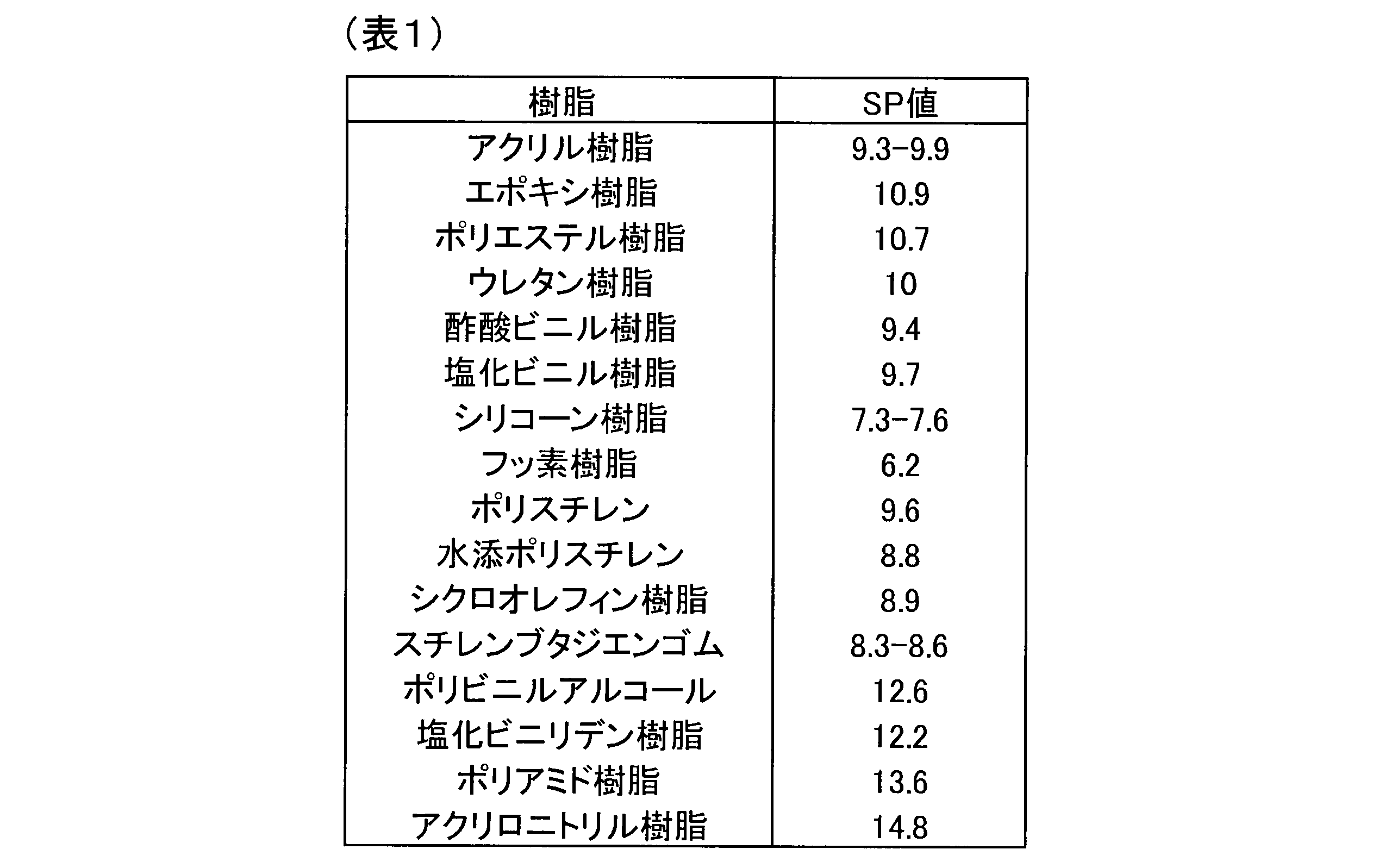
- Table 1 shows typical SP values of the resins.
- the first matrix resin and the second matrix resin can be used in any combination, for example, from the resins shown in Table 1.
- the support that can be used in the present invention includes, in addition to the particulate color conversion material and the light-emitting material, a light-resistant dye such as a light-absorbing dye, a light-absorbing pigment, an antioxidant, a processing and heat stabilizer, and an ultraviolet absorber.
- a light-resistant dye such as a light-absorbing dye, a light-absorbing pigment, an antioxidant, a processing and heat stabilizer, and an ultraviolet absorber.
- An additive such as a coupling agent can be contained.
- the color conversion substrate according to the embodiment of the present invention has a configuration including at least the particulate color conversion material or the color conversion member of the present invention.
- the color conversion substrate has a plurality of color conversion layers on a transparent substrate.
- the color conversion layer preferably includes a red conversion layer and a green conversion layer.
- the red conversion layer is formed of a phosphor material that absorbs at least blue light and emits red light.
- the green color conversion layer is formed of a phosphor material that absorbs at least blue light and emits green light.
- a partition may be formed, and the color conversion layer is preferably disposed between the partition (recess).
- the particle size of 100 isolated particles was measured using ECLIPSE L200N (manufactured by Nikon Corporation), and the average value was calculated. The average particle size was 14 ⁇ m. The particle size was measured by selecting a portion having the largest diameter.
- ECLIPSE L200N manufactured by Nikon Corporation
- the particle size was measured by selecting a portion having the largest diameter.
- 300 parts by mass of cyclohexane as a solvent was mixed with 100 parts by mass of this resin. did.
- the mixture was stirred and defoamed at 300 rpm for 30 minutes using a planetary stirring and defoaming apparatus “Mazerustar KK-400” (manufactured by Kurabo Industries) to obtain a resin solution for a support.
- Examples 2 and 3 A color conversion member was prepared and evaluated in the same manner as in Example 1 except that the matrix resin and the support resin shown in Table 2 were used. Table 2 shows the results.
- Comparative Example 2 The color conversion composition prepared in Example 1 was applied on a slide glass plate using a bar coater, heated at 100 ° C. for 20 minutes, and dried to prepare a color conversion member.
Landscapes
- Chemical & Material Sciences (AREA)
- Physics & Mathematics (AREA)
- Organic Chemistry (AREA)
- Engineering & Computer Science (AREA)
- Health & Medical Sciences (AREA)
- Chemical Kinetics & Catalysis (AREA)
- Medicinal Chemistry (AREA)
- Polymers & Plastics (AREA)
- Optics & Photonics (AREA)
- General Physics & Mathematics (AREA)
- Materials Engineering (AREA)
- Spectroscopy & Molecular Physics (AREA)
- General Engineering & Computer Science (AREA)
- Electroluminescent Light Sources (AREA)
- Led Device Packages (AREA)
- Liquid Crystal (AREA)
- Optical Filters (AREA)
- Devices For Indicating Variable Information By Combining Individual Elements (AREA)
Abstract
Description
また、量子ドットの代わりに有機物の発光材料を色変換組成物の成分として用いる技術も提案されている。有機発光材料を色変換組成物の成分として用いる技術の例としては、クマリン誘導体を用いたもの(例えば、特許文献2参照)、ローダミン誘導体を用いたもの(例えば、特許文献3参照)、ピロメテン誘導体を用いたもの(例えば、特許文献4参照)が開示されている。
また、有機発光材料の劣化を防ぎ、耐久性を向上させるため、光安定化剤を添加する技術も開示されている(例えば、特許文献5参照)。
また、近年、4Kや8Kといった高精細化、ハイダイナミックレンジ(HDR)、およびローカルディミングによる高コントラスト化に伴い、液晶ディスプレイのバックライトユニットに求められる照度が高まっており、駆動熱によるバックライトユニットの高温化が生じている。しかし、特許文献5に記載されている光安定化剤のような既存の技術は、耐久性の向上効果はあるものの、高温下で耐久性を向上させる技術としては、不十分であった。特に、有機発光材料を用いた色変換材料は、高温下において耐久性が著しく悪くなるという課題があり、既存の技術では、未だこの課題を十分に解決できていなかった。
本発明が解決しようとする課題は、液晶ディスプレイやLED照明に用いられる色変換材料において、色再現性の向上と耐久性とを両立させることであり、特に高色純度の発光と耐久性とを両立させることである。特に、高温下における耐久性を向上させた色変換材料および色変換部材の提供を目的とする。

本発明の実施の形態に係る粒子状色変換材料は、少なくとも1種の発光材料を含む。ここで、本発明における発光材料とは、何らかの光が照射されたときに、その光とは異なる波長の光を発する材料のことをいう。有機発光材料は、有機物の発光材料である。
高効率な色変換を達成するためには、発光材料が発光量子収率の高い発光特性を示す材料であることが好ましい。一般に、発光材料としては、無機蛍光体、蛍光顔料、蛍光染料、量子ドット等の公知の発光材料が挙げられる。中でも、分散の均一性、使用量の低減、環境負荷の低減の観点からは、有機発光材料が好ましい。

また、ボリル基とは、置換もしくは無置換のボリル基である。置換する場合の置換基としては、例えば、アリール基、ヘテロアリール基、直鎖アルキル基、分岐アルキル基、アリールエーテル基、アルコキシ基、ヒドロキシル基等が挙げられる。中でも、アリール基、アリールエーテル基が好ましい。
ホスフィンオキシド基とは、-P(=O)R10R11で表される基である。R10R11は、R1~R9と同様の群から選ばれる。



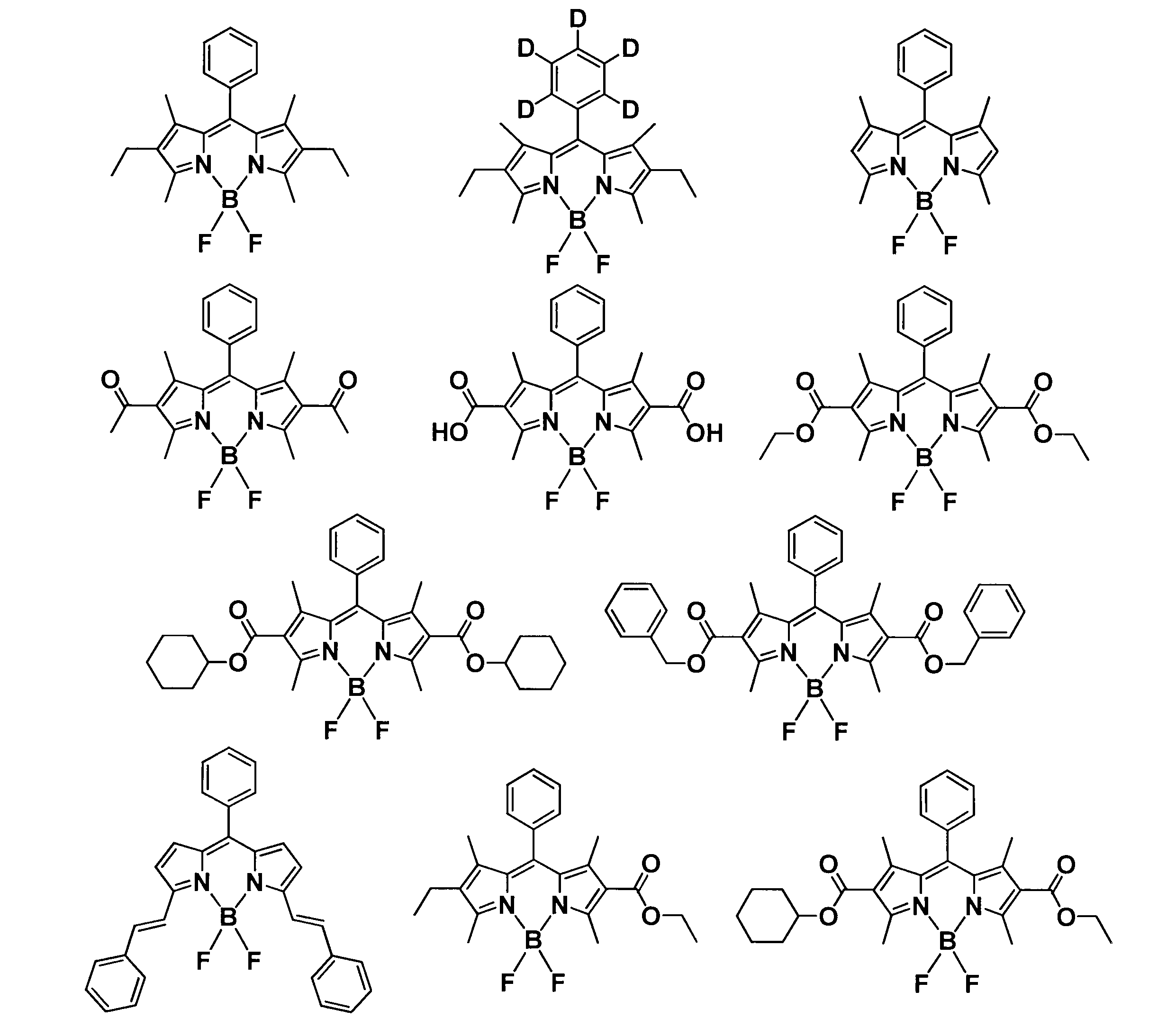
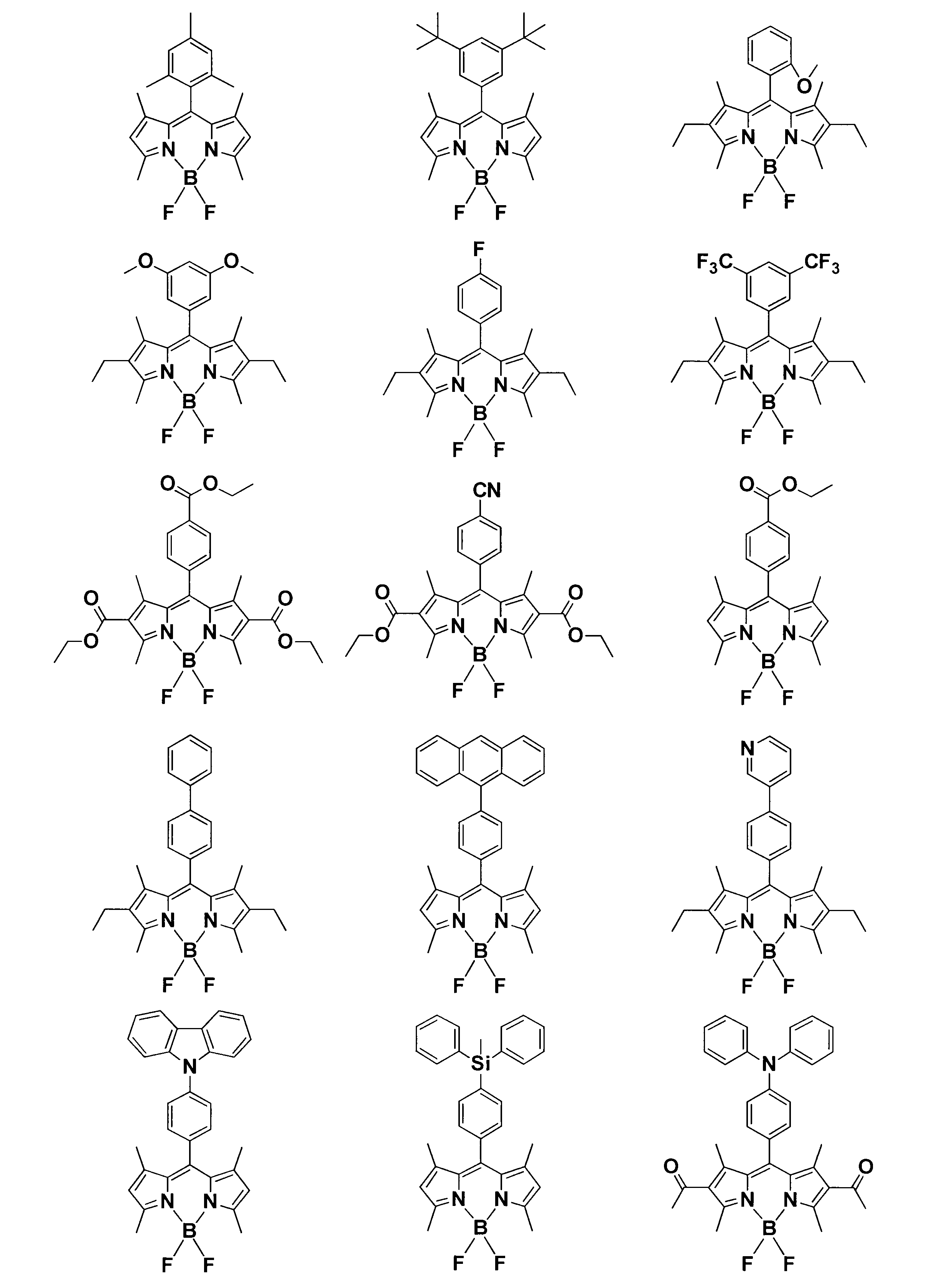
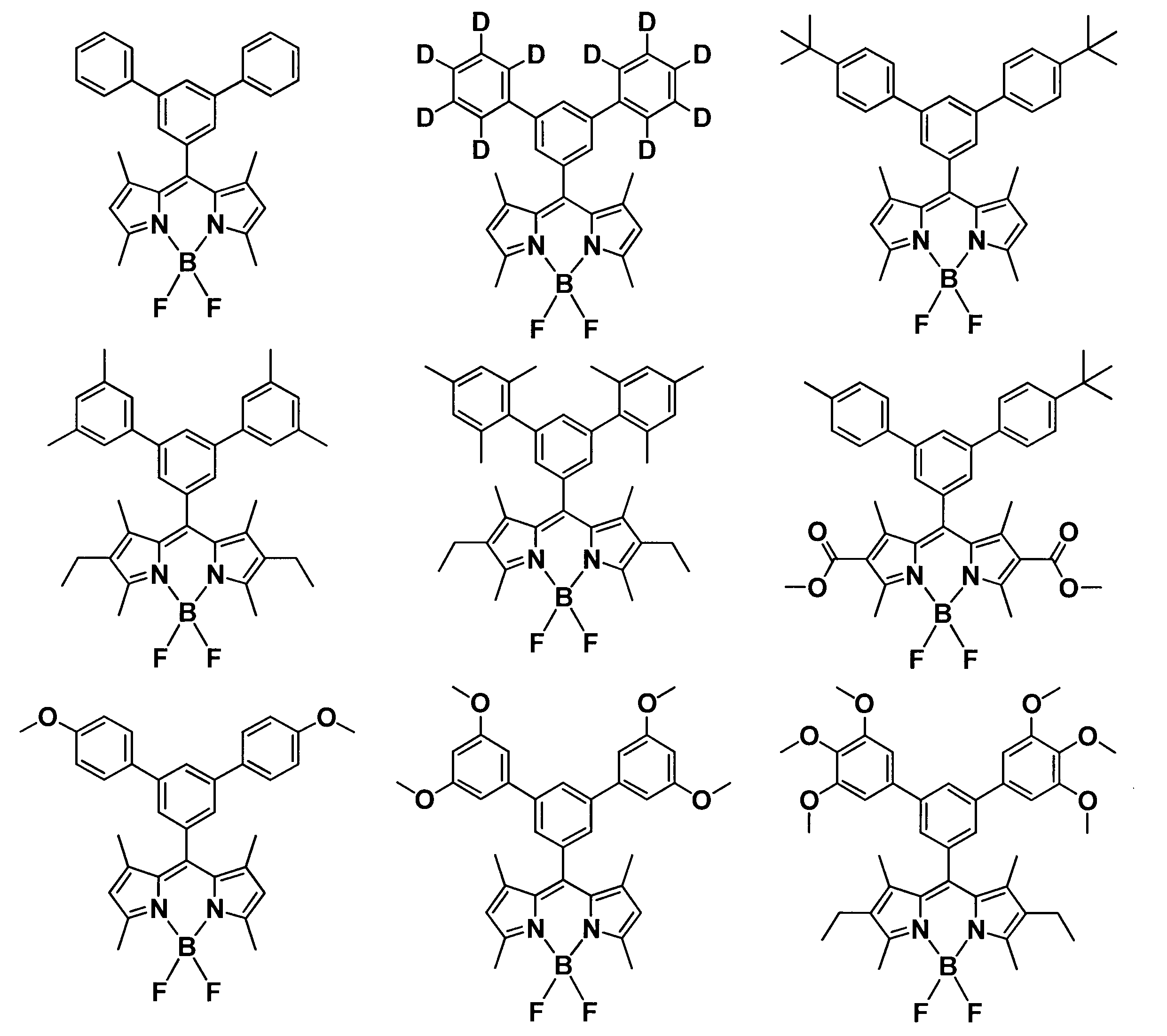
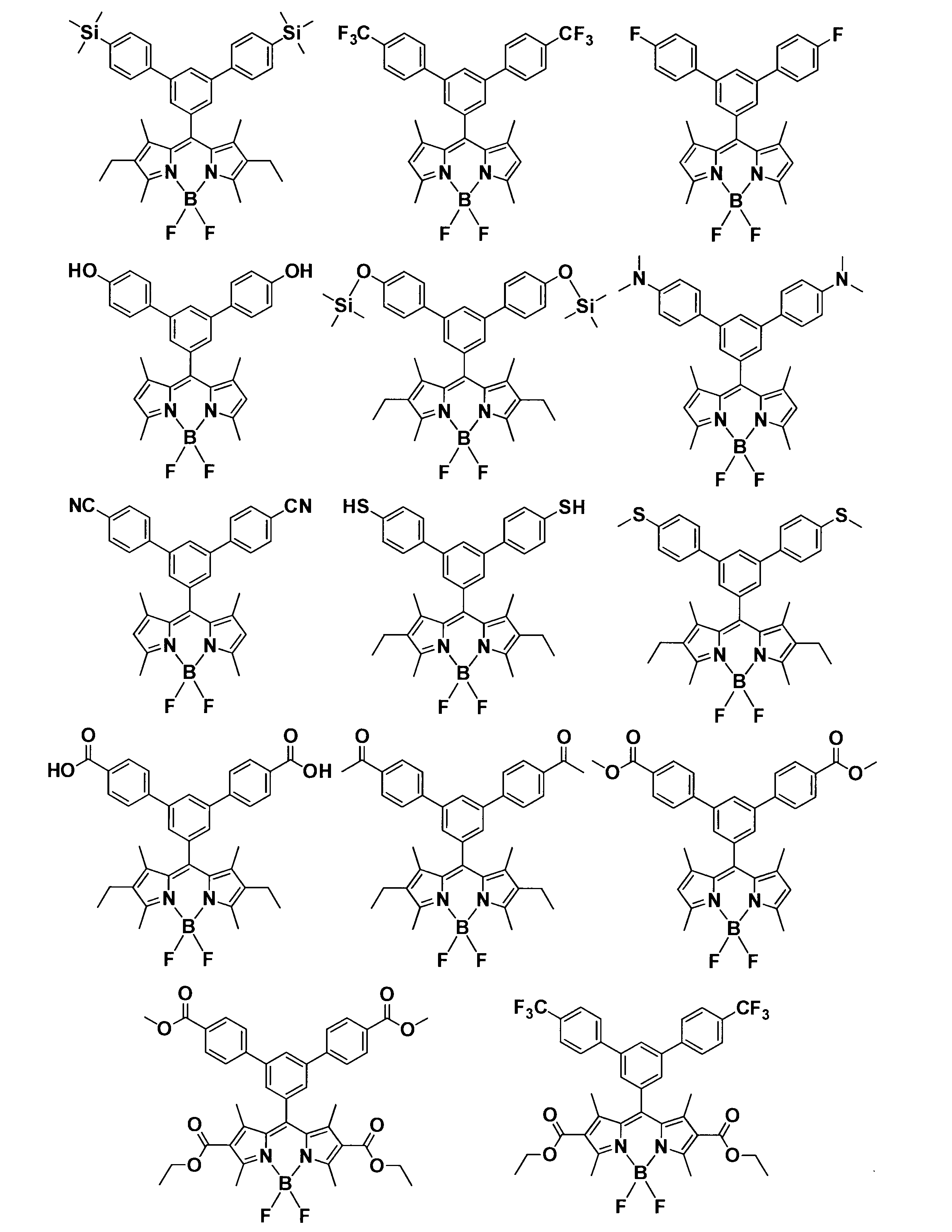

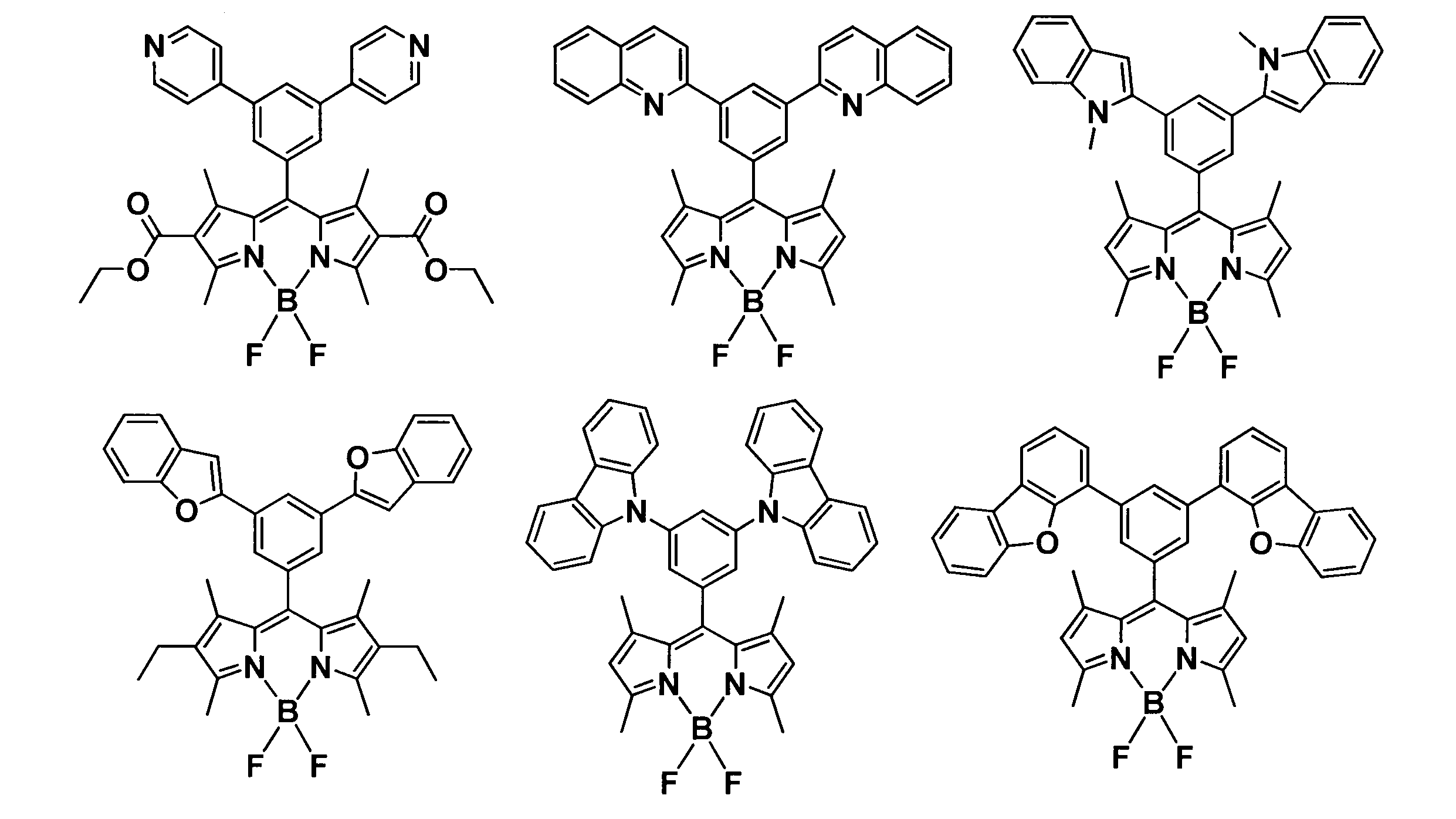

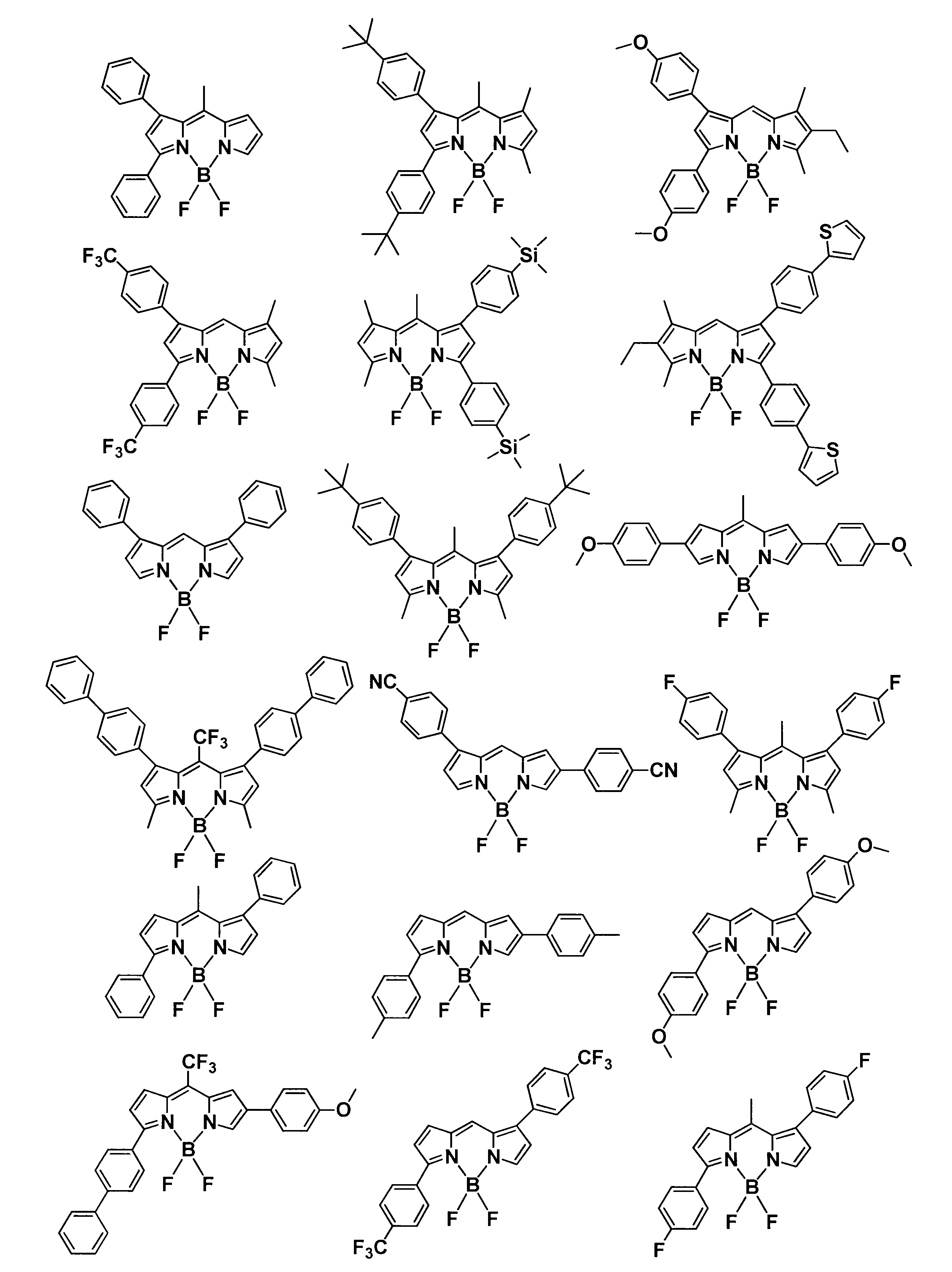
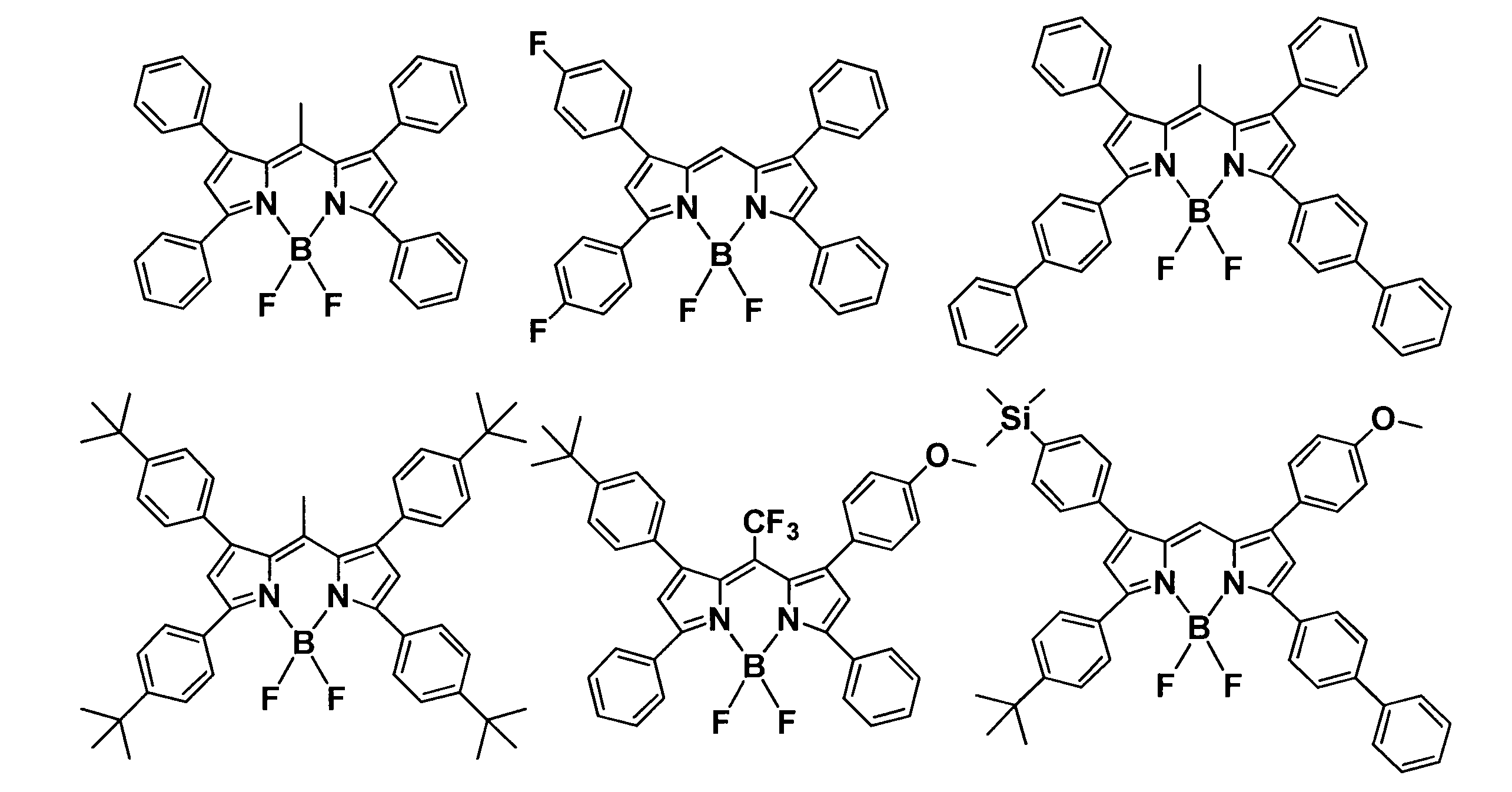


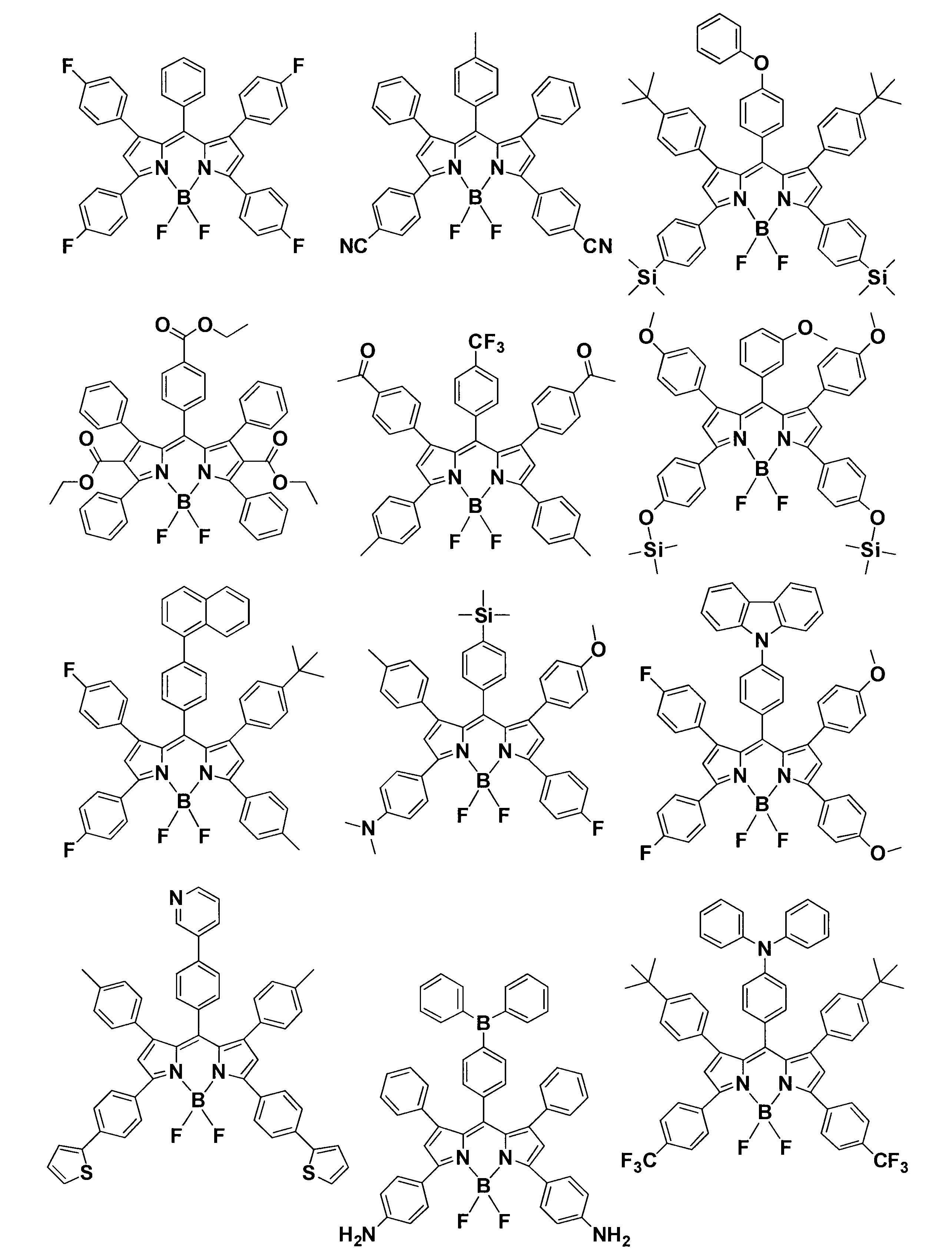
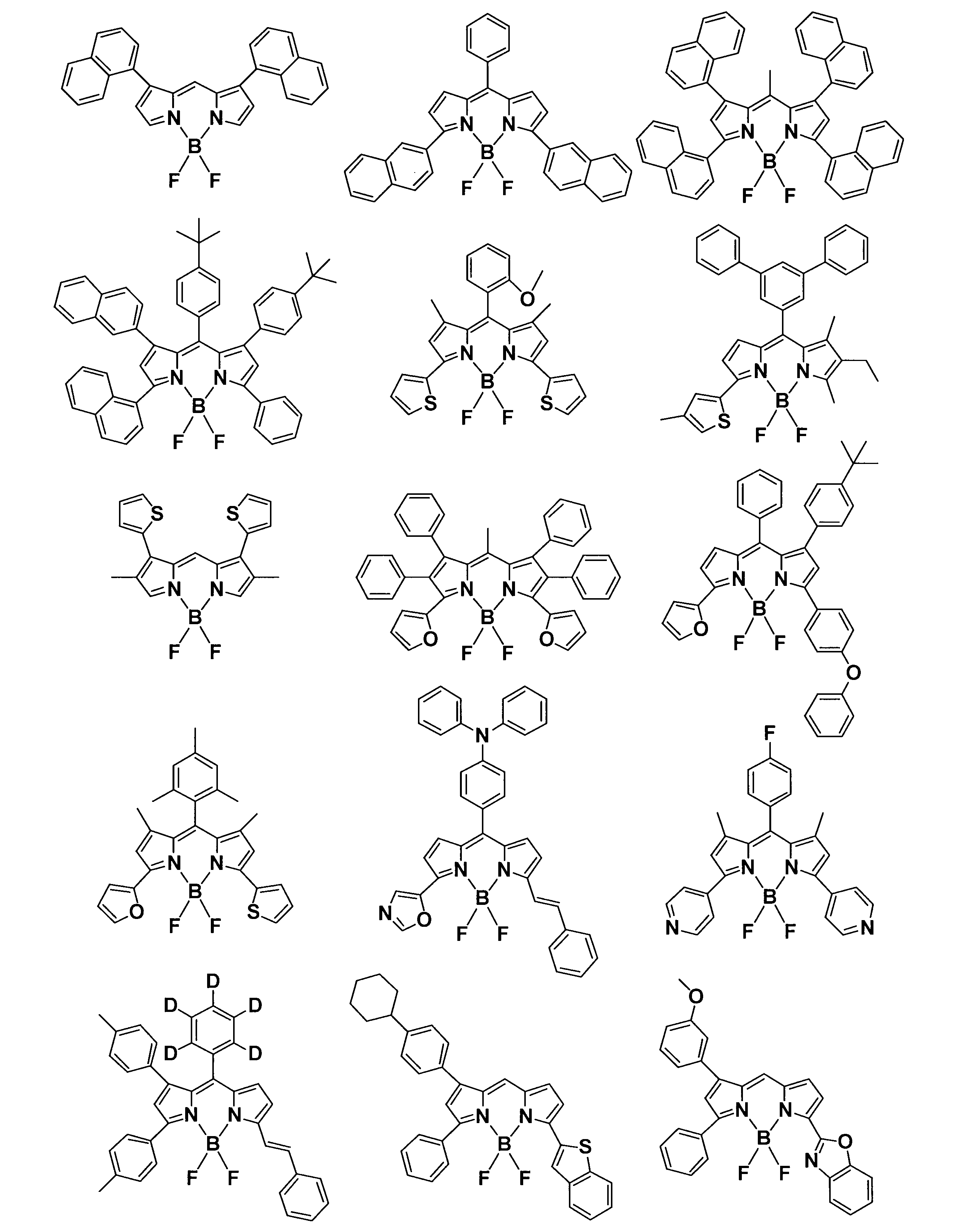


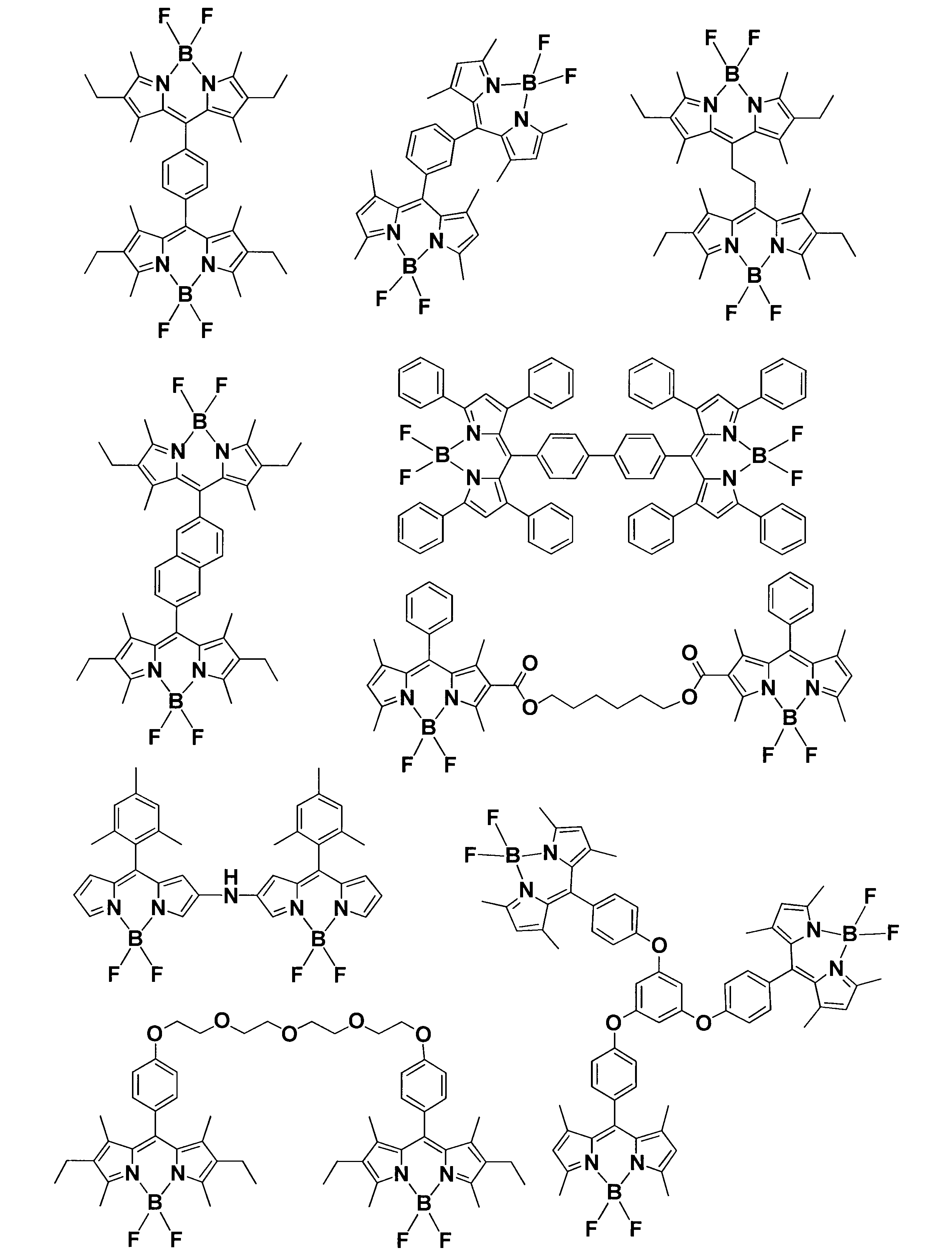
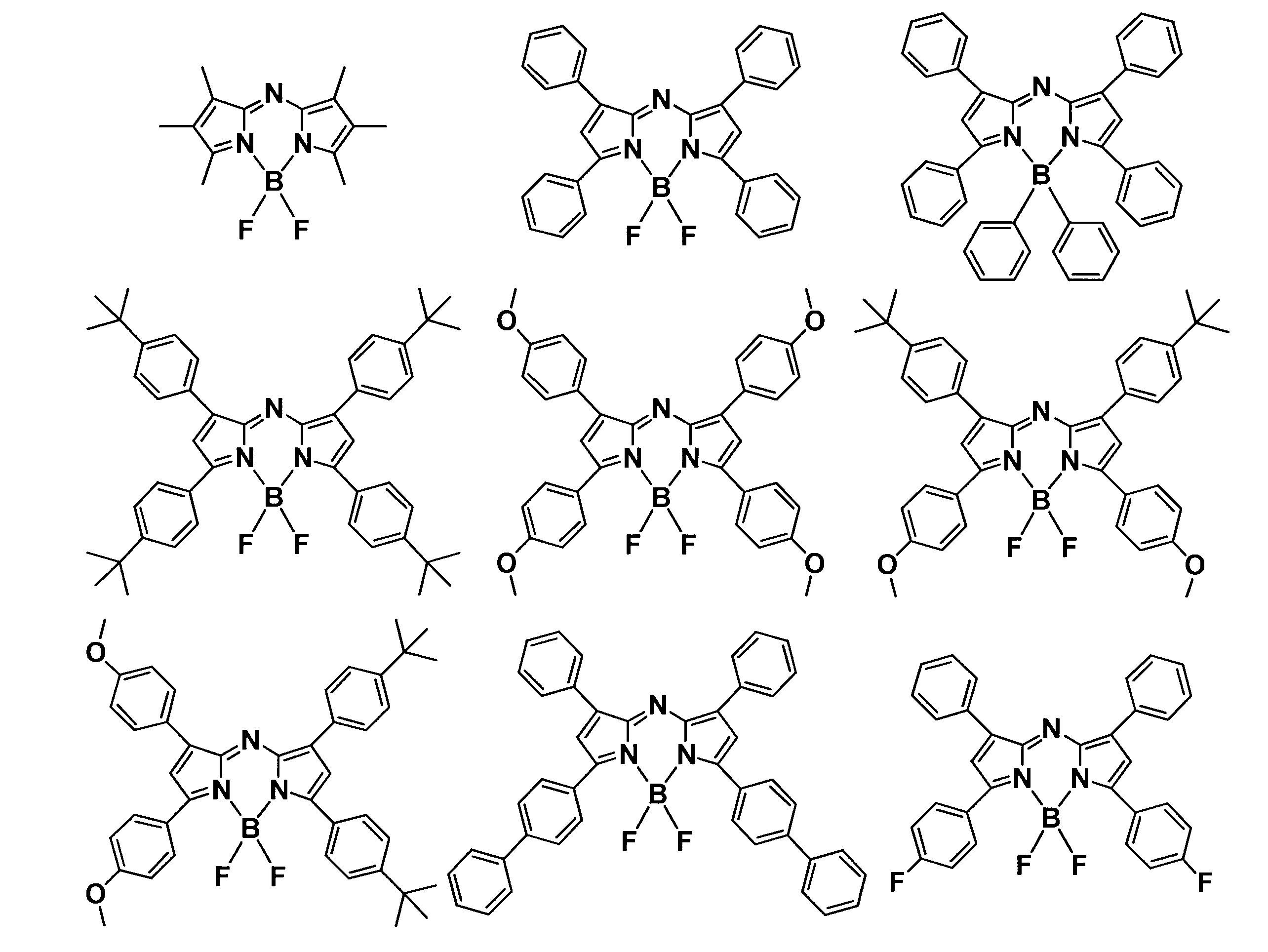

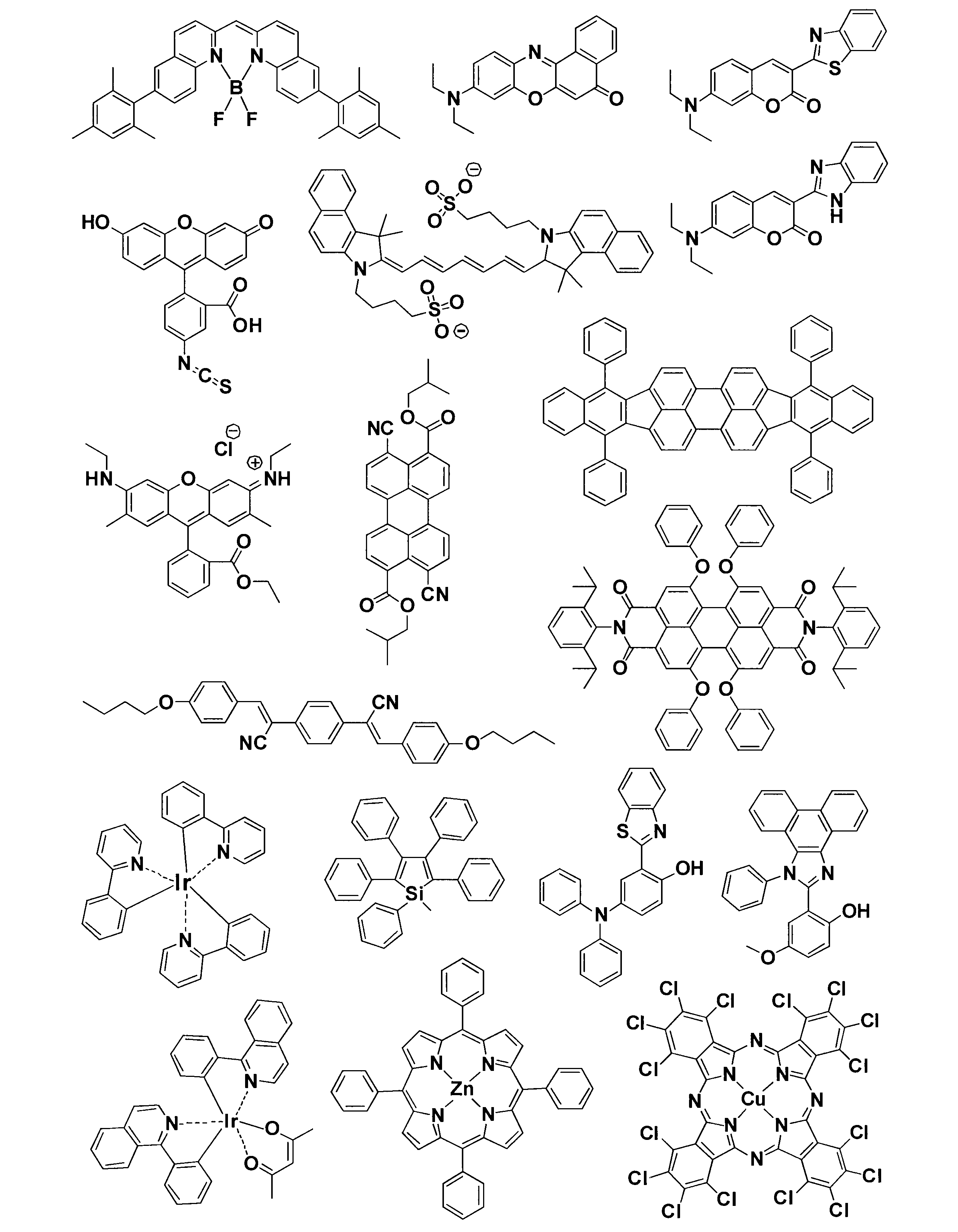
本発明の実施の形態に係る粒子状色変換材料において、マトリクス樹脂は、成形加工性、透明性、耐熱性等に優れる材料が好適に用いられる。マトリクス樹脂の例としては、例えば、アクリル酸系、メタクリル酸系、ポリケイ皮酸ビニル系、環ゴム系等の反応性ビニル基を有する光硬化型レジスト材料、エポキシ樹脂、シリコーン樹脂(シリコーンゴム、シリコーンゲル等のオルガノポリシロキサン硬化物(架橋物)を含む)、ウレア樹脂、フッ素樹脂、ポリカーボネート樹脂、アクリル樹脂、ウレタン樹脂、メラミン樹脂、ポリビニル樹脂、ポリアミド樹脂、フェノール樹脂、ポリビニルアルコール樹脂、ポリビニルブチラール樹脂、セルロース樹脂、脂肪族エステル樹脂および芳香族エステル樹脂等のポリエステル樹脂、シクロオレフィン樹脂等の脂肪族ポリオレフィン樹脂、芳香族ポリオレフィン樹脂等の公知のものが挙げられる。また、マトリクス樹脂としては、これらの樹脂の混合物や共重合体を用いても構わない。これらの樹脂を適宜設計することで、本発明の実施の形態に係る粒子状色変換材料に有用なマトリクス樹脂が得られる。
本発明の実施の形態に係る粒子状色変換材料は、発光材料およびマトリクス樹脂以外に、酸化防止剤、加工および熱安定化剤、紫外線吸収剤等の耐光性安定化剤、可塑剤、エポキシ化合物等の架橋剤、アミン、酸無水物、イミダゾール等の硬化剤、シリカ粒子やシリコーン微粒子等の無機粒子およびシランカップリング剤等、の添加剤を含有することができる。
加工および熱安定化剤としては、例えば、リン系安定化剤を挙げることができるが、特にこれらに限定されるものではない。また、安定化剤は、単独で使用してもよく、複数併用してもよい。
耐光性安定化剤としては、例えば、ベンゾトリアゾール類を挙げることができるが、特にこれらに限定されるものではない。また、耐光性安定化剤は、単独で使用してもよく、複数併用してもよい。
一重項酸素クエンチャーとしての役割を持つ化合物としては、例えば、特定の、3級アミンおよび金属塩を挙げることができるが、特にこれらに限定されるものではない。また、これらの化合物(耐光性安定化剤)は、単独で使用してもよく、複数併用してもよい。
また、耐光性安定化剤としては、ラジカルクエンチャーとしての役割を持つ化合物も好適に用いることができる。中でも、ヒンダードアミン系化合物が好適な例として挙げられる。
本発明の実施の形態に係る粒子状色変換材料において、これらの添加剤の含有量は、化合物のモル吸光係数、発光量子収率および励起波長における吸収強度、ならびに作製する色変換材料や色変換部材のサイズや厚み、透過率にもよるが、マトリクス樹脂の100質量部に対して、1.0×10⁻³質量部以上であることが好ましく、1.0×10⁻²質量部以上であることがより好ましく、1.0×10⁻¹質量部以上であることがさらに好ましい。また、これらの添加剤の含有量は、マトリクス樹脂の100質量部に対して、30質量部以下であることが好ましく、15質量部以下であることがより好ましく、10質量部以下であることがさらに好ましい。
本発明の実施の形態に係る粒子状色変換材料は、一般式(1)で表される化合物を含有するため、非常に色純度の高い発光を示す。
また、粉体として扱えるため、複数種類の粒子状色変換材料を混合して使用し、精緻な波長変換特性の調整を行うことが容易となる。例えば、青色光の一部を色変換して白色光を得る場合、緑色の発光を示す発光材料を含有する緑色変換材料と赤色の発光を示す発光材料を含有する赤色変換材料をそれぞれ用意し、それらの混合量を調整することで、白色光のホワイトバランスや色温度を容易に調整することができる。
さらに、色変換材料の粒子径や形状、マトリクス樹脂の屈折率などの制御によって、色変換特性を調整することや、色変換機能以外の機能を付与することも可能である。例えば、光散乱機能を発現させることが可能である。
本発明の実施の形態に係る粒子状色変換材料の作製方法は、発光材料およびマトリクス樹脂を含んだ粒子状に成形できれば、特に限定されない。例えば、界面重合法、W/O系液中乾燥法、ストーバー法、及びスプレードライ法、in Situ重合法、水溶液からの相分離法、有機溶媒からの相分離法、融解分散冷却法、気中懸濁被覆法により作製することができる。
中でも、前述した発光材料、マトリクス樹脂、溶媒等の材料を所定量混合して作製した組成物を、スプレードライ法により乾燥させることで粒子状に成形する方法が、簡便な方法として挙げられる。
本発明の実施の形態に係る粒子状色変換材料は、それ自体のみで使用してもよい。また、光学部材への適用性をより高める観点から、粒子状色変換材料を含有させた支持体を用いることが好ましい。本発明の実施の形態に係る粒子状色変換材料を含有する支持体は、色変換部材として用いることができる。
支持体が樹脂からなる場合、粒子状色変換材料のマトリクス樹脂のSP値は支持体を形成する樹脂のSP値より大きいことが好ましい。
一方、LED光源との一体化や、パターニングされた部材との一体化の観点からは、型に充填する手法も好ましい。
支持体中に含まれる粒子状色変換材料は、1種類であっても、複数種類であってもよい。
樹脂の代表的なSP値を表1に示す。第1マトリクス樹脂および第2マトリクス樹脂は、例えば表1に示すような樹脂の中から任意に組み合わせて用いることができる。
本発明の実施の形態に係る色変換部材の作製方法は、本発明の粒子状色変換材料を含んだ支持体を所望の形状に成形できれば、特に限定されない。例えば、本発明に係る粒子状色変換材料と支持体として使用する樹脂と溶剤とを混合し、組成物を作製したのち、基材上に塗布し、乾燥することで、シート状に成形する方法が挙げられる。また、本発明に係る粒子状色変換材料と支持体となる樹脂とを加熱しながら混錬し、押し出し機を用いて成形する方法も挙げられる。
本発明の実施の形態に係る色変換基板は、少なくとも本発明の粒子状色変換材料または色変換部材を備える構成である。色変換基板は、透明基板上に、複数の色変換層を備えるものである。本発明において、色変換層は、赤色変換層と緑色変換層とを含むことが好ましい。赤色変換層は少なくとも青色光を吸収して赤色光を発する蛍光体材料によって形成されている。緑色変換層は少なくとも青色光を吸収して緑色光を発する蛍光体材料によって形成されている。また、隔壁が形成されていてもよく、色変換層は、隔壁と隔壁の間(凹部)に配置されていることが好ましい。透明基板側から励起光を入射させ、透明基板と反対の側から視認してもよいし、色変換層側から励起光を入射させ、透明基板側から視認してもよい。色変換層の量子収率は、ピーク波長が440~460nmの青色光を色変換基板に照射したとき、通常は0.5以上、好ましくは0.7以上、より好ましくは0.8以上、さらに好ましくは0.9以上である。
本発明の実施の形態に係るインクは、少なくとも本発明の粒子状色変換材料または色変換部材を含んだ液体、ジェル、固体の状態で、文字の記載や表面への色付けのために用いられるものである。本発明の実施の形態に係るインクは、本発明の粒子状色変換材料または色変換部材を用いることで、高色純度の発光と耐久性とを両立することができるため、特に、セキュリティ印刷用途のための蛍光インクとして好ましく用いることができる。
励起光の種類は、本発明に用いられる有機発光材料が吸収可能な波長領域に発光を示すものであれば、いずれの励起光でも用いることができる。例えば、熱陰極管や冷陰極管、無機エレクトロルミネッセンス(EL)素子等の蛍光性光源、有機EL素子光源、LED光源、白熱光源、あるいは太陽光等、いずれの光源からの励起光でも利用可能である。中でも、LED光源からの励起光が好適である。ディスプレイや照明用途では、青色光の色純度を高められる点で、400nm以上500nm以下の波長範囲の励起光を持つ青色LED光源からの励起光が、さらに好適である。
励起光は、1種類の発光ピークを持つものでもよく、2種類以上の発光ピークを持つものでもよいが、色純度を高めるためには、1種類の発光ピークを持つものが好ましい。また、発光ピークの種類の異なる複数の励起光源を任意に組み合わせて使用することも可能である。
本発明の実施の形態に係る光源ユニットは、少なくとも光源および本発明の粒子状色変換材料または色変換部材を備える構成である。光源と粒子状色変換材料や色変換部材との配置方法については特に限定されず、光源と粒子状色変換材料や色変換部材とを密着させた構成を取ってもよいし、光源と粒子状色変換材料や色変換部材とを離したリモートフォスファー形式を取ってもよい。また、光源ユニットは、色純度を高める目的で、さらにカラーフィルターを備える構成を取ってもよい。
本発明の実施の形態に係るディスプレイは、少なくとも、光源および粒子状色変換材料または色変換部材を含む光源ユニットを備える。例えば、液晶ディスプレイ等のディスプレイには、バックライトユニットとして、上述の光源ユニットが用いられる。
また、本発明の実施の形態に係る照明装置は、少なくとも、光源および粒子状色変換材料または色変換部材を含む光源ユニットを備える。例えば、この照明装置は、光源としての青色LED光源と、この青色LED光源からの青色光をこれよりも長波長の光に変換する粒子状色変換材料または色変換部材とを組み合わせて、白色光を発光するように構成される。
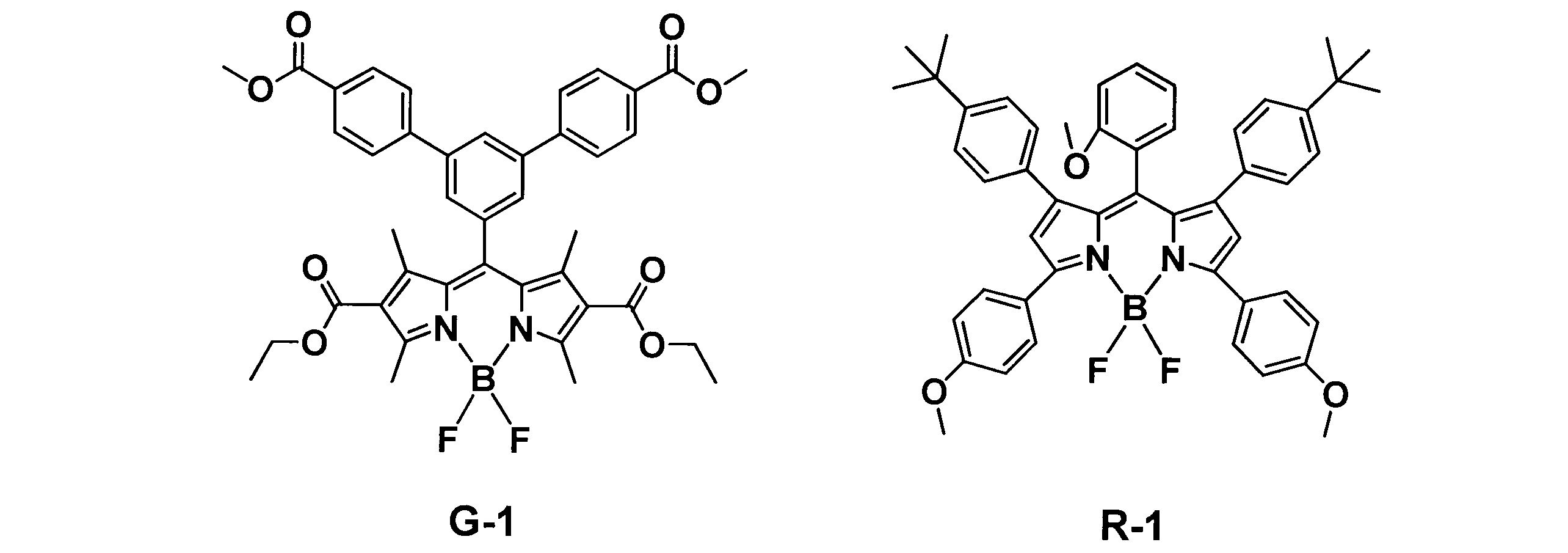
下記の実施例および比較例において、化合物G-1、R-1は以下に示す化合物である。なお、化合物G-1、R-1は、公知の手法を用いて合成して使用した。
<色変換特性の測定>
色変換特性の測定では、発光ピーク波長457nmの青色LED素子を搭載した面状発光装置に各色変換部材およびプリズムシートを載せた状態で、この面状発光装置に30mAの電流を流して、この青色LED素子を点灯させ、分光放射輝度計(CS-1000、コニカミノルタ社製)を用いて、発光スペクトル、色度および輝度を測定した。
上記色変換特性の測定によって得られた発光スペクトルと、カラーフィルターの透過率のスペクトルデータとから、カラーフィルターにより色純度を向上させた場合の(u’,v’)色空間における色域を算出した。また、算出された(u’,v’)色空間における色域の面積は、BT.2020規格の色域面積を100%とした場合の割合により、以下の基準で評価した。この(u’,v’)色空間における色域の面積の評価結果として、「A」は、上記の割合が91%以上であることを示す。「B」は、上記の割合が86%以上90%以下であることを示す。「C」は、上記の割合が81%以上85%以下であることを示す。「D」は、上記の割合が80%以下であることを示す。この評価結果において、上記の割合が高いほど、色域が広く、色変換部材の色再現性が良好である。
光耐久性のテストでは、発光ピーク波長447nmの青色LED素子を搭載した面状発光装置に各色変換部材およびプリズムシートを載せた状態で、この面状発光装置に100mAの電流を流して、この青色LED素子を点灯させ、分光放射輝度計(CS-1000、コニカミノルタ社製)を用いて初期輝度を測定した。その後、オーブンを用いて50℃、27%RHの環境下で青色LED素子からの光を連続照射し、輝度が一定量低下するまでの時間を観測することで、光耐久性を評価した。ただし、輝度の測定は、色変換部材および面状発光装置を前述のオーブンの外に出し、室温まで降温させた状態で測定した。
まず、マトリクス樹脂としてアクリル樹脂T1(SP値=9.8(cal/cm3)0.5)を用い、このマトリクス樹脂の100質量部に対して、化合物G-1を0.3質量部、溶剤としてトルエンを400質量部、混合した。これらの混合物を、遊星式撹拌・脱泡装置“マゼルスターKK-400”(クラボウ製)を用いて300rpmで30分間撹拌・脱泡し、色変換組成物を得た。この色変換組成物をスプレードライ法で乾燥させることにより、粒子状色変換材料を作製した。ECLIPSE L200N(株式会社ニコン製)を用い、孤立粒子100個の粒径を測定して、その平均値を算出したところ、平均粒径は14μmだった。粒径は、最も直径が大きくなる部分を選択して測定した。
次に、水添SEBS共重合体樹脂T2(SP値=8.5(cal/cm3)0.5)を用い、この樹脂の100質量部に対して、溶剤としてシクロヘキサンを300質量部、混合した。これらの混合物を、遊星式撹拌・脱泡装置“マゼルスターKK-400”(クラボウ製)を用いて300rpmで30分間撹拌・脱泡し、支持体用樹脂液を得た。
作製した色変換部材を用いて青色LED光を色変換させたところ、緑色光の発光領域のみを抜粋すると、ピーク波長528nm、ピーク波長における発光スペクトルの半値幅33nmの高色純度緑色発光が得られた。また、上記の方法にしたがい、50℃、27%RHの環境下で青色LED素子からの光を連続照射したところ、輝度が10%低下するまでの時間は120時間であった。結果を表2に示す。
表2記載のマトリクス樹脂および支持体樹脂を用いた以外は、実施例1と同様にして色変換部材を作製して評価した。結果を表2に示す。
発光材料としてCoumarine6(シグマアルドリッチ社製)を用いた以外は、実施例1と同様にして色変換部材を作製して評価した。ただし、発光材料の混合量は、実施例1のG-1と同じ物質量になるように調整した。結果を表2に示す。
実施例1で作製した色変換組成物を、バーコーターを用いて、スライドガラス板上に塗布し、100℃で20分加熱、乾燥して、色変換部材を作製した。
まず、マトリクス樹脂としてアクリル樹脂T1(SP値=9.8(cal/cm3)0.5)を用い、このマトリクス樹脂の100質量部に対して、化合物G-1を0.3質量部、溶剤としてトルエンを400質量部、混合した。これらの混合物を、遊星式撹拌・脱泡装置“マゼルスターKK-400”(クラボウ製)を用いて300rpmで30分間撹拌・脱泡し、色変換組成物を得た。この色変換組成物をスプレードライ法で乾燥させることにより、第1粒子状色変換材料を作製した。
同様に、マトリクス樹脂としてポリエステル樹脂T11(SP値=10.7(cal/cm3)0.5)を用い、マトリクス樹脂の100質量部に対して、化合物R-1を0.1質量部、溶剤としてトルエンを400質量部、混合した。これらの混合物を、遊星式撹拌・脱泡装置“マゼルスターKK-400”(クラボウ製)を用いて300rpmで30分間撹拌・脱泡し、色変換組成物を得た。この色変換組成物をスプレードライ法で乾燥させることにより、第2粒子状色変換材料を作製した。
最後に、第1粒子状色変換材料と第2粒子状色変換材料と支持体用樹脂液を混合し、撹拌することで、色変換分散液を作製した。この色変換分散液を、バーコーターを用いて、スライドガラス板上に塗布し、100℃で20分加熱、乾燥して、色変換部材を作製した。
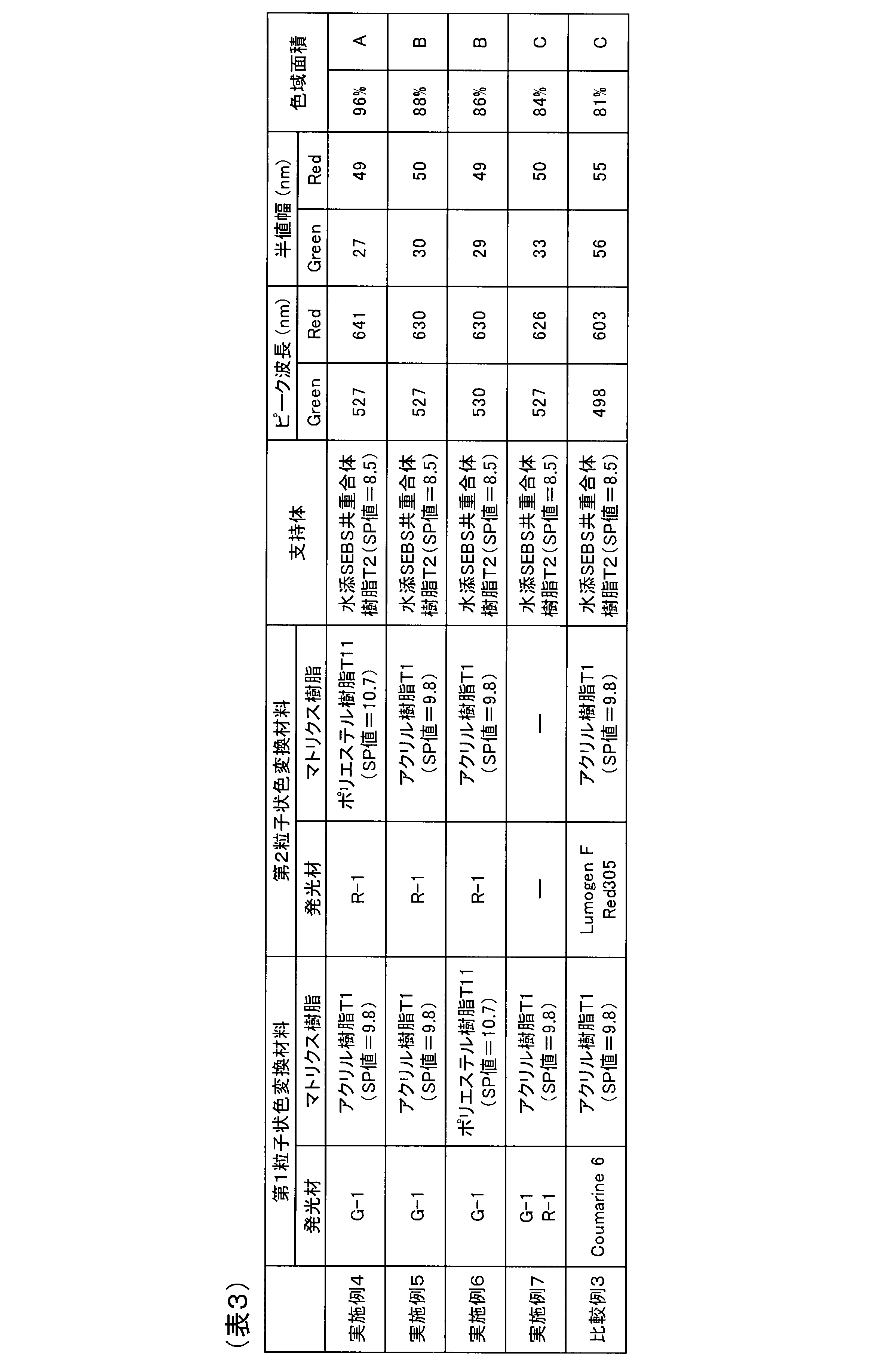
作製した色変換部材を用いて青色LED光を色変換させたところ、発光スペクトルは図4に示す通りとなり、白色光が得られた。緑色光の発光領域のみを抜粋すると、ピーク波長527nm、ピーク波長における発光スペクトルの半値幅27nmの高色純度緑色発光が得られた。また、赤色光の発光領域のみを抜粋すると、ピーク波長641nm、ピーク波長における発光スペクトルの半値幅49nmの高色純度赤色発光が得られた。(u’,v’)色空間における色域の面積は、BT.2020規格の色域面積に対して96%であった。結果を表3に示す。表3において、「色域面積」は、(u’,v’)色空間における色域の面積である。また、「色域面積」欄の「A」~「D」は、この色域の面積の評価結果を示すものである。
第2粒子状色変換材料のマトリクス樹脂として、アクリル樹脂T1(SP値=9.8(cal/cm3)0.5)を用いた以外は、実施例2と同様にして色変換部材を作製して評価した。結果を表3に示す。
第1粒子状色変換材料のマトリクス樹脂として、ポリエステル樹脂T11(SP値=10.7(cal/cm3)0.5)を用い、第2粒子状色変換材料のマトリクス樹脂として、アクリル樹脂T1(SP値=9.8(cal/cm3)0.5)を用いた以外は、実施例4と同様にして色変換部材を作製して評価した。結果を表3に示す。
第1粒子状色変換材料の発光材料としてCoumarine6(シグマアルドリッチ社製)を用い、実施例3のG-1と同じ物質量になるように調整して混合し、第2粒子状色変換材料の発光材料としてLumogen F Red305(BASF社製)を用い、実施例3のR-1と同じ物質量になるように調整して混合した以外は、実施例5と同様にして色変換部材を作製して評価した。結果を表3に示す。
マトリクス樹脂としてアクリル樹脂T1(SP値=9.8(cal/cm3)0.5)を用い、このマトリクス樹脂の100質量部に対して、化合物G-1を0.3質量部、化合物R-1を0.017質量部、溶剤としてトルエンを400質量部、混合した。これらの混合物を、遊星式撹拌・脱泡装置“マゼルスターKK-400”(クラボウ製)を用いて300rpmで30分間撹拌・脱泡し、色変換組成物を得た。この色変換組成物をスプレードライ法で乾燥させることにより、粒子状色変換材料を作製した。
次に、水添SEBS共重合体樹脂T2(SP値=8.5(cal/cm3)0.5)を用い、この樹脂の100質量部に対して、溶剤としてシクロヘキサンを300質量部、混合した。これらの混合物を、遊星式撹拌・脱泡装置“マゼルスターKK-400”(クラボウ製)を用いて300rpmで30分間撹拌・脱泡し、支持体用樹脂液を得た。
最後に、粒子状色変換材料と支持体用樹脂液を混合し、撹拌することで、色変換材料分散液を作製した。この色変換材料分散液を、バーコーターを用いて、スライドガラス板上に塗布し、100℃で20分加熱、乾燥して、色変換部材を作製した。実施例4と同様に評価した結果を表3に示す。
まず、マトリクス樹脂としてポリエステル樹脂T12(SP値=10.9(cal/cm3)0.5)を用い、このマトリクス樹脂の100質量部に対して、化合物R-1を0.1質量部、溶剤としてメチルエチルケトンを400質量部、混合した。これらの混合物を、遊星式撹拌・脱泡装置“マゼルスターKK-400”(クラボウ製)を用いて300rpmで30分間撹拌・脱泡し、色変換組成物を得た。この色変換組成物をスプレードライ法で乾燥させることにより、粒子状色変換材料を作製した。
次に、アクリル樹脂T2(SP値=9.9(cal/cm3)0.5)を用い、この樹脂の100質量部に対して、化合物G-1を0.3質量部、溶剤として酢酸エチルを200質量部、1-メトキシ-2-プロパノールを200質量部、を混合した。これらの混合物を、遊星式撹拌・脱泡装置“マゼルスターKK-400”(クラボウ製)を用いて300rpmで30分間撹拌・脱泡し、支持体用樹脂液を得た。
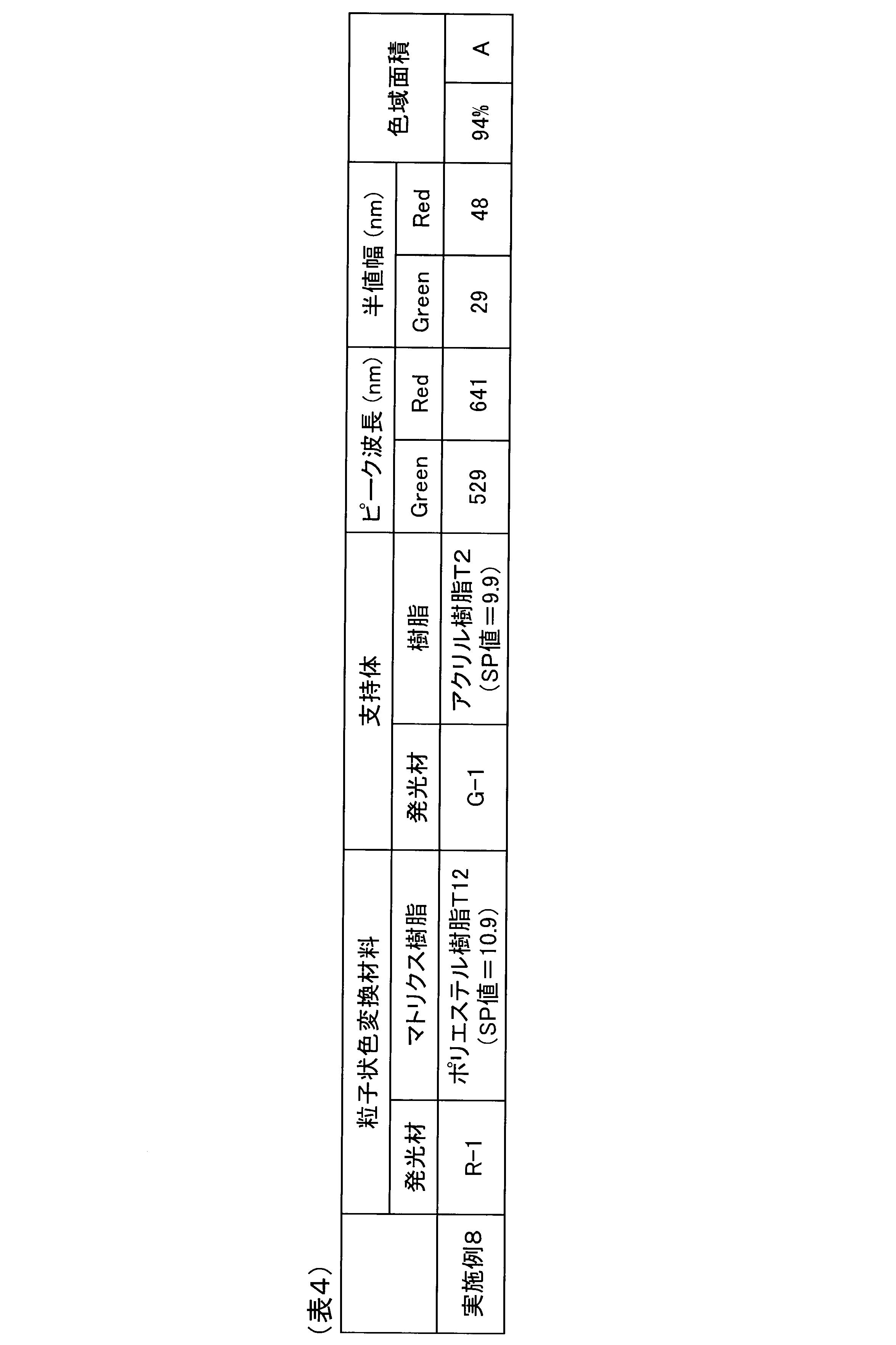
作製した色変換部材を用いて青色LED光を色変換させたところ、緑色光の発光領域のみを抜粋すると、ピーク波長529nm、ピーク波長における発光スペクトルの半値幅29nmの高色純度緑色発光が得られた。また、赤色光の発光領域のみを抜粋すると、ピーク波長641nm、ピーク波長における発光スペクトルの半値幅48nmの高色純度赤色発光が得られた。(u’,v’)色空間における色域の面積は、BT.2020規格の色域面積に対して94%であった。結果を表4に示す。表4において、「色域面積」は、(u’,v’)色空間における色域の面積である。また、「色域面積」欄の「A」~「D」は、この色域の面積の評価結果を示すものである。

2、2a、2b 粒子状色変換材料
3、3a、3b 支持体
Claims (19)
- マトリクス樹脂および少なくとも1種の発光材料を有する粒子状色変換材料であって、前記発光材料が一般式(1)で表される化合物を含有する、粒子状色変換材料。

- ピーク波長が500nm以上580nm未満の領域に観測される発光を呈する第1発光材料、および/またはピーク波長が580nm以上750nm以下の領域に観測される発光を呈する第2発光材料の少なくとも一方を含有する、請求項1に記載の粒子状色変換材料。
- 平均粒径が0.010μm以上100μm以下である、請求項1または2に記載の粒子状色変換材料。
- 前記マトリクス樹脂がアクリル樹脂、アクリル酸エステルまたはメタクリル酸エステル部位を含む共重合樹脂、ポリエステル樹脂、シクロオレフィン樹脂、エポキシ樹脂のいずれかである、請求項1~3のいずれかに記載の粒子状色変換材料。
- 請求項1~4のいずれかに記載の粒子状色変換材料を含有する支持体を備える、色変換部材。
- 前記支持体の形状がシート状である、請求項5に記載の色変換部材。
- 前記支持体が樹脂からなる、請求項5または6に記載の色変換部材。
- 前記マトリクス樹脂と前記支持体を形成する樹脂のSP値の差が0.5(cal/cm3)0.5以上である、請求項7に記載の色変換部材。
- 前記粒子状色変換材料が、
ピーク波長が500nm以上580nm未満の領域に観測される発光を呈する一般式(1)で表される化合物と第1マトリクス樹脂からなる第1粒子状色変換材料と、
ピーク波長が580nm以上750nm以下の領域に観測される発光を呈する一般式(1)で表される化合物と第2マトリクス樹脂からなる第2粒子状色変換材料とを含む、請求項5~8のいずれかに記載の色変換部材。 - 前記第1マトリクス樹脂と第2マトリクス樹脂が異なる、請求項9に記載の色変換部材。
- 前記第1マトリクス樹脂および第2マトリクス樹脂のSP値をそれぞれSP1(cal/cm3)0.5およびSP2(cal/cm3)0.5とするとき、SP1≦SP2である、請求項9または10に記載の色変換部材。
- 前記支持体が、請求項1~4のいずれかに記載の粒子状色変換材料および少なくとも1種の発光材料を含有する、請求項5~11のいずれかに記載の色変換部材。
- 前記発光材料が、少なくとも一般式(1)で表される化合物を含有する、請求項12に記載の色変換部材。
- 光源と、請求項1~4のいずれかに記載の粒子状色変換材料または請求項5~11のいずれかに記載の色変換部材、を備える、光源ユニット。
- 前記光源が、波長400nm以上500nm以下の範囲に極大発光を有する発光ダイオードである、請求項14に記載の光源ユニット。
- 請求項14または15に記載の光源ユニットを備える、ディスプレイ。
- 請求項14または15に記載の光源ユニットを備える、照明装置。
- 請求項1~4のいずれか一つに記載の粒子状色変換材料、または請求項5~13のいずれか一つに記載の色変換部材を含有する、色変換基板。
- 請求項1~4のいずれか一つに記載の粒子状色変換材料、または請求項5~13のいずれか一つに記載の色変換部材を含有する、インク。
Priority Applications (3)
| Application Number | Priority Date | Filing Date | Title |
|---|---|---|---|
| KR1020217004840A KR102779770B1 (ko) | 2018-09-06 | 2019-08-29 | 색변환 재료, 색변환 부재, 광원 유닛, 디스플레이, 조명 장치, 색변환 기판 및 잉크 |
| CN201980055522.2A CN112639542B (zh) | 2018-09-06 | 2019-08-29 | 颜色转换材料、颜色转换部件、光源单元、显示器、照明装置、颜色转换基板及油墨 |
| JP2019549015A JP7380216B2 (ja) | 2018-09-06 | 2019-08-29 | 色変換部材、光源ユニット、ディスプレイ、照明装置、色変換基板およびインク |
Applications Claiming Priority (2)
| Application Number | Priority Date | Filing Date | Title |
|---|---|---|---|
| JP2018-166657 | 2018-09-06 | ||
| JP2018166657 | 2018-09-06 |
Publications (1)
| Publication Number | Publication Date |
|---|---|
| WO2020050144A1 true WO2020050144A1 (ja) | 2020-03-12 |
Family
ID=69721652
Family Applications (1)
| Application Number | Title | Priority Date | Filing Date |
|---|---|---|---|
| PCT/JP2019/034006 Ceased WO2020050144A1 (ja) | 2018-09-06 | 2019-08-29 | 色変換材料、色変換部材、光源ユニット、ディスプレイ、照明装置、色変換基板およびインク |
Country Status (5)
| Country | Link |
|---|---|
| JP (1) | JP7380216B2 (ja) |
| KR (1) | KR102779770B1 (ja) |
| CN (1) | CN112639542B (ja) |
| TW (1) | TWI808253B (ja) |
| WO (1) | WO2020050144A1 (ja) |
Cited By (4)
| Publication number | Priority date | Publication date | Assignee | Title |
|---|---|---|---|---|
| JPWO2022131362A1 (ja) * | 2020-12-17 | 2022-06-23 | ||
| JP2022161116A (ja) * | 2021-04-08 | 2022-10-21 | 富士フイルム株式会社 | 波長変換用材料、波長変換部材及び発光装置並びにこれに用いる化合物 |
| WO2023120515A1 (ja) * | 2021-12-21 | 2023-06-29 | 積水化学工業株式会社 | 隔壁形成用インクジェット組成物、ledモジュール、ledモジュールの製造方法及びインクジェット組成物 |
| WO2024202764A1 (ja) * | 2023-03-24 | 2024-10-03 | 東レ株式会社 | ポリマー微粒子、その製造方法、組成物、光学部材、光源ユニット、ディスプレイおよび照明装置、インク |
Citations (7)
| Publication number | Priority date | Publication date | Assignee | Title |
|---|---|---|---|---|
| JP2000212554A (ja) * | 1998-11-20 | 2000-08-02 | Idemitsu Kosan Co Ltd | 蛍光変換媒体及びそれを用いた表示装置 |
| JP2013064031A (ja) * | 2011-09-15 | 2013-04-11 | Hitachi Chemical Co Ltd | 球状蛍光体、波長変換フィルタ及びこれを用いた色変換発光デバイス |
| JP2017027839A (ja) * | 2015-07-24 | 2017-02-02 | 株式会社ジャパンディスプレイ | 照明装置及び表示装置 |
| JP2017040730A (ja) * | 2015-08-19 | 2017-02-23 | 東レ株式会社 | 光波長変換部材用バリアフィルム |
| WO2017164155A1 (ja) * | 2016-03-25 | 2017-09-28 | 東レ株式会社 | 光源ユニット、積層部材ならびにそれらを用いたディスプレイおよび照明装置 |
| JP2018506625A (ja) * | 2015-12-23 | 2018-03-08 | アファンタマ アクチェンゲゼルシャフト | 発光部品 |
| JP2018119971A (ja) * | 2013-03-08 | 2018-08-02 | コニカミノルタ株式会社 | 蛍光標識用樹脂粒子 |
Family Cites Families (9)
| Publication number | Priority date | Publication date | Assignee | Title |
|---|---|---|---|---|
| CN1143159C (zh) * | 1995-11-29 | 2004-03-24 | 三洋电机株式会社 | 显示装置和显示装置的制造方法 |
| JP4005749B2 (ja) | 1999-12-13 | 2007-11-14 | 出光興産株式会社 | 色変換膜及び有機エレクトロルミネッセンス素子 |
| JP5221859B2 (ja) | 2006-03-09 | 2013-06-26 | 株式会社Adeka | クマリン化合物を含有してなるフィルム、クマリン化合物とマトリクスを含む色変換層、該色変換層を含む色変換フィルタ、補色層、補色フィルタならびに多色発光デバイス |
| JP2011241160A (ja) | 2010-05-17 | 2011-12-01 | Yamamoto Chem Inc | 色変換材料、該材料を含む組成物、該組成物を使用した色変換光学部品および該色変換光学部品を使用した発光素子 |
| CN102905513A (zh) | 2010-05-28 | 2013-01-30 | 旭硝子株式会社 | 波长转换膜 |
| JP2012022028A (ja) | 2010-07-12 | 2012-02-02 | Ns Materials Kk | 液晶ディスプレイ |
| US10894375B2 (en) * | 2015-09-29 | 2021-01-19 | Toray Industries, Inc. | Color conversion film and light source unit including the same, display, and lighting apparatus |
| JP6737010B2 (ja) * | 2016-07-01 | 2020-08-05 | 東レ株式会社 | 色変換シート、それを含む光源ユニット、ディスプレイおよび照明 |
| CN109804042A (zh) * | 2016-10-14 | 2019-05-24 | 陶氏环球技术有限责任公司 | 发光设备和包括发光设备的电子装置 |
-
2019
- 2019-08-29 KR KR1020217004840A patent/KR102779770B1/ko active Active
- 2019-08-29 CN CN201980055522.2A patent/CN112639542B/zh active Active
- 2019-08-29 JP JP2019549015A patent/JP7380216B2/ja active Active
- 2019-08-29 WO PCT/JP2019/034006 patent/WO2020050144A1/ja not_active Ceased
- 2019-09-05 TW TW108131979A patent/TWI808253B/zh active
Patent Citations (7)
| Publication number | Priority date | Publication date | Assignee | Title |
|---|---|---|---|---|
| JP2000212554A (ja) * | 1998-11-20 | 2000-08-02 | Idemitsu Kosan Co Ltd | 蛍光変換媒体及びそれを用いた表示装置 |
| JP2013064031A (ja) * | 2011-09-15 | 2013-04-11 | Hitachi Chemical Co Ltd | 球状蛍光体、波長変換フィルタ及びこれを用いた色変換発光デバイス |
| JP2018119971A (ja) * | 2013-03-08 | 2018-08-02 | コニカミノルタ株式会社 | 蛍光標識用樹脂粒子 |
| JP2017027839A (ja) * | 2015-07-24 | 2017-02-02 | 株式会社ジャパンディスプレイ | 照明装置及び表示装置 |
| JP2017040730A (ja) * | 2015-08-19 | 2017-02-23 | 東レ株式会社 | 光波長変換部材用バリアフィルム |
| JP2018506625A (ja) * | 2015-12-23 | 2018-03-08 | アファンタマ アクチェンゲゼルシャフト | 発光部品 |
| WO2017164155A1 (ja) * | 2016-03-25 | 2017-09-28 | 東レ株式会社 | 光源ユニット、積層部材ならびにそれらを用いたディスプレイおよび照明装置 |
Cited By (7)
| Publication number | Priority date | Publication date | Assignee | Title |
|---|---|---|---|---|
| JPWO2022131362A1 (ja) * | 2020-12-17 | 2022-06-23 | ||
| JP7830353B2 (ja) | 2020-12-17 | 2026-03-16 | 富士フイルム株式会社 | 波長変換部材および波長変換部材の製造方法、発光装置ならびに液晶表示装置 |
| JP2022161116A (ja) * | 2021-04-08 | 2022-10-21 | 富士フイルム株式会社 | 波長変換用材料、波長変換部材及び発光装置並びにこれに用いる化合物 |
| JP7697808B2 (ja) | 2021-04-08 | 2025-06-24 | 富士フイルム株式会社 | 波長変換用材料、波長変換部材及び発光装置並びにこれに用いる化合物 |
| WO2023120515A1 (ja) * | 2021-12-21 | 2023-06-29 | 積水化学工業株式会社 | 隔壁形成用インクジェット組成物、ledモジュール、ledモジュールの製造方法及びインクジェット組成物 |
| WO2024202764A1 (ja) * | 2023-03-24 | 2024-10-03 | 東レ株式会社 | ポリマー微粒子、その製造方法、組成物、光学部材、光源ユニット、ディスプレイおよび照明装置、インク |
| KR20250163312A (ko) | 2023-03-24 | 2025-11-20 | 도레이 카부시키가이샤 | 폴리머 미립자, 그 제조 방법, 조성물, 광학 부재, 광원 유닛, 디스플레이 및 조명 장치, 잉크 |
Also Published As
| Publication number | Publication date |
|---|---|
| CN112639542B (zh) | 2023-06-20 |
| CN112639542A (zh) | 2021-04-09 |
| JPWO2020050144A1 (ja) | 2021-08-26 |
| KR102779770B1 (ko) | 2025-03-12 |
| KR20210055677A (ko) | 2021-05-17 |
| TW202020107A (zh) | 2020-06-01 |
| JP7380216B2 (ja) | 2023-11-15 |
| TWI808253B (zh) | 2023-07-11 |
Similar Documents
| Publication | Publication Date | Title |
|---|---|---|
| CN107614659B (zh) | 吡咯亚甲基硼络合物、颜色转换组合物、颜色转换膜以及包含其的光源单元、显示器及照明 | |
| KR102344621B1 (ko) | 색변환 조성물, 색변환 필름 그리고 그것을 포함하는 백라이트 유닛, 디스플레이 및 조명 | |
| JP6939787B2 (ja) | 色変換シート、それを含む光源ユニット、ディスプレイおよび照明装置 | |
| JP6380653B2 (ja) | 色変換シート、それを含む光源ユニット、ディスプレイおよび照明装置 | |
| JP7380216B2 (ja) | 色変換部材、光源ユニット、ディスプレイ、照明装置、色変換基板およびインク | |
| JP7290047B2 (ja) | 色変換組成物、色変換シートならびにそれを含む光源ユニット、ディスプレイおよび照明装置 | |
| JP7163773B2 (ja) | 色変換組成物、色変換シートならびにそれを含む光源ユニット、ディスプレイおよび照明装置 | |
| JP6737010B2 (ja) | 色変換シート、それを含む光源ユニット、ディスプレイおよび照明 | |
| KR102772042B1 (ko) | 색 변환 시트 및 그것을 포함하는 광원 유닛, 디스플레이 및 조명 장치 | |
| JP2019219512A (ja) | 色変換組成物、色変換シートならびにそれを含む光源ユニット、ディスプレイおよび照明装置 | |
| JPWO2017104581A1 (ja) | 色変換組成物、色変換フィルム、それを含む光源ユニット、ディスプレイおよび照明装置 | |
| JP2021076790A (ja) | 色変換フィルム、それを含む光源ユニット、ディスプレイおよび照明 | |
| WO2022255173A1 (ja) | 色変換組成物、色変換シート、それを含む光源ユニット、ディスプレイおよび照明装置 | |
| KR20250042738A (ko) | 입자상 색 변환 재료, 색 변환 부재 그리고 그것을 포함하는 광원 유닛, 디스플레이, 조명 장치 및 색 변환 기판 | |
| WO2025205226A1 (ja) | ピロメテンホウ素錯体、色変換組成物、色変換部材、光源ユニット、ディスプレイおよび照明装置 | |
| JP2025138053A (ja) | 色変換組成物、色変換部材ならびにそれを含む光源ユニット、ディスプレイおよび照明装置 | |
| WO2024057867A1 (ja) | 色変換組成物、色変換シート、光源ユニット、表示装置および照明装置 |
Legal Events
| Date | Code | Title | Description |
|---|---|---|---|
| ENP | Entry into the national phase |
Ref document number: 2019549015 Country of ref document: JP Kind code of ref document: A |
|
| 121 | Ep: the epo has been informed by wipo that ep was designated in this application |
Ref document number: 19856670 Country of ref document: EP Kind code of ref document: A1 |
|
| ENP | Entry into the national phase |
Ref document number: 20217004840 Country of ref document: KR Kind code of ref document: A |
|
| NENP | Non-entry into the national phase |
Ref country code: DE |
|
| 122 | Ep: pct application non-entry in european phase |
Ref document number: 19856670 Country of ref document: EP Kind code of ref document: A1 |