WO2020049901A1 - 亜鉛二次電池 - Google Patents
亜鉛二次電池 Download PDFInfo
- Publication number
- WO2020049901A1 WO2020049901A1 PCT/JP2019/029881 JP2019029881W WO2020049901A1 WO 2020049901 A1 WO2020049901 A1 WO 2020049901A1 JP 2019029881 W JP2019029881 W JP 2019029881W WO 2020049901 A1 WO2020049901 A1 WO 2020049901A1
- Authority
- WO
- WIPO (PCT)
- Prior art keywords
- secondary battery
- zinc secondary
- negative electrode
- zinc
- battery according
- Prior art date
- Legal status (The legal status is an assumption and is not a legal conclusion. Google has not performed a legal analysis and makes no representation as to the accuracy of the status listed.)
- Ceased
Links
Images
Classifications
-
- H—ELECTRICITY
- H01—ELECTRIC ELEMENTS
- H01M—PROCESSES OR MEANS, e.g. BATTERIES, FOR THE DIRECT CONVERSION OF CHEMICAL ENERGY INTO ELECTRICAL ENERGY
- H01M50/00—Constructional details or processes of manufacture of the non-active parts of electrochemical cells other than fuel cells, e.g. hybrid cells
- H01M50/40—Separators; Membranes; Diaphragms; Spacing elements inside cells
- H01M50/409—Separators, membranes or diaphragms characterised by the material
-
- H—ELECTRICITY
- H01—ELECTRIC ELEMENTS
- H01M—PROCESSES OR MEANS, e.g. BATTERIES, FOR THE DIRECT CONVERSION OF CHEMICAL ENERGY INTO ELECTRICAL ENERGY
- H01M10/00—Secondary cells; Manufacture thereof
- H01M10/24—Alkaline accumulators
- H01M10/26—Selection of materials as electrolytes
-
- H—ELECTRICITY
- H01—ELECTRIC ELEMENTS
- H01M—PROCESSES OR MEANS, e.g. BATTERIES, FOR THE DIRECT CONVERSION OF CHEMICAL ENERGY INTO ELECTRICAL ENERGY
- H01M10/00—Secondary cells; Manufacture thereof
- H01M10/24—Alkaline accumulators
- H01M10/30—Nickel accumulators
-
- H—ELECTRICITY
- H01—ELECTRIC ELEMENTS
- H01M—PROCESSES OR MEANS, e.g. BATTERIES, FOR THE DIRECT CONVERSION OF CHEMICAL ENERGY INTO ELECTRICAL ENERGY
- H01M12/00—Hybrid cells; Manufacture thereof
- H01M12/08—Hybrid cells; Manufacture thereof composed of a half-cell of a fuel-cell type and a half-cell of the secondary-cell type
-
- H—ELECTRICITY
- H01—ELECTRIC ELEMENTS
- H01M—PROCESSES OR MEANS, e.g. BATTERIES, FOR THE DIRECT CONVERSION OF CHEMICAL ENERGY INTO ELECTRICAL ENERGY
- H01M4/00—Electrodes
- H01M4/02—Electrodes composed of, or comprising, active material
- H01M4/24—Electrodes for alkaline accumulators
-
- H—ELECTRICITY
- H01—ELECTRIC ELEMENTS
- H01M—PROCESSES OR MEANS, e.g. BATTERIES, FOR THE DIRECT CONVERSION OF CHEMICAL ENERGY INTO ELECTRICAL ENERGY
- H01M4/00—Electrodes
- H01M4/02—Electrodes composed of, or comprising, active material
- H01M4/24—Electrodes for alkaline accumulators
- H01M4/32—Nickel oxide or hydroxide electrodes
-
- H—ELECTRICITY
- H01—ELECTRIC ELEMENTS
- H01M—PROCESSES OR MEANS, e.g. BATTERIES, FOR THE DIRECT CONVERSION OF CHEMICAL ENERGY INTO ELECTRICAL ENERGY
- H01M4/00—Electrodes
- H01M4/02—Electrodes composed of, or comprising, active material
- H01M4/36—Selection of substances as active materials, active masses, active liquids
- H01M4/38—Selection of substances as active materials, active masses, active liquids of elements or alloys
- H01M4/42—Alloys based on zinc
-
- H—ELECTRICITY
- H01—ELECTRIC ELEMENTS
- H01M—PROCESSES OR MEANS, e.g. BATTERIES, FOR THE DIRECT CONVERSION OF CHEMICAL ENERGY INTO ELECTRICAL ENERGY
- H01M4/00—Electrodes
- H01M4/02—Electrodes composed of, or comprising, active material
- H01M4/62—Selection of inactive substances as ingredients for active masses, e.g. binders, fillers
-
- Y—GENERAL TAGGING OF NEW TECHNOLOGICAL DEVELOPMENTS; GENERAL TAGGING OF CROSS-SECTIONAL TECHNOLOGIES SPANNING OVER SEVERAL SECTIONS OF THE IPC; TECHNICAL SUBJECTS COVERED BY FORMER USPC CROSS-REFERENCE ART COLLECTIONS [XRACs] AND DIGESTS
- Y02—TECHNOLOGIES OR APPLICATIONS FOR MITIGATION OR ADAPTATION AGAINST CLIMATE CHANGE
- Y02E—REDUCTION OF GREENHOUSE GAS [GHG] EMISSIONS, RELATED TO ENERGY GENERATION, TRANSMISSION OR DISTRIBUTION
- Y02E60/00—Enabling technologies; Technologies with a potential or indirect contribution to GHG emissions mitigation
- Y02E60/10—Energy storage using batteries
Definitions
- the present invention relates to a zinc secondary battery.
- a zinc secondary battery such as a nickel zinc secondary battery and an air zinc secondary battery
- metallic zinc precipitates in a dendrite shape from the negative electrode during charging and reaches the positive electrode through the voids of the separator such as a nonwoven fabric. It is known to cause a short circuit. Such a short circuit caused by the zinc dendrite repeatedly shortens the charge / discharge life.
- Patent Document 1 discloses that an LDH separator is provided between a positive electrode and a negative electrode in a nickel zinc secondary battery.
- Patent Document 2 International Publication No. 2016/076047 discloses a separator structure including an LDH separator fitted or joined to a resin outer frame. It is disclosed that the material has a high density enough to have water impermeability. This document also discloses that the LDH separator can be combined with a porous substrate.
- Patent Document 3 discloses various methods for forming a dense LDH film on the surface of a porous substrate to obtain a composite material.
- a starting substance capable of giving a starting point of LDH crystal growth is uniformly attached to a porous substrate, and the porous substrate is subjected to hydrothermal treatment in a raw material aqueous solution to form a dense LDH film on the surface of the porous substrate. Is formed.
- a zinc secondary battery can be manufactured by adding a substance such as a protein or a polyphenol capable of complexing with Zn to an electrolytic solution, thereby suppressing a change in form of the negative electrode due to repetition of charge and discharge.
- a substance such as a protein or a polyphenol capable of complexing with Zn
- a positive electrode including at least one selected from the group consisting of metal Zn, ZnO, a Zn alloy, and a Zn compound;
- a separator for separating the positive electrode and the negative electrode so that hydroxide ion conduction is possible,
- An electrolytic solution containing an alkali metal hydroxide aqueous solution wherein the electrolyte further comprises a protein capable of complexing with Zn and / or a derivative and / or degradation product thereof, or a polyphenol capable of complexing with Zn and / or a derivative and / or degradation product thereof.
- a secondary battery is provided.
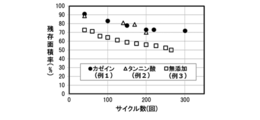
- 4 is a graph showing a change in a residual area ratio of a negative electrode according to a charge / discharge cycle of Examples 1 to 3.
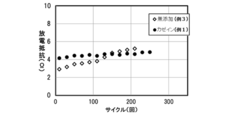
- 4 is a graph showing a change in discharge resistance according to a charge / discharge cycle of Examples 1 and 3.
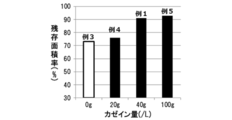
- 6 is a graph showing the remaining area ratio of the negative electrode when the number of charge / discharge cycles reaches 40 in Examples 1 and 3 to 5 of various amounts of casein added.
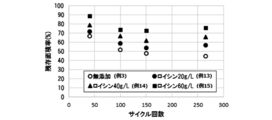
- 9 is a graph showing the change in the remaining area ratio of the negative electrode according to the charge / discharge cycles of Examples 3 and 13 to 15.
- the zinc secondary battery of the present invention includes a positive electrode, a negative electrode, a separator, and an electrolyte.
- the negative electrode includes at least one selected from the group consisting of metal Zn, ZnO, a Zn alloy, and a Zn compound.
- the separator separates the positive electrode and the negative electrode so that hydroxide ions can be conducted.
- the electrolyte contains an alkali metal hydroxide aqueous solution.
- the electrolytic solution further includes a protein capable of complexing with Zn and / or a derivative and / or degradation product thereof, or a polyphenol capable of complexing with Zn and / or a derivative and / or degradation product thereof.
- the zinc secondary battery of the present invention can be a nickel zinc secondary battery, a silver zinc oxide secondary battery, a manganese oxide zinc secondary battery, a zinc air secondary battery, and various other alkaline zinc secondary batteries.
- the positive electrode contains nickel hydroxide and / or nickel oxyhydroxide, whereby the zinc secondary battery forms a nickel zinc secondary battery.
- the positive electrode may be an air electrode, whereby the zinc secondary battery may form a zinc air secondary battery.
- the zinc material contained in the negative electrode is at least one selected from the group consisting of metallic zinc, zinc oxide, a zinc alloy and a zinc compound. That is, zinc may be contained in any form of metallic zinc, zinc oxide, a zinc alloy, and a zinc compound as long as it has electrochemical activity suitable for the negative electrode.
- Preferred examples of the negative electrode material include zinc oxide, metallic zinc, calcium zincate, and the like, and a mixture of metallic zinc and zinc oxide is more preferred.
- the negative electrode active material may be formed in a gel state, or may be mixed with an electrolytic solution to form a negative electrode mixture.
- a gelled negative electrode can be easily obtained by adding an electrolytic solution and a thickener to the negative electrode active material. Examples of the thickener include polyvinyl alcohol, polyacrylate, CMC, alginic acid, and the like. Polyacrylic acid is preferable because of its excellent chemical resistance to strong alkalis.
- a zinc alloy containing no mercury and lead which is known as a non-melting zinc alloy
- a zinc alloy containing 0.01 to 0.1% by mass of indium, 0.005 to 0.02% by mass of bismuth, and 0.0035 to 0.015% by mass of aluminum has an effect of suppressing hydrogen gas generation. It is preferred.
- indium and bismuth are advantageous in improving discharge performance.
- metal zinc doped with a small amount of indium and bismuth it is also preferable to use metal zinc doped with a small amount of indium and bismuth.
- the shape of the zinc material is not particularly limited, but is preferably in the form of a powder, whereby the surface area is increased and it is possible to cope with a large current discharge.
- the average particle diameter D50 of the preferred zinc material is 1 to 100 ⁇ m for metallic zinc powder and zinc alloy powder, and 0.1 to 5 ⁇ m for zinc oxide powder. When the content is within these ranges, the surface area is large, so that it is suitable for handling a large current discharge, and is easily mixed with the electrolytic solution and the gelling agent uniformly, and the handleability during battery assembly is good.
- the negative electrode preferably further contains a binder.
- a binder various known binders can be used. Preferred examples include polyvinyl alcohol (PVA) and polytetrafluoroethylene (PTFE). It is particularly preferred to use both PVA and PTFE as a binder in combination.
- the negative electrode is preferably a sheet-shaped press-formed body.
- a sheet-shaped press-formed body may be formed by adding a binder to a zinc material, kneading the resultant, and subjecting the obtained kneaded material to press forming such as a roll press to form a sheet.
- a current collector is provided on the negative electrode.
- Preferred examples of the current collector include a copper punched metal and a copper expanded metal.
- a mixture containing a zinc raw material powder and a binder for example, polytetrafluoroethylene particles
- a binder for example, polytetrafluoroethylene particles
- the above-described sheet-shaped press-formed body may be pressure-bonded to a current collector such as a copper expanded metal.
- the electrolytic solution contains an alkali metal hydroxide aqueous solution.
- alkali metal hydroxide examples include potassium hydroxide, sodium hydroxide, lithium hydroxide, ammonium hydroxide and the like, with potassium hydroxide being more preferred.
- a zinc compound such as zinc oxide or zinc hydroxide may be added to the electrolytic solution.
- the preferred KOH concentration is 3 to 10 mol / L, more preferably 4 to 9 mol / L, and still more preferably 5 to 8 mol / L.
- the electrolyte further includes a protein capable of complexing with Zn and / or a derivative and / or decomposed product thereof, or a polyphenol capable of complexing with Zn and / or a derivative and / or decomposed product thereof.
- the electrolyte solution may contain a protein capable of forming a complex with Zn, but a part or all of the protein may be present as a derivative and / or a degradation product (for example, a peptide or an amino acid).
- the electrolytic solution may contain a polyphenol capable of forming a complex with Zn, and a part or all of the polyphenol may be present as a derivative and / or a decomposition product of the polyphenol.
- the protein that can be added to the electrolytic solution is not particularly limited as long as it can form a complex with Zn.
- proteins include casein, gelatin and the like, with casein being particularly preferred. Proteins such as casein may form micelles in the electrolyte. Derivatives of proteins such as casein are not particularly limited as long as they have been modified to such an extent that the structure or properties of the protein are not significantly changed by the introduction or substitution of a functional group, oxidation, reduction, substitution of atoms, etc. For example, a sodium salt and a potassium salt are mentioned.
- Examples of degradation products of proteins such as casein include polypeptides, tripeptides, dipeptides, and amino acids such as glutamic acid, aspartic acid, leucine, isoleucine, histidine, methionine, glycine, proline, tyrosine, and lysine.
- examples of preferred amino acids include aspartic acid, methionine, glycine, leucine, and isoleucine, more preferably glycine, leucine, and isoleucine, particularly preferably leucine and isoleucine, and most preferably leucine. Is mentioned.
- the mechanism by which the cycle life becomes longer when the electrolyte contains an amino acid such as leucine is unclear, but i) the amino acid captures a Zn ion to form a complex, thereby suppressing the movement of the Zn ion, thereby reducing the negative electrode. That the macroscopic change in shape can be suppressed, and ii) the amino acid such as leucine is trapped on the surface of the negative electrode active material such as ZnO in addition to capturing the Zn ion to cause steric hindrance, thereby causing the microscopic change in the negative electrode. Can be suppressed more effectively.
- the total concentration of casein and its derivatives and decomposition products in the electrolytic solution is preferably 0.1 to 80 g / L, more preferably 1 to 70 g / L, still more preferably 5 to 60 g / L, Particularly preferably, it is 10 to 50 g / L, most preferably 20 to 50 g / L.
- casein or the like is contained in the electrolytic solution in such a concentration range, a change in the form of the negative electrode due to repetition of charge and discharge can be more effectively suppressed without impairing battery performance.
- the concentration of the amino acid (eg, leucine) in the electrolytic solution is preferably 0.1 to 80 g / L, more preferably 1 to 70 g / L, and still more preferably 5 to 60 g / L. L, particularly preferably 10 to 60 g / L, most preferably 20 to 60 g / L.
- the electrolytic solution containing an amino acid (for example, leucine) may not contain a protein (for example, casein), but may contain a protein (for example, casein).
- the polyphenol that can be added to the electrolytic solution is not particularly limited as long as it can form a complex with Zn.
- examples of such polyphenols include hydrolyzable (pyrogallol-type) tannins and condensed (catechol-type) tannins, preferably hydrolyzable (pyrogallol-type) tannins, more preferably hydrolysis Tannic acid, which is one of the type (pyrogallol type) tannins.
- Derivatives of polyphenols such as tannic acid are not particularly limited as long as they are compounds modified so as not to significantly change the structure and properties of the polyphenol by introducing or substituting a functional group, oxidizing, reducing, or substituting atoms.
- Examples of the tannic acid derivative include a compound having a molecular structure in which at least a part of a hydroxyl group contained in a tannic acid molecule is substituted with an alkyl ether group, an alkyl ester group, or the like.
- Examples of the decomposed product of tannic acid include a compound formed by hydrolyzing at least a part of an ester bond in a tannic acid molecule.
- the total concentration of tannic acid and its derivatives and decomposition products in the electrolytic solution is preferably 2 to 40 g / L, more preferably 5 to 30 g / L, and still more preferably 8 to 20 g / L.
- the separator is preferably a layered double hydroxide (LDH) separator. That is, as described above, LDH separators are known in the field of nickel zinc secondary batteries and air zinc secondary batteries (see Patent Documents 1 to 3), and this LDH separator is used as a zinc secondary battery of the present invention. Can also be preferably used.
- the LDH separator can prevent penetration of zinc dendrites while selectively transmitting hydroxide ions.
- the durability of the zinc secondary battery can be further improved in combination with the effect of adding substances such as proteins and polyphenols to the electrolytic solution of the present invention.
- the LDH separator may be a composite with a porous substrate as disclosed in Patent Documents 1 to 3.
- the porous substrate may be made of any of a ceramic material, a metal material, and a polymer material, but is particularly preferably made of a polymer material.
- Polymer porous substrates have the following features: 1) they have flexibility (thus, they are hard to crack even when they are thin); 2) they tend to increase porosity; and 3) they tend to increase conductivity (thickness while increasing porosity). 4) It is advantageous in that it is easy to manufacture and handle.
- Particularly preferred polymer materials are polyolefins such as polypropylene and polyethylene, and most preferably polypropylene, because they are excellent in hot water resistance, acid resistance and alkali resistance, and are low in cost.
- the porous substrate is composed of a polymer material
- the functional layer is incorporated over the entire region in the thickness direction of the porous substrate (for example, most or almost all pores inside the porous substrate are filled with LDH.
- the thickness of the polymer porous substrate is preferably 5 to 200 ⁇ m, more preferably 5 to 100 ⁇ m, and still more preferably 5 to 30 ⁇ m.
- a microporous membrane commercially available as a separator for a lithium battery can be preferably used.
- Example 1 Preparation of Positive Electrode A paste-type nickel hydroxide positive electrode (capacity density: about 700 mAh / cm 3 ) was prepared.
- Negative Electrode A zinc oxide powder (manufactured by Mitsui Mining & Smelting Co., Ltd., Bi) And In-doped, Bi: 1000 weight ppm, In: 1000 weight ppm, average particle diameter D50: 10 ⁇ m), 5.2 parts by weight, and polyvinyl alcohol (manufactured by Wako Pure Chemical Industries, Ltd.) as a binder having a solid content of 5.2 parts by weight. 1.26 parts by weight of a converted aqueous solution of polytetrafluoroethylene (PTFE) (manufactured by Daikin Industries, Ltd., solid content: 60%) was added in an amount of 0.02 parts by weight, and kneaded together with propylene glycol. The obtained kneaded material was rolled by a roll press to obtain a negative electrode active material sheet. The negative electrode active material sheet was pressed against a tin-plated copper expanded metal to obtain a negative electrode.
- PTFE polytetrafluoroethylene
- ⁇ Evaluation 1 Remaining area ratio of negative electrode> The remaining area ratio of the negative electrode was calculated based on a transmission image of a simple closed cell by X-rays. Specifically, using a three-dimensional measurement X-ray CT apparatus (TDW1300-IW / TDW1000-IW switching type, manufactured by Yamato Scientific Co., Ltd.), a transmission X-ray image of a simple sealed cell is obtained at a voltage of 80 kV and a current of 100 ⁇ A. did.
- TDW1300-IW / TDW1000-IW switching type manufactured by Yamato Scientific Co., Ltd.
- Example 2 A simple closed cell was prepared in the same manner as in Example 1 except that tannic acid (manufactured by Wako Pure Chemical Industries, Ltd.) was dissolved at a concentration of 10 g / L instead of casein in the preparation of the electrolytic solution of the above (3). Production and evaluation 1 were performed. The results were as shown in FIG.
- Example 3 (comparison) A simple closed cell was prepared and evaluations 1 and 2 were performed in the same manner as in Example 1 except that casein was not added in the preparation of the electrolytic solution of (3) above. In Evaluation 1, the change in the remaining area ratio of the negative electrode when the number of charge / discharge cycles was increased to 100, 150, and 265 was also examined. The results were as shown in FIGS.
- Example 4 A simple closed cell was prepared and evaluated in the same manner as in Example 1 except that casein was dissolved at a concentration of 20 g / L in the preparation of the electrolytic solution of (3) above. Evaluation 3 shown below was also performed. The results were as shown in FIG. 3 and Table 1.
- ⁇ Evaluation 3 Charge / discharge evaluation> Using a charging / discharging device (TOSCAT3100, manufactured by Toyo System Co., Ltd.), a simple closed cell was subjected to formation at 0.1 C charge and 0.2 C discharge. Thereafter, a 1C charge / discharge cycle was performed. The charge / discharge cycle was repeatedly performed under the same conditions, and the number of times of charge / discharge until the discharge capacity decreased to 70% of the discharge capacity in the first cycle of the prototype battery was recorded. Table 1 shows the relative values when the number of times of charge and discharge in Example 4 was 1.0, together with the evaluation results based on the following criteria.
- Evaluation A Number of times of charge / discharge (relative value to the number of times in Example 4) is 1.5 or more
- Evaluation B Number of times of charge / discharge (relative value to the number of times of Example 4) is 1.1 or more and less than 1.5
- Evaluation C Number of times of charge / discharge (Relative value to the number of times of Example 4) is less than 1.1
- Example 5 In the preparation of the electrolytic solution of the above (3), a simple closed cell was prepared and evaluation 1 was performed in the same manner as in Example 1, except that casein was dissolved to a concentration of 100 g / L. The results were as shown in FIG. As is clear from FIG. 3, it can be seen that the change in form of the negative electrode is effectively suppressed by the addition of casein.
- Examples 6 to 17 In the preparation of the electrolytic solution of the above (3), a simple closed cell was prepared and evaluation 3 was performed in the same manner as in Example 4, except that amino acids of the types and amounts shown in Table 1 were added instead of casein. In Examples 13 to 15, Evaluation 1 was performed in the same manner as in Example 3. The results were as shown in Table 1 and FIG. As can be seen from Table 1, in Examples 12 to 16 in which leucine was added to the electrolytic solution, the number of times of charge and discharge was significantly increased. In addition, as is apparent from FIG. 4, it can be seen that the addition of leucine effectively suppresses the change in the form of the negative electrode due to the repetition of charge and discharge.
Landscapes
- Chemical & Material Sciences (AREA)
- Chemical Kinetics & Catalysis (AREA)
- Electrochemistry (AREA)
- General Chemical & Material Sciences (AREA)
- Engineering & Computer Science (AREA)
- Manufacturing & Machinery (AREA)
- Secondary Cells (AREA)
- Battery Electrode And Active Subsutance (AREA)
- Cell Separators (AREA)
- Hybrid Cells (AREA)
Abstract
充放電の繰り返しに伴う負極の形態変化を抑制可能な、耐久性が向上された亜鉛二次電池が提供される。この亜鉛二次電池は、正極と、金属Zn、ZnO、Zn合金及びZn化合物からなる群から選択される少なくとも1種を含む負極と、正極と負極とを水酸化物イオン伝導可能に隔離するセパレータと、アルカリ金属水酸化物水溶液を含む電解液とを備える。電解液は、Znと錯形成可能なタンパク質並びに/又はその誘導体及び/若しくは分解物、又はZnと錯形成可能なポリフェノール並びに/又はその誘導体及び/若しくは分解物をさらに含む。
Description
本発明は、亜鉛二次電池に関するものである。
ニッケル亜鉛二次電池、空気亜鉛二次電池等の亜鉛二次電池では、充電時に負極から金属亜鉛がデンドライト状に析出し、不織布等のセパレータの空隙を貫通して正極に到達し、その結果、短絡を引き起こすことが知られている。このような亜鉛デンドライトに起因する短絡は繰り返し充放電寿命の短縮を招く。
上記問題に対処すべく、水酸化物イオンを選択的に透過させながら、亜鉛デンドライトの貫通を阻止する、層状複水酸化物(LDH)セパレータを備えた電池が提案されている。例えば、特許文献1(国際公開第2013/118561号)には、ニッケル亜鉛二次電池においてLDHセパレータを正極及び負極間に設けることが開示されている。また、特許文献2(国際公開第2016/076047号)には、樹脂製外枠に嵌合又は接合されたLDHセパレータを備えたセパレータ構造体が開示されており、LDHセパレータがガス不透過性及び/又は水不透過性を有する程の高い緻密性を有することが開示されている。また、この文献にはLDHセパレータが多孔質基材と複合化されうることも開示されている。さらに、特許文献3(国際公開第2016/067884号)には多孔質基材の表面にLDH緻密膜を形成して複合材料を得るための様々な方法が開示されている。この方法は、多孔質基材にLDHの結晶成長の起点を与えうる起点物質を均一に付着させ、原料水溶液中で多孔質基材に水熱処理を施してLDH緻密膜を多孔質基材の表面に形成させる工程を含むものである。
ところで、亜鉛二次電池の短寿命化を招く別の要因として、負極活物質である亜鉛の形態変化が挙げられる。すなわち、充放電の繰り返しにより亜鉛が溶解及び析出を繰り返すにつれて、負極が形態変化して、気孔の閉塞、亜鉛の孤立化等を生じ、その結果、高抵抗化して充放電が困難になるとの問題がある。この問題に対して様々な検討がなされてきたが、具体的な解決策は見出されていなかった。
本発明者らは、今般、亜鉛二次電池において、Znと錯形成可能なタンパク質やポリフェノール等の物質を電解液に添加することにより、充放電の繰り返しに伴う負極の形態変化を抑制して耐久性を向上できるとの知見を得た。
したがって、本発明の目的は、充放電の繰り返しに伴う負極の形態変化を抑制可能な、耐久性が向上された亜鉛二次電池を提供することにある。
本発明の一態様によれば、正極と、
金属Zn、ZnO、Zn合金及びZn化合物からなる群から選択される少なくとも1種を含む負極と、
前記正極と前記負極とを水酸化物イオン伝導可能に隔離するセパレータと、
アルカリ金属水酸化物水溶液を含む電解液と、
を備え、前記電解液が、Znと錯形成可能なタンパク質並びに/又はその誘導体及び/若しくは分解物、又はZnと錯形成可能なポリフェノール並びに/又はその誘導体及び/若しくは分解物をさらに含む、亜鉛二次電池が提供される。
金属Zn、ZnO、Zn合金及びZn化合物からなる群から選択される少なくとも1種を含む負極と、
前記正極と前記負極とを水酸化物イオン伝導可能に隔離するセパレータと、
アルカリ金属水酸化物水溶液を含む電解液と、
を備え、前記電解液が、Znと錯形成可能なタンパク質並びに/又はその誘導体及び/若しくは分解物、又はZnと錯形成可能なポリフェノール並びに/又はその誘導体及び/若しくは分解物をさらに含む、亜鉛二次電池が提供される。
亜鉛二次電池
本発明の亜鉛二次電池は、正極と、負極と、セパレータと、電解液とを備える。負極は、金属Zn、ZnO、Zn合金及びZn化合物からなる群から選択される少なくとも1種を含む。セパレータは、正極と負極とを水酸化物イオン伝導可能に隔離する。電解液は、アルカリ金属水酸化物水溶液を含む。そして、電解液は、Znと錯形成可能なタンパク質並びに/又はその誘導体及び/若しくは分解物、又はZnと錯形成可能なポリフェノール並びに/又はその誘導体及び/若しくは分解物をさらに含む。このように、電解液にZnと錯形成可能なタンパク質やポリフェノール等の物質を添加することにより、充放電の繰り返しに伴う負極の形態変化を抑制して耐久性を向上することができる。負極の形態変化が抑制される理由は明らかではないが、Znと錯形成可能なタンパク質やポリフェノール等の物質が活物質粒子近傍の電解液中に存在することで、亜鉛酸イオンの動きが制御ないし抑制されて、Znの析出が均一化されるものと考えられる。すなわち、亜鉛酸イオンの局所的な集中及びそれによるZnの局所的ないし不均一な析出を抑制して、負極の形態変化の過度な進行を阻止することができる。
本発明の亜鉛二次電池は、正極と、負極と、セパレータと、電解液とを備える。負極は、金属Zn、ZnO、Zn合金及びZn化合物からなる群から選択される少なくとも1種を含む。セパレータは、正極と負極とを水酸化物イオン伝導可能に隔離する。電解液は、アルカリ金属水酸化物水溶液を含む。そして、電解液は、Znと錯形成可能なタンパク質並びに/又はその誘導体及び/若しくは分解物、又はZnと錯形成可能なポリフェノール並びに/又はその誘導体及び/若しくは分解物をさらに含む。このように、電解液にZnと錯形成可能なタンパク質やポリフェノール等の物質を添加することにより、充放電の繰り返しに伴う負極の形態変化を抑制して耐久性を向上することができる。負極の形態変化が抑制される理由は明らかではないが、Znと錯形成可能なタンパク質やポリフェノール等の物質が活物質粒子近傍の電解液中に存在することで、亜鉛酸イオンの動きが制御ないし抑制されて、Znの析出が均一化されるものと考えられる。すなわち、亜鉛酸イオンの局所的な集中及びそれによるZnの局所的ないし不均一な析出を抑制して、負極の形態変化の過度な進行を阻止することができる。
本発明の亜鉛二次電池は、ニッケル亜鉛二次電池、酸化銀亜鉛二次電池、酸化マンガン亜鉛二次電池、亜鉛空気二次電池、その他各種のアルカリ亜鉛二次電池であることができる。例えば、正極が水酸化ニッケル及び/又はオキシ水酸化ニッケルを含み、それにより亜鉛二次電池がニッケル亜鉛二次電池をなすのが好ましい。あるいは、正極が空気極であり、それにより亜鉛二次電池が亜鉛空気二次電池をなしてもよい。
負極に含まれる亜鉛材料は、金属亜鉛、酸化亜鉛、亜鉛合金及び亜鉛化合物からなる群から選択される少なくとも1種である。すなわち、亜鉛は、負極に適した電気化学的活性を有するものであれば、金属亜鉛、酸化亜鉛、亜鉛合金及び亜鉛化合物のいずれの形態で含まれていてもよい。負極材料の好ましい例としては、酸化亜鉛、金属亜鉛、亜鉛酸カルシウム等が挙げられるが、金属亜鉛及び酸化亜鉛の混合物がより好ましい。負極活物質はゲル状に構成してもよいし、電解液と混合して負極合材としてもよい。例えば、負極活物質に電解液及び増粘剤を添加することにより容易にゲル化した負極を得ることができる。増粘剤の例としては、ポリビニルアルコール、ポリアクリル酸塩、CMC、アルギン酸等が挙げられるが、ポリアクリル酸が強アルカリに対する耐薬品性に優れているため好ましい。
亜鉛合金として、無汞化亜鉛合金として知られている水銀及び鉛を含まない亜鉛合金を用いることができる。例えば、インジウムを0.01~0.1質量%、ビスマスを0.005~0.02質量%、アルミニウムを0.0035~0.015質量%を含む亜鉛合金が水素ガス発生の抑制効果があるので好ましい。とりわけ、インジウムやビスマスは放電性能を向上させる点で有利である。亜鉛合金の負極への使用は、アルカリ性電解液中での自己溶解速度を遅くすることで、水素ガス発生を抑制して安全性を向上できる。同様の理由から、インジウム及びビスマスが微量ドープされた金属亜鉛を用いるのも好ましい。
亜鉛材料の形状は特に限定されないが、粉末状とすることが好ましく、それにより表面積が増大して大電流放電に対応可能となる。好ましい亜鉛材料の平均粒径D50は、金属亜鉛粉末及び亜鉛合金粉末の場合、1~100μmであり、酸化亜鉛粉末の場合、0.1~5μmである。これらの範囲内であると表面積が大きいことから大電流放電への対応に適するとともに、電解液及びゲル化剤と均一に混合しやすく、電池組み立て時の取り扱い性も良い。
負極はバインダーをさらに含むのが好ましい。負極がバインダーを含むことで、負極形状を保持しやすくなる。バインダーは公知の様々なバインダーが使用可能であるが、好ましい例としては、ポリビニルアルコール(PVA)、ポリテトラフルオロエチレン(PTFE)が挙げられる。PVA及びPTFEの両方を組み合わせてバインダーとして用いるのが特に好ましい。
負極はシート状のプレス成形体であるのが好ましい。こうすることで、電極活物質の脱落防止や電極密度の向上を図ることができ、負極の形態変化をより効果的に抑制することができる。かかるシート状のプレス成形体の作製は、亜鉛材料にバインダーを加えて混練し、得られた混練物にロールプレス等のプレス成形を施してシート状に成形すればよい。
負極には集電体が設けられるのが好ましい。集電体の好ましい例としては、銅パンチングメタルや銅エキスパンドメタルが挙げられる。この場合、例えば、銅パンチングメタルや銅エキスパンドメタル上に、亜鉛原料粉末及び所望によりバインダー(例えばポリテトラフルオロエチレン粒子)を含む混合物を塗布して負極/負極集電体からなる負極板を好ましく作製することができる。その際、乾燥後の負極板(すなわち負極/負極集電体)にプレス処理を施して、電極活物質の脱落防止や電極密度の向上を図ることも好ましい。あるいは、上述したようなシート状のプレス成形体を銅エキスパンドメタル等の集電体に圧着してもよい。
電解液は、アルカリ金属水酸化物水溶液を含む。アルカリ金属水酸化物の例としては、水酸化カリウム、水酸化ナトリウム、水酸化リチウム、水酸化アンモニウム等が挙げられるが、水酸化カリウムがより好ましい。亜鉛合金の自己溶解を抑制するために、電解液中に酸化亜鉛、水酸化亜鉛等の亜鉛化合物を添加してもよい。水酸化カリウム水溶液の場合、好ましいKOH濃度は3~10mol/Lであり、より好ましくは4~9mol/L、さらに好ましくは5~8mol/Lである。
電解液は、Znと錯形成可能なタンパク質並びに/又はその誘導体及び/若しくは分解物、又はZnと錯形成可能なポリフェノール並びに/又はその誘導体及び/若しくは分解物をさらに含む。すなわち、電解液は、Znと錯形成可能なタンパク質を含みうるが、タンパク質の一部又は全部がその誘導体及び/又は分解物(例えばペプチドやアミノ酸)として存在しうる。あるいは、電解液は、Znと錯形成可能なポリフェノールを含みうるが、その一部又は全部がポリフェノールの誘導体及び/又は分解物として存在しうる。
電解液に添加されうるタンパク質は、Znと錯形成可能なものであれば特に限定されない。そのようなタンパク質の例としては、カゼイン、ゼラチン等が挙げられ、特に好ましくはカゼインである。カゼイン等のタンパク質は電解液中でミセルを形成していてもよい。カゼイン等のタンパク質の誘導体は、官能基の導入ないし置換、酸化、還元、原子の置換等により、タンパク質の構造や性質を大幅に変えない程度の改変がなされた化合物であれば特に限定されず、例えば、ナトリウム塩やカリウム塩が挙げられる。カゼイン等のタンパク質の分解物の例としては、ポリペプチド、トリペプチド、ジペプチド、並びにグルタミン酸、アスパラギン酸、ロイシン、イソロイシン、ヒスチジン、メチオニン、グリシン、プロリン、チロシン、リシン等のアミノ酸が挙げられる。サイクル寿命を長くする観点から、好ましいアミノ酸の例としては、アスパラギン酸、メチオニン、グリシン、ロイシン、イソロイシンが挙げられ、より好ましくはグリシン、ロイシン、及びイソロイシン、特に好ましくはロイシン及びイソロイシン、最も好ましくはロイシンが挙げられる。電解液がロイシン等のアミノ酸を含むとサイクル寿命が長くなるメカニズムは定かではないが、i)アミノ酸がZnイオンを捕獲して錯体を形成することでZnイオンの移動を抑制し、それにより負極のマクロな形態変化を抑制しうること、及びii)ロイシン等のアミノ酸が上記Znイオンの捕獲に加え、ZnO等の負極活物質表面に吸着されて立体障害をもたらすことで、負極のミクロな形態変化をより効果的に抑制しうることが考えられる。
電解液がカゼインを含む場合、電解液におけるカゼイン並びにその誘導体及び分解物の合計濃度は好ましくは0.1~80g/L、より好ましくは1~70g/L、さらに好ましくは5~60g/L、特に好ましくは10~50g/L、最も好ましくは20~50g/Lである。このような濃度範囲でカゼイン等が電解液に含まれることで、電池性能を損なうことなく、充放電の繰り返しに伴う負極の形態変化をより効果的に抑制することができる。
電解液がアミノ酸(例えばロイシン)を含む場合、電解液におけるアミノ酸(例えばロイシン)の濃度は、好ましくは0.1~80g/L、より好ましくは1~70g/L、さらに好ましくは5~60g/L、特に好ましくは10~60g/L、最も好ましくは20~60g/Lである。この場合、アミノ酸(例えばロイシン)を含む電解液はタンパク質(例えばカゼイン)を含まないものであることができるが、タンパク質(例えばカゼイン)を含むものであってもよい。
電解液に添加されうるポリフェノールは、Znと錯形成可能なものであれば特に限定されない。そのようなポリフェノールの例としては、加水分解型(ピロガロール型)タンニン類及び縮合型(カテコール系)タンニン類が挙げられ、好ましくは加水分解型(ピロガロール型)タンニン類であり、さらに好ましくは加水分解型(ピロガロール型)タンニン類の一つであるタンニン酸である。タンニン酸等のポリフェノールの誘導体は、官能基の導入ないし置換、酸化、還元、原子の置換等により、ポリフェノールの構造や性質を大幅に変えない程度の改変がなされた化合物であれば特に限定されない。タンニン酸の誘導体の例としては、タンニン酸分子中に含まれるヒドロキシル基の少なくとも一部がアルキルエーテル基又はアルキルエステル基等で置換された分子構造を有する化合物等が挙げられる。タンニン酸の分解物の例としては、タンニン酸分子中のエステル結合の少なくとも一部が加水分解されて生成された化合物等が挙げられる。電解液におけるタンニン酸並びにその誘導体及び分解物の合計濃度は好ましくは2~40g/L、より好ましくは5~30g/L、さらに好ましくは8~20g/Lである。このような範囲でタンニン酸等が電解液に含まれることで、電池性能を損なうことなく、充放電の繰り返しに伴う負極の形態変化をより効果的に抑制することができる。
セパレータは層状複水酸化物(LDH)セパレータであるのが好ましい。すなわち、前述したように、ニッケル亜鉛二次電池や空気亜鉛二次電池の分野において、LDHセパレータが知られており(特許文献1~3を参照)、このLDHセパレータを本発明の亜鉛二次電池にも好ましく使用することができる。LDHセパレータは、水酸化物イオンを選択的に透過させながら、亜鉛デンドライトの貫通を阻止することができる。本発明の電解液におけるタンパク質やポリフェノール等の物質の添加効果と相まって、亜鉛二次電池の耐久性をより一層向上することができる。
LDHセパレータは、特許文献1~3に開示されるように多孔質基材と複合化されたものであってもよい。多孔質基材はセラミックス材料、金属材料、及び高分子材料のいずれで構成されてもよいが、高分子材料で構成されるのが特に好ましい。高分子多孔質基材には、1)フレキシブル性を有する(それ故薄くしても割れにくい)、2)気孔率を高くしやすい、3)伝導率を高くしやすい(気孔率を高めながら厚さを薄くできるため)、4)製造及びハンドリングしやすいといった利点がある。特に好ましい高分子材料は、耐熱水性、耐酸性及び耐アルカリ性に優れ、しかも低コストである点から、ポリプロピレン、ポリエチレン等のポリオレフィンであり、最も好ましくはポリプロピレンである。多孔質基材が高分子材料で構成される場合、機能層が多孔質基材の厚さ方向の全域にわたって組み込まれている(例えば多孔質基材内部の大半又はほぼ全部の孔がLDHで埋まっている)のが特に好ましい。この場合における高分子多孔質基材の好ましい厚さは、5~200μmであり、より好ましくは5~100μm、さらに好ましくは5~30μmである。このような高分子多孔質基材として、リチウム電池用セパレータとして市販されているような微多孔膜を好ましく用いることができる。
本発明を以下の例によってさらに具体的に説明する。
例1
(1)正極の用意
ペースト式水酸化ニッケル正極(容量密度:約700mAh/cm3)を用意した。
(1)正極の用意
ペースト式水酸化ニッケル正極(容量密度:約700mAh/cm3)を用意した。
(2)負極の作製
酸化亜鉛粉末(正同化学工業株式会社製、JIS規格1種グレード、平均粒径D50:0.2μm)100重量部に、金属亜鉛粉末(三井金属鉱業株式会社製、Bi及びInがドープされたもの、Bi:1000重量ppm、In:1000重量ppm、平均粒径D50:10μm)を5.2重量部、バインダーとしてポリビニルアルコール(和光純薬工業株式会社製)を固形分換算で0.02重量部、ポリテトラフルオロエチレン(PTFE)分散水溶液(ダイキン工業株式会社製、固形分60%)を固形分換算で1.26重量部添加し、プロピレングリコールと共に混練した。得られた混練物をロールプレスで圧延して、負極活物質シートを得た。負極活物質シートを、錫メッキが施された銅エキスパンドメタルに圧着して、負極を得た。
酸化亜鉛粉末(正同化学工業株式会社製、JIS規格1種グレード、平均粒径D50:0.2μm)100重量部に、金属亜鉛粉末(三井金属鉱業株式会社製、Bi及びInがドープされたもの、Bi:1000重量ppm、In:1000重量ppm、平均粒径D50:10μm)を5.2重量部、バインダーとしてポリビニルアルコール(和光純薬工業株式会社製)を固形分換算で0.02重量部、ポリテトラフルオロエチレン(PTFE)分散水溶液(ダイキン工業株式会社製、固形分60%)を固形分換算で1.26重量部添加し、プロピレングリコールと共に混練した。得られた混練物をロールプレスで圧延して、負極活物質シートを得た。負極活物質シートを、錫メッキが施された銅エキスパンドメタルに圧着して、負極を得た。
(3)電解液の作製
48%水酸化カリウム水溶液(関東化学株式会社製、特級)にイオン交換水を加えてKOH濃度を5.4mol%に調整した後、カゼイン(和光純薬工業株式会社製)を40g/Lの濃度となるように溶解させて、電解液を得た。
48%水酸化カリウム水溶液(関東化学株式会社製、特級)にイオン交換水を加えてKOH濃度を5.4mol%に調整した後、カゼイン(和光純薬工業株式会社製)を40g/Lの濃度となるように溶解させて、電解液を得た。
(4)評価セルの作製
正極と負極の各々を不織布で包むとともに、電流取り出し端子を溶接した。こうして準備された正極及び負極を、LDHセパレータを介して対向させ、電流取り出し口が設けられたラミネートフィルムに挟んで、ラミネートフィルムの3辺を熱融着した。こうして得られた上部開放されたセル容器に電解液を加え、真空引き等により電解液を十分に正極及び負極に浸透させた。その後、ラミネートフィルムの残りの1辺も熱融着して、簡易密閉セルとした。
正極と負極の各々を不織布で包むとともに、電流取り出し端子を溶接した。こうして準備された正極及び負極を、LDHセパレータを介して対向させ、電流取り出し口が設けられたラミネートフィルムに挟んで、ラミネートフィルムの3辺を熱融着した。こうして得られた上部開放されたセル容器に電解液を加え、真空引き等により電解液を十分に正極及び負極に浸透させた。その後、ラミネートフィルムの残りの1辺も熱融着して、簡易密閉セルとした。
(5)評価
充放電装置(東洋システム株式会社製、TOSCAT3100)を用いて、簡易密閉セルに対し、0.1C充電及び0.2C放電で化成を実施した。その後、1C充放電サイクルを繰り返し実施し、以下に示される評価1及び2を行った。
充放電装置(東洋システム株式会社製、TOSCAT3100)を用いて、簡易密閉セルに対し、0.1C充電及び0.2C放電で化成を実施した。その後、1C充放電サイクルを繰り返し実施し、以下に示される評価1及び2を行った。
<評価1:負極の残存面積率>
負極の残存面積率を、X線による簡易密閉セルの透過像に基づき算出した。具体的には、三次元計測X線CT装置(ヤマト科学株式会社製、TDW1300-IW/TDW1000-IW切替式)を用いて、電圧80kV、電流100μAにて簡易密閉セルの透過X線像を取得した。得られた透過像を縦20マス×横20マスの400マスに分割し、負極活物質がマス内全面に存在するマスの総数をA、マス内に全く存在しないマスの総数をB、A及びB以外のマスの総数をCとして以下の式:
残存面積率(%)=[(A+0.5×C)/400]×100
に基づき負極の残存面積率(%)を算出した。得られた負極の残存面積率のサイクル数に応じた変化は図1に示されるとおりであった。また、サイクル数が40回に達した時点における負極の残存面積率を図3に棒グラフとして示した。
負極の残存面積率を、X線による簡易密閉セルの透過像に基づき算出した。具体的には、三次元計測X線CT装置(ヤマト科学株式会社製、TDW1300-IW/TDW1000-IW切替式)を用いて、電圧80kV、電流100μAにて簡易密閉セルの透過X線像を取得した。得られた透過像を縦20マス×横20マスの400マスに分割し、負極活物質がマス内全面に存在するマスの総数をA、マス内に全く存在しないマスの総数をB、A及びB以外のマスの総数をCとして以下の式:
残存面積率(%)=[(A+0.5×C)/400]×100
に基づき負極の残存面積率(%)を算出した。得られた負極の残存面積率のサイクル数に応じた変化は図1に示されるとおりであった。また、サイクル数が40回に達した時点における負極の残存面積率を図3に棒グラフとして示した。
<評価2:放電抵抗>
各サイクルの放電抵抗を、放電開始から3分後の電流値及び電圧値から算出した。結果は図2に示されるとおりであった。
各サイクルの放電抵抗を、放電開始から3分後の電流値及び電圧値から算出した。結果は図2に示されるとおりであった。
例2
上記(3)の電解液の作製においてカゼインの代わりにタンニン酸(和光純薬工業株式会社製)を10g/Lとなるように溶解させたこと以外は、例1と同様にして簡易密閉セルの作製及び評価1を行った。結果は図1に示されるとおりであった。
上記(3)の電解液の作製においてカゼインの代わりにタンニン酸(和光純薬工業株式会社製)を10g/Lとなるように溶解させたこと以外は、例1と同様にして簡易密閉セルの作製及び評価1を行った。結果は図1に示されるとおりであった。
例3(比較)
上記(3)の電解液の作製においてカゼインを添加しなかったこと以外は、例1と同様にして簡易密閉セルの作製及び評価1及び2を行った。なお、評価1においては充放電サイクル数を100回、150回、265回と増やした際における負極の残存面積率変化についても併せて調べた。結果は図1~4に示されるとおりであった。
上記(3)の電解液の作製においてカゼインを添加しなかったこと以外は、例1と同様にして簡易密閉セルの作製及び評価1及び2を行った。なお、評価1においては充放電サイクル数を100回、150回、265回と増やした際における負極の残存面積率変化についても併せて調べた。結果は図1~4に示されるとおりであった。
例4
上記(3)の電解液の作製において、カゼインを20g/Lの濃度となるように溶解させたこと以外は、例1と同様にして簡易密閉セルの作製及び評価1を行った。また、以下に示される評価3も行った。結果は図3及び表1に示されるとおりであった。
上記(3)の電解液の作製において、カゼインを20g/Lの濃度となるように溶解させたこと以外は、例1と同様にして簡易密閉セルの作製及び評価1を行った。また、以下に示される評価3も行った。結果は図3及び表1に示されるとおりであった。
<評価3:充放電評価>
充放電装置(東洋システム株式会社製、TOSCAT3100)を用いて、簡易密閉セルに対し、0.1C充電及び0.2C放電で化成を実施した。その後、1C充放電サイクルを実施した。同一条件で繰り返し充放電サイクルを実施し、試作電池の1サイクル目の放電容量の70%まで放電容量が低下するまでの充放電回数を記録した。例4の充放電回数を1.0とした場合の相対値として、下記基準に基づく評価結果とともに表1に示す。
<評価基準>
評価A:充放電回数(例4の回数に対する相対値)が1.5以上
評価B:充放電回数(例4の回数に対する相対値)が1.1以上1.5未満
評価C:充放電回数(例4の回数に対する相対値)が1.1未満
充放電装置(東洋システム株式会社製、TOSCAT3100)を用いて、簡易密閉セルに対し、0.1C充電及び0.2C放電で化成を実施した。その後、1C充放電サイクルを実施した。同一条件で繰り返し充放電サイクルを実施し、試作電池の1サイクル目の放電容量の70%まで放電容量が低下するまでの充放電回数を記録した。例4の充放電回数を1.0とした場合の相対値として、下記基準に基づく評価結果とともに表1に示す。
<評価基準>
評価A:充放電回数(例4の回数に対する相対値)が1.5以上
評価B:充放電回数(例4の回数に対する相対値)が1.1以上1.5未満
評価C:充放電回数(例4の回数に対する相対値)が1.1未満
例5
上記(3)の電解液の作製において、カゼインを100g/Lの濃度となるように溶解させたこと以外は、例1と同様にして簡易密閉セルの作製及び評価1を行った。結果は図3に示されるとおりであった。図3から明らかなように、カゼインの添加により負極の形態変化が効果的に抑制されることが分かる。
上記(3)の電解液の作製において、カゼインを100g/Lの濃度となるように溶解させたこと以外は、例1と同様にして簡易密閉セルの作製及び評価1を行った。結果は図3に示されるとおりであった。図3から明らかなように、カゼインの添加により負極の形態変化が効果的に抑制されることが分かる。
例6~17
上記(3)の電解液の作製において、カゼインの代わりに表1に示される種類及び量のアミノ酸を加えたこと以外は、例4と同様にして簡易密閉セルの作製及び評価3を行った。また、例13~15では、例3と同様にして評価1を行った。結果は表1及び図4に示されるとおりであった。表1から分かるように、電解液にロイシンを添加した例12~16においては、充放電回数が顕著に増加した。また、図4から明らかなように、ロイシンの添加により、充放電の繰り返しに伴う負極の形態変化が効果的に抑制されることが分かる。
上記(3)の電解液の作製において、カゼインの代わりに表1に示される種類及び量のアミノ酸を加えたこと以外は、例4と同様にして簡易密閉セルの作製及び評価3を行った。また、例13~15では、例3と同様にして評価1を行った。結果は表1及び図4に示されるとおりであった。表1から分かるように、電解液にロイシンを添加した例12~16においては、充放電回数が顕著に増加した。また、図4から明らかなように、ロイシンの添加により、充放電の繰り返しに伴う負極の形態変化が効果的に抑制されることが分かる。

Claims (13)
- 正極と、
金属Zn、ZnO、Zn合金及びZn化合物からなる群から選択される少なくとも1種を含む負極と、
前記正極と前記負極とを水酸化物イオン伝導可能に隔離するセパレータと、
アルカリ金属水酸化物水溶液を含む電解液と、
を備え、前記電解液が、Znと錯形成可能なタンパク質並びに/又はその誘導体及び/若しくは分解物、又はZnと錯形成可能なポリフェノール並びに/又はその誘導体及び/若しくは分解物をさらに含む、亜鉛二次電池。 - 前記Znと錯形成可能なタンパク質がカゼインである、請求項1に記載の亜鉛二次電池。
- 前記電解液における前記カゼイン並びにその誘導体及び分解物の合計濃度が0.1~80g/Lである、請求項2に記載の亜鉛二次電池。
- 前記Znと錯形成可能なタンパク質の分解物がロイシンである、請求項1に記載の亜鉛二次電池。
- 前記電解液における前記ロイシンの濃度が0.1~80g/Lである、請求項4に記載の亜鉛二次電池。
- 前記Znと錯形成可能なポリフェノールがタンニン酸である、請求項1に記載の亜鉛二次電池。
- 前記電解液における前記タンニン酸並びにその誘導体及び分解物の合計濃度が2~40g/Lである、請求項6に記載の亜鉛二次電池。
- 前記負極がシート状のプレス成形体である、請求項1~7のいずれか一項に記載の亜鉛二次電池。
- 前記負極がバインダーをさらに含む、請求項1~8のいずれか一項に記載の亜鉛二次電池。
- 前記セパレータが層状複水酸化物(LDH)セパレータである、請求項1~9のいずれか一項に記載の亜鉛二次電池。
- 前記LDHセパレータが多孔質基材と複合化されている、請求項10に記載の亜鉛二次電池。
- 前記正極が水酸化ニッケル及び/又はオキシ水酸化ニッケルを含み、それにより前記亜鉛二次電池がニッケル亜鉛二次電池をなす、請求項1~11のいずれか一項に記載の亜鉛二次電池。
- 前記正極が空気極であり、それにより前記亜鉛二次電池が亜鉛空気二次電池をなす、請求項1~11のいずれか一項に記載の亜鉛二次電池。
Priority Applications (1)
| Application Number | Priority Date | Filing Date | Title |
|---|---|---|---|
| JP2020541060A JP6955111B2 (ja) | 2018-09-03 | 2019-07-30 | 亜鉛二次電池 |
Applications Claiming Priority (2)
| Application Number | Priority Date | Filing Date | Title |
|---|---|---|---|
| JP2018164509 | 2018-09-03 | ||
| JP2018-164509 | 2018-09-03 |
Publications (1)
| Publication Number | Publication Date |
|---|---|
| WO2020049901A1 true WO2020049901A1 (ja) | 2020-03-12 |
Family
ID=69723116
Family Applications (1)
| Application Number | Title | Priority Date | Filing Date |
|---|---|---|---|
| PCT/JP2019/029881 Ceased WO2020049901A1 (ja) | 2018-09-03 | 2019-07-30 | 亜鉛二次電池 |
Country Status (2)
| Country | Link |
|---|---|
| JP (1) | JP6955111B2 (ja) |
| WO (1) | WO2020049901A1 (ja) |
Cited By (12)
| Publication number | Priority date | Publication date | Assignee | Title |
|---|---|---|---|---|
| CN112563446A (zh) * | 2020-11-22 | 2021-03-26 | 扬州大学 | 具有生物聚合物涂层的电极及其制备方法 |
| CN112635860A (zh) * | 2021-01-08 | 2021-04-09 | 浙江大学 | 一种水系锌离子电池电解液添加剂 |
| CN113314773A (zh) * | 2021-05-12 | 2021-08-27 | 江苏师范大学 | 一种水系锌离子电池电解质及其制备方法和应用 |
| JP2021158028A (ja) * | 2020-03-27 | 2021-10-07 | 日本碍子株式会社 | 亜鉛二次電池 |
| CN113690397A (zh) * | 2021-08-19 | 2021-11-23 | 国家纳米科学中心 | 一种锌负极极片及其制备方法和应用 |
| CN114597513A (zh) * | 2020-12-07 | 2022-06-07 | 中国科学院大连化学物理研究所 | 一种电解液及其应用 |
| JPWO2022118610A1 (ja) * | 2020-12-03 | 2022-06-09 | ||
| JPWO2022118625A1 (ja) * | 2020-12-03 | 2022-06-09 | ||
| JPWO2022201638A1 (ja) * | 2021-03-26 | 2022-09-29 | ||
| CN118231798A (zh) * | 2024-05-21 | 2024-06-21 | 河南师范大学 | 一种水系锌离子电池电解液的制备方法及应用 |
| WO2024180596A1 (ja) * | 2023-02-27 | 2024-09-06 | 国立大学法人東北大学 | 亜鉛負極電池 |
| CN119447511A (zh) * | 2024-11-06 | 2025-02-14 | 南京大学 | 包含多重阳离子的电解液、水系锌离子电池及制备方法 |
Citations (9)
| Publication number | Priority date | Publication date | Assignee | Title |
|---|---|---|---|---|
| US4258110A (en) * | 1973-11-09 | 1981-03-24 | Alvarez Mario Y | Electrolytic device |
| JPH10228922A (ja) * | 1996-12-13 | 1998-08-25 | Akiya Ozawa | 二次電池、二次電池用添加剤および鉛蓄電池の製造法 |
| WO2007065089A2 (en) * | 2005-11-30 | 2007-06-07 | Rovcal, Inc. | Ionically conductive clay additive for use in electrochemical cells |
| WO2007065086A2 (en) * | 2005-11-30 | 2007-06-07 | Rovcal, Inc. | Electrochemical cells having improved gelling agents |
| JP2015036376A (ja) * | 2013-08-14 | 2015-02-23 | 森永乳業株式会社 | 血中トリグリセライド低下剤 |
| WO2016084557A1 (ja) * | 2014-11-25 | 2016-06-02 | 日本碍子株式会社 | 水酸化物イオン伝導性セラミックスセパレータを用いた二次電池 |
| WO2017070340A1 (en) * | 2015-10-21 | 2017-04-27 | Research Foundation Of The City University Of New York | Additive for increasing lifespan of rechargeable zinc-anode batteries |
| JP2018029045A (ja) * | 2016-08-19 | 2018-02-22 | 日本碍子株式会社 | 電極、電極集合体及びニッケル亜鉛電池 |
| WO2019095075A1 (en) * | 2017-11-17 | 2019-05-23 | Salient Energy Inc. | Secondary electrochemical cell having a zinc metal negative electrode and mild aqueous electrolyte and methods thereof |
-
2019
- 2019-07-30 WO PCT/JP2019/029881 patent/WO2020049901A1/ja not_active Ceased
- 2019-07-30 JP JP2020541060A patent/JP6955111B2/ja active Active
Patent Citations (9)
| Publication number | Priority date | Publication date | Assignee | Title |
|---|---|---|---|---|
| US4258110A (en) * | 1973-11-09 | 1981-03-24 | Alvarez Mario Y | Electrolytic device |
| JPH10228922A (ja) * | 1996-12-13 | 1998-08-25 | Akiya Ozawa | 二次電池、二次電池用添加剤および鉛蓄電池の製造法 |
| WO2007065089A2 (en) * | 2005-11-30 | 2007-06-07 | Rovcal, Inc. | Ionically conductive clay additive for use in electrochemical cells |
| WO2007065086A2 (en) * | 2005-11-30 | 2007-06-07 | Rovcal, Inc. | Electrochemical cells having improved gelling agents |
| JP2015036376A (ja) * | 2013-08-14 | 2015-02-23 | 森永乳業株式会社 | 血中トリグリセライド低下剤 |
| WO2016084557A1 (ja) * | 2014-11-25 | 2016-06-02 | 日本碍子株式会社 | 水酸化物イオン伝導性セラミックスセパレータを用いた二次電池 |
| WO2017070340A1 (en) * | 2015-10-21 | 2017-04-27 | Research Foundation Of The City University Of New York | Additive for increasing lifespan of rechargeable zinc-anode batteries |
| JP2018029045A (ja) * | 2016-08-19 | 2018-02-22 | 日本碍子株式会社 | 電極、電極集合体及びニッケル亜鉛電池 |
| WO2019095075A1 (en) * | 2017-11-17 | 2019-05-23 | Salient Energy Inc. | Secondary electrochemical cell having a zinc metal negative electrode and mild aqueous electrolyte and methods thereof |
Non-Patent Citations (1)
| Title |
|---|
| NIE, YUJUAN ET AL.: "An effective hybrid organic/inorganic inhibitor for alkaline aluminum- air fuel cells", ELECTROCHIMICA ACTA, vol. 248, 2017, pages 478 - 485, XP085185930, DOI: 10.1016/j.electacta.2017.07.108 * |
Cited By (19)
| Publication number | Priority date | Publication date | Assignee | Title |
|---|---|---|---|---|
| JP2021158028A (ja) * | 2020-03-27 | 2021-10-07 | 日本碍子株式会社 | 亜鉛二次電池 |
| CN112563446A (zh) * | 2020-11-22 | 2021-03-26 | 扬州大学 | 具有生物聚合物涂层的电极及其制备方法 |
| JP7641990B2 (ja) | 2020-12-03 | 2025-03-07 | 日本碍子株式会社 | 負極及び亜鉛二次電池 |
| JP7641989B2 (ja) | 2020-12-03 | 2025-03-07 | 日本碍子株式会社 | 負極及び亜鉛二次電池 |
| JPWO2022118610A1 (ja) * | 2020-12-03 | 2022-06-09 | ||
| JPWO2022118625A1 (ja) * | 2020-12-03 | 2022-06-09 | ||
| CN114597513B (zh) * | 2020-12-07 | 2024-02-02 | 中国科学院大连化学物理研究所 | 一种电解液及其应用 |
| CN114597513A (zh) * | 2020-12-07 | 2022-06-07 | 中国科学院大连化学物理研究所 | 一种电解液及其应用 |
| CN112635860B (zh) * | 2021-01-08 | 2022-07-12 | 浙江大学 | 一种水系锌离子电池电解液添加剂 |
| CN112635860A (zh) * | 2021-01-08 | 2021-04-09 | 浙江大学 | 一种水系锌离子电池电解液添加剂 |
| JPWO2022201638A1 (ja) * | 2021-03-26 | 2022-09-29 | ||
| WO2022201638A1 (ja) * | 2021-03-26 | 2022-09-29 | 日本碍子株式会社 | 亜鉛二次電池 |
| JP7564941B2 (ja) | 2021-03-26 | 2024-10-09 | 日本碍子株式会社 | 亜鉛二次電池 |
| CN113314773A (zh) * | 2021-05-12 | 2021-08-27 | 江苏师范大学 | 一种水系锌离子电池电解质及其制备方法和应用 |
| CN113690397B (zh) * | 2021-08-19 | 2023-01-06 | 国家纳米科学中心 | 一种锌负极极片及其制备方法和应用 |
| CN113690397A (zh) * | 2021-08-19 | 2021-11-23 | 国家纳米科学中心 | 一种锌负极极片及其制备方法和应用 |
| WO2024180596A1 (ja) * | 2023-02-27 | 2024-09-06 | 国立大学法人東北大学 | 亜鉛負極電池 |
| CN118231798A (zh) * | 2024-05-21 | 2024-06-21 | 河南师范大学 | 一种水系锌离子电池电解液的制备方法及应用 |
| CN119447511A (zh) * | 2024-11-06 | 2025-02-14 | 南京大学 | 包含多重阳离子的电解液、水系锌离子电池及制备方法 |
Also Published As
| Publication number | Publication date |
|---|---|
| JP6955111B2 (ja) | 2021-10-27 |
| JPWO2020049901A1 (ja) | 2021-06-03 |
Similar Documents
| Publication | Publication Date | Title |
|---|---|---|
| WO2020049901A1 (ja) | 亜鉛二次電池 | |
| JP6856823B2 (ja) | 負極及び亜鉛二次電池 | |
| JP7773625B2 (ja) | 負極及び亜鉛二次電池 | |
| EP2834874A1 (en) | Zinc electrode for use in rechargeable batteries | |
| JP2018147738A (ja) | 亜鉛負極二次電池用セパレータの製造方法及び亜鉛負極二次電池用セパレータ | |
| US20230261251A1 (en) | Negative electrode and zinc secondary battery | |
| JP2021158028A (ja) | 亜鉛二次電池 | |
| US10305099B2 (en) | Electrode alloy powder, negative electrode for nickel-metal hydride storage batteries using the same, and nickel-metal hydride storage battery | |
| JP7657554B2 (ja) | 二次電池 | |
| US20230261204A1 (en) | Negative electrode and zinc secondary battery | |
| JP2019079701A (ja) | 亜鉛負極二次電池用セパレータの製造方法及び亜鉛負極二次電池用セパレータ | |
| JP7773647B2 (ja) | 負極板及び亜鉛二次電池 | |
| JP6422017B2 (ja) | 水素吸蔵合金、電極及びニッケル水素蓄電池 | |
| JP6394955B2 (ja) | 水素吸蔵合金、電極及びニッケル水素蓄電池 | |
| JP7564941B2 (ja) | 亜鉛二次電池 | |
| JP7156868B2 (ja) | 負極及び亜鉛二次電池 | |
| JP2020176210A (ja) | 多孔膜及び亜鉛電池 | |
| JP7564668B2 (ja) | 負極及び亜鉛二次電池 | |
| JP7737545B2 (ja) | 負極及び亜鉛二次電池 | |
| JP7010553B2 (ja) | 亜鉛負極二次電池 | |
| US20250357498A1 (en) | Air electrode/separator conjugate and metal-air rechargeable battery | |
| JP7773660B2 (ja) | 負極板及び亜鉛二次電池 | |
| JP2020030925A (ja) | アルカリ電池 | |
| WO2025069518A1 (ja) | 負極板及び亜鉛二次電池 | |
| JP2019160793A (ja) | 二次電池用負極合剤組成物、二次電池用負極の製造方法、および二次電池の製造方法 |
Legal Events
| Date | Code | Title | Description |
|---|---|---|---|
| 121 | Ep: the epo has been informed by wipo that ep was designated in this application |
Ref document number: 19856773 Country of ref document: EP Kind code of ref document: A1 |
|
| ENP | Entry into the national phase |
Ref document number: 2020541060 Country of ref document: JP Kind code of ref document: A |
|
| NENP | Non-entry into the national phase |
Ref country code: DE |
|
| 122 | Ep: pct application non-entry in european phase |
Ref document number: 19856773 Country of ref document: EP Kind code of ref document: A1 |