WO2020044918A1 - ネガ型感光性樹脂組成物 - Google Patents
ネガ型感光性樹脂組成物 Download PDFInfo
- Publication number
- WO2020044918A1 WO2020044918A1 PCT/JP2019/029854 JP2019029854W WO2020044918A1 WO 2020044918 A1 WO2020044918 A1 WO 2020044918A1 JP 2019029854 W JP2019029854 W JP 2019029854W WO 2020044918 A1 WO2020044918 A1 WO 2020044918A1
- Authority
- WO
- WIPO (PCT)
- Prior art keywords
- group
- photosensitive resin
- resin composition
- component
- negative photosensitive
- Prior art date
- Legal status (The legal status is an assumption and is not a legal conclusion. Google has not performed a legal analysis and makes no representation as to the accuracy of the status listed.)
- Ceased
Links
Classifications
-
- G—PHYSICS
- G03—PHOTOGRAPHY; CINEMATOGRAPHY; ANALOGOUS TECHNIQUES USING WAVES OTHER THAN OPTICAL WAVES; ELECTROGRAPHY; HOLOGRAPHY
- G03F—PHOTOMECHANICAL PRODUCTION OF TEXTURED OR PATTERNED SURFACES, e.g. FOR PRINTING, FOR PROCESSING OF SEMICONDUCTOR DEVICES; MATERIALS THEREFOR; ORIGINALS THEREFOR; APPARATUS SPECIALLY ADAPTED THEREFOR
- G03F7/00—Photomechanical, e.g. photolithographic, production of textured or patterned surfaces, e.g. printing surfaces; Materials therefor, e.g. comprising photoresists; Apparatus specially adapted therefor
- G03F7/004—Photosensitive materials
- G03F7/038—Macromolecular compounds which are rendered insoluble or differentially wettable
- G03F7/0382—Macromolecular compounds which are rendered insoluble or differentially wettable the macromolecular compound being present in a chemically amplified negative photoresist composition
-
- C—CHEMISTRY; METALLURGY
- C08—ORGANIC MACROMOLECULAR COMPOUNDS; THEIR PREPARATION OR CHEMICAL WORKING-UP; COMPOSITIONS BASED THEREON
- C08F—MACROMOLECULAR COMPOUNDS OBTAINED BY REACTIONS ONLY INVOLVING CARBON-TO-CARBON UNSATURATED BONDS
- C08F220/00—Copolymers of compounds having one or more unsaturated aliphatic radicals, each having only one carbon-to-carbon double bond, and only one being terminated by only one carboxyl radical or a salt, anhydride ester, amide, imide or nitrile thereof
- C08F220/02—Monocarboxylic acids having less than ten carbon atoms; Derivatives thereof
- C08F220/04—Acids; Metal salts or ammonium salts thereof
- C08F220/06—Acrylic acid; Methacrylic acid; Metal salts or ammonium salts thereof
-
- C—CHEMISTRY; METALLURGY
- C08—ORGANIC MACROMOLECULAR COMPOUNDS; THEIR PREPARATION OR CHEMICAL WORKING-UP; COMPOSITIONS BASED THEREON
- C08F—MACROMOLECULAR COMPOUNDS OBTAINED BY REACTIONS ONLY INVOLVING CARBON-TO-CARBON UNSATURATED BONDS
- C08F220/00—Copolymers of compounds having one or more unsaturated aliphatic radicals, each having only one carbon-to-carbon double bond, and only one being terminated by only one carboxyl radical or a salt, anhydride ester, amide, imide or nitrile thereof
- C08F220/02—Monocarboxylic acids having less than ten carbon atoms; Derivatives thereof
- C08F220/10—Esters
- C08F220/12—Esters of monohydric alcohols or phenols
- C08F220/16—Esters of monohydric alcohols or phenols of phenols or of alcohols containing two or more carbon atoms
- C08F220/18—Esters of monohydric alcohols or phenols of phenols or of alcohols containing two or more carbon atoms with acrylic or methacrylic acids
-
- C—CHEMISTRY; METALLURGY
- C08—ORGANIC MACROMOLECULAR COMPOUNDS; THEIR PREPARATION OR CHEMICAL WORKING-UP; COMPOSITIONS BASED THEREON
- C08F—MACROMOLECULAR COMPOUNDS OBTAINED BY REACTIONS ONLY INVOLVING CARBON-TO-CARBON UNSATURATED BONDS
- C08F222/00—Copolymers of compounds having one or more unsaturated aliphatic radicals, each having only one carbon-to-carbon double bond, and at least one being terminated by a carboxyl radical and containing at least one other carboxyl radical in the molecule; Salts, anhydrides, esters, amides, imides, or nitriles thereof
- C08F222/04—Anhydrides, e.g. cyclic anhydrides
- C08F222/06—Maleic anhydride
-
- C—CHEMISTRY; METALLURGY
- C08—ORGANIC MACROMOLECULAR COMPOUNDS; THEIR PREPARATION OR CHEMICAL WORKING-UP; COMPOSITIONS BASED THEREON
- C08F—MACROMOLECULAR COMPOUNDS OBTAINED BY REACTIONS ONLY INVOLVING CARBON-TO-CARBON UNSATURATED BONDS
- C08F222/00—Copolymers of compounds having one or more unsaturated aliphatic radicals, each having only one carbon-to-carbon double bond, and at least one being terminated by a carboxyl radical and containing at least one other carboxyl radical in the molecule; Salts, anhydrides, esters, amides, imides, or nitriles thereof
- C08F222/36—Amides or imides
- C08F222/40—Imides, e.g. cyclic imides
-
- G—PHYSICS
- G02—OPTICS
- G02B—OPTICAL ELEMENTS, SYSTEMS OR APPARATUS
- G02B1/00—Optical elements characterised by the material of which they are made; Optical coatings for optical elements
- G02B1/04—Optical elements characterised by the material of which they are made; Optical coatings for optical elements made of organic materials, e.g. plastics
-
- G—PHYSICS
- G02—OPTICS
- G02B—OPTICAL ELEMENTS, SYSTEMS OR APPARATUS
- G02B3/00—Simple or compound lenses
-
- G—PHYSICS
- G03—PHOTOGRAPHY; CINEMATOGRAPHY; ANALOGOUS TECHNIQUES USING WAVES OTHER THAN OPTICAL WAVES; ELECTROGRAPHY; HOLOGRAPHY
- G03F—PHOTOMECHANICAL PRODUCTION OF TEXTURED OR PATTERNED SURFACES, e.g. FOR PRINTING, FOR PROCESSING OF SEMICONDUCTOR DEVICES; MATERIALS THEREFOR; ORIGINALS THEREFOR; APPARATUS SPECIALLY ADAPTED THEREFOR
- G03F7/00—Photomechanical, e.g. photolithographic, production of textured or patterned surfaces, e.g. printing surfaces; Materials therefor, e.g. comprising photoresists; Apparatus specially adapted therefor
- G03F7/004—Photosensitive materials
- G03F7/027—Non-macromolecular photopolymerisable compounds having carbon-to-carbon double bonds, e.g. ethylenic compounds
-
- G—PHYSICS
- G03—PHOTOGRAPHY; CINEMATOGRAPHY; ANALOGOUS TECHNIQUES USING WAVES OTHER THAN OPTICAL WAVES; ELECTROGRAPHY; HOLOGRAPHY
- G03F—PHOTOMECHANICAL PRODUCTION OF TEXTURED OR PATTERNED SURFACES, e.g. FOR PRINTING, FOR PROCESSING OF SEMICONDUCTOR DEVICES; MATERIALS THEREFOR; ORIGINALS THEREFOR; APPARATUS SPECIALLY ADAPTED THEREFOR
- G03F7/00—Photomechanical, e.g. photolithographic, production of textured or patterned surfaces, e.g. printing surfaces; Materials therefor, e.g. comprising photoresists; Apparatus specially adapted therefor
- G03F7/004—Photosensitive materials
- G03F7/027—Non-macromolecular photopolymerisable compounds having carbon-to-carbon double bonds, e.g. ethylenic compounds
- G03F7/028—Non-macromolecular photopolymerisable compounds having carbon-to-carbon double bonds, e.g. ethylenic compounds with photosensitivity-increasing substances, e.g. photoinitiators
-
- G—PHYSICS
- G03—PHOTOGRAPHY; CINEMATOGRAPHY; ANALOGOUS TECHNIQUES USING WAVES OTHER THAN OPTICAL WAVES; ELECTROGRAPHY; HOLOGRAPHY
- G03F—PHOTOMECHANICAL PRODUCTION OF TEXTURED OR PATTERNED SURFACES, e.g. FOR PRINTING, FOR PROCESSING OF SEMICONDUCTOR DEVICES; MATERIALS THEREFOR; ORIGINALS THEREFOR; APPARATUS SPECIALLY ADAPTED THEREFOR
- G03F7/00—Photomechanical, e.g. photolithographic, production of textured or patterned surfaces, e.g. printing surfaces; Materials therefor, e.g. comprising photoresists; Apparatus specially adapted therefor
- G03F7/004—Photosensitive materials
- G03F7/027—Non-macromolecular photopolymerisable compounds having carbon-to-carbon double bonds, e.g. ethylenic compounds
- G03F7/032—Non-macromolecular photopolymerisable compounds having carbon-to-carbon double bonds, e.g. ethylenic compounds with binders
- G03F7/033—Non-macromolecular photopolymerisable compounds having carbon-to-carbon double bonds, e.g. ethylenic compounds with binders the binders being polymers obtained by reactions only involving carbon-to-carbon unsaturated bonds, e.g. vinyl polymers
-
- G—PHYSICS
- G03—PHOTOGRAPHY; CINEMATOGRAPHY; ANALOGOUS TECHNIQUES USING WAVES OTHER THAN OPTICAL WAVES; ELECTROGRAPHY; HOLOGRAPHY
- G03F—PHOTOMECHANICAL PRODUCTION OF TEXTURED OR PATTERNED SURFACES, e.g. FOR PRINTING, FOR PROCESSING OF SEMICONDUCTOR DEVICES; MATERIALS THEREFOR; ORIGINALS THEREFOR; APPARATUS SPECIALLY ADAPTED THEREFOR
- G03F7/00—Photomechanical, e.g. photolithographic, production of textured or patterned surfaces, e.g. printing surfaces; Materials therefor, e.g. comprising photoresists; Apparatus specially adapted therefor
- G03F7/16—Coating processes; Apparatus therefor
- G03F7/168—Finishing the coated layer, e.g. drying, baking, soaking
-
- G—PHYSICS
- G03—PHOTOGRAPHY; CINEMATOGRAPHY; ANALOGOUS TECHNIQUES USING WAVES OTHER THAN OPTICAL WAVES; ELECTROGRAPHY; HOLOGRAPHY
- G03F—PHOTOMECHANICAL PRODUCTION OF TEXTURED OR PATTERNED SURFACES, e.g. FOR PRINTING, FOR PROCESSING OF SEMICONDUCTOR DEVICES; MATERIALS THEREFOR; ORIGINALS THEREFOR; APPARATUS SPECIALLY ADAPTED THEREFOR
- G03F7/00—Photomechanical, e.g. photolithographic, production of textured or patterned surfaces, e.g. printing surfaces; Materials therefor, e.g. comprising photoresists; Apparatus specially adapted therefor
- G03F7/20—Exposure; Apparatus therefor
-
- G—PHYSICS
- G03—PHOTOGRAPHY; CINEMATOGRAPHY; ANALOGOUS TECHNIQUES USING WAVES OTHER THAN OPTICAL WAVES; ELECTROGRAPHY; HOLOGRAPHY
- G03F—PHOTOMECHANICAL PRODUCTION OF TEXTURED OR PATTERNED SURFACES, e.g. FOR PRINTING, FOR PROCESSING OF SEMICONDUCTOR DEVICES; MATERIALS THEREFOR; ORIGINALS THEREFOR; APPARATUS SPECIALLY ADAPTED THEREFOR
- G03F7/00—Photomechanical, e.g. photolithographic, production of textured or patterned surfaces, e.g. printing surfaces; Materials therefor, e.g. comprising photoresists; Apparatus specially adapted therefor
- G03F7/26—Processing photosensitive materials; Apparatus therefor
Definitions
- the present invention relates to a negative photosensitive resin composition containing an alkali-soluble polymer, at least two kinds of crosslinkable compounds, at least one kind of photopolymerization initiator, and a solvent.
- a negative photosensitive resin composition for forming a microlens containing an alkali-soluble polymer, at least two kinds of crosslinkable compounds, at least one kind of photopolymerization initiator, and a solvent.
- it relates to a negative photosensitive resin composition for forming a microlens.
- CMOS image sensors have been provided with microlenses in order to improve light collection efficiency.
- an etch-back method is known (Patent Documents 1 and 2). That is, a resist pattern is formed on the microlens resin layer formed on the color filter, and the resist pattern is reflowed by heat treatment to form a lens pattern. Using the lens pattern formed by reflowing the resist pattern as an etching mask, the lower microlens resin layer is etched back, and the lens pattern shape is transferred to the microlens resin layer to produce a microlens.
- Such microlenses are required to have various properties such as chemical resistance and high transparency.
- a film is formed in a pattern only at an arbitrary position on an electronic device element such as a CCD / CMOS image sensor, a liquid crystal display, and an organic EL display, photolithography is required.
- a photosensitive material is required to be able to form a pattern with a low exposure amount (sensitivity characteristics) and to suppress generation of a residue after alkali development.
- Patent Document 3 a microlens-forming photosensitive resin composition containing a maleimide-based copolymer
- Patent Document 4 a positive resist composition containing a triazine skeleton
- these patent documents require high-temperature heating of more than 100 ° C., for example, 140 ° C. to 260 ° C., in order to satisfy the above-mentioned various properties, particularly solvent resistance. Not satisfying.
- the present invention has been made based on the above circumstances, and the problem to be solved is that a film obtained at a baking temperature of 100 ° C. has high transparency, solvent resistance, sensitivity characteristics, and unexposed portions.
- the purpose of the present invention is to provide a negative photosensitive resin composition which can significantly improve the residue of the above.
- the present invention relates to the following component (A), 80% to 90% by mass based on 100% by mass of component (A), and 3% by mass based on 100% by mass of component (B). % Of the following (C) component and a solvent.
- C) at least one photopolymerization initiator
- the at least two kinds of crosslinkable compounds include, for example, a crosslinkable compound having two acryloyloxy groups or methacryloyloxy groups in one molecule as the polymerizable group, and an acryloyloxy group or methacryloyloxy group as the polymerizable group. It contains a crosslinkable compound having three or more in one molecule.
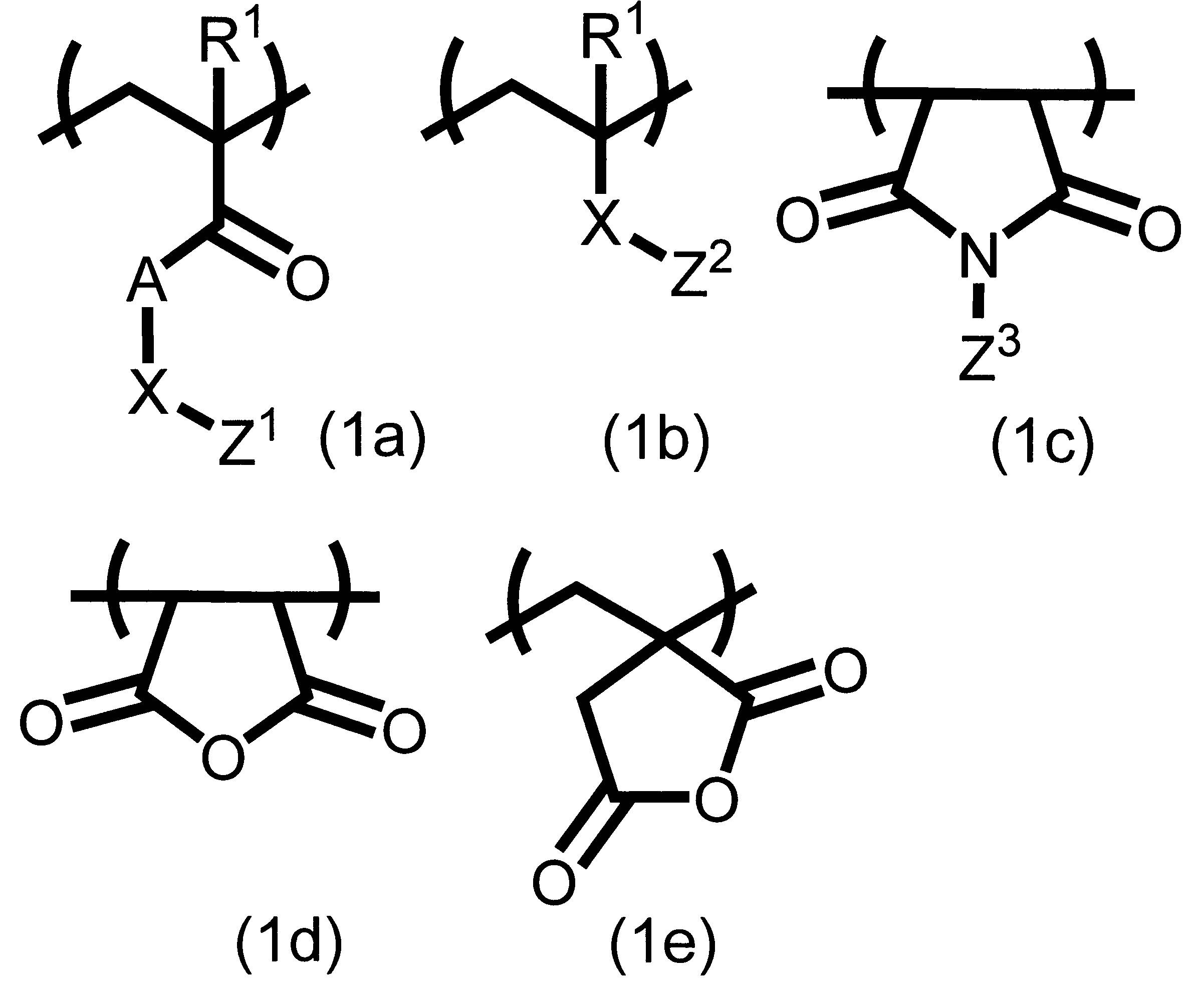
- the alkali-soluble polymer has, for example, a structural unit selected from the group consisting of the formulas (1a), (1b), (1c), (1d), and (1e).
- R 1 represents a hydrogen atom or a methyl group
- A represents an —O— group or a —NH— group
- X represents a single bond, an alkylene group having 1 to 3 carbon atoms, or 1 to 3 carbon atoms.
- the divalent linking group represents, for example, the alkyleneoxy group having 1 to 3 carbon atoms or a group in which two or more alkyleneoxy groups having 1 to 3 carbon atoms are bonded.
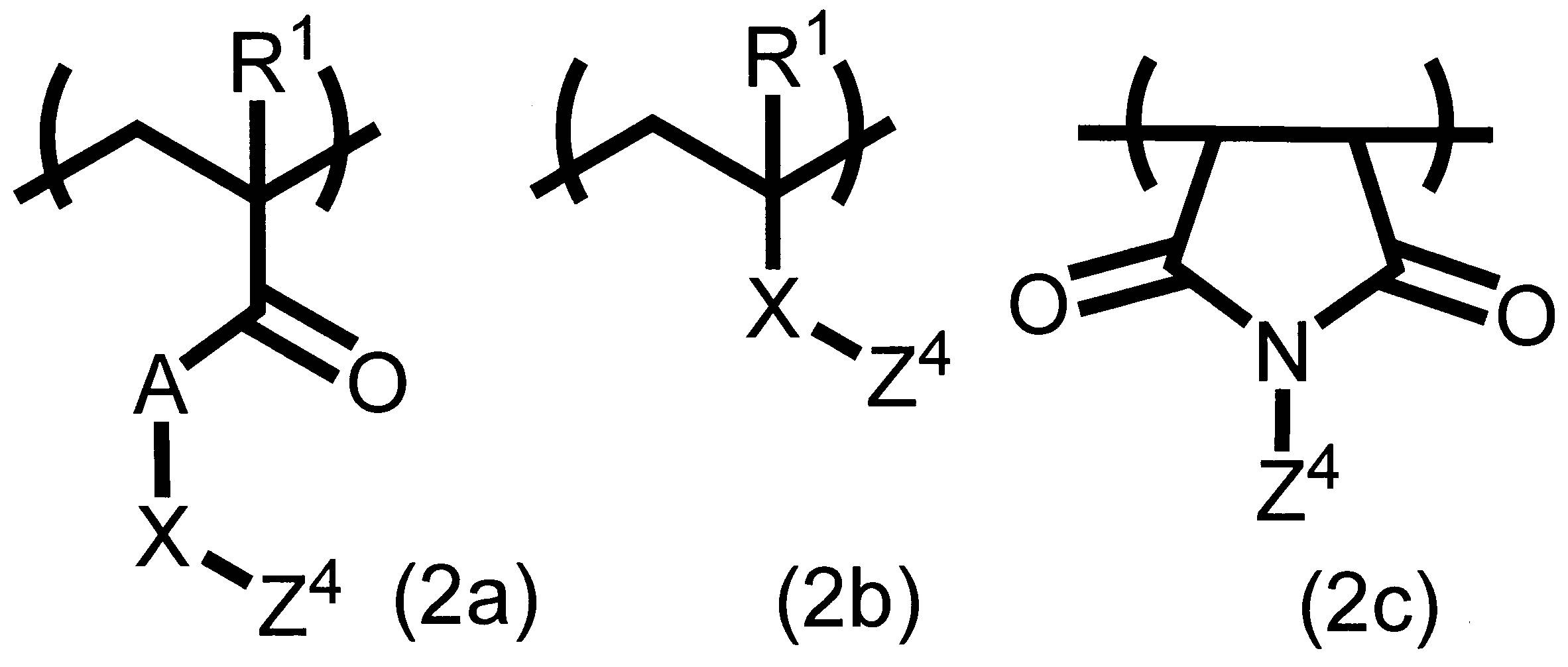
- the alkali-soluble polymer is, for example, a copolymer further having a structural unit selected from the group consisting of the following formulas (2a), (2b) and (2c) different from the structural units.
- R 1 represents a hydrogen atom or a methyl group
- A represents an —O— group or a —NH— group
- X represents a single bond
- Z 4 represents a divalent linking group containing an alkyleneoxy group
- Z 4 represents a linear organic group having 1 to 3 carbon atoms, or a branched or cyclic organic group having 3 to 14 carbon atoms. .
- the divalent linking group represents, for example, the alkyleneoxy group having 1 to 3 carbon atoms or a group in which two or more alkyleneoxy groups having 1 to 3 carbon atoms are bonded.
- the organic group may have at least one hetero atom such as a nitrogen atom and an oxygen atom, and may have a double bond or a triple bond between two carbon atoms or between a carbon atom and a hetero atom. Is also good.
- the cyclic organic group include an aromatic hydrocarbon group, an alicyclic hydrocarbon group, a bridged hydrocarbon group, and a heterocyclic group.
- the negative photosensitive resin composition of the present invention is, for example, for forming microlenses.
- the present invention also includes a step of applying the negative-type photosensitive resin composition on a substrate and prebaking to form a resin film, a step of exposing the resin film through a mask, and a step of applying the exposed resin film to an alkaline developer. And a step of exposing the entire surface of the resin film after the development.
- the method may further include a step of post-baking the resin film after or before the step of exposing the entire surface of the resin film after the development.
- the negative photosensitive resin composition of the present invention can be prepared by optimizing the addition amount of an alkali-soluble polymer, at least two types of crosslinkable compounds, and at least one type of photopolymerization initiator, so that A film obtained at a baking temperature of ° C. is highly transparent, has high sensitivity, has little residue in unexposed areas, and has excellent solvent resistance. Therefore, the negative photosensitive resin composition of the present invention is suitable as a material for forming a microlens.
- the present invention relates to the component (A), 80% to 90% by mass based on 100% by mass of the component (A), and 3% to 20% by mass based on 100% by mass of the total amount of the component (B) % Of the component (C) and a solvent.
- the solid content of the negative photosensitive resin composition of the present invention excluding the solvent is usually 1% by mass to 50% by mass.
- the components of the negative photosensitive resin composition of the present invention excluding the solvent are defined as solids.
- the component (A) in the negative photosensitive resin composition of the present invention is an alkali-soluble polymer.
- the polymer is a polymer of a raw material monomer containing a monomer having an alkali-soluble group and optionally another monomer.
- the alkali-soluble polymer of the component (A) may have an alkali-soluble group, and there is no particular limitation on the skeleton of the main chain and the type of side chain of the polymer constituting the polymer.
- the weight average molecular weight of the alkali-soluble polymer is, for example, from 1,000 to 50,000, preferably from 3,000 to 40,000.
- the weight average molecular weight is a value obtained by gel permeation chromatography (GPC) using polystyrene as a standard sample.
- Examples of the monomer having an alkali-soluble group include a monomer having a carboxyl group, a monomer having a phenolic hydroxy group, a monomer having an acid anhydride group, and a monomer having a maleimide group.
- Examples of the monomer having a carboxyl group include acrylic acid, methacrylic acid, crotonic acid, mono- (2- (acryloyloxy) ethyl) phthalate, mono- (2- (methacryloyloxy) ethyl) phthalate, N- (carboxy) Phenyl) maleimide, N- (carboxyphenyl) methacrylamide, N- (carboxyphenyl) acrylamide, 4-vinylbenzoic acid.
- Examples of the monomer having a phenolic hydroxy group include hydroxystyrene, N- (hydroxyphenyl) acrylamide, N- (hydroxyphenyl) methacrylamide, and N- (hydroxyphenyl) maleimide.
- Examples of the monomer having an acid anhydride group include maleic anhydride and itaconic anhydride.
- Examples of the monomer having a maleimide group include the aforementioned N- (carboxyphenyl) maleimide, N- (hydroxyphenyl) maleimide, and maleimide.
- a polymer of a monomer containing at least one selected from the group consisting of acrylic acid, methacrylic acid, maleic anhydride, and maleimide is preferable.
- the alkali-soluble polymer of the component (A) may be a copolymer of the monomer having an alkali-soluble group and another monomer.
- the copolymer is not limited to a copolymer obtained from two kinds of monomers, and may be a terpolymer (ternary copolymer) obtained from three kinds of monomers.
- Specific examples of the other monomer include an acrylate compound, a methacrylate compound, an N-substituted maleimide compound, an acrylonitrile compound, an acrylamide compound, a methacrylamide compound, a styrene compound, and a vinyl compound.
- specific examples of the other monomer will be described, but the invention is not limited thereto.
- the acrylate compound examples include methyl acrylate, ethyl acrylate, isopropyl acrylate, benzyl acrylate, naphthyl acrylate, anthryl acrylate, anthryl methyl acrylate, phenyl acrylate, phenoxyethyl acrylate, 2,2,2-trifluoroethyl Acrylate, tert-butyl acrylate, cyclohexyl acrylate, isobornyl acrylate, 2-methoxyethyl acrylate, methoxytriethylene glycol acrylate, 2-ethoxyethyl acrylate, tetrahydrofurfuryl acrylate, 3-methoxybutyl acrylate, 2-methyl-2- Adamantyl acrylate, 2-propyl-2-adamantyl acrylate, 8-methyl-8 Tricyclodecyl acrylate, 2-hydroxyethyl acrylate, 2-hydroxypropyl acrylate, 4-hydroxybuty
- methacrylate compound examples include, for example, methyl methacrylate, ethyl methacrylate, isopropyl methacrylate, benzyl methacrylate, naphthyl methacrylate, anthryl methacrylate, anthryl methyl methacrylate, phenyl methacrylate, phenoxyethyl methacrylate, 2,2,2-trifluoroethyl Methacrylate, tert-butyl methacrylate, cyclohexyl methacrylate, isobornyl methacrylate, 2-methoxyethyl methacrylate, methoxytriethylene glycol methacrylate, 2-ethoxyethyl methacrylate, tetrahydrofurfuryl methacrylate, 3-methoxybutyl methacrylate, 2-methyl-2-methyl Adamantyl methacrylate, ⁇ -butyrolactone Tacrylate, 2-propyl-2-adamantyl methacrylate,
- vinyl compound examples include methyl vinyl ether, benzyl vinyl ether, vinyl naphthalene, vinyl anthracene, vinyl biphenyl, vinyl carbazole, 2-hydroxyethyl vinyl ether, phenyl vinyl ether, and propyl vinyl ether.
- styrene compound examples include styrene, methylstyrene, chlorostyrene, and bromostyrene.
- N-substituted maleimide compound examples include N-methylmaleimide, N-phenylmaleimide, and N-cyclohexylmaleimide.
- acrylonitrile compound examples include acrylonitrile.
- the method for obtaining the alkali-soluble polymer of the component (A) is not particularly limited, but generally, a raw material monomer containing the above-mentioned monomer having an alkali-soluble group is polymerized in a polymerization solvent at a temperature of usually 50 ° C to 110 ° C. It is obtained by reacting.
- the alkali-soluble polymer obtained by the above method has a structural unit selected from the group consisting of the formulas (1a), (1b), (1c), (1d) and (1e).
- the alkali-soluble polymer may further have a structural unit different from the structural unit and selected from the group consisting of the formulas (2a), (2b) and (2c).
- the content of the component (A) in the negative photosensitive resin composition of the present invention is usually 48% by mass to 55% by mass based on the content in the solid content of the composition.
- the component (B) in the negative photosensitive resin composition of the present invention comprises at least two polymerizable groups selected from the group consisting of an acryloyloxy group, a methacryloyloxy group, an allyl group and a vinyl group.
- Species of crosslinkable compounds As the component (B), a combination of a crosslinkable compound having two polymerizable groups in one molecule and a crosslinkable compound having three or more polymerizable groups in one molecule is preferable.
- the polymerizable group exists at a molecular terminal of the crosslinkable compound.
- the crosslinkable compound of the component (B) has a weight average molecular weight of 200 to 200 from the viewpoint that the compatibility with other components of the negative photosensitive resin composition of the present invention is good and the developability is not affected. 1,000 compounds are preferred.
- crosslinking compound examples include, for example, dipentaerythritol hexaacrylate, dipentaerythritol hexamethacrylate, dipentaerythritol pentaacrylate, dipentaerythritol pentamethacrylate, pentaerythritol tetraacrylate, pentaerythritol tetramethacrylate, pentaerythritol triacrylate, pentaerythritol Trimethacrylate, pentaerythritol diacrylate, pentaerythritol dimethacrylate, tetramethylolpropanetetraacrylate, tetramethylolpropanetetramethacrylate, tetramethylolmethanetetraacrylate, tetramethylolmethanetetramethacrylate, trimethylolpropanetriacrylate, trimethylolpropanetriacrylate,
- the crosslinkable compound can be easily obtained as a commercial product, for example, KAYARAD (registered trademark) T-1420, DPHA, DPHA-2C, D-310, D-330, DPCA-20.
- BP-10EA HPP-A, G-201P, TMP-A, TMP-3EO-A, TMP-6EO-3A, PE-3A, PE-4A, DPE-6A Epoxy ester 40EM, 70PA, 200PA, 80MFA, 3002M, 3002A, 3000MK, 3000A, EX-0205, AH-600, AT-600, UA-306H, UA-306T, UA-306I UA-510H, UF-8001G, DAUA-167 (manufactured by Kyoeisha Chemical Co., Ltd.); EBECRYL (registered trademark) TPGDA, 145, 150, PEG400DA, 11, HPNDA, PETIA, PETIA, PETRA, TMPTA, TMPEOTA, OTA480, DPHA, 180, 40, 140, 204, 205, 210, 215, 220, 6202, 230, 244, 245, 264, 265, 270, 280 / 15IB, 284,
- the crosslinkable compound (B) is used in combination of two or more.
- a crosslinkable compound having two polymerizable groups in one molecule and a crosslinkable compound having three or more polymerizable groups in one molecule are preferable.
- the crosslinkable compound having three or more polymerizable groups in one molecule may be a combination of two or more crosslinkable compounds having different numbers of polymerizable groups.
- an acryloyloxy group or a methacryloyloxy group is preferable.
- the content of the component (B) in the negative photosensitive resin composition of the present invention is from 80% by mass to 90% by mass relative to 100% by mass of the component (A).
- the component (C) in the negative photosensitive resin composition of the present invention is at least one kind of photopolymerization initiator.
- the photopolymerization initiator of the component (C) is not particularly limited as long as it has absorption in a light source used at the time of photocuring.
- photopolymerization initiator examples include tert-butylperoxy-iso-butyrate, 2,5-dimethyl-2,5-bis (benzoyldioxy) hexane, and 1,4-bis [ ⁇ - (tert-butyldioxy) -Iso-propoxy] benzene, di-tert-butyl peroxide, 2,5-dimethyl-2,5-bis (tert-butyldioxy) hexene hydroperoxide, ⁇ - (iso-propylphenyl) -iso-propyl hydroperoxide, tert -Butyl hydroperoxide, 1,1-bis (tert-butyldioxy) -3,3,5-trimethylcyclohexane, butyl-4,4-bis (tert-butyldioxy) valerate, cyclohexanone peroxide, 2,2 ′, 5,5 '-Tetra (tert-butyl
- the photopolymerization initiator can be obtained as a commercial product, for example, OMNIRAD (registered trademark) 651, 184, 500, 2959, 127, 754, 907, 369, 379, 379EG, 819, 819DW, 1700, 1870, 784, 1173, MBF, 4265, TPO (all manufactured by IGM Resins) [former IRGACURE (registered trademark) 651, 184, 500] , 2959, 127, 754, 907, 369, 379, 379EG, 819, 819DW, 1700, 1870, 784, 1173, MBF, 4265, TPO , BASF Japan Ltd.)], IRGACURE (registered trademark) 1800, OXE01, OXE02 (all above) BASF Japan Co., Ltd.), KAYACURE (registered trademark) DETX, MBP, DMBI, EPA, OA (all manufactured by Nippon Kayaku Co., Ltd.), VICURE-10,
- the photopolymerization initiator of the component (C) can be used alone or in combination of two or more.
- the content of the component (C) in the negative photosensitive resin composition of the present invention is 3% by mass to 20% by mass based on 100% by mass of the total amount of the component (B).
- the negative photosensitive resin composition of the present invention contains a solvent.
- the solvent is not particularly limited as long as it dissolves the components (A), (B) and (C).
- solvent examples include ethylene glycol monomethyl ether, ethylene glycol monoethyl ether, methyl cellosolve acetate, ethyl cellosolve acetate, diethylene glycol monomethyl ether, diethylene glycol monoethyl ether, propylene glycol, propylene glycol monomethyl ether, propylene glycol monomethyl ether acetate, and propylene.
- propylene glycol monomethyl ether propylene glycol monomethyl ether acetate, 2-heptanone, ethyl lactate, butyl lactate, and cyclohexanone are preferred from the viewpoint of improving the leveling property of the coating film.
- the solvents can be used alone or in combination of two or more.
- the negative photosensitive resin composition of the present invention may also contain a surfactant for the purpose of improving coatability.
- a surfactant for example, polyoxyethylene alkyl ethers such as polyoxyethylene lauryl ether, polyoxyethylene stearyl ether, polyoxyethylene cetyl ether, polyoxyethylene oleyl ether, polyoxyethylene octyl phenyl ether, polyoxyethylene Polyoxyethylene alkyl aryl ethers such as ethylene nonyl phenyl ether, polyoxyethylene / polyoxypropylene block copolymers, sorbitan monolaurate, sorbitan monopalmitate, sorbitan monostearate, sorbitan monooleate, sorbitan trioleate, sorbitan Sorbitan fatty acid esters such as tristearate, polyoxyethylene sorbitan monolaurate, polyoxyethylene Nonionic surfactants such as polyoxyethylene sorbitan fatty acid esters such as bitane
- the surfactants can be used alone or in combination of two or more.
- its content in the negative photosensitive resin composition of the present invention is 3% by mass or less, for example, 0.1% by mass based on the content in the solid content of the composition. It is from 0001% by mass to 3% by mass, preferably from 0.001% by mass to 1% by mass, more preferably from 0.01% by mass to 0.5% by mass.
- the negative photosensitive resin composition of the present invention is, as long as the effects of the present invention are not impaired, as necessary, a curing aid, an ultraviolet absorber, a sensitizer, a plasticizer, an antioxidant, an adhesion aid, Alternatively, a dissolution promoter such as a polyhydric phenol or a polycarboxylic acid can be included as another additive.
- the method for preparing the negative photosensitive resin composition of the present invention is not particularly limited.
- the alkali-soluble polymer of the component (A) is dissolved in the solvent, and the resulting solution is mixed with the crosslinkable component of the component (B).
- the compound and the photopolymerization initiator of the component (C) are mixed at a predetermined ratio to form a uniform solution.
- the above-mentioned other additives are further added and mixed if necessary.
- Substrate a semiconductor substrate such as silicon covered with a silicon oxide film, a semiconductor substrate such as silicon covered with a silicon nitride film or a silicon oxynitride film, a silicon nitride substrate, a quartz substrate, a glass substrate (alkali-free glass, low
- a suitable coating method such as a spinner or a coater.
- a coating film is formed by pre-baking using a heating means such as a hot plate.
- the pre-bake conditions are appropriately selected from a bake temperature of 80 ° C. to 150 ° C. and a bake time of 0.3 to 60 minutes, preferably a bake temperature of 80 ° C. to 100 ° C. and a bake time of 0.5 to 5 minutes. It is.
- the thickness of the film formed from the negative photosensitive resin composition of the present invention is, for example, 0.005 ⁇ m to 20 ⁇ m, and preferably 0.01 ⁇ m to 15 ⁇ m.
- a mask for forming a predetermined pattern on the obtained film.
- a mask for example, a g-line, an i-line, and a KrF excimer laser can be used.
- post-exposure heating (Post @ Exposure @ Bake) is performed as necessary. Conditions for the post-exposure baking are appropriately selected from a heating temperature of 80 ° C. to 100 ° C. and a heating time of 0.3 to 60 minutes. Then, development is performed with an alkaline developer.
- alkaline developer examples include an aqueous solution of an alkali metal hydroxide such as potassium hydroxide and sodium hydroxide, an aqueous solution of a quaternary ammonium hydroxide such as tetramethylammonium hydroxide, tetraethylammonium hydroxide and choline, and ethanolamine. And aqueous alkaline solutions such as aqueous amine solutions such as propylamine and ethylenediamine. Further, a surfactant can be added to these developers.
- an alkali metal hydroxide such as potassium hydroxide and sodium hydroxide
- a quaternary ammonium hydroxide such as tetramethylammonium hydroxide, tetraethylammonium hydroxide and choline
- ethanolamine aqueous alkaline solutions
- aqueous amine solutions such as propylamine and ethylenediamine.
- a surfactant can be added to these developers.
- the development conditions are appropriately selected from a development temperature of 5 ° C. to 50 ° C. and a development time of 10 seconds to 300 seconds.
- the film formed from the negative photosensitive resin composition of the present invention can be easily developed at room temperature using an aqueous solution of tetramethylammonium hydroxide.
- rinsing is appropriately performed using, for example, ultrapure water as a rinsing liquid.
- the developed film is entirely exposed using, for example, a g-line, an i-line, or a KrF excimer laser. Further, before or after the entire surface exposure, post-baking may be performed on the developed film by using a heating means such as a hot plate.
- the post-baking conditions are appropriately selected from, for example, a baking temperature of 80 to 100 ° C. and a baking time of 0.5 to 60 minutes.
- Example 1 19.7 g of a solution (solid content concentration: 35% by mass) of the alkali-soluble polymer as the component (A) obtained in Synthesis Example 1, and PET-30 (Nippon Kayaku Co., Ltd.) as a crosslinkable compound as the component (B) 3.4 g) and 2.1 g of ABE-300 (manufactured by Shin-Nakamura Chemical Co., Ltd.), IRGACURE (registered trademark) OXE01 (manufactured by BASF Japan Co., Ltd.) as a photopolymerization initiator as a component (C).
- ABE-300 manufactured by Shin-Nakamura Chemical Co., Ltd.
- IRGACURE registered trademark
- OXE01 manufactured by BASF Japan Co., Ltd.
- OMNIRAD registered trademark
- 184 manufactured by IGM Resins
- DFX-18 manufactured by Neos
- a surfactant 0.0040 g was dissolved in 5.6 g of propylene glycol monomethyl ether and 18.4 g of propylene glycol monomethyl ether acetate. The solution was used. Thereafter, the mixture was filtered using a polyethylene microfilter having a pore size of 1 ⁇ m to prepare a negative photosensitive resin composition.
- Example 2 19.6 g of a solution (solid content concentration: 35% by mass) of the alkali-soluble polymer (A) obtained in Synthesis Example 1, and PET-30 (Nippon Kayaku Co., Ltd.) as a crosslinkable compound as the component (B) 4.1 g) and 2.1 g of ABE-300 (manufactured by Shin-Nakamura Chemical Co., Ltd.), IRGACURE (registered trademark) OXE01 (manufactured by BASF Japan Ltd.) as a photopolymerization initiator as a component (C).
- ABE-300 manufactured by Shin-Nakamura Chemical Co., Ltd.
- IRGACURE registered trademark
- OXE01 manufactured by BASF Japan Ltd.
- Example 3 18.8 g of a solution (solid content concentration: 35% by mass) of the alkali-soluble polymer as the component (A) obtained in Synthesis Example 1, and PET-30 (Nippon Kayaku Co., Ltd.) as a crosslinkable compound as the component (B) 3.9 g of ABE-300 (manufactured by Shin-Nakamura Chemical Industry Co., Ltd.) and 2.0 g of IRGACURE (registered trademark) OXE01 (manufactured by BASF Japan) as a photopolymerization initiator as the component (C).
- ABE-300 manufactured by Shin-Nakamura Chemical Industry Co., Ltd.
- IRGACURE registered trademark
- OXE01 manufactured by BASF Japan
- OMNIRAD registered trademark
- 184 manufactured by IGM Resins
- DFX-18 manufactured by Neos Corporation
- a surfactant 0.0040 g was dissolved in 6.2 g of propylene glycol monomethyl ether and 18.4 g of propylene glycol monomethyl ether acetate. The solution was used. Thereafter, the mixture was filtered using a polyethylene microfilter having a pore size of 1 ⁇ m to prepare a negative photosensitive resin composition.
- Example 4 23.7 g of a solution (solid content concentration: 35% by mass) of the alkali-soluble polymer as the component (A) obtained in Synthesis Example 2, and PET-30 (Nippon Kayaku Co., Ltd.) as a crosslinkable compound as the component (B) 5.0 g of ABE-300 (manufactured by Shin-Nakamura Chemical Co., Ltd.) and IRGACURE (registered trademark) OXE01 (manufactured by BASF Japan Ltd.) as a photopolymerization initiator as a component (C).
- ABE-300 manufactured by Shin-Nakamura Chemical Co., Ltd.
- IRGACURE registered trademark
- OXE01 manufactured by BASF Japan Ltd.
- OMNIRAD registered trademark
- 184 manufactured by IGM Resins
- DFX-18 manufactured by Neos Corporation
- a surfactant 0.0050 g was dissolved in 1.2 g of propylene glycol monomethyl ether and 16.6 g of propylene glycol monomethyl ether acetate. The solution was used. Thereafter, the mixture was filtered using a polyethylene microfilter having a pore size of 1 ⁇ m to prepare a negative photosensitive resin composition.
- OMNIRAD registered trademark
- 184 manufactured by IGM Resins
- DFX-18 manufactured by Neos
- a surfactant 0.0040 g was dissolved in 4.9 g of propylene glycol monomethyl ether and 18.4 g of propylene glycol monomethyl ether acetate. The solution was used. Thereafter, the mixture was filtered using a polyethylene microfilter having a pore size of 1 ⁇ m to prepare a negative photosensitive resin composition.
- the content of the component (B) is out of the range of the present invention.
- Comparative Example 2 15.6 g of a solution (solid content concentration: 35% by mass) of the alkali-soluble polymer as the component (A) obtained in Synthesis Example 1, and PET-30 (Nippon Kayaku Co., Ltd.) as a crosslinkable compound as the component (B) 3.3 g of ABE-300 (manufactured by Shin-Nakamura Chemical Industry Co., Ltd.) and 3.3 g of IRGACURE (registered trademark) OXE01 (manufactured by BASF Japan) as a photopolymerization initiator as a component (C).
- ABE-300 manufactured by Shin-Nakamura Chemical Industry Co., Ltd.
- IRGACURE registered trademark
- OXE01 manufactured by BASF Japan
- 0.0039 g was dissolved in 2.6 g of propylene glycol monomethyl ether and 18.5 g of propylene glycol monomethyl ether acetate to form a solution. Thereafter, the mixture was filtered using a polyethylene microfilter having a pore size of 1 ⁇ m to prepare a negative photosensitive resin composition.
- the content of the component (B) is out of the range of the present invention, and the component (B) is a crosslinkable compound having two polymerizable groups in one molecule. Not included.
- the mixture was filtered using a polyethylene microfilter having a pore size of 1 ⁇ m to prepare a negative photosensitive resin composition.
- the content of the component (B) is out of the range of the present invention, and the component (B) is a crosslinkable compound having two polymerizable groups in one molecule. Not included.
- the mixture was filtered using a polyethylene microfilter having a pore size of 1 ⁇ m to prepare a negative photosensitive resin composition.
- the content of the component (B) is out of the range of the present invention, and the component (B) is a crosslinkable compound having two polymerizable groups in one molecule. Not included.
- the entire surface of the resin film was irradiated with ultraviolet rays having an exposure amount of 1000 mJ / cm 2 at 365 nm by a batch type UV irradiation device (high-pressure mercury lamp 2 kW ⁇ 1 lamp) (manufactured by Eye Graphics Co., Ltd.).
- a cured film was formed on a quartz substrate. Both the pre-bake and post-bake were performed in the air.
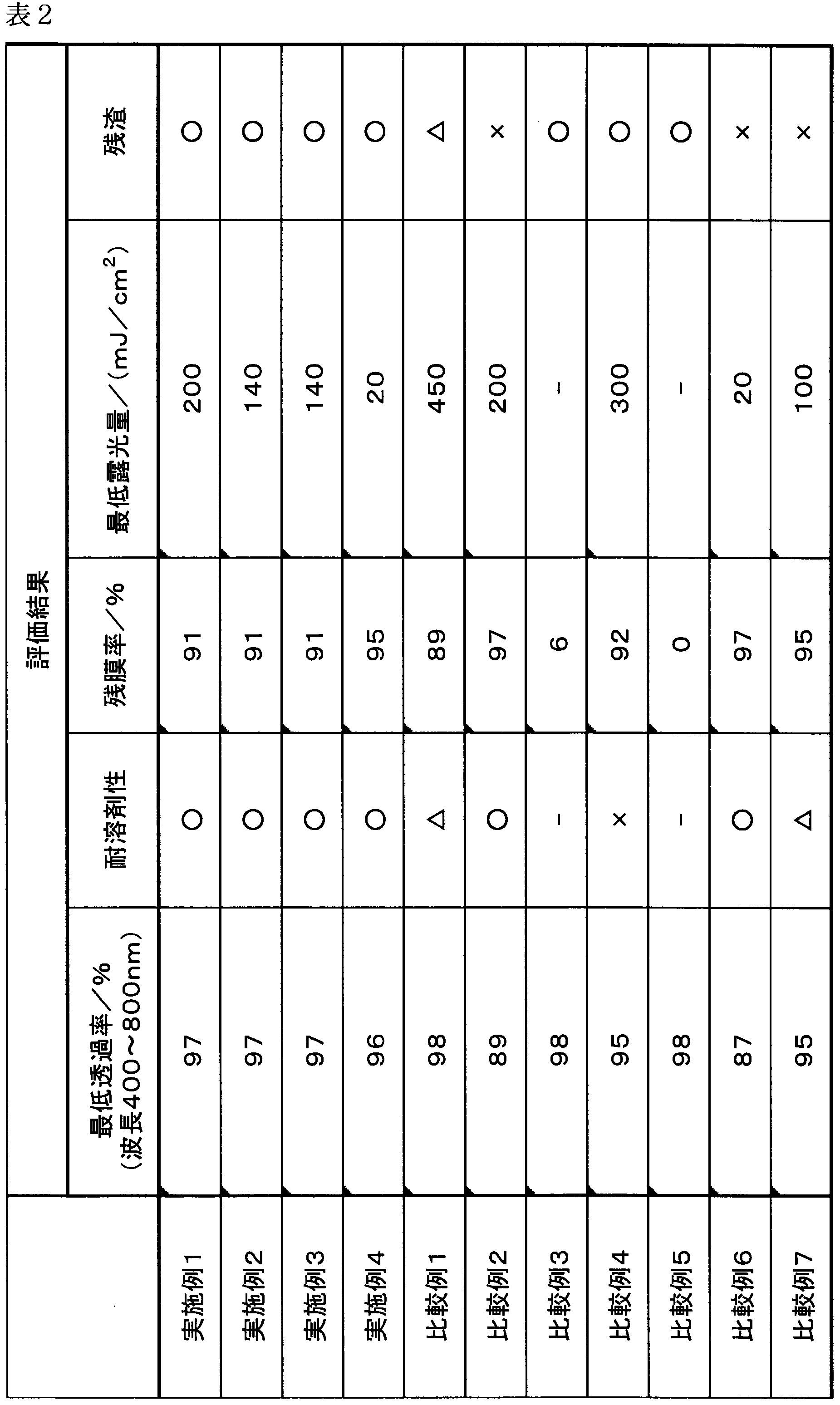
- the transmittance of these cured films was measured using an ultraviolet-visible spectrophotometer UV-2550 (manufactured by Shimadzu Corporation) while changing the wavelength in steps of 2 nm in a wavelength range of 400 nm to 800 nm. Table 2 shows the values of the minimum transmittance measured in the wavelength range of 400 nm to 800 nm. A value closer to 100% indicates that a transparent film was obtained.
- the resin film was developed for 60 seconds using an aqueous solution of tetramethylammonium hydroxide (TMAH) having a concentration shown in Table 1 as an alkaline developer, rinsed with ultrapure water for 20 seconds, and dried.
- TMAH tetramethylammonium hydroxide
- the resin film formed from the negative photosensitive resin compositions prepared in Comparative Examples 3 and 5 was removed from the silicon wafer. Further, the remaining resin film was post-baked on a hot plate at 100 ° C. for 5 minutes.
- the entire surface of the resin film is irradiated with ultraviolet light having an exposure amount of 1000 mJ / cm 2 at 365 nm by a batch type UV irradiation device (high-pressure mercury lamp 2 kW ⁇ 1 lamp) (manufactured by Eye Graphics Co., Ltd.)
- a cured film was formed on the silicon wafer. Both the pre-bake and post-bake were performed in the air.
- TMAH tetramethylammonium hydroxide
- TMAH tetramethylammonium hydroxide
- the rectangular pattern was not formed from the resin films formed from the negative photosensitive resin compositions prepared in Comparative Examples 3 and 5.
- the thickness of the formed product on the silicon wafer was measured by the same method as that for measuring the thickness of the resin film.
- the residual film ratio (%) was evaluated by comparing with the film thickness of the resin film immediately after prebaking. Table 2 shows the results.
- the residual film ratio is calculated from the formula (film thickness after development / film thickness after pre-baking) ⁇ 100, and the closer the value is to 100%, the less the exposed portion of the resin film is likely to be dissolved in the developing solution. .
- the film thickness of the unexposed portion of the resin film was measured using a light interference type film thickness measuring device Lambda Ace VM-2110 (manufactured by SCREEN Semiconductor Solutions Co., Ltd.). The smaller the film thickness, the smaller the residue.
- the residue was evaluated as “x” when the film thickness was 10 nm or more, “ ⁇ ” when it was less than 10 nm and 5 nm or more, and “ ⁇ ” when it was less than 5 nm. Table 2 shows the evaluation results.
Landscapes
- Physics & Mathematics (AREA)
- General Physics & Mathematics (AREA)
- Chemical & Material Sciences (AREA)
- Chemical Kinetics & Catalysis (AREA)
- Spectroscopy & Molecular Physics (AREA)
- Medicinal Chemistry (AREA)
- Health & Medical Sciences (AREA)
- Polymers & Plastics (AREA)
- Organic Chemistry (AREA)
- Optics & Photonics (AREA)
- Materials For Photolithography (AREA)
- Photosensitive Polymer And Photoresist Processing (AREA)
- Exposure And Positioning Against Photoresist Photosensitive Materials (AREA)
- Macromonomer-Based Addition Polymer (AREA)
- Polymerisation Methods In General (AREA)
Abstract
Description
(A):アルカリ可溶性ポリマー
(B):アクリロイルオキシ基、メタクリロイルオキシ基、アリル基及びビニル基からなる群から選ばれる重合性基を1分子中に2つ以上有する少なくとも2種の架橋性化合物
(C):少なくとも1種の光重合開始剤
前記二価の連結基は、例えば、前記炭素原子数1乃至3のアルキレンオキシ基、又は該炭素原子数1乃至3のアルキレンオキシ基が2つ以上結合した基を表す。
本発明のネガ型感光性樹脂組成物における(A)成分はアルカリ可溶性ポリマーである。該ポリマーは、アルカリ可溶性基を有するモノマー及び任意でその他モノマーを含む原料モノマーの重合体である。(A)成分のアルカリ可溶性ポリマーは、アルカリ可溶性基を有すればよく、該ポリマーを構成する高分子の主鎖の骨格及び側鎖の種類などについて特に限定されない。前記アルカリ可溶性ポリマーの重量平均分子量は例えば、1000乃至50000であり、好ましくは3000乃至40000である。なお、重量平均分子量は、ゲルパーミエーションクロマトグラフィー(GPC)により、標準試料としてポリスチレンを用いて得られる値である。
本発明のネガ型感光性樹脂組成物における(B)成分は、アクリロイルオキシ基、メタクリロイルオキシ基、アリル基及びビニル基からなる群から選ばれる重合性基を1分子中に2つ以上有する少なくとも2種の架橋性化合物である。(B)成分として、該重合性基を1分子中に2つ有する架橋性化合物と、該重合性基を1分子中に3つ以上有する架橋性化合物との組み合わせが好ましい。該重合性基は、架橋性化合物の分子末端に存在する。
本発明のネガ型感光性樹脂組成物における(C)成分は、少なくとも1種の光重合開始剤である。(C)成分の光重合開始剤は、光硬化時に使用する光源に吸収をもつものであれば、特に限定されるものではない。
本発明のネガ型感光性樹脂組成物は溶剤を含む。該溶剤としては、前記(A)成分、(B)成分及び(C)成分を溶解するものであれば特に限定されない。
本発明のネガ型感光性樹脂組成物は、塗布性を向上させる目的で、界面活性剤を含有することもできる。該界面活性剤としては、例えば、ポリオキシエチレンラウリルエーテル、ポリオキシエチレンステアリルエーテル、ポリオキシエチレンセチルエーテル、ポリオキシエチレンオレイルエーテル等のポリオキシエチレンアルキルエーテル類、ポリオキシエチレンオクチルフェニルエーテル、ポリオキシエチレンノニルフェニルエーテル等のポリオキシエチレンアルキルアリールエーテル類、ポリオキシエチレン・ポリオキシプロピレンブロックコポリマー類、ソルビタンモノラウレート、ソルビタンモノパルミテート、ソルビタンモノステアレート、ソルビタンモノオレエート、ソルビタントリオレエート、ソルビタントリステアレート等のソルビタン脂肪酸エステル類、ポリオキシエチレンソルビタンモノラウレート、ポリオキシエチレンソルビタンモノパルミテート、ポリオキシエチレンソルビタンモノステアレート、ポリオキシエチレンソルビタントリオレエート、ポリオキシエチレンソルビタントリステアレート等のポリオキシエチレンソルビタン脂肪酸エステル類等のノニオン系界面活性剤、エフトップ(登録商標)EF301、同EF303、同EF352(以上、三菱マテリアル電子化成(株)製)、メガファック(登録商標)F-171、同F-173、同R-30、同R-40、同R-40-LM(以上、DIC(株)製)、フロラードFC430、同FC431(以上、スリーエムジャパン(株)製)、アサヒガード(登録商標)AG710、サーフロン(登録商標)S-382、同SC101、同SC102、同SC103、同SC104、同SC105、同SC106(AGC(株)製)、FTX-206D、FTX-212D、FTX-218、FTX-220D、FTX-230D、FTX-240D、FTX-212P、FTX-220P、FTX-228P、FTX-240G等フタージェントシリーズ((株)ネオス製)等のフッ素系界面活性剤、オルガノシロキサンポリマーKP341(信越化学工業(株)製)を挙げることができる。
本発明のネガ型感光性樹脂組成物は、本発明の効果を損なわない限りにおいて、必要に応じて、硬化助剤、紫外線吸収剤、増感剤、可塑剤、酸化防止剤、密着助剤、又は多価フェノール、多価カルボン酸等の溶解促進剤をその他添加剤として含むことができる。
本発明のネガ型感光性樹脂組成物の調製方法は、特に限定されないが、例えば、(A)成分のアルカリ可溶性ポリマーを前記溶剤に溶解し、得られた溶液に、(B)成分の架橋性化合物及び(C)成分の光重合開始剤を所定の割合で混合し、均一な溶液とする方法が挙げられる。さらに、この調製方法の適当な段階において、必要に応じて、前記その他添加剤を更に添加して混合する方法が挙げられる。
基板[例えば、酸化珪素膜で被覆されたシリコン等の半導体基板、窒化珪素膜又は酸化窒化珪素膜で被覆されたシリコン等の半導体基板、窒化珪素基板、石英基板、ガラス基板(無アルカリガラス、低アルカリガラス、結晶化ガラスを含む)、酸化インジウムスズ(ITO)膜が形成されたガラス基板]上に、スピナー、コーター等の適当な塗布方法により本発明のネガ型感光性樹脂組成物を塗布し、その後、ホットプレート等の加熱手段を用いてプリベークすることにより、塗膜を形成する。
装置:日本分光(株)製GPCシステム
カラム:Shodex〔登録商標〕GPC KF-804L及びGPC KF-803L
カラムオーブン:40℃
流量:1ml/分
溶離液:テトラヒドロフラン
標準資料:ポリスチレン
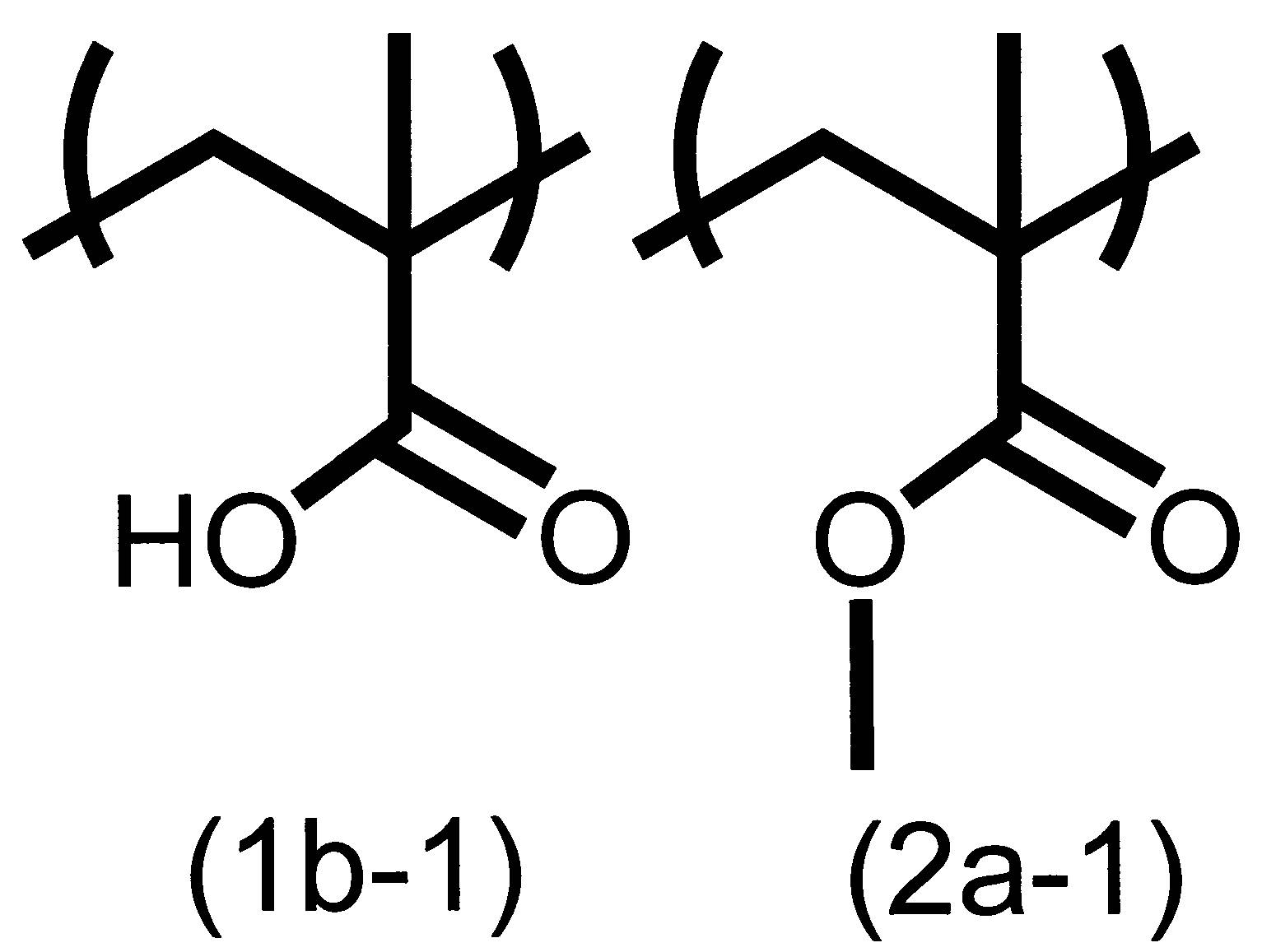
メタクリル酸60g、メタクリル酸メチル240g、及び2,2’-アゾビスイソブチロニトリル7.6gをプロピレングリコールモノメチルエーテル132gに溶解させた後、この溶液を、プロピレングリコールモノメチルエーテル440gを70℃に保持したフラスコ中に3時間かけて滴下した。滴下終了後、18時間反応させることにより、下記式(1b-1)で表される構造単位及び下記式(2a-1)で表される構造単位を有するアルカリ可溶性ポリマー(共重合体)の溶液(固形分濃度35質量%)を得た。得られた共重合体の重量平均分子量Mwは35,000(ポリスチレン換算)であった。
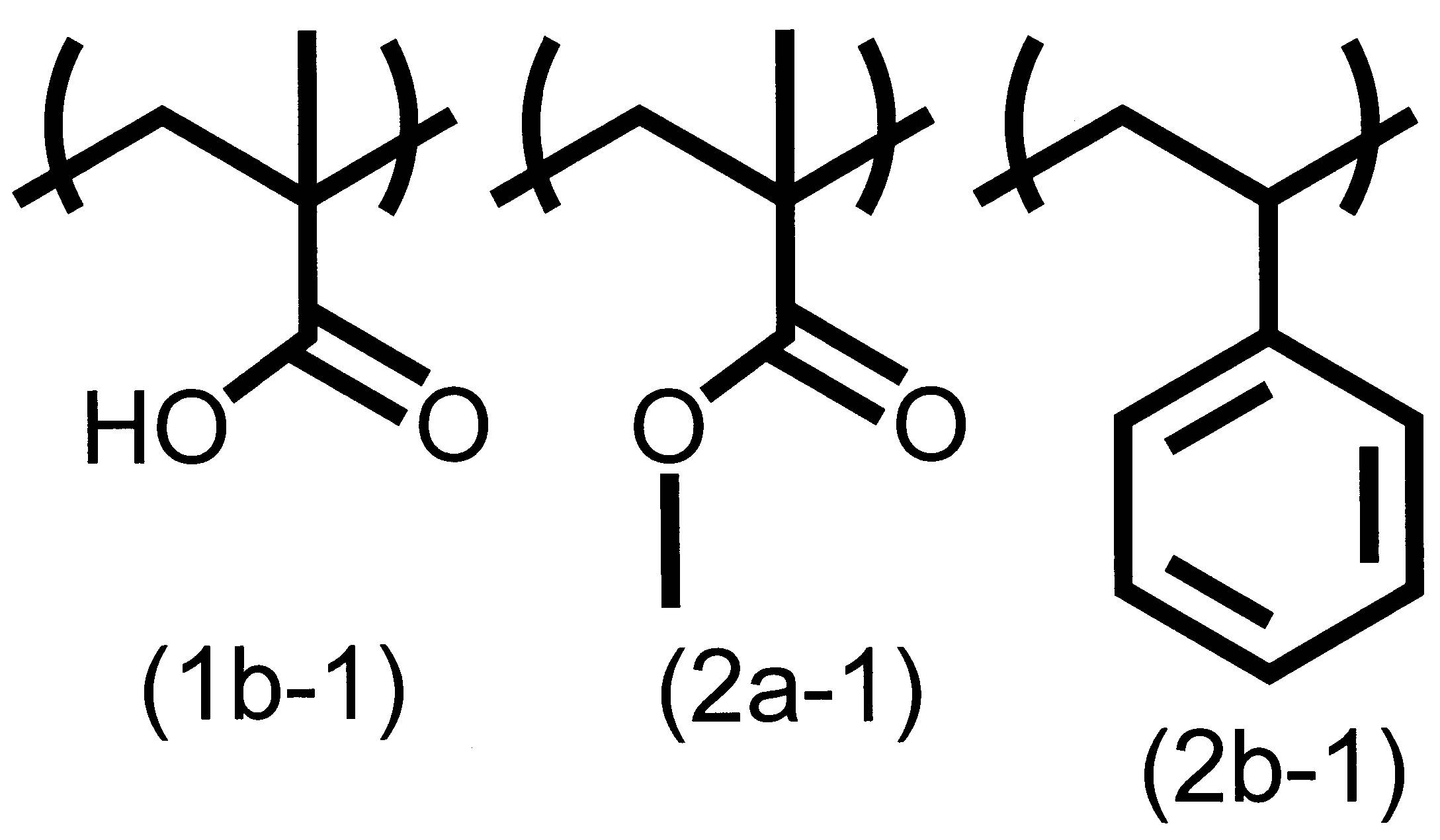
メタクリル酸61g、メタクリル酸メチル122g、スチレン122g、及び2,2’-アゾビスイソブチロニトリル7.6gをプロピレングリコールモノメチルエーテル134gに溶解させた後、この溶液を、プロピレングリコールモノメチルエーテル446gを70℃に保持したフラスコ中に3時間かけて滴下した。滴下終了後、18時間反応させることにより、下記式(1b-1)で表される構造単位、下記式(2a-1)で表される構造単位及び下記式(2b-1)で表される構造単位を有するアルカリ可溶性ポリマー(三元共重合体)の溶液(固形分濃度35質量%)を得た。得られた共重合体の重量平均分子量Mwは35,000(ポリスチレン換算)であった。
合成例1で得られた(A)成分であるアルカリ可溶性ポリマーの溶液(固形分濃度35質量%)19.7g、(B)成分である架橋性化合物としてPET-30(日本化薬(株)製)3.4g及びABE-300(新中村化学工業(株)製)2.1g、(C)成分である光重合開始剤としてIRGACURE(登録商標)OXE01(BASFジャパン(株)製)0.21g及びOMNIRAD(登録商標)184(IGM Resins社製)[旧IRGACURE(登録商標)184(BASFジャパン(株)製)]0.62g、並びに界面活性剤としてDFX-18(ネオス(株)製)0.0040gを、プロピレングリコールモノメチルエーテル5.6g及びプロピレングリコールモノメチルエーテルアセテート18.4gに溶解させ溶液とした。その後、孔径1μmのポリエチレン製ミクロフィルターを用いてろ過してネガ型感光性樹脂組成物を調製した。
合成例1で得られた(A)成分であるアルカリ可溶性ポリマーの溶液(固形分濃度35質量%)19.6g、(B)成分である架橋性化合物としてPET-30(日本化薬(株)製)4.1g及びABE-300(新中村化学工業(株)製)2.1g、(C)成分である光重合開始剤としてIRGACURE(登録商標)OXE01(BASFジャパン(株)製)0.21g、並びに界面活性剤としてDFX-18(ネオス(株)製)0.0040gを、プロピレングリコールモノメチルエーテル5.6g及びプロピレングリコールモノメチルエーテルアセテート18.4gに溶解させ溶液とした。その後、孔径1μmのポリエチレン製ミクロフィルターを用いてろ過してネガ型感光性樹脂組成物を調製した。
合成例1で得られた(A)成分であるアルカリ可溶性ポリマーの溶液(固形分濃度35質量%)18.8g、(B)成分である架橋性化合物としてPET-30(日本化薬(株)製)3.9g及びABE-300(新中村化学工業(株)製)2.0g、(C)成分である光重合開始剤としてIRGACURE(登録商標)OXE01(BASFジャパン(株)製)0.20g及びOMNIRAD(登録商標)184(IGM Resins社製)[旧IRGACURE(登録商標)184(BASFジャパン(株)製)]0.59g、並びに界面活性剤としてDFX-18(ネオス(株)製)0.0040gを、プロピレングリコールモノメチルエーテル6.2g及びプロピレングリコールモノメチルエーテルアセテート18.4gに溶解させ溶液とした。その後、孔径1μmのポリエチレン製ミクロフィルターを用いてろ過してネガ型感光性樹脂組成物を調製した。
合成例2で得られた(A)成分であるアルカリ可溶性ポリマーの溶液(固形分濃度35質量%)23.7g、(B)成分である架橋性化合物としてPET-30(日本化薬(株)製)5.0g及びABE-300(新中村化学工業(株)製)2.5g、(C)成分である光重合開始剤としてIRGACURE(登録商標)OXE01(BASFジャパン(株)製)0.25g及びOMNIRAD(登録商標)184(IGM Resins社製)[旧IRGACURE(登録商標)184(BASFジャパン(株)製)]0.75g、並びに界面活性剤としてDFX-18(ネオス(株)製)0.0050gを、プロピレングリコールモノメチルエーテル1.2g及びプロピレングリコールモノメチルエーテルアセテート16.6gに溶解させ溶液とした。その後、孔径1μmのポリエチレン製ミクロフィルターを用いてろ過してネガ型感光性樹脂組成物を調製した。
合成例1で得られた(A)成分であるアルカリ可溶性ポリマーの溶液(固形分濃度35質量%)20.8g、(B)成分である架橋性化合物としてPET-30(日本化薬(株)製)2.9g及びABE-300(新中村化学工業(株)製)2.2g、(C)成分である光重合開始剤としてIRGACURE(登録商標)OXE01(BASFジャパン(株)製)0.22g及びOMNIRAD(登録商標)184(IGM Resins社製)[旧IRGACURE(登録商標)184(BASFジャパン(株)製)]0.65g、並びに界面活性剤としてDFX-18(ネオス(株)製)0.0040gを、プロピレングリコールモノメチルエーテル4.9g及びプロピレングリコールモノメチルエーテルアセテート18.4gに溶解させ溶液とした。その後、孔径1μmのポリエチレン製ミクロフィルターを用いてろ過してネガ型感光性樹脂組成物を調製した。本比較例のネガ型感光性樹脂組成物は、(B)成分の含有量が本発明の範囲外である。
合成例1で得られた(A)成分であるアルカリ可溶性ポリマーの溶液(固形分濃度35質量%)15.6g、(B)成分である架橋性化合物としてPET-30(日本化薬(株)製)3.3g及びABE-300(新中村化学工業(株)製)3.3g、(C)成分である光重合開始剤としてIRGACURE(登録商標)OXE01(BASFジャパン(株)製)1.3g、並びに界面活性剤としてDFX-18(ネオス(株)製)0.0040gを、プロピレングリコールモノメチルエーテル8.3g及びプロピレングリコールモノメチルエーテルアセテート18.5gに溶解させ溶液とした。その後、孔径1μmのポリエチレン製ミクロフィルターを用いてろ過してネガ型感光性樹脂組成物を調製した。本比較例のネガ型感光性樹脂組成物は、(B)成分の含有量が本発明の範囲外である。
合成例1で得られた(A)成分であるアルカリ可溶性ポリマーの溶液(固形分濃度35質量%)24.5g、(B)成分である架橋性化合物としてPET-30(日本化薬(株)製)4.3g、(C)成分である光重合開始剤としてIRGACURE(登録商標)OXE01(BASFジャパン(株)製)0.13g、及び界面活性剤としてDFX-18(ネオス(株)製)0.0039gを、プロピレングリコールモノメチルエーテル2.6g及びプロピレングリコールモノメチルエーテルアセテート18.5gに溶解させ溶液とした。その後、孔径1μmのポリエチレン製ミクロフィルターを用いてろ過してネガ型感光性樹脂組成物を調製した。本比較例のネガ型感光性樹脂組成物は、(B)成分の含有量が本発明の範囲外であり、且つ該(B)成分は重合性基を1分子中に2つ有する架橋性化合物を含まない。
合成例1で得られた(A)成分であるアルカリ可溶性ポリマーの溶液(固形分濃度35質量%)23.2g、(B)成分である架橋性化合物としてPET-30(日本化薬(株)製)4.1g、(C)成分である光重合開始剤としてIRGACURE(登録商標)OXE01(BASFジャパン(株)製)0.8g、及び界面活性剤としてDFX-18(ネオス(株)製)0.0039gを、プロピレングリコールモノメチルエーテル3.4g及びプロピレングリコールモノメチルエーテルアセテート18.5gに溶解させ溶液とした。その後、孔径1μmのポリエチレン製ミクロフィルターを用いてろ過してネガ型感光性樹脂組成物を調製した。本比較例のネガ型感光性樹脂組成物は、(B)成分の含有量が本発明の範囲外であり、且つ該(B)成分は重合性基を1分子中に2つ有する架橋性化合物を含まない。
合成例1で得られた(A)成分であるアルカリ可溶性ポリマーの溶液(固形分濃度35質量%)19.5g、(B)成分である架橋性化合物としてPET-30(日本化薬(株)製)4.1g及びABE-300(新中村化学工業(株)製)2.0g、(C)成分である光重合開始剤としてIRGACURE(登録商標)OXE01(BASFジャパン(株)製)0.061g、並びに界面活性剤としてDFX-18(ネオス(株)製)0.0039gを、プロピレングリコールモノメチルエーテル5.9g及びプロピレングリコールモノメチルエーテルアセテート18.5gに溶解させ溶液とした。その後、孔径1μmのポリエチレン製ミクロフィルターを用いてろ過してネガ型感光性樹脂組成物を調製した。本比較例のネガ型感光性樹脂組成物は、(C)成分の含有量が本発明の範囲外である。
合成例1で得られた(A)成分であるアルカリ可溶性ポリマーの溶液(固形分濃度35質量%)17.1g、(B)成分である架橋性化合物としてPET-30(日本化薬(株)製)3.6g及びABE-300(新中村化学工業(株)製)1.8g、(C)成分である光重合開始剤としてIRGACURE(登録商標)OXE01(BASFジャパン(株)製)1.6g、並びに界面活性剤としてDFX-18(ネオス(株)製)0.0039gを、プロピレングリコールモノメチルエーテル7.4g及びプロピレングリコールモノメチルエーテルアセテート18.5gに溶解させ溶液とした。その後、孔径1μmのポリエチレン製ミクロフィルターを用いてろ過してネガ型感光性樹脂組成物を調製した。本比較例のネガ型感光性樹脂組成物は、(C)成分の含有量が本発明の範囲外である。
合成例2で得られた(A)成分であるアルカリ可溶性ポリマーの溶液(固形分濃度35質量%)24.9g、(B)成分である架橋性化合物としてPET-30(日本化薬(株)製)5.3g、(C)成分である光重合開始剤としてIRGACURE(登録商標)OXE01(BASFジャパン(株)製)0.26g及びOMNIRAD(登録商標)184(IGM Resins社製)[旧IRGACURE(登録商標)184(BASFジャパン(株)製)]0.78g、並びに界面活性剤としてDFX-18(ネオス(株)製)0.0045gを、プロピレングリコールモノメチルエーテル1.3g及びプロピレングリコールモノメチルエーテルアセテート17.5gに溶解させ溶液とした。その後、孔径1μmのポリエチレン製ミクロフィルターを用いてろ過してネガ型感光性樹脂組成物を調製した。本比較例のネガ型感光性樹脂組成物は、(B)成分の含有量が本発明の範囲外であり、且つ該(B)成分は重合性基を1分子中に2つ有する架橋性化合物を含まない。
実施例1乃至実施例4及び比較例1乃至比較例7で調製したネガ型感光性樹脂組成物をそれぞれ、石英基板上にスピンコーターを用いて塗布し、ホットプレート上において100℃で90秒間プリベークすることにより、表1に示す膜厚の樹脂膜を形成した。次いで、紫外線照射装置PLA-501(F)(キヤノン(株)製)により、365nmにおける照射量が1000mJ/cm2の紫外線を前記樹脂膜の全面に照射した。その後、前記樹脂膜をホットプレート上において100℃で5分間ポストベークした。さらに、バッチ式UV照射装置(高圧水銀灯2kW×1灯)(アイグラフィックス(株)製)により、365nmにおける露光量が1000mJ/cm2の紫外線を前記樹脂膜の全面に照射することで、前記石英基板上に硬化膜を形成した。前記プリベーク及びポストベークはいずれも、大気中で実施した。これらの硬化膜に対し、紫外線可視分光光度計UV-2550((株)島津製作所製)を用いて、波長400nm乃至800nmの範囲で2nmずつ波長を変化させて透過率を測定した。波長400nm乃至800nmの範囲で測定された最低透過率の値を表2に示す。その数値が100%に近いほど、透明な膜が得られたことを示している。
実施例1乃至実施例4及び比較例1乃至比較例7で調製したネガ型感光性樹脂組成物をそれぞれ、シリコンウエハー上にスピンコーターを用いて塗布し、ホットプレート上において100℃で90秒間プリベークすることにより、表1に示す膜厚の樹脂膜を形成した。次いで、紫外線照射装置PLA-501(F)(キヤノン(株)製)により、365nmにおける照射量が1000mJ/cm2の紫外線を前記樹脂膜の全面に照射した。その後、前記樹脂膜を、アルカリ性現像液として表1に示す濃度の水酸化テトラメチルアンモニウム(TMAH)水溶液を用い60秒間現像し、超純水で20秒間リンスし、乾燥した。その結果、比較例3及び比較例5で調製したネガ型感光性樹脂組成物から形成された樹脂膜は、前記シリコンウエハー上から除去された。さらに、残りの樹脂膜を、ホットプレート上において100℃で5分間ポストベークした。最後に、バッチ式UV照射装置(高圧水銀灯2kW×1灯)(アイグラフィックス(株)製)により、365nmにおける露光量が1000mJ/cm2の紫外線を前記樹脂膜の全面に照射することで、前記シリコンウエハー上に硬化膜を形成した。前記プリベーク及びポストベークはいずれも、大気中で実施した。これらの硬化膜に対して、プロピレングリコールモノメチルエーテル、プロピレングリコールモノメチルエーテルアセテート、乳酸エチル、3-メトキシプロピオン酸メチル、及び2.38質量%濃度の水酸化テトラメチルアンモニウム(TMAH)水溶液それぞれに、23℃の温度条件下、2分間浸漬する試験を行った。浸漬前後において前記硬化膜の膜厚変化を測定した。浸漬試験に使用した上記溶剤のうち1つでも、浸漬前の該硬化膜の膜厚に対して10%以上の膜厚増減があった場合は“×”、10%未満5%以上の膜厚増減があった場合は“△”、全ての溶剤について膜厚増減が5%未満であった場合は“○”、測定不能の場合は“-”として、耐溶剤性を評価した。評価結果を表2に示す。
実施例1乃至実施例4及び比較例1乃至比較例7で調製したネガ型感光性樹脂組成物をそれぞれ、シリコンウエハー上にスピンコーターを用いて塗布し、ホットプレート上において100℃で90秒間プリベークすることにより、表1に示す膜厚の樹脂膜を形成した。前記プリベークは、大気中で実施した。光干渉式膜厚測定装置ラムダエースVM-2110(SCREENセミコンダクターソリューションズ(株)製)を用いて、これらの樹脂膜の膜厚を測定した。次いで、i線ステッパーNSR-2205i12D(NA=0.63)((株)ニコン製)により、バイナリーマスクを介して前記樹脂膜を露光した。その後、前記樹脂膜を、アルカリ性現像液として表1に示す濃度の水酸化テトラメチルアンモニウム(TMAH)水溶液を用い60秒間現像し、超純水で20秒間リンスし、乾燥した。その結果、実施例1乃至実施例4、比較例1、比較例2、比較例4、比較例6及び比較例7で調製したネガ型感光性樹脂組成物から形成された樹脂膜から、7mm×7mmの矩形パターンが前記シリコンウエハー上に形成された。一方、比較例3及び比較例5で調製したネガ型感光性樹脂組成物から形成された樹脂膜から、前記矩形パターンは形成されなかった。前記シリコンウエハー上の形成物に対して、前記樹脂膜の膜厚測定と同様の方法にて膜厚を測定した。プリベーク直後の樹脂膜の膜厚と比較して、残膜率(%)を評価した。その結果を表2に示す。残膜率は式(現像後膜厚/プリベーク後膜厚)×100から計算され、その数値が100%に近いほど、前記樹脂膜の露光部が現像液に溶けにくいことを示しているため好ましい。

Claims (7)
- 下記(A)成分、該(A)成分100質量%に対し80質量%乃至90質量%の下記(B)成分、該(B)成分の総量100質量%に対し3質量%乃至20質量%の下記(C)成分、及び溶剤を含有するネガ型感光性樹脂組成物。
(A):アルカリ可溶性ポリマー
(B):アクリロイルオキシ基、メタクリロイルオキシ基、アリル基及びビニル基からなる群から選ばれる重合性基を1分子中に2つ以上有する少なくとも2種の架橋性化合物
(C):少なくとも1種の光重合開始剤 - 前記少なくとも2種の架橋性化合物は、前記重合性基としてアクリロイルオキシ基又はメタクリロイルオキシ基を1分子中に2つ有する架橋性化合物、及び前記重合性基としてアクリロイルオキシ基又はメタクリロイルオキシ基を1分子中に3つ以上有する架橋性化合物を含む、請求項1に記載のネガ型感光性樹脂組成物。
- 前記アルカリ可溶性ポリマーは下記式(1a)、式(1b)、式(1c)、式(1d)及び式(1e)からなる群から選ばれる構造単位を有する、請求項1又は請求項2に記載のネガ型感光性樹脂組成物。

- 前記アルカリ可溶性ポリマーは前記構造単位とは異なる下記式(2a)、式(2b)及び式(2c)からなる群から選ばれる構造単位をさらに有する共重合体である、請求項3に記載のネガ型感光性樹脂組成物。

- マイクロレンズ形成用である、請求項1乃至請求項4のいずれか一項に記載のネガ型感光性樹脂組成物。
- 請求項5に記載のネガ型感光性樹脂組成物を基板上に塗布し、プリベークして樹脂膜を形成する工程、マスクを通して前記樹脂膜を露光する工程、前記露光後の樹脂膜をアルカリ性現像液を用いて現像する工程、及び前記現像後の樹脂膜の全面を露光する工程を有する、マイクロレンズの作製方法。
- 前記現像後の樹脂膜の全面を露光する工程の後又は該工程の前に、該樹脂膜をポストベークする工程をさらに有する、請求項6に記載のマイクロレンズの作製方法。
Priority Applications (4)
| Application Number | Priority Date | Filing Date | Title |
|---|---|---|---|
| KR1020217005961A KR102723350B1 (ko) | 2018-08-30 | 2019-07-30 | 네가티브형 감광성 수지조성물 |
| CN201980056292.1A CN112639618B (zh) | 2018-08-30 | 2019-07-30 | 负型感光性树脂组合物 |
| JP2020540172A JP7464911B2 (ja) | 2018-08-30 | 2019-07-30 | ネガ型感光性樹脂組成物 |
| JP2024043870A JP7807728B2 (ja) | 2018-08-30 | 2024-03-19 | ネガ型感光性樹脂組成物 |
Applications Claiming Priority (2)
| Application Number | Priority Date | Filing Date | Title |
|---|---|---|---|
| JP2018-162055 | 2018-08-30 | ||
| JP2018162055 | 2018-08-30 |
Publications (1)
| Publication Number | Publication Date |
|---|---|
| WO2020044918A1 true WO2020044918A1 (ja) | 2020-03-05 |
Family
ID=69643567
Family Applications (1)
| Application Number | Title | Priority Date | Filing Date |
|---|---|---|---|
| PCT/JP2019/029854 Ceased WO2020044918A1 (ja) | 2018-08-30 | 2019-07-30 | ネガ型感光性樹脂組成物 |
Country Status (5)
| Country | Link |
|---|---|
| JP (2) | JP7464911B2 (ja) |
| KR (1) | KR102723350B1 (ja) |
| CN (1) | CN112639618B (ja) |
| TW (2) | TWI815946B (ja) |
| WO (1) | WO2020044918A1 (ja) |
Families Citing this family (4)
| Publication number | Priority date | Publication date | Assignee | Title |
|---|---|---|---|---|
| KR102881600B1 (ko) | 2021-08-25 | 2025-11-11 | 동우 화인켐 주식회사 | 감광성 수지 조성물, 이를 이용한 돌출형 패턴 및 화상표시장치 |
| KR102875044B1 (ko) | 2021-08-25 | 2025-10-21 | 동우 화인켐 주식회사 | 감광성 수지 조성물, 이를 이용한 돌출형 패턴 및 화상표시장치 |
| KR102696681B1 (ko) | 2021-08-25 | 2024-08-19 | 동우 화인켐 주식회사 | 감광성 수지 조성물, 이를 이용한 돌출형 패턴 및 화상표시장치 |
| KR102779098B1 (ko) | 2021-08-25 | 2025-03-07 | 동우 화인켐 주식회사 | 감광성 수지 조성물, 이를 이용한 돌출형 패턴 및 화상표시장치 |
Citations (3)
| Publication number | Priority date | Publication date | Assignee | Title |
|---|---|---|---|---|
| WO2006121112A1 (ja) * | 2005-05-12 | 2006-11-16 | Tokyo Ohka Kogyo Co., Ltd. | 三次元微小成形体の光学的安定性を高める方法 |
| JP2007140174A (ja) * | 2005-11-18 | 2007-06-07 | Fujifilm Corp | パターン形成材料、並びにパターン形成装置及びパターン形成方法 |
| JP2010020077A (ja) * | 2008-07-10 | 2010-01-28 | Tokyo Ohka Kogyo Co Ltd | マイクロレンズ保護膜形成用感光性樹脂組成物、マイクロレンズ保護膜形成用感光性ドライフィルム、及び液晶表示ディスプレイ |
Family Cites Families (19)
| Publication number | Priority date | Publication date | Assignee | Title |
|---|---|---|---|---|
| JPS5930778Y2 (ja) | 1979-11-13 | 1984-09-01 | 株式会社ナブコ | 2系統ブレ−キ用ブレ−キ弁 |
| JPS5867735U (ja) | 1981-10-30 | 1983-05-09 | 佐藤 英一 | 紙容器の注出口の開口方法 |
| JP2776810B2 (ja) | 1987-07-03 | 1998-07-16 | ソニー株式会社 | 固体撮像装置の製造方法 |
| JP3254759B2 (ja) | 1992-09-25 | 2002-02-12 | ソニー株式会社 | 光学素子およびオンチップレンズの製造方法 |
| JP4749760B2 (ja) * | 2005-05-12 | 2011-08-17 | 東京応化工業株式会社 | 三次元微小成形体の製造方法 |
| JP2007249190A (ja) * | 2006-02-14 | 2007-09-27 | Fujifilm Electronic Materials Co Ltd | 光硬化性組成物、それを用いた反射防止膜、及び固体撮像素子 |
| JP2009040628A (ja) * | 2007-08-08 | 2009-02-26 | Toray Ind Inc | マイクロレンズ用感光性ガラスペーストおよびそれを用いたマイクロレンズアレイ |
| JP2009216727A (ja) * | 2008-03-06 | 2009-09-24 | Sumitomo Chemical Co Ltd | マイクロレンズ及びマイクロレンズ用感光性組成物 |
| JP2010072340A (ja) * | 2008-09-18 | 2010-04-02 | Fujifilm Corp | 感光性組成物、感光性フィルム、感光性積層体、永久パターン形成方法、及びプリント基板 |
| JP5555415B2 (ja) * | 2008-09-30 | 2014-07-23 | 富士フイルム株式会社 | 硬化性着色組成物及びその製造方法、カラーフィルタ、並びに、固体撮像素子 |
| JP2011002655A (ja) * | 2009-06-18 | 2011-01-06 | Hitachi Chem Co Ltd | 感光性樹脂組成物、感光性エレメント及びマイクロレンズアレイの製造法 |
| JP2011202025A (ja) * | 2010-03-25 | 2011-10-13 | Fujifilm Corp | 固体分散液、着色感光性組成物、インクジェット用インク、カラーフィルタ及びその製造方法、固体撮像素子、表示装置、並びに金属錯体化合物及びその互変異性体 |
| JP2013195712A (ja) * | 2012-03-19 | 2013-09-30 | Hitachi Chemical Co Ltd | 感光性樹脂組成物、感光性エレメント、レジストパターンの形成方法及びプリント配線板の製造方法 |
| JP5948543B2 (ja) * | 2012-05-29 | 2016-07-06 | 旭化成株式会社 | 感光性樹脂組成物 |
| JP6019791B2 (ja) * | 2012-06-19 | 2016-11-02 | 日立化成株式会社 | 隔壁形成材料、これを用いた感光性エレメント、隔壁の形成方法及び画像表示装置の製造方法 |
| WO2015060240A1 (ja) * | 2013-10-21 | 2015-04-30 | 日産化学工業株式会社 | ネガ型感光性樹脂組成物 |
| KR101494733B1 (ko) * | 2014-06-25 | 2015-02-23 | 동우 화인켐 주식회사 | 포토레지스트 패턴 형성 방법 |
| WO2017141723A1 (ja) * | 2016-02-19 | 2017-08-24 | 富士フイルム株式会社 | 硬化性組成物、遮光膜、固体撮像装置、および、カラーフィルタ |
| JP6744233B2 (ja) * | 2017-01-30 | 2020-08-19 | 日本化薬株式会社 | ポリウレタン化合物、それを含有する活性エネルギー線硬化型樹脂組成物及びその用途 |
-
2019
- 2019-07-30 WO PCT/JP2019/029854 patent/WO2020044918A1/ja not_active Ceased
- 2019-07-30 JP JP2020540172A patent/JP7464911B2/ja active Active
- 2019-07-30 CN CN201980056292.1A patent/CN112639618B/zh active Active
- 2019-07-30 KR KR1020217005961A patent/KR102723350B1/ko active Active
- 2019-08-12 TW TW108128458A patent/TWI815946B/zh active
- 2019-08-12 TW TW112131099A patent/TWI868861B/zh active
-
2024
- 2024-03-19 JP JP2024043870A patent/JP7807728B2/ja active Active
Patent Citations (3)
| Publication number | Priority date | Publication date | Assignee | Title |
|---|---|---|---|---|
| WO2006121112A1 (ja) * | 2005-05-12 | 2006-11-16 | Tokyo Ohka Kogyo Co., Ltd. | 三次元微小成形体の光学的安定性を高める方法 |
| JP2007140174A (ja) * | 2005-11-18 | 2007-06-07 | Fujifilm Corp | パターン形成材料、並びにパターン形成装置及びパターン形成方法 |
| JP2010020077A (ja) * | 2008-07-10 | 2010-01-28 | Tokyo Ohka Kogyo Co Ltd | マイクロレンズ保護膜形成用感光性樹脂組成物、マイクロレンズ保護膜形成用感光性ドライフィルム、及び液晶表示ディスプレイ |
Also Published As
| Publication number | Publication date |
|---|---|
| TW202346901A (zh) | 2023-12-01 |
| KR20210052452A (ko) | 2021-05-10 |
| CN112639618B (zh) | 2025-01-28 |
| JP7464911B2 (ja) | 2024-04-10 |
| TWI868861B (zh) | 2025-01-01 |
| TW202024672A (zh) | 2020-07-01 |
| JP2024073626A (ja) | 2024-05-29 |
| TWI815946B (zh) | 2023-09-21 |
| CN112639618A (zh) | 2021-04-09 |
| JPWO2020044918A1 (ja) | 2021-09-24 |
| JP7807728B2 (ja) | 2026-01-28 |
| KR102723350B1 (ko) | 2024-10-30 |
Similar Documents
| Publication | Publication Date | Title |
|---|---|---|
| JP7807728B2 (ja) | ネガ型感光性樹脂組成物 | |
| TWI655505B (zh) | 負型感光性樹脂組成物 | |
| CN103838083B (zh) | 感光性树脂组合物、其所形成的彩色滤光片及其液晶显示元件 | |
| KR102144796B1 (ko) | 네가티브형 감광성 수지조성물 | |
| KR20150105378A (ko) | 경화막 형성용 수지 조성물 | |
| JP4753040B2 (ja) | 重合性基を有する化合物を含有するネガ型感光性樹脂組成物 | |
| KR102954697B1 (ko) | 수지 조성물 | |
| KR20150052080A (ko) | 경화막 형성 조성물 | |
| CN104698753A (zh) | 负性光敏性树脂组合物 | |
| KR20200052090A (ko) | 포지티브형 감광성 수지 조성물 및 이로부터 제조된 경화막 | |
| KR102493958B1 (ko) | 감광성 수지 조성물 및 이로부터 제조된 유기 절연막 | |
| JP2024060600A (ja) | 高屈折率パターン形成用のネガ型感光性樹脂組成物 | |
| KR20200052028A (ko) | 감광성 수지 조성물 및 이로부터 제조된 절연막 | |
| KR20140003087A (ko) | 감광성 수지 조성물 및 이를 이용한 절연막 |
Legal Events
| Date | Code | Title | Description |
|---|---|---|---|
| 121 | Ep: the epo has been informed by wipo that ep was designated in this application |
Ref document number: 19856058 Country of ref document: EP Kind code of ref document: A1 |
|
| DPE1 | Request for preliminary examination filed after expiration of 19th month from priority date (pct application filed from 20040101) | ||
| ENP | Entry into the national phase |
Ref document number: 2020540172 Country of ref document: JP Kind code of ref document: A |
|
| NENP | Non-entry into the national phase |
Ref country code: DE |
|
| 122 | Ep: pct application non-entry in european phase |
Ref document number: 19856058 Country of ref document: EP Kind code of ref document: A1 |
|
| WWG | Wipo information: grant in national office |
Ref document number: 201980056292.1 Country of ref document: CN |