WO2020032018A1 - 流体制御弁、および、これを用いたバルブタイミング調整装置 - Google Patents
流体制御弁、および、これを用いたバルブタイミング調整装置 Download PDFInfo
- Publication number
- WO2020032018A1 WO2020032018A1 PCT/JP2019/030883 JP2019030883W WO2020032018A1 WO 2020032018 A1 WO2020032018 A1 WO 2020032018A1 JP 2019030883 W JP2019030883 W JP 2019030883W WO 2020032018 A1 WO2020032018 A1 WO 2020032018A1
- Authority
- WO
- WIPO (PCT)
- Prior art keywords
- check valve
- valve
- fluid
- control valve
- flow path
- Prior art date
- Legal status (The legal status is an assumption and is not a legal conclusion. Google has not performed a legal analysis and makes no representation as to the accuracy of the status listed.)
- Ceased
Links
Images





Classifications
-
- F—MECHANICAL ENGINEERING; LIGHTING; HEATING; WEAPONS; BLASTING
- F01—MACHINES OR ENGINES IN GENERAL; ENGINE PLANTS IN GENERAL; STEAM ENGINES
- F01L—CYCLICALLY OPERATING VALVES FOR MACHINES OR ENGINES
- F01L1/00—Valve-gear or valve arrangements, e.g. lift-valve gear
- F01L1/34—Valve-gear or valve arrangements, e.g. lift-valve gear characterised by the provision of means for changing the timing of the valves without changing the duration of opening and without affecting the magnitude of the valve lift
- F01L1/344—Valve-gear or valve arrangements, e.g. lift-valve gear characterised by the provision of means for changing the timing of the valves without changing the duration of opening and without affecting the magnitude of the valve lift changing the angular relationship between crankshaft and camshaft, e.g. using helicoidal gear
- F01L1/3442—Valve-gear or valve arrangements, e.g. lift-valve gear characterised by the provision of means for changing the timing of the valves without changing the duration of opening and without affecting the magnitude of the valve lift changing the angular relationship between crankshaft and camshaft, e.g. using helicoidal gear using hydraulic chambers with variable volume to transmit the rotating force
-
- F—MECHANICAL ENGINEERING; LIGHTING; HEATING; WEAPONS; BLASTING
- F16—ENGINEERING ELEMENTS AND UNITS; GENERAL MEASURES FOR PRODUCING AND MAINTAINING EFFECTIVE FUNCTIONING OF MACHINES OR INSTALLATIONS; THERMAL INSULATION IN GENERAL
- F16K—VALVES; TAPS; COCKS; ACTUATING-FLOATS; DEVICES FOR VENTING OR AERATING
- F16K3/00—Gate valves or sliding valves, i.e. cut-off apparatus with closing members having a sliding movement along the seat for opening and closing
- F16K3/28—Gate valves or sliding valves, i.e. cut-off apparatus with closing members having a sliding movement along the seat for opening and closing with resilient valve members
-
- F—MECHANICAL ENGINEERING; LIGHTING; HEATING; WEAPONS; BLASTING
- F01—MACHINES OR ENGINES IN GENERAL; ENGINE PLANTS IN GENERAL; STEAM ENGINES
- F01L—CYCLICALLY OPERATING VALVES FOR MACHINES OR ENGINES
- F01L1/00—Valve-gear or valve arrangements, e.g. lift-valve gear
- F01L1/34—Valve-gear or valve arrangements, e.g. lift-valve gear characterised by the provision of means for changing the timing of the valves without changing the duration of opening and without affecting the magnitude of the valve lift
- F01L1/344—Valve-gear or valve arrangements, e.g. lift-valve gear characterised by the provision of means for changing the timing of the valves without changing the duration of opening and without affecting the magnitude of the valve lift changing the angular relationship between crankshaft and camshaft, e.g. using helicoidal gear
- F01L1/3442—Valve-gear or valve arrangements, e.g. lift-valve gear characterised by the provision of means for changing the timing of the valves without changing the duration of opening and without affecting the magnitude of the valve lift changing the angular relationship between crankshaft and camshaft, e.g. using helicoidal gear using hydraulic chambers with variable volume to transmit the rotating force
- F01L2001/34423—Details relating to the hydraulic feeding circuit
- F01L2001/34426—Oil control valves
-
- F—MECHANICAL ENGINEERING; LIGHTING; HEATING; WEAPONS; BLASTING
- F01—MACHINES OR ENGINES IN GENERAL; ENGINE PLANTS IN GENERAL; STEAM ENGINES
- F01L—CYCLICALLY OPERATING VALVES FOR MACHINES OR ENGINES
- F01L1/00—Valve-gear or valve arrangements, e.g. lift-valve gear
- F01L1/34—Valve-gear or valve arrangements, e.g. lift-valve gear characterised by the provision of means for changing the timing of the valves without changing the duration of opening and without affecting the magnitude of the valve lift
- F01L1/344—Valve-gear or valve arrangements, e.g. lift-valve gear characterised by the provision of means for changing the timing of the valves without changing the duration of opening and without affecting the magnitude of the valve lift changing the angular relationship between crankshaft and camshaft, e.g. using helicoidal gear
- F01L1/3442—Valve-gear or valve arrangements, e.g. lift-valve gear characterised by the provision of means for changing the timing of the valves without changing the duration of opening and without affecting the magnitude of the valve lift changing the angular relationship between crankshaft and camshaft, e.g. using helicoidal gear using hydraulic chambers with variable volume to transmit the rotating force
- F01L2001/34423—Details relating to the hydraulic feeding circuit
- F01L2001/34426—Oil control valves
- F01L2001/3443—Solenoid driven oil control valves
-
- F—MECHANICAL ENGINEERING; LIGHTING; HEATING; WEAPONS; BLASTING
- F01—MACHINES OR ENGINES IN GENERAL; ENGINE PLANTS IN GENERAL; STEAM ENGINES
- F01L—CYCLICALLY OPERATING VALVES FOR MACHINES OR ENGINES
- F01L1/00—Valve-gear or valve arrangements, e.g. lift-valve gear
- F01L1/34—Valve-gear or valve arrangements, e.g. lift-valve gear characterised by the provision of means for changing the timing of the valves without changing the duration of opening and without affecting the magnitude of the valve lift
- F01L1/344—Valve-gear or valve arrangements, e.g. lift-valve gear characterised by the provision of means for changing the timing of the valves without changing the duration of opening and without affecting the magnitude of the valve lift changing the angular relationship between crankshaft and camshaft, e.g. using helicoidal gear
- F01L1/3442—Valve-gear or valve arrangements, e.g. lift-valve gear characterised by the provision of means for changing the timing of the valves without changing the duration of opening and without affecting the magnitude of the valve lift changing the angular relationship between crankshaft and camshaft, e.g. using helicoidal gear using hydraulic chambers with variable volume to transmit the rotating force
- F01L2001/34423—Details relating to the hydraulic feeding circuit
- F01L2001/34426—Oil control valves
- F01L2001/34433—Location oil control valves
-
- F—MECHANICAL ENGINEERING; LIGHTING; HEATING; WEAPONS; BLASTING
- F01—MACHINES OR ENGINES IN GENERAL; ENGINE PLANTS IN GENERAL; STEAM ENGINES
- F01L—CYCLICALLY OPERATING VALVES FOR MACHINES OR ENGINES
- F01L2301/00—Using particular materials
Definitions
- the present disclosure relates to a fluid control valve and a valve timing adjusting device using the same.
- a fluid control valve provided with a check valve made of an annular elastic body is known.
- the check valve is provided in an annular flow path that is an annular flow path outside the cylindrical valve piston, and is opened by expanding the diameter to open from the inside of the valve piston. The flow of the fluid to the annular flow path side is allowed, and the valve is closed by reducing the diameter to restrict the flow of the fluid from the annular flow path side to the inside of the valve piston.
- An object of the present disclosure is to provide a fluid control valve capable of suppressing a check valve from being damaged while suppressing a decrease in a flow rate of a fluid supplied to a fluid supply target, and a valve timing adjusting device using the same.
- the present disclosure is a fluid control valve capable of controlling a flow of a fluid supplied from a fluid supply source to a fluid supply target, and includes an outer tube portion, an inner tube portion, an axial flow passage portion, an annular flow passage portion, and a valve seat surface. , A valve seat flow path, a check valve, and a displacement restricting section.
- the inner cylinder is provided inside the outer cylinder.
- the axial channel portion is formed to extend in the axial direction of the outer tube portion and the inner tube portion between the outer tube portion and the inner tube portion so that the fluid flowing from the fluid supply source to the fluid supply target can flow.
- the annular flow path is formed in an annular shape so as to extend in the circumferential direction of the outer cylinder and the inner cylinder while being connected to the axial flow path between the outer cylinder and the inner cylinder.
- the valve seat surface is formed in a tubular shape on the inner tubular portion side of the annular flow passage portion. The valve seat flow path communicates the valve seat surface with the inside of the inner cylinder.
- the check valve is made of an annular elastic body, is provided in the annular flow path portion, and is opened by expanding the diameter and separating from the valve seat surface to open the valve to flow the fluid from the valve seat flow path side to the annular flow path side. The flow is allowed, the diameter is reduced, and the valve is closed by abutting against the valve seat surface to restrict the flow of the fluid from the annular flow passage to the valve seat flow.
- the displacement restricting portion includes a restricting portion main body provided outside the check valve in the annular flow passage portion so as to restrict the displacement of the check valve in the radial direction, and an outer cylindrical portion and an inner cylindrical portion so that fluid can flow therethrough. In the axial direction, there is a regulating portion flow path that connects one side and the other side of the regulating portion main body.
- the displacement of the check valve in the radial direction can be regulated by the regulating body of the displacement regulating unit. Therefore, damage due to excessive deformation of the check valve can be suppressed.
- the displacement restricting portion has a restricting portion flow path communicating one side and the other side of the restricting portion main body in the axial direction of the outer cylindrical portion and the inner cylindrical portion so that fluid can flow. Therefore, the fluid flowing through the axial flow path can flow through the restriction flow path, and is prevented from being obstructed by the displacement restriction section provided in the annular flow path. Thus, it is possible to suppress a decrease in the flow rate of the fluid supplied to the fluid supply target.
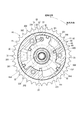
- FIG. 1 is a cross-sectional view illustrating a valve timing adjustment device according to a first embodiment.
- FIG. 2 is a sectional view taken along line II-II of FIG.
- FIG. 3 is a sectional view showing a fluid control valve of the valve timing adjusting device according to the first embodiment;
- FIG. 4 is a perspective view showing an inner sleeve of the fluid control valve according to the first embodiment,
- FIG. 5 is a perspective view showing a retard supply check valve of the fluid control valve according to the first embodiment;
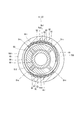
- FIG. 6 is a sectional view taken along line VI-VI in FIG. FIG.
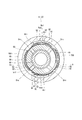
- FIG. 7 is a cross-sectional view showing an initial state of a check valve of the fluid control valve according to the first embodiment
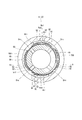
- FIG. 8 is a diagram showing an initial state of opening of a check valve of a fluid control valve according to a comparative embodiment
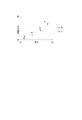
- FIG. 9 is a diagram illustrating a relationship between a flow rate of hydraulic oil and a pressure loss at an early stage of opening of the check valves according to the first embodiment and the comparative embodiment.
- FIG. 10 is a diagram illustrating the relationship between the flow rate of hydraulic oil and the pressure loss when a predetermined time has elapsed after the check valves of the first embodiment and the comparative embodiment have opened and the flow rate of hydraulic oil has become constant;
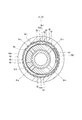
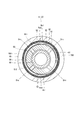
- FIG. 11 is a cross-sectional view illustrating a check valve and a displacement restricting unit of the fluid control valve according to the second embodiment
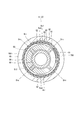
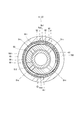
- FIG. 12 is a cross-sectional view illustrating a check valve and a displacement restricting unit of the fluid control valve according to the third embodiment
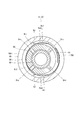
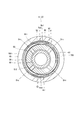
- FIG. 13 is a cross-sectional view illustrating a check valve and a displacement restricting unit of a fluid control valve according to a fourth embodiment
- FIG. 14 is a cross-sectional view illustrating a check valve and a displacement restricting unit of a fluid control valve according to a fifth embodiment
- FIG. 15 is a cross-sectional view illustrating a check valve and a displacement restricting unit of a fluid control valve according to a sixth embodiment
- FIG. 16 is a cross-sectional view illustrating a check valve and a displacement restricting unit of a fluid control valve according to a seventh embodiment
- FIG. 17 is a cross-sectional view illustrating a check valve and a displacement restricting unit of the fluid control valve according to the eighth embodiment.
- substantially the same components are denoted by the same reference numerals, and description thereof will be omitted.
- substantially the same component has the same or similar operation and effect.
- FIGS. 1 and 2 show a fluid control valve according to a first embodiment and a valve timing adjusting device to which the fluid control valve is applied.
- the valve timing adjusting device 10 changes the rotation phase of the camshaft 3 with respect to the crankshaft 2 of the engine 1 as an internal combustion engine, thereby changing the rotation of the camshaft 3 to open or close the intake valve 4 or the exhaust valve 5 of the intake valve 4. This is for adjusting the valve timing.
- the valve timing adjusting device 10 is provided in a power transmission path from the crankshaft 2 to the camshaft 3.
- the crankshaft 2 corresponds to a “drive shaft”.
- the camshaft 3 corresponds to a “driven shaft”.
- the intake valve 4 and the exhaust valve 5 correspond to “valves”.
- the valve timing adjustment device 10 includes a phase conversion unit PC, a hydraulic oil supply source OS as a fluid supply source, a hydraulic oil control unit OC, an oil discharge unit OD, a retard supply oil passage RRs, an advance supply oil passage RAs, and drain oil. There are a retard drain oil passage RRd, an advance drain oil passage RAd, and the like as paths.
- the phase converter PC includes the housing 20 and the vane rotor 30.
- the housing 20 has a gear part 21 and a case 22.
- the case 22 has a tubular portion 221 and plate portions 222 and 223.
- the tubular portion 221 is formed in a tubular shape.
- the plate portion 222 is formed integrally with the tubular portion 221 so as to close one end of the tubular portion 221.
- the plate portion 223 is provided to close the other end of the cylindrical portion 221. Thereby, a space 200 is formed inside the housing 20.
- the plate portion 223 is fixed to the cylindrical portion 221 by the bolt 12.
- the gear portion 21 is formed on the outer edge of the plate portion 223.
- the plate portion 223 is fitted to the end of the camshaft 3.
- the camshaft 3 rotatably supports the housing 20.
- the chain 6 is wound around the gear portion 21 and the crankshaft 2.
- the gear unit 21 rotates in conjunction with the crankshaft 2.
- the case 22 forms a plurality of partition portions 23 that protrude radially inward from the cylindrical portion 221. In the center of the plate portion 222 of the case 22, an opening 24 that opens to a space outside the case 22 is formed.
- the opening 24 is located on the opposite side of the vane rotor 30 from the camshaft 3.
- the vane rotor 30 has a boss 31 and a plurality of vanes 32.
- the boss 31 has a cylindrical shape and is fixed to an end of the camshaft 3.
- the vanes 32 protrude from the bosses 31 between the partition portions 23 radially outward.
- a space 200 inside the housing 20 is partitioned by a vane 32 into a retard chamber 201 and an advance chamber 202. That is, the housing 20 forms the retard chamber 201 and the advance chamber 202 between the housing 20 and the vane rotor 30.
- the retard chamber 201 is located on one side in the circumferential direction with respect to the vane 32.
- the advance chamber 202 is located on the other side in the circumferential direction with respect to the vane 32.
- the vane rotor 30 relatively rotates in the retard direction or the advance direction with respect to the housing 20 in accordance with the oil pressure of the working oil supplied to the retard chamber 201 and the advance chamber 202.
- the retard chamber 201 and the advance chamber 202 correspond to a “hydraulic chamber” as a fluid supply target.
- the hydraulic oil control valve 11 as a fluid control valve corresponds to the hydraulic oil control unit OC.
- the hydraulic oil control valve 11 includes a sleeve 400, a spool 60, a recycle oil passage Rre, a retard supply check valve 71, an advance supply check valve 72, a recycle check valve 81 as a check valve, a displacement regulating section 90, and the like. .
- the hydraulic oil control valve 11 is provided at the center of the housing 20 and the vane rotor 30, that is, at the center of the phase converter PC (see FIGS. 1 and 2).
- the hydraulic oil control valve 11 is provided so that at least a part thereof is located inside the housing 20.
- the hydraulic oil control valve 11 is located on the rotation axis of the phase converter PC.
- the sleeve 400 has an outer sleeve 40 as an outer cylinder and an inner sleeve 50 as an inner cylinder.
- the outer sleeve 40 is formed in a substantially cylindrical shape from a material having relatively high hardness including, for example, iron.
- the outer peripheral wall of the outer sleeve 40 has a substantially cylindrical shape.
- a screw portion 41 is formed on the outer peripheral wall at one end of the outer sleeve 40.
- a locking portion 49 extending annularly outward from the outer peripheral wall in the radial direction is formed.
- a shaft hole 100 and a supply hole 101 are formed at the end of the cam shaft 3 on the valve timing adjusting device 10 side.
- the shaft hole 100 is formed to extend in the axial direction of the camshaft 3 from the center of the end face of the camshaft 3 on the valve timing adjusting device 10 side.
- the supply hole 101 extends radially inward from the outer wall of the camshaft 3 and communicates with the shaft hole 100 (see FIG. 1).
- a shaft-side screw portion 110 that can be screw-coupled to the screw portion 41 of the outer sleeve 40 is formed.
- the outer sleeve 40 passes through the inside of the boss 31 of the vane rotor 30 and is fixed to the camshaft 3 such that the screw portion 41 is coupled to the shaft-side screw portion 110 of the camshaft 3.
- the locking portion 49 locks the end surface of the boss 31 of the vane rotor 30 on the side opposite to the cam shaft 3.
- the vane rotor 30 is fixed to the camshaft 3 so as to be sandwiched between the camshaft 3 and the locking portion 49.
- the outer sleeve 40 is provided at the center of the vane rotor 30.
- the hydraulic oil supply source OS is the oil pump 8.
- the oil discharge section OD is an oil pan 7.
- the oil pump 8 is connected to the supply hole 101.
- the oil pump 8 pumps up the working oil stored in the oil pan 7 and supplies it to the supply hole 101. As a result, the working oil flows into the shaft hole 100.
- the inner sleeve 50 is formed in a substantially cylindrical shape from a material having relatively low hardness including, for example, aluminum. That is, the inner sleeve 50 is formed of a material having a lower hardness than the outer sleeve 40.
- the inner sleeve 50 has an inner peripheral wall and an outer peripheral wall formed in a substantially cylindrical surface shape.
- the inner sleeve 50 has a surface subjected to a surface hardening treatment such as alumite, and has a surface layer having a higher hardness than the base material.
- the inner sleeve 50 is provided inside the outer sleeve 40 such that the outer peripheral wall is fitted to the inner peripheral wall of the outer sleeve 40.
- the inner sleeve 50 cannot move relative to the outer sleeve 40.
- a sleeve sealing portion 51 is provided at one end of the inner sleeve 50. The sleeve sealing portion 51 covers one end of the inner sleeve 50.
- the spool 60 is formed in a substantially cylindrical shape by, for example, metal.
- the spool 60 is provided inside the inner sleeve 50 so that the outer peripheral wall slides on the inner peripheral wall of the inner sleeve 50 and can reciprocate in the axial direction. That is, the spool 60 is provided inside the inner sleeve 50 so as to be relatively movable in the axial direction with respect to the inner sleeve 50.
- a spool sealing portion 62 is provided at one end of the spool 60. The spool sealing portion 62 closes one end of the spool 60.
- variable volume space Sv is formed inside the inner sleeve 50 between the sleeve sealing portion 51 and the other end of the spool 60.
- the volume of the variable volume space Sv changes when the spool 60 moves in the axial direction with respect to the inner sleeve 50. That is, the sleeve sealing portion 51 forms a volume variable space Sv in which the volume changes between the sleeve 60 and the spool 60.
- a spring 63 is provided in the variable volume space Sv.
- the spring 63 is a so-called coil spring, one end of which contacts the sleeve sealing portion 51, and the other end of which contacts the other end of the spool 60.
- the spring 63 urges the spool 60 to the side opposite to the sleeve sealing portion 51.
- a locking portion 59 is provided radially inside the other end of the outer sleeve 40.
- the locking portion 59 is formed in a bottomed cylindrical shape, and is provided so that the outer peripheral wall is fitted to the inner peripheral wall of the outer sleeve 40.
- a hole is formed in the center of the bottom of the locking portion 59, and the spool sealing portion 62 is located inside the hole.
- the locking portion 59 can lock one end of the spool 60 by the bottom.
- the locking portion 59 can restrict the movement of the spool 60 to the opposite side of the spool 60 from the sleeve sealing portion 51.
- the spool 60 is prevented from falling off from the inner side of the inner sleeve 50.
- the spool 60 is axially movable from a position where it contacts the locking portion 59 to a position where it contacts the sleeve sealing portion 51.
- the movable range with respect to the sleeve 400 is from the position where it contacts the locking portion 59 (see FIG. 3) to the position where it contacts the sleeve sealing portion 51.
- the movable range of the spool 60 is referred to as a “stroke section”.
- the outer end of the inner sleeve 50 on the side of the sleeve sealing portion 51 is formed smaller than the inner diameter of the outer sleeve 40.
- a cylindrical space St1 which is a substantially cylindrical space, is formed between the outer peripheral wall at the end of the inner sleeve 50 on the side of the sleeve sealing portion 51 and the inner peripheral wall of the outer sleeve 40.
- the inner sleeve 50 has an annular recess Ht.
- the annular concave portion Ht is formed so as to be annularly concave radially inward from a position corresponding to the locking portion 49 on the outer peripheral wall of the inner sleeve 50.
- an annular space St2 which is an annular space, is formed between the annular concave portion Ht and the inner peripheral wall of the outer sleeve 40.
- a flow channel groove 52 is formed in the inner sleeve 50.
- the flow channel groove 52 is formed so as to be recessed radially inward from the outer peripheral wall of the inner sleeve 50 and to extend in the axial direction of the inner sleeve 50 (see FIGS. 3, 4, and 6).
- Two channel grooves 52 are formed at equal intervals in the circumferential direction of the inner sleeve 50 (see FIG. 6).
- the flow channel groove 52 forms an axial supply oil passage RsA as an axial flow channel. That is, the axial supply oil passage RsA is formed to extend in the axial direction of the sleeve 400 at the interface T1 between the outer sleeve 40 and the inner sleeve 50.
- the axial supply oil passage RsA has one end connected to the cylindrical space St1, and the other end connected to the annular space St2.
- Regulation grooves 511 and 512 are formed in the inner sleeve 50.
- the regulating groove 511 is formed so as to be annularly recessed radially outward from a position corresponding to the end of the cylindrical space St1 on the inner peripheral wall of the inner sleeve 50.
- the restriction groove portion 512 is formed to be annularly concave radially outward from a position corresponding to the annular concave portion Ht on the inner peripheral wall of the inner sleeve 50.
- the inner sleeve 50 is provided with a movement restricting portion 513.
- the movement restricting portion 513 is formed so as to be annularly concave radially inward from the outer peripheral wall of the inner sleeve 50 between the restricting groove 511 and the restricting groove 512. Therefore, a part of the movement restricting portion 513 in the circumferential direction is connected to the flow channel groove 52.
- the movement restricting portion 513 forms an annular flow passage portion Rri. That is, the annular flow path portion Rri is formed between the outer sleeve 40 and the inner sleeve 50 so as to extend in the circumferential direction of the sleeve 400 while being connected to the axial supply oil passage RsA.
- the sleeve 400 has a retard supply opening ORs, an advance supply opening OAs, a retard opening OR, an advance opening OA, and a recycle opening Ore.
- the retard supply opening ORs is formed so as to extend in the radial direction of the sleeve 400 and connect the regulating groove 511 of the inner sleeve 50 to the cylindrical space St1 and the axial supply oil passage RsA. Note that a plurality of retard supply openings ORs are formed in the circumferential direction of the inner sleeve 50.
- the advance supply opening OAs is formed so as to extend in the radial direction of the sleeve 400 and connect the regulating groove 512 of the inner sleeve 50 to the annular space St2 and the axial supply oil passage RsA. Note that a plurality of advance angle supply openings OAs are formed in the circumferential direction of the inner sleeve 50.
- the retard opening OR extends in the radial direction of the sleeve 400 and connects the space inside the inner sleeve 50 and the space outside the outer sleeve 40. Note that a plurality of retard opening portions OR are formed in the circumferential direction of the sleeve 400.
- the retard opening OR communicates with the retard chamber 201 via the retard oil passage 301.
- the advance opening OA extends in the radial direction of the sleeve 400 and connects the space inside the inner sleeve 50 and the space outside the outer sleeve 40.
- the advance opening OA is formed on the locking portion 49 side with respect to the retard opening OR. Note that a plurality of advance opening portions OA are formed in the circumferential direction of the sleeve 400.
- the advance opening OA communicates with the advance chamber 202 via the advance oil passage 302.
- a substantially cylindrical valve seat surface 55 is formed in the movement restricting portion 513 of the inner sleeve 50 (see FIGS. 3 and 6). That is, the valve seat surface 55 is formed in a tubular shape on the inner sleeve 50 side of the annular flow path portion Rri.
- the recycle opening Ore is formed so as to extend in the radial direction of the sleeve 400 and communicate the valve seat surface 55 with the inside of the inner sleeve 50. That is, the recycle opening Ore connects the annular flow path Rri and the space inside the inner sleeve 50.
- Four recycling openings Ore are formed at equal intervals in the circumferential direction of the inner sleeve 50 (see FIG. 6).
- the recycle opening Ore corresponds to a “valve seat flow path”.
- the flow channel groove 52 and the axial supply oil passage RsA are formed between two adjacent recycle openings Ore in the circumferential direction of the sleeve 400 (see FIG. 6).
- the spool 60 has a retard supply recess HRs, a retard drain recess HRd, an advance drain recess HAd, an advance supply recess HAs, and drain openings Od1 and Od2.
- the retard supply recess HRs, the retard drain recess HRd, the advance drain recess HAd, and the advance supply recess HAs are each formed annularly so as to be recessed radially inward from the outer peripheral wall of the spool 60.
- the retard supply recess HRs, the retard drain recess HRd, the advance drain recess HAd, and the advance supply recess HAs are formed so as to be arranged in the axial direction of the spool 60 in this order.
- the retard drain recess HRd and the advance drain recess HAd are formed integrally.
- the retard drain recess HRd and the advance drain recess HAd form a specific space Ss with the inner peripheral wall of the inner sleeve 50. That is, the specific space Ss is formed between the spool 60 and the sleeve 400.
- the drain opening Od1 is formed so as to communicate a space inside the spool 60 with the retard drain recess HRd and the advance drain recess HAd, that is, the specific space Ss.
- the drain opening Od2 is formed at the end on the spool sealing portion 62 side of the spool 60 so as to communicate the inside space and the outside space.
- Two drain openings Od1 are formed at equal intervals in the circumferential direction of the spool 60, for example.
- the four drain openings Od2 are formed at equal intervals in the circumferential direction of the spool 60, for example.
- the retard supply oil passage RRs connects the oil pump 8 and the retard chamber 201 via the hydraulic oil control valve 11.
- the advance supply oil passage RAs connects the oil pump 8 and the advance chamber 202 via the hydraulic oil control valve 11.
- the retard drain oil passage RRd as the drain oil passage connects the retard chamber 201 and the oil pan 7.
- the advance drain oil passage RAd as the drain oil passage connects the advance chamber 202 and the oil pan 7.
- the retard supply oil passage RRs includes a supply hole 101, a shaft hole 100, a cylindrical space St1, an axial supply oil passage RsA, a retard supply opening ORs, a regulating groove 511, a retard supply recess HRs, and a retard opening.
- the oil pump 8 and the retard chamber 201 are connected via the section OR and the retard oil passage 301.
- the advancing supply oil passage RAs includes a supply hole 101, a shaft hole 100, a cylindrical space St1, an axial supply oil passage RsA, an advancing supply opening OAs, a regulating groove 512, an advancing supply recess HAs, and an advancing opening.
- the oil pump 8 and the advance chamber 202 are connected via the section OA and the advance oil passage 302.
- the retard drain oil passage RRd connects the retard chamber 201 and the oil pan 7 via the retard oil passage 301, the retard opening OR, the retard drain recess HRd, and the drain openings Od1 and Od2.
- the advancing drain oil passage RAd connects the advancing chamber 202 and the oil pan 7 via the advancing oil passage 302, the advancing opening OA, the advancing drain recess HAd, and the drain openings Od1 and Od2.
- the retard supply oil passage RRs, the advance supply oil passage RAs, the retard drain oil passage RRd, and the advance drain oil passage RAd are partially formed inside the hydraulic oil control valve 11.
- the axial supply oil passage RsA is formed to extend in the axial direction of the sleeve 400 in the advance supply oil passage RAs. That is, the sleeve 400 has the axial supply oil passage RsA extending in the axial direction of the sleeve 400 in the advance supply oil passage RAs.
- the recycle oil passage Rre connects the retarded drain oil passage RRd and the advanced drain oil passage RAd as the drain oil passage to the retarded supply oil passage RRs and the advanced supply oil passage RAs.
- the recycle oil passage Rre extends from the specific space Ss via the recycle opening Ore, the movement restricting portion 513, the annular flow passage Rri, and the retard supply oil passage RRs and the advance supply oil passage RAs. That is, it is connected to the axial supply oil passage RsA.
- the retard drain oil passage RRd and the advance drain oil passage RAd as the drain oil passage include a retard oil passage 301, a retard opening OR, an advance oil passage 302, an advance opening OA, a specific space Ss, and a drain opening. It is connected to the space inside the spool 60 via the section Od1.
- the drain opening Od1 is formed to be connected to the specific space Ss in the drain oil passage and to extend from the specific space Ss in the radial direction of the sleeve 400 or the spool 60.
- the recycle opening Ore is formed so as to be connected to the specific space Ss in the recycle oil passage Rre and extend from the specific space Ss to a side opposite to the drain opening Od1.
- the recycled oil passage Rre is connected to the retarded drain oil passage RRd and the advanced drain oil passage RAd in the specific space Ss.
- the drain opening Od1 is formed so that at least a part thereof overlaps the recycle opening Ore in the axial direction of the sleeve 400 or the spool 60.
- the drain opening Od1 is formed in the spool 60 so as to extend from the specific space Ss to the sleeve 400 or the inside of the spool 60 in the radial direction.
- the recycle opening Ore is formed in the inner sleeve 50 so as to extend from the specific space Ss to the outside in the radial direction of the sleeve 400 or the spool 60.
- the oil pump 8 includes a supply hole 101, a shaft hole 100, a cylindrical space St1, an axial supply oil passage RsA, a retard supply opening ORs, a restriction groove 511, a retard supply recess HRs of the retard supply oil passage RRs. , And communicates with the retard chamber 201 via the retard opening OR and the retard oil passage 301. Thereby, hydraulic oil can be supplied from the oil pump 8 to the retard chamber 201 via the retard supply oil passage RRs.
- the advance chamber 202 is connected to the oil pan 7 via the advance oil passage 302 of the advance drain oil passage RAd, the advance opening OA, the advance drain recess HAd, and the drain openings Od1 and Od2. Communicate. Thereby, the working oil can be discharged from the advance chamber 202 to the oil pan 7 via the advance drain oil passage RAd.
- the oil pump 8 supplies the advance supply oil passage RAs.
- the hole 101, the shaft hole 100, the cylindrical space St1, the axial supply oil passage RsA, the advance supply opening OAs, the regulating groove 512, the advance supply recess HAs, the advance opening OA, and the advance oil passage 302 It communicates with the advancing chamber 202 via the control unit.
- the oil pump 8 and the retard chamber 201 communicate with each other through the retard supply oil passage RRs.
- hydraulic oil can be supplied from the oil pump 8 to the retard chamber 201 and the advance chamber 202 via the retard supply oil path RRs and the advance supply oil path RAs.
- the hydraulic oil flows from the retard chamber 201 and the advance chamber 202 to the oil pan 7 because the retard drain oil passage RRd and the advance drain oil passage RAd are closed by the spool 60, that is, shut off. Not emitted.
- the retard chamber 201 becomes the retard oil passage 301 of the retard drain oil passage RRd.
- the oil pan 7 communicates with the oil pan 7 through the retard opening OR, the retard drain recess HRd, and the drain openings Od1 and Od2.
- the oil pump 8 and the advance chamber 202 communicate with each other through the advance supply oil passage RAs.
- hydraulic oil can be discharged from the retard chamber 201 to the oil pan 7 via the retard drain oil passage RRd, and the advance chamber 202 from the oil pump 8 via the advance supply oil passage RAs. Can be supplied with hydraulic oil.
- a filter 58 is provided inside the end of the outer sleeve 40 on the sleeve sealing portion 51 side, that is, in the middle of the retard supply oil passage RRs and the advance supply oil passage RAs.
- the filter 58 is, for example, a disk-shaped mesh.
- the filter 58 is capable of collecting foreign substances contained in the hydraulic oil. Therefore, it is possible to suppress the foreign matter from flowing on the downstream side of the filter 58, that is, on the side opposite to the oil pump 8.
- the retard supply check valve 71 is formed in a substantially cylindrical shape by bending, for example, a rectangular thin metal plate so that the longitudinal direction is along the circumferential direction. That is, the retard supply check valve 71 is formed of an annular elastic body.
- FIG. 5 is a perspective view of the retard supply check valve 71.
- the retard supply check valve 71 has an overlapping portion 700.
- the overlap portion 700 is formed at one end in the circumferential direction of the retard supply check valve 71.
- the overlapping portion 700 is formed so as to overlap the other end of the retard supply check valve 71 in the circumferential direction in the radial direction (see FIG. 5).
- the retard supply check valve 71 is provided in the regulating groove 511.
- the retard supply check valve 71 is provided in the regulating groove 511 so as to be elastically deformable in the radial direction.
- the retard supply check valve 71 is provided radially inside the inner sleeve 50 with respect to the retard supply opening ORs.
- the retard supply check valve 71 is provided in the regulating groove portion 511, and in a state where hydraulic oil is not flowing through the retard supply oil passage RRs, that is, in a state where no external force is acting, the overlapping portion 700 is the other in the circumferential direction. It is in a state where it overlaps the end.
- the retard supply check valve 71 When the hydraulic oil flows from the retard supply opening ORs to the retard supply recess HRs in the retard supply oil passage RRs, the retard supply check valve 71 is configured such that the outer peripheral wall is pushed by the hydraulic oil and contracts radially inward. That is, it is deformed so as to reduce the diameter. Thereby, the outer peripheral wall of the retard supply check valve 71 is opened by separating from the retard supply opening ORs, and the hydraulic oil flows to the retard supply recess HRs through the retard supply check valve 71. be able to. At this time, the overlapping portion 700 is in a state in which the overlapping portion 700 and the other end of the retard supply check valve 71 maintain a partially overlapping state while increasing the length of the overlapping range.
- the retard supply check valve 71 When the flow rate of the hydraulic oil flowing through the retard supply oil passage RRs becomes equal to or less than a predetermined value, the retard supply check valve 71 is deformed so as to expand radially outward, that is, expand. Further, when the hydraulic oil flows from the retard supply concave portion HRs to the retard supply opening ORs, the inner peripheral wall of the retard supply check valve 71 is pushed radially outward by the hydraulic oil, and the retard supply check valve 71 is moved to the retard supply opening ORs. The valve is closed by contact. This restricts the flow of the hydraulic oil from the retard supply recess HRs to the retard supply opening ORs.
- the retard supply check valve 71 functions as a check valve, permits the flow of hydraulic oil from the retard supply opening ORs to the retard supply recess HRs, and allows the hydraulic oil to flow from the retard supply recess HRs.
- the flow of the hydraulic oil to the retard supply opening ORs side can be regulated. That is, the retard supply check valve 71 is provided on the oil pump 8 side with respect to the spool 60 of the hydraulic oil control valve 11 in the retard supply oil passage RRs, and the hydraulic oil flows from the oil pump 8 side to the retard chamber 201 side. Only flow is allowed.
- the advance supply check valve 72 is formed in a substantially cylindrical shape by, for example, bending a rectangular thin metal plate so that its longitudinal direction is along the circumferential direction.
- the configuration of the advance angle supply check valve 72 is the same as that of the retard angle supply check valve 71, and a detailed description of the configuration is omitted.
- Advance supply check valve 72 is provided in regulating groove 512.
- the advance angle supply check valve 72 is provided in the regulating groove portion 512 so as to be elastically deformable in the radial direction.
- the advance angle supply check valve 72 is provided radially inside the inner sleeve 50 with respect to the advance angle supply opening OAs.
- the advance angle supply check valve 72 is provided in the regulating groove portion 512, and in a state where hydraulic oil does not flow through the advance angle supply oil passage RAs, that is, in a state where no external force is acting, the overlap portion 700 is positioned on the other side in the circumferential direction. It is in a state where it overlaps the end.
- the advance supply check valve 72 is configured such that the outer peripheral wall is pushed by the hydraulic oil and contracts radially inward. That is, it is deformed so as to reduce the diameter.
- the outer peripheral wall of the advance supply check valve 72 is opened by separating from the advance supply opening OAs, and the hydraulic oil flows through the advance supply check valve 72 to the advance supply recess HAs side. be able to.
- the overlapping portion 700 is in a state where the overlapping portion 700 and the other end of the advance supply check valve 72 maintain a partially overlapping state while increasing the length of the overlapping range.
- the advance supply check valve 72 When the flow rate of the working oil flowing through the advance supply oil passage RAs becomes equal to or less than a predetermined value, the advance supply check valve 72 is deformed so as to expand radially outward, that is, expand. Further, when the hydraulic oil flows from the advance supply concave portion HAs to the advance supply opening OAs, the inner peripheral wall of the advance supply check valve 72 is pushed radially outward by the hydraulic oil, and is moved into the advance supply opening OAs. The valve is closed by contact. This restricts the flow of the hydraulic oil from the advance supply recess HAs to the advance supply opening OAs.
- the advance supply check valve 72 functions as a check valve, allows the flow of hydraulic oil from the advance supply opening OAs to the advance supply recess HAs, and allows the hydraulic oil to flow from the advance supply recess HAs.
- the flow of the hydraulic oil to the advance supply opening OAs side can be regulated. That is, the advance supply check valve 72 is provided on the oil pump 8 side with respect to the spool 60 of the hydraulic oil control valve 11 in the advance supply oil passage RAs, and the hydraulic oil flows from the oil pump 8 side to the advance chamber 202 side. Only flow is allowed.
- the recycle check valve 81 as a check valve is formed in a substantially cylindrical shape, for example, by bending a rectangular thin metal plate so that the longitudinal direction is along the circumferential direction. That is, the recycle check valve 81 is made of an annular elastic body.
- the outside diameter of the recycle check valve 81 is formed larger than the outside diameter of the retard supply check valve 71.
- the configuration of the recycle check valve 81 is the same as that of the retard supply check valve 71 except for the difference in the outer diameter, and thus the detailed description of the configuration is omitted.
- the recycle check valve 81 is provided on the recycle oil passage Rre in the movement restricting portion 513, that is, in the annular flow passage portion Rri.
- the recycle check valve 81 is provided so as to be elastically deformable in the radial direction in the annular flow path portion Rri.
- the recycle check valve 81 is provided radially outside the inner sleeve 50 with respect to the valve seat surface 55.
- the recycle check valve 81 is provided in the annular flow path portion Rri, and when the operating oil is not flowing through the recycle oil passage Rre, that is, in a state in which no external force is applied, the overlapping portion 700 is connected to the other end in the circumferential direction. (See FIG. 6).
- the recycle check valve 81 When the hydraulic oil flows from the recycle opening Ore side to the annular flow path Rri side in the recycle oil passage Rre, the recycle check valve 81 is expanded such that the inner peripheral wall is pushed radially outward by the hydraulic oil, that is, expands in diameter. In this way. Thereby, the inner peripheral wall of the recycle check valve 81 is opened by separating from the valve seat surface 55, and the hydraulic oil can flow toward the annular flow path portion Rri via the recycle check valve 81 (FIG. 7). reference). At this time, the overlapping portion 700 is in a state where the overlapping portion 700 and the other end of the recycle check valve 81 maintain a partially overlapping state while reducing the length of the overlapping range.
- the recycle check valve 81 functions as a check valve, permits the flow of hydraulic oil from the recycle opening Ore side to the annular flow path Rri side, and allows the recycle check valve 81 to recycle from the annular flow path Rri side.
- the flow of hydraulic oil to the side can be regulated. That is, the recycle check valve 81 allows only the flow of the hydraulic oil from the drain oil passage side to the retard supply oil passage RRs side and the advance supply oil passage RAs side in the recycle oil passage Rre.
- the movement restricting unit 513 can restrict the movement of the recycle check valve 81 in the axial direction.
- the displacement regulating section 90 has a regulating section main body 91 and a regulating section flow path 92 (see FIG. 6).
- the restricting portion main body 91 is formed, for example, by bending a bellows-like plate material in an annular shape.
- the regulating portion main body 91 is formed in a substantially cylindrical shape from a plate material such as a metal.
- the restricting portion main body 91 is provided outside the recycle check valve 81 in the annular flow path portion Rri.
- the axial length of the restricting portion main body 91 is substantially the same as the axial length of the recycle check valve 81.
- the outer edge of the regulating portion main body 91 can abut on the inner peripheral wall of the outer sleeve 40.
- the regulating portion main body 91 can restrict the displacement of the recycle check valve 81 in the diameter increasing direction by the inner edge abutting on the outer peripheral wall of the recycle check valve 81. (See FIG. 7).
- the regulation part main body 91 is formed so as to be elastically deformable in the radial direction of the annular flow path part Rri.
- the regulating portion main body 91 is formed of a bellows-like plate, a plurality of regulating portion flow paths 92 are formed inside and outside the regulating portion main body 91 (see FIGS. 6 and 7).
- the regulating portion flow path 92 is formed so as to communicate one side and the other side of the regulating portion main body 91 in the axial direction of the sleeve 400 so that the hydraulic oil can flow.
- at least a part of the regulating portion main body 91 is located at a connection point Rc1 between the annular flow passage portion Rri and the axial supply oil passage RsA. Therefore, the hydraulic oil flowing through the axial supply oil passage RsA can flow through the restriction portion flow path 92, and the flow of the hydraulic oil is prevented from being hindered by the displacement restriction portion 90 provided in the annular flow path portion Rri.
- FIG. 8 shows a fluid control valve according to a comparative embodiment.
- the fluid control valve according to the comparative embodiment has the same configuration as the hydraulic oil control valve 11 according to the present embodiment except that the fluid control valve does not include the displacement restricting unit 90. Since the fluid control valve according to the comparative example does not include the displacement restricting portion 90, when the diameter of the recycle check valve 81 is increased and the valve is opened (see FIG. 8), the recycle check valve 81 may be excessively deformed and damaged. Further, in the initial stage of opening the recycle check valve 81 (see FIG. 8), there is a possibility that pressure loss due to uneven opening of the recycle check valve 81 in the circumferential direction may increase.
- the hydraulic oil control valve 11 of the present embodiment includes the displacement restricting portion 90, when the recycle check valve 81 expands in diameter and opens (see FIG. 7), excessive deformation of the recycle check valve 81 is suppressed. Thus, damage to the recycle check valve 81 can be suppressed. Further, in the initial stage of opening the recycle check valve 81 (see FIG. 7), uneven opening of the recycle check valve 81 in the circumferential direction can be suppressed, and the pressure loss can be reduced.
- FIG. 9 is a diagram showing experimental results of the present embodiment and the comparative embodiment regarding the relationship between the flow rate of hydraulic oil and the pressure loss at the initial stage of opening of the recycle check valve 81.
- P0 indicates the experimental result of the comparative embodiment
- P1 indicates the experimental result of the present embodiment.
- the pressure loss of the present embodiment is smaller than that of the comparative embodiment regardless of the flow rate of the hydraulic oil.
- FIG. 10 shows the experimental results of the present embodiment and the comparative embodiment regarding the relationship between the flow rate of the hydraulic oil and the pressure loss when a predetermined time has elapsed since the recycle check valve 81 was opened and the flow rate of the hydraulic oil became constant.
- P0 indicates the experimental result of the comparative embodiment
- P1 indicates the experimental result of the present embodiment.
- FIG. 10 when a predetermined time has elapsed after the recycle check valve 81 has been opened and the flow rate of the hydraulic oil has become constant, it is understood that there is no difference in pressure loss between the comparative embodiment and the present embodiment. .
- the present embodiment has a high effect of suppressing the pressure loss of the hydraulic oil particularly in the early stage of opening the recycle check valve 81.
- a linear solenoid 9 is provided on the side of the spool 60 opposite to the camshaft 3.
- the linear solenoid 9 is provided so as to contact the spool sealing portion 62.
- the linear solenoid 9 presses the spool 60 toward the camshaft 3 via the spool sealing portion 62 against the urging force of the spring 63. Accordingly, the position of the spool 60 in the axial direction with respect to the sleeve 400 changes in the stroke section.
- variable volume space Sv communicates with the retard drain oil passage RRd and the advance drain oil passage RAd. Therefore, the variable volume space Sv is open to the atmosphere via the drain opening Od2 of the retard drain oil passage RRd and the advance drain oil passage RAd. Thereby, the pressure in the variable volume space Sv can be made equal to the atmospheric pressure. Therefore, the axial movement of the spool 60 can be made smooth.
- the hydraulic oil is delayed from the oil pump 8 via the retard supply oil passage RRs. It is supplied to the corner chamber 201. At this time, the hydraulic oil is discharged from the advance chamber 202 to the oil pan 7 via the advance drain oil passage RAd. Further, part of the hydraulic oil flowing through the advance drain oil passage RAd is returned to the axial supply oil passage RsA and the retard supply oil passage RRs via the recycle oil passage Rre. Thereby, the operating oil discharged from the advance chamber 202 can be reused. At this time, the recycle check valve 81 suppresses the backflow of the recycled oil passage Rre from the axial supply oil passage RsA to the drain oil passage.
- the hydraulic oil is supplied from the oil pump 8 to the retard supply oil passage. It is supplied to the retard chamber 201 via RRs. At this time, the hydraulic oil is supplied from the oil pump 8 to the advance chamber 202 via the advance supply oil passage RAs. At this time, since the retard drain oil passage RRd and the advance drain oil passage RAd are closed by the spool 60, the hydraulic oil does not flow through the drain oil passage, and the hydraulic oil flows through the recycle oil passage Rre. It is not returned to the direction supply oil passage RsA side.
- the hydraulic oil is supplied from the oil pump 8 via the advance supply oil passage RAs. It is supplied to the advance chamber 202. At this time, the hydraulic oil is discharged from the retard chamber 201 to the oil pan 7 via the retard drain oil passage RRd. Further, a part of the hydraulic oil flowing through the retard drain oil passage RRd is returned to the axial supply oil passage RsA and the advance supply oil passage RAs via the recycle oil passage Rre. Thereby, the hydraulic oil discharged from the retard chamber 201 can be reused. At this time, the recycle check valve 81 suppresses the backflow of the recycled oil passage Rre from the axial supply oil passage RsA to the drain oil passage.
- This embodiment further includes a lock pin 33 (see FIGS. 1 and 2).
- the lock pin 33 is formed in a cylindrical shape with a bottom, and is housed in a housing hole 321 formed in the vane 32 so as to be able to reciprocate in the axial direction.
- a spring 34 is provided inside the lock pin 33. The spring 34 urges the lock pin 33 toward the plate portion 222 of the case 22.
- a fitting recess 25 is formed on the vane 32 side of the plate portion 222 of the case 22.
- the lock pin 33 can be fitted into the fitting recess 25 when the vane rotor 30 is at the most retarded position with respect to the housing 20.
- the lock pin 33 is fitted in the fitting recess 25, the relative rotation of the vane rotor 30 with respect to the housing 20 is restricted.
- the lock pin 33 is not fitted in the fitting recess 25, the relative rotation of the vane rotor 30 with respect to the housing 20 is allowed.
- a pin control oil passage 304 communicating with the advance chamber 202 is formed between the lock pin 33 of the vane 32 and the advance chamber 202 (see FIG. 2).
- the pressure of the operating oil flowing into the pin control oil passage 304 from the advance chamber 202 acts in a direction in which the lock pin 33 comes out of the fitting recess 25 against the urging force of the spring 34.
- valve timing adjusting device 10 configured as described above, when hydraulic oil is supplied to the advance chamber 202, hydraulic oil flows into the pin control oil passage 304, the lock pin 33 comes out of the fitting recess 25, and the housing The state is such that the relative rotation of the vane rotor 30 with respect to 20 is allowed.
- the valve timing adjusting device 10 presses the spool 60 of the hydraulic oil control valve 11 by driving the linear solenoid 9, and connects the hydraulic oil control valve 11 to the advance chamber 202 while connecting the oil pump 8 and the retard chamber 201.
- the operating oil is supplied from the advance chamber 202 to the oil pan 7 via the advance drain oil passage RAd while the operating oil is supplied to the retard chamber 201 via the retard supply oil passage RRs. Will be returned. Further, the working oil is returned from the advance drain oil passage RAd to the retard supply oil passage RRs via the recycle oil passage Rre.
- the operating oil is supplied from the retard chamber 201 to the oil pan 7 via the retard drain oil passage RRd while the operating oil is supplied to the advance chamber 202 via the advance supply oil passage RAs. Will be returned. Further, the working oil is returned from the retard drain oil passage RRd to the advance supply oil passage RAs via the recycle oil passage Rre.
- the valve timing adjusting device 10 sets the hydraulic oil control valve 11 to the first operating state when the rotation phase of the camshaft 3 is on the advanced side of the target value.
- the vane rotor 30 relatively rotates in the retard direction with respect to the housing 20, and the rotational phase of the cam shaft 3 changes to the retard side.
- the hydraulic oil control valve 11 when the hydraulic oil control valve 11 is in the first operating state or the second operating state, the hydraulic oil control valve 11 passes through the recycle oil passage Rre from the drain oil passage to the retard supply oil passage RRs or the advance supply oil passage RAs. The hydraulic oil is returned to. Thereby, the operating oil discharged from the advance chamber 202 or the retard chamber 201 can be reused.
- the hydraulic oil control valve 11 even when the hydraulic oil control valve 11 is in the phase holding state, that is, when the phase of the phase conversion unit PC is being held, the hydraulic oil is supplied to the retard chamber 201 and the advance chamber 202. Can be supplied.
- the phase of the phase converter PC when the phase of the phase converter PC is maintained, the supply state of the hydraulic oil to the retard chamber 201 and the advance chamber 202 is maintained, and the phase converter generated by the air being sucked into the retard chamber 201 and the advance chamber 202 is generated.
- the PC can be prevented from being out of phase.
- the hydraulic oil control valve 11 of the present embodiment is suitable for the valve timing adjusting device 10 in which the initial state of the recycle check valve 81 is repeated.
- the hydraulic oil control valve 11 is provided so as to be located at the center of the phase converter PC, that is, on the rotation axis of the phase converter PC. Therefore, when the engine 1 is operating, centrifugal force acts on the recycle check valve 81, and the position of the recycle check valve 81 and the on-off valve in the annular flow path Rri may become unstable. However, in the present embodiment, the position of the recycle check valve 81 and the on-off valve in the annular flow path portion Rri can be stabilized by the displacement restricting portion 90.
- the present embodiment is a hydraulic oil control valve 11 that can control the flow of hydraulic oil supplied from a hydraulic oil supply source OS to a hydraulic chamber as a fluid supply target, and an outer cylinder as an outer cylinder.
- An opening Ore, a recycle check valve 81 as a check valve, and a displacement restricting section 90 are provided.
- the inner sleeve 50 is provided inside the outer sleeve 40.
- the axial supply oil passage RsA is provided between the outer sleeve 40 and the inner sleeve 50 so that hydraulic oil flowing from the hydraulic oil supply source OS to the retard chamber 201 and the advance chamber 202 as hydraulic chambers can flow.
- 40 and the inner sleeve 50 are formed to extend in the axial direction.
- the annular flow path portion Rri is formed in an annular shape so as to extend in the circumferential direction of the outer sleeve 40 and the inner sleeve 50 while being connected to the axial supply oil passage RsA between the outer sleeve 40 and the inner sleeve 50.
- the valve seat surface 55 is formed in a tubular shape on the inner sleeve 50 side of the annular flow path portion Rri.
- the recycle opening Ore communicates the valve seat surface 55 with the inside of the inner sleeve 50.
- the recycle check valve 81 is formed of an annular elastic body, is provided in the annular flow path portion Rri, and opens when the diameter increases and is separated from the valve seat surface 55 to open from the recycle opening portion Ore side to the annular flow passage portion Rri side.
- the flow of hydraulic oil is permitted, the diameter of the hydraulic oil is reduced, and the valve closes by contacting the valve seat surface 55 to restrict the flow of hydraulic oil from the annular flow path portion Rri to the recycle opening Ore.
- the displacement regulating portion 90 is provided with a regulating portion main body 91 provided outside the recycle check valve 81 in the annular flow passage portion Rri so as to regulate the displacement of the recycle check valve 81 in the radial direction, and the hydraulic oil can flow therethrough.
- a regulating portion flow path 92 that communicates between one side and the other side of the regulating portion main body 91.
- the displacement of the recycle check valve 81 in the radial direction can be regulated by the regulating portion main body 91 of the displacement regulating portion 90. Therefore, damage due to excessive deformation of the recycle check valve 81 can be suppressed.
- the displacement restricting portion 90 has a restricting portion flow path 92 that connects one side and the other side of the restricting portion main body 91 in the axial direction of the outer sleeve 40 and the inner sleeve 50 so that hydraulic oil can flow. . Therefore, the hydraulic oil flowing through the axial supply oil passage RsA can flow through the restriction portion flow path 92, and the flow of the hydraulic oil is prevented from being hindered by the displacement restriction portion 90 provided in the annular flow path portion Rri. Thus, it is possible to suppress a decrease in the flow rate of the working oil supplied to the retard chamber 201 and the advance chamber 202 as the hydraulic chamber.
- the restricting portion main body 91 is formed by bending a bellows-like plate material into an annular shape. Therefore, the displacement regulating portion 90 having the regulating portion flow path 92 can be formed relatively easily.
- the restricting portion main body 91 is formed so as to be elastically deformable in the radial direction of the annular flow path portion Rri. Therefore, the impact of the collision between the recycle check valve 81 and the restricting portion main body 91 when the displacement restricting portion 90 restricts the displacement of the recycle check valve 81 in the radial direction can be reduced. Thereby, abrasion and breakage of the recycle check valve 81 and the regulating portion main body 91 can be suppressed.
- the present embodiment further includes a spool 60.
- the spool 60 is provided inside the inner sleeve 50 so as to be relatively movable in the axial direction with respect to the inner sleeve 50, and the hydraulic oil supply source OS and the retard chamber 201 as a hydraulic chamber are provided in accordance with the axial position with respect to the inner sleeve 50.
- the flow of the hydraulic oil to the advance chamber 202 can be controlled.
- the inner sleeve 50, the recycle check valve 81, and the displacement restricting portion 90 do not move relative to the outer sleeve 40 when the flow of the hydraulic oil is controlled by the spool 60. Becomes stable.
- the present embodiment is a valve timing adjusting device 10 that adjusts the valve timing of the engine 1 and includes a phase conversion unit PC and a hydraulic oil control valve 11 as a hydraulic oil control valve.
- the phase converter PC is attached to the camshaft 3 of the engine 1 so as to be rotatable in conjunction with the crankshaft 2 of the engine 1, and has a retard chamber 201 and an advance chamber 202 as hydraulic chambers. 201, the phase of the crankshaft 2 and the phase of the camshaft 3 are converted by the hydraulic oil supplied to the advance chamber 202.
- the hydraulic oil control valve 11 controls the hydraulic oil supplied from the hydraulic oil supply source OS to the retard chamber 201 and the advance chamber 202.
- the displacement restricting section 90 can suppress the flow rate of the hydraulic oil supplied to the retard chamber 201 and the advance chamber 202 as hydraulic chambers, and can also prevent the recycle check valve 81 from being damaged.
- the hydraulic oil control valve 11 of the present embodiment is suitable for the valve timing adjusting device 10 in which the initial state of the recycle check valve 81 is repeated.
- the hydraulic oil control valve 11 is provided at the center of the phase conversion unit PC. Therefore, during operation of the engine 1, the recycle check valve 81 rotates, and centrifugal force acts on the recycle check valve 81, and the position of the recycle check valve 81 and the on-off valve in the annular flow path Rri may become unstable. is there. However, in the present embodiment, the position of the recycle check valve 81 and the on-off valve in the annular flow path portion Rri can be stabilized by the displacement restricting portion 90.
- FIG. 11 shows a fluid control valve according to the second embodiment.
- the second embodiment differs from the first embodiment in the configuration of the displacement restricting section 90.
- the restricting portion main body 91 is formed by further bending a spirally wound wire into an annular shape.
- the regulating portion main body 91 is formed by spirally winding a wire such as a metal into a coil shape, and further winding the wire in a ring shape.
- the regulating section main body 91 is provided outside the recycle check valve 81 in the annular flow path section Rri.
- the outer edge of the regulating portion main body 91 can abut on the inner peripheral wall of the outer sleeve 40.
- the regulating portion main body 91 can restrict the displacement of the recycle check valve 81 in the diameter increasing direction by the inner edge abutting on the outer peripheral wall of the recycle check valve 81.
- the regulation part main body 91 is formed so as to be elastically deformable in the radial direction of the annular flow path part Rri.
- the regulating portion main body 91 is formed of a spirally wound wire, a plurality of regulating portion flow paths 92 are formed in the regulating portion main body 91 (see FIG. 11).
- the regulating portion flow path 92 is formed so as to communicate one side and the other side of the regulating portion main body 91 in the axial direction of the sleeve 400 so that the hydraulic oil can flow.
- at least a part of the regulating portion main body 91 is located at a connection point Rc1 between the annular flow passage portion Rri and the axial supply oil passage RsA. Therefore, the hydraulic oil flowing through the axial supply oil passage RsA can flow through the regulating portion flow path 92, and is prevented from being obstructed by the displacement regulating portion 90 provided in the annular flow passage portion Rri.
- the restricting portion main body 91 is formed by further bending a spirally wound wire into an annular shape. Therefore, the displacement regulating portion 90 having the regulating portion flow path 92 can be formed relatively easily.
- FIG. 12 shows a fluid control valve according to the third embodiment.
- the third embodiment differs from the first embodiment in the configuration of the displacement restricting section 90.
- the regulating portion main body 91 is formed in a substantially cylindrical shape by, for example, metal.
- the restricting portion main body 91 is provided outside the recycle check valve 81 in the annular flow path portion Rri.
- the axial length of the restricting portion main body 91 is substantially the same as the axial length of the recycle check valve 81.
- the outer peripheral wall of the regulating portion main body 91 can abut on the inner peripheral wall of the outer sleeve 40.
- the regulating unit main body 91 can regulate the displacement of the recycle check valve 81 in the radial direction by contacting the inner peripheral wall with the outer peripheral wall of the recycle check valve 81. .
- the regulating portion flow path 92 is a hole that connects one end surface of the regulating portion main body 91 in the axial direction to the other end surface (see FIG. 12).
- a plurality of regulating section flow paths 92 are formed at regular intervals in the circumferential direction of the regulating section main body 91.
- the regulating portion flow path 92 is formed so as to communicate one side and the other side of the regulating portion main body 91 in the axial direction of the sleeve 400 so that the hydraulic oil can flow.
- at least a part of the regulating portion main body 91 is located at a connection point Rc1 between the annular flow passage portion Rri and the axial supply oil passage RsA. Therefore, the hydraulic oil flowing through the axial supply oil passage RsA can flow through the regulating portion flow path 92, and is prevented from being obstructed by the displacement regulating portion 90 provided in the annular flow passage portion Rri.
- the regulating portion flow path 92 is a hole that connects one end surface of the regulating portion main body 91 in the axial direction to the other end surface. Therefore, the displacement regulating portion 90 having the regulating portion flow path 92 can be formed relatively easily.
- FIG. 13 shows a fluid control valve according to the fourth embodiment.
- the fourth embodiment differs from the third embodiment in the configuration of the displacement restricting section 90.
- the regulating portion flow path 92 is a groove that connects one end surface of the regulating portion main body 91 in the axial direction to the other end surface (see FIG. 13).
- the regulating portion flow path 92 is formed so as to be recessed radially inward from the outer peripheral wall of the regulating portion main body 91.
- a plurality of regulating portion flow paths 92 are formed at regular intervals in the circumferential direction of the regulating portion main body 91.
- the restricting portion flow path 92 is formed so as to communicate one side and the other side of the restricting portion main body 91 in the axial direction of the sleeve 400 so that hydraulic oil can flow.
- the hydraulic oil flowing in the axial supply oil passage RsA can flow through the regulating portion flow path 92, and is prevented from being obstructed by the displacement regulating portion 90 provided in the annular flow passage portion Rri. Is done.
- the regulating portion flow path 92 is a groove that connects one end surface of the regulating portion main body 91 in the axial direction to the other end surface. Therefore, the displacement regulating portion 90 having the regulating portion flow path 92 can be formed relatively easily.
- FIG. 14 shows a fluid control valve according to the fifth embodiment.
- the fifth embodiment differs from the third embodiment in the configuration of the displacement restricting section 90.
- the regulating portion main body 91 is formed in a porous substantially cylindrical shape by, for example, sintering a metal or the like.
- the regulating portion main body 91 is formed in a porous shape, so that a large number of regulating portion flow paths 92 are formed in the regulating portion main body 91.
- the regulating portion flow path 92 is formed so as to communicate one side and the other side of the regulating portion main body 91 in the axial direction of the sleeve 400 so that the hydraulic oil can flow.
- the hydraulic oil flowing in the axial supply oil passage RsA can flow through the regulating portion flow path 92, and is prevented from being obstructed by the displacement regulating portion 90 provided in the annular flow passage portion Rri. Is done.
- the regulating portion flow path 92 is formed by forming the regulating portion main body 91 in a porous shape. Therefore, the displacement regulating portion 90 having the regulating portion flow path 92 can be formed relatively easily.
- FIG. 15 shows a fluid control valve according to the sixth embodiment.
- the sixth embodiment differs from the first embodiment in the configuration of the displacement restricting section 90.
- the restricting portion main body 91 is divided into two in the circumferential direction of the annular flow path portion Rri, and is formed in a substantially arc shape.
- the regulating part main body 91 divided into two is provided at a position corresponding to each of the two axial supply oil passages RsA.
- the regulating portion main body 91 divided into two is provided in the annular flow passage portion Rri so as to sandwich the shaft of the sleeve 400.
- the restricting portion main body 91 is provided such that the outer edge portion is fixed to the inner peripheral wall of the outer sleeve 40.
- the regulating portion main body 91 When the recycle check valve 81 expands in diameter and opens, the regulating portion main body 91 is divided into two parts so that the inner edge portion abuts on the outer peripheral wall of the recycle check valve 81, thereby increasing the diameter of the recycle check valve 81.
- the displacement can be regulated (see FIG. 15).
- At least a part of the regulating portion main body 91 is located at a connection point Rc1 between the annular flow passage portion Rri and the axial supply oil passage RsA. Therefore, the hydraulic oil flowing through the axial supply oil passage RsA can flow through the restriction portion flow path 92, and the flow of the hydraulic oil is prevented from being hindered by the displacement restriction portion 90 provided in the annular flow path portion Rri.
- the regulating portion main body 91 is divided into a plurality of portions in the circumferential direction of the annular flow passage portion Rri, and at least a part thereof is formed between the annular flow passage portion Rri and the axial supply oil passage RsA. At the connection point Rc1. Therefore, while suppressing the member cost of the displacement control unit 90, the displacement control unit 90 suppresses the flow rate of the hydraulic oil supplied to the retard chamber 201 and the advance chamber 202, and suppresses the damage of the recycle check valve 81. It is possible.
- FIG. 16 shows a fluid control valve according to the seventh embodiment.
- the seventh embodiment differs from the first embodiment in the configuration of the displacement restricting section 90.
- the restricting portion main body 91 is divided into four in the circumferential direction of the annular flow path portion Rri, and is formed in a substantially arc shape.
- the regulating part main body 91 divided into four is provided at equal intervals in the circumferential direction of the annular flow path part Rri.
- Two opposing restricting portion main bodies 91 among the four divided restricting portion main bodies 91 are provided at positions corresponding to the two axial supply oil passages RsA, respectively.
- the restricting portion main body 91 is provided such that the inner edge portion is fixed to the outer peripheral wall of the recycle check valve 81. Therefore, the regulating portion main body 91 can move together with the recycle check valve 81 along with the opening / closing valve of the recycle check valve 81.
- the regulating portion main body 91 provided on the recycle check valve 81 contacts the outer peripheral portion with the inner peripheral wall of the outer sleeve 40 so that the diameter of the recycle check valve 81 increases. Can be restricted.
- At least a part of the regulating portion main body 91 is located at a connection point Rc1 between the annular flow passage portion Rri and the axial supply oil passage RsA. Therefore, the hydraulic oil flowing through the axial supply oil passage RsA can flow through the restriction portion flow path 92, and the flow of the hydraulic oil is prevented from being hindered by the displacement restriction portion 90 provided in the annular flow path portion Rri.
- the restricting portion main body 91 is fixed to the outer peripheral wall of the recycle check valve 81, and is movable together with the recycle check valve 81 with the on-off valve of the recycle check valve 81. Therefore, when the displacement regulating unit 90 regulates the displacement of the recycle check valve 81 in the radial direction, the collision between the recycle check valve 81 and the regulating unit main body 91 can be reduced. Thereby, abrasion and breakage of the recycle check valve 81 and the regulating portion main body 91 can be suppressed.
- FIG. 17 shows a fluid control valve according to the eighth embodiment.
- the eighth embodiment is different from the seventh embodiment in the configuration of the sleeve 400 and the like.
- the hydraulic oil control valve 11 does not include the spool 60.
- the inner sleeve 50 is provided inside the outer sleeve 40 so as to be relatively movable in the axial direction with respect to the outer sleeve 40.
- the position of the inner sleeve 50 in the axial direction with respect to the outer sleeve 40 is changed by the operation of the linear solenoid 9.
- the inner sleeve 50 is capable of controlling the flow of hydraulic oil between the hydraulic oil supply source OS and the retard chamber 201 and the advance chamber 202 according to the axial position with respect to the outer sleeve 40.
- the displacement restricting portion 90 moves axially relative to the outer sleeve 40 together with the recycle check valve 81 and the inner sleeve 50.
- the restricting portion main body 91 of the displacement restricting portion 90 is provided such that the inner edge portion is fixed to the outer peripheral wall of the recycle check valve 81.
- the inner sleeve 50 is provided inside the outer sleeve 40 so as to be movable relative to the outer sleeve 40 in the axial direction.
- the flow of hydraulic oil between the supply source OS and the retard chamber 201 and the advance chamber 202 can be controlled.
- the flow of fluid is controlled by the inner cylinder that does not include the spool and moves relative to the outer cylinder, as disclosed in Patent Document 1 (Japanese Patent Application Laid-Open No. 2015-145672).
- the present invention can also be applied to a fluid control valve.
- the regulating portion flow path 92 is a groove formed to be recessed radially inward from the outer peripheral wall of the regulating portion main body 91.
- the regulating portion flow path 92 may be a groove formed so as to be recessed radially outward from the inner peripheral wall of the regulating portion main body 91.
- the regulating portion main body 91 is not limited to two or four in the circumferential direction of the annular flow passage portion Rri, and may be provided in any number of divisions.
- the displacement restricting portion has a restricting portion flow path that communicates one side and the other side of the restricting portion main body in the axial direction of the outer cylinder portion and the inner cylindrical portion so that fluid can flow therethrough.
- the restricting portion main body may be formed of any material and in any manner.
- the example in which the hydraulic oil control valve 11 is provided at the center of the phase conversion unit PC has been described.
- the hydraulic oil control valve 11 may be provided outside the phase conversion unit PC. In this case, the physique of the phase conversion unit PC can be reduced.
- the fluid control valve according to the present disclosure is not limited to the valve timing adjusting device, and can be used to control the flow of a fluid supplied to a supply target such as another device.
- the present disclosure is not limited to the above embodiments, and can be implemented in various forms without departing from the gist of the present disclosure.
Landscapes
- Engineering & Computer Science (AREA)
- General Engineering & Computer Science (AREA)
- Mechanical Engineering (AREA)
- Valve Device For Special Equipments (AREA)
- Sliding Valves (AREA)
- Check Valves (AREA)
- Multiple-Way Valves (AREA)
Priority Applications (2)
| Application Number | Priority Date | Filing Date | Title |
|---|---|---|---|
| DE112019003963.6T DE112019003963T9 (de) | 2018-08-08 | 2019-08-06 | Fluidsteuerungsventil und Ventilsteuerzeitanpassungsvorrichtung unter Verwendung desselben |
| US17/167,323 US11519306B2 (en) | 2018-08-08 | 2021-02-04 | Fluid control valve, and valve timing adjusting device employing same |
Applications Claiming Priority (2)
| Application Number | Priority Date | Filing Date | Title |
|---|---|---|---|
| JP2018-149379 | 2018-08-08 | ||
| JP2018149379A JP7040769B2 (ja) | 2018-08-08 | 2018-08-08 | 流体制御弁、および、これを用いたバルブタイミング調整装置 |
Related Child Applications (1)
| Application Number | Title | Priority Date | Filing Date |
|---|---|---|---|
| US17/167,323 Continuation US11519306B2 (en) | 2018-08-08 | 2021-02-04 | Fluid control valve, and valve timing adjusting device employing same |
Publications (1)
| Publication Number | Publication Date |
|---|---|
| WO2020032018A1 true WO2020032018A1 (ja) | 2020-02-13 |
Family
ID=69413542
Family Applications (1)
| Application Number | Title | Priority Date | Filing Date |
|---|---|---|---|
| PCT/JP2019/030883 Ceased WO2020032018A1 (ja) | 2018-08-08 | 2019-08-06 | 流体制御弁、および、これを用いたバルブタイミング調整装置 |
Country Status (4)
| Country | Link |
|---|---|
| US (1) | US11519306B2 (enExample) |
| JP (1) | JP7040769B2 (enExample) |
| DE (1) | DE112019003963T9 (enExample) |
| WO (1) | WO2020032018A1 (enExample) |
Cited By (1)
| Publication number | Priority date | Publication date | Assignee | Title |
|---|---|---|---|---|
| CN115151712A (zh) * | 2020-02-26 | 2022-10-04 | 株式会社电装 | 气门正时调整装置 |
Families Citing this family (5)
| Publication number | Priority date | Publication date | Assignee | Title |
|---|---|---|---|---|
| US11852051B2 (en) | 2020-06-14 | 2023-12-26 | Schaeffler Technologies AG & Co. KG | Recirculating hydraulic fluid control valve |
| US11560813B2 (en) * | 2021-03-18 | 2023-01-24 | Schaeffler Technologies AG & Co. KG | Recirculating hydraulic fluid control valve |
| US11560814B1 (en) * | 2022-01-21 | 2023-01-24 | Schaeffler Technologies AG & Co. KG | Recirculating hydraulic fluid control valve |
| JP2025090873A (ja) * | 2022-04-27 | 2025-06-18 | Astemo株式会社 | 制御弁及びこの制御弁を用いた内燃機関のバルブタイミング制御装置 |
| CN115013558B (zh) * | 2022-07-02 | 2025-04-01 | 安徽工程大学 | 一种六通道流体介质控制阀 |
Citations (1)
| Publication number | Priority date | Publication date | Assignee | Title |
|---|---|---|---|---|
| WO2018135586A1 (ja) * | 2017-01-19 | 2018-07-26 | 株式会社デンソー | バルブタイミング調整装置 |
Family Cites Families (10)
| Publication number | Priority date | Publication date | Assignee | Title |
|---|---|---|---|---|
| DE200760C (enExample) * | ||||
| DE630363C (de) * | 1934-11-10 | 1936-05-26 | Hoerbiger & Co | Selbsttaetiges Ventil mit topfaehnlichem Gehaeuse |
| JP5269199B2 (ja) | 2009-06-10 | 2013-08-21 | 日鍛バルブ株式会社 | 内燃機関用油圧ラッシュアジャスタ |
| DE102010011835A1 (de) | 2010-03-18 | 2011-09-22 | Schaeffler Technologies Gmbh & Co. Kg | Druckmittelbetätigbare Nockenwellenverstelleinrichtung für eine Brennkraftmaschine |
| DE102011077586A1 (de) * | 2011-06-16 | 2012-12-20 | Schaeffler Technologies AG & Co. KG | Nockenwellenversteller |
| US20160201822A1 (en) * | 2013-09-10 | 2016-07-14 | Hitachi Automotive Systems, Ltd. | Solenoid valve |
| DE102014101236B4 (de) | 2014-01-31 | 2017-06-08 | Hilite Germany Gmbh | Hydraulikventil für einen Schwenkmotorversteller einer Nockenwelle |
| JP6790925B2 (ja) | 2017-03-07 | 2020-11-25 | 株式会社デンソー | 作動油制御弁、および、これを用いたバルブタイミング調整装置 |
| JP6683142B2 (ja) | 2017-01-19 | 2020-04-15 | 株式会社デンソー | バルブタイミング調整装置 |
| DE102017118666A1 (de) * | 2017-08-16 | 2019-02-21 | ECO Holding 1 GmbH | Rückschlagventil für ein Hydraulikventil eines Schwenkmotorverstellers |
-
2018
- 2018-08-08 JP JP2018149379A patent/JP7040769B2/ja not_active Expired - Fee Related
-
2019
- 2019-08-06 WO PCT/JP2019/030883 patent/WO2020032018A1/ja not_active Ceased
- 2019-08-06 DE DE112019003963.6T patent/DE112019003963T9/de not_active Expired - Fee Related
-
2021
- 2021-02-04 US US17/167,323 patent/US11519306B2/en active Active
Patent Citations (1)
| Publication number | Priority date | Publication date | Assignee | Title |
|---|---|---|---|---|
| WO2018135586A1 (ja) * | 2017-01-19 | 2018-07-26 | 株式会社デンソー | バルブタイミング調整装置 |
Cited By (1)
| Publication number | Priority date | Publication date | Assignee | Title |
|---|---|---|---|---|
| CN115151712A (zh) * | 2020-02-26 | 2022-10-04 | 株式会社电装 | 气门正时调整装置 |
Also Published As
| Publication number | Publication date |
|---|---|
| JP2020024018A (ja) | 2020-02-13 |
| DE112019003963T5 (de) | 2021-04-22 |
| US20210180476A1 (en) | 2021-06-17 |
| US11519306B2 (en) | 2022-12-06 |
| JP7040769B2 (ja) | 2022-03-23 |
| DE112019003963T9 (de) | 2021-06-24 |
Similar Documents
| Publication | Publication Date | Title |
|---|---|---|
| CN110199093B (zh) | 气门正时调整装置 | |
| WO2020032018A1 (ja) | 流体制御弁、および、これを用いたバルブタイミング調整装置 | |
| CN110192010B (zh) | 气门正时调整装置 | |
| CN110192011B (zh) | 气门正时调整装置以及单向阀 | |
| JP6733594B2 (ja) | バルブタイミング調整装置 | |
| WO2018164022A1 (ja) | 作動油制御弁およびバルブタイミング調整装置 | |
| JP6645448B2 (ja) | バルブタイミング調整装置 | |
| WO2018135584A1 (ja) | バルブタイミング調整装置およびチェック弁 | |
| WO2018135573A1 (ja) | バルブタイミング調整装置 | |
| JP7226001B2 (ja) | 作動油制御弁およびバルブタイミング調整装置 | |
| CN113396273B (zh) | 气门正时调整装置 | |
| JP7124775B2 (ja) | 作動油制御弁およびバルブタイミング調整装置 | |
| JP7136455B2 (ja) | 流体制御弁、および、これを用いたバルブタイミング調整装置 | |
| CN111433498B (zh) | 阀装置 | |
| JP7251878B2 (ja) | 流体制御弁、および、これを用いたバルブタイミング調整装置 | |
| JP6879242B2 (ja) | 弁装置 | |
| JP6947115B2 (ja) | チェック弁 |
Legal Events
| Date | Code | Title | Description |
|---|---|---|---|
| 121 | Ep: the epo has been informed by wipo that ep was designated in this application |
Ref document number: 19847851 Country of ref document: EP Kind code of ref document: A1 |
|
| 122 | Ep: pct application non-entry in european phase |
Ref document number: 19847851 Country of ref document: EP Kind code of ref document: A1 |