WO2019230494A1 - 投薬管理装置、投薬管理方法及び投薬管理プログラム - Google Patents
投薬管理装置、投薬管理方法及び投薬管理プログラム Download PDFInfo
- Publication number
- WO2019230494A1 WO2019230494A1 PCT/JP2019/020056 JP2019020056W WO2019230494A1 WO 2019230494 A1 WO2019230494 A1 WO 2019230494A1 JP 2019020056 W JP2019020056 W JP 2019020056W WO 2019230494 A1 WO2019230494 A1 WO 2019230494A1
- Authority
- WO
- WIPO (PCT)
- Prior art keywords
- medication
- information
- unit
- management
- period
- Prior art date
- Legal status (The legal status is an assumption and is not a legal conclusion. Google has not performed a legal analysis and makes no representation as to the accuracy of the status listed.)
- Ceased
Links
Images



Classifications
-
- G—PHYSICS
- G16—INFORMATION AND COMMUNICATION TECHNOLOGY [ICT] SPECIALLY ADAPTED FOR SPECIFIC APPLICATION FIELDS
- G16H—HEALTHCARE INFORMATICS, i.e. INFORMATION AND COMMUNICATION TECHNOLOGY [ICT] SPECIALLY ADAPTED FOR THE HANDLING OR PROCESSING OF MEDICAL OR HEALTHCARE DATA
- G16H20/00—ICT specially adapted for therapies or health-improving plans, e.g. for handling prescriptions, for steering therapy or for monitoring patient compliance
- G16H20/10—ICT specially adapted for therapies or health-improving plans, e.g. for handling prescriptions, for steering therapy or for monitoring patient compliance relating to drugs or medications, e.g. for ensuring correct administration to patients
-
- G—PHYSICS
- G16—INFORMATION AND COMMUNICATION TECHNOLOGY [ICT] SPECIALLY ADAPTED FOR SPECIFIC APPLICATION FIELDS
- G16H—HEALTHCARE INFORMATICS, i.e. INFORMATION AND COMMUNICATION TECHNOLOGY [ICT] SPECIALLY ADAPTED FOR THE HANDLING OR PROCESSING OF MEDICAL OR HEALTHCARE DATA
- G16H10/00—ICT specially adapted for the handling or processing of patient-related medical or healthcare data
- G16H10/60—ICT specially adapted for the handling or processing of patient-related medical or healthcare data for patient-specific data, e.g. for electronic patient records
-
- G—PHYSICS
- G16—INFORMATION AND COMMUNICATION TECHNOLOGY [ICT] SPECIALLY ADAPTED FOR SPECIFIC APPLICATION FIELDS
- G16H—HEALTHCARE INFORMATICS, i.e. INFORMATION AND COMMUNICATION TECHNOLOGY [ICT] SPECIALLY ADAPTED FOR THE HANDLING OR PROCESSING OF MEDICAL OR HEALTHCARE DATA
- G16H50/00—ICT specially adapted for medical diagnosis, medical simulation or medical data mining; ICT specially adapted for detecting, monitoring or modelling epidemics or pandemics
- G16H50/20—ICT specially adapted for medical diagnosis, medical simulation or medical data mining; ICT specially adapted for detecting, monitoring or modelling epidemics or pandemics for computer-aided diagnosis, e.g. based on medical expert systems
Definitions
- the present invention relates to a medication management apparatus, a medication management method, and a medication management program for performing medication management in a treatment for a management subject having a disease requiring medication, for example, at home or at work.
- Patent Document 1 discloses a treatment support apparatus for performing medication management in clinical trials.
- medication management for a subject is performed by acquiring biological information transmitted from a management subject.
- the presence or absence of side effects is determined based on the biological information transmitted from the management subject. Then, the effectiveness of medication is determined based on the onset of side effects.
- a medication management method when a medicine is changed, it is difficult to grasp which medicine is difficult for the management subject to take or which medicine is the medicine that the management subject tends to forget to take.
- the present invention has been made paying attention to the above circumstances, and the purpose of the present invention is, for example, a medication that makes it possible to grasp the medication status of a person to be managed by medication, thereby enabling accurate medication management.
- a management device a medication management method, and a medication management program.
- the medication management apparatus includes an acquisition unit that acquires medication information for each drug and medication information related to a management target person, a setting unit that sets at least one unit medication period, and the acquisition A calculating unit for calculating a medication rate for each unit dosage period based on the set dosage information for each drug and drug-specific medication information and the set unit dosage period; and the acquired medicine A generating unit that generates management screen data representing different medication information and the calculated medication-specific medication rate in association with each unit medication period.
- a medication manager such as a doctor or a pharmacist can manage medication for each management subject who has a disease that requires medication management at home or at work by using the management screen data.
- the rate can be confirmed for each unit dosing period.
- the medication manager does not reduce adherence (aggressiveness to treatment) to the management subject by comparing the medication results for medication instructions for each medication period and by medication on the medication rate management screen. It is possible to determine what kind of medication is used, that is, which medication is easy to take and less likely to be forgotten by the management subject.
- the medication management apparatus performs medication management in the treatment for a management subject having a hypertension disease.
- the medication identification information, the prescribed medication amount by medication, the medication start date and medication end date by medication are acquired as the medication information.
- the acquisition unit acquires at least drug specific information and medication-specific medication dates as the medication information.
- the acquisition unit determines, based on the medication information, whether or not the management subject has taken the medication.
- the acquisition unit further acquires a medication start date and a medication end date
- the setting unit sets the medication start date as a start date of the unit medication period
- the medication An end date is set as the end date of the unit dosing period.
- the acquisition unit acquires a first visit date as the medication start date, and acquires a second visit date that is the next visit date of the first visit date as the medication end date.
- the calculation unit calculates, as the medication rate for each medicine, a ratio of the actual number of medications to the number of medications prescribed for each of the medications in the unit medication period.
- the acquisition unit acquires at least a medication date and a medication time for each medication as the medication information, and the generation unit sets a plurality of prescribed medication times within the unit medication period. Then, based on the obtained medication date and medication time for each medicine, management screen data representing the medication information for each medicine and the medication rate for each medicine in association with each prescribed medication time is generated.
- the obtaining unit when there are a plurality of kinds of medicines to be taken, the obtaining unit further obtains medicine specifying information as the medicine information.
- a medication management device capable of easily grasping which medication is easy to take and less likely to be forgotten, for a subject to be managed such as a patient, A medication management method and a medication management program can be provided.
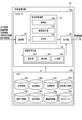
- FIG. 1 is a block diagram illustrating a functional configuration of a medication management apparatus according to an application example.
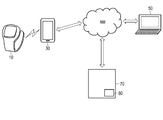
- FIG. 2 is a schematic view illustrating the configuration of a medication management system including the medication management apparatus according to the first embodiment.
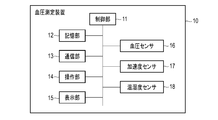
- FIG. 3 is a block diagram illustrating a hardware configuration of the blood pressure measurement device according to the first embodiment.
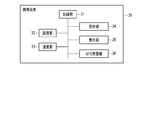
- FIG. 4 is a block diagram illustrating a hardware configuration of the mobile terminal according to the first embodiment.
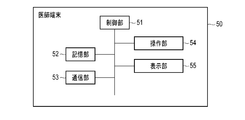
- FIG. 5 is a block diagram illustrating a hardware configuration of the doctor terminal according to the first embodiment.
- FIG. 6 is a block diagram illustrating a hardware configuration of the server according to the first embodiment.
- FIG. 7 is a block diagram illustrating a functional configuration of a medication management circuit as an example of a medication management apparatus according to the first embodiment.
- FIG. 1 is a block diagram illustrating a functional configuration of a medication management apparatus according to an application example.
- FIG. 2 is a schematic view illustrating the configuration of a medication management system including the medication management apparatus according to
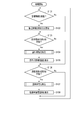
- FIG. 8 is a flowchart illustrating a procedure of medication management by a medication management system including a medication management circuit as an example of a medication management apparatus according to the first embodiment.
- FIG. 9 is a flowchart illustrating a side effect management process procedure in a medication management circuit as an example of a medication management apparatus according to the first embodiment.
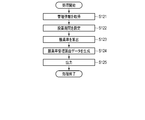
- FIG. 10 is a flowchart illustrating the procedure of the medication rate management process in the medication management circuit as an example of the medication management apparatus according to the first embodiment.
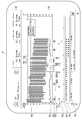
- FIG. 11 is a diagram illustrating a side effect management screen displayed based on output screen data generated by a side effect management process of a medication management circuit as an example of a medication management apparatus according to the first embodiment.
- FIG. 12 is a diagram illustrating a medication rate management screen displayed based on output screen data generated by a medication rate management process of a medication management circuit as an example of a medication management device according to the first embodiment.
- the medication management device 1 is used for medication management by an administrator in the treatment of a management subject having a disease that requires medication management at home.
- the administrator is, for example, a doctor.
- the management subject is, for example, a patient having the target disease.
- the medication management apparatus 1 executes a diagnostic screen generation process based on the diagnostic screen generation program.
- the diagnostic screen generation processing program is an example of a medication management program.
- the medication management apparatus 1 includes an acquisition unit 2, a setting unit 3, a calculation unit 4, a generation unit 5, and an output unit 6.
- the acquisition unit 2 acquires management information related to the management target person.
- the management information includes medication information and medication information.
- the acquisition unit 2 transmits the acquired management information to the setting unit 3.
- the medication information is information related to the medicine specified in the medication.
- the medication information includes, for example, a medication start date, a medication end date, medication specific information, and a prescribed dosage for each of the medications designated in the medication.
- the drug identification information may include a drug name.
- the medication information is information related to the actual medication of the management subject.
- the medication information includes at least medication identification information and the medication date and time for each medication.
- the medication information can include the medication amount and the like for each medication in addition to the medication date and time.
- the medicine specifying information is, for example, a medicine name.
- the setting unit 3 sets, for example, at least one unit dosing period based on dosing information.
- the start date of the unit dosing period is, for example, coincident with the start date of dosing
- the end date of the unit dosing period is, for example, coincident with the end date of dosing.
- the medication start date and the medication end date may be included in the medication information.
- the drug specifying information for example, drug name
- the unit dosing period may be one day or several days. Also, the length of the unit dosage period may be different with respect to each other.
- the setting unit transmits the setting information of the unit dosing period to the calculation unit 4.
- the calculation unit 4 calculates a medication rate for each unit medication period and for each medicine based on the medication information, medication information, and unit medication period setting information.
- the dose rate for a particular drug in a particular unit dose period is the ratio of the number of times actually taken to the number of doses of a particular drug specified within a particular unit dose period.
- the calculation unit 4 transmits the calculated medication rate to the generation unit 5.
- the generation unit 5 executes the medication rate management screen generation process, so that the medication rate management screen related to the person to be managed based on the medication information, the setting information of the unit medication period, and the medication rate calculated by the calculation unit 4 Generate data.
- the medication rate management screen data is display data for displaying the medication rate management screen on the display screen of the display device. On the medication rate management screen, for example, medication information and medication rates are arranged in correspondence with each unit medication period and in correspondence with each medication.
- the generation unit 5 transmits the generated medication rate management screen data to the output unit 6 as output screen data.
- the output unit 6 outputs the medication rate management screen data generated by the generation unit 5 to the display device or the like as output screen data.
- the medication information and medication rate concerning the management subject are displayed for each unit medication period and for each medication.
- the management screen can be displayed on the display screen of the display device used by the administrator.
- the administrator can easily determine what kind of medication does not reduce adherence to the management subject by comparing each information on a unit medication period on the medication rate management screen.
- the administrator can easily determine what kind of medicine does not reduce adherence to the management subject by comparing each piece of information on the medication rate management screen. For this reason, in the treatment of diseases that require medication management at home such as hypertensive diseases, managers such as doctors understand which drugs are easy to take and less likely to forget to take for patients such as patients. can do.
- a first embodiment of a medication management apparatus will be described below.
- a medication management system including a server having a medication management circuit will be described.
- the medication management circuit is an example of a medication management device.
- FIG. 2 is a diagram schematically illustrating an example of an application scene of the medication management system according to the present embodiment.
- the medication management system according to the present embodiment is a system for managing medication for a management subject having a hypertensive disease.
- Hypertension disease is an example of lifestyle-related diseases. Lifestyle-related diseases are examples of diseases that require medication management at home.
- the medication management system includes a doctor terminal 50 and a server 70.
- the doctor terminal 50 and the server 70 can be connected via a network NW such as the Internet.
- NW such as the Internet.
- a plurality of doctor terminals 50 may be provided.
- short-range wireless communication or wired communication that does not pass through the network NW may be applied.
- the medication management system further includes a blood pressure measurement device 10 and a portable terminal 30.
- a plurality of each of the blood pressure measurement device 10 and the mobile terminal 30 may be provided.
- the blood pressure measurement device 10 and the portable terminal 30 are connected by short-range wireless communication or wired communication.
- the portable terminal 30 can be connected to the server 70 via the network NW.
- the portable terminal 30 may be further connected to the doctor terminal 50 via the network NW.
- the blood pressure measurement device 10 can be connected to the server 70 (and the doctor terminal 50) via the portable terminal 30. That is, the blood pressure measurement device 10 can communicate with the server 70 (and the doctor terminal 50) via the portable terminal 30.
- the blood pressure measurement device 10 is a device that can be attached to any measurement location (for example, wrist).
- the blood pressure measurement device 10 measures the blood pressure value of the management subject at the measurement location.
- the blood pressure measurement device 10 can transmit blood pressure information including a blood pressure value measurement result and the like to the portable terminal 30.
- the blood pressure measurement device 10 can acquire the pulse information of the management subject.
- the pulse information includes a pulse value and a pulse wave.
- the blood pressure measurement device 10 can transmit pulse information to the mobile terminal 30.
- the blood pressure measurement device 10 has a clock function, and can transmit blood pressure information and pulse information to the portable terminal 30 in association with the measurement date and time.
- the portable terminal 30 is, for example, a terminal that can be carried by a management subject.
- the portable terminal 30 receives blood pressure information and pulse information from the blood pressure measurement device 10.
- the portable terminal 30 can store the received blood pressure information and pulse information together with the measurement date and time of the blood pressure information and the pulse information.
- the portable terminal 30 can appropriately transfer the stored blood pressure information and pulse information to the server 70 in association with the measurement date and time.
- the blood pressure information can include the first measurement result (maximum blood pressure value and minimum blood pressure value) in the morning after waking up and representative information such as the average value of the measurement results.
- the medication information and side effect information of the management subject can be input.
- the portable terminal 30 can transfer medication information and side effect information to the server 70.
- the doctor terminal 50 is a terminal that can be operated by an administrator such as a doctor. For example, a manager such as a doctor examines a management target person and diagnoses the medical condition of the management target person based on examination data or the like.
- the doctor terminal 50 can receive examination data from an examination apparatus (not shown) in the hospital and present it to the administrator. From the doctor terminal 50, diagnostic information related to the management subject is input by the operation of the administrator. In the doctor terminal 50, the administration information of the management subject is input by the operation of the administrator.
- the doctor terminal 50 can transmit diagnostic information and medication information to the server 70.
- the server 70 is a server computer that accumulates information transmitted from the mobile terminal 30, the doctor terminal 50, and the like.
- the accumulated information is stored as an electronic medical record, for example.
- the server 70 includes a medication management circuit 80.
- the medication management circuit 80 acquires management information related to the management target person, and generates management screen data related to the management target person based on the acquired management information.
- the management screen data includes side effect management screen data, medication rate management screen data, and the like.
- the server 70 can transmit the generated management screen data to the doctor terminal 50 as output data.
- the server 70 may generate a part of the management screen data as simple screen data, and transmit this to the portable terminal 30 as output data for the portable terminal 30.
- the medication management circuit 80 is an example of a medication management device. Part or all of the medication management circuit 80 may be provided in the doctor terminal 50, for example.
- the doctor terminal 50 can receive the output data generated by the medication management circuit 80 and display a side effect management screen and a medication rate management screen based on the received output data.
- the doctor terminal 50 is an example of a display device.
- FIG. 3 is a block diagram illustrating an example of a hardware configuration of the blood pressure measurement device 10 according to the present embodiment.
- the blood pressure measurement device 10 according to the present embodiment includes a control unit 11, a storage unit 12, a communication unit 13, an operation unit 14, a display unit 15, and a blood pressure sensor 16.
- the blood pressure measurement device 10 may further include at least one of an acceleration sensor 17 and a temperature / humidity sensor 18.
- the control unit 11 includes a CPU (Central Processing Unit), a RAM (Random Access Memory), a ROM (Read Only Memory), and the like, and controls each component according to information processing.
- the control unit 11 includes a clock (not shown) and has a function of acquiring the current date and time.
- the control unit 11 may have a function of displaying the acquired date and time on the display unit 15.
- the control unit 11 generates blood pressure information, pulse information, activity information, and environment information based on the measurement results obtained by the blood pressure sensor 16, the acceleration sensor 17, and the temperature / humidity sensor 18.
- the blood pressure information and the pulse information include, for example, a blood pressure value and a pulse value of the management subject by the blood pressure sensor 16, a measurement result of the pulse wave, and the like.
- the activity information includes the amount of activity, the number of steps, and the sleep state of the management subject based on measurement by the acceleration sensor 17.
- the environmental information includes the temperature and humidity around the management subject based on the measurement by the temperature and humidity sensor 18.
- Each of blood pressure information, pulse information, activity information, and environment information is associated with a measurement date and time based on the current date and time acquired by the clock.
- Each of blood pressure information, pulse information, activity information, and environment information may be further associated with a device ID that uniquely identifies the blood pressure measurement device 10.
- the storage unit 12 is an auxiliary storage device such as a solid state drive, for example.
- the storage unit 12 may be a hard disk drive.
- the storage unit 12 stores a program executed by the control unit 11, blood pressure information, pulse information, activity information, environment information, and the like.
- the communication unit 13 is a communication interface that manages communication with the mobile terminal 30.
- the communication unit 13 transmits, for example, blood pressure information, pulse information, activity information, environment information, and the like to the mobile terminal 30.
- near field communication such as Bluetooth (registered trademark) can be applied to the communication with the mobile terminal 30 by the communication unit 13, but is not limited thereto.
- the communication by the communication unit 13 may be, for example, communication via a network NW such as a LAN (Local Area Network) or wired communication using a communication cable.
- NW Local Area Network
- the operation unit 14 includes, for example, a user interface such as a touch panel and operation buttons.
- the operation unit 14 detects an operation performed by the management subject via the user interface, and outputs a signal indicating the content of the operation to the control unit 11.
- the display unit 15 includes, for example, a display screen (for example, an LCD (Liquid Crystal Display) or an EL (Electroluminescence) display), an indicator, and the like.
- the display unit 15 displays information according to a signal from the control unit 11 and notifies the management target person.
- the display unit 15 can display, for example, blood pressure information, pulse information, activity information, environment information, and the like stored in the storage unit 12.
- the blood pressure sensor 16 measures the blood pressure value of the management subject.
- the blood pressure value includes, for example, representative indexes such as a maximum blood pressure and a minimum blood pressure.
- the blood pressure sensor 16 may be, for example, a continuous measurement type capable of measuring the blood pressure of the management subject for each beat (continuous) of the heartbeat, and discontinuous measurement capable of measuring with a spot (non-continuous) at a predetermined time. It may be a mold.
- the continuous measurement type blood pressure sensor 16 includes, for example, a technique for continuously measuring the blood pressure of the management subject based on a pulse wave transmission time (PTT) and a continuous blood pressure based on the pressure pulse wave.
- PTT pulse wave transmission time
- a measuring method (tonometry method) or the like can be applied. Note that the method of continuously measuring blood pressure is not limited to the above-described example, and a method of detecting a pulse wave using a light emitting element can be appropriately applied.
- a technique for detecting a pulse wave by compressing a blood vessel using a cuff as a pressure sensor can be applied to the non-continuous measurement type blood pressure sensor 16. Therefore, the blood pressure sensor 16 can acquire pulse information.
- the acceleration sensor 17 detects the acceleration of the management subject that occurs at the place where the blood pressure measurement device 10 is mounted as a set of three-axis components.
- the acceleration sensor 17 may further include a gyro sensor, and may further detect the angular velocity as a set of three-axis components in addition to the acceleration.
- the temperature / humidity sensor 18 measures the temperature and humidity around the management subject.
- FIG. 4 is a block diagram illustrating an example of a hardware configuration of the mobile terminal 30 according to the present embodiment.
- the mobile terminal 30 according to the present embodiment includes a control unit 31, a storage unit 32, a communication unit 33, an operation unit 34, a display unit 35, and a GPS (Global Positioning System) receiver 36. .
- GPS Global Positioning System
- the control unit 31 and the storage unit 32 are the same as the control unit 11 and the storage unit 12 of the blood pressure measurement device 10, respectively.
- the storage unit 32 of the portable terminal 30 stores information received from the blood pressure measurement device 10 and position information generated by the GPS receiver 36 under the control of the control unit 31.
- the information received from the blood pressure measurement device 10 includes blood pressure information, pulse information, activity information, environment information, and the like.
- the storage unit 32 stores medication information, side effect information, and the like input in the operation unit 34 under the control of the control unit 31.
- information acquisition date and time can be stored together.
- the communication unit 33 is a communication interface that controls communication with the blood pressure measurement device 10 and the server 70 (and the doctor terminal 50).
- the communication unit 33 receives, for example, blood pressure information, pulse information, activity information, environment information, and the like from the blood pressure measurement device 10.
- the communication unit 33 transmits blood pressure information, pulse information, activity information, environment information, position information, and the like to the server 70.
- the communication unit 33 can also receive simple management screen data and the like from the server 70.
- the operation unit 34 and the display unit 35 are the same as the operation unit 14 and the display unit 15 of the blood pressure measurement device 10, respectively.
- the display unit 35 can display an input screen for medication information and side effect information.
- medication information and side effect information are input.
- side effect information it is possible to input “Feel good”, “Dry cough”, “Headache”, “Dizziness”, “Palpitation”, “Hot flash”, “Swollenness”, etc. Yes.
- the GPS receiver 36 measures the position of the mobile terminal 30 and generates position information.
- the position information includes, for example, the positioning date and time, and the latitude and longitude of the mobile terminal 30 at the positioning date and time.
- the positioning by the GPS receiver 36 can be performed in synchronization with the measurement of the blood pressure sensor 16 of the blood pressure measurement device 10, for example.
- FIG. 5 is a block diagram illustrating an example of a hardware configuration of the doctor terminal 50 according to the present embodiment.
- the doctor terminal 50 according to the present embodiment includes a control unit 51, a storage unit 52, a communication unit 53, an operation unit 54, and a display unit 55.
- the control unit 51 and the storage unit 52 are the same as the control unit 11 and the storage unit 12 of the blood pressure measurement device 10, respectively.
- the control unit 51 of the doctor terminal 50 generates diagnosis information, medication information, and the like related to the management subject.
- the storage unit 52 of the doctor terminal 50 stores diagnosis information, medication information, and the like related to the management target generated by the control unit 51.
- the storage unit 52 stores management screen data received from the server 70.
- the communication unit 53 is a communication interface that manages communication with the server 70 (and the portable terminal 30).
- the communication unit 53 transmits diagnostic information, medication information, and the like regarding the management subject to the server 70. Further, the communication unit 53 can receive management screen data and the like from the server 70.
- the operation unit 54 and the display unit 55 are the same as the operation unit 14 and the display unit 15 of the blood pressure measurement device 10, respectively.
- medication information, examination information acquired by various examination apparatuses, and the like can be input.
- the medication information and the examination information may be recorded in the server 70 via a network such as a hospital LAN.
- the display unit 55 can display a side effect management screen and a medication rate management screen based on the management screen data generated by the medication management circuit 80.
- the display unit 55 is an example of a display screen.
- FIG. 6 is a block diagram illustrating an example of a hardware configuration of the server 70 according to the present embodiment.
- the server 70 according to the present embodiment includes a control unit 71, a storage unit 72, a communication unit 73, and a medication management circuit 80.
- the control unit 71 and the storage unit 72 are the same as the control unit 11 and the storage unit 12 of the blood pressure measurement device 10, respectively.
- the storage unit 72 of the server 70 may store information transmitted from the mobile terminal 30 and the doctor terminal 50, management screen data generated by the medication management circuit 80, and the like.
- the communication unit 73 is a communication interface that manages communication with the mobile terminal 30 and the doctor terminal 50.
- the communication unit 73 receives, for example, blood pressure information, pulse information, activity information, environment information, and the like from the mobile terminal 30.
- the communication unit 73 receives examination information, diagnosis information, medication information, and the like related to the management subject from the doctor terminal 50.
- the communication unit 73 can transmit the information stored in the storage unit 72 to the mobile terminal 30 and the doctor terminal 50.
- the medication management circuit 80 includes, for example, a processor 80a and a memory 80b.
- the medication management circuit 80 realizes various types of operation control and data processing by the processor 80a executing the program stored in the memory 80b.
- the medication management circuit 80 has a clock (not shown) and can count the current date and time.
- the processor 80a is, for example, a CPU including an arithmetic circuit or an MPU (Micro Processing Unit).
- the processor 80 a can execute control of each unit and data processing by executing a program stored in the memory 80 b or the storage unit 72.
- the memory 80b includes, for example, a non-volatile memory for storing a program executed by the processor 80a and a volatile memory such as a RAM used as a working memory.
- the medication management circuit 80 executes side effect management processing based on the side effect management program.
- the side effect management program is an example of a medication management program. Side effect management processing by the medication management circuit 80 will be described later.
- the side effect management program is a program for causing the medication management circuit 80 to execute side effect management processing.
- the side effect management program may be stored in the memory 80 b or may be stored in the storage unit 72.
- the medication management circuit 80 executes a medication rate management process based on the medication rate management program.
- the medication rate management program is an example of a medication management program. The medication rate management process by the medication management circuit 80 will be described later.
- the medication rate management program is a program for causing the medication management circuit 80 to execute a medication rate management process.
- the medication rate management program may be stored in the memory 80 b or may be stored in the storage unit 72.
- the control unit 71 may function as the medication management circuit 80. That is, the control unit 71 may also serve as the medication management circuit 80.
- the CPU of the control unit 71 is the processor 80a of the medication management circuit 80
- the ROM of the control unit 71 is the non-volatile memory of the memory 80b of the medication management circuit 80
- the RAM of the control unit 71 is the memory 80b of the medication management circuit 80. Volatile memory.
- FIG. 7 is a block diagram schematically illustrating an example of a functional configuration of the medication management circuit 80 of the medication management system according to the present embodiment.
- the processor 80a of the medication management circuit 80 expands the medication management program stored in the nonvolatile memory of the memory 80b in the volatile memory of the memory 80b.
- the processor 80a functions as the acquisition unit 82, the side effect management unit 83, the medication rate management unit 84, and the output unit 85 by interpreting and executing the medication management program expanded in the volatile memory.
- the volatile memory of the memory 80b includes a biological information storage unit 86a, a diagnostic information storage unit 86b, a medication information storage unit 86c, a medication execution information storage unit 86d, a side effect information storage unit 86e, a setting information storage unit 86f, and a medication rate information storage unit. It functions as 86g and an output data storage unit 86h.
- the biological information storage unit 86a stores biological information related to each management target person.
- the biological information is information related to the biological parameter of the management subject.
- the biological information includes age, sex, blood pressure information, pulse information, and the like. Blood pressure information is an example of biological information.
- Blood pressure information includes blood pressure values.
- the blood pressure value is a systolic blood pressure, a diastolic blood pressure, or other index.
- the blood pressure information can include the measurement date and time and the measurement location for each blood pressure value.
- the pulse information includes a pulse value and a pulse wave.
- the pulse information can include a measurement date and a measurement location for each of the pulse value and the pulse wave.
- the measurement date and time includes, for example, a measurement date and a measurement time.
- the measurement time is, for example, morning or night.
- the measurement location is, for example, a home, a workplace, or a hospital.
- Diagnostic information relating to each management subject is stored in the diagnostic information storage unit 86b.
- the diagnostic information can include a visit date and a diagnostic result.
- the diagnosis result can include a disease name, information on an irregular pulse wave, and the like.
- the information regarding irregular pulse waves is, for example, a diagnosis result based on pulse information.
- the information related to the irregular pulse wave includes the detection date of the irregular pulse wave.
- the medication information storage unit 86c stores medication information regarding each management subject.
- the medication information is information relating to a medicine designated in medication.
- the medication information is used as part of medication information.
- the medication information is information regarding the actual medication of the management subject.
- the medication information includes the medication start date, medication end date, medication name, medication class name, prescribed medication time, prescribed medication amount, etc. for each of the medications designated in the medication.
- the medication start date and the medication end date coincide with, for example, the hospital visit date.
- the prescribed medication time is, for example, morning or night.
- the prescribed medication time and prescribed medication amount are defined in the medication.
- the medicine class name is an example of a medicine classification name.
- the class name of the drug is, for example, a classification name of an antihypertensive drug defined in the hypertension treatment guidelines.
- the class names are, for example, CCB (calcium antagonist), ACE (angiotensin converting enzyme inhibitor), ARB (angiotensin receptor antagonist), thiazide diuretic, ⁇ -blocker and the like.
- the medication execution information storage unit 86d stores medication execution information related to each management subject.
- the medication execution information is used as part of the medication information.
- the medication execution information includes the medication name and medication date and time for each medication actually taken.
- the medication date and time includes the medication date and the medication time.
- the medication time is, for example, morning or night. It may also include the presence or absence of actual medication.
- the side effect information storage unit 86e stores side effect information regarding each management target person.
- Side effect information is information relating to the onset of side effect symptoms.
- the side effect information includes symptom information. Further, the side effect information includes an onset date for each symptom information.
- the symptom information is information regarding the symptoms of side effects. Symptom information includes good, dry cough, headache, dizziness, palpitation, hot flashes, swelling, and the like.
- the setting information is stored in the setting information storage unit 86f.
- the setting information includes information related to the unit dosage period.
- the unit dosage period is an example of a unit dosage period.
- the information regarding the unit dosage period includes a start date and time and an end date and time for each of the plurality of unit dosage periods.
- the medication rate information storage unit 86g stores medication rate information regarding each management subject.
- the medication rate information is information related to the medication rate calculated by the medication rate management unit 84.
- the medication rate information includes the medication rate for each of a plurality of unit dosage periods.
- the medication rate information includes the medication rate for each of the designated medications.
- the medication rate is the ratio of the number of times of medication actually taken out of the number of medications prescribed by medication during the unit medication period.
- management screen data output to an external display device or the like is temporarily stored as output data.
- the management screen data includes side effect management screen data, medication rate management screen data, and the like.
- the side effect management screen data is image data for displaying the side effect management screen on the display screen of the display device.
- the medication rate management screen data is image data for displaying the medication rate management screen on the display screen of the display device. The side effect management screen and the medication rate management screen will be described later.
- each management target person is stored in each information storage unit.
- this is not restrictive.
- the acquisition unit 82 acquires management information related to each management target person.
- the acquisition unit 82 acquires management information from the communication unit 73 or the storage unit 72, for example.
- the management information includes, for example, biological information, diagnostic information, medication information, medication information, side effect information, and the like.
- the acquisition unit 82 stores the acquired management information in the memory 80b.
- the side effect management unit 83 generates side effect management screen data related to each management target person based on the management information stored in the memory 80b by executing the side effect management process.
- the side effect management process will be described later.
- the side effect management screen data is display data for displaying the side effect management screen on the display screen of the display device. By displaying the side effect management screen data on the display screen, the daily diagnosis display data is arranged side by side on the side effect management screen. One day is an example of a unit diagnosis period.
- the display device is, for example, the doctor terminal 50, and the display screen is, for example, the display unit 55.
- the display device may be the display unit 35 of the mobile terminal 30, for example.
- the side effect management unit 83 stores the generated medication management screen data in the output data storage unit 86h of the memory 80b.
- the side effect management unit 83 includes a processing unit 83a, an arrangement setting unit 83b, and a generation unit 83c.
- the processing unit 83a generates a plurality of diagnostic display data based on the management information stored in the memory 80b. Each of the diagnostic display data is arranged at a predetermined position on the side effect management screen.
- the display data for diagnosis includes date / time display data, blood pressure display data, pulse display data, pulse wave display data, hospital display data, medication display data, side effect display data, and the like.
- Each of the diagnostic display data is stored in the output data storage unit 86h of the memory 80b.
- the date / time display data indicates information related to the date / time.
- the date display data indicates, for example, a date for each day.
- the date / time display data may display information about time every day. The information about time is, for example, morning or night.
- Blood pressure display data indicates information related to blood pressure.
- the blood pressure display data is generated based on blood pressure information stored in the biological information storage unit 86a, for example.
- the blood pressure display data indicates, for example, morning maximum blood pressure and minimum blood pressure, and night maximum blood pressure and minimum blood pressure, for each day.
- the nighttime systolic blood pressure and the diastolic blood pressure are, for example, average values of the measured values of the day.
- the blood pressure display data can include the highest blood pressure and the lowest blood pressure measured in the hospital.
- the blood pressure display data is, for example, a graph showing blood pressure fluctuation.
- the pulse display data indicates information related to the pulse value.
- the pulse display data is generated based on, for example, pulse information stored in the biological information storage unit 86a.
- the pulse display data is, for example, a graph showing fluctuations in pulse values every day.
- the pulse display data can include morning and night pulse values and pulse values measured in a hospital.
- Pulse wave display data indicates information on irregular pulse waves.
- the pulse wave display data is generated based on, for example, pulse information stored in the biological information storage unit 86a.
- the pulse wave display data is, for example, an icon indicating that an irregular pulse wave is detected.
- Visit data indicates information related to visits.
- the hospital display data is generated based on, for example, diagnostic information stored in the diagnostic information storage unit 86b.
- the hospital display data is, for example, an icon indicating that the patient has been hospitalized.
- the medication display data indicates information related to the actual medication.
- the medication display data is generated based on the medication information stored in the medication execution information storage unit 86d, for example.
- the medication display data indicates, for example, the medication name, medication date and time, medication amount, and the like.
- the medication display data includes medication display data and medication execution display data.
- the medication display data indicates information related to the designated medication.
- the medication display data is generated, for example, based on medication information stored in the medication information storage unit 86c.
- the medication display data indicates, for example, a medicine name, a medicine class name, a prescribed medication date and time, a prescribed medication amount, and the like.
- the medication execution display data indicates information regarding whether or not medication has actually been performed based on the specified medication.
- the medication execution display data is generated, for example, based on the medication execution information stored in the medication execution information storage unit 86d.
- the medication execution display data is, for example, an icon indicating that medication has actually been performed based on the medication shown in the medication display data.
- the side effect display data indicates information about side effects.
- the side effect display data is generated based on, for example, side effect information stored in the side effect information storage unit 86e.
- the side effect display data is, for example, an icon indicating that a symptom of a side effect has developed and a symptom of the onset.
- the arrangement setting unit 83b sets arrangement information for each element included in each of the diagnostic display data based on the setting information stored in the setting information storage unit 86f, and stores it in the output data storage unit 86h of the memory 80b. To do.
- the placement information is information used to determine the positional relationship between the diagnostic display data on the side effect management screen, and is information regarding the corresponding date and time of each element of each diagnostic display data. The placement information is not displayed on the side effect management screen.
- the arrangement setting unit 83b sets the measurement date and the measurement time as arrangement information for each element included in the blood pressure display data.
- the arrangement setting unit 83b displays the measurement date for each element included in the pulse display data, the irregular pulse wave detection date for each element included in the pulse wave display data, and the visit date for each element included in the hospital display data.
- the prescribed date and the prescribed time for each element included in the medication display data, the medication date and the medication time for each element included in the medication execution display data, and the onset date for each element included in the side effect display data are set as placement information. .
- the generation unit 83c generates side effect management screen data based on the diagnostic display data and the arrangement information. Specifically, the generation unit 83c arranges each element included in each of the diagnostic display data on the side effect management screen in association with each date. Thereby, the side effect management screen data can be displayed side by side by displaying each element of the daily diagnostic display data by being displayed on the display screen. “One day” is an example of a unit diagnosis period.
- the medication rate management unit 84 executes the medication rate management process to calculate the medication rate for the management target person based on the medication information, medication information, and unit medication period, and generates medication rate management screen data. .
- the medication rate management process will be described later.
- the medication rate management screen data is display data for displaying the medication rate management screen on the display screen of the display device. By displaying the medication rate management screen data on the display screen, the medication information and the medication rate are displayed for each unit medication period and for each medication on the medication rate management screen.
- the display device is, for example, the doctor terminal 50, and the display screen is, for example, the display unit 55.
- the medication rate management unit 84 stores the generated medication rate management screen data in the output data storage unit 86h of the memory 80b.
- the medication rate management unit 84 includes, for example, a setting unit 84a, a calculation unit 84b, and a generation unit 84c.
- the setting unit 84a sets at least one unit medication period based on the medication information stored in the medication information storage unit 86c.
- the start date of the unit dosing period is, for example, coincident with the start date of dosing
- the end date of the unit dosing period is, for example, coincident with the end date of dosing.
- the unit dosage period coincides with, for example, a period from a visit date to the next visit date.
- the end date of the unit dosing period may be, for example, the last day in the acquired medication information.
- the end date of the unit dosing period may be arbitrarily designated by an administrator, for example.
- the drug specifying information for example, drug name
- prescribed medication time for example, prescribed medication time
- prescribed medication amount etc. designated in the medication
- the unit dosing period may be one day or several days. Also, the length of the unit dosage period may be different with respect to each other.
- the set unit dosage period is stored as setting information in the setting information storage unit 86f of the memory 80b.
- the calculation unit 84b calculates a medication rate for each unit medication period and for each medicine based on the medication information, medication execution information, and setting information.
- the dose rate of a specific drug in a specific unit dosing period is the ratio of the number of times that a specific drug is actually taken to the number of times of taking a specific drug defined within the specific unit dosing period.
- the calculated medication rate is stored as medication rate information in the medication rate information storage unit 86g of the memory 80b.
- the calculation unit 84b may take a medication for each prescribed medication time when a plurality of prescribed medication times are prescribed within a day in the medication during the specific unit medication period.
- the rate is further calculated.
- the medication rate at a specific prescribed medication time is the ratio of the number of times actually taken to the prescribed number of medications at a particular prescribed medication time within a particular unit dosage period.
- the generation unit 84c generates medication rate management screen data based on the medication information and the medication rate information.
- the generation unit 84c arranges the medication information and the medication rate information in correspondence with each unit medication period on the medication rate management screen.
- the medication rate management screen data is displayed on the display screen to display medication information and medication rate information for each unit medication period.
- the generated medication rate management screen data is stored in the output data storage unit 86h of the memory 80b.
- the output unit 85 generates the side effect management screen data generated by the side effect management unit 83 and stored in the output data storage unit 86h of the memory 80b in response to an instruction from the side effect management unit 83 or the medication rate management unit 84.
- the medication rate management screen data generated by the rate management unit 84 and stored in the output data storage unit 86h of the memory 80b can be output to the doctor terminal 50.
- FIG. 8 shows an example of processing procedures by the control unit 71 of the server 70 and the processor 80a of the medication management circuit 80 in the medication management using the medication management system according to the present embodiment. It is a flowchart which shows.
- the medication management process using the medication management system is executed by an administrator such as a doctor, for example. In the medication management process, the processes of S101 to S108 described later are repeated.
- the control unit 71 of the server 70 determines whether or not new management information has been received (S101). For example, the management information is transmitted from the mobile terminal 30 or the doctor terminal 50 and received by the communication unit 73 of the server 70. When new management information is received (S101-Yes), the control unit 71 stores the newly acquired management information in the storage unit 72 (S102). Thereby, for example, in the electronic medical record, information on the management subject is additionally stored or updated. If new management information has not been received (S101-No), the process proceeds to S103.
- the control unit 71 of the server 70 determines whether or not a side effect display request has been received.
- the side effect display request is information indicating that an instruction to display the side effect management screen on the display device has been input.
- An instruction to display the side effect management screen on the display device is input, for example, on the operation unit 54 of the doctor terminal 50.
- the information transmitted from the doctor terminal 50 and indicating that the instruction to display the side effect management screen on the display device is input is received by the communication unit 73 of the server 70. If the side effect display request has not been received (S103-No), the process proceeds to S106.
- the control unit 71 transmits information indicating that the side effect display request is received to the processor 80a of the medication management circuit 80.
- the processor 80a executes side effect management processing based on the acquisition of information indicating that a side effect display request has been received (S104). The side effect management process will be described later.
- the server 70 outputs the side effect management screen data output from the medication management circuit 80 in the side effect management processing to the doctor terminal 50 as management screen data.
- the control unit 51 of the doctor terminal 50 displays the side effect management screen on the display unit 55 based on the received side effect management screen data (S105).
- the control unit 71 of the server 70 determines whether or not a medication rate display request has been received.
- the medication rate display request is information indicating that an instruction to display the medication rate management screen on the display device has been input.
- An instruction to display the medication rate management screen on the display device is input, for example, on the operation unit 54 of the doctor terminal 50.
- information indicating that an instruction to display the medication rate management screen transmitted from the doctor terminal 50 on the display device is received by the communication unit 73 of the server 70. If the medication rate display request has not been received (S106-No), the process returns to S101.
- the control unit 71 transmits information indicating that the medication rate display request has been received to the processor 80a of the medication management circuit 80.
- the processor 80a executes the medication rate management process based on the acquisition of information indicating that the medication rate display request has been received (S107).
- the medication rate management process will be described later.
- the server 70 outputs the medication rate management screen data output from the medication management circuit 80 in the medication rate management process to the doctor terminal 50 as management screen data.
- the control unit 51 of the doctor terminal 50 displays the medication rate management screen on the display unit 55 based on the received medication rate management screen data (S108).
- FIG. 9 is a flowchart showing an example of the procedure of the side effect management process in the processor 80a of the medication management circuit 80 according to this embodiment.
- the processor 80a starts the side effect management process based on the operation input performed on the doctor terminal 50.
- the processor 80a first acquires management information related to the management subject from, for example, the storage unit 72 of the server 70 (S111).
- the management information includes biological information, diagnostic information, medication information, medication information, and side effect information.
- the processor 80a generates display data for diagnosis based on the management information (S112).
- the diagnostic display data includes, for example, each element such as date and time display data, blood pressure display data, pulse display data, pulse wave display data, hospital display data, medication display data, medication execution display data, and side effect display data.
- the processor 80a sets arrangement information for each element included in each of the diagnostic display data based on the management information (S113).
- the processor 80a generates side effect management screen data based on the diagnostic display data and the arrangement information (S114). Thereby, the processor 80a arranges each element included in each of the display data for diagnosis on the side effect management screen in association with each date.
- the processor 80a outputs the side effect management screen data to the outside as management screen data (S115).
- the processor 80a outputs the side effect management screen data to the doctor terminal 50, for example.
- the processor 80a may output the side effect management screen data to the mobile terminal 30.
- FIG. 10 is a flowchart showing an example of the procedure of medication rate management processing in the processor 80a of the medication management circuit 80 according to the present embodiment.
- the processor 80a starts the medication rate management process based on the operation input performed on the doctor terminal 50.
- the processor 80a first acquires management information related to the management subject from, for example, the storage unit 72 of the server 70 (S121).
- the management information includes medication information and medication information.
- the processor 80a sets a unit dosage period (S122). For example, the processor 80a sets a plurality of unit dosing periods based on hospital visit information.
- the processor 80a calculates the medication rate for each unit medication period and for each medicine based on the medication information, medication information, and unit medication period setting information (S123).
- the processor 80a performs the process of calculating the medication rate in the unit dosing period for all the set unit dosing periods and for all the specified drugs.
- the processor 80a first calculates, within the calculation unit 84b, within a specific unit dosage period based on the medication start date and the medication end date included in the medication information. Calculate the prescribed number of doses.
- the processor 80a calculates the actual number of times of medication for the specific medicine within the specific unit medication period based on the medication date and time included in the medication information for the specific medicine. Then, the processor 80a calculates the ratio of the actual number of times of medication to the prescribed number of times of medication as the medication rate for the specific medicine in the specific unit medication period.
- the processor 80a generates medication rate management screen data based on the medication information and the medication rate information (S124). Thus, the processor 80a arranges the medication information and the medication rate information on the medication rate management screen so as to correspond to each unit medication period and to each medication.
- the processor 80a outputs the medication rate management screen data to the outside as management screen data (S125).
- the processor 80a outputs the medication rate management screen data to the doctor terminal 50, for example.
- FIG. 11 shows a display example of the side effect management screen generated by the side effect management processing of the medication management circuit 80.
- the side effect management screen 91 is an example of a side effect management screen.
- the side effect management screen 91 is displayed on the display unit 55 of the doctor terminal 50, for example, and used for diagnosis related to the management target person by the administrator.
- the management subject is, for example, a hypertensive patient.
- the administrator is, for example, a doctor.
- the side effect management screen 91 may be displayed on the display unit 35 of the portable terminal 30 of the management target person.
- the side effect management screen 91 includes a representative information display unit 92, a diagnostic information display unit 93, and a display switching unit 94.
- the representative information display section 92 personal information and representative information are displayed.
- the personal information is information for specifying an individual with respect to the management target person.
- personal information includes a management number, gender, age, and the like.
- the personal information may further include a name or the like.
- the representative information includes representative values such as systolic blood pressure, diastolic blood pressure, and pulse in the most recent days.
- the diagnostic information display unit 93 includes a date display unit 93a, a blood pressure display unit 93b, a pulse display unit 93c, a pulse wave display unit 93d, a hospital display unit 93e, a medication display unit 93f, and a medication execution display unit 93g. And a side effect display section 93h.
- date display data is displayed.
- the date is displayed every day as the date and time display data. “One day” is an example of a unit diagnosis period.
- blood pressure display data is displayed.
- a blood pressure graph indicating blood pressure fluctuation is displayed as blood pressure display data.
- the blood pressure graph is a vertical bar graph.
- the vertical axis uses the blood pressure value (BLOOD PRESSURE), and the horizontal axis uses the date of the date display unit 93a.
- the blood pressure graph includes a plurality of measured values as each element. The measured values are the maximum blood pressure and the minimum blood pressure measured at home, the maximum blood pressure and the minimum blood pressure measured at the time of hospital visit, and the like.
- the blood pressure graph is a vertical bar graph with the highest blood pressure as the upper end and the lowest blood pressure as the lower end.
- the blood pressure display unit 93b is arranged so that the measurement date of each measurement value corresponds to the date of the date display unit 93a. Each measurement value is classified into a morning measurement value and a night measurement value and displayed.
- pulse display data is displayed.
- a pulse graph indicating the fluctuation of the pulse value is displayed as the pulse display data.
- the pulse graph is a line graph.
- the pulse value PULSE RATE
- the date on the date display unit 93a is used on the horizontal axis.
- the pulse graph includes a plurality of measured values as each element.
- the pulse display section 93c is arranged so that the measurement date of each measurement value corresponds to the date of the date display section 93a.
- pulse wave display data is displayed.
- an icon indicating that an irregular pulse wave (IHB) is detected is displayed as each element of the pulse wave display data.
- the pulse wave display unit 93d is arranged so that the detection date of each icon corresponds to the date of the date display unit 93a.
- the hospital display data is displayed in the hospital display section 93e.
- an icon indicating that the patient has been hospitalized is displayed as each element of the hospital display data.
- the outpatient display unit 93e is arranged so that the visit date of each icon corresponds to the date of the date display unit 93a.
- medication display data is displayed.
- the medication name, the icon indicating the prescribed medication time, and the prescribed medication amount are displayed for each medication as the medication display data.
- the icon indicating the prescribed medication time for example, displays a picture of the morning sun and indicates that the prescribed medication time is morning.
- the icon indicating the prescribed medication time indicates, for example, that a picture of a crescent moon is displayed and the prescribed medication time is night.
- any one of medications # 1 to # 3 is displayed as the medication name.
- Drugs # 1 to # 3 are antihypertensive drugs.
- the antihypertensive drug is an example of a therapeutic drug for a disease requiring home management.
- medicine # 1 and medicine # 3 are classified into class 1
- medicine # 2 is classified into class 2.
- Each medication display data is classified into a medicine class and displayed.
- the medication display section 93f is arranged so that the prescribed medication date of each medication display data corresponds to the date of the date display section 93a.
- the medication execution display section 93g the medication execution display data is displayed.
- an icon indicating that the medication has been taken is displayed as each element of the medication execution display data.
- the medication execution display section 93g is arranged so that the medication date of each icon corresponds to the date of the date display section 93a.
- Each icon is classified and displayed as morning medication and evening medication.
- Each icon indicates that the medication has been performed based on the medication displayed on the medication display unit 93f on the date corresponding to the date display unit 93a.
- each icon of the medication execution display unit 93g is used in combination with the display on the medication display unit 93f, so that the name of the medication taken, the class name of the medication taken, the actual medication date and time, the actual medication amount, etc. It is shown as medication information.
- side effect display section 93h side effect display data is displayed.
- an icon indicating that a side effect symptom has developed is displayed as each element of the side effect display data.
- the side effect display section 93h is arranged so that the onset date of each icon corresponds to the date of the date display section 93a.
- an icon indicating a symptom of a side effect is displayed by selecting each icon.
- the icon indicating the symptom of the side effect is one of symptoms such as dry cough, headache, dizziness, palpitation, hot flash, and swollenness. Show. For example, the example of FIG. 11 shows that on March 21, symptoms of dry cough (Headache) and headache (Headache) developed.
- the display switching unit 94 displays an icon for switching the display from the side effect management screen to the medication rate management screen when selected. For example, when the icon of the display switching unit 94 is selected by an operation on the operation unit 54 of the doctor terminal 50, an operation for displaying the medication rate management screen is input.
- the side effect management screen 91 reflects management information from March 3 to April 2.
- a period from March 4 to March 10 is defined as a first diagnosis period P1.
- the period from March 10 to March 17 is the second diagnosis period P2, and the period from March 17 to March 24 is the third diagnosis period P3.
- From March 24 to March 31 The period up to the day is the fourth diagnosis period P4, and the period from March 31 to the next hospital visit is the fifth diagnosis period P5.
- the diagnosis periods P1 to P5 is a period from a hospital visit date to the next hospital visit date.
- the start date and the end date of the diagnosis periods P1 to P5 coincide with the medication change date.
- Each of the diagnosis periods P1 to P5 is an example of a unit diagnosis period.
- the unit diagnosis period may be a period from the next day to the next hospital day or one day.
- the administrator can select the name of the medication actually taken by the management subject and the actual medication in each of the diagnosis periods P1 to P5. Get the quantity.
- medicine # 1 is designated in the first diagnosis period P1 in the first diagnosis period P1.
- the prescribed dose amount of medicine # 1 is 10 mg
- the prescribed medication time of medicine # 1 is morning.
- the administrator determines that the management subject has taken a prescribed amount of the medicine specified in the medication for the date and time when the icon is displayed on the medication execution display section 93g.
- an icon indicating that the medication prescribed in the morning has been performed is displayed on all dates. Therefore, the administrator determines that the management subject has taken 10 mg of medicine # 1 in the morning in the first diagnosis period P1.
- the manager determines whether or not the blood pressure of the management subject exceeds the reference value for hypertension in each of the diagnosis periods P1 to P5 based on the display on the date display section 93a and the blood pressure display section 93b.
- Blood pressure is an example of biological information.
- the maximum blood pressure is higher than 135 mmHg
- the minimum blood pressure is higher than 85 mmHg.
- 135 mmHg is a reference value for hypertension related to systolic blood pressure.
- 85 mmHg is a reference value of hypertension regarding the minimum blood pressure. Therefore, the administrator determines that the maximum blood pressure and the minimum blood pressure exceed the reference value for hypertension in the first diagnosis period P1.
- the administrator acquires the onset status of the side effect to the management subject in each of the diagnosis periods P1 to P5 based on the display on the date display unit 93a and the side effect display unit 93h.
- the administrator determines that side effects frequently occur in the management subject in the second diagnosis period P2.
- the administrator determines effective medication and effective hypertension for the management subject based on the display on the date display unit 93a, medication display unit 93f, medication execution display unit 93g, and side effect display unit 93h. Get the information you need.
- the systolic blood pressure and the systolic blood pressure are substantially the same as the reference value for hypertension, and side effects frequently occur. For this reason, the administrator determines that the medication in the second diagnosis period P2 is not appropriate medication for the management subject. Therefore, the administrator determines that the medicine # 1 is not an appropriate medicine for the management target person.
- each of the maximum blood pressure and the minimum blood pressure is substantially the same as the reference value for hypertension.
- each of the maximum blood pressure and the minimum blood pressure is smaller than the reference value for hypertension.
- no side effects have developed in the third diagnosis period P3. Therefore, the administrator determines that the medication for the third diagnosis period P3 is more appropriate for the management subject than the medication for the first diagnosis period P1 and the medication for the second diagnosis period P2.
- the administrator determines that the medicine # 2 is more appropriate for the management subject than the medicine # 1.
- Medicine # 1 is classified into class 1
- medicine # 2 is classified into class 2. Therefore, the administrator determines that the medicine classified into class 2 is more appropriate for the management subject than the medicine classified into class 1.
- each of the maximum blood pressure and the minimum blood pressure is smaller than the reference value for hypertension.
- each of the maximum blood pressure and the minimum blood pressure is smaller than the reference value for hypertension.
- the administrator determines that the medication in the fourth diagnosis period P4 is more appropriate for the management subject than the medication in the first diagnosis period P1 to the third diagnosis period P3.
- FIG. 12 shows a display example of the medication rate management screen generated by the medication rate management process of the medication management circuit 80.
- the medication rate management screen 96 displays the medication rate for the management subject for each set unit medication period.
- the medication rate management screen 96 is an example of a medication rate management screen.
- the medication rate management screen 96 is displayed on the display unit 55 of the doctor terminal 50, for example, and is used for diagnosis by the administrator regarding the management target person.
- the management subject is, for example, a hypertensive patient.
- the administrator is, for example, a doctor.
- the medication rate management screen 96 includes a representative information display unit 92, a display switching unit 95, a period information display unit 97, a medication information display unit 98, and a medication rate display unit 99.
- the representative information display section 92 personal information and representative information are displayed.
- the personal information is information for specifying an individual with respect to the management target person.
- personal information includes a management number, gender, age, and the like.
- the personal information may further include a name or the like.
- the representative information includes representative values such as systolic blood pressure, diastolic blood pressure, and pulse in the most recent days.
- the display switching unit 95 displays an icon for switching the display from the medication rate management screen to the side effect management screen when selected. For example, when the icon of the display switching unit 95 is selected by an operation on the operation unit 54 of the doctor terminal 50, an operation for displaying the side effect management screen is input.
- the period information display section 97 information related to the unit dosage period is displayed.
- the period information display unit 97 includes a period display unit 97a and a time display unit 97b. In the period display portion 97a, for example, the start date of each unit dosage period is displayed.
- time display section 97b information on the prescribed medication time (Dosing Time) is displayed for each unit medication period.
- Dosing Time information on the prescribed medication time (Dosing Time) is displayed for each unit medication period.
- time display portion 97b for example, either “Morning” or “Evening” is displayed.
- “Morning” is displayed in the time display portion 97b, it indicates that the prescribed medication time is in the morning.
- “Evening” is displayed in the time display portion 97b, it indicates that the prescribed medication time is night.
- the medication information display unit 98 displays medication information for each unit medication period.
- the medication information displayed on the medication information display unit 98 includes, for example, medication specifying information, a prescribed medication amount, and the like.
- the medication information display unit 98 includes a drug identification information display unit 98a and a medication amount display unit 98b.
- a medicine name (Medicine) is displayed as medicine specific information for each prescribed medication time of the unit dosage period.
- any one of the medicines # 1 to # 3 is displayed as the medicine name in the medicine specifying information display section 98a.
- the drugs # 1 to # 3 are, for example, drug names of antihypertensive drugs.
- the antihypertensive drug is an example of a therapeutic drug for a disease requiring home management.
- the prescribed dosage amount (Dosage) is displayed for each prescribed dosage time in the unit dosage period and for each medicine.
- the medication rate (Adherence) is displayed for each prescribed medication time of the unit dosage period and for each medication.
- dosing periods T1 to T5 are set.
- the starting date of each of the dosing periods T1 to T5 coincides with the starting date of dosing.
- the end date of each of the dosing periods T1 to T5 coincides with the end date of dosing.
- the end date of the medication period T5 is, for example, the last acquisition date of medication information.
- the start date and the end date coincide with the hospital visit date.
- the start date and the end date of the dosing periods T1 to T5 coincide with the dosing change date.
- the start date of the medication period T5 coincides with the hospital visit date.
- Each of the dosing periods T1 to T5 is an example of a unit dosing period.
- each of the dosing periods T to T5 coincides with the diagnosis periods P1 to P5. That is, the first dosing period T1 is a period from March 4 to March 10.
- the second dosing period T2 is a period from March 10 to March 17.
- the third dosing period T3 is a period from March 17 to March 24.
- the fourth dosing period T4 is a period from March 24 to March 31.
- the fifth medication period T5 is a period from March 31 to April 2, which is the last acquisition date of the medication information.
- a plurality of prescribed medication periods are set in each of the fourth medication period T4 and the fifth medication period T5.
- the morning (Morning) is set as the first prescribed medication time
- the evening (Evening) is set as the second prescribed medication time.
- the administrator evaluates the degree of influence of the drug on the adherence (aggressiveness to treatment) of the management subject based on the display in the medication information display unit 98 and the medication rate display unit 99.
- the medication rate in the first medication period T1 is 100%
- the medication rate in the second medication period T2 is 86%. Therefore, the manager determines that the medication for the second medication period T2 is medication that lowers the medication rate of the management subject as compared to the medication for the first medication period T1. Thereby, the administrator determines that the adherence (aggressiveness to the treatment) of the management target person is lowered with respect to the dosing in the second dosing period T2 as compared with the dosing in the first dosing period T1.
- the same medication # 1 is used in the dosing in the second dosing period T2, but the prescribed dose is increased compared to the dosing in the first dosing period T1. Therefore, the administrator can determine that an increase in the amount of medication for medicine # 1 is a cause of a decrease in the medication rate of the management subject. Thereby, the administrator makes a determination to return the prescribed dose amount of the medicine # 1 to the same amount as that of the first medication period T1 and add another medicine # 2 in the medication in the third medication period T3.
- the medication rate of medicine # 1 is 86%, and the medication rate of medicine # 2 is 100%. Therefore, the administrator determines that the medicine # 2 is a medicine that does not lower the medication rate of the management subject as compared to the medicine # 1. Thereby, the administrator determines that the adherence (aggressiveness to treatment) of the management subject is not lowered with respect to the medicine # 2 as compared with the medicine # 1. The administrator can determine that the medicine # 2 is a medicine that is easy to take and less likely to be forgotten without reducing the administration rate of the management subject.
- the administrator uses a side effect management screen on which information including blood pressure information, medication information, and side effect information related to a management target is displayed every day. It can be displayed on the display screen of the display device. The administrator compares each information on the side effect management screen every day, and what kind of medication is effective for the management subject and the medication with few side effects Can be easily determined. Therefore, according to the present embodiment, in the treatment of diseases requiring medication management at home such as hypertensive diseases, an administrator such as a doctor can easily determine the efficacy and side effects of medication on a management subject such as a patient. Judgment can be made.
- the administrator uses a medication rate management screen in which each piece of information including medication information and medication rate information regarding a management subject is displayed for each unit medication period and for each medication. Can be displayed on the display screen of the display device.
- the administrator can easily determine what kind of medicine does not reduce adherence to the management target person by comparing each information for each unit dosage period and for each medicine on the medication rate management screen. be able to.
- the administrator in the treatment of diseases requiring medication administration at home such as hypertensive diseases, the administrator such as a doctor makes every drug for the adherence (aggressiveness of treatment) of the management subject such as a patient. The degree of influence can be easily determined.
- the diagnostician can fully exert the effect of the drug on the management target, have few side effects, and provide adherence. It is possible to easily determine what kind of medication is not reduced.
- the side effect management screen and the medication rate management screen may be displayed side by side instead of being switched.
- the medication rate has decreased due to an increase in the dose during the second medication period T2, using the medication rate management screen 96.
- the side effect management screen 91 that side effects frequently occur in the management subject in the second diagnosis period P2 corresponding to the second medication period T2. Therefore, the administrator uses both the side effect management screen 91 and the medication rate management screen 96 to cause side effects in addition to the increase in the dose during the period corresponding to the second medication period T2 and the second diagnosis period P2. It can be determined that the frequent onset is the cause of the decrease in the medication rate of the management subject.
- the side effect management unit 83 can further display the medication rate for each unit dosage period on the side effect management screen.
- the side effect management unit 83 acquires the medication rate information from the medication rate information storage unit 86g, and generates the medication rate display data based on the acquired medication rate information.
- the medication rate display data for example, a graph showing the variation of the medication rate for each unit dosage period is generated. Then, the side effect management unit 83 arranges the medication rate display data on the side effect management screen so that the unit medication period corresponds to a unit diagnosis period such as a date.
- information indicating the incidence of side effects may be displayed for each unit medication period.
- the medication management apparatus has been described by way of medication management with a patient having a hypertension disease as a management subject, the present invention is not limited to this.
- the medication management apparatus may be used for medication management in which a patient having a lifestyle-related disease other than a hypertensive disease is a management subject.
- a blood glucose level and a cholesterol level are used as biological information and displayed on the side effect management screen.
- the medication management apparatus may be used for medication management in which a patient having a disease requiring medication management at home such as asthma is a management subject.
- information related to asthma symptoms is used as biometric information and displayed on the side effect management screen.
- the medication management device (1:80) includes an acquisition unit (2:82) that obtains medication-specific medication information and medication-specific medication information regarding a management target person, and at least one unit medication period. Based on the setting unit (3: 84a) to be set, the obtained medication-specific medication information and medication-specific medication information, and the set unit medication period, medication by medication for each unit medication period A calculation unit (4: 84b) that calculates a rate, and a generation that generates management screen data that represents the acquired medication-specific medication information and the calculated medication-specific medication rate in association with each unit medication period Part (5: 84c).
- this invention is not limited to the said embodiment, In the implementation stage, it can change variously in the range which does not deviate from the summary. Further, the embodiments may be implemented in combination as appropriate, and in that case, the combined effect can be obtained. Furthermore, the present invention includes various inventions, and various inventions can be extracted by combinations selected from a plurality of disclosed constituent elements. For example, even if several constituent requirements are deleted from all the constituent requirements shown in the embodiment, if the problem can be solved and an effect can be obtained, the configuration from which the constituent requirements are deleted can be extracted as an invention.
- a medication management device having a hardware processor and a memory, The hardware processor is Obtaining medication-specific medication information and medication-specific medication information regarding the management subject, storing the obtained medication-specific medication information and medication-specific medication information in the memory, Setting at least one unit dosage period, storing the set unit dosage period in the memory; Based on the medication-specific medication information stored in the memory, the medication-specific medication information, and the unit medication period, a medication-specific medication rate for each unit medication period is calculated, and the calculated medication-specific rates are calculated.
- the medication rate is stored in the memory, Generating management screen data representing the medication-specific medication information stored in the memory and the medication-specific medication rate in association with each unit medication period; Medication management device.
- a medication management method executed by an apparatus having a hardware processor and a memory comprising: The hardware processor acquires medication information by medication and medication information by medication related to the management subject, and stores the acquired medication information by medication and medication information by medication in the memory; The hardware processor setting at least one unit dosage period and storing the set unit dosage period in the memory; The hardware processor calculates a medication rate for each unit dosage period based on the medication-specific medication information and the medication-specific medication information stored in the memory and the unit medication period, Storing the calculated medication rate for each medicine in the memory; The hardware processor generating management screen data representing the medication-specific medication information stored in the memory and the medication-specific medication rate in association with each unit medication period; A medication management method comprising:
- Control unit 72 Storage unit 73 ... Communication unit 80 ... Medication management circuit 80a ... Processor 80b ... Memory 82 ... Acquisition unit 83 ... Side effect management Unit 83a ... Processing unit 83b ... Arrangement setting unit 83c ... Generation unit 84 ... Medication rate management unit 84a ... Setting unit 84b ... Calculation unit 84c ... Generation unit 85 ... Output unit 86a ... Biological information storage unit 86b ... Diagnostic information storage unit 86c ... Medication information storage unit 86d ... Medication execution information storage unit 86e ... Side effect information storage unit 86f ... Setting information storage unit 86g ... Medication rate information storage unit 86h ... Output data storage unit 91 ...
- Side effect management screen 92 ... Representative information display unit 93 ... Diagnosis information display unit 93a ... Date display unit 93b ... Blood pressure display unit 93c ... Pulse display unit 93d ... Pulse wave display unit 93e ... Visit display unit 93f ... Medication display unit 93g ... medication execution display unit 93h ... side effect display unit 94, 95 ... display switching unit 96 ... medication rate management screen 97 ... period information display unit 97a ... period display unit 97b ... time display unit 98 ... medication information display unit 98a ... drug specific information Display unit 98b ... Medication amount display unit 99 ... Medication rate display unit P1 to P5 ... Diagnosis period T1 to T5 ... Medication period
Landscapes
- Health & Medical Sciences (AREA)
- Engineering & Computer Science (AREA)
- Public Health (AREA)
- Medical Informatics (AREA)
- General Health & Medical Sciences (AREA)
- Epidemiology (AREA)
- Primary Health Care (AREA)
- Biomedical Technology (AREA)
- Medicinal Chemistry (AREA)
- Bioinformatics & Cheminformatics (AREA)
- Chemical & Material Sciences (AREA)
- Data Mining & Analysis (AREA)
- Databases & Information Systems (AREA)
- Pathology (AREA)
- Medical Treatment And Welfare Office Work (AREA)
Priority Applications (3)
| Application Number | Priority Date | Filing Date | Title |
|---|---|---|---|
| CN201980028846.7A CN112041935A (zh) | 2018-05-29 | 2019-05-21 | 用药管理装置、用药管理方法及用药管理程序 |
| DE112019002084.6T DE112019002084T5 (de) | 2018-05-29 | 2019-05-21 | Medikationsverwaltungsvorrichtung, medikationsverwaltungsverfahren und medikationsverwaltungsprogramm |
| US17/101,867 US20210118539A1 (en) | 2018-05-29 | 2020-11-23 | Medication management device, medication management method, and non-transitory computer-readable storage medium storing medication management program |
Applications Claiming Priority (2)
| Application Number | Priority Date | Filing Date | Title |
|---|---|---|---|
| JP2018102327A JP7176230B2 (ja) | 2018-05-29 | 2018-05-29 | 投薬管理装置、投薬管理方法及び投薬管理プログラム |
| JP2018-102327 | 2018-05-29 |
Related Child Applications (1)
| Application Number | Title | Priority Date | Filing Date |
|---|---|---|---|
| US17/101,867 Continuation US20210118539A1 (en) | 2018-05-29 | 2020-11-23 | Medication management device, medication management method, and non-transitory computer-readable storage medium storing medication management program |
Publications (1)
| Publication Number | Publication Date |
|---|---|
| WO2019230494A1 true WO2019230494A1 (ja) | 2019-12-05 |
Family
ID=68696979
Family Applications (1)
| Application Number | Title | Priority Date | Filing Date |
|---|---|---|---|
| PCT/JP2019/020056 Ceased WO2019230494A1 (ja) | 2018-05-29 | 2019-05-21 | 投薬管理装置、投薬管理方法及び投薬管理プログラム |
Country Status (5)
| Country | Link |
|---|---|
| US (1) | US20210118539A1 (enExample) |
| JP (1) | JP7176230B2 (enExample) |
| CN (1) | CN112041935A (enExample) |
| DE (1) | DE112019002084T5 (enExample) |
| WO (1) | WO2019230494A1 (enExample) |
Cited By (2)
| Publication number | Priority date | Publication date | Assignee | Title |
|---|---|---|---|---|
| WO2022024684A1 (ja) * | 2020-07-28 | 2022-02-03 | オムロンヘルスケア株式会社 | 血圧関連情報表示装置、血圧関連情報表示方法、およびプログラム |
| WO2022024685A1 (ja) * | 2020-07-28 | 2022-02-03 | オムロンヘルスケア株式会社 | 血圧関連情報表示装置、血圧関連情報表示方法、およびプログラム |
Families Citing this family (2)
| Publication number | Priority date | Publication date | Assignee | Title |
|---|---|---|---|---|
| JP7149665B2 (ja) | 2020-03-30 | 2022-10-07 | 株式会社Peco | 動物患者用電子カルテの提供方法 |
| JP7326385B2 (ja) * | 2021-06-30 | 2023-08-15 | 西日本電信電話株式会社 | 情報提供システム、情報加工装置、情報提供装置、情報提供方法及びコンピュータプログラム |
Citations (6)
| Publication number | Priority date | Publication date | Assignee | Title |
|---|---|---|---|---|
| JP2002056099A (ja) * | 2000-08-11 | 2002-02-20 | Ntt Me Corp | 健康管理システム |
| JP2003323497A (ja) * | 2002-04-30 | 2003-11-14 | Moss Institute Co Ltd | 投薬管理システム及び情報処理装置、投薬管理方法並びにプログラム |
| JP2013105302A (ja) * | 2011-11-14 | 2013-05-30 | Mvisual Co Ltd | 調剤薬局システム |
| JP2014071592A (ja) * | 2012-09-28 | 2014-04-21 | Fujifilm Corp | 投薬効果予測システム及びその制御方法、並びに制御プログラム |
| JP2015060509A (ja) * | 2013-09-20 | 2015-03-30 | 株式会社Sdネクスト | 服薬管理システム |
| JP2016531334A (ja) * | 2013-06-06 | 2016-10-06 | ヤンセン ファーマシューティカ エヌ.ベー. | 電気的服薬アドヒアランス、識別、及び分配 |
Family Cites Families (7)
| Publication number | Priority date | Publication date | Assignee | Title |
|---|---|---|---|---|
| JP2930548B2 (ja) * | 1996-02-29 | 1999-08-03 | 株式会社塚田メディカル・リサーチ | 携帯式患者用服薬管理ボード |
| JP2004265105A (ja) * | 2003-02-28 | 2004-09-24 | Mitsubishi Electric Information Systems Corp | 投薬状況管理システム及び投薬状況管理プログラム |
| US20130317839A1 (en) * | 2012-03-16 | 2013-11-28 | Drfirst.Com, Inc. | System and method for increasing patient adherence to medication treatment regimens |
| JP3185839U (ja) * | 2013-06-25 | 2013-09-05 | 株式会社ウエルテクノス | 糖尿病治療困難者支援システム及び肥満症治療困難者支援システム |
| US20150058035A1 (en) | 2013-08-23 | 2015-02-26 | Ateb, Inc. | Methods, systems and computer program products for automatic periodic prescription fill dates |
| JP2016091419A (ja) * | 2014-11-07 | 2016-05-23 | 株式会社Nttドコモ | 端末装置、服薬支援方法、プログラム |
| US10255412B2 (en) * | 2015-11-13 | 2019-04-09 | Reciprocal Labs Corporation | Real time adaptive controller medication dosing |
-
2018
- 2018-05-29 JP JP2018102327A patent/JP7176230B2/ja active Active
-
2019
- 2019-05-21 WO PCT/JP2019/020056 patent/WO2019230494A1/ja not_active Ceased
- 2019-05-21 DE DE112019002084.6T patent/DE112019002084T5/de active Pending
- 2019-05-21 CN CN201980028846.7A patent/CN112041935A/zh active Pending
-
2020
- 2020-11-23 US US17/101,867 patent/US20210118539A1/en not_active Abandoned
Patent Citations (6)
| Publication number | Priority date | Publication date | Assignee | Title |
|---|---|---|---|---|
| JP2002056099A (ja) * | 2000-08-11 | 2002-02-20 | Ntt Me Corp | 健康管理システム |
| JP2003323497A (ja) * | 2002-04-30 | 2003-11-14 | Moss Institute Co Ltd | 投薬管理システム及び情報処理装置、投薬管理方法並びにプログラム |
| JP2013105302A (ja) * | 2011-11-14 | 2013-05-30 | Mvisual Co Ltd | 調剤薬局システム |
| JP2014071592A (ja) * | 2012-09-28 | 2014-04-21 | Fujifilm Corp | 投薬効果予測システム及びその制御方法、並びに制御プログラム |
| JP2016531334A (ja) * | 2013-06-06 | 2016-10-06 | ヤンセン ファーマシューティカ エヌ.ベー. | 電気的服薬アドヒアランス、識別、及び分配 |
| JP2015060509A (ja) * | 2013-09-20 | 2015-03-30 | 株式会社Sdネクスト | 服薬管理システム |
Cited By (5)
| Publication number | Priority date | Publication date | Assignee | Title |
|---|---|---|---|---|
| WO2022024684A1 (ja) * | 2020-07-28 | 2022-02-03 | オムロンヘルスケア株式会社 | 血圧関連情報表示装置、血圧関連情報表示方法、およびプログラム |
| WO2022024685A1 (ja) * | 2020-07-28 | 2022-02-03 | オムロンヘルスケア株式会社 | 血圧関連情報表示装置、血圧関連情報表示方法、およびプログラム |
| JP2022024725A (ja) * | 2020-07-28 | 2022-02-09 | オムロンヘルスケア株式会社 | 血圧関連情報表示装置、血圧関連情報表示方法、およびプログラム |
| JP7468224B2 (ja) | 2020-07-28 | 2024-04-16 | オムロンヘルスケア株式会社 | 血圧関連情報表示装置、血圧関連情報表示方法、およびプログラム |
| US12232892B2 (en) | 2020-07-28 | 2025-02-25 | Omron Healthcare Co., Ltd. | Device for displaying blood-pressure-related information, method for displaying blood-pressure-related information, and computer-readable recording medium |
Also Published As
| Publication number | Publication date |
|---|---|
| JP2019207537A (ja) | 2019-12-05 |
| JP7176230B2 (ja) | 2022-11-22 |
| CN112041935A (zh) | 2020-12-04 |
| DE112019002084T5 (de) | 2021-02-25 |
| US20210118539A1 (en) | 2021-04-22 |
Similar Documents
| Publication | Publication Date | Title |
|---|---|---|
| JP7124453B2 (ja) | 投薬管理装置、投薬管理方法及び投薬管理プログラム | |
| JP7355826B2 (ja) | プラットフォーム非依存のリアルタイム医療データ表示システム | |
| CN106102571B (zh) | 患者监控器和介入/事件时间线 | |
| US20240148339A1 (en) | Method for providing alert of potential thyroid abnormality | |
| US20210118539A1 (en) | Medication management device, medication management method, and non-transitory computer-readable storage medium storing medication management program | |
| JP6868423B2 (ja) | 投薬支援装置、方法及びプログラム | |
| JP2003061919A (ja) | 電子血圧計および血圧測定データ処理システム | |
| JP7076967B2 (ja) | データ処理装置、データ処理方法及びデータ処理プログラム | |
| JP7522592B2 (ja) | 生体情報提供装置、生体情報提供方法及び生体情報提供プログラム | |
| JP7119707B2 (ja) | 診断支援装置、診断支援方法及び診断支援プログラム | |
| JP2013158415A (ja) | 血圧モニタリングシステムおよび血圧測定装置 | |
| WO2018168803A1 (ja) | 投薬支援装置、方法およびプログラム | |
| JP2019003570A (ja) | 健康管理装置、健康管理方法、および健康管理プログラム | |
| WO2023112779A1 (ja) | 診療支援システム、診療支援装置及びプログラム | |
| CN116209385A (zh) | 用于心力衰竭患者的治疗性管理的组合物和方法 | |
| JP7707655B2 (ja) | 生体情報処理システム、生体情報処理装置、生体情報処理方法及びプログラム | |
| US20240185982A1 (en) | Medical care assistance system, medical care assistance device, and recording medium | |
| US20240180438A1 (en) | Medical care assistance system, medical care assistance device, and recording medium | |
| US20180336971A1 (en) | Biological information evaluation device, biological information measurement device, and biological information evaluation method | |
| WO2018079380A1 (ja) | 生体データ処理装置、生体データ処理システムおよびプログラム | |
| Son et al. | Modern information technologies as a tool for protecting public health and individual prevention of cardiovascular diseases | |
| CN118742255A (zh) | 用于心力衰竭患者的治疗性管理的组合物和方法 |
Legal Events
| Date | Code | Title | Description |
|---|---|---|---|
| 121 | Ep: the epo has been informed by wipo that ep was designated in this application |
Ref document number: 19810988 Country of ref document: EP Kind code of ref document: A1 |
|
| DPE2 | Request for preliminary examination filed before expiration of 19th month from priority date (pct application filed from 20040101) | ||
| 122 | Ep: pct application non-entry in european phase |
Ref document number: 19810988 Country of ref document: EP Kind code of ref document: A1 |