WO2019167387A1 - 多機能樹脂体の製造方法 - Google Patents
多機能樹脂体の製造方法 Download PDFInfo
- Publication number
- WO2019167387A1 WO2019167387A1 PCT/JP2018/046331 JP2018046331W WO2019167387A1 WO 2019167387 A1 WO2019167387 A1 WO 2019167387A1 JP 2018046331 W JP2018046331 W JP 2018046331W WO 2019167387 A1 WO2019167387 A1 WO 2019167387A1
- Authority
- WO
- WIPO (PCT)
- Prior art keywords
- functional
- dye
- resin body
- function
- substrate
- Prior art date
- Legal status (The legal status is an assumption and is not a legal conclusion. Google has not performed a legal analysis and makes no representation as to the accuracy of the status listed.)
- Ceased
Links
Images



Classifications
-
- B—PERFORMING OPERATIONS; TRANSPORTING
- B29—WORKING OF PLASTICS; WORKING OF SUBSTANCES IN A PLASTIC STATE IN GENERAL
- B29D—PRODUCING PARTICULAR ARTICLES FROM PLASTICS OR FROM SUBSTANCES IN A PLASTIC STATE
- B29D11/00—Producing optical elements, e.g. lenses or prisms
- B29D11/00009—Production of simple or compound lenses
-
- B—PERFORMING OPERATIONS; TRANSPORTING
- B29—WORKING OF PLASTICS; WORKING OF SUBSTANCES IN A PLASTIC STATE IN GENERAL
- B29D—PRODUCING PARTICULAR ARTICLES FROM PLASTICS OR FROM SUBSTANCES IN A PLASTIC STATE
- B29D11/00—Producing optical elements, e.g. lenses or prisms
- B29D11/00865—Applying coatings; tinting; colouring
- B29D11/00894—Applying coatings; tinting; colouring colouring or tinting
- B29D11/00903—Applying coatings; tinting; colouring colouring or tinting on the surface
-
- G—PHYSICS
- G02—OPTICS
- G02B—OPTICAL ELEMENTS, SYSTEMS OR APPARATUS
- G02B5/00—Optical elements other than lenses
- G02B5/20—Filters
- G02B5/22—Absorbing filters
- G02B5/223—Absorbing filters containing organic substances, e.g. dyes, inks or pigments
-
- G—PHYSICS
- G02—OPTICS
- G02C—SPECTACLES; SUNGLASSES OR GOGGLES INSOFAR AS THEY HAVE THE SAME FEATURES AS SPECTACLES; CONTACT LENSES
- G02C7/00—Optical parts
- G02C7/10—Filters, e.g. for facilitating adaptation of the eyes to the dark; Sunglasses
Definitions
- the present disclosure relates to a method for manufacturing a multifunctional resin body that reduces light transmittance in a plurality of wavelength regions.
- a functional resin body that has a good influence on the human body by reducing the transmittance of light in a specific wavelength region to the resin body.
- the functional resin body there is a functional lens that reduces the transmittance in a specific wavelength region.
- those that reduce the transmittance of light such as ultraviolet light, infrared light, and blue light have been proposed.
- multifunctional resin bodies that reduce the transmittance of light in a plurality of specific wavelength regions have been demanded (for example, Patent Document 1).
- a method for producing such a multifunctional resin body a method of forming a multilayer film on the resin body has been used.
- This indication aims at providing the manufacturing method of the functional resin body which can manufacture a good multifunctional resin body easily in view of the above-mentioned problem.
- the present invention is characterized by having the following configuration.
- the method for producing a multifunctional resin body according to the first aspect of the present disclosure is a method for producing a multifunctional resin body that reduces the transmittance of light in a plurality of wavelength ranges, and the light in the first wavelength range.
- a first functional dye that absorbs water, and a first functional dye having sublimation property is applied to the substrate to obtain a first function-added substrate, and the first step
- the obtained first function-adding substrate and the functional resin body having a function of reducing the transmittance of light in the second wavelength range that is a wavelength range different from the first wavelength range are opposed to each other, By heating the first function-adding substrate, the first functional dye applied to the first function-adding substrate is sublimated, and the second functional dye is adhered to the functional resin body.
- the functional tree to which the first functional dye is attached by the step and the second step A third step of fixing the first functional dye to the functional resin body by heating the body, and using the first functional dye, the functional resin body has the first wavelength region.
- FIG. 1 is a flowchart showing a flow of a method for producing a multifunctional resin body of the present embodiment.
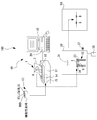
- FIG. 2 is a schematic view showing a manufacturing system used in the method for manufacturing a multifunctional resin body of the present embodiment.
- the light transmittance in a specific wavelength region is further reduced by using a gas phase transfer dyeing method.
- a function resin is added to produce a multifunctional resin body.
- a functional resin body having a function of reducing the light transmittance of a specific wavelength region has a characteristic function such that the light transmittance of a specific wavelength region is a predetermined threshold value or less. May be.
- a lens that is one of the resin bodies will be described as an example of the resin body. That is, the functional lens 8 having a function of reducing the transmittance of light in a specific wavelength region will be described as an example.
- the techniques exemplified below are functional resin bodies other than the functional lens 8 (for example, goggles, functional covers for mobile phones, functional covers for lights, functional accessories, functional toys, functional films (for example, a thickness of 400 ⁇ m or less, etc.) ), A functional plate material (for example, a functional molded body having a thickness of 400 ⁇ m or more, etc.), using a vapor phase transfer dyeing method to add further functions,
- the present invention can also be applied to the production of a multifunctional resin body that reduces the transmittance.
- the function-added substrate 1 exemplified below can also be used in a transfer dyeing process other than gas phase transfer dyeing.
- a polycarbonate resin for example, diethylene glycol bisallyl carbonate polymer (CR-39)), a polyurethane resin (Tribex), an allyl resin (for example, allyl diglycol carbonate and its co-polymer).
- a function can be further added to a functional resin body made of at least one of a highly refractive material such as urethane or thioepoxy, nylon resin (polyamide resin), or the like.
- the functional resin body may be coated with a receiving film on which the functional dye is easily fixed. By coating the functional resin body with a receiving film, it is possible to easily add a function.
- the first step, the second step, and the third step are performed.
- the method for producing a multifunctional resin body according to this embodiment is performed in the order of the first step, the second step, and the third step.
- a first functional dye that absorbs light in the first wavelength range and has a sublimation property is applied to a substrate (for example, the substrate 2).
- a first function-adding substrate (for example, the function-adding substrate 1) is obtained.
- the second step has a function of reducing the transmittance of light in the second wavelength range that is a wavelength range different from the first wavelength range, and the first function addition substrate obtained in the first step.
- the first functional dye applied to the first function addition substrate is sublimated by heating the first function addition substrate by facing the functional resin body (for example, the functional lens 8), and the first function addition substrate is heated.
- This is a step of attaching a functional dye to the functional resin body.
- the third step is a step of fixing the first functional dye to the functional resin body by heating the functional resin body to which the first functional dye is attached in the second step.
- the method for producing a multifunctional resin body including the first step, the second step, and the third step described above uses the first functional dye to produce light in the first wavelength range on the functional resin body.
- permeability of the light of a several wavelength range is added by adding the function to reduce the transmittance
- a multifunctional resin body that reduces the transmittance of light in a plurality of wavelength regions can be easily manufactured without requiring many steps and complicated operations.
- a good multifunctional resin body in which cracks are suppressed can be produced.
- variation in light transmittance in the multifunctional resin body can be suppressed.
- various multifunctional resin bodies that can reduce the light transmittance in the plurality of wavelength regions can be easily manufactured. That is, for example, a function of reducing the transmittance of light in other wavelength ranges can be added to the functional resin body that reduces the transmittance of light in a specific wavelength range. It is possible to easily manufacture various multifunctional resin bodies that can reduce the transmittance of the resin.
- the manufacturing system 100 is used to perform each step in the method for manufacturing a multifunctional resin body.
- a schematic configuration of the manufacturing system 100 in the present embodiment will be described with reference to FIG.
- the manufacturing system 100 of this embodiment includes a dye application device 10, a vapor deposition device 30, and a dye fixing device (fixing device) 50.
- the dye applying apparatus 10 is used.
- the dye applying apparatus 10 applies a first functional dye that absorbs light in the first wavelength range, which is deposited on the functional resin body (the functional lens 8 in the present embodiment), to the base 2, It is used to obtain the function-adding substrate 1 coated with the first functional dye.
- the vapor deposition apparatus 30 is used in the second step.
- the vapor deposition apparatus 30 causes the function-added substrate 1 to face the functional lens 8 having a function of reducing the transmittance of light in the second wavelength range that is a wavelength range different from the first wavelength range, thereby adding the function.
- the substrate 1 for heating is used to sublimate the sublimable dye applied to the function-added substrate 1 and attach the sublimable dye to the functional lens 8.
- the fixing device 50 is used in the third step.
- the fixing device 50 is used to fix the first functional dye to the functional lens 8 by heating the functional lens 8 to which the first functional dye is attached.
- At least one functional dye may be used as the functional dye. That is, for example, in the present embodiment, a function of reducing the transmittance of light in at least one specific wavelength region may be added to the functional resin body.
- one functional dye may be used.
- a plurality of functional dyes for example, two functional dyes, three functional dyes, four functional dyes, etc. may be used.
- the first step is a third function of absorbing light in a third wavelength range that is a wavelength range different from the first wavelength range and the second wavelength range.
- the third functional dye applied to the first function-adding substrate may be sublimated, and the third functional dye may be adhered to the functional resin body.
- the third functional dye is fixed to the functional resin body by heating the functional resin body to which the third functional dye is adhered in the second step. Also good.
- the function resin body is added with a function of reducing the light transmittance in the first wavelength region and the third wavelength region.
- a multifunctional resin body that reduces the transmittance of light in a plurality of wavelength ranges may be obtained.
- the first step may be configured to apply a plurality of functional dyes to the substrate at the same time. Further, for example, when a plurality of functional dyes are used for the functional resin body, the first step may be configured to apply the plurality of functional dyes to the base at different timings.
- a wavelength range with a different wavelength range may be a configuration in which at least some of the wavelength ranges are different between the wavelength ranges.
- a configuration in which at least some of the wavelength ranges are different from the wavelength range in which the first wavelength range and the second wavelength range are different may be used.
- a configuration in which the first wavelength region and the second wavelength region do not overlap may be employed.
- the first wavelength region and the second wavelength region overlap, but a part of the configuration may be different.
- a function relating to the first wavelength region is added to the functional resin body having a function relating to the second wavelength region.
- the third wavelength range which is a different wavelength range from the first wavelength range and the second wavelength range, is at least one for the first wavelength range and the second wavelength range.
- the wavelength range of the part may be different.
- a configuration in which the third wavelength region is not superimposed on the first wavelength region and the second wavelength region may be employed.
- the third wavelength range is superimposed on the first wavelength range and the second wavelength range, but a part of the configuration may be different.
- the first functional resin body having a function related to the second wavelength range
- a configuration in which the reduction of the transmittance of the overlapping wavelength region is further improved with respect to the overlapping wavelength region may be adopted.
- the multifunctional resin body may be dyed in a desired color by using a sublimation dye for adjusting the color in addition to the functional dye.
- a first function-adding substrate on which a sublimation dye for dyeing the functional resin body is further applied may be obtained.
- the sublimable dye applied to the first function-adding substrate may be sublimated, and the sublimable dye may be attached to the functional resin body.
- the sublimable dye may be fixed to the functional resin body by heating the functional resin body to which the sublimable dye is adhered in the second step.
- the function resin body may be added with a function of reducing the transmittance of light in a plurality of wavelength regions, and the functional resin body may be dyed by the above process. .
- a function can be added to the functional resin body and a multifunctional resin body having a desired color can be manufactured.
- a sublimation dye is used. Since the color can be adjusted by using, it is possible to obtain a multifunctional resin body having a desired color.
- the sublimation dye at least three dyes of red, blue, and yellow may be used.
- a functional dye may be used.
- colors other than these three colors may be used as the sublimable dye. For example, a mixed color (green, purple, etc.) may be used.
- the first step may include a color information acquisition step and a setting step.
- the color information acquisition step may acquire color information (color data) desired by the operator.
- the setting step is a setting step for setting the amount of sublimation dye (sublimation dye for dyeing a multifunctional resin body) to be applied to the substrate based on the color information acquired by the color information acquisition step, You may make it set the quantity of sublimation dye according to the quantity of functional dye (for example, 1st functional dye, 3rd functional dye, etc.). Thereby, for example, the color information can be acquired and the amount of the sublimation dye corresponding thereto can be set, so that the multifunctional resin body can be easily dyed to a desired color.
- the quantity of sublimation dye for example, 1st functional dye, 3rd functional dye, etc.
- the color of the resin body may change depending on the amount of the functional dye, and the desired color may not be obtained, but this corresponds to the amount of the functional dye.
- the amount of the (subject) sublimable dye By setting the amount of the (subject) sublimable dye, the multifunctional resin body can be dyed with a desired color. For example, even if the amount of the functional dye is changed, the resin body can be satisfactorily dyed with a desired color.
- the color information acquisition step may be performed by various devices.
- a dye application device for example, the dye application device 10.
- the color information acquisition process may be performed by an apparatus different from the dye applying apparatus.
- the dye application device may receive the amount of each dye set by different devices from different devices.
- the setting process may be performed by various devices.
- a dye applying apparatus for example, the dye applying apparatus 10
- the setting process may be performed by an apparatus different from the dye applying apparatus.
- the dye application device may receive the amount of each dye set by different devices from different devices.
- the color information may be color tone information.
- the color information may be information on at least one of hue, saturation, and lightness for indicating a color tone.
- the color information may be density information indicating the density of each color for indicating the color tone.
- the color information may be density gradient information (gradation information).
- the color information is not limited to the above information.
- the color information may be information for setting the color tone dyed on the multifunctional resin body.
- the color information may be acquired by the operator inputting the color information.
- selectable colors are presented in the dye coating apparatus (for example, the dye coating apparatus 10), and color information is input by selecting a desired color (tone) by the operator. Good.
- color information may be input by an operator inputting parameters relating to color tone.
- the method for the operator to input the color information is not limited to the above, and the color information may be input by a method different from the above.
- the color information may be input by an apparatus different from the dye application apparatus, and the color information may be acquired by receiving the input color information by the dye application apparatus.
- the color information may be acquired when the dye application apparatus receives the color information.
- the color information may be acquired by receiving the color information measured by the color information measuring unit that measures the color tone of the resin body dyed in the color desired by the operator.
- the color information measuring unit may be provided in the dye coating apparatus or may be provided as another apparatus.
- the setting process includes color information, the amount of functional dye (for example, the first functional dye, the third functional dye, etc.), and the sublimation dye (sublimation dye for dyeing the multifunctional resin body).
- the amount of each sublimable dye may be set using correspondence information, which is information in which the amount is associated with each other.
- the setting process is correspondence information stored in the storage means (for example, the memory 20), and the color information, the amount of the functional dye, and the amount of the sublimation dye are associated with each other. Based on the correspondence information that is information, the amount of functional dye and the amount of sublimation dye may be set.
- correspondence information color information, the amount of the functional dye, the amount of the sublimation dye, and the correspondence information associated with each other may be set in advance by simulation or experiment.
- the operator does not need to set the amount of each dye in detail, and can easily and smoothly acquire the first function adding substrate.
- the amount of sublimable dye may be set from the correspondence information based only on the acquired color information.
- the amount of the functional dye and the amount of the sublimation dye can be set based on the color information by associating color information corresponding to the amount of the functional dye. it can.
- the setting step acquires functional dye amount information in addition to the acquired color information, and sublimates from the correspondence information based on the color information and the functional dye amount information.
- the amount of the sex dye may be set.
- the information on the amount of the functional dye may be acquired by the operator inputting the information on the amount of the functional dye.
- the information on the amount of the functional dye may be acquired by receiving it from another device.
- the amount of each dye may be set by arithmetic processing.
- the amount of the functional dye and the amount of the sublimation dye may be calculated based only on the acquired color information.
- the amount of sublimable dye is calculated and set based on the color information and the amount information of the functional dye by associating color information corresponding to the amount of the functional dye. can do.
- the setting step obtains information on the amount of the functional dye in addition to the obtained color information, and based on the color information and the information on the amount of the functional dye, The amount may be calculated and set.
- the information on the amount of the functional dye may be acquired by the operator inputting the information on the amount of the functional dye. Further, for example, the information on the amount of the functional dye may be acquired by receiving it from another device.
- the amount of each dye may be set by a method different from the above.
- the amount of functional dye may be set by acquiring light transmittance information in a specific wavelength range desired by the operator.
- the first step may include a transmittance information acquisition step of acquiring transmittance information of light in a specific wavelength range desired by the operator.
- the setting step is based on the light transmittance information of the specific wavelength range acquired by the transmittance information acquiring step, and the functional dye (for example, the first functional dye, the third functional dye, etc.). You may make it set the quantity of.
- the transmittance information may be information indicating the transmittance of light in a specific wavelength region (for example, the first wavelength region).
- the transmittance information may be information that directly or indirectly indicates the transmittance in a specific wavelength region.
- the amount of the functional dye corresponding to the transmittance is set, so that the operator can easily and smoothly set the amount of the functional dye. That is, the operator can easily and smoothly acquire the function-added substrate.
- the transmittance information acquisition step may be performed by various devices.
- a dye application apparatus may be used in the transmittance information acquisition step.
- the transmittance information acquisition step may be performed by an apparatus different from the dye applying apparatus.
- the dye applying apparatus may receive transmittance information set by different apparatuses from different apparatuses.
- the transmittance information may be acquired by the operator inputting the transmittance information.
- the wavelength range and transmittance selectable in the dye coating apparatus are presented, and the transmittance information is input by selecting the wavelength range desired by the operator and the transmittance desired by the operator. You may be made to do.
- the operator may input the transmittance information by inputting parameters regarding the transmittance information.
- the method for the operator to input the transmittance information is not limited to the above, and the transmittance information may be input by a method different from the above.
- the transmittance information may be input by a device different from the dye coating device, and the transmittance information may be acquired by receiving the input transmittance information by the dye coating device.
- the transmittance information may be acquired by the dye coating apparatus receiving the transmittance information.
- the transmission rate information may be acquired by receiving.
- the transmittance measuring unit may be provided in the dye coating apparatus, or may be provided as a separate apparatus.
- a functional resin body having a function of reducing the transmittance of light in the second wavelength range which is a wavelength range different from the first wavelength range
- a functional resin body having a function of reducing the transmittance of light in a specific wavelength region can be obtained by various manufacturing methods.
- the functional resin body is a method of kneading a substance capable of selectively absorbing wavelengths into the resin body, a method of immersing the resin body in a liquid mixed with a substance capable of selectively absorbing wavelengths (immersion method)
- immersion method The method may be obtained by using at least one of a method of forming a multilayer film on the resin body, and the like.
- the functional resin body may be obtained by using a gas phase transfer dyeing method.
- the fourth step, the fifth step, and the sixth step are performed.
- a second functional addition base for example, second function addition
- the second functional dye that absorbs light in the second wavelength range is applied by applying a second functional dye that absorbs light in the second wavelength range to the base (for example, base 102).
- the base for example, base 102
- the second function addition substrate obtained in the fourth step and the resin body are opposed to each other, and the second function addition substrate is heated to apply the second function addition substrate.
- the second functional dye is sublimated to attach the second functional dye to the resin body.
- the sixth step is a step of fixing the second functional dye to the resin body by heating the resin body to which the second functional dye is adhered in the fifth step.
- the method for producing a multifunctional resin body including the fourth step, the fifth step, and the sixth step described above uses the second functional dye to transmit light in the second wavelength region to the resin body.
- a functional resin body is obtained by adding a function of reducing the transmittance.
- a multifunction resin body can be obtained more easily by performing the same process as when acquiring a multifunctional resin body.
- the functional dye can be uniformly applied in both steps when obtaining the functional resin body and the multifunctional resin body, so that variation in light transmittance in the multifunctional resin body is further suppressed. be able to.
- a lens for example, the lens 108 that is one of the resin bodies may be used as the resin body.
- the techniques exemplified below include resin bodies other than lenses (for example, goggles, mobile phone covers, light covers, accessories, toys, films (for example, a thickness of 400 ⁇ m or less), plate materials (for example, a thickness of It can be applied to any molded body such as 400 ⁇ m or more.
- the functional dye in the present embodiment has a functionality for absorbing light in at least one specific wavelength region.
- It may be a dye.
- a functional dye that absorbs light in a plurality of specific wavelength ranges a configuration in which a space between a plurality of specific wavelength ranges is open (for example, there are a plurality of wavelength peaks, and each wavelength peak The configuration in which the gap is open may be used.
- a configuration in which at least some of the wavelength ranges of the plurality of specific wavelength ranges are superimposed may be used.
- the color information acquisition step, the setting step, and the transmittance information acquisition step may be performed.
- the functional lens 8 which is one of the functional resin bodies is added with a function using a gas phase transfer dyeing method, and a case where a multifunctional resin body is manufactured is described as an example.
- the functional application base 1 is obtained (manufactured) by applying a functional dye (for example, the first functional dye) to the base 2 by the dye applying apparatus 10.
- the dye applying apparatus 10 forms the dye portion 6 by applying a functional dye to be deposited on the functional lens 8 to the base 2 later.
- the substrate 2 is a medium that temporarily holds a functional dye that is used when a function is added to the functional lens 8. A detailed description of the base 2 will be described later.
- a printing apparatus is used as the dye applying apparatus 10.
- the function-added substrate 1 is obtained by printing the function-added ink containing the functional dye on the substrate 2 using a printing apparatus.
- the functional dye to be used is reduced by using a printing apparatus.
- the functional dye is held more firmly by performing the step of drying the ink printed by the printing apparatus.
- sublimation dye for adjusting the color of a multifunctional resin body other than a functional dye is used as an example.
- only functional dyes may be used.
- at least three dyes of red, blue, and yellow are used as the sublimation dye.
- the functional dye can be discharged, so that the multifunctional resin body can be satisfactorily dyed with various colors. That is, it is possible to easily obtain the function-added substrate 1 that can satisfactorily dye the multifunctional resin body with various colors.
- colors other than these three colors may be used. For example, a mixed color (green, purple, etc.) may be used.
- the functional dye may be dissolved in an ink solvent.
- the function-adding ink is put in an ink container (for example, an ink pack or an ink cartridge) for an ink jet printer, and the ink container is attached to the attachment portion 14 of the ink jet printer 11.
- the ink cartridge 13 is used as an ink container
- the function addition ink is put in the ink cartridge 13 for the ink jet printer, and the cartridge 13 is attached to the attachment portion 14 of the ink jet printer 11.
- a functional dye for example, a first functional dye
- a specific wavelength region for example, the first wavelength region
- a sublimation dye is used together with a functional dye.
- the sublimable dye may be dissolved in the ink solvent.
- the dyeing ink includes at least three dyeing inks of red, blue, and yellow.
- the dyeing ink is put into an ink container (for example, ink pack, ink cartridge, etc.) for an ink jet printer, and the ink container is attached to the attachment portion 14 of the ink jet printer 11.
- the ink cartridge 13 is used as an ink container will be described as an example.
- the dyeing ink is put into the ink cartridge 13 for the ink jet printer, and the cartridge 13 is attached to the attachment portion 14 of the ink jet printer 11.
- a commercially available inkjet printer 11 can be used.
- the sublimation dye it is preferable to use a dye having heat resistance capable of withstanding the heat during sublimation.
- a quinophthalone sublimation dye or an anthraquinone sublimation dye is used (for example, refer to JP 2004-326018 A, JP 2003-185882 A, etc. )
- a configuration in which the function addition ink and the dyeing ink are put in separate ink ink containers is described as an example, but the present invention is not limited thereto.
- a mixed ink in which a function addition ink and a dyeing ink are mixed may be used.
- the mixed ink may be placed in the ink container.
- the injection printer 11 is used as a printing apparatus
- the functional dye is applied to the substrate 2 by printing with the ink jet printer 11.
- the inject printer 11 includes a mounting unit 14, an inkjet head 15, and a control unit (control unit) 16.
- the inject printer 11 is not limited to the above configuration.
- the mounting unit 14 includes an ink container for function-added ink containing a functional dye (for example, an ink cartridge 13 described later) and an ink container for dyeing ink containing a sublimable dye (for example, ink described later). Cartridge 13 and the like).
- the ink jet head 15 discharges the function addition ink and the dyeing ink toward the base 2 from the ink container for function addition ink and the ink container for dyeing ink provided in the mounting portion 14.
- the function addition ink and the dyeing ink are printed on the base 2.
- the control unit 16 controls the driving of the inkjet heads 15 so that the function addition ink and the dyeing ink are ejected independently from the respective inkjet heads 15.
- the control unit 16 causes the function adding ink and the dyeing ink to be simultaneously ejected from the ink jet head 15, and the functional dye and the sublimation dye are discharged. You may make it apply
- the term “simultaneous” means any configuration that can be applied to the substrate 2 in a state where the functional dye and the sublimation dye are mixed, and includes substantially the same.
- the control unit 16 causes the function adding ink and the dyeing ink to be ejected from the inkjet head 15 at different timings, so that the functional dye and the sublimation property are discharged.
- a dye may be applied to the substrate 2. For example, one of the function addition ink and the dyeing ink may be discharged first, and then the other may be discharged thereafter.
- a function-adding ink containing a functional dye for adding a desired function for example, a function of reducing the light transmittance of a specific wavelength range
- a desired function for example, a function of reducing the light transmittance of a specific wavelength range
- a personal computer 12 (hereinafter referred to as PC) is used to adjust the discharge amount of each ink to be printed in order to print on the substrate 2 dyeing ink containing a sublimation dye for dyeing colors.
- the amount of the function-adding ink containing the functional dye and the amount of the dyed ink containing the sublimation dye for adjusting the color are stored in the memory 20 as color data.
- the color density is stored in the memory 20 as color data. For example, by selecting the color data desired by the operator, it is possible to call the color data from the memory 20, add the same function as many times as possible, and reproduce the same color.
- the color density is digitally managed, so that the same density color can be obtained as many times as necessary.
- the density gradient can be acquired by a gradation function provided in draw software or the like.
- a gradation according to preference may be set in advance and stored as unique gradation data (color data) in the PC 12.
- a gradation pattern having a density gradient is described as an example of a desired color, but the present invention is not limited to this.
- a desired color various designs (for example, a monochrome design, an image, etc.) can be printed.
- color data may be stored in the memory 20 for each function to be added.
- a function to be added may be selected, and color data when the function is added may be selected. That is, the amount of function addition ink containing a functional dye and the color data may be set independently.
- the function to be added can be selected, the function-adding ink containing the functional dye corresponding to the function to be added is selected according to the selected function, and is ejected from the ink jet printer 11 and applied to the substrate 2.
- the concentration of the functional dye may be changed.
- the light transmittance can be changed by changing the concentration of the functional dye.
- the concentration of the functional dye can be selected, and color data for applying the functional dye at the selected concentration may be selected for each concentration of the functional dye.
- the base 2 on which the functional dye is printed by a printing apparatus includes a configuration using paper, a metal plate (for example, aluminum, iron, copper, etc.), glass, or the like.
- the substrate 2 will be described using paper as an example.
- the base 2 is a sheet-like base.
- the printing apparatus will be described by taking the inject printer 11 as an example.
- the base body 2 is placed in the inject printer 11, and printing of each ink is performed by the operation of the PC 12 so as to obtain a preset function addition, color, and color density.
- the configuration using the inkjet printer 11 is described as an example of the printing apparatus in the dye applying apparatus 10, but the present invention is not limited to this.
- a printing apparatus it is good also as a structure which applies a functional dye to the base
- the functional dye is attached to the substrate 2 by a laser printer using toner.
- the dye coating apparatus 10 may be configured so that the functional dye can be applied to the base 2.
- the dye applying apparatus 10 may adhere the function-adding ink to the function-adding substrate 1 by driving a dispenser (liquid quantitative application apparatus), a roller, or the like.
- the function-adding ink may be applied to the function-adding substrate 1 by an operator using a brush, a roller, a spray, or the like without using the dye applying apparatus 10.
- the functional dye may be applied to the substrate 2 without making it into ink.
- the functional dye when applying the functional dye to the substrate 2, the functional dye may be applied at least once or more.
- the functional dye may be applied to the substrate 2 by one application (for example, one printing), or the functional dye may be applied by a plurality of application (for example, multiple printing). You may make it apply
- a functional dye that absorbs light in the near-infrared wavelength region is used as the functional dye (for example, the first functional dye).
- a functional dye that absorbs light in a wavelength region of 750 nm to 790 nm is used as the functional dye.
- the functional dye for reducing the light transmittance in the near infrared wavelength range is not limited to the wavelength range of 750 nm to 790 nm, and an arbitrary wavelength range can be set.
- a functional dye that absorbs light in a specific wavelength range for example, 800 nm to 950 nm
- a functional dye relating to a specific wavelength range desired by an operator a function of reducing light transmittance relating to a desired specific wavelength range can be added to the functional resin body.
- a functional dye that absorbs light in the wavelength region of the infrared region at least one of cyanine-based, phthalocyanine-based, quinone-based, diimmonium-based, naphthalocyanine-based, squalium-based, metal-containing azo-based dyes, etc. May be used.
- the functional dye that absorbs light in the wavelength region of the infrared region is not limited to the above-described dye, and may be any functional dye that has sublimation and absorbs light in the wavelength region of the infrared region. .
- the functional dye is described as an example in which a functional dye that absorbs light in the near-infrared wavelength region is used, but is not limited thereto.
- a functional dye that absorbs light in a wavelength region different from the functional dye that absorbs light in the near-infrared wavelength region may be used.
- the functional dye may be a functional dye that absorbs light in a wavelength region of a blue region (for example, generally 380 nm to 500 nm).
- the functional dye may be a functional dye that absorbs light in a specific wavelength range in the blue wavelength range.
- a functional dye that absorbs light in a specific wavelength range for example, 430 nm to 490 nm
- a wavelength range of 380 nm to 500 nm which is generally a blue wavelength range, may be used.
- functional dyes that absorb light in the blue wavelength range include merocyanine-based, benzophenone-based, triazine-based, alkoxyanthracene compounds, copper porphyrin complexes or dimethine skeletons, pyrazolone skeletons, naphthalimide skeletons, and pesolene skeletons. At least one of the dyes such as may be used.
- the functional dye that absorbs light in the wavelength region of the blue region is not limited to the above dye, and any functional dye that has sublimation and absorbs light in the wavelength region of the blue region may be used.
- the functional dye may be a functional dye that absorbs light in a wavelength region of the ultraviolet region (for example, generally 320 nm to 400 nm).
- the functional dye may be a functional dye that absorbs light in a specific wavelength range in the ultraviolet wavelength range.
- a functional dye that absorbs light in a specific wavelength range for example, 380 nm to 400 nm
- a wavelength range of 320 nm to 400 nm which is generally an ultraviolet wavelength range
- a functional dye that absorbs light in the ultraviolet wavelength region at least one of benzophenone-based, salicylate-based, benzotriazole-based, cyanoacrylate-based, oxalic acid anilide-based, triazine-based dyes, and the like is used. May be.
- the functional dye that absorbs light in the wavelength region of the ultraviolet region is not limited to the above dye, and any functional dye that has sublimation and absorbs light in the wavelength region of the ultraviolet region may be used.
- the functional dye is not limited to the functional dye that absorbs light in the above wavelength range, and a functional dye that absorbs light in an arbitrary wavelength range desired by the operator can be used.
- a functional dye a function that reduces the light transmittance in a plurality of specific wavelength ranges (for example, the first wavelength range and the third wavelength range) may be added to the functional resin body.
- a functional dye a functional dye that adds a function that reduces the light transmittance in the wavelength region of both the blue region and the ultraviolet region to the functional resin body may be used. .
- At least one functional dye may be used.
- a function that reduces the light transmittance of a plurality of specific wavelength ranges is added to the functional resin body, even if one functional dye has a function of a plurality of specific wavelength ranges Good.
- a plurality of functional dyes for example, a first functional dye and a third functional dye
- Etc. a plurality of functional dyes
- the function-adding substrate 1 to which the functional dye is applied is obtained by the ink jet printer 11.
- the second step is performed using the function-added substrate 1 obtained in the first step.
- the function addition substrate 1 obtained in the first step is opposed to the functional resin body (in this embodiment, the functional lens 8), and the function addition substrate 1 is heated to thereby function.
- the functional dye applied to the additional substrate 1 is sublimated, and the functional dye is attached to the lens 8.
- the vapor deposition apparatus 30 is used in the second step.
- the vapor deposition apparatus 30 sublimates the functional dye and the sublimation dye toward the functional lens 8 by heating the functional dye and the sublimation dye attached to the function-adding substrate 1 with electromagnetic waves. As a result, a functional dye and a sublimation dye are deposited on the functional lens 8.
- the functional lens 8 may be formed with various layers such as a receiving film for facilitating fixing of the functional dye and the sublimation dye in the third step described later.
- the vapor deposition apparatus 30 of this embodiment includes an electromagnetic wave generation unit 31, a vapor deposition jig 32, a pump 36, and a valve 37.
- the structure of the vapor deposition apparatus 30 is not limited to the said structure. In this embodiment, the case where the functional dye and the sublimation dye are vapor-deposited on the functional lens 8 will be described as an example. However, even when only the functional dye is vapor-deposited on the functional lens 8. Good.
- the electromagnetic wave generator 31 generates an electromagnetic wave.
- a halogen lamp that generates infrared rays is used as the electromagnetic wave generator 31.
- the electromagnetic wave generation unit 31 may be any unit that generates electromagnetic waves. Therefore, instead of the halogen lamp, a configuration that generates electromagnetic waves of other wavelengths such as ultraviolet rays and microwaves may be used.
- the vapor deposition apparatus 30 can raise the temperature of a sublimable dye in a short time by irradiating the function addition base
- the vapor deposition apparatus 30 of this embodiment can heat a functional dye and a sublimation dye uniformly with the electromagnetic waves from the electromagnetic wave generation part 31 spaced apart from the function-adding substrate 1.
- the vapor deposition jig 32 holds the function-adding substrate 1 and the functional lens 8.
- the vapor deposition jig 32 of this embodiment includes a lens support part 33 and a base support part 34.
- the lens support portion 33 includes a cylindrical base portion and a mounting table disposed inside the base portion.
- the functional lens 8 is supported by the mounting table of the lens support 33 while being surrounded by the base.
- the base support part 34 is located at the upper end of the cylindrical base and supports the function-added base 1 above the functional lens 8.
- the position of the function adding substrate 1 is fixed.
- the sublimation dye may be prevented from spreading to the back side of the function-adding substrate 1 and spreading.
- the function-adding substrate 1 is disposed so that the surface on which the functional dye and the sublimation dye are attached faces the functional lens 8.
- the function addition substrate 1 since the function addition substrate 1 is supported above the functional lens 8, the function addition substrate 1 is placed on the substrate support portion 34 so that the dye adhesion surface faces downward.
- the function-adding substrate 1 and the functional lens 8 when they are opposed to each other, they may be opposed to each other in a non-contact manner (for example, 2 mm to 30 mm).
- the function-adding substrate 1 obtained by the first step is opposed to the functional lens 8 in a non-contact manner, and the function-adding substrate 1 is heated.
- the applied functional dye and sublimation dye may be sublimated, and the functional dye and sublimation dye may be adhered to the functional lens 8.
- by facing non-contact it is possible to suppress the conduction of heat to the functional resin body when the function-adding substrate 1 is heated in order to sublimate the functional dye and the sublimable dye.
- it can suppress that a functional resin body discolors, shrinks, etc. with heat.
- the functional dye can be sufficiently dispersed and adhered to the functional resin body.
- the sublimable dye can be sufficiently dispersed and adhered to the functional resin body.
- variation in transmittance and color unevenness on the lens can be further suppressed, and a good multifunctional resin body can be manufactured.
- the gradation pattern when the gradation pattern is applied to the base 2 in the color of the multifunction resin body, the gradation pattern can be suitably reproduced on the multifunction resin body.
- the pump 36 discharges the gas inside the vapor deposition apparatus 30 to the outside, and lowers the atmospheric pressure inside the vapor deposition apparatus 30. That is, for example, the pump 36 discharges the gas inside the vapor deposition apparatus 30 to the outside, and makes the inside of the vapor deposition apparatus 30 have a predetermined degree of vacuum.
- the adhesion operation is performed with the inside of the vapor deposition apparatus 30 at a predetermined vacuum degree by the pump 36.
- the inside of the vapor deposition apparatus 30 is set to a predetermined vacuum state.
- the present invention is not limited to this, and the inside of the vapor deposition apparatus 30 can be attached under normal pressure.
- the function-adding substrate 1 is heated from above using the electromagnetic wave generator 31 to sublimate the functional dye and the sublimable dye.
- the heating temperature is less than 100 ° C. on the function-adding substrate 1, the functional dye and the sublimation dye are difficult to sublime from the function-adding substrate 1.
- the sublimation dye is easily altered and the lens 8 is easily deformed. Accordingly, the heating temperature is preferably 100 to 250 ° C., but it is preferable to select a temperature as high as possible according to the material of the lens 8.
- the functional resin body (for example, the functional lens 8) has a function of reducing the light transmittance in a specific wavelength region (for example, the second wavelength region).
- the functional lens 8 has a function of reducing the transmittance of light in the ultraviolet wavelength region.
- the functional lens 8 reduces the transmittance of light in a specific wavelength range in the ultraviolet wavelength range.
- the functional lens 8 has a function of reducing the transmittance of light in the wavelength region of 380 nm to 400 nm.
- the wavelength region is not limited to the wavelength region of 380 nm to 400 nm, and an arbitrary wavelength region can be set.
- the functional lens 8 may generally be configured to reduce the light transmittance of 320 nm to 400 nm.
- the functional lens 8 may be configured to reduce the transmittance of light in a specific wavelength range in the ultraviolet wavelength range.
- a functional lens 8 that reduces the transmittance of light in a specific wavelength range for example, 380 nm to 400 nm
- the wavelength range of 320 nm to 400 nm which is generally the wavelength range of the ultraviolet region, is used. May be.
- the functional lens 8 can be obtained (manufactured) by various manufacturing methods.
- the functional lens 8 is a method of kneading a substance (for example, a dye) capable of selectively absorbing a wavelength into the lens, or a method of immersing the lens in a liquid mixed with a substance capable of selectively absorbing a wavelength (for a predetermined time ( It may be obtained by using at least one of a dyeing method), a method of forming a multilayer film on a lens, a gas phase transfer dyeing method, and the like.
- the functional lens 8 may be obtained by a method different from the above.
- the functional lens 8 is acquired by using a gas phase transfer dyeing method.
- the manufacturing method of the functional lens 8 using the vapor phase transfer dyeing method is acquired.
- FIG. 3 is a flowchart showing the flow of the method for producing the functional resin body of the present embodiment.
- FIG. 4 is a schematic view showing a manufacturing system used in the method for manufacturing a functional resin body of the present embodiment.
- the fourth step, the fifth step, and the sixth step are performed in the vapor phase transfer dyeing method.
- a manufacturing system used in the method for manufacturing a multifunctional resin body that performs the first step, the second step, and the third step is used. You may make it do.
- the manufacturing system used in the fourth process, the fifth process, and the sixth process may be different from the manufacturing system used in the first process, the second process, and the third process.
- a manufacturing system in which at least a part of the manufacturing system used in the fourth process, the fifth process, and the sixth process and the manufacturing system used in the first process, the second process, and the third process are combined.
- the fourth process, the fifth process, and the sixth process are performed using a manufacturing system used in the method for manufacturing a multifunctional resin body that performs the first process, the second process, and the third process.
- a manufacturing system used in the method for manufacturing a multifunctional resin body that performs the first process, the second process, and the third process.
- a functional dye for example, a second functional dye
- a specific wavelength range for example, the second wavelength range
- the additional substrate 101 is obtained.
- the second function addition substrate 101 acquired in the fourth step and the lens 108 are opposed to each other, and the second function addition substrate 101 is heated to thereby form the second function addition substrate.
- the second functional dye applied to 101 is sublimated and the second functional dye is attached to the lens 108.
- the sixth step is a step of fixing the second functional dye to the lens 108 by heating the lens 108 to which the second functional dye is attached in the fifth step.
- the fourth step, the fifth step, and the sixth step are performed, so that the transmittance of light in the second wavelength region is reduced in the lens 108 using the second functional dye.
- the function lens 8 is acquired.
- the second functional dye when acquiring the functional lens 8 having a function of reducing the light transmittance in the wavelength region of the outer region, may be a light in the wavelength region of the ultraviolet region.
- Functional dyes that absorb are used.
- the second functional dye that absorbs light in the ultraviolet wavelength region at least one of benzophenone-based, salicylate-based, benzotriazole-based, cyanoacrylate-based, oxalic acid anilide-based, triazine-based dyes, and the like is used. May be used.
- the second functional dye that absorbs light in the wavelength region of the ultraviolet region is not limited to the above-described dye, and may be any functional dye that has sublimation and absorbs light in the wavelength region of the ultraviolet region. .
- the functional lens 8 is described by taking as an example a configuration having a function of reducing the transmittance of light in the ultraviolet wavelength range, but is not limited thereto.
- the functional lens 8 may be configured to have a function of reducing the transmittance of light in a wavelength region different from the function of reducing the transmittance of light in the wavelength region of the ultraviolet region.
- the functional lens 8 may be configured to have a function of reducing the light transmittance in the wavelength region of the blue region (for example, generally 380 nm to 500 nm).
- the functional lens 8 may have a function of reducing the transmittance of light in a specific wavelength range in the blue wavelength range.
- the functional lens 8 has a function of reducing light transmittance in a specific wavelength range (for example, 430 nm to 490 nm, etc.) in a wavelength range of 380 nm to 500 nm, which is generally a blue wavelength range.
- a configuration having the following may be used.
- the second functional dye for obtaining the functional lens 8 having the function of reducing the light transmittance in the wavelength region of the blue region merocyanine-based, benzophenone-based, triazine-based, alkoxyanthracene compound, copper porphyrin complex
- at least one dye such as a compound having a dimethine skeleton, a pyrazolone skeleton, a naphthalimide skeleton, or a pesolene skeleton may be used.
- the second functional dye that absorbs light in the wavelength region of the blue region is not limited to the above-described dye, and may be any functional dye that has sublimation and absorbs light in the wavelength region of the blue region. .
- the functional lens 8 may have a function of reducing the transmittance of light in the near-infrared wavelength region (eg, generally 750 nm to 2000 nm).
- the functional lens 8 may have a function of reducing the transmittance of light in a specific wavelength range in the near-infrared wavelength range.
- the functional lens 8 reduces the transmittance of light in a specific wavelength range (for example, 800 nm to 950 nm, etc.) in a wavelength range of 750 nm to 2000 nm, which is generally a near infrared wavelength range. May be used.
- the second functional dye for obtaining the functional lens 8 having a function of reducing the transmittance of light in the near infrared wavelength range cyanine, phthalocyanine, quinone, diimmonium, naphthocyanine
- cyanine, phthalocyanine, quinone, diimmonium, naphthocyanine At least any one of a dye, a squalium series, a metal-containing azo series, or the like may be used.
- the second functional dye that absorbs light in the wavelength region of the infrared region is not limited to the above-described dye, and may be a functional dye that has sublimation and absorbs light in the wavelength region of the infrared region. That's fine.
- the functional lens 8 is not limited to the configuration having the function of reducing the transmittance of light in the above-described wavelength region, and the functional lens 8 having the function of reducing light in an arbitrary wavelength region desired by the operator is used. Can be used.
- a functional lens 8 having a function of reducing light transmittance in a plurality of specific wavelength ranges may be used.
- a functional lens 8 having a function of reducing the light transmittance in both the blue wavelength region and the ultraviolet wavelength region may be used.
- At least one functional dye may be used.
- a function that reduces the light transmittance of a plurality of specific wavelength ranges is added to the lens 108
- a configuration in which one functional dye has a function of a plurality of specific wavelength ranges may be used.
- a functional dye having a function for reducing the light transmittance of a specific wavelength range A plurality of may be used.
- ⁇ Third step> For example, when the second step is completed, the third step is performed.
- the third step will be described.
- the functional lens 8 to which the functional dye and the sublimation dye are attached in the second step is heated to fix the functional dye and the sublimation dye.
- the third step may be a step of fixing only the functional dye.
- the dye fixing device 50 fixes the functional dye and the sublimation dye to the functional lens 8 by heating the functional lens 8 on which the functional dye and the sublimation dye are deposited. For example, when the functional lens 8 is heated, the functional dye and the sublimation dye are fixed to the functional lens 8.
- the function lens 8 can be added with a function of reducing the transmittance of light in a specific wavelength region, and the function lens 8 can be dyed in a desired color.
- an oven is used as the dye fixing device 50.
- an oven particularly, a blowing type constant temperature thermostat
- the temperature of the functional lens 8 gradually increases over a long period of time, so that a temperature difference is unlikely to occur. Therefore, the functional dye and the sublimation dye are easily fixed to the functional lens 8 equally.
- the functional dye and the sublimation dye may be fixed by heating under normal pressure.
- the third step may be performed under different atmospheric pressures.
- the operator takes out the functional lens 8 to which the functional dye and the sublimation dye are attached.
- the operator puts the functional lens 8 in the dye fixing device 50 and heats it under normal pressure to fix the functional dye and the sublimation dye.
- the heating temperature is a temperature at which the functional lens 8 is not deformed and sufficient color development is possible.
- the heating temperature may be preferably 110 ° C. or higher and 160 ° C. or lower (110 ° C. to 160 ° C.).
- the functional dye and the sublimation property are heated by heating the functional resin body to which the functional dye and the sublimation dye are attached in the second step at a temperature of 110 ° C. to 160 ° C.
- the dye may be fixed. For example, by fixing the functional dye and the sublimation dye at a temperature of 110 ° C.
- the functional dye and the sublimation dye are further contained in the functional resin body (functional lens 8 in the present embodiment). It becomes easy to reach, and a function of reducing the transmittance of light in a specific wavelength region can be added satisfactorily, and dyeing can be performed more satisfactorily. For example, color loss from the dyed multifunctional resin body (in this embodiment, a multifunctional lens) can be suppressed after the third step.
- the functional resin body can be prevented from being overheated, and the functional resin body can be further deformed. It can be difficult.
- the heating temperature is more preferably 120 ° C.
- the functional dye and the sublimation property are heated by heating the functional resin body to which the functional dye and the sublimation dye are attached in the second step at a temperature of 120 ° C. to 150 ° C.
- the dye may be fixed.
- the function of reducing the light transmittance in a specific wavelength range can be added well, and the better Dyeing can be performed.
- color loss from the dyed multifunctional resin body can be further suppressed, and deformation of the multifunctional resin body can be further suppressed.
- the first functional substrate is applied by applying the first functional dye that absorbs light in the first wavelength range to the substrate.
- the first function addition substrate and the functional resin body having a function of reducing the transmittance of light in the second wavelength region are opposed to each other.
- the first functional dye by sublimating the first functional dye and attaching the first functional dye to the functional resin body; and heating the functional resin body to which the first functional dye is attached.
- a multifunctional resin body that reduces the light transmittance of the region is obtained.
- a multifunctional resin body that reduces the transmittance of light in a plurality of wavelength regions can be easily manufactured without requiring many steps and complicated operations.
- a good multifunctional resin body in which cracks are suppressed can be produced.
- variation in light transmittance in the multifunctional resin body can be suppressed.
- various multifunctional resin bodies that can reduce the light transmittance in the plurality of wavelength regions can be easily manufactured. That is, for example, a function of reducing the transmittance of light in other wavelength ranges can be added to the functional resin body that reduces the transmittance of light in a specific wavelength range. It is possible to easily manufacture various multifunctional resin bodies that can reduce the transmittance of the resin.
- the shape (printing shape) of the dye portion 6 is a circular shape, but is not limited to this, and may be, for example, a semicircular shape or other shapes (for example, a square shape). Good.
- the heating method of the function-added substrate 1 is described as an example from the top, but is not limited thereto.
- the heating method of the function-adding substrate 1 can cause sublimation dyes to sublimate in the same way even when heated from the side or from below.
- the configuration of the dye fixing device 50 can be changed.
- the dye fixing device 50 may heat the functional lens 8 by causing the laser to scan on the functional lens 8.
- the dye fixing device 50 can intentionally generate a temperature difference according to the part of the functional lens 8.
- the dye fixing device 50 may control the scanning of the laser in accordance with the target gradation state when performing dyeing with gradation.
- the dye fixing device 50 may control laser scanning according to the thickness of the functional lens 8 or the like so that the temperature of each part of the lens 8 becomes a desirable temperature.
- the dye fixing device 50 may heat the lens by directly irradiating the functional lens 8 with electromagnetic waves.
- two or more of the steps (for example, the first step, the second step, the third step, etc.) performed in each of the dye applying device 10, the vapor deposition device 30, and the dye fixing device 50 are executed by one device. May be.
- a multifunctional resin body manufacturing apparatus that executes both the second process performed by the vapor deposition apparatus 30 and the third process performed by the dye fixing apparatus 50 may be used.
- the same heating means for example, an infrared heater
- the multifunctional resin body manufacturing apparatus may automatically perform a plurality of steps (for example, from the second step to the third step) in a series of flows.
- the functional dyes and sublimation dyes are used, if the area for reducing the light transmittance of a specific wavelength region is provided in a gradation, the light transmittance of the specific wavelength region is uniformly reduced. It may not be possible. For this reason, for example, the region where the functional dye is applied may be different from the region where the sublimation dye is applied.
- the functional dye may be fixed to the entire functional resin body, and the sublimation dye may be fixed to a partial region of the functional resin body.
- a functional CR-39 lens (S-0.00) capable of reducing the transmittance of light in the wavelength range of 750 nm to 760 nm was used as the second wavelength range.
- the functional CR-39 lens is obtained by adding a function of reducing the light transmittance in the wavelength region of 750 nm to 760 nm as the second wavelength region to the CR-39 lens.
- a functional dye capable of absorbing light having a wavelength range of 430 nm to 500 nm as the first wavelength range was used for the functional CR-39 lens.
- FDB-006 ink (Yamada Chemical Co., Ltd.) capable of absorbing light in the wavelength range of 430 nm to 500 nm was used.
- a functional dye, pure water, and a dispersant were put in a container, and pure ink was stirred to produce a dyeing ink.
- Demall MS (Kao Corporation) was used as the dispersant.
- the composition ratio of dye, dispersant, and pure water was 6.0% by weight of dye, 2.5% by weight of dispersant, and 91.5% by weight of pure water.
- the amount of functional dye is preferably 0.1 to 20% by weight, more preferably 0.5 to 10% by weight.
- the amount of the functional dye is not limited to the above-mentioned weight%, and any amount can be used.
- the functional dye is less than 0.1% by weight, the dye is difficult to fix, and a desired concentration may not be obtained.
- the functional dye exceeds 20% by weight, the dispersibility of the functional dye may deteriorate.
- the amount of the functional dye was 6.0% by weight.
- the container containing the dyeing ink in a container containing cooling water, and perform the treatment for a specified time with an ultrasonic homogenizer.
- an ultrasonic homogenizer To the desired particle size.
- the dyeing ink is suction filtered through a filter (glass fiber filter paper GF / B) having a pore diameter of about 1 ⁇ m to remove large particles and dust.
- pure water is added and adjusted so as to achieve a specified ink concentration, and if necessary, a moisturizing agent and a surfactant for adjusting the surface tension are added to prepare a dyeing ink.
- a micronizer such as a bead mill may be used. In this way, the function addition ink is manufactured.
- the function was added to the function CR-39 lens using the function addition substrate thus obtained.
- a functional addition base was attached to a jig in a vapor deposition apparatus (Nidec TTM-1000), and functional dye was deposited on a functional CR-39 lens. The conditions at this time were such that the distance between the dye adhesion surface side of the functional CR-39 lens and the function-adding substrate was 15 mm.
- the surface temperature of the function-added substrate was heated to 200 ° C. with a heating unit (a halogen lamp was used in this experimental example). The temperature in the vicinity of the function-adding substrate was measured with a temperature sensor (not shown). Upon reaching 200 ° C., the halogen lamp was turned off and the functional dye was sublimated and adhered.
- the heating temperature condition of the oven was 140 ° C.
- the functional CR-39 lens to which the functional dye was attached was heated to fix the functional dye.
- a function was added to the functional CR-39 lens to produce a multifunctional CR-39 lens.
- a hard coat film and an antireflection film were formed on the thus produced multifunctional CR-39 lens to complete the multifunctional CR-39 lens.
- the hard coat film was formed by applying a silicone-based thermosetting hard coat solution by a dipping method and then heating.
- the antireflection film is deposited by a vacuum deposition method with a degree of vacuum of 1.0 ⁇ 10 ⁇ 3 Pa or less and an internal temperature of the deposition apparatus of 70 ° C., and the first layer is made of ZrO 2 of 40 nm, two layers A film of SiO 2 of 60 nm was formed on the eyes, a film of ZrO 2 of 120 nm was formed on the third layer, and a film of SiO 2 of 110 nm was formed on the fourth layer, and four layers were formed as antireflection films.
- the multifunctional CR-39 lens was completed, the following evaluation was performed. The results are shown in Table 1.
- the functional CR-39 lens is a KAYASORB IR-750 ink (Nipponization), which is a functional dye capable of absorbing light in the wavelength range of 750 nm to 760 nm as the second wavelength range compared to the CR-39 lens.
- the functional dye can be deposited on the CR-39 lens and heated in an oven to fix the functional dye on the CR-39 lens.
- another manufacturing method for example, a method in which a functional dye capable of selectively absorbing a wavelength in a CR-39 lens, a dyeing method, or a CR-39 lens is used.
- a method of forming a multilayer film, etc. A method of forming a multilayer film, etc.
- FDB-006 ink which is a functional dye capable of absorbing light in the wavelength range of 430 nm to 500 nm as the first wavelength range
- light in the wavelength range of 750 nm to 760 nm is absorbed as the first wavelength range.
- KAYASORB IR-750 ink which is a functional dye that can be used, was used.
- the functional CR-39 lens capable of reducing the transmittance of light in the wavelength range of 750 nm to 760 nm as the second wavelength range transmission of light in the wavelength range of 400 nm to 410 nm as the second wavelength range.
- a functional CR-39 lens capable of reducing the rate was used.
- a multifunctional CR-39 lens is formed by forming a multilayer film on a CR-39 lens on which a hard coat film is formed as in the prior art.
- the multifunctional CR-39 capable of reducing light in the respective wavelength ranges of 430 nm to 500 nm and 750 nm to 760 nm as the first wavelength range and the second wavelength range.
- a lens was manufactured.
- a CR-39 lens is prepared, and vapor deposition is performed by a vacuum vapor deposition method with a degree of vacuum of 1.0 ⁇ 10 ⁇ 3 Pa or less and an internal temperature of the vapor deposition machine is set to 70 ° C. to form a multilayer film on the CR-39.
- a vacuum vapor deposition method with a degree of vacuum of 1.0 ⁇ 10 ⁇ 3 Pa or less and an internal temperature of the vapor deposition machine is set to 70 ° C.
- 24 layers of films were formed on the convex surface of CR-39, and 6 layers of films were formed on the concave surface.
- the structure of the multilayer film is shown in Table 3.
- the manufactured multifunctional CR-39 lens was evaluated according to the same evaluation criteria as in Experimental Example 1. The above results are shown in Table 2.
- a multifunctional CR-39 lens is formed by forming a multilayer film on a CR-39 lens on which a hard coat film is formed as in the prior art. Manufactured.
- Comparative Example 2 as in Experimental Example 2, a multifunctional CR-39 lens capable of reducing the wavelength ranges of 400 nm to 410 nm and 750 nm to 760 nm as the first wavelength range and the second wavelength range is provided. Manufactured.
- a CR-39 lens is prepared, and vapor deposition is performed by a vacuum vapor deposition method with a degree of vacuum of 1.0 ⁇ 10 ⁇ 3 Pa or less and an internal temperature of the vapor deposition machine is set to 70 ° C. to form a multilayer film on the CR-39.
- a multilayer film structure a four-layer film was formed on the convex surface of CR-39, and an eight-layer film was formed on the concave surface.
- the structure of the multilayer film is shown in Table 4.
- the manufactured multifunctional CR-39 lens was evaluated according to the same evaluation criteria as in Experimental Example 1. The above results are shown in Table 2.
- a multifunctional CR-39 lens is formed by forming a multilayer film on a CR-39 lens on which a hard coat film is formed as in the prior art. Manufactured.
- Comparative Example 3 as in Experimental Example 3, a multifunctional CR-39 lens capable of reducing the wavelength ranges of 430 nm to 500 nm and 400 nm to 410 nm as the first wavelength range and the second wavelength range is provided. Manufactured.
- a CR-39 lens is prepared, and vapor deposition is performed by a vacuum vapor deposition method with a degree of vacuum of 1.0 ⁇ 10 ⁇ 3 Pa or less and an internal temperature of the vapor deposition machine is set to 70 ° C. to form a multilayer film on the CR-39.
- a vacuum vapor deposition method with a degree of vacuum of 1.0 ⁇ 10 ⁇ 3 Pa or less and an internal temperature of the vapor deposition machine is set to 70 ° C.
- Table 5 The structure of the multilayer film is shown in Table 5.
- the multifunctional CR-39 lens manufactured in Experimental Examples 1 to 4 has a function of reducing the light transmittance in each of the first wavelength range and the second wavelength range. confirmed. That is, in Experimental Examples 1 to 4, by fixing the functional dye to the functional CR-39, the functional dye is compared with the transmittance of the functional CR-39 before fixing the functional dye. It was confirmed that the functions possessed can be added. In addition, it was confirmed that the multifunctional CR-39 lens produced in Experimental Examples 1 to 4 had no cracks, and that a good multifunctional CR-39 lens could be produced.
- the multifunctional CR-39 lens manufactured in Comparative Examples 1 to 3 has a function of reducing the light transmittance in each of the first wavelength region and the second wavelength region. Although confirmed, it was confirmed that cracks had occurred.
Landscapes
- Engineering & Computer Science (AREA)
- Physics & Mathematics (AREA)
- Health & Medical Sciences (AREA)
- Manufacturing & Machinery (AREA)
- Ophthalmology & Optometry (AREA)
- Mechanical Engineering (AREA)
- General Physics & Mathematics (AREA)
- Optics & Photonics (AREA)
- Eyeglasses (AREA)
- Optical Filters (AREA)
- Coloring (AREA)
Priority Applications (1)
| Application Number | Priority Date | Filing Date | Title |
|---|---|---|---|
| EP18907851.2A EP3761081B1 (en) | 2018-02-28 | 2018-12-17 | Method for manufacturing multifunctional resin body |
Applications Claiming Priority (2)
| Application Number | Priority Date | Filing Date | Title |
|---|---|---|---|
| JP2018035048A JP7067120B2 (ja) | 2018-02-28 | 2018-02-28 | 多機能樹脂体の製造方法 |
| JP2018-035048 | 2018-02-28 |
Publications (1)
| Publication Number | Publication Date |
|---|---|
| WO2019167387A1 true WO2019167387A1 (ja) | 2019-09-06 |
Family
ID=67804914
Family Applications (1)
| Application Number | Title | Priority Date | Filing Date |
|---|---|---|---|
| PCT/JP2018/046331 Ceased WO2019167387A1 (ja) | 2018-02-28 | 2018-12-17 | 多機能樹脂体の製造方法 |
Country Status (3)
| Country | Link |
|---|---|
| EP (1) | EP3761081B1 (https=) |
| JP (1) | JP7067120B2 (https=) |
| WO (1) | WO2019167387A1 (https=) |
Citations (7)
| Publication number | Priority date | Publication date | Assignee | Title |
|---|---|---|---|---|
| JP2001215306A (ja) * | 2000-02-04 | 2001-08-10 | Nidek Co Ltd | プラスチックレンズの染色方法及び染色装置 |
| JP2003185982A (ja) | 2001-12-17 | 2003-07-03 | Nidek Co Ltd | プラスチックレンズ染色方法及び該方法に用いるプラスチックレンズ染色用インク |
| JP2004326018A (ja) | 2003-04-28 | 2004-11-18 | Nidek Co Ltd | プラスチックレンズ染色方法及び該方法に用いるプラスチックレンズ染色用インク |
| JP2006154783A (ja) * | 2004-11-05 | 2006-06-15 | Teijin Chem Ltd | 眼鏡レンズおよび光学成形品用ポリカーボネート樹脂成形材料 |
| JP2014199327A (ja) | 2013-03-29 | 2014-10-23 | Hoya株式会社 | 眼鏡レンズ |
| JP2015148673A (ja) * | 2014-02-05 | 2015-08-20 | 株式会社ニコン・エシロール | 眼鏡用レンズ |
| JP2017015761A (ja) * | 2015-06-26 | 2017-01-19 | 株式会社ニデック | 印刷装置および印刷制御データ作成プログラム |
Family Cites Families (2)
| Publication number | Priority date | Publication date | Assignee | Title |
|---|---|---|---|---|
| JP4068310B2 (ja) * | 2001-03-02 | 2008-03-26 | 株式会社ニデック | 紫外線吸収効果を有するプラスチックレンズの製造方法及び該方法に使用する紫外線吸収用インク |
| JP2012177909A (ja) * | 2011-01-31 | 2012-09-13 | Hoya Corp | 染色プラスチックレンズ |
-
2018
- 2018-02-28 JP JP2018035048A patent/JP7067120B2/ja active Active
- 2018-12-17 WO PCT/JP2018/046331 patent/WO2019167387A1/ja not_active Ceased
- 2018-12-17 EP EP18907851.2A patent/EP3761081B1/en active Active
Patent Citations (7)
| Publication number | Priority date | Publication date | Assignee | Title |
|---|---|---|---|---|
| JP2001215306A (ja) * | 2000-02-04 | 2001-08-10 | Nidek Co Ltd | プラスチックレンズの染色方法及び染色装置 |
| JP2003185982A (ja) | 2001-12-17 | 2003-07-03 | Nidek Co Ltd | プラスチックレンズ染色方法及び該方法に用いるプラスチックレンズ染色用インク |
| JP2004326018A (ja) | 2003-04-28 | 2004-11-18 | Nidek Co Ltd | プラスチックレンズ染色方法及び該方法に用いるプラスチックレンズ染色用インク |
| JP2006154783A (ja) * | 2004-11-05 | 2006-06-15 | Teijin Chem Ltd | 眼鏡レンズおよび光学成形品用ポリカーボネート樹脂成形材料 |
| JP2014199327A (ja) | 2013-03-29 | 2014-10-23 | Hoya株式会社 | 眼鏡レンズ |
| JP2015148673A (ja) * | 2014-02-05 | 2015-08-20 | 株式会社ニコン・エシロール | 眼鏡用レンズ |
| JP2017015761A (ja) * | 2015-06-26 | 2017-01-19 | 株式会社ニデック | 印刷装置および印刷制御データ作成プログラム |
Non-Patent Citations (1)
| Title |
|---|
| See also references of EP3761081A4 |
Also Published As
| Publication number | Publication date |
|---|---|
| EP3761081A4 (en) | 2021-11-24 |
| JP7067120B2 (ja) | 2022-05-16 |
| JP2019148770A (ja) | 2019-09-05 |
| EP3761081A1 (en) | 2021-01-06 |
| EP3761081B1 (en) | 2024-08-07 |
Similar Documents
| Publication | Publication Date | Title |
|---|---|---|
| JP3966662B2 (ja) | プラスチックレンズの染色方法及び染色装置 | |
| JP4014345B2 (ja) | プラスチックレンズの染色方法及び染色用基体 | |
| JP6999273B2 (ja) | 染色装置及び染色方法 | |
| JP2001059950A (ja) | プラスチックレンズの染色方法、染色装置及び染色レンズ | |
| JP4268766B2 (ja) | プラスチックレンズの染色方法及び該方法を用いて得られるプラスチックレンズ | |
| JP7306396B2 (ja) | 機能樹脂体の製造方法 | |
| JP4421176B2 (ja) | プラスチックレンズの染色方法、染色装置及び染色レンズ | |
| JP4063466B2 (ja) | プラスチックレンズの染色方法 | |
| JP4038314B2 (ja) | プラスチックレンズ染色方法及び染色レンズ | |
| WO2019167388A1 (ja) | 機能付き染色樹脂体の製造方法 | |
| WO2019167387A1 (ja) | 多機能樹脂体の製造方法 | |
| JP4268767B2 (ja) | プラスチックレンズの染色方法 | |
| JP4365060B2 (ja) | プラスチックレンズ染色方法及び該方法に用いるプラスチックレンズ染色用インク | |
| JP2021103280A (ja) | 染色偏光レンズの製造方法 | |
| US11623419B2 (en) | Method of producing photochromic resin body and method of producing function-adding base body | |
| JP4068310B2 (ja) | 紫外線吸収効果を有するプラスチックレンズの製造方法及び該方法に使用する紫外線吸収用インク | |
| JP6972848B2 (ja) | 染色方法及び染色用基体の製造方法 | |
| JP4236003B2 (ja) | プラスチックレンズの染色方法 | |
| JP6354987B2 (ja) | 染色用基体、染色樹脂体の製造方法、および染色用基体の製造方法 | |
| JP2019059205A (ja) | キャリア剤インク | |
| JP2019058892A (ja) | 印刷装置及びキャリア剤インクのインク容器 | |
| JP2017155380A (ja) | 皮革の染色方法 |
Legal Events
| Date | Code | Title | Description |
|---|---|---|---|
| 121 | Ep: the epo has been informed by wipo that ep was designated in this application |
Ref document number: 18907851 Country of ref document: EP Kind code of ref document: A1 |
|
| NENP | Non-entry into the national phase |
Ref country code: DE |
|
| ENP | Entry into the national phase |
Ref document number: 2018907851 Country of ref document: EP Effective date: 20200928 |