WO2018179936A1 - 非水電解質二次電池用正極活物質及びその製造方法 - Google Patents
非水電解質二次電池用正極活物質及びその製造方法 Download PDFInfo
- Publication number
- WO2018179936A1 WO2018179936A1 PCT/JP2018/004972 JP2018004972W WO2018179936A1 WO 2018179936 A1 WO2018179936 A1 WO 2018179936A1 JP 2018004972 W JP2018004972 W JP 2018004972W WO 2018179936 A1 WO2018179936 A1 WO 2018179936A1
- Authority
- WO
- WIPO (PCT)
- Prior art keywords
- active material
- positive electrode
- metal oxide
- transition metal
- secondary battery
- Prior art date
- Legal status (The legal status is an assumption and is not a legal conclusion. Google has not performed a legal analysis and makes no representation as to the accuracy of the status listed.)
- Ceased
Links
Images


Classifications
-
- C—CHEMISTRY; METALLURGY
- C01—INORGANIC CHEMISTRY
- C01G—COMPOUNDS CONTAINING METALS NOT COVERED BY SUBCLASSES C01D OR C01F
- C01G53/00—Compounds of nickel
- C01G53/40—Complex oxides containing nickel and at least one other metal element
- C01G53/42—Complex oxides containing nickel and at least one other metal element containing alkali metals, e.g. LiNiO2
-
- H—ELECTRICITY
- H01—ELECTRIC ELEMENTS
- H01M—PROCESSES OR MEANS, e.g. BATTERIES, FOR THE DIRECT CONVERSION OF CHEMICAL ENERGY INTO ELECTRICAL ENERGY
- H01M4/00—Electrodes
- H01M4/02—Electrodes composed of, or comprising, active material
- H01M4/36—Selection of substances as active materials, active masses, active liquids
- H01M4/48—Selection of substances as active materials, active masses, active liquids of inorganic oxides or hydroxides
- H01M4/485—Selection of substances as active materials, active masses, active liquids of inorganic oxides or hydroxides of mixed oxides or hydroxides for inserting or intercalating light metals, e.g. LiTi2O4 or LiTi2OxFy
-
- H—ELECTRICITY
- H01—ELECTRIC ELEMENTS
- H01M—PROCESSES OR MEANS, e.g. BATTERIES, FOR THE DIRECT CONVERSION OF CHEMICAL ENERGY INTO ELECTRICAL ENERGY
- H01M10/00—Secondary cells; Manufacture thereof
- H01M10/05—Accumulators with non-aqueous electrolyte
- H01M10/052—Li-accumulators
-
- H—ELECTRICITY
- H01—ELECTRIC ELEMENTS
- H01M—PROCESSES OR MEANS, e.g. BATTERIES, FOR THE DIRECT CONVERSION OF CHEMICAL ENERGY INTO ELECTRICAL ENERGY
- H01M10/00—Secondary cells; Manufacture thereof
- H01M10/05—Accumulators with non-aqueous electrolyte
- H01M10/052—Li-accumulators
- H01M10/0525—Rocking-chair batteries, i.e. batteries with lithium insertion or intercalation in both electrodes; Lithium-ion batteries
-
- H—ELECTRICITY
- H01—ELECTRIC ELEMENTS
- H01M—PROCESSES OR MEANS, e.g. BATTERIES, FOR THE DIRECT CONVERSION OF CHEMICAL ENERGY INTO ELECTRICAL ENERGY
- H01M4/00—Electrodes
- H01M4/02—Electrodes composed of, or comprising, active material
- H01M4/36—Selection of substances as active materials, active masses, active liquids
- H01M4/362—Composites
- H01M4/364—Composites as mixtures
-
- H—ELECTRICITY
- H01—ELECTRIC ELEMENTS
- H01M—PROCESSES OR MEANS, e.g. BATTERIES, FOR THE DIRECT CONVERSION OF CHEMICAL ENERGY INTO ELECTRICAL ENERGY
- H01M4/00—Electrodes
- H01M4/02—Electrodes composed of, or comprising, active material
- H01M4/36—Selection of substances as active materials, active masses, active liquids
- H01M4/362—Composites
- H01M4/366—Composites as layered products
-
- H—ELECTRICITY
- H01—ELECTRIC ELEMENTS
- H01M—PROCESSES OR MEANS, e.g. BATTERIES, FOR THE DIRECT CONVERSION OF CHEMICAL ENERGY INTO ELECTRICAL ENERGY
- H01M4/00—Electrodes
- H01M4/02—Electrodes composed of, or comprising, active material
- H01M4/36—Selection of substances as active materials, active masses, active liquids
- H01M4/38—Selection of substances as active materials, active masses, active liquids of elements or alloys
-
- H—ELECTRICITY
- H01—ELECTRIC ELEMENTS
- H01M—PROCESSES OR MEANS, e.g. BATTERIES, FOR THE DIRECT CONVERSION OF CHEMICAL ENERGY INTO ELECTRICAL ENERGY
- H01M4/00—Electrodes
- H01M4/02—Electrodes composed of, or comprising, active material
- H01M4/36—Selection of substances as active materials, active masses, active liquids
- H01M4/48—Selection of substances as active materials, active masses, active liquids of inorganic oxides or hydroxides
- H01M4/52—Selection of substances as active materials, active masses, active liquids of inorganic oxides or hydroxides of nickel, cobalt or iron
- H01M4/525—Selection of substances as active materials, active masses, active liquids of inorganic oxides or hydroxides of nickel, cobalt or iron of mixed oxides or hydroxides containing iron, cobalt or nickel for inserting or intercalating light metals, e.g. LiNiO2, LiCoO2 or LiCoOxFy
-
- H—ELECTRICITY
- H01—ELECTRIC ELEMENTS
- H01M—PROCESSES OR MEANS, e.g. BATTERIES, FOR THE DIRECT CONVERSION OF CHEMICAL ENERGY INTO ELECTRICAL ENERGY
- H01M4/00—Electrodes
- H01M4/02—Electrodes composed of, or comprising, active material
- H01M4/36—Selection of substances as active materials, active masses, active liquids
- H01M4/58—Selection of substances as active materials, active masses, active liquids of inorganic compounds other than oxides or hydroxides, e.g. sulfides, selenides, tellurides, halogenides or LiCoFy; of polyanionic structures, e.g. phosphates, silicates or borates
- H01M4/5825—Oxygenated metallic salts or polyanionic structures, e.g. borates, phosphates, silicates, olivines
-
- C—CHEMISTRY; METALLURGY
- C01—INORGANIC CHEMISTRY
- C01P—INDEXING SCHEME RELATING TO STRUCTURAL AND PHYSICAL ASPECTS OF SOLID INORGANIC COMPOUNDS
- C01P2002/00—Crystal-structural characteristics
- C01P2002/50—Solid solutions
- C01P2002/52—Solid solutions containing elements as dopants
-
- C—CHEMISTRY; METALLURGY
- C01—INORGANIC CHEMISTRY
- C01P—INDEXING SCHEME RELATING TO STRUCTURAL AND PHYSICAL ASPECTS OF SOLID INORGANIC COMPOUNDS
- C01P2002/00—Crystal-structural characteristics
- C01P2002/50—Solid solutions
- C01P2002/52—Solid solutions containing elements as dopants
- C01P2002/54—Solid solutions containing elements as dopants one element only
-
- C—CHEMISTRY; METALLURGY
- C01—INORGANIC CHEMISTRY
- C01P—INDEXING SCHEME RELATING TO STRUCTURAL AND PHYSICAL ASPECTS OF SOLID INORGANIC COMPOUNDS
- C01P2002/00—Crystal-structural characteristics
- C01P2002/80—Crystal-structural characteristics defined by measured data other than those specified in group C01P2002/70
- C01P2002/85—Crystal-structural characteristics defined by measured data other than those specified in group C01P2002/70 by XPS, EDX or EDAX data
-
- C—CHEMISTRY; METALLURGY
- C01—INORGANIC CHEMISTRY
- C01P—INDEXING SCHEME RELATING TO STRUCTURAL AND PHYSICAL ASPECTS OF SOLID INORGANIC COMPOUNDS
- C01P2004/00—Particle morphology
- C01P2004/60—Particles characterised by their size
- C01P2004/61—Micrometer sized, i.e. from 1-100 micrometer
-
- C—CHEMISTRY; METALLURGY
- C01—INORGANIC CHEMISTRY
- C01P—INDEXING SCHEME RELATING TO STRUCTURAL AND PHYSICAL ASPECTS OF SOLID INORGANIC COMPOUNDS
- C01P2006/00—Physical properties of inorganic compounds
- C01P2006/40—Electric properties
-
- H—ELECTRICITY
- H01—ELECTRIC ELEMENTS
- H01M—PROCESSES OR MEANS, e.g. BATTERIES, FOR THE DIRECT CONVERSION OF CHEMICAL ENERGY INTO ELECTRICAL ENERGY
- H01M4/00—Electrodes
- H01M4/02—Electrodes composed of, or comprising, active material
- H01M2004/026—Electrodes composed of, or comprising, active material characterised by the polarity
- H01M2004/028—Positive electrodes
-
- Y—GENERAL TAGGING OF NEW TECHNOLOGICAL DEVELOPMENTS; GENERAL TAGGING OF CROSS-SECTIONAL TECHNOLOGIES SPANNING OVER SEVERAL SECTIONS OF THE IPC; TECHNICAL SUBJECTS COVERED BY FORMER USPC CROSS-REFERENCE ART COLLECTIONS [XRACs] AND DIGESTS
- Y02—TECHNOLOGIES OR APPLICATIONS FOR MITIGATION OR ADAPTATION AGAINST CLIMATE CHANGE
- Y02E—REDUCTION OF GREENHOUSE GAS [GHG] EMISSIONS, RELATED TO ENERGY GENERATION, TRANSMISSION OR DISTRIBUTION
- Y02E60/00—Enabling technologies; Technologies with a potential or indirect contribution to GHG emissions mitigation
- Y02E60/10—Energy storage using batteries
Definitions
- the present disclosure relates to a positive electrode active material for a non-aqueous electrolyte secondary battery and a method for manufacturing the same.
- Ni-containing lithium transition metal oxide positive electrode active material of a lithium ion secondary battery e.g., LiNiO 2
- Co-containing lithium transition metal oxides e.g., LiCoO 2
- Nickel is expected to be a next-generation positive electrode material because it has advantages such as being cheaper than cobalt and being stably available.
- Patent Document 1 includes Ni-containing lithium transition metal oxide particles and a layer containing LiAlO 2 provided on a part of the surface thereof, and Al derived from LiAlO 2 is only in the vicinity of the surface of the lithium transition metal oxide particles.
- the surface layer portion of the lithium transition metal oxide particles is Al-rich, if the Al-rich layer is formed to a level of several ⁇ m, the active material capacity decreases.
- This disclosure is intended to provide a positive electrode active material for a non-aqueous electrolyte secondary battery that can improve thermal stability and suppress capacity reduction.
- a peak of an Al-rich layer having a binding energy of 1560 to 1565 eV exists at a photon energy of 6 KeV in hard X-ray photoelectron spectroscopy (HAXPES), and the average particle diameter r of the lithium transition metal oxide particles is
- HXPES hard X-ray photoelectron spectroscopy
- it is a positive electrode active material for a non-aqueous electrolyte secondary battery in which the Al concentration is substantially constant within a range of 0.35r from the center.
- the Al-rich layer includes LiAlO 2 .
- the lithium transition metal oxide particles have an Al concentration of 0.99 ⁇ (Al concentration of 0.35r) / (Al concentration of the central portion) ⁇ 1.01.
- the range of 0.35r from the center of the lithium transition metal oxide particles is Li x Ni a Co b Al c M d O 2 , and c> 0.03.
- M is one or more metal elements selected from B, Si, Mg, Ge, Sn, Mg, Cr, Mn, Ti, Nb, Mo and Fe.
- the Al-rich layer is a mixture of LiAlO 2 and LiNiCoAlO 2 .
- Yet another aspect of the present disclosure is a method for producing a positive electrode active material for a non-aqueous electrolyte secondary battery including a nickel-containing lithium transition metal oxide, comprising: NCA carrying lithium hydroxide or lithium carbonate on the surface;
- a method for producing a positive electrode active material for a non-aqueous electrolyte secondary battery comprising a nickel-containing lithium transition metal oxide comprising: a step of mixing an Al compound; and a step of heating the NCA and the Al compound at 500 ° C. to 800 ° C. It is.
- a positive electrode active material for a non-aqueous electrolyte secondary battery that can improve thermal stability and suppress capacity reduction.
- Ni-containing lithium transition metal oxide particles as the positive electrode active material with Al or the like. If it does, the high capacity
- the inventors have made Al-rich layers in the vicinity of the surface of Ni-containing lithium transition metal oxide particles, specifically on the order of several tens of nm, not on the order of several hundred nm, specifically on the order of, for example, 300 nm or less.
- Al-rich layers in the vicinity of the surface of Ni-containing lithium transition metal oxide particles, specifically on the order of several tens of nm, not on the order of several hundred nm, specifically on the order of, for example, 300 nm or less.
- the crystal structure is stabilized by diffusing Al into the transition metal oxide particles at a substantially constant concentration and dissolving them. Further, by forming an ultrathin (for example, 300 nm or less) Al-rich layer on the surface layer portion, an irreversible reaction between the lithium transition metal oxide and the electrolytic solution can be suppressed, and thermal stability can be improved. Then, by forming an extremely thin Al-rich layer on the surface layer, a region that does not contribute to charge / discharge can be limited to only a small part of the surface layer, and a decrease in charge / discharge capacity can be suppressed.
- an ultrathin for example, 300 nm or less
- the positive electrode active material for a non-aqueous electrolyte secondary battery that is one embodiment of the present disclosure includes a Ni-containing lithium transition metal oxide.
- the Ni ratio a in the Ni-containing lithium transition metal oxide is preferably in the range of 80 mol% ⁇ a ⁇ 100 mol%, for example, in terms of increasing the capacity of the battery, stability of the crystal structure, and the like, and 85 mol% More preferably, it is in the range of ⁇ a ⁇ 100 mol%.
- the Ni-containing lithium transition metal oxide has, for example, a layered structure, and includes a layered structure belonging to the space group R-3m, a layered structure belonging to the space group C2 / m, and the like. Among these, a layered structure belonging to the space group R-3m is preferable from the viewpoint of increasing the capacity and stability of the crystal structure.
- Ni-containing lithium transition metal oxide is not particularly limited as long as it is a lithium transition metal oxide containing the above-mentioned predetermined amount of Ni or Al, but may contain other metal elements. It is preferable that it is Ni containing lithium transition metal oxide represented by this compositional formula.
- M is a metal element other than Ni, Co, and Al.
- M is a metal element other than Ni, Co, and Al.
- metal elements such as B, Si, Mg, Ge, Sn, Mg, Cr, Mn, Ti, Nb, Mo, and Fe The metal element etc. are mentioned.
- metal elements other than these metal elements may be used.
- X in the composition formula (1) indicates the content (molar ratio) of lithium (Li) with respect to the total amount of Ni, Co, M, and Al.
- the lithium content x in the composition formula (1) is preferably in the range of 0.95 ⁇ x ⁇ 1.05 in that, for example, the charge / discharge capacity of the nonaqueous electrolyte secondary battery can be improved. 0.98 ⁇ x ⁇ 1 is more preferable.
- a in composition formula (1) indicates the content (molar ratio) of nickel (Ni) with respect to the total amount of Ni, Co, M, and Al.
- the content a of nickel in the composition formula (1) is preferably in the range of 0.80 ⁇ a ⁇ 1 in that, for example, the charge / discharge capacity of the nonaqueous electrolyte secondary battery can be improved. More preferably, 85 ⁇ a ⁇ 1.
- B in the composition formula (1) indicates the content (molar ratio) of cobalt (Co) with respect to the total amount of Ni, Co, M, and Al.
- the cobalt content b in the composition formula (1) is, for example, in the range of 0 ⁇ b ⁇ 0.15 in that the charge / discharge cycle characteristics and the charge / discharge capacity of the nonaqueous electrolyte secondary battery can be improved. Is more preferable, and 0.03 ⁇ b ⁇ 0.12 is more preferable.
- D in the composition formula (1) indicates the content (molar ratio) of M with respect to the total amount of Ni, Co, M, and Al.
- the content d of M in the composition formula (1) is, for example, in the range of 0 ⁇ d ⁇ 0.15 in that the charge / discharge cycle characteristics and the charge / discharge capacity of the nonaqueous electrolyte secondary battery can be improved. It is preferable that the range is 0.005 ⁇ d ⁇ 0.1.
- C in the composition formula (1) indicates the content (molar ratio) of aluminum (Al) with respect to the total amount of Ni, Co, M, and Al.
- the aluminum content c in the composition formula (1) is preferably in the range of 0.03 ⁇ c from the viewpoint that the charge / discharge cycle and the thermal stability of the nonaqueous electrolyte secondary battery can be improved. More preferably, 0.045 ⁇ c ⁇ 0.1. In addition, when there is too much content of Al, a charge / discharge capacity may fall.
- ICP-AES inductively coupled plasma optical emission spectrometer
- EPMA electron microanalyzer
- EDX energy dispersive X-ray analyzer
- the content of the Ni-containing lithium transition metal oxide is, for example, 90% with respect to the total mass of the positive electrode active material for a non-aqueous electrolyte secondary battery in that the charge / discharge capacity of the non-aqueous electrolyte secondary battery can be improved. It is preferable that it is mass% or more, and it is preferable that it is 99 mass% or more.
- the positive electrode active material for a non-aqueous electrolyte secondary battery of the present embodiment may contain other lithium transition metal oxides in addition to the Ni-containing lithium transition metal oxide.
- other lithium transition metal oxides include lithium transition metal oxides having a Ni content of 0 mol% to less than 80 mol%, and the lithium transition metal oxides include B, Si, and other metal elements. And lithium transition metal oxides.
- a transition metal oxide As a method for synthesizing a Ni-containing lithium transition metal oxide, a transition metal oxide, a Li source, and an Al compound are added and baked at a temperature of 500 ° C. to 800 ° C.
- the transition metal oxide is, for example, (NiCoAlO 2 ) (NCA).
- the Li source is, for example, lithium carbonate or lithium hydroxide.
- the Al compound is, for example, Al (OH) 3 . These are adjusted and mixed according to each composition, and fired at 500 ° C. to 800 ° C., for example, about 700 ° C. in an oxygen atmosphere.
- NCA and Al compound supporting lithium carbonate or lithium hydroxide on the surface are mixed, and then heat-treated at 500 ° C.
- the degree of solid solution of Al can be controlled by the temperature and time of heat treatment.
- the inventors of the present invention have heated the Al in the temperature range of 500 ° C. to 800 ° C. and in the time range of 5 to 9 hours to sufficiently diffuse Al inside the NCA, while the surface layer has an extremely thin Al-rich layer, Specifically, it has been confirmed that a mixture of LiAlO 2 and LiNiCoAlO 2 can be formed.
- HAXPES hard X-ray photoelectron spectroscopy
- the average particle diameter r of the Ni-containing lithium transition metal oxide particles can be measured with a laser diffraction particle size analyzer.
- the Al-rich layer is preferably extremely thin on the surface layer of the Ni-containing lithium transition metal oxide particles, and is preferably, for example, 300 nm or less, and more preferably 100 nm or less.
- the other particles have a solid solution with an Al concentration substantially constant.
- the Al concentration is substantially constant from the center of the particle to the range of 0.35r, and more specifically, 0.99 ⁇ (Al concentration of 0.35r) / (Al in the center). (Concentration) ⁇ 1.01 is preferred.
- the Al concentration in the range from the center of the particle to 0.35 r is preferably 3 mol% or more. This is because if the Al concentration is too small, the effect of improving the stabilization of the crystal structure and the thermal stability is not sufficient, and if it is more than this, the charge / discharge capacity can be reduced.
- a nonaqueous electrolyte secondary battery includes, for example, an electrode body in which a positive electrode and a negative electrode are wound or stacked with a separator interposed therebetween, a nonaqueous electrolyte, and an exterior body in which the electrode body and the nonaqueous electrolyte are accommodated.
- the form of the nonaqueous electrolyte secondary battery is not particularly limited, and examples thereof include a cylindrical shape, a square shape, a coin shape, a button shape, and a laminate shape.
- the positive electrode includes a positive electrode current collector such as a metal foil and a positive electrode active material layer formed on the positive electrode current collector.
- a positive electrode current collector such as a metal foil and a positive electrode active material layer formed on the positive electrode current collector.
- a metal foil that is stable in the potential range of the positive electrode such as aluminum, a film in which the metal is disposed on the surface layer, or the like can be used.
- the positive electrode active material layer includes, for example, a positive electrode active material for a nonaqueous electrolyte secondary battery containing a Ni-containing lithium transition metal oxide, a conductive material, and a binder.
- the conductive material examples include carbon materials such as carbon black, acetylene black, ketjen black, and graphite.
- the content of the conductive material is preferably 0.1 to 30% by mass, and preferably 0.1 to 20% by mass with respect to the total mass of the positive electrode active material layer in terms of improving the conductivity of the positive electrode active material layer. More preferred is 0.1 to 10% by mass.
- binder for example, polytetrafluoroethylene (PTFE), polyvinylidene fluoride, polyvinyl acetate, polymethacrylate, polyacrylate, polyacrylonitrile, polyvinyl alcohol, or the like is used.
- the binder may be used in combination with a thickener such as carboxymethyl cellulose (CMC) or polyethylene oxide (PEO).
- CMC carboxymethyl cellulose
- PEO polyethylene oxide
- the content of the binder is preferably 0.1 to 30% by mass with respect to the total mass of the positive electrode active material layer, for example, in terms of improving the adhesion between the positive electrode active material layer and the positive electrode current collector. More preferably, it is 1 to 20% by mass, and particularly preferably 0.1 to 10% by mass.
- the negative electrode includes, for example, a negative electrode current collector such as a metal foil, and a negative electrode active material layer formed on the surface of the negative electrode current collector.
- a negative electrode current collector such as a metal foil
- a negative electrode active material layer formed on the surface of the negative electrode current collector.
- the negative electrode active material layer preferably contains a binder in addition to the negative electrode active material capable of inserting and extracting lithium ions. Further, a conductive material may be included as necessary.
- the negative electrode active material examples include natural graphite, artificial graphite, lithium, silicon, carbon, tin, germanium, aluminum, lead, indium, gallium, lithium alloy, carbon in which lithium is occluded in advance, silicon, and alloys thereof. Is mentioned.
- the binder the same material as in the case of the positive electrode may be used. However, it is preferable to use a styrene-butadiene copolymer (SBR) or a modified product thereof.
- SBR styrene-butadiene copolymer
- the binder may be used in combination with a thickener such as CMC.
- the non-aqueous electrolyte includes a non-aqueous solvent and an electrolyte salt dissolved in the non-aqueous solvent.
- the nonaqueous electrolyte is not limited to a liquid electrolyte (nonaqueous electrolyte solution), and may be a solid electrolyte using a gel polymer or the like.
- the non-aqueous solvent for example, esters, ethers, nitriles such as acetonitrile, amides such as dimethylformamide, and a mixed solvent of two or more of these can be used.
- esters include cyclic carbonates such as ethylene carbonate, propylene carbonate, butylene carbonate, chain carbonates such as dimethyl carbonate, methyl ethyl carbonate, diethyl carbonate, methyl propyl carbonate, ethyl propyl carbonate, methyl isopropyl carbonate, acetic acid
- carboxylic acid esters such as methyl, ethyl acetate, propyl acetate, methyl propionate, ethyl propionate, and ⁇ -butyrolactone.
- ethers include 1,3-dioxolane, 4-methyl-1,3-dioxolane, tetrahydrofuran, 2-methyltetrahydrofuran, propylene oxide, 1,2-butylene oxide, 1,3-dioxane, 1,4- Cyclic ethers such as dioxane, 1,3,5-trioxane, furan, 2-methylfuran, 1,8-cineol, crown ether, 1,2-dimethoxyethane, diethyl ether, dipropyl ether, diisopropyl ether, dibutyl ether, Dihexyl ether, ethyl vinyl ether, butyl vinyl ether, methyl phenyl ether, ethyl phenyl ether, butyl phenyl ether, pentyl phenyl ether, methoxy toluene, benzyl ethyl ether, diphenyl ether, dibenzyl ether
- the non-aqueous solvent preferably contains a halogen substitution product obtained by substituting hydrogen of the above various solvents with a halogen atom such as fluorine.
- a fluorinated cyclic carbonate and a fluorinated chain carbonate are preferable, and it is more preferable to use a mixture of both. Thereby, a good protective film is formed not only in the negative electrode but also in the positive electrode, and the cycle characteristics are improved.
- Preferred examples of the fluorinated cyclic carbonate include 4-fluoroethylene carbonate, 4,5-difluoroethylene carbonate, 4,4-difluoroethylene carbonate, 4,4,5-trifluoroethylene carbonate, 4,4,5 , 5-tetrafluoroethylene carbonate and the like.
- Preferable examples of the fluorinated chain carbonate include ethyl 2,2,2-trifluoroacetate, methyl 3,3,3-trifluoropropionate, methyl pentafluoropropionate and the like.
- the electrolyte salt is preferably a lithium salt.
- lithium salts include LiPF 6 , LiBF 4 , LiAsF 6 , LiClO 4 , LiCF 3 SO 3 , LiN (FSO 2 ) 2 , LiN (C 1 F 2l + 1 SO 2 ) (C m F 2m + 1 SO 2 ) (l , m is an integer of 1 or more), LiC (C p F2 p + 1 SO 2) (C q F 2q + 1 SO 2) (C r F 2r + 1 SO 2) (p, q, r is an integer of 1 or more), Li [B (C 2 O 4 ) 2 ] (bis (oxalate) lithium borate (LiBOB)), Li [B (C 2 O 4 ) F 2 ], Li [P (C 2 O 4 ) F 4 ], Li [P (C 2 O 4 ) 2 F 2 ], LiPO 2 F 2 and the like.
- a porous sheet having ion permeability and insulating properties is used.
- the porous sheet include a microporous thin film, a woven fabric, and a nonwoven fabric.
- olefinic resins such as polyethylene and polypropylene, cellulose and the like are suitable.
- the separator may be a laminate having a cellulose fiber layer and a thermoplastic resin fiber layer such as an olefin resin.
- Example 1 [Preparation of positive electrode active material (Ni-containing lithium transition metal oxide)] An NCA composite oxide containing a certain amount (3 to 4 mol%) of Al was prepared. Next, the composite oxide, LiOH, and 1 mol% Al (OH) 3 are mixed and baked at 715 ° C. for 5 hours in an oxygen atmosphere, and then impurities are removed by washing with water to obtain a Ni-containing lithium transition metal oxide. Obtained. The composition of the obtained Ni-containing lithium transition metal oxide was measured using an ICP emission spectroscopic analyzer (manufactured by Thermo Fisher Scientific, trade name “iCAP6300”).
- the average particle diameter r was 18 ⁇ m.
- Ethylene carbonate (EC) and methyl ethyl carbonate (MEC) were mixed at a volume ratio of 3: 7.
- a nonaqueous electrolyte was prepared by dissolving lithium hexafluorophosphate (LiPF 6 ) in the mixed solvent so as to have a concentration of 1.0 mol / liter.
- test cell The positive electrode and a negative electrode made of lithium metal foil were laminated so as to face each other with a separator interposed therebetween, and an electrode body was produced. Next, the electrode body and the non-aqueous electrolyte were inserted into an aluminum exterior body to produce a test cell.
- Example 2 In the adjustment of the positive electrode active material, Example 1 and Example 1 except that Al (OH) 3 was doubled to 2 mol% and the heating temperature was 735 ° C. while maintaining the NCA composition ratio substantially the same. Similarly, a Ni-containing lithium transition metal oxide was produced.
- the average particle diameter r was 12 ⁇ m.
- Example 2 when qualitatively analyzing the Al concentration at the central portion of the Ni-containing lithium transition metal oxide particles by EPMA and at the positions of 0.35r on the left and right when viewed in plan, the strength (au) is: Left 0.35r position: 385.5 Center position: 382.5 Right 0.35r position: 382 It was confirmed that. Using this as the positive electrode active material of Example 2, a test cell was produced in the same manner as in Example 1.
- Example 3 In the adjustment of the positive electrode active material, the Ni-containing lithium transition metal oxide was used in the same manner as in Example 2 except that the composition ratio of NCA was maintained substantially the same and Al (OH) 3 was further increased to 3 mol%.
- Example 3 when the particle diameter was measured with a laser diffraction particle size analyzer, the average particle diameter r was 12 ⁇ m. Using this as the positive electrode active material of Example 3, a test cell was produced in the same manner as in Example 1.
- ⁇ Comparative Example 1> In the adjustment of the positive electrode active material, a Ni-containing lithium transition metal oxide was produced in the same manner as in Example 1 except that the composition ratio of NCA was maintained substantially the same and Al (OH) 3 was not added.
- Example 1 when the particle diameter was measured with a laser diffraction particle size analyzer, the average particle diameter r was 18 ⁇ m. Using this as the positive electrode active material of Comparative Example 1, a test cell was produced in the same manner as in Example 1.
- FIGS. 1A to 1C show the analysis results of the HAXPES of Examples 1-2 and Comparative Example 1 at a photon energy of 6 KeV.
- 1A shows the analysis result of Comparative Example 1
- FIG. 1B shows the analysis result of Example 1
- FIG. Focusing on the binding energies 1560 to 1565 eV no peak occurred in Comparative Example 1 in which no Al (OH) 3 was added, and peaks occurred in Example 1 and Example 2.
- the photon energy of 6 KeV corresponds to about several tens of nanometers from the particle surface.
- Comparative Example 1 there is no Al-rich layer at this position, whereas in Examples 1 and 2, there is an Al-rich layer. I understand that The reason why the peak value of Example 2 is higher than that of Example 1 is that the amount of Al added is large.
- 2A to 2C show the results of qualitative analysis and measurement of Al concentration by EPMA on the particle cross sections of Examples 1 and 2 and Comparative Example 1, and the measurement positions of Al concentration.
- 2A shows the results of Comparative Example 1
- FIG. 2B shows the results of Example 1
- FIG. The circles in the particle cross section indicate the measurement positions, which respectively indicate the position of 0.35r on the left side, the center portion, and the position of 0.35r on the right side.
- Table 1 shows the measurement results of Comparative Example 1 and Examples 1 and 2.
- Table 2 shows the results of Comparative Example 1 and Examples 1 to 3.
- the addition amount indicates the addition amount (mol%) of Al (OH) 3 . Since Comparative Example 1 was not added, the content was 0 mol%, and Examples 1 to 3 were successively increased to 1 mol%, 2 mol%, and 3 mol%, respectively.
- the heat generation start temperature is 146 ° C.
- the temperatures gradually increase to 149 ° C., 150 ° C., and 154 ° C., respectively.
- the capacity of Comparative Example 1 was 222 mAh / g, whereas Examples 1 to 3 were slightly decreased to 223, 216 and 210 mAh / g, but there was no significant capacity reduction. Therefore, it can be seen that in Examples 1 to 3, compared with Comparative Example 1, the heat generation start temperature is high and the thermal stability is improved without a significant decrease in capacity. Moreover, it turns out that coexistence of suppression of a capacity
Landscapes
- Chemical & Material Sciences (AREA)
- Chemical Kinetics & Catalysis (AREA)
- Electrochemistry (AREA)
- General Chemical & Material Sciences (AREA)
- Composite Materials (AREA)
- Inorganic Chemistry (AREA)
- Engineering & Computer Science (AREA)
- Manufacturing & Machinery (AREA)
- Organic Chemistry (AREA)
- Materials Engineering (AREA)
- Crystallography & Structural Chemistry (AREA)
- Battery Electrode And Active Subsutance (AREA)
Abstract
非水電解質二次電池用正極活物質は、ニッケル含有リチウム遷移金属酸化物を含む非水電解質二次電池用正極活物質であって、硬X線光電子分光法(HAXPES)の光子エネルギ6KeVにおいて結合エネルギ1560~1565eVのAlリッチ層のピークが存在し、かつ、リチウム遷移金属酸化物粒子の平均粒子径rに対し、中心から0.35rの範囲内においてAl濃度が略一定である。
Description
本開示は、非水電解質二次電池用正極活物質及びその製造方法に関する。
リチウムイオン二次電池の正極活物質の一つであるNi含有リチウム遷移金属酸化物(例えばLiNiO2)は、Co含有リチウム遷移金属酸化物(例えばLiCoO2)と比べて、高容量であること、ニッケルがコバルトよりも安価であり、安定して入手可能であることなどの利点を有しているため、次世代の正極材料として期待されている。
特許文献1には、Ni含有リチウム遷移金属酸化物粒子と、その表面の一部に設けられたLiAlO2を含む層からなり、LiAlO2由来のAlがリチウム遷移金属酸化物粒子の表面近傍にのみ固溶している正極活物質が記載されている。具体的には、リチウム遷移金属酸化物粒子の平均粒子径r=8μm~30μmに対し、0.2rの範囲にAlを固溶させることが記載されている。
リチウム遷移金属酸化物粒子の表層部をAlリッチとすることは熱安定性の観点からは好ましいものの、Alリッチ層を数μmレベルまで形成してしまうと、活物質容量が低下してしまう。
本開示は、熱的安定性を向上させるとともに容量低下を抑制し得る非水電解質二次電池用正極活物質を提供することを目的とする。
本開示の一態様は、硬X線光電子分光法(HAXPES)の光子エネルギ6KeVにおいて結合エネルギ1560~1565eVのAlリッチ層のピークが存在し、かつ、リチウム遷移金属酸化物粒子の平均粒子径rに対し、中心から0.35rの範囲内においてAl濃度が略一定である非水電解質二次電池用正極活物質である。
本開示の他の態様は、前記Alリッチ層は、LiAlO2を含む。
本開示のさらに他の態様は、前記リチウム遷移金属酸化物粒子のAl濃度は、0.99<(0.35rのAl濃度)/(中心部のAl濃度)<1.01である。
本開示のさらに他の態様は、前記リチウム遷移金属酸化物粒子の中心から0.35rの範囲内は、LixNiaCobAlcMdO2であって、c>0.03であり、Mは、B、Si、Mg、Ge、Sn、Mg、Cr、Mn、Ti、Nb、Mo及びFeから選ばれる1種以上の金属元素である。
本開示のさらに他の態様は、前記Alリッチ層は、LiAlO2とLiNiCoAlO2との混合体である。
また、本開示のさらに別の態様は、ニッケル含有リチウム遷移金属酸化物を含む非水電解質二次電池用正極活物質の製造方法であって、表面に水酸化リチウムまたは炭酸リチウムを担持するNCAとAl化合物とを混合する工程と、前記NCA及び前記Al化合物を500℃~800℃で加熱する工程とを備えるニッケル含有リチウム遷移金属酸化物を含む非水電解質二次電池用正極活物質の製造方法である。
本開示の一態様によれば、熱的安定性を向上させるとともに容量低下を抑制し得る非水電解質二次電池用正極活物質を提供することができる。
正極活物質としてのNi含有リチウム遷移金属酸化物粒子をAl等によりコーティングすることで結晶の熱的安定性を向上させることが可能であるが、他方で、粒子内部までAlが高い濃度で固溶してしまうと、Ni含有リチウム遷移金属酸化物特有の高容量特性を減殺してしまう。
従来においても、表面近傍のみにLiAlO2由来のAlを固溶させるとの技術思想はあるものの、未だ熱的安定性の要求と高容量の要求を高いレベルで両立させるには至っていない。
本発明者等は、Alリッチ層をNi含有リチウム遷移金属酸化物粒子の表面近傍、具体的には数百nmのオーダではなく数十nmのオーダ、具体的には、例えば300nm以下というオーダで形成させる種々の技術を鋭意検討した結果、遷移金属酸化物をLi源とともにAl化合物を加えて一定の温度範囲で焼成することで、Li源とAl化合物とが溶融し、遷移金属酸化物粒子内にLiとAlが十分に拡散させつつもその表層部に極薄のAlリッチ層を形成し得ることを見出した。
遷移金属酸化物粒子内部にほぼ一定の濃度でAlを拡散させて固溶させることで結晶構造が安定化する。また、表層部に極薄(例えば300nm以下)のAlリッチ層を形成することでリチウム遷移金属酸化物と電解液との不可逆な反応が抑制され、熱的安定性を向上させ得る。そして、表層に極薄のAlリッチ層を形成することで、充放電に寄与しない領域を表層のごく一部のみに限定し、充放電容量の低下を抑制し得る。
以下、本開示の一態様である非水電解質二次電池用正極活物質の構成について詳述する。
本開示の一態様である非水電解質二次電池用正極活物質は、Ni含有リチウム遷移金属酸化物を含む。
Ni含有リチウム遷移金属酸化物中のNiの割合aは、例えば、電池の高容量化、結晶構造の安定性等の点で、80mol%≦a<100mol%の範囲であることが好ましく、85mol%≦a<100mol%の範囲であることがより好ましい。
Ni含有リチウム遷移金属酸化物は、例えば層状構造であり、空間群R-3mに属する層状構造、空間群C2/mに属する層状構造等が挙げられる。これらの中では、高容量化、結晶構造の安定性等の点で、空間群R-3mに属する層状構造であることが好ましい。
Ni含有リチウム遷移金属酸化物は、上記所定量のNi、あるいはAlを含むリチウム遷移金属酸化物であれば特に制限されるものではないが、他の金属元素を含んでいても良く、例えば、以下の組成式で表されるNi含有リチウム遷移金属酸化物であることが好ましい。
LixNiaCobAlcMdO2 (1)
式中、x、a、b、c、及びdはそれぞれ、0.95<x<1.05、0.80≦a<1、0<b<0.15、0≦d<0.15、0.03<cを満たすことが好ましい。また、式中Mは、Ni、Co、Al以外の金属元素であり、例えば、B、Si、Mg、Ge、Sn、Mg、Cr、Mn、Ti、Nb、Mo及びFeから選ばれる1種以上の金属元素等が挙げられる。また、これらの金属元素以外の金属元素でもよい。
式中、x、a、b、c、及びdはそれぞれ、0.95<x<1.05、0.80≦a<1、0<b<0.15、0≦d<0.15、0.03<cを満たすことが好ましい。また、式中Mは、Ni、Co、Al以外の金属元素であり、例えば、B、Si、Mg、Ge、Sn、Mg、Cr、Mn、Ti、Nb、Mo及びFeから選ばれる1種以上の金属元素等が挙げられる。また、これらの金属元素以外の金属元素でもよい。
組成式(1)のxは、Ni、Co、M、及びAlの総量に対するリチウム(Li)の含有量(モル比)を示す。組成式(1)におけるリチウムの含有量xは、例えば、非水電解質二次電池の充放電容量を向上することができる点で、0.95<x<1.05の範囲であることが好ましく、0.98<x≦1の範囲であることがより好ましい。
組成式(1)のaは、Ni、Co、M、及びAlの総量に対するニッケル(Ni)の含有量(モル比)を示す。組成式(1)におけるニッケルの含有量aは、例えば、非水電解質二次電池の充放電容量を向上させることができる点で、0.80≦a<1の範囲であることが好ましく、0.85<a<1であることがより好ましい。
組成式(1)のbは、Ni、Co、M、及びAlの総量に対するコバルト(Co)の含有量(モル比)を示す。組成式(1)におけるコバルトの含有量bは、例えば、非水電解質二次電池の充放電サイクル特性及び充放電容量を向上させることができる点で、0<b<0.15の範囲であることが好ましく、0.03<b<0.12の範囲であることがより好ましい。
組成式(1)のdは、Ni、Co、M、及びAlの総量に対するMの含有量(モル比)を示す。組成式(1)におけるMの含有量dは、例えば、非水電解質二次電池の充放電サイクル特性及び充放電容量を向上させることができる点で、0<d<0.15の範囲であることが好ましく、0.005<d<0.1の範囲であることがより好ましい。
組成式(1)のcは、Ni、Co、M、及びAlの総量に対するアルミニウム(Al)の含有量(モル比)を示す。組成式(1)におけるアルミニウムの含有量cは、非水電解質二次電池の充放電サイクル及び熱安定性を改善することができる点で、0.03<cの範囲であることが好ましく、0.045<c≦0.1の範囲であることがより好ましい。なお、Alの含有量が多過ぎると、充放電容量が低下する場合がある。
Ni含有リチウム遷移金属酸化物を構成する元素の含有量は、誘導結合プラズマ発光分光分析装置(ICP-AES)や電子線マイクロアナライザー(EPMA)、エネルギ分散型X線分析装置(EDX)等により測定することができる。
Ni含有リチウム遷移金属酸化物の含有量は、例えば、非水電解質二次電池の充放電容量を向上させることができる点で、非水電解質二次電池用正極活物質の総質量に対して90質量%以上であることが好ましく、99質量%以上であることが好ましい。
また、本実施形態の非水電解質二次電池用正極活物質は、Ni含有リチウム遷移金属酸化物以外に、その他のリチウム遷移金属酸化物を含んでいても良い。その他のリチウム遷移金属酸化物としては、例えば、Ni含有率が0モル%~80モル%未満のリチウム遷移金属酸化物、当該リチウム遷移金属酸化物にBやSiやその他の金属元素等が含まれたリチウム遷移金属酸化物等が挙げられる。
Ni含有リチウム遷移金属酸化物の合成方法としては、遷移金属酸化物とLi源とAl化合物を加えて500℃~800℃の温度で焼成する。遷移金属酸化物は、例えば(NiCoAlO2)(NCA)である。Li源は、例えば炭酸リチウムや水酸化リチウムである。Al化合物は、例えばAl(OH)3である。これらを各組成に応じて調整混合し、酸素雰囲気で500℃~800℃、例えば700℃程度で焼成する。あるいは、その表面に炭酸リチウムあるいは水酸化リチウムを担持したNCAとAl化合物を混合させ、その後に、500℃~800℃で熱処理することで、外添したAlをNCA内部にほぼ均一に固溶させるということができる。熱処理の温度及び時間によってAlの固溶の程度をコントロールし得る。本発明者等は、500℃~800℃の温度範囲で、かつ5~9時間の時間範囲で加熱することにより、AlをNCA内部に十分に拡散させつつ、表層に極薄のAlリッチ層、具体的にはLiAlO2とLiNiCoAlO2との混合体を形成し得ることを確認している。
Ni含有リチウム遷移金属酸化物粒子の表層に極薄のAlリッチ層が形成されることは、硬X線光電子分光法(HAXPES)により分析することができる。HAXPESの基本的な原理は、一般的なXPSと同様に試料表面に励起光を照射し、放出される光電子の運動エネルギを測定するものであるが、XPS装置で最も多く使用されている光子エネルギが1486.6eVであるのに対し、硬X線光電子分光法で使用される励起源の光子エネルギは5~8KeVと大幅に高いという特徴があり、このためHAXPESでは、より深い領域の情報を得ることができる。
また、Ni含有リチウム遷移金属酸化物粒子の平均粒子径rは、レーザ回折式粒度分析装置で計測することができる。
Alリッチ層は、Ni含有リチウム遷移金属酸化物粒子の表層に極薄で存在することが好ましく、例えば300nm以下であることが好ましく、さらに好ましくは100nm以下である。
また、それ以外の粒子内部はAl濃度がほぼ一定で固溶していることが好ましい。具体的には、粒子の中心~0.35rの範囲までAl濃度がほぼ一定であることが好ましく、より具体的には、0.99<(0.35rのAl濃度)/(中心部のAl濃度)<1.01であることが好ましい。
また、粒子の中心~0.35rの範囲におけるAl濃度は、3モル%以上であることが好ましい。Al濃度が少なすぎると結晶構造の安定化及び熱的安定性を向上させる効果が十分でなく、これより過剰であると充放電容量が低下し得るからである。
以下に、Ni含有リチウム遷移金属酸化物を含む非水電解質二次電池用正極活物質を適用した非水電解質二次電池の一例について説明する。
非水電解質二次電池は、例えば、正極及び負極がセパレータを介して巻回又は積層されてなる電極体と、非水電解質と、電極体及び非水電解質が収容される外装体と、を備える。非水電解質二次電池の形態としては、特に限定されず、円筒型、角型、コイン型、ボタン型、ラミネート型などが例示できる。
[正極]
正極は、例えば金属箔等の正極集電体と、正極集電体上に形成された正極活物質層とで構成される。正極集電体には、アルミニウムなどの正極の電位範囲で安定な金属の箔、当該金属を表層に配置したフィルム等を用いることができる。
正極は、例えば金属箔等の正極集電体と、正極集電体上に形成された正極活物質層とで構成される。正極集電体には、アルミニウムなどの正極の電位範囲で安定な金属の箔、当該金属を表層に配置したフィルム等を用いることができる。
正極活物質層は、例えば、Ni含有リチウム遷移金属酸化物を含む非水電解質二次電池用正極活物質、導電材及び結着剤を含む。
導電材としては、例えば、カーボンブラック、アセチレンブラック、ケッチェンブラック、黒鉛等の炭素材料等が用いられる。導電材の含有率は、例えば、正極活物質層の導電性を向上させる点で、正極活物質層の総質量に対して0.1~30質量%が好ましく、0.1~20質量%がより好ましく、0.1~10質量%が特に好ましい。
結着剤としては、例えばポリテトラフルオロエチレン(PTFE)、ポリフッ化ビニリデン、ポリビニルアセテート、ポリメタクリレート、ポリアクリレート、ポリアクリロニトリル、ポリビニルアルコール等が用いられる。結着剤は、カルボキシメチルセルロース(CMC)、ポリエチレンオキシド(PEO)等の増粘剤と併用されてもよい。結着剤の含有率は、例えば、正極活物質層と正極集電体との接着性を向上させる点で、正極活物質層の総質量に対して0.1~30質量%が好ましく、0.1~20質量%がより好ましく、0.1~10質量%が特に好ましい。
[負極]
負極は、例えば金属箔等の負極集電体と、負極集電体の表面に形成された負極活物質層とを備える。負極集電体には、アルミニウムや銅などの負極の電位範囲で安定な金属の箔、当該金属を表層に配置したフィルム等を用いることができる。負極活物質層は、リチウムイオンを吸蔵・放出可能な負極活物質の他に、結着剤を含むことが好適である。また、必要により導電材を含んでいてもよい。
負極は、例えば金属箔等の負極集電体と、負極集電体の表面に形成された負極活物質層とを備える。負極集電体には、アルミニウムや銅などの負極の電位範囲で安定な金属の箔、当該金属を表層に配置したフィルム等を用いることができる。負極活物質層は、リチウムイオンを吸蔵・放出可能な負極活物質の他に、結着剤を含むことが好適である。また、必要により導電材を含んでいてもよい。
負極活物質としては、例えば、天然黒鉛、人造黒鉛、リチウム、珪素、炭素、錫、ゲルマニウム、アルミニウム、鉛、インジウム、ガリウム、リチウム合金、予めリチウムを吸蔵させた炭素、珪素、及びこれらの合金等が挙げられる。結着剤は、正極の場合と同様の物質を用いてもよいが、スチレン-ブタジエン共重合体(SBR)又はこの変性体等を用いることが好ましい。結着剤は、CMC等の増粘剤と併用されてもよい。
[非水電解質]
非水電解質は、非水溶媒と、非水溶媒に溶解した電解質塩とを含む。非水電解質は、液体電解質(非水電解液)に限定されず、ゲル状ポリマー等を用いた固体電解質であってもよい。非水溶媒には、例えばエステル類、エーテル類、アセトニトリル等のニトリル類、ジメチルホルムアミド等のアミド類、及びこれらの2種以上の混合溶媒等を用いることができる。
非水電解質は、非水溶媒と、非水溶媒に溶解した電解質塩とを含む。非水電解質は、液体電解質(非水電解液)に限定されず、ゲル状ポリマー等を用いた固体電解質であってもよい。非水溶媒には、例えばエステル類、エーテル類、アセトニトリル等のニトリル類、ジメチルホルムアミド等のアミド類、及びこれらの2種以上の混合溶媒等を用いることができる。
エステル類の例としては、エチレンカーボネート、プロピレンカーボネート、ブチレンカーボネート等の環状炭酸エステル、ジメチルカーボネート、メチルエチルカーボネート、ジエチルカーボネート、メチルプロピルカーボネート、エチルプロピルカーボネート、メチルイソプロピルカーボネート等の鎖状炭酸エステル、酢酸メチル、酢酸エチル、酢酸プロピル、プロピオン酸メチル、プロピオン酸エチル、γ-ブチロラクトン等のカルボン酸エステル類などが挙げられる。
エーテル類の例としては、1,3-ジオキソラン、4-メチル-1,3-ジオキソラン、テトラヒドロフラン、2-メチルテトラヒドロフラン、プロピレンオキシド、1,2-ブチレンオキシド、1,3-ジオキサン、1,4-ジオキサン、1,3,5-トリオキサン、フラン、2-メチルフラン、1,8-シネオール、クラウンエーテル等の環状エーテル、1,2-ジメトキシエタン、ジエチルエーテル、ジプロピルエーテル、ジイソプロピルエーテル、ジブチルエーテル、ジヘキシルエーテル、エチルビニルエーテル、ブチルビニルエーテル、メチルフェニルエーテル、エチルフェニルエーテル、ブチルフェニルエーテル、ペンチルフェニルエーテル、メトキシトルエン、ベンジルエチルエーテル、ジフェニルエーテル、ジベンジルエーテル、o-ジメトキシベンゼン、1,2-ジエトキシエタン、1,2-ジブトキシエタン、ジエチレングリコールジメチルエーテル、ジエチレングリコールジエチルエーテル、ジエチレングリコールジブチルエーテル、1,1-ジメトキシメタン、1,1-ジエトキシエタン、トリエチレングリコールジメチルエーテル、テトラエチレングリコールジメチルエーテル等の鎖状エーテル類などが挙げられる。
非水溶媒は、上記各種溶媒の水素をフッ素等のハロゲン原子で置換したハロゲン置換体を含有することが好適である。特に、フッ素化環状炭酸エステル、フッ素化鎖状炭酸エステルが好ましく、両者を混合して用いることがより好ましい。これにより、負極はもとより正極においても良好な保護被膜が形成されてサイクル特性が向上する。フッ素化環状炭酸エステルの好適な例としては、4-フルオロエチレンカーボネート、4,5-ジフルオロエチレンカーボネート、4,4-ジフルオロエチレンカーボネート、4,4,5-トリフルオロエチレンカーボネート、4,4,5,5-テトラフルオロエチレンカーボネート等が挙げられる。フッ素化鎖状炭酸エステルの好適な例としては、2,2,2-トリフルオロ酢酸エチル、3,3,3-トリフルオロプロピオン酸メチル、ペンタフルオロプロピオン酸メチル等が挙げられる。
電解質塩は、リチウム塩であることが好ましい。リチウム塩の例としては、LiPF6、LiBF4、LiAsF6、LiClO4、LiCF3SO3、LiN(FSO2)2、LiN(ClF2l+1SO2)(CmF2m+1SO2)(l,mは1以上の整数)、LiC(CpF2p+1SO2)(CqF2q+1SO2)(CrF2r+1SO2)(p,q,rは1以上の整数)、Li[B(C2O4)2](ビス(オキサレート)ホウ酸リチウム(LiBOB))、Li[B(C2O4)F2]、Li[P(C2O4)F4]、Li[P(C2O4)2F2]、LiPO2F2等が挙げられる。
[セパレータ]
セパレータには、例えば、イオン透過性及び絶縁性を有する多孔性シートが用いられる。多孔性シートの具体例としては、微多孔薄膜、織布、不織布等が挙げられる。セパレータの材質としては、ポリエチレン、ポリプロピレン等のオレフィン系樹脂、セルロースなどが好適である。セパレータは、セルロース繊維層及びオレフィン系樹脂等の熱可塑性樹脂繊維層を有する積層体であってもよい。
セパレータには、例えば、イオン透過性及び絶縁性を有する多孔性シートが用いられる。多孔性シートの具体例としては、微多孔薄膜、織布、不織布等が挙げられる。セパレータの材質としては、ポリエチレン、ポリプロピレン等のオレフィン系樹脂、セルロースなどが好適である。セパレータは、セルロース繊維層及びオレフィン系樹脂等の熱可塑性樹脂繊維層を有する積層体であってもよい。
以下、実施例により本開示をさらに説明するが、本開示は以下の実施例に限定されるものではない。
<実施例1>
[正極活物質(Ni含有リチウム遷移金属酸化物)の調製]
一定以上(3~4モル%)のAlを含むNCA複合酸化物を調製した。次に、当該複合酸化物、LiOH及び1モル%のAl(OH)3を混合し、酸素雰囲気で715℃、5時間焼成した後、水洗により不純物を除去してNi含有リチウム遷移金属酸化物を得た。ICP発光分光分析装置(Thermo Fisher Scientific社製、商品名「iCAP6300」)を用いて、上記得られたNi含有リチウム遷移金属酸化物の組成を測定した。その結果、前駆体のNi、Co、及びAlの組成比は、モル%比で
Ni:Co:Al=92.5:4.0:3.5
であり、得られた最終の酸化物におけるNi、Co、及びAlの組成比は、
Ni:Co:Al=91.0:4.5:4.5
であった。
また、レーザ回折式粒度分析装置で粒子径を計測したところ、平均粒子径r=18μmであった。
また、粒子断面をEPMA(波長分散型)で面分析したところ、Alの濃度分布が観測されず、HAXPESの光子エネルギを6KeVとして分析したところ、結合エネルギが1561eVにおいてピークを有することが確認できた。従って、表層に300nm未満のAlリッチ層が形成されていると推察する。
さらに、EPMAでNi含有リチウム遷移金属酸化物粒子の中央部、及び平面視した場合の左右の0.35rの位置におけるAl濃度を定性分析したところ、その強度(a.u)は、
左側の0.35rの位置:283.5
中央部の位置:283.5
右側の0.35rの位置:279.5
であることを確認した。これを実施例1の正極活物質とした。
左側の0.35rの位置:283.5
中央部の位置:283.5
右側の0.35rの位置:279.5
であることを確認した。これを実施例1の正極活物質とした。
[正極の作製]
上記正極活物質を85質量部、導電材としてアセチレンブラックを10質量部、結着剤としてポリフッ化ビニリデンを5質量部の割合で混合した。当該混合物をめのう乳鉢で混練し、正極合材を調製した。次いで、正極合材をペレット状に形成した。これを正極とした。
上記正極活物質を85質量部、導電材としてアセチレンブラックを10質量部、結着剤としてポリフッ化ビニリデンを5質量部の割合で混合した。当該混合物をめのう乳鉢で混練し、正極合材を調製した。次いで、正極合材をペレット状に形成した。これを正極とした。
[非水電解質の調製]
エチレンカーボネート(EC)と、メチルエチルカーボネート(MEC)とを、3:7の体積比で混合した。当該混合溶媒に対して、六フッ化リン酸リチウム(LiPF6)を1.0モル/リットルの濃度となるように溶解させて、非水電解質を調製した。
エチレンカーボネート(EC)と、メチルエチルカーボネート(MEC)とを、3:7の体積比で混合した。当該混合溶媒に対して、六フッ化リン酸リチウム(LiPF6)を1.0モル/リットルの濃度となるように溶解させて、非水電解質を調製した。
[試験セルの作製]
上記正極と、リチウム金属箔からなる負極とを、セパレータを介して互いに対向するように積層し、電極体を作製した。次いで、電極体及び上記非水電解質をアルミニウム製の外装体に挿入し、試験セルを作製した。
上記正極と、リチウム金属箔からなる負極とを、セパレータを介して互いに対向するように積層し、電極体を作製した。次いで、電極体及び上記非水電解質をアルミニウム製の外装体に挿入し、試験セルを作製した。
<実施例2>
正極活物質の調整において、NCAの組成比をほぼ同一に維持しつつ、Al(OH)3を2モル%に倍増させたこと、及び加熱温度を735℃としたこと以外は、実施例1と同様にしてNi含有リチウム遷移金属酸化物を作製した。
正極活物質の調整において、NCAの組成比をほぼ同一に維持しつつ、Al(OH)3を2モル%に倍増させたこと、及び加熱温度を735℃としたこと以外は、実施例1と同様にしてNi含有リチウム遷移金属酸化物を作製した。
前駆体のNi、Co、及びAlの組成比は、モル%比で
Ni:Co:Al=93.5:3.0:3.5
であり、得られた最終の酸化物におけるNi、Co、及びAlの組成比は、
Ni:Co:Al=91.6:2.9:5.5
であった。
Ni:Co:Al=93.5:3.0:3.5
であり、得られた最終の酸化物におけるNi、Co、及びAlの組成比は、
Ni:Co:Al=91.6:2.9:5.5
であった。
また、レーザ回折式粒度分析装置で粒子径を計測したところ、平均粒子径r=12μmであった。
また、断面をEPMA(波長分散型)で面分析したところ、Alの濃度分布が観測されず、HAXPESの光子エネルギを6KeVとして分析したところ、結合エネルギが1561eVにおいてピークを有することが確認できた。従って、表層に300nm未満のAlリッチ層が形成されていると推察する。
さらに、EPMAでNi含有リチウム遷移金属酸化物粒子の中央部、及び平面視した場合の左右の0.35rの位置におけるAl濃度を定性分析したところ、その強度(a.u)は、
左側の0.35rの位置:385.5
中央部の位置:382.5
右側の0.35rの位置:382
であることを確認した。これを実施例2の正極活物質として、実施例1と同様に試験セルを作製した。
左側の0.35rの位置:385.5
中央部の位置:382.5
右側の0.35rの位置:382
であることを確認した。これを実施例2の正極活物質として、実施例1と同様に試験セルを作製した。
<実施例3>
正極活物質の調整において、NCAの組成比をほぼ同一に維持しつつ、Al(OH)3を3モル%にさらに増大させた以外は、実施例2と同様にしてNi含有リチウム遷移金属酸化物を作製した。前駆体のNi、Co、及びAlの組成比は、モル%比で
Ni:Co:Al=93.5:3.0:3.5
であり、得られた最終の酸化物におけるNi、Co、及びAlの組成比は、
Ni:Co:Al=90.6:2.9:6.5
であった。
正極活物質の調整において、NCAの組成比をほぼ同一に維持しつつ、Al(OH)3を3モル%にさらに増大させた以外は、実施例2と同様にしてNi含有リチウム遷移金属酸化物を作製した。前駆体のNi、Co、及びAlの組成比は、モル%比で
Ni:Co:Al=93.5:3.0:3.5
であり、得られた最終の酸化物におけるNi、Co、及びAlの組成比は、
Ni:Co:Al=90.6:2.9:6.5
であった。
また、レーザ回折式粒度分析装置で粒子径を計測したところ、平均粒子径r=12μmであった。これを実施例3の正極活物質として、実施例1と同様に試験セルを作製した。
<比較例1>
正極活物質の調整において、NCAの組成比をほぼ同一に維持しつつ、Al(OH)3を添加しない以外は、実施例1と同様にしてNi含有リチウム遷移金属酸化物を作製した。
正極活物質の調整において、NCAの組成比をほぼ同一に維持しつつ、Al(OH)3を添加しない以外は、実施例1と同様にしてNi含有リチウム遷移金属酸化物を作製した。
前駆体のNi、Co、及びAlの組成比は、モル%比で
Ni:Co:Al=91.0:4.5:4.5
であり、得られた最終の酸化物におけるNi、Co、及びAlの組成比は、
Ni:Co:Al=91.0:4.5:4.5
であった。
Ni:Co:Al=91.0:4.5:4.5
であり、得られた最終の酸化物におけるNi、Co、及びAlの組成比は、
Ni:Co:Al=91.0:4.5:4.5
であった。
また、レーザ回折式粒度分析装置で粒子径を計測したところ、平均粒子径r=18μmであった。これを比較例1の正極活物質として、実施例1と同様に試験セルを作製した。
図1A~図1Cは、実施例1~2、及び比較例1のHAXPESの光子エネルギ6KeVでの分析結果を示す。図1Aは比較例1、図1Bは実施例1、図1Cは実施例2の分析結果を示す。結合エネルギ1560~1565eVに着目すると、Al(OH)3を添加しない比較例1ではピークは生じておらず、実施例1及び実施例2ではピークが生じていた。光子エネルギ6KeVは粒子表面から数十nm程度に対応しており、比較例1ではこの位置にAlリッチ層が存在していないのに対し、実施例1及び実施例2ではAlリッチ層が存在していることが分かる。実施例2の方が実施例1よりピーク値が増大しているのは、Alの添加量が多いためである。
図2A~図2Cは、実施例1~2、及び比較例1の粒子断面のEPMAによるAl濃度の定性分析測定結果、及び、Al濃度の測定位置を示す。図2Aは比較例1、図2Bは実施例1、図2Cは実施例2の結果を示す。粒子断面の中の丸印は測定位置を示し、それぞれ左側の0.35rの位置、中央部、右側の0.35rの位置を示す。
表1は、比較例1及び実施例1,2の測定結果を示す。

表1において、カッコ内の数値は、中央部の値を基準とした場合の比率=(左側0.35rあるいは右側0.35r)/(中央部)を示す。すなわち、比較例1では、中心部に対する左側の0.35rのAl濃度は0.99であり、右側の0.35rのAl濃度は1.00であることを示す。実施例1では、中心部に対する左側の0.35rのAl濃度は1.00であり、右側の0.35rのAl濃度は0.99である。実施例2では、中心部に対する左側の0.35rのAl濃度は1.01であり、右側の0.35rのAl濃度は1.00であった。
[初期充放電試験]
実施例1~3及び比較例1の試験セルを用いて、25℃の温度条件下で、電圧が4.3Vになるまで電流値11mAで定電流充電を行い、次いで、電流値が2.75mAになるまで4.3Vで定電圧充電を行った。その後、電圧が2.5Vになるまで11mAで定電流放電を行った。この1サイクルの充放電試験により試験セルから得られた充電容量及び放電容量を初回充電容量、初回放電容量(mAh/g)とした。
実施例1~3及び比較例1の試験セルを用いて、25℃の温度条件下で、電圧が4.3Vになるまで電流値11mAで定電流充電を行い、次いで、電流値が2.75mAになるまで4.3Vで定電圧充電を行った。その後、電圧が2.5Vになるまで11mAで定電流放電を行った。この1サイクルの充放電試験により試験セルから得られた充電容量及び放電容量を初回充電容量、初回放電容量(mAh/g)とした。
[発熱開始温度の測定]
実施例1~3及び比較例1の試験セルを初期充放電試験した後、4.3Vまで充電した状態で分解し、正極のみを取り出して乾燥後、消防法試料容器に封入し、Rigaku社製のThermo plus DSC8230装置で25℃~300℃の範囲でDSC測定を行った。発熱開始温度は、ブランク補正後の発熱量が0.02mW/gになる温度とした。
実施例1~3及び比較例1の試験セルを初期充放電試験した後、4.3Vまで充電した状態で分解し、正極のみを取り出して乾燥後、消防法試料容器に封入し、Rigaku社製のThermo plus DSC8230装置で25℃~300℃の範囲でDSC測定を行った。発熱開始温度は、ブランク補正後の発熱量が0.02mW/gになる温度とした。
表2に、比較例1及び実施例1~3の結果を示す。
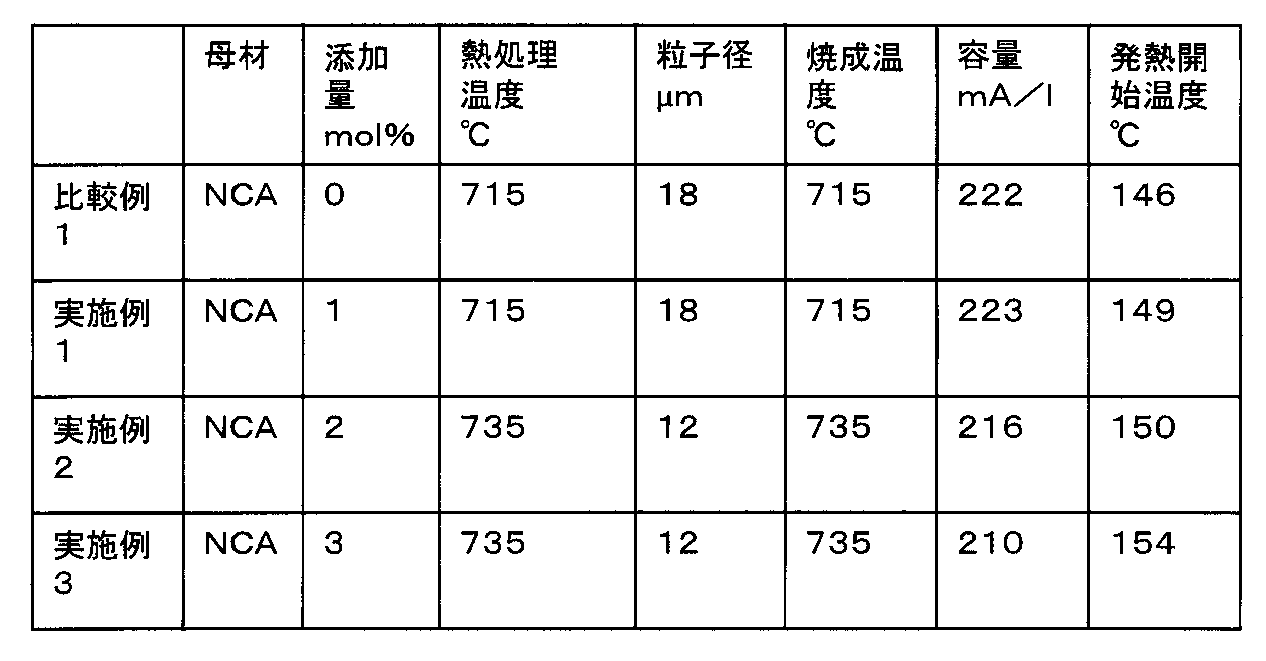
表2において、添加量はAl(OH)3の添加量(モル%)を示す。比較例1は添加しないため0モル%であり、実施例1~3はそれぞれ1モル%、2モル%、3モル%と順次増大している。
比較例1では発熱開始温度が146℃であるのに対し、実施例1~3ではそれぞれ149℃、150℃、154℃と順次高くなっている。他方、容量については、比較例1は222mAh/gであるのに対し、実施例1~3は223,216,210mAh/gと若干低下しているものの大きな容量低下はない。従って、実施例1~3では、比較例1と比較して、容量が大きく低下することなく、発熱開始温度が高く、熱的安定性が向上していることが分かる。また、Al(OH)3の添加量を調整することで、容量低下の抑制と熱的安定性の向上の両立を達成し得ることも分かる。この結果から、Ni含有リチウム遷移金属酸化物の表層に極薄のAlリッチ層を形成するとともに、中心部~0.35rまでのAlをほぼ一定とすることで、容量を維持しつつも熱的安定性を向上することが可能といえる。
Claims (6)
- ニッケル含有リチウム遷移金属酸化物を含む非水電解質二次電池用正極活物質であって、
硬X線光電子分光法(HAXPES)の光子エネルギ6KeVにおいて結合エネルギ1560~1565eVのAlリッチ層のピークが存在し、かつ、リチウム遷移金属酸化物粒子の平均粒子径rに対し、中心から0.35rの範囲内においてAl濃度が略一定である非水電解質二次電池用正極活物質。 - 前記Alリッチ層はLiAlO2を含む、請求項1に記載の非水電解質二次電池用正極活物質。
- リチウム遷移金属酸化物粒子のAl濃度は、0.99<(0.35rのAl濃度)/(中心部のAl濃度)<1.01である、請求項1、2のいずれかに記載の非水電解質二次電池用正極活物質。
- リチウム遷移金属酸化物粒子の中心から0.35rの範囲内は、LixNiaCobAlcMdO2であって、c>0.03であり、Mは、B、Si、Mg、Ge、Sn、Mg、Cr、Mn、Ti、Nb、Mo及びFeから選ばれる1種以上の金属元素である、請求項1~3のいずれかに記載の非水電解質二次電池用正極活物質。
- 前記Alリッチ層は、LiAlO2とLiNiCoAlO2との混合体である請求項1~4のいずれかに記載の非水電解質二次電池用正極活物質。
- ニッケル含有リチウム遷移金属酸化物を含む非水電解質二次電池用正極活物質の製造方法であって、
表面に水酸化リチウム又は炭酸リチウムを担持するNCAとAl化合物とを混合する工程と、
前記NCA及び前記Al化合物を500℃~800℃で加熱する工程と、
を備えるニッケル含有リチウム遷移金属酸化物を含む非水電解質二次電池用正極活物質の製造方法。
Priority Applications (5)
| Application Number | Priority Date | Filing Date | Title |
|---|---|---|---|
| CN201880014065.8A CN110337745B (zh) | 2017-03-31 | 2018-02-14 | 非水电解质二次电池用正极活性物质和其制造方法 |
| CN202410258049.0A CN118054002A (zh) | 2017-03-31 | 2018-02-14 | 非水电解质二次电池用正极活性物质和其制造方法 |
| JP2019508724A JP6903742B2 (ja) | 2017-03-31 | 2018-02-14 | 非水電解質二次電池用正極活物質 |
| US16/577,022 US11658295B2 (en) | 2017-03-31 | 2019-09-20 | Positive electrode active material for non-aqueous electrolyte secondary battery and method for producing same |
| US18/133,232 US12388082B2 (en) | 2017-03-31 | 2023-04-11 | Positive electrode active material for non-aqueous electrolyte secondary battery and method for producing same |
Applications Claiming Priority (2)
| Application Number | Priority Date | Filing Date | Title |
|---|---|---|---|
| JP2017070700 | 2017-03-31 | ||
| JP2017-070700 | 2017-03-31 |
Related Child Applications (1)
| Application Number | Title | Priority Date | Filing Date |
|---|---|---|---|
| US16/577,022 Continuation US11658295B2 (en) | 2017-03-31 | 2019-09-20 | Positive electrode active material for non-aqueous electrolyte secondary battery and method for producing same |
Publications (1)
| Publication Number | Publication Date |
|---|---|
| WO2018179936A1 true WO2018179936A1 (ja) | 2018-10-04 |
Family
ID=63677340
Family Applications (1)
| Application Number | Title | Priority Date | Filing Date |
|---|---|---|---|
| PCT/JP2018/004972 Ceased WO2018179936A1 (ja) | 2017-03-31 | 2018-02-14 | 非水電解質二次電池用正極活物質及びその製造方法 |
Country Status (4)
| Country | Link |
|---|---|
| US (2) | US11658295B2 (ja) |
| JP (1) | JP6903742B2 (ja) |
| CN (2) | CN110337745B (ja) |
| WO (1) | WO2018179936A1 (ja) |
Cited By (6)
| Publication number | Priority date | Publication date | Assignee | Title |
|---|---|---|---|---|
| WO2021107363A1 (ko) * | 2019-11-27 | 2021-06-03 | 주식회사 엘지에너지솔루션 | 도핑 원소가 도핑된 리튬 니켈계 산화물을 포함하는 양극 활물질, 및 이를 포함하는 이차전지 |
| JP2022530000A (ja) * | 2019-07-22 | 2022-06-27 | エルジー・ケム・リミテッド | リチウム二次電池用正極活物質の製造方法および前記製造方法により製造された正極活物質 |
| WO2023127290A1 (ja) * | 2021-12-27 | 2023-07-06 | パナソニックIpマネジメント株式会社 | 非水電解質二次電池用正極活物質 |
| EP3933981B1 (en) | 2019-09-02 | 2024-07-10 | Contemporary Amperex Technology Co., Limited | Positive electrode active material and preparation method therefor, positive electrode plate, lithium ion secondary battery, and battery module, battery pack, and apparatus containing such lithium-ion secondary battery |
| WO2026048542A1 (ja) * | 2024-08-30 | 2026-03-05 | パナソニックIpマネジメント株式会社 | 正極活物質および正極活物質の製造方法 |
| JP7909198B2 (ja) | 2021-12-27 | 2026-08-21 | パナソニックIpマネジメント株式会社 | 非水電解質二次電池用正極活物質 |
Families Citing this family (3)
| Publication number | Priority date | Publication date | Assignee | Title |
|---|---|---|---|---|
| WO2018179936A1 (ja) * | 2017-03-31 | 2018-10-04 | パナソニック株式会社 | 非水電解質二次電池用正極活物質及びその製造方法 |
| KR102877580B1 (ko) * | 2019-11-27 | 2025-10-29 | 주식회사 엘지에너지솔루션 | 도핑 원소가 도핑된 리튬 니켈계 산화물을 포함하는 양극 활물질, 및 이를 포함하는 이차전지 |
| DE112021000827T5 (de) * | 2020-04-28 | 2022-11-17 | Murata Manufacturing Co., Ltd. | Positive elektrode für eine sekundärbatterie und sekundärbatterie |
Citations (4)
| Publication number | Priority date | Publication date | Assignee | Title |
|---|---|---|---|---|
| KR100923442B1 (ko) * | 2007-08-01 | 2009-10-27 | 주식회사 엘 앤 에프 | 신규 양극 활물질 |
| JP2010129471A (ja) * | 2008-11-28 | 2010-06-10 | Sony Corp | 正極活物質および非水電解質電池 |
| JP2015069958A (ja) * | 2013-10-01 | 2015-04-13 | 日立マクセル株式会社 | 非水二次電池用正極材料及びその製造方法、並びに該非水二次電池用正極材料を用いた非水二次電池用正極合剤層、非水二次電池用正極及び非水二次電池 |
| WO2016108376A1 (ko) * | 2014-12-31 | 2016-07-07 | 주식회사 에코프로 | 양극활물질 및 이의 제조 방법 |
Family Cites Families (17)
| Publication number | Priority date | Publication date | Assignee | Title |
|---|---|---|---|---|
| JP3620703B2 (ja) * | 1998-09-18 | 2005-02-16 | キヤノン株式会社 | 二次電池用負極電極材、電極構造体、二次電池、及びこれらの製造方法 |
| KR100637998B1 (ko) * | 2002-05-16 | 2006-10-23 | 마쯔시다덴기산교 가부시키가이샤 | 비수전해질 이차전지용 양극활물질 및 그 제조방법 |
| JP4095499B2 (ja) * | 2003-06-24 | 2008-06-04 | キヤノン株式会社 | リチウム二次電池用の電極材料、電極構造体及びリチウム二次電池 |
| JP2010170741A (ja) | 2009-01-20 | 2010-08-05 | Panasonic Corp | 非水電解質二次電池用正極活物質の製造方法 |
| CN102844914B (zh) * | 2010-02-09 | 2015-05-20 | 住友金属矿山株式会社 | 非水电解质二次电池用正极活性物质、其制造方法、和使用了该正极活性物质的非水电解质二次电池 |
| CN102201572A (zh) * | 2010-03-25 | 2011-09-28 | 青岛新正锂业有限公司 | 锂离子电池正极材料锰铝酸锂固溶体 |
| CN103515606B (zh) * | 2012-06-21 | 2016-09-14 | 中国科学院宁波材料技术与工程研究所 | 高能量密度锂离子电池氧化物正极材料及其制备方法 |
| WO2015141179A1 (ja) * | 2014-03-17 | 2015-09-24 | 三洋電機株式会社 | 非水電解質二次電池 |
| CN104979553B (zh) * | 2014-04-02 | 2019-12-06 | 郭建 | 一种核壳结构镍钴铝酸锂材料的制备方法 |
| KR20150134259A (ko) * | 2014-05-21 | 2015-12-01 | 주식회사 에너세라믹 | 리튬복합금속산화물 및 이를 포함하는 리튬이차전지 |
| CN104795556B (zh) * | 2014-08-11 | 2017-10-03 | 湖南省正源储能材料与器件研究所 | 一种高容量镍钴铝酸锂的制备方法 |
| KR102296854B1 (ko) * | 2014-11-14 | 2021-09-01 | 에스케이이노베이션 주식회사 | 리튬이온 이차전지 |
| CN104766959B (zh) * | 2015-03-24 | 2017-01-25 | 江苏乐能电池股份有限公司 | 一种Li(Ni0.8Co0.1Mn0.1)O2三元材料的制备方法 |
| US10529978B2 (en) | 2015-03-30 | 2020-01-07 | Sanyo Electric Co., Ltd. | Nonaqueous electrolyte secondary battery |
| JP6723074B2 (ja) | 2015-06-01 | 2020-07-15 | マクセルホールディングス株式会社 | リチウムイオン二次電池 |
| US11018338B2 (en) | 2015-07-30 | 2021-05-25 | Sumitomo Metal Mining Co., Ltd. | Positive electrode active material for nonaqueous electrolyte secondary battery, and nonaqueous electrolyte secondary battery |
| WO2018179936A1 (ja) * | 2017-03-31 | 2018-10-04 | パナソニック株式会社 | 非水電解質二次電池用正極活物質及びその製造方法 |
-
2018
- 2018-02-14 WO PCT/JP2018/004972 patent/WO2018179936A1/ja not_active Ceased
- 2018-02-14 CN CN201880014065.8A patent/CN110337745B/zh active Active
- 2018-02-14 JP JP2019508724A patent/JP6903742B2/ja active Active
- 2018-02-14 CN CN202410258049.0A patent/CN118054002A/zh active Pending
-
2019
- 2019-09-20 US US16/577,022 patent/US11658295B2/en active Active
-
2023
- 2023-04-11 US US18/133,232 patent/US12388082B2/en active Active
Patent Citations (4)
| Publication number | Priority date | Publication date | Assignee | Title |
|---|---|---|---|---|
| KR100923442B1 (ko) * | 2007-08-01 | 2009-10-27 | 주식회사 엘 앤 에프 | 신규 양극 활물질 |
| JP2010129471A (ja) * | 2008-11-28 | 2010-06-10 | Sony Corp | 正極活物質および非水電解質電池 |
| JP2015069958A (ja) * | 2013-10-01 | 2015-04-13 | 日立マクセル株式会社 | 非水二次電池用正極材料及びその製造方法、並びに該非水二次電池用正極材料を用いた非水二次電池用正極合剤層、非水二次電池用正極及び非水二次電池 |
| WO2016108376A1 (ko) * | 2014-12-31 | 2016-07-07 | 주식회사 에코프로 | 양극활물질 및 이의 제조 방법 |
Cited By (10)
| Publication number | Priority date | Publication date | Assignee | Title |
|---|---|---|---|---|
| JP2022530000A (ja) * | 2019-07-22 | 2022-06-27 | エルジー・ケム・リミテッド | リチウム二次電池用正極活物質の製造方法および前記製造方法により製造された正極活物質 |
| JP7292660B2 (ja) | 2019-07-22 | 2023-06-19 | エルジー・ケム・リミテッド | リチウム二次電池用正極活物質の製造方法および前記製造方法により製造された正極活物質 |
| US12347848B2 (en) | 2019-07-22 | 2025-07-01 | Lg Chem, Ltd. | Method for preparing positive electrode active material for lithium secondary battery and positive electrode active material prepared thereby |
| EP3933981B1 (en) | 2019-09-02 | 2024-07-10 | Contemporary Amperex Technology Co., Limited | Positive electrode active material and preparation method therefor, positive electrode plate, lithium ion secondary battery, and battery module, battery pack, and apparatus containing such lithium-ion secondary battery |
| WO2021107363A1 (ko) * | 2019-11-27 | 2021-06-03 | 주식회사 엘지에너지솔루션 | 도핑 원소가 도핑된 리튬 니켈계 산화물을 포함하는 양극 활물질, 및 이를 포함하는 이차전지 |
| US12555785B2 (en) | 2019-11-27 | 2026-02-17 | Lg Energy Solution, Ltd. | Positive electrode active material comprising lithium nickel-based oxide doped with doping element, and secondary battery comprising the same |
| WO2023127290A1 (ja) * | 2021-12-27 | 2023-07-06 | パナソニックIpマネジメント株式会社 | 非水電解質二次電池用正極活物質 |
| JPWO2023127290A1 (ja) * | 2021-12-27 | 2023-07-06 | ||
| JP7909198B2 (ja) | 2021-12-27 | 2026-08-21 | パナソニックIpマネジメント株式会社 | 非水電解質二次電池用正極活物質 |
| WO2026048542A1 (ja) * | 2024-08-30 | 2026-03-05 | パナソニックIpマネジメント株式会社 | 正極活物質および正極活物質の製造方法 |
Also Published As
| Publication number | Publication date |
|---|---|
| US11658295B2 (en) | 2023-05-23 |
| US20230282817A1 (en) | 2023-09-07 |
| CN110337745B (zh) | 2024-03-19 |
| US12388082B2 (en) | 2025-08-12 |
| JP6903742B2 (ja) | 2021-07-14 |
| CN118054002A (zh) | 2024-05-17 |
| CN110337745A (zh) | 2019-10-15 |
| US20200020941A1 (en) | 2020-01-16 |
| JPWO2018179936A1 (ja) | 2020-02-27 |
Similar Documents
| Publication | Publication Date | Title |
|---|---|---|
| US12388082B2 (en) | Positive electrode active material for non-aqueous electrolyte secondary battery and method for producing same | |
| CN112335079B (zh) | 非水电解质二次电池用正极活性物质和非水电解质二次电池 | |
| KR101718059B1 (ko) | 복합체, 그 제조방법, 이를 포함하는 음극 활물질, 이를 포함하는 음극 및 이를 채용한 리튬 이차 전지 | |
| KR101601917B1 (ko) | 리튬 이차전지용 양극 활물질, 이들의 제조방법, 및 이를 포함하는 리튬 이차전지 | |
| US10553878B2 (en) | Positive electrode active material for non-aqueous electrolyte secondary batteries | |
| JPWO2018043190A1 (ja) | 非水電解質二次電池用正極活物質及び非水電解質二次電池 | |
| WO2007007542A1 (ja) | リチウムイオン二次電池 | |
| WO2017169129A1 (ja) | 非水電解質二次電池 | |
| US10811671B2 (en) | Positive-electrode active material and battery | |
| JP2025027027A (ja) | 非水電解質二次電池用正極活物質、及び非水電解質二次電池 | |
| CN107431201A (zh) | 正极活性物质和电池 | |
| WO2018043189A1 (ja) | 非水電解質二次電池用正極活物質及び非水電解質二次電池 | |
| CN110088970B (zh) | 非水电解质二次电池 | |
| JP2016033887A (ja) | 非水電解質二次電池 | |
| KR101255539B1 (ko) | 리튬 전지용 양극 활물질 및 이를 이용한 리튬 전지 | |
| US10833317B2 (en) | Positive-electrode active material and battery | |
| KR20130060008A (ko) | 복합체 질화물, 그 제조방법, 이를 포함하는 전극 활물질, 이를 포함하는 전극 및 이를 채용한 리튬 이차 전지 | |
| JP6660599B2 (ja) | 非水電解質二次電池用正極活物質、及び非水電解質二次電池 | |
| KR101432628B1 (ko) | 리튬 이차 전지용 양극 활물질, 이의 제조 방법 및 이를 포함하는 리튬 이차 전지 | |
| KR20150116222A (ko) | 리튬 이차전지용 양극 활물질, 이의 제조방법, 및 이를 포함하는 리튬 이차전지 | |
| US20210265626A1 (en) | Negative active material for rechargeable lithium battery and rechargeable lithium battery including same | |
| KR101288123B1 (ko) | 전극 활물질, 그 제조방법, 이를 포함한 리튬 이차 전지용 전극 및 이를 이용한 리튬 이차 전지 | |
| WO2018123604A1 (ja) | 非水電解質二次電池用正極活物質 | |
| US20210020937A1 (en) | Positive electrode active substance for non-aqueous electrolyte secondary battery and non-aqueous electrolyte secondary battery | |
| KR101443500B1 (ko) | 리튬금속산화물 및 이를 포함하는 리튬이차전지 |
Legal Events
| Date | Code | Title | Description |
|---|---|---|---|
| 121 | Ep: the epo has been informed by wipo that ep was designated in this application |
Ref document number: 18774254 Country of ref document: EP Kind code of ref document: A1 |
|
| ENP | Entry into the national phase |
Ref document number: 2019508724 Country of ref document: JP Kind code of ref document: A |
|
| NENP | Non-entry into the national phase |
Ref country code: DE |
|
| 122 | Ep: pct application non-entry in european phase |
Ref document number: 18774254 Country of ref document: EP Kind code of ref document: A1 |