WO2018135226A1 - 半導体ウェーハの洗浄方法 - Google Patents
半導体ウェーハの洗浄方法 Download PDFInfo
- Publication number
- WO2018135226A1 WO2018135226A1 PCT/JP2017/045831 JP2017045831W WO2018135226A1 WO 2018135226 A1 WO2018135226 A1 WO 2018135226A1 JP 2017045831 W JP2017045831 W JP 2017045831W WO 2018135226 A1 WO2018135226 A1 WO 2018135226A1
- Authority
- WO
- WIPO (PCT)
- Prior art keywords
- semiconductor wafer
- oxide film
- cleaning
- rpm
- rotation speed
- Prior art date
- Legal status (The legal status is an assumption and is not a legal conclusion. Google has not performed a legal analysis and makes no representation as to the accuracy of the status listed.)
- Ceased
Links
Images


Classifications
-
- H—ELECTRICITY
- H10—SEMICONDUCTOR DEVICES; ELECTRIC SOLID-STATE DEVICES NOT OTHERWISE PROVIDED FOR
- H10P—GENERIC PROCESSES OR APPARATUS FOR THE MANUFACTURE OR TREATMENT OF DEVICES COVERED BY CLASS H10
- H10P70/00—Cleaning of wafers, substrates or parts of devices
- H10P70/10—Cleaning before device manufacture, i.e. Begin-Of-Line process
- H10P70/15—Cleaning before device manufacture, i.e. Begin-Of-Line process by wet cleaning only
-
- H—ELECTRICITY
- H10—SEMICONDUCTOR DEVICES; ELECTRIC SOLID-STATE DEVICES NOT OTHERWISE PROVIDED FOR
- H10P—GENERIC PROCESSES OR APPARATUS FOR THE MANUFACTURE OR TREATMENT OF DEVICES COVERED BY CLASS H10
- H10P70/00—Cleaning of wafers, substrates or parts of devices
- H10P70/20—Cleaning during device manufacture
-
- H—ELECTRICITY
- H10—SEMICONDUCTOR DEVICES; ELECTRIC SOLID-STATE DEVICES NOT OTHERWISE PROVIDED FOR
- H10P—GENERIC PROCESSES OR APPARATUS FOR THE MANUFACTURE OR TREATMENT OF DEVICES COVERED BY CLASS H10
- H10P72/00—Handling or holding of wafers, substrates or devices during manufacture or treatment thereof
- H10P72/04—Apparatus for manufacture or treatment
- H10P72/0402—Apparatus for fluid treatment
- H10P72/0406—Apparatus for fluid treatment for cleaning followed by drying, rinsing, stripping, blasting or the like
- H10P72/0411—Apparatus for fluid treatment for cleaning followed by drying, rinsing, stripping, blasting or the like for wet cleaning or washing
-
- H—ELECTRICITY
- H10—SEMICONDUCTOR DEVICES; ELECTRIC SOLID-STATE DEVICES NOT OTHERWISE PROVIDED FOR
- H10P—GENERIC PROCESSES OR APPARATUS FOR THE MANUFACTURE OR TREATMENT OF DEVICES COVERED BY CLASS H10
- H10P72/00—Handling or holding of wafers, substrates or devices during manufacture or treatment thereof
- H10P72/70—Handling or holding of wafers, substrates or devices during manufacture or treatment thereof for supporting or gripping
- H10P72/76—Handling or holding of wafers, substrates or devices during manufacture or treatment thereof for supporting or gripping using mechanical means, e.g. clamps or pinches
- H10P72/7604—Handling or holding of wafers, substrates or devices during manufacture or treatment thereof for supporting or gripping using mechanical means, e.g. clamps or pinches the wafers being placed on a susceptor, stage or support
- H10P72/7618—Handling or holding of wafers, substrates or devices during manufacture or treatment thereof for supporting or gripping using mechanical means, e.g. clamps or pinches the wafers being placed on a susceptor, stage or support characterised by a movable susceptor, stage or support, others than those only rotating on their own vertical axis, e.g. susceptors on a rotating carrousel
Definitions
- the present invention relates to a method for cleaning a semiconductor wafer.
- the water-repellent surface treatment of a semiconductor wafer (for example, silicon wafer) using a single wafer spin cleaning machine removes the oxide film from a semiconductor wafer having an oxide film formed on the surface with a cleaning solution such as hydrofluoric acid (HF). It is common (patent document 1).
- a cleaning solution such as hydrofluoric acid (HF).
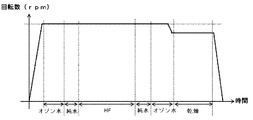
- FIG. 7 shows a graph representing the rotational speed of a semiconductor wafer in a conventional semiconductor wafer cleaning process (ozone water ⁇ pure water ⁇ hydrofluoric acid treatment ⁇ pure water ⁇ ozone water cleaning) and a drying process.
- the rotational speed during hydrofluoric acid treatment is basically constant, and the rotational speed is not changed.
- the surface roughness is deteriorated and surface defects such as watermarks and fine particles are increased.
- the present invention has been made in view of the above problems, and an object thereof is to provide a semiconductor wafer cleaning method capable of suppressing deterioration of surface roughness and suppressing occurrence of surface defects. To do.
- the present invention supplies a cleaning solution capable of removing the oxide film to a semiconductor wafer having an oxide film formed on a surface thereof, and performs cleaning while rotating the semiconductor wafer.
- Such a method for cleaning a semiconductor wafer can suppress the deterioration of the surface roughness and the occurrence of surface defects.
- the semiconductor wafer is a silicon wafer and the cleaning liquid capable of removing the oxide film is hydrofluoric acid.
- the semiconductor wafer cleaning method of the present invention is particularly effective in such a case.
- the oxide film is removed at a rotation speed of 300 rpm or more until 90% of the oxide film formed on the surface of the semiconductor wafer is removed, and then the rotation speed of the semiconductor wafer is switched to 100 rpm or less. It is preferable to completely remove the oxide film.
- the oxide film is removed at a rotational speed of 300 rpm or more until the contact angle of the semiconductor wafer on which the oxide film is formed with respect to pure water exceeds 5 °, and then the rotational speed of the semiconductor wafer is 100 rpm or less. It is preferable to completely remove the oxide film by switching to the above.
- the oxide film can be a natural oxide film.
- the semiconductor wafer cleaning method of the present invention can be particularly preferably used when the oxide film is a natural oxide film.
- the semiconductor wafer cleaning method of the present invention can suppress the deterioration of the surface roughness and suppress the generation of surface defects, and can provide a high-quality semiconductor wafer.
- (B) The measurement result of a haze deterioration amount It is a surface defect map after drying in an Example and a comparative example. It is a haze map after drying in Example 6, Comparative Example 1, and Comparative Example 7. It is a graph showing the rotational speed of the semiconductor wafer in the cleaning method of the conventional semiconductor wafer.
- the conventional method for cleaning a semiconductor wafer has a problem that a local haze abnormality occurs and surface defects such as watermarks and minute particles increase.
- the present inventors use a high speed rotation to maintain the surface roughness and a low speed to suppress particles and watermarks. I found that it was necessary to rotate.
- the increase in particles and watermarks is caused by the fact that cleaning with high-speed rotation after the water-repellent surface of the wafer is exposed causes chemicals to be easily repelled.
- the present inventors performed an oxide film removal process at a high speed of 300 rpm or more until the water repellent surface comes out in order to maintain the haze level, and then 100 rpm The present inventors have found that it is possible to suppress the deterioration of the surface roughness and suppress the generation of surface defects by shifting to the following low-speed rotation and completely removing the oxide film.
- the present invention provides a semiconductor wafer having an oxide film formed on the surface thereof by supplying a cleaning solution capable of removing the oxide film and cleaning the semiconductor wafer while rotating the semiconductor wafer, thereby forming the semiconductor wafer on the surface.
- a method for cleaning a semiconductor wafer to remove the oxidized film The removal of the oxide film is performed by setting the rotation speed of the semiconductor wafer to 300 rpm or more from the start of cleaning with the cleaning liquid to before the water repellent surface comes out, and then the rotation speed of the semiconductor wafer is switched to 100 rpm or less to complete the oxide film.
- a method for cleaning a semiconductor wafer is provided.
- the object to be cleaned is a semiconductor wafer having an oxide film formed on the surface.
- the oxide film include a natural oxide film and a thermal oxide film, but a natural oxide film (for example, a film thickness of 0.5 nm to 1.5 nm) is preferable.
- the natural oxide film can be formed by ozone water (for example, ozone concentration of 3 ppm or more), pure water cleaning, or the like.
- An oxide film formed on the surface of the semiconductor wafer is obtained by supplying a cleaning solution capable of removing the oxide film to the semiconductor wafer having the oxide film formed on the surface and cleaning the semiconductor wafer while rotating the semiconductor wafer.
- the removal of the oxide film is performed at a rotational speed of the semiconductor wafer of 300 rpm or more from the start of cleaning with the cleaning liquid until the water-repellent surface comes out, and then the rotational speed of the semiconductor wafer is switched to 100 rpm or less.
- the oxide film is completely removed.
- Such a method for cleaning a semiconductor wafer can suppress the deterioration of the surface roughness and the occurrence of surface defects.
- a conventionally used single wafer type spin cleaning machine can be used for cleaning the semiconductor wafer in the present invention.
- the cleaning liquid capable of removing the oxide film hydrofluoric acid (for example, 0.5 to 5.0 wt%) is preferable.
- the surface roughness is maintained by high-speed rotation of 300 rpm or more (preferably 1000 rpm or more) from the start of cleaning with a cleaning liquid capable of removing the oxide film to before the water-repellent surface comes out (especially immediately before the water-repellent surface comes out).
- the haze abnormality can be suppressed from occurring on the outer periphery of the wafer. If the rotational speed from the start of cleaning until the water repellent surface comes out is less than 300 rpm, the haze level is deteriorated.
- the upper limit of the rotation speed from the start of cleaning to before the water repellent surface comes out is not particularly limited, but can be, for example, 5000 rpm or less.
- the rotation speed of the semiconductor wafer is switched to 100 rpm or less (preferably 50 rpm or less) to oxidize. By completely removing the film, generation of surface defects such as particles and watermarks can be suppressed. If high-speed rotation of 300 rpm or more is performed in the state of the water repellent surface, or if the rotation speed after switching exceeds 100 rpm, generation of surface defects such as particles and watermarks cannot be suppressed.
- the lower limit of the rotation speed after switching is not particularly limited, but is preferably several rotations or more in order to obtain a cleaning effect.
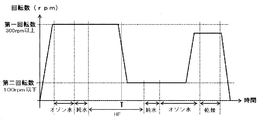
- the method for cleaning a semiconductor wafer of the present invention is performed with a cleaning liquid (HF) capable of removing an oxide film after cleaning with ozone water and pure water to form an oxide film.
- HF cleaning liquid
- the oxide film is removed at a first rotational speed of 300 rpm or more from the start of cleaning until the water-repellent surface comes out (especially immediately before the water-repellent surface comes out), and then the process proceeds to the second rotational speed of 100 rpm or less to completely remove the oxide film. This can be done.
- T is a timing when “a water-repellent surface appears”.
- the state of the “water-repellent surface” can be defined using the contact angle with respect to pure water of the semiconductor wafer on which the oxide film is formed.
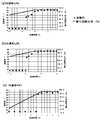
- FIGS. 2A to 2C show the relationship between the semiconductor wafer on which the oxide film is formed and pure water in the process of removing the oxide film using hydrofluoric acid (0.2%, 1.0%, 4.0%). The graph showing the change of a contact angle and an oxide film removal rate is shown.
- the contact angle shown in FIGS. 2 (a) to 2 (c) is 5 ° or less (that is, a hydrophilic surface) for a while from the start of cleaning, but then suddenly increases to become a water-repellent surface.
- the “water-repellent surface emerges” timing can be defined as the timing when the contact angle between the semiconductor wafer on which the oxide film is formed and pure water exceeds 5 °.
- a portable contact angle meter PCA-11 manufactured by Kyowa Interface Science Co., Ltd. can be used.
- the oxide film is removed at a rotation speed of 300 rpm or more until the contact angle of the semiconductor wafer on which the oxide film is formed with respect to pure water exceeds 5 °, and then the rotation speed of the semiconductor wafer is switched to 100 rpm or less.
- the contact angle of the wafer exceeds 5 °, which is a water repellent surface.
- the oxide film is removed at a rotation speed of 300 rpm or more until 90% of the oxide film formed on the surface of the semiconductor wafer is removed, and then the rotation speed of the semiconductor wafer is 100 rpm or less.
- the oxide film can be completely removed by switching to the above.
- the oxide film it is preferable to remove the oxide film at a rotational speed of 300 rpm or more for as long as possible before the water-repellent surface appears in order to reliably suppress the deterioration of the surface roughness. Therefore, it is preferable to carry out until just before 90% of the oxide film formed on the surface of the semiconductor wafer is removed, but it is possible until 80% or more of the oxide film is removed.
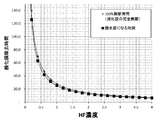
- FIG. 3 shows the relationship between the removal time of the natural oxide film (the complete peeling time of the oxide film and the time required for the water repellent surface) and the hydrofluoric acid concentration.
- the complete stripping time of the natural oxide film (the time required to remove 100% of the natural oxide film) is 28 seconds. Since the natural oxide film is removed (etched) at a constant speed, the oxide film removal rate is 90% (that is, the water-repellent surface appears) at 25.2 seconds. Therefore, in this case, the oxide film removal at a high speed of 300 rpm or more in the present invention can be performed until 25.2 seconds before the start of cleaning with hydrofluoric acid, and then switched to a low speed of 100 rpm or less.
- washing with water or ozone water is preferably performed at a rotation speed of 100 rpm or less (particularly preferably 50 rpm or less). In this way, by performing pure water or ozone water cleaning after removing the oxide film at a low speed, generation of watermarks and fine particles can be suppressed more reliably.
- the rotation speed after forming the oxide film by pure water or ozone water cleaning is not particularly limited, and can be high-speed rotation of 300 rpm or more. Then, it is preferable to perform a drying process.
- Examples 1 to 5 Comparative Examples 1 to 12
- ozone water (first rotation speed) ⁇ pure water (first rotation speed) ⁇ hydrofluoric acid (first rotation speed) )
- Hydrofluoric acid (second rotational speed) ⁇ Pure water (second rotational speed) ⁇ Ozone (second rotational speed) ⁇ Ozone water (1000 rpm) ⁇ Drying (1000 rpm).
- concentration of hydrofluoric acid is 1.0%.
- cleaning with hydrofluoric acid at the first rotation speed is performed until about 89% of the oxide film is removed.
- the second rotation speed was switched to complete removal of the oxide film.
- the contact angle of the wafer with pure water at the end of the hydrofluoric acid cleaning at the first rotational speed was 5 °.
- the rotation speed was not switched in the oxide film removal process using hydrofluoric acid.
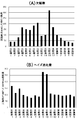
- Tables 1 and 2 show the results of the number of surface defects of the semiconductor wafer after drying, ⁇ Haze (amount of haze deterioration), and the presence or absence of a haze abnormality.
- FIG. 4 shows a graph of (A) the number of defects when Example 1 is 100, and (B) the amount of haze deterioration when Example 1 is 100.
- FIG. 5 the surface defect map in the semiconductor wafer after drying is shown.
- FIG. 6 shows haze maps after drying in Comparative Examples 1 and 7. Comparative Example 1 was found to have a haze abnormality, and Comparative Example 7 was found to have no haze abnormality.
- Example 6 Cleaning and drying were performed in the same manner as in Examples 1 to 5 except that the first rotation speed was 1300 rpm and the second rotation speed was 50 rpm (Example 6). In FIG. 6, the haze map of Example 6 is shown. Example 6 was found to have no haze abnormality.
- Table 3 summarizes the above results and the results obtained when washing and drying were performed under the conditions described in Table 3 (first rotation speed, second rotation speed).
- first rotation speed second rotation speed
- Table 3 the case where the number of defects was good, the amount of haze deterioration was good and no haze abnormality was observed was rated as ⁇ , and the others were marked as x.
- the present invention is not limited to the above embodiment.
- the above-described embodiment is an exemplification, and the present invention has substantially the same configuration as the technical idea described in the claims of the present invention, and any device that exhibits the same function and effect is the present invention. It is included in the technical scope of the invention.
Landscapes
- Cleaning Or Drying Semiconductors (AREA)
- Weting (AREA)
Priority Applications (4)
| Application Number | Priority Date | Filing Date | Title |
|---|---|---|---|
| US16/471,609 US11094525B2 (en) | 2017-01-23 | 2017-12-20 | Method for cleaning semiconductor wafer |
| CN201780082034.1A CN110140197B (zh) | 2017-01-23 | 2017-12-20 | 半导体晶圆的洗净方法 |
| KR1020197019648A KR102509323B1 (ko) | 2017-01-23 | 2017-12-20 | 반도체 웨이퍼의 세정방법 |
| EP17892697.8A EP3573090B1 (en) | 2017-01-23 | 2017-12-20 | Semiconductor wafer cleaning method |
Applications Claiming Priority (2)
| Application Number | Priority Date | Filing Date | Title |
|---|---|---|---|
| JP2017-009295 | 2017-01-23 | ||
| JP2017009295A JP6575538B2 (ja) | 2017-01-23 | 2017-01-23 | 半導体ウェーハの洗浄方法 |
Publications (1)
| Publication Number | Publication Date |
|---|---|
| WO2018135226A1 true WO2018135226A1 (ja) | 2018-07-26 |
Family
ID=62907914
Family Applications (1)
| Application Number | Title | Priority Date | Filing Date |
|---|---|---|---|
| PCT/JP2017/045831 Ceased WO2018135226A1 (ja) | 2017-01-23 | 2017-12-20 | 半導体ウェーハの洗浄方法 |
Country Status (8)
| Country | Link |
|---|---|
| US (1) | US11094525B2 (https=) |
| EP (1) | EP3573090B1 (https=) |
| JP (1) | JP6575538B2 (https=) |
| KR (1) | KR102509323B1 (https=) |
| CN (1) | CN110140197B (https=) |
| SG (1) | SG10201913707UA (https=) |
| TW (1) | TWI778004B (https=) |
| WO (1) | WO2018135226A1 (https=) |
Families Citing this family (2)
| Publication number | Priority date | Publication date | Assignee | Title |
|---|---|---|---|---|
| FI128613B (en) * | 2019-06-19 | 2020-08-31 | Comptek Solutions Oy | Optoelectronic device |
| KR20240121053A (ko) * | 2023-02-01 | 2024-08-08 | 에스케이실트론 주식회사 | 반도체 기판 및 반도체 기판의 세정 방법 |
Citations (4)
| Publication number | Priority date | Publication date | Assignee | Title |
|---|---|---|---|---|
| JP2009147038A (ja) * | 2007-12-13 | 2009-07-02 | Dainippon Screen Mfg Co Ltd | 基板処理方法 |
| JP2009272411A (ja) | 2008-05-02 | 2009-11-19 | Sumco Techxiv株式会社 | 半導体ウェーハの処理方法及び処理装置 |
| JP2015076558A (ja) * | 2013-10-10 | 2015-04-20 | 株式会社Screenホールディングス | 基板処理方法および基板処理装置 |
| JP2015220284A (ja) * | 2014-05-15 | 2015-12-07 | 信越半導体株式会社 | ウエーハの洗浄方法 |
Family Cites Families (12)
| Publication number | Priority date | Publication date | Assignee | Title |
|---|---|---|---|---|
| JPH069195B2 (ja) * | 1989-05-06 | 1994-02-02 | 大日本スクリーン製造株式会社 | 基板の表面処理方法 |
| JP2002368067A (ja) * | 2001-06-08 | 2002-12-20 | Tokyo Electron Ltd | 回転式基板処理装置及び回転式基板処理方法 |
| JP4089809B2 (ja) * | 2002-03-13 | 2008-05-28 | Sumco Techxiv株式会社 | 半導体ウェーハのエッジ部の酸化膜除去装置 |
| JP2005327936A (ja) * | 2004-05-14 | 2005-11-24 | Canon Inc | 基板の洗浄方法及びその製造方法 |
| CN100524639C (zh) * | 2005-02-07 | 2009-08-05 | 株式会社荏原制作所 | 基板处理方法、基板处理装置及控制程序 |
| JP2007165366A (ja) * | 2005-12-09 | 2007-06-28 | Ebara Corp | 基板処理装置および基板処理方法 |
| JP4832201B2 (ja) * | 2006-07-24 | 2011-12-07 | 大日本スクリーン製造株式会社 | 基板処理装置 |
| JP2010177543A (ja) * | 2009-01-30 | 2010-08-12 | Ebara Corp | 基板処理方法及び基板処理装置 |
| JP5795917B2 (ja) * | 2010-09-27 | 2015-10-14 | 株式会社Screenホールディングス | 基板処理装置および基板処理方法 |
| JP5061229B2 (ja) * | 2010-10-18 | 2012-10-31 | 東京エレクトロン株式会社 | 基板洗浄装置及び基板洗浄方法。 |
| JP5589968B2 (ja) * | 2011-06-17 | 2014-09-17 | 信越半導体株式会社 | 半導体ウェーハの洗浄方法 |
| JP6379400B2 (ja) * | 2013-09-26 | 2018-08-29 | 株式会社Screenホールディングス | 基板処理方法および基板処理装置 |
-
2017
- 2017-01-23 JP JP2017009295A patent/JP6575538B2/ja active Active
- 2017-12-20 CN CN201780082034.1A patent/CN110140197B/zh active Active
- 2017-12-20 KR KR1020197019648A patent/KR102509323B1/ko active Active
- 2017-12-20 SG SG10201913707UA patent/SG10201913707UA/en unknown
- 2017-12-20 WO PCT/JP2017/045831 patent/WO2018135226A1/ja not_active Ceased
- 2017-12-20 US US16/471,609 patent/US11094525B2/en active Active
- 2017-12-20 EP EP17892697.8A patent/EP3573090B1/en active Active
-
2018
- 2018-01-05 TW TW107100403A patent/TWI778004B/zh active
Patent Citations (4)
| Publication number | Priority date | Publication date | Assignee | Title |
|---|---|---|---|---|
| JP2009147038A (ja) * | 2007-12-13 | 2009-07-02 | Dainippon Screen Mfg Co Ltd | 基板処理方法 |
| JP2009272411A (ja) | 2008-05-02 | 2009-11-19 | Sumco Techxiv株式会社 | 半導体ウェーハの処理方法及び処理装置 |
| JP2015076558A (ja) * | 2013-10-10 | 2015-04-20 | 株式会社Screenホールディングス | 基板処理方法および基板処理装置 |
| JP2015220284A (ja) * | 2014-05-15 | 2015-12-07 | 信越半導体株式会社 | ウエーハの洗浄方法 |
Non-Patent Citations (1)
| Title |
|---|
| See also references of EP3573090A4 |
Also Published As
| Publication number | Publication date |
|---|---|
| US11094525B2 (en) | 2021-08-17 |
| EP3573090A1 (en) | 2019-11-27 |
| EP3573090B1 (en) | 2024-05-01 |
| TWI778004B (zh) | 2022-09-21 |
| JP2018120886A (ja) | 2018-08-02 |
| CN110140197B (zh) | 2023-04-28 |
| KR20190105581A (ko) | 2019-09-17 |
| KR102509323B1 (ko) | 2023-03-13 |
| JP6575538B2 (ja) | 2019-09-18 |
| CN110140197A (zh) | 2019-08-16 |
| SG10201913707UA (en) | 2020-03-30 |
| US20200105517A1 (en) | 2020-04-02 |
| EP3573090A4 (en) | 2020-11-04 |
| TW201841240A (zh) | 2018-11-16 |
Similar Documents
| Publication | Publication Date | Title |
|---|---|---|
| JP5589968B2 (ja) | 半導体ウェーハの洗浄方法 | |
| TWI657309B (zh) | 晶圓之洗淨方法 | |
| WO2019035345A1 (ja) | シリコンウェーハの洗浄方法 | |
| JP2001053050A (ja) | 半導体基板の洗浄方法 | |
| WO2020075448A1 (ja) | 半導体シリコンウェーハの洗浄処理装置および洗浄方法 | |
| JP6575538B2 (ja) | 半導体ウェーハの洗浄方法 | |
| JP6347232B2 (ja) | シリコンウェーハの洗浄方法 | |
| CN105428211A (zh) | 一种去除焊盘缺陷的方法 | |
| TWI460782B (zh) | 晶圓表面處理方法 | |
| TWI909266B (zh) | 半導體晶圓的洗淨方法、半導體晶圓的製造方法及半導體晶圓 | |
| JP5208658B2 (ja) | 半導体ウェハの洗浄方法、および、半導体ウェハ | |
| JP7439788B2 (ja) | ウェーハの洗浄方法 | |
| WO2025099975A1 (ja) | シリコンウェーハの洗浄方法 | |
| JP2025094340A (ja) | シリコンウェーハの洗浄方法 | |
| JP2024171492A (ja) | シリコンウェーハの洗浄方法、シリコンウェーハの製造方法、及びシリコンウェーハ | |
| JP5461810B2 (ja) | 半導体ウェハの洗浄方法 | |
| JP2008021924A (ja) | シリコンウエハ表面の不純物除去方法 | |
| JP2005057179A (ja) | 半導体装置の洗浄方法 |
Legal Events
| Date | Code | Title | Description |
|---|---|---|---|
| 121 | Ep: the epo has been informed by wipo that ep was designated in this application |
Ref document number: 17892697 Country of ref document: EP Kind code of ref document: A1 |
|
| ENP | Entry into the national phase |
Ref document number: 20197019648 Country of ref document: KR Kind code of ref document: A |
|
| NENP | Non-entry into the national phase |
Ref country code: DE |
|
| WWE | Wipo information: entry into national phase |
Ref document number: 2017892697 Country of ref document: EP |