WO2018135037A1 - フライアッシュ、セメント組成物及びフライアッシュの製造方法 - Google Patents
フライアッシュ、セメント組成物及びフライアッシュの製造方法 Download PDFInfo
- Publication number
- WO2018135037A1 WO2018135037A1 PCT/JP2017/033787 JP2017033787W WO2018135037A1 WO 2018135037 A1 WO2018135037 A1 WO 2018135037A1 JP 2017033787 W JP2017033787 W JP 2017033787W WO 2018135037 A1 WO2018135037 A1 WO 2018135037A1
- Authority
- WO
- WIPO (PCT)
- Prior art keywords
- fly ash
- particle size
- less
- particles
- volume
- Prior art date
- Legal status (The legal status is an assumption and is not a legal conclusion. Google has not performed a legal analysis and makes no representation as to the accuracy of the status listed.)
- Ceased
Links
Images
Classifications
-
- C—CHEMISTRY; METALLURGY
- C04—CEMENTS; CONCRETE; ARTIFICIAL STONE; CERAMICS; REFRACTORIES
- C04B—LIME, MAGNESIA; SLAG; CEMENTS; COMPOSITIONS THEREOF, e.g. MORTARS, CONCRETE OR LIKE BUILDING MATERIALS; ARTIFICIAL STONE; CERAMICS; REFRACTORIES; TREATMENT OF NATURAL STONE
- C04B18/00—Use of agglomerated or waste materials or refuse as fillers for mortars, concrete or artificial stone; Treatment of agglomerated or waste materials or refuse, specially adapted to enhance their filling properties in mortars, concrete or artificial stone
- C04B18/04—Waste materials; Refuse
- C04B18/06—Combustion residues, e.g. purification products of smoke, fumes or exhaust gases
- C04B18/08—Flue dust, i.e. fly ash
-
- C—CHEMISTRY; METALLURGY
- C04—CEMENTS; CONCRETE; ARTIFICIAL STONE; CERAMICS; REFRACTORIES
- C04B—LIME, MAGNESIA; SLAG; CEMENTS; COMPOSITIONS THEREOF, e.g. MORTARS, CONCRETE OR LIKE BUILDING MATERIALS; ARTIFICIAL STONE; CERAMICS; REFRACTORIES; TREATMENT OF NATURAL STONE
- C04B28/00—Compositions of mortars, concrete or artificial stone, containing inorganic binders or the reaction product of an inorganic and an organic binder, e.g. polycarboxylate cements
- C04B28/02—Compositions of mortars, concrete or artificial stone, containing inorganic binders or the reaction product of an inorganic and an organic binder, e.g. polycarboxylate cements containing hydraulic cements other than calcium sulfates
-
- C—CHEMISTRY; METALLURGY
- C04—CEMENTS; CONCRETE; ARTIFICIAL STONE; CERAMICS; REFRACTORIES
- C04B—LIME, MAGNESIA; SLAG; CEMENTS; COMPOSITIONS THEREOF, e.g. MORTARS, CONCRETE OR LIKE BUILDING MATERIALS; ARTIFICIAL STONE; CERAMICS; REFRACTORIES; TREATMENT OF NATURAL STONE
- C04B28/00—Compositions of mortars, concrete or artificial stone, containing inorganic binders or the reaction product of an inorganic and an organic binder, e.g. polycarboxylate cements
- C04B28/02—Compositions of mortars, concrete or artificial stone, containing inorganic binders or the reaction product of an inorganic and an organic binder, e.g. polycarboxylate cements containing hydraulic cements other than calcium sulfates
- C04B28/04—Portland cements
-
- C—CHEMISTRY; METALLURGY
- C04—CEMENTS; CONCRETE; ARTIFICIAL STONE; CERAMICS; REFRACTORIES
- C04B—LIME, MAGNESIA; SLAG; CEMENTS; COMPOSITIONS THEREOF, e.g. MORTARS, CONCRETE OR LIKE BUILDING MATERIALS; ARTIFICIAL STONE; CERAMICS; REFRACTORIES; TREATMENT OF NATURAL STONE
- C04B7/00—Hydraulic cements
- C04B7/24—Cements from oil shales, residues or waste other than slag
- C04B7/26—Cements from oil shales, residues or waste other than slag from raw materials containing flue dust, i.e. fly ash
-
- Y—GENERAL TAGGING OF NEW TECHNOLOGICAL DEVELOPMENTS; GENERAL TAGGING OF CROSS-SECTIONAL TECHNOLOGIES SPANNING OVER SEVERAL SECTIONS OF THE IPC; TECHNICAL SUBJECTS COVERED BY FORMER USPC CROSS-REFERENCE ART COLLECTIONS [XRACs] AND DIGESTS
- Y02—TECHNOLOGIES OR APPLICATIONS FOR MITIGATION OR ADAPTATION AGAINST CLIMATE CHANGE
- Y02P—CLIMATE CHANGE MITIGATION TECHNOLOGIES IN THE PRODUCTION OR PROCESSING OF GOODS
- Y02P40/00—Technologies relating to the processing of minerals
- Y02P40/10—Production of cement, e.g. improving or optimising the production methods; Cement grinding
-
- Y—GENERAL TAGGING OF NEW TECHNOLOGICAL DEVELOPMENTS; GENERAL TAGGING OF CROSS-SECTIONAL TECHNOLOGIES SPANNING OVER SEVERAL SECTIONS OF THE IPC; TECHNICAL SUBJECTS COVERED BY FORMER USPC CROSS-REFERENCE ART COLLECTIONS [XRACs] AND DIGESTS
- Y02—TECHNOLOGIES OR APPLICATIONS FOR MITIGATION OR ADAPTATION AGAINST CLIMATE CHANGE
- Y02W—CLIMATE CHANGE MITIGATION TECHNOLOGIES RELATED TO WASTEWATER TREATMENT OR WASTE MANAGEMENT
- Y02W30/00—Technologies for solid waste management
- Y02W30/50—Reuse, recycling or recovery technologies
- Y02W30/91—Use of waste materials as fillers for mortars or concrete
Definitions
- the present invention relates to fly ash, a cement composition using the fly ash, and a fly that can improve the workability by suppressing a decrease in fluidity when used in mortar or concrete, and suppress the occurrence of uneven color.
- the present invention relates to a method for producing ash.
- coal ash generated As the amount of power generated at coal-fired power plants has increased, the amount of coal ash generated has increased. Most of the coal ash generated from coal-fired power plants etc. is disposed of as landfills as industrial waste. In recent years, it has been difficult to secure a disposal site for industrial waste, and environmental regulations have been strengthened. Therefore, effective use of coal ash is required.
- the value of the specific surface area of coal ash measured by the BET method is related to the fluidity of mortar or concrete using this coal ash.
- the BET specific surface area value of coal ash is small, a coal ash having a relatively large 45 ⁇ m sieve residue value is proposed, and when the BET specific surface area value is large, coal ash having a relatively small 45 ⁇ m sieve residue value is proposed. (Patent Document 1).
- Coal ash includes spherical fly ash (fly ash) collected from the combustion gas of the combustion boiler with a dust collector.
- Fly ash which is a fine powder in coal ash, is used as an admixture for concrete or mortar.
- the quality of fly ash used for concrete or mortar is defined in JIS A6201: 2015 “Fly ash for concrete”.
- Fly ash used for concrete or mortar contains a lot of fine spherical particles, and the use of fly ash as an admixture is expected to improve the workability of concrete or mortar and reduce the unit water volume. .
- incinerated ash is heated in a melting furnace, and in addition to true spherical fully molten particles melted and spheroidized in a floating state, incompletely molten particles larger in size than completely molten particles are included. It is. Incompletely melted particles also include coarse and distorted shaped particles or coarse and hollow particles.
- fly ash unburned carbon particles that did not react during the gasification reaction of a thermal power plant remain. Since unburned carbon particles are fragile, they become fine unburned carbon particles by impact or grinding.
- the fly ash includes coarse unburned carbon particles and fine unburned carbon particles obtained by grinding the coarse unburned carbon particles. Therefore, when fly ash is used for concrete or mortar, unburned carbon contained in fly ash adsorbs various admixtures in cement such as water and / or water reducing agent, and fluidity decreases. It is difficult to improve workability.
- fly ash is used for concrete or mortar, unburned carbon contained in the fly ash together with bleeding water floats on the surface of the concrete, etc. when the concrete is placed, and black color unevenness occurs.
- a fly ash comprising: ashing fly ash until unburned carbon is 1 wt% or less; and pulverizing to 50% passage diameter 5 ⁇ m to 15 ⁇ m
- Patent Document 2 A reforming method has been proposed.
- Patent Document 1 the coal ash described in Patent Document 1 is mainly used by replacing a portion of fine aggregate with coal ash having a particle size equal to or smaller than the fine aggregate.
- the use of coal ash as a fine aggregate is different from the use as an admixture.
- the present invention when used in concrete or mortar, the present invention can improve flowability and workability, and can suppress the occurrence of uneven color on the surface, fly ash, and cement containing the fly ash It aims at providing the manufacturing method of a composition and fly ash.
- the present inventors have found that unburned carbon contained in fly ash and distorted coarse particles are fluidity of concrete using fly ash, and the like.
- the present invention has been completed by finding that it affects the occurrence of uneven color on the concrete surface. That is, the present invention is as follows. [1] The content of particles having a particle size of 45 ⁇ m or more measured by a laser diffraction / scattering particle size distribution measurement method is less than 38% by volume, and the content of particles having a particle size of less than 5 ⁇ m measured by the measurement method is 12% by volume.
- Fly ash characterized by: [2] The fly ash according to [1], wherein the ignition loss is 6.0% by mass or less.
- the average particle diameter (D50) with a cumulative frequency of 50% in the volume-based particle size distribution measured by the laser diffraction / scattering particle size distribution measurement method is 15.0 to 30.0 ⁇ m, and the measurement method for the average particle diameter (D50)
- the particle size ratio (D30 / D50) of the particle size (D30) having a cumulative frequency of 30% in the volume-based particle size distribution by 0.5 is 0.50 or more, and the cumulative frequency in the volume-based particle size distribution by the measurement method with respect to the average particle size D50
- the fly ash according to [1] to [4], wherein the particle size ratio (D70 / D50) of the 70% particle size (D70) is 1.85 or less.
- a cement composition comprising the fly ash according to any one of [1] to [5] and a cement.
- the cement composition according to [6] wherein the content of the fly ash is more than 1% by mass and not more than 35% by mass with respect to the total amount of the cement composition.
- a method for producing fly ash comprising a step of removing at least part of particles having a diameter of less than 5 ⁇ m.
- fly ash when used in concrete or mortar, fly ash capable of suppressing workability by suppressing a decrease in fluidity and suppressing occurrence of uneven color, and a cement composition using the fly ash And a method for producing fly ash can be provided.
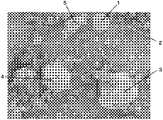
- FIG. 1 is an SEM photograph of fly ash containing unburned carbon particles.
- the fly ash has a particle size of 45 ⁇ m or more measured by a laser diffraction / scattering particle size distribution measurement method of less than 38% by volume, and the particle size measured by the measurement method described above.
- the content of particles less than 5 ⁇ m is 12% by volume or less.
- FIG. 1 is an SEM photograph of fly ash obtained from a coal-fired power plant. As shown in FIG. 1, the fly ash has perfect spherical molten particles 1, fine unburned carbon particles 2, coarse and distorted incomplete molten particles 3 having a particle size of 45 ⁇ m or more, and coarse and hollow incomplete. Molten particles 4 and coarse unburned carbon particles 5 are included.
- true sphere means a true sphere or a shape close to a true sphere.
- the cement containing fly ash in which the content of the particles having a particle size of 45 ⁇ m or more measured by the measurement method exceeds 38% by volume.
- the composition may float on the concrete surface together with bleeding water during casting, and cause uneven coloration.
- Particles having a relatively small particle diameter of less than 5 ⁇ m measured by a laser diffraction / scattering particle size distribution measurement method in fly ash are often fine unburned carbon particles 2.
- the coarse unburned carbon particles 5 that have been incompletely reacted during the gasification reaction in a coal-fired power plant are fragile, and thus become fine unburned carbon particles 2 by impact or grinding.
- fly ash When the content of particles having a particle size of less than 5 ⁇ m measured by the above measurement method in fly ash exceeds 12% by volume, the amount of fine unburned carbon particles 2 contained in the fly ash increases. In the cement composition containing this fly ash, the fine unburned carbon particles 2 adsorb the admixture and the like, so that the fluidity is lowered and the workability cannot be improved. In addition, if fly ash contains a lot of fine unburned carbon particles 2, when fly ash is used for concrete, the fine unburned carbon particles 2 float on the concrete surface together with bleeding water when placed. May cause uneven color.
- the content of particles having a particle size of 45 ⁇ m or more measured by a laser diffraction / scattering particle size distribution measurement method is less than 38% by volume, and the content of particles having a particle size of less than 5 ⁇ m measured by the measurement method is 12.0% by volume or less.
- a fly ash having a specific particle size distribution is suitable for a fly ash for cement mixing because it can suppress a decrease in fluidity, improve workability, and suppress the occurrence of uneven color.
- the content of particles having a particle diameter of 45 ⁇ m or more measured by a laser diffraction / scattering particle size distribution measurement method is preferably 37.0% by volume or less, more preferably 36.0% by volume or less, Preferably it is 35.0 volume% or less.
- This fly ash has a small content of large particles having a particle size of 45 ⁇ m or more, including a large amount of coarse and distorted incompletely melted particles 3, coarse and hollow incompletely melted particles 4, and coarse unburned carbon particles 5.
- the cement composition containing fly ash can improve fluidity and workability.
- the fly ash is a hollow body and has a small bulk specific gravity and a small content of particles with a large particle size.
- the mixed cement containing fly ash of 37.0% by volume or less prevents fly ash from floating on the concrete surface together with bleeding water at the time of casting, and can suppress the occurrence of uneven color caused by changes in the color tone of fly ash. .
- the content of particles having a particle size of less than 5 ⁇ m measured by a laser diffraction / scattering particle size distribution measurement method is preferably 11.0% by volume or less, more preferably 10.0% by volume or less, Preferably it is 9.0 volume% or less, More preferably, it is 8.0 volume% or less, Most preferably, it is 5.0 volume% or less.
- fly ash has a small content of unburned carbon particles 2 having a small particle size
- the cement composition containing fly ash has fluidity due to adsorbing admixture and the like by unburned carbon particles 2 having a small particle size. Can be reduced and workability can be improved.
- fly ash since fly ash has a small content of fine unburned carbon particles 2, the cement composition containing fly ash hardly raises the fine unburned carbon particles 2 together with bleeding water during casting. The occurrence of unevenness can be suppressed.
- the content of particles having a particle diameter of 90 ⁇ m or more measured by a laser diffraction / scattering particle size distribution measurement method is preferably 15.0% by volume or less, more preferably 13.5% by volume or less, Preferably it is 12.0 volume% or less.
- the cement composition containing the fly ash can suppress a decrease in fluidity and suppress the occurrence of uneven color. .
- the content of particles having a particle diameter of 75 ⁇ m or more measured by a laser diffraction / scattering particle size distribution measurement method is preferably 20.0% by volume or less, more preferably 19.5% by volume or less, Preferably it is 19.3 volume% or less.
- the content of particles having a particle size of 30 ⁇ m or more measured by a laser diffraction / scattering particle size distribution measurement method is preferably 15.0% by volume or more, more preferably 18.0% by volume or more, Preferably it is 20.0 volume% or more, Preferably it is 55.0 volume% or less, More preferably, it is 54.0 volume% or less, More preferably, it is 52.0 volume% or less.
- the fly ash has a relatively large particle size with a large number of distorted shapes, and contains a large amount of perfectly spherical completely melted particles 1, so that the cement composition containing this fly ash has a fluidity. Can be suppressed.
- the content of particles having a particle diameter of 20 ⁇ m or more measured by a laser diffraction / scattering particle size distribution measurement method is preferably 35.0% by volume or more, more preferably 38.0% by volume or more, Preferably it is 39.0 volume% or more, Preferably it is 70.0 volume% or less, More preferably, it is 69.0 volume% or less.
- the fly ash has a relatively large particle size with a large number of distorted shapes, and contains a large amount of perfectly spherical completely melted particles 1, so that the cement composition containing this fly ash has a fluidity. Can be suppressed.
- the content of particles having a particle diameter of less than 10 ⁇ m measured by a laser diffraction / scattering particle size distribution measurement method is preferably 30.0% by volume or less, more preferably 29.5% by volume or less, Preferably it is 29.0 volume% or less, Preferably it is 10.0 volume% or more, More preferably, it is 12.0 volume% or more.
- the fly ash preferably has a loss on ignition of 6.0% by mass or less.
- the ignition loss of fly ash is related to the content of unburned carbon. When the ignition loss is small, it can be estimated that the content of unburned carbon contained in the fly ash is also small.
- the fly ash preferably has a loss on ignition of 5.8% by mass or less, more preferably a loss on ignition of 5.6% by mass or less, and still more preferably 5.5% by mass or less. Fly ash has a low loss on ignition of 6.0% by mass or less, so that the content of unburned carbon is small and the fluidity is higher than that of a cement composition containing fly ash mixed with a lot of unburned carbon.
- the fly ash satisfies the numerical value of ignition loss of the type III fly ash described in JIS A6201: 2015 “Fly ash for concrete”. Further, the fly ash may satisfy the value of ignition loss of the type I, type II, or type IV fly ash described in JIS A6201: 2015 “Fly Ash for Concrete”.
- fly ash When fly ash has an ignition loss of 6.0% by mass or less, the fly ash has a particle size of 45 ⁇ m measured by a laser diffraction scattering particle size distribution measurement method even when unburned carbon is contained.
- the content of the above particles is less than 38% by volume and the content of particles having a particle size of less than 5 ⁇ m measured by the measurement method is 12% by volume or less. It is possible to improve the workability by suppressing the decrease, and to suppress the occurrence of uneven color.
- Fe 2 O 3 as a chemical component is preferably 7.1% by mass or less.
- Iron (Fe) contained in fly ash forms a crystal phase together with (Si) and (Al) contained in fly ash.
- Crystalline phase contained in the fly ash for example, quartz (SiO 2), cristobalite (SiO 2), mullite (3Al 2 O 3 ⁇ 2SiO 2 ⁇ 2Al 2 O 3 ⁇ SiO 2), hematite (Fe 2 O 3), magnetite (Fe 3 O 4) can be mentioned.
- a relatively large particle having a particle size of 45 ⁇ m or more measured by a laser diffraction / scattering particle size distribution measuring device has a slower cooling rate than the small particle having a particle size of less than 45 ⁇ m. Therefore, since it is cooled slowly, the crystal phase contained in the particles tends to increase as compared with particles having a small particle size of less than 45 ⁇ m.
- the crystal phase contained in fly ash includes black or reddish brown hematite (Fe 2 O 3 ) or black magnetite (Fe 3 O 4 ), and the color tone of fly ash changes depending on the content of the crystal phase.
- the content of particles having a particle diameter of 45 ⁇ m or more measured by a laser diffraction scattering particle size distribution measurement method is less than 38% by volume, and the content of particles having a particle diameter of 45 ⁇ m or more is large. Therefore, it contains a large number of particles having a small particle size of less than 45 ⁇ m, which is presumed to have a relatively small crystal phase content.
- the fly ash of the present invention contains 7.1% by mass or less of Fe 2 O 3 as a chemical component contained in the fly ash, a crystal phase such as hematite showing black or reddish brown or magnetite showing black is formed.
- the fly ash of the present invention can suppress color unevenness because the content of the crystal phase that changes the color tone of the concrete surface is reduced.
- the content of the crystal phase is determined by the method for measuring the crystal phase and the amorphous phase (mass%) in the fly ash described in the examples described later, and includes the total amount of unburned carbon.
- the content of the crystal phase in the fly ash calculated in consideration of the amorphous amount G total (% by mass).
- Iron (Fe) in the crystal phase refers to the amount of iron (Fe) in the crystal phase calculated in consideration of the total amorphous amount G total (% by mass) including unburned carbon. In this specification, It is also called “the amount of iron (Fe) in the crystalline phase”.
- Fe 2 O 3 as a chemical component contained in fly ash is derived from coal as a raw material.
- Fe 2 O 3 as a chemical component in fly ash is more preferably 7.05% by mass or less, still more preferably 7.00% by mass or less, and even more preferably 6.95% by mass or less. Usually, it is 3.00 mass% or more.
- F e O 3 as a chemical component contained in fly ash is the amount of iron in terms of oxide measured according to JIS R5204 “Method for X-ray fluorescence analysis of cement” (iron (III) oxide: Fe 2 O 3 ). The value of
- hematite In fly ash, hematite (Fe 2 O 3 ) is 0.75 mass% or less, magnetite (Fe 3 O 4 ) is 1.25 mass% or less, and iron (Fe) in the crystal phase is 1.45 mass% or less. It is preferable that Hematato (Fe 2 O 3 ) is black or reddish brown, magnetite (Fe 3 O 4 ) is black, and fly ash containing a large amount of hematite and magnetite changes the color tone of fly ash.
- the concrete using the cement composition containing fly ash has a light and shade of a color tone that includes a portion that appears partially blackish or a portion that appears whitish in the gray color tone of the surface of the fly ash that floats with bleeding water ( Color irregularity) may appear.
- One of the factors that cause color unevenness when fly ash hematite is 0.75 mass% or less, magnetite is 1.25 mass% or less, and iron (Fe) in the crystal phase is 1.45 mass% or less.
- the content of hematite and magnetite contained in the fly ash that affects the change in color tone of the two fly ashes is small, and color unevenness can be suppressed.
- hematite (Fe 2 O 3 ) is more preferably 0.74% by mass or less, magnetite (Fe 3 O 4 ) is more preferably 1.24% by mass, and iron (Fe) in the crystal phase. Is more preferably 1.42% by mass or less.
- hematite (Fe 2 O 3 ) is more preferably 0.72% by mass or less, magnetite (Fe 3 O 4 ) is more preferably 1.23% by mass or less, and iron (Fe) in the crystal phase Is more preferably 1.39% by mass or less.
- hematite (Fe 2 O 3 ) is more preferably 0.70% by mass or less
- magnetite (Fe 3 O 4 ) is more preferably 1.22% by mass or less
- iron (Fe ) Is more preferably 1.37% by mass or less.
- the content of hematite (Fe 2 O 3 ) in fly ash, the content of magnetite (Fe 3 O 4 ), and the content of iron (Fe) in the crystalline phase depend on the coal and fly ash production conditions.
- fly ash is different from fly ash
- hematite Fe 2 O 3
- magnetite Fe 3 O 4
- iron in the crystal phase Fe is usually 0.21% by mass or more.
- the measurement of hematite (Fe 2 O 3 ), magnetite (Fe 3 O 4 ) in fly ash and iron (Fe) in the crystal phase can be measured by a Rietveld analysis method using a powder X-ray diffractometer. It can.
- a powder X-ray diffractometer for example, D8 Advance (manufactured by Bruker AXS) can be used.
- the amount of iron (Fe) in the crystal phase can be determined by the method for measuring the amount of crystal phase and amorphous phase (mass%) in fly ash described in the examples described later.
- the fly ash has an average particle size (D50) with a cumulative frequency of 50% in a volume-based particle size distribution measured by a laser diffraction / scattering particle size distribution measurement method of 15.0 to 30.0 ⁇ m, and the measurement for the average particle size (D50) is performed as described above.
- the particle size ratio (D30 / D50) of the particle size (D30) with a cumulative frequency of 30% from the small diameter side in the volume-based particle size distribution by the method is 0.50 or more, and according to the measurement method for the average particle size (D50) It is preferable that the particle size ratio (D70 / D50) of the particle size (D70) having a cumulative frequency of 70% from the small diameter side in the volume-based particle size distribution is 1.85 or less.
- the fly ash has an average particle size (D50) of 15.0 to 30.0 ⁇ m, a particle size ratio (D30 / D50) of 0.50 or more, and a particle size ratio (D70 / D50) of 1.85 or less.
- D50 average particle size
- D30 / D50 particle size ratio
- D70 / D50 particle size ratio
- the cement composition using ash can suppress a decrease in fluidity and suppress the occurrence of uneven color.
- the fly ash has an average particle size (D50) with a cumulative frequency of 50% in the volume-based particle size distribution measured by a laser diffraction / scattering particle size distribution measurement method, more preferably 16.0 to 29.5 ⁇ m, and even more preferably 17.0. ⁇ 29.0 ⁇ m.
- D50 average particle diameter
- the coarse and distorted incomplete molten particles 3 the coarse and hollow incomplete molten particles 4
- the particle size including a large amount of coarse unburned carbon 5 Since the content of large particles is small, the content of perfect spherical completely melted particles 1 is large, and the content of fine unburned carbon particles 2 is also small, the cement composition containing this fly ash is fluid. Is suppressed, and the occurrence of uneven color is suppressed.
- the fly ash has a particle size ratio (D30 / D50) of preferably 0.51 or more, and more preferably 0.52 or more.
- the fly ash has a particle size ratio (D70 / D50) of preferably 1.84 or less. As the particle size ratio (D30 / D50) and / or the particle size ratio (D70 / D50) are closer to 1, the particle size distribution becomes sharper and the particle size is uniform.
- Fly ash contains a large amount of coarse and distorted incompletely melted particles 3, coarse and hollow incompletely melted particles 4 and coarse unburned carbon particles 5 that cause a decrease in fluidity and color unevenness. Since the content of particles having a large particle size is small and the content of unburned carbon particles 2 having a small particle size is also small, the cement composition containing this fly ash is suppressed in fluidity and has uneven color. Is suppressed.
- the fly ash has an average particle size (D50) with a cumulative frequency of 50% in a volume-based particle size distribution measured by a laser diffraction / scattering particle size distribution measurement method of 15.0 to 30.0 ⁇ m, and the measurement for the average particle size (D50) is performed as described above.
- the particle size ratio (D10 / D50) of the particle size (D10) having a cumulative frequency of 10% in the volume-based particle size distribution by the method is preferably 0.2 or more and 0.5 or less.
- Fly ash having a particle size ratio (D10 / D50) of 0.2 or more and 0.5 or less has a small particle size of unburned carbon particles 2 and a relatively uniform particle size distribution.
- the fly ash having a particle size ratio (D10 / D50) of 0.2 or more and 0.5 or less has a particle size distribution in which the content of unburned carbon particles 2 having a small particle size is small and the particle size is relatively uniform.
- the cement composition containing this fly ash can suppress the occurrence of uneven color because there is little lifting of fine unburned carbon particles having a small particle size together with bleeding water.
- the fly ash has an average particle size (D50) with a cumulative frequency of 50% in a volume-based particle size distribution measured by a laser diffraction / scattering particle size distribution measurement method of 15.0 to 30.0 ⁇ m, and the measurement for the average particle size (D50) is performed as described above.
- the particle size ratio (D90 / D50) of the particle size (D90) having a cumulative frequency of 90% in the volume-based particle size distribution by the method is preferably 1.5 or more and 4.5 or less.
- the fly ash having a particle size ratio (D90 / D50) of 1.5 or more and 4.5 or less is a coarse and distorted incomplete molten particle 3, a coarse and hollow incomplete molten particle 4, and a coarse unburned carbon.
- the content of large particles containing many particles 5 is small.
- the cement composition containing this fly ash can suppress a decrease in fluidity due to mixing of coarse particles having a distorted shape, and the particle size ratio (D90 / D50) is 1.5 or more and 4.5 or less.
- One fly ash reduces the content of particles with a relatively large particle size with a small bulk specific gravity, and a cement composition containing this fly ash lifts up particles with a relatively large particle size with a small bulk specific gravity together with bleeding water. The occurrence of color unevenness can be suppressed by reducing the amount.
- the cement composition includes fly ash according to one embodiment of the present invention and cement.
- the type of cement is not particularly limited, and examples thereof include ordinary Portland cement, early-strength Portland cement, moderately hot Portland cement, and low heat Portland cement.
- the content of fly ash with respect to the total amount of the cement composition is preferably more than 1% by mass and 35% by mass or less, and more preferably 2% by mass to 32% by mass.
- the content of fly ash is within the above range with respect to the total amount of the cement composition, the fluidity of mortar or concrete using the cement composition containing fly ash can be improved, and workability can be improved. Further, fine unburned carbon particles and coarse particles having a small bulk specific gravity do not float with the bleeding water on the concrete surface, and the occurrence of uneven color can be suppressed.
- the fly ash content with respect to the total amount of the cement composition is such that the content of the fly ash cement A, B or C fly ash described in JIS R5213: 2009 “Fly Ash Cement” is satisfied.
- the content of fly ash may be more than 5% by mass and not more than 10% by mass in the case of Class A, and the content of fly ash in the case of Class B with respect to the total amount of the composition. It may be 20% by mass or more exceeding 10% by mass, and in the case of Class C, the fly ash content may be more than 20% by mass and 30% by mass or less.
- Fly ash is not limited to that for fly ash cement, but may be used as a mixed material in a cement composition, and the amount used does not satisfy the content of fly ash in “fly ash cement” defined by JIS. It may be.
- the cement composition may contain admixtures such as gypsum, a water reducing agent, and a high-performance AE water reducing agent in addition to fly ash and cement.
- the fly ash manufacturing method comprises less than 38% by volume of particles having a particle size of 45 ⁇ m or more as measured by a laser diffraction scattering particle size distribution measurement method in 100% by volume of the entire fly ash. So that at least a part of particles having a particle size of 45 ⁇ m or more is removed from the raw fly ash, and the content of particles having a particle size of less than 5 ⁇ m measured by the measurement method in 100% by volume of the entire fly ash is 12 Removing at least a part of particles having a particle size of less than 5 ⁇ m from the fly ash of the raw material so that the volume% or less.
- the step of removing at least part of the particles having a particle size of 45 ⁇ m or more from the raw fly ash and the step of removing at least part of the particles having a particle size of less than 5 ⁇ m from the raw fly ash may use an air classifier or a sieve. it can.
- a wind classifier such as a turbo classifier manufactured by Nissin Engineering Co., Ltd. can be used.
- the fly ash manufacturing method is a relatively simple method without passing through steps such as carbonization and pulverization, thereby reducing fluidity and causing color unevenness.
- the coarse and distorted incomplete molten particles 3, the coarse and hollow incomplete molten particles 4, the coarse unburned carbon particles 5, and the fine unburned carbon 2 can be removed.
- coarse particles and fine unburned carbon are removed by classification, and the obtained fly ash contains a large amount of perfectly spherical completely molten particles 1. .
- the fly ash manufacturing method it is possible to obtain a fly ash that can suppress a decrease in fluidity and suppress the occurrence of color unevenness due to the ball bearing effect of the perfectly spherical fully melted particles 1.
- coal ash for example, when fly ash obtained from a coal-fired power plant is used as a raw material, laser diffraction scattering in 100% by volume of the entire fly ash is obtained so that fly ash having a specific particle size distribution can be obtained. Removing at least part of the particles having a particle size of 45 ⁇ m or more from the fly ash of the raw material so that the content of particles having a particle size of 45 ⁇ m or more measured by the formula particle size distribution measurement method is less than 38% by volume; Removing at least a part of the particles having a particle diameter of less than 5 ⁇ m from the raw fly ash so that the content of the particles having a particle diameter of less than 5 ⁇ m measured in step 1 is 12% by volume or less.
- fly ash having a specific particle size distribution can be manufactured, and fly ash suitable for cement mixing can be manufactured. it can.
- fly ash (Examples 1 to 5) Using fly ash obtained from the coal-fired power plant of Comparative Example 1 as the raw fly ash, using a wind classifier (product name: Turbo Classifier, manufactured by Nissin Engineering Co., Ltd.), 100% by volume of the entire fly ash At least part of the particles having a particle size of 45 ⁇ m or more are removed so that the content of particles having a particle size of 45 ⁇ m or more measured by the laser diffraction / scattering particle size distribution measurement method is less than 38% by volume.
- a wind classifier product name: Turbo Classifier, manufactured by Nissin Engineering Co., Ltd.
- Example 1 having the laser diffraction particle size distribution shown in Table 1 by removing at least part of the particles having a particle size of less than 5 ⁇ m so that the measured content of particles having a particle size of less than 5 ⁇ m is 12% by volume or less. A fly ash for mixing was produced.
- Example 6 having the laser diffraction particle size distribution (volume%) shown in Table 1 in the same manner as in Examples 1 to 5 using fly ash obtained from the coal-fired power plant of Comparative Example 2 as the raw fly ash -7 fly ash for cement mixing was produced.
- Comparative Examples 3 to 4 Using fly ash obtained from the coal-fired power plant of Comparative Example 1 as a raw fly ash, using a wind classifier (product name: Turbo Classifier, manufactured by Nissin Engineering Co., Ltd.) The content of particles having a particle size of 45 ⁇ m or more measured by a laser diffraction / scattering particle size distribution measurement method is 38% by volume or more, or the content of particles having a particle size of less than 5 ⁇ m measured by the measurement method exceeds 12% by volume. As described above, at least a part of particles having a particle diameter of 45 ⁇ m or more and at least a part of particles having a particle diameter of less than 5 ⁇ m were removed. Specifically, fly ash for cement mixing of Comparative Examples 3 to 4 having a laser diffraction particle size distribution (volume%) shown in Table 1 was produced.
- the cumulative frequency 10% is D10
- the cumulative frequency 30% is D30
- the cumulative frequency 70% is D70
- the cumulative frequency 90% is D90
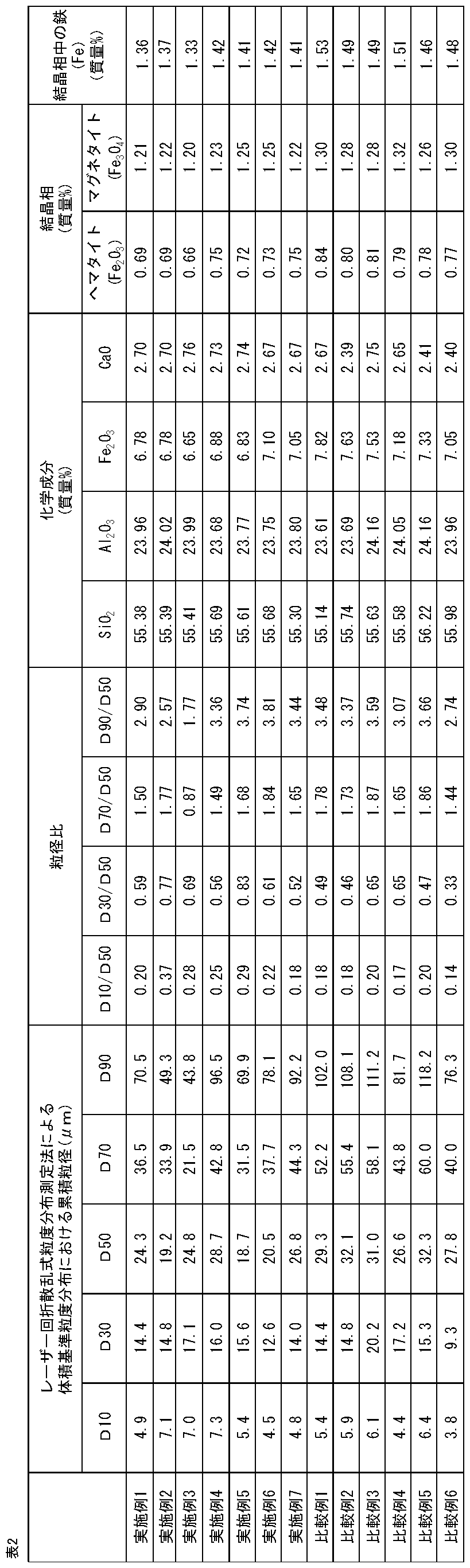
- the particle size ratio of each cumulative frequency to the average particle size D50 is D10 / D50, D30 / D50, D70 / D50, D90 / D50 were measured. The results are shown in Table 2.
- Measurement conditions X-ray tube: Cu Tube voltage: 40 kV Tube current: 40 mA Measurement range of diffraction angle 2 ⁇ : start angle 5 °, end angle 70 ° / 75 ° *
- rutile type titanium dioxide is added as an internal standard substance, if the end angle is 70 °, the peak shape of titanium dioxide around 70 ° cannot be obtained correctly. Therefore, the end angle of the sample added with titanium dioxide was set to 75 °.
- Step width 0.025 ° / step
- Counting time 60 sec. / Step Internal standard: Rutile type titanium dioxide Rietveld analysis conditions Rietveld analysis software: TOPAS Ver.
- fly ash As an internal standard, fly ash (sample 1) to which 20% by mass of rutile-type titanium dioxide was added and fly ash (sample 2) to which no internal standard was added were prepared.
- fly ash (sample 2) to which no internal standard substance was added was measured using a powder X-ray diffractometer, and the powder X-ray diffraction pattern of the obtained fly ash (sample 2) and the target mineral quartz , Mullite, anhydrous gypsum, limestone, magnetite, and hematite, and fitting each theoretical profile, quantitative analysis of each mineral to be analyzed contained in fly ash, the amount of each mineral to be analyzed (% by mass) ) was calculated.
- Sample 2 to which no internal standard substance is added is used for quantitative analysis of magnetite and hematite.
- the diffraction angle 2 ⁇ of magnetite and hematite is about 35.5 ° to 35.6 °, and the diffraction angle 2 ⁇ of rutile titanium dioxide. This is because the peak near 36.1 ° is close.
- the content of magnetite or hematite overlaps (overlap) particularly when the content of magnetite or hematite is small, the quantitative value is greatly affected.
- a fly ash (sample 1) to which rutile type titanium dioxide as an internal standard substance was added was measured using a powder X-ray diffractometer, and a powder X-ray diffraction pattern of the obtained fly ash (sample 1)
- Analytical minerals such as quartz, mullite, anhydrous gypsum, limestone, hematite, magnetite, and titanium dioxide were fitted to each theoretical profile, and each analytical mineral contained in fly ash (sample 1) to which an internal standard was added Quantitative analysis was performed, and the amount (% by mass) of each analysis target mineral was calculated by analysis software.
- G total is the analysis value of the sample 1
- the amount of iron (Fe) in the crystal phase layer was calculated as follows.
- the amount of iron (Fe) in the crystalline phase contained in fly ash was calculated by taking into account the total amount of amorphous phase G total (% by mass) containing unburned carbon contained in fly ash.
- the content (mass%) of the magnetite in the crystal phase calculated taking the total amorphous phase quantity G total (mass%) including unburned carbon into account, with the content (mass%) of
- the measured value 3 was calculated by the following formula (2).
- a high-performance AE water reducing agent trade name: Master Grenium (registered trademark) SP8S, manufactured by BASF
- the kneaded cement paste is immediately filled in a cylindrical flow cone with an inner diameter of 50 mm and a height of 50 mm placed on polished glass, and after 1 minute from the kneading, the cylindrical flow cone is pulled up, and the cement paste is drawn from the cylindrical flow cone.
- the maximum length of the diameter of the cement paste spreading in a circle and the length perpendicular to it were measured, and the average value of the two was used as the flow value.
- a sample having a flow value of 140 mm or more was evaluated as having good fluidity, and a sample having a flow value of less than 140 mm was evaluated as having decreased fluidity.
- the mortar flow value was measured in accordance with JIS R5201: 2015 “Cement physical test method 12.2 Measurement of flow value”. A sample having a flow value of 145 mm or more was evaluated as having good fluidity, and a sample having a flow value of less than 145 mm was evaluated as having decreased fluidity.
- the degree of color unevenness was evaluated based on the difference ( ⁇ L) between the value (Lmax value), the minimum L value (Lmin value), and ⁇ Eab calculated by the following equation (3).
- ⁇ a is the difference ( ⁇ a) between the maximum a value (amax value) and the minimum a value (amin value) among the five measured points
- ⁇ b is the maximum b value among the five measured points. It is the difference ( ⁇ b) between (bmax value) and the minimum b value (bmin value).
- ⁇ Eab ⁇ ( ⁇ L) 2 + ( ⁇ a) 2 + ( ⁇ b) 2 ⁇ 1/2 (3)
- the content of particles having a particle size of 45 ⁇ m or more measured by a laser diffraction / scattering particle size distribution measurement method is less than 38% by volume, and the content of particles having a particle size of less than 5 ⁇ m measured by the measurement method
- the cement compositions of Examples 1 to 7 mixed with fly ash of Examples 1 to 7 having a volume of 12% by volume or less have a paste flow value exceeding 140 mm and a mortar flow value exceeding 145 mm. , Fluidity was improved and workability was improved.
- Examples 2 and 3 are cement compositions using fly ash having a particle size of 45 ⁇ m or more and having a particle size of 45 ⁇ m or less, both the paste flow value and the mortar flow value exceed 160 mm, and the fluidity is It was more improved.
- Example 3 is a cement composition using fly ash having a particle size of less than 5% by volume of particles having a particle size of less than 5 ⁇ m. Both the paste flow value and the mortar flow value exceed 165 mm, and the fluidity is high. It was further improved.
- the content of particles having a particle size of 45 ⁇ m or more measured by a laser diffraction / scattering particle size distribution measurement method is less than 38% by volume, and particles having a particle size of less than 5 ⁇ m measured by the measurement method are used.
- the cement paste using the fly ash of Examples 1 to 7 having a content of 12% by volume or less is smaller in both ⁇ L value and ⁇ Eab value than the cement paste using the fly ash of Comparative Examples 1 to 6, It was confirmed that the color unevenness was suppressed.
- a fly ash having a content of particles having a particle size of 45 ⁇ m or more is 35% by volume or less and a content of particles having a particle size of less than 5 ⁇ m is 3.4% by volume or less was used.
- the cement paste had a smaller ⁇ L value or ⁇ Eab value, and color unevenness was further suppressed.
- the impression level is a range that can be treated as the same color.
- ⁇ Eab is 2.8 as in the second embodiment
- the color difference level is hardly noticed in the color separation comparison, and is generally a level that seems to be the same color.
- Example 3 when ⁇ Eab is 0.7, the level of color unevenness is such that a strict allowable color difference standard can be set in view of reproducibility of visual determination.
- the content of particles having a particle size of 45 ⁇ m or more measured by a laser diffraction / scattering particle size distribution measurement method is less than 38% by volume, and particles having a particle size of less than 5 ⁇ m measured by the measurement method are used.
- the fly ash of Examples 1 to 7 having a content of 12% by volume or less has a low loss on ignition of 6.0% by mass or less, and includes coarse unburned carbon particles 5 and fine unburned carbon particles 2. It was confirmed that the loss on ignition was reduced because the content was small.
- the fly ash of Example 1-7, Fe 2 O 3 as a chemical component is less 7.1 wt%, the content of Fe 2 O 3 as a chemical component in the fly ash
- the cement paste using the fly ash of Examples 1 to 7 whose Fe 2 O 3 as a chemical component is 7.1% by mass or less is the cement paste using the fly ash of Comparative Examples 1 to 6.
- both the ⁇ L value and the ⁇ Eab value were small, and it was confirmed that the color unevenness was suppressed.
- hematite (Fe 2 O 3 ) is 0.7% by mass or less
- magnetite (Fe 3 O 4 ) is 1.25% by mass or less
- the amount of iron (Fe) in the crystalline phase considering the total amount of amorphous phase G total including fuel carbon is 1.42% by mass or less, changing the color tone of fly ash, which is one of the factors that cause color unevenness Low hematite and magnetite content.
- the cement paste using the fly ash of Examples 1 to 7 having a low content of hematite or magnetite has a ⁇ L value and a value higher than that of the cement paste using the fly ash of Comparative Examples 1 to 6. Both ⁇ Eab values were small, and it was confirmed that color unevenness was suppressed.
- the fly ash of Examples 1 to 7 has an average particle size (D50) of 15.0 to 30.0 ⁇ m by a laser diffraction scattering type particle size distribution measurement method, and a particle size ratio (D30 / D50). ) Is 0.50 or more, and the particle size ratio (D70 / D50) is 1.85 or less.
- the fly ash of Examples 1 to 7 has a sharp particle size distribution, uniform particle size, and coarse and distorted incompletely melted particles 3 that cause a decrease in fluidity and color unevenness.
- the fly ash was used because the contents of the coarse and hollow incompletely melted particles 4 and the coarse unburned carbon particles 5 are small, and the fine unburned carbon particles 2 are small.
- the fly ash mixed cement composition was able to improve fluidity, and the occurrence of uneven color was suppressed.
- the content of particles having a particle size of 45 ⁇ m or more measured by the laser diffraction scattering particle size distribution measurement method is 38% by volume or more.
- the measured content of particles having a particle size of less than 5 ⁇ m exceeded 12% by volume.
- the cement paste using the fly ash of Comparative Examples 1 to 6 had a paste flow value of less than 140 mm and decreased fluidity.
- the mortar using the fly ash of Comparative Examples 1 to 6 had a mortar flow value of less than 145 mm, and the fluidity was lowered.
- the cement paste using the fly ash of Comparative Examples 1 to 6 had a large ⁇ L value of 14.5 or more and a ⁇ Eab value of 16.7 or more, and it was confirmed that the color unevenness could be distinguished visually.
- the fly ash of Comparative Examples 1 to 5 had Fe 2 O 3 exceeding 7.1 mass% as a chemical component.
- Fe 2 O 3 as a chemical component was 7.05% by mass, but hematite (Fe 2 O 3 ) was 0.77% by mass, and magnetite (Fe 3 O 4 ).
- the cement paste using the fly ash of Comparative Examples 1 to 6 has a large ⁇ L value and ⁇ Eab value compared with the cement paste using the fly ash of Examples 1 to 7, and color unevenness is observed. It was not suppressed.
- the fly ash of Comparative Example 6 has Fe 2 O 3 as a chemical component as small as 7.05% by mass, and hematite (Fe 2 O 3 ) is 0.77% by mass.
- Magnetite (Fe 3 O 4 ) was 1.30% by mass and the contents of hematite and magnetite were relatively small, but the ⁇ L value shown in Table 1 was 23.8 and the ⁇ Eab value was 30.9. And it was a relatively large value. This is because the fly ash of Comparative Example 6 has a relatively high content of particles having a particle size of less than 5 ⁇ m as measured by a laser diffraction / scattering particle size distribution analyzer of 15.4% by volume.
- the cement paste was presumed to be because fine unburned carbon particles floated together with bleeding water at the time of casting, and the occurrence of uneven color could not be suppressed.
- the fly ash of Comparative Examples 1 to 6 has a particle size ratio (D30 / D50) of less than 0.65 or a particle size ratio (D70 / D50) of more than 1.85. It was confirmed that the particle size distribution was broad and the particle size varied. Moreover, as shown in Table 1, the fly ash of Comparative Examples 2 and 5 has a loss on ignition exceeding 6.0% by mass, can suppress the decrease in fluidity, and can suppress the occurrence of uneven color. Unburned carbon was not reduced.
- the fly ash of the comparative example 1 which used the fly ash obtained from the coal-fired power plant as it is is a spherical perfect melt particle 1, the fine unburned carbon particle 2, the particle size of 45 micrometers or more. Coarse and distorted incomplete molten particles 3, coarse and hollow incomplete molten particles 4, and coarse unburned carbon particles 5 were included.
- fly ash that is increasing in the amount of generation can be used effectively, without increasing the energy used for complicated processes and production,
- a fly ash capable of improving workability by suppressing a decrease in fluidity and suppressing color unevenness when used for mortar or concrete, a cement composition using the fly ash, and a method for producing fly ash can be provided.
Landscapes
- Chemical & Material Sciences (AREA)
- Engineering & Computer Science (AREA)
- Ceramic Engineering (AREA)
- Structural Engineering (AREA)
- Materials Engineering (AREA)
- Organic Chemistry (AREA)
- Environmental & Geological Engineering (AREA)
- Inorganic Chemistry (AREA)
- Chemical Kinetics & Catalysis (AREA)
- Combustion & Propulsion (AREA)
- Civil Engineering (AREA)
- Curing Cements, Concrete, And Artificial Stone (AREA)
- Processing Of Solid Wastes (AREA)
Abstract
Description
[1]レーザー回折散乱式粒度分布測定法で測定した粒径45μm以上の粒子の含有量が38体積%未満であり、前記測定法で測定した粒径5μm未満の粒子の含有量が12体積%以下であることを特徴するフライアッシュ。
[2]強熱減量が6.0質量%以下である、前記[1]に記載のフライアッシュ。
[3]化学成分としてFe2O3が7.1質量%以下である、前記[1]又は[2]に記載のフライアッシュ。
[4]ヘマタイトが0.75質量%以下、マグネタイトが1.25質量%以下、かつ、結晶相中の鉄(Fe)が1.45質量%以下である、前記[1]~[3]に記載のフライアッシュ。
[5]レーザー回折散乱式粒度分布測定法による体積基準粒度分布における累積頻度50%の平均粒径(D50)が15.0~30.0μmであり、前記平均粒径(D50)に対する前記測定法による体積基準粒度分布における累積頻度30%の粒径(D30)の粒径比(D30/D50)が0.50以上であり、前記平均粒径D50に対する前記測定法による体積基準粒度分布における累積頻度70%の粒径(D70)の粒径比(D70/D50)が1.85以下である、前記[1]~[4]に記載のフライアッシュ。
[6]前記[1]~[5]のいずれかに記載のフライアッシュと、セメントとを含むセメント組成物。
[7]セメント組成物全量に対して、前記フライアッシュの含有量が1質量%を超え35質量%以下である、前記[6]に記載のセメント組成物。
[8]フライアッシュ全体100体積%中のレーザー回折散乱式粒度分布測定法で測定した粒径45μm以上の粒子の含有量が38体積%未満となるように、原料のフライアッシュから粒径45μm以上の粒子の少なくとも一部を取り除く工程と、フライアッシュ全体100体積%中の前記測定法で測定した粒径5μm未満の粒子の含有量が12体積%以下となるように、原料のフライアッシュから粒径5μm未満の粒子の少なくとも一部を取り除く工程を含む、フライアッシュの製造方法。
[フライアッシュ]
本発明の一実施形態によれば、フライアッシュは、レーザー回折散乱式粒度分布測定法で測定した粒径45μm以上の粒子の含有量が38体積%未満であり、前記測定法で測定した粒径5μm未満の粒子の含有量が12体積%以下である。
図1は、石炭火力発電所から得られたフライアッシュのSEM写真である。図1に示すようにフライアッシュには、真球状の完全溶融粒子1、微細な未燃カーボン粒子2、粒径45μm以上の粗大で歪な不完全溶融粒子3、粗大で中空体である不完全溶融粒子4、粗大な未燃カーボン粒子5が含まれる。
本明細書において、「真球状」とは、真球又は真球に近い形状をいう。
フライアッシュは、より好ましくは強熱減量が5.8質量%以下であり、さらに好ましくは強熱減量が5.6質量%以下であり、よりさらに好ましくは5.5質量%以下である。フライアッシュは、強熱減量が6.0質量%以下と少ないことにより、未燃カーボンの含有量が少なく、未燃カーボンが多く混入されているフライアッシュを含むセメント組成物と比べて、流動性の低下を抑制し、色むらの発生を抑制することができる。
フライアッシュは、JIS A6201:2015「コンクリート用フライアッシュ」に記載されているIII種のフライアッシュの強熱減量の数値を満たすものである。また、フライアッシュは、JIS A6201:2015「コンクリート用フライアッシュ」に記載されているI種、II種、又はIV種のフライアッシュの強熱減量の数値を満たすものであってもよい。
レーザー回折散乱式粒度分布測定装置で測定した粒径が45μm以上である粒径の比較的大きい粒子は、粒径が45μm未満である粒径の小さい粒子と比べて、粒子全体の冷却速度が遅くなり、ゆっくりと冷却されるために、粒径が45μm未満である粒径の小さい粒子と比較して、粒子に含まれる結晶相が多くなる傾向がある。フライアッシュに含まれる結晶相には、黒色ないし赤褐色のヘマタイト(Fe2O3)や黒色のマグネタイト(Fe3O4)が含まれ、結晶相の含有量によってフライアッシュの色調が変化する。このフライアッシュを含むセメント組成物を用いたコンクリートは、ブリーディング水とともにフライアッシュが表面に浮き上がり、コンクリートの表面のグレーの色調に、部分的に黒っぽく見える部分や白っぽく見える部分が存在するような色調の濃淡(色むら)が表れる場合がある。フライアッシュ中の化学成分としてのFe2O3の含有量が多くなると、フライアッシュ中に含まれる、ヘマタイトやマグネタイトなどのコンクリート表面の色調に変化を及ぼす結晶相の含有量も多くなると推測される。
本発明のフライアッシュは、レーザー回折散乱式粒度分布測定法で測定した粒径45μm以上の粒子の含有量が38体積%未満であり、粒径45μm以上の粒径が大きな粒子の含有量が比較的少なく、結晶相の含有量が比較的少ないと推測される粒径45μm未満の粒径が小さい粒子を多く含む。しかも本発明のフライアッシュが、フライアッシュに含まれる化学成分としてのFe2O3が7.1質量%以下であると、黒色ないし赤褐色を示すヘマタイトや黒色を示すマグネタイトなどの結晶相を形成する鉄分量が少なくなり、フライアッシュに含まれる結晶相の量が少なくなることが推測される。本発明のフライアッシュは、コンクリート表面の色調に変化を及ぼす結晶相の含有量が少なくなることから、色むらを抑制することが可能となる。本明細書において、結晶相の含有量は、後述する実施例に記載のフライアッシュ中の結晶相及び非晶質相(質量%)の測定方法によって求められるものであり、未燃カーボンを含む総非晶質量Gtotal(質量%)を考慮に入れて算出したフライアッシュ中の結晶相の含有量をいう。結晶相中の鉄(Fe)は、未燃カーボンを含む総非晶質量Gtotal(質量%)を考慮に入れて算出した結晶相中の鉄(Fe)の量をいい、本明細書において、「結晶相中鉄(Fe)量」ともいう。
フライアッシュ中のヘマタイト(Fe2O3)の含有量、マグネタイト(Fe3O4)の含有量及び結晶相中の鉄(Fe)の含有量は、原料となる石炭やフライアッシュの生成条件によって異なるが、フライアッシュは、ヘマタイト(Fe2O3)が、通常、0.30質量%以上、マグネタイト(Fe3O4)が、通常、0.20質量%以上、かつ、結晶相中の鉄(Fe)が、通常、0.21質量%以上である。
フライアッシュは、平均粒径(D50)が15.0~30.0μmであり、粒径比(D30/D50)が0.50以上であり、粒径比(D70/D50)が1.85以下であることにより、粒度分布がシャープな形状となり、粒子の大きさが揃っており、流動性の低下や色むらを発生させる要因となる、粗大で歪な不完全溶融粒子3、粗大で中空体である不完全溶融粒子4、粗大な未燃カーボン粒子5を多く含む粒径の大きな粒子の含有量が少なく、粒径の小さい未燃カーボン粒子2の含有量が少ない。平均粒径(D50)が15.0~30.0μmであり、粒径比(D30/D50)が0.50以上であり、かつ粒径比(D70/D50)が1.85以下であるフライアッシュを用いたセメント組成物は、流動性の低下を抑制することができ、色むらの発生が抑制される。
本発明の一実施形態によれば、セメント組成物は、本発明の一実施形態によるフライアッシュと、セメントとを含む。
セメントの種類は特に限定されず、普通ポルトランドセメント、早強ポルトランドセメント、中庸熱ポルトランドセメント、低熱ポルトランドセメント等が挙げられる。
本発明の一実施形態によれば、フライアッシュの製造方法は、フライアッシュ全体100体積%中のレーザー回折散乱式粒度分布測定法で測定した粒径45μm以上の粒子の含有量が38体積%未満となるように、原料のフライアッシュから粒径45μm以上の粒子の少なくとも一部を取り除く工程と、フライアッシュ全体100体積%中の前記測定法で測定した粒径5μm未満の粒子の含有量が12体積%以下となるように、原料のフライアッシュから粒径5μm未満の粒子の少なくとも一部を取り除く工程とを含む。
原料のフライアッシュから粒径45μm以上の粒子の少なくとも一部を取り除く工程と、原料のフライアッシュから粒径5μm未満の粒子の少なくとも一部を取り除く工程は、風力分級機や篩等を用いることができる。風力分級の場合は、例えば、日清エンジニアリング株式会社製のターボクラシファイア等の風力分級機等を用いることができる。
(実施例1~5)
比較例1の石炭火力発電所から得られたフライアッシュを原料フライアッシュとして用いて、風力分級機(製品名:ターボクラシファイア、日清エンジニアリング株式会社製)を用いて、フライアッシュ全体100体積%中にレーザー回折散乱式粒度分布測定法で測定した粒径45μm以上の粒子の含有量が38体積%未満となるように、粒径45μm以上の粒子の少なくとも一部を取り除き、次いで、前記測定法で測定した粒径5μm未満の粒子の含有量が12体積%以下となるように、粒径5μm未満の粒子の少なくとも一部を取り除き、表1に示すレーザー回折粒子径分布を有する実施例1のセメント混合用のフライアッシュを製造した。
比較例2の石炭火力発電所から得られたフライアッシュを原料フライアッシュとして用いて、実施例1~5と同様にして、表1に示すレーザー回折粒子径分布(体積%)を有する実施例6~7のセメント混合用のフライアッシュを製造した。
石炭火力発電所から得られたフライアッシュをそのまま比較例1および比較例2のフライアッシュとして用いた。比較例1および比較例2のフライアッシュは、フライアッシュ全体100体積%中にレーザー回折散乱式粒度分布測定法で測定した粒径45μm以上の粒子の含有量が38体積%を超えていた。具体的には、比較例1および比較例2のフライアッシュは、表1に示すレーザー回折粒子径分布(体積%)を有していた。また、図1は、比較例1のフライアッシュのSEM写真である。
比較例1の石炭火力発電所から得られたフライアッシュを原料フライアッシュとして用い、風力分級機(製品名:ターボクラシファイア、日清エンジニアリング株式会社製)を用いて、フライアッシュ全体100体積%中にレーザー回折散乱式粒度分布測定法で測定した粒径45μm以上の粒子の含有量が38体積%以上となるか、前記測定法で測定した粒径5μm未満の粒子の含有量が12体積%を超えるように、粒径45μm以上の粒子の少なくとも一部と、粒径5μm未満の粒子の少なくとも一部とを取り除いた。具体的には、表1に示すレーザー回折粒子径分布(体積%)を有する比較例3~4のセメント混合用のフライアッシュを製造した。
比較例2の石炭火力発電所から得られたフライアッシュを原料フライアッシュとして用いて、風力分級機(製品名:ターボクラシファイア、日清エンジニアリング株式会社製)を用いて、フライアッシュ全体100体積%中にレーザー回折散乱式粒度分布測定法で測定した粒径45μm以上の粒子の含有量が38体積%以上となるか、前記測定法で測定した粒径5μm未満の粒子の含有量が12体積%を超えるように、粒径45μm以上の粒子の少なくとも一部と、粒径5μm未満の粒子の少なくとも一部とを取り除いた。具体的には、表1に示すレーザー回折粒子径分布(体積%)を有する比較例5~6のセメント混合用のフライアッシュを製造した。
各実施例及び比較例のセメント混合用のフライアッシュの粒径構成をレーザー回折散乱式粒度分布測定装置(日機装株式会社、製品名:マイクロトラックMT-3300EX)を用いて測定した。結果を表1に示す。
各実施例及び比較例のセメント混合用のフライアッシュの強熱減量は、JIS A6201:2015「コンクリート用フライアッシュ 8.3 強熱減量」に準拠して測定した。結果を表1に示す。
レーザー回折散乱式粒度分布測定装置(日機装株式会社、製品名:マイクロトラックMT-3300EX)を用いて、各実施例及び比較例の体積基準粒度分布における小径側から累積頻度10%、30%、50%、70%、90%となる粒径を測定した。レーザー回折式散乱式粒度分布測定装置で測定した体積基準粒度分布における小径側から累積頻度50%の粒径を平均粒径(D50)とした。また、累積頻度10%をD10、累積頻度30%をD30、累積頻度70%をD70、累積頻度90%をD90とし、平均粒径D50に対する各累積頻度の粒径比をD10/D50、D30/D50、D70/D50、D90/D50を測定した。結果を表2に示す。
各実施例及び比較例のセメント混合用のフライアッシュの化学成分(SiO2、Al2O3、Fe2O3、CaO)をJIS R5204「セメントの蛍光X線分析方法」に準拠して測定した。結果を表2に示す。
フライアッシュ中の結晶相及び非晶質相量(質量%)の測定は、粉末X線回折装置により、内部標準物質を用いて、リートベルト解析法により測定した。粉末X線回折装置としては、D8 Advance(Bruker AXS(ブルカー・エイエックス)社製)を用いた。測定条件、内部標準物質、リートベルト解析条件を以下に記載した。
測定条件
X線管球:Cu
管電圧:40kV
管電流:40mA
回折角2θの測定範囲: 開始角5°,終了角70°/75°
※内部標準物質としてルチル型二酸化チタンを添加した場合、終了角を70°とすると70°付近の二酸化チタンのピーク形状が正しく取得できない。このため二酸化チタンを添加した試料については終了角を75°とした。
ステップ幅:0.025°/step
計数時間:60sec./step
内部標準物質:ルチル型二酸化チタン
リートベルト解析条件
リートベルト解析ソフト:TOPAS Ver.4.2(Bruker AXS(ブルカー・エイエックス)社製)
ゼロ点補正:無し
試料面の高さの補正:有り
解析対象鉱物:石英、ムライト(3:2)、無水石膏、石灰石、マグネタイト、ヘマタイト、二酸化チタン(内部標準物質として添加した試料のみ)
ヘマタイト相の選択配向関数:ヘマタイト相の選択配向は回折角2θ=35.5°付近の(110)面の回折線に生じるものとし、March Dollase関数を用いて、係数の初期値を1として精密化を行なった。マグネタイト相に関しては、選択配向が生じないものとした。
(i)内部標準物として、ルチル型二酸化チタンを20質量%添加したフライアッシュ(試料1)と、内部標準物質を添加しないフライアッシュ(試料2)を作製した。
(ii)内部標準物質を添加しないフライアッシュ(試料2)を、粉末X線回折装置を用いて測定し、得られたフライアッシュ(試料2)の粉末X線回折パターンと、解析対象鉱物の石英、ムライト、無水石膏、石灰石、マグネタイト、ヘマタイトのそれぞれの理論プロファイルのフィッティングを行ない、フライアッシュ中に含まれる各解析対象鉱物の定量分析を行い、解析ソフトによって、各解析対象鉱物の量(質量%)を算出した。
マグネタイトとヘマタイトの定量分析に内部標準物質を添加しない試料2を用いるのは、マグネタイト、ヘマタイトの回折角2θ=35.5°~35.6°付近のピークと、ルチル型二酸化チタンの回折角2θ=36.1°付近のピークとが近接するためである。特に内部標準物質として粒子径が小さく、結晶子サイズが小さいルチル型二酸化チタンを用いた場合、ピークのブロードニングが起こり、ルチル型二酸化チタンの回折角2θ=36.1°付近のピークのボトム付近が、マグネタイト、ヘマタイトのピークと重なり(オーバーラップ)、特にマグネタイトやヘマタイトの含有量が少ない場合に、定量した値に大きく影響を及ぼすからである。
(iii)内部標準物質であるルチル型二酸化チタンを添加したフライアッシュ(試料1)を、粉末X線回折装置を用いて測定し、得られたフライアッシュ(試料1)の粉末X線回折パターンと、解析対象鉱物の石英、ムライト、無水石膏、石灰石、ヘマタイト、マグネタイト、二酸化チタンのそれぞれの理論プロファイルのフィッティングを行ない、内部標準物質を添加したフライアッシュ(試料1)に含まれる各解析対象鉱物の定量分析を行い、解析ソフトによって、各解析対象鉱物の量(質量%)を算出した。
(iv)試料1のルチル型二酸化チタンの定量値から、以下の(A)式により、未燃カーボンを含む総非晶質相量Gtotal(質量%)を算出した。
総非晶質相量Gtotal=100×(Y-X)/{Y×(100-X)/100} (A)
ただし、式(A)中、Xは内部標準物質の添加量(20質量%)、Yはルチル型二酸化のリートベルト解析値(%)である。
(v)試料1の解析対象鉱物の結晶相の含有量(質量%)から総非晶質相を定量した後、試料2の解析対象鉱物の含有量(質量%)から、以下の(B)式により、総非晶質相を考慮に入れた結晶相の含有量を算出した
結晶相(総非晶質相量Gtotal考慮)=結晶相(試料2解析値)×(100-Gtotal)/100 (B)
ただし、式(B)中、Gtotalは試料1の解析値と(A)式より得られた総非晶質定量値(%)である。以上の取り扱いにより、試料1では誤差が生じるヘマタイト、マグネタイト相について、試料2の解析結果を反映し、総結晶相内の各結晶相の分率の定量値を精密化する。
(vi)下記式(1)により、(A)式より算出した総非晶質相量Gtotal(質量%)からフライアッシュ中の未燃カーボン含有量(質量%)を差し引いた値をフライアッシュ中の非晶質相量GFA(質量%)とした。未燃カーボン量は、JIS A6201「コンクリート用フライアッシュ」に準拠して測定した強熱減量をフライアッシュ中の未燃カーボン含有量(質量%)とした。
フライアッシュ中の非晶質相量GFA(質量%)=リートベルト解析による総非晶質相量Gtotal(質量%)-未燃カーボン含有量(質量%) (1)
フライアッシュに含まれる結晶相中の鉄(Fe)量は、フライアッシュに含まれる未燃カーボンを含む総非晶質相量Gtotal(質量%)を考慮に入れて算出した結晶相中のヘマタイトの含有量(質量%)を測定値2とし、未燃カーボンを含む総非晶質相量Gtotal(質量%)を考慮に入れて算出した結晶相中のマグネタイトの含有量(質量%)を測定値3として、下記式(2)により算出した。
フライアッシュに含まれる総非晶質相量Gtotalを考慮した結晶相中の鉄(Fe)量=〔測定値2×{2Fe/Fe2O3(111.6/159.7)}〕+〔測定値3×{3Fe/Fe3O4(167.4/231.5)}〕 (2)
各実施例及び比較例のセメント混合用のフライアッシュと普通セメントとを、フライアッシュが20質量%、普通セメントが80質量%となるように混合して、各実施例及び比較例のフライアッシュを混合したセメント組成物を製造した。各実施例及び比較例のフライアッシュを混合したセメント組成物を用いて、以下の評価を行なった。結果を表1に示す。
フライアッシュを混合したセメント組成物100質量部に対して、混和剤として高性能AE減水剤(商品名:マスターグレニウム(登録商標)SP8S、BASF社製)1質量部を配合し、水セメント比(W/C)が30%となるようにして、セメント組成物、高性能AE減水剤、水をホバートミキサーで3分間練り混ぜ、各実施例及び比較例のフライアッシュを混合したセメント組成物を用いたセメントペーストを得た。
練り混ぜられたセメントペーストをすぐに磨きガラス上に置いた内径50mm、高さ50mmの円筒形フローコーンに充填し、練り上げから1分後に円筒形フローコーンを引き上げて、円筒形フローコーンからセメントペーストを引き抜き、円形に広がったセメントペーストの直径の最も大きな長さとそれに直行する長さを測定して両者の平均値をフロー値とした。フロー値が140mm以上のものを流動性が良好とし、フロー値が140mm未満のものを流動性が低下したと評価した。
各施例及び比較例のフライアッシュを混合したセメント組成物を用いて、質量比で、前記セメント組成物1に対して、JIS R5201の標準砂3の割合でプレミックスした。プレミックスした粉体中に、フライアッシュを混合したセメント組成物100質量部に対して、混和剤として高性能AE減水剤(商品名:マスターグレニウム(登録商標)SP8S、BASF社製)1質量部を配合し、水セメント比(W/C)が30%となるようにして、ホバートミキサーで3分間練り混ぜ、各実施例及び比較例のフライアッシュ混合セメント組成物を用いたモルタルを得た。
練り混ぜられたモルタルをJIS R5201:2015の「セメント物理試験方法 12.2 フロー値の測定」に準拠して、モルタルのフロー値を測定した。フロー値が145mm以上のものを流動性が良好とし、フロー値が145mm未満のものを流動性が低下したと評価した。
流動性の評価-1で用いた各実施例及び比較例のフライアッシュを混合したセメント組成物を用いたセメントペーストを金属製のバットに流し込み、温度20℃、湿度90%以上の湿気箱で7日間養生したのち、目視にて色彩に差があると判断し、目視にて色彩の差が大きいと判断した表面の色彩の差が大きい順から選択した5箇所について、色彩色差計(商品名:CR-300、コニカミノルタジャパン株式会社製)を用いて、CIE(国際照明委員会)で規定された明度(L値)、a値、b値を測定し、測定した5点のうち最大のL値(Lmax値)と、最小のL値(Lmin値)の差(ΔL)と、下記式(3)によって算出されたΔEabにより色むらの度合いを評価した。Δaは、測定した5点のうちの最大のa値(amax値)と最小のa値(amin値)との差(Δa)であり、Δbは、測定した5点のうち、最大のb値(bmax値)と最小のb値(bmin値)との差(Δb)である。ΔL又はΔEabが小さい程、色むらが抑制されていると評価した。
ΔEab={(ΔL)2+(Δa)2+(Δb)2}1/2 (3)

実施例2及び3は、粒径45μm以上の粒子の含有量が15体積%以下のフライアッシュを用いたセメント組成物であり、ペーストフロー値及びモルタルフロー値とも160mmを超えており、流動性がより向上していた。
実施例3は、粒径5μ未満の粒子の含有量が3.0体積%以下のフライアッシュを用いたセメント組成物であり、ペーストフロー値及びモルタルフロー値とも165mmを超えており、流動性がさらに向上されていた。
実施例1~4に示すように、粒径45μm以上の粒子の含有量が35体積%以下であり、粒径5μm未満の粒子の含有量が3.4体積%以下であるフライアッシュを用いたセメントペーストは、ΔL値又はΔEab値がより小さく色むらがさらに抑制されていた。実施例1のように、ΔEabが3.6の場合、印象レベルでは同じ色として扱える範囲である。実施例2のように、ΔEabが2.8の場合、色の離間比較では、殆ど気付かれない色差レベルであり、一般的には同じ色だと思われるレベルである。また、実施例3のように、ΔEabが0.7の場合は、目視判定の再現性からみて厳格な許容色差の規格を設定できるほど、色むらがないレベルである。
Claims (8)
- レーザー回折散乱式粒度分布測定法で測定した粒径45μm以上の粒子の含有量が38体積%未満であり、前記測定法で測定した粒径5μm未満の粒子の含有量が12体積%以下であることを特徴するフライアッシュ。
- 強熱減量が6.0質量%以下である、請求項1に記載のフライアッシュ。
- 化学成分としてのFe2O3が7.1質量%以下である、請求項1又は2に記載のフライアッシュ。
- ヘマタイトが0.75質量%以下、マグネタイトが1.25質量%以下、かつ、結晶相中の鉄(Fe)が1.45質量%以下である、請求項1~3のいずれか1項に記載のフライアッシュ。
- レーザー回折散乱式粒度分布測定法による体積基準粒度分布における累積頻度50%の平均粒径(D50)が15.0~30.0μmであり、前記平均粒径(D50)に対する前記測定法による体積基準粒度分布における累積頻度30%の粒径(D30)の粒径比(D30/D50)が0.50以上であり、前記平均粒径D50に対する前記測定法による体積基準粒度分布における累積頻度70%の粒径(D70)の粒径比(D70/D50)が1.85以下である、請求項1~4のいずれか1項に記載のフライアッシュ。
- 請求項1~5のいずれか1項に記載のフライアッシュと、セメントとを含むセメント組成物。
- セメント組成物全量に対して、前記フライアッシュの含有量が1質量%を超え35質量%以下である、請求項6に記載のセメント組成物。
- フライアッシュ全体100体積%中のレーザー回折散乱式粒度分布測定法で測定した粒径45μm以上の粒子の含有量が38体積%未満となるように、原料のフライアッシュから粒径45μm以上の粒子の少なくとも一部を取り除く工程と、フライアッシュ全体100体積%中の前記測定法で測定した粒径5μm未満の粒子の含有量が12体積%以下となるように、原料のフライアッシュから粒径5μm未満の粒子の少なくとも一部を取り除く工程を含む、フライアッシュの製造方法。
Priority Applications (6)
| Application Number | Priority Date | Filing Date | Title |
|---|---|---|---|
| CN201780042911.2A CN109415257B (zh) | 2017-01-17 | 2017-09-19 | 飞灰、水泥组合物和飞灰的制造方法 |
| AU2017394419A AU2017394419B2 (en) | 2017-01-17 | 2017-09-19 | Fly ash, cement composition, and production method for fly ash |
| KR1020187036006A KR102202537B1 (ko) | 2017-01-17 | 2017-09-19 | 플라이 애시, 시멘트 조성물 및 플라이 애시의 제조 방법 |
| SG11201900700SA SG11201900700SA (en) | 2017-01-17 | 2017-09-19 | Fly ash, cement composition, and production method for fly ash |
| NZ755376A NZ755376A (en) | 2017-01-17 | 2017-09-19 | Fly ash, cement composition, and method for preparing fly ash |
| PH12018500747A PH12018500747B1 (en) | 2017-01-17 | 2018-04-04 | Fly ash, cement composition, and method of preparing fly ash |
Applications Claiming Priority (4)
| Application Number | Priority Date | Filing Date | Title |
|---|---|---|---|
| JP2017-005921 | 2017-01-17 | ||
| JP2017005921 | 2017-01-17 | ||
| JP2017-142308 | 2017-07-21 | ||
| JP2017142308A JP6278148B1 (ja) | 2017-01-17 | 2017-07-21 | フライアッシュ、セメント組成物及びフライアッシュの製造方法 |
Publications (1)
| Publication Number | Publication Date |
|---|---|
| WO2018135037A1 true WO2018135037A1 (ja) | 2018-07-26 |
Family
ID=61195837
Family Applications (1)
| Application Number | Title | Priority Date | Filing Date |
|---|---|---|---|
| PCT/JP2017/033787 Ceased WO2018135037A1 (ja) | 2017-01-17 | 2017-09-19 | フライアッシュ、セメント組成物及びフライアッシュの製造方法 |
Country Status (8)
| Country | Link |
|---|---|
| JP (1) | JP6278148B1 (ja) |
| KR (1) | KR102202537B1 (ja) |
| CN (1) | CN109415257B (ja) |
| AU (1) | AU2017394419B2 (ja) |
| NZ (1) | NZ755376A (ja) |
| PH (1) | PH12018500747B1 (ja) |
| SG (1) | SG11201900700SA (ja) |
| WO (1) | WO2018135037A1 (ja) |
Cited By (1)
| Publication number | Priority date | Publication date | Assignee | Title |
|---|---|---|---|---|
| JP2021054662A (ja) * | 2019-09-27 | 2021-04-08 | 太平洋セメント株式会社 | 蒸気養生製品用セメント組成物 |
Families Citing this family (6)
| Publication number | Priority date | Publication date | Assignee | Title |
|---|---|---|---|---|
| JP6558383B2 (ja) * | 2017-02-10 | 2019-08-14 | 三菱マテリアル株式会社 | 石炭灰の改質方法およびコンクリート混和材用のフライアッシュの製造方法 |
| JP7117135B2 (ja) * | 2018-04-20 | 2022-08-12 | Ube三菱セメント株式会社 | 石炭灰組成物及びセメント組成物、ならびに石炭灰組成物の製造方法 |
| JP7138405B2 (ja) * | 2018-11-29 | 2022-09-16 | 太平洋セメント株式会社 | 石炭灰の処理方法 |
| JP2020147452A (ja) * | 2019-03-12 | 2020-09-17 | 太平洋セメント株式会社 | フライアッシュ及びセメント組成物 |
| JP7761560B2 (ja) * | 2019-11-05 | 2025-10-28 | カーボン アップサイクリング テクノロジーズ インク. | メカノケミカルカルボキシル化された無機充填剤と、セメント及び/又はアスファルトのバインダーと、を含む組成物 |
| KR20220123635A (ko) * | 2019-11-05 | 2022-09-08 | 카본 업사이클링 테크놀러지스 인코포레이티드 | 기계적으로 카르복실화된 비산회, 이의 제조 방법 및 이의 용도 |
Citations (3)
| Publication number | Priority date | Publication date | Assignee | Title |
|---|---|---|---|---|
| JPS57145066A (en) * | 1981-02-28 | 1982-09-07 | Kobe Steel Ltd | Method of sintering fly ash granules |
| JP2012505150A (ja) * | 2008-10-10 | 2012-03-01 | ローマン セメント エルエルシー | 高い早期強度発現性を有するポゾランセメントブレンド |
| JP2013193078A (ja) * | 2012-03-23 | 2013-09-30 | Taiheiyo Cement Corp | フライアッシュの処理方法及び処理装置 |
Family Cites Families (8)
| Publication number | Priority date | Publication date | Assignee | Title |
|---|---|---|---|---|
| JPH04270184A (ja) * | 1991-02-25 | 1992-09-25 | Ogawa Denki Kk | フライアッシュ成形体の製造方法 |
| JPH092848A (ja) | 1995-06-19 | 1997-01-07 | Chichibu Onoda Cement Corp | モルタル・コンクリート用石炭灰及びこれを用いたモルタル・コンクリート |
| JP3200634B2 (ja) | 1997-06-16 | 2001-08-20 | 太平洋セメント株式会社 | フライアッシュの改質方法 |
| JP2001058860A (ja) * | 1999-08-19 | 2001-03-06 | Asao Ishimaru | 火力発電所から排出される石炭の燃焼灰を原料にして、良質のコンクリート用フライアッシュを効率的に製造する方法。 |
| JP2001226159A (ja) * | 2000-02-15 | 2001-08-21 | Nippon Solid Co Ltd | セメントの混練方法 |
| US8257486B2 (en) * | 2008-03-26 | 2012-09-04 | Council Of Scientific & Industrial Research | Composition for building material and a process for the preparation thereof |
| JP2010030885A (ja) | 2008-06-30 | 2010-02-12 | Mitsubishi Materials Corp | 石炭灰の未燃炭素分の低減方法 |
| CN102947244B (zh) * | 2010-04-15 | 2015-05-20 | 罗马水泥有限责任公司 | 窄粒度分布的水硬性水泥-scm掺混物及其制备方法 |
-
2017
- 2017-07-21 JP JP2017142308A patent/JP6278148B1/ja active Active
- 2017-09-19 KR KR1020187036006A patent/KR102202537B1/ko active Active
- 2017-09-19 SG SG11201900700SA patent/SG11201900700SA/en unknown
- 2017-09-19 NZ NZ755376A patent/NZ755376A/en unknown
- 2017-09-19 CN CN201780042911.2A patent/CN109415257B/zh active Active
- 2017-09-19 WO PCT/JP2017/033787 patent/WO2018135037A1/ja not_active Ceased
- 2017-09-19 AU AU2017394419A patent/AU2017394419B2/en active Active
-
2018
- 2018-04-04 PH PH12018500747A patent/PH12018500747B1/en unknown
Patent Citations (3)
| Publication number | Priority date | Publication date | Assignee | Title |
|---|---|---|---|---|
| JPS57145066A (en) * | 1981-02-28 | 1982-09-07 | Kobe Steel Ltd | Method of sintering fly ash granules |
| JP2012505150A (ja) * | 2008-10-10 | 2012-03-01 | ローマン セメント エルエルシー | 高い早期強度発現性を有するポゾランセメントブレンド |
| JP2013193078A (ja) * | 2012-03-23 | 2013-09-30 | Taiheiyo Cement Corp | フライアッシュの処理方法及び処理装置 |
Non-Patent Citations (1)
| Title |
|---|
| YAMAMOTO, TAKESHI ET AL.: "The forms of hematite and magnetite containing fly ash, Abstracts of the 59th Annual Meeting of JCA", JAPAN CEMENT ASSOCIATION, vol. 45, 28 April 2005 (2005-04-28), pages 44 * |
Cited By (2)
| Publication number | Priority date | Publication date | Assignee | Title |
|---|---|---|---|---|
| JP2021054662A (ja) * | 2019-09-27 | 2021-04-08 | 太平洋セメント株式会社 | 蒸気養生製品用セメント組成物 |
| JP7370204B2 (ja) | 2019-09-27 | 2023-10-27 | 太平洋セメント株式会社 | 蒸気養生製品用セメント組成物 |
Also Published As
| Publication number | Publication date |
|---|---|
| KR20190101861A (ko) | 2019-09-02 |
| JP6278148B1 (ja) | 2018-02-14 |
| CN109415257B (zh) | 2020-09-01 |
| AU2017394419B2 (en) | 2019-05-30 |
| AU2017394419A1 (en) | 2019-04-18 |
| PH12018500747A1 (en) | 2018-10-15 |
| JP2018115104A (ja) | 2018-07-26 |
| KR102202537B1 (ko) | 2021-01-13 |
| NZ755376A (en) | 2020-01-31 |
| SG11201900700SA (en) | 2019-02-27 |
| CN109415257A (zh) | 2019-03-01 |
| PH12018500747B1 (en) | 2018-10-15 |
Similar Documents
| Publication | Publication Date | Title |
|---|---|---|
| JP6278148B1 (ja) | フライアッシュ、セメント組成物及びフライアッシュの製造方法 | |
| JP6853438B2 (ja) | 高活性銅スラグ微粉末の製造方法、高活性銅スラグ微粉末およびセメント組成物 | |
| KR101798162B1 (ko) | 용광로 공급 원료로 사용하기 위해 금속 산화물을 함유한 미세 입자로 만들어진 응집체 제조 방법 | |
| JP7361097B2 (ja) | セメントクリンカーの製造方法及びセメントクリンカー粉末 | |
| JP6288355B1 (ja) | セメント組成物、その製造方法、及びセメント組成物用フライアッシュの製造方法 | |
| CN111003954B (zh) | 高纯一铝酸钙水泥、其制备方法及应用 | |
| JP6311220B2 (ja) | 低温焼成セメントクリンカーの製造方法 | |
| CN103459054A (zh) | 用于生产含有三价铬氧化物的耐火颗粒的方法 | |
| CN100591636C (zh) | 用于生产高级硅质耐火材料的硅酸盐水泥及其生产工艺 | |
| CN110803881A (zh) | 超细灰及其制备方法和应用、水泥、混凝土 | |
| KR102202526B1 (ko) | 석탄회의 제조 방법 및 석탄회, 시멘트 조성물 | |
| HK1262599A1 (en) | Fly ash, cement composition, and production method for fly ash | |
| HK1262599B (en) | Fly ash, cement composition, and production method for fly ash | |
| JP7403252B2 (ja) | セメント製品、及びセメント製品の製造方法 | |
| JP2008230864A (ja) | セメント添加材 | |
| CN115611657A (zh) | 以铝灰渣为原料的轻质骨料及其制备方法 | |
| CN114149268A (zh) | 一种钢包渣线用石灰砖及加工工艺 | |
| JP2008195588A (ja) | 遠心成形コンクリート製品 | |
| JP2014181161A (ja) | 低温焼成セメントクリンカー用原料および低温焼成セメントクリンカー | |
| JP2014076919A (ja) | ポルトランドセメントクリンカーの製造方法 | |
| JP7120950B2 (ja) | フライアッシュ混合材料の製造方法 | |
| KR20040078466A (ko) | 시멘트 킬른 더스트를 이용하여 제조되는 콘크리트 | |
| TWI399355B (zh) | Method for manufacturing secondary aluminum slag | |
| HK1261835B (en) | Cement composition, method for producing same, and method for producing fly ash for cement composition | |
| HK1261835A1 (en) | Cement composition, method for producing same, and method for producing fly ash for cement composition |
Legal Events
| Date | Code | Title | Description |
|---|---|---|---|
| WWE | Wipo information: entry into national phase |
Ref document number: 12018500747 Country of ref document: PH |
|
| 121 | Ep: the epo has been informed by wipo that ep was designated in this application |
Ref document number: 17892252 Country of ref document: EP Kind code of ref document: A1 |
|
| ENP | Entry into the national phase |
Ref document number: 20187036006 Country of ref document: KR Kind code of ref document: A |
|
| ENP | Entry into the national phase |
Ref document number: 2017394419 Country of ref document: AU Date of ref document: 20170919 Kind code of ref document: A |
|
| NENP | Non-entry into the national phase |
Ref country code: DE |
|
| 122 | Ep: pct application non-entry in european phase |
Ref document number: 17892252 Country of ref document: EP Kind code of ref document: A1 |