WO2018131545A1 - 硬化性樹脂組成物、その硬化物、及び半導体装置 - Google Patents
硬化性樹脂組成物、その硬化物、及び半導体装置 Download PDFInfo
- Publication number
- WO2018131545A1 WO2018131545A1 PCT/JP2018/000113 JP2018000113W WO2018131545A1 WO 2018131545 A1 WO2018131545 A1 WO 2018131545A1 JP 2018000113 W JP2018000113 W JP 2018000113W WO 2018131545 A1 WO2018131545 A1 WO 2018131545A1
- Authority
- WO
- WIPO (PCT)
- Prior art keywords
- group
- component
- resin composition
- curable resin
- mol
- Prior art date
- Legal status (The legal status is an assumption and is not a legal conclusion. Google has not performed a legal analysis and makes no representation as to the accuracy of the status listed.)
- Ceased
Links
- 0 *N(C(N(*)C(N1[Rh])=O)=O)C1=O Chemical compound *N(C(N(*)C(N1[Rh])=O)=O)C1=O 0.000 description 1
Images

Classifications
-
- C—CHEMISTRY; METALLURGY
- C08—ORGANIC MACROMOLECULAR COMPOUNDS; THEIR PREPARATION OR CHEMICAL WORKING-UP; COMPOSITIONS BASED THEREON
- C08G—MACROMOLECULAR COMPOUNDS OBTAINED OTHERWISE THAN BY REACTIONS ONLY INVOLVING UNSATURATED CARBON-TO-CARBON BONDS
- C08G77/00—Macromolecular compounds obtained by reactions forming a linkage containing silicon with or without sulfur, nitrogen, oxygen or carbon in the main chain of the macromolecule
- C08G77/04—Polysiloxanes
- C08G77/12—Polysiloxanes containing silicon bound to hydrogen
-
- C—CHEMISTRY; METALLURGY
- C08—ORGANIC MACROMOLECULAR COMPOUNDS; THEIR PREPARATION OR CHEMICAL WORKING-UP; COMPOSITIONS BASED THEREON
- C08G—MACROMOLECULAR COMPOUNDS OBTAINED OTHERWISE THAN BY REACTIONS ONLY INVOLVING UNSATURATED CARBON-TO-CARBON BONDS
- C08G77/00—Macromolecular compounds obtained by reactions forming a linkage containing silicon with or without sulfur, nitrogen, oxygen or carbon in the main chain of the macromolecule
- C08G77/04—Polysiloxanes
- C08G77/06—Preparatory processes
- C08G77/08—Preparatory processes characterised by the catalysts used
-
- C—CHEMISTRY; METALLURGY
- C08—ORGANIC MACROMOLECULAR COMPOUNDS; THEIR PREPARATION OR CHEMICAL WORKING-UP; COMPOSITIONS BASED THEREON
- C08K—Use of inorganic or non-macromolecular organic substances as compounding ingredients
- C08K3/00—Use of inorganic substances as compounding ingredients
-
- C—CHEMISTRY; METALLURGY
- C08—ORGANIC MACROMOLECULAR COMPOUNDS; THEIR PREPARATION OR CHEMICAL WORKING-UP; COMPOSITIONS BASED THEREON
- C08K—Use of inorganic or non-macromolecular organic substances as compounding ingredients
- C08K3/00—Use of inorganic substances as compounding ingredients
- C08K3/01—Use of inorganic substances as compounding ingredients characterized by their specific function
- C08K3/013—Fillers, pigments or reinforcing additives
-
- C—CHEMISTRY; METALLURGY
- C08—ORGANIC MACROMOLECULAR COMPOUNDS; THEIR PREPARATION OR CHEMICAL WORKING-UP; COMPOSITIONS BASED THEREON
- C08K—Use of inorganic or non-macromolecular organic substances as compounding ingredients
- C08K5/00—Use of organic ingredients
- C08K5/04—Oxygen-containing compounds
-
- C—CHEMISTRY; METALLURGY
- C08—ORGANIC MACROMOLECULAR COMPOUNDS; THEIR PREPARATION OR CHEMICAL WORKING-UP; COMPOSITIONS BASED THEREON
- C08K—Use of inorganic or non-macromolecular organic substances as compounding ingredients
- C08K5/00—Use of organic ingredients
- C08K5/04—Oxygen-containing compounds
- C08K5/07—Aldehydes; Ketones
-
- C—CHEMISTRY; METALLURGY
- C08—ORGANIC MACROMOLECULAR COMPOUNDS; THEIR PREPARATION OR CHEMICAL WORKING-UP; COMPOSITIONS BASED THEREON
- C08K—Use of inorganic or non-macromolecular organic substances as compounding ingredients
- C08K5/00—Use of organic ingredients
- C08K5/04—Oxygen-containing compounds
- C08K5/09—Carboxylic acids; Metal salts thereof; Anhydrides thereof
- C08K5/098—Metal salts of carboxylic acids
-
- C—CHEMISTRY; METALLURGY
- C08—ORGANIC MACROMOLECULAR COMPOUNDS; THEIR PREPARATION OR CHEMICAL WORKING-UP; COMPOSITIONS BASED THEREON
- C08K—Use of inorganic or non-macromolecular organic substances as compounding ingredients
- C08K5/00—Use of organic ingredients
- C08K5/16—Nitrogen-containing compounds
- C08K5/34—Heterocyclic compounds having nitrogen in the ring
- C08K5/3467—Heterocyclic compounds having nitrogen in the ring having more than two nitrogen atoms in the ring
- C08K5/3477—Six-membered rings
-
- C—CHEMISTRY; METALLURGY
- C08—ORGANIC MACROMOLECULAR COMPOUNDS; THEIR PREPARATION OR CHEMICAL WORKING-UP; COMPOSITIONS BASED THEREON
- C08K—Use of inorganic or non-macromolecular organic substances as compounding ingredients
- C08K5/00—Use of organic ingredients
- C08K5/16—Nitrogen-containing compounds
- C08K5/34—Heterocyclic compounds having nitrogen in the ring
- C08K5/3467—Heterocyclic compounds having nitrogen in the ring having more than two nitrogen atoms in the ring
- C08K5/3477—Six-membered rings
- C08K5/3492—Triazines
- C08K5/34926—Triazines also containing heterocyclic groups other than triazine groups
-
- C—CHEMISTRY; METALLURGY
- C08—ORGANIC MACROMOLECULAR COMPOUNDS; THEIR PREPARATION OR CHEMICAL WORKING-UP; COMPOSITIONS BASED THEREON
- C08K—Use of inorganic or non-macromolecular organic substances as compounding ingredients
- C08K5/00—Use of organic ingredients
- C08K5/54—Silicon-containing compounds
-
- C—CHEMISTRY; METALLURGY
- C08—ORGANIC MACROMOLECULAR COMPOUNDS; THEIR PREPARATION OR CHEMICAL WORKING-UP; COMPOSITIONS BASED THEREON
- C08L—COMPOSITIONS OF MACROMOLECULAR COMPOUNDS
- C08L63/00—Compositions of epoxy resins; Compositions of derivatives of epoxy resins
-
- H—ELECTRICITY
- H10—SEMICONDUCTOR DEVICES; ELECTRIC SOLID-STATE DEVICES NOT OTHERWISE PROVIDED FOR
- H10H—INORGANIC LIGHT-EMITTING SEMICONDUCTOR DEVICES HAVING POTENTIAL BARRIERS
- H10H20/00—Individual inorganic light-emitting semiconductor devices having potential barriers, e.g. light-emitting diodes [LED]
- H10H20/80—Constructional details
- H10H20/85—Packages
- H10H20/852—Encapsulations
- H10H20/854—Encapsulations characterised by their material, e.g. epoxy or silicone resins
-
- H—ELECTRICITY
- H10—SEMICONDUCTOR DEVICES; ELECTRIC SOLID-STATE DEVICES NOT OTHERWISE PROVIDED FOR
- H10W—GENERIC PACKAGES, INTERCONNECTIONS, CONNECTORS OR OTHER CONSTRUCTIONAL DETAILS OF DEVICES COVERED BY CLASS H10
- H10W74/00—Encapsulations, e.g. protective coatings
- H10W74/10—Encapsulations, e.g. protective coatings characterised by their shape or disposition
-
- H—ELECTRICITY
- H10—SEMICONDUCTOR DEVICES; ELECTRIC SOLID-STATE DEVICES NOT OTHERWISE PROVIDED FOR
- H10W—GENERIC PACKAGES, INTERCONNECTIONS, CONNECTORS OR OTHER CONSTRUCTIONAL DETAILS OF DEVICES COVERED BY CLASS H10
- H10W74/00—Encapsulations, e.g. protective coatings
- H10W74/40—Encapsulations, e.g. protective coatings characterised by their materials
-
- H—ELECTRICITY
- H10—SEMICONDUCTOR DEVICES; ELECTRIC SOLID-STATE DEVICES NOT OTHERWISE PROVIDED FOR
- H10W—GENERIC PACKAGES, INTERCONNECTIONS, CONNECTORS OR OTHER CONSTRUCTIONAL DETAILS OF DEVICES COVERED BY CLASS H10
- H10W74/00—Encapsulations, e.g. protective coatings
- H10W74/40—Encapsulations, e.g. protective coatings characterised by their materials
- H10W74/47—Encapsulations, e.g. protective coatings characterised by their materials comprising organic materials, e.g. plastics or resins
- H10W74/476—Organic materials comprising silicon
-
- H—ELECTRICITY
- H10—SEMICONDUCTOR DEVICES; ELECTRIC SOLID-STATE DEVICES NOT OTHERWISE PROVIDED FOR
- H10W—GENERIC PACKAGES, INTERCONNECTIONS, CONNECTORS OR OTHER CONSTRUCTIONAL DETAILS OF DEVICES COVERED BY CLASS H10
- H10W74/00—Encapsulations, e.g. protective coatings
Definitions
- the present invention is obtained by sealing a semiconductor element (particularly an optical semiconductor element) using a curable resin composition, a cured product thereof, a sealant using the curable resin composition, and the sealant.
- the present invention relates to a semiconductor device (especially an optical semiconductor device).
- the present invention also relates to a semiconductor device (particularly an optical semiconductor device) having a lens obtained by curing the curable resin composition.
- methylsilicone methylsilicone-based sealing material
- phenyl silicone-based sealing materials having relatively good gas barrier properties against corrosive gases are also widely used (see, for example, Patent Document 2).
- the methylsilicone-based sealing material described in Patent Document 1 has high transparency, heat resistance, and light resistance, and has a high barrier property against corrosive gas as compared with conventionally used methylsilicone-based sealing materials. However, the characteristics are still insufficient, and the corrosion of the electrode cannot be sufficiently prevented.
- the phenyl silicone-based encapsulant described in Patent Document 2 exhibits high gas barrier properties and can prevent electrode corrosion to some extent. In particular, it was not able to withstand high-power, high-luminance lighting applications.
- a methylsilicone sealant with excellent heat resistance and light resistance is used, and the electrode is coated before sealing to prevent corrosion.
- a process of coating with a liquid is used, or a non-corrosive gold is used for the electrode itself, there are problems such as a complicated manufacturing process and an increase in cost.
- phenyl silicone-based encapsulants that are inferior in heat resistance and light resistance have low current and output, and are limited to low-illuminance applications. Therefore, a sealing material for optical semiconductors that satisfies both high heat resistance / light resistance and gas barrier properties is desired.
- the object of the present invention is to have excellent transparency, heat resistance, light resistance and flexibility by curing, and in particular, a decrease in transmittance with time even in a high temperature heat resistance test and a high brightness light resistance test.
- Another object of the present invention is to provide a curable resin composition capable of forming a material (cured product) in which an increase in hardness and hardness is suppressed and flexibility is maintained.
- another object of the present invention is a quality obtained by sealing a sealing element using the curable resin composition, and sealing a semiconductor element (particularly an optical semiconductor element) using the sealing agent.
- Another object of the present invention is to provide a semiconductor device (particularly an optical semiconductor device) having excellent durability.
- another object of the present invention is to provide a resin composition for forming a lens using the curable resin composition, and a lens obtained by curing the resin composition for forming a lens, in terms of quality and durability.
- the object is to provide an excellent semiconductor device (particularly an optical semiconductor device).
- the present inventor contains M units, D units, and Q units as essential constituent units, the ratio of constituent units (Q units / D units) is adjusted, A curable resin composition having an alkenyl group bonded to a silicon atom and having an alkyl group such as a methyl group and an aryl group such as a phenyl group in one molecule as an essential component is added to a SiH group (hydrosilyl group).
- the above curable resin composition contains M units, T units, and Q units as essential constituent units, the ratio of the constituent units (Q units / T units) is adjusted, and further bonded to silicon atoms.
- this invention is the curable resin composition containing the following (A) component, (B) component, and (C) component,
- the content of the component (B) is 0.1 mol of SiH groups (hydrosilyl groups) present in the component (B) with respect to a total of 1 mol of alkenyl groups bonded to silicon atoms present in the curable resin composition.
- An amount of 5 to 2 moles Provided is a curable resin composition characterized in that the content of the component (A) is 0.01 to 90% by weight relative to the total amount (100% by weight) of the curable resin composition.
- Polyorganosiloxane (B) represented by the following average composition formula (II): R 2 m H n SiO [(4-mn) / 2] (II) [Wherein, R 2 are the same or different and each represents an alkyl group having 1 to 10 carbon atoms or an aryl group having 6 to 14 carbon atoms. It has at least two hydrogen atoms bonded to silicon atoms.
- m and n are numbers satisfying 0.7 ⁇ m ⁇ 2.1, 0.001 ⁇ n ⁇ 1, and 0.8 ⁇ m + n ⁇ 3.
- the curable resin composition may further contain the following component (A-1).
- A-1) The following average unit formula (Ia): (SiO 4/2 ) a1 (R 1a SiO 3/2 ) a2 (R 1a 2 SiO 2/2 ) a3 (R 1a 3 SiO 1/2 ) a4 (Ia)
- R 1a are the same or different and each represents an alkyl group having 1 to 10 carbon atoms, an aryl group having 6 to 14 carbon atoms, an alkenyl group having 2 to 8 carbon atoms, an alkoxy group having 1 to 10 carbon atoms, or a hydroxyl group, the ratio of alkyl groups to the total amount of R 1a (100 mol%)
- X a mol% the proportion of aryl groups Y a mole%, when the ratio of the alkenyl group as the Z a mole%, X a is 30-98 mol%, the Y a 1 ⁇ 50 mol%, the Z a
- the curable resin composition may further contain the following component (D).
- the component (A-2) is The weight average molecular weight is 500 or more and 50000 or less in terms of polystyrene, The molecular weight distribution is from 1 to 4, It may be a polyorganosiloxane which is a liquid or solid having a viscosity at 25 ° C. of 10 mPa ⁇ s or more.
- the component (A-1) is The weight average molecular weight is 500 or more and 50000 or less in terms of polystyrene, The molecular weight distribution is from 1 to 4, It may be a polyorganosiloxane which is a liquid or solid having a viscosity at 25 ° C. of 10 mPa ⁇ s or more.
- the ratio of X b to Y b may be 0.5 to 25.
- the ratio of X a to Y a may be 0.5 to 25.
- the curable resin composition further comprises the following component (E), component (A-2) (when component (A-1) is included, component (A-1) and component (A-2):
- the total amount of the components) may be 50 parts by weight or less with respect to 100 parts by weight.
- R x are the same or different and each represents an alkyl group having 1 to 10 carbon atoms, an aryl group having 6 to 14 carbon atoms, an alkenyl group having 2 to 8 carbon atoms, an alkoxy group having 1 to 10 carbon atoms, or It is a hydroxyl group, the ratio of the aryl group to the total amount (100 mol%) of R x is 1 to 50 mol%, and at least two of the
- R A is a divalent hydrocarbon group.
- the curable resin composition may further contain the following component (F).
- the content of the component (F) may be 0.01 to 1% by weight with respect to the total amount (100% by weight) of the curable resin composition.
- the curable resin composition may further contain the following component (G).
- G Silsesquioxane having one or more alkenyl groups and one or more aryl groups in the molecule
- the curable resin composition further includes the following formula (2): [In Formula (2), R f , R g , and R h are the same or different and represent a group represented by Formula (2a) or a group represented by Formula (2b). However, at least one of R f , R g , and R h is a group represented by the formula (2b). [In formula (2a), R i represents a hydrogen atom or a linear or branched C 1-8 alkyl group] [In formula (2b), R j represents a hydrogen atom or a linear or branched C 1-8 alkyl group] The isocyanurate compound (H) represented by these may be included.
- the curable resin composition may further contain a silane coupling agent (I).
- the curable resin composition may further contain an inorganic filler (J).
- the present invention also provides a cured product of the curable resin composition.
- the refractive index at 589 nm of the cured product may be 1.46 to 1.54.
- the curable resin composition may be a sealant.
- the curable resin composition may be a lens-forming resin composition.
- this invention is a semiconductor device which has a semiconductor element and the sealing material which seals this semiconductor element, Comprising:
- the said sealing material is the hardened
- a semiconductor device is provided.
- the present invention provides a semiconductor device having a semiconductor element and a lens, wherein the lens is a cured product of the curable resin composition (lens forming resin composition). provide.
- this invention is a semiconductor device which has a semiconductor element, the sealing material which seals this semiconductor element, and a lens, Comprising:
- the said sealing material is the said curable resin composition (sealing agent).
- a semiconductor device which is a cured product, and wherein the lens is a cured product of the curable resin composition (lens-forming resin composition).
- the refractive index of the cured product at 589 nm may be 1.46 or more and 1.54 or less.
- the semiconductor device may be an optical semiconductor device.
- the curable resin composition of the present invention has the above-described configuration, it has excellent transparency, heat resistance, light resistance, and flexibility by being cured, and in particular, increases in hardness and elongation with time due to heat and light. Decrease in degree (that is, embrittlement) is suppressed, flexibility is maintained, and furthermore, a cured product having improved elongation, that is, toughness can be formed. For this reason, even when the cured product is used as a sealing material or a lens for a semiconductor element in an optical semiconductor device for illumination use with high brightness and high current, for example, even if it is exposed to high brightness light for a long time.
- the curable resin composition of the present invention is a material (sealing agent, lens) for forming an optical lens or a sealing material for an optical semiconductor element (LED element) in an optical semiconductor device having high output and high brightness.
- the resin composition for forming can be preferably used.
- An optical semiconductor device obtained by using the curable resin composition of the present invention as a sealing agent or a lens-forming resin composition has excellent quality and durability.
- FIG. 1 It is the schematic which shows one Embodiment of the optical semiconductor device by which the optical semiconductor element was sealed with the hardened
- the left figure (a) is a perspective view
- the right figure (b) is a sectional view.
- the curable resin composition of the present invention is a curable resin composition containing the following components (A), (B), and (C) as essential components,
- the content of the component (B) is 0.1 mol of SiH groups (hydrosilyl groups) present in the component (B) with respect to a total of 1 mol of alkenyl groups bonded to silicon atoms present in the curable resin composition.
- Polyorganosiloxane (B) represented by the following average composition formula (II): R 2 m H n SiO [(4-mn) / 2] (II) [Wherein, R 2 are the same or different and each represents an alkyl group having 1 to 10 carbon atoms or an aryl group having 6 to 14 carbon atoms. It has at least two hydrogen atoms bonded to silicon atoms.
- m and n are numbers satisfying 0.7 ⁇ m ⁇ 2.1, 0.001 ⁇ n ⁇ 1, and 0.8 ⁇ m + n ⁇ 3.
- the curable resin composition of the present invention further includes, for example, the components (A-1), (D), (E), (F), and (G) described below.
- other components such as an isocyanurate compound (H), a silane coupling agent (I), and an inorganic filler (J) may be contained.
- the component (A) that is an essential component of the curable resin composition of the present invention is at least one polyorganosiloxane selected from the group consisting of the component (A-2).
- the curable resin composition of the present invention contains the component (A) having the component (A-2) as an essential component, the heat resistance and light resistance of the cured product are improved, and the aging due to heat and light is improved. Increase in hardness and decrease in elongation are suppressed, and flexibility is maintained.
- the component (A-2) which is an essential component of the component (A) of the present invention, has the following average unit formula (Ib): (SiO 4/2) a5 (R 1b SiO 3/2) a6 (R 1b 2 SiO 2/2) a7 (R 1b 3 SiO 1/2) a8 (Ib) [Wherein, R 1b is the same or different and is an alkyl group having 1 to 10 carbon atoms, an aryl group having 6 to 14 carbon atoms, an alkenyl group having 2 to 8 carbon atoms, an alkoxy group having 1 to 10 carbon atoms, or a hydroxyl group, the ratio of alkyl groups to the total amount of R 1b (100 mol%) X b mol%, the proportion of aryl groups Y b mol%, when the ratio of the alkenyl group has a Z b mole%, X b is 30-98 mol%, the Y b 1
- the component (A-2) is a polysiloxane having an alkenyl group, and a component that causes a hydrosilylation reaction with a component having a hydrosilyl group (for example, a component (B) described later).
- examples of the alkyl group having 1 to 10 carbon atoms represented by R 1b include a methyl group, an ethyl group, a propyl group, an isopropyl group, a butyl group, a hexyl group, an octyl group, and an isooctyl group.
- linear or branched alkyl groups such as a decyl group and the like, among which a methyl group is preferable.
- the component (A-2) may have only one type of alkyl group, or may have two or more types of alkyl groups.
- examples of the aryl group having 6 to 14 carbon atoms represented by R 1b include a phenyl group and a naphthyl group. Among them, a phenyl group is preferable.
- the component (A-2) may have only one kind of aryl group or may have two or more kinds of aryl groups.
- examples of the alkenyl group having 2 to 8 carbon atoms represented by R 1b include substituted or unsubstituted groups such as a vinyl group, an allyl group, a butenyl group, a pentenyl group, and a hexenyl group.
- a linear or branched alkenyl group is mentioned.
- the substituent include a halogen atom, a hydroxy group, and a carboxy group.
- a vinyl group is preferable.
- the component (A-2) may have only one type of alkenyl group, or may have two or more types of alkenyl groups.
- examples of the alkoxy group having 1 to 10 carbon atoms represented by R 1b include a methoxy group, an ethoxy group, a propoxy group, an isopropoxy group, a butoxy group, a hexyloxy group, and an octyloxy group.
- a methoxy group and an ethoxy group are preferable.
- the component (A-2) may have only one type of alkoxy group, or may have two or more types of alkoxy groups.
- X b when the ratio of the alkyl group to the total amount of R 1b (100 mol%) is X b mol%, X b is 30 to 98 mol%, preferably 55 to 95 mol%. More preferably, it is 60 to 90 mol%.
- Xb is 30 mol% or more, when the curable resin composition of the present invention is cured, a cured product having excellent heat resistance and light resistance is easily obtained.
- Xb when Xb is 98 mol% or less, the gas barrier property of the cured product is improved, and the tack tends to be lowered.
- Y b when the ratio of the aryl group to the total amount of R 1b (100 mol%) is Y b mol%, Y b is 1 to 50 mol%, preferably 3 to 40 mol%. More preferably, it is 5 to 30 mol%.
- Y b is 1 mol% or more, when curing the curable resin composition of the present invention is excellent in gas barrier properties, tack low cured product can be easily obtained.
- a Y b and 50 mol% or less there is a tendency that heat resistance of the cured product, light resistance is improved.
- Z b is 1 to 20 mol%, preferably 2 to 15 mol%. More preferably, it is 3 to 10 mol%.
- the Z b By controlling the above range, there is a tendency that toughness of the cured resin composition is further improved.
- the ratio (X b / Y b ) of the alkyl group ratio (X b ) and the aryl group ratio (Y b ) is not particularly limited, but is preferably 0.5 to 25 More preferably 1 to 20 and even more preferably 2 to 15.
- the X b / Y b by controlling the above-mentioned range, upon curing the curable resin composition of the present invention, high gas barrier properties, excellent heat resistance and light resistance combines, even less tack cured It becomes easy to obtain. That is, when X b / Y b is 0.5 or more, when the curable resin composition of the present invention is cured, a cured product in which heat resistance and light resistance are maintained is easily obtained. On the other hand, by setting X b / Y b to 25 or less, it becomes easy to obtain a cured product in which high gas barrier properties are maintained and tack is suppressed.
- the ratio of the alkyl group (mol%), the ratio of the aryl group (mol%) and the ratio of the alkenyl group (mol%) with respect to the total amount of R 1b (100 mol%) are, for example, 1 H— It can be calculated by NMR spectrum measurement or the like.
- a5, a6, a7 and a8 are a5> 0, a6 ⁇ 0, 0.03 ⁇ a7 ⁇ 0.7, a8> 0, 0.01 ⁇ a5 / a7 ⁇ 10.
- a5 + a6 + a7 + a8 1.
- a5 is a positive number (a5> 0) and corresponds to the abundance ratio (in terms of mole) of the Q unit in the component (A-2), preferably 0.01 to 0.8, more preferably 0. 0.02 to 0.7, and more preferably 0.03 to 0.6.
- a6 is 0 or a positive number (a6 ⁇ 0) and corresponds to the abundance ratio of T unit in the component (A-2) (molar conversion), preferably 0 to 0.7, more preferably 0. It is -0.6, More preferably, it is 0-0.5.
- a7 is 0.03 ⁇ a7 ⁇ 0.7, which corresponds to the abundance ratio of the D unit in the component (A-2) (molar conversion), preferably 0.05 to 0.65, more preferably Is 0.1 to 0.6, more preferably 0.1 to 0.5.
- a8 is a positive number (a8> 0) and corresponds to the abundance ratio of M units in the component (A-2) (in terms of mole), preferably 0.01 to 0.9, more preferably 0. 0.03 to 0.8, and more preferably 0.05 to 0.7.
- the curable resin composition of the present invention when cured, it has excellent heat resistance and light resistance, and the increase in hardness and the decrease in elongation are suppressed, and the flexibility is maintained. Furthermore, it becomes easy to obtain a cured product having a low tack.
- a5 / a7 corresponds to the ratio of Q unit to D unit (Q / D, in terms of mole) in component (A-2), preferably 0.01 to 10, Is 0.02 to 8, more preferably 0.03 to 6.
- Q / D in terms of mole
- Is 0.02 to 8 more preferably 0.03 to 6.
- X b , Y b , Z b , X b / Y b , a5 to a8, a5 / a7, etc. in the component (A-2) of the present invention are those described below in the method for producing the component (A-2). It can be appropriately adjusted depending on the type and composition of the group that substitutes the silicon atom of the raw material (hydrolyzable silane compound described later) for forming the structural unit.
- Examples of the component (A-2) include those having a partially branched linear, branched, or network molecular structure.
- the component (A-2) one type can be used alone, or two or more types can be used in combination.
- two or more components (A-2) having different molecular structures can be used in combination, for example, a linear (A-2) component having a partial branch and a branched (A-) 2) A component can be used in combination.
- the weight average molecular weight (Mw) of the component (A-2) is not particularly limited, but is preferably 500 or more and 50000 or less, more preferably 600 or more and 40000 or less, further preferably 700 or more and 20000 or less, and particularly preferably 1000 or more. 10,000 or less.
- the weight average molecular weight is 500 or more, the toughness of the cured product is further improved and the tack tends to be reduced.
- the weight average molecular weight is 50000 or less, the compatibility with other components tends to be improved.
- the said weight average molecular weight is computed from the molecular weight of standard polystyrene conversion by a gel permeation chromatography (GPC).
- the molecular weight distribution (Mw / Mn) of the component (A-2) is not particularly limited, but is preferably 1 or more and 4 or less, more preferably 1 to 3.5, still more preferably 1 to 3, particularly preferably 1 ⁇ 2.5. When the molecular weight distribution is 4 or less, the compatibility of the cured product tends to be further improved.
- the molecular weight distribution can be calculated from the weight average molecular weight (Mw) and the number average molecular weight (Mn) calculated from the molecular weight in terms of standard polystyrene by gel permeation chromatography (GPC).
- the component (A-2) may be liquid or solid at 25 ° C., and is preferably liquid. More specifically, the viscosity of component (A-2) at 25 ° C. is not particularly limited, but is preferably 10 mPa ⁇ s or more, more preferably 100 mPa ⁇ s or more, and further preferably 500 mPa ⁇ s or more. is there. When the viscosity is 10 mPa ⁇ s or more, the curable resin composition tends to be easily prepared and handled. On the other hand, the upper limit of the viscosity is not particularly limited, but is preferably 1000000 mPa ⁇ s, more preferably 100000 mPa ⁇ s.
- the viscosity is 1000000 mPa ⁇ s or less, the preparation and handling of the curable resin composition tends to be easy.
- the weight average molecular weight (Mw), molecular weight distribution (Mw / Mn), and viscosity at 25 ° C. (mPa ⁇ s) in the component (A-2) of the present invention are as follows in the method for producing the component (A-2) described below. It can be appropriately adjusted depending on the kind and composition of the group bonded to the silicon atom of the raw material (hydrolyzable silane compound described later) for forming the structural unit, and the production conditions (reaction temperature, reaction time, etc.).
- the content of the component (A-2) relative to the total amount (100% by weight) of the curable resin composition is 0.01 to 90% by weight, preferably 0.5 to 88% by weight, More preferably, it is 1 to 86% by weight.
- the content of the component (A-2) is within the above range, the heat resistance and light resistance of the cured product are improved, the increase in hardness and the decrease in elongation due to heat and light are suppressed, and the flexibility is improved. There is a tendency to be maintained.
- the content of the component (A-2) with respect to the total amount (100% by weight) of the component (A-2) and the later-described component (A-1) is not particularly limited, but is preferably 0.1 to 100% by weight. More preferably, it is 1 to 100% by weight.
- the content of the component (A-2) is within the above range, the heat resistance and light resistance of the cured product are improved, the increase in hardness and the decrease in elongation due to heat and light are suppressed, and the flexibility is improved. There is a tendency to be maintained.
- the curable resin composition of the present invention may further contain a component (A-1) represented by the following average unit formula (Ia) as an optional component.
- a component (A-1) represented by the following average unit formula (Ia) as an optional component.
- the component (A-1) has the following average unit formula (Ia): (SiO 4/2 ) a1 (R 1a SiO 3/2 ) a2 (R 1a 2 SiO 2/2 ) a3 (R 1a 3 SiO 1/2 ) a4 (Ia)
- R 1a are the same or different and each represents an alkyl group having 1 to 10 carbon atoms, an aryl group having 6 to 14 carbon atoms, an alkenyl group having 2 to 8 carbon atoms, an alkoxy group having 1 to 10 carbon atoms, or a hydroxyl group, the ratio of alkyl groups to the total amount of R 1a (100 mol%)
- X a mol% the proportion of aryl groups Y a mole%, when the ratio of the alkenyl group as the Z a mole%, X a is 30-98 mol%, the Y a 1 ⁇ 50 mol%, the Z a is 1 to 20 mol%.
- the component (A-1) is a polysiloxane having an alkenyl group, and a component that causes a hydrosilylation reaction with a component having a hydrosilyl group (for example, the component (B) described later).
- Examples of the group are the same as those for R 1b in the component (A-2).
- X a when the ratio of the alkyl group to the total amount (100 mol%) of R 1a is X a mol%, X a is 30 to 98 mol%, preferably 55 to 95 mol%. More preferably, it is 60 to 90 mol%.
- Xa is 30 mol% or more, when the curable resin composition of the present invention is cured, a cured product having excellent heat resistance and light resistance is easily obtained.
- Xa when Xa is 98 mol% or less, the gas barrier property of the cured product is improved and the tack tends to be lowered.
- Y a when the ratio of the aryl group to the total amount (100 mol%) of R 1a is Y a mol%, Y a is 1 to 50 mol%, preferably 3 to 40 mol%. More preferably, it is 5 to 30 mol%.
- Y a is 1 mol% or more, when curing the curable resin composition of the present invention is excellent in gas barrier properties, easy to tack low cure was obtained.
- a Y a and 50 mol% or less there is a tendency that heat resistance of the cured product, light resistance is improved.
- Z a when the ratio of alkenyl groups relative to the total amount of R 1a (100 mol%) was Z a mole%, Z a is 1 to 20 mol%, preferably 2 to 15 mol% More preferably, it is 3 to 10 mol%.
- the ratio (X a / Y a ) of the alkyl group ratio (X a ) and the aryl group ratio (Y a ) is not particularly limited, but is preferably 0.5 to 25 More preferably 1 to 20 and even more preferably 2 to 15.
- X a / Y a in the above range, when the curable resin composition of the present invention is cured, a cured product having both high gas barrier properties, excellent heat resistance and light resistance, and low tack is obtained. It becomes easy to obtain. That is, when X a / Y a is 0.5 or more, when the curable resin composition of the present invention is cured, a cured product in which heat resistance and light resistance are maintained is easily obtained. On the other hand, by setting X a / Y a to 25 or less, it becomes easy to obtain a cured product in which high gas barrier properties are maintained and tack is suppressed.
- the ratio of the alkyl group (mol%), the ratio of the aryl group (mol%), and the ratio of the alkenyl group (mol%) to the total amount of R 1a (100 mol%) are, for example, 1 H— It can be calculated by NMR spectrum measurement or the like.
- a1 is a positive number (a1> 0) and corresponds to the abundance ratio of the Q unit in the component (A-1) (molar conversion), preferably 0.01 to 0.8, more preferably 0. 0.02 to 0.7, and more preferably 0.03 to 0.6.
- a2 is a positive number (a2> 0) and corresponds to the abundance ratio of T units in the component (A-1) (molar conversion), preferably 0.01 to 0.90, more preferably 0. 0.03 to 0.85, and more preferably 0.05 to 0.8.
- a3 is 0 ⁇ a3 ⁇ 0.03, which corresponds to the abundance ratio of the D unit in the component (A-1) (molar conversion), preferably 0 to 0.029, more preferably 0 to 0.
- a4 is a positive number (a4> 0) and corresponds to the abundance ratio of M units in the component (A-1) (molar conversion), preferably 0.01 to 0.9, more preferably 0. 0.03 to 0.8, and more preferably 0.05 to 0.7.
- a1 / a2 corresponds to the ratio of Q units to T units (Q / T, in terms of mole) in the component (A-1), and is preferably 0.01 to 10, preferably Is 0.02 to 8, more preferably 0.03 to 6.
- a1 / a2 is 0.01 or more, when the curable resin composition of the present invention is cured, a cured product having excellent heat resistance and light resistance is easily obtained.
- a1 / a2 by setting a1 / a2 to 10 or less, a cured product having excellent flexibility can be easily obtained.
- X a , Y a , Z a , X a / Y a , a1 to a4, a1 / a2 and the like in the component (A-1) of the present invention are those described below in the method for producing the component (A-1). It can be appropriately adjusted depending on the type and composition of the group that substitutes the silicon atom of the raw material (hydrolyzable silane compound described later) for forming the structural unit.
- component (A-1) examples include those having a partially branched linear, branched or network molecular structure.
- (A-1) component can be used individually by 1 type, and can also be used in combination of 2 or more type.
- two or more components (A-1) having different molecular structures can be used in combination, for example, a linear (A-1) component having a partial branch and a branched (A-) 1) A component can be used in combination.
- the weight average molecular weight (Mw) of the component (A-1) is not particularly limited, but is preferably 500 or more and 50000 or less, more preferably 600 or more and 40000 or less, still more preferably 700 or more and 20000 or less, and particularly preferably 1000 or more. 10,000 or less.
- the weight average molecular weight is 500 or more, the toughness of the cured product is further improved and the tack tends to be reduced.
- the weight average molecular weight is 50000 or less, the compatibility with other components tends to be improved.
- the said weight average molecular weight is computed from the molecular weight of standard polystyrene conversion by a gel permeation chromatography (GPC).
- the molecular weight distribution (Mw / Mn) of the component (A-1) is not particularly limited, but is preferably 1 or more and 4 or less, more preferably 1 to 3.5, still more preferably 1 to 3, particularly preferably 1 ⁇ 2.5. When the molecular weight distribution is 4 or less, the compatibility of the cured product tends to be further improved.
- the molecular weight distribution can be calculated from the weight average molecular weight (Mw) and the number average molecular weight (Mn) calculated from the molecular weight in terms of standard polystyrene by gel permeation chromatography (GPC).
- the component (A-1) may be liquid or solid at 25 ° C., and is preferably liquid. More specifically, the viscosity of component (A-1) at 25 ° C. is not particularly limited, but is preferably 10 mPa ⁇ s or more, more preferably 100 mPa ⁇ s or more, and further preferably 500 mPa ⁇ s or more. It is. When the viscosity is 10 mPa ⁇ s or more, the curable resin composition tends to be easily prepared and handled. On the other hand, the upper limit of the viscosity is not particularly limited, but is preferably 1000000 mPa ⁇ s, more preferably 100000 mPa ⁇ s. When the viscosity is 1000000 mPa ⁇ s or less, the preparation and handling of the curable resin composition tends to be easy. The viscosity at 25 ° C. is measured under the same conditions as the component (A-2).
- the weight average molecular weight (Mw), molecular weight distribution (Mw / Mn), and viscosity at 25 ° C. (mPa ⁇ s) in the component (A-1) of the present invention are as follows in the method for producing the component (A-1) described below. It can be appropriately adjusted depending on the kind and composition of the group bonded to the silicon atom of the raw material (hydrolyzable silane compound described later) for forming the structural unit, and the production conditions (reaction temperature, reaction time, etc.).
- the content of the component (A-1) with respect to the total amount (100% by weight) of the curable resin composition is not particularly limited, but is preferably 0 to 80% by weight, and more preferably 0 to 75% by weight.
- the content of the component (A-1) is within the above range, the heat resistance and light resistance of the cured product are improved, and the increase in hardness and elongation with time due to heat and light is suppressed, In a state where flexibility is maintained, the resin tends to be a tougher resin.
- the content of the component (A-1) with respect to the total amount (100% by weight) of the component (A-1) and the component (A-2) is not particularly limited, but is preferably 0 to 99% by weight. More preferably, it is 0 to 98% by weight.
- the content of the component (A-1) is within the above range, the heat resistance and light resistance of the cured product are improved, and the increase in hardness and elongation with time due to heat and light is suppressed, In a state where flexibility is maintained, the resin tends to be a tougher resin.
- the weight ratio of the component (A-2) to the component (A-1) in the curable resin composition of the present invention is not particularly limited, but is preferably 100 / 0 to 1/99, more preferably 100/0 to 2/98.
- the weight ratio of the component (A-2) to the component (A-1) is within the above range, the heat resistance and light resistance of the cured product are improved, and the hardness is increased and the flexibility is decreased by heat and light. There is a tendency that a decrease in transparency is suppressed.
- the components (A-1) and (A-2) in the curable resin composition of the present invention can be produced by a known or conventional polysiloxane production method, and are not particularly limited. It can be produced by a method in which two or more hydrolyzable silane compounds are hydrolyzed and condensed.
- hydrolyzable silane compound for forming the structural unit represented by the above average unit formula (Ib) a hydrolyzable tetrafunctional silane compound (compound represented by the following formula (a)), hydrolyzate, A degradable bifunctional silane compound (compound represented by the following formula (c)) and a hydrolyzable monofunctional silane compound (compound represented by the following formula (d)) are used as essential hydrolyzable silane compounds. It is necessary to use a hydrolyzable trifunctional silane compound (a compound represented by the following formula (b)) if necessary.
- hydrolyzable silane compound for forming the structural unit represented by the above average unit formula (Ia) a hydrolyzable tetrafunctional silane compound (compound represented by the following formula (a)), hydrolyzate, A degradable trifunctional silane compound (compound represented by the following formula (b)) and a hydrolyzable monofunctional silane compound (compound represented by the following formula (d)) are used as essential hydrolyzable silane compounds. It is necessary to use a hydrolyzable bifunctional silane compound (a compound represented by the following formula (c)) if necessary.
- the component (A-2) can be produced by a method of hydrolyzing and condensing a compound represented by the following formula (b) which is a decomposable silane compound.
- the component (A-1) can be produced by hydrolysis and condensation with a compound represented by the following formula (c).
- the compound represented by the above formula (a) is a compound that forms a Q unit which is an essential constituent unit in the component (A-1) and the component (A-2) of the present invention.
- X 1 in the above formula (a) represents an alkoxy group or a halogen atom.
- the alkoxy group for X 1 include alkoxy groups having 1 to 10 carbon atoms such as a methoxy group, an ethoxy group, a propoxy group, an isopropoxy group, a butoxy group, and an isobutoxy group.
- the halogen atom in X 1 for example, a fluorine atom, a chlorine atom, a bromine atom, and an iodine atom.
- X 1 is preferably an alkoxy group, more preferably a methoxy group or an ethoxy group.
- the four X 1 s may be the same or different.
- the compound represented by the above formula (b) is a compound that forms a T unit which is an essential constituent unit in the component (A-1) of the present invention.
- R 12 in the formula (b) is an alkyl group having 1 to 10 carbon atoms, an aryl group having 6 to 14 carbon atoms, or an alkenyl group having 2 to 8 carbon atoms. Illustrative and preferred embodiments of the alkyl group having 1 to 10 carbon atoms, the aryl group having 6 to 14 carbon atoms, and the alkenyl group having 2 to 8 carbon atoms represented by R 12 are respectively shown in the above average unit formula (Ia). The same as R 1a .
- X 2 in the above formula (b) represents an alkoxy group or a halogen atom.
- alkoxy group for X 2 include alkoxy groups having 1 to 10 carbon atoms such as a methoxy group, an ethoxy group, a propoxy group, an isopropoxy group, a butoxy group, and an isobutoxy group.
- halogen atom in X 2 for example, a fluorine atom, a chlorine atom, a bromine atom, and an iodine atom.
- X 2 is preferably an alkoxy group, more preferably a methoxy group or an ethoxy group.
- the three X 2 may be the same or different.
- the compound represented by the above formula (c) is a compound that forms a D unit which is an essential constituent unit in the component (A-2) of the present invention.
- R 13 in the formula (c) is an alkyl group having 1 to 10 carbon atoms, an aryl group having 6 to 14 carbon atoms, or an alkenyl group having 2 to 8 carbon atoms. Illustrative and preferred embodiments of the alkyl group having 1 to 10 carbon atoms, the aryl group having 6 to 14 carbon atoms, and the alkenyl group having 2 to 8 carbon atoms represented by R 13 are respectively shown in the above average unit formula (Ia). The same as R 1a . Note that two R 13 s may be the same or different.
- X 3 in the above formula (c) represents an alkoxy group or a halogen atom.
- the alkoxy group for X 3 include alkoxy groups having 1 to 10 carbon atoms such as a methoxy group, an ethoxy group, a propoxy group, an isopropoxy group, a butoxy group, and an isobutoxy group.
- the halogen atom in X 3 for example, a fluorine atom, a chlorine atom, a bromine atom, and an iodine atom.
- X 3 is preferably an alkoxy group, more preferably a methoxy group or an ethoxy group. Note that the two X 3 s may be the same or different.
- the compound represented by the above formula (d) is a compound which forms an M unit which is an essential constituent unit in the component (A-1) and the component (A-2) of the present invention.
- R 14 in the formula (d) is an alkyl group having 1 to 10 carbon atoms, an aryl group having 6 to 14 carbon atoms, or an alkenyl group having 2 to 8 carbon atoms. Illustrative and preferred embodiments of the alkyl group having 1 to 10 carbon atoms, the aryl group having 6 to 14 carbon atoms, and the alkenyl group having 2 to 8 carbon atoms represented by R 14 are respectively shown in the above average unit formula (Ia). The same as R 1a . Note that the three R 14 s may be the same or different.
- X 4 in the above formula (d) represents an alkoxy group, a halogen atom, or a group represented by —OSiR 14 3 .
- alkoxy group for X 4 include alkoxy groups having 1 to 10 carbon atoms such as a methoxy group, an ethoxy group, a propoxy group, an isopropoxy group, a butoxy group, and an isobutoxy group.
- halogen atom in X 4 for example, a fluorine atom, a chlorine atom, a bromine atom, and an iodine atom.
- X 4 is preferably an alkoxy group or a group represented by —OSiR 14 3 , more preferably a group represented by a methoxy group, an ethoxy group, or —OSiR 14 3 .
- X 4 is a group represented by —OSiR 14 3
- the three R 14 s may be the same or different.
- the amount and composition of the hydrolyzable silane compound can be appropriately adjusted according to the desired structure of the component (A-1) or component (A-2) of the present invention.
- the amount of the compound represented by the formula (a) is not particularly limited, but is preferably 1 to 80 mol%, more preferably based on the total amount (100 mol%) of the hydrolyzable silane compound to be used. Is 2 to 70 mol%, more preferably 3 to 60 mol%.
- the amount of the compound represented by the above formula (b) is not particularly limited, but in the case of the component (A-2), with respect to the total amount (100 mol%) of the hydrolyzable silane compound to be used. It is preferably 0 to 70 mol%, more preferably 0 to 60 mol%, still more preferably 0 to 60 mol%. In the case of component (A-1), the total amount of hydrolyzable silane compound to be used (100 mol) %) Is preferably 1 to 90 mol%, more preferably 3 to 85 mol%, still more preferably 5 to 80 mol%.
- the amount of the compound represented by the above formula (c) is 3 to 70 mol% with respect to the total amount (100 mol%) of the hydrolyzable silane compound to be used. 5 to 65 mol% is preferable, more preferably 10 to 60 mol%, still more preferably 10 to 50 mol%.
- the total amount of the hydrolyzable silane compound to be used (100 mol%) is less than 3 mol%, preferably 0 to 2.9 mol%, more preferably 0 to 2 mol%, still more preferably 0 to 1 mol%.
- the amount of the compound represented by the formula (d) is not particularly limited, but is preferably 1 to 90 mol%, more preferably based on the total amount (100 mol%) of the hydrolyzable silane compound to be used. Is 3 to 80 mol%, more preferably 5 to 70 mol%.
- hydrolysis and condensation reaction of these hydrolysable silane compounds can also be performed simultaneously, and can also be performed sequentially.
- the order which performs reaction is not specifically limited. For example, after adding the compound represented by the formula (d) after subjecting the compound represented by the above formula (a), (b), (c) and / or (d) to hydrolysis and condensation reaction Is mentioned.
- the hydrolysis and condensation reaction of the hydrolyzable silane compound can be performed in the presence or absence of a solvent.
- a solvent examples include aromatic hydrocarbons such as benzene, toluene, xylene and ethylbenzene; ethers such as diethyl ether, dimethoxyethane, tetrahydrofuran and dioxane; ketones such as acetone, methyl ethyl ketone and methyl isobutyl ketone; methyl acetate and ethyl acetate.
- aromatic hydrocarbons such as benzene, toluene, xylene and ethylbenzene
- ethers such as diethyl ether, dimethoxyethane, tetrahydrofuran and dioxane
- ketones such as acetone, methyl ethyl ketone and methyl isobutyl ketone
- Esters such as isopropyl acetate and butyl acetate; amides such as N, N-dimethylformamide and N, N-dimethylacetamide; nitriles such as acetonitrile, propionitrile and benzonitrile; alcohols such as methanol, ethanol, isopropyl alcohol and butanol Etc. Among them, ketone and ether are preferable.
- a solvent can also be used individually by 1 type and can also be used in combination of 2 or more type.
- the amount of the solvent used is not particularly limited, and can be appropriately adjusted in the range of 0 to 2000 parts by weight with respect to 100 parts by weight of the total amount of the hydrolyzable silane compound, depending on the desired reaction time. .
- the hydrolysis and condensation reaction of the hydrolyzable silane compound is preferably allowed to proceed in the presence of a catalyst and water.
- the catalyst may be an acid catalyst or an alkali catalyst.
- the acid catalyst include mineral acids such as hydrochloric acid, sulfuric acid, nitric acid, phosphoric acid and boric acid; phosphoric acid esters; carboxylic acids such as acetic acid, formic acid and trifluoroacetic acid; methanesulfonic acid, trifluoromethanesulfonic acid, p -Sulfonic acids such as toluenesulfonic acid; solid acids such as activated clay; Lewis acids such as iron chloride.
- alkali catalyst examples include alkali metal hydroxides such as lithium hydroxide, sodium hydroxide, potassium hydroxide, and cesium hydroxide; alkaline earth metals such as magnesium hydroxide, calcium hydroxide, and barium hydroxide. Hydroxides; carbonates of alkali metals such as lithium carbonate, sodium carbonate, potassium carbonate, cesium carbonate; carbonates of alkaline earth metals such as magnesium carbonate; lithium hydrogen carbonate, sodium hydrogen carbonate, potassium hydrogen carbonate, cesium hydrogen carbonate Alkali metal bicarbonates such as lithium acetate, sodium acetate, potassium acetate, cesium acetate, etc.
- alkali metal hydroxides such as lithium hydroxide, sodium hydroxide, potassium hydroxide, and cesium hydroxide
- alkaline earth metals such as magnesium hydroxide, calcium hydroxide, and barium hydroxide.
- Hydroxides carbonates of alkali metals such as lithium carbonate, sodium carbonate, potassium carbonate, cesium carbonate
- alkaline earth metal organic acid salts such as magnesium acetate (for example, Acetate); lithium methoxide, sodium methoxide, sodium ethoxide Alkali metal alkoxides such as sodium phenoxide, sodium isopropoxide, potassium ethoxide, potassium t-butoxide; alkali metal phenoxides such as sodium phenoxide; triethylamine, N-methylpiperidine, 1,8-diazabicyclo [5.4.0] Amines such as undec-7-ene and 1,5-diazabicyclo [4.3.0] non-5-ene (tertiary amine, etc.); pyridine, 2,2′-bipyridyl, 1,10-phenanthroline, etc.
- a catalyst can also be used individually by 1 type and can also be used in combination of 2 or more type. Further, the catalyst can be used in a state dissolved or dispersed in water, a solvent or the like.
- the amount of the catalyst used is not particularly limited and can be appropriately adjusted within a range of 0.002 to 0.200 mol with respect to 1 mol of the total amount of the hydrolyzable silane compound.
- the amount of water used in the hydrolysis and condensation reaction is not particularly limited and can be appropriately adjusted within a range of 0.5 to 20 mol with respect to 1 mol of the total amount of the hydrolyzable silane compound.
- the method for adding water is not particularly limited, and the total amount of water to be used (total amount used) may be added all at once or sequentially. When adding sequentially, you may add continuously and may add intermittently.
- the reaction conditions for carrying out the hydrolysis and condensation reaction of the hydrolyzable silane compound are, in particular, the weight average molecular weight (Mw) and molecular weight distribution in the components (A-1) and (A-2) of the present invention ( It is preferable to select reaction conditions such that (Mw / Mn), a viscosity at 25 ° C., and the like are within a predetermined range.
- the reaction temperature for the hydrolysis and condensation reaction is not particularly limited, but is preferably ⁇ 10 to 100 ° C., more preferably 0 to 80 ° C. By controlling the reaction temperature within the above range, the weight average molecular weight (Mw), molecular weight distribution (Mw / Mn), viscosity at 25 ° C., etc.
- the reaction time for the hydrolysis and condensation reaction is not particularly limited, but is preferably 0.1 to 24 hours, and more preferably 1.5 to 18 hours.
- the hydrolysis and condensation reaction can be performed under normal pressure, or can be performed under pressure or under reduced pressure.
- the atmosphere at the time of performing the hydrolysis and condensation reaction is not particularly limited, and may be any of, for example, in an inert gas atmosphere such as a nitrogen atmosphere or an argon atmosphere, or in the presence of oxygen such as in the air. However, an inert gas atmosphere is preferred.
- the component (A-1) or component (A-2) of the present invention is obtained by hydrolysis and condensation reaction of the hydrolyzable silane compound.
- the component (A-1) or component (A-2) of the present invention can be separated by, for example, separation means such as water washing, acid washing, alkali washing, filtration, concentration, distillation, extraction, crystallization, recrystallization, column chromatography, etc. These may be separated and purified by a separation means combining these.
- the component (A-2) of the present invention has the above-described configuration, by curing a curable resin composition containing the component (A-2) as an essential component, it has excellent heat resistance and light resistance. The increase in hardness and the decrease in elongation over time due to heat and light are suppressed, and flexibility is maintained. Furthermore, since the component (A-1) of the present invention has the above-described configuration, the curable resin composition further containing the component (A-1) is cured to increase the hardness over time due to heat and light. It is possible to further improve toughness in a state in which a decrease in elongation is suppressed and flexibility is maintained.
- the component (A-2) one type can be used alone, or two or more types can be used in combination.
- the component (A-1) can be used alone or in combination of two or more.
- the above X a , Y a , Z a , X a / Y a , a1 to a4, a1 / a2, etc. It may be an average value according to the blending ratio of the components.
- the total content (blending amount) of the component (A-2) and the component (A-1) in the curable resin composition of the present invention is not particularly limited, but the total amount (100% by weight) of the curable resin composition. On the other hand, it is preferably 20 to 99% by weight, more preferably 40 to 97% by weight, still more preferably 50 to 95% by weight. By making the content 20% by weight or more, excellent heat resistance and light resistance are further improved, and the increase in hardness over time and the decrease in elongation due to heat and light are suppressed, and the flexibility is maintained. , Tend to further improve toughness.
- the component (B) which is an essential component of the curable resin composition of the present invention, has the following average composition formula (II): R 2 m H n SiO [(4-mn) / 2] (II) [Wherein, R 2 are the same or different and each represents an alkyl group having 1 to 10 carbon atoms or an aryl group having 6 to 14 carbon atoms. It has at least two hydrogen atoms bonded to silicon atoms. m and n are numbers satisfying 0.7 ⁇ m ⁇ 2.1, 0.001 ⁇ n ⁇ 1, and 0.8 ⁇ m + n ⁇ 3. ] It is polyorganosiloxane represented by these.
- the component (B) is a polyorganosiloxane having a hydrosilyl group, and has a component having an alkenyl group (for example, the above-described component (A-1), component (A-2), component (D) described later, E) component, (G) component, isocyanurate compound (H) and the like) and components that cause a hydrosilylation reaction.
- a component having an alkenyl group for example, the above-described component (A-1), component (A-2), component (D) described later, E) component, (G) component, isocyanurate compound (H) and the like
- examples of the alkyl group having 1 to 10 carbon atoms represented by R 2 include a methyl group, an ethyl group, a propyl group, an isopropyl group, a butyl group, a hexyl group, an octyl group, and an isooctyl group.
- linear or branched alkyl groups such as a decyl group and the like, among which a methyl group is preferable.
- (B) component may have only 1 type of alkyl group, and may have 2 or more types of alkyl groups.
- examples of the aryl group having 6 to 14 carbon atoms represented by R 2 include a phenyl group and a naphthyl group. Among them, a phenyl group is preferable.
- (B) component may have only 1 type of aryl groups, and may have 2 or more types of aryl groups.
- X ′ is not particularly limited, but is preferably 20 to 95 mol%, more preferably Is from 30 to 93 mol%, more preferably from 40 to 90 mol%.
- X ′ is 20 mol% or more, when the curable resin composition of the present invention is cured, a cured product having excellent heat resistance and light resistance is easily obtained.
- X ′ is 95 mol% or less, the gas barrier property of the cured product is improved and the tack tends to be lowered.
- Y ′ is not particularly limited, but is preferably 1 to 80 mol%, more preferably Is 3 to 60 mol%, more preferably 5 to 40 mol%.
- Y ′ is not particularly limited, but is preferably 1 to 80 mol%, more preferably Is 3 to 60 mol%, more preferably 5 to 40 mol%.
- Z ′ is not particularly limited, but preferably 2 to 70 mol%. More preferably, it is 5 to 60 mol%, and further preferably 10 to 55 mol%.
- the ratio (X ′ / Y ′) of the alkyl group content (X ′) to the aryl group content (Y ′) is not particularly limited, but is preferably 1/100 to 100/1. More preferably, it is 10/100 to 100/10, and more preferably 20/100 to 100/20.
- the ratio (mol%) of the alkyl group, the content ratio (mol%) of the aryl group, and the ratio (mol%) of the SiH group (hydrosilyl group) with respect to the total amount (100 mol%) of the R 2 For example, it can be calculated by 1 H-NMR spectrum measurement or the like.
- m and n are numbers satisfying 0.7 ⁇ m ⁇ 2.1, 0.001 ⁇ n ⁇ 1, and 0.8 ⁇ m + n ⁇ 3.
- m represents the average number of R 2 per silicon atom in the component (B), and is selected from the range of 0.7 to 2.1, preferably 0.8 to 2.1, more preferably 1 to 2.
- n represents the number of silicon-bonded hydrogen atoms per silicon atom in the component (B), and is selected from the range of 0.001 to 1, preferably 0.01 to 1, more preferably 0.2 to 1. is there.
- m + n represents the average number of R 2 per silicon atom in the component (B) and the total number of silicon atom-bonded hydrogen atoms, and is selected from the range of 0.8 to 3, preferably 1 to 2.9. More preferably, it is 1.5 to 2.8.
- X ′, Y ′, Z ′, X ′ / Y ′, m, n, m + n, etc. in the component (B) of the present invention are for forming these structural units in the production of the component (B) described later. It can be appropriately adjusted depending on the type and composition of the group bonded to the silicon atom of the raw material (hydrolyzable silane compound).
- the component (B) preferably has at least two structural units (M units) represented by (R 2 ′ 2 HSiO 1/2 ) in one molecule. That is, the component (B) preferably has a structure in which at least two ends are sealed with M units represented by (R 2 ′ 2 HSiO 1/2 ).
- R 2 ′ in the M unit is the same or different and is an alkyl group having 1 to 10 carbon atoms or an aryl group having 6 to 14 carbon atoms. Examples of the alkyl group having 1 to 10 carbon atoms and the aryl group having 6 to 14 carbon atoms represented by R 2 ′ include those similar to R 2 in the above average composition formula (II), preferably 1 to 1 carbon atoms.
- the component (B) has such a structure having a SiH group (hydrosilyl group) at at least two ends, it is excellent in flexibility, heat resistance, and light resistance when the curable resin composition is cured. A cured product is easily obtained.
- the component (B) has an M unit represented by (R 2 ′ 2 HSiO 1/2 ), the number is not particularly limited as long as it is 2 or more, but 2 to 4 is preferable, and more preferably Two. Two or more M units represented by (R 2 ′ 2 HSiO 1/2 ) may be the same or different. Further, the component (B) may have a SiH group (hydrosilyl group) in the side chain in addition to the M unit represented by (R 2 ′ 2 HSiO 1/2 ).
- component (B) examples include those having a linear, partially branched linear, branched, or network molecular structure.
- (B) component can also be used individually by 1 type, and can also be used in combination of 2 or more type.
- two or more types of the component (B) having different molecular structures can be used in combination, for example, a linear (B) component and a branched (B) component can be used in combination. .
- the property of the component may be liquid or solid. Among them, liquid is preferable, and liquid having a viscosity at 25 ° C. of 0.1 to 100,000 mPa ⁇ s is more preferable.
- the viscosity at 25 ° C. of the component (B) can be measured by the same method as the component (A-2) described above.
- the following average unit formula (R 2a SiO 3/2 ) c1 (R 2a 2 SiO 2/2 ) c2 (R 2a 3 SiO 1/2 ) c3 (SiO 4/2 ) c4 (X 5 O 1/2 ) c5 And preferably a polyorganosiloxane having at least two structural units (M units) represented by (R 2a 2 HSiO 1/2 ).
- R 2a is the same or different and is a hydrogen atom, an alkyl group having 1 to 10 carbon atoms, or an aryl group having 6 to 14 carbon atoms.
- Alkyl group having 1 to 10 carbon atoms represented by R 2a, exemplary and preferred embodiments of the aryl group having 6 to 14 carbon atoms are the same as R 2 in the above average composition formula (II).
- a part of R 2a may be a hydrogen atom (hydrogen atom constituting a hydrosilyl group).
- the ratio of hydrogen atoms to the total amount of R 2a (100 mol%) is not particularly limited, but is preferably 1 to 70 mol%.
- X 5 is a hydrogen atom or an alkyl group.
- alkyl group examples include a methyl group, an ethyl group, a propyl group, a butyl group, a pentyl group, and a hexyl group, and a methyl group is particularly preferable.
- c1 is 0 or positive number
- c2 is 0 or positive number
- c3 is 0 or positive number
- c4 is 0 or positive number
- c5 is 0 or positive number
- (c1 + c2 + c3) is positive Is a number.
- component (B) for example, a linear polyorganosiloxane having two or more hydrosilyl groups at both ends in the molecule can be mentioned.
- the ratio of hydrogen atoms (hydrogen atoms bonded to silicon atoms) to the total amount (100 mol%) of groups bonded to silicon atoms is preferably 1 to 70 mol%.
- the ratio of alkyl groups (particularly methyl groups) to the total amount (100 mol%) of groups bonded to silicon atoms is preferably 20 to 95 mol%.
- the ratio of aryl groups (particularly phenyl groups) to the total amount of groups bonded to silicon atoms (100 mol%) is preferably 1 to 80 mol%.
- the linear polyorganosiloxane has a ratio of alkyl groups (particularly methyl groups) to 20 mol% or more (for example, 40 to 95 mol%) with respect to the total amount (100 mol%) of groups bonded to silicon atoms.
- the ratio (mol%) of the alkyl group, aryl group and hydrogen atom to the total amount of groups bonded to silicon atoms (100 mol%) can be calculated by, for example, 1 H-NMR spectrum measurement.
- the linear polyorganosiloxane is preferably, for example, a polyorganosiloxane represented by the following formula (II-1) (hereinafter sometimes referred to as component (B1)).
- R 21 is the same or different and represents an alkyl group having 1 to 10 carbon atoms or an aryl group having 6 to 14 carbon atoms, and x represents an integer of 0 to 1000.
- Examples and preferred embodiments of the alkyl group having 1 to 10 carbon atoms and the aryl group having 6 to 14 carbon atoms represented by R 21 are the same as R 2 in the above average composition formula (II).
- x represents an integer of 0 to 1000, preferably an integer of 1 to 100.
- the component (B) preferably contains 1 to 99% by weight of the component (B1), more preferably 10 to 50% by weight.
- the component (B1) may be liquid or solid at 25 ° C., and is preferably liquid.
- the viscosity at 25 ° C. of the component (B1) is not particularly limited, but is preferably 10,000 mPa ⁇ s or less, more preferably 5000 mPa ⁇ s or less. There exists a tendency for the compatibility of hardened
- the lower limit of the viscosity is not particularly limited, but is preferably 1 mPa ⁇ s, more preferably 5 mPa ⁇ s. When the viscosity is 1 mPa ⁇ s or more, the preparation and handling of the curable resin composition tends to be easy.
- the viscosity at 25 ° C. is measured under the same conditions as the component (A-2).
- a siloxane unit (T unit) having two or more M units represented by (R 2 HSiO 1/2 ) and RSiO 3/2 in the molecule As another example of the component (B), a siloxane unit (T unit) having two or more M units represented by (R 2 HSiO 1/2 ) and RSiO 3/2 in the molecule. And a branched polyorganosiloxane having the following formula.
- R is an alkyl group having 1 to 10 carbon atoms or an aryl group having 6 to 14 carbon atoms in the same manner as R 2 in the average composition formula (II).
- the ratio of alkyl groups (particularly methyl groups) to the total amount (100 mol%) of groups bonded to silicon atoms is preferably 20 to 95 mol%.
- the ratio of aryl groups (particularly phenyl groups) to the total amount of groups bonded to silicon atoms (100 mol%) is preferably 1 to 80 mol%.
- a cured product can be obtained by using a compound in which the ratio of alkyl groups (particularly methyl groups) is 20 mol% or more (for example, 50 to 90 mol%) with respect to the total amount (100 mol%) of groups bonded to silicon atoms. There exists a tendency for the heat resistance of to improve more.
- the branched polyorganosiloxane can be represented, for example, by the above average unit formula in which c1 is a positive number.
- c2 / c1 is a number from 0 to 10
- c3 / c1 is a number from 0 to 0.5
- c4 / (c1 + c2 + c3 + c4) is a number from 0 to 0.3
- c5 / (c1 + c2 + c3 + c4) is from 0 to 0.4.
- the molecular weight of the branched polyorganosiloxane is preferably 100 to 50,000, more preferably 150 to 40,000, based on GPC in terms of standard polystyrene.
- the weight average molecular weight (Mw) of (B) component is not specifically limited, Preferably it is 100 or more and 50000 or less, More preferably, it is 150 or more and 40000 or less, More preferably, it is 175 or more and 20000 or less, Most preferably, it is 200 or more and 10,000 or less. It is. When the weight average molecular weight is 100 or more, the toughness of the cured product is further improved and tack tends to be reduced. On the other hand, when the weight average molecular weight is 50000 or less, the compatibility with other components tends to be improved. In addition, the said weight average molecular weight is computed from the molecular weight of standard polystyrene conversion by a gel permeation chromatography (GPC).
- GPC gel permeation chromatography
- the molecular weight distribution (Mw / Mn) of the component (B) is not particularly limited, but is preferably 1 or more and 4 or less, more preferably 1 to 3.5, still more preferably 1 to 3, particularly preferably 1 to 2. .5. When the molecular weight distribution is 4 or less, the compatibility of the cured product tends to be further improved.
- the molecular weight distribution can be calculated from the weight average molecular weight (Mw) and the number average molecular weight (Mn) calculated from the molecular weight in terms of standard polystyrene by gel permeation chromatography (GPC).
- the component may be liquid or solid at 25 ° C., and is preferably liquid.
- the viscosity of component (B) at 25 ° C. is not particularly limited, but is preferably 1 mPa ⁇ s or more, and more preferably 5 mPa ⁇ s or more. When the viscosity is 1 mPa ⁇ s or more, the tendency of the curable resin composition to be easily prepared and handled tends to be further improved.
- the upper limit of the viscosity is not particularly limited, but is preferably 10,000 mPa ⁇ s, more preferably 5000 mPa ⁇ s. When the viscosity is 10,000 mPa ⁇ s or less, the compatibility tends to be improved.
- the viscosity at 25 ° C. is measured under the same conditions as the component (A-2).
- the component (B) can be produced by a known or conventional polysiloxane production method, and is not particularly limited.
- R In the hydrolyzable silane compound represented by the formulas (b), (c) and (d) used in the method for producing the components (A-1) and (A-2), R Other than using a hydrolyzable silane compound in which the alkenyl group having 2 to 8 carbon atoms in R 12 , R 13 , and R 14 is replaced with a hydrogen atom, the components (A-1) and (A-2) It can manufacture by the method of hydrolyzing and condensing 1 type, or 2 or more types of hydrolysable silane compounds similarly to a manufacturing method.
- a compound represented by the following formula (e), which is a hydrolyzable silane compound for forming the M unit, is further used as a raw material. Except for the use, it can be produced by a method of hydrolyzing and condensing one or more hydrolyzable silane compounds in the same manner as in the production method of the above components (A-1) and (A-2).
- the compound represented by the above formula (e) is a compound that forms an M unit having a terminal SiH group (hydrosilyl group) in the component (B) of the present invention.
- R 22 in the formula (e) is an alkyl group having 1 to 10 carbon atoms or an aryl group having 6 to 14 carbon atoms. Examples and preferred embodiments of the alkyl group having 1 to 10 carbon atoms and the aryl group having 6 to 14 carbon atoms represented by R 22 are the same as those for R 2 in the average composition formula (II). Two R 22 s may be the same or different.
- X 6 in the above formula (e) represents an alkoxy group, a halogen atom, or a group represented by —OSiHR 22 2 .
- alkoxy group for X 6 examples include alkoxy groups having 1 to 10 carbon atoms such as methoxy group, ethoxy group, propoxy group, isopropoxy group, butoxy group and isobutoxy group.
- halogen atom in X 6 for example, a fluorine atom, a chlorine atom, a bromine atom, and an iodine atom.
- X 6 is preferably an alkoxy group or a group represented by —OSiHR 22 2 , more preferably a methoxy group, an ethoxy group, or a group represented by —OSiHR 22 2 .
- the two R 22 s may be the same or different.
- the component (B) of the present invention include, for example, 1,1,5,5-tetramethyl-3,3-diphenyltrisiloxane, 3-phenyl-1,1,3,5,5-penta Methyltrisiloxane, 1,1,3,3,5,5-hexamethyltrisiloxane, 1,1,3,3,5,5,7,7-octamethyltetrasiloxane, 1,1,3,3, 5,5,7,7,9,9-decamethylpentasiloxane and the like.
- Examples of products containing the component (B) include trade names “HMS-031”, “HPM-502”, “HMS-991”.
- the component (B) of the present invention Since the component (B) of the present invention has the above-described configuration, it is excellent in heat resistance and light resistance and further has low tack by curing a curable resin composition containing the component (B) as an essential component. A cured product can be formed.
- one kind of polyorganosiloxane represented by the average composition formula (II) may be contained alone, and the average composition formula (II)
- the component (B) preferably contains at least one polyorganosiloxane represented by the average composition formula (II) in which at least one of R 2 is an aryl group having 6 to 14 carbon atoms.
- the above X ′, Y ′, Z ′, X ′ / Y ′, m, n, m + n, c1 to c5, x, etc. It may be an average value according to the blending ratio of the components.
- the content (blending amount) of the component (B) is as described above with respect to a total of 1 mol of alkenyl groups bonded to silicon atoms present in the curable resin composition.
- the amount of SiH groups (hydrosilyl groups) present in component (B) is 0.5 to 2 mol, preferably 0.7 to 1.8 mol, more preferably 0.8.
- the amount is 8 to 1.6 mol. (B) Even when the hardness of the hardened
- the curable resin composition of the present invention is bonded to a silicon atom other than the components (A-1) and (A-2) such as the components (D), (E), and (G) described later.
- the content of the component (B) is 1 in total of the alkenyl groups of the compound having alkenyl groups bonded to all silicon atoms in the curable resin composition of the present invention.
- the SiH group (hydrosilyl group) present in the component (B) is blended so as to fall within the above range relative to the mole.
- the content (blending amount) of the component (B) in the curable resin composition of the present invention is not particularly limited as long as the ratio of SiH groups (hydrosilyl groups) present in the component (B) is in the above range,
- the amount is preferably 5 to 50% by weight, more preferably 7 to 45% by weight, still more preferably 10 to 40% by weight, based on the total amount (100% by weight) of the curable resin composition.
- the content (blending amount) of the component is not particularly limited as long as the ratio of SiH groups (hydrosilyl groups) present in the component (B) is within the above range, but the component (A-2) (component (A-1)
- the amount is preferably from 1 to 200 parts by weight, more preferably from 5 to 150 parts by weight, based on 100 parts by weight of the total amount of the components (A-1) and (A-2).
- the amount is preferably 10 to 100 parts by weight.
- Component (C)] (C) component which is an essential component of the curable resin composition of this invention is a hydrosilylation catalyst as mentioned above.
- the curable resin composition of the present invention contains a hydrosilylation catalyst and is heated, the hydrosilyl group between an aliphatic carbon-carbon double bond (particularly, an alkenyl group) and the hydrosilyl group in the curable resin composition is heated. There is a tendency that the chemical reaction can proceed more efficiently.
- hydrosilylation catalyst examples include known hydrosilylation reaction catalysts such as platinum-based catalysts, rhodium-based catalysts, and palladium-based catalysts. Specifically, platinum fine powder, platinum black, platinum-supported silica fine powder, platinum Supported activated carbon, chloroplatinic acid, complexes of chloroplatinic acid and alcohols, aldehydes, ketones, platinum olefin complexes, platinum carbonyl complexes such as platinum-carbonylvinylmethyl complexes, platinum-divinyltetramethyldisiloxane complexes and platinum- Platinum-based catalysts such as platinum-vinylmethylsiloxane complexes such as cyclovinylmethylsiloxane complexes, platinum-phosphine complexes, platinum-phosphite complexes, etc., and palladium-based catalysts containing palladium atoms or rhodium atoms in place of platinum atoms in the above-ment
- a platinum-vinylmethylsiloxane complex a platinum-carbonylvinylmethyl complex, or a complex of chloroplatinic acid and an alcohol or an aldehyde is preferable because the reaction rate is good.
- the hydrosilylation catalyst can be used alone or in combination of two or more.
- the content (blending amount) of the hydrosilylation catalyst in the curable resin composition of the present invention is 1 mol of the total amount of aliphatic carbon-carbon double bonds (particularly alkenyl groups) contained in the curable resin composition.
- the amount is preferably 1 ⁇ 10 ⁇ 8 to 1 ⁇ 10 ⁇ 2 mol, more preferably 1 ⁇ 10 ⁇ 6 to 1 ⁇ 10 ⁇ 3 mol.
- the content (blending amount) of the hydrosilylation catalyst in the curable resin composition of the present invention is, for example, in the range of 0.01 to 1000 ppm by weight of platinum, palladium, or rhodium in the hydrosilylation catalyst. An amount that falls within the range of 0.1 to 500 ppm is more preferable. When the content of the hydrosilylation catalyst is in such a range, a cured product can be formed more efficiently, and a cured product having a more excellent hue tends to be obtained.
- the component (D) which is an essential component of the curable resin composition of the present invention, has a ratio of alkenyl groups having 2 to 6 carbon atoms to the total amount of organic groups bonded to silicon atoms (100 mol%). It is a polyorganosiloxane having 20 to 60 mol% and having 10 or less silicon atoms.
- the component (D) is a polysiloxane having an alkenyl group, and a component that causes a hydrosilylation reaction with a component having a hydrosilyl group (for example, the component (B) described above).
- the component (D) is a polyorganosiloxane having one or more alkenyl groups in the molecule and containing a siloxane bond (—Si—O—Si—) as the main chain, and comprising an organic group bonded to a silicon atom.
- the polyorganosiloxane has a ratio of alkenyl groups having 2 to 6 carbon atoms to the total amount (100 mol%) of 20 to 60 mol% and silicon atoms of 10 or less.
- (D) Component includes linear, partially branched linear, branched, network, and cyclic molecular structures.
- (D) component can also be used individually by 1 type, and can also be used in combination of 2 or more type.
- two or more types of component (D) having different molecular structures can be used in combination, for example, a linear (D) component and a branched (D) component can be used in combination. .
- alkenyl group having 2 to 6 carbon atoms in the component (D) examples include vinyl group, allyl group, methallyl group, 1-propenyl group, isopropenyl group, 1-butenyl group, 2-butenyl group, 3- C 2-6 alkenyl groups such as butenyl, 1-pentenyl, 2-pentenyl, 3-pentenyl, 4-pentenyl and 5-hexenyl (preferably C 2-5 alkenyl, more preferably C 2 -4 alkenyl group) and the like. Among them, a C 2-4 alkenyl group is preferable, and a vinyl group is more preferable.
- the alkenyl group may have a substituent.
- (D) component may have only 1 type of alkenyl group, and may have 2 or more types of alkenyl groups.
- the ratio of the alkenyl group to the total amount (100 mol%) of the organic groups bonded to the silicon atom is 20 to 60 mol%, preferably 20 to 55 mol%, as described above. Preferably, it is 25 to 50 mol%.
- cured material obtained is improved more because the said ratio of an alkenyl group exists in the said range. That is, when the ratio of the alkenyl group is less than 20 mol%, the hardness of the obtained cured product tends to be low, whereas when the ratio of the alkenyl group exceeds 60 mol%, the cured product tends to be brittle.
- the number of the silicon atoms which comprise a component is 10 or less, Preferably it is 8 or less, More preferably, it is 6 or less.
- the lower limit of the number of silicon atoms constituting the component (D) is not particularly limited, but is preferably 2 or more, more preferably 3 or more.
- the number of silicon atoms constituting the component (D) is 2 or more, the amount of siloxane that volatilizes during curing tends to be suppressed, which is preferable.
- Examples of the organic group bonded to the silicon atom of the component (D) include a monovalent hydrocarbon group or a monovalent heterocyclic group.
- the “group bonded to a silicon atom” usually means a group not containing a silicon atom.
- Examples of the monovalent hydrocarbon group include a monovalent aliphatic hydrocarbon group; a monovalent alicyclic hydrocarbon group; a monovalent aromatic hydrocarbon group; an aliphatic hydrocarbon group and an alicyclic carbon group. And a monovalent group in which two or more of a hydrogen group and an aromatic hydrocarbon group are bonded.
- Examples of the monovalent heterocyclic group include a pyridyl group, a furyl group, a thienyl group, and the like.
- Examples of the monovalent aliphatic hydrocarbon group include an alkyl group, the above-described alkenyl group, and alkynyl group.
- Examples of the alkyl group include linear or branched C 1-20 such as methyl group, ethyl group, propyl group, isopropyl group, butyl group, hexyl group, octyl group, isooctyl group, decyl group, and dodecyl group.
- Examples thereof include an alkyl group (preferably a C 1-10 alkyl group, more preferably a C 1-4 alkyl group).
- Examples of the alkynyl group include C 2-20 alkynyl groups such as ethynyl group and propynyl group (preferably C 2-10 alkynyl group, more preferably C 2-4 alkynyl group).
- the monovalent alicyclic hydrocarbon group described above for example, cyclopropyl group, cyclobutyl group, cyclopentyl group, cyclohexyl group, a cycloalkyl group of C 3-12, such as cyclododecyl; such as cyclohexenyl group C 3- 12 cycloalkenyl groups; C 4-15 bridged cyclic hydrocarbon groups such as bicycloheptanyl group and bicycloheptenyl group.
- C6-14 aryl groups (especially C6-10 aryl group), such as a phenyl group, a naphthyl group, an anthryl group, etc. are mentioned, for example.
- Examples of the group in which an aliphatic hydrocarbon group and an alicyclic hydrocarbon group are bonded include a cyclohexylmethyl group and a methylcyclohexyl group.
- Examples of the group in which an aliphatic hydrocarbon group and an aromatic hydrocarbon group are bonded include a C 7-18 aralkyl group (particularly a C 7-10 aralkyl group) such as a benzyl group and a phenethyl group, and a C 6-10 such as a cinnamyl group.
- Examples thereof include C 1-4 alkyl-substituted aryl groups such as aryl-C 2-6 alkenyl group and tolyl group, C 2-4 alkenyl-substituted aryl groups such as styryl group, and the like.
- the monovalent hydrocarbon group may have a substituent. That is, the monovalent hydrocarbon group may be a monovalent hydrocarbon group in which at least one hydrogen atom of the monovalent hydrocarbon group exemplified above is replaced with a substituent.
- the substituent preferably has 0 to 20 carbon atoms, more preferably 0 to 10 carbon atoms.
- substituents include, for example, a halogen atom; a hydroxyl group; an alkoxy group; an alkenyloxy group; an aryloxy group; an aralkyloxy group; an acyloxy group; a mercapto group; Aroxy group; carboxyl group; alkoxycarbonyl group; aryloxycarbonyl group; aralkyloxycarbonyl group; amino group; mono- or dialkylamino group; mono- or diphenylamino group; acylamino group; epoxy group-containing group; Group; oxo group; isocyanate group; a group in which two or more of these are bonded via a C 1-6 alkylene group, if necessary.
- alkoxy group examples include C 1-6 alkoxy groups (preferably C 1-4 alkoxy groups) such as a methoxy group, an ethoxy group, a propoxy group, an isopropyloxy group, a butoxy group, and an isobutyloxy group.
- alkenyloxy group examples include a C 2-6 alkenyloxy group (preferably a C 2-4 alkenyloxy group) such as an allyloxy group.
- aryloxy group include, for example, substitution of a C 1-4 alkyl group, a C 2-4 alkenyl group, a halogen atom, a C 1-4 alkoxy group, etc.
- a phenoxy group such as a phenoxy group, a tolyloxy group, and a naphthyloxy group.
- a C 6-14 aryloxy group which may have a group.
- the aralkyloxy group include C 7-18 aralkyloxy groups such as benzyloxy group and phenethyloxy group.
- the acyloxy group include C 1-12 acyloxy groups such as an acetyloxy group, a propionyloxy group, a (meth) acryloyloxy group, and a benzoyloxy group.
- alkylthio group examples include C 1-6 alkylthio groups (preferably C 1-4 alkylthio groups) such as a methylthio group and an ethylthio group.
- alkenylthio group examples include C 2-6 alkenylthio groups (preferably C 2-4 alkenylthio groups) such as an allylthio group.
- arylthio group examples include a phenylthio group, a tolylthio group, a naphthylthio group, and the like, and a substituent such as a C 1-4 alkyl group, a C 2-4 alkenyl group, a halogen atom, and a C 1-4 alkoxy group on the aromatic ring.
- Examples thereof include a C 6-14 arylthio group which may be present.
- Examples of the aralkylthio group include C 7-18 aralkylthio groups such as benzylthio group and phenethylthio group.
- Examples of the alkoxycarbonyl group include C 1-6 alkoxy-carbonyl groups such as a methoxycarbonyl group, an ethoxycarbonyl group, a propoxycarbonyl group, and a butoxycarbonyl group.
- Examples of the aryloxycarbonyl group include C 6-14 aryloxy-carbonyl groups such as a phenoxycarbonyl group, a tolyloxycarbonyl group, and a naphthyloxycarbonyl group.
- Examples of the aralkyloxycarbonyl group include C 7-18 aralkyloxy-carbonyl groups such as benzyloxycarbonyl group.
- Examples of the mono- or dialkylamino group include mono- or di-C 1-6 alkylamino groups such as a methylamino group, an ethylamino group, a dimethylamino group, and a diethylamino group.
- Examples of the acylamino group include C 1-11 acylamino groups such as an acetylamino group, a propionylamino group, and a benzoylamino group.
- Examples of the epoxy group-containing group include a glycidyl group, a glycidyloxy group, and a 3,4-epoxycyclohexyl group.
- As said oxetanyl group containing group an ethyl oxetanyloxy group etc. are mentioned, for example.
- As said acyl group an acetyl group, a propionyl group, a benzoyl group etc. are mentioned, for example.
- Examples of the halogen atom include a chlorine atom, a bromine atom, and an iodine atom.
- the monovalent heterocyclic group may have a substituent.
- substituent the thing similar to the substituent which the said monovalent hydrocarbon group may have is illustrated.
- examples of the monovalent hydrocarbon group and monovalent heterocyclic group include a methyl group, an ethyl group, a propyl group, an isopropyl group, a butyl group, a hexyl group, an octyl group, and a decyl group.
- Alkyl groups phenyl groups, naphthyl groups, aryl groups such as anthryl groups, aralkyl groups such as benzyl groups and phenethyl groups, heterocyclic groups such as pyridyl groups, furyl groups, and thienyl groups, alkenyl groups such as vinyl groups, substitution Hydrocarbon group having a group (for example, 2- (3,4-epoxycyclohexyl) ethyl group, 3-glycidylpropyl group, 3-methacryloxypropyl group, 3-acryloxypropyl group, N-2- (aminoethyl) -3-aminopropyl group, 3-aminopropyl group, N-phenyl-3-aminopropyl group, 3-mercaptopropyl group, 3-isocyanate pro Le group).
- the component (D) may have a hydroxy group or an alkoxy group as a group bonded to a silicon atom.
- component (D) The property of component (D) is preferably liquid at 25 ° C.
- R y is the same or different and is a monovalent organic group.
- the monovalent organic group include specific examples of the above-mentioned monovalent hydrocarbon group or monovalent heterocyclic group. Is mentioned.
- a part of R y is an alkenyl group (particularly a vinyl group), and the proportion thereof is 20 to 60 mol based on the total amount (100 mol%) of organic groups bonded to silicon atoms in the component (D) as described above. % (Preferably 20 to 55 mol%, more preferably 25 to 50 mol%).
- R y other than the alkenyl group an alkyl group (particularly a methyl group) and an aryl group (particularly a phenyl group) are preferable.
- X y is a hydrogen atom or an alkyl group.
- alkyl group examples include a methyl group, an ethyl group, a propyl group, a butyl group, a pentyl group, and a hexyl group, and a methyl group is particularly preferable.
- y1 is 0 or a positive integer
- y2 is 0 or a positive integer
- y3 is 0 or a positive integer
- y4 is 0 or a positive integer
- y5 is 0 or a positive integer
- (y1 + y2 + y3) Is a positive number and a positive number satisfying 2 ⁇ y1 + y2 + y3 + y4 ⁇ 10.
- (Y1 + y2 + y3 + y4) is preferably 2 to 8, more preferably 2 to 6.
- the ratio of alkenyl groups to the total amount (100 mol%) of organic groups bonded to silicon atoms is 20 to 60 mol% (preferably 20 to 55 mol%, more preferably 25 to 25 mol%).
- a linear polyorganosiloxane having 10 or less silicon atoms preferably 8 or less, more preferably 6 or less.
- Specific examples of the alkenyl group of the linear polyorganosiloxane include the above-described specific examples. Among them, a vinyl group is preferable. In addition, you may have only 1 type of alkenyl group, and you may have 2 or more types of alkenyl groups.
- examples of the group bonded to the silicon atom other than the alkenyl group in the linear polyorganosiloxane include the monovalent substituted or unsubstituted hydrocarbon group described above, among which an alkyl group (particularly a methyl group). ) Or an aryl group (particularly a phenyl group).
- the ratio of the alkenyl group to the total amount (100 mol%) of organic groups bonded to silicon atoms is 20 to 60 mol% (preferably 20 to 55 mol%, more preferably as described above). 25 to 50 mol%). Further, the ratio of the alkyl group (especially methyl group) to the total amount (100 mol%) of organic groups bonded to the silicon atom is not particularly limited, but is preferably 0 to 80 mol%. Further, the ratio of aryl groups (particularly phenyl groups) to the total amount (100 mol%) of organic groups bonded to silicon atoms is not particularly limited, but is preferably 0 to 80 mol%.
- the ratio of aryl groups (particularly phenyl groups) to the total amount (100 mol%) of groups bonded to silicon atoms is 5 mol% or more (for example, 7 to 60 mol%).
- cured material to improve more.
- the ratio of the alkyl group (especially methyl group) to the total amount (100 mol%) of organic groups bonded to silicon atoms is 40 mol% or more (for example, 50 to 80 mol%), There exists a tendency for the thermal shock resistance of a thing to improve more.
- the linear (D) component is represented, for example, by the following formula (Y-1).
- R y1 is the same or different and is a monovalent substituted or unsubstituted hydrocarbon group. However, 20 to 60 mol% (preferably 20 to 55 mol%, more preferably 25 to 50 mol%) of the total R y1 is an alkenyl group. my is an integer of 0 to 8. ]
- Examples of the alkenyl group represented by R y1 include the specific examples described above, and among them, a vinyl group is preferable.
- Examples of R y1 other than an alkenyl group include the monovalent substituted or unsubstituted hydrocarbon groups described above, and among them, an alkyl group (particularly a methyl group) and an aryl group (particularly a phenyl group) are preferable.
- my is an integer of 0 to 8, preferably an integer of 0 to 6, and more preferably an integer of 0 to 4.
- linear (D) component examples include 1,3-divinyltetramethyldisiloxane, 1,3-divinyltetraethyldisiloxane, 1,1-divinyltetramethyldisiloxane, 1,1,3-trimethyl Vinyltrimethyldisiloxane, 1,1,1-trivinyltrimethyldisiloxane, 1,3-divinyltetraphenyldisiloxane, 1,1-divinyltetraphenyldisiloxane, 1,1,3-trivinyltriphenyldisiloxane, 1,1,1-trivinyltriphenyldisiloxane, 1,5-divinylhexamethyltrisiloxane, 1,3-divinylhexamethyltrisiloxane, 1,1-divinylhexamethyltrisiloxane, 3,3-divinylhexamethyl Trisiloxane, 1,5-divinyl, 1,
- the ratio of alkenyl groups to the total amount of organic groups bonded to silicon atoms is 20 to 60 mol% (preferably 20 to 55 mol%, more preferably 25 to 50 mol%), the number of silicon atoms is 10 or less (preferably 8 or less, more preferably 6 or less), and the branched chain polysiloxane having a siloxane unit (T unit) represented by RSiO 3/2 Organosiloxane is mentioned.
- R is a monovalent substituted or unsubstituted hydrocarbon group.
- alkenyl group of the branched polyorganosiloxane include the specific examples described above, and among them, a vinyl group is preferable.
- alkenyl group you may have only 1 type of alkenyl group, and you may have 2 or more types of alkenyl groups.
- the group bonded to the silicon atom other than the alkenyl group in the branched polyorganosiloxane include the above-mentioned monovalent substituted or unsubstituted hydrocarbon group, and among them, an alkyl group (particularly a methyl group). ) Or an aryl group (particularly a phenyl group).
- R in the T unit an alkyl group (particularly a methyl group) and an aryl group (particularly a phenyl group) are preferable.
- the ratio of alkenyl groups to the total amount of organic groups bonded to silicon atoms (100 mol%) is 20 to 60 mol from the viewpoint of curability of the curable resin composition as described above. % (Preferably 20 to 55 mol%, more preferably 25 to 50 mol%). Further, the ratio of the alkyl group (especially methyl group) to the total amount (100 mol%) of organic groups bonded to the silicon atom is not particularly limited, but is preferably 0 to 80 mol%. Further, the ratio of aryl groups (particularly phenyl groups) to the total amount (100 mol%) of organic groups bonded to silicon atoms is not particularly limited, but is preferably 0 to 80 mol%.
- the branched polyorganosiloxane has a ratio of aryl groups (particularly phenyl groups) to 5 mol% or more (for example, 7 to 60 mol%) with respect to the total amount (100 mol%) of organic groups bonded to silicon atoms.
- aryl groups particularly phenyl groups
- cured material to improve more.
- the ratio of the alkyl group (especially methyl group) to the total amount (100 mol%) of organic groups bonded to silicon atoms is 40 mol% or more (for example, 50 to 80 mol%), There exists a tendency for the thermal shock resistance of a thing to improve more.
- the branched polyorganosiloxane can be represented by the above unit formula in which y1 and / or y4 is a positive integer.
- y2 / y1 is a number from 0 to 10
- y3 / y1 is a number from 0 to 3
- y4 / (y1 + y2 + y3 + y4) is a number from 0 to 0.3
- y5 / (y1 + y2 + y3 + y4) is from 0 to A number of 0.4 is preferred.
- branched (D) component examples include tris (vinyldimethylsiloxy) methylsilane, tris (vinyldimethylsiloxy) methoxysilane, tris (vinyldimethylsiloxy) phenylsilane, tetrakis (vinyldimethylsiloxy) silane, and the like. It is done.
- the ratio of alkenyl groups to the total amount of organic groups bonded to silicon atoms is 20 to 60 mol% (preferably 20 to 55 mol%, more preferably And a cyclic polyorganosiloxane having a silicon atom number of 10 or less (preferably 8 or less, more preferably 6 or less).
- a cyclic polyorganosiloxane having a silicon atom number of 10 or less preferably 8 or less, more preferably 6 or less.
- alkenyl group possessed by the cyclic polyorganosiloxane include the specific examples described above, and among them, a vinyl group is preferable.
- Examples of the group bonded to the silicon atom other than the alkenyl group in the cyclic polyorganosiloxane include the monovalent substituted or unsubstituted hydrocarbon group described above, among which an alkyl group (particularly a methyl group), Aryl groups (particularly phenyl groups) are preferred.
- the ratio of alkenyl groups to the total amount of organic groups bonded to silicon atoms (100 mol%) is 20 to 60 mol% (preferably 20 to 55 mol%, more preferably 25 mol%) as described above. ⁇ 50 mol%). Further, the ratio of the alkyl group (especially methyl group) to the total amount (100 mol%) of organic groups bonded to the silicon atom is not particularly limited, but is preferably 0 to 80 mol%. Further, the ratio of aryl groups (particularly phenyl groups) to the total amount (100 mol%) of organic groups bonded to silicon atoms is not particularly limited, but is preferably 0 to 80 mol%.
- the cyclic polyorganosiloxane has a ratio of aryl groups (particularly phenyl groups) to 5 mol% or more (for example, 7 to 60 mol%) with respect to the total amount (100 mol%) of groups bonded to silicon atoms.
- aryl groups particularly phenyl groups
- cured material to improve more.
- the ratio of the alkyl group (especially methyl group) to the total amount (100 mol%) of organic groups bonded to silicon atoms is 40 mol% or more (for example, 50 to 80 mol%), There exists a tendency for the thermal shock resistance of a thing to improve more.
- cyclic (D) component examples include 1,3-divinyltetramethylcyclotrisiloxane, 1,3,5-trivinyltrimethylcyclotrisiloxane, 1,3,5-trivinyltriphenylcyclotrisiloxane, 1,3-divinyltetraphenylcyclotrisiloxane, 1,3,5-trivinyltriphenylcyclotrisiloxane, 1,3-divinylhexamethylcyclotetrasiloxane, 1,3,5-trivinylpentamethylcyclotetrasiloxane, And 1,3,5,7-tetravinyltetramethylcyclotetrasiloxane, 1,3,5,7-tetravinyltetraphenylcyclotetrasiloxane, and the like.
- the molecular weight of the component (D) is not particularly limited, but is preferably 200 or more and 2000 or less, more preferably 250 or more and 1500 or less, and further preferably 300 or more and 1000 or less.
- the molecular weight is 200 or more, the volatilization amount of the component (D) during curing tends to decrease.
- the molecular weight is 2000 or less, compatibility with other components is improved, and the viscosity of the curable resin composition can be easily controlled to be low.
- the viscosity at 25 ° C. of the component (D) is not particularly limited, but is preferably 1000 mPa ⁇ s or less, more preferably 500 mPa ⁇ s or less.
- the viscosity is 1000 mPa ⁇ s or less, the viscosity of the curable resin composition is easily controlled to be low, and the preparation and handling of the curable resin composition tends to be easy.
- the lower limit of the viscosity is not particularly limited, but is preferably 0.1 mPa ⁇ s, more preferably 1 mPa ⁇ s.
- the viscosity is 0.1 mPa ⁇ s or more, the volatilization amount of the component (D) during curing tends to decrease.
- the viscosity at 25 ° C. is measured under the same conditions as the component (A-2).
- component can be manufactured by a well-known thru
- the product containing the component (D) for example, tris (vinyldimethylsiloxy) phenylsilane (manufactured by Gelest Co., Ltd.), trade name “LS-8670” (manufactured by Shin-Etsu Chemical Co., Ltd.) and the like are available.
- (D) component can also be used individually by 1 type, and can also be used in combination of 2 or more type.
- the above y1 to y5 and the like may be average values corresponding to the blending ratio of each component (D).
- the component (D) only needs to have an alkenyl group in a proportion of 20 to 60 mol% with respect to the total amount (100 mol%) of organic groups bonded to silicon atoms, and further has a hydrosilyl group. May be.
- the content (blending amount) of the component (D) is not particularly limited, but is 3 to 30% by weight with respect to the total amount (100% by weight) of the curable resin composition. Preferably, it is 3 to 25% by weight, more preferably 3 to 20% by weight.
- the viscosity of the curable resin composition can be easily controlled to be low, and the preparation and handling of the curable resin composition tend to be easy.
- the content (blending amount) of the component is not particularly limited, but the sum of the component (A-2) and the component (A-2) when the component (A-2) (the component (A-1) is included)
- the amount is preferably 5 to 50 parts by weight, more preferably 5 to 40 parts by weight, and still more preferably 5 to 30 parts by weight with respect to 100 parts by weight.
- the curable resin composition of this invention may contain (E) component which is polyorganosiloxane represented by the following average unit formula (X) as an arbitrary component.
- R x are the same or different and each represents an alkyl group having 1 to 10 carbon atoms, an aryl group having 6 to 14 carbon atoms, an alkenyl group having 2 to 8 carbon atoms, an alkoxy group having 1 to 10 carbon atoms, or It is a hydroxyl group, the ratio of the aryl group to the total amount (100 mol%) of R x is 1 to 50 mol%, and at least two of the total R x are alkenyl groups.
- R A is a divalent hydrocarbon group.
- component (E) can also be represented as, for example, a polyorganosiloxane having a structure represented by the following formula (X-1).
- the component (E) is a polysiloxane having an alkenyl group, and a component that causes a hydrosilylation reaction with a component having a hydrosilyl group (for example, the component (B) described above).
- examples of the alkyl group having 1 to 10 carbon atoms represented by R x include a methyl group, an ethyl group, a propyl group, an isopropyl group, a butyl group, a hexyl group, an octyl group, and an isooctyl group.
- linear or branched alkyl groups such as a decyl group and the like, among which a methyl group is preferable.
- (E) component may have only 1 type of alkyl group, and may have 2 or more types of alkyl groups.
- examples of the aryl group having 6 to 14 carbon atoms represented by R x include a phenyl group and a naphthyl group, and among them, a phenyl group is preferable.
- (E) component may have only 1 type of aryl group, and may have 2 or more types of aryl groups.
- examples of the alkenyl group having 2 to 8 carbon atoms represented by R x include a substituted or unsubstituted group such as a vinyl group, an allyl group, a butenyl group, a pentenyl group, and a hexenyl group.
- a linear or branched alkenyl group is mentioned.
- the substituent include a halogen atom, a hydroxy group, and a carboxy group.
- a vinyl group is preferable.
- (E) component may have only 1 type of alkenyl group, and may have 2 or more types of alkenyl groups.
- examples of the alkoxy group having 1 to 10 carbon atoms represented by R x include a methoxy group, an ethoxy group, a propoxy group, an isopropoxy group, a butoxy group, a hexyloxy group, and an octyloxy group.
- (E) component may have only 1 type of alkoxy groups, and may have 2 or more types of alkoxy groups.
- X ′′ when the ratio of the alkyl group to the total amount of R x (100 mol%) is X ′′ mol%, X ′′ is preferably 30 to 98 mol%, more preferably 55 to 95 mol%. More preferably, it is 60 to 90 mol%.
- X ′′ is 30 mol% or more, when the curable resin composition of the present invention is cured, a cured product excellent in heat resistance and light resistance can be easily obtained.
- X ′′ is 98 mol% or less.
- Y ′′ when the ratio of the aryl group to the total amount of R X (100 mol%) is Y ′′ mol%, Y ′′ is 1 to 50 mol%, preferably 3 to 40 mol%. More preferably, it is 5 to 30 mol%.
- Y ′′ is 1 mol% or more, when the curable resin composition of the present invention is cured, a cured product excellent in gas barrier properties of the cured product is easily obtained.
- Y ′′ is 50 mol% or less. This tends to improve the heat resistance and light resistance of the cured product.
- At least two of the total R x are alkenyl groups, and when the ratio of alkenyl groups to the total amount (100 mol%) of R x is Z ′′ mol%, Z ′′ is preferably 1 to 20 It is mol%, more preferably 2 to 15 mol%, still more preferably 3 to 10 mol%.
- Z ′′ is preferably 1 to 20 It is mol%, more preferably 2 to 15 mol%, still more preferably 3 to 10 mol%.
- the ratio (X ′′ / Y ′′) of the alkyl group ratio (X ′′) and the aryl group ratio (Y ′′) is not particularly limited, but is preferably 0.5 to 25, more The number is preferably 1 to 20, and more preferably 2 to 15.
- the ratio of the alkyl group (mol%), the ratio of the aryl group (mol%) and the ratio of the alkenyl group (mol%) with respect to the total amount of R x (100 mol%) are, for example, 1 H— It can be calculated by NMR spectrum measurement or the like.
- the divalent hydrocarbon group represented by R A is, for example, a linear or branched alkylene group (for example, represented by — [CH 2 ] t —).
- t represents an integer of 1 or more
- a divalent alicyclic hydrocarbon group examples include a linear or branched alkylene group having 1 to 18 carbon atoms such as a methylene group, a methylmethylene group, a dimethylmethylene group, an ethylene group, a propylene group, and a trimethylene group.
- divalent alicyclic hydrocarbon group examples include 1,2-cyclopentylene group, 1,3-cyclopentylene group, cyclopentylidene group, 1,2-cyclohexylene group, 1,3-cyclohexene group.
- divalent cycloalkylene groups such as a silylene group, 1,4-cyclohexylene group, and cyclohexylidene group.
- R A a linear or branched alkylene group is preferable, and an ethylene group is particularly preferable.
- the component (E) includes a bond represented by —Si—R A —Si— (hereinafter referred to as “silalkylene bond”). If it has, it is difficult to produce a low molecular weight ring in the production process, and it is difficult to decompose by heating or the like to produce a silanol group (—SiOH). There is a tendency that the surface tackiness of the cured product of the composition is reduced, and it becomes more difficult to yellow.
- the curable resin composition of this invention contains the (E) component which is polyorgano (silalkyl) siloxane which has such a structure, the toughness of hardened
- x1 corresponds to the abundance ratio of the T unit in the component (E) (molar conversion), and as described above, is 0 or more and less than 0.05, preferably 0.01 or more and 0.04 or less, more preferably It is 0.02 or more and 0.03 or less.
- x2 is 0 or a positive number (x2 ⁇ 0) and corresponds to the abundance ratio of the D unit in the component (E) (molar conversion), preferably 0.30 to 0.99, more preferably 0. .40 to 0.98, and more preferably 0.50 to 0.97.
- x3 is 0 or a positive number (x3 ⁇ 0) and corresponds to the abundance of silalkylene units in component (E) (molar conversion), preferably 0.20 to 0.90, more preferably It is 0.30 to 0.80, and more preferably 0.40 to 0.70.
- x2 and x3 are numbers satisfying x2 + x3> 0. That is, the component (E) includes at least one unit selected from a D unit and a silalkylene unit. Thereby, there exists a tendency for the softness
- x2 + x3 is preferably 0.30 to 0.99, more preferably 0.40 to 0.98, and still more preferably 0.50 to 0.97
- x4 is a positive number (a4> 0), which corresponds to the abundance ratio of M units in the component (E) (in terms of mole), preferably 0.01 to 0.50, more preferably 0.02. Is 0.40 to 0.40, and more preferably 0.03 to 0.35.
- x1 to x4 are in the above range, a cured product having excellent toughness can be easily obtained when the curable resin composition of the present invention is cured.
- X ′′, Y ′′, Z ′′, X ′′ / Y ′′, x1 to x4, etc. in the component (E) of the present invention are raw materials for forming these structural units in the method for producing the component (E) described later. It can be appropriately adjusted depending on the type and composition of the group that substitutes for the silicon atom of (hydrolyzable silane compound described later).
- (E) As the component, there may be mentioned those having a partially branched linear, branched or network molecular structure.
- (E) component can also be used individually by 1 type and can also be used in combination of 2 or more type.
- two or more types of (E) components having different molecular structures can be used in combination, for example, a linear (E) component having a partial branch and a branched (E) component are used in combination.
- the weight average molecular weight (Mw) of the component (E) is not particularly limited, but is preferably 500 or more and 50000 or less, more preferably 600 or more and 40000 or less, still more preferably 700 or more and 20000 or less, and particularly preferably 1000 or more and 10,000 or less. It is. When the weight average molecular weight is 500 or more, the toughness of the cured product is further improved and the tack tends to be reduced. On the other hand, when the weight average molecular weight is 50000 or less, the compatibility with other components tends to be improved. In addition, the said weight average molecular weight is computed from the molecular weight of standard polystyrene conversion by a gel permeation chromatography (GPC).
- GPC gel permeation chromatography
- the molecular weight distribution (Mw / Mn) of the component (E) is not particularly limited, but is preferably 1 or more and 4 or less, more preferably 1 to 3.5, still more preferably 1 to 3, particularly preferably 1 to 2. .5. When the molecular weight distribution is 4 or less, the compatibility of the cured product tends to be further improved.
- the molecular weight distribution can be calculated from the weight average molecular weight (Mw) and the number average molecular weight (Mn) calculated from the molecular weight in terms of standard polystyrene by gel permeation chromatography (GPC).
- the component may be liquid or solid at 25 ° C., and is preferably liquid. More specifically, the viscosity at 25 ° C. of the component (E) is not particularly limited, but is preferably 10 mPa ⁇ s or more, more preferably 100 mPa ⁇ s or more, and further preferably 500 mPa ⁇ s or more. When the viscosity is 10 mPa ⁇ s or more, the curable resin composition tends to be easily prepared and handled. On the other hand, the upper limit of the viscosity is not particularly limited, but is preferably 1000000 mPa ⁇ s, more preferably 100000 mPa ⁇ s.
- the viscosity is 1000000 mPa ⁇ s or less, the preparation and handling of the curable resin composition tends to be easy.
- the viscosity at 25 ° C. of the component (E) is measured under the same conditions as the component (A-2).
- the weight average molecular weight (Mw), molecular weight distribution (Mw / Mn), and viscosity at 25 ° C. (mPa ⁇ s) in the component (E) of the present invention are those constituent units in the method for producing the component (E) described later. It can be appropriately adjusted depending on the type and composition of the group bonded to the silicon atom of the raw material for formation (hydrolyzable silane compound described later) and production conditions (reaction temperature, reaction time, etc.).
- the component (E) can be produced by a known or commonly used method for producing polysiloxane, and is not particularly limited. Specifically, the component (E) not having a silalkylene unit is represented by the formulas (c) and (d) used in the method for producing the components (A-1) and (A-2). In the case where a hydrolyzable silane compound is used and the component (E) contains a part of a branched chain structure, the above component (A-1) is used except that the hydrolyzable silane compound represented by the formula (b) is also used in combination. In addition, it can be produced by a method of hydrolyzing and condensing one or more hydrolyzable silane compounds in the same manner as the method for producing the component (A-2).
- a polyorganosiloxane containing a group containing an aliphatic carbon-carbon unsaturated bond and It can be produced by a hydrosilylation reaction with a polyorganosiloxane having a SiH group (hydrosilyl group).
- the polyorganosiloxane containing a group containing an aliphatic carbon-carbon unsaturated bond the above component (E) having no silalkylene unit can be used.
- the polyorganosiloxane having a SiH group is a hydrolysis represented by the formulas (b), (c) and (d) used in the process for producing the component (E) having no silalkylene unit.
- sexual silane compound except that the R 12, R 13, and the raw material hydrolyzable silane compound obtained by replacing the alkenyl group having 2 to 8 carbon atoms in hydrogen atom in R 14, said component (a-1) and ( It can be produced by a method of hydrolyzing and condensing one or more hydrolyzable silane compounds in the same manner as in the production method of component A-2), and a commercially available product can also be used.
- the content (blending amount) is as described above when the component (A-2) (component (A-1) is contained).
- the total amount of the components (A-1) and (A-2) is preferably 50 parts by weight or less (ie 0 to 50 parts by weight), more preferably 0 to 40 parts by weight, based on 100 parts by weight. More preferably, it is 1 to 30 parts by weight.
- the content (mixing amount) is not particularly limited, but it is 20% with respect to the total amount (100% by weight) of the curable resin composition. % Or less (that is, 0 to 20% by weight), more preferably 0 to 15% by weight, and still more preferably 1 to 10% by weight. By setting the content to 20% by weight or less, the viscosity of the blended liquid is lowered, and thus handling tends to be further improved.
- the curable resin composition of the present invention may contain at least one zinc compound selected from the group consisting of zinc carboxylate and zinc ⁇ -diketone complex (sometimes simply referred to as “(F) component”). Good.
- (F) component By the curable resin composition of the present invention containing the component (F), in particular, tends to barrier property against corrosive gas such as H 2 S gas is improved.
- (F) component can be used individually by 1 type or in combination of 2 or more types.
- Examples of the zinc carboxylate in the component (F) include zinc naphthenate, zinc octylate, zinc acetoacetate, zinc (meth) acrylate, zinc neodecanate and the like, preferably zinc naphthenate and zinc octylate, and octylic acid. Zinc is more preferred.
- a zinc ⁇ -diketone complex represented by the following formula (1) is preferable.
- [Zn (L1) (L2)] (1) [Wherein, L1 and L2 are the same or different and are represented by the following formula (1a) R 31 COCHR 32 COR 33 (1a) Represents an anion or an enolate anion of ⁇ -diketone or ⁇ -ketoester represented by
- R 31 represents a substituted or unsubstituted C 1-30 alkyl group, and the C 1-30 alkyl group is preferably a C 1-20 alkyl group, more preferably a C 2-15 alkyl group.
- a C 3-10 alkyl group is more preferable, and a C 3-10 alkyl group having a branched chain is particularly preferable.
- Examples of the branched C 3-10 alkyl group include isopropyl group, isobutyl group, t-butyl group, s-butyl group, isopentyl group, t-pentyl group, isohexyl group, t-hexyl group, isoheptyl group, t- Examples include heptyl group, isooctyl group, t-octyl group, 2-ethylhexyl group, isononyl group, isodecyl group and the like.
- isopropyl, isobutyl, t-butyl, s-butyl, isopentyl, and t-pentyl are most preferred.
- substituents include a halogen atom, a hydroxy group, and a carboxy group.
- R 32 represents a hydrogen atom, or a substituted or unsubstituted C 1-30 alkyl group, but the groups listed above R 31 is preferably a C 1-30 alkyl group, the R 32 The most preferred group is a hydrogen atom.
- the above substituents are the same as those mentioned for R 31 above.
- R 33 represents a substituted or unsubstituted C 1-30 alkyl group, a substituted or unsubstituted aromatic heterocyclic group, or an —OR 34 group.
- R 34 represents a substituted or unsubstituted C 1-30 alkyl group. As these C 1-30 alkyl groups, the same groups as those described above for R 31 are preferable.
- aromatic heterocyclic group examples include pyridyl group, pyrimidinyl group, pyrazolyl group, pyridazinyl group, pyrazinyl group, triazinyl group, furanyl group, thienyl group, indolyl group, oxazolyl group, thiazolyl group, imidazolyl group and the like. It is done.
- the above substituents are the same as those mentioned for R 31 above.
- R 31 and R 32 may combine with each other to form a ring, and R 32 and R 33 may combine with each other to form a ring.
- the anion has a structure represented by the formula (1a ′), and the enolate anion is represented by the formula (1a ′′).
- R 31 , R 32 , and R 33 in formula (1a ′) and formula (1a ′′) are the same as described above.
- R 35 represents a substituted or unsubstituted C 1-30 alkyl group
- R 36 represents a hydrogen atom, or a substituted or unsubstituted C 1-30 alkyl group
- R 37 Represents a substituted or unsubstituted C 1-30 alkyl group, a substituted or unsubstituted aromatic heterocyclic group, or an —OR 38 group.
- R 38 represents a substituted or unsubstituted C 1-30 alkyl group.
- R 35 and R 36 may combine with each other to form a ring
- R 36 and R 37 may combine with each other to form a ring]
- R 35, R 36, R 37 , and C 1-30 alkyl substituted or unsubstituted C 1-30 alkyl group in R 38 are preferably the aromatic heterocyclic
- the formula groups are the same groups as those described above for R 33 , and the substituents are the same as those described above for R 31 .
- Examples of the zinc ⁇ -diketone complex include zinc bisacetylacetonate, bis (octane-2,4-dionato) zinc, zinc bis (2,2,7-trimethyl-3,5-octanedionate), zinc bis Particularly preferred is dipivaloylmethane.
- zinc carboxylate can be used alone or in combination of two or more.
- a zinc (beta) diketone complex can also be used individually by 1 type, and can also be used in combination of 2 or more type.
- at least one zinc carboxylate and at least one zinc ⁇ -diketone complex may be used in combination.
- a commercially available product can also be used as the zinc carboxylate or zinc ⁇ -diketone complex.
- the component (F) is not particularly limited, but from the viewpoint of barrier properties against corrosive gas, the zinc content with respect to the total weight (100% by weight) of the component (F) is, for example, 2 to 30% by weight. More preferably, it is 4 to 25% by weight, particularly preferably 6 to 20% by weight.
- the content is not particularly limited, but the component (A-1), the component (A-2), the component (B), and the component (D) 0.01 parts by weight or more and less than 1 part by weight, preferably 0.03 parts by weight or more and less than 0.8 parts by weight, and 0.05 parts by weight or more with respect to the total amount of component (100 parts by weight) Less than 0.6 parts by weight is more preferred.
- the content of the component (F) is less than 0.01 part by weight, the barrier property against H 2 S gas may be deteriorated.
- the content of the component (F) is 0.1 parts by weight or more, the barrier property against SO X gas may be deteriorated.
- the H 2 S corrosion resistance and the SO X corrosion resistance are excellent.
- zinc octylate particularly zinc octylate having a zinc content of 2 to 30% by weight
- it has excellent SO X corrosion resistance and H 2 S corrosion resistance. Can be obtained.
- the content thereof is not particularly limited.
- the content of the curable resin composition is 0.01 to The amount is preferably 1% by weight, more preferably 0.05 to 0.5% by weight.
- the curable resin composition of the present invention may contain silsesquioxane (sometimes referred to as “(G) component”) having one or more alkenyl groups and one or more aryl groups in the molecule. Good. When the curable resin composition of the present invention contains the component (G), flexibility and thermal shock resistance tend to be remarkably improved. As the component (G), silsesquioxane having one or more (preferably two or more) alkenyl groups and one or more (preferably 2 to 50) aryl groups in the molecule can be used. There is no particular limitation.
- alkenyl group and aryl group that the component (G) has in the molecule include those exemplified above as the alkenyl group and aryl group that the component (A-2) has in the molecule.
- the alkenyl group and aryl group of the component (G) are not particularly limited, but are preferably groups bonded to a silicon atom. Although it does not specifically limit as a group couple
- numerator For example, a hydrogen atom, an organic group, etc. are mentioned.
- the organic group include the monovalent substituted or unsubstituted hydrocarbon group described above.
- the “group bonded to a silicon atom” usually means a group not containing a silicon atom. Of these, an alkyl group (particularly a methyl group) is preferable.
- the component (G) may have a hydroxy group or an alkoxy group as a group bonded to a silicon atom.
- the proportion of the alkenyl group in the total component (G) (100% by weight) is not particularly limited as long as it is controlled within the range of 1 or more in the molecule.
- the amount is preferably 1.5 to 15.0% by weight.
- the proportion of the aryl group is not particularly limited as long as it is controlled within the range of 1 or more in the molecule, but is, for example, 1.0 to 50.0% by weight, preferably 5.0 to 25.0% by weight. .
- the proportion of the alkyl group is not particularly limited, but is, for example, 10.0 to 50.0% by weight, preferably 20.0 to 40.0% by weight.
- the ratio of the alkenyl group, aryl group, and alkyl group in the component (G) can be calculated, for example, by measuring an NMR spectrum (for example, 1 H-NMR spectrum).
- Silsesquioxane is a polysiloxane having a T unit (a unit consisting of a trivalent group in which a silicon atom is bonded to three oxygen atoms) as a basic structural unit, and its empirical formula (basic structural formula) is RSiO 1.5. It is represented by Examples of the structure of the Si—O—Si skeleton of silsesquioxane include a random structure, a cage structure, and a ladder structure.
- the number of alkenyl groups in the molecule may be one or more, and is not particularly limited, but is preferably 2 to 50, more preferably 2 to 30.
- the number of alkenyl groups can be calculated by, for example, 1 H-NMR spectrum measurement.
- the weight average molecular weight (Mw) of the component (G) is not particularly limited, but is preferably 100 to 800,000, more preferably 200 to 100,000, still more preferably 300 to 10,000, particularly preferably 500 to 8000, and most preferably 1700 to 7000. If the Mw is less than 100, the heat resistance of the cured product may decrease. On the other hand, if Mw exceeds 800,000, the compatibility with other components may decrease.
- the above Mw can be calculated from the molecular weight in terms of standard polystyrene by gel permeation chromatography.
- the number average molecular weight (Mn) of the component (G) is not particularly limited, but is preferably 80 to 800,000, more preferably 150 to 100,000, still more preferably 250 to 10,000, particularly preferably 400 to 8000, most preferably 1500 to 7000.
- Mn is less than 80, the heat resistance of the cured product may be lowered.
- Mn exceeds 800,000, compatibility with other components may decrease.
- said Mn can be calculated from the molecular weight of standard polystyrene conversion by gel permeation chromatography.
- the molecular weight distribution (Mw / Mn) in terms of standard polystyrene by gel permeation chromatography of the component (G) is not particularly limited, but is preferably 1.00 to 1.40, more preferably 1.35 or less ( For example, 1.05 to 1.35), more preferably 1.30 or less (eg, 1.10 to 1.30).
- the molecular weight distribution exceeds 1.40 for example, low molecular siloxane tends to increase and the adhesiveness of the cured product tends to decrease.
- by setting the molecular weight distribution to 1.05 or more it may be liable to become liquid at room temperature and handleability may be improved.
- the number average molecular weight and molecular weight distribution of (G) component can be measured with the following apparatus and conditions.
- Alliance HPLC system 2695 manufactured by Waters
- Refractive Index Detector 2414 manufactured by Waters
- Column: Tskel GMH HR -M ⁇ 2 manufactured by Tosoh Corporation
- Guard column: Tskel guard column H HR L manufactured by Tosoh Corporation
- Solvent THF Measurement temperature: 40 ° C
- the component (G) is preferably liquid at normal temperature (about 25 ° C.). More specifically, the viscosity at 23 ° C. is preferably 100 to 100,000 mPa ⁇ s, more preferably 500 to 10,000 mPa ⁇ s, and still more preferably 1000 to 8000 mPa ⁇ s. If the viscosity is less than 100 mPa ⁇ s, the heat resistance of the cured product may decrease. On the other hand, when the viscosity exceeds 100,000 mPa ⁇ s, it may be difficult to prepare and handle the curable resin composition. The viscosity at 23 ° C.
- (G) component can also be used individually by 1 type in the curable resin composition of this invention, and can also be used in combination of 2 or more type.
- the curable resin composition of the present invention preferably contains a component (G) from the viewpoint of the strength (resin strength), flexibility, and thermal shock resistance of the cured product.
- the content (blending amount) of the component (G) in the curable resin composition of the present invention is not particularly limited, but the component (A-1) , (A-2) component, (B) component, and (D) component are preferably added in an amount of 0.05 to 50 parts by weight, more preferably 0.1 to 45 parts by weight, still more preferably 100 parts by weight. Is 0.2 to 40 parts by weight.
- the content (blending amount) of the component (G) is preferably 0.01 to 20% by weight, more preferably 0.8% with respect to the curable resin composition (100% by weight). 05 to 15% by weight, more preferably 0.1 to 10% by weight.
- the curable resin composition of the present invention may contain an isocyanurate compound represented by the following formula (2) (sometimes simply referred to as “isocyanurate compound (H)”).
- an isocyanurate compound (H) When the curable resin composition of the present invention contains an isocyanurate compound (H), the adhesion of the cured product to the adherend is further improved, and the barrier property against corrosive gas tends to be higher. .
- R f , R g , and R h are the same or different and represent a group represented by Formula (2a) or a group represented by Formula (2b). However, at least one of R f , R g , and R h is a group represented by the formula (2b).
- R i represents a hydrogen atom or a linear or branched C 1-8 alkyl group.
- the linear or branched C 1-8 alkyl group include, for example, methyl group, ethyl group, propyl group, isopropyl group, butyl group, isobutyl group, sec-butyl group, pentyl group, hexyl group, heptyl group, An octyl group, an ethylhexyl group, etc. are mentioned.
- linear or branched C 1-3 alkyl groups such as a methyl group, an ethyl group, a propyl group, and an isopropyl group are preferable.
- R i a hydrogen atom is particularly preferable.
- R f , R g , and R h in the formula (2) are groups represented by the formula (2a), these groups represented by the formula (2a) are the same. It may be different or different. Further, the isocyanurate compound (H) may not have the group represented by the formula (2a).
- R j represents a hydrogen atom or a linear or branched C 1-8 alkyl group.
- the linear or branched C 1-8 alkyl group include, for example, methyl group, ethyl group, propyl group, isopropyl group, butyl group, isobutyl group, sec-butyl group, pentyl group, hexyl group, heptyl group, An octyl group, an ethylhexyl group, etc. are mentioned.
- linear or branched C 1-3 alkyl groups such as a methyl group, an ethyl group, a propyl group, and an isopropyl group are preferable.
- R j a hydrogen atom is particularly preferable.
- R f , R g , and R h in the formula (2) are groups represented by the formula (2b), the groups represented by these formulas (2b) are: They may be the same or different.
- Examples of the isocyanurate compound (H) include a compound in which one of R f , R g , and R h in the formula (2) is a group represented by the formula (2b) (“monoallyl diglycidyl isocyanurate” 2) out of R f , R g , and R h in formula (2) (sometimes referred to as a “diallyl monoglycidyl isocyanurate compound”). And a compound in which R f , R g and R h in formula (2) are all represented by formula (2b) (sometimes referred to as “triallyl isocyanurate compound”).
- monoallyl diglycidyl isocyanurate compound examples include monoallyl diglycidyl isocyanurate, 1-allyl-3,5-bis (2-methylepoxypropyl) isocyanurate, 1- (2-methyl And propenyl) -3,5-diglycidyl isocyanurate, 1- (2-methylpropenyl) -3,5-bis (2-methylepoxypropyl) isocyanurate, and the like.
- diallyl monoglycidyl isocyanurate compound examples include diallyl monoglycidyl isocyanurate, 1,3-diallyl-5- (2-methylepoxypropyl) isocyanurate, and 1,3-bis (2-methyl). And propenyl) -5-glycidyl isocyanurate and 1,3-bis (2-methylpropenyl) -5- (2-methylepoxypropyl) isocyanurate.
- triallyl isocyanurate compound examples include triallyl isocyanurate and tris (2-methylpropenyl) isocyanurate.
- the isocyanurate compound (H) can be used alone or in combination of two or more.
- the isocyanurate compound (H) can also be obtained as a commercial product.
- the isocyanurate compound (H) has a group represented by the formula (2a), it is used after being modified by reacting with a compound that reacts with an epoxy group such as alcohol or acid anhydride, for example. You can also.
- the isocyanurate compound (H) has a group represented by the formula (2b), for example, it can be used after previously reacting with a compound having a hydrosilyl group (hydrosilylation reaction).
- a product obtained by reacting the monoallyl diglycidyl isocyanurate compound with the silsesquioxane (G) in the presence of a hydrosilylation catalyst is used as a constituent of the curable resin composition of the present invention. You can also.
- the isocyanurate compound (H) can be blended with other components after previously mixing with a silane coupling agent (I) described later from the viewpoint of improving compatibility with other components.
- the curable resin composition of this invention contains an isocyanurate compound (H)
- content (blending amount) of the isocyanurate compound (H) in the curable resin composition of this invention is curable resin composition (100).
- % By weight) is preferably 0.01 to 6% by weight, more preferably 0.05 to 4% by weight, still more preferably 0.08 to 3% by weight.
- the curable resin composition of the present invention may contain a silane coupling agent (I).
- a silane coupling agent (I) When the silane coupling agent (I) is included, the adhesion of the cured product to the adherend tends to be further improved.
- silane coupling agent (I) known or conventional silane coupling agents can be used.
- silane coupling agents such as silane, 3-glycidoxypropylmethyldiethoxysilane, 3-glycidoxypropyltriethoxysilane; N-2- (aminoethyl) -3-aminopropylmethyldimethoxysilane, N -2- (aminoethyl) -3-aminopropyltrimethoxysilane, N-2- (aminoethyl) -3-aminopropyltriethoxysilane, 3-aminopropyltrimethoxysilane, 3-aminopropyltriethoxysilane, 3 -Triethoxysilyl-N- (1,3-dimethyl-butyryl
- the silane coupling agent (I) can be used alone or in combination of two or more. Moreover, a commercial item can also be used as a silane coupling agent (I).
- the content (blending amount) of the silane coupling agent (I) in the curable resin composition of the present invention is the curable resin composition.
- the content is preferably 0.01 to 15% by weight, more preferably 0.1 to 10% by weight, and still more preferably 0.5 to 5% by weight with respect to (100% by weight).
- the content of the silane coupling agent (I) is 0.01% by weight or more, the adhesion of the cured product to the adherend tends to be further improved.
- the content of the silane coupling agent (I) is 15% by weight or less, the curing reaction proceeds sufficiently and the toughness and heat resistance of the cured product tend to be further improved.
- the curable resin composition of the present invention may contain an inorganic filler (J) as an optional component.
- an inorganic filler (J) When the curable resin composition of the present invention contains an inorganic filler (J), the viscosity of the curable resin composition when heated (for example, when filled for LED package or cured) is increased. Is less likely to decrease and the sedimentation of the phosphor is suppressed (that is, excellent dispersibility is maintained). As a result, the chromaticity variation of the optical semiconductor device is suppressed, and the optical semiconductor device having high light extraction efficiency is stabilized. Can be manufactured automatically. Moreover, since the inorganic filler (J) exhibits an excellent stress relaxation effect in the cured product, a cured product having excellent thermal shock resistance can be obtained. Furthermore, since tack is reduced, a high-quality optical semiconductor device can be obtained.
- inorganic filler (J) known or commonly used inorganic fillers can be used, and are not particularly limited.
- Examples of the inorganic filler (J) include those obtained by subjecting the above-described inorganic filler to a known or conventional surface treatment. Among them, as the inorganic filler (J), suppression of viscosity reduction when heating the curable resin composition, improvement of heat resistance (particularly, thermal shock resistance), light resistance, and fluidity of the cured product, reduction of tack In view of the above, silica, alumina, silicon nitride, aluminum nitride, and boron nitride are preferable, and silica (silica filler) is more preferable.
- the silica is not particularly limited, and for example, known or commonly used silica such as fused silica, crystalline silica, high-purity synthetic silica or the like can be used.
- Silica has been subjected to a known or conventional surface treatment [for example, surface treatment with a surface treatment agent such as a metal oxide, a silane coupling agent, a titanium coupling agent, an organic acid, a polyol, or silicone]. Can also be used.
- the shape of the inorganic filler (J) is not particularly limited, and examples thereof include powder, spherical shape, crushed shape, fibrous shape, needle shape, and scale shape. Among these, spherical inorganic fillers are preferable from the viewpoint of dispersibility, and spherical inorganic fillers (for example, spherical inorganic fillers having an aspect ratio of 1.2 or less) are particularly preferable.
- the average particle diameter of the primary particles of the inorganic filler (J) is not particularly limited, but is preferably 0.001 ⁇ m to 100 ⁇ m, more preferably 0.05 ⁇ m to 50 ⁇ m from the viewpoint of the transparency of the cured product.
- the average particle diameter of the primary particles is a value obtained by measuring the particle diameters of 100 arbitrarily selected fine particles from a photograph taken with a TEM (transmission electron microscope) and averaging them.
- the inorganic filler (J) can be used alone or in combination of two or more.
- the inorganic filler (J) can also be produced by a known or conventional production method. For example, trade names “FB-910”, “FB-940”, “FB-950”, “FB-105” can be used.
- the content (blending amount) of the inorganic filler (J) in the curable resin composition of the present invention is not particularly limited, but is 0.01 to 90% by weight with respect to the curable resin composition (100% by weight). More preferred is 0.1 to 40% by weight, still more preferred is 0.5 to 30% by weight, still more preferred is 1 to 20% by weight.
- the viscosity is increased when the curable resin composition is heated (for example, when heated for filling or curing an LED package). Is less likely to decrease and the sedimentation of the phosphor is suppressed (that is, excellent dispersibility is maintained).
- the chromaticity variation of the optical semiconductor device is suppressed, and the optical semiconductor device having high light extraction efficiency is stabilized.
- Easy to manufacture Moreover, it becomes easy to obtain the hardened
- the content of the inorganic filler (J) is 90% by weight or less, the curable resin composition has good fluidity, and thus problems such as unfilling at the time of molding tend to be suppressed.
- the curable resin composition of the present invention may contain components other than the components described above (sometimes simply referred to as “other components”).
- other components include (A-1) component, (A-2) component, (B) component, (D) component, (E) component, siloxane compounds other than (G) component, hydrosilylation reaction suppression Agents, solvents, various additives and the like.
- additives include fine organic resin powders such as silicone resins, epoxy resins, and fluororesins other than those described above; fillers such as conductive metal powders such as silver and copper, solvents, stabilizers (antioxidants, ultraviolet rays) Absorbers, light stabilizers, heat stabilizers, etc.), flame retardants (phosphorous flame retardants, halogen flame retardants, inorganic flame retardants, etc.), flame retardant aids, reinforcing materials (other fillers, etc.), core Agent, coupling agent, lubricant, wax, plasticizer, mold release agent, impact resistance improver, hue improver, fluidity improver, colorant (dye, pigment, etc.), dispersant, defoamer, defoamer Agents, antibacterial agents, preservatives, viscosity modifiers, thickeners, phosphors and the like. These other components can also be used individually by 1 type, and can also be used in combination of 2 or more type. In addition, it is possible to select suitably content
- the curable resin composition of the present invention comprises SiH contained in the component (B) with respect to 1 mol of an alkenyl group (including a group containing an aliphatic carbon-carbon double bond) present in the curable resin composition.
- a composition (formulation composition) in which the group (hydrosilyl group) is 0.1 mol or more and 100 mol or less is preferable, 0.3 to 50 mol is more preferable, and 0.5 to 30 mol is more preferable.
- the curable resin composition of the present invention can be prepared by stirring and mixing the above components at room temperature.
- the curable resin composition of the present invention can be used as a one-component composition in which each component is mixed in advance, for example, two or more stored separately. It can also be used as a multi-component (for example, two-component) composition in which the components are mixed at a predetermined ratio before use.
- it may be heated (for example, 30 to 100 ° C.) to such an extent that it does not cure.
- the curable resin composition of the present invention may have either a solid state or a liquid state, but is usually liquid at room temperature (about 25 ° C.).
- the viscosity of the curable resin composition of the present invention at 23 ° C. is preferably 300 to 20000 mPa ⁇ s, more preferably 500 to 10000 mPa ⁇ s, and still more preferably 1000 to 8000 mPa ⁇ s.
- the viscosity of the curable resin composition is measured by the same method as the viscosity of the component (A-2) described above.
- a cured product (sometimes simply referred to as “cured product of the present invention”) is obtained.
- Conditions for curing can be appropriately selected from conventionally known conditions.
- the temperature (curing temperature) is preferably 25 to 180 ° C., More preferably, the temperature is 60 to 150 ° C., and the time (curing time) is preferably 5 to 720 minutes. Curing can be performed in one stage or in multiple stages.
- the cured product of the present invention has not only high heat resistance and transparency specific to polysiloxane materials, but also excellent flexibility and thermal shock resistance and low tack. In particular, also in a high temperature heat resistance test and a high brightness light resistance test, a decrease in transmittance and a hardness increase over time can be suppressed, and flexibility can be maintained.
- the solid refractive index of the cured product of the present invention at 25 ° C. and 589 nm is preferably 1.46 to 1.54, more preferably 1.465 to 1.535, and still more preferably 1.47 to 1.53. is there.
- the solid refractive index of the cured product of the present invention is 1.46 or more, the tack of the cured product tends to be lower.
- the solid refractive index is 1.54 or less, the heat resistance and light resistance of the cured product tend to be further improved.
- the solid refractive index can be measured by a prism coupler “Model 2010 / M” (manufactured by Metricon).
- the curable resin composition of the present invention can be preferably used as a composition (sealant) for sealing a semiconductor element in a semiconductor device (sometimes simply referred to as “the sealant of the present invention”).
- the sealing agent of the present invention can be particularly preferably used for sealing an optical semiconductor element (LED element) in an optical semiconductor device (that is, as an optical semiconductor sealing agent).
- the encapsulant (cured product) obtained by curing the encapsulant of the present invention has not only high heat resistance and transparency specific to polysiloxane materials, but also excellent flexibility and thermal shock resistance. Tack is low.
- the sealing agent of this invention can be preferably used especially as a sealing agent etc. of a large-sized optical semiconductor element with a high luminance and a short wavelength.
- the curable resin composition of the present invention can also be preferably used as a composition for forming a lens (sometimes referred to as “the lens-forming resin composition of the present invention”).
- the lens obtained by curing the lens-forming resin composition of the present invention has not only high heat resistance and transparency specific to polysiloxane materials, but also excellent flexibility and thermal shock resistance, and low tack. .
- the lens obtained by hardening the resin composition for lens formation of this invention can be preferably used especially as a lens etc. of a high-intensity and short wavelength optical semiconductor element.
- a semiconductor device By sealing the semiconductor element using the sealing agent of the present invention, a semiconductor device (sometimes simply referred to as “the semiconductor device of the present invention”) is obtained. That is, the semiconductor device of the present invention is a semiconductor device having at least a semiconductor element and a sealing material for sealing the semiconductor element, and the sealing material is a cured product of the sealing agent of the present invention. . Moreover, a semiconductor device (this may also be referred to as “the semiconductor device of the present invention”) can also be obtained by using the lens-forming resin composition of the present invention.
- another aspect of the semiconductor device of the present invention is a semiconductor device having at least a semiconductor element and a lens, wherein the lens is a cured product of the lens-forming resin composition of the present invention.
- the semiconductor device of the present invention includes a semiconductor element, a sealing material that seals the semiconductor element, and a lens, and the sealing material is made of the curable resin composition of the present invention (the sealing agent of the present invention).
- the semiconductor device may be a cured product, and the lens may be a cured product of the curable resin composition of the present invention (lens-forming resin composition of the present invention).
- the semiconductor device of the present invention can be produced by a known or conventional method.
- the sealing agent and / or the lens-forming resin composition of the present invention is injected into a predetermined mold and heated under predetermined conditions. It can be carried out after curing.
- the curing temperature and the curing time can be set in the same range as at the time of preparing the cured product.
- the sealing agent and / or lens-forming resin composition of the present invention that is, an optical semiconductor element sealing agent (optical semiconductor sealing agent) in the optical semiconductor device, and
- an optical semiconductor device (sometimes simply referred to as “the optical semiconductor device of the present invention”) is obtained.
- FIG. 1 An example of the optical semiconductor device of the present invention is shown in FIG.
- 100 is a reflector (light reflecting resin composition)
- 101 is a metal wiring (electrode)
- 102 is an optical semiconductor element
- 103 is a bonding wire
- 104 is a cured product (sealing material).
- the curable resin composition of the present invention is a sealing material that covers an optical semiconductor element used in a large-sized optical semiconductor device with high luminance and short wavelength, which has been difficult to cope with with conventional resin materials.
- the curable resin composition of the present invention is not limited to the above-described encapsulant application (especially for optical semiconductor element encapsulant applications) and lens formation applications (particularly for lens formation applications in optical semiconductor devices).
- the solid refractive index of the product and product was measured from values of 407.3 nm, 632.8 nm, 827.8 nm, and 1310.2 nm in a 25 ° C. environment using a prism coupler Model 2010 / M (manufactured by Metricon). A refractive index of 589.0 nm was calculated.
- Mn Number average molecular weight (Mn): 2171, weight average molecular weight (Mw): 4645, molecular weight distribution (Mw / Mn): 2.14 1 H-NMR (JEOL ECA500 (500 MHz, CDCl 3 )): ⁇ 0.18 (br), 1.24 (br), 3.54-3.84 (br), 5.74-6.16 (br ), 7.38-7.71 (br).
- Mn Number average molecular weight (Mn): 2117, weight average molecular weight (Mw): 4766, molecular weight distribution (Mw / Mn): 2.26 1 H-NMR (JEOL ECA500 (500 MHz, CDCl 3 )): ⁇ 0.17 (br), 1.24 (br), 3.54-3.84 (br), 5.74-6.14 (br ), 7.36-7.72 (br).
- Mn Number average molecular weight (Mn): 2304, weight average molecular weight (Mw): 4329, molecular weight distribution (Mw / Mn): 1.88 1 H-NMR (JEOL ECA500 (500 MHz, CDCl 3 )): ⁇ 0.11-0.14 (br), 1.23 (br), 3.53-3.76 (br), 5.73-6 .18 (br), 7.35-7.64 (br).
- Resin A-2 Product obtained in Production Example 4 The following products were used as the component (A-1).
- Resin A-1a Product obtained in Production Example 1
- Resin A-1b Product obtained in Production Example 2
- Resin A-1c Product obtained in Production Example 3
- Si-H monomer 1,1,5,5-tetramethyl-3,3-diphenyltrisiloxane (manufactured by NANJING SiSiB SILICONES)
- Addition reaction catalyst Trade name “Pt-VTS”, xylene solution of platinum divinyltetramethyldisiloxane complex; containing 2.0 wt% as platinum, manufactured by N.E.
- Si-Vi monomer Tris (vinyldimethylsiloxy) phenylsilane (manufactured by Gelest)
- Examples 1 to 6 and Comparative Examples 1 to 4 were carried out according to the following procedure. According to Table 1 (Examples 1 to 6) and Table 2 (Comparative Examples 1 to 4), the components (A-2), (A-1), (B), and (D) are mixed at a predetermined weight ratio. Mix and stir at 70 ° C. for 2 hours. Then, after cooling to room temperature, (C) component was added by the predetermined weight ratio, and it stirred for 10 minutes, and obtained curable resin composition which is a uniform liquid. Tables 1 and 2 show a1 / a2 of component (A-1) and a5 / a7 of component (A-2) contained in the curable resin compositions obtained in Examples and Comparative Examples. Tables 1 and 2 show the ratio (SiH / SiVi ratio) of the hydrosilyl group (SiH group) contained in the component (B) to the vinyl group (SiVi group) contained in the curable resin composition.
- curable resin composition The following evaluation test was done about curable resin composition.
- the amount of each component of the curable resin composition indicates parts by weight unless otherwise specified, hyphen (-) indicates that the component is not blended, and component (C) Represents in weight units (ppm) of platinum.
- Tables 1 and 2 show the tensile elongation after exposure for 100 hours at 150 ° C. in a light-shielded environment as “tensile elongation after 150 ° C. heat resistance test (100 hr)”. From this measurement result, the rate of change in tensile elongation was calculated from the following formula. Shown in Tables 1 and 2.
- Tensile elongation change rate [%] (tensile elongation [%] after 150 ° C. heat resistance test (100 hr) / initial tensile elongation [%]) ⁇ 100
- the cured product produced above was subjected to a light transmittance of 450 nm and a type D durometer (trade name “GS-702G”, manufactured by Teclock Co., Ltd.). D hardness was measured. Tables 1 and 2 show the D hardness immediately after curing as “initial hardness”. Thereafter, ultraviolet rays having an intensity of 15 mW / cm 2 were irradiated for 500 hours in an environment of 120 ° C., and the light transmittance and D hardness were measured in the same manner. In addition, each was exposed for 300 hours at 175 ° C.
- the light transmittance and D hardness after UV irradiation for 500 hours in an environment of 120 ° C. are “transmittance after 120 ° C. light resistance test (300 hr)” and “hardness after 120 ° C. light resistance test (300 hr)”, respectively. It was. Also, the light transmittance after exposure for 300 hours in an environment of 170 ° C. and light shielding, and the D hardness are “transmission [%] after 175 ° C. heat resistance test (300 hr)” and “after 175 ° C. heat resistance test (300 hr)”, respectively. Hardness ".
- a hardness change value and a transmittance maintenance factor were calculated from the following formula.
- a curable resin composition comprising the following component (A), component (B), and component (C):
- the content of the component (B) is 0.1 mol of SiH groups (hydrosilyl groups) present in the component (B) with respect to a total of 1 mol of alkenyl groups bonded to silicon atoms present in the curable resin composition.
- An amount of 5 to 2 moles A curable resin composition, wherein the content of the component (A) is 0.01 to 90% by weight relative to the total amount (100% by weight) of the curable resin composition.
- Group (preferably vinyl group), alkoxy group having 1 to 10 carbon atoms (preferably methoxy group, ethoxy group), or hydroxyl group, and the ratio of alkyl group to the total amount of R 1b (100 mol%) is X b mol%
- the aryl group ratio is Y b mol% and the alkenyl group ratio is Z b mol%
- X b is 30 to 98 mol%
- Y b is 1 to 50 mol%
- Z b is 1 to 20 mol%. It is.
- Polyorganosiloxane (B) represented by the following average composition formula (II): R 2 m H n SiO [(4-mn) / 2] (II) [Wherein, R 2 are the same or different and each represents an alkyl group having 1 to 10 carbon atoms (preferably a methyl group) or an aryl group having 6 to 14 carbon atoms (preferably a phenyl group).
- the weight average molecular weight (Mw) of the component (A-2) is 500 or more and 50000 or less (preferably 600 or more and 40000 or less, more preferably 700 or more and 20000 or less, particularly preferably 1000 or more and 10,000 or less) in terms of polystyrene.
- the molecular weight distribution (Mw / Mn) of the component (A-2) is 1 or more and 4 or less (preferably 1 to 3.5, more preferably 1 to 3, particularly preferably 1 to 2.5).
- Group (preferably vinyl group), alkoxy group having 1 to 10 carbon atoms (preferably methoxy group, ethoxy group), or hydroxyl group, and the ratio of alkyl group to the total amount of R 1a (100 mol%) is X a mol% , proportion Y a mole% of the aryl group, when the proportion of the alkenyl group as the Z a mole%, X a is 30-98 mol%, Y a is 1 to 50 mol%, Z a is 1 to 20 mol% It is.
- X a is 55 to 95 mol% (preferably 60 to 90 mol%)
- Y a is 3 to 40 mol% (preferably 5 to 30 mol%).
- the weight average molecular weight (Mw) of the component (A-1) is 500 to 50000 in terms of polystyrene (preferably 600 to 40000, more preferably 700 to 20000, more preferably 1000 to 10000).
- the molecular weight distribution (Mw / Mn) of the component (A-1) is 1 or more and 4 or less (preferably 1 to 3.5, more preferably 1 to 3, more preferably 1 to 2.5).
- the weight ratio of the component (A-2) to the component (A-1) (component (A-2) / component (A-1)) is 100/0 to 1/99 (preferably 100/0 to 2). / 98), the curable resin composition according to any one of [17] to [32] above.
- the total content (blending amount) of component (A-2) and component (A-1) is 20 to 99% by weight (preferably with respect to the total amount (100% by weight) of the curable resin composition)
- X ′ is 20 to 95 mol% (preferably 30 to 93 mol%, more The curable resin composition according to any one of the above [1] to [34], preferably 40 to 90 mol%).
- Y ′ mol% when the ratio of the aryl group to the total amount of R 2 (100 mol%) is Y ′ mol%, Y is 1 to 80 mol% (preferably 3 to 60 mol%, more preferably Is a curable resin composition according to any one of [1] to [35] above.
- Z ′ is 2 to 70 mol% (preferably 5 to 60 mol%).
- the ratio (X ′ / Y ′) of the alkyl group content (X ′) to the aryl group content (Y ′) is 1/100 to 100/1 (preferably 10 /
- the component (B) is (R 2 ′ 2 HSiO 1/2 ) in one molecule [wherein R 2 ′ is the same or different and is an alkyl group having 1 to 10 carbon atoms (preferably a methyl group) Or an aryl group having 6 to 14 carbon atoms (preferably a phenyl group). ]
- R 2a are the same or different and each represents a hydrogen atom, an alkyl group having 1 to 10 carbon atoms (preferably a methyl group), or an aryl group having 6 to 14 carbon atoms (preferably a phenyl group).
- X 5 is a hydrogen atom or an alkyl group (preferably a methyl group).
- the component (B) is represented by the following formula (II-1): [Wherein, R 21 are the same or different and each represents an alkyl group having 1 to 10 carbon atoms (preferably a methyl group) or an aryl group having 6 to 14 carbon atoms (preferably a phenyl group), and x is 0 An integer of ⁇ 1000 (preferably an integer of 1 to 100) is shown.
- component (B1) a linear polyorganosiloxane represented by the formula (hereinafter sometimes referred to as component (B1)).
- component (B1) contains the component (B1) in an amount of 1 wt% to 99 wt% (preferably 10 wt% to 50 wt%).
- the component (B) has two or more M units represented by (R 2 HSiO 1/2 ) in the molecule, and a siloxane unit (T unit) represented by RSiO 3/2 [R Is an alkyl group having 1 to 10 carbon atoms (preferably a methyl group) or an aryl group having 6 to 14 carbon atoms (preferably a phenyl group).
- the curability according to the above [55] or [56], wherein the ratio of aryl groups (preferably phenyl groups) to the total amount (100 mol%) of groups bonded to silicon atoms is 1 to 80 mol% Resin composition.
- the weight average molecular weight (Mw) of the component (B) is 100 or more and 50000 or less (preferably 150 or more and 40000 or less, more preferably 175 or more and 20000 or less, particularly preferably 200 or more and 10,000 or less). ] To [63]. The curable resin composition according to any one of [63]. [65] The molecular weight distribution (Mw / Mn) of the component (B) is 1 or more and 4 or less (preferably 1 to 3.5, more preferably 1 to 3, particularly preferably 1 to 2.5), [1] The curable resin composition according to any one of [64]. [66] The curable resin composition according to any one of [1] to [65] above, wherein the viscosity of the component (B) at 25 ° C.
- the component (B) is 1,1,5,5-tetramethyl-3,3-diphenyltrisiloxane, 3-phenyl-1,1,3,5,5-pentamethyltrisiloxane, 1,1 , 3,3,5,5-hexamethyltrisiloxane, 1,1,3,3,5,5,7,7-octamethyltetrasiloxane, and 1,1,3,3,5,5,7,
- the curable resin composition according to any one of [1] to [67], which is at least one selected from the group consisting of 7,9,9-decamethylpentasiloxane.
- the component (B) contains one type of polyorganosiloxane represented by the average composition formula (II) or two or more different polyorganosiloxanes represented by the average composition formula (II)
- the curable resin composition according to any one of [1] to [68] above.
- the component (B) includes at least one polyorganosiloxane represented by an average composition formula (II) in which at least one of R 2 is an aryl group having 6 to 14 carbon atoms (preferably a phenyl group).
- the curable resin composition according to any one of the above [1] to [69].
- component (B) SiH groups present in component (B) with respect to a total of 1 mole of alkenyl groups bonded to silicon atoms present in the curable resin composition (B) component content (blending amount)
- component content (blending amount) The curable resin according to any one of [1] to [70] above, wherein the amount of (hydrosilyl group) is 0.7 to 1.8 mol (preferably 0.8 to 1.6 mol).
- Composition Composition.
- the content (blending amount) of component (B) is 5 to 50% by weight (preferably 7 to 45% by weight, more preferably 10% by weight) with respect to the total amount (100% by weight) of the curable resin composition.
- the curable resin composition according to any one of the above [1] to [71] which is about 40% by weight.
- component (B) is component (A-2) (when component (A-1) is included, component (A-1) and component (A-2) 1 to 200 parts by weight (preferably 5 to 150 parts by weight, more preferably 10 to 100 parts by weight) per 100 parts by weight of the total amount)
- component (A-2) when component (A-1) is included, component (A-1) and component (A-2) 1 to 200 parts by weight (preferably 5 to 150 parts by weight, more preferably 10 to 100 parts by weight) per 100 parts by weight of the total amount)
- the curable resin composition described is component (A-2) (when component (A-1) is included, component (A-1) and component (A-2) 1 to 200 parts by weight (preferably 5 to 150 parts by weight, more preferably 10 to 100 parts by weight) per 100 parts by weight of the total amount)
- the component (C) is a platinum-based catalyst (preferably platinum fine powder, platinum black, platinum-supported silica fine powder, platinum-supported activated carbon, chloroplatinic acid, chloroplatinic acid and alcohol, aldehyde or ketone complex.
- platinum-based catalyst preferably platinum fine powder, platinum black, platinum-supported silica fine powder, platinum-supported activated carbon, chloroplatinic acid, chloroplatinic acid and alcohol, aldehyde or ketone complex.
- Platinum olefin complexes platinum carbonyl complexes (preferably platinum-carbonylvinylmethyl complexes), platinum-vinylmethylsiloxane complexes (preferably platinum-divinyltetramethyldisiloxane complexes, platinum-cyclovinylmethylsiloxane complexes), Platinum-phosphine complex and platinum-phosphite complex), palladium-based catalyst (preferably a catalyst containing a palladium atom instead of a platinum atom in the platinum-based catalyst), and rhodium-based catalyst (preferably the platinum-based catalyst described above) Selected from the group consisting of catalysts containing rhodium atoms instead of platinum atoms).
- the content of component (C) (amount) is, aliphatic carbon contained in the curable resin composition - based on the total amount to 1 mol of carbon-carbon double bond (in particular, an alkenyl group), 1 ⁇ 10 -
- X y is a hydrogen atom or an alkyl group (preferably a methyl group).
- y1 is 0 or a positive integer
- y2 is 0 or a positive integer
- y3 is 0 or a positive integer
- y4 is 0 or a positive integer
- y5 is 0 or a positive integer
- (y1 + y2 + y3) is a positive number And a positive number satisfying 2 ⁇ y1 + y2 + y3 + y4 ⁇ 10 (preferably 2 ⁇ y1 + y2 + y3 + y4 ⁇ 8, more preferably 2 ⁇ y1 + y2 + y3 + y4 ⁇ 6).
- R y other than the alkenyl group is an alkyl group (preferably a methyl group) or an aryl group (preferably a phenyl group).
- the ratio of the alkenyl group (preferably vinyl group) to the total amount (100 mol%) of the organic group bonded to the silicon atom in the component (D) is 20 to 60 mol% (preferably 20 to 55 mol%, more Any of the above [77] to [81], which is a linear polyorganosiloxane having a silicon atom number of preferably 10 or less (preferably 8 or less, more preferably 6 or less).
- the curable resin composition as described in any one.
- the ratio of aryl groups (preferably phenyl groups) to the total amount (100 mol%) of organic groups bonded to silicon atoms is 0 to 80 mol% (preferably 5 mol% or more, more preferably 7 to 60 mol) %)).
- R y1 is the same or different and is a monovalent substituted or unsubstituted hydrocarbon group. However, 20 to 60 mol% (preferably 20 to 55 mol%, more preferably 25 to 50 mol%) of the total R y1 is an alkenyl group (preferably a vinyl group). my is an integer of 0 to 8 (preferably an integer of 0 to 6, more preferably an integer of 0 to 4). ] [87] The curable resin composition according to the above [86], wherein R y1 other than the alkenyl group is an alkyl group (preferably a methyl group) or an aryl group (preferably a phenyl group).
- the ratio of the alkenyl group (preferably vinyl group) to the total amount (100 mol%) of the organic group bonded to the silicon atom in the component (D) is 20 to 60 mol% (preferably 20 to 55 mol%, more Preferably, the number of silicon atoms is 10 or less (preferably 8 or less, more preferably 6 or less), and RSiO 3/2 (R is a monovalent substituted or unsubstituted hydrocarbon group).
- Curable resin composition. [90] The curable resin composition according to the above [88] or [89], wherein R is an alkyl group (preferably a methyl group) or an aryl group (preferably a phenyl group).
- the ratio of alkyl groups (preferably methyl groups) to the total amount (100 mol%) of organic groups bonded to silicon atoms is 0 to 80 mol% (preferably 40 mol% or more, more preferably 50 to 80 mol). %)).
- the ratio of aryl groups (preferably phenyl groups) to the total amount (100 mol%) of organic groups bonded to silicon atoms is 0 to 80 mol% (preferably 5 mol% or more, more preferably 7 to 60 mol) %).
- the ratio of the alkenyl group (preferably vinyl group) to the total amount (100 mol%) of the organic group bonded to the silicon atom in the component (D) is 20 to 60 mol% (preferably 20 to 55 mol%, more Any one of the above [77] to [97], preferably a cyclic polyorganosiloxane having a silicon atom number of 10 or less (preferably 8 or less, more preferably 6 or less).
- the ratio of aryl groups (preferably phenyl groups) to the total amount (100 mol%) of organic groups bonded to silicon atoms is 0 to 80 mol% (preferably 5 mol% or more, more preferably 7 to 60 mol). %)).
- the molecular weight of the component (D) is 200 or more and 2000 or less (preferably 250 or more and 1500 or less, more preferably 300 or more and 1000 or less), according to any one of the above [77] to [101] Curable resin composition.
- the curable resin composition according to any one of the above [77] to [102], wherein the viscosity of the component (D) at 25 ° C. is 1000 mPa ⁇ s or less (preferably 500 mPa ⁇ s or less). .
- composition is 0.1 mPa ⁇ s or more (preferably 1 mPa ⁇ s or more).
- Composition. [105]
- the content (blending amount) of component (D) is 3 to 30% by weight (preferably 3 to 25% by weight, more preferably 3% by weight based on the total amount (100% by weight) of the curable resin composition.
- the curable resin composition according to any one of the above [77] to [104], which is about 20% by weight.
- component (D) is component (A-2) (when component (A-1) is included, component (A-1) and component (A-2) Any one of the above [77] to [105], which is 5 to 50 parts by weight (preferably 5 to 40 parts by weight, more preferably 5 to 30 parts by weight) with respect to 100 parts by weight of the total amount)
- component (A-2) any one of the above [77] to [105], which is 5 to 50 parts by weight (preferably 5 to 40 parts by weight, more preferably 5 to 30 parts by weight) with respect to 100 parts by weight of the total amount)
- the curable resin composition described is component (A-2) (when component (A-1) is included, component (A-1) and component (A-2) Any one of the above [77] to [105], which is 5 to 50 parts by weight (preferably 5 to 40 parts by weight, more preferably 5 to 30 parts by weight) with respect to 100 parts by weight of the total amount)
- R A is a divalent hydrocarbon group (preferably an ethylene group).
- organopolysiloxane [108] (E) component represented by the formula when the ratio of the alkyl group to the total amount of R x (100 mol%) is X ′′ mol%, X ′′ is 30 to 98 mol% (preferably The curable resin composition according to [107], which is 55 to 95 mol%, more preferably 60 to 90 mol%.
- Y ′′ when the ratio of the aryl group to the total amount of R X (100 mol%) is Y ′′ mol%, Y ′′ is 1 to 50 mol% (preferably 3 to 40 mol%, more The curable resin composition according to the above [107] or [108], preferably 5 to 30 mol%.
- the ratio (X ′′ / Y ′′) of the alkyl group ratio (X ′′) and the aryl group ratio (Y ′′) is 0.5 to 25 (preferably 1 to 20, more preferably Is a curable resin composition according to any one of the above [107] to [110].
- the curable resin composition described in 1. Any one of the above [107] to [115], wherein x4 is 0.01 to 0.50 (preferably 0.02 to 0.40, more preferably 0.03 to 0.35).
- the weight average molecular weight (Mw) of the component (E) is 500 or more and 50000 or less (preferably 600 or more and 40000 or less, more preferably 700 or more and 20000 or less, particularly preferably 1000 or more and 10,000 or less).
- the curable resin composition according to any one of to [117].
- the molecular weight distribution (Mw / Mn) of the component (E) is 1 or more and 4 or less (preferably 1 to 3.5, more preferably 1 to 3, particularly preferably 1 to 2.5). 107] to [118].
- the curable resin composition according to any one of [118] to [118].
- Curable resin composition is 10 mPa ⁇ s or more (preferably 100 mPa ⁇ s or more, more preferably 500 mPa ⁇ s or more), any one of the above [107] to [119] Curable resin composition.
- the content (blending amount) of component (E) is component (A-2) (when component (A-1) is included, component (A-1) and component (A-2) The above [107]-[ 121].
- the content (blending amount) of component (E) is 20% by weight or less (that is, 0 to 20% by weight) (preferably 0 to 20% by weight) based on the total amount (100% by weight) of the curable resin composition.
- the curable resin composition according to any one of the above [107] to [122], which is 15% by weight, more preferably 1 to 10% by weight.
- zinc carboxylate is zinc naphthenate, zinc octylate, zinc acetoacetate, zinc (meth) acrylate
- R 33 represents a substituted or unsubstituted C 1-30 alkyl group, a substituted or unsubstituted aromatic heterocyclic group, or an —OR 34 group (R 34 represents a substituted or unsubstituted C 1-30 alkyl group). Show). R 31 and R 32 may be bonded to each other to form a ring. R 32 and R 33 may combine with each other to form a ring. ] [127]
- R 35 represents a substituted or unsubstituted C 1-30 alkyl group
- R 36 represents a hydrogen atom, or a substituted or unsubstituted C 1-30 alkyl group
- R 37 Represents a substituted or unsubstituted C 1-30 alkyl group, a substituted or unsubstituted aromatic heterocyclic group, or an —OR 38 group.
- R 38 represents a substituted or unsubstituted C 1-30 alkyl group.
- R 35 and R 36 may combine with each other to form a ring, and R 36 and R 37 may combine with each other to form a ring]
- the “C 1-30 alkyl group” in R 31 , R 32 , R 33 , R 34 , R 35 , R 36 , R 37 , and R 38 each independently represents a C 1-20 alkyl group ( A C 2-15 alkyl group is more preferred, a C 3-10 alkyl group is more preferred, and a branched C 3-10 alkyl group is particularly preferred: an isopropyl group, an isobutyl group, a t-butyl group, an s-butyl group,
- the “aromatic heterocyclic group” in R 33 and R 37 each independently represents a pyridyl group, pyrimidinyl group, pyrazolyl group, pyridazinyl group, pyrazinyl group, triazinyl group, furanyl group, thienyl group, indolyl group.
- “Substituents” in R 31 , R 32 , R 33 , R 34 , R 35 , R 36 , R 37 , and R 38 each independently comprise a halogen atom, a hydroxy group, and a carboxy group.
- Zinc ⁇ -diketone complex is selected from zinc bisacetylacetonate, bis (octane-2,4-dionate) zinc, zinc bis (2,2,7-trimethyl-3,5-octanedionate), and zinc bis
- the above [124], wherein the zinc content relative to the total weight (100% by weight) of the component (F) is 2 to 30% by weight (preferably 4 to 25% by weight, particularly preferably 6 to 20% by weight)
- the curable resin composition according to any one of [131] to [131].
- the content of the component (F) is 0.01 with respect to the total amount (100 parts by weight) of the components (A-1), (A-2), (B) and (D). [124] to [132] above, which are not less than 1 part by weight and preferably not less than 1 part by weight (preferably not less than 0.03 part by weight and less than 0.8 part by weight, more preferably not less than 0.05 part by weight and less than 0.6 part by weight).
- the curable resin composition as described in any one of these.
- the content of the component (F) is 0.01 to 1% by weight (preferably 0.05 to 0.5% by weight) with respect to the total amount (100% by weight) of the curable resin composition.
- the curable resin composition according to any one of [124] to [133] above.
- the weight average molecular weight (Mw) of the component (G) is 100 to 800,000 (preferably 200 to 100,000, more preferably 300 to 10,000, particularly preferably 500 to 8,000, most preferably 1700 to 7000).
- the number average molecular weight (Mn) of the component (G) is 80 to 800,000 (preferably 150 to 100,000, more preferably 250 to 10,000, particularly preferably 400 to 8000, most preferably 1500 to 7000).
- the molecular weight distribution (Mw / Mn) of the component (G) is 1.00 to 1.40 (preferably 1.35 or less (eg, 1.05 to 1.35), more preferably 1.30 or less.
- the curable resin composition according to any one of the above [135] to [142], which is (for example, 1.10 to 1.30).
- the viscosity of component (G) at 23 ° C. is 100 to 100,000 mPa ⁇ s (preferably 500 to 10000 mPa ⁇ s, more preferably 1000 to 8000 mPa ⁇ s).
- the curable resin composition as described in any one.
- the content (blending amount) of component (G) is 0 with respect to a total of 100 parts by weight of component (A-1), component (A-2), component (B), and component (D).
- the content (blending amount) of component (G) is 0.01 to 20% by weight (preferably 0.05 to 15% by weight, more preferably, relative to the curable resin composition (100% by weight). Is 0.1 to 10% by weight), and the curable resin composition according to any one of [135] to [145] above.
- R f , R g , and R h are the same or different and represent a group represented by Formula (2a) or a group represented by Formula (2b). However, at least one of R f , R g , and R h is a group represented by the formula (2b).
- R i represents a hydrogen atom or a linear or branched C 1-8 alkyl group (preferably a hydrogen atom)]
- R j represents a hydrogen atom or a linear or branched C 1-8 alkyl group (preferably a hydrogen atom)]
- the isocyanurate compound (H) is a compound in which one of R f , R g , and R h in the formula (2) is a group represented by the formula (2b) (for example, monoallyl diglycidyl isocyanate) Nurate, 1-allyl-3,5-bis (2-methylepoxypropyl) isocyanurate, 1- (2-methylpropenyl) -3,5-diglycidyl isocyanurate, 1- (2-methylpropenyl) -3, 5-bis (2-methylepoxypropy
- the content (blending amount) of the isocyanurate compound (H) is 0.01 to 6% by weight (preferably 0.05 to 4% by weight) based on the curable resin composition (100% by weight).
- silane coupling agent (I) preferably an epoxy group-containing silane coupling agent, particularly preferably 3-glycidoxypropyltrimethoxysilane
- the curable resin composition as described in any one.
- the content (blending amount) of the silane coupling agent (I) is 0.01 to 15% by weight (preferably 0.1 to 10% by weight) with respect to the curable resin composition (100% by weight).
- the curable resin composition according to [150] more preferably 0.5 to 5% by weight.
- the content (blending amount) of the inorganic filler (J) is 0.01 to 90% by weight (preferably 0.1 to 40% by weight) relative to the curable resin composition (100% by weight).
- the curable resin composition according to the above [152] or [153] which is more preferably 0.5 to 30% by weight, and further preferably 1 to 20% by weight.
- the SiH group (hydrosilyl group) contained in the component (B) is 0 with respect to 1 mol of the alkenyl group (including the group containing an aliphatic carbon-carbon double bond) present in the curable resin composition.
- the viscosity of the curable resin composition at 23 ° C. is 300 to 20000 mPa ⁇ s (preferably 500 to 10000 mPa ⁇ s, more preferably 1000 to 8000 mPa ⁇ s).
- the curable resin composition as described in any one.
- [162] A semiconductor device having a semiconductor element and a lens, wherein the lens is a cured product of the curable resin composition according to [160].
- [163] A semiconductor device having a semiconductor element, a sealing material for sealing the semiconductor element, and a lens, wherein the sealing material is a cured product of the curable resin composition according to [159]. And the lens is a cured product of the curable resin composition according to the above [160].
- the refractive index at 589 nm of the cured product is 1.46 or more and 1.54 or less (preferably 1.465 to 1.535, more preferably 1.47 to 1.53).
- [165] The semiconductor device according to any one of [161] to [164], which is an optical semiconductor device.
- the curable resin composition of the present invention is particularly preferably used as a sealing material for an optical semiconductor element (LED element) in an optical semiconductor device and a material for forming an optical lens (encapsulant, resin composition for lens formation). can do.
- Reflector resin composition for light reflection
- Metal wiring electrode
- Optical semiconductor element 103
- Bonding wire 104: Cured material (sealing material)
Landscapes
- Chemical & Material Sciences (AREA)
- Health & Medical Sciences (AREA)
- Chemical Kinetics & Catalysis (AREA)
- Medicinal Chemistry (AREA)
- Polymers & Plastics (AREA)
- Organic Chemistry (AREA)
- Compositions Of Macromolecular Compounds (AREA)
- Structures Or Materials For Encapsulating Or Coating Semiconductor Devices Or Solid State Devices (AREA)
- Led Device Packages (AREA)
Abstract
Description
一方、腐食性ガスに対するガスバリア性が比較的良好なフェニルシリコーン系封止材も広く使用されている(例えば、特許文献2参照)。
一方で、上記特許文献2に記載のフェニルシリコーン系封止材は、高いガスバリア性を示し、電極の腐食をある程度防ぐことはできるものの、耐熱性、耐光性はメチルシリコーン系封止材には到底及ぶものではなく、特に高出力、高輝度の照明用途に耐えるものではなかった。
従って、高い耐熱性・耐光性とガスバリア性を両立する光半導体用封止材が望まれている。
さらに、本発明の他の目的は、上記硬化性樹脂組成物を使用した封止剤、及び該封止剤を使用して半導体素子(特に光半導体素子)を封止することにより得られる、品質と耐久性に優れた半導体装置(特に光半導体装置)を提供することにある。
さらに、本発明の他の目的は、上記硬化性樹脂組成物を使用したレンズ形成用樹脂組成物、及び該レンズ形成用樹脂組成物を硬化させることにより得られるレンズを有する、品質と耐久性に優れた半導体装置(特に光半導体装置)を提供することにある。
(B)成分の含有量が、硬化性樹脂組成物中に存在するケイ素原子に結合したアルケニル基の合計1モルに対して、(B)成分中に存在するSiH基(ヒドロシリル基)が0.5~2モルとなる量であり、
硬化性樹脂組成物の全量(100重量%)に対する(A)成分の含有量が0.01~90重量%であることを特徴とする硬化性樹脂組成物を提供する。
(A):下記の(A-2)成分からなる群から選ばれる少なくとも一種のポリオルガノシロキサン
(A-2):下記平均単位式(Ib):
(SiO4/2)a5(R1bSiO3/2)a6(R1b 2SiO2/2)a7(R1b 3SiO1/2)a8 (Ib)
[式中、R1bは、同一又は異なって、炭素数1~10のアルキル基、炭素数6~14のアリール基、炭素数2~8のアルケニル基、炭素数1~10のアルコキシ基、又は水酸基であり、R1bの全量(100モル%)に対するアルキル基の割合をXbモル%、アリール基の割合をYbモル%、アルケニル基の割合をZbモル%としたとき、Xbは30~98モル%、Ybは1~50モル%、Zbは1~20モル%である。a5、a6、a7、及びa8は、a5>0、a6≧0、0.03≦a7≦0.7、a8>0、0.01≦a5/a7≦10、及びa5+a6+a7+a8=1を満たす数である。]
で表されるポリオルガノシロキサン
(B):下記平均組成式(II):
R2 mHnSiO[(4-m-n)/2] (II)
[式中、R2は、同一又は異なって、炭素数1~10のアルキル基、又は炭素数6~14のアリール基である。ケイ素原子に結合した水素原子を少なくとも2個有する。m及びnは、0.7≦m≦2.1、0.001≦n≦1、及び0.8≦m+n≦3を満たす数である。]
で表されるポリオルガノシロキサン
(C):ヒドロシリル化触媒
(A-1):下記平均単位式(Ia):
(SiO4/2)a1(R1aSiO3/2)a2(R1a 2SiO2/2)a3(R1a 3SiO1/2)a4 (Ia)
[式中、R1aは、同一又は異なって、炭素数1~10のアルキル基、炭素数6~14のアリール基、炭素数2~8のアルケニル基、炭素数1~10のアルコキシ基、又は水酸基であり、R1aの全量(100モル%)に対するアルキル基の割合をXaモル%、アリール基の割合をYaモル%、アルケニル基の割合をZaモル%としたとき、Xaは30~98モル%、Yaは1~50モル%、Zaは1~20モル%である。a1、a2、a3、及びa4は、a1>0、a2>0、0≦a3<0.03、a4>0、0.01≦a1/a2≦10、及びa1+a2+a3+a4=1を満たす数である。]
で表されるポリオルガノシロキサン
(D):ケイ素原子に結合した有機基の全量(100モル%)に対する炭素数2~6のアルケニル基の割合が20~60モル%であり、ケイ素原子数が10以下であるポリオルガノシロキサン
重量平均分子量がポリスチレン換算で500以上50000以下であり、
分子量分布が1以上4以下であり、
25℃での粘度が10mPa・s以上の液体もしくは固体である
ポリオルガノシロキサンであってもよい。
重量平均分子量がポリスチレン換算で500以上50000以下であり、
分子量分布が1以上4以下であり、
25℃での粘度が10mPa・s以上の液体もしくは固体である
ポリオルガノシロキサンであってもよい。
(E):下記平均単位式(X):
(RxSiO3/2)x1(Rx 2SiO2/2)x2(Rx 2SiRARx 2SiO2/2)x3(Rx 3SiO1/2)x4 (X)
[式中、Rxは、同一又は異なって、炭素数1~10のアルキル基、炭素数6~14のアリール基、炭素数2~8のアルケニル基、炭素数1~10のアルコキシ基、又は水酸基であり、Rxの全量(100モル%)に対するアリール基の割合が1~50モル%であり、全Rxの少なくとも2個はアルケニル基である。RAは、二価の炭化水素基である。x1、x2、x3、及びx4は、0.05>x1≧0、x2+x3>0、x4>0、及びx1+x2+x3+x4=1を満たす数である。]
で表されるオルガノポリシロキサン
(F):カルボン酸亜鉛、及び亜鉛βジケトン錯体からなる群から選ばれる少なくとも1種の亜鉛化合物
(G):分子内に1個以上のアルケニル基及び1個以上のアリール基を有するシルセスキオキサン
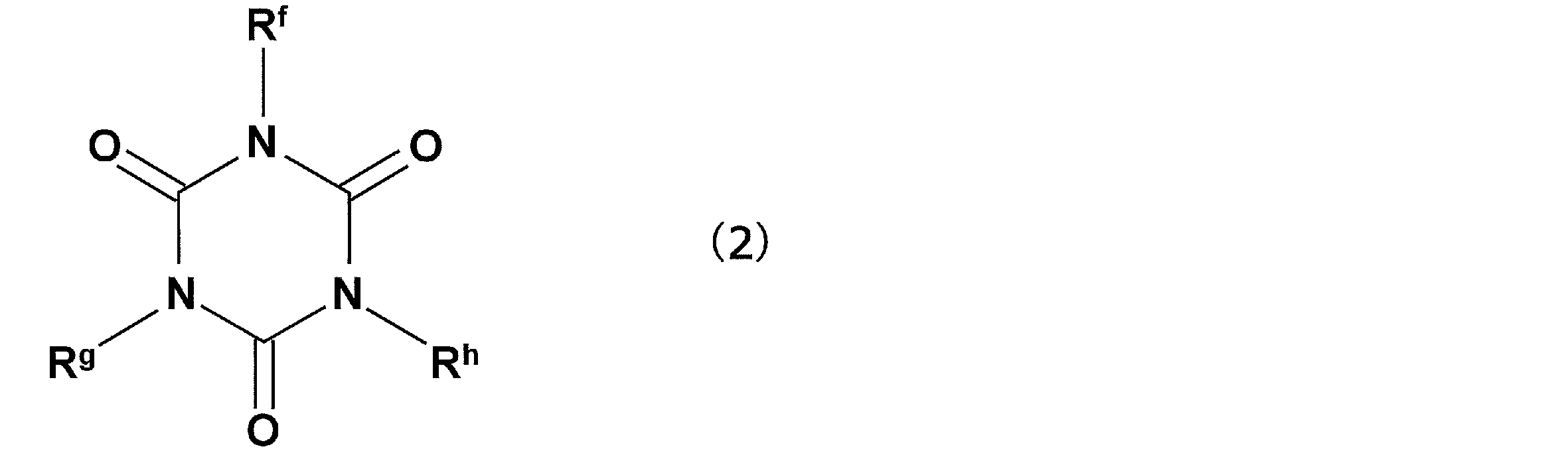


で表されるイソシアヌレート化合物(H)を含んでいてもよい。
本発明の硬化性樹脂組成物は、下記の(A)成分、(B)成分、及び(C)成分を必須成分として含む硬化性樹脂組成物であって、
(B)成分の含有量が、硬化性樹脂組成物中に存在するケイ素原子に結合したアルケニル基の合計1モルに対して、(B)成分中に存在するSiH基(ヒドロシリル基)が0.5~2モルとなる量であり、
硬化性樹脂組成物の全量(100重量%)に対する(A)成分の含有量が0.01~90重量%であることを特徴とする硬化性樹脂組成物。
(A):下記の(A-2)成分からなる群から選ばれる少なくとも一種のポリオルガノシロキサン
(A-2):下記平均単位式(Ib):
(SiO4/2)a5(R1bSiO3/2)a6(R1b 2SiO2/2)a7(R1b 3SiO1/2)a8 (Ib)
[式中、R1bは、同一又は異なって、炭素数1~10のアルキル基、炭素数6~14のアリール基、炭素数2~8のアルケニル基、炭素数1~10のアルコキシ基、又は水酸基であり、R1bの全量(100モル%)に対するアルキル基の割合をXbモル%、アリール基の割合をYbモル%、アルケニル基の割合をZbモル%としたとき、Xbは30~98モル%、Ybは1~50モル%、Zbは1~20モル%である。a5、a6、a7、及びa8は、a5>0、a6≧0、0.03≦a7≦0.7、a8>0、0.01≦a5/a7≦10、及びa5+a6+a7+a8=1を満たす数である。]
で表されるポリオルガノシロキサン
(B):下記平均組成式(II):
R2 mHnSiO[(4-m-n)/2] (II)
[式中、R2は、同一又は異なって、炭素数1~10のアルキル基、又は炭素数6~14のアリール基である。ケイ素原子に結合した水素原子を少なくとも2個有する。m及びnは、0.7≦m≦2.1、0.001≦n≦1、及び0.8≦m+n≦3を満たす数である。]
で表されるポリオルガノシロキサン
(C):ヒドロシリル化触媒
本発明の硬化性樹脂組成物の必須成分である(A)成分は、上述のように、上記の(A-2)成分からなる群から選ばれる少なくとも一種のポリオルガノシロキサンである。
本発明の硬化性樹脂組成物が、(A-2)成分を必須成分とする(A)成分を含有することにより、硬化した硬化物の耐熱性、耐光性が改善され、熱や光による経時的な硬度上昇や伸度低下が抑制され、柔軟性が維持される。
本発明の(A)成分の必須成分である(A-2)成分は、上述のように、下記平均単位式(Ib):
(SiO4/2)a5(R1bSiO3/2)a6(R1b 2SiO2/2)a7(R1b 3SiO1/2)a8 (Ib)
[式中、R1bは、同一又は異なって、炭素数1~10のアルキル基、炭素数6~14のアリール基、炭素数2~8のアルケニル基、炭素数1~10のアルコキシ基、又は水酸基であり、R1bの全量(100モル%)に対するアルキル基の割合をXbモル%、アリール基の割合をYbモル%、アルケニル基の割合をZbモル%としたとき、Xbは30~98モル%、Ybは1~50モル%、Zbは1~20モル%である。a5、a6、a7、及びa8は、a5>0、a6≧0、0.03≦a7≦0.7、a8>0、0.01≦a5/a7≦10、及びa5+a6+a7+a8=1を満たす数である。]
で表されるポリオルガノシロキサンである。
a6は、0又は正数(a6≧0)であり、(A-2)成分中のT単位の存在割合(モル換算)に相当し、好ましくは0~0.7であり、より好ましくは0~0.6であり、さらに好ましくは0~0.5である。
a7は、0.03≦a7≦0.7であり、(A-2)成分中のD単位の存在割合(モル換算)に相当し、好ましくは0.05~0.65であり、より好ましくは0.1~0.6であり、さらに好ましくは0.1~0.5である。
a8は、正数(a8>0)であり、(A-2)成分中のM単位の存在割合(モル換算)に相当し、好ましくは0.01~0.9であり、より好ましくは0.03~0.8であり、さらに好ましくは0.05~0.7である。
a5~a8が上記範囲にあることにより、本発明の硬化性樹脂組成物を硬化した際に、優れた耐熱性・耐光性を併せ持ち、硬度上昇や伸度の低下が抑制され、柔軟性が維持され、さらにタックが低い硬化物が得られやすくなる。
本発明の硬化性樹脂組成物は、下記平均単位式(Ia)で表される(A-1)成分を、任意成分としてさらに含有していてもよい。
本発明の硬化性樹脂組成物が(A-1)成分を含むことにより、熱・光による経時的な硬度上昇や伸度の低下が抑制され、柔軟性が維持された状態で、靭性をさらに向上させることができる。
(SiO4/2)a1(R1aSiO3/2)a2(R1a 2SiO2/2)a3(R1a 3SiO1/2)a4 (Ia)
[式中、R1aは、同一又は異なって、炭素数1~10のアルキル基、炭素数6~14のアリール基、炭素数2~8のアルケニル基、炭素数1~10のアルコキシ基、又は水酸基であり、R1aの全量(100モル%)に対するアルキル基の割合をXaモル%、アリール基の割合をYaモル%、アルケニル基の割合をZaモル%としたとき、Xaは30~98モル%、Yaは1~50モル%、Zaは1~20モル%である。a1、a2、a3、及びa4は、a1>0、a2>0、0≦a3<0.03、a4>0、0.01≦a1/a2≦10、及びa1+a2+a3+a4=1を満たす数である。]
で表されるポリオルガノシロキサンである。
a2は、正数(a2>0)であり、(A-1)成分中のT単位の存在割合(モル換算)に相当し、好ましくは0.01~0.90であり、より好ましくは0.03~0.85であり、さらに好ましくは0.05~0.8である。
a3は、0≦a3<0.03であり、(A-1)成分中のD単位の存在割合(モル換算)に相当し、好ましくは0~0.029であり、より好ましくは0~0.02であり、さらに好ましくは0~0.01である。
a4は、正数(a4>0)であり、(A-1)成分中のM単位の存在割合(モル換算)に相当し、好ましくは0.01~0.9であり、より好ましくは0.03~0.8であり、さらに好ましくは0.05~0.7である。
a1~a4が上記範囲にあることにより、本発明の硬化性樹脂組成物を硬化した際に、優れた耐熱性・耐光性を併せ持ち、熱・光による経時的な硬度上昇や伸度の低下が抑制され、柔軟性が維持された状態で、靭性をさらに向上された硬化物が得られやすくなる。
本発明の硬化性樹脂組成物における(A-1)成分と(A-2)成分は、公知乃至慣用のポリシロキサンの製造方法により製造することができ、特に限定されないが、例えば、1種又は2種以上の加水分解性シラン化合物を加水分解及び縮合させる方法により製造できる。例えば、上述の平均単位式(Ib)で表される構成単位を形成するための加水分解性シラン化合物としては、加水分解性四官能シラン化合物(下記式(a)で表される化合物)、加水分解性二官能シラン化合物(下記式(c)で表される化合物)、及び加水分解性一官能シラン化合物(下記式(d)で表される化合物)を必須の加水分解性シラン化合物として使用する必要があり、必要により加水分解性三官能シラン化合物(下記式(b)で表される化合物)を使用する。また、上述の平均単位式(Ia)で表される構成単位を形成するための加水分解性シラン化合物としては、加水分解性四官能シラン化合物(下記式(a)で表される化合物)、加水分解性三官能シラン化合物(下記式(b)で表される化合物)、及び加水分解性一官能シラン化合物(下記式(d)で表される化合物)を必須の加水分解性シラン化合物として使用する必要があり、必要により加水分解性二官能シラン化合物(下記式(c)で表される化合物)を使用する。

上記式(b)中のX2は、アルコキシ基又はハロゲン原子を示す。X2におけるアルコキシ基としては、例えば、メトキシ基、エトキシ基、プロポキシ基、イソプロポキシ基、ブトキシ基、イソブトキシ基等の炭素数1~10のアルコキシ基等が挙げられる。また、X2におけるハロゲン原子としては、例えば、フッ素原子、塩素原子、臭素原子、ヨウ素原子等が挙げられる。中でもX2としては、アルコキシ基が好ましく、より好ましくはメトキシ基、エトキシ基である。なお、3つのX2は、それぞれ同一であってもよいし、異なっていてもよい。
上記式(c)中のX3は、アルコキシ基又はハロゲン原子を示す。X3におけるアルコキシ基としては、例えば、メトキシ基、エトキシ基、プロポキシ基、イソプロポキシ基、ブトキシ基、イソブトキシ基等の炭素数1~10のアルコキシ基等が挙げられる。また、X3におけるハロゲン原子としては、例えば、フッ素原子、塩素原子、臭素原子、ヨウ素原子等が挙げられる。中でもX3としては、アルコキシ基が好ましく、より好ましくはメトキシ基、エトキシ基である。なお、2つのX3は、それぞれ同一であってもよいし、異なっていてもよい。
式(d)中のR14は、炭素数1~10のアルキル基、炭素数6~14のアリール基、又は炭素数2~8のアルケニル基である。R14で表される炭素数1~10のアルキル基、炭素数6~14のアリール基、及び炭素数2~8のアルケニル基の例示及び好ましい態様は、それぞれ、上記平均単位式(Ia)におけるR1aと同様である。なお、3つのR14は、それぞれ同一であってもよいし、異なっていてもよい。
上記式(d)中のX4は、アルコキシ基、ハロゲン原子、又は-OSiR14 3で表される基を示す。X4におけるアルコキシ基としては、例えば、メトキシ基、エトキシ基、プロポキシ基、イソプロポキシ基、ブトキシ基、イソブトキシ基等の炭素数1~10のアルコキシ基等が挙げられる。また、X4におけるハロゲン原子としては、例えば、フッ素原子、塩素原子、臭素原子、ヨウ素原子等が挙げられる。中でもX4としては、アルコキシ基又は-OSiR14 3で表される基が好ましく、より好ましくはメトキシ基、エトキシ基、-OSiR14 3で表される基である。また、X4が-OSiR14 3で表される基である場合、3つのR14は、それぞれ同一であってもよいし、異なっていてもよい。
例えば、上記式(a)、(b)、(c)及び/又は(d)で表される化合物を加水分解及び縮合反応に付した後に、式(d)で表される化合物を追加する態様が挙げられる。
(A-2)成分の2種以上を組み合わせて使用した場合、上記のXb、Yb、Zb、Xb/Yb、a5~a8、a5/a6等は、各々の(A-2)成分の配合割合に応じた平均値であってもよい。
また、本発明の硬化性樹脂組成物において(A-1)成分は、1種を単独で使用することもできるし、2種以上を組み合わせて使用することもできる。
(A-1)成分の2種以上を組み合わせて使用した場合、上記のXa、Ya、Za、Xa/Ya、a1~a4、a1/a2等は、各々の(A-1)成分の配合割合に応じた平均値であってもよい。
本発明の硬化性樹脂組成物の必須成分である(B)成分は、上述のように、下記平均組成式(II):
R2 mHnSiO[(4-m-n)/2] (II)
[式中、R2は、同一又は異なって、炭素数1~10のアルキル基、又は炭素数6~14のアリール基である。ケイ素原子に結合した水素原子を少なくとも2個有する。m及びnは、0.7≦m≦2.1、0.001≦n≦1、及び0.8≦m+n≦3を満たす数である。]
で表されるポリオルガノシロキサンである。
mは(B)成分中のケイ素1原子あたりのR2の平均数を示し、0.7~2.1の範囲内から選ばれ、好ましくは0.8~2.1、より好ましくは1~2である。
nは(B)成分中のケイ素1原子あたりのケイ素原子結合水素原子数を示し、0.001~1範囲内から選ばれ、好ましくは0.01~1、より好ましくは0.2~1である。
m+nは、(B)成分中のケイ素一原子あたりのR2とケイ素原子結合水素原子数の合計の平均数を示し、0.8~3の範囲内から選ばれ、好ましくは1~2.9、より好ましくは1.5~2.8である。
m及びnが上記条件を満たすことにより、本発明の硬化性樹脂組成物を硬化した際に、優れた耐熱性・耐光性を併せ持ち、さらにタックが低い硬化物が得られやすくなる。
(B)成分が、このような少なくとも2つの末端にSiH基(ヒドロシリル基)を有する構造を有することにより、硬化性樹脂組成物を硬化された際に、柔軟性、耐熱性、耐光性に優れる硬化物が得られやすい。
(B)成分が(R2' 2HSiO1/2)で表されるM単位を有する場合、その数は、2個以上であれば特に限定されないが、2~4個が好ましく、より好ましくは2個である。2個以上の(R2' 2HSiO1/2)で表されるM単位は、同一であっても、異なっていてもよい。
また、(B)成分は、(R2' 2HSiO1/2)で表されるM単位以外に、側鎖にSiH基(ヒドロシリル基)を有していてもよい。
(R2aSiO3/2)c1(R2a 2SiO2/2)c2(R2a 3SiO1/2)c3(SiO4/2)c4(X5O1/2)c5
で表され、好ましくは(R2a 2HSiO1/2)で表される構成単位(M単位)を少なくとも2個有するポリオルガノシロキサンが挙げられる。上記平均単位式及びM単位中、R2aは、同一又は異なって、水素原子、炭素数1~10のアルキル基、又は炭素数6~14のアリール基である。R2aで表される炭素数1~10のアルキル基、炭素数6~14のアリール基の例示及び好ましい態様は、上記平均組成式(II)中のR2と同様である。
なお、ケイ素原子に結合した基の全量(100モル%)に対するアルキル基、アリール基及び水素原子の割合(モル%)は、例えば、1H-NMRスペクトル測定等により算出できる。
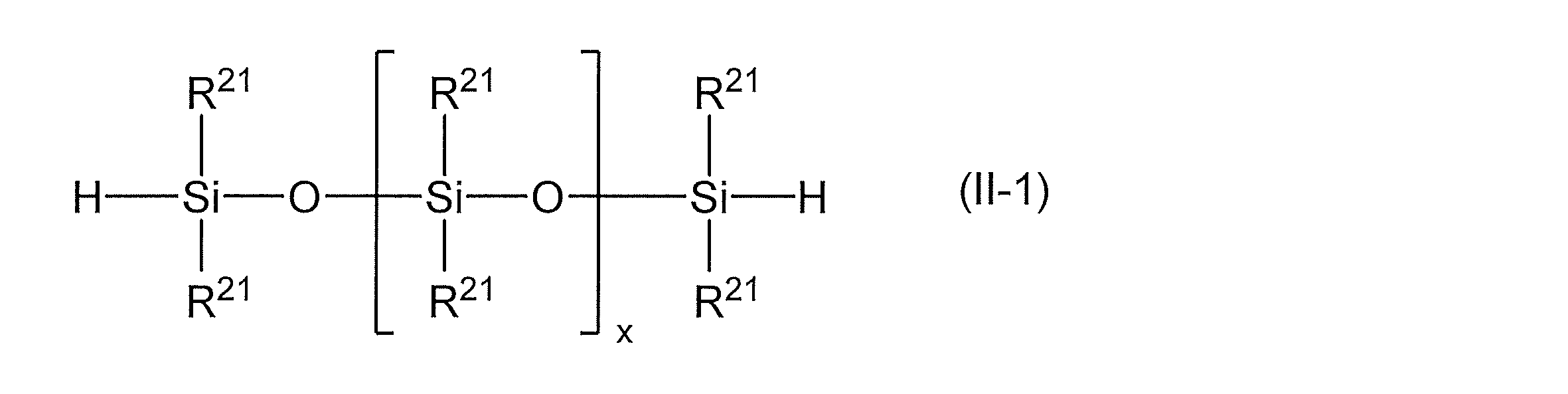
xは、0~1000の整数を示し、1~100の整数が好ましい。
(B1)成分は、25℃で液体であっても固体であってもよく、液体が好ましい。(B1)成分の25℃における粘度は、特に限定されないが、好ましくは10000mPa・s以下であり、より好ましくは5000mPa・s以下である。粘度が10000mPa・s以下であると、硬化物の相溶性がより向上する傾向がある。一方、当該粘度の下限は特に限定されないが、好ましくは1mPa・sであり、より好ましくは5mPa・sである。粘度が1mPa・s以上であると、硬化性樹脂組成物の調製や取り扱いが容易となる傾向がある。なお、25℃における粘度は、上述の(A-2)成分と同じ条件で測定される。
また、(B)成分が、末端のSiHを有するM単位を有する場合には、当該M単位を形成するための加水分解性シラン化合物である下記式(e)で表される化合物をさらに原料として使用すること以外は、上記(A-1)成分、(A-2)成分の製造方法と同様に1種又は2種以上の加水分解性シラン化合物を加水分解及び縮合させる方法により製造できる。

上記式(e)中のX6は、アルコキシ基、ハロゲン原子、又は-OSiHR22 2で表される基を示す。X6におけるアルコキシ基としては、例えば、メトキシ基、エトキシ基、プロポキシ基、イソプロポキシ基、ブトキシ基、イソブトキシ基等の炭素数1~10のアルコキシ基等が挙げられる。また、X6におけるハロゲン原子としては、例えば、フッ素原子、塩素原子、臭素原子、ヨウ素原子等が挙げられる。中でもX6としては、アルコキシ基又は-OSiHR22 2で表される基が好ましく、より好ましくはメトキシ基、エトキシ基、-OSiHR22 2で表される基である。また、X6が-OSiHR22 2で表される基である場合、2つのR22は、それぞれ同一であってもよいし、異なっていてもよい。
(B)成分の2種以上を組み合わせて使用した場合、上記のX'、Y'、Z'、X'/Y'、m、n、m+n、c1~c5、x等は、各々の(B)成分の配合割合に応じた平均値であってもよい。
なお、本発明の硬化性樹脂組成物が、後述の(D)成分、(E)成分、(G)成分等の(A-1)成分、(A-2)成分以外の「ケイ素原子に結合したアルケニル基」を有する化合物を含む場合は、(B)成分の含有量は、本発明の硬化性樹脂組成物中の全てのケイ素原子に結合したアルケニル基を有する化合物のアルケニル基の合計量1モルに対して、(B)成分中に存在するSiH基(ヒドロシリル基)が、上記範囲となるように配合される。
本発明の硬化性樹脂組成物の必須成分である(C)成分は、上述のように、ヒドロシリル化触媒である。本発明の硬化性樹脂組成物がヒドロシリル化触媒を含むことにより、加熱することで、硬化性樹脂組成物中の脂肪族炭素-炭素二重結合(特に、アルケニル基)とヒドロシリル基の間のヒドロシリル化反応をより効率的に進行させることができる傾向がある。
本発明の硬化性樹脂組成物の必須成分である(D)成分は、上述のように、ケイ素原子に結合した有機基の全量(100モル%)に対する炭素数2~6のアルケニル基の割合が20~60モル%であり、ケイ素原子数が10以下であるポリオルガノシロキサンである。
該アルケニル基は置換基を有していてもよい。該置換基としては、後述の一価の炭化水素基が有していてもよい置換基と同様のものが例示される。
また、(D)成分は、1種のみのアルケニル基を有するものであってもよいし、2種以上のアルケニル基を有するものであってもよい。なお、(D)成分が有するアルケニル基は、ケイ素原子に結合したものである。
(D)成分を構成するケイ素原子数の下限は、特に限定されないが、好ましくは2個以上、より好ましくは3個以上である。(D)成分を構成するケイ素原子数が2個以上であると、硬化中に揮発するシロキサンの量が抑えられる傾向があり、好ましい。
(D)成分が有するアルケニル基以外のケイ素原子に結合した有機基としては、アルキル基(好ましくはメチル基)、アリール基(好ましくはフェニル基)が好ましい。
(RySiO3/2)y1(Ry 2SiO2/2)y2(Ry 3SiO1/2)y3(SiO4/2)y4(XyO1/2)y5
で表されるポリオルガノシロキサンが好ましい。上記単位式中、Ryは、同一又は異なって、一価の有機基であり、一価の有機基としては、上述の一価の炭化水素基、又は一価の複素環式基の具体例が挙げられる。Ryの一部はアルケニル基(特にビニル基)であり、その割合は、上述の通り、(D)成分におけるケイ素原子に結合した有機基の全量(100モル%)に対して20~60モル%(好ましくは20~55モル%、より好ましくは25~50モル%)となる範囲に制御される。アルケニル基の割合を上記範囲に制御することにより、硬化性樹脂組成物の硬化性がより向上する傾向がある。また、アルケニル基以外のRyとしては、アルキル基(特にメチル基)、アリール基(特にフェニル基)が好ましい。
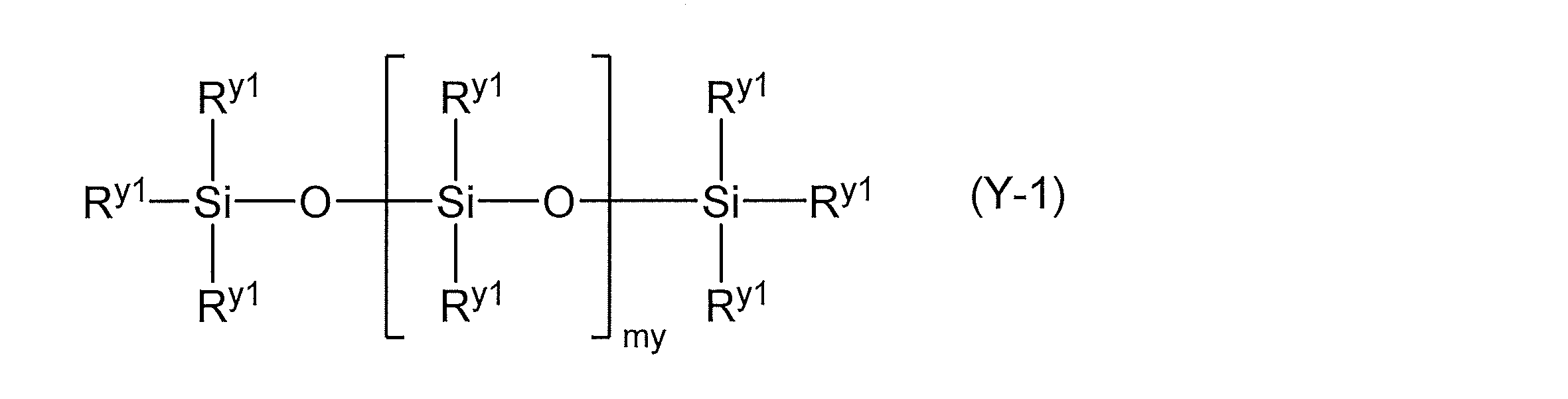
(D)成分の2種以上を組み合わせて使用した場合、上記のy1~y5等は、各々の(D)成分の配合割合に応じた平均値であってもよい。
本発明の硬化性樹脂組成物は、下記平均単位式(X)で表されるポリオルガノシロキサンである(E)成分を、任意成分として含有していてもよい。
(RxSiO3/2)x1(Rx 2SiO2/2)x2(Rx 2SiRARx 2SiO2/2)x3(Rx 3SiO1/2)x4 (X)
[式中、Rxは、同一又は異なって、炭素数1~10のアルキル基、炭素数6~14のアリール基、炭素数2~8のアルケニル基、炭素数1~10のアルコキシ基、又は水酸基であり、Rxの全量(100モル%)に対するアリール基の割合が1~50モル%であり、全Rxの少なくとも2個はアルケニル基である。RAは、二価の炭化水素基である。x1、x2、x3、及びx4は、0.05>x1≧0、x2+x3>0、x4>0、及びx1+x2+x3+x4=1を満たす数である。]
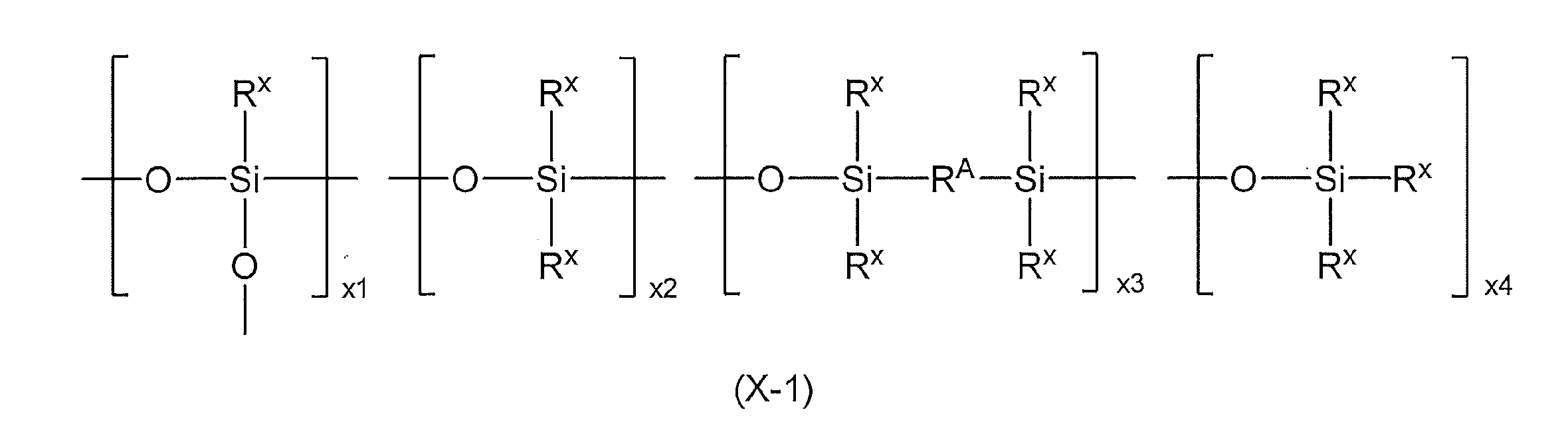
上記(E)成分が、主鎖としてシロキサン結合(-Si-O-Si-)に加えて、-Si-RA-Si-で表される結合(以下、「シルアルキレン結合」と称す)を有する場合、製造工程において低分子量の環を生じ難く、また、加熱等により分解してシラノール基(-SiOH)を生じ難いため、シルアルキレン結合を有する(E)成分を使用した場合、硬化性樹脂組成物の硬化物の表面粘着性が低減され、より黄変し難くなる傾向がある。
即ち、(E)成分は、(Rx 2SiO2/2)で表されるD単位、及び(Rx 2SiRASiO2/2)で表される構成単位(本明細書において、「シルアルキレン単位」という)からなる群から選ばれる少なくとも一種の構成単位、及び(Rx 3SiO1/2)で表されるM単位を必須構成単位として含み、さらに、(RxSiO3/2)で表されるT単位を任意構成単位として全構成単位の5モル%未満で含んでいてもよい、分岐鎖を一部含んでいてもよい直鎖状のポリオルガノシロキサン又はポリオルガノシロキシシルアルキレンである。
本発明の硬化性樹脂組成物が、このような構造を有するポリオルガノ(シルアルキル)シロキサンである(E)成分を含む場合、硬化物の靭性が高くなりやすくなり、好ましい。
x3は、0又は正数(x3≧0)であり、(E)成分中のシルアルキレン単位の存在割合(モル換算)に相当し、好ましくは0.20~0.90であり、より好ましくは0.30~0.80であり、さらに好ましくは0.40~0.70である。
ただし、x2及びx3は、x2+x3>0を満たす数である。即ち、(E)成分は、D単位及びシルアルキレン単位から選ばれる少なくとも1つの単位を含む。これにより、硬化物の柔軟性が向上する傾向がある。x2+x3は、好ましくは0.30~0.99であり、より好ましくは0.40~0.98であり、さらに好ましくは0.50~0.97である。
x1~x4が上記範囲にあることにより、本発明の硬化性樹脂組成物を硬化した際に、靭性に優れる硬化物が得られやすくなる。
本発明の硬化性樹脂組成物は、カルボン酸亜鉛、及び亜鉛βジケトン錯体からなる群から選ばれる少なくとも1種の亜鉛化合物(単に「(F)成分」と称する場合がある)を含んでいてもよい。本発明の硬化性樹脂組成物が上記(F)成分を含むことにより、特に、H2Sガス等の腐食性ガスに対するバリア性が向上する傾向がある。なお、(F)成分は、1種を単独で、又は2種以上を組合せて使用することができる。
[Zn(L1)(L2)] (1)
[式中、L1及びL2は、同一又は異なって、下記式(1a)
R31COCHR32COR33 (1a)
で表される、β-ジケトン、又はβ-ケトエステルのアニオン若しくはエノラートアニオンを示す]

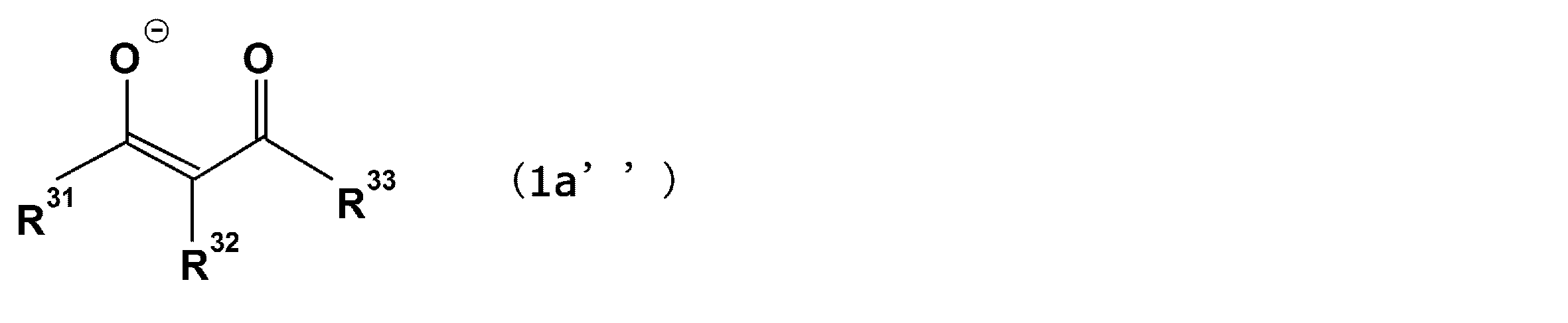
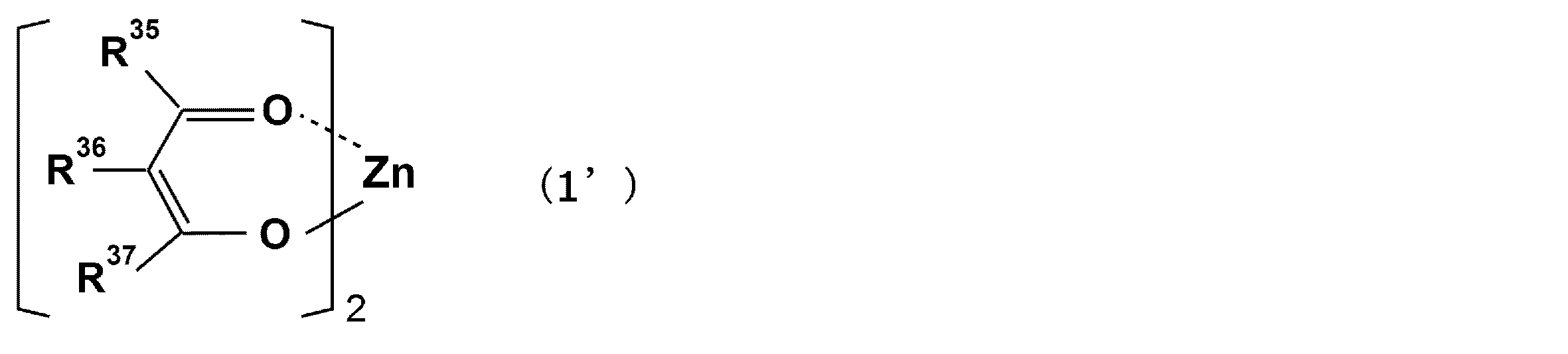
なお、カルボン酸亜鉛又は亜鉛βジケトン錯体としては、市販品を使用することもできる。
本発明の硬化性樹脂組成物は、分子内に1個以上のアルケニル基及び1個以上のアリール基を有するシルセスキオキサン(「(G)成分」と称する場合がある)を含んでいてもよい。本発明の硬化性樹脂組成物が(G)成分を含むことにより、柔軟性、耐熱衝撃性が著しく向上する傾向がある。(G)成分としては、分子内に1個以上(好ましくは2個以上)のアルケニル基と1個以上(好ましくは2~50個)のアリール基を有するシルセスキオキサンを使用することができ、特に限定されない。
(G)成分が分子内に有するアルケニル基及びアリール基以外のケイ素原子に結合した基としては、特に限定されないが、例えば、水素原子、有機基等が挙げられる。有機基としては、例えば、上述の一価の置換又は無置換炭化水素基等が挙げられる。なお、本明細書において「ケイ素原子に結合した基」とは、通常、ケイ素原子を含まない基を指すものとする。中でも、アルキル基(特にメチル基)が好ましい。
また、(G)成分は、ケイ素原子に結合した基として、ヒドロキシ基、アルコキシ基を有していてもよい。
Alliance HPLCシステム 2695(Waters製)
Refractive Index Detector 2414(Waters製)
カラム:Tskgel GMHHR-M×2(東ソー(株)製)
ガードカラム:Tskgel guard column HHRL(東ソー(株)製)
カラムオーブン:COLUMN HEATER U-620(Sugai製)
溶媒:THF
測定温度:40℃
分子量:標準ポリスチレン換算
本発明の硬化性樹脂組成物は、下記式(2)で表されるイソシアヌレート化合物(単に「イソシアヌレート化合物(H)」と称する場合がある)を含んでいてもよい。本発明の硬化性樹脂組成物がイソシアヌレート化合物(H)を含む場合には、硬化物の被着体に対する密着性がいっそう向上し、さらに、腐食性ガスに対するバリア性がより高くなる傾向がある。
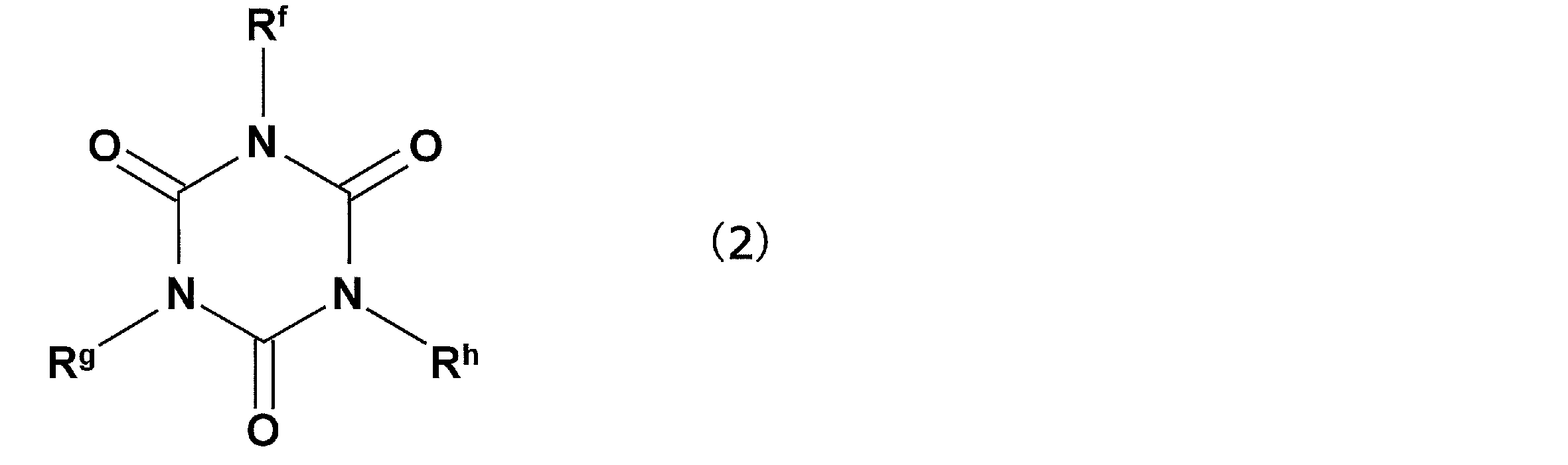


本発明の硬化性樹脂組成物は、シランカップリング剤(I)を含んでいてもよい。シランカップリング剤(I)を含む場合には、特に、硬化物の被着体に対する密着性がいっそう向上する傾向がある。
本発明の硬化性樹脂組成物は、無機充填剤(J)を任意成分として含んでいてもよい。本発明の硬化性樹脂組成物が無機充填剤(J)を含むことにより、該硬化性樹脂組成物を加熱した場合(例えば、LEDパッケージへの充填や硬化のために加熱した場合等)に粘度が大きく低下しにくくなって蛍光体の沈降が抑制され(即ち、優れた分散性が維持され)、その結果、光半導体装置の色度ばらつきが抑制され、光取り出し効率の高い光半導体装置を安定的に製造することが可能となる。また、その硬化物において無機充填剤(J)が優れた応力緩和効果を発揮するため、耐熱衝撃性に優れた硬化物が得られる。さらに、タックが低減するため、高品質の光半導体装置が得られる。
本発明の硬化性樹脂組成物を硬化(特に、ヒドロシリル化反応により硬化)させることによって、硬化物(単に「本発明の硬化物」と称する場合がある)が得られる。硬化(特に、ヒドロシリル化反応による硬化)の際の条件は、従来公知の条件より適宜選択することができるが、例えば、反応速度の点から、温度(硬化温度)は25~180℃が好ましく、より好ましくは60~150℃であり、時間(硬化時間)は5~720分が好ましい。なお、硬化は一段階で実施することもできるし、多段階で実施することもできる。本発明の硬化物は、ポリシロキサン系材料特有の高い耐熱性及び透明性を有するのみならず、柔軟性、耐熱衝撃性に優れ、さらにタックが低い。特に、高温耐熱性試験や高輝度耐光性試験においても経時的な透過率の低下や硬度上昇が抑制され、柔軟性を維持することができる。
本発明の硬化性樹脂組成物は、半導体装置における半導体素子の封止用の組成物(封止剤)(単に「本発明の封止剤」と称する場合がある)として好ましく使用することができる。具体的には、本発明の封止剤は、光半導体装置における光半導体素子(LED素子)の封止用途に(即ち、光半導体用封止剤として)特に好ましく使用できる。本発明の封止剤を硬化させることにより得られる封止材(硬化物)は、ポリシロキサン系材料特有の高い耐熱性及び透明性を有するのみならず、柔軟性、耐熱衝撃性に優れ、さらにタックが低い。特に、高温耐熱性試験や高輝度耐光性試験においても経時的な透過率の低下や硬度上昇が抑制され、柔軟性を維持することができる。このため、本発明の封止剤は、特に、高輝度、短波長の大型光半導体素子の封止剤等として好ましく使用できる。
また、本発明の硬化性樹脂組成物は、レンズを形成するための組成物(「本発明のレンズ形成用樹脂組成物」と称する場合がある)としても好ましく使用できる。本発明のレンズ形成用樹脂組成物を硬化させることにより得られるレンズは、ポリシロキサン系材料特有の高い耐熱性及び透明性を有するのみならず、柔軟性、耐熱衝撃性に優れ、さらにタックが低い。特に、高温耐熱性試験や高輝度耐光性試験においても経時的な透過率の低下や硬度上昇が抑制され、柔軟性を維持することができる。このため、本発明のレンズ形成用樹脂組成物硬化させることにより得られるレンズは、特に、高輝度、短波長の光半導体素子のレンズ等として好ましく使用できる。
本発明の封止剤を使用して半導体素子を封止することにより、半導体装置(単に「本発明の半導体装置」と称する場合がある)が得られる。即ち、本発明の半導体装置は、半導体素子とこれを封止する封止材とを少なくとも有する半導体装置であって、上記封止材が本発明の封止剤の硬化物である半導体装置である。また、本発明のレンズ形成用樹脂組成物を使用することによっても、半導体装置(これも「本発明の半導体装置」と称する場合がある)を得ることができる。即ち、本発明の半導体装置の別の態様は、半導体素子とレンズとを少なくとも有する半導体装置であって、上記レンズが本発明のレンズ形成用樹脂組成物の硬化物である半導体装置であってもよい。
本発明の半導体装置は、半導体素子と、該半導体素子を封止する封止材と、レンズとを含み、上記封止材が本発明の硬化性樹脂組成物(本発明の封止剤)の硬化物であり、なおかつ、上記レンズが本発明の硬化性樹脂組成物(本発明のレンズ形成用樹脂組成物)の硬化物である半導体装置であってもよい。
本発明の半導体装置の製造は、公知乃至慣用の方法により実施でき、例えば、本発明の封止剤及び/又はレンズ形成用樹脂組成物を所定の成形型内に注入し、所定の条件で加熱硬化して実施できる。硬化温度と硬化時間は、硬化物の調製時と同様の範囲で設定することができる。
本発明の光半導体装置の一例を図1に示す。図1において、100はリフレクター(光反射用樹脂組成物)、101は金属配線(電極)、102は光半導体素子、103はボンディングワイヤ、104は硬化物(封止材)を示す。
生成物並びに製品の数平均分子量及び重量平均分子量の測定は、Alliance HPLCシステム 2695(Waters製)、Refractive Index Detector 2414(Waters製)、カラム:Tskgel GMHHR-M×2(東ソー(株)製)、ガードカラム:Tskgel guard column HHRL(東ソー(株)製)、カラムオーブン:COLUMN HEATER U-620(Sugai製)、溶媒:THF、測定条件:40℃、標準ポリスチレン換算により行った。
生成物並びに製品の粘度の測定は、レオメーター(商品名「Physica MCR-302」、Anton Paar社製とパラレルプレート(円錐直径:25mm、テーパ角度=0°)を用いて、温度:25℃、回転数:20rpmの条件で行った。
生成物並びに製品の固体屈折率の測定は、プリズムカプラ Model 2010/M(メトリコン社製)を用い、25℃の環境下で407.3nm、632.8nm、827.8nm、1310.2nmの値から589.0nmの屈折率を算出した。
500mLの4つ口フラスコにテトラエトキシシラン5.00g(24.00mmol)、トリメトキシメチルシラン35.96g(264.00mmol)、トリメトキシフェニルシラン14.79g(74.59mmol)、メチルイソブチルケトン60.39gを仕込んだ。15℃まで冷却した後に、滴下ロートに入れた5N塩酸14.84gを滴下した。さらに水20.01gを滴下した。その後、80℃まで昇温し、攪拌した。ヘキサメチルジシロキサン38.67g(238.12mmol)、1,1,3,3-テトラメチル-1,3-ジビニルジシロキサン56.49g(303.06mmol)をさらに加え、攪拌を行った。
分液ロートに反応液を移し、シリコーンレジンを含有する下層のみを取り出し、分液ロートに再度移液した後に水洗を行った。
水洗後、ロータリーエバポレーターにて溶媒分を減圧除去すると、収量34.88gのシリコーンレジンA-1aを得た。
数平均分子量(Mn):2086、重量平均分子量(Mw):4165、分子量分布(Mw/Mn):2.00
1H-NMR(JEOL ECA500(500MHz, CDCl3)): δ 0.15(br), 1.25(br), 3.58-3.86(br), 5.75-6.16(br), 7.38-7.73(br)..
平均単位式:(SiO4/2)0.06(PhSiO3/2)0.17(MeSiO3/2)0.61(Me3SiO1/2)0.09(ViMe2SiO1/2)0.07[Ph:フェニル基、Me:メチル基、Vi:ビニル基、以下、同様]
メチル基含有率:81モル%、フェニル基含有率:14モル%、ビニル基含有率:6モル%
500mLの4つ口フラスコにテトラエトキシシラン5.00g(24.00mmol)、トリメトキシメチルシラン35.96g(264.00mmol)、トリメトキシフェニルシラン14.79g(74.59mmol)、メチルイソブチルケトン60.39gを仕込んだ。15℃まで冷却した後に、滴下ロートに入れた5N塩酸14.84gを滴下した。さらに水20.01gを滴下した。その後、80℃まで昇温し、攪拌した。ヘキサメチルジシロキサン22.85g(140.71mmol)、1,1,3,3-テトラメチル-1,3-ジビニルジシロキサン74.65g(400.47mmol)をさらに加え、攪拌を行った。
分液ロートに反応液を移し、シリコーンレジンを含有する下層のみを取り出し、分液ロートに再度移液した後に水洗を行った。
水洗後、ロータリーエバポレーターにて溶媒分を減圧除去すると、収量33.86gのシリコーンレジンA-1bを得た。
数平均分子量(Mn):2171、重量平均分子量(Mw):4645、分子量分布(Mw/Mn):2.14
1H-NMR(JEOL ECA500(500MHz, CDCl3)): δ 0.18(br), 1.24(br), 3.54-3.84(br), 5.74-6.16(br), 7.38-7.71(br).
平均単位式:(SiO4/2)0.06(PhSiO3/2)0.17(MeSiO3/2)0.62(Me3SiO1/2)0.05(ViMe2SiO1/2)0.10
メチル基含有率:78モル%、フェニル基含有率:14モル%、ビニル基含有率:8モル%
500mLの4つ口フラスコにテトラエトキシシラン7.50g(36.00mmol)、トリメトキシメチルシラン53.94g(396.00mmol)、トリメトキシフェニルシラン22.19g(111.89mmol)、ヘキサメチルジシロキサン11.96g(73.65mmol)、メチルイソブチルケトン65.27gを仕込んだ。15℃まで冷却した後に、滴下ロートに入れた5N塩酸22.26gを滴下した。さらに水30.02gを滴下した。その後、80℃まで昇温し、攪拌した。ヘキサメチルジシロキサン19.77g(121.77mmol)、1,1,3,3-テトラメチル-1,3-ジビニルジシロキサン128.62g(690.00mmol)をさらに加え、攪拌を行った。
分液ロートに反応液を移し、シリコーンレジンを含有する下層のみを取り出し、分液ロートに再度移液した後に水洗を行った。
水洗後、ロータリーエバポレーターにて溶媒分を減圧除去すると、収量50.65gのシリコーンレジンA-1cを得た。
数平均分子量(Mn):2117、重量平均分子量(Mw):4766、分子量分布(Mw/Mn):2.26
1H-NMR(JEOL ECA500(500MHz, CDCl3)): δ 0.17(br), 1.24(br), 3.54-3.84(br), 5.74-6.14(br), 7.36-7.72(br).
平均単位式:(SiO4/2)0.06(PhSiO3/2)0.17(MeSiO3/2)0.62(Me3SiO1/2)0.03(ViMe2SiO1/2)0.12
メチル基含有率:77モル%、フェニル基含有率:14モル%、ビニル基含有率:9モル%
500mLの4つ口フラスコにテトラエトキシシラン7.65g(36.72mmol)、ジメトキシジメチルシラン11.17g(92.88mmol)、トリメトキシフェニルシラン6.66g(33.57mmol)、メチルイソブチルケトン46.22gを仕込んだ。15℃まで冷却した後に、滴下ロートに入れた36.5%塩酸3.28gと水5.99gを滴下した。その後、80℃まで昇温し、攪拌した。ヘキサメチルジシロキサン16.61g(102.28mmol)、1,1,3,3-テトラメチル-1,3-ジビニルジシロキサン26.33g(141.25mmol)をさらに加え、攪拌を行った。
分液ロートに反応液を移し、シリコーンレジンを含有する下層のみを取り出し、分液ロートに再度移液した後に水洗を行った。
水洗後、ロータリーエバポレーターにて溶媒分を減圧除去すると、収量50.65gのシリコーンレジンA-2を得た。
数平均分子量(Mn):2304、重量平均分子量(Mw):4329、分子量分布(Mw/Mn):1.88
1H-NMR(JEOL ECA500(500MHz, CDCl3)): δ 0.11-0.14(br), 1.23(br), 3.53-3.76(br), 5.73-6.18(br), 7.35-7.64(br).
平均単位式:(SiO4/2)0.19(PhSiO3/2)0.18(Me2SiO2/2)0.44(Me3SiO1/2)0.09(ViMe2SiO1/2)0.09
メチル基含有率:83モル%、フェニル基含有率:11モル%、ビニル基含有率:6モル%
レジンA-2:製造例4で得られた生成物
(A-1)成分としては、次の製品を使用した。
レジンA-1a:製造例1で得られた生成物
レジンA-1b:製造例2で得られた生成物
レジンA-1c:製造例3で得られた生成物
Si-Hモノマー:1,1,5,5-テトラメチル-3,3-ジフェニルトリシロキサン(NANJING SiSiB SILICONES社製)
一般式:Ph2/3Me4/3H2/3SiO2/3
平均単位式:(Ph2SiO2/2)1(HMe2SiO1/2)2
メチル基含有率:50モル%、フェニル基含有率:25モル%、ヒドロシリル基含有率:25モル%
付加反応触媒:商品名「Pt-VTS」、白金のジビニルテトラメチルジシロキサン錯体のキシレン溶液;白金として2.0wt%含有、エヌ・イーケムキャット社製
Si-Viモノマー:トリス(ビニルジメチルシロキシ)フェニルシラン(Gelest社製)
実施例1~6、比較例1~4を、以下の手順に従って実施した。
表1(実施例1~6)、表2(比較例1~4)に従って、(A-2)成分、(A-1)成分、(B)成分、及び(D)成分を所定重量比率で混合し、70℃で2時間攪拌した。その後、室温まで冷却した後、(C)成分を所定重量比率で加え、10分間攪拌し、均一な液体である硬化性樹脂組成物を得た。
表1、2に実施例及び比較例で得られた硬化性樹脂組成物に含まれる(A-1)成分のa1/a2、並びに(A-2)成分のa5/a7を示す。
また、表1、2に硬化性樹脂組成物中に含まれるビニル基(SiVi基)に対する(B)成分中に含まれるヒドロシリル基(SiH基)の比(SiH/SiVi比)を示す。
なお、表1、2中、硬化性樹脂組成物の各成分の配合量は特に指定がない限り重量部を示し、ハイフン(-)は当該成分が配合されていないことを示し、(C)成分は、白金の重量単位(ppm)で示す。
[粘度]
上記で得られた硬化性樹脂組成物の23℃における粘度(mPa・s)を、レオメーター(商品名「Physica MCR-302」、Anton Paar社製とパラレルプレート(円錐直径:25mm、テーパ角度=0°)を用いて、温度:23℃、回転数:20rpmの条件で測定した。結果を表1、2に示す。
厚み0.5mmのPTFE製の型枠に、上記で得られた硬化性樹脂組成物を注入し、80℃で1時間、続いて150℃で4時間加熱することで、固体屈折率測定用の硬化性樹脂組成物の硬化物を製造した。
得られた硬化物をプリズムカプラ Model 2010/M(メトリコン社製)を用い、25℃の環境下で407.3nm、632.8nm、827.8nm、1310.2nmの値から589.0nmの屈折率を算出した。結果を表1、2に示す。
厚み0.5mmのPTFE製の型枠に、上記で得られた硬化性樹脂組成物を注入し、80℃で1時間、続いて150℃で4時間加熱することで、引張試験用の硬化性樹脂組成物の硬化物を製造した。
JISK6251に準拠して、得られた硬化物の引張伸度を測定した。硬化直後の引張伸度を「初期引張伸度[%]」として、表1、2に示す。
その後、150℃、遮光下での環境下で、100時間曝露し、同様に引張伸度を測定した。150℃、遮光下の環境下で100時間曝露後の引張伸度を「150℃耐熱試験(100hr)後の引張伸度」として、表1、2に示す。
この測定結果から下記式より引張伸度変化率を算出した。表1、2に示す。
引張伸度変化率[%]=(150℃耐熱試験(100hr)後の引張伸度[%]/初期引張伸度[%])×100
(硬化物の製造)
厚み3mm、幅10mm、長さ50mmの長方形の型に上記で得られた硬化性樹脂組成物を注入し、80℃で1時間、続いて150℃で6時間加熱することで、上記硬化性樹脂組成物の硬化物(厚み3mm)を製造した。
硬化直後のD硬度を、「初期硬度」として、表1、2に示す。
その後、120℃の環境下で強度15mW/cm2の紫外線を500時間照射し、同様に光線透過率及びD硬度を測定した。また、175℃、遮光下での環境下で、それぞれ300時間曝露し、同様に光線透過率及びD硬度を測定した。
120℃の環境下で500時間紫外線照射した後の光線透過率、D硬度をそれぞれ「120℃耐光試験(300hr)後の透過率[%]」、「120℃耐光試験(300hr)後の硬度」とした。
また、170℃、遮光下の環境下で300時間曝露後の光線透過率、D硬度をそれぞれ「175℃耐熱試験(300hr)後の透過率[%]」、「175℃耐熱試験(300hr)後の硬度」とした。
175℃耐熱試験(300hr)後の硬度変化値=175℃耐熱試験(300hr)後の硬度-初期硬度
120℃耐光試験(300hr)後の硬度変化値=120℃耐光試験(300hr)後の硬度-初期硬度
175℃耐熱試験(300hr)後の透過率維持率[%]=(175℃耐熱試験(300hr)後の透過率[%]/初期透過率[%])×100
120℃耐光試験(300hr)後の透過率維持率[%]=(120℃耐光試験(300hr)後の透過率[%]/初期透過率[%])×100
そして、「175℃耐熱試験(300hr)後の硬度変化値」、「120℃耐光試験(300hr)後の硬度変化値」、「175℃耐熱試験(300hr)後の透過率維持率」、「120℃耐光試験(300hr)後の透過率維持率」をそれぞれ表1、2に示す。
引張試験結果、エージング試験結果において、下記(1)を満たす場合を○、(1)を満たさない場合を×として、総合判定した。それぞれ表1、2に示す。
(1)引張伸度変化率[%]が85%以上で、且つ120℃耐光試験(300hr)後の硬度変化値、及び175℃耐熱試験(300hr)後の硬度変化値がいずれも15以下である
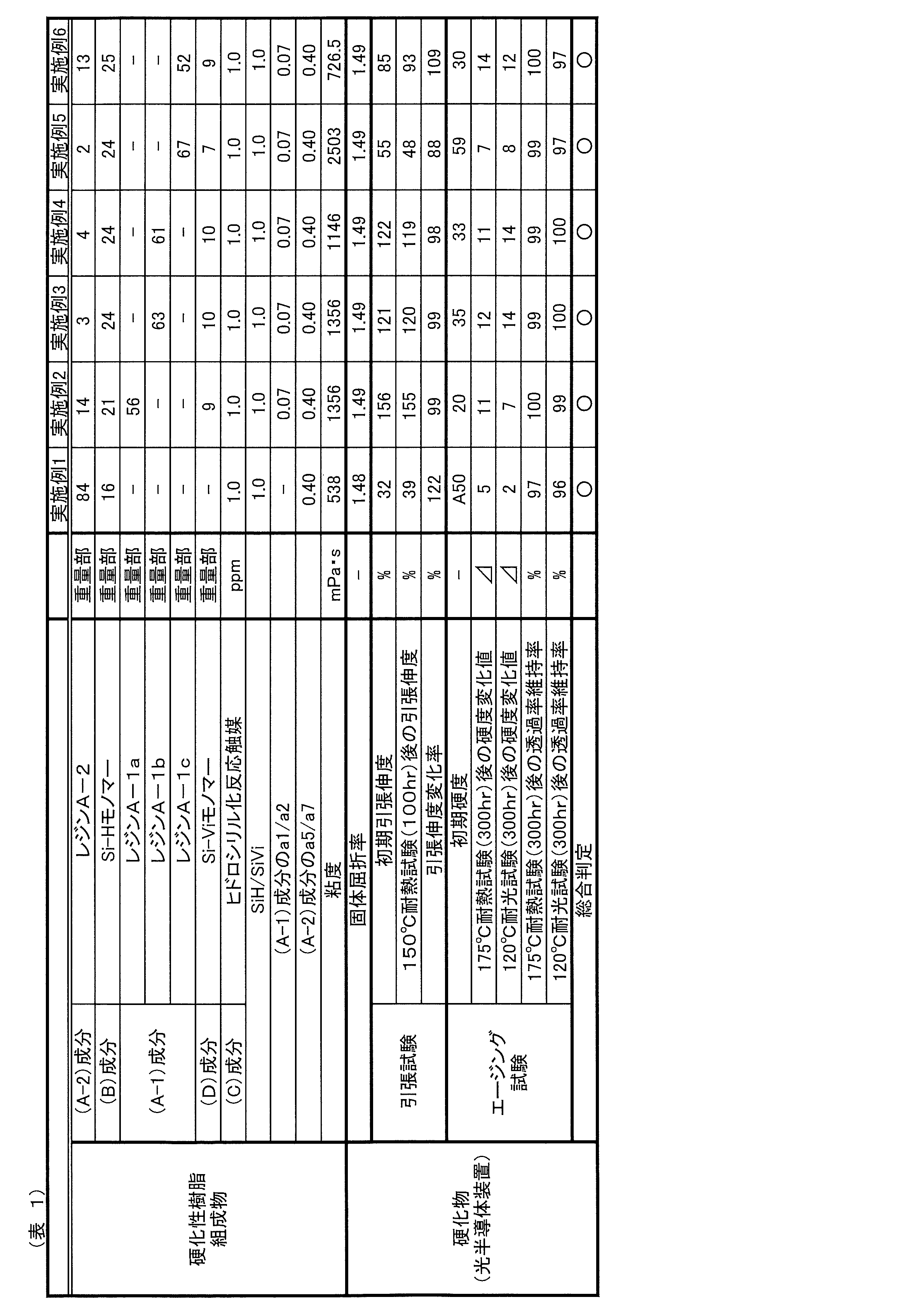

[1]下記の(A)成分、(B)成分、及び(C)成分を含む硬化性樹脂組成物であって、
(B)成分の含有量が、硬化性樹脂組成物中に存在するケイ素原子に結合したアルケニル基の合計1モルに対して、(B)成分中に存在するSiH基(ヒドロシリル基)が0.5~2モルとなる量であり、
硬化性樹脂組成物の全量(100重量%)に対する(A)成分の含有量が0.01~90重量%であることを特徴とする硬化性樹脂組成物。
(A):下記の(A-2)成分からなる群から選ばれる少なくとも一種のポリオルガノシロキサン
(A-2):下記平均単位式(Ib):
(SiO4/2)a5(R1bSiO3/2)a6(R1b 2SiO2/2)a7(R1b 3SiO1/2)a8 (Ib)
[式中、R1bは、同一又は異なって、炭素数1~10のアルキル基(好ましくはメチル基)、炭素数6~14のアリール基(好ましくはフェニル基)、炭素数2~8のアルケニル基(好ましくはビニル基)、炭素数1~10のアルコキシ基(好ましくはメトキシ基、エトキシ基)、又は水酸基であり、R1bの全量(100モル%)に対するアルキル基の割合をXbモル%、アリール基の割合をYbモル%、アルケニル基の割合をZbモル%としたとき、Xbは30~98モル%、Ybは1~50モル%、Zbは1~20モル%である。a5、a6、a7、及びa8は、a5>0、a6≧0、0.03≦a7≦0.7、a8>0、0.01≦a5/a7≦10、及びa5+a6+a7+a8=1を満たす数である。]
で表されるポリオルガノシロキサン
(B):下記平均組成式(II):
R2 mHnSiO[(4-m-n)/2] (II)
[式中、R2は、同一又は異なって、炭素数1~10のアルキル基(好ましくはメチル基)、又は炭素数6~14のアリール基(好ましくはフェニル基)である。ケイ素原子に結合した水素原子を少なくとも2個有する。m及びnは、0.7≦m≦2.1、0.001≦n≦1、及び0.8≦m+n≦3を満たす数である。]
で表されるポリオルガノシロキサン
(C):ヒドロシリル化触媒
[3]Ybが3~40モル%(好ましくは5~30モル%)である、上記[1]又は[2]に記載の硬化性樹脂組成物。
[4]Zbが2~15モル%(好ましくは3~10モル%)である、上記[1]~[3]のいずれか1つに記載の硬化性樹脂組成物。
[5]XbとYbの割合(Xb/Yb)が0.5~25(好ましくは1~20、さらに好ましくは2~15)である、上記[1]~[4]のいずれか1つに記載の硬化性樹脂組成物。
[7]a6が0~0.7(好ましくは0~0.6、より好ましくは0~0.5)である、上記[1]~[6]のいずれか1つに記載の硬化性樹脂組成物。
[8]a7が0.05~0.65(好ましくは0.1~0.6、より好ましくは0.1~0.5)である、上記[1]~[7]のいずれか1つに記載の硬化性樹脂組成物。
[9]a8が0.01~0.9(好ましくは0.03~0.8、より好ましくは0.05~0.7)である、上記[1]~[8]のいずれか1つに記載の硬化性樹脂組成物。
[10]a5/a7が0.02~8(好ましくは0.03~6)である、上記[1]~[9]のいずれか1つに記載の硬化性樹脂組成物。
[12](A-2)成分の分子量分布(Mw/Mn)が、1以上4以下(好ましくは1~3.5、より好ましくは1~3、特に好ましくは1~2.5)である、上記[1]~[11]のいずれか1つに記載の硬化性樹脂組成物。
[13](A-2)成分の25℃における粘度が、10mPa・s以上(好ましく100mPa・s以上、より好ましくは500mPa・s以上)である、上記[1]~[12]のいずれか1つに記載の硬化性樹脂組成物。
[14](A-2)成分の25℃における粘度が、1000000mPa・s以下(好ましくは100000mPa・s以下)である、上記[1]~[13]のいずれか1つに記載の硬化性樹脂組成物。
[15]硬化性樹脂組成物の全量(100重量%)に対する(A-2)成分の含有量が0.5~88重量%(好ましくは1~86重量%)である、上記[1]~[14]のいずれか1つに記載の硬化性樹脂組成物。
[16](A-2)成分と後述の(A-1)成分の合計量(100重量%)に対する(A-2)成分の含有量が0.1~100重量%(好ましくは1~100重量%)である、上記[1]~[15]のいずれか1つに記載の硬化性樹脂組成物。
(A-1):下記平均単位式(Ia):
(SiO4/2)a1(R1aSiO3/2)a2(R1a 2SiO2/2)a3(R1a 3SiO1/2)a4 (Ia)
[式中、R1aは、同一又は異なって、炭素数1~10のアルキル基(好ましくはメチル基)、炭素数6~14のアリール基(好ましくはフェニル基)、炭素数2~8のアルケニル基(好ましくはビニル基)、炭素数1~10のアルコキシ基(好ましくはメトキシ基、エトキシ基)、又は水酸基であり、R1aの全量(100モル%)に対するアルキル基の割合をXaモル%、アリール基の割合をYaモル%、アルケニル基の割合をZaモル%としたとき、Xaは30~98モル%、Yaは1~50モル%、Zaは1~20モル%である。a1、a2、a3、及びa4は、a1>0、a2>0、0≦a3<0.03、a4>0、0.01≦a1/a2≦10、及びa1+a2+a3+a4=1を満たす数である。]
で表されるポリオルガノシロキサン
[18]Xaが55~95モル%(好ましくは60~90モル%)である、上記[17]に記載の硬化性樹脂組成物。
[19]Yaが3~40モル%(好ましくは5~30モル%)である、上記[17]又は[18]に記載の硬化性樹脂組成物。
[20]Zaが2~15モル%(好ましくは3~10モル%)である、上記[17]~[19]のいずれか1つに記載の硬化性樹脂組成物。
[21]XaとYaの割合(Xa/Ya)が0.5~25(好ましくは1~20であり、より好ましくは2~15)である、上記[17]~[20]のいずれか1つに記載の硬化性樹脂組成物。
[22]a1が0.01~0.8(好ましくは0.02~0.7、より好ましくは0.03~0.6)である、上記[17]~[21]のいずれか1つに記載の硬化性樹脂組成物。
[23]a2が0.01~0.90(好ましくは0.03~0.85、より好ましくは0.05~0.8)である、上記[17]~[22]のいずれか1つに記載の硬化性樹脂組成物。
[24]a3が0~0.029(好ましくは0~0.02、より好ましくは0~0.01)である、上記[17]~[23]のいずれか1つに記載の硬化性樹脂組成物。
[25]a4が0.01~0.9(好ましくは0.03~0.8、より好ましくは0.05~0.7)である、上記[17]~[24]のいずれか1つに記載の硬化性樹脂組成物。
[26]a1/a2が0.02~8(好ましくは0.03~6)である、上記[17]~[25]のいずれか1つに記載の硬化性樹脂組成物。
[27](A-1)成分の重量平均分子量(Mw)がポリスチレン換算で500以上50000以下(好ましくは600以上40000以下、より好ましくは700以上20000以下、さらに好ましくは1000以上10000以下)である、上記[17]~[26]のいずれか1つに記載の硬化性樹脂組成物。
[28](A-1)成分の分子量分布(Mw/Mn)が1以上4以下(好ましくは1~3.5、より好ましくは1~3、さらに好ましくは1~2.5)である、上記[17]~[27]のいずれか1つに記載の硬化性樹脂組成物。
[29](A-1)成分の25℃における粘度が10mPa・s以上(好ましくは100mPa・s以上、より好ましくは500mPa・s以上である、上記[17]~[28]のいずれか1つに記載の硬化性樹脂組成物。
[30](A-1)成分の25℃における粘度が1000000mPa・s以下(好ましくは100000mPa・s以下)である、上記[17]~[29]のいずれか1つに記載の硬化性樹脂組成物。
[31]硬化性樹脂組成物の全量(100重量%)に対する(A-1)成分の含有量が0~80重量%(好ましくは0~75重量%)である、上記[17]~[30]のいずれか1つに記載の硬化性樹脂組成物。
[32](A-1)成分と(A-2)成分との合計量(100重量%)に対する(A-1)成分の含有量が0~99重量%(好ましくは0~98重量%)である、上記[17]~[31]のいずれか1つに記載の硬化性樹脂組成物。
[33](A-2)成分と(A-1)成分の重量比((A-2)成分/(A-1)成分)が100/0~1/99(好ましくは100/0~2/98)である、上記[17]~[32]のいずれか1つに記載の硬化性樹脂組成物。
[34](A-2)成分及び(A-1)成分の合計含有量(配合量)が、硬化性樹脂組成物の全量(100重量%)に対して、20~99重量%(好ましくは40~97重量%、より好ましくは50~95重量%)である、上記[17]~[33]のいずれか1つに記載の硬化性樹脂組成物。
[36](B)成分において、R2の全量(100モル%)に対するアリール基の割合をY'モル%としたとき、Yが1~80モル%(好ましくは3~60モル%、より好ましくは5~40モル%)である、上記[1]~[35]のいずれか1つに記載の硬化性樹脂組成物。
[37](B)成分において、R2の全量(100モル%)に対するSiH基(ヒドロシリル基)の割合をZ'モル%としたとき、Z'が2~70モル%(好ましくは5~60モル%、より好ましくは10~55モル%)である、上記[1]~[36]のいずれか1つに記載の硬化性樹脂組成物。
[38](B)成分おいて、アルキル基の含有量(X')とアリール基の含量(Y')の割合(X'/Y')が1/100~100/1(好ましくは10/100~100/10、より好ましくは20/100~100/20)である、上記[1]~[37]のいずれか1つに記載の硬化性樹脂組成物。
[39]mが0.8~2.1(好ましくは1~2)である、上記[1]~[38]のいずれか1つに記載の硬化性樹脂組成物。
[40]nが0.01~1(好ましくは0.2~1)である、上記[1]~[39]のいずれか1つに記載の硬化性樹脂組成物。
[41]m+nが1~2.9(好ましくは1.5~2.8)である、上記[1]~[40]のいずれか1つに記載の硬化性樹脂組成物。
[42](B)成分が、1分子中に(R2' 2HSiO1/2)[式中、R2'は、同一又は異なって、炭素数1~10のアルキル基(好ましくはメチル基)、又は炭素数6~14のアリール基(好ましくはフェニル基)である。]で表される構成単位(M単位)を少なくとも2個(好ましくは2~4個、より好ましくは2個)有する、上記[1]~[41]のいずれか1つに記載の硬化性樹脂組成物。
[43](B)成分の性状が、25℃における粘度が0.1~100000mPa・sの液状である、上記[1]~[42]のいずれか1つに記載の硬化性樹脂組成物。
[44](B)成分が、下記平均単位式で表され、(R2a 2HSiO1/2)で表される構成単位(M単位)を少なくとも2個有するポリオルガノシロキサンを含む、上記[1]~[43]のいずれか1つに記載の硬化性樹脂組成物。
(R2aSiO3/2)c1(R2a 2SiO2/2)c2(R2a 3SiO1/2)c3(SiO4/2)c4(X5O1/2)c5
[式中、R2aは、同一又は異なって、水素原子、炭素数1~10のアルキル基(好ましくはメチル基)、又は炭素数6~14のアリール基(好ましくはフェニル基)である。X5は、水素原子又はアルキル基(好ましくはメチル基)である。c1は0又は正数、c2は0又は正数、c3は0又は正数、c4は0又は正数、c5は0又は正数であり、かつ、(c1+c2+c3)は正数である。]
[45]R2aの全量(100モル%)に対する水素原子の割合が、1~70モル%である、上記[44]に記載の硬化性樹脂組成物。
[47]ケイ素原子に結合した基の全量(100モル%)に対する水素原子(ケイ素原子に結合した水素原子)の割合が1~70モル%である、上記[46]に記載の硬化性樹脂組成物。
[48]ケイ素原子に結合した基の全量(100モル%)に対するアルキル基(好ましくはメチル基)の割合が、20~95モル%(好ましくは40~95モル%)である、上記[46]又は[47]に記載の硬化性樹脂組成物。
[49]ケイ素原子に結合した基の全量(100モル%)に対するアリール基(好ましくはフェニル基)の割合が、1~80モル%である、上記[46]~[48]のいずれか1つに記載の硬化性樹脂組成物。
[50](B)成分が、下記式(II-1):

で表される直鎖状ポリオルガノシロキサン(以下、(B1)成分と称する場合がある)を含む、上記[46]~[49]のいずれか1つに記載の硬化性樹脂組成物。
[51](B)成分が、(B1)成分を1重量%以上99重量%以下(好ましくは10重量%以上50重量%以下)含有する、上記[50]に記載の硬化性樹脂組成物。
[52](B1)成分が、25℃で液体である、上記[50]又は[51]に記載の硬化性樹脂組成物。
[53](B1)成分の25℃における粘度が、10000mPa・s以下(好ましくは5000mPa・s以下)である、上記[50]~[52]のいずれか1つに記載の硬化性樹脂組成物。
[54](B1)成分の25℃における粘度が、1mPa・s以上(好ましくは5mPa・s以上)である、上記[50]~[53]のいずれか1つに記載の硬化性樹脂組成物。
[56]ケイ素原子に結合した基の全量(100モル%)に対するアルキル基(好ましくはメチル基)の割合が、20~95モル%(好ましくは50~90モル%)である、上記[55]に記載の硬化性樹脂組成物。
[57]ケイ素原子に結合した基の全量(100モル%)に対するアリール基(好ましくはフェニル基)の割合が、1~80モル%である、上記[55]又は[56]に記載の硬化性樹脂組成物。
[58]分岐鎖状ポリオルガノシロキサンが、c1が正数である上記[44]に記載の平均単位式で表される、上記[55]~[57]のいずれか1つに記載の硬化性樹脂組成物。
[59]c2/c1が0~10の数である、上記[58]に記載の硬化性樹脂組成物。
[60]c3/c1が0~0.5の数である、上記[58]又は[59]に記載の硬化性樹脂組成物。
[61]c4/(c1+c2+c3+c4)が0~0.3の数である、上記[58]~[60]のいずれか1つに記載の硬化性樹脂組成物。
[62]c5/(c1+c2+c3+c4)が0~0.4の数である、上記[58]~[61]のいずれか1つに記載の硬化性樹脂組成物。
[63]分岐鎖状ポリオルガノシロキサンのGPCによる標準ポリスチレン換算の重量平均分子量が、100~50000(好ましくは150~40000)である、上記[55]~[62]のいずれか1つに記載の硬化性樹脂組成物。
[65](B)成分の分子量分布(Mw/Mn)が、1以上4以下(好ましくは1~3.5、より好ましくは1~3、特に好ましくは1~2.5)である、上記[1]~[64]のいずれか1つに記載の硬化性樹脂組成物。
[66](B)成分の25℃における粘度が、1mPa・s以上(好ましくは5mPa・s以上)である、上記[1]~[65]のいずれか1つに記載の硬化性樹脂組成物。
[67](B)成分の25℃における粘度が、10000mPa・s以下(好ましくは5000mPa・s以下)である、上記[1]~[66]のいずれか1つに記載の硬化性樹脂組成物。
[69](B)成分が、平均組成式(II)で表されるポリオルガノシロキサンの1種を含むか、或いは平均組成式(II)で表されるポリオルガノシロキサンの異なる2種以上を含む、上記[1]~[68]のいずれか1つに記載の硬化性樹脂組成物。
[70](B)成分が、R2の少なくとも1つが炭素数6~14のアリール基(好ましくはフェニル基)である平均組成式(II)で表されるポリオルガノシロキサンを少なくとも1種含む、上記[1]~[69]のいずれか1つに記載の硬化性樹脂組成物。
[72](B)成分の含有量(配合量)が、硬化性樹脂組成物の全量(100重量%)に対して、5~50重量%(好ましくは7~45重量%、より好ましくは10~40重量%)である、上記[1]~[71]のいずれか1つに記載の硬化性樹脂組成物。
[73](B)成分の含有量(配合量)が、(A-2)成分((A-1)成分を含有する場合には、(A-1)成分及び(A-2)成分の合計量)100重量部に対して、1~200重量部(好ましくは5~150重量部、より好ましくは10~100重量部)である、上記[1]~[72]のいずれか1つに記載の硬化性樹脂組成物。
[75](C)成分の含有量(配合量)が、硬化性樹脂組成物に含まれる脂肪族炭素-炭素二重結合(特に、アルケニル基)の全量1モルに対して、1×10⁻⁸~1×10⁻²モル(好ましくは1×10⁻⁶~1×10⁻³モル)である、上記[1]~[74]のいずれか1つに記載の硬化性樹脂組成物。
[76](C)成分の含有量(配合量)が、ヒドロシリル化触媒中の白金、パラジウム、又はロジウムが重量単位で、0.01~1000ppmの範囲内となる量(好ましくは0.1~500ppmの範囲内となる量)である、上記[74]又は[75]に記載の硬化性樹脂組成物。
(D):ケイ素原子に結合した有機基の全量(100モル%)に対する炭素数2~6のアルケニル基(好ましくはビニル基)の割合が20~60モル%(好ましくは20~55モル%、より好ましくは25~50モル%)であり、ケイ素原子数が10以下(好ましくは8個以下、より好ましくは6個以下)であるポリオルガノシロキサン
[78](D)成分を構成するケイ素原子数が2個以上好ましくは3個以上)である、上記[77]に記載の硬化性樹脂組成物。
[79](D)成分が有するアルケニル基以外のケイ素原子に結合した有機基が、アルキル基(好ましくはメチル基)、又はアリール基(好ましくはフェニル基)である、上記[77]又は[78]に記載の硬化性樹脂組成物。
(RySiO3/2)y1(Ry 2SiO2/2)y2(Ry 3SiO1/2)y3(SiO4/2)y4(XyO1/2)y5
[式中、Ryは、同一又は異なって、一価の有機基であり、Ryの一部はアルケニル基(好ましくはビニル基)であり、その割合は、(D)成分におけるケイ素原子に結合した有機基の全量(100モル%)に対して20~60モル%(好ましくは20~55モル%、より好ましくは25~50モル%)となる範囲である。Xyは、水素原子又はアルキル基(好ましくはメチル基)である。y1は0又は正の整数、y2は0又は正の整数、y3は0又は正の整数、y4は0又は正の整数、y5は0又は正の整数であり、(y1+y2+y3)が正数であり、かつ、2≦y1+y2+y3+y4≦10(好ましくは2≦y1+y2+y3+y4≦8、より好ましくは2≦y1+y2+y3+y4≦6)を満たす正数である。]
[81]アルケニル基以外のRyが、アルキル基(好ましくはメチル基)、又はアリール基(好ましくはフェニル基)である、上記[80]に記載の硬化性樹脂組成物。
[83]直鎖状ポリオルガノシロキサンにおけるアルケニル基以外のケイ素原子に結合した基が、アルキル基(好ましくはメチル基)、又はアリール基(好ましくはフェニル基)である、上記[82]に記載の硬化性樹脂組成物。
[84]ケイ素原子に結合した有機基の全量(100モル%)に対するアルキル基(好ましくはメチル基)の割合が、0~80モル%(好ましくは40モル%以上、より好ましくは50~80モル%)である、上記[83]に記載の硬化性樹脂組成物。
[85]ケイ素原子に結合した有機基の全量(100モル%)に対するアリール基(好ましくはフェニル基)の割合が、0~80モル%(好ましくは5モル%以上、より好ましくは7~60モル%)である、上記[83]又は[84]に記載の硬化性樹脂組成物。

[87]アルケニル基以外のRy1が、アルキル基(好ましくはメチル基)、又はアリール基(好ましくはフェニル基)である、上記[86]に記載の硬化性樹脂組成物。
[89]分岐鎖状ポリオルガノシロキサンにおけるアルケニル基以外のケイ素原子に結合した基が、アルキル基(好ましくはメチル基)、又はアリール基(好ましくはフェニル基)である、上記[88]に記載の硬化性樹脂組成物。
[90]Rが、アルキル基(好ましくはメチル基)、又はアリール基(好ましくはフェニル基)である、上記[88]又は[89]に記載の硬化性樹脂組成物。
[91]ケイ素原子に結合した有機基の全量(100モル%)に対するアルキル基(好ましくはメチル基)の割合が、0~80モル%(好ましくは40モル%以上、より好ましくは50~80モル%)である、上記[89]又は[90]に記載の硬化性樹脂組成物。
[92]ケイ素原子に結合した有機基の全量(100モル%)に対するアリール基(好ましくはフェニル基)の割合が、0~80モル%(好ましくは5モル%以上、より好ましくは7~60モル%)である、上記[89]~[91]のいずれか1つに記載の硬化性樹脂組成物。
[93]分岐鎖状ポリオルガノシロキサンが、y1および/もしくはy4が正の整数である上記[80]の単位式で表される、上記[88]~[92]のいずれか1つに記載の硬化性樹脂組成物。
[94]y2/y1が0~10の数である、上記[93]に記載の硬化性樹脂組成物。
[95]y3/y1が0~3の数である、上記[93]又は[94]に記載の硬化性樹脂組成物。
[96]y4/(y1+y2+y3+y4)が0~0.3の数である、上記[93]~[95]のいずれか1つに記載の硬化性樹脂組成物。
[97]y5/(y1+y2+y3+y4)が0~0.4の数である、上記[93]~[96]のいずれか1つに記載の硬化性樹脂組成物。
[99]環状ポリオルガノシロキサンにおけるアルケニル基以外のケイ素原子に結合した基が、アルキル基(好ましくはメチル基)、又はアリール基(好ましくはフェニル基)である、上記[98]に記載の硬化性樹脂組成物。
[100]ケイ素原子に結合した有機基の全量(100モル%)に対するアルキル基(好ましくはメチル基)の割合が、0~80モル%(好ましくは40モル%以上、より好ましくは50~80モル%)である、上記[99]に記載の硬化性樹脂組成物。
[101]ケイ素原子に結合した有機基の全量(100モル%)に対するアリール基(好ましくはフェニル基)の割合が、0~80モル%(好ましくは5モル%以上、より好ましくは7~60モル%)である、上記[99]又は[100]に記載の硬化性樹脂組成物。
[103](D)成分の25℃における粘度が、1000mPa・s以下(好ましくは500mPa・s以下)である、上記[77]~[102]のいずれか1つに記載の硬化性樹脂組成物。
[104](D)成分の25℃における粘度が、0.1mPa・s以上(好ましくは1mPa・s以上)である、上記[77]~[103]のいずれか1つに記載の硬化性樹脂組成物。
[105](D)成分の含有量(配合量)が、硬化性樹脂組成物の全量(100重量%)に対して、3~30重量%(好ましくは3~25重量%、より好ましくは3~20重量%)である、上記[77]~[104]のいずれか1つに記載の硬化性樹脂組成物。
[106](D)成分の含有量(配合量)が、(A-2)成分((A-1)成分を含有する場合には、(A-1)成分及び(A-2)成分の合計量)100重量部に対して、5~50重量部(好ましくは5~40重量部、より好ましくは5~30重量部)である、上記[77]~[105]のいずれか1つに記載の硬化性樹脂組成物。
(E):下記平均単位式(X):
(RxSiO3/2)x1(Rx 2SiO2/2)x2(Rx 2SiRARx 2SiO2/2)x3(Rx 3SiO1/2)x4 (X)
[式中、Rxは、同一又は異なって、炭素数1~10のアルキル基(好ましくはメチル基)、炭素数6~14のアリール基(好ましくはフェニル基)、炭素数2~8のアルケニル基(好ましくはビニル基)、炭素数1~10のアルコキシ基(好ましくはメトキシ基、エトキシ基)、又は水酸基であり、Rxの全量(100モル%)に対するアリール基の割合が1~50モル%であり、全Rxの少なくとも2個はアルケニル基である。RAは、二価の炭化水素基(好ましくはエチレン基)である。x1、x2、x3、及びx4は、0.05>x1≧0、x2+x3>0、x4>0、及びx1+x2+x3+x4=1を満たす数である。]
で表されるオルガノポリシロキサン
[108](E)成分において、Rxの全量(100モル%)に対するアルキル基の割合をX"モル%としたとき、X"が30~98モル%(好ましくは55~95モル%、より好ましくは60~90モル%)である、上記[107]に記載の硬化性樹脂組成物。
[109](E)成分において、RXの全量(100モル%)に対するアリール基の割合をY"モル%としたとき、Y"が1~50モル%(好ましくは3~40モル%、より好ましくは5~30モル%)である、上記[107]又は[108]に記載の硬化性樹脂組成物。
[110](E)成分において、Rxの全量(100モル%)に対するアルケニル基の割合をZ"モル%としたとき、Z"が1~20モル%(好ましくは2~15モル%、より好ましくは3~10モル%)である、上記[107]~[109]のいずれか1つに記載の硬化性樹脂組成物。
[111](E)成分において、アルキル基の割合(X")とアリール基の割合(Y")の割合(X"/Y")が0.5~25(好ましくは1~20、より好ましくは2~15)である、上記[107]~[110]のいずれか1つに記載の硬化性樹脂組成物。
[112]x1が0.01以上0.04以下(好ましくは0.02以上0.03以下)である、上記[107]~[111]のいずれか1つに記載の硬化性樹脂組成物。
[113]x2が0.30~0.99(好ましくは0.40~0.98、より好ましくは0.50~0.97)である、上記[107]~[112]のいずれか1つに記載の硬化性樹脂組成物。
[114]x3が0.20~0.90(好ましくは0.30~0.80、より好ましくは0.40~0.70)である、上記[107]~[113]のいずれか1つに記載の硬化性樹脂組成物。
[115]x2+x3が0.30~0.99(好ましくは0.40~0.98、より好ましくは0.50~0.97)である、上記[107]~[114]のいずれか1つに記載の硬化性樹脂組成物。
[116]x4が0.01~0.50(好ましくは0.02~0.40、より好ましくは0.03~0.35)である、上記[107]~[115]のいずれか1つに記載の硬化性樹脂組成物。
[117]x1、x2、x3、及びx4が、0.05>x1>0、x2+x3>0、x3>0、x4>0、及びx1+x2+x3+x4=1を満たす数である、上記[107]~[116]のいずれか1つに記載の硬化性樹脂組成物。
[118](E)成分の重量平均分子量(Mw)が500以上50000以下(好ましくは600以上40000以下、より好ましくは700以上20000以下、特に好ましくは1000以上10000以下)である、上記[107]~[117]のいずれか1つに記載の硬化性樹脂組成物。
[119](E)成分の分子量分布(Mw/Mn)が1以上4以下(好ましくは1~3.5、より好ましくは1~3、特に好ましくは1~2.5)である、上記[107]~[118]のいずれか1つに記載の硬化性樹脂組成物。
[120](E)成分の25℃における粘度が10mPa・s以上(好ましく100mPa・s以上、より好ましくは500mPa・s以上)である、上記[107]~[119]のいずれか1つに記載の硬化性樹脂組成物。
[121](E)成分の25℃における粘度が1000000mPa・s以下(好ましくは100000mPa・s以下)である、上記[107]~[120]のいずれか1つに記載の硬化性樹脂組成物。
[122](E)成分の含有量(配合量)が、(A-2)成分((A-1)成分を含有する場合には、(A-1)成分及び(A-2)成分の合計量)100重量部に対して、50重量部以下(即ち、0~50重量部)(好ましくは0~40重量部、より好ましくは1~30重量部)である、上記[107]~[121]のいずれか1つに記載の硬化性樹脂組成物。
[123](E)成分の含有量(配合量)が、硬化性樹脂組成物の全量(100重量%)に対して、20重量%以下(即ち、0~20重量%)(好ましくは0~15重量%、より好ましくは1~10重量%)である、上記[107]~[122]のいずれか1つに記載の硬化性樹脂組成物。
(F):カルボン酸亜鉛、及び亜鉛βジケトン錯体からなる群から選ばれる少なくとも1種の亜鉛化合物
[125]カルボン酸亜鉛が、ナフテン酸亜鉛、オクチル酸亜鉛、アセト酢酸亜鉛、亜鉛(メタ)アクリレート、及び亜鉛ネオデカネートからなる群から選ばれる少なくとも1種(好ましくはナフテン酸亜鉛、オクチル酸亜鉛、より好ましくはオクチル酸亜鉛)である、上記[124]に記載の硬化性樹脂組成物。
[126]亜鉛βジケトン錯体が、下記式(1)で表される亜鉛βジケトン錯体を含む、上記[124]又は[125]に記載の硬化性樹脂組成物。
[Zn(L1)(L2)] (1)
[式中、L1及びL2は、同一又は異なって、下記式(1a)
R31COCHR32COR33 (1a)
で表される、β-ジケトン、又はβ-ケトエステルのアニオン若しくはエノラートアニオンを示す。式(1a)中、R31は、置換若しくは無置換のC1-30アルキル基を示す。R32は、水素原子、又は置換若しくは無置換のC1-30アルキル基(好ましくは水素原子)を示す。R33は、置換若しくは無置換のC1-30アルキル基、置換若しくは無置換の芳香族複素環式基、又は-OR34基(R34は、置換若しくは無置換のC1-30アルキル基を示す)を示す。R31及びR32は、互いに結合して環を形成してもよい。R32及びR33は、互いに結合して環を形成してもよい。]
[127]亜鉛βジケトン錯体が、以下の式(1’)で表される化合物を含む、上記[124]~[126]のいずれか1つに記載の硬化性樹脂組成物。

[128]R31、R32、R33、R34、R35、R36、R37、及びR38における「C1-30アルキル基」が、それぞれ独立して、C1-20アルキル基(C2-15アルキル基がより好ましく、C3-10アルキル基がさらに好ましく、分岐鎖を有するC3-10アルキル基が特に好ましい。イソプロピル基、イソブチル基、t-ブチル基、s-ブチル基、イソペンチル基、t-ペンチル基が最も好ましい。)である、上記[126]又は[127]に記載の硬化性樹脂組成物。
[129]R33、及びR37における「芳香族複素環式基」が、それぞれ独立して、ピリジル基、ピリミジニル基、ピラゾリル基、ピリダジニル基、ピラジニル基、トリアジニル基、フラニル基、チエニル基、インドリル基、オキサゾリル基、チアゾリル基、又はイミダゾリル基である、上記[126]~[128]のいずれか1つに記載の硬化性樹脂組成物。
[130]R31、R32、R33、R34、R35、R36、R37、及びR38における「置換基」が、それぞれ独立して、ハロゲン原子、ヒドロキシ基、及びカルボキシ基からなる群から選ばれる少なくとも1種である、上記[126]~[129]のいずれか1つに記載の硬化性樹脂組成物。
[131]亜鉛βジケトン錯体が、亜鉛ビスアセチルアセトネート、ビス(オクタン-2,4-ジオナト)亜鉛、亜鉛ビス(2,2,7-トリメチル-3,5-オクタンジオナート)、及び亜鉛ビスジピバロイルメタンからなる群から選ばれる少なくとも1種である、上記[124]~[130]のいずれか1つに記載の硬化性樹脂組成物。
[132](F)成分全重量(100重量%)に対する亜鉛含有量が、2~30重量%(好ましくは4~25重量%、特に好ましくは6~20重量%)である、上記[124]~[131]のいずれか1つに記載の硬化性樹脂組成物。
[133](F)成分の含有量が、(A-1)成分、(A-2)成分、(B)成分及び(D)成分の合計量(100重量部)に対して、0.01重量部以上1重量部未満(好ましくは0.03重量部以上0.8重量部未満、より好ましくは0.05重量部以上0.6重量部未満)である、上記[124]~[132]のいずれか1つに記載の硬化性樹脂組成物。
[134](F)成分の含有量が、硬化性樹脂組成物の全量(100重量%)に対して、0.01~1重量%(好ましくは0.05~0.5重量%)である、上記[124]~[133]のいずれか1つに記載の硬化性樹脂組成物。
(G):分子内に1個以上のアルケニル基(好ましくはビニル基)及び1個以上のアリール基(好ましくはフェニル基)を有するシルセスキオキサン
[136](G)成分が分子内に有するアルケニル基及びアリール基以外のケイ素原子に結合した基が、アルキル基(特にメチル基)である、上記[135]に記載の硬化性樹脂組成物。
[137](G)成分全体(100重量%)に占めるアルケニル基の割合が、1.0~20.0重量%(好ましくは1.5~15.0重量%)である、上記[135]又は[136]に記載の硬化性樹脂組成物。
[138](G)成分全体(100重量%)に占めるアリール基の割合が、1.0~50.0重量%(好ましくは5.0~25.0重量%)である、上記[135]~[137]のいずれか1つに記載の硬化性樹脂組成物。
[139](G)成分全体(100重量%)に占めるアルキル基の割合が、10.0~50.0重量%(好ましくは20.0~40.0重量%)である、上記[135]~[138]のいずれか1つに記載の硬化性樹脂組成物。
[140](G)成分における、分子内のアルケニル基の数が1個以上(好ましくは2~50個、より好ましくは2~30個)である、上記[135]~[139]のいずれか1つに記載の硬化性樹脂組成物。
[141](G)成分の重量平均分子量(Mw)が、100~800000(好ましくは200~100000、より好ましくは300~10000、特に好ましくは500~8000、最も好ましくは1700~7000)である、上記[135]~[140]のいずれか1つに記載の硬化性樹脂組成物。
[142](G)成分の数平均分子量(Mn)が、80~800000(好ましくは150~100000、より好ましくは250~10000、特に好ましくは400~8000、最も好ましくは1500~7000)である、上記[135]~[141]のいずれか1つに記載の硬化性樹脂組成物。
[143](G)成分の分子量分布(Mw/Mn)が、1.00~1.40(好ましくは1.35以下(例えば、1.05~1.35)、より好ましくは1.30以下(例えば、1.10~1.30))である、上記[135]~[142]のいずれか1つに記載の硬化性樹脂組成物。
[144](G)成分の23℃における粘度が、100~100000mPa・s(好ましくは500~10000mPa・s、より好ましくは1000~8000mPa・s)である、上記[135]~[143]のいずれか1つに記載の硬化性樹脂組成物。
[145](G)成分の含有量(配合量)が、(A-1)成分、(A-2)成分、(B)成分、及び(D)成分の合計100重量部に対して、0.05~50重量部(好ましくは0.1~45重量部、より好ましくは0.2~40重量部)である、上記[135]~[144]のいずれか1つに記載の硬化性樹脂組成物。
[146](G)成分の含有量(配合量)が、硬化性樹脂組成物(100重量%)に対して、0.01~20重量%(好ましくは0.05~15重量%、より好ましくは0.1~10重量%)である、上記[135]~[145]のいずれか1つに記載の硬化性樹脂組成物。
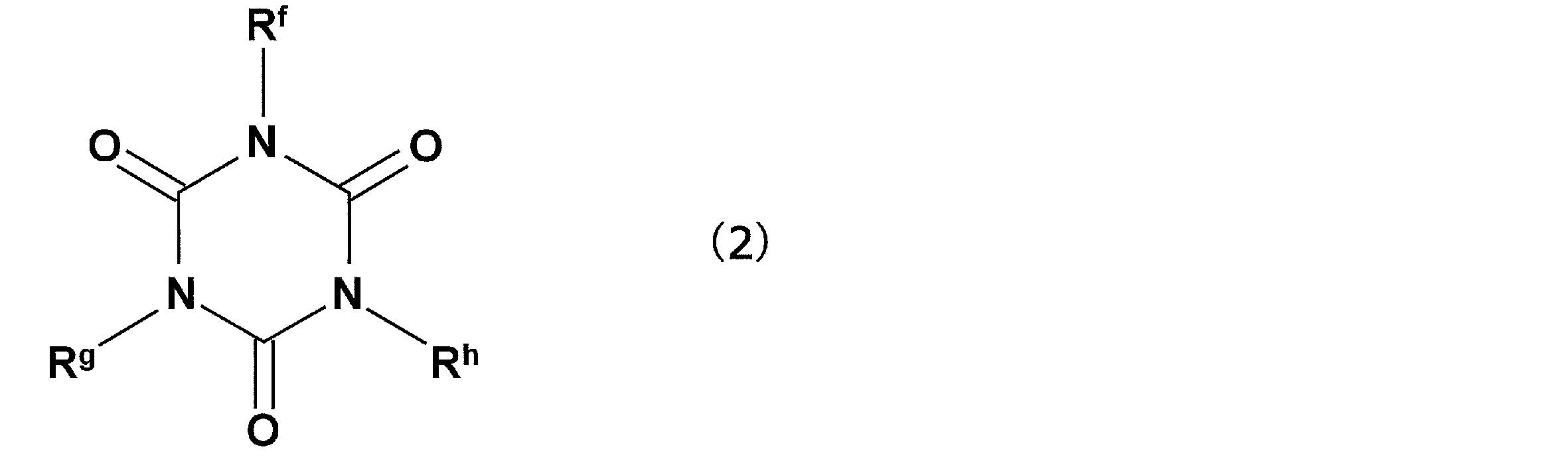


で表されるイソシアヌレート化合物(H)を含む、上記[1]~[146]のいずれか1つに記載の硬化性樹脂組成物。
[148]イソシアヌレート化合物(H)が、式(2)におけるRf、Rg、及びRhのうち1個が式(2b)で表される基である化合物(例えば、モノアリルジグリシジルイソシアヌレート、1-アリル-3,5-ビス(2-メチルエポキシプロピル)イソシアヌレート、1-(2-メチルプロペニル)-3,5-ジグリシジルイソシアヌレート、1-(2-メチルプロペニル)-3,5-ビス(2-メチルエポキシプロピル)イソシアヌレート)、式(2)におけるRf、Rg、及びRhのうち2個が式(2b)で表される化合物(例えば、ジアリルモノグリシジルイソシアヌレート、1,3-ジアリル-5-(2-メチルエポキシプロピル)イソシアヌレート、1,3-ビス(2-メチルプロペニル)-5-グリシジルイソシアヌレート、1,3-ビス(2-メチルプロペニル)-5-(2-メチルエポキシプロピル)イソシアヌレート)、及び式(2)におけるRf、Rg、及びRhの全てが式(2b)で表される化合物(例えば、トリアリルイソシアヌレート、トリス(2-メチルプロペニル)イソシアヌレート)からなる群から選ばれる少なくとも1種を含む、上記[147]に記載の硬化性樹脂組成物。
[149]イソシアヌレート化合物(H)の含有量(配合量)が、硬化性樹脂組成物(100重量%)に対して、0.01~6重量%(好ましくは0.05~4重量%、さらに好ましくは0.08~3重量%)である、上記[147]又は[148]に記載の硬化性樹脂組成物。
[151]シランカップリング剤(I)の含有量(配合量)が、硬化性樹脂組成物(100重量%)に対して、0.01~15重量%(好ましくは0.1~10重量%、さらに好ましくは0.5~5重量%)である、上記[150]に記載の硬化性樹脂組成物。
[153]無機充填剤(J)の一次粒子の平均粒径が、0.001μm~100μm(好ましくは0.05μm~50μm)である、上記[152]に記載の硬化性樹脂組成物。
[154]無機充填剤(J)の含有量(配合量)が、硬化性樹脂組成物(100重量%)に対して、0.01~90重量%(好ましくは0.1~40重量%、より好ましくは0.5~30重量%、さらに好ましくは1~20重量%)である、上記[152]又は[153]に記載の硬化性樹脂組成物。
[156]硬化性樹脂組成物の23℃における粘度が、300~20000mPa・s(好ましくは500~10000mPa・s、より好ましくは1000~8000mPa・s)である、上記[1]~[155]のいずれか1つに記載の硬化性樹脂組成物。
[158]589nmにおける屈折率が1.46以上1.54以下(好ましくは1.465~1.535、さらに好ましくは1.47~1.53)であることを特徴とする、上記[157]に記載の硬化物。
[159]封止剤である、上記[1]~[156]のいずれか1つに記載の硬化性樹脂組成物。
[160]レンズ形成用樹脂組成物である、上記[1]~[156]のいずれか1つに記載の硬化性樹脂組成物。
[161]半導体素子と、該半導体素子を封止する封止材とを有する半導体装置であって、前記封止材が、上記[159]に記載の硬化性樹脂組成物の硬化物であることを特徴とする半導体装置。
[162]半導体素子とレンズとを有する半導体装置であって、前記レンズが、上記[160]に記載の硬化性樹脂組成物の硬化物であることを特徴とする半導体装置。
[163]半導体素子と、該半導体素子を封止する封止材と、レンズとを有する半導体装置であって、前記封止材が、上記[159]に記載の硬化性樹脂組成物の硬化物であり、前記レンズが、上記[160]に記載の硬化性樹脂組成物の硬化物であることを特徴とする半導体装置。
[164]硬化物の589nmにおける屈折率が、1.46以上1.54以下(好ましくは1.465~1.535、より好ましくは1.47~1.53)である、上記[161]~[163]のいずれか1つに記載の半導体装置。
[165]光半導体装置である上記[161]~[164]のいずれか1つに記載の半導体装置。
101:金属配線(電極)
102:光半導体素子
103:ボンディングワイヤ
104:硬化物(封止材)
Claims (23)
- 下記の(A)成分、(B)成分、及び(C)成分を含む硬化性樹脂組成物であって、
(B)成分の含有量が、硬化性樹脂組成物中に存在するケイ素原子に結合したアルケニル基の合計1モルに対して、(B)成分中に存在するSiH基(ヒドロシリル基)が0.5~2モルとなる量であり、
硬化性樹脂組成物の全量(100重量%)に対する(A)成分の含有量が0.01~90重量%であることを特徴とする硬化性樹脂組成物。
(A):下記の(A-2)成分からなる群から選ばれる少なくとも一種のポリオルガノシロキサン
(A-2):下記平均単位式(Ib):
(SiO4/2)a5(R1bSiO3/2)a6(R1b 2SiO2/2)a7(R1b 3SiO1/2)a8 (Ib)
[式中、R1bは、同一又は異なって、炭素数1~10のアルキル基、炭素数6~14のアリール基、炭素数2~8のアルケニル基、炭素数1~10のアルコキシ基、又は水酸基であり、R1bの全量(100モル%)に対するアルキル基の割合をXbモル%、アリール基の割合をYbモル%、アルケニル基の割合をZbモル%としたとき、Xbは30~98モル%、Ybは1~50モル%、Zbは1~20モル%である。a5、a6、a7、及びa8は、a5>0、a6≧0、0.03≦a7≦0.7、a8>0、0.01≦a5/a7≦10、及びa5+a6+a7+a8=1を満たす数である。]
で表されるポリオルガノシロキサン
(B):下記平均組成式(II):
R2 mHnSiO[(4-m-n)/2] (II)
[式中、R2は、同一又は異なって、炭素数1~10のアルキル基、又は炭素数6~14のアリール基である。ケイ素原子に結合した水素原子を少なくとも2個有する。m及びnは、0.7≦m≦2.1、0.001≦n≦1、及び0.8≦m+n≦3を満たす数である。]
で表されるポリオルガノシロキサン
(C):ヒドロシリル化触媒 - さらに、下記の(A-1)成分を含む、請求項1に記載の硬化性樹脂組成物。
(A-1):下記平均単位式(Ia):
(SiO4/2)a1(R1aSiO3/2)a2(R1a 2SiO2/2)a3(R1a 3SiO1/2)a4 (Ia)
[式中、R1aは、同一又は異なって、炭素数1~10のアルキル基、炭素数6~14のアリール基、炭素数2~8のアルケニル基、炭素数1~10のアルコキシ基、又は水酸基であり、R1aの全量(100モル%)に対するアルキル基の割合をXaモル%、アリール基の割合をYaモル%、アルケニル基の割合をZaモル%としたとき、Xaは30~98モル%、Yaは1~50モル%、Zaは1~20モル%である。a1、a2、a3、及びa4は、a1>0、a2>0、0≦a3<0.03、a4>0、0.01≦a1/a2≦10、及びa1+a2+a3+a4=1を満たす数である。]
で表されるポリオルガノシロキサン - さらに、下記の(D)成分を含む、請求項1又は2に記載の硬化性樹脂組成物。
(D):ケイ素原子に結合した有機基の全量(100モル%)に対する炭素数2~6のアルケニル基の割合が20~60モル%であり、ケイ素原子数が10以下であるポリオルガノシロキサン - (A-2)成分が、
重量平均分子量がポリスチレン換算で500以上50000以下であり、
分子量分布が1以上4以下であり、
25℃での粘度が10mPa・s以上の液体もしくは固体である
ポリオルガノシロキサンである、請求項1~3のいずれか1項に記載の硬化性樹脂組成物。 - (A-1)成分が、
重量平均分子量がポリスチレン換算で500以上50000以下であり、
分子量分布が1以上4以下であり、
25℃での粘度が10mPa・s以上の液体もしくは固体である
ポリオルガノシロキサンである、請求項2~4のいずれか1項に記載の硬化性樹脂組成物。 - 前記(A-2)成分において、XbとYbの割合(Xb/Yb)が0.5~25である、請求項1~5のいずれか1項に記載の硬化性樹脂組成物。
- 前記(A-1)成分において、XaとYaの割合(Xa/Ya)が0.5~25である、請求項2~6のいずれか1項に記載の硬化性樹脂組成物。
- さらに、下記の(E)成分を、(A-2)成分((A-1)成分を含有する場合には、(A-1)成分及び(A-2)成分の合計量)100重量部に対して50重量部以下含む、請求項1~7のいずれか1項に記載の硬化性樹脂組成物。
(E):下記平均単位式(X):
(RxSiO3/2)x1(Rx 2SiO2/2)x2(Rx 2SiRARx 2SiO2/2)x3(Rx 3SiO1/2)x4 (X)
[式中、Rxは、同一又は異なって、炭素数1~10のアルキル基、炭素数6~14のアリール基、炭素数2~8のアルケニル基、炭素数1~10のアルコキシ基、又は水酸基であり、Rxの全量(100モル%)に対するアリール基の割合が1~50モル%であり、全Rxの少なくとも2個はアルケニル基である。RAは、二価の炭化水素基である。x1、x2、x3、及びx4は、0.05>x1≧0、x2+x3>0、x4>0、及びx1+x2+x3+x4=1を満たす数である。]
で表されるオルガノポリシロキサン - さらに、下記の(F)成分を含む、請求項1~8のいずれか1項に記載の硬化性樹脂組成物。
(F):カルボン酸亜鉛、及び亜鉛βジケトン錯体からなる群から選ばれる少なくとも1種の亜鉛化合物 - 前記(F)成分の含有量が、硬化性樹脂組成物の全量(100重量%)に対して、0.01~1重量%である、請求項9に記載の硬化性樹脂組成物。
- さらに、下記の(G)成分を含む、請求項1~10のいずれか1項に記載の硬化性樹脂組成物。
(G):分子内に1個以上のアルケニル基及び1個以上のアリール基を有するシルセスキオキサン - さらに、下記式(2)



で表されるイソシアヌレート化合物(H)を含む、請求項1~11のいずれか1項に記載の硬化性樹脂組成物。 - さらに、シランカップリング剤(I)を含む、請求項1~12のいずれか1項に記載の硬化性樹脂組成物。
- さらに、無機充填剤(J)を含む、請求項1~13のいずれか1項に記載の硬化性樹脂組成物。
- 請求項1~14のいずれか1項に記載の硬化性樹脂組成物の硬化物。
- 589nmにおける屈折率が1.46以上1.54以下であることを特徴とする、請求項15に記載の硬化物。
- 封止剤である、請求項1~14のいずれか1項に記載の硬化性樹脂組成物。
- レンズ形成用樹脂組成物である、請求項1~14のいずれか1項に記載の硬化性樹脂組成物。
- 半導体素子と、該半導体素子を封止する封止材とを有する半導体装置であって、前記封止材が、請求項17に記載の硬化性樹脂組成物の硬化物であることを特徴とする半導体装置。
- 半導体素子とレンズとを有する半導体装置であって、前記レンズが、請求項18に記載の硬化性樹脂組成物の硬化物であることを特徴とする半導体装置。
- 半導体素子と、該半導体素子を封止する封止材と、レンズとを有する半導体装置であって、前記封止材が、請求項17に記載の硬化性樹脂組成物の硬化物であり、前記レンズが、請求項18に記載の硬化性樹脂組成物の硬化物であることを特徴とする半導体装置。
- 硬化物の589nmにおける屈折率が、1.46以上1.54以下である、請求項19~21のいずれか1項に記載の半導体装置。
- 光半導体装置である請求項19~22のいずれか1項に記載の半導体装置。
Priority Applications (3)
| Application Number | Priority Date | Filing Date | Title |
|---|---|---|---|
| KR1020197023605A KR102518155B1 (ko) | 2017-01-16 | 2018-01-05 | 경화성 수지 조성물, 그의 경화물 및 반도체 장치 |
| CN201880006968.1A CN110177841A (zh) | 2017-01-16 | 2018-01-05 | 固化性树脂组合物、其固化物及半导体装置 |
| JP2018561348A JP6985613B2 (ja) | 2017-01-16 | 2018-01-05 | 硬化性樹脂組成物、その硬化物、及び半導体装置 |
Applications Claiming Priority (2)
| Application Number | Priority Date | Filing Date | Title |
|---|---|---|---|
| JP2017005454 | 2017-01-16 | ||
| JP2017-005454 | 2017-01-16 |
Publications (1)
| Publication Number | Publication Date |
|---|---|
| WO2018131545A1 true WO2018131545A1 (ja) | 2018-07-19 |
Family
ID=62839968
Family Applications (1)
| Application Number | Title | Priority Date | Filing Date |
|---|---|---|---|
| PCT/JP2018/000113 Ceased WO2018131545A1 (ja) | 2017-01-16 | 2018-01-05 | 硬化性樹脂組成物、その硬化物、及び半導体装置 |
Country Status (5)
| Country | Link |
|---|---|
| JP (1) | JP6985613B2 (ja) |
| KR (1) | KR102518155B1 (ja) |
| CN (1) | CN110177841A (ja) |
| TW (1) | TW201831603A (ja) |
| WO (1) | WO2018131545A1 (ja) |
Cited By (1)
| Publication number | Priority date | Publication date | Assignee | Title |
|---|---|---|---|---|
| WO2022181281A1 (ja) * | 2021-02-25 | 2022-09-01 | コニカミノルタ株式会社 | 封止材組成物、半導体封止材料及び半導体 |
Citations (5)
| Publication number | Priority date | Publication date | Assignee | Title |
|---|---|---|---|---|
| JP2012012433A (ja) * | 2010-06-29 | 2012-01-19 | Dow Corning Toray Co Ltd | 硬化性オルガノポリシロキサン組成物および光半導体装置 |
| WO2015016000A1 (ja) * | 2013-08-01 | 2015-02-05 | 株式会社ダイセル | 硬化性樹脂組成物及びそれを用いた半導体装置 |
| JP2016520678A (ja) * | 2013-04-04 | 2016-07-14 | エルジー・ケム・リミテッド | 硬化性組成物 |
| JP2016521300A (ja) * | 2013-04-04 | 2016-07-21 | エルジー・ケム・リミテッド | 硬化性組成物 |
| JP2016216598A (ja) * | 2015-05-20 | 2016-12-22 | 株式会社ダイセル | 硬化性シリコーン樹脂組成物及びその硬化物 |
Family Cites Families (2)
| Publication number | Priority date | Publication date | Assignee | Title |
|---|---|---|---|---|
| JP4409160B2 (ja) | 2002-10-28 | 2010-02-03 | 東レ・ダウコーニング株式会社 | 硬化性オルガノポリシロキサン組成物および半導体装置 |
| US9646904B2 (en) | 2013-01-09 | 2017-05-09 | Daicel Corporation | Curable resin composition, and cured product of same |
-
2018
- 2018-01-05 CN CN201880006968.1A patent/CN110177841A/zh active Pending
- 2018-01-05 WO PCT/JP2018/000113 patent/WO2018131545A1/ja not_active Ceased
- 2018-01-05 KR KR1020197023605A patent/KR102518155B1/ko active Active
- 2018-01-05 JP JP2018561348A patent/JP6985613B2/ja active Active
- 2018-01-12 TW TW107101168A patent/TW201831603A/zh unknown
Patent Citations (5)
| Publication number | Priority date | Publication date | Assignee | Title |
|---|---|---|---|---|
| JP2012012433A (ja) * | 2010-06-29 | 2012-01-19 | Dow Corning Toray Co Ltd | 硬化性オルガノポリシロキサン組成物および光半導体装置 |
| JP2016520678A (ja) * | 2013-04-04 | 2016-07-14 | エルジー・ケム・リミテッド | 硬化性組成物 |
| JP2016521300A (ja) * | 2013-04-04 | 2016-07-21 | エルジー・ケム・リミテッド | 硬化性組成物 |
| WO2015016000A1 (ja) * | 2013-08-01 | 2015-02-05 | 株式会社ダイセル | 硬化性樹脂組成物及びそれを用いた半導体装置 |
| JP2016216598A (ja) * | 2015-05-20 | 2016-12-22 | 株式会社ダイセル | 硬化性シリコーン樹脂組成物及びその硬化物 |
Cited By (2)
| Publication number | Priority date | Publication date | Assignee | Title |
|---|---|---|---|---|
| WO2022181281A1 (ja) * | 2021-02-25 | 2022-09-01 | コニカミノルタ株式会社 | 封止材組成物、半導体封止材料及び半導体 |
| JPWO2022181281A1 (ja) * | 2021-02-25 | 2022-09-01 |
Also Published As
| Publication number | Publication date |
|---|---|
| TW201831603A (zh) | 2018-09-01 |
| CN110177841A (zh) | 2019-08-27 |
| KR20190103366A (ko) | 2019-09-04 |
| KR102518155B1 (ko) | 2023-04-06 |
| JPWO2018131545A1 (ja) | 2019-11-07 |
| JP6985613B2 (ja) | 2021-12-22 |
Similar Documents
| Publication | Publication Date | Title |
|---|---|---|
| JP6944120B2 (ja) | 硬化性樹脂組成物、その硬化物、及び半導体装置 | |
| JP6567693B2 (ja) | 縮合反応型シリコーン組成物及び硬化物 | |
| JP6871545B2 (ja) | 硬化性樹脂組成物、その硬化物、及び半導体装置 | |
| JP2016216606A (ja) | 硬化性樹脂組成物及びその硬化物、並びに半導体装置 | |
| JP6533387B2 (ja) | 硬化性樹脂組成物及びその硬化物、並びに半導体装置 | |
| JP2016108393A (ja) | 硬化性シリコーン樹脂組成物及びその硬化物 | |
| JP6944119B2 (ja) | 硬化性樹脂組成物、その硬化物、及び半導体装置 | |
| JP6496185B2 (ja) | 硬化性シリコーン樹脂組成物及びその硬化物 | |
| JP6826581B2 (ja) | 硬化性樹脂組成物、その硬化物、及び半導体装置 | |
| WO2015178475A1 (ja) | 分岐鎖状ポリオルガノシロキシシルアルキレン、その製造方法、硬化性樹脂組成物、及び半導体装置 | |
| JP6985613B2 (ja) | 硬化性樹脂組成物、その硬化物、及び半導体装置 | |
| WO2018235811A1 (ja) | 硬化性シリコーン樹脂組成物及びその硬化物 | |
| JP6452545B2 (ja) | 硬化性シリコーン樹脂組成物及びその硬化物 | |
| JP2017002172A (ja) | 高硬度ポリシロキサン硬化物を与える硬化性樹脂組成物及びその硬化物 | |
| JP6460714B2 (ja) | 硬化性樹脂組成物及びその硬化物、並びに半導体装置 | |
| JPWO2017126538A1 (ja) | 新規ポリオルガノシロキシシルアルキレン、硬化性樹脂組成物及びその硬化物 | |
| JP2017075216A (ja) | 硬化性樹脂組成物、その硬化物、及び半導体装置 |
Legal Events
| Date | Code | Title | Description |
|---|---|---|---|
| 121 | Ep: the epo has been informed by wipo that ep was designated in this application |
Ref document number: 18738475 Country of ref document: EP Kind code of ref document: A1 |
|
| ENP | Entry into the national phase |
Ref document number: 2018561348 Country of ref document: JP Kind code of ref document: A |
|
| NENP | Non-entry into the national phase |
Ref country code: DE |
|
| ENP | Entry into the national phase |
Ref document number: 20197023605 Country of ref document: KR Kind code of ref document: A |
|
| 122 | Ep: pct application non-entry in european phase |
Ref document number: 18738475 Country of ref document: EP Kind code of ref document: A1 |