WO2018079203A1 - 樹脂の製造方法、及び、感活性光線性又は感放射線性組成物の製造方法 - Google Patents
樹脂の製造方法、及び、感活性光線性又は感放射線性組成物の製造方法 Download PDFInfo
- Publication number
- WO2018079203A1 WO2018079203A1 PCT/JP2017/035839 JP2017035839W WO2018079203A1 WO 2018079203 A1 WO2018079203 A1 WO 2018079203A1 JP 2017035839 W JP2017035839 W JP 2017035839W WO 2018079203 A1 WO2018079203 A1 WO 2018079203A1
- Authority
- WO
- WIPO (PCT)
- Prior art keywords
- group
- general formula
- repeating unit
- resin
- acid
- Prior art date
- Legal status (The legal status is an assumption and is not a legal conclusion. Google has not performed a legal analysis and makes no representation as to the accuracy of the status listed.)
- Ceased
Links
Classifications
-
- C—CHEMISTRY; METALLURGY
- C08—ORGANIC MACROMOLECULAR COMPOUNDS; THEIR PREPARATION OR CHEMICAL WORKING-UP; COMPOSITIONS BASED THEREON
- C08F—MACROMOLECULAR COMPOUNDS OBTAINED BY REACTIONS ONLY INVOLVING CARBON-TO-CARBON UNSATURATED BONDS
- C08F212/00—Copolymers of compounds having one or more unsaturated aliphatic radicals, each having only one carbon-to-carbon double bond, and at least one being terminated by an aromatic carbocyclic ring
- C08F212/02—Monomers containing only one unsaturated aliphatic radical
- C08F212/04—Monomers containing only one unsaturated aliphatic radical containing one ring
- C08F212/14—Monomers containing only one unsaturated aliphatic radical containing one ring substituted by heteroatoms or groups containing heteroatoms
- C08F212/22—Oxygen
-
- C—CHEMISTRY; METALLURGY
- C08—ORGANIC MACROMOLECULAR COMPOUNDS; THEIR PREPARATION OR CHEMICAL WORKING-UP; COMPOSITIONS BASED THEREON
- C08F—MACROMOLECULAR COMPOUNDS OBTAINED BY REACTIONS ONLY INVOLVING CARBON-TO-CARBON UNSATURATED BONDS
- C08F212/00—Copolymers of compounds having one or more unsaturated aliphatic radicals, each having only one carbon-to-carbon double bond, and at least one being terminated by an aromatic carbocyclic ring
- C08F212/02—Monomers containing only one unsaturated aliphatic radical
- C08F212/04—Monomers containing only one unsaturated aliphatic radical containing one ring
- C08F212/14—Monomers containing only one unsaturated aliphatic radical containing one ring substituted by heteroatoms or groups containing heteroatoms
-
- C—CHEMISTRY; METALLURGY
- C08—ORGANIC MACROMOLECULAR COMPOUNDS; THEIR PREPARATION OR CHEMICAL WORKING-UP; COMPOSITIONS BASED THEREON
- C08F—MACROMOLECULAR COMPOUNDS OBTAINED BY REACTIONS ONLY INVOLVING CARBON-TO-CARBON UNSATURATED BONDS
- C08F220/00—Copolymers of compounds having one or more unsaturated aliphatic radicals, each having only one carbon-to-carbon double bond, and only one being terminated by only one carboxyl radical or a salt, anhydride ester, amide, imide or nitrile thereof
- C08F220/02—Monocarboxylic acids having less than ten carbon atoms; Derivatives thereof
- C08F220/10—Esters
- C08F220/12—Esters of monohydric alcohols or phenols
- C08F220/16—Esters of monohydric alcohols or phenols of phenols or of alcohols containing two or more carbon atoms
-
- C—CHEMISTRY; METALLURGY
- C08—ORGANIC MACROMOLECULAR COMPOUNDS; THEIR PREPARATION OR CHEMICAL WORKING-UP; COMPOSITIONS BASED THEREON
- C08F—MACROMOLECULAR COMPOUNDS OBTAINED BY REACTIONS ONLY INVOLVING CARBON-TO-CARBON UNSATURATED BONDS
- C08F220/00—Copolymers of compounds having one or more unsaturated aliphatic radicals, each having only one carbon-to-carbon double bond, and only one being terminated by only one carboxyl radical or a salt, anhydride ester, amide, imide or nitrile thereof
- C08F220/02—Monocarboxylic acids having less than ten carbon atoms; Derivatives thereof
- C08F220/10—Esters
- C08F220/12—Esters of monohydric alcohols or phenols
- C08F220/16—Esters of monohydric alcohols or phenols of phenols or of alcohols containing two or more carbon atoms
- C08F220/18—Esters of monohydric alcohols or phenols of phenols or of alcohols containing two or more carbon atoms with acrylic or methacrylic acids
-
- C—CHEMISTRY; METALLURGY
- C08—ORGANIC MACROMOLECULAR COMPOUNDS; THEIR PREPARATION OR CHEMICAL WORKING-UP; COMPOSITIONS BASED THEREON
- C08F—MACROMOLECULAR COMPOUNDS OBTAINED BY REACTIONS ONLY INVOLVING CARBON-TO-CARBON UNSATURATED BONDS
- C08F220/00—Copolymers of compounds having one or more unsaturated aliphatic radicals, each having only one carbon-to-carbon double bond, and only one being terminated by only one carboxyl radical or a salt, anhydride ester, amide, imide or nitrile thereof
- C08F220/02—Monocarboxylic acids having less than ten carbon atoms; Derivatives thereof
- C08F220/10—Esters
- C08F220/26—Esters containing oxygen in addition to the carboxy oxygen
- C08F220/30—Esters containing oxygen in addition to the carboxy oxygen containing aromatic rings in the alcohol moiety
-
- C—CHEMISTRY; METALLURGY
- C08—ORGANIC MACROMOLECULAR COMPOUNDS; THEIR PREPARATION OR CHEMICAL WORKING-UP; COMPOSITIONS BASED THEREON
- C08F—MACROMOLECULAR COMPOUNDS OBTAINED BY REACTIONS ONLY INVOLVING CARBON-TO-CARBON UNSATURATED BONDS
- C08F220/00—Copolymers of compounds having one or more unsaturated aliphatic radicals, each having only one carbon-to-carbon double bond, and only one being terminated by only one carboxyl radical or a salt, anhydride ester, amide, imide or nitrile thereof
- C08F220/02—Monocarboxylic acids having less than ten carbon atoms; Derivatives thereof
- C08F220/10—Esters
- C08F220/26—Esters containing oxygen in addition to the carboxy oxygen
- C08F220/30—Esters containing oxygen in addition to the carboxy oxygen containing aromatic rings in the alcohol moiety
- C08F220/302—Esters containing oxygen in addition to the carboxy oxygen containing aromatic rings in the alcohol moiety and two or more oxygen atoms in the alcohol moiety
-
- C—CHEMISTRY; METALLURGY
- C08—ORGANIC MACROMOLECULAR COMPOUNDS; THEIR PREPARATION OR CHEMICAL WORKING-UP; COMPOSITIONS BASED THEREON
- C08F—MACROMOLECULAR COMPOUNDS OBTAINED BY REACTIONS ONLY INVOLVING CARBON-TO-CARBON UNSATURATED BONDS
- C08F220/00—Copolymers of compounds having one or more unsaturated aliphatic radicals, each having only one carbon-to-carbon double bond, and only one being terminated by only one carboxyl radical or a salt, anhydride ester, amide, imide or nitrile thereof
- C08F220/02—Monocarboxylic acids having less than ten carbon atoms; Derivatives thereof
- C08F220/10—Esters
- C08F220/34—Esters containing nitrogen, e.g. N,N-dimethylaminoethyl (meth)acrylate
- C08F220/36—Esters containing nitrogen, e.g. N,N-dimethylaminoethyl (meth)acrylate containing oxygen in addition to the carboxy oxygen, e.g. 2-N-morpholinoethyl (meth)acrylate or 2-isocyanatoethyl (meth)acrylate
-
- C—CHEMISTRY; METALLURGY
- C08—ORGANIC MACROMOLECULAR COMPOUNDS; THEIR PREPARATION OR CHEMICAL WORKING-UP; COMPOSITIONS BASED THEREON
- C08F—MACROMOLECULAR COMPOUNDS OBTAINED BY REACTIONS ONLY INVOLVING CARBON-TO-CARBON UNSATURATED BONDS
- C08F224/00—Copolymers of compounds having one or more unsaturated aliphatic radicals, each having only one carbon-to-carbon double bond, and at least one being terminated by a heterocyclic ring containing oxygen
-
- C—CHEMISTRY; METALLURGY
- C08—ORGANIC MACROMOLECULAR COMPOUNDS; THEIR PREPARATION OR CHEMICAL WORKING-UP; COMPOSITIONS BASED THEREON
- C08F—MACROMOLECULAR COMPOUNDS OBTAINED BY REACTIONS ONLY INVOLVING CARBON-TO-CARBON UNSATURATED BONDS
- C08F8/00—Chemical modification by after-treatment
- C08F8/12—Hydrolysis
-
- G—PHYSICS
- G03—PHOTOGRAPHY; CINEMATOGRAPHY; ANALOGOUS TECHNIQUES USING WAVES OTHER THAN OPTICAL WAVES; ELECTROGRAPHY; HOLOGRAPHY
- G03F—PHOTOMECHANICAL PRODUCTION OF TEXTURED OR PATTERNED SURFACES, e.g. FOR PRINTING, FOR PROCESSING OF SEMICONDUCTOR DEVICES; MATERIALS THEREFOR; ORIGINALS THEREFOR; APPARATUS SPECIALLY ADAPTED THEREFOR
- G03F7/00—Photomechanical, e.g. photolithographic, production of textured or patterned surfaces, e.g. printing surfaces; Materials therefor, e.g. comprising photoresists; Apparatus specially adapted therefor
- G03F7/004—Photosensitive materials
- G03F7/038—Macromolecular compounds which are rendered insoluble or differentially wettable
-
- G—PHYSICS
- G03—PHOTOGRAPHY; CINEMATOGRAPHY; ANALOGOUS TECHNIQUES USING WAVES OTHER THAN OPTICAL WAVES; ELECTROGRAPHY; HOLOGRAPHY
- G03F—PHOTOMECHANICAL PRODUCTION OF TEXTURED OR PATTERNED SURFACES, e.g. FOR PRINTING, FOR PROCESSING OF SEMICONDUCTOR DEVICES; MATERIALS THEREFOR; ORIGINALS THEREFOR; APPARATUS SPECIALLY ADAPTED THEREFOR
- G03F7/00—Photomechanical, e.g. photolithographic, production of textured or patterned surfaces, e.g. printing surfaces; Materials therefor, e.g. comprising photoresists; Apparatus specially adapted therefor
- G03F7/004—Photosensitive materials
- G03F7/039—Macromolecular compounds which are photodegradable, e.g. positive electron resists
-
- G—PHYSICS
- G03—PHOTOGRAPHY; CINEMATOGRAPHY; ANALOGOUS TECHNIQUES USING WAVES OTHER THAN OPTICAL WAVES; ELECTROGRAPHY; HOLOGRAPHY
- G03F—PHOTOMECHANICAL PRODUCTION OF TEXTURED OR PATTERNED SURFACES, e.g. FOR PRINTING, FOR PROCESSING OF SEMICONDUCTOR DEVICES; MATERIALS THEREFOR; ORIGINALS THEREFOR; APPARATUS SPECIALLY ADAPTED THEREFOR
- G03F7/00—Photomechanical, e.g. photolithographic, production of textured or patterned surfaces, e.g. printing surfaces; Materials therefor, e.g. comprising photoresists; Apparatus specially adapted therefor
- G03F7/004—Photosensitive materials
- G03F7/039—Macromolecular compounds which are photodegradable, e.g. positive electron resists
- G03F7/0392—Macromolecular compounds which are photodegradable, e.g. positive electron resists the macromolecular compound being present in a chemically amplified positive photoresist composition
-
- G—PHYSICS
- G03—PHOTOGRAPHY; CINEMATOGRAPHY; ANALOGOUS TECHNIQUES USING WAVES OTHER THAN OPTICAL WAVES; ELECTROGRAPHY; HOLOGRAPHY
- G03F—PHOTOMECHANICAL PRODUCTION OF TEXTURED OR PATTERNED SURFACES, e.g. FOR PRINTING, FOR PROCESSING OF SEMICONDUCTOR DEVICES; MATERIALS THEREFOR; ORIGINALS THEREFOR; APPARATUS SPECIALLY ADAPTED THEREFOR
- G03F7/00—Photomechanical, e.g. photolithographic, production of textured or patterned surfaces, e.g. printing surfaces; Materials therefor, e.g. comprising photoresists; Apparatus specially adapted therefor
- G03F7/004—Photosensitive materials
- G03F7/039—Macromolecular compounds which are photodegradable, e.g. positive electron resists
- G03F7/0392—Macromolecular compounds which are photodegradable, e.g. positive electron resists the macromolecular compound being present in a chemically amplified positive photoresist composition
- G03F7/0397—Macromolecular compounds which are photodegradable, e.g. positive electron resists the macromolecular compound being present in a chemically amplified positive photoresist composition the macromolecular compound having an alicyclic moiety in a side chain
-
- G—PHYSICS
- G03—PHOTOGRAPHY; CINEMATOGRAPHY; ANALOGOUS TECHNIQUES USING WAVES OTHER THAN OPTICAL WAVES; ELECTROGRAPHY; HOLOGRAPHY
- G03F—PHOTOMECHANICAL PRODUCTION OF TEXTURED OR PATTERNED SURFACES, e.g. FOR PRINTING, FOR PROCESSING OF SEMICONDUCTOR DEVICES; MATERIALS THEREFOR; ORIGINALS THEREFOR; APPARATUS SPECIALLY ADAPTED THEREFOR
- G03F7/00—Photomechanical, e.g. photolithographic, production of textured or patterned surfaces, e.g. printing surfaces; Materials therefor, e.g. comprising photoresists; Apparatus specially adapted therefor
- G03F7/20—Exposure; Apparatus therefor
-
- C—CHEMISTRY; METALLURGY
- C08—ORGANIC MACROMOLECULAR COMPOUNDS; THEIR PREPARATION OR CHEMICAL WORKING-UP; COMPOSITIONS BASED THEREON
- C08F—MACROMOLECULAR COMPOUNDS OBTAINED BY REACTIONS ONLY INVOLVING CARBON-TO-CARBON UNSATURATED BONDS
- C08F220/00—Copolymers of compounds having one or more unsaturated aliphatic radicals, each having only one carbon-to-carbon double bond, and only one being terminated by only one carboxyl radical or a salt, anhydride ester, amide, imide or nitrile thereof
- C08F220/02—Monocarboxylic acids having less than ten carbon atoms; Derivatives thereof
- C08F220/10—Esters
- C08F220/26—Esters containing oxygen in addition to the carboxy oxygen
- C08F220/28—Esters containing oxygen in addition to the carboxy oxygen containing no aromatic rings in the alcohol moiety
- C08F220/283—Esters containing oxygen in addition to the carboxy oxygen containing no aromatic rings in the alcohol moiety and containing one or more carboxylic moiety in the chain, e.g. acetoacetoxyethyl(meth)acrylate
Definitions
- the present invention relates to a method for producing a resin and a method for producing an actinic ray-sensitive or radiation-sensitive composition.
- an actinic ray-sensitive or radiation-sensitive composition (hereinafter referred to as the present specification).
- fine processing by lithography using “resist composition” is also performed.
- finer pattern formation has been required.
- a chemically amplified actinic ray-sensitive or radiation-sensitive film (hereinafter referred to as the present specification) using an acid as a catalyst.
- resist films are also referred to as “resist films”.
- KrF excimer laser light As an exposure light source at this time, KrF excimer laser light, ArF excimer laser light, EUV (EUV is an abbreviation for Extreme Ultra Violet), and EB (EB is an abbreviation for Electron Beam, an electron beam). High energy rays are often used.
- EUV Extreme Ultra Violet
- EB EB is an abbreviation for Electron Beam, an electron beam. High energy rays are often used.
- the above fine pattern forming technique is also used in a photomask blank forming method when manufacturing a photomask for semiconductor manufacturing.
- Patent Document 1 describes a resist material containing a repeating unit based on 4-hydroxystyrene and a repeating unit having an acid-decomposable group.
- the present inventors formed a resist film using the resist composition containing the resist material described in Patent Document 1, exposed the resist film, developed, and formed a pattern. Clarified that the required level has not been reached. In addition, when forming a pattern, reduction of scum was also calculated
- the present invention provides a method for producing a resin, which can form a resist film having excellent resolution and can produce a resin capable of reducing scum at the time of forming a pattern.
- the task is to do.
- Another object of the present invention is to provide a method for producing an actinic ray-sensitive or radiation-sensitive composition.
- a method for producing a resin comprising producing a resin containing a repeating unit represented by the general formula (1) and a repeating unit containing a group that decomposes by the action of an acid to generate a polar group.
- a first step of obtaining a resin precursor containing a repeating unit represented by the general formula (2) and a repeating unit containing a group that decomposes by the action of an acid to generate a polar group A second step of obtaining a repeating unit represented by the general formula (1) by deprotecting a group represented by -OY in the repeating unit represented by the general formula (2) with an acid or a base.
- a method for producing a resin comprising producing a resin containing a repeating unit represented by the general formula (1) and a repeating unit containing a group that decomposes by the action of an acid to generate a polar group.
- Y is represented by the following general formula (5), and in the second step, the group represented by —OY is deprotected with an acid, or the repeating unit represented by the general formula (2) And the method for producing a resin according to [1] or [2], wherein in the second step, the group represented by —O—Z—O— is deprotected with an acid in the second step .
- the repeating unit represented by the general formula (2) is represented by the general formula (6), and in the second step, the group represented by —O—Z—O— is deprotected with an acid.
- the manufacturing method of resin which can form the resist film which has the outstanding resolution and can manufacture resin which can reduce the scum at the time of forming a pattern is provided. can do.
- this invention can provide the manufacturing method of actinic-ray-sensitive or radiation-sensitive composition.
- an “alkyl group” that does not clearly indicate substitution or unsubstituted is intended to include an alkyl group that does not contain a substituent (unsubstituted alkyl group) and an alkyl group that contains a substituent (substituted alkyl group).
- active light or “radiation” means, for example, an emission line spectrum of an mercury lamp, an excimer laser, extreme ultraviolet rays (EUV light), X-rays, an electron beam, an ion beam, or the like.
- light means actinic rays or radiation.
- exposure in this specification refers to exposure with an emission line spectrum of a mercury lamp, excimer laser, X-rays, extreme ultraviolet rays (EUV light), etc., and an electron beam and an ion beam. This is intended for drawing.
- (meth) acrylate means “at least one of acrylate and methacrylate”.
- (Meth) acrylic acid” means “at least one of acrylic acid and methacrylic acid”.
- a numerical range expressed using “to” means a range including numerical values described before and after “to” as a lower limit value and an upper limit value.
- a resin production method includes a resin containing a repeating unit represented by the general formula (1) and a repeating unit containing a group that decomposes by the action of an acid to generate a polar group. It is the manufacturing method of resin to manufacture.
- the manufacturing method of resin which concerns on embodiment of this invention contains the following processes. -1st process: The process of obtaining the resin precursor containing the repeating unit represented by General formula (2), and the repeating unit containing the group which decomposes
- the present inventors have disclosed a resist film formed of a resist composition containing a resin containing a repeating unit containing a hydroxyl group and a repeating unit containing an acid-decomposable group described in Patent Document 1. Regarding the point that there is room for improvement in the resolution of the above, studies have been made focusing on the number of hydroxyl groups contained in the repeating unit.
- a resist film having better resolution can be obtained according to a resist composition containing a resin containing a repeating unit based on polyvalent hydroxystyrene.
- a resist film made of a resist composition containing a resin containing a repeating unit based on polyvalent hydroxystyrene has a smaller limit resolution, a residue (scum) may occur in an unexposed area during development. It was. Therefore, depending on the above, a resist film having excellent resolution could be formed, and the two problems of reducing scum when forming a pattern could not be improved at the same time. .
- limit resolution and “scum” are intended to indicate the performance of the resist film evaluated by the method described in the examples, and that the resist film has excellent resolution means a small limit resolution. And the state in which the occurrence of scum is suppressed is intended.
- polyhydroxystyrene may unintentionally polymerize and cause scum.
- Polyhydroxystyrene is low in stability as a monomer compared to conventional hydroxystyrene, and since it is easy to make a polymer with multivalent hydroxystyrene, an unintended high molecular weight product is generated during the synthesis of the resin, This was speculated to cause scum. Therefore, a resin precursor containing a repeating unit represented by the general formula (2) and a repeating unit containing a group that decomposes by the action of an acid to generate a polar group is obtained.
- resin (A) a resin manufactured by the above-described manufacturing method
- the resin (A) is a repeating unit containing a repeating unit represented by the following general formula (1) (hereinafter also referred to as “repeating unit (a)”) and a group that decomposes by the action of an acid to generate a polar group. Unit (hereinafter also referred to as “repeating unit (b)”) and other repeating units other than those described above (hereinafter also referred to as “repeating unit (c)”). Good. Below, each repeating unit which resin A contains is demonstrated.
- Resin (A) contains a repeating unit (a). Since the repeating unit (a) contains a plurality of hydroxyl groups in the repeating unit, the resist film formed from the resist composition containing the resin (A) has better adhesion to the substrate described later. Presumed to have. Therefore, the resist film formed from the resist composition containing the resin (A) is less likely to fall off from the substrate or the like even if the pattern has a narrow line width, and as a result, has a higher resolution. It is guessed.
- the content of the repeating unit (a) in the resin (A) is not particularly limited, and is generally preferably 5 mol% or more, more preferably 15 mol% or more, and more preferably 25 mol% with respect to all the repeating units of the resin.
- the above is more preferable. It does not restrict
- limit especially as an upper limit 90 mol% or less is preferable, 80 mol% or less is more preferable, and 70 mol% or less is still more preferable.
- the content of the repeating unit (a) is 15 mol% or more, the resist composition containing the resin has more excellent resolution.
- the repeating unit (a) one type may be used alone, or two or more types may be used in combination. When using 2 or more types of repeating units (a) together, it is preferable that total content is in the said range.
- R 1 represents a hydrogen atom, a halogen atom, an alkyl group, a cycloalkyl group, a cyano group, or an alkoxycarbonyl group
- X represents a single bond, —COO—, or —CONR 3 —
- R 2 represents a substituent
- R 3 represents a hydrogen atom or an alkyl group
- n represents an integer of 2 to 5
- m represents an integer of 0 to 3.
- a plurality of R 2 may be the same or different.
- a fluorine atom a chlorine atom, a bromine atom, or an iodine atom is preferable, and a fluorine atom is more preferable.
- the alkyl group represented by R 1 is not particularly limited, and examples thereof include a methyl group, ethyl group, propyl group, isopropyl group, n-butyl group, sec-butyl which may contain a substituent.
- the cycloalkyl group of R 1 is not particularly limited, and examples thereof include known cycloalkyl groups.
- the cycloalkyl group may be monocyclic or polycyclic.
- Examples of the cycloalkyl group include a cyclopropyl group, a cyclopentyl group, and a cyclohexyl group that may contain a substituent.
- a cycloalkyl group having 3 to 8 carbon atoms and a monocyclic cycloalkyl group is exemplified. Groups are preferred.
- the alkyl group contained in the alkoxycarbonyl group of R 1 is as previously described as the alkyl group of the R 1.
- R 2 represents a substituent. It does not restrict
- alkoxy groups containing the alkyl group moiety alkoxy groups containing the alkyl group moiety; cycloalkyl groups such as cyclopentyl group and cyclohexyl group; cycloalkoxy groups containing the cycloalkyl group moiety; Halogen atom, aryl group, cyano group, nitro group, acyl group, acyloxy group, acylamino group, sulfonylamino group, alkylthio group, arylthio group, aralkylthio group, thiophenecarbonyloxy group, and thiophenemethylcarbonyloxy group; pyrrolidone residue A heterocyclic residue such as a group; and the like.
- a linear or branched alkyl group having 1 to 5 carbon atoms or an alkoxy group containing the above alkyl group moiety is preferable, and a methyl group or a methoxy group is more preferable.
- n is an integer of 2 to 5, and an integer of 2 to 3 is more preferable.
- m is an integer of 0 to 3, and 0 is more preferable.
- X represents a single bond, —COO—, or —CONR 3 —
- R 3 represents a hydrogen atom or an alkyl group.
- the alkyl group for R 3 include a methyl group, an ethyl group, a propyl group, an isopropyl group, an n-butyl group, a sec-butyl group, a hexyl group, a 2-ethylhexyl group, and an octyl group, which may contain a substituent.
- an alkyl group having 20 or less carbon atoms such as a dodecyl group, and an alkyl group having 8 or less carbon atoms is preferable.
- X is preferably a single bond, —COO— or —CONH—, more preferably a single bond or COO—.
- the resin (A) contains a repeating unit (b) containing a group that decomposes by the action of an acid to generate a polar group.
- the repeating unit (b) is a repeating unit different from the repeating unit (a).
- the content of the repeating unit (b) in the resin (A) is not particularly limited, and is generally preferably 5 to 90 mol%, more preferably 10 to 70 mol%, based on all the repeating units of the resin.
- the repeating unit (b) one type may be used alone, or two or more types may be used in combination. When using 2 or more types of repeating units (b) together, it is preferable that total content is in the said range.
- the polar group examples include a carboxyl group, an alcoholic hydroxyl group, a phenolic hydroxyl group, and a sulfonic acid group.
- the acid-decomposable group is preferably a group in which the polar group is protected with a protecting group (preferably a group in which a hydrogen atom of the polar group is substituted with a protecting group).
- the repeating unit (b) is preferably a repeating unit having a group that decomposes by the action of an acid to generate a carboxyl group.
- the repeating unit having a group that decomposes by the action of an acid to generate a carboxyl group is a repeating unit having a group in which the hydrogen atom of the carboxyl group is substituted with a group (protecting group) that decomposes and leaves by the action of an acid. .
- the repeating unit (b) contains an acid-decomposable group composed of only carbon atoms and hydrogen atoms, wherein the polar group is protected with a protecting group P having 5 to 12 carbon atoms (carbon number). It is preferable to contain a repeating unit (b).
- the resist film has better resolution.
- the protecting group P is a group represented by —C (Rx 1 ) (Rx 2 ) (Rx 3 ).
- Rx 1 a group represented by —C (Rx 1 ) (Rx 2 ) (Rx 3 ).
- Rx 3 the reactivity of the resist composition can be adjusted within a preferable range, and both high sensitivity and high resolution can be achieved.
- definitions of each symbol represented by Rx 1, Rx 2 and Rx 3 are the same meaning as Rx 1, Rx 2 and Rx 3 in the general formula (A1) described below.
- the resin (A) preferably contains a repeating unit represented by the following general formula (A1) as the repeating unit (b).
- Xa 1 represents a hydrogen atom, a halogen atom, an alkyl group, a cycloalkyl group, a cyano group, or an alkoxycarbonyl group.
- T represents a single bond or a divalent linking group.
- Rx 1 , Rx 2 and Rx 3 each independently represents an alkyl group (straight or branched chain), a cycloalkyl group (monocyclic or polycyclic), or a phenyl group. However, when all of Rx 1 , Rx 2 and Rx 3 are alkyl groups (linear or branched), it is preferable that at least two of Rx 1 , Rx 2 and Rx 3 are methyl groups.
- Rx 1 , Rx 2 and Rx 3 may combine to form a ring (eg, a cycloalkyl group (monocyclic or polycyclic)).
- Rx 1 , Rx 2 and Rx 3 are each preferably composed of only carbon atoms and hydrogen atoms, and the total number of carbon atoms contained in Rx 1 , Rx 2 and Rx 3 is 4 or more and 11 or less. More preferred.
- Examples of the alkyl group represented by Xa 1 include a methyl group or a group represented by —CH 2 —R 11 .
- R 11 represents a halogen atom (such as a fluorine atom), a hydroxyl group or a monovalent organic group, and examples thereof include an alkyl group having 5 or less carbon atoms and an acyl group having 5 or less carbon atoms, and an alkyl having 3 or less carbon atoms. Group is preferred, and a methyl group is more preferred.
- Xa 1 is preferably a hydrogen atom, a methyl group, a trifluoromethyl group, or a hydroxymethyl group.
- Examples of the divalent linking group of T include an alkylene group, an arylene group, a —COO—Rt— group, a —O—Rt— group, and the like.
- Rt represents an alkylene group or a cycloalkylene group.
- T is preferably a single bond, an arylene group or a —COO—Rt— group, more preferably a single bond or an arylene group.
- arylene group an arylene group having 6 to 10 carbon atoms is preferable, and a phenylene group is more preferable.
- Rt is preferably an alkylene group having 1 to 5 carbon atoms, more preferably a —CH 2 — group, a — (CH 2 ) 2 — group, or a — (CH 2 ) 3 — group.
- Examples of the alkyl group represented by Rx 1 to Rx 3 include alkyl groups having 1 to 4 carbon atoms such as a methyl group, an ethyl group, an n-propyl group, an isopropyl group, an n-butyl group, an isobutyl group, and a t-butyl group. preferable.
- the cycloalkyl group represented by Rx 1 to Rx 3 is preferably a monocyclic cycloalkyl group such as a cyclopentyl group or a cyclohexyl group; a polycyclic cycloalkyl group such as a norbornyl group;
- Examples of the ring formed by combining two of Rx 1 to Rx 3 include a cycloalkyl group.
- a cycloalkyl group a monocyclic cycloalkyl group such as a cyclopentyl group and a cyclohexyl group; a polycyclic cycloalkyl group such as a norbornyl group, a tetracyclodecanyl group, and an adamantyl group; are preferable.
- a monocyclic cycloalkyl group having 5 to 6 carbon atoms is more preferable.
- the repeating unit represented by the general formula (A1) preferably has, for example, an embodiment in which Rx 1 is a methyl group or an ethyl group, and Rx 2 and Rx 3 are bonded to form the above-described cycloalkyl group.
- Each of the above groups may have a substituent.
- substituents include an alkyl group (1 to 4 carbon atoms), a halogen atom, a hydroxyl group, an alkoxy group (1 to 4 carbon atoms), a carboxyl group, And an alkoxycarbonyl group (having 2 to 6 carbon atoms). Among them, a carbon number of 4 or less is preferable.
- repeating unit (b) a repeating unit represented by the general formula (3) is more preferable.
- R 31 represents a hydrogen atom, a halogen atom, an alkyl group, a cycloalkyl group, a cyano group, or an alkoxycarbonyl group
- R 32 , R 33 , and R 34 are each independently alkyl.
- R 33 and R 34 may be bonded to each other to form a ring.
- the definition of each group in R 31 are the same as those defined for each group of the general formula (A1) in Xa 1 in.
- each group in R ⁇ 32> , R ⁇ 33> , and R ⁇ 34> in General formula (3) is the same as the definition of each group in Rx ⁇ 1 >, Rx ⁇ 2 >, and Rx ⁇ 3 > in General formula (A1). It is.
- the repeating unit represented by the general formula (3) is preferably an acid-decomposable (meth) acrylic acid tertiary alkyl ester-based repeating unit (R 31 represents a hydrogen atom or a methyl group).
- R 32 to R 34 are preferably each independently a linear or branched alkyl group, and R 32 to R 34 are preferably each independently a linear alkyl group. preferable.
- Two of R 32 to R 34 are preferably bonded to form a ring, more preferably a monocyclic cycloalkyl group having 5 to 6 carbon atoms.
- repeating unit (b) As specific examples of the repeating unit (b), the specific examples described in paragraphs 0227 to 0233 of JP-A-2014-232309 can be used, and the contents thereof are incorporated herein.
- the resin (A) preferably contains the repeating unit (a) and other repeating units (c) other than the repeating unit (b).
- the other repeating unit (c) intends a repeating unit different from the repeating unit (a) and the repeating unit (b).
- the content of the repeating unit (c) in the resin (A) is not particularly limited, and is generally preferably 1 to 50 mol% with respect to all the repeating units of the resin.
- the repeating unit (c) one type may be used alone, or two or more types may be used in combination. When using 2 or more types of repeating units (c) together, it is preferable that total content is in the said range.
- the repeating unit (c) is preferably a repeating unit containing a lactone structure.
- the resist film has better sensitivity.
- the lactone group is not particularly limited as long as it contains a lactone structure, and is preferably a group containing a 5- to 7-membered ring lactone structure, and forms a bicyclo structure or a spiro structure in the 5- to 7-membered ring lactone structure. More preferred are groups in which the other ring structure is condensed.
- the repeating unit containing a lactone structure preferably contains at least one structure selected from the group consisting of the following general formulas (LC1-1) to (LC1-17). ), General formula (LC1-4), general formula (LC1-5), general formula (LC1-6), general formula (LC1-13), and general formula (LC1-14) More preferably, it contains at least one structure. Further, a group having a lactone structure may be directly bonded to the main chain.
- the lactone structure moiety may or may not contain a substituent (Rb 2 ).
- substituent (Rb 2 ) include an alkyl group having 1 to 8 carbon atoms, a cycloalkyl group having 4 to 7 carbon atoms, an alkoxy group having 1 to 8 carbon atoms, an alkoxycarbonyl group having 2 to 8 carbon atoms, a carboxyl group, A halogen atom, a hydroxyl group, a cyano group, or an acid-decomposable group is preferable.
- n 2 represents an integer of 0 to 4. When n 2 is 2 or more, the plurality of Rb 2 may be the same or different, and the plurality of Rb 2 may be bonded to form a ring.
- Examples of the repeating unit containing a group containing a lactone structure represented by any one of the general formulas (LC1-1) to (LC1-17) include a repeating unit represented by the following general formula (AII): It is done.
- Rb 0 represents a hydrogen atom, a halogen atom, or an alkyl group having 1 to 4 carbon atoms.
- the alkyl group of Rb 0 may contain a substituent, and examples of the substituent include a hydroxyl group and a halogen atom.
- a halogen atom a fluorine atom, a chlorine atom, a bromine atom, or an iodine atom is mentioned.
- a hydrogen atom or a methyl group is preferable.
- Ab represents a single bond or a divalent linking group.
- the divalent linking group include an alkylene group, a divalent linking group containing a monocyclic or polycyclic alicyclic hydrocarbon structure, an ether bond, an ester bond, a carbonyl group, a carboxyl group, and a group obtained by combining these Etc.
- a single bond or a group represented by —Ab 1 —CO 2 — is preferable.
- Ab 1 represents a linear or branched alkylene group, or a monocyclic or polycyclic cycloalkylene group, and is preferably a methylene group, an ethylene group, a cyclohexylene group, an adamantylene group, or a norbornylene group.
- V is a group having a structure represented by any one of the general formulas (LC1-1) to (LC1-17).
- the repeating unit containing a group containing a lactone structure usually has an optical isomer, but any optical isomer may be used. One optical isomer may be used alone, or a plurality of optical isomers may be mixed and used. When one kind of optical isomer is mainly used, the optical purity is preferably 90% or more, and more preferably 95% or more. Specific examples of the repeating unit containing a group containing a lactone structure are listed below, but the repeating unit containing a group containing a lactone structure is not limited thereto.
- Rx in the following formula represents a hydrogen atom, a halogen atom, an alkyl group, a cycloalkyl group, a cyano group, or an alkoxycarbonyl group.
- the repeating unit (c) includes a repeating unit containing an organic group containing a polar group, particularly a repeating unit containing an alicyclic hydrocarbon structure substituted with a polar group.
- a resist film formed from a resist composition containing a resin containing the above repeating unit has better adhesion to the substrate and more excellent affinity to a developer.
- the alicyclic hydrocarbon structure substituted with a polar group is preferably an adamantyl group, a diamantyl group, or a norbornane group.
- the polar group is preferably a hydroxyl group or a cyano group.
- the content thereof is preferably 1 to 30 mol% with respect to all repeating units in the resin (A). 25 mol% is more preferable, and 5 to 20 mol% is still more preferable.
- a repeating unit containing a group capable of generating an acid (photoacid generating group) upon irradiation with actinic rays or radiation may be contained.
- repeating unit examples include a repeating unit represented by the following general formula (4).
- R 41 represents a hydrogen atom or a methyl group.
- L 41 represents a single bond or a divalent linking group.
- L 42 represents a divalent linking group.
- R 40 represents a structural moiety which generates an acid by decomposition upon irradiation with actinic rays or radiation.
- Examples of the repeating unit represented by the general formula (4) include the repeating units described in paragraphs 0094 to 0105 of JP-A No. 2014-041327, and the above contents are incorporated in the present specification.
- the content of the repeating unit having a photoacid-generating group is preferably 1 to 40 mol% with respect to all the repeating units in the resin (A). 5-35 mol% is more preferable, and 5-30 mol% is still more preferable.
- the weight average molecular weight of the resin (A), which is obtained as a polystyrene converted value by the GPC (Gel Permeation Chromatography) method, is preferably 1,000 to 200,000, more preferably 3,000 to 20,000, and more preferably 5,000 to 15,000 is more preferred.
- the resist film is less susceptible to heat resistance and / or dry etching resistance, developability, and / or The film forming property is more difficult to deteriorate.
- the GPC method uses HLC-8120 (manufactured by Tosoh Corporation), a temperature of 40 ° C., and a column as TSK gel Multipore HXL-M (manufactured by Tosoh Corporation, 7.8 mm ID ⁇ 30). 0.0 cm) using a differential refractometer as a detector and THF (tetrahydrofuran) as an eluent, with a flow rate of 1 mL / min, a sample concentration of 0.1% by mass, and a sample injection amount of 10 ⁇ L, or the like Intended method.
- the weight average molecular weight of the resin (A) is particularly preferably 7,000 to 14,000.
- the resin (A) has a weight average molecular weight of 7,000 to 14,000, when the resist film formed from the resist composition containing the resin (A) is developed, a residue (hereinafter, “ Occurrence of scum) is more easily suppressed.
- the degree of dispersion (molecular weight distribution) of the resin (A) is not particularly limited and is generally preferably 1 to 5, more preferably 1 to 3, further preferably 1.2 to 3.0, and 1.2 to 2.0. Is particularly preferred. When the molecular weight distribution is in the range of 1 to 5, the resist film has better resolution.
- the first step is a step of obtaining a resin precursor containing a repeating unit represented by the general formula (2) and a repeating unit containing a group that decomposes by the action of an acid to generate a polar group.
- the resin precursor is composed of a repeating unit represented by the general formula (2) (hereinafter also referred to as “repeating unit (a2)”) and a repeating unit containing a group that decomposes by the action of an acid to generate a polar group ( The above-mentioned “repeating unit (b)”).
- the resin precursor may contain a repeating unit other than the above, and the other repeating unit contained in the resin precursor is as already described as the repeating unit (c) in the resin (A).
- a well-known manufacturing method can be used.
- the method for producing (synthesizing) the resin precursor include a radical polymerization method.
- the radical polymerization method includes a batch polymerization method in which a monomer species, an initiator, and the like are dissolved in a solvent, and the polymerization is performed by heating, and a solution of the monomer species and the initiator in the heating solvent over 1 to 10 hours.
- Examples include a dropping polymerization method that is added dropwise, and a dropping polymerization method is preferred.
- species what is necessary is just a monomer which becomes a repeating unit (a2) and a repeating unit (b) mentioned later after superposition
- reaction solvent examples include ethers such as tetrahydrofuran, 1,4-dioxane and diisopropyl ether; ketones such as methyl ethyl ketone and methyl isobutyl ketone; esters such as ethyl acetate; dimethylformamide and dimethylacetamide Amides such as propylene glycol monomethyl ether acetate, propylene glycol monomethyl ether, and cyclohexanone. Especially, it is preferable to polymerize using the resist solvent mentioned later at the point which solid content does not precipitate more easily when a resist composition is stored.
- the polymerization reaction is preferably carried out in an inert gas atmosphere such as nitrogen and / or argon.
- radical initiators azo initiators, peroxides, etc.
- an azo initiator is preferable, and an azo initiator having an ester group, a cyano group, or a carboxyl group is more preferable.
- Specific examples of the polymerization initiator include azobisisobutyronitrile, azobisdimethylvaleronitrile, dimethyl 2,2'-azobis (2-methylpropionate), and the like. If desired, a polymerization initiator is added or added in portions, and after completion of the reaction, the resin precursor is recovered.
- the concentration of the reactant is preferably 5 to 50% by mass, and more preferably 10 to 30% by mass.
- the reaction temperature is not particularly limited, and is generally preferably 10 to 150 ° C, more preferably 30 to 120 ° C, and still more preferably 60 to 100 ° C.
- Purification methods include washing with water and / or a liquid-liquid extraction method that removes residual monomers and / or oligomers by combining appropriate solvents; ultrafiltration that extracts and removes compounds with a specific molecular weight or less Purification method in a solution state; reprecipitation method in which a resin precursor is coagulated in a poor solvent by dropping a solution containing the resin precursor into the poor solvent to remove residual monomers and the like; a filtered resin precursor
- a normal method such as a purification method in a solid state such as washing the slurry with a poor solvent can be used.
- Examples of the monomer that becomes the repeating unit (a2) after polymerization include monomers represented by the following general formula (6a).
- R 61 represents a substituent
- Z is a group represented by the general formula (Z)
- R 1, X, and, m are each R 1 in the general formula (1) , X, and m.
- R 45 and R 46 each independently represent a hydrogen atom, an alkyl group, or an alkoxy group. However, at least one selected from the group consisting of R 45 and R 46 is an alkyl group or an alkoxy group.
- * represents a bonding position with an oxygen atom.
- the suitable form of each group is mentioned later as a suitable form of a repeating unit (a2).
- examples of the monomer that becomes the repeating unit (a2) after polymerization include monomers represented by the following general formula (7a).
- R 41 represents an alkyl group, a cycloalkyl group, or an aryl group
- R 1 , R 2 , X, m, and n are R 1 , R 2 in General Formula (1), respectively.
- X, m, and n are R 1 , R 2 in General Formula (1), respectively.
- X, m, and n are R 1 , R 2 in General Formula (1), respectively.
- X, m, and n the suitable form of each group is mentioned later as a suitable form of a repeating unit (a2).
- the monomer represented by the general formula (7a) is a monomer represented by the following general formula (7b)
- a compound represented by the following general formula (8) and malonic acid or a malonic acid ester A first stage of heating in an organic solvent under basic conditions, and (2) a second stage of performing a decarboxylation reaction by heating at a temperature 20 ° C. or more higher than the heating temperature of the first stage without post-treatment.
- R 41, R 2, m, and n are the R 41 in the general formula (7a), respectively, R 2, m, and an n-synonymous.
- R 2, m , and n are respectively the same as R 2, m, and n in the general formula (7a).
- the above synthesis method is preferred because it is industrially very excellent because a polyhydric hydroxystyrene monomer protected in one pot can be synthesized from an inexpensive aldehyde raw material.
- the organic solvent used preferably has a boiling point of 100 ° C. or higher, and examples thereof include pyridine.
- the base used is preferably a secondary amine, such as piperidine, and is preferably used in an amount of 0.1 to 1 equivalent with respect to the raw material aldehyde.
- the reaction temperature is preferably 50 to 100 ° C.
- the reaction temperature is preferably 100 to 180 ° C.
- the reaction temperature is preferably 100 to 180 ° C.
- the first stage is performed at the same temperature as the second stage (for example, 100 to 140 ° C.)
- the decomposition of the raw material malonic acid competes, leading to a decrease in yield.
- preferable acylating agents include acetic anhydride, acetyl chloride and the like.
- the repeating unit (a2) is a repeating unit represented by the general formula (2).
- the repeating unit (a2) contains a protecting group Y.
- the repeating unit represented by the general formula (2) is deprotected with an acid or a base in the second step described later, and as a result, is converted into the repeating unit (a) already described.
- the content of the repeating unit (a2) in the resin precursor is not particularly limited, and is generally preferably 1 mol% or more, more preferably 15 mol% or more, as a lower limit with respect to all the repeating units of the resin. 25 mol% or more is more preferable. Moreover, it does not restrict
- the repeating unit (a2) one type may be used alone, or two or more types may be used in combination. When using 2 or more types of repeating units (a2) together, it is preferable that total content is in the said range.
- —OY is a group that is deprotected by the action of an acid or a base to generate a hydroxyl group
- Y represents a protecting group (hereinafter also referred to as “protecting group Y”).
- protecting group Y When two -OYs are in the ortho positions with each other, the two Ys may be bonded to each other to form a ring.
- R 1, R 2, X, m and, n is, R 1 in the general formula (1), respectively, R 2, X, m and have the same meanings as n.
- Y is not particularly limited, and a known protecting group can be used.
- Protecting groups include, for example, Green et al., Protective Groups in Organic Synthesis, 3rd Edition, 1999, John Wiley & Sons, Inc. Etc. can be referred to.
- Examples of the protecting group Y include —C (R 36 ) (R 37 ) (R 38 ), —C (R 36 ) (R 37 ) (OR 39 ), —C (R 01 ) (R 02 ) (OR 39 ), acyl groups, silyl groups and the like.
- R 36 to R 39 each independently represents an alkyl group, a cycloalkyl group, an aryl group, an aralkyl group or an alkenyl group.
- R 36 and R 37 may be bonded to each other to form a ring.
- R 01 and R 02 each independently represents a hydrogen atom, an alkyl group, a cycloalkyl group, an aryl group, an aralkyl group or an alkenyl group.
- protecting group Y is not limited to the following.
- * represents a bonding position with an oxygen atom (hereinafter the same applies in this specification).
- protecting group Y in the case where the groups represented by —OY in the ortho positions with each other form a ring are shown below, but the protecting group Y is not limited to the following.
- * represents a bonding position with an oxygen atom.
- R 41 represents an alkyl group, a cycloalkyl group, or an aryl group. * Represents a bonding position with an oxygen atom.
- the form of the alkyl group and cycloalkyl group of R 41 is as already described as the alkyl group and cycloalkyl group of R 1 in the general formula (1).
- the aryl group is not particularly limited, and an aryl group having 6 to 12 carbon atoms is preferable.
- the protecting group Y is a group represented by the general formula (4), it contains an acid-decomposable group because the group represented by -OY is more easily deprotected by the action of a base in the second step described later It becomes easier to deprotect the group represented by —OY more selectively with respect to the resin precursor containing the repeating unit (b).
- protecting group Y represented by the general formula (4) are shown below, but the protecting group Y is not limited thereto.
- the protecting group Y is also preferably represented by the general formula (5) from the viewpoint that the resin (A) can be more easily produced.
- R 42 represents an alkyl group
- R 43 and,, R 44 each independently represent a hydrogen atom or an alkyl group.
- R 42 and R 44 may combine with each other to form a ring.
- * Represents a bonding position with an oxygen atom.
- the form of the alkyl group of R 42 , R 43 , and R 44 is as already described as the alkyl group of R 1 in the general formula (1).
- protecting group Y represented by the general formula (5)
- the protecting group Y is not limited thereto.
- the protecting group Y is a group represented by the general formula (5), it contains an acid-decomposable group because the group represented by —OY is more easily deprotected by the action of an acid in the second step described later. It becomes easier to deprotect the group represented by —OY more selectively with respect to the resin precursor containing the repeating unit (b).
- the repeating unit (a2) is a repeating unit represented by the general formula (6) in that the resin (A) can be more easily produced.
- R 61 represents a substituent
- Z represents a group represented by General Formula (Z)
- R 1 , X, and m are R 1 in General Formula (1), respectively.
- X, and m are R 1 in General Formula (1), respectively.
- R 45 and R 46 each independently represent a hydrogen atom, an alkyl group, or an alkoxy group. However, at least one selected from the group consisting of R 45 and R 46 is an alkyl group or an alkoxy group.
- * represents a bonding position with an oxygen atom.
- the alkyl group and alkoxy group of R 45 and R 46 are as already described as the alkyl group and alkoxy group of R 2 in the general formula (1).
- repeating unit (a2) represented by the general formula (6) are shown below, but the repeating unit (a2) is not limited to the following.
- the repeating unit (a2) is a repeating unit represented by the general formula (6)
- the group represented by —OY is more easily deprotected by the action of an acid in the second step to be described later. It becomes easier to deprotect the group represented by —OY more selectively with respect to the resin precursor containing the repeating unit (b) containing the group.
- the resin precursor contains the repeating unit (b).
- the repeating unit (b) is as already described.
- the content of the repeating unit (b) in the resin precursor is not particularly limited, and is generally preferably 5 to 90 mol%, more preferably 10 to 70 mol%, based on all repeating units of the resin precursor.
- the repeating unit (b) one type may be used alone, or two or more types may be used in combination. When using 2 or more types of repeating units (b) together, it is preferable that total content is in the said range.
- the resin precursor preferably contains a repeating unit (c).
- the form of the repeating unit (c) is as already described as the repeating unit (c) contained in the resin (A).
- the content of the repeating unit (c) in the resin precursor is not particularly limited, and is generally preferably 1 to 60 mol%, more preferably 1 to 50 mol%, based on all repeating units of the resin precursor.
- the repeating unit (c) one type may be used alone, or two or more types may be used in combination. When using 2 or more types of repeating units (c) together, it is preferable that total content is in the said range.
- the deprotection method is not particularly limited, and a known method can be used.
- the method for deprotecting the group represented by —OY with an acid or a base is not particularly limited, and can be selected from known methods according to the type of the protecting group Y.
- a deprotection method Protecting Groups 3rd Edition can be referred to.
- the compound which cannot calculate pKa by said method it is set as the pKa value as described in Chemical Handbook basic edition II revision 5 (Chemical Society of Japan).
- Examples of the acid used for the deprotection reaction include sulfonic acid (sulfuric acid, methanesulfonic acid, p-toluenesulfonic acid, trifluoromethanesulfonic acid, etc.), hydrogen halide (hydrogen fluoride, hydrogen chloride, hydrogen bromide, And hydrogen iodide), perfluorocarboxylic acid (such as trifluoroacetic acid and perfluorobutanecarboxylic acid), and nitric acid. These acids may be used alone or in combination.
- the acid dissociation constant (pKa) of the acid used for the deprotection reaction is not particularly limited, and is ⁇ 1.0 or more in that a resist composition capable of forming a resist film having better resolution can be obtained. Is preferable, and 0.5 or more is more preferable. As an upper limit, it is preferable that it is 3.0 or less, and it is more preferable that it is 2.0 or less.
- acids having an acid dissociation constant of ⁇ 1.0 or more include 10-camphorsulfonic acid (1.2), p-toluenesulfonic acid ( ⁇ 0.43), and trifluoroacetic acid (0.53). However, it is not limited to this.
- the deprotection reaction can also be performed with a base.
- the base used for the deprotection reaction include triethylamine, ethyldiisopropylamine, N-methylmorpholine, pyridine, 4-dimethylaminopyridine, diisopropylethylamine, sodium carbonate, potassium carbonate, cesium carbonate, tert-butoxy sodium, tert-butoxy.
- Examples include potassium, sodium hydroxide, potassium hydroxide, potassium methoxide, diazabicycloundecene, sodium methoxide, and the like.
- the acid dissociation constant (pKa) of the conjugate acid of the base used for the deprotection reaction is not particularly limited, and is obtained in that a resist composition capable of forming a resist film having better resolution can be obtained. 0 or more is preferable, and 9.0 or more is more preferable. As an upper limit, 16.0 or less is preferable and 14.0 or less is more preferable.
- Examples of the base having an acid dissociation constant of the conjugate acid of 6.0 or more include triethylamine (10.6), 4-dimethylaminopyridine (9.5), morpholine (8.9), and diazabicycloundecene. (13.3) etc. are mentioned, but it is not limited to this.
- the amount of acid or base used for deprotection is preferably 0.1 to 10 molar equivalents relative to the protecting group Y.
- the temperature of the deprotection reaction is not particularly limited, and generally it is preferably performed at 0 to 100 ° C.
- the time for the deprotection reaction is not particularly limited, but is preferably within 20 hours.
- a well-known method can be used and Referencing Protection Groups 3rd Edition etc. can be referred.
- a preferred embodiment of the second step includes a step of deprotecting the group represented by —OY represented by the general formula (4) and the repeating unit (a2) with a base.
- the resist composition which can form the resist film which has more outstanding resolution is obtained.
- the acid dissociation constant of the above-mentioned conjugate acid of the base is 6.0 or more
- a resist composition capable of forming a resist film having more excellent resolution can be obtained, and is 9.0 or more.
- a resist composition capable of forming a resist film having further excellent resolution can be obtained.
- the protecting group Y is represented by the general formula (5), and in the second step, the group represented by —OY is deprotected with an acid, or the general formula (2 And a step of deprotecting a group represented by —O—Z—O— with an acid in the second step.
- the acid dissociation constant of the acid is ⁇ 1.0 or more
- a resist composition capable of forming a resist film having better resolution is obtained, and the acid dissociation constant is 1.0 or more.
- the method for producing an actinic ray-sensitive or radiation-sensitive (resist) composition includes the resin (A) produced by the production method already described, and an acid generated by irradiation with an actinic ray or radiation. And a compound (B) to be mixed.
- the method for mixing the resin (A) and the compound (B) that generates an acid upon irradiation with actinic rays or radiation is not particularly limited, and a known method can be used.
- the resist composition contains a resin (A).
- the form of the resin (A) is as already described in the method for producing the resin (A).
- the content of the resin (A) in the resist composition is not particularly limited, and is generally preferably 50 to 99% by mass with respect to the total solid content of the resist composition.
- Resin (A) may be used individually by 1 type, or may use 2 or more types together. When using 2 or more types of resin (A) together, it is preferable that total content is in the said range.
- the resist composition is a compound (B) that generates an acid upon irradiation with actinic rays or radiation (hereinafter also referred to as “photo acid generator” or “PAG”.
- PAG is “Photo”.
- the content of the photoacid generator in the resist composition is not particularly limited, and is generally preferably 0.1 to 50% by mass and more preferably 5 to 50% by mass with respect to the total solid content of the resist composition. 8 to 40% by mass is more preferable.
- a photo-acid generator may be used individually by 1 type, or may use 2 or more types together.
- the total content is preferably within the above range.
- the content of the photoacid generator in the resist composition is the total solids of the resist composition.
- the amount is preferably 10 to 40% by mass, more preferably 10 to 35% by mass based on the minute.
- the resist film has more excellent sensitivity and resolution when exposed to an electron beam and / or extreme ultraviolet rays.
- a well-known photo-acid generator can be used.
- the photoacid generator may be in the form of a low molecular compound or may be incorporated in a part of the polymer. Moreover, you may use together the form incorporated in a part of polymer and the form of a low molecular compound.
- the photoacid generator is in the form of a low molecular compound, the molecular weight is preferably 3000 or less, more preferably 2000 or less, and even more preferably 1000 or less. Among these, a low molecular compound is preferable as the photoacid generator.
- the photoacid generator may contain a fluorine atom.
- the number of fluorine atoms contained in the photoacid generator is preferably adjusted as appropriate. By adjusting the number of fluorine atoms contained in the photoacid generator, the surface uneven distribution of the photoacid generator in the resist film can be controlled. As the number of fluorine atoms contained in the photoacid generator increases, the photoacid generator tends to be unevenly distributed on the surface of the resist film.
- the photoacid generator is not particularly limited, and a compound that generates an organic acid upon irradiation with actinic rays or radiation, preferably electron beams or extreme ultraviolet rays is preferable.
- the organic acid to be generated is not particularly limited, and examples thereof include sulfonic acid, bis (alkylsulfonyl) imide, and tris (alkylsulfonyl) methide.
- the photoacid generator a compound that generates at least one of the above organic acids is preferable.
- photoacid generator a compound represented by the following general formula (ZI), general formula (ZII), or general formula (ZIII) is preferable.
- R 201 , R 202 , and R 203 each independently represents an organic group.
- the number of carbon atoms of R 201 , R 202 , and R 203 is not particularly limited, and is generally preferably 1-30, and more preferably 1-20.
- Two of R 201 , R 202 , and R 203 may combine to form a ring structure, and an oxygen atom, a sulfur atom, an ester bond, an amide bond, or a carbonyl group is included in the ring structure. You may contain.
- Examples of the group formed by combining two of R 201 , R 202 , and R 203 include an alkylene group (for example, a butylene group or a pentylene group).
- Z ⁇ represents a non-nucleophilic anion (an anion having an extremely low ability to cause a nucleophilic reaction).
- the non-nucleophilic anion is not particularly limited, and examples thereof include a sulfonate anion (such as an aliphatic sulfonate anion, an aromatic sulfonate anion, and a camphor sulfonate anion); a carboxylate anion (an aliphatic carboxylate anion, Aromatic carboxylic acid anions and aralkylcarboxylic acid anions); sulfonylimide anions; bis (alkylsulfonyl) imide anions; tris (alkylsulfonyl) methide anions; and the like.
- a sulfonate anion such as an aliphatic sulfonate anion, an aromatic sulfonate anion, and a camphor sulfonate anion
- the aliphatic moiety in the aliphatic sulfonate anion and aliphatic carboxylate anion may be an alkyl group or a cycloalkyl group, a linear or branched alkyl group having 1 to 30 carbon atoms, and A cycloalkyl group having 3 to 30 carbon atoms is preferred.
- an aryl group having 6 to 14 carbon atoms is preferable, and examples thereof include a phenyl group, a tolyl group, and a naphthyl group.
- the pKa of the generated acid is preferably ⁇ 1 or less in order to improve sensitivity.
- the anion represented with the following general formula (AN1) is also mentioned as a preferable aspect.
- Xf each independently represents a fluorine atom or an alkyl group substituted with at least one fluorine atom.
- R 1 and R 2 each independently represent a hydrogen atom, a fluorine atom, or an alkyl group, and when there are a plurality of R 1 and R 2 , they may be the same or different.
- L represents a divalent linking group, and when there are a plurality of L, L may be the same or different.
- A represents a cyclic organic group.
- x represents an integer of 1 to 20
- y represents an integer of 0 to 10
- z represents an integer of 0 to 10.
- the carbon number of the alkyl group in the alkyl group substituted with the fluorine atom of Xf is preferably 1 to 10, more preferably 1 to 4.
- the alkyl group substituted with the fluorine atom of Xf is preferably a perfluoroalkyl group.
- Xf is preferably a fluorine atom or a perfluoroalkyl group having 1 to 4 carbon atoms.
- Examples of Xf include a fluorine atom, CF 3 , C 2 F 5 , C 3 F 7 , C 4 F 9 , CH 2 CF 3 , CH 2 CH 2 CF 3 , CH 2 C 2 F 5 , and CH 2 CH 2.
- both Xf are fluorine atoms.
- the alkyl group for R 1 and R 2 may contain a substituent (preferably a fluorine atom), and the number of carbon atoms is preferably 1 to 4. Of these, a perfluoroalkyl group having 1 to 4 carbon atoms is more preferred.
- R 1 and R 2 are alkyl groups containing a substituent, for example, CF 3 , C 2 F 5 , C 3 F 7 , C 4 F 9 , C 5 F 11 , C 6 F 13 , C 7 F 15 , C 8 F 17 , CH 2 CF 3 , CH 2 CH 2 CF 3 , CH 2 C 2 F 5 , CH 2 CH 2 C 2 F 5 , CH 2 C 3 F 7 , CH 2 CH 2 C 3 Examples thereof include F 7 , CH 2 C 4 F 9 , and CH 2 CH 2 C 4 F 9. Among them, CF 3 is preferable.
- R 1 and R 2 are more preferably a fluorine atom or CF 3 .
- x is preferably from 1 to 10, and more preferably from 1 to 5.
- y is preferably 0 to 4, more preferably 0.
- z is preferably 0 to 5, and more preferably 0 to 3.
- the divalent linking group of L is not particularly limited, and is —COO—, —OCO—, —CO—, —O—, —S—, —SO—, —SO 2 —, an alkylene group, a cycloalkylene group, Examples include alkenylene groups and a group in which a plurality of these groups are linked. Among them, a linking group having a total carbon number of 12 or less is preferable. Of these, —COO—, —OCO—, —CO—, or —O— is preferable, and —COO— or —OCO— is more preferable.
- the cyclic organic group of A is not particularly limited as long as it has a cyclic structure, and has an alicyclic group, an aryl group, and a heterocyclic group (not only those having aromaticity but also aromaticity). And the like).
- the alicyclic group may be monocyclic or polycyclic, and is a monocyclic cycloalkyl group such as a cyclopentyl group, a cyclohexyl group, and a cyclooctyl group; a norbornyl group, a tricyclodecanyl group, a tetracyclodecanyl group, a tetra And a polycyclic cycloalkyl group such as a cyclododecanyl group and an adamantyl group are preferred.
- a monocyclic cycloalkyl group such as a cyclopentyl group, a cyclohexyl group, and a cyclooctyl group
- a norbornyl group a tricyclodecanyl group, a tetracyclodecanyl group, a tetra
- a polycyclic cycloalkyl group such as a cyclo
- an alicyclic group having a bulky structure having 7 or more carbon atoms such as a norbornyl group, a tricyclodecanyl group, a tetracyclodecanyl group, a tetracyclododecanyl group, and an adamantyl group is a heating step after exposure.
- the photoacid generator can be prevented from diffusing in the resist film, and the MEEF (mask error enhancement factor) is further improved.
- aryl group examples include a benzene ring, a naphthalene ring, a phenanthrene ring, and an anthracene ring.
- heterocyclic group examples include those derived from a furan ring, a thiophene ring, a benzofuran ring, a benzothiophene ring, a dibenzofuran ring, a dibenzothiophene ring, and a pyridine ring. Of these, those derived from a furan ring, a thiophene ring, and a pyridine ring are preferred.
- the cyclic organic group can also include a lactone structure, and specific examples include lactone structures represented by the general formulas (LC1-1) to (LC1-17).
- the cyclic organic group may contain a substituent, and the substituent may be an alkyl group (straight, branched, or cyclic, having 1 to 12 carbon atoms). Is preferable), a cycloalkyl group (which may be any of monocyclic, polycyclic and spiro rings, preferably having 3 to 20 carbon atoms), an aryl group (preferably having 6 to 14 carbon atoms), a hydroxyl group, Examples thereof include an alkoxy group, an ester group, an amide group, a urethane group, a ureido group, a thioether group, a sulfonamide group, and a sulfonic acid ester group.
- the carbon constituting the cyclic organic group may be a carbonyl carbon.
- Examples of the organic group for R 201 , R 202, and R 203 include an aryl group, an alkyl group, and a cycloalkyl group.
- R 201 , R 202 and R 203 at least one is preferably an aryl group, more preferably all three are aryl groups.
- the aryl group include heteroaryl groups such as an indole residue and a pyrrole residue in addition to a phenyl group and a naphthyl group.
- the alkyl group and cycloalkyl group represented by R 201 , R 202 and R 203 a linear or branched alkyl group having 1 to 10 carbon atoms and a cycloalkyl group having 3 to 10 carbon atoms are preferable. .
- alkyl group examples include a methyl group, an ethyl group, an n-propyl group, an i-propyl group, and an n-butyl group.
- cycloalkyl group examples include a cyclopropyl group, a cyclobutyl group, a cyclopentyl group, a cyclohexyl group, and a cycloheptyl group. These groups may further have a substituent.
- substituents examples include a nitro group, a halogen atom (such as a fluorine atom), a carboxyl group, a hydroxyl group, an amino group, a cyano group, an alkoxy group (preferably having 1 to 15 carbon atoms), a cycloalkyl group (preferably having 3 carbon atoms).
- an aryl group preferably 6 to 14 carbon atoms
- an alkoxycarbonyl group preferably 2 to 7 carbon atoms
- an acyl group preferably 2 to 12 carbon atoms
- alkoxycarbonyloxy group preferably examples thereof include, but are not limited to, 2 to 7 carbon atoms.
- Preferable examples of the anion represented by the general formula (AN1) include the following.
- A represents a cyclic organic group. SO 3 -- CF 2 -CH 2 -OCO-A, SO 3 -- CF 2 -CHF-CH 2 -OCO-A, SO 3 -- CF 2 -COO-A, SO 3 -- CF 2 -CF 2 -CH 2 -A, SO 3 - -CF 2 -CH (CF 3) -OCO-A
- R 204 to R 207 each independently represents an aryl group, an alkyl group, or a cycloalkyl group.
- the aryl group, alkyl group, and cycloalkyl group of R 204 to R 207 are the same as those described as the aryl group, alkyl group, and cycloalkyl group of R 201 to R 203 in the aforementioned compound (ZI). is there.
- the aryl group, alkyl group, and cycloalkyl group of R 204 to R 207 may contain a substituent.
- the above substituents are the same as the substituents described as the substituents that the aryl group, alkyl group, and cycloalkyl group of R 201 to R 203 in the compound (ZI) may have.
- Z ⁇ represents a non-nucleophilic anion, and examples thereof include the same as the non-nucleophilic anion of Z ⁇ in formula (ZI).
- a compound that generates an acid having a size as described above is preferably a compound that generates an acid having a size as described above (more preferably sulfonic acid), more preferably a compound that generates an acid having a volume of 190 to 3 or more (more preferably sulfonic acid), more preferably (more preferably sulfonic acid) acid volume 270 ⁇ 3 or more in size is a compound that generates it (more preferably sulfonic acid) acid volume 400 ⁇ 3 or more in size is a compound capable of generating an Is particularly preferred.
- the volume is preferably 2000 3 or less, and more preferably 1500 3 or less.
- the value of the said volume intends the volume calculated
- Examples of the photoacid generator include paragraphs 0368 to 0377 of JP-A-2014-41328, paragraphs 0240 to 0262 of JP-A-2013-228881 (paragraph 0339 of the corresponding US Patent Application Publication No. 2015/004533). ), The contents of which are incorporated herein. Moreover, although the following compounds are mentioned as a preferable specific example, it is not restrict
- the said resist composition contains arbitrary components other than resin (A) and a photo-acid generator.
- the optional component include a solvent, a basic compound, a hydrophobic resin, a surfactant, and other additives. Below, each arbitrary component is explained in full detail.
- the resist composition preferably contains a solvent (hereinafter also referred to as “resist solvent” in the present specification).
- the solvent content in the resist composition is not particularly limited, and in general, the solid content of the resist composition is preferably adjusted to 0.5 to 30% by mass, and preferably 1 to 20% by mass. More preferably, it is adjusted. When the solid content of the resist composition is 0.5 to 30% by mass, the resist composition has better coating properties.
- a solvent may be used individually by 1 type, or may use 2 or more types together. When two or more solvents are used in combination, the total content is preferably within the above range.
- the thickness of the resist film mentioned later can be adjusted by adjusting solid content of a resist composition.
- the resist composition comprises: component (M1): propylene glycol monoalkyl ether carboxylate; and component (M2): propylene glycol monoalkyl ether, lactic acid ester, acetic acid (or butyric acid) ester, alkoxypropionic acid ester, chain ketone. It is preferable to contain as a solvent at least one selected from the group consisting of, cyclic ketones, lactones, and alkylene carbonates.
- the resist composition may further contain a solvent other than the component (M1) and / or the component (M2).
- Component (M1) is preferably at least one selected from the group consisting of propylene glycol monomethyl ether acetate, propylene glycol monomethyl ether propionate, and propylene glycol monoethyl ether acetate, more preferably propylene glycol monomethyl ether acetate.
- the component (M2) the following are preferable.
- propylene glycol monoalkyl ether propylene glycol monomethyl ether or propylene glycol monoethyl ether is preferable.
- lactic acid ester ethyl lactate, butyl lactate or propyl lactate is preferable.
- acetate ester methyl acetate, ethyl acetate, butyl acetate, isobutyl acetate, propyl acetate, isoamyl acetate, or 3-methoxybutyl acetate is preferable.
- butyric acid ester butyl butyrate is preferable.
- alkoxypropionate methyl 3-methoxypropionate (MMP) or ethyl 3-ethoxypropionate (EEP) is preferable.
- chain ketones include 1-octanone, 2-octanone, 1-nonanone, 2-nonanone, acetone, 4-heptanone, 1-hexanone, 2-hexanone, diisobutylketone, phenylacetone, methylethylketone, methylisobutylketone, acetylacetone, Acetonyl acetone, ionone, diacetonyl alcohol, acetyl carbinol, acetophenone, methyl naphthyl ketone, or methyl amyl ketone are preferred.
- cyclic ketone methylcyclohexanone, isophorone, or cyclohexanone is preferable.
- lactone ⁇ -butyrolactone is preferable.
- alkylene carbonate propylene carbonate is preferable.
- Component (M2) is more preferably propylene glycol monomethyl ether, ethyl lactate, ethyl 3-ethoxypropionate, methyl amyl ketone, cyclohexanone, butyl acetate, pentyl acetate, ⁇ -butyrolactone or propylene carbonate.
- an ester solvent having 7 or more carbon atoms (preferably 7 to 14, more preferably 7 to 12, more preferably 7 to 10) and a hetero atom number of 2 or less.
- ester solvents having 7 or more carbon atoms and 2 or less heteroatoms include amyl acetate, isoamyl acetate, 2-methylbutyl acetate, 1-methylbutyl acetate, hexyl acetate, pentyl propionate, hexyl propionate, butyl propionate, Examples include isobutyl isobutyrate, heptyl propionate, and butyl butanoate. Among them, isoamyl acetate is preferable.
- Component (M2) preferably has a flash point (hereinafter also referred to as fp) of 37 ° C. or higher.
- component (M2) include propylene glycol monomethyl ether (fp: 47 ° C.), ethyl lactate (fp: 53 ° C.), ethyl 3-ethoxypropionate (fp: 49 ° C.), methyl amyl ketone (fp: 42 ° C), cyclohexanone (fp: 44 ° C), pentyl acetate (fp: 45 ° C), methyl 2-hydroxyisobutyrate (fp: 45 ° C), ⁇ -butyrolactone (fp: 101 ° C), or propylene carbonate (fp: 132 ° C.) is preferred.
- propylene glycol monoethyl ether, ethyl lactate, pentyl acetate, or cyclohexanone is more preferred, and propylene glycol monoethyl ether or ethyl lactate is more preferred.
- flash point means a value described in a reagent catalog of Tokyo Chemical Industry Co., Ltd. or Sigma-Aldrich.
- the solvent preferably contains the component (M1).
- a solvent it consists only of a component (M1) substantially, or combined use (mixed solvent) of a component (M1) and another component is more preferable.
- a solvent is the said mixed solvent, it is still more preferable that a solvent contains a component (M1) and a component (M2).
- the content ratio of the content of the component (M2) to the content of the component (M1) in the resist composition is preferably 0 to 85/15, more preferably 0 to 60/40, and more preferably 0 to 40 / 60 is more preferable.
- the case where the said containing mass ratio is 0 represents that a resist composition does not contain a component (M2).
- the content ratio is in the range of 0 to 85/15, the resist film has better defect suppression performance.
- the content ratio of the content of the component (M2) to the content of the component (M1) in the resist composition is as follows. 1/99 or more is preferable.
- the resist composition may further contain a solvent other than the components (M1) and (M2) as a solvent.
- the content of the solvent other than the components (M1) and (M2) is preferably in the range of 5 to 30% by mass with respect to the total mass of each solvent.
- the resist composition preferably contains a basic compound.
- the content of the basic compound in the resist composition is not particularly limited, and is generally preferably 0.001 to 10% by mass, more preferably 0.01 to 5% by mass with respect to the total solid content of the resist composition. preferable.
- a basic compound may be used individually by 1 type, or may use 2 or more types together. When two or more basic compounds are used in combination, the total content is preferably within the above range.
- a well-known basic compound can be used.
- Examples of the basic compound include compounds containing structures represented by the following formulas (A) to (E).
- R 200 , R 201 and R 202 may be the same or different, and are a hydrogen atom, an alkyl group (preferably having a carbon number of 1 to 20), a cycloalkyl group (preferably a carbon atom). 3 to 20) or an aryl group (preferably having 6 to 20 carbon atoms), wherein R 201 and R 202 may be bonded to each other to form a ring.
- the alkyl group containing a substituent is preferably an aminoalkyl group having 1 to 20 carbon atoms, a hydroxyalkyl group having 1 to 20 carbon atoms, or a cyanoalkyl group having 1 to 20 carbon atoms.
- R 203 , R 204 , R 205 and R 206 may be the same or different and each represents an alkyl group having 1 to 20 carbon atoms.
- the alkyl groups in the general formulas (A) and (E) are more preferably unsubstituted.
- Examples of the basic compound include guanidine, aminopyrrolidine, pyrazole, pyrazoline, piperazine, aminomorpholine, aminoalkylmorpholine, and piperidine.
- an amine compound having a phenoxy group or an ammonium salt compound having a phenoxy group is more preferable.
- amine compound a primary, secondary, or tertiary amine compound can be used, and an amine compound in which at least one alkyl group is bonded to a nitrogen atom is preferable.
- the amine compound is more preferably a tertiary amine compound.
- the amine compound has an cycloalkyl group (preferably having 3 to 20 carbon atoms) or an aryl group (preferably having 3 to 20 carbon atoms).
- 6 to 12 carbon atoms may be bonded to the nitrogen atom.
- the amine compound preferably contains an oxygen atom in the alkyl chain and an oxyalkylene group is formed.
- the number of oxyalkylene groups in the amine compound is preferably one or more in the molecule, more preferably 3 to 9, and still more preferably 4 to 6.
- the oxyalkylene group includes an oxyethylene group (—CH 2 CH 2 O—), an oxypropylene group (—CH (CH 3 ) CH 2 O—, or —CH 2 CH 2 CH 2 O—).
- an oxyethylene group is more preferable.
- ammonium salt compound primary, secondary, tertiary and quaternary ammonium salt compounds can be used, and an ammonium salt compound in which at least one alkyl group is bonded to a nitrogen atom is preferable.
- the ammonium salt compound may be a cycloalkyl group (preferably having 3 to 20 carbon atoms) or an aryl group, provided that at least one alkyl group (preferably having 1 to 20 carbon atoms) is bonded to the nitrogen atom. (Preferably having 6 to 12 carbon atoms) may be bonded to a nitrogen atom.
- the ammonium salt compound preferably contains an oxygen atom in the alkyl chain and an oxyalkylene group is formed.
- the number of oxyalkylene groups contained in the ammonium salt compound is preferably one or more in the molecule, more preferably 3 to 9, and still more preferably 4 to 6.
- the oxyalkylene group an oxyethylene group (—CH 2 CH 2 O—), an oxypropylene group (—CH (CH 3 ) CH 2 O—, or —CH 2 CH 2 CH 2 O— ) Is preferred, and an oxyethylene group is more preferred.
- Examples of the anion of the ammonium salt compound include halogen atoms, sulfonates, borates, and phosphates. Of these, a halogen atom or a sulfonate is preferable. As the halogen atom, chloride, bromide, or iodide is preferable. As the sulfonate, an organic sulfonate having 1 to 20 carbon atoms is preferable.
- the amine compound containing a phenoxy group is prepared by reacting a primary or secondary amine containing a phenoxy group with a haloalkyl ether by heating to obtain a reaction product. Obtained by adding an aqueous solution of a strong base such as potassium hydroxide and tetraalkylammonium to obtain a mixed solution, and then extracting the mixture by adding an organic solvent such as ethyl acetate and chloroform. be able to.
- a primary or secondary amine and a haloalkyl ether having a phenoxy group at a terminal are reacted by heating to obtain a reaction product.
- An aqueous solution of a strong base such as sodium hydroxide, potassium hydroxide, and tetraalkylammonium was added to the reaction product to obtain a mixed solution, and then the mixture was mixed with ethyl acetate, chloroform, and the like.
- a method of extracting by adding an organic solvent can also be used.
- Compound (PA) Generates compounds that have a proton acceptor functional group and decompose by irradiation with actinic rays or radiation, resulting in a decrease or disappearance of the proton acceptor property, or a change from proton acceptor property to acidity.
- Compound (PA) The resist composition has a proton acceptor functional group as a basic compound, and is decomposed by irradiation with actinic rays or radiation to decrease or disappear the proton acceptor, or the proton acceptor It may further contain a compound (hereinafter also referred to as “compound (PA)”) that generates a compound that has changed from acidic to acidic.
- the proton acceptor functional group is a group capable of electrostatically interacting with protons or a functional group having electrons.
- Examples of the proton acceptor functional group include a functional group having a macrocyclic structure such as a cyclic polyether, and a functional group containing a nitrogen atom containing an unshared electron pair that does not contribute to ⁇ conjugation.
- the nitrogen atom containing an unshared electron pair that does not contribute to ⁇ conjugation intends, for example, a nitrogen atom containing a partial structure represented by the following general formula.
- Examples of the partial structure of the proton acceptor functional group include a crown ether, an azacrown ether, a primary to tertiary amine, a pyridine, an imidazole, and a pyrazine structure.
- the compound (PA) is decomposed by irradiation with actinic rays or radiation to generate a compound in which the proton acceptor property is reduced or disappears, or the proton acceptor property is changed to acidic.
- the generation of a compound in which the proton acceptor property decreases, disappears, or changes from a proton acceptor property to an acidic property is attributed to the proton acceptor attributed to the addition of a proton to the proton acceptor functional group.
- This is a change in scepter properties.
- a proton adduct is produced from a compound having a proton acceptor functional group (PA) and a proton, it means that the equilibrium constant in the chemical equilibrium is reduced.
- Examples of the compound (PA) include the following compounds.
- the content molar ratio of the content (molar amount) of the photoacid generator to the content (molar amount) of the basic compound in the resist composition is not particularly limited, and is preferably 2.5 to 300. 0 to 200 is more preferable, and 7.0 to 150 is still more preferable.
- the content molar ratio is 2.5 or more, the resist film has more excellent sensitivity and resolution, and when the content molar ratio is 300 or less, after the exposure, heat treatment is performed. Thus, the resist pattern can be further prevented from becoming thick, and as a result, the resist film has better resolution.
- the resist composition preferably contains a hydrophobic resin.
- the hydrophobic resin intends a resin different from the resin (A) already described.
- the content of the hydrophobic resin in the resist composition is not particularly limited, and is generally preferably 0.01 to 20% by mass, and 0.01 to 10% by mass with respect to the total solid content of the resist composition. More preferably, 0.05 to 8% by mass is still more preferable, and 0.5 to 5% by mass is particularly preferable.
- a hydrophobic resin may be used individually by 1 type, or may use 2 or more types together. When two or more hydrophobic resins are used in combination, the total content is preferably within the above range.
- the hydrophobic resin is not particularly limited, and a known hydrophobic resin can be used.
- the hydrophobic resin is preferably designed to be unevenly distributed on the surface of the resist film, but does not necessarily have a hydrophilic group in the molecule and does not contribute to uniform mixing of polar / nonpolar substances. May be.
- the resist composition contains a hydrophobic resin
- the static and / or dynamic contact angle of the resist film surface with respect to water can be more easily controlled, and generation of outgas can be further suppressed. be able to.
- the hydrophobic resin contains at least one selected from the group consisting of a fluorine atom, a silicon atom, and a CH 3 partial structure contained in the side chain portion of the resin in that it is more likely to be unevenly distributed in the resist film surface layer. It is preferable to contain 2 or more types.
- the hydrophobic resin preferably contains a hydrocarbon group having 5 or more carbon atoms. The hydrophobic resin may contain these groups in the main chain or in the side chain.
- the hydrophobic resin may contain a fluorine atom and / or a silicon atom in the main chain or in the side chain.
- the partial structure containing the fluorine atom contains an alkyl group containing a fluorine atom, a cycloalkyl group containing a fluorine atom, or an aryl group containing a fluorine atom. Is preferred.
- the alkyl group containing a fluorine atom (preferably having 1 to 10 carbon atoms, more preferably 1 to 4 carbon atoms) is a linear or branched alkyl group in which at least one hydrogen atom is substituted with a fluorine atom. And may further contain a substituent other than a fluorine atom.
- the cycloalkyl group containing a fluorine atom is a monocyclic or polycyclic cycloalkyl group in which at least one hydrogen atom is substituted with a fluorine atom, and may further contain a substituent other than a fluorine atom.
- aryl group containing a fluorine atom examples include those in which at least one hydrogen atom of an aryl group such as a phenyl group and a naphthyl group is substituted with a fluorine atom, and further a substituent other than a fluorine atom is contained. Also good.
- repeating unit containing a fluorine atom and / or a silicon atom those described in paragraph 0519 of US2012 / 0251948A1 can also be used, and the above contents are incorporated herein.
- the hydrophobic resin preferably contains a CH 3 partial structure in a side chain.
- the CH 3 partial structure hydrophobic side chain in the resin contains, an ethyl group, and is intended to include CH 3 partial structure a propyl group contains.
- methyl groups directly bonded to the main chain of the hydrophobic resin (for example, ⁇ -methyl groups of repeating units containing a methacrylic acid structure) contribute to the uneven distribution of the surface of the hydrophobic resin due to the influence of the main chain. Is not included in the CH 3 partial structure.
- hydrophobic resin As the hydrophobic resin, the description in paragraphs 0348 to 0415 of JP2014-010245A can be referred to, and the contents thereof are incorporated in the present specification. Further, as the hydrophobic resin, the resins described in JP2011-248019A, JP2010-175859A, JP2012-032544A can be used, and the above contents are described in this specification. Incorporated.
- the resist composition preferably contains a surfactant.
- a resist film formed of a resist composition containing a surfactant has better sensitivity and better resolution when using an exposure light source with a wavelength of 250 nm or less, particularly 220 nm or less. Furthermore, it is possible to form a pattern having better adhesion and fewer development defects.
- the content of the surfactant in the resist composition is not particularly limited, and is generally preferably 0.0001 to 2% by mass, more preferably 0.0005 to 1% by mass with respect to the total solid content of the resist composition.
- Surfactant may be used individually by 1 type, or may use 2 or more types together. When using 2 or more types of surfactant together, it is preferable that total content is in the said range.
- the surfactant is not particularly limited, and a known surfactant can be used.
- a surfactant described in paragraph 0280 of U.S. Patent Application Publication No. 2008/0248425 can be used, and the above contents are incorporated herein.
- fluorine-based and / or silicon-based surfactants are preferable.
- fluorine-based and / or silicon-based surfactant include surfactants described in paragraph 0276 of US Patent Application Publication No. 2008/0248425, and the above contents are incorporated herein. .
- Examples of commercially available surfactants include F-top EF301 and EF303 (manufactured by Shin-Akita Kasei Co., Ltd.); Fluorard FC430, 431 and 4430 (manufactured by Sumitomo 3M); Megafac F171, F173 and F176 F189, F113, F110, F177, F120, R08, etc. (manufactured by DIC); Surflon S-382, SC101, 102, 103, 104, 105, 106, etc. (manufactured by Asahi Glass); Troisol S-366 (Manufactured by Troy Chemical); GF-300, GF-150, etc.
- F-top EF301 and EF303 manufactured by Shin-Akita Kasei Co., Ltd.
- Fluorard FC430, 431 and 4430 manufactured by Sumitomo 3M
- examples of the surfactant include compounds synthesized using a fluoroaliphatic compound produced by a telomerization method (also referred to as a telomer method) or an oligomerization method (also referred to as an oligomer method).
- a polymer containing a fluoroaliphatic group derived from a fluoroaliphatic compound may be used as the surfactant.
- This fluoroaliphatic compound can be synthesized, for example, by the method described in JP-A-2002-90991.
- the resist composition includes a dissolution inhibiting compound, a dye, a plasticizer, a photosensitizer, a light absorber, and a compound that promotes solubility in a developer (for example, a phenol compound having a molecular weight of 1000 or less, or An alicyclic or aliphatic compound containing a carboxyl group) may be further contained.
- the resist composition may further contain a dissolution inhibiting compound.
- a dissolution inhibiting compound intends a compound having a molecular weight of 3000 or less, which is decomposed by the action of an acid to reduce the solubility in an organic developer.
- the pattern formation method using the said resist composition is not particularly limited, and a known pattern forming method can be used. Below, the suitable form of the pattern formation method using the said resist composition is demonstrated.
- an actinic ray sensitive or radiation sensitive film containing the actinic ray sensitive or radiation sensitive composition (resist composition) is formed.
- An actinic ray sensitive or radiation sensitive film (resist film) forming step, an exposure step of exposing the actinic ray sensitive or radiation sensitive film, and developing the exposed actinic ray sensitive or radiation sensitive film And a development step of developing with a liquid.
- the actinic ray-sensitive or radiation-sensitive film forming step is a step of forming a resist film using a resist composition.
- a method for forming a resist film using the resist composition is not particularly limited, and a known method can be used. Examples of a method for forming a resist film using a resist composition include a method for forming a resist film on a substrate using a resist composition.
- a method for forming a resist film on a substrate using the resist composition is not particularly limited, and a known method can be used.
- a method of forming a resist film on a substrate using the resist composition a resist composition containing a solvent is applied on the substrate to form a resist composition layer, and if necessary, a resist composition is formed. Examples thereof include a method of forming a resist film by drying and / or heating the physical layer.
- the resist composition is preferably applied on a substrate made of a known material such as that used in the manufacture of integrated circuit elements by a coating method such as a spinner.
- the resist composition may be filtered before application.
- the filter used for filter filtration is not particularly limited, and the pore size of the filter is preferably 0.1 ⁇ m or less, more preferably 0.05 ⁇ m or less, and further preferably 0.03 ⁇ m or less.
- the filter material is not particularly limited, and for example, polytetrafluoroethylene, polyethylene, or nylon is preferable.
- Various base films may be formed between the substrate and the resist film as necessary.
- the drying method is not particularly limited, and a method of drying by heating is preferable. Heating can be performed by means provided in a normal exposure / developing machine, and a hot plate or the like may be used.
- the heating temperature is preferably 80 to 150 ° C, more preferably 80 to 140 ° C, and still more preferably 80 to 130 ° C.
- the heating time is preferably 30 to 1000 seconds, more preferably 60 to 800 seconds, and even more preferably 60 to 600 seconds.
- the thickness of the resist film is preferably 5 to 80 nm, more preferably 5 to 60 nm, and still more preferably 15 to 45 nm. When the thickness of the resist film is in the range of 5 to 80 nm, the resist film has better resist performance.
- thickness means the thickness of the resist film after the resist composition is applied on a substrate to form a resist composition layer and the resist composition layer is dried. Therefore, the thickness of the resist film measured before additional processing such as exposure is performed on the resist film.
- the said pattern formation method may contain the upper layer film formation process of forming an upper layer film (topcoat) further on the upper layer of a resist film.
- a method of forming an upper layer film on the upper layer of the resist film is not particularly limited, and a known method can be used. Among them, the upper film forming composition layer is formed on the resist film using the upper film forming composition, and if necessary, the upper film forming composition layer is dried, heated, and / or A method of curing to form an upper layer film is preferred.
- composition for forming an upper layer film composition for forming a top coat
- a well-known composition for upper layer film formation can be used.
- the composition for forming an upper layer film is not mixed with the resist film and can be uniformly applied to the upper layer of the resist film.
- the thickness of the upper layer film is not particularly limited and is preferably 10 to 200 nm, more preferably 20 to 100 nm, and still more preferably 40 to 80 nm.
- a method for forming the upper layer film on the resist film for example, the method described in paragraphs 0072 to 0082 of JP-A-2014-059543 can be used, and the above contents are incorporated in this specification.
- the exposure process is a process of exposing the resist film.
- the method for exposing the resist film is not particularly limited, and a known method can be used. Examples of the method for exposing the resist film include a method in which the resist film is irradiated with actinic rays or radiation through a predetermined mask. In the case of a method of irradiating the resist film with an electron beam, irradiation may be performed without using a mask (this is also referred to as “direct drawing”).
- the actinic ray or radiation used for the exposure is not particularly limited, and examples thereof include KrF excimer laser, ArF excimer laser, extreme ultraviolet (EUV, Extreme Ultra Violet), and electron beam (EB, Electron Beam). Extreme ultraviolet rays or electron beams are preferred.
- the exposure may be immersion exposure.
- the pattern forming method preferably further includes a PEB step of baking the exposed resist film (PEB: Post Exposure Bake) before the exposure step and the development step.
- the reaction of the exposed part is promoted by baking, and the sensitivity and / or pattern shape becomes better.
- the heating temperature is preferably 80 to 150 ° C, more preferably 80 to 140 ° C, and still more preferably 80 to 130 ° C.
- the heating time is preferably 30 to 1000 seconds, more preferably 60 to 800 seconds, and even more preferably 60 to 600 seconds. Heating can be performed by means provided in a normal exposure / developing machine, and may be performed using a hot plate or the like.
- the development step is a step of developing the exposed resist film (hereinafter also referred to as “resist film after exposure”) with a developer.
- the development method is not particularly limited, and a known development method can be used. Examples of the developing method include a dipping method, a paddle method, a spray method, and a dynamic dispensing method.
- the pattern forming method may further include a step of replacing the developing solution with another solvent after the developing step to stop development.
- the development time is not particularly limited and is generally preferably 10 to 300 seconds, more preferably 10 to 120 seconds.
- the temperature of the developer is preferably from 0 to 50 ° C, more preferably from 15 to 35 ° C.
- the pattern formation method should just contain the image development process at least once, and may contain it in multiple times.
- the developer is not particularly limited, and a known developer can be used.
- Examples of the developer include an alkali developer and a developer (organic developer) containing an organic solvent.
- alkali developer examples include inorganic alkalis such as sodium hydroxide, potassium hydroxide, sodium carbonate, sodium silicate, sodium metasilicate, and aqueous ammonia; primary amines such as ethylamine and n-propylamine Amines; secondary amines such as diethylamine and di-n-butylamine; tertiary amines such as triethylamine and methyldiethylamine; alcohol amines such as dimethylethanolamine and triethanolamine; tetra Methylammonium hydroxide, tetraethylammonium hydroxide, tetrapropylammonium hydroxide, tetrabutylammonium hydroxide, tetrapentylammonium hydroxide, tetrahexylammonium hydroxide, tetraoctyl Tetraalkylammonium hydroxides such as ammonium hydroxide
- the alkaline developer may further contain alcohols, a surfactant and the like.
- the alkali concentration of the alkali developer is not particularly limited and is generally preferably 0.1 to 20% by mass.
- the pH of the alkali developer is not particularly limited and is generally preferably 10.0 to 15.0.
- the vapor pressure of the organic solvent (the vapor pressure as a whole in the case of a mixed solvent) is not particularly limited, and is preferably 5 kPa or less, more preferably 3 kPa or less, and further preferably 2 kPa or less at 20 ° C.
- the organic solvent is not particularly limited, and examples thereof include ester solvents, ketone solvents, alcohol solvents, amide solvents, ether solvents, and hydrocarbon solvents.
- the organic solvent preferably has 7 or more carbon atoms, more preferably 7 to 14 in view of further suppressing the swelling of the resist film.
- To 12 are more preferable, and 7 to 10 are particularly preferable.
- the number of heteroatoms in the organic solvent is preferably 2 or less.
- a hetero atom is an atom that is neither a carbon atom nor a hydrogen atom, and examples thereof include an oxygen atom, a nitrogen atom, and a sulfur atom. Of these, ester solvents having the above properties are preferred.
- ester solvent having 7 or more carbon atoms and 2 or less hetero atoms examples include amyl acetate, isoamyl acetate, 2-methylbutyl acetate, 1-methylbutyl acetate, hexyl acetate, pentyl propionate, hexyl propionate, Examples thereof include butyl propionate, isobutyl isobutyrate, heptyl propionate, and butyl butanoate, and isoamyl acetate is preferred.
- the organic solvent contained in the organic developer when EUV or EB is used for exposure, the above ester solvent, instead of the ester solvent having 7 or more carbon atoms and 2 or less hetero atoms, and Also, a mixed solvent of a hydrocarbon solvent, or a mixed solvent of a ketone solvent and a hydrocarbon solvent can be used. Even in this case, it is effective in suppressing the swelling of the resist film.
- ester solvent When an ester solvent and a hydrocarbon solvent are used in combination, isoamyl acetate is preferably used as the ester solvent.
- hydrocarbon solvent it is preferable to use a saturated hydrocarbon solvent (for example, octane, nonane, decane, dodecane, undecane, hexadecane, etc.) from the viewpoint of adjusting the solubility of the resist film.
- 2-heptanone is preferably used as the ketone solvent.
- a saturated hydrocarbon solvent for example, octane, nonane, decane, dodecane, undecane, hexadecane, etc.
- the content of the hydrocarbon solvent is not particularly limited because it depends on the solvent solubility of the resist film, and the necessary amount may be determined appropriately.
- a plurality of the above organic solvents may be mixed, or may be used by mixing with other solvents and / or water.
- the water content in the developer is preferably less than 10% by mass with respect to the total mass of the developer, and more preferably contains substantially no water.
- the content of the organic solvent in the developer (total in the case of mixing) is preferably 50% by mass or more, more preferably 50 to 100% by mass, and more preferably 85 to 100% by mass with respect to the total mass of the developer. Is more preferable, 90 to 100% by mass is particularly preferable, and 95 to 100% by mass is most preferable.
- a developing solution consists essentially of an organic solvent.
- the developer substantially consisting of only an organic solvent may contain a surfactant, an antioxidant, a stabilizer, an antifoaming agent, and the like.
- the developer preferably contains an antioxidant. It does not restrict
- the content of the antioxidant in the developer is not particularly limited, and is preferably 0.0001 to 1% by mass, more preferably 0.0001 to 0.1% by mass with respect to the total mass of the developer. More preferred is 0.0001 to 0.01% by mass. When the content is 0.0001% by mass or more, a more excellent antioxidant effect is obtained, and when the content is 1% by mass or less, development residues can be further suppressed.
- the developer may contain a basic compound. It does not restrict
- the developer may contain a surfactant.
- a developer containing a surfactant has better wettability with respect to a resist film, and development can proceed more effectively.
- the surfactant is not particularly limited, and a known surfactant can be used. Specific examples of the surfactant are as already described as the surfactant contained in the resist composition.
- the content of the surfactant in the developer is preferably 0.001 to 5% by mass, more preferably 0.005 to 2% by mass, and 0.01 to 0.5% with respect to the total mass of the developer. More preferred is mass%.
- both development using a developer containing an organic solvent and development with an alkaline developer may be performed (so-called double development may be performed).
- the pattern forming method preferably further includes a rinsing step after the developing step.
- the rinsing step is a step of cleaning the wafer provided with the developed resist film using a rinsing liquid.
- the cleaning method is not particularly limited, and a known cleaning method can be used. Examples of the cleaning method include a rotary discharge method, a dip method, and a spray method. In particular, it is preferable to perform cleaning by a rotary discharge method, and after cleaning, the wafer is rotated at a rotational speed of 2000 to 4000 rpm to remove the rinse liquid from the substrate.
- the rinsing time is generally preferably 10 to 300 seconds, more preferably 10 to 180 seconds, still more preferably 20 to 120 seconds.
- the temperature of the rinsing liquid is preferably 0 to 50 ° C., more preferably 15 to 35 ° C.
- the rinse liquid is preferably a rinse liquid containing an organic solvent, and examples of the organic solvent contained in the rinse liquid include hydrocarbon solvents, At least one organic solvent selected from the group consisting of ketone solvents, ester solvents, alcohol solvents, amide solvents, and ether solvents is preferred, hydrocarbon solvents, ether solvents, and At least one selected from the group consisting of ketone solvents is more preferable, and at least one selected from the group consisting of hydrocarbon solvents and ether solvents is more preferable.
- the rinse liquid may contain an ether solvent.
- ether solvents include glycol ether solvents that contain hydroxyl groups; glycol ether solvents that do not contain hydroxyl groups, such as dipropylene glycol dimethyl ether, dipropylene glycol diethyl ether, diethylene glycol dimethyl ether, and diethylene glycol diethyl ether; anisole And aromatic ether solvents such as phenetole; dioxane, tetrahydrofuran, tetrahydropyran, perfluoro-2-butyltetrahydrofuran, perfluorotetrahydrofuran, 1,4-dioxane, cyclopentyl isopropyl ether, cyclopentyl sec-butyl ether, cyclopentyl tert-butyl ether, Cyclohexyl isopropyl ether, cyclohexyl s Cyclic aliphatic ether solvents of c-butyl
- an acyclic aliphatic ether solvent having 8 to 12 carbon atoms is preferable, and an acyclic aliphatic ether containing a branched alkyl group having 8 to 12 carbon atoms.
- a system solvent is more preferable, and diisobutyl ether, diisopentyl ether, or diisohexyl ether is still more preferable.
- Other specific examples of the organic solvent contained in the rinse liquid are the same as those described as the organic solvent contained in the developer.
- the vapor pressure of the rinsing liquid is not particularly limited, and is preferably 0.05 kPa or more at 20 ° C., more preferably 5.0 kPa or less, still more preferably 0.1 to 5.0 kPa, and particularly preferably 0.12 to 3 kPa.
- the rinse liquid contains a plurality of solvents
- the vapor pressure as a whole is preferably in the above range.
- the vapor pressure of the rinsing liquid is 0.05 to 5.0 kPa, the temperature uniformity within the wafer surface provided with the resist film is improved, and further, the swelling due to the penetration of the rinsing liquid is suppressed, and the resist film is provided. Dimensional uniformity in the wafer plane is improved.
- the organic solvent contained in the rinse liquid one type may be used alone, or two or more types may be used in combination. When two or more organic solvents are used in combination, the total content is preferably within the above range.
- an organic solvent for example, a rinsing liquid containing undecane and diisobutyl ketone can be mentioned.
- the rinse liquid may contain a surfactant.
- the rinsing liquid containing the surfactant has better wettability to the resist film, whereby the generation of foreign matters on the resist film and / or the wafer after rinsing is further suppressed.
- the surfactant is not particularly limited, and a known surfactant can be used. Specific examples of the surfactant are as described above as the surfactant contained in the resist composition.
- the content of the surfactant in the rinsing liquid is not particularly limited and is preferably 0.001 to 5% by mass, more preferably 0.005 to 2% by mass with respect to the total mass of the rinsing liquid. More preferably, it is 0.5% by mass.
- the rinse liquid may contain an antioxidant. It does not restrict
- the content of the antioxidant in the rinsing liquid is not particularly limited, and is preferably 0.0001 to 1% by mass, more preferably 0.0001 to 0.1% by mass, based on the total mass of the rinsing liquid. More preferably, it is 0.0001 to 0.01% by mass.
- the pattern formation method when using a developer containing an organic solvent, may include a rinse step after the development step, and does not include a rinse step from the viewpoint of throughput (productivity). May be.
- a pattern forming method that does not include a rinsing step for example, the description in paragraphs 0014 to 0086 of JP-A-2015-216403 can be used, and the above contents are incorporated herein.
- MIBC methyl isobutyl carbinol
- butyl acetate a liquid as a developing solution
- the pattern forming method may contain other steps in addition to the steps already described. Examples of other processes include a cleaning process using a supercritical fluid and a heating process.
- the removing process using the supercritical fluid is a process of removing the developing solution and / or the rinsing solution adhering to the pattern with the supercritical fluid after the developing process and / or the rinsing process.
- the heating step is a step of heating the resist film in order to remove the solvent remaining in the pattern after the development step, the rinsing step, or the removal step with the supercritical fluid.
- the heating temperature is not particularly limited and is generally preferably 40 to 160 ° C, more preferably 50 to 150 ° C, and still more preferably 50 to 110 ° C.
- the heating time is not particularly limited, but is generally preferably 15 to 300 seconds, more preferably 15 to 180 seconds.
- a semiconductor microcircuit, an imprint mold structure, a photomask, and the like can be manufactured by appropriately performing an etching process and ion implantation.
- the pattern formed by the above method can also be used for guide pattern formation in DSA (Directed Self-Assembly) (for example, refer to ACS Nano Vol. 4 No. 8 Page 4815-4823). Further, the pattern formed by the above method can be used as a core material (core) of a spacer process disclosed in, for example, JP-A-3-270227 and JP-A-2013-164509.
- DSA Directed Self-Assembly
- core core material of a spacer process disclosed in, for example, JP-A-3-270227 and JP-A-2013-164509.
- the photomask manufactured using the pattern forming method of the present invention is a light reflective mask used in reflective lithography using EUV light as a light source, even if it is a light transmissive mask used in an ArF excimer laser or the like. May be.
- the pattern forming method and / or the pattern formed by the pattern forming method can be used for manufacturing an electronic device.
- Examples of the electronic device manufactured by the method for manufacturing an electronic device of the present invention include electrical and electronic equipment (home appliances, OA (Office Appliance) / media related equipment, optical equipment, communication equipment, and the like).
- the stirred reaction liquid was cooled to 5 ° C. or lower in an ice bath. 110.9 g of acetic anhydride was carefully added dropwise to the reaction mixture after cooling so as not to generate excessive heat, and the mixture was stirred at room temperature for 2 hours. After completion of the reaction, 600 mL of ethyl acetate and 600 mL of saturated aqueous ammonium chloride solution were added to the reaction solution, followed by liquid separation, and the organic layer was collected. The organic layer was then washed twice with a saturated aqueous ammonium chloride solution and then three times with water.
- the mixture was heated to a liquid temperature of 70 ° C. and stirred for 1.5 hours.
- 113.0 g of malonic acid was further added, and the liquid temperature was maintained at 70 ° C. and heated and stirred for 1.5 hours, and then the starting 3,4-dihydroxybenzaldehyde in the above reaction liquid. Confirmed that was consumed.
- the reaction solution was heated to 110 ° C.
- the reaction solution was allowed to cool to room temperature.
- the reaction liquid after being allowed to cool was added to 500 mL of a 2% aqueous sodium hydrogen carbonate solution, followed by liquid separation operation, and the organic layer was recovered.
- the organic layer was washed three times with water and then concentrated under reduced pressure to distill away the residual solvent, thereby obtaining 36.2 g of an intermediate 2-1.
- the purity of the obtained intermediate 2-1 was 98% by mass (containing 2% by mass of ethyl orthoformate). This intermediate (2-1) was used in the next reaction without further purification.
- 14 g of resin A-38 precursor was dissolved in 189 g of tetrahydrofuran to obtain a solution.
- the same operation as in the above synthesis example was performed to synthesize resins (A-1) to (A-75), resin (R-1), and resin (R-2) shown in Table 1 as resin (A). did.
- the resin (R-2) is a resin synthesized using dihydroxystyrene as a monomer. That is, it is a resin synthesized without going through the first step and the second step. In the table, it was described as “unprotected”.
- weight average molecular weight and dispersity in Table 1 represent the weight average molecular weight and dispersity of each resin finally obtained.
- a weight average molecular weight and dispersion degree are the values of polystyrene conversion calculated
- each abbreviation represents the following compound.
- DMAP 4-dimethylaminopyridine
- CSA ( ⁇ ) -10-camphorsulfonic acid
- PTS p-toluenesulfonic acid
- HCl hydrochloric acid
- COOH trifluoroacetic acid
- DBU diazabicycloundecene
- pKa represents an acid dissociation constant
- pKa of a basic substance represents pKa of a conjugate acid.
- the photoacid generator As components other than the resin used for preparing the resist composition, the photoacid generator, basic compound, surfactant, hydrophobic resin, and solvent are as follows. [Photoacid generator]
- W-1 Megafuck F176 (manufactured by DIC) (fluorine-based)
- W-2 Megafuck R08 (manufactured by DIC) (fluorine and silicon)
- W-3 Polysiloxane polymer KP-341 (manufactured by Shin-Etsu Chemical Co., Ltd.) (silicon-based)
- W-4 Troisol S-366 (manufactured by Troy Chemical)
- W-5 KH-20 (Asahi Kasei Corporation)
- G1 butyl acetate
- G2 2-heptanone
- G3 diisobutyl ketone
- G4 isoamyl acetate
- G5 dibutyl ether
- G6 undecane
- An organic antireflection film-forming composition ARC29SR (manufactured by Brewer) was applied on a silicon wafer and baked at 205 ° C. for 60 seconds to form an antireflection film having a thickness of 86 nm on the silicon wafer.
- the resist composition shown in Table 2 was applied on the antireflection film, and baked at 120 ° C. for 60 seconds to form a resist film having a thickness of 40 nm on the silicon wafer.
- the silicon wafer provided with the resist film was subjected to pattern exposure.
- a silicon wafer provided with the exposed resist film was placed on a heated hot plate with the silicon wafer surface facing down, and baked at the temperature shown in Table 3 for 60 seconds.
- the resist film after baking was subjected to paddle development for 30 seconds with the developer shown in Table 3, and then rinsed with the rinse solution shown in Table 3.
- the optimal exposure amount (Eopt) at the time of evaluating the resolution and scum described later was the irradiation energy when resolving a 1: 1 line and space pattern having a line width of 30 nm.
- the resist film formed using the resist composition of each example had excellent resolution. In other words, the limit resolution is small, and the occurrence of unexposed residue (scum) during development is suppressed.
- the formed resist film has a large limit resolution, and the effect of the present invention. Did not have.
- the formed resist film has a small limit resolution, After development, a residue (scum) was generated in the unexposed area, and the effects of the present invention were not obtained.
- Example 1E; Example 1EA; Example 1EB; Example 1EC in which the repeating unit containing a group that decomposes by the action of an acid to generate a polar group is represented by the general formula (3) is: Example 34E; Example 20EA, Example 21EA, Example 24EA, Example 29EA, Example 30EA, Example 37EA, Example 38EA, Example 46EA, Example 47EA, Example 56EA, and Example, respectively.
- Example 47EA contains many resin containing the repeating unit represented by General formula (3) compared with Example 46EA, limit resolution was smaller.
- Y in the general formula (2) is represented by the general formula (4), and in the second step, the group represented by —OY was deprotected with a base, Example 1E; Example 1EA; Example 1EB; the resist composition of Example 1EC has the lower limit resolution compared to the resist composition of Example 14E; Example 8EA; Example 8EB; Example 7EC, respectively. And had better resolution.
- the compositions were respectively 13E; Example 8EA; Example 8EB; Example 7EC, compared to the resist composition of Example 7EC, the resulting resist film had a smaller marginal resolution and better resolution. Had.
- Example 1E the resist of Example 1E; Example 1EA; Example 1EB; Example 1EC in which the group represented by —OY was deprotected with a base having an acid dissociation constant of the conjugate acid of 9.0 or more
- the compositions were as follows: Example 12E; Example 7EA; Example 7EB; Example 6EC Compared to the resist composition of Example 6EC, the resulting resist film had a smaller marginal resolution and better resolution. Had.
- step 2 when Y in the general formula (2) is represented by the general formula (5) or the repeating unit represented by the general formula (2) is represented by the general formula (6), the group represented by —OY is deprotected with acid.
- Example 77E; Example 40EB resist compositions are Example 74E, Example 78E; Example 37EB, and Example 41EB, respectively. Compared to the resist composition, the resulting resist film had a smaller limit resolution and better resolution.
- the repeating unit represented by the general formula (2) is represented by the general formula (6)
- the group represented by —OY is deprotected with an acid, Example 57E;
- the resist composition of Example 25EB is less than the resist composition of Example 77E and Example 40EB, respectively, and the resulting resist film has a lower limit resolution and better resolution. It was.
- Example 61E The resist composition of Example 27EB was Example 62E; Compared to the resist composition of Example 28EB, the resulting resist film had a smaller limit resolution and better resolution. Further, in the second step, the group represented by —OY was deprotected with an acid having an acid dissociation constant of 1.0 or more.
- Example 60E The resist composition of Example 26E was Example 61E; Example 27EB Compared to the resist composition, the resulting resist film had a smaller limit resolution and better resolution.
- the content of the repeating unit represented by the formula (2) in the resin precursor is 15 mol% or more with respect to all the repeating units of the resin precursor.
Landscapes
- Chemical & Material Sciences (AREA)
- Physics & Mathematics (AREA)
- Health & Medical Sciences (AREA)
- Organic Chemistry (AREA)
- Medicinal Chemistry (AREA)
- Polymers & Plastics (AREA)
- Chemical Kinetics & Catalysis (AREA)
- Spectroscopy & Molecular Physics (AREA)
- General Physics & Mathematics (AREA)
- General Chemical & Material Sciences (AREA)
- Emergency Medicine (AREA)
- Materials For Photolithography (AREA)
- Addition Polymer Or Copolymer, Post-Treatments, Or Chemical Modifications (AREA)
- Exposure And Positioning Against Photoresist Photosensitive Materials (AREA)
Abstract
Description
近年、集積回路の高集積化に伴いより微細なパターン形成が求められ、微細なパターン形成には、酸を触媒とした化学増幅型の感活性光線性又は感放射線性膜(以下、本明細書において、「レジスト膜」ともいう。)が用いられている。この際の露光光源としては、KrFエキシマレーザー光、ArFエキシマレーザー光、EUV(EUVは、Extreme Ultra Violet、極紫外線の略語である。)、及び、EB(EBはElectron Beam、電子ビームの略語である)等の高エネルギー線が用いられることが多い。
上記の微細なパターン形成技術は、半導体製造用のフォトマスクを作製する際のフォトマスクブランク形成方法にも用いられている。
一般式(2)で表される繰り返し単位と、酸の作用により分解して極性基を生じる基を含有する繰り返し単位と、を含有する樹脂前駆体を得る第一工程と、樹脂前駆体中の一般式(2)で表される繰り返し単位における-OYで表される基を、酸又は塩基で脱保護して、一般式(1)で表される繰り返し単位を得る第二工程と、を含有する、樹脂の製造方法。
[2] 酸の作用により分解して極性基を生じる基を含有する繰り返し単位が、一般式(3)で表される、[1]に記載の樹脂の製造方法。
[3] Yが、一般式(4)で表され、第二工程において、-OYで表される基を塩基で脱保護する、[1]又は[2]に記載の樹脂の製造方法。
[4] 塩基の共役酸の酸解離定数が6.0以上である、[3]に記載の樹脂の製造方法。
[5] Yが下記一般式(5)で表され、かつ、第二工程において、-OYで表される基を酸で脱保護するか、又は、一般式(2)で表される繰り返し単位が一般式(6)で表され、かつ、第二工程において、-O-Z-O-で表される基を酸で脱保護する、[1]又は[2]に記載の樹脂の製造方法。
[6] 一般式(2)で表される繰り返し単位が、一般式(6)で表され、かつ、前記第二工程において、-O-Z-O-で表される基を酸で脱保護する、[5]に記載の樹脂の製造方法。
[7] 酸の酸解離定数が-1.0以上である、[5]又は[6]に記載の樹脂の製造方法。
[8] 樹脂中における一般式(1)で表される繰り返し単位の含有量が、樹脂の全繰り返し単位に対して15モル%以上である、[1]~[7]のいずれか一つに記載の樹脂の製造方法。
[9] [1]~[8]のいずれか一つに記載の製造方法により製造された樹脂と、
活性光線又は放射線の照射により酸を発生する化合物と、を混合する工程を含有する、感活性光線性又は感放射線性組成物の製造方法。
本発明において「活性光線」又は「放射線」とは、例えば、水銀灯の輝線スペクトル、エキシマレーザー、極紫外線(EUV光)、X線、電子ビーム、及び、イオンビーム等を意味する。また、本発明において「光」とは、活性光線又は放射線を意味する。
また、本明細書中における「露光」とは、特に断らない限り、水銀灯の輝線スペクトル、エキシマレーザー、X線、及び、極紫外線(EUV光)等による露光、並びに、電子ビーム、及び、イオンビーム等による描画を意図する。
また、本明細書では、「(メタ)アクリレート」とは、「アクリレート及びメタクリレートの少なくとも1種」を意味する。また、「(メタ)アクリル酸」とは、「アクリル酸及びメタクリル酸の少なくとも1種」を意味する。
また、本明細書において「~」を用いて表される数値範囲は、「~」の前後に記載される数値を下限値、及び、上限値として含む範囲を意味する。
本発明の実施形態に係る樹脂の製造方法は、一般式(1)で表される繰り返し単位と、酸の作用により分解して極性基を生じる基を含有する繰り返し単位と、を含有する樹脂を製造する樹脂の製造方法である。本発明の実施形態に係る樹脂の製造方法は、以下の工程を含有する。
・第一工程:一般式(2)で表される繰り返し単位と、酸の作用により分解して極性基を生じる基を含有する繰り返し単位と、を含有する樹脂前駆体を得る工程。
・第二工程:樹脂前駆体中の一般式(2)で表される繰り返し単位における-OYで表される基を、酸又は塩基で脱保護して、一般式(1)で表される繰り返し単位を得る工程。
上記樹脂(A)は、後述する一般式(1)で表される繰り返し単位(以下「繰り返し単位(a)」ともいう)と、酸の作用により分解して極性基を生じる基を含有する繰り返し単位(以下、「繰り返し単位(b)」ともいう。)と、を含有していればよく、上記以外のその他の繰り返し単位(以下「繰り返し単位(c)」ともいう。)を含有してもよい。以下では、樹脂Aが含有する各繰り返し単位について説明する。
樹脂(A)は、繰り返し単位(a)を含有する。繰り返し単位(a)は、繰り返し単位中にヒドロキシル基を複数含有するため、樹脂(A)を含有するレジスト組成物により形成したレジスト膜は、後述する基板等に対して、より優れた密着性を有すると推測される。従って、樹脂(A)を含有するレジスト組成物により形成されたレジスト膜は、狭い線幅のパターンであっても、基板等から脱落しにくいため、結果として、より優れた解像性を有するものと推測される。
繰り返し単位(a)の含有量が15モル%以上であると、上記樹脂を含有するレジスト組成物はより優れた解像性を有する。
繰り返し単位(a)は、1種を単独で用いても、2種以上を併用してもよい。2種以上の繰り返し単位(a)を併用する場合には、合計含有量が上記範囲内であることが好ましい。
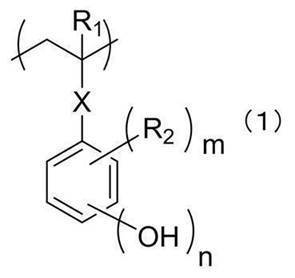
アルキル基の炭素数としては特に制限されず、一般に20以下が好ましく、8以下がより好ましく、3以下が更に好ましい。
置換基としては、炭素数1~5の直鎖状、若しくは、分岐鎖状のアルキル基、又は、上記アルキル基部分を含有するアルコキシ基が好ましく、メチル基又はメトキシ基がより好ましい。
一般式(1)中、mは0~3の整数であり、0がより好ましい。
Xとしては、単結合、-COO-、又は、-CONH-が好ましく、単結合、又は、COO-がより好ましい。
樹脂(A)は酸の作用により分解して極性基を生ずる基を含有する繰り返し単位(b)を含有する。繰り返し単位(b)は、上記繰り返し単位(a)とは異なる繰り返し単位である。
酸分解性基としては、上記極性基が保護基で保護されてなる基(好ましくは、極性基の水素原子が保護基で置換されてなる基)であることが好ましい。
繰り返し単位(b)としては、酸の作用により分解してカルボキシル基を生じる基を有する繰り返し単位が好ましい。酸の作用により分解してカルボキシル基を生じる基を有する繰り返し単位は、カルボキシル基の水素原子が酸の作用により分解して脱離する基(保護基)で置換された基を有する繰り返し単位である。

Xa1は、水素原子、ハロゲン原子、アルキル基、シクロアルキル基、シアノ基、又は、アルコキシカルボニル基を表す。
Tは、単結合又は2価の連結基を表す。
Rx1、Rx2及びRx3は、それぞれ独立に、アルキル基(直鎖状若しくは分岐鎖状)、シクロアルキル基(単環若しくは多環)、又は、フェニル基を表す。ただし、Rx1、Rx2及びRx3の全てがアルキル基(直鎖状若しくは分岐鎖状)である場合、Rx1、Rx2及びRx3のうち少なくとも2つはメチル基であることが好ましい。
Rx1、Rx2及びRx3の2つが結合して、環(例えば、シクロアルキル基(単環若しくは多環))を形成してもよい。
Rx1、Rx2及びRx3は、それぞれ、炭素原子と水素原子のみから構成されることが好ましく、Rx1、Rx2及びRx3に含まれる炭素数の合計は4以上11以下であることがより好ましい。
Rx1~Rx3のシクロアルキル基としては、シクロペンチル基、及び、シクロヘキシル基等の単環のシクロアルキル基;ノルボルニル基等の多環のシクロアルキル基;が好ましい。

一般式(3)中、R31中の各基の定義は、一般式(A1)中のXa1中の各基の定義と同義である。また、一般式(3)中のR32、R33、及び、R34中の各基は、一般式(A1)中のRx1、Rx2、及び、Rx3中の各基の定義と同じである。
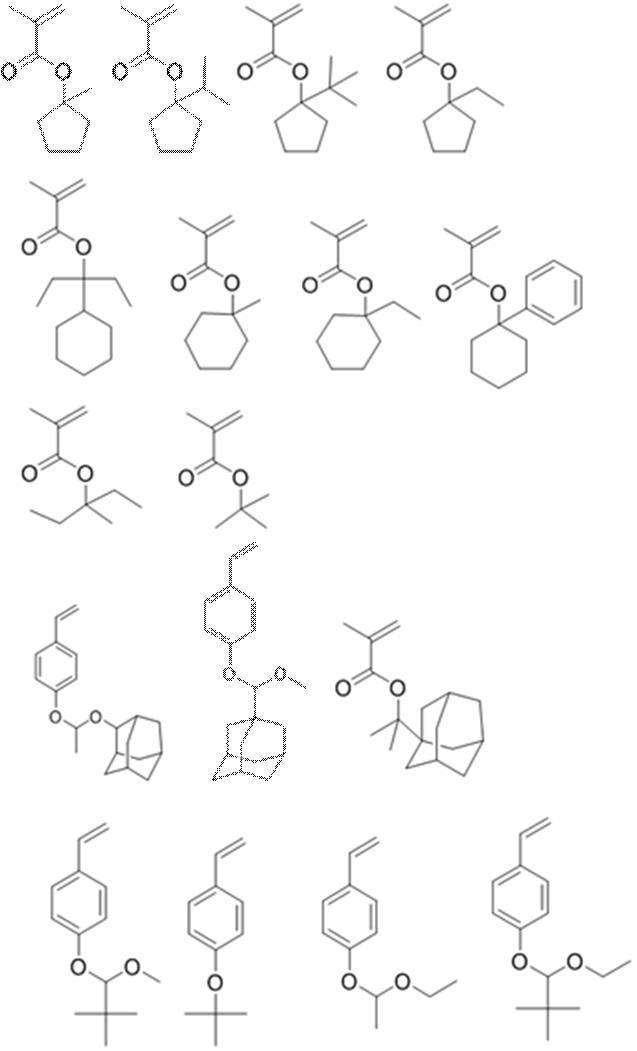
樹脂(A)は、繰り返し単位(a)、及び、繰り返し単位(b)以外のその他の繰り返し単位(c)を含有することが好ましい。その他の繰り返し単位(c)は、繰り返し単位(a)及び繰り返し単位(b)とは異なる繰り返し単位を意図する。
ラクトン構造を含有する繰り返し単位としては、下記一般式(LC1-1)~(LC1-17)からなる群から選択される少なくとも1種の構造を含有することがより好ましく、一般式(LC1-1)、一般式(LC1-4)、一般式(LC1-5)、一般式(LC1-6)、一般式(LC1-13)、及び、一般式(LC1-14)からなる群から選択される少なくとも1種の構造を含有することが更に好ましい。
また、ラクトン構造を有する基が主鎖に直接結合していてもよい。
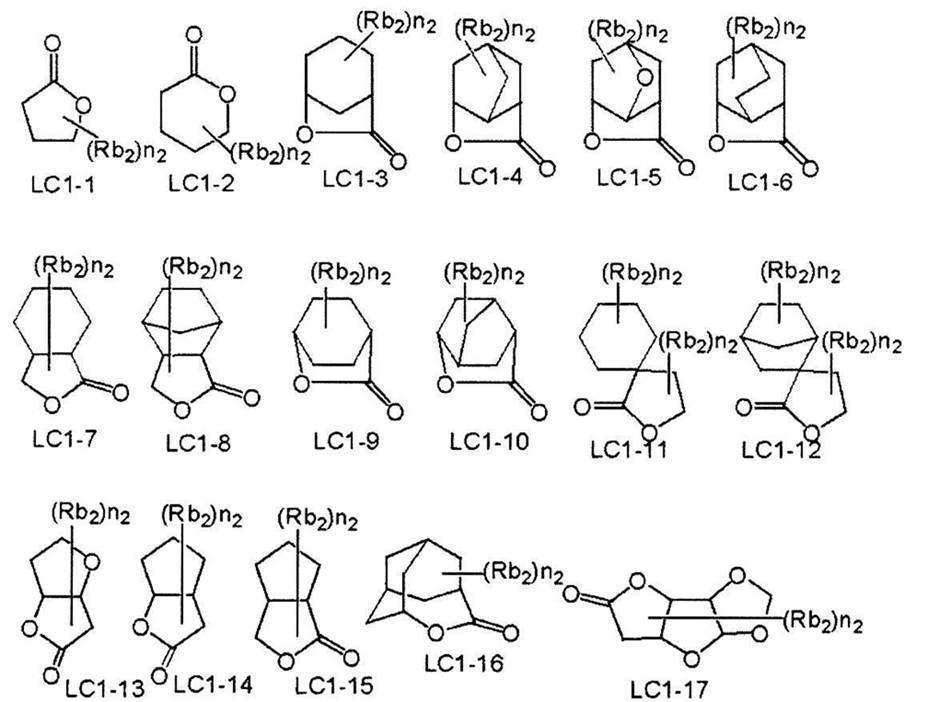

Rb0は、水素原子、ハロゲン原子、又は炭素数1~4のアルキル基を表す。
Rb0のアルキル基は置換基を含有していてもよく、置換基としては、ヒドロキシル基、又は、ハロゲン原子が挙げられる。ハロゲン原子としては、フッ素原子、塩素原子、臭素原子、又は、ヨウ素原子が挙げられる。なかでも、Rb0としては、水素原子又はメチル基が好ましい。
なかでも、単結合、又は、-Ab1-CO2-で表される基が好ましい。Ab1は、直鎖状若しくは分岐鎖状のアルキレン基、又は、単環若しくは多環のシクロアルキレン基を表し、メチレン基、エチレン基、シクロヘキシレン基、アダマンチレン基、又は、ノルボルニレン基が好ましい。
ラクトン構造を含有する基を含有する繰り返し単位の具体例を以下に挙げるが、ラクトン構造を含有する基を含有する繰り返し単位としては、これらに制限されない。なお、下記式中のRxは、水素原子、ハロゲン原子、アルキル基、シクロアルキル基、シアノ基、又は、アルコキシカルボニル基を表す。
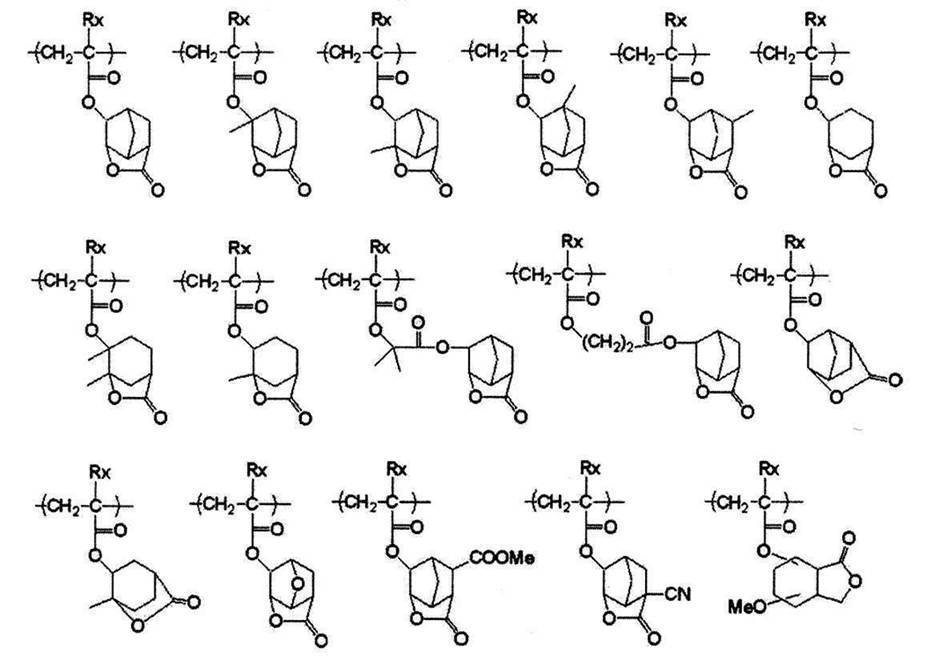


次に、樹脂(A)の製造方法における第一工程について詳述する。第一工程は、一般式(2)で表される繰り返し単位と、酸の作用により分解して極性基を生じる基を含有する繰り返し単位と、を含有する樹脂前駆体を得る工程である。
樹脂前駆体は、一般式(2)で表される繰り返し単位(以下、「繰り返し単位(a2)」ともいう。)と、酸の作用により分解して極性基を生じる基を含有する繰り返し単位(上述した「繰り返し単位(b)」)とを含有する重合体である。樹脂前駆体は、上記以外の繰り返し単位を含有してよく、樹脂前駆体が含有するその他の繰り返し単位としては、樹脂(A)中における繰り返し単位(c)としてすでに説明したとおりである。
モノマー種としては、重合後に、後述する繰り返し単位(a2)及び繰り返し単位(b)となるモノマーであればよい。
なかでも、レジスト組成物を保管した際に、より固形分が析出しにくい点で、後述するレジスト溶剤を用いて重合することが好ましい。


ert-ブチル-4-メチルフェノールなどの重合禁止剤を、モノマーに対して50~2
000ppm添加しておくことが好ましい。
以下では、樹脂前駆体が含有する各繰り返し単位について説明する。
繰り返し単位(a2)は、一般式(2)で表される繰り返し単位である。繰り返し単位(a2)は、保護基Yを含有する。一般式(2)で表される繰り返し単位は、後述する第二工程において、酸又は塩基で脱保護され、結果として、既に説明した繰り返し単位(a)に変換される。
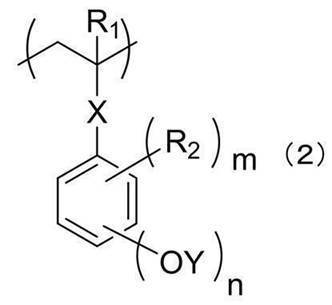
保護基としては、例えば、Greenら、Protective Groups inOrganic Synthesis, 3rd Edition,1999,John Wiley & Sons, Inc.等の記載を参照にすることができる。
式中、R36~R39は、各々独立に、アルキル基、シクロアルキル基、アリール基、アラルキル基又はアルケニル基を表す。R36とR37とは、互いに結合して環を形成してもよい。
R01~R02は、各々独立に、水素原子、アルキル基、シクロアルキル基、アリール基、アラルキル基又はアルケニル基を表す。

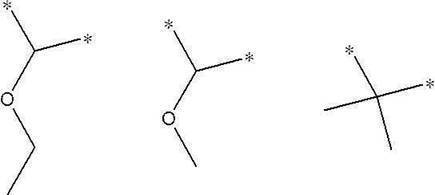
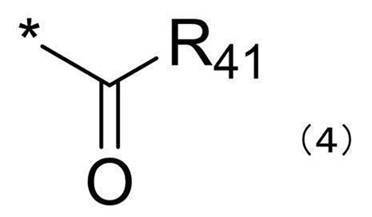
一般式(4)中、R41はアルキル基、シクロアルキル基、又は、アリール基を表す。また、*は酸素原子との結合位置を表す。
R41のアルキル基、及び、シクロアルキル基の形態は、一般式(1)中のR1のアルキル基、及び、シクロアルキル基として既に説明したとおりである。
アリール基としては特に制限されず、炭素数6~12のアリール基が好ましい。
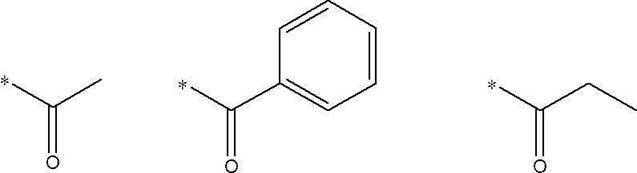

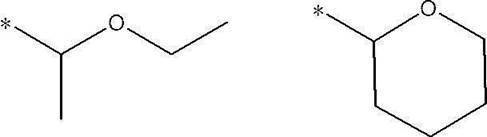


樹脂前駆体は、繰り返し単位(b)を含有する。繰り返し単位(b)は、既に説明したとおりである。
樹脂前駆体中における繰り返し単位(b)の含有量としては特に制限されず、一般に、樹脂前駆体の全繰り返し単位に対して、5~90モル%が好ましく、10~70モル%がより好ましい。繰り返し単位(b)は、1種を単独で用いても、2種以上を併用してもよい。2種以上の繰り返し単位(b)を併用する場合には、合計含有量が上記範囲内であることが好ましい。
樹脂前駆体は、繰り返し単位(c)を含有することが好ましい。繰り返し単位(c)の形態としては、樹脂(A)が含有する繰り返し単位(c)として既に説明したとおりである。
樹脂前駆体中における繰り返し単位(c)の含有量としては特に制限されず、一般に、樹脂前駆体の全繰り返し単位に対して、1~60モル%が好ましく、1~50モル%がより好ましい。繰り返し単位(c)は、1種を単独で用いても、2種以上を併用してもよい。2種以上の繰り返し単位(c)を併用する場合には、合計含有量が上記範囲内であることが好ましい。
第二工程は樹脂前駆体の一般式(2)で表される繰り返し単位(a2)における-OYで表される基を、酸又は塩基で脱保護して、一般式(1)で表される繰り返し単位(a)を得る工程である。
第二工程によれば、繰り返し単位(a2)を酸又は塩基で選択的に脱保護することにより、複数のヒドロキシル基を含有する構成単位(a)に変換し、樹脂(A)を製造することができる。
脱保護の方法としては特に制限されず、公知の方法を用いることができる。
これらの酸は単独で用いてもよく、混合して用いてもよい。
脱保護反応に用いる塩基としては、例えば、トリエチルアミン、エチルジイソプロピルアミン、N-メチルモルホリン、ピリジン、4-ジメチルアミノピリジン、ジイソプロピルエチルアミン、炭酸ナトリウム、炭酸カリウム、炭酸セシウム、tert-ブトキシナトリウム、tert-ブトキシカリウム、水酸化ナトリウム、水酸化カリウム、カリウムメトキシド、ジアザビシクロウンデセン、及び、ナトリウムメトキシド等が挙げられる。
脱保護反応の温度としては特に制限されず、一般に0~100℃で行うことが好ましい。脱保護反応の時間としては特に制限されないが、20時間以内が好ましい。
なお、上記脱保護の条件については、公知の方法を用いることができ、Protecting Groups 3rd Edition等を参照することができる。
第二工程の好適形態としては、保護基Yが一般式(4)で表され、繰り返し単位(a2)が含有する-OYで表される基を塩基で脱保護する工程が挙げられる。上記方法によれば、より優れた解像性を有するレジスト膜を形成することができるレジスト組成物が得られる。
なかでも上記塩基の共役酸の酸解離定数が6.0以上であると、より優れた解像性を有するレジスト膜を形成することができるレジスト組成物が得られ、9.0以上であると、更に優れた解像性を有するレジスト膜を形成することができるレジスト組成物が得られる。
第二工程の好適形態としては、保護基Yが一般式(5)で表され、かつ、第二工程において、-OYで表される基を酸で脱保護するか、又は、一般式(2)で表される繰り返し単位が一般式(6)で表され、かつ、第二工程において、-O-Z-O-で表される基を酸で脱保護する工程が挙げられる。
なかでも上記酸の酸解離定数-1.0以上であると、より優れた解像性を有するレジスト膜を形成することができるレジスト組成物が得られ、酸解離定数が1.0以上であると、更に優れた解像性を有するレジスト膜を形成することができるレジスト組成物が得られる。
本発明の実施形態に係る感活性光線性又は感放射線性(レジスト)組成物の製造方法は、既に説明した製造方法により製造された樹脂(A)と、活性光線又は放射線の照射により酸を発生する化合物(B)と、を混合する工程を含有する。
樹脂(A)と活性光線又は放射線の照射により酸を発生する化合物(B)とを混合する方法としては特に制限されず、公知の方法を用いることができる。すなわち、樹脂(A)と活性光線又は放射線の照射により酸を発生する化合物(B)と、以下で説明する任意成分をミキサ等により混合する方法が挙げられる。以下では、上記レジスト組成物に含有される各成分について説明する。
上記レジスト組成物は、樹脂(A)を含有する。樹脂(A)の形態としては、樹脂(A)の製造方法において既に説明したとおりである。
レジスト組成物中における樹脂(A)の含有量としては特に制限されず、一般に、レジスト組成物の全固形分に対して、50~99質量%が好ましい。樹脂(A)は、1種を単独で用いても、2種以上を併用してもよい。2種以上の樹脂(A)を併用する場合には、合計含有量が上記範囲内であることが好ましい。
上記レジスト組成物は、活性光線又は放射線の照射により酸を発生する化合物(B)(以下、本明細書において「光酸発生剤」、又は、「PAG」ともいう。なお、PAGは、「Photo Acid Generator」の略語である。)を含有する。
レジスト組成物中における光酸発生剤の含有量としては特に制限されず、一般に、レジスト組成物の全固形分に対して、0.1~50質量%が好ましく、5~50質量%がより好ましく、8~40質量%が更に好ましい。光酸発生剤は、1種を単独で用いても、2種以上を併用してもよい。2種以上の光酸発生剤を併用する場合には、合計含有量が上記範囲内であることが好ましい。
なお、上記レジスト組成物により形成されたレジスト膜が、電子線、及び/又は、極紫外線により露光される場合、レジスト組成物中における光酸発生剤の含有量としては、レジスト組成物の全固形分に対して、10~40質量%が好ましく、10~35質量%がより好ましい。光酸発生剤の含有量が上記範囲内であると、電子線、及び/又は、極紫外線により露光される場合に、レジスト膜はより優れた感度、及び、解像性を有する。
光酸発生剤は、低分子化合物の形態であってもよく、重合体の一部に組み込まれた形態であってもよい。また、低分子化合物の形態と重合体の一部に組み込まれた形態を併用してもよい。
光酸発生剤が、低分子化合物の形態である場合、分子量が3000以下であることが好ましく、2000以下であることがより好ましく、1000以下であることが更に好ましい。
なかでも、光酸発生剤としては、低分子化合物が好ましい。
光酸発生剤が含有するフッ素原子の数は、適宜調整されることが好ましい。光酸発生剤が含有するフッ素原子の数を調整すると、レジスト膜中における光酸発生剤の表面偏在性を制御できる。光酸発生剤が含有するフッ素原子の数が多いほど、光酸発生剤はレジスト膜の表面に偏在しやすい。
発生する有機酸としては、特に制限されず、例えば、スルホン酸、ビス(アルキルスルホニル)イミド、及び、トリス(アルキルスルホニル)メチド等が挙げられる。光酸発生剤としては、上記の有機酸のうち、少なくともいずれかを発生する化合物が好ましい。

R201、R202、及び、R203の炭素数としては特に制限されず、一般に、1~30が好ましく、1~20がより好ましい。
また、R201、R202、及び、R203のうち2つが結合して環構造を形成してもよく、上記環構造内に酸素原子、硫黄原子、エステル結合、アミド結合、又は、カルボニル基を含有してもよい。R201、R202、及び、R203のうち2つが結合して形成する基としては、アルキレン基(例えば、ブチレン基、又は、ペンチレン基)等が挙げられる。
非求核性アニオンとしては、特に制限されず、例えば、スルホン酸アニオン(脂肪族スルホン酸アニオン、芳香族スルホン酸アニオン、及び、カンファースルホン酸アニオン等);カルボン酸アニオン(脂肪族カルボン酸アニオン、芳香族カルボン酸アニオン、及び、アラルキルカルボン酸アニオン等);スルホニルイミドアニオン;ビス(アルキルスルホニル)イミドアニオン;トリス(アルキルスルホニル)メチドアニオン;等が挙げられる。
また、非求核性アニオンとしては、以下の一般式(AN1)で表されるアニオンも好ましい態様として挙げられる。
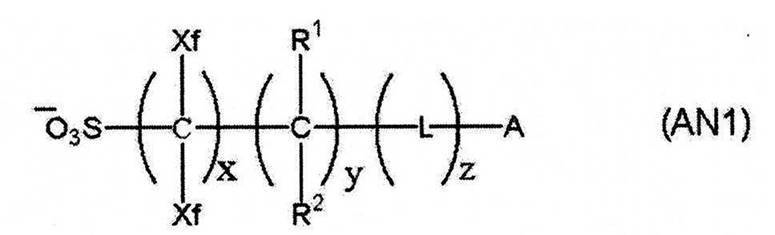
R1、R2は、それぞれ独立に、水素原子、フッ素原子、又は、アルキル基を表し、複数存在する場合のR1、及び、R2は、それぞれ同一でも異なってもよい。
Lは、二価の連結基を表し、複数存在する場合のLは、同一でも異なってもよい。
Aは、環状の有機基を表す。xは1~20の整数を表し、yは0~10の整数を表し、zは0~10の整数を表す。
Xfのフッ素原子で置換されたアルキル基におけるアルキル基の炭素数としては、1~10が好ましく、炭素数1~4がより好ましい。また、Xfのフッ素原子で置換されたアルキル基としては、ペルフルオロアルキル基が好ましい。
R1、及び、R2としては、フッ素原子又はCF3がより好ましい。
yは0~4が好ましく、0がより好ましい。
zは0~5が好ましく、0~3がより好ましい。
アルキル基としては、メチル基、エチル基、n-プロピル基、i-プロピル基、及び、n-ブチル基等が挙げられる。シクロアルキル基としては、シクロプロピル基、シクロブチル基、シクロペンチル基、シクロヘキシル基、及び、シクロへプチル基等が挙げられる。これらの基は更に置換基を有していてもよい。
上記置換基としては、ニトロ基、ハロゲン原子(フッ素原子等)、カルボキシル基、ヒドロキシル基、アミノ基、シアノ基、アルコキシ基(好ましくは炭素数1~15)、シクロアルキル基(好ましくは炭素数3~15)、アリール基(好ましくは炭素数6~14)、アルコキシカルボニル基(好ましくは炭素数2~7)、アシル基(好ましくは炭素数2~12)、及び、アルコキシカルボニルオキシ基(好ましくは炭素数2~7)等が挙げられるが、これらに制限さない。
SO3 --CF2-CH2-OCO-A、SO3 --CF2-CHF-CH2-OCO-A、SO3 --CF2-COO-A、SO3 --CF2-CF2-CH2-A、SO3 --CF2-CH(CF3)-OCO-A
一般式(ZII)、及び、一般式(ZIII)中、R204~R207は、それぞれ独立に、アリール基、アルキル基又はシクロアルキル基を表す。
なお、上記体積の値は、富士通株式会社製の「WinMOPAC」を用いて求めた体積を意図する。すなわち、酸の化学構造を入力し、次に、この構造を初期構造としてMM3法(MMはMolecular Mechanicsの略語である。)を用いた分子力場計算により、酸の最安定立体配座を決定し、その後、これら最安定立体配座についてPM3法(PMはParameterized Modelの略語である。)を用いた分子軌道計算を行うことにより、酸の「accessible volume」を計算することができる。上記体積は、「accessible volume」を意図する。
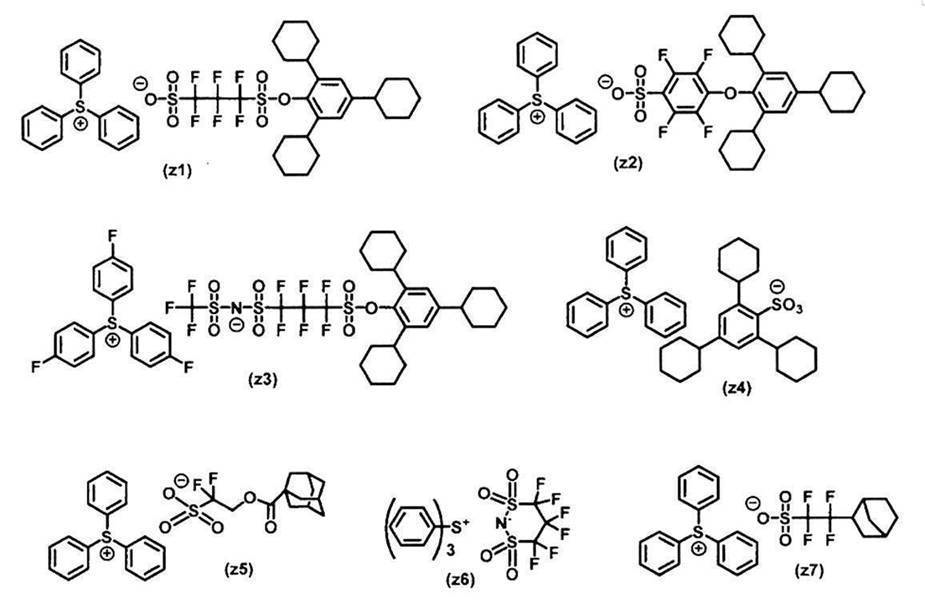


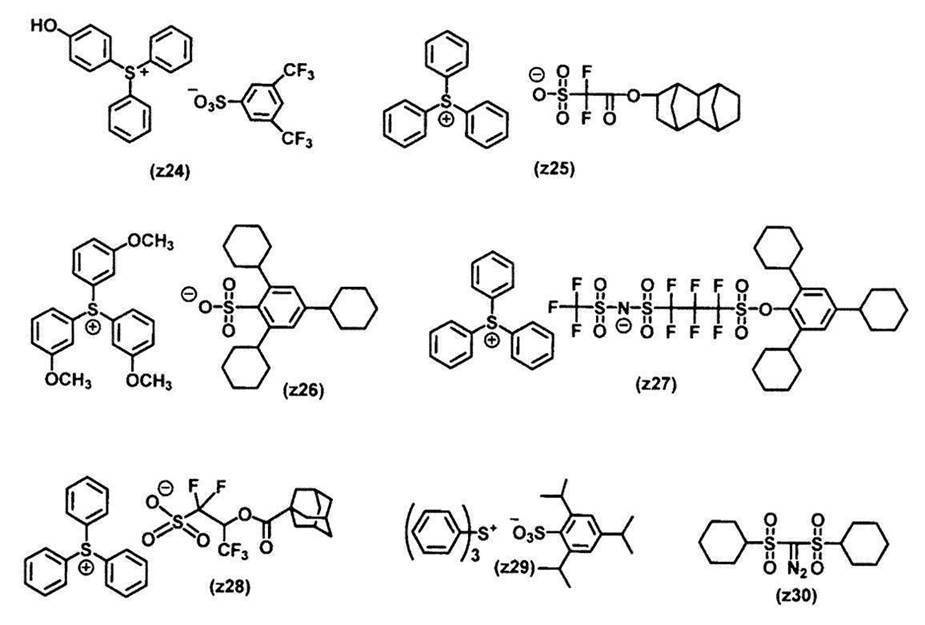
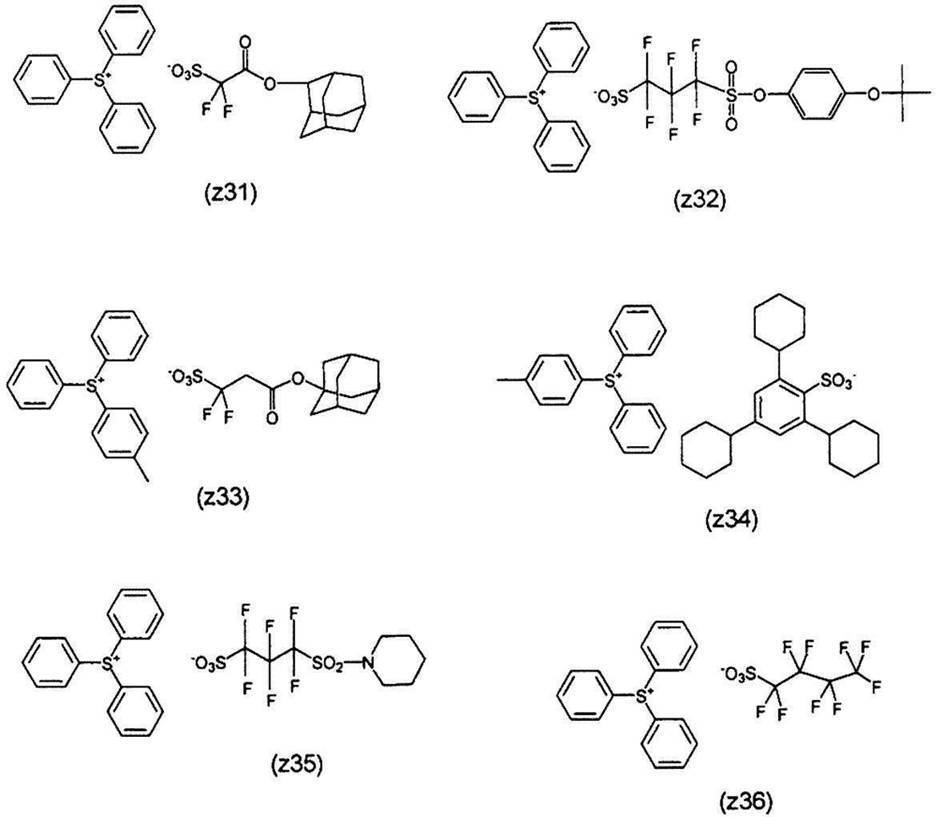

上記レジスト組成物は、樹脂(A)及び光酸発生剤以外の任意成分を含有することが好ましい。任意成分としては、例えば、溶剤、塩基性化合物、疎水性樹脂、界面活性剤、及び、その他の添加剤等が挙げられる。以下では、各任意成分について詳述する。
上記レジスト組成物は溶剤(以下、本明細書において「レジスト溶剤」ともいう。)を含有することが好ましい。
上記レジスト組成物中における溶剤の含有量としては特に制限されず、一般に、レジスト組成物の固形分含有量が、0.5~30質量%に調整されることが好ましく、1~20質量%に調整されることがより好ましい。レジスト組成物の固形分含有量が0.5~30質量%であると、レジスト組成物はより優れた塗布性を有する。
溶剤は、1種を単独で用いても、2種以上を併用してもよい。2種以上の溶剤を併用する場合には、合計含有量が上記範囲内であることが好ましい。
なお、レジスト組成物の固形分含有量を調整することにより、後述するレジスト膜の厚みを調整することができる。
溶剤は、異性体(同じ原子数で異なる構造の化合物)を含有してもよい。また、異性体は、1種のみが含有されてもよいし、複数種含有されてもよい。
上記レジスト組成物は、成分(M1):プロピレングリコールモノアルキルエーテルカルボキシレート、並びに、成分(M2):プロピレングリコールモノアルキルエーテル、乳酸エステル、酢酸(又は酪酸)エステル、アルコキシプロピオン酸エステル、鎖状ケトン、環状ケトン、ラクトン、及びアルキレンカーボネートからなる群より選択される少なくとも1種、からなる群から選択される少なくとも1種を溶剤として含有することが好ましい。上記レジスト組成物は、成分(M1)及び/又は、成分(M2)以外の溶剤を更に含有してもよい。
プロピレングリコールモノアルキルエーテルとしては、プロピレングリコールモノメチルエーテル、又は、プロピレングリコールモノエチルエーテルが好ましい。
乳酸エステルとしては、乳酸エチル、乳酸ブチル、又は、乳酸プロピルが好ましい。
酪酸エステルとしては、酪酸ブチルが好ましい。
鎖状ケトンとしては、1-オクタノン、2-オクタノン、1-ノナノン、2-ノナノン、アセトン、4-ヘプタノン、1-ヘキサノン、2-ヘキサノン、ジイソブチルケトン、フェニルアセトン、メチルエチルケトン、メチルイソブチルケトン、アセチルアセトン、アセトニルアセトン、イオノン、ジアセトニルアルコール、アセチルカービノール、アセトフェノン、メチルナフチルケトン、又は、メチルアミルケトンが好ましい。
環状ケトンとしては、メチルシクロヘキサノン、イソホロン、又は、シクロヘキサノンが好ましい。
アルキレンカーボネートとしては、プロピレンカーボネートが好ましい。
上記レジスト組成物は、塩基性化合物を含有することが好ましい。レジスト組成物が塩基性化合物を含有すると、レジスト膜を露光して、その後加熱するまでの間におけるレジスト膜の性能変化をより低減できる。
レジスト組成物中における塩基性化合物の含有量としては特に制限されず、一般に、レジスト組成物の全固形分に対して、0.001~10質量%が好ましく、0.01~5質量%がより好ましい。塩基性化合物は、1種を単独で用いても、2種以上を併用してもよい。2種以上の塩基性化合物を併用する場合には、合計含有量が上記範囲内であることが好ましい。

これら一般式(A)及び(E)中のアルキル基は、無置換であることがより好ましい。
フェノキシ基を含有するアミン化合物の他の作製方法としては、1級、又は、2級アミンと、末端にフェノキシ基を有するハロアルキルエーテルと、を加熱して反応させ、反応物を得た後、上記反応物に対して、水酸化ナトリウム、水酸化カリウム、及び、テトラアルキルアンモニウム等の強塩基の水溶液を添加して、混合液を得た後、上記混合液に、酢酸エチル、及び、クロロホルム等の有機溶剤を加えて抽出する方法を用いることもできる。
レジスト組成物は、塩基性化合物として、プロトンアクセプター性官能基を有し、かつ、活性光線又は放射線の照射により分解してプロトンアクセプター性が低下する、若しくは、消失する、又は、プロトンアクセプター性から酸性に変化した化合物を発生する、化合物(以下、本明細書において、「化合物(PA)」ともいう)を更に含有しもよい。


上記レジスト組成物は疎水性樹脂を含有することが好ましい。疎水性樹脂は、既に説明した樹脂(A)とは異なる樹脂を意図する。
上記レジスト組成物中における疎水性樹脂の含有量としては特に制限されず、一般に、レジスト組成物の全固形分に対して、0.01~20質量%が好ましく、0.01~10質量%がより好ましく、0.05~8質量%が更に好ましく、0.5~5質量%が特に好ましい。疎水性樹脂は、1種を単独で用いても、2種以上を併用してもよい。2種以上の疎水性樹脂を併用する場合には、合計含有量が上記範囲内であることが好ましい。
疎水性樹脂としては、レジスト膜の表面に偏在するように設計されることが好ましいが、必ずしも分子内に親水基を有する必要はなく、極性/非極性物質を均一に混合することに寄与しなくてもよい。
また、疎水性樹脂は、炭素数5以上の炭化水素基を含有することが好ましい。疎水性樹脂は、これらの基を主鎖に含有しても、側鎖に含有してもよい。
疎水性樹脂中の側鎖が含有するCH3部分構造としては、エチル基、及び、プロピル基等が含有するCH3部分構造を含むものとする。
また、疎水性樹脂としては、特開2011-248019号公報、特開2010-175859号公報、特開2012-032544号公報に記載された樹脂を用いることができ、上記内容は、本明細書に組み込まれる。
上記レジスト組成物は、界面活性剤を含有することが好ましい。
界面活性剤を含有するレジスト組成物により形成されるレジスト膜は、波長が250nm以下、特には220nm以下の露光光源を使用した場合に、より優れた感度、及び、より優れた解像性を有し、更に、より優れた密着性を有し、現像欠陥のより少ないパターンを形成することできる。
界面活性剤としては、例えば、米国特許出願公開第2008/0248425号明細書の0280段落に記載されている界面活性剤を用いることもでき、上記内容は本明細書に組み込まれる。
フッ素系、及び/又は、シリコン系界面活性剤としては、例えば、米国特許出願公開第2008/0248425号明細書の0276段落に記載の界面活性剤が挙げられ、上記内容は本明細書に組み込まれる。
レジスト組成物は、上記以外にも溶解阻止化合物、染料、可塑剤、光増感剤、光吸収剤、及び、現像液に対する溶解性を促進させる化合物(例えば、分子量1000以下のフェノール化合物、又は、カルボキシル基を含有する脂環族、若しくは、脂肪族化合物)等を更に含有してもよい。
次に、上記レジスト組成物を用いたパターン形成方法について説明する。上記レジスト組成物を用いたパターン形成方法としては特に制限されず、公知のパターン形成方法を用いることができる。以下では、上記レジスト組成物を用いたパターン形成方法の好適形態について説明する。
感活性光線性又は感放射線性膜形成工程(以下、「レジスト膜形成工程」ともいう。)は、レジスト組成物を用いてレジスト膜を形成する工程である。レジスト組成物を用いてレジスト膜を形成する方法としては特に制限されず、公知の方法を用いることができる。
レジスト組成物を用いてレジスト膜を形成する方法としては、例えば、レジスト組成物を用いて、基板上に、レジスト膜を形成する方法が挙げられる。
レジスト組成物を用いて、基板上に、レジスト膜を形成する方法としては、溶剤を含有するレジスト組成物を、基板上に塗布してレジスト組成物層を形成し、必要に応じて、レジスト組成物層を乾燥、及び/又は、加熱して、レジスト膜を形成する方法が挙げられる。レジスト組成物は、集積回路素子の製造に使用されるような公知の材料からなる基板上に、スピナー等の塗布方法により塗布されることが好ましい。
フィルタろ過に用いるフィルタとしては、特に制限されず、フィルタのポアサイズとしては、0.1μm以下が好ましく、0.05μm以下がより好ましく、0.03μm以下が更に好ましい。
フィルタの材料としては特に制限されず、例えば、ポリテトラフロロエチレン、ポリエチレン、又は、ナイロンが好ましい。
加熱時間は30~1000秒が好ましく、60~800秒がより好ましく、60~600秒が更に好ましい。
なお、上記パターン形成方法は、レジスト膜の上層に更に上層膜(トップコート)を形成する、上層膜形成工程を含有してもよい。
レジスト膜の上層に、更に上層膜を形成する方法としては特に制限されず、公知の方法を用いることができる。なかでも、上層膜形成用組成物を用いて、レジスト膜上に、上層膜形成用組成物層を形成し、必要に応じて、上層膜形成用組成物層を乾燥、加熱、及び/又は、硬化させて、上層膜を形成する方法が好ましい。
上層膜形成用組成物としては特に制限されず、公知の上層膜形成用組成物を用いることができる。なお、上層膜形成用組成物としては、レジスト膜と混合せず、更にレジスト膜上層に均一に塗布できることが好ましい。
上層膜の厚みは、特に制限されず、10~200nmが好ましく、20~100nmがより好ましく、40~80nmが更に好ましい。
レジスト膜上に上層膜を形成する方法としては、例えば、特開2014-059543号公報の0072~0082段落に記載された方法を用いることができ、上記内容は本明細書に組み込まれる。
露光工程は、レジスト膜を露光する工程である。レジスト膜を露光する方法としては特に制限されず、公知の方法を用いることができる。
レジスト膜を露光する方法としては、例えばレジスト膜に、所定のマスクを通して活性光線又は放射線を照射する方法が挙げられる。また、レジスト膜に電子ビームを照射する方法の場合は、マスクを介さないで照射してもよい(これを、「直描」ともいう。)。
上記パターン形成方法は、露光工程と、現像工程の前に、露光後のレジスト膜をベーク(PEB:Post Exposure Bake)する、PEB工程を更に含有することが好ましい。ベークにより露光部の反応が促進され、感度、及び/又は、パターン形状がより良好となる。
加熱温度は80~150℃が好ましく、80~140℃がより好ましく、80~130℃が更に好ましい。
加熱時間は30~1000秒が好ましく、60~800秒がより好ましく、60~600秒が更に好ましい。
加熱は通常の露光・現像機に備わっている手段で行うことができ、ホットプレート等を用いて行ってもよい。
現像工程は、露光されたレジスト膜(以下、「露光後のレジスト膜」ともいう。)を現像液によって現像する工程である。
現像方法としては、特に制限されず、公知の現像方法を用いることができる。現像方法としては、例えば、ディップ法、パドル法、スプレー法、及び、ダイナミックディスペンス法等が挙げられる。
また、上記パターン形成方法は、現像工程の後に、現像液を他の溶剤に置換し、現像を停止する工程を更に含有してもよい。
現像時間はとしては、特に制限されず、一般に10~300秒が好ましく、10~120秒がより好ましい。現像液の温度としては、0~50℃が好ましく、15~35℃がより好ましい。パターン形成方法は、現像工程を少なくとも1回含有していればよく、複数回含有してもよい。
現像液としては特に制限されず、公知の現像液を用いることができる。現像液としては、例えば、アルカリ現像液、及び、有機溶剤を含有する現像液(有機系現像液)が挙げられる。
アルカリ現像液としては、例えば、水酸化ナトリウム、水酸化カリウム、炭酸ナトリウム、ケイ酸ナトリウム、メタケイ酸ナトリウム、及び、アンモニア水等の無機アルカリ類;エチルアミン、及び、n-プロピルアミン等の第一級アミン類;ジエチルアミン、及び、ジ-n-ブチルアミン等の第二級アミン類;トリエチルアミン、及び、メチルジエチルアミン等の第三級アミン類;ジメチルエタノールアミン、及び、トリエタノールアミン等のアルコールアミン類;テトラメチルアンモニウムヒドロキシド、テトラエチルアンモニウムヒドロキシド、テトラプロピルアンモニウムヒドロキシド、テトラブチルアンモニウムヒドロキシド、テトラペンチルアンモニウムヒドロキシド、テトラヘキシルアンモニウムヒドロキシド、テトラオクチルアンモニウムヒドロキシド、エチルトリメチルアンモニウムヒドロキシド、ブチルトリメチルアンモニウムヒドロキシド、メチルトリアミルアンモニウムヒドロキシド、及び、ジブチルジペンチルアンモニウムヒドロキシド等のテトラアルキルアンモニウムヒドロキシド;ジメチルビス(2-ヒドロキシエチル)アンモニウムヒドロキシド、トリメチルフェニルアンモニウムヒドロキシド、トリメチルベンジルアンモニウムヒドロキシド、及び、トリエチルベンジルアンモニウムヒドロキシド等の第四級アンモニウム塩;ピロール、及び、ピペリジン等の環状アミン類等;等のアルカリ性水溶液等が挙げられるが、これに制限されない。
アルカリ現像液のアルカリ濃度としては、特に制限されず、一般に0.1~20質量%が好ましい。アルカリ現像液のpHとしては、特に制限されず、一般に10.0~15.0が好ましい。
次に、有機系現像液に含有される有機溶剤について説明する。
有機溶剤の蒸気圧(混合溶剤である場合は全体としての蒸気圧)としては特に制限されず、20℃において、5kPa以下が好ましく、3kPa以下がより好ましく、2kPa以下が更に好ましい。
有機溶剤としては特に制限されず、例えば、エステル系溶剤、ケトン系溶剤、アルコール系溶剤、アミド系溶剤、エーテル系溶剤、及び、炭化水素系溶剤等が挙げられる。
現像液中における酸化防止剤の含有量としては、特に限定されず、現像液の全質量に対して、0.0001~1質量%が好ましく、0.0001~0.1質量%がより好ましく、0.0001~0.01質量%が更に好ましい。0.0001質量%以上であるとより優れた酸化防止効果が得られ、1質量%以下であると、現像残渣をより抑制するこができる。
界面活性剤としては、特に制限されず、公知の界面活性剤を用いることができる。界面活性剤の具体例としては、レジスト組成物が含有する界面活性剤として既に説明したとおりである。
現像液中における界面活性剤の含有量としては、現像液の全質量に対して、0.001~5質量%が好ましく、0.005~2質量%がより好ましく、0.01~0.5質量%が更に好ましい。
上記パターン形成方法は、現像工程の後に更にリンス工程を含有することが好ましい。
リンス工程は、現像後のレジスト膜を備えるウェハを、リンス液を用いて洗浄する工程である。
洗浄方法としては特に制限されず、公知の洗浄方法を用いることできる。洗浄方法としては、例えば、回転吐出法、ディップ法、及び、スプレー法等が挙げられる。
なかでも回転吐出法で洗浄し、洗浄後にウェハを2000~4000rpmの回転数で回転させ、リンス液を基板上から除去することが好ましい。
リンス時間としては、一般に10~300秒が好ましく、10~180秒がより好ましく、20~120秒が更に好ましい、リンス液の温度としは0~50℃が好ましく、15~35℃がより好ましい。
アルカリ現像液を用いた現像後に、レジスト膜を備えるウェハをリンスする場合、リンス液としては、純水が好ましく、界面活性剤を含有する純水であってもよい。
有機系現像液を用いた現像後に、レジスト膜を備えるウェハをリンスする場合、リンス液としては、有機溶剤を含有するリンス液が好ましく、リンス液が含有する有機溶剤として例えば、炭化水素系溶剤、ケトン系溶剤、エステル系溶剤、アルコール系溶剤、及び、アミド系溶剤、及び、エーテル系溶剤からなる群より選択される少なくとも1種の有機溶剤が好ましく、炭化水素系溶剤、エーテル系溶剤、及び、ケトン系溶剤からなる群から選択される少なくとも1種がより好ましく、炭化水素系溶剤、及び、エーテル系溶剤からなる群から選択される少なくとも1種が更に好ましい。
なお、リンス液が含有する有機溶剤のその他の具体例としては、現像液に含有される有機溶剤として説明したものと同様である。
界面活性剤としては、特に制限されず、公知の界面活性剤を用いることができる。界面活性剤の具体例としては、レジスト組成物が含有する界面活性剤として、既に説明したとおりである。
リンス液中における界面活性剤の含有量としては特に制限されず、リンス液の全質量に対して、0.001~5質量%が好ましく、0.005~2質量%がより好ましく、0.01~0.5質量%が更に好ましい。
リンス液中における酸化防止剤の含有量としては特に制限されず、リンス液の全質量に対して、0.0001~1質量%が好ましく、0.0001~0.1質量%がより好ましく、0.0001~0.01質量%が更に好ましい。
リンス工程を含有しないパターン形成方法としては、例えば、特開2015-216403号公報の0014段落~0086段落の記載が援用でき、上記内容は本明細書に組み込まれる。
上記パターン形成方法は、既に説明した工程に加えて、その他の工程を含有してもよい。その他の工程としては例えば、超臨界流体による洗浄工程、及び、加熱工程等が挙げられる。
超臨界流体による除去工程は、現像処理、及び/又は、リンス処理の後に、パターン上に付着している現像液、及び/又は、リンス液を超臨界流体により除去する工程である。
加熱工程は、現像工程、リンス工程、又は、超臨界流体による除去工程の後に、パターン中に残存する溶剤を除去するためにレジスト膜を加熱する工程である。
加熱温度は、特に制限されず、一般に40~160℃が好ましく、50~150℃がより好ましく、50~110℃が更に好ましい。
加熱時間は、特に制限されないが、一般に15~300秒が好ましく、15~180秒がより好ましい。
本発明の電子デバイスの製造方法により製造される電子デバイスは、電気電子機器(家電、OA(Office Appliance)・メディア関連機器、光学用機器及び通信機器等)等が挙げられる。
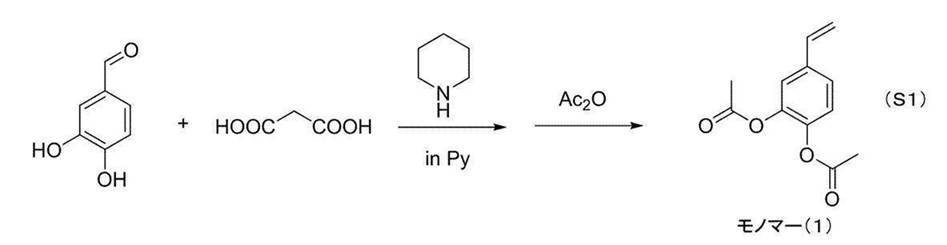
1H-NMR(Acetone―d6:ppm)δ:7.36(d、1H)、7.33(s、1H)、7.19(d、1H)、6.74(dd、1H)、5.80(d、1H)、5.27(d、1H)、2.26(s、3H)、2.25(s、3H)
150.0gの3,4-ジヒドロキシベンズアルデヒドと、46.2gのピペリジンと、0.03gの4-メトキシフェノールと、850gのピリジンを混合し、これに113.0gのマロン酸を加えて混合液を得た。この混合液を加熱して、液温を70℃とし、1.5時間撹拌した。撹拌後の混合液に対し、更に113.0gのマロン酸を加え、液温を70℃に保持して1.5時間加熱撹拌した後、上記反応液中における、原料の3,4-ジヒドロキシベンズアルデヒドが消費したことを確認した。反応液を110℃に昇温して、液温を保ちながら2時間撹拌した後、撹拌後の反応液を氷浴で5℃以下まで冷却した。冷却後の反応液に332.6gの無水酢酸を、過度に発熱しないよう注意深く滴下し、室温で2時間撹拌した。反応終了後、上記反応液に酢酸エチル1800mL、飽和塩化アンモニウム水溶液900mL、及び水600mLを加え、分液操作し、有機層を回収した。次に、有機層を飽和塩化アンモニウム水溶液900mLで2回、その後、飽和食塩水900mLで3回洗浄した。硫酸マグネシウムで脱水した後で硫酸マグネシウムをろ別し、得られたろ液に4-メトキシフェノール0.15gを加えてから減圧濃縮して残留溶剤を留去して残留物を得た。残留物を蒸留精製(2.5Torr、沸点132℃)して、モノマー(1)の合成1と同様のスキームで、123.0gのモノマー(1)を得た。なお、NMRとはnuclear magnetic resonanceの略語である。
1H-NMR(Acetone―d6:ppm)δ:7.36(d、1H)、7.33(s、1H)、7.19(d、1H)、6.74(dd、1H)、5.80(d、1H)、5.27(d、1H)、2.26(s、3H)、2.25(s、3H)

25.0gの3,4-ジヒドロキシベンズアルデヒドと、1.8gのパラトルエンスルホン酸一水和物と、トルエン500mLとを混合し混合液を得た。次に、混合液を30分間加熱環流した後、加熱還流後の混合液に52.7gのオルトギ酸エチルを加え、副生するエタノールを除去しながら更に3時間加熱環流した。次に、上記加熱還流後の混合液に、30gのオルトギ酸エチルを加え、更に2時間加熱環流して、反応液を得た。反応液中における原料の3,4-ジヒドロキシベンズアルデヒドが消費したことを確認した後、反応液を室温まで放冷した。次に、放冷後の反応液を、2%炭酸水素ナトリウム水溶液500mLに加え、分液操作し、有機層を回収した。次に有機層を水で3回洗浄した後、減圧濃縮して残留溶剤を留去し、36.2gの中間体2-1を得た。得られた中間体2-1の純度は98質量%だった(2質量%のオルトギ酸エチルを含有していた。)。この中間体(2-1)はこれ以上の精製はせずに次の反応に用いた。
1H-NMR(Acetone―d6:ppm)δ:9.88(s、1H)、7.59(d、1H)、7.39(s、1H)、7.14(s、1H)、7.12(d、1H)、3.78(q、2H)、1.23(s、3H)
70.9gのメチルトリフェニルホスホニウムブロミドと、2,6-ジ-tert-ブチル-p-クレゾール0.02gと、テトラヒドロフラン350mLを混合して、混合液を得た。次に、混合液を窒素雰囲気下で、5℃以下に氷冷した。次に、氷冷後の混合液に23.4gのtert-ブトキシカリウムを、過度に発熱しないよう注意深く添加し、室温に戻した後、1時間撹拌して、反応液を得た。次に、反応液を5℃以下に氷冷し、26.2gの中間体2-1(純度98%)とテトラヒドロフラン15mLとを混合した溶液を、過度に発熱しないよう注意深く反応液に滴下した。次に、反応液の液温を室温に戻して更に3時間撹拌した後で5℃以下に氷冷した。次に、350mLの水を、過度に発熱しないよう注意深く氷冷後の反応液に滴下した。次に、反応液に、更に酢酸エチル350mLを加え、分液操作し、有機層を回収した。次に有機層を水で5回洗浄し、硫酸ナトリウムで脱水した。次に、硫酸ナトリウムをろ別し、ろ液を得た。次に、ろ液を減圧濃縮して溶剤を留去して、残留物を得た。残留物にn-ヘキサン及び酢酸エチルの混合溶液(n-ヘキサン/酢酸エチル=95/5(質量比))を加え、析出した結晶をろ別し、得られた溶液を減圧濃縮した後に蒸留精製(2.8Torr、沸点98℃)して、16.5gのモノマー(2)を得た。なお、スキーム(S2)には、モノマー(2)の合成方法を簡略化して表した。
1H-NMR(Acetone―d6:ppm)δ:7.10(d、1H)、6.98(s、1H)、6.95(d、1H)、6.86(d、1H)、6.68(dd、1H)、5.67(d、1H)、5.12(d、1H)、3.72(q、2H)、1.21(s、3H)
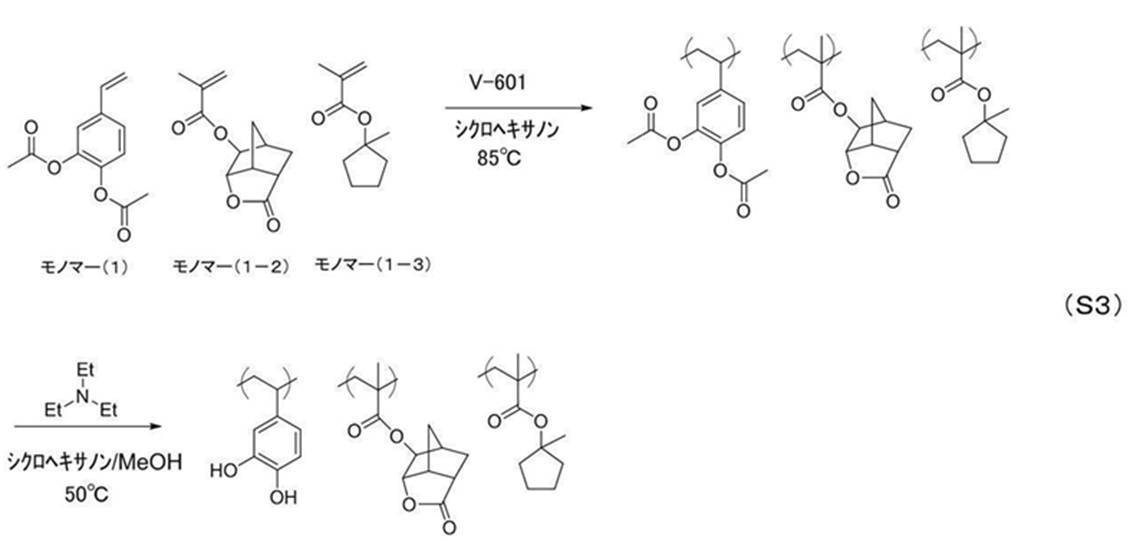
1H-NMR(DMSO―d6:ppm)δ:8.76-8.29、6.88-5.80、4.71-2.84、2.63-0.21(ピークはいずれもブロード)
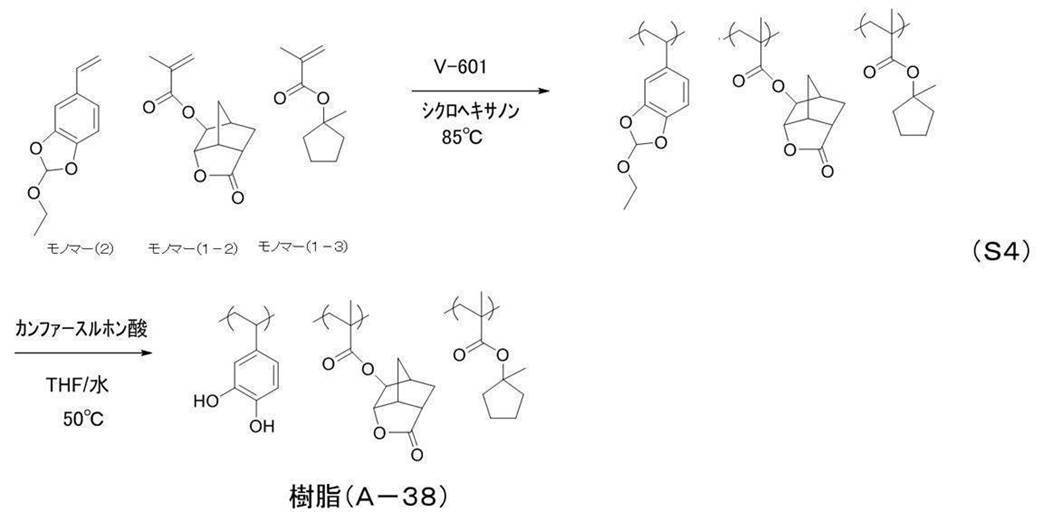
1H-NMR(DMSO―d6:ppm)δ:8.76-8.29、6.88-5.80、4.71-2.84、2.63-0.21(ピークはいずれもブロード)
なお、樹脂(R-2)は、ジヒドロキシスチレンをモノマーとして用いて、合成した樹脂である。すなわち、上記第一工程、及び、第二工程を経ずに合成した樹脂である。表中では、「未保護」と記載した。
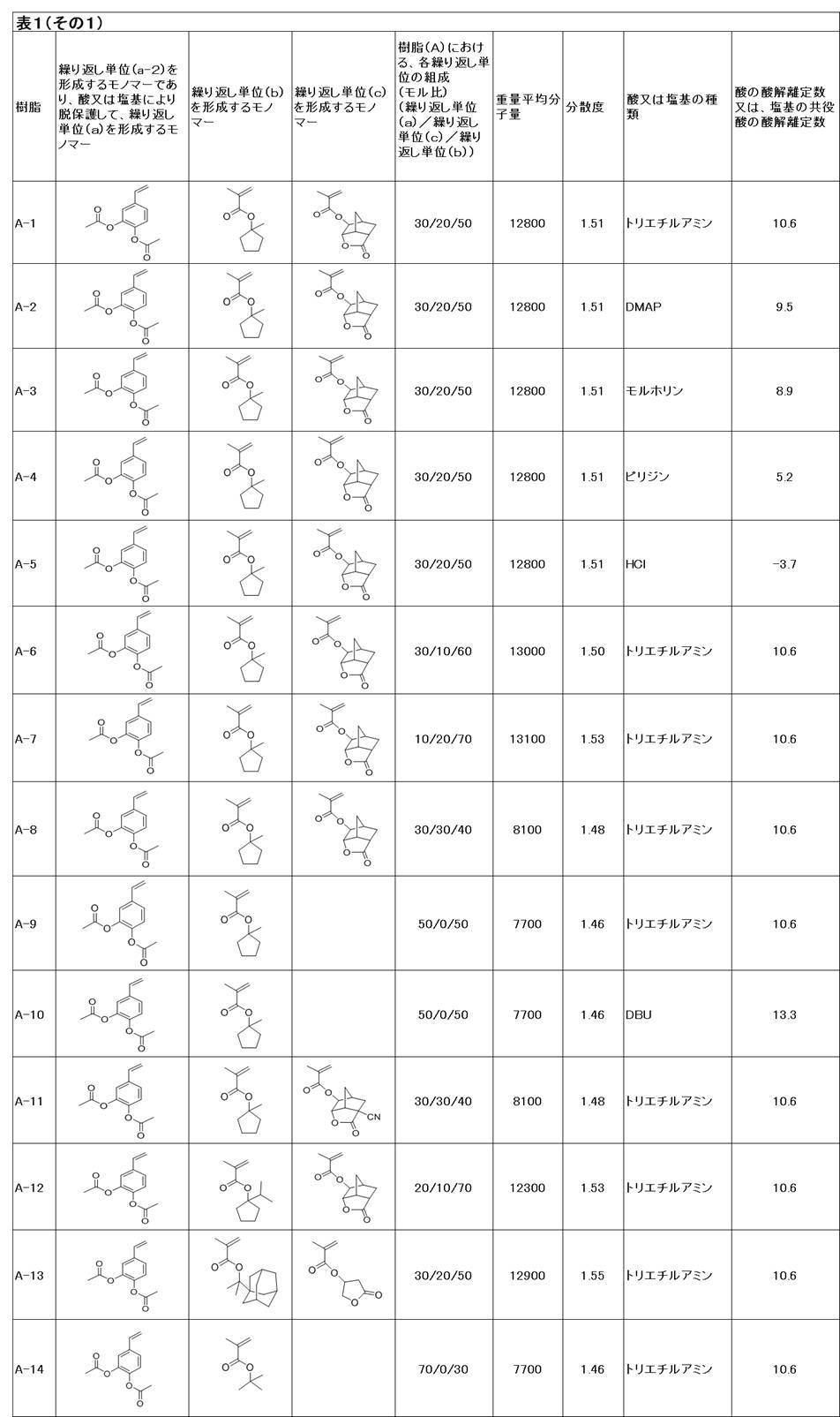

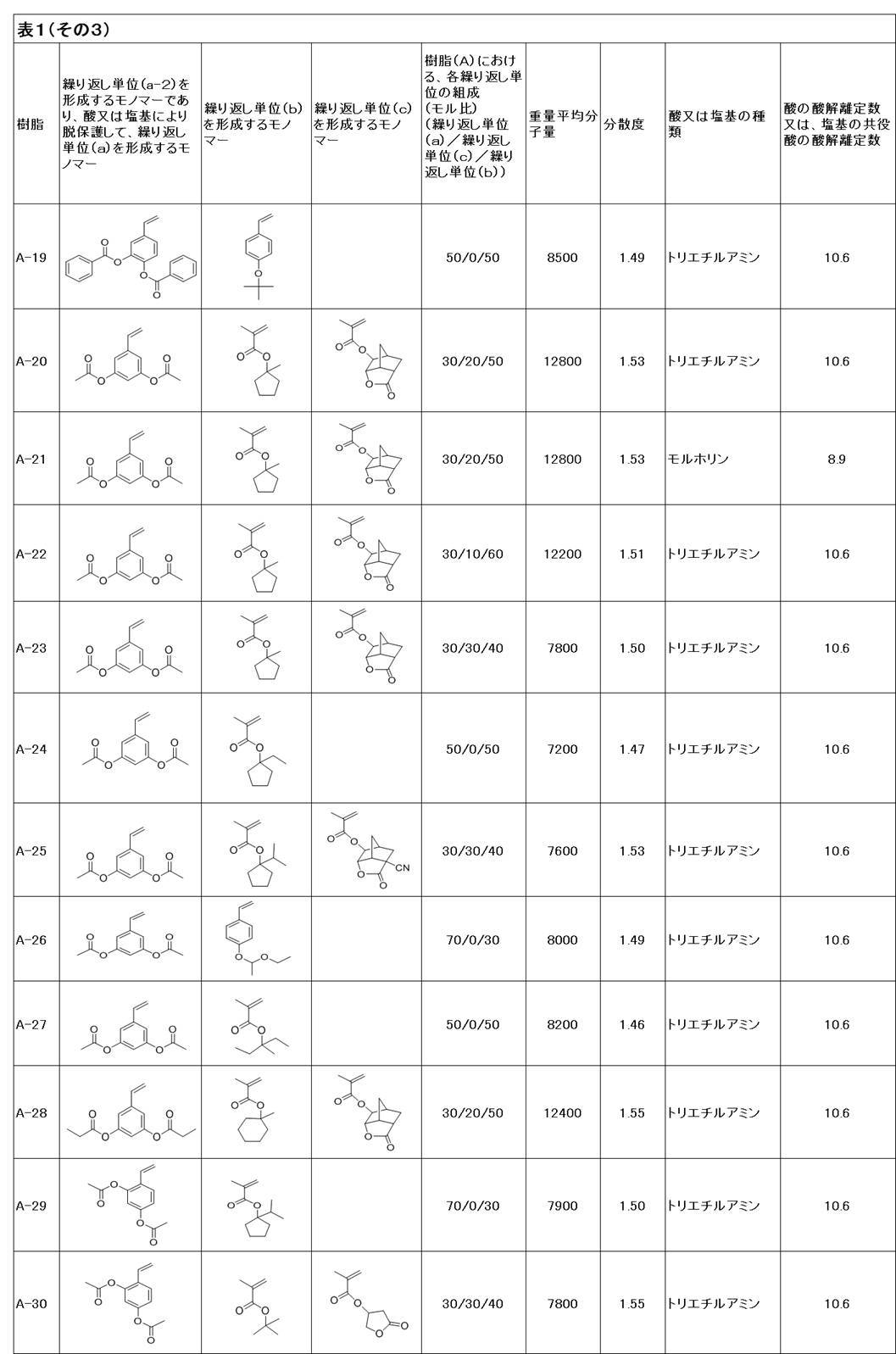

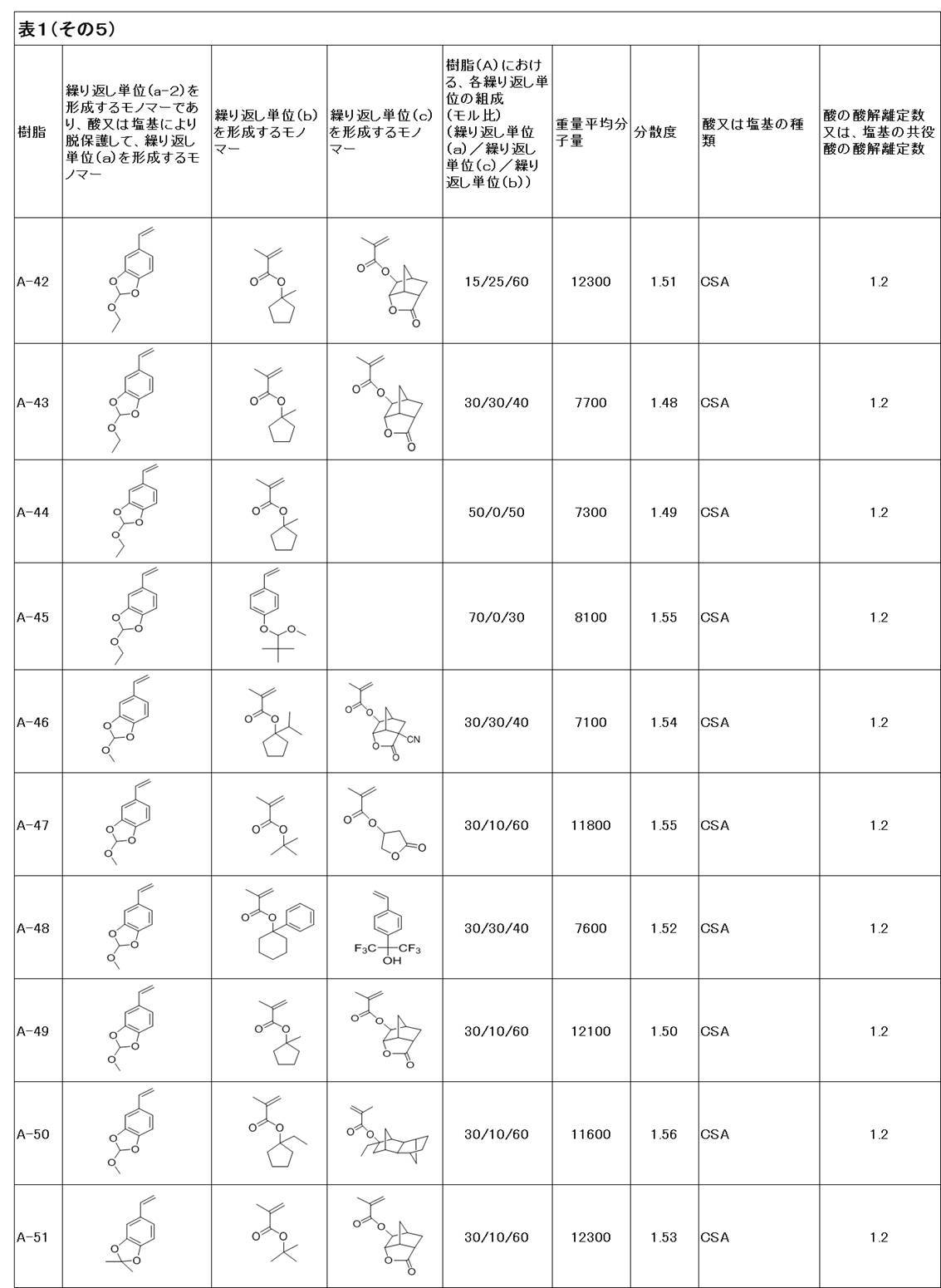
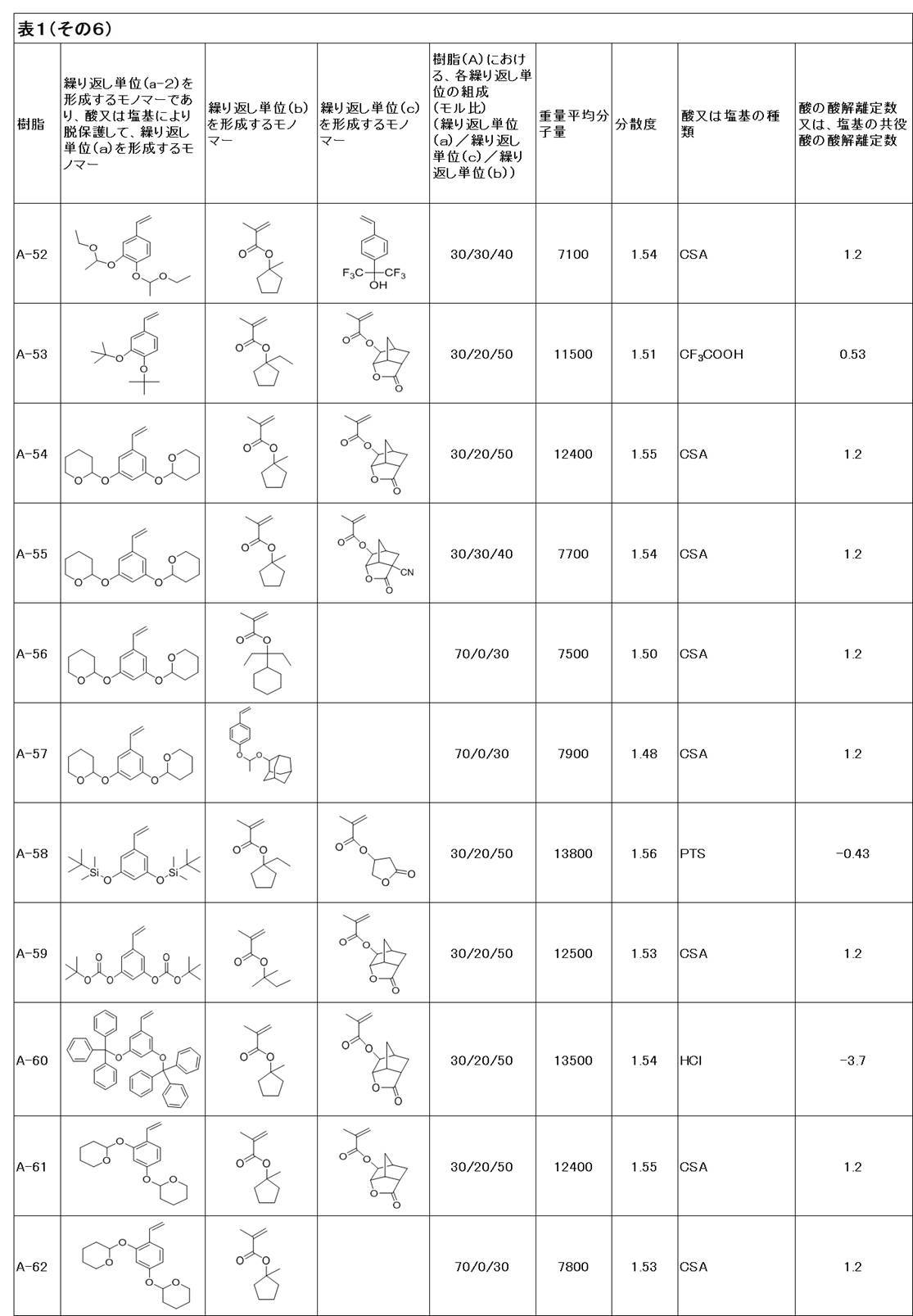


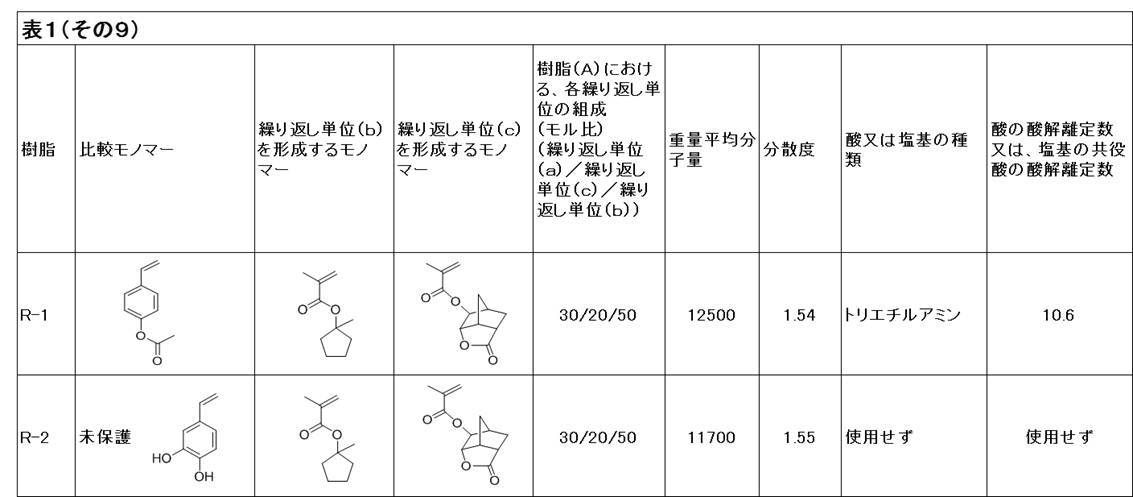
・DMAP:4-ジメチルアミノピリジン
・CSA:(±)-10-カンファースルホン酸
・PTS:p-トルエンスルホン酸
・HCl:塩酸
・CF3COOH:トリフルオロ酢酸
・DBU:ジアザビシクロウンデセン
また、表中、pKaは酸解離定数を表し、塩基性物質のpKaは共役酸のpKaを表わす。
〔光酸発生剤〕
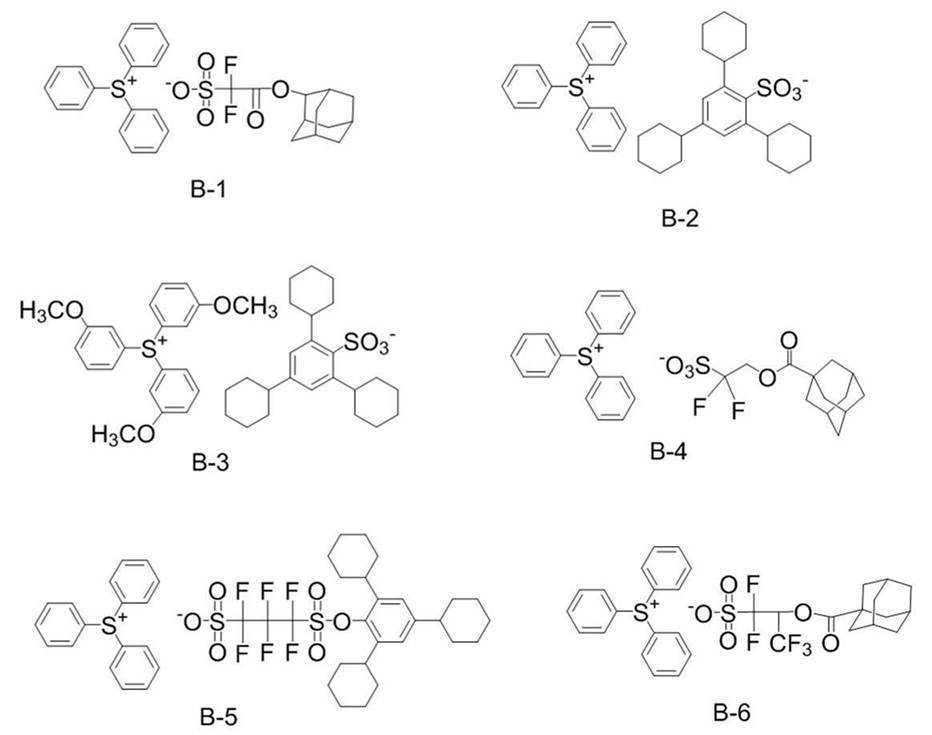
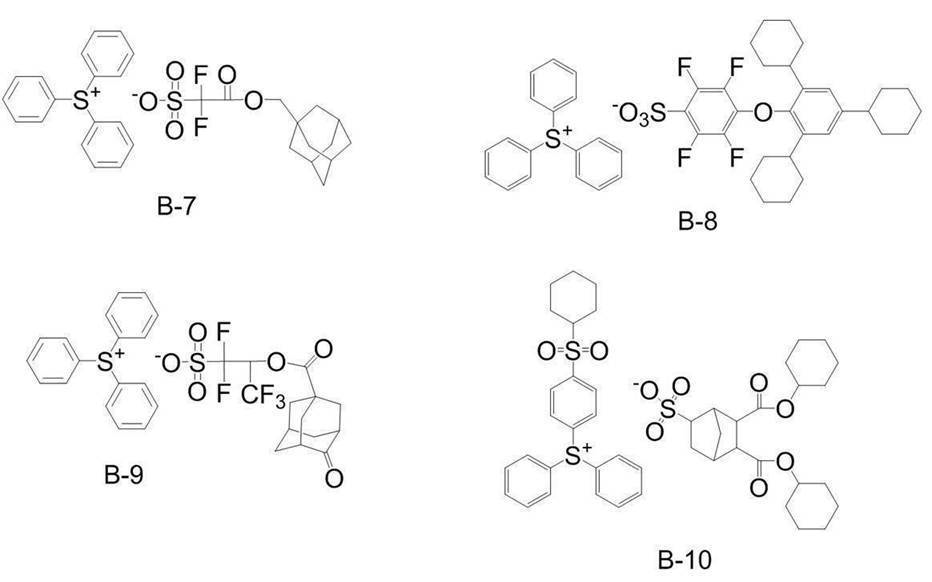
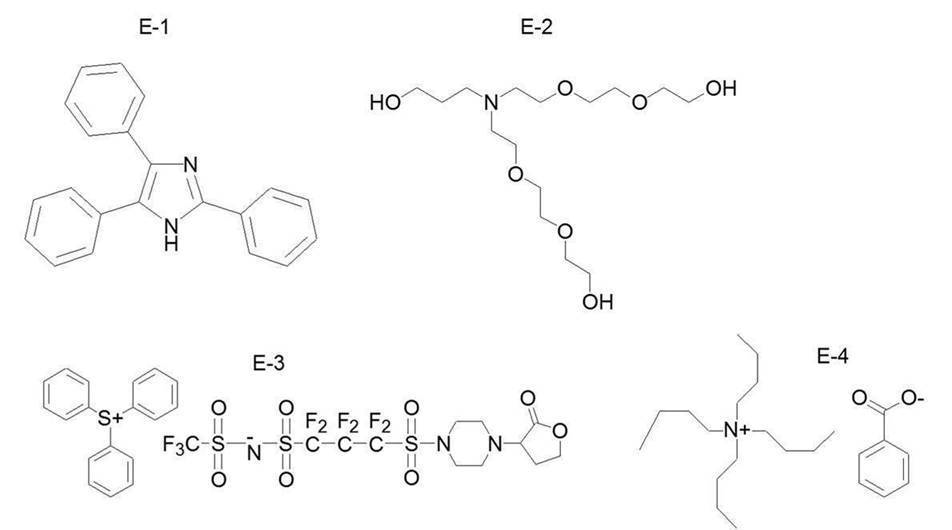
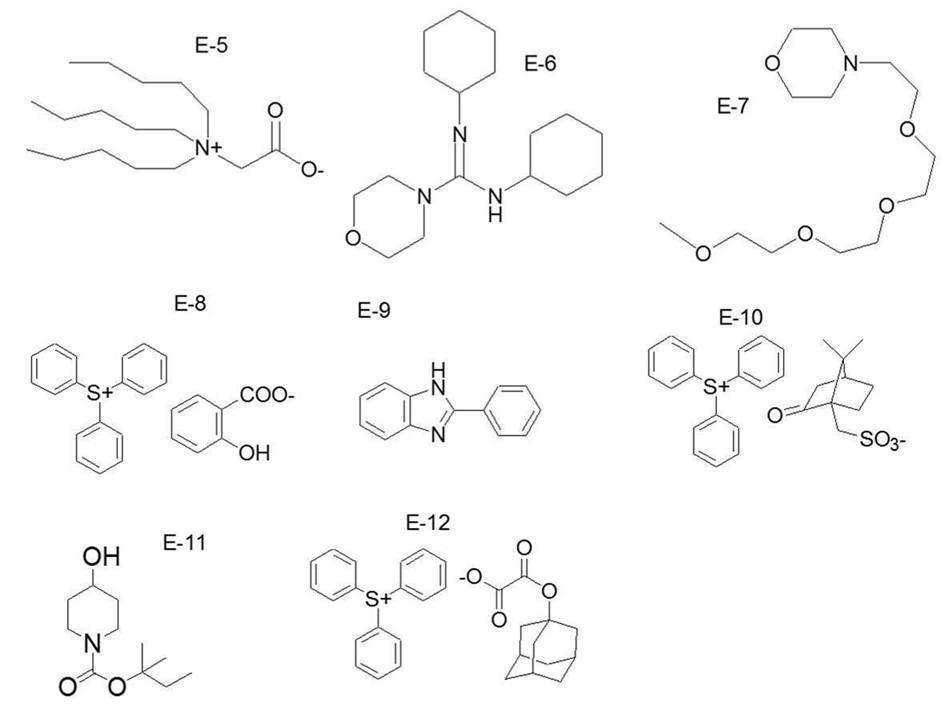
・W-1:メガファックF176(DIC社製)(フッ素系)
・W-2:メガファックR08(DIC社製)(フッ素及びシリコン系)
・W-3:ポリシロキサンポリマーKP-341(信越化学工業社製)(シリコン系)
・W-4:トロイゾルS-366(トロイケミカル社製)
・W-5:KH-20(旭化成社製)
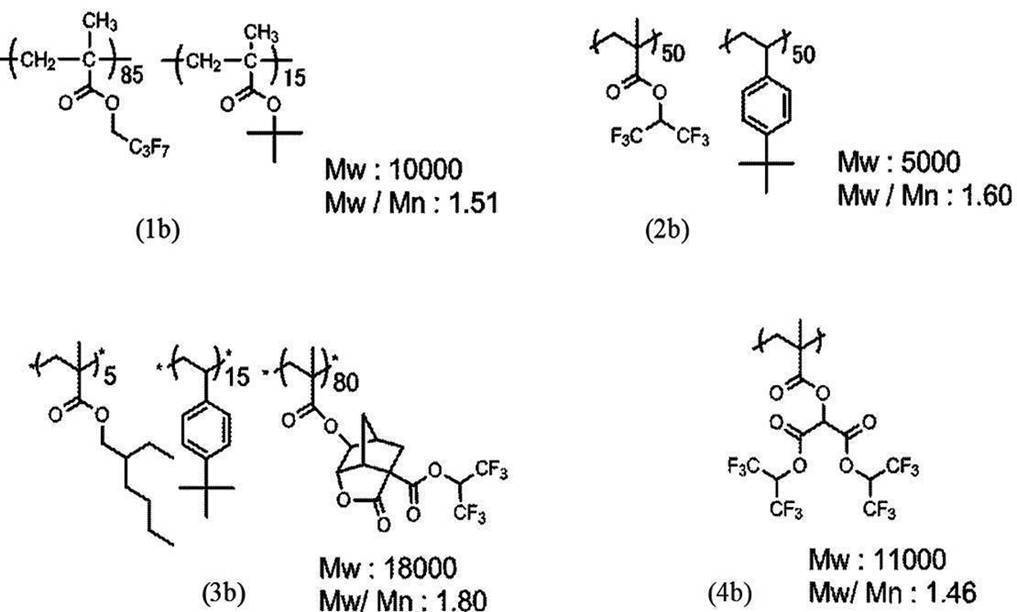
・C1:プロピレングリコールモノメチルエーテルアセテート(PGMEA)
・C2:プロピレングリコールモノメチルエーテル(PGME)
・C3:乳酸エチル
・C4:シクロヘキサノン
・C5:2-ヘプタノン
・C6:γ-ブチロラクトン
・G1:酢酸ブチル
・G2:2-ヘプタノン
・G3:ジイソブチルケトン
・G4:酢酸イソアミル
・G5:ジブチルエーテル
・G6:ウンデカン
表2に示す各成分(各成分の濃度(質量%)は全固形分に対する各成分の含有量を表す)を混合し、それぞれを、孔径が0.03μmのポリエチレンフィルターでろ過して、レジスト組成物を得た。

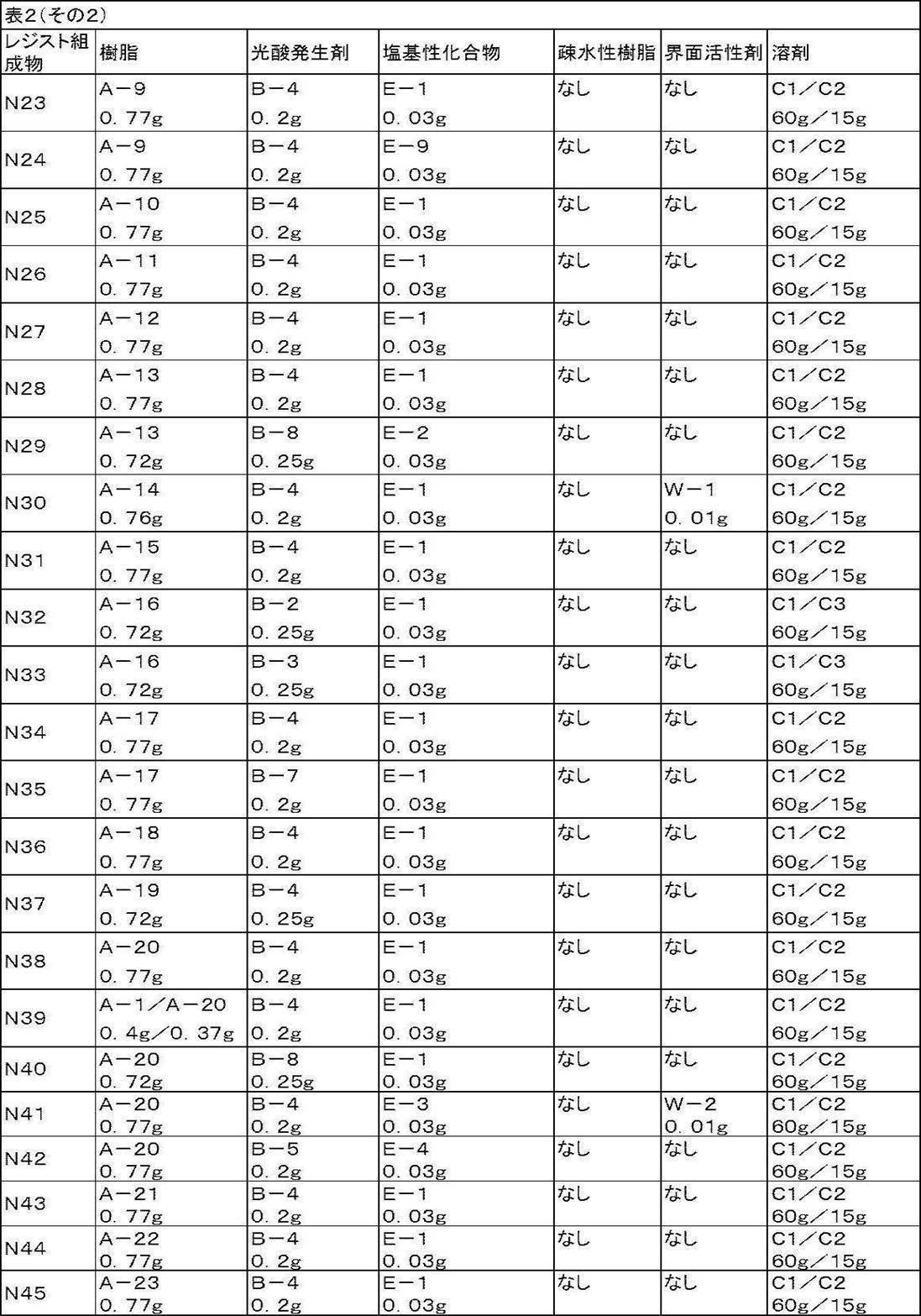


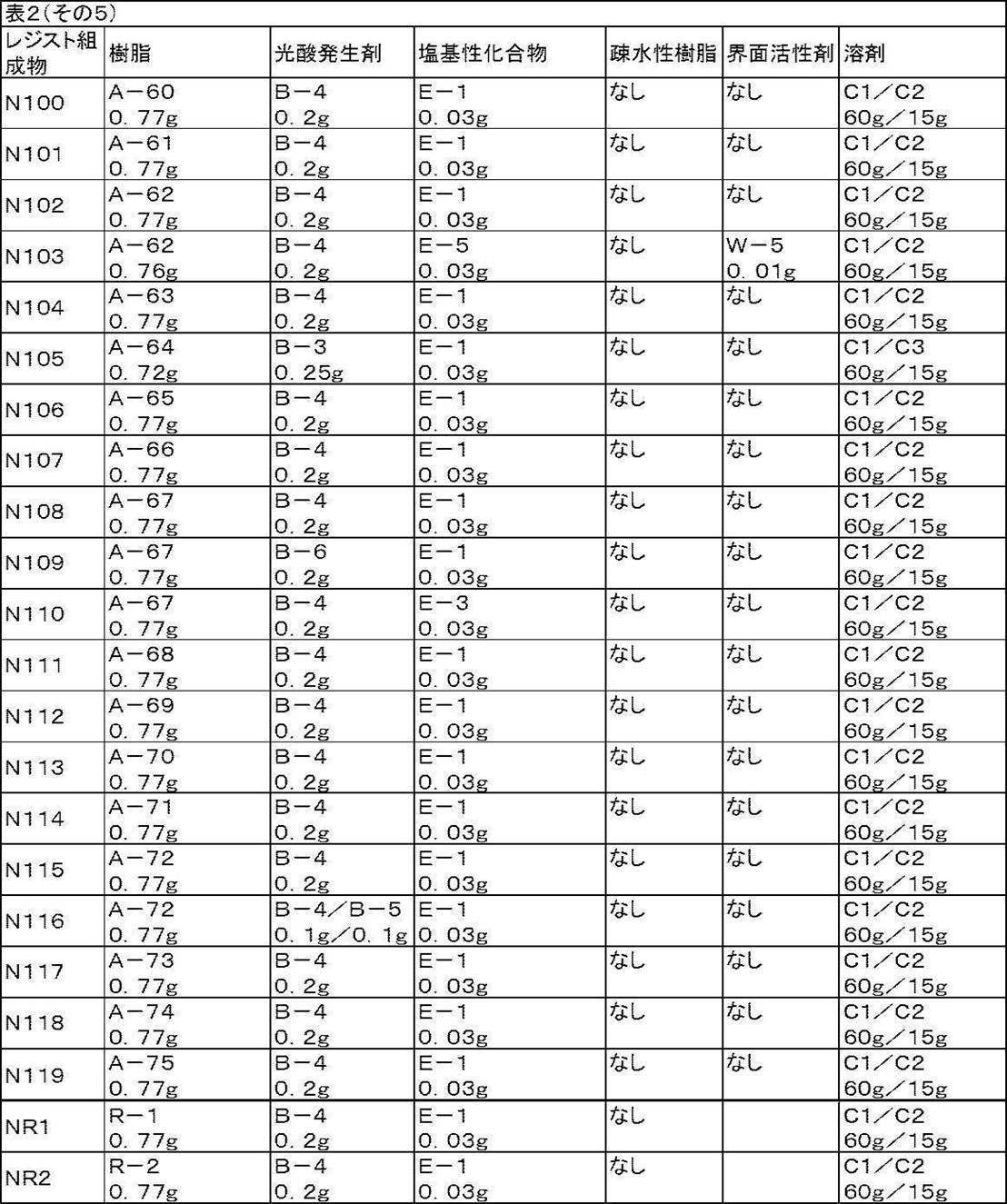
上記レジスト組成物を用いて、下記の方法で評価した。
レジストパターンの性能評価は走査型電子顕微鏡((株)日立製作所製S-9380II)を用いて行った。
最適露光量(Eopt)で各レジスト膜を露光し、線幅16~30nmまでの1:1ラインアンドスペースパターンを、形成する際の限界解像度(倒れずに分離解像する最小の線幅)を解像性(nm)とした。この値が小さいほど、レジスト膜は優れた解像性を有しており、好ましい。
上記、解像性評価において、スカムを以下のように評価した。
A:スカムが全く見られなかった。
B:限界解像度よりも広い線幅においてスカムが見られた。
表3に記載の現像液に代えて、テトラメチルアンモニウムヒドロキシド水溶液(2.38質量%、表4中ではTMAHと表記した。)を用い、表3に記載のリンス液に代えて純水用いた以外は、上記と同様の手順に従って、1:1ラインアンドスペースパターンを形成し、解像性、及び、スカムを評価した。結果を表4に示した。
EUV露光装置の代わりに電子線照射装置((株)JEOL製 JBX6000;加速電圧50keV)を用いて、2.5nm刻みで線幅18~30nmのラインアンドスペースパターン(長さ方向0.2mm、描画本数40本)が形成されるように照射量を変えて露光したことを除いては、上記と同様の方法により、パターンを形成し、解像性、及び、スカムを評価した。なお、現像液、及び、リンス液としては、それぞれ表5、及び、表6に記載したものを使用した。
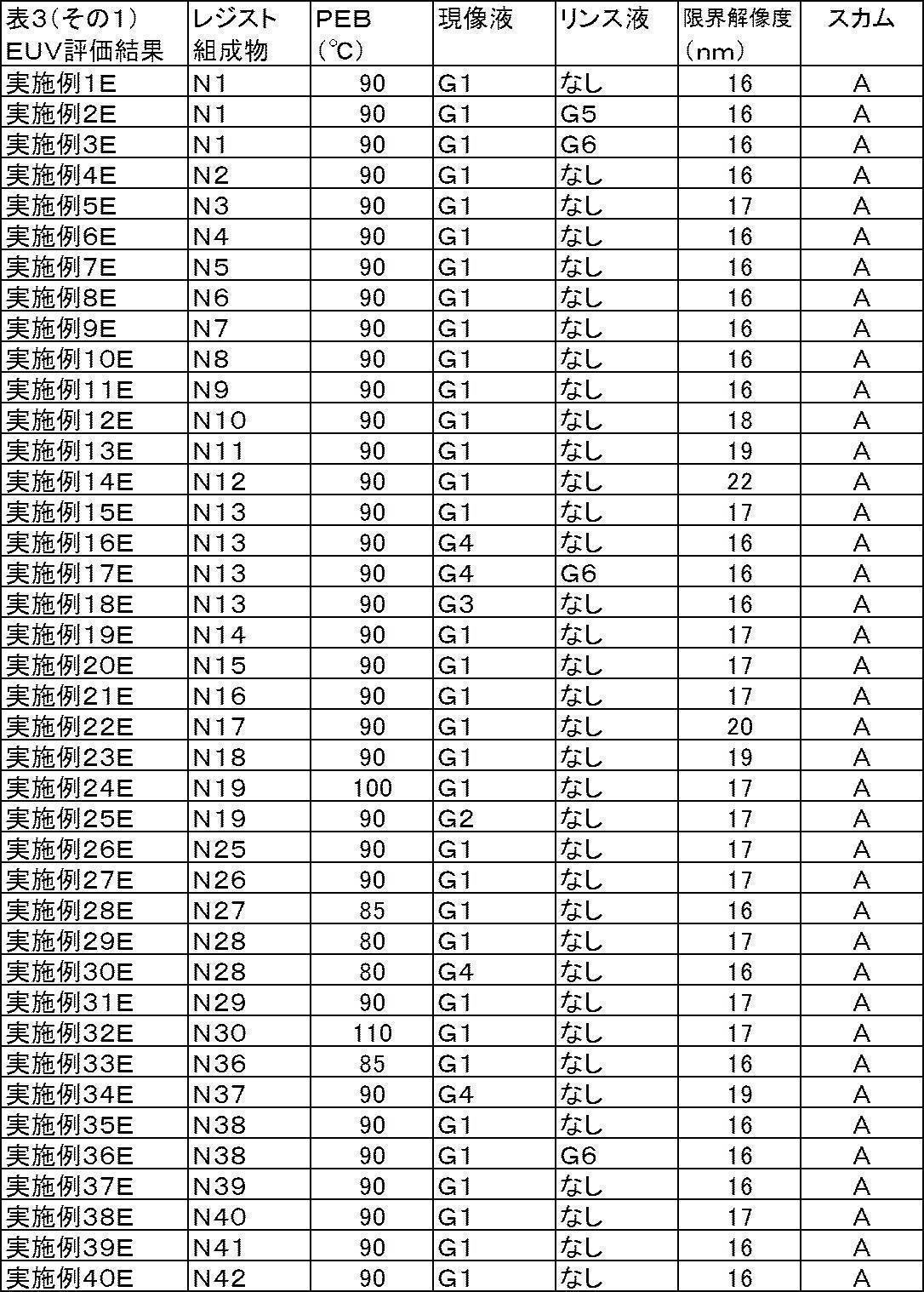
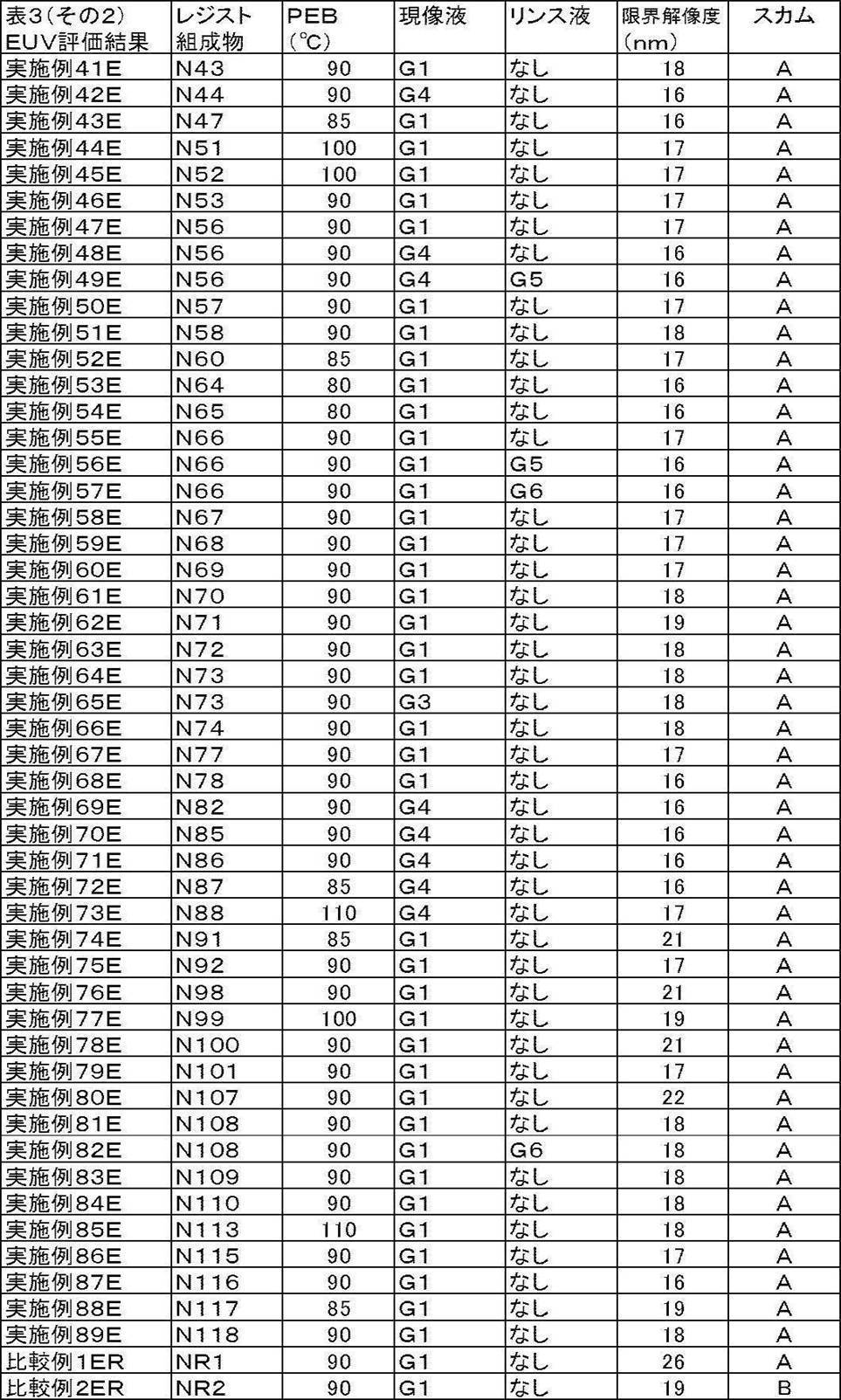


一方、繰り返し単位(a)を含有しない(複数のヒドロキシル基を含有しない)樹脂を含有するレジスト組成物NR1を用いた比較例では、形成されたレジスト膜は、限界解像度が大きく、本発明の効果を有していなかった。
また、第一工程、及び、第二工程を経ずに製造した樹脂(R-2)を含有するレジスト組成物NR2を用いた比較例では、形成されたレジスト膜は、限界解像度は小さいものの、現像後、未露光部に残渣(スカム)が生じ、本発明の効果を有していなかった。
また、実施例47EAは、実施例46EAと比較して、一般式(3)で表される繰り返し単位を含有する樹脂を多く含有しているため、より限界解像度が小さかった。
また、第二工程において、-OYで表される基を共役酸の酸解離定数が9.0以上の塩基で脱保護した、実施例1E;実施例1EA;実施例1EB;実施例1ECのレジスト組成物は、それぞれ、実施例12E;実施例7EA;実施例7EB;実施例6ECのレジスト組成物と比較して、得られるレジスト膜が、より小さい限界解像度を有し、より優れた解像性を有していた。
また、第二工程において、-OYで表される基を酸解離定数が1.0以上の酸で脱保護した、実施例60E;実施例26Eのレジスト組成物は、実施例61E;実施例27EBのレジスト組成物と比較して、得られるレジスト膜が、より小さい限界解像度を有し、より優れた解像性を有していた。
Claims (9)
- 一般式(1)で表される繰り返し単位と、
酸の作用により分解して極性基を生じる基を含有する繰り返し単位と、
を含有する樹脂を製造する、樹脂の製造方法であって、
一般式(2)で表される繰り返し単位と、
酸の作用により分解して極性基を生じる基を含有する繰り返し単位と、
を含有する樹脂前駆体を得る第一工程と、
前記樹脂前駆体中の前記一般式(2)で表される繰り返し単位における-OYで表される基を、酸又は塩基で脱保護して、前記一般式(1)で表される繰り返し単位を得る第二工程と、
を含有する、樹脂の製造方法。

前記一般式(1)中、R1は水素原子、ハロゲン原子、アルキル基、シクロアルキル基、シアノ基、又は、アルコキシカルボニル基を表し、Xは単結合、-COO-、又は、-CONR3-を表し、R2は置換基を表し、R3は水素原子、又は、アルキル基を表し、nは2~5の整数を表し、mは0~3の整数を表す。なお、複数あるR2は同一でも異なってもよい。
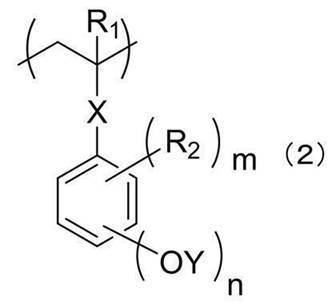
前記一般式(2)中、-OYで表される基は、酸又は塩基の作用で脱保護してヒドロキシル基を生じる基であり、Yは保護基である。なお、2つの前記-OYで表される基が互いにオルト位にある場合、2つの前記Y同士は互いに結合して環を形成してもよい。また、R1、R2、X、m、及び、nは、それぞれ前記一般式(1)におけるR1、R2、X、m、及び、nと同義である。 - 前記酸の作用により分解して極性基を生じる基を含有する繰り返し単位が、一般式(3)で表される、請求項1に記載の樹脂の製造方法。
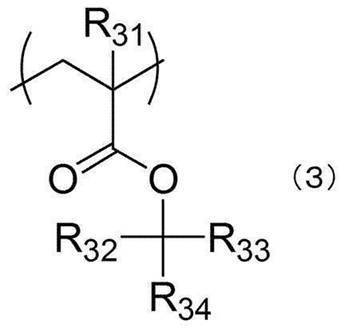
前記一般式(3)中、R31は水素原子、ハロゲン原子、アルキル基、シクロアルキル基、シアノ基、又は、アルコキシカルボニル基を表し、R32、R33、及び、R34はそれぞれ独立に、アルキル基、又は、シクロアルキル基を表し、R33とR34は互いに結合して環を形成してもよい。 - 前記Yが、一般式(4)で表され、前記第二工程において、前記-OYで表される基を塩基で脱保護する、請求項1又は2に記載の樹脂の製造方法。

前記一般式(4)中、R41はアルキル基、シクロアルキル基、又は、アリール基を表す。また、*は酸素原子との結合位置を表す。 - 前記塩基の共役酸の酸解離定数が6.0以上である、請求項3に記載の樹脂の製造方法。
- 前記Yが下記一般式(5)で表され、かつ、前記第二工程において、前記-OYで表される基を酸で脱保護するか、又は、
前記一般式(2)で表される繰り返し単位が一般式(6)で表され、かつ、前記第二工程において、-O-Z-O-で表される基を酸で脱保護する、請求項1又は2に記載の樹脂の製造方法。

前記一般式(5)中、R42はアルキル基を表し、R43、及び、R44は、それぞれ独立に、水素原子、又は、アルキル基を表す。また、R42とR44とは、互いに結合して環を形成してもよい。また、*は酸素原子との結合位置を表す。

前記一般式(6)中、R61は置換基を表し、Zは、一般式(Z)で表される基を表し、R1、X、及び、mは、それぞれ前記一般式(1)におけるR1、X、及び、mと同義である。前記一般式(Z)中、R45及びR46は、それぞれ独立に、水素原子、アルキル基、又は、アルコキシ基を表す。ただし、R45、及び、R46からなる群から選択される少なくとも一方は、アルキル基、又は、アルコキシ基である。なお*は酸素原子との結合位置を表す。 - 前記一般式(2)で表される繰り返し単位が、前記一般式(6)で表され、かつ、前記第二工程において、-O-Z-O-で表される基を酸で脱保護する、請求項5に記載の樹脂の製造方法。
- 前記酸の酸解離定数が-1.0以上である、請求項5又は6に記載の樹脂の製造方法。
- 前記樹脂中における前記一般式(1)で表される繰り返し単位の含有量が、前記樹脂の全繰り返し単位に対して15モル%以上である、請求項1~7のいずれか一項に記載の樹脂の製造方法。
- 請求項1~8のいずれか一項に記載の製造方法により製造された樹脂と、
活性光線又は放射線の照射により酸を発生する化合物と、を混合する工程を含有する、感活性光線性又は感放射線性組成物の製造方法。
Priority Applications (4)
| Application Number | Priority Date | Filing Date | Title |
|---|---|---|---|
| JP2018547508A JPWO2018079203A1 (ja) | 2016-10-31 | 2017-10-02 | 樹脂の製造方法、及び、感活性光線性又は感放射線性組成物の製造方法 |
| CN201780062407.9A CN109803990A (zh) | 2016-10-31 | 2017-10-02 | 树脂的制造方法及感光化射线性或感放射线性组合物的制造方法 |
| KR1020197009658A KR102208103B1 (ko) | 2016-10-31 | 2017-10-02 | 수지의 제조 방법, 및 감활성광선성 또는 감방사선성 조성물의 제조 방법 |
| US16/362,820 US20190276575A1 (en) | 2016-10-31 | 2019-03-25 | Method for producing resin and method for producing actinic ray-sensitive or radiation-sensitive composition |
Applications Claiming Priority (4)
| Application Number | Priority Date | Filing Date | Title |
|---|---|---|---|
| JP2016-212953 | 2016-10-31 | ||
| JP2016212953 | 2016-10-31 | ||
| JP2017042996 | 2017-03-07 | ||
| JP2017-042996 | 2017-03-07 |
Related Child Applications (1)
| Application Number | Title | Priority Date | Filing Date |
|---|---|---|---|
| US16/362,820 Continuation US20190276575A1 (en) | 2016-10-31 | 2019-03-25 | Method for producing resin and method for producing actinic ray-sensitive or radiation-sensitive composition |
Publications (1)
| Publication Number | Publication Date |
|---|---|
| WO2018079203A1 true WO2018079203A1 (ja) | 2018-05-03 |
Family
ID=62023367
Family Applications (1)
| Application Number | Title | Priority Date | Filing Date |
|---|---|---|---|
| PCT/JP2017/035839 Ceased WO2018079203A1 (ja) | 2016-10-31 | 2017-10-02 | 樹脂の製造方法、及び、感活性光線性又は感放射線性組成物の製造方法 |
Country Status (6)
| Country | Link |
|---|---|
| US (1) | US20190276575A1 (ja) |
| JP (2) | JPWO2018079203A1 (ja) |
| KR (1) | KR102208103B1 (ja) |
| CN (1) | CN109803990A (ja) |
| TW (1) | TWI733916B (ja) |
| WO (1) | WO2018079203A1 (ja) |
Cited By (11)
| Publication number | Priority date | Publication date | Assignee | Title |
|---|---|---|---|---|
| CN108640836A (zh) * | 2018-06-12 | 2018-10-12 | 上海博栋化学科技有限公司 | 一锅法合成酰氧基取代的苯乙烯类化合物的方法 |
| CN108640819A (zh) * | 2018-06-12 | 2018-10-12 | 上海博栋化学科技有限公司 | 一种一锅法合成羟基苯乙烯类化合物的方法 |
| JP2018205710A (ja) * | 2017-06-06 | 2018-12-27 | 住友化学株式会社 | レジスト組成物及びレジストパターンの製造方法 |
| KR20200056929A (ko) * | 2018-11-15 | 2020-05-25 | 도오꾜오까고오교 가부시끼가이샤 | 레지스트 조성물 및 레지스트 패턴 형성 방법 |
| JP2021004927A (ja) * | 2019-06-25 | 2021-01-14 | 東京応化工業株式会社 | レジスト組成物及びレジストパターン形成方法 |
| WO2021029310A1 (ja) * | 2019-08-09 | 2021-02-18 | 丸善石油化学株式会社 | 重合体およびその製造方法、ならびにレジスト用樹脂組成物 |
| JP2021081678A (ja) * | 2019-11-22 | 2021-05-27 | 東京応化工業株式会社 | レジスト組成物及びレジストパターン形成方法 |
| JP2021095575A (ja) * | 2016-10-31 | 2021-06-24 | 富士フイルム株式会社 | 樹脂の製造方法、及び、感活性光線性又は感放射線性組成物の製造方法 |
| JP2021103236A (ja) * | 2019-12-25 | 2021-07-15 | 東京応化工業株式会社 | レジスト組成物及びレジストパターン形成方法 |
| JP2023121675A (ja) * | 2022-02-21 | 2023-08-31 | 富士フイルム株式会社 | フェノール性水酸基を有する樹脂の製造方法 |
| JP2024022755A (ja) * | 2022-08-08 | 2024-02-21 | 信越化学工業株式会社 | レジスト組成物及びパターン形成方法 |
Families Citing this family (4)
| Publication number | Priority date | Publication date | Assignee | Title |
|---|---|---|---|---|
| WO2020261784A1 (ja) * | 2019-06-25 | 2020-12-30 | 富士フイルム株式会社 | 感放射線性樹脂組成物の製造方法 |
| JP7530572B2 (ja) * | 2020-03-11 | 2024-08-08 | Jsr株式会社 | 感放射線性樹脂組成物、パターン形成方法及び単量体化合物の製造方法 |
| JP2022135905A (ja) * | 2021-03-03 | 2022-09-15 | Jsr株式会社 | 感放射線性樹脂組成物及びレジストパターンの形成方法 |
| CN117362164A (zh) * | 2023-12-07 | 2024-01-09 | 中节能万润股份有限公司 | 一种光刻胶单体化合物及其制备方法和应用 |
Citations (9)
| Publication number | Priority date | Publication date | Assignee | Title |
|---|---|---|---|---|
| JPH08286375A (ja) * | 1995-04-12 | 1996-11-01 | Shin Etsu Chem Co Ltd | 高分子化合物及び化学増幅型ポジ型レジスト組成物 |
| JP2009086354A (ja) * | 2007-09-28 | 2009-04-23 | Fujifilm Corp | ポジ型レジスト組成物およびこれを用いたパターン形成方法 |
| JP2011053365A (ja) * | 2009-08-31 | 2011-03-17 | Fujifilm Corp | 感活性光線性又は感放射線性樹脂組成物、及びそれを用いたパターン形成方法 |
| JP2011170315A (ja) * | 2009-09-25 | 2011-09-01 | Sumitomo Chemical Co Ltd | レジスト組成物 |
| JP4982228B2 (ja) * | 2007-03-30 | 2012-07-25 | 富士フイルム株式会社 | ポジ型レジスト組成物及びこれを用いたパターン形成方法 |
| JP5046965B2 (ja) * | 2007-03-27 | 2012-10-10 | 富士フイルム株式会社 | ポジ型レジスト組成物及びそれを用いたパターン形成方法 |
| JP2012219162A (ja) * | 2011-04-07 | 2012-11-12 | Sumitomo Chemical Co Ltd | 樹脂の製造方法 |
| JP2012219164A (ja) * | 2011-04-07 | 2012-11-12 | Sumitomo Chemical Co Ltd | 樹脂の製造方法 |
| JP2014074893A (ja) * | 2012-09-13 | 2014-04-24 | Shin Etsu Chem Co Ltd | マイクロ構造体用樹脂構造体の製造方法及びマイクロ構造体の製造方法 |
Family Cites Families (8)
| Publication number | Priority date | Publication date | Assignee | Title |
|---|---|---|---|---|
| JP3712047B2 (ja) | 2000-08-14 | 2005-11-02 | 信越化学工業株式会社 | レジスト材料及びパターン形成方法 |
| JP4123920B2 (ja) * | 2001-12-20 | 2008-07-23 | Jsr株式会社 | 共重合体、重合体混合物および感放射線性樹脂組成物 |
| JP2004062044A (ja) * | 2002-07-31 | 2004-02-26 | Fuji Photo Film Co Ltd | 電子線、x線又はeuv用ネガ型レジスト組成物 |
| JP5514759B2 (ja) * | 2011-03-25 | 2014-06-04 | 富士フイルム株式会社 | レジストパターン形成方法、レジストパターン、有機溶剤現像用の架橋性ネガ型化学増幅型レジスト組成物、レジスト膜、及びレジスト塗布マスクブランクス |
| JP6230217B2 (ja) | 2011-09-06 | 2017-11-15 | Jsr株式会社 | レジストパターン形成方法 |
| JP6413333B2 (ja) | 2014-05-13 | 2018-10-31 | Jsr株式会社 | パターン形成方法 |
| WO2017057203A1 (ja) | 2015-09-29 | 2017-04-06 | Jsr株式会社 | 感放射線性樹脂組成物及びレジストパターン形成方法 |
| CN109803990A (zh) | 2016-10-31 | 2019-05-24 | 富士胶片株式会社 | 树脂的制造方法及感光化射线性或感放射线性组合物的制造方法 |
-
2017
- 2017-10-02 CN CN201780062407.9A patent/CN109803990A/zh active Pending
- 2017-10-02 KR KR1020197009658A patent/KR102208103B1/ko active Active
- 2017-10-02 WO PCT/JP2017/035839 patent/WO2018079203A1/ja not_active Ceased
- 2017-10-02 JP JP2018547508A patent/JPWO2018079203A1/ja active Pending
- 2017-10-11 TW TW106134683A patent/TWI733916B/zh active
-
2019
- 2019-03-25 US US16/362,820 patent/US20190276575A1/en not_active Abandoned
-
2021
- 2021-03-01 JP JP2021031881A patent/JP7203133B2/ja active Active
Patent Citations (9)
| Publication number | Priority date | Publication date | Assignee | Title |
|---|---|---|---|---|
| JPH08286375A (ja) * | 1995-04-12 | 1996-11-01 | Shin Etsu Chem Co Ltd | 高分子化合物及び化学増幅型ポジ型レジスト組成物 |
| JP5046965B2 (ja) * | 2007-03-27 | 2012-10-10 | 富士フイルム株式会社 | ポジ型レジスト組成物及びそれを用いたパターン形成方法 |
| JP4982228B2 (ja) * | 2007-03-30 | 2012-07-25 | 富士フイルム株式会社 | ポジ型レジスト組成物及びこれを用いたパターン形成方法 |
| JP2009086354A (ja) * | 2007-09-28 | 2009-04-23 | Fujifilm Corp | ポジ型レジスト組成物およびこれを用いたパターン形成方法 |
| JP2011053365A (ja) * | 2009-08-31 | 2011-03-17 | Fujifilm Corp | 感活性光線性又は感放射線性樹脂組成物、及びそれを用いたパターン形成方法 |
| JP2011170315A (ja) * | 2009-09-25 | 2011-09-01 | Sumitomo Chemical Co Ltd | レジスト組成物 |
| JP2012219162A (ja) * | 2011-04-07 | 2012-11-12 | Sumitomo Chemical Co Ltd | 樹脂の製造方法 |
| JP2012219164A (ja) * | 2011-04-07 | 2012-11-12 | Sumitomo Chemical Co Ltd | 樹脂の製造方法 |
| JP2014074893A (ja) * | 2012-09-13 | 2014-04-24 | Shin Etsu Chem Co Ltd | マイクロ構造体用樹脂構造体の製造方法及びマイクロ構造体の製造方法 |
Cited By (24)
| Publication number | Priority date | Publication date | Assignee | Title |
|---|---|---|---|---|
| JP7203133B2 (ja) | 2016-10-31 | 2023-01-12 | 富士フイルム株式会社 | 樹脂の製造方法、及び、感活性光線性又は感放射線性組成物の製造方法 |
| JP2021095575A (ja) * | 2016-10-31 | 2021-06-24 | 富士フイルム株式会社 | 樹脂の製造方法、及び、感活性光線性又は感放射線性組成物の製造方法 |
| JP7204343B2 (ja) | 2017-06-06 | 2023-01-16 | 住友化学株式会社 | レジスト組成物及びレジストパターンの製造方法 |
| JP2018205710A (ja) * | 2017-06-06 | 2018-12-27 | 住友化学株式会社 | レジスト組成物及びレジストパターンの製造方法 |
| US11327399B2 (en) | 2017-06-06 | 2022-05-10 | Sumitomo Chemical Company, Limited | Photoresist composition and process for producing photoresist pattern |
| CN108640836A (zh) * | 2018-06-12 | 2018-10-12 | 上海博栋化学科技有限公司 | 一锅法合成酰氧基取代的苯乙烯类化合物的方法 |
| CN108640819A (zh) * | 2018-06-12 | 2018-10-12 | 上海博栋化学科技有限公司 | 一种一锅法合成羟基苯乙烯类化合物的方法 |
| KR102895194B1 (ko) | 2018-11-15 | 2025-12-03 | 도오꾜오까고오교 가부시끼가이샤 | 레지스트 조성물 및 레지스트 패턴 형성 방법 |
| JP2020085917A (ja) * | 2018-11-15 | 2020-06-04 | 東京応化工業株式会社 | レジスト組成物及びレジストパターン形成方法 |
| KR20200056929A (ko) * | 2018-11-15 | 2020-05-25 | 도오꾜오까고오교 가부시끼가이샤 | 레지스트 조성물 및 레지스트 패턴 형성 방법 |
| JP7158251B2 (ja) | 2018-11-15 | 2022-10-21 | 東京応化工業株式会社 | レジスト組成物及びレジストパターン形成方法 |
| JP2021004927A (ja) * | 2019-06-25 | 2021-01-14 | 東京応化工業株式会社 | レジスト組成物及びレジストパターン形成方法 |
| TWI828918B (zh) * | 2019-06-25 | 2024-01-11 | 日商東京應化工業股份有限公司 | 阻劑組成物及阻劑圖型形成方法 |
| JP7308668B2 (ja) | 2019-06-25 | 2023-07-14 | 東京応化工業株式会社 | レジスト組成物及びレジストパターン形成方法 |
| WO2021029310A1 (ja) * | 2019-08-09 | 2021-02-18 | 丸善石油化学株式会社 | 重合体およびその製造方法、ならびにレジスト用樹脂組成物 |
| JP7596275B2 (ja) | 2019-08-09 | 2024-12-09 | 丸善石油化学株式会社 | 重合体およびその製造方法、ならびにレジスト用樹脂組成物 |
| JPWO2021029310A1 (ja) * | 2019-08-09 | 2021-02-18 | ||
| JP2021081678A (ja) * | 2019-11-22 | 2021-05-27 | 東京応化工業株式会社 | レジスト組成物及びレジストパターン形成方法 |
| JP7716838B2 (ja) | 2019-11-22 | 2025-08-01 | 東京応化工業株式会社 | レジスト組成物及びレジストパターン形成方法 |
| JP2021103236A (ja) * | 2019-12-25 | 2021-07-15 | 東京応化工業株式会社 | レジスト組成物及びレジストパターン形成方法 |
| JP2023121675A (ja) * | 2022-02-21 | 2023-08-31 | 富士フイルム株式会社 | フェノール性水酸基を有する樹脂の製造方法 |
| JP7763686B2 (ja) | 2022-02-21 | 2025-11-04 | 富士フイルム株式会社 | フェノール性水酸基を有する樹脂の製造方法 |
| JP2024022755A (ja) * | 2022-08-08 | 2024-02-21 | 信越化学工業株式会社 | レジスト組成物及びパターン形成方法 |
| JP7800342B2 (ja) | 2022-08-08 | 2026-01-16 | 信越化学工業株式会社 | レジスト組成物及びパターン形成方法 |
Also Published As
| Publication number | Publication date |
|---|---|
| KR102208103B1 (ko) | 2021-01-27 |
| TW201817751A (zh) | 2018-05-16 |
| US20190276575A1 (en) | 2019-09-12 |
| CN109803990A (zh) | 2019-05-24 |
| JPWO2018079203A1 (ja) | 2019-09-12 |
| JP7203133B2 (ja) | 2023-01-12 |
| TWI733916B (zh) | 2021-07-21 |
| JP2021095575A (ja) | 2021-06-24 |
| KR20190050809A (ko) | 2019-05-13 |
Similar Documents
| Publication | Publication Date | Title |
|---|---|---|
| JP7203133B2 (ja) | 樹脂の製造方法、及び、感活性光線性又は感放射線性組成物の製造方法 | |
| TWI827629B (zh) | 感光化射線性或感放射線性樹脂組成物、圖案形成方法、電子器件的製造方法、樹脂 | |
| KR102450804B1 (ko) | 감활성광선성 또는 감방사선성 수지 조성물, 레지스트막, 패턴 형성 방법, 전자 디바이스의 제조 방법, 수지 | |
| TWI833701B (zh) | 感光化射線性或感放射線性樹脂組成物、抗蝕劑膜、圖案形成方法、電子元件的製造方法 | |
| KR102404436B1 (ko) | 감활성광선성 또는 감방사선성 수지 조성물, 레지스트막, 패턴 형성 방법, 전자 디바이스의 제조 방법 | |
| TWI766074B (zh) | 感光化射線性或感放射線性樹脂組成物、抗蝕劑膜、圖案形成方法、電子元件的製造方法 | |
| JP5659310B2 (ja) | 電子線又はeuv光を用いた有機溶剤系現像又は多重現像パターン形成方法 | |
| TWI777981B (zh) | 感光化射線性或感放射線性樹脂組成物、圖案形成方法及電子元件的製造方法 | |
| JP6743158B2 (ja) | レジスト組成物、パターン形成方法及び電子デバイスの製造方法 | |
| WO2020158313A1 (ja) | 感活性光線性又は感放射線性樹脂組成物、レジスト膜、パターン形成方法、電子デバイスの製造方法 | |
| TWI763703B (zh) | 感光化射線性或感放射線性樹脂組成物、圖案形成方法及電子元件的製造方法 | |
| JP2019045864A (ja) | 反転パターン形成方法、電子デバイスの製造方法 | |
| WO2020158337A1 (ja) | 感活性光線性又は感放射線性樹脂組成物、レジスト膜、パターン形成方法、電子デバイスの製造方法 | |
| JPWO2017138267A1 (ja) | パターン形成方法及び電子デバイスの製造方法 | |
| TWI514077B (zh) | 圖案形成方法、樹脂組成物、膜以及製造半導體元件之方法 | |
| CN113166327A (zh) | 感光化射线性或感放射线性树脂组合物、抗蚀剂膜、图案形成方法及电子器件的制造方法 | |
| CN107735730A (zh) | 显影液、图案形成方法及电子设备的制造方法 | |
| TWI667535B (zh) | 感光化射線性或感放射線性樹脂組成物、圖案形成方法、及電子裝置的製造方法 | |
| JPWO2017104355A1 (ja) | レジスト組成物、レジスト膜、マスクブランクス、パターン形成方法、及び電子デバイスの製造方法 | |
| WO2020261885A1 (ja) | 感活性光線性又は感放射線性樹脂組成物、パターン形成方法、レジスト膜、電子デバイスの製造方法 | |
| JP6676657B2 (ja) | パターン形成方法、電子デバイスの製造方法、半導体デバイス製造プロセス用樹脂の製造用モノマー、樹脂、樹脂の製造方法、感活性光線性又は感放射線性樹脂組成物、及び、感活性光線性又は感放射線性膜 | |
| CN113574079B (zh) | Euv光用感光性组合物、图案形成方法及电子器件的制造方法 | |
| TWI803689B (zh) | 感光化射線性或感放射線性樹脂組成物、抗蝕劑膜、圖案形成方法、電子器件之製造方法 |
Legal Events
| Date | Code | Title | Description |
|---|---|---|---|
| 121 | Ep: the epo has been informed by wipo that ep was designated in this application |
Ref document number: 17865028 Country of ref document: EP Kind code of ref document: A1 |
|
| ENP | Entry into the national phase |
Ref document number: 20197009658 Country of ref document: KR Kind code of ref document: A |
|
| ENP | Entry into the national phase |
Ref document number: 2018547508 Country of ref document: JP Kind code of ref document: A |
|
| NENP | Non-entry into the national phase |
Ref country code: DE |
|
| 122 | Ep: pct application non-entry in european phase |
Ref document number: 17865028 Country of ref document: EP Kind code of ref document: A1 |