WO2018074458A1 - 方法及び診断薬 - Google Patents
方法及び診断薬 Download PDFInfo
- Publication number
- WO2018074458A1 WO2018074458A1 PCT/JP2017/037496 JP2017037496W WO2018074458A1 WO 2018074458 A1 WO2018074458 A1 WO 2018074458A1 JP 2017037496 W JP2017037496 W JP 2017037496W WO 2018074458 A1 WO2018074458 A1 WO 2018074458A1
- Authority
- WO
- WIPO (PCT)
- Prior art keywords
- hepatitis
- hla
- virus
- progression
- dpb1
- Prior art date
- Legal status (The legal status is an assumption and is not a legal conclusion. Google has not performed a legal analysis and makes no representation as to the accuracy of the status listed.)
- Ceased
Links
Classifications
-
- C—CHEMISTRY; METALLURGY
- C12—BIOCHEMISTRY; BEER; SPIRITS; WINE; VINEGAR; MICROBIOLOGY; ENZYMOLOGY; MUTATION OR GENETIC ENGINEERING
- C12Q—MEASURING OR TESTING PROCESSES INVOLVING ENZYMES, NUCLEIC ACIDS OR MICROORGANISMS; COMPOSITIONS OR TEST PAPERS THEREFOR; PROCESSES OF PREPARING SUCH COMPOSITIONS; CONDITION-RESPONSIVE CONTROL IN MICROBIOLOGICAL OR ENZYMOLOGICAL PROCESSES
- C12Q1/00—Measuring or testing processes involving enzymes, nucleic acids or microorganisms; Compositions therefor; Processes of preparing such compositions
- C12Q1/68—Measuring or testing processes involving enzymes, nucleic acids or microorganisms; Compositions therefor; Processes of preparing such compositions involving nucleic acids
Definitions
- the present invention relates to a detection method and a diagnostic agent for HLA class II gene polymorphism involved in chronicity of hepatitis B and HLA gene polymorphism involved in hepatitis B-derived liver cancer.
- Hepatitis B virus HBV
- Hepatitis B virus HBV
- Acute hepatitis develops symptoms after a latent period of 1 to 6 months after infection, and begins to recover within a few weeks.
- 1-2% of patients who develop acute hepatitis are at risk of developing fulminant hepatitis, and 70-80% of those who develop fulminant hepatitis die.
- infected HBV is not eliminated from the body, but becomes a carrier when it settles in the liver for more than 6 months.
- 80 to 90% of carriers go through an asymptomatic period, a transient hepatitis stage, and a hepatitis sedation stage, and then continue as an asymptomatic carrier.
- Chronic carriers of hepatitis B virus are distributed in Southeast Asia and the East Pacific region, and in particular, it is said that there are approximately 1.5 million hepatitis B infected people in Japan.
- HLA-DPB1 and HLA-DQB1 are related to HBV persistent infection and virus elimination (Kamatani et al. 2009, Nishida et al. 2012). Further, although resistance and sensitive alleles have been investigated for HLA-DPB1, detailed studies on alleles and haplotypes have not been conducted on HLA-DRB1 and HLA-DQB1. In addition, GWAS has also been made for hepatitis B-derived liver cancer, and multiple genetic factors have been identified, but there are some that cannot be reproduced by the Japanese. There is a need.
- the present invention performs analysis using the healthy subject group, chronic hepatitis B group and hepatitis B disease state progression group (liver cancer), and is sensitive and resistant to the progression of hepatitis B virus-related diseases.
- An object of the present invention is to provide a method and a diagnostic agent for testing the ease of progression of a disease state when suffering from a hepatitis B virus-related disease by identifying alleles.
- the following methods (1) to (12) are methods and diagnostic agents for testing the ease of progression of a disease state when suffering from a hepatitis B virus-related disease according to the present invention.
- the subject has a step of comparing the subject's HLA type with a first criterion of ease of pathological progression when he / she suffers from a hepatitis B virus-related disease; To test the ease of progression of the pathological condition when suffering from the disease.
- the method further includes a step of comparing the frequency of mutation of the hepatitis B virus population infected with the subject with a second standard of ease of progression of a disease state when suffering from a hepatitis B virus related disease. The method of (1) above.
- the HLA type includes HLA-DPB1 * 02: 01
- the method according to (1) above which is a criterion that it is difficult to progress to liver cancer when hepatitis B virus is persistently infected.
- the HLA type includes HLA-DPB1 * 02: 01
- the method according to (2) above which is a criterion that it is difficult to progress to liver cancer when hepatitis B virus is persistently infected.
- the mutation is a mutation in the HBs antigen protein derived from the hepatitis B virus population and the second criterion is that the 166th most frequently occurring amino acid of the HBs antigen protein is not leucine
- the standard is that it is difficult to develop into liver cancer when hepatitis virus is persistently infected, or if the 236th most frequently occurring amino acid of the HBs antigen protein is not glutamine, If it is a criterion that it is difficult to progress to liver cancer, or if the 251st most frequently occurring amino acid of the HBs antigen protein is not arginine, it is difficult to progress to liver cancer when hepatitis B virus is persistently infected.
- hepatitis B A reference that when persistent infection in Luz hardly progress in liver cancer, the method according to (4).
- the method according to (4) In the case where the pathological progress is progress to liver cancer when hepatitis B virus is persistently infected, and the first criterion is that the HLA type includes HLA-A * 33: 03
- the pathological progression is progression to chronic hepatitis B in the case of persistent infection with hepatitis B virus
- the first criterion is that the HLA type is HLA-DPB1 * 09: 01, HLA-DRB1 * In the case of including 15:02 and HLA-DQB1 * 06: 01, it is a criterion that it is easy to progress to chronic hepatitis B when it is persistently infected with hepatitis B virus, (1) or (2) The method described in 1.
- the pathological progression is progression to chronic hepatitis B in the case of persistent infection with hepatitis B virus
- the first criterion is that the HLA type is HLA-DPB1 * 04: 01, HLA-DRB1 * When 13:02 and HLA-DQB1 * 06: 04 are included, it is a criterion that it is difficult to develop chronic hepatitis B when persistent infection with hepatitis B virus occurs (1) or (2) The method described in 1.
- (11) Primer set for detecting HLA type of HLA-DPB1 * 09: 01, HLA-DRB1 * 15: 02 and HLA-DQB1 * 06: 01, or HLA-DPB1 * 04: 01, HLA-DRB1 * 13: A diagnostic agent for testing the easiness of progression to chronic hepatitis B when persistently infected with hepatitis B virus, comprising a primer set for detecting HLA type 02 and HLA-DQB1 * 06: 04.
- (12) The diagnostic agent according to (11), further comprising a primer set for determining the frequency of mutation in the hepatitis B virus population, or a specific binding substance for determining the frequency of mutation in the hepatitis B virus population.
- the subject suffers from hepatitis B virus-related disease by comparing the subject's HLA type with the first criteria for ease of pathological progression when he / she suffers from hepatitis B virus-related disease.
- a method and a diagnostic agent for testing the ease of progression of the disease state will be described.
- the hepatitis B virus-related disease is at least one of persistent infection, asymptomatic carrier, chronic hepatitis B, cirrhosis and liver cancer.
- the pathological progress when suffering from a hepatitis B virus-related disease is, for example, when a patient with persistent hepatitis B virus infection develops chronic hepatitis, when a chronic hepatitis patient develops cirrhosis, chronic hepatitis patient May develop liver cancer, patients with cirrhosis may develop liver cancer, or may develop liver cancer from asymptomatic carriers. Unlike patients suffering from hepatitis C virus, patients who are persistently infected with hepatitis B virus may progress to liver cancer without going through the pathological stage. Ease of pathological progress is whether or not pathological progress is easier or difficult compared with patients suffering from hepatitis B virus-related diseases.
- a patient whose disease state is likely to progress is a patient who is likely to develop chronic hepatitis, cirrhosis or liver cancer when he / she is persistently infected with hepatitis B virus.
- a patient who is difficult to progress is a patient who is less likely to develop chronic hepatitis, cirrhosis or liver cancer when he / she is persistently infected with hepatitis B virus.
- the onset of the disease is as follows: mother-to-infant infection (vertical infection) from a person with persistent HBV infection; If blood or body fluid of a person with persistent HBV infection enters the body due to a medical action during the period; the result of infection with HBV while using an immunosuppressant or anticancer drug that reduces the body's immunity And HBV cannot be eliminated from the body, causing persistent infections; and healthy individuals have recently been infected with foreign species such as genotype A type Western and Asian / African type HBV. Thus, when infected with HBV, 80 to 90% become asymptomatic carriers, but 10 to 20% shift to chronic hepatitis. In addition, some of them shift to cirrhosis and liver cancer.
- Liver cirrhosis refers to a condition in which fibers formed when the liver damaged by hepatitis B virus infection is repaired spread to the liver. As the liver becomes hard, ascites, esophageal varices occur, The decrease may cause hepatic encephalopathy or jaundice.
- Hepatoma refers to hepatocellular carcinoma caused by hepatitis B virus infection.
- hepatitis B virus-related diseases are susceptible to canceration due to progression of hepatitis B virus-related diseases (hepatitis B virus-related diseases are It refers to allyl that is pathologically advanced and susceptible to cancer) or resistant (hepatitis B virus-related disease is difficult to progress and cancerous).
- genomic DNA was prepared from biological samples collected from chronic hepatitis B patients, liver cancer patients, or healthy individuals. It can be carried out by analyzing the gene sequence by a direct sequence method or the like. Since the novel allyl thus obtained was found in patients with chronic hepatitis B or liver cancer, it is related to canceration due to progression of hepatitis B virus-related disease. Is a promising candidate as an allyl according to this embodiment. In order to confirm the relationship between the allele selected as described above and canceration due to the progression of the disease state of the hepatitis B virus-related disease, statistical tests can be performed.
- the appearance rate of the candidate allele in the group having chronicity of hepatitis B and the group of healthy persons is calculated, respectively, and the association between the candidate allele and chronicity of hepatitis B is statistically tested.
- the test can be performed by a statistically appropriate method such as ⁇ 2 test, Fisher's exact test, etc., and the significance level may be corrected as necessary.
- the method for detecting allyl is not particularly limited, and can be selected from methods known to those skilled in the art.
- TaqMan PCR method MALDI-TOF / MS method, ASO (allele-specific oligonucleotide) method, direct sequencing method, RFLP method, invader method, TGGE, DGGE method, MutY enzyme method, microarray, Protein truncation test method , Snipper method, Luminex method, direct sequencing method, HLA Impression method, micro SSP method and the like can be selected according to the purpose.
- the direct sequencing method may be a conventional direct sequencing method or a next generation direct sequencing method.
- the HLA Imputation method is a method of genetic statistical analysis in which an individual's HLA genotype is estimated with high accuracy by a computer.
- the micro SSP method is a method in which PCR amplification is performed using a plurality of primers, whether or not a characteristic polymorphic portion is amplified by gel electrophoresis, and alleles are determined based on the amplification pattern. is there.
- the present inventors analyzed GWAS and HLA six loci by HLA imputation for 473 specimens of Japanese patients with hepatitis B positive liver cancer and 516 specimens of chronic hepatitis B patients and asymptomatic carrier group 516 specimens.
- HLA-A * 33: 03 was identified as an allele susceptible to canceration due to the progression of hepatitis B virus-related disease.
- the present inventors also confirmed that the HLA-DPB1 GWAS and HLA six loci for the HLA-DPB1 GHAS and HLA 6 loci of the Japanese hepatitis B positive liver cancer patient group 473 samples, the chronic hepatitis B patient group and the asymptomatic carrier group 516 samples.
- HLA-DPB1 * 02: 01 was identified as an allele resistant to carcinogenesis due to the progression of hepatitis B virus-related disease.
- HLA is a human major histocompatibility complex (MHC), a membrane protein that binds to foreign antigen peptides such as grafts, bacteria, and viruses and presents them to T cells. It is known that many alleles exist in HLA, and such information is described in HLA nomenclature (http://hla.alleles.org/announcement.html) and the like. In addition, the notation of allyl and polymorphism in this specification is based on the notation method by HLA nomenclature.
- GenBank NIH genetic sequence database
- DDBJ DNA Data Bank of Japan
- IPD-IMGT / HLA Immno Polymorphism Database / p. / Wac. / Wac. / Data registered in a database such as imgt / hla /
- GenBank the base sequence of HLA-A * 33: 03 cDNA is registered as, for example, HSU09740
- the amino acid sequence thereof is registered as, for example, AAA79865.
- GenBank registers the base sequence of HLA-DPB1 * 02: 01 cDNA, for example, AY804134, and the amino acid sequence, for example, AAW78739.
- allyl HLA-A * 33: 03 and HLA-DPB1 * 02: 01 are referred to as “alleles related to canceration due to progression of hepatitis B virus-related disease”, “according to this embodiment "Allyl", or HLA type, polymorphism, or SNP instead of allyl.
- the method according to the present embodiment is related to canceration due to progression of the pathological condition of hepatitis B virus-related disease.
- the present invention relates to a method for detecting a predisposition to canceration caused by progression of a hepatitis B virus-related disease using allele (in the following description, sometimes referred to as “HLA type”, “polymorphism”, or “SNP”). .
- HLA type hepatitis B virus-related disease using allele
- SNP polymorphism
- the following steps are included: a) comparing a subject's HLA type with a first criterion of ease of pathological progression when suffering from a hepatitis B virus-related disease.
- the allele sensitive to canceration caused by the progression of the hepatitis B virus-related disease is HLA-A * 33: 03
- the hepatitis B virus-related disease is the disease progression.
- the allyl that is resistant to canceration is HLA-DPB1 * 02: 01. That is, the above first criterion is that when a subject has HLA-A * 33: 03 allele, hepatitis easily develops from hepatitis B virus-related disease and becomes cancerous.
- DPB1 * 02: 01 allyl is present, it is a criterion that it is difficult to progress from hepatitis B virus-related disease to liver cancer. The above method will be described in detail below.
- the step of comparing the subject's HLA type with the first criteria for the ease of progression of the disease state when he / she suffers from a hepatitis B virus-related disease is, in other words, HLA-A * 33: 03 and / or Alternatively, detection of alleles of the base sequence and amino acid sequence of HLA-DPB1 * 02: 01 allele.
- Allele detection can be performed at the gene level or protein level.
- genomic DNA or mRNA can be prepared from a specimen, and based on the nucleotide sequence, alleles related to canceration due to the progression of hepatitis B virus-related disease in the genomic DNA or mRNA can be detected.
- Genomic DNA or mRNA prepared by a method well known to those skilled in the art can be used based on a biological sample collected from the specimen to be examined.
- the biological sample collected from the specimen used in the method of the present embodiment was, for example, a cell or tissue of a blood cell specimen, hair, stool, urine, saliva, cells, cells scraped from the nasal mucosa, or scraped from the oral mucosa. Although a cell etc. can be used, it is not limited to these.
- Genomic DNA can be prepared by any known method, and examples thereof include a phenol / chloroform method and a cetyltrimethylammonium bromide (CTAB) method.
- mRNA can be prepared by any known method, such as the guanidine isothiocyanate method.
- a commercially available kit may be used for the preparation of genomic DNA or mRNA. Examples of the kit include Wizard Genomic DNA Purification Kit (Promega) for preparing genomic DNA, and NucleoTrap mRNA Kit (Clontech) for preparing mRNA.
- cDNA may be synthesized from mRNA for the detection of allele described below.
- a cDNA synthesis method any method known in the art may be used.
- cDNA can be synthesized from RNA by reverse transcriptase-polymerase chain reaction (RT-PCR) using random primers or poly-T primers.
- the method for detecting HLA-A * 33: 03 and / or HLA-DPB1 * 02: 01 allele in the genomic DNA or mRNA prepared as described above is not particularly limited.
- direct sequencing method polymerase chain reaction (PCR), restriction enzyme fragment length polymorphism (RFLP), hybridization method, primer extension reaction, mass spectroscopy, Luminex method, direct sequencing method, HLA Impression method, micro SSP method
- PCR polymerase chain reaction
- RFLP restriction enzyme fragment length polymorphism
- hybridization method primer extension reaction
- mass spectroscopy Luminex method
- Luminex method direct sequencing method
- HLA Impression method HLA Impression method
- micro SSP method it is not limited to these methods.
- HLA-A * 33: 03 and / or HLA-DPB1 * 02: 01 allele is detected by direct sequencing method using genomic DNA or cDNA derived from mRNA. Can do.
- cDNA is prepared from the genomic DNA or mRNA prepared above; the region containing HLA-A * 33: 03 and / or HLA-DPB1 * 02: 01 allele to be detected is cloned into a vector. Or amplification by PCR; by determining the nucleotide sequence of the region. For example, it can be cloned by amplification by a PCR reaction using appropriate primers and ligation to an appropriate vector.
- the vector can be subcloned into another vector, but is not limited thereto.
- the vector include pBlue-Script TM SK (+) (Stratagene), pGEM-T (Promega), pAmp (TM: Gibco-BRL), p-Direct (Clontech), pCR2.1-TOPO (Invitrogene) ) And other commercially available plasmid vectors, viral vectors, artificial chromosome vectors and cosmid vectors.
- the determination of the base sequence is not particularly limited, and examples thereof include, but are not limited to, a manual sequencing method using a radioactive marker nucleotide, an automatic sequencing method using a dye terminator, and a next-generation sequencing method. Based on the base sequence thus obtained, it is determined whether or not the specimen has a sequence corresponding to HLA-A * 33: 03 and / or HLA-DPB1 * 02: 01 allele.
- the allele according to the present embodiment can also be detected using the PCR method.
- PCR is performed using oligonucleotide primers that hybridize only to sequences having alleles according to this embodiment or sequences having other alleles.
- the genomic DNA or mRNA derived from the specimen is amplified.
- the specimen has the allyl according to the present embodiment homozygous, and PCR from the allele primer according to the present embodiment and other allele primers
- the product is generated, the specimen has the allyl according to the present embodiment in a hetero form.
- the other allyl primer generates a PCR product, it is indicated that the sample does not have the allyl according to the present embodiment.
- the allele according to the present embodiment can also be detected using a restriction fragment length polymorphism (RFLP).
- RFLP restriction fragment length polymorphism
- a region containing allyl according to the present embodiment to be detected is amplified by PCR.
- the PCR product is cleaved with a restriction enzyme suitable for the allyl according to the present embodiment.
- PCR products digested with restriction enzymes are separated by gel electrophoresis and visualized by ethidium bromide staining.
- the allyl according to the present embodiment can also be detected using hybridization.
- the hybridization method is a method for determining the presence or absence of an allyl according to this embodiment based on the property that a genomic DNA or mRNA derived from a specimen hybridizes with a complementary DNA molecule (for example, an oligonucleotide probe).
- This hybridization method can be performed using various techniques for hybridization and detection such as known hybridization such as colony hybridization, plaque hybridization, Southern blotting and the like. The detailed procedure of the hybridization method is described in “Molecular Cloning, A Laboratory Manual 3rd ed.
- hybridization can also be detected using a DNA chip.
- an allyl-specific oligonucleotide probe according to the present embodiment is designed and affixed to a solid support. Then, the DNA sample derived from the specimen is brought into contact with the DNA chip to detect hybridization.
- the TaqMan PCR method is a method in which an allele-specific Taqman probe and Taq polymerase are used to detect SNP and amplify a region containing SNP in parallel.
- the Taqman probe is an oligonucleotide of about 20 bases labeled with a fluorescent substance at the 5 ′ end and a quencher at the 3 ′ end, and is designed to hybridize to a target SNP site.
- Taq polymerase has 5′-3 ′ nuclease activity.
- the Taqman probe When the allele region is amplified using a PCR primer designed to amplify the region containing the target allele in the presence of these Taqman probes and Taq polymerase, the Taqman probe is in parallel with the amplification and the target allyl site of the template DNA. Hybridize to.
- the extension reaction from the forward primer side reaches the Taqman probe hybridized to the template, the fluorescent substance bound to the 5 ′ end of the Taqman probe is cleaved by the 5 ′ nuclease activity of Taq polymerase. As a result, the released fluorescent substance is not affected by the quencher and generates fluorescence.
- SNP detection can be performed by measuring the fluorescence intensity.
- a method combined with a primer extension method can also be mentioned.
- This method enables high-throughput analysis, and includes the steps of 1) PCR, 2) PCR product purification, 3) primer extension reaction, 4) extension product purification, 5) mass spectrometry, and 6) genotype determination.
- a primer extension reaction is performed using a genotyping primer designed so that the 3 'end is directly adjacent to the SNP site.
- the PCR product is denatured at high temperature and excess genotyping primer is added and annealed.
- ddNTP and DNA polymerase are added to the reaction system and subjected to a thermal cycle reaction, an oligomer that is one base longer than the genotyping primer is generated.
- the one base-long oligomer generated in this extension reaction differs depending on the allyl depending on the above-described design of the genotyping primer.
- the purified extension reaction product is subjected to mass spectrometry and analyzed from the mass spectrum.
- MF20 / 10S is a system that employs this method.
- complementary and non-complementary primers are used in an ultra-fine region of about 1 femtoliter (1/1000 trillion liter).
- the translational diffusion time at the level of one molecule of a fluorescent label primer amplified by the conventional PCR method is measured and analyzed.
- DNA chip method is one of the types that can achieve high throughput.
- a DNA chip is obtained by aligning and fixing various types of DNA probes on a substrate, and a labeled DNA sample is hybridized on the chip to detect a fluorescent signal from the probe.
- SNP typing method using a gene amplification method other than the PCR method is the Snapper method.
- This method is an SNP typing method using an RCA (rolling cycle amplification) method, which is a DNA amplification method in which a circular single-stranded DNA is used as a template and a DNA polymerase synthesizes a complementary strand DNA while moving on the template.
- the probe is an oligo DNA with a length of 80-90 bases and contains a 10-20 base length sequence complementary to each of the 5 'and 3' ends of the target SNP at both ends, and is annealed to the target DNA and circular Designed to be The probe is designed so that the 3 'end of the probe is a complementary sequence to the target allele.
- the probe has a backbone sequence with a length of 40-50 bases and includes sequences complementary to two types of RCA amplification primers.
- Examples of the SNP typing method using a gene amplification method other than the PCR method include a typing method using the UCAN method and the LAMP method.
- the UCAN method is a method applying the ICAN method, which is a gene isothermal amplification method developed by Takara Bio.
- a DNA-RNA-DNA chimeric oligonucleotide (DRD) is used as a primer precursor.
- This DRD primer precursor is designed such that the DNA at the 3 'end is modified so that replication of the template DNA by DNA polymerase does not occur, and the RNA portion binds to the SNP site.
- the LAMP method is a gene isothermal amplification method developed by Eiken Chemical Co., Ltd. and defines six regions (F3c, F2c, F1c from the 3 ′ end side, B3, B2, B1 from the 5 ′ end side) of the target gene. Amplification is performed using four types of primers (FIP primer, F3 primer, BIP primer, B3 primer) for the six regions. For the purpose of typing, only the target SNP site (one base) is required between F1 and B1, and the FIP primer and the BIP primer are designed so that one base of the SNP comes to the 5 'end.
- a DNA synthesis reaction occurs from the dumbbell structure, which is the starting structure of the LAMP method, and the amplification reaction proceeds continuously.
- the DNA synthesis reaction from the dumbbell structure does not occur and the amplification reaction does not proceed.
- the Invader method is a method using two types of non-fluorescently labeled probes (allele probe, invader probe), one type of fluorescently labeled probe (FRET probe), and cleavase, which is an endonuclease, without using a nucleic acid amplification method.
- the allele probe has a sequence complementary to the template DNA on the 3 'end side from the SNP site, and has a sequence unrelated to the template DNA called a flap on the 5' side of the probe.
- the invader probe has a complementary sequence 5 'from the SNP site of the template DNA, and the base corresponding to the SNP site has an arbitrary base.
- the FRET probe has a sequence complementary to the flap sequence on the 3 'side.
- One 5 'side is labeled with a fluorescent dye and a quencher, but the FRET probe is designed to form a double strand in the molecule and is usually quenched.
- the 3 'end (arbitrary base portion) of the invader probe enters the SNP site when the allele probe forms a double strand with the template DNA.
- the cleavase recognizes the structure invaded by the base and cleaves the flap portion of the allele probe.
- the 3 'end of the flap enters the intramolecular double-stranded portion of the FRET probe.
- cleavase recognizes a structure in which a flap base has entered the FRET probe, and cleaves the fluorescent dye of the FRET probe. Since the fluorescent dye is separated from the quencher, fluorescence is generated.
- the allele probe does not match the allele, the specific structure recognized by cleavase is not formed, and the flap is not cut.
- primers for the detection of allele it is designed to be a primer suitable for the region to be amplified and the typing method. For example, it is preferable that the region can be completely amplified, and the sequence can be designed based on sequences near both ends of the region. Primer design methods are well known in the art, and the primers that can be used in the present embodiment satisfy the conditions that allow specific annealing, for example, the length and base composition that allow specific annealing (melting temperature). ).
- the length of the region to be amplified is not limited as long as typing is not hindered, and may be appropriately increased or decreased depending on the detection method.
- an allyl site is included in a part of the region to be amplified, but the position of the site in the region to be amplified is not limited, and may be arranged at an appropriate position according to a detection method (typing method).
- the positional relationship between the primer and the allyl site can be freely designed according to the detection method, and a partial region of the base sequence containing the allyl to be detected (for example, 50 bases or more and 500 bases in length)
- the primer can be designed in consideration of the characteristics of the typing method as long as it hybridizes to a length of less than or equal to the length.
- the length that exhibits the function as a primer is preferably 10 to 100 bases or more, usually 15 to 50 bases, preferably 15 to 30 bases.
- Tm melting temperature
- the probe When a probe is used for allyl detection, the probe is designed to recognize the allyl moiety.
- the allyl site may be recognized at any location in the probe in accordance with the typing method, and may be recognized at the end of the probe depending on the typing method.
- the allele-detecting polynucleotide is used as a probe, the length of the base sequence complementary to the genomic DNA is usually 15 to 200, preferably 15 to 100 bases, more preferably 15 to 50 bases. May be longer or shorter.
- Preferred Allyl Detection Method for the Present Embodiment include PCR-SSOP (Sequence Specific Oligonucleotide probe) method using PCR, Luminex method, direct sequencing Method, HLA Calculation method, micro SSP method and the like. Specifically, in the PCR-SSOP method, first, a region containing the allyl of the specimen is amplified by PCR using a biotin-labeled primer. Subsequently, the amplified DNA is converted into single-stranded DNA and specifically bound to a probe that is a specific sequence.
- PCR-SSOP Sequence Specific Oligonucleotide probe
- a probe is fixed to a microbead that is color-coded with a fluorescent dye, and a fluorescent signal is obtained by binding of fluorescently labeled streptadipine via biotin from the microbead to which the amplified DNA is bound.
- a fluorescent signal is obtained by binding of fluorescently labeled streptadipine via biotin from the microbead to which the amplified DNA is bound.
- the gene type can be determined from the type of beads to which the amplified DNA is bound.
- a commercially available kit may be used for the method. Examples of the kit include, but are not limited to, xMAP (registered trademark) technology (Luminex) that can discriminate many polymorphisms at once. The outline of the method of this embodiment using the Luminex method and this method is demonstrated below for the detection method of allyl.
- Polynucleotides used for allyl detection are known based on the base sequence of HLA-A * 33: 03 and / or HLA-DPB1 * 02: 01 allyl, depending on the type of primer or probe and the applicable detection method. Chemical synthesis may be carried out by the oligonucleotide synthesis method described above, and may be synthesized using a commercially available chemical synthesis apparatus. A person skilled in the art can use a known method based on the base sequence of HLA-A * 33: 03 and / or HLA-DPB1 * 02: 01 allyl and their complementary strands and the positional information of allyl according to the present embodiment. Can be used to synthesize polynucleotides.
- a polynucleotide may be modified using a fluorescent dye or a nucleotide derivative modified with biotin or the like, or a fluorescent dye or the like may be bound to the synthesized polynucleotide.
- a PCR reaction is carried out by allowing the above-mentioned primers and heat-resistant DNA polymerase to act on the genomic DNA prepared from the specimen.
- the above method is described in “Molecular Cloning, A Laboratory Manual 3rd ed. (Cold Spring Harbor Press (2001)) ”can be easily performed by those skilled in the art.
- Examples of the PCR reaction conditions of the present embodiment include the following conditions. Denaturation temperature: 90-100 ° C Annealing temperature: 40-70 ° C Elongation temperature: 60-75 ° C Number of cycles described above: about 30 to 50 times
- the amplification reaction may be performed twice or more using two or more sets of primers.
- the primer used in each amplification reaction may be designed at the same position, or may be designed inside the position of the primer in the first amplification.
- the nucleic acid fragment of the region containing the allele base sequence according to the present embodiment can be specifically amplified using the sample genomic DNA as a template.
- the base sequence may be determined, and the determined base sequence may be compared with the base sequence of the allele according to the present embodiment. Thereby, it can be determined whether the sample has the allyl according to the present embodiment.
- the purification method of the obtained PCR product is not particularly limited. For example, Wizard SV Gel and PCR clean-UP System (Promega), GENECLEAN (Funakoshi), QIAquick (registered trademark) PCR purification Kits (QIAGEN), ExoSAP-IT (GE Healthcare Bioscience A) -There are a method using a cellulose filter paper, a method using a dialysis tube, and the like.
- agarose gel electrophoresis is performed, base sequence fragments are excised from the agarose gel, Wizard SV Gel and PCR clean-UP System (Promega), GENECLEAN (Funakoshi), QIAquick (Registered Trademark) Gel Extraction. It can be purified by Kits (QIAGEN), freeze & squeeze method or the like.
- the sequencing method is not particularly limited, and examples thereof include, but are not limited to, a direct sequencing method capable of determining a sequence without cloning an amplified nucleic acid fragment into a vector.
- Examples of the sequencing method include a commercially available kit such as CEQTMDTCS Quick Start Kit (BECKMAN), BigDye Terminator Cycle Sequencing Ready Reaction Kit ABI310 (Applied Biosystems).
- a primer that can specifically determine the base sequence of the allyl-containing region according to this embodiment.
- the primer set to be used can be designed by a known method.
- the base sequence is compared with the base sequence of the allele according to the present embodiment.
- the allyl according to the present embodiment can also be detected at the protein level.
- the allyl according to this embodiment can be detected by using an antibody capable of specifically recognizing the HLA protein having the allyl according to this embodiment.
- the antibody can be produced by an immunological method using a peptide consisting of any region of the amino acid sequence of HLA-A * 33: 03 and / or HLA-DPB1 * 02: 01 allele as an antigen.
- the method for producing the antibody and the method for detecting allyl according to the present embodiment using the antibody are not particularly limited.
- HLA-DPB1 * 02: 01 allyl is The sample shows that the hepatitis B virus-related disease is resistant to canceration due to the progression of the disease state.
- HLA-A * 33: 03 allyl indicates that the sample is susceptible to onset of canceration due to the progression of hepatitis B virus-related disease.
- the method of the present embodiment can also be said to be a method for examining canceration caused by the pathological progression of a chronic hepatitis B virus-related disease using the allyl according to the present embodiment.
- hepatitis B virus-related diseases in patients with hepatitis B can be used to calculate the diagnostic utility by using alleles susceptible to canceration and alleles resistant to canceration caused by hepatitis B virus-related diseases. It can also be evaluated by analyzing the positive rate of canceration.
- “Positive rate” related to chronic hepatitis B refers to the proportion of patients who have one or more susceptible alleles related to canceration due to progression of hepatitis B virus-related disease among all patients, or hepatitis B Refers to the percentage of patients who have no or only one resistant allele for canceration due to the progression of viral-related diseases.
- the susceptibility allele related to canceration due to pathological progression of hepatitis B virus-related disease Since there are 76 patients with a certain HLA-A * 33: 03 and 397 without any, the positive rate is 16.07%. Furthermore, 12 cases have two HLA-DPB1 * 02: 01, which are resistant alleles related to canceration due to progression of hepatitis B virus-related disease, and 120 cases have only one, Since 341 cases have none, the positive rate is 97.46%.
- the presence or absence of onset susceptibility to canceration due to the progression of hepatitis B virus-related disease is important information not only for chronic patients with hepatitis B but also for non-chronic patients.
- treatment of chronic hepatitis B It is important information regarding the selection of methods and therapeutic agents and prevention / prevention of chronic hepatitis B.
- the presence of this HLA-A * 33: 03 allyl may be either homo or hetero. This is because humans have two types of genes derived from father and mother.
- the inventors of the present invention have identified 370 HBV patient groups (total 740 alleles) and 2281 healthy control groups (allyl) for HLA alleles related to canceration due to progression of hepatitis B virus-related diseases.
- the odds ratio (OR; Odds Ratio) in the 95% confidence interval for the total count 4582) was determined.
- the odds ratio is the ratio between the odds of the HBV patient group and the odds of the healthy control group for the human group having a certain allyl combination.
- the odds of this HBV patient group are determined by the ratio of the number of HBV patients having a specific allele among the number of HBV patients.
- the odds of this healthy control group are calculated
- a group of humans having HLA-DPB1 * 02: 01 as a resistant allyl will be described.
- the odds ratio is 0.53.
- the odds ratio of 0.53 for humans with HLA-DPB1 * 02: 01 allyl shown in this specific example is lower than the odds ratio of 0.54 for humans with HLA-DPB1 * 04: 02 allyl.
- the present inventors calculated the odds ratio of whether or not an HBV patient who progressed due to hepatitis B virus-related disease and progressed to chronic hepatitis became cancerous due to subsequent pathological progression.
- the odds ratio between a patient who has progressed to chronic hepatitis due to a hepatitis B virus-related disease and who has become cancerous and a patient who has not become cancerous is 0.61. This shows stronger resistance than humans with alleles other than HLA-DPB1 * 02: 01 allele.
- HLA-DPB1 * 02: 01 allyl has strong resistance to canceration after the pathological condition has progressed due to hepatitis B virus-related disease and has progressed to chronic hepatitis.
- the odds ratio is smaller than 1, it can be said that the hepatitis B virus-related disease is resistant to canceration due to the progression of the disease state.
- a human having HLA-DPB1 * 02: 01 as a resistant allyl is resistant to canceration due to progression of a hepatitis B virus-related disease.
- the allyl according to the present embodiment it is possible to determine the onset resistance or susceptibility to canceration caused by the progression of the hepatitis B virus-related disease.
- the diagnostic agent for detecting the allele is useful as a diagnostic agent for testing canceration due to progression of the disease state of a hepatitis B virus-related disease.
- the diagnostic agent can also be used to determine the onset resistance or susceptibility to canceration due to the progression of hepatitis B virus-related disease or the progression of the disease.
- the allyl according to the present embodiment various primers and probes, an antibody capable of specifically binding to the allyl according to the present embodiment, and diagnostic agents used simultaneously when performing SNP typing (for example, In addition to deoxynucleotide triphosphates (dNTPs, DNA polymerases, buffers, etc.), positive controls, etc., they can be combined with other solvents and solutes to make diagnostic agents. For example, distilled water, pH buffer diagnostic agent, salt, protein, surfactant and the like can be combined.
- the allele-detecting polynucleotide according to this embodiment may be a chimera of DNA and RNA.
- the allele-detecting polynucleotide according to the present embodiment may be labeled with a fluorescent substance or a binding affinity substance such as biotin or digoxin.
- the diagnostic agent of this embodiment may further contain a reaction reagent such as a buffer, a dNTP mixture, enzymes (polymerase, etc.) constituting the reaction solution.
- a reaction reagent is a diagnostic agent having a label detectable by an appropriate chemical or physical detection means.
- a labeling agent used in a measurement method using such a labeling substance for example, a fluorescent substance, an enzyme, a radioisotope, a luminescent substance and the like are used. An ELISA method using an enzyme for labeling is widely used.
- fluorescent substances fluorescamine, fluorescein isothiocyanate, etc., as enzymes, peroxidase, alkaline phosphatase, malate dehydrase, ⁇ -glucosidase, ⁇ -galactosidase, etc., as radioisotopes, 125I, 131I, 3H, 14C
- the luminescent substance include luciferin, lucigenin, luminol, luminol derivatives and the like.
- reaction medium includes a buffer solution that gives the optimal conditions for the reaction or is useful for stabilizing the reaction product, a stabilizer for the reactant, and the like.
- the diagnostic agent of the present embodiment it is possible to perform the most convenient and efficient measurement for that purpose by making the diagnostic agent of the present embodiment into a kit.
- the configuration and form of the assay kit are not particularly limited, and the content thereof is not limited as long as the predetermined purpose can be achieved. In general, it is composed of an instruction manual relating to the means for detecting allyl according to the present embodiment, a reaction reagent, a reaction medium in which a reaction is performed, a base material that provides an assay field, and the like.
- a collation sample, a detector, or the like for use as a comparison reference or for creating a calibration curve may be included.
- the detection confirmation means for gene introduction include those capable of detecting the above-mentioned label such as a spectroscope, a radiation detector, and a light scattering detector.
- the above-described method of the present embodiment may be used in combination with an allele related to canceration caused by the progression of other hepatitis B virus-related diseases.
- the allele used may be allele related to HLA-A * 33: 03 and / or HLA-DPB1 * 02: 01 allele as long as it is related to canceration due to progression of hepatitis B virus-related disease.
- Allyl in a sequence other than the above sequence may be used.
- the method of this embodiment is based on the detection of allyl.
- allyl is defined as a base change occurring at a frequency of 1% or more of the population, and those with less than 1% are called rare variations.
- the allele in addition to the above allyl, may be less than 1% regardless of the existence frequency of allyl.
- the allele combined with this embodiment may be present anywhere in the gene related to canceration due to the progression of hepatitis B virus-related disease, exon, intron, 3′-UTR or 5′-UTR. And its adjacent region and promoter region.
- Such polynucleotides for detecting alleles can be prepared by those skilled in the art using the method described in the above “(2-2) Detection of alleles”.
- the number of alleles is not particularly limited, and may be any one of substitution, deletion, insertion and addition of 1 to several tens of bases.
- SNP single nucleotide polymorphism
- RFLP restriction fragment length polymorphism
- VNTR variable number of antrepreneurial
- type of antreprene also good.
- Allyl may be a known polymorph or a new polymorph.
- a polymorphism that is a detection target candidate can be selected from publicly known polymorphisms disclosed in public databases such as GenBank. Further, public data: ENSEMBL (http://www.ensembl.org/) can be used for selection or a haplotype can be used. The selection method and typing method of SNPs constituting the haplotype are as described above. The evaluation of whether the haplotype is related to canceration due to the progression of the hepatitis B virus-related disease can be determined by a statistical test as in the Examples.
- allyl according to this embodiment in combination with other alleles is also preferable in that the reliability of diagnosis can be increased because canceration due to the progression of hepatitis B virus-related disease can be determined more quickly and accurately. .
- the frequency of mutation in the hepatitis B virus population infected with the subject is determined based on the progression of the pathological condition when suffering from a hepatitis B virus related disease.
- the method of testing the ease of pathological progression when a subject suffers from a hepatitis B virus-related disease which further includes a step of comparing with a second standard of ease, has been proved effective. .
- the mutation (change) of the virus population means that the HBV infected with the subject is mutated in the subject's body, whereby the gene sequence of the HBV is mutated, or for some reason as the virus population.
- the mutation ratio changes.
- the frequency of mutation refers to the frequency of HBV having a specific gene sequence or amino acid sequence in the body of a subject.
- HBV100 hepatitis B virus in which the 100th base of a specific gene of HBV is mutated
- HBV100 hepatitis B virus in which the 100th base of a specific gene of HBV is mutated
- the number of HBV100-derived genes is larger than the number of HBV-derived genes of other gene sequences.
- the second criterion is the 166 highest position at the position of the HBs antigen gene (PreS1 / 2-S gene, HBs antigen protein) in the HBV gene sequence derived from the subject. If the frequent amino acid is leucine, the most frequent amino acid at 236 is glutamine, the most frequent amino acid at 251 is arginine at that position, and the most frequent amino acid at 275 at that position is leucine, The subject is more likely to develop the disease state and more likely to become cancerous.
- the second criterion is that the 166 most frequently occurring amino acid is not leucine at the position of the HBs antigen gene (PreS1 / 2-S gene) in the HBV gene sequence derived from the subject, and 236 most frequently at that position. If the frequent amino acid is not glutamine, the most frequent amino acid at 251 is not arginine at the position, and the most frequent amino acid at 275 is not leucine at the position, the subject is unlikely to develop a pathological condition and is difficult to become cancerous. .
- the second criterion does not require that the mutations coincide at all the most frequent amino acid positions on the above gene sequences, and only a part may be mutated.
- the evaluation as to whether the frequency of mutation in the virus population described above is related to canceration due to the progression of the hepatitis B virus-related disease can be determined by a statistical test as in the Examples.
- the frequency of mutations in the hepatitis B virus population as the second criterion for the ease of progression of the pathological condition when the subject suffers from a hepatitis B virus-related disease, only the subject's HLA type It is possible to predict the ease of progression of the subject's disease state with higher accuracy than predicting the ease of progression of the subject's disease state. If it is possible to accurately predict the ease of progression of the pathological condition of the subject, for example, the period for follow-up of a patient continuously infected with hepatitis B virus can be set more appropriately. Can be reduced and medical costs can be reduced.
- the search method the combination of the HLA-DPB1 * 02: 01 allele and the mutation of the HBV population has been described.
- the present invention is not limited to this, and the search is performed by combining other HLA types and mutations of the HBV population.
- a combination of another HLA type and the second standard can be determined.
- the gene sequence of hepatitis B virus infecting the subject is analyzed, and the HLA type of the subject, By combining with the gene sequence of hepatitis B virus, it is possible to accurately predict the ease of progression of the disease state of the subject.
- Hepatitis B virus population comprising a primer set for determining the frequency of mutation in the hepatitis B virus population or a specific binding substance for determining the amino acid sequence of the HBs antigen of hepatitis B virus.
- the diagnostic agent can also be used to determine the onset resistance or susceptibility to canceration due to the progression of hepatitis B virus-related disease or the progression of the disease state.
- various primers and probes for measuring the frequency of mutation of the hepatitis B virus population according to the present embodiment antibodies that can specifically bind to a mutant protein derived from hepatitis B virus, and positive In addition to controls, etc., it can be combined with other solvents and solutes to make a diagnostic agent.
- distilled water, pH buffer diagnostic agent, salt, protein, surfactant and the like can be combined.
- specific binding substances include antibodies, antibody fragments, aptamers and the like.
- the antibody can be produced, for example, by immunizing an animal such as a mouse with a mutated hepatitis B virus protein as an antigen. Alternatively, for example, it can be prepared by screening a phage library. Examples of antibody fragments include Fv, Fab, scFv and the like. The above antibody is preferably a monoclonal antibody. A commercially available antibody may also be used.
- An aptamer is a substance having a specific binding ability to a target substance.
- examples of aptamers include nucleic acid aptamers and peptide aptamers.
- a nucleic acid aptamer having a specific binding ability to a target substance can be selected by, for example, a systematic evolution of ligand by exponential enrichment (SELEX) method.
- Peptide aptamers having specific binding ability to the target substance can be selected by, for example, the two-hybrid method using yeast.
- Haplotypes related to progression of hepatitis B chronicity The present inventors performed HLA typing on Japanese HBV patient group 1033 samples and healthy control group 942 samples and suffered from hepatitis B Haplotypes that are sensitive to the progression of chronic hepatitis B are HLA-DPB1 * 09: 01, HLA-DRB1 * 15: 02, and HLA-DQB1 * 06: 01
- HLA-DPB1 * 04 01
- HLA-DRB1 * 13 02
- HLA-DQB1 * 06 04 that are resistant to the progression of hepatitis to chronicity.
- GenBank National genetic sequence database
- DDBJ DNA Data Bank of Japan
- IPD- Data registered in a database such as IMGT / HLA (Immno Polymorphism Database; http://www.ebi.ac.uk/ipd/imgt/hla/) may be used.
- GenBank the base sequence of the cDNA of HLA-DPB1 * 09: 01 is registered as, for example, AY804139, and the amino acid sequence thereof is registered as, for example, AAW78744.
- GenBank the base sequence of HLA-DRB1 * 15: 02 cDNA is registered as, for example, X64546, and the amino acid sequence thereof is registered as, for example, CAA45844.
- GenBank registers the nucleotide sequence of HLA-DQB1 * 06: 01 cDNA, for example, AF184882, and the amino acid sequence, for example, AAD56412.
- GenBank registers the base sequence of HLA-DPB1 * 04: 01 cDNA, for example, AY804136, and the amino acid sequence, for example, AAW78741.
- GenBank registers the base sequence of HLA-DRB1 * 13: 02 cDNA, for example, U83584, and the amino acid sequence, for example, AAC02813.
- GenBank registers the base sequence of HLA-DQB1 * 06: 04 cDNA, for example, AY036896, and the amino acid sequence, for example, AAK96012.
- a method for detecting a predisposition relating to the progression of hepatitis B to chronicity includes the following steps: a) When the subject's HLA type is continuously infected with hepatitis B virus Comparing with a first criterion of ease of pathological progression.
- haplotypes that are susceptible to the progression of hepatitis B chronicity are HLA-DPB1 * 09: 01, HLA-DRB1 * 15: 02, and HLA- It is a haplotype containing an allyl combination of DQB1 * 06: 01.
- the haplotype that is resistant to the progression of hepatitis B chronicity includes haplotypes that include combinations of alleles of HLA-DPB1 * 04: 01, HLA-DRB1 * 13: 02, and HLA-DQB1 * 06: 04 It is.
- the method of the present embodiment is a method for examining whether or not a patient who is persistently infected with the hepatitis B virus using the haplotype according to the present embodiment progresses to chronic hepatitis.
- the HLA haplotype of each specimen of each specimen of this embodiment is randomly extracted from the population, and the phase of each specimen (combination of HLA haplotypes) is determined so that the probability that the HLA haplotype composition in the sample is generated is the highest. did. More specifically, in the detection of the haplotype of each specimen of this embodiment, it is considered that the HLA haplotype was randomly extracted from a population in the Hardy-Weinberg equilibrium, and the HLA haplotype composition in the sample is obtained by mutation and recombination. The phase of each specimen (combination of HLA haplotypes) was determined so that the probability of occurrence was highest. The haplotype can be detected by the method described above. About the haplotype diagnostic agent of this embodiment, it is the same as that of what was demonstrated in 1st Embodiment mentioned above.
- the present invention includes (1) a step of collecting a genomic DNA sample from a subject, (2) a step of determining the HLA type of the subject using the genomic DNA sample, and (3) a subject.
- the examiner's HLA type includes HLA-A * 33: 03
- the subject comprises a step of diagnosing that he / she is likely to progress to liver cancer when suffering from chronic hepatitis B.
- a method for diagnosing easiness of progression to liver cancer when a person suffers from chronic hepatitis B is provided.
- the present invention also includes (1) a step of collecting a genomic DNA sample from the subject, (2) a step of determining the HLA type of the subject using the genomic DNA sample, and (3) the subject's
- the HLA type includes HLA-DPB1 * 02: 01
- the subject is diagnosed as having difficulty developing into liver cancer when suffering from chronic hepatitis B, and the subject has B
- a method for diagnosing the ease of progression to liver cancer when suffering from chronic hepatitis B is provided.
- (2) described above is a step of determining the HLA type of the subject by a specific method using the genomic DNA sample from the subject.
- Specific methods include TaqMan PCR method, MALDI-TOF / MS method, ASO (allele-specific oligonucleotide) method, direct sequencing method, RFLP method, invader method, TGGE, DGGE method, MutY enzyme method, microarray, protein transcription It may be at least one of (PTT) method, Snipper method, Luminex method, direct sequence method, HLA Impression method, and micro SSP method.
- the present invention includes (1) a step of collecting a genomic DNA sample from a subject, (2) a step of determining the HLA type of the subject using the genomic DNA sample, and (3) a subject. If the examiner's HLA type includes HLA-DPB1 * 09: 01, HLA-DRB1 * 15: 02, and HLA-DQB1 * 06: 01, the subject is diagnosed as prone to develop chronic hepatitis B If the subject's HLA type includes HLA-DPB1 * 04: 01, HLA-DRB1 * 13: 02 and HLA-DQB1 * 06: 04, the subject is unlikely to develop chronic hepatitis B A method for diagnosing the ease with which a subject suffering from hepatitis B virus progresses to chronic hepatitis B, comprising the step of diagnosing.
- (2) described above is a step of determining the HLA type of the subject by a specific method using the genomic DNA sample from the subject.
- Specific methods include TaqMan PCR method, MALDI-TOF / MS method, ASO (allele-specific oligonucleotide) method, direct sequencing method, RFLP method, invader method, TGGE, DGGE method, MutY enzyme method, microarray, protein transcription It may be at least one of (PTT) method, Snipper method, Luminex method, direct sequence method, HLA Impression method, and micro SSP method.
- the frequency of mutation in the hepatitis B virus population infected with the subject is determined according to the second of the ease of progression of the pathological condition when suffering from a hepatitis B virus related disease.
- a step of comparing with a reference may be further included.
- allyl or haplotype relating to the ease of progression of the disease state when suffering from a hepatitis B virus-related disease will be described by way of examples.
- the present invention is not limited to these examples, and various modifications are possible. Is included.
- Example 1 (Allyl detection 1) The purpose of this example was to detect HLA-A * 33: 03.
- Each sample derived from Japanese was prepared as follows using QIAamp (registered trademark) DNA Mini kit (QIAGEN). First, 20 ⁇ l of QIAGEN Protease was pipetted into a microtube, and then 200 ⁇ l of each sample was added. Further, Buffer AL was added and mixed for 15 seconds, and then incubated at 56 ° C. for 10 minutes to dissolve the sample. The microtube was then spun down for a few seconds to collect the solution on the inside of the lid.
- QIAamp registered trademark
- Buffer AL was added and mixed for 15 seconds, and then incubated at 56 ° C. for 10 minutes to dissolve the sample.
- the microtube was then spun down for a few seconds to collect the solution on the inside of the lid.
- LABType SSO HLA SSO HLA A Locus kit (Wan Lambda) or WAKFlow (registered trademark) HLA-A typing kit (Yunaga Pharmaceutical) using PCR-SSOP method using the prepared DNA sample. Typing was performed. The experiment was performed according to the instructions, and a multiplex measurement system (Luminex) using xMAP (registered trademark) technology was used. Specifically, 24.5 ⁇ l of amplification reagent and 0.5 ⁇ l of DNA polymerase solution were added to 2 ⁇ l of the above DNA sample, and PCR reaction was performed under the following conditions. Denaturation temperature: 93 ° C.
- Luminex XYP was set to 37 ° C., and measurement was performed using a template file corresponding to the lot number of the bead mix.
- the CSV file of the measurement results was opened with WAKFlow (registered trademark) Typing Software, and the positive / negative of each fluorescent bead was automatically determined based on the cutoff value described in the determination table. In the automatic determination, beads having a fluorescence intensity equal to or higher than the cut-off value were positive, beads having a fluorescence intensity equal to or lower than the cut-off value were negative, and the HLA genotype was determined from the positive / negative pattern of each bead.
- Table 1 shows a comparison of HLA-A allele frequencies in the liver cancer group (hereinafter, the liver cancer group is also referred to as the HCC group), chronic hepatitis B patient group, and asymptomatic carrier group in Japanese.
- liver cancer is also referred to as HCC (Hepatocellular Carcinoma).
- HCC Hepatocellular Carcinoma
- Table 2 shows a comparison of the HLA-DPB1 allele frequency in the Japanese liver cancer group (hereinafter, the liver cancer group is also referred to as the HCC group), the chronic hepatitis B patient group, and the asymptomatic carrier group.
- HCC group Japanese liver cancer group
- HLA-DPB1 * 02: 01 allyl has the onset resistance to canceration due to the progression of hepatitis B virus-related disease.
- Table 3 the present inventors counted alleles from a sample derived from a patient group (with HCC) who progressed to liver cancer in a HBV patient group and a sample derived from a healthy group.
- Table 3 shows that HLA-DPB1 * 02: 01 allyl shows a very strong association as HLA-DPB1 allyl that is unlikely to cause liver cancer in HBV infection.
- the inventors of the present invention also included a sample derived from a patient (with HCC) who has progressed to liver cancer among the HBV patient group and a patient who has not progressed to liver cancer among the HBV patient group ( Alleles were counted from samples from the group without HCC).
- HLA-DPB1 * 02 01 alleles derived from patients who progressed to chronic hepatitis due to hepatitis B virus-related diseases and became cancerous
- HLA-DPB1 * 02 01 alleles derived from patients who did not become cancerous
- the odds ratio with the number was 0.61. That is, humans with HLA-DPB1 * 02: 01 allyl were more resistant to canceration than humans with alleles other than HLA-DPB1 * 02: 01 allyl.
- HLA-DPB1 * 02: 01 allyl has a strong resistance to the progression of hepatic cancer after hepatitis B virus-related disease progresses to chronic hepatitis. .
- humans with HLA-DPB1 * 02: 01 allele are less likely to become cancerous due to the progression of hepatitis B virus-related disease than humans without HLA-DPB1 * 02: 01 allele. It was done.
- the odds ratio is smaller than 1, it can be said that the hepatitis B virus-related disease is resistant to canceration due to the progression of the disease state.
- a human having HLA-DPB1 * 02: 01 allele as a resistant allyl is resistant to canceration due to progression of hepatitis B virus-related disease.
- HLA-DPB1 * 02: 01 allele showed a more significant association by analyzing in the group that progressed to liver carcinogenesis due to HBV infection.
- HLA-DPB1 * 02: 01 allele can be said to be an allele resistant to chronic hepatitis B, but HLA-DPB1 * 02: 01 allele is a more relevant resistant allele against liver carcinogenesis in HBV infection. It can be said.
- the analysis of alleles related to canceration caused by the progression of hepatitis B virus-related disease in HBV patient groups results in the progression of hepatitis B virus-related disease. Elucidation of the molecular mechanism of saponification and identification of drug discovery target candidate molecules. Further, by analyzing the HBV carrier, it is possible to classify the carrier into a group that is likely to become cancerous and a group that is difficult to become cancerous, and it is possible to provide information that is useful for determining subsequent treatment policies. Furthermore, medical costs can be reduced by developing test kits that contain SNPs of other immune-related genes in addition to the alleles.
- HBV gene sequence The present inventors analyzed an HBV gene sequence derived from a patient with a hepatitis B virus-related disease who carries HLA-DPB1 * 02: 01 allele.
- the analysis included HBV derived from 11 cases (hereinafter also referred to simply as cases) of hepatitis B virus-related disease patients who have HLA-DPB1 * 02: 01, HBV derived from 11 cases not developing cancer (hereinafter also simply referred to as control) was used.
- the age and sex of the patient to be analyzed are matched with each other.
- High antigenicity is a substance that easily causes an immune reaction when the antigen enters the human body.
- high antigenicity is a substance that humans can easily recognize as a pathogen.
- the HBs gene region was divided into three regions and the gene was amplified by the PCR method.
- the three regions are positions 2814 to 256 on the HBs gene sequence, positions 18 to 557 on the HBs gene sequence, and positions 414 to 989 on the HBs gene sequence.
- the positions 2814 to 256 on the HBV gene sequence include 2814 to the end 3215 and the beginning 1 to 256. This is because the HBV gene has a circular gene structure.
- the inventors obtained 66 PCR products from HBV samples derived from 22 cases by gene amplification by the PCR method described above.
- the present inventors performed deep sequence analysis of 66 PCR products amplified by the PCR method using a high-speed sequencer, and obtained the gene sequence of the HBs gene region.
- GS Junior or Miseq can be used as the high-speed sequencer.
- the present inventors acquired 1000 or more data for each base on the HBs gene.
- the present inventors have obtained amino acid mutation patterns in the HBV gene by listing the variations of HBV mutations from each base on the obtained HBs gene.
- the present inventors compared the appearance order of amino acids for each position on each gene sequence in the HBV gene derived from the case and from the control based on the obtained mutation pattern.
- the amino acid having the highest appearance rank for each position on each gene sequence in the HBV gene is also described as the most frequently occurring amino acid.
- amino acids (hereinafter also simply referred to as AA) are represented by single letter amino acids. For example, “L” is “leucine” and “Q” is “glutamine”.
- the present inventors among patients with hepatitis B virus-related diseases who possess HLA-DPB1 * 02: 01, developed HBV from 11 patients who developed liver cancer, and developed liver cancer.
- the HBs gene region of the HBV gene was analyzed using HBV derived from 11 cases that were not.
- HBV / C is a type of hepatitis B virus that is frequently infected by Japanese and Asians. Comparing the amino acid sequence of the HBs protein derived from a patient with a virus-related disease and the amino acid sequence of a general HBV / C HBs protein, the 166th, 236th, 251st and 275th amino acids were mutated. Admitted. Furthermore, the amino acid at the position where mutation was observed was compared between the amino acid sequence of HBs protein derived from 11 cases that developed liver cancer and the amino acid sequence of HBs protein derived from 11 cases that did not develop liver cancer. .
- the amino acid at the 166th position in the amino acid sequence of the HBs protein is 51.5% for L, 34.3% for L, and 12.5 for N among samples derived from 11 cases not developing liver cancer.
- %, X is 1.7%, and S is 0%, L is 99.4%, N is 0%, “X” is 0.6% among samples from 11 patients who developed liver cancer Met. Note that “X” is a set of detected amino acids whose appearance frequency is less than the reference value of 5%.
- the amino acid at position 236 in the amino acid sequence of the HBs protein is P of 40.2%, Q of 39.8%, and L of 19.4 out of samples derived from 11 cases not developing liver cancer. %, “X” is 0.6%, and P is 12.8%, Q is 87.0%, L is 0.0% among samples from 11 patients who developed liver cancer, “X” ”Was 0.2%.
- the amino acid at position 251 in the amino acid sequence of the HBs protein is L. 58.3%, R is 40.9%, and “X” is 0 among samples from 11 cases not developing liver cancer. Among the samples from 11 cases that developed liver cancer, L was 12.5%, R was 87.1%, and “X” was 0.4%.
- the amino acid at position 275 of the amino acid sequence of the HBs protein is 57.8% for L, 39.4% for L, and 2 for "X" among samples from 11 cases not developing liver cancer.
- Q was 12.1%
- L was 86.9%
- X was 0.9%.
- the amino acid at position 310 of the amino acid sequence of the HBs protein is 11.8% for S, 49.5% for T, and 38.3 for E among samples derived from 11 cases not developing liver cancer. %, “X” is 0.3%, and S is 98.7%, T is 0.0%, E is 0.0%, and “X” "Is 1.3%.
- the present inventors in Table 6 the pathological progress to liver cancer among the 166th, 236th, 251st, 275th, and 310th of the HBV gene shown in Table 5
- the odds ratio of the risk of developing liver cancer in the case of an amino acid different from the most frequently occurring amino acid derived from the subject was calculated. There were no exceptional cases for the amino acids at positions 166 and 310 of the HBV gene, and the odds ratio could not be calculated.
- the odds ratios of the 236th, 251st and 275th HBV genes were 0.01, respectively, indicating resistance to canceration.
- the 166th most frequently occurring amino acid of the gene derived from the hepatitis B virus population is not leucine, it can be said that it is a criterion that it is difficult to progress to liver cancer when suffering from a hepatitis B virus related disease.
- the 236th most frequently occurring amino acid of the gene derived from the hepatitis B virus population is not glutamine, it can be said that it is a criterion that it is difficult to progress to liver cancer when suffering from a hepatitis B virus related disease.
- the 251st most frequent amino acid of the gene derived from a hepatitis B virus population is not arginine, it can be said that it is a standard that it is difficult to progress to liver cancer when suffering from a hepatitis B virus related disease.
- the 275nd most frequently occurring amino acid of the gene derived from the hepatitis B virus population is not leucine, it can be said that it is a criterion that it is difficult to progress to liver cancer when suffering from a hepatitis B virus related disease.
- HBV HBs protein mutations derived from 11 patients with hepatitis B virus-related diseases who have HLA-DPB1 * 02: 01 the 166th position is mutated to leucine 10.7%, 166th mutated to leucine, 236th to glutamine, 251st to arginine, and 275th to leucine, 83.6%.
- Table 8 shows HLA-DRB1 * 15: 02 and HLA-DQB1 when the allele of HLA-DPB1 is 09:01 among the haplotypes related to the progression of hepatitis B chronicity.
- 06:01 it is shown that there is sensitivity to the pathological progression to chronicity of hepatitis B. Specifically, 14.7% of each sample from the HBV patient group and 8.3% of each sample from the healthy control group possessed the sensitive allyl.
- the odds ratio for HLA-DRB1 * 15: 02 and HLA-DQB1 * 06: 01 was 1.91.
- the odds ratio is larger than 1, it can be said that it is sensitive to the pathological progression to the chronicity of hepatitis B.
- HLA-DPB1 * 05: 01 When the odds ratio of HLA-DPB1 * 05: 01 is compared with the odds ratio of HLA-DPB1 * 05: 01, which is an allele having a conventional sensitivity, when HLA-DPB1 is 09:01, HLA-DRB1 * 15: 02 and HLA-DQB1 * 06: 01 were more sensitive.
- Table 9 shows HLA-DRB1 * 13: 02 and HLA-DQB1 when the allele of HLA-DPB1 is 04:01 among the haplotypes related to the progression of hepatitis B chronicity.
- 06:04 it is shown that the patient is resistant to progression of hepatitis to chronicity. Specifically, 1.9% of each sample derived from the HBV patient group and 4.1% of 942 healthy control groups possessed the resistant allyl.
- the odds ratio in the case of HLA-DRB1 * 13: 02 and HLA-DQB1 * 06: 04 was 0.44.
- the odds ratio is smaller than 1, it can be said that there is resistance to pathological progression to chronicity of hepatitis B.
- HLA-DPB1 * 13: 02 and HLA-DQB1 * 06: 04 When comparing the odds ratio of HLA-DPB1 * 02: 01 and HLA-DPB1 * 04: 02 with other conventional sensitive alleles, the allele of HLA-DPB1 was 04:01 In some cases, HLA-DRB1 * 13: 02 and HLA-DQB1 * 06: 04 were more resistant.
- HBV patient groups As described above, among all hepatitis B virus-related diseases, in the case of pathological progression to chronic hepatitis B, alleles related to the pathological progression to chronic hepatitis B are given to HBV patient groups. Analysis makes it possible to elucidate the molecular mechanism of pathological progression to chronic hepatitis B specialized for Asians including Japanese, and to identify drug discovery target candidate molecules. Further, by analyzing the HBV carrier, it is possible to classify the carrier into a group that is likely to become chronic and a group that is difficult to become chronic, and can provide information that is useful for determining a subsequent treatment policy. Furthermore, medical costs can be reduced by developing test kits that contain SNPs of other immune-related genes in addition to the alleles.
Landscapes
- Chemical & Material Sciences (AREA)
- Organic Chemistry (AREA)
- Life Sciences & Earth Sciences (AREA)
- Zoology (AREA)
- Wood Science & Technology (AREA)
- Proteomics, Peptides & Aminoacids (AREA)
- Health & Medical Sciences (AREA)
- Engineering & Computer Science (AREA)
- Microbiology (AREA)
- Biochemistry (AREA)
- Physics & Mathematics (AREA)
- Molecular Biology (AREA)
- Biotechnology (AREA)
- Biophysics (AREA)
- Analytical Chemistry (AREA)
- Immunology (AREA)
- Bioinformatics & Cheminformatics (AREA)
- General Engineering & Computer Science (AREA)
- General Health & Medical Sciences (AREA)
- Genetics & Genomics (AREA)
- Measuring Or Testing Involving Enzymes Or Micro-Organisms (AREA)
- Investigating Or Analysing Biological Materials (AREA)
Abstract
被検者のHLA型を、B型肝炎ウイルス関連疾患に罹患した場合の病態進展のしやすさの第1の基準と比較する工程を含む、被検者がB型肝炎ウイルス関連疾患に罹患した場合の病態進展のしやすさを試験する。
Description
本発明は、B型肝炎の慢性化に関与するHLA class II遺伝子多型及びB型肝炎由来肝がんに関与するHLA遺伝子多型の検出方法及び診断薬に関する。本願は、2016年10月18日に、日本に出願された特願2016-204735号に基づき優先権を主張し、その内容をここに援用する。
世界人口の1/3にあたる人々がB型肝炎ウイルス(HBV)に感染しているといわれている。B型肝炎は、一過性に終息する一過性感染と慢性肝炎に大別される。急性肝炎は感染後1~6か月後の潜伏期間を経て症状が出現し、数週間で回復過程に入る。しかし急性肝炎を発症した患者のうち1~2%の人は劇症肝炎を発症する危険性があり、劇症肝炎を発症した人の70~80%は死亡する。
一方、感染したHBVが体内から排除されず6か月以上にわたって肝臓の中に住み着くことでキャリアとなる。キャリアの8~9割は無症候期、一過性の肝炎期、肝炎沈静期を経て、その後は無症候キャリアのまま経過する。しかし、1~2割は慢性肝炎に移行し、さらに、その一部が肝硬変や肝がんへと移行する。B型肝炎ウイルス慢性保菌者は東南アジアや東太平洋地域に多く分布し、特に、日本にはおよそ150万人のB型肝炎感染者がいるといわれている。
このように、HBV感染後の経過は多岐にわたり、主として慢性肝炎、肝がんに関与するウイルス側の遺伝要因が調べられてきた。しかしながら、近年では、宿主側の遺伝要因の探索も進み、日本人を含むアジア人サンプルを用いたゲノムワイド関連解析(Genome Wide Association Study: GWAS)により、B型慢性肝炎(CHB)に関連する新たな遺伝要因が報告されている。HBV持続感染やウイルス排除にはHLA-DPA1及びHLA-DPB1の関連が示唆されており(非特許文献1、非特許文献2)、HLA-DRと連鎖不平衡のあるHLA-DQの関与も示唆された(非特許文献3)。しかしながら、GWASを用いた解析では、慢性化に関与するそれ以外の強い遺伝要因は見つかっていない。また、がん化についても近年のGWASにより、中国から幾つかの宿主遺伝要因が報告されている(非特許文献4及び5)。
このように、HBV感染後の経過は多岐にわたり、主として慢性肝炎、肝がんに関与するウイルス側の遺伝要因が調べられてきた。しかしながら、近年では、宿主側の遺伝要因の探索も進み、日本人を含むアジア人サンプルを用いたゲノムワイド関連解析(Genome Wide Association Study: GWAS)により、B型慢性肝炎(CHB)に関連する新たな遺伝要因が報告されている。HBV持続感染やウイルス排除にはHLA-DPA1及びHLA-DPB1の関連が示唆されており(非特許文献1、非特許文献2)、HLA-DRと連鎖不平衡のあるHLA-DQの関与も示唆された(非特許文献3)。しかしながら、GWASを用いた解析では、慢性化に関与するそれ以外の強い遺伝要因は見つかっていない。また、がん化についても近年のGWASにより、中国から幾つかの宿主遺伝要因が報告されている(非特許文献4及び5)。
Kamatani Y, Wattanapokayakit S, Ochi H, Kawaguchi T, Takahashi A, et al. (2009) A genome-wide association study identifies variants in the HLA-DP locus associated with chronic hepatitis B in Asians. Nat Genet 41: 591-595.
Nishida N, et.al., Genome-Wide Association Study Confirming Association of HLA-DP with Protection against Chronic Hepatitis B and Viral Clearance in Japanese and Korean Plos ONE June 2012 vol. 7, Issue 6, e39175
Mbarek H, Ochi H, Urabe Y, Kumar V, Kubo M, et al. (2011) A genome-wide association study of chronic hepatitis B identified novel risk locus in a Japanese population. Hum Mol Genet 20: 3884-3892
Li S, Qian J, Yang Y, Zhao W, Dai J, et al. (2012) GWAS Identifies Novel Susceptibility Loci on 6p21.32 and 21q21.3 for Hepatocellular Carcinoma in Chronic Hepatitis B Virus Carriers. PloS Genet 8(7): e1002791
Jiang DK, Sun J, Cao G, Liu Y, Lin D, et al. (2013) Genetic variants in STAT4 and HLA-DQ genes confer risk of hepatitis B virus-related hepatocellular carcinoma. Nat Genet 45: 72-75
これまでのGWASにより、HBV持続感染やウイルス排除にはHLA-DPB1やHLA-DQB1の関連が示された(Kamatani et al. 2009, Nishida et al. 2012)。更にHLA-DPB1については抵抗性・感受性アリルが調べられているものの、HLA-DRB1及びHLA-DQB1での詳細なアリルの検討や、ハプロタイプの検討はなされていない。また、B型肝炎由来の肝がんについてもGWASがなされており、複数の遺伝要因が同定されているが、日本人で再現できないものもあるなど、日本人検体での大規模解析を実施する必要がある。
そこで、本発明は、健常者群、B型慢性肝炎群及びB型肝炎病態進展群(肝がん)を用いて解析を実施し、B型肝炎ウイルス関連疾患の病態進展に感受性及び抵抗性のアリルを同定することにより、B型肝炎ウイルス関連疾患に罹患した場合の病態進展のしやすさを試験する方法及び診断薬を提供することを目的とする。
本発明に係るB型肝炎ウイルス関連疾患に罹患した場合の病態進展のしやすさを試験する方法及び診断薬は、下記(1)~(12)である。
(1)被検者のHLA型を、B型肝炎ウイルス関連疾患に罹患した場合の病態進展のしやすさの第1の基準と比較する工程を含む、被検者がB型肝炎ウイルス関連疾患に罹患した場合の病態進展のしやすさを試験する方法。
(2)前記被検者に感染したB型肝炎ウイルス集団の変異の頻度を、B型肝炎ウイルス関連疾患に罹患した場合の病態進展のしやすさの第2の基準と比較する工程を更に含む、前記(1)の方法。
(3)前記病態進展が、B型肝炎ウイルスに持続感染した場合の肝がんへの進展であり、前記第1の基準が、前記HLA型がHLA-DPB1*02:01を含む場合には、B型肝炎ウイルスに持続感染した場合に肝がんに進展しにくいという基準である、前記(1)に記載の方法。
(4)前記病態進展が、B型肝炎ウイルスに持続感染した場合の肝がんへの進展であり、前記第1の基準が、前記HLA型がHLA-DPB1*02:01を含む場合には、B型肝炎ウイルスに持続感染した場合に肝がんに進展しにくいという基準である、前記(2)に記載の方法。
(5)前記変異が前記B型肝炎ウイルス集団由来のHBs抗原タンパク質における変異であり、前記第2の基準が、前記HBs抗原タンパク質の第166番目の最頻出アミノ酸がロイシンでない場合には、B型肝炎ウイルスに持続感染した場合に肝がんに進展しにくいという基準であるか、前記HBs抗原タンパク質の第236番目の最頻出アミノ酸がグルタミンでない場合には、B型肝炎ウイルスに持続感染した場合に肝がんに進展しにくいという基準であるか、前記HBs抗原タンパク質の第251番目の最頻出アミノ酸がアルギニンでない場合には、B型肝炎ウイルスに持続感染した場合に肝がんに進展しにくいという基準であるか、前記HBs抗原タンパク質の第275番目の最頻出アミノ酸がロイシンでない場合には、B型肝炎ウイルスに持続感染した場合に肝がんに進展しにくいという基準である、前記(4)に記載の方法。
(6)前記病態進展が、B型肝炎ウイルスに持続感染した場合の肝がんへの進展であり、前記第1の基準が、前記HLA型がHLA-A*33:03を含む場合には、B型肝炎ウイルスに持続感染した場合に肝がんに進展しやすいという基準である、前記(1)又は前記(2)に記載の方法。
(7)前記病態進展が、B型肝炎ウイルスに持続感染した場合のB型慢性肝炎への進展であり、前記第1の基準が、前記HLA型がHLA-DPB1*09:01、HLA-DRB1*15:02及びHLA-DQB1*06:01を含む場合には、B型肝炎ウイルスに持続感染した場合にB型慢性肝炎に進展しやすいという基準である、前記(1)又は前記(2)に記載の方法。
(8)前記病態進展が、B型肝炎ウイルスに持続感染した場合のB型慢性肝炎への進展であり、前記第1の基準が、前記HLA型がHLA-DPB1*04:01、HLA-DRB1*13:02及びHLA-DQB1*06:04を含む場合には、B型肝炎ウイルスに持続感染した場合にB型慢性肝炎に進展しにくいという基準である、前記(1)又は前記(2)に記載の方法。
(9)HLA-A*33:03又はHLA-DPB1*02:01のHLA型を検出するプライマーセットを含む、B型肝炎ウイルスに持続感染した場合の肝がんへの進展のしやすさを試験するための診断薬。
(10)B型肝炎ウイルス集団の変異の頻度を決定するプライマーセット、又はB型肝炎ウイルス集団の変異の頻度を決定する特異的結合物質、を更に含む、前記(9)に記載の診断薬。
(11)HLA-DPB1*09:01、HLA-DRB1*15:02及びHLA-DQB1*06:01のHLA型を検出するプライマーセット、又はHLA-DPB1*04:01、HLA-DRB1*13:02及びHLA-DQB1*06:04のHLA型を検出するプライマーセットを含む、B型肝炎ウイルスに持続感染した場合のB型慢性肝炎への進展のしやすさを試験するための診断薬。
(12)B型肝炎ウイルス集団の変異の頻度を決定するプライマーセット、又はB型肝炎ウイルス集団の変異の頻度を決定する特異的結合物質、を更に含む、前記(11)に記載の診断薬。
(1)被検者のHLA型を、B型肝炎ウイルス関連疾患に罹患した場合の病態進展のしやすさの第1の基準と比較する工程を含む、被検者がB型肝炎ウイルス関連疾患に罹患した場合の病態進展のしやすさを試験する方法。
(2)前記被検者に感染したB型肝炎ウイルス集団の変異の頻度を、B型肝炎ウイルス関連疾患に罹患した場合の病態進展のしやすさの第2の基準と比較する工程を更に含む、前記(1)の方法。
(3)前記病態進展が、B型肝炎ウイルスに持続感染した場合の肝がんへの進展であり、前記第1の基準が、前記HLA型がHLA-DPB1*02:01を含む場合には、B型肝炎ウイルスに持続感染した場合に肝がんに進展しにくいという基準である、前記(1)に記載の方法。
(4)前記病態進展が、B型肝炎ウイルスに持続感染した場合の肝がんへの進展であり、前記第1の基準が、前記HLA型がHLA-DPB1*02:01を含む場合には、B型肝炎ウイルスに持続感染した場合に肝がんに進展しにくいという基準である、前記(2)に記載の方法。
(5)前記変異が前記B型肝炎ウイルス集団由来のHBs抗原タンパク質における変異であり、前記第2の基準が、前記HBs抗原タンパク質の第166番目の最頻出アミノ酸がロイシンでない場合には、B型肝炎ウイルスに持続感染した場合に肝がんに進展しにくいという基準であるか、前記HBs抗原タンパク質の第236番目の最頻出アミノ酸がグルタミンでない場合には、B型肝炎ウイルスに持続感染した場合に肝がんに進展しにくいという基準であるか、前記HBs抗原タンパク質の第251番目の最頻出アミノ酸がアルギニンでない場合には、B型肝炎ウイルスに持続感染した場合に肝がんに進展しにくいという基準であるか、前記HBs抗原タンパク質の第275番目の最頻出アミノ酸がロイシンでない場合には、B型肝炎ウイルスに持続感染した場合に肝がんに進展しにくいという基準である、前記(4)に記載の方法。
(6)前記病態進展が、B型肝炎ウイルスに持続感染した場合の肝がんへの進展であり、前記第1の基準が、前記HLA型がHLA-A*33:03を含む場合には、B型肝炎ウイルスに持続感染した場合に肝がんに進展しやすいという基準である、前記(1)又は前記(2)に記載の方法。
(7)前記病態進展が、B型肝炎ウイルスに持続感染した場合のB型慢性肝炎への進展であり、前記第1の基準が、前記HLA型がHLA-DPB1*09:01、HLA-DRB1*15:02及びHLA-DQB1*06:01を含む場合には、B型肝炎ウイルスに持続感染した場合にB型慢性肝炎に進展しやすいという基準である、前記(1)又は前記(2)に記載の方法。
(8)前記病態進展が、B型肝炎ウイルスに持続感染した場合のB型慢性肝炎への進展であり、前記第1の基準が、前記HLA型がHLA-DPB1*04:01、HLA-DRB1*13:02及びHLA-DQB1*06:04を含む場合には、B型肝炎ウイルスに持続感染した場合にB型慢性肝炎に進展しにくいという基準である、前記(1)又は前記(2)に記載の方法。
(9)HLA-A*33:03又はHLA-DPB1*02:01のHLA型を検出するプライマーセットを含む、B型肝炎ウイルスに持続感染した場合の肝がんへの進展のしやすさを試験するための診断薬。
(10)B型肝炎ウイルス集団の変異の頻度を決定するプライマーセット、又はB型肝炎ウイルス集団の変異の頻度を決定する特異的結合物質、を更に含む、前記(9)に記載の診断薬。
(11)HLA-DPB1*09:01、HLA-DRB1*15:02及びHLA-DQB1*06:01のHLA型を検出するプライマーセット、又はHLA-DPB1*04:01、HLA-DRB1*13:02及びHLA-DQB1*06:04のHLA型を検出するプライマーセットを含む、B型肝炎ウイルスに持続感染した場合のB型慢性肝炎への進展のしやすさを試験するための診断薬。
(12)B型肝炎ウイルス集団の変異の頻度を決定するプライマーセット、又はB型肝炎ウイルス集団の変異の頻度を決定する特異的結合物質、を更に含む、前記(11)に記載の診断薬。
本発明によれば、B型肝炎ウイルス関連疾患に罹患した場合の病態進展のしやすさを試験する技術を提供することができる。
以下、被検者のHLA型を、B型肝炎ウイルス関連疾患に罹患した場合の病態進展のしやすさの第1の基準と比較することにより、被検者がB型肝炎ウイルス関連疾患に罹患した場合の病態進展のしやすさを試験する方法及び診断薬に関して説明する。以下の説明では、B型肝炎ウイルス関連疾患とは、持続感染、無症候キャリア、B型慢性肝炎、肝硬変及び肝がんのうち少なくとも1つである。B型肝炎ウイルス関連疾患に罹患した場合の病態進展とは、例えば、B型肝炎ウイルスに持続感染した患者が慢性肝炎を発症する場合、慢性肝炎の患者が肝硬変を発症する場合、慢性肝炎の患者が肝がんを発症する場合、肝硬変の患者が肝がんを発症する場合、無症候キャリアから肝がんを発症する場合などがある。B型肝炎ウイルスに持続感染した患者は、C型肝炎ウイルスに罹患した患者とは異なり、病態進展の段階を踏まずに肝がんへと病態進展する場合がある。病態進展のしやすさとは、B型肝炎ウイルス関連疾患に罹患した患者同士で比較して、病態進展しやすいか、又は、しにくいかである。病態進展しやすい患者とは、B型肝炎ウイルスに持続感染した場合に、慢性肝炎、肝硬変、肝がんのいずれかを発症しやすい患者である。また、病態進展しにくい患者とは、B型肝炎ウイルスに持続感染した場合に、慢性肝炎、肝硬変、肝がんのいずれかを発症しにくい患者である。
[第1の実施形態]
(1)B型肝炎ウイルス関連疾患が病態進展することによるがん化に関連のあるアリル 第1の実施形態では、B型肝炎ウイルス関連疾患が病態進展することによるがん化に関連のあるアリルに関して説明する。
以下の説明において、「B型肝炎の慢性化」とは、HBVが持続感染している状態をいい、発症要因としては、以下の:HBV持続感染者からの母児感染(垂直感染);乳幼児期の医療行為等の理由で、HBV持続感染者の血液や体液が体内に侵入した場合;体の免疫力が低下するような免疫抑制剤や抗がん剤の使用中にHBVに感染した結果、HBVを体内から排除できずに持続感染を起こす場合;及び健常者が近年ジェノタイプA型という欧米型やアジア・アフリカ型等の外来種HBVに感染した場合等があげられる。このように、HBVに感染すると、8~9割が無症候キャリアとなるが、1~2割は慢性肝炎に移行する。さらにその中の一部が肝硬変や肝がんへ移行する。「肝硬変」とは、B型肝炎ウイルス感染により損傷した肝臓が修復されるときにできる線維が肝臓に拡がった状態をいい、肝臓が硬くなったために腹水や食道静脈瘤が生じたり、肝臓機能が低下するために肝性脳症や黄疸が生じたりする原因となる。「肝がん」とは、B型肝炎ウイルスの感染が原因で生じる肝細胞がんをいう。
(1)B型肝炎ウイルス関連疾患が病態進展することによるがん化に関連のあるアリル 第1の実施形態では、B型肝炎ウイルス関連疾患が病態進展することによるがん化に関連のあるアリルに関して説明する。
以下の説明において、「B型肝炎の慢性化」とは、HBVが持続感染している状態をいい、発症要因としては、以下の:HBV持続感染者からの母児感染(垂直感染);乳幼児期の医療行為等の理由で、HBV持続感染者の血液や体液が体内に侵入した場合;体の免疫力が低下するような免疫抑制剤や抗がん剤の使用中にHBVに感染した結果、HBVを体内から排除できずに持続感染を起こす場合;及び健常者が近年ジェノタイプA型という欧米型やアジア・アフリカ型等の外来種HBVに感染した場合等があげられる。このように、HBVに感染すると、8~9割が無症候キャリアとなるが、1~2割は慢性肝炎に移行する。さらにその中の一部が肝硬変や肝がんへ移行する。「肝硬変」とは、B型肝炎ウイルス感染により損傷した肝臓が修復されるときにできる線維が肝臓に拡がった状態をいい、肝臓が硬くなったために腹水や食道静脈瘤が生じたり、肝臓機能が低下するために肝性脳症や黄疸が生じたりする原因となる。「肝がん」とは、B型肝炎ウイルスの感染が原因で生じる肝細胞がんをいう。
B型肝炎ウイルス関連疾患が病態進展することによるがん化に関連のあるアリルとは、B型肝炎ウイルス関連疾患が病態進展することによるがん化に感受性である(B型肝炎ウイルス関連疾患が病態進展してがん化しやすい)か又は抵抗性である(B型肝炎ウイルス関連疾患が病態進展してがん化しにくい)アリルをいう。
B型肝炎ウイルス関連疾患が病態進展することによるがん化に関連のあるアリルの検索は、B型慢性肝炎患者、肝がん患者又は健常人から採取した生物学的試料からゲノムDNAを調製し、ダイレクトシークエンス法等によって遺伝子配列を解析することによって行うことができる。このようにして得られた新規アリルは、B型慢性肝炎患者又は肝がん患者から見出されたものであるため、B型肝炎ウイルス関連疾患が病態進展することによるがん化との関連性が高い、本実施形態に係るアリルとして有望な候補である。上記のように選択したアリルとB型肝炎ウイルス関連疾患が病態進展することによるがん化との関連性を確認するには、統計的な検定によって行うことができる。例えば、B型肝炎の慢性化を有する群と健常人群における該候補アリルの出現率をそれぞれ算出し、当該候補アリルとB型肝炎の慢性化との関連を統計的に検定する。検定は、χ2検定、フィッシャーの正確確率検定(Fischer’s exact test)等、統計学上適当な方法によって行うことができ、必要に応じて有意水準の補正を行ってもよい。
上記アリルを検出する方法は、特に制限はなく、当業者にとって公知の方法の中から選択することができる。例えば、TaqMan PCR法、MALDI-TOF/MS法、ASO (allele-specific oligonucleotide)法、直接シークエンス法、RFLP法、インベーダー法、TGGE, DGGE法、MutY 酵素法、マイクロアレイ、Protein truncation test (PTT)法、Snipper法、ルミネックス法、直接シークエンス法、HLA Imputation法、マイクロSSP法等の公知のタイピング方法の中から、目的等に応じて選択することができる。PCR法を応用した方法が多いが、PCR法によらない方法もある。また、直接シーケンス法は、従来型の直接シーケンス法又は次世代型直接シーケンス法であってもよい。HLA Imputation法とは、個人のHLA遺伝子型をコンピュータにより高い精度で推定する遺伝統計解析の手法である。マイクロSSP法とは、複数のプライマーを用いてPCR増幅を行い、ゲル電気泳動により特徴的な多型部分が増幅されたか否かを確認し、当該増幅のパターンに基づいてアリルを判定する手法である。
本発明者らは、日本人のB型肝炎陽性の肝がん患者群473検体とB型慢性肝炎患者群および無症候キャリア群516検体とについてGWASおよびHLAの6座位についてHLA imputationによる解析をした結果、B型肝炎ウイルス関連疾患が病態進展することによるがん化に感受性のあるアリルとしてHLA-A*33:03を同定した。また、本発明者らは、日本人のB型肝炎陽性の肝がん患者群473検体とB型慢性肝炎患者群および無症候キャリア群516検体についてHLA-DPB1のGWASおよびHLAの6座位についてHLA imputation法により解析した結果、B型肝炎ウイルス関連疾患が病態進展することによるがん化に抵抗性のあるアリルとしてHLA-DPB1*02:01を同定した。HLAはヒトの主要組織適合性複合体(MHC; Major Histocompatibility Complex)であり、移植片や細菌、ウイルス等の外来抗原ペプチドと結合してT細胞に提示する膜タンパク質である。HLAには多くのアリルが存在することが知られており、これらの情報についてはHLA nomenclature (http://hla.alleles.org/announcement.html)等に記載がある。なお、本明細書のアリルや多型の表記は、HLA nomenclatureによる表記方法に基づく。
上記アリルに関するシークエンスデータは、例えばGenBank(NIH genetic sequence database)や、DDBJ(DNA Data Bank of Japan)、IPD-IMGT/HLA(Immno Polymorphism Database;http://www.ebi.ac.uk/ipd/imgt/hla/)等のデータベースに登録されているデータを用いてよい。ここで、GenBankには、HLA-A*33:03のcDNAの塩基配列は例えば、HSU09740と、アミノ酸配列は例えば、AAA79865と登録されている。GenBankには、HLA-DPB1*02:01のcDNAの塩基配列は例えば、AY804134と、アミノ酸配列は例えば、AAW78739と登録されている。
なお、上記のアリルHLA-A*33:03及びHLA-DPB1*02:01を「B型肝炎ウイルス関連疾患が病態進展することによるがん化に関連のあるアリル」、「本実施形態に係るアリル」、また、アリルにかえてHLA型、多型、SNPという場合がある。
なお、上記のアリルHLA-A*33:03及びHLA-DPB1*02:01を「B型肝炎ウイルス関連疾患が病態進展することによるがん化に関連のあるアリル」、「本実施形態に係るアリル」、また、アリルにかえてHLA型、多型、SNPという場合がある。
(2)B型肝炎ウイルス関連疾患が病態進展することによるがん化の素因の検出方法 本実施形態の方法は、上記B型肝炎ウイルス関連疾患が病態進展することによるがん化に関連のあるアリル(以下の記載では、「HLA型」、「多型」、「SNP」という場合もある)を用いてB型肝炎ウイルス関連疾患が病態進展することによるがん化の素因を検出する方法に関する。具体的には、以下の工程:a)被検者のHLA型を、B型肝炎ウイルス関連疾患に罹患した場合の病態進展のしやすさの第1の基準と比較する工程;を含む。
実施例において後述するように、B型肝炎ウイルス関連疾患が病態進展することによるがん化に感受性のあるアリルとは、HLA-A*33:03であり、B型肝炎ウイルス関連疾患が病態進展することによるがん化に抵抗性のあるアリルとはHLA-DPB1*02:01である。すなわち、上記の第1の基準とは、被検者がHLA-A*33:03アリルを有する場合にはB型肝炎ウイルス関連疾患から病態進展してがん化しやすく、被検者がHLA-DPB1*02:01アリルを有する場合にはB型肝炎ウイルス関連疾患から肝がんへ病態進展しにくいという基準である。上記方法について以下に詳細に説明する。
「被検者のHLA型を、B型肝炎ウイルス関連疾患に罹患した場合の病態進展のしやすさの第1の基準と比較する工程」は、換言すればHLA-A*33:03及び/又はHLA-DPB1*02:01アリルの塩基配列及びアミノ酸配列のアリルの検出である。
アリルの検出(タイピング)は、遺伝子レベル又はタンパク質レベルで行うことができる。例えば、検体からゲノムDNA又はmRNAを調製し、塩基配列に基づいて、ゲノムDNA又はmRNAにおけるB型肝炎ウイルス関連疾患が病態進展することによるがん化に関連のあるアリルを検出することができる。
(2-1)検体からのゲノムDNA又はmRNA調製
本実施形態の方法で用いる試料は、B型肝炎ウイルス関連疾患が病態進展することによるがん化に感受性であるか又は抵抗性であるかを検査しようとする検体から採取した生物学的試料をもとに、当業者に周知の方法で調製したゲノムDNA又はmRNAを用いることができる。本実施形態の方法で用いる検体から採取する生物学的試料は、例えば、血球検体の細胞又は組織、毛髪、便、尿、唾液、細胞、鼻腔粘膜からこすりとった細胞、口腔粘膜からこすりとった細胞等を用いることができるが、これらに限定されない。
本実施形態の方法で用いる試料は、B型肝炎ウイルス関連疾患が病態進展することによるがん化に感受性であるか又は抵抗性であるかを検査しようとする検体から採取した生物学的試料をもとに、当業者に周知の方法で調製したゲノムDNA又はmRNAを用いることができる。本実施形態の方法で用いる検体から採取する生物学的試料は、例えば、血球検体の細胞又は組織、毛髪、便、尿、唾液、細胞、鼻腔粘膜からこすりとった細胞、口腔粘膜からこすりとった細胞等を用いることができるが、これらに限定されない。
ゲノムDNAは、いかなる公知の方法によっても調製することができ、例えば、フェノール/クロロホルム法、セチルトリメチルアンモニウムブロミド(CTAB)法等があげられる。また、mRNAの調製もいかなる公知の方法によっても調製することができ、例えば、グアニジンイソチオシアネート法等があげられる。ゲノムDNA又はmRNAの調製には、市販のキットを用いてもよい。当該キットとしては、例えば、ゲノムDNAの調製用としては、Wizard Genomic DNA Purification Kit (Promega)、mRNAの調製用としては、NucleoTrap mRNA Kit(Clontech)等があげられる。なお、以下で説明するアリルの検出のために、mRNAからcDNAを合成してもよい。cDNAの合成方法は当技術分野で公知のいかなる方法をも用いてよい。例えば、ランダムプライマー又はポリTプライマーを用いて、RNAから逆転写酵素-ポリメラーゼ連鎖反応(RT-PCR)によりcDNAを合成することができる。
(2-2)アリルの検出
上記のように調製したゲノムDNA又はmRNAにおけるHLA-A*33:03及び/又はHLA-DPB1*02:01アリルの検出方法は特に限定されない。例えば、直接配列決定法、ポリメラーゼ連鎖反応(PCR)、制限酵素断片長多型(RFLP)、ハイブリダイゼーション法、プライマー伸長反応、質量分光法、ルミネックス法、直接シークエンス法、HLA Imputation法、マイクロSSP法等を用いる方法があげられるが、これらに限定されない。
上記のように調製したゲノムDNA又はmRNAにおけるHLA-A*33:03及び/又はHLA-DPB1*02:01アリルの検出方法は特に限定されない。例えば、直接配列決定法、ポリメラーゼ連鎖反応(PCR)、制限酵素断片長多型(RFLP)、ハイブリダイゼーション法、プライマー伸長反応、質量分光法、ルミネックス法、直接シークエンス法、HLA Imputation法、マイクロSSP法等を用いる方法があげられるが、これらに限定されない。
(2-2-1)直接配列決定法
例えば、ゲノムDNA又はmRNA由来のcDNAを用いた直接配列決定法によりHLA-A*33:03及び/又はHLA-DPB1*02:01アリルを検出することができる。直接配列決定法は、上記で調製したゲノムDNA又はmRNAからcDNAを調製し;検出対象であるHLA-A*33:03及び/又はHLA-DPB1*02:01アリルを含む領域を、ベクターにクローニングするか又はPCRで増幅し;当該領域の塩基配列を決定することにより行う。例えば、適切なプライマーを用いてPCR反応により増幅し、適切なベクターに連結することによりクローニングすることができる。さらに、別のベクターにサブクローニングすることもできるが、これらに限定されない。ベクターとしては、例えば、pBlue-Script(商標)SK(+)(Stratagene)、pGEM-T(Promega)、pAmp(TM: Gibco-BRL)、p-Direct(Clontech)、pCR2.1-TOPO(Invitrogene)等の市販のプラスミドベクター、ウイルスベクター、人工染色体ベクターやコスミドベクターを用いることができる。塩基配列の決定は特に限定されず、例えば、放射性マーカーヌクレオチドを使用する手動式配列決定法や、ダイターミネーターを使用する自動配列決定法、次世代シークエンス法等があげられるが、これらに限定されない。このようにして得られた塩基配列に基づき、検体がHLA-A*33:03及び/又はHLA-DPB1*02:01アリルに相当する配列を有するか否かを決定する。
例えば、ゲノムDNA又はmRNA由来のcDNAを用いた直接配列決定法によりHLA-A*33:03及び/又はHLA-DPB1*02:01アリルを検出することができる。直接配列決定法は、上記で調製したゲノムDNA又はmRNAからcDNAを調製し;検出対象であるHLA-A*33:03及び/又はHLA-DPB1*02:01アリルを含む領域を、ベクターにクローニングするか又はPCRで増幅し;当該領域の塩基配列を決定することにより行う。例えば、適切なプライマーを用いてPCR反応により増幅し、適切なベクターに連結することによりクローニングすることができる。さらに、別のベクターにサブクローニングすることもできるが、これらに限定されない。ベクターとしては、例えば、pBlue-Script(商標)SK(+)(Stratagene)、pGEM-T(Promega)、pAmp(TM: Gibco-BRL)、p-Direct(Clontech)、pCR2.1-TOPO(Invitrogene)等の市販のプラスミドベクター、ウイルスベクター、人工染色体ベクターやコスミドベクターを用いることができる。塩基配列の決定は特に限定されず、例えば、放射性マーカーヌクレオチドを使用する手動式配列決定法や、ダイターミネーターを使用する自動配列決定法、次世代シークエンス法等があげられるが、これらに限定されない。このようにして得られた塩基配列に基づき、検体がHLA-A*33:03及び/又はHLA-DPB1*02:01アリルに相当する配列を有するか否かを決定する。
(2-2-2)PCR法
本実施形態に係るアリルは、PCR法を利用して検出することもできる。PCRは、本実施形態に係るアリルを有する配列又は他のアリルを有する配列にのみハイブリダイズするオリゴヌクレオチドプライマーを用いて行う。このプライマーセットを使用して検体のゲノムDNA又はmRNA由来のcDNAを増幅する。本実施形態に係るアリル用プライマーのみがPCR産物を生成した場合には、検体は本実施形態に係るアリルをホモで有し、本実施形態に係るアリル用プライマーと他のアリル用プライマーからのPCR産物が生成された場合には、検体は本実施形態に係るアリルをヘテロで有することになる。他のアリル用プライマーのみがPCR産物を生成した場合には、検体には本実施形態に係るアリルがないことが示される。
本実施形態に係るアリルは、PCR法を利用して検出することもできる。PCRは、本実施形態に係るアリルを有する配列又は他のアリルを有する配列にのみハイブリダイズするオリゴヌクレオチドプライマーを用いて行う。このプライマーセットを使用して検体のゲノムDNA又はmRNA由来のcDNAを増幅する。本実施形態に係るアリル用プライマーのみがPCR産物を生成した場合には、検体は本実施形態に係るアリルをホモで有し、本実施形態に係るアリル用プライマーと他のアリル用プライマーからのPCR産物が生成された場合には、検体は本実施形態に係るアリルをヘテロで有することになる。他のアリル用プライマーのみがPCR産物を生成した場合には、検体には本実施形態に係るアリルがないことが示される。
(2-2-3)PCR-RFLP法
本実施形態に係るアリルは、制限酵素断片長多型(Restriction Fragment Length Polymorphism;RFLP)を利用して検出することもできる。まず、検出対象の本実施形態に係るアリルを含む領域をPCRで増幅する。続いてこのPCR産物を、本実施形態に係るアリルに適する制限酵素で切断する。制限酵素により消化されたPCR産物は、ゲル電気泳動で分離し、エチジウムブロマイド染色で可視化する。当該断片長を、分子量マーカー並びに他のアリル及び本実施形態に係るアリルの対照により生じた断片長と比較して、検体における本実施形態に係るアリルの存在を検出することができる。
本実施形態に係るアリルは、制限酵素断片長多型(Restriction Fragment Length Polymorphism;RFLP)を利用して検出することもできる。まず、検出対象の本実施形態に係るアリルを含む領域をPCRで増幅する。続いてこのPCR産物を、本実施形態に係るアリルに適する制限酵素で切断する。制限酵素により消化されたPCR産物は、ゲル電気泳動で分離し、エチジウムブロマイド染色で可視化する。当該断片長を、分子量マーカー並びに他のアリル及び本実施形態に係るアリルの対照により生じた断片長と比較して、検体における本実施形態に係るアリルの存在を検出することができる。
(2-2-4)ハイブリダイゼーション法
本実施形態に係るアリルは、ハイブリダイゼーションを利用して検出することもできる。ハイブリダイゼーション法は、検体由来のゲノムDNA又はmRNAが、それに対し相補的なDNA分子(例えばオリゴヌクレオチドプローブ)とハイブリダイズする性質に基づき、本実施形態に係るアリルの有無を決定する方法である。コロニーハイブリダイゼーション、プラークハイブリダイゼーション、サザンブロット等の公知のハイブリダイゼーション等のハイブリダイゼーション及び検出のための種々の技術を利用してこのハイブリダイゼーション法を行うことができる。ハイブリダイゼーション法の詳細な手順については、『Molecular Cloning, A Laboratory Manual 3rd ed.』(Cold Spring Harbor Press (2001);特にSection 6-7)、『Current Protocols in Molecular Biology』(John Wiley & Sons (1987-1997);特にSection6.3-6.4)、『DNA Cloning 1: Core Techniques, A Practical Approach 2nd ed.』(Oxford University(1995);ハイブリダイゼーション条件については特にSection2.10)等を参照することができる。さらに、ハイブリダイゼーションはDNAチップを利用して検出することもできる。当該方法としては、本実施形態に係るアリルに特異的なオリゴヌクレオチドプローブを設計し、それを固相支持体に貼りつけたものを用いる。そして、検体由来のDNAサンプルを当該DNAチップと接触させて、ハイブリダイゼーションを検出する。
本実施形態に係るアリルは、ハイブリダイゼーションを利用して検出することもできる。ハイブリダイゼーション法は、検体由来のゲノムDNA又はmRNAが、それに対し相補的なDNA分子(例えばオリゴヌクレオチドプローブ)とハイブリダイズする性質に基づき、本実施形態に係るアリルの有無を決定する方法である。コロニーハイブリダイゼーション、プラークハイブリダイゼーション、サザンブロット等の公知のハイブリダイゼーション等のハイブリダイゼーション及び検出のための種々の技術を利用してこのハイブリダイゼーション法を行うことができる。ハイブリダイゼーション法の詳細な手順については、『Molecular Cloning, A Laboratory Manual 3rd ed.』(Cold Spring Harbor Press (2001);特にSection 6-7)、『Current Protocols in Molecular Biology』(John Wiley & Sons (1987-1997);特にSection6.3-6.4)、『DNA Cloning 1: Core Techniques, A Practical Approach 2nd ed.』(Oxford University(1995);ハイブリダイゼーション条件については特にSection2.10)等を参照することができる。さらに、ハイブリダイゼーションはDNAチップを利用して検出することもできる。当該方法としては、本実施形態に係るアリルに特異的なオリゴヌクレオチドプローブを設計し、それを固相支持体に貼りつけたものを用いる。そして、検体由来のDNAサンプルを当該DNAチップと接触させて、ハイブリダイゼーションを検出する。
(2-2-5)その他の方法
例えば、TaqMan PCR法は、アレル特異的なTaqmanプローブとTaqポリメラーゼを用い、SNPの検出とSNPを含む領域の増幅とを同時並行で行う方法である。Taqmanプローブは、5’末端が蛍光物質、3’末端がクエンチャーで標識されている約20塩基前後のオリゴヌクレオチドであり、目的のSNP部位にハイブリダイズするよう設計されている。Taqポリメラーゼは5’-3’ヌクレアーゼ活性がある。これらのTaqmanプローブ及びTaqポリメラーゼ存在下で目的のアリルを含む領域を増幅するよう設計されたPCRプライマーを用いて該アリル領域を増幅すると、増幅と並行して、Taqmanプローブが鋳型DNAの目的アリル部位にハイブリダイズする。フォワードプライマー側からの伸長反応が、鋳型にハイブリダイズしたTaqmanプローブに到達すると、Taqポリメラーゼの5’ヌクレアーゼ活性により、Taqmanプローブの5’末端に結合していた蛍光物質が切断される。その結果、遊離した蛍光物質はクエンチャーの影響を受けなくなり、蛍光を発生する。蛍光強度の測定により、SNP検出が可能となる。
例えば、TaqMan PCR法は、アレル特異的なTaqmanプローブとTaqポリメラーゼを用い、SNPの検出とSNPを含む領域の増幅とを同時並行で行う方法である。Taqmanプローブは、5’末端が蛍光物質、3’末端がクエンチャーで標識されている約20塩基前後のオリゴヌクレオチドであり、目的のSNP部位にハイブリダイズするよう設計されている。Taqポリメラーゼは5’-3’ヌクレアーゼ活性がある。これらのTaqmanプローブ及びTaqポリメラーゼ存在下で目的のアリルを含む領域を増幅するよう設計されたPCRプライマーを用いて該アリル領域を増幅すると、増幅と並行して、Taqmanプローブが鋳型DNAの目的アリル部位にハイブリダイズする。フォワードプライマー側からの伸長反応が、鋳型にハイブリダイズしたTaqmanプローブに到達すると、Taqポリメラーゼの5’ヌクレアーゼ活性により、Taqmanプローブの5’末端に結合していた蛍光物質が切断される。その結果、遊離した蛍光物質はクエンチャーの影響を受けなくなり、蛍光を発生する。蛍光強度の測定により、SNP検出が可能となる。
MALDI-TOF/MS法を応用したSNPタイピング方法として、プライマー伸長法と組み合わせた方法もあげられる。この方法はハイスループットな解析が可能であり、1)PCR、2)PCR産物の精製、3)プライマー伸長反応、4)伸長産物の精製、5)質量分析、6)ジェノタイプ決定、のステップにより解析する。まずPCRによって、目的とするSNP部位を含む領域をゲノムDNAから増幅する。PCRプライマーは、アリル部位塩基と重複しないように設計する。そして、エキソヌクレアーゼとエビのアルカリホスファターゼ(shrimp alkaline phosphatase)を用いて酵素的除去方法により精製するかエタノール沈殿法を用いて精製する。次に、3’末端がSNP部位に直接隣接するように設計したジェノタイピングプライマーを用いて、プライマー伸長反応を行う。PCR産物を高温で変性し、過剰のジェノタイピングプライマーを加えて、アニールさせる。ddNTPとDNAポリメラーゼを反応系に添加し、サーマルサイクル反応させると、ジェノタイピングプライマーよりも1塩基長いオリゴマーが生じる。この伸長反応で生じる1塩基長いオリゴマーは、ジェノタイピングプライマーの上記設計により、アリルに応じて異なる。精製した伸長反応産物について質量分析を行い、マススペクトルから解析する。
ハイスループットが可能なSNPタイピング法として、1分子蛍光分析法を応用した方法があげられる。例えば、MF20/10S(オリンパス)は、当該方法を採用したシステムである。具体的には、共焦点レーザー光学系と高感度光検出器を用いて、約1フェムトリットル(1000兆分の1リットル)の超微小領域中で、相補的・非相補的なプライマーを用いたPCR法によって増幅した蛍光ラベルプライマーの1分子レベルの並進拡散時間を計測及び解析するものである。
またDNAチップによる方法も、ハイスループットが可能なタイピングの1つである。DNAチップは、基板上に多種類のDNAプローブを整列して固定したもので、標識したDNA試料をチップ上でハイブリダイゼーションし、プローブによる蛍光シグナルを検出する。
PCR法以外の遺伝子増幅法を利用したSNPタイピング方法の例として、Snipper法があげられる。当該方法は、環状一本鎖DNAを鋳型としてDNAポリメラーゼがその上を移動しながら相補鎖DNAを合成するDNA増幅方法であるRCA(rolling circle amplification)法を応用したSNPタイピング法である。プローブは80-90塩基長のオリゴDNAで、標的SNPの5’及び3’末端近傍のそれぞれに相補的な10-20塩基長の配列を両末端に含んでおり、標的DNAにアニールして環状になるように設計されている。また、プローブの3’末端が標的アレルに相補的配列となるよう設計されている。プローブの3’末端が標的アレルと完全に相補的であれば、プローブは環状化されるが、プローブの3’末端がミスマッチであるとプローブは環状化されない。またプローブには、40-50塩基長のバックボーン配列があり、2種類のRCA増幅プライマーと相補的な配列が含まれる。
PCR法以外の遺伝子増幅法を利用したSNPタイピング方法としては、例えば、UCAN法やLAMP法を利用したタイピング方法があげられる。UCAN法は、タカラバイオが開発した遺伝子等温増幅法であるICAN法を応用した方法である。UCAN法では、プライマー前駆体としてDNA-RNA-DNAキメラオリゴヌクレオチド(DRD)を用いる。このDRDプライマー前駆体は、DNAポリメラーゼによる鋳型DNAの複製が起こらないように、3’末端のDNAが修飾してあり、SNPサイトにRNA部分が結合するように設計されている。このDRDプライマー前駆体を鋳型とインキュベートすると、DRDプライマーと鋳型が完全にマッチしている場合のみ、共存するRNase Hが対合したDRDプライマーのRNA部分を切断する。これにより、プライマー3’末端は修飾DNAが外れて新しくなるため、DNAポリメラーゼによる伸長反応が進み、鋳型DNAが増幅される。一方、DRDプライマーと鋳型DNAがマッチしない場合、RNase HはDRDプライマーを切断せず、DNA増幅も起こらない。パーフェクトマッチしたDRDプライマー前駆体がRNase Hによって切断されたあとの増幅反応は、ICAN反応メカニズムによって進行する。
LAMP法は、栄研化学によって開発された遺伝子等温増幅法で、標的遺伝子の6箇所の領域(3’末端側からF3c、F2c、F1c、5’末端側からB3、B2、B1)を規定し、当該6領域に対する4種類のプライマー(FIPプライマー、F3プライマー、BIPプライマー、B3プライマー)を用いて増幅する。タイピングを目的とする場合は、F1-B1間は標的SNP部位(1塩基)のみでよく、FIPプライマー及びBIPプライマーを、その5’端にSNPの1塩基がくるように設計する。WTアリルの場合、LAMP法の起点構造であるダンベル構造からDNAの合成反応が起こり、増幅反応が連続的に進行する。アリルがある場合は、ダンベル構造からのDNA合成反応が起こらず、増幅反応は進行しない。
インベーダー(Invader)法は、核酸増幅法を用いず、2種類の非蛍光標識プローブ(アレルプローブ、インベーダープローブ)と1種類の蛍光標識プローブ(FRETプローブ)及びエンドヌクレアーゼであるcleavaseを用いる方法である。アレルプローブは、鋳型DNAに対しSNP部位から3’末端側に相補的な配列があり、プローブの5’側にフラップという鋳型DNAと無関係な配列がある。インベーダープローブは、鋳型DNAのSNP部位から5’側に相補的な配列があり、SNP部位に相当する部分の塩基は任意の塩基がある。FRETプローブは、3’側にフラップ配列に相補的な配列がある。一方の5’側は蛍光色素及びクエンチャーで標識されているが、FRETプローブは分子内で2本鎖を形成するよう設計されており、通常は消光されている。これらを鋳型DNAと反応させると、アレルプローブが鋳型DNAと2本鎖を形成したときに、SNP部位にインベーダープローブの3’末端(任意塩基部分)が侵入する。cleavaseは、当該塩基が侵入した構造を認識して、アレルプローブのフラップ部分を切断する。次に、この遊離したフラップがFRETプローブの相補配列と結合すると、フラップの3’末端がFRETプローブの分子内二本鎖部分に侵入する。cleavaseは、上記アレルプローブとインベーダープローブの場合と同様に、このFRETプローブにフラップの塩基が侵入した構造を認識し、FRETプローブの蛍光色素を切断する。蛍光色素はクエンチャーから離れるため、蛍光が発生する。アレルプローブがアレルとマッチしない場合は、cleavaseが認識する、上記特異的な構造が形成されないため、フラップは切断されない。
(2-2-6)アリルの検出に用いる物質
アリルを検出するポリヌクレオチドについて以下に説明する。
アリルの検出にプライマーを用いる場合は、増幅する領域及びタイピング方法に即したプライマーとなるように設計する。例えば、上記領域を完全に増幅できることが好ましく、上記領域の両端付近の配列に基づいて配列を設計できる。プライマーの設計手法は当技術分野で周知であり、本実施形態において使用可能なプライマーは、特異的なアニーリングが可能な条件を満たす、例えば特異的なアニーリングが可能な長さ及び塩基組成(融解温度)を有するように設計される。増幅する領域の長さは、タイピングに支障がない限り制限はないし、検出方法により適宜増減してよい。また、増幅される領域の一部にはアリル部位が含まれるが、増幅される領域内における当該部位の位置に制限はなく、検出方法(タイピング方法)にしたがって適切な位置に配置してよい。そのためプライマーの設計にあたり、プライマーとアリル部位との位置関係は、検出方法にあわせて自由に設計でき、検出しようとするアリルを含む塩基配列の一部領域(例えば、連続した50塩基長以上500塩基長以下)にハイブリダイズする限り、タイピング方法の特性を考慮しながら、プライマーを設計できる。プライマーとしての機能を発揮する長さとしては、10~100塩基以上が好ましく、通常15~50塩基、好ましくは15~30塩基である。また設計の際には、任意の核酸鎖の50%がその相補鎖とハイブリッドを形成する温度であるプライマーの融解温度(Tm)を確認することが好ましい。鋳型となるDNAとプライマーとが二本鎖を形成してアニーリングするためには、アニーリングの温度を最適化する必要があるが、その一方で、この温度をより低すぎると非特異的な反応がおこるため、好ましくないからである。Tmの確認には、公知のプライマー設計用ソフトウェアを利用することができる。
アリルを検出するポリヌクレオチドについて以下に説明する。
アリルの検出にプライマーを用いる場合は、増幅する領域及びタイピング方法に即したプライマーとなるように設計する。例えば、上記領域を完全に増幅できることが好ましく、上記領域の両端付近の配列に基づいて配列を設計できる。プライマーの設計手法は当技術分野で周知であり、本実施形態において使用可能なプライマーは、特異的なアニーリングが可能な条件を満たす、例えば特異的なアニーリングが可能な長さ及び塩基組成(融解温度)を有するように設計される。増幅する領域の長さは、タイピングに支障がない限り制限はないし、検出方法により適宜増減してよい。また、増幅される領域の一部にはアリル部位が含まれるが、増幅される領域内における当該部位の位置に制限はなく、検出方法(タイピング方法)にしたがって適切な位置に配置してよい。そのためプライマーの設計にあたり、プライマーとアリル部位との位置関係は、検出方法にあわせて自由に設計でき、検出しようとするアリルを含む塩基配列の一部領域(例えば、連続した50塩基長以上500塩基長以下)にハイブリダイズする限り、タイピング方法の特性を考慮しながら、プライマーを設計できる。プライマーとしての機能を発揮する長さとしては、10~100塩基以上が好ましく、通常15~50塩基、好ましくは15~30塩基である。また設計の際には、任意の核酸鎖の50%がその相補鎖とハイブリッドを形成する温度であるプライマーの融解温度(Tm)を確認することが好ましい。鋳型となるDNAとプライマーとが二本鎖を形成してアニーリングするためには、アニーリングの温度を最適化する必要があるが、その一方で、この温度をより低すぎると非特異的な反応がおこるため、好ましくないからである。Tmの確認には、公知のプライマー設計用ソフトウェアを利用することができる。
アリルの検出にプローブを用いる場合は、プローブがアリル部位を認識するように設計する。プローブ設計において、アリル部位は、タイピング方法にあわせて、プローブ内のいずれかの場所で認識されればよく、タイピング方法によっては、プローブの末端で認識されてもよい。アリル検出用ポリヌクレオチドをプローブとする場合、ゲノムDNAに相補的な塩基配列の長さは、通常15~200、好ましくは15~100塩基、より好ましくは15~50塩基であるが、タイピング方法によってはこれより長く
ても短くてもよい。
ても短くてもよい。
(2-2-7)本実施形態に好ましいアリルの検出方法
本実施形態の方法として好ましいアリルの検出方法としては、PCRを用いたPCR-SSOP(Sequence Specific Oligonucleotide probe)法、ルミネックス法、直接シークエンス法、HLA Imputation法、マイクロSSP法等が挙げられる。PCR-SSOP法では具体的には、まず、ビオチン標識したプライマーを用いてPCRで検体の上記アリルを含む領域を増幅する。続いて、増幅DNAを1本鎖DNAとし、特異的な配列であるプローブと特異的に結合させる。例えば、プローブを蛍光色素で色分けされたマイクロビーズに固定し、増幅DNAが結合したマイクロビーズからビオチンを介した蛍光標識ストレプトアジピンの結合による蛍光シグナルが得られるので、この蛍光シグナルの種類と増幅DNAの結合による蛍光を識別して同時に検出することで増幅DNAが結合したビーズの種類から遺伝子タイプが決定できる。当該方法には、市販のキットを用いてもよい。当該キットとしては、例えば、多数の多型を一度に判別できるxMAP(登録商標)テクノロジー(Luminex社)等があげられるが、これらに限定されない。アリルの検出方法は、ルミネックス法、本方法を用いた本実施形態の方法の概要を以下に説明する。
本実施形態の方法として好ましいアリルの検出方法としては、PCRを用いたPCR-SSOP(Sequence Specific Oligonucleotide probe)法、ルミネックス法、直接シークエンス法、HLA Imputation法、マイクロSSP法等が挙げられる。PCR-SSOP法では具体的には、まず、ビオチン標識したプライマーを用いてPCRで検体の上記アリルを含む領域を増幅する。続いて、増幅DNAを1本鎖DNAとし、特異的な配列であるプローブと特異的に結合させる。例えば、プローブを蛍光色素で色分けされたマイクロビーズに固定し、増幅DNAが結合したマイクロビーズからビオチンを介した蛍光標識ストレプトアジピンの結合による蛍光シグナルが得られるので、この蛍光シグナルの種類と増幅DNAの結合による蛍光を識別して同時に検出することで増幅DNAが結合したビーズの種類から遺伝子タイプが決定できる。当該方法には、市販のキットを用いてもよい。当該キットとしては、例えば、多数の多型を一度に判別できるxMAP(登録商標)テクノロジー(Luminex社)等があげられるが、これらに限定されない。アリルの検出方法は、ルミネックス法、本方法を用いた本実施形態の方法の概要を以下に説明する。
アリルの検出に用いるポリヌクレオチドは、HLA-A*33:03及び/又はHLA-DPB1*02:01アリルの塩基配列をもとに、プライマー又はプローブの別及び適応する検出方法に合わせて、公知のオリゴヌクレオチド合成手法により化学合成することができ、市販の化学合成装置を用いて合成されてよい。当業者であれば、HLA-A*33:03及び/又はHLA-DPB1*02:01アリルの塩基配列及びそれらの相補鎖並びに本実施形態に係るアリルの位置情報に基づいて、公知の方法を用いてポリヌクレオチドを合成することができる。さらに、当該オリゴヌクレオチドの合成において、蛍光色素やビオチン等で修飾されたヌクレオチド誘導体を利用して、ポリヌクレオチドを修飾したり、合成されたポリヌクレオチドに、蛍光色素等を結合したりしてもよい。
そして、検体から調製したゲノムDNAに、上記プライマー及び耐熱性DNAポリメラーゼ等を作用させてPCR反応を行う。上記方法は、『Molecular Cloning, A Laboratory Manual 3rd ed.』(Cold Spring Harbor Press (2001))』等に従い、当業者であれば容易に行うことができるが、本実施形態のPCR反応の条件としては、例えば、以下の条件があげられる。
変性温度:90~100℃
アニーリング温度:40~70℃
伸長温度:60~75℃、
上記のサイクル数:30~50回程度
増幅の特異性を高めるために、2組以上のプライマーを用いて2回以上増幅反応を行ってもよい。その際、各増幅反応で用いるプライマーを、同じ位置に設計してもよく、最初の増幅におけるプライマーの位置よりも内側に設計してもよい。このようにして、検体のゲノムDNAを鋳型として、本実施形態に係るアリルの塩基配列を含む領域の核酸断片を特異的に増幅することができる。
変性温度:90~100℃
アニーリング温度:40~70℃
伸長温度:60~75℃、
上記のサイクル数:30~50回程度
増幅の特異性を高めるために、2組以上のプライマーを用いて2回以上増幅反応を行ってもよい。その際、各増幅反応で用いるプライマーを、同じ位置に設計してもよく、最初の増幅におけるプライマーの位置よりも内側に設計してもよい。このようにして、検体のゲノムDNAを鋳型として、本実施形態に係るアリルの塩基配列を含む領域の核酸断片を特異的に増幅することができる。
続いて、増幅した核酸断片を精製した後、例えば、塩基配列を決定し、決定した塩基配列と、本実施形態に係るアリルの塩基配列とを比較してもよい。これにより、検体が本実施形態に係るアリルを有するかを決定することができる。得られたPCR産物の精製方法は特に限定されない。例えば、Wizard SV Gel and PCR clean-UP System (Promega)、GENECLEAN(フナコシ)、QIAquick(登録商標) PCR purification Kits(QIAGEN)、ExoSAP-IT(GEヘルスケアバイオサイエンス)等のキットを用いる方法、DEAE-セルロース濾紙を用いる方法、透析チューブを用いる方法等がある。アガロースゲルを用いる場合には、アガロースゲル電気泳動を行い、塩基配列断片をアガロースゲルより切り出して、Wizard SV Gel and PCR clean-UP System (Promega)、GENECLEAN(フナコシ)、QIAquick(登録商標) Gel extraction Kits(QIAGEN)、フリーズ&スクイーズ法等により精製することができる。配列決定方法は特に限定されず、例えば、増幅した核酸断片をベクターにクローニングせずに配列を決定することができるダイレクト・シーケンス法があげられるが、これらに限定されない。当該配列決定法としては、例えばCEQTMDTCS Quick Start Kit(BECKMAN)、BigDye Terminator Cycle Sequencing Ready Reaction Kit ABI310(Applied Biosystems)等の市販のキットを用いて簡易に行うことができる。上記のダイレクト・シーケンス法を行う場合には、本実施形態に係るアリルを含む領域の塩基配列を特異的に決定することができるプライマーを用いることが好ましい。用いるプライマーセットは公知の方法により設計できる。
上述したように、検体における本実施形態に係るアリルに対応する領域の塩基配列を決定した後、その塩基配列と、本実施形態に係るアリルの塩基配列を比較する。
(2-3)B型肝炎ウイルス関連疾患が病態進展することによるがん化に関連のあるアリルと、検体から得られたアミノ酸配列中の前記アリルのアミノ酸配列に対応するアミノ酸配列を比較する工程
本実施形態の方法において、タンパク質レベルで本実施形態に係るアリルを検出することもできる。具体的には、本実施形態に係るアリルを有するHLAタンパク質を特異的に認識することができる抗体を用いることにより、本実施形態に係るアリルを検出することができる。当該抗体は、HLA-A*33:03及び/又はHLA-DPB1*02:01アリルのアミノ酸配列のいずれかの領域からなるペプチドを抗原として免疫学的方法により作製できる。抗体の作製方法、及び抗体を用いた本実施形態に係るアリルの検出方法は、特に限定されない。
本実施形態の方法において、タンパク質レベルで本実施形態に係るアリルを検出することもできる。具体的には、本実施形態に係るアリルを有するHLAタンパク質を特異的に認識することができる抗体を用いることにより、本実施形態に係るアリルを検出することができる。当該抗体は、HLA-A*33:03及び/又はHLA-DPB1*02:01アリルのアミノ酸配列のいずれかの領域からなるペプチドを抗原として免疫学的方法により作製できる。抗体の作製方法、及び抗体を用いた本実施形態に係るアリルの検出方法は、特に限定されない。
(2-4)B型肝炎ウイルス関連疾患が病態進展することによるがん化に対する発症抵抗性又は感受性の判定
実施例において後述するように、本実施形態において、HLA-DPB1*02:01アリルは、当該検体がB型肝炎ウイルス関連疾患が病態進展することによるがん化に対して発症抵抗性を有することを示す。また、HLA-A*33:03アリルは当該検体がB型肝炎ウイルス関連疾患が病態進展することによるがん化に対して発症感受性を有することを示す。この意味で、本実施形態の方法は、本実施形態に係るアリルを用いてB型慢性肝炎ウイルス関連疾患が病態進展することによるがん化の検査を行う方法ともいえる。
実施例において後述するように、本実施形態において、HLA-DPB1*02:01アリルは、当該検体がB型肝炎ウイルス関連疾患が病態進展することによるがん化に対して発症抵抗性を有することを示す。また、HLA-A*33:03アリルは当該検体がB型肝炎ウイルス関連疾患が病態進展することによるがん化に対して発症感受性を有することを示す。この意味で、本実施形態の方法は、本実施形態に係るアリルを用いてB型慢性肝炎ウイルス関連疾患が病態進展することによるがん化の検査を行う方法ともいえる。
さらに、B型肝炎ウイルス関連疾患が病態進展することによるがん化に対する発症感受性アリル及び発症抵抗性アリルを診断実用性の計算に用いて、B型肝炎患者におけるB型肝炎ウイルス関連疾患が病態進展することによるがん化の陽性率を解析することにより評価することもできる。B型肝炎慢性化等に関する「陽性率」とは、患者全体のうち、B型肝炎ウイルス関連疾患が病態進展することによるがん化に関する感受性アリルが1又はそれ以上ある患者の割合又はB型肝炎ウイルス関連疾患が病態進展することによるがん化に関する抵抗性アリルがないか1のみある患者の割合をいう。例えば、本明細書の実施例に記載した日本人HBV患者のうち病態進展することによりがん化した473例については、B型肝炎ウイルス関連疾患が病態進展することによるがん化に関する感受性アリルであるHLA-A*33:03を有する患者は76例であり、いずれもないのは397例であるので、陽性率は16.07%となる。さらに、B型肝炎ウイルス関連疾患が病態進展することによるがん化に関する抵抗性アリルであるHLA-DPB1*02:01を2つ有するのは12例で、1つだけ有するのは120例で、1つも有しないのは341例であるので、陽性率は97.46%となる。
B型肝炎ウイルス関連疾患が病態進展することによるがん化に対する発症感受性の有無は、B型肝炎の慢性患者だけでなく非慢性患者にとっても重要な情報であり、例えば、B型慢性肝炎の治療方法や治療薬の選定及びB型慢性肝炎の予防・発症防止に関する重要な情報となる。なお、このHLA-A*33:03アリルの存在は、ホモ又はヘテロのいずれでもよい。ヒトは各遺伝子について父親由来と母親由来の2種類を有するからである。
また、本発明者らは、B型肝炎ウイルス関連疾患が病態進展することによるがん化に関連するHLAアリルについて、HBV患者群370人(アリル総カウント740個)と健常対照群2281人(アリル総カウント4582個)についての95%信頼区間におけるオッズ比(OR;Odds Ratio)を求めた。ここで、オッズ比とは、あるアリルの組み合わせを有するヒトの群についての、HBV患者群のオッズと、健常対照群のオッズとの比である。このHBV患者群のオッズは、HBV患者数のうち、ある特定のアリルを有するHBV患者数の比によって求められる。また、この健常対照群のオッズは、健常対照群の人数のうち、ある特定のアリルを有する健常対照群の人数の比によって求められる。以下、具体例として、抵抗性アリルとしてHLA-DPB1*02:01を有するヒトの群について説明する。
この具体例において、HBV患者群370人由来の試料のうち、この具体例に示す特定のアリルは108個検出された。また、この具体例において、健常対照群2281人由来の試料のうち、この具体例に示す特定のアリルは1112個検出された。この具体例に示す特定のアリルを有するヒトについて、オッズ比は0.53である。この具体例に示すHLA-DPB1*02:01アリルを有するヒトのオッズ比の0.53は、HLA-DPB1*04:02アリルを有するヒトのオッズ比である0.54よりも低いオッズ比であり、B型肝炎ウイルス関連疾患が病態進展することによるがん化に抵抗性としては、強い抵抗性である。
ここで、本発明者らは、B型肝炎ウイルス関連疾患によって病態進展し、慢性肝炎に進展したHBV患者が、その後の病態進展によりがん化したか否かのオッズ比を算出した。 HLA-DPB1*02:01アリルを有するヒトがB型肝炎ウイルス関連疾患による慢性肝炎が病態進展し、がん化した患者由来の試料は、108個である。B型肝炎ウイルス関連疾患による慢性肝炎が病態進展し、がん化しなかった患者由来の試料は、179個である。B型肝炎ウイルス関連疾患によって慢性肝炎に病態進展し、がん化した患者と、がん化しなかった患者とのオッズ比は0.61である。これは、HLA-DPB1*02:01アリル以外のアリルを有するヒトよりも、強い抵抗性を示している。
つまり、HLA-DPB1*02:01アリルは、B型肝炎ウイルス関連疾患によって病態進展し慢性肝炎に進展した後にがん化する際に、強い抵抗性を示している。
ここで、オッズ比が1より小さい場合には、B型肝炎ウイルス関連疾患が病態進展することによるがん化に抵抗性があるといえる。この具体例においては、抵抗性アリルとしてHLA-DPB1*02:01を有するヒトは、B型肝炎ウイルス関連疾患が病態進展することによるがん化に抵抗性があるといえる。
つまり、HLA-DPB1*02:01アリルは、B型肝炎ウイルス関連疾患によって病態進展し慢性肝炎に進展した後にがん化する際に、強い抵抗性を示している。
ここで、オッズ比が1より小さい場合には、B型肝炎ウイルス関連疾患が病態進展することによるがん化に抵抗性があるといえる。この具体例においては、抵抗性アリルとしてHLA-DPB1*02:01を有するヒトは、B型肝炎ウイルス関連疾患が病態進展することによるがん化に抵抗性があるといえる。
つまり、本実施形態に係るアリルを用いることにより、B型肝炎ウイルス関連疾患が病態進展することによるがん化に対する発症抵抗性又は感受性を判定することができる。
(3)B型肝炎ウイルス関連疾患が病態進展することによるがん化の素因の検出のための診断薬
本実施形態に係るアリルを用いてB型肝炎のウイルス関連疾患が病態進展することによるがん化の素因を検出することができる。したがって、上記アリルを検出する診断薬は、B型肝炎ウイルス関連疾患が病態進展することによるがん化の検査用診断薬として有用である。当該診断薬はB型肝炎ウイルス関連疾患が病態進展することによるがん化に対する発症抵抗性若しくは感受性又は病態進展を判定するためにも用いることができる。具体的には、上記の本実施形態に係るアリルや各種プライマーやプローブ、本実施形態に係るアリルに特異的に結合することができる抗体、SNPタイピングを行うときに同時に用いる診断薬類(例えば、デオキシヌクレオチド3リン酸(dNTPs)やDNAポリメラーゼ、緩衝液等)や陽性コントロール等に加えて、他の溶媒や溶質と組み合わせて診断薬とすることができる。たとえば、蒸留水、pH緩衝診断薬、塩、タンパク質、界面活性剤等を組み合わせることができる。
本実施形態に係るアリルを用いてB型肝炎のウイルス関連疾患が病態進展することによるがん化の素因を検出することができる。したがって、上記アリルを検出する診断薬は、B型肝炎ウイルス関連疾患が病態進展することによるがん化の検査用診断薬として有用である。当該診断薬はB型肝炎ウイルス関連疾患が病態進展することによるがん化に対する発症抵抗性若しくは感受性又は病態進展を判定するためにも用いることができる。具体的には、上記の本実施形態に係るアリルや各種プライマーやプローブ、本実施形態に係るアリルに特異的に結合することができる抗体、SNPタイピングを行うときに同時に用いる診断薬類(例えば、デオキシヌクレオチド3リン酸(dNTPs)やDNAポリメラーゼ、緩衝液等)や陽性コントロール等に加えて、他の溶媒や溶質と組み合わせて診断薬とすることができる。たとえば、蒸留水、pH緩衝診断薬、塩、タンパク質、界面活性剤等を組み合わせることができる。
また、タイピング法によっては、プローブ又はプライマー等の本実施形態に係るアリル検出用ポリヌクレオチドの一部に、HLA-A*33:03及び/又はHLA-DPB1*02:01アリル等とは無関係な配列が含まれていてもよい。さらに本実施形態に係るアリル検出用ポリヌクレオチドはDNAとRNAのキメラであってもよい。また本実施形態に係るアリル検出用ポリヌクレオチドは、蛍光物質や、ビオチン又はジゴキシンのような結合親和性物質で標識されていてもよい。
また、本実施形態の診断薬には特定のアリルを検出する手段のほか、さらに、反応液を構成するバッファー、dNTP混合物、酵素類(ポリメラーゼ等)等の反応試薬を含めてよい。反応試薬とは適当な化学的又は物理的検出手段により検出可能な標識を有する診断薬である。そのような標識物質を用いる測定法に使用される標識剤として、たとえば蛍光物質、酵素、放射性同位元素、発光物質等が用いられる。標識に酵素を用いたELISA法は広く利用されている。蛍光物質として、フルオレスカミン、フルオレッセインイソチオシアネート等、酵素として、パーオキシダーゼ、アルカリホスファターゼ、リンゴ酸脱水酵素、α-グルコシダーゼ、α-ガラクトシダーゼ等、放射性同位元素として、125I、131I、3H、14C等、発光物質として、ルシフェリン、ルシゲニン、ルミノール、ルミノール誘導体等が例示される。
さらに、反応媒体として、反応の至適条件を与えるか、反応生成物質の安定化等に有用な緩衝液、反応物質の安定化剤等が含まれる。
(4)B型肝炎ウイルス関連疾患が病態進展することによるがん化の素因の検出のためのキット
本実施形態に係るアリルを用いてB型肝炎ウイルス関連疾患が病態進展することによるがん化の素因を検出する場合、特別の条件、操作等は必要とされない。それぞれの方法における通常の条件、操作に準じて行なわれ、必要であれば若干の修飾を加えて好適な測定系を構築できる。
本実施形態に係るアリルを用いてB型肝炎ウイルス関連疾患が病態進展することによるがん化の素因を検出する場合、特別の条件、操作等は必要とされない。それぞれの方法における通常の条件、操作に準じて行なわれ、必要であれば若干の修飾を加えて好適な測定系を構築できる。
そのためのもっとも簡便かつ効率的な測定を行なうことを可能とするのは、上記本実施形態の診断薬をキット化することである。キット化により、通常の検査室又は実験室で、特殊な分析機器、熟練した操作、高度の知識は必要とせずに、効率的に定量を行なうことができる。アッセイキットの構成及び形態は、とくに限定されるものでなく所定の目的を達成できるものであればその内容は限定されない。一般には本実施形態に係るアリルを検出する手段に関する使用説明書、反応試薬、反応が行なわれる場となる反応媒体、アッセイの場を提供する基材等から構成される。さらに所望により、比較基準とするためのあるいは検量線を作成するための照合サンプル、検出器等も含んでもよい。本実施形態の遺伝子導入の検出確認手段としては、分光器、放射線検出器、光散乱検出器といった上記標識を検出可能なものがあげられる。
本実施形態の上記方法は、他のB型肝炎ウイルス関連疾患が病態進展することによるがん化に関連のあるアリルと組み合わせて用いてよい。用いるアリルについては、HLA-A*33:03及び/又はHLA-DPB1*02:01アリルに関するアリルでよく、さらにB型肝炎ウイルス関連疾患が病態進展することによるがん化に関連するのであれば、上記配列以外の配列中のアリルでもよい。本実施形態の方法は、換言すればアリルの検出による。一般にアリルとは、塩基の変化が人口の1%以上の頻度で存在しているものと定義され、1%未満のものは、まれなバリエーションという。本実施形態として組み合わされるアリルとしては、上記アリルのほか、アリルとしての存在頻度を問わず、1%未満のものであってもよい。また本実施形態と組み合わされるアリルは、B型肝炎ウイルス関連疾患が病態進展することによるがん化に関する遺伝子中のどこに存在していてもよく、エクソン、イントロン、3’-UTR又は5’-UTR及びその隣接領域、及びプロモーター領域に存在してもよい。当該他のアリルを検出するためのポリヌクレオチドについては、当業者であれば、上記「(2-2)アリルの検出」に記載した方法等を用いて作製できる。また、アリルの数も特に制限はなく、1から数十の塩基の置換・欠失・挿入・付加のいずれであってもよい。また、一塩基多型(SNP:single nucleotide polymorphism)、制限酵素切断断片長多型(RFLP: restriction fragment length polymorphism)、VNTR(variable number of tandem repeat)、マイクロサテライト多型等の多型であってもよい。
アリルも多型として公知のものであっても新規な多型であってもよい。公知多型を検出対象とする場合は、例えば、公共データベース:GenBank等に公開されている公知多型の中から、検出対象候補となる多型を選択することができる。また、公的データ:ENSEMBL(http://www.ensembl.org/)を利用して、選択することもできるし、ハプロタイプを用いることができる。ハプロタイプを構成するSNPの選択方法及びタイピング方法については上記のとおりである。当該ハプロタイプがB型肝炎ウイルス関連疾患が病態進展することによるがん化に関連するか否かの評価は実施例にあるように、統計学的検定によって判断できる。
本実施形態に係るアリルと他のアリル等を組み合わせて用いるとB型肝炎ウイルス関連疾患が病態進展することによるがん化をより迅速に精度よく判断できるため、診断の信頼度が高まる点でも好ましい。
[第2の実施形態]
(1)HBV遺伝子配列
ここまでは、抵抗性アリルを保有する患者が、B型肝炎ウイルス関連疾患が病態進展することによりがん化しにくいことを説明した。しかし、上述した抵抗性アリルを保有していても、B型肝炎ウイルス関連疾患が病態進展することにより、がん化する患者も存在する。そこで、実施例において後述するように、本発明者らは、B型肝炎患者を対象として、HBVの遺伝子配列を解析することにより、B型肝炎ウイルス関連疾患に罹患した患者が病態進展することによるがん化についての予測を補強する因子の探索を行った。
(1)HBV遺伝子配列
ここまでは、抵抗性アリルを保有する患者が、B型肝炎ウイルス関連疾患が病態進展することによりがん化しにくいことを説明した。しかし、上述した抵抗性アリルを保有していても、B型肝炎ウイルス関連疾患が病態進展することにより、がん化する患者も存在する。そこで、実施例において後述するように、本発明者らは、B型肝炎患者を対象として、HBVの遺伝子配列を解析することにより、B型肝炎ウイルス関連疾患に罹患した患者が病態進展することによるがん化についての予測を補強する因子の探索を行った。
その結果、第1の実施形態で説明した方法に加えて「b)被検者に感染したB型肝炎ウイルス集団の変異の頻度を、B型肝炎ウイルス関連疾患に罹患した場合の病態進展のしやすさの第2の基準と比較する工程を更に含む、被検者がB型肝炎ウイルス関連疾患に罹患した場合の病態進展のしやすさを試験する方法」が有効であることを明らかにした。
ここで、ウイルス集団の変異(変化)とは、被検者に感染したHBVが、当該被検者の体内で変異することによりHBVの遺伝子配列が変異すること、もしくは何らかの原因でウイルス集団としての変異比率が変化することである。また、本明細書において、変異の頻度とは、被検者の体内に占める特定の遺伝子配列もしくはアミノ酸配列をもつHBVの頻度をいう。一例として、HBVの特定の遺伝子の第100番目の塩基が変異したB型肝炎ウイルス(以下、単にHBV100と記載する)が被検者の体内のHBVの多数を占める場合には、同じ被検者の他の遺伝子配列のHBV由来の遺伝子の数よりも、HBV100由来の遺伝子の数が多い。
ここで、B型肝炎ウイルス関連疾患に罹患した患者が、抵抗性アリルとしてHLA-DPB1*02:01アリルを保有していても、B型肝炎ウイルス関連疾患が病態進展してがん化する場合について説明する。
第2の基準とは、この一例では、実施例において後述するように、被検者由来のHBV遺伝子配列のうちHBs抗原遺伝子(PreS1/2-S遺伝子、HBs抗原タンパク質)の位置で166の最頻出アミノ酸はロイシンであり、当該位置で236の最頻出アミノ酸はグルタミンであり、当該位置で251の最頻出アミノ酸はアルギニンであり、当該位置で275の最頻出アミノ酸はロイシンである場合には、当該被検者は、病態進展しやすく、がん化しやすい。
言い換えると、第2の基準とは、被検者由来のHBV遺伝子配列のうちHBs抗原遺伝子(PreS1/2-S遺伝子)の位置で166の最頻出アミノ酸はロイシンではなく、当該位置で236の最頻出アミノ酸はグルタミンではなく、当該位置で251の最頻出アミノ酸はアルギニンではなく、当該位置で275の最頻出アミノ酸はロイシンではない場合には、当該被検者は病態進展しにくく、がん化しにくい。
なお、第2の基準は、上述した各遺伝子配列上の位置の最頻出アミノ酸全ての位置において変異が一致している必要は無く、一部分だけが変異していてもよい。
上述したウイルス集団の変異の頻度がB型肝炎ウイルス関連疾患が病態進展することによるがん化に関連するか否かの評価は実施例にあるように、統計学的検定によって判断できる。B型肝炎ウイルス集団の変異の頻度を、被検者がB型肝炎ウイルス関連疾患に罹患した場合の病態進展のしやすさの第2の基準とすることにより、被検者のHLA型のみで被検者の病態進展のしやすさを予測するよりも精度よく、被検者の病態進展のしやすさを予測することができる。被検者の病態進展のしやすさを精度よく予測することができれば、例えば、B型肝炎ウイルスに持続感染した患者の経過観察のための期間をより適切に設定することができ、患者の負担を減らすことや、医療費を低減することができる。
また、上述した探索方法では、HLA-DPB1*02:01アリルと、HBV集団の変異との組み合わせについて説明したがこれに限られず、他のHLA型とHBV集団の変異とを組み合わせて探索することにより、他のHLA型と第2の基準との組み合わせを決定することができる。
以上説明したように、被検者のHLA型を決定する工程に加えて、当該被検者に感染しているB型肝炎ウイルスの遺伝子配列を解析し、当該被検者のHLA型と、当該B型肝炎ウイルスの遺伝子配列とを併せることにより、当該被検者の病態進展のしやすさを精度よく予測することができる。
(2)B型肝炎ウイルス集団の変異の頻度を決定するプライマーセット、又はB型肝炎ウイルスのHBs抗原のアミノ酸配列を決定する特異的結合物質を含む診断薬
本実施形態に係るB型肝炎ウイルス集団の変異の頻度を決定することによって、B型肝炎ウイルス関連疾患に罹患した場合に肝がんに進展しにくいという基準とすることができる。したがって、B型肝炎ウイルス集団の変異の頻度を検出する診断薬は、B型肝炎ウイルス関連疾患が病態進展することによるがん化の検査用診断薬として有用である。当該診断薬は、B型肝炎ウイルス関連疾患が病態進展することによるがん化に対する発症抵抗性若しくは感受性又は病態進展を判定するためにも用いることができる。具体的には、上記本実施形態に係るB型肝炎ウイルス集団の変異の頻度を測定するための各種プライマーやプローブ、B型肝炎ウイルス由来の変異タンパク質に特異的に結合することができる抗体や陽性コントロール等に加えて、他の溶媒や溶質と組み合わせて診断薬とすることができる。たとえば、蒸留水、pH緩衝診断薬、塩、タンパク質、界面活性剤等を組み合わせることができる。
本実施形態に係るB型肝炎ウイルス集団の変異の頻度を決定することによって、B型肝炎ウイルス関連疾患に罹患した場合に肝がんに進展しにくいという基準とすることができる。したがって、B型肝炎ウイルス集団の変異の頻度を検出する診断薬は、B型肝炎ウイルス関連疾患が病態進展することによるがん化の検査用診断薬として有用である。当該診断薬は、B型肝炎ウイルス関連疾患が病態進展することによるがん化に対する発症抵抗性若しくは感受性又は病態進展を判定するためにも用いることができる。具体的には、上記本実施形態に係るB型肝炎ウイルス集団の変異の頻度を測定するための各種プライマーやプローブ、B型肝炎ウイルス由来の変異タンパク質に特異的に結合することができる抗体や陽性コントロール等に加えて、他の溶媒や溶質と組み合わせて診断薬とすることができる。たとえば、蒸留水、pH緩衝診断薬、塩、タンパク質、界面活性剤等を組み合わせることができる。
ここで、特異的結合物質としては、抗体、抗体断片、アプタマー等が挙げられる。抗体は、例えば、マウス等の動物に、変異したB型肝炎ウイルスのタンパク質を抗原として免疫することによって作製することができる。あるいは、例えば、ファージライブラリーのスクリーニングにより作製することができる。抗体断片としては、Fv、Fab、scFv等が挙げられる。上記の抗体は、モノクローナル抗体であることが好ましい。また、市販の抗体であってもよい。
アプタマーとは、標的物質に対する特異的結合能を有する物質である。アプタマーとしては、核酸アプタマー、ペプチドアプタマー等が挙げられる。標的物質に特異的結合能を有する核酸アプタマーは、例えば、systematic evolution of ligand by exponential enrichment(SELEX)法等により選別することができる。また、標的物質に特異的結合能を有するペプチドアプタマーは、例えば酵母を用いたTwo-hybrid法等により選別することができる。
[第3の実施形態]
ここまでは、B型肝炎ウイルス関連疾患が病態進展することによるがん化について説明した。次に、B型肝炎ウイルス関連疾患による持続感染からB型慢性肝炎への病態進展に関係のあるアリルについて説明する。
ここまでは、B型肝炎ウイルス関連疾患が病態進展することによるがん化について説明した。次に、B型肝炎ウイルス関連疾患による持続感染からB型慢性肝炎への病態進展に関係のあるアリルについて説明する。
(1)B型肝炎の慢性化への病態進展に関係のあるハプロタイプ
本発明者らは、日本人のHBV患者群1033検体と健常対照群942検体についてHLAのタイピングを行い、B型肝炎に罹患した場合の、B型慢性肝炎への病態進展に感受性のあるハプロタイプが、HLA-DPB1*09:01、HLA-DRB1*15:02及びHLA-DQB1*06:01を含むハプロタイプであり、B型肝炎の慢性化への病態進展に抵抗性のあるハプロタイプがHLA-DPB1*04:01、HLA-DRB1*13:02及びHLA-DQB1*06:04を含むハプロタイプであることを同定した。
本発明者らは、日本人のHBV患者群1033検体と健常対照群942検体についてHLAのタイピングを行い、B型肝炎に罹患した場合の、B型慢性肝炎への病態進展に感受性のあるハプロタイプが、HLA-DPB1*09:01、HLA-DRB1*15:02及びHLA-DQB1*06:01を含むハプロタイプであり、B型肝炎の慢性化への病態進展に抵抗性のあるハプロタイプがHLA-DPB1*04:01、HLA-DRB1*13:02及びHLA-DQB1*06:04を含むハプロタイプであることを同定した。
上記のB型肝炎ウイルス関連疾患によるB型肝炎の慢性化への病態進展に関係のある各アリルのシークエンスデータは、GenBank(NIH genetic sequence database)や、DDBJ(DNA Data Bank of Japan)、IPD-IMGT/HLA(Immno Polymorphism Database;http://www.ebi.ac.uk/ipd/imgt/hla/)等のデータベースに登録されているデータを用いてもよい。ここで、GenBankには、HLA-DPB1*09:01のcDNAの塩基配列は例えば、AY804139と、アミノ酸配列は例えば、AAW78744と登録されている。GenBankには、HLA-DRB1*15:02のcDNAの塩基配列は例えば、X64546と、アミノ酸配列は例えば、CAA45844と登録されている。GenBankには、HLA-DQB1*06:01のcDNAの塩基配列は例えば、AF184982と、アミノ酸配列は例えば、AAD56412と登録されている。GenBankには、HLA-DPB1*04:01のcDNAの塩基配列は例えば、AY804136と、アミノ酸配列は例えば、AAW78741と登録されている。GenBankには、HLA-DRB1*13:02のcDNAの塩基配列は例えば、U83584と、アミノ酸配列は例えば、AAC02813と登録されている。GenBankには、HLA-DQB1*06:04のcDNAの塩基配列は例えば、AY036896と、アミノ酸配列は例えば、AAK96012と登録されている。
(2)B型肝炎の慢性化への病態進展に関係のあるハプロタイプの検出方法
本実施形態に係る、上記B型肝炎の慢性化への病態進展に関係のある素因の検出方法について説明する。本実施形態に係るB型肝炎の慢性化への病態進展に関係のある素因の検出の工程は、以下の工程:a)被検者のHLA型を、B型肝炎ウイルスに持続感染した場合の病態進展のしやすさの第1の基準と比較する工程;を含む。
本実施形態の方法は、実施例において後述するように、B型肝炎の慢性化への病態進展に感受性のあるハプロタイプは、HLA-DPB1*09:01、HLA-DRB1*15:02及びHLA-DQB1*06:01のアリルの組み合わせを含むハプロタイプである。また、B型肝炎の慢性化への病態進展に抵抗性のあるハプロタイプは、HLA-DPB1*04:01、HLA-DRB1*13:02及びHLA-DQB1*06:04のアリルの組み合わせを含むハプロタイプである。この意味で、本実施形態の方法は、本実施形態に係るハプロタイプを用いてB型肝炎ウイルスに持続感染した患者が、慢性肝炎へ病態進展するか否かの検査を行う方法ともいえる。
本実施形態に係る、上記B型肝炎の慢性化への病態進展に関係のある素因の検出方法について説明する。本実施形態に係るB型肝炎の慢性化への病態進展に関係のある素因の検出の工程は、以下の工程:a)被検者のHLA型を、B型肝炎ウイルスに持続感染した場合の病態進展のしやすさの第1の基準と比較する工程;を含む。
本実施形態の方法は、実施例において後述するように、B型肝炎の慢性化への病態進展に感受性のあるハプロタイプは、HLA-DPB1*09:01、HLA-DRB1*15:02及びHLA-DQB1*06:01のアリルの組み合わせを含むハプロタイプである。また、B型肝炎の慢性化への病態進展に抵抗性のあるハプロタイプは、HLA-DPB1*04:01、HLA-DRB1*13:02及びHLA-DQB1*06:04のアリルの組み合わせを含むハプロタイプである。この意味で、本実施形態の方法は、本実施形態に係るハプロタイプを用いてB型肝炎ウイルスに持続感染した患者が、慢性肝炎へ病態進展するか否かの検査を行う方法ともいえる。
「a)被検者のHLA型を、B型肝炎ウイルスに持続感染した場合の病態進展のしやすさの第1の基準と比較する工程」は、換言すればHLA-DPB1*09:01、HLA-DRB1*15:02及びHLA-DQB1*06:01及びHLA-DPB1*04:01、HLA-DRB1*13:02及びHLA-DQB1*06:04のアリルの組み合わせを含むハプロタイプの検出である。
本実施形態の各検体の各検体のHLAハプロタイプは集団から無作為抽出されたと考え、サンプル中のHLAハプロタイプ構成が生じる確率が最も高くなるように、各検体の相(HLAハプロタイプの組合せ)を決定した。より具体的には、本実施形態の各検体のハプロタイプの検出は、HLAハプロタイプはハーディ・ワインバーグ平衡にある集団から無作為抽出されたと考え、突然変異と組換えによって、サンプル中のHLAハプロタイプ構成が生じる確率が最も高くなるように、各検体の相(HLAハプロタイプの組合せ)を決定した。ハプロタイプの検出は、上述の方法により、検出することができる。本実施形態のハプロタイプの診断薬については、上述した第1の実施形態において説明したものと同様である。
[その他の実施形態]
一実施形態において、本発明は、(1)被検者からゲノムDNA試料を採取する工程と、(2)ゲノムDNA試料を用いて被検者のHLA型を決定する工程と、(3)被検者のHLA型がHLA-A*33:03を含む場合には、被検者はB型慢性肝炎に罹患した場合に肝がんに進展しやすいと診断する工程と、を備える、被検者がB型慢性肝炎に罹患した場合の肝がんへの進展のしやすさの診断方法を提供する。
一実施形態において、本発明は、(1)被検者からゲノムDNA試料を採取する工程と、(2)ゲノムDNA試料を用いて被検者のHLA型を決定する工程と、(3)被検者のHLA型がHLA-A*33:03を含む場合には、被検者はB型慢性肝炎に罹患した場合に肝がんに進展しやすいと診断する工程と、を備える、被検者がB型慢性肝炎に罹患した場合の肝がんへの進展のしやすさの診断方法を提供する。
また、本発明は、(1)被検者からゲノムDNA試料を採取する工程と、(2)ゲノムDNA試料を用いて被検者のHLA型を決定する工程と、(3)被検者のHLA型がHLA-DPB1*02:01を含む場合には、被検者はB型慢性肝炎に罹患した場合に肝がんに進展しにくいと診断する工程と、を備える、被検者がB型慢性肝炎に罹患した場合の肝がんへの進展のしやすさの診断方法を提供する。
また、上述した(2)とは、被検者からゲノムDNA試料を用いて被検者のHLA型を特定の方法により決定する工程である。特定の方法とは、TaqMan PCR法、MALDI-TOF/MS法、ASO (allele-specific oligonucleotide)法、直接シークエンス法、RFLP法、インベーダー法、TGGE, DGGE法、MutY 酵素法、マイクロアレイ、Protein truncation test (PTT)法、Snipper法、ルミネックス法、直接シークエンス法、HLA Imputation法、マイクロSSP法のうち少なくとも1つであってもよい。
一実施形態において、本発明は、(1)被検者からゲノムDNA試料を採取する工程と、(2)ゲノムDNA試料を用いて被検者のHLA型を決定する工程と、(3)被検者のHLA型がHLA-DPB1*09:01、HLA-DRB1*15:02及びHLA-DQB1*06:01を含む場合には、被検者はB型慢性肝炎に進展しやすいと診断し、被検者のHLA型がHLA-DPB1*04:01、HLA-DRB1*13:02及びHLA-DQB1*06:04を含む場合には、被検者はB型慢性肝炎に進展しにくいと診断する工程と、を備える、B型肝炎ウイルスに罹患した被検者がB型慢性肝炎に病態進展しやすさの診断方法を提供する。
また、上述した(2)とは、被検者からゲノムDNA試料を用いて被検者のHLA型を特定の方法により決定する工程である。特定の方法とは、TaqMan PCR法、MALDI-TOF/MS法、ASO (allele-specific oligonucleotide)法、直接シークエンス法、RFLP法、インベーダー法、TGGE,DGGE法、MutY 酵素法、マイクロアレイ、Protein truncation test (PTT)法、Snipper法、ルミネックス法、直接シークエンス法、HLA Imputation法、マイクロSSP法のうち少なくとも1つであってもよい。
上述した方法において、上述した工程に加えて、被検者に感染したB型肝炎ウイルス集団の変異の頻度を、B型肝炎ウイルス関連疾患に罹患した場合の病態進展のしやすさの第2の基準と比較する工程を更に含んでいてもよい。
次に、B型肝炎ウイルス関連疾患に罹患した場合の病態進展のしやすさに係るアリル又はハプロタイプを、実施例によって説明するが、これらの実施例によって限定されるものではなく、様々な変形例が含まれる。
[実験例1]
(アリルの検出1)
本実施例は、HLA-A*33:03を検出することを目的とした。
日本人由来の各試料について、QIAamp(登録商標) DNA Mini kit(QIAGEN)を用いて以下のように調製した。まず、マイクロチューブにQIAGEN Protease20μlをピペッティングした後、各試料200μlを添加した。さらにBuffer ALを加えて15秒間混和した後、56℃で10分間インキュベートして試料を溶解した。その後、マイクロチューブを数秒間スピンダウンして蓋の内側についた溶液を収集した。さらに試料にエタノール(100%)200μlを添加し、再び15秒間ボルテックスした後、1.5ml マイクロチューブを数秒間スピンダウンして蓋の内側についた溶液を収集した。当該溶液をQIAamp(登録商標) Mini Spin Columnにカラムにアプライし、6,000×gで1分間遠心分離した。QIAamp(登録商標) Mini Spin Columnを開き、500μlのBuffer AW1を添加して6,000×gで1分間遠心分離した。QIAamp(登録商標) Mini Spin Columnを開き、500μlのBuffer AW2を添加して、20,000×gで3分間遠心分離した。QIAamp(登録商標) Mini Spin Column を開き、200μlのBuffer AE又は精製水を添加した。室温で1分間インキュベートした後、6,000×gで1分間遠心分離して、各検体由来のDNAを回収した。
(アリルの検出1)
本実施例は、HLA-A*33:03を検出することを目的とした。
日本人由来の各試料について、QIAamp(登録商標) DNA Mini kit(QIAGEN)を用いて以下のように調製した。まず、マイクロチューブにQIAGEN Protease20μlをピペッティングした後、各試料200μlを添加した。さらにBuffer ALを加えて15秒間混和した後、56℃で10分間インキュベートして試料を溶解した。その後、マイクロチューブを数秒間スピンダウンして蓋の内側についた溶液を収集した。さらに試料にエタノール(100%)200μlを添加し、再び15秒間ボルテックスした後、1.5ml マイクロチューブを数秒間スピンダウンして蓋の内側についた溶液を収集した。当該溶液をQIAamp(登録商標) Mini Spin Columnにカラムにアプライし、6,000×gで1分間遠心分離した。QIAamp(登録商標) Mini Spin Columnを開き、500μlのBuffer AW1を添加して6,000×gで1分間遠心分離した。QIAamp(登録商標) Mini Spin Columnを開き、500μlのBuffer AW2を添加して、20,000×gで3分間遠心分離した。QIAamp(登録商標) Mini Spin Column を開き、200μlのBuffer AE又は精製水を添加した。室温で1分間インキュベートした後、6,000×gで1分間遠心分離して、各検体由来のDNAを回収した。
調製されたDNA試料を用いてPCR-SSOP法を利用したLABType SSO HLA SSO HLA A Locus kit(ワンラムダ)又は、WAKFlow(登録商標) HLA-A typing kit(湧永製薬)を用いて、4桁のHLAタイピングを実施した。実験は説明書に従って行い、xMAP(登録商標)テクノロジーを利用したマルチプレックス測定システム(Luminex社)を利用した。具体的には、上記DNA試料2μlに増幅試薬24.5μl、DNAポリメラーゼ液0.5μlを加えて以下の条件でPCR反応を行った。
変性温度:93℃(30秒)
アニーリング温度:60℃(30秒)
伸長温度:72℃(30秒)
上記のサイクル数:40回
上記サイクル前に93℃(3分)、上記サイクル後に72℃(5分)の反応を行い、終了後は4℃で保存した。
変性温度:93℃(30秒)
アニーリング温度:60℃(30秒)
伸長温度:72℃(30秒)
上記のサイクル数:40回
上記サイクル前に93℃(3分)、上記サイクル後に72℃(5分)の反応を行い、終了後は4℃で保存した。
当該PCR終了後の増幅DNA5μlを、変性液5μlを分注した96穴PCRプレートの各ウエルに加えて、ボルテックスし、室温に5分間放置した。ハイブリダイゼーション溶液20μl、ビーズミックス3μl及びSAPE2μlを混合したハイブリミックス試薬25μlに上記の変性増幅DNAを加えてハイブリミックス溶液としてボルテックスで撹拌した。55℃に設定したサーマルサイクラーに上記ハイブリミックス溶液をセットして、30分間ハイブリダイゼーションを行った。洗浄液75μlを各ウエルに加え、1000×gで1分間遠心分離を行った。その
後、上清を除去して、洗浄液75μlを各ウエルに加えた。Luminex XYPのブロック温度を37℃に設定して、ビーズミックスのLot番号に対応したテンプレートファイルを用いて測定した。測定結果のCSVファイルをWAKFlow(登録商標)Typing Softwareで開き、各蛍光ビーズの陽性・陰性を判定表に記載しているカットオフ値をもとに自動判定した。当該自動判定では、蛍光強度がカットオフ値以上を示すビーズを陽性、カットオフ値以下を示すビーズを陰性とし、各ビーズの陽性・陰性のパターンからHLAの遺伝子型を決定した。
後、上清を除去して、洗浄液75μlを各ウエルに加えた。Luminex XYPのブロック温度を37℃に設定して、ビーズミックスのLot番号に対応したテンプレートファイルを用いて測定した。測定結果のCSVファイルをWAKFlow(登録商標)Typing Softwareで開き、各蛍光ビーズの陽性・陰性を判定表に記載しているカットオフ値をもとに自動判定した。当該自動判定では、蛍光強度がカットオフ値以上を示すビーズを陽性、カットオフ値以下を示すビーズを陰性とし、各ビーズの陽性・陰性のパターンからHLAの遺伝子型を決定した。
その結果を表1に示す。

表1は、日本人における肝がん群(以下、肝がん群をHCC群とも記載する)と、B型慢性肝炎患者群及び無症候キャリア群とのHLA-Aアリル頻度の比較を示す。以下の説明では、肝がんをHCC(Hepatocellular carcinoma)とも記載する。これにより、肝がん群では、HLA-A*33:03アリルは、当該検体が、B型肝炎ウイルス関連疾患が病態進展することによるがん化に対する発症感受性を有することが示された。
[実験例2]
(アリルの検出2)
本実施例は、HLA-DPB1*02:01アリルを検出することを目的とした。
B型慢性肝炎が病態進展することによるHCCあり患者、B型慢性肝炎に罹患してHCCを発症していない患者(以下、HCCなし群とも記載する)、及び健常者対照群由来の各試料についてHLAの遺伝子型を決定した。なお、この遺伝子型の決定の手順は、上述した本実施形態に係るアリルの検出における手順と同様であるため、説明を省略する。 その結果を表2~表4に示す。
(アリルの検出2)
本実施例は、HLA-DPB1*02:01アリルを検出することを目的とした。
B型慢性肝炎が病態進展することによるHCCあり患者、B型慢性肝炎に罹患してHCCを発症していない患者(以下、HCCなし群とも記載する)、及び健常者対照群由来の各試料についてHLAの遺伝子型を決定した。なお、この遺伝子型の決定の手順は、上述した本実施形態に係るアリルの検出における手順と同様であるため、説明を省略する。 その結果を表2~表4に示す。

表2は、日本人における肝がん群(以下、肝がん群をHCC群とも記載する)と、B型慢性肝炎患者群及び無症候キャリア群とのHLA-DPB1アリル頻度の比較を示す。これにより、肝がん群では、HLA-DPB1*02:01アリルは、当該検体が、B型肝炎ウイルス関連疾患が病態進展することによるがん化に対する発症抵抗性を有することが示された。

また、本発明者らは、表3において、HBV患者群のうち肝がんに病態進展した患者(HCCあり)群由来の試料と健常者群由来の試料とからアリルを計数した。HBV感染において肝がんになりにくいHLA-DPB1アリルとしてHLA-DPB1*02:01アリルが非常に強い関連を示していることが表3から示された。
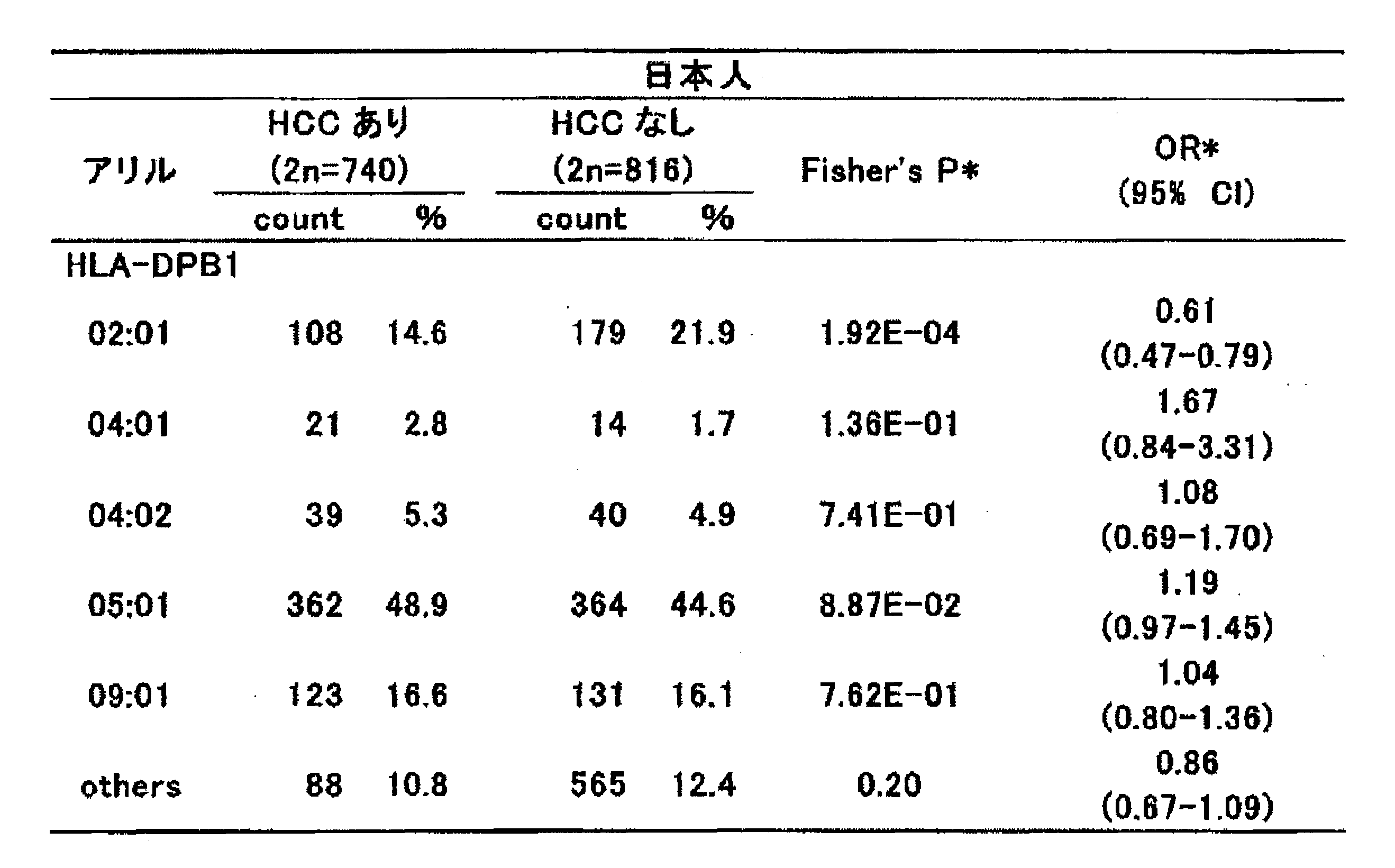
また、本発明者らは、表4において、HBV患者群のうち肝がんに病態進展した患者(HCCあり)群由来の試料とHBV患者群のうち肝がんに病態進展していない患者(HCCなし)群由来の試料とからアリルを計数した。
B型肝炎ウイルス関連疾患によって慢性肝炎に病態進展し、がん化した患者由来のHLA-DPB1*02:01アリルの数と、がん化していない患者由来のHLA-DPB1*02:01アリルの数とのオッズ比は0.61であった。つまり、HLA-DPB1*02:01アリル以外のアリルを有するヒトよりも、HLA-DPB1*02:01アリルを有するヒトの方が、がん化に対して強い抵抗性を示していた。
これにより、HLA-DPB1*02:01アリルは、B型肝炎ウイルス関連疾患によって病態進展し慢性肝炎に進展した後に、肝がんに病態進展する際に、強い抵抗性を有することが示された。つまり、HLA-DPB1*02:01アリルを有するヒトは、HLA-DPB1*02:01アリルを有していないヒトよりも、B型肝炎ウイルス関連疾患が病態進展することによるがん化しにくいこと示された。
ここで、オッズ比が1より小さい場合には、B型肝炎ウイルス関連疾患が病態進展することによるがん化に抵抗性があるといえる。この具体例においては、抵抗性アリルとしてHLA-DPB1*02:01アリルを有するヒトは、B型肝炎ウイルス関連疾患が病態進展することによるがん化に抵抗性があるといえる。
ここで、オッズ比が1より小さい場合には、B型肝炎ウイルス関連疾患が病態進展することによるがん化に抵抗性があるといえる。この具体例においては、抵抗性アリルとしてHLA-DPB1*02:01アリルを有するヒトは、B型肝炎ウイルス関連疾患が病態進展することによるがん化に抵抗性があるといえる。
上述したように、HLA-DPB1*02:01アリルはHBV感染で肝発がんに病態進展した群で解析をすることにより、より有意な関連を示した。つまり、HLA-DPB1*02:01アリルはB型慢性肝炎に対する抵抗性アリルとも言えるが、HLA-DPB1*02:01アリルはHBV感染における肝発がんに対して、より関連のある抵抗性アリルであると言える。
以上説明したように、B型肝炎ウイルス関連疾患が病態進展することによるがん化に関連するアリルをHBV患者群に対して解析することにより、B型肝炎ウイルス関連疾患が病態進展することによるがん化の分子機構の解明や創薬ターゲット候補分子の同定が可能になる。また、HBVキャリアに対して解析することにより、当該キャリアをがん化しやすい群とがん化しにくい群とに分類することが可能となり、その後の治療方針の決定に役立つ情報を提供できる。さらに、当該アリルに加えて、他の免疫関連遺伝子のSNPも含む検査キットの開発により医療費削減も可能となる。
[実験例3]
(B型肝炎ウイルス集団の変異の頻度の検出)
本実施例は、HLA-DPB1*02:01アリルを有するB型肝炎関連疾患患者由来のHBV集団の変異の頻度を検出することを目的とした。日本人由来の各試料について、HBV由来の遺伝子配列上の各位置について1000以上の遺伝子配列データを収集した。また、HBV由来の遺伝子配列上の各位置について出現頻度が5%以上のアミノ酸を、解析の対象とした。
(B型肝炎ウイルス集団の変異の頻度の検出)
本実施例は、HLA-DPB1*02:01アリルを有するB型肝炎関連疾患患者由来のHBV集団の変異の頻度を検出することを目的とした。日本人由来の各試料について、HBV由来の遺伝子配列上の各位置について1000以上の遺伝子配列データを収集した。また、HBV由来の遺伝子配列上の各位置について出現頻度が5%以上のアミノ酸を、解析の対象とした。
(1)HBV遺伝子配列
本発明者らは、HLA-DPB1*02:01アリルを保有しているB型肝炎ウイルス関連疾患患者由来のHBV遺伝子配列を解析した。当該解析には、HLA-DPB1*02:01を保有しているB型肝炎ウイルス関連疾患患者のうち、肝がんを発症した11例(以下単に、ケースとも記載する)由来のHBVと、肝がんを発症していない11例(以下単に、コントロールとも記載する)由来のHBVとを用いた。なお、解析対象患者の年齢と性別とは、それぞれ一致させている。
本発明者らは、HLA-DPB1*02:01アリルを保有しているB型肝炎ウイルス関連疾患患者由来のHBV遺伝子配列を解析した。当該解析には、HLA-DPB1*02:01を保有しているB型肝炎ウイルス関連疾患患者のうち、肝がんを発症した11例(以下単に、ケースとも記載する)由来のHBVと、肝がんを発症していない11例(以下単に、コントロールとも記載する)由来のHBVとを用いた。なお、解析対象患者の年齢と性別とは、それぞれ一致させている。
HBVの解析は、HBV遺伝子のうち、抗原性が高いHBs抗原をコードするHBs遺伝子領域を解析対象とした。抗原性が高いとは、当該抗原がヒトの体内に侵入すると免疫反応を引き起こしやすい物質である。言い換えると、抗原性が高いとは、ヒトが病原体として認識しやすい物質である。
当該HBVの解析は、HBs遺伝子領域を3つの領域に分けて、PCR法による遺伝子増幅した。3つの領域とは、HBs遺伝子配列上の位置2814から256まで、HBs遺伝子配列上の位置18から557まで、HBs遺伝子配列上の位置414から989までである。なお、HBV遺伝子配列上の位置2814から256までには、2814から末尾の3215、先頭の1から256までが含まれる。これは、HBV遺伝子が環状の遺伝子構造をしているためである。
発明者らは、上述したPCR法による遺伝子増幅によって、22例由来のHBV試料から、66のPCR産物を取得した。
発明者らは、上述したPCR法による遺伝子増幅によって、22例由来のHBV試料から、66のPCR産物を取得した。
次に、本発明者らは、PCR法によって増幅された66のPCR産物を、高速シーケンサーによってディープシークエンス解析を行い、HBs遺伝子領域の遺伝子配列を取得した。高速シーケンサーは、例えば、GS Junior、Miseqなどを用いることができる。
当該ディープシークエンス解析により、本発明者らは、HBs遺伝子上の各塩基について、1000以上のデータを取得した。
本発明者らは、取得したHBs遺伝子上の各塩基から、HBVの変異のバリエーションをリスト化することにより、HBV遺伝子におけるアミノ酸の変異のパターンを取得した。
当該ディープシークエンス解析により、本発明者らは、HBs遺伝子上の各塩基について、1000以上のデータを取得した。
本発明者らは、取得したHBs遺伝子上の各塩基から、HBVの変異のバリエーションをリスト化することにより、HBV遺伝子におけるアミノ酸の変異のパターンを取得した。
本発明者らは、取得した変異パターンに基づいて、ケース由来とコントロール由来とのHBV遺伝子における各遺伝子配列上の位置毎にアミノ酸の出現順位をそれぞれ比較した。なお、以下の説明では、HBV遺伝子における各遺伝子配列上の位置毎に出現順位が最も高いアミノ酸を、最頻出アミノ酸とも記載する。
その結果を表5~表7に示す。なお、表5~表7のアミノ酸(以下単にAAとも記載する)の表記は、アミノ酸の一文字表記で記載している。アミノ酸の一文字表記とは、例えば、”L”は”ロイシン”、”Q”は”グルタミン”などである。
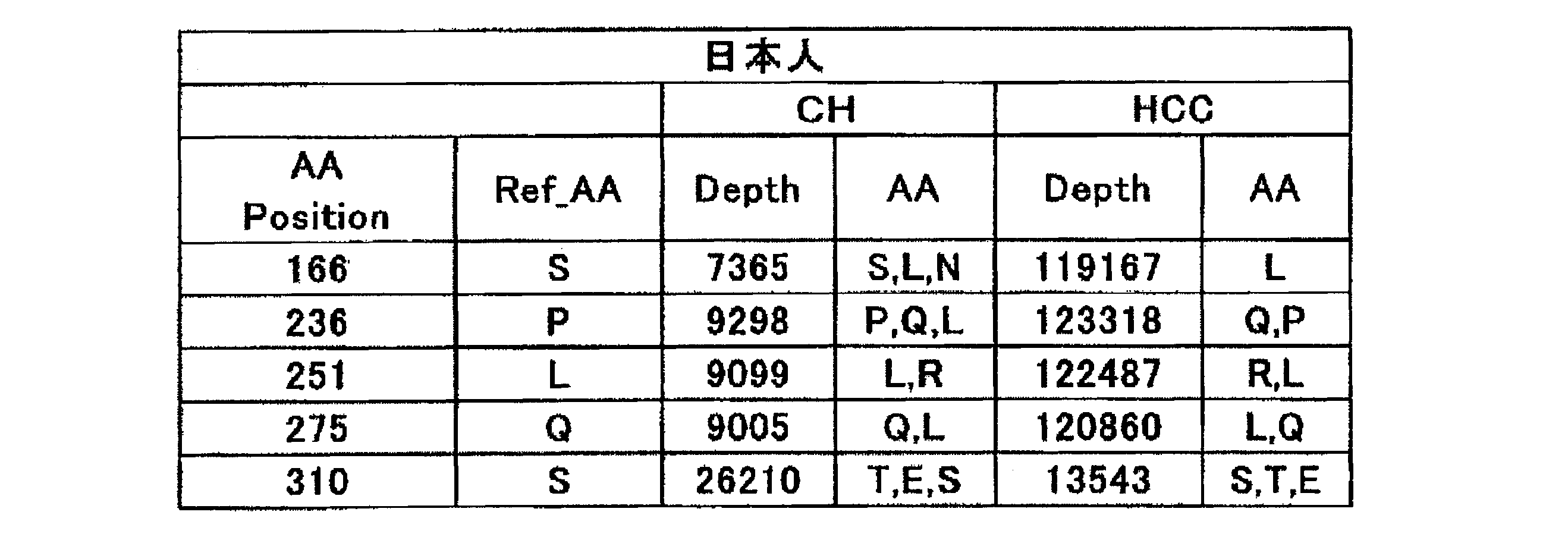
本発明者らは、表5において、HLA-DPB1*02:01を保有しているB型肝炎ウイルス関連疾患患者のうち、肝がんを発症した11例由来のHBVと、肝がんを発症していない11例由来のHBVとを用いて、HBV遺伝子のHBs遺伝子領域を解析した。
HBV遺伝子の変異の比較には、HBV遺伝子型C(HBV/C)の一般的な遺伝子配列を基準とした。HBV/Cとは、日本人やアジア人が多く感染しているB型肝炎ウイルスの型である。ウイルス関連疾患患者由来のHBsタンパク質のアミノ酸配列と、一般的なHBV/CのHBsタンパク質のアミノ酸配列とを比較すると、第166番目、第236番目、第251番目及び第275番目のアミノ酸に変異が認められた。さらに、変異が認められた位置のアミノ酸を、肝がんを発症した11例由来のHBsタンパク質のアミノ酸配列と、肝がんを発症していない11例由来のHBsタンパク質のアミノ酸配列とで比較した。
HBsタンパク質のアミノ酸配列の第166番目の位置のアミノ酸は、肝がんを発症していない11例由来の試料のうち、Sが51.5%、Lが34.3%、Nが12.5%、Xが1.7%であり、肝がんを発症した11例由来の試料のうち、Sが0%、Lが99.4%、Nが0%、”X”が0.6%であった。なお、”X”とは、検出されたアミノ酸のうち、出現頻度が基準値である5%に満たないアミノ酸の集合である。
HBsタンパク質のアミノ酸配列の第236番目の位置のアミノ酸は、肝がんを発症していない11例由来の試料のうち、Pが40.2%、Qが39.8%、Lが19.4%、”X”が0.6%であり、肝がんを発症した11例由来の試料のうち、Pが12.8%、Qが87.0%、Lが0.0%、”X”が0.2%であった。
HBsタンパク質のアミノ酸配列の第251番目の位置のアミノ酸は、肝がんを発症していない11例由来の試料のうち、Lが58.3%、Rが40.9%、”X”が0.8%であり、肝がんを発症した11例由来の試料のうち、Lが12.5%、Rが87.1%、”X”が0.4%であった。
HBsタンパク質のアミノ酸配列の第275番目の位置のアミノ酸は、肝がんを発症していない11例由来の試料のうち、Qが57.8%、Lが39.4%、”X”が2.8%であり、肝がんを発症した11例由来の試料のうち、Qが12.1%、Lが86.9%、”X”が0.9%であった。
HBsタンパク質のアミノ酸配列の第310番目の位置のアミノ酸は、肝がんを発症していない11例由来の試料のうち、Sが11.8%、Tが49.5%、Eが38.3%、”X”が0.3%であり、肝がんを発症した11例由来の試料のうち、Sが98.7%、Tが0.0%、Eが0.0%、”X”が1.3%であった。
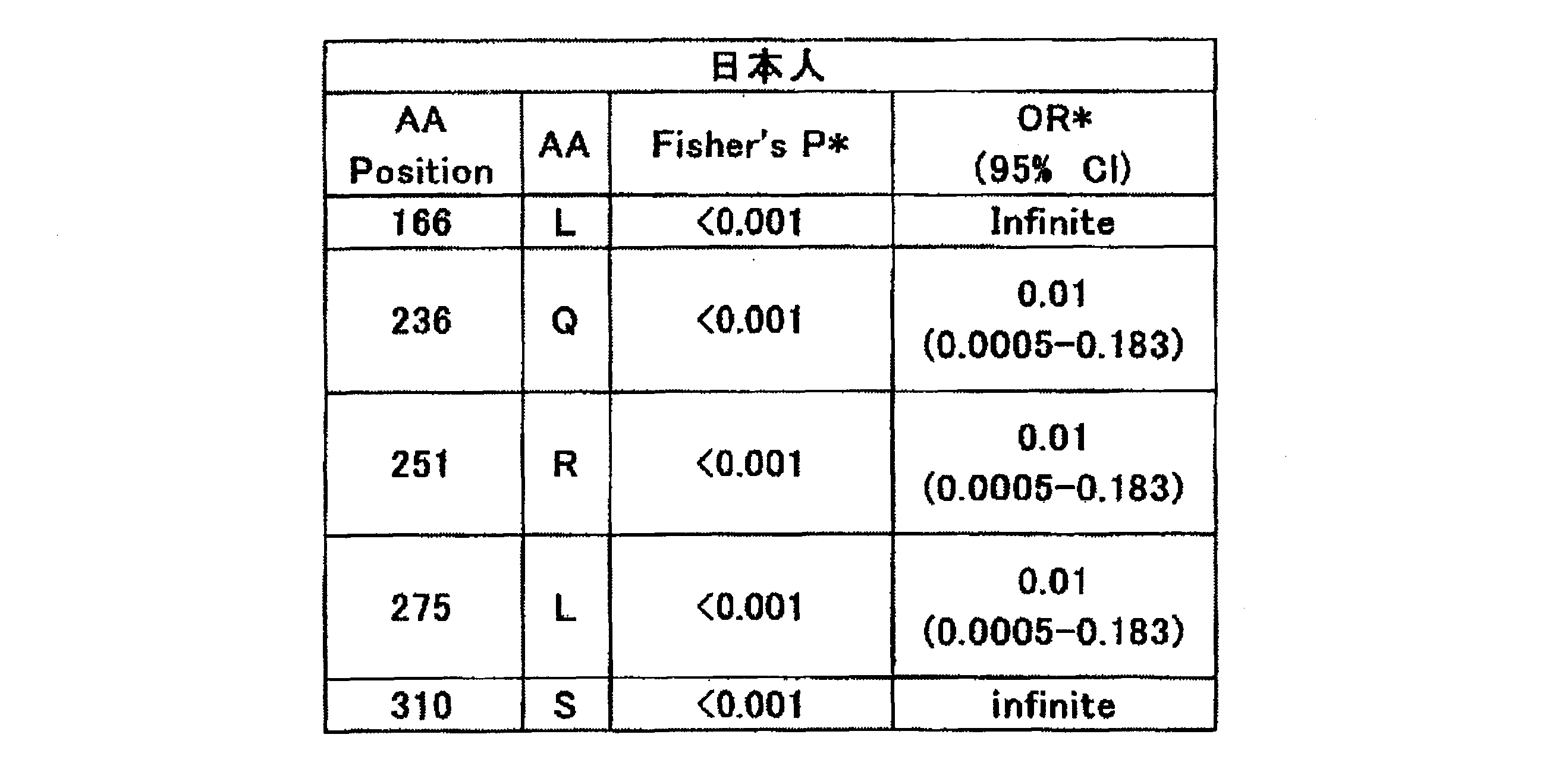
次に、本発明者らは、表6において、表5に示したHBV遺伝子の第166番目、第236番目、第251番目、第275番目及び、第310番目のうち、肝がんへ病態進展した被検者由来の最頻出アミノ酸とは異なるアミノ酸の場合の、肝がん発症のリスクのオッズ比を算出した。
HBV遺伝子の第166番目と、第310番目の位置のアミノ酸については、例外症例が無く、オッズ比を算出することができなかった。HBV遺伝子の第236番目と、第251番目と第275番目のオッズ比は、それぞれ0.01であり、がん化に対して抵抗性を示していた。
HBV遺伝子の第166番目と、第310番目の位置のアミノ酸については、例外症例が無く、オッズ比を算出することができなかった。HBV遺伝子の第236番目と、第251番目と第275番目のオッズ比は、それぞれ0.01であり、がん化に対して抵抗性を示していた。
これにより、B型肝炎ウイルス集団由来の遺伝子の第166番目の最頻出アミノ酸がロイシンでない場合には、B型肝炎ウイルス関連疾患に罹患した場合に肝がんに進展しにくいという基準であるといえる。また、B型肝炎ウイルス集団由来の遺伝子の第236番目の最頻出アミノ酸がグルタミンでない場合には、B型肝炎ウイルス関連疾患に罹患した場合に肝がんに進展しにくいという基準であるといえる。また、B型肝炎ウイルス集団由来の遺伝子の第251番目の最頻出アミノ酸がアルギニンでない場合には、B型肝炎ウイルス関連疾患に罹患した場合に肝がんに進展しにくいという基準であるといえる。また、B型肝炎ウイルス集団由来の遺伝子の第275番目の最頻出アミノ酸がロイシンでない場合には、B型肝炎ウイルス関連疾患に罹患した場合に肝がんに進展しにくいという基準であるといえる。

次に、本発明者らは、表7において、B型肝炎ウイルスの遺伝子鎖で見た際に、各アミノ酸変異がどの組み合わせで同一遺伝子鎖上に存在するかを示した。
コンセンサスとは、HBV/Cの標準的なアミノ酸の配列である。
HLA-DPB1*02:01を保有しているB型肝炎ウイルス関連疾患患者のうち、肝がんを発症した11例由来のHBVのHBsタンパク質の変異のうち、第166番目の位置がロイシンに変異しているものが10.7%であり、第166番目がロイシン、第236番目がグルタミン、第251番目がアルギニン及び第275番目がロイシンに変異しているものが83.6%であった。
コンセンサスとは、HBV/Cの標準的なアミノ酸の配列である。
HLA-DPB1*02:01を保有しているB型肝炎ウイルス関連疾患患者のうち、肝がんを発症した11例由来のHBVのHBsタンパク質の変異のうち、第166番目の位置がロイシンに変異しているものが10.7%であり、第166番目がロイシン、第236番目がグルタミン、第251番目がアルギニン及び第275番目がロイシンに変異しているものが83.6%であった。
以上説明したように、HBV集団の遺伝子の変異の頻度を、B型肝炎ウイルス関連疾患に罹患した場合に肝がんに進展しにくいという第2の基準として用いることにより、より正確に病態進展のしやすさを試験することができる。
[実験例4]
(ハプロタイプの検出)
B型肝炎の慢性化に感受性のある感受性アリルを有するヒトについて、HBV患者群と健常対照群由来の各試料についての95%信頼区間におけるオッズ比を求めた。表4に結果を示す。
(ハプロタイプの検出)
B型肝炎の慢性化に感受性のある感受性アリルを有するヒトについて、HBV患者群と健常対照群由来の各試料についての95%信頼区間におけるオッズ比を求めた。表4に結果を示す。

表8には、B型肝炎の慢性化への病態進展に関係のあるハプロタイプのうち、HLA-DPB1のアリルが、09:01である場合には、HLA-DRB1*15:02及びHLA-DQB1*06:01の場合に、B型肝炎の慢性化への病態進展に感受性があることが示されている。具体的には、HBV患者群由来の各試料のうち14.7%が、健常対照群由来の各試料のうち8.3%のヒトが、当該感受性があるアリルを保有していた。HLA-DPB1のアリルが、09:01である場合には、HLA-DRB1*15:02及びHLA-DQB1*06:01の場合のオッズ比は、1.91であった。なお、オッズ比が1よりも大きい場合には、B型肝炎の慢性化への病態進展に感受性があるといえる。
B型肝炎の慢性化への病態進展に関係のあるハプロタイプのうち、HLA-DPB1のアリルが、09:01である場合には、HLA-DRB1*15:02及びHLA-DQB1*06:01の場合のオッズ比と、他の従来感受性があるアリルとされたHLA-DPB1*05:01のオッズ比とを比較すると、HLA-DPB1のアリルが、09:01である場合には、HLA-DRB1*15:02及びHLA-DQB1*06:01の方が、感受性が高かった。
つまり、B型肝炎の慢性化への病態進展に関係のあるハプロタイプのうち、HLA-DPB1*09:01である場合には、HLA-DRB1*15:02及びHLA-DQB1*06:01とのアリルの組み合わせが、より感受性が高いアリルの組み合わせであることが明らかとなった。
つまり、B型肝炎の慢性化への病態進展に関係のあるハプロタイプのうち、HLA-DPB1*09:01である場合には、HLA-DRB1*15:02及びHLA-DQB1*06:01とのアリルの組み合わせが、より感受性が高いアリルの組み合わせであることが明らかとなった。
(アリルの検出4)
B型肝炎の慢性化への病態進展に関係のあるハプロタイプのうち、B型肝炎の慢性化への病態進展に抵抗性のある抵抗性アリルを有するヒトについて、HBV患者群と健常対照群由来の各試料についての95%信頼区間におけるオッズ比を求めた。表9に結果を示す。
B型肝炎の慢性化への病態進展に関係のあるハプロタイプのうち、B型肝炎の慢性化への病態進展に抵抗性のある抵抗性アリルを有するヒトについて、HBV患者群と健常対照群由来の各試料についての95%信頼区間におけるオッズ比を求めた。表9に結果を示す。

表9には、B型肝炎の慢性化への病態進展に関係のあるハプロタイプのうち、HLA-DPB1のアリルが、04:01である場合には、HLA-DRB1*13:02及びHLA-DQB1*06:04の場合に、型肝炎の慢性化への病態進展に抵抗性があることが示されている。具体的には、HBV患者群由来の各試料のうち1.9%が、健常対照群942人のうち4.1%のヒトが、当該抵抗性があるアリルを保有していた。HLA-DPB1のアリルが、04:01である場合には、HLA-DRB1*13:02及びHLA-DQB1*06:04の場合のオッズ比は、0.44であった。なお、オッズ比が1よりも小さい場合には、B型肝炎の慢性化への病態進展に抵抗性があるといえる。
B型肝炎の慢性化への病態進展に関係のあるハプロタイプのうち、HLA-DPB1のアリルが、04:01である場合には、HLA-DRB1*13:02及びHLA-DQB1*06:04の場合のオッズ比と、他の従来感受性があるアリルとされたHLA-DPB1*02:01及びHLA-DPB1*04:02のオッズ比とを比較すると、HLA-DPB1のアリルが、04:01である場合には、HLA-DRB1*13:02及びHLA-DQB1*06:04の方が、抵抗性が高かった。
つまり、B型肝炎の慢性化への病態進展に感受性のあるアリルがHLA-DPB1*04:01である場合には、HLA-DRB1*13:02及びHLA-DQB1*06:04とのアリルの組み合わせが、より抵抗性が高いアリルの組み合わせであることが明らかとなった。
つまり、B型肝炎の慢性化への病態進展に感受性のあるアリルがHLA-DPB1*04:01である場合には、HLA-DRB1*13:02及びHLA-DQB1*06:04とのアリルの組み合わせが、より抵抗性が高いアリルの組み合わせであることが明らかとなった。
以上説明したように、B型肝炎ウイルス関連疾患のうち、B型肝炎の慢性化への病態進展の場合に、B型肝炎の慢性化への病態進展に関連するアリルをHBV患者群に対して解析することにより、特に、日本人を含むアジア人に特化したB型肝炎の慢性化への病態進展の分子機構の解明や創薬ターゲット候補分子の同定が可能になる。また、HBVキャリアに対して解析することにより、当該キャリアを慢性化しやすい群と慢性化しにくい群とに分類することが可能となり、その後の治療方針の決定に役立つ情報を提供できる。さらに、当該アリルに加えて、他の免疫関連遺伝子のSNPも含む検査キットの開発により医療費削減も可能となる。
以上、本発明者によってなされた発明をその実施の形態に基づき具体的に説明したが、上述した実施形態に限定されるものではなく、その要旨を逸脱しない範囲で種々変更可能であることはいうまでもない。
Claims (12)
- 被検者のHLA型を、B型肝炎ウイルス関連疾患に罹患した場合の病態進展のしやすさの第1の基準と比較する工程を含む、被検者がB型肝炎ウイルス関連疾患に罹患した場合の病態進展のしやすさを試験する方法。
- 前記被検者に感染したB型肝炎ウイルス集団の変異の頻度を、B型肝炎ウイルス関連疾患に罹患した場合の病態進展のしやすさの第2の基準と比較する工程を更に含む、請求項1に記載の方法。
- 前記病態進展が、B型肝炎ウイルスに持続感染した場合の肝がんへの進展であり、前記第1の基準が、前記HLA型がHLA-DPB1*02:01を含む場合には、B型肝炎ウイルスに持続感染した場合に肝がんに進展しにくいという基準である、請求項1に記載の方法。
- 前記病態進展が、B型肝炎ウイルスに持続感染した場合の肝がんへの進展であり、前記第1の基準が、前記HLA型がHLA-DPB1*02:01を含む場合には、B型肝炎ウイルスに持続感染した場合に肝がんに進展しにくいという基準である、請求項2に記載の方法。
- 前記変異が前記B型肝炎ウイルス集団由来のHBs抗原タンパク質における変異であり、
前記第2の基準が、
前記HBs抗原タンパク質の第166番目の最頻出アミノ酸がロイシンでない場合には、B型肝炎ウイルスに持続感染した場合に肝がんに進展しにくいという基準であるか、 前記HBs抗原タンパク質の第236番目の最頻出アミノ酸がグルタミンでない場合には、B型肝炎ウイルスに持続感染した場合に肝がんに進展しにくいという基準であるか、 前記HBs抗原タンパク質の第251番目の最頻出アミノ酸がアルギニンでない場合には、B型肝炎ウイルスに持続感染した場合に肝がんに進展しにくいという基準であるか、 前記HBs抗原タンパク質の第275番目の最頻出アミノ酸がロイシンでない場合には、B型肝炎ウイルスに持続感染した場合に肝がんに進展しにくいという基準である、
請求項4に記載の方法。 - 前記病態進展が、B型肝炎ウイルスに持続感染した場合の肝がんへの進展であり、前記第1の基準が、前記HLA型がHLA-A*33:03を含む場合には、B型肝炎ウイルスに持続感染した場合に肝がんに進展しやすいという基準である、請求項1又は2に記載の方法。
- 前記病態進展が、B型肝炎ウイルスに持続感染した場合のB型慢性肝炎への進展であり、前記第1の基準が、前記HLA型がHLA-DPB1*09:01、HLA-DRB1*15:02及びHLA-DQB1*06:01を含む場合には、B型肝炎ウイルスに持続感染した場合にB型慢性肝炎に進展しやすいという基準である、請求項1又は2に記載の方法。
- 前記病態進展が、B型肝炎ウイルスに持続感染した場合のB型慢性肝炎への進展であり、前記第1の基準が、前記HLA型がHLA-DPB1*04:01、HLA-DRB1*13:02及びHLA-DQB1*06:04を含む場合には、B型肝炎ウイルスに持続感染した場合にB型慢性肝炎に進展しにくいという基準である、請求項1又は2に記載の方法。
- HLA-A*33:03又はHLA-DPB1*02:01のHLA型を検出するプライマーセットを含む、B型肝炎ウイルスに持続感染した場合の肝がんへの進展のしやすさを試験するための診断薬。
- B型肝炎ウイルス集団の変異の頻度を決定するプライマーセット、又は
B型肝炎ウイルス集団の変異の頻度を決定する特異的結合物質、
を更に含む、請求項9に記載の診断薬。 - HLA-DPB1*09:01、HLA-DRB1*15:02及びHLA-DQB1*06:01のHLA型を検出するプライマーセット、又はHLA-DPB1*04:01、HLA-DRB1*13:02及びHLA-DQB1*06:04のHLA型を検出するプライマーセットを含む、B型肝炎ウイルスに持続感染した場合のB型慢性肝炎への進展のしやすさを試験するための診断薬。
- B型肝炎ウイルス集団の変異の頻度を決定するプライマーセット、又は
B型肝炎ウイルス集団の変異の頻度を決定する特異的結合物質、
を更に含む、請求項11に記載の診断薬。
Priority Applications (1)
| Application Number | Priority Date | Filing Date | Title |
|---|---|---|---|
| JP2018546350A JPWO2018074458A1 (ja) | 2016-10-18 | 2017-10-17 | 方法及び診断薬 |
Applications Claiming Priority (2)
| Application Number | Priority Date | Filing Date | Title |
|---|---|---|---|
| JP2016204735 | 2016-10-18 | ||
| JP2016-204735 | 2016-10-18 |
Publications (1)
| Publication Number | Publication Date |
|---|---|
| WO2018074458A1 true WO2018074458A1 (ja) | 2018-04-26 |
Family
ID=62018496
Family Applications (1)
| Application Number | Title | Priority Date | Filing Date |
|---|---|---|---|
| PCT/JP2017/037496 Ceased WO2018074458A1 (ja) | 2016-10-18 | 2017-10-17 | 方法及び診断薬 |
Country Status (2)
| Country | Link |
|---|---|
| JP (1) | JPWO2018074458A1 (ja) |
| WO (1) | WO2018074458A1 (ja) |
Cited By (1)
| Publication number | Priority date | Publication date | Assignee | Title |
|---|---|---|---|---|
| JP2020174617A (ja) * | 2019-04-22 | 2020-10-29 | ジェネシスヘルスケア株式会社 | B型肝炎及び/又はc型肝炎のリスクを判定する方法 |
Citations (5)
| Publication number | Priority date | Publication date | Assignee | Title |
|---|---|---|---|---|
| JPH05308999A (ja) * | 1992-05-08 | 1993-11-22 | Sumitomo Metal Ind Ltd | B型肝炎ウイルスpre−C変異の判定法 |
| JP2008283977A (ja) * | 2008-06-09 | 2008-11-27 | Toshiba Corp | 標的核酸の遺伝子型、および変異の判定方法、不溶性支持体に核酸断片を固定化する方法、所望の核酸を精製し、かつ増幅するための方法、並びに遺伝子型アッセイキット |
| JP2009159845A (ja) * | 2007-12-28 | 2009-07-23 | Hiromitsu Kumada | 肝細胞癌に移行する可能性を予測する方法 |
| WO2013093992A1 (ja) * | 2011-12-19 | 2013-06-27 | ビッツ株式会社 | B型肝炎ウイルス群を検出し、遺伝子多様性を評価するためのオリゴヌクレオチドのセット、並びにそれを用いた方法 |
| WO2015030142A1 (ja) * | 2013-08-30 | 2015-03-05 | 国立大学法人東京大学 | B型肝炎の慢性化の素因の検出方法 |
-
2017
- 2017-10-17 JP JP2018546350A patent/JPWO2018074458A1/ja active Pending
- 2017-10-17 WO PCT/JP2017/037496 patent/WO2018074458A1/ja not_active Ceased
Patent Citations (5)
| Publication number | Priority date | Publication date | Assignee | Title |
|---|---|---|---|---|
| JPH05308999A (ja) * | 1992-05-08 | 1993-11-22 | Sumitomo Metal Ind Ltd | B型肝炎ウイルスpre−C変異の判定法 |
| JP2009159845A (ja) * | 2007-12-28 | 2009-07-23 | Hiromitsu Kumada | 肝細胞癌に移行する可能性を予測する方法 |
| JP2008283977A (ja) * | 2008-06-09 | 2008-11-27 | Toshiba Corp | 標的核酸の遺伝子型、および変異の判定方法、不溶性支持体に核酸断片を固定化する方法、所望の核酸を精製し、かつ増幅するための方法、並びに遺伝子型アッセイキット |
| WO2013093992A1 (ja) * | 2011-12-19 | 2013-06-27 | ビッツ株式会社 | B型肝炎ウイルス群を検出し、遺伝子多様性を評価するためのオリゴヌクレオチドのセット、並びにそれを用いた方法 |
| WO2015030142A1 (ja) * | 2013-08-30 | 2015-03-05 | 国立大学法人東京大学 | B型肝炎の慢性化の素因の検出方法 |
Non-Patent Citations (2)
| Title |
|---|
| NISHIDA, NAO ET AL.: "Understanding of HLA-conferred susceptibility to chronic hepatitis B infection requires HLA genotyping-based association analysis", SCIENTIFIC REPORTS, vol. 6, 19 April 2016 (2016-04-19), pages 24767, XP055356942 * |
| RAMEZANI, AMITIS ET AL.: "Association of human leukocyte antigen polymorphism with outcomes of hepatitis B virus infection", JOURNAL OF GASTROENTEROLOGY AND HEPATOLOGY, vol. 23, 2008, pages 1716 - 1721, XP055477984 * |
Cited By (2)
| Publication number | Priority date | Publication date | Assignee | Title |
|---|---|---|---|---|
| JP2020174617A (ja) * | 2019-04-22 | 2020-10-29 | ジェネシスヘルスケア株式会社 | B型肝炎及び/又はc型肝炎のリスクを判定する方法 |
| JP7138074B2 (ja) | 2019-04-22 | 2022-09-15 | ジェネシスヘルスケア株式会社 | B型肝炎及び/又はc型肝炎のリスクを判定する方法 |
Also Published As
| Publication number | Publication date |
|---|---|
| JPWO2018074458A1 (ja) | 2019-08-08 |
Similar Documents
| Publication | Publication Date | Title |
|---|---|---|
| JP6440658B2 (ja) | 薬理ゲノミクスバイオマーカーを発見するための方法 | |
| CN107660234A (zh) | 使用二代测序预测器官移植排斥的方法 | |
| EP3332031A1 (en) | Snp rs12603226 as a predictive marker for nafld | |
| TW202516023A (zh) | 檢測致病基因雙套染色體連鎖攜帶的方法 | |
| CN103492570A (zh) | 一种强直性脊柱炎相关特异性单核苷酸多态性的检测方法及其试剂盒 | |
| JP6521382B2 (ja) | B型肝炎の慢性化及び/又は病態進展の遺伝要因の検出方法 | |
| JPWO2018074458A1 (ja) | 方法及び診断薬 | |
| CN109457031B (zh) | BRCA2基因g.32338309A>G突变体及其在乳腺癌辅助诊断中的应用 | |
| KR101724130B1 (ko) | 장 베체트병 진단용 바이오마커 및 이의 용도 | |
| JPWO2012056694A1 (ja) | 乳がん発症感受性の判定方法 | |
| KR101402608B1 (ko) | 만성 b형 간염 치료제의 약제내성 예측용 조성물 및 그 예측 방법 | |
| JP7731565B2 (ja) | B型肝炎ワクチンに対する免疫応答性の遺伝的要因を検出する方法及び試薬 | |
| JP4889258B2 (ja) | ウシ白血病発症に対する抵抗性の判定方法 | |
| JP7461624B2 (ja) | B型肝炎ワクチンに対する免疫応答性の遺伝的要因を検出する方法及びキット | |
| KR102816628B1 (ko) | 대사증후군 특이적 후성유전 메틸화 마커 및 이의 용도 | |
| CN114369664B (zh) | 用于胰腺癌筛查的标志物、探针组合物及其应用 | |
| KR101598296B1 (ko) | Dna 복제수 변이를 이용한 강직성 척추염 발병 고위험도 예측용 조성물 및 이를 이용한 예측 방법 | |
| RU2510508C1 (ru) | Способ прогнозирования риска развития бронхиальной астмы | |
| JP7824622B2 (ja) | Covid-19の重症化の遺伝的要因を検出する方法及びキット | |
| JP6516128B2 (ja) | 抗甲状腺薬誘発性無顆粒球症リスクを判定するための検査方法及び判定用キット | |
| JP4859088B2 (ja) | 2型糖尿病に関連するヒトwnt5b遺伝子多型の検出方法及びキット | |
| JP2008545387A (ja) | 心血管疾患診断のための方法及び構成 | |
| CN106834476A (zh) | 一种乳腺癌检测试剂盒 | |
| CN106947813A (zh) | 单核苷酸多态性rs930507和rs10824793在检测结核易感性中的应用 | |
| CN106834491B (zh) | 乳腺癌预后相关基因突变检测试剂盒及其使用方法 |
Legal Events
| Date | Code | Title | Description |
|---|---|---|---|
| 121 | Ep: the epo has been informed by wipo that ep was designated in this application |
Ref document number: 17863160 Country of ref document: EP Kind code of ref document: A1 |
|
| ENP | Entry into the national phase |
Ref document number: 2018546350 Country of ref document: JP Kind code of ref document: A |
|
| NENP | Non-entry into the national phase |
Ref country code: DE |
|
| 122 | Ep: pct application non-entry in european phase |
Ref document number: 17863160 Country of ref document: EP Kind code of ref document: A1 |