WO2018074403A1 - 遺伝子組換えミノムシ絹糸 - Google Patents
遺伝子組換えミノムシ絹糸 Download PDFInfo
- Publication number
- WO2018074403A1 WO2018074403A1 PCT/JP2017/037327 JP2017037327W WO2018074403A1 WO 2018074403 A1 WO2018074403 A1 WO 2018074403A1 JP 2017037327 W JP2017037327 W JP 2017037327W WO 2018074403 A1 WO2018074403 A1 WO 2018074403A1
- Authority
- WO
- WIPO (PCT)
- Prior art keywords
- silkworm
- modified
- gene
- amino acid
- fib
- Prior art date
- Legal status (The legal status is an assumption and is not a legal conclusion. Google has not performed a legal analysis and makes no representation as to the accuracy of the status listed.)
- Ceased
Links
Images

Classifications
-
- C—CHEMISTRY; METALLURGY
- C07—ORGANIC CHEMISTRY
- C07K—PEPTIDES
- C07K14/00—Peptides having more than 20 amino acids; Gastrins; Somatostatins; Melanotropins; Derivatives thereof
- C07K14/435—Peptides having more than 20 amino acids; Gastrins; Somatostatins; Melanotropins; Derivatives thereof from animals; from humans
-
- C—CHEMISTRY; METALLURGY
- C07—ORGANIC CHEMISTRY
- C07K—PEPTIDES
- C07K14/00—Peptides having more than 20 amino acids; Gastrins; Somatostatins; Melanotropins; Derivatives thereof
- C07K14/435—Peptides having more than 20 amino acids; Gastrins; Somatostatins; Melanotropins; Derivatives thereof from animals; from humans
- C07K14/43504—Peptides having more than 20 amino acids; Gastrins; Somatostatins; Melanotropins; Derivatives thereof from animals; from humans from invertebrates
- C07K14/43563—Peptides having more than 20 amino acids; Gastrins; Somatostatins; Melanotropins; Derivatives thereof from animals; from humans from invertebrates from insects
-
- A—HUMAN NECESSITIES
- A01—AGRICULTURE; FORESTRY; ANIMAL HUSBANDRY; HUNTING; TRAPPING; FISHING
- A01B—SOIL WORKING IN AGRICULTURE OR FORESTRY; PARTS, DETAILS, OR ACCESSORIES OF AGRICULTURAL MACHINES OR IMPLEMENTS, IN GENERAL
- A01B7/00—Disc-like soil-working implements usable either as ploughs or as harrows, or the like
-
- A—HUMAN NECESSITIES
- A01—AGRICULTURE; FORESTRY; ANIMAL HUSBANDRY; HUNTING; TRAPPING; FISHING
- A01K—ANIMAL HUSBANDRY; AVICULTURE; APICULTURE; PISCICULTURE; FISHING; REARING OR BREEDING ANIMALS, NOT OTHERWISE PROVIDED FOR; NEW BREEDS OF ANIMALS
- A01K67/00—Rearing or breeding animals, not otherwise provided for; New or modified breeds of animals
- A01K67/60—New or modified breeds of invertebrates
- A01K67/61—Genetically modified invertebrates, e.g. transgenic or polyploid
-
- A—HUMAN NECESSITIES
- A01—AGRICULTURE; FORESTRY; ANIMAL HUSBANDRY; HUNTING; TRAPPING; FISHING
- A01K—ANIMAL HUSBANDRY; AVICULTURE; APICULTURE; PISCICULTURE; FISHING; REARING OR BREEDING ANIMALS, NOT OTHERWISE PROVIDED FOR; NEW BREEDS OF ANIMALS
- A01K67/00—Rearing or breeding animals, not otherwise provided for; New or modified breeds of animals
- A01K67/60—New or modified breeds of invertebrates
- A01K67/61—Genetically modified invertebrates, e.g. transgenic or polyploid
- A01K67/65—Genetically modified arthropods
- A01K67/68—Genetically modified insects
-
- C—CHEMISTRY; METALLURGY
- C07—ORGANIC CHEMISTRY
- C07K—PEPTIDES
- C07K14/00—Peptides having more than 20 amino acids; Gastrins; Somatostatins; Melanotropins; Derivatives thereof
- C07K14/435—Peptides having more than 20 amino acids; Gastrins; Somatostatins; Melanotropins; Derivatives thereof from animals; from humans
- C07K14/43504—Peptides having more than 20 amino acids; Gastrins; Somatostatins; Melanotropins; Derivatives thereof from animals; from humans from invertebrates
-
- C—CHEMISTRY; METALLURGY
- C12—BIOCHEMISTRY; BEER; SPIRITS; WINE; VINEGAR; MICROBIOLOGY; ENZYMOLOGY; MUTATION OR GENETIC ENGINEERING
- C12N—MICROORGANISMS OR ENZYMES; COMPOSITIONS THEREOF; PROPAGATING, PRESERVING, OR MAINTAINING MICROORGANISMS; MUTATION OR GENETIC ENGINEERING; CULTURE MEDIA
- C12N15/00—Mutation or genetic engineering; DNA or RNA concerning genetic engineering, vectors, e.g. plasmids, or their isolation, preparation or purification; Use of hosts therefor
- C12N15/09—Recombinant DNA-technology
-
- C—CHEMISTRY; METALLURGY
- C12—BIOCHEMISTRY; BEER; SPIRITS; WINE; VINEGAR; MICROBIOLOGY; ENZYMOLOGY; MUTATION OR GENETIC ENGINEERING
- C12N—MICROORGANISMS OR ENZYMES; COMPOSITIONS THEREOF; PROPAGATING, PRESERVING, OR MAINTAINING MICROORGANISMS; MUTATION OR GENETIC ENGINEERING; CULTURE MEDIA
- C12N15/00—Mutation or genetic engineering; DNA or RNA concerning genetic engineering, vectors, e.g. plasmids, or their isolation, preparation or purification; Use of hosts therefor
- C12N15/09—Recombinant DNA-technology
- C12N15/63—Introduction of foreign genetic material using vectors; Vectors; Use of hosts therefor; Regulation of expression
- C12N15/79—Vectors or expression systems specially adapted for eukaryotic hosts
- C12N15/85—Vectors or expression systems specially adapted for eukaryotic hosts for animal cells
- C12N15/8509—Vectors or expression systems specially adapted for eukaryotic hosts for animal cells for producing genetically modified animals, e.g. transgenic
-
- A—HUMAN NECESSITIES
- A01—AGRICULTURE; FORESTRY; ANIMAL HUSBANDRY; HUNTING; TRAPPING; FISHING
- A01K—ANIMAL HUSBANDRY; AVICULTURE; APICULTURE; PISCICULTURE; FISHING; REARING OR BREEDING ANIMALS, NOT OTHERWISE PROVIDED FOR; NEW BREEDS OF ANIMALS
- A01K2217/00—Genetically modified animals
- A01K2217/05—Animals comprising random inserted nucleic acids (transgenic)
- A01K2217/052—Animals comprising random inserted nucleic acids (transgenic) inducing gain of function
-
- A—HUMAN NECESSITIES
- A01—AGRICULTURE; FORESTRY; ANIMAL HUSBANDRY; HUNTING; TRAPPING; FISHING
- A01K—ANIMAL HUSBANDRY; AVICULTURE; APICULTURE; PISCICULTURE; FISHING; REARING OR BREEDING ANIMALS, NOT OTHERWISE PROVIDED FOR; NEW BREEDS OF ANIMALS
- A01K2217/00—Genetically modified animals
- A01K2217/20—Animal model comprising regulated expression system
- A01K2217/206—Animal model comprising tissue-specific expression system, e.g. tissue specific expression of transgene, of Cre recombinase
-
- A—HUMAN NECESSITIES
- A01—AGRICULTURE; FORESTRY; ANIMAL HUSBANDRY; HUNTING; TRAPPING; FISHING
- A01K—ANIMAL HUSBANDRY; AVICULTURE; APICULTURE; PISCICULTURE; FISHING; REARING OR BREEDING ANIMALS, NOT OTHERWISE PROVIDED FOR; NEW BREEDS OF ANIMALS
- A01K2227/00—Animals characterised by species
- A01K2227/70—Invertebrates
-
- A—HUMAN NECESSITIES
- A01—AGRICULTURE; FORESTRY; ANIMAL HUSBANDRY; HUNTING; TRAPPING; FISHING
- A01K—ANIMAL HUSBANDRY; AVICULTURE; APICULTURE; PISCICULTURE; FISHING; REARING OR BREEDING ANIMALS, NOT OTHERWISE PROVIDED FOR; NEW BREEDS OF ANIMALS
- A01K2227/00—Animals characterised by species
- A01K2227/70—Invertebrates
- A01K2227/706—Insects, e.g. Drosophila melanogaster, medfly
-
- A—HUMAN NECESSITIES
- A01—AGRICULTURE; FORESTRY; ANIMAL HUSBANDRY; HUNTING; TRAPPING; FISHING
- A01K—ANIMAL HUSBANDRY; AVICULTURE; APICULTURE; PISCICULTURE; FISHING; REARING OR BREEDING ANIMALS, NOT OTHERWISE PROVIDED FOR; NEW BREEDS OF ANIMALS
- A01K2267/00—Animals characterised by purpose
- A01K2267/01—Animal expressing industrially exogenous proteins
-
- C—CHEMISTRY; METALLURGY
- C12—BIOCHEMISTRY; BEER; SPIRITS; WINE; VINEGAR; MICROBIOLOGY; ENZYMOLOGY; MUTATION OR GENETIC ENGINEERING
- C12N—MICROORGANISMS OR ENZYMES; COMPOSITIONS THEREOF; PROPAGATING, PRESERVING, OR MAINTAINING MICROORGANISMS; MUTATION OR GENETIC ENGINEERING; CULTURE MEDIA
- C12N2830/00—Vector systems having a special element relevant for transcription
- C12N2830/008—Vector systems having a special element relevant for transcription cell type or tissue specific enhancer/promoter combination
-
- D—TEXTILES; PAPER
- D01—NATURAL OR MAN-MADE THREADS OR FIBRES; SPINNING
- D01B—MECHANICAL TREATMENT OF NATURAL FIBROUS OR FILAMENTARY MATERIAL TO OBTAIN FIBRES OF FILAMENTS, e.g. FOR SPINNING
- D01B7/00—Obtaining silk fibres or filaments
-
- D—TEXTILES; PAPER
- D01—NATURAL OR MAN-MADE THREADS OR FIBRES; SPINNING
- D01B—MECHANICAL TREATMENT OF NATURAL FIBROUS OR FILAMENTARY MATERIAL TO OBTAIN FIBRES OF FILAMENTS, e.g. FOR SPINNING
- D01B7/00—Obtaining silk fibres or filaments
- D01B7/06—Obtaining silk from cocoons or portions thereof not suitable for reeling
Definitions
- the present invention relates to a modified silkworm silk thread produced by using a genetic recombination technique and a genetically modified silkworm that spouts it.
- Threads that make up insect wings and hair of mammals have been used as clothing for clothing since ancient times.
- silk thread derived from silkworm, Bombyx mori larvae (often referred to as “silk silk thread” in this specification) is excellent in moisture absorption and moisture retention and heat retention, and has a unique luster and smoothness. Because of its soft touch, it is still prized as a high-quality natural material.
- a thread Basket worm, alias “bag worm”) spun yarn (often referred to in this specification as “worm worm”) is one of them.
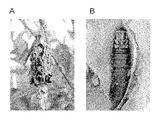
- a common bug is a generic name for moth larvae belonging to the order Lepidoptera (Psychidae), usually in a spindle-shaped or cylindrical nest (Bagestnest) (Fig. 1) in which leaf pieces and branch pieces are entangled with threads. It is known to live with the nest during the entire larval stage, such as moving with the nest even when lurking and eating.
- This silkworm silk has mechanically superior characteristics than silkworm silk.
- Eumeta minuscula wormworm thread is 3.5 times the silkworm silk thread, and boasts a very strong strength (Non-Patent Documents 1 and 2).
- the cross-sectional area of single fiber of silkworm silk thread is only about 1/7 that of single fiber of silkworm silk thread, so it is possible to produce a thin and light cloth with a fine and smooth texture.
- the wormworm silk has a luster and glossiness equivalent to or higher than that of silkworm silk. Therefore, the caterpillar silk thread can be an extremely promising animal fiber as a new natural material.
- wormworm silk thread Another major problem in the practical application of wormworm silk thread is that leaf pieces, branch pieces, etc. are always attached to the surface of the wormworm nest. In order to commercialize the wormworm silk thread, these impurities must be completely removed. However, since the removal work requires enormous labor and cost, there arises a new problem that the production cost increases as a result. In addition, it is difficult to completely remove contaminants using existing technology. In addition to the small amount of leaflets mixed in the final product, the silk thread is dyed light brown with the pigment derived from contaminants. It will become something.
- transposon piggyBac is used to stably maintain the foreign gene in the genome.
- a technique for producing a transgenic silkworm (transgenic silkworm) has already been established (Non-patent Document 3).
- the silkworm gland of silkworm is morphologically composed of a pair of left and right organs as shown in FIG. 2, each of which is composed of three regions: an anterior silk gland, a middle silk gland, and a posterior silk gland.
- the three major proteins that make up fibroin, the fiber component of silk fibroin H chain (often abbreviated herein as “Fib H”), fibroin L chain (herein, Often abbreviated as “Fib L”) and p25 / FHX (hereinafter referred to as “p25”).
- These three proteins form a complex (silk fibroin elementary unit; hereinafter referred to as “SFEU complex”) and are secreted into the posterior silk gland lumen.
- a water-soluble gelatin-like protein sericin which is a coating component of silk, is synthesized. They are secreted into the middle silk gland lumen after synthesis.
- the SFEU complex secreted into the posterior silk gland lumen migrates to the middle silk gland lumen, where it is covered with sericin and spun out from the anterior silk gland as a silk thread (Non-Patent Document 4).
- the basic structure of the wormworm silk thread is thought to be composed of fibroin, which is a fiber component, and sericin covering it, as with silkworm silk thread. Therefore, if silkworm silk glands can be used as an expression system for silkworm silk and the silkworm silk can be spun on silkworm, silkworm silk can be obtained easily and in large quantities. If the silkworm silk can be recovered as a silkworm cocoon, impurities such as a worm's nest will not be mixed. Furthermore, if the breeding target is a genetically modified silkworm, the existing silkworm breeding equipment, the silk mill and the breeding technology can be used as they are, so that early commercialization is possible.
- the production method of the silkworm silk thread using the above-mentioned genetically modified silkworm has a problem that impedes its realization.
- it is essential to clone each gene that encodes the constituent protein of caterpillar silk at least the gene that constitutes Fib H, which is the main component of fibroin in caterpillar silk (Fib H gene) Become.
- Fib H generally has an amino acid sequence in which a cluster of glycine and alanine residues is repeated
- a gene that encodes the full-length caterpillar Fib H (hereinafter referred to as “the worm beetle” in this specification) is generally used for cloning. It is difficult to isolate and identify "Fib H gene"). In fact, to date, no caterpillar fibroin heavy chain gene has been identified.
- An object of the present invention is to provide a method for producing a large amount of silkworm silk by producing a genetically modified silkworm that spouts a silkworm silk thread using a gene recombination technique.
- the present inventors encoded transcripts of the wormworm Fib H-like polypeptide containing a partial amino acid sequence of the wormworm Fib H by performing transcriptome analysis using a next-generation DNA sequencer using Eumeta japonica.
- a gene encoding a modified worm Fib H, which is obtained by fusing the gene fragment with a gene fragment encoding FibFiH derived from silkworm (hereinafter, often referred to as “modified worm Fib H gene” in this specification) was made.
- the gene was introduced into silkworms to create transgenic silkworms.
- This transgenic silkworm spouts Fib H in which the silkworm Fib ⁇ ⁇ H contains a part of the modified caterpillar Fib H, and the modified silkworm silk thread containing the silkworm-derived Fib L, p25, and sericin.
- the modified caterpillar silk thread is a hybrid silk thread in which the silkworm silk thread has the properties of the caterpillar silk thread.
- the gene according to (1) comprising any amino acid sequence having 90% or more amino acid identity with the amino acid sequence shown.
- the amino acid sequence represented by SEQ ID NO: 9 in the modified minomyfibroin H chain the amino acid sequence represented by SEQ ID NO: 9, one or more amino acids added, deleted or substituted, or SEQ ID NO: 9
- the gene according to (4) which encodes any amino acid sequence having 90% or more amino acid identity with the amino acid sequence shown.
- (6) a silkworm-derived posterior silk gland expression promoter, and the modified minomififibroin H chain gene according to any one of (1) to (5) in a state capable of being expressed in silkworm cells, A fibroin heavy chain gene expression vector, wherein the fibroin heavy chain gene is arranged to be directly or indirectly controlled by the posterior silk gland expression promoter.
- a first expression unit comprising a silkworm-derived posterior silk gland expression promoter and a gene encoding a transcriptional regulatory factor placed under the downstream control of the promoter, and a target promoter of the transcriptional regulatory factor and the target promoter
- a genetically modified silkworm comprising the modified Minomushi fibroin H chain gene expression vector according to any one of (6) to (12).
- a method for producing a genetically modified silkworm that spouts a modified silkworm silk thread comprising a step of selecting a genetically modified silkworm containing the silkworm.
- transgenic silkworm having the first expression unit according to any one of (10) to (12) and (8) or (9), or subordinate thereto The step of mating the transgenic silkworm having the second expression unit according to any one of (10) to (12), and the transgenic silkworm having the first and second expression units from the progeny after the mating
- a method for producing a genetically modified silkworm that spits a modified silkworm silk thread comprising a step of selecting.
- a method for producing modified wormworm silk comprising a step of cultivating the transgenic silkworm according to (13), a step of collecting the cocoon, and a step of spinning the modified wormworm silk from the collected cocoon.
- the expression vector of the present invention by introducing the expression vector into a silkworm, it is possible to produce a genetically modified silkworm that spits a modified worm silk thread.
- the genetically modified silkworm of the present invention it is possible to produce a modified silkworm silk thread in which the physical properties of the silkworm silk thread are artificially imparted to the silkworm silk thread.
- A It is an external view of the nest of a giant worm (Oomino moth).
- B It is a figure which shows the inside of a nest when the nest of a giant rotifer is cut open in the major axis direction and divided into two. It is a conceptual diagram which shows until the silkworm gland of silkworm and the fibroin component protein and silk thread which are expressed at each site
- the 1st aspect of this invention is the gene (modified
- “Minomushi” is a general term for moth larvae belonging to the order Lepidoptera (Lepidoptera), Psychidae.
- the kind of the bug is not particularly limited as long as the bug that spits it contains the amino acid sequence shown by SEQ ID NO: 1 described later.
- Fib H that has been subjected to gene cloning in the present specification is Fib H derived from the giant moth, so that the worm is preferably a larva of the genus Eumeta such as the giant moth or Eumeta minuscula, more preferably the larva of the moth .
- the term “silk thread” refers to a thread derived from an insect, which is a protein thread that insect larvae and adults spun for the purpose of nesting, movement, fixation, hunting, food capture, and the like.
- silk thread when simply described as “silk thread”, it means, in principle, a wide general silk thread that does not specify the name of an insect, and when it represents a silk thread derived from a specific insect, silkworm silk thread or wormworm silk thread Like, the name of the organism of its origin shall be attached to the front of the silk thread.
- the “silk gland” is an altered tubular organ of the salivary gland that has the function of producing, accumulating and secreting liquid silk.
- Silk glands usually exist in pairs of left and right, mainly along the larval digestive tract, of insects that can spit silk, and each silk gland is composed of three regions: the front, middle and posterior silk glands. ing.
- FIG. 2 illustrates the silk gland of silkworm, but the silkworm gland of caterpillar has almost the same form.
- the posterior silk gland produces and secretes fibroin, the fiber component of silk.
- the middle silk gland produces and secretes sericin, which is a coating component, and accumulates in the lumen together with fibroin that has migrated from the posterior silk gland.
- Fibroin H chain is one of the proteins constituting fibroin, which is a fiber protein component in silk thread.
- silkworm fibroin is mainly composed of three proteins, namely Fib H, Fib L, and p25.
- Fib H is a main constituent protein in fibroin, and the properties of silk are mainly brought about by Fib H.
- the derived insect when it is simply expressed as “Fib H”, in principle, the derived insect is not particularly limited.
- Fib H derived from a specific insect is represented, the name of the organism from which it is derived is added in front of Fib H, such as the silkworm Fib H and the beetle Fib H.
- modified Fib H is an artificially modified Fib H, and is composed of an amino acid sequence different from wild-type Fib H.
- Modified Fib H includes, for example, mutant Fib H in which one or more amino acid additions, deletions, and / or substitutions are introduced into the amino acid sequence of Fib H, or Fib H derived from two or more different insects.
- the ⁇ modified worm Fib H '' is a modified Fib H in the worm H Fib H, and the addition or deletion of one or more amino acids in the amino acid sequence of the wild type worm Fib H, And / or mutant Fib H into which substitution is introduced and / or chimeric Fib H in which the amino acid sequences of two or more different insect-derived Fib H are fused.
- Fib H gene refers to a gene encoding Fib H.
- Fib H gene when it is simply expressed as “Fib H gene”, in principle, any insect originates in this specification.
- Fib H gene when a Fib H gene derived from a specific insect is represented, the name of the organism from which it is derived is prefixed to Fib H, such as the silkworm Fib H gene and the worm insect Fib H gene.
- modified Fib H gene refers to a gene encoding the modified Fib H. Accordingly, the “modified worm Fib H gene” is a gene encoding modified Fib H in Fib ⁇ ⁇ ⁇ ⁇ H derived from caterpillars. In this embodiment, this modified caterpillar Fib H gene is targeted.
- the “modified silkworm silk thread” refers to a silk thread in which the modified Fib H gene is introduced into a silkworm in a state in which it can be expressed in the silk gland of the silkworm, and the resultant transgenic silkworm spits out.
- All of the modified wormworm silks are composed of silkworm-derived silk components except Fib H.
- Fib H in the modified silkworm silk thread is a hybrid Fib H in which the endogenous silkworm Fib H and the modified silkworm Fib H are mixed. Therefore, the modified silkworm silk thread is a so-called hybrid silk thread of silkworm silk thread and modified silkworm silk thread.
- the hybrid silk thread has physical properties of the silkworm silk thread by mixing the modified silkworm Fib H with the silkworm Fib H.
- Fib H contains one or more repeating units in its amino acid sequence.
- the “repeat unit” is an amino acid sequence including a large number of glycine residues (G) and alanine residues (A) and appearing one or more times within the amino acid sequence of Fib H.
- the modified worm Fib H encoded by the modified worm Fib H gene of the present invention also contains one or more repeating units in its amino acid sequence.
- the modified rotifer Fib H is an amino acid sequence represented by SEQ ID NO: 5, an amino acid sequence obtained by adding, deleting, or substituting one or more amino acids in the amino acid sequence represented by SEQ ID NO: 5, or SEQ ID NO: An amino acid sequence having amino acid identity of 90% or more, 93% or more, 95% or more, 97% or more, 98% or more, or 99% or more with respect to the amino acid sequence shown in FIG.
- the amino acid sequence shown in SEQ ID NO: 5 is an amino acid sequence containing a part of the wild-type worm Beb H Fib H.
- “plurality” means 2 to 10, 2 to 8, 2 to 6, 2 to 5, 2 to 4, or 2 to 3.
- the amino acid substitution is preferably a conservative amino acid substitution.
- a conservative amino acid refers to the relationship between amino acids classified into the same amino acid group.
- Non-polar amino acid groups (glycine, alanine, phenylalanine, valine, leucine, isoleucine, methionine, proline, tryptophan), polar amino acid groups (amino acids other than nonpolar amino acids), charged amino acid groups (acidic amino acids (asparagine) Acid, glutamic acid) and basic amino acid group (arginine, histidine, lysine)), uncharged amino acid group (amino acid other than charged amino acid), aromatic amino acid group (phenylalanine, tryptophan, tyrosine), branched chain amino acid group (leucine, isoleucine) , Valine), and aliphatic amino acid groups (glycine, alanine, leucine, isoleucine, valine) and the like.
- amino acid identity means alignment (alignment) of amino acid sequences of two polypeptides, and a gap is introduced into one of the amino acid sequences as necessary. Is the ratio (%) of the same amino acid of the other polypeptide to the total number of amino acids of one polypeptide.
- This% amino acid identity is a known program such as a homology search program BLAST (Basic local alignment search tool; Altschul, S. F. et al, J. Mol. Biol., 215, 403-410, 1990) Can be easily determined.
- the base sequence shown by SEQ ID NO: 6 encoding the amino acid sequence shown by SEQ ID NO: 5 can be mentioned.
- the modified caterpillar Fib H encoded by the modified caterpillar Fib H gene of the present invention includes a plurality of core sequences, for example, two or more, preferably three or more, in the repeating unit.
- the “core sequence” refers to a sequence consisting of dozens of amino acids that appear more than once in a repeating unit.
- Examples of the “core sequence” in the modified worm Beb H include an amino acid sequence (GAGAGAGSGAGAG) composed of 13 amino acids represented by SEQ ID NO: 1.
- This amino acid sequence is a partial amino acid sequence in the wild-type caterpillar Fib H.
- the repeating unit consisting of the amino acid sequence shown in SEQ ID NO: 5 includes three core sequences.
- nucleotide sequence of the polynucleotide encoding the core sequence include the nucleotide sequences represented by SEQ ID NOs: 2, 3, and 4 that encode the amino acid sequence represented by SEQ ID NO: 1.
- the modified caterpillar Fib ⁇ ⁇ ⁇ H encoded by the gene of the present invention further comprises an amino acid sequence represented by SEQ ID NO: 7, an amino acid sequence obtained by adding, deleting, or substituting one or more amino acids in the amino acid sequence represented by SEQ ID NO: 7, Alternatively, an amino acid sequence having 90% or more amino acid identity with the amino acid sequence represented by SEQ ID NO: 7 can be included.
- the amino acid sequence shown in SEQ ID NO: 7 is an amino acid sequence containing a part of the wild-type worm Beb Fib H.
- the amino acid sequence shown in SEQ ID NO: 7 contains one repeating unit, but the number of repeating units can be increased to two or more as necessary.
- the base sequence shown in SEQ ID NO: 8 can be mentioned.
- the modified worm insect Fib H encoded by the gene of the present invention may be a chimeric Fib H with another insect Fib H.
- the chimera Fib H of the caterpillar Fib H and the silkworm Fib H As a specific example, the chironomid Fib H of silkworm Fib H and the silkworm Fib H having the amino acid sequence shown in SEQ ID NO: 9 can be mentioned.
- the chimera Fib H has amino acid sequences derived from silkworm Fib H at positions 1 to 153 and 466 to 524, and positions 156 to 463 contain an amino acid sequence derived from the wormworm Fib H.
- amino acid sequence shown in SEQ ID NO: 9 consists of an amino acid sequence in which one or more amino acids are added, deleted or substituted, or an amino acid sequence having 90% or more amino acid identity with the amino acid sequence shown in SEQ ID NO: 9. Fib H may be used. Furthermore, the amino acid sequence shown in SEQ ID NO: 9 contains one repeating unit, but this repeating unit can be increased to two or more as necessary. As a specific base sequence encoding the amino acid sequence shown in SEQ ID NO: 9, for example, the base sequence shown in SEQ ID NO: 10 can be mentioned.
- the modified worm Beb H of the present invention can have an exogenous signal peptide on the N-terminal side as necessary.
- a “signal peptide” is an extracellular signal required for secreting a protein biosynthesized by gene expression out of the cell. The signal peptide is cleaved and removed by signal peptidase after translation and before being secreted outside the cell.
- the signal peptide has a positively charged amino acid such as Lys or Arg on the N-terminal side, followed by a highly hydrophobic amino acid sequence such as Ala, Leu, Val, Ile, Val, and Phe. ing. In the case of a secretory protein, it usually has an endogenous signal peptide on the N-terminal side thereof.
- this exogenous signal peptide is unnecessary.
- the amino acid at positions 1 to 21 corresponds to the endogenous signal peptide derived from silkworm Fib H. Sex signal peptides are not required.
- an exogenous signal peptide may be arranged at the N-terminus thereof.
- the C-terminal side of the signal peptide may have an amino acid sequence including a signal peptidase recognition site for cleaving the signal peptide from the fusion protein and / or an insertion sequence after the signal sequence that promotes cleavage and secretion of the signal peptide.
- the amino acid sequence of the signal peptide is not particularly limited. Usually, it may be in the range of 3 to 60 amino acids.
- the signal peptide DNA encoding the signal peptide includes, but is not limited to, a signal peptide DNA encoding a silkworm sericin 1 signal peptide comprising the amino acid sequence represented by SEQ ID NO: 11 (for example, including the base sequence represented by SEQ ID NO: 12).
- a signal peptide DNA encoding a silkworm sericin 2 signal peptide comprising the amino acid sequence represented by SEQ ID NO: 13 for example, a DNA comprising the base sequence represented by SEQ ID NO: 14
- the amino acid sequence represented by SEQ ID NO: 15 examples thereof include a signal peptide DNA encoding a silkworm sericin 3 signal peptide (for example, a DNA containing the base sequence represented by SEQ ID NO: 16).
- the 2nd aspect of this invention is a modified type beetle Fib H gene expression vector.
- the expression vector of the present invention contains the modified worm Beb Fib H gene described in the first aspect in a state capable of being expressed in the silkworm gland of the silkworm. By introducing the expression vector of the present invention into a silkworm, a modified silkworm silk can be obtained from a transgenic silkworm.
- expression vector refers to an expression unit that includes a gene encoding a target protein and that can control the expression of the gene.
- the modified caterpillar Fib H gene expression vector of the present invention is configured to express the modified caterpillar Fib H gene in the posterior silk gland of the silkworm, the host.
- Various vectors can be used as the mother nucleus vector of the modified worm Beb H gene expression vector.
- an autonomously replicable expression vector such as a plasmid or Bacmid, a viral vector, an expression vector capable of homologous or non-homologous recombination in a chromosome, or a part of a chromosome in which it is inserted into a host chromosome.
- a shuttle vector that can replicate in E. coli, Bacillus subtilis, or yeast can also be used.
- the modified worm insect Fib H gene expression vector includes the posterior silk gland expression promoter and the modified worm insect Fib ⁇ H gene as essential components.
- a marker gene, a transposon inverted terminal repeat, 5'UTR, 3'UTR, terminator, enhancer, insulator, and the like are included as selection components.
- the modified vector beetle Fib H gene expression vector is composed of two gene expression units, a first expression unit and a second expression unit, which will be described later, the gene of the transcriptional regulatory factor and the target promoter of the transcriptional regulatory factor Is included as an essential component.
- each component in the modified worm Beb H gene expression vector of the present invention will be specifically described.
- Posterior silk gland expression promoter is arranged downstream in the silkworm posterior silk gland when the modified worm insect Fib H gene expression vector of the present invention is introduced into the host silkworm. It is a promoter that can control the expression of the generated gene.
- the posterior silk gland expression promoter may be a promoter of any gene as long as it is a promoter operable in the posterior silk gland of the silkworm. “Operable” means that the expression of a gene located downstream can be controlled. Examples of the posterior silk gland expression promoter include a posterior silk gland-specific promoter, a systemic promoter that can be expressed ubiquitously, a constitutively active promoter or a time-specific active promoter, or an expression-inducible promoter. A posterior silk gland specific promoter is preferred. Among them, the promoter of a gene encoding a protein that is specifically and highly expressed in the posterior silk gland of the silkworm is preferable, and the late silk gland that is specifically activated in the posterior silk gland from the late stage to the anterior stage of the late stage.
- Fib H, Fib L, or p25 gene promoters (herein referred to as “Fib H promoter”, “Fib L promoter”, or “p25 promoter”, respectively) that are fibroin constituent proteins) It is suitable as a posterior silk gland expression promoter in the modified vector beetle Fib H gene expression vector.
- the biological species derived from the posterior silk gland expression promoter that is, the donor of the promoter is not particularly limited as long as it can operate in the silkworm cells of which the promoter is the host.
- the base sequences of Fib H, Fib L, or p25 promoters expressed specifically in the posterior silk gland are evolutionarily very conserved among silkworms (Sezutsu H., et al., 2009). , Journal of Insect Biotechnology and Sericology, 78: 1-10). Therefore, even if the donor of the posterior silk gland expression promoter in the modified worm insect Fib H gene expression vector of the present invention is not a silkworm, the posterior silk gland expression promoter can operate in the posterior silk gland of the silkworm.
- the term “silkworm” refers to a general term for insects that have a silk gland and can spout silk thread. Usually refers to a species that can spun during larval stage for nesting, nesting or migration. Specifically, it is a species belonging to the order of the order Lepidoptera, Bee, Aphididae and Tobicella. Preferably, it is a species belonging to the order Lepidoptera which can spout a large amount of silk thread. Bombycidae, Saturniidae, Brahmaeidae, Eupterotidae, Lasiocampidae, Psychidae, Arctiidae, Noctae, etc.
- Species are preferred as the silkworms herein. Bombyx genus, Samia genus, Antheraea genus, Saturnia genus, Attacus genus, Rhodinia genus, specifically, silkworm, quay (Bombyx mandarina), Shinjusan (Samia cynthia ricini) and Synjusan Particularly preferred are Erysan hybrids), Antheraea yamamai, Sakusan (Antheraea pernyi), Saturnia japonica, Actiasonicagnoma, and the like.
- the organism derived from the posterior silk gland expression promoter in the modified worm Beb H gene expression vector of the present invention preferably a species belonging to the same Lepidoptera as the host silkworm, more preferably a species belonging to the same silkworm family More preferably, the species belongs to the same genus such as mulberry.
- the most preferred source organism is the same species, ie silkworm.
- a silkworm Fib ⁇ ⁇ ⁇ ⁇ ⁇ ⁇ H promoter containing the base sequence shown by SEQ ID NO: 17, a saxan Fib H promoter containing the base sequence shown by SEQ ID NO: 18, and the base sequence shown by SEQ ID NO: 19 The silkworm Fib L promoter containing, the saksan Fib L promoter containing the base sequence shown by SEQ ID NO: 20, the silkworm p25 promoter containing the base sequence shown by SEQ ID NO: 21, and the like can be used.
- the modified caterpillar Fib H gene is a gene encoding a target protein to be expressed in the modified caterpillar Fib H gene expression vector of the present invention. Since the details of this gene are described in the first embodiment, a specific description thereof is omitted here.
- the modified caterpillar Fib H gene is arranged and linked under direct or indirect control of the posterior silk gland expression promoter.
- under direct control means that the modified worm insect Fib H gene is arranged downstream of the posterior silk gland expression promoter and its expression is directly controlled by the posterior silk gland expression promoter.
- under indirect control means that gene expression control by the posterior silk gland expression promoter is performed through other gene expression activities or the like.
- the expression control of the modified modelworm Fib H gene by the posterior silk gland expression promoter is a gene encoding a transcriptional regulatory factor. And the activity of the target promoter of its transcriptional regulator.
- Marker gene A “marker gene” is a gene encoding a labeled protein, also called a selection marker.
- Labeled protein refers to a polypeptide that can determine the presence or absence of expression of a labeled gene based on its activity.
- the marker gene is used for the purpose of discriminating the host carrying the modified wormworm Fib H gene expression vector, that is, the transformant and / or monitoring the target protein expressed from the modified wormworm Fib H gene expression vector. .
- the activity of the labeled protein it is possible to discriminate transformants and monitor the expression level of the modified worm Beb Fib H.
- “based on activity” means based on the detection result of activity.
- the activity may be detected directly by the activity of the labeled protein itself or indirectly by a metabolite generated by the activity of the labeled protein such as a dye.
- Detection can be biological detection (including detection by binding of peptides or nucleic acids such as antibodies and aptamers), chemical detection (including enzymatic reaction detection), physical detection (including behavioral analysis detection), or detection Any of human sensory detection (including detection by sight, touch, smell, hearing, and taste) may be used.
- the type of labeled protein encoded by the labeled gene is not particularly limited as long as its activity can be detected by a method known in the art.
- it is a labeled protein with low invasiveness to the transformant upon detection.
- tag peptides, fluorescent proteins, chromogenic proteins, photoproteins, external secreted proteins, proteins that control external morphology, and the like can be mentioned.
- Fluorescent proteins, chromogenic proteins, photoproteins, and exocrine proteins can be visually detected under certain conditions without changing the external form of the transformant, and therefore are less invasive to the transformant.
- it is particularly suitable because it is easy to identify and select transformants.
- a “tag peptide” is a short peptide consisting of several tens to several tens of amino acids that can label a protein, and is used for protein detection and purification. Usually, the base sequence encoding the tag peptide is linked to the 5 ′ end side or 3 ′ end side of the gene encoding the protein to be labeled (in this specification, the modified rotifer Fib H gene) and fused with the tag peptide. It is labeled by expressing it as a protein. Although various types of tag peptides have been developed in the art, any tag peptide may be used. Specific examples of the tag peptide include FLAG, HA, His, and myc.
- Fluorescent protein refers to a protein that emits fluorescence of a specific wavelength when irradiated with excitation light of a specific wavelength. Either a natural type or a non-natural type may be used. Further, the excitation wavelength and the fluorescence wavelength are not particularly limited. Specifically, for example, CFP, RFP, DsRed (including derivatives such as 3xP3-DsRed), YFP, PE, PerCP, APC, GFP (including derivatives such as EGFP and 3xP3-EGFP), etc. It is done.
- Chrosome synthesis protein is a protein involved in pigment biosynthesis and is usually an enzyme.
- the “dye” here is a low molecular compound or peptide capable of imparting a dye to a transformant, and the kind thereof is not limited.
- a pigment that appears as an external color of an individual is preferable. Examples include melanin pigments (including dopamine melanin), omochrome pigments, and pteridine pigments.
- photoprotein refers to a substrate protein that can emit light without the need for excitation light or an enzyme that catalyzes the light emission of the substrate protein.
- luciferin or aequorin as a substrate protein and luciferase as an enzyme can be mentioned.
- exocrine protein is a protein that is secreted extracellularly or externally, and corresponds to an exocrine enzyme or the like.
- Exocrine enzymes include digestive enzymes in addition to enzymes that contribute to the degradation or inactivation of drugs such as blasticidin and impart drug resistance to the host.
- the marker gene is arranged in a state that can be expressed downstream of the promoter in a state of being linked to the modified caterpillar Fib H gene in the modified caterpillar Fib H gene expression vector or independently of the modified caterpillar Fib H gene. .
- Inverted terminal repeat sequence of transposon are expressions capable of homologous recombination of the modified worm insect Fib H gene expression vector of the present invention with genomic DNA.
- a selection component that can be included in the case of a vector.
- the inverted terminal repeats are usually used in pairs, and piggyBac, mariner, minos, etc. can be used as transposons (Shimizu, K. et al., 2000, Insect Mol. Biol., 9 , 277-281; Wang W. et al., 2000, Insect Mol Biol 9 (2): 145-55).
- 5'UTR and 3'UTR are both polynucleotides consisting of untranslated regions that do not themselves encode proteins, fragments thereof, or functional nucleic acids.
- the base sequence constituting each UTR is preferably, but not limited to, 5′UTR and 3′UTR derived from the Fib H gene.
- 5′UTR is located upstream (5 ′ end side) of the start codon of Fib H gene, and 3′UTR is downstream (3 ′ end of Fib H gene stop codon). Side).
- the 3 ′ UTR can contain a poly A signal.
- Terminator is a base sequence that is arranged at the 3 ′ end side of the modified worm insect Fib H gene, preferably downstream of the stop codon in the modified worm insect Fib H gene expression vector of the present invention. It consists of a base sequence that can terminate transcription of the caterpillar Fib H gene.
- the hsp70 terminator consisting of the base sequence shown in SEQ ID NO: 22 and the SV40 terminator consisting of the base sequence shown in SEQ ID NO: 23 can be mentioned.
- Enhancer “Enhancer” comprises a base sequence that can further enhance the expression of the modified worm insect Fib H gene under the control of a site-specific promoter in the modified worm insect Fib H gene expression vector of the present invention.
- Insulator is a base sequence that can stably control the transcription of a gene sandwiched between sequences without being affected by chromatin of surrounding chromosomes. Examples include the cHS4 sequence of chicken and the gypsy sequence of Drosophila.
- transcriptional regulatory factor gene is an essential component of the first expression unit described below.
- transcriptional regulatory factor refers to a protein factor that can bind to a target promoter described below and activate the target promoter. Examples thereof include GAL4 protein, which is a galactose metabolic activation protein of yeast, tTA, which is a tetracycline-regulated transactivator, and mutants thereof.
- the target promoter of transcription regulator is an essential element of the second expression unit described later, and the transcription regulator encoded by the first expression unit binds to it.
- the transcriptional regulatory factor and its target promoter are in a corresponding relationship with the transcriptional regulatory factor. Normally, when the transcriptional regulatory factor is determined, the target promoter is inevitably determined. For example, when the transcriptional regulatory factor is GAL4 protein, UAS (Upstream Activating Sequence) is used.
- modified worm Fib H gene expression vector of the present invention may be composed of one expression unit or two expression units. Hereinafter, each case will be described.
- the modified rotifer Fib H gene expression vector is all that is necessary to express the modified wormworm Fib H gene in silkworm cells.
- the posterior silk gland expression promoter which is an essential component, and a modified caterpillar Fib H gene placed under the control of the promoter.
- the modified wormworm Fib H gene expression vector may contain two or more modified wormworm FibFiH genes under the control of one promoter.
- the modified beetle Fib H gene expression vector is composed of one gene expression unit
- the modified beetle Fib H gene is expressed in the silkworm posterior silk gland simply by introducing the modified beetle Fib H gene expression vector into the silkworm. Can be made.
- the expression vector is composed of two expression units
- the first expression unit and the second expression unit the expression of the modified type insect Fib H gene
- the essential components are divided into units.
- the first and second expression units coexist in the host cell and function as one modified worm Beb H gene expression vector.
- the first expression unit when the first and second expression units coexist in the host cell, the first expression unit is activated by the activation of the posterior silk gland expression promoter contained in the first expression unit in the same cell. Transcription factor is expressed from The transcriptional regulatory factor binds to and activates the target promoter of the second expression unit, whereby the desired modified worm Beb H gene can be expressed.
- the first and second expression units have the following configuration.
- the “first expression unit” comprises a posterior silk gland expression promoter and a gene for a transcriptional regulatory factor placed under the control of the promoter. At this time, the same or different two or more transcriptional regulatory factors may be included under the control of one promoter.
- the first expression unit can also have two or more pairs consisting of a posterior silk gland expression promoter and a transcription regulatory factor gene under its control.
- each set may be the same set or different sets.
- the first expression unit includes a pair consisting of a Fib H promoter and a GAL4 gene and a pair consisting of a Fib L promoter and a GAL4 gene can be mentioned.
- the first expression unit can also reuse an existing gene expression vector including a posterior silk gland expression promoter and a transcriptional regulatory factor.
- the “second expression unit” includes the target promoter of the transcriptional regulatory factor encoded by the first expression unit and the modified worm Beb H gene arranged under the control of the target promoter.
- the target promoter contained in the second expression unit is a promoter activated by the transcriptional regulatory factor encoded by the first expression unit. That is, in principle, the target promoter contained in the second expression unit is uniquely determined by the transcriptional regulatory factor encoded by the first expression unit. For example, if the gene of the transcriptional regulatory factor contained in the target promoter first expression unit is a GAL4 gene, the GAL4 target promoter of the second expression unit is UAS.
- the second expression unit may contain two or more modified worm Beb H genes having the same or different sequences under the control of one target promoter.
- the second expression unit may have two or more sets of a target promoter and a modified worm Beb Fib gene under its control.
- each set may be the same set or different sets.
- the second expression unit may be composed of two or more units that are the same or different including the modified worm Beb H gene.
- the transcriptional regulatory factor expressed from one first expression unit activates the target promoter of a plurality of second expression units, thereby expressing the modified rotifer Fib H gene contained in each second expression unit. can do.
- the modified caterpillar Fib H gene expression vector of this configuration can amplify the expression of the modified caterpillar Fib H gene of the second expression unit via a transcriptional regulatory factor encoded by the first expression unit. Therefore, it is suitable for overexpressing the modified worm Beb H gene in the host cell.
- the 3rd aspect of this invention is a transgenic silkworm.
- the transgenic silkworm of this aspect is a transformant comprising the modified wormworm Fib H gene expression vector of the second aspect.
- the silk thread spited by the genetically modified silkworm of the present invention is a modified silkworm silk thread containing the modified silkworm Fib H based on the silkworm silk thread. Therefore, the modified silkworm silk can be mass-produced by breeding the transgenic silkworm of the present invention.
- the genetically modified silkworm of the present invention contains the modified worm insect Fib H gene expression vector described in the second embodiment in a cell. Since the structure of the modified wormworm Fib H gene expression vector has been described in detail in the second embodiment, the description thereof will be omitted, and the structure unique to the transgenic silkworm of this embodiment will be described here.
- the modified wormworm Fib H gene expression vector described in the second aspect may be transiently present in the silkworm cell, and is stable in a state of being introduced into the chromosome and the like. It may exist continuously. Usually, it is preferable to exist stably and continuously.
- the transgenic silkworm can have two or more different modified caterpillar Fib H gene expression vectors described in the second embodiment.
- modified caterpillar Fib H gene expression vectors described in the second embodiment.
- each modified wormworm Fib H gene expression vector can contain the modified wormworm Fib H gene having the same or different base sequence.
- each expression unit is present on the same chromosome. May be present on different chromosomes.
- the transgenic silkworm of the present invention having the first expression unit and the second expression unit at F1 can be easily obtained.
- the transgenic silkworm strain having only the first expression unit is highly versatile, an existing transgenic silkworm strain having only the first expression unit may be reused.
- the distance between the expression units is close and linked to each other so that they are not separated by recombination during the passage process. Is preferred.
- a method for producing a recombinant silkworm include a method of directly introducing the modified wormworm Fib H gene expression vector of the second aspect into a silkworm that is a host, and a modified wormworm Fib H gene expression vector of the second aspect. And a method of mating male and female transgenic silkworms each having a first expression unit and a second expression unit on different chromosomes.
- This method is a method for producing a transgenic silkworm that is mainly employed when the modified wormworm Fib H gene expression vector of the second aspect is composed of one expression unit.
- the object can be achieved by introducing a modified caterpillar Fib H gene expression vector into a silkworm of a host and selecting a transgenic silkworm containing the expression vector.
- This production method includes an introduction step and a selection step as essential steps.
- the “introducing step” is a step of introducing the modified worm insect Fib H gene expression vector described in the second aspect into a silkworm as a host.
- a method known in the art may be used for introducing the expression vector into a silkworm.
- the method of Tamura et al. can be used.
- the modified wormworm Fib H gene expression vector is diluted with a solvent such as water or a buffer so that the modified wormworm Fib H gene expression vector has an appropriate concentration to prepare an administration solution.
- a helper vector containing DNA encoding the transposon transferase is added to the administration solution to add to the early eggs of the silkworm. Just inject it.
- the host silkworm used at this time is not particularly limited. It may be a wild type or mutant silkworm, or a genetically modified silkworm.
- a dosing solution containing only the modified worm insect Fib H gene expression vector without adding the helper vector may be injected into the silkworm early development egg.
- the selection step is a step of selecting a genetically modified silkworm containing the modified worm insect Fib H gene expression vector from the silkworm after the introduction step.
- the selection method is not limited as long as it is a method known in the art.
- transformants should be selected based on the presence or absence of a selectable marker generated by the expression of a marker gene contained in a modified worm Beb Fib H gene expression vector (or helper vector if a helper vector is introduced).
- the desired transgenic silkworm can be obtained.
- the introduced modified worm insect Fib H gene expression vector is integrated into the chromosome via the transposon inverted terminal repeat sequence. Therefore, if necessary, a homozygote of the expression vector inserted into the chromosome may be obtained through a step of mating or sibling mating of the obtained transgenic silkworm.
- This method is a method for producing a genetically modified silkworm that is mainly employed when the modified wormworm Fib H gene expression vector of the second aspect is composed of two expression units.
- male and female transgenic silkworms each having a first expression unit and a second expression unit on different chromosomes are mated, and a genetic recombination having two expression units at F1 or F2 is selected. Can be achieved.
- This production method includes a mating step and a selection step as essential steps.
- the “crossing step” is a step of mating a transgenic silkworm having a first expression unit (first transgenic silkworm) and a transgenic silkworm having a second expression unit (second transgenic silkworm). is there.
- two silkworm lines may be mated based on a conventional method.
- the “selection step” is a step of selecting a transgenic silkworm strain having the first and second expression units. In this step, both gene expression units are obtained based on the activity of the selection marker encoded in each of the first and second expression units from the F1 individuals obtained after the mating step or the F2 individuals obtained by crossing the F1s. This can be achieved by selecting an individual.
- the first and second transgenic silkworms can be produced by introducing the first expression unit or the second expression unit into the silkworm, respectively, using the direct introduction method.
- the 4th aspect of this invention is a production method of a modified type worm silk thread.
- a recombinant silkworm of a mass production system for proteins is used.
- the transgenic silkworm used in this embodiment is the transgenic silkworm of the third embodiment.
- the silkworm is allowed to grow, and a modified worm silk thread is obtained from the cocoon.
- a hybrid silk thread of silkworm silk and silkworm silk having physical properties of the silkworm silk, that is, a modified silkworm silk thread can be mass-produced using a silkworm silk production facility or the like.
- the production method of the modified wormworm silk thread of the present invention includes a breeding process as a selection process, and a management process, a convergence process, and a reeling process as essential processes.
- the “breeding process” is a process of breeding the transgenic silkworm of the third aspect.
- the “breeding process” should just breed according to the silkworm breeding technique well-known in the said field
- the feed may be natural leaves of a herbaceous species such as the leaves of the genus Morus, or an artificial feed such as silk mate L4M or potato species 1-3 years old (Nippon Agricultural Industries). May be. Artificial feeds are preferred because they can suppress the occurrence of disease, can be fed with a stable quality and quantity, and can be sterilized as needed.
- a simple method for breeding transgenic silkworms will be described with an example.
- Sweeping is performed with eggs laid by females of a similar transgenic silkworm with an appropriate number (eg, 4-10).
- the hatched larvae are transferred from the egg mount into a container laid with dry paper (paraffin processed paper), which is a scorpio, and artificial feed such as silk mate is arranged on the dry paper and fed.
- dry paper paraffin processed paper
- artificial feed such as silk mate is arranged on the dry paper and fed.
- food exchange should be performed once at 1-2 years and 1-3 times at 3 years. Old bait is removed to prevent corruption if left over.
- For rearing silkworm larvae at the age of 4-5 years transfer to large containers and adjust the number of animals per container as appropriate.
- the container may be provided with a lid made of dry paper, acrylic, or mesh. Rearing temperature is 25-28 ° C throughout the entire age.
- the “management process” is a process in which the genetically modified silkworm of the third aspect is managed. “Eiken” refers to the formation of cocoons for hatching by silkworms.
- this step basically a known management method for silkworms may be performed.
- this step can be achieved by collecting the matured rice from the 6th to the 8th day of age and collecting it. “Upper” is to move silkworms to the eyelids. The management should be performed at 25-28 ° C. Thereafter, the transgenic silkworm of the third aspect forms a cocoon in the cocoon.
- the “convergence process” is a process of scraping and collecting the straw from the basket after the management process. This process includes the removal of fluff adhering to the periphery of the eyelids. Convergence may be performed on the 6th to 8th day after the upper heel. Converging can be done manually, but it is convenient to use a dedicated converging device. In addition to the fluff remover that removes only the fluff, a fully automatic converging fluff remover that performs scraping of the wrinkles from the wrinkles and removal of the fuzz can be used.
- the "pulling process” is a process in which the modified worm silk is wound from the cocoon collected in the converging process.
- “Filling” refers to making raw silk from a cocoon. The collected cocoons are submerged in hot water at 80-85 ° C to make the cocoons easy to unravel, and then the ridges are used to strip the surface layer of the cocoons . After that, perform “shaking” to remove the clue from the kite and manipulate the yarn. Although these steps can be performed manually, it is preferable to use an automatic reeling machine which is a dedicated reeling device. Through the above steps, the modified wormworm silk can be produced as raw silk.
- Example 1 Cloning of the caterpillar Fib H gene> (the purpose) Clone the unknown worm insect Fib H gene. (Method) A silk gland was excised by dissecting the larvae of Ominoga collected in Abiko, Chiba Prefecture (Japan). Silk glands extracted in ISOGEN (Nippon Gene), an RNA extraction reagent, were ground and extracted with SV Total RNA Isolation system (Promega). Using the extracted total RNA as a template, a cDNA library was prepared using TruSeq RNA Sample Preparation Kit v2 (Illumina). It was subjected to RNAseq analysis using the next-generation sequencer Hiseq 2500. Using the obtained 101 bp ⁇ 2 paired-end sequence read data, blast search and de novo assemble analysis using trinity were performed.
- Example 2 Construction of expression vector of modified wormworm FibH> (the purpose) An expression vector for the full-length chimeric Fib H gene is constructed based on the partial sequence information of the silkworm Fib H gene and the silkworm Fib H gene information obtained in Example 1.
- the base sequence information obtained in Example 1 was a partial region (N-terminal region, central region, C-terminal region) in the Japanese wormworm Fib H gene.
- the transcript of the Ominoga Fib H gene is estimated to have a total length of about 10 kbp. Therefore, in order to make the beetle Fib H gene into a form that can be used as a gene recombination construct, the following operations are performed based on the base sequence information of the Fib H gene fragment of silkworm and the silkworm Fib H gene information obtained in Example 1.
- a modified worm insect Fib H gene composed of the wormworm and silkworm chimeric Fib H gene was constructed.
- the base sequence information of the N-terminal region and C-terminal region obtained in Example 1 is not used in constructing the modified worm Beb H gene of this example. This is because the N-terminal region and the C-terminal region of the silkworm Fib H are appropriately expressed in the posterior silk gland of the silkworm and properly secreted as the modified silkworm silk gland. This is because it is considered preferable to use a gene.
- the physical properties peculiar to various silk threads generally have a region composed of repetitive sequences, it is sufficient to use only the central region encoding the repetitive sequences in order to give the silkworm silk physical properties. Because it was thought.
- an N-terminal primer represented by SEQ ID NO: 31 was used as a template by using a solution obtained by diluting the reaction solution containing the amplified products (Ev01HFB-F21 / R26 and Ev01HFB-F26 / R12) after each PCR in a 1/50 volume 1000 times as a template.
- PCR with EvHFB-F12) and a C-terminal primer represented by SEQ ID NO: 30 (EvHFB-R12) was performed to recover the amplified piece (Ev01HFB-F12 / R12).
- the N-terminal and C-terminal sequences of the vector backbone and the silkworm FibH remain from the green fluorescent FibH construct “pHChis6-EGFP” (KuwanauwaY., Et al., 2014, PLoS ONE 9 (8): e105325) As described above, it was cut with BamHI and SalI. Transformation was performed using both ligation reaction solutions, and a modified worm insect FibH “pHC.BmEv01HFB-F31 / R31s” was constructed.
- the silkworm silk thread was transformed with the ligation reaction solution of the AscI and FseI cut pieces of the “pHC.BmEv01HFB-F31 / R31.03” clone selected from the above and the AscI and FseI cut pieces of the piggyback vector “pBac3xP3eGFP”.
- a modified rotifer FibH gene expression vector (pBac3xP3eGFP-BmEv01HFB-F31 / R31), which was hybridized so that it could be expressed in the gland, was constructed.
- Example 3 Production of transgenic silkworm> (the purpose) A transgenic silkworm introduced with the expression vector constructed in Example 2 is produced.
- the modified worm insect Fib H transgenic silkworm was again produced.
- pBac3xP3eGFP-BmEv01HFB-F31 / R31 was injected into 384 silkworm w1pnd strains according to the above-mentioned standard method.
- sib mating was performed with the obtained G0 adults, and G1 eggs were obtained in 38 cells.
- screening was performed based on the GFP marker in the embryo's eye.
- GFP positive individuals were obtained in 8 cells.
- a GFP positive individual is a transgenic silkworm capable of expressing the target modified worm Beb H gene.
- Each subdivision was designated Y91.01 to Y91.08 in descending order of the number of positive individuals.
- the following experiments were carried out using transgenic silkworms in the top 3 cocoons (Y91.01 to Y91.03).
- the GFP negative individual obtained at this stage was used as a control individual (Y90. Cont.) That does not carry the modified rotifer FibH gene expression vector.
- the G1 individuals and the control G1 individuals in the above 3 guts were each sib-crossed to obtain G2 eggs, and then the G2 individuals were bred and re-sib-crossed to obtain G3 eggs.
- the cocoons obtained from the G3 generation larvae were spun at a target fineness of 27d and a spinning speed of 200 m / min using an automatic spinning machine for cocoon testing (Nissan Motor, CT-2 type).
- the physical properties (breaking strength, breaking elongation, and Young's modulus) of the obtained silk thread were allowed to stand for 2 hours or longer in a target temperature / humidity of 20 ° C. and 65%, and then the sample length was 100 mm and the pulling speed was 150 mm / min. It was measured. Breaking strength refers to the stress immediately before breaking. In general, a larger value means that the target material can withstand strong stress.
- the elongation at break refers to the elongation to break.
- the Young's modulus is a proportional constant of strain and stress in the coaxial direction in the elastic range where Hooke's law is established. In general, the larger the value, the higher the rigidity of the target material.
- the transgenic silkworm silk thread is a silk thread spouted by the modified silkworm Fib H transgenic silkworm, and corresponds to a mixed silk thread of the modified silkworm silk thread and the silkworm silk derived from the w1pnd strain.
- the control silk thread corresponds to silkworm silk derived from the w1pnd strain.
- the elongation and Young's modulus of the genetically modified silkworm silks were significantly increased in all strains compared to the control silk. This indicates that the modified silkworm silk has imparted elongation and rigidity to the silkworm silk.
Landscapes
- Life Sciences & Earth Sciences (AREA)
- Health & Medical Sciences (AREA)
- Chemical & Material Sciences (AREA)
- Genetics & Genomics (AREA)
- Engineering & Computer Science (AREA)
- Zoology (AREA)
- Organic Chemistry (AREA)
- Environmental Sciences (AREA)
- Biotechnology (AREA)
- Biomedical Technology (AREA)
- General Engineering & Computer Science (AREA)
- Wood Science & Technology (AREA)
- Bioinformatics & Cheminformatics (AREA)
- General Health & Medical Sciences (AREA)
- Molecular Biology (AREA)
- Biochemistry (AREA)
- Biophysics (AREA)
- Biodiversity & Conservation Biology (AREA)
- Animal Husbandry (AREA)
- Animal Behavior & Ethology (AREA)
- Microbiology (AREA)
- Plant Pathology (AREA)
- Physics & Mathematics (AREA)
- Medicinal Chemistry (AREA)
- Gastroenterology & Hepatology (AREA)
- Proteomics, Peptides & Aminoacids (AREA)
- Mechanical Engineering (AREA)
- Toxicology (AREA)
- Veterinary Medicine (AREA)
- Textile Engineering (AREA)
- Tropical Medicine & Parasitology (AREA)
- Soil Sciences (AREA)
- Insects & Arthropods (AREA)
- Micro-Organisms Or Cultivation Processes Thereof (AREA)
- Peptides Or Proteins (AREA)
- Preparation Of Compounds By Using Micro-Organisms (AREA)
Abstract
Description
(2)前記改変型ミノムシフィブロインH鎖が配列番号5で示すアミノ酸配列、配列番号5で示すアミノ酸配列において1又は複数個のアミノ酸が付加、欠失、又は置換したアミノ酸配列、又は配列番号5で示すアミノ酸配列と90%以上のアミノ酸同一性を有するアミノ酸配列のいずれかを含む、(1)に記載の遺伝子。
(3)前記改変型ミノムシフィブロインH鎖が配列番号7で示すアミノ酸配列、配列番号7で示すアミノ酸配列において1又は複数個のアミノ酸が付加、欠失、又は置換したアミノ酸配列、又は配列番号7で示すアミノ酸配列と90%以上のアミノ酸同一性を有するアミノ酸配列のいずれかを含む、(2)に記載の遺伝子。
(4)カイコフィブロインH鎖をコードする遺伝子の一部を含む、(1)~(3)のいずれかに記載の遺伝子。
(5)前記改変型ミノムシフィブロインH鎖が配列番号9で示すアミノ酸配列、配列番号9で示すアミノ酸配列において1又は複数個のアミノ酸が付加、欠失、又は置換したアミノ酸配列、又は配列番号9で示すアミノ酸配列と90%以上のアミノ酸同一性を有するアミノ酸配列のいずれかをコードする、(4)に記載の遺伝子。
(6)絹糸虫由来の後部絹糸腺発現プロモーター、及び(1)~(5)のいずれかに記載の改変型ミノムシフィブロインH鎖遺伝子をカイコ細胞内で発現可能な状態で含み、前記改変型ミノムシフィブロインH鎖遺伝子は、前記後部絹糸腺発現プロモーターによる直接的又は間接的な発現制御を受けるように配置されている改変型ミノムシフィブロインH鎖遺伝子発現ベクター。
(7)絹糸虫由来の後部絹糸腺発現プロモーター及び該プロモーターの下流制御下に配置された(1)~(5)のいずれかに記載の改変型ミノムシフィブロインH鎖遺伝子を含む、(6)に記載の改変型ミノムシフィブロインH鎖遺伝子発現ベクター。
(8)絹糸虫由来の後部絹糸腺発現プロモーター及び該プロモーターの下流制御下に配置された転写調節因子をコードする遺伝子を含む第1発現ユニット、及び該転写調節因子の標的プロモーター及び該標的プロモーターの下流制御下に配置された改変型ミノムシフィブロインH鎖遺伝子を含む第2発現ユニットから構成される、(6)に記載の改変型ミノムシフィブロインH鎖遺伝子発現ベクター。
(9)前記転写調節因子をコードする遺伝子がGAL4遺伝子であり、該転写調節因子の標的プロモーターがUASプロモーターである、(8)に記載の改変型ミノムシフィブロインH鎖遺伝子発現ベクター。
(10)前記後部絹糸腺発現プロモーターが後部絹糸腺特異的プロモーターである、(6)~(9)のいずれかに記載の改変型ミノムシフィブロインH鎖遺伝子発現ベクター。
(11)前記後部絹糸腺特異的プロモーターがフィブロインH鎖、フィブロインL鎖、又はp25のいずれかのプロモーターである、(10)に記載の改変型ミノムシフィブロインH鎖遺伝子発現ベクター。
(12)前記絹糸虫がカイコである、(6)~(11)のいずれかに記載の改変型ミノムシフィブロインH鎖遺伝子発現ベクター。
(13)(6)~(12)のいずれかに記載の改変型ミノムシフィブロインH鎖遺伝子発現ベクターを含む遺伝子組換えカイコ。
(14)(6)又は(7)、又はそれに従属する(10)~(12)のいずれかに記載の改変型ミノムシフィブロインH鎖遺伝子発現ベクターを宿主であるカイコに導入する工程、前記発現ベクターを含む遺伝子組換えカイコを選択する工程を含む改変型ミノムシ絹糸を吐糸する遺伝子組換えカイコの作出方法。
(15)(8)又は(9)、又はそれに従属する(10)~(12)のいずれかに記載の第1発現ユニットを有する遺伝子組換えカイコと(8)又は(9)、又はそれに従属する(10)~(12)のいずれかに記載の第2発現ユニットを有する遺伝子組換えカイコを交配させる工程、及び前記交配後の後代から前記第1及び第2発現ユニットを有する遺伝子組換えカイコを選択する工程を含む改変型ミノムシ絹糸を吐糸する遺伝子組換えカイコの作出方法。
(16)(13)に記載の遺伝子組換えカイコに営繭させる工程、繭を回収する工程、及び回収した繭から改変型ミノムシ絹糸を繰糸する工程を含む改変型ミノムシ絹糸を生産する方法。
(17)(13)に記載の遺伝子組換えカイコが吐糸した改変型ミノムシ絹糸。
1-1.概要
本発明の第1の態様は、オオミノガ由来のミノムシ絹糸におけるフィブロインH鎖(Fib H)のアミノ酸の一部を有する改変型ミノムシFib Hをコードする遺伝子(改変型ミノムシFib H遺伝子)である。本発明の遺伝子をカイコに導入し、後部絹糸腺内で発現させることによって、その遺伝子組換えカイコからオオミノガ由来のミノムシ絹糸の物性を有するハイブリッド絹糸、すなわち改変型ミノムシ絹糸を吐糸させることができる。
本明細書で頻用する以下の用語について、以下の通り定義する。
一般にFib Hは、そのアミノ酸配列内に繰り返し単位を1個又は複数個含む。本明細書において「繰り返し単位」とは、グリシン残基(G)及びアラニン残基(A)を多数包含し、Fib Hのアミノ酸配列内で1回又は複数回出現するアミノ酸配列である。本発明の改変型ミノムシFib H遺伝子がコードする改変型ミノムシFib Hも、そのアミノ酸配列内に繰り返し単位を1個又は複数個含んでいる。
2-1.概要
本発明の第2の態様は、改変型ミノムシFib H遺伝子発現ベクターである。本発明の発現ベクターは、第1態様に記載の改変型ミノムシFib H遺伝子をカイコの後部絹糸腺内において発現可能な状態で含んでいる。本発明の発現ベクターをカイコに導入することによって、遺伝子組換えカイコから改変型ミノムシ絹糸を得ることができる。
2-2-1.改変型ミノムシFib H遺伝子発現ベクターの構成要素
本明細書で「発現ベクター」とは、目的のタンパク質をコードする遺伝子を含み、その遺伝子の発現を制御できる発現単位をいう。
「後部絹糸腺発現プロモーター」とは、本発明の改変型ミノムシFib H遺伝子発現ベクターを宿主であるカイコに導入したときに、カイコの後部絹糸腺において、下流に配置された遺伝子の発現を制御することのできるプロモーターである。
改変型ミノムシFib H遺伝子は、本発明における改変型ミノムシFib H遺伝子発現ベクターにおいて、発現すべき目的のタンパク質をコードする遺伝子である。この遺伝子の詳細については、第1態様に記載したことから、ここでの具体的な説明は省略する。
「標識遺伝子」は、選抜マーカーとも呼ばれる標識タンパク質をコードする遺伝子である。「標識タンパク質」とは、その活性に基づいて標識遺伝子の発現の有無を判別することのできるポリペプチドをいう。標識遺伝子は、改変型ミノムシFib H遺伝子発現ベクターを保有する宿主、すなわち形質転換体を判別する目的、及び/又は改変型ミノムシFib H遺伝子発現ベクターから発現した目的のタンパク質をモニタリングする目的で用いられる。いずれの目的の場合にも、標識タンパク質の活性に基づいて形質転換体の判別や改変型ミノムシFib Hの発現量をモニタリングすることができる。ここで「活性に基づいて」とは、活性の検出結果に基づいて、という意味である。活性の検出は、標識タンパク質の活性そのものを直接的に検出するものであってもよいし、色素のような標識タンパク質の活性によって発生する代謝物を介して間接的に検出するものであってもよい。検出は、生物学的検出(抗体、アプタマー等のペプチドや核酸の結合による検出を含む)、化学的検出(酵素反応的検出を含む)、物理的検出(行動分析的検出を含む)、又は検出者の感覚的検出(視覚、触覚、嗅覚、聴覚、味覚による検出を含む)のいずれであってもよい。
「トランスポゾンの逆位末端反復配列(ITRs:inverted terminal repeat sequence)」は、本発明の改変型ミノムシFib H遺伝子発現ベクターをゲノムDNAに相同組換え可能な発現ベクターとする場合に含まれ得る選択構成要素である。逆位末端反復配列は、通常は2個1組で使用され、トランスポゾンとしては、piggyBac、mariner、minos等を用いることができる(Shimizu,K. et al., 2000, Insect Mol. Biol., 9, 277-281;Wang W. et al.,2000, Insect Mol Biol 9(2):145-55)。
「5’UTR(5’untranslated region)及び3’UTR(3’untranslated region)」は、いずれもそれ自身がタンパク質やその断片、又は機能性核酸をコードしない非翻訳領域からなるポリヌクレオチドである。各UTRを構成する塩基配列は、限定はしないがFib H遺伝子に由来する5’UTR及び3’UTRであることが好ましい。改変型ミノムシFib H遺伝子発現ベクターにおいて5’UTRは、前記Fib H遺伝子の開始コドンの上流(5’末端側)に配置され、3’UTRは、Fib H遺伝子の終止コドンの下流(3’末端側)に配置される。なお、3’UTRは、ポリAシグナルを含むことができる。
「ターミネーター」は、本発明の改変型ミノムシFib H遺伝子発現ベクターにおいて、改変型ミノムシFib H遺伝子の3’末端側、好ましくは終止コドンの下流に配置される塩基配列で、改変型ミノムシFib H遺伝子の転写を終結できる塩基配列で構成されている。例えば、配列番号22で示す塩基配列からなるhsp70ターミネーターや配列番号23で示す塩基配列からなるSV40ターミネーターが挙げられる。
「エンハンサー」は、本発明の改変型ミノムシFib H遺伝子発現ベクターにおいて、部位特異的プロモーターの制御による改変型ミノムシFib H遺伝子の発現をさらに増強することができる塩基配列からなる。
「インスレーター」は、周囲の染色体のクロマチンによる影響を受けることなく、その配列に挟まれた遺伝子の転写を、安定的に制御できる塩基配列である。例えば、ニワトリのcHS4配列やショウジョウバエのgypsy配列などが挙げられる。
「転写調節因子の遺伝子」は、後述する第1発現ユニットの必須構成要素である。本明細書でいう「転写調節因子」とは、後述の標的プロモーターに結合して、その標的プロモーターを活性化することのできるタンパク質因子をいう。例えば、酵母のガラクトース代謝活性化タンパク質であるGAL4タンパク質、及びテトラサイクリン制御性トランス活性化因子であるtTA及びその変異体等が挙げられる。
「転写調節因子の標的プロモーター」とは、後述する第2発現ユニットの必須要素であって、第1発現ユニットにコードされた転写調節因子が結合することよって、その制御下にある遺伝子発現を活性化することのできるプロモーターをいう。前記転写調節因子とその標的プロモーターは、前記転写調節因子とは対応関係にあり、通常は、転写調節因子が定まれば、その標的プロモーターも必然的に定まる。例えば、転写調節因子がGAL4タンパク質の場合には、UAS(Upstream Activating Sequence)が使用される。
本発明の改変型ミノムシFib H遺伝子発現ベクターは、1つの発現ユニットで構成される場合と、2つの発現ユニットで構成される場合がある。以下、それぞれの場合について説明をする。
1つの発現ユニットで構成される場合、改変型ミノムシFib H遺伝子発現ベクターは、カイコ細胞内で改変型ミノムシFib H遺伝子を発現させる上で必要な全ての構成要素を1つのベクター内に含んでいる。具体的には、必須の構成要素である後部絹糸腺発現プロモーター及びそのプロモーターの制御下に配置された改変型ミノムシFib H遺伝子を含む。
改変型ミノムシFib H遺伝子発現ベクターが第1発現ユニット及び第2発現ユニットの2つの遺伝子発現ユニットで構成される場合、改変型ミノムシFib H遺伝子の発現に必須の構成要素は各ユニットに分割されている。本構成では、第1及び第2発現ユニットが宿主細胞内に併存してはじめて1つの改変型ミノムシFib H遺伝子発現ベクターとして機能する。
3-1.概要
本発明の第3の態様は、遺伝子組換えカイコである。本態様の遺伝子組換えカイコは、前記第2態様の改変型ミノムシFib H遺伝子発現ベクターを含む形質転換体である。本発明の遺伝子組換えカイコが吐糸する絹糸は、カイコ絹糸をベースとして改変型ミノムシFib Hを含む改変型ミノムシ絹糸である。したがって、本発明の遺伝子組換えカイコに営繭させることで、改変型ミノムシ絹糸を量産することが可能となる。
本発明の遺伝子組換えカイコは、前記第2態様に記載の改変型ミノムシFib H遺伝子発現ベクターを細胞内に含む。改変型ミノムシFib H遺伝子発現ベクターの構成については、第2態様で詳述したことから、その説明を省略し、ここでは本態様の遺伝子組換えカイコに特有の構成について説明をする。
本態様の遺伝子組換えカイコの作出方法は、公知のいかなる方法も採用可能であり、特に限定はしない。組換えカイコを作出する方法として、例えば、前記第2態様の改変型ミノムシFib H遺伝子発現ベクターを宿主であるカイコに直接導入する方法や、第2態様に記載の改変型ミノムシFib H遺伝子発現ベクターの第1発現ユニットと第2発現ユニットをそれぞれ異なる染色体上に有する雌雄の遺伝子組換えカイコを交配する方法が挙げられる。
本方法は、主として第2態様の改変型ミノムシFib H遺伝子発現ベクターが1つの発現ユニットで構成される場合に採用する遺伝子組換えカイコの作出方法である。この方法では、改変型ミノムシFib H遺伝子発現ベクターを宿主のカイコ内に導入し、その発現ベクターを含む遺伝子組換えカイコを選択することで目的を達成し得る。本作出方法は、導入工程及び選択工程を必須の工程として含む。
「導入工程」とは、第2態様に記載の改変型ミノムシFib H遺伝子発現ベクターを宿主であるカイコに導入する工程である。発現ベクターをカイコに導入する方法は、当該分野で公知の方法によって行えばよい。例えば、カイコ卵に導入する場合には、Tamuraらの方法(Tamura T. et al., 2000, Nature Biotechnology, 18, 81-84)を利用することができる。具体的には、改変型ミノムシFib H遺伝子発現ベクターが適当な濃度となるように改変型ミノムシFib H遺伝子発現ベクターを水やバッファー等の溶媒によって希釈し、投与溶液を調製する。ここで、改変型ミノムシFib H遺伝子発現ベクターがトランスポゾンの逆位末端反復配列を有する場合には、投与溶液にトランスポゾン転移酵素をコードするDNAを含んだヘルパーベクターを加えてカイコの発生初期卵にコインジェクションすればよい。この時に用いる宿主カイコは、特に限定はしない。野生型若しくは変異型カイコであってもよいし、遺伝子組換えカイコであってもよい。また宿主カイコがヘルパーベクターを既に含んでいる場合には、ヘルパーベクターを加えない、改変型ミノムシFib H遺伝子発現ベクターのみを含む投与溶液をカイコの発生初期卵にインジェクションすればよい。
選択工程は、導入工程後のカイコから、改変型ミノムシFib H遺伝子発現ベクターを含む遺伝子組換えカイコを選択する工程である。選択方法は、当該分野に公知の方法であれば限定はしない。通常は、改変型ミノムシFib H遺伝子発現ベクター(ヘルパーベクターを導入した場合にはヘルパーベクターも同様)に含まれる標識遺伝子の発現によって生じた選抜マーカーの有無に基づいて、形質転換体を選択することで、目的の遺伝子組換えカイコを得ることができる。
本方法は、主として第2態様の改変型ミノムシFib H遺伝子発現ベクターが2つの発現ユニットで構成される場合に採用する遺伝子組換えカイコの作出方法である。この方法では、第1発現ユニット及び第2発現ユニットのそれぞれを異なる染色体上に有する雌雄の遺伝子組換えカイコを交配し、F1又はF2で2つの発現ユニットを有する遺伝子組み換えを選択することで目的を達成し得る。本作出方法は、交配工程及び選択工程を必須の工程として含む。
「交配工程」とは、第1発現ユニットを有する遺伝子組換えカイコ(第1遺伝子組換えカイコ)と第2発現ユニットを有する遺伝子組換えカイコと(第2遺伝子組換えカイコ)を交配させる工程である。交配は、二つのカイコ系統を常法に基づいて交配させればよい。
「選択工程」とは、前記第1及び第2発現ユニットを有する遺伝子組換えカイコ系統を選択する工程である。本工程では、交配工程後に得られるF1個体又はF1どうしの交配によって得られるF2個体から、第1及び第2発現ユニットのそれぞれにコードされた選抜マーカーの活性に基づいて、両遺伝子発現ユニットを有する個体を選択することによって達成し得る。なお、第1及び第2遺伝子組換えカイコの作出は、前記直接導入方法を用いて、カイコにそれぞれ第1発現ユニット又は第2発現ユニットを導入することで作出できる。
4-1.概要
本発明の第4の態様は、改変型ミノムシ絹糸の生産方法である。本発明の生産方法では、タンパク質の大量生産系の遺伝子組換えカイコを用いる。本態様で用いる遺伝子組換えカイコは、第3態様の遺伝子組換えカイコである。そのカイコに営繭させ、繭から改変型ミノムシ絹糸を得る。本発明の生産方法によれば、カイコ絹糸の生産設備等を用いて、ミノムシ絹糸の物性を有するミノムシ絹糸とカイコ絹糸のハイブリッド絹糸、すなわち改変型ミノムシ絹糸を量産することができる。
本発明の改変型ミノムシ絹糸の生産方法は、飼育工程を選択工程として、また営繭工程、収繭工程、繰糸工程を必須の工程として含む。
(1)飼育工程
「飼育工程」とは、第3態様の遺伝子組換えカイコを飼育する工程である。遺伝子組換えカイコの飼育方法については、当該分野で公知のカイコの飼育技術に従って飼育すればよい。例えば、「蚕種総論;高見丈夫著、全国蚕種協会刊」を参照するとよい。飼料には、クワ属(Morus)の葉のような食草樹種の天然葉を用いてもよいし、シルクメイトL4M若しくは原蚕種1-3齢用(日本農産工業)のような人工飼料を用いてもよい。病気の発生を抑え、安定した質及び量の給餌が可能であり、また必要に応じて無菌的に飼育できる点から、人工飼料が好ましい。以下、遺伝子組換えカイコの簡単な飼育方法について、一例を挙げて説明する。
「営繭工程」は、第3態様の遺伝子組換えカイコに営繭させる工程である。「営繭(えいけん)」とは、終齢(5齢)カイコが繭を蛹化のために繭を形成することをいう。
「収繭(しゅうけん)工程」は、営繭工程後、蔟から繭を掻き取り、回収する工程である。本工程は繭周辺に付着した毛羽の除去までを包含する。収繭は、上蔟後6~8日目に行えばよい。収繭は、手作業で行うこともできるが、収繭専用装置を用いると便利である。毛羽のみを除去する毛羽取機の他、蔟からの繭の掻き取り及び毛羽の除去までを行う全自動収繭毛羽取機を利用することができる。
「繰糸工程」は、収繭工程で回収した繭から改変型ミノムシ絹糸を繰糸する工程である。「繰糸」とは、繭から生糸を作ることをいう。回収された繭は、80~85℃の熱湯に水没させて繭をほぐれやすくする「煮繭」を行った後、索緒箒を用いて繭の表層部を剥取する「索緒」を行う。その後、繭から糸口を取り出す「抄緒」を行い、操糸を行う。これらの工程は、手作業で行うこともできるが、繰糸専用装置である自動繰糸機を用いることが好ましい。以上の工程によって、改変型ミノムシ絹糸を生糸として生産することができる。
(目的)
未知のミノムシFib H遺伝子をクローニングする。
(方法)
千葉県我孫子市(日本)で野外採取したオオミノガの幼虫を解剖して、絹糸腺を摘出した。RNA抽出試薬であるISOGEN(ニッポンジーン社)中において摘出した絹糸腺をすりつぶし、SV Total RNA Isolation system(プロメガ社)を用いて総RNAの抽出を行った。抽出した総RNAを鋳型に、TruSeq RNA Sample Preparation Kit v2 (イルミナ社)を用いてcDNAライブラリーを作製した。次世代シーケンサーHiseq2500を用いてRNAseq解析に供した。得られた101bp×2のペアエンド配列リードデータを用いて、blast検索及びtrinityを用いたde novo assemble解析を行った。
de novo assemble解析によりオオミノガFib HのN末端領域をコードする配列番号24で示す約750bpの塩基配列、中央領域の繰り返し配列をコードする配列番号25で示す約1020bpの塩基配列、及びC末端領域をコードする配列番号26で示す約300bpの塩基配列の同定に成功した。
(目的)
実施例1で得られたオオミノガのミノムシFib H遺伝子の部分配列情報とカイコFib H遺伝子情報に基づいて全長キメラFib H遺伝子の発現ベクターを構築する。
実施例1で得られた塩基配列情報は、オオミノガ由来のミノムシFib H遺伝子における一部領域(N末端領域、中央領域、C末端領域)であった。オオミノガFib H遺伝子の転写産物は、全長が約10kbpと推定される。そこで、ミノムシFib H遺伝子を遺伝子組換えコンストラクトとして利用可能な形態にするため、実施例1で得たオオミノガのFib H遺伝子断片の塩基配列情報とカイコFib H遺伝子情報に基づいて、以下の操作によりミノムシ及びカイコのキメラFib H遺伝子からなる改変型ミノムシFib H遺伝子を構築した。
(目的)
実施例2で構築した発現ベクターを導入した遺伝子組換えカイコを作出する。
実施例2で構築した改変型ミノムシFibH遺伝子発現ベクター(pBac3xP3eGFP-BmEv01HFB-F31/R31)を定法(Tamura T. et al., 2000, Nat Biotechnol, 18: 81-84)に従い、カイコw1pnd系統の卵288個に注射し、生じた成虫のsib交配(G0交配)により38蛾区を得た。その内の8蛾区から92個体の遺伝子組換え体(G1卵)がスクリーニングされた。G1卵より56個体が孵化し、34個体の改変型ミノムシFib H遺伝子組換えカイコの成虫を得た。

Claims (17)
- 配列番号1で示すアミノ酸配列を複数個含む改変型ミノムシフィブロインH鎖をコードする遺伝子。
- 前記改変型ミノムシフィブロインH鎖が
配列番号5で示すアミノ酸配列、
配列番号5で示すアミノ酸配列において1又は複数個のアミノ酸が付加、欠失、又は置換したアミノ酸配列、又は
配列番号5で示すアミノ酸配列と90%以上のアミノ酸同一性を有するアミノ酸配列
のいずれかを含む、請求項1に記載の遺伝子。 - 前記改変型ミノムシフィブロインH鎖が
配列番号7で示すアミノ酸配列、
配列番号7で示すアミノ酸配列において1又は複数個のアミノ酸が付加、欠失、又は置換したアミノ酸配列、又は
配列番号7で示すアミノ酸配列と90%以上のアミノ酸同一性を有するアミノ酸配列
のいずれかを含む、請求項2に記載の遺伝子。 - カイコフィブロインH鎖をコードする遺伝子の一部を含む、請求項1~3のいずれか一項に記載の遺伝子。
- 前記改変型ミノムシフィブロインH鎖が
配列番号9で示すアミノ酸配列、
配列番号9で示すアミノ酸配列において1又は複数個のアミノ酸が付加、欠失、又は置換したアミノ酸配列、又は
配列番号9で示すアミノ酸配列と90%以上のアミノ酸同一性を有するアミノ酸配列
のいずれかをコードする、請求項4に記載の遺伝子。 - 絹糸虫由来の後部絹糸腺発現プロモーター、及び請求項1~5のいずれか一項に記載の改変型ミノムシフィブロインH鎖遺伝子をカイコ細胞内で発現可能な状態で含み、
前記改変型ミノムシフィブロインH鎖遺伝子は、前記後部絹糸腺発現プロモーターによる直接的又は間接的な発現制御を受けるように配置されている改変型ミノムシフィブロインH鎖遺伝子発現ベクター。 - 絹糸虫由来の後部絹糸腺発現プロモーター及び該プロモーターの下流制御下に配置された請求項1~5のいずれか一項に記載の改変型ミノムシフィブロインH鎖遺伝子を含む、請求項6に記載の改変型ミノムシフィブロインH鎖遺伝子発現ベクター。
- 絹糸虫由来の後部絹糸腺発現プロモーター及び該プロモーターの下流制御下に配置された転写調節因子をコードする遺伝子を含む第1発現ユニット、及び
該転写調節因子の標的プロモーター及び該標的プロモーターの下流制御下に配置された改変型ミノムシフィブロインH鎖遺伝子を含む第2発現ユニット
から構成される、請求項6に記載の改変型ミノムシフィブロインH鎖遺伝子発現ベクター。 - 前記転写調節因子をコードする遺伝子がGAL4遺伝子であり、該転写調節因子の標的プロモーターがUASプロモーターである、請求項8に記載の改変型ミノムシフィブロインH鎖遺伝子発現ベクター。
- 前記後部絹糸腺発現プロモーターが後部絹糸腺特異的プロモーターである、請求項6~9のいずれか一項に記載の改変型ミノムシフィブロインH鎖遺伝子発現ベクター。
- 前記後部絹糸腺特異的プロモーターがフィブロインH鎖、フィブロインL鎖、又はp25のいずれかのプロモーターである、請求項10に記載の改変型ミノムシフィブロインH鎖遺伝子発現ベクター。
- 前記絹糸虫がカイコである、請求項6~11のいずれか一項に記載の改変型ミノムシフィブロインH鎖遺伝子発現ベクター。
- 請求項6~12のいずれか一項に記載の改変型ミノムシフィブロインH鎖遺伝子発現ベクターを含む遺伝子組換えカイコ。
- 請求項6又は7、又はそれに従属する請求項10~12のいずれか一項に記載の改変型ミノムシフィブロインH鎖遺伝子発現ベクターを宿主であるカイコに導入する工程、
前記発現ベクターを含む遺伝子組換えカイコを選択する工程
を含む改変型ミノムシ絹糸を吐糸する遺伝子組換えカイコの作出方法。 - 請求項8又は9、又はそれに従属する請求項10~12のいずれか一項に記載の第1発現ユニットを有する遺伝子組換えカイコと請求項8又は9、又はそれに従属する請求項10~12のいずれか一項に記載の第2発現ユニットを有する遺伝子組換えカイコを交配させる工程、及び
前記交配後の後代から前記第1及び第2発現ユニットを有する遺伝子組換えカイコを選択する工程
を含む改変型ミノムシ絹糸を吐糸する遺伝子組換えカイコの作出方法。 - 請求項13に記載の遺伝子組換えカイコに営繭させる工程、
繭を回収する工程、及び
回収した繭から改変型ミノムシ絹糸を繰糸する工程
を含む改変型ミノムシ絹糸を生産する方法。 - 請求項13に記載の遺伝子組換えカイコが吐糸した改変型ミノムシ絹糸。
Priority Applications (7)
| Application Number | Priority Date | Filing Date | Title |
|---|---|---|---|
| CN202310215279.4A CN116195554A (zh) | 2016-10-18 | 2017-10-16 | 基因重组蓑蛾虫丝 |
| US16/342,837 US11220529B2 (en) | 2016-10-18 | 2017-10-16 | Recombinant bagworm silk |
| JP2018546315A JP6990413B2 (ja) | 2016-10-18 | 2017-10-16 | 遺伝子組換えミノムシ絹糸 |
| IL266090A IL266090B2 (en) | 2016-10-18 | 2017-10-16 | Recombinant silkworm |
| CN201780064025.XA CN109844112B (zh) | 2016-10-18 | 2017-10-16 | 基因重组蓑蛾虫丝 |
| KR1020197013824A KR102563658B1 (ko) | 2016-10-18 | 2017-10-16 | 유전자 재조합 도롱이벌레 견사 |
| EP17862918.4A EP3530735B1 (en) | 2016-10-18 | 2017-10-16 | Recombinant bagworm silk |
Applications Claiming Priority (2)
| Application Number | Priority Date | Filing Date | Title |
|---|---|---|---|
| JP2016204592 | 2016-10-18 | ||
| JP2016-204592 | 2016-10-18 |
Publications (1)
| Publication Number | Publication Date |
|---|---|
| WO2018074403A1 true WO2018074403A1 (ja) | 2018-04-26 |
Family
ID=62018615
Family Applications (1)
| Application Number | Title | Priority Date | Filing Date |
|---|---|---|---|
| PCT/JP2017/037327 Ceased WO2018074403A1 (ja) | 2016-10-18 | 2017-10-16 | 遺伝子組換えミノムシ絹糸 |
Country Status (7)
| Country | Link |
|---|---|
| US (1) | US11220529B2 (ja) |
| EP (1) | EP3530735B1 (ja) |
| JP (1) | JP6990413B2 (ja) |
| KR (1) | KR102563658B1 (ja) |
| CN (2) | CN116195554A (ja) |
| IL (1) | IL266090B2 (ja) |
| WO (1) | WO2018074403A1 (ja) |
Cited By (6)
| Publication number | Priority date | Publication date | Assignee | Title |
|---|---|---|---|---|
| WO2020045381A1 (ja) * | 2018-08-27 | 2020-03-05 | 国立研究開発法人農業・食品産業技術総合研究機構 | 基材表面上に吐糸されたミノムシ絹糸由来の糸塊生産方法 |
| WO2020235692A1 (ja) * | 2019-05-23 | 2020-11-26 | 興和株式会社 | 組換えミノムシ絹糸タンパク質の大量生産システム |
| JP2022092616A (ja) * | 2020-12-10 | 2022-06-22 | 国立研究開発法人農業・食品産業技術総合研究機構 | ミノガの採卵器並びにそれを用いたミノガの交配方法及び採卵方法 |
| CN114717261A (zh) * | 2022-03-04 | 2022-07-08 | 西南大学 | 一种通过特异调控家蚕内源丝蛋白提高蚕丝机械性能的方法及其家蚕品种 |
| WO2023190453A1 (ja) | 2022-03-30 | 2023-10-05 | 国立研究開発法人農業・食品産業技術総合研究機構 | キメラ絹糸を生産するゲノム改変カイコ |
| WO2024143470A1 (ja) | 2022-12-27 | 2024-07-04 | 国立研究開発法人農業・食品産業技術総合研究機構 | ミノムシ絹糸を含有するゲル及びその製造法 |
Families Citing this family (1)
| Publication number | Priority date | Publication date | Assignee | Title |
|---|---|---|---|---|
| CN114480410A (zh) * | 2022-03-04 | 2022-05-13 | 西南大学 | 一种利用袋蛾丝蛋白提高蚕丝机械性能的转基因方法及其家蚕品种 |
Citations (3)
| Publication number | Priority date | Publication date | Assignee | Title |
|---|---|---|---|---|
| JP2012055270A (ja) * | 2010-09-10 | 2012-03-22 | Okamoto Kk | 組換え生物及び組換え生物により作られるタンパク質 |
| WO2014104269A1 (ja) * | 2012-12-25 | 2014-07-03 | 独立行政法人農業生物資源研究所 | 後部絹糸腺遺伝子発現ユニット及びそれを有する遺伝子組換え絹糸虫 |
| JP2016204592A (ja) | 2015-04-28 | 2016-12-08 | 大日精化工業株式会社 | ポリヒドロキシウレタン水分散体組成物、及び該水分散体組成物を用いてなるガスバリア性水性コーティング剤、ガスバリア性フィルム |
Family Cites Families (5)
| Publication number | Priority date | Publication date | Assignee | Title |
|---|---|---|---|---|
| WO2005068495A1 (ja) * | 2004-01-13 | 2005-07-28 | Toray Industries, Inc. | クモ糸タンパク質を含む絹糸および該絹糸を産生するカイコ |
| JP2012187123A (ja) * | 2004-09-27 | 2012-10-04 | National Institute Of Agrobiological Sciences | カイコ中部絹糸腺特異的遺伝子発現系を利用したタンパク質の製造方法 |
| JP2007222106A (ja) * | 2006-02-24 | 2007-09-06 | Toray Ind Inc | カイコにおける組換えタンパク質生産に用いる発現カセット |
| CN107190017A (zh) * | 2010-09-28 | 2017-09-22 | 圣母大学 | 嵌合蜘蛛丝及其用途 |
| CA2924343C (en) * | 2013-09-17 | 2025-09-16 | Bolt Threads, Inc. | PROCESSES AND COMPOSITIONS FOR SYNTHESIZING IMPROVED SILK FIBERS |
-
2017
- 2017-10-16 KR KR1020197013824A patent/KR102563658B1/ko active Active
- 2017-10-16 CN CN202310215279.4A patent/CN116195554A/zh active Pending
- 2017-10-16 EP EP17862918.4A patent/EP3530735B1/en active Active
- 2017-10-16 US US16/342,837 patent/US11220529B2/en active Active
- 2017-10-16 IL IL266090A patent/IL266090B2/en unknown
- 2017-10-16 JP JP2018546315A patent/JP6990413B2/ja active Active
- 2017-10-16 WO PCT/JP2017/037327 patent/WO2018074403A1/ja not_active Ceased
- 2017-10-16 CN CN201780064025.XA patent/CN109844112B/zh active Active
Patent Citations (3)
| Publication number | Priority date | Publication date | Assignee | Title |
|---|---|---|---|---|
| JP2012055270A (ja) * | 2010-09-10 | 2012-03-22 | Okamoto Kk | 組換え生物及び組換え生物により作られるタンパク質 |
| WO2014104269A1 (ja) * | 2012-12-25 | 2014-07-03 | 独立行政法人農業生物資源研究所 | 後部絹糸腺遺伝子発現ユニット及びそれを有する遺伝子組換え絹糸虫 |
| JP2016204592A (ja) | 2015-04-28 | 2016-12-08 | 大日精化工業株式会社 | ポリヒドロキシウレタン水分散体組成物、及び該水分散体組成物を用いてなるガスバリア性水性コーティング剤、ガスバリア性フィルム |
Non-Patent Citations (14)
| Title |
|---|
| ALTSCHUL, S. F. ET AL., J. MOL. BIOL., vol. 215, 1990, pages 403 - 410 |
| DATABASE NUCLEOTIDE [online] 19 June 2000 (2000-06-19), ANONYMOUS: "Bombyx mori fibroin heavy chain Fib-H (fib-H) gene, complete cds", XP055604709, retrieved from NCBI Database accession no. AF226688 * |
| FUNAHASHI NORIYUKI ET AL.: "Mass Production of pharmaceutical protein by sikworm", THE INSECT AND TECHNOLOGY PROJECT FOR UTILIZING THE BIGGEST RESOURCES BEING UNUSED IN THE 21 CENTURY, vol. 457, no. 21, 18 February 2008 (2008-02-18), pages 169 - 179, XP009515010 * |
| INOUE S. ET AL., THE JOURNAL OF BIOLOGICAL CHEMISTRY, vol. 275, no. 51, 2000, pages 40517 - 40528 |
| KOBAYASHI KEI: "Phenomenon of study on modification of silk proetein by genetically modified silkworm", SANSHI KONCHU BIOTEC, vol. 76, no. 1, 1 January 2007 (2007-01-01), pages 15 - 20, XP055605283, DOI: 10.11416/konchubiotec.76.1_15 * |
| KUWANA Y. ET AL., PLOS ONE, vol. 9, no. 8, 2014, pages e105325 |
| SEZUTSU H. ET AL., JOURNAL OF INSECT BIOTECHNOLOGY AND SERICOLOGY, vol. 78, 2009, pages 1 - 10 |
| SHIGEYOSI OHSAKI, SEN'I GAKKAISHI (SEN'I TO KOGYO, vol. 58, 2002, pages 74 - 78 |
| SHIMIZU, K. ET AL., INSECT MOL. BIOL., vol. 9, 2000, pages 277 - 281 |
| TAKEO TAKAMI: "Silkworm Eggs: An Overview", ZENKOKU SANSHU KYOUKAI |
| TAMURA T. ET AL., NAT BIOTECHNOL, vol. 18, 2000, pages 81 - 84 |
| TAMURA T. ET AL., NATURE BIOTECHNOLOGY, vol. 18, 2000, pages 81 - 84 |
| WANG W. ET AL., INSECT MOL BIOL, vol. 9, no. 2, 2000, pages 145 - 55 |
| ZHOU, CONG-ZHAO ET AL.: "Fine organization of Bombyx mori fibroin heavy chain gene", NUCLEIC ACID RESEARCH, vol. 28, no. 12, 2000, pages 2413 - 2419, XP002238586, doi:10.1093/nar/28.12.2413 * |
Cited By (17)
| Publication number | Priority date | Publication date | Assignee | Title |
|---|---|---|---|---|
| JP7355336B2 (ja) | 2018-08-27 | 2023-10-03 | 国立研究開発法人農業・食品産業技術総合研究機構 | 基材表面上に吐糸されたミノムシ絹糸由来の糸塊生産方法 |
| WO2020045381A1 (ja) * | 2018-08-27 | 2020-03-05 | 国立研究開発法人農業・食品産業技術総合研究機構 | 基材表面上に吐糸されたミノムシ絹糸由来の糸塊生産方法 |
| CN112639180A (zh) * | 2018-08-27 | 2021-04-09 | 国立研究开发法人农业·食品产业技术综合研究机构 | 来源于被吐出在基材表面上的袋蛾幼虫绢丝的丝块生产方法 |
| JPWO2020045381A1 (ja) * | 2018-08-27 | 2021-08-10 | 国立研究開発法人農業・食品産業技術総合研究機構 | 基材表面上に吐糸されたミノムシ絹糸由来の糸塊生産方法 |
| JP2023165754A (ja) * | 2018-08-27 | 2023-11-17 | 国立研究開発法人農業・食品産業技術総合研究機構 | 基材表面上に吐糸されたミノムシ絹糸由来の糸塊生産方法 |
| JP7580092B2 (ja) | 2018-08-27 | 2024-11-11 | 国立研究開発法人農業・食品産業技術総合研究機構 | 基材表面上に吐糸されたミノムシ絹糸由来の糸塊生産方法 |
| JPWO2020235692A1 (ja) * | 2019-05-23 | 2020-11-26 | ||
| JP7581195B2 (ja) | 2019-05-23 | 2024-11-12 | 興和株式会社 | 組換えミノムシ絹糸タンパク質の大量生産システム |
| EP3974442A4 (en) * | 2019-05-23 | 2023-06-28 | Kowa Company, Ltd. | Mass production system of recombinant bagworm silk thread protein |
| WO2020235692A1 (ja) * | 2019-05-23 | 2020-11-26 | 興和株式会社 | 組換えミノムシ絹糸タンパク質の大量生産システム |
| JP2022092616A (ja) * | 2020-12-10 | 2022-06-22 | 国立研究開発法人農業・食品産業技術総合研究機構 | ミノガの採卵器並びにそれを用いたミノガの交配方法及び採卵方法 |
| JP7740658B2 (ja) | 2020-12-10 | 2025-09-17 | 国立研究開発法人農業・食品産業技術総合研究機構 | ミノガの採卵器並びにそれを用いたミノガの交配方法及び採卵方法 |
| CN114717261B (zh) * | 2022-03-04 | 2024-02-27 | 西南大学 | 一种通过特异调控家蚕内源丝蛋白提高蚕丝机械性能的方法及其家蚕品种 |
| CN114717261A (zh) * | 2022-03-04 | 2022-07-08 | 西南大学 | 一种通过特异调控家蚕内源丝蛋白提高蚕丝机械性能的方法及其家蚕品种 |
| WO2023190453A1 (ja) | 2022-03-30 | 2023-10-05 | 国立研究開発法人農業・食品産業技術総合研究機構 | キメラ絹糸を生産するゲノム改変カイコ |
| WO2024143470A1 (ja) | 2022-12-27 | 2024-07-04 | 国立研究開発法人農業・食品産業技術総合研究機構 | ミノムシ絹糸を含有するゲル及びその製造法 |
| EP4644487A1 (en) | 2022-12-27 | 2025-11-05 | National Agriculture And Food Research Organization | Gel containing bagworm silk and method for producing same |
Also Published As
| Publication number | Publication date |
|---|---|
| KR20190065410A (ko) | 2019-06-11 |
| US11220529B2 (en) | 2022-01-11 |
| KR102563658B1 (ko) | 2023-08-03 |
| CN109844112A (zh) | 2019-06-04 |
| IL266090B2 (en) | 2025-10-01 |
| JPWO2018074403A1 (ja) | 2019-08-08 |
| CN116195554A (zh) | 2023-06-02 |
| CN109844112B (zh) | 2023-06-09 |
| IL266090A (en) | 2019-06-30 |
| IL266090B1 (en) | 2025-06-01 |
| JP6990413B2 (ja) | 2022-02-03 |
| EP3530735A4 (en) | 2020-03-18 |
| US20190256565A1 (en) | 2019-08-22 |
| EP3530735C0 (en) | 2025-09-10 |
| EP3530735A1 (en) | 2019-08-28 |
| EP3530735B1 (en) | 2025-09-10 |
Similar Documents
| Publication | Publication Date | Title |
|---|---|---|
| JP6990413B2 (ja) | 遺伝子組換えミノムシ絹糸 | |
| JP6497605B2 (ja) | 雌蚕致死カイコ系統 | |
| JP6326703B2 (ja) | 外因性遺伝子発現増強剤 | |
| Takasu et al. | Fibroin heavy chain gene replacement with a highly ordered synthetic repeat sequence in Bombyx mori | |
| US7459599B2 (en) | Methods for producing proteins using silkworm middle silk gland-specific gene expression system | |
| CN108642059A (zh) | 适用于家蚕表达的改造具有促进细胞增殖因子基因及其表达载体和应用 | |
| JP5997772B2 (ja) | カイコフィブロイン重鎖遺伝子の突然変異配列、及び突然変異を誘発する方法と応用 | |
| HK40095764A (zh) | 基因重组蓑蛾虫丝 | |
| JP6541173B2 (ja) | 細胞死誘導ベクター及びそれを有する部位特異的細胞死誘導カイコ系統 | |
| KR101634275B1 (ko) | 청색 형광 실크를 생산하는 형질전환 누에 | |
| HK40005134B (en) | Genetically modified basket worm silk thread | |
| HK40005134A (en) | Genetically modified basket worm silk thread | |
| JP2023119400A (ja) | 休眠卵を用いた遺伝子組換えカイコの作製方法 | |
| WO2023190453A1 (ja) | キメラ絹糸を生産するゲノム改変カイコ | |
| CN108588083B (zh) | 适用于家蚕表达的改造血小板衍生生长因子基因及其表达载体和应用 | |
| Sezutsu et al. | Silkworm Transgenesis and its Applications | |
| KR102114194B1 (ko) | 킬러레드 단백질을 발현하는 실크를 생산하는 형질전환 누에 | |
| WO2025013948A1 (ja) | 遺伝子組換えチョウ目昆虫 | |
| JP6948064B2 (ja) | ミトコンドリア機能異常型遺伝子組換え絹糸虫 | |
| Sezutsu et al. | Silkworm transgenesis and applications. | |
| WO2025013739A1 (ja) | 遺伝子組換えチョウ目昆虫 |
Legal Events
| Date | Code | Title | Description |
|---|---|---|---|
| 121 | Ep: the epo has been informed by wipo that ep was designated in this application |
Ref document number: 17862918 Country of ref document: EP Kind code of ref document: A1 |
|
| ENP | Entry into the national phase |
Ref document number: 2018546315 Country of ref document: JP Kind code of ref document: A |
|
| NENP | Non-entry into the national phase |
Ref country code: DE |
|
| ENP | Entry into the national phase |
Ref document number: 20197013824 Country of ref document: KR Kind code of ref document: A |
|
| ENP | Entry into the national phase |
Ref document number: 2017862918 Country of ref document: EP Effective date: 20190520 |
|
| WWG | Wipo information: grant in national office |
Ref document number: 2017862918 Country of ref document: EP |