WO2018043407A1 - アセタール保護されたシラノール基を含むポリシロキサン組成物 - Google Patents
アセタール保護されたシラノール基を含むポリシロキサン組成物 Download PDFInfo
- Publication number
- WO2018043407A1 WO2018043407A1 PCT/JP2017/030753 JP2017030753W WO2018043407A1 WO 2018043407 A1 WO2018043407 A1 WO 2018043407A1 JP 2017030753 W JP2017030753 W JP 2017030753W WO 2018043407 A1 WO2018043407 A1 WO 2018043407A1
- Authority
- WO
- WIPO (PCT)
- Prior art keywords
- group
- polysiloxane
- resist
- mol
- formula
- Prior art date
- Legal status (The legal status is an assumption and is not a legal conclusion. Google has not performed a legal analysis and makes no representation as to the accuracy of the status listed.)
- Ceased
Links
- 0 C*1C(N)=**=*1 Chemical compound C*1C(N)=**=*1 0.000 description 2
Classifications
-
- C—CHEMISTRY; METALLURGY
- C09—DYES; PAINTS; POLISHES; NATURAL RESINS; ADHESIVES; COMPOSITIONS NOT OTHERWISE PROVIDED FOR; APPLICATIONS OF MATERIALS NOT OTHERWISE PROVIDED FOR
- C09D—COATING COMPOSITIONS, e.g. PAINTS, VARNISHES OR LACQUERS; FILLING PASTES; CHEMICAL PAINT OR INK REMOVERS; INKS; CORRECTING FLUIDS; WOODSTAINS; PASTES OR SOLIDS FOR COLOURING OR PRINTING; USE OF MATERIALS THEREFOR
- C09D183/00—Coating compositions based on macromolecular compounds obtained by reactions forming in the main chain of the macromolecule a linkage containing silicon, with or without sulfur, nitrogen, oxygen, or carbon only; Coating compositions based on derivatives of such polymers
- C09D183/04—Polysiloxanes
-
- C—CHEMISTRY; METALLURGY
- C08—ORGANIC MACROMOLECULAR COMPOUNDS; THEIR PREPARATION OR CHEMICAL WORKING-UP; COMPOSITIONS BASED THEREON
- C08G—MACROMOLECULAR COMPOUNDS OBTAINED OTHERWISE THAN BY REACTIONS ONLY INVOLVING UNSATURATED CARBON-TO-CARBON BONDS
- C08G77/00—Macromolecular compounds obtained by reactions forming a linkage containing silicon with or without sulfur, nitrogen, oxygen or carbon in the main chain of the macromolecule
- C08G77/04—Polysiloxanes
- C08G77/14—Polysiloxanes containing silicon bound to oxygen-containing groups
- C08G77/18—Polysiloxanes containing silicon bound to oxygen-containing groups to alkoxy or aryloxy groups
-
- C—CHEMISTRY; METALLURGY
- C08—ORGANIC MACROMOLECULAR COMPOUNDS; THEIR PREPARATION OR CHEMICAL WORKING-UP; COMPOSITIONS BASED THEREON
- C08G—MACROMOLECULAR COMPOUNDS OBTAINED OTHERWISE THAN BY REACTIONS ONLY INVOLVING UNSATURATED CARBON-TO-CARBON BONDS
- C08G77/00—Macromolecular compounds obtained by reactions forming a linkage containing silicon with or without sulfur, nitrogen, oxygen or carbon in the main chain of the macromolecule
- C08G77/04—Polysiloxanes
- C08G77/38—Polysiloxanes modified by chemical after-treatment
-
- C—CHEMISTRY; METALLURGY
- C08—ORGANIC MACROMOLECULAR COMPOUNDS; THEIR PREPARATION OR CHEMICAL WORKING-UP; COMPOSITIONS BASED THEREON
- C08G—MACROMOLECULAR COMPOUNDS OBTAINED OTHERWISE THAN BY REACTIONS ONLY INVOLVING UNSATURATED CARBON-TO-CARBON BONDS
- C08G77/00—Macromolecular compounds obtained by reactions forming a linkage containing silicon with or without sulfur, nitrogen, oxygen or carbon in the main chain of the macromolecule
- C08G77/48—Macromolecular compounds obtained by reactions forming a linkage containing silicon with or without sulfur, nitrogen, oxygen or carbon in the main chain of the macromolecule in which at least two but not all the silicon atoms are connected by linkages other than oxygen atoms
- C08G77/50—Macromolecular compounds obtained by reactions forming a linkage containing silicon with or without sulfur, nitrogen, oxygen or carbon in the main chain of the macromolecule in which at least two but not all the silicon atoms are connected by linkages other than oxygen atoms by carbon linkages
-
- G—PHYSICS
- G03—PHOTOGRAPHY; CINEMATOGRAPHY; ANALOGOUS TECHNIQUES USING WAVES OTHER THAN OPTICAL WAVES; ELECTROGRAPHY; HOLOGRAPHY
- G03F—PHOTOMECHANICAL PRODUCTION OF TEXTURED OR PATTERNED SURFACES, e.g. FOR PRINTING, FOR PROCESSING OF SEMICONDUCTOR DEVICES; MATERIALS THEREFOR; ORIGINALS THEREFOR; APPARATUS SPECIALLY ADAPTED THEREFOR
- G03F7/00—Photomechanical, e.g. photolithographic, production of textured or patterned surfaces, e.g. printing surfaces; Materials therefor, e.g. comprising photoresists; Apparatus specially adapted therefor
- G03F7/0002—Lithographic processes using patterning methods other than those involving the exposure to radiation, e.g. by stamping
-
- G—PHYSICS
- G03—PHOTOGRAPHY; CINEMATOGRAPHY; ANALOGOUS TECHNIQUES USING WAVES OTHER THAN OPTICAL WAVES; ELECTROGRAPHY; HOLOGRAPHY
- G03F—PHOTOMECHANICAL PRODUCTION OF TEXTURED OR PATTERNED SURFACES, e.g. FOR PRINTING, FOR PROCESSING OF SEMICONDUCTOR DEVICES; MATERIALS THEREFOR; ORIGINALS THEREFOR; APPARATUS SPECIALLY ADAPTED THEREFOR
- G03F7/00—Photomechanical, e.g. photolithographic, production of textured or patterned surfaces, e.g. printing surfaces; Materials therefor, e.g. comprising photoresists; Apparatus specially adapted therefor
- G03F7/004—Photosensitive materials
- G03F7/0045—Photosensitive materials with organic non-macromolecular light-sensitive compounds not otherwise provided for, e.g. dissolution inhibitors
-
- G—PHYSICS
- G03—PHOTOGRAPHY; CINEMATOGRAPHY; ANALOGOUS TECHNIQUES USING WAVES OTHER THAN OPTICAL WAVES; ELECTROGRAPHY; HOLOGRAPHY
- G03F—PHOTOMECHANICAL PRODUCTION OF TEXTURED OR PATTERNED SURFACES, e.g. FOR PRINTING, FOR PROCESSING OF SEMICONDUCTOR DEVICES; MATERIALS THEREFOR; ORIGINALS THEREFOR; APPARATUS SPECIALLY ADAPTED THEREFOR
- G03F7/00—Photomechanical, e.g. photolithographic, production of textured or patterned surfaces, e.g. printing surfaces; Materials therefor, e.g. comprising photoresists; Apparatus specially adapted therefor
- G03F7/004—Photosensitive materials
- G03F7/038—Macromolecular compounds which are rendered insoluble or differentially wettable
-
- G—PHYSICS
- G03—PHOTOGRAPHY; CINEMATOGRAPHY; ANALOGOUS TECHNIQUES USING WAVES OTHER THAN OPTICAL WAVES; ELECTROGRAPHY; HOLOGRAPHY
- G03F—PHOTOMECHANICAL PRODUCTION OF TEXTURED OR PATTERNED SURFACES, e.g. FOR PRINTING, FOR PROCESSING OF SEMICONDUCTOR DEVICES; MATERIALS THEREFOR; ORIGINALS THEREFOR; APPARATUS SPECIALLY ADAPTED THEREFOR
- G03F7/00—Photomechanical, e.g. photolithographic, production of textured or patterned surfaces, e.g. printing surfaces; Materials therefor, e.g. comprising photoresists; Apparatus specially adapted therefor
- G03F7/004—Photosensitive materials
- G03F7/075—Silicon-containing compounds
- G03F7/0752—Silicon-containing compounds in non photosensitive layers or as additives, e.g. for dry lithography
-
- G—PHYSICS
- G03—PHOTOGRAPHY; CINEMATOGRAPHY; ANALOGOUS TECHNIQUES USING WAVES OTHER THAN OPTICAL WAVES; ELECTROGRAPHY; HOLOGRAPHY
- G03F—PHOTOMECHANICAL PRODUCTION OF TEXTURED OR PATTERNED SURFACES, e.g. FOR PRINTING, FOR PROCESSING OF SEMICONDUCTOR DEVICES; MATERIALS THEREFOR; ORIGINALS THEREFOR; APPARATUS SPECIALLY ADAPTED THEREFOR
- G03F7/00—Photomechanical, e.g. photolithographic, production of textured or patterned surfaces, e.g. printing surfaces; Materials therefor, e.g. comprising photoresists; Apparatus specially adapted therefor
- G03F7/004—Photosensitive materials
- G03F7/075—Silicon-containing compounds
- G03F7/0757—Macromolecular compounds containing Si-O, Si-C or Si-N bonds
-
- G—PHYSICS
- G03—PHOTOGRAPHY; CINEMATOGRAPHY; ANALOGOUS TECHNIQUES USING WAVES OTHER THAN OPTICAL WAVES; ELECTROGRAPHY; HOLOGRAPHY
- G03F—PHOTOMECHANICAL PRODUCTION OF TEXTURED OR PATTERNED SURFACES, e.g. FOR PRINTING, FOR PROCESSING OF SEMICONDUCTOR DEVICES; MATERIALS THEREFOR; ORIGINALS THEREFOR; APPARATUS SPECIALLY ADAPTED THEREFOR
- G03F7/00—Photomechanical, e.g. photolithographic, production of textured or patterned surfaces, e.g. printing surfaces; Materials therefor, e.g. comprising photoresists; Apparatus specially adapted therefor
- G03F7/004—Photosensitive materials
- G03F7/09—Photosensitive materials characterised by structural details, e.g. supports, auxiliary layers
- G03F7/11—Photosensitive materials characterised by structural details, e.g. supports, auxiliary layers having cover layers or intermediate layers, e.g. subbing layers
-
- G—PHYSICS
- G03—PHOTOGRAPHY; CINEMATOGRAPHY; ANALOGOUS TECHNIQUES USING WAVES OTHER THAN OPTICAL WAVES; ELECTROGRAPHY; HOLOGRAPHY
- G03F—PHOTOMECHANICAL PRODUCTION OF TEXTURED OR PATTERNED SURFACES, e.g. FOR PRINTING, FOR PROCESSING OF SEMICONDUCTOR DEVICES; MATERIALS THEREFOR; ORIGINALS THEREFOR; APPARATUS SPECIALLY ADAPTED THEREFOR
- G03F7/00—Photomechanical, e.g. photolithographic, production of textured or patterned surfaces, e.g. printing surfaces; Materials therefor, e.g. comprising photoresists; Apparatus specially adapted therefor
- G03F7/16—Coating processes; Apparatus therefor
-
- G—PHYSICS
- G03—PHOTOGRAPHY; CINEMATOGRAPHY; ANALOGOUS TECHNIQUES USING WAVES OTHER THAN OPTICAL WAVES; ELECTROGRAPHY; HOLOGRAPHY
- G03F—PHOTOMECHANICAL PRODUCTION OF TEXTURED OR PATTERNED SURFACES, e.g. FOR PRINTING, FOR PROCESSING OF SEMICONDUCTOR DEVICES; MATERIALS THEREFOR; ORIGINALS THEREFOR; APPARATUS SPECIALLY ADAPTED THEREFOR
- G03F7/00—Photomechanical, e.g. photolithographic, production of textured or patterned surfaces, e.g. printing surfaces; Materials therefor, e.g. comprising photoresists; Apparatus specially adapted therefor
- G03F7/20—Exposure; Apparatus therefor
- G03F7/2002—Exposure; Apparatus therefor with visible light or UV light, through an original having an opaque pattern on a transparent support, e.g. film printing, projection printing; by reflection of visible or UV light from an original such as a printed image
-
- G—PHYSICS
- G03—PHOTOGRAPHY; CINEMATOGRAPHY; ANALOGOUS TECHNIQUES USING WAVES OTHER THAN OPTICAL WAVES; ELECTROGRAPHY; HOLOGRAPHY
- G03F—PHOTOMECHANICAL PRODUCTION OF TEXTURED OR PATTERNED SURFACES, e.g. FOR PRINTING, FOR PROCESSING OF SEMICONDUCTOR DEVICES; MATERIALS THEREFOR; ORIGINALS THEREFOR; APPARATUS SPECIALLY ADAPTED THEREFOR
- G03F7/00—Photomechanical, e.g. photolithographic, production of textured or patterned surfaces, e.g. printing surfaces; Materials therefor, e.g. comprising photoresists; Apparatus specially adapted therefor
- G03F7/26—Processing photosensitive materials; Apparatus therefor
- G03F7/40—Treatment after imagewise removal, e.g. baking
-
- C—CHEMISTRY; METALLURGY
- C08—ORGANIC MACROMOLECULAR COMPOUNDS; THEIR PREPARATION OR CHEMICAL WORKING-UP; COMPOSITIONS BASED THEREON
- C08G—MACROMOLECULAR COMPOUNDS OBTAINED OTHERWISE THAN BY REACTIONS ONLY INVOLVING UNSATURATED CARBON-TO-CARBON BONDS
- C08G77/00—Macromolecular compounds obtained by reactions forming a linkage containing silicon with or without sulfur, nitrogen, oxygen or carbon in the main chain of the macromolecule
- C08G77/80—Siloxanes having aromatic substituents, e.g. phenyl side groups
Definitions
- the present invention relates to a composition containing a polysiloxane containing an acetal-protected silanol group used for a photosensitive composition, a coating composition for pattern reversal for forming a fine pattern, and the like.
- a technique for forming a fine pattern on a substrate and etching the substrate in accordance with the pattern to process the substrate is widely used in the field of semiconductor manufacturing.
- fine patterning has progressed, and krF excimer laser and ArF excimer laser are used, and further, exposure technology using electron beams and EUV (extreme ultraviolet rays) is being studied.
- EUV extreme ultraviolet rays
- a pattern inversion method as one of the pattern forming techniques.
- a resist pattern is formed on the semiconductor substrate, and the resist pattern is covered with a silicon coating solution.
- the silicon-based coating liquid is filled between the resist patterns, and then baked to form a coating film.
- the upper part of the silicon-containing coating is etched back with a fluorine-based gas to expose the upper part of the resist pattern, and the gas is changed to remove the resist pattern with an oxygen-based etching gas.
- a silicon-based pattern derived from the film remains and the pattern is inverted.
- the reverse pattern is transferred to form a pattern on the substrate.
- a pattern formation method using such an inversion pattern a hydrogen atom, a fluorine atom, a linear or branched alkyl group having 1 to 5 carbon atoms, a cyano group, a cyanoalkyl group, an alkylcarbonyloxy group, an alkenyl
- a material using a polysiloxane and an ether solvent obtained by cohydrolysis of a silane having a group or an aryl group and tetraethoxysilane see Patent Document 1.
- Patent Document 2 A material using polyalkylsiloxane in which a part of hydrogen atoms of a hydroxyl group directly bonded to a silicon atom is substituted with an acetal group and present in a molar ratio of (acetal group) / (Si) ⁇ 0.3, and the polysiloxane There is disclosed a photosensitive resin composition using the above (see Patent Document 3).
- the present invention is a polysiloxane composition having a high silicon content, and it has been found that by improving the silanol group with an acetal group, the etching resistance can be improved and the storage stability of the composition can be improved.
- the polysiloxane composition which protected the silanol group by acetal has photosensitivity by including an acid generator. It can also be used as a photosensitive composition (resist) by combining a polysiloxane having an acetal-protected silanol group and a photoacid generator.
- the present invention provides a polysiloxane composition for pattern inversion on a resist pattern and a photosensitive polysiloxane composition.
- the present invention provides, as a first aspect, a polysiloxane obtained by acetal-protecting a silanol group of a condensate from a hydrolyzable condensate of a hydrolyzable silane having 2 to 4 hydrolyzable groups in the molecule.
- the hydrolysis-condensation product has an average of 0 ⁇ (the organic group) / (Si) ⁇ 0.
- the coating composition or photosensitive composition present in a molar ratio of 29;
- the hydrolyzable silane has the formula (1):
- R 1 has an alkyl group, an aryl group, a halogenated alkyl group, a halogenated aryl group, an alkoxyaryl group, an alkenyl group, an epoxy group, an acryloyl group, a methacryloyl group, a mercapto group, or a cyano group. It is an organic group and is bonded to a silicon atom by a Si—C bond, R 2 represents an alkoxy group, an acyloxy group, or a halogen group, and a represents an integer of 0 to 3.
- the coating composition or photosensitive composition according to the first aspect which is a hydrolyzable silane containing a hydrolyzable silane.
- the hydrolyzable silane represented by the formula (1) is a tetraalkoxysilane in which a is 0 in the formula (1), methyltrialkoxysilane in which a is 1 in the formula (1), vinyl
- the coating composition or photosensitive composition as described in the 2nd viewpoint containing either trialkoxysilane or phenyl trialkoxysilane, and the dimethyl dialkoxysilane whose a is 2 in Formula (1).
- the coating composition or photosensitive composition according to the second aspect which is contained in a proportion of 0 mol% to 29 mol%.
- the hydrolyzable silane in formula (1) has a hydrolyzable silane in which a is 0 to 85.5 mol% to 100 mol%, and a hydrolyzable silane in which a is 2 to 0 mol%.
- the coating composition or photosensitive composition as described in the 2nd viewpoint which is included in the ratio of thru
- the coating composition or photosensitive composition according to the first aspect wherein the polysiloxane obtained by acetal protecting a silanol group is a polysiloxane having a partial structure represented by the formula (2).
- R 1 ′, R 2 ′ and R 3 ′ each represent a hydrogen atom or an alkyl group having 1 to 10 carbon atoms
- R 4 ′ represents an alkyl having 1 to 10 carbon atoms.
- R 2 ′ and R 4 ′ may be bonded to each other to form a ring. * Indicates a bond with an adjacent atom.
- R 1a , R 2a and R 3a each represent a hydrogen atom or an alkyl group having 1 to 10 carbon atoms
- R 4a represents an alkyl group having 1 to 10 carbon atoms
- R 2a and R 4a may be bonded to each other to form a ring.
- the vinyl ether represented by the formula (3) is ethyl vinyl ether, propyl vinyl ether, butyl vinyl ether, ethylhexyl vinyl ether, cyclohexyl vinyl ether, 3,4-dihydro-2H-pyran, or 2,3-dihydrofuran.
- the coating composition according to any one of the first to eighth aspects, further including a thermal acid generator or a photoacid generator, wherein the resist composition or the resist pattern is transferred to a lower layer
- a thermal acid generator or a photoacid generator wherein the resist composition or the resist pattern is transferred to a lower layer
- the coating composition according to any one of the first to ninth aspects further including one or more selected from the group consisting of water, an acid, a quencher, and a curing catalyst.
- a resist composition further comprising a photoacid generator in the coating composition according to any one of the first to eighth aspects.
- a step (I) of forming a pattern by a nanoimprint method on a semiconductor substrate, a step of embedding polysiloxane by applying the coating composition according to any one of the first to tenth aspects on the pattern (II) includes a step (III) of curing the embedded polysiloxane and then reversing the pattern by etching or ashing the pattern by the nanoimprint method, and a step (IV) of processing the substrate using the polysiloxane film.
- a step (A) of forming a resist film on a semiconductor substrate a step (B) of exposing the resist film, developing the resist after exposure to obtain a resist pattern, and a step of forming a resist pattern on the patterned resist film
- a method for manufacturing a semiconductor device comprising a step (D) of reversing and a step (E) of processing a substrate using a polysiloxane film.
- a step (a) of forming an organic underlayer film on a semiconductor substrate a step (b) of forming a silicon hard mask by applying and baking a silicon hard mask forming composition thereon, A step (c) of forming a resist layer by applying a resist composition thereon, a step (d) of exposing the resist film and developing the resist after exposure to obtain a resist pattern; Step (e) of applying the coating composition according to any one of the viewpoints and embedding polysiloxane, curing the embedded polysiloxane, and then etching or ashing the resist film to reverse the pattern (f) ), Etching the silicon hard mask with a reverse pattern (g),
- the method of manufacturing a semiconductor device including a step of the lower layer film is etched to form a patterned organic underlayer film (h), the step of processing the substrate by the organic underlayer film is patterned (i).
- a step (1) of forming an organic underlayer film on a semiconductor substrate a step (2) of forming a silicon hard mask by applying and baking a silicon hard mask forming composition thereon, A step (3) of forming a resist layer by applying a resist composition thereon, a step of exposing the resist film, developing the resist after exposure to obtain a resist pattern (4), and etching a silicon hard mask with the resist pattern Step (5), etching the organic underlayer film with a patterned silicon hard mask to form a patterned organic underlayer film (6), the patterned organic underlayer film according to the first aspect to the tenth aspect Applying the coating composition according to any one of the steps (7) and embedding the polysiloxane; After step (8) for inverting the pattern of organic underlayer film etching or ashing to method of manufacturing a semiconductor device including a step (9) for processing a substrate using a polysiloxane membrane.
- a step (i) of forming a resist film on a semiconductor substrate with the resist composition described in the eleventh aspect a step of exposing the resist film and developing the resist after exposure to obtain a resist pattern (ii)
- a method for manufacturing a semiconductor device which includes a step (iii) of processing a substrate with a patterned resist film.
- the coating composition containing polysiloxane is formed on the resist pattern on the substrate to be processed, or without intermixing with the patterned organic underlayer film in which the resist pattern is transferred to the lower layer. Or it can coat
- the coating composition containing polysiloxane is cured to form polysiloxane, and a flat surface can be formed later by etching back by gas etching.
- the organic underlayer film can be removed by ashing (ashing treatment)
- the pattern of the resist or the organic underlayer film can be inverted to a polysiloxane pattern filled with a coating composition containing polysiloxane.
- the substrate to be processed can be processed by these reversal patterns.
- the adhesion between the target substrate to be processed and the film coated thereon is improved by the coating composition containing polysiloxane rather than the organic underlayer film, such pattern inversion is performed.
- the substrate to be processed can be processed with a film having high adhesion.
- the polysiloxane contains an acetal-protected silanol group, and the acetal group is eliminated by the acid generated by the acid generator to form a silanol group, and the silanol group forms a crosslink. Since the silanol group is protected by the acetal group, it is possible to stably contain silicon at a high concentration as a composition.
- a coating composition coated on a resist pattern or an organic underlayer film having a pattern in which the resist pattern is transferred to the lower layer, and the polysiloxane can be included as a photosensitive composition, It has good properties as a coating composition or a photosensitive composition.
- the present invention relates to a coating composition
- a coating composition comprising a polysiloxane obtained by acetal-protecting a silanol group of a condensate from a hydrolyzable condensate of a hydrolyzable silane having 2 to 4 hydrolyzable groups in the molecule.
- a photosensitive composition wherein the hydrolysis-condensation product has a molar ratio of 0 ⁇ (the organic group) / (Si) ⁇ 0.29, with an average of organic groups bonded to silicon atoms by Si—C bonds.
- the hydrolysis condensate is a polysiloxane obtained by hydrolyzing and condensing a hydrolyzable silane.
- an organic group bonded to a silicon atom by an Si—C bond exists on average in a molar ratio of 0 ⁇ (the organic group) / (Si) ⁇ 0.29,
- the organic groups are bonded at a molar ratio of 0.29 or less. That is, the hydrolysis condensate has a molar ratio of 0 ⁇ (the organic group) / (Si) ⁇ 0.29.
- a hydrolyzable silane containing a hydrolyzable silane represented by the formula (1) can be used.
- R 1 has an alkyl group, an aryl group, a halogenated alkyl group, a halogenated aryl group, an alkoxyaryl group, an alkenyl group, or an epoxy group, an acryloyl group, a methacryloyl group, a mercapto group, or a cyano group. It is an organic group and bonded to a silicon atom by a Si—C bond, R 2 represents an alkoxy group, an acyloxy group, or a halogen group, and a represents an integer of 0 to 3.
- the hydrolyzable silane is 71 mol% to 100 mol% in which a is 0, and the hydrolyzable silane in which a is 1 in the formula (1) is 0 mol% to 29 mol. It can be contained in a mol% ratio. Further, the hydrolyzable silane is represented by the formula (1), the hydrolyzable silane in which a is 0 to 85.5 mol% to 100 mol%, and the hydrolyzable silane in which the a is 2 in formula (1) is 0 mol. % To 14.5 mol%.
- composition containing the polysiloxane of the present invention contains a hydrolysis condensate of a hydrolyzable silane represented by the formula (1) and a solvent.
- a hydrolysis condensate of a hydrolyzable silane represented by the formula (1) and a solvent.
- acid, water, alcohol, curing catalyst, acid generator, other organic polymer, light-absorbing compound, surfactant and the like can be included.
- the solid content in the composition containing the polysiloxane of the present invention is, for example, 0.1 mass% to 50 mass%, or 0.1 mass% to 30 mass%, 0.1 mass% to 25 mass%.
- the solid content is obtained by removing the solvent component from all the components of the composition containing polysiloxane.
- the ratio of the hydrolyzable silane, its hydrolyzate, and its hydrolysis condensate in the solid content is 20% by mass or more, for example, 50% by mass to 100% by mass, 60% by mass to 99% by mass, 70%. % By mass to 99% by mass.
- hydrolyzable silane, its hydrolyzate, and its hydrolysis condensate can also be used as a mixture thereof. It can be used as a condensate obtained by hydrolyzing a hydrolyzable silane and condensing the obtained hydrolyzate.
- a hydrolysis-condensation product a partial hydrolysis product or a silane compound in which hydrolysis is not completely completed are mixed with the hydrolysis-condensation product, and the mixture can also be used.
- This condensate is a polymer having a polysiloxane structure.
- the alkyl group is a linear or branched alkyl group having 1 to 10 carbon atoms, such as a methyl group, an ethyl group, an n-propyl group, an i-propyl group, an n-butyl group, an i-butyl group, s-butyl, t-butyl, n-pentyl, 1-methyl-n-butyl, 2-methyl-n-butyl, 3-methyl-n-butyl, 1,1-dimethyl-n- Propyl group, 1,2-dimethyl-n-propyl group, 2,2-dimethyl-n-propyl group, 1-ethyl-n-propyl group, n-hexyl, 1-methyl-n-pentyl group, 2-methyl -N-pentyl group, 3-methyl-n-pentyl group, 4-methyl-n-pentyl group, 1,1-dimethyl-n-butyl group, 1,2-dimethyl-n
- a cyclic alkyl group can also be used.
- a cyclic alkyl group having 1 to 10 carbon atoms includes a cyclopropyl group, a cyclobutyl group, a 1-methyl-cyclopropyl group, a 2-methyl-cyclopropyl group, a cyclopentyl group, 1-methyl-cyclobutyl group, 2-methyl-cyclobutyl group, 3-methyl-cyclobutyl group, 1,2-dimethyl-cyclopropyl group, 2,3-dimethyl-cyclopropyl group, 1-ethyl-cyclopropyl group, 2 -Ethyl-cyclopropyl group, cyclohexyl group, 1-methyl-cyclopentyl group, 2-methyl-cyclopentyl group, 3-methyl-cyclopentyl group, 1-ethyl-cyclobutyl group, 2-ethyl-cyclobutyl group, 3-ethyl-cyclobutyl Group, 1,2-di
- the alkenyl group is an alkenyl group having 2 to 10 carbon atoms and includes an ethenyl group, a 1-propenyl group, a 2-propenyl group, a 1-methyl-1-ethenyl group, a 1-butenyl group, a 2-butenyl group, and a 3-butenyl group.
- aryl group examples include aryl groups having 6 to 40 carbon atoms, such as a phenyl group, o-methylphenyl group, m-methylphenyl group, p-methylphenyl group, o-chlorophenyl group, m-chlorophenyl group, p-chlorophenyl group, o-fluorophenyl group, p-mercaptophenyl group, o-methoxyphenyl group, p-methoxyphenyl group, p-aminophenyl group, p-cyanophenyl group, ⁇ -naphthyl group, ⁇ -naphthyl Group, o-biphenylyl group, m-biphenylyl group, p-biphenylyl group, 1-anthryl group, 2-anthryl group, 9-anthryl group, 1-phenanthryl group, 2-phenanthryl group, 3-phenanthryl group, 4-phen
- organic group having an epoxy group examples include glycidoxymethyl, glycidoxyethyl, glycidoxypropyl, glycidoxybutyl, and epoxycyclohexyl.
- Examples of the organic group having an acryloyl group include acryloylmethyl, acryloylethyl, acryloylpropyl, and the like.
- Examples of the organic group having a methacryloyl group include methacryloylmethyl, methacryloylethyl, methacryloylpropyl, and the like.
- Examples of the organic group having a mercapto group include ethyl mercapto, butyl mercapto, hexyl mercapto and octyl mercapto.
- Examples of the organic group having a cyano group include cyanoethyl and cyanopropyl.
- alkoxy group having 1 to 20 carbon atoms examples include alkoxy groups having a linear, branched, and cyclic alkyl moiety having 1 to 20 carbon atoms, such as a methoxy group, an ethoxy group, an n-propoxy group, and an i-propoxy group.
- the acyloxy group having 2 to 20 carbon atoms is, for example, methylcarbonyloxy group, ethylcarbonyloxy group, n-propylcarbonyloxy group, i-propylcarbonyloxy group, n-butylcarbonyloxy group, i-butylcarbonyloxy group, s-butylcarbonyloxy group, t-butylcarbonyloxy group, n-pentylcarbonyloxy group, 1-methyl-n-butylcarbonyloxy group, 2-methyl-n-butylcarbonyloxy group, 3-methyl-n-butyl Carbonyloxy group, 1,1-dimethyl-n-propylcarbonyloxy group, 1,2-dimethyl-n-propylcarbonyloxy group, 2,2-dimethyl-n-propylcarbonyloxy group, 1-ethyl-n-propyl Carbonyloxy group, n-hexylcarbonyloxy group, 1-methyl -N-p
- halogen group examples include fluorine, chlorine, bromine and iodine.
- the hydrolyzable silane represented by formula (1) is tetraalkoxysilane in which a is 0 in formula (1), methyltrialkoxysilane, vinyltrialkoxysilane or phenyl in which a is 1 in formula (1) Any one of trialkoxysilane and dimethyldialkoxysilane in which a is 2 in formula (1) is contained.
- a polysiloxane in which the silanol group of the condensate is acetal protected can be used.
- the polysiloxane obtained by protecting the silanol group with acetal is a polysiloxane having a partial structure represented by the formula (2).
- R 1 ′, R 2 ′ and R 3 ′ each represent a hydrogen atom or an alkyl group having 1 to 10 carbon atoms
- R 4 ′ is an alkyl group having 1 to 10 carbon atoms.
- R 2 ′ and R 4 ′ may be bonded to each other to form a ring.
- * indicates a bond with an adjacent atom.
- the adjacent atom include an oxygen atom of a siloxane bond, an oxygen atom of a silanol group, and a carbon atom derived from R 1 ′ in the formula (1).
- the alkyl group can include the above-mentioned examples.
- the acetal protection of the silanol group can be performed using a vinyl ether represented by the formula (3).
- a hydrolysis condensate (polysiloxane) having a partial structure represented by the formula (2) is obtained by reacting the silanol group of the hydrolyzable silane hydrolysis condensate with the vinyl ether compound represented by the formula (3). can get.
- R 1a , R 2a , and R 3a each represent a hydrogen atom or an alkyl group having 1 to 10 carbon atoms
- R 4a represents an alkyl group having 1 to 10 carbon atoms
- R 2a and R 4a may be bonded to each other to form a ring.
- Examples of the alkyl group can include the above-mentioned examples.
- an aprotic solvent such as propylene glycol monomethyl ether acetate, ethyl acetate, dimethylformamide, tetrahydrofuran, 1,4-dioxane can be used as a solvent.
- aprotic solvent such as propylene glycol monomethyl ether acetate, ethyl acetate, dimethylformamide, tetrahydrofuran, 1,4-dioxane
- pyridium paratoluenesulfonic acid, trifluoromethanesulfonic acid, paratoluenesulfonic acid, methanesulfonic acid, hydrochloric acid, sulfuric acid and the like can be used, and weak acids such as pyridium paratoluenesulfonic acid are particularly preferable.
- Examples of the vinyl ether of the formula (3) include aliphatic vinyl ether compounds such as methyl vinyl ether, ethyl vinyl ether, isopropyl vinyl ether, normal butyl vinyl ether, 2-ethylhexyl vinyl ether, tert-butyl vinyl ether, and cyclohexyl vinyl ether, 2,3-dihydrofuran, 4 And cyclic vinyl ether compounds such as methyl-2,3-dihydrofuran and 2,3-dihydro-4H-pyran.
- ethyl vinyl ether propyl vinyl ether, butyl vinyl ether, ethylhexyl vinyl ether, cyclohexyl vinyl ether, 3,4-dihydro-2H-pyran, or 2,3-dihydrofuran can be preferably used.
- the hydrolyzable condensate of hydrolyzable silane can acetal-protect silanol groups at an arbitrary ratio.
- hydrolysis condensate polysiloxane
- the hydrolyzable condensate (polyorganosiloxane) of the hydrolyzable silane can obtain a condensate having a weight average molecular weight of 1,000 to 1,000,000, or 1,000 to 100,000. These molecular weights are molecular weights obtained in terms of polystyrene by GPC analysis.
- GPC measurement conditions are, for example, GPC apparatus (trade name HLC-8220GPC, manufactured by Tosoh Corporation), GPC column (trade names Shodex KF803L, KF802, KF801, Showa Denko), column temperature is 40 ° C., eluent (elution solvent) Is tetrahydrofuran, the flow rate (flow rate) is 1.0 ml / min, and the standard sample is polystyrene (manufactured by Showa Denko KK).
- acyloxysilyl group For hydrolysis of the alkoxysilyl group, acyloxysilyl group, or halogenated silyl group, 0.5 to 100 mol, preferably 1 to 10 mol of water is used per mol of the hydrolyzable group.
- hydrolysis catalyst 0.001 mol to 10 mol, preferably 0.001 mol to 1 mol, of hydrolysis catalyst can be used per mol of the hydrolyzable group.
- the reaction temperature during the hydrolysis and condensation is usually 20 ° C to 80 ° C.
- Hydrolysis may be complete hydrolysis or partial hydrolysis. That is, a hydrolyzate or a monomer may remain in the hydrolysis condensate.
- a catalyst can be used in the hydrolysis and condensation.
- An acid or a base can be used as the hydrolysis catalyst.
- hydrolysis catalyst examples include metal chelate compounds, organic acids, inorganic acids, organic bases, and inorganic bases.
- metal chelate compound as the hydrolysis catalyst include triethoxy mono (acetylacetonato) titanium, tri-n-propoxy mono (acetylacetonato) titanium, tri-i-propoxy mono (acetylacetonato) titanium, tri -N-Butoxy mono (acetylacetonato) titanium, tri-sec-butoxy mono (acetylacetonato) titanium, tri-t-butoxy mono (acetylacetonato) titanium, diethoxy bis (acetylacetonato) titanium , Di-n-propoxy bis (acetylacetonato) titanium, di-i-propoxy bis (acetylacetonato) titanium, di-n-butoxy bis (acetylacetonato) titanium, di-sec-butoxy bis (Acetylacetonate) Titanium, Di-t- T
- Organic acids as hydrolysis catalysts are, for example, acetic acid, propionic acid, butanoic acid, pentanoic acid, hexanoic acid, heptanoic acid, octanoic acid, nonanoic acid, decanoic acid, oxalic acid, maleic acid, methylmalonic acid, adipic acid, sebacin Acid, gallic acid, butyric acid, merit acid, arachidonic acid, 2-ethylhexanoic acid, oleic acid, stearic acid, linoleic acid, linolenic acid, salicylic acid, benzoic acid, p-aminobenzoic acid, p-toluenesulfonic acid, benzenesulfone Examples include acid, monochloroacetic acid, dichloroacetic acid, trichloroacetic acid, trifluoroacetic acid, formic acid, malonic acid, sulfonic acid, phthal
- Organic bases as hydrolysis catalysts are, for example, pyridine, pyrrole, piperazine, pyrrolidine, piperidine, picoline, trimethylamine, triethylamine, monoethanolamine, diethanolamine, dimethylmonoethanolamine, monomethyldiethanolamine, triethanolamine, diazabicyclooctane, dia
- the inorganic base include ammonia, sodium hydroxide, potassium hydroxide, barium hydroxide, calcium hydroxide and the like. Of these catalysts, metal chelate compounds, organic acids, and inorganic acids are preferred, and these may be used alone or in combination of two or more.
- organic solvent used in the hydrolysis examples include n-pentane, i-pentane, n-hexane, i-hexane, n-heptane, i-heptane, 2,2,4-trimethylpentane, n-octane, i- Aliphatic hydrocarbon solvents such as octane, cyclohexane and methylcyclohexane; benzene, toluene, xylene, ethylbenzene, trimethylbenzene, methylethylbenzene, n-propyl benzene, i-propyl benzene, diethylbenzene, i-butylbenzene, triethylbenzene, di -Aromatic hydrocarbon solvents such as i-propyl benzene, n-amyl naphthalene, trimethylbenzene; methanol, ethanol, ethanol
- acetone methyl ethyl ketone, methyl-n-propyl ketone, methyl-n-butyl ketone, diethyl ketone, methyl-i-butyl ketone, methyl-n-pentyl ketone, ethyl-n-butyl ketone, methyl-n-hexyl ketone, di- Ketone solvents such as i-butyl ketone, trimethylnonanone, cyclohexanone, methylcyclohexanone, 2,4-pentanedione, acetonylacetone, diacetone alcohol, acetophenone, and fenchon are preferred from the viewpoint of storage stability of the solution.
- the coating composition containing the polysiloxane of the present invention may contain a curing catalyst.
- the curing catalyst functions as a curing catalyst when a coating film containing polyorganosiloxane composed of a hydrolysis condensate is heated and cured.
- ammonium salts, phosphines, phosphonium salts, and sulfonium salts can be used.
- the formula (D-1) (Wherein m is an integer of 2 to 11, n is an integer of 2 to 3, R 21 is an alkyl group or an aryl group, and Y ⁇ is an anion), a quaternary ammonium salt having the structure (D-2): (Wherein R 22 , R 23 , R 24 and R 25 represent an alkyl group or an aryl group, N represents a nitrogen atom, Y ⁇ represents an anion, and R 22 , R 23 , R 24 and R 25 represent A quaternary ammonium salt having a structure represented by the formula: Formula (D-3): A quaternary ammonium salt having the structure (wherein R 26 and R 27 represent an alkyl group or an aryl group, Y ⁇ represents an anion), Formula (D-4): A quaternary ammonium salt having the structure (wherein R 28 represents an alkyl group or an aryl group, Y ⁇ represents an anion), Formula (D-5)
- the formula (D-7) (However, R 31 , R 32 , R 33 , and R 34 represent an alkyl group or an aryl group, P represents a phosphorus atom, Y ⁇ represents an anion, and R 31 , R 32 , R 33 , and R 34) Are each bonded to a phosphorus atom by a CP bond).
- the formula (D-8) (However, R 35 , R 36 , and R 37 are alkyl groups or aryl groups, S is a sulfur atom, Y ⁇ is an anion, and R 35 , R 36 , and R 37 are CS bonds, respectively. And a tertiary sulfonium salt which is bonded to a sulfur atom.
- the compound of the above formula (D-1) is a quaternary ammonium salt derived from an amine, m represents an integer of 2 to 11, and n represents an integer of 2 to 3.
- R 21 of this quaternary ammonium salt represents an alkyl group or aryl group having 1 to 18 carbon atoms, preferably 2 to 10 carbon atoms. Cyclohexyl group, cyclohexylmethyl group, dicyclopentadienyl group and the like.
- Anions (Y ⁇ ) include halide ions such as chlorine ions (Cl ⁇ ), bromine ions (Br ⁇ ), iodine ions (I ⁇ ), carboxylates (—COO ⁇ ), sulfonates (—SO 3 — ). And acid groups such as alcoholate (—O ⁇ ).
- the compound of the above formula (D-2) is a quaternary ammonium salt represented by R 22 R 23 R 24 R 25 N + Y ⁇ .
- R 22 , R 23 , R 24 and R 25 are an alkyl group or aryl group having 1 to 18 carbon atoms, or a silane compound bonded to a silicon atom by a Si—C bond.
- the anion (Y ⁇ ) includes halide ions such as chlorine ion (Cl ⁇ ), bromine ion (Br ⁇ ), iodine ion (I ⁇ ), carboxylate (—COO ⁇ ), sulfonate (—SO 3 ⁇ ).
- This quaternary ammonium salt can be obtained commercially, for example, tetramethylammonium acetate, tetrabutylammonium acetate, triethylbenzylammonium chloride, triethylbenzylammonium bromide, trioctylmethylammonium chloride, tributylbenzyl chloride. Examples include ammonium and trimethylbenzylammonium chloride.
- the compound of the above formula (D-3) is a quaternary ammonium salt derived from 1-substituted imidazole, R 26 and R 27 have 1 to 18 carbon atoms, and R 26 and R 27 carbon atoms. Is preferably 7 or more.
- R 26 can be exemplified by methyl group, ethyl group, propyl group, phenyl group and benzyl group
- R 27 can be exemplified by benzyl group, octyl group and octadecyl group.
- the anion (Y ⁇ ) includes halide ions such as chlorine ion (Cl ⁇ ), bromine ion (Br ⁇ ), iodine ion (I ⁇ ), carboxylate (—COO ⁇ ), sulfonate (—SO 3 ⁇ ). And acid groups such as alcoholate (—O ⁇ ).
- This compound can be obtained as a commercial product.
- imidazole compounds such as 1-methylimidazole and 1-benzylimidazole are reacted with alkyl halides and aryl halides such as benzyl bromide and methyl bromide. Can be manufactured.
- the compound of the above formula (D-4) is a quaternary ammonium salt derived from pyridine
- R 28 is an alkyl or aryl group having 1 to 18 carbon atoms, preferably 4 to 18 carbon atoms, For example, a butyl group, an octyl group, a benzyl group, and a lauryl group can be exemplified.
- the anion (Y ⁇ ) includes halide ions such as chlorine ion (Cl ⁇ ), bromine ion (Br ⁇ ), iodine ion (I ⁇ ), carboxylate (—COO ⁇ ), sulfonate (—SO 3 ⁇ ).
- this compound can be obtained as a commercial product, it is produced, for example, by reacting pyridine with an alkyl halide such as lauryl chloride, benzyl chloride, benzyl bromide, methyl bromide, octyl bromide, or an aryl halide. I can do it. Examples of this compound include N-laurylpyridinium chloride and N-benzylpyridinium bromide.
- the compound of the above formula (D-5) is a quaternary ammonium salt derived from a substituted pyridine represented by picoline or the like, and R 29 is an alkyl group having 1 to 18, preferably 4 to 18 carbon atoms Examples of the aryl group include a methyl group, an octyl group, a lauryl group, and a benzyl group.
- R 30 is an alkyl group or aryl group having 1 to 18 carbon atoms. For example, in the case of quaternary ammonium derived from picoline, R 30 is a methyl group.
- the anion (Y ⁇ ) includes halide ions such as chlorine ion (Cl ⁇ ), bromine ion (Br ⁇ ), iodine ion (I ⁇ ), carboxylate (—COO ⁇ ), sulfonate (—SO 3 ⁇ ). And acid groups such as alcoholate (—O ⁇ ).
- This compound can also be obtained as a commercial product. For example, a substituted pyridine such as picoline is reacted with an alkyl halide such as methyl bromide, octyl bromide, lauryl chloride, benzyl chloride or benzyl bromide, or an aryl halide. Can be manufactured. Examples of this compound include N-benzylpicolinium chloride, N-benzylpicolinium bromide, N-laurylpicolinium chloride and the like.
- the compound of the above formula (D-6) is a tertiary ammonium salt derived from an amine, m represents an integer of 2 to 11, and n represents an integer of 2 to 3.
- Anions (Y ⁇ ) include halide ions such as chlorine ions (Cl ⁇ ), bromine ions (Br ⁇ ), iodine ions (I ⁇ ), carboxylates (—COO ⁇ ), sulfonates (—SO 3 — ). And acid groups such as alcoholate (—O ⁇ ). It can be produced by reacting an amine with a weak acid such as carboxylic acid or phenol. Examples of the carboxylic acid include formic acid and acetic acid.
- the anion (Y ⁇ ) is (HCOO ⁇ ), and when acetic acid is used, the anion (Y ⁇ ) is (CH 3 COO). - ) When phenol is used, the anion (Y ⁇ ) is (C 6 H 5 O ⁇ ).
- the compound of the above formula (D-7) is a quaternary phosphonium salt having a structure of R 31 R 32 R 33 R 34 P + Y — .
- R 31 , R 32 , R 33 , and R 34 are an alkyl group or aryl group having 1 to 18 carbon atoms, or a silane compound bonded to a silicon atom by a Si—C bond, preferably R 31 to R 34 of the four substituents of 34 are a phenyl group or a substituted phenyl group, and examples thereof include a phenyl group and a tolyl group, and the remaining one is an alkyl group having 1 to 18 carbon atoms, A silane compound bonded to a silicon atom by an aryl group or Si—C bond.
- Anions (Y ⁇ ) include halide ions such as chlorine ions (Cl ⁇ ), bromine ions (Br ⁇ ), iodine ions (I ⁇ ), carboxylates (—COO ⁇ ), sulfonates (—SO 3 — ). And acid groups such as alcoholate (—O ⁇ ).
- This compound can be obtained as a commercial product, for example, a halogenated tetraalkylphosphonium such as tetra-n-butylphosphonium halide, tetra-n-propylphosphonium halide, or a trialkylbenzyl halide such as triethylbenzylphosphonium halide.
- Triphenylmonoalkylphosphonium halides such as phosphonium, triphenylmethylphosphonium halide, triphenylethylphosphonium halide, triphenylbenzylphosphonium halide, tetraphenylphosphonium halide, tritolylmonoarylphosphonium halide, or tritolyl monohalogenate Examples thereof include alkylphosphonium (the halogen atom is a chlorine atom or a bromine atom).
- halogens such as triphenylmonoalkylphosphonium halides such as triphenylmethylphosphonium halide, triphenylethylphosphonium halide, triphenylmonoarylphosphonium halides such as triphenylbenzylphosphonium halide, and halogens such as tritolylmonophenylphosphonium halide.
- Preferred is a tolylyl monoarylphosphonium halide, or a tolyl monoalkylphosphonium halide such as a tolyl monomethylphosphonium halide (the halogen atom is a chlorine atom or a bromine atom).
- the phosphines include methylphosphine, ethylphosphine, propylphosphine, isopropylphosphine, isobutylphosphine, phenylphosphine and other first phosphine, dimethylphosphine, diethylphosphine, diisopropylphosphine, diisoamylphosphine, diphenylphosphine and other second phosphine.
- tertiary phosphines such as trimethylphosphine, triethylphosphine, triphenylphosphine, methyldiphenylphosphine, and dimethylphenylphosphine.
- the compound of the above formula (D-8) is a tertiary sulfonium salt having a structure of R 35 R 36 R 37 S + Y — .
- R 35, R 36, and R 37 is an alkyl group or aryl group having 1 to 18 carbon atoms or is a silane compound bonded to a silicon atom by Si-C bonds, preferably R 35 to 3 R 37,
- Two of the substituents are a phenyl group or a substituted phenyl group, and examples thereof include a phenyl group and a tolyl group, and the other one is an alkyl group having 1 to 18 carbon atoms or an aryl group. It is.
- Anions (Y ⁇ ) include halide ions such as chlorine ions (Cl ⁇ ), bromine ions (Br ⁇ ), iodine ions (I ⁇ ), carboxylates (—COO ⁇ ), sulfonates (—SO 3 — ). ), Alcoholate (—O ⁇ ), maleate anion, nitrate anion and the like. This compound is available as a commercial product.
- halogenated tetraalkylsulfonium such as tri-n-butylsulfonium halide and tri-n-propylsulfonium halide
- trialkylbenzyl halide such as diethylbenzylsulfonium halide.
- Halogenated diphenylmonoalkylsulfonium such as sulfonium, halogenated diphenylmethylsulfonium, halogenated diphenylethylsulfonium, halogenated triphenylsulfonium, (halogen atom is chlorine or bromine atom), tri-n-butylsulfonium carboxylate, tri-n- Trialkylsulfonium carboxylates such as propylsulfonium carboxylate, and dialkylbenzyl sulfates such as diethylbenzylsulfonium carboxylate Pyridinium carboxylate, diphenylmethyl sulfonium carboxylate, diphenyl monoalkyl sulfonium carboxylate, triphenylsulfonium carboxylate such as diphenylethyl sulfonium carboxylate. Further, triphenylsulfonium halide and triphenylsulf
- a nitrogen-containing silane compound can be added as a curing catalyst.
- the nitrogen-containing silane compound include imidazole ring-containing silane compounds such as N- (3-triethoxysilylpropyl) -4,5-dihydroimidazole.
- the curing catalyst is 0.01 to 10 parts by mass, 0.01 to 5 parts by mass, or 0.01 to 3 parts by mass with respect to 100 parts by mass of the polyorganosiloxane.
- Hydrolyzable silane is hydrolyzed using a catalyst in a solvent to condense, and the resulting hydrolyzed condensate (polymer) simultaneously removes by-product alcohol, used hydrolysis catalyst, and water by distillation under reduced pressure. be able to. Moreover, the acid and base catalyst used for hydrolysis can be removed by neutralization or ion exchange.
- the coating composition containing the polysiloxane of the present invention the coating composition containing the hydrolysis condensate (polysiloxane) can be added with an organic acid, water, alcohol, or a combination thereof for stabilization. .
- organic acid examples include oxalic acid, malonic acid, methylmalonic acid, succinic acid, maleic acid, malic acid, tartaric acid, phthalic acid, citric acid, glutaric acid, lactic acid, salicylic acid and the like. Of these, oxalic acid and maleic acid are preferred.
- the organic acid to be added is 0.1 to 5.0 parts by mass with respect to 100 parts by mass of the condensate (polyorganosiloxane).
- pure water, ultrapure water, ion exchange water, etc. can be used for the water to add, and the addition amount can be 1 mass part thru
- coating is preferable, for example, methanol, ethanol, propanol, isopropanol, a butanol etc. are mentioned.
- the added alcohol may be 1 to 20 parts by mass with respect to 100 parts by mass of the coating composition containing polysiloxane.
- the coating composition containing polysiloxane may include one or more selected from the group consisting of water, acid, quencher, and curing catalyst.
- the coating composition containing the polysiloxane of the present invention can contain an organic polymer compound, a photoacid generator, a surfactant, and the like, if necessary, in addition to the above components.
- the dry etching rate decrease in film thickness per unit time
- attenuation coefficient decrease in film thickness per unit time
- refractive index refractive index
- the present invention when used as a coating composition, particularly a radiation-sensitive composition (resist composition), it contains a compound (photoacid generator) that generates an acid in response to actinic rays or radiation.
- a compound photoacid generator
- any compound that generates an acid by irradiation with high energy rays may be used.
- Suitable photoacid generators include sulfonium salts, iodonium salts, sulfonyldiazomethane, N-sulfonyloxyimide, oxime-O-sulfonate type acid generators, and the like. Although described in detail below, these can be used alone or in admixture of two or more.
- the sulfonium salt is a salt of a sulfonium cation and a sulfonate, bis (substituted alkylsulfonyl) imide, or tris (substituted alkylsulfonyl) methide.
- sulfonates trifluoromethane sulfonate, pentafluoroethane sulfonate, nonafluorobutane sulfonate, dodecafluorohexane sulfonate, pentafluoroethyl perfluorocyclohexane sulfonate, heptadecafluorooctane sulfonate, 2,2,2-trifluoroethane sulfonate, pentafluoro Benzene sulfonate, 4-trifluoromethylbenzene sulfonate, 4-fluorobenzene sulfonate, mesitylene sulfonate, 2,4,6-triisopropylbenzene sulfonate, toluene sulfonate, benzene sulfonate, 4- (4′-toluenesulfonyloxy) benzen
- Examples of the bis (substituted alkylsulfonyl) imide include bistrifluoromethylsulfonylimide, bispentafluoroethylsulfonylimide, bisheptafluoropropylsulfonylimide, 1,3-propylene bissulfonylimide, and the like.
- Tris (substituted alkylsulfonyl) methide includes tris (trimethyl) methylsulfonylmethide. The sulfonium salt of these combinations is mentioned.
- the iodonium salt is a salt of an iodonium cation and a sulfonate, bis (substituted alkylsulfonyl) imide, or tris (substituted alkylsulfonyl) methide.
- Examples of the iodonium cation include aryliodonium cations such as diphenyliodonium, bis (4-tert-butylphenyl) iodonium, 4-tert-butoxyphenylphenyliodonium, 4-methoxyphenylphenyliodonium.
- Examples of the sulfonate, bis (substituted alkylsulfonyl) imide, and tris (substituted alkylsulfonyl) methide include those described above. These combinations include iodonium salts.
- sulfonyldiazomethane bis (ethylsulfonyl) diazomethane, bis (1 -Methylpropylsulfonyl) diazomethane, bis (2-methylpropylsulfonyl) diazomethane, bis (1,1-dimethylethylsulfonyl) diazomethane, bis (cyclohexylsulfonyl) diazomethane, bis (perfluoroisopropylsulfonyl) diazomethane, bis (phenylsulfonyl) Diazomethane, bis (4-methylphenylsulfonyl) diazomethane, bis (2,4-dimethylphenylsulfonyl) diazomethane, bis (2-naphthylsulfonyl) diazomethane, bis (4-acetyloxyphenylsulfonyl) diazomethane,
- N-sulfonyloxyimide type photoacid generator examples include succinimide, naphthalene dicarboxylic imide, phthalic imide, cyclohexyl dicarboxylic imide, 5-norbornene-2,3-dicarboxylic imide, 7-oxabicyclo [2. 2.1] A combination of an imide skeleton such as -5-heptene-2,3-dicarboxylic imide and a sulfonate.
- sulfonates include trifluoromethane sulfonate, pentafluoroethane sulfonate, nonafluorobutane sulfonate, dodecafluorohexane sulfonate, pentafluoroethyl perfluorocyclohexane sulfonate, hedecafluorooctane sulfonate, 2,2,2-trifluoroethane sulfonate, and pentafluorobenzene.
- benzoin sulfonate photoacid generator examples include benzoin tosylate, benzoin mesylate, and benzoin butane sulfonate.
- pyrogallol trisulfonate photoacid generator examples include those in which all of the hydroxyl groups of pyrogallol, phloroglicinol, catechol, resorcinol and hydroquinone are substituted with the following groups.
- Substituents include trifluoromethanesulfonate, pentafluoroethanesulfonate, nonafluorobutanesulfonate, dodecafluorohexanesulfonate, pentafluoroethyl perfluorocyclohexanesulfonate, heptadecafluorooctanesulfonate, 2,2,2-trifluoroethanesulfonate, pentafluoro Benzenesulfonate, 4-trifluoromethylbenzenesulfonate, 4-fluorobenzenesulfonate, toluenesulfonate, benzenesulfonate, naphthalenesulfonate, camphorsulfonate, octanesulfonate, dodecylbenzenesulfonate, butanesulfonate, methanesulfonate, 2-benzoyl
- sulfone photoacid generator examples include bis (phenylsulfonyl) methane, bis (4-methylphenylsulfonyl) methane, bis (2-naphthylsulfonyl) methane, 2,2-bis (phenylsulfonyl) propane, 2, 2-bis (4-methylphenylsulfonyl) propane, 2,2-bis (2-naphthylsulfonyl) propane, 2-methyl-2- (p-toluenesulfonyl) propiophenone, 2-cyclohexylcarbonyl) -2- ( p-toluenesulfonyl) propane, 2,4-dimethyl-2- (p-toluenesulfonyl) pentan-3-one and the like.
- Examples of glyoxime derivative-type photoacid generators include bis-O- (p-toluenesulfonyl) - ⁇ -dimethylglyoxime, bis-O- (p-toluenesulfonyl) - ⁇ -diphenylglyoxime, and bis-O- ( p-toluenesulfonyl) - ⁇ -dicyclohexylglyoxime, bis-O- (p-toluenesulfonyl) -2,3-pentanedione glyoxime, bis-O- (n-butanesulfonyl) - ⁇ -dimethylglyoxime, bis -O- (n-butanesulfonyl) - ⁇ -diphenylglyoxime, bis-O- (n-butanesulfonyl) - ⁇ -dicyclohexylglyoxime, bis-O- (methanesulf
- oxime sulfonates particularly (5- (4-toluenesulfonyl) oxyimino-5H-thiophen-2-ylidene) phenylacetonitrile, (5- (10-camphorsulfonyl) oxyimino-5H-thiophen-2-ylidene) phenylacetonitrile, (5-n-octanesulfonyloxyimino-5H-thiophen-2-ylidene) phenylacetonitrile, (5- (4-toluenesulfonyl) oxyimino-5H-thiophen-2-ylidene) (2-methylphenyl) acetonitrile, (5 -(10-camphorsulfonyl) oxyimino-5H-thiophen-2-ylidene) (2-methylphenyl) acetonitrile, (5-n-octanesulfonyloxyimino-5H-thiophen-2-
- oxime sulfonates particularly 2,2,2-trifluoro-1-phenyl-ethanone oxime-O-methyl sulfonate, 2,2,2-trifluoro-1-phenyl-ethanone oxime-O- (10 -Camphoryl sulfonate), 2,2,2-trifluoro-1-phenyl-ethanone oxime-O- (4-methoxyphenyl sulfonate), 2,2,2-trifluoro-1-phenyl-ethanone Oxime-O- (1-naphthylsulfonate), 2,2,2-trifluoro-1-phenyl-ethanone oxime-O- (2-naphthylsulfonate), 2,2,2-trifluoro-1- Phenyl-ethanone oxime-O- (2,4,6-trimethylphenylsulfonate), 2,2,2-trifluoro-1- (4-methylphenyl) -ethanone Ximeme-O
- oxime sulfonate ⁇ - (p-toluenesulfonyloxyimino) -phenylacetonitrile, ⁇ - (p-chlorobenzenesulfonyloxyimino) -phenylacetonitrile, ⁇ - (4-nitrobenzenesulfonyloxyimino) -phenylacetonitrile, ⁇ - (4 -Nitro-2-trifluoromethylbenzenesulfonyloxyimino) -phenylacetonitrile, ⁇ - (benzenesulfonyloxyimino) -4-chlorophenylacetonitrile, ⁇ - (benzenesulfonyloxyimino) -2,4-dichlorophenylacetonitrile, ⁇ - ( Benzenesulfonyloxyimino) -2,6-dichlorophenylacetonitrile, ⁇ - (benzen
- oxime sulfonate can be mentioned. Specifically, 2- [2,2,3,3,4,4,5,5-octafluoro-1- (nonafluorobutylsulfonyloxyimino) -pentyl] -fluorene, 2- [2,2, 3,3,4,4-pentafluoro-1- (nonafluorobutylsulfonyloxyimino) -butyl] -fluorene, 2- [2,2,3,3,4,4,5,5,6,6- Decafluoro-1- (nonafluorobutylsulfonyloxyimino) -hexyl] -fluorene, 2- [2,2,3,3,4,4,5,5-octafluoro-1- (nonafluorobutylsulfonyloxyimino) ) -Pentyl] -4-biphenyl, 2- [2,2,3,3,4,4-pentafluoro-1- (
- bisoxime sulfonate bis ( ⁇ - (4-toluenesulfonyloxy) imino) -p-phenylenediacetonitrile, bis ( ⁇ - (benzenesulfonyloxy) imino) -p-phenylenediacetonitrile, bis ( ⁇ - (Methanesulfonyloxy) imino) -p-phenylenediacetonitrile, bis ( ⁇ - (butanesulfonyloxy) imino) -p-phenylenediacetonitrile, bis ( ⁇ - (10-camphorsulfonyloxy) imino) -p-phenylenedi Acetonitrile, bis ( ⁇ - (4-toluenesulfonyloxy) imino) -p-phenylenediacetonitrile, bis ( ⁇ - (trifluoromethanesulfonyloxy) imino) -p-phenylenediacetonit
- photoacid generators preferably used are sulfonium salts, bissulfonyldiazomethane, N-sulfonyloxyimide, oxime-O-sulfonate, and glyoxime derivatives. More preferably used photoacid generators are sulfonium salts, bissulfonyldiazomethanes, N-sulfonyloxyimides, and oxime-O-sulfonates.
- triphenylsulfonium p-toluenesulfonate triphenylsulfonium camphorsulfonate, triphenylsulfonium pentafluorobenzenesulfonate, triphenylsulfonium nonafluorobutanesulfonate, triphenylsulfonium 4- (4′-toluenesulfonyloxy) benzenesulfonate, Triphenylsulfonium-2,4,6-triisopropylbenzenesulfonate, 4-tert-butoxyphenyldiphenylsulfonium p-toluenesulfonate, 4-tert-butoxyphenyldiphenylsulfonium camphorsulfonate, 4-tert-butoxyphenyldiphenylsulfonium 4- ( 4′-Toluenesulfonyloxy) benzenesulf
- examples of the photoacid generator contained in the coating composition containing the polysiloxane of the present invention include onium salt compounds, sulfonimide compounds, and disulfonyldiazomethane compounds.
- onium salt compounds include diphenyliodonium hexafluorophosphate, diphenyliodonium trifluoromethanesulfonate, diphenyliodonium nonafluoronormalbutanesulfonate, diphenyliodonium perfluoronormaloctanesulfonate, diphenyliodonium camphorsulfonate, bis (4-tert-butylphenyl) iodonium camphor.
- Iodonium salt compounds such as sulfonate, bis (4-tert-butylphenyl) iodonium trifluoromethanesulfonate, and triphenylsulfonium hexafluoroantimonate, triphenylsulfonium nonafluoronormal butanesulfonate, triphenylsulfonium camphorsulfonate, and triphenylsulfone Sulfonium salt compounds such as trifluoromethane sulfonate and the like.
- sulfonimide compound examples include N- (trifluoromethanesulfonyloxy) succinimide, N- (nonafluoronormalbutanesulfonyloxy) succinimide, N- (camphorsulfonyloxy) succinimide, N- (trifluoromethanesulfonyloxy) naphthalimide, and the like. Can be mentioned.
- disulfonyldiazomethane compound examples include bis (trifluoromethylsulfonyl) diazomethane, bis (cyclohexylsulfonyl) diazomethane, bis (phenylsulfonyl) diazomethane, bis (p-toluenesulfonyl) diazomethane, and bis (2,4-dimethylbenzenesulfonyl). And diazomethane, and methylsulfonyl-p-toluenesulfonyldiazomethane.
- photoacid generator Only one type of photoacid generator can be used, or two or more types can be used in combination.
- the proportion thereof is 0.01 to 30 parts by weight, 0.01 to 15 parts by weight, or 100 parts by weight with respect to 100 parts by weight of the condensate (polyorganosiloxane). 0.1 parts by mass to 10 parts by mass.
- thermal acid generator when used as a coating composition, a thermal acid generator can be added.
- thermal acid generators include ammonium salts, sulfonium salts, onium salts such as phosphonium salts, counter anions include sulfonates, antimonates, phosphates, etc.
- an ammonium salt of trifluoromethanesulfonic acid is preferable.
- thermal acid generators can be used alone or in combination of two or more.
- the proportion is 0.01 to 30 parts by weight, 0.01 to 15 parts by weight, or 100 parts by weight with respect to 100 parts by weight of the condensate (polyorganosiloxane). 0.1 parts by mass to 10 parts by mass.
- 1 type, or 2 or more types of nitrogen-containing organic compounds can be mix
- a quencher When a quencher is used, the ratio is 0.01 to 30 parts by weight, 0.01 to 15 parts by weight, or 0.1 parts by weight with respect to 100 parts by weight of the condensate (polyorganosiloxane). 1 to 10 parts by mass.
- the nitrogen-containing organic compound a compound capable of suppressing the diffusion rate when the acid generated from the acid generator diffuses into the resist film is suitable.
- the acid diffusion rate in the resist film is suppressed and resolution is improved, sensitivity change after exposure is suppressed, substrate and environment dependency is reduced, and exposure margins and patterns are reduced. Profiles and the like can be improved.
- Such nitrogen-containing organic compounds include primary, secondary, and tertiary aliphatic amines, hybrid amines, aromatic amines, heterocyclic amines, and carboxy-containing compounds.
- Such a nitrogen-containing organic compound can be represented by the following general formula.
- n is an integer of 0, 1, 2, or 3.
- X may be the same or different and can be represented by (X1), (X2), or (X3).
- Y represents the same or different hydrogen atom, or a linear, branched, or cyclic alkyl group having 1 to 20 or 1 to 10 carbon atoms, and may contain an ether group or a hydroxyl group.
- the illustration of an alkyl group can show the above-mentioned illustration.
- R 200 , R 202 , and R 205 represent a linear or branched alkylene group having 1 to 10 carbon atoms
- R 201 and R 204 represent a hydrogen atom, or 1 to 20 carbon atoms, or 1 Or a linear alkyl group, a branched alkyl group, or a cyclic alkyl group, and may contain one or a plurality of hydroxyl groups, ether groups, ester groups, or lactone rings.
- R 203 represents a single bond or a linear or branched alkylene group having 1 to 10 carbon atoms.
- R 206 is a linear, branched, or cyclic alkyl group having 1 to 20 or 1 to 10 carbon atoms, and includes one or more hydroxyl groups, ether groups, ester groups, and lactone rings. good.
- the alkyl group is as described above, and the alkylene group can be a functional group derived from the alkyl group.
- R 207 is a linear or branched alkylene group having 1 to 20, or 1 to 10, or 2 to 20 carbon atoms, and includes a carbonyl group, an ether group, and an ester group. Alternatively, it may contain one or more sulfide groups.
- An alkylene group is a functional group derived from an alkyl group, and examples of the alkyl group can include the above-mentioned examples.
- the nitrogen-containing organic compound containing a cyano group can be illustrated.
- X and R 207 are as described above, and n is an integer of 1, 2, or 3.
- R 208 and R 209 are the same or different linear or branched alkylene groups having 1 to 10 or 1 to 4 carbon atoms.
- R 210 is an alkyl group having a linear, branched, or cyclic polar functional group having 1 to 20, 1 to 10, or 2 to 20 carbon atoms. Group, ester group, ether group, sulfide group, carbonate group, cyano group, or acetal group.
- R 211 , R 212 , and R 213 are a hydrogen atom, a linear, branched, or cyclic alkyl group having 1 to 10 carbon atoms, an aryl group, or an aralkyl group.
- R 214 is a hydrogen atom, a linear, branched or cyclic alkyl group having 1 to 10 carbon atoms, an aryl group having 6 to 40 carbon atoms, or an aralkyl group.
- R 215 is an alkyl group having a linear, branched, or cyclic polar functional group having 1 to 20 or 1 to 10 carbon atoms.
- the aralkyl group is a combination of an aryl group and an alkyl group, and these aryl groups and alkyl groups can be exemplified above. Examples of the polar functional group can be exemplified above.
- A is a nitrogen atom or ⁇ C—R 222
- B is a nitrogen atom or ⁇ C—R 223
- R 216 is an alkyl group having a linear, branched, or cyclic polar functional group having 1 to 20, 1 to 10, or 2 to 20 carbon atoms.
- R 217 , R 218 , R 219 , and R 220 are a hydrogen atom, a linear, branched, or cyclic alkyl group having 1 to 10 carbon atoms, or an aryl group having 6 to 40 carbon atoms.
- R 217 and R 218 , R 219 and R 220 may be bonded to each other to form a benzene ring, a naphthalene ring, or a pyridine ring.
- R 221 is a hydrogen atom, a linear, branched, or cyclic alkyl group or aryl group having 1 to 10 carbon atoms.
- R 222 and R 223 are a hydrogen atom, a linear, branched, or cyclic alkyl group or aryl group having 1 to 10 carbon atoms.
- R 221 and R 223 may combine to form a benzene ring or a naphthalene ring.
- R 224 is an aryl group having 6 to 40 carbon atoms or a heteroaromatic group having 4 to 20 carbon atoms, and part or all of the hydrogen atoms are halogen atoms, 1 to 10 carbon atoms or A linear, branched, or cyclic alkyl group having 2 to 10 carbon atoms, an aryl group having 6 to 40 carbon atoms, an aralkyl group having 7 to 20 carbon atoms, an alkoxy group having 1 to 10 carbon atoms, or the number of carbon atoms It may be substituted with an acyloxy group having 1 to 10 carbon atoms or an alkylthio group having 1 to 10 carbon atoms.
- R 225 is COOR 226 , OR 227 or a cyano group.
- R 226 is an alkyl group having 1 to 10 carbon atoms in which some methylene groups may be substituted with oxygen atoms.
- R 227 is an alkyl or acyl group having 1 to 10 carbon atoms in which a part of the methylene group may be substituted with an oxygen atom.
- R 228 is a single bond, a methylene group, an ethylene group, a sulfur atom or an —O (CH 2 CH 2 O) n— group, and n is an integer of 0 to 4.
- R 229 is a hydrogen atom, a methyl group, an ethyl group or a phenyl group.
- X is a nitrogen atom or CR 230 .
- Y is a nitrogen atom or CR 231 .
- Z is a nitrogen atom or CR 232.
- R 230 , R 231 and R 232 may be a hydrogen atom, a methyl group or a phenyl group, or R 230 and R 231 or R 231 and R 232 may combine to form a heteroaromatic ring.
- R 233 is a hydrogen atom or a linear, branched, or cyclic alkyl group having 1 to 10 carbon atoms.
- R 234 and R 235 are each an alkyl group having 1 to 20 carbon atoms or 1 to 10 carbon atoms, an aryl group having 6 to 40 carbon atoms, or an aralkyl group having 7 to 20 carbon atoms, which may contain a polar functional group. In this case, a part of hydrogen atoms may be substituted with a halogen atom.
- R 234 and R 235 may combine with each other to form a heterocycle or heteroaromatic ring having 2 to 20 carbon atoms.
- R 236 represents a hydrogen atom, an alkyl group having 1 to 10 carbon atoms, a cycloalkyl group, an aryl group having 6 to 40 carbon atoms, or an aralkyl group.
- n is 2 or more, two R 236 may be bonded to each other to form a heterocyclic hydrocarbon group.
- R 237 , R 238 and R 239 each represent a hydrogen atom, an alkyl group having 1 to 10 carbon atoms, a cycloalkyl group, an aryl group having 6 to 40 carbon atoms, an aralkyl group, or an alkoxyalkyl group.
- n 0 to 2
- m 1 to 3
- n + m 3.
- Primary aliphatic amines include methylamine, ethylamine, n-propylamine, isopropylamine, n-butylamine, isobutylamine, sec-butylamine, tert-butylamine, pentylamine, tert-amylamine, cyclopentylamine, hexylamine And cyclohexylamine, heptylamine, octylamine, nonylamine, decylamine, dodecylamine, cetylamine, methylenediamine, ethylenediamine, tetraethylenepentamine and the like.
- Secondary aliphatic amines include dimethylamine, diethylamine, di-n-propylamine, diisopropylamine, di-n-butylamine, diisobutylamine, di-sec-butylamine, dipentylamine, dicyclopentylamine, dihexylamine, Examples include dicyclohexylamine, diheptylamine, dioctylamine, dinonylamine, didecylamine, didodecylamine, dicetylamine, N, N-dimethylmethylenediamine, N, N-dimethylethylenediamine, N, N-dimethyltetraethylenepentamine and the like.
- Tertiary aliphatic amines include trimethylamine, triethylamine, tri-n-propylamine, triisopropylamine, tri-n-butylamine, triisobutylamine, tri-sec-butylamine, tripentylamine, tricyclopentylamine, tri Hexylamine, tricyclohexylamine, triheptylamine, trioctylamine, trinonylamine, tridecylamine, tridodecylamine, tricetylamine, N, N, N ′, N′-tetramethylmethylenediamine, N, N, Examples thereof include N ′, N′-tetramethylethylenediamine, N, N, N ′, N′-tetramethyltetraethylenepentamine and the like.
- hybrid amines examples include dimethylethylamine, methylethylpropylamine, benzylamine, phenethylamine, and benzyldimethylamine.
- aromatic amines and heterocyclic amines include aniline derivatives (for example, aniline, N-methylaniline, N-ethylaniline, N-propylaniline, N, N-dimethylaniline, 2-methylaniline, 3- Methylaniline, 4-methylaniline, ethylaniline, propylaniline, trimethylaniline, 2-nitroaniline, 3-nitroaniline, 4-nitroaniline, 2,4-dinitroaniline, 2,6-dinitroaniline, 3,5- Dinitroaniline, N, N-dimethyltoluidine, etc.), diphenyl (p-tolyl) amine, methyldiphenylamine, triphenylamine, phenylenediamine, naphthylamine, diaminonaphthalene, pyrrole derivatives (eg pyrrole, 2H-pyrrole, 1-methylpyrrole, 2,4-dim Lupyrrole, 2,5-dimethylpyrrole, N-methylpyrrol
- examples of the nitrogen-containing compound having a carboxy group include aminobenzoic acid, indolecarboxylic acid, amino acid derivatives (for example, nicotinic acid, alanine, arginine, aspartic acid, glutamic acid, glycine, histidine, isoleucine, glycylleucine, leucine, methionine. , Phenylalanine, threonine, lysine, 3-aminopyrazine-2-carboxylic acid, methoxyalanine) and the like.
- aminobenzoic acid for example, nicotinic acid, alanine, arginine, aspartic acid, glutamic acid, glycine, histidine, isoleucine, glycylleucine, leucine, methionine.
- Phenylalanine, threonine, lysine 3-aminopyrazine-2-carboxylic acid
- nitrogen-containing compounds having a sulfonyl group examples include 3-pyridinesulfonic acid and pyridinium p-toluenesulfonate.
- Nitrogen-containing compounds having a hydroxyl group, nitrogen-containing compounds having a hydroxyphenyl group, and alcoholic nitrogen-containing compounds include 2-hydroxypyridine, aminocresol, 2,4-quinolinediol, 3-indolemethanol hydrate, monoethanolamine, Diethanolamine, triethanolamine, N-ethyldiethanolamine, N, N-diethylethanolamine, triisopropanolamine, 2,2'-iminodiethanol, 2-aminoethanol, 3-amino-1-propanol, 4-amino-1 -Butanol, 4- (2-hydroxyethyl) morpholine, 2- (2-hydroxyethyl) pyridine, 1- (2-hydroxyethyl) piperazine, 1- [2- (2-hydroxyethoxy) ethyl] piperazine, piperidine ethanol 1- (2-hydroxyethyl) pyrrolidine, 1- (2-hydroxyethyl) -2-pyrrolidinone, 3-piperidino-1,2-propan
- amides include formamide, N-methylformamide, N, N-dimethylformamide, acetamide, N-methylacetamide, N, N-dimethylacetamide, propionamide, benzamide, 1-cyclohexylpyrrolidone and the like.
- imides include phthalimide, succinimide, maleimide and the like.
- carbamates include Nt-butoxycarbonyl-N, N-dicyclohexylamine, Nt-butoxycarbonylbenzimidazole, oxazolidinone and the like.
- sulfonic acid, nitric acid, or carboxylic acid sulfonium salt that is not fluorinated at the ⁇ -position, sulfonic acid, nitric acid, or iodonium salt of carboxylic acid that is not fluorinated at the ⁇ -position, ⁇ -position is not fluorinated
- An onium salt such as ammonium salt of sulfonic acid, nitric acid, or carboxylic acid, ammonium halide, sulfonium halide, iodonium halide, or the like can be used.
- the carboxylic acid include maleic acid, acetic acid, propionic acid, formic acid and the like.
- the halogen include fluorine, chlorine, bromine and iodine, and chlorine is preferably used.
- sulfonium cation examples include triphenylsulfonium, 4-hydroxyphenyldiphenylsulfonium, bis (4-hydroxyphenyl) phenylsulfonium, tris (4-hydroxyphenyl) sulfonium, (4-tert-butoxyphenyl) diphenylsulfonium, Bis (4-tert-butoxyphenyl) phenylsulfonium, tris (4-tert-butoxyphenyl) sulfonium, (3-tert-butoxyphenyl) diphenylsulfonium, bis (3-tert-butoxyphenyl) phenylsulfonium, tris (3- tert-butoxyphenyl) sulfonium, (3,4-ditert-butoxyphenyl) diphenylsulfonium, bis (3,4-ditert-butoxyphenyl) pheny Sulfonium, tris (3,4-ditert
- triphenylsulfonium 4-tert-butylphenyldiphenylsulfonium, 4-tert-butoxyphenyldiphenylsulfonium, tris (4-tert-butylphenyl) sulfonium, (4-tert-butoxycarbonylmethyloxyphenyl) diphenylsulfonium, etc. Is mentioned.
- 4- (methacryloyloxy) phenyldiphenylsulfonium, 4- (acryloyloxy) phenyldiphenylsulfonium, 4- (methacryloyloxy) phenyldimethylsulfonium, 4- (acryloyloxy) phenyldimethylsulfonium and the like can be mentioned.
- Ammonium cations include ammonia, primary, secondary, and tertiary aliphatic amines, hybrid amines, aromatic amines, heterocyclic amines, nitrogen-containing compounds having a carboxy group, and nitrogen-containing compounds having a sulfonyl group.
- Examples thereof include an ammonium cation and a quaternary ammonium cation obtained by proton addition to a nitrogen atom such as a compound, a nitrogen-containing compound having a hydroxyl group, a nitrogen-containing compound having a hydroxyphenyl group, and an alcoholic nitrogen-containing compound.
- Examples of the quaternary ammonium cation include tetraethylammonium and benzyltriethylammonium.
- the surfactant is effective in suppressing the occurrence of pinholes and installations when the coating composition containing the polysiloxane of the present invention is applied to a substrate.
- Examples of the surfactant contained in the coating composition containing the polysiloxane of the present invention include polyoxyethylene alkyl such as polyoxyethylene lauryl ether, polyoxyethylene stearyl ether, polyoxyethylene cetyl ether, and polyoxyethylene oleyl ether.
- Ethers polyoxyethylene octylphenol ether, polyoxyethylene alkylallyl ethers such as polyoxyethylene nonylphenol ether, polyoxyethylene / polyoxypropylene block copolymers, sorbitan monolaurate, sorbitan monopalmitate, sorbitan monostearate Sorbitan fatty acid esters such as rate, sorbitan monooleate, sorbitan trioleate, sorbitan tristearate, polyoxyethylene Nonionic surface activity such as polyoxyethylene sorbitan fatty acid esters such as sorbitan monolaurate, polyoxyethylene sorbitan monopalmitate, polyoxyethylene sorbitan monostearate, polyoxyethylene sorbitan trioleate, polyoxyethylene sorbitan tristearate Agents, trade names: F-top EF301, EF303, EF352 (manufactured by Tochem Products Co., Ltd.), trade names: Megafuck F171, F173, R-08, R-30, R
- surfactants may be used alone or in combination of two or more.
- the ratio is 0.0001 to 5 parts by mass, or 0.001 to 1 part by mass, or 0 with respect to 100 parts by mass of the condensate (polyorganosiloxane). 0.01 parts by mass to 1 part by mass.
- a rheology adjusting agent, an adhesion aid and the like can be added to the coating composition containing the polysiloxane of the present invention.
- the rheology modifier is effective for improving the fluidity of the underlayer film forming composition.
- the adhesion aid is effective for improving the adhesion between the semiconductor substrate or resist and the lower layer film.
- any solvent can be used without particular limitation as long as it can dissolve the solid content.
- solvents include methyl cellosolve acetate, ethyl cellosolve acetate, propylene glycol, propylene glycol monomethyl ether, propylene glycol monoethyl ether, methyl isobutyl carbinol, propylene glycol monobutyl ether, propylene glycol monomethyl ether acetate, propylene glycol mono Ether ether acetate, propylene glycol monopropyl ether acetate, propylene glycol monobutyl ether acetate, toluene, xylene, methyl ethyl ketone, cyclopentanone, cyclohexanone, ethyl 2-hydroxypropionate, ethyl 2-hydroxy-2-methylpropionate, ethyl ethoxyacetate , E
- the organic underlayer film used in the present invention is obtained by applying and curing an organic underlayer film forming composition. Curing can be performed by heating at about 150 ° C. to 230 ° C.
- the organic underlayer film forming composition may contain a coating film resin and a solvent. As needed, a crosslinking agent, an acid, an acid generator, a light absorbing compound, and the like can be contained.
- the coating resin is a resin capable of mainly forming a film, and examples thereof include novolak resins, condensed epoxy resins, (meth) acrylic resins, polyether resins, and silicon-containing resins.
- the solid content of the composition is 0.1% to 70% by weight, or 0.1% to 60% by weight.
- Solid content is the content rate of the component remove
- the coating resin is 1% to 99.9% by weight, or 50% to 99.9% by weight, or 50% to 95% by weight, or 50% to 90% by weight. Can be contained.
- the coating resin has a weight average molecular weight of 600 to 1000000, or 600 to 200000.
- the silicon hard mask used in the present invention is obtained by applying and curing a silicon hard mask forming composition.
- the condensate obtained by hydrolyzing hydrolyzable silane is mentioned.
- This is a polysiloxane, including organopolysiloxanes.
- Hydrolyzable silane is hydrolyzable silane having four hydrolyzable groups, hydrolyzable silane having three hydrolyzable groups, hydrolyzable silane having two hydrolyzable groups, and one hydrolyzate It is obtained by hydrolyzing at least one hydrolyzable silane selected from the group consisting of hydrolyzable silanes having a functional group.
- Hydrolysis is performed by adding a catalyst (for example, an acid catalyst or a basic catalyst) in an organic solvent, followed by condensation by heating to obtain a hydrolyzed condensate (polysiloxane, organopolysiloxane).
- a catalyst for example, an acid catalyst or a basic catalyst
- the solid content of the composition is 0.1% to 70% by weight, or 0.1% to 60% by weight. Solid content is the content rate of the component remove
- the coating resin is 1% to 99.9% by weight, or 50% to 99.9% by weight, or 50% to 95% by weight, or 50% to 90% by weight. Can be contained.
- the coating resin has a weight average molecular weight of 600 to 1000000, or 600 to 200000.
- the silicon hard mask can also be formed by vapor deposition.
- a substrate used for manufacturing a semiconductor device for example, a silicon wafer substrate, a silicon / silicon dioxide coated substrate, a silicon nitride substrate, a glass substrate, an ITO substrate, a polyimide substrate, and a low dielectric constant material (low-k)).
- the composition used in the present invention is coated on a material (coated substrate, etc.) by an appropriate coating method such as a spinner or a coater.
- a film is formed by firing.
- the conditions for firing are appropriately selected from firing temperatures of 80 ° C. to 250 ° C. and firing times of 0.3 minutes to 60 minutes.
- the firing temperature is 150 ° C. to 250 ° C.
- the firing time is 0.5 minutes to 2 minutes.
- the film thickness of the formed film is, for example, 10 nm to 1000 nm, 20 nm to 500 nm, 50 nm to 300 nm, or 100 nm to 200 nm.
- a photoresist layer is formed on the hard mask. Formation of the photoresist layer can be performed by a well-known method, that is, by applying a photoresist composition solution onto the lower layer film and baking.
- the film thickness of the photoresist is, for example, 50 nm to 10,000 nm, 100 nm to 2000 nm, or 200 nm to 1000 nm.
- the substrate can be processed by selecting an appropriate etching gas.
- a fluorine-based gas that provides a sufficiently high etching rate for photoresist as an etching gas
- an oxygen-based gas that provides a sufficiently high etching rate for the hard mask as an etching gas.
- Organic underlayer film can be processed. Further, the substrate can be processed by reversing the turn.
- the photoresist is not particularly limited as long as it is sensitive to light used for exposure. Either a negative photoresist or a positive photoresist can be used.
- a positive photoresist comprising a novolac resin and 1,2-naphthoquinonediazide sulfonic acid ester, a chemically amplified photoresist comprising a binder having a group that decomposes with an acid to increase the alkali dissolution rate and a photoacid generator, an acid
- a chemically amplified photoresist comprising a low-molecular compound that decomposes to increase the alkali dissolution rate of the photoresist, an alkali-soluble binder, and a photoacid generator, and a binder having a group that decomposes with an acid to increase the alkali dissolution rate
- a chemically amplified photoresist composed of a low molecular weight compound that decomposes with an acid to increase the al
- Examples include trade name APEX-E manufactured by Shipley, trade name PAR710 manufactured by Sumitomo Chemical Co., Ltd., and trade name SEPR430 manufactured by Shin-Etsu Chemical Co., Ltd. Also, for example, Proc. SPIE, Vol. 3999, 330-334 (2000), Proc. SPIE, Vol. 3999, 357-364 (2000), Proc. SPIE, Vol. 3999, 365-374 (2000), and fluorine-containing polymer-based photoresists.
- post-exposure heating is performed as necessary.
- the post-exposure heating is performed under conditions appropriately selected from a heating temperature of 70 ° C. to 150 ° C. and a heating time of 0.3 minutes to 10 minutes.
- a resist for electron beam lithography or a resist for EUV lithography can be used instead of a photoresist as a resist.
- the electron beam resist either a negative type or a positive type can be used.
- Chemically amplified resist comprising a binder having a group that decomposes with an acid generator and an acid to change the alkali dissolution rate, a low molecular weight compound that decomposes with an alkali-soluble binder, an acid generator and an acid to change the alkali dissolution rate of the resist
- a chemically amplified resist comprising: a binder having a group that decomposes with an acid generator and an acid to change the alkali dissolution rate; and a chemically amplified resist comprising a low-molecular compound that decomposes with an acid to change the alkali dissolution rate of the resist,
- non-chemically amplified resists composed of a binder having a group that changes the alkali dissolution rate by being
- EUV resist a methacrylate resin resist, a methacrylate-polyhydroxystyrene hybrid resin resist, and a polyhydroxystyrene resin resist can be used.
- EUV resist either a negative type or a positive type can be used.
- Chemically amplified resist comprising a binder having a group that decomposes with an acid generator and an acid to change the alkali dissolution rate, a low molecular weight compound that decomposes with an alkali-soluble binder, an acid generator and an acid to change the alkali dissolution rate of the resist
- a chemically amplified resist comprising: a binder having a group that decomposes with an acid generator and an acid to change the alkali dissolution rate; and a chemically amplified resist comprising a low-molecular compound that decomposes with an acid to change the alkali dissolution rate of the resist,
- a non-chemically amplified resist composed of a binder having a group that is decomposed by EUV light to change the alkali dissolution rate
- a non-chemically amplified resist composed of a binder having a portion that is cut by EUV light to change the alkali dissolution rate.
- a developer for example, an alkali developer.
- a developer for example, an alkali developer.
- Developers include aqueous solutions of alkali metal hydroxides such as potassium hydroxide and sodium hydroxide, aqueous solutions of quaternary ammonium hydroxides such as tetramethylammonium hydroxide, tetraethylammonium hydroxide and choline, ethanolamine, propylamine, An alkaline aqueous solution such as an aqueous amine solution such as ethylenediamine can be mentioned as an example. Further, a surfactant or the like can be added to these developers.
- the development conditions are appropriately selected from a temperature of 5 ° C. to 50 ° C. and a time of 10 seconds to 600 seconds.
- an organic solvent can be used as a developer. After the exposure, development is performed with a developer (solvent). As a result, for example, when a positive photoresist is used, a portion of the photoresist that is not exposed is removed, and a photoresist pattern is formed.
- Developers include, for example, methyl acetate, butyl acetate, ethyl acetate, isopropyl acetate, amyl acetate, isoamyl acetate, ethyl methoxyacetate, ethyl ethoxy acetate, propylene glycol monomethyl ether acetate, ethylene glycol monoethyl ether acetate, ethylene glycol monopropyl Ether acetate, ethylene glycol monobutyl ether acetate, ethylene glycol monophenyl ether acetate, diethylene glycol monomethyl ether acetate, diethylene glycol monopropyl ether acetate, diethylene glycol monoethyl ether acetate, diethylene glycol monophenyl ether acetate, diethylene glycol monobutyl ether acetate, diethylene glycol No ethyl ether acetate, 2-methoxybutyl acetate, 3-methoxybutyl acetate
- a coating composition containing polysiloxane is applied to the resist pattern, the resist pattern surface is exposed by etch back, and the pattern can be inverted by etching or ashing.
- a semiconductor device can be manufactured by a process of processing a substrate using a patterned organic underlayer film.
- the resist pattern is coated and etched or ashed to reverse the pattern, or the resist pattern is coated on the organic underlayer film pattern transferred to the lower layer and the organic underlayer film is etched or There is a method of ashing and inverting the pattern.
- the portion of the hard mask from which the photoresist has been removed is removed by dry etching to expose the organic underlayer film.
- dry etching tetrafluoromethane (CF 4 ), perfluorocyclobutane (C 4 F 8 ), perfluoropropane (C 3 F 8 ), trifluoromethane, carbon monoxide, argon, oxygen, nitrogen, hexafluoro Gases such as sulfur fluoride, difluoromethane, nitrogen trifluoride and chlorine trifluoride, chlorine, trichloroborane and dichloroborane can be used.
- a halogen-based gas is preferably used for dry etching of the hard mask.
- a photoresist made of an organic substance is basically difficult to remove.
- the hard mask containing many silicon atoms is quickly removed by the halogen-based gas. Therefore, it is possible to suppress a decrease in the film thickness of the photoresist accompanying the dry etching of the hard mask. As a result, the photoresist can be used as a thin film.
- the dry etching of the hard mask is preferably performed using a fluorine-based gas.
- fluorine-based gas examples include tetrafluoromethane (CF 4 ), perfluorocyclobutane (C 4 F 8 ), perfluoropropane (C 3 F 8 ), Examples thereof include trifluoromethane and difluoromethane (CH 2 F 2 ).
- the organic underlayer film is removed using the patterned photoresist and hard mask as a protective film.
- the organic underlayer film (underlayer) is preferably formed by dry etching with an oxygen-based gas. This is because a hard mask containing a large amount of silicon atoms is difficult to remove by dry etching using an oxygen-based gas.
- the fluorine-based gas is used as the gas used for etch back. Then, the pattern can be reversed by etching or ashing the organic underlayer film. And a semiconductor device can be manufactured by the process of processing a board
- the resist pattern can be formed by the above-described lithography method, but can be formed by the nanoimprint method.
- a nanoimprint composition that is cured by heat or light is applied on a substrate, and a resist pattern is formed by pressing the mold against the mold and thermally curing or photocuring.
- a semiconductor device can be manufactured by a process of processing a substrate using
- a resist composition (photosensitive composition) can be prepared by adding a photoacid generator to the composition containing the polysiloxane and further quencher as necessary.
- the resist composition can use the photoacid generator, various additives, and solvents used in the above-described coating composition.
- a resist film with the resist composition of the present invention By forming a resist film with the resist composition of the present invention on a semiconductor substrate, exposing the resist film, developing the resist after exposure to obtain a resist pattern, and then processing the substrate with the patterned resist film A semiconductor device can be manufactured.
- i-line wavelength 365 nm
- KrF excimer laser wavelength 248 nm
- ArF excimer laser wavelength 193 nm
- F2 excimer laser wavelength 157 nm
- broadband light broadband light in which these wavelengths are mixed can be used.
- Tetraethoxysilane (TEOS): Methyltriethoxysilane (MTEOS) 85 mol%: Production of polysiloxane solution prepared from 15 mol% Tetraethoxysilane (100.09 g) ), 15.08 g of methyltriethoxysilane (containing 15 mol% in all silanes) and 172.52 g of acetone were placed in a flask.
- a dropping funnel containing 30.37 g of an aqueous hydrochloric acid solution (0.01 mol / liter) prepared by attaching a cooling tube was set in the flask, and the aqueous hydrochloric acid solution was slowly added dropwise at room temperature and stirred for several minutes. Thereafter, the mixture was reacted at 85 ° C. for 4 hours in an oil bath. After completion of the reaction, the flask containing the reaction solution is allowed to cool and then set in an evaporator to remove the ethanol produced during the reaction. 196.3 g of a solution was obtained (corresponding to formula (1-1)). In addition, solid content in the obtained reaction product was 19.7 mass% as a result of measuring by the baking method.
- the mixture was reacted at 85 ° C. for 4 hours in an oil bath.
- the flask containing the reaction solution is allowed to cool and then set in an evaporator to remove ethanol generated during the reaction.
- acetone is substituted with propylene glycol monomethyl ether acetate using an evaporator to obtain polysiloxane. 225.6 g of a solution was obtained (corresponding to the formula (1-1)).
- solid content in the obtained reaction product was 19.3 mass% as a result of measuring by the baking method.
- the mixture was reacted at 85 ° C. for 4 hours in an oil bath.
- the flask containing the reaction solution is allowed to cool and then set in an evaporator to remove ethanol generated during the reaction.
- acetone is substituted with propylene glycol monomethyl ether acetate using an evaporator to obtain polysiloxane. 210.6 g of a solution was obtained (corresponding to formula (1-1)).
- solid content in the obtained reaction product was 19.4 mass% as a result of measuring by the baking method.
- a dropping funnel containing 37.52 g of an aqueous hydrochloric acid solution (0.01 mol / liter) prepared by attaching a cooling tube was set in the flask, and the aqueous hydrochloric acid solution was slowly added dropwise at room temperature and stirred for several minutes.
- the mixture was reacted at 85 ° C. for 4 hours in an oil bath.
- the flask containing the reaction solution is allowed to cool and then set in an evaporator to remove ethanol generated during the reaction.
- acetone is substituted with propylene glycol monomethyl ether acetate using an evaporator to obtain polysiloxane.
- 184.3 g of a solution was obtained (corresponding to formula (1-1)).
- solid content in the obtained reaction product was 20.1 mass% as a result of measuring by the baking method.
- the flask containing the reaction solution is allowed to cool and then set in an evaporator to remove ethanol generated during the reaction. Further, acetone is substituted with propylene glycol monomethyl ether acetate using an evaporator to obtain polysiloxane. 171.0 g of a solution was obtained (corresponding to formula (1-2)). In addition, solid content in the obtained reaction product was 19.7 mass% as a result of measuring by the baking method.
- VinTMOS vinyltrimethoxysilane
- the mixture was reacted at 85 ° C. for 4 hours in an oil bath.
- the flask containing the reaction solution is allowed to cool and then set in an evaporator to remove ethanol generated during the reaction.
- acetone is substituted with propylene glycol monomethyl ether acetate using an evaporator to obtain polysiloxane.
- 248.51 g of solution was obtained (corresponding to formula (1-3)).
- solid content in the obtained reaction product was 19.9 mass% as a result of measuring by the baking method.
- PhTMOS phenyltrimethoxysilane
- a dropping funnel containing 47.01 g of an aqueous hydrochloric acid solution (0.01 mol / liter) prepared by attaching a cooling tube was set in the flask, and the aqueous hydrochloric acid solution was slowly added dropwise at room temperature and stirred for several minutes. Thereafter, the mixture was reacted at 85 ° C. for 4 hours in an oil bath. After completion of the reaction, the flask containing the reaction solution is allowed to cool and then set in an evaporator to remove the ethanol produced during the reaction. As a result, 278.89 g of a solution was obtained (corresponding to the formula (1-4)). In addition, solid content in the obtained reaction product was 19.5 mass% as a result of measuring by the baking method.
- DMDEOS dimethyldiethoxysilane
- a dropping funnel containing 56.22 g of an aqueous hydrochloric acid solution (0.01 mol / liter) prepared by attaching a cooling pipe was set in the flask, and the aqueous hydrochloric acid solution was slowly added dropwise at room temperature and stirred for several minutes. Thereafter, the mixture was reacted at 85 ° C. for 4 hours in an oil bath. After completion of the reaction, the flask containing the reaction solution is allowed to cool and then set in an evaporator to remove ethanol generated during the reaction. Further, acetone is substituted with propylene glycol monomethyl ether acetate using an evaporator to obtain polysiloxane. 286.15 g of solution was obtained (corresponding to formula (1-5)).
- the polysiloxane solution in which silanol groups are protected with acetal groups has less increase in Mw (weight average molecular weight) compared to polysiloxane solutions in which silanol groups are not protected with acetal groups, and is stable in storage. It turns out that it is excellent in property.
- benzyltriethylammonium chloride as a curing catalyst is BTEAC
- triethanolamine is TEA as a quencher
- propylene glycol monomethyl ether acetate is PGMEA
- propylene glycol monoethyl ether as solvent is PGEE
- propylene glycol monomethyl ether is solvent.
- PGME and methyl isobutyl carbinol as a solvent were abbreviated as MIBC.
- the trade name ILP-113 is a photoacid generator manufactured by Heraeus, and has the following structure.
- TAG-2689 was a thermal acid generator (component is ammonium salt of trifluorosulfonate) manufactured by King Industries, and the trade name R-30N was a surfactant manufactured by DIC. Each addition amount was shown in parts by mass.
- each coating polysiloxane composition in Example 3, Example 9, and Examples 10 to 13 was evaluated for photosensitivity and developability as follows. The evaluation results are shown in the table below. On the wafer, each coating polysiloxane composition was applied using a spin coater under the conditions of a rotational speed of 1500 rpm for 60 seconds, and then baked at 80 ° C. for 1 minute to form a photosensitive resin film. The film thickness was about 170 nm to 190 nm.
- the silanol group produced by the decomposition of the acetal group by the acid generated from the photoacid generator upon exposure formed a polysiloxane bond by heating after exposure, so that the polysiloxane film was not dissolved in the alkali developer. It is thought that it remained on the substrate, and the polysiloxane composition is considered to exhibit photosensitivity.
- the exposure amount is not sufficient, it is considered that the acetal group is not decomposed because the acid is not sufficiently generated from the photoacid generator, and the polysiloxane film is dissolved by the alkali developer.
- the siloxane coating film formed using the composition of the present invention exhibited photosensitivity and good developability.
- the solution of the composition containing the siloxane of Example 14, Example 15, and Comparative Example 5 was applied on a wafer using a spin coater under the conditions of a rotational speed of 1500 rpm for 60 seconds, and then 1 on a hot plate.
- the mixture was heated at 215 ° C. for 1 minute to prepare a polysiloxane composition film (prepared to a film thickness of 180 nm).
- These coating films were dry-etched, the etching rate of chlorine gas (etching rate: nm / min) was measured, and the results are shown in the table below.
- the etcher used for measuring the dry etching rate was LAM-2300 (manufactured by Lam Research).
- the siloxane coating film formed using the composition of the present invention showed good etching resistance with respect to the comparative example. This shows good etching resistance when the substrate is processed using the formed pattern when used as a coating composition or a resist composition.
- the polysiloxane compositions in Examples 3 and 14 and Comparative Example 4 were evaluated for planarization as follows. The evaluation results are shown in Table 7.
- the polysiloxane composition of Example 3 was applied onto a stepped substrate having a groove depth of 200 nm and a width of 800 nm using a spin coater under the conditions of a rotation speed of 1500 rpm and 60 seconds, and then baked at 80 ° C. for 1 minute. Then, a photosensitive resin film was formed. Subsequently, 100 mJ / cm 2 whole surface exposure was performed with broadband light using an automatic exposure apparatus AE810e mask aligner manufactured by Sanmei Co., Ltd.
- the siloxane coating film formed using the composition of the present invention showed good flatness compared to the comparative example.
- a coating composition for forming a flat film on a substrate to be processed and performing pattern inversion, and a composition containing acetal-protected polysiloxane that can be used as a photosensitive composition are provided.
Landscapes
- Chemical & Material Sciences (AREA)
- Physics & Mathematics (AREA)
- General Physics & Mathematics (AREA)
- Chemical Kinetics & Catalysis (AREA)
- Organic Chemistry (AREA)
- Health & Medical Sciences (AREA)
- Polymers & Plastics (AREA)
- Medicinal Chemistry (AREA)
- Spectroscopy & Molecular Physics (AREA)
- Engineering & Computer Science (AREA)
- Wood Science & Technology (AREA)
- Materials Engineering (AREA)
- Life Sciences & Earth Sciences (AREA)
- General Chemical & Material Sciences (AREA)
- Architecture (AREA)
- Structural Engineering (AREA)
- Silicon Polymers (AREA)
- Materials For Photolithography (AREA)
- Exposure Of Semiconductors, Excluding Electron Or Ion Beam Exposure (AREA)
- Photosensitive Polymer And Photoresist Processing (AREA)
- Paints Or Removers (AREA)
Abstract
Description
リソグラフィー技術の進展に伴い微細パターン化が進み、krFエキシマレーザー、ArFエキシマレーザーが用いられ、更に電子線やEUV(極端紫外線)を用いた露光技術が検討されている。
その様な反転パターンを利用したパターンの形成方法として、水素原子、フッ素原子、炭素数1乃至5の直鎖状若しくは分岐鎖状のアルキル基、シアノ基、シアノアルキル基、アルキルカルボニルオキシ基、アルケニル基、又はアリール基を有するシランと、テトラエトキシシランとの共加水分解によるポリシロキサンとエーテル系溶剤を用いた材料を利用する発明がある(特許文献1参照)。
また、ポリアルキルシロキサンを用いた材料を利用する発明がある(特許文献2参照)。
ケイ素原子と直接結合している水酸基の一部の水素原子がアセタール基で置換されていて、(アセタール基)/(Si)≧0.3のモル比割合で存在するポリシロキサンと、そのポリシロキサンを用いた感光性樹脂組成物が開示されている(特許文献3参照)。



ポリシロキサンを含む被覆組成物は硬化してポリシロキサンを形成し、後にエッチング(ガスエッチング)によるエッチバックにより平坦な面を形成することができる。更に有機下層膜はアッシング(灰化処理)により除去することができるので、レジストや有機下層膜によるパターンを、ポリシロキサンを含む被覆組成物が充填されてできたポリシロキサンのパターンに反転することできる。これらの反転パターンにより被加工基板の加工を行うことができる。
また、加水分解性シランが式(1)中、aが0である加水分解性シランを85.5モル%乃至100モル%、式(1)中aが2である加水分解性シランを0モル%乃至14.5モル%の割合で含むことができる。

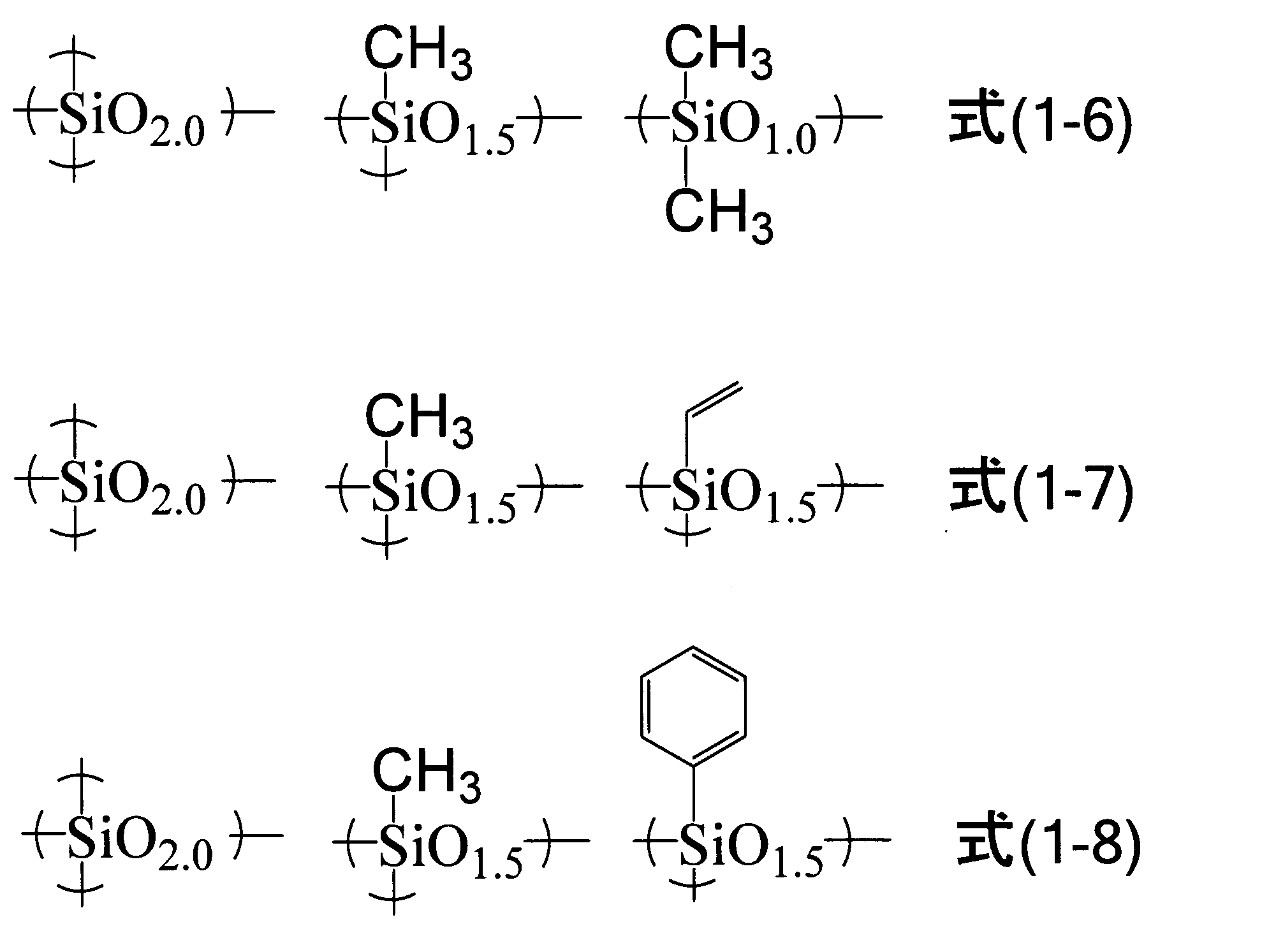
加水分解触媒としての金属キレート化合物は、例えばトリエトキシ・モノ(アセチルアセトナート)チタン、トリ-n-プロポキシ・モノ(アセチルアセトナート)チタン、トリ-i-プロポキシ・モノ(アセチルアセトナート)チタン、トリ-n-ブトキシ・モノ(アセチルアセトナート)チタン、トリ-sec-ブトキシ・モノ(アセチルアセトナート)チタン、トリ-t-ブトキシ・モノ(アセチルアセトナート)チタン、ジエトキシ・ビス(アセチルアセトナート)チタン、ジ-n-プロポキシ・ビス(アセチルアセトナート)チタン、ジ-i-プロポキシ・ビス(アセチルアセトナート)チタン、ジ-n-ブトキシ・ビス(アセチルアセトナート)チタン、ジ-sec-ブトキシ・ビス(アセチルアセトナート)チタン、ジ-t-ブトキシ・ビス(アセチルアセトナート)チタン、モノエトキシ・トリス(アセチルアセトナート)チタン、モノ-n-プロポキシ・トリス(アセチルアセトナート)チタン、モノ-i-プロポキシ・トリス(アセチルアセトナート)チタン、モノ-n-ブトキシ・トリス(アセチルアセトナート)チタン、モノ-sec-ブトキシ・トリス(アセチルアセトナート)チタン、モノ-t-ブトキシ・トリス(アセチルアセトナート)チタン、テトラキス(アセチルアセトナート)チタン、トリエトキシ・モノ(エチルアセトアセテート)チタン、トリ-n-プロポキシ・モノ(エチルアセトアセテート)チタン、トリ-i-プロポキシ・モノ(エチルアセトアセテート)チタン、トリ-n-ブトキシ・モノ(エチルアセトアセテート)チタン、トリ-sec-ブトキシ・モノ(エチルアセトアセテート)チタン、トリ-t-ブトキシ・モノ(エチルアセトアセテート)チタン、ジエトキシ・ビス(エチルアセトアセテート)チタン、ジ-n-プロポキシ・ビス(エチルアセトアセテート)チタン、ジ-i-プロポキシ・ビス(エチルアセトアセテート)チタン、ジ-n-ブトキシ・ビス(エチルアセトアセテート)チタン、ジ-sec-ブトキシ・ビス(エチルアセトアセテート)チタン、ジ-t-ブトキシ・ビス(エチルアセトアセテート)チタン、モノエトキシ・トリス(エチルアセトアセテート)チタン、モノ-n-プロポキシ・トリス(エチルアセトアセテート)チタン、モノ-i-プロポキシ・トリス(エチルアセトアセテート)チタン、モノ-n-ブトキシ・トリス(エチルアセトアセテート)チタン、モノ-sec-ブトキシ・トリス(エチルアセトアセテート)チタン、モノ-t-ブトキシ・トリス(エチルアセトアセテート)チタン、テトラキス(エチルアセトアセテート)チタン、モノ(アセチルアセトナート)トリス(エチルアセトアセテート)チタン、ビス(アセチルアセトナート)ビス(エチルアセトアセテート)チタン、トリス(アセチルアセトナート)モノ(エチルアセトアセテート)チタン、等のチタンキレート化合物;トリエトキシ・モノ(アセチルアセトナート)ジルコニウム、トリ-n-プロポキシ・モノ(アセチルアセトナート)ジルコニウム、トリ-i-プロポキシ・モノ(アセチルアセトナート)ジルコニウム、トリ-n-ブトキシ・モノ(アセチルアセトナート)ジルコニウム、トリ-sec-ブトキシ・モノ(アセチルアセトナート)ジルコニウム、トリ-t-ブトキシ・モノ(アセチルアセトナート)ジルコニウム、ジエトキシ・ビス(アセチルアセトナート)ジルコニウム、ジ-n-プロポキシ・ビス(アセチルアセトナート)ジルコニウム、ジ-i-プロポキシ・ビス(アセチルアセトナート)ジルコニウム、ジ-n-ブトキシ・ビス(アセチルアセトナート)ジルコニウム、ジ-sec-ブトキシ・ビス(アセチルアセトナート)ジルコニウム、ジ-t-ブトキシ・ビス(アセチルアセトナート)ジルコニウム、モノエトキシ・トリス(アセチルアセトナート)ジルコニウム、モノ-n-プロポキシ・トリス(アセチルアセトナート)ジルコニウム、モノ-i-プロポキシ・トリス(アセチルアセトナート)ジルコニウム、モノ-n-ブトキシ・トリス(アセチルアセトナート)ジルコニウム、モノ-sec-ブトキシ・トリス(アセチルアセトナート)ジルコニウム、モノ-t-ブトキシ・トリス(アセチルアセトナート)ジルコニウム、テトラキス(アセチルアセトナート)ジルコニウム、トリエトキシ・モノ(エチルアセトアセテート)ジルコニウム、トリ-n-プロポキシ・モノ(エチルアセトアセテート)ジルコニウム、トリ-i-プロポキシ・モノ(エチルアセトアセテート)ジルコニウム、トリ-n-ブトキシ・モノ(エチルアセトアセテート)ジルコニウム、トリ-sec-ブトキシ・モノ(エチルアセトアセテート)ジルコニウム、トリ-t-ブトキシ・モノ(エチルアセトアセテート)ジルコニウム、ジエトキシ・ビス(エチルアセトアセテート)ジルコニウム、ジ-n-プロポキシ・ビス(エチルアセトアセテート)ジルコニウム、ジ-i-プロポキシ・ビス(エチルアセトアセテート)ジルコニウム、ジ-n-ブトキシ・ビス(エチルアセトアセテート)ジルコニウム、ジ-sec-ブトキシ・ビス(エチルアセトアセテート)ジルコニウム、ジ-t-ブトキシ・ビス(エチルアセトアセテート)ジルコニウム、モノエトキシ・トリス(エチルアセトアセテート)ジルコニウム、モノ-n-プロポキシ・トリス(エチルアセトアセテート)ジルコニウム、モノ-i-プロポキシ・トリス(エチルアセトアセテート)ジルコニウム、モノ-n-ブトキシ・トリス(エチルアセトアセテート)ジルコニウム、モノ-sec-ブトキシ・トリス(エチルアセトアセテート)ジルコニウム、モノ-t-ブトキシ・トリス(エチルアセトアセテート)ジルコニウム、テトラキス(エチルアセトアセテート)ジルコニウム、モノ(アセチルアセトナート)トリス(エチルアセトアセテート)ジルコニウム、ビス(アセチルアセトナート)ビス(エチルアセトアセテート)ジルコニウム、トリス(アセチルアセトナート)モノ(エチルアセトアセテート)ジルコニウム、等のジルコニウムキレート化合物;トリス(アセチルアセトナート)アルミニウム、トリス(エチルアセトアセテート)アルミニウム等のアルミニウムキレート化合物;などを挙げることができる。
加水分解触媒としての無機酸は、例えば塩酸、硝酸、硫酸、フッ酸、リン酸等を挙げることができる。
硬化触媒としては、アンモニウム塩、ホスフィン類、ホスホニウム塩、スルホニウム塩を用いることができる。
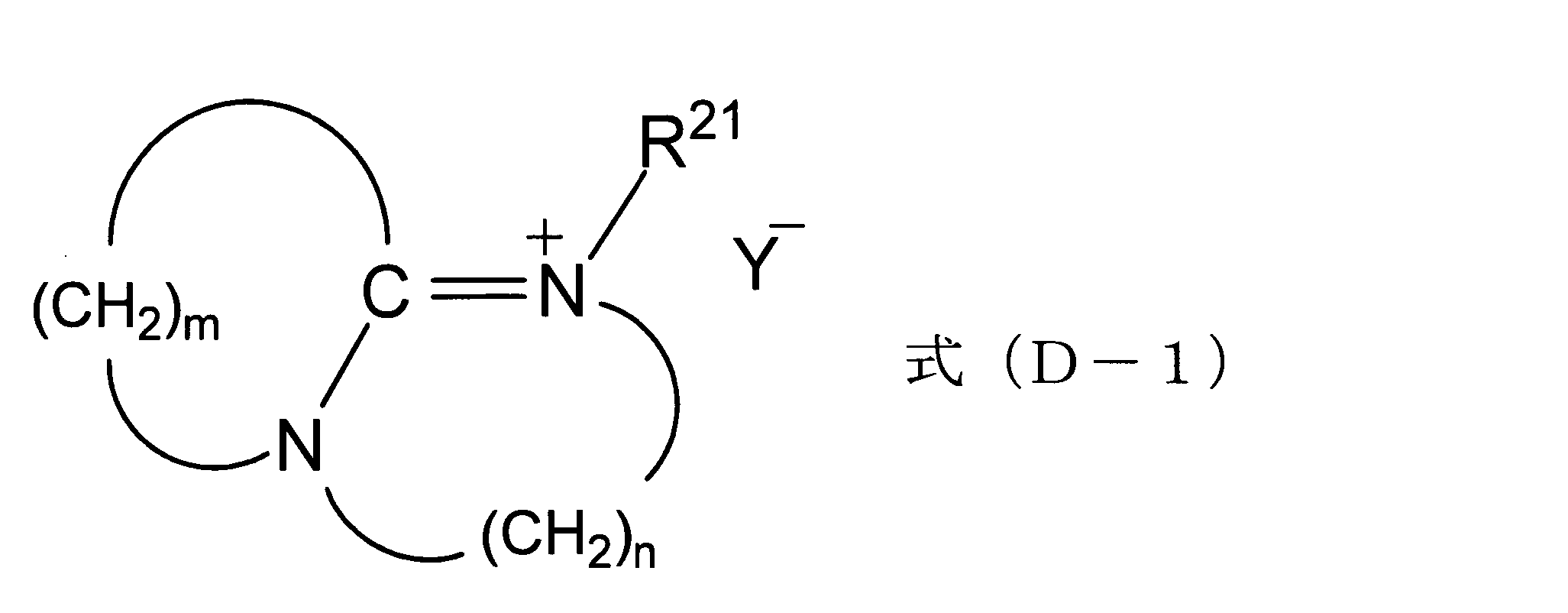

式(D-3):

式(D-4):

式(D-5):
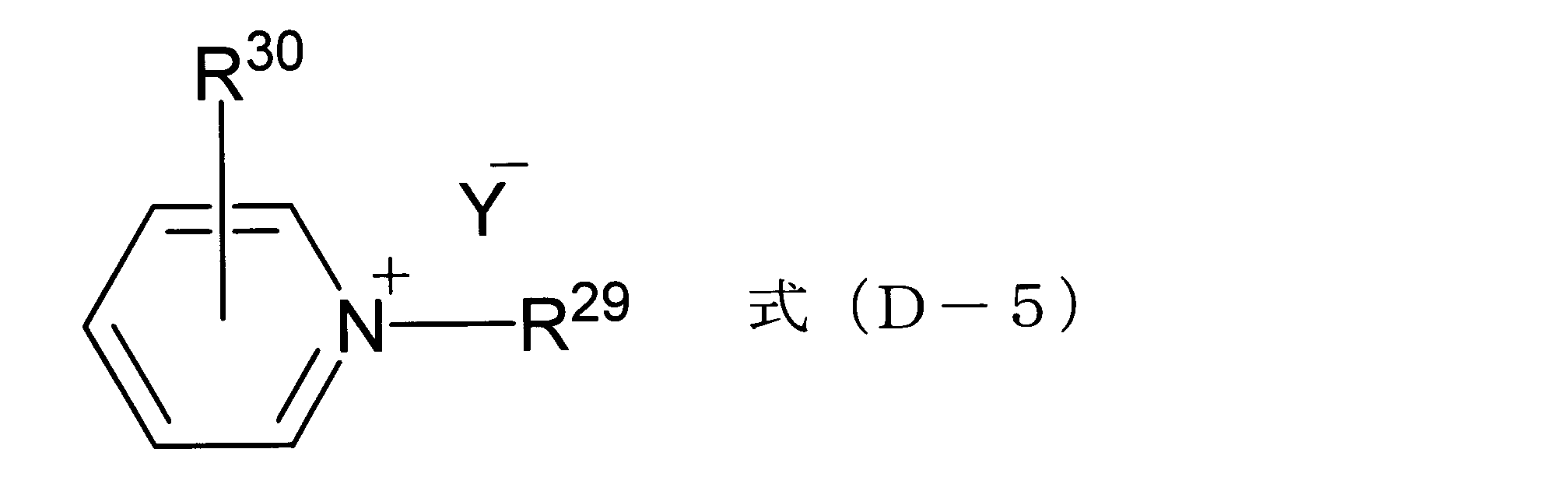
式(D-6):
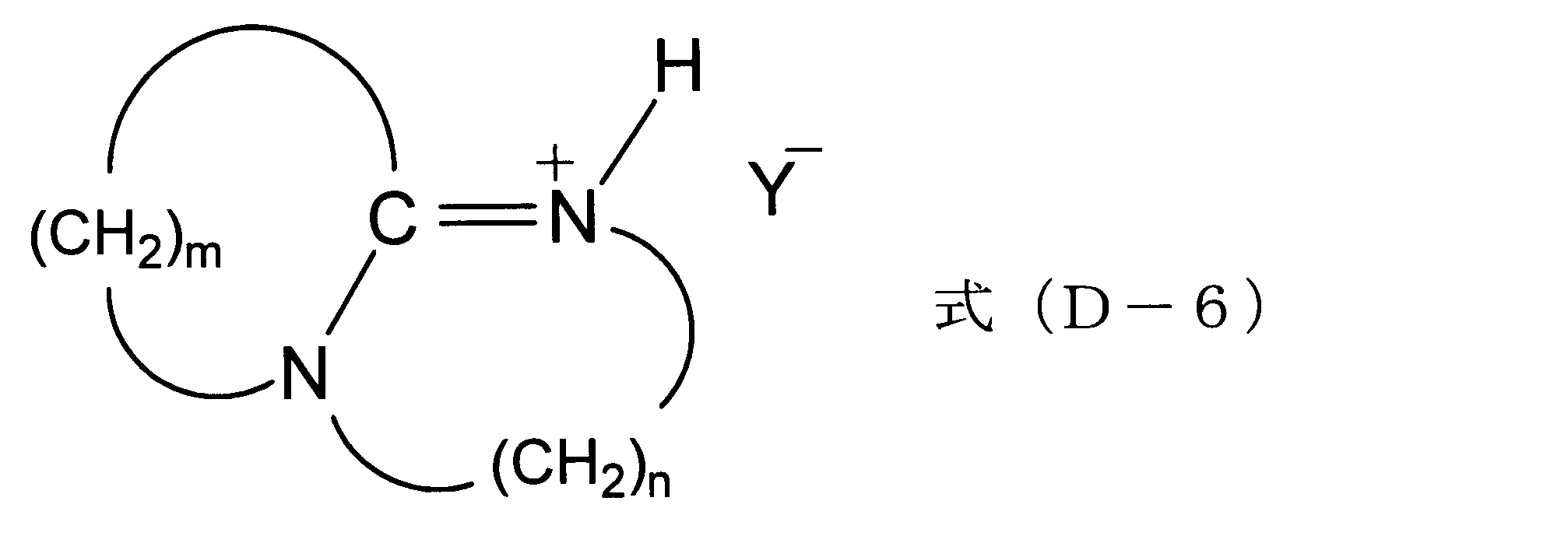


-メチルプロピルスルホニル)ジアゾメタン、ビス(2-メチルプロピルスルホニル)ジアゾメタン、ビス(1,1-ジメチルエチルスルホニル)ジアゾメタン、ビス(シクロヘキシルスルホニル)ジアゾメタン、ビス(パーフルオロイソプロピルスルホニル)ジアゾメタン、ビス(フェニルスルホニル)ジアゾメタン、ビス(4-メチルフェニルスルホニル)ジアゾメタン、ビス(2,4-ジメチルフェニルスルホニル)ジアゾメタン、ビス(2-ナフチルスルホニル)ジアゾメタン、ビス(4-アセチルオキシフェニルスルホニル)ジアゾメタン、ビス(4-メタンスルホニルオキシフェニルスルホニル)ジアゾメタン、ビス(4-(4-トルエンスルホニルオキシ)フェニルスルホニル)ジアゾメタン、ビス(4-n-ヘキシルオキシ)フェニルスルホニル)ジアゾメタン、ビス(2-メチル-4-(n-ヘキシルオキシ)フェニルスルホニル)ジアゾメタン、ビス(2,5-ジメチル-4-(n-ヘキシルオキシ)フェニルスルホニル)ジアゾメタン、ビス(3,5-ジメチル-4-(n-ヘキsシルオキシ)フェニルスルホニル)ジアゾメタン、ビス(2-メチル-5-イソプロピル-4-(n-ヘキシルオキシ)フェニルスルホニル)ジアゾメタン、4-メチルフェニルスルホニルベンゾイルジアゾメタン、tertブチルカルボニル-4-メチルフェニルスルホニルジアゾメタン、2-ナフチルスルホニルベンゾイルジアゾメタン、4-メチルフェニルスルホニル2-ナフトイルジアゾメタン、メチルスルホニルベンゾイルジアゾメタン、tertブトキシカルボニル-4-メチルフェニルスルホニルジアゾメタン等のビススルホニルジアゾメタンとスルホニル-カルボニルジアゾメタンが挙げられる。
スルホン型光酸発生剤の例としては、ビス(フェニルスルホニル)メタン、ビス(4-メチルフェニルスルホニル)メタン、ビス(2-ナフチルスルホニル)メタン、2,2-ビス(フェニルスルホニル)プロパン、2,2-ビス(4-メチルフェニルスルホニル)プロパン、2,2-ビス(2-ナフチルスルホニル)プロパン、2-メチル-2-(p-トルエンスルホニル)プロピオフェノン、2-シクロヘキシルカルボニル)-2-(p-トルエンスルホニル)プロパン、2,4-ジメチル-2-(p-トルエンスルホニル)ペンタン-3-オン等が挙げられる。
ニルアセトニトリル、α-(p-クロロベンゼンスルホニルオキシイミノ)-フェニルアセトニトリル、α-(4-ニトロベンゼンスルホニルオキシイミノ)-フェニルアセトニトリル、α-(4-ニトロ-2-トリフルオロメチルベンゼンスルホニルオキシイミノ)-フェニルアセトニトリル、α-(ベンゼンスルホニルオキシイミノ)-4-クロロフェニルアセトニトリル、α-(ベンゼンスルホニルオキシイミノ)-2,4-ジクロロフェニルアセトニトリル、α-(ベンゼンスルホニルオキシイミノ)-2,6-ジクロロフェニルアセトニトリル、α-(ベンゼンスルホニルオキシイミノ)-4-メトキシフェニルアセトニトリル、α-(2-クロロベンゼンスルホニルオキシイミノ)-4-メトキシフェニルアセトニトリル、α-(ベンゼンスルホニルオキシイミノ)-2-チエニルアセトニトリル、α-(4-ドデシルベンゼンスルホニルオキシイミノ)-フェニルアセトニトリル、α-[(4-トルエンスルホニルオキシイミノ)-4-メトキシフェニル]アセトニトリル、α-[(ドデシルベンゼンスルホニルオキシイミノ)-4-メトキシフェニル]アセトニトリル、α-(トシルオキシイミノ)-3-チエニルアセトニトリル、α-(メチルスルホニルオキシイミノ)-1-シクロペンテニルアセトニトリル、α-(エチルスルホニルオキシイミノ)-1-シクロペンテニルアセトニトリル、α-(イソプロピルスルホニルオキシイミノ)-1-シクロペンテニルアセトニトリル、α-(n-ブチルスルホニルオキシイミノ)-1-シクロペンテニルアセトニトリル、α-(エチルスルホニルオキシイミノ)-1-シクロヘキセニルアセトニトリル、α-(イソプロピルスルホニルオキシイミノ)-1-シクロヘキセニルアセトニトリル、α-(n-ブチルスルホニルオキシイミノ)-1-シクロヘキセニルアセトニトリル等が挙げられる。
特に、トリフルオロメタンスルホン酸のアンモニウム塩が好ましい。

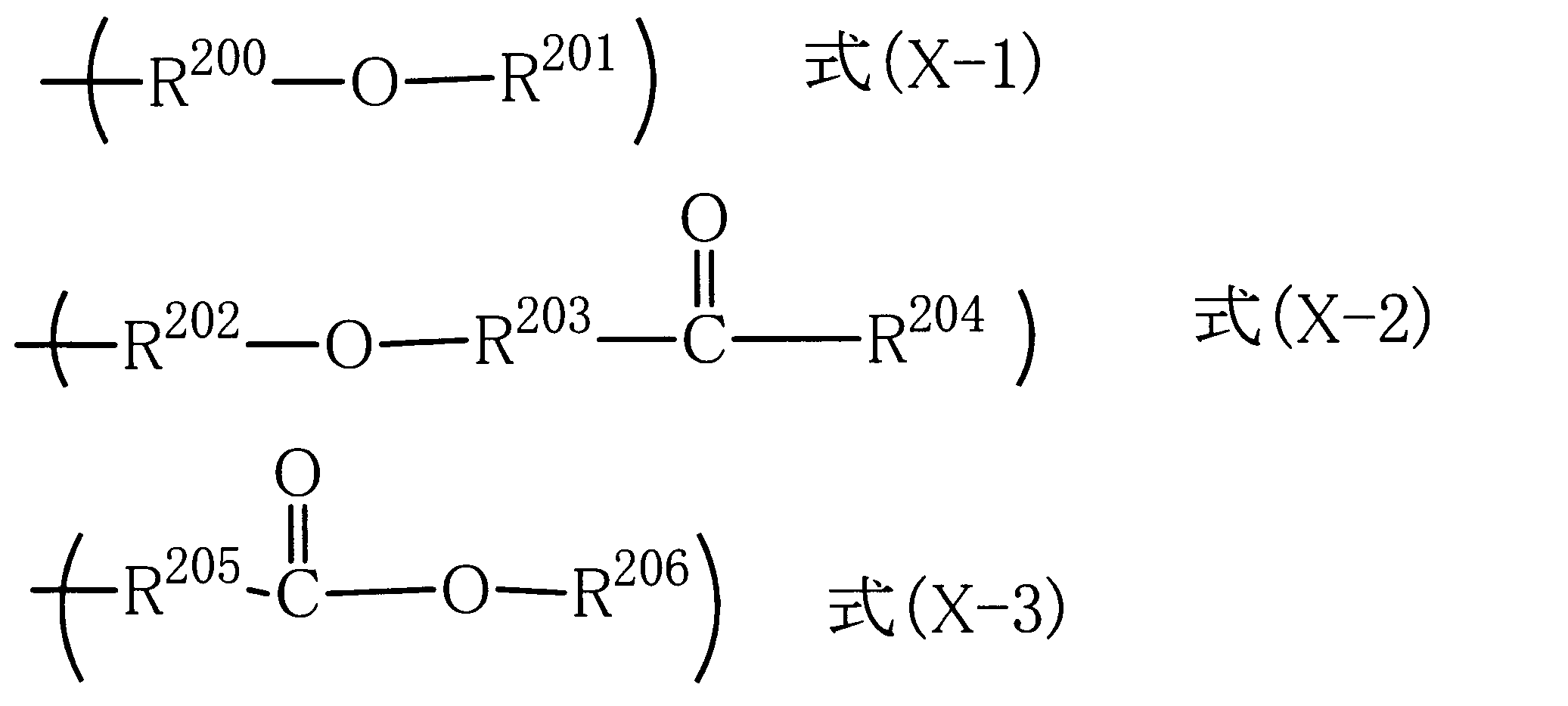

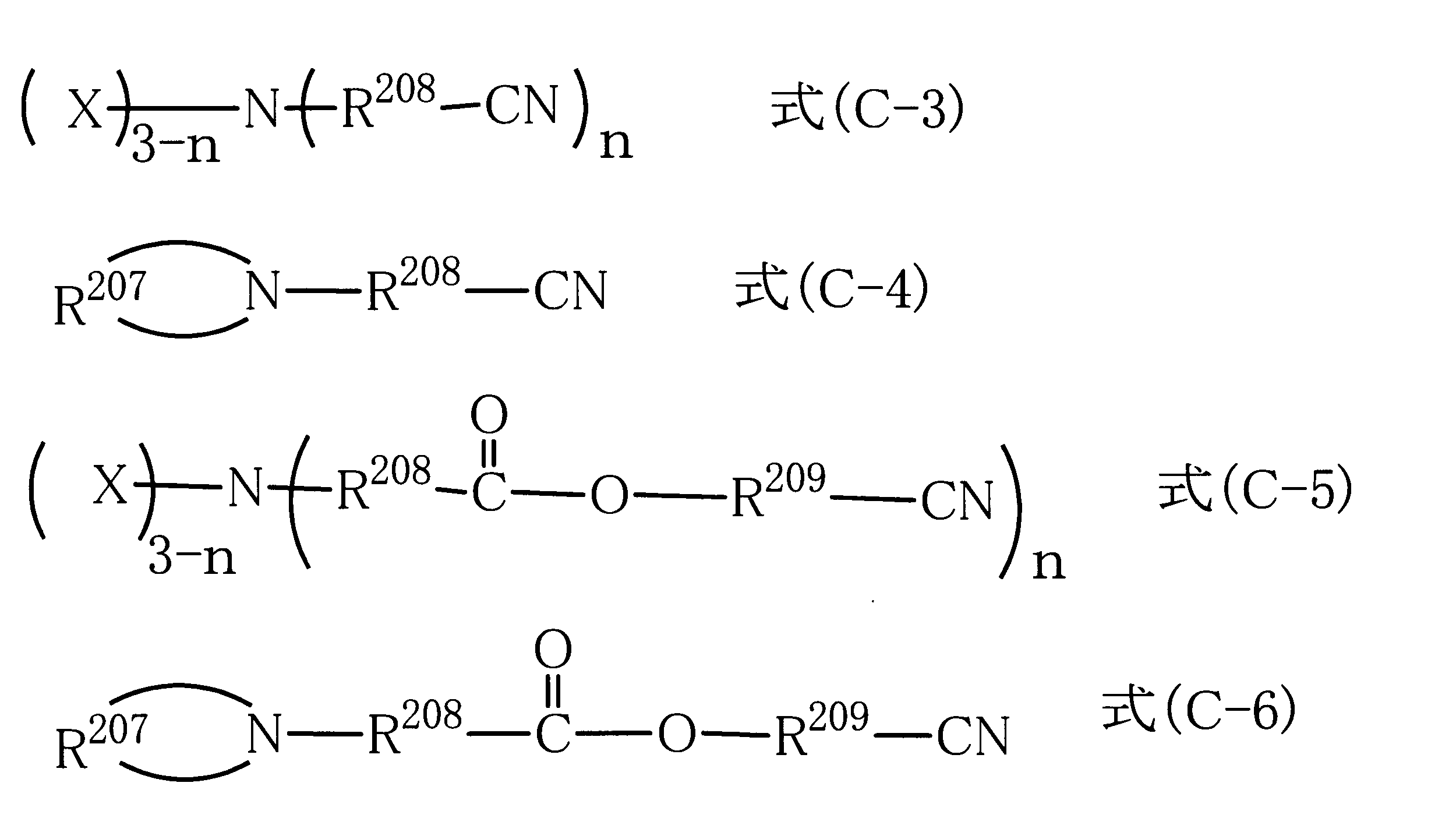


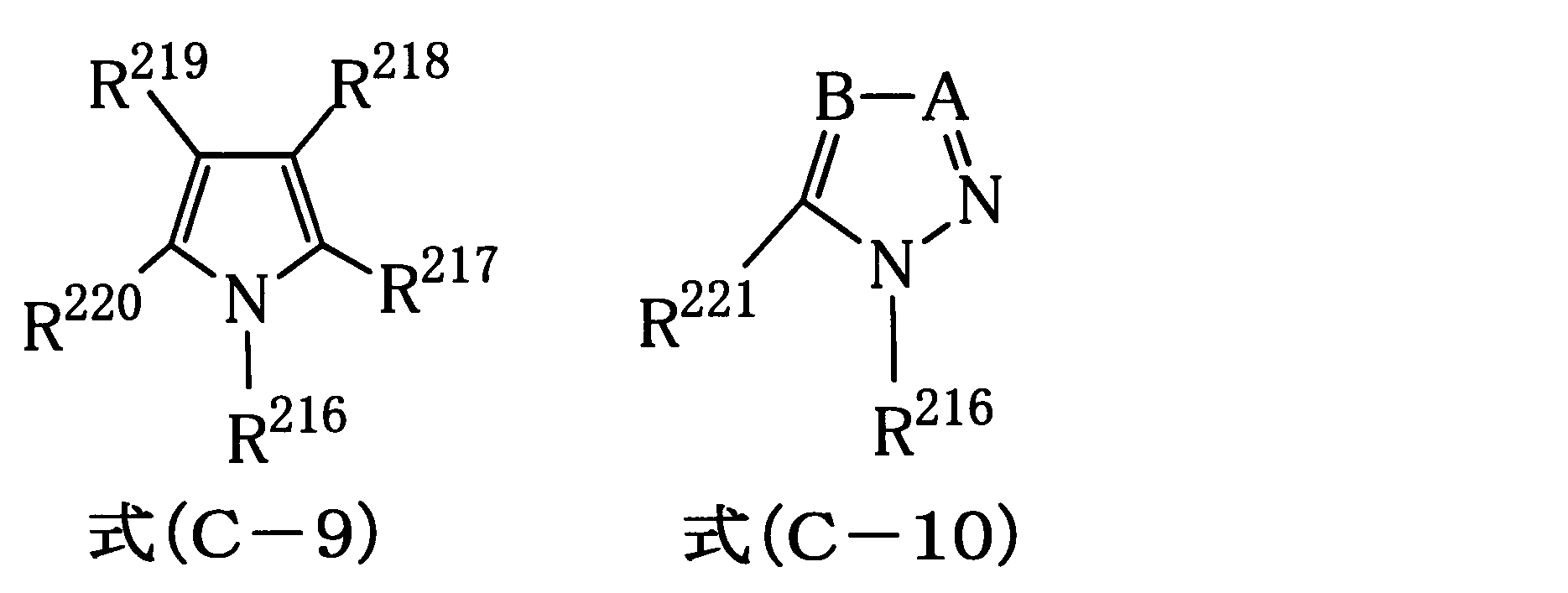
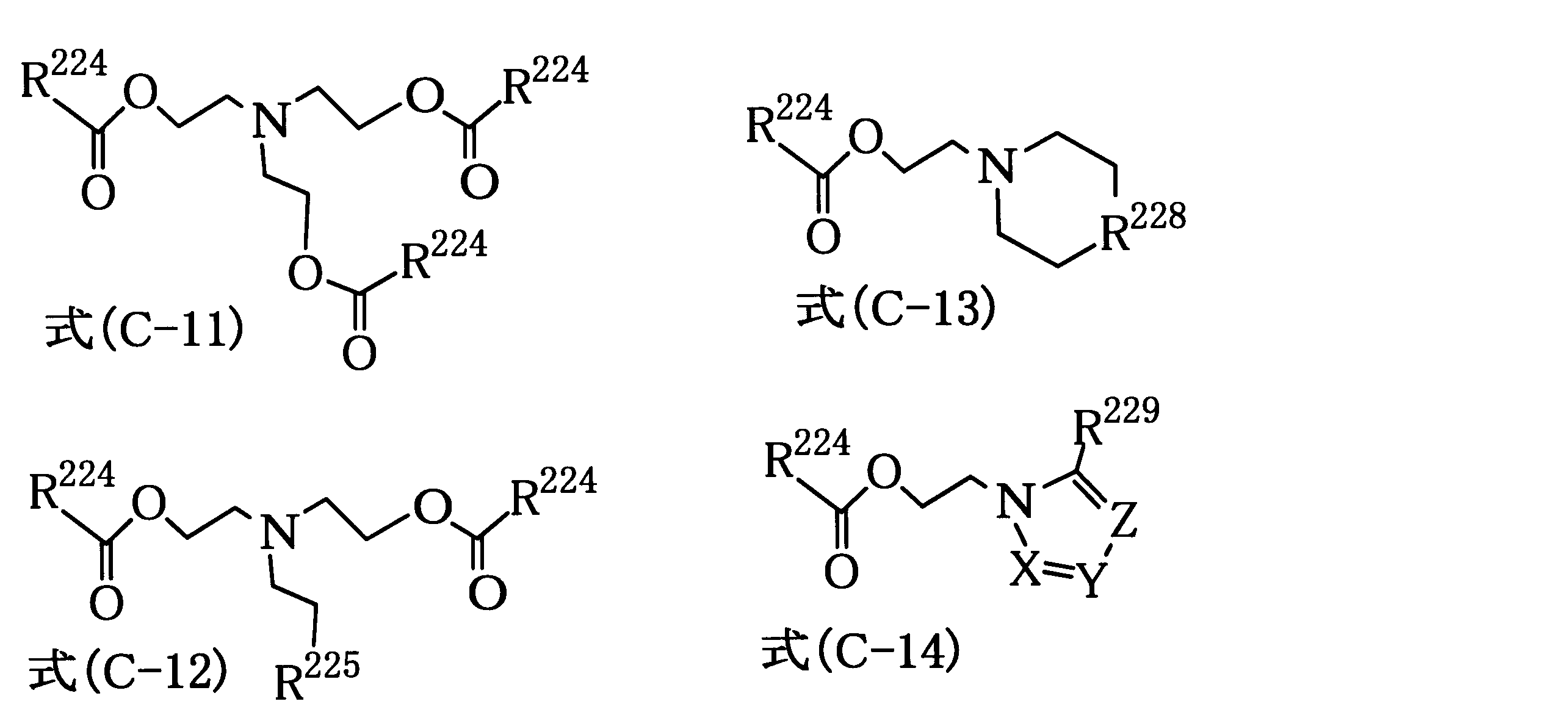


第一級の脂肪族アミン類として、メチルアミン、エチルアミン、n-プロピルアミン、イソプロピルアミン、n-ブチルアミン、イソブチルアミン、sec-ブチルアミン、tert-ブチルアミン、ペンチルアミン、tert-アミルアミン、シクロペンチルアミン、ヘキシルアミン、シクロヘキシルアミン、ヘプチルアミン、オクチルアミン、ノニルアミン、デシルアミン、ドデシルアミン、セチルアミン、メチレンジアミン、エチレンジアミン、テトラエチレンペンタミン等が例示される。
ミン、ベンジルアミン、フェネチルアミン、ベンジルジメチルアミン等が例示される。
体(例えばピリジン、メチルピリジン、エチルピリジン、プロピルピリジン、ブチルピリ
ジン、4-(1-ブチルペンチル)ピリジン、ジメチルピリジン、トリメチルピリジン、
トリエチルピリジン、フェニルピリジン、3-メチル-2-フェニルピリジン、4-te
rt-ブチルピリジン、ジフェニルピリジン、ベンジルピリジン、メトキシピリジン、ブ
トキシピリジン、ジメトキシピリジン、4-ピロリジノピリジン、2-(1-エチルプロ
ピル)ピリジン、アミノピリジン、ジメチルアミノピリジン等)、ピリダジン誘導体、ピ
リミジン誘導体、ピラジン誘導体、ピラゾリン誘導体、ピラゾリジン誘導体、ピペリジン
誘導体、ピペラジン誘導体、モルホリン誘導体、インドール誘導体、イソインドール誘導
体、1H-インダゾール誘導体、インドリン誘導体、キノリン誘導体(例えばキノリン、
3-キノリンカルボニトリル等)、イソキノリン誘導体、シンノリン誘導体、キナゾリン
誘導体、キノキサリン誘導体、フタラジン誘導体、プリン誘導体、プテリジン誘導体、カ
ルバゾール誘導体、フェナントリジン誘導体、アクリジン誘導体、フェナジン誘導体、1
,10-フェナントロリン誘導体、アデニン誘導体、アデノシン誘導体、グアニン誘導体
、グアノシン誘導体、ウラシル誘導体、ウリジン誘導体等が例示される。
ルカルボン酸、アミノ酸誘導体(例えばニコチン酸、アラニン、アルギニン、アスパラギ
ン酸、グルタミン酸、グリシン、ヒスチジン、イソロイシン、グリシルロイシン、ロイシ
ン、メチオニン、フェニルアラニン、スレオニン、リジン、3-アミノピラジン-2-カ
ルボン酸、メトキシアラニン)等が例示される。
更には、4-(メタクリロイルオキシ)フェニルジフェニルスルホニウム、4-(アク
リロイルオキシ)フェニルジフェニルスルホニウム、4-(メタクリロイルオキシ)フェ
ニルジメチルスルホニウム、4-(アクリロイルオキシ)フェニルジメチルスルホニウム
等が挙げられる。
本発明では、半導体装置の製造に使用される基板(例えば、シリコンウエハー基板、シリコン/二酸化シリコン被覆基板、シリコンナイトライド基板、ガラス基板、ITO基板、ポリイミド基板、及び低誘電率材料(low-k材料)被覆基板等)の上に、スピナー、コーター等の適当な塗布方法により本発明に用いられる組成物が塗布される。
テトラエトキシシラン100.09g(全シラン中に85モル%含有する)、メチルトリエトキシシラン15.08g(全シラン中に15モル%含有する)及びアセトン172.52gをフラスコに入れた。このフラスコに、冷却管を取り付け調製しておいた塩酸水溶液(0.01モル/リットル)30.37gを入れた滴下ロートをセットし、室温下で塩酸水溶液をゆっくり滴下し数分攪拌した。その後オイルバスにて85℃で4時間反応させた。反応終了後、反応溶液の入ったフラスコを放冷してからエバポレーターにセットし、反応中に生成したエタノールを除去し、さらに、エバポレーターを用いてアセトンをプロピレングリコールモノメチルエーテルアセテートに置換してポリシロキサン溶液196.3gを得た(式(1-1)に相当)。尚、得られた反応生成物中の固形分は、焼成法により測定した結果、19.7質量%であった。
1H-NMR(500MHz、CD3COCD3):δ=6.441(br、0.70H)、3.847(br、0.20H)、1.185(br、0.30H)、0.142(br、0.45H)
Si-Meの積分値を0.45Hと仮定
GPC(ポリスチレン換算):重量平均分子量Mw=2004
テトラエトキシシラン100.02g(全シラン中に75モル%含有する)、メチルトリエトキシシラン28.52g(全シラン中に25モル%含有する)及びアセトン192.43gをフラスコに入れた。このフラスコに、冷却管を取り付け調製しておいた塩酸水溶液(0.01モル/リットル)43.25gを入れた滴下ロートをセットし、室温下で塩酸水溶液をゆっくり滴下し数分攪拌した。その後オイルバスにて85℃で4時間反応させた。反応終了後、反応溶液の入ったフラスコを放冷してからエバポレーターにセットし、反応中に生成したエタノールを除去し、さらに、エバポレーターを用いてアセトンをプロピレングリコールモノメチルエーテルアセテートに置換してポリシロキサン溶液225.6gを得た(式(1-1)に相当)。尚、得られた反応生成物中の固形分は、焼成法により測定した結果、19.3質量%であった。
1H-NMR(500MHz、CD3COCD3):δ=6.718(br、0.61H)、3.845(br、0.20H)、1.189(br、0.40H)、0.140(br、0.75H)
Si-Meの積分値を0.75Hと仮定
GPC(ポリスチレン換算):Mw=1810
テトラエトキシシラン100.00g(全シラン中に80モル%含有する)、メチルトリエトキシシラン21.41g(全シラン中に20モル%含有する)及びアセトン182.08gをフラスコに入れた。このフラスコに、冷却管を取り付け調製しておいた塩酸水溶液(0.01モル/リットル)41.11gを入れた滴下ロートをセットし、室温下で塩酸水溶液をゆっくり滴下し数分攪拌した。その後オイルバスにて85℃で4時間反応させた。反応終了後、反応溶液の入ったフラスコを放冷してからエバポレーターにセットし、反応中に生成したエタノールを除去し、さらに、エバポレーターを用いてアセトンをプロピレングリコールモノメチルエーテルアセテートに置換してポリシロキサン溶液210.6gを得た(式(1-1)に相当)。尚、得られた反応生成物中の固形分は、焼成法により測定した結果、19.4質量%であった。
1H-NMR(500MHz、CD3COCD3):δ=6.457(br、0.55H)、3.843(br、0.21H)、1.193(br、0.42H)、0.141(br、0.60H)
Si-Meの積分値を0.60Hと仮定
GPC(ポリスチレン換算):Mw=1634
テトラエトキシシラン100.00g(全シラン中に90モル%含有する)、メチルトリエトキシシラン9.52g(全シラン中に10モル%含有する)及びアセトン164.26gをフラスコに入れた。このフラスコに、冷却管を取り付け調製しておいた塩酸水溶液(0.01モル/リットル)37.52gを入れた滴下ロートをセットし、室温下で塩酸水溶液をゆっくり滴下し数分攪拌した。その後オイルバスにて85℃で4時間反応させた。反応終了後、反応溶液の入ったフラスコを放冷してからエバポレーターにセットし、反応中に生成したエタノールを除去し、さらに、エバポレーターを用いてアセトンをプロピレングリコールモノメチルエーテルアセテートに置換してポリシロキサン溶液184.3gを得た(式(1-1)に相当)。尚、得られた反応生成物中の固形分は、焼成法により測定した結果、20.1質量%であった。
1H-NMR(500MHz、CD3COCD3):δ=6.776(br、0.70H)、3.848(br、0.19H)、1.150(br、0.38H)、0.146(br、0.30H)
Si-Meの積分値を0.30Hと仮定
GPC(ポリスチレン換算):Mw=1996
テトラエトキシシラン100.00g(全シラン中に95モル%含有する)、メチルトリエトキシシラン4.52g(全シラン中に5モル%含有する)及びアセトン156.62gをフラスコに入れた。このフラスコに、冷却管を取り付け調製しておいた塩酸水溶液(0.01モル/リットル)35.91gを入れた滴下ロートをセットし、室温下で塩酸水溶液をゆっくり滴下し数分攪拌した。その後オイルバスにて85℃で4時間反応させた。反応終了後、反応溶液の入ったフラスコを放冷してからエバポレーターにセットし、反応中に生成したエタノールを除去し、さらに、エバポレーターを用いてアセトンをプロピレングリコールモノメチルエーテルアセテートに置換してポリシロキサン溶液185.8gを得た(式(1-1)に相当)。尚、得られた反応生成物中の固形分は、焼成法により測定した結果、18.9質量%であった。
1H-NMR(500MHz、CD3COCD3):δ=6.891(br、0.71H)、3.846(br、0.20H)、1.188(br、0.40H)、0.157(br、0.15H)
Si-Meの積分値を0.15Hと仮定
GPC(ポリスチレン換算):Mw=2184
テトラエトキシシラン100.02g(全シラン中に100モル%含有する)及びアセトン150.22gをフラスコに入れた。このフラスコに、冷却管を取り付け調製しておいた塩酸水溶液(0.01モル/リットル)34.54gを入れた滴下ロートをセットし、室温下で塩酸水溶液をゆっくり滴下し数分攪拌した。その後オイルバスにて85℃で4時間反応させた。反応終了後、反応溶液の入ったフラスコを放冷してからエバポレーターにセットし、反応中に生成したエタノールを除去し、さらに、エバポレーターを用いてアセトンをプロピレングリコールモノメチルエーテルアセテートに置換してポリシロキサン溶液171.0gを得た(式(1-2)に相当)。尚、得られた反応生成物中の固形分は、焼成法により測定した結果、19.7質量%であった。
1H-NMR(500MHz、CD3COCD3):δ=6.675(br、0.50H)、3.856(br、0.12H)、1.193(br、0.18H)
SiOHの積分値を0.50Hと仮定
GPC(ポリスチレン換算):Mw=2440
テトラエトキシシラン120.00g(全シラン中に85モル%含有する)、ビニルトリメトキシシラン15.07g(全シラン中に15モル%含有する)及びアセトン202.60gをフラスコに入れた。このフラスコに、冷却管を取り付け調製しておいた塩酸水溶液(0.01モル/リットル)47.01gを入れた滴下ロートをセットし、室温下で塩酸水溶液をゆっくり滴下し数分攪拌した。その後オイルバスにて85℃で4時間反応させた。反応終了後、反応溶液の入ったフラスコを放冷してからエバポレーターにセットし、反応中に生成したエタノールを除去し、さらに、エバポレーターを用いてアセトンをプロピレングリコールモノメチルエーテルアセテートに置換してポリシロキサン溶液248.51gを得た(式(1-3)に相当)。尚、得られた反応生成物中の固形分は、焼成法により測定した結果、19.9質量%であった。
1H-NMR(500MHz、CD3COCD3):δ=6.370(br、0.73H)、5.989(br、0.45H)、3.858(br、0.20H)、1.185(br、0.30H)
Si-Vinの積分値を0.45Hと仮定
GPC(ポリスチレン換算):Mw=1808
テトラエトキシシラン120.00g(全シラン中に85モル%含有する)、フェニルトリメトキシシラン20.16g(全シラン中に15モル%含有する)及びアセトン210.23gをフラスコに入れた。このフラスコに、冷却管を取り付け調製しておいた塩酸水溶液(0.01モル/リットル)47.01gを入れた滴下ロートをセットし、室温下で塩酸水溶液をゆっくり滴下し数分攪拌した。その後オイルバスにて85℃で4時間反応させた。反応終了後、反応溶液の入ったフラスコを放冷してからエバポレーターにセットし、反応中に生成したエタノールを除去し、さらに、エバポレーターを用いてアセトンをプロピレングリコールモノメチルエーテルアセテートに置換してポリシロキサン溶液278.89gを得た(式(1-4)に相当)。尚、得られた反応生成物中の固形分は、焼成法により測定した結果、19.5質量%であった。
1H-NMR(500MHz、CD3COCD3):δ=7.734、7.377(br、0.75H)、6.456(br、0.59H)、3.867(br、0.15H)、1.196(br、0.23H)
Si-Phの積分値を0.75Hと仮定
GPC(ポリスチレン換算):Mw=1608
テトラエトキシシラン150.00g(全シラン中に90モル%含有する)、ジメチルジエトキシシラン11.86g(全シラン中に10モル%含有する)及びアセトン242.79gをフラスコに入れた。このフラスコに、冷却管を取り付け調製しておいた塩酸水溶液(0.01モル/リットル)56.22gを入れた滴下ロートをセットし、室温下で塩酸水溶液をゆっくり滴下し数分攪拌した。その後オイルバスにて85℃で4時間反応させた。反応終了後、反応溶液の入ったフラスコを放冷してからエバポレーターにセットし、反応中に生成したエタノールを除去し、さらに、エバポレーターを用いてアセトンをプロピレングリコールモノメチルエーテルアセテートに置換してポリシロキサン溶液286.15gを得た(式(1-5)に相当)。尚、得られた反応生成物中の固形分は、焼成法により測定した結果、19.6質量%であった。
1H-NMR(500MHz、CD3COCD3):δ=6.318(br、0.66H)、3.853(br、0.20H)、1.196(br、0.30H)、0.163(br、0.60H)
Si-Me2の積分値を0.60Hと仮定
GPC(ポリスチレン換算):Mw=2194
合成例1で得られたポリシロキサン溶液50.77g、プロピレングリコールモノメチルエーテルアセテート50.10g、ピリジウムパラトルエンスルホネート500.5mg、エチルビニルエーテル9.15gをフラスコに加え、室温で2日間反応させた。反応終了後、プロピレングリコールモノメチルエーテルアセテート150mL、メチルイソブチルケトン50mL、酢酸水溶液(0.01モル/リットル)150mLを加え、抽出した。エバポレーターを用いて有機層の溶媒を除去し、さらにプロピレングリコールモノメチルエーテルアセテートに置換して反応生成物(ポリシロキサン)69.6gを得た(式(1-1)に存在するシラノール基が式(2)に変換した化合物)。尚、得られた反応生成物中の固形分は、焼成法により測定した結果、20.0質量%であった。
1H-NMR(500MHz、CD3COCD3):δ=6.678(br,0.21H),5.182(br,0.59H),3.912-3.819(m,1.07H),3.479(br,0.59H),1.359(br,1.77H),1.164(br,2.13H)、0.278(br、0.45H)
Si-Meの積分値を0.45Hと仮定
保護率:アセタール基/(アセタール基+SiOH基)×100=73.8モル%
GPC(ポリスチレン換算):Mw=3164
その後、上記のようにして得られたポリシロキサンを下表の割合で混合し、孔径0.1μmのフィルターでろ過してパターン反転のための被覆用ポリシロキサン組成物を得た。
合成例2で得られたポリシロキサン溶液51.79g、プロピレングリコールモノメチルエーテルアセテート50.03g、ピリジウムパラトルエンスルホネート494.6mg、エチルビニルエーテル9.17gをフラスコに加え、室温で2日間反応させた。反応終了後、プロピレングリコールモノメチルエーテルアセテート150mL、メチルイソブチルケトン50mL、酢酸水溶液(0.01モル/リットル)150mLを加え、抽出した。エバポレーターを用いて有機層の溶媒を除去し、さらにプロピレングリコールモノメチルアセテートに置換して反応生成物(ポリシロキサン)69.8gを得た(式(1-1)に存在するシラノール基が式(2)に変換した化合物)。尚、得られた反応生成物中の固形分は、焼成法により測定した結果、19.9質量%であった。
1H-NMR(500MHz、CD3COCD3):δ=6.827(br、0.17H)、5.171(br、0.51H)、3.899-3.808(m、0.75H)、3.470(br、0.51H)、1.349(br、1.53H)1.158(1.89H)、0.255(br、0.75H)
Si-Meの積分値を0.75Hと仮定
保護率:アセタール基/(アセタール基+SiOH基)×100=75.0モル%
GPC(ポリスチレン換算):Mw=3210
その後、上記のようにして得られたポリシロキサンを下表の割合で混合し、孔径0.1μmのフィルターでろ過してパターン反転のための被覆用ポリシロキサン組成物を得た。
合成例3で得られたポリシロキサン溶液51.54g、プロピレングリコールモノメチルエーテルアセテート50.23g、ピリジウムパラトルエンスルホネート501.6mg、エチルビニルエーテル9.17gをフラスコに加え、室温で2日間反応させた。反応終了後、プロピレングリコールモノメチルエーテルアセテート150mL、メチルイソブチルケトン50mL、酢酸水溶液(0.01モル/リットル)150mLを加え、抽出した。エバポレーターを用いて有機層の溶媒を除去し、さらにプロピレングリコールモノメチルアセテートに置換して反応生成物(ポリシロキサン)52.6gを得た(式(1-1)に存在するシラノール基が式(2)に変換した化合物)。尚、得られた反応生成物中の固形分は、焼成法により測定した結果、20.0質量%であった。
1H-NMR(500MHz、CD3COCD3):δ=6.693(br、0.39H)、5.158(br、0.23H)、3.870-3.808(m、0.47H)、3.459(br、0.23H)、1.331(br、0.69H)1.145(br、1.05H)、0.219(br、0.60H)
Si-Meの積分値を0.60Hと仮定
保護率:アセタール基/(アセタール基+SiOH基)×100=37.1モル%
GPC(ポリスチレン換算):Mw=5619
その後、上記のようにして得られたポリシロキサンを下表の割合で混合し、孔径0.1μmのフィルターでろ過してパターン反転のための被覆用ポリシロキサン組成物を得た。
合成例4で得られたポリシロキサン溶液49.76g、プロピレングリコールモノメチルエーテルアセテート50.03g、ピリジウムパラトルエンスルホネート496.4mg、エチルビニルエーテル9.17gをフラスコに加え、室温で2日間反応させた。反応終了後、プロピレングリコールモノメチルエーテルアセテート150mL、メチルイソブチルケトン50mL、酢酸水溶液(0.01モル/リットル)150mLを加え、抽出した。エバポレーターを用いて有機層の溶媒を除去し、さらにプロピレングリコールモノメチルアセテートに置換して反応生成物(ポリシロキサン)48.8gを得た(式(1-1)に存在するシラノール基が式(2)に変換した化合物)。尚、得られた反応生成物中の固形分は、焼成法により測定した結果、20.0質量%であった。
1H-NMR(500MHz、CD3COCD3):δ=6.624(br、0.32H)、5.143(br、0.25H)、3.856-3.788(m、0.47H)、3.437(br、0.25H)、1.312(br、0.75H)1.124(br、1.08H)、0.207(br、0.30H)
Si-Meの積分値を0.30Hと仮定
保護率:アセタール基/(アセタール基+SiOH基)×100=43.9モル%
GPC(ポリスチレン換算):Mw=7953
その後、上記のようにして得られたポリシロキサンを下表の割合で混合し、孔径0.1μmのフィルターでろ過してパターン反転のための被覆用ポリシロキサン組成物を得た。
合成例5で得られたポリシロキサン溶液52.97g、プロピレングリコールモノメチルエーテルアセテート50.03g、ピリジウムパラトルエンスルホネート502.8mg、エチルビニルエーテル9.17gをフラスコに加え、室温で2日間反応させた。反応終了後、プロピレングリコールモノメチルエーテルアセテート150mL、メチルイソブチルケトン50mL、酢酸水溶液(0.01モル/リットル)150mLを加え、抽出した。エバポレーターを用いて有機層の溶媒を除去し、さらにプロピレングリコールモノメチルアセテートに置換して反応生成物(ポリシロキサン)48.7gを得た(式(1-1)に存在するシラノール基が式(2)に変換した化合物)。尚、得られた反応生成物中の固形分は、焼成法により測定した結果、20.1質量%であった。
1H-NMR(500MHz、CD3COCD3):δ=6.674(br、0.43H)、5.171(br、0.25H)、3.885-3.816(m、0.50H)、3.467(br、0.25H)、1.340(br、0.75H)1.149(br、1.11H)、0.243(br、0.15H)
Si-Meの積分値を0.15Hと仮定
保護率:アセタール基/(アセタール基+SiOH基)×100=36.8モル%
GPC(ポリスチレン換算):Mw=9374
その後、上記のようにして得られたポリシロキサンを下表の割合で混合し、孔径0.1μmのフィルターでろ過してパターン反転のための被覆用ポリシロキサン組成物を得た。
合成例6で得られたポリシロキサン溶液50.79g、プロピレングリコールモノメチルエーテルアセテート50.17g、ピリジウムパラトルエンスルホネート502.2mg、エチルビニルエーテル9.18gをフラスコに加え、室温で2日間反応させた。反応終了後、プロピレングリコールモノメチルエーテルアセテート150mL、メチルイソブチルケトン50mL、酢酸水溶液(0.01モル/リットル)150mLを加え、抽出した。エバポレーターを用いて有機層の溶媒を除去し、さらにプロピレングリコールモノメチルアセテートに置換して反応生成物(ポリシロキサン)38.1gを得た(式(1-2)に存在するシラノール基が式(2)に変換した化合物)。尚、得られた反応生成物中の固形分は、焼成法により測定した結果、19.5質量%であった。
1H-NMR(500MHz、CD3COCD3):δ=6.654(br、0.29H)、5.175(br、0.02H)、3.866(m、0.12H)、3.472(br、0.02H)、1.326(br、0.06H)1.148(br、0.21H)
SiOHの積分値を0.29と仮定
保護率:アセタール基/(アセタール基+SiOH基)×100=6.8モル%
GPC(ポリスチレン換算):Mw=11401
その後、上記のようにして得られたポリシロキサンを下表の割合で混合し、孔径0.1μmのフィルターでろ過してパターン反転のための被覆用ポリシロキサン組成物を得た。
合成例1で得られたポリシロキサン溶液51.07g、プロピレングリコールモノメチルエーテルアセテート50.00g、ピリジウムパラトルエンスルホネート500.0mg、イソブチルビニルエーテル10.02gをフラスコに加え、室温で2日間反応させた。反応終了後、プロピレングリコールモノメチルエーテルアセテート150mL、メチルイソブチルケトン50mL、酢酸水溶液(0.01モル/リットル)150mLを加え、抽出した。エバポレーターを用いて有機層の溶媒を除去し、さらにメチルイソブチルカルビノールに置換して反応生成物(ポリシロキサン)43.33gを得た(式(1-1)に存在するシラノール基が式(2)に変換した化合物)。尚、得られた反応生成物中の固形分は、焼成法により測定した結果、19.6質量%であった。
1H-NMR(500MHz、CD3COCD3):δ=6.591(br,0.34H),5.164(br,0.35H),3.905(br、0.20H)、3.569(br,0.35H),3.180(br,0.35H),1.822(br、0.35H)、1.363(br,1.05H),0.903(br,2.40H)、0.246(br、0.45H)
Si-Meの積分値を0.45Hと仮定
保護率:アセタール基/(アセタール基+SiOH基)×100=50.7モル%
GPC(ポリスチレン換算):Mw=5457
その後、上記のようにして得られたポリシロキサンを下表の割合で混合し、孔径0.1μmのフィルターでろ過してパターン反転のための被覆用ポリシロキサン組成物を得た。
合成例7で得られたポリシロキサン溶液100.50g、プロピレングリコールモノメチルエーテルアセテート100.00g、ピリジウムパラトルエンスルホネート1.00g、エチルビニルエーテル23.80gをフラスコに加え、室温で2日間反応させた。反応終了後、プロピレングリコールモノメチルエーテルアセテート200mL、メチルイソブチルケトン100mL、酢酸水溶液(0.01モル/リットル)200mLを加え、抽出した。エバポレーターを用いて有機層の溶媒を除去し、さらにメチルイソブチルカルビノールに置換して反応生成物(ポリシロキサン)165.0gを得た(式(1-3)に存在するシラノール基が式(2)に変換した化合物)。尚、得られた反応生成物中の固形分は、焼成法により測定した結果、19.3質量%であった。
1H-NMR(500MHz、CD3COCD3):δ=6.805(br、0.13H)、6.165(br、0.45H)、5.186(br、0.56H)、3.907(br、0.18H)、3.818(br、0.56H)、3.566(br、0.56H)、1.361(br、1.68H)、1.161(br、1.95H)
Si-Vinの積分値を0.45と仮定
保護率:アセタール基/(アセタール基+SiOH基)×100=81.2モル%
GPC(ポリスチレン換算):Mw=3592
その後、上記のようにして得られたポリシロキサンを下表の割合で混合し、孔径0.1μmのフィルターでろ過してパターン反転のための被覆用ポリシロキサン組成物を得た。
合成例8で得られたポリシロキサン溶液102.56g、プロピレングリコールモノメチルエーテルアセテート100.00g、ピリジウムパラトルエンスルホネート1.00g、エチルビニルエーテル23.80gをフラスコに加え、室温で2日間反応させた。反応終了後、プロピレングリコールモノメチルエーテルアセテート200mL、メチルイソブチルケトン100mL、酢酸水溶液(0.01モル/リットル)200mLを加え、抽出した。エバポレーターを用いて有機層の溶媒を除去し、さらにプロピレングリコールモノメチルエーテルアセテートに置換して反応生成物(ポリシロキサン)162.23gを得た(式(1-4)に存在するシラノール基が式(2)に変換した化合物)。尚、得られた反応生成物中の固形分は、焼成法により測定した結果、20.3質量%であった。
1H-NMR(500MHz、CD3COCD3):δ=7.784、7.474(br、0.75H)、6.699(br、0.25H)、5.206(br、0.69H)、3.907(br、0.14H)、3.832(br、0.69H)、3.490(br、0.69H)、1.375(br、2.07H)、1.152(br、2.28H)
Si-Phの積分値を0.75と仮定
保護率:アセタール基/(アセタール基+SiOH基)×100=73.4モル%
GPC(ポリスチレン換算):Mw=2769
その後、上記のようにして得られたポリシロキサンを下表の割合で混合し、孔径0.1μmのフィルターでろ過してパターン反転のための被覆用ポリシロキサン組成物を得た。
合成例9で得られたポリシロキサン溶液102.04g、プロピレングリコールモノメチルエーテルアセテート100.00g、ピリジウムパラトルエンスルホネート1.00g、エチルビニルエーテル23.80gをフラスコに加え、室温で2日間反応させた。反応終了後、プロピレングリコールモノメチルエーテルアセテート200mL、メチルイソブチルケトン100mL、酢酸水溶液(0.01モル/リットル)200mLを加え、抽出した。エバポレーターを用いて有機層の溶媒を除去し、さらにメチルイソブリツカルビノールに置換して反応生成物(ポリシロキサン)156.62gを得た(式(1-5)に存在するシラノール基が式(2)に変換した化合物)。尚、得られた反応生成物中の固形分は、焼成法により測定した結果、19.6質量%であった。
1H-NMR(500MHz、CD3COCD3):δ=6.659(br、0.13H)、5.155(br、0.58H)、3.907(br、0.19H)、3.790(br、0.58H)、3.443(br、0.58H)、1.330(br、1.74H)、1.129(br、2.04H)
Si-Me2の積分値を0.60と仮定
保護率:アセタール基/(アセタール基+SiOH基)×100=81.7モル%
GPC(ポリスチレン換算):Mw=6021
その後、上記のようにして得られたポリシロキサンを下表の割合で混合し、孔径0.1μmのフィルターでろ過してパターン反転のための被覆用ポリシロキサン組成物を得た。
テトラエトキシシラン200.00g(全シラン中に70モル%含有する)、メチルトリエトキシシラン73.36g(全シラン中に30モル%含有する)及びアセトン410.04gをフラスコに入れた。このフラスコに、冷却管を取り付け調製しておいた塩酸水溶液(0.01モル/リットル)91.45gを入れた滴下ロートをセットし、室温下で塩酸水溶液をゆっくり滴下し数分攪拌した。その後オイルバスにて85℃で4時間反応させた。反応終了後、反応溶液の入ったフラスコを放冷してからエバポレーターにセットし、反応中生成したエタノールを除去し、さらに、エバポレーターを用いてアセトンをプロピレングリコールモノメチルエーテルアセテートに置換してポリシロキサン溶液484.0gを得た(式(1-1)に相当)。尚、得られた反応生成物中の固形分は、焼成法により測定した結果、19.6質量%であった。
1H-NMR(500MHz、CD3COCD3):δ=6.431(br、0.60H)、3.839(br、0.18H)、1.193(br、0.36H)、0.139(br、0.90H)
Si-Meの積分値を0.90Hと仮定
GPC(ポリスチレン換算):Mw=2124
比較合成例1で得られたポリシロキサン溶液51.19g、プロピレングリコールモノメチルエーテルアセテート50.02g、ピリジウムパラトルエンスルホネート502.0mg、エチルビニルエーテル9.09gをフラスコに加え、室温で2日間反応させた。反応終了後、プロピレングリコールモノメチルエーテルアセテート150mL、メチルイソブチルケトン50mL、酢酸水溶液(0.01モル/リットル)150mLを加え、抽出した。エバポレーターを用いて有機層の溶媒を除去し、さらにプロピレングリコールモノメチルアセテートに置換して反応生成物(ポリシロキサン)53.4gを得た(式(1-1)に存在するシラノール基が式(2)に変換した化合物)。尚、得られた反応生成物中の固形分は、焼成法により測定した結果、19.5質量%であった。
1H-NMR(500MHz、CD3COCD3):δ=6.743(br、0.37H)、5.150(br、0.17H)、3.851-3.815(m、0.38H)、3.456(br、0.17H)、1.324(br、0.51H)、1.143(br、0.83H)、0.201(br、0.90H)
*Si-Meの積分値を0.90Hと仮定
保護率:アセタール基/(アセタール基+SiOH基)×100=31.5モル%
GPC(ポリスチレン換算):Mw=7416
その後、上記のようにして得られたポリシロキサンを下表の割合で混合し、孔径0.1μmのフィルターでろ過してパターン反転のための被覆用ポリシロキサン組成物を得た。
上記合成例10のシラノール基をアセタール基で保護したポリシロキサン溶液を実施例1と実施例2として、合成例1のシラノール基をアセタール基で保護していないポリシロキサン溶液を比較例1と比較例2として、40℃、又は23℃で3週間保存し、GPCにてMw(重量平均分子量)を比較した。
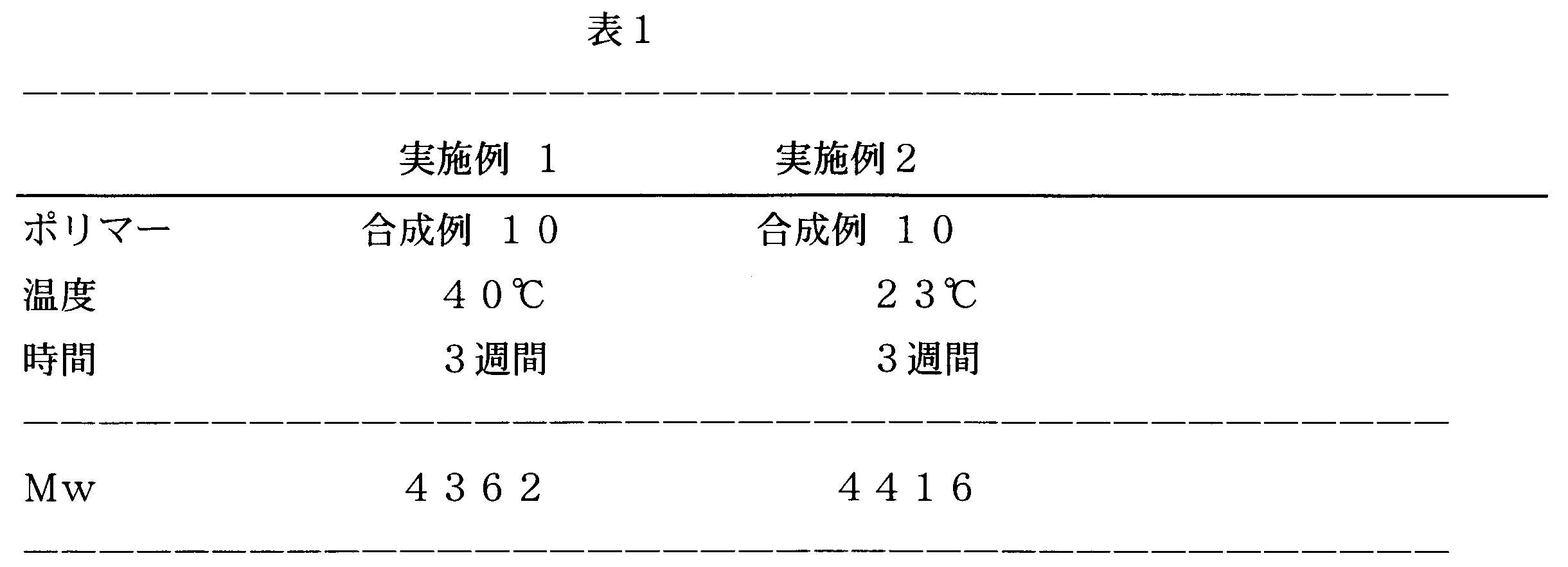

上記合成例10乃至19、比較合成例2、合成例1で得られたポリシロキサン、PAG(光酸発生剤)、TAG(熱酸発生剤),硬化触媒、クエンチャー、溶媒を下記表に示す割合で混合し、0.1μmのフッ素樹脂製のフィルターで濾過することによって、ポリシロキサン組成物の溶液をそれぞれ調製した。下記表中のポリマーの添加割合はポリマー溶液の添加量ではなく、ポリマー自体の添加量を示した。
下記表中で硬化触媒としてベンジルトリエチルアンモニウムクロリドはBTEAC、クエンチャーとしてトリエタノールアミンはTEA、溶剤としてプロピレングリコールモノメチルエーテルアセテートはPGMEA、溶剤としてプロピレングリコールモノエチルエーテルはPGEE、溶剤としてプロピレングリコールモノメチルエーテルはPGME、溶剤としてメチルイソブチルカルビノールはMIBCと略した。また、商品名ILP-113はヘレウス社製の光酸発生剤であり、以下の構造である。


実施例3、実施例9、実施例10乃至13における各被覆用ポリシロキサン組成物について、下記のように感光性、現像性評価を行った。その評価結果を下表に示す。
ウェハ上に、スピンコーターを用いて、回転数1500rpm、60秒間の条件にて、各被覆用ポリシロキサン組成物をそれぞれ塗布し、その後80℃で1分間ベークし、感光性樹脂膜を形成した。膜厚は約170nm乃至190nmであった。次いで、ウシオ電機社製マルチライトUSH-250BYを備えた三明社製自動露光装置AE810eマスクアライナーを用い、1cm×2cm角のオープンマスクを通してブロードバンド光を10mJ/cm2乃至100mJ/cm2、または100mJ/cm2乃至200mJ/cm2まで露光を行った。その後、80℃のホットプレートで1分間露光後加熱を行った。冷却後、現像液として2.38%濃度のテトラメチルアンモニウムヒドロキシド水溶液を用いて現像した。現像後の組成物の膜厚(nm)は下表の通りであった。
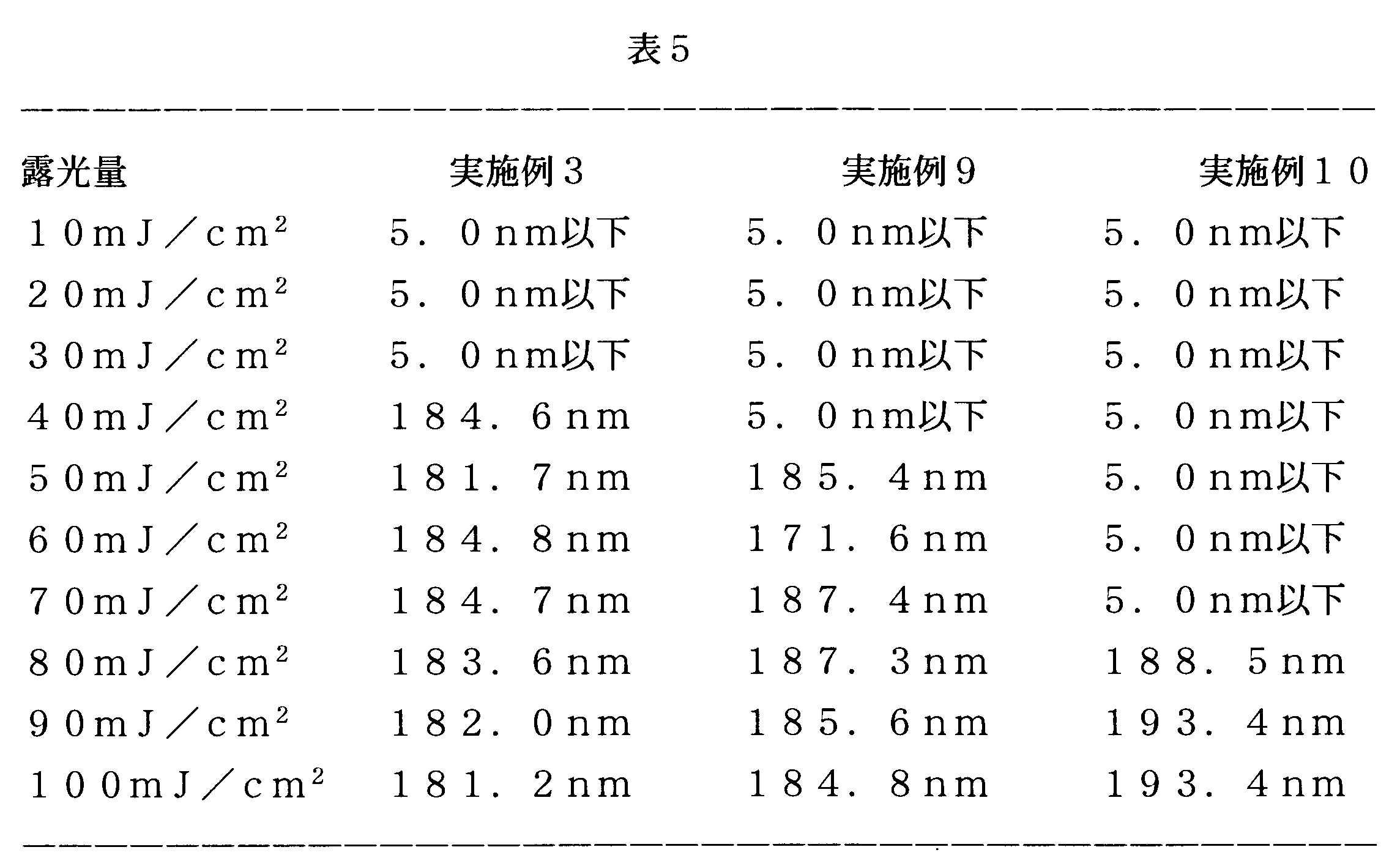

露光量が十分でない場合は、光酸発生剤からの酸の発生が十分でないためアセタール基が分解せず、アルカリ現像液によりポリシロキサン膜が溶解したものと考えられる。
上記表に示すように、本発明の組成物を用いて形成したシロキサン塗布膜は感光性を示し、また現像性も良好であった。
実施例3乃至実施例13、比較例3のポリシロキサンを含む組成物の溶液をウェハ上にスピンコーターを用いて、回転数1500rpm、60秒間の条件にて塗布し、その後80℃で1分間ベークし、樹脂膜を形成した。次いで、ウシオ電機社製マルチライトUSH-250BYを備えた三明社製自動露光装置AE810eマスクアライナーを用い、ブロードバンド光を200mJ/cm2全面露光を行った。ホットプレート上で1分間、215℃で加熱し、ポリシロキサン組成物膜(膜厚180nmに調製)を作成した。
また、実施例14、実施例15、比較例5のシロキサンを含む組成物の溶液をウェハ上にスピンコーターを用いて、回転数1500rpm、60秒間の条件にて塗布し、その後ホットプレート上に1分間、215℃で加熱し、ポリシロキサン組成物膜(膜厚180nmに調製)を作成した。
これらの塗膜のドライエッチングを行い、塩素ガスのエッチングレート(エッチング速度:nm/分)を測定し、結果を下表に示した。
なお、ドライエッチング速度の測定に用いたエッチャーはLAM-2300(ラムリサーチ社製)を用いた。


実施例3、14、比較例4におけるポリシロキサン組成物について、下記のように平坦化性評価を行った。その評価結果を表7に示す。
溝の深さ200nm、幅800nmの段差基板上に、スピンコーターを用いて、回転数1500rpm、60秒間の条件にて、実施例3のポリシロキサン組成物を塗布し、その後80℃で1分間ベークし、感光性樹脂膜を形成した。次いで、ウシオ電機社製マルチライトUSH-250BYを備えた三明社製自動露光装置AE810eマスクアライナーを用い、ブロードバンド光を100mJ/cm2全面露光を行った。ホットプレート上で1分間、215℃で加熱し、ポリシロキサン組成物膜(膜厚120nmに調製)を作成した。 同様に、実施例14、比較例4のポリシロキサン組成物を塗布し、ホットプレート上で1分間、215℃で加熱し、ポリシロキサン組成物膜(膜厚120nmに調製)を作成した。次いで、得られたポリシロキサン組成物膜について、断面SEMにより断面の形状を観察し、平坦化性を評価した。深さ200nm、幅800nmの溝パターンを観察し、溝底部を基準として最も膜厚の低い箇所と最も膜厚が高い箇所の膜厚を測定し、膜厚差を算出し、膜厚差が少ないものほど平坦化性が良好と評価した。

Claims (16)
- 分子内に2乃至4個の加水分解性基を有する加水分解性シランの加水分解縮合物より、該縮合物が有するシラノール基をアセタール保護して得られたポリシロキサンを含む被覆組成物または感光性組成物であって、該加水分解縮合物はSi-C結合でケイ素原子に結合する有機基が平均として、0≦(該有機基)/(Si)≦0.29のモル比割合で存在する被覆組成物または感光性組成物。
- 前記加水分解性シランが式(1):

- 式(1)で表される前記加水分解性シランが式(1)中、aが0であるテトラアルコキシシラン、式(1)中aが1であるメチルトリアルコキシシラン、ビニルトリアルコキシシラン又はフェニルトリアルコキシシラン、式(1)中aが2であるジメチルジアルコキシシランのうちいずれかを含む請求項2に記載の被覆組成物または感光性組成物。
- 前記加水分解性シランが式(1)中、aが0である加水分解性シランを71モル%乃至100モル%、式(1)中aが1である加水分解性シランを0モル%乃至29モル%の割合で含むものである請求項2に記載の被覆組成物または感光性組成物。
- 前記加水分解性シランが式(1)中、aが0である加水分解性シランを85.5モル%乃至100モル%、式(1)中aが2である加水分解性シランを0モル%乃至14.5モル%の割合で含むものである請求項2に記載の被覆組成物または感光性組成物。
- シラノール基をアセタール保護して得られたポリシロキサンが、式(2)で表される部分構造を有するポリシロキサンである請求項1に記載の被覆組成物または感光性組成物。
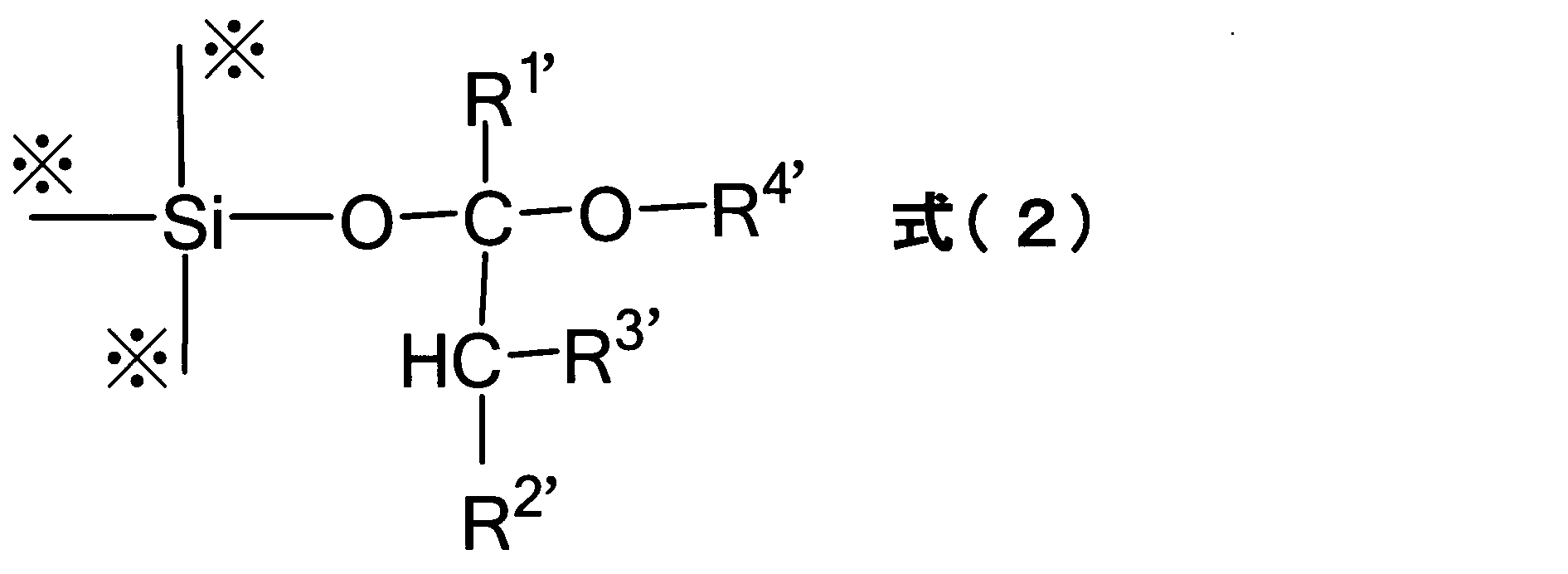
- シラノール基のアセタール保護が式(3)で表されるビニルエーテルで行われるものである請求項1に記載の被覆組成物または感光性組成物。

- 式(3)で表されるビニルエーテルがエチルビニルエーテル、プロピルビニルエーテル、ブチルビニルエーテル、エチルヘキシルビニルエーテル、シクロヘキシルビニルエーテル、3、4-ジヒドロ-2H-ピラン又は2、3-ジヒドロフランである請求項7に記載の被覆組成物または感光性組成物。
- 更に熱酸発生剤又は光酸発生剤を含む請求項1乃至請求項8のいずれか1項に記載の被覆組成物であって、レジストパターン上、又はレジストパターンを下層に転写した有機下層膜上に被覆される前記被覆組成物。
- 更に水、酸、クエンチャー、及び硬化触媒からなる群から選ばれた一つ以上を含む請求項1乃至請求項9のいずれか1項に記載の被覆組成物。
- 請求項1乃至請求項8のいずれか1項に記載の被覆組成物に更に光酸発生剤を含むレジスト組成物。
- 半導体基板上にナノインプリント法によるパターンを形成する工程(I)、パターン上に請求項1乃至請求項10のいずれか1項に記載の被覆組成物を塗布しポリシロキサンを埋め込む工程(II)、埋め込んだ該ポリシロキサンを硬化させた後、ナノインプリント法によるパターンをエッチング又はアッシングしてパターンを反転する工程(III)、ポリシロキサン膜を用いて基板を加工する工程(IV)を含む半導体装置の製造方法。
- 半導体基板上にレジスト膜を形成する工程(A)、前記レジスト膜を露光し、露光後にレジストを現像しレジストパターンを得る工程(B)、パターン化されたレジスト膜上に請求項1乃至請求項10のいずれか1項に記載の被覆組成物を塗布しポリシロキサンを埋め込む工程(C)、埋め込んだ該ポリシロキサンを硬化させた後、レジスト膜をエッチング又はアッシングしてパターンを反転する工程(D)、ポリシロキサン膜を用いて基板を加工する工程(E)を含む半導体装置の製造方法。
- 半導体基板上に有機下層膜を形成する工程(a)、その上にシリコンハードマスク形成組成物を塗布し焼成しシリコンハードマスクを形成する工程(b)、前記シリコンハードマスクの上にレジスト用組成物を塗布しレジスト層を形成する工程(c)、前記レジスト膜を露光し、露光後にレジストを現像しレジストパターンを得る工程(d)、レジストパターンに請求項1乃至請求項10のいずれか1項に記載の被覆組成物を塗布しポリシロキサンを埋め込む工程(e)、埋め込んだ該ポリシロキサンを硬化させた後、レジスト膜をエッチング又はアッシングしてパターンを反転させる工程(f)、反転パターンによりシリコンハードマスクをエッチングする工程(g)、パターン化されたシリコンハードマスクにより有機下層膜をエッチングしパターン化された有機下層膜を形成する工程(h)、パターン化された有機下層膜により基板を加工する工程(i)を含む半導体装置の製造方法。
- 半導体基板上に有機下層膜を形成する工程(1)、その上にシリコンハードマスク形成組成物を塗布し焼成しシリコンハードマスクを形成する工程(2)、前記シリコンハードマスクの上にレジスト用組成物を塗布しレジスト層を形成する工程(3)、前記レジスト膜を露光し、露光後にレジストを現像しレジストパターンを得る工程(4)、レジストパターンによりシリコンハードマスクをエッチングする工程(5)、パターン化されたシリコンハードマスクにより有機下層膜をエッチングしパターン化された有機下層膜を形成する工程(6)、パターン化された有機下層膜に請求項1乃至請求項10のいずれか1項に記載の被覆組成物を塗布しポリシロキサンを埋め込む工程(7)、埋め込んだ該ポリシロキサンを硬化させた後、有機下層膜をエッチング又はアッシングしてパターンを反転する工程(8)、ポリシロキサン膜を用いて基板を加工する工程(9)を含む半導体装置の製造方法。
- 半導体基板上に請求項11に記載のレジスト組成物によりレジスト膜を形成する工程(i)、前記レジスト膜を露光し、露光後にレジストを現像しレジストパターンを得る工程(ii)、パターン化されたレジスト膜で基板を加工する工程(iii)を含む半導体装置の製造方法。
Priority Applications (4)
| Application Number | Priority Date | Filing Date | Title |
|---|---|---|---|
| CN201780049797.6A CN109563371B (zh) | 2016-08-29 | 2017-08-28 | 包含进行了缩醛保护的硅烷醇基的聚硅氧烷组合物 |
| JP2018537257A JP6978731B2 (ja) | 2016-08-29 | 2017-08-28 | アセタール保護されたシラノール基を含むポリシロキサン組成物 |
| US16/329,175 US11884839B2 (en) | 2016-08-29 | 2017-08-28 | Acetal-protected silanol group-containing polysiloxane composition |
| KR1020197000363A KR102446537B1 (ko) | 2016-08-29 | 2017-08-28 | 아세탈 보호된 실라놀기를 포함하는 폴리실록산 조성물 |
Applications Claiming Priority (2)
| Application Number | Priority Date | Filing Date | Title |
|---|---|---|---|
| JP2016-167251 | 2016-08-29 | ||
| JP2016167251 | 2016-08-29 |
Publications (1)
| Publication Number | Publication Date |
|---|---|
| WO2018043407A1 true WO2018043407A1 (ja) | 2018-03-08 |
Family
ID=61305331
Family Applications (1)
| Application Number | Title | Priority Date | Filing Date |
|---|---|---|---|
| PCT/JP2017/030753 Ceased WO2018043407A1 (ja) | 2016-08-29 | 2017-08-28 | アセタール保護されたシラノール基を含むポリシロキサン組成物 |
Country Status (6)
| Country | Link |
|---|---|
| US (1) | US11884839B2 (ja) |
| JP (1) | JP6978731B2 (ja) |
| KR (1) | KR102446537B1 (ja) |
| CN (1) | CN109563371B (ja) |
| TW (1) | TWI732032B (ja) |
| WO (1) | WO2018043407A1 (ja) |
Cited By (2)
| Publication number | Priority date | Publication date | Assignee | Title |
|---|---|---|---|---|
| KR20220057429A (ko) | 2020-10-29 | 2022-05-09 | 사카타 인쿠스 가부시키가이샤 | 활성 에너지선 경화형 조성물 |
| WO2024004323A1 (ja) * | 2022-06-27 | 2024-01-04 | 日産化学株式会社 | 硬化性組成物 |
Families Citing this family (1)
| Publication number | Priority date | Publication date | Assignee | Title |
|---|---|---|---|---|
| CN113985701B (zh) * | 2021-12-06 | 2024-11-01 | 潍坊星泰克微电子材料有限公司 | 负性光刻胶组合物、制备方法及形成光刻胶图案的方法 |
Citations (6)
| Publication number | Priority date | Publication date | Assignee | Title |
|---|---|---|---|---|
| JPH04345841A (ja) * | 1991-05-24 | 1992-12-01 | Toru Yamamoto | バリアー性積層フィルムおよびその製造方法 |
| JPH11130860A (ja) * | 1997-08-29 | 1999-05-18 | Fujitsu Ltd | ケイ素含有ポリマ並びにこれを用いたレジスト組成物及びレジストパターン形成方法 |
| JP2002082437A (ja) * | 2000-09-06 | 2002-03-22 | Fuji Photo Film Co Ltd | ポジ型フォトレジスト組成物 |
| JP2004212946A (ja) * | 2002-10-21 | 2004-07-29 | Rohm & Haas Electronic Materials Llc | Siポリマー含有フォトレジスト |
| JP2009263522A (ja) * | 2008-04-25 | 2009-11-12 | Shin Etsu Chem Co Ltd | ポリオルガノシロキサン化合物、これを含む樹脂組成物及びこれらのパターン形成方法 |
| WO2016052390A1 (ja) * | 2014-09-29 | 2016-04-07 | 富士フイルム株式会社 | 感光性樹脂組成物、硬化膜の製造方法、硬化膜、液晶表示装置、有機エレクトロルミネッセンス表示装置およびタッチパネル |
Family Cites Families (12)
| Publication number | Priority date | Publication date | Assignee | Title |
|---|---|---|---|---|
| JP3193227B2 (ja) * | 1994-03-24 | 2001-07-30 | 沖電気工業株式会社 | シリコーン樹脂それを含む組成物、ケイ酸ガラス系無機膜の形成方法 |
| JPH08190200A (ja) * | 1995-01-09 | 1996-07-23 | Oki Electric Ind Co Ltd | Si含有薄膜の形成方法および該薄膜のパターン形成方法 |
| JPH0940779A (ja) * | 1995-08-01 | 1997-02-10 | Toshiba Corp | ポリシロキサン、ポリシロキサン組成物、絶縁膜の製造方法、着色部材の製造方法及び導電膜の製造方法 |
| JPH0964037A (ja) * | 1995-08-23 | 1997-03-07 | Mitsubishi Electric Corp | 半導体装置の製造方法 |
| JP3324360B2 (ja) * | 1995-09-25 | 2002-09-17 | 信越化学工業株式会社 | ポリシロキサン化合物及びポジ型レジスト材料 |
| JPH1160733A (ja) * | 1997-08-14 | 1999-03-05 | Showa Denko Kk | 重合体、レジスト樹脂組成物、及びそれらを用いたパターン形成方法 |
| US7704670B2 (en) | 2006-06-22 | 2010-04-27 | Az Electronic Materials Usa Corp. | High silicon-content thin film thermosets |
| JP5003279B2 (ja) | 2007-05-21 | 2012-08-15 | Jsr株式会社 | 反転パターン形成方法 |
| KR20090113183A (ko) * | 2008-04-25 | 2009-10-29 | 신에쓰 가가꾸 고교 가부시끼가이샤 | 폴리유기실록산 화합물, 이것을 포함하는 수지 조성물 및 이들의 패턴 형성 방법 |
| WO2011052611A1 (ja) | 2009-10-30 | 2011-05-05 | Jsr株式会社 | 反転パターン形成方法及びポリシロキサン樹脂組成物 |
| JP5862894B2 (ja) * | 2010-09-21 | 2016-02-16 | 日産化学工業株式会社 | 保護された脂肪族アルコールを含有する有機基を有するシリコン含有レジスト下層膜形成組成物 |
| JP6323225B2 (ja) * | 2013-11-01 | 2018-05-16 | セントラル硝子株式会社 | ポジ型感光性樹脂組成物、それを用いた膜の製造方法および電子部品 |
-
2017
- 2017-08-28 US US16/329,175 patent/US11884839B2/en active Active
- 2017-08-28 KR KR1020197000363A patent/KR102446537B1/ko active Active
- 2017-08-28 CN CN201780049797.6A patent/CN109563371B/zh active Active
- 2017-08-28 JP JP2018537257A patent/JP6978731B2/ja active Active
- 2017-08-28 WO PCT/JP2017/030753 patent/WO2018043407A1/ja not_active Ceased
- 2017-08-29 TW TW106129273A patent/TWI732032B/zh active
Patent Citations (6)
| Publication number | Priority date | Publication date | Assignee | Title |
|---|---|---|---|---|
| JPH04345841A (ja) * | 1991-05-24 | 1992-12-01 | Toru Yamamoto | バリアー性積層フィルムおよびその製造方法 |
| JPH11130860A (ja) * | 1997-08-29 | 1999-05-18 | Fujitsu Ltd | ケイ素含有ポリマ並びにこれを用いたレジスト組成物及びレジストパターン形成方法 |
| JP2002082437A (ja) * | 2000-09-06 | 2002-03-22 | Fuji Photo Film Co Ltd | ポジ型フォトレジスト組成物 |
| JP2004212946A (ja) * | 2002-10-21 | 2004-07-29 | Rohm & Haas Electronic Materials Llc | Siポリマー含有フォトレジスト |
| JP2009263522A (ja) * | 2008-04-25 | 2009-11-12 | Shin Etsu Chem Co Ltd | ポリオルガノシロキサン化合物、これを含む樹脂組成物及びこれらのパターン形成方法 |
| WO2016052390A1 (ja) * | 2014-09-29 | 2016-04-07 | 富士フイルム株式会社 | 感光性樹脂組成物、硬化膜の製造方法、硬化膜、液晶表示装置、有機エレクトロルミネッセンス表示装置およびタッチパネル |
Cited By (4)
| Publication number | Priority date | Publication date | Assignee | Title |
|---|---|---|---|---|
| KR20220057429A (ko) | 2020-10-29 | 2022-05-09 | 사카타 인쿠스 가부시키가이샤 | 활성 에너지선 경화형 조성물 |
| JP2022072415A (ja) * | 2020-10-29 | 2022-05-17 | サカタインクス株式会社 | 活性エネルギー線硬化型組成物 |
| JP7500899B2 (ja) | 2020-10-29 | 2024-06-18 | サカタインクス株式会社 | 活性エネルギー線硬化型組成物 |
| WO2024004323A1 (ja) * | 2022-06-27 | 2024-01-04 | 日産化学株式会社 | 硬化性組成物 |
Also Published As
| Publication number | Publication date |
|---|---|
| US20190185707A1 (en) | 2019-06-20 |
| CN109563371A (zh) | 2019-04-02 |
| JP6978731B2 (ja) | 2021-12-08 |
| CN109563371B (zh) | 2021-09-21 |
| KR20190046757A (ko) | 2019-05-07 |
| US11884839B2 (en) | 2024-01-30 |
| JPWO2018043407A1 (ja) | 2019-06-24 |
| KR102446537B1 (ko) | 2022-09-23 |
| TWI732032B (zh) | 2021-07-01 |
| TW201821487A (zh) | 2018-06-16 |
Similar Documents
| Publication | Publication Date | Title |
|---|---|---|
| TWI590002B (zh) | 含有磺酸鎓鹽的含矽euv阻劑下層膜形成組成物 | |
| TWI547764B (zh) | 含有鈦及矽的微影用薄膜形成組成物 | |
| JP7212322B2 (ja) | 感放射線性組成物 | |
| JP6902350B2 (ja) | 脂肪族多環構造含有有機基を有するシリコン含有レジスト下層膜形成組成物 | |
| TWI507825B (zh) | 包含有含醯胺酸之矽的抗蝕下層膜形成組成物 | |
| CN106462075B (zh) | 含有具有苯基生色团的硅的抗蚀剂下层膜形成用组合物 | |
| JP6754098B2 (ja) | カーボネート骨格を有する加水分解性シランを含むリソグラフィー用レジスト下層膜形成組成物 | |
| TWI681019B (zh) | 包含具有含鹵素的羧酸醯胺基之水解性矽烷之微影蝕刻用光阻底層膜形成組成物 | |
| CN106662820A (zh) | 具有卤代磺酰基烷基的含硅抗蚀剂下层膜形成用组合物 | |
| CN106575090A (zh) | 用于soc 图案上的图案反转的被覆用组合物 | |
| TWI818900B (zh) | 圖型反轉用之被覆組成物 | |
| KR102446537B1 (ko) | 아세탈 보호된 실라놀기를 포함하는 폴리실록산 조성물 | |
| CN111902774A (zh) | 包含硝酸和被保护了的苯酚基的含硅抗蚀剂下层膜形成用组合物 |
Legal Events
| Date | Code | Title | Description |
|---|---|---|---|
| ENP | Entry into the national phase |
Ref document number: 2018537257 Country of ref document: JP Kind code of ref document: A |
|
| 121 | Ep: the epo has been informed by wipo that ep was designated in this application |
Ref document number: 17846412 Country of ref document: EP Kind code of ref document: A1 |
|
| ENP | Entry into the national phase |
Ref document number: 20197000363 Country of ref document: KR Kind code of ref document: A |
|
| NENP | Non-entry into the national phase |
Ref country code: DE |
|
| 122 | Ep: pct application non-entry in european phase |
Ref document number: 17846412 Country of ref document: EP Kind code of ref document: A1 |