WO2018043174A1 - 放熱塗料組成物、硬化膜の製造方法、硬化膜、金属部材、放熱部材および電子部品 - Google Patents
放熱塗料組成物、硬化膜の製造方法、硬化膜、金属部材、放熱部材および電子部品 Download PDFInfo
- Publication number
- WO2018043174A1 WO2018043174A1 PCT/JP2017/029751 JP2017029751W WO2018043174A1 WO 2018043174 A1 WO2018043174 A1 WO 2018043174A1 JP 2017029751 W JP2017029751 W JP 2017029751W WO 2018043174 A1 WO2018043174 A1 WO 2018043174A1
- Authority
- WO
- WIPO (PCT)
- Prior art keywords
- heat
- cured film
- group
- dissipating
- composition
- Prior art date
- Legal status (The legal status is an assumption and is not a legal conclusion. Google has not performed a legal analysis and makes no representation as to the accuracy of the status listed.)
- Ceased
Links
Classifications
-
- C—CHEMISTRY; METALLURGY
- C09—DYES; PAINTS; POLISHES; NATURAL RESINS; ADHESIVES; COMPOSITIONS NOT OTHERWISE PROVIDED FOR; APPLICATIONS OF MATERIALS NOT OTHERWISE PROVIDED FOR
- C09D—COATING COMPOSITIONS, e.g. PAINTS, VARNISHES OR LACQUERS; FILLING PASTES; CHEMICAL PAINT OR INK REMOVERS; INKS; CORRECTING FLUIDS; WOODSTAINS; PASTES OR SOLIDS FOR COLOURING OR PRINTING; USE OF MATERIALS THEREFOR
- C09D133/00—Coating compositions based on homopolymers or copolymers of compounds having one or more unsaturated aliphatic radicals, each having only one carbon-to-carbon double bond, and at least one being terminated by only one carboxyl radical, or of salts, anhydrides, esters, amides, imides, or nitriles thereof; Coating compositions based on derivatives of such polymers
-
- C—CHEMISTRY; METALLURGY
- C09—DYES; PAINTS; POLISHES; NATURAL RESINS; ADHESIVES; COMPOSITIONS NOT OTHERWISE PROVIDED FOR; APPLICATIONS OF MATERIALS NOT OTHERWISE PROVIDED FOR
- C09D—COATING COMPOSITIONS, e.g. PAINTS, VARNISHES OR LACQUERS; FILLING PASTES; CHEMICAL PAINT OR INK REMOVERS; INKS; CORRECTING FLUIDS; WOODSTAINS; PASTES OR SOLIDS FOR COLOURING OR PRINTING; USE OF MATERIALS THEREFOR
- C09D167/00—Coating compositions based on polyesters obtained by reactions forming a carboxylic ester link in the main chain; Coating compositions based on derivatives of such polymers
Definitions
- the present invention relates to a heat radiation coating composition, a method for producing a cured film, a cured film, a metal member, a heat radiation member, and an electronic component.
- a CPU Central Processing Unit mounted on an electronic article such as a computer generates heat during operation of the article, and the article causes a failure due to the generated heat. For this reason, a heat radiating member such as a heat sink is used in the electronic article for the purpose of radiating such heat.
- a heat radiating member such as a heat sink is used in the electronic article for the purpose of radiating such heat.
- the heat radiating member is normally considered to be used inside an electronic article such as an electronic device. However, in recent years, it is also used in an outdoor device such as an outdoor lighting device, a solar battery panel, a traffic light, and an outdoor power source BOX. It is required to be usable. However, the cured films obtained from the compositions described in Patent Documents 1 and 2 have room for improvement in terms of weather resistance.
- One embodiment of the present invention provides a heat dissipating coating composition capable of forming a cured film having excellent heat dissipation, heat resistance and weather resistance.
- a configuration example of the present invention is as follows.
- a heat dissipating coating composition comprising a polyester-forming component containing an acrylic polymer and a heat dissipating filler.
- the radiation coating composition according to [1] which is an aqueous composition.
- the acrylic polymer has at least one group selected from the group consisting of a hydroxyl group, a carboxyl group, an oxoheterocyclic group, an alkoxysilyl group, an amino group, a carbonyl group, and a sulfo group, [1] or [2]
- the polyester-forming component includes at least one of a divalent or higher carboxylic acid compound, a divalent or higher hydroxy compound, or a compound in which a carboxyl group or a hydroxy group is generated by decomposition or ring opening.
- [5] The heat radiation coating composition according to any one of [1] to [4], wherein the acrylic polymer has a weight average molecular weight in the range of 500 to 40000.
- the heat radiation filler includes at least one selected from the group consisting of silicate compounds, boron nitride, aluminum nitride, silica, alumina, zinc oxide, titanium oxide, silicon carbide, graphite, and nanodiamonds. ] To [5]. [7] The heat radiation coating composition according to any one of [1] to [6], wherein the heat radiation filler includes an orthorhombic silicate compound. [8] The radiation coating composition according to [7], wherein the orthorhombic silicate compound is cordierite or mullite.
- a method for producing a cured film comprising a step of esterifying the heat radiation coating composition according to any one of [1] to [10].
- [12] A cured film of the heat radiation coating composition according to any one of [1] to [10]. [13] YI (yellow index) value of a cured film having a thickness of 30 ⁇ m formed on an aluminum plate having a thickness of 0.4 mm, and YI value after heating the cured film on the hot plate in the air for 10 minutes. [12] The cured film according to [12], wherein the heating temperature at which the difference is 3 or more is 170 ° C or more.
- a metal layer made of copper, iron, magnesium, aluminum, nickel, or an alloy containing any one of these metals; A metal member having the cured film according to [12] or [13], which covers at least a part of the metal layer.
- a heat radiating member comprising the metal member according to [14].
- An electronic article comprising the metal member according to [14].
- a cured film that is excellent in heat dissipation, heat resistance, and weather resistance, and particularly excellent in balance in heat dissipation, heat resistance, weather resistance, and corrosion resistance.
- a metal member, a heat dissipation member, an electronic article, and the like that are excellent in heat dissipation, heat resistance, weather resistance, corrosion resistance, and durability.
- a heat radiation coating composition (hereinafter also referred to as “the present composition”) according to an embodiment of the present invention includes a polyester-forming component containing an acrylic polymer (hereinafter also referred to as “component (A)”), and a heat radiation filler. (Hereinafter also referred to as “component (B)”).
- component (A) an acrylic polymer
- component (B) a heat radiation filler
- a cured film containing a polyester resin containing an acrylic polymer and a heat dissipating filler is obtained by curing, and thus the cured film exhibits the above-described effects.
- the component (A) is a polyester-forming component containing an acrylic polymer, and is a component that can become a polyester resin containing an acrylic polymer by curing. Since the component (A) is self-reactive and can form a cured film without using a curing agent or the like, the present composition can be preferably a one-component composition, Compared to a two-component curable composition, the composition is excellent in storage stability and has a prolonged pot life during operation.
- Component (A) includes a compound having an ester-forming group, and the compound is polymerized to become a polyester resin.
- Component (A) may contain an acrylic polymer as a compound having the ester-forming group, or may contain a compound having an ester-forming group other than the acrylic polymer.
- the ester-forming group is not particularly limited as long as it is a group capable of forming an ester, and examples thereof include carboxyl groups such as carboxyl groups, acid anhydride groups, acid chloride groups and ester bonds, and hydroxy groups, and ether groups.
- carboxyl groups such as carboxyl groups, acid anhydride groups, acid chloride groups and ester bonds
- hydroxy groups and ether groups.
- the ester forming group may be protected with a conventionally known protecting group from the viewpoint of the storage stability of the composition.
- the polyester-forming component preferably contains at least one of a divalent or higher carboxylic acid compound, a divalent or higher hydroxy compound, or a compound in which a carboxyl group or a hydroxy group is generated by decomposition or ring opening.
- the said carboxylic acid compound and the said hydroxy compound may be protected by the conventionally well-known protecting group from the point of the storage stability of this composition.
- Component (A) contains an acrylic polymer as an essential component. For this reason, the cured film which is excellent in adhesiveness with a metal layer, heat dissipation, a weather resistance, and corrosion resistance can be formed.
- the acrylic polymer contained in the component (A) may be one type or two or more types.
- acrylic polymer examples include polymers and oligomers of acrylic compounds, a composition having excellent storage stability is obtained, and a cured film that is excellent in terms of adhesion to the metal layer, weather resistance, corrosion resistance, and the like is obtained.
- a polymer having at least one functional group selected from the group is more preferable, a polymer having a hydroxyl group, an oxoheterocyclic group, a carboxyl group or a trimethoxysilyl group is more preferable, and a polymer having a hydroxyl group, a glycidyl group or a carboxyl group is more preferable. Particularly preferred.
- These functional groups may be protected with a conventionally known protecting group from the viewpoint of storage stability of the composition.
- the “oxoheterocyclic group” refers to a group containing a ring containing oxygen, and may be a group containing a ring composed of oxygen, carbon and hydrogen, containing oxygen, further containing nitrogen, silicon, It may be a group containing a ring containing sulfur or phosphorus.
- acrylic compound examples include methyl (meth) acrylate, ethyl (meth) acrylate, n-propyl (meth) acrylate, n-butyl (meth) acrylate, t-butyl (meth) acrylate, and isobutyl (meth) ) Acrylate, n-hexyl (meth) acrylate, 2-ethylhexyl (meth) acrylate, isodecyl (meth) acrylate, stearyl (meth) acrylate, lauryl (meth) acrylate, tridecyl (meth) acrylate, methoxyethyl (meth) acrylate, Ethoxyethyl (meth) acrylate, butoxyethyl (meth) acrylate, 2-ethoxyethoxyethyl (meth) acrylate, methoxydiethylene glycol (meth) acrylate, ethoxydi
- acrylic polymer Commercially available products may be used as the acrylic polymer, and specific examples of such commercially available products include Act Flow CBIB-1013, Act Flow UTIB-1013, Act Flow UME-2005, Acto Chemical Co., Ltd. Examples include Flow NE-1000, Act Flow BGV-100T, and Aron, Alfon, Aronix, etc., manufactured by Toagosei Co., Ltd.
- the weight average molecular weight of the acrylic polymer measured by gel permeation chromatography (GPC) is preferably 500 to 40,000 from the viewpoint of good polymerization reactivity when forming the polyester resin.
- the content of the acrylic polymer in the component (A) is 100% by weight with respect to 100% by weight of the resin component in the component (A) (the component that becomes a resin by curing in the component (A) hereinafter).
- the content is 0.1 to 50% by weight.
- a compound having any two or more of a carboxyl group, a hydroxy group and an oxo heterocyclic group in one molecule may be used. It is preferable to use a compound having a group and a compound having a hydroxy group and / or a compound having an oxoheterocyclic group, more preferably using a divalent or higher carboxylic acid compound and a divalent or higher hydroxy compound in combination.
- the said carboxylic acid compound and the said hydroxy compound may be protected by the conventionally well-known protecting group from the point of the storage stability of this composition.
- divalent or higher carboxylic acid compound examples include compounds having two or more carboxyl groups in one molecule, preferably dicarboxylic acid compounds such as aromatic dicarboxylic acid compounds and aliphatic dicarboxylic acid compounds. . Divalent or higher carboxylic acid compounds may be used alone or in combination of two or more.
- Aromatic dicarboxylic acid compounds include terephthalic acid, dimethyl terephthalate, isophthalic acid, dimethyl isophthalate, phthalic acid, diphenic acid, naphthalic acid, 1,2-naphthalenedicarboxylic acid, 1,4-naphthalenedicarboxylic acid, 1,5 -Naphthalenedicarboxylic acid, 2,6-naphthalenedicarboxylic acid, dimethyl 2,6-naphthalenedicarboxylic acid, derivatives thereof (acid anhydride, acid chloride, ester, etc.) and the like.
- Aliphatic dicarboxylic acid compounds include oxalic acid, malonic acid, succinic acid, maleic acid, itaconic acid, glutaric acid, adipic acid, pimelic acid, 2,2-dimethylglutaric acid, suberic acid, azelaic acid, sebacic acid, dodecane
- Examples thereof include diacids, 1,3-cyclopentanedicarboxylic acid, 1,4-cyclohexanedicarboxylic acid, diglycolic acid, thiodipropionic acid, and derivatives thereof (acid anhydride, acid chloride, ester, etc.).
- divalent or higher carboxylic acid compounds examples include aromatic dicarboxylic acids such as terephthalic acid, isophthalic acid, and 2,6-naphthalenedicarboxylic acid, succinic acid, and the like from the viewpoint of easy reaction, weather resistance and durability of the resulting resin. Preference is given to aliphatic dicarboxylic acids such as acids, adipic acid, sebacic acid, dodecanedioic acid, and derivatives thereof (acid anhydrides, acid chlorides, esters, etc.).
- Component (A) is a dicarboxylic acid having a metal sulfonate group such as an alkali metal salt of a sulfonic acid such as dimethyl sodium 5-sulfoisophthalate, a trivalent or higher polyvalent carboxylic acid, as a divalent or higher carboxylic acid compound.
- a metal sulfonate group such as an alkali metal salt of a sulfonic acid such as dimethyl sodium 5-sulfoisophthalate, a trivalent or higher polyvalent carboxylic acid, as a divalent or higher carboxylic acid compound.
- a metal sulfonate group such as an alkali metal salt of a sulfonic acid such as dimethyl sodium 5-sulfoisophthalate, a trivalent or higher polyvalent carboxylic acid, as a divalent or higher carboxylic acid compound.
- divalent or higher-valent hydroxy compound examples include compounds having two or more hydroxy groups in one molecule, preferably glycol compounds.
- Divalent or higher hydroxy compounds may be used alone or in combination of two or more.
- glycol compounds include ethylene glycol, diethylene glycol, triethylene glycol, tetraethylene glycol, pentaethylene glycol, hexaethylene glycol, heptaethylene glycol, octaethylene glycol, and other polyethylene glycols, propylene glycol, dipropylene glycol, tripropylene glycol, tetra Polypropylene glycol such as propylene glycol, 1,3-propanediol, 1,3-butanediol, 1,4-butanediol, 1,5-pentanediol, 1,6-hexanediol, 2,2-dimethyl-1, 3-propanediol, 2-ethyl-2-butyl-1,3-propanediol, 2-ethyl-2-isobutyl-1,3-propanediol, 2,2,4 Trimethyl-1,6-hexanediol, 1,2-cyclohexanedimethanol,
- divalent or higher-valent hydroxy compounds examples include butanediols such as ethylene glycol, diethylene glycol and 1,4-butanediol, 1,6-hexanediol and the like from the viewpoint of easy reaction and durability of the resulting resin.
- Hexanediols, 1,4-cyclohexanedimethanols, 2,2-dimethyl-1,3-propanediol and bisphenol A are preferred.
- Component (A) may further contain a trivalent or higher hydroxy compound such as pentaerythritol or trimethylolpropane as a divalent or higher hydroxy compound, from the viewpoint of adjusting the molecular weight of the polyester resin.
- a trivalent or higher hydroxy compound such as pentaerythritol or trimethylolpropane as a divalent or higher hydroxy compound
- Component (A) may contain a reactive phosphorus-containing compound from the viewpoint of obtaining a cured film having excellent flame retardancy.
- a reactive phosphorus containing compound may be used independently and may use 2 or more types.
- the reactive phosphorus-containing compound is preferably a compound having one or two ester forming groups in one molecule. When the reactive phosphorus-containing compound has two ester-forming groups, it is preferable that the two ester-forming groups are both carboxyl groups or both are hydroxyl groups. When the reactive phosphorus-containing compound has one ester-forming group, this reactive phosphorus-containing compound may act as a terminal terminator, so a trivalent or higher carboxylic acid compound or a trivalent or higher hydroxy compound may be used. It is preferable to use together.
- the content of the resin component in component (A) is preferably 10 to 60% by weight, more preferably 20 to 50% by weight, based on 100% by weight of component (A).
- the content of the resin component is in the above range, a cured film that is superior in heat dissipation, heat resistance, weather resistance and corrosion resistance can be formed, and self-reaction progresses during storage of the composition, and changes with time. This can prevent the physical properties of the paint from being damaged.
- the content of the compound having an ester-forming group contained in component (A) is such that the total number of moles of carboxyl groups in component (A) and the total number of moles of hydroxyl groups are approximately equimolar or more. Is preferably an amount that is 2.5 times the mole of the other.
- Component (A) preferably contains a solvent, and the solvent is preferably an aqueous solvent.
- the aqueous solvent may be a solvent composed only of water or a mixed solvent of water and a hydrophilic organic solvent.
- the hydrophilic organic solvent include alcohols such as methanol, ethanol, and propanol, glycol ethers such as propylene glycol monomethyl ether, ethyl cellosolve, propyl cellosolve, and butyl cellosolve, cyclohexanone, acetone, dioxane, and the like. Ethers are preferred.
- a solvent may be used independently and may use 2 or more types.
- the composition is preferably an aqueous composition from the viewpoints of ease of handling, less adverse effects on the human body and the environment, and the solvent contained in the component (A) is 50% by weight or more of water.
- the solvent contained in the component (A) is 50% by weight or more of water.
- 80% by weight or more is more preferably water, and more preferably 90% by weight or more is water.
- the content of the solvent in the component (A) is preferably 40 to 90% by weight, more preferably 50 to 80% by weight with respect to 100% by weight of the component (A).
- the content of the solvent is in the above range, the self-reaction proceeds rapidly during storage of the composition, and the physical properties as a paint can be prevented from being impaired.
- a composition capable of forming a uniform cured film can be obtained, and a cured film excellent in heat dissipation, heat resistance, weather resistance and corrosion resistance can be formed.
- ⁇ Other compounds> In addition to the compound, other components may be added to the component (A) as long as the effects of the present invention are not impaired.
- the other compound include p-hydroxybenzoic acid, monovalent aliphatic alcohol, and known polyfunctional compounds such as dimethylolbutanoic acid for adjusting the molecular weight of the resulting polyester resin.
- the component (A) includes esterification reaction catalysts such as titanium compounds such as potassium potassium oxalate, antimony compounds, lead compounds, zinc compounds, magnesium compounds, calcium compounds, manganese compounds, and alkali metal compounds. You may mix
- esterification reaction catalysts such as titanium compounds such as potassium potassium oxalate, antimony compounds, lead compounds, zinc compounds, magnesium compounds, calcium compounds, manganese compounds, and alkali metal compounds. You may mix
- the viscosity of the component (A) is not particularly limited, but the viscosity at 20 ° C. is obtained from the viewpoint that a composition excellent in handling ease and cured film formation is obtained.
- the pressure is preferably 10 to 500 mPa ⁇ s, more preferably 30 to 300 mPa ⁇ s.
- the pH when the component (A) is diluted 10-fold with water is not particularly limited, but a composition excellent in storage stability and ease of handling can be obtained. Therefore, it is preferably 6 to 10, more preferably 7 to 9.
- the content of the component (A) in the composition is 100% by weight of the composition from the viewpoint that a cured film excellent in heat dissipation, heat resistance, weather resistance and corrosion resistance can be easily formed.
- the content of the resin component in the component (A) is preferably 10 to 50% by weight, more preferably 20 to 40% by weight.
- the component (B) is a heat dissipating filler and is not particularly limited as long as it contributes to the heat dissipating effect, and a filler having a high far-infrared emissivity or a filler having a high thermal conductivity may be appropriately selected according to a desired application. That's fine.
- a silicate compound, boron nitride, aluminum nitride, silica, alumina, zinc oxide, titanium oxide, silicon carbide, graphite, and nano diamond are mentioned.
- a component (B) may be used independently and may use 2 or more types.
- Component (B) contains an orthorhombic silicate compound from the standpoint that it is particularly excellent in far-infrared radiation effect, so that a cured film with excellent heat radiation and high heat dissipation effect can be easily obtained. It is preferable.
- the orthorhombic silicate compound is preferably an orthorhombic silicate mineral, such as mullite, cordierite, enstatite, hemimorphite, zoisite, sillimanite, and columbite. Cordierite and mullite are particularly preferable in that they have high thermal radiation, are chemically stable, have high affinity with the component (A) and the polyester resin, and are less harmful to the human body.
- the orthorhombic silicate compound may be natural or artificial, and may be an aluminosilicate mineral or the like. In the case of a naturally occurring mineral, a monoclinic or triclinic mineral, or a cubic mineral may be contained as an impurity.
- Component (B) preferably contains an orthorhombic silicate compound, but from the viewpoint of increasing the thermal conductivity of the resulting cured film, boron nitride, aluminum nitride, silica, alumina, zinc oxide, It is preferable to further include at least one selected from the group consisting of titanium oxide, silicon carbide, graphite, and nanodiamond.
- a commercially available product having an average particle diameter or shape in a desired range may be used as it is, or a commercially available product is crushed, classified, heated, etc. so that the average particle size or shape is in a desired range. May be.
- the heat dissipating filler is usually in the form of a powder, and the average particle size thereof provides a composition having excellent storage stability and ease of handling, and has a good balance of heat dissipating properties, heat resistance, weather resistance, and corrosion resistance, and a metal layer.
- it is preferably 200 ⁇ m or less, more preferably 0.1 to 20 ⁇ m, and particularly preferably 0.1 ⁇ 3 ⁇ m.
- the average particle size is the particle size at an integrated value of 50% in the particle size distribution determined by the laser diffraction / scattering method.
- Component (B) content is excellent in storage stability and ease of handling, resulting in a well-balanced heat dissipation, heat resistance, weather resistance and corrosion resistance, and excellent adhesion to the metal layer. From the standpoint of easily forming a cured film with little unevenness, it is preferably 5 to 60% by weight, more preferably 5 to 30% by weight, and particularly preferably 10 to 20% with respect to 100% by weight of the present composition. The amount is preferably 20 to 100 parts by weight, more preferably 30 to 60 parts by weight with respect to 100 parts by weight of the resin component in the component (A).
- This composition may contain additive components other than the said components (A) and (B) in the range which does not impair the effect of this invention.
- the additive component is not particularly limited, but a solvent, a dispersant, a thickener, an antisettling agent, a thixotropic agent, an antifoaming agent, a colorant, an antioxidant, a silane coupling agent, a pH adjuster, Thermosetting resins such as epoxy resins, polycarbodiimide resins and oxazoline group-containing polymers, isocyanate compounds, epoxy compounds and other crosslinking agents, curing agents, copper damage inhibitors, metal deactivators, rust inhibitors, and adhesive properties Examples include an imparting agent, an anti-aging agent, an antistatic agent, a weathering agent, a surface conditioner, and an anti-drying agent. These may be used alone or in combination of two or more.
- component (A) contains a solvent
- a solvent is further added from the viewpoint of obtaining a composition that is superior in storage stability, ease of handling and cured film formation. May be.
- the solvent is preferably a compound that can disperse the heat dissipating filler, and specific examples thereof include the same compounds as those mentioned in the column for the component (A).
- the composition is preferably an aqueous composition from the viewpoints of ease of handling, less adverse effects on the human body and the environment, and the like.
- the dispersion medium (solvent in component (A) + additive) contained in the composition 50% by weight or more thereof is preferably water, more preferably 80% by weight or more is water, and more preferably 90% by weight or more is water.
- the composition may contain a curing agent for promoting curing, but since it contains the component (A), a cured film can be formed without using a curing agent. Therefore, it is preferable that the present composition does not contain a curing agent from the viewpoints of obtaining a composition having excellent storage stability and a prolonged pot life at the time of use.
- an ultraviolet absorber for example, an ultraviolet absorber, a light stabilizer, etc. are mentioned, Among these, it is using an ultraviolet absorber from the point of obtaining the cured film which is more excellent in a weather resistance. preferable. In addition, by using an ultraviolet absorber and a light stabilizer in combination, a synergistic effect can be obtained by using them, and the weather resistance is extremely excellent. In particular, a cured film having the weather resistance over a long period of time can be easily obtained. Can do.
- the present composition can be obtained by mixing the respective components.
- the mixing method is not particularly limited, and may be performed using a conventionally known stirrer or disperser such as a stirring motor, a raking machine, a three-roll, a ball mill, a rotation / revolution mill, a planetary mill, a bead mill, or the like. Good.
- a conventionally known stirrer or disperser such as a stirring motor, a raking machine, a three-roll, a ball mill, a rotation / revolution mill, a planetary mill, a bead mill, or the like.
- a stirring motor such as a stirring motor, a raking machine, a three-roll, a ball mill, a rotation / revolution mill, a planetary mill, a bead mill, or the like.
- methods such as ultrasonic irradiation, use of a rotation / revolution mixer, ball milling, and bead milling may be used.
- the cured film which concerns on one Embodiment of this invention is a cured film of this composition, and is a film
- the method including the process of esterifying this composition Can be obtained at
- the esterification method is not particularly limited as long as the resin component in component (A) is esterified, and may be performed by a conventionally known method, but a method of heating the composition is preferred.
- a cured film can be formed without performing an active energy ray curing step or addition of a curing agent, so that film formation is extremely easy.
- the heating conditions are not particularly limited as long as esterification occurs and cures, and may be appropriately selected according to the resin component in the component (A) to be used.
- the heating temperature is preferably Is 70 to 200 ° C., more preferably 90 to 150 ° C.
- the heating time is preferably 1 to 30 minutes, more preferably 3 to 20 minutes.
- the composition can be cured at a low temperature in a short time, and a cured film having sufficient strength can be obtained at a low temperature in a short time. Therefore, the cured film can be easily formed on a member having low heat resistance and can be formed at various desired locations, and the formation case is not particularly limited.
- the heating may be performed in one stage, and may be performed in two or more stages, for example, by performing a transesterification reaction, a ring-opening reaction or a deprotection reaction in the first stage, and performing a polycondensation reaction in the second stage or more. Also good. Moreover, the said heating may be performed in inert gas atmosphere, such as nitrogen gas, and may be performed under pressure reduction.
- the number average molecular weight of the polyester resin in the cured film measured by gel permeation chromatography (GPC), can form a cured film having excellent balance of heat resistance, weather resistance, corrosion resistance and durability, etc. From the viewpoint, it is preferably 5000 to 100,000.
- the pencil hardness (measured based on JIS K5600-5-4) of the cured film is preferably F or more from the viewpoint of obtaining a cured film having excellent strength.
- the film thickness of the cured film may be appropriately selected according to the desired application, but is preferably 1 to 1 from the viewpoint that the cured film has excellent balance in handling, heat dissipation, heat resistance, weather resistance and corrosion resistance.
- thermal emissivity and thermal conductivity it is more preferably 10 to 100 ⁇ m, and further preferably 20 to 70 ⁇ m.
- YI (ASTM E 313-00, Yellow Index) value of a 30 ⁇ m thick cured film formed on a 0.4 mm thick aluminum plate, and after heating the cured film in the air for 10 minutes on a hot plate
- the heating temperature at which the difference from the YI value is 3 or more is preferably 170 ° C. or more. Since the cured film having a YI value in the above range is excellent in heat resistance and designability, it can be used for high temperature members such as power semiconductor devices and places where designability is required. Specifically, the YI value can be measured by the method described in the Examples below.
- the cured film has a good balance of heat dissipation, heat resistance, weather resistance, corrosion resistance and durability, so it can be used in any desired part of the member to be radiated, but it has low emissivity, such as metal, and conducts heat. It is preferable to arrange on a member with a high rate.
- the metal member according to an embodiment of the present invention includes a metal layer made of copper, iron, magnesium, aluminum, nickel, or an alloy containing any of these metals, and the hardening that covers at least a part of the metal layer. It is not particularly limited as long as it has a film, and may include a conventionally known layer such as an adhesive layer or a graphite layer.
- the metal layer is a metal that constitutes a part of a product that requires heat dissipation. May be.
- the heat radiating member which concerns on one Embodiment of this invention consists of this metal member.
- Such metal members and heat radiating members can lower the temperature of the heating element by efficiently radiating the heat energy from the heating element to the outside. More specifically, the metal layer having high thermal conductivity plays a role of sucking up heat generated in the heating element, and the sucked heat spreads over the entire metal layer and is transmitted to the cured film, and more efficiently by the cured film. The heat is released and the temperature of the heating element can be lowered. That is, since it has a metal layer and a cured film, the metal member and the heat dissipation member can efficiently dissipate heat from the heating element.
- a copper layer is preferable in terms of obtaining a metal member and a heat radiating member that are more excellent in heat dissipation, and an aluminum layer is preferable in consideration of a balance between heat dissipation and light weight.
- the alloy may be in any state of a solid solution, a eutectic or an intermetallic compound. Specific examples of the alloy include aluminum magnesium alloy, aluminum lithium alloy, brass, nichrome, stainless steel, phosphor bronze, copper nickel, and duralumin.
- the thickness of the metal layer may be appropriately selected according to the desired application, but is preferably 0.005 to 100 mm, and more preferably 0.01 to 100 mm considering the balance between heat dissipation and light weight. 10 mm, particularly preferably 0.03 to 2 mm.
- the cured film is not particularly limited as long as it covers at least a part of the metal layer.
- a part of one surface having the largest area of the metal layer is coated, the two layers having the largest area of the metal layer are coated.
- covering a part the case where the whole surface of a metal layer is covered is mentioned, Preferably, the case where the whole surface of one surface with the largest area of a metal layer is covered is mentioned.
- the method for producing the metal member and the heat dissipation member is not particularly limited, but a method including the step of esterifying the coating film after applying the composition to the metal layer is preferable.
- a wet coating method is preferable from the viewpoint that the present composition can be uniformly coated, and a spin coating method is more preferable from the viewpoint that a simple and uniform film formation is possible.
- a spin coating method is more preferable from the viewpoint that a simple and uniform film formation is possible.
- gravure coating, die coating, bar coating, reverse coating, roll coating, slit coating, spray coating, kiss coating, reverse kiss coating, air knife coating, curtain A coating method, a rod coating method, a dip coating method and the like are preferable.
- the oxide layer on the surface of the metal layer is removed from the viewpoint that a metal member and a heat dissipation member having high adhesive strength between the metal layer and the obtained cured film can be obtained. It is preferable to degrease and clean the surface of the metal layer.
- the metal member and the heat radiating member are excellent in heat dissipation, heat resistance, weather resistance, corrosion resistance, and durability in a well-balanced manner
- the metal member and the heat radiating member can be used without limitation on a desired portion of the member to be radiated. It can also be used for machinery, etc., and can also be used for equipment used outdoors such as lighting equipment, solar cell panels, traffic lights, switchboards, distribution boards, and outdoor power supply boxes. Furthermore, it can also be used for members that are easily heated (eg, brake pads, solar cell frames) and peripheral members made of heat-sensitive materials.
- An electronic article includes the metal member or the heat dissipation member.
- an electronic article specifically, an electronic component having a heating element, a lighting fixture, a machine, a motor, an outdoor installation, a lighting device, a solar panel, a traffic light, a switchboard, a distribution board, an outdoor Power supply BOX and the like, and furthermore, electronic articles including heat-sensitive members (eg, brake pads, solar cell frames), heat-sensitive materials, and the like.
- the metal member and the heat radiating member are usually used in contact with a heating element in an electronic article. Specifically, the metal member or the metal layer of the heat radiating member and the heating element are arranged in contact with each other.
- the term “in contact with the heating element” includes not only the case where the metal member or the heat radiating member is in direct contact with the heating element but also the case where it is in contact with the heating element through a conventionally known layer such as an adhesive layer.
- Example 1 As a polyester forming component containing an acrylic polymer, a product name GX-1080 (hereinafter also referred to as “PEA1”) manufactured by Kyoyo Chemical Industry Co., Ltd., which is a self-reactive aqueous emulsion containing an acrylic polymer, was used. As the heat-dissipating filler, trade name SS-1000 (average particle size 1.7 ⁇ m), which is a synthetic cordierite manufactured by Marusu Shakuyaku Kaisha, was used.
- PDA1 product name GX-1080
- trade name SS-1000 average particle size 1.7 ⁇ m
- the resulting heat-dissipating coating composition was 40 mm ⁇ 40 mm ⁇ 0.4 (thickness) so that the resulting cured film had a thickness of about 30 ⁇ m.
- the heat radiating paint composition applied on the aluminum plate was dried and cured at 100 ° C. for 10 minutes on a hot plate to produce a heat radiating member.
- Example 2 Example 1 except that SS-1000 (4.10 g) and 1.03 g of aluminum oxide (trade name: AL-47H, average particle size 2.1 ⁇ m) manufactured by Showa Denko KK were used as the heat dissipating filler. In the same manner as above, a composition was prepared and a heat dissipation member was produced. The obtained composition was excellent in storage stability, and gelation or the like did not occur at room temperature.
- Example 3 Example except that SS-1000 (4.10 g) and 1.03 g of titanium oxide (trade name: Taipei CR-50, average particle size of 0.25 ⁇ m) manufactured by Ishihara Sangyo Co., Ltd. were used as the heat dissipating filler. In the same manner as in No. 1, a composition was prepared and a heat radiating member was produced. The obtained composition was excellent in storage stability, and gelation or the like did not occur at room temperature.
- Example 4 Example 1 except that SS-1000 (4.10 g) and 1.03 g of boron nitride (trade name: DENKABORON NITRIDE SGP, average particle size 18 ⁇ m) manufactured by Denka Co., Ltd. were used as the heat dissipating filler. In the same manner, a composition was prepared to produce a heat dissipation member. The obtained composition was excellent in storage stability, and gelation or the like did not occur at room temperature.
- Example 5 Example except that SS-1000 (4.10 g) and 1.03 g of graphite (trade name: scale-like graphite powder F # 2, average particle size 130 ⁇ m) manufactured by Nippon Graphite Industries Co., Ltd. were used as the heat dissipating filler. In the same manner as in No. 1, a composition was prepared and a heat radiating member was produced. The obtained composition was excellent in storage stability, and gelation or the like did not occur at room temperature.
- SS-1000 4.10 g
- graphite trade name: scale-like graphite powder F # 2, average particle size 130 ⁇ m
- Example 1 The heat dissipation paint composition was the same as in Example 1 except that the product name TP-3004WD manufactured by JNC Co., Ltd., which is a water-based urethane heat dissipation paint, was used and the drying and curing conditions were changed to 1 hour at 80 ° C. A member was prepared. Note that TP-3004WD is a paint containing SS-1000 in such an amount that the ratio of the heat dissipating filler in the obtained cured film is 30% by weight, and gelation or the like did not occur at room temperature.
- TP-3004WD is a paint containing SS-1000 in such an amount that the ratio of the heat dissipating filler in the obtained cured film is 30% by weight, and gelation or the like did not occur at room temperature.
- a heat radiating member was produced in the same manner as in Example 1 except that the obtained heat radiation coating composition was used and the drying and curing conditions were changed to 30 hours at room temperature.
- thermosetting acrylic heat-dissipating paint trade name PELCOOL H-7001 manufactured by Pernox Co., Ltd. was used. The drying and curing conditions were pre-dried at 80 ° C. for 10 minutes and cured at 160 ° C. for 20 minutes. A heat radiating member was produced in the same manner as in Example 1 except that the conditions were changed. Note that when PELCOOL H-7001 was used, and when heated at 100 ° C. for 10 minutes in the same manner as in Example 1, the coating film was insufficiently cured and a sufficiently strong coating film could not be obtained. The paint is not preferable when applied to a heat-sensitive member. Further, PELCOOL H-7001 was not gelled at room temperature.
- Example 4 a heat radiating member was produced in the same manner as Example 1 except that SS-1000 was not used.
- Example 5 The aluminum plate used in Example 1 was used as a heat dissipation member.
- Double-sided tape (Sumitomo 3M Co., Ltd.) and the aluminum plate side of the heat dissipation member produced in Examples 1 to 5 and Comparative Examples 1 to 5 and a transistor (manufactured by Toshiba, Toshiba transistor silicon NPN triple diffusion type 2SD2012) And heat conductive adhesive transfer tape No. 9885).
- a K thermocouple (manufactured by Rika Kogyo Co., Ltd., ST-50) was attached to the opposite side of the transistor from the heat radiating member side, and the temperature of the transistor was recorded with a personal computer using a data logger.
- the heat radiating member to which this transistor is attached is left in the center of a constant temperature bath set at 40 ° C., and after confirming that the temperature of the transistor has become constant at 40 ° C., the transistor is 1.20 V using a DC stabilized power supply. And the temperature of the transistor surface 30 minutes after applying the voltage was measured. In this method, since the heat generation amount of the transistor is constant, the transistor temperature is kept lower as the heat radiation amount (infrared radiation amount) from the cured film (coating film) is larger.
- Table 1 shows the average value of the transistor temperature 30 minutes after the voltage application.
- the cured films obtained in Examples 1 to 5 have the same heat dissipation properties as the cured films obtained in Comparative Example 1 (urethane heat radiation paint) and Comparative Example 2 (silicone-modified acrylic heat radiation paint). It is slightly better in heat dissipation than the cured film obtained in Comparative Example 3 (thermosetting acrylic heat radiation paint).
- the heat radiating members obtained in Examples 1 to 5 had a transistor temperature lower by about 4 ° C. than the heat radiating member containing no filler obtained in Comparative Example 4, and the cured film obtained in Comparative Example 5 The transistor temperature is about 8 ° C. lower than that of the heat dissipating member not having.
- a cured film obtained from the heat radiation coating composition is often used at a high temperature. Therefore, the heat dissipating members produced in Examples 1 to 5 and Comparative Examples 1 to 5 are arranged on a hot plate, respectively, and 100 ° C., 110 ° C., 120 ° C., 130 ° C., 140 ° C., 150 ° C., 160 ° C., 170 ° C. , 180 ° C, 190 ° C, and 200 ° C for 10 minutes each, and then the hue of the cured film before and after heating was measured using Color Mate 5 manufactured by Nippon Denshoku Industries Co., Ltd., and the cured film turned yellow The temperature (yellowing point) was checked.
- Table 2 shows the average values obtained by evaluating each sample using three heat radiating members obtained in Examples 1 to 5 and Comparative Examples 1 to 5.
- ⁇ Weather resistance comparison method> The cured film obtained from the heat-dissipating coating composition is used in applications such as electronic devices (references, Natsuka et al., Journal of Japan Institute of Electronics Packaging, May 2014 issue (Vol.17 No.3), p.p. 175-179), but it is also expected to be used in outdoor applications such as outdoor lighting equipment and solar battery panels. For this reason, the following tests were conducted as a weather resistance test.
- Example 1 Comparative Example 2 and Comparative Example 4, no deterioration of the cured film and the aluminum plate was observed, and no difference between before and after the test was observed in the results of the heat dissipation measurement.
- Comparative Example 1 although a slight yellowing was observed on the surface of the cured film, peeling of the cured film was not observed, and no decrease in heat dissipation performance was observed.
- Comparative Example 3 the gloss was slightly lost and the heat dissipation performance was slightly decreased. If the test is continued, performance and appearance may be further deteriorated.
- Comparative Example 5 the corrosion product is deposited on the surface, and the radiation property is improved by the corrosion product. Therefore, it seems that the heat radiation performance is improved.
- Example 1 Comparative Example 2 and Comparative Example 4, no deterioration of the cured film and the aluminum plate was observed, and no difference between before and after the test was observed in the results of the heat dissipation measurement.
- Comparative Example 1 although a slight corrosion product was observed in various places on the surface, no peeling of the cured film was observed, and no deterioration in heat dissipation performance was observed.
- Comparative Example 3 the adhesiveness of the cured film was lowered, and the cured film was seen to be lifted from the aluminum plate, and a significant decrease in heat dissipation performance and corrosion products were observed.
- Comparative Example 5 since the corrosion products are closely deposited on the surface and the radioactivity is improved by the corrosion products, it seems that the heat radiation performance is improved.
- the heat radiating member often has a scratch on the cured film constituting the heat radiating member under normal use conditions. Even in such a case, the heat radiating member is required to have corrosion resistance. As a test for confirming whether or not this requirement is satisfied, the following test was performed.
- Example 1 and Comparative Example 4 deterioration of the cured film and the aluminum plate was not observed, and no difference was observed before and after the test, but in Comparative Example 2, a corrosion product was observed in the cut portion, The surrounding cured film of 1 to 3 mm was lifted from the aluminum plate. Moreover, about the comparative example 3, the corrosion product was seen over the whole, the adhesiveness worsened, and the mode that the cured film was floating was seen. The heat radiating member often scratches the cured film even under normal use conditions, but the cured film of Example 1 maintains corrosion resistance and heat dissipation even when it is damaged during use. Therefore, it turned out to be preferable.
- Example 1 ⁇ Reinforcement of weather resistance by adding weathering agent> Comparison of the weather resistance of the samples prepared in Example 1 and Comparative Examples 1 to 5 shows that the cured film obtained in Example 1 is very excellent in weather resistance. The performance can be further enhanced by adding a light stabilizer or UV absorber as a weathering agent so that it can be used in a wide range of outdoor applications. Therefore, the following test was performed in order to evaluate the weather resistance under more severe conditions.
- Example 6 SS-1000 (5.26 g) instead of SS-1000 (5.13 g), light stabilizer Adecanol UH-606 (0.42 g) manufactured by ADEKA Corporation, and thickening manufactured by ADEKA Corporation A heat radiation coating composition was prepared in the same manner as in Example 1 except that the agent Adecanol UH-756VF (0.09 g) was used, and a heat radiation member was produced. The obtained composition was excellent in storage stability, and gelation or the like did not occur at room temperature.
- Example 7 Instead of SS-1000 (5.13 g), SS-1000 (5.31 g), UV absorber SONGSORB CS1130 (0.36 g) manufactured by SONGWON, and the thickener Adecanol UH-756VF (0.09 g) Except that was used, a heat radiating coating composition was prepared in the same manner as in Example 1 to produce a heat radiating member. The obtained composition was excellent in storage stability, and gelation or the like did not occur at room temperature.
- Example 8 Instead of SS-1000 (5.13 g), SS-1000 (5.29 g), SONGSORB CS1130 (0.35 g), Adecanol UH-606 (0.41 g), and the thickener Adecanol UH-756VF (0 0.09 g) was used in the same manner as in Example 1 to prepare a heat dissipating paint composition and to produce a heat dissipating member.
- the obtained composition was excellent in storage stability, and gelation or the like did not occur at room temperature.
- Example 9 Instead of SS-1000 (5.13 g), SS-1000 (5.2 g), UV absorber BZ-24 (1.08 g) manufactured by SENKA CORPORATION, and thickener Adecanol UH-756VF (0 0.09 g) was added in the same manner as in Example 1 to prepare a heat dissipating paint composition and to produce a heat dissipating member.
- the obtained composition was excellent in storage stability, and gelation or the like did not occur at room temperature.
- Example 10 Instead of SS-1000 (5.13 g), SS-1000 (5.25 g), UV absorber TA-22 (0.72 g) manufactured by SENKA CORPORATION, and thickener Adecanol UH-756VF (0 0.09 g) was added in the same manner as in Example 1 to prepare a heat dissipating paint composition and to produce a heat dissipating member.
- the obtained composition was excellent in storage stability, and gelation or the like did not occur at room temperature.
- Example 6 In any of Examples 6 to 10 to which a weathering agent was added, the weather resistance was improved as compared with Example 1. Therefore, by using a weathering agent, it is possible to obtain a cured film that has excellent heat dissipation and can be used over a long period of time, and it is possible to reduce the number of times the article having the cured film is repainted and the frequency of replacing the article itself. preferable.
- Example 11 Instead of SS-1000 (5.13 g), SS-1000 (5.26 g), cross-linking agent Epocross SW-500 (0.6 g) manufactured by Nippon Shokubai Co., Ltd., and thickener Adecanol UH-756VF ( Except for using 0.09 g), a heat dissipating paint composition was prepared in the same manner as in Example 1 to prepare a heat dissipating member. The obtained composition was excellent in storage stability, and gelation or the like did not occur at room temperature.
- Example 12 instead of SS-1000 (5.13 g), SS-1000 (5.22 g), the cross-linking agent Epocross SW-700 (0.6 g) manufactured by Nippon Shokubai Co., Ltd., and the thickener Adecanol UH-756VF ( Except for using 0.09 g), a heat dissipating paint composition was prepared in the same manner as in Example 1 to prepare a heat dissipating member. The obtained composition was excellent in storage stability, and gelation or the like did not occur at room temperature.
- Example 13 Instead of SS-1000 (5.13 g), SS-1000 (5.22 g), Nisshinbo Chemicals' crosslinker Carbodilite V-04 (1.2 g), and thickener Adecanol UH-756VF ( Except for using 0.09 g), a heat dissipating paint composition was prepared in the same manner as in Example 1 to prepare a heat dissipating member. The obtained composition was excellent in storage stability, and gelation or the like did not occur at room temperature.
- Example 14 Instead of SS-1000 (5.13 g), SS-1000 (5.26 g), Nisshinbo Chemicals' crosslinker Carbodilite SV-02 (0.6 g), and thickener Adecanol UH-756VF ( Except for using 0.09 g), a heat dissipating paint composition was prepared in the same manner as in Example 1 to prepare a heat dissipating member. The obtained composition was excellent in storage stability, and gelation or the like did not occur at room temperature.
- Example 15 Instead of SS-1000 (5.13 g), SS-1000 (5.26 g), Nisshinbo Chemicals' crosslinker Carbodilite E-02 (0.6 g), and thickener Adecanol UH-756VF ( Except for using 0.09 g), a heat dissipating paint composition was prepared in the same manner as in Example 1 to prepare a heat dissipating member. The obtained composition was excellent in storage stability, and gelation or the like did not occur at room temperature.
- Example 16 instead of SS-1000 (5.13 g), SS-1000 (5.22 g), the cross-linking agent Carbodilite E-05 (0.36 g) manufactured by Nisshinbo Chemicals Co., Ltd., and the thickener Adecanol UH-756VF ( Except for using 0.09 g), a heat dissipating paint composition was prepared in the same manner as in Example 1 to prepare a heat dissipating member. The obtained composition was excellent in storage stability, and gelation or the like did not occur at room temperature.
- Example 11 In any of Examples 11 to 16 to which a crosslinking agent was added, the heat resistant temperature was improved as compared with Example 1. It is preferable to use a crosslinking agent because a cured film that can be used for a higher temperature article or a heating element can be easily obtained.
Landscapes
- Chemical & Material Sciences (AREA)
- Life Sciences & Earth Sciences (AREA)
- Engineering & Computer Science (AREA)
- Materials Engineering (AREA)
- Wood Science & Technology (AREA)
- Organic Chemistry (AREA)
- Chemical Kinetics & Catalysis (AREA)
- Paints Or Removers (AREA)
- Laminated Bodies (AREA)
Abstract
本発明は、放熱塗料組成物、硬化膜の製造方法、硬化膜、金属部材、放熱部材および電子部品に関し、該放熱塗料組成物は、アクリル重合体を含有するポリエステル形成成分と、放熱フィラーとを含む。
Description
本発明は、放熱塗料組成物、硬化膜の製造方法、硬化膜、金属部材、放熱部材および電子部品に関する。
コンピュータをはじめとする電子物品に搭載されるCPU(中央演算処理装置)などは、該物品の運転の際に発熱し、この発熱により該物品は故障などが生じる。このため、このような発熱の放熱を目的として、電子物品には、ヒートシンクなどの放熱部材が用いられている。
近年、CPUなどの高性能化に伴い発熱量が増大しているため、放熱部材には、放熱性の向上が求められている。
そこで、放熱部材に、放熱効果に優れる硬化膜を用いる方法が研究されており、特に、該硬化膜を形成可能な放熱塗料組成物の研究がなされている(特許文献1および2)。
そこで、放熱部材に、放熱効果に優れる硬化膜を用いる方法が研究されており、特に、該硬化膜を形成可能な放熱塗料組成物の研究がなされている(特許文献1および2)。
放熱部材は、通常、電子機器等の電子物品の内部で使用される用途が考えられるが、近年、屋外用照明機器、太陽電池パネル、信号機や屋外用電源BOXなど、屋外で使用される機器でも使用できることが求められている。
しかしながら、前記特許文献1および2に記載の組成物から得られる硬化膜には、耐候性の点で改良の余地があった。
しかしながら、前記特許文献1および2に記載の組成物から得られる硬化膜には、耐候性の点で改良の余地があった。
本発明の一実施形態は、放熱性、耐熱性および耐候性に優れる硬化膜を形成可能な放熱塗料組成物を提供する。
本発明者は、前記課題を解決するために鋭意検討した結果、下記構成によれば、前記目的を達成できることを見出し、本発明を完成するに至った。
本発明の構成例は以下の通りである。
本発明の構成例は以下の通りである。
[1] アクリル重合体を含有するポリエステル形成成分と、放熱フィラーとを含む、放熱塗料組成物。
[2] 水系組成物である、[1]に記載の放熱塗料組成物。
[2] 水系組成物である、[1]に記載の放熱塗料組成物。
[3] 前記アクリル重合体が、水酸基、カルボキシル基、オキソヘテロ環基、アルコキシシリル基、アミノ基、カルボニル基およびスルホ基からなる群より選ばれる少なくとも1つの基を有する、[1]または[2]に記載の放熱塗料組成物。
[4] 前記ポリエステル形成成分が、二価以上のカルボン酸化合物、二価以上のヒドロキシ化合物、または、分解もしくは開環によりカルボキシル基もしくはヒドロキシ基が生成される化合物の少なくとも1種を含む、[1]~[3]のいずれかに記載の放熱塗料組成物。
[5] 前記アクリル重合体の重量平均分子量が500~40000の範囲にある、[1]~[4]のいずれかに記載の放熱塗料組成物。
[4] 前記ポリエステル形成成分が、二価以上のカルボン酸化合物、二価以上のヒドロキシ化合物、または、分解もしくは開環によりカルボキシル基もしくはヒドロキシ基が生成される化合物の少なくとも1種を含む、[1]~[3]のいずれかに記載の放熱塗料組成物。
[5] 前記アクリル重合体の重量平均分子量が500~40000の範囲にある、[1]~[4]のいずれかに記載の放熱塗料組成物。
[6] 前記放熱フィラーが、ケイ酸塩化合物、窒化ホウ素、窒化アルミニウム、シリカ、アルミナ、酸化亜鉛、酸化チタン、炭化ケイ素、黒鉛およびナノダイヤモンドからなる群より選ばれる少なくとも1種を含む、[1]~[5]のいずれかに記載の放熱塗料組成物。
[7] 前記放熱フィラーが斜方晶系のケイ酸塩化合物を含む、[1]~[6]のいずれかに記載の放熱塗料組成物。
[8] 前記斜方晶系のケイ酸塩化合物がコーディエライトまたはムライトである、[7]に記載の放熱塗料組成物。
[7] 前記放熱フィラーが斜方晶系のケイ酸塩化合物を含む、[1]~[6]のいずれかに記載の放熱塗料組成物。
[8] 前記斜方晶系のケイ酸塩化合物がコーディエライトまたはムライトである、[7]に記載の放熱塗料組成物。
[9] 放熱塗料組成物に対して前記放熱フィラーを5~60重量%含有する、[1]~[8]のいずれかに記載の放熱塗料組成物。
[10] 前記放熱フィラーの平均粒径が0.1~20μmである、[1]~[9]のいずれかに記載の放熱塗料組成物。
[10] 前記放熱フィラーの平均粒径が0.1~20μmである、[1]~[9]のいずれかに記載の放熱塗料組成物。
[11] [1]~[10]のいずれかに記載の放熱塗料組成物をエステル化反応させる工程を含む、硬化膜の製造方法。
[12] [1]~[10]のいずれかに記載の放熱塗料組成物の硬化膜。
[13] 厚さ0.4mmのアルミ板上に形成した厚さ30μmの硬化膜のYI(イエローインデックス)値と、該硬化膜をホットプレート上にて大気中で10分間加熱した後におけるYI値との差が3以上となる加熱温度が170℃以上である、[12]に記載の硬化膜。
[13] 厚さ0.4mmのアルミ板上に形成した厚さ30μmの硬化膜のYI(イエローインデックス)値と、該硬化膜をホットプレート上にて大気中で10分間加熱した後におけるYI値との差が3以上となる加熱温度が170℃以上である、[12]に記載の硬化膜。
[14] 銅、鉄、マグネシウム、アルミニウム、ニッケルまたはこれらのいずれかの金属を含有する合金からなる金属層と、
該金属層の少なくとも一部を被覆する、[12]または[13]に記載の硬化膜と
を有する、金属部材。
該金属層の少なくとも一部を被覆する、[12]または[13]に記載の硬化膜と
を有する、金属部材。
[15] [14]に記載の金属部材からなる放熱部材。
[16] [14]に記載の金属部材を含む電子物品。
[17] [15]に記載の放熱部材を含む電子物品。
[16] [14]に記載の金属部材を含む電子物品。
[17] [15]に記載の放熱部材を含む電子物品。
本発明の一実施形態によれば、放熱性、耐熱性および耐候性に優れ、特に、放熱性、耐熱性、耐候性および耐食性にバランスよく優れる硬化膜を形成することができる。
また、本発明の一実施形態によれば、放熱性、耐熱性、耐候性、耐食性および耐久性に優れる金属部材、放熱部材および電子物品などを提供することができる。
また、本発明の一実施形態によれば、放熱性、耐熱性、耐候性、耐食性および耐久性に優れる金属部材、放熱部材および電子物品などを提供することができる。
≪放熱塗料組成物≫
本発明の一実施形態に係る放熱塗料組成物(以下「本組成物」ともいう。)は、アクリル重合体を含有するポリエステル形成成分(以下「成分(A)」ともいう。)と、放熱フィラー(以下「成分(B)」ともいう。)とを含む。
本組成物によれば、硬化により、アクリル重合体を含有するポリエステル樹脂と放熱フィラーを含む硬化膜が得られるため、該硬化膜は前記効果を奏する。
本発明の一実施形態に係る放熱塗料組成物(以下「本組成物」ともいう。)は、アクリル重合体を含有するポリエステル形成成分(以下「成分(A)」ともいう。)と、放熱フィラー(以下「成分(B)」ともいう。)とを含む。
本組成物によれば、硬化により、アクリル重合体を含有するポリエステル樹脂と放熱フィラーを含む硬化膜が得られるため、該硬化膜は前記効果を奏する。
<成分(A)>
成分(A)は、アクリル重合体を含有するポリエステル形成成分であり、硬化によりアクリル重合体を含有するポリエステル樹脂となり得る成分である。
成分(A)は、自己反応性であり、硬化剤等を使用しなくても硬化膜を形成することができるため、本組成物は、好ましくは1液型の組成物とすることができ、2液硬化型の組成物と比較すると、保存安定性に優れ、作業時のポットライフが長期化した組成物となる。
成分(A)は、アクリル重合体を含有するポリエステル形成成分であり、硬化によりアクリル重合体を含有するポリエステル樹脂となり得る成分である。
成分(A)は、自己反応性であり、硬化剤等を使用しなくても硬化膜を形成することができるため、本組成物は、好ましくは1液型の組成物とすることができ、2液硬化型の組成物と比較すると、保存安定性に優れ、作業時のポットライフが長期化した組成物となる。
成分(A)には、エステル形成基を有する化合物が含まれ、該化合物が重合することにより、ポリエステル樹脂となる。成分(A)は、該エステル形成基を有する化合物としてアクリル重合体を含んでもよく、アクリル重合体以外の他のエステル形成基を有する化合物を含んでもよい。
エステル形成基としては、エステルを形成できる基であれば特に制限されないが、カルボキシル基、酸無水物基、酸塩化物基およびエステル結合などのカルボキシル基類と、ヒドロキシ基とが挙げられ、エーテル基、窒素、珪素、硫黄またはリンの少なくとも1つの元素と酸素とを含有するヘテロ環基などの分解または開環によりカルボキシル基またはヒドロキシ基を生成する基でもよい。
なお、エステル形成基は、本組成物の保存安定性の点から、従来公知の保護基で保護されていてもよい。
なお、エステル形成基は、本組成物の保存安定性の点から、従来公知の保護基で保護されていてもよい。
前記ポリエステル形成成分は、二価以上のカルボン酸化合物、二価以上のヒドロキシ化合物、または、分解もしくは開環によりカルボキシル基もしくはヒドロキシ基が生成される化合物の少なくとも1種を含むことが好ましい。なお、前記カルボン酸化合物と前記ヒドロキシ化合物は、本組成物の保存安定性の点から、従来公知の保護基で保護されていてもよい。
〈アクリル重合体〉
成分(A)は、アクリル重合体を必須成分として含有する。このため、金属層との接着性、放熱性、耐候性および耐食性により優れる硬化膜を形成することができる。
成分(A)に含まれるアクリル重合体は、1種でも、2種以上でもよい。
成分(A)は、アクリル重合体を必須成分として含有する。このため、金属層との接着性、放熱性、耐候性および耐食性により優れる硬化膜を形成することができる。
成分(A)に含まれるアクリル重合体は、1種でも、2種以上でもよい。
アクリル重合体としては、アクリル化合物のポリマーやオリゴマーが挙げられ、保存安定性に優れる組成物が得られ、金属層との接着性、耐候性および耐食性などにより優れる硬化膜が得られる等の点から、エステル形成基および親水性付与基からなる群より選ばれる少なくとも1つの官能基を有する重合体が好ましく、水酸基、カルボキシル基、オキソヘテロ環基、アルコキシシリル基、アミノ基、カルボニル基およびスルホ基からなる群より選ばれる少なくとも1つの官能基を有する重合体がより好ましく、水酸基、オキソヘテロ環基、カルボキシル基またはトリメトキシシリル基を有する重合体がさらに好ましく、水酸基、グリシジル基またはカルボキシル基を有する重合体が特に好ましい。なお、これらの官能基は、本組成物の保存安定性の点から、従来公知の保護基で保護されていてもよい。
なお、「オキソヘテロ環基」とは、酸素を含有する環を含む基のことを言い、酸素、炭素および水素からなる環を含む基であってもよく、酸素を含有し、さらに窒素、珪素、硫黄またはリンなどを含有する環を含む基であってもよい。
なお、「オキソヘテロ環基」とは、酸素を含有する環を含む基のことを言い、酸素、炭素および水素からなる環を含む基であってもよく、酸素を含有し、さらに窒素、珪素、硫黄またはリンなどを含有する環を含む基であってもよい。
前記アクリル化合物としては、具体的には、メチル(メタ)アクリレート、エチル(メタ)アクリレート、n-プロピル(メタ)アクリレート、n-ブチル(メタ)アクリレート、t-ブチル(メタ)アクリレート、イソブチル(メタ)アクリレート、n-ヘキシル(メタ)アクリレート、2-エチルヘキシル(メタ)アクリレート、イソデシル(メタ)アクリレート、ステアリル(メタ)アクリレート、ラウリル(メタ)アクリレート、トリデシル(メタ)アクリレート、メトキシエチル(メタ)アクリレート、エトキシエチル(メタ)アクリレート、ブトキシエチル(メタ)アクリレート、2-エトキシエトキシエチル(メタ)アクリレート、メトキシジエチレングリコール(メタ)アクリレート、エトキシジエチレングリコール(メタ)アクリレート、メトキシジプロピレングリコール(メタ)アクリレート、2-ヒドロキシエチル(メタ)アクリレート、2-ヒドロキシプロピル(メタ)アクリレート、グリシジル(メタ)アクリレート、オクタフルオロペンチル(メタ)アクリレート、N,N-ジメチルアミノエチル(メタ)アクリレート、N,N-ジエチルアミノエチル(メタ)アクリレート、アリル(メタ)アクリレート、1,3-ブタンジオール(メタ)アクリレート、1,4-ブタンジオール(メタ)アクリレート、(メタ)アクリロイルモルフォリン、1,6-ヘキサンジオール(メタ)アクリレート、ポリエチレングリコールジ(メタ)アクリレート、ジエチレングリコールジ(メタ)アクリレート、ネオペンチルグリコールジ(メタ)アクリレート、トリエチレングリコールジ(メタ)アクリレート、トリプロピレングリコールジ(メタ)アクリレート、トリメチロールプロパンジ(メタ)アクリレート、3-メチルペンタンジオール(メタ)アクリレート、α,ω-ジアクリルビスジエチレングリコールフタレート、トリメチロールプロパントリ(メタ)アクリレート、ペンタエリスリトール(メタ)アクリレート、ペンタエリスリトールトリ(メタ)アクリレート、ペンタエリスリトールテトラ(メタ)アクリレート、ペンタエリスリトールヘキサ(メタ)アクリレート、ジペンタエリスリトールヘキサ(メタ)アクリレート、ジペンタエリスリトールモノヒドロキシペンタ(メタ)アクリレート、トリヒドロキシエチルイソシアヌレートのトリ(メタ)アクリレートおよび水酸基を有する(メタ)アクリレートのエチレンオキシドおよび/またはプロピレンオキシド付加物等が挙げられる。
アクリル重合体としては、市販品を用いてもよく、該市販品の具体例としては、綜研化学(株)製の、アクトフローCBIB-1013、アクトフローUTIB-1013、アクトフローUME-2005、アクトフローNE-1000、アクトフローBGV-100T、東亞合成(株)製の、アロン、アルフォン、アロニックス等が挙げられる。
アクリル重合体の、ゲルパーミエーションクロマトグラフィー(GPC)により測定される重量平均分子量は、ポリエステル樹脂形成時の重合反応性が良好となる等の点から、好ましくは500~40000である。
成分(A)中のアクリル重合体の含有量は、成分(A)中の樹脂成分(成分(A)中の硬化により樹脂となる成分を、以下「樹脂成分」という。)100重量%に対して、好ましくは0.1~50重量%である。アクリル重合体の含有量が前記範囲にあると、金属層との接着性、放熱性、耐候性および耐食性により優れる硬化膜を形成することができる。
〈他のエステル形成基を有する化合物〉
前記アクリル重合体以外の他のエステル形成基を有する化合物としては、1分子中に、カルボキシル基類、ヒドロキシ基およびオキソヘテロ環基のいずれか2つ以上を有する化合物を用いてもよいが、カルボキシル基類を有する化合物と、ヒドロキシ基を有する化合物および/またはオキソヘテロ環基を有する化合物とを併用することが好ましく、二価以上のカルボン酸化合物と二価以上のヒドロキシ化合物とを併用することがより好ましい。なお、前記カルボン酸化合物と前記ヒドロキシ化合物は、本組成物の保存安定性の点から、従来公知の保護基で保護されていてもよい。
前記アクリル重合体以外の他のエステル形成基を有する化合物としては、1分子中に、カルボキシル基類、ヒドロキシ基およびオキソヘテロ環基のいずれか2つ以上を有する化合物を用いてもよいが、カルボキシル基類を有する化合物と、ヒドロキシ基を有する化合物および/またはオキソヘテロ環基を有する化合物とを併用することが好ましく、二価以上のカルボン酸化合物と二価以上のヒドロキシ化合物とを併用することがより好ましい。なお、前記カルボン酸化合物と前記ヒドロキシ化合物は、本組成物の保存安定性の点から、従来公知の保護基で保護されていてもよい。
前記二価以上のカルボン酸化合物としては、1分子中にカルボキシル基類を2つ以上有する化合物が挙げられ、好ましくは芳香族ジカルボン酸化合物、脂肪族ジカルボン酸化合物などのジカルボン酸化合物等が挙げられる。
二価以上のカルボン酸化合物は単独で用いてもよく、2種以上を用いてもよい。
二価以上のカルボン酸化合物は単独で用いてもよく、2種以上を用いてもよい。
芳香族ジカルボン酸化合物としては、テレフタル酸、テレフタル酸ジメチル、イソフタル酸、イソフタル酸ジメチル、フタル酸、ジフェン酸、ナフタル酸、1,2-ナフタレンジカルボン酸、1,4-ナフタレンジカルボン酸、1,5-ナフタレンジカルボン酸、2,6-ナフタレンジカルボン酸、2,6-ナフタレンジカルボン酸ジメチル、これらの誘導体(酸無水物、酸塩化物、エステルなど)等が挙げられる。
脂肪族ジカルボン酸化合物としては、シュウ酸、マロン酸、コハク酸、マレイン酸、イタコン酸、グルタル酸、アジピン酸、ピメリン酸、2,2-ジメチルグルタル酸、スベリン酸、アゼライン酸、セバシン酸、ドデカン二酸、1,3-シクロペンタンジカルボン酸、1,4-シクロヘキサンジカルボン酸、ジグリコール酸、チオジプロピオン酸、これらの誘導体(酸無水物、酸塩化物、エステルなど)等が挙げられる。
二価以上のカルボン酸化合物としては、反応の容易性、得られる樹脂の耐候性、耐久性等の点から、テレフタル酸、イソフタル酸、2,6-ナフタレンジカルボン酸等の芳香族ジカルボン酸、コハク酸、アジピン酸、セバシン酸、ドデカン二酸等の脂肪族ジカルボン酸、これらの誘導体(酸無水物、酸塩化物、エステルなど)が好ましい。
成分(A)は、二価以上のカルボン酸化合物として、さらに、5-スルホイソフタル酸ジメチルナトリウムなどのスルホン酸のアルカリ金属塩等の金属スルホネート基を有するジカルボン酸、三価以上の多価カルボン酸、これらの誘導体(酸無水物、酸塩化物、エステルなど)を含んでもよい。
前記二価以上のヒドロキシ化合物としては、1分子中にヒドロキシ基を2つ以上有する化合物が挙げられ、好ましくはグリコール化合物等が挙げられる。
二価以上のヒドロキシ化合物は単独で用いてもよく、2種以上を用いてもよい。
二価以上のヒドロキシ化合物は単独で用いてもよく、2種以上を用いてもよい。
グリコール化合物としては、エチレングリコール、ジエチレングリコール、トリエチレングリコール、テトラエチレングリコール、ペンタエチレングリコール、ヘキサエチレングリコール、ヘプタエチレングリコール、オクタエチレングリコールなどのポリエチレングリコール、プロピレングリコール、ジプロピレングリコール、トリプロピレングリコール、テトラプロピレングリコールなどのポリプロピレングリコール、1,3-プロパンジオール、1,3-ブタンジオール、1,4-ブタンジオール、1,5-ペンタンジオール、1,6-ヘキサンジオール、2,2-ジメチル-1,3-プロパンジオール、2-エチル-2-ブチル-1,3-プロパンジオール、2-エチル-2-イソブチル-1,3-プロパンジオール、2,2,4-トリメチル-1,6-ヘキサンジオール、1,2-シクロヘキサンジメタノール、1,3-シクロヘキサンジメタノール、1,4-シクロヘキサンジメタノール、2,2,4,4-テトラメチル-1,3-シクロブタンジオール、4,4'-ジヒドロキシビフェノール、4,4'-メチレンジフェノール、4,4'-イソプロピリデンジフェノール、1,5-ジヒドロキシナフタレン、2,5-ジヒドロキシナフタレン、ビスフェノールA、ビスフェノールS等が挙げられる。
二価以上のヒドロキシ化合物としては、反応の容易性、得られる樹脂の耐久性等の点から、エチレングリコール、ジエチレングリコール、1,4-ブタンジオール等のブタンジオール類、1,6-ヘキサンジオール等のヘキサンジオール類、1,4-シクロヘキサンジメタノール類、2,2-ジメチル-1,3-プロパンジオール、ビスフェノールAが好ましい。
成分(A)は、二価以上のヒドロキシ化合物として、さらに、ポリエステル樹脂の分子量を調整する等の点から、ペンタエリスリトール、トリメチロールプロパンなどの三価以上のヒドロキシ化合物を含んでもよい。
成分(A)は、難燃性に優れる硬化膜が得られる等の点から、反応性リン含有化合物を含んでもよい。反応性リン含有化合物は単独で用いてもよく、2種以上を用いてもよい。
反応性リン含有化合物は、一分子中にエステル形成基を1個または2個有する化合物であることが好ましい。反応性リン含有化合物がエステル形成基を2個有する場合は、2個のエステル形成基が共にカルボキシル基であり、または共にヒドロキシル基であることが好ましい。反応性リン含有化合物がエステル形成基を1個有する場合には、この反応性リン含有化合物が末端停止剤として作用するおそれがあるため、三価以上のカルボン酸化合物や三価以上のヒドロキシ化合物を併用することが好ましい。
反応性リン含有化合物は、一分子中にエステル形成基を1個または2個有する化合物であることが好ましい。反応性リン含有化合物がエステル形成基を2個有する場合は、2個のエステル形成基が共にカルボキシル基であり、または共にヒドロキシル基であることが好ましい。反応性リン含有化合物がエステル形成基を1個有する場合には、この反応性リン含有化合物が末端停止剤として作用するおそれがあるため、三価以上のカルボン酸化合物や三価以上のヒドロキシ化合物を併用することが好ましい。
成分(A)中の樹脂成分の含有量は、成分(A)100重量%に対して、好ましくは10~60重量%であり、より好ましくは20~50重量%である。樹脂成分の含有量が前記範囲にあると、放熱性、耐熱性、耐候性および耐食性により優れる硬化膜を形成することができ、また、本組成物を保存中に自己反応が進行し、経時変化により塗料としての物性が損なわれることを防ぐことができる。
なお、成分(A)に含まれるエステル形成基を有する化合物の含有量は、成分(A)中のカルボキシル基類の総モル数と、ヒドロキシル基の総モル数とが、略等モル以上、どちらかが他方の2.5倍モル以下となる量が好ましい。
なお、成分(A)に含まれるエステル形成基を有する化合物の含有量は、成分(A)中のカルボキシル基類の総モル数と、ヒドロキシル基の総モル数とが、略等モル以上、どちらかが他方の2.5倍モル以下となる量が好ましい。
〈溶媒〉
成分(A)は、溶媒を含んでいることが好ましく、該溶媒としては、水系溶媒が好ましい。水系溶媒としては、水のみからなる溶媒であってもよく、水と親水性有機溶媒との混合溶媒であってもよい。親水性有機溶媒としては、メタノール、エタノール、プロパノール等のアルコール類、プロピレングリコールモノメチルエーテル、エチルセロソルブ、プロピルセロソルブ、ブチルセロソルブ等のグリコールエーテル類、シクロヘキサノン、アセトン、ジオキサン等が挙げられ、これらの中ではグリコールエーテル類が好ましい。
溶媒は単独で用いてもよく、2種以上を用いてもよい。
成分(A)は、溶媒を含んでいることが好ましく、該溶媒としては、水系溶媒が好ましい。水系溶媒としては、水のみからなる溶媒であってもよく、水と親水性有機溶媒との混合溶媒であってもよい。親水性有機溶媒としては、メタノール、エタノール、プロパノール等のアルコール類、プロピレングリコールモノメチルエーテル、エチルセロソルブ、プロピルセロソルブ、ブチルセロソルブ等のグリコールエーテル類、シクロヘキサノン、アセトン、ジオキサン等が挙げられ、これらの中ではグリコールエーテル類が好ましい。
溶媒は単独で用いてもよく、2種以上を用いてもよい。
本組成物は、取扱い容易性、人体や環境への悪影響が少ない等の点から、水系組成物であることが好ましく、成分(A)に含まれる溶媒は、その50重量%以上が水であることが好ましく、80重量%以上が水であることがより好ましく、90重量%以上が水であることがより好ましい。
成分(A)における溶媒の含有量は、成分(A)100重量%に対して、好ましくは40~90重量%であり、より好ましくは50~80重量%である。溶媒の含有量が前記範囲にあると、本組成物を保存中に自己反応が急速に進行し、塗料としての物性が損なわれることを防ぐことができるため、保存安定性により優れ、また、ハンドリングが良好で均一な硬化膜を形成できる組成物が得られ、放熱性、耐熱性、耐候性および耐食性により優れる硬化膜を形成することができる。
〈他の化合物〉
成分(A)には、前記化合物の他に、本発明の効果を損なわない範囲で他の化合物を配合してもよい。
該他の化合物としては、p-ヒドロキシ安息香酸や1価の脂肪族アルコール、得られるポリエステル樹脂の分子量を調整するための、ジメチロールブタン酸などの公知の多官能性化合物等が挙げられる。
成分(A)には、前記化合物の他に、本発明の効果を損なわない範囲で他の化合物を配合してもよい。
該他の化合物としては、p-ヒドロキシ安息香酸や1価の脂肪族アルコール、得られるポリエステル樹脂の分子量を調整するための、ジメチロールブタン酸などの公知の多官能性化合物等が挙げられる。
また、成分(A)には、エステル化反応の触媒、例えば、シュウ酸チタンカリウムなどのチタン化合物、アンチモン化合物、鉛化合物、亜鉛化合物、マグネシウム化合物、カルシウム化合物、マンガン化合物、アルカリ金属化合物等の従来公知の触媒を配合してもよい。
〈成分(A)の物性等〉
成分(A)が溶媒を含む場合、該成分(A)の粘度は、特に制限されないが、取扱い容易性および硬化膜形成性により優れる組成物が得られる等の点から、20℃における粘度が、好ましくは10~500mPa・sであり、より好ましくは30~300mPa・sである。
成分(A)が溶媒を含む場合、該成分(A)の粘度は、特に制限されないが、取扱い容易性および硬化膜形成性により優れる組成物が得られる等の点から、20℃における粘度が、好ましくは10~500mPa・sであり、より好ましくは30~300mPa・sである。
成分(A)が溶媒を含む場合、該成分(A)を水で10倍に希釈した時のpHは、特に制限されないが、保存安定性および取扱い容易性により優れる組成物が得られる等の点から、好ましくは6~10であり、より好ましくは7~9である。
本組成物中の成分(A)の含有量は、放熱性、耐熱性、耐候性および耐食性にバランスよく優れる硬化膜を容易に形成することができる等の点から、本組成物100重量%に対し、成分(A)中の樹脂成分の含有量が、好ましくは10~50重量%、より好ましくは20~40重量%となる量である。
<成分(B)>
成分(B)は、放熱フィラーであり、放熱効果に寄与するフィラーであれば特に制限されず、所望の用途に応じて、遠赤外線放射率の高いフィラーや熱伝導率の高いフィラーを適宜選択すればよい。
このような成分(B)としては、好ましくは、ケイ酸塩化合物、窒化ホウ素、窒化アルミニウム、シリカ、アルミナ、酸化亜鉛、酸化チタン、炭化ケイ素、黒鉛およびナノダイヤモンドが挙げられる。
成分(B)は単独で用いてもよく、2種以上を用いてもよい。
成分(B)は、放熱フィラーであり、放熱効果に寄与するフィラーであれば特に制限されず、所望の用途に応じて、遠赤外線放射率の高いフィラーや熱伝導率の高いフィラーを適宜選択すればよい。
このような成分(B)としては、好ましくは、ケイ酸塩化合物、窒化ホウ素、窒化アルミニウム、シリカ、アルミナ、酸化亜鉛、酸化チタン、炭化ケイ素、黒鉛およびナノダイヤモンドが挙げられる。
成分(B)は単独で用いてもよく、2種以上を用いてもよい。
成分(B)は、特に遠赤外線の放射効果に優れるため、熱放射性に優れ、放熱効果の高い硬化膜を容易に得ることができる等の点から、斜方晶系のケイ酸塩化合物を含むことが好ましい。
斜方晶系のケイ酸塩化合物としては、斜方晶系のケイ酸塩鉱物が好ましく、ムライト、コーディエライト、エンスタタイト、ヘミモルファイト、ゾイサイト、シリマナイト、紅柱石等が挙げられ、軽量で特に熱放射性が高く、化学的に安定で成分(A)やポリエステル樹脂との親和性も高く、人体に害が少ない等の点でコーディエライト、ムライトが好ましい。
なお、斜方晶系のケイ酸塩化合物は天然、人工のいずれであってもよく、アルミノケイ酸塩鉱物等であってもよい。天然に産する鉱物の場合は、単斜晶系や三斜晶系の鉱物、さらには立方晶系等の鉱物を不純物として含んでいてもよい。
斜方晶系のケイ酸塩化合物としては、斜方晶系のケイ酸塩鉱物が好ましく、ムライト、コーディエライト、エンスタタイト、ヘミモルファイト、ゾイサイト、シリマナイト、紅柱石等が挙げられ、軽量で特に熱放射性が高く、化学的に安定で成分(A)やポリエステル樹脂との親和性も高く、人体に害が少ない等の点でコーディエライト、ムライトが好ましい。
なお、斜方晶系のケイ酸塩化合物は天然、人工のいずれであってもよく、アルミノケイ酸塩鉱物等であってもよい。天然に産する鉱物の場合は、単斜晶系や三斜晶系の鉱物、さらには立方晶系等の鉱物を不純物として含んでいてもよい。
成分(B)は、斜方晶系のケイ酸塩化合物を含むことが好ましいが、得られる硬化膜の熱伝導性を高める等の点から、窒化ホウ素、窒化アルミニウム、シリカ、アルミナ、酸化亜鉛、酸化チタン、炭化ケイ素、黒鉛およびナノダイヤモンドからなる群から選ばれる少なくとも1種をさらに含むことが好ましい。
放熱フィラーは、平均粒径や形状が所望の範囲にある市販品をそのまま用いてもよく、平均粒径や形状が所望の範囲になるように市販品を粉砕、分級、加熱等したものを用いてもよい。
放熱フィラーは、通常、粉末状であり、その平均粒径は、保存安定性および取扱い容易性に優れる組成物が得られ、放熱性、耐熱性、耐候性および耐食性にバランスよく優れ、さらに金属層との接着性に優れ、表面凹凸の少ない硬化膜を容易に形成することができる等の点から、好ましくは200μm以下であり、より好ましくは0.1~20μmであり、特に好ましくは0.1~3μmである。
なお、前記平均粒径は、レーザー回折・散乱法によって求めた粒度分布における積算値50%での粒径である。
なお、前記平均粒径は、レーザー回折・散乱法によって求めた粒度分布における積算値50%での粒径である。
成分(B)の含有量は、保存安定性および取扱い容易性により優れる組成物が得られ、放熱性、耐熱性、耐候性および耐食性にバランスよく優れ、さらに金属層との接着性に優れ、表面凹凸の少ない硬化膜を容易に形成することができる等の点から、本組成物100重量%に対し、好ましくは5~60重量%、より好ましくは5~30重量%、特に好ましくは10~20重量%であり、また、成分(A)中の樹脂成分100重量部に対し、好ましくは20~100重量部、より好ましくは30~60重量部である。
<添加剤成分>
本組成物は、本発明の効果を損なわない範囲で、前記成分(A)および(B)以外の添加剤成分を含んでもよい。前記添加剤成分としては、特に制限されないが、溶剤、分散剤、増粘剤、沈降防止剤、チクソ性付与剤、消泡剤、着色剤、酸化防止剤、シランカップリング剤、pH調整剤、エポキシ樹脂などの熱硬化性樹脂、ポリカルボジイミド樹脂やオキサゾリン基含有ポリマー、イソシアネート系化合物、エポキシ系化合物などの架橋剤、硬化剤、銅害防止剤、金属不活性化剤、防錆剤、粘着性付与剤、老化防止剤、帯電防止剤、耐候剤、表面調整剤、乾燥防止剤などが挙げられる。
これらは、それぞれ単独で用いてもよく、2種以上を用いてもよい。
本組成物は、本発明の効果を損なわない範囲で、前記成分(A)および(B)以外の添加剤成分を含んでもよい。前記添加剤成分としては、特に制限されないが、溶剤、分散剤、増粘剤、沈降防止剤、チクソ性付与剤、消泡剤、着色剤、酸化防止剤、シランカップリング剤、pH調整剤、エポキシ樹脂などの熱硬化性樹脂、ポリカルボジイミド樹脂やオキサゾリン基含有ポリマー、イソシアネート系化合物、エポキシ系化合物などの架橋剤、硬化剤、銅害防止剤、金属不活性化剤、防錆剤、粘着性付与剤、老化防止剤、帯電防止剤、耐候剤、表面調整剤、乾燥防止剤などが挙げられる。
これらは、それぞれ単独で用いてもよく、2種以上を用いてもよい。
成分(A)が溶媒を含んでいる場合、さらに溶剤を添加する必要はないが、保存安定性、取扱い容易性および硬化膜形成性により優れる組成物が得られる等の点から、さらに溶剤を添加してもよい。該溶剤としては、放熱フィラーを分散させることができる化合物であることが好ましく、具体例としては、前記成分(A)の欄で挙げた溶媒と同様の化合物が挙げられる。
本組成物は、取扱い容易性、人体や環境への悪影響が少ない等の点から、水系組成物であることが好ましく、本組成物に含まれる分散媒(成分(A)中の溶媒+添加剤として用いる溶剤)は、その50重量%以上が水であることが好ましく、80重量%以上が水であることがより好ましく、90重量%以上が水であることがより好ましい。
本組成物は、硬化促進のため硬化剤を含んでもよいが、成分(A)を含むため、硬化剤を使用しなくても硬化膜を形成することができる。従って、保存安定性に優れ、使用時におけるポットライフが長期化した組成物を得ることができる等の点から、本組成物は、硬化剤を含まないことが好ましい。
前記耐候剤としては特に制限されないが、例えば、紫外線吸収剤、光安定剤などが挙げられ、これらの中でも、より耐候性に優れる硬化膜が得られる等の点から、紫外線吸収剤を用いることが好ましい。
また、紫外線吸収剤および光安定剤を併用することで、これらを用いることによる相乗効果が得られ、耐候性に極めて優れ、特に、該耐候性を長期に亘って有する硬化膜を容易に得ることができる。
また、紫外線吸収剤および光安定剤を併用することで、これらを用いることによる相乗効果が得られ、耐候性に極めて優れ、特に、該耐候性を長期に亘って有する硬化膜を容易に得ることができる。
<本組成物>
本組成物は、前記各成分を混合することで得ることができる。
該混合する際の方法としては特に制限されず、攪拌モーター、らいかい機、三本ロール、ボールミル、自転・公転ミル、遊星ミル、ビーズミル等の従来公知の撹拌機や分散機を用いて行えばよい。
また、成分(B)の凝集を防ぐため、超音波照射、自転・公転ミキサーの使用、ボールミリング、ビーズミリング等の方法を用いてもよい。
本組成物は、前記各成分を混合することで得ることができる。
該混合する際の方法としては特に制限されず、攪拌モーター、らいかい機、三本ロール、ボールミル、自転・公転ミル、遊星ミル、ビーズミル等の従来公知の撹拌機や分散機を用いて行えばよい。
また、成分(B)の凝集を防ぐため、超音波照射、自転・公転ミキサーの使用、ボールミリング、ビーズミリング等の方法を用いてもよい。
≪硬化膜≫
本発明の一実施形態に係る硬化膜は、本組成物の硬化膜であり、本組成物を硬化させることで得られる膜であり、好ましくは、本組成物をエステル化反応させる工程を含む方法で得ることができる。
前記エステル化の方法としては、成分(A)中の樹脂成分がエステル化すれば特に制限されず、従来公知の方法で行えばよいが、本組成物を加熱する方法が好ましい。本組成物によれば、活性エネルギー線硬化工程や硬化剤の添加を行わなくても硬化膜の形成が可能となるため、製膜が極めて容易である。
本発明の一実施形態に係る硬化膜は、本組成物の硬化膜であり、本組成物を硬化させることで得られる膜であり、好ましくは、本組成物をエステル化反応させる工程を含む方法で得ることができる。
前記エステル化の方法としては、成分(A)中の樹脂成分がエステル化すれば特に制限されず、従来公知の方法で行えばよいが、本組成物を加熱する方法が好ましい。本組成物によれば、活性エネルギー線硬化工程や硬化剤の添加を行わなくても硬化膜の形成が可能となるため、製膜が極めて容易である。
前記加熱の条件としては、エステル化が起こり、硬化する条件であれば、特に制限されず、用いる成分(A)中の樹脂成分に応じて適宜選択すればよいが、例えば、加熱温度は、好ましくは70~200℃、より好ましくは90~150℃であり、加熱時間は、好ましくは1~30分、より好ましくは3~20分である。
本組成物は、低温短時間で硬化可能であり、低温短時間で十分な強度を有する硬化膜を得ることができる。従って、前記硬化膜は、耐熱性の低い部材などに容易に形成することができ、所望の様々な場所に形成することができ、形成場合が特に限定されない。
なお、前記加熱は、1段階であってもよく、2段階以上、例えば、第1段階等でエステル交換反応や開環反応、脱保護反応を行い、第2段階以上で重縮合反応を行ってもよい。
また、前記加熱は、窒素ガス等の不活性ガス雰囲気下で行ってもよく、減圧下等で行ってもよい。
本組成物は、低温短時間で硬化可能であり、低温短時間で十分な強度を有する硬化膜を得ることができる。従って、前記硬化膜は、耐熱性の低い部材などに容易に形成することができ、所望の様々な場所に形成することができ、形成場合が特に限定されない。
なお、前記加熱は、1段階であってもよく、2段階以上、例えば、第1段階等でエステル交換反応や開環反応、脱保護反応を行い、第2段階以上で重縮合反応を行ってもよい。
また、前記加熱は、窒素ガス等の不活性ガス雰囲気下で行ってもよく、減圧下等で行ってもよい。
ゲルパーミエーションクロマトグラフィー(GPC)により測定された、前記硬化膜中のポリエステル樹脂の数平均分子量は、耐熱性、耐候性、耐食性および耐久性にバランスよく優れる硬化膜を形成することができる等の点から、好ましくは5000~100000である。
前記硬化膜の鉛筆硬度(JIS K5600-5-4に基づき測定)は、強度に優れる硬化膜が得られる等の点から、F以上であることが好ましい。
硬化膜の膜厚は、所望の用途に応じて適宜選択すればよいが、取扱い性、放熱性、耐熱性、耐候性および耐食性にバランスよく優れる硬化膜となる等の点から、好ましくは1~1000μmであり、熱放射率と熱伝導率とのバランスを考慮すると、より好ましくは、10~100μmであり、さらに好ましくは20~70μmである。
厚さ0.4mmのアルミ板上に形成した厚さ30μmの硬化膜のYI(ASTM E 313-00、イエローインデックス)値と、該硬化膜をホットプレート上にて大気中で10分間加熱した後におけるYI値との差が3以上となる加熱温度は、170℃以上であることが好ましい。
YI値が前記範囲にある硬化膜は、耐熱性や意匠性に優れるため、パワー半導体デバイスなどの高温となる部材や意匠性が要求される箇所への使用が可能になる。
該YI値は、具体的には、下記実施例に記載の方法で測定することができる。
YI値が前記範囲にある硬化膜は、耐熱性や意匠性に優れるため、パワー半導体デバイスなどの高温となる部材や意匠性が要求される箇所への使用が可能になる。
該YI値は、具体的には、下記実施例に記載の方法で測定することができる。
前記硬化膜は、放熱性、耐熱性、耐候性、耐食性および耐久性にバランスよく優れるため、放熱させたい部材の所望の箇所に用いることができるが、金属などのように放射率が低く熱伝導率の高い部材上に配置されることが好ましい。
≪金属部材および放熱部材≫
本発明の一実施形態に係る金属部材は、銅、鉄、マグネシウム、アルミニウム、ニッケルまたはこれらのいずれかの金属を含有する合金からなる金属層と、該金属層の少なくとも一部を被覆する前記硬化膜とを有すれば特に制限されず、接着剤層やグラファイト層などの従来公知の層等を含んでいてもよく、前記金属層は、放熱が求められる製品の一部を構成する金属であってもよい。
また、本発明の一実施形態に係る放熱部材は、該金属部材からなる。
本発明の一実施形態に係る金属部材は、銅、鉄、マグネシウム、アルミニウム、ニッケルまたはこれらのいずれかの金属を含有する合金からなる金属層と、該金属層の少なくとも一部を被覆する前記硬化膜とを有すれば特に制限されず、接着剤層やグラファイト層などの従来公知の層等を含んでいてもよく、前記金属層は、放熱が求められる製品の一部を構成する金属であってもよい。
また、本発明の一実施形態に係る放熱部材は、該金属部材からなる。
このような金属部材および放熱部材は、発熱体からの熱エネルギーを効率よく外部に放熱することで、該発熱体の温度を下げることができる。より具体的には、熱伝導性の高い金属層が、発熱体で発生した熱を吸い上げる役割を果たし、吸い上げられた熱は金属層全体に広がり、硬化膜に伝達され、該硬化膜により効率よく放熱され該発熱体の温度を下げることができる。すなわち、金属層と硬化膜とを有するため、前記金属部材および放熱部材は、発熱体からの熱を効率よく放熱することができる。
前記金属層としては、放熱性により優れる金属部材および放熱部材が得られる等の点から、銅層が好ましく、放熱性と軽量性とのバランスを考慮するとアルミニウム層が好ましい。
前記合金は、固溶体、共晶または金属間化合物のいずれの状態であってもよい。
前記合金としては、具体的には、アルミマグネシウム合金、アルミリチウム合金、真鍮、ニクロム、ステンレス鋼、リン青銅、銅ニッケル、ジュラルミン等が挙げられる。
前記合金は、固溶体、共晶または金属間化合物のいずれの状態であってもよい。
前記合金としては、具体的には、アルミマグネシウム合金、アルミリチウム合金、真鍮、ニクロム、ステンレス鋼、リン青銅、銅ニッケル、ジュラルミン等が挙げられる。
前記金属層の厚さは、所望の用途に応じて適宜選択すればよいが、放熱性と軽量性とのバランスを考慮すると、好ましくは0.005~100mmであり、より好ましくは0.01~10mm、特に好ましくは0.03~2mmである。
前記硬化膜は、金属層の少なくとも一部を被覆すれば特に制限されないが、通常、金属層の最も面積の大きい一つの面の一部を被覆する場合、金属層の最も面積の大きい二面の一部を被覆する場合、金属層の全面を被覆する場合が挙げられ、好ましくは、金属層の最も面積の大きい一つの面の全面を被覆する場合が挙げられる。
前記金属部材および放熱部材の製造方法は特に制限されないが、前記金属層に本組成物を塗布した後、該塗膜を前述のエステル化反応させる工程を含む方法が好ましい。
前記塗布する方法としては、本組成物を均一にコーティングすることができる等の点から、ウェットコーティング法が好ましく、簡便で均質な製膜が可能である等の点から、スピンコート法がより好ましい。生産性を重視する場合には、グラビアコート法、ダイコート法、バーコート法、リバースコート法、ロールコート法、スリットコート法、スプレーコート法、キスコート法、リバースキスコート法、エアーナイフコート法、カーテンコート法、ロッドコート法、ディップコート法などが好ましい。
金属層上に塗膜を形成する前には、金属層と得られる硬化膜との接着強度が高い金属部材および放熱部材を得ることができる等の点から、金属層表面の酸化層を除去したり、金属層表面を脱脂洗浄しておくことが好ましい。
前記金属部材および放熱部材は、放熱性、耐熱性、耐候性、耐食性および耐久性にバランスよく優れるため、放熱させたい部材の所望の箇所に制限なく用いることができ、例えば、電子部品、照明器具、機械等に使用することもできるし、照明機器、太陽電池パネル、信号機、配電盤、分電盤、屋外用電源BOXなど、屋外で使用される機器でも使用することができる。さらには、熱を帯びやすい部材(例:ブレーキパッド、太陽電池のフレーム)や、熱に弱い素材の周辺部材などにも使用することができる。
≪電子物品≫
本発明の一実施形態に係る電子物品は、前記金属部材または放熱部材を含む。
電子物品としては特に制限されないが、具体的には、発熱体を有する電子部品、照明器具、機械、モーター、屋外に設置される、照明機器、太陽電池パネル、信号機、配電盤、分電盤、屋外用電源BOX等が挙げられ、さらには、熱を帯びやすい部材(例:ブレーキパッド、太陽電池のフレーム)、熱に弱い素材等を含む電子物品が挙げられる。
本発明の一実施形態に係る電子物品は、前記金属部材または放熱部材を含む。
電子物品としては特に制限されないが、具体的には、発熱体を有する電子部品、照明器具、機械、モーター、屋外に設置される、照明機器、太陽電池パネル、信号機、配電盤、分電盤、屋外用電源BOX等が挙げられ、さらには、熱を帯びやすい部材(例:ブレーキパッド、太陽電池のフレーム)、熱に弱い素材等を含む電子物品が挙げられる。
前記金属部材および放熱部材は、通常、電子物品中の発熱体に接して使用され、具体的には、金属部材または放熱部材の金属層と発熱体とが接するように配置される。
なお、「発熱体に接する」とは、金属部材または放熱部材が直接発熱体に接する場合の他、接着剤層などの従来公知の層を介して発熱体に接する場合も含まれる。
なお、「発熱体に接する」とは、金属部材または放熱部材が直接発熱体に接する場合の他、接着剤層などの従来公知の層を介して発熱体に接する場合も含まれる。
以下に本発明を、実施例を用いて詳細に説明する。しかし本発明は、以下の実施例に記載された内容に限定されるものではない。
[実施例1]
アクリル重合体を含有するポリエステル形成成分として、アクリル重合体を含有する自己反応性水系エマルションである、互応化学工業(株)製の商品名GX-1080(以下「PEA1」ともいう。)を用い、放熱フィラーとして、丸ス釉薬合資会社製の合成コーディエライトである、商品名SS-1000(平均粒径1.7μm)を用いた。
アクリル重合体を含有するポリエステル形成成分として、アクリル重合体を含有する自己反応性水系エマルションである、互応化学工業(株)製の商品名GX-1080(以下「PEA1」ともいう。)を用い、放熱フィラーとして、丸ス釉薬合資会社製の合成コーディエライトである、商品名SS-1000(平均粒径1.7μm)を用いた。
ポリプロピレン製の容器に、得られる硬化膜における放熱フィラーの割合が30重量%になるように、30gのPEA1と5.13gの放熱フィラーとを加え、自転・公転ミキサー((株)シンキー製、あわとり錬太郎 ARE250)を用い、回転数2000rpmで10分間撹拌し、次いで、回転数2200rpmで3分間脱泡することにより、放熱塗料組成物を調製した。なお、得られた組成物は保存安定性に優れ、常温下ではゲル化等は起こらなかった。
得られる硬化膜の膜厚が約30μmになるように、スピンコーター(ミカサ(株)製:MS-A150型)を用いて、得られた放熱塗料組成物を40mm×40mm×0.4(厚さ)mmのアルミ板に塗布した。
なお、硬化膜の膜厚は、(株)Nikon製のDIGIMICRO MFC-101Aを使用して測定した。
なお、硬化膜の膜厚は、(株)Nikon製のDIGIMICRO MFC-101Aを使用して測定した。
アルミ板上に塗布した放熱塗料組成物を、ホットプレート上、100℃で10分間乾燥硬化させることで、放熱部材を作製した。
[実施例2]
放熱フィラーとして、SS-1000(4.10g)と、昭和電工(株)製の酸化アルミニウム(商品名:AL-47H、平均粒径2.1μm)1.03gとを用いた以外は実施例1と同様にして、組成物を調製し、放熱部材を作製した。なお、得られた組成物は保存安定性に優れ、常温下ではゲル化等は起こらなかった。
放熱フィラーとして、SS-1000(4.10g)と、昭和電工(株)製の酸化アルミニウム(商品名:AL-47H、平均粒径2.1μm)1.03gとを用いた以外は実施例1と同様にして、組成物を調製し、放熱部材を作製した。なお、得られた組成物は保存安定性に優れ、常温下ではゲル化等は起こらなかった。
[実施例3]
放熱フィラーとして、SS-1000(4.10g)と、石原産業(株)製の酸化チタン(商品名:タイペーク CR-50、平均粒径0.25μm)1.03gとを用いた以外は実施例1と同様にして、組成物を調製し、放熱部材を作製した。なお、得られた組成物は保存安定性に優れ、常温下ではゲル化等は起こらなかった。
放熱フィラーとして、SS-1000(4.10g)と、石原産業(株)製の酸化チタン(商品名:タイペーク CR-50、平均粒径0.25μm)1.03gとを用いた以外は実施例1と同様にして、組成物を調製し、放熱部材を作製した。なお、得られた組成物は保存安定性に優れ、常温下ではゲル化等は起こらなかった。
[実施例4]
放熱フィラーとして、SS-1000(4.10g)と、デンカ(株)製の窒化ホウ素(商品名:デンカボロンナイトライドSGP、平均粒径18μm)1.03gとを用いた以外は実施例1と同様にして、組成物を調製し、放熱部材を作製した。なお、得られた組成物は保存安定性に優れ、常温下ではゲル化等は起こらなかった。
放熱フィラーとして、SS-1000(4.10g)と、デンカ(株)製の窒化ホウ素(商品名:デンカボロンナイトライドSGP、平均粒径18μm)1.03gとを用いた以外は実施例1と同様にして、組成物を調製し、放熱部材を作製した。なお、得られた組成物は保存安定性に優れ、常温下ではゲル化等は起こらなかった。
[実施例5]
放熱フィラーとして、SS-1000(4.10g)と、日本黒鉛工業(株)製の黒鉛(商品名:鱗状黒鉛粉末 F#2、平均粒径130μm)1.03gとを用いた以外は実施例1と同様にして、組成物を調製し、放熱部材を作製した。なお、得られた組成物は保存安定性に優れ、常温下ではゲル化等は起こらなかった。
放熱フィラーとして、SS-1000(4.10g)と、日本黒鉛工業(株)製の黒鉛(商品名:鱗状黒鉛粉末 F#2、平均粒径130μm)1.03gとを用いた以外は実施例1と同様にして、組成物を調製し、放熱部材を作製した。なお、得られた組成物は保存安定性に優れ、常温下ではゲル化等は起こらなかった。
[比較例1]
放熱塗料組成物として、水性ウレタン放熱塗料である、JNC(株)製の商品名TP-3004WDを用い、乾燥硬化条件を80℃で1時間に変更した以外は実施例1と同様にして、放熱部材を作製した。なお、TP-3004WDは、得られる硬化膜における放熱フィラーの割合が30重量%となる量でSS-1000を含む塗料であり、常温下ではゲル化等は起こらなかった。
放熱塗料組成物として、水性ウレタン放熱塗料である、JNC(株)製の商品名TP-3004WDを用い、乾燥硬化条件を80℃で1時間に変更した以外は実施例1と同様にして、放熱部材を作製した。なお、TP-3004WDは、得られる硬化膜における放熱フィラーの割合が30重量%となる量でSS-1000を含む塗料であり、常温下ではゲル化等は起こらなかった。
[比較例2]
2液硬化型のシリコーン変性アクリル放熱塗料である、JNC(株)製の商品名TP-2011BR(ベース塗料)27gと、TP-2011HD(硬化剤)3gとを、あわとり錬太郎 ARE250を用い、回転数2000rpmで10分間撹拌し、次いで、回転数2200rpmで3分間脱泡することにより、放熱塗料組成物を調製した。なお、得られた組成物は、得られる硬化膜における放熱フィラーの割合が30重量%となる量でSS-1000を含む組成物であり、得られた組成物の常温下におけるポットライフは5時間であった。
2液硬化型のシリコーン変性アクリル放熱塗料である、JNC(株)製の商品名TP-2011BR(ベース塗料)27gと、TP-2011HD(硬化剤)3gとを、あわとり錬太郎 ARE250を用い、回転数2000rpmで10分間撹拌し、次いで、回転数2200rpmで3分間脱泡することにより、放熱塗料組成物を調製した。なお、得られた組成物は、得られる硬化膜における放熱フィラーの割合が30重量%となる量でSS-1000を含む組成物であり、得られた組成物の常温下におけるポットライフは5時間であった。
得られた放熱塗料組成物を用い、乾燥硬化条件を室温で30時間に変更した以外は実施例1と同様にして、放熱部材を作製した。
[比較例3]
放熱塗料組成物として、熱硬化性アクリル放熱塗料である、ペルノックス(株)製の商品名PELCOOL H-7001を用い、乾燥硬化条件を、80℃で10分間予備乾燥し、160℃で20分間硬化する条件に変更した以外は実施例1と同様にして、放熱部材を作製した。なお、PELCOOL H-7001を用いた場合であって、実施例1と同様に100℃で10分加熱した場合には、塗膜の硬化が不十分で十分な強度の塗膜が得られないため、該塗料は、熱に弱い部材に塗布する場合には好ましくない。また、PELCOOL H-7001は、常温下ではゲル化等は起こらなかった。
放熱塗料組成物として、熱硬化性アクリル放熱塗料である、ペルノックス(株)製の商品名PELCOOL H-7001を用い、乾燥硬化条件を、80℃で10分間予備乾燥し、160℃で20分間硬化する条件に変更した以外は実施例1と同様にして、放熱部材を作製した。なお、PELCOOL H-7001を用いた場合であって、実施例1と同様に100℃で10分加熱した場合には、塗膜の硬化が不十分で十分な強度の塗膜が得られないため、該塗料は、熱に弱い部材に塗布する場合には好ましくない。また、PELCOOL H-7001は、常温下ではゲル化等は起こらなかった。
[比較例4]
実施例1において、SS-1000を用いない以外は実施例1と同様にして、放熱部材を作製した。
実施例1において、SS-1000を用いない以外は実施例1と同様にして、放熱部材を作製した。
[比較例5]
実施例1で用いたアルミ板を放熱部材とした。
実施例1で用いたアルミ板を放熱部材とした。
<放熱特性の評価方法>
実施例1~5および比較例1~5で作製した放熱部材のアルミ板側と、トランジスタ((株)東芝製、東芝トランジスタ シリコンNPN 三重拡散形 2SD2012)とを両面テープ(住友スリーエム(株)製、熱伝導性接着剤転写テープNo.9885)を用いて貼り合わせた。トランジスタの放熱部材側とは反対側にK熱電対(理化工業(株)製、ST-50)を取り付け、データロガーを用いてパソコンでトランジスタの温度を記録した。
実施例1~5および比較例1~5で作製した放熱部材のアルミ板側と、トランジスタ((株)東芝製、東芝トランジスタ シリコンNPN 三重拡散形 2SD2012)とを両面テープ(住友スリーエム(株)製、熱伝導性接着剤転写テープNo.9885)を用いて貼り合わせた。トランジスタの放熱部材側とは反対側にK熱電対(理化工業(株)製、ST-50)を取り付け、データロガーを用いてパソコンでトランジスタの温度を記録した。
このトランジスタを取り付けた放熱部材を40℃に設定した恒温槽中央に静置し、トランジスタの温度が40℃で一定になったことを確認した後、トランジスタに直流安定化電源を用いて1.20Vを印加し、電圧を印加してから30分後のトランジスタ表面の温度を測定した。この方法では、トランジスタの発熱量は一定であるので、硬化膜(塗膜)からの放熱量(赤外線放射量)が多いほど、トランジスタ温度は低く保たれる。
なお、実施例1~5および比較例1~5で得られた放熱部材をそれぞれ3個ずつ用い、それぞれのサンプルについて評価を行った。電圧印加から30分後のトランジスタ温度の平均値を表1に示す。
なお、実施例1~5および比較例1~5で得られた放熱部材をそれぞれ3個ずつ用い、それぞれのサンプルについて評価を行った。電圧印加から30分後のトランジスタ温度の平均値を表1に示す。

<放熱特性の評価結果>
実施例1~5で得られた硬化膜は、比較例1(ウレタン放熱塗料)や比較例2(シリコーン変性アクリル放熱塗料)で得られた硬化膜と同程度の放熱性を有しており、比較例3(熱硬化性アクリル放熱塗料)で得られた硬化膜よりも若干放熱性に優れている。
また、実施例1~5で得られた放熱部材は、比較例4で得られたフィラーを含まない放熱部材よりも約4℃トランジスタ温度が低下しており、比較例5で得られた硬化膜を有さない放熱部材よりも約8℃トランジスタ温度が低下している。
実施例1~5で得られた硬化膜は、比較例1(ウレタン放熱塗料)や比較例2(シリコーン変性アクリル放熱塗料)で得られた硬化膜と同程度の放熱性を有しており、比較例3(熱硬化性アクリル放熱塗料)で得られた硬化膜よりも若干放熱性に優れている。
また、実施例1~5で得られた放熱部材は、比較例4で得られたフィラーを含まない放熱部材よりも約4℃トランジスタ温度が低下しており、比較例5で得られた硬化膜を有さない放熱部材よりも約8℃トランジスタ温度が低下している。
<耐熱温度の評価>
放熱塗料組成物から得られる硬化膜は高温下で使用されることが多い。
そこで、実施例1~5および比較例1~5で作製した放熱部材を、それぞれホットプレート上に並べ、100℃、110℃、120℃、130℃、140℃、150℃、160℃、170℃、180℃、190℃、200℃で、それぞれ10分間加熱した後に、加熱前後の硬化膜の色相を日本電色工業(株)製のColor Mate 5を使用して測定し、硬化膜が黄変する温度(黄変点)を調べた。なお、加熱前後のYI(ASTM E 313-00)値の差が3以上になった温度を黄変点とした。実施例1~5および比較例1~5で得られた放熱部材をそれぞれ3個ずつ用い、それぞれのサンプルについて評価を行った平均値を表2に示す。
放熱塗料組成物から得られる硬化膜は高温下で使用されることが多い。
そこで、実施例1~5および比較例1~5で作製した放熱部材を、それぞれホットプレート上に並べ、100℃、110℃、120℃、130℃、140℃、150℃、160℃、170℃、180℃、190℃、200℃で、それぞれ10分間加熱した後に、加熱前後の硬化膜の色相を日本電色工業(株)製のColor Mate 5を使用して測定し、硬化膜が黄変する温度(黄変点)を調べた。なお、加熱前後のYI(ASTM E 313-00)値の差が3以上になった温度を黄変点とした。実施例1~5および比較例1~5で得られた放熱部材をそれぞれ3個ずつ用い、それぞれのサンプルについて評価を行った平均値を表2に示す。

<耐熱温度の比較>
いずれのサンプルも少なくとも120℃程度の耐熱性を有する。
実施例1~5と比較例1との比較より、水系塗料であっても実施例1~5で得られた放熱部材の方が耐熱温度が高く、180℃になっても硬化膜の色や表面に変化は認められなかった。このように、外観の劣化が見られない場合、硬化膜の強度や性能が損なわれないだけでなく、硬化膜を任意の色に着色して外装として使用することもできるため好ましい。
なお、比較例3で得られた硬化膜は、160℃で硬化する熱硬化型の組成物から得られた膜であり加熱前後の温度差が20℃しかなく、また白色顔料が入っているため樹脂の黄変が隠蔽され、耐熱性が高いと評価できたと考えられる。
いずれのサンプルも少なくとも120℃程度の耐熱性を有する。
実施例1~5と比較例1との比較より、水系塗料であっても実施例1~5で得られた放熱部材の方が耐熱温度が高く、180℃になっても硬化膜の色や表面に変化は認められなかった。このように、外観の劣化が見られない場合、硬化膜の強度や性能が損なわれないだけでなく、硬化膜を任意の色に着色して外装として使用することもできるため好ましい。
なお、比較例3で得られた硬化膜は、160℃で硬化する熱硬化型の組成物から得られた膜であり加熱前後の温度差が20℃しかなく、また白色顔料が入っているため樹脂の黄変が隠蔽され、耐熱性が高いと評価できたと考えられる。
<耐候性の比較方法>
放熱塗料組成物から得られる硬化膜は、電子機器等の内部で使用される用途(参考文献、日夏ほか、エレクトロニクス実装学会誌2014年5月号(Vol.17 No.3)、p.p.175-179)が考えられるが、屋外用照明機器や太陽電池パネルなど、屋外で使用される用途においてもその使用が期待される。
このため、耐候性試験として、以下の試験を行った。
放熱塗料組成物から得られる硬化膜は、電子機器等の内部で使用される用途(参考文献、日夏ほか、エレクトロニクス実装学会誌2014年5月号(Vol.17 No.3)、p.p.175-179)が考えられるが、屋外用照明機器や太陽電池パネルなど、屋外で使用される用途においてもその使用が期待される。
このため、耐候性試験として、以下の試験を行った。
JIS D 0205に従い、サンシャインカーボンアーク灯式耐候性および耐光性試験(WANおよびWAL)を行った。サンプルとして、実施例1および比較例1~5で作製した放熱部材を使用し、それぞれのサンプルに対し600時間の試験を行った。600時間後の放熱部材表面の状態を目視観察し、また、WANおよびWAL試験前後の放熱特性を前述と同様の方法で測定し、そのトランジスタ温度差を算出した。結果を表3に示す。

<耐候性の比較>
実施例1、比較例2および比較例4については硬化膜およびアルミ板の劣化は観測されず、また放熱測定の結果にも試験前後の差は見られなかった。比較例1に関しては、硬化膜表面に僅かに黄変が見られたものの、硬化膜の剥がれは見られず、放熱性能の低下は観測されなかった。比較例3に関しては、光沢が僅かになくなり放熱性能が僅かに低下した。引き続き試験を続行するとさらに性能や外観の劣化が見られる可能性がある。比較例5に関しては、表面に腐食生成物が堆積しており、腐食生成物により放射性が向上しているため、放熱性能は向上したように見えている。
実施例1、比較例2および比較例4については硬化膜およびアルミ板の劣化は観測されず、また放熱測定の結果にも試験前後の差は見られなかった。比較例1に関しては、硬化膜表面に僅かに黄変が見られたものの、硬化膜の剥がれは見られず、放熱性能の低下は観測されなかった。比較例3に関しては、光沢が僅かになくなり放熱性能が僅かに低下した。引き続き試験を続行するとさらに性能や外観の劣化が見られる可能性がある。比較例5に関しては、表面に腐食生成物が堆積しており、腐食生成物により放射性が向上しているため、放熱性能は向上したように見えている。
<耐食性の比較方法>
放熱塗料組成物から得られる硬化膜は、屋外、特に海辺など過酷な環境下での使用も想定される。
そこで、JIS H 8502(CASS試験)に従い、耐食性試験を行った。
サンプルとして、実施例1および比較例1~4において、アルミ板の両面に硬化膜を形成した以外は実施例1および比較例1~4で得られた放熱部材と(それぞれ実施例1および比較例1~4)、比較例5と同じ放熱部材とを使用し、それぞれに対し72時間試験を行った。72時間後の放熱部材表面の状態を目視観察し、耐食性試験前後の放熱特性を前述と同様の方法で測定し、そのトランジスタ温度差を算出した。結果を表4に示す。
放熱塗料組成物から得られる硬化膜は、屋外、特に海辺など過酷な環境下での使用も想定される。
そこで、JIS H 8502(CASS試験)に従い、耐食性試験を行った。
サンプルとして、実施例1および比較例1~4において、アルミ板の両面に硬化膜を形成した以外は実施例1および比較例1~4で得られた放熱部材と(それぞれ実施例1および比較例1~4)、比較例5と同じ放熱部材とを使用し、それぞれに対し72時間試験を行った。72時間後の放熱部材表面の状態を目視観察し、耐食性試験前後の放熱特性を前述と同様の方法で測定し、そのトランジスタ温度差を算出した。結果を表4に示す。

<耐食性の比較>
実施例1、比較例2および比較例4については硬化膜およびアルミ板の劣化は観測されず、また放熱測定の結果にも試験前後の差は見られなかった。比較例1については、表面の所々にわずかに腐食生成物が見られたものの、硬化膜の剥がれは見られず、放熱性能の低下は観測されなかった。比較例3については、硬化膜の密着性が低下し、硬化膜がアルミ板から浮き上がっている様子が見られ、放熱性能の著しい低下と腐食生成物が観測された。比較例5に関しては、表面にびっしりと腐食生成物が堆積しており、腐食生成物により放射性が向上しているため、放熱性能は向上したように見えている。
実施例1、比較例2および比較例4については硬化膜およびアルミ板の劣化は観測されず、また放熱測定の結果にも試験前後の差は見られなかった。比較例1については、表面の所々にわずかに腐食生成物が見られたものの、硬化膜の剥がれは見られず、放熱性能の低下は観測されなかった。比較例3については、硬化膜の密着性が低下し、硬化膜がアルミ板から浮き上がっている様子が見られ、放熱性能の著しい低下と腐食生成物が観測された。比較例5に関しては、表面にびっしりと腐食生成物が堆積しており、腐食生成物により放射性が向上しているため、放熱性能は向上したように見えている。
放熱部材は、通常の使用条件下において、該放熱部材を構成する硬化膜に傷がつくことがよくあり、このような場合にも、該放熱部材には、耐食性が求められている。この要求を満たすか否かを確認するための試験として、以下の試験を行った。
前記耐食性試験で用いたサンプルと同様のサンプル(実施例1および比較例1~4)の一方の硬化膜に3cmの長さの切り傷を付けて、同様に72時間のCASS試験を行った。結果を表5に示す。
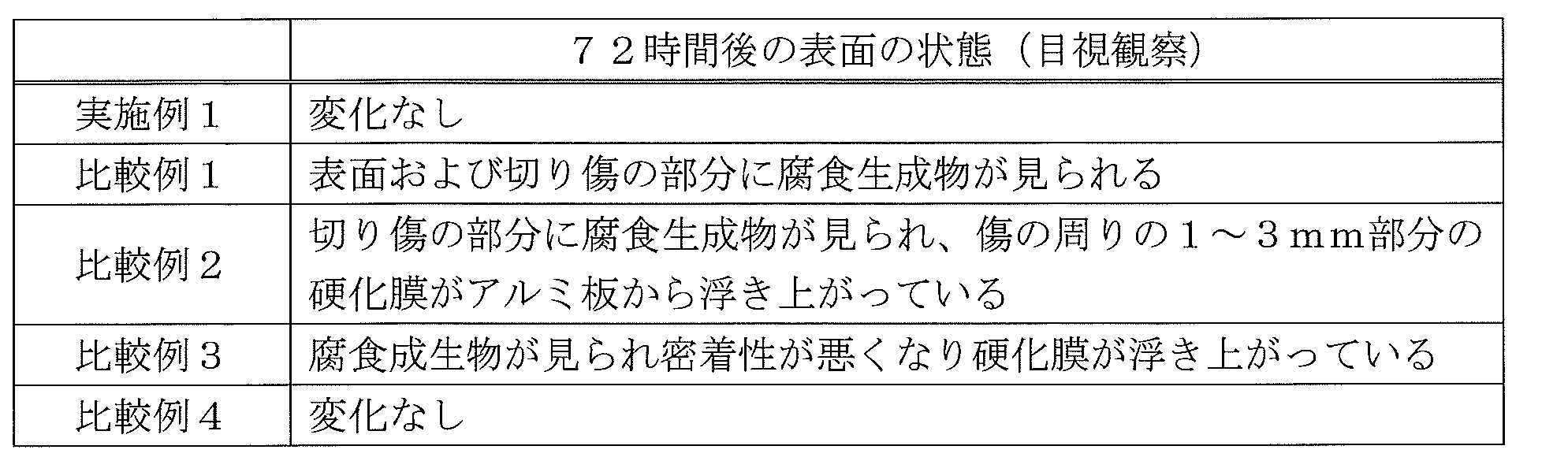
実施例1および比較例4については硬化膜およびアルミ板の劣化は観測されず、試験前後の差は見られなかったが、比較例2については切り傷の部分に腐食生成物が見られ、傷の周りの1~3mm部分の硬化膜がアルミ板から浮き上がっている様子が見られた。また、比較例3については全体にわたり腐食成生物が見られ、密着性が悪くなり硬化膜が浮き上がっている様子が見られた。放熱部材は、通常の使用条件下でも、硬化膜に傷がつくことはよくあるが、実施例1の硬化膜は、使用中において傷がついた場合であっても耐食性および放熱性が維持されるため好ましいことがわかった。
<耐候剤の添加による耐候性の強化>
実施例1および比較例1~5で作製したサンプルの耐候性の比較にて、実施例1で得られた硬化膜は耐候性に非常に優れていることが示されているが、より長期に亘る屋外用途での使用に耐え得るように、耐候剤として光安定剤やUV吸収剤を添加することにより、その性能をさらに強化させることも可能である。
そこで、より厳しい条件で耐候性を評価するために以下の試験を実施した。
実施例1および比較例1~5で作製したサンプルの耐候性の比較にて、実施例1で得られた硬化膜は耐候性に非常に優れていることが示されているが、より長期に亘る屋外用途での使用に耐え得るように、耐候剤として光安定剤やUV吸収剤を添加することにより、その性能をさらに強化させることも可能である。
そこで、より厳しい条件で耐候性を評価するために以下の試験を実施した。
[実施例6]
SS-1000(5.13g)の代わりに、SS-1000(5.26g)、(株)ADEKA製の光安定剤アデカノールUH-606(0.42g)、および、(株)ADEKA製の増粘剤アデカノールUH-756VF(0.09g)を用いた以外は、実施例1と同様にして、放熱塗料組成物を調製し、放熱部材を作製した。なお、得られた組成物は保存安定性に優れ、常温下ではゲル化等は起こらなかった。
SS-1000(5.13g)の代わりに、SS-1000(5.26g)、(株)ADEKA製の光安定剤アデカノールUH-606(0.42g)、および、(株)ADEKA製の増粘剤アデカノールUH-756VF(0.09g)を用いた以外は、実施例1と同様にして、放熱塗料組成物を調製し、放熱部材を作製した。なお、得られた組成物は保存安定性に優れ、常温下ではゲル化等は起こらなかった。
[実施例7]
SS-1000(5.13g)の代わりに、SS-1000(5.31g)、SONGWON社製の紫外線吸収剤SONGSORB CS1130(0.36g)、および、増粘剤アデカノールUH-756VF(0.09g)を用いた以外は、実施例1と同様にして、放熱塗料組成物を調製し、放熱部材を作製した。なお、得られた組成物は保存安定性に優れ、常温下ではゲル化等は起こらなかった。
SS-1000(5.13g)の代わりに、SS-1000(5.31g)、SONGWON社製の紫外線吸収剤SONGSORB CS1130(0.36g)、および、増粘剤アデカノールUH-756VF(0.09g)を用いた以外は、実施例1と同様にして、放熱塗料組成物を調製し、放熱部材を作製した。なお、得られた組成物は保存安定性に優れ、常温下ではゲル化等は起こらなかった。
[実施例8]
SS-1000(5.13g)の代わりに、SS-1000(5.29g)、SONGSORB CS1130(0.35g)、アデカノールUH-606(0.41g)、および、増粘剤アデカノールUH-756VF(0.09g)を用いた以外は、実施例1と同様にして、放熱塗料組成物を調製し、放熱部材を作製した。なお、得られた組成物は保存安定性に優れ、常温下ではゲル化等は起こらなかった。
SS-1000(5.13g)の代わりに、SS-1000(5.29g)、SONGSORB CS1130(0.35g)、アデカノールUH-606(0.41g)、および、増粘剤アデカノールUH-756VF(0.09g)を用いた以外は、実施例1と同様にして、放熱塗料組成物を調製し、放熱部材を作製した。なお、得られた組成物は保存安定性に優れ、常温下ではゲル化等は起こらなかった。
[実施例9]
SS-1000(5.13g)の代わりに、SS-1000(5.2g)、センカ(株)製の紫外線吸収剤BZ-24(1.08g)、および、増粘剤アデカノールUH-756VF(0.09g)を添加した以外は、実施例1と同様にして、放熱塗料組成物を調製し、放熱部材を作製した。なお、得られた組成物は保存安定性に優れ、常温下ではゲル化等は起こらなかった。
SS-1000(5.13g)の代わりに、SS-1000(5.2g)、センカ(株)製の紫外線吸収剤BZ-24(1.08g)、および、増粘剤アデカノールUH-756VF(0.09g)を添加した以外は、実施例1と同様にして、放熱塗料組成物を調製し、放熱部材を作製した。なお、得られた組成物は保存安定性に優れ、常温下ではゲル化等は起こらなかった。
[実施例10]
SS-1000(5.13g)の代わりに、SS-1000(5.25g)、センカ(株)製の紫外線吸収剤TA-22(0.72g)、および、増粘剤アデカノールUH-756VF(0.09g)を添加した以外は、実施例1と同様にして、放熱塗料組成物を調製し、放熱部材を作製した。なお、得られた組成物は保存安定性に優れ、常温下ではゲル化等は起こらなかった。
SS-1000(5.13g)の代わりに、SS-1000(5.25g)、センカ(株)製の紫外線吸収剤TA-22(0.72g)、および、増粘剤アデカノールUH-756VF(0.09g)を添加した以外は、実施例1と同様にして、放熱塗料組成物を調製し、放熱部材を作製した。なお、得られた組成物は保存安定性に優れ、常温下ではゲル化等は起こらなかった。
Q-Lab Corporation製モデルQUV型促進耐候性試験機を用いて、屋外暴露の加速試験を行った。下記表6に記載の実施例および比較例で得られた放熱部材をサンプルとし、光源にはUVB-313を使用し、放射照度を0.71W/m2/nm、UV照射時のブラックパネル温度を60℃、結露時の温度を50℃とし、各々のサンプルに対し、4時間ごとに結露の有無を切り替えながら96時間試験を行った。
96時間後の放熱部材表面の状態を目視観察した。結果を表6に示す。
96時間後の放熱部材表面の状態を目視観察した。結果を表6に示す。

耐候剤を添加した実施例6~10のいずれも、実施例1よりも耐候性が向上した。従って、耐候剤を用いることにより、放熱性に優れ、長期にわたり使用できる硬化膜を得ることができ、硬化膜を有する物品を塗装し直す回数や、物品自体を交換する頻度を減らすことができるため好ましい。
<架橋剤の添加による耐熱性の強化>
実施例1~5および比較例1~5で作製したサンプルの耐熱温度の評価にて、実施例1で得られた硬化膜は耐熱性に非常に優れていることが示されているが、より高温領域での使用に耐え得るように、架橋剤を添加することにより、その性能をさらに強化させることも可能である。
そこで、下記実施例11~16のサンプルを作製し、前記<耐熱温度の評価>と同様の試験を実施した。
実施例1~5および比較例1~5で作製したサンプルの耐熱温度の評価にて、実施例1で得られた硬化膜は耐熱性に非常に優れていることが示されているが、より高温領域での使用に耐え得るように、架橋剤を添加することにより、その性能をさらに強化させることも可能である。
そこで、下記実施例11~16のサンプルを作製し、前記<耐熱温度の評価>と同様の試験を実施した。
[実施例11]
SS-1000(5.13g)の代わりに、SS-1000(5.26g)、日本触媒(株)製の架橋剤エポクロスSW-500(0.6g)、および、増粘剤アデカノールUH-756VF(0.09g)を用いた以外は、実施例1と同様にして、放熱塗料組成物を調製し、放熱部材を作製した。なお、得られた組成物は保存安定性に優れ、常温下ではゲル化等は起こらなかった。
SS-1000(5.13g)の代わりに、SS-1000(5.26g)、日本触媒(株)製の架橋剤エポクロスSW-500(0.6g)、および、増粘剤アデカノールUH-756VF(0.09g)を用いた以外は、実施例1と同様にして、放熱塗料組成物を調製し、放熱部材を作製した。なお、得られた組成物は保存安定性に優れ、常温下ではゲル化等は起こらなかった。
[実施例12]
SS-1000(5.13g)の代わりに、SS-1000(5.22g)、日本触媒(株)製の架橋剤エポクロスSW-700(0.6g)、および、増粘剤アデカノールUH-756VF(0.09g)を用いた以外は、実施例1と同様にして、放熱塗料組成物を調製し、放熱部材を作製した。なお、得られた組成物は保存安定性に優れ、常温下ではゲル化等は起こらなかった。
SS-1000(5.13g)の代わりに、SS-1000(5.22g)、日本触媒(株)製の架橋剤エポクロスSW-700(0.6g)、および、増粘剤アデカノールUH-756VF(0.09g)を用いた以外は、実施例1と同様にして、放熱塗料組成物を調製し、放熱部材を作製した。なお、得られた組成物は保存安定性に優れ、常温下ではゲル化等は起こらなかった。
[実施例13]
SS-1000(5.13g)の代わりに、SS-1000(5.22g)、日清紡ケミカルズ(株)製の架橋剤カルボジライトV-04(1.2g)、および、増粘剤アデカノールUH-756VF(0.09g)を用いた以外は、実施例1と同様にして、放熱塗料組成物を調製し、放熱部材を作製した。なお、得られた組成物は保存安定性に優れ、常温下ではゲル化等は起こらなかった。
SS-1000(5.13g)の代わりに、SS-1000(5.22g)、日清紡ケミカルズ(株)製の架橋剤カルボジライトV-04(1.2g)、および、増粘剤アデカノールUH-756VF(0.09g)を用いた以外は、実施例1と同様にして、放熱塗料組成物を調製し、放熱部材を作製した。なお、得られた組成物は保存安定性に優れ、常温下ではゲル化等は起こらなかった。
[実施例14]
SS-1000(5.13g)の代わりに、SS-1000(5.26g)、日清紡ケミカルズ(株)製の架橋剤カルボジライトSV-02(0.6g)、および、増粘剤アデカノールUH-756VF(0.09g)を用いた以外は、実施例1と同様にして、放熱塗料組成物を調製し、放熱部材を作製した。なお、得られた組成物は保存安定性に優れ、常温下ではゲル化等は起こらなかった。
SS-1000(5.13g)の代わりに、SS-1000(5.26g)、日清紡ケミカルズ(株)製の架橋剤カルボジライトSV-02(0.6g)、および、増粘剤アデカノールUH-756VF(0.09g)を用いた以外は、実施例1と同様にして、放熱塗料組成物を調製し、放熱部材を作製した。なお、得られた組成物は保存安定性に優れ、常温下ではゲル化等は起こらなかった。
[実施例15]
SS-1000(5.13g)の代わりに、SS-1000(5.26g)、日清紡ケミカルズ(株)製の架橋剤カルボジライトE-02(0.6g)、および、増粘剤アデカノールUH-756VF(0.09g)を用いた以外は、実施例1と同様にして、放熱塗料組成物を調製し、放熱部材を作製した。なお、得られた組成物は保存安定性に優れ、常温下ではゲル化等は起こらなかった。
SS-1000(5.13g)の代わりに、SS-1000(5.26g)、日清紡ケミカルズ(株)製の架橋剤カルボジライトE-02(0.6g)、および、増粘剤アデカノールUH-756VF(0.09g)を用いた以外は、実施例1と同様にして、放熱塗料組成物を調製し、放熱部材を作製した。なお、得られた組成物は保存安定性に優れ、常温下ではゲル化等は起こらなかった。
[実施例16]
SS-1000(5.13g)の代わりに、SS-1000(5.22g)、日清紡ケミカルズ(株)製の架橋剤カルボジライトE-05(0.36g)、および、増粘剤アデカノールUH-756VF(0.09g)を用いた以外は、実施例1と同様にして、放熱塗料組成物を調製し、放熱部材を作製した。なお、得られた組成物は保存安定性に優れ、常温下ではゲル化等は起こらなかった。
SS-1000(5.13g)の代わりに、SS-1000(5.22g)、日清紡ケミカルズ(株)製の架橋剤カルボジライトE-05(0.36g)、および、増粘剤アデカノールUH-756VF(0.09g)を用いた以外は、実施例1と同様にして、放熱塗料組成物を調製し、放熱部材を作製した。なお、得られた組成物は保存安定性に優れ、常温下ではゲル化等は起こらなかった。
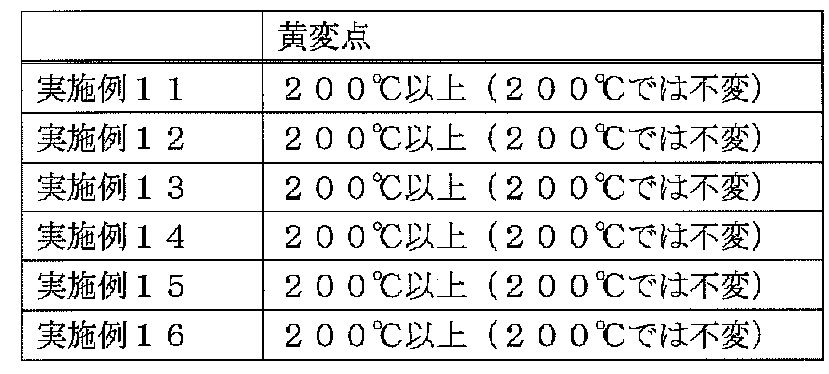
架橋剤を添加した実施例11~16のいずれも、実施例1よりも耐熱温度が向上した。架橋剤を用いることにより、より高温の物品や発熱体に使用可能な硬化膜を容易に得ることができるため好ましい。
Claims (17)
- アクリル重合体を含有するポリエステル形成成分と、放熱フィラーとを含む、放熱塗料組成物。
- 水系組成物である、請求項1に記載の放熱塗料組成物。
- 前記アクリル重合体が、水酸基、カルボキシル基、オキソヘテロ環基、アルコキシシリル基、アミノ基、カルボニル基およびスルホ基からなる群より選ばれる少なくとも1つの基を有する、請求項1または2に記載の放熱塗料組成物。
- 前記ポリエステル形成成分が、二価以上のカルボン酸化合物、二価以上のヒドロキシ化合物、または、分解もしくは開環によりカルボキシル基もしくはヒドロキシ基が生成される化合物の少なくとも1種を含む、請求項1~3のいずれか1項に記載の放熱塗料組成物。
- 前記アクリル重合体の重量平均分子量が500~40000の範囲にある、請求項1~4のいずれか1項に記載の放熱塗料組成物。
- 前記放熱フィラーが、ケイ酸塩化合物、窒化ホウ素、窒化アルミニウム、シリカ、アルミナ、酸化亜鉛、酸化チタン、炭化ケイ素、黒鉛およびナノダイヤモンドからなる群より選ばれる少なくとも1種を含む、請求項1~5のいずれか1項に記載の放熱塗料組成物。
- 前記放熱フィラーが斜方晶系のケイ酸塩化合物を含む、請求項1~6のいずれか1項に記載の放熱塗料組成物。
- 前記斜方晶系のケイ酸塩化合物がコーディエライトまたはムライトである、請求項7に記載の放熱塗料組成物。
- 放熱塗料組成物に対して前記放熱フィラーを5~60重量%含有する、請求項1~8のいずれか1項に記載の放熱塗料組成物。
- 前記放熱フィラーの平均粒径が0.1~20μmである、請求項1~9のいずれか1項に記載の放熱塗料組成物。
- 請求項1~10のいずれか1項に記載の放熱塗料組成物をエステル化反応させる工程を含む、硬化膜の製造方法。
- 請求項1~10のいずれか1項に記載の放熱塗料組成物の硬化膜。
- 厚さ0.4mmのアルミ板上に形成した厚さ30μmの硬化膜のイエローインデックス値と、該硬化膜をホットプレート上にて大気中で10分間加熱した後におけるイエローインデックス値との差が3以上となる加熱温度が170℃以上である、請求項12に記載の硬化膜。
- 銅、鉄、マグネシウム、アルミニウム、ニッケルまたはこれらのいずれかの金属を含有する合金からなる金属層と、
該金属層の少なくとも一部を被覆する、請求項12または13に記載の硬化膜と
を有する、金属部材。 - 請求項14に記載の金属部材からなる放熱部材。
- 請求項14に記載の金属部材を含む電子物品。
- 請求項15に記載の放熱部材を含む電子物品。
Priority Applications (1)
| Application Number | Priority Date | Filing Date | Title |
|---|---|---|---|
| JP2018537136A JPWO2018043174A1 (ja) | 2016-08-31 | 2017-08-21 | 放熱塗料組成物、硬化膜の製造方法、硬化膜、金属部材、放熱部材および電子部品 |
Applications Claiming Priority (2)
| Application Number | Priority Date | Filing Date | Title |
|---|---|---|---|
| JP2016169684 | 2016-08-31 | ||
| JP2016-169684 | 2016-08-31 |
Publications (1)
| Publication Number | Publication Date |
|---|---|
| WO2018043174A1 true WO2018043174A1 (ja) | 2018-03-08 |
Family
ID=61300620
Family Applications (1)
| Application Number | Title | Priority Date | Filing Date |
|---|---|---|---|
| PCT/JP2017/029751 Ceased WO2018043174A1 (ja) | 2016-08-31 | 2017-08-21 | 放熱塗料組成物、硬化膜の製造方法、硬化膜、金属部材、放熱部材および電子部品 |
Country Status (3)
| Country | Link |
|---|---|
| JP (1) | JPWO2018043174A1 (ja) |
| TW (1) | TW201829663A (ja) |
| WO (1) | WO2018043174A1 (ja) |
Cited By (1)
| Publication number | Priority date | Publication date | Assignee | Title |
|---|---|---|---|---|
| JP2023055078A (ja) * | 2021-10-05 | 2023-04-17 | Ube株式会社 | 放熱塗料及び放熱性塗膜 |
Citations (2)
| Publication number | Priority date | Publication date | Assignee | Title |
|---|---|---|---|---|
| JP2002161244A (ja) * | 2000-11-27 | 2002-06-04 | Jsr Corp | 熱伝導性膜、その形成用液、熱伝導性膜付基材、その製造方法、放熱板および放熱構造 |
| JP2012036314A (ja) * | 2010-08-09 | 2012-02-23 | Shimizu:Kk | 電着塗料用樹脂組成物、水性電着塗料、塗装方法および塗装物 |
-
2017
- 2017-08-21 WO PCT/JP2017/029751 patent/WO2018043174A1/ja not_active Ceased
- 2017-08-21 JP JP2018537136A patent/JPWO2018043174A1/ja active Pending
- 2017-08-25 TW TW106128953A patent/TW201829663A/zh unknown
Patent Citations (2)
| Publication number | Priority date | Publication date | Assignee | Title |
|---|---|---|---|---|
| JP2002161244A (ja) * | 2000-11-27 | 2002-06-04 | Jsr Corp | 熱伝導性膜、その形成用液、熱伝導性膜付基材、その製造方法、放熱板および放熱構造 |
| JP2012036314A (ja) * | 2010-08-09 | 2012-02-23 | Shimizu:Kk | 電着塗料用樹脂組成物、水性電着塗料、塗装方法および塗装物 |
Cited By (1)
| Publication number | Priority date | Publication date | Assignee | Title |
|---|---|---|---|---|
| JP2023055078A (ja) * | 2021-10-05 | 2023-04-17 | Ube株式会社 | 放熱塗料及び放熱性塗膜 |
Also Published As
| Publication number | Publication date |
|---|---|
| TW201829663A (zh) | 2018-08-16 |
| JPWO2018043174A1 (ja) | 2019-07-04 |
Similar Documents
| Publication | Publication Date | Title |
|---|---|---|
| WO2014136615A1 (ja) | 放熱性粉体塗料組成物、放熱性塗膜、及び被塗装物 | |
| JP6437702B2 (ja) | 熱放射性塗料、塗膜及び塗膜付き被塗布物の製造方法 | |
| KR20140063190A (ko) | 방열 흑색수지 코팅강판 | |
| JP6443443B2 (ja) | 防曇剤組成物並びに防曇性物品及びその製造方法 | |
| CN100427221C (zh) | 铝基材的涂膜形成方法 | |
| JP2013095807A (ja) | 自己貼着性積層体フィルム | |
| KR101757287B1 (ko) | 비철금속용 베이스 도료 조성물 | |
| JP2009013364A (ja) | 粉体塗料組成物 | |
| WO2017038942A1 (ja) | 放熱塗料組成物、放熱部材、物品 | |
| WO2018043174A1 (ja) | 放熱塗料組成物、硬化膜の製造方法、硬化膜、金属部材、放熱部材および電子部品 | |
| JP6653485B2 (ja) | 離型フィルム | |
| JP2005162929A (ja) | 粉体プライマ組成物、粉体プライマ塗膜、塗膜の形成方法及び金属塗装製品の製造方法 | |
| JP2007217622A (ja) | 高拡散高反射用粉体塗料及びその塗料を用いた反射板 | |
| JP2009215372A (ja) | 艶消粉体塗料組成物及び塗膜形成方法 | |
| EP2152815B1 (en) | Resin compositions for wrinkle-pattern paint purposes | |
| JP2015229718A (ja) | 水性接着剤およびそれより得られる被膜 | |
| JP5679314B2 (ja) | 分子遮断性を有するシート状接着剤 | |
| CN116057139B (zh) | 粉末涂料组合物 | |
| KR101723102B1 (ko) | 방열 도포용 조성물, 이의 제조 방법 및 이를 이용한 도포 방법 | |
| JP2009215371A (ja) | 艶消粉体塗料組成物及び塗膜形成方法 | |
| KR20240115988A (ko) | 분체도료 조성물 | |
| TWI822211B (zh) | 防霧層及其利用 | |
| JP2005162930A (ja) | 粉体塗料組成物、塗膜の形成方法及び金属塗装製品の製造方法 | |
| CN112533707B (zh) | 有机硅烷涂布组合物 | |
| JP2000345076A (ja) | 熱硬化性艶消し粉体塗料組成物 |
Legal Events
| Date | Code | Title | Description |
|---|---|---|---|
| ENP | Entry into the national phase |
Ref document number: 2018537136 Country of ref document: JP Kind code of ref document: A |
|
| NENP | Non-entry into the national phase |
Ref country code: DE |
|
| 122 | Ep: pct application non-entry in european phase |
Ref document number: 17846182 Country of ref document: EP Kind code of ref document: A1 |