WO2018020732A1 - 樹脂組成物及びそれを用いた立体造形物 - Google Patents
樹脂組成物及びそれを用いた立体造形物 Download PDFInfo
- Publication number
- WO2018020732A1 WO2018020732A1 PCT/JP2017/011588 JP2017011588W WO2018020732A1 WO 2018020732 A1 WO2018020732 A1 WO 2018020732A1 JP 2017011588 W JP2017011588 W JP 2017011588W WO 2018020732 A1 WO2018020732 A1 WO 2018020732A1
- Authority
- WO
- WIPO (PCT)
- Prior art keywords
- meth
- group
- acrylate
- resin composition
- macromonomer
- Prior art date
- Legal status (The legal status is an assumption and is not a legal conclusion. Google has not performed a legal analysis and makes no representation as to the accuracy of the status listed.)
- Ceased
Links
Classifications
-
- C—CHEMISTRY; METALLURGY
- C08—ORGANIC MACROMOLECULAR COMPOUNDS; THEIR PREPARATION OR CHEMICAL WORKING-UP; COMPOSITIONS BASED THEREON
- C08F—MACROMOLECULAR COMPOUNDS OBTAINED BY REACTIONS ONLY INVOLVING CARBON-TO-CARBON UNSATURATED BONDS
- C08F265/00—Macromolecular compounds obtained by polymerising monomers on to polymers of unsaturated monocarboxylic acids or derivatives thereof as defined in group C08F20/00
- C08F265/04—Macromolecular compounds obtained by polymerising monomers on to polymers of unsaturated monocarboxylic acids or derivatives thereof as defined in group C08F20/00 on to polymers of esters
-
- C—CHEMISTRY; METALLURGY
- C08—ORGANIC MACROMOLECULAR COMPOUNDS; THEIR PREPARATION OR CHEMICAL WORKING-UP; COMPOSITIONS BASED THEREON
- C08F—MACROMOLECULAR COMPOUNDS OBTAINED BY REACTIONS ONLY INVOLVING CARBON-TO-CARBON UNSATURATED BONDS
- C08F290/00—Macromolecular compounds obtained by polymerising monomers on to polymers modified by introduction of aliphatic unsaturated end or side groups
- C08F290/02—Macromolecular compounds obtained by polymerising monomers on to polymers modified by introduction of aliphatic unsaturated end or side groups on to polymers modified by introduction of unsaturated end groups
- C08F290/04—Polymers provided for in subclasses C08C or C08F
Definitions
- the present invention relates to a resin composition suitable for use in optical modeling and a three-dimensional modeled product thereof.
- the resin composition for optical modeling that is cured by irradiating light energy has functions such as adhesives, adhesives, hard coat films for physical protection of the surface, chemical resistance, waterproofing, and antifouling.
- a plurality of cured thin films are laminated by repeating a coating film for forming a thin film made of a resin composition for optical modeling and a process of irradiating the thin film with light energy and curing the thin film a plurality of times.
- An optical three-dimensional modeling method (three-dimensional optical modeling method) for manufacturing a three-dimensional object having a desired shape is known (Patent Documents 1 and 2, etc.). According to this optical three-dimensional modeling method, even if the shape of the three-dimensional model to be manufactured is complicated, a desired three-dimensional model can be manufactured easily and in a relatively short time.
- a composition containing an ethylenically unsaturated compound having a crosslinked alicyclic hydrocarbon group Patent Document 3
- a composition containing a specific urethane (meth) acrylate Patent document 4
- the composition (patent document 5) containing an energy-beam curable cation polymerizable organic compound and an energy-beam sensitive cationic polymerizable initiator is disclosed as a cationically polymerizable resin composition.
- the resin composition is required to have a fast curing property that can be quickly cured by light energy irradiation, and to have good mechanical properties (such as tensile strength and tensile elongation) of the resulting molded product.
- a general resin composition contains a monomer having two or more radical groups, there are many crosslinked shaped articles, and it is considered difficult to achieve both tensile strength and tensile elongation.
- a method for improving the mechanical properties of the active energy ray-curable composition a method of adding a polymer having a reactive functional group at the terminal to the composition is known.
- the characteristics of a cured product such as low warpage and high hardness are known.
- Patent Documents 6 and 7 a technique for achieving both tensile strength and tensile elongation has not been known.
- the present invention has been made in view of the above circumstances, and has a rapid curing property and a resin composition having good mechanical properties (tensile strength and tensile elongation) of the resulting molded article, and the same. It aims at providing a three-dimensional molded item.
- the inventors of the present invention mix and combine a macromonomer, another radical polymerizable compound, and a radical polymerization initiator (photopolymerization initiator) to make the relationship between the weight average molecular weight of the macromonomer and the composition ratio appropriate.
- a radical polymerization initiator photopolymerization initiator
- a resin composition comprising a macromonomer (A), a compound (B) having two or more radical polymerizable groups excluding the macromonomer (A), and a radical polymerization initiator (C).
- X and y when the amount of the macromonomer (A) per 100 parts by mass of the compound (B) having two or more radical polymerizable groups is x parts by mass, and the weight average molecular weight of the macromonomer (A) is y
- a product having a product of 10000 to 130,000 is
- a resin composition for optical modeling that has a low viscosity when uncured, has high curability, and has a high mechanical property (tensile strength and tensile elongation). can do. Moreover, by using this resin composition, it is possible to provide a shaped article having a desired shape and dimensions and excellent mechanical properties (tensile strength and tensile elongation).
- the resin composition of the present invention contains a macromonomer (A), a compound (B) having two or more radical polymerizable groups other than the macromonomer (A), and a radical polymerization initiator (C).
- the radically polymerizable group means a group that polymerizes in a radical polymerization reaction, and includes, for example, a double bond.
- the macromonomer means a polymer having a polymerizable functional group.
- a molded product having unprecedented bending strength and tensile strength and having excellent elongation can be obtained by using a macromonomer having a radical polymerizable group.
- (meth) acrylate when used as a radical polymerizable group, the radical reactivity is high due to the polarity of carbonyl, and it can have fast curability. Furthermore, methacrylate is less reactive than acrylate due to the steric hindrance of the methyl group, and it is possible to selectively use methacrylate and acrylate according to the characteristics of the optical molding resin composition.
- the macromonomer structure is preferably represented by the following formula (1). That is, the macromonomer (A) has a radical polymerizable group at one end of the poly (meth) acrylate segment, and is also called a macromer.
- “(meth) acrylate” means “acrylate” or “methacrylate”.
- one end of the poly (meth) acrylate segment is a carbon-carbon bond chain in which unsaturated double bond portions of (meth) acrylate are connected as shown in the formula (1). It is a terminal group and means a group located on the side opposite to Z.
- the “repeating unit” means a structural unit derived from polymerization of a monomer.
- each R is independently a hydrogen atom, an alkyl group, a cycloalkyl group, an aryl group or a heterocyclic group.
- the alkyl group, cycloalkyl group, aryl group or heterocyclic group can have a substituent.
- alkyl group of R examples include a branched or straight chain alkyl group having 1 to 20 carbon atoms. Specific examples of the branched or straight chain alkyl group having 1 to 20 carbon atoms include methyl group, ethyl group, n-propyl group, i-propyl group, n-butyl group, t-butyl group, i-butyl group, and pentyl.
- a methyl group, an ethyl group, an n-propyl group, an i-propyl group, an n-butyl group and a t-butyl group are more preferable, and a methyl group is particularly preferable.
- Examples of the cycloalkyl group of R include cycloalkyl groups having 3 to 20 carbon atoms.
- Specific examples of the cycloalkyl group having 3 to 20 carbon atoms include a cyclopropyl group, a cyclobutyl group, a cyclopentyl group, a cyclohexyl group, a cycloheptyl group, a cyclooctyl group, and an adamantyl group. From the viewpoint of availability, a cyclopropyl group, a cyclobutyl group and an adamantyl group are preferred.
- aryl group for R examples include aryl groups having 6 to 18 carbon atoms. Specific examples of the aryl group having 6 to 18 carbon atoms include a phenyl group and a naphthyl group.
- heterocyclic group for R examples include heterocyclic groups having 5 to 18 carbon atoms.
- Specific examples of the plurality of R heterocyclic groups include a ⁇ -lactone group and an ⁇ -caprolactone group.
- Examples of the hetero atom contained in the heterocyclic ring include an oxygen atom, a nitrogen atom, and a sulfur atom.
- R group each independently represents an alkyl group, an aryl group, a carboxyl group, an alkoxycarbonyl group (—COOR ′), a carbamoyl group (—CONR′R ′′), a cyano group, a hydroxyl group, an amino group.
- substituent of the R group each independently represents an alkyl group, an aryl group, a carboxyl group, an alkoxycarbonyl group (—COOR ′), a carbamoyl group (—CONR′R ′′), a cyano group, a hydroxyl group, an amino group.
- Examples include groups or atoms selected from the group consisting of a group (—NR′R ′′), a halogen, an allyl group, an epoxy group, an alkoxy group (—OR ′), or a group exhibiting hydrophilicity or ionicity.
- R ′ and R ′′ are each independently the same group as R except for a heterocyclic group.
- alkoxycarbonyl group for the substituent of the R group examples include a methoxycarbonyl group.
- Examples of the carbamoyl group as a substituent of the R group include an N-methylcarbamoyl group and an N, N-dimethylcarbamoyl group.
- halogen of the substituent of the R group examples include fluorine, chlorine, bromine and iodine.
- alkoxy group as the substituent of the R group examples include an alkoxy group having 1 to 12 carbon atoms, and specific examples thereof include a methoxy group.
- Examples of the group showing the hydrophilicity or ionicity of the substituent of the R group include, for example, alkali salts of carboxyl groups or alkali salts of sulfoxyl groups, poly (alkylene oxide) groups such as polyethylene oxide groups and polypropylene oxide groups, and quaternary groups. And cationic substituents such as ammonium base.
- R is preferably at least one selected from an alkyl group and a cycloalkyl group, and more preferably an alkyl group.
- alkyl group a methyl group, an ethyl group, an n-propyl group, an i-propyl group, an n-butyl group, a t-butyl group, a pentyl group, a hexyl group, a heptyl group and an octyl group from the viewpoint of availability.
- a methyl group, an ethyl group, an n-propyl group, an i-propyl group, an n-butyl group and a t-butyl group are more preferable, and a methyl group is particularly preferable.
- X is at least one selected from a hydrogen atom and a methyl group, preferably a methyl group.
- the proportion of methacrylate may be 80% by mass or more.
- Z is a terminal group of the macromonomer (a).
- the terminal group of the macromonomer (a) include a group derived from a hydrogen atom and a radical polymerization initiator, similarly to the terminal group of a polymer obtained by known radical polymerization.
- N represents the number of moles of monomer units contained in one molecule of the macromonomer (A) (however, the number excluding monomer units having a double bond).
- n is an integer of 2 to 10,000.
- n is preferably 10 to 400, and more preferably 20 to 100. If n is too small, the tensile strength and tensile elongation cannot be improved. If it is too large, the viscosity of the resin composition is too high to be practical.
- This invention pays attention to the ratio of the addition rate with respect to the mass average molecular weight of the macromonomer, and the macromonomer per 100 parts by mass of the compound (B) having two or more radically polymerizable groups contained in the resin composition
- the product of x and y (hereinafter also referred to as the product xy) when the amount of A) is x parts by mass and the weight average molecular weight of the macromonomer (A) is y is 10,000 to 130,000.
- the product xy is 10,000 or more, the yield strength is improved and the mechanical strength is excellent.
- the value of the product xy is 130,000 or less, the fracture strain is improved and the mechanical strength is excellent.
- the product xy is more preferably 20,000 or more, and from the viewpoint of fracture strain, it is more preferably 110,000 or less.
- the product xy is preferably 20,000 or more and 110,000 or less.
- the blending amount of the component (A) in the resin composition of the present invention is not particularly limited, but is preferably 1 to 75 parts by mass with respect to 100 parts by mass in total of the components (A) and (B). 50 parts by mass is more preferable, and 2 to 30 parts by mass is more preferable. (A) If the amount of the component is less than 1 part by mass, the resulting molded article cannot be improved in tensile strength and tensile elongation, and if it exceeds 75 parts by mass, the liquid viscosity of the resin composition becomes high and a molded article is obtained. May be difficult.
- the amount of component (A) is preferably 1 to 30 parts by weight, more preferably 1 to 20 parts by weight per 100 parts by weight of component (B). When the amount of the component (A) is within the above numerical range, the yield strength and fracture strain are improved and the mechanical strength is excellent.
- the weight average molecular weight of the macromonomer (A) is preferably 2000 to 40,000, and more preferably 5000 to 20000 from the viewpoint of handleability.
- a weight average molecular weight is a mass average molecular weight of polymethylmethacrylate conversion measured by gel permeation chromatography (GPC).
- component (B component) In the present invention, the compound (B) containing a compound having a radical polymerizable group and containing two or more radical polymerizable groups is blended.
- Component (B) is blended as a reactive diluent for component (A), which tends to become solid content or high viscosity, and in addition to adjust the strength, elasticity, and heat resistance of the resulting molded article. Is blended into.
- ester type di ester type di, tri, tetra, penta, and hexa (meth) acrylate derived from various polyalcohols
- di (meth) acrylamides di (meth) acrylamides, urethane poly (meth) acrylate, Epoxy (meth) acrylate, polyester (meth) acrylate, vinyl ether compound, vinyl ester compound, allyl compound and the like
- di (meth) acrylamides di (meth) acrylamides, urethane poly (meth) acrylate, Epoxy (meth) acrylate, polyester (meth) acrylate, vinyl ether compound, vinyl ester compound, allyl compound and the like
- These can use 1 type (s) or 2 or more types.
- component (B) examples include ethylene glycol di (meth) acrylate, diethylene glycol di (meth) acrylate, triethylene glycol di (meth) acrylate, tetraethylene glycol di (meth) acrylate, di (meta) ) Polyethylene glycol acrylate (number of repeating units: 5 to 14), propylene glycol di (meth) acrylate, dipropylene glycol di (meth) acrylate, tripropylene glycol di (meth) acrylate, di (meth) acrylic acid Tetrapropylene glycol, polypropylene glycol di (meth) acrylate (repeating unit number: 5 to 14), 1,3-butylene glycol di (meth) acrylate, 1,4-butanediol di (meth) acrylate, di ( (Meth) acrylic acid polybutylene glycol Return unit number: 3 to 16), poly (1-methylbutylene glycol) di (meth) acrylate (repeating unit number:
- component (B) include, in addition to the above, di (meth) acrylic acid ester of caprolactone adduct of hydroxypentylglycolate neopentylglycol, di (meth) of ⁇ -butyrolactone adduct of neopentylglycol hydroxypivalate Di (meth) acrylic ester of caprolactone adduct of neopentyl glycol, di (meth) acrylic ester of caprolactone adduct of butylene glycol, di (meth) acrylic ester of caprolactone adduct of cyclohexanedimethanol Di (meth) acrylic acid ester of caprolactone adduct of dicyclopentanediol, di (meth) acrylic acid ester of caprolactone adduct of bisphenol A, di (meth) acrylate of caprolactone adduct of bisphenol F Le ester, dimethylol tricyclo
- di (meth) acrylic acid ester of bisphenol A ethylene oxide adduct di (meth) acrylic acid ester of bisphenol A propylene oxide adduct, bisphenol F ethylene oxide adduct
- Di (meth) acrylates such as di (meth) acrylates, di (meth) acrylates of bisphenol F propylene oxide adducts; trimethylolpropane tri (meth) acrylates, trimethylolpropane ethylene oxide adducts
- component (B) include, in addition to the above, tri (meth) acrylic acid ester of pentaerythritol caprolactone (4 to 8 mol) adduct, tetra (meth) pentaerythritol caprolactone (4 to 8 mol) adduct.
- Acrylic acid ester dipentaerythritol penta (meth) acrylic acid ester, dipentaerythritol hexa (meth) acrylic acid ester, dipentaerythritol caprolactone (4-12 mol) adduct penta (meth) acrylic acid ester, dipentaerythritol Hexa (meth) acrylic acid ester of caprolactone (4 to 12 mol) adduct, N, N ′, N ′′ -tris (acryloxyethyl) isocyanurate, N, N′-bis (acryloxyethyl) -N ′′- Poly (such as hydroxyethyl isocyanurate) ) Trimers of isocyanate compounds such as acrylate, hexamethylene diisocyanate, isophorone diisocyanate, tolylene diisocyanate, xylylene diisocyanate, diphenylmethane diisocyanate, hydrogenated diphen
- component (B) include, in addition to the above, bisphenol A glycidyl ether, bisphenol F glycidyl ether, phenol novolac epoxy resin, cresol novolac epoxy resin, pentaerythritol polyglycidyl ether, trimethylolpropane triglycidyl ether, tri Epoxy poly (meth) acrylate obtained by addition reaction of a polyepoxy compound having a plurality of epoxy groups in the molecule such as glycidyl tris (2-hydroxyethyl) isocyanurate and (meth) acrylic acid; phthalic acid, fumaric acid, Polycarboxylic acid such as maleic acid and ethylene glycol, polyethylene glycol (repeating unit number: 2 to 14), propylene glycol, polypropylene glycol (repeating unit number: 2 to 14), Two or more kinds selected from polyols (OH functional groups: 2 to 4) such as tylene glycol, polybutylene glycol, poly
- component (B) include, in addition to the above, bisphenol A glycidyl ether, bisphenol F glycidyl ether, phenol novolac epoxy resin, cresol novolac epoxy resin, pentaerythritol polyglycidyl ether, trimethylolpropane triglycidyl ether, tri Epoxy poly (meth) acrylate obtained by addition reaction of a polyepoxy compound having a plurality of epoxy groups in the molecule such as glycidyl tris (2-hydroxyethyl) isocyanurate and (meth) acrylic acid; phthalic acid, fumaric acid, Polycarboxylic acid such as maleic acid and ethylene glycol, polyethylene glycol (repeating unit number: 2 to 14), propylene glycol, polypropylene glycol (repeating unit number: 2 to 14), Two or more kinds selected from polyols (OH functional groups: 2 to 4) such as tylene glycol, polybutylene glycol, poly
- di (meth) acrylic acid 1,6-hexanediol, di (meth) acrylic acid 1,9-nonanediol, and di (meth) acrylic are low viscosity and have a diluting action.
- Di (meth) acrylic acid ester of neopentyl glycol acid, caprolactone adduct of neopentyl glycol hydroxypivalate, dimethylol ditricyclodecane di (meth) acrylic acid ester, neopentyl glycol modified trimethylolpropane di (meth) acrylic acid Esters and the like are suitable for reducing the viscosity.
- component (B) in addition to the dilution components exemplified above, in the molecule, two or more radically polymerizable (meth) acryloyl groups, one or more amide groups, and two or more One or more urethane (meth) acrylates having a urethane group can be used.
- Urethane (meth) acrylate is an amide hydroxy compound having in its molecule one or more amide groups and two or more hydroxy groups (the hydroxy groups are reactive with the NCO group of component (b3)).
- b1) a diol (b2) selected from the group consisting of a polyether diol, a polyester diol, and a polycarbonate diol, an organic diisocyanate compound (b3), and a hydroxy group (this hydroxy group corresponds to the NCO group of the component (b3)) It is obtained by addition reaction with the (meth) acrylate (b4) containing (reactive).
- the amidohydroxy compound (b1) is a component that improves the strength (toughness) while maintaining the elongation of the cured product of the urethane (meth) acrylate compound.
- the reaction product of cyclic hydroxycarboxylic acid ester and the compound containing ammonia or primary or secondary amino nitrogen is preferable.
- Examples of the cyclic hydroxycarboxylic acid ester include ⁇ -butyrolactone, ⁇ -valerolactone, ⁇ -valerolactone, and ⁇ -caprolactone. These can use 1 type (s) or 2 or more types. Of these, ⁇ -butyrolactone and ⁇ -valerolactone are particularly preferable.
- Compounds containing primary or secondary amino nitrogen include ethanolamine, diethanolamine, N-methylethanolamine, N-ethylethanolamine, N-phenylethanolamine, 2-amino-1-butanol, 2-amino- Examples include 2-ethyl-1,3-propanediol, 6-amino-1-hexanol, 1,4-diaminobutane, 1,2-diaminocyclohexane, 1,10-diaminodecane and the like. These can use 1 type (s) or 2 or more types. Of these, ethanolamine, diethanolamine, and N-methylethanolamine are particularly preferable.
- reaction of a cyclic hydroxycarboxylic acid ester with ammonia or a compound containing a primary or secondary amino nitrogen is obtained by mixing equimolar amounts and heating at about 80-100 ° C. for 8-24 hours. Can be implemented.
- the components (b1) thus obtained 4-hydroxy-N- (2-hydroxyethyl) -N-methylbutanamide is particularly preferable.
- Diol (b2) is a component that improves the flexibility and elongation of a cured product of a urethane (meth) acrylate compound.
- the diol which does not have such a fear is used.
- one or more diols selected from polyether diol, polyester diol, and polycarbonate diol can be used.
- Commercially available products can be used. Specific examples thereof include polyethylene glycol (number of repeating units: 6 to 20), polypropylene glycol (number of repeating units: 6 to 20), and polybutylene glycol (number of repeating units: 6 to 20).
- 1-methylbutylene glycol (repeating unit number: 6 to 20), polycaprolactone diol, caprolactone addition of alkylene (2 to 10 carbon atoms) diol (repeating unit number: 2 to 10) diol, polycarbonate diol (4 to 4 carbon atoms) 6 aliphatic skeleton), polyester diol derived from phthalic acid and alkylene diol, polyester diol derived from maleic acid and alkylene diol, polyester diol derived from fumaric acid and alkylene diol, and the like.
- polybutylene glycol (repetition unit number: 6 to 20), polycaprolactone diol, and caprolactone addition (repetition unit number: 2 to 10) diol of alkylene (carbon number 2 to 10) diol are particularly preferable. Further, those having a mass average molecular weight of about 300 to 2,000 are preferred.
- Organic diisocyanate compound (b3) is a component that reacts with the hydroxy group of other components to generate a urethane group.
- the component (b3) is not particularly limited, but isophorone diisocyanate, bis (4-isocyanatocyclohexyl) methane, bis (4-isocyanatophenyl) methane, bis (3-chloro-4-isocyanatophenyl) methane, , 4-tolylene diisocyanate, 2,6-tolylene diisocyanate, tris (4-isocyanatophenyl) methane, 1,2-xylene diisocyanate, 1,4-xylene diisocyanate, 1,2-hydrogenated xylene diisocyanate, 1, 4-Hydrogenated xylene diisocyanate, tetramethylxylylene diisocyanate, naphthalene diisocyanate, hexamethylene diisocyanate and the like.
- isophorone diisocyanate bis (4-isocyanatocyclohexyl) methane, 2,4-tolylene diisocyanate, 2,6-tolylene diisocyanate, 1,2-xylylene diisocyanate, 1,4-xylylene diisocyanate, 1,2 -Hydrogenated xylene diisocyanate and 1,4-hydrogenated xylene diisocyanate are preferred.
- aliphatics or fats such as isophorone diisocyanate, bis (4-isocyanatocyclohexyl) methane, 1,2-hydrogenated xylylene diisocyanate, 1,4-hydrogenated xylylene diisocyanate, etc. Those having a cyclic skeleton are preferred.
- Hydroxyl group-containing (meth) acrylate (b4) is a component that is added to the end of the polyurethane precursor obtained by the reaction to impart radical reactivity to the urethane (meth) acrylate compound.
- the component (b4) preferably has one or more (meth) acryloyl groups and one NCO-reactive hydroxy group in the molecule, and specific examples thereof include 2-hydroxyethyl (meth) acrylate, 2-hydroxypropyl (meth) acrylate, 4-hydroxybutyl (meth) acrylate, 6-hydroxyhexyl (meth) acrylate, cyclohexanedimethanol mono (meth) acrylate, trimethylolpropane di (meth) acrylate, pentaerythritol tri (meth) ) Acrylate, ditrimethylolpropane tri (meth) acrylate, dipentaerythritol penta (meth) acrylate, 2-hydroxybutyl (me
- the urethane (meth) acrylate compound is prepared, for example, by charging the component (b1) and the component (b2) having a total hydroxy group-containing equivalent of 0.9 mole equivalent into 2.0 moles under heating and stirring.
- An equivalent (b3) component is added dropwise to obtain a precursor isocyanate-terminated polyurethane, and 1.1 to 1.3 molar equivalents of (b4) component are further added dropwise thereto and heated to add. .
- “molar equivalent” means a number obtained by multiplying the number of moles of the compound used by the number of functional groups. That is, the “molar equivalent” is a number obtained by multiplying the number of moles of hydroxy groups in the molecule and the number of moles used in the amide hydroxy compound (b1), diol (b2), and hydroxy group-containing (meth) acrylate (b4). In the diisocyanate compound (b3), the number is the product of the number of NCO groups in the molecule and the number of moles used.
- the radical polymerization initiator (C) is a component for promoting the curing of the component (A) and the component (B) and producing a three-dimensional structure at an industrial speed by an optical three-dimensional modeling method.
- the radical polymerization initiator (C) is not particularly limited, but benzophenone, 4,4-bis (diethylamino) benzophenone, 2,4,6-trimethylbenzophenone, methyl orthobenzoylbenzoate, 4-phenylbenzophenone, t-butylanthraquinone Thioxanthones such as 2,4-diethylthioxanthone, isopropylthioxanthone, 2,4-dichlorothioxanthone; diethoxyacetophenone, 2-hydroxy-2-methyl-1-phenylpropan-1-one, benzyldimethyl Ketal, 1-hydroxycyclohexyl-phenylketone, 2-methyl-2-morpholino (4-thiomethylphenyl) propan-1-one, 2-benzyl-2-dimethylamino-1- (4-morpholinofe ) -Acetophenones such as butanone; benzoin ethers such as benzoin methyl ether, be
- the compounding amount of the component (C) in the resin composition of the present invention is not particularly limited, but is preferably 0.01 to 15 parts by mass with respect to 100 parts by mass in total of the components (A) and (B). Particularly preferred is 0.1 to 10 parts by mass.
- component amount is less than 0.01 mass part, the sclerosis
- the amount of the component exceeds 15 parts by mass, when the irradiation light energy when producing the three-dimensional model is small, odor may remain in the three-dimensional model obtained.
- ester type (meth) acrylates derived from various alkyl mono- or polyalcohols, mono (meth) acrylamides, urethane poly (meth) acrylates, epoxy (meth) acrylates, polyesters
- monofunctional (meth) acrylates such as (meth) acrylate, vinyl ether compounds, vinyl ester compounds, allyl compounds, and the like. These can use 1 type (s) or 2 or more types.
- component (D) include aromatic vinyl monomers such as styrene, ⁇ -methylstyrene, ⁇ -chlorostyrene, vinyltoluene, divinylbenzene; vinyl acetate, vinyl butyrate, N-vinylformamide, N-vinyl.
- aromatic vinyl monomers such as styrene, ⁇ -methylstyrene, ⁇ -chlorostyrene, vinyltoluene, divinylbenzene; vinyl acetate, vinyl butyrate, N-vinylformamide, N-vinyl.
- Vinyl ester monomers such as acetamide, N-vinyl-2-pyrrolidone, N-vinylcaprolactam and divinyl adipate; vinyl ethers such as ethyl vinyl ether and phenyl vinyl ether; allyl such as diallyl phthalate, trimethylolpropane diallyl ether and allyl glycidyl ether
- N N-dimethyl (meth) acrylamide, (meth) acryloylmorpholine, (meth) acrylic acid 2- Ethylhexyl, tetrahydrofurfuryl (meth) acrylate, benzyl (meth) acrylate, cyclohexyl (meth) acrylate, phenoxyethyl (meth) acrylate, tricyclodecane (meth) acrylate, isobornyl (meth) acrylate, ( (Meth) phenyl acrylate, etc.
- (meth) acryloylmorpholine which is a monofunctional (meth) acrylate, and isobonyl (meth) acrylate, have a ring skeleton, which increases the elastic modulus of the three-dimensional structure.
- This is preferable because it improves toughness.
- it is more preferable to use (meth) acryloylmorpholine because the hydrogen bond is strong, the elastic modulus is increased, and the toughness is improved.
- the blending amount of the component (D) in the resin composition of the present invention is not particularly limited, but is preferably 0.1 to 5 parts by mass with respect to 100 parts by mass in total of the component (A) and the component (B). 0.1 to 3 parts by mass is more preferable. When the content of the component (D) is within the above range, the curability is excellent.
- the resin composition of the present invention contains ethanolamine, diethanolamine, triethanolamine, N-methyldiethanolamine, methyl 4-dimethylaminobenzoate, 4 -Known photosensitizers such as ethyl dimethylaminobenzoate, amyl 4-dimethylaminobenzoate and 4-dimethylaminoacetophenone can be added.
- the resin composition of the present invention includes an elastomer particle, a release agent, a lubricant, a plasticizer, an antioxidant, an antistatic agent, a light stabilizer, an ultraviolet absorber, within the scope not departing from the spirit of the present invention.
- Various additives such as flame retardants, flame retardant aids, polymerization inhibitors, fillers, pigments, dyes, silane coupling agents, leveling agents, antifoaming agents, fluorescent agents, chain transfer agents, etc. Can be added.
- the elastomer particles are not particularly limited, but the core component is at least one selected from an acrylic rubbery polymer, a silicone rubbery polymer, and a silicone / acrylic composite rubbery polymer. Some core / shell elastomer particles can be used. By adding the elastomer particles, the impact resistance, tensile strength, tensile elongation, and weather resistance of the shaped article can be improved.
- acrylic rubbery polymer and “silicone rubbery polymer” include acrylic composite rubbery polymers and silicone composite rubbery polymers.
- Composite rubber-like polymer refers to a state in which two or more rubber-like polymers are entangled entirely or partially at a micro level or chemically bonded, and are individually rubber-like polymers. A simple blend of is excluded. The composite rubber-like polymer may be completely uniform as a whole, or may form independent domains in the submicron or nano order.
- the ultraviolet absorber is an effective component for controlling the curing depth of the resin composition.
- the blending amount of the ultraviolet absorber is not particularly limited, but is preferably 0.005 to 1 part by mass, particularly 0.01 to 0.8 part by mass with respect to 100 parts by mass of the resin composition.
- the organic solvent and water can also be added to the resin composition of this invention as needed in the range which does not impair the performance of the three-dimensional molded item obtained.
- the resin composition of the present invention is constituted as described above, and includes a macromonomer (A) having a radical polymerizable group as a curing component and a compound having a radical polymerizable functional group other than the macromonomer, and radical polymerization. It contains the compound (B) containing a compound having two or more functional groups and a radical polymerization initiator (C).
- a macromonomer (A) having a radical polymerizable group as a curing component and a compound having a radical polymerizable functional group other than the macromonomer, and radical polymerization.
- C radical polymerization initiator
- the resin composition of the present invention has a low viscosity when uncured, a thin film can be satisfactorily formed when subjected to optical modeling. Moreover, it has the property that it hardens
- the resin composition of the present invention comprises the components (A) to (C), the component (A) is polymethyl methacrylate, the component (B) is urethane acrylate, and ⁇ -caprolactone reaction of neopentyl glycol hydroxypivalate. And at least one selected from the group consisting of 2,4,6-trimethylbenzoyldiphenylphosphine oxide and 1-hydroxycyclohexyl phenyl ketone. One type is preferable.
- the resin composition of the present invention comprises the components (A) to (C), the component (A) is polymethyl methacrylate, the component (B) is urethane acrylate, and ⁇ -caprolactone reaction of neopentyl glycol hydroxypivalate.
- the resin composition of the present invention comprises the components (A) to (D), the component (A) is polymethyl methacrylate, the component (B) is urethane acrylate, and ⁇ -caprolactone reaction of neopentyl glycol hydroxypivalate. And at least one selected from the group consisting of 2,4,6-trimethylbenzoyldiphenylphosphine oxide and 1-hydroxycyclohexyl phenyl ketone.
- the resin composition of the present invention comprises the components (A) to (D), the component (A) is polymethyl methacrylate, the component (B) is urethane acrylate, and ⁇ -caprolactone reaction of neopentyl glycol hydroxypivalate. And at least one selected from the group consisting of 2,4,6-trimethylbenzoyldiphenylphosphine oxide and 1-hydroxycyclohexyl phenyl ketone.
- the component (D) is acryloylmorpholine
- the component (A) has a weight average molecular weight of 2200 to 10,000.
- the modeled article of the present invention is composed of a cured product of the above-described resin composition for optical modeling of the present invention.
- the structure, shape, size, and the like of the three-dimensional structure can be appropriately designed according to the application.
- the resin composition is cured and manufactured by applying light energy to the resin composition.
- light energy laser light emitted from Ar laser, He—Cd laser, He—Ne laser, ArF excimer laser, CO 2 laser, Nd: YAG laser, semiconductor laser, Dye laser, etc., xenon lamp, metal halide Active energy rays such as ultraviolet rays emitted from lamps, mercury lamps, fluorescent lamps and the like are preferable.
- the component (B) used in the examples and comparative examples is urethane acrylate (B-1) synthesized by the synthesis method described later and diacrylate (B) of the ⁇ -caprolactone reaction product of neopentyl glycol hydroxypivalate which is a bifunctional acrylate. -2) (KAYARAD HX-220, Nippon Kayaku Co., Ltd.) was used.
- component ((C) component) In this example and comparative example, as component (C), 2,4,6-trimethylbenzoyldiphenylphosphine oxide (C-1) (trade name: Irgacure TPO) and 1-hydroxycyclohexyl phenyl ketone (C-2) ) (BASF brand name: Irgacure 184) was used.
- C-1 trade name: Irgacure TPO
- C-2) 1-hydroxycyclohexyl phenyl ketone
- acryloylmorpholine (D-1) (Kj Chemicals Ltd. abbreviation: ACMO), which is a monofunctional acrylate, was used as the other component.
- a 200 ⁇ m thick shim plate is used as a spacer, the resin composition is sandwiched between glass plates, precured at 400 mJ / cm 2 at 0.67 mW / cm 2 using a 385 nm UV-LED, and then applied to JIS K6251 using a dumbbell cutter. Standard tension type 4 dumbbell pieces were prepared. Then, to produce a film for evaluation to post-cure and 1000mJ / cm 2 irradiated at 450mW / cm 2 by using a fusion lamp. The film was 200-230 ⁇ m thick.
- the tensile test was performed using a desktop tensile tester EZ-Test 500N (Shimadzu Corporation). Under test conditions in accordance with JIS K7127, the chuck interval was 20 mm, and the test speed was 5 mm / min. From the obtained stress strain diagram, the yield stress was taken as the yield strength, and the elongation at break was taken as the elongation at break.
- Examples 1 to 10 Comparative Examples 1 to 3
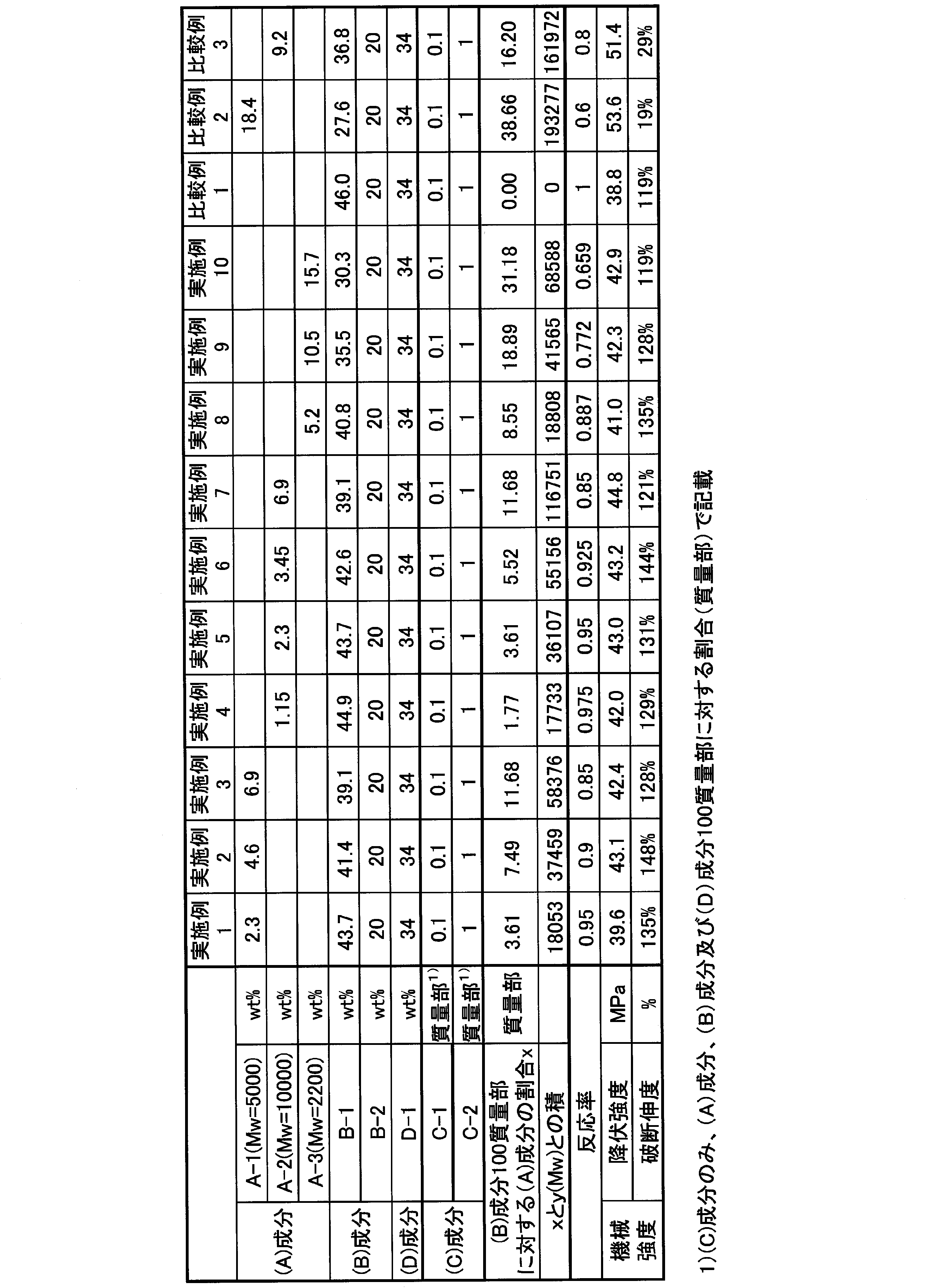
- Each component was mixed in the ratio shown in Table 1 (unit is “part”) to prepare a resin composition.
- a film was prepared and subjected to various evaluations. The evaluation results are shown in Table 1.
- Examples 1 to 10 resulted in an increase in tensile strength without a significant decrease in elongation.
- the present invention comprises an adhesive, a pressure-sensitive adhesive, a hard coat film for physical protection of the surface, a coat film for imparting functions such as chemical resistance, waterproofing, and antifouling, and a resin composition for optical modeling.
- Optical three-dimensional modeling that manufactures a three-dimensional modeled object of a desired shape by stacking a plurality of cured thin films by repeating a process of forming a thin film and a process of irradiating and curing light energy a plurality of times. This method is extremely useful for methods (three-dimensional stereolithography) and the like.
Landscapes
- Chemical & Material Sciences (AREA)
- Health & Medical Sciences (AREA)
- Chemical Kinetics & Catalysis (AREA)
- Medicinal Chemistry (AREA)
- Polymers & Plastics (AREA)
- Organic Chemistry (AREA)
- Macromonomer-Based Addition Polymer (AREA)
- Graft Or Block Polymers (AREA)
Abstract
マクロモノマー(A)と、前記マクロモノマー(A)を除くラジカル重合性基を2つ以上有する化合物(B)と、ラジカル重合開始剤(C)とを含有する樹脂組成物であって、樹脂組成物に含まれるラジカル重合性基を2つ以上有する化合物(B)100質量部あたりのマクロモノマー(A)の量をx質量部、前記マクロモノマー(A)重量平均分子量をyした場合のxとyとの積が、10000以上13万以下である樹脂組成物。
Description
本発明は、光学的造形用に用いるのに適した樹脂組成物、及びその立体造形物に関する。
本願は、2016年7月27日に、日本に出願された特願2016-146897号に基づき優先権を主張し、その内容をここに援用する。
本願は、2016年7月27日に、日本に出願された特願2016-146897号に基づき優先権を主張し、その内容をここに援用する。
光エネルギーを照射して硬化する光学的造形用の樹脂組成物には、接着剤や粘着剤、表面の物理的な保護のためのハードコート膜や耐薬品、防水、防汚などの機能付与のためのコート膜、または、光学的造形用樹脂組成物からなる薄膜を形成する工程と、該薄膜に対して光エネルギーを照射し硬化させる工程とを複数回繰り返すことにより、硬化した薄膜を複数積層させ、所望の形状の立体造形物を製造する光学的立体造形法(3次元光造形法)が知られている(特許文献1~2等)。
かかる光学的立体造形法によれば、製造する立体造形物の形状が複雑であっても、簡易にかつ比較的短時間で、所望の立体造形物を製造することができる。
かかる光学的立体造形法によれば、製造する立体造形物の形状が複雑であっても、簡易にかつ比較的短時間で、所望の立体造形物を製造することができる。
従来、ラジカル重合性の樹脂組成物として、架橋脂環式炭化水素基を有するエチレン性不飽和化合物を含有する組成物(特許文献3)や、特定のウレタン(メタ)アクリレートを含有する組成物(特許文献4)が開示されている。また、カチオン重合性の樹脂組成物として、エネルギー線硬化型カチオン重合性有機化合物とエネルギー線感受性カチオン重合性開始剤とを含有する組成物(特許文献5)が開示されている。
樹脂組成物には、光エネルギー照射により迅速に硬化する速硬化性を有すると共に、得られる造形物の機械的特性(引張強度、及び引張伸度等)が良好であることが必要である。しかしながら、一般的な樹脂組成物は2つ以上のラジカル性基を有するモノマーが含まれているため架橋した造形物が多く、引張強度、及び引張伸度の両立は難しいとされている。
活性エネルギー線硬化性組成物の機械的特性を改良する手法として、末端に反応性官能基を有するポリマーを組成物に配合する手法が知られており、例えば低反り、高硬度といった硬化物の特徴が示されている(特許文献6、7)。しかしながら、引張強度と引張伸度を両立する手法については知られていなかった。
本発明は上記事情に鑑みてなされたものであり、速硬化性を有し、得られる造形物の機械的特性(引張強度、及び引張伸度)が良好な樹脂組成物、及びこれを用いた立体造形物を提供することを目的とする。
本発明者らは、マクロモノマーと、他のラジカル重合性化合物と、ラジカル重合開始剤(光重合開始剤)とを合わせて配合し、マクロモノマーの重量平均分子量と組成比の関係を適正とすることで、上記課題を解決し得ることを見出し、本発明を完成した。
本発明は以下の態様を有する。
[1]マクロモノマー(A)と、前記マクロモノマー(A)を除くラジカル重合性基を2つ以上有する化合物(B)と、ラジカル重合開始剤(C)とを含有する樹脂組成物であって、
前記ラジカル重合性基を2つ以上有する化合物(B)100質量部あたりの前記マクロモノマー(A)の量をx質量部、前記マクロモノマー(A)の重量平均分子量をyした場合のxとyとの積が、10000以上13万以下である樹脂組成物。
[2]前記マクロモノマー(A)の量が、前記ラジカル重合性基を2つ以上有する化合物(B)100質量部あたりの1質量部以上30質量部以下である、[1]に記載の樹脂組成物。
[3]前記マクロモノマー(A)の重量平均分子量が2,000以上40,000以下である[1]または[2]に記載の樹脂組成物。
[4]前記マクロモノマー(A)が(メタ)アクリレート単位を繰り返し単位として有する[1]~[3]のいずれか一項に記載の樹脂組成物。
[5]前記(メタ)アクリレート単位がメチルメタクリレート単位である[4]に記載の樹脂組成物。
[6]前記マクロモノマー(A)が下記式(1)で示す構造である[1]~[5]のいずれか一項に記載の樹脂組成物。
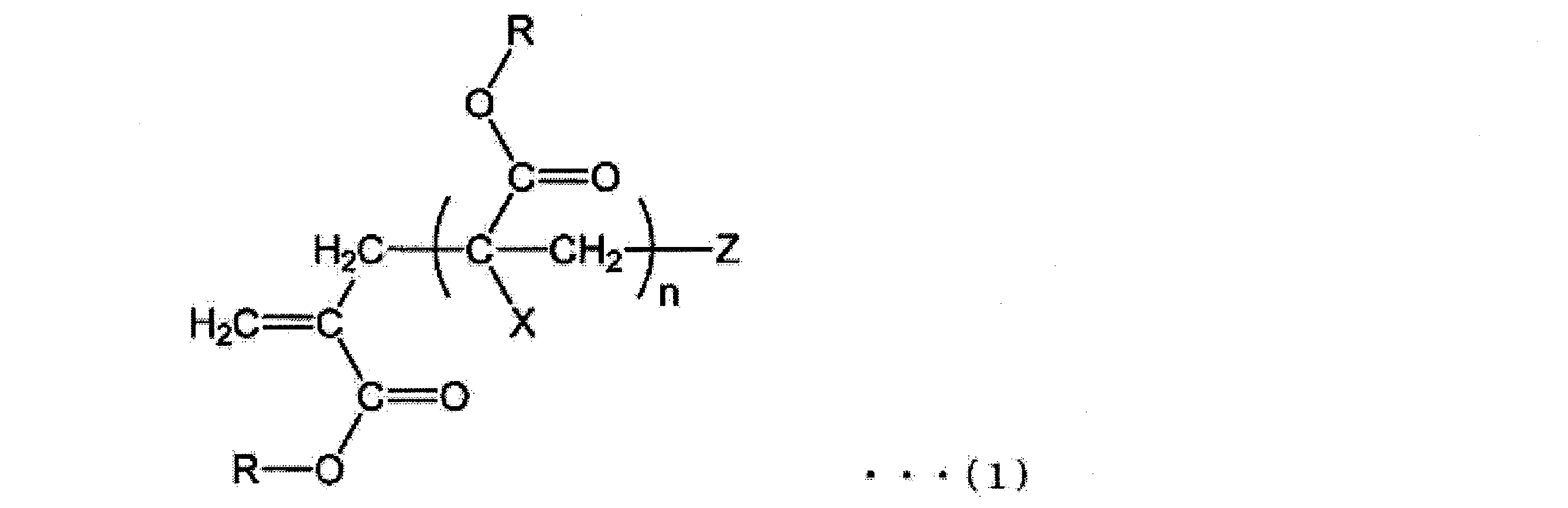
式(1)において、Rは水素原子、アルキル基、シクロアルキル基、アリール基又は複素環式基であり、複数のRはそれぞれ同じでも異なってもよく、Xは水素原子又はメチル基であり、複数のXはそれぞれ同じでも異なってもよく、Zは末端基であり、nは2~10000である。
[7]前記式(1)において、複数のR及び複数のXがすべてメチル基である[6]に記載の樹脂組成物。
[8]さらに、単官能(メタ)アクリレートを含む[1]~[7]のいずれか一項に記載の樹脂組成物。
[9][1]~[8]のいずれか一項に記載の樹脂組成物の硬化物からなる立体造形物。
[10]マクロモノマー(A)由来の微視的領域と化合物(B)由来の微視的領域とが相分離している[8]に記載の立体造形物。
[1]マクロモノマー(A)と、前記マクロモノマー(A)を除くラジカル重合性基を2つ以上有する化合物(B)と、ラジカル重合開始剤(C)とを含有する樹脂組成物であって、
前記ラジカル重合性基を2つ以上有する化合物(B)100質量部あたりの前記マクロモノマー(A)の量をx質量部、前記マクロモノマー(A)の重量平均分子量をyした場合のxとyとの積が、10000以上13万以下である樹脂組成物。
[2]前記マクロモノマー(A)の量が、前記ラジカル重合性基を2つ以上有する化合物(B)100質量部あたりの1質量部以上30質量部以下である、[1]に記載の樹脂組成物。
[3]前記マクロモノマー(A)の重量平均分子量が2,000以上40,000以下である[1]または[2]に記載の樹脂組成物。
[4]前記マクロモノマー(A)が(メタ)アクリレート単位を繰り返し単位として有する[1]~[3]のいずれか一項に記載の樹脂組成物。
[5]前記(メタ)アクリレート単位がメチルメタクリレート単位である[4]に記載の樹脂組成物。
[6]前記マクロモノマー(A)が下記式(1)で示す構造である[1]~[5]のいずれか一項に記載の樹脂組成物。
[7]前記式(1)において、複数のR及び複数のXがすべてメチル基である[6]に記載の樹脂組成物。
[8]さらに、単官能(メタ)アクリレートを含む[1]~[7]のいずれか一項に記載の樹脂組成物。
[9][1]~[8]のいずれか一項に記載の樹脂組成物の硬化物からなる立体造形物。
[10]マクロモノマー(A)由来の微視的領域と化合物(B)由来の微視的領域とが相分離している[8]に記載の立体造形物。
本発明によれば、未硬化時には低粘度であり、速硬化性を有し、得られる立体造形物の機械的特性(引張強度、及び引張伸度)が高い光学的造形用樹脂組成物を提供することができる。
また、この樹脂組成物を用いることにより、所望の形状や寸法を有し、機械的特性(引張強度、及び引張伸度)が良好な造形物を提供することができる。
また、この樹脂組成物を用いることにより、所望の形状や寸法を有し、機械的特性(引張強度、及び引張伸度)が良好な造形物を提供することができる。
以下、本発明について詳述する。本発明の樹脂組成物は、マクロモノマー(A)と、マクロモノマー(A)以外のラジカル重合性基を2つ以上有する化合物(B)と、ラジカル重合開始剤(C)とを含有する。
ラジカル重合性基とは、ラジカル重合反応において重合する基を意味し、例えば二重結合が挙げられる。
ラジカル重合性基とは、ラジカル重合反応において重合する基を意味し、例えば二重結合が挙げられる。
「(A)成分」
本発明においてマクロモノマーとは、重合性官能基を有する高分子を意味する。
本発明では、ラジカル重合性基を有するマクロモノマーを用いることで従来にない曲げ強度と引張強度を有し、優れた伸度を有する造形物が得られることを見出し、これを選定した。
本発明においてマクロモノマーとは、重合性官能基を有する高分子を意味する。
本発明では、ラジカル重合性基を有するマクロモノマーを用いることで従来にない曲げ強度と引張強度を有し、優れた伸度を有する造形物が得られることを見出し、これを選定した。
特にラジカル重合性基として(メタ)アクリレートを有するとカルボニルの極性によりラジカル反応性が高く速硬化性を有することができる。さらに、メタクリレートはアクリレートに比べメチル基の立体障害により反応性が穏やかであり、光学的造形用樹脂組成物の特性に応じてメタクリレートとアクリレートを使い分けることが可能である。
また、マクロモノマーの構造としては下記式(1)で表されるものが好ましい。すなわち、マクロモノマー(A)は、ポリ(メタ)アクリレートセグメントの一方の末端にラジカル重合性基を有するものであり、別名マクロマーと呼ばれるものである。なお、本明細書において「(メタ)アクリレート」とは「アクリレート」または「メタクリレート」を示す。また、本明細書においてポリ(メタ)アクリレートセグメントの一方の末端とは、前記式(1)のように、(メタ)アクリレートの不飽和二重結合部分が開いてつながった炭素-炭素結合鎖の末端基であり、Zとは反対側に位置する基のことを意味する。また、本明細書において「繰り返し単位」とは、モノマーが重合することにより誘導される構造単位を意味する。

前記式(1)において、Rはそれぞれ独立に、水素原子、アルキル基、シクロアルキル基、アリール基または複素環基である。アルキル基、シクロアルキル基、アリール基または複素環基は、置換基を有することができる。
Rのアルキル基としては例えば、炭素数1~20の分岐又は直鎖アルキル基が挙げられる。炭素数1~20の分岐又は直鎖アルキル基の具体例としては、メチル基、エチル基、n-プロピル基、i-プロピル基、n-ブチル基、t-ブチル基、i-ブチル基、ペンチル基、ヘキシル基、ヘプチル基、オクチル基、ノニル基、デシル基、ウンデシル基、ドデシル基、トリデシル基、テトラデシル基、ペンタデシル基、ヘキサデシル基、ヘプタデシル基、オクタデシル基、ノナデシル基及びイコシル基が挙げられる。これらの中で、入手のし易さから、メチル基、エチル基、n-プロピル基、i-プロピル基、n-ブチル基、t-ブチル基、ペンチル基、ヘキシル基、ヘプチル基及びオクチル基が好ましく、メチル基、エチル基、n-プロピル基、i-プロピル基、n-ブチル基及びt-ブチル基がより好ましく、メチル基が特に好ましい。
Rのシクロアルキル基としては、例えば、炭素数3~20のシクロアルキル基が挙げられる。炭素数3~20のシクロアルキル基の具体例としては、シクロプロピル基、シクロブチル基、シクロペンチル基、シクロヘキシル基、シクロヘプチル基、シクロオクチル基及びアダマンチル基が挙げられる。入手のし易さから、シクロプロピル基、シクロブチル基及びアダマンチル基が好ましい。
Rのアリール基としては、例えば、炭素数6~18のアリール基が挙げられる。炭素数6~18のアリール基の具体例としては、フェニル基及びナフチル基が挙げられる。
Rの複素環基としては、例えば、炭素数5~18の複素環基が挙げられる。複数のRの複素環基の具体例としては、γ-ラクトン基及びε-カプロラクトン基が挙げられる。複素環に含まれるヘテロ原子としては、酸素原子、窒素原子、硫黄原子等が挙げられる。
Rの基の置換基としては、それぞれ独立して、アルキル基、アリール基、カルボキシル基、アルコキシカルボニル基(-COOR’)、カルバモイル基(-CONR’R’’)、シアノ基、ヒドロキシル基、アミノ基(-NR’R’’)、ハロゲン、アリル基、エポキシ基、アルコキシ基(-OR’)又は親水性若しくはイオン性を示す基からなる群から選択される基又は原子が挙げられる。尚、R’又はR’’は、それぞれ独立して、複素環基を除いてRと同様の基が挙げられる。
Rの基の置換基のアルコキシカルボニル基としては、例えば、メトキシカルボニル基が挙げられる。
Rの基の置換基のカルバモイル基としては、例えば、N-メチルカルバモイル基及びN,N-ジメチルカルバモイル基が挙げられる。
Rの基の置換基のハロゲンとしては、例えば、フッ素、塩素、臭素及びヨウ素が挙げられる。
Rの基の置換基のアルコキシ基としては、例えば、炭素数1~12のアルコキシ基が挙げられ、具体例としては、メトキシ基が挙げられる。
Rの基の置換基の親水性又はイオン性を示す基としては、例えば、カルボキシル基のアルカリ塩又はスルホキシル基のアルカリ塩、ポリエチレンオキシド基、ポリプロピレンオキシド基等のポリ(アルキレンオキシド)基及び四級アンモニウム塩基等のカチオン性置換基が挙げられる。
Rは、アルキル基及びシクロアルキル基から選ばれる少なくとも1種が好ましく、アルキル基がより好ましい。
アルキル基としては、入手のし易さの観点からメチル基、エチル基、n-プロピル基、i-プロピル基、n-ブチル基、t-ブチル基、ペンチル基、ヘキシル基、ヘプチル基及びオクチル基が好ましく、メチル基、エチル基、n-プロピル基、i-プロピル基、n-ブチル基及びt-ブチル基がより好ましく、メチル基、が特に好ましい。
Xは水素原子及びメチル基から選ばれる少なくとも1種であり、メチル基が好ましい。
Xはマクロモノマー(A)の合成し易さの観点から、複数のXの半数以上がメチル基であることが好ましく、より好ましくはすべてがメチル基であることが好ましい。複数のXの半数以上をメチル基とするには、後述するマクロモノマー(A)を製造するための原料組成物(I)において、メタクリレートの割合を80質量%以上とすればよい。
Zは、マクロモノマー(a)の末端基である。マクロモノマー(a)の末端基としては、例えば、公知のラジカル重合で得られるポリマーの末端基と同様に、水素原子及びラジカル重合開始剤に由来する基が挙げられる。
nはマクロモノマー(A)1分子中に含まれるモノマー単位のモル数(ただし二重結合を有するモノマー単位を除いた数)を表す。nは、2~10,000の整数である。nは10~400が好ましく、20~100がより好ましい。nが小さすぎると、引張強度、及び引張伸度を改良することが出来ず、大きすぎると樹脂組成物の粘度が高すぎて実用に向かない。
本発明はマクロモノマーの質量平均分子量に対して添加率の割合に着目したものであり、樹脂組成物に含まれるラジカル重合性基を2つ以上有する化合物(B)100質量部あたりのマクロモノマー(A)の量をx質量部、前記マクロモノマー(A)の重量平均分子量をyした場合のxとyとの積(以下、積xyともいう)が、10000以上13万以下である。積xyの値が10000以上であると降伏強度が向上し機械強度に優れ、積xyの値が13万以下であると、破断歪みが向上し機械強度に優れる。降伏強度の観点からは、積xyが2万以上であるとより好ましく、破断歪みの観点からは11万以下であることがより好ましい。好ましくは積xyは2万以上11万以下である。
本発明の樹脂組成物における(A)成分の配合量は特に制限は無いが、(A)成分と(B)成分との合計100質量部に対して、1~75質量部が好ましく、1~50質量部がより好ましく、さらには2~30質量部であることが好ましい。(A)成分量が1質量部未満では、得られる造形物の引張強度、及び引張伸度の改良が出来ず、75質量部超では、樹脂組成物の液粘度が高くなり造形物を得るのが難しくなる恐れがある。
(A)成分の量は、(B)成分100質量部あたりの1~30質量部でが好ましく、1~20質量部がより好ましい。(A)成分の量が上記数値範囲内であると、降伏強度及び破断歪みが向上し機械強度に優れる。
マクロモノマー(A)の重量平均分子量は、取扱い性の観点から2000~40000であることが好ましく、5000~20000であることがより好ましい。
なお、重量平均分子量は、ゲル透過クロマトグラフィー(GPC)によって測定される、ポリメチルメタクリレート換算の質量平均分子量である。
なお、重量平均分子量は、ゲル透過クロマトグラフィー(GPC)によって測定される、ポリメチルメタクリレート換算の質量平均分子量である。
「B成分」
本発明では、ラジカル重合性基を有する化合物であって、ラジカル重合性基を2つ以上有する化合物を含む前記化合物(B)を配合する。(B)成分は、固形分もしくは高粘度になりやすい(A)成分の反応性希釈剤として配合される他、得られる造形物の強伸度や弾性率の調整、耐熱性等を付与するために配合される。
本発明では、ラジカル重合性基を有する化合物であって、ラジカル重合性基を2つ以上有する化合物を含む前記化合物(B)を配合する。(B)成分は、固形分もしくは高粘度になりやすい(A)成分の反応性希釈剤として配合される他、得られる造形物の強伸度や弾性率の調整、耐熱性等を付与するために配合される。
(B)成分としては特に制限は無いが、各種ポリアルコールから誘導されるエステル型ジ、トリ、テトラ、ペンタ、及びヘキサ(メタ)アクリレート、ジ(メタ)アクリルアミド類、ウレタンポリ(メタ)アクリレート、エポキシ(メタ)アクリレート、ポリエステル(メタ)アクリレート、ビニルエーテル化合物、ビニルエステル化合物、アリル化合物等が挙げられる。これらは1種又は2種以上を用いることができる。
(B)成分の具体例としては、ジ(メタ)アクリル酸エチレングリコール、ジ(メタ)アクリル酸ジエチレングリコール、ジ(メタ)アクリル酸トリエチレングリコール、ジ(メタ)アクリル酸テトラエチレングリコール、ジ(メタ)アクリル酸ポリエチレングリコール(繰り返し単位数:5~14)、ジ(メタ)アクリル酸プロピレングリコール、ジ(メタ)アクリル酸ジプロピレングリコール、ジ(メタ)アクリル酸トリプロピレングリコール、ジ(メタ)アクリル酸テトラプロピレングリコール、ジ(メタ)アクリル酸ポリプロピレングリコール(繰り返し単位数:5~14)、ジ(メタ)アクリル酸1,3-ブチレングリコール、ジ(メタ)アクリル酸1,4-ブタンジオール、ジ(メタ)アクリル酸ポリブチレングリコール(繰り返し単位数:3~16)、ジ(メタ)アクリル酸ポリ(1-メチルブチレングリコール)(繰り返し単位数:5~20)、ジ(メタ)アクリル酸1,6-ヘキサンジオール、ジ(メタ)アクリル酸1,9-ノナンジオール、ジ(メタ)アクリル酸ネオペンチルグリコール、ヒドロキシピバリン酸ネオペンチルグリコールジ(メタ)アクリル酸エステル、ジシクロペンタンジオールジ(メタ)アクリル酸エステル等のジ(メタ)アクリレートが挙げられる。
(B)成分の具体例としては、上記の他、ヒドロキシピバリン酸ネオペンチルグリコールのカプロラクトン付加物のジ(メタ)アクリル酸エステル、ヒドロキシピバリン酸ネオペンチルグリコールのγ-ブチロラクトン付加物のジ(メタ)アクリル酸エステル、ネオペンチルグリコールのカプロラクトン付加物のジ(メタ)アクリル酸エステル、ブチレングリコールのカプロラクトン付加物のジ(メタ)アクリル酸エステル、シクロヘキサンジメタノールのカプロラクトン付加物のジ(メタ)アクリル酸エステル、ジシクロペンタンジオールのカプロラクトン付加物のジ(メタ)アクリル酸エステル、ビスフェノールAのカプロラクトン付加物のジ(メタ)アクリル酸エステル、ビスフェノールFのカプロラクトン付加物のジ(メタ)アクリル酸エステル、ジメチロールトリシクロデカンジ(メタ)アクリル酸エステル、ネオペンチルグリコール変性トリメチロールプロパンジ(メタ)アクリル酸エステルが挙げられる。
(B)成分の具体例としては、上記の他、ビスフェノールAエチレンオキサイド付加物のジ(メタ)アクリル酸エステル、ビスフェノールAプロピレンオキサイド付加物のジ(メタ)アクリル酸エステル、ビスフェノールFエチレンオキサイド付加物のジ(メタ)アクリル酸エステル、ビスフェノールFプロピレンオキサイド付加物のジ(メタ)アクリル酸エステル等のジ(メタ)アクリレート;トリメチロールプロパントリ(メタ)アクリル酸エステル、トリメチロールプロパンエチレンオキサイド付加物のトリ(メタ)アクリル酸エステル、トリメチロールプロパンプロピレンオキサイド付加物のトリ(メタ)アクリル酸エステル、グリセリントリ(メタ)アクリル酸エステル、グリセリンエチレンオキサイド付加物のトリ(メタ)アクリル酸エステル、ジトリメチロールプロパンテトラ(メタ)アクリル酸エステル、ジトリメチロールプロパンエチレンオキサイド付加物のテトラ(メタ)アクリル酸エステル、ペンタエリスリトールトリ(メタ)アクリル酸エステル、ペンタエリスリトールテトラ(メタ)アクリル酸エステル、ペンタエリスリトールエチレンオキサイド付加物のトリ(メタ)アクリル酸エステル、ペンタエリスリトールエチレンオキサイド付加物のテトラ(メタ)アクリル酸エステル、ペンタエリスリトールプロピレンオキサイド付加物のトリ(メタ)アクリル酸エステル、ペンタエリスリトールプロピレンオキサイド付加物のテトラ(メタ)アクリル酸エステル、ジペンタエリスリトールエチレンオキサイド付加物のペンタ(メタ)アクリル酸エステル、ジペンタエリスリトールエチレンオキサイド付加物のヘキサ(メタ)アクリル酸エステル、N,N’,N”-トリス((メタ)アクリロキシポリ(エトキシ)エチル)イソシアヌレート等のポリ(メタ)アクリレートが挙げられる。
(B)成分の具体例としては、上記の他、ペンタエリスリトールカプロラクトン(4~8モル)付加物のトリ(メタ)アクリル酸エステル、ペンタエリスリトールカプロラクトン(4~8モル)付加物のテトラ(メタ)アクリル酸エステル、ジペンタエリスリトールペンタ(メタ)アクリル酸エステル、ジペンタエリスリトールヘキサ(メタ)アクリル酸エステル、ジペンタエリスリトールカプロラクトン(4~12モル)付加物のペンタ(メタ)アクリル酸エステル、ジペンタエリスリトールカプロラクトン(4~12モル)付加物のヘキサ(メタ)アクリル酸エステル、N,N’,N”-トリス(アクリロキシエチル)イソシアヌレート、N,N’-ビス(アクリロキシエチル)-N”-ヒドロキシエチルイソシアヌレート等のポリ(メタ)アクリレート、ヘキサメチレンジイソシアネート、イソホロンジイソシアネート、トリレンジイソシアネート、キシリレンジイソシアネート、ジフェニルメタンジイソシアネート、水添ジフェニルメタンジイソシアネート等のイソシアネート化合物の3量体や、これらのジイソシアネートとアルキルポリアルコール(例えばトリメチロールプロパン、ペンタエリスリトール、グリセリン等)との付加体ポリイソシアネート、トリス(4-イソシアナトフェニル)メタン等に、2-ヒドロキシエチル(メタ)アクリレート、2-ヒドロキシプロピル(メタ)アクリレート、4-ヒドロキシブチル(メタ)アクリレートやそれらのカプロラクトン付加体等のヒドロキシ基含有(メタ)アクリレートを付加した(A)成分を除くウレタンポリ(メタ)アクリレートが挙げられる。
(B)成分の具体例としては、上記の他、ビスフェノールAグリシジルエーテル、ビスフェノールFグリシジルエーテル、フェノールノボラック型エポキシ樹脂、クレゾールノボラック型エポキシ樹脂、ペンタエリスリトールポリグリシジルエーテル、トリメチロールプロパントリグリシジルエーテル、トリグリシジルトリス(2-ヒドロキシエチル)イソシアヌレート等の分子内に複数のエポキシ基を有するポリエポキシ化合物と(メタ)アクリル酸との付加反応により得られるエポキシポリ(メタ)アクリレート;フタル酸、フマル酸、マレイン酸等のポリカルボン酸とエチレングリコール、ポリエチレングリコール(繰り返し単位数:2~14)、プロピレングリコール、ポリプロピレングリコール(繰り返し単位数:2~14)、ブチレングリコール、ポリブチレングリコール(繰り返し単位数:2~14)、ビスフェノールAエチレンオキサイド付加物、トリメチロールプロパン、ペンタエリスリトール等のポリオール(OH官能基数:2~4)から選ばれる2種以上と(メタ)アクリル酸とを縮合反応させて得られるポリエステルポリ(メタ)アクリレートが挙げられる。
(B)成分の具体例としては、上記の他、ビスフェノールAグリシジルエーテル、ビスフェノールFグリシジルエーテル、フェノールノボラック型エポキシ樹脂、クレゾールノボラック型エポキシ樹脂、ペンタエリスリトールポリグリシジルエーテル、トリメチロールプロパントリグリシジルエーテル、トリグリシジルトリス(2-ヒドロキシエチル)イソシアヌレート等の分子内に複数のエポキシ基を有するポリエポキシ化合物と(メタ)アクリル酸との付加反応により得られるエポキシポリ(メタ)アクリレート;フタル酸、フマル酸、マレイン酸等のポリカルボン酸とエチレングリコール、ポリエチレングリコール(繰り返し単位数:2~14)、プロピレングリコール、ポリプロピレングリコール(繰り返し単位数:2~14)、ブチレングリコール、ポリブチレングリコール(繰り返し単位数:2~14)、ビスフェノールAエチレンオキサイド付加物、トリメチロールプロパン、ペンタエリスリトール等のポリオール(OH官能基数:2~4)から選ばれる2種以上と(メタ)アクリル酸とを縮合反応させて得られるポリエステルポリ(メタ)アクリレートが挙げられる。
以上例示した中で、それ自身が低粘度で希釈作用を有することから、ジ(メタ)アクリル酸1,6-ヘキサンジオール、ジ(メタ)アクリル酸1,9-ノナンジオール、ジ(メタ)アクリル酸ネオペンチルグリコール、ヒドロキシピバリン酸ネオペンチルグリコールのカプロラクトン付加物のジ(メタ)アクリル酸エステル、ジメチロールジトリシクロデカンジ(メタ)アクリル酸エステル、ネオペンチルグリコール変性トリメチロールプロパンジ(メタ)アクリル酸エステル等が低粘度化には好適である。
(B)成分の具体例としては、以上で例示した希釈成分の他に、分子内に、2個以上のラジカル重合性(メタ)アクリロイル基と、1個以上のアミド基と、2個以上のウレタン基とを有するウレタン(メタ)アクリレートを1種又は2種以上を用いることができる。
ウレタン(メタ)アクリレートは、分子内に1個以上のアミド基と2個以上のヒドロキシ基(このヒドロキシ基は(b3)成分のNCO基に対して反応性を有する)とを有するアミドヒドロキシ化合物(b1)と、ポリエーテルジオール、ポリエステルジオール、及びポリカーボネートジオールからなる群より選ばれるジオール(b2)と、有機ジイソシアネート化合物(b3)と、ヒドロキシ基(このヒドロキシ基は(b3)成分のNCO基に対して反応性を有する)含有(メタ)アクリレート(b4)とを付加反応させることで得られる。
アミドヒドロキシ化合物(b1)は、ウレタン(メタ)アクリレート化合物の硬化物の伸度を維持したまま、強度(靭性)を向上させる成分である。該成分としては特に制限はないが、環状ヒドロキシカルボン酸エステルと、アンモニア、若しくは第一級又は第二級アミノ窒素を含む化合物との反応生成物が好ましい。
環状ヒドロキシカルボン酸エステルとしては、γ-ブチロラクトン、γ-バレロラクトン、δ-バレロラクトン、ε-カプロラクトン等が挙げられる。これらは1種又は2種以上を用いることができる。中でも、γ-ブチロラクトン、γ-バレロラクトンが特に好ましい。第一級又は第二級アミノ窒素を含む化合物としては、エタノールアミン、ジエタノールアミン、N-メチルエタノールアミン、N-エチルエタノールアミン、N-フェニルエタノールアミン、2-アミノ-1-ブタノール、2-アミノ-2-エチル-1,3-プロパンジオール、6-アミノ-1-ヘキサノール、1,4-ジアミノブタン、1,2-ジアミノシクロヘキサン、1,10-ジアミノデカン等が挙げられる。これらは1種又は2種
以上を用いることができる。中でも、エタノールアミン、ジエタノールアミン、及びN-メチルエタノールアミンが特に好ましい。環状ヒドロキシカルボン酸エステルと、アンモニア、若しくは第一級又は第二級アミノ窒素を含む化合物との反応は、当モル量の両者を混合し、約80~100℃で8~24時間加熱することで実施できる。このようにして得られる(b1)成分の中でも、4-ヒドロキシ-N-(2-ヒドロキシエチル)-N-メチルブタナミドが特に好ましい。
以上を用いることができる。中でも、エタノールアミン、ジエタノールアミン、及びN-メチルエタノールアミンが特に好ましい。環状ヒドロキシカルボン酸エステルと、アンモニア、若しくは第一級又は第二級アミノ窒素を含む化合物との反応は、当モル量の両者を混合し、約80~100℃で8~24時間加熱することで実施できる。このようにして得られる(b1)成分の中でも、4-ヒドロキシ-N-(2-ヒドロキシエチル)-N-メチルブタナミドが特に好ましい。
ジオール(b2)は、ウレタン(メタ)アクリレート化合物の硬化物の柔軟性と伸度を向上させる成分である。なお、3官能以上のポリオールであると、ウレタン(メタ)アクリレート化合物の製造時に架橋・ゲル化しやすいため、かかる恐れのないジオールを用いる。
(b2)成分としては、ポリエーテルジオール、ポリエステルジオール、ポリカーボネートジオールから選ばれるジオールを1種又は2種以上用いることができる。これらは市販品を使用でき、その具体例としては、ポリエチレングリコール(繰り返し単位数:6~20)、ポリプロピレングリコール(繰り返し単位数:6~20)、ポリブチレングリコール(繰り返し単位数:6~20)、1-メチルブチレングリコール(繰り返し単位数:6~20)、ポリカプロラクトンジオール、アルキレン(炭素数2~10)ジオールのカプロラクトン付加(繰り返し単位数:2~10)ジオール、ポリカーボネートジオール(炭素数4~6の脂肪族骨格)、フタル酸とアルキレンジオールから誘導されたポリエステルジオール、マレイン酸とアルキレンジオールから誘導されたポリエステルジオール、フマル酸とアルキレンジオールから誘導されたポリエステルジオール等が挙げられる。中でも、ポリブチレングリコール(繰り返し単位数:6~20)、ポリカプロラクトンジオール、アルキレン(炭素数2~10)ジオールのカプロラクトン付加(繰り返し単位数:2~10)ジオールが特に好ましい。また、質量平均分子量が300~2000程度のものが好ましい。
有機ジイソシアネート化合物(b3)は、他の成分のヒドロキシ基と反応してウレタン基を生成する成分である。(b3)成分としては特に制限はないが、イソホロンジイソシアネート、ビス(4-イソシアナトシクロヘキシル)メタン、ビス(4-イソシアナトフェニル)メタン、ビス(3-クロロ-4-イソシアナトフェニル)メタン、2,4-トリレンジイソシアネート、2,6-トリレンジイソシアネート、トリス(4-イソシアナトフェニル)メタン、1,2-キシレンジイソシアネート、1,4-キシレンジイソシアネート、1,2-水添キシレンジイソシアネート、1,4-水添キシレンジイソシアネート、テトラメチルキシリレンジイソシアネート、ナフタレンジイソシアネート、ヘキサメチレンジイソシアネート等が挙げられる。これらは1種又は2種以上用いることができる。中でも、イソホロンジイソシアネート、ビス(4-イソシアナトシクロヘキシル)メタン、2,4-トリレンジイソシアネート、2,6-トリレンジイソシアネート、1,2-キシリレンジイソシアネート、1,4-キシリレンジイソシアネート、1,2-水添キシレンジイソシアネート、1,4-水添キシレンジイソシアネートが好ましい。特に、硬化物の耐候性に優れることから、イソホロンジイソシアネート、ビス(4-イソシアナトシクロヘキシル)メタン、1,2-水添キシリレンジイソシアネート、1,4-水添キシリレンジイソシアネート等の脂肪族又は脂環族骨格のものが好ましい。
ヒドロキシ基含有(メタ)アクリレート(b4)は、反応で得られるポリウレタン前駆体の末端に付加して、ウレタン(メタ)アクリレート化合物にラジカル反応性を付与する成分である。(b4)成分としては、分子内に1個以上の(メタ)アクリロイル基と、1個のNCO反応性ヒドロキシ基を有するものが好ましく、その具体例としては、2-ヒドロキシエチル(メタ)アクリレート、2-ヒドロキシプロピル(メタ)アクリレート、4-ヒドロキシブチル(メタ)アクリレート、6-ヒドロキシヘキシル(メタ)アクリレート、シクロヘキサンジメタノールモノ(メタ)アクリレート、トリメチロールプロパンジ(メタ)アクリレート、ペンタエリスリトールトリ(メタ)アクリレート、ジトリメチロールプロパントリ(メタ)アクリレート、ジペンタエリスリトールペンタ(メタ)アクリレート、2-ヒドロキシブチル(メタ)アクリレート、及びこれらのカプロラクトンの付加物等が挙げられる。これらは1種又は2種以上を用いることができる。中でも、2-ヒドロキシエチル(メタ)アクリレート、4-ヒドロキシブチル(メタ)アクリレートが特に好ましい。
ウレタン(メタ)アクリレート化合物は、例えば、(b1)成分と、総ヒドロキシ基含有当量で0.9モル当量の(b2)成分とを合成釜内に仕込み、加熱・攪拌下で、2.0モル当量の(b3)成分を滴下することで、前駆体のイソシアネート末端ポリウレタンを得、これに更に1.1~1.3モル当量の(b4)成分を滴下し、加熱付加することで、得られる。上記反応における(b1)~(b4)の使用比率は、モル当量比で、(b3):[(b1)+(b2)]:(b4)=2.0:0.5~4.0:0.5~4.0、(b1):(b2)=0.2~1.0:1.0~0.2とすることが好ましい。
本明細書において、「モル当量」は、使用化合物のモル数と官能基数を乗じた数を意味する。すなわち、「モル当量」は、アミドヒドロキシ化合物(b1)、ジオール(b2)、及びヒドロキシ基含有(メタ)アクリレート(b4)では、分子内のヒドロキシ基数と使用モル数を乗じた数であり、有機ジイソシアネート化合物(b3)では、分子内のNCO基数と使用モル数を乗じた数である。
以上で例示したウレタン(メタ)アクリレート化合物を添加することで立体造形物の強伸度や弾性率、耐熱性等を改良することができる。
「C成分」
ラジカル重合開始剤(C)は、(A)成分と(B)成分の硬化を促進し、光学的立体造形法にて工業的なスピードで立体造形物を製造するための成分である。
ラジカル重合開始剤(C)は、(A)成分と(B)成分の硬化を促進し、光学的立体造形法にて工業的なスピードで立体造形物を製造するための成分である。
ラジカル重合開始剤(C)としては特に制限はないが、ベンゾフェノン、4,4-ビス(ジエチルアミノ)ベンゾフェノン、2,4,6-トリメチルベンゾフェノン、メチルオルソベンゾイルベンゾエート、4-フェニルベンゾフェノン、t-ブチルアントラキノン、2-エチルアントラキノン;2,4-ジエチルチオキサントン、イソプロピルチオキサントン、2,4-ジクロロチオキサントン等のチオキサントン類;ジエトキシアセトフェノン、2-ヒドロキシ-2-メチル-1-フェニルプロパン-1-オン、ベンジルジメチルケタール、1-ヒドロキシシクロヘキシル-フェニルケトン、2-メチル-2-モルホリノ(4-チオメチルフェニル)プロパン-1-オン、2-ベンジル-2-ジメチルアミノ-1-(4-モルホリノフェニル)-ブタノン等のアセトフェノン類;ベンゾインメチルエーテル、ベンゾインエチルエーテル、ベンゾインイソプロピルエーテル、ベンゾインイソブチルエーテル等のベンゾインエーテル類;2,4,6-トリメチルベンゾイルジフェニルホスフィンオキサイド、ビス(2,6-ジメトキシベンゾイル)-2,4,4-トリメチルペンチルホスフィンオキサイド、ビス(2,4,6-トリメチルベンゾイル)-フェニルホスフィンオキサイド等のアシルホスフィンオキサイド類;メチルベンゾイルホルメート、1,7-ビスアクリジニルヘプタン、9-フェニルアクリジン等が挙げられる。
これらは1種又は2種以上を用いることができる。
これらは1種又は2種以上を用いることができる。
本発明の樹脂組成物における(C)成分の配合量は特に制限はないが、(A)成分と(B)成分との合計100質量部に対して、0.01~15質量部が好ましく、特に0.1~10質量部が好ましい。(C)成分量が0.01質量部未満では、樹脂組成物の硬化性が低下し、立体造形物を製造する際の生産性が低下する恐れがある。(C)成分量が15質量部超では、立体造形物を製造する際の照射光エネルギーが小さい場合、得られる立体造形物に臭気が残る恐れがある。
「その他の成分(D)」
本発明の樹脂組成物には、上記(A)~(C)成分に加えて、必要に応じて、ラジカル重合性基を有する化合物であって、ラジカル重合性基を1つ有する化合物を添加することができる。
本発明の樹脂組成物には、上記(A)~(C)成分に加えて、必要に応じて、ラジカル重合性基を有する化合物であって、ラジカル重合性基を1つ有する化合物を添加することができる。
ラジカル重合性基を1つ有する化合物としては、各種アルキルモノ又はポリアルコールから誘導されるエステル型(メタ)アクリレート、モノ(メタ)アクリルアミド類、ウレタンポリ(メタ)アクリレート、エポキシ(メタ)アクリレート、ポリエステル(メタ)アクリレート等の単官能(メタ)アクリレート、ビニルエーテル化合物、ビニルエステル化合物、アリル化合物等が挙げられる。これらは1種又は2種以上を用いることができる。
(D)成分の具体例としては、スチレン、α-メチルスチレン、α-クロロスチレン、ビニルトルエン、ジビニルベンゼン等の芳香族ビニル系モノマー類;酢酸ビニル、酪酸ビニル、N-ビニルホルムアミド、N-ビニルアセトアミド、N-ビニル-2-ピロリドン、N-ビニルカプロラクタム、アジピン酸ジビニル等のビニルエステルモノマー類;エチルビニルエーテル、フェニルビニルエーテル等のビニルエーテル類;ジアリルフタレート、トリメチロールプロパンジアリルエーテル、アリルグリシジルエーテル等のアリル化合物類;アクリルアミド、N,N-ジメチルアクリルアミド、N,N-ジメチルメタクリルアミド、N-メチロールアクリルアミド、N-メトキシメチルアクリルアミド、N-ブトキシメチルアクリルアミド、N-t-ブチルアクリルアミド、アクリルモルホリン、メチレンビスアクリルアミド等のアクリルアミド類;(メタ)アクリル酸、(メタ)アクリル酸メチル、(メタ)アクリル酸エチル、(メタ)アクリル酸プロピル、(メタ)アクリル酸n-ブチル、(メタ)アクリル酸i-ブチル、(メタ)アクリル酸t-ブチル、(メタ)アクリル酸ヘキシル、(メタ)アクリル酸2-エチルヘキシル、(メタ)アクリル酸ラウリル、(メタ)アクリル酸ステアリル、(メタ)アクリル酸テトラヒドロフルフリル、(メタ)アクリル酸モルフォリル、(メタ)アクリル酸2-ヒドロキシエチル、(メタ)アクリル酸2-ヒドロキシプロピル、(メタ)アクリル酸4-ヒドロキシブチル、(メタ)アクリル酸グリシジル、(メタ)アクリル酸ジメチルアミノエチル、(メタ)アクリル酸ジエチルアミノエチル、(メタ)アクリル酸ベンジル、(メタ)アクリル酸シクロヘキシル、(メタ)アクリル酸フェノキシエチル、(メタ)アクリル酸トリシクロデカン、(メタ)アクリル酸ジシクロペンテニル、(メタ)アクリル酸アリル、(メタ)アクリル酸2-エトキシエチル、(メタ)アクリル酸イソボルニル、(メタ)アクリル酸フェニル等のモノ(メタ)アクリレートが挙げられる。
以上例示した中でも、それ自身が低粘度で希釈作用を有し、さらには伸度が増すことから、N,N-ジメチル(メタ)アクリルアミド、(メタ)アクリロイルモルフォリン、(メタ)アクリル酸2-エチルヘキシル、(メタ)アクリル酸テトラヒドロフルフリル、(メタ)アクリル酸ベンジル、(メタ)アクリル酸シクロヘキシル、(メタ)アクリル酸フェノキシエチル、(メタ)アクリル酸トリシクロデカン、(メタ)アクリル酸イソボルニル、(メタ)アクリル酸フェニル、等が好適であり、さらに単官能(メタ)アクリレートである(メタ)アクリロイルモルフォリン、(メタ)アクリル酸イソボニルを用いると環骨格を有するため立体造形物の弾性率が増し靭性を向上するので好ましい。特に(メタ)アクリロイルモルフォリンを用いると水素結合が強くさらに弾性率が増し靭性が向上するので、より好ましい。
本発明の樹脂組成物における(D)成分の配合量は特に制限はないが、(A)成分と(B)成分との合計100質量部に対して、0.1~5質量部が好ましく、0.1~3質量部がより好ましい。(D)成分の含有量が上記範囲内であると、硬化性に優れる。
本発明の樹脂組成物には、上記(A)~(C)成分に加えて、必要に応じて、エタノールアミン、ジエタノールアミン、トリエタノールアミン、N-メチルジエタノールアミン、4-ジメチルアミノ安息香酸メチル、4-ジメチルアミノ安息香酸エチル、4-ジメチルアミノ安息香酸アミル、4-ジメチルアミノアセトフェノン等の公知の光増感剤を添加することができる。
その他、本発明の樹脂組成物には、本発明の趣旨を逸脱しない範囲内において、エラストマー粒子、離型剤、滑剤、可塑剤、酸化防止剤、帯電防止剤、光安定剤、紫外線吸収剤、難燃剤、難燃助剤、重合禁止剤、充填剤、顔料、染料、シランカップリング剤、レベリング剤、消泡剤、蛍光剤、連鎖移動剤等の各種添加剤を、用途等に応じて適宜添加することができる。
中でも、エラストマー粒子は、特に限定されるものではないが、コア成分が、アクリル系ゴム状重合体、シリコーン系ゴム状重合体、及びシリコーン/アクリル系複合ゴム状重合体から選ばれる1種以上であるコア/シェル構造のエラストマー粒子を用いることができる。エラストマー粒子を添加することによって、造形物の耐衝撃性や引張強度、及び引張伸度、耐候性を改良することができる。
なお、本明細書において、「アクリル系ゴム状重合体」、「シリコーン系ゴム状重合体」には、アクリル系複合ゴム状重合体、シリコーン系複合ゴム状重合体も含まれるものとする。
また、「複合ゴム状重合体」とは2以上のゴム状重合体が全体的又は部分的にミクロレベルで絡みあった、若しくは化学的に結合した状態を指し、個々に独立したゴム状重合体を単純ブレンドしたものは除外される。複合ゴム状重合体は、全体的に完全に均一であっても良いが、サブミクロン又はナノオーダーで独立したドメインを形成していても構わない。
また、「複合ゴム状重合体」とは2以上のゴム状重合体が全体的又は部分的にミクロレベルで絡みあった、若しくは化学的に結合した状態を指し、個々に独立したゴム状重合体を単純ブレンドしたものは除外される。複合ゴム状重合体は、全体的に完全に均一であっても良いが、サブミクロン又はナノオーダーで独立したドメインを形成していても構わない。
さらに、その他成分として、紫外線吸収剤は樹脂組成物の硬化深度を制御するのに有効な成分である。紫外線吸収剤の配合量は特に限定されないが、樹脂組成物100質量部に対して、0.005~1質量部、特に0.01~0.8質量部が好ましい。
また、本発明の樹脂組成物には、得られる立体造形物の性能を損なわない範囲で、必要に応じて有機溶剤や水を添加することもできる。
また、本発明の樹脂組成物には、得られる立体造形物の性能を損なわない範囲で、必要に応じて有機溶剤や水を添加することもできる。
本発明の樹脂組成物は以上のように構成され、硬化成分として、ラジカル重合性基を有するマクロモノマー(A)と、前記マクロモノマー以外のラジカル重合性官能基を有する化合物であって、ラジカル重合性基を2つ以上有する化合物を含む前記化合物(B)と、ラジカル重合開始剤(C)とを含有することを特徴とする。
本発明ではかかる構成を採用することで、未硬化時には低粘度であり、速硬化性を有し、マクロモノマー(A)由来の微視的領域と化合物(B)由来の微視的領域とが相分離を形成する。このため、得られる立体造形物の機械的特性(引張強度、及び引張伸度)が良好な光学的造形用樹脂組成物を提供することができる。
本発明ではかかる構成を採用することで、未硬化時には低粘度であり、速硬化性を有し、マクロモノマー(A)由来の微視的領域と化合物(B)由来の微視的領域とが相分離を形成する。このため、得られる立体造形物の機械的特性(引張強度、及び引張伸度)が良好な光学的造形用樹脂組成物を提供することができる。
本発明の樹脂組成物は、未硬化時には低粘度であるので、光学的造形に供した場合、薄膜を良好に形成することができる。また、光エネルギー照射により迅速に硬化すると共に、硬化時の体積収縮率が小さいという性質も有する。したがって、本発明の組成物を用いることで、所望の形状や寸法を有する立体造形物を精度良く、安定して、かつ効率良く製造することができる。
本発明の樹脂組成物は、(A)~(C)成分を含み、(A)成分がポリメチルメタクリレートであり、(B)成分がウレタンアクリレート、及びヒドロキシピバリン酸ネオペンチルグリコールのε-カプロラクトン反応物のジアクリレートからなる群から選択される少なくとも1種であり、(C)成分が2、4、6-トリメチルベンゾイルジフェニルフォスフィンオキサイド、及び1-ヒドロキシシクロヘキシルフェニルケトンからなる群から選択される少なくとも1種であることが好ましい。
本発明の樹脂組成物は、(A)~(C)成分を含み、(A)成分がポリメチルメタクリレートであり、(B)成分がウレタンアクリレート、及びヒドロキシピバリン酸ネオペンチルグリコールのε-カプロラクトン反応物のジアクリレートからなる群から選択される少なくとも1種であり、(C)成分が2、4、6-トリメチルベンゾイルジフェニルフォスフィンオキサイド、及び1-ヒドロキシシクロヘキシルフェニルケトンからなる群から選択される少なくとも1種であり、(A)成分の重量平均分子量が2200~10000であることが好ましい。
本発明の樹脂組成物は、(A)~(D)成分を含み、(A)成分がポリメチルメタクリレートであり、(B)成分がウレタンアクリレート、及びヒドロキシピバリン酸ネオペンチルグリコールのε-カプロラクトン反応物のジアクリレートからなる群から選択される少なくとも1種であり、(C)成分が2、4、6-トリメチルベンゾイルジフェニルフォスフィンオキサイド、及び1-ヒドロキシシクロヘキシルフェニルケトンからなる群から選択される少なくとも1種であり、(D)成分がアクリロイルモルフォリンであることが好ましい。
本発明の樹脂組成物は、(A)~(D)成分を含み、(A)成分がポリメチルメタクリレートであり、(B)成分がウレタンアクリレート、及びヒドロキシピバリン酸ネオペンチルグリコールのε-カプロラクトン反応物のジアクリレートからなる群から選択される少なくとも1種であり、(C)成分が2、4、6-トリメチルベンゾイルジフェニルフォスフィンオキサイド、及び1-ヒドロキシシクロヘキシルフェニルケトンからなる群から選択される少なくとも1種であり、(D)成分がアクリロイルモルフォリンであり、(A)成分の重量平均分子量が2200~10000であることが好ましい。
本発明の樹脂組成物は、(A)~(C)成分を含み、(A)成分がポリメチルメタクリレートであり、(B)成分がウレタンアクリレート、及びヒドロキシピバリン酸ネオペンチルグリコールのε-カプロラクトン反応物のジアクリレートからなる群から選択される少なくとも1種であり、(C)成分が2、4、6-トリメチルベンゾイルジフェニルフォスフィンオキサイド、及び1-ヒドロキシシクロヘキシルフェニルケトンからなる群から選択される少なくとも1種であり、(A)成分の重量平均分子量が2200~10000であることが好ましい。
本発明の樹脂組成物は、(A)~(D)成分を含み、(A)成分がポリメチルメタクリレートであり、(B)成分がウレタンアクリレート、及びヒドロキシピバリン酸ネオペンチルグリコールのε-カプロラクトン反応物のジアクリレートからなる群から選択される少なくとも1種であり、(C)成分が2、4、6-トリメチルベンゾイルジフェニルフォスフィンオキサイド、及び1-ヒドロキシシクロヘキシルフェニルケトンからなる群から選択される少なくとも1種であり、(D)成分がアクリロイルモルフォリンであることが好ましい。
本発明の樹脂組成物は、(A)~(D)成分を含み、(A)成分がポリメチルメタクリレートであり、(B)成分がウレタンアクリレート、及びヒドロキシピバリン酸ネオペンチルグリコールのε-カプロラクトン反応物のジアクリレートからなる群から選択される少なくとも1種であり、(C)成分が2、4、6-トリメチルベンゾイルジフェニルフォスフィンオキサイド、及び1-ヒドロキシシクロヘキシルフェニルケトンからなる群から選択される少なくとも1種であり、(D)成分がアクリロイルモルフォリンであり、(A)成分の重量平均分子量が2200~10000であることが好ましい。
「立体造形物」
本発明の造形物は、上記の本発明の光学的造形用の樹脂組成物の硬化物からなるものである。前述のように立体造形物の構造、形状、大きさ等は、用途に応じて適宜設計することができる。
本発明の造形物は、上記の本発明の光学的造形用の樹脂組成物の硬化物からなるものである。前述のように立体造形物の構造、形状、大きさ等は、用途に応じて適宜設計することができる。
造形物の製造方法としては、樹脂組成物に光エネルギーを与えることで樹脂組成物を硬化し製造する。光エネルギーを与える手段としては、Arレーザー、He-Cdレーザー、He-Neレーザー、ArFエキシマレーザー、CO2レーザー、Nd:YAGレーザー、半導体レーザー、Dyeレーザー等から出射されるレーザー光線や、キセノンランプ、メタルハライドランプ、水銀灯、蛍光灯等から出射される紫外線等の活性エネルギー光線が好適である。
以下、実施例等を挙げて本発明を具体的に説明するが、本発明は書き例によって何ら限定されない。なお、下記例中、配合量を示す「部」及び濃度を示す「%」は、質量基準とする。
((A)成分)
本実施例において、マクロモノマー(A)成分としてポリメチルメタクリレートであるELVACITE1010(重量平均分子量(Mw)=5000)(A-1)とELVACITE1020(重量平均分子量(Mw)=10000)(A-2)(Lucite社)と、WHP-264O(重量平均分子量(Mw)=2200)(A-3)を使用した。
本実施例において、マクロモノマー(A)成分としてポリメチルメタクリレートであるELVACITE1010(重量平均分子量(Mw)=5000)(A-1)とELVACITE1020(重量平均分子量(Mw)=10000)(A-2)(Lucite社)と、WHP-264O(重量平均分子量(Mw)=2200)(A-3)を使用した。
((B)成分)
本実施例及び比較例において用いる(B)成分は後述する合成法により合成したウレタンアクリレート(B-1)および二官能アクリレートであるヒドロキシピバリン酸ネオペンチルグリコールのε-カプロラクトン反応物のジアクリレート(B-2)(KAYARAD HX-220、日本化薬株式会社)を使用した。
本実施例及び比較例において用いる(B)成分は後述する合成法により合成したウレタンアクリレート(B-1)および二官能アクリレートであるヒドロキシピバリン酸ネオペンチルグリコールのε-カプロラクトン反応物のジアクリレート(B-2)(KAYARAD HX-220、日本化薬株式会社)を使用した。
(ウレタンアクリレート(B-1)の合成)
ウレタンアクリレート(B-1)を合成した。反応の終点は、残存イソシアネート当量が1%未満となった時点とした。
ウレタンアクリレート(B-1)を合成した。反応の終点は、残存イソシアネート当量が1%未満となった時点とした。
(1)攪拌機、温度調節器、温度計、及び凝縮器を備えた内容積5Lの三つ口フラスコに、(b3)成分としてジシクロヘキシルメタン-4,4-ジイソシアネート1850g(7.0モル当量)、及びジブチル錫ジラウレート0.7gを仕込み、ウォーターバスで内温が70℃になるように加熱した。
(2)別途、(b1)成分として4-ヒドロキシ-N-(2-ヒドロキシエチル)-N-メチルブタナミド193g(1.1モル当量)と、(b2)成分としてポリブチレングリコール(繰り返し単位数:12、平均分子量:865)1200g(1.4モル当量)とを均一に混合溶解させた液を、側管付きの滴下ロートに仕込み、これを上記(1)のフラスコ中の内容物に対して滴下した。この際、上記(1)のフラスコ中の内容物を攪拌しつつ、フラスコ内温を65~75℃に保持し、4時間かけて等速滴下した。さらに、滴下終了後、同温度で2時間攪拌して反応させた。
(3)別途、(b4)成分として2-ヒドロキシエチルアクリレート1335g(11.5モル当量)とハイドロキノンモノメチルエーテル2.5gとを均一に混合溶解させた液を、別の滴下ロートに仕込んだ。この内容物を、(2)のフラスコ内容物を75℃まで降温させた後、フラスコ内温を55~65℃に保持しながら2時間かけて等速滴下し、さらにフラスコ内容物の温度を75~85℃に保持し、4時間反応させることで、無色透明のウレタンアクリレート(B-1)を得た。
(2)別途、(b1)成分として4-ヒドロキシ-N-(2-ヒドロキシエチル)-N-メチルブタナミド193g(1.1モル当量)と、(b2)成分としてポリブチレングリコール(繰り返し単位数:12、平均分子量:865)1200g(1.4モル当量)とを均一に混合溶解させた液を、側管付きの滴下ロートに仕込み、これを上記(1)のフラスコ中の内容物に対して滴下した。この際、上記(1)のフラスコ中の内容物を攪拌しつつ、フラスコ内温を65~75℃に保持し、4時間かけて等速滴下した。さらに、滴下終了後、同温度で2時間攪拌して反応させた。
(3)別途、(b4)成分として2-ヒドロキシエチルアクリレート1335g(11.5モル当量)とハイドロキノンモノメチルエーテル2.5gとを均一に混合溶解させた液を、別の滴下ロートに仕込んだ。この内容物を、(2)のフラスコ内容物を75℃まで降温させた後、フラスコ内温を55~65℃に保持しながら2時間かけて等速滴下し、さらにフラスコ内容物の温度を75~85℃に保持し、4時間反応させることで、無色透明のウレタンアクリレート(B-1)を得た。
((C)成分)
本実施例及び比較例において、(C)成分として2、4、6-トリメチルベンゾイルジフェニルフォスフィンオキサイド(C-1)(BASF社 商品名:イルガキュアTPO)と1-ヒドロキシシクロヘキシルフェニルケトン(C-2)(BASF社 商品名:イルガキュア184)を使用した。
本実施例及び比較例において、(C)成分として2、4、6-トリメチルベンゾイルジフェニルフォスフィンオキサイド(C-1)(BASF社 商品名:イルガキュアTPO)と1-ヒドロキシシクロヘキシルフェニルケトン(C-2)(BASF社 商品名:イルガキュア184)を使用した。
(その他成分(D))
本実施例及び比較例において、その他成分として単官能アクリレートであるアクリロイルモルフォリン(D-1)(Kjケミカルズ株式会社 略称:ACMO)を使用した。
本実施例及び比較例において、その他成分として単官能アクリレートであるアクリロイルモルフォリン(D-1)(Kjケミカルズ株式会社 略称:ACMO)を使用した。
(評価用フィルムの作製)
厚さ200μmのシムプレートをスペーサーにし、ガラス板で樹脂組成物を挟み、385nmのUV-LEDを用いて0.67mW/cm2で400mJ/cm2でプレキュア後、ダンベルカッターを用いてJIS K6251にて規格された引張4号形ダンベル片を作製した。その後、フュージョンランプ用いて450mW/cm2で1000mJ/cm2照射してポストキュアを行い評価用のフィルムを作製した。フィルムは厚さ200~230μmであった。
厚さ200μmのシムプレートをスペーサーにし、ガラス板で樹脂組成物を挟み、385nmのUV-LEDを用いて0.67mW/cm2で400mJ/cm2でプレキュア後、ダンベルカッターを用いてJIS K6251にて規格された引張4号形ダンベル片を作製した。その後、フュージョンランプ用いて450mW/cm2で1000mJ/cm2照射してポストキュアを行い評価用のフィルムを作製した。フィルムは厚さ200~230μmであった。
(フィルムの引張試験)
引張試験には卓上引張試験機EZ-Test500N(株式会社島津製作所)を用いて行った。JIS K7127に準拠した試験条件でチャック間隔を20mm、試験速度は5mm/minとした。得られた応力歪み線図より、降伏応力を降伏強度、破断時の伸びを破断伸度とした。
引張試験には卓上引張試験機EZ-Test500N(株式会社島津製作所)を用いて行った。JIS K7127に準拠した試験条件でチャック間隔を20mm、試験速度は5mm/minとした。得られた応力歪み線図より、降伏応力を降伏強度、破断時の伸びを破断伸度とした。
(実施例1~10、比較例1~3)
表1に示す割合(単位は「部」)で各成分を混合し、樹脂組成物を調整した。得られた樹脂組成物を用い、フィルムを作製し各種評価を行った。評価結果を表1に示す。比較例1~3に対して、実施例1~10では伸度が大きく低下することなく引張強度が増加する結果となった。
表1に示す割合(単位は「部」)で各成分を混合し、樹脂組成物を調整した。得られた樹脂組成物を用い、フィルムを作製し各種評価を行った。評価結果を表1に示す。比較例1~3に対して、実施例1~10では伸度が大きく低下することなく引張強度が増加する結果となった。
本発明は、接着剤や粘着剤、表面の物理的な保護のためのハードコート膜や耐薬品、防水、防汚などの機能付与のためのコート膜、また光学的造形用樹脂組成物からなる薄膜を形成する工程と、該薄膜に対して光エネルギーを照射し硬化させる工程とを複数回繰り返すことにより、硬化した薄膜を複数積層させ、所望の形状の立体造形物を製造する光学的立体造形法(3次元光造形法)等に極めて有用である。
Claims (10)
- マクロモノマー(A)と、前記マクロモノマー(A)を除くラジカル重合性基を2つ以上有する化合物(B)と、ラジカル重合開始剤(C)とを含有する樹脂組成物であって、
前記ラジカル重合性基を2つ以上有する化合物(B)100質量部あたりの前記マクロモノマー(A)の量をx質量部、前記マクロモノマー(A)の重量平均分子量をyした場合のxとyとの積が、10000以上13万以下である樹脂組成物。 - 前記マクロモノマー(A)の量が、前記ラジカル重合性基を2つ以上有する化合物(B)100質量部あたりの1質量部以上30質量部以下である、請求項1に記載の樹脂組成物。
- 前記マクロモノマー(A)の重量平均分子量が2,000以上40,000以下である請求項1または2に記載の樹脂組成物。
- 前記マクロモノマー(A)が(メタ)アクリレート単位を繰り返し単位として有する請求項1~3のいずれか一項に記載の樹脂組成物。
- 前記(メタ)アクリレート単位がメチルメタクリレート単位である請求項4に記載の樹脂組成物。
- 前記マクロモノマー(A)が下記式(1)で示す構造である請求項1~5のいずれか一項に記載の樹脂組成物。

- 前記式(1)において、複数のR及び複数のXがすべてメチル基である請求項6に記載の樹脂組成物。
- さらに、単官能(メタ)アクリレートを含む請求項1~7のいずれか一項に記載の樹脂組成物。
- 請求項1~8のいずれか一項に記載の樹脂組成物の硬化物からなる立体造形物。
- マクロモノマー(A)由来の微視的領域と化合物(B)由来の微視的領域とが相分離している請求項8に記載の立体造形物。
Priority Applications (1)
| Application Number | Priority Date | Filing Date | Title |
|---|---|---|---|
| JP2017522215A JP6468355B2 (ja) | 2016-07-27 | 2017-03-23 | 樹脂組成物及びそれを用いた立体造形物 |
Applications Claiming Priority (2)
| Application Number | Priority Date | Filing Date | Title |
|---|---|---|---|
| JP2016146897 | 2016-07-27 | ||
| JP2016-146897 | 2016-07-27 |
Publications (1)
| Publication Number | Publication Date |
|---|---|
| WO2018020732A1 true WO2018020732A1 (ja) | 2018-02-01 |
Family
ID=61017397
Family Applications (1)
| Application Number | Title | Priority Date | Filing Date |
|---|---|---|---|
| PCT/JP2017/011588 Ceased WO2018020732A1 (ja) | 2016-07-27 | 2017-03-23 | 樹脂組成物及びそれを用いた立体造形物 |
Country Status (2)
| Country | Link |
|---|---|
| JP (1) | JP6468355B2 (ja) |
| WO (1) | WO2018020732A1 (ja) |
Cited By (6)
| Publication number | Priority date | Publication date | Assignee | Title |
|---|---|---|---|---|
| WO2020085166A1 (ja) * | 2018-10-22 | 2020-04-30 | キヤノン株式会社 | 硬化性樹脂組成物、およびその硬化物 |
| WO2020162475A1 (ja) * | 2019-02-08 | 2020-08-13 | キヤノン株式会社 | 硬化性樹脂組成物 |
| JP2020128526A (ja) * | 2019-02-08 | 2020-08-27 | キヤノン株式会社 | 硬化性樹脂組成物 |
| CN112888719A (zh) * | 2018-10-22 | 2021-06-01 | 佳能株式会社 | 固化性树脂组合物和由其得到的固化物 |
| WO2021173795A3 (en) * | 2020-02-25 | 2022-01-27 | Arkema France | Fast actinically curable compositions for 3d composites |
| WO2022113863A1 (ja) * | 2020-11-24 | 2022-06-02 | キヤノン株式会社 | 光硬化性樹脂組成物とその硬化物、および立体物の製造方法 |
Citations (2)
| Publication number | Priority date | Publication date | Assignee | Title |
|---|---|---|---|---|
| JP2003534394A (ja) * | 1999-11-05 | 2003-11-18 | クローン インダストリーズ インコーポレイテッド | Uv硬化性ペイント組成物及びその製造及び適用方法 |
| JP2014008607A (ja) * | 2012-06-27 | 2014-01-20 | Daicel Corp | ハードコートフィルム及びその製造方法 |
Family Cites Families (4)
| Publication number | Priority date | Publication date | Assignee | Title |
|---|---|---|---|---|
| US5310807A (en) * | 1992-12-30 | 1994-05-10 | E. I. Du Pont De Nemours And Company | Star polymers made from macromonomers made by cobalt chain transfer process |
| JPH07138333A (ja) * | 1993-11-16 | 1995-05-30 | Dai Ichi Kogyo Seiyaku Co Ltd | 光学的立体造形用樹脂組成物 |
| JP4014420B2 (ja) * | 2001-02-28 | 2007-11-28 | 旭化成ケミカルズ株式会社 | 感光性樹脂組成物及びそれを使用した型 |
| JP2007056128A (ja) * | 2005-08-24 | 2007-03-08 | Dainippon Ink & Chem Inc | 活性エネルギー線硬化性組成物及び該組成物の硬化被膜が表面に形成された成形体 |
-
2017
- 2017-03-23 WO PCT/JP2017/011588 patent/WO2018020732A1/ja not_active Ceased
- 2017-03-23 JP JP2017522215A patent/JP6468355B2/ja active Active
Patent Citations (2)
| Publication number | Priority date | Publication date | Assignee | Title |
|---|---|---|---|---|
| JP2003534394A (ja) * | 1999-11-05 | 2003-11-18 | クローン インダストリーズ インコーポレイテッド | Uv硬化性ペイント組成物及びその製造及び適用方法 |
| JP2014008607A (ja) * | 2012-06-27 | 2014-01-20 | Daicel Corp | ハードコートフィルム及びその製造方法 |
Cited By (11)
| Publication number | Priority date | Publication date | Assignee | Title |
|---|---|---|---|---|
| WO2020085166A1 (ja) * | 2018-10-22 | 2020-04-30 | キヤノン株式会社 | 硬化性樹脂組成物、およびその硬化物 |
| CN112888719A (zh) * | 2018-10-22 | 2021-06-01 | 佳能株式会社 | 固化性树脂组合物和由其得到的固化物 |
| US11840597B2 (en) | 2018-10-22 | 2023-12-12 | Canon Kabushiki Kaisha | Curable resin composition and cured product thereof |
| CN112888719B (zh) * | 2018-10-22 | 2024-02-23 | 佳能株式会社 | 固化性树脂组合物和由其得到的固化物 |
| US12146021B2 (en) | 2018-10-22 | 2024-11-19 | Canon Kabushiki Kaisha | Curable resin composition and cured product thereof |
| WO2020162475A1 (ja) * | 2019-02-08 | 2020-08-13 | キヤノン株式会社 | 硬化性樹脂組成物 |
| JP2020128526A (ja) * | 2019-02-08 | 2020-08-27 | キヤノン株式会社 | 硬化性樹脂組成物 |
| JP7443069B2 (ja) | 2019-02-08 | 2024-03-05 | キヤノン株式会社 | 硬化性樹脂組成物 |
| US12168734B2 (en) | 2019-02-08 | 2024-12-17 | Canon Kabushiki Kaisha | Curable resin composition |
| WO2021173795A3 (en) * | 2020-02-25 | 2022-01-27 | Arkema France | Fast actinically curable compositions for 3d composites |
| WO2022113863A1 (ja) * | 2020-11-24 | 2022-06-02 | キヤノン株式会社 | 光硬化性樹脂組成物とその硬化物、および立体物の製造方法 |
Also Published As
| Publication number | Publication date |
|---|---|
| JPWO2018020732A1 (ja) | 2018-07-26 |
| JP6468355B2 (ja) | 2019-02-13 |
Similar Documents
| Publication | Publication Date | Title |
|---|---|---|
| JP6468355B2 (ja) | 樹脂組成物及びそれを用いた立体造形物 | |
| JP4282873B2 (ja) | 光造形用硬化性組成物および成形品 | |
| US6200732B1 (en) | Photocurable resin composition | |
| US20200407581A1 (en) | Optical shaping ink set, optically shaped article, and method for producing optically shaped article | |
| JP7231119B2 (ja) | 光造形用硬化性樹脂組成物、硬化物及び立体造形物 | |
| WO2018105463A1 (ja) | 光学的立体造形用光硬化性樹脂組成物 | |
| JP2004051665A (ja) | 光学的立体造形用樹脂組成物、及び立体造形物 | |
| JP2001302744A (ja) | 活性エネルギー線硬化性組成物 | |
| JP7022033B2 (ja) | 硬化性組成物及びその硬化物 | |
| JP2004217809A (ja) | 活性エネルギー線硬化樹脂シート | |
| CN115247046A (zh) | 一种高透led/uv紫外光固化阻燃型胶黏剂及其制备方法 | |
| JP2004059601A (ja) | 光学的立体造形用樹脂組成物、及び立体造形物 | |
| JP2013151678A (ja) | 活性エネルギー線硬化性組成物 | |
| JP4007704B2 (ja) | 光学的立体造形用の光硬化性樹脂組成物 | |
| JP2018199805A (ja) | 硬化性組成物及び硬化物 | |
| JP7210844B2 (ja) | 賦形フィルム及び光硬化型組成物 | |
| JP7077737B2 (ja) | 光造形用樹脂組成物 | |
| CN114829431B (zh) | 硬化性树脂组合物、硬化物及立体造形物 | |
| JP2005082691A (ja) | 硬化性組成物、硬化物及び物品 | |
| JP2009091586A (ja) | 活性エネルギー線硬化樹脂シート | |
| JP2004315617A (ja) | 立体造形用組成物、及び立体造形物 | |
| JP2018178115A (ja) | 多分岐ウレタン化合物含有重合性組成物 | |
| JP2023054915A (ja) | 活性エネルギー線硬化性樹脂組成物 | |
| JP5294543B2 (ja) | 光学用接着剤組成物 | |
| JP2024095609A (ja) | 光硬化性樹脂組成物、立体造形物、及び立体造形物の製造方法 |
Legal Events
| Date | Code | Title | Description |
|---|---|---|---|
| ENP | Entry into the national phase |
Ref document number: 2017522215 Country of ref document: JP Kind code of ref document: A |
|
| 121 | Ep: the epo has been informed by wipo that ep was designated in this application |
Ref document number: 17833743 Country of ref document: EP Kind code of ref document: A1 |
|
| NENP | Non-entry into the national phase |
Ref country code: DE |
|
| 122 | Ep: pct application non-entry in european phase |
Ref document number: 17833743 Country of ref document: EP Kind code of ref document: A1 |