WO2017204262A1 - Atropine-containing aqueous composition - Google Patents
Atropine-containing aqueous composition Download PDFInfo
- Publication number
- WO2017204262A1 WO2017204262A1 PCT/JP2017/019423 JP2017019423W WO2017204262A1 WO 2017204262 A1 WO2017204262 A1 WO 2017204262A1 JP 2017019423 W JP2017019423 W JP 2017019423W WO 2017204262 A1 WO2017204262 A1 WO 2017204262A1
- Authority
- WO
- WIPO (PCT)
- Prior art keywords
- buffer
- aqueous composition
- composition according
- atropine
- sodium
- Prior art date
- Legal status (The legal status is an assumption and is not a legal conclusion. Google has not performed a legal analysis and makes no representation as to the accuracy of the status listed.)
- Ceased
Links
Images

Classifications
-
- A—HUMAN NECESSITIES
- A61—MEDICAL OR VETERINARY SCIENCE; HYGIENE
- A61K—PREPARATIONS FOR MEDICAL, DENTAL OR TOILETRY PURPOSES
- A61K9/00—Medicinal preparations characterised by special physical form
- A61K9/0012—Galenical forms characterised by the site of application
- A61K9/0048—Eye, e.g. artificial tears
-
- A—HUMAN NECESSITIES
- A61—MEDICAL OR VETERINARY SCIENCE; HYGIENE
- A61K—PREPARATIONS FOR MEDICAL, DENTAL OR TOILETRY PURPOSES
- A61K31/00—Medicinal preparations containing organic active ingredients
- A61K31/33—Heterocyclic compounds
- A61K31/395—Heterocyclic compounds having nitrogen as a ring hetero atom, e.g. guanethidine or rifamycins
- A61K31/435—Heterocyclic compounds having nitrogen as a ring hetero atom, e.g. guanethidine or rifamycins having six-membered rings with one nitrogen as the only ring hetero atom
- A61K31/46—8-Azabicyclo [3.2.1] octane; Derivatives thereof, e.g. atropine, cocaine
-
- A—HUMAN NECESSITIES
- A61—MEDICAL OR VETERINARY SCIENCE; HYGIENE
- A61K—PREPARATIONS FOR MEDICAL, DENTAL OR TOILETRY PURPOSES
- A61K47/00—Medicinal preparations characterised by the non-active ingredients used, e.g. carriers or inert additives; Targeting or modifying agents chemically bound to the active ingredient
- A61K47/02—Inorganic compounds
-
- A—HUMAN NECESSITIES
- A61—MEDICAL OR VETERINARY SCIENCE; HYGIENE
- A61K—PREPARATIONS FOR MEDICAL, DENTAL OR TOILETRY PURPOSES
- A61K47/00—Medicinal preparations characterised by the non-active ingredients used, e.g. carriers or inert additives; Targeting or modifying agents chemically bound to the active ingredient
- A61K47/06—Organic compounds, e.g. natural or synthetic hydrocarbons, polyolefins, mineral oil, petrolatum or ozokerite
- A61K47/08—Organic compounds, e.g. natural or synthetic hydrocarbons, polyolefins, mineral oil, petrolatum or ozokerite containing oxygen, e.g. ethers, acetals, ketones, quinones, aldehydes, peroxides
-
- A—HUMAN NECESSITIES
- A61—MEDICAL OR VETERINARY SCIENCE; HYGIENE
- A61K—PREPARATIONS FOR MEDICAL, DENTAL OR TOILETRY PURPOSES
- A61K47/00—Medicinal preparations characterised by the non-active ingredients used, e.g. carriers or inert additives; Targeting or modifying agents chemically bound to the active ingredient
- A61K47/06—Organic compounds, e.g. natural or synthetic hydrocarbons, polyolefins, mineral oil, petrolatum or ozokerite
- A61K47/08—Organic compounds, e.g. natural or synthetic hydrocarbons, polyolefins, mineral oil, petrolatum or ozokerite containing oxygen, e.g. ethers, acetals, ketones, quinones, aldehydes, peroxides
- A61K47/10—Alcohols; Phenols; Salts thereof, e.g. glycerol; Polyethylene glycols [PEG]; Poloxamers; PEG/POE alkyl ethers
-
- A—HUMAN NECESSITIES
- A61—MEDICAL OR VETERINARY SCIENCE; HYGIENE
- A61K—PREPARATIONS FOR MEDICAL, DENTAL OR TOILETRY PURPOSES
- A61K47/00—Medicinal preparations characterised by the non-active ingredients used, e.g. carriers or inert additives; Targeting or modifying agents chemically bound to the active ingredient
- A61K47/06—Organic compounds, e.g. natural or synthetic hydrocarbons, polyolefins, mineral oil, petrolatum or ozokerite
- A61K47/08—Organic compounds, e.g. natural or synthetic hydrocarbons, polyolefins, mineral oil, petrolatum or ozokerite containing oxygen, e.g. ethers, acetals, ketones, quinones, aldehydes, peroxides
- A61K47/12—Carboxylic acids; Salts or anhydrides thereof
-
- A—HUMAN NECESSITIES
- A61—MEDICAL OR VETERINARY SCIENCE; HYGIENE
- A61K—PREPARATIONS FOR MEDICAL, DENTAL OR TOILETRY PURPOSES
- A61K47/00—Medicinal preparations characterised by the non-active ingredients used, e.g. carriers or inert additives; Targeting or modifying agents chemically bound to the active ingredient
- A61K47/06—Organic compounds, e.g. natural or synthetic hydrocarbons, polyolefins, mineral oil, petrolatum or ozokerite
- A61K47/16—Organic compounds, e.g. natural or synthetic hydrocarbons, polyolefins, mineral oil, petrolatum or ozokerite containing nitrogen, e.g. nitro-, nitroso-, azo-compounds, nitriles, cyanates
- A61K47/18—Amines; Amides; Ureas; Quaternary ammonium compounds; Amino acids; Oligopeptides having up to five amino acids
- A61K47/183—Amino acids, e.g. glycine, EDTA or aspartame
-
- A—HUMAN NECESSITIES
- A61—MEDICAL OR VETERINARY SCIENCE; HYGIENE
- A61K—PREPARATIONS FOR MEDICAL, DENTAL OR TOILETRY PURPOSES
- A61K47/00—Medicinal preparations characterised by the non-active ingredients used, e.g. carriers or inert additives; Targeting or modifying agents chemically bound to the active ingredient
- A61K47/06—Organic compounds, e.g. natural or synthetic hydrocarbons, polyolefins, mineral oil, petrolatum or ozokerite
- A61K47/16—Organic compounds, e.g. natural or synthetic hydrocarbons, polyolefins, mineral oil, petrolatum or ozokerite containing nitrogen, e.g. nitro-, nitroso-, azo-compounds, nitriles, cyanates
- A61K47/18—Amines; Amides; Ureas; Quaternary ammonium compounds; Amino acids; Oligopeptides having up to five amino acids
- A61K47/186—Quaternary ammonium compounds, e.g. benzalkonium chloride or cetrimide
-
- A—HUMAN NECESSITIES
- A61—MEDICAL OR VETERINARY SCIENCE; HYGIENE
- A61K—PREPARATIONS FOR MEDICAL, DENTAL OR TOILETRY PURPOSES
- A61K47/00—Medicinal preparations characterised by the non-active ingredients used, e.g. carriers or inert additives; Targeting or modifying agents chemically bound to the active ingredient
- A61K47/30—Macromolecular organic or inorganic compounds, e.g. inorganic polyphosphates
- A61K47/36—Polysaccharides; Derivatives thereof, e.g. gums, starch, alginate, dextrin, hyaluronic acid, chitosan, inulin, agar or pectin
- A61K47/38—Cellulose; Derivatives thereof
-
- A—HUMAN NECESSITIES
- A61—MEDICAL OR VETERINARY SCIENCE; HYGIENE
- A61K—PREPARATIONS FOR MEDICAL, DENTAL OR TOILETRY PURPOSES
- A61K9/00—Medicinal preparations characterised by special physical form
- A61K9/08—Solutions
-
- A—HUMAN NECESSITIES
- A61—MEDICAL OR VETERINARY SCIENCE; HYGIENE
- A61P—SPECIFIC THERAPEUTIC ACTIVITY OF CHEMICAL COMPOUNDS OR MEDICINAL PREPARATIONS
- A61P27/00—Drugs for disorders of the senses
- A61P27/02—Ophthalmic agents
-
- A—HUMAN NECESSITIES
- A61—MEDICAL OR VETERINARY SCIENCE; HYGIENE
- A61P—SPECIFIC THERAPEUTIC ACTIVITY OF CHEMICAL COMPOUNDS OR MEDICINAL PREPARATIONS
- A61P27/00—Drugs for disorders of the senses
- A61P27/02—Ophthalmic agents
- A61P27/08—Mydriatics or cycloplegics
-
- A—HUMAN NECESSITIES
- A61—MEDICAL OR VETERINARY SCIENCE; HYGIENE
- A61P—SPECIFIC THERAPEUTIC ACTIVITY OF CHEMICAL COMPOUNDS OR MEDICINAL PREPARATIONS
- A61P27/00—Drugs for disorders of the senses
- A61P27/02—Ophthalmic agents
- A61P27/10—Ophthalmic agents for accommodation disorders, e.g. myopia
Definitions
- the present invention mainly relates to an aqueous composition that comprises atropine or a salt thereof (hereinafter also referred to simply as "atropine").
- Myopia a type of refractive error, is a condition of eyes where light coming into an eye from a distance is not focused on retina, but focused before retina, which causes the image of an object to appear blurred. It is known that myopia is caused by an ocular axial length (length from the cornea to the retina) that is longer than normal (axial myopia) or by excessively high refractive powers of the cornea or the crystalline lens (refractive myopia).
- Patent Literature 1 discloses that a composition comprising less than 0.025% atropine inhibits or prevents myopia progression.
- an atropine ophthalmic solution is used as a mydriatic, and also reduces accommodation.
- An atropine ophthalmic solution when instilled into the eye, relaxes the pupillary sphincter muscle of the iris and thus induces mydriasis that causes glare, which persists for a period during which the action of the atropine ophthalmic solution is maintained, and also reduces accommodation of the crystalline lens to result in poor near-acuity. This can be a hindrance in performing daily activities. It would therefore be highly desirable that a medication for inhibiting or preventing myopia progression, should induce a lesser degree of mydriasis and a lesser loss of accommodation so as to enhance the quality of life (QOL).
- QOL quality of life
- a purpose of the present invention is to find an aqueous composition comprising atropine which has a potent action for inhibiting the elongation of eye axial length and improving the refractive error.
- the important goal is to find an atropine-containing aqueous composition that induces a lesser degree of mydriasis and also a lesser loss of accommodation.
- another purpose of the present invention is to find an aqueous composition comprising atropine whose viscosity does not decrease with time and wherein atropine or a salt thereof is stable.
- an aqueous composition comprising 0.001 - 0.1 % (w/v) atropine or a salt thereof, a water-soluble polymer, and buffer (I), which is at a pH range of 6 or lower, wherein the buffer (I) is at least one selected from the group consisting of a phosphate buffer, an aminocarboxylate buffer, a carbonate buffer, an acetate buffer, a tartrate buffer, a borate buffer, and trometamol, surprisingly has a potent action for inhibiting the elongation of eye axial length and improving the refractive error without exacerbating the mydriatic action of atropine.
- the present inventors have also found that the above aqueous composition, but which comprises no benzalkonium chloride or a limited amount of benzalkonium chloride, has a lower mydriatic action. Furthermore, the present inventors have also found that, in an aqueous composition comprising atropine or a salt thereof and a water-soluble polymer which is at a pH range of 6 or lower, the addition of a nonionic tonicity agent can make it possible to inhibit the debasement over time of the viscosity given by the water-soluble polymer and additionally maintain the stability of atropine or a salt thereof.
- the aqueous composition of the present invention is expected to inhibit or prevent the progression of myopia and lead to a lesser degree of mydriasis, and lesser loss of accommodation so as to be optimal in terms of quality of life.
- the present invention relates to the following.
- aqueous composition comprising 0.001 - 0.1 % (w/v) atropine or a salt thereof, a water-soluble polymer, and buffer (I), which is at a pH range of 6 or lower, wherein the buffer (I) is at least one selected from the group consisting of a phosphate buffer, an aminocarboxylate buffer, a carbonate buffer, an acetate buffer, a tartrate buffer, a borate buffer, and trometamol.
- buffer (I) is at least one selected from the group consisting of a phosphate buffer, an aminocarboxylate buffer, a carbonate buffer, an acetate buffer, a tartrate buffer, a borate buffer, and trometamol.
- (Term 2) The aqueous composition of Term 1, wherein the buffer (I) is at least one selected from the group consisting of a phosphate buffer, an aminocarboxylate buffer, a carbonate buffer, and an acetate buffer.
- the buffer (I) is at least one selected from the group consisting of a phosphate buffer, an aminocarboxylate buffer, a carbonate buffer, and an acetate buffer.
- Term 4 The aqueous composition of Term 1 or 2, wherein the aminocarboxylate buffer is at least one selected from the group consisting of epsilon-aminocaproic acid, a glutamate buffer, and an aspartate buffer.
- phosphate buffer is derived from at least one selected from the group consisting of dibasic sodium phosphate hydrate, sodium dihydrogen phosphate, sodium dihydrogen phosphate monohydrate, sodium dihydrogen phosphate dihydrate, potassium dihydrogen phosphate, sodium monohydrogen phosphate heptahydrate, trisodium phosphate, and dipotassium phosphate
- the carbonate buffer is derived from at least one selected from the group consisting of carbonic acid, sodium bicarbonate, sodium carbonate, ammonium carbonate, potassium carbonate, calcium carbonate, potassium bicarbonate, and magnesium carbonate
- the acetate buffer is derived from at least one selected from the group consisting of acetic acid, ammonium acetate, potassium acetate, calcium acetate, and sodium acetate
- tartrate buffer is derived from at least one selected from the group consisting of sodium tartrate and potassium tartrate
- the borate buffer is derived from at least one
- Term 7 The aqueous composition of Term 6 wherein the citrate buffer is derived from at least one selected from the group consisting of citric acid hydrate, sodium citrate, sodium citrate hydrate, potassium citrate, calcium citrate, sodium dihydrogen citrate, and disodium citrate.
- Term 9 The aqueous composition of Term 8, wherein the cellulose derivative is at least one selected from the group consisting of hydroxyethyl cellulose, hydroxypropyl methylcellulose, methyl cellulose, ethyl cellulose, hydroxymethyl cellulose, hydroxypropyl cellulose, hydroxyethyl methyl cellulose, carboxymethyl cellulose, sodium carboxymethyl cellulose, hypromellose acetate succinate, hypromellose phthalate, carboxymethylethyl cellulose, and cellulose acetate phthalate.
- the cellulose derivative is at least one selected from the group consisting of hydroxyethyl cellulose, hydroxypropyl methylcellulose, methyl cellulose, ethyl cellulose, hydroxymethyl cellulose, hydroxypropyl cellulose, hydroxyethyl methyl cellulose, carboxymethyl cellulose, sodium carboxymethyl cellulose, hypromellose acetate succinate, hypromellose phthalate, carboxymethylethyl cellulose
- Term 10 The aqueous composition of Term 8 or 9, wherein the cellulose derivative is at least one selected from the group consisting of hydroxyethyl cellulose and hydroxypropyl methylcellulose.
- aqueous composition comprising 0.001 - 0.1 % (w/v) atropine or a salt thereof, hydroxyethyl cellulose, and buffer (I), which is at a pH range of 6 or lower, wherein the buffer (I) is a phosphate buffer.
- Term 17 The aqueous composition of Term 16, wherein the nonionic tonicity agent is at least one selected from the group consisting of glycerin, mannitol, propylene glycol, polyethylene glycol, glucose, sorbitol, xylitol and trehalose.
- the nonionic tonicity agent is at least one selected from the group consisting of glycerin, mannitol, propylene glycol, polyethylene glycol, glucose, sorbitol, xylitol and trehalose.
- Term 18 The aqueous composition of Term 16 or 17, wherein the nonionic tonicity agent is at least one compound selected from the group consisting of glycerin and mannitol.
- aqueous composition comprising 0.001 - 0.1 % (w/v) atropine or a salt thereof, a water-soluble polymer, and a buffer, which is at a pH range of less than 5.
- Term 26 The aqueous composition of Term 25, wherein the buffer is at least one selected from the group consisting of a phosphate buffer, a citrate buffer, an aminocarboxylate buffer, a carbonate buffer, an acetate buffer, a tartrate buffer, a borate buffer, and trometamol.
- the buffer is at least one selected from the group consisting of a phosphate buffer, a citrate buffer, an aminocarboxylate buffer, a carbonate buffer, an acetate buffer, a tartrate buffer, a borate buffer, and trometamol.
- Term 27 The aqueous composition of Term 25 or 26, wherein the buffer is a citrate buffer.
- aqueous composition comprising 0.001 - 0.1 % (w/v) atropine or a salt thereof, and a phosphate buffer, which is at pH range of 6 or lower.
- Term 30 The aqueous composition of Term 29, wherein the water-soluble polymer is at least one selected from the group consisting of hydroxyethyl cellulose, carboxyvinyl polymer, hydroxypropyl methylcellulose, and sodium alginate.
- an aqueous composition comprising 0.001 - 0.1 % (w/v) atropine or a salt thereof, a water-soluble polymer, and a buffer (I), which is at a pH range of 6 or lower, wherein the buffer (I) is at least one selected from the group consisting of a phosphate buffer, an aminocarboxylate buffer, a carbonate buffer, an acetate buffer, a tartrate buffer, a borate buffer, and trometamol, has a potent action for inhibiting the elongation of eye axial length and improving the refractive error without exacerbating the mydriatic action of atropine.
- the above aqueous composition but which comprises no benzalkonium chloride or a limited amount of benzalkonium chloride, has a lower mydriatic action. Furthermore, it has been also shown that, in an aqueous composition comprising atropine or a salt thereof and a water-soluble polymer which is at a pH range of 6 or lower, the addition of a nonionic tonicity agent can make it possible to inhibit the debasement over time of the viscosity given by the water-soluble polymer and additionally maintain the stability of atropine or a salt thereof.
- compositions of the present invention are therefore expected to inhibit or prevent the progression of myopia and lead to a lesser degree of mydriasis, and lesser loss of accommodation so as to be optimal in terms of quality of life.
- a further advantage associated with the compositions of the present invention, such as compositions that further comprise a tonicity agent, is that the compositions may retain their initial viscosity (or a substantial proportion thereof) over an extended period of time.
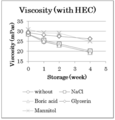
- Fig. 1 shows the results of the viscosity determination test in Test 5.
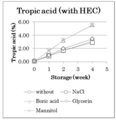
- Fig. 2 shows the results of the stability test in Test 5.
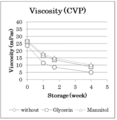
- Fig. 3 shows the results of Examples 23 to 25 in the viscosity determination test in Test 6.
- Fig. 4 shows the results of Examples 26 to 28 in the viscosity determination test in Test 6.
- the present aqueous composition comprises "atropine or a salt thereof," which serves as an active ingredient.
- the term "atropine or a salt thereof” also includes (i) a hydrate of atropine or a salt thereof, (ii) an organic solvate of atropine or a salt thereof, and (iii) a combination of the hydrate and the organic solvate.
- the salt of atropine includes atropine sulfate or a hydrate thereof, and is preferably an atropine sulfate hydrate.
- Atropine sulfate hydrate is a compound represented by the following structural formula:
- the atropine or the salt thereof includes a crystal polymorph and a group of crystal polymorphs (crystal polymorph system)
- those crystal polymorph and group of crystal polymorphs (crystal polymorph system) are also encompassed by the scope of the present invention.
- the group of crystal polymorphs means not only individual crystal forms obtained at respective stages where crystals transform into various forms depending on conditions and states during the manufacture, crystallization, storage, and the like of the crystals, but also a mixture of the crystal forms obtained at two or more of the stages.
- Atropine or a salt thereof can be manufactured in accordance with a method commonly employed in the field of organic synthetic chemistry or can alternatively be a commercially available product.
- atropine sulfate hydrate can be a commercially available product from Tokyo Chemical Industry Co., Ltd. (product code: A0550).
- the concentration of atropine or a salt thereof is preferably 0.001 to 0.1 % (w/v), more preferably 0.001 to 0.05 % (w/v), still more preferably 0.001 to 0.025 % (w/v), and particularly preferably 0.001 to 0.01 % (w/v).
- the concentration is preferably 0.0010 % (w/v), 0.0015 % (w/v), 0.0020 % (w/v), 0.0025 % (w/v), 0.0030 % (w/v), 0.0035 % (w/v), 0.0040 % (w/v), 0.0045 % (w/v), 0.0050 % (w/v), 0.0055 % (w/v), 0.0060 % (w/v), 0.0065 % (w/v), 0.0070 % (w/v), 0.0075 % (w/v), 0.0080 % (w/v), 0.0085 % (w/v), 0.0090 % (w/v), 0.0095 % (w/v), or 0.010 % (w/v).
- aqueous composition means a composition containing water that serves as a solvent.
- the "water-soluble polymer” can be any pharmaceutically acceptable polymer capable of dissolving in water.
- Non-limiting examples of such a polymer include celluloses and their derivatives (e.g., methyl cellulose, hydroxypropyl methylcellulose, hydroxypropyl cellulose, hydroxypropyl methylcellulose phthalate, hydroxypropyl methylcellulose acetate succinate, carboxymethylethyl cellulose, carboxymethyl cellulose, sodium carboxymethyl cellulose, hydroxyethyl cellulose, cellulose acetate phthalate, ethyl cellulose, hydroxymethyl cellulose, hydroxyethylmethyl cellulose, hypromellose acetate succinate and hypromellose phthalate); synthetic polymers (e.g., polyethylene glycol, polyvinyl alcohol, polyvinyl pyrrolidone, polyvinylacetal diethylamino acetate, aminoalkyl methacrylate copolymer E, aminoalkyl methacrylate copoly
- preferably used in the present invention as the water-soluble polymer are cellulose and its derivative, carboxyvinyl polymer and sodium alginate.
- more preferably used in the present invention as the water-soluble polymer are hydroxyethyl cellulose, carboxyvinyl polymer and hydroxypropyl methylcellulose.
- the present aqueous composition can comprise one or more types of water-soluble polymers.
- the concentration of the water-soluble polymer in the present aqueous composition is set to a value by adjusting the content of a water-soluble polymer as appropriate to reflect the influence of the water-soluble polymer on a medicinal substance (active ingredient), other additive(s), pH, osmotic pressure, and/or viscosity.
- the concentration of the water-soluble polymer in the present aqueous composition is preferably 0.01 to 5 % (w/v), and more preferably 0.1 to 2 % (w/v).
- the concentration of the cellulose and its derivative is preferably 0.01 to 5 % (w/v), more preferably 0.1 to 2 % (w/v), still more preferably 0.1 to 1 % (w/v), particularly preferably 0.1 to 0.6 %.
- the concentration of the hydroxyethyl cellulose is preferably 0.1 to 1.0 % (w/v), and more preferably 0.1 to 0.6 % (w/v).
- the concentration of the carboxyvinyl polymer is preferably 0.04 to 0.4 % (w/v), and more preferably 0.08 to 0.4 % (w/v).
- the concentration of the hydroxypropyl methylcellulose is preferably 0.1 to 1.0 % (w/v), and more preferably 0.1 to 0.6 % (w/v).
- the concentration of the sodium alginate is preferably 0.1 to 2% (w/v), and more preferably 0.5 to 2% (w/v).
- the term "buffer” should not be limited as long as it is pharmaceutically acceptable ones, which includes, for example, a phosphate buffer, a citrate buffer, a borate buffer, a carbonate buffer, an acetate buffer, a tartrate buffer, an aminocarboxylate buffer, and trometamol.
- the aminocarboxylate buffer includes, for example, an aspartate buffer, a glutamate buffer, and epsilon-aminocaproic acid. These buffers may be used as a single ingredient or as a combination of any two or more ingredients.
- a phosphate buffer, a citrate buffer, a carbonate buffer, an acetate buffer, and an aminocarboxylate buffer are preferable; a phosphate buffer, a citrate buffer, an acetate buffer, and an aminocarboxylate buffer are more preferable; a phosphate buffer and/or a citrate buffer are still more preferable; and a phosphate buffer and a citrate buffer are particularly preferable.
- the concentration of the buffer in the present aqueous composition is set to a value by adjusting the content of the buffer as appropriate to reflect the influence of the buffer on a medicinal substance (active ingredient), other additive(s), pH, osmotic pressure, and/or viscosity.
- the concentration of the buffer in the present aqueous composition is preferably 0.001 to 10 % (w/v), more preferably 0.01 to 5 % (w/v), still more preferably 0.01 to 3 % (w/v), still much more preferably 0.01 to 1 % (w/v), particularly preferably 0.01 to 0.5 % (w/v), more particularly preferably 0.01 to 0.1 % (w/v), wherein the weight of the buffer is that of a buffering agent as its material.
- the phosphate buffer can be derived from any pharmaceutically acceptable phosphate buffering agent.
- a phosphate buffering agent include: phosphoric acid; phosphates such as alkali metal phosphates and alkaline earth metal phosphates; and hydrates thereof.
- the phosphate buffering agent includes dibasic sodium phosphate hydrate (referred to as "dibasic sodium phosphate” or “sodium phosphate”), sodium dihydrogen phosphate (referred to as “monosodium phosphate”), sodium dihydrogen phosphate monohydrate (referred to as “monosodium phosphate”), sodium dihydrogen phosphate dihydrate (referred to as “monosodium phosphate”), potassium dihydrogen phosphate (referred to as "monopotassium phosphate”), sodium monohydrogen phosphate heptahydrate, trisodium phosphate, dipotassium phosphate, and the like.
- dibasic sodium phosphate referred to as "dibasic sodium phosphate” or “sodium phosphate”
- sodium dihydrogen phosphate referred to as “monosodium phosphate”
- sodium dihydrogen phosphate monohydrate referred to as “monosodium phosphate”
- the concentration of the phosphate buffer in the present aqueous composition is set to a value by adjusting the content of the phosphate buffer as appropriate to reflect the influence of the phosphate buffer on a medicinal substance (active ingredient), other additive(s), pH, osmotic pressure, and/or viscosity.
- the concentration of the phosphate buffer in the present aqueous composition is preferably 0.01 to 1.0 % (w/v), more preferably 0.05 to 1.0 % (w/v), and still more preferably 0.05 to 0.5 % (w/v), wherein the weight of the phosphate buffer is that of a phosphate buffering agent as its material.
- the "citrate buffer” can be derived from a citrate buffering agent which should not be limited as long as it is pharmaceutically acceptable ones, which includes, for example, citric acid; citrates such as alkali metal citrates and alkaline earth metal citrates; and hydrates thereof. More specifically, the citrate buffer includes citric acid hydrate, sodium citrate, sodium citrate hydrate, potassium citrate, calcium citrate, sodium dihydrogen citrate, and disodium citrate.
- a citrate buffering agent which should not be limited as long as it is pharmaceutically acceptable ones, which includes, for example, citric acid; citrates such as alkali metal citrates and alkaline earth metal citrates; and hydrates thereof. More specifically, the citrate buffer includes citric acid hydrate, sodium citrate, sodium citrate hydrate, potassium citrate, calcium citrate, sodium dihydrogen citrate, and disodium citrate.
- the concentration of the citrate buffer in the present aqueous composition is set to a value by adjusting the content of citrate buffer as appropriate to reflect the influence of the citrate buffer on a medicinal substance (active ingredient), other additive(s), pH, osmotic pressure, and/or viscosity.
- the concentration of the citrate buffer in the present aqueous composition is preferably 0.001 to 1.0 % (w/v), more preferably 0.005 to 0.5 % (w/v), still more preferably 0.01 to 0.1 % (w/v), still much more preferably 0.01 to 0.05 % (w/v) and particularly preferably 0.02 to 0.04 % (w/v), wherein the weight of the citrate buffer is that of a citrate buffering agent as its material.
- the "borate buffer” can be derived from a borate buffering agent which includes, for example, boric acid or a salt thereof, and borax. More specifically, the borate buffering agent includes boric acid, sodium borate, potassium borate, potassium tetraborate, potassium metaborate, ammonium borate, and borax.
- the "carbonate buffer” can be derived from a carbonate buffering agent which includes, for example, carbonic acid or a salt thereof. More specifically, the carbonate buffering agent includes carbonic acid, sodium bicarbonate, sodium carbonate, ammonium carbonate, potassium carbonate, calcium carbonate, potassium bicarbonate, and magnesium carbonate.
- the "acetate buffer” can be derived from an acetate buffering agent which includes, for example, acetic acid or a salt thereof. More specifically, the acetate buffering agent includes acetic acid, ammonium acetate, potassium acetate, calcium acetate, and sodium acetate.
- the "tartrate buffer” can be derived from a tartrate buffering agent which includes, for example, tartaric acid or a salt thereof. More specifically, the tartrate buffering agent includes sodium tartrate and potassium tartrate.
- the "aspartate buffer” can be derived from an aspartate buffering agent which includes, for example, aspartic acid or a salt thereof. More specifically, the aspartate buffering agent includes sodium aspartate and magnesium aspartate.
- the "glutamate buffer” can be derived from a glutamate buffering agent which includes, for example, glutamic acid or a salt thereof. More specifically, the glutamate buffering agent includes sodium glutamate and potassium glutamate.
- the aqueous composition of the present invention may comprise buffer (I) as sole buffers, or buffer (I) and buffer (II) as sole buffers. And, the aqueous composition of the present invention may also comprise further different buffers besides buffer (I) and buffer (II).
- buffer (I) is at least one selected from the group consisting of a phosphate buffer, an aminocarboxylate buffer, a carbonate buffer, an acetate buffer, a tartrate buffer, a borate buffer, and trometamol.
- a phosphate buffer an aminocarboxylate buffer
- a carbonate buffer an acetate buffer
- a tartrate buffer a borate buffer
- trometamol a buffer that provides a phosphate buffer (I)
- the definition of each buffer and the preferred range of each concentration are as explained in the above section of "buffer”.
- buffer (II) is a citrate buffer.
- the definition of the citrate buffer and the preferred range of the concentration are as explained in the above section of "buffer".
- the viscosity of the present aqueous composition is adjusted to fall within preferably a range of 3 to 500 mPa ⁇ s, and more preferably a range of 6 to 70 mPa ⁇ s, when measured by an E-type viscometer (25°C; shear rate of 50 s-1).
- the present aqueous composition may further comprise a tonicity agent.
- the tonicity agent used in the present invention can be any pharmaceutically acceptable tonicity agent.
- Non-limiting examples of such a tonicity agent include nonionic tonicity agents such as glycerin, mannitol, propylene glycol, polyethylene glycol, glucose, sorbitol, xylitol, and trehalose.
- a nonionic tonicity agent is preferable as the tonicity agent.
- nonionic tonicity agent glycerin, mannitol, propylene glycol, polyethylene glycol, glucose, sorbitol, xylitol, and trehalose are preferable, glycerin and mannitol are more preferable, and glycerin is particularly preferable.
- the tonicity agents listed above may be used singly or in combination of two or more.
- the concentration of the tonicity agent in the present aqueous composition is set to a value by adjusting the content of a tonicity agent as appropriate to reflect the influence of the tonicity agent on a medicinal substance (active ingredient), other additive(s), pH, osmotic pressure, and/or viscosity.
- the concentration of the tonicity agent in the present aqueous composition is preferably 0.01 to 10 % (w/v), more preferably 0.05 to 5 % (w/v), still more preferably 0.1 to 5 % (w/v), still much more preferably 0.5 to 5 % (w/v), and particularly preferably 1 to 5 % (w/v).
- the concentration of glycerin is preferably 0.1 to 5.0 % (w/v), more preferably 0.1 to 3.0 % (w/v), still more preferably 0.5 to 3.0 % (w/v) and particularly preferably 1.0 to 3.0 % (w/v).
- the present aqueous composition can comprise a pharmaceutically acceptable additive(s) as needed.
- the additive(s) can be mixed with other ingredients of the present aqueous composition by a widely used technique.
- the additive(s) can be selected from, for example, surfactants such as polyoxyethylene sorbitan monooleate, polyoxyl 40 stearate, and polyoxyethylene hydrogenated castor oil; stabilizers such as disodium edetate; preservatives such as benzalkonium chloride and boric acid; pH adjusting agents such as hydrochloric acid and sodium hydroxide; and the like as needed.
- benzalkonium chloride is used as a preservative.
- an aqueous composition of atropine which comprises no benzalkonium chloride has lower mydriatic action than another aqueous composition of atropine which comprises benzalkonium chloride, as shown later.
- the present aqueous composition comprises no benzalkonium chloride or a limited amount of benzalkonium chloride.
- the "limited amount” used herein means an amount of benzalkonium chloride used in the present aqueous composition of atropine which does not exacerbate the mydriatic action.
- the concentration of benzalkonium chloride is preferably less than 100 ppm, more preferably less than 50 ppm, and even more preferably the present aqueous composition comprises substantially no benzalkonium chloride.
- unit-dose container used herein means an eyedrop container in which a cap is tightly attached to the bottle mouth with fusion, which is opened by breaking the fused part between the cap and the bottle mouth when it is used.
- the unit-dose container may contain just one dose of the aqueous composition for one shot, or more doses thereof used several times in one day.
- multiple-dose container used herein means an eyedrop container equipped with a bottle body and a cap which can be fixed to the bottle body, said cap can be freely opened and closed.
- the multiple-dose container generally contains plural doses of the eyedrop liquid for using for a certain period.
- the aqueous composition of the present invention can be contained in a unit-dose container or a multiple-dose container. Unless the present aqueous composition substantially comprises a preservative such as benzalkonium chloride, a unit-dose container is preferable.
- the pH of the present aqueous composition is not limited to a specific value, provided that it falls within a medicinally acceptable range.
- the pH of the present aqueous composition is preferably in a range of 6 or less, more preferably 4 to 6, still more preferably in a range of 4 to 5, and particularly preferably in the neighborhood of 4 or 5.
- pH 3.5, 3.6, 3.7, 3.8, 3.9, 4.0, 4.1, 4.2, 4.3, 4.4, 4.5, 4.6, 4.7, 4.8, 4.9, 5.0, 5.1, 5.2, 5.3, 5.4, 5.5, 5.6, 5.7, 5.8, 5.9, and 6.0 are preferable, and pH 3.5, 3.6, 3.7, 3.8, 3.9, 4.0, 4.1, 4.2, 4.3, 4.4, 4.5, 4.6, 4.7, 4.8, 4.9, 5.0, 5.1, 5.2, 5.3, and 5.4 are more preferable.
- the osmotic pressure of the aqueous composition in the present invention is not limited to a specific value, provided that it falls within a range acceptable to a living body.
- the osmotic pressure of the aqueous composition in the present invention is, for example, 100 to 1000 mOsm, preferably 200 to 500 mOsm, and more preferably 250 to 350 mOsm.
- the osmotic pressure of an aqueous composition is more than a little affected by the amounts of medicinal substance and additive in the aqueous composition.
- the osmotic pressure can be adjusted to fall within the above-described ranges by appropriately adjusting the amounts of those substances that can affect the osmotic pressure.
- the osmotic pressure of the aqueous composition in the present invention can be measured by a common method.
- the osmotic pressure of the aqueous composition in the present invention can be measured in accordance with the method described in the "Osmometry (Osmolarity Determination)" section of the Japanese Pharmacopoeia, 15th Revised Edition.
- Examples of a dosage form of the present aqueous composition include an eyedrop or an ophthalmic aqueous solution.
- the dosage and administration of the aqueous composition administered in the present invention are not limited as long as it can sufficiently provide a desired efficacy, which can be administered in eyedrops, preferably at a frequency of 1 - 5 times a day in an amount of 1 - 3 drops each time, more preferably at a frequency of 2 - 4 times a day in an amount of 1 - 2 drops each time, and the most preferably once a day, before bedtime in an amount of 1 drop.
- the present aqueous composition is preferably used to inhibit or prevent the progression of myopia, to prevent myopia, and/or to treat myopia, and is more preferably used to inhibit or prevent the progression of childhood myopia.
- inhibitor or prevent the progression of myopia used herein may mean slowing myopia progression or reducing myopia progression.
- prevent myopia used herein may mean preventing the onset of myopia or delaying the onset of myopia.
- Test 1 Some aqueous compositions were evaluated in terms of their mydriatic action.
- Example 1 An aqueous composition in Example 1 was prepared in accordance with the formulation shown in Table 1. Specifically, 0.01 g of atropine sulfate hydrate, 0.32 g of hydroxyethyl cellulose, 0.1 g of sodium dihydrogen phosphate, and 2.4 g of concentrated glycerin were dissolved in purified water. To the solution thus obtained were added hydrochloric acid and sodium hydroxide as appropriate, so that the solution was adjusted to pH 5 and brought to a total volume of 100 ml.
- Examples 2 and 3 and Comparative Examples 1 to 3 Aqueous compositions in Examples 2 and 3 and in Comparative Examples 1 to 3 were prepared as in Example 1 in accordance with the formulation shown in Table 1.
- Test Method A single dose of each aqueous composition (50 ⁇ l in volume) was instilled into one eye of a rabbit (four eyes from four rabbits or six eyes from six rabbits for each aqueous composition). Images of pupils of the rabbits before the instillation and 1 hour after the instillation were captured by optical coherence tomography (OCT) and were then analyzed by image analysis software to calculate pupil areas of the rabbits and a mydriasis rate.
- OCT optical coherence tomography
- Example 1 to 3 and in Comparative Examples 1 to 3 are shown in Table 2.
- Table 2 each value is a mean value of data from the four or six cases.
- the mydriatic action of each aqueous composition was evaluated under the following criteria.
- C in case that the pupil area is 35.0 mm2 to less than 40.0 mm2 one hour after the instillation.
- D in case that the pupil area is 40.0 mm2 or more one hour after the instillation.
- Test 2 Some aqueous compositions of the present invention were evaluated in terms of their mydriatic action.
- Example Preparation Method (Examples 4 to 11) Aqueous compositions in Examples 4 to 11 were prepared as in Example 1 in accordance with the formulation shown in Table 3.
- Test Method A single dose of each aqueous composition (50 ⁇ l in volume) was instilled into one eye of a rabbit (four eyes from four rabbits or six eyes from six rabbits for each aqueous composition). Images of pupils of the rabbits 1 hour after the instillation were captured by optical coherence tomography (OCT) and were then analyzed by image analysis software to calculate pupil areas of the rabbits.
- OCT optical coherence tomography
- each value is a mean value of data from the four or six cases.
- the mydriatic action of each aqueous composition was evaluated under the following criteria.
- D in case that the pupil area is 40.0 mm2 or more one hour after the instillation.
- Test 3 Some aqueous compositions of the present invention were evaluated in terms of their mydriatic action.
- Example Preparation Method (Examples 12 to 14) Aqueous compositions in Examples 12 to 14 were prepared as in Example 1 in accordance with the formulation shown in Table 4.
- Test Method A single dose of each aqueous composition (50 ⁇ l in volume) was instilled into one eye of a rabbit (four eyes from four rabbits for each aqueous composition). Images of pupils of the rabbits 1 hour after the instillation were captured by optical coherence tomography (OCT) and were then analyzed by image analysis software to calculate pupil areas of the rabbits.
- OCT optical coherence tomography
- Example 12 to 14 The results in Examples 12 to 14 are shown in Table 4.
- Table 4 each value is a mean value of data from the four cases.
- the mydriatic action of each aqueous composition was evaluated under the following criteria.
- C in case that the pupillary area one hour after eyedropping is 35.0 mm2 to less than 40.0 mm2.
- D in case that the pupillary area one hour after eyedropping is 40.0 mm2 or more.
- Test 4 The effect of benzalkonium chloride which is generally used as a preservative to the mydriatic action of the present aqueous composition was studied.
- Example Preparation Method (Examples 15 to 17) Aqueous compositions in Examples 15 to 17 were prepared as in Example 1 in accordance with the formulation shown in Table 5.
- Test Method A single dose of each aqueous composition (50 ⁇ l in volume) was instilled into one eye of a rabbit (four eyes from four rabbits for each aqueous composition). Images of pupils of the rabbits 1 hour after the instillation were captured by optical coherence tomography (OCT) and were then analyzed by image analysis software to calculate pupil areas of the rabbits.
- OCT optical coherence tomography
- Example 15 to 17 The results in Examples 15 to 17 are shown in Table 5.
- Table 5 each value is a mean value of data from the four cases.
- the mydriatic action of each aqueous composition was evaluated under the following criteria.
- C in case that the pupil area is 35.0 mm2 to less than 40.0 mm2 one hour after the instillation.
- D in case that the pupil area is 40.0 mm2 to less than 45.0 mm2 one hour after the instillation.
- Test 5 (Viscosity Determination Test 1 and Stability Test 1) The effects of a tonicity agent to the viscosity of an aqueous composition comprising atropine and a water-soluble polymer and the stability of atropine therein were studied.
- Example Preparation Method (Examples 18 to 22) Aqueous compositions in Examples 18 to 22 were prepared as in Example 1 in accordance with the formulation shown in Table 6. Each prepared sample (5 mL) was put into a polyethylene eyedrop container, an inside plug was attached to the bottle mouth, and the container was sealed-up with a cap. The containers were stored under dark at 60°C for 4 weeks.
- Viscosity Determination Test 1 According to "Method II, Viscosity measurement by rotational viscometer" in the Japanese Pharmacopoeia 16th edition, each viscosity of the freshly-prepared aqueous compositions and the aqueous compositions stored for 1, 2 and 4 weeks after the productions was measured with a cone-flat plate-type rotational viscometer. The measuring conditions are shown below.
- Viscosity Determination Test 1 As shown in Figure 1, each viscosity of the aqueous composition comprising atropine and hydroxyethyl cellulose, but no tonicity agent (Example 18 which corresponds to "without” in Figure 1), the aqueous composition further comprising sodium chloride as a tonicity agent (Example 19 which corresponds to "NaCl” in Figure 1), and the aqueous composition further comprising boric acid as a tonicity agent (Example 20 which corresponds to "Boric acid” in Figure 1), decreased over time.
- each viscosity of the aqueous composition comprising atropine and hydroxyethyl cellulose, and further comprising glycerin as a tonicity agent (Example 21 which corresponds to "Glycerin” in Figure 1) and the aqueous composition further comprising mannitol as a tonicity agent (Example 22 which corresponds to "Mannitol” in Figure 1) was maintained, i.e., the decrease of viscosity over time was inhibited.
- Viscosity Determination Test 1 and Stability Test 1 suggested that it is preferable to add glycerin as a tonicity agent to an aqueous composition comprising atropine and hydroxyethyl cellulose to inhibit the decrease of viscosity over time and maintain the stability of atropine.
- Test 6 (Viscosity Determination Test 2) The effect of a tonicity agent to the viscosity of an aqueous composition comprising atropine and a water-soluble polymer was studied.
- Example Preparation Method (Examples 23 to 28) Aqueous compositions in Examples 23 to 28 were prepared as in Example 1 in accordance with the formulation shown in Table 7. Each prepared sample (5 mL) was put into a polyethylene eyedrop container, an inside plug was attached to the bottle mouth, and the container was sealed-up with a cap. The containers were stored under dark at 60°C for 4 weeks.
- the viscosity of the aqueous composition comprising atropine and carboxyvinyl polymer, but no tonicity agent (Example 26 which corresponds to "without” in Figure 4) decreased over time.
- the viscosity of the aqueous composition further comprising glycerin or mannitol as a tonicity agent Example 27 or 28 which corresponds to "Glycerin” or “Mannitol” in Figure 4) was maintained, i.e., the decrease of viscosity over time was inhibited.
- Test 7 The effects of a water-soluble polymer to the actions for inhibiting the elongation of eye axial length and improving the refractive error were studied with myopia mouse models.
- Example Preparation Method (Examples A to D) Aqueous compositions in Examples A to D were prepared as in Example 1 in accordance with the formulation shown in Table 8.
- Murine model of experimental myopia was established by placing -10D lens on the right eye of the mice (C57BL/6J), which served as the experimental eye, at post-natal day 24. Briefly, a -10D lens (PMMA spectacle lens in blue tint, radius of outer curvature 8.5 mm, inner curvature 8 mm, lens thickness 0.5 mm) was glued to an annulus (with 8 mm base curve) of Velcro. This mating piece was then attached to the Velcro that had been glued to the hair around the right experimental eye using a cyanoacrylate. Through this set up, we made sure that an air gap of 1.5 mm existed between the back part of the lens and the anterior surface of the cornea.
- a -10D lens PMMA spectacle lens in blue tint, radius of outer curvature 8.5 mm, inner curvature 8 mm, lens thickness 0.5 mm
- Ocular biometry methods Ocular biometry such as axial length and refractive error measurements were done using in vivo Optical Low Coherence Interferometry (OLCI-AcMaster) and automated eccentric photorefractor respectively. The axial length was measured at post-natal days 38 and 66, whereas the animal eyes were refracted at days 52 and 66.
- Drug treatment Atropine sulphate (at 0.01 % concentration) with and without hydroxyethyl cellulose were administered once a day at post-natal day 39 until day 66 in the spectacle lens-induced myopia model. 7 ⁇ L of each drug was administered topically to the right eye in dim red light each day.
- Formulation Example 1 Eye Drop (0.01% (w/v)) To sterile purified water are added atropine sulfate hydrate and the other ingredients as listed above. These ingredients are mixed well to prepare the above-described eye drop.
- Formulation Example 2 Eye Drop (0.004% (w/v)) To sterile purified water are added atropine sulfate hydrate and the other ingredients as listed above. These ingredients are mixed well to prepare the above-described eye drop.
- an aqueous composition comprising 0.001 - 0.1 % (w/v) atropine or a salt thereof, a water-soluble polymer, and buffer (I), which is at a pH range of 6 or lower, wherein the buffer (I) is at least one selected from the group consisting of a phosphate buffer, an aminocarboxylate buffer, a carbonate buffer, an acetate buffer, a tartrate buffer, a borate buffer, and trometamol, has a potent action for inhibiting the elongation of eye axial length and improving the refractive error without exacerbating the mydriatic action of atropine.
- the above aqueous composition but which comprises no benzalkonium chloride or a limited amount of benzalkonium chloride, has a lower mydriatic action.
- an aqueous composition comprising atropine or a salt thereof and a water-soluble polymer which is at a pH range of 6 or lower
- the addition of a nonionic tonicity agent can make it possible to inhibit the debasement over time of the viscosity given by the water-soluble polymer and additionally maintain the stability of atropine or a salt thereof.
- the present aqueous composition is expected to inhibit or prevent the progression of myopia and lead to a lesser degree of mydriasis, and lesser loss of accommodation so as to be optimal in terms of quality of life.
Landscapes
- Health & Medical Sciences (AREA)
- Chemical & Material Sciences (AREA)
- Life Sciences & Earth Sciences (AREA)
- Pharmacology & Pharmacy (AREA)
- Veterinary Medicine (AREA)
- Public Health (AREA)
- General Health & Medical Sciences (AREA)
- Animal Behavior & Ethology (AREA)
- Medicinal Chemistry (AREA)
- Epidemiology (AREA)
- Engineering & Computer Science (AREA)
- General Chemical & Material Sciences (AREA)
- Chemical Kinetics & Catalysis (AREA)
- Oil, Petroleum & Natural Gas (AREA)
- Ophthalmology & Optometry (AREA)
- Bioinformatics & Cheminformatics (AREA)
- Organic Chemistry (AREA)
- Nuclear Medicine, Radiotherapy & Molecular Imaging (AREA)
- Inorganic Chemistry (AREA)
- Proteomics, Peptides & Aminoacids (AREA)
- Emergency Medicine (AREA)
- Medicinal Preparation (AREA)
- Pharmaceuticals Containing Other Organic And Inorganic Compounds (AREA)
- Compositions Of Macromolecular Compounds (AREA)
- Materials For Photolithography (AREA)
- Biochemistry (AREA)
- Molecular Biology (AREA)
Priority Applications (19)
| Application Number | Priority Date | Filing Date | Title |
|---|---|---|---|
| CA3023149A CA3023149C (en) | 2016-05-25 | 2017-05-24 | AQUEOUS COMPOSITION CONTAINING ATROPINE |
| ES17802848T ES2929368T3 (es) | 2016-05-25 | 2017-05-24 | Composición acuosa que contiene atropina |
| CN202311240197.1A CN117205210A (zh) | 2016-05-25 | 2017-05-24 | 含有阿托品的水性组合物 |
| EP17802848.6A EP3463360B2 (en) | 2016-05-25 | 2017-05-24 | Atropine-containing aqueous composition |
| SG11201809822SA SG11201809822SA (en) | 2016-05-25 | 2017-05-24 | Atropine-containing aqueous composition |
| KR1020237031744A KR102804061B1 (ko) | 2016-05-25 | 2017-05-24 | 아트로핀-함유 수성 조성물 |
| KR1020257014231A KR20250067951A (ko) | 2016-05-25 | 2017-05-24 | 아트로핀-함유 수성 조성물 |
| US16/303,686 US20210267885A1 (en) | 2016-05-25 | 2017-05-24 | Atropine-containing aqueous composition |
| CN201780031738.6A CN109310687B (zh) | 2016-05-25 | 2017-05-24 | 含有阿托品的水性组合物 |
| MYPI2018001914A MY189774A (en) | 2016-05-25 | 2017-05-24 | Atropine-containing aqueous composition |
| CN202311238651.XA CN117205209A (zh) | 2016-05-25 | 2017-05-24 | 含有阿托品的水性组合物 |
| KR1020187037233A KR20190013877A (ko) | 2016-05-25 | 2017-05-24 | 아트로핀-함유 수성 조성물 |
| EA201892703A EA201892703A1 (ru) | 2016-05-25 | 2017-05-24 | Водная композиция, содержащая атропин |
| EP22189717.6A EP4112055A1 (en) | 2016-05-25 | 2017-05-24 | Atropine-containing aqueous composition |
| KR1020227039104A KR102580933B1 (ko) | 2016-05-25 | 2017-05-24 | 아트로핀-함유 수성 조성물 |
| UAA201812662A UA126195C2 (uk) | 2016-05-25 | 2017-05-24 | Водна композиція, яка містить атропін |
| PH12018502421A PH12018502421A1 (en) | 2016-05-25 | 2018-11-16 | Atropine-containing aqueous composition |
| US18/676,396 US20240307305A1 (en) | 2016-05-25 | 2024-05-28 | Atropine-containing aqueous composition |
| US19/405,958 US20260183235A1 (en) | 2016-05-25 | 2025-12-02 | Atropine-containing aqueous composition |
Applications Claiming Priority (2)
| Application Number | Priority Date | Filing Date | Title |
|---|---|---|---|
| SG10201604200P | 2016-05-25 | ||
| SG10201604200P | 2016-05-25 |
Related Child Applications (2)
| Application Number | Title | Priority Date | Filing Date |
|---|---|---|---|
| US16/303,686 A-371-Of-International US20210267885A1 (en) | 2016-05-25 | 2017-05-24 | Atropine-containing aqueous composition |
| US18/676,396 Continuation US20240307305A1 (en) | 2016-05-25 | 2024-05-28 | Atropine-containing aqueous composition |
Publications (1)
| Publication Number | Publication Date |
|---|---|
| WO2017204262A1 true WO2017204262A1 (en) | 2017-11-30 |
Family
ID=60411416
Family Applications (1)
| Application Number | Title | Priority Date | Filing Date |
|---|---|---|---|
| PCT/JP2017/019423 Ceased WO2017204262A1 (en) | 2016-05-25 | 2017-05-24 | Atropine-containing aqueous composition |
Country Status (15)
| Country | Link |
|---|---|
| US (3) | US20210267885A1 (enExample) |
| EP (2) | EP3463360B2 (enExample) |
| JP (6) | JP6590860B2 (enExample) |
| KR (4) | KR102804061B1 (enExample) |
| CN (3) | CN117205210A (enExample) |
| AR (1) | AR108591A1 (enExample) |
| CA (1) | CA3023149C (enExample) |
| EA (1) | EA201892703A1 (enExample) |
| ES (1) | ES2929368T3 (enExample) |
| MY (1) | MY189774A (enExample) |
| PH (1) | PH12018502421A1 (enExample) |
| SG (1) | SG11201809822SA (enExample) |
| TW (3) | TWI849355B (enExample) |
| UA (1) | UA126195C2 (enExample) |
| WO (1) | WO2017204262A1 (enExample) |
Cited By (14)
| Publication number | Priority date | Publication date | Assignee | Title |
|---|---|---|---|---|
| WO2018154440A1 (en) * | 2017-02-21 | 2018-08-30 | Singapore Health Services Pte Ltd | Composition and method for preventing or delaying onset of myopia comprising atropine |
| WO2018209051A1 (en) | 2017-05-11 | 2018-11-15 | Nevakar Inc. | Atropine pharmaceutical compositions |
| EP3701938A1 (en) | 2019-03-01 | 2020-09-02 | Medivis S.R.L. | Ophthalmic formulations based on atropine |
| US20200306239A1 (en) * | 2015-04-23 | 2020-10-01 | Sydnexis, Inc. | Ophthalmic composition |
| US20210259961A1 (en) * | 2018-09-25 | 2021-08-26 | Shenyang Xingqi Pharmaceutical Co., Ltd. | Pharmaceutical composition for preventing and treating nitm and medical use thereof |
| WO2022130337A1 (en) * | 2020-12-17 | 2022-06-23 | Sun Pharmaceutical Industries Limited | An aqueous sterile solution of atropine for ophthalmic use |
| US11446307B2 (en) | 2020-11-02 | 2022-09-20 | Trethera Corporation | Crystalline forms of a deoxycytidine kinase inhibitor and uses thereof |
| EP4088714A1 (en) | 2021-05-10 | 2022-11-16 | Warszawskie Zaklady Farmaceutyczne Polfa S.A. | Ophthalmic pharmaceutical composition comprising atropine |
| EP4088713A1 (en) | 2021-05-10 | 2022-11-16 | Warszawskie Zaklady Farmaceutyczne Polfa S.A. | Ophthalmic pharmaceutical composition comprising atropine |
| US20230120997A1 (en) * | 2021-10-18 | 2023-04-20 | Ocular Science, Inc. | Compositions and methods for myopia control and orthokeratology lenses treatment |
| US11883390B2 (en) | 2014-06-24 | 2024-01-30 | Sydnexis, Inc. | Ophthalmic composition |
| US12070466B2 (en) | 2015-05-29 | 2024-08-27 | Sydnexis, Inc. | D2O stabilized pharmaceutical formulations |
| EP4230210A4 (en) * | 2020-10-14 | 2024-10-02 | Santen Pharmaceutical Co., Ltd. | STABLE PHARMACEUTICAL COMPOSITION |
| RU2863982C2 (ru) * | 2020-10-14 | 2026-06-16 | Сантэн Фармасьютикал Ко., Лтд. | Стабильная фармацевтическая композиция |
Families Citing this family (7)
| Publication number | Priority date | Publication date | Assignee | Title |
|---|---|---|---|---|
| CN114533652B (zh) * | 2018-09-25 | 2024-12-13 | 沈阳兴齐眼药股份有限公司 | 药物组合物、其制备方法和用途 |
| CA3189821A1 (en) | 2020-08-04 | 2022-02-10 | Santen Pharmaceutical Co., Ltd. | Agent for treating myopia, preventing myopia and/or suppressing myopia progression |
| CN114129511A (zh) * | 2021-12-07 | 2022-03-04 | 河南润弘制药股份有限公司 | 一种具有改进稳定性的硫酸阿托品注射液 |
| JP7884090B2 (ja) * | 2022-09-11 | 2026-07-02 | アルコン インク. | ベンジルアトロピンを含む水性医薬組成物及びその使用 |
| WO2025018419A1 (ja) | 2023-07-20 | 2025-01-23 | センジュ ユーエスエー、インコーポレイテッド | 水性液剤 |
| JP7665073B1 (ja) | 2024-04-05 | 2025-04-18 | ロート製薬株式会社 | 容器に収容してなる眼科用組成物 |
| JP7723851B1 (ja) | 2024-11-22 | 2025-08-14 | 参天製薬株式会社 | アトロピン含有水性医薬組成物 |
Citations (4)
| Publication number | Priority date | Publication date | Assignee | Title |
|---|---|---|---|---|
| JPH01203320A (ja) * | 1988-02-05 | 1989-08-16 | Eisai Co Ltd | 安定なジフェンヒドラミン含有水溶液 |
| JP2007308398A (ja) * | 2006-05-17 | 2007-11-29 | Chang Gung Memorial Hospital | 目薬、及びその製造方法 |
| WO2012161655A1 (en) | 2011-05-23 | 2012-11-29 | Singapore Health Services Pte Ltd | Composition and/or method for reducing and/or preventing myopia progression comprising atropine |
| WO2015200361A1 (en) * | 2014-06-24 | 2015-12-30 | Sydnexis, Inc. | Ophthalmic composition |
Family Cites Families (11)
| Publication number | Priority date | Publication date | Assignee | Title |
|---|---|---|---|---|
| US5612027A (en) * | 1995-04-18 | 1997-03-18 | Galin; Miles A. | Controlled release of miotic and mydriatic drugs in the anterior chamber |
| JP3166002B2 (ja) * | 1997-01-27 | 2001-05-14 | 日本車輌製造株式会社 | 自動車の洗浄装置 |
| US20030096831A1 (en) | 2000-01-18 | 2003-05-22 | Stone Richard A. | Ocular growth and nicotinic antagonists |
| CN1509172A (zh) * | 2001-05-25 | 2004-06-30 | ά����ҩ��˾ | 哌仑西平眼用凝胶剂 |
| US20070254914A1 (en) * | 2006-05-01 | 2007-11-01 | Non-Profit Organization Chang Gung Memorial Hospital | Low-concentration atropine solution for preventing myopia progression and preparing method thereof |
| JP2010528010A (ja) * | 2007-05-21 | 2010-08-19 | ニューロプティックス コーポレイション | アミロイドβ造影剤の眼用製剤およびその使用の方法 |
| CN101327216A (zh) * | 2007-06-22 | 2008-12-24 | 肖正连 | 一种硫酸阿托品眼用即型凝胶 |
| US20160009705A1 (en) * | 2014-06-24 | 2016-01-14 | Sydnexis, Inc. | Ophthalmic composition |
| CN104983739B (zh) * | 2015-06-25 | 2018-01-16 | 成都乾坤动物药业股份有限公司 | 一种多功能药物组合及其制备方法和应用 |
| JP2017102939A (ja) * | 2016-12-26 | 2017-06-08 | 株式会社プロフィールド | オーサリング装置、オーサリング方法、およびプログラム |
| EP3970694A1 (en) * | 2017-05-11 | 2022-03-23 | Vyluma Inc. | Atropine pharmaceutical compositions |
-
2017
- 2017-05-24 US US16/303,686 patent/US20210267885A1/en not_active Abandoned
- 2017-05-24 EP EP17802848.6A patent/EP3463360B2/en active Active
- 2017-05-24 CN CN202311240197.1A patent/CN117205210A/zh active Pending
- 2017-05-24 EP EP22189717.6A patent/EP4112055A1/en active Pending
- 2017-05-24 SG SG11201809822SA patent/SG11201809822SA/en unknown
- 2017-05-24 KR KR1020237031744A patent/KR102804061B1/ko active Active
- 2017-05-24 CA CA3023149A patent/CA3023149C/en active Active
- 2017-05-24 ES ES17802848T patent/ES2929368T3/es active Active
- 2017-05-24 AR ARP170101418A patent/AR108591A1/es not_active Application Discontinuation
- 2017-05-24 CN CN201780031738.6A patent/CN109310687B/zh active Active
- 2017-05-24 TW TW110141612A patent/TWI849355B/zh active
- 2017-05-24 UA UAA201812662A patent/UA126195C2/uk unknown
- 2017-05-24 JP JP2017102939A patent/JP6590860B2/ja active Active
- 2017-05-24 TW TW106117194A patent/TWI791438B/zh active
- 2017-05-24 KR KR1020187037233A patent/KR20190013877A/ko not_active Ceased
- 2017-05-24 MY MYPI2018001914A patent/MY189774A/en unknown
- 2017-05-24 KR KR1020257014231A patent/KR20250067951A/ko active Pending
- 2017-05-24 EA EA201892703A patent/EA201892703A1/ru unknown
- 2017-05-24 CN CN202311238651.XA patent/CN117205209A/zh active Pending
- 2017-05-24 TW TW112102321A patent/TWI874894B/zh active
- 2017-05-24 KR KR1020227039104A patent/KR102580933B1/ko active Active
- 2017-05-24 WO PCT/JP2017/019423 patent/WO2017204262A1/en not_active Ceased
-
2018
- 2018-11-16 PH PH12018502421A patent/PH12018502421A1/en unknown
-
2019
- 2019-09-17 JP JP2019168569A patent/JP6886502B2/ja active Active
-
2021
- 2021-05-14 JP JP2021082578A patent/JP7224390B2/ja active Active
-
2023
- 2023-02-07 JP JP2023016850A patent/JP2023058574A/ja not_active Withdrawn
-
2024
- 2024-05-28 US US18/676,396 patent/US20240307305A1/en not_active Abandoned
-
2025
- 2025-03-03 JP JP2025032538A patent/JP2025084921A/ja active Pending
- 2025-09-16 JP JP2025153045A patent/JP2025176149A/ja not_active Withdrawn
- 2025-12-02 US US19/405,958 patent/US20260183235A1/en active Pending
Patent Citations (4)
| Publication number | Priority date | Publication date | Assignee | Title |
|---|---|---|---|---|
| JPH01203320A (ja) * | 1988-02-05 | 1989-08-16 | Eisai Co Ltd | 安定なジフェンヒドラミン含有水溶液 |
| JP2007308398A (ja) * | 2006-05-17 | 2007-11-29 | Chang Gung Memorial Hospital | 目薬、及びその製造方法 |
| WO2012161655A1 (en) | 2011-05-23 | 2012-11-29 | Singapore Health Services Pte Ltd | Composition and/or method for reducing and/or preventing myopia progression comprising atropine |
| WO2015200361A1 (en) * | 2014-06-24 | 2015-12-30 | Sydnexis, Inc. | Ophthalmic composition |
Non-Patent Citations (1)
| Title |
|---|
| "Japanese Pharmacopoeia 16th edition", article "Method II, Viscosity measurement by rotational viscometer" |
Cited By (39)
| Publication number | Priority date | Publication date | Assignee | Title |
|---|---|---|---|---|
| US12629360B2 (en) | 2014-06-24 | 2026-05-19 | Sydnexis, Inc. | Ophthalmic composition |
| US11896588B2 (en) | 2014-06-24 | 2024-02-13 | Sydnexis, Inc. | Ophthalmic composition |
| US11890277B2 (en) | 2014-06-24 | 2024-02-06 | Sydnexis, Inc. | Ophthalmic composition |
| US11883390B2 (en) | 2014-06-24 | 2024-01-30 | Sydnexis, Inc. | Ophthalmic composition |
| US20200306239A1 (en) * | 2015-04-23 | 2020-10-01 | Sydnexis, Inc. | Ophthalmic composition |
| US20200338060A1 (en) * | 2015-04-23 | 2020-10-29 | Sydnexis, Inc. | Ophthalmic composition |
| US12168017B2 (en) | 2015-05-29 | 2024-12-17 | Sydnexis, Inc. | D2O stabilized pharmaceutical formulations |
| US12070466B2 (en) | 2015-05-29 | 2024-08-27 | Sydnexis, Inc. | D2O stabilized pharmaceutical formulations |
| US11253507B2 (en) | 2017-02-21 | 2022-02-22 | Singapore Health Services Ptd Ltd | Composition and method for preventing or delaying onset of myopia comprising atropine |
| WO2018154440A1 (en) * | 2017-02-21 | 2018-08-30 | Singapore Health Services Pte Ltd | Composition and method for preventing or delaying onset of myopia comprising atropine |
| AU2018224426B2 (en) * | 2017-02-21 | 2023-05-18 | Singapore Health Services Pte Ltd | Composition and method for preventing or delaying onset of myopia comprising atropine |
| US11730728B2 (en) | 2017-05-11 | 2023-08-22 | Vyluma Inc. | Atropine pharmaceutical compositions |
| US10583132B2 (en) | 2017-05-11 | 2020-03-10 | Nevakar Inc. | Atropine Pharmaceutical Compositions |
| WO2018209051A1 (en) | 2017-05-11 | 2018-11-15 | Nevakar Inc. | Atropine pharmaceutical compositions |
| EP3970694A1 (en) | 2017-05-11 | 2022-03-23 | Vyluma Inc. | Atropine pharmaceutical compositions |
| US10251875B2 (en) | 2017-05-11 | 2019-04-09 | Nevakar Inc. | Atropine pharmaceutical compositions |
| US10568875B2 (en) | 2017-05-11 | 2020-02-25 | Nevakar Inc. | Atropine pharmaceutical compositions |
| US11464769B2 (en) | 2017-05-11 | 2022-10-11 | Vyluma Inc. | Atropine pharmaceutical compositions |
| US12036217B2 (en) | 2017-05-11 | 2024-07-16 | Vyluma Inc. | Atropine pharmaceutical compositions |
| USRE50040E1 (en) | 2017-05-11 | 2024-07-16 | Vyluma Inc. | Atropine pharmaceutical compositions |
| US10576074B2 (en) | 2017-05-11 | 2020-03-03 | Nevakar Inc. | Atropine pharmaceutical compositions |
| EP3548000B1 (en) | 2017-05-11 | 2021-11-10 | Vyluma Inc. | Atropine pharmaceutical compositions |
| US10610525B2 (en) | 2017-05-11 | 2020-04-07 | Nevakar Inc. | Atropine pharmaceutical compositions |
| US11730727B2 (en) | 2017-05-11 | 2023-08-22 | Vyluma Inc. | Atropine pharmaceutical compositions |
| US11642338B2 (en) | 2017-05-11 | 2023-05-09 | Vyluma Inc. | Atropine pharmaceutical compositions |
| US11071732B2 (en) | 2017-05-11 | 2021-07-27 | Nevakar Inc. | Atropine pharmaceutical compositions |
| US11707458B2 (en) | 2017-05-11 | 2023-07-25 | Vyluma Inc. | Atropine pharmaceutical compositions |
| US20210259961A1 (en) * | 2018-09-25 | 2021-08-26 | Shenyang Xingqi Pharmaceutical Co., Ltd. | Pharmaceutical composition for preventing and treating nitm and medical use thereof |
| EP3701938A1 (en) | 2019-03-01 | 2020-09-02 | Medivis S.R.L. | Ophthalmic formulations based on atropine |
| EP4230210A4 (en) * | 2020-10-14 | 2024-10-02 | Santen Pharmaceutical Co., Ltd. | STABLE PHARMACEUTICAL COMPOSITION |
| RU2863982C2 (ru) * | 2020-10-14 | 2026-06-16 | Сантэн Фармасьютикал Ко., Лтд. | Стабильная фармацевтическая композиция |
| US11446307B2 (en) | 2020-11-02 | 2022-09-20 | Trethera Corporation | Crystalline forms of a deoxycytidine kinase inhibitor and uses thereof |
| WO2022130337A1 (en) * | 2020-12-17 | 2022-06-23 | Sun Pharmaceutical Industries Limited | An aqueous sterile solution of atropine for ophthalmic use |
| WO2022238251A3 (en) * | 2021-05-10 | 2023-01-26 | Warszawskie Zakłady Farmaceutyczne Polfa S.A. | Ophthalmic pharmaceutical composition comprising atropine |
| WO2022238251A2 (en) | 2021-05-10 | 2022-11-17 | Warszawskie Zakłady Farmaceutyczne Polfa S.A. | Ophthalmic pharmaceutical composition comprising atropine |
| WO2022238250A1 (en) | 2021-05-10 | 2022-11-17 | Warszawskie Zakłady Farmaceutyczne Polfa S.A. | Ophthalmic pharmaceutical composition comprising atropine |
| EP4088713A1 (en) | 2021-05-10 | 2022-11-16 | Warszawskie Zaklady Farmaceutyczne Polfa S.A. | Ophthalmic pharmaceutical composition comprising atropine |
| EP4088714A1 (en) | 2021-05-10 | 2022-11-16 | Warszawskie Zaklady Farmaceutyczne Polfa S.A. | Ophthalmic pharmaceutical composition comprising atropine |
| US20230120997A1 (en) * | 2021-10-18 | 2023-04-20 | Ocular Science, Inc. | Compositions and methods for myopia control and orthokeratology lenses treatment |
Also Published As
Similar Documents
| Publication | Publication Date | Title |
|---|---|---|
| US20240307305A1 (en) | Atropine-containing aqueous composition | |
| AU2008325214A1 (en) | Compositions for the treatment and prevention of eyelid swelling comprising an osmotically active ingredient and a vasoconstrictor | |
| TWI839364B (zh) | 包含釋放一氧化氮的前列醯胺之眼用組成物 | |
| JP7058650B2 (ja) | 眼圧降下用点眼組成物 | |
| WO2018174145A1 (en) | Agent for preventing myopia, treating myopia, and/or preventing myopia progression comprising umeclidinium as active ingredient | |
| EP3600306A1 (en) | Agent for preventing myopia, treating myopia, and/or preventing myopia progression comprising tiotropium as active ingredient | |
| JP7723851B1 (ja) | アトロピン含有水性医薬組成物 | |
| HK40003059A (en) | Atropine-containing aqueous composition | |
| HK40004290B (en) | Atropine-containing aqueous composition | |
| HK40004290A (en) | Atropine-containing aqueous composition | |
| EP4454639A1 (en) | Ophthalmic composition comprising carbomer and taurine | |
| HK40003059B (en) | Atropine-containing aqueous composition | |
| EA044560B1 (ru) | Водная композиция, содержащая атропин | |
| HK40005358A (en) | Eye-drop composition for lowering intraocular pressure | |
| HK40005358B (en) | Eye-drop composition for lowering intraocular pressure |
Legal Events
| Date | Code | Title | Description |
|---|---|---|---|
| ENP | Entry into the national phase |
Ref document number: 3023149 Country of ref document: CA |
|
| NENP | Non-entry into the national phase |
Ref country code: DE |
|
| 121 | Ep: the epo has been informed by wipo that ep was designated in this application |
Ref document number: 17802848 Country of ref document: EP Kind code of ref document: A1 |
|
| ENP | Entry into the national phase |
Ref document number: 20187037233 Country of ref document: KR Kind code of ref document: A |
|
| ENP | Entry into the national phase |
Ref document number: 2017802848 Country of ref document: EP Effective date: 20190102 |