WO2017199905A1 - 液晶表示素子用シール剤、上下導通材料、及び、液晶表示素子 - Google Patents
液晶表示素子用シール剤、上下導通材料、及び、液晶表示素子 Download PDFInfo
- Publication number
- WO2017199905A1 WO2017199905A1 PCT/JP2017/018181 JP2017018181W WO2017199905A1 WO 2017199905 A1 WO2017199905 A1 WO 2017199905A1 JP 2017018181 W JP2017018181 W JP 2017018181W WO 2017199905 A1 WO2017199905 A1 WO 2017199905A1
- Authority
- WO
- WIPO (PCT)
- Prior art keywords
- liquid crystal
- crystal display
- meth
- weight
- sealing agent
- Prior art date
- Legal status (The legal status is an assumption and is not a legal conclusion. Google has not performed a legal analysis and makes no representation as to the accuracy of the status listed.)
- Ceased
Links
- DGPRASWSNDDIAZ-UHFFFAOYSA-N C=CC(OCC(COc1ccc(Cc(cc2)ccc2OCC2OC2)cc1)O)=O Chemical compound C=CC(OCC(COc1ccc(Cc(cc2)ccc2OCC2OC2)cc1)O)=O DGPRASWSNDDIAZ-UHFFFAOYSA-N 0.000 description 1
Classifications
-
- C—CHEMISTRY; METALLURGY
- C09—DYES; PAINTS; POLISHES; NATURAL RESINS; ADHESIVES; COMPOSITIONS NOT OTHERWISE PROVIDED FOR; APPLICATIONS OF MATERIALS NOT OTHERWISE PROVIDED FOR
- C09K—MATERIALS FOR MISCELLANEOUS APPLICATIONS, NOT PROVIDED FOR ELSEWHERE
- C09K3/00—Materials not provided for elsewhere
- C09K3/10—Materials in mouldable or extrudable form for sealing or packing joints or covers
-
- C—CHEMISTRY; METALLURGY
- C08—ORGANIC MACROMOLECULAR COMPOUNDS; THEIR PREPARATION OR CHEMICAL WORKING-UP; COMPOSITIONS BASED THEREON
- C08F—MACROMOLECULAR COMPOUNDS OBTAINED BY REACTIONS ONLY INVOLVING CARBON-TO-CARBON UNSATURATED BONDS
- C08F2/00—Processes of polymerisation
- C08F2/38—Polymerisation using regulators, e.g. chain terminating agents, e.g. telomerisation
-
- C—CHEMISTRY; METALLURGY
- C08—ORGANIC MACROMOLECULAR COMPOUNDS; THEIR PREPARATION OR CHEMICAL WORKING-UP; COMPOSITIONS BASED THEREON
- C08F—MACROMOLECULAR COMPOUNDS OBTAINED BY REACTIONS ONLY INVOLVING CARBON-TO-CARBON UNSATURATED BONDS
- C08F2/00—Processes of polymerisation
- C08F2/46—Polymerisation initiated by wave energy or particle radiation
- C08F2/48—Polymerisation initiated by wave energy or particle radiation by ultraviolet or visible light
- C08F2/50—Polymerisation initiated by wave energy or particle radiation by ultraviolet or visible light with sensitising agents
-
- C—CHEMISTRY; METALLURGY
- C08—ORGANIC MACROMOLECULAR COMPOUNDS; THEIR PREPARATION OR CHEMICAL WORKING-UP; COMPOSITIONS BASED THEREON
- C08F—MACROMOLECULAR COMPOUNDS OBTAINED BY REACTIONS ONLY INVOLVING CARBON-TO-CARBON UNSATURATED BONDS
- C08F220/00—Copolymers of compounds having one or more unsaturated aliphatic radicals, each having only one carbon-to-carbon double bond, and only one being terminated by only one carboxyl radical or a salt, anhydride ester, amide, imide or nitrile thereof
- C08F220/02—Monocarboxylic acids having less than ten carbon atoms; Derivatives thereof
- C08F220/10—Esters
- C08F220/26—Esters containing oxygen in addition to the carboxy oxygen
- C08F220/32—Esters containing oxygen in addition to the carboxy oxygen containing epoxy radicals
-
- C—CHEMISTRY; METALLURGY
- C08—ORGANIC MACROMOLECULAR COMPOUNDS; THEIR PREPARATION OR CHEMICAL WORKING-UP; COMPOSITIONS BASED THEREON
- C08F—MACROMOLECULAR COMPOUNDS OBTAINED BY REACTIONS ONLY INVOLVING CARBON-TO-CARBON UNSATURATED BONDS
- C08F290/00—Macromolecular compounds obtained by polymerising monomers on to polymers modified by introduction of aliphatic unsaturated end or side groups
- C08F290/02—Macromolecular compounds obtained by polymerising monomers on to polymers modified by introduction of aliphatic unsaturated end or side groups on to polymers modified by introduction of unsaturated end groups
- C08F290/06—Polymers provided for in subclass C08G
-
- C—CHEMISTRY; METALLURGY
- C08—ORGANIC MACROMOLECULAR COMPOUNDS; THEIR PREPARATION OR CHEMICAL WORKING-UP; COMPOSITIONS BASED THEREON
- C08G—MACROMOLECULAR COMPOUNDS OBTAINED OTHERWISE THAN BY REACTIONS ONLY INVOLVING UNSATURATED CARBON-TO-CARBON BONDS
- C08G59/00—Polycondensates containing more than one epoxy group per molecule; Macromolecules obtained by polymerising compounds containing more than one epoxy group per molecule using curing agents or catalysts which react with the epoxy groups
- C08G59/14—Polycondensates modified by chemical after-treatment
-
- C—CHEMISTRY; METALLURGY
- C08—ORGANIC MACROMOLECULAR COMPOUNDS; THEIR PREPARATION OR CHEMICAL WORKING-UP; COMPOSITIONS BASED THEREON
- C08G—MACROMOLECULAR COMPOUNDS OBTAINED OTHERWISE THAN BY REACTIONS ONLY INVOLVING UNSATURATED CARBON-TO-CARBON BONDS
- C08G59/00—Polycondensates containing more than one epoxy group per molecule; Macromolecules obtained by polymerising compounds containing more than one epoxy group per molecule using curing agents or catalysts which react with the epoxy groups
- C08G59/14—Polycondensates modified by chemical after-treatment
- C08G59/1433—Polycondensates modified by chemical after-treatment with organic low-molecular-weight compounds
- C08G59/1438—Polycondensates modified by chemical after-treatment with organic low-molecular-weight compounds containing oxygen
- C08G59/1455—Monocarboxylic acids, anhydrides, halides, or low-molecular-weight esters thereof
- C08G59/1461—Unsaturated monoacids
- C08G59/1466—Acrylic or methacrylic acids
-
- C—CHEMISTRY; METALLURGY
- C08—ORGANIC MACROMOLECULAR COMPOUNDS; THEIR PREPARATION OR CHEMICAL WORKING-UP; COMPOSITIONS BASED THEREON
- C08G—MACROMOLECULAR COMPOUNDS OBTAINED OTHERWISE THAN BY REACTIONS ONLY INVOLVING UNSATURATED CARBON-TO-CARBON BONDS
- C08G59/00—Polycondensates containing more than one epoxy group per molecule; Macromolecules obtained by polymerising compounds containing more than one epoxy group per molecule using curing agents or catalysts which react with the epoxy groups
- C08G59/18—Macromolecules obtained by polymerising compounds containing more than one epoxy group per molecule using curing agents or catalysts which react with the epoxy groups ; e.g. general methods of curing
- C08G59/20—Macromolecules obtained by polymerising compounds containing more than one epoxy group per molecule using curing agents or catalysts which react with the epoxy groups ; e.g. general methods of curing characterised by the epoxy compounds used
- C08G59/22—Di-epoxy compounds
- C08G59/24—Di-epoxy compounds carbocyclic
-
- C—CHEMISTRY; METALLURGY
- C08—ORGANIC MACROMOLECULAR COMPOUNDS; THEIR PREPARATION OR CHEMICAL WORKING-UP; COMPOSITIONS BASED THEREON
- C08G—MACROMOLECULAR COMPOUNDS OBTAINED OTHERWISE THAN BY REACTIONS ONLY INVOLVING UNSATURATED CARBON-TO-CARBON BONDS
- C08G59/00—Polycondensates containing more than one epoxy group per molecule; Macromolecules obtained by polymerising compounds containing more than one epoxy group per molecule using curing agents or catalysts which react with the epoxy groups
- C08G59/18—Macromolecules obtained by polymerising compounds containing more than one epoxy group per molecule using curing agents or catalysts which react with the epoxy groups ; e.g. general methods of curing
- C08G59/20—Macromolecules obtained by polymerising compounds containing more than one epoxy group per molecule using curing agents or catalysts which react with the epoxy groups ; e.g. general methods of curing characterised by the epoxy compounds used
- C08G59/22—Di-epoxy compounds
- C08G59/24—Di-epoxy compounds carbocyclic
- C08G59/245—Di-epoxy compounds carbocyclic aromatic
-
- C—CHEMISTRY; METALLURGY
- C08—ORGANIC MACROMOLECULAR COMPOUNDS; THEIR PREPARATION OR CHEMICAL WORKING-UP; COMPOSITIONS BASED THEREON
- C08L—COMPOSITIONS OF MACROMOLECULAR COMPOUNDS
- C08L63/00—Compositions of epoxy resins; Compositions of derivatives of epoxy resins
-
- G—PHYSICS
- G02—OPTICS
- G02F—OPTICAL DEVICES OR ARRANGEMENTS FOR THE CONTROL OF LIGHT BY MODIFICATION OF THE OPTICAL PROPERTIES OF THE MEDIA OF THE ELEMENTS INVOLVED THEREIN; NON-LINEAR OPTICS; FREQUENCY-CHANGING OF LIGHT; OPTICAL LOGIC ELEMENTS; OPTICAL ANALOGUE/DIGITAL CONVERTERS
- G02F1/00—Devices or arrangements for the control of the intensity, colour, phase, polarisation or direction of light arriving from an independent light source, e.g. switching, gating or modulating; Non-linear optics
- G02F1/01—Devices or arrangements for the control of the intensity, colour, phase, polarisation or direction of light arriving from an independent light source, e.g. switching, gating or modulating; Non-linear optics for the control of the intensity, phase, polarisation or colour
- G02F1/13—Devices or arrangements for the control of the intensity, colour, phase, polarisation or direction of light arriving from an independent light source, e.g. switching, gating or modulating; Non-linear optics for the control of the intensity, phase, polarisation or colour based on liquid crystals, e.g. single liquid crystal display cells
- G02F1/133—Constructional arrangements; Operation of liquid crystal cells; Circuit arrangements
- G02F1/1333—Constructional arrangements; Manufacturing methods
- G02F1/1339—Gaskets; Spacers; Sealing of cells
Definitions
- the present invention relates to a sealant for a liquid crystal display element that can provide a liquid crystal display element that has excellent adhesion, low liquid crystal contamination, and excellent display performance. Moreover, this invention relates to the vertical conduction material and liquid crystal display element which use this sealing compound for liquid crystal display elements.
- a frame-shaped seal pattern is formed on one of the two transparent substrates with electrodes by dispensing.
- a liquid crystal micro-droplet is dropped on the entire surface of the sealant frame on the transparent substrate while the sealant is uncured. Temporary curing is performed. Thereafter, heating is performed to perform main curing, and a liquid crystal display element is manufactured.
- a liquid crystal display element can be manufactured with extremely high efficiency by bonding the substrates under a reduced pressure, and this dropping method is currently the mainstream method for manufacturing liquid crystal display elements.
- the position of the seal portion is arranged under the black matrix (hereinafter also referred to as a narrow frame design).
- the sealant is placed directly under the black matrix, so when the dripping method is used, the light irradiated when photocuring the sealant is blocked and the light does not reach the inside of the sealant. There was a problem that the curing was insufficient. As described above, when the sealant is insufficiently cured, there is a problem in that the uncured sealant component is eluted in the liquid crystal and easily causes liquid crystal contamination.
- liquid crystal display elements are increasingly required to have durability against impact tests, drop tests, and the like.
- moisture resistance reliability is required for driving in a high temperature and high humidity environment, and the sealing agent is further required to have the ability to prevent water from entering from the outside. That is, it is necessary to improve the adhesion between the sealing agent and the substrate from the viewpoint of improving the impact resistance and moisture resistance reliability of the liquid crystal display element.
- the present invention is a sealant for a liquid crystal display element containing a curable resin and a polymerization initiator and / or a thermosetting agent, wherein the curable resin comprises a compound represented by the following formula (1), 1 A compound having two or more epoxy groups in the molecule, and the content of the compound having two or more epoxy groups in one molecule in 100 parts by weight of the curable resin is 5 parts by weight or more and 25 parts by weight or less. It is a sealing agent for liquid crystal display elements whose adhesive strength with respect to the glass substrate of hardened
- R 1 represents a hydrogen atom or a methyl group
- R 2 represents a group represented by the following formula (2-1) or (2-2)
- R 3 represents a structure derived from an acid anhydride
- R 4 represents a structure derived from an epoxy compound
- X represents a ring-opening structure of a lactone
- n represents an integer of 1 to 6
- a represents an integer of 1 to 4.
- This inventor examined obtaining the sealing agent which is excellent in the adhesiveness of the sealing compound for liquid crystal display elements, and has low liquid-contamination property by using the compound represented by said Formula (1) as curable resin. did.
- the obtained sealing agent is used, there is a problem that an afterimage may occur, contrast may be lowered, and response speed may be lowered particularly in a high-definition liquid crystal display element.
- the inventor found that the cause of an afterimage or the like generated in the display element is that the compound represented by the above formula (1) remaining in the cured product of the sealant precipitates and adheres to the alignment film. I thought it was causing a decline.
- the portion of the sealing agent disposed under the wirings becomes large, and the light does not reach the sealing agent sufficiently by the wirings, so that there is no reaction. It was considered that the compound represented by the above formula (1) was easily precipitated. Therefore, as a result of further intensive studies, the inventor used a combination of the compound represented by the above formula (1) and a compound having two or more epoxy groups in one molecule, and two or more in one molecule. By setting the content of the compound having an epoxy group in a specific range, a sealing agent for a liquid crystal display element capable of obtaining a liquid crystal display element having excellent adhesiveness, low liquid crystal contamination, and excellent display performance can be obtained. As a result, the present invention has been completed.
- the sealing agent for liquid crystal display elements of this invention contains curable resin.
- the said curable resin contains the compound represented by the said Formula (1).
- the sealing agent for liquid crystal display elements of the present invention has excellent adhesiveness and low liquid crystal contamination.
- R 2 represents a group represented by the above formula (2-1) or (2-2).
- R 2 is a chemical formula (2-2) in which b is 1 to 4, c is 0, and d is 0.
- a linear oxyalkylene group having 1 to 4 carbon atoms is preferable.
- R 3 is represents a structure derived from an acid anhydride.
- the acid anhydride include phthalic anhydride, maleic anhydride, succinic anhydride, citraconic anhydride, and the like. Of these, phthalic anhydride is preferable.
- R 4 represents a structure derived from epoxy compounds.
- said epoxy compound the thing similar to the compound which has a 2 or more epoxy group in 1 molecule mentioned later is used suitably.
- X represents a lactone ring-opening structure.
- the lactone include ⁇ -propiolactone, ⁇ -butyrolactone, ⁇ -butyrolactone, ⁇ -valerolactone, ⁇ -valerolactone, ⁇ -caprolactone, ⁇ -heptalactone, ⁇ -nonalactone, ⁇ -decalactone, ⁇ - Examples include decalactone, ⁇ -dodecalactone, ⁇ -dodecalactone, ⁇ -undecalactone, ⁇ -undecalactone, and 7-butyl-2-oxepanone. Among them, those in which the straight chain portion of the main skeleton has 3 to 7 carbon atoms when ring-opened are preferable.
- n represents an integer of 1 to 6.
- n is preferably an integer of 1 to 5 from the viewpoint of the adhesiveness of the obtained sealant for liquid crystal display elements and the flexibility of the cured product.
- a represents an integer of 1 to 4.
- a is preferably an integer of 2 to 4 from the viewpoint of improving the heat resistance of the cured product of the sealant for liquid crystal display elements to be obtained, and more preferably 2 from the viewpoint of storage stability. preferable.
- the preferable lower limit of the molecular weight of the compound represented by the above formula (1) is 700, and the preferable upper limit is 2100.
- the obtained sealing agent for liquid crystal display elements is more excellent in adhesion and low liquid crystal contamination.
- the preferable lower limit of the content of the compound represented by the formula (1) in 100 parts by weight of the curable resin is 5 parts by weight, and the preferable upper limit is 50 parts by weight.
- the content of the compound represented by the above formula (1) is within this range, the obtained sealing agent for liquid crystal display elements is more excellent in adhesion and low liquid crystal contamination.
- the upper limit with more preferable content of the compound represented by the said Formula (1) is 30 weight part.
- the curable resin contains a compound having two or more epoxy groups in one molecule (hereinafter also referred to as “polyfunctional epoxy compound”). Since the polyfunctional epoxy compound tends to cause liquid crystal contamination, it is usually preferable to reduce the blending amount within a range that does not affect the adhesiveness. On the other hand, in the sealing agent for liquid crystal display elements of the present invention, the content of the polyfunctional epoxy compound is not limited to the purpose of making both adhesiveness and liquid crystal contamination compatible, but to be a range described later. . As a result, even when the compound represented by the above formula (1) is used, it is possible to suppress the precipitation of the compound represented by the above formula (1) from the cured product, and the obtained liquid crystal display element is an afterimage. Occurrence and the like are suppressed, and the display performance is excellent.
- polyfunctional epoxy compound examples include, for example, bisphenol A type epoxy compound, bisphenol F type epoxy compound, bisphenol S type epoxy compound, 2,2′-diallyl bisphenol A type epoxy compound, hydrogenated bisphenol type epoxy compound, propylene Oxide-added bisphenol A type epoxy compound, resorcinol type epoxy compound, biphenyl type epoxy compound, sulfide type epoxy compound, diphenyl ether type epoxy compound, dicyclopentadiene type epoxy compound, naphthalene type epoxy compound, phenol novolak type epoxy compound, orthocresol novolak type Epoxy compounds, dicyclopentadiene novolac epoxy compounds, biphenyl novolac epoxy compounds, naphthalene Nord novolak epoxy compound, glycidyl amine type epoxy compounds, alkyl polyol type epoxy compound, a rubber-modified epoxy compounds, glycidyl ester compounds.
- the lower limit of the content of the polyfunctional epoxy compound in 100 parts by weight of the curable resin is 5 parts by weight, and the upper limit is 25 parts by weight.
- the content of the polyfunctional epoxy compound is 5 parts by weight or more, it is excellent in the effect of suppressing the precipitation of the compound represented by the formula (1), and the obtained liquid crystal display element suppresses the occurrence of afterimages and the like. be able to.
- the content of the polyfunctional epoxy compound is 25 parts by weight or less, the obtained sealing agent for liquid crystal display elements is excellent in low liquid crystal contamination.
- the preferable lower limit of the content of the polyfunctional epoxy compound is 7 parts by weight, the preferable upper limit is 23 parts by weight, the more preferable lower limit is 10 parts by weight, and the more preferable upper limit is 20 parts by weight.
- the said curable resin may contain other curable resin in addition to the compound represented by Formula (1) and the said polyfunctional epoxy compound.
- Examples of the other curable resins include other (meth) acrylic compounds other than the compound represented by the formula (1), and compounds having one epoxy group in one molecule (hereinafter referred to as “monofunctional epoxy compound”). Or the like).
- the “(meth) acryl” means acryl or methacryl
- the “(meth) acryl compound” means a compound having a (meth) acryloyl group.
- “Meth) acryloyl” means acryloyl or methacryloyl.
- (meth) acrylic acid ester compound obtained by making the compound which has a hydroxyl group react with (meth) acrylic acid for example, and (meth) acrylic acid and an epoxy compound are made to react.
- Epoxy (meth) acrylate obtained by this, urethane (meth) acrylate obtained by making the isocyanate compound react with the (meth) acrylic acid derivative which has a hydroxyl group, etc. are mentioned.
- epoxy (meth) acrylate is preferable.
- the (meth) acrylic compound preferably has two or more (meth) acryloyl groups in one molecule from the viewpoint of reactivity.
- the “(meth) acrylate” means acrylate or methacrylate
- the “epoxy (meth) acrylate” refers to all the epoxy groups in the epoxy compound and (meth) acrylic acid. It represents the reacted compound.
- Examples of the monofunctional compounds among the (meth) acrylic acid ester compounds include, for example, methyl (meth) acrylate, ethyl (meth) acrylate, propyl (meth) acrylate, n-butyl (meth) acrylate, and isobutyl (meth) acrylate.
- Examples of the bifunctional compound among the (meth) acrylic acid ester compounds include 1,3-butanediol di (meth) acrylate, 1,4-butanediol di (meth) acrylate, and 1,6-hexane.
- those having three or more functions include, for example, trimethylolpropane tri (meth) acrylate, ethylene oxide-added trimethylolpropane tri (meth) acrylate, propylene oxide-added trimethylolpropane tri ( (Meth) acrylate, caprolactone-modified trimethylolpropane tri (meth) acrylate, ethylene oxide-added isocyanuric acid tri (meth) acrylate, glycerin tri (meth) acrylate, propylene oxide-added glycerin tri (meth) acrylate, pentaerythritol tri (meth) acrylate, Tris (meth) acryloyloxyethyl phosphate, ditrimethylolpropane tetra (meth) acrylate, pentaerythritol tetra Meth) acrylate, dipentaerythritol pen
- Examples of the epoxy (meth) acrylate include those obtained by reacting an epoxy compound and (meth) acrylic acid in the presence of a basic catalyst according to a conventional method.
- Examples of commercially available epoxy (meth) acrylates include EBECRYL860, EBECRYL3200, EBECRYL3201, EBECRYL3412, EBECRYL3600, EBECRYL3700, EBECRYL3701, EBECRYL3702, EBECRY370R ), EA-1010, EA-1020, EA-5323, EA-5520, EA-CHD, EMA-1020 (all manufactured by Shin-Nakamura Chemical Co., Ltd.), epoxy ester M-600A, epoxy ester 40EM, epoxy ester 70PA, Epoxy ester 200PA, Epoxy ester 80MF Epoxy ester 3002M, Epoxy ester 3002A, Epoxy ester 1600A, Epoxy ester 3000M, Epoxy ester 3000A, Epoxy ester 200EA, Epoxy ester 400EA (all manufactured by Kyoeisha Chemical Co., Ltd.), Denacol acrylate DA-141, Denacol acrylate DA-3
- Examples of the urethane (meth) acrylate obtained by reacting a hydroxyl group-containing (meth) acrylic acid derivative with the isocyanate compound include, for example, (meth) acrylic having a hydroxyl group with respect to 1 equivalent of an isocyanate compound having two isocyanate groups. Two equivalents of the acid derivative can be obtained by reacting in the presence of a catalytic amount of a tin-based compound.
- isocyanate compound used as the raw material for the urethane (meth) acrylate examples include isophorone diisocyanate, 2,4-tolylene diisocyanate, 2,6-tolylene diisocyanate, hexamethylene diisocyanate, trimethylhexamethylene diisocyanate, and diphenylmethane-4,4.
- MDI '-Diisocyanate
- hydrogenated MDI polymeric MDI, 1,5-naphthalene diisocyanate, norbornane diisocyanate, tolidine diisocyanate, xylylene diisocyanate (XDI), hydrogenated XDI, lysine diisocyanate, triphenylmethane triisocyanate, tris (isocyanate) Phenyl) thiophosphate, tetramethylxylylene diisocyanate, 1,6,11-undecantrie Cyanate, and the like.
- MDI '-Diisocyanate
- XDI xylylene diisocyanate
- XDI hydrogenated XDI
- lysine diisocyanate triphenylmethane triisocyanate
- tris (isocyanate) Phenyl) thiophosphate tetramethylxylylene diisocyanate, 1,6,11-und
- Examples of the isocyanate compound that is a raw material for the urethane (meth) acrylate include, for example, polyols such as ethylene glycol, propylene glycol, glycerin, sorbitol, trimethylolpropane, carbonate diol, polyether diol, polyester diol, and polycaprolactone diol. Chain-extended isocyanate compounds obtained by reaction with excess isocyanate compounds can also be used.
- Examples of the (meth) acrylic acid derivative having a hydroxyl group as a raw material for the urethane (meth) acrylate include 2-hydroxyethyl (meth) acrylate, 2-hydroxypropyl (meth) acrylate, and 2-hydroxybutyl (meth).
- Hydroxyalkyl mono (meth) acrylates such as acrylate, 4-hydroxybutyl (meth) acrylate, ethylene glycol, propylene glycol, 1,3-propanediol, 1,3-butanediol, 1,4-butanediol, polyethylene glycol Mono (meth) acrylates of dihydric alcohols such as mono (meth) acrylates or di (meth) acrylates of trivalent alcohols such as trimethylolethane, trimethylolpropane and glycerin, and bisphenol A type epoxy Epoxy (meth) acrylates such as acrylate and the like.
- Examples of commercially available urethane (meth) acrylates include M-1100, M-1200, M-1210, M-1600 (all manufactured by Toagosei Co., Ltd.), EBECRYL210, EBECRYL220, EBECRYL230, EBECRYL270, EBECRYL1290, EBECRYL2220, EBECRYL4827, EBECRYL4842, EBECRYL4858, EBECRYL5129, EBECRYL6700, EBECRYL8402, EBECRYL8803, EBECRYL8804, EBECRYL8804 , Art resin N-1255, Art Resin UN-3320HB, Art Resin UN-7100, Art Resin UN-9000A, Art Resin UN-9000H (all manufactured by Negami Industrial Co., Ltd.), U-2HA, U-2PHA, U-3HA, U- 4HA, U-6H, U-6HA, U-6LPA, U-10H, U-15HA, U
- the partial (meth) acryl-modified epoxy resin means a compound having one epoxy group and one or more (meth) acryloyl groups in one molecule. It can be obtained by reacting a part of the epoxy group of the epoxy compound with (meth) acrylic acid.
- the other curable resin preferably has a hydrogen bonding unit such as —OH group, —NH— group, and —NH 2 group from the viewpoint of suppressing liquid crystal contamination.
- the sealing agent for liquid crystal display elements of this invention contains a polymerization initiator and / or a thermosetting agent.
- a polymerization initiator a radical polymerization initiator is preferably used.
- radical polymerization initiator examples include a thermal radical polymerization initiator that generates radicals by heating, a photo radical polymerization initiator that generates radicals by light irradiation, and the like.
- photo radical polymerization initiator examples include benzophenone compounds, acetophenone compounds, acylphosphine oxide compounds, titanocene compounds, oxime ester compounds, benzoin ether compounds, thioxanthones, and the like.
- Examples of commercially available photo radical polymerization initiators include IRGACURE 184, IRGACURE 369, IRGACURE 379, IRGACURE 651, IRGACURE 819, IRGACURE 907, IRGACURE 2959, IRGACURE OXE01, and Lucin TPO (both benzoin methyl ether, benzoin methyl ether) Examples include ethyl ether, benzoin isopropyl ether (all manufactured by Tokyo Chemical Industry Co., Ltd.), KR-02 (manufactured by Light Chemical Co., Ltd.), and the like.
- thermal radical polymerization initiator what consists of an azo compound, an organic peroxide, etc. is mentioned, for example.
- a polymer azo initiator composed of a polymer azo compound is preferable.
- the polymer azo initiator means a compound having an azo group and generating a radical capable of curing a (meth) acryloyloxy group by heat and having a number average molecular weight of 300 or more. .
- the preferable lower limit of the number average molecular weight of the polymeric azo initiator is 1000, and the preferable upper limit is 300,000.
- the more preferable lower limit of the number average molecular weight of the polymeric azo initiator is 5000, the more preferable upper limit is 100,000, the still more preferable lower limit is 10,000, and the still more preferable upper limit is 90,000.
- the said number average molecular weight is a value calculated
- polymer azo initiator examples include those having a structure in which a plurality of units such as polyalkylene oxide and polydimethylsiloxane are bonded via an azo group.
- polymer azo initiator having a structure in which a plurality of units such as polyalkylene oxide are bonded via the azo group those having a polyethylene oxide structure are preferable.
- Examples of such a polymer azo initiator include polycondensates of 4,4′-azobis (4-cyanopentanoic acid) and polyalkylene glycol, and 4,4′-azobis (4-cyanopentanoic acid) Examples thereof include polycondensates of polydimethylsiloxane having a terminal amino group, such as VPE-0201, VPE-0401, VPE-0601, VPS-0501, VPS-1001 (all of which are Wako Pure Chemical Industries, Ltd.) Manufactured) and the like.
- Examples of azo compounds that are not polymers include V-65 and V-501 (both manufactured by Wako Pure Chemical Industries, Ltd.).
- organic peroxide examples include ketone peroxide, peroxyketal, hydroperoxide, dialkyl peroxide, peroxyester, diacyl peroxide, and peroxydicarbonate.
- the content of the polymerization initiator is preferably 0.1 parts by weight and preferably 30 parts by weight with respect to 100 parts by weight of the entire curable resin. When the content of the polymerization initiator is within this range, the resulting sealing agent for liquid crystal display elements is more excellent in curability while maintaining excellent storage stability.
- a more preferable lower limit of the content of the polymerization initiator is 1 part by weight, a more preferable upper limit is 10 parts by weight, and a still more preferable upper limit is 5 parts by weight.
- thermosetting agent examples include organic acid hydrazides, imidazole derivatives, amine compounds, polyhydric phenol compounds, acid anhydrides, and the like. Among these, solid organic acid hydrazide is preferably used.
- Examples of the solid organic acid hydrazide include 1,3-bis (hydrazinocarboethyl-5-isopropylhydantoin), sebacic acid dihydrazide, isophthalic acid dihydrazide, adipic acid dihydrazide, malonic acid dihydrazide, and the like.
- Examples thereof include SDH, ADH (manufactured by Otsuka Chemical Co., Ltd.), MDH (manufactured by Nippon Finechem Co., Ltd.), Amicure VDH, Amicure VDH-J, Amicure UDH (all manufactured by Ajinomoto Fine Techno Co., Ltd.) and the like.
- thermosetting agent As for content of the said thermosetting agent, a preferable minimum is 1 weight part and a preferable upper limit is 50 weight part with respect to 100 weight part of whole curable resin. When the content of the thermosetting agent is within this range, the obtained sealing agent for a liquid crystal display element is more excellent in curability while maintaining excellent coating properties and storage stability.
- the upper limit with more preferable content of the said thermosetting agent is 30 weight part.
- the sealing agent for liquid crystal display elements of the present invention preferably contains a polymerization inhibitor from the viewpoint of improving storage stability.
- polymerization inhibitor examples include 2,6-di-t-butylcresol, butylated hydroxyanisole, 2,6-di-t-butyl-4-ethylphenol, stearyl ⁇ - (3,5-di- t-butyl-4-hydroxyphenyl) propionate, 2,2'-methylenebis (4-methyl-6-t-butylphenol), 2,2'-methylenebis (4-ethyl-6-t-butylphenol), 4,4 '-Thiobis (3-methyl-6-tert-butylphenol), 4,4-butylidenebis (3-methyl-6-tert-butylphenol), 3,9-bis (1,1-dimethyl-2- ( ⁇ - ( 3-tert-butyl-4-hydroxy-5-methylphenyl) propionyloxy) ethyl) -2,4,8,10-tetraoxaspiro (5,5) undecane, tetraki Su- (methylene-3- (3 ′, 5′-d
- the content of the polymerization inhibitor is preferably 0.005 parts by weight and preferably 0.2 parts by weight with respect to 100 parts by weight of the curable resin. When the content of the polymerization inhibitor is within this range, effects such as improvement in storage stability can be exhibited while maintaining excellent curability of the obtained sealing agent for liquid crystal display elements.
- the minimum with more preferable content of the said polymerization inhibitor is 0.007 weight part, and a more preferable upper limit is 0.18 weight part.
- the sealing agent for liquid crystal display elements of the present invention may contain a filler for the purpose of improving the viscosity, further improving the adhesion due to the stress dispersion effect, improving the linear expansion coefficient, improving the moisture resistance of the cured product, and the like. preferable.
- the filler examples include silica, talc, glass beads, asbestos, gypsum, diatomaceous earth, smectite, bentonite, montmorillonite, sericite, activated clay, alumina, zinc oxide, iron oxide, magnesium oxide, tin oxide, titanium oxide,
- Organic fillers such as calcium carbonate, magnesium carbonate, magnesium hydroxide, aluminum hydroxide, aluminum nitride, silicon nitride, barium sulfate, and calcium silicate, and organic materials such as polyester fine particles, polyurethane fine particles, vinyl polymer fine particles, and acrylic polymer fine particles A filler is mentioned.
- the preferable lower limit of the content of the filler in 100 parts by weight of the sealant for liquid crystal display elements of the present invention is 10 parts by weight, and the preferable upper limit is 70 parts by weight.
- content of the said filler is this range, effects, such as an adhesive improvement, can be exhibited more, suppressing deterioration, such as applicability
- the minimum with more preferable content of the said filler is 20 weight part, and a more preferable upper limit is 60 weight part.
- the sealing agent for liquid crystal display elements of the present invention preferably contains a silane coupling agent for the purpose of further improving the adhesiveness.
- the silane coupling agent mainly has a role as an adhesion assistant for favorably bonding the sealing agent and the substrate.
- the silane coupling agent for example, 3-aminopropyltrimethoxysilane, 3-mercaptopropyltrimethoxysilane, 3-glycidoxypropyltrimethoxysilane and the like are preferably used.
- the minimum with preferable content of the said silane coupling agent in 100 weight part of sealing compounds for liquid crystal display elements of this invention is 0.1 weight part, and a preferable upper limit is 10 weight part.
- a preferable upper limit is 10 weight part.
- the minimum with more preferable content of the said silane coupling agent is 0.3 weight part, and a more preferable upper limit is 5 weight part.
- the sealing agent for liquid crystal display elements of the present invention may contain a light shielding agent.
- the sealing compound for liquid crystal display elements of this invention can be used suitably as a light shielding sealing agent.
- Examples of the light-shielding agent include iron oxide, titanium black, aniline black, cyanine black, fullerene, carbon black, and resin-coated carbon black. Of these, titanium black is preferable.
- Titanium black is a substance having a higher transmittance in the vicinity of the ultraviolet region, particularly for light having a wavelength of 370 to 450 nm, compared to the average transmittance for light having a wavelength of 300 to 800 nm. That is, the above-described titanium black sufficiently shields light having a wavelength in the visible light region, thereby providing a light shielding property to the sealing agent for liquid crystal display elements of the present invention, while transmitting light having a wavelength in the vicinity of the ultraviolet region.
- the light shielding agent contained in the liquid crystal display element sealant of the present invention is preferably a highly insulating material, and titanium black is also preferred as the highly insulating light shielding agent.
- the above-mentioned titanium black exhibits a sufficient effect even if it is not surface-treated, but the surface is treated with an organic component such as a coupling agent, silicon oxide, titanium oxide, germanium oxide, aluminum oxide, oxidized Surface-treated titanium black such as those coated with an inorganic component such as zirconium or magnesium oxide can also be used. Especially, what is processed with the organic component is preferable at the point which can improve insulation more.
- the liquid crystal display element produced using the sealing agent for liquid crystal display elements of the present invention containing the above-described titanium black as a light-shielding agent has sufficient light-shielding properties, and therefore has high contrast without light leakage A liquid crystal display element having excellent image display quality can be realized.
- titanium black examples include 12S, 13M, 13M-C, 13R-N, 14M-C (all manufactured by Mitsubishi Materials Corporation), Tilak D (manufactured by Ako Kasei Co., Ltd.), and the like. Can be mentioned.
- the preferable lower limit of the specific surface area of the titanium black is 13 m 2 / g, the preferable upper limit is 30 m 2 / g, the more preferable lower limit is 15 m 2 / g, and the more preferable upper limit is 25 m 2 / g.
- the preferred lower limit of the volume resistance of the titanium black is 0.5 ⁇ ⁇ cm, the preferred upper limit is 3 ⁇ ⁇ cm, the more preferred lower limit is 1 ⁇ ⁇ cm, and the more preferred upper limit is 2.5 ⁇ ⁇ cm.
- the primary particle diameter of the light-shielding agent is not particularly limited as long as it is not more than the distance between the substrates of the liquid crystal display element, but the preferred lower limit is 1 nm and the preferred upper limit is 5 ⁇ m. When the primary particle diameter of the light-shielding agent is within this range, the viscosity and thixotropy of the obtained sealing agent for liquid crystal display elements are not greatly increased, and the coating property is excellent.
- the more preferable lower limit of the primary particle diameter of the light shielding agent is 5 nm
- the more preferable upper limit is 200 nm
- the still more preferable lower limit is 10 nm
- the still more preferable upper limit is 100 nm.
- the primary particle size of the light-shielding agent can be measured using a particle size distribution meter (for example, “NICOMP 380ZLS” manufactured by PARTICLE SIZING SYSTEMS).
- the preferable lower limit of the content of the light-shielding agent in 100 parts by weight of the sealant for liquid crystal display elements of the present invention is 5 parts by weight, and the preferable upper limit is 80 parts by weight.
- the content of the light-shielding agent is within this range, the effect of improving the light-shielding property is exhibited without lowering the adhesiveness, strength after curing, and drawing property of the obtained sealing agent for liquid crystal display elements. it can.
- the more preferable lower limit of the content of the light shielding agent is 10 parts by weight, the more preferable upper limit is 70 parts by weight, the still more preferable lower limit is 30 parts by weight, and the still more preferable upper limit is 60 parts by weight.
- the sealing agent for liquid crystal display elements of the present invention further contains additives such as a stress relieving agent, a reactive diluent, a thixotropic agent, a spacer, a curing accelerator, an antifoaming agent, and a leveling agent as necessary. May be.
- a method for producing the sealing agent for liquid crystal display elements of the present invention for example, using a mixer such as a homodisper, a homomixer, a universal mixer, a planetary mixer, a kneader, a three roll, a curable resin, and a polymerization
- a mixer such as a homodisper, a homomixer, a universal mixer, a planetary mixer, a kneader, a three roll, a curable resin, and a polymerization
- examples thereof include a method of mixing an initiator and / or a thermosetting agent and an additive such as a silane coupling agent added as necessary.
- cured material is 290 N / cm ⁇ 2 >.
- the adhesive strength is 290 N / cm 2 or more, the obtained liquid crystal display element has excellent impact resistance.
- Preferred lower limit to the adhesion strength 310N / cm 2 and more preferable lower limit is 330N / cm 2. The higher the adhesive strength, the better. There is no preferred upper limit, but the substantial upper limit is 400 N / cm 2 .
- cured material can be measured with the following method.
- a liquid crystal display element sealant is applied to a glass substrate, and another glass substrate is overlaid on the glass substrate to spread the liquid crystal display element sealant, which is irradiated with 100 mW / cm 2 of ultraviolet rays for 30 seconds.
- An adhesion test piece is produced by heating at 0 ° C. for 1 hour. Subsequently, about the obtained adhesion test piece, the adhesive strength with respect to the glass substrate of the said hardened
- the sealing agent for liquid crystal display elements of the present invention is suitable for curing at a high temperature, preferably cured at 100 ° C. or higher, and more preferably cured at 110 ° C. or higher.
- a vertical conducting material can be produced by blending conductive fine particles with the liquid crystal display element sealant of the present invention.
- the vertical conduction material containing the sealing agent for liquid crystal display elements of the present invention and conductive fine particles is also one aspect of the present invention.
- the conductive fine particles a metal ball, a resin fine particle formed with a conductive metal layer on the surface, or the like can be used.
- the one in which the conductive metal layer is formed on the surface of the resin fine particles is preferable because the conductive connection is possible without damaging the transparent substrate due to the excellent elasticity of the resin fine particles.
- the liquid crystal display element using the sealing agent for liquid crystal display elements of this invention or the vertical conduction material of this invention is also one of this invention.
- the sealing agent for a liquid crystal display element of the present invention suppresses generation of afterimages and the like, and exhibits excellent display performance even when the opening ratio of the sealing agent in the obtained liquid crystal display element is low. It is suitably used for a liquid crystal display element having a low aperture ratio of the agent.
- the sealing agent for a liquid crystal display element of the present invention is preferably used for a liquid crystal display element having an opening ratio of the sealing agent of 50% or less, and more preferably for a liquid crystal display element having an opening ratio of the sealing agent of 30% or less. Used for.
- the “opening ratio of the sealing agent” means a ratio of a portion where the sealing agent is not hidden by the wiring or the like, and by observing the shape of the metal wiring disposed on the upper portion of the sealing agent using an optical microscope. Can be measured.
- the sealing agent for liquid crystal display elements of this invention can be used suitably for manufacture of the liquid crystal display element by a liquid crystal dropping method.
- a method for producing the liquid crystal display element of the present invention by the liquid crystal dropping method specifically, for example, a frame-shaped seal pattern is formed on the substrate by screen printing, dispenser application, etc. of the liquid crystal display element sealant of the present invention.
- Examples of the method include a step of irradiating a seal pattern portion such as a sealing agent for liquid crystal display elements with light such as ultraviolet rays to temporarily cure the sealing agent, and a step of heating and temporarily curing the temporarily cured sealing agent. It is done.
- the sealing compound for liquid crystal display elements which can obtain the liquid crystal display element which is excellent in adhesiveness, is low in liquid crystal contamination, and is excellent in display performance can be provided.
- the vertical conduction material and liquid crystal display element which use this sealing compound for liquid crystal display elements can be provided.
- * represents a bonding position
- * represents a bonding position
- curable resin B was obtained in the same manner as in “(Preparation of curable resin A)” except that the blending amount of ⁇ -propiolactone was changed to 360 parts by weight.
- curable resin C was obtained in the same manner as in the above “(Preparation of curable resin A)” except that 200 parts by weight of ⁇ -valerolactone was added instead of 114 parts by weight of ⁇ -propiolactone.
- * represents a bonding position
- curable resin D was obtained in the same manner as “(Preparation of curable resin A)” except that 500 parts by weight of ⁇ -valerolactone was added instead of 114 parts by weight of ⁇ -propiolactone.
- the curable resin D is a compound represented by the above formula (1)
- R 1 is a hydrogen atom
- R 2 is the above formula (2-2).
- R 3 is a structure derived from phthalic anhydride represented by the above formula (3)
- curable resin E was obtained in the same manner as “(Preparation of curable resin A)” except that 114 parts by weight of ⁇ -caprolactone was used instead of 114 parts by weight of ⁇ -propiolactone.
- * represents a bonding position
- curable resin F was obtained in the same manner as “(Preparation of curable resin A)” except that 228 parts by weight of ⁇ -caprolactone was added instead of 114 parts by weight of ⁇ -propiolactone.
- curable resin G was obtained in the same manner as “(Preparation of curable resin A)” except that 342 parts by weight of ⁇ -caprolactone was added instead of 114 parts by weight of ⁇ -propiolactone.
- curable resin H was obtained in the same manner as in “(Preparation of curable resin A)” except that 456 parts by weight of ⁇ -caprolactone was used instead of 114 parts by weight of ⁇ -propiolactone.
- curable resin I A curable resin I was obtained in the same manner as “(Preparation of curable resin A)” except that 570 parts by weight of ⁇ -caprolactone was added instead of 114 parts by weight of ⁇ -propiolactone.
- curable resin J was obtained in the same manner as “(Preparation of curable resin A)” except that 684 parts by weight of ⁇ -caprolactone was used instead of 114 parts by weight of ⁇ -propiolactone.
- curable resin K was obtained in the same manner as “(Preparation of curable resin A)” except that 256 parts by weight of ⁇ -heptalactone was blended in place of 114 parts by weight of ⁇ -propiolactone.
- * represents a bonding position
- curable resin L was obtained in the same manner as in “(Preparation of curable resin A)” except that 640 parts by weight of ⁇ -heptalactone was blended in place of 114 parts by weight of ⁇ -propiolactone.
- the curable resin L is a compound represented by the above formula (1)
- R 1 is a hydrogen atom
- R 2 is the above formula (2-2).
- R 3 is a structure derived from phthalic anhydride represented by the above formula (3)
- curable resin M 342 parts by weight of ⁇ -caprolactone was blended instead of 114 parts by weight of ⁇ -propiolactone, and 230 parts by weight of tris (p-hydroxyphenyl) methane diglycidyl ether was blended instead of 170 parts by weight of bisphenol A diglycidyl ether. Except for the above, a curable resin M was obtained in the same manner as in the above-mentioned “(Preparation of curable resin A)”. According to 1 H-NMR, 13 C-NMR, and FT-IR analysis, the curable resin M is a compound represented by the above formula (1) (R 1 is a hydrogen atom, R 2 is the above formula (2-2).
- R 3 is a structure derived from phthalic anhydride represented by the above formula (3)
- Examples 1 to 17, Comparative Examples 1 to 5 In accordance with the blending ratios described in Tables 1 to 3, each material was stirred with a planetary stirrer (“Shinky Co., Ltd.”, “Awatori Netaro”), and then mixed uniformly with a ceramic three roll. Sealants for liquid crystal display elements of Examples 1 to 17 and Comparative Examples 1 to 5 were obtained.
- the vacuum was released, the display portion was masked, and 100 mW / cm 2 of ultraviolet rays were irradiated for 30 seconds, and then the sealant was cured by heating at 120 ° C. for 1 hour to form a liquid crystal display element (opening ratio 20 of the sealant). %).
- the sealant periphery of the display part was confirmed using the polarizing microscope. As a result, the display performance of the liquid crystal display element is indicated by “ ⁇ ” when no display unevenness is confirmed, “ ⁇ ” when slight display unevenness is confirmed, and “ ⁇ ” when severe display unevenness is confirmed. (Low liquid crystal contamination) was evaluated.
- the sealing compound for liquid crystal display elements which can obtain the liquid crystal display element which is excellent in adhesiveness, is low in liquid crystal contamination, and is excellent in display performance can be provided.
- the vertical conduction material and liquid crystal display element which use this sealing compound for liquid crystal display elements can be provided.
Landscapes
- Chemical & Material Sciences (AREA)
- Organic Chemistry (AREA)
- Health & Medical Sciences (AREA)
- Chemical Kinetics & Catalysis (AREA)
- Medicinal Chemistry (AREA)
- Polymers & Plastics (AREA)
- Physics & Mathematics (AREA)
- Nonlinear Science (AREA)
- Crystallography & Structural Chemistry (AREA)
- Mathematical Physics (AREA)
- General Chemical & Material Sciences (AREA)
- General Physics & Mathematics (AREA)
- Optics & Photonics (AREA)
- Engineering & Computer Science (AREA)
- Materials Engineering (AREA)
- Emergency Medicine (AREA)
- Liquid Crystal (AREA)
- Sealing Material Composition (AREA)
- Compositions Of Macromolecular Compounds (AREA)
- Epoxy Resins (AREA)
- Macromonomer-Based Addition Polymer (AREA)
Abstract
Description

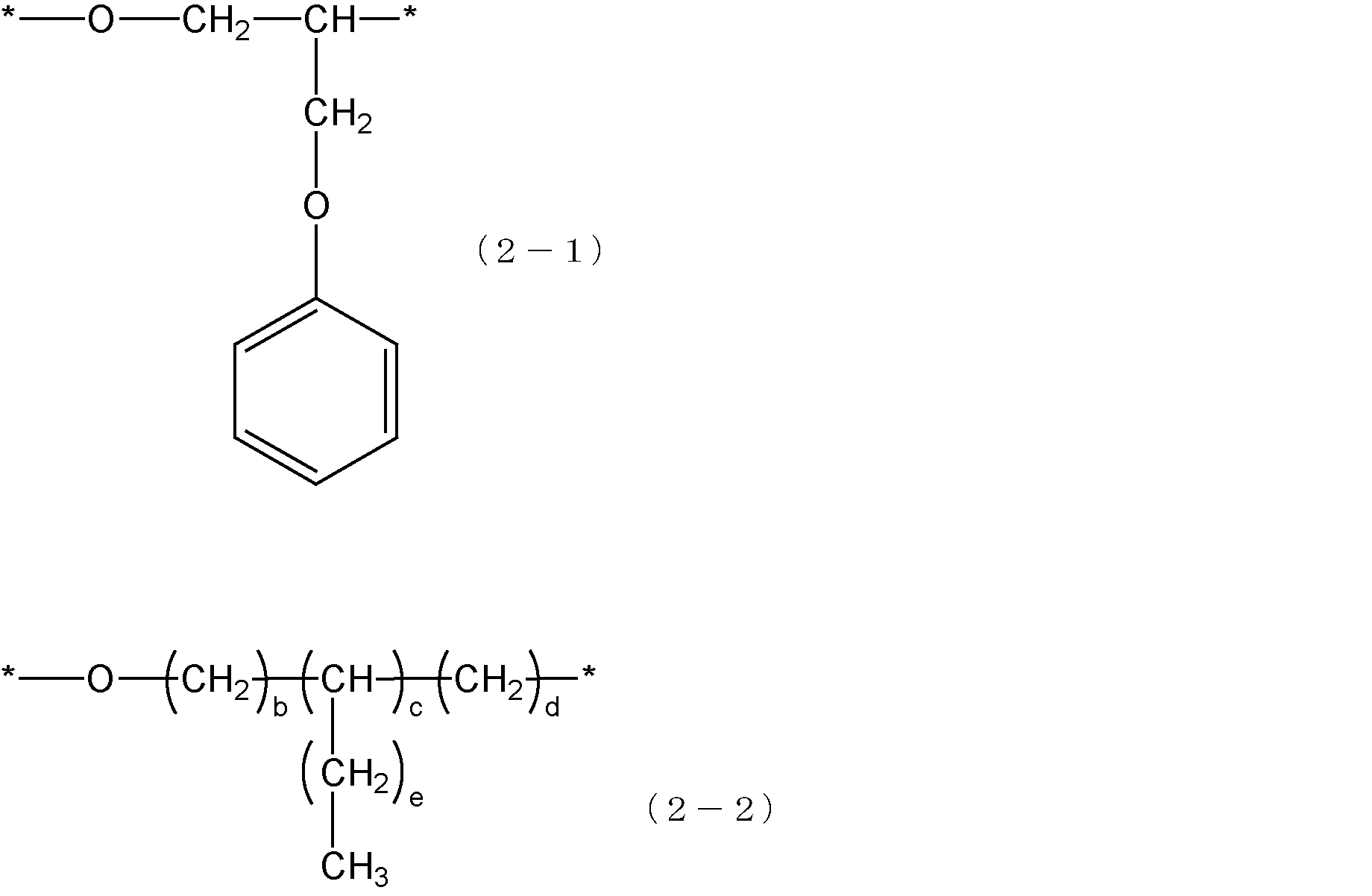
式(2-2)中、bは0~8の整数を表し、cは0~3の整数を表し、dは0~8の整数を表し、eは0~8の整数を表し、b、c、dのいずれか1つは1以上であり、*は結合位置を表す。
以下に本発明を詳述する。
本発明者は、表示素子に生じた残像等の原因が、シール剤の硬化物中に残った上記式(1)で表される化合物が析出して配向膜上に付着し、配向規制力の低下を引き起こしていることであると考えた。即ち、画素密度が高いため配線の数が多い高精細液晶表示素子では、配線の下に配置されるシール剤の部分が大きくなり、該配線によってシール剤に光が充分に届かず、未反応の上記式(1)で表される化合物が析出し易くなっていると考えた。
そこで本発明者は更に鋭意検討した結果、上記式(1)で表される化合物と1分子中に2つ以上のエポキシ基を有する化合物とを組み合わせて用い、該1分子中に2つ以上のエポキシ基を有する化合物の含有量を特定の範囲とすることにより、接着性に優れ、液晶汚染性が低く、表示性能に優れる液晶表示素子を得ることができる液晶表示素子用シール剤が得られることを見出し、本発明を完成させるに至った。
上記硬化性樹脂は、上記式(1)で表される化合物を含有する。上記式(1)で表される化合物を含有することにより、本発明の液晶表示素子用シール剤は、接着性に優れ、液晶汚染性が低いものとなる。
上記酸無水物としては、例えば、無水フタル酸、無水マレイン酸、無水コハク酸、無水シトラコン酸等が挙げられる。なかでも、無水フタル酸が好ましい。
上記エポキシ化合物としては、後述する1分子中に2つ以上のエポキシ基を有する化合物と同様のものが好適に用いられる。
上記ラクトンとしては、例えば、β-プロピオラクトン、β-ブチロラクトン、γ-ブチロラクトン、γ-バレロラクトン、δ-バレロラクトン、ε-カプロラクトン、γ-ヘプタラクトン、γ-ノナラクトン、γ-デカラクトン、δ-デカラクトン、γ-ドデカラクトン、δ-ドデカラクトン、γ-ウンデカラクトン、δ-ウンデカラクトン、7-ブチル-2-オキセパノン等が挙げられる。なかでも、開環したときに主骨格の直鎖部分の炭素数が3~7となるものが好ましい。
なお、本明細書において、上記「(メタ)アクリル」とは、アクリル又はメタクリルを意味し、上記「(メタ)アクリル化合物」とは、(メタ)アクリロイル基を有する化合物を意味し、上記「(メタ)アクリロイル」とは、アクリロイル又はメタクリロイルを意味する。
なお、本明細書において、上記「(メタ)アクリレート」とは、アクリレート又はメタクリレートを意味し、上記「エポキシ(メタ)アクリレート」とは、エポキシ化合物中の全てのエポキシ基を(メタ)アクリル酸と反応させた化合物のことを表す。
なお、本明細書において上記部分(メタ)アクリル変性エポキシ樹脂とは、1分子中に1つのエポキシ基と1つ以上の(メタ)アクリロイル基とを有する化合物を意味し、例えば、上述した多官能エポキシ化合物の一部分のエポキシ基を(メタ)アクリル酸と反応させることによって得ることができる。
上記重合開始剤としては、ラジカル重合開始剤が好適に用いられる。
なお、本明細書において高分子アゾ開始剤とは、アゾ基を有し、熱によって(メタ)アクリロイルオキシ基を硬化させることができるラジカルを生成する、数平均分子量が300以上の化合物を意味する。
なお、本明細書において、上記数平均分子量は、ゲルパーミエーションクロマトグラフィー(GPC)で測定を行い、ポリスチレン換算により求められる値である。GPCによってポリスチレン換算による数平均分子量を測定する際のカラムとしては、例えば、Shodex LF-804(昭和電工社製)等が挙げられる。
上記アゾ基を介してポリアルキレンオキサイド等のユニットが複数結合した構造を有する高分子アゾ開始剤としては、ポリエチレンオキサイド構造を有するものが好ましい。このような高分子アゾ開始剤としては、例えば、4,4’-アゾビス(4-シアノペンタン酸)とポリアルキレングリコールの重縮合物や、4,4’-アゾビス(4-シアノペンタン酸)と末端アミノ基を有するポリジメチルシロキサンの重縮合物等が挙げられ、具体的には例えば、VPE-0201、VPE-0401、VPE-0601、VPS-0501、VPS-1001(いずれも和光純薬工業社製)等が挙げられる。
また、高分子ではないアゾ化合物の例としては、V-65、V-501(いずれも和光純薬工業社製)等が挙げられる。
上記シランカップリング剤としては、例えば、3-アミノプロピルトリメトキシシラン、3-メルカプトプロピルトリメトキシシラン、3-グリシドキシプロピルトリメトキシシラン等が好適に用いられる。
また、遮光剤として上記チタンブラックを含有する本発明の液晶表示素子用シール剤を用いて製造した液晶表示素子は、充分な遮光性を有するため、光の漏れ出しがなく高いコントラストを有し、優れた画像表示品質を有する液晶表示素子を実現することができる。
また、上記チタンブラックの体積抵抗の好ましい下限は0.5Ω・cm、好ましい上限は3Ω・cmであり、より好ましい下限は1Ω・cm、より好ましい上限は2.5Ω・cmである。
なお、上記遮光剤の一次粒子径は、粒度分布計(例えば、PARTICLE SIZING SYSTEMS社製、「NICOMP 380ZLS」)を用いて測定することができる。
上記接着強度は高いほどよく、好ましい上限はないが、実質的な上限は400N/cm2である。
なお、上記硬化物のガラス基板に対する接着強度は、以下の方法で測定できる。
まず、液晶表示素子用シール剤をガラス基板に塗布し、別のガラス基板をその上に重ね合わせて液晶表示素子用シール剤を押し広げ、100mW/cm2の紫外線を30秒照射した後、120℃で1時間加熱を行うことにより接着試験片を作製する。次いで、得られた接着試験片について、テンションゲージを用いることにより、上記硬化物のガラス基板に対する接着強度を測定することができる。
なお、上記「シール剤の開口率」は、シール剤が配線等によって隠れていない部分の割合を意味し、光学顕微鏡を用いてシール剤の上部に配置される金属配線の形状を観察することにより測定することができる。
液晶滴下工法によって本発明の液晶表示素子を製造する方法としては、具体的には例えば、基板に本発明の液晶表示素子用シール剤等をスクリーン印刷、ディスペンサー塗布等により枠状のシールパターンを形成する工程、本発明の液晶表示素子用シール剤等が未硬化の状態で液晶の微小滴を透明基板の枠内全面に滴下塗布し、すぐに別の基板を重ね合わせる工程、及び、本発明の液晶表示素子用シール剤等のシールパターン部分に紫外線等の光を照射してシール剤を仮硬化させる工程、及び、仮硬化させたシール剤を加熱して本硬化させる工程を有する方法等が挙げられる。
反応フラスコに、2-ヒドロキシエチルアクリレート116重量部と、β-プロピオラクトン114重量部と、重合禁止剤としてハイドロキノン0.3重量部とを加え、マントルヒーターを用いて90℃で5時間撹拌した後、無水フタル酸148重量部を加えて更に5時間撹拌した。次いで、得られた反応物にビスフェノールAジグリシジルエーテル170重量部を加え、90℃で5時間撹拌することにより、硬化性樹脂Aを得た。
1H-NMR、13C-NMR、及び、FT-IR分析により、硬化性樹脂Aは、上記式(1)で表される化合物(R1が水素原子、R2が上記式(2-2)で表される基(b=2、c=0、d=0)、R3が下記式(3)で表される無水フタル酸由来の構造、R4が下記式(4)で表されるビスフェノールAジグリシジルエーテル由来の構造、Xが下記式(5)で表されるβ-プロピオラクトンの開環構造、n=2、a=2)であることを確認した。



β-プロピオラクトンの配合量を360重量部に変更したこと以外は、上記「(硬化性樹脂Aの作製)」と同様にして硬化性樹脂Bを得た。
1H-NMR、13C-NMR、及び、FT-IR分析により、硬化性樹脂Bは、上記式(1)で表される化合物(R1が水素原子、R2が上記式(2-2)で表される基(b=2、c=0、d=0)、R3が上記式(3)で表される無水フタル酸由来の構造、R4が上記式(4)で表されるビスフェノールAジグリシジルエーテル由来の構造、Xが上記式(5)で表されるβ-プロピオラクトンの開環構造、n=5、a=2)であることを確認した。
β-プロピオラクトン114重量部に代えてγ-バレロラクトン200重量部を配合したこと以外は、上記「(硬化性樹脂Aの作製)」と同様にして硬化性樹脂Cを得た。
1H-NMR、13C-NMR、及び、FT-IR分析により、硬化性樹脂Cは、上記式(1)で表される化合物(R1が水素原子、R2が上記式(2-2)で表される基(b=2、c=0、d=0)、R3が上記式(3)で表される無水フタル酸由来の構造、R4が上記式(4)で表されるビスフェノールAジグリシジルエーテル由来の構造、Xが下記式(6)で表されるγ-バレロラクトンの開環構造、n=2、a=2)であることを確認した。

β-プロピオラクトン114重量部に代えてγ-バレロラクトン500重量部を配合したこと以外は、上記「(硬化性樹脂Aの作製)」と同様にして硬化性樹脂Dを得た。
1H-NMR、13C-NMR、及び、FT-IR分析により、硬化性樹脂Dは、上記式(1)で表される化合物(R1が水素原子、R2が上記式(2-2)で表される基(b=2、c=0、d=0)、R3が上記式(3)で表される無水フタル酸由来の構造、R4が上記式(4)で表されるビスフェノールAジグリシジルエーテル由来の構造、Xが上記式(6)で表されるγ-バレロラクトンの開環構造、n=5、a=2)であることを確認した。
β-プロピオラクトン114重量部に代えてε-カプロラクトン114重量部を配合したこと以外は、上記「(硬化性樹脂Aの作製)」と同様にして硬化性樹脂Eを得た。
1H-NMR、13C-NMR、及び、FT-IR分析により、硬化性樹脂Eは、上記式(1)で表される化合物(R1が水素原子、R2が上記式(2-2)で表される基(b=2、c=0、d=0)、R3が上記式(3)で表される無水フタル酸由来の構造、R4が上記式(4)で表されるビスフェノールAジグリシジルエーテル由来の構造、Xが下記式(7)で表されるε-カプロラクトンの開環構造、n=1、a=2)であることを確認した。

β-プロピオラクトン114重量部に代えてε-カプロラクトン228重量部を配合したこと以外は、上記「(硬化性樹脂Aの作製)」と同様にして硬化性樹脂Fを得た。
1H-NMR、13C-NMR、及び、FT-IR分析により、硬化性樹脂Fは、上記式(1)で表される化合物(R1が水素原子、R2が上記式(2-2)で表される基(b=2、c=0、d=0)、R3が上記式(3)で表される無水フタル酸由来の構造、R4が上記式(4)で表されるビスフェノールAジグリシジルエーテル由来の構造、Xが上記式(7)で表されるε-カプロラクトンの開環構造、n=2、a=2)であることを確認した。
β-プロピオラクトン114重量部に代えてε-カプロラクトン342重量部を配合したこと以外は、上記「(硬化性樹脂Aの作製)」と同様にして硬化性樹脂Gを得た。
1H-NMR、13C-NMR、及び、FT-IR分析により、硬化性樹脂Gは、上記式(1)で表される化合物(R1が水素原子、R2が上記式(2-2)で表される基(b=2、c=0、d=0)、R3が上記式(3)で表される無水フタル酸由来の構造、R4が上記式(4)で表されるビスフェノールAジグリシジルエーテル由来の構造、Xが上記式(7)で表されるε-カプロラクトンの開環構造、n=3、a=2)であることを確認した。
β-プロピオラクトン114重量部に代えてε-カプロラクトン456重量部を配合したこと以外は、上記「(硬化性樹脂Aの作製)」と同様にして硬化性樹脂Hを得た。
1H-NMR、13C-NMR、及び、FT-IR分析により、硬化性樹脂Hは、上記式(1)で表される化合物(R1が水素原子、R2が上記式(2-2)で表される基(b=2、c=0、d=0)、R3が上記式(3)で表される無水フタル酸由来の構造、R4が上記式(4)で表されるビスフェノールAジグリシジルエーテル由来の構造、Xが上記式(7)で表されるε-カプロラクトンの開環構造、n=4、a=2)であることを確認した。
β-プロピオラクトン114重量部に代えてε-カプロラクトン570重量部を配合したこと以外は、上記「(硬化性樹脂Aの作製)」と同様にして硬化性樹脂Iを得た。
1H-NMR、13C-NMR、及び、FT-IR分析により、硬化性樹脂Iは、上記式(1)で表される化合物(R1が水素原子、R2が上記式(2-2)で表される基(b=2、c=0、d=0)、R3が上記式(3)で表される無水フタル酸由来の構造、R4が上記式(4)で表されるビスフェノールAジグリシジルエーテル由来の構造、Xが上記式(7)で表されるε-カプロラクトンの開環構造、n=5、a=2)であることを確認した。
β-プロピオラクトン114重量部に代えてε-カプロラクトン684重量部を配合したこと以外は、上記「(硬化性樹脂Aの作製)」と同様にして硬化性樹脂Jを得た。
1H-NMR、13C-NMR、及び、FT-IR分析により、硬化性樹脂Jは、上記式(1)で表される化合物(R1が水素原子、R2が上記式(2-2)で表される基(b=2、c=0、d=0)、R3が上記式(3)で表される無水フタル酸由来の構造、R4が上記式(4)で表されるビスフェノールAジグリシジルエーテル由来の構造、Xが上記式(7)で表されるε-カプロラクトンの開環構造、n=6、a=2)であることを確認した。
β-プロピオラクトン114重量部に代えてγ-ヘプタラクトン256重量部を配合したこと以外は、上記「(硬化性樹脂Aの作製)」と同様にして硬化性樹脂Kを得た。
1H-NMR、13C-NMR、及び、FT-IR分析により、硬化性樹脂Kは、上記式(1)で表される化合物(R1が水素原子、R2が上記式(2-2)で表される基(b=2、c=0、d=0)、R3が上記式(3)で表される無水フタル酸由来の構造、R4が上記式(4)で表されるビスフェノールAジグリシジルエーテル由来の構造、Xが下記式(8)で表されるγ-ヘプタラクトンの開環構造、n=2、a=2)であることを確認した。

β-プロピオラクトン114重量部に代えてγ-ヘプタラクトン640重量部を配合したこと以外は、上記「(硬化性樹脂Aの作製)」と同様にして硬化性樹脂Lを得た。
1H-NMR、13C-NMR、及び、FT-IR分析により、硬化性樹脂Lは、上記式(1)で表される化合物(R1が水素原子、R2が上記式(2-2)で表される基(b=2、c=0、d=0)、R3が上記式(3)で表される無水フタル酸由来の構造、R4が上記式(4)で表されるビスフェノールAジグリシジルエーテル由来の構造、Xが上記式(8)で表されるγ-ヘプタラクトンの開環構造、n=5、a=2)であることを確認した。
β-プロピオラクトン114重量部に代えてε-カプロラクトン342重量部を配合し、ビスフェノールAジグリシジルエーテル170重量部に代えてトリス(p-ヒドロキシフェニル)メタンジグリシジルエーテル230重量部を配合したこと以外は、上記「(硬化性樹脂Aの作製)」と同様にして硬化性樹脂Mを得た。
1H-NMR、13C-NMR、及び、FT-IR分析により、硬化性樹脂Mは、上記式(1)で表される化合物(R1が水素原子、R2が上記式(2-2)で表される基(b=2、c=0、d=0)、R3が上記式(3)で表される無水フタル酸由来の構造、R4が下記式(9)で表されるトリス(p-ヒドロキシフェニル)メタンジグリシジルエーテル由来の構造、Xが上記式(7)で表されるε-カプロラクトンの開環構造、n=3、a=2)であることを確認した。

ビスフェノールFジグリシジルエーテル312重量部をトルエン600mLに溶解させ、この溶液にトリフェニルホスフィン0.2gを加え、均一な溶液とした。得られた溶液にアクリル酸72重量部を還流撹拌下において2時間かけて滴下した後、更に還流撹拌を6時間行った。次に、トルエンを除去することによって、下記式(10)で表される部分アクリル変性ビスフェノールF型エポキシ樹脂を得た。

表1~3に記載された配合比に従い、各材料を、遊星式撹拌装置(シンキー社製、「あわとり練太郎」)にて撹拌した後、セラミック3本ロールにて均一に混合して実施例1~17、比較例1~5の液晶表示素子用シール剤を得た。
実施例及び比較例で得られた各液晶表示素子用シール剤について以下の評価を行った。結果を表1~3に示した。
実施例及び比較例で得られた各液晶表示素子用シール剤をシリンジに入れ、真空脱泡装置(シンキー社製、「ARV-200」)で、1500rpm、3torrの条件で10分間真空脱泡し、温度23℃、湿度50%RHの環境下に2週間放置した後、少量をスパチュラで取り出しガラス基板に手作業で塗布し、シール剤のゲル化が進んでいないかを調べた。
ゲル化せず、容易にガラス基板に塗布できたものを「○」、ゲル化して塗布性が悪化したものを「△」、塗布できなかったものを「×」として保存安定性を評価した。
実施例及び比較例で得られた各液晶表示素子用シール剤100重量部に対して平均粒径5μmのポリマービーズ(積水化学工業社製、「ミクロパールSP」)3重量部を遊星式撹拌装置によって分散させ均一な液とした。得られた液の極微量をガラス基板(20mm×50mm×1.1mmt)の中央部に取り、同型のガラス基板をその上に重ね合わせて液晶表示素子用シール剤を押し広げた。その状態で100mW/cm2の紫外線を30秒照射した後、120℃で1時間加熱を行い、接着試験片を得た。
得られた接着試験片について、テンションゲージを用いて接着強度を測定した。
サンプル瓶に液晶(チッソ社製、「JC-5001LA」)0.5gを入れ、実施例及び比較例で得られた各液晶滴下工法用シール剤0.1gを加えて振とうした後、120℃で1時間加熱し、室温(25℃)に戻した。
透明電極と配向膜(日産化学社製、「SE7492」)とを有するガラス基板の配向膜上に、実施例及び比較例で得られた各液晶滴下工法用シール剤を正方形の枠を描くようにディスペンサーで塗布した。続いて、上記サンプル瓶から取り出した液晶の微小滴を基板上の枠内全面に滴下塗布し、真空中にて別のガラス基板を重ね合わせた。真空を解除し、100mW/cm2の紫外線を30秒照射した後、120℃で1時間加熱することによりシール剤を硬化させて液晶表示素子(シール剤の開口率20%)を得た。
得られた液晶表示素子について、1.5Vの交流電圧を印加しながら1Vの直流電圧を印加した際の残像の発生具合を目視にて確認した。その結果、残像が全く確認されなかった場合を「○」、わずかに残像が確認された場合を「△」、酷い残像が確認された場合を「×」として液晶表示素子の表示性能(残像防止性)を評価した。
透明電極と配向膜(日産化学社製、「SE7492」)とを有するガラス基板の配向膜上に、実施例及び比較例で得られた各液晶滴下工法用シール剤を正方形の枠を描くようにディスペンサーで塗布した。続いて、液晶(チッソ社製、「JC-5001LA」)の微小滴を基板上の枠内全面に滴下塗布し、真空中にて別のガラス基板を重ね合わせた。真空を解除し、表示部にマスクをして100mW/cm2の紫外線を30秒照射した後、120℃で1時間加熱することによりシール剤を硬化させて液晶表示素子(シール剤の開口率20%)を得た。得られた液晶表示素子について、偏光顕微鏡を用いて表示部のシール剤周辺を確認した。その結果、表示ムラが全く確認されなかった場合を「○」、わずかに表示ムラが確認された場合を「△」、酷い表示ムラが確認された場合を「×」として液晶表示素子の表示性能(低液晶汚染性)を評価した。
実施例及び比較例で得られた各液晶表示素子用シール剤について、上記「(液晶表示素子の表示性能(低液晶汚染性))」と同様にして液晶表示素子をそれぞれ10セルずつ作製した。
各液晶表示素子を2mの高さから落下させる落下試験を行い、落下試験後、全てのセルに剥がれや割れによる液晶漏れがなかった場合を「○」、1セル以上9セル以下の液晶表示素子に液晶漏れがあった場合を「△」、全ての液晶表示素子に液晶漏れがあった場合を「×」として液晶表示素子の耐衝撃性を評価した。
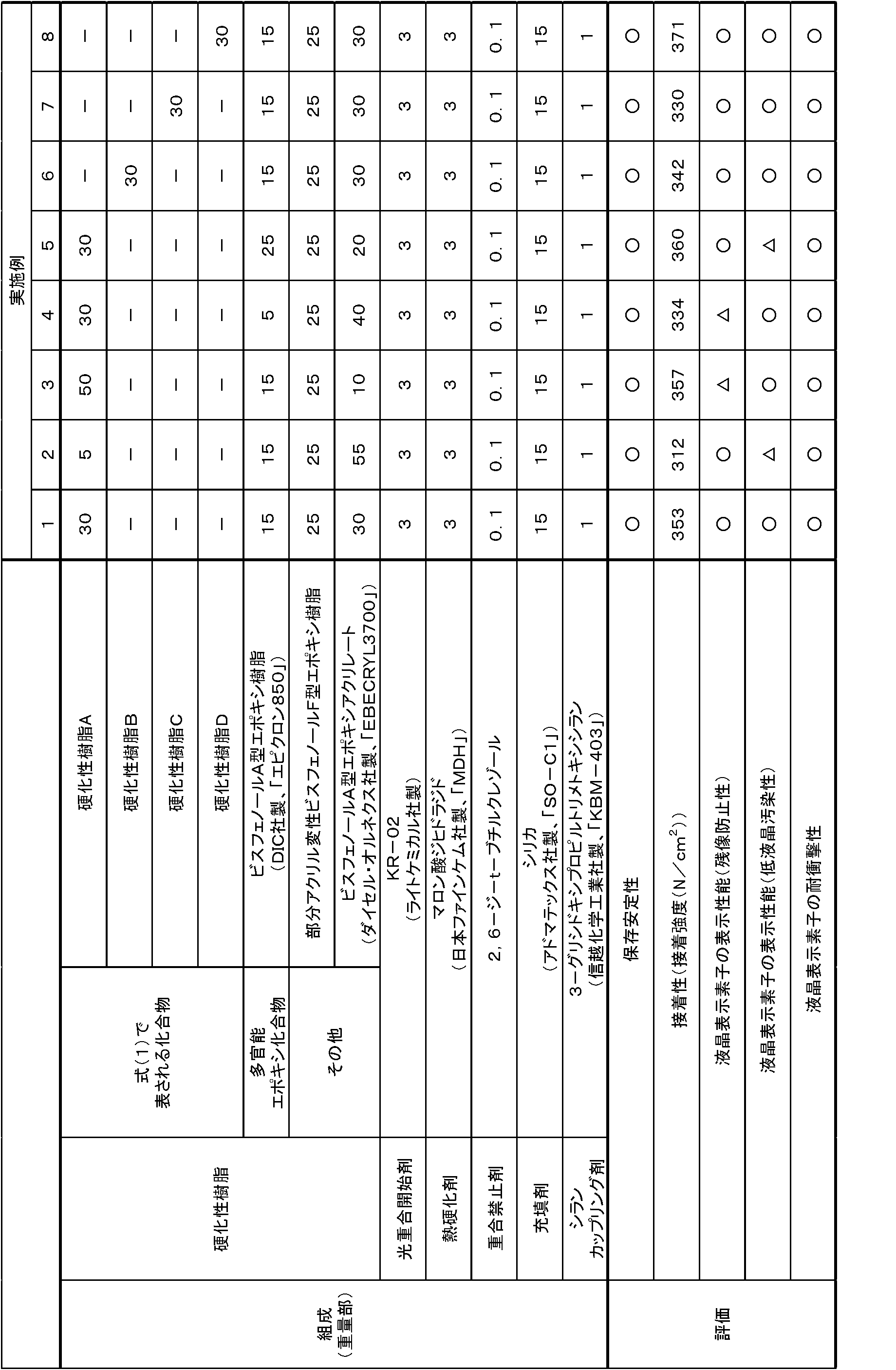

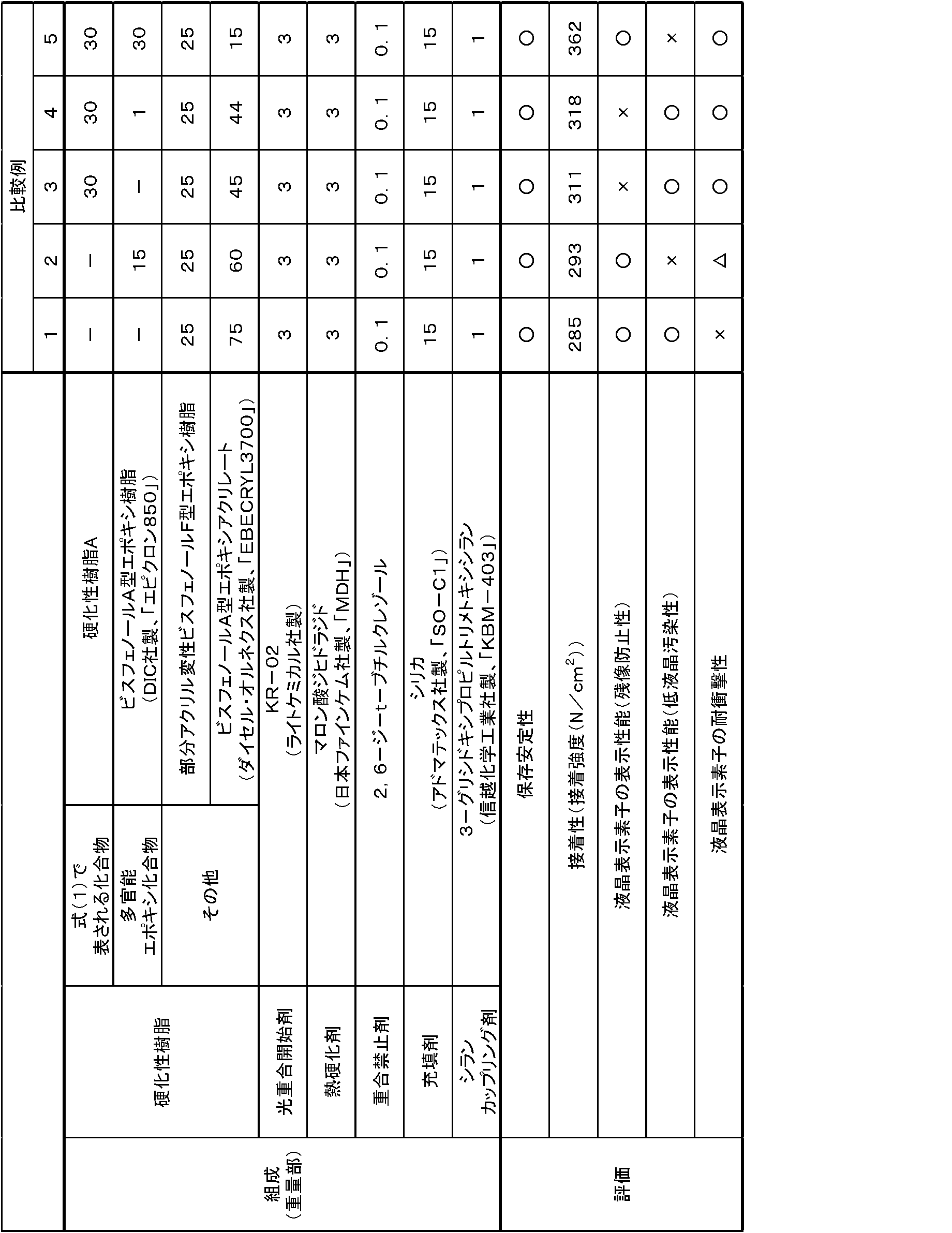
Claims (6)
- 硬化性樹脂と重合開始剤及び/又は熱硬化剤とを含有する液晶表示素子用シール剤であって、
前記硬化性樹脂は、下記式(1)で表される化合物と、1分子中に2つ以上のエポキシ基を有する化合物とを含有し、
硬化性樹脂100重量部中における1分子中に2つ以上のエポキシ基を有する化合物の含有量が5重量部以上25重量部以下であり、
硬化物のガラス基板に対する接着強度が290N/cm2以上である
ことを特徴とする液晶表示素子用シール剤。


式(2-2)中、bは0~8の整数を表し、cは0~3の整数を表し、dは0~8の整数を表し、eは0~8の整数を表し、b、c、dのいずれか1つは1以上であり、*は結合位置を表す。 - 硬化性樹脂100重量部中における式(1)で表される化合物の含有量が5~50重量部であることを特徴とする請求項1記載の液晶表示素子用シール剤。
- 重合禁止剤を含有することを特徴とする請求項1又は2記載の液晶表示素子用シール剤。
- 遮光剤を含有することを特徴とする請求項1、2又は3記載の液晶表示素子用シール剤。
- 請求項1、2、3又は4記載の液晶表示素子用シール剤と導電性微粒子とを含有することを特徴とする上下導通材料。
- 請求項1、2、3若しくは4記載の液晶表示素子用シール剤又は請求項5記載の上下導通材料を用いてなることを特徴とする液晶表示素子。
Priority Applications (3)
| Application Number | Priority Date | Filing Date | Title |
|---|---|---|---|
| KR1020187017628A KR102426816B1 (ko) | 2016-05-17 | 2017-05-15 | 액정 표시 소자용 시일제, 상하 도통 재료, 및, 액정 표시 소자 |
| JP2017527668A JP6263317B1 (ja) | 2016-05-17 | 2017-05-15 | 液晶表示素子用シール剤、上下導通材料、及び、液晶表示素子 |
| CN201780003640.XA CN108351561B (zh) | 2016-05-17 | 2017-05-15 | 液晶显示元件用密封剂、上下导通材料和液晶显示元件 |
Applications Claiming Priority (2)
| Application Number | Priority Date | Filing Date | Title |
|---|---|---|---|
| JP2016-098916 | 2016-05-17 | ||
| JP2016098916 | 2016-05-17 |
Publications (1)
| Publication Number | Publication Date |
|---|---|
| WO2017199905A1 true WO2017199905A1 (ja) | 2017-11-23 |
Family
ID=60325869
Family Applications (1)
| Application Number | Title | Priority Date | Filing Date |
|---|---|---|---|
| PCT/JP2017/018181 Ceased WO2017199905A1 (ja) | 2016-05-17 | 2017-05-15 | 液晶表示素子用シール剤、上下導通材料、及び、液晶表示素子 |
Country Status (5)
| Country | Link |
|---|---|
| JP (1) | JP6263317B1 (ja) |
| KR (1) | KR102426816B1 (ja) |
| CN (1) | CN108351561B (ja) |
| TW (1) | TWI733805B (ja) |
| WO (1) | WO2017199905A1 (ja) |
Cited By (3)
| Publication number | Priority date | Publication date | Assignee | Title |
|---|---|---|---|---|
| JP2020087774A (ja) * | 2018-11-28 | 2020-06-04 | 東洋インキScホールディングス株式会社 | ディスプレイ |
| JPWO2021177111A1 (ja) * | 2020-03-02 | 2021-09-10 | ||
| WO2023182245A1 (ja) * | 2022-03-25 | 2023-09-28 | 積水化学工業株式会社 | 液晶表示素子用シール剤及び液晶表示素子 |
Families Citing this family (1)
| Publication number | Priority date | Publication date | Assignee | Title |
|---|---|---|---|---|
| JP6650151B2 (ja) * | 2018-04-03 | 2020-02-19 | 協立化学産業株式会社 | 硬化性組成物、液晶パネル、及び液晶パネルの製造方法 |
Citations (5)
| Publication number | Priority date | Publication date | Assignee | Title |
|---|---|---|---|---|
| JP2007041559A (ja) * | 2005-07-06 | 2007-02-15 | Sekisui Chem Co Ltd | 液晶滴下工法用シール剤、上下導通材料及び液晶表示素子 |
| JP2008088167A (ja) * | 2006-09-07 | 2008-04-17 | Mitsui Chemicals Inc | (メタ)アクリロイル基およびグリシジル基を含有する化合物、当該化合物を含む重合性組成物、ならびに当該化合物の製造方法に関する。 |
| WO2012137749A1 (ja) * | 2011-04-05 | 2012-10-11 | 積水化学工業株式会社 | 液晶表示素子用遮光シール剤、上下導通材料及び液晶表示素子 |
| JP2013025177A (ja) * | 2011-07-22 | 2013-02-04 | Nippon Kayaku Co Ltd | 液晶シール剤及びそれを用いた液晶表示セル |
| WO2016013214A1 (ja) * | 2014-07-24 | 2016-01-28 | 三井化学株式会社 | 液晶シール剤、および液晶表示パネルの製造方法 |
Family Cites Families (10)
| Publication number | Priority date | Publication date | Assignee | Title |
|---|---|---|---|---|
| JP3162179B2 (ja) | 1992-04-17 | 2001-04-25 | 協立化学産業株式会社 | 液晶表示装置の枠シール剤組成物 |
| JP3583326B2 (ja) | 1999-11-01 | 2004-11-04 | 協立化学産業株式会社 | Lcdパネルの滴下工法用シール剤 |
| JP2004361854A (ja) * | 2003-06-06 | 2004-12-24 | Sekisui Chem Co Ltd | 液晶表示素子 |
| WO2004108790A1 (ja) * | 2003-06-04 | 2004-12-16 | Sekisui Chemical Co., Ltd. | 硬化性樹脂組成物、液晶表示素子用シール剤及び液晶表示素子 |
| KR100926926B1 (ko) * | 2005-05-09 | 2009-11-17 | 세키스이가가쿠 고교가부시키가이샤 | 액정 적하 공법용 시일제, 상하 도통 재료 및 액정 표시소자 |
| JP5508001B2 (ja) * | 2008-03-26 | 2014-05-28 | 積水化学工業株式会社 | 液晶滴下工法用シール剤、上下導通材料、及び、液晶表示素子 |
| JP5238910B1 (ja) * | 2011-08-17 | 2013-07-17 | 積水化学工業株式会社 | 液晶表示素子用シール剤及び液晶表示素子 |
| CN105283803B (zh) * | 2013-06-11 | 2017-08-01 | 积水化学工业株式会社 | 液晶滴下工艺用密封剂、上下导通材料及液晶显示元件 |
| JP6539160B2 (ja) * | 2014-09-04 | 2019-07-03 | 積水化学工業株式会社 | 液晶表示素子用シール剤及び上下導通材料 |
| CN106415381B (zh) * | 2014-09-24 | 2020-09-25 | 积水化学工业株式会社 | 液晶显示元件用密封剂、上下导通材料及液晶显示元件 |
-
2017
- 2017-05-15 KR KR1020187017628A patent/KR102426816B1/ko active Active
- 2017-05-15 JP JP2017527668A patent/JP6263317B1/ja active Active
- 2017-05-15 CN CN201780003640.XA patent/CN108351561B/zh active Active
- 2017-05-15 WO PCT/JP2017/018181 patent/WO2017199905A1/ja not_active Ceased
- 2017-05-17 TW TW106116230A patent/TWI733805B/zh active
Patent Citations (5)
| Publication number | Priority date | Publication date | Assignee | Title |
|---|---|---|---|---|
| JP2007041559A (ja) * | 2005-07-06 | 2007-02-15 | Sekisui Chem Co Ltd | 液晶滴下工法用シール剤、上下導通材料及び液晶表示素子 |
| JP2008088167A (ja) * | 2006-09-07 | 2008-04-17 | Mitsui Chemicals Inc | (メタ)アクリロイル基およびグリシジル基を含有する化合物、当該化合物を含む重合性組成物、ならびに当該化合物の製造方法に関する。 |
| WO2012137749A1 (ja) * | 2011-04-05 | 2012-10-11 | 積水化学工業株式会社 | 液晶表示素子用遮光シール剤、上下導通材料及び液晶表示素子 |
| JP2013025177A (ja) * | 2011-07-22 | 2013-02-04 | Nippon Kayaku Co Ltd | 液晶シール剤及びそれを用いた液晶表示セル |
| WO2016013214A1 (ja) * | 2014-07-24 | 2016-01-28 | 三井化学株式会社 | 液晶シール剤、および液晶表示パネルの製造方法 |
Cited By (6)
| Publication number | Priority date | Publication date | Assignee | Title |
|---|---|---|---|---|
| JP2020087774A (ja) * | 2018-11-28 | 2020-06-04 | 東洋インキScホールディングス株式会社 | ディスプレイ |
| JPWO2021177111A1 (ja) * | 2020-03-02 | 2021-09-10 | ||
| WO2021177111A1 (ja) * | 2020-03-02 | 2021-09-10 | 三井化学株式会社 | 液晶滴下工法用シール剤および液晶表示パネルの製造方法 |
| JP7490747B2 (ja) | 2020-03-02 | 2024-05-27 | 三井化学株式会社 | 液晶滴下工法用シール剤および液晶表示パネルの製造方法 |
| WO2023182245A1 (ja) * | 2022-03-25 | 2023-09-28 | 積水化学工業株式会社 | 液晶表示素子用シール剤及び液晶表示素子 |
| JP7421691B1 (ja) * | 2022-03-25 | 2024-01-24 | 積水化学工業株式会社 | 液晶表示素子用シール剤及び液晶表示素子 |
Also Published As
| Publication number | Publication date |
|---|---|
| KR102426816B1 (ko) | 2022-07-28 |
| JPWO2017199905A1 (ja) | 2018-06-07 |
| CN108351561B (zh) | 2021-12-10 |
| TW201811854A (zh) | 2018-04-01 |
| JP6263317B1 (ja) | 2018-01-17 |
| TWI733805B (zh) | 2021-07-21 |
| KR20190008172A (ko) | 2019-01-23 |
| CN108351561A (zh) | 2018-07-31 |
Similar Documents
| Publication | Publication Date | Title |
|---|---|---|
| JP5827752B2 (ja) | 液晶滴下工法用シール剤、上下導通材料、及び、液晶表示素子 | |
| JP5685346B1 (ja) | 液晶滴下工法用シール剤、上下導通材料、及び、液晶表示素子 | |
| JPWO2017119406A1 (ja) | 液晶表示素子用シール剤、上下導通材料、及び、液晶表示素子 | |
| JP6263317B1 (ja) | 液晶表示素子用シール剤、上下導通材料、及び、液晶表示素子 | |
| JP6046868B1 (ja) | 液晶滴下工法用シール剤、上下導通材料、及び、液晶表示素子 | |
| JP6539160B2 (ja) | 液晶表示素子用シール剤及び上下導通材料 | |
| TWI826652B (zh) | 硬化性樹脂組成物、液晶顯示元件用密封劑、上下導通材料、及液晶顯示元件 | |
| JP6163045B2 (ja) | 液晶滴下工法用シール剤、上下導通材料、及び、液晶表示素子 | |
| WO2017061303A1 (ja) | 液晶表示素子用シール剤、上下導通材料、及び、液晶表示素子 | |
| JP6978314B2 (ja) | 液晶表示素子用シール剤、上下導通材料、及び、液晶表示素子 | |
| TWI716440B (zh) | 液晶顯示元件用密封劑、上下導通材料、及液晶顯示元件 | |
| TWI888653B (zh) | 液晶顯示元件用密封劑、上下導通材料、及液晶顯示元件 | |
| JP6928177B2 (ja) | 硬化性樹脂組成物、液晶表示素子用シール剤、上下導通材料、及び、液晶表示素子 | |
| WO2018110594A1 (ja) | 液晶表示素子用シール剤、上下導通材料、及び、液晶表示素子 | |
| WO2018116928A1 (ja) | 液晶表示素子用シール剤、上下導通材料、及び、液晶表示素子 | |
| JP6078698B1 (ja) | 液晶滴下工法用シール剤、上下導通材料、及び、液晶表示素子 | |
| WO2017061255A1 (ja) | 液晶表示素子用シール剤、上下導通材料、及び、液晶表示素子 | |
| JPWO2018037861A1 (ja) | 液晶表示素子用シール剤、上下導通材料、及び、液晶表示素子 | |
| WO2017119260A1 (ja) | 液晶表示素子用シール剤、上下導通材料、及び、液晶表示素子 | |
| JP2016218447A (ja) | 液晶表示素子用シール剤、上下導通材料、及び、液晶表示素子 | |
| JP2015022289A (ja) | 液晶滴下工法用シール剤、上下導通材料、及び、液晶表示素子 |
Legal Events
| Date | Code | Title | Description |
|---|---|---|---|
| ENP | Entry into the national phase |
Ref document number: 2017527668 Country of ref document: JP Kind code of ref document: A |
|
| ENP | Entry into the national phase |
Ref document number: 20187017628 Country of ref document: KR Kind code of ref document: A |
|
| NENP | Non-entry into the national phase |
Ref country code: DE |
|
| 121 | Ep: the epo has been informed by wipo that ep was designated in this application |
Ref document number: 17799329 Country of ref document: EP Kind code of ref document: A1 |
|
| 122 | Ep: pct application non-entry in european phase |
Ref document number: 17799329 Country of ref document: EP Kind code of ref document: A1 |