WO2017188005A1 - ネマチック液晶組成物及びこれを用いた液晶表示素子 - Google Patents
ネマチック液晶組成物及びこれを用いた液晶表示素子 Download PDFInfo
- Publication number
- WO2017188005A1 WO2017188005A1 PCT/JP2017/015106 JP2017015106W WO2017188005A1 WO 2017188005 A1 WO2017188005 A1 WO 2017188005A1 JP 2017015106 W JP2017015106 W JP 2017015106W WO 2017188005 A1 WO2017188005 A1 WO 2017188005A1
- Authority
- WO
- WIPO (PCT)
- Prior art keywords
- group
- liquid crystal
- general formula
- carbon atoms
- oco
- Prior art date
- Legal status (The legal status is an assumption and is not a legal conclusion. Google has not performed a legal analysis and makes no representation as to the accuracy of the status listed.)
- Ceased
Links
- 0 COC(C(N)=C)=* Chemical compound COC(C(N)=C)=* 0.000 description 4
- WJPIFXJKXXIQJD-OPIVVEOKSA-N C/C=C/c(cc1)ccc1-c(cc1I)cc(F)c1C#Cc(cc1)ccc1-c(cc1)cc(cc2)c1cc2[U]CC=C Chemical compound C/C=C/c(cc1)ccc1-c(cc1I)cc(F)c1C#Cc(cc1)ccc1-c(cc1)cc(cc2)c1cc2[U]CC=C WJPIFXJKXXIQJD-OPIVVEOKSA-N 0.000 description 1
- ANFJWZPVANPAFJ-UHFFFAOYSA-N C=CC(OCCCOc(cc1)ccc1-c(cc1F)cc(F)c1C#Cc(c(F)cc(-c1ccc(CCCCC#C)cc1)c1)c1F)=O Chemical compound C=CC(OCCCOc(cc1)ccc1-c(cc1F)cc(F)c1C#Cc(c(F)cc(-c1ccc(CCCCC#C)cc1)c1)c1F)=O ANFJWZPVANPAFJ-UHFFFAOYSA-N 0.000 description 1
- RXUWGACFTGPUCA-UHFFFAOYSA-N CC(CC1=C)OC1O Chemical compound CC(CC1=C)OC1O RXUWGACFTGPUCA-UHFFFAOYSA-N 0.000 description 1
- JUUSFFMIYYUBDE-UHFFFAOYSA-N COCC1C(C2)OC2CC1 Chemical compound COCC1C(C2)OC2CC1 JUUSFFMIYYUBDE-UHFFFAOYSA-N 0.000 description 1
Classifications
-
- C—CHEMISTRY; METALLURGY
- C09—DYES; PAINTS; POLISHES; NATURAL RESINS; ADHESIVES; COMPOSITIONS NOT OTHERWISE PROVIDED FOR; APPLICATIONS OF MATERIALS NOT OTHERWISE PROVIDED FOR
- C09K—MATERIALS FOR MISCELLANEOUS APPLICATIONS, NOT PROVIDED FOR ELSEWHERE
- C09K19/00—Liquid crystal materials
- C09K19/04—Liquid crystal materials characterised by the chemical structure of the liquid crystal components, e.g. by a specific unit
- C09K19/42—Mixtures of liquid crystal compounds covered by two or more of the preceding groups C09K19/06 - C09K19/40
-
- C—CHEMISTRY; METALLURGY
- C09—DYES; PAINTS; POLISHES; NATURAL RESINS; ADHESIVES; COMPOSITIONS NOT OTHERWISE PROVIDED FOR; APPLICATIONS OF MATERIALS NOT OTHERWISE PROVIDED FOR
- C09K—MATERIALS FOR MISCELLANEOUS APPLICATIONS, NOT PROVIDED FOR ELSEWHERE
- C09K19/00—Liquid crystal materials
- C09K19/04—Liquid crystal materials characterised by the chemical structure of the liquid crystal components, e.g. by a specific unit
- C09K19/06—Non-steroidal liquid crystal compounds
- C09K19/08—Non-steroidal liquid crystal compounds containing at least two non-condensed rings
- C09K19/10—Non-steroidal liquid crystal compounds containing at least two non-condensed rings containing at least two benzene rings
- C09K19/12—Non-steroidal liquid crystal compounds containing at least two non-condensed rings containing at least two benzene rings at least two benzene rings directly linked, e.g. biphenyls
-
- C—CHEMISTRY; METALLURGY
- C09—DYES; PAINTS; POLISHES; NATURAL RESINS; ADHESIVES; COMPOSITIONS NOT OTHERWISE PROVIDED FOR; APPLICATIONS OF MATERIALS NOT OTHERWISE PROVIDED FOR
- C09K—MATERIALS FOR MISCELLANEOUS APPLICATIONS, NOT PROVIDED FOR ELSEWHERE
- C09K19/00—Liquid crystal materials
- C09K19/04—Liquid crystal materials characterised by the chemical structure of the liquid crystal components, e.g. by a specific unit
- C09K19/06—Non-steroidal liquid crystal compounds
- C09K19/08—Non-steroidal liquid crystal compounds containing at least two non-condensed rings
- C09K19/10—Non-steroidal liquid crystal compounds containing at least two non-condensed rings containing at least two benzene rings
- C09K19/20—Non-steroidal liquid crystal compounds containing at least two non-condensed rings containing at least two benzene rings linked by a chain containing carbon and oxygen atoms as chain links, e.g. esters or ethers
-
- C—CHEMISTRY; METALLURGY
- C09—DYES; PAINTS; POLISHES; NATURAL RESINS; ADHESIVES; COMPOSITIONS NOT OTHERWISE PROVIDED FOR; APPLICATIONS OF MATERIALS NOT OTHERWISE PROVIDED FOR
- C09K—MATERIALS FOR MISCELLANEOUS APPLICATIONS, NOT PROVIDED FOR ELSEWHERE
- C09K19/00—Liquid crystal materials
- C09K19/04—Liquid crystal materials characterised by the chemical structure of the liquid crystal components, e.g. by a specific unit
- C09K19/06—Non-steroidal liquid crystal compounds
- C09K19/08—Non-steroidal liquid crystal compounds containing at least two non-condensed rings
- C09K19/30—Non-steroidal liquid crystal compounds containing at least two non-condensed rings containing saturated or unsaturated non-aromatic rings, e.g. cyclohexane rings
-
- C—CHEMISTRY; METALLURGY
- C09—DYES; PAINTS; POLISHES; NATURAL RESINS; ADHESIVES; COMPOSITIONS NOT OTHERWISE PROVIDED FOR; APPLICATIONS OF MATERIALS NOT OTHERWISE PROVIDED FOR
- C09K—MATERIALS FOR MISCELLANEOUS APPLICATIONS, NOT PROVIDED FOR ELSEWHERE
- C09K19/00—Liquid crystal materials
- C09K19/52—Liquid crystal materials characterised by components which are not liquid crystals, e.g. additives with special physical aspect: solvents, solid particles
- C09K19/54—Additives having no specific mesophase characterised by their chemical composition
-
- G—PHYSICS
- G02—OPTICS
- G02F—OPTICAL DEVICES OR ARRANGEMENTS FOR THE CONTROL OF LIGHT BY MODIFICATION OF THE OPTICAL PROPERTIES OF THE MEDIA OF THE ELEMENTS INVOLVED THEREIN; NON-LINEAR OPTICS; FREQUENCY-CHANGING OF LIGHT; OPTICAL LOGIC ELEMENTS; OPTICAL ANALOGUE/DIGITAL CONVERTERS
- G02F1/00—Devices or arrangements for the control of the intensity, colour, phase, polarisation or direction of light arriving from an independent light source, e.g. switching, gating or modulating; Non-linear optics
- G02F1/01—Devices or arrangements for the control of the intensity, colour, phase, polarisation or direction of light arriving from an independent light source, e.g. switching, gating or modulating; Non-linear optics for the control of the intensity, phase, polarisation or colour
- G02F1/13—Devices or arrangements for the control of the intensity, colour, phase, polarisation or direction of light arriving from an independent light source, e.g. switching, gating or modulating; Non-linear optics for the control of the intensity, phase, polarisation or colour based on liquid crystals, e.g. single liquid crystal display cells
Definitions
- the present invention relates to a nematic liquid crystal composition having a negative dielectric anisotropy ( ⁇ ) useful as a liquid crystal display material, and a liquid crystal display device using the same.
- Liquid crystal display elements are used in various household electric appliances, measuring instruments, automobile panels, mobile phones, computers, televisions, etc., including watches and calculators.
- Typical liquid crystal display methods include TN (twisted nematic), STN (super twisted nematic), DS (dynamic light scattering), GH (guest / host), and IPS (in-plane switching).
- Type FFS (fringe field switching) type, OCB (optical compensation birefringence) type, ECB (voltage controlled birefringence) type, VA (vertical alignment) type, PSVA type, PSA type, CSH (color super homeotropic) type, Or FLC (ferroelectric liquid crystal) etc.
- Examples of the driving method include static driving, multiplex driving, simple matrix method, active matrix (AM) method driven by TFT (thin film transistor), TFD (thin film diode), and the like.
- the IPS type, FFS type, ECB type, VA type, CSH type, and the like have a feature that a liquid crystal material having a negative value of ⁇ is used.
- the VA type display method by AM driving is used for a display element that requires a high speed and a wide viewing angle, such as a television.
- the FFS display method is used for mobile applications such as smartphones because high transmittance can be obtained.
- Nematic liquid crystal compositions used in VA type, FFS type and other display systems are required to have low voltage driving, high speed response, a wide operating temperature range, and high reliability. That is, ⁇ is negative and the absolute value is large, low rotational viscosity ( ⁇ 1 ), large elastic constant (K 33 ), low solid phase-nematic phase transition temperature (T cn ), high nematic phase-isotropic liquid phase transition Temperature (T ni ) and high voltage holding ratio (VHR) are required. Further, from the setting of ⁇ n ⁇ d, which is the product of refractive index anisotropy ( ⁇ n) and cell gap (d), it is necessary to adjust ⁇ n of the liquid crystal material to an appropriate range according to the cell gap.
- ⁇ n ⁇ d which is the product of refractive index anisotropy ( ⁇ n) and cell gap (d)
- liquid crystal compositions In response to these requirements, the characteristics of liquid crystal compositions have been improved by variously examining compounds having a negative ⁇ and a large absolute value.
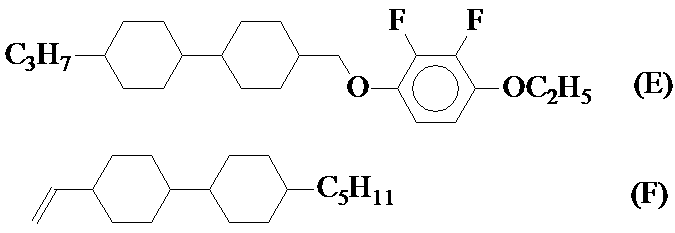
- a liquid crystal composition using the following liquid crystal compounds (A) and (B) having a 2,3-difluorophenylene skeleton (see Patent Document 1) as a liquid crystal material having a negative ⁇ is disclosed.
- liquid crystal compounds (C) and (D) are used as compounds having ⁇ of approximately 0.
- this liquid crystal composition is used in a liquid crystal composition that requires a high-speed response such as a liquid crystal television. It cannot be said that the viscosity is sufficiently low.
- a liquid crystal composition using a compound represented by the formula (G) has already been disclosed (see Patent Document 4), but this liquid crystal composition also contains an alkenyl compound as in the above liquid crystal compound (F). Since it is a liquid crystal composition containing a compound, there is a problem that display defects such as image sticking and display unevenness are likely to occur.
- the PSA (Polymer Sustained Alignment) type is a structure in which a polymer structure is formed in the cell to control the pretilt angle of the liquid crystal molecules, and features high-speed response and high contrast.
- a polymerizable compound-containing liquid crystal composition composed of a polymerizable compound and a liquid crystal compound is injected between the substrates, and a voltage is applied to polymerize the polymerizable compound in a state where the liquid crystal molecules are aligned, thereby aligning the liquid crystal molecules. This is done by fixing. Therefore, a problem peculiar to the PSA type is the occurrence of display defects due to image sticking or the like caused by the reaction product of the polymerizable compound.
- the cause of this burn-in is the presence of a causative substance in the liquid crystal composition of the PSA element.
- a polymerization reaction product generated in a polymerization process of a polymerizable compound at the time of manufacturing a PSA element has an adverse effect such as image sticking.
- the polymerizable compound reacts with the components of the liquid crystal composition, and this reaction product has an adverse effect such as image sticking.
- ⁇ is negative and absolute value is large, low rotational viscosity ( ⁇ 1 ), large elastic constant (K 33 ), low solid phase-nematic phase transition temperature (T cn ), high nematic phase-isotropic liquid phase transition temperature (T ni ) and high voltage holding ratio (VHR) have been demanded.
- UV irradiation at the time of manufacturing and use of the element does not cause deterioration or the like, even if it does not affect display, and there is no display defect such as image sticking or display unevenness, or excellent display quality.
- a liquid crystal display device having a high response speed There has been a demand for a liquid crystal display device having a high response speed.
- JP-A-8-104869 European Patent Application No. 0474402 JP 2006-37054 A JP 2001-354967 A JP 2008-144135 A
- ⁇ is negative and has a large absolute value, low rotational viscosity ( ⁇ 1 ), large elastic constant (K 33 ), low solid phase-nematic phase transition temperature (T cn ), high nematic
- ⁇ is negative and has a large absolute value, low rotational viscosity ( ⁇ 1 ), large elastic constant (K 33 ), low solid phase-nematic phase transition temperature (T cn ), high nematic
- a liquid crystal composition having a phase-isotropic liquid phase transition temperature (T ni ), a low-temperature dissolution stability and a high voltage holding ratio (VHR), and further reducing the reliability of the liquid crystal composition after UV irradiation.
- liquid crystal display element such as a VA type, a PSVA type, a PSA type, and an FFS type that has no display defects such as burn-in and display unevenness using the same, and has excellent display quality and a high-speed response. is there.
- the present inventor has studied various compounds and found that the above problems can be solved by combining specific compounds, and has completed the present invention.
- the liquid crystal composition of the present invention has the formula (I-1) as the first component
- R 11 represents an alkyl group having 1 to 10 carbon atoms, an alkoxyl group having 1 to 10 carbon atoms, an alkenyl group having 2 to 10 carbon atoms, or an alkenyloxy group having 2 to 10 carbon atoms
- R 12 represents an alkyl group having 1 to 10 carbon atoms, an alkoxyl group having 1 to 10 carbon atoms, an alkenyl group having 2 to 10 carbon atoms, or an alkenyloxy group having 2 to 10 carbon atoms.
- the second component is a compound of formula (I-2)
- P represents a polymerizable group
- S represents a single bond or a spacer group, and when a plurality of S are present, they may be the same or different
- X represents —O—, —S—, —OCH 2 —, —CH 2 O—, —CO—, —COO—, —OCO—, —CO—S—, —S—CO—, —O—CO—O—, —CO—.
- the liquid crystal composition of the present invention has a negative ⁇ and a large absolute value, a low rotational viscosity ( ⁇ 1 ), a large elastic constant (K 33 ), a low solid phase—nematic phase transition temperature (T cn ), a high nematic phase— Isotropic liquid phase transition temperature (T ni ), low-temperature dissolution stability, and high voltage holding ratio (VHR), and VA type, PSVA type, PSA type, FFS type and other liquid crystal display elements manufactured by using this Has a high VHR, has no display defects such as burn-in and display unevenness, or has a high-speed response with excellent display quality.
- the liquid crystal composition of the present invention has a general formula (I-1) as a first component
- the compound represented by these is contained.
- the compound represented by the general formula (I-1) is contained in an amount of 3 to 70% by mass, and the lower limit is preferably 5% by mass, preferably 10% by mass, preferably 15% by mass, and preferably 20% by mass. 25% by mass, preferably 30% by mass, preferably 35% by mass, and preferably 40% by mass.
- the upper limit is preferably 65% by mass, preferably 60% by mass, preferably 55% by mass, and 50% by mass. Is preferable, 45% by mass is preferable, 40% by mass is preferable, 35% by mass is preferable, and 30% by mass is preferable. More specifically, to obtain a low rotational viscosity ( ⁇ 1 ), the content is preferably 30 to 65% by mass. However, when emphasizing the suppression of precipitation at low temperatures, the content is 5 to 30% by mass. preferable.
- R 11 represents an alkyl group having 1 to 10 carbon atoms, an alkoxyl group having 1 to 10 carbon atoms, an alkenyl group having 2 to 10 carbon atoms, or an alkenyl group having 2 to 10 carbon atoms.
- R 11 represents an alkyl group having 1 to 5 carbon atoms, an alkoxyl group having 1 to 5 carbon atoms, an alkenyl group having 2 to 5 carbon atoms, or an alkenyloxy group having 2 to 5 carbon atoms.
- R 12 represents an alkyl group having 1 to 10 carbon atoms, an alkoxyl group having 1 to 10 carbon atoms, an alkenyl group having 2 to 10 carbon atoms, or an alkenyl group having 2 to 10 carbon atoms.
- R 12 represents an alkyl group having 1 to 5 carbon atoms, an alkoxyl group having 1 to 5 carbon atoms, an alkenyl group having 2 to 5 carbon atoms, or an alkenyloxy group having 2 to 5 carbon atoms.
- it is an alkyl group having 1 to 5 carbon atoms, an alkenyl group having 2 to 5 carbon atoms, and particularly preferably an alkenyl group having 2 to 3 carbon atoms.
- the compound represented by these is contained.
- the compound represented by the general formula (I-2) is characterized by having four or more phenyl rings or naphthalene rings, which are aromatic rings, and one polymerizable group.
- the compound represented by the general formula (I-2) is contained in an amount of 0.01 to 5% by mass, and the lower limit is preferably 0.1% by mass, preferably 0.2% by mass, and 0.3% by mass. 0.5% by mass is preferable, 1% by mass is preferable, 1.5% by mass is preferable, and 2% by mass is preferable.
- the upper limit is 4.5% by mass, preferably 4% by mass, and 3% by mass.
- the content is preferably 0.3 to 3% by mass in order to obtain a high voltage holding ratio (VHR).
- VHR voltage holding ratio
- the content is from 0.1. 1% by mass is preferred.
- P represents a polymerizable group, and specifically represents a group selected from formula (P-1) to formula (P-18).
- P is preferably the formula (P-1), the formula (P-2) or the formula (P-3), and particularly preferably the formula (P-1) or the formula (P-2).
- S represents a single bond or a spacer group.
- the spacer group for example, an alkylene group having 1 to 20 carbon atoms can be represented, and one or two or more non-adjacent —CH 2 in the group can be represented. - May be each independently substituted with -O-, -COO-, -OCO- or -OCO-O-, and when there are a plurality of S, they may be the same or different. . More preferably, S is a spacer group.
- a 1 , A 2 , A 3 and A 4 each independently represents 1,4-phenylene, naphthalene-1,4-diyl or naphthalene-2,6-diyl, and the hydrogen atom in these groups is It may be substituted with one or more L, and when there are multiple A 5, they may be the same or different, but at least one is substituted with one or more L Is preferred.
- a 1 , A 2 , A 3 , A 4 and A 5 are specifically represented by the following formulas (A-1) to (A-10):
- L represents a fluorine atom, a chlorine atom, a bromine atom, an iodine atom, a methyl group or a methoxy group, and is preferably a fluorine atom, a chlorine atom, a methyl group or a methoxy group.
- the hydrogen atom of the methyl group or methoxy group may be optionally substituted with a fluorine atom.
- l represents 0, 1 or 2, and is preferably 1.
- n represents 0, 1 or 2, with 0 being preferred.
- Z 1 , Z 2 , and Z 3 are each independently —O—, —S—, —OCH 2 —, —CH 2 O—, —COO—, —OCO—, —CO—, —CO —S—, —S—CO—, —O—CO—O—, —CO—NH—, —NH—CO—, —SCH 2 —, —CH 2 S—, —CF 2 O—, —OCF 2 —, —CF 2 S—, —SCF 2 —, —CH 2 CH 2 —, —CH 2 CF 2 —, —CF 2 CH 2 —, —CF 2 CF 2 —, —CH ⁇ CH—COO—, — CH ⁇ CH—OCO—, —COO—CH ⁇ CH—, —OCO—CH ⁇ CH—, —OCO—CH ⁇ CH—, —COO—CH 2 CH 2 —, —OCO—CH 2 CH 2 —, —CH 2
- X represents —O—, —S—, —OCH 2 —, —CH 2 O—, —CO—, —COO—, —OCO—, —CO—S—, —S—CO—, —O—CO—.
- R represents a hydrogen atom, a fluorine atom, a chlorine atom, a bromine atom, an iodine atom, a pentafluorosulfuranyl group, a cyano group, a nitro group, an isocyano group, a thioisocyano group, or one —CH 2 —, or one carbon atom.
- —CH 2 — To twelve straight or branched alkyl groups, but two or more non-adjacent —CH 2 — are each independently —O—, —S—, —CO—, —COO—, —OCO—, —CO—S—, —S—CO—, —O—CO—O—, —CO—NH—, —NH—CO—, —CH ⁇ CH—COO—, —CH ⁇ CH—OCO—, —COO.
- —CH ⁇ CH—, —OCO—CH ⁇ CH—, —CH ⁇ CH—, —CF ⁇ CF— or —C ⁇ C— but may be a hydrogen atom, fluorine atom, chlorine atom, cyano group or one or non-adjacent two or more -CH 2 - pixel It is preferably a linear or branched alkyl group having 1 to 12 carbon atoms which may be independently substituted by —O—, —COO—, —OCO—, —O—CO—O—, Hydrogen atom, fluorine atom, straight chain alkyl group having 1 to 12 carbon atoms, branched alkyl group having 2 to 12 carbon atoms, straight chain alkoxy group having 1 to 12 carbon atoms, branched alkoxy group having 2 to 12 carbon atoms More preferably, it is a group.
- the compound represented by general formula (I-2) is more preferably a compound represented by general formula (I-3).
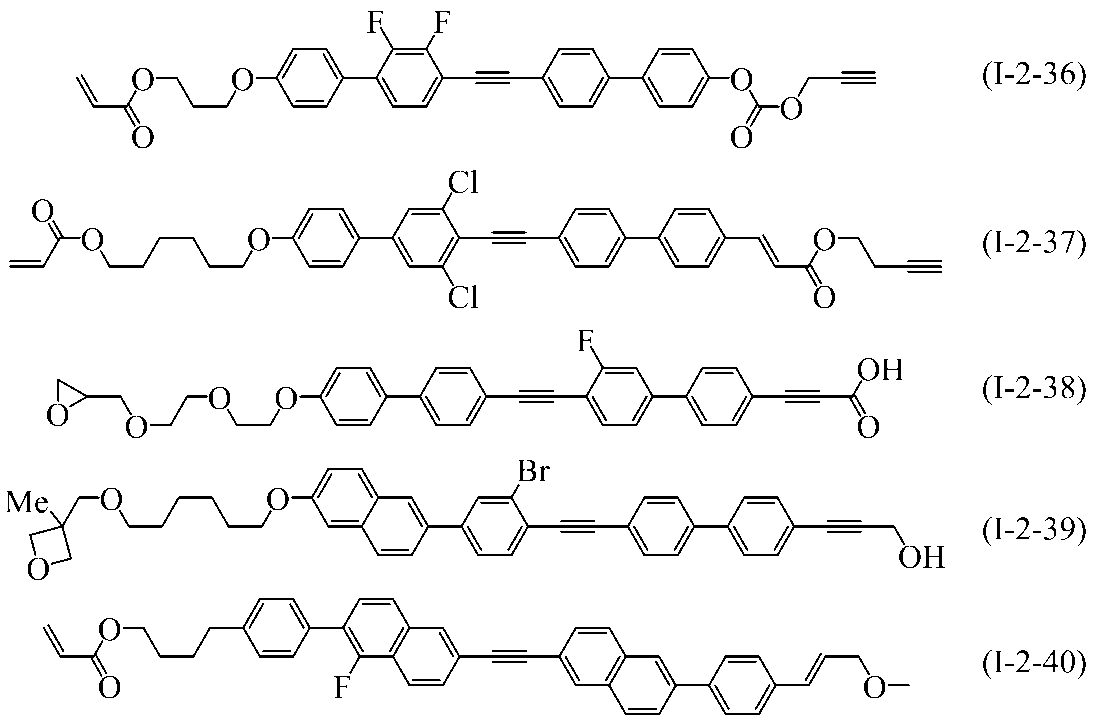
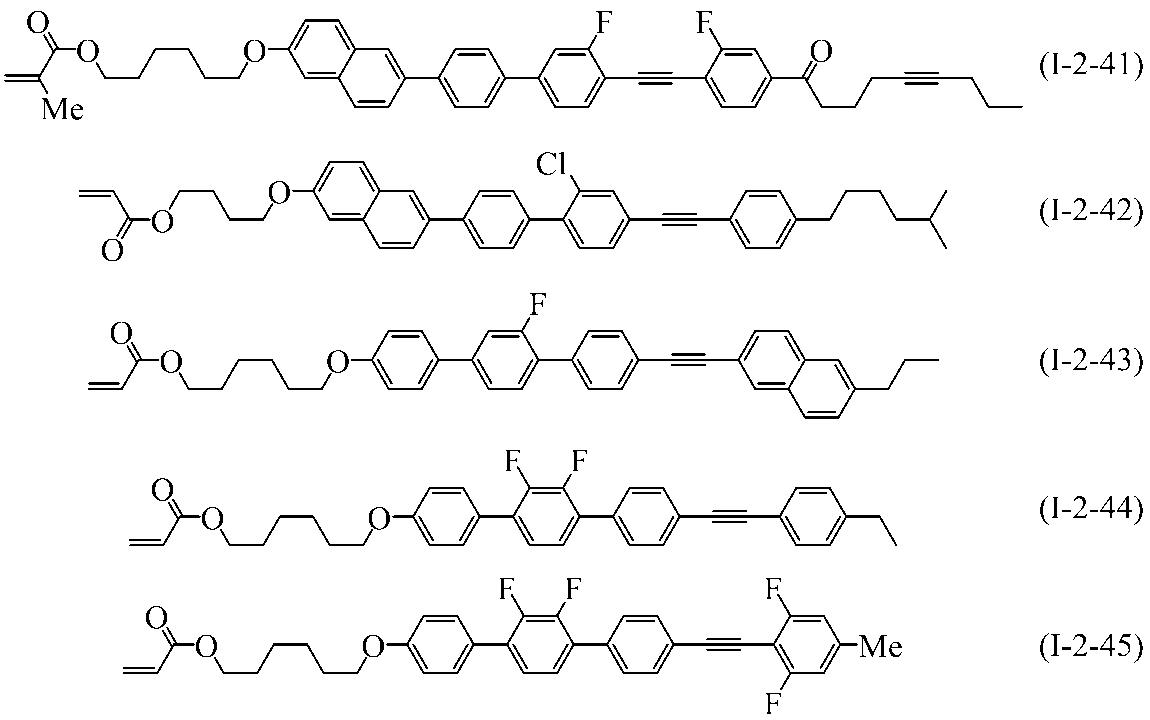
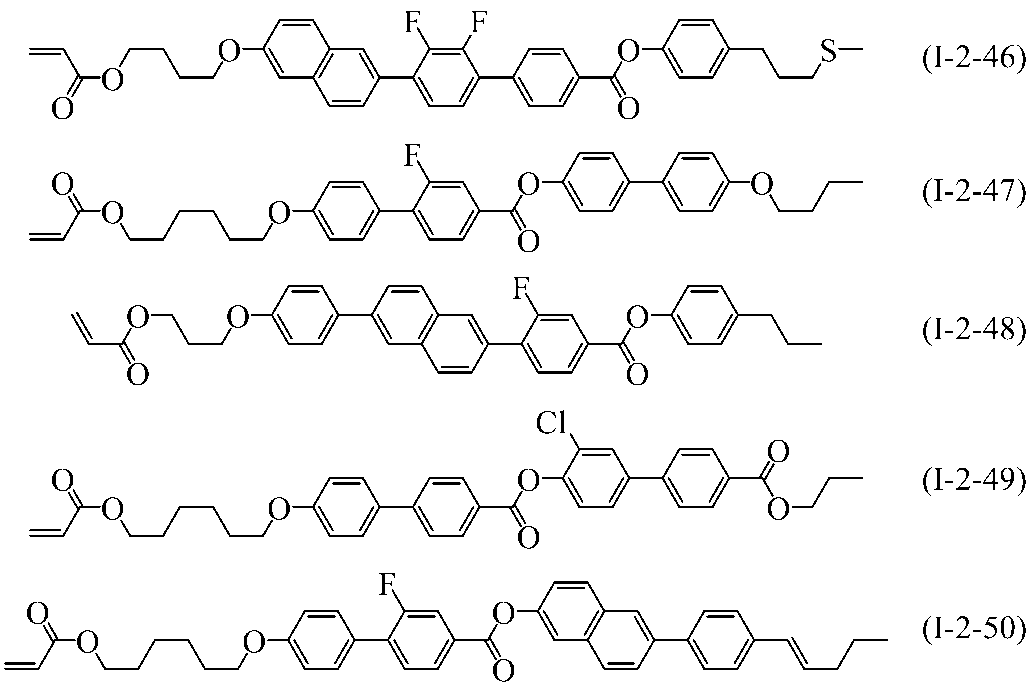
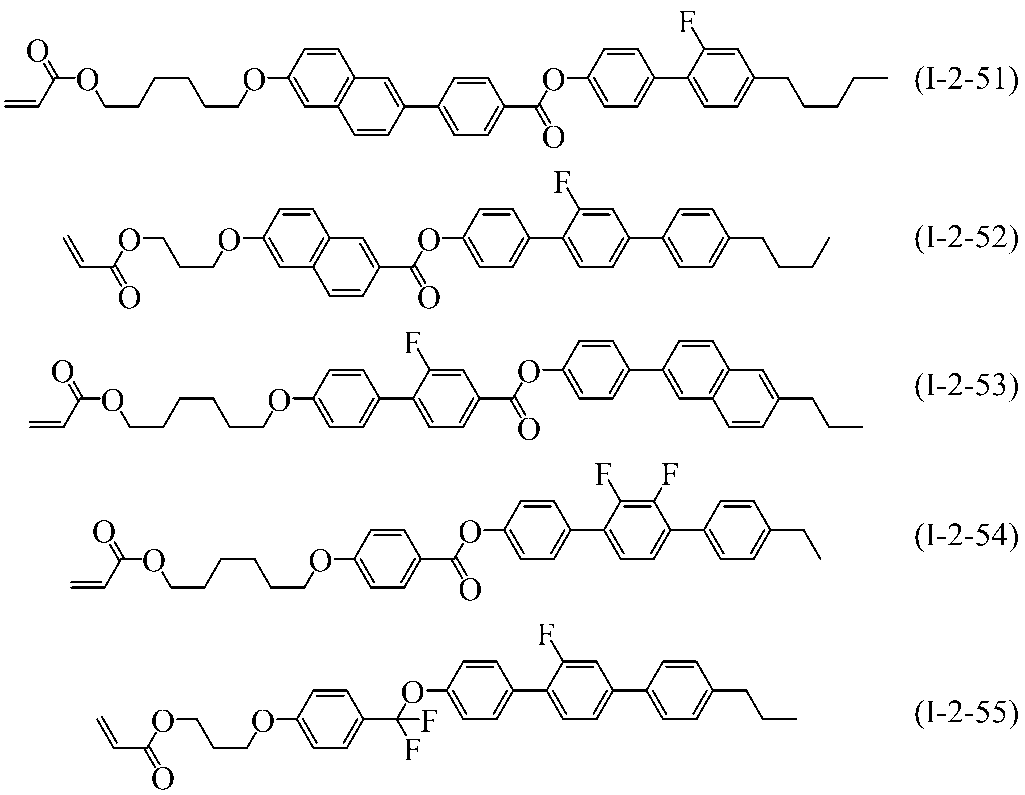
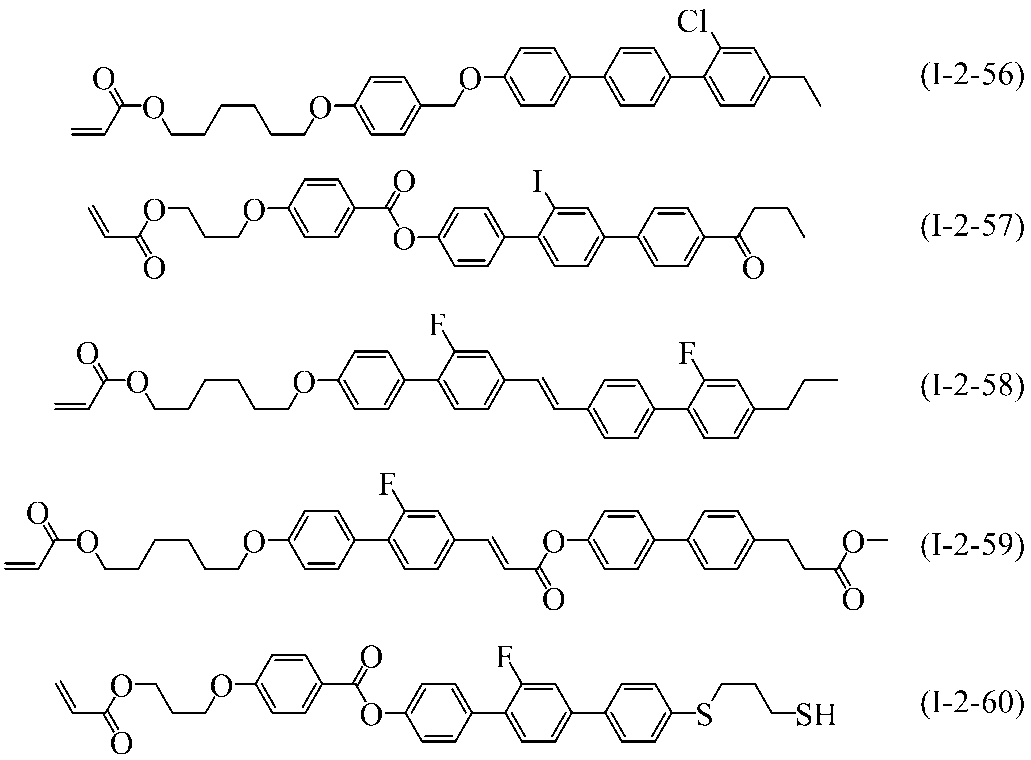
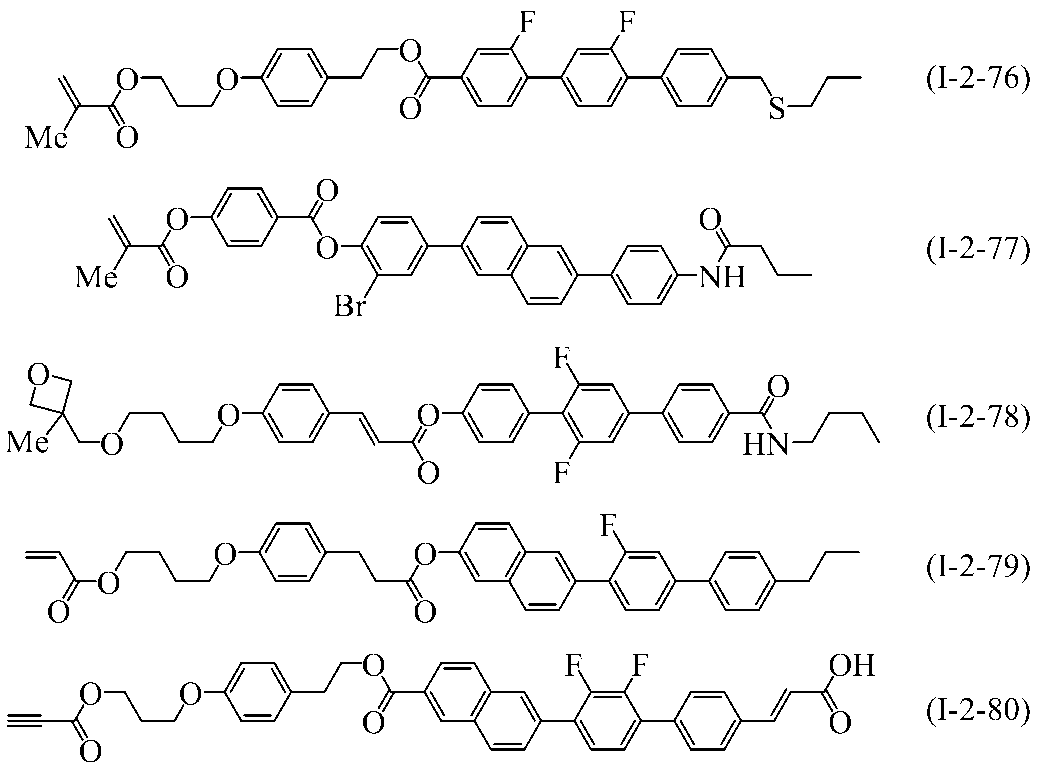
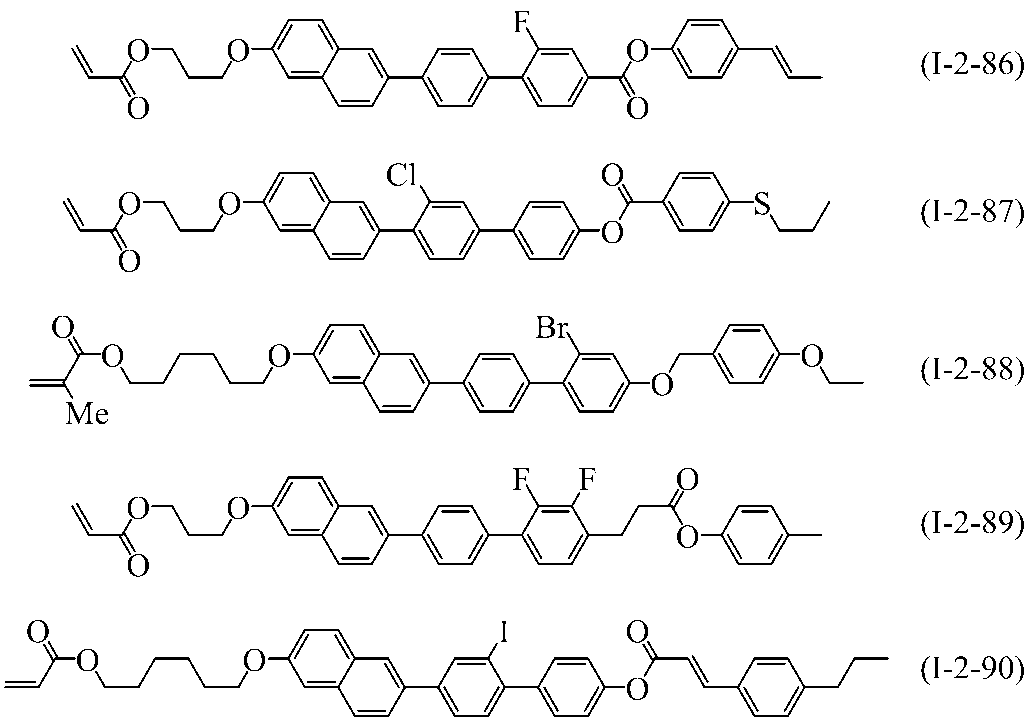
- the compounds represented by the general formula (I-2) are preferably compounds represented by the following formulas (I-2-1) to (I-2-95).
- P 21 represents the same meaning as in formula (P-1), (P-2) or (P-3) in formula (I-2), and S 21 represents a single bond or a spacer group.
- ring A 21 , ring A 22 , ring A 23 , and ring A 24 are each independently 1,4-phenylene group, 2-fluoro-1,4-phenylene group, Represents a 3-fluoro-1,4-phenylene group, a 3,5-difluoro-1,4-phenylene group or a 2,3-difluoro-1,4-phenylene group
- R 21 represents an alkyl having 1 to 10 carbon atoms.
- a group having 1 to 10 carbon atoms, an alkoxyl group having 2 to 10 carbon atoms Represents Kenyir group or an alkenyloxy group having 2 to 10 carbon atoms, these one or non-adjacent in group two or more -CH 2 - are each independently -O -, - S -, - CO—, —COO—, —OCO—, —CO—S—, —S—CO—, —O—CO—O—, —CO—NH—, —NH—CO—, —CH ⁇ CH—COO—.
- —CH ⁇ CH—OCO—, —COO—CH ⁇ CH—, —OCO—CH ⁇ CH—, —CH ⁇ CH—, —CF ⁇ CF— or —C ⁇ C— may be substituted. ) Is more preferable.
- At least one of ring A 21 , ring A 22 , ring A 23 , and ring A 24 is a 2-fluoro-1,4-phenylene group, 3-fluoro-1,4-
- the phenylene group, the 3,5-difluoro-1,4-phenylene group, and the 2,3-difluoro-1,4-phenylene group are preferable from the viewpoint of dissolution stability at low temperatures.
- R 21 is preferably an alkyl group having 1 to 10 carbon atoms, an alkoxyl group having 1 to 10 carbon atoms, an alkyl group having 1 to 5 carbon atoms, or 1 to 5 carbon atoms.
- the alkoxyl group is preferable.
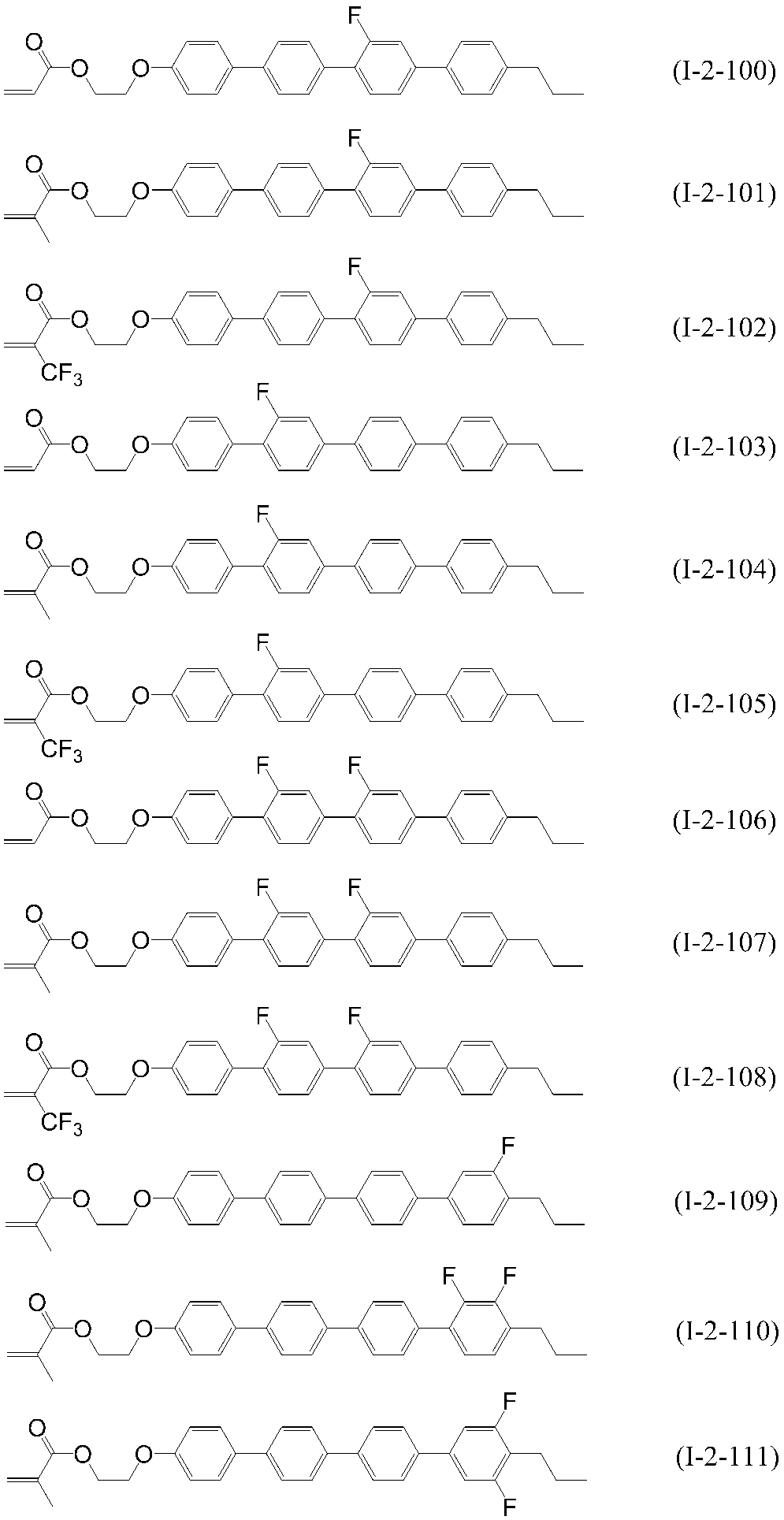
- the compound represented by the general formula (II-rm) is preferably a compound represented by the formula (I-2-100) to the formula (I-2-119).
- a compound having a negative dielectric anisotropy ( ⁇ ) and an absolute value larger than 3 is contained.
- Specific examples include compounds represented by general formula (II-1) and general formula (II-2).
- R 1 and R 2 are each independently an alkyl group having 1 to 10 carbon atoms, an alkoxyl group having 1 to 10 carbon atoms, an alkenyl group having 2 to 10 carbon atoms, or 2 to 10 carbon atoms.
- R 1 and R present in the 2 one -CH 2 - or nonadjacent two or more -CH 2 - are, each independently -O- or -S- in It may be substituted, and one or more hydrogen atoms present in R 1 and R 2 may be independently substituted with fluorine atoms or chlorine atoms, but R 1 is An alkyl group having 1 to 5 carbon atoms, an alkoxyl group having 1 to 5 carbon atoms, an alkenyl group having 2 to 5 carbon atoms, or an alkenyloxy group having 2 to 5 carbon atoms is preferable, and has 1 to 5 carbon atoms.
- Alkyl group or carbon source The number is more preferably an alkenyl group having 2 to 5, more preferably an alkyl group or an alkenyl group having 2 to 3 carbon atoms, having one to three carbon atoms, R 2 is an alkyl group having 1 to 5 carbon atoms, carbon atoms A 1 to 5 alkoxyl group, an alkenyl group having 2 to 5 carbon atoms or an alkenyloxy group having 2 to 5 carbon atoms is preferable, and an alkoxyl group having 1 to 5 carbon atoms is more preferable.
- ring A and ring B are each independently a trans-1,4-cyclohexylene group, 1,4-phenylene group, 2-fluoro-1,4-phenylene group, 3-fluoro-1,4. -Phenylene group, 3,5-difluoro-1,4-phenylene group, 2,3-difluoro-1,4-phenylene group, 1,4-cyclohexenylene group, 1,4-bicyclo [2.2.2] ]
- Octylene group, piperidine-1,4-diyl group, naphthalene-2,6-diyl group, decahydronaphthalene-2,6-diyl group or 1,2,3,4-tetrahydronaphthalene-2,6-diyl group Represents a trans-1,4-cyclohexylene group or a 1,4-phenylene group.
- Z 11 and Z 21 are each independently —OCH 2 —, —CH 2 O—, —CF 2 O—, —OCF 2 —, —CH 2 CH 2 —, —CF 2 CF 2 —. or it represents a single bond, -CH 2 O -, - CF 2 O -, - CH 2 CH 2 -, - CF 2 CF 2 - or a single bond are preferred, -CH 2 O -, - CH 2 CH 2 - Alternatively, a single bond is more preferable, and —CH 2 O— or a single bond is particularly preferable.
- the liquid crystal composition of the present invention contains one or more compounds represented by general formula (II-1) and general formula (II-2), but preferably contains 2 to 10 compounds.
- the content is preferably 10 to 90% by mass, but the lower limit is preferably 15% by mass, preferably 20% by mass, preferably 25% by mass, preferably 30% by mass, and preferably 35% by mass, 40 mass% is preferable, 45 mass% is preferable, 50 mass% is preferable, and the upper limit is preferably 85 mass%, preferably 80 mass%, preferably 75 mass%, preferably 70 mass%, and 65 mass%.
- 60 mass% is preferable, 55 mass% is preferable, 50 mass% is preferable, 45 mass% is preferable, and 40 mass% is preferable.
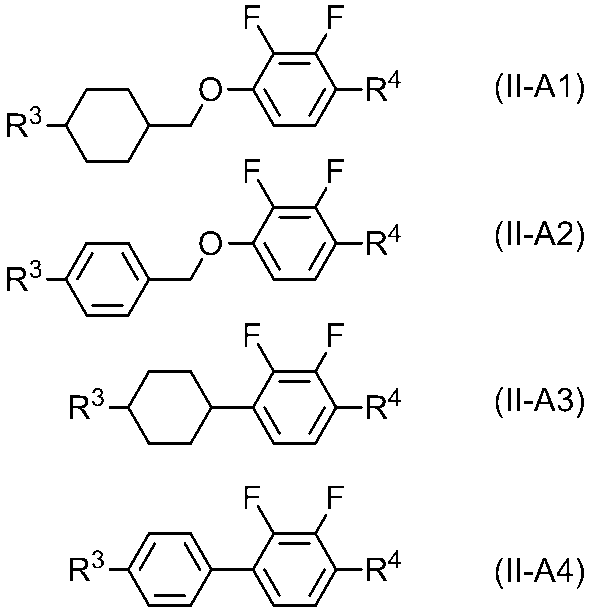
- the compound represented by the general formula (II-1) is preferably a compound represented by the general formula (II-A1) to the general formula (II-A4).
- A1) is preferred, a compound represented by the general formula (II-A3) is preferred, a compound represented by the general formula (II-A4) is preferred,
- the compound represented by the formula (II-A1) is more preferable, and the compound represented by the general formula (II-A4) is further preferable.
- R 3 and R 4 each independently represent the same meaning as R 1 and R 2 .
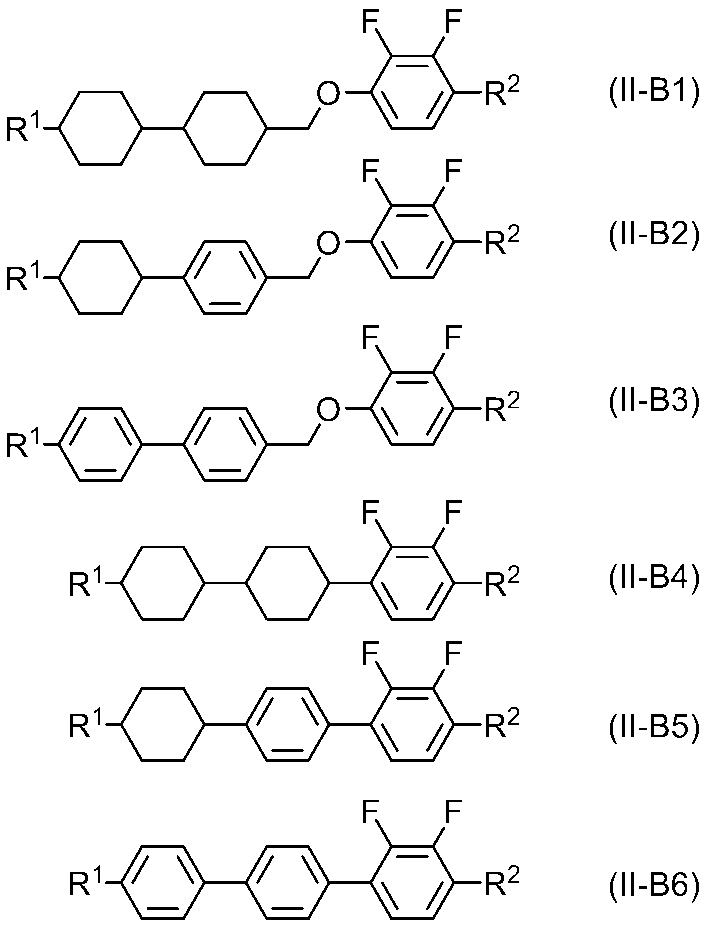
- the compound represented by the general formula (II-2) is preferably a compound represented by the general formula (II-B1) to the general formula (II-B6). It is preferably a compound represented by B1), preferably a compound represented by the general formula (II-B3), preferably a compound represented by the general formula (II-B4), A compound represented by the formula (II-B5) is preferable, a compound represented by the general formula (II-B6) is preferable, and a compound represented by the general formula (II-B1) is more preferable.
- the compound of the general formula (II-B3) is more preferable, the compound of the general formula (II-B5) is more preferable, the compound of the general formula (II-B6) is more preferable, Represented by formula (II-B3) Particularly preferably from that compound, it is particularly preferably a compound represented by the general formula (II-B4).
- R 3 and R 4 each independently represent the same meaning as R 1 and R 2 .
- the third component is preferably a combination of the general formula (II-A1) and the general formula (II-B1), and the general formula (II-A1), the general formula (II-B1) and the general formula A combination of (II-A3) is more preferable, and a combination of general formula (II-A1), general formula (II-B1) and general formula (II-A4) is more preferable.
- the third component is preferably a combination of the general formula (II-A3) and the general formula (II-B4), and the general formula (II-A3), the general formula (II-B4) and the general formula A combination of (II-B5) is more preferable, and a combination of general formula (II-A3), general formula (II-B4) and general formula (II-B1) is more preferable.
- the third component is preferably a combination of the general formula (II-A4) and the general formula (II-B4), and the combination of the general formula (II-A4) and the general formula (II-B1) More preferably, it is more preferably a combination of the general formula (II-A4) and the general formula (II-B1) and the general formula (II-B5), and the general formula (II-A4) and the general formula (II- More preferred is a combination of B1) and general formula (II-B3).
- the liquid crystal composition of the present invention preferably contains one or more compounds selected from general formula (III-A) to general formula (III-J) as the fourth component.
- the compound represented by the general formula (III-A) does not include the same compound as the compound represented by the formula (I-1).
- R 5 is an alkyl group having 1 to 5 carbon atoms or an alkenyl group having 2 to 5 carbon atoms
- R 6 is an alkyl group having 1 to 5 carbon atoms
- an alkoxyl group having 1 to 5 carbon atoms Represents an alkenyl group having 2 to 5 carbon atoms or an alkenyloxy group having 2 to 5 carbon atoms.
- the fourth component is a compound selected from general formula (III-A), general formula (III-D), general formula (III-F), general formula (III-G), and general formula (III-H). It is more preferable that the compound is selected from the general formula (III-A), the general formula (III-F), the general formula (III-G), and the general formula (III-H).
- R 5 represents an alkyl group having 1 to 5 carbon atoms or 2 carbon atoms.
- R 6 is preferably an alkoxy group having 1 to 5 alkyl groups or carbon atoms of 1 to 5 carbon atoms, that R 5 is an alkenyl group having 2 to 5 carbon atoms More preferably, it is more preferably an alkenyl group having 2 or 3 carbon atoms.
- R 5 and R 6 are each independently 1 to 5 carbon atoms. And an alkenyl group having 2 to 5 carbon atoms.
- the content of the fourth component is preferably 1% by mass to 50% by mass, and this lower limit is preferably 3% by mass, preferably 3% by mass, preferably 5% by mass, preferably 10% by mass, 15% % By mass is preferable, 20% by mass is preferable, and 25% by mass is preferable.
- the upper limit is preferably 45% by mass, preferably 40% by mass, preferably 35% by mass, preferably 30% by mass, and preferably 25% by mass. 20 mass% is preferable, and 15 mass% is preferable.
- one or more compounds represented by the general formula (V) may be contained.
- R 21 and R 22 are each independently an alkyl group having 1 to 8 carbon atoms, an alkoxyl group having 1 to 8 carbon atoms, an alkenyl group having 2 to 8 carbon atoms, or an alkyl group having 2 to 8 carbon atoms.
- an alkenyloxyl group is represented, an alkyl group having 1 to 5 carbon atoms or an alkenyl group having 2 to 5 carbon atoms is preferable.
- the content of the general formula (V) is preferably 0% by mass to 20% by mass.
- one or more compounds represented by general formula (VIII-a), general formula (VIII-c) or general formula (VIII-d) can be contained, and the content thereof are preferably independently from 0 to 10% by mass.
- R 51 and R 52 each independently represents an alkyl group having 1 to 5 carbon atoms, an alkenyl group having 2 to 5 carbon atoms, or an alkoxy group having 1 to 4 carbon atoms.
- each of R 51 and R 52 are independently an alkyl group having 1 to 5 carbon atoms, an alkenyl group or an alkoxy group having 1 to 4 carbon atoms carbon atoms 2 to 5
- X 51 and X 52 each independently represents a fluorine atom or a hydrogen atom, and at least one of X 51 and X 52 is a fluorine atom.
- each of R 51 and R 52 are independently an alkyl group having 1 to 5 carbon atoms, an alkenyl group or an alkoxy group having 1 to 4 carbon atoms carbon atoms 2 to 5
- X 51 and X 52 each independently represents a fluorine atom or a hydrogen atom, and at least one of X 51 and X 52 is a fluorine atom.
- one or more compounds represented by formulas (V-9.1) to (V-9.3) may be contained.
- the liquid crystal composition of the present invention preferably contains a compound of formula (I-1), formula (I-2), general formula (II-A1) and general formula (III-A) at the same time.
- -1), formula (I-2), general formula (II-A3) and general formula (III-A) are preferably contained at the same time, and the compounds of formula (I-1), formula (I-2), It is preferable to simultaneously contain the compounds of the general formula (II-A4) and the general formula (III-A), and the compounds of the formula (I-1), the formula (I-2), the general formula (II-B1) and the general formula (II)
- the liquid crystal composition of the invention simultaneously contains compounds of formula (I-1), formula (I-2), general formula (II-A1), general formula (II-B1) and general formula (III-A) More preferably, the compounds of formula (I-1), formula (I-2), general formula (II-A3), general formula (II-B5) and general formula (III-A) are contained simultaneously. Is more preferable, and it further contains a compound of the formula (I-1), formula (I-2), general formula (II-A1), general formula (II-B4) and general formula (III-A) at the same time. It is more preferable that the compounds of formula (I-1), formula (I-2), general formula (II-A1), general formula (II-B5) and general formula (III-A) are simultaneously contained.
- the liquid crystal composition of the invention simultaneously contains compounds of formula (I-1), formula (I-2), general formula (II-A4), general formula (II-B5) and general formula (III-H) More preferably, the compounds of formula (I-1), formula (I-2), general formula (II-A1), general formula (II-B1) and general formula (III-H) are contained simultaneously.
- the total content of the first component, the second component, the third component and the fourth component is preferably 70 to 100% by mass, and preferably 80 to 100% by mass. More preferred is 85 to 100% by mass.
- the total content of the first component, the second component, the third component, the fourth component and the compound represented by the general formula (V) is 88 to 100% by mass. It is preferably 93 to 100% by mass, more preferably 97 to 100% by mass.
- the liquid crystal composition of the present invention has a dielectric anisotropy ( ⁇ ) at ⁇ 25 ° C. of ⁇ 2.0 to ⁇ 8.0, preferably ⁇ 2.0 to ⁇ 6.0, -5.0 is more preferable, and -2.5 to -4.5 is particularly preferable.
- the liquid crystal composition of the present invention has a refractive index anisotropy ( ⁇ n) at 25 ° C. of 0.08 to 0.14, more preferably 0.09 to 0.13, and 0.09 to 0.12. Particularly preferred. More specifically, it is preferably 0.10 to 0.13 when dealing with a thin cell gap, and preferably 0.08 to 0.10 when dealing with a thick cell gap.
- the liquid crystal composition of the present invention has a rotational viscosity ( ⁇ 1 ) at 25 ° C. of 60 to 200 mPa ⁇ s, and the upper limit is preferably 190 mPa ⁇ s, preferably 180 mPa ⁇ s, preferably 170 mPa ⁇ s, preferably 160 mPa ⁇ s.
- the liquid crystal composition of the present invention has a solid phase-nematic phase transition temperature (T cn ) of ⁇ 60 ° C. to ⁇ 15 ° C., more preferably ⁇ 60 ° C. to ⁇ 20 ° C., and ⁇ 60 ° C. to ⁇ 25 ° C. Particularly preferred.
- the liquid crystal composition of the present invention has a nematic phase-isotropic liquid phase transition temperature (T ni ) of 60 ° C. to 120 ° C., more preferably 70 ° C. to 100 ° C., and particularly preferably 70 ° C. to 85 ° C.
- the liquid crystal composition of the present invention has an elastic constant (K 33 ) at 25 ° C.
- the liquid crystal composition of the present invention has a voltage holding ratio (VHR) of 70% to 100%, preferably 75% to 100%, preferably 80% to 100%, and preferably 85% to 100%.
- VHR voltage holding ratio
- the measurement conditions are 1 V, 3 Hz, and 60 ° C., and VHR measurement is performed after UV (12 J) irradiation with a high-pressure mercury lamp.
- the liquid crystal composition of the present invention contains ordinary nematic liquid crystals, smectic liquid crystals, cholesteric liquid crystals, antioxidants, ultraviolet absorbers, light stabilizers (HALS), spontaneous alignment compounds, infrared absorbers, and the like. It may be contained.
- the liquid crystal composition of the present invention contains a polymerizable compound represented by the general formula (I-2), but may contain other polymerizable compounds.
- polymerizable compounds such as biphenyl derivatives and terphenyl derivatives can be mentioned, and in such a case, 0.01 to 2% by mass is contained. More specifically, the general formula (M)
- X 201 and X 202 each independently represent a hydrogen atom, a methyl group, or a —CF 3 group.
- X 201 and X 202 are each preferably a diacrylate derivative that is a hydrogen atom, and a dimethacrylate derivative that is both a methyl group, and a compound in which one is a hydrogen atom and the other is a methyl group.
- a preferred compound can be used depending on the application, but in the PSA display element, the polymerizable compound represented by the general formula (M) preferably has at least one methacrylate derivative, and preferably has two.
- Sp 201 and Sp 202 are each independently a single bond, an alkylene group having 1 to 8 carbon atoms, or —O— (CH 2 ) s — (wherein s is 2 to 7 And an oxygen atom is bonded to the ring.
- at least one of Sp 201 and Sp 202 is preferably a single bond, either a single bond compound or one of which is a single bond and the other is an alkylene having 1 to 8 carbon atoms.
- ring M 201 , ring M 202 and ring M 203 are each independently a trans-1,4-cyclohexylene group (one or non-adjacent two or more —CH in the group). 2 — may be substituted by —O— or —S—), 1,4-phenylene group (one or two or more non-adjacent —CH ⁇ in the group is substituted by —N ⁇ .
- Z 201 and Z 202 each independently represent —OCH 2 —, —CH 2 O—, —COO—, —OCO—, —CF 2 O—, —OCF 2 —, — CH 2 CH 2 —, —CF 2 CF 2 —, —CH ⁇ CH—COO—, —CH ⁇ CH—OCO—, —COO—CH ⁇ CH—, —OCO—CH ⁇ CH—, —COO—CH 2 CH 2 —, —OCO—CH 2 CH 2 —, —CH 2 CH 2 —COO—, —CH 2 CH 2 —OCO—, —COO—CH 2 —, —OCO—CH 2 —, —CH 2 —COO —, —CH 2 —OCO—, —CY 1 ⁇ CY 2 — (wherein Y 1 and Y 2 each independently represents a fluorine atom or a hydrogen atom), —C ⁇ C— or a single bond
- n 201 represents 0, 1 or 2, with 0 or 1 being preferred. However, when there are a plurality of rings M 202 and Z 202 , they may be different or the same.
- It may contain at least one polymerizable compound represented by formula (M), preferably 1 to 5 types, more preferably 1 to 3 types.
- the content of the general formula (M) is preferably 0.01 to 2.00% by mass, more preferably 0.05 to 1.00% by mass, and 0.10 to 0.50% by mass. It is particularly preferred.
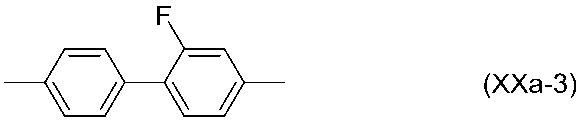
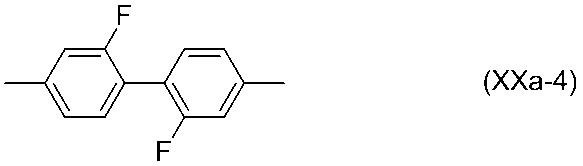
- the ring structure between Sp 201 and Sp 202 is preferably a formula (XXa-1) to a formula (XXa-5),
- the formula (XXa-1) to the formula (XXa-3) are more preferable, and the formula (XXa-1) or the formula (XXa-2) is particularly preferable.
- both ends of the equation shall be connected to Sp 201 or Sp 202 .
- the polymerizable compound represented by the general formula (M) containing these skeletons is suitable for a PSA mode liquid crystal display element because of its alignment regulating force after polymerization, and a good alignment state can be obtained, thereby suppressing display unevenness. There is an effect that does not occur at all.
- a compound represented by the formula (XX-1) to the general formula (XX-10) is preferable, and a formula (XX-1) to a formula (XX-4) is more preferable.
- Sp xx represents an alkylene group having 1 to 8 carbon atoms or —O— (CH 2 ) s — (wherein s represents an integer of 2 to 7) And an oxygen atom is bonded to the ring).
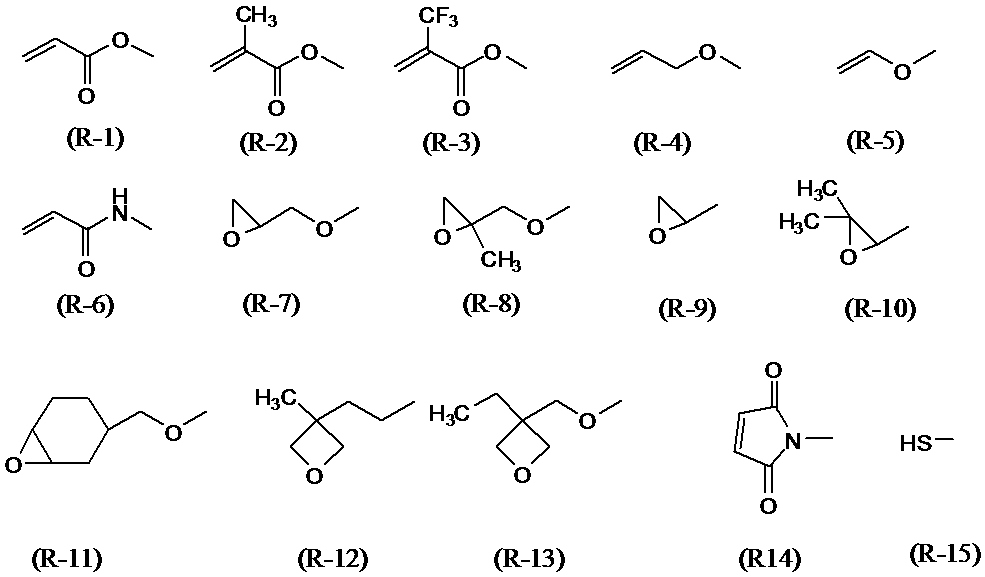
- the hydrogen atom in the 1,4-phenylene group is further —F, —Cl, —CF 3 , —CH 3 , formula (R-1) To any one of formulas (R-15).
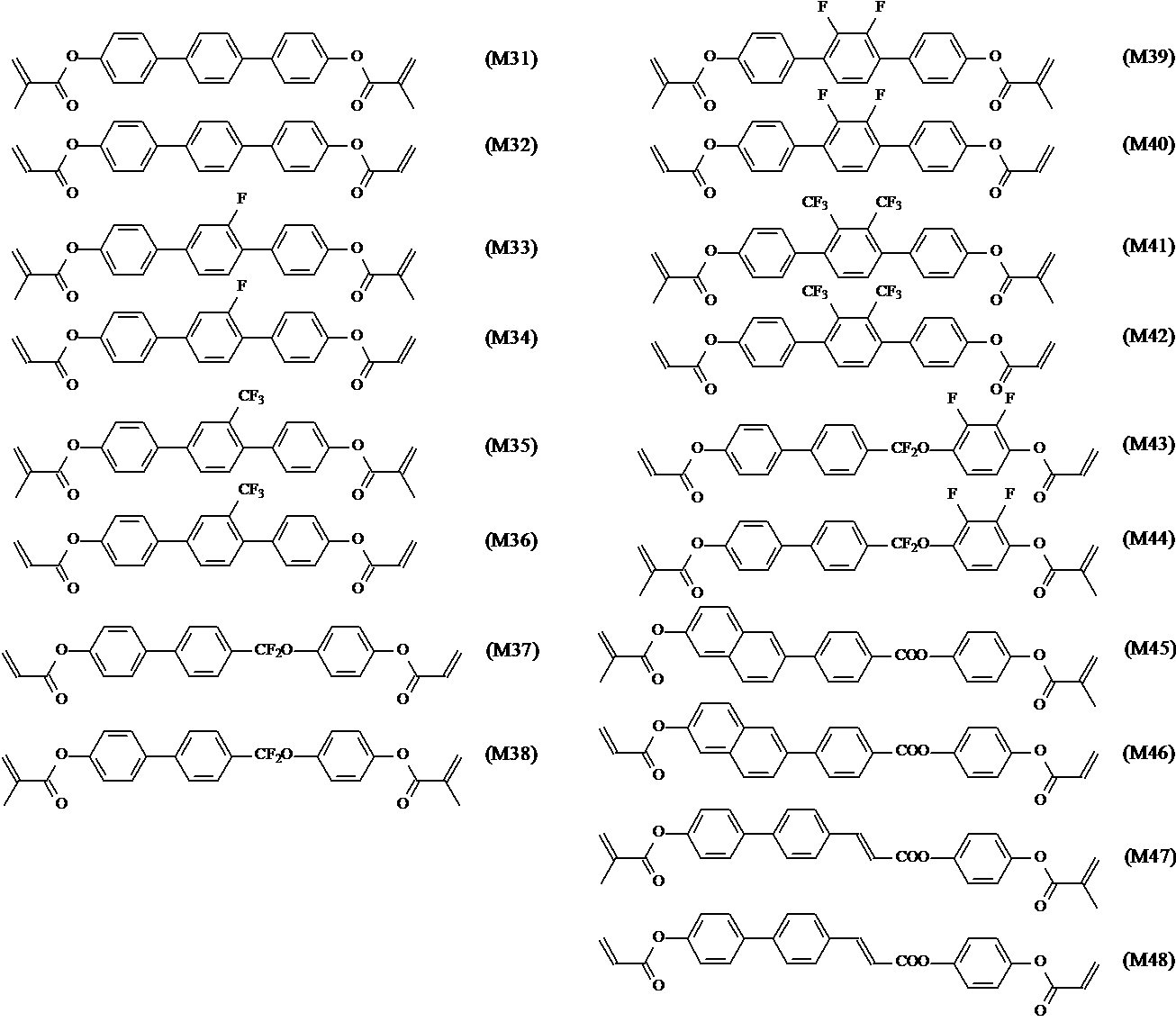
- n 201 is 1, for example, a polymerizable compound such as the formula (M31) to the formula (M48) is preferable.
- the hydrogen atoms in the 1,4-phenylene group and naphthalene group in the formula (M31) to the formula (M48) are further represented by —F, —Cl, —CF 3 , —CH 3 , and the formula (R-1) to the formula It may be substituted by any of (R-15).
- the polymerizable compound represented by the general formula (M) containing these skeletons is suitable for a PSA mode liquid crystal display element because of its alignment regulating force after polymerization, and a good alignment state can be obtained, thereby suppressing display unevenness. There is an effect that does not occur at all.
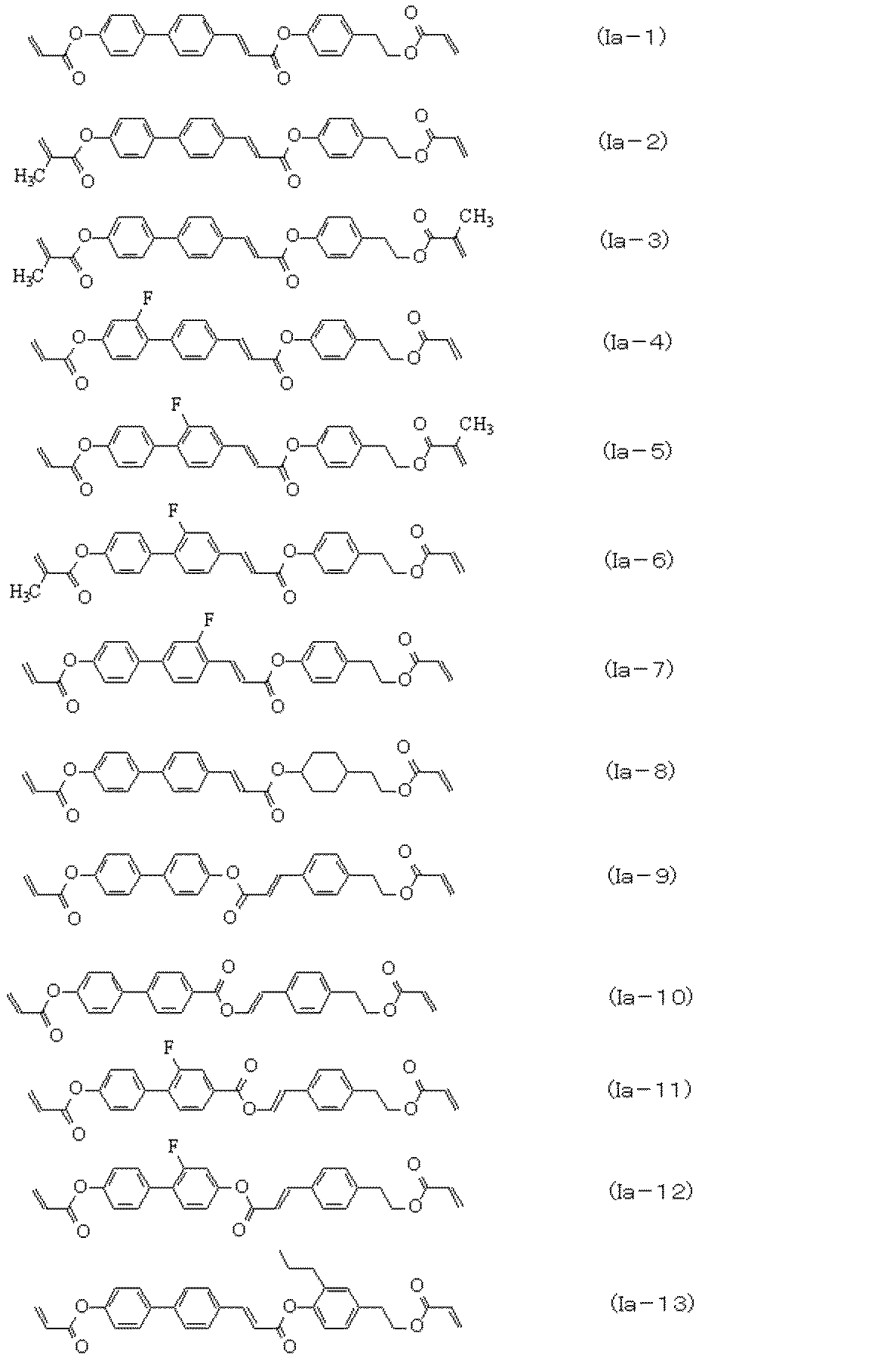
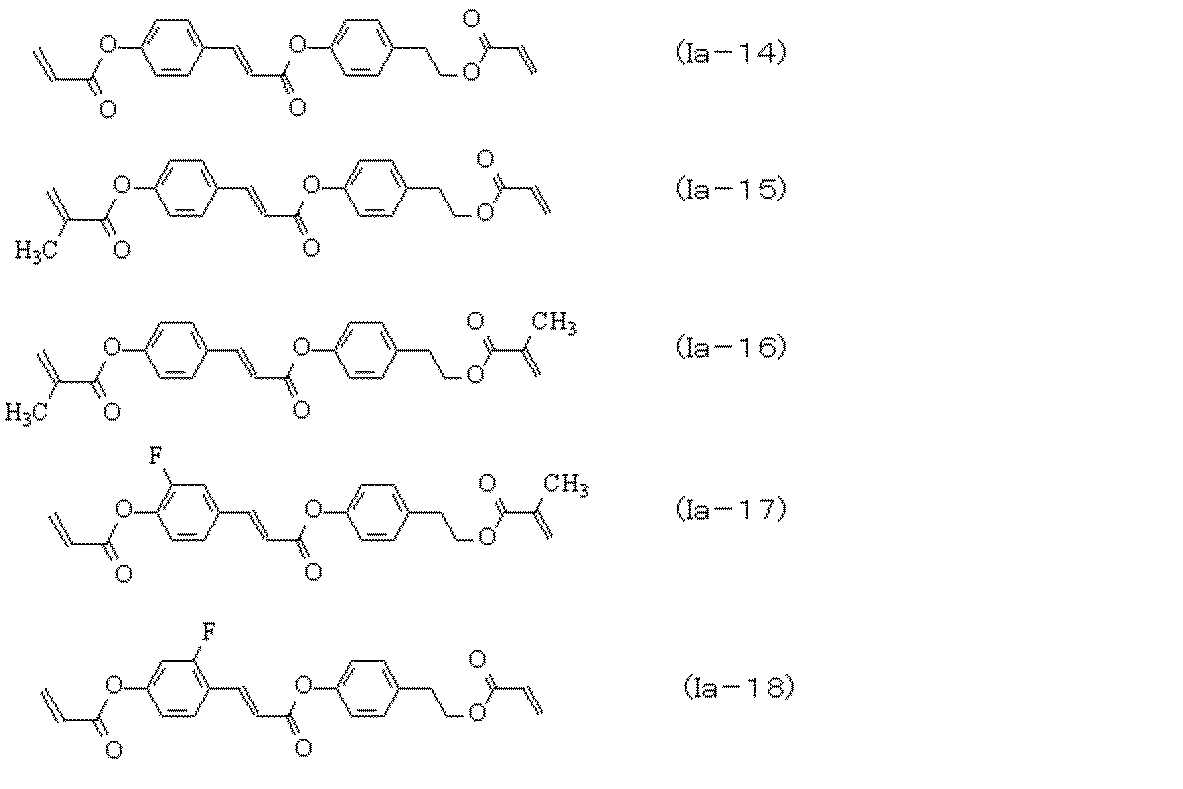
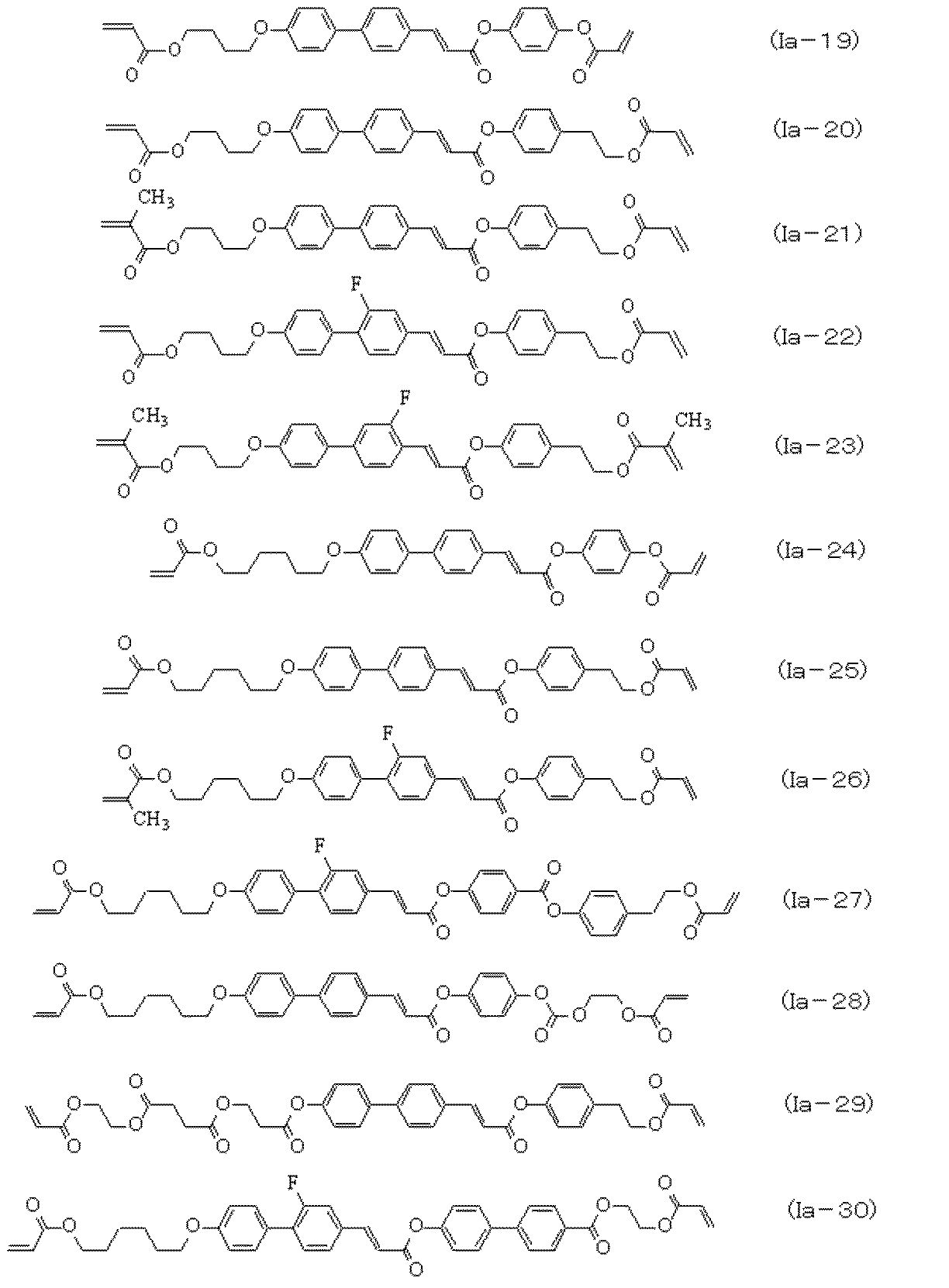
- polymerizable compounds represented by the general formula (M) for example, polymerizable compounds such as formula (Ia-1) to formula (Ia-31) are also preferable.
- polymerizable compound for example, trifunctional polymerizable compounds such as formula (M301) to formula (M316) are also preferable.
- the hydrogen atoms in the 1,4-phenylene group and naphthalene group in the formulas (M301) to (M316) may be further substituted with —F, —Cl, —CF 3 , or —CH 3 .
- the antioxidant to be added to the liquid crystal composition of the present invention hindered phenols represented by general formula (H-1) to general formula (H-4) are preferable.
- R H1 represents an alkyl group having 1 to 10 carbon atoms, an alkoxyl group having 1 to 10 carbon atoms, an alkenyl group having 2 to 10 carbon atoms, or It represents an alkenyloxy group having 2 to 10 carbon atoms, one -CH 2 present in the radical - or non-adjacent two or more -CH 2 - are each independently -O- or -S- In addition, one or two or more hydrogen atoms present in the group may be independently substituted with a fluorine atom or a chlorine atom.
- alkyl group having 2 to 7 carbon atoms an alkoxyl group having 2 to 7 carbon atoms, an alkenyl group having 2 to 7 carbon atoms, or an alkenyloxy group having 2 to 7 carbon atoms.
- An alkyl group having 3 to 7 carbon atoms or an alkenyl group having 2 to 7 carbon atoms is more preferable.
- M H4 is -CH 2 1, two or more of the alkylene group (the alkylene group having from 1 to 15 carbon atoms - as the oxygen atoms are not directly adjacent, - O—, —CO—, —COO—, —OCO— may be substituted.), —OCH 2 —, —CH 2 O—, —COO—, —OCO—, —CF 2 O—, — OCF 2 —, —CF 2 CF 2 —, —CH ⁇ CH—COO—, —CH ⁇ CH—OCO—, —COO—CH ⁇ CH—, —OCO—CH ⁇ CH—, —CH ⁇ CH—, — C ⁇ C—, a single bond, a 1,4-phenylene group (any hydrogen atom in the 1,4-phenylene group may be substituted with a fluorine atom) or a trans-1,4-cyclohexylene group.
- an alkylene group having 1 to 14 carbon atoms Preferably an alkylene group having 1 to 14 carbon atoms, The Although consideration of the number of carbon atoms is larger numerical Preferably, rotational viscosity (gamma 1) consider the number of carbon atoms from that it is preferred not too large, more preferably 2 to 12 carbon atoms, carbon atoms 3 10 is more preferred, 4 to 10 carbon atoms are more preferred, 5 to 10 carbon atoms are more preferred, and 6 to 10 carbon atoms are still more preferred. In general formula (H-1) to general formula (H-4), one or more non-adjacent —CH ⁇ in the 1,4-phenylene group may be substituted by —N ⁇ .
- each hydrogen atom in the 1,4-phenylene group may be independently substituted with a fluorine atom or a chlorine atom.
- general formula (H-1) to general formula (H-4) one or more non-adjacent —CH 2 — in the 1,4-cyclohexylene group is replaced by —O— or —S—. May be.
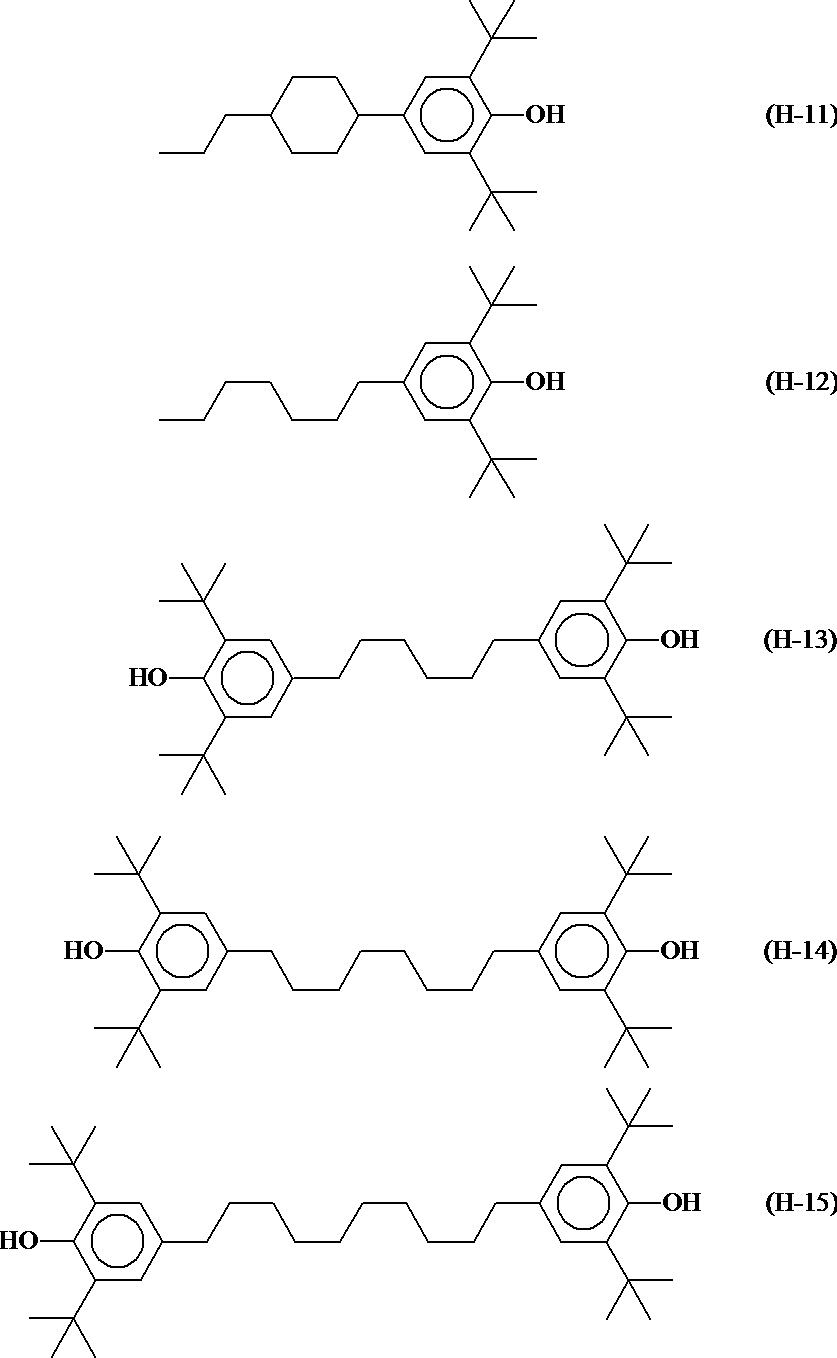
- each hydrogen atom in the 1,4-cyclohexylene group may be independently substituted with a fluorine atom or a chlorine atom. More specifically, for example, the formulas (H-11) to (H-15) can be given.
- the liquid crystal composition of the present invention may contain 1 ppm by mass or more of an antioxidant, preferably 10 ppm by mass or more, preferably 20 ppm by mass or more, and more preferably 50 ppm by mass or more.
- an antioxidant preferably 10 ppm by mass or more, preferably 20 ppm by mass or more, and more preferably 50 ppm by mass or more.
- the upper limit of content of antioxidant is 10000 mass ppm, 1000 mass ppm is preferable, 500 mass ppm is preferable, and 100 mass ppm is preferable.
- the liquid crystal composition of the present invention is useful for a liquid crystal display device, particularly useful for a liquid crystal display device for driving an active matrix, and used for a liquid crystal display device for PSA mode, PSVA mode, VA mode, IPS mode or ECB mode. Can do.
- the liquid crystal composition of the present invention is a liquid crystal display element in which a polymerizable compound contained therein is polymerized by ultraviolet irradiation to impart liquid crystal alignment ability, and the amount of transmitted light is controlled using the birefringence of the liquid crystal composition Used for.
- liquid crystal display elements AM-LCD (active matrix liquid crystal display element), TN (nematic liquid crystal display element), STN-LCD (super twisted nematic liquid crystal display element), OCB-LCD and IPS-LCD (in-plane switching liquid crystal display element)
- AM-LCD active matrix liquid crystal display element
- TN nematic liquid crystal display element
- STN-LCD super twisted nematic liquid crystal display element
- OCB-LCD OCB-LCD
- IPS-LCD in-plane switching liquid crystal display element
- it is particularly useful for AM-LCDs and can be used for transmissive or reflective liquid crystal display elements. Further, it can be applied to a liquid crystal display element having no alignment film
- the two substrates of the liquid crystal cell used in the liquid crystal display element can be made of a transparent material having flexibility such as glass or plastic, and one of them can be an opaque material such as silicon.
- a transparent substrate having a transparent electrode layer can be obtained, for example, by sputtering indium tin oxide (ITO) on a transparent substrate such as a glass plate.
- the color filter can be prepared by, for example, a pigment dispersion method, a printing method, an electrodeposition method, or a dyeing method.
- a method for producing a color filter by a pigment dispersion method will be described as an example.
- a curable coloring composition for a color filter is applied on the transparent substrate, subjected to patterning treatment, and cured by heating or light irradiation. By performing this process for each of the three colors red, green, and blue, a pixel portion for a color filter can be created.
- a pixel electrode provided with an active element such as a TFT, a thin film diode, or a metal insulator metal specific resistance element may be provided on the substrate.
- the substrate is opposed so that the transparent electrode layer is on the inside.
- the thickness of the obtained light control layer is 1 to 100 ⁇ m. More preferably, the thickness is 1.5 to 10 ⁇ m.
- the polarizing plate it is preferable to adjust the product of the refractive index anisotropy ⁇ n of the liquid crystal and the cell thickness d so that the contrast is maximized.
- the polarizing axis of each polarizing plate can be adjusted so that the viewing angle and contrast are good.
- a retardation film for widening the viewing angle can also be used.
- the spacer examples include glass particles, plastic particles, alumina particles, and a photoresist material.
- a sealant such as an epoxy thermosetting composition is screen-printed on the substrates with a liquid crystal inlet provided, the substrates are bonded together, and heated to thermally cure the sealant.
- a normal vacuum injection method or an ODF method can be used as a method of sandwiching the polymerizable compound-containing liquid crystal composition between the two substrates.
- an appropriate polymerization rate is desirable in order to obtain good alignment performance of liquid crystals. Therefore, active energy rays such as ultraviolet rays or electron beams are irradiated singly or in combination or sequentially.
- the method of polymerizing by is preferred.
- ultraviolet rays When ultraviolet rays are used, a polarized light source or a non-polarized light source may be used.
- the polymerization is performed in a state where the polymerizable compound-containing liquid crystal composition is sandwiched between two substrates, at least the substrate on the irradiation surface side must be given appropriate transparency to the active energy rays. I must.
- the orientation state of the unpolymerized part is changed by changing conditions such as an electric field, a magnetic field, or temperature, and further irradiation with active energy rays is performed. Then, it is possible to use a means for polymerization.
- a means for polymerization In particular, when ultraviolet exposure is performed, it is preferable to perform ultraviolet exposure while applying an alternating electric field to the liquid crystal composition of the invention.
- the alternating electric field to be applied is preferably an alternating current having a frequency of 10 Hz to 10 kHz, more preferably a frequency of 60 Hz to 10 kHz, and the voltage is selected depending on a desired pretilt angle of the liquid crystal display element.
- the pretilt angle of the liquid crystal display element is controlled by the applied voltage.
- the pretilt angle In the MVA mode liquid crystal display element, it is necessary to control the pretilt angle from about 80 degrees to about 88 degrees from the viewpoint of alignment stability and contrast.
- the liquid crystal composition of the present invention it is desirable to control the pretilt angle.
- the pretilt angle can be controlled.
- the temperature during irradiation is preferably within a temperature range in which the liquid crystal state of the liquid crystal composition of the present invention is maintained. Polymerization is preferably performed at a temperature close to room temperature, that is, typically at a temperature of 15 to 35 ° C.
- a lamp for generating ultraviolet rays a metal halide lamp, a high-pressure mercury lamp, an ultra-high pressure mercury lamp, or the like can be used.
- a wavelength of the ultraviolet-rays to irradiate it is preferable to irradiate the ultraviolet-ray of the wavelength range which is not the absorption wavelength range of a liquid crystal composition, and it is preferable to cut and use an ultraviolet-ray as needed.
- Intensity of ultraviolet irradiation is preferably from 0.1mW / cm 2 ⁇ 100W / cm 2, 2mW / cm 2 ⁇ 50W / cm 2 is more preferable.
- the amount of energy of ultraviolet rays to be irradiated can be adjusted as appropriate, but is preferably 10 mJ / cm 2 to 500 J / cm 2, and more preferably 100 mJ / cm 2 to 200 J / cm 2 .
- the intensity may be changed.
- the time for irradiating with ultraviolet rays is appropriately selected depending on the intensity of the irradiated ultraviolet rays, but is preferably from 10 seconds to 3600 seconds, and more preferably from 10 seconds to 600 seconds.
- the measured characteristics are as follows.
- T ni Nematic phase-isotropic liquid phase transition temperature (° C.)
- T cn Solid phase-nematic phase transition temperature (° C)
- ⁇ n Refractive index anisotropy at 25 ° C.
- ⁇ Dielectric anisotropy at 25 ° C.
- ⁇ 1 Rotational viscosity at 25 ° C. (mPa ⁇ s)
- K 33 Elastic constant at 25 ° C.
- the liquid crystal composition LC-1 of the present invention was confirmed to have a negative ⁇ and a large absolute value, low ⁇ 1, large K 33 , low T cn , high T ni and high VHR.
- a low-temperature storage test at ⁇ 25 ° C. for 100 hours in LC-1, it was confirmed that the nematic phase was maintained.
- the response speed of the liquid crystal display element using this was measured, it was sufficiently high-speed response. It was also confirmed that there were no display defects such as burn-in and display unevenness.
- the cell thickness was 3.3 ⁇ m
- the alignment film was JALS2096
- the response speed measurement conditions were Von 6 V, Voff 1 V, measurement temperature 30 ° C.
- DUT 703 manufactured by AUTRONIC-MELCHERS.
- a liquid crystal composition in which 0.35% by mass of the compound of the formula (XX-2) is added as a polymerizable compound to 99.65% by mass of each of the LC-1 to LC-4 above.
- a PSVA mode liquid crystal display element was manufactured, and it was confirmed that there was no display defect in any of the elements and the response was sufficiently fast.
- Examples 5 to 8 Further, by using a liquid crystal composition in which 0.3% by mass of the formula (XX-4) is added as a polymerizable compound to 99.7% by mass of each liquid crystal composition of LC-1 to LC-4, PSVA A mode liquid crystal display device was manufactured, and it was confirmed that there was no display defect in any of the devices and the response was sufficiently fast.
- Examples 9 to 12 A liquid crystal display element of PSVA mode is obtained using a liquid crystal composition in which 0.35% by mass of the compound of formula (XX-2) is added as a polymerizable compound to 99.65% by mass of the liquid crystal composition LC-A. When fabricated, a burn-in phenomenon was observed.
- Example 5 a liquid crystal composition LC-5 (Example 13) in which the 3-Cy-Cy-V compound of Example 1 was substituted with a V-Cy-Cy-V compound was prepared, and the physical properties thereof were measured. ⁇ 1 superior to that of Example 1 was obtained.
- the liquid crystal composition of the present invention has a negative ⁇ and a large absolute value, a low rotational viscosity ( ⁇ 1 ), a large elastic constant (K 33 ), a low solid phase-nematic phase transition temperature (T cn ).
- High nematic phase-isotropic liquid phase transition temperature (T ni ), low-temperature dissolution stability and high voltage holding ratio (VHR), and VA type, PSVA type, PSA type, FFS produced using this It has been confirmed that the liquid crystal display element such as a mold has a high VHR, has a high-speed response with excellent display quality, and has no or suppressed display defects such as image sticking and display unevenness.
Landscapes
- Chemical & Material Sciences (AREA)
- Crystallography & Structural Chemistry (AREA)
- Engineering & Computer Science (AREA)
- Materials Engineering (AREA)
- Organic Chemistry (AREA)
- Physics & Mathematics (AREA)
- Nonlinear Science (AREA)
- General Physics & Mathematics (AREA)
- Optics & Photonics (AREA)
- Liquid Crystal Substances (AREA)
Abstract
Description




一般式(I-1)中、R12は炭素原子数1から10のアルキル基、炭素原子数1から10のアルコキシル基、炭素原子数2から10のアルケニル基又は炭素原子数2から10のアルケニルオキシ基を表すが、R12は炭素原子数1から5のアルキル基、炭素原子数1から5のアルコキシル基、炭素原子数2から5のアルケニル基又は炭素原子数2から5のアルケニルオキシ基を表すことが好ましく、炭素原子数1から5のアルキル基、炭素原子数2から5のアルケニル基が好ましく、炭素原子数2から3のアルケニル基を表すことが特に好ましい。


Sは、単結合又はスペーサー基を表すが、スペーサー基として、例えば、炭素原子数1から20のアルキレン基を表すことができ、基中の1個又は隣接していない2個以上の-CH2-はそれぞれ独立的に-O-、-COO-、-OCO-又は-OCO-O-に置換されていても良く、Sが複数存在する場合、それらは同一であっても異なっていても良い。Sはスペーサー基であることがより好ましい。
A1、A2、A3及びA4はそれぞれ独立的に、1,4-フェニレン、ナフタレン-1,4-ジイル又はナフタレン-2,6-ジイルを表すが、これらの基中の水素原子は1つ以上のLによって置換されていても良く、A5が複数存在する場合それらは同一であっても異なっていても良いが、少なくとも1つは、1つ以上のLによって置換されていることが好ましい。
A1、A2、A3、A4及びA5は、具体的には、下記の式(A-1)から式(A-10)

Lはフッ素原子、塩素原子、臭素原子、ヨウ素原子、メチル基又はメトキシ基を表すが、フッ素原子、塩素原子、メチル基又はメトキシ基であることが好ましい。なお、メチル基又はメトキシ基の水素原子は任意にフッ素原子で置換されていても良い。
lは0、1又は2を表すが、1であることが好ましい。
nは0、1又は2を表すが、0が好ましい。
Z1、Z2、及び、Z3は、それぞれ独立的に、-O-、-S-、-OCH2-、-CH2O-、-COO-、-OCO-、-CO-、-CO-S-、-S-CO-、-O-CO-O-、-CO-NH-、-NH-CO-、-SCH2-、-CH2S-、-CF2O-、-OCF2-、-CF2S-、-SCF2-、-CH2CH2-、-CH2CF2-、-CF2CH2-、-CF2CF2-、-CH=CH-COO-、-CH=CH-OCO-、-COO-CH=CH-、-OCO-CH=CH-、-COO-CH2CH2-、-OCO-CH2CH2-、-CH2CH2-COO-、-CH2CH2-OCO-、-COO-CH2-、-OCO-CH2-、-CH2-COO-、-CH2-OCO-、-CH=CH-、-CF=CF-又は-C≡C-又は単結合を表し、複数存在する場合は、それらは同一であっても異なっていても良いが、それぞれ独立的に単結合、-OCH2-、-CH2O-、-COO-、-OCO-、-COO-CH2CH2-、-OCO-CH2CH2-、-CH2CH2-COO-、-CH2CH2-OCO-、-CH=CH-又は-C≡C-であることが好ましく、Z1、Z2、及びZ3の少なくとも1個が単結合であることが好ましく、すべてが単結合であることが好ましい。
Xは-O-、-S-、-OCH2-、-CH2O-、-CO-、-COO-、-OCO-、-CO-S-、-S-CO-、-O-CO-O-、-CO-NH-、-NH-CO-、-SCH2-、-CH2S-、-CF2O-、-OCF2-、-CF2S-、-SCF2-、-CH=CH-COO-、-CH=CH-OCO-、-COO-CH=CH-、-OCO-CH=CH-、-COO-CH2CH2-、-OCO-CH2CH2-、-CH2CH2-COO-、-CH2CH2-OCO-、-COO-CH2-、-OCO-CH2-、-CH2-COO-、-CH2-OCO-、-CH=CH-、-CF=CF-又は単結合を表し、Xが複数存在する場合それらは同一であっても異なっていても良いが、-O-、-COO-、-OCO-又は単結合であることが好ましい。
Rは、水素原子、フッ素原子、塩素原子、臭素原子、ヨウ素原子、ペンタフルオロスルフラニル基、シアノ基、ニトロ基、イソシアノ基、チオイソシアノ基又は1個の-CH2-又は、炭素原子数1から12の直鎖又は分岐アルキル基を表すが、隣接していない2個以上の-CH2-がそれぞれ独立的に-O-、-S-、-CO-、-COO-、-OCO-、-CO-S-、-S-CO-、-O-CO-O-、-CO-NH-、-NH-CO-、-CH=CH-COO-、-CH=CH-OCO-、-COO-CH=CH-、-OCO-CH=CH-、-CH=CH-、-CF=CF-又は-C≡C-によって置換されていても良いが、水素原子、フッ素原子、塩素原子、シアノ基又は1個又は隣接していない2個以上の-CH2-がそれぞれ独立的に-O-、-COO-、-OCO-、-O-CO-O-によって置換されていても良い炭素原子数1から12の直鎖又は分岐アルキル基であることが好ましく、水素原子、フッ素原子、炭素原子数1から12の直鎖アルキル基、炭素原子数2から12の分岐アルキル基、炭素原子数1から12の直鎖アルコキシ基、炭素原子数2から12の分岐アルコキシ基であることが更に好ましい。lは、0から8の整数を表し、m1、m2及びm3は0又は1を表し、nは、0、1又は2を表し、m1+m2+m3は0又は1を表す。
一般式(I-2)で表される化合物は、一般式(I-3)で表される化合物であることが更に好ましい。


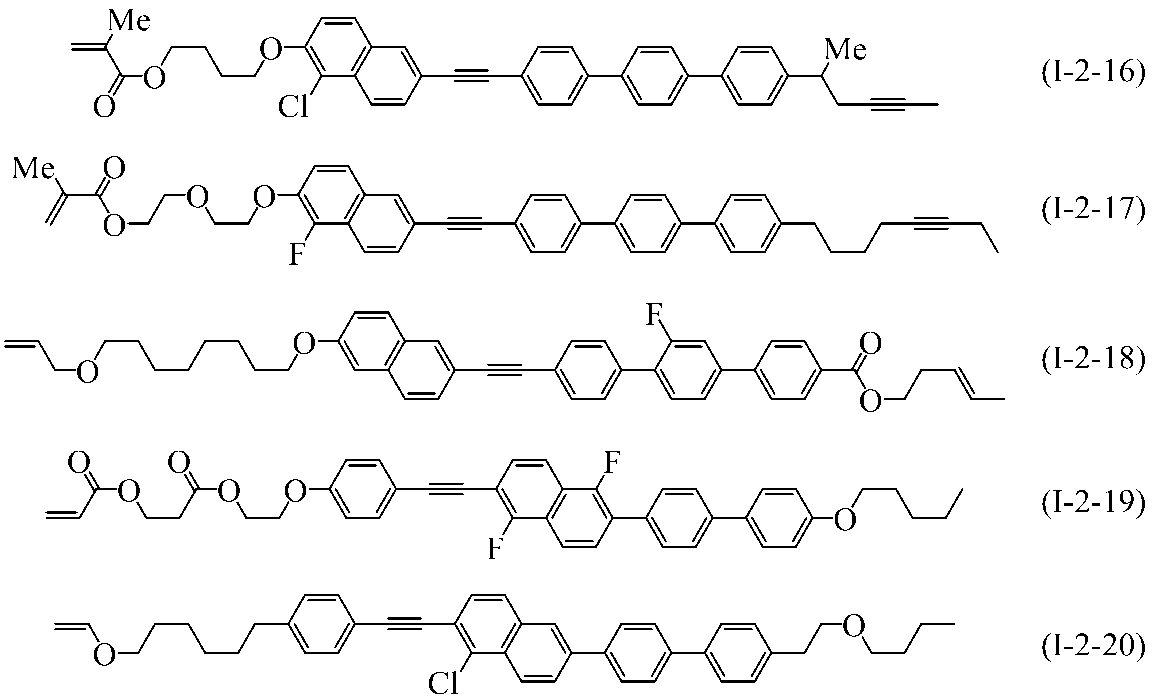
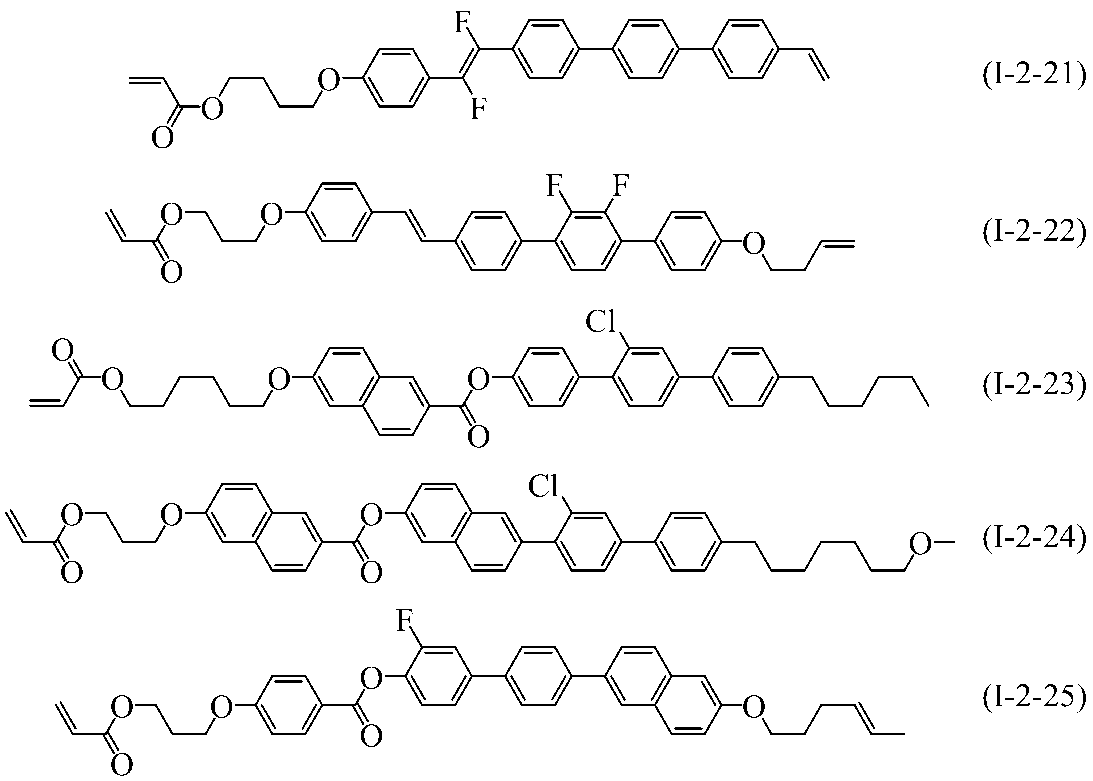
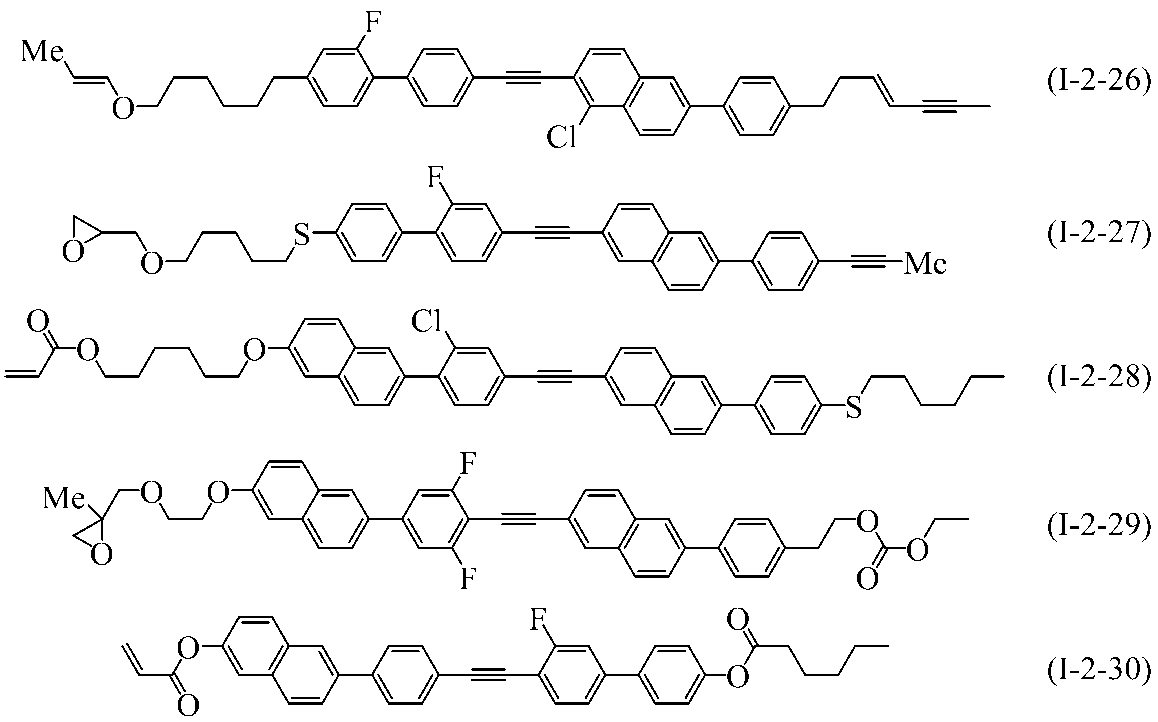






一般式(II-rm)中、R21は炭素原子数1から10のアルキル基、炭素原子数1から10のアルコキシル基が好ましく、炭素原子数1から5のアルキル基、炭素原子数1から5のアルコキシル基が好ましい。
一般式(II-rm)で表される化合物として、更に具体的には、式(I-2-100)から式(I-2-119)で表される化合物が好ましい。

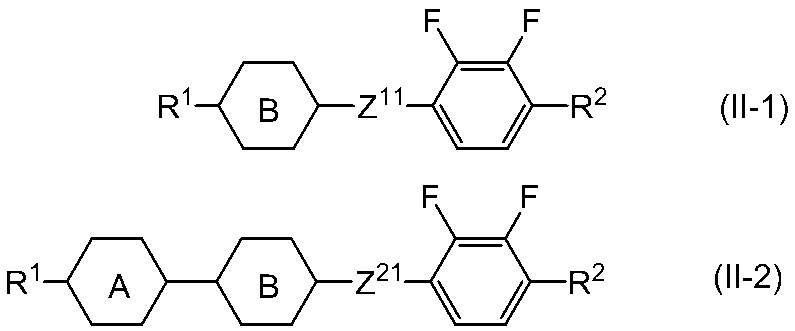
式中、環A及び環Bは、それぞれ独立的にトランス-1,4-シクロへキシレン基、1,4-フェニレン基、2-フルオロ-1,4-フェニレン基、3-フルオロ-1,4-フェニレン基、3,5-ジフルオロ-1,4-フェニレン基、2,3-ジフルオロ-1,4-フェニレン基、1,4-シクロヘキセニレン基、1,4-ビシクロ[2.2.2]オクチレン基、ピペリジン-1,4-ジイル基、ナフタレン-2,6-ジイル基、デカヒドロナフタレン-2,6-ジイル基又は1,2,3,4-テトラヒドロナフタレン-2,6-ジイル基を表すが、トランス-1,4-シクロへキシレン基又は1,4-フェニレン基が好ましい。
式中、Z11及びZ21は、それぞれ独立的に、-OCH2-、-CH2O-、-CF2O-、-OCF2-、-CH2CH2-、-CF2CF2-又は単結合を表すが、-CH2O-、-CF2O-、-CH2CH2-、-CF2CF2-又は単結合が好ましく、-CH2O-、-CH2CH2-又は単結合が更に好ましく、-CH2O-又は単結合が特に好ましい。
一般式(II-1)で表される化合物は、具体的には、一般式(II-A1)から一般式(II-A4)で表される化合物であることが好ましく、一般式(II-A1)で表される化合物であることが好ましく、一般式(II-A3)で表される化合物であることが好ましく、一般式(II-A4)で表される化合物であることが好ましく、一般式(II-A1)で表される化合物であることが更に好ましく、一般式(II-A4)で表される化合物であることが更に好ましい。
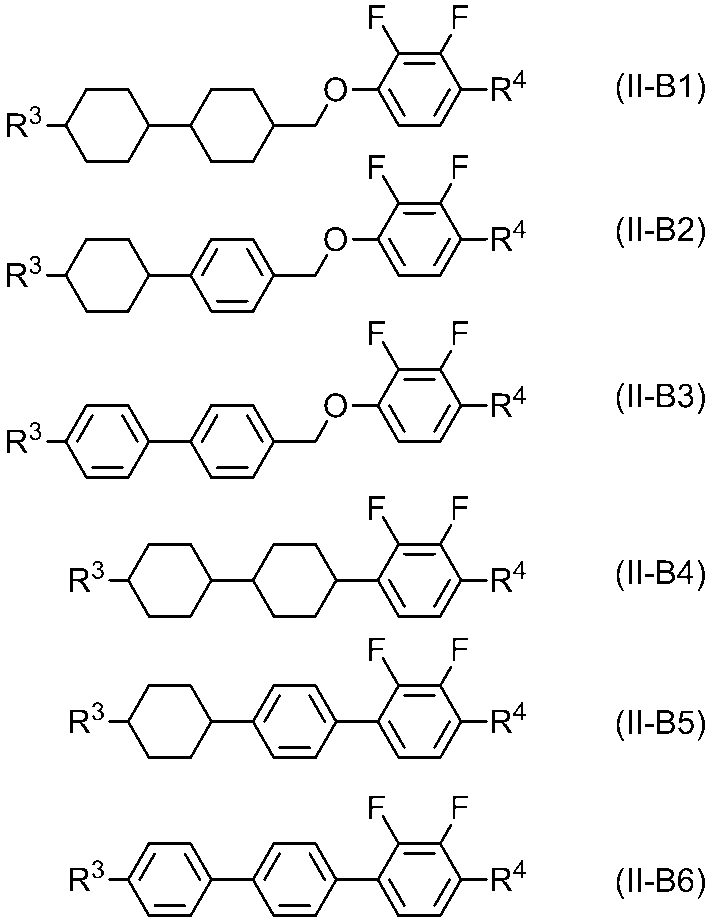
更に詳述すると、第三成分は一般式(II-A3)及び一般式(II-B4)の組み合わせであることが好ましく、一般式(II-A3)及び一般式(II-B4)及び一般式(II-B5)の組み合わせであることが更に好ましく、一般式(II-A3)及び一般式(II-B4)及び一般式(II-B1)の組み合わせであることが更に好ましい。
更に詳述すると、第三成分は一般式(II-A4)及び一般式(II-B4)の組み合わせであることが好ましく、一般式(II-A4)及び一般式(II-B1)の組み合わせであることが好ましく、一般式(II-A4)及び一般式(II-B1)及び一般式(II-B5)の組み合わせであることが更に好ましく、一般式(II-A4)及び一般式(II-B1)及び一般式(II-B3)の組み合わせであることが更に好ましい。
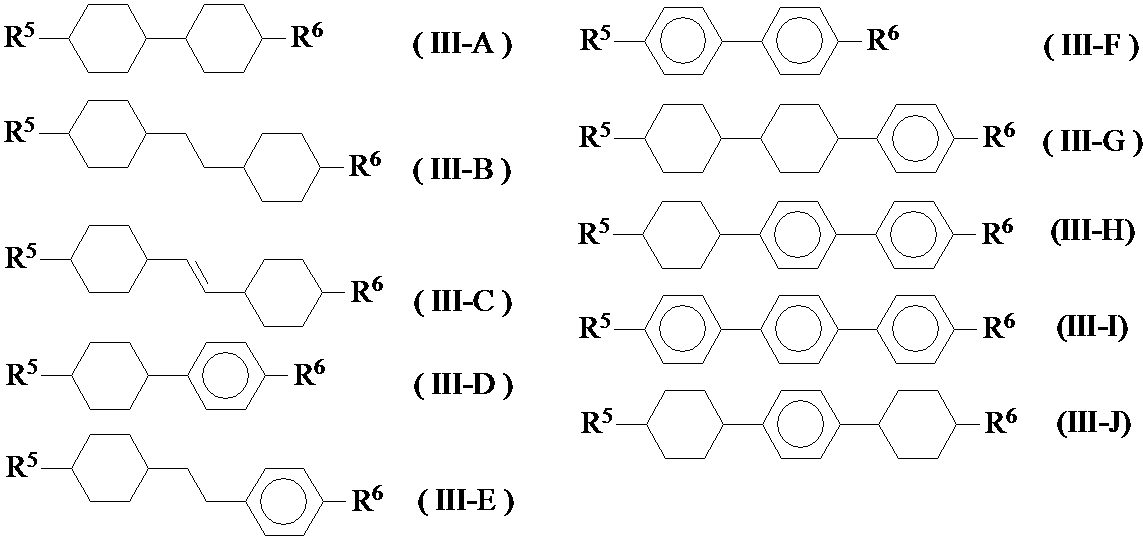
第四成分は、一般式(III-A)、一般式(III-D)、一般式(III-F)、一般式(III-G)及び一般式(III-H)から選ばれる化合物であることが好ましく、一般式(III-A)、一般式(III-F)、一般式(III-G)及び一般式(III-H)から選ばれる化合物であることが更に好ましく、一般式(III-A)、一般式(III-G)及び一般式(III-H)から選ばれる化合物であることが更に好ましく、一般式(III-A)、一般式(III-F)及び一般式(III-H)から選ばれる化合物であることも好ましい。
また、一般式(III-D)、一般式(III-G)及び一般式(III-H)で表される化合物においては、R5は炭素原子数1から5のアルキル基又は炭素原子数2から5のアルケニル基、R6は炭素原子数1から5のアルキル基又は炭素原子数1から5のアルコキシ基であることが好ましく、R5は炭素原子数2から5のアルケニル基であることが更に好ましく、炭素原子数2又は3のアルケニル基であることが更に好ましく、一般式(III-F)で表される化合物においては、R5及びR6はそれぞれ独立的に炭素原子数1から5のアルキル基又は炭素原子数2から5のアルケニル基であることが好ましい。
第四成分の含有量は、1質量%から50質量%であることが好ましく、この下限値は3質量%が好ましく、3質量%が好ましく、5質量%が好ましく、10質量%が好ましく、15質量%が好ましく、20質量%が好ましく、25質量%が好ましく、この上限値は45質量%が好ましく、40質量%が好ましく、35質量%が好ましく、30質量%が好ましく、25質量%が好ましく、20質量%が好ましく、15質量%が好ましい。
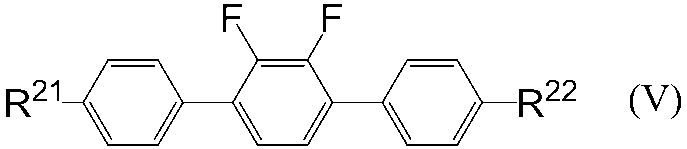


更なる成分として、一般式(V-9.1)から一般式(V-9.3)で表される化合物を1種又は2種以上含有しても良い。

本発明の液晶組成物は、ネマチック相-等方性液体相転移温度(Tni)が60℃から120℃であるが、70℃から100℃がより好ましく、70℃から85℃が特に好ましい。
本発明の液晶組成物は、25℃における弾性定数(K33)が10pNから20pNであるが、12pNから18pNがより好ましく、13pNから17pNが特に好ましい。
本発明の液晶組成物は、電圧保持率(VHR)が70%から100%であるが、75%から100%が好ましく、80%から100%が好ましく、85%から100%が好ましい。但し、測定条件は1V、3Hz、60℃であって、高圧水銀ランプでUVを12(J)照射後にVHR測定するものとする。


一般式(M)の含有量は0.01~2.00質量%であることが好ましく、0.05~1.00質量%であることが更に好ましく、0.10~0.50質量%であることが特に好ましい。






また、本発明の液晶組成物に添加させる酸化防止剤として、一般式(H-1)から一般式(H-4)で表されるヒンダードフェノールが好ましい。

一般式(H-4)中、MH4は炭素原子数1から15のアルキレン基(該アルキレン基中の1つ又は2つ以上の-CH2-は、酸素原子が直接隣接しないように、-O-、-CO-、-COO-、-OCO-に置換されていても良い。)、-OCH2-、-CH2O-、-COO-、-OCO-、-CF2O-、-OCF2-、-CF2CF2-、-CH=CH-COO-、-CH=CH-OCO-、-COO-CH=CH-、-OCO-CH=CH-、-CH=CH-、-C≡C-、単結合、1,4-フェニレン基(1,4-フェニレン基中の任意の水素原子はフッ素原子により置換されていても良い。)又はトランス-1,4-シクロヘキシレン基を表すが、炭素原子数1から14のアルキレン基であることが好ましく、揮発性を考慮すると炭素原子数は大きい数値が好ましいが、回転粘性(γ1)を考慮すると炭素原子数は大き過ぎない方が好ましいことから、炭素原子数2から12が更に好ましく、炭素原子数3から10が更に好ましく、炭素原子数4から10が更に好ましく、炭素原子数5から10が更に好ましく、炭素原子数6から10が更に好ましい。
一般式(H-1)から一般式(H-4)中、1,4-フェニレン基中の1個又は非隣接の2個以上の-CH=は-N=によって置換されていても良い。また、1,4-フェニレン基中の水素原子はそれぞれ独立的に、フッ素原子又は塩素原子で置換されていても良い。
一般式(H-1)から一般式(H-4)中、1,4-シクロヘキシレン基中の1個又は非隣接の2個以上の-CH2-は-O-又は-S-によって置換されていても良い。また、1,4-シクロヘキシレン基中の水素原子はそれぞれ独立的に、フッ素原子又は塩素原子で置換されていても良い。
更に具体的には、例えば、式(H-11)から式(H-15)が挙げられる。
実施例において化合物の記載について以下の略号を用いる。
(側鎖)
-n -CnH2n+1 炭素数nの直鎖状のアルキル基
n- CnH2n+1- 炭素数nの直鎖状のアルキル基
-On -OCnH2n+1 炭素数nの直鎖状のアルコキシル基
nO- CnH2n+1O- 炭素数nの直鎖状のアルコキシル基
-V -CH=CH2
V- CH2=CH-
-V1 -CH=CH-CH3
1V- CH3-CH=CH-
-2V -CH2-CH2-CH=CH3
V2- CH3=CH-CH2-CH2-
-2V1 -CH2-CH2-CH=CH-CH3
1V2- CH3-CH=CH-CH2-CH2-
(連結基)
-CF2O- -CF2-O-
-OCF2- -O-CF2-
-1O- -CH2-O-
-O1- -O-CH2-
-COO- -COO-
(環構造)

Tcn :固体相-ネマチック相転移温度(℃)
Δn :25℃における屈折率異方性
Δε :25℃における誘電率異方性
γ1 :25℃における回転粘性(mPa・s)
K33 :25℃における弾性定数K33(pN)
VHR :高圧水銀ランプでUVを12(J)照射後の電圧保持率(%)
(比較例1~5及び実施例1~13)
LC-A(比較例1)、LC-B(比較例2)、LC-C(比較例3)、LC-D(比較例4)、LC-1(実施例1)、LC-2(実施例2)、LC-3(実施例3)及びLC-4(実施例4)の液晶組成物を調製し、その物性値を測定した。液晶組成物の構成とその物性値の結果は表1のとおりであった。
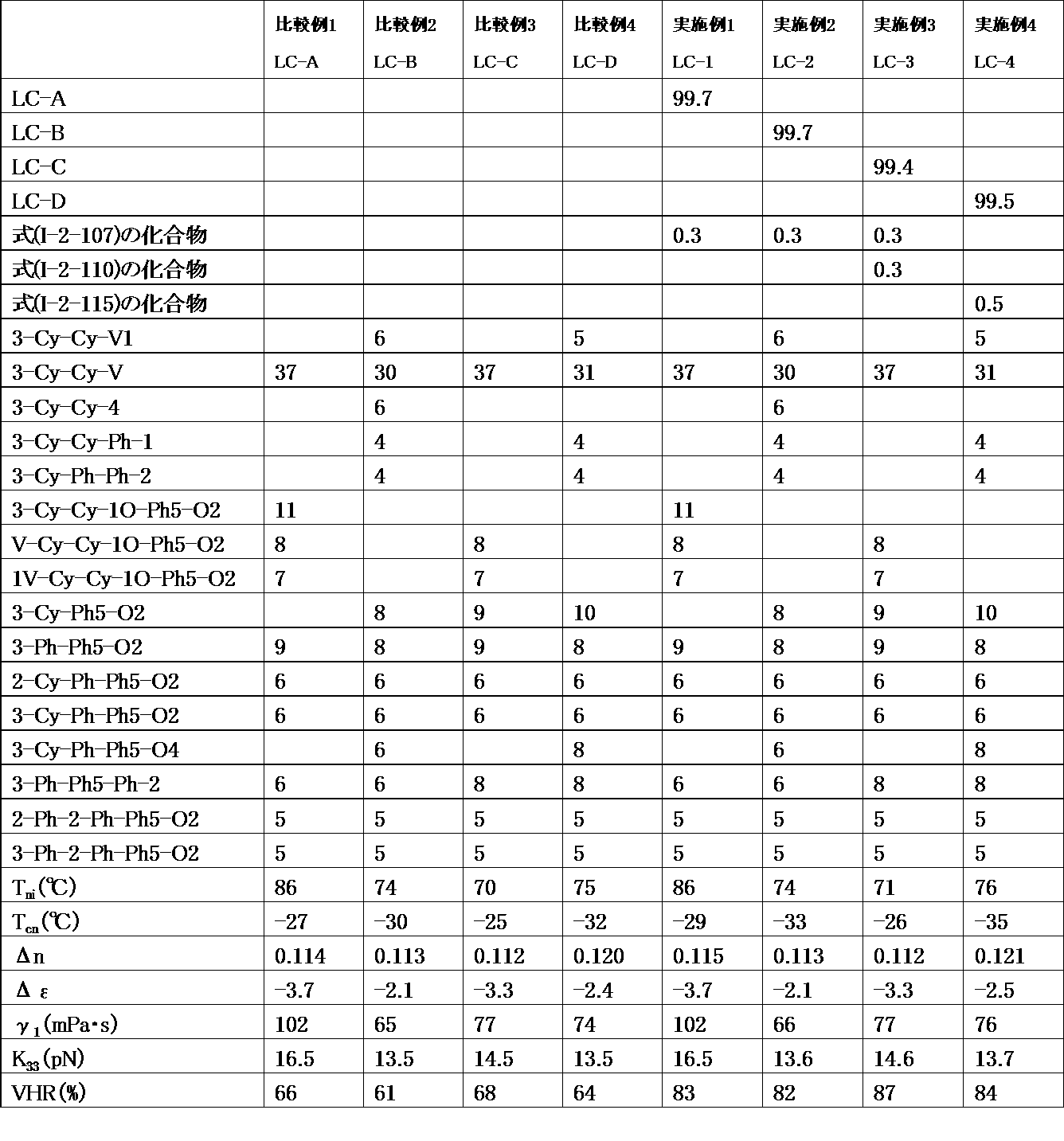
また、上記のLC-1からLC-4のそれぞれの液晶組成物99.65質量%に対して、重合性化合物として式(XX-2)の化合物を0.35質量%添加した液晶組成物を用いて、PSVAモードの液晶表示素子を作製し、いずれの素子においても表示不良がなく、十分に高速応答であることを確認した。(実施例5~8)
また、LC-1からLC-4のそれぞれの液晶組成物99.7質量%に対して、重合性化合物として式(XX-4)を0.3質量%添加した液晶組成物を用いて、PSVAモードの液晶表示素子を作製し、いずれの素子においても表示不良がなく、十分に高速応答であることを確認した。(実施例9~12)
液晶組成物LC-Aを99.65質量%に対して、重合性化合物として式(XX-2)の化合物を0.35質量%添加した液晶組成物を用いて、PSVAモードの液晶表示素子を作製したところ、焼き付き現象が観察された。(比較例5)
また、実施例1の3-Cy-Cy-Vの化合物をV-Cy-Cy-Vの化合物に置換した液晶組成物LC-5(実施例13)を調製し、その物性値を測定したところ、実施例1よりも優れたγ1が得られた。
Claims (11)
- 第一成分として、一般式(I-1)


- 20℃における誘電率異方性(Δε)が-2.0から-8.0の範囲であり、20℃における屈折率異方性(Δn)が0.08から0.14の範囲であり、20℃における回転粘性(γ1)が60から200mPa・sの範囲であり、ネマチック相-等方性液体相転移温度(Tni)が60℃から120℃の範囲である請求項1に記載の液晶組成物。
- 第三成分として、一般式(II-1)及び一般式(II-2)

- 第四成分として、一般式(III-A)から一般式(III-J)

- 一般式(II-1)で表される化合物と一般式(II-2)で表される化合物を同時に含有する請求項3又は4に記載の液晶組成物。
- 一般式(II-1)が、一般式(II-A1)から一般式(II-A4)

- 一般式(II-1)及び一般式(II-2)中のR1がプロペニル基である化合物の群から選ばれる化合物を1種又は2種以上含有する請求項3に記載の液晶組成物。
- 一般式(IV)
- 請求項1から8のいずれか1項に記載の液晶組成物を用いた液晶表示素子。
- 請求項1から8のいずれか1項に記載の液晶組成物を用いたアクティブマトリックス駆動用液晶表示素子。
- 請求項1から8のいずれか1項に記載の液晶組成物を用いたVA型、FFS型、PSA型、PSVA型の液晶表示素子。
Priority Applications (3)
| Application Number | Priority Date | Filing Date | Title |
|---|---|---|---|
| KR1020187025549A KR20180134851A (ko) | 2016-04-27 | 2017-04-13 | 네마틱 액정 조성물 및 이를 사용한 액정 표시 소자 |
| CN201780018636.0A CN108779395B (zh) | 2016-04-27 | 2017-04-13 | 向列液晶组合物和使用其的液晶显示元件 |
| JP2017544365A JP6265312B1 (ja) | 2016-04-27 | 2017-04-13 | ネマチック液晶組成物及びこれを用いた液晶表示素子 |
Applications Claiming Priority (2)
| Application Number | Priority Date | Filing Date | Title |
|---|---|---|---|
| JP2016-089250 | 2016-04-27 | ||
| JP2016089250 | 2016-04-27 |
Publications (1)
| Publication Number | Publication Date |
|---|---|
| WO2017188005A1 true WO2017188005A1 (ja) | 2017-11-02 |
Family
ID=60161565
Family Applications (1)
| Application Number | Title | Priority Date | Filing Date |
|---|---|---|---|
| PCT/JP2017/015106 Ceased WO2017188005A1 (ja) | 2016-04-27 | 2017-04-13 | ネマチック液晶組成物及びこれを用いた液晶表示素子 |
Country Status (4)
| Country | Link |
|---|---|
| JP (1) | JP6265312B1 (ja) |
| KR (1) | KR20180134851A (ja) |
| CN (1) | CN108779395B (ja) |
| WO (1) | WO2017188005A1 (ja) |
Cited By (6)
| Publication number | Priority date | Publication date | Assignee | Title |
|---|---|---|---|---|
| WO2019124093A1 (ja) * | 2017-12-21 | 2019-06-27 | Dic株式会社 | 液晶組成物 |
| WO2019124094A1 (ja) * | 2017-12-21 | 2019-06-27 | Dic株式会社 | 液晶組成物 |
| WO2019135350A1 (ja) * | 2018-01-05 | 2019-07-11 | Jnc株式会社 | 液晶組成物および液晶表示素子 |
| CN110734770A (zh) * | 2018-07-20 | 2020-01-31 | Dic株式会社 | 液晶组合物和液晶显示元件 |
| CN111334310A (zh) * | 2018-12-18 | 2020-06-26 | Dic株式会社 | 液晶组合物和液晶显示元件 |
| CN111334311A (zh) * | 2018-12-18 | 2020-06-26 | Dic株式会社 | 液晶组合物和液晶显示元件 |
Families Citing this family (5)
| Publication number | Priority date | Publication date | Assignee | Title |
|---|---|---|---|---|
| JP7163733B2 (ja) * | 2018-11-14 | 2022-11-01 | Dic株式会社 | 液晶組成物及び液晶表示素子 |
| TW202035380A (zh) * | 2018-12-11 | 2020-10-01 | 日商Dic股份有限公司 | 液晶組成物及顯示元件、以及化合物 |
| JP7302305B2 (ja) * | 2019-06-04 | 2023-07-04 | Dic株式会社 | 液晶組成物及び液晶表示素子 |
| JP7409047B2 (ja) * | 2019-11-27 | 2024-01-09 | Dic株式会社 | 組成物及びそれを使用した液晶表示素子 |
| WO2024197854A1 (zh) * | 2023-03-31 | 2024-10-03 | 京东方科技集团股份有限公司 | 液晶显示面板及其制造方法、显示基板和显示装置 |
Citations (6)
| Publication number | Priority date | Publication date | Assignee | Title |
|---|---|---|---|---|
| JP2007126449A (ja) * | 2005-10-05 | 2007-05-24 | Chisso Corp | アルカジエニル基を側鎖として有する化合物およびこれを用いた液晶組成物 |
| JP2014019646A (ja) * | 2012-07-12 | 2014-02-03 | Jnc Corp | フルオロビニル基を有する液晶化合物、液晶組成物および液晶表示素子 |
| JP2014040413A (ja) * | 2012-07-26 | 2014-03-06 | Jnc Corp | 2、2−ジフルオロビニルオキシ基または1、2、2−トリフルオロビニルオキシ基を有する化合物、液晶組成物および液晶表示素子 |
| JP2014181293A (ja) * | 2013-03-19 | 2014-09-29 | Jnc Corp | 液晶組成物および液晶表示素子 |
| WO2015025604A1 (ja) * | 2013-08-20 | 2015-02-26 | Jnc株式会社 | 液晶組成物および液晶表示素子 |
| JP2015172035A (ja) * | 2014-02-18 | 2015-10-01 | Jnc株式会社 | フッ素を含有するアルケニル末端基を有する液晶性化合物、液晶組成物および液晶表示素子 |
Family Cites Families (3)
| Publication number | Priority date | Publication date | Assignee | Title |
|---|---|---|---|---|
| JP6729395B2 (ja) * | 2015-01-20 | 2020-07-22 | Jnc株式会社 | 液晶組成物および液晶表示素子 |
| WO2016152340A1 (ja) * | 2015-03-24 | 2016-09-29 | Jnc株式会社 | 液晶組成物および液晶表示素子 |
| EP3214154B1 (en) * | 2016-03-01 | 2019-06-26 | Merck Patent GmbH | Liquid-crystal media and light modulation element |
-
2017
- 2017-04-13 CN CN201780018636.0A patent/CN108779395B/zh active Active
- 2017-04-13 WO PCT/JP2017/015106 patent/WO2017188005A1/ja not_active Ceased
- 2017-04-13 KR KR1020187025549A patent/KR20180134851A/ko not_active Ceased
- 2017-04-13 JP JP2017544365A patent/JP6265312B1/ja active Active
Patent Citations (6)
| Publication number | Priority date | Publication date | Assignee | Title |
|---|---|---|---|---|
| JP2007126449A (ja) * | 2005-10-05 | 2007-05-24 | Chisso Corp | アルカジエニル基を側鎖として有する化合物およびこれを用いた液晶組成物 |
| JP2014019646A (ja) * | 2012-07-12 | 2014-02-03 | Jnc Corp | フルオロビニル基を有する液晶化合物、液晶組成物および液晶表示素子 |
| JP2014040413A (ja) * | 2012-07-26 | 2014-03-06 | Jnc Corp | 2、2−ジフルオロビニルオキシ基または1、2、2−トリフルオロビニルオキシ基を有する化合物、液晶組成物および液晶表示素子 |
| JP2014181293A (ja) * | 2013-03-19 | 2014-09-29 | Jnc Corp | 液晶組成物および液晶表示素子 |
| WO2015025604A1 (ja) * | 2013-08-20 | 2015-02-26 | Jnc株式会社 | 液晶組成物および液晶表示素子 |
| JP2015172035A (ja) * | 2014-02-18 | 2015-10-01 | Jnc株式会社 | フッ素を含有するアルケニル末端基を有する液晶性化合物、液晶組成物および液晶表示素子 |
Cited By (16)
| Publication number | Priority date | Publication date | Assignee | Title |
|---|---|---|---|---|
| JP7255495B2 (ja) | 2017-12-21 | 2023-04-11 | Dic株式会社 | 液晶組成物 |
| CN111448291A (zh) * | 2017-12-21 | 2020-07-24 | Dic株式会社 | 液晶组合物 |
| TWI854965B (zh) * | 2017-12-21 | 2024-09-11 | 大陸商石家莊誠志永華顯示材料有限公司 | 液晶組成物 |
| JP7255496B2 (ja) | 2017-12-21 | 2023-04-11 | Dic株式会社 | 液晶組成物 |
| WO2019124093A1 (ja) * | 2017-12-21 | 2019-06-27 | Dic株式会社 | 液晶組成物 |
| JPWO2019124093A1 (ja) * | 2017-12-21 | 2021-01-14 | Dic株式会社 | 液晶組成物 |
| WO2019124094A1 (ja) * | 2017-12-21 | 2019-06-27 | Dic株式会社 | 液晶組成物 |
| CN111433325A (zh) * | 2017-12-21 | 2020-07-17 | Dic株式会社 | 液晶组合物 |
| JPWO2019124094A1 (ja) * | 2017-12-21 | 2020-12-24 | Dic株式会社 | 液晶組成物 |
| JPWO2019135350A1 (ja) * | 2018-01-05 | 2021-01-07 | Jnc株式会社 | 液晶組成物および液晶表示素子 |
| JP7205496B2 (ja) | 2018-01-05 | 2023-01-17 | Jnc株式会社 | 液晶組成物および液晶表示素子 |
| WO2019135350A1 (ja) * | 2018-01-05 | 2019-07-11 | Jnc株式会社 | 液晶組成物および液晶表示素子 |
| CN110734770A (zh) * | 2018-07-20 | 2020-01-31 | Dic株式会社 | 液晶组合物和液晶显示元件 |
| CN111334311A (zh) * | 2018-12-18 | 2020-06-26 | Dic株式会社 | 液晶组合物和液晶显示元件 |
| CN111334310A (zh) * | 2018-12-18 | 2020-06-26 | Dic株式会社 | 液晶组合物和液晶显示元件 |
| CN111334311B (zh) * | 2018-12-18 | 2024-04-26 | Dic株式会社 | 液晶组合物和液晶显示元件 |
Also Published As
| Publication number | Publication date |
|---|---|
| JPWO2017188005A1 (ja) | 2018-05-17 |
| KR20180134851A (ko) | 2018-12-19 |
| CN108779395B (zh) | 2022-01-11 |
| CN108779395A (zh) | 2018-11-09 |
| JP6265312B1 (ja) | 2018-01-24 |
Similar Documents
| Publication | Publication Date | Title |
|---|---|---|
| JP6265312B1 (ja) | ネマチック液晶組成物及びこれを用いた液晶表示素子 | |
| JP5761468B2 (ja) | ネマチック液晶組成物及びこれを用いた液晶表示素子 | |
| JP6245211B2 (ja) | ネマチック液晶組成物及びこれを用いた液晶表示素子 | |
| TWI452122B (zh) | 液晶組成物 | |
| KR101316708B1 (ko) | 네마틱 액정 조성물 및 이를 사용한 액정 표시 소자 | |
| TWI656198B (zh) | Nematic liquid crystal composition and liquid crystal display element using same | |
| JP5900718B1 (ja) | ネマチック液晶組成物及びこれを用いた液晶表示素子 | |
| JPWO2014136770A1 (ja) | ネマチック液晶組成物及びこれを用いた液晶表示素子 | |
| JP6153999B2 (ja) | 重合性化合物含有液晶組成物及びこれを使用した液晶表示素子 | |
| WO2013187373A1 (ja) | ネマチック液晶組成物及びこれを用いた液晶表示素子 | |
| WO2018096932A1 (ja) | 液晶組成物及び液晶表示素子 | |
| JP2020076012A (ja) | 液晶組成物及び液晶表示素子 | |
| JP7024254B2 (ja) | 液晶組成物及び液晶表示素子 | |
| JP6575735B1 (ja) | 液晶組成物及び液晶表示素子 | |
| TW201425543A (zh) | 向列型液晶組成物及使用其之液晶顯示元件 | |
| JP2017222749A (ja) | 液晶組成物、及び液晶表示素子 | |
| JP2012082349A (ja) | 重合性化合物含有液晶組成物及びそれを使用した液晶表示素子 | |
| TWI721763B (zh) | 液晶組成物及液晶顯示元件 |
Legal Events
| Date | Code | Title | Description |
|---|---|---|---|
| ENP | Entry into the national phase |
Ref document number: 2017544365 Country of ref document: JP Kind code of ref document: A |
|
| ENP | Entry into the national phase |
Ref document number: 20187025549 Country of ref document: KR Kind code of ref document: A |
|
| NENP | Non-entry into the national phase |
Ref country code: DE |
|
| 121 | Ep: the epo has been informed by wipo that ep was designated in this application |
Ref document number: 17789292 Country of ref document: EP Kind code of ref document: A1 |
|
| 122 | Ep: pct application non-entry in european phase |
Ref document number: 17789292 Country of ref document: EP Kind code of ref document: A1 |