WO2017171004A1 - 凝結調整混和材 - Google Patents
凝結調整混和材 Download PDFInfo
- Publication number
- WO2017171004A1 WO2017171004A1 PCT/JP2017/013595 JP2017013595W WO2017171004A1 WO 2017171004 A1 WO2017171004 A1 WO 2017171004A1 JP 2017013595 W JP2017013595 W JP 2017013595W WO 2017171004 A1 WO2017171004 A1 WO 2017171004A1
- Authority
- WO
- WIPO (PCT)
- Prior art keywords
- setting
- admixture
- inorganic
- powder
- carbonate
- Prior art date
- Legal status (The legal status is an assumption and is not a legal conclusion. Google has not performed a legal analysis and makes no representation as to the accuracy of the status listed.)
- Ceased
Links
Classifications
-
- C—CHEMISTRY; METALLURGY
- C04—CEMENTS; CONCRETE; ARTIFICIAL STONE; CERAMICS; REFRACTORIES
- C04B—LIME, MAGNESIA; SLAG; CEMENTS; COMPOSITIONS THEREOF, e.g. MORTARS, CONCRETE OR LIKE BUILDING MATERIALS; ARTIFICIAL STONE; CERAMICS; REFRACTORIES; TREATMENT OF NATURAL STONE
- C04B14/00—Use of inorganic materials as fillers, e.g. pigments, for mortars, concrete or artificial stone; Treatment of inorganic materials specially adapted to enhance their filling properties in mortars, concrete or artificial stone
- C04B14/02—Granular materials, e.g. microballoons
- C04B14/04—Silica-rich materials; Silicates
- C04B14/06—Quartz; Sand
-
- C—CHEMISTRY; METALLURGY
- C04—CEMENTS; CONCRETE; ARTIFICIAL STONE; CERAMICS; REFRACTORIES
- C04B—LIME, MAGNESIA; SLAG; CEMENTS; COMPOSITIONS THEREOF, e.g. MORTARS, CONCRETE OR LIKE BUILDING MATERIALS; ARTIFICIAL STONE; CERAMICS; REFRACTORIES; TREATMENT OF NATURAL STONE
- C04B14/00—Use of inorganic materials as fillers, e.g. pigments, for mortars, concrete or artificial stone; Treatment of inorganic materials specially adapted to enhance their filling properties in mortars, concrete or artificial stone
- C04B14/02—Granular materials, e.g. microballoons
- C04B14/04—Silica-rich materials; Silicates
- C04B14/10—Clay
-
- C—CHEMISTRY; METALLURGY
- C04—CEMENTS; CONCRETE; ARTIFICIAL STONE; CERAMICS; REFRACTORIES
- C04B—LIME, MAGNESIA; SLAG; CEMENTS; COMPOSITIONS THEREOF, e.g. MORTARS, CONCRETE OR LIKE BUILDING MATERIALS; ARTIFICIAL STONE; CERAMICS; REFRACTORIES; TREATMENT OF NATURAL STONE
- C04B14/00—Use of inorganic materials as fillers, e.g. pigments, for mortars, concrete or artificial stone; Treatment of inorganic materials specially adapted to enhance their filling properties in mortars, concrete or artificial stone
- C04B14/02—Granular materials, e.g. microballoons
- C04B14/26—Carbonates
- C04B14/28—Carbonates of calcium
-
- C—CHEMISTRY; METALLURGY
- C04—CEMENTS; CONCRETE; ARTIFICIAL STONE; CERAMICS; REFRACTORIES
- C04B—LIME, MAGNESIA; SLAG; CEMENTS; COMPOSITIONS THEREOF, e.g. MORTARS, CONCRETE OR LIKE BUILDING MATERIALS; ARTIFICIAL STONE; CERAMICS; REFRACTORIES; TREATMENT OF NATURAL STONE
- C04B18/00—Use of agglomerated or waste materials or refuse as fillers for mortars, concrete or artificial stone; Treatment of agglomerated or waste materials or refuse, specially adapted to enhance their filling properties in mortars, concrete or artificial stone
- C04B18/04—Waste materials; Refuse
- C04B18/06—Combustion residues, e.g. purification products of smoke, fumes or exhaust gases
- C04B18/08—Flue dust, i.e. fly ash
-
- C—CHEMISTRY; METALLURGY
- C04—CEMENTS; CONCRETE; ARTIFICIAL STONE; CERAMICS; REFRACTORIES
- C04B—LIME, MAGNESIA; SLAG; CEMENTS; COMPOSITIONS THEREOF, e.g. MORTARS, CONCRETE OR LIKE BUILDING MATERIALS; ARTIFICIAL STONE; CERAMICS; REFRACTORIES; TREATMENT OF NATURAL STONE
- C04B18/00—Use of agglomerated or waste materials or refuse as fillers for mortars, concrete or artificial stone; Treatment of agglomerated or waste materials or refuse, specially adapted to enhance their filling properties in mortars, concrete or artificial stone
- C04B18/04—Waste materials; Refuse
- C04B18/06—Combustion residues, e.g. purification products of smoke, fumes or exhaust gases
- C04B18/10—Burned or pyrolised refuse
-
- C—CHEMISTRY; METALLURGY
- C04—CEMENTS; CONCRETE; ARTIFICIAL STONE; CERAMICS; REFRACTORIES
- C04B—LIME, MAGNESIA; SLAG; CEMENTS; COMPOSITIONS THEREOF, e.g. MORTARS, CONCRETE OR LIKE BUILDING MATERIALS; ARTIFICIAL STONE; CERAMICS; REFRACTORIES; TREATMENT OF NATURAL STONE
- C04B18/00—Use of agglomerated or waste materials or refuse as fillers for mortars, concrete or artificial stone; Treatment of agglomerated or waste materials or refuse, specially adapted to enhance their filling properties in mortars, concrete or artificial stone
- C04B18/04—Waste materials; Refuse
- C04B18/14—Waste materials; Refuse from metallurgical processes
-
- C—CHEMISTRY; METALLURGY
- C04—CEMENTS; CONCRETE; ARTIFICIAL STONE; CERAMICS; REFRACTORIES
- C04B—LIME, MAGNESIA; SLAG; CEMENTS; COMPOSITIONS THEREOF, e.g. MORTARS, CONCRETE OR LIKE BUILDING MATERIALS; ARTIFICIAL STONE; CERAMICS; REFRACTORIES; TREATMENT OF NATURAL STONE
- C04B22/00—Use of inorganic materials as active ingredients for mortars, concrete or artificial stone, e.g. accelerators or shrinkage compensating agents
- C04B22/08—Acids or salts thereof
-
- C—CHEMISTRY; METALLURGY
- C04—CEMENTS; CONCRETE; ARTIFICIAL STONE; CERAMICS; REFRACTORIES
- C04B—LIME, MAGNESIA; SLAG; CEMENTS; COMPOSITIONS THEREOF, e.g. MORTARS, CONCRETE OR LIKE BUILDING MATERIALS; ARTIFICIAL STONE; CERAMICS; REFRACTORIES; TREATMENT OF NATURAL STONE
- C04B22/00—Use of inorganic materials as active ingredients for mortars, concrete or artificial stone, e.g. accelerators or shrinkage compensating agents
- C04B22/08—Acids or salts thereof
- C04B22/10—Acids or salts thereof containing carbon in the anion, e.g. carbonates
-
- C—CHEMISTRY; METALLURGY
- C04—CEMENTS; CONCRETE; ARTIFICIAL STONE; CERAMICS; REFRACTORIES
- C04B—LIME, MAGNESIA; SLAG; CEMENTS; COMPOSITIONS THEREOF, e.g. MORTARS, CONCRETE OR LIKE BUILDING MATERIALS; ARTIFICIAL STONE; CERAMICS; REFRACTORIES; TREATMENT OF NATURAL STONE
- C04B22/00—Use of inorganic materials as active ingredients for mortars, concrete or artificial stone, e.g. accelerators or shrinkage compensating agents
- C04B22/08—Acids or salts thereof
- C04B22/14—Acids or salts thereof containing sulfur in the anion, e.g. sulfides
-
- C—CHEMISTRY; METALLURGY
- C04—CEMENTS; CONCRETE; ARTIFICIAL STONE; CERAMICS; REFRACTORIES
- C04B—LIME, MAGNESIA; SLAG; CEMENTS; COMPOSITIONS THEREOF, e.g. MORTARS, CONCRETE OR LIKE BUILDING MATERIALS; ARTIFICIAL STONE; CERAMICS; REFRACTORIES; TREATMENT OF NATURAL STONE
- C04B24/00—Use of organic materials as active ingredients for mortars, concrete or artificial stone, e.g. plasticisers
- C04B24/04—Carboxylic acids; Salts, anhydrides or esters thereof
- C04B24/06—Carboxylic acids; Salts, anhydrides or esters thereof containing hydroxy groups
-
- Y—GENERAL TAGGING OF NEW TECHNOLOGICAL DEVELOPMENTS; GENERAL TAGGING OF CROSS-SECTIONAL TECHNOLOGIES SPANNING OVER SEVERAL SECTIONS OF THE IPC; TECHNICAL SUBJECTS COVERED BY FORMER USPC CROSS-REFERENCE ART COLLECTIONS [XRACs] AND DIGESTS
- Y02—TECHNOLOGIES OR APPLICATIONS FOR MITIGATION OR ADAPTATION AGAINST CLIMATE CHANGE
- Y02W—CLIMATE CHANGE MITIGATION TECHNOLOGIES RELATED TO WASTEWATER TREATMENT OR WASTE MANAGEMENT
- Y02W30/00—Technologies for solid waste management
- Y02W30/50—Reuse, recycling or recovery technologies
- Y02W30/91—Use of waste materials as fillers for mortars or concrete
Definitions
- the present invention relates to an agglomeration adjusting admixture that is added to an ultrafast cement composition to adjust the initial setting time of the ultrafast cement composition.
- Cement is usually used as a cement composition containing fine aggregates and coarse aggregates, and various admixtures depending on the application.
- a quick-setting admixture combining calcium aluminate and an inorganic sulfate (gypsum) is known.
- This fast-setting admixture that combines calcium aluminate and inorganic sulfate has a strong effect of accelerating the hardening of the cement composition, and the cement composition containing this quick-setting admixture and cement is super-fast setting and contains water.
- the time (additional start time) from the addition to the start of condensation is short.
- Patent Document 1 includes a quick-hardening cement containing 15-35% by weight of a quick-hardening component in which the weight ratio of calcium aluminate to inorganic sulfate is 1: 0.5 to 3, and includes an internal weight.
- a super-hard cement composition comprising sodium aluminate 0.2 to 3%, inorganic carbonate 0.2 to 5%, and oxycarboxylic acids 0.1 to 2% is disclosed.
- Patent Document 2 discloses a calcium aluminate-based fast-hardening admixture containing calcium aluminate, an inorganic sulfate, and a setting regulator, and a super-hard-hardening cement composition containing the fast-hardening admixture and cement.
- sodium aluminate, inorganic carbonate and carboxylic acid are used as a setting modifier for a fast-curing admixture. At least one of these setting modifiers has a particle size configuration exceeding an average particle size of 45 ⁇ m.
- the second particles are contained in a larger amount than the first particles and more than the third particles.
- a setting controller As described in Patent Document 1 and Patent Document 2, as a method for adjusting the initial setting time of a super-hard setting cement composition containing a quick-setting admixture in which calcium aluminate and inorganic sulfate are combined, a setting controller The method of adding is widely performed.
- the ultra-fast setting cement composition containing the quick-setting admixture and the setting modifier may delay the initial setting time when stored for a long period of time, compared to the ultra-fast setting cement composition immediately after manufacture. There was a problem.
- the setting retarding agent alone is too sensitive, the amount of fluctuation of the setting start time is large by adding a small amount, and it is difficult to adjust the setting start time easily and accurately.
- This invention has been made in view of the circumstances described above, and by adding to the ultrafast cement composition, the initial setting time of the ultrafast cement composition can be easily and accurately adjusted, It is another object of the present invention to provide an admixture for adjusting the initial setting time that can maintain the initial setting time stably even when the ultrafast cement composition is stored for a long period of time.
- the mass adjusting agent has a mass ratio of a coagulation regulator such as inorganic carbonate, oxycarboxylic acid, sodium aluminate and sodium sulfate, and inorganic powder.
- a coagulation regulator such as inorganic carbonate, oxycarboxylic acid, sodium aluminate and sodium sulfate, and inorganic powder.
- the setting control admixture of the present invention is one or more selected from the group consisting of inorganic carbonate, oxycarboxylic acid, sodium aluminate and sodium sulfate. It is characterized by being a mixture containing a setting modifier and inorganic powder in a mass ratio of 1: 0.5 to 1: 3.
- the setting modifier admixture of the present invention is a mixture of a setting modifier and an inorganic powder
- the addition of the setting modifier admixture of the present invention to a super-hard setting cement composition has substantially two steps of setting agent. It will be mixed with the super-hard setting cement composition.
- the setting control agent can be uniformly dispersed in the super-hard setting cement composition.
- the setting modifier diluted with the inorganic powder is uniformly dispersed in the super-hard setting cement composition to which the setting control admixture of the present invention is added, the setting control action of the cement by the setting control agent as a whole.
- the initial setting time of the super-hard setting cement composition can be adjusted reliably and accurately, and even if the super-fast setting cement composition is stored for a long period of time, the setting start time is stable. can do. That is, by using the setting adjusting admixture of the present invention, it becomes easy to adjust the addition amount of the setting adjusting agent for obtaining the required setting starting time, and it is possible to adjust the setting starting time with high accuracy. .
- the inorganic powder is Portland cement, limestone powder, silica powder, blast furnace slag powder, coal ash, fly ash, clay mineral, calcium aluminate powder, inorganic sulfate powder. It is preferable that it is one or more of them.
- the above-mentioned inorganic powder does not adversely affect the performance related to the quick setting of the quick-setting admixture, and has low reactivity with the setting modifier, so the setting-adjusting admixture using these inorganic powders, By adding to the ultrafast cement composition, the initial setting time can be stably maintained even if the ultrafast cement composition is stored for a long period of time.
- the average particle diameter of the said inorganic powder exists in the range of 10 micrometers or more and 200 micrometers or less.
- the setting modifier can be uniformly dispersed in the inorganic powder, and the composition of the setting modifier admixture becomes more uniform.
- dispersibility in the ultrafast cement composition is improved. Therefore, by adding this setting adjusting admixture to the ultrafast cement composition, the initial setting time of the ultrafast cement composition can be adjusted more reliably and accurately, and the ultrafast cement composition can be used for a long time. Even when stored for a long time, the initial setting time can be stably maintained.
- the inorganic carbonate is one or more of potassium carbonate, lithium carbonate, sodium carbonate, sodium bicarbonate, ammonium carbonate. It is preferable that That is, one of these inorganic carbonates may be used alone, or two or more thereof may be used in combination. In this case, since the inorganic carbonate is used as the setting adjuster, the setting adjusting action by the set adjusting agent can be surely exhibited. Therefore, by adding this setting adjusting admixture to the ultrafast cement composition, the initial setting time of the ultrafast cement composition can be adjusted more reliably and accurately.
- the oxycarboxylic acid is one or more of tartaric acid, citric acid, malic acid, gluconic acid, and maleic acid. Preferably there is. That is, these oxycarboxylic acids may be used alone or in combination of two or more.
- the setting adjustment effect by the setting modifier can be reliably exhibited. Therefore, by adding this setting adjusting admixture to the ultrafast cement composition, the initial setting time of the ultrafast cement composition can be adjusted more reliably and accurately.
- the average particle diameter of the setting adjusting agent is in the range of 1 ⁇ m to 500 ⁇ m.
- the setting modifier having an average particle diameter in the above range has high solubility in water and hardly changes in quality due to moisture in the atmosphere, so that the setting adjustment action can be maintained over a long period of time.
- the initial setting time of the ultrafast cement composition can be adjusted more reliably and accurately. Even when stored for a long period of time, the initial setting time can be stably maintained.
- the setting control admixture of this embodiment is a mixture containing one or more setting control agents selected from the group consisting of inorganic carbonates, oxycarboxylic acids and sodium aluminates and inorganic powders.
- the mixture includes a mixture obtained by simply mixing a setting modifier and an inorganic powder, and a mixed pulverized product obtained by mixing and pulverizing a setting modifier and an inorganic powder.
- the setting control agent further contains sodium sulfate.
- the blending ratio of the setting modifier and the inorganic powder is in the range of 1: 0.5 to 1: 3 by mass ratio.
- the setting modifier and inorganic powder used in the setting modifier admixture of the present embodiment, and the blending amounts thereof will be described.
- the setting modifier has the effect of adjusting the time from the addition of water to the ultrafast setting cement composition until the start of setting of the cement, that is, the action of delaying the setting time of the cement when using the ultrafast setting cement composition.
- the delay of cement setting time due to the setting modifier is due to the fact that the setting modifier dissolves in water and chelate reacts with calcium ions and aluminum ions eluted from the quick setting admixture (calcium aluminate).
- the setting modifier used in the present embodiment includes one or more of inorganic carbonate, oxycarboxylic acid, sodium aluminate and sodium sulfate.
- the inorganic carbonate is preferably an alkali metal carbonate or bicarbonate.
- Examples of the inorganic carbonate include potassium carbonate, lithium carbonate, sodium carbonate, sodium bicarbonate, and ammonium carbonate.
- One of these inorganic carbonates may be used alone, or two or more thereof may be used in combination.
- Examples of oxycarboxylic acids include tartaric acid, citric acid, malic acid, gluconic acid, and maleic acid. One of these oxycarboxylic acids may be used alone, or two or more thereof may be used in combination.
- the setting modifier is preferably used in combination of two or more of inorganic carbonate, oxycarboxylic acid, sodium aluminate and sodium sulfate.
- the combination of two or more is preferably three combinations of inorganic carbonate, oxycarboxylic acid and sodium aluminate, and more preferably four combinations of inorganic carbonate, oxycarboxylic acid, sodium aluminate and sodium sulfate.
- sodium sulfate has a particularly fast dissolution rate in water. For this reason, sodium sulfate has a high effect of improving the fluidity of the ultrafast hardened cement composition after adding water. Moreover, since sodium sulfate is easy to melt
- the setting modifier preferably has an average particle size in the range of 1 ⁇ m to 500 ⁇ m.
- the average particle size of the setting modifier is within this range, the solubility in water is high, and alteration due to moisture in the atmosphere hardly occurs, so that the setting adjusting action can be maintained for a long period of time.
- the average particle size of the setting modifier is less than 1 ⁇ m, it will not be possible to maintain the action as a setting modifier by absorbing moisture in the atmosphere during storage with the setting agent alone, and maintaining the action as a setting modifier. As a result, the handling may be deteriorated.
- the average particle diameter of the setting modifier exceeds 500 ⁇ m, the dissolution rate in water is slow, and there is a possibility that sufficient action as a setting regulator may not be exhibited.
- the inorganic powder acts as a dispersion medium for diluting the setting modifier to uniformly disperse the setting modifier in the super-hard setting cement composition.
- examples of the inorganic powder include Portland cement, limestone powder, silica stone powder, blast furnace slag powder, coal ash, fly ash, clay mineral, calcium aluminate powder, and inorganic sulfate powder.
- One of these inorganic powders may be used alone, or two or more thereof may be used in combination.
- the inorganic sulfate powder is preferably gypsum, particularly preferably anhydrous gypsum. The above-mentioned inorganic powder does not adversely affect the performance related to the quick setting of the quick setting admixture.
- these inorganic powders have low reactivity with the setting modifier. For this reason, the above-mentioned setting control admixture using the inorganic powder is stable over a long period of time. In addition, the initial setting time can be stably maintained.
- the inorganic powder preferably has an average particle size in the range of 10 ⁇ m to 200 ⁇ m.
- the setting modifier in the setting adjustment admixture can be dispersed in a more uniform state using the inorganic powder as a dispersion medium.
- the composition of the regulator becomes more uniform.
- the fine inorganic powder whose average particle diameter is in the above range improves the dispersibility in the ultrafast cement composition. For this reason, by adding a setting control admixture containing this fine inorganic powder to the ultrafast hardening cement composition, it becomes possible to more uniformly disperse the setting control agent in the ultrafast setting cement composition.
- the initial setting time of the ultrafast cement composition can be adjusted more accurately and accurately, and the fluidity of the ultrafast cement composition after adding water is improved. Moreover, even if the super-hard setting cement composition is stored for a long period of time, the initial setting time can be stably maintained.
- the setting adjusting admixture of the present embodiment can be produced by mixing the setting adjusting agent and the inorganic powder at the above mixing ratio. Mixing is performed by dry mixing or dry mixing and grinding.
- the inorganic powder used as the raw material preferably has a Blaine specific surface area in the range of 2500 cm 2 / g to 5000 cm 2 / g.
- the coagulation modifier is uniformly obtained.
- a dispersed setting control admixture can be obtained.
- the specific surface area of the brane is measured by a specific surface area test using a brane air permeation apparatus described in JIS R 5201 “Cement physical test method”.
- a V-type mixer, a ribbon mixer, a pro-shear mixer or the like can be used.
- the present invention is not limited to this, and various types of commonly used cement material mixing devices can be used. Can be used.
- the mixing time can be appropriately adjusted according to the capacity of the mixing apparatus and the blending amount of each material.
- the mixing time can be appropriately adjusted according to the capacity of the mixing apparatus and the blending amount of each material.
- a pulverizing apparatus such as a ball mill, a tube mill, a vertical mill, and an E mill can be used, but the present invention is not limited thereto, and various kinds of pulverizing apparatuses that are usually used as substances are used.
- a grinding device can be used.
- the inorganic powder and the setting modifier are mixed simultaneously while being pulverized (pulverization and mixing).
- the component of the setting modifier is softer and easier to pulverize than the inorganic powder, so the mixing and pulverizing time may be as short as about 5 to 15 minutes.
- the setting-adjusting admixture of the present embodiment can be suitably used as an admixture for adjusting the setting start time of the super-hard setting cement composition.
- the super-hard setting cement composition is preferably a composition containing a quick-setting admixture in which calcium aluminate and inorganic sulfate are combined.
- Super hard cement composition is fine aggregate, coarse aggregate, water reducing agent, AE water reducing agent, high performance water reducing agent, high performance AE water reducing agent, fluidizing agent, waterproofing agent, foaming agent, antifoaming Agents, foaming agents, rust preventives for reinforced concrete, underwater non-separable admixtures, water retention agents, drying shrinkage reducing agents, separation reducing agents (thickening agents), antifreeze / cold resistant agents, re-emulsified powder polymers, silica fume, etc. It may contain material.
- the content of the setting modifier is 0.01% by mass with respect to the total amount of the setting-adjusting admixture and the ultrafast-hardening cement composition. The amount is preferably in the range of 5% by mass or less. If the content of the setting modifier is too large, the initial setting time may be delayed, and the initial strength development may be reduced. Further, if the content of the setting modifier is too small, the setting start time is shortened, and it may be difficult to secure a sufficient pot
- the setting control admixture of the present embodiment configured as described above is a mixture of a setting control agent and an inorganic powder.
- the setting agent can be used in a super-hard setting cement composition.
- the setting adjuster can be uniformly dispersed.
- the setting adjusting component diluted with the inorganic powder is uniformly dispersed.
- the initial setting time of the ultrafast cement composition can be adjusted reliably and accurately, and the fluidity of the ultrafast cement composition after adding water is improved. Furthermore, even when the ultrafast hard cement composition is stored for a long period of time, the initial setting time can be stably maintained.
- the coagulation adjusting admixture of the present invention includes a water reducing agent, an AE water reducing agent, a high performance water reducing agent, a high performance AE water reducing agent, a fluidizing agent, a waterproofing agent, a foaming agent, a defoaming agent, a foaming agent, and a reinforced concrete prevention agent.
- admixtures such as a rusting agent, an inseparable admixture in water, a water retention agent, a drying shrinkage reducing agent, a separation reducing agent (thickening agent), a defrosting / cold resistant agent, a re-emulsified powder polymer, and silica fume may be included.
- Table 1 shows the types, compositions and abbreviations of the materials used in the examples and comparative examples.
- a mixture condensation adjusting admixture 1
- the setting modifier before mixing, the inorganic powder (fine limestone powder), and the setting adjustment admixture 1 were each observed with an SEM (scanning electron microscope).
- SEM scanning electron microscope
- the average particle size of the fine limestone powder in the setting control admixture 1 was 85 ⁇ m
- the average particle size of sodium carbonate was 61 ⁇ m.
- the average particle diameter of the fine limestone powder (inorganic powder) was measured by observing 100 particles using SEM, measuring the longest diameter of the particles, and taking the average of the measured longest diameter.
- the average particle diameter of sodium carbonate was also determined by observing 100 particles using SEM, measuring the longest diameter of the particles, and determining the average of the longest diameters measured.
- the limestone fine powder and sodium carbonate were identified by elemental analysis using EPMA (Electron Probe Microanalyzer).
- coagulation adjusting admixture 2 containing a setting modifier and an inorganic powder in a mass ratio of 1: 1.
- the setting modifier before mixing, inorganic powder (ordinary Portland cement), and setting modifier admixture 2 were each observed by SEM.
- the particle size of the setting modifier and ordinary Portland cement in the setting modifier admixture 2 were almost the same as before mixing.
- the average particle size of ordinary Portland cement in the setting control admixture 2 measured by SEM observation and elemental analysis by EPMA was 14 ⁇ m, and the average particle size of sodium carbonate was 58 ⁇ m.
- the setting modifier, the inorganic powder (ordinary Portland cement), and the setting modifier admixture 3 before mixing and pulverization were each observed with an SEM.
- the particle size of the setting modifier and ordinary Portland cement in the setting modifier admixture 3 became finer than before pulverization and mixing.
- the average particle size of ordinary Portland cement in the setting control admixture 3 measured by SEM observation and elemental analysis by EPMA was 12 ⁇ m, and the average particle size of sodium carbonate was 2.1 ⁇ m.
- a mixture (condensation adjusting admixture 4) was obtained.
- the pre-mixing setting modifier, inorganic powder (limestone fine powder), and setting control admixture 4 were each observed with an SEM (scanning electron microscope).
- SEM scanning electron microscope
- the particle size of the setting modifier and the limestone fine powder in the setting modifier admixture 4 was almost the same as before mixing.
- the average particle diameter of the limestone fine powder in the coagulation adjusting admixture 4 measured by SEM observation and elemental analysis by EPMA was 85 ⁇ m, and the average particle diameter of sodium carbonate was 61 ⁇ m.
- Table 2 below shows the blending amount of each material used in Examples 1 to 4 and Comparative Example 1 and the mixing apparatus used for mixing the materials.
- Cement mortar was prepared by adding water and kneading at a water amount ratio of 16 mass water with respect to 100 mass parts of the ultrafast cement composition immediately after production.
- the test temperature was 20 ° C.
- the resulting cement mortar was measured for 15 shots, setting time (starting and finishing), compressive strength at a material age of 2 hours and a material age of 3 hours.
- the results are shown in Table 4 together with the amount of setting adjusting admixture added to the super-hard setting cement composition and the total content of setting adjusters.
- the 15 shot flow, setting time and compressive strength were measured according to the method described in JIS R 5201 “Physical Test Method for Cement”.
- the ultra-fast hardened cement composition is packed in a plastic bag (capacity: 12L), pinholes (hole diameter: 0.5mm) are opened at four corners of the plastic bag, and the temperature is 30 ° C and the humidity is 80% RH. Each room was stored for 3 months and 6 months. Then, a cement mortar was prepared in the same manner as described above for the ultrafast cement composition after storage, and the setting time was measured. The results are shown in Table 4.
- Examples C-1 to C-3 when the setting amount of the setting adjustment admixture increased by 0.08 parts by mass, the setting start time was delayed by 5 to 6 minutes, and the compression strength at the age of 3 hours was 2 to It decreased by 3%.
- Comparative Examples E-1 to E-3 when the setting amount of the setting modifier is increased by 0.08 parts by mass, the setting start time is delayed by 22 to 24 minutes. The fluctuation of the initial setting time with respect to the quantity increased. The compressive strength at the age of 3 hours was 20% lower than the value when the content of the setting modifier was 0.116% by mass from the value when 0.100% by mass.
- Examples A-1 to A-3, Examples B-1 to B-3, Examples C-1 to C-3, and Comparative Examples E-1 to E-3 after storage all have storage periods. The longer the setting, the slower the initial setting time.
- the initial setting time of Examples A-1 to A-3 using limestone powder as the inorganic powder was 1.2 times longer after 3 months of storage and 1.3 to 1.5 times longer after 6 months of storage.
- Examples B-1 to B-3 using ordinary Portland cement as the inorganic powder the initial setting time was 1.1 times after 3 months of storage and 1.2 times longer after 6 months of storage. The storage delay was slow and the storage stability was good.
- Examples C-1 to C-3 prepared by pulverizing and mixing the coagulation adjusting admixture were substantially unchanged at 1.0 times in 3 months of storage and 1.1 times in 6 months of storage, and the storage stability was also improved. It was even better.
- the initial setting time was 1.4 times or more after 3 months of storage and 1.8 times or more after 6 months of storage.
- Comparative Example E-3 having a setting modifier content of 0.116% by mass had an initial setting time of 120 minutes or more after 3 months of storage.
- Examples D-1 to D-3 there was almost no change in the initial setting time until 6 months of storage.
- Example A-2 95 parts by mass of water with respect to 100 parts by mass of the ultra-fast hardened cement composition immediately after production
- Cement mortar was prepared by adding water and kneading at a water amount ratio of The test temperature was 5 ° C, 20, 35 ° C.
- the cement mortar thus obtained was measured for setting time (initial and final), compressive strength at a material age of 2 hours and a material age of 3 hours.
- the results are shown in Table 5 together with the amount of setting adjusting admixture and the total content of setting adjusting agent added to the ultra-hard setting cement composition.
- the setting time and compressive strength were measured according to the method described in JIS R 5201 “Cement physical test method”.
- Example A-2, Example B-2, Example C-2, Example D-2, and Comparative Example E-2 all had a condensation start time when the test temperature was high. It became early.
- the initial setting time of Example A-2 using limestone powder as the inorganic powder was 6 to 9 minutes earlier when the temperature increased by 15 ° C.
- the initial setting time of Example B-2 using ordinary Portland cement as the inorganic powder was 6 minutes earlier when the temperature increased by 15 ° C.
- the setting start time of Example C-2 and Example D-2 prepared by pulverizing and mixing the setting adjustment admixture was about 3 minutes earlier when the temperature was increased by 15 ° C.
- the initial setting time of Comparative Example E-2 was 12 to 15 minutes earlier when the temperature was increased by 15 ° C.
- Example A-2, Example B-2, Example C-2, and Example D Compared with -2, the temperature dependence became larger.
- the mixture containing the setting modifier and the inorganic powder in a predetermined ratio that is, the setting adjustment admixture of the present invention has a slow accelerating action on the initial setting time compared with the setting agent alone, and It was confirmed that the storage stability was excellent. Moreover, it was confirmed that the temperature dependency on the initial setting time of the setting was reduced by preparing the setting adjusting admixture by pulverization and mixing. It was also confirmed that sodium sulfate was included in the setting adjustment admixture, and the fluidity was improved and the temperature dependence on the setting start time was reduced.
Landscapes
- Chemical & Material Sciences (AREA)
- Engineering & Computer Science (AREA)
- Ceramic Engineering (AREA)
- Materials Engineering (AREA)
- Structural Engineering (AREA)
- Organic Chemistry (AREA)
- Civil Engineering (AREA)
- Environmental & Geological Engineering (AREA)
- Inorganic Chemistry (AREA)
- Combustion & Propulsion (AREA)
- Dispersion Chemistry (AREA)
- Curing Cements, Concrete, And Artificial Stone (AREA)
Abstract
本発明は、超速硬性セメント組成物に添加して超速硬性セメント組成物の凝結始発時間を調整するための凝結調整混和材に関し、この凝結調整混和材は、無機炭酸塩、オキシカルボン酸、アルミン酸ナトリウムおよび硫酸ナトリウムからなる群より選ばれる1つ以上の凝結調整剤と、無機粉末とを質量比で1:0.5~1:3の範囲にて含む混合物であることを特徴とする。
Description
本発明は、超速硬性セメント組成物に添加して超速硬性セメント組成物の凝結始発時間を調整するための凝結調整混和材に関する。
本願は、2016年3月31日に、日本に出願された特願2016-073204号、及び2017年3月27日に、日本に出願された特願2017-060945号に基づき優先権を主張し、その内容をここに援用する。
本願は、2016年3月31日に、日本に出願された特願2016-073204号、及び2017年3月27日に、日本に出願された特願2017-060945号に基づき優先権を主張し、その内容をここに援用する。
セメントは、通常、細骨材や粗骨材、さらに用途に応じに様々な混和材を含むセメント組成物として使用されている。セメント組成物の硬化を促進するための混和材として、カルシウムアルミネートと無機硫酸塩(石膏)とを組み合わせた速硬性混和材が知られている。このカルシウムアルミネートと無機硫酸塩とを組み合わせた速硬性混和材は、セメント組成物の硬化を促進する作用が強く、この速硬性混和材とセメントを含むセメント組成物は、超速硬性で、水を加えてから凝結を開始するまでの時間(凝結始発時間)が短い。このため、この超速硬性セメント組成物の可使時間を確保するためには、凝結調整剤の添加により凝結時間を制御することが必要である。超速硬性セメント組成物と凝結調整剤を併用することによって可使時間を確保することが可能となり、緊急性や短い施工時間が要求される舗装工事、グラウト工事、コンクリート構造物の補修や補強工事、およびコンクリート工事等に対応可能となる。凝結調整剤としては、無機炭酸塩、オキシカルボン酸、アルミン酸ナトリウムが知られている。
特許文献1には、カルシウムアルミネート対無機硫酸塩の重量比が1対0.5~3からなる急硬成分を15~35重量%含有してなる急硬セメントを主成分とし、内割重量で、アルミン酸ナトリウム0.2~3%、無機炭酸塩0.2~5%、およびオキシカルボン酸類0.1~2%を含有してなる超速硬セメント組成物が開示されている。
特許文献2には、カルシウムアルミネートと無機硫酸塩と凝結調整剤を含むカルシウムアルミネート系の速硬性混和材と、この速硬性混和材とセメントを含む超速硬セメント組成物が開示されている。この特許文献2には、速硬性混和材の凝結調整剤としてアルミン酸ナトリウム、無機炭酸塩及びカルボン酸類を用い、これら凝結調整剤のうちの少なくとも一種について、粒度構成を、平均粒径45μmを越えかつ90μm以下の第1粒子10~45質量%と、平均粒径90μmを越えかつ150μm以下の第2粒子30~70質量%と、平均粒径150μmを越えかつ500μm以下の第3粒子5~30質量%とを含み、かつ前記第2粒子を前記第1粒子より多く含むとともに前記第3粒子より多く含むようにすることが開示されている。
特許文献1および特許文献2に記載されているように、カルシウムアルミネートと無機硫酸塩とを組み合わせた速硬性混和材を含む超速硬性セメント組成物の凝結始発時間を調整する方法として、凝結調整剤を添加する方法は広く行われている。しかしながら、この速硬性混和材と凝結調整剤とを含む超速硬性セメント組成物は、長期間にわたって保存すると、製造直後の超速硬性セメント組成物と比較して、凝結始発時間が遅くなることがあるという問題があった。また、凝結調整剤単味では、その凝結遅延作用が敏感すぎるため、少量の添加によって凝結始発時間の変動量が大きく、凝結始発時間を容易に、かつ精度良く調整することが困難であった。
この発明は、前述した事情に鑑みてなされたものであって、超速硬性セメント組成物に添加することによってその超速硬性セメント組成物の凝結始発時間を容易に、かつ精度よく調整することができ、さらに、その超速硬性セメント組成物を長期間にわたって保存しても、凝結始発時間を安定に維持することができる凝結始発時間調整用の混和材を提供することにある。
上記の課題を解決するために、本発明の発明者等は鋭意検討した結果、無機炭酸塩、オキシカルボン酸、アルミン酸ナトリウムおよび硫酸ナトリウムなどの凝結調整剤と、無機粉末とを質量比で1:0.5~1:3の範囲(無機炭酸塩とオキシカルボン酸とアルミン酸ナトリウムと硫酸ナトリウムの合計量:無機粉末の量)にて含む混合物として、超速硬性セメント組成物に加えると、超速硬性セメント組成物の凝結始発時間を容易に、かつ精度良く調整できるとともに、その超速硬性セメント組成物を長期間にわたって保存しても、凝結始発時間を安定に維持することが可能となるとの知見を得た。
本発明は、上述の知見に基づいてなされたものであって、本発明の凝結調整混和材は、無機炭酸塩、オキシカルボン酸、アルミン酸ナトリウムおよび硫酸ナトリウムからなる群より選ばれる1つ以上の凝結調整剤と、無機粉末とを質量比で1:0.5~1:3の範囲にて含む混合物であることを特徴としている。
本発明の凝結調整混和材は凝結調整剤と無機粉末との混合物とされているので、本発明の凝結調整混和材を超速硬性セメント組成物に添加することは、凝結調整剤を実質2段階で超速硬性セメント組成物と混合することとなる。このため、本発明の凝結調整混和材を用いることによって、超速硬性セメント組成物に凝結調整剤を均一に分散させることができる。そして、本発明の凝結調整混和材が添加された超速硬性セメント組成物は、無機粉末により希釈された凝結調整剤が均一に分散されているので、その凝結調整剤によるセメントの凝結調整作用が全体的に均一に進行し、超速硬性セメント組成物の凝結始発時間を確実かつ精度よく調整することができ、かつ、超速硬性セメント組成物を長期間にわたって保存しても、凝結始発時間を安定に維持することができる。すなわち、本発明の凝結調整混和材を用いることによって、所要の凝結始発時間を得るための凝結調整剤の添加量の調整が容易になるとともに、凝結始発時間を精度よく調整することが可能となる。
ここで、本発明の凝結調整混和材においては、前記無機粉末は、ポルトランドセメント、石灰石粉末、珪石粉末、高炉スラグ粉末、石炭灰、フライアッシュ、粘土鉱物、カルシウムアルミネート粉末、無機硫酸塩粉末のうちの1つ以上であることが好ましい。
この場合、上記の無機粉末は、速硬性混和材の速硬性に係わる性能に悪影響を及ぼさず、また凝結調整剤との反応性が低いので、これらの無機粉末を用いた凝結調整混和材を、超速硬性セメント組成物に添加することによって、超速硬性セメント組成物を長期間にわたって保存しても、凝結始発時間を安定に維持することができる。
この場合、上記の無機粉末は、速硬性混和材の速硬性に係わる性能に悪影響を及ぼさず、また凝結調整剤との反応性が低いので、これらの無機粉末を用いた凝結調整混和材を、超速硬性セメント組成物に添加することによって、超速硬性セメント組成物を長期間にわたって保存しても、凝結始発時間を安定に維持することができる。
また、本発明の凝結調整混和材においては、前記無機粉末の平均粒子径が、10μm以上200μm以下の範囲にあることが好ましい。
この場合、無機粉末を平均粒子径が上記の範囲にある微細な無機粉末として用いるので、凝結調整剤を無機粉末中に均一に分散させることができ、凝結調整混和材の組成がより均一となるとともに、超速硬性セメント組成物への分散性が向上する。従って、この凝結調整混和材を超速硬性セメント組成物に添加することによって、超速硬性セメント組成物の凝結始発時間をさらに確実に精度よく調整することができ、またその超速硬性セメント組成物を長期間にわたって保存しても、凝結始発時間を安定に維持することができる。
この場合、無機粉末を平均粒子径が上記の範囲にある微細な無機粉末として用いるので、凝結調整剤を無機粉末中に均一に分散させることができ、凝結調整混和材の組成がより均一となるとともに、超速硬性セメント組成物への分散性が向上する。従って、この凝結調整混和材を超速硬性セメント組成物に添加することによって、超速硬性セメント組成物の凝結始発時間をさらに確実に精度よく調整することができ、またその超速硬性セメント組成物を長期間にわたって保存しても、凝結始発時間を安定に維持することができる。
さらに、本発明の凝結調整混和材において前記凝結調整剤が無機炭酸塩を含む場合は、前記無機炭酸塩は、炭酸カリウム、炭酸リチウム、炭酸ナトリウム、炭酸水素ナトリウム、炭酸アンモニウムのうちの1つ以上であることが好ましい。すなわち、これらの無機炭酸塩は、1つを単独で使用してもよいし、2つ以上を組合せて使用してもよい。
この場合、凝結調整剤として上記の無機炭酸塩を用いるので、凝結調整剤による凝結調整作用を確実に発揮させることができる。従って、この凝結調整混和材を、超速硬性セメント組成物に添加することによって、超速硬性セメント組成物の凝結始発時間をさらに確実にかつ精度よく調整することができる。
この場合、凝結調整剤として上記の無機炭酸塩を用いるので、凝結調整剤による凝結調整作用を確実に発揮させることができる。従って、この凝結調整混和材を、超速硬性セメント組成物に添加することによって、超速硬性セメント組成物の凝結始発時間をさらに確実にかつ精度よく調整することができる。
またさらに、本発明の凝結調整混和材において前記凝結調整剤がオキシカルボン酸を含む場合は、前記オキシカルボン酸は、酒石酸、クエン酸、リンゴ酸、グルコン酸、マレイン酸のうちの1つ以上であることが好ましい。すなわち、これらのオキシカルボン酸は1つを単独で使用してもよいし、2つ以上を組合せて使用してもよい。
この場合、凝結調整剤として上記のオキシカルボン酸を用いるので、凝結調整剤による凝結調整作用を確実に発揮させることができる。従って、この凝結調整混和材を、超速硬性セメント組成物に添加することによって、その超速硬性セメント組成物の凝結始発時間をさらに確実に精度よく調整することができる。
この場合、凝結調整剤として上記のオキシカルボン酸を用いるので、凝結調整剤による凝結調整作用を確実に発揮させることができる。従って、この凝結調整混和材を、超速硬性セメント組成物に添加することによって、その超速硬性セメント組成物の凝結始発時間をさらに確実に精度よく調整することができる。
さらにまた、本発明の凝結調整混和材においては、前記凝結調整剤の平均粒子径が、1μm以上500μm以下の範囲にあることが好ましい。
この場合、平均粒子径が上記の範囲にある凝結調整剤は、水への溶解性が高く、また大気中の水分などによる変質が起こりにくいので、凝結調整作用を長期間にわたって維持することができる。さらに、この凝結調整混和材を、超速硬性セメント組成物に添加することによって、その超速硬性セメント組成物の凝結始発時間をさらに確実に精度よく調整することができ、またその超速硬性セメント組成物を長期間にわたって保存しても、凝結始発時間を安定に維持することができる。
この場合、平均粒子径が上記の範囲にある凝結調整剤は、水への溶解性が高く、また大気中の水分などによる変質が起こりにくいので、凝結調整作用を長期間にわたって維持することができる。さらに、この凝結調整混和材を、超速硬性セメント組成物に添加することによって、その超速硬性セメント組成物の凝結始発時間をさらに確実に精度よく調整することができ、またその超速硬性セメント組成物を長期間にわたって保存しても、凝結始発時間を安定に維持することができる。
本発明によれば、超速硬性セメント組成物を長期間にわたって保存しても、凝結始発時間を安定に維持することができる凝結時間調整用の混和材を提供することが可能となる。
以下に、本発明の実施形態である凝結調整混和材について説明する。
本実施形態の凝結調整混和材は、無機炭酸塩、オキシカルボン酸およびアルミン酸ナトリウムからなる群より選ばれる1つ以上の凝結調整剤と無機粉末とを含む混合物である。
なお、本実施形態において、混合物は、凝結調整剤と無機粉末とを単に混合した混合物および凝結調整剤と無機粉末とを混合粉砕した混合粉砕物を含む。本実施形態の凝結調整混和材においては、凝結調整剤はさらに硫酸ナトリウムを含む。凝結調整剤と無機粉末との配合比は、質量比で1:0.5~1:3の範囲とされている。
以下、本実施形態の凝結調整混和材で用いる凝結調整剤および無機粉末、そしてこれらの配合量について説明する。
本実施形態の凝結調整混和材は、無機炭酸塩、オキシカルボン酸およびアルミン酸ナトリウムからなる群より選ばれる1つ以上の凝結調整剤と無機粉末とを含む混合物である。
なお、本実施形態において、混合物は、凝結調整剤と無機粉末とを単に混合した混合物および凝結調整剤と無機粉末とを混合粉砕した混合粉砕物を含む。本実施形態の凝結調整混和材においては、凝結調整剤はさらに硫酸ナトリウムを含む。凝結調整剤と無機粉末との配合比は、質量比で1:0.5~1:3の範囲とされている。
以下、本実施形態の凝結調整混和材で用いる凝結調整剤および無機粉末、そしてこれらの配合量について説明する。
(凝結調整剤)
凝結調整剤は、超速硬性セメント組成物の使用時において、超速硬性セメント組成物に水を加えてからセメントの凝結が開始するまでの時間を調整する作用、すなわちセメントの硬化時間を遅延させる作用を有する。凝結調整剤によって、セメントの硬化時間が遅延されることによって、超速硬性セメント組成物に水を加えてからセメントの硬化反応が進行するまでの間の超速硬性セメント組成物の流動性が向上する。
凝結調整剤によるセメントの硬化時間の遅延作用は、凝結調整剤が水に溶解し、速硬性混和材(カルシウムアルミネート)から溶出したカルシウムイオンやアルミニウムイオンとキレート反応して、速硬性混和材の表面に皮膜を形成することによって、速硬性混和材からのカルシウムイオンやアルミニウムイオンの溶出が一時的に抑制されることにより発現すると考えられる。ただし、速硬性混和材の表面に形成される皮膜は、極めて薄いため、比較的短時間で溶解して消失する。そして、この被膜が消失した後は、速硬性混和材からのカルシウムイオン、アルミニウムイオンの再溶出が始まって、セメントの硬化反応が進行する。
凝結調整剤は、超速硬性セメント組成物の使用時において、超速硬性セメント組成物に水を加えてからセメントの凝結が開始するまでの時間を調整する作用、すなわちセメントの硬化時間を遅延させる作用を有する。凝結調整剤によって、セメントの硬化時間が遅延されることによって、超速硬性セメント組成物に水を加えてからセメントの硬化反応が進行するまでの間の超速硬性セメント組成物の流動性が向上する。
凝結調整剤によるセメントの硬化時間の遅延作用は、凝結調整剤が水に溶解し、速硬性混和材(カルシウムアルミネート)から溶出したカルシウムイオンやアルミニウムイオンとキレート反応して、速硬性混和材の表面に皮膜を形成することによって、速硬性混和材からのカルシウムイオンやアルミニウムイオンの溶出が一時的に抑制されることにより発現すると考えられる。ただし、速硬性混和材の表面に形成される皮膜は、極めて薄いため、比較的短時間で溶解して消失する。そして、この被膜が消失した後は、速硬性混和材からのカルシウムイオン、アルミニウムイオンの再溶出が始まって、セメントの硬化反応が進行する。
本実施形態において用いる凝結調整剤は、無機炭酸塩、オキシカルボン酸、アルミン酸ナトリウムおよび硫酸ナトリウムのうちの1つ以上を含む。無機炭酸塩は、アルカリ金属の炭酸塩あるいは炭酸水素塩であることが好ましい。無機炭酸塩の例としては、炭酸カリウム、炭酸リチウム、炭酸ナトリウム、炭酸水素ナトリウム、炭酸アンモニウムが挙げられる。これらの無機炭酸塩は、1つを単独で使用してもよいし、2つ以上を組合せて使用してもよい。オキシカルボン酸の例としては酒石酸、クエン酸、リンゴ酸、グルコン酸、マレイン酸が挙げられる。これらのオキシカルボン酸は、1つを単独で使用してもよいし、2つ以上を組合せて使用してもよい。
凝結調整剤は、無機炭酸塩、オキシカルボン酸、アルミン酸ナトリウムおよび硫酸ナトリウムのうちの2つ以上を組合せて使用することが好ましい。2つ以上の組合せは、無機炭酸塩、オキシカルボン酸およびアルミン酸ナトリウムの3つの組合せが好ましく、無機炭酸塩、オキシカルボン酸、アルミン酸ナトリウムおよび硫酸ナトリウムの4つの組合せがより好ましい。
凝結調整剤は、無機炭酸塩、オキシカルボン酸、アルミン酸ナトリウムおよび硫酸ナトリウムのうちの2つ以上を組合せて使用することが好ましい。2つ以上の組合せは、無機炭酸塩、オキシカルボン酸およびアルミン酸ナトリウムの3つの組合せが好ましく、無機炭酸塩、オキシカルボン酸、アルミン酸ナトリウムおよび硫酸ナトリウムの4つの組合せがより好ましい。
上記の凝結調整剤の中で、硫酸ナトリウムは、水に対する溶解速度が特に速い。このため、硫酸ナトリウムは、水を加えた後の超速硬性セメント組成物の流動性を向上させる効果が高い。また、硫酸ナトリウムは、広い温度範囲で水に溶解し易いので、水を加えた後の超速硬性セメント組成物の凝結始発時間に対する温度依存性を小さくする効果もある。
凝結調整剤は、平均粒子径が1μm以上500μm以下の範囲にあることが好ましい。凝結調整剤の平均粒子径がこの範囲にあると、水への溶解性が高く、また大気中の水分などによる変質が起こりにくいので、凝結調整作用を長期間にわたって維持することができる。凝結調整剤の平均粒子径が1μm未満であると、凝結調整剤単味での保存中に大気中の水分を吸湿して潮解し凝結調整剤としての作用を維持できなくなる、さらに、圧密による固結を生じるためハンドリングが悪くなるおそれがある。一方、凝結調整剤の平均粒子径が500μmを超えると水に対する溶解速度が遅くなり、凝結調整剤として十分な作用を発揮できなくなるおそれがある。
(無機粉末)
無機粉末は、凝結調整剤を希釈して、超速硬性セメント組成物中に凝結調整剤を均一に分散させるための分散媒体として作用する。
無機粉末の例としては、ポルトランドセメント、石灰石粉末、珪石粉末、高炉スラグ粉末、石炭灰、フライアッシュ、粘土鉱物、カルシウムアルミネート粉末、無機硫酸塩粉末が挙げられる。これらの無機粉末は、1つを単独で使用してもよいし、2つ以上を組合せて使用してもよい。無機硫酸塩粉末は、石膏であることが好ましく、無水石膏であることが特に好ましい。
上記の無機粉末は速硬性混和材の速硬性に係わる性能に悪影響を及ぼさない。また、これらの無機粉末は、凝結調整剤との反応性が低い。このため、上記の無機粉末を用いた凝結調整混和材は長期間にわたって安定し、この凝結調整混和材を超速硬性セメント組成物に添加することによって、超速硬性セメント組成物を長期間にわたって保存しても、凝結始発時間を安定に維持することができる。
無機粉末は、凝結調整剤を希釈して、超速硬性セメント組成物中に凝結調整剤を均一に分散させるための分散媒体として作用する。
無機粉末の例としては、ポルトランドセメント、石灰石粉末、珪石粉末、高炉スラグ粉末、石炭灰、フライアッシュ、粘土鉱物、カルシウムアルミネート粉末、無機硫酸塩粉末が挙げられる。これらの無機粉末は、1つを単独で使用してもよいし、2つ以上を組合せて使用してもよい。無機硫酸塩粉末は、石膏であることが好ましく、無水石膏であることが特に好ましい。
上記の無機粉末は速硬性混和材の速硬性に係わる性能に悪影響を及ぼさない。また、これらの無機粉末は、凝結調整剤との反応性が低い。このため、上記の無機粉末を用いた凝結調整混和材は長期間にわたって安定し、この凝結調整混和材を超速硬性セメント組成物に添加することによって、超速硬性セメント組成物を長期間にわたって保存しても、凝結始発時間を安定に維持することができる。
無機粉末は、平均粒子径が10μm以上200μm以下の範囲にあることが好ましい。無機粉末を平均粒子径が上記の範囲にある微細な無機粉末として用いることによって、凝結調整混和材中の凝結調整剤を、無機粉末を分散媒体としてより均一な状態で分散させることができ、凝結調整剤の組成がより均一になる。また、平均粒子径が上記の範囲にある微細な無機粉末は、超速硬性セメント組成物への分散性が向上する。このため、この微細な無機粉末を含む凝結調整混和材を超速硬性セメント組成物に添加することによって、超速硬性セメント組成物中に凝結調整剤をより均一に分散させることが可能となり、これによって、超速硬性セメント組成物の凝結始発時間をさらに確実に精度よく調整することができ、水を加えた後の超速硬性セメント組成物の流動性が向上する。またその超速硬性セメント組成物を長期間にわたって保存しても、凝結始発時間を安定に維持することができる。
(凝結調整剤と無機粉末の配合比)
本実施形態の凝結調整混和材において、凝結調整剤の含有量が多くなりすぎると、凝結調整剤の希釈効果が少なくなり、本発明の目的の一つである凝結始発時間を確実に、かつ精度良く調整することが困難になるとともに、凝結調整剤の分散効果が低減し長期間にわたる保存性も悪くなる。また、無機粉末の配合量が多くなりすぎると、超速硬性セメント組成物に添加する凝結調整混和材の量が多くなり、結果として超速硬性セメント組成物中の速硬性混和材量の比率が減少し、早期強度発現性が低下する。
以上の理由から、本実施形態の凝結調整混和材においては、凝結調整剤と無機粉末との配合比は、質量比で1:0.5~1:3の範囲とされている。
本実施形態の凝結調整混和材において、凝結調整剤の含有量が多くなりすぎると、凝結調整剤の希釈効果が少なくなり、本発明の目的の一つである凝結始発時間を確実に、かつ精度良く調整することが困難になるとともに、凝結調整剤の分散効果が低減し長期間にわたる保存性も悪くなる。また、無機粉末の配合量が多くなりすぎると、超速硬性セメント組成物に添加する凝結調整混和材の量が多くなり、結果として超速硬性セメント組成物中の速硬性混和材量の比率が減少し、早期強度発現性が低下する。
以上の理由から、本実施形態の凝結調整混和材においては、凝結調整剤と無機粉末との配合比は、質量比で1:0.5~1:3の範囲とされている。
本実施形態の凝結調整混和材は、凝結調整剤と無機粉末とを上記の配合比で混合することによって製造することができる。混合は乾式混合もしくは乾式の混合粉砕により行う。原料として用いる無機粉末は、ブレーン比表面積が、2500cm2/g以上5000cm2/g以下の範囲にあることが好ましい。ブレーン比表面積が上記の範囲にある無機粉末と凝結調整剤とを、無機粉末の平均粒子径が10μm以上200μm以下の範囲となるように、混合もしくは混合粉砕することによって、凝結調整剤が均一に分散された凝結調整混和材を得ることができる。
なお、ブレーン比表面積は、JIS R 5201「セメントの物理試験方法」に記載のブレーン空気透過装置を用いた比表面積試験で測定するものとする。
なお、ブレーン比表面積は、JIS R 5201「セメントの物理試験方法」に記載のブレーン空気透過装置を用いた比表面積試験で測定するものとする。
乾式混合装置としては、V型混合機、リボンミキサー、プロ-シェアミキサー等の混合機を用いることができるが、これに限定されるものではなく、セメント材料の混合装置として通常用いられている各種の混合装置を用いることができる。混合時間は、混合装置の容量や各材料の配合量に合せて適宜調整することができる。混合時間は、混合装置の容量や各材料の配合量に合せて適宜調整することができる。
乾式混合粉砕装置としては、ボールミル、チューブミル、竪型ミル、Eミル等の粉砕装置を用いることができるが、これに限定されるものではなく、物質の粉砕装置として通常用いられている各種の粉砕装置を用いることができる。粉砕装置で混合すると、無機粉末と凝結調整剤とが粉砕されながら同時に混合される(粉砕混合)。なお、凝結調整剤の成分は、無機粉末に比べて軟らかく粉砕されやすいので、混合粉砕時間は5分~15分程度の短時間でよい。
乾式混合粉砕装置としては、ボールミル、チューブミル、竪型ミル、Eミル等の粉砕装置を用いることができるが、これに限定されるものではなく、物質の粉砕装置として通常用いられている各種の粉砕装置を用いることができる。粉砕装置で混合すると、無機粉末と凝結調整剤とが粉砕されながら同時に混合される(粉砕混合)。なお、凝結調整剤の成分は、無機粉末に比べて軟らかく粉砕されやすいので、混合粉砕時間は5分~15分程度の短時間でよい。
本実施形態の凝結調整混和材は、超速硬性セメント組成物の凝結始発時間を調整するための混和材として好適に使用できる。超速硬性セメント組成物は、カルシウムアルミネートと無機硫酸塩とを組み合わせた速硬性混和材を含む組成物であることが好ましい。超速硬性セメント組成物は、細骨材、粗骨材などの骨材、減水剤、AE減水剤、高性能減水剤、高性能AE減水剤、流動化剤、防水剤、起泡剤、消泡剤、発泡剤、鉄筋コンクリート用防錆剤、水中不分離性混和剤、保水剤、乾燥収縮低減剤、分離低減剤(増粘剤)、防凍・耐寒剤、再乳化粉末ポリマーやシリカフュームなどの各種混和材を含んでいてもよい。本実施形態の凝結調整混和材の超速硬性セメント組成物への添加量は、凝結調整混和材と超速硬性セメント組成物との全体量に対して、凝結調整剤の含有量が0.01質量%以上5質量%以下の範囲となる量であることが好ましい。凝結調整剤の含有量が多くなりすぎると、凝結始発時間が遅くなり、初期強度発現性が低下するおそれがある。また、凝結調整剤の含有量が少なくなりすぎると凝結始発時間が短くなり、可使時間を十分に確保するのが困難となるおそれがある。
以上のような構成とされた本実施形態の凝結調整混和材は、凝結調整剤と無機粉末との混合物とされているので、この凝結調整混和材を用いることによって、超速硬性セメント組成物中に凝結調整剤を均一に分散させることができる。そして、本実施形態の凝結調整混和材が添加された超速硬性セメント組成物は、無機粉末により希釈された凝結調整成分が均一に分散されているので、凝結調整剤によるセメントの凝結調整作用が全体的に均一に進行し、超速硬性セメント組成物の凝結始発時間を確実かつ精度よく調整することができ、水を加えた後の超速硬性セメント組成物の流動性が向上する。さらに、超速硬性セメント組成物を長期間にわたって保存しても、凝結始発時間を安定に維持することができる。
以上、本発明の実施形態である凝結調整混和材について説明したが、本発明はこれに限定されることはなく、その発明の技術的思想を逸脱しない範囲で適宜変更可能である。
例えば、本発明の凝結調整混和材は、減水剤、AE減水剤、高性能減水剤、高性能AE減水剤、流動化剤、防水剤、起泡剤、消泡剤、発泡剤、鉄筋コンクリート用防錆剤、水中不分離性混和剤、保水剤、乾燥収縮低減剤、分離低減剤(増粘剤)、防凍・耐寒剤、再乳化粉末ポリマーやシリカフュームなどの各種混和材を含んでいてもよい。
例えば、本発明の凝結調整混和材は、減水剤、AE減水剤、高性能減水剤、高性能AE減水剤、流動化剤、防水剤、起泡剤、消泡剤、発泡剤、鉄筋コンクリート用防錆剤、水中不分離性混和剤、保水剤、乾燥収縮低減剤、分離低減剤(増粘剤)、防凍・耐寒剤、再乳化粉末ポリマーやシリカフュームなどの各種混和材を含んでいてもよい。
次に本発明の実施例を比較例とともに詳しく説明する。
[使用材料]
本実施例および比較例にて使用した使用材料の種類、組成及び略号を、下記の表1に示す。
本実施例および比較例にて使用した使用材料の種類、組成及び略号を、下記の表1に示す。

[実施例1]
凝結調整剤として、炭酸ナトリウム(Na-1)、炭酸ナトリウム(Na-2)、炭酸ナトリウム(Na-3)、アルミン酸ナトリウム(Al-1)、アルミン酸ナトリウム(Al-2)、アルミン酸ナトリウム(Al-3)、酒石酸(Ta-1)、酒石酸(Ta-2)、酒石酸(Ta-3)、そして無機粉末として石灰石微粉末(LP)を、質量比で3:6:3:1:2:1:1:2:1:20(=Na-1:Na-2:Na-3:Al-1:Al-2:Al-3:Ta-1:Ta-2:Ta-3:LP)の割合にて混合機に投入して、15分間乾式混合して、凝結調整剤と無機粉末とを質量比で1:1の割合で含む混合物(凝結調整混和材1)を得た。混合前の凝結調整剤と無機粉末(石灰石微粉末)、及び凝結調整混和材1を、それぞれSEM(走査型電子顕微鏡)にて観察した。その結果、凝結調整混和材1中の凝結調整剤および石灰石微粉末は、いずれについても粒子サイズが混合前と比較してほぼ同じであった。なお、凝結調整混和材1中の石灰石微粉末の平均粒子径は85μmであり、炭酸ナトリウムの平均粒子径は61μmであった。
石灰石微粉末(無機粉末)の平均粒子径は、SEMを用いて100個の粒子を観察して、その粒子の最長径を測定し、測定した最長径の平均とした。また、炭酸ナトリウム(凝結調整剤)の平均粒子径もまた、SEMを用いて100個の粒子を観察して、その粒子の最長径を測定し、測定した最長径の平均とした。なお、石灰石微粉末と炭酸ナトリウムの同定は、EPMA(電子プローブマイクロアナライザー)による元素分析により行った。
凝結調整剤として、炭酸ナトリウム(Na-1)、炭酸ナトリウム(Na-2)、炭酸ナトリウム(Na-3)、アルミン酸ナトリウム(Al-1)、アルミン酸ナトリウム(Al-2)、アルミン酸ナトリウム(Al-3)、酒石酸(Ta-1)、酒石酸(Ta-2)、酒石酸(Ta-3)、そして無機粉末として石灰石微粉末(LP)を、質量比で3:6:3:1:2:1:1:2:1:20(=Na-1:Na-2:Na-3:Al-1:Al-2:Al-3:Ta-1:Ta-2:Ta-3:LP)の割合にて混合機に投入して、15分間乾式混合して、凝結調整剤と無機粉末とを質量比で1:1の割合で含む混合物(凝結調整混和材1)を得た。混合前の凝結調整剤と無機粉末(石灰石微粉末)、及び凝結調整混和材1を、それぞれSEM(走査型電子顕微鏡)にて観察した。その結果、凝結調整混和材1中の凝結調整剤および石灰石微粉末は、いずれについても粒子サイズが混合前と比較してほぼ同じであった。なお、凝結調整混和材1中の石灰石微粉末の平均粒子径は85μmであり、炭酸ナトリウムの平均粒子径は61μmであった。
石灰石微粉末(無機粉末)の平均粒子径は、SEMを用いて100個の粒子を観察して、その粒子の最長径を測定し、測定した最長径の平均とした。また、炭酸ナトリウム(凝結調整剤)の平均粒子径もまた、SEMを用いて100個の粒子を観察して、その粒子の最長径を測定し、測定した最長径の平均とした。なお、石灰石微粉末と炭酸ナトリウムの同定は、EPMA(電子プローブマイクロアナライザー)による元素分析により行った。
[実施例2]
炭酸ナトリウム(Na-1)、炭酸ナトリウム(Na-2)、炭酸ナトリウム(Na-3)、アルミン酸ナトリウム(Al-1)、アルミン酸ナトリウム(Al-2)、アルミン酸ナトリウム(Al-3)、酒石酸(Ta-1)、酒石酸(Ta-2)、酒石酸(Ta-3)、そして無機粉末として普通ポルトランドセメント(N)を、質量比で3:6:3:1:2:1:1:2:1:20(=Na-1:Na-2:Na-3:Al-1:Al-2:Al-3:Ta-1:Ta-2:Ta-3:N)の割合にて混合機に投入して、15分間乾式混合して、凝結調整剤と無機粉末とを質量比で1:1の割合で含む混合物(凝結調整混和材2)を得た。混合前の凝結調整剤と無機粉末(普通ポルトランドセメント)、及び凝結調整混和材2を、それぞれSEMにて観察した。その結果、凝結調整混和材2中の凝結調整剤および普通ポルトランドセメントは、いずれについても粒子サイズが混合前と比較してほぼ同じであった。なお、SEM観察とEPMAによる元素分析により測定された凝結調整混和材2中の普通ポルトランドセメントの平均粒子径は14μmであり、炭酸ナトリウムの平均粒子径は58μmであった。
炭酸ナトリウム(Na-1)、炭酸ナトリウム(Na-2)、炭酸ナトリウム(Na-3)、アルミン酸ナトリウム(Al-1)、アルミン酸ナトリウム(Al-2)、アルミン酸ナトリウム(Al-3)、酒石酸(Ta-1)、酒石酸(Ta-2)、酒石酸(Ta-3)、そして無機粉末として普通ポルトランドセメント(N)を、質量比で3:6:3:1:2:1:1:2:1:20(=Na-1:Na-2:Na-3:Al-1:Al-2:Al-3:Ta-1:Ta-2:Ta-3:N)の割合にて混合機に投入して、15分間乾式混合して、凝結調整剤と無機粉末とを質量比で1:1の割合で含む混合物(凝結調整混和材2)を得た。混合前の凝結調整剤と無機粉末(普通ポルトランドセメント)、及び凝結調整混和材2を、それぞれSEMにて観察した。その結果、凝結調整混和材2中の凝結調整剤および普通ポルトランドセメントは、いずれについても粒子サイズが混合前と比較してほぼ同じであった。なお、SEM観察とEPMAによる元素分析により測定された凝結調整混和材2中の普通ポルトランドセメントの平均粒子径は14μmであり、炭酸ナトリウムの平均粒子径は58μmであった。
[実施例3]
炭酸ナトリウム(Na-1)、炭酸ナトリウム(Na-2)、炭酸ナトリウム(Na-3)、アルミン酸ナトリウム(Al-1)、アルミン酸ナトリウム(Al-2)、アルミン酸ナトリウム(Al-3)、酒石酸(Ta-1)、酒石酸(Ta-2)、酒石酸(Ta-3)、そして無機粉末として普通ポルトランドセメント(N)を、質量比で3:6:3:1:2:1:1:2:1:20(=Na-1:Na-2:Na-3:Al-1:Al-2:Al-3:Ta-1:Ta-2:Ta-3:N)の割合にて粉砕機に投入して、15分間粉砕混合して、凝結調整剤と無機粉末とを質量比で1:1の割合で含む混合粉砕物(凝結調整混和材3)を得た。混合粉砕前の凝結調整剤と無機粉末(普通ポルトランドセメント)、及び凝結調整混和材3を、それぞれSEMにて観察した。その結果、凝結調整混和材3中の凝結調整剤および普通ポルトランドセメントは、いずれについても粒子サイズが粉砕混合前と比較して微細となった。なお、SEM観察とEPMAによる元素分析により測定された凝結調整混和材3中の普通ポルトランドセメントの平均粒子径は12μmであり、炭酸ナトリウムの平均粒子径は2.1μmであった。
炭酸ナトリウム(Na-1)、炭酸ナトリウム(Na-2)、炭酸ナトリウム(Na-3)、アルミン酸ナトリウム(Al-1)、アルミン酸ナトリウム(Al-2)、アルミン酸ナトリウム(Al-3)、酒石酸(Ta-1)、酒石酸(Ta-2)、酒石酸(Ta-3)、そして無機粉末として普通ポルトランドセメント(N)を、質量比で3:6:3:1:2:1:1:2:1:20(=Na-1:Na-2:Na-3:Al-1:Al-2:Al-3:Ta-1:Ta-2:Ta-3:N)の割合にて粉砕機に投入して、15分間粉砕混合して、凝結調整剤と無機粉末とを質量比で1:1の割合で含む混合粉砕物(凝結調整混和材3)を得た。混合粉砕前の凝結調整剤と無機粉末(普通ポルトランドセメント)、及び凝結調整混和材3を、それぞれSEMにて観察した。その結果、凝結調整混和材3中の凝結調整剤および普通ポルトランドセメントは、いずれについても粒子サイズが粉砕混合前と比較して微細となった。なお、SEM観察とEPMAによる元素分析により測定された凝結調整混和材3中の普通ポルトランドセメントの平均粒子径は12μmであり、炭酸ナトリウムの平均粒子径は2.1μmであった。
[実施例4]
凝結調整剤として、炭酸ナトリウム(Na-1)、炭酸ナトリウム(Na-2)、炭酸ナトリウム(Na-3)、アルミン酸ナトリウム(Al-1)、アルミン酸ナトリウム(Al-2)、アルミン酸ナトリウム(Al-3)、酒石酸(Ta-1)、酒石酸(Ta-2)、酒石酸(Ta-3)、硫酸ナトリウム(NS-3)そして無機粉末として石灰石微粉末(LP)を、質量比で3:6:3:1:2:1:1:2:1:12:32(=Na-1:Na-2:Na-3:Al-1:Al-2:Al-3:Ta-1:Ta-2:Ta-3::NS-3:LP)の割合にて混合機に投入して、15分間乾式混合して、凝結調整剤と無機粉末とを質量比で1:1の割合で含む混合物(凝結調整混和材4)を得た。混合前の凝結調整剤と無機粉末(石灰石微粉末)、及び凝結調整混和材4を、それぞれSEM(走査型電子顕微鏡)にて観察した。その結果、凝結調整混和材4中の凝結調整剤および石灰石微粉末は、いずれについても粒子サイズが混合前と比較してほぼ同じであった。なお、SEM観察とEPMAによる元素分析により測定された凝結調整混和材4中の石灰石微粉末の平均粒子径は85μmであり、炭酸ナトリウムの平均粒子径は61μmであった。
凝結調整剤として、炭酸ナトリウム(Na-1)、炭酸ナトリウム(Na-2)、炭酸ナトリウム(Na-3)、アルミン酸ナトリウム(Al-1)、アルミン酸ナトリウム(Al-2)、アルミン酸ナトリウム(Al-3)、酒石酸(Ta-1)、酒石酸(Ta-2)、酒石酸(Ta-3)、硫酸ナトリウム(NS-3)そして無機粉末として石灰石微粉末(LP)を、質量比で3:6:3:1:2:1:1:2:1:12:32(=Na-1:Na-2:Na-3:Al-1:Al-2:Al-3:Ta-1:Ta-2:Ta-3::NS-3:LP)の割合にて混合機に投入して、15分間乾式混合して、凝結調整剤と無機粉末とを質量比で1:1の割合で含む混合物(凝結調整混和材4)を得た。混合前の凝結調整剤と無機粉末(石灰石微粉末)、及び凝結調整混和材4を、それぞれSEM(走査型電子顕微鏡)にて観察した。その結果、凝結調整混和材4中の凝結調整剤および石灰石微粉末は、いずれについても粒子サイズが混合前と比較してほぼ同じであった。なお、SEM観察とEPMAによる元素分析により測定された凝結調整混和材4中の石灰石微粉末の平均粒子径は85μmであり、炭酸ナトリウムの平均粒子径は61μmであった。
[比較例1]
炭酸ナトリウム(Na-1)、炭酸ナトリウム(Na-2)、炭酸ナトリウム(Na-3)、アルミン酸ナトリウム(Al-1)、アルミン酸ナトリウム(Al-2)、アルミン酸ナトリウム(Al-3)、酒石酸(Ta-1)、酒石酸(Ta-2)、そして酒石酸(Ta-3)を、質量比で3:6:3:1:2:1:1:2:1(=Na-1:Na-2:Na-3:Al-1:Al-2:Al-3:Ta-1:Ta-2:Ta-3)の割合にて混合機に投入したこと以外は実施例1と同様にして、凝結調整剤の混合物(凝結調整剤)を得た。なお、SEM観察とEPMAによる元素分析により測定された混合物中の炭酸ナトリウムの平均粒子径は75μmであった。
炭酸ナトリウム(Na-1)、炭酸ナトリウム(Na-2)、炭酸ナトリウム(Na-3)、アルミン酸ナトリウム(Al-1)、アルミン酸ナトリウム(Al-2)、アルミン酸ナトリウム(Al-3)、酒石酸(Ta-1)、酒石酸(Ta-2)、そして酒石酸(Ta-3)を、質量比で3:6:3:1:2:1:1:2:1(=Na-1:Na-2:Na-3:Al-1:Al-2:Al-3:Ta-1:Ta-2:Ta-3)の割合にて混合機に投入したこと以外は実施例1と同様にして、凝結調整剤の混合物(凝結調整剤)を得た。なお、SEM観察とEPMAによる元素分析により測定された混合物中の炭酸ナトリウムの平均粒子径は75μmであった。
実施例1~4および比較例1にて使用した各材料の配合量と、材料の混合に使用した混合装置を、下記の表2に示す。

[実施例A-1~A-3、実施例B-1~B-3、実施例C-1~C-3、実施例D-1~D-3、比較例E-1~E-3]
(1)速硬性混和材(SA-1)の調製
カルシウムアルミネートクリンカー粉末(CA-S)100質量部に対して、無機硫酸塩として無水石膏(CS)を120質量部の割合にて混合機に投入して、混合した。得られた混合物を速硬性混和材(SA-1)とした。
(2)超速硬性セメント組成物の製造
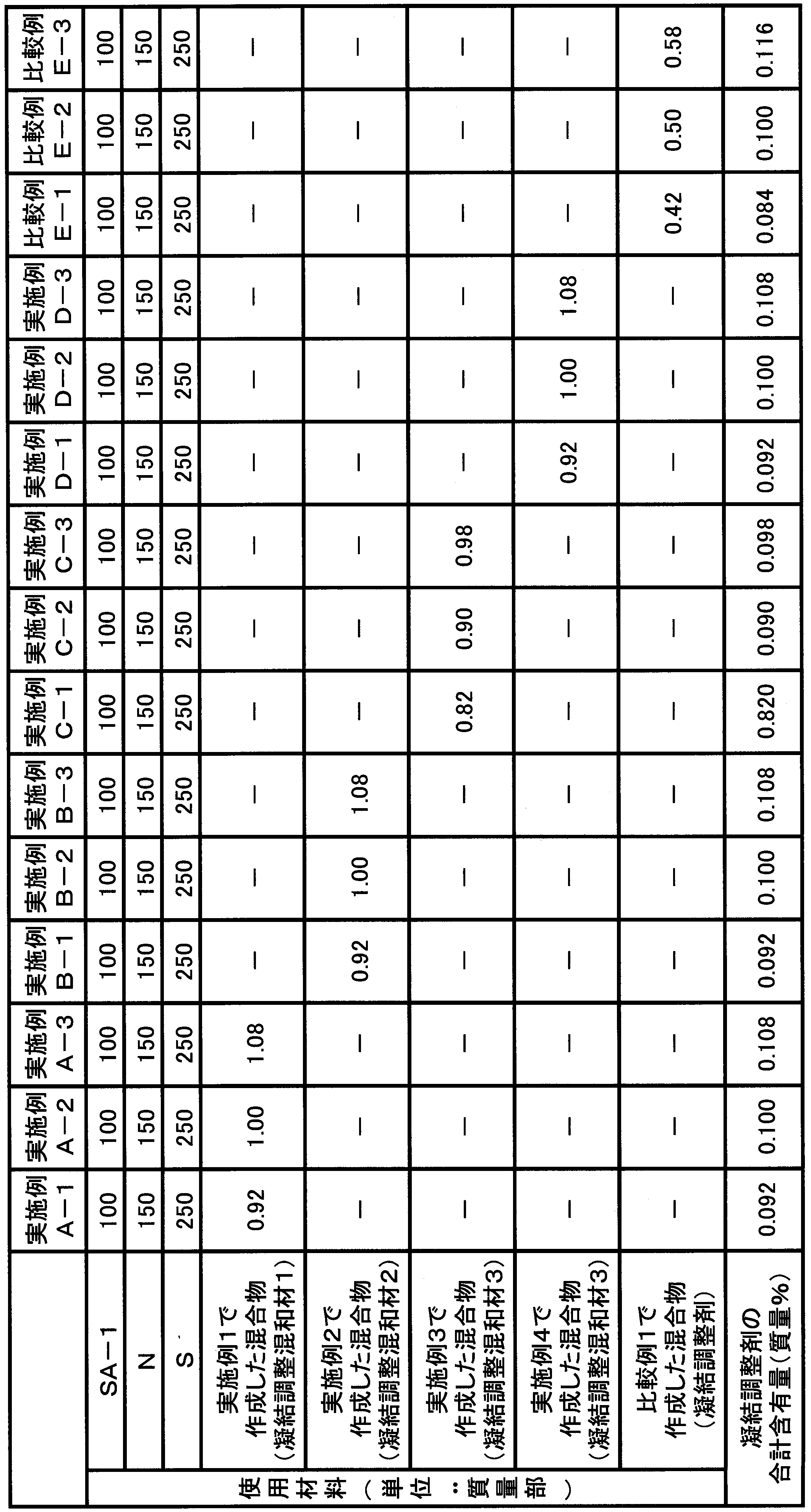
実施例1~4および比較例1にて作製した混合物と、速硬性混和材(SA-1)と、普通ポルトランドセメント(N)と、細骨砂(S)とを下記の表3に示す割合(質量部)にて混合機に投入して超速硬性セメント組成物を製造した。表3に超速硬性セメント組成物の全体量に対する凝結調整剤(炭酸ナトリウム、アルミン酸ナトリウム、酒石酸、硫酸ナトリウム)の合計の含有量を示す。
(1)速硬性混和材(SA-1)の調製
カルシウムアルミネートクリンカー粉末(CA-S)100質量部に対して、無機硫酸塩として無水石膏(CS)を120質量部の割合にて混合機に投入して、混合した。得られた混合物を速硬性混和材(SA-1)とした。
(2)超速硬性セメント組成物の製造
実施例1~4および比較例1にて作製した混合物と、速硬性混和材(SA-1)と、普通ポルトランドセメント(N)と、細骨砂(S)とを下記の表3に示す割合(質量部)にて混合機に投入して超速硬性セメント組成物を製造した。表3に超速硬性セメント組成物の全体量に対する凝結調整剤(炭酸ナトリウム、アルミン酸ナトリウム、酒石酸、硫酸ナトリウム)の合計の含有量を示す。
製造直後の超速硬性セメント組成物100質量部に対して、水16質量となる水量比にて水を加えて混練して、セメントモルタルを調製した。試験温度は20℃とした。得られたセメントモルタルの15打フロー、凝結時間(始発、終結)、材齢2時間と材齢3時間の圧縮強度を測定した。その結果を、超速硬性セメント組成物に添加した凝結調整混和材量および凝結調整剤の合計含有量と共に表4に示す。
15打フロー、凝結時間および圧縮強度は、JIS R 5201「セメントの物理試験方法」に記載されている方法に従って測定した。
15打フロー、凝結時間および圧縮強度は、JIS R 5201「セメントの物理試験方法」に記載されている方法に従って測定した。
また、超速硬性セメント組成物をビニール袋(容量:12L)に梱包し、ビニール袋の角部の4カ所にそれぞれピンホール(孔径:0.5mm)を開け、温度30℃、湿度80%RHの室内に、3ヶ月、6ヶ月それぞれ保存した。そして、保存後の超速硬性セメント組成物について、上記と同様にしてセメントモルタルを調製し、凝結時間を測定した。その結果を表4に示す。
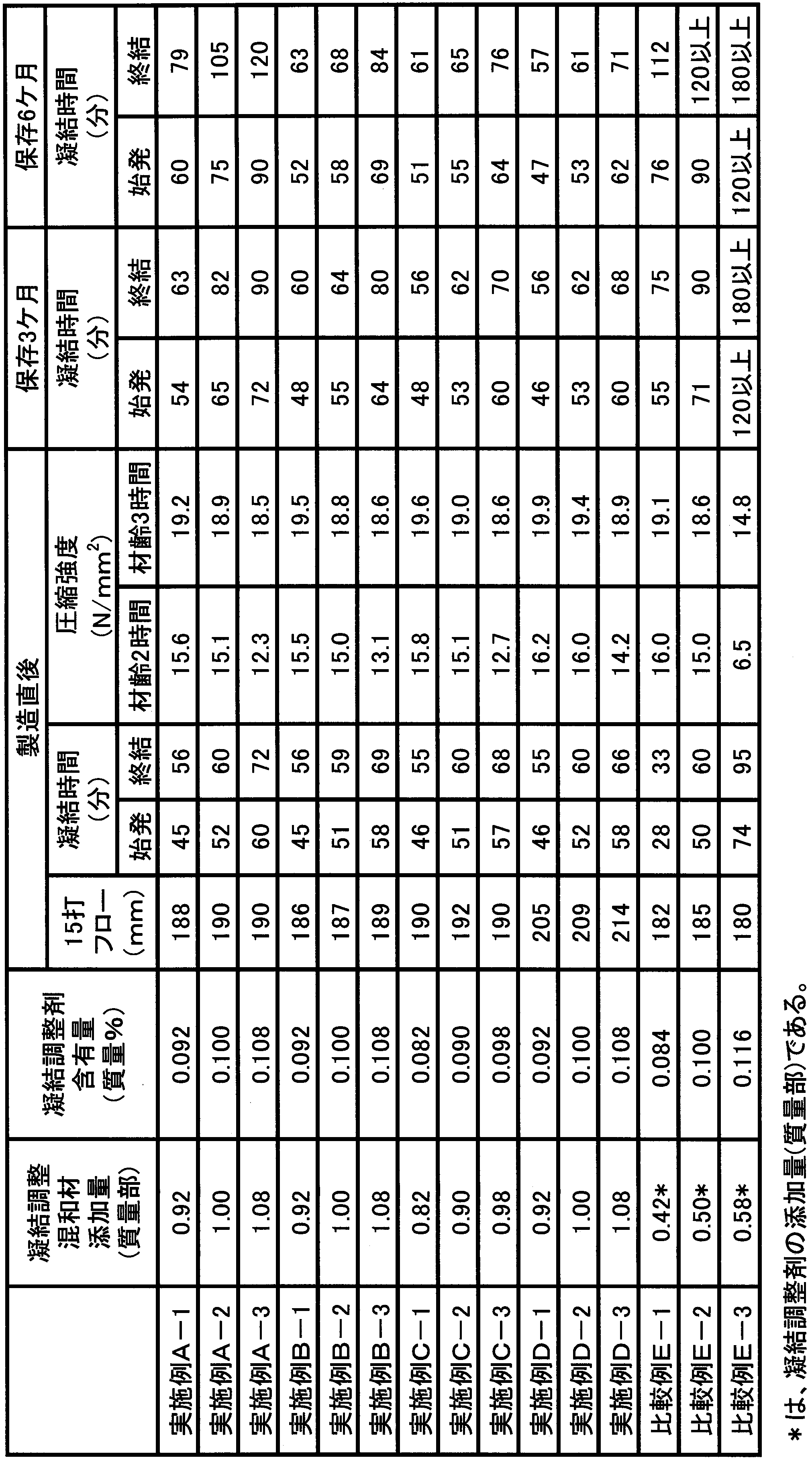
表4に示すように、製造直後の実施例A-1~A-3、実施例B-1~B-3、実施例C-1~C-3、実施例D-1~D-3および比較例1~3は、いずれも凝結調整混和材添加量の増加と共に、凝結始発時間は遅く、圧縮強度は低くなった。実施例A-1~A-3、実施例B-1~B-3、実施例D-1~D-3では凝結調整混和材添加量が0.08質量部増加すると、凝結始発時間が6~8分の遅延が生じ、材齢3時間の圧縮強度は2~4%低下した。また、実施例C-1~C-3では凝結調整混和材添加量が0.08質量部増加すると、凝結始発時間が5~6分の遅延が生じ、材齢3時間の圧縮強度は2~3%低下した。これに対して、比較例E-1~E-3では、凝結調整剤添加量が0.08質量部増加すると、凝結始発時間が22~24分の遅延が生じており、凝結調整剤の含有量に対する凝結始発時間の変動が大きくなった。また、材齢3時間の圧縮強度は、凝結調整剤の含有量が0.116質量%のときの値は、0.100質量%のときの値から20%も低下した。よって、表4の結果から、凝結調整剤と無機粉末を混合または粉砕混合して作製した凝結調整混和材を用いた方が、超速硬性セメント組成物の凝結始発時間を容易に、かつ精度良く調整できることが確認された。また、実施例D-1~D-3に示すように、硫酸ナトリウムを含む凝結調整混和材(実施例4)は、各添加量において15打フローが大きくなり、水を加えた後の超速硬性セメント組成物の流動性を向上させる効果が特に高いこと確認された。
保存後の実施例A-1~A-3、実施例B-1~B-3、実施例C-1~C-3、および比較例E-1~E-3は、いずれも保存期間が長くなると、凝結始発時間が遅くなった。無機粉末として石灰石粉末を用いた実施例A-1~A-3の凝結始発時間は、保存3ヶ月で1.2倍、保存6ヶ月で1.3~1.5倍の長さとなった。無機粉末として普通ポルトランドセメントを使用した実施例B-1~B-3の凝結始発時間は、保存3ヶ月で1.1倍、保存6ヶ月で1.2倍の長さとなり、保存期間による凝結の遅延が緩やかで、保存安定性が良好であった。また、凝結調整混和材を粉砕混合により作製した実施例C-1~C-3は、保存3ヶ月で1.0倍、保存6ヶ月で1.1倍とほぼ変化せず、保存安定性もさらに優れていた。比較例E-1~E-3の凝結始発時間は、保存3ヶ月で1.4倍以上、保存6ヶ月で1.8倍以上の長さとなった。特に、凝結調整剤の含有量が0.116質量%の比較例E-3は、保存3ヶ月後で凝結始発時間が120分以上となった。
これに対して、実施例D-1~D-3では、保存6ケ月まで凝結始発時間の変化はほとんど見られなかった。
これに対して、実施例D-1~D-3では、保存6ケ月まで凝結始発時間の変化はほとんど見られなかった。
製造直後の超速硬性セメント組成物(実施例A-2、実施例B-2、実施例C-2、実施例D-2、比較例E-2)100質量部に対して、水95質量部となる水量比にて水を加えて混練して、セメントモルタルを調製した。試験温度は5℃、20、35℃とした。得られたセメントモルタルの凝結時間(始発、終結)、材齢2時間と材齢3時間の圧縮強度を測定した。その結果を、超速硬性セメント組成物に添加した凝結調整混和材量および凝結調整剤の合計含有量と共に表5に示す。
凝結時間および圧縮強度は、JIS R 5201「セメントの物理試験方法」に記載されている方法に従って測定した。
凝結時間および圧縮強度は、JIS R 5201「セメントの物理試験方法」に記載されている方法に従って測定した。

表5に示すように、実施例A-2、実施例B-2、実施例C-2、実施例D-2および比較例E-2は、いずれも試験温度が高くなると、凝結始発時間が早くなった。無機粉末として石灰石粉末を用いた実施例A-2の凝結始発時間は、温度が15℃高くなると6~9分早くなった。無機粉末として普通ポルトランドセメントを使用した実施例B-2の凝結始発時間は、温度が15℃高くなると6分早くなった。また、凝結調整混和材を粉砕混合により作製した実施例C-2、実施例D-2の凝結始発時間は、温度が15℃高くなると3分早くなる程度で、実施例A-2、実施例B-2に比べて温度依存性が小さくなった。これに対して、比較例E-2の凝結始発時間は、温度が15℃高くなると12~15分早くなり、実施例A-2、実施例B-2、実施例C-2、実施例D-2に比べて温度依存性が大きくなった。
以上の結果から、凝結調整剤と無機粉末とを所定の割合で含む混合物、すなわち本発明の凝結調整混和材は、凝結調整剤単体と比較して凝結始発時間の遅延促進作用が緩やかで、また保存安定性に優れることが確認された。また、凝結調整混和材を粉砕混合により作製することで、凝結始発時間に対する温度依存性がより小さくなることが確認された。また、硫酸ナトリウムを凝結調整混和材に含ませることにより、流動性が向上するとともに、凝結始発時間に対する温度依存性が小さくなることが確認された。
Claims (6)
- 無機炭酸塩、オキシカルボン酸、アルミン酸ナトリウムおよび硫酸ナトリウムからなる群より選ばれる1つ以上の凝結調整剤と、無機粉末とを質量比で1:0.5~1:3の範囲にて含む混合物であることを特徴とする凝結調整混和材。
- 前記無機粉末が、ポルトランドセメント、石灰石粉末、珪石粉末、高炉スラグ粉末、石炭灰、フライアッシュ、粘土鉱物、カルシウムアルミネート粉末、無機硫酸塩粉末のうちの1つ以上であることを特徴とする請求項1に記載の凝結調整混和材。
- 前記無機粉末の平均粒子径が、10μm以上200μm以下の範囲にあることを特徴とする請求項1又は2に記載の凝結調整混和材。
- 前記凝結調整剤が無機炭酸塩を含み、前記無機炭酸塩が、炭酸カリウム、炭酸リチウム、炭酸ナトリウム、炭酸水素ナトリウム、炭酸アンモニウムのうちの1つ以上であることを特徴とする請求項1乃至3のいずれか1項に記載の凝結調整混和材。
- 前記凝結調整剤がオキシカルボン酸を含み、前記オキシカルボン酸が、酒石酸、クエン酸、リンゴ酸、グルコン酸、マレイン酸のうちの1つ以上であることを特徴とする請求項1乃至4のいずれか1項に記載の凝結調整混和材。
- 前記凝結調整剤の平均粒子径が、1μm以上500μm以下の範囲にあることを特徴とする請求項1乃至5のいずれか1項に記載の凝結調整混和材。
Applications Claiming Priority (4)
| Application Number | Priority Date | Filing Date | Title |
|---|---|---|---|
| JP2016-073204 | 2016-03-31 | ||
| JP2016073204 | 2016-03-31 | ||
| JP2017060945A JP6311819B2 (ja) | 2016-03-31 | 2017-03-27 | 凝結調整混和材 |
| JP2017-060945 | 2017-03-27 |
Publications (1)
| Publication Number | Publication Date |
|---|---|
| WO2017171004A1 true WO2017171004A1 (ja) | 2017-10-05 |
Family
ID=59964774
Family Applications (1)
| Application Number | Title | Priority Date | Filing Date |
|---|---|---|---|
| PCT/JP2017/013595 Ceased WO2017171004A1 (ja) | 2016-03-31 | 2017-03-31 | 凝結調整混和材 |
Country Status (1)
| Country | Link |
|---|---|
| WO (1) | WO2017171004A1 (ja) |
Cited By (1)
| Publication number | Priority date | Publication date | Assignee | Title |
|---|---|---|---|---|
| CN111960705A (zh) * | 2020-08-25 | 2020-11-20 | 中建商品混凝土有限公司 | 一种用于煤渣改性处理的预湿液及其预湿处理方法和应用 |
Citations (10)
| Publication number | Priority date | Publication date | Assignee | Title |
|---|---|---|---|---|
| JPS605050A (ja) * | 1983-06-22 | 1985-01-11 | 脇村 嘉郎 | 水硬性セメントの早強化方法及び早強化剤 |
| JPS6021838A (ja) * | 1983-07-15 | 1985-02-04 | 阿部 政博 | セメント用水分散系混和剤及びその製造法 |
| JPS61186255A (ja) * | 1985-02-14 | 1986-08-19 | 電気化学工業株式会社 | 超高強度セメント硬化体及びその製造方法 |
| JPS63123848A (ja) * | 1986-11-10 | 1988-05-27 | 麻生セメント株式会社 | セメントミルク工法用懸濁液の現場調液用混和材 |
| JPH0251457A (ja) * | 1988-08-11 | 1990-02-21 | Denki Kagaku Kogyo Kk | セメント混和剤 |
| JPH04170344A (ja) * | 1990-11-02 | 1992-06-18 | Denki Kagaku Kogyo Kk | セメント混和材及びセメント組成物 |
| JPH0632639A (ja) * | 1992-07-13 | 1994-02-08 | Denki Kagaku Kogyo Kk | セメント混和材及びセメント組成物 |
| JP2001172062A (ja) * | 1999-12-17 | 2001-06-26 | Denki Kagaku Kogyo Kk | 粉末凝結調整材、セメントコンクリート、急結性セメントコンクリート、及び急結性セメントコンクリートの施工方法 |
| JP2015124132A (ja) * | 2013-12-27 | 2015-07-06 | 太平洋マテリアル株式会社 | 吹付コンクリート及びその製造方法 |
| JP2016117600A (ja) * | 2014-12-19 | 2016-06-30 | 太平洋マテリアル株式会社 | 吹付コンクリート及びその製造方法 |
-
2017
- 2017-03-31 WO PCT/JP2017/013595 patent/WO2017171004A1/ja not_active Ceased
Patent Citations (10)
| Publication number | Priority date | Publication date | Assignee | Title |
|---|---|---|---|---|
| JPS605050A (ja) * | 1983-06-22 | 1985-01-11 | 脇村 嘉郎 | 水硬性セメントの早強化方法及び早強化剤 |
| JPS6021838A (ja) * | 1983-07-15 | 1985-02-04 | 阿部 政博 | セメント用水分散系混和剤及びその製造法 |
| JPS61186255A (ja) * | 1985-02-14 | 1986-08-19 | 電気化学工業株式会社 | 超高強度セメント硬化体及びその製造方法 |
| JPS63123848A (ja) * | 1986-11-10 | 1988-05-27 | 麻生セメント株式会社 | セメントミルク工法用懸濁液の現場調液用混和材 |
| JPH0251457A (ja) * | 1988-08-11 | 1990-02-21 | Denki Kagaku Kogyo Kk | セメント混和剤 |
| JPH04170344A (ja) * | 1990-11-02 | 1992-06-18 | Denki Kagaku Kogyo Kk | セメント混和材及びセメント組成物 |
| JPH0632639A (ja) * | 1992-07-13 | 1994-02-08 | Denki Kagaku Kogyo Kk | セメント混和材及びセメント組成物 |
| JP2001172062A (ja) * | 1999-12-17 | 2001-06-26 | Denki Kagaku Kogyo Kk | 粉末凝結調整材、セメントコンクリート、急結性セメントコンクリート、及び急結性セメントコンクリートの施工方法 |
| JP2015124132A (ja) * | 2013-12-27 | 2015-07-06 | 太平洋マテリアル株式会社 | 吹付コンクリート及びその製造方法 |
| JP2016117600A (ja) * | 2014-12-19 | 2016-06-30 | 太平洋マテリアル株式会社 | 吹付コンクリート及びその製造方法 |
Cited By (1)
| Publication number | Priority date | Publication date | Assignee | Title |
|---|---|---|---|---|
| CN111960705A (zh) * | 2020-08-25 | 2020-11-20 | 中建商品混凝土有限公司 | 一种用于煤渣改性处理的预湿液及其预湿处理方法和应用 |
Similar Documents
| Publication | Publication Date | Title |
|---|---|---|
| US11117833B2 (en) | Rapid-hardening mortar composition | |
| US10800701B2 (en) | Rapid-hardening cement composition | |
| JP5791927B2 (ja) | 高活性セメントクリンカの製造方法 | |
| JP4834574B2 (ja) | 高流動性コンクリート用セメント組成物および高流動性コンクリート組成物 | |
| JP2004345898A (ja) | グラウト組成物 | |
| JP7122170B2 (ja) | コンクリート表面仕上げ用硬化促進剤 | |
| CN110770189B (zh) | 水泥强度增强剂 | |
| JP6206614B1 (ja) | 速硬性混和材およびその製造方法 | |
| JP6311819B2 (ja) | 凝結調整混和材 | |
| WO2017171004A1 (ja) | 凝結調整混和材 | |
| JP6887272B2 (ja) | 速硬性ポリマーセメント組成物及び速硬性ポリマーセメントモルタル | |
| JP2008120625A (ja) | セメント系材料 | |
| JP5763458B2 (ja) | コンクリート組成物及びその製造方法 | |
| JP7355690B2 (ja) | 尿素を含むモルタルまたはコンクリート組成物 | |
| JP4585905B2 (ja) | モルタル又はコンクリート | |
| WO2017171006A1 (ja) | 速硬性混和材およびその製造方法 | |
| JP5987378B2 (ja) | モルタル | |
| JP2014185040A (ja) | セメント組成物 | |
| JP7185994B2 (ja) | セメント系固化材およびその製造方法 | |
| JP2026001916A (ja) | 吹付コンクリート | |
| JP2025091214A (ja) | 高強度モルタル組成物及び高強度モルタル | |
| JP2006111485A (ja) | セメント用凝結促進剤及びセメント組成物 | |
| JP2022147028A (ja) | ポリマーセメントコンクリート | |
| JP2022131677A (ja) | セメント組成物、及びその製造方法 | |
| JP2021143096A (ja) | 速硬性グラウト組成物及び速硬性グラウト材 |
Legal Events
| Date | Code | Title | Description |
|---|---|---|---|
| NENP | Non-entry into the national phase |
Ref country code: DE |
|
| 121 | Ep: the epo has been informed by wipo that ep was designated in this application |
Ref document number: 17775535 Country of ref document: EP Kind code of ref document: A1 |
|
| 122 | Ep: pct application non-entry in european phase |
Ref document number: 17775535 Country of ref document: EP Kind code of ref document: A1 |