WO2017170601A1 - アフラトキシン産生阻害剤及びアフラトキシン汚染防除方法 - Google Patents
アフラトキシン産生阻害剤及びアフラトキシン汚染防除方法 Download PDFInfo
- Publication number
- WO2017170601A1 WO2017170601A1 PCT/JP2017/012746 JP2017012746W WO2017170601A1 WO 2017170601 A1 WO2017170601 A1 WO 2017170601A1 JP 2017012746 W JP2017012746 W JP 2017012746W WO 2017170601 A1 WO2017170601 A1 WO 2017170601A1
- Authority
- WO
- WIPO (PCT)
- Prior art keywords
- aflatoxin
- formula
- production inhibitor
- aflatoxin production
- carbon atoms
- Prior art date
- Legal status (The legal status is an assumption and is not a legal conclusion. Google has not performed a legal analysis and makes no representation as to the accuracy of the status listed.)
- Ceased
Links
- 0 *c(cc1)ccc1O Chemical compound *c(cc1)ccc1O 0.000 description 1
Images


Classifications
-
- A—HUMAN NECESSITIES
- A01—AGRICULTURE; FORESTRY; ANIMAL HUSBANDRY; HUNTING; TRAPPING; FISHING
- A01N—PRESERVATION OF BODIES OF HUMANS OR ANIMALS OR PLANTS OR PARTS THEREOF; BIOCIDES, e.g. AS DISINFECTANTS, AS PESTICIDES OR AS HERBICIDES; PEST REPELLANTS OR ATTRACTANTS; PLANT GROWTH REGULATORS
- A01N37/00—Biocides, pest repellants or attractants, or plant growth regulators containing organic compounds containing a carbon atom having three bonds to hetero atoms with at the most two bonds to halogen, e.g. carboxylic acids
- A01N37/36—Biocides, pest repellants or attractants, or plant growth regulators containing organic compounds containing a carbon atom having three bonds to hetero atoms with at the most two bonds to halogen, e.g. carboxylic acids containing at least one carboxylic group or a thio analogue, or a derivative thereof, and a singly bound oxygen or sulfur atom attached to the same carbon skeleton, this oxygen or sulfur atom not being a member of a carboxylic group or of a thio analogue, or of a derivative thereof, e.g. hydroxy-carboxylic acids
- A01N37/38—Biocides, pest repellants or attractants, or plant growth regulators containing organic compounds containing a carbon atom having three bonds to hetero atoms with at the most two bonds to halogen, e.g. carboxylic acids containing at least one carboxylic group or a thio analogue, or a derivative thereof, and a singly bound oxygen or sulfur atom attached to the same carbon skeleton, this oxygen or sulfur atom not being a member of a carboxylic group or of a thio analogue, or of a derivative thereof, e.g. hydroxy-carboxylic acids having at least one oxygen or sulfur atom attached to an aromatic ring system
- A01N37/40—Biocides, pest repellants or attractants, or plant growth regulators containing organic compounds containing a carbon atom having three bonds to hetero atoms with at the most two bonds to halogen, e.g. carboxylic acids containing at least one carboxylic group or a thio analogue, or a derivative thereof, and a singly bound oxygen or sulfur atom attached to the same carbon skeleton, this oxygen or sulfur atom not being a member of a carboxylic group or of a thio analogue, or of a derivative thereof, e.g. hydroxy-carboxylic acids having at least one oxygen or sulfur atom attached to an aromatic ring system having at least one carboxylic group or a thio analogue, or a derivative thereof, and one oxygen or sulfur atom attached to the same aromatic ring system
-
- A—HUMAN NECESSITIES
- A23—FOODS OR FOODSTUFFS; TREATMENT THEREOF, NOT COVERED BY OTHER CLASSES
- A23B—PRESERVATION OF FOODS, FOODSTUFFS OR NON-ALCOHOLIC BEVERAGES; CHEMICAL RIPENING OF FRUIT OR VEGETABLES
- A23B2/00—Preservation of foods or foodstuffs, in general
- A23B2/70—Preservation of foods or foodstuffs, in general by treatment with chemicals
- A23B2/725—Preservation of foods or foodstuffs, in general by treatment with chemicals in the form of liquids or solids
- A23B2/729—Organic compounds; Microorganisms; Enzymes
- A23B2/742—Organic compounds containing oxygen
- A23B2/754—Organic compounds containing oxygen containing carboxyl groups
- A23B2/758—Carboxylic acid esters
Definitions
- the present invention relates to an aflatoxin production inhibitor containing a specific alkyl syringate, a specific alkyl p-hydroxybenzoate or an alkyl gallate, and a method for controlling aflatoxin contamination using the same.
- Mold secondary metabolites include useful compounds, but there are many toxic compounds called mycotoxins.
- mycotoxins Currently, contamination of crops with mycotoxins is a serious problem worldwide, and means for controlling mycotoxin contamination are required to stably obtain safe food.
- Aflatoxin is a metabolite of fungi that grows in plants. Under subtropical and tropical environments, aflatoxin-producing bacteria infect agricultural crops at the stage of cultivation and storage, and actively produce aflatoxins. The produced aflatoxins remain in the crops after mold dies.
- aflatoxin is a stable compound and is not decomposed by ordinary cooking methods.
- Aflatoxin has extremely strong acute toxicity and the strongest carcinogenicity among known natural substances. Therefore, ingestion of crops contaminated with aflatoxin is harmful to humans and livestock, and its health damage is Serious. There are frequent reports of deaths from ingestion of crops contaminated with aflatoxins, and the incidence of liver cancer estimated to be caused by aflatoxins amounts to hundreds of thousands of people worldwide every year, accounting for three out of all liver cancer cases. One minute.
- An object of the present invention is to provide a method for effectively controlling crops from contamination with aflatoxins.
- alkyl syringate having a straight chain alkyl having a specific carbon chain length has a strong inhibitory effect on aflatoxin production.
- the present inventor has examined alkyl p-hydroxybenzoate and alkyl gallate, which have been known to be usable as food additives, and found that alkyl p-hydroxybenzoate having linear alkyl having a specific carbon chain length is used. It was also found that alkyl gallate has a particularly strong aflatoxin production inhibitory action.
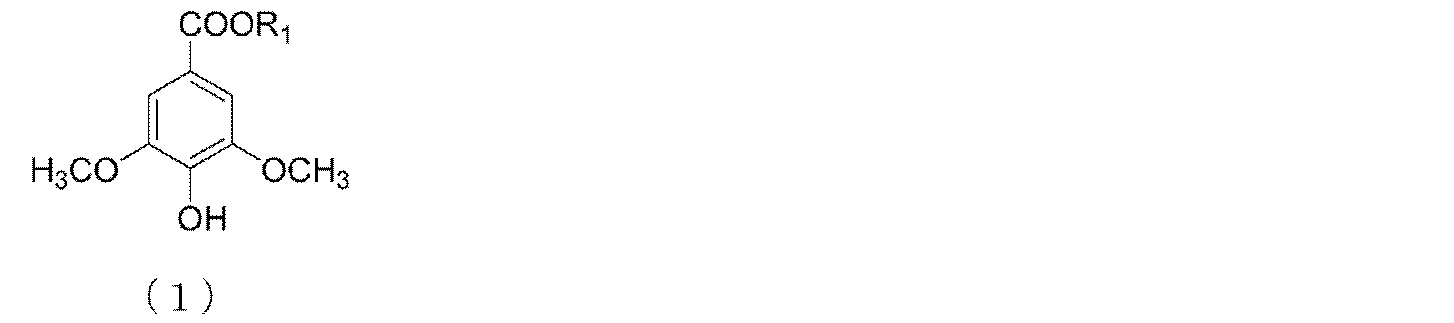
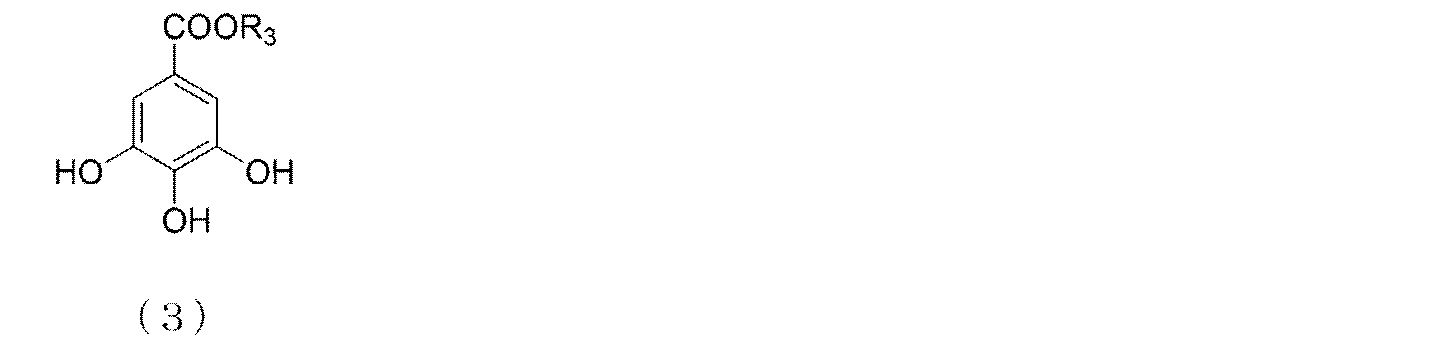
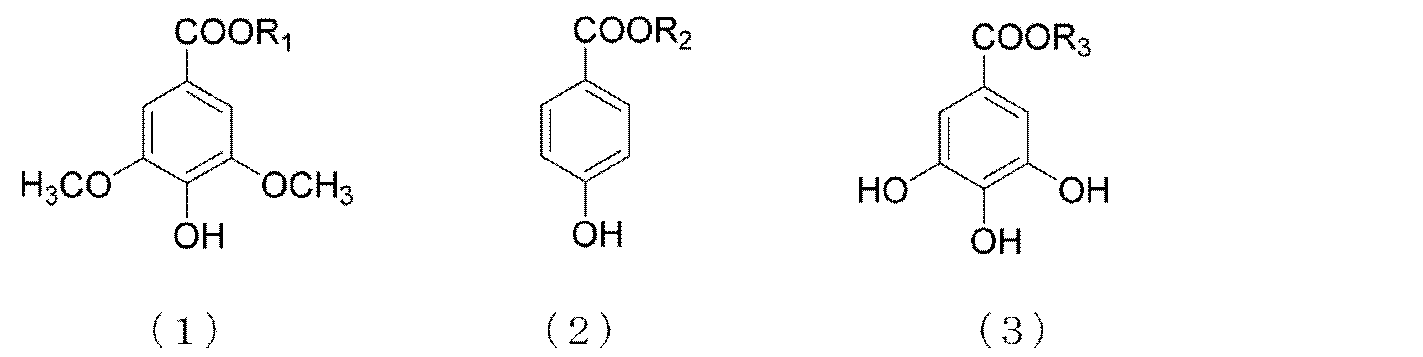
- An aflatoxin production inhibitor comprising at least one compound selected from the compounds represented by the following formulas (1) to (3): (In Formula (1), R 1 is a linear alkyl group having 2 to 8 carbon atoms, In the formula (2), R 2 is a linear alkyl group having 2 to 8 carbon atoms, or isopropyl or isobutyl. In the formula (3), R 3 is a linear alkyl group having 3 to 8 carbon atoms. is there. ) [2] The aflatoxin production inhibitor according to [1], comprising at least 1 of the compound represented by the following formula (1).
- R 1 is a linear alkyl group having 2 to 8 carbon atoms.
- R 2 is a linear alkyl group having 2 to 8 carbon atoms, or isopropyl or isobutyl.
- R 4 The aflatoxin production inhibitor according to [1], comprising at least 1 of the compound represented by the following formula (3).
- R 3 is a linear alkyl group having 3 to 8 carbon atoms.
- a method for controlling aflatoxin contamination comprising applying the aflatoxin production inhibitor according to any one of [1] to [4] to a crop.
- R 1 is a linear alkyl group having 2 to 8 carbon atoms
- R 2 is a linear alkyl group having 2 to 8 carbon atoms, or isopropyl or isobutyl
- R 3 is a linear alkyl group having 3 to 8 carbon atoms. is there. ) Is provided.
- alkyl syringate having linear alkyl having a specific carbon chain length alkyl p-hydroxybenzoate having linear alkyl having a specific carbon chain length, or gallic acid having linear alkyl having a specific carbon chain length
- Aflatoxin production inhibitors containing alkyl can effectively control crops from contamination by aflatoxins.
- One aspect of the present invention is an aflatoxin production inhibitor comprising at least one compound selected from the compounds represented by the following formulas (1) to (3) (hereinafter referred to as “the aflatoxin production inhibitor of the present invention”). ").
- R 1 is a linear alkyl group having 2 to 8 carbon atoms, preferably a linear alkyl group having 4 to 8 carbon atoms.
- R 2 is a linear alkyl group having 2 to 8 carbon atoms, or isopropyl or isobutyl, preferably a linear alkyl group having 4 to 8 carbon atoms.
- R 3 is a linear alkyl group having 3 to 8 carbon atoms, preferably a linear alkyl group having 4 to 8 carbon atoms.
- the aflatoxin production inhibitor of the present invention may contain one or more compounds represented by the formulas (1) to (3).
- the compound represented by formula (1) when two or more compounds represented by formula (1) or (2) are contained, the compound represented by formula (1)
- 1 or more types of compounds and 1 or more types of compounds represented by Formula (2) and / or the compound represented by Formula (3) are included is also included.
- One aspect of the aflatoxin production inhibitor of the present invention is an aflatoxin production inhibitor containing at least one of the compounds represented by formula (1).
- R 1 is a linear alkyl group having 2 to 8 carbon atoms, preferably a linear alkyl group having 4 to 8 carbon atoms.
- the aflatoxin production inhibitor may contain one or more compounds represented by the formula (1).
- One aspect of the aflatoxin production inhibitor of the present invention is an aflatoxin production inhibitor containing at least one of the compounds represented by the following formula (2).
- R 2 is a linear alkyl group having 2 to 8 carbon atoms, or isopropyl or isobutyl, preferably a linear alkyl group having 4 to 8 carbon atoms. That is, it was known that alkyl p-hydroxybenzoate can be used as a food additive, but alkyl p-hydroxybenzoate having a straight chain alkyl having a specific carbon chain length has a strong inhibitory action on aflatoxin production. .
- the aflatoxin production inhibitor may contain one or more compounds represented by the formula (2).
- Still another aspect of the aflatoxin production inhibitor of the present invention is an aflatoxin production inhibitor containing at least 1 of the compound represented by the following formula (3).
- R 3 is a linear alkyl group having 3 to 8 carbon atoms, preferably a linear alkyl group having 4 to 8 carbon atoms.
- the aflatoxin production inhibitor may contain one or more compounds represented by the formula (3).
- the aflatoxin production inhibitor of the present invention preferably contains 0.001 to 10 mM of the compound of formula (1).
- the aflatoxin production inhibitor of the present invention preferably contains 0.001 to 10 mM of the compound of the formula (2).
- the aflatoxin production inhibitor of the present invention preferably contains 0.001 to 10 mM of the compound of formula (3).
- the aflatoxin production inhibitor of the present invention contains at least one compound selected from the compounds represented by formulas (1) to (3), and further contains other components as necessary.
- the other components in the aflatoxin production inhibitor are not particularly limited as long as the effects of the present invention are not impaired, and examples thereof include arbitrary agricultural chemical components and agricultural chemical adjuvants.
- the content of other components in the aflatoxin production inhibitor is not particularly limited as long as the effects of the present invention are not impaired, and can be appropriately selected according to the purpose.
- Pesticides include, for example, fungicides, bactericides, antiviral agents, plant resistance inducers, insecticides, acaricides, nematicides, insect growth regulators, insect attractants, herbicides, plant growth Examples include regulators, synergists, safeners, bird repellents, fertilizers, and soil conditioners. These may be used alone or in combination of two or more.
- the agricultural chemical auxiliary agent contains a carrier, a surfactant, and other auxiliary agents, and further contains other components as necessary.
- the carrier carrier is not particularly limited as long as it can be used for agriculture and horticulture, and can be appropriately selected according to the purpose. Examples thereof include a liquid carrier and a solid carrier. These may be used individually by 1 type and may use 2 or more types together.
- liquid carrier examples include water; alcohols such as isopropyl alcohol and ethylene glycol; cyclohexanone; ketones such as methyl ethyl ketone; ethers such as propylene glycol monomethyl ether and diethylene glycol mono-n-butyl ether; and aliphatics such as kerosene and light oil.
- Hydrocarbons aromatic hydrocarbons such as xylene, trimethylbenzene, tetramethylbenzene, methylnaphthalene and solvent naphtha; amides such as N-methyl-2-pyrrolidone; esters such as glycerin esters of fatty acids; soybean oil, And vegetable oils such as rapeseed oil.
- solid carrier examples include animal and vegetable powders such as starch, activated carbon, soybean flour, wheat flour, wood flour, fish flour, and milk powder; talc, kaolin, bentonite, zeolite, diatomaceous earth, white carbon, clay, alumina, calcium carbonate, potassium chloride And mineral powders such as ammonium sulfate.
- animal and vegetable powders such as starch, activated carbon, soybean flour, wheat flour, wood flour, fish flour, and milk powder
- talc kaolin, bentonite, zeolite, diatomaceous earth, white carbon, clay, alumina, calcium carbonate, potassium chloride
- mineral powders such as ammonium sulfate.
- the surfactant surfactant is not particularly limited and may be appropriately selected depending on the intended purpose. Examples thereof include nonionic surfactants, anionic surfactants, cationic surfactants, and amphoteric interfaces. An active agent etc. are mentioned. These surfactants may be used alone or in combination of two or more.
- nonionic surfactant examples include polyoxyethylene alkyl ether, polyoxyethylene alkyl aryl ether, polyoxyethylene styryl phenyl ether, polyoxyethylene alkyl ester, polyoxyethylene sorbitan alkylate, and polyoxyethylene phenyl ether polymer.
- anionic surfactant examples include lignin sulfonate, alkylaryl sulfonate, dialkyl sulfosuccinate, polyoxyethylene alkylaryl ether sulfate, alkyl naphthalene sulfonate, polyoxyethylene styryl phenyl ether sulfate, stearoyl.
- examples include lactate.
- Examples of the cationic surfactant include alkylamine salts.
- Examples of amphoteric surfactants include quaternary ammonium salt alkylbetaines and amine oxides.
- adjuvants are not particularly limited and can be appropriately selected according to the purpose.
- the binder, thickener, and fixing agent are not particularly limited and may be appropriately selected depending on the intended purpose.
- dextrin cellulose, methylcellulose, ethylcellulose, carboxymethylcellulose, hydroxyethylcellulose, hydroxypropylcellulose, hydroxy Propylmethylcellulose, carboxymethyl starch, pullulan, sodium alginate, ammonium alginate, propylene glycol ester alginate, guar gum, locust bean gum, gum arabic, xanthan gum, gelatin, casein, polyvinyl alcohol, polyethylene oxide, polyethylene glycol, ethylene / propylene block polymer, Examples include sodium polyacrylate and polyvinylpyrrolidone.
- the dosage form of the aflatoxin production inhibitor is not particularly limited and may be appropriately selected depending on the intended purpose.
- a liquid agent is preferable.
- limiting in particular as a manufacturing method of each agent It can manufacture by a well-known method.
- Another aspect of the present invention is an aflatoxin contamination control method comprising applying the aflatoxin production inhibitor of the present invention to a crop (hereinafter also referred to as “the aflatoxin contamination control method of the present invention”).
- One aspect of the method for controlling contamination of aflatoxin according to the present invention includes a plant to which an aflatoxin-producing bacterium may adhere, a fruit harvested from the plant, and / or a storage medium. It is a method for controlling aflatoxin contamination, characterized by treating the fruit at the time.
- a plant to which an aflatoxin-producing bacterium may adhere means a plant to which an aflatoxin-producing bacterium may adhere and infect as a host, and the plant is already infected even if it is not yet infected. It may be in a state of being sick, may be in a state of being already infected and before being ill, or may be in a state after being ill. Moreover, the fruit which is still a harvest may be before or after fruiting. Further, it may be any case where the inhibitor is treated on the fruit before harvesting and / or on the fruit after harvesting.
- the fruit when the fruit is stored for a short period or a long period after harvesting, it may be any case where the fruit is processed at the initial stage of storage, during storage, and / or before shipment.
- the treatment method is not particularly limited as long as the production inhibitor can be brought into contact with the object to be controlled.
- the aflatoxin production inhibitor of the present invention is sprayed as it is or diluted with water or the like ( For example, spraying, misting, atomizing, dusting, dusting, water surface application, box application, etc.), soil application (eg, mixing, irrigation, etc.), surface application (eg, application, powder coating, coating, etc.) ) And dipping methods.
- the target to be treated with the aflatoxin production inhibitor of the present invention is not particularly limited and may be appropriately selected depending on the intended purpose. Examples thereof include plants and crops.
- Examples of agricultural crops include cereals such as corn, rice, buckwheat and pearl barley; nuts such as peanuts, pistachio nuts and Brazil nuts; spices such as nutmeg, chili and paprika; beans such as coffee beans; sesame seeds; almonds; Cotton seeds, etc.
- the application amount of the aflatoxin production inhibitor of the present invention is not particularly limited, and the form of the preparation, the target disease or crop type, the degree of damage caused by the disease, the application location, the application method, the application timing, the drugs to be mixed or used together, It can be suitably selected according to various conditions such as the type and amount of fertilizer used, weather, and the like.
- the application concentration of the aflatoxin production inhibitor of the present invention is not particularly limited and may be appropriately selected depending on the intended purpose. However, it should be applied so that the concentration of the aflatoxin production inhibitor is 0.001 mM or more. And is more preferably applied so as to be 0.01 mM or more. If the application concentration is less than 0.01 mM, production of aflatoxins may not be sufficiently inhibited. In particular, it is preferable to treat at a concentration such that the amount of aflatoxin-producing bacteria is 50% or more, preferably 70% or more, and more preferably 95% or more compared to the untreated group.
- the aflatoxin production inhibitor of the present invention includes other fungicides (fungicides, bactericides, antiviral agents, plant resistance inducers, etc.), insecticides, acaricides, nematicides, insect growth regulators. , Insect attractants, herbicides, plant growth regulators, synergists, safeners, avian repellents, fertilizers, soil conditioners, etc., or can be used in combination.
- Another aspect of the present invention is a food additive containing at least one compound selected from the compounds represented by the following formulas (1) to (3) (hereinafter “the food additive of the present invention”). Also called).
- the food additive of the present invention is a food additive containing at least one compound selected from the compounds represented by the following formulas (1) to (3) (hereinafter “the food additive of the present invention”). Also called).
- R 1 in formula (1) is as described above.
- R 2 in formula (2) is as described above.
- R 3 in formula (3) is as described above. As described.)
- the food additive of the present invention contains at least one compound selected from the compounds represented by formulas (1) to (3) alone or various physiologically acceptable food additives such as other food additives.
- the above-mentioned crops for example, grains such as corn, rice, buckwheat, pearl barley; nuts such as peanuts, pistachio nuts, Brazil nuts; spices such as nutmeg, chili, paprika; beans such as coffee beans; sesame seeds; Food additives such as almonds; figs; cotton seeds; etc.).
- “food” is not limited to human use, but includes feed for raising mammals such as dogs, cats, cows and pigs, and birds such as chickens.
- the concept of “food” includes, in addition to ordinary foods, beverages, so-called supplements, health foods, enteral nutrition foods, special-purpose foods, functional nutritional foods, foods for specified health use, and the like.
- the food additive of the present invention can be added to the food at an arbitrary ratio, and the amount added is appropriately determined by those skilled in the art according to the general intake of food and the product concept.
- the amount of any compound of formulas (1) to (3) per day for adults should be adjusted in consideration of the total food intake so that the intake is over 10 mg and not more than about 10 mg. Can do.
- Ethyl sillates, propyl sillates, butyl sillates, pentyl sillates, hexyl sillates and heptyl sillates are reported in the literature (Usuma Jermnak, Tomoya Yoshinari, Yasumasa Sugiyama, Rie Tsuyuki, Hiromichi Nagasawa, and Shohei Sakuda, Isolation of methyl syringate as a specific aflatoxin production inhibitor from the essential oil of Betula alba and aflatoxin production inhibitory activities of its related compounds.Int. J.
- silling acid and 1-octanol in tetrahydrofuran solution were synthesized by dehydration condensation using N, N′-dicyclohexylcarbodiimide.
- octyl p-hydroxybenzoate was synthesized from p-hydroxybenzoic acid (manufactured by Tokyo Chemical Industry Co., Ltd.) and 1-octanol by a method using N, N′-dicyclohexylcarbodiimide.
- Example 1 Evaluation of Aflatoxin Production Inhibitory Activity
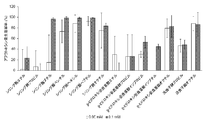
- the aflatoxin production inhibitory activity of the alkyl sillate 7 compound, alkyl p-hydroxybenzoate 6 compound and alkyl gallate 2 compound shown in FIG. 1 was evaluated as follows.
- Aspergillus flavus IFM47798 obtained from USDA, Agricultural Research Service, USA was cultured on a potato dextrose agar medium (PDA medium; manufactured by Difco) for 7 days at 27.5 ° C. as the aflatoxin B 1 producer.
- the spores were scraped with a platinum loop and suspended in distilled water containing 0.1% by mass of Tween 20 to 6.5 ⁇ 10 4 cells / mL to prepare a spore suspension.
- the spore suspension ( A. flavus IFM47798) was mixed with potato dextrose liquid medium (manufactured by Difco) so as to contain 1% by volume, and 2 mL was added to each well of a 12-well microplate. It added to each well so that the final concentration of the compound shown in FIG. 1 might be 0 mM (control), 0.05 mM, and 0.1 mM, respectively, and statically cultured at 27.5 degreeC for 4 days. After culturing for 4 days, the culture solution in each well was centrifuged to separate the cells and culture supernatant.
- the cells were washed with 5 mL of distilled water, transferred to a 1.5 mL microtube, and lyophilized. After the lyophilization, the mass of the microtube containing the microbial cells was measured, and the mass obtained by subtracting the mass of the empty microtube was taken as the microbial mass.
- 0.7 mL of the culture supernatant was extracted with 0.2 mL of chloroform, the chloroform was distilled off by air drying, and then dissolved in 0.25 mL of a 90% by volume acetonitrile aqueous solution. This solution was subjected to high performance liquid chromatography (HPLC) under the following measurement conditions to quantify the mass of aflatoxin.
- HPLC high performance liquid chromatography
- X Aflatoxin production ( ⁇ g / mL) in the case of control (no addition of the compound of FIG. 1)
- Y Aflatoxin production ( ⁇ g / mL) when the compound of FIG. 1 is added
- the influence of the compound of FIG. 1 on the cell mass was evaluated according to the following criteria. The results are shown in FIG. [Evaluation criteria] -(No effect): The cell mass is 95% or more with respect to the cell mass in the case of the control (no addition of the compound of FIG. 1). ⁇ (substantially unaffected): The cell mass is 70% or more and less than 95% with respect to the cell mass in the case of the control (no addition of the compound of FIG. 1). + (Influence): The cell mass is 50% or more and less than 70% with respect to the cell mass in the case of control (no addition of the compound of FIG. 1). ++ (with strong influence): The cell mass is less than 50% with respect to the cell mass in the case of control (no addition of the compound of FIG. 1).
- propyl gallate had a weak aflatoxin production inhibitory activity of about 50% at 0.05 mM, while octyl gallate showed a strong inhibitory activity at 0.05 mM. As shown in FIG. 3, octyl gallate affected the cell mass at 0.1 mM.
Landscapes
- Life Sciences & Earth Sciences (AREA)
- Engineering & Computer Science (AREA)
- Wood Science & Technology (AREA)
- Zoology (AREA)
- Pest Control & Pesticides (AREA)
- Food Science & Technology (AREA)
- Polymers & Plastics (AREA)
- Agronomy & Crop Science (AREA)
- Chemical & Material Sciences (AREA)
- Plant Pathology (AREA)
- Health & Medical Sciences (AREA)
- Dentistry (AREA)
- General Health & Medical Sciences (AREA)
- Environmental Sciences (AREA)
- Agricultural Chemicals And Associated Chemicals (AREA)
- Organic Low-Molecular-Weight Compounds And Preparation Thereof (AREA)
- Food Preservation Except Freezing, Refrigeration, And Drying (AREA)
Abstract
本発明は、アフラトキシンによる汚染から農作物を効果的に防除するためのアフラトキシン産生阻害剤に関し、より詳細には、以下の式(1)~(3)で表される化合物から選択される少なくも1の化合物を含むアフラトキシン産生阻害剤に関するものである。
Description
本発明は、特定のシリング酸アルキル、特定のp-ヒドロキシ安息香酸アルキル又は没食子酸アルキルを含むアフラトキシン産生阻害剤、及びこれを用いたアフラトキシン汚染防除方法に関する。
カビの二次代謝物には、有用な化合物が含まれる一方、マイコトキシンと呼ばれる毒性を示す化合物も多い。現在、マイコトキシンによる農作物の汚染は、世界的に深刻な問題となっており、安全な食糧を安定して得るために、マイコトキシン汚染防除の手段が求められている。
マイコトキシンによる農作物の汚染のうち、最も深刻な問題となっているのが、アフラトキシンによる農作物の汚染である。アフラトキシンは、植物を棲家とするカビの代謝産物であり、亜熱帯や熱帯の環境下、アフラトキシン生産菌は栽培や貯蔵の段階で農作物に感染しアフラトキシンを旺盛に生産する。生産されたアフラトキシンはカビの死滅後農作物中に残留する。
さらに、アフラトキシンは安定な化合物であり、通常の調理方法等では分解されない。また、アフラトキシンは、極めて強い急性毒性と既知の天然物質中で最も強い発ガン性を有していることから、アフラトキシンに汚染された農作物の摂取はヒトや家畜に害をなし、その健康被害は深刻である。アフラトキシンに汚染された農作物の摂取による死亡の報告は頻繁にあり、またアフラトキシンが原因と推定される肝臓ガンの発症は世界で毎年数十万人にのぼり、それは肝臓ガンの全発症者数の三分の一に当たる。
このような健康被害を防止するため、アフラトキシンの農作物汚染の規制値は、10ppb程度と低く設けられている。しかし、これにより、アフラトキシンで汚染された農作物を破棄することによる損害額も高額にのぼっている。例えば、米国でのアフラトキシン汚染による損失は、年間十億ドル程度である。また、アジアとアフリカにおけるアフラトキシン汚染による損失は更に大きいと推定されている。
このように、アフラトキシンによる健康被害及び経済的損失は世界的に深刻な問題となっているが、現在、効果的な汚染防除法はほとんどなく、汚染調査、汚染農作物の破棄で対処している。従って、アフラトキシン汚染防除法の開発は、健康被害及び経済的損失の側面からも緊急を要する課題である。
本発明は、アフラトキシンによる汚染から農作物を効果的に防除する方法を提供することを目的とする。
本発明者は、アフラトキシン産生菌のアフラトキシン産生を選択的に阻害する薬剤を探索したところ、特定の炭素鎖長の直鎖アルキルを有するシリング酸アルキルが強いアフラトキシン産生阻害作用を有することを見出し、本発明を完成した。
更に、本発明者は、食品添加物として使用できることが知られていたp-ヒドロキシ安息香酸アルキル及び没食子酸アルキルについて検討したところ、特定の炭素鎖長の直鎖アルキルを有するp-ヒドロキシ安息香酸アルキル及び没食子酸アルキルが特に強いアフラトキシン産生阻害作用を有することを見出した。
更に、本発明者は、食品添加物として使用できることが知られていたp-ヒドロキシ安息香酸アルキル及び没食子酸アルキルについて検討したところ、特定の炭素鎖長の直鎖アルキルを有するp-ヒドロキシ安息香酸アルキル及び没食子酸アルキルが特に強いアフラトキシン産生阻害作用を有することを見出した。
即ち、本発明は、
[1]以下の式(1)~(3)で表される化合物から選択される少なくも1の化合物を含むアフラトキシン産生阻害剤。

(式(1)において、R1は、炭素数2~8の直鎖のアルキル基であり、
式(2)において、R2は、炭素数2~8の直鎖のアルキル基、あるいはイソプロピル、イソブチルであり、式(3)において、R3は炭素数3~8の直鎖のアルキル基である。)
[2]以下の式(1)で表される化合物の少なくも1を含む、[1]に記載のアフラトキシン産生阻害剤。
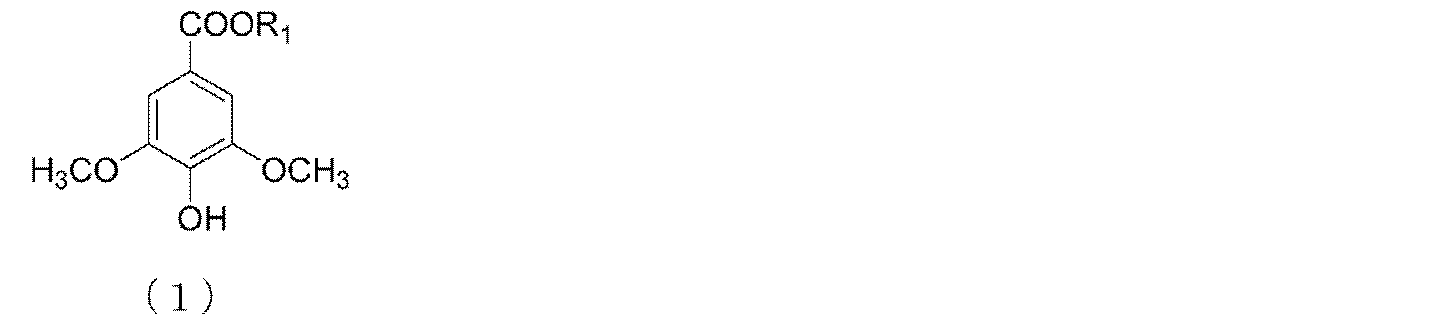
(式中、R1は、炭素数2~8の直鎖のアルキル基である。)
[3]以下の式(2)で表される化合物の少なくも1を含む、[1]に記載のアフラトキシン産生阻害剤。
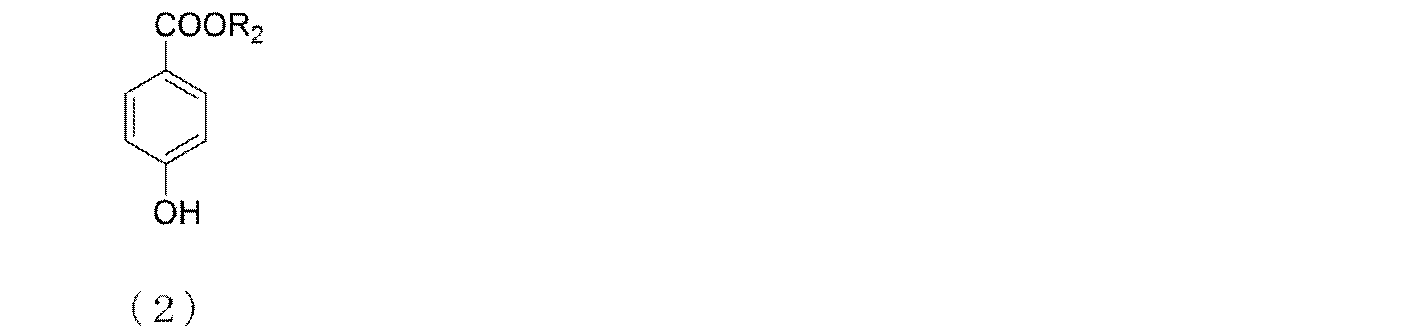
(式中、R2は、炭素数2~8の直鎖のアルキル基、あるいはイソプロピル、イソブチルである。)
[4]以下の式(3)で表される化合物の少なくも1を含む、[1]に記載のアフラトキシン産生阻害剤。

(式中、R3は炭素数3~8の直鎖のアルキル基である。)
[5][1]~[4]のいずれか1項に記載のアフラトキシン産生阻害剤を農作物に施用することを含むアフラトキシン汚染防除方法。
[6]以下の式(1)~(3)で表される化合物から選択される少なくも1の化合物を含む食品添加物。

(式(1)において、R1は、炭素数2~8の直鎖のアルキル基であり、
式(2)において、R2は、炭素数2~8の直鎖のアルキル基、あるいはイソプロピル、イソブチルであり、式(3)において、R3は炭素数3~8の直鎖のアルキル基である。)
を、提供するものである。
[1]以下の式(1)~(3)で表される化合物から選択される少なくも1の化合物を含むアフラトキシン産生阻害剤。
(式(1)において、R1は、炭素数2~8の直鎖のアルキル基であり、
式(2)において、R2は、炭素数2~8の直鎖のアルキル基、あるいはイソプロピル、イソブチルであり、式(3)において、R3は炭素数3~8の直鎖のアルキル基である。)
[2]以下の式(1)で表される化合物の少なくも1を含む、[1]に記載のアフラトキシン産生阻害剤。
(式中、R1は、炭素数2~8の直鎖のアルキル基である。)
[3]以下の式(2)で表される化合物の少なくも1を含む、[1]に記載のアフラトキシン産生阻害剤。
(式中、R2は、炭素数2~8の直鎖のアルキル基、あるいはイソプロピル、イソブチルである。)
[4]以下の式(3)で表される化合物の少なくも1を含む、[1]に記載のアフラトキシン産生阻害剤。
(式中、R3は炭素数3~8の直鎖のアルキル基である。)
[5][1]~[4]のいずれか1項に記載のアフラトキシン産生阻害剤を農作物に施用することを含むアフラトキシン汚染防除方法。
[6]以下の式(1)~(3)で表される化合物から選択される少なくも1の化合物を含む食品添加物。
(式(1)において、R1は、炭素数2~8の直鎖のアルキル基であり、
式(2)において、R2は、炭素数2~8の直鎖のアルキル基、あるいはイソプロピル、イソブチルであり、式(3)において、R3は炭素数3~8の直鎖のアルキル基である。)
を、提供するものである。
本発明により、特定の炭素鎖長の直鎖アルキルを有するシリング酸アルキル、特定の炭素鎖長の直鎖アルキルを有するp-ヒドロキシ安息香酸アルキル又は特定の炭素鎖長の直鎖アルキルを有する没食子酸アルキルを含むアフラトキシン産生阻害剤は、アフラトキシンによる汚染から農作物を効果的に防除することが可能である。
本発明の1つの態様は、以下の式(1)~(3)で表される化合物から選択される少なくも1の化合物を含むアフラトキシン産生阻害剤である(以下「本発明のアフラトキシン産生阻害剤」とも言う)。
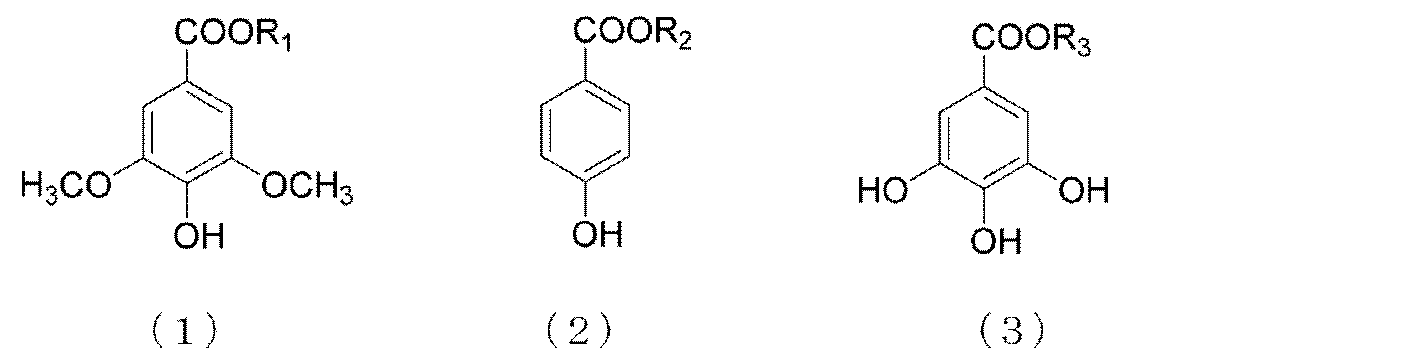
式(1)において、R1は、炭素数2~8の直鎖のアルキル基であり、好ましくは、炭素数4~8の直鎖のアルキル基である。
式(2)において、R2は、炭素数2~8の直鎖のアルキル基、あるいはイソプロピル、イソブチルであり、好ましくは、炭素数4~8の直鎖のアルキル基である。
式(3)において、R3は炭素数3~8の直鎖のアルキル基であり、好ましくは、炭素数4~8の直鎖のアルキル基である。
本発明のアフラトキシン産生阻害剤は、式(1)~(3)で表される化合物を1種又は2種以上含んでもよい。式(1)~(3)で表される化合物を2種以上含む態様には、式(1)又は(2)で表される化合物を2種以上含む場合、式(1)で表される化合物を1種以上と式(2)で表される化合物を1種以上及び/又は式(3)で表される化合物を含む場合等も含まれる。
本発明のアフラトキシン産生阻害剤の1つの側面は、式(1)で表される化合物の少なくも1を含むアフラトキシン産生阻害剤である。

式(1)において、R1は、炭素数2~8の直鎖のアルキル基であり、好ましくは、炭素数4~8の直鎖のアルキル基である。
前記アフラトキシン産生阻害剤は式(1)で表される化合物を1種又は2種以上含んでもよい。
前記アフラトキシン産生阻害剤は式(1)で表される化合物を1種又は2種以上含んでもよい。
本発明のアフラトキシン産生阻害剤の1つの側面は、以下の式(2)で表される化合物の少なくも1を含むアフラトキシン産生阻害剤である。

式(2)において、R2は、炭素数2~8の直鎖のアルキル基、あるいはイソプロピル、イソブチルであり、好ましくは、炭素数4~8の直鎖のアルキル基である。
即ち、p-ヒドロキシ安息香酸アルキルは食品添加物として使用できることが知られていたが、特定の炭素鎖長の直鎖アルキルを有するp-ヒドロキシ安息香酸アルキルはアフラトキシン産生に対して強い阻害作用を有する。
前記アフラトキシン産生阻害剤は式(2)で表される化合物を1種又は2種以上含んでもよい。
即ち、p-ヒドロキシ安息香酸アルキルは食品添加物として使用できることが知られていたが、特定の炭素鎖長の直鎖アルキルを有するp-ヒドロキシ安息香酸アルキルはアフラトキシン産生に対して強い阻害作用を有する。
前記アフラトキシン産生阻害剤は式(2)で表される化合物を1種又は2種以上含んでもよい。
本発明のアフラトキシン産生阻害剤のさらに1つの側面は、以下の式(3)で表される化合物の少なくも1を含むアフラトキシン産生阻害剤である。

式(3)において、R3は炭素数3~8の直鎖のアルキル基であり、好ましくは、炭素数4~8の直鎖のアルキル基である。
前記アフラトキシン産生阻害剤は式(3)で表される化合物を1種又は2種以上含んでもよい。
式(3)において、R3は炭素数3~8の直鎖のアルキル基であり、好ましくは、炭素数4~8の直鎖のアルキル基である。
前記アフラトキシン産生阻害剤は式(3)で表される化合物を1種又は2種以上含んでもよい。
本発明のアフラトキシン産生阻害剤は、式(1)の化合物を0.001~10mMを含むことが好ましい。
また、本発明のアフラトキシン産生阻害剤は、式(2)の化合物を0.001~10mMを含むことが好ましい。
また、本発明のアフラトキシン産生阻害剤は、式(3)の化合物を0.001~10mMを含むことが好ましい。
また、本発明のアフラトキシン産生阻害剤は、式(2)の化合物を0.001~10mMを含むことが好ましい。
また、本発明のアフラトキシン産生阻害剤は、式(3)の化合物を0.001~10mMを含むことが好ましい。
式(1)の化合物の製造方法としては、特に制限はなく、公知の方法の中から目的に応じて適宜選択することができ、例えば、Usuma Jermnak, Tomoya Yoshinari, Yasumasa Sugiyama, Rie Tsuyuki, Hiromichi Nagasawa, and Shohei Sakuda, Isolation of methyl syringate as a specific aflatoxin production inhibitor from the essential oil of Betula alba and aflatoxin production inhibitory activities of its related compounds. Int. J. Food Microbiol., 153, 339-344, 2012.に記載された方法などが挙げられる。
式(2)の化合物の製造方法としては、特に制限はなく、公知の方法の中から目的に応じて適宜選択することができ、例えば、Shinsuke Ito, Satoru Yazawa, Yasutaka Nakagawa, Yasuyuki Sasaki, and Shunsuke Yajima, Effects of alkyl parabens on pathogenic fungi. Bioorg. Med. Chem. Lett., 25, 1774-1777, 2015.に記載された方法などが挙げられる。
式(3)の化合物の製造方法としては、特に制限はなく、公知の方法の中から目的に応じて適宜選択することができ、例えば、Isao Kubo, Ping Xiao, Ken-ichi Nihei, Ken-ichi Fujita, Yoshiro Yamagiwa, and Tadao Kamikawa, Molecular design of antifungal agents. J. Agri. Food Chem., 50, 3992-3998, 2002.に記載された方法などが挙げられる。
その他の成分
本発明のアフラトキシン産生阻害剤は、式(1)~(3)で表される化合物から選択される少なくも1の化合物を含み、必要に応じて、更にその他の成分を含む。
アフラトキシン産生阻害剤中のその他の成分としては、本発明の効果を損なわない限り、特に制限はなく、例えば、任意の農薬成分、農薬補助剤などが挙げられる。
アフラトキシン産生阻害剤中の、その他の成分の含有量としては、本発明の効果を損なわない限り、特に制限はなく、目的に応じて適宜選択することができる。
本発明のアフラトキシン産生阻害剤は、式(1)~(3)で表される化合物から選択される少なくも1の化合物を含み、必要に応じて、更にその他の成分を含む。
アフラトキシン産生阻害剤中のその他の成分としては、本発明の効果を損なわない限り、特に制限はなく、例えば、任意の農薬成分、農薬補助剤などが挙げられる。
アフラトキシン産生阻害剤中の、その他の成分の含有量としては、本発明の効果を損なわない限り、特に制限はなく、目的に応じて適宜選択することができる。
農薬成分
農薬成分としては、特に制限はなく、目的に応じて適宜選択することができ、例えば、以下の農薬の有効成分が挙げられる。
農薬としては、例えば、殺カビ剤、殺細菌剤、抗ウィルス剤、植物抵抗性誘導剤、殺虫剤、殺ダニ剤、殺線虫剤、昆虫生育調整剤、昆虫誘引剤、除草剤、植物生長調整剤、共力剤、薬害軽減剤、鳥類忌避剤、肥料、土壌改良剤などが挙げられる。これらは、1種単独で使用してもよく、2種以上を併用してもよい。
農薬成分としては、特に制限はなく、目的に応じて適宜選択することができ、例えば、以下の農薬の有効成分が挙げられる。
農薬としては、例えば、殺カビ剤、殺細菌剤、抗ウィルス剤、植物抵抗性誘導剤、殺虫剤、殺ダニ剤、殺線虫剤、昆虫生育調整剤、昆虫誘引剤、除草剤、植物生長調整剤、共力剤、薬害軽減剤、鳥類忌避剤、肥料、土壌改良剤などが挙げられる。これらは、1種単独で使用してもよく、2種以上を併用してもよい。
農薬補助剤
農薬補助剤は、担体と、界面活性剤と、その他の補助剤とを含有し、更に必要に応じてその他の成分を含有する。
農薬補助剤は、担体と、界面活性剤と、その他の補助剤とを含有し、更に必要に応じてその他の成分を含有する。
担体
担体としては、農園芸用に用いることができるものであれば、特に制限はなく、目的に応じて適宜選択することができ、例えば、液体担体、固体担体などが挙げられる。これらは、1種単独で使用してもよいし、2種以上を併用してもよい。
担体としては、農園芸用に用いることができるものであれば、特に制限はなく、目的に応じて適宜選択することができ、例えば、液体担体、固体担体などが挙げられる。これらは、1種単独で使用してもよいし、2種以上を併用してもよい。
液体担体としては、例えば、水;イソプロピルアルコール、エチレングリコール等のアルコール類;シクロヘキサノン;メチルエチルケトン等のケトン類;プロピレングリコールモノメチルエーテル、ジエチレングリコールモノ-n-ブチルエーテル等のエーテル類;ケロシン、軽油等の脂肪族炭化水素類;キシレン、トリメチルベンゼン、テトラメチルベンゼン、メチルナフタリン、ソルベントナフサ等の芳香族炭化水素類;N-メチル-2-ピロリドン等のアミド類;脂肪酸のグリセリンエステル等のエステル類;大豆油、ナタネ油等の植物油などが挙げられる。
固体担体としては、例えば、澱粉、活性炭、大豆粉、小麦粉、木粉、魚粉、粉乳等の動植物性粉末;タルク、カオリン、ベントナイト、ゼオライト、珪藻土、ホワイトカーボン、クレー、アルミナ、炭酸カルシウム、塩化カリウム、硫安等の鉱物性粉末などが挙げられる。
界面活性剤
界面活性剤としては、特に制限はなく、目的に応じて適宜選択することができ、例えば、非イオン性界面活性剤、陰イオン性界面活性剤、陽イオン性界面活性剤、両性界面活性剤などが挙げられる。これらの界面活性剤は、1種単独で使用してもよいし、2種以上を併用してもよい。
界面活性剤としては、特に制限はなく、目的に応じて適宜選択することができ、例えば、非イオン性界面活性剤、陰イオン性界面活性剤、陽イオン性界面活性剤、両性界面活性剤などが挙げられる。これらの界面活性剤は、1種単独で使用してもよいし、2種以上を併用してもよい。
非イオン性界面活性剤としては、例えば、ポリオキシエチレンアルキルエーテル、ポリオキシエチレンアルキルアリールエーテル、ポリオキシエチレンスチリルフェニルエーテル、ポリオキシエチレンアルキルエステル、ポリオキシエチレンソルビタンアルキレート、ポリオキシエチレンフェニルエーテルポリマー、ポリオキシエチレンアルキレンアリールフェニルエーテル、ポリオキシエチレンアルキレングリコール、ポリオキシエチレンポリオキシプロピレンブロックポリマー、グリセリン脂肪酸エステル、ショ糖脂肪酸エステル、ソルビタン脂肪酸エステル、プロピレングリコール脂肪酸エステルなどが挙げられる。
陰イオン性界面活性剤としては、例えば、リグニンスルホン酸塩、アルキルアリールスルホン酸塩、ジアルキルスルホサクシネート、ポリオキシエチレンアルキルアリールエーテルサルフェート、アルキルナフタレンスルホン酸塩、ポリオキシエチレンスチリルフェニルエーテルサルフェート、ステアロイル乳酸塩などが挙げられる。
陽イオン性界面活性剤としては、例えば、アルキルアミン塩などが挙げられる。
両性界面活性剤としては、例えば、第4級アンモニウム塩アルキルベタイン、アミンオキサイドなどが挙げられる。
両性界面活性剤としては、例えば、第4級アンモニウム塩アルキルベタイン、アミンオキサイドなどが挙げられる。
その他の補助剤
その他の補助剤としては、特に制限はなく、目的に応じて適宜選択することができ、例えば、粘結剤、増粘剤、固着剤、防腐防カビ剤、溶剤、農薬活性成分の安定化剤、酸化防止剤、紫外線防止剤、結晶析出防止剤、消泡剤、物性向上剤、着色剤などが挙げられる。
粘結剤、増粘剤、固着剤としては、特に制限はなく、目的に応じて適宜選択することができ、例えば、デキストリン、セルロース、メチルセルロース、エチルセルロース、カルボキシメチルセルロース、ヒドロキシエチルセルロース、ヒドロキシプロピルセルロース、ヒドロキシプロピルメチルセルロース、カルボキシメチルデンプン、プルラン、アルギン酸ナトリウム、アルギン酸アンモニウム、アルギン酸プロピレングリコールエステル、グアーガム、ローカストビーンガム、アラビアゴム、キサンタンガム、ゼラチン、カゼイン、ポリビニルアルコール、ポリエチレンオキサイド、ポリエチレングリコール、エチレン・プロピレンブロックポリマー、ポリアクリル酸ナトリウム、ポリビニルピロリドンなどが挙げられる。
その他の補助剤としては、特に制限はなく、目的に応じて適宜選択することができ、例えば、粘結剤、増粘剤、固着剤、防腐防カビ剤、溶剤、農薬活性成分の安定化剤、酸化防止剤、紫外線防止剤、結晶析出防止剤、消泡剤、物性向上剤、着色剤などが挙げられる。
粘結剤、増粘剤、固着剤としては、特に制限はなく、目的に応じて適宜選択することができ、例えば、デキストリン、セルロース、メチルセルロース、エチルセルロース、カルボキシメチルセルロース、ヒドロキシエチルセルロース、ヒドロキシプロピルセルロース、ヒドロキシプロピルメチルセルロース、カルボキシメチルデンプン、プルラン、アルギン酸ナトリウム、アルギン酸アンモニウム、アルギン酸プロピレングリコールエステル、グアーガム、ローカストビーンガム、アラビアゴム、キサンタンガム、ゼラチン、カゼイン、ポリビニルアルコール、ポリエチレンオキサイド、ポリエチレングリコール、エチレン・プロピレンブロックポリマー、ポリアクリル酸ナトリウム、ポリビニルピロリドンなどが挙げられる。
剤型
アフラトキシン産生阻害剤の剤型としては、特に制限はなく、目的に応じて適宜選択することができ、例えば、乳剤、懸濁剤、水和剤、水溶剤、液剤、ゾル剤(フロアブル剤)、顆粒水和剤、粉剤、細粒剤、粒剤、錠剤、油剤、噴霧剤、煙霧剤、エアゾール剤、ペースト剤などが挙げられる。これらの中でも、液剤が好ましい。
各剤の製造方法としては、特に制限はなく、公知の方法により製造することができる。
アフラトキシン産生阻害剤の剤型としては、特に制限はなく、目的に応じて適宜選択することができ、例えば、乳剤、懸濁剤、水和剤、水溶剤、液剤、ゾル剤(フロアブル剤)、顆粒水和剤、粉剤、細粒剤、粒剤、錠剤、油剤、噴霧剤、煙霧剤、エアゾール剤、ペースト剤などが挙げられる。これらの中でも、液剤が好ましい。
各剤の製造方法としては、特に制限はなく、公知の方法により製造することができる。
本発明のもう1つの態様は、本発明のアフラトキシン産生阻害剤を農作物に施用することを含むアフラトキシン汚染防除方法である(以下「本発明のアフラトキシン汚染防除方法」とも言う)。
本発明のアフラトキシン汚染防除方法の1つの側面は、前述したいずれかに記載のアフラトキシン産生阻害剤を、アフラトキシン産生菌が付着する可能性がある植物、該植物から収穫された果実、及び/または貯蔵時の該果実に処理することを特徴とするアフラトキシン汚染防除方法である。
アフラトキシン産生菌が付着する可能性がある植物とは、アフラトキシン産生菌が宿主として付着し感染する可能性がある植物を意味し、該植物は、いまだ感染していない状態であっても、すでに感染している状態であってもよく、すでに感染した状態であっていまだ発病する前の状態であっても、既に発病した後の状態であっても構わない。また、いまだ収穫物である果実が、結実する前でも結実した後であってもよい。また、収穫前の果実に及び/または収穫後の果実に該阻害剤を処理するいずれの場合であっても構わない。また、収穫後、短期または長期に亘って該果実を保存する場合に、保存の初期、保存中、及び/または出荷前に該果実に処理するいずれの場合であっても構わない。処理方法は該産生阻害剤と防除対象物が接触できる方法であれば、特に制限されず、具体的には、本発明のアフラトキシン産生阻害剤をそのまま、又は水等で希釈した状態で、散布(例えば、噴霧、ミスティング、アトマイジング、散粉、散粒、水面施用、箱施用等)する方法、土壌施用(例えば、混入、潅注等)する方法、表面施用(例えば、塗布、粉衣、被覆等)する方法、浸漬する方法などが挙げられる。
本発明のアフラトキシン産生阻害剤を処理する対象物としては、特に制限はなく、目的に応じて適宜選択することができ、例えば、植物体、農作物などが挙げられる。
農作物としては、例えば、トウモロコシ、コメ、ソバ、ハトムギ等の穀類;ピーナッツ、ピスタチオナッツ、ブラジルナッツ等のナッツ類;ナツメグ、唐辛子、パプリカ等の香辛料;コーヒー豆等の豆類;ゴマ類;アーモンド;イチジク;綿実;などが挙げられる。
本発明のアフラトキシン産生阻害剤の施用量としては、特に制限はなく、製剤の形態、対象病害や作物の種類、病害による被害の程度、施用場所、施用方法、施用時期、混用あるいは併用する薬剤や肥料等の種類や使用量、気象などの種々の条件に応じて、適宜選択することができる。
本発明のアフラトキシン産生阻害剤の施用濃度としては、特に制限はなく、目的に応じて、適宜選択することができるが、アフラトキシン産生阻害剤の濃度が、0.001mM以上となるように施用することが好ましく、0.01mM以上となるように施用することがより好ましい。施用濃度が、0.01mM未満であると、アフラトキシンの産生を十分に阻害できないことがある。特に、アフラトキシン産生菌の菌体量が、無処理区に比して50%以上、好ましくは、70%以上、さらに好ましくは、95%以上になるような濃度で処理するのが好ましい。
本発明のアフラトキシン産生阻害剤は、他の殺菌剤(殺カビ剤、殺細菌剤、抗ウィルス剤、植物抵抗性誘導剤など)、殺虫剤、殺ダニ剤、殺線虫剤、昆虫生育調整剤、昆虫誘引剤、除草剤、植物生長調整剤、共力剤、薬害軽減剤、鳥類忌避剤、肥料、土壌改良剤等との混用あるいは併用することもできる。
本発明のもう1つの態様は、以下の式(1)~(3)で表される化合物から選択される少なくも1の化合物を含む食品添加物である(以下「本発明の食品添加物」とも言う)。

(式(1)におけるR1は、前記で記載したとおりである。また、式(2)におけるR2は、前記で記載した通りである。また、式(3)におけるR3は、前記で記載した通りである。)
(式(1)におけるR1は、前記で記載したとおりである。また、式(2)におけるR2は、前記で記載した通りである。また、式(3)におけるR3は、前記で記載した通りである。)
本発明の食品添加物は、式(1)~(3)で表される化合物から選択される少なくも1の化合物を、単独で、または他の食品添加物などの生理的に許容される各種成分と組み合わせて、前記の農作物(例えば、トウモロコシ、コメ、ソバ、ハトムギ等の穀類;ピーナッツ、ピスタチオナッツ、ブラジルナッツ等のナッツ類;ナツメグ、唐辛子、パプリカ等の香辛料;コーヒー豆等の豆類;ゴマ類;アーモンド;イチジク;綿実;など)などの食品に添加するための食品添加物とすることができる。
なお、ここで、「食品」は、ヒト用に限定されず、犬、猫、牛、豚等の哺乳動物、鶏等の鳥類を飼育するための飼料を含む。また、「食品」の概念には、通常の食品の他、飲料やいわゆるサプリメントや健康食品、経腸栄養食品、特別用途食品、栄養機能食品、特定保健用食品などが包含される。
本発明の食品添加物は食品中に任意の割合で添加して用いることができ、その添加量は当業者が食品の一般的な摂取量と商品コンセプトに応じて適宜決定するものである。一例として、成人1日当たりの式(1)~(3)のいずれかの化合物の摂取量が0mgを超え10mg程度以下となるように、食品全体の摂取量を考慮して添加量を調整することができる。
以下に本発明の実施例により本発明を具体的に説明するが、本発明はこれらの実施例に何ら限定されるものではない。
(合成例1)
p-ヒドロキシ安息香酸エチル、p-ヒドロキシ安息香酸イソプロピル、p-ヒドロキシ安息香酸イソブチルおよび没食子酸プロピルは和光純薬工業株式会社から購入した。p-ヒドロキシ安息香酸プロピルと没食子酸オクチルは東京化成工業株式会社から購入した。シリング酸エチル、シリング酸プロピル、シリング酸ブチル、シリング酸ペンチル、シリング酸ヘキシルおよびシリング酸ヘプチルは文献(Usuma Jermnak, Tomoya Yoshinari, Yasumasa Sugiyama, Rie Tsuyuki, Hiromichi Nagasawa, and Shohei Sakuda, Isolation of methyl syringate as a specific aflatoxin production inhibitor from the essential oil of Betula alba and aflatoxin production inhibitory activities of its related compounds. Int. J. Food Microbiol., 153, 339-344, 2012.)の方法に従い、触媒量の硫酸存在下、シリング酸(東京化成工業社製)をエタノール、1-プロパノール、1-ブタノール、1-ペンタノール、1-ヘキサノール、1-ヘプタノールとそれぞれ反応させることで合成した。シリング酸オクチルは文献(Shinsuke Ito, Satoru Yazawa, Yasutaka Nakagawa, Yasuyuki Sasaki, and Shunsuke Yajima, Effects of alkyl parabens on pathogenic fungi. Bioorg. Med. Chem. Lett., 25, 1774-1777, 2015.)の方法に従い、テトラヒドロフラン溶液中シリング酸と1-オクタノールをN,N’-ジシクロヘキシルカルボジイミドを用いて脱水縮合する方法で合成した。同様に、N,N’-ジシクロヘキシルカルボジイミドを用いる方法で、p-ヒドロキシ安息香酸オクチルをp-ヒドロキシ安息香酸(東京化成工業社製)と1-オクタノールより合成した。
p-ヒドロキシ安息香酸エチル、p-ヒドロキシ安息香酸イソプロピル、p-ヒドロキシ安息香酸イソブチルおよび没食子酸プロピルは和光純薬工業株式会社から購入した。p-ヒドロキシ安息香酸プロピルと没食子酸オクチルは東京化成工業株式会社から購入した。シリング酸エチル、シリング酸プロピル、シリング酸ブチル、シリング酸ペンチル、シリング酸ヘキシルおよびシリング酸ヘプチルは文献(Usuma Jermnak, Tomoya Yoshinari, Yasumasa Sugiyama, Rie Tsuyuki, Hiromichi Nagasawa, and Shohei Sakuda, Isolation of methyl syringate as a specific aflatoxin production inhibitor from the essential oil of Betula alba and aflatoxin production inhibitory activities of its related compounds. Int. J. Food Microbiol., 153, 339-344, 2012.)の方法に従い、触媒量の硫酸存在下、シリング酸(東京化成工業社製)をエタノール、1-プロパノール、1-ブタノール、1-ペンタノール、1-ヘキサノール、1-ヘプタノールとそれぞれ反応させることで合成した。シリング酸オクチルは文献(Shinsuke Ito, Satoru Yazawa, Yasutaka Nakagawa, Yasuyuki Sasaki, and Shunsuke Yajima, Effects of alkyl parabens on pathogenic fungi. Bioorg. Med. Chem. Lett., 25, 1774-1777, 2015.)の方法に従い、テトラヒドロフラン溶液中シリング酸と1-オクタノールをN,N’-ジシクロヘキシルカルボジイミドを用いて脱水縮合する方法で合成した。同様に、N,N’-ジシクロヘキシルカルボジイミドを用いる方法で、p-ヒドロキシ安息香酸オクチルをp-ヒドロキシ安息香酸(東京化成工業社製)と1-オクタノールより合成した。
[実施例1]
アフラトキシン産生阻害活性の評価
図1に示すシリング酸アルキル7化合物、p-ヒドロキシ安息香酸アルキル6化合物および没食子酸アルキル2化合物のアフラトキシン産生阻害活性を以下のようにして評価した。
アフラトキシン産生阻害活性の評価
図1に示すシリング酸アルキル7化合物、p-ヒドロキシ安息香酸アルキル6化合物および没食子酸アルキル2化合物のアフラトキシン産生阻害活性を以下のようにして評価した。
<胞子懸濁液の調製>
アフラトキシンB1の産生菌として、Aspergillus flavus IFM47798(USDA, Agricultural Research Service, USAより入手)をポテトデキストロース寒天培地(PDA培地;Difco製)のプレート培地上で27.5℃で7日間培養後、その菌叢より胞子を白金耳で掻きとり、6.5×10⁴cell/mLになるようTween20を0.1質量%含む蒸留水に懸濁して胞子懸濁液を調製した。
アフラトキシンB1の産生菌として、Aspergillus flavus IFM47798(USDA, Agricultural Research Service, USAより入手)をポテトデキストロース寒天培地(PDA培地;Difco製)のプレート培地上で27.5℃で7日間培養後、その菌叢より胞子を白金耳で掻きとり、6.5×10⁴cell/mLになるようTween20を0.1質量%含む蒸留水に懸濁して胞子懸濁液を調製した。
<アフラトキシンの産生阻害活性の評価>
ポテトデキストロース液体培地(Difco製)に前記胞子懸濁液(A. flavus IFM47798)が1体積%含まれるよう混合し、12ウェルのマイクロプレートの各ウェルに2mLずつ加えた。図1に示す化合物のそれぞれ終濃度が、0mM(コントロール)、0.05mM、0.1mMとなるように、それぞれのウェルに加え、27.5℃で4日間静置培養した。
4日間培養後、それぞれのウェルの培養液を遠心分離し、菌体と培養上清とに分離した。
前記菌体は、5mLの蒸留水で洗浄後、1.5mLのマイクロチューブに移し、凍結乾燥させた。前記凍結乾燥後、菌体入りのマイクロチューブの質量を測定し、空のマイクロチューブの質量を差し引いた質量を菌体質量とした。
前記培養上清は、該培養上清0.7mLをクロロホルム0.2mLで抽出し、風乾によってクロロホルムを留去後、0.25mLの90体積%アセトニトリル水溶液に溶解した。この溶液について、下記測定条件にて、高速液体クロマトグラフィー(HPLC)を行い、アフラトキシンの質量を定量した。
ポテトデキストロース液体培地(Difco製)に前記胞子懸濁液(A. flavus IFM47798)が1体積%含まれるよう混合し、12ウェルのマイクロプレートの各ウェルに2mLずつ加えた。図1に示す化合物のそれぞれ終濃度が、0mM(コントロール)、0.05mM、0.1mMとなるように、それぞれのウェルに加え、27.5℃で4日間静置培養した。
4日間培養後、それぞれのウェルの培養液を遠心分離し、菌体と培養上清とに分離した。
前記菌体は、5mLの蒸留水で洗浄後、1.5mLのマイクロチューブに移し、凍結乾燥させた。前記凍結乾燥後、菌体入りのマイクロチューブの質量を測定し、空のマイクロチューブの質量を差し引いた質量を菌体質量とした。
前記培養上清は、該培養上清0.7mLをクロロホルム0.2mLで抽出し、風乾によってクロロホルムを留去後、0.25mLの90体積%アセトニトリル水溶液に溶解した。この溶液について、下記測定条件にて、高速液体クロマトグラフィー(HPLC)を行い、アフラトキシンの質量を定量した。
[HPLCの測定条件]
・装置:LC-2000 plus HPLC system(日本分光株式会社製)
・カラム:Capcell-pak C18 column UG120(長さ250 mm、直径4.6 mm、資生堂株式会社製)
・溶出液:アセトニトリル/メタノール/水(10:30:60(体積比))
・溶出条件:20分間のアイソクラティック溶出
・流量:1mL/分間
・保持時間:アフラトキシンB1(8.3分間)
・検出:UV365nm
・装置:LC-2000 plus HPLC system(日本分光株式会社製)
・カラム:Capcell-pak C18 column UG120(長さ250 mm、直径4.6 mm、資生堂株式会社製)
・溶出液:アセトニトリル/メタノール/水(10:30:60(体積比))
・溶出条件:20分間のアイソクラティック溶出
・流量:1mL/分間
・保持時間:アフラトキシンB1(8.3分間)
・検出:UV365nm
前記図1の化合物の各添加濃度におけるアフラトキシン産生阻害率を下記式から算出した。結果を図2に示す。
アフラトキシン産生阻害率(%)={(X-Y)/X}×100
X:コントロール(図1の化合物無添加)の場合のアフラトキシン産生量(μg/mL)
Y:図1の化合物を添加した場合のアフラトキシン産生量(μg/mL)
アフラトキシン産生量としては、A. flavus IFM47798の培養液中に産生が確認できるアフラトキシン類である、アフラトキシンB1の量を用いて算出した。
アフラトキシン産生阻害率(%)={(X-Y)/X}×100
X:コントロール(図1の化合物無添加)の場合のアフラトキシン産生量(μg/mL)
Y:図1の化合物を添加した場合のアフラトキシン産生量(μg/mL)
アフラトキシン産生量としては、A. flavus IFM47798の培養液中に産生が確認できるアフラトキシン類である、アフラトキシンB1の量を用いて算出した。
前記図1の化合物の菌体質量に対する影響を以下の基準で評価した。結果を図3に示す。
[評価基準]
-(影響なし):菌体質量が、コントロール(図1の化合物無添加)の場合の菌体質量に対して95%以上である。
±(ほぼ影響なし):菌体質量が、コントロール(図1の化合物無添加)の場合の菌体質量に対して70%以上95%未満である。
+(影響あり):菌体質量が、コントロール(図1の化合物無添加)の場合の菌体質量に対して50%以上70%未満である。
++(強い影響あり):菌体質量が、コントロール(図1の化合物無添加)の場合の菌体質量に対して50%未満である。
[評価基準]
-(影響なし):菌体質量が、コントロール(図1の化合物無添加)の場合の菌体質量に対して95%以上である。
±(ほぼ影響なし):菌体質量が、コントロール(図1の化合物無添加)の場合の菌体質量に対して70%以上95%未満である。
+(影響あり):菌体質量が、コントロール(図1の化合物無添加)の場合の菌体質量に対して50%以上70%未満である。
++(強い影響あり):菌体質量が、コントロール(図1の化合物無添加)の場合の菌体質量に対して50%未満である。
図2に示すように、シリング酸アルキル類では、0.05mMでシリング酸ペンチル、シリング酸ヘキシル、シリング酸ヘプチル、シリング酸オクチルが強いアフラトキシン産生阻害活性を示した。また、0.1mMではそれらの化合物に加えシリング酸ブチルも強いアフラトキシン産生阻害活性を示した。シリング酸エチルとシリング酸プロピルでは強いアフラトキシン産生阻害活性は見られなかった。図3に示すように、試験に用いたすべてのシリング酸アルキル類の菌体質量に対する影響はほぼ無く、選択的にアフラトキシン産生を阻害していた。
また、図2に示すように、p-ヒドロキシ安息香酸アルキル類では、p-ヒドロキシ安息香酸オクチルが強いアフラトキシン産生阻害活性を示したが、p-ヒドロキシ安息香酸エチル、p-ヒドロキシ安息香酸イソプロピル、p-ヒドロキシ安息香酸イソブチルは0.1mMで50%程度の阻害率であった。図3に示すように、p-ヒドロキシ安息香酸オクチルの菌体質量に対する影響はほぼ無く、選択的にアフラトキシン産生を阻害していた。p-ヒドロキシ安息香酸ブチルも強いアフラトキシン産生阻害活性を示した。
また、図2に示すように、没食子酸プロピルは0.05mMで50%程度の弱いアフラトキシン産生阻害活性であったが、没食子酸オクチルは0.05mMで強い阻害活性を示した。図3に示すように、没食子酸オクチルは0.1mMで菌体質量に影響を与えた。
また、図2に示すように、p-ヒドロキシ安息香酸アルキル類では、p-ヒドロキシ安息香酸オクチルが強いアフラトキシン産生阻害活性を示したが、p-ヒドロキシ安息香酸エチル、p-ヒドロキシ安息香酸イソプロピル、p-ヒドロキシ安息香酸イソブチルは0.1mMで50%程度の阻害率であった。図3に示すように、p-ヒドロキシ安息香酸オクチルの菌体質量に対する影響はほぼ無く、選択的にアフラトキシン産生を阻害していた。p-ヒドロキシ安息香酸ブチルも強いアフラトキシン産生阻害活性を示した。
また、図2に示すように、没食子酸プロピルは0.05mMで50%程度の弱いアフラトキシン産生阻害活性であったが、没食子酸オクチルは0.05mMで強い阻害活性を示した。図3に示すように、没食子酸オクチルは0.1mMで菌体質量に影響を与えた。
Claims (6)
- 以下の式(1)~(3)で表される化合物から選択される少なくも1の化合物を含むアフラトキシン産生阻害剤。

(式(1)において、R1は、炭素数2~8の直鎖のアルキル基であり、
式(2)において、R2は、炭素数2~8の直鎖のアルキル基、あるいはイソプロピル、イソブチルであり、式(3)において、R3は炭素数3~8の直鎖のアルキル基である。) - 以下の式(1)で表される化合物の少なくも1を含む、請求項1に記載のアフラトキシン産生阻害剤。
(式中、R1は、炭素数2~8の直鎖のアルキル基である。) - 以下の式(2)で表される化合物の少なくも1を含む、請求項1に記載のアフラトキシン産生阻害剤。

(式中、R2は、炭素数2~8の直鎖のアルキル基、あるいはイソプロピル、イソブチルである。) - 以下の式(3)で表される化合物の少なくも1を含む、請求項1に記載のアフラトキシン産生阻害剤。
(式中、R3は炭素数3~8の直鎖のアルキル基である。) - 請求項1~4のいずれか1項に記載のアフラトキシン産生阻害剤を農作物に施用することを含むアフラトキシン汚染防除方法。
- 以下の式(1)~(3)で表される化合物から選択される少なくも1の化合物を含む食品添加物。
(式(1)において、R1は、炭素数2~8の直鎖のアルキル基であり、
式(2)において、R2は、炭素数2~8の直鎖のアルキル基、あるいはイソプロピル、イソブチルであり、式(3)において、R3は炭素数3~8の直鎖のアルキル基である。)
Applications Claiming Priority (2)
| Application Number | Priority Date | Filing Date | Title |
|---|---|---|---|
| JP2016-066659 | 2016-03-29 | ||
| JP2016066659A JP2019094261A (ja) | 2016-03-29 | 2016-03-29 | アフラトキシン産生阻害剤及びアフラトキシン汚染防除方法 |
Publications (1)
| Publication Number | Publication Date |
|---|---|
| WO2017170601A1 true WO2017170601A1 (ja) | 2017-10-05 |
Family
ID=59964720
Family Applications (1)
| Application Number | Title | Priority Date | Filing Date |
|---|---|---|---|
| PCT/JP2017/012746 Ceased WO2017170601A1 (ja) | 2016-03-29 | 2017-03-28 | アフラトキシン産生阻害剤及びアフラトキシン汚染防除方法 |
Country Status (3)
| Country | Link |
|---|---|
| JP (1) | JP2019094261A (ja) |
| AR (1) | AR108826A1 (ja) |
| WO (1) | WO2017170601A1 (ja) |
Cited By (2)
| Publication number | Priority date | Publication date | Assignee | Title |
|---|---|---|---|---|
| CN108760416A (zh) * | 2018-03-29 | 2018-11-06 | 中国计量科学研究院 | 花生中黄曲霉毒素b1基体标准物质制备方法 |
| JPWO2023149203A1 (ja) * | 2022-02-01 | 2023-08-10 |
Citations (4)
| Publication number | Priority date | Publication date | Assignee | Title |
|---|---|---|---|---|
| JP2001522784A (ja) * | 1997-11-10 | 2001-11-20 | ノボ ノルディスク アクティーゼルスカブ | ラッカーゼの抗菌活性 |
| JP2013523191A (ja) * | 2010-04-15 | 2013-06-17 | クロモセル コーポレーション | 苦味を低減または排除する化合物、組成物、および方法 |
| WO2015005209A1 (ja) * | 2013-07-11 | 2015-01-15 | 国立大学法人東京大学 | アフラトキシン産生阻害剤、及びアフラトキシン汚染防除方法 |
| JP2015533892A (ja) * | 2012-09-24 | 2015-11-26 | フラウンホッファー−ゲゼルシャフト・ツァー・フォデラング・デル・アンゲワンテン・フォーシュング・エー.ファウ. | サーモクロミック材料、サーモクロミック材料を含む成形品、及びその利用 |
-
2016
- 2016-03-29 JP JP2016066659A patent/JP2019094261A/ja active Pending
-
2017
- 2017-03-28 WO PCT/JP2017/012746 patent/WO2017170601A1/ja not_active Ceased
- 2017-03-28 AR ARP170100756A patent/AR108826A1/es unknown
Patent Citations (4)
| Publication number | Priority date | Publication date | Assignee | Title |
|---|---|---|---|---|
| JP2001522784A (ja) * | 1997-11-10 | 2001-11-20 | ノボ ノルディスク アクティーゼルスカブ | ラッカーゼの抗菌活性 |
| JP2013523191A (ja) * | 2010-04-15 | 2013-06-17 | クロモセル コーポレーション | 苦味を低減または排除する化合物、組成物、および方法 |
| JP2015533892A (ja) * | 2012-09-24 | 2015-11-26 | フラウンホッファー−ゲゼルシャフト・ツァー・フォデラング・デル・アンゲワンテン・フォーシュング・エー.ファウ. | サーモクロミック材料、サーモクロミック材料を含む成形品、及びその利用 |
| WO2015005209A1 (ja) * | 2013-07-11 | 2015-01-15 | 国立大学法人東京大学 | アフラトキシン産生阻害剤、及びアフラトキシン汚染防除方法 |
Non-Patent Citations (5)
| Title |
|---|
| ALEXANDRIA SCIENCE EXCHANGE, vol. 14, no. 2, 1993, pages 293 - 314 * |
| FOOD HYGIENE AND SAFETY SCIENCE, vol. 22, no. 2, 1981, pages 142 - 149 * |
| INTERNATIONAL JOURNAL OF FOOD MICROBIOLOGY, vol. 153, no. 3, 2012, pages 339 - 344, XP028885236, Retrieved from the Internet <URL:doi:10.1016/j.ijfoodmicro.2011.11.023> * |
| JOURNAL OF APPLIED MICROBIOLOGY, vol. 99, 2005, pages 682 - 691 * |
| JOURNAL OF FOOD SCIENCE, vol. 48, 1983, pages 576 - 580 * |
Cited By (4)
| Publication number | Priority date | Publication date | Assignee | Title |
|---|---|---|---|---|
| CN108760416A (zh) * | 2018-03-29 | 2018-11-06 | 中国计量科学研究院 | 花生中黄曲霉毒素b1基体标准物质制备方法 |
| CN108760416B (zh) * | 2018-03-29 | 2021-03-23 | 中国计量科学研究院 | 花生中黄曲霉毒素b1基体标准物质制备方法 |
| JPWO2023149203A1 (ja) * | 2022-02-01 | 2023-08-10 | ||
| JP7774325B2 (ja) | 2022-02-01 | 2025-11-21 | 国立研究開発法人農業・食品産業技術総合研究機構 | アフラトキシン産生抑制用組成物 |
Also Published As
| Publication number | Publication date |
|---|---|
| JP2019094261A (ja) | 2019-06-20 |
| AR108826A1 (es) | 2018-10-03 |
Similar Documents
| Publication | Publication Date | Title |
|---|---|---|
| JP6758296B2 (ja) | 植物の成長に利益をもたらす及び植物病害を治療するための微生物組成物 | |
| KR20030025933A (ko) | 항균제로서의 중간 사슬 길이의 지방산 | |
| BR112020024509A2 (pt) | métodos de aplicação foliar de uma composição, de controle de pragas de plantas em uma planta ou parte da planta e/ou indução de resistência a uma praga de plantas em uma planta ou parte da planta e de controle ou prevenção de danos por pragas em um material de propagação da planta, uma planta, parte de uma planta e/ou órgão da planta. | |
| JPS62212306A (ja) | 殺菌剤としてのシアノピロ−ル誘導体の使用方法 | |
| CN101589716B (zh) | 蛇床子素与苦参碱的复配杀虫剂及其应用 | |
| TW200911119A (en) | Fungicidal active compound combination | |
| Jackman et al. | Antimicrobial monoglycerides for swine and poultry applications | |
| CN102362599A (zh) | 一种含有环唑醇与噻虫嗪的拌种剂 | |
| CN101845029A (zh) | 4-甲基-1,2,3-噻二唑-5-甲酸酯类化合物及其制备方法和用途 | |
| CN108719345B (zh) | 一种牛至精油制剂、制备方法及其应用 | |
| WO2015135422A1 (zh) | 一种保护植物免于植物病害的方法 | |
| CN104059129A (zh) | 一种抗真菌肽及其在抑制黄曲霉毒素产生中的应用 | |
| KR970005231B1 (ko) | 조류를 쫓아버리기 위한 개량된 방법 | |
| CN107344954B (zh) | 增效型甲氨基阿维菌素b1或b2的盐及制备方法和应用 | |
| WO2015005209A1 (ja) | アフラトキシン産生阻害剤、及びアフラトキシン汚染防除方法 | |
| JP2019094261A (ja) | アフラトキシン産生阻害剤及びアフラトキシン汚染防除方法 | |
| WO2014040572A1 (zh) | 苯并噻二唑衍生物的诱导抗虫作用及其应用 | |
| CN110150306B (zh) | 一种活性成分组合物 | |
| CN112602719B (zh) | 一种抑菌组合物及其应用 | |
| Pourhosseini et al. | Potential of cyclopiazonic acid production in non-aflatoxinogenic strains of Aspergillus flavus of Iranian Pistachio | |
| CN107136073A (zh) | 一种含有大黄素甲醚与甲氧基丙烯酸酯类杀菌剂组合物 | |
| JP4486273B2 (ja) | いもち病防除剤組成物及び製剤 | |
| JP2008005827A (ja) | 植物種子 | |
| CN120118006B (zh) | 一种具有手性、同分异构的亚硫酸酯类化合物及其应用 | |
| CN117099792B (zh) | 植物源活性物质千金藤素在防控杂草方面的应用 |
Legal Events
| Date | Code | Title | Description |
|---|---|---|---|
| NENP | Non-entry into the national phase |
Ref country code: DE |
|
| 121 | Ep: the epo has been informed by wipo that ep was designated in this application |
Ref document number: 17775138 Country of ref document: EP Kind code of ref document: A1 |
|
| 122 | Ep: pct application non-entry in european phase |
Ref document number: 17775138 Country of ref document: EP Kind code of ref document: A1 |
|
| NENP | Non-entry into the national phase |
Ref country code: JP |