WO2017170551A1 - マレイミド樹脂、硬化性樹脂組成物およびその硬化物 - Google Patents
マレイミド樹脂、硬化性樹脂組成物およびその硬化物 Download PDFInfo
- Publication number
- WO2017170551A1 WO2017170551A1 PCT/JP2017/012642 JP2017012642W WO2017170551A1 WO 2017170551 A1 WO2017170551 A1 WO 2017170551A1 JP 2017012642 W JP2017012642 W JP 2017012642W WO 2017170551 A1 WO2017170551 A1 WO 2017170551A1
- Authority
- WO
- WIPO (PCT)
- Prior art keywords
- group
- resin
- acid
- maleimide
- maleimide resin
- Prior art date
- Legal status (The legal status is an assumption and is not a legal conclusion. Google has not performed a legal analysis and makes no representation as to the accuracy of the status listed.)
- Ceased
Links
- 0 Cc(cc1)ccc1-c1ccc(*N)cc1 Chemical compound Cc(cc1)ccc1-c1ccc(*N)cc1 0.000 description 1
Classifications
-
- C—CHEMISTRY; METALLURGY
- C08—ORGANIC MACROMOLECULAR COMPOUNDS; THEIR PREPARATION OR CHEMICAL WORKING-UP; COMPOSITIONS BASED THEREON
- C08G—MACROMOLECULAR COMPOUNDS OBTAINED OTHERWISE THAN BY REACTIONS ONLY INVOLVING UNSATURATED CARBON-TO-CARBON BONDS
- C08G73/00—Macromolecular compounds obtained by reactions forming a linkage containing nitrogen with or without oxygen or carbon in the main chain of the macromolecule, not provided for in groups C08G12/00 - C08G71/00
- C08G73/06—Polycondensates having nitrogen-containing heterocyclic rings in the main chain of the macromolecule
- C08G73/10—Polyimides; Polyester-imides; Polyamide-imides; Polyamide acids or similar polyimide precursors
- C08G73/12—Unsaturated polyimide precursors
-
- C—CHEMISTRY; METALLURGY
- C08—ORGANIC MACROMOLECULAR COMPOUNDS; THEIR PREPARATION OR CHEMICAL WORKING-UP; COMPOSITIONS BASED THEREON
- C08F—MACROMOLECULAR COMPOUNDS OBTAINED BY REACTIONS ONLY INVOLVING CARBON-TO-CARBON UNSATURATED BONDS
- C08F22/00—Homopolymers and copolymers of compounds having one or more unsaturated aliphatic radicals each having only one carbon-to-carbon double bond, and at least one being terminated by a carboxyl radical and containing at least one other carboxyl radical in the molecule; Salts, anhydrides, esters, amides, imides or nitriles thereof
- C08F22/36—Amides or imides
- C08F22/40—Imides, e.g. cyclic imides
-
- C—CHEMISTRY; METALLURGY
- C08—ORGANIC MACROMOLECULAR COMPOUNDS; THEIR PREPARATION OR CHEMICAL WORKING-UP; COMPOSITIONS BASED THEREON
- C08G—MACROMOLECULAR COMPOUNDS OBTAINED OTHERWISE THAN BY REACTIONS ONLY INVOLVING UNSATURATED CARBON-TO-CARBON BONDS
- C08G61/00—Macromolecular compounds obtained by reactions forming a carbon-to-carbon link in the main chain of the macromolecule
- C08G61/02—Macromolecular compounds containing only carbon atoms in the main chain of the macromolecule, e.g. polyxylylenes
Definitions
- the present invention relates to a high-quality maleimide resin, a curable resin composition using the same, and a cured product thereof.
- Electrical and electronic parts such as a semiconductor sealing material, a printed wiring board, and a build-up laminate, carbon It is suitably used for lightweight high-strength materials such as fiber-reinforced plastic and glass fiber-reinforced plastic.
- a wiring board using BT resin which is a resin in which a bisphenol A-type cyanate ester compound and a bismaleimide compound are used together as described in Patent Document 1
- BT resin which is a resin in which a bisphenol A-type cyanate ester compound and a bismaleimide compound are used together as described in Patent Document 1
- it has been widely used as a plate it needs to be improved in a situation where higher performance is required as described above.
- the weight reduction of airplanes, automobiles, trains, ships, etc. has been progressing due to the need for energy saving.
- a study of replacing a metal material that has conventionally been used with a carbon fiber composite material having a light weight and high strength has been made.
- maleimide resin has been studied as one means for that purpose. Under such circumstances, it is often a bismaleimide compound of a maleimide compound available on the market, and since it is a crystal having a high melting point, it must be used as a solution form. However, they are difficult to dissolve in general-purpose organic solvents, and have such drawbacks as being soluble only in high-boiling and hygroscopic solvents such as N, N-dimethylacetamide and N-methyl-2-pyrrolidone.
- a cured product of the bismaleimide compound has good heat resistance, but has a drawback of being brittle and having a large amount of moisture absorption.
- a maleimide resin having a molecular weight distribution, a relatively low softening point, and excellent solvent solubility has been developed as in Patent Document 2, Patent Document 3, and Patent Document 4, and the cured product is heat resistant. It has been reported that it has flexibility but also has flexibility and low hygroscopicity.
- Patent Document 5 points out that when unclosed amic acid or the like is contained as an impurity, the heat resistance of the cured product is lowered and a problem of wiring corrosion occurs when used as an electrical insulating material.
- Patent Document 5 As a method for reducing impurities, Patent Document 5 was obtained by adding water to a bismaleimide solution to reduce the solubility of the solvent, adding a basic compound to the suspension, treating and filtering, and obtaining. A method of repeating the washing of the cake is disclosed. Patent Document 6 discloses a method for reducing impurities by adding a poor solvent such as alcohols or aliphatic solvents to a bismaleimide solution to lower the solubility of the solvent to cause precipitation or cake washing. is doing.
- a poor solvent such as alcohols or aliphatic solvents
- Japanese Patent Publication No.54-30440 Japanese Patent Laid-Open No. 3-100016 Japanese Patent Publication No.8-16151 Japanese Unexamined Patent Publication No. 2009-001783 Japanese Unexamined Patent Publication No. 55-13234 Japanese Unexamined Patent Publication No. 1-211563 Japanese Unexamined Patent Publication No. 2005-264154
- An object of the present invention is to provide a maleimide resin with a low amount of unclosed amic acid in order to improve the thermal decomposability, flame retardancy, low hygroscopicity, and strength of a curable resin composition containing a maleimide resin. It is in.
- X represents an aromatic hydrocarbon group having 6 to 18 carbon atoms.
- a plurality of R 1 each independently represents a hydrogen atom, an alkyl group having 1 to 10 carbon atoms or an aromatic group. (An integer of 1 to 4 is represented, and n represents a real number of 1 to 10.)
- R 1 s each independently represent a hydrogen atom, an alkyl group having 1 to 10 carbon atoms or an aromatic group, m represents an integer of 1 to 4, and n represents a real number of 1 to 10).
- m represents an integer of 1 to 4
- n represents a real number of 1 to 10.
- the maleimide resin according to any one of [1] to [3] above, which undergoes a dehydration ring-closing reaction in the presence of [5] A curable resin composition containing the maleimide resin according to any one of [1] to [4] above, [6] A cured product obtained by curing the curable resin composition according to [5] above, [7] After reacting an aromatic amine resin with maleic acid or maleic anhydride to produce an amic acid, the dehydration reaction is performed in the presence of the catalyst, and excess maleic acid or maleic anhydride is removed by washing with water.
- X represents an aromatic hydrocarbon group having 6 to 18 carbon atoms.
- a plurality of R 1 each independently represents a hydrogen atom, an alkyl group having 1 to 10 carbon atoms or an aromatic group. (An integer of 1 to 4 is represented, and n represents a real number of 1 to 10.) About.
- the maleimide resin having a small amount of unclosed amic acid according to the present invention can improve the thermal decomposability, flame retardancy, low hygroscopicity, and strength of a cured product of a curable resin composition using the maleimide resin.
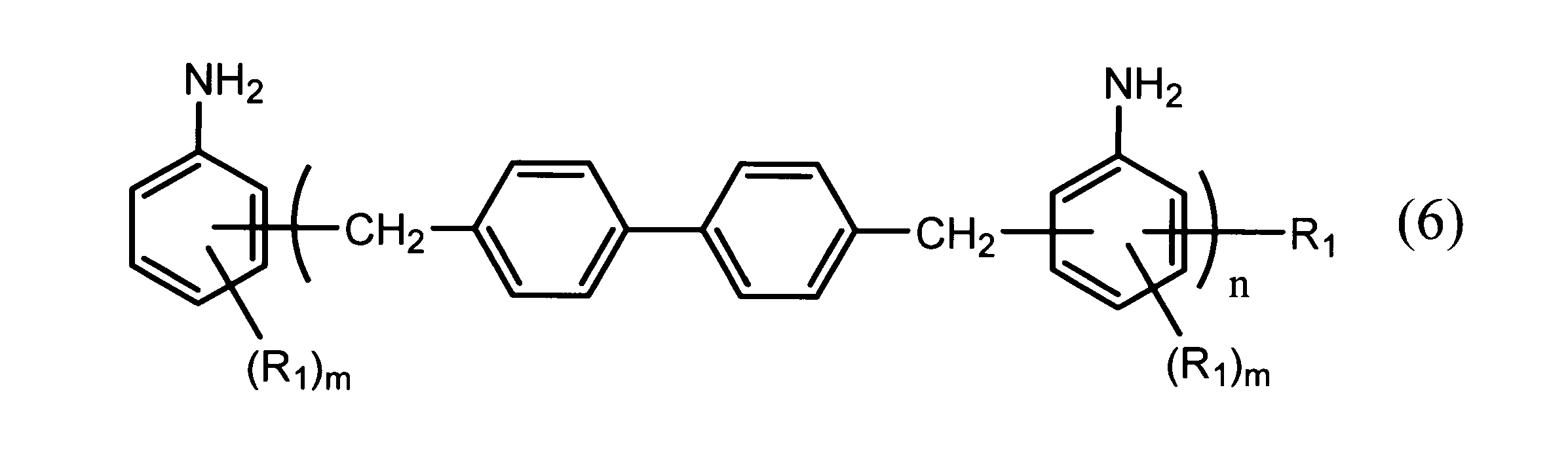
- aromatic amine resins represented by the following formulas (4) to (6) can be used as precursors.
- X represents an aromatic hydrocarbon group having 6 to 18 carbon atoms.
- a plurality of R 1 each independently represents a hydrogen atom, an alkyl group having 1 to 10 carbon atoms or an aromatic group. (An integer of 1 to 4 is represented, and n represents a real number of 1 to 10.)
- R 1 s each independently represent a hydrogen atom, an alkyl group having 1 to 10 carbon atoms or an aromatic group, m represents an integer of 1 to 4, and n represents a real number of 1 to 10).
- R 1 s each independently represent a hydrogen atom, an alkyl group having 1 to 10 carbon atoms or an aromatic group, m represents an integer of 1 to 4, and n represents a real number of 1 to 10).
- Patent Document 3 describes a reaction between an aniline derivative and a bishalogenomethylaralkyl derivative or an aralkyl alcohol derivative.
- the aromatic amine resins of the formulas (4) to (6) can be obtained by reacting an aniline derivative with a bishalogenomethylaralkyl derivative or an aralkyl alcohol derivative by employing the same method as these.
- aniline derivatives used include aniline, 2-methylaniline, 3-methylaniline, 4-methylaniline, 2-ethylaniline, 3-ethylaniline, 4-ethylaniline, 2,3-dimethylaniline, 2,4 -Dimethylaniline, 2,5-dimethylaniline, 2,6-dimethylaniline, 3,4-dimethylaniline, 3,5-dimethylaniline, 2-propylaniline, 3-propylaniline, 4-propylaniline, 2-isopropyl Aniline, 3-isopropylaniline, 4-isopropylaniline, 2-ethyl-6-methylaniline, 2-sec-butylaniline, 2-tert-butylaniline, 4-butylaniline, 4-sec-butylaniline, 4-tert -Butylaniline, 2,3-diethylaniline, 2,4 Diethylaniline, 2,5-diethylaniline, 2,6-diethylaniline, 2-isopropyl,
- bishalogenomethylaralkyl derivatives or aralkyl alcohol derivatives used include 1,4-bischloromethylbenzene, 1,3-bischloromethylbenzene, 1,2-bischloromethylbenzene, 1,4-bisbromomethylbenzene 1,3-bisbromomethylbenzene, 1,2-bisbromomethylbenzene, 1,4-dimethoxymethylbenzene, 1,3-dimethoxymethylbenzene, 1,2-dimethoxymethylbenzene, 1,4-diethoxymethyl Benzene, 1,3-diethoxymethylbenzene, 1,2-diethoxymethylbenzene, 1,4-dihydroxymethylbenzene, 1,3-dihydroxymethylbenzene, 1,2-dihydroxymethylbenzene, 2,6-dihydroxymethyl Naphthalene, 1,5-dihydroxymethyl Phthalene, 2,6-dimethoxymethylnaphthalene, 1,5-dimethoxymethylnaphthalene, 4,4′-bis (chloromethyl) bi
- the amount of the bishalogenomethylaralkyl derivative or aralkyl alcohol derivative used is 0.05 to 0.8 mol, preferably 0.1 to 0.6 mol, relative to 1 mol of the aniline derivative used.
- an acidic catalyst such as hydrochloric acid, phosphoric acid, sulfuric acid, formic acid, zinc chloride, ferric chloride, aluminum chloride, p-toluenesulfonic acid, methanesulfonic acid may be used. These may be used alone or in combination of two or more.
- the amount of the catalyst used is 0.1 to 0.8 mol, preferably 0.5 to 0.7 mol, based on 1 mol of the aniline used. If the amount is too small, the progress of the reaction may be slow.
- the reaction may be carried out using an organic solvent such as toluene or xylene, if necessary, or without solvent.
- an organic solvent such as toluene or xylene
- the reaction may be carried out using an organic solvent such as toluene or xylene, if necessary, or without solvent.
- an organic solvent such as toluene or xylene
- the water is removed from the system by azeotropic distillation.
- the bishalogenomethylaralkyl derivative or aralkyl alcohol derivative is added over 1 to 5 hours, preferably 2 to 4 hours at 40 to 100 ° C., preferably 50 to 80 ° C., and then the temperature is raised while removing the solvent from the system.
- the reaction is carried out at 180 to 240 ° C., preferably 190 to 220 ° C. for 5 to 30 hours, preferably 5 to 20 hours.
- a diphenylamine derivative is produced as a by-product, and therefore the diphenylamine derivative is 1 wt% or less, preferably 0.5 wt% or less, under high temperature and high vacuum, or using means such as steam distillation. Preferably it is removed to 0.2 wt% or less.
- maleimide resin of the present invention the aromatic amine resins of the formulas (4) to (6) obtained by the above steps and maleic acid or maleic anhydride (hereinafter also referred to as “maleic anhydride”) are used as solvents. It can be obtained by addition or dehydration condensation reaction in the presence of a catalyst.
- a water-insoluble solvent for example, aromatic solvents such as toluene and xylene, aliphatic solvents such as cyclohexane and n-hexane, ethers such as diethyl ether and diisopropyl ether, ester solvents such as ethyl acetate and butyl acetate, methyl isobutyl ketone and cyclopentanone
- aromatic solvents such as toluene and xylene
- aliphatic solvents such as cyclohexane and n-hexane
- ethers such as diethyl ether and diisopropyl ether
- ester solvents such as ethyl acetate and butyl acetate, methyl isobutyl ketone and cyclopentanone
- an aprotic polar solvent can be used in combination.
- examples include dimethyl sulfone, dimethyl sulfoxide, dimethylformamide, dimethylacetamide, 1,3-dimethyl-2-imidazolidinone, N-methyl-2-pyrrolidone and the like, and two or more kinds may be used in combination.
- an aprotic polar solvent it is preferable to use a solvent having a higher boiling point than the water-insoluble solvent used in combination.
- the catalyst used in the reaction is an acidic catalyst and is not particularly limited, and examples thereof include p-toluenesulfonic acid, hydroxy-p-toluenesulfonic acid, methanesulfonic acid, sulfuric acid, and phosphoric acid.
- the amount of the acid catalyst used is usually 0.1 to 10% by weight, preferably 1 to 5% by weight, based on the aromatic amine resin.
- the aromatic amine resins of the formulas (4) to (6) are dissolved in toluene and N-methyl-2-pyrrolidone, and maleic anhydride is added thereto to produce an amic acid, and then p-toluene The reaction is carried out while adding sulfonic acid and removing water produced under reflux conditions from the system.
- maleic anhydride is dissolved in toluene, and an N-methyl-2-pyrrolidone solution of an aromatic amine resin of formula (4) to formula (6) is added with stirring to produce an amic acid, and then p -Toluenesulfonic acid is added and the reaction is carried out while removing the water produced under reflux conditions from the system.
- the maleic anhydride is usually 1 to 3 times equivalent, preferably 1.2 to 2.0, with respect to the amino group of the aromatic amine resin of the formula (4) to the formula (6). Use double equivalents.
- water is added to the reaction solution after the maleimidation reaction listed above, and separated into a resin solution layer and an aqueous layer, and excess maleic acid or maleic anhydride is added. Since the acid, aprotic polar solvent, catalyst, etc. are dissolved in the aqueous layer side, this is separated and removed, and the same operation is repeated to remove excess maleic acid, maleic anhydride, aprotic polar solvent, Thoroughly remove the catalyst.
- the time for the rehydration ring-closing reaction is usually 1 to 5 hours, preferably 1 to 3 hours. If necessary, the above-mentioned aprotic polar solvent may be added. After completion of the reaction, cool and repeat the water washing until the water becomes neutral. Thereafter, water may be removed by azeotropic dehydration under reduced pressure, and the solvent may be distilled off or another solvent may be added to adjust the resin solution to a desired concentration, or the solvent may be completely retained. You may leave and take out as solid resin.
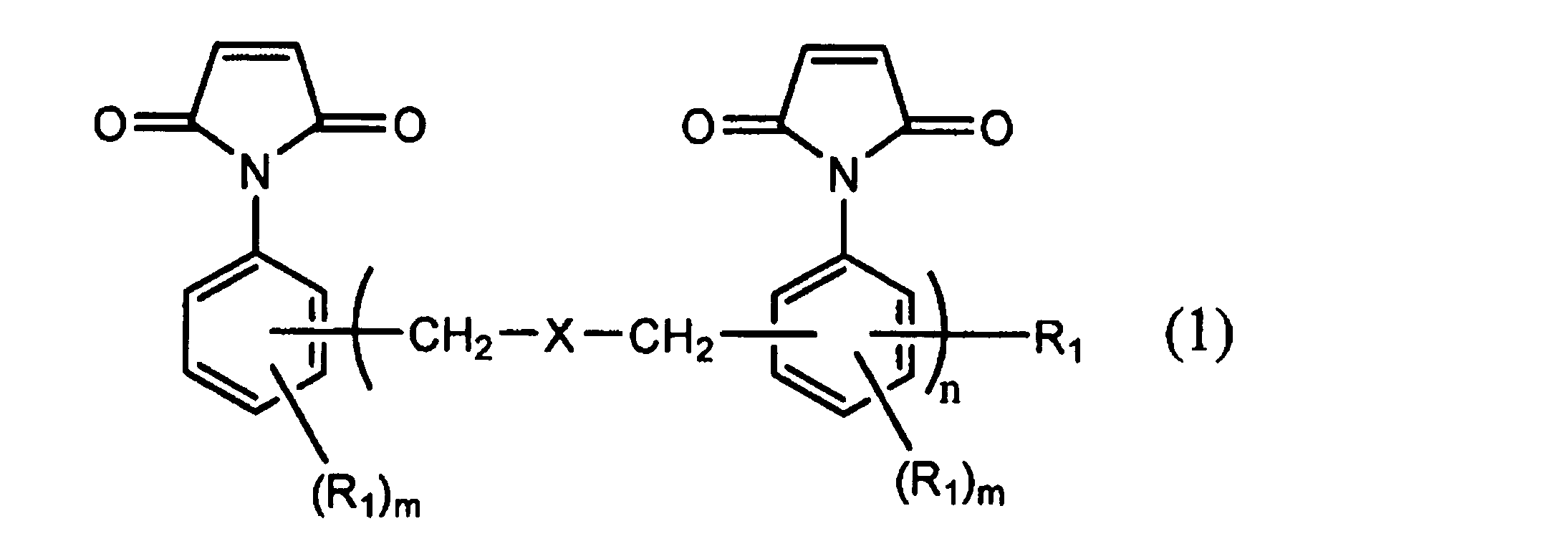
- the maleimide resin of the present invention obtained by the production method described above has a structure represented by the following formula (1) having an acid value of 5 mgKOH / g or less.
- X represents an aromatic hydrocarbon group having 6 to 18 carbon atoms.
- a plurality of R 1 each independently represents a hydrogen atom, an alkyl group having 1 to 10 carbon atoms or an aromatic group. (An integer of 1 to 4 is represented, and n represents a real number of 1 to 10.)
- examples of the aromatic hydrocarbon group having 6 to 18 carbon atoms that is X include a phenyl group, a biphenyl group, and a terphenyl group.
- a phenyl group and a biphenyl group are preferable, and a biphenyl group is more preferable.
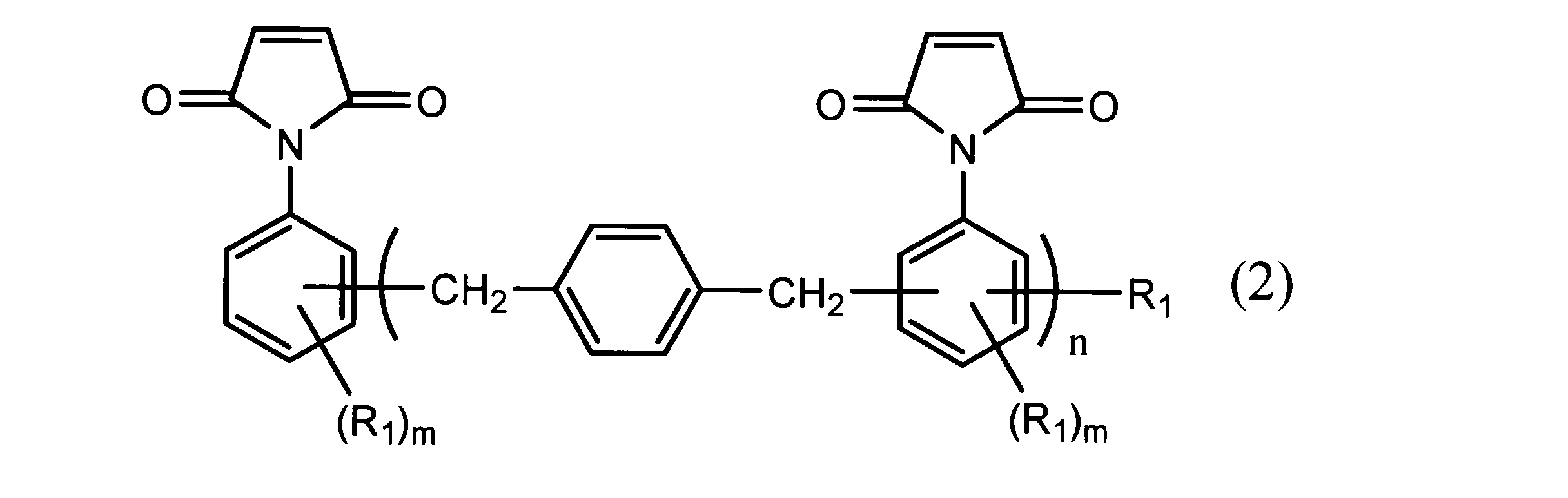
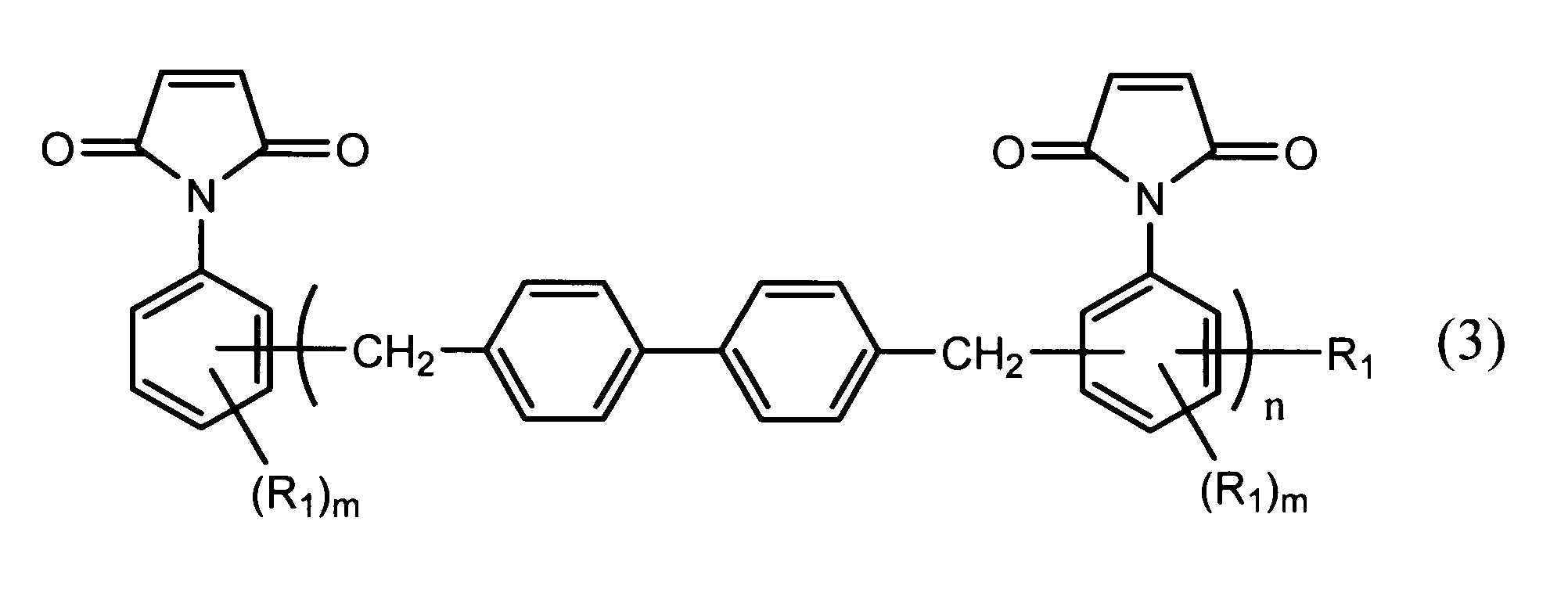
- a maleimide resin having a structure represented by the following formula (2) or the following formula (3) is preferable.
- R 1 s each independently represent a hydrogen atom, an alkyl group having 1 to 10 carbon atoms or an aromatic group, m represents an integer of 1 to 4, and n represents a real number of 1 to 10).
- R 1 s each independently represent a hydrogen atom, an alkyl group having 1 to 10 carbon atoms or an aromatic group, m represents an integer of 1 to 4, and n represents a real number of 1 to 10).
- the alkyl group having 1 to 10 carbon atoms for R 1 includes a methyl group, an ethyl group, an n-propyl group, an iso-propyl group, an n-butyl group, and an iso-butyl group.
- a methyl group an ethyl group, an n-propyl group, an iso-propyl group, an n-butyl group, and an iso-butyl group.
- Tert-butyl group, sec-butyl group, n-pentyl group, i-pentyl group, amyl group, n-hexyl group, cyclopentyl group, cyclohexyl group, octyl group, 2-ethylhexyl group, nonyl group, A decyl group etc. are mentioned.
- the aromatic group in R 1 in the above formulas (1) to (3) includes an aromatic hydrocarbon group such as phenyl group, biphenyl group, indenyl group, naphthyl group, anthryl group, fluorenyl group, pyrenyl group, furanyl Group, thienyl group, thienothienyl group, pyrrolyl group, imidazolyl group, pyridyl group, pyrazyl group, pyrimidyl group, quinolyl group, indolyl group and carbazolyl group.
- aromatic hydrocarbon group such as phenyl group, biphenyl group, indenyl group, naphthyl group, anthryl group, fluorenyl group, pyrenyl group, furanyl Group, thienyl group, thienothienyl group, pyrrolyl group, imidazolyl group, pyridyl group, pyrazyl group, pyrimidyl group
- n 1 ⁇ n average value ⁇ 5.
- the value of n can be calculated from the value of the number average molecular weight determined by gel permeation chromatography (GPC) measurement of the maleimide resin, but is approximately represented by the above formula (4) which is a raw material. It can be considered to be almost equivalent to the value of n calculated from the GPC measurement result of the aromatic amine resin.
- the maleimide resin of the present invention has an acid value of 5 mgKOH / g or less, preferably 4 mgKOH / g, more preferably 3 mg / KOH or less.
- the value of the acid value can be measured by a method according to JIS K-0070: 1992.
- an unclosed amic acid or the like is contained as an impurity, when the acid value is more than 5 mgKOH / g, the heat resistance of the cured product is lowered, and when it is used as an electrical insulating material, a problem of wiring corrosion may occur.
- the maleimide resin of the present invention those having a melting point and a softening point can be used.
- a melting point it is preferably 200 ° C. or lower, and when it has a softening point, it is preferably 150 ° C. or lower.
- An excessively high melting point or softening point is not preferable because the possibility of gelation increases during subsequent mixing with the epoxy resin.
- the melt viscosity at 150 ° C. of the maleimide resin of the present invention is usually 0.05 to 100 Pa ⁇ s, preferably 0.1 to 40 Pa ⁇ s.
- the curable resin composition of the present invention can contain a compound capable of undergoing a crosslinking reaction with the maleimide resin of the present invention.
- a compound capable of undergoing a crosslinking reaction with the maleimide resin of the present invention include amino groups, cyanate groups, phenolic hydroxyl groups, alcoholic hydroxyl groups, allyl groups, methallyl groups, acrylic groups, methacrylic groups, vinyl groups, conjugated diene groups and other functional groups that can undergo a crosslinking reaction (or If it is a compound which has a structure), it will not specifically limit. Since the amine compound and the maleimide compound undergo a crosslinking reaction, aromatic amine resins represented by the above formulas (4) to (6) may be used.
- the maleimide resin can be self-polymerized and can be used alone. Further, an amine compound other than the aromatic amine resin described in the above formulas (4) to (6) or a maleimide compound other than the maleimide resin of the present invention may be used in combination.
- the content of the maleimide resin in the curable resin composition of the present invention is usually 10% by weight or more, preferably 15% by weight or more, and more preferably 20% by weight. In the case of the above range, in the physical properties of the cured product, mechanical strength is high, peel strength is high, and heat resistance tends to be high.
- amine compound that can be blended in the curable resin composition of the present invention a conventionally known amine compound can be used.
- Specific examples of the amine compound include diethylenetriamine, triethylenetetramine, tetraethylenepentamine, m-xylenediamine, trimethylhexamethylenediamine, 2-methylpentamethylenediamine, diethylaminopropylamine, isophoronediamine, 1,3-bisaminomethyl.
- Cyclohexane bis (4-aminocyclohexyl) methane, bis (4-amino-3-methylcyclohexyl) methane, norbornenediamine, 1,2-diaminocyclohexane, diaminodiphenylmethane, metaphenylenediamine, diaminodiphenylsulfone, dicyandiamide, polyoxypropylene Examples include diamine, polyoxypropylene triamine, N-aminoethylpiperazine, and aniline / formalin resin. Not intended to be. These may be used alone or in combination of two or more.
- maleimide compound that can be blended in the curable resin composition of the present invention
- a conventionally known maleimide compound can be used.
- the maleimide compound include 4,4′-diphenylmethane bismaleimide, polyphenylmethane maleimide, m-phenylene bismaleimide, 2,2′-bis [4- (4-maleimidophenoxy) phenyl] propane, 3,3 '-Dimethyl-5,5'-diethyl-4,4'-diphenylmethane bismaleimide, 4-methyl-1,3-phenylene bismaleimide, 4,4'-diphenyl ether bismaleimide, 4,4'-diphenylsulfone bismaleimide 1,3-bis (3-maleimidophenoxy) benzene, 1,3-bis (4-maleimidophenoxy) benzene and the like, but are not limited thereto. These may be used alone or in combination of two or more.
- the blending amount of the maleimide compound is
- a conventionally well-known cyanate ester compound can be used as a cyanate ester compound which can be mix
- Specific examples of cyanate ester compounds include polycondensates of phenols and various aldehydes, polymers of phenols and various diene compounds, polycondensates of phenols and ketones, and polycondensations of bisphenols and various aldehydes. Examples include, but are not limited to, cyanate ester compounds obtained by reacting a product with cyanogen halide. These may be used alone or in combination of two or more.
- phenols examples include phenol, alkyl-substituted phenol, aromatic-substituted phenol, naphthol, alkyl-substituted naphthol, dihydroxybenzene, alkyl-substituted dihydroxybenzene, and dihydroxynaphthalene.
- aldehydes examples include formaldehyde, acetaldehyde, alkyl aldehyde, benzaldehyde, alkyl-substituted benzaldehyde, hydroxybenzaldehyde, naphthaldehyde, glutaraldehyde, phthalaldehyde, crotonaldehyde, and cinnamaldehyde.
- Examples of the various diene compounds include dicyclopentadiene, terpenes, vinylcyclohexene, norbornadiene, vinylnorbornene, tetrahydroindene, divinylbenzene, divinylbiphenyl, diisopropenylbiphenyl, butadiene, and isoprene.
- Examples of the ketones include acetone, methyl ethyl ketone, methyl isobutyl ketone, acetophenone, and benzophenone.
- cyanate ester compounds described in Japanese Patent Application Laid-Open No. 2005-264154 are particularly preferable as cyanate ester compounds because they are excellent in low moisture absorption, flame retardancy, and dielectric properties.
- Examples of the compound having an allyl group or a methallyl group that can be blended in the curable resin composition of the present invention include, for example, 4,4′-bisphenol A diallyl ether, 4,4′-bisphenol F as (meth) allyl compounds.
- an epoxy resin can be further blended.
- any conventionally known epoxy resin can be used.
- Specific examples of epoxy resins include polycondensates of phenols and various aldehydes, polymers of phenols and various diene compounds, polycondensates of phenols and ketones, polycondensates of bisphenols and various aldehydes.
- glycidyl ether epoxy resins obtained by glycidylation of alcohols, alicyclic epoxies such as 4-vinyl-1-cyclohexene diepoxide and 3,4-epoxycyclohexylmethyl-3,4′-epoxycyclohexanecarboxylate
- the resin include, but are not limited to, glycidylamine epoxy resins and glycidyl ester epoxy resins such as tetraglycidyldiaminodiphenylmethane (TGDDM) and triglycidyl-p-aminophenol. These may be used alone or in combination of two or more.
- a phenol aralkyl resin obtained by condensation reaction of phenols and the above-mentioned bishalogenomethyl aralkyl derivative or aralkyl alcohol derivative, and an epoxy resin obtained by dehydrochlorination reaction with epichlorohydrin are low hygroscopic, Since it is excellent in a flame retardance and a dielectric characteristic, it is especially preferable as an epoxy resin.
- the blending amount is not particularly limited, but is preferably 0.1 to 10 times that of the maleimide resin, more preferably 0.2 to 4 times by weight.
- the blending amount of the epoxy resin is 0.1 times or less of the maleimide resin, the cured product may become brittle, and when it is 10 times or more, the dielectric characteristics may be deteriorated.
- a phenol resin and a compound having an acid anhydride group can be further blended.
- Any conventionally known phenol resin can be used as the phenol resin that can be blended.
- phenolic resins include bisphenols (bisphenol A, bisphenol F, bisphenol S, biphenol, bisphenol AD, etc.), phenols (phenol, alkyl-substituted phenol, aromatic-substituted phenol, naphthol, alkyl-substituted naphthol, dihydroxybenzene, alkyl Substituted polyhydroxybenzene, dihydroxynaphthalene, etc.) and various aldehydes (formaldehyde, acetaldehyde, alkyl aldehyde, benzaldehyde, alkyl-substituted benzaldehyde, hydroxybenzaldehyde, naphthaldehyde, glutaraldehyde, phthalaldehyde
- a phenol aralkyl resin obtained by a condensation reaction of a phenol and the above bishalogenomethyl aralkyl derivative or aralkyl alcohol derivative is particularly preferable as a phenol resin because it is excellent in low moisture absorption, flame retardancy, and dielectric properties. .
- any conventionally known compound having an acid anhydride group can be used.
- Specific examples of the compound having an acid anhydride group include 1,2,3,4-butanetetracarboxylic dianhydride, 1,2,3,4-cyclobutanetetracarboxylic dianhydride, 1,2,3, 4-cyclopentanetetracarboxylic dianhydride, 1,2,4,5-cyclohexanetetracarboxylic dianhydride, pyromellitic anhydride, 5- (2,5-dioxotetrahydrofuryl) -3-methyl- 3-cyclohexene-1,2-dicarboxylic acid anhydride, 4- (2,5-dioxotetrahydrofuran-3-yl) -1,2,3,4-tetrahydronaphthalene-1,2-dicarboxylic acid anhydride, etc.
- the compounds having an acid anhydride group can be used alone or in combination of two or more.
- the acid anhydride group and amine react to form an amic acid, but when heated at 200 ° C. to 300 ° C., an imide structure is formed by a dehydration reaction, resulting in a material with excellent heat resistance.
- a curing catalyst can be blended with the curable resin composition of the present invention as necessary.
- imidazoles such as 2-methylimidazole, 2-ethylimidazole, 2-phenylimidazole, 2-ethyl-4-methylimidazole, 2-undecylimidazole, 1-cyanoethyl-2-ethyl-4-methylimidazole, triethylamine
- Amines such as triethylenediamine, 2- (dimethylaminomethyl) phenol, 1,8-diaza-bicyclo (5,4,0) undecene-7, tris (dimethylaminomethyl) phenol, benzyldimethylamine, triphenylphosphine, Phosphines such as tributylphosphine and trioctylphosphine, tin octylate, zinc octylate, dibutyltin dimaleate, zinc naphthenate, cobalt naph
- varnish-like composition An organic solvent can be added to the curable resin composition of the present invention to obtain a varnish-like composition (hereinafter simply referred to as varnish).
- the solvent used include amide solvents such as ⁇ -butyrolactone, N-methylpyrrolidone, N, N-dimethylformamide, N, N-dimethylacetamide, N, N-dimethylimidazolidinone, and tetramethylene sulfone.
- ether solvents such as diethylene glycol dimethyl ether, diethylene glycol diethyl ether, propylene glycol, propylene glycol monomethyl ether, propylene glycol monomethyl ether monoacetate, propylene glycol monobutyl ether, ketones such as methyl ethyl ketone, methyl isobutyl ketone, cyclopentanone and cyclohexanone
- Aromatic solvents such as solvent, toluene, xylene and the like can be mentioned.
- the solvent is used in the range where the solid content concentration excluding the solvent in the obtained varnish is usually 10 to 80% by weight, preferably 20 to 70% by weight.
- the curable resin composition of the present invention can contain known additives as required.
- additives that can be used include curing agents for epoxy resins, polybutadiene and modified products thereof, modified products of acrylonitrile copolymers, polyphenylene ether, polystyrene, polyethylene, polyimide, fluororesin, maleimide compounds, cyanate ester compounds , Silicone gel, silicone oil, inorganic fillers such as silica, alumina, calcium carbonate, quartz powder, aluminum powder, graphite, talc, clay, iron oxide, titanium oxide, aluminum nitride, asbestos, mica, glass powder, silane cup Coloring agents such as a surface treatment agent for a filler such as a ring agent, a release agent, carbon black, phthalocyanine blue, and phthalocyanine green can be used.
- the amount of these additives is preferably 1,000 parts by weight or less, more preferably 700 parts by weight or less, with respect to 100 parts by weight of the curable resin composition.
- the method for preparing the curable resin composition of the present invention is not particularly limited, but each component may be mixed evenly or prepolymerized.
- a maleimide resin and a cyanate ester compound are prepolymerized by heating in the presence or absence of a catalyst and in the presence or absence of a solvent.
- the maleimide resin of the present invention may be prepolymerized by adding an epoxy resin, an amine compound, a maleimide compound, a cyanate ester compound, a phenol resin, an acid anhydride compound, and other additives as necessary.
- an extruder, a kneader, or a roll is used in the absence of a solvent, and a reaction kettle with a stirring device is used in the presence of a solvent.
- a prepreg can be obtained by heating and melting the curable resin composition of the present invention to lower the viscosity and impregnating it with reinforcing fibers such as glass fiber, carbon fiber, polyester fiber, polyamide fiber, and alumina fiber. Moreover, a prepreg can also be obtained by impregnating the varnish into a reinforcing fiber and drying by heating. The above prepreg is cut into a desired shape, laminated with copper foil as necessary, and then the curable resin composition is heated and cured while applying pressure to the laminate by a press molding method, autoclave molding method, sheet winding molding method, etc. Thus, an electric / electronic laminate (printed wiring board) and a carbon fiber reinforcing material can be obtained.
- reinforcing fibers such as glass fiber, carbon fiber, polyester fiber, polyamide fiber, and alumina fiber.
- a prepreg can also be obtained by impregnating the varnish into a reinforcing fiber and drying by heating.
- the above prepreg is cut into a desired shape
- Synthesis example 1 A flask equipped with a thermometer, condenser, Dean-Stark azeotropic distillation trap, and stirrer was charged with 372 parts of aniline and 200 parts of toluene, and 1 hour while maintaining 88 parts of 1,4-bischloromethylbenzene at 60 to 70 ° C. The reaction was carried out at the same temperature for 2 hours. Next, 104 parts of 35% hydrochloric acid was added dropwise over 1 hour while maintaining the temperature at 60 to 70 ° C. After completion of the dropwise addition, water and toluene were distilled off while raising the temperature to 205 to 210 ° C., and the reaction was carried out at this temperature for 10 hours.
- the obtained resin was again dripped in small amounts in place of steam blowing in a rotary evaporator under heating and reduced pressure (200 ° C., 4 KPa). As a result, 131 parts of aromatic amine resin (A1) was obtained.
- the obtained aromatic amine resin (A1) was a highly viscous liquid at room temperature, the amine equivalent was 150 g / eq, and diphenylamine was 0.1% or less.
- Synthesis example 2 A flask equipped with a thermometer, condenser, Dean-Stark azeotropic distillation trap, and stirrer was charged with 372 parts of aniline and 200 parts of toluene, and 125 parts of 4,4′-bis (chloromethyl) biphenyl was kept at 60 to 70 ° C. However, it was added over 1 hour and reacted at the same temperature for 2 hours. Next, 104 parts of 35% hydrochloric acid was added dropwise over 1 hour while maintaining the temperature at 60 to 70 ° C. After completion of the dropwise addition, water and toluene were distilled off while raising the temperature to 205 to 210 ° C., and the reaction was carried out at this temperature for 10 hours.
- Diphenylamine in the aromatic amine resin (a2) was 2.0%.
- the obtained resin was again dripped in small amounts in place of steam blowing in a rotary evaporator under heating and reduced pressure (200 ° C., 4 KPa).
- 166 parts of aromatic amine resin (A2) was obtained.
- the aromatic amine resin (A2) obtained had a softening point of 56 ° C., a melt viscosity of 0.035 Pa ⁇ s, an amine equivalent of 195 g / eq, and diphenylamine of 0.1% or less.
- Example 1 A flask equipped with a thermometer, a condenser, a Dean-Stark azeotropic distillation trap, and a stirrer was charged with 147 parts of maleic anhydride, 200 parts of toluene, and 4 parts of methanesulfonic acid, and heated to reflux. Next, a resin solution in which 150 parts of aromatic amine resin (A1) was dissolved in 95 parts of N-methyl-2-pyrrolidone and 95 parts of toluene was added dropwise over 3 hours while maintaining the reflux state.
- aromatic amine resin (A1) 150 parts was dissolved in 95 parts of N-methyl-2-pyrrolidone and 95 parts of toluene was added dropwise over 3 hours while maintaining the reflux state.
- the maleimide resin (M1) of the present invention was obtained by leaving.
- the maleimide resin obtained had a softening point of 94 ° C., a melt viscosity of 4 Pa ⁇ s, and an acid value of 1.9 mgKOH / g.
- Example 2 A flask equipped with a thermometer, a condenser, a Dean-Stark azeotropic distillation trap, and a stirrer was charged with 147 parts of maleic anhydride, 200 parts of toluene, and 4 parts of methanesulfonic acid, and heated to reflux. Next, a resin solution in which 195 parts of the aromatic amine resin (A2) was dissolved in 95 parts of N-methyl-2-pyrrolidone and 95 parts of toluene was added dropwise over 3 hours while maintaining the reflux state.
- A2 aromatic amine resin
- the maleimide resin (M2) of this invention was obtained by leaving.
- the maleimide resin obtained had a softening point of 109 ° C., a melt viscosity of 5 Pa ⁇ s, and an acid value of 1.6 mgKOH / g.
- Comparative Example 1 A flask equipped with a thermometer, condenser, Dean-Stark azeotropic distillation trap, and stirrer was charged with 400 parts of toluene and 100 parts of N-methyl-2-pyrrolidone, and 150 parts of aromatic amine resin (A1) was added and dissolved. It was. Next, 147 parts of maleic anhydride was added in portions over 1 hour while maintaining the temperature at 50-60 ° C. Thereafter, the reaction was carried out at 80 ° C. for 2 hours, 2 parts of methanesulfonic acid was added, and the reaction was carried out at 110 to 120 ° C. for 14 hours.
- the maleimide resin obtained had a softening point of 95 ° C., a melt viscosity of 5 Pa ⁇ s, and an acid value of 8.1 mgKOH / g.
- the resulting maleimide resin had a softening point of 119 ° C., a melt viscosity of 6 Pa ⁇ s, and an acid value of 6 mgKOH / g.
- Examples 3 to 4 and Comparative Examples 3 to 4 Using the maleimide resins (M1), (M2) and (C1), (C2) obtained in Examples 1 and 2 and Comparative Examples 1 and 2, various epoxy resins, curing agents and curing accelerators are shown in Table 1. In a proportion (part by weight), kneaded with a mixing roll and tableted, a resin molded body was prepared by transfer molding and cured at 200 ° C. for 2 hours. The results of measuring the physical properties of the cured product thus obtained for the following items are shown in Table 1.
- Glass transition temperature Temperature measured by a dynamic viscoelasticity tester and tan ⁇ is a maximum value.
- Td5 5% thermogravimetric decrease temperature: The obtained cured product was pulverized and powdered, and a 100 mesh pass, 200 mesh on sample was used, and the thermal decomposition temperature was measured by TG-DTA. A temperature at which the weight was reduced by 5% as measured at a sample amount of 10 mg, a heating rate of 10 ° C./min, and an air amount of 200 ml / hr.
- -Flame retardancy test The sample size is 12.5 mm wide, 150 mm long, and 0.8 mm thick, and the total afterflame time is measured.
- ⁇ Bending strength Measured according to JIS K-6911.
- Moisture absorption Weight increase rate after 24 hours at 85 ° C./85% and 121 ° C./100%.
- the test piece is a disk having a diameter of 50 mm and a thickness of 4 mm.
- Curing shrinkage Measured according to JIS K-6911.
- E1 NC-3000-L (Nippon Kayaku Epoxy equivalent 270 g / eq)
- P1 Kayahard GPH-65 (manufactured by Nippon Kayaku, hydroxyl equivalent: 200 g / eq)
- 2E4MZ 2-ethyl-4-methylimidazole (manufactured by Tokyo Chemical Industry Co., Ltd.)
- the cured product using the maleimide resin of the present invention is superior in heat resistance and strength and less hygroscopic than the cured product of maleimide resin having a large acid value. Since Td5 is high, the thermal decomposition temperature is high, and thus flame retardancy is excellent. Further, since the shrinkage rate is small, when used for a laminated plate, a carbon fiber composite material, etc., there is little dimensional change due to molding, and it becomes easy to create a molded product as designed.
Landscapes
- Chemical & Material Sciences (AREA)
- Health & Medical Sciences (AREA)
- Chemical Kinetics & Catalysis (AREA)
- Medicinal Chemistry (AREA)
- Polymers & Plastics (AREA)
- Organic Chemistry (AREA)
- Macromolecular Compounds Obtained By Forming Nitrogen-Containing Linkages In General (AREA)
- Polyoxymethylene Polymers And Polymers With Carbon-To-Carbon Bonds (AREA)
- Macromonomer-Based Addition Polymer (AREA)
Abstract
Description
また、近年省エネの必要から飛行機、自動車、列車、船舶等の軽量化が進んでいる。従来は金属材料を用いていたものを、軽量で高強度な炭素繊維複合材料に置き換える検討が輸送機器分野で特に行われている。例えばボーイング787においては複合材料の比率を上げることで軽量化を行い、燃費効率を大幅に改善している。航空分野ではさらなる軽量化のために、エンジン回りの部材にも炭素繊維複合材を導入する動きもあり、当然高いレベルの耐熱性が要求されてきている。自動車分野では一部ではあるが複合材料製のプロペラシャフトを搭載しており、また高級車向けに車体を複合材料で作る動きもある。炭素繊維複合材の分野では、従来はエポキシ樹脂のビスフェノールAジグリシジルエーテルやテトラグリシジルジアミノジフェニルメタンなどと、硬化剤としてジアミノジフェニルメタン、ジアミノジフェニルスルホンなどを使用した複合材料が用いられてきたが、より軽量化・高耐熱化を進めるためには複合材料の適用を広げる必要があり、そのための材料としてマレイミド樹脂が一つの手段として検討されている。
このような中、市場で入手可能なマレイミド化合物のビスマレイミド化合物であることが多く、融点が高い結晶であるため溶液の形態として用いる必要がある。しかしこれらは汎用の有機溶剤には溶解し難く、N,N-ジメチルアセトアミド、N-メチル-2-ピロリドンなどの高沸点で吸湿性の溶剤にしか溶解しないなどの欠点を有する。また、ビスマレイミド化合物の硬化物は、耐熱性は良好であるが、脆くて、吸湿量も多いという欠点を有する。
これに対して、特許文献2、特許文献3、特許文献4のように分子量分布を有し、軟化点が比較的低く、溶剤溶解性に優れたマレイミド樹脂も開発されおり、その硬化物は耐熱性を有しながら、可撓性があり、低吸湿性もあることが報告されている。
本発明の目的は、マレイミド樹脂を含有する硬化性樹脂組成物の熱分解性、難燃性、低吸湿性、強度を向上させるために、未閉環のアミック酸量の少ないマレイミド樹脂を提供することにある。
すなわち本発明は
[1]
下記式(1)で表される、酸価が5mgKOH/g以下であるマレイミド樹脂、

[2]
下記式(2)で表される前項[1]に記載のマレイミド樹脂、
[3]
下記式(3)で表される前項[1]に記載のマレイミド樹脂、

[4]
芳香族アミン樹脂とマレイン酸またはマレイン酸無水物とを反応させてアミック酸を生成後、触媒存在下において脱水反応を行い、水洗により過剰のマレイン酸またはマレイン酸無水物を除去した後に、ふたたび触媒存在下において脱水閉環反応する前項[1]~[3]のいずれか一項に記載のマレイミド樹脂、
[5]
前項[1]~[4]のいずれか一項に記載のマレイミド樹脂を含有する硬化性樹脂組成物、
[6]
前項[5]に記載の硬化性樹脂組成物を硬化した硬化物、
[7]
芳香族アミン樹脂とマレイン酸またはマレイン酸無水物とを反応させてアミック酸を生成後、触媒存在下において脱水反応を行い、水洗により過剰のマレイン酸またはマレイン酸無水物を除去した後に、ふたたび触媒存在下において脱水閉環反応する下記式(1)で表されるマレイミド樹脂の製造方法、
に関する。
本発明のマレイミド樹脂は、前駆体として下記式(4)~下記式(6)の芳香族アミン樹脂を用いることができる。


ビスハロゲノメチルアラルキル誘導体またはアラルキルアルコール誘導体の使用量は、使用されるアニリン誘導体1モルに対して0.05~0.8モル、好ましくは0.1~0.6モルである。
アニリン誘導体の種類によっては、ジフェニルアミン誘導体が副生するため、高温・高真空下で、もしくは水蒸気蒸留等の手段を用いて、ジフェニルアミン誘導体を1重量%以下、好ましくは0.5重量%以下、より好ましくは0.2重量%以下まで除去する。
または、マレイン酸無水物をトルエンに溶解し、撹拌下で式(4)~式(6)の芳香族アミン樹脂のN-メチル-2-ピロリドン溶液を添加してアミック酸を生成し、その後p-トルエンスルホン酸を加えて、還流条件下で生成する水を系内から除去しながら反応を行う。
再脱水閉環反応の時間は通常1~5時間、好ましくは1~3時間であり、必要により前述の非プロトン性極性溶剤を添加しても良い。反応終了後、冷却して、水洗水が中性になるまで水洗を繰り返す。その後、加熱減圧下において水を共沸脱水で除いてから、溶剤を留去したり、別の溶剤を加えたりして所望の濃度の樹脂溶液に調整しても良いし、溶剤を完全に留去して固形の樹脂として取り出しても良い。
前述した製造方法により得られた本発明のマレイミド樹脂は、酸価が5mgKOH/g以下である下記式(1)の構造を有する。

具体的には下記式(2)または下記式(3)で表される構造を有するマレイミド樹脂が好ましい。


前記式(1)~式(3)中のR1における芳香族基としては、フェニル基、ビフェニル基、インデニル基、ナフチル基、アントリル基、フルオレニル基、ピレニル基等の芳香族炭化水素基、フラニル基、チエニル基、チエノチエニル基、ピロリル基、イミダゾリル基、ピリジル基、ピラジル基、ピリミジル基、キノリル基、インドリル基及びカルバゾリル基等が挙げられる。
未閉環のアミック酸などが不純物として含まれると、酸価が5mgKOH/gより多い場合、硬化物の耐熱性が低下し、かつ電気絶縁材として用いた場合配線腐食の問題が生じることがある。
融点や軟化点が高温すぎる場合、後のエポキシ樹脂との混合の際にゲル化の可能性が高くなるため好ましくない。
本発明の硬化性樹脂組成物には、本発明のマレイミド樹脂と架橋反応可能な化合物を含有することができる。当該化合物としては、アミノ基、シアネート基、フェノール性水酸基、アルコール性水酸基、アリル基、メタリル基、アクリル基、メタクリル基、ビニル基、共役ジエン基などのマレイミド樹脂と架橋反応し得る官能基(或いは構造)を有する化合物であれば特に限定されない。
アミン化合物とマレイミド化合物は架橋反応するので、前記式(4)~式(6)で表される芳香族アミン樹脂を用いても良い。マレイミド樹脂は自己重合も可能なので単独使用も可能である。また、前記式(4)~式(6)に記載の芳香族アミン樹脂以外のアミン化合物または本発明のマレイミド樹脂以外のマレイミド化合物を併用してもかまわない。
上記フェノール類としては、フェノール、アルキル置換フェノール、芳香族置換フェノール、ナフトール、アルキル置換ナフトール、ジヒドロキシベンゼン、アルキル置換ジヒドロキシベンゼン、ジヒドロキシナフタレン等が挙げられる。
上記各種アルデヒドとしては、ホルムアルデヒド、アセトアルデヒド、アルキルアルデヒド、ベンズアルデヒド、アルキル置換ベンズアルデヒド、ヒドロキシベンズアルデヒド、ナフトアルデヒド、グルタルアルデヒド、フタルアルデヒド、クロトンアルデヒド、シンナムアルデヒド等が挙げられる。
上記各種ジエン化合物としては、ジシクロペンタジエン、テルペン類、ビニルシクロヘキセン、ノルボルナジエン、ビニルノルボルネン、テトラヒドロインデン、ジビニルベンゼン、ジビニルビフェニル、ジイソプロペニルビフェニル、ブタジエン、イソプレン等が挙げられる。
上記ケトン類としてはアセトン、メチルエチルケトン、メチルイソブチルケトン、アセトフェノン、ベンゾフェノン等が挙げられる。
また、日本国特開2005-264154号公報に合成方法が記載されているシアネートエステル化合物は、低吸湿性、難燃性、誘電特性に優れているためシアネートエステル化合物として特に好ましい。
また、フェノール類と前記のビスハロゲノメチルアラルキル誘導体またはアラルキルアルコール誘導体とを縮合反応させることにより得られるフェノールアラルキル樹脂を原料とし、エピクロルヒドリンと脱塩酸反応させることにより得られるエポキシ樹脂は、低吸湿性、難燃性、誘電特性に優れているためエポキシ樹脂として特に好ましい。
配合し得るフェノール樹脂としては、従来公知のフェノール樹脂のいずれも使用することができる。フェノール樹脂の具体例としてはビスフェノール類(ビスフェノールA、ビスフェノールF、ビスフェノールS、ビフェノール、ビスフェノールAD等)、フェノール類(フェノール、アルキル置換フェノール、芳香族置換フェノール、ナフトール、アルキル置換ナフトール、ジヒドロキシベンゼン、アルキル置換ジヒドロキシベンゼン、ジヒドロキシナフタレン等)と各種アルデヒド(ホルムアルデヒド、アセトアルデヒド、アルキルアルデヒド、ベンズアルデヒド、アルキル置換ベンズアルデヒド、ヒドロキシベンズアルデヒド、ナフトアルデヒド、グルタルアルデヒド、フタルアルデヒド、クロトンアルデヒド、シンナムアルデヒド等)との重縮合物、フェノール類と各種ジエン化合物(ジシクロペンタジエン、テルペン類、ビニルシクロヘキセン、ノルボルナジエン、ビニルノルボルネン、テトラヒドロインデン、ジビニルベンゼン、ジビニルビフェニル、ジイソプロペニルビフェニル、ブタジエン、イソプレン等)との重合物、フェノール類とケトン類(アセトン、メチルエチルケトン、メチルイソブチルケトン、アセトフェノン、ベンゾフェノン等)との重縮合物、フェノール類と芳香族ジメタノール類(ベンゼンジメタノール、α,α,α’,α’-ベンゼンジメタノール、ビフェニルジメタノール、α,α,α’,α’-ビフェニルジメタノール等)との重縮合物、フェノール類と芳香族ジクロロメチル類(α,α’-ジクロロキシレン、ビスクロロメチルビフェニル等)との重縮合物、ビスフェノール類と各種アルデヒドの重縮合物、及びこれらの変性物が挙げられるがこれらに限定されるものではない。これらは単独で用いてもよく2種以上を用いてもよい。
また、フェノール類と前記のビスハロゲノメチルアラルキル誘導体またはアラルキルアルコール誘導体とを縮合反応させることにより得られるフェノールアラルキル樹脂は、低吸湿性、難燃性、誘電特性に優れているためフェノール樹脂として特に好ましい。
酸無水物基を有する化合物は単独又は2種以上混合して用いることができる。また、酸無水物基とアミンが反応した結果、アミック酸となるが、さらに200℃~300℃で加熱すると脱水反応によりイミド構造となり、耐熱性に非常に優れた材料となる。
また、前記ワニスを、強化繊維に含浸させて加熱乾燥させることによりプリプレグを得ることもできる。
上記のプリプレグを所望の形に裁断、必要により銅箔などと積層後、積層物にプレス成形法やオートクレーブ成形法、シートワインディング成形法などで圧力をかけながら硬化性樹脂組成物を加熱硬化させることにより電気電子用積層板(プリント配線板)や、炭素繊維強化材を得ることができる。
・軟化点 :JIS K-7234に準じた方法で測定
・溶融粘度:コーンプレート法での150℃における粘度
・酸価:JIS K-0070:1992に準じた方法で測定
温度計、冷却管、ディーンスターク共沸蒸留トラップ、撹拌機を取り付けたフラスコにアニリン372部とトルエン200部を仕込み、1,4-ビスクロロメチルベンゼン88部を60~70℃に保ちながら1時間かけて添加し同温度で2時間反応を行った。次いで35%塩酸104部を60~70℃に保ちながら1時間で滴下した。滴下終了後、昇温をしながら水、トルエンを留去して系内を205~210℃とし、この温度で10時間反応をした。その後冷却しながら30%水酸化ナトリウム水溶液277部を系内が激しく還流しないようにゆっくりと滴下し、80℃以下で昇温時に留去したトルエンを系内に戻し、70℃~80℃で静置した。分離した下層の水層を除去し、反応液の水洗を洗浄液が中性になるまで繰り返した。次いでロータリーエバポレーターで油層から加熱減圧下(200℃、0.6KPa)において過剰のアニリンとトルエンを留去することにより芳香族アミン樹脂(a1)138部を得た。芳香族アミン樹脂(a1)中のジフェニルアミンは2.0%であった。
得られた樹脂を、再びロータリーエバポレーターで加熱減圧下(200℃、4KPa)において水蒸気吹き込みの代わりに水を少量づつ滴下した。その結果、芳香族アミン樹脂(A1)131部を得た。得られた芳香族アミン樹脂(A1)は室温で高粘調な液状であり、アミン当量は150g/eq、ジフェニルアミンは0.1%以下であった。
温度計、冷却管、ディーンスターク共沸蒸留トラップ、撹拌機を取り付けたフラスコにアニリン372部とトルエン200部を仕込み、4,4’-ビス(クロロメチル)ビフェニル125部を60~70℃に保ちながら1時間かけて添加し同温度で2時間反応を行った。次いで35%塩酸104部を60~70℃に保ちながら1時間で滴下した。滴下終了後、昇温をしながら水、トルエンを留去して系内を205~210℃とし、この温度で10時間反応をした。その後冷却しながら30%水酸化ナトリウム水溶液277部を系内が激しく還流しないようにゆっくりと滴下し、80℃以下で昇温時に留去したトルエンを系内に戻し、70℃~80℃で静置した。分離した下層の水層を除去し、反応液の水洗を洗浄液が中性になるまで繰り返した。次いでロータリーエバポレーターで油層から加熱減圧下(200℃、0.6KPa)において過剰のアニリンとトルエンを留去することにより芳香族アミン樹脂(a2)173部を得た。芳香族アミン樹脂(a2)中のジフェニルアミンは2.0%であった。
得られた樹脂を、再びロータリーエバポレーターで加熱減圧下(200℃、4KPa)において水蒸気吹き込みの代わりに水を少量づつ滴下した。その結果、芳香族アミン樹脂(A2)166部を得た。得られた芳香族アミン樹脂(A2)の軟化点は56℃、溶融粘度は0.035Pa・s、アミン当量は、195g/eq、ジフェニルアミンは0.1%以下であった。
温度計、冷却管、ディーンスターク共沸蒸留トラップ、撹拌機を取り付けたフラスコに無水マレイン酸147部とトルエン200部、メタンスルホン酸4部を仕込み、加熱還流状態とした。次に、芳香族アミン樹脂(A1)150部をN-メチル-2-ピロリドン95部とトルエン95部に溶解した樹脂溶液を、還流状態を保ちながら3時間かけて滴下した。この間、還流条件で共沸してくる縮合水とトルエンをディーンスターク共沸蒸留トラップ内で冷却・分液した後、有機層であるトルエンは系内に戻し、水は系外へ排出した。樹脂溶液の滴下終了後、還流状態を保ち、脱水操作をしながら2時間反応を行った。
反応終了後、水洗を4回繰り返してメタンスルホン酸及び過剰の無水マレイン酸を除去し、70℃以下の加熱減圧下においてトルエンと水の共沸により、水を系内から除去した。次いで、メタンスルホン酸2部を加え、加熱還流状態で2時間反応を行った。反応終了後、水洗水が中性になるまで4回水洗を繰り返したのち、70℃以下の加熱減圧下においてトルエンと水の共沸により、水を系内から除去したのち、トルエンを完全に留去することにより本発明のマレイミド樹脂(M1)を得た。得られたマレイミド樹脂の軟化点は94℃、溶融粘度は4Pa・s、酸価は1.9mgKOH/gであった。
温度計、冷却管、ディーンスターク共沸蒸留トラップ、撹拌機を取り付けたフラスコに無水マレイン酸147部とトルエン200部、メタンスルホン酸4部を仕込み、加熱還流状態とした。次に、芳香族アミン樹脂(A2)195部をN-メチル-2-ピロリドン95部とトルエン95部に溶解した樹脂溶液を、還流状態を保ちながら3時間かけて滴下した。この間、還流条件で共沸してくる縮合水とトルエンをディーンスターク共沸蒸留トラップ内で冷却・分液した後、有機層であるトルエンは系内に戻し、水は系外へ排出した。樹脂溶液の滴下終了後、還流状態を保ち、脱水操作をしながら2時間反応を行った。
反応終了後、水洗を4回繰り返してメタンスルホン酸及び過剰の無水マレイン酸を除去し、70℃以下の加熱減圧下においてトルエンと水の共沸により、水を系内から除去した。次いで、メタンスルホン酸2部を加え、加熱還流状態で2時間反応を行った。反応終了後、水洗水が中性になるまで4回水洗を繰り返したのち、70℃以下の加熱減圧下においてトルエンと水の共沸により、水を系内から除去したのち、トルエンを完全に留去することにより本発明のマレイミド樹脂(M2)を得た。得られたマレイミド樹脂の軟化点は109℃、溶融粘度は5Pa・s、酸価は1.6mgKOH/gであった。
温度計、冷却管、ディーンスターク共沸蒸留トラップ、撹拌機を取り付けたフラスコにトルエン400部とN-メチル-2-ピロリドン100部を仕込み、芳香族アミン樹脂(A1)150部を加えて溶解させた。次いで、50~60℃に保ちながらマレイン酸無水物147部を1時間かけて分割添加した。その後、80℃で2時間反応し、メタンスルホン酸2部を加えて110~120℃で14時間反応を行った。この間、還流条件で共沸してくる縮合水とトルエンをディーンスターク共沸蒸留トラップ内で冷却・分液した後、有機層であるトルエンは系内に戻し、水は系外へ排出した。反応終了後、水洗を7回繰り返したのち、加熱減圧下においてトルエンを完全に留去して比較用のマレイミド樹脂(C1)を得た。得られたマレイミド樹脂の軟化点は95℃、溶融粘度は5Pa・s、酸価は8.1mgKOH/gであった。
温度計、冷却管、ディーンスターク共沸蒸留トラップ、撹拌機を取り付けたフラスコにトルエン400部とN-メチル-2-ピロリドン100部を仕込み、芳香族アミン樹脂(A1)195部を加えて溶解させた。次いで、50~60℃に保ちながらマレイン酸無水物147部を1時間かけて分割添加した。その後、80℃で2時間反応し、メタンスルホン酸2部を加えて110~120℃で14時間反応を行った。この間、還流条件で共沸してくる縮合水とトルエンをディーンスターク共沸蒸留トラップ内で冷却・分液した後、有機層であるトルエンは系内に戻し、水は系外へ排出した。反応終了後、水洗を7回繰り返したのち、加熱減圧下においてトルエンを完全に留去して比較用のマレイミド樹脂(C2)を得た。得られたマレイミド樹脂の軟化点は119℃、溶融粘度は6Pa・s、酸価は6mgKOH/gであった。
実施例1及び2、比較例1及び2で得られたマレイミド樹脂(M1)、(M2)および(C1)、(C2)を使用し、各種のエポキシ樹脂、硬化剤、硬化促進剤を表1の割合(重量部)で配合し、ミキシングロールで混練、タブレット化後、トランスファー成形で樹脂成形体を調製し、200℃で2時間硬化させた。このようにして得られた硬化物の物性を以下の項目について測定した結果を表1に示す。
・Td5(5%熱重量減少温度):得られた硬化物を粉砕し粉状にしたものを100メッシュパス、200メッシュオンのサンプルを用い、TG-DTAにより熱分解温度を測定。サンプル量10mg、昇温速度10℃/min、空気量200ml/hrで測定し、重量が5%減少した温度。
・難燃性試験:サンプルサイズは幅12.5mm、長さ150mm、厚さ0.8mmを使用し、トータルの残炎時間を測定。
・曲げ強度:JIS K-6911に準拠して測定。
・吸湿率:85℃/85%および121℃/100%での24時間後の重量増加率。試験片は直径50mm×厚み4mmの円盤。
・硬化収縮:JIS K-6911に準拠して測定。

E1:NC-3000-L(日本化薬製 エポキシ当量270g/eq)
P1:カヤハードGPH-65(日本化薬製 水酸基当量200g/eq)
2E4MZ:2-エチル-4-メチルイミダゾール(東京化成工業社製)
なお、本出願は、2016年3月29日付で出願された日本国特許出願(特願2016-065226)に基づいており、その全体が引用により援用される。また、ここに引用されるすべての参照は全体として取り込まれる。
Claims (7)
- 下記式(1)で表される、酸価が5mgKOH/g以下であるマレイミド樹脂。

- 下記式(2)で表される請求項1に記載のマレイミド樹脂。

- 下記式(3)で表される請求項1に記載のマレイミド樹脂。
- 芳香族アミン樹脂とマレイン酸またはマレイン酸無水物とを反応させてアミック酸を生成後、触媒存在下において脱水反応を行い、水洗により過剰のマレイン酸またはマレイン酸無水物を除去した後に、ふたたび触媒存在下において脱水閉環反応する請求項1~3のいずれか一項に記載のマレイミド樹脂。
- 請求項1~4のいずれか1項に記載のマレイミド樹脂を含有する硬化性樹脂組成物。
- 請求項5に記載の硬化性樹脂組成物を硬化した硬化物。
- 芳香族アミン樹脂とマレイン酸またはマレイン酸無水物とを反応させてアミック酸を生成後、触媒存在下において脱水反応を行い、水洗により過剰のマレイン酸またはマレイン酸無水物を除去した後に、ふたたび触媒存在下において脱水閉環反応する下記式(1)で表されるマレイミド樹脂の製造方法。

Priority Applications (3)
| Application Number | Priority Date | Filing Date | Title |
|---|---|---|---|
| CN201780021053.3A CN108884212B (zh) | 2016-03-29 | 2017-03-28 | 顺丁烯二酰亚胺树脂、硬化性树脂组成物及它的硬化物 |
| JP2018508073A JP6764470B2 (ja) | 2016-03-29 | 2017-03-28 | マレイミド樹脂、硬化性樹脂組成物およびその硬化物 |
| KR1020187027154A KR102261470B1 (ko) | 2016-03-29 | 2017-03-28 | 말레이미드 수지, 경화성 수지 조성물, 및 그 경화물 |
Applications Claiming Priority (2)
| Application Number | Priority Date | Filing Date | Title |
|---|---|---|---|
| JP2016-065226 | 2016-03-29 | ||
| JP2016065226 | 2016-03-29 |
Publications (1)
| Publication Number | Publication Date |
|---|---|
| WO2017170551A1 true WO2017170551A1 (ja) | 2017-10-05 |
Family
ID=59965680
Family Applications (1)
| Application Number | Title | Priority Date | Filing Date |
|---|---|---|---|
| PCT/JP2017/012642 Ceased WO2017170551A1 (ja) | 2016-03-29 | 2017-03-28 | マレイミド樹脂、硬化性樹脂組成物およびその硬化物 |
Country Status (5)
| Country | Link |
|---|---|
| JP (1) | JP6764470B2 (ja) |
| KR (1) | KR102261470B1 (ja) |
| CN (1) | CN108884212B (ja) |
| TW (1) | TWI716573B (ja) |
| WO (1) | WO2017170551A1 (ja) |
Cited By (8)
| Publication number | Priority date | Publication date | Assignee | Title |
|---|---|---|---|---|
| WO2019131306A1 (ja) * | 2017-12-28 | 2019-07-04 | パナソニックIpマネジメント株式会社 | 樹脂組成物、プリプレグ、樹脂付きフィルム、樹脂付き金属箔、金属張積層板、及び配線板 |
| WO2020054526A1 (ja) * | 2018-09-12 | 2020-03-19 | 日本化薬株式会社 | マレイミド樹脂、硬化性樹脂組成物およびその硬化物 |
| CN111777541A (zh) * | 2020-06-30 | 2020-10-16 | 艾蒙特成都新材料科技有限公司 | 一种高Tg低介电活性酯固化剂、制备方法及应用 |
| WO2020213640A1 (ja) * | 2019-04-17 | 2020-10-22 | 日本化薬株式会社 | 芳香族アミン樹脂、マレイミド樹脂、硬化性樹脂組成物およびその硬化物 |
| WO2020213639A1 (ja) * | 2019-04-17 | 2020-10-22 | 日本化薬株式会社 | マレイミド樹脂、硬化性樹脂組成物およびその硬化物 |
| KR20210056996A (ko) * | 2018-09-12 | 2021-05-20 | 니폰 가야꾸 가부시끼가이샤 | 말레이미드 수지, 경화성 수지 조성물 및 그 경화물 |
| WO2021182360A1 (ja) * | 2020-03-11 | 2021-09-16 | 日本化薬株式会社 | マレイミド樹脂およびその製造方法、マレイミド溶液、並びに、硬化性樹脂組成物およびその硬化物 |
| KR20250001405A (ko) | 2023-06-28 | 2025-01-06 | 디아이씨 가부시끼가이샤 | 말레이미드 수지, 경화성 조성물, 경화물, 프리프레그, 회로 기판, 빌드업 필름, 반도체 봉지재 및 반도체 장치 |
Families Citing this family (2)
| Publication number | Priority date | Publication date | Assignee | Title |
|---|---|---|---|---|
| JP7152839B1 (ja) * | 2021-03-30 | 2022-10-13 | 日本化薬株式会社 | マレイミド樹脂混合物、硬化性樹脂組成物、プリプレグおよびその硬化物 |
| JP7208705B1 (ja) * | 2021-05-06 | 2023-01-19 | 日本化薬株式会社 | マレイミド樹脂、硬化性樹脂組成物およびその硬化物 |
Citations (10)
| Publication number | Priority date | Publication date | Assignee | Title |
|---|---|---|---|---|
| JPH01294662A (ja) * | 1988-05-19 | 1989-11-28 | Mitsui Toatsu Chem Inc | ポリマレイミド化合物およびその製造方法 |
| JPH0348659A (ja) * | 1989-07-17 | 1991-03-01 | Nippon Shokubai Kagaku Kogyo Co Ltd | マレイミド類中の酸成分の低減方法 |
| JPH0356463A (ja) * | 1989-07-25 | 1991-03-12 | Nippon Shokubai Kagaku Kogyo Co Ltd | マレイミド類中の酸成分の低減方法 |
| JPH05140097A (ja) * | 1991-11-19 | 1993-06-08 | Mitsubishi Petrochem Co Ltd | ポリマレイミドの製造方法 |
| JPH05140095A (ja) * | 1991-11-19 | 1993-06-08 | Mitsubishi Petrochem Co Ltd | マレイミドの製造方法 |
| JPH05221974A (ja) * | 1992-02-14 | 1993-08-31 | Nippon Shokubai Co Ltd | 貯蔵安定性の改良されたマレイミド化合物 |
| JPH0761969A (ja) * | 1993-08-26 | 1995-03-07 | Mitsubishi Chem Corp | 高純度ポリマレイミドの製造方法 |
| JP2009001783A (ja) * | 2007-05-18 | 2009-01-08 | Nippon Kayaku Co Ltd | 積層板用樹脂組成物、プリプレグ及び積層板 |
| WO2015152007A1 (ja) * | 2014-04-02 | 2015-10-08 | 日本化薬株式会社 | 芳香族アミン樹脂、マレイミド樹脂、硬化性樹脂組成物およびその硬化物 |
| JP2016023195A (ja) * | 2014-07-16 | 2016-02-08 | 日本化薬株式会社 | 硬化性マレイミド樹脂、硬化性樹脂組成物およびその硬化物 |
Family Cites Families (6)
| Publication number | Priority date | Publication date | Assignee | Title |
|---|---|---|---|---|
| JPS5430440A (en) | 1977-08-10 | 1979-03-06 | Japan Storage Battery Co Ltd | Inverter |
| JPS5513234A (en) | 1978-07-17 | 1980-01-30 | Mitsui Toatsu Chem Inc | Preparation of polymaleimide |
| JPH01211563A (ja) | 1988-02-18 | 1989-08-24 | Mitsubishi Petrochem Co Ltd | ビスマレイミドの製造方法 |
| JPH03100016A (ja) | 1989-09-14 | 1991-04-25 | Mitsui Toatsu Chem Inc | ポリマレイミド化合物の製造方法 |
| JPH0816151A (ja) | 1994-06-29 | 1996-01-19 | Matsushita Electric Ind Co Ltd | 画像拡大縮小処理方法 |
| JP4407823B2 (ja) | 2004-02-18 | 2010-02-03 | 三菱瓦斯化学株式会社 | 新規なシアネートエステル化合物、難燃性樹脂組成物、およびその硬化物 |
-
2017
- 2017-03-28 KR KR1020187027154A patent/KR102261470B1/ko active Active
- 2017-03-28 WO PCT/JP2017/012642 patent/WO2017170551A1/ja not_active Ceased
- 2017-03-28 JP JP2018508073A patent/JP6764470B2/ja active Active
- 2017-03-28 CN CN201780021053.3A patent/CN108884212B/zh active Active
- 2017-03-29 TW TW106110550A patent/TWI716573B/zh active
Patent Citations (10)
| Publication number | Priority date | Publication date | Assignee | Title |
|---|---|---|---|---|
| JPH01294662A (ja) * | 1988-05-19 | 1989-11-28 | Mitsui Toatsu Chem Inc | ポリマレイミド化合物およびその製造方法 |
| JPH0348659A (ja) * | 1989-07-17 | 1991-03-01 | Nippon Shokubai Kagaku Kogyo Co Ltd | マレイミド類中の酸成分の低減方法 |
| JPH0356463A (ja) * | 1989-07-25 | 1991-03-12 | Nippon Shokubai Kagaku Kogyo Co Ltd | マレイミド類中の酸成分の低減方法 |
| JPH05140097A (ja) * | 1991-11-19 | 1993-06-08 | Mitsubishi Petrochem Co Ltd | ポリマレイミドの製造方法 |
| JPH05140095A (ja) * | 1991-11-19 | 1993-06-08 | Mitsubishi Petrochem Co Ltd | マレイミドの製造方法 |
| JPH05221974A (ja) * | 1992-02-14 | 1993-08-31 | Nippon Shokubai Co Ltd | 貯蔵安定性の改良されたマレイミド化合物 |
| JPH0761969A (ja) * | 1993-08-26 | 1995-03-07 | Mitsubishi Chem Corp | 高純度ポリマレイミドの製造方法 |
| JP2009001783A (ja) * | 2007-05-18 | 2009-01-08 | Nippon Kayaku Co Ltd | 積層板用樹脂組成物、プリプレグ及び積層板 |
| WO2015152007A1 (ja) * | 2014-04-02 | 2015-10-08 | 日本化薬株式会社 | 芳香族アミン樹脂、マレイミド樹脂、硬化性樹脂組成物およびその硬化物 |
| JP2016023195A (ja) * | 2014-07-16 | 2016-02-08 | 日本化薬株式会社 | 硬化性マレイミド樹脂、硬化性樹脂組成物およびその硬化物 |
Cited By (18)
| Publication number | Priority date | Publication date | Assignee | Title |
|---|---|---|---|---|
| WO2019131306A1 (ja) * | 2017-12-28 | 2019-07-04 | パナソニックIpマネジメント株式会社 | 樹脂組成物、プリプレグ、樹脂付きフィルム、樹脂付き金属箔、金属張積層板、及び配線板 |
| KR20210056996A (ko) * | 2018-09-12 | 2021-05-20 | 니폰 가야꾸 가부시끼가이샤 | 말레이미드 수지, 경화성 수지 조성물 및 그 경화물 |
| WO2020054526A1 (ja) * | 2018-09-12 | 2020-03-19 | 日本化薬株式会社 | マレイミド樹脂、硬化性樹脂組成物およびその硬化物 |
| KR102760030B1 (ko) | 2018-09-12 | 2025-01-24 | 니폰 가야꾸 가부시끼가이샤 | 말레이미드 수지, 경화성 수지 조성물 및 그 경화물 |
| US11958940B2 (en) * | 2018-09-12 | 2024-04-16 | Nippon Kayaku Kabushiki Kaisha | Maleimide resin, curable resin composition, and cured product thereof |
| US20210284800A1 (en) * | 2018-09-12 | 2021-09-16 | Nipponkayaku Kabushiki Kaisha | Maleimide resin, curable resin composition, and cured product thereof |
| US20210261736A1 (en) * | 2018-09-12 | 2021-08-26 | Nipponkayaku Kabushiki Kaisha | Maleimide resin, curable resin composition, and cured product thereof |
| CN113227047A (zh) * | 2019-04-17 | 2021-08-06 | 日本化药株式会社 | 马来酰亚胺树脂、硬化性树脂组合物及其硬化物 |
| JP2020176190A (ja) * | 2019-04-17 | 2020-10-29 | 日本化薬株式会社 | マレイミド樹脂、硬化性樹脂組成物およびその硬化物 |
| JP2020176191A (ja) * | 2019-04-17 | 2020-10-29 | 日本化薬株式会社 | 芳香族アミン樹脂、マレイミド樹脂、硬化性樹脂組成物およびその硬化物 |
| WO2020213639A1 (ja) * | 2019-04-17 | 2020-10-22 | 日本化薬株式会社 | マレイミド樹脂、硬化性樹脂組成物およびその硬化物 |
| WO2020213640A1 (ja) * | 2019-04-17 | 2020-10-22 | 日本化薬株式会社 | 芳香族アミン樹脂、マレイミド樹脂、硬化性樹脂組成物およびその硬化物 |
| WO2021182360A1 (ja) * | 2020-03-11 | 2021-09-16 | 日本化薬株式会社 | マレイミド樹脂およびその製造方法、マレイミド溶液、並びに、硬化性樹脂組成物およびその硬化物 |
| JP7005821B1 (ja) * | 2020-03-11 | 2022-02-10 | 日本化薬株式会社 | マレイミド樹脂およびその製造方法、マレイミド溶液、並びに、硬化性樹脂組成物およびその硬化物 |
| TWI847021B (zh) * | 2020-03-11 | 2024-07-01 | 日商日本化藥股份有限公司 | 順丁烯二醯亞胺樹脂及其製造方法、順丁烯二醯亞胺溶液、以及硬化性樹脂組成物及其硬化物 |
| CN111777541B (zh) * | 2020-06-30 | 2022-11-11 | 艾蒙特成都新材料科技有限公司 | 一种高Tg低介电活性酯固化剂、制备方法及应用 |
| CN111777541A (zh) * | 2020-06-30 | 2020-10-16 | 艾蒙特成都新材料科技有限公司 | 一种高Tg低介电活性酯固化剂、制备方法及应用 |
| KR20250001405A (ko) | 2023-06-28 | 2025-01-06 | 디아이씨 가부시끼가이샤 | 말레이미드 수지, 경화성 조성물, 경화물, 프리프레그, 회로 기판, 빌드업 필름, 반도체 봉지재 및 반도체 장치 |
Also Published As
| Publication number | Publication date |
|---|---|
| TW201807007A (zh) | 2018-03-01 |
| KR20180124877A (ko) | 2018-11-21 |
| JPWO2017170551A1 (ja) | 2019-02-07 |
| CN108884212B (zh) | 2020-12-29 |
| CN108884212A (zh) | 2018-11-23 |
| JP6764470B2 (ja) | 2020-09-30 |
| KR102261470B1 (ko) | 2021-06-07 |
| TWI716573B (zh) | 2021-01-21 |
Similar Documents
| Publication | Publication Date | Title |
|---|---|---|
| JP6689475B1 (ja) | マレイミド樹脂、硬化性樹脂組成物およびその硬化物 | |
| JP5030297B2 (ja) | 積層板用樹脂組成物、プリプレグ及び積層板 | |
| JP6752390B1 (ja) | マレイミド樹脂、硬化性樹脂組成物およびその硬化物 | |
| JP6429862B2 (ja) | 芳香族アミン樹脂、マレイミド樹脂、硬化性樹脂組成物およびその硬化物 | |
| JP6764470B2 (ja) | マレイミド樹脂、硬化性樹脂組成物およびその硬化物 | |
| KR102727867B1 (ko) | 말레이미드 수지 및 그의 제조 방법, 말레이미드 용액, 그리고, 경화성 수지 조성물 및 그의 경화물 | |
| JP7464474B2 (ja) | マレイミド樹脂、硬化性樹脂組成物およびその硬化物 | |
| CN110546177A (zh) | 顺丁烯二酰亚胺树脂组成物、预浸体及其硬化物 |
Legal Events
| Date | Code | Title | Description |
|---|---|---|---|
| ENP | Entry into the national phase |
Ref document number: 2018508073 Country of ref document: JP Kind code of ref document: A |
|
| ENP | Entry into the national phase |
Ref document number: 20187027154 Country of ref document: KR Kind code of ref document: A |
|
| NENP | Non-entry into the national phase |
Ref country code: DE |
|
| 121 | Ep: the epo has been informed by wipo that ep was designated in this application |
Ref document number: 17775088 Country of ref document: EP Kind code of ref document: A1 |
|
| 122 | Ep: pct application non-entry in european phase |
Ref document number: 17775088 Country of ref document: EP Kind code of ref document: A1 |