WO2017150244A1 - パーフルオロアルカンスルホニルイミド酸金属塩の製造方法 - Google Patents
パーフルオロアルカンスルホニルイミド酸金属塩の製造方法 Download PDFInfo
- Publication number
- WO2017150244A1 WO2017150244A1 PCT/JP2017/006097 JP2017006097W WO2017150244A1 WO 2017150244 A1 WO2017150244 A1 WO 2017150244A1 JP 2017006097 W JP2017006097 W JP 2017006097W WO 2017150244 A1 WO2017150244 A1 WO 2017150244A1
- Authority
- WO
- WIPO (PCT)
- Prior art keywords
- salt
- acid
- organic base
- complex
- halide
- Prior art date
- Legal status (The legal status is an assumption and is not a legal conclusion. Google has not performed a legal analysis and makes no representation as to the accuracy of the status listed.)
- Ceased
Links
Classifications
-
- C—CHEMISTRY; METALLURGY
- C07—ORGANIC CHEMISTRY
- C07C—ACYCLIC OR CARBOCYCLIC COMPOUNDS
- C07C303/00—Preparation of esters or amides of sulfuric acids; Preparation of sulfonic acids or of their esters, halides, anhydrides or amides
- C07C303/36—Preparation of esters or amides of sulfuric acids; Preparation of sulfonic acids or of their esters, halides, anhydrides or amides of amides of sulfonic acids
- C07C303/38—Preparation of esters or amides of sulfuric acids; Preparation of sulfonic acids or of their esters, halides, anhydrides or amides of amides of sulfonic acids by reaction of ammonia or amines with sulfonic acids, or with esters, anhydrides, or halides thereof
-
- C—CHEMISTRY; METALLURGY
- C07—ORGANIC CHEMISTRY
- C07C—ACYCLIC OR CARBOCYCLIC COMPOUNDS
- C07C303/00—Preparation of esters or amides of sulfuric acids; Preparation of sulfonic acids or of their esters, halides, anhydrides or amides
- C07C303/42—Separation; Purification; Stabilisation; Use of additives
- C07C303/44—Separation; Purification
-
- C—CHEMISTRY; METALLURGY
- C07—ORGANIC CHEMISTRY
- C07C—ACYCLIC OR CARBOCYCLIC COMPOUNDS
- C07C311/00—Amides of sulfonic acids, i.e. compounds having singly-bound oxygen atoms of sulfo groups replaced by nitrogen atoms, not being part of nitro or nitroso groups
- C07C311/48—Amides of sulfonic acids, i.e. compounds having singly-bound oxygen atoms of sulfo groups replaced by nitrogen atoms, not being part of nitro or nitroso groups having nitrogen atoms of sulfonamide groups further bound to another hetero atom
Definitions
- the present invention relates to a method for producing a perfluoroalkanesulfonylimidic acid metal salt.
- Perfluoroalkanesulfonylimide acid metal salt is a useful compound as a battery electrolyte solvent, ionic liquid, and antistatic agent.
- non-patent documents 1 and 2 are reacted with perfluoroalkylsulfonyl fluoride and a trimethylsilyl group-containing perfluoroalkylsulfonamide alkali metal salt to obtain perfluoroalkanesulfonylimide acid.
- a manufacturing method for obtaining the above is disclosed.
- Patent Document 1 and Patent Document 2 disclose a process for producing trifluoromethanesulfonyl chloride or trifluoromethanesulfonyl fluoride, ammonia, and a tertiary amine or heterocyclic amine.
- Patent Document 4 Is a method for producing a perfluoroalkanesulfonylimide acid metal salt by reacting trifluoromethanesulfonyl fluoride, anhydrous ammonia and potassium fluoride in Patent Document 4 Is disclosed.
- Patent Document 5 as a method for producing a fluorine-containing sulfonylimide compound, a reaction liquid is obtained by reacting perfluoroalkanesulfonyl fluoride and ammonia, and then an alkali metal such as an alkali metal hydroxide is added to the reaction liquid. Also disclosed is a method of making by reacting a compound followed by reaction with perfluoroalkanesulfonyl halide.
- Non-Patent Documents 1 and 2 there are many reaction steps, and expensive compounds such as hexamethyldisilazane must be used, which is disadvantageous for industrial mass production.
- Patent Document 1 it is necessary to add a large amount of alkali metal fluoride.
- An object of the present invention is to provide a method for producing a perfluoroalkanesulfonylimidic acid metal salt that is less wasteful and more efficient than the methods known in the prior art.
- the present invention provides the inventions described in [Invention 1]-[Invention 7] below.
- [Third step] The following [Steps A-1 to A-3] or [Steps B-1 to B-3] for the “salt or complex comprising perfluoroalkanesulfonylimide acid and organic base” obtained in the second step: A step of obtaining a perfluoroalkanesulfonylimidic acid metal salt by passing through. [Step A-1] In the solvent, alkali metal or alkaline earth metal halide or alkali metal or alkaline earth metal hydroxide is added to the “salt or complex comprising perfluoroalkanesulfonylimide acid and organic base” obtained in the second step.
- Step A-2 A step of obtaining a perfluoroalkanesulfonylimidic acid metal salt by distilling off the solvent from the mixed solution obtained in step A-1.
- Step A-3 A step of obtaining a high-purity perfluoroalkanesulfonylimidic acid metal salt by subjecting the perfluoroalkanesulfonylimidic acid metal salt obtained in step A-2 to a recrystallization operation using a solvent.
- Step B-1 The “salt or complex consisting of perfluoroalkanesulfonylimide acid and organic base” obtained in the second step is subjected to recrystallization using a solvent, and consists of high-purity “perfluoroalkanesulfonylimide acid and organic base” Obtaining a salt or complex.
- Step B-2 The high-purity “salt or complex comprising perfluoroalkanesulfonylimidic acid and an organic base” obtained in Step B-1 is added to an alkali metal or alkaline earth metal halide or alkali metal or alkaline earth in a solvent.
- Step B-3 A step of reacting a metal hydroxide to obtain a mixed liquid containing a perfluoroalkanesulfonylimidic acid metal salt represented by the formula [1].
- Step B-3 A step of obtaining a perfluoroalkanesulfonylimidic acid metal salt by distilling off the solvent from the mixed solution obtained in the step B-2.
- invention 2 The production method according to invention 1, wherein the organic base used in the first step is a primary amine, secondary amine, tertiary amine, nitrogen-containing aromatic heterocyclic compound or imine base.
- invention 3 The production according to the invention 1 or 2, further comprising a step of performing a reaction using a solvent in the first step, and further concentrating and distilling off the solvent before performing water washing and / or filtration in the subsequent second step.
- the alkali metal or alkaline earth metal halide or alkali metal or alkaline earth metal hydroxide used in the third step [Step A-1] or [Step B-2] is lithium fluoride, fluoride Sodium, potassium fluoride, lithium chloride, sodium chloride, potassium chloride, magnesium fluoride, calcium fluoride, barium fluoride, strontium fluoride, magnesium chloride, calcium chloride, lithium hydroxide, sodium hydroxide, potassium hydroxide, water
- the solvent used in the reaction with the alkali metal halide or hydroxide is an ether, ester, amide or nitrile.
- the production method according to the present invention has an effect that the metal salt of perfluoroalkanesulfonylimide acid can be efficiently produced with little waste.
- a perfluoroalkanesulfonyl halide is reacted with an organic base and ammonia or an ammonium halide to produce a “salt or complex comprising perfluoroalkanesulfonylimidic acid and an organic base” and “an organic base and This is a step of obtaining a mixture containing “a salt or complex comprising a hydrogen halide” (Scheme 1; definitions of each reaction reagent will be described later).
- R f is a perfluoroalkyl group having a linear or branched chain having 1 to 6 carbon atoms is preferably a R f has 1 to 4 carbon atoms, R f is carbon Those of formula 1 (trifluoromethyl group) are particularly preferred.
- perfluoroalkanesulfonyl halide examples include trifluoromethanesulfonyl fluoride, pentafluoroethanesulfonyl fluoride, heptafluoropropanesulfonyl fluoride, nonafluorobutanesulfonyl fluoride, trifluoromethanesulfonyl chloride, pentafluoroethanesulfonyl chloride, hepta.
- trifluoromethanesulfonyl fluoride pentafluoroethanesulfonyl fluoride, heptafluoropropanesulfonyl fluoride, trifluoromethanesulfonyl chloride, pentafluoroethanesulfonyl chloride, heptafluoropropanesulfonyl chloride, trifluoromethanesulfonyl bromide, pentafluoroethanesulfonyl bromide , Heptafluoropropanesulfonyl bromide, trifluoromethanesulfonyl iodide, pentafluoroethanesulfonyl iodide, and heptafluoropropanesulfonyl iodide are preferable, trifluoromethanesulfonyl fluoride, pentafluoroethanesulfonyl flu
- the perfluoroalkanesulfonyl halide used in this step is usually 1 to 10 moles, preferably 1 to 8 moles, more preferably 1 to 5 moles per mole of ammonia or ammonium halide.
- the organic base used in this step is a primary amine, secondary amine or tertiary amine represented by the following formula, a nitrogen-containing aromatic heterocyclic compound, or an imine skeleton: —C ⁇ N—C—. It is an imine base.
- R 1 , R 2 and R 3 are each independently a hydrogen atom (except when R 1 , R 2 and R 3 are hydrogen atoms (excluding ammonia)), an alkyl group, a substituted alkyl group, Represents an aryl group or a substituted aryl group.
- the alkyl group represents a linear or branched alkyl group having 1 to 12 carbon atoms and a cyclic alkyl group having 3 to 12 carbon atoms.
- the aryl group represents a phenyl group, a naphthyl group, an anthranyl group, or the like.
- Substituents in the substituted alkyl group are halogen (fluorine, chlorine, bromine, iodine), amino group, alkyl group having 1 to 12 carbon atoms (when substituted with a cyclic alkyl group), haloalkyl group having 1 to 12 carbon atoms (cyclic) Substituted with an alkyl group), a nitro group, an acetyl group, a cyano group, an aryl group or a hydroxyl group, and the substituents in the substituted aryl group are halogen (fluorine, chlorine, bromine, iodine), amino group, carbon number 1 to A 10 alkyl group, a haloalkyl group having 1 to 10 carbon atoms, a nitro group, an acetyl group, a cyano group, an
- organic bases they are primary amines, secondary amines or tertiary amines, and R 1 , R 2 and R 3 in the amines are each independently a hydrogen atom, a carbon number of 1 to 8 A linear or branched alkyl group, a cyclic alkyl group having 3 to 8 carbon atoms, or an aryl group is preferable. Further, among these, tertiary amines, in which R 1 , R 2 and R 3 in the amine are each independently a linear or branched alkyl group having 1 to 6 carbon atoms are particularly preferable. .
- organic base examples include methylamine, ethylamine, isopropylamine, n-butylamine, N-benzylamine, diethylamine, dipropylamine, trimethylamine, triethylamine, diisopropylethylamine, tri-n-propylamine, triisopropylamine.
- Tri-n-butylamine Tri-n-butylamine, trioctylamine, tridecylamine, triphenylamine, tribenzylamine, tris (2-ethylhexyl) amine, N, N-dimethyldecylamine, N-benzyldimethylamine, N-butyl Dimethylamine, N, N-dimethylcyclohexylamine, N, N, N ′, N′-tetramethylethylenediamine, N, N, N ′, N′-tetramethylpropylenediamine, N, N-dimethylaniline, N, N -Jie Ruaniline, 1,8-diazabicyclo [5.4.0] undec-7-ene, 1,5-diazabicyclo [4.3.0] non-5-ene, 1,4-diazabicyclo [2.2.2] Octane, N-methylpyrrolidine, N-methylpiperidine, N-methylmorpholine, N-ethylmorph
- the amount of organic base used in this step is 3 moles when stoichiometrically ammonia is used and 4 moles when ammonium halide is used, relative to 1 mole of perfluoroalkanesulfonyl halide.
- the amount is usually 3 to 10 moles, preferably 3 to 5 moles. When the amount is less than 3 mol, the reaction yield is reduced. Even if it is used in excess of 10 moles, there is no problem with the progress of the reaction, but there is no particular merit in terms of reaction rate, yield, or economy.
- the ammonia used in this step can be used either in a gaseous state (for example, anhydrous ammonia) or in a liquid state (water, dissolved in a solvent, etc.).
- Specific examples of the ammonium halide used in this step include ammonium fluoride, ammonium chloride, ammonium bromide, and ammonium iodide.
- this step can be performed in the presence of an organic solvent or water.
- the organic solvent means an inert organic compound that does not directly participate in the reaction of the present invention.
- the reaction solvent include aliphatic hydrocarbons, aromatic hydrocarbons, halogenated hydrocarbons, ethers, esters, amides, nitriles or sulfoxides. Among these, esters, amides, nitriles or sulfoxides are preferable, and nitriles are more preferable.
- organic solvent examples include n-hexane, cyclohexane, n-heptane, benzene, toluene, xylene, mesitylene, methylene chloride, chloroform, 1,2-dichloroethane, diethyl ether, tetrahydrofuran, tert-butyl methyl ether, Examples thereof include ethyl acetate, butyl acetate, N, N-dimethylformamide, N, N-dimethylacetamide, N-methylpyrrolidone, acetonitrile, propionitrile, butyronitrile, isobutyronitrile, valeronitrile, dimethyl sulfoxide and the like.
- reaction solvents can be used alone or in combination.
- the amount of the organic solvent or water used is not particularly limited, but it is sufficient to use 0.1 L (liter) or more with respect to 1 mol of ammonia, usually 0.1 to 20 L is preferable, particularly 0.1 to 10L is more preferable.
- an organic solvent when used in this step, when the organic solvent is a water-soluble organic solvent, it is removed by a general organic chemistry operation such as distillation after the reaction in this step, and after the removal.
- Performing the second step is mentioned as one of particularly preferable embodiments from the viewpoint of operation.
- the second step can be carried out as it is after the reaction in this step, without particularly performing an operation for removing the solvent.
- the temperature condition in this step is not particularly limited, but it may be usually in the range of ⁇ 50 to 200 ° C., preferably 0 to 100 ° C., more preferably 0 to 70 ° C. If the temperature is lower than ⁇ 50 ° C., the reaction rate is slow, and if the temperature exceeds 200 ° C., decomposition of the product may occur.
- reaction vessel used in the present process stainless steel, Monel TM, Hastelloy TM, nickel, or these metals or polytetrafluoroethylene, etc. lined pressure-resistant reaction vessel with a fluororesin such as perfluoropolyether resins .
- the reaction time in this step is not particularly limited, but may be in the range of 0.1 to 240 hours. Since it varies depending on the substrate and reaction conditions, it can be analyzed by analytical means such as gas chromatography, liquid chromatography, and NMR. It is preferable that the progress of the reaction is followed and the end point is the point at which the perfluoroalkanesulfonyl halide as the raw material has almost disappeared.
- the embodiment for carrying out water washing and / or filtration is not particularly limited, and may be carried out by ordinary organic chemistry operations.
- the amount of water used in the water washing is not particularly limited, but it is usually preferable to use about 50 to 300% by mass with respect to the “salt or complex consisting of imido acid and organic base” in the reaction mixture. It is also a preferable operation to repeat the washing / separation by dividing the amount of water into several times.
- the washing with water is usually preferably performed at room temperature, but the temperature condition is not particularly limited and may be heated. Further, as the reaction vessel used for water washing is not particularly limited, stainless steel, Monel TM, Hastelloy TM, nickel, or these metals or polytetrafluoroethylene, lined with a fluorine resin such as perfluoro polyether resin Reaction container etc. are mentioned.
- the separation operation after washing with water is not particularly limited as long as it is a method capable of separating an organic mixture and an aqueous layer containing a salt or a complex. In general, it can be carried out by simple separation, filtration, centrifugation or the like. When a water-insoluble organic solvent is used continuously from the first step, it is preferable to remove it by a general organic chemistry operation such as distillation after separation, but it can also be used in the third step as it is. is there.
- the third step is the following [Steps A-1 to A-3] or [B-1 to B] for the “salt or complex comprising perfluoroalkanesulfonylimide acid and an organic base” obtained in the second step. -3 step] to obtain a perfluoroalkanesulfonylimidic acid metal salt (Scheme 3).
- Step A-1 the “salt or complex comprising perfluoroalkanesulfonylimide acid and an organic base” obtained in the second step is mixed with an alkali metal halide or hydroxide, or an alkaline earth metal in a solvent.
- a halide or a hydroxide is reacted to obtain a mixed liquid containing a metal perfluoroalkanesulfonylimide acid salt.
- alkali metal hydroxide examples include lithium hydroxide (LiOH), sodium hydroxide (NaOH), potassium hydroxide (KOH), rubidium hydroxide (RbOH), and cesium hydroxide (CsOH).
- lithium fluoride (LiF) sodium fluoride (NaF), potassium fluoride (KF), rubidium fluoride (RbF), cesium fluoride (CsF), lithium chloride (LiCl), sodium chloride (NaCl), Potassium chloride (KCl), rubidium chloride (RbCl), cesium chloride (CsCl), lithium bromide (LiBr), sodium bromide (NaBr), potassium bromide (KBr), rubidium bromide (RbBr), cesium bromide ( CsBr), lithium iodide (LiI), sodium iodide (NaI), iodine Potassium (KI), rubidium iodide (RbI), cesium hydro
- alkali metal or alkaline earth metal halides or alkali metal or alkaline earth metal hydroxides are preferred.
- alkali metal halides include lithium fluoride (LiF) and sodium fluoride (NaF). ), Potassium fluoride (KF), lithium chloride (LiCl), sodium chloride (NaCl) or potassium chloride (KCl), and alkaline earth metal halides include magnesium fluoride (MgF 2 ), calcium fluoride ( CaF 2 ), barium fluoride (BaF 2 ), strontium fluoride (SrF 2 ), magnesium chloride (MgCl 2 ) or calcium chloride (CaCl 2 ) are used as alkali metal hydroxides, such as lithium hydroxide (LiOH) , Sodium hydroxide (NaOH) or potassium hydroxide (KOH) is, as the hydroxide of an alkaline earth metal, magnesium hydroxide (Mg (OH) 2) or calcium hydroxide (C
- these compounds can be used alone or in combination of two or more.
- a combination of the same alkali metal hydroxide and halide for example, potassium hydroxide and potassium chloride
- the same alkaline earth metal hydroxide and halide for example, hydroxide
- magnesium and magnesium chloride is one of the preferred embodiments.
- These compounds may be in the form of hydrates depending on the type, but even in the form of hydrates, they can be suitably used in this step.
- the amount of alkali metal or alkaline earth metal halide or alkali metal or alkaline earth metal hydroxide used is preferably 1 to 5 moles per mole of “salt or complex comprising imide acid and organic base” More preferably, it is 1 to 3 mol.
- the amount exceeding 5 mol that is, an excess amount of the halide or the hydroxide is reacted, the reaction proceeds, but the “salt or complex composed of imidic acid and an organic base” is decomposed, yield.
- the amount is less than 1 mol, the conversion rate decreases, which is not preferable.
- This step can be performed using an organic solvent or water as a solvent.
- the organic solvent include aliphatic hydrocarbons, aromatic hydrocarbons, ethers, carbonates, esters, amides, nitriles, or sulfoxides. Among these, ethers, esters, amides, nitriles or sulfoxides are preferable, and nitriles are more preferable.
- organic solvent examples include n-hexane, cyclohexane, n-heptane, benzene, toluene, xylene, mesitylene, methylene chloride, chloroform, 1,2-dichloroethane, diethyl ether, tetrahydrofuran, tert-butyl methyl ether, Dimethyl carbonate, ethyl methyl carbonate, diethyl carbonate, ethylene carbonate, propylene carbonate, ethyl acetate, butyl acetate, N, N-dimethylformamide, N, N-dimethylacetamide, N-methylpyrrolidone, acetonitrile, propionitrile, butyronitrile, iso Examples include butyronitrile, valeronitrile, and dimethyl sulfoxide.
- reaction solvents can be used alone or in combination.
- the reaction temperature is not particularly limited, but is usually ⁇ 10 ° C. to + 110 ° C., preferably +25 to + 80 ° C. If the temperature is lower than ⁇ 10 ° C., the reaction does not proceed sufficiently and causes a decrease in yield, which is economically disadvantageous, or causes a problem that the reaction rate decreases and it takes a long time to complete the reaction. There is a case. On the other hand, if it exceeds + 110 ° C., by-products are likely to be generated, and excessive heating is not energy efficient.
- the reaction time is not particularly limited, but it may usually be within a range of 24 hours.
- the progress of the reaction is traced by an analytical means such as ion chromatography or NMR, and the end point when the raw material substrate has almost disappeared. Is preferable.
- the reactor used in this process include stainless steel, Hastelloy TM, or metal container such as Monel TM, tetrafluoroethylene resin, chlorotrifluoroethylene resin, vinylidene fluoride resin, PFA resin, polypropylene resin, polyethylene resin, A reactor capable of performing a sufficient reaction under normal pressure or pressure, such as a glass lined inside, can be used.
- Step A-2 In the step A-2, the solvent is distilled off from the mixed solution containing the perfluoroalkanesulfonylimidic acid metal salt obtained in the step A-1 and “a salt or complex composed of an organic base and a hydrogen halide”. This is a step of obtaining a perfluoroalkanesulfonylimidic acid metal salt.
- the embodiment of the solvent distillation is not particularly limited, and may be performed by a normal operation of organic chemistry.
- Step A-3 is a step in which the perfluoroalkanesulfonylimide acid metal salt obtained in Step A-2 is subjected to a recrystallization operation using a solvent to obtain a highly pure perfluoroalkanesulfonylimide acid metal salt. .
- Examples of the solvent used for recrystallization include an organic solvent and water.
- Examples of the organic solvent include ethers, alcohols, carbonates, aliphatic hydrocarbons, ketones, halogenated hydrocarbons, aromatic hydrocarbons and the like.
- organic solvents include diethyl ether, tetrahydrofuran, dioxane, butyl methyl ether, diisopropyl ether, methyl tert-butyl ether ethylene glycol dimethyl ether, methanol, ethanol, n-propyl alcohol, iso-propyl alcohol, n- Butyl alcohol, iso-butyl alcohol, sec-butyl alcohol, tert-butyl alcohol, dimethyl carbonate, ethyl methyl carbonate, diethyl carbonate, ethylene carbonate, propylene carbonate, n-pentane, n-hexane, n-heptane, n-octane, Acetone, methyl ethyl ketone, methyl isobutyl ketone, dichloromethane, chloroform, benzene, toluene, xylene, etc.
- organic solvents may be used alone or in combination with
- Perfluoroalkanesulfonylimido metal salt is precipitated by recrystallization.
- filtration operation note that “filtration operation” here refers to a filtration operation in the recrystallization step; the same shall apply hereinafter.
- the present inventors collect the obtained filtrate and re-use it as a solvent for recrystallization.
- the knowledge which can be utilized was acquired (refer Table 1 mentioned later).
- the yield of perfluoroalkanesulfonylimidic acid metal salt can be further improved, and the waste liquid of waste organic solvent can be greatly reduced compared with the comparative examples described later, so that the productivity is remarkably improved. It was improved.
- Step B-1 to B-3 will be described step by step.
- Step B-1 the “salt or complex comprising perfluoroalkanesulfonylimide acid and organic base” obtained in the second step is subjected to a recrystallization operation using a solvent to obtain a high-purity “perfluoroalkanesulfonylimide”.
- a salt or complex comprising an acid and an organic base is obtained.
- Examples of the solvent used for recrystallization include an organic solvent and water.
- the specific type of the organic solvent, the conditions for the recrystallization operation, and the embodiment such as post-treatment are the same as those in the above-mentioned step A-3, and the conditions described in the steps are the same as those in step B-1. It can be applied as it is.
- Recrystallization causes precipitation of “a salt or complex comprising perfluoroalkanesulfonylimide acid and an organic base”.
- a salt or complex comprising perfluoroalkanesulfonylimide acid and an organic base.
- normal organic chemistry operations may be performed.
- By performing a filtration operation even higher purity than "perfluoroalkanesulfonylimide acid and organic base" can be obtained compared to the second step. Can be obtained.
- the present inventors recovered the obtained filtrate. And the knowledge which can be reused as a solvent in recrystallization was acquired (refer Table 1 mentioned later). By reusing, the yield of “salt or complex consisting of perfluoroalkanesulfonylimide acid and organic base” can be further improved, and the waste liquid of waste organic solvent can be greatly reduced compared to the comparative examples described later. As a result, productivity was significantly improved.
- Step B-2 In the step B-2, the high-purity “salt or complex comprising perfluoroalkanesulfonylimide acid and an organic base” obtained in the step B-1, an alkali metal or alkaline earth metal halide in a solvent, or This is a step of reacting an alkali metal or alkaline earth metal hydroxide to obtain a mixed liquid containing a perfluoroalkanesulfonylimide acid metal salt.
- step B-2 except for starting materials, the reaction reagent, reaction conditions, and embodiment to be used are the same as those in step A-1, and the conditions described in step A-1 can be applied as they are in step B-2.
- an alkali metal or alkaline earth metal halide is used in this step, it is the same as in step A-1, and the mixture containing a perfluoroalkanesulfonylimidic acid metal salt contains “an organic base and a hydrogen halide. Since a “salt or complex” is formed, the “salt or complex comprising an organic base and a hydrogen halide” can be separated and removed from the mixed solution by subjecting the mixed solution to a filtration operation.
- Step B-3 is a step of obtaining a perfluoroalkanesulfonylimidic acid metal salt by distilling off the solvent from the mixed liquid containing the perfluoroalkanesulfonylimidic acid metal salt obtained in Step B-2.
- the embodiment of the solvent distillation is not particularly limited, and may be performed by a normal operation of organic chemistry.
- the precipitated crystals were filtered under reduced pressure using a Kiriyama funnel and washed with 600 g of a 20% aqueous potassium hydroxide solution to obtain 109 g (0.33 mol) of a crude product of potassium bistrifluoromethanesulfonylimide (where the wastewater was 1168 g). By-product).
- 109 g (0.33 mol) of a crude product of potassium bistrifluoromethanesulfonylimide and 200 g of concentrated sulfuric acid were placed in a four-necked flask and stirred at an internal temperature of 60 ° C. for 1 hour.
- Example 4 125 g of a crude product of bistrifluoromethanesulfonylimide triethylammonium salt was obtained in the same manner as in Example 1. When this crude product was quantified by 19 F-NMR, the yield of the starting material with respect to ammonia was 84% (0.32 mol). [Third step] Next, 125 g of this crude product was put into a 500 ml four-necked flask, 100 g of water was added, and then cooled to 5 ° C. or lower to precipitate crystals.
- the precipitated crystals were filtered under reduced pressure using a Kiriyama funnel to obtain 115 g of bistrifluoromethanesulfonylimide triethylammonium salt.
- the crude product was quantified by 19 F-NMR. As a result, the yield of the starting material with respect to ammonia was 80% (0.30 mol) and the purity was 99% or more. Further, 115 g (0.30 mol) of the bistrifluoromethanesulfonylimide triethylammonium salt obtained in the second step, 250 g of methyl-t-butyl ether and 14.0 g (0.33 mol) of lithium chloride were added to a 500 ml four-necked flask.
- the perfluoroalkanesulfonylimidic acid metal salt targeted in the present invention can be used as an intermediate for medical and agricultural chemicals, a battery electrolyte, and an acid catalyst.
Landscapes
- Chemical & Material Sciences (AREA)
- Organic Chemistry (AREA)
- Chemical Kinetics & Catalysis (AREA)
- Organic Low-Molecular-Weight Compounds And Preparation Thereof (AREA)
Abstract
パーフルオロアルカンスルホニルハライドに、有機塩基と、アンモニアまたはハロゲン化アンモニウムとを反応させることにより、「パーフルオロアルカンスルホニルイミド酸と有機塩基からなる塩又は錯体」と、「有機塩基とフッ化水素からなる塩または錯体」とを含む混合物を得(第1工程)、続いて混合物を水洗浄及び/又はろ別を行うことにより、該混合物に含まれる「有機塩基とフッ化水素からなる塩または錯体」を分離除去し、「パーフルオロアルカンスルホニルイミド酸と有機塩基からなる塩又は錯体」を得(第2工程)、続いて混合物に対し、溶媒中、アルカリ金属のハロゲン化物もしくは水酸化物を反応させる工程、または再結晶工程を組み合わせる(第3工程)ことにより、パーフルオロアルカンスルホニルイミド酸金属塩を製造する。
Description
本発明は、パーフルオロアルカンスルホニルイミド酸金属塩の製造方法に関する。
パーフルオロアルカンスルホニルイミド酸金属塩は電池電解質溶媒やイオン液体、帯電防止剤としても有用な化合物である。
パーフルオロアルカンスルホニルイミド酸化合物の製造方法として、非特許文献1や2に、パーフルオロアルキルスルホニルフルオリドとトリメチルシリル基含有パーフルオロアルキルスルホンアミドのアルカリ金属塩を反応させて、パーフルオロアルカンスルホニルイミド酸を得る製造法が開示されている。
一方、特許文献1や特許文献2に、トリフルオロメタンスルホニルクロリドまたはトリフルオロメタンスルホニルフルオリドと、アンモニアと、第3級アミンもしくは複素環式アミンとを反応させて製造する方法が、特許文献3にスルホンイミド酸に第3級アミンもしくは複素環式アミンとの塩をアルカリ金属の水酸化物水溶液中で反応させてアミンを遊離させた後、スルホンイミドのアルカリ金属塩を晶析させ、分離精製することによりパーフルオロアルカンスルホニルイミド酸金属塩を得る方法が、特許文献4にトリフルオロメタンスルホニルフルオリドと、無水アンモニアと、フッ化カリウムとを反応させることでパーフルオロアルカンスルホニルイミド酸金属塩を製造する方法が開示されている。
また、特許文献5では、含フッ素スルホニルイミド化合物の製造方法として、パーフルオロアルカンスルホニルフルオリドとアンモニアとを反応させて反応液を得た後、該反応液にアルカリ金属水酸化物等のアルカリ金属化合物とを反応させ、続いてパーフルオロアルカンスルホニルハライドとを反応させることにより製造する方法も開示されている。
Inorganic Chemistry, 23 (23), 3720-3723頁 (1984年)
Inorganic Chemistry, 32 (23), 5007-5010頁 (1993年)
非特許文献1や2の方法では、反応工程が多く、また、ヘキサメチルジシラザンのような高価な化合物を使用しなければならないため、工業的に量産を行うには不利である。一方、特許文献1の方法では、アルカリ金属フッ化物を多量に添加する必要がある。更に、これら以外の上記に記載の従来の方法においても、パーフルオロアルカンスルホニルイミドリチウム塩を生成する場合には収率良く得ることが出来ず、反応で得られたスルホンイミド化合物をアミン塩、カリウム塩、ナトリウム塩で単離した後に、硫酸などの強酸でスルホンイミド酸へと誘導し、水酸化リチウム(LiOH)や炭酸リチウム(Li2CO3)で中和してスルホンイミドリチウム塩を得る必要があった。そのため、工程が多くなり廃棄物が多量となるという課題があった。
本発明は、従来例で知られている方法よりも廃棄物が少ない、かつ効率的なパーフルオロアルカンスルホニルイミド酸金属塩を製造する方法を提供することを課題とする。
そこで本発明者らは、上記課題に鑑み、鋭意検討したところ、パーフルオロアルカンスルホニルハライドに、有機塩基の存在下、アンモニア(NH3)等を反応させて「パーフルオロアルカンスルホニルイミド酸と有機塩基からなる塩又は錯体」を系内に形成させ、続いて水洗浄及び/又はろ別操作を行った後、金属ハロゲン化物との反応及び再結晶操作等を組み合わせることで、従来の製造方法と比べて廃棄物の少ない、パーフルオロアルカンスルホニルイミド酸金属塩の効率的な製造方法を見出し、本発明を完成させた。
すなわち、本発明は以下の[発明1]-[発明7]に記載する発明を提供する。
[発明1]
以下の工程を含むことを特徴とする、式[1]で表されるパーフルオロアルカンスルホニルイミド酸金属塩の製造方法。

[式中、Rfはそれぞれ独立に、炭素数1~6の直鎖または分岐鎖のパーフルオロアルキル基を表し、Mはアルカリ金属又はアルカリ土類金属を表す。nは該当する金属の価数と同数の整数を示す。]
[第1工程]
式[2]で表されるパーフルオロアルカンスルホニルハライドに、有機塩基と、アンモニアまたはハロゲン化アンモニウムとを反応させることにより、「パーフルオロアルカンスルホニルイミド酸と有機塩基からなる塩又は錯体」と、「有機塩基とハロゲン化水素からなる塩または錯体」とを含む混合物を得る工程。

[式中、Rfは炭素数1~6の直鎖または分岐鎖のパーフルオロアルキル基を表し、Xはハロゲン原子を表す]
[第2工程]
第1工程で得られた混合物に対し水洗浄及び/又はろ別を行うことにより、該混合物に含まれる「有機塩基とハロゲン化水素からなる塩または錯体」を分離除去し、「パーフルオロアルカンスルホニルイミド酸と有機塩基からなる塩又は錯体」を得る工程。
[第3工程]
第2工程で得られた「パーフルオロアルカンスルホニルイミド酸と有機塩基からなる塩又は錯体」に対し、以下の[A-1~A-3工程]または[B-1~B-3工程]を経ることで、パーフルオロアルカンスルホニルイミド酸金属塩を得る工程。
[A-1工程]
第2工程で得られた「パーフルオロアルカンスルホニルイミド酸と有機塩基からなる塩又は錯体」に、溶媒中、アルカリ金属もしくはアルカリ土類金属のハロゲン化物、またはアルカリ金属もしくはアルカリ土類金属の水酸化物を反応させ、式[1]で表されるパーフルオロアルカンスルホニルイミド酸金属塩を含む混合液を得る工程。
[A-2工程]
A-1工程で得られた混合液に対し、溶媒を留去することによりパーフルオロアルカンスルホニルイミド酸金属塩を得る工程。
[A-3工程]
A-2工程で得られたパーフルオロアルカンスルホニルイミド酸金属塩に、溶媒を用いて再結晶操作を行い、高純度のパーフルオロアルカンスルホニルイミド酸金属塩を得る工程。
[B-1工程]
第2工程で得られた「パーフルオロアルカンスルホニルイミド酸と有機塩基からなる塩又は錯体」に、溶媒を用いて再結晶操作を行い、高純度の「パーフルオロアルカンスルホニルイミド酸と有機塩基からなる塩又は錯体」を得る工程。
[B-2工程]
B-1工程で得られた高純度の「パーフルオロアルカンスルホニルイミド酸と有機塩基からなる塩又は錯体」に、溶媒中、アルカリ金属もしくはアルカリ土類金属のハロゲン化物、またはアルカリ金属もしくはアルカリ土類金属の水酸化物を反応させ、式[1]で表されるパーフルオロアルカンスルホニルイミド酸金属塩を含む混合液を得る工程。
[B-3工程]
B-2工程で得られた混合液に対し、溶媒を留去することによりパーフルオロアルカンスルホニルイミド酸金属塩を得る工程。
以下の工程を含むことを特徴とする、式[1]で表されるパーフルオロアルカンスルホニルイミド酸金属塩の製造方法。
[第1工程]
式[2]で表されるパーフルオロアルカンスルホニルハライドに、有機塩基と、アンモニアまたはハロゲン化アンモニウムとを反応させることにより、「パーフルオロアルカンスルホニルイミド酸と有機塩基からなる塩又は錯体」と、「有機塩基とハロゲン化水素からなる塩または錯体」とを含む混合物を得る工程。
[第2工程]
第1工程で得られた混合物に対し水洗浄及び/又はろ別を行うことにより、該混合物に含まれる「有機塩基とハロゲン化水素からなる塩または錯体」を分離除去し、「パーフルオロアルカンスルホニルイミド酸と有機塩基からなる塩又は錯体」を得る工程。
[第3工程]
第2工程で得られた「パーフルオロアルカンスルホニルイミド酸と有機塩基からなる塩又は錯体」に対し、以下の[A-1~A-3工程]または[B-1~B-3工程]を経ることで、パーフルオロアルカンスルホニルイミド酸金属塩を得る工程。
[A-1工程]
第2工程で得られた「パーフルオロアルカンスルホニルイミド酸と有機塩基からなる塩又は錯体」に、溶媒中、アルカリ金属もしくはアルカリ土類金属のハロゲン化物、またはアルカリ金属もしくはアルカリ土類金属の水酸化物を反応させ、式[1]で表されるパーフルオロアルカンスルホニルイミド酸金属塩を含む混合液を得る工程。
[A-2工程]
A-1工程で得られた混合液に対し、溶媒を留去することによりパーフルオロアルカンスルホニルイミド酸金属塩を得る工程。
[A-3工程]
A-2工程で得られたパーフルオロアルカンスルホニルイミド酸金属塩に、溶媒を用いて再結晶操作を行い、高純度のパーフルオロアルカンスルホニルイミド酸金属塩を得る工程。
[B-1工程]
第2工程で得られた「パーフルオロアルカンスルホニルイミド酸と有機塩基からなる塩又は錯体」に、溶媒を用いて再結晶操作を行い、高純度の「パーフルオロアルカンスルホニルイミド酸と有機塩基からなる塩又は錯体」を得る工程。
[B-2工程]
B-1工程で得られた高純度の「パーフルオロアルカンスルホニルイミド酸と有機塩基からなる塩又は錯体」に、溶媒中、アルカリ金属もしくはアルカリ土類金属のハロゲン化物、またはアルカリ金属もしくはアルカリ土類金属の水酸化物を反応させ、式[1]で表されるパーフルオロアルカンスルホニルイミド酸金属塩を含む混合液を得る工程。
[B-3工程]
B-2工程で得られた混合液に対し、溶媒を留去することによりパーフルオロアルカンスルホニルイミド酸金属塩を得る工程。
[発明2]
第1工程で用いる有機塩基が、第1級アミン、第2級アミン、第3級アミン、含窒素芳香族複素環式化合物またはイミン系塩基である、発明1に記載の製造方法。
第1工程で用いる有機塩基が、第1級アミン、第2級アミン、第3級アミン、含窒素芳香族複素環式化合物またはイミン系塩基である、発明1に記載の製造方法。
[発明3]
第1工程で溶媒を用いて反応を行い、続く第2工程において、水洗浄及び/又はろ別を行う前に濃縮して溶媒を留去する工程を更に含む、発明1または2に記載の製造方法。
第1工程で溶媒を用いて反応を行い、続く第2工程において、水洗浄及び/又はろ別を行う前に濃縮して溶媒を留去する工程を更に含む、発明1または2に記載の製造方法。
[発明4]
第3工程の[A-1工程]または[B-2工程]において用いるアルカリ金属もしくはアルカリ土類金属のハロゲン化物、またはアルカリ金属もしくはアルカリ土類金属の水酸化物が、フッ化リチウム、フッ化ナトリウム、フッ化カリウム、塩化リチウム、塩化ナトリウム、塩化カリウム、フッ化マグネシウム、フッ化カルシウム、フッ化バリウム、フッ化ストロンチウム、塩化マグネシウム、塩化カルシウム、水酸化リチウム、水酸化ナトリウム、水酸化カリウム、水酸化マグネシウムまたは水酸化カルシウムである、発明1乃至3の何れかに記載の製造方法。
第3工程の[A-1工程]または[B-2工程]において用いるアルカリ金属もしくはアルカリ土類金属のハロゲン化物、またはアルカリ金属もしくはアルカリ土類金属の水酸化物が、フッ化リチウム、フッ化ナトリウム、フッ化カリウム、塩化リチウム、塩化ナトリウム、塩化カリウム、フッ化マグネシウム、フッ化カルシウム、フッ化バリウム、フッ化ストロンチウム、塩化マグネシウム、塩化カルシウム、水酸化リチウム、水酸化ナトリウム、水酸化カリウム、水酸化マグネシウムまたは水酸化カルシウムである、発明1乃至3の何れかに記載の製造方法。
[発明5]
第3工程の[A-1工程]または[B-2工程]において、アルカリ金属のハロゲン化物もしくは水酸化物を反応させる際に用いる溶媒が、エーテル類、エステル類、アミド類またはニトリル類である、発明1乃至4の何れかに記載の製造方法。
第3工程の[A-1工程]または[B-2工程]において、アルカリ金属のハロゲン化物もしくは水酸化物を反応させる際に用いる溶媒が、エーテル類、エステル類、アミド類またはニトリル類である、発明1乃至4の何れかに記載の製造方法。
[発明6]
第3工程の[A-1工程]または[A-2工程]において、アルカリ金属もしくはアルカリ土類金属のハロゲン化物を用いて反応を行うことで生成した、パーフルオロアルカンスルホニルイミド酸金属塩を含む混合液中に含まれる「有機塩基とハロゲン化水素からなる塩または錯体」を、該混合液のろ別操作で分離除去する工程を更に含む、発明1乃至5の何れかに記載の製造方法。
第3工程の[A-1工程]または[A-2工程]において、アルカリ金属もしくはアルカリ土類金属のハロゲン化物を用いて反応を行うことで生成した、パーフルオロアルカンスルホニルイミド酸金属塩を含む混合液中に含まれる「有機塩基とハロゲン化水素からなる塩または錯体」を、該混合液のろ別操作で分離除去する工程を更に含む、発明1乃至5の何れかに記載の製造方法。
[発明7]
第3工程の[B-2工程]または[B-3工程]において、アルカリ金属もしくはアルカリ土類金属のハロゲン化物を用いて反応を行うことで生成した、パーフルオロアルカンスルホニルイミド酸金属塩を含む混合液中に含まれる「有機塩基とハロゲン化水素からなる塩または錯体」を、該混合液のろ別操作で分離除去する工程を更に含む、発明1乃至5の何れかに記載の製造方法。
第3工程の[B-2工程]または[B-3工程]において、アルカリ金属もしくはアルカリ土類金属のハロゲン化物を用いて反応を行うことで生成した、パーフルオロアルカンスルホニルイミド酸金属塩を含む混合液中に含まれる「有機塩基とハロゲン化水素からなる塩または錯体」を、該混合液のろ別操作で分離除去する工程を更に含む、発明1乃至5の何れかに記載の製造方法。
本発明における製造方法は、廃棄物も少なく、効率的にパーフルオロアルカンスルホニルイミド酸金属塩を製造できるという効果を奏する。
以下、本発明を詳細に説明する。以下、本発明の実施態様について説明するが、本発明は以下の実施の態様に限定されるものではなく、本発明の趣旨を損なわない範囲で、当業者の通常の知識に基づいて、適宜実施することができる。
以下、詳細に説明する。
[第1工程]
まず、第1工程について説明する。第1工程は、パーフルオロアルカンスルホニルハライドに、有機塩基と、アンモニアまたはハロゲン化アンモニウムとを反応させることにより、「パーフルオロアルカンスルホニルイミド酸と有機塩基からなる塩又は錯体」と、「有機塩基とハロゲン化水素からなる塩または錯体」とを含む混合物を得る工程である(スキーム1;各反応試剤の定義は後述する)。

まず、第1工程について説明する。第1工程は、パーフルオロアルカンスルホニルハライドに、有機塩基と、アンモニアまたはハロゲン化アンモニウムとを反応させることにより、「パーフルオロアルカンスルホニルイミド酸と有機塩基からなる塩又は錯体」と、「有機塩基とハロゲン化水素からなる塩または錯体」とを含む混合物を得る工程である(スキーム1;各反応試剤の定義は後述する)。
本工程で用いるパーフルオロアルカンスルホニルハライドにおいて、Rfは炭素数1~6の直鎖または分岐鎖のパーフルオロアルキル基であり、Rfが炭素数1~4のものが好ましく、Rfが炭素数1のもの(トリフルオロメチル基)が特に好ましい。
パーフルオロアルカンスルホニルハライドの具体例としては、トリフルオロメタンスルホニルフルオリド、ペンタフルオロエタンスルホニルフルオリド、ヘプタフルオロプロパンスルホニルフルオリド、ノナフルオロブタンスルホニルフルオリド、トリフルオロメタンスルホニルクロリド、ペンタフルオロエタンスルホニルクロリド、ヘプタフルオロプロパンスルホニルクロリド、ノナフルオロブタンスルホニルクロリド、トリフルオロメタンスルホニルブロミド、ペンタフルオロエタンスルホニルブロミド、ヘプタフルオロプロパンスルホニルブロミド、ノナフルオロブタンスルホニルブロミド、トリフルオロメタンスルホニルヨージド、ペンタフルオロエタンスルホニルヨージド、ヘプタフルオロプロパンスルホニルヨージド、ノナフルオロブタンスルホニルヨージドなどが挙げられる。
このうち、トリフルオロメタンスルホニルフルオリド、ペンタフルオロエタンスルホニルフルオリド、ヘプタフルオロプロパンスルホニルフルオリド、トリフルオロメタンスルホニルクロリド、ペンタフルオロエタンスルホニルクロリド、ヘプタフルオロプロパンスルホニルクロリド、トリフルオロメタンスルホニルブロミド、ペンタフルオロエタンスルホニルブロミド、ヘプタフルオロプロパンスルホニルブロミド、トリフルオロメタンスルホニルヨージド、ペンタフルオロエタンスルホニルヨージド、ヘプタフルオロプロパンスルホニルヨージドが好ましく、トリフルオロメタンスルホニルフルオリド、ペンタフルオロエタンスルホニルフルオリド、トリフルオロメタンスルホニルクロリド、ペンタフルオロエタンスルホニルクロリド、トリフルオロメタンスルホニルブロミド、ペンタフルオロエタンスルホニルブロミド、トリフルオロメタンスルホニルヨージド、ペンタフルオロエタンスルホニルヨージドが特に好ましい。
本工程で使用するパーフルオロアルカンスルホニルハライドはアンモニアもしくはハロゲン化アンモニウム1モルに対して、通常、1~10モルで行い、好ましくは1~8モル、より好ましくは1~5モルで行う。
本工程で用いる有機塩基は、下記式で表される第1級アミン、第2級アミンまたは第3級アミン、含窒素芳香族複素環式化合物、またはイミン骨格:-C=N-C-を有するイミン系塩基である。

[式中、R1、R2、R3は、それぞれ独立に、水素原子(但し、R1、R2及びR3が水素原子の場合(アンモニア)を除く)、アルキル基、置換アルキル基、アリール基または置換アリール基を表す。]
該アルキル基としては、炭素数1~12の直鎖又は分岐鎖のアルキル基、炭素数3~12の環状アルキル基を表す。アリール基はフェニル基、ナフチル基、アントラニル基等を表す。置換アルキル基における置換基は、ハロゲン(フッ素、塩素、臭素、ヨウ素)、アミノ基、炭素数1~12のアルキル基(環状アルキル基に置換する場合)、炭素数1~12のハロアルキル基(環状アルキル基に置換する場合)、ニトロ基、アセチル基、シアノ基、アリール基またはヒドロキシル基であり、置換アリール基における置換基はハロゲン(フッ素、塩素、臭素、ヨウ素)、アミノ基、炭素数1~10のアルキル基、炭素数1~10のハロアルキル基、ニトロ基、アセチル基、シアノ基、アリール基またはヒドロキシル基である。
該アルキル基としては、炭素数1~12の直鎖又は分岐鎖のアルキル基、炭素数3~12の環状アルキル基を表す。アリール基はフェニル基、ナフチル基、アントラニル基等を表す。置換アルキル基における置換基は、ハロゲン(フッ素、塩素、臭素、ヨウ素)、アミノ基、炭素数1~12のアルキル基(環状アルキル基に置換する場合)、炭素数1~12のハロアルキル基(環状アルキル基に置換する場合)、ニトロ基、アセチル基、シアノ基、アリール基またはヒドロキシル基であり、置換アリール基における置換基はハロゲン(フッ素、塩素、臭素、ヨウ素)、アミノ基、炭素数1~10のアルキル基、炭素数1~10のハロアルキル基、ニトロ基、アセチル基、シアノ基、アリール基またはヒドロキシル基である。
これらの有機塩基のうち、第1級アミン、第2級アミンまたは第3級アミンであり、該アミンにおけるR1、R2、R3が、それぞれ独立に、水素原子、炭素数1~8の直鎖又は分岐鎖のアルキル基、炭素数3~8の環状アルキル基またはアリール基であるものが好ましい。さらに、これらの中でも、第3級アミンであり、該アミンにおけるR1、R2、R3が、それぞれ独立に、炭素数1~6の直鎖又は分岐鎖のアルキル基であるものが特に好ましい。
有機塩基の具体的な例としては、メチルアミン、エチルアミン、イソプロピルアミン、n-ブチルアミン、N-ベンジルアミン、ジエチルアミン、ジプロピルアミン、トリメチルアミン、トリエチルアミン、ジイソプロピルエチルアミン、トリ-n-プロピルアミン、トリイソプロピルアミン、トリ-n-ブチルアミン、トリオクチルアミン、トリデシルアミン、トリフェニルアミン、トリベンジルアミン、トリス(2-エチルへキシル)アミン、N,N-ジメチルデシルアミン、N-ベンジルジメチルアミン、N-ブチルジメチルアミン、N,N-ジメチルシクロヘキシルアミン、N,N,N’,N’-テトラメチルエチレンジアミン、N,N,N’,N’-テトラメチルプロピレンジアミン、N,N-ジメチルアニリン、N,N-ジエチルアニリン、1,8-ジアザビシクロ[5.4.0]ウンデカ-7-エン、1,5-ジアザビシクロ[4.3.0]ノン-5-エン、1,4-ジアザビシクロ[2.2.2]オクタン、N-メチルピロリジン、N-メチルピペリジン、N-メチルモルホリン、N-エチルモルホリン、N,N′-ジメチルピペラジン、N-メチルピペコリン、N-メチルピロリドン、N-ビニル-ピロリドン、ビス(2-ジメチルアミノ-エチル)エーテル、N,N,N,N',N''-ペンタメチル-ジエチレントリアミン、トリエタノールアミン、トリプロパノールアミン、ジメチルエタノールアミン、ジメチルアミノエトキシエタノール、N,N-ジメチルアミノプロピルアミン、N,N,N',N',N''-ペンタメチルジプロピレントリアミン、トリス(3-ジメチルアミノプロピル)アミン、テトラメチルイミノ-ビス(プロピルアミン)、N-ジエチル-エタノールアミン、ピリジン、2,4,6-トリメチルピリジン、4-ジメチルアミノピリジン、ルチジン、ピリミジン、ピリダジン、ピラジン、オキサゾール、イソオキサゾール、チアゾール、イソチアゾール、イミダゾール、1,2-ジメチルイミダゾール、3-(ジメチルアミノ)プロピルイミダゾール、ピラゾール,フラザン、ピラジン、キノリン、イソキノリン、プリン、1H-インダゾール、キナゾリン、シンノリン、キノキサリン、フタラジン、プテリジン、フェナントリジン、2,6-ジ-t-ブチルピリジン、2,2'-ビピリジン、4,4'-ジメチル-2,2'-ビピリジル、4,4'-ジメチル-2,2'-ビピリジル、5,5'-ジメチル-2,2'-ビピリジル、6,6'-t-ブチル-2,2'-ジピリジル、4,4'-ジフェニル-2,2'-ビピリジル、1,10-フェナントロリン、2,7-ジメチル-1,10-フェナントロリン、5,6-ジメチル-1,10-フェナントロリン、4,7-ジフェニル-1,10-フェナントロリンなどであるが、これらのうち、トリメチルアミン、トリエチルアミン、ジイソプロピルエチルアミン、トリ-n-プロピルアミン、トリイソプロピルアミン、トリ-n-ブチルアミン、トリオクチルアミン、トリフェニルアミン、N-ブチルジメチルアミンまたはN,N-ジメチルシクロヘキシルアミンが好ましく、中でも、トリエチルアミン、ジイソプロピルエチルアミン、トリ-n-ブチルアミンが特に好ましい。なお、有機塩基は単独又は組み合わせて使用することができる。
本工程で用いる有機塩基の使用量は、パーフルオロアルカンスルホニルハライド1モルに対して、化学量論的にはアンモニアを使用した場合は3モル、ハロゲン化アンモニウムを使用した場合は4モル必要とし、通常3~10モルであるが、好ましくは3~5モルから適宜選択される。3モルより少ないと反応収率が低下する原因となる。また、10モルを超えて用いても反応の進行について問題は無いが、反応速度、収率、または経済性の点で特にメリットが無い。
本工程で用いるアンモニアは、気体状態(例えば無水アンモニアなど)であっても、液体状態(水、溶媒に溶解したもの等)であっても、いずれも用いることが可能である。また、本工程で用いるハロゲン化アンモニウムとしては具体的にフッ化アンモニウム、塩化アンモニウム、臭化アンモニウム、ヨウ化アンモニウムなどが挙げられる。
また、本工程は有機溶媒又は水を共存させて反応を行うこともできる。ここで有機溶媒とは、本発明の反応に直接関与しない不活性な有機化合物のことを言う。反応溶媒としては、脂肪族炭化水素類、芳香族炭化水素類、ハロゲン化炭化水素類、エーテル類、エステル類、アミド類、ニトリル類またはスルホキシド類等が挙げられる。これらの中でもエステル類、アミド類、ニトリル類またはスルホキシド類が好ましく、ニトリル類がより好ましい。
有機溶媒の具体的な例としては、n-ヘキサン、シクロヘキサン、n-ヘプタン、ベンゼン、トルエン、キシレン、メシチレン、塩化メチレン、クロロホルム、1,2-ジクロロエタン、ジエチルエーテル、テトラヒドロフラン、tert-ブチルメチルエーテル、酢酸エチル、酢酸ブチル、N,N-ジメチルホルムアミド、N,N-ジメチルアセトアミド、N-メチルピロリドン、アセトニトリル、プロピオニトリル、ブチロニトリル、イソブチロニトリル、バレロニトリルまたはジメチルスルホキシド等が挙げられる。その中でも酢酸エチル、酢酸ブチル、N,N-ジメチルホルムアミド、N,N-ジメチルアセトアミド、N-メチルピロリドン、アセトニトリル、プロピオニトリルまたはジメチルスルホキシドが好ましく、アセトニトリルまたはプロピオニトリルがより好ましい。これらの反応溶媒は単独又は組み合わせて使用することができる。
有機溶媒又は水の使用量としては、特に制限はないが、アンモニア1モルに対して0.1L(リットル)以上を使用すればよく、通常は0.1~20Lが好ましく、特に0.1~10Lがより好ましい。
なお、本工程で有機溶媒を用いた場合、該有機溶媒が水溶性の有機溶媒である場合は、本工程の反応後、蒸留等の一般的な有機化学の操作で除去しておき、除去後に第2工程を行うことが、操作の観点からも特に好ましい態様の一つとして挙げられる。一方、有機溶媒を用いない場合もしくは非水溶性の有機溶媒を用いた場合、本工程の反応後、特に溶媒を取り除く操作を行うことなく、そのまま第2工程を行うことができる。
本工程の温度条件としては、特に制限はないが、通常、-50~200℃の範囲で行えば良いが、0~100℃が好ましく、特に0~70℃がより好ましい。-50℃よりも低い温度であれば反応速度が遅くなり、200℃を超える温度であれば、生成物の分解等が生じることもある。
本工程で用いる反応容器としては、ステンレス鋼、モネルTM、ハステロイTM、ニッケル、又はこれらの金属やポリテトラフルオロエチレン、パーフルオロポリエーテル樹脂などのフッ素樹脂でライニングされた耐圧反応容器などが挙げられる。
本工程の反応時間としては、特に制限はないが、0.1~240時間の範囲で行えばよく、基質および反応条件により異なるため、ガスクロマトグラフィー、液体クロマトグラフィー、NMR等の分析手段により、反応の進行状況を追跡して原料であるパーフルオロアルカンスルホニルハライドが殆ど消失した時点を終点とすることが好ましい。
[第2工程]
次に第2工程について説明する。第2工程は、第1工程で得られた「パーフルオロアルカンスルホニルイミド酸と有機塩基からなる塩又は錯体」と「有機塩基とハロゲン化水素からなる塩または錯体」とを含む混合物に対し水洗浄及び/又はろ別を行うことにより、該混合物に含まれる「有機塩基とハロゲン化水素からなる塩または錯体」を分離除去し、「パーフルオロアルカンスルホニルイミド酸と有機塩基からなる塩又は錯体」を得る工程である(スキーム2)。
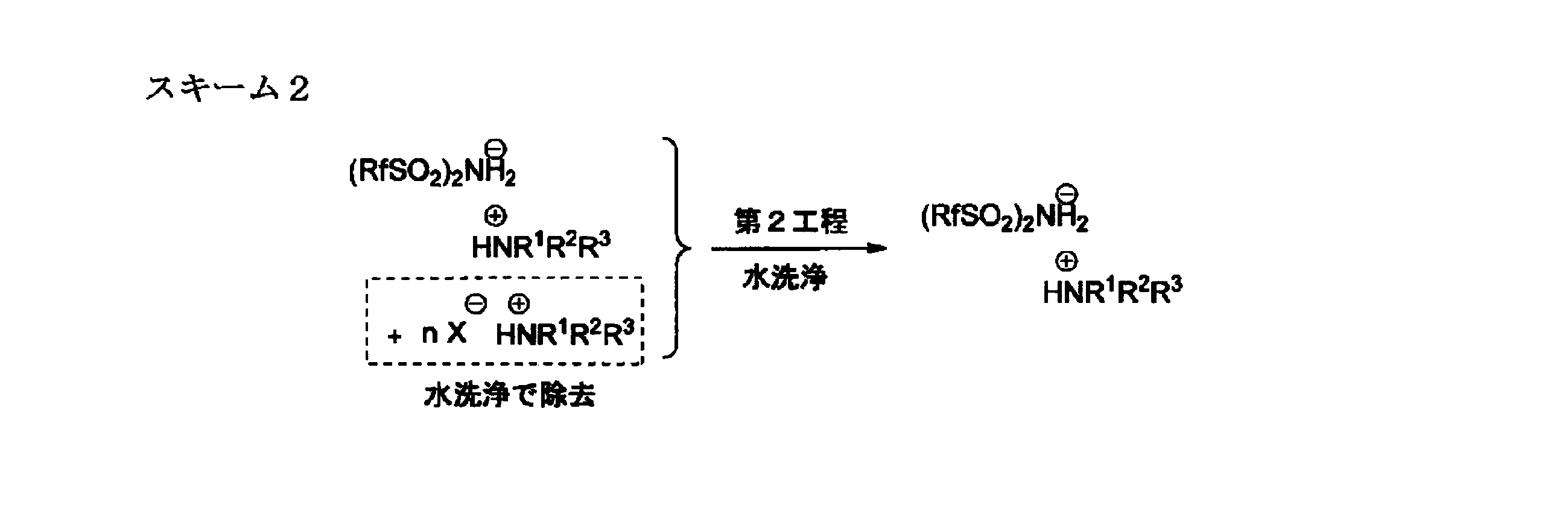
次に第2工程について説明する。第2工程は、第1工程で得られた「パーフルオロアルカンスルホニルイミド酸と有機塩基からなる塩又は錯体」と「有機塩基とハロゲン化水素からなる塩または錯体」とを含む混合物に対し水洗浄及び/又はろ別を行うことにより、該混合物に含まれる「有機塩基とハロゲン化水素からなる塩または錯体」を分離除去し、「パーフルオロアルカンスルホニルイミド酸と有機塩基からなる塩又は錯体」を得る工程である(スキーム2)。
水洗浄及び/又はろ別を実施する実施態様としては、特に制限は無く、有機化学の通常の操作でもって行えば良い。
前記水洗浄で用いられる水の量は特に限定されないが、通常、反応混合物中の「イミド酸と有機塩基からなる塩又は錯体」に対して、50~300質量%程度を用いることが好ましい。また、前記の量の水を数回に分けて洗浄・分離を繰り返すことも好ましい操作の一つである。
前記水洗浄は通常は常温で行うことが好ましいが、温度条件に特に制限はなく、加温してもよい。また、水洗浄に使われる反応容器としては特に制限は無く、ステンレス鋼、モネルTM、ハステロイTM、ニッケル、又はこれらの金属やポリテトラフルオロエチレン、パーフルオロポリエーテル樹脂などのフッ素樹脂でライニングされた反応容器などが挙げられる。
第2工程において、水洗浄した後の分離操作とは、有機混合物と、塩又は錯体を含む水層とを分けられる方法であれば特に限定はない。一般的には簡便な分液やろ過、遠心分離等で行うことが出来る。第1工程から引き続き、非水溶性の有機溶媒を使用した場合、分液後、蒸留等の一般的な有機化学の操作で除去することが好ましいが、そのまま第3工程で使用することも可能である。
[第3工程]
次に、第3工程について説明する。第3工程は、第2工程で得られた「パーフルオロアルカンスルホニルイミド酸と有機塩基からなる塩又は錯体」に対し、以下の[A-1~A-3工程]または[B-1~B-3工程]を経ることで、パーフルオロアルカンスルホニルイミド酸金属塩を得る工程である(スキーム3)。
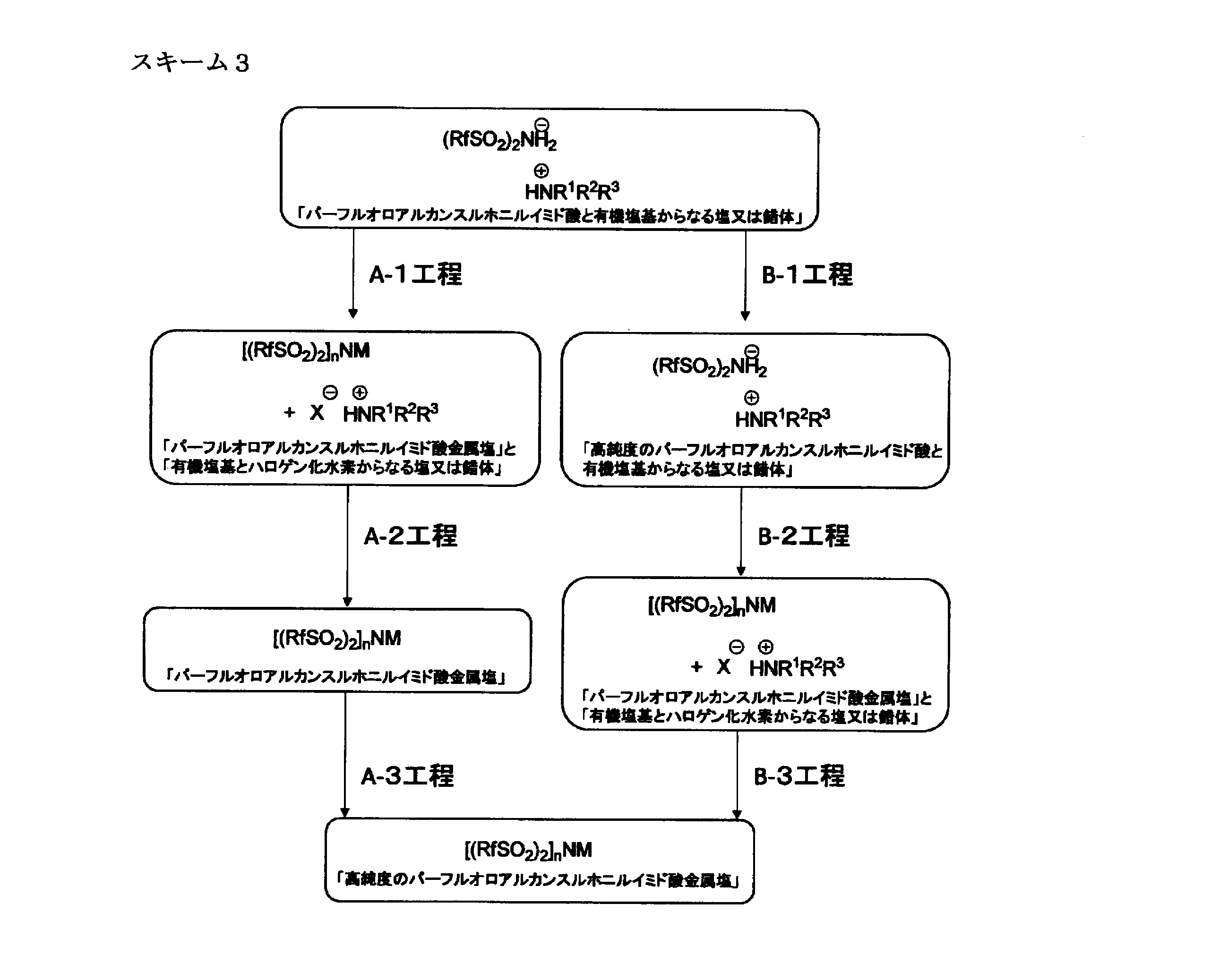
次に、第3工程について説明する。第3工程は、第2工程で得られた「パーフルオロアルカンスルホニルイミド酸と有機塩基からなる塩又は錯体」に対し、以下の[A-1~A-3工程]または[B-1~B-3工程]を経ることで、パーフルオロアルカンスルホニルイミド酸金属塩を得る工程である(スキーム3)。
まず、[A-1~A-3工程]について、順を追って説明する。
[A-1工程]
A-1工程は、第2工程で得られた「パーフルオロアルカンスルホニルイミド酸と有機塩基からなる塩又は錯体」に、溶媒中、アルカリ金属のハロゲン化物もしくは水酸化物、又はアルカリ土類金属のハロゲン化物もしくは水酸化物を反応させ、パーフルオロアルカンスルホニルイミド酸金属塩を含む混合液を得る工程である。
A-1工程は、第2工程で得られた「パーフルオロアルカンスルホニルイミド酸と有機塩基からなる塩又は錯体」に、溶媒中、アルカリ金属のハロゲン化物もしくは水酸化物、又はアルカリ土類金属のハロゲン化物もしくは水酸化物を反応させ、パーフルオロアルカンスルホニルイミド酸金属塩を含む混合液を得る工程である。
アルカリ金属の水酸化物としては、水酸化リチウム(LiOH)、水酸化ナトリウム(NaOH)、水酸化カリウム(KOH)、水酸化ルビジウム(RbOH)、水酸化セシウム(CsOH)が、アルカリ金属のハロゲン化物としては、フッ化リチウム(LiF)、フッ化ナトリウム(NaF)、フッ化カリウム(KF)、フッ化ルビジウム(RbF)、フッ化セシウム(CsF)、塩化リチウム(LiCl)、塩化ナトリウム(NaCl)、塩化カリウム(KCl)、塩化ルビジウム(RbCl)、塩化セシウム(CsCl)、臭化リチウム(LiBr)、臭化ナトリウム(NaBr)、臭化カリウム(KBr)、臭化ルビジウム(RbBr)、臭化セシウム(CsBr)、ヨウ化リチウム(LiI)、ヨウ化ナトリウム(NaI)、ヨウ化カリウム(KI)、ヨウ化ルビジウム(RbI)、ヨウ化セシウム(CsI)が、アルカリ土類金属の水酸化物としては、水酸化マグネシウム(Mg(OH)2)、水酸化カルシウム(Ca(OH)2)、水酸化バリウム(Ba(OH)2)、水酸化ストロンチウム(Sr(OH)2)がアルカリ土類金属のハロゲン化物としては、フッ化マグネシウム(MgF2)、フッ化カルシウム(CaF2)、フッ化バリウム(BaF2)、フッ化ストロンチウム(SrF2)、塩化マグネシウム(MgCl2)、塩化カルシウム(CaCl2)、塩化バリウム(BaCl2)、塩化ストロンチウム(SrCl2)、臭化マグネシウム(MgBr2)、臭化カルシウム(CaBr2)、臭化バリウム(BaBr2)、臭化ストロンチウム(SrBr2)、ヨウ化マグネシウム(MgI2)、ヨウ化カルシウム(CaI2)、ヨウ化バリウム(BaI2)、ヨウ化ストロンチウム(SrI2)が挙げられ、好ましくは水酸化リチウム(LiOH)、水酸化ナトリウム(NaOH)、水酸化カリウム(KOH)、水酸化ルビジウム(RbOH)、水酸化セシウム(CsOH)、塩化リチウム(LiCl)、塩化ナトリウム(NaCl)、塩化カリウム(KCl)、塩化ルビジウム(RbCl)、塩化セシウム(CsCl)、水酸化マグネシウム(Mg(OH)2)、水酸化カルシウム(Ca(OH)2)、水酸化バリウム(Ba(OH)2)、水酸化ストロンチウム(Sr(OH)2)、塩化マグネシウム(MgCl2)、塩化カルシウム(CaCl2)、塩化バリウム(BaCl2)、塩化ストロンチウム(SrCl2)が挙げられる。
これらのうち、アルカリ金属もしくはアルカリ土類金属のハロゲン化物、またはアルカリ金属もしくはアルカリ土類金属の水酸化物が好ましく、アルカリ金属のハロゲン化物としては、フッ化リチウム(LiF)、フッ化ナトリウム(NaF)、フッ化カリウム(KF)、塩化リチウム(LiCl)、塩化ナトリウム(NaCl)または塩化カリウム(KCl)が、アルカリ土類金属のハロゲン化物としては、フッ化マグネシウム(MgF2)、フッ化カルシウム(CaF2)、フッ化バリウム(BaF2)、フッ化ストロンチウム(SrF2)、塩化マグネシウム(MgCl2)または塩化カルシウム(CaCl2)が、アルカリ金属の水酸化物としては、水酸化リチウム(LiOH)、水酸化ナトリウム(NaOH)または水酸化カリウム(KOH)が、アルカリ土類金属の水酸化物としては、水酸化マグネシウム(Mg(OH)2)または水酸化カルシウム(Ca(OH)2)が、安価かつ入手の容易性の点で好ましく用いられる。
また、これらの化合物は1種または2種以上を組み合わせて用いることもできる。2種以上を用いる場合、同一のアルカリ金属の水酸化物とハロゲン化物(例えば、水酸化カリウムと塩化カリウム)の組み合わせ、又は同一のアルカリ土類金属の水酸化物とハロゲン化物(例えば、水酸化マグネシウムと塩化マグネシウム)の組み合わせを用いることは、好ましい態様の一つである。なお、これらの化合物について、種類によって水和物の形になっている場合があるが、水和物の形態であっても本工程では好適に利用することができる。
アルカリ金属もしくはアルカリ土類金属のハロゲン化物、またはアルカリ金属もしくはアルカリ土類金属の水酸化物の使用量は、「イミド酸と有機塩基からなる塩又は錯体」1モルあたり1~5モルが好ましく、より好ましくは1~3モルである。5モルを超える量、すなわち過剰量の該ハロゲン化物または該水酸化物を反応させた場合、反応は進行するが、「イミド酸と有機塩基からなる塩又は錯体」が分解してしまい、収率が低下してしまうことがある為、過剰量の該ハロゲン化物または該水酸化物を用いることは好ましくない。また、1モルよりも少ないと、変換率が低下することからも、好ましくない。
本工程は、有機溶媒又は水を溶媒として用いて反応させることができる。有機溶媒としては、脂肪族炭化水素類、芳香族炭化水素類、エーテル類、カーボネート類、エステル類、アミド類、ニトリル類またはスルホキシド類等が挙げられる。これらの中でもエーテル類、エステル類、アミド類、ニトリル類またはスルホキシド類が好ましく、ニトリル類がより好ましい。
有機溶媒の具体的な例としては、n-ヘキサン、シクロヘキサン、n-ヘプタン、ベンゼン、トルエン、キシレン、メシチレン、塩化メチレン、クロロホルム、1,2-ジクロロエタン、ジエチルエーテル、テトラヒドロフラン、tert-ブチルメチルエーテル、ジメチルカーボネート、エチルメチルカーボネート、ジエチルカーボネート、エチレンカーボネート、プロピレンカーボネート、酢酸エチル、酢酸ブチル、N,N-ジメチルホルムアミド、N,N-ジメチルアセトアミド、N-メチルピロリドン、アセトニトリル、プロピオニトリル、ブチロニトリル、イソブチロニトリル、バレロニトリルまたはジメチルスルホキシド等が挙げられる。その中でも酢酸エチル、酢酸ブチル、N,N-ジメチルホルムアミド、N,N-ジメチルアセトアミド、N-メチルピロリドン、アセトニトリル、プロピオニトリルまたはジメチルスルホキシドが好ましく、アセトニトリルまたはプロピオニトリルがより好ましい。これらの反応溶媒は単独又は組み合わせて使用することができる。
反応温度に特別に制限はないが、通常-10℃~+110℃、好ましくは+25~+80℃である。-10℃未満であると反応が充分に進行せず、収率低下の原因となり、経済的に不利となる、あるいは、反応速度が低下して反応終了までに長時間を要するなどの問題を生ずる場合がある。一方、+110℃を超えると、副生物が生じやすく、また過剰な加熱はエネルギー効率が悪い。
反応時間としては、特に制限はないが、通常は24時間以内の範囲で行えばよく、イオンクロマトグラフィー、NMR等の分析手段により反応の進行状況を追跡し、原料基質が殆ど消失した時点を終点とするのが好ましい。
本工程に用いられる反応器は、ステンレス鋼、ハステロイTM、モネルTMなどの金属製容器や、四フッ化エチレン樹脂、クロロトリフルオロエチレン樹脂、フッ化ビニリデン樹脂、PFA樹脂、ポリプロピレン樹脂、ポリエチレン樹脂、そしてガラスなどを内部にライニングしたもの等、常圧又は加圧下で十分反応を行うことができる反応器を使用することができる。
なお、本工程でアルカリ金属のハロゲン化物もしくは水酸化物、又はアルカリ土類金属のハロゲン化物を用いた場合、パーフルオロアルカンスルホニルイミド酸金属塩を含む混合液中に「有機塩基とハロゲン化水素からなる塩または錯体」が固体として生成する為、該混合液に対しろ別操作を行うことで「有機塩基とハロゲン化水素からなる塩または錯体」を分離除去することが好ましい。この場合、本工程における反応直後に行っても良く、続く[A-2工程]で溶媒を留去する直前に行っても良い。なお、ろ別操作を実施する実施態様としては、特に制限は無く、有機化学の通常の操作でもって行えば良い。
[A-2工程]
A-2工程は、A-1工程で得られたパーフルオロアルカンスルホニルイミド酸金属塩と、「有機塩基とハロゲン化水素からなる塩または錯体」とを含む混合液に対し、溶媒を留去することによりパーフルオロアルカンスルホニルイミド酸金属塩を得る工程である。
A-2工程は、A-1工程で得られたパーフルオロアルカンスルホニルイミド酸金属塩と、「有機塩基とハロゲン化水素からなる塩または錯体」とを含む混合液に対し、溶媒を留去することによりパーフルオロアルカンスルホニルイミド酸金属塩を得る工程である。
溶媒留去の実施態様は特に制限は無く、有機化学の通常の操作でもって行えば良い。
[A-3工程]
A-3工程は、A-2工程で得られたパーフルオロアルカンスルホニルイミド酸金属塩に、溶媒を用いて再結晶操作を行い、高純度のパーフルオロアルカンスルホニルイミド酸金属塩を得る工程である。
A-3工程は、A-2工程で得られたパーフルオロアルカンスルホニルイミド酸金属塩に、溶媒を用いて再結晶操作を行い、高純度のパーフルオロアルカンスルホニルイミド酸金属塩を得る工程である。
再結晶に用いる溶媒としては、有機溶媒又は水が挙げられる。有機溶媒としては、例えばエーテル類、アルコール類、カーボネート類、脂肪族炭化水素類、ケトン類、ハロゲン化炭化水素類、芳香族炭化水素類等が挙げられる。
これらの有機溶媒の具体的な化合物は、ジエチルエーテル、テトラヒドロフラン、ジオキサン、ブチルメチルエーテル、ジイソプロピルエーテル、メチル-tert-ブチルエーテルエチレングリコールジメチルエーテル、メタノール、エタノール、n-プロピルアルコール、iso-プロピルアルコール、n-ブチルアルコール、iso-ブチルアルコール、sec-ブチルアルコール、tert-ブチルアルコール、ジメチルカーボネート、エチルメチルカーボネート、ジエチルカーボネート、エチレンカーボネート、プロピレンカーボネート、n-ペンタン、n-ヘキサン、n-ヘプタン、n-オクタン、アセトン、メチルエチルケトン、メチルイソブチルケトン、ジクロロメタン、クロロホルム、ベンゼン、トルエン、キシレン等である。これらの有機溶媒はそれぞれ単独で用いてもよく、複数の有機溶媒を組み合わせてもよい。
再結晶によって、パーフルオロアルカンスルホニルイミド酸金属塩が析出する。これを単離するには、通常の有機化学の操作で行えばよく、「ろ過操作」(なお、ここで言う「ろ過操作」とは、再結晶工程におけるろ過操作を示す。以下、同じ。)を施すことで、さらに高純度のパーフルオロアルカンスルホニルイミド酸金属塩を得ることが出来る。
また、ろ過操作により得られたろ液には、パーフルオロアルカンスルホニルイミド酸金属塩が一部溶解していることから、本発明者らは、得られたろ液を回収し、再結晶における溶媒として再利用が可能である知見を得た(後述の表1参照)。再利用することにより、パーフルオロアルカンスルホニルイミド酸金属塩の収率をさらに向上させること、また、後述の比較例と比べても廃有機溶媒の廃液が大幅に削減できることから、格段に生産性が向上することとなった。
次に、[B-1~B-3工程]について、順を追って説明する。
[B-1工程]
B-1工程は、第2工程で得られた「パーフルオロアルカンスルホニルイミド酸と有機塩基からなる塩又は錯体」に、溶媒を用いて再結晶操作を行い、高純度の「パーフルオロアルカンスルホニルイミド酸と有機塩基からなる塩又は錯体」を得る工程である。
B-1工程は、第2工程で得られた「パーフルオロアルカンスルホニルイミド酸と有機塩基からなる塩又は錯体」に、溶媒を用いて再結晶操作を行い、高純度の「パーフルオロアルカンスルホニルイミド酸と有機塩基からなる塩又は錯体」を得る工程である。
再結晶に用いる溶媒としては、有機溶媒又は水が挙げられる。なお、有機溶媒についての具体的な種類、再結晶操作の条件、及び後処理等の実施態様については、前述したA-3工程とそれと同様であり、該工程に記載の条件がB-1工程にそのまま適用できる。
再結晶によって、「パーフルオロアルカンスルホニルイミド酸と有機塩基からなる塩又は錯体」が析出する。これを単離するには、通常の有機化学の操作で行えばよく、ろ過操作を施すことで、前述の第2工程と比べてもさらに高純度の「パーフルオロアルカンスルホニルイミド酸と有機塩基からなる塩又は錯体」を得ることが出来る。
また、ろ過操作により得られたろ液には、「パーフルオロアルカンスルホニルイミド酸と有機塩基からなる塩又は錯体」が一部溶解していることから、本発明者らは、得られたろ液を回収し、再結晶における溶媒として再利用が可能である知見を得た(後述の表1参照)。再利用することにより、「パーフルオロアルカンスルホニルイミド酸と有機塩基からなる塩又は錯体」の収率をさらに向上させること、また、後述の比較例と比べても廃有機溶媒の廃液が大幅に削減できることから、格段と生産性が向上することとなった。
[B-2工程]
B-2工程は、B-1工程で得られた高純度の「パーフルオロアルカンスルホニルイミド酸と有機塩基からなる塩又は錯体」に、溶媒中、アルカリ金属もしくはアルカリ土類金属のハロゲン化物、またはアルカリ金属もしくはアルカリ土類金属の水酸化物を反応させ、パーフルオロアルカンスルホニルイミド酸金属塩を含む混合液を得る工程である。
B-2工程は、B-1工程で得られた高純度の「パーフルオロアルカンスルホニルイミド酸と有機塩基からなる塩又は錯体」に、溶媒中、アルカリ金属もしくはアルカリ土類金属のハロゲン化物、またはアルカリ金属もしくはアルカリ土類金属の水酸化物を反応させ、パーフルオロアルカンスルホニルイミド酸金属塩を含む混合液を得る工程である。
B-2工程は、出発原料を除き、用いる反応試剤、反応条件、実施態様は、前述したA-1工程と同様であり、A-1工程に記載の条件がB-2工程でそのまま適用できる。本工程でアルカリ金属もしくはアルカリ土類金属のハロゲン化物を用いた場合もA-1工程と同様であり、パーフルオロアルカンスルホニルイミド酸金属塩を含む混合液中に「有機塩基とハロゲン化水素からなる塩または錯体」が生成する為、該混合液に対しろ別操作を行うことにより「有機塩基とハロゲン化水素からなる塩または錯体」を該混合液から分離除去することができる。
[B-3工程]
B-3工程は、B-2工程で得られたパーフルオロアルカンスルホニルイミド酸金属塩を含む混合液に対し、溶媒を留去することによりパーフルオロアルカンスルホニルイミド酸金属塩を得る工程である。
B-3工程は、B-2工程で得られたパーフルオロアルカンスルホニルイミド酸金属塩を含む混合液に対し、溶媒を留去することによりパーフルオロアルカンスルホニルイミド酸金属塩を得る工程である。
溶媒留去の実施態様としては、特に制限は無く、有機化学の通常の操作でもって行えば良い。
次に本発明を実施例に基づき詳細に説明する。なお、本発明はかかる実施例に限定されるものではない。ここで、生成物の定量については、反応混合物を核磁気共鳴分析装置(NMR)によって測定して得られた組成の「モル%」を基に算出した。
<実施例1>
[第1工程]
500mlオートクレーブにアセトニトリルを120g、トリエチルアミンを120g(1.19mоl)仕込み、氷水で5℃に冷却し、トリフルオロメタンスルホニルフルオリドを122g(0.80mоl)導入した。トリフルオロメタンスルホニルフルオリドを導入した後、続いて、無水アンモニア6.5g(0.38mоl)を内温0℃~5℃を保ちながら1時間掛けて導入した。無水アンモニアの導入が終了したら反応器を室温まで昇温させ、14時間攪拌した。14時間後、反応液を19F-NMRで定量した結果、出発原料のアンモニアに対するビストリフルオロメタンスルホニルイミドトリエチルアンモニウム塩の収率は92%(0.35mol)、純度は95.7%であった。
[第2工程]
上記反応工程で得られた反応液の溶媒を留去後、残渣を水洗浄し、ビストリフルオロメタンスルホニルイミドトリエチルアンモニウム塩の粗体を136g得た(ここで廃有機溶媒が132g、廃水が520g副生)。この粗体を19F-NMRにより定量を行ったところ出発原料のアンモニアに対する収率は87%(0.33mol)であった。
[第3工程]
上記第2工程で得られた粗体136gを500ml四つ口フラスコに入れ、水を100g加えた。水酸化リチウム一水和物17g(0.40mol)を加えて、60℃に加熱し濃縮することでビストリフルオロメタンスルホニルイミドリチウムを98gの粗体として得た(ここで廃水153gが副生)。次に、500ml四つ口フラスコに粗体98gを入れ、メチル-tert-ブチルエーテル100gに溶解後、クロロホルム1000gを滴下することで白色結晶を析出させた。結晶をろ過し乾燥後、純度97.8%のビストリフルオロメタンスルホニルイミドリチウムを76g、収率69%(0.26mоl)で得た(濾液が1114g副生)。
[第1工程]
500mlオートクレーブにアセトニトリルを120g、トリエチルアミンを120g(1.19mоl)仕込み、氷水で5℃に冷却し、トリフルオロメタンスルホニルフルオリドを122g(0.80mоl)導入した。トリフルオロメタンスルホニルフルオリドを導入した後、続いて、無水アンモニア6.5g(0.38mоl)を内温0℃~5℃を保ちながら1時間掛けて導入した。無水アンモニアの導入が終了したら反応器を室温まで昇温させ、14時間攪拌した。14時間後、反応液を19F-NMRで定量した結果、出発原料のアンモニアに対するビストリフルオロメタンスルホニルイミドトリエチルアンモニウム塩の収率は92%(0.35mol)、純度は95.7%であった。
[第2工程]
上記反応工程で得られた反応液の溶媒を留去後、残渣を水洗浄し、ビストリフルオロメタンスルホニルイミドトリエチルアンモニウム塩の粗体を136g得た(ここで廃有機溶媒が132g、廃水が520g副生)。この粗体を19F-NMRにより定量を行ったところ出発原料のアンモニアに対する収率は87%(0.33mol)であった。
[第3工程]
上記第2工程で得られた粗体136gを500ml四つ口フラスコに入れ、水を100g加えた。水酸化リチウム一水和物17g(0.40mol)を加えて、60℃に加熱し濃縮することでビストリフルオロメタンスルホニルイミドリチウムを98gの粗体として得た(ここで廃水153gが副生)。次に、500ml四つ口フラスコに粗体98gを入れ、メチル-tert-ブチルエーテル100gに溶解後、クロロホルム1000gを滴下することで白色結晶を析出させた。結晶をろ過し乾燥後、純度97.8%のビストリフルオロメタンスルホニルイミドリチウムを76g、収率69%(0.26mоl)で得た(濾液が1114g副生)。
<実施例2>
[第1工程]
500mlオートクレーブにアセトニトリルを120g、トリ-n-ブチルアミンを222g(1.20mоl)仕込み、氷水で5℃に冷却し、トリフルオロメタンスルホニルフルオリドを122g(0.80mоl)導入した。トリフルオロメタンスルホニルフルオリドを導入した後、続いて、無水アンモニア6.5g(0.38mоl)を内温0℃~5℃を保ちながら1時間掛けて導入した。無水アンモニアの導入が終了したら反応器を室温まで昇温させ、13時間攪拌した。13時間後、反応液を19F-NMRで定量した結果、出発原料のアンモニアに対するビストリフルオロメタンスルホニルイミドトリ-n-ブチルアンモニウム塩の収率は90%(0.34mol)、純度96%であった。
[第2工程]
上記第1工程で得られた反応液の溶媒を留去後、残渣を水洗浄し得られた白色結晶を桐山ロートを用いて減圧濾過することで、ビストリフルオロメタンスルホニルイミドトリ-n-ブチルアンモニウム塩の粗体を134g得た(ここで廃有機溶媒が144g、廃水が243g副生)。この粗体を19F-NMRにより定量を行ったところ出発原料のアンモニアに対する収率は88%(0.33mol)であった。
[第3工程]
次に、この粗体134gを500ml四つ口フラスコに入れ、炭酸ジメチルを100g加えた。50℃に加熱し結晶を完全に溶解した後、5℃以下に冷却し結晶を析出させた。析出した結晶を、桐山ロートを用いて減圧濾過し、ビストリフルオロメタンスルホニルイミドトリ-n-ブチルアンモニウム塩を124g得た(ここで濾液が117g副生)。この粗体を19F-NMRにより定量を行ったところ出発原料のアンモニアに対する収率は67%(0.26mol)、純度99%以上であった。さらに、500ml四つ口フラスコに第2工程で得られたビストリフルオロメタンスルホニルイミドトリ-n-ブチルアンモニウム塩70g(0.15mol)と炭酸ジメチル150g、塩化リチウム7.6g(0.18mol)を加えて15時間、室温で攪拌した。反応混合物をろ過し、得られた濾液を濃縮、乾燥を行った(ここで廃有機溶媒が150g副生)。乾燥後、純度99%以上のビストリフルオロメタンスルホニルイミドリチウムを41g、収率64%(0.14mоl)で得た。
[第1工程]
500mlオートクレーブにアセトニトリルを120g、トリ-n-ブチルアミンを222g(1.20mоl)仕込み、氷水で5℃に冷却し、トリフルオロメタンスルホニルフルオリドを122g(0.80mоl)導入した。トリフルオロメタンスルホニルフルオリドを導入した後、続いて、無水アンモニア6.5g(0.38mоl)を内温0℃~5℃を保ちながら1時間掛けて導入した。無水アンモニアの導入が終了したら反応器を室温まで昇温させ、13時間攪拌した。13時間後、反応液を19F-NMRで定量した結果、出発原料のアンモニアに対するビストリフルオロメタンスルホニルイミドトリ-n-ブチルアンモニウム塩の収率は90%(0.34mol)、純度96%であった。
[第2工程]
上記第1工程で得られた反応液の溶媒を留去後、残渣を水洗浄し得られた白色結晶を桐山ロートを用いて減圧濾過することで、ビストリフルオロメタンスルホニルイミドトリ-n-ブチルアンモニウム塩の粗体を134g得た(ここで廃有機溶媒が144g、廃水が243g副生)。この粗体を19F-NMRにより定量を行ったところ出発原料のアンモニアに対する収率は88%(0.33mol)であった。
[第3工程]
次に、この粗体134gを500ml四つ口フラスコに入れ、炭酸ジメチルを100g加えた。50℃に加熱し結晶を完全に溶解した後、5℃以下に冷却し結晶を析出させた。析出した結晶を、桐山ロートを用いて減圧濾過し、ビストリフルオロメタンスルホニルイミドトリ-n-ブチルアンモニウム塩を124g得た(ここで濾液が117g副生)。この粗体を19F-NMRにより定量を行ったところ出発原料のアンモニアに対する収率は67%(0.26mol)、純度99%以上であった。さらに、500ml四つ口フラスコに第2工程で得られたビストリフルオロメタンスルホニルイミドトリ-n-ブチルアンモニウム塩70g(0.15mol)と炭酸ジメチル150g、塩化リチウム7.6g(0.18mol)を加えて15時間、室温で攪拌した。反応混合物をろ過し、得られた濾液を濃縮、乾燥を行った(ここで廃有機溶媒が150g副生)。乾燥後、純度99%以上のビストリフルオロメタンスルホニルイミドリチウムを41g、収率64%(0.14mоl)で得た。
<比較例1>
[第1工程]
500mlオートクレーブにアセトニトリルを120g、トリエチルアミンを120g(1.19mоl)仕込み、氷水で5℃に冷却し、トリフルオロメタンスルホニルフルオリドを122g(0.80mоl)導入した。トリフルオロメタンスルホニルフルオリドを導入した後、続いて、無水アンモニア6.5g(0.38mоl)を内温0℃~5℃を保ちながら1時間掛けて導入した。無水アンモニアの導入が終了したら反応器を室温まで昇温させ、14時間攪拌した。14時間後、反応液を19F-NMRで定量した結果、出発原料のアンモニアに対するビストリフルオロメタンスルホニルイミドトリエチルアンモニウム塩の収率は91.0%(0.346mol)、純度は95.7%であった。
[精製工程]
上記第1工程で得られた反応液の溶媒を留去後、残渣に48%水酸化カリウム水溶液330g、水250g加え、エバポレーターにて反応系内のトリエチルアミンを減圧留去した(ここで廃有機溶媒157g副生)。析出した結晶を、桐山ロートを用いて減圧濾過し、20%水酸化カリウム水溶液600gで洗浄することでビストリフルオロメタンスルホニルイミドカリウムの粗体を109g(0.33mol)得た(ここで廃水が1168g副生)。次に、4つ口フラスコにビストリフルオロメタンスルホニルイミドカリウムの粗体109g(0.33mol)と濃硫酸200gを入れ、内温60℃で1時間攪拌した。攪拌後、減圧下フラッシュ蒸留を行ないビストリフルオロメタンスルホニルイミド酸を84g(0.30mol)得た(釜残として廃酸225g副生)。
[カチオン交換工程]
次に、500ml四つ口フラスコに上記精製工程で得られたビストリフルオロメタンスルホニルイミド酸84g(0.30mol)と水36g、炭酸リチウム24g(0.33mol)を加え、内温60℃にて1時間攪拌した。過剰の炭酸リチウムをろ過し、得られた濾液を濃縮、乾燥を行った(ここで廃水が41g副生)。乾燥後、純度99%以上のビストリフルオロメタンスルホニルイミドリチウムを82g、収率76%(0.29mol)で得た。
[第1工程]
500mlオートクレーブにアセトニトリルを120g、トリエチルアミンを120g(1.19mоl)仕込み、氷水で5℃に冷却し、トリフルオロメタンスルホニルフルオリドを122g(0.80mоl)導入した。トリフルオロメタンスルホニルフルオリドを導入した後、続いて、無水アンモニア6.5g(0.38mоl)を内温0℃~5℃を保ちながら1時間掛けて導入した。無水アンモニアの導入が終了したら反応器を室温まで昇温させ、14時間攪拌した。14時間後、反応液を19F-NMRで定量した結果、出発原料のアンモニアに対するビストリフルオロメタンスルホニルイミドトリエチルアンモニウム塩の収率は91.0%(0.346mol)、純度は95.7%であった。
[精製工程]
上記第1工程で得られた反応液の溶媒を留去後、残渣に48%水酸化カリウム水溶液330g、水250g加え、エバポレーターにて反応系内のトリエチルアミンを減圧留去した(ここで廃有機溶媒157g副生)。析出した結晶を、桐山ロートを用いて減圧濾過し、20%水酸化カリウム水溶液600gで洗浄することでビストリフルオロメタンスルホニルイミドカリウムの粗体を109g(0.33mol)得た(ここで廃水が1168g副生)。次に、4つ口フラスコにビストリフルオロメタンスルホニルイミドカリウムの粗体109g(0.33mol)と濃硫酸200gを入れ、内温60℃で1時間攪拌した。攪拌後、減圧下フラッシュ蒸留を行ないビストリフルオロメタンスルホニルイミド酸を84g(0.30mol)得た(釜残として廃酸225g副生)。
[カチオン交換工程]
次に、500ml四つ口フラスコに上記精製工程で得られたビストリフルオロメタンスルホニルイミド酸84g(0.30mol)と水36g、炭酸リチウム24g(0.33mol)を加え、内温60℃にて1時間攪拌した。過剰の炭酸リチウムをろ過し、得られた濾液を濃縮、乾燥を行った(ここで廃水が41g副生)。乾燥後、純度99%以上のビストリフルオロメタンスルホニルイミドリチウムを82g、収率76%(0.29mol)で得た。
ここで、実施例1、2及び比較例1の廃液量の比較を表1として以下にまとめる。
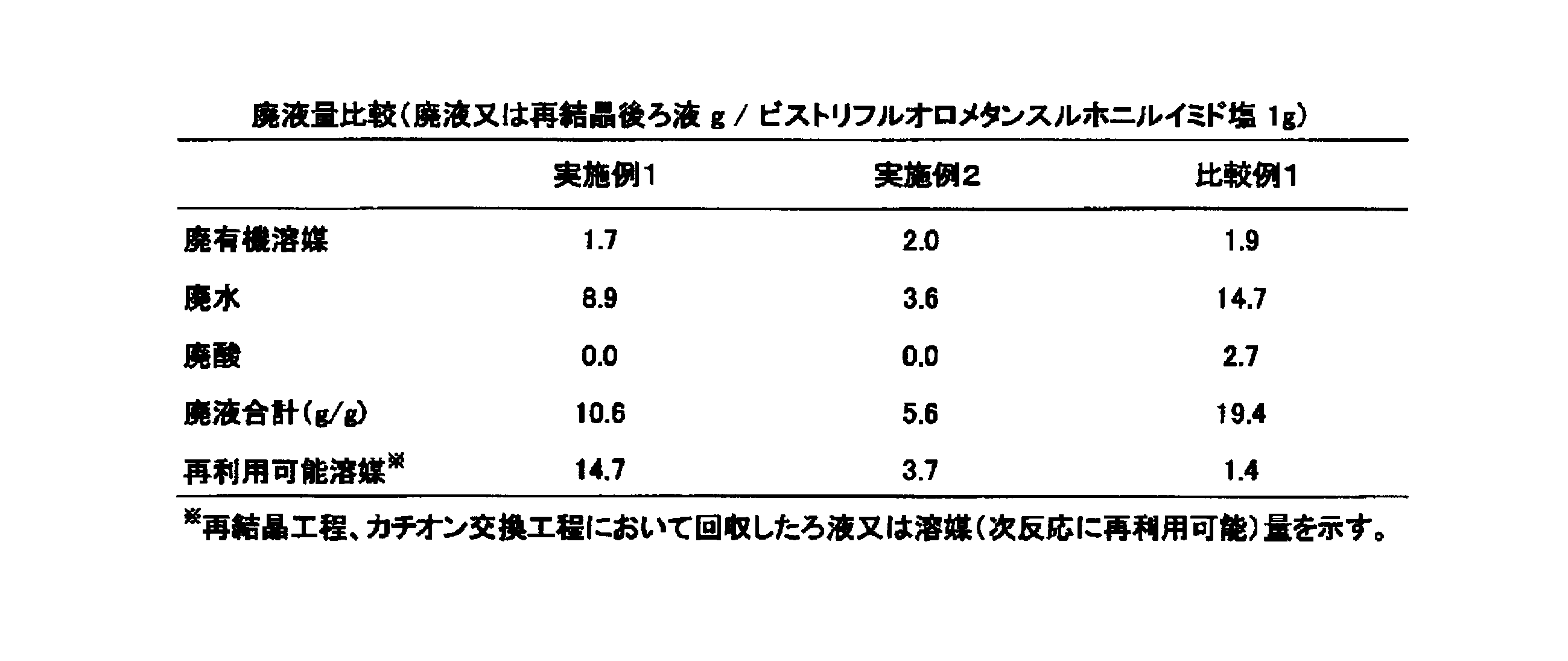
表1に示すように、実施例1、2は比較例1と比べて廃液を格段に削減できることがわかる。
<実施例3>
[第1工程~第2工程]
実施例1と同様の方法によりビストリフルオロメタンスルホニルイミドトリエチルアンモニウム塩の粗体を120gが得られた。この粗体を19F-NMRにより定量を行ったところ出発原料のアンモニアに対する収率は76%(0.29mol)であった。
[第3工程]
上記第2工程で得られた粗体120gを500ml四つ口フラスコに入れ、水を100g加えた。水酸化カルシウム13g(0.17mol)を加えて、60℃に加熱し濃縮することでビストリフルオロメタンスルホニルイミドカルシウム105gを粗体として得た。次に、500ml四つ口フラスコに粗体105gを入れ、メチル-t-ブチルエーテル100gに溶解後、クロロホルム1000gを滴下することで白色結晶を析出させた。結晶をろ過し乾燥後、純度99.2%のビストリフルオロメタンスルホニルイミドカルシウムを74g(0.25mol)、収率65%で得た。
[第1工程~第2工程]
実施例1と同様の方法によりビストリフルオロメタンスルホニルイミドトリエチルアンモニウム塩の粗体を120gが得られた。この粗体を19F-NMRにより定量を行ったところ出発原料のアンモニアに対する収率は76%(0.29mol)であった。
[第3工程]
上記第2工程で得られた粗体120gを500ml四つ口フラスコに入れ、水を100g加えた。水酸化カルシウム13g(0.17mol)を加えて、60℃に加熱し濃縮することでビストリフルオロメタンスルホニルイミドカルシウム105gを粗体として得た。次に、500ml四つ口フラスコに粗体105gを入れ、メチル-t-ブチルエーテル100gに溶解後、クロロホルム1000gを滴下することで白色結晶を析出させた。結晶をろ過し乾燥後、純度99.2%のビストリフルオロメタンスルホニルイミドカルシウムを74g(0.25mol)、収率65%で得た。
<実施例4>
[第1工程~第2工程]
実施例1と同様の方法によりビストリフルオロメタンスルホニルイミドトリエチルアンモニウム塩の粗体を125gが得られた。この粗体を19F-NMRにより定量を行ったところ出発原料のアンモニアに対する収率は84%(0.32mol)であった。
[第3工程]
次に、この粗体125gを500ml四つ口フラスコに入れ、水を100g加えた後、5℃以下に冷却し結晶を析出させた。析出した結晶を、桐山ロートを用いて減圧濾過し、ビストリフルオロメタンスルホニルイミドトリエチルアンモニウム塩を115g得た。この粗体を19F-NMRにより定量を行ったところ出発原料のアンモニアに対する収率は80%(0.30mol)、純度99%以上であった。さらに、500ml四つ口フラスコに第2工程で得られたビストリフルオロメタンスルホニルイミドトリエチルアンモニウム塩115g(0.30mol)とメチル-t-ブチルエーテル250g、塩化リチウム14.0g(0.33mol)を加えて15時間、室温で攪拌した。反応混合物をろ過し、得られた濾液を濃縮、乾燥を行った。乾燥後、純度99%以上のビストリフルオロメタンスルホニルイミドリチウムを78g、収率71%(0.27mоl)で得た。
[第1工程~第2工程]
実施例1と同様の方法によりビストリフルオロメタンスルホニルイミドトリエチルアンモニウム塩の粗体を125gが得られた。この粗体を19F-NMRにより定量を行ったところ出発原料のアンモニアに対する収率は84%(0.32mol)であった。
[第3工程]
次に、この粗体125gを500ml四つ口フラスコに入れ、水を100g加えた後、5℃以下に冷却し結晶を析出させた。析出した結晶を、桐山ロートを用いて減圧濾過し、ビストリフルオロメタンスルホニルイミドトリエチルアンモニウム塩を115g得た。この粗体を19F-NMRにより定量を行ったところ出発原料のアンモニアに対する収率は80%(0.30mol)、純度99%以上であった。さらに、500ml四つ口フラスコに第2工程で得られたビストリフルオロメタンスルホニルイミドトリエチルアンモニウム塩115g(0.30mol)とメチル-t-ブチルエーテル250g、塩化リチウム14.0g(0.33mol)を加えて15時間、室温で攪拌した。反応混合物をろ過し、得られた濾液を濃縮、乾燥を行った。乾燥後、純度99%以上のビストリフルオロメタンスルホニルイミドリチウムを78g、収率71%(0.27mоl)で得た。
実施例3、4でも、実施例1、2と同様に、廃液を削減しつつ、効率的にパーフルオロアルカンスルホニルイミド酸金属塩を製造できた。
本発明で対象とするパーフルオロアルカンスルホニルイミド酸金属塩は、医農薬の中間体、電池電解質、そして酸触媒として利用できる。
Claims (7)
- 以下の工程を含むことを特徴とする、式[1]で表されるパーフルオロアルカンスルホニルイミド酸金属塩の製造方法。

[第1工程]
式[2]で表されるパーフルオロアルカンスルホニルハライドに、有機塩基と、アンモニアまたはハロゲン化アンモニウムとを反応させることにより、「パーフルオロアルカンスルホニルイミド酸と有機塩基からなる塩又は錯体」と、「有機塩基とハロゲン化水素からなる塩または錯体」とを含む混合物を得る工程。

[第2工程]
第1工程で得られた混合物に対し水洗浄及び/又はろ別を行うことにより、該混合物に含まれる「有機塩基とハロゲン化水素からなる塩または錯体」を分離除去し、「パーフルオロアルカンスルホニルイミド酸と有機塩基からなる塩又は錯体」を得る工程。
[第3工程]
第2工程で得られた「パーフルオロアルカンスルホニルイミド酸と有機塩基からなる塩又は錯体」に対し、以下の[A-1~A-3工程]または[B-1~B-3工程]を経ることで、パーフルオロアルカンスルホニルイミド酸金属塩を得る工程。
[A-1工程]
第2工程で得られた「パーフルオロアルカンスルホニルイミド酸と有機塩基からなる塩又は錯体」に、溶媒中、アルカリ金属もしくはアルカリ土類金属のハロゲン化物、またはアルカリ金属もしくはアルカリ土類金属の水酸化物を反応させ、式[1]で表されるパーフルオロアルカンスルホニルイミド酸金属塩を含む混合液を得る工程。
[A-2工程]
A-1工程で得られた混合液に対し、溶媒を留去することによりパーフルオロアルカンスルホニルイミド酸金属塩を得る工程。
[A-3工程]
A-2工程で得られたパーフルオロアルカンスルホニルイミド酸金属塩に、溶媒を用いて再結晶操作を行い、高純度のパーフルオロアルカンスルホニルイミド酸金属塩を得る工程。
[B-1工程]
第2工程で得られた「パーフルオロアルカンスルホニルイミド酸と有機塩基からなる塩又は錯体」に、溶媒を用いて再結晶操作を行い、高純度の「パーフルオロアルカンスルホニルイミド酸と有機塩基からなる塩又は錯体」を得る工程。
[B-2工程]
B-1工程で得られた高純度の「パーフルオロアルカンスルホニルイミド酸と有機塩基からなる塩又は錯体」に、溶媒中、アルカリ金属もしくはアルカリ土類金属のハロゲン化物、またはアルカリ金属もしくはアルカリ土類金属の水酸化物を反応させ、式[1]で表されるパーフルオロアルカンスルホニルイミド酸金属塩を含む混合液を得る工程。
[B-3工程]
B-2工程で得られた混合液に対し、溶媒を留去することによりパーフルオロアルカンスルホニルイミド酸金属塩を得る工程。 - 第1工程で用いる有機塩基が、第1級アミン、第2級アミン、第3級アミン、含窒素芳香族複素環式化合物またはイミン系塩基である、請求項1に記載の製造方法。
- 第1工程で溶媒を用いて反応を行い、続く第2工程において、水洗浄及び/又はろ別を行う前に濃縮して溶媒を留去する工程を更に含む、請求項1または2に記載の製造方法。
- 第3工程の[A-1工程]または[B-2工程]において用いるアルカリ金属もしくはアルカリ土類金属のハロゲン化物、またはアルカリ金属もしくはアルカリ土類金属の水酸化物が、フッ化リチウム、フッ化ナトリウム、フッ化カリウム、塩化リチウム、塩化ナトリウム、塩化カリウム、フッ化マグネシウム、フッ化カルシウム、フッ化バリウム、フッ化ストロンチウム、塩化マグネシウム、塩化カルシウム、水酸化リチウム、水酸化ナトリウム、水酸化カリウム、水酸化マグネシウムまたは水酸化カルシウムである、請求項1乃至3の何れかに記載の製造方法。
- 第3工程の[A-1工程]または[B-2工程]において、アルカリ金属のハロゲン化物もしくは水酸化物を反応させる際に用いる溶媒が、エーテル類、エステル類、アミド類またはニトリル類である、請求項1乃至4の何れかに記載の製造方法。
- 第3工程の[A-1工程]または[A-2工程]において、アルカリ金属もしくはアルカリ土類金属のハロゲン化物を用いた反応で生成した「有機塩基とハロゲン化水素からなる塩または錯体」を、ろ別操作で分離除去する工程を更に含む、請求項1乃至5の何れかに記載の製造方法。
- 第3工程の[B-2工程]または[B-3工程]において、アルカリ金属もしくはアルカリ土類金属のハロゲン化物を用いた反応で生成した「有機塩基とハロゲン化水素からなる塩または錯体」を、ろ別操作で分離除去する工程を更に含む、請求項1乃至5の何れかに記載の製造方法。
Applications Claiming Priority (2)
| Application Number | Priority Date | Filing Date | Title |
|---|---|---|---|
| JP2016036551A JP2019069904A (ja) | 2016-02-29 | 2016-02-29 | パーフルオロアルカンスルホニルイミド酸金属塩の製造方法 |
| JP2016-036551 | 2016-02-29 |
Publications (1)
| Publication Number | Publication Date |
|---|---|
| WO2017150244A1 true WO2017150244A1 (ja) | 2017-09-08 |
Family
ID=59743996
Family Applications (1)
| Application Number | Title | Priority Date | Filing Date |
|---|---|---|---|
| PCT/JP2017/006097 Ceased WO2017150244A1 (ja) | 2016-02-29 | 2017-02-20 | パーフルオロアルカンスルホニルイミド酸金属塩の製造方法 |
Country Status (2)
| Country | Link |
|---|---|
| JP (1) | JP2019069904A (ja) |
| WO (1) | WO2017150244A1 (ja) |
Cited By (1)
| Publication number | Priority date | Publication date | Assignee | Title |
|---|---|---|---|---|
| WO2019044286A1 (ja) * | 2017-08-29 | 2019-03-07 | セントラル硝子株式会社 | パーフルオロアルカンスルホニルイミド酸金属塩の製造方法 |
Citations (2)
| Publication number | Priority date | Publication date | Assignee | Title |
|---|---|---|---|---|
| CN101456832A (zh) * | 2008-11-24 | 2009-06-17 | 张家港市华盛化学有限公司 | 双三氟甲磺酰亚胺金属盐的制备方法 |
| JP2013241353A (ja) * | 2012-05-18 | 2013-12-05 | Central Glass Co Ltd | イミド酸化合物の製造方法 |
-
2016
- 2016-02-29 JP JP2016036551A patent/JP2019069904A/ja active Pending
-
2017
- 2017-02-20 WO PCT/JP2017/006097 patent/WO2017150244A1/ja not_active Ceased
Patent Citations (2)
| Publication number | Priority date | Publication date | Assignee | Title |
|---|---|---|---|---|
| CN101456832A (zh) * | 2008-11-24 | 2009-06-17 | 张家港市华盛化学有限公司 | 双三氟甲磺酰亚胺金属盐的制备方法 |
| JP2013241353A (ja) * | 2012-05-18 | 2013-12-05 | Central Glass Co Ltd | イミド酸化合物の製造方法 |
Non-Patent Citations (1)
| Title |
|---|
| CONTE,L. ET AL.: "Perfluoroalkanesulfonylimides and their lithium salts: synthesis and characterisation of intermediates and target compounds", JOURNAL OF FLUORINE CHEMISTRY, vol. 125, no. 2, 2004, pages 243 - 252, XP004486527, ISSN: 0022-1139 * |
Cited By (1)
| Publication number | Priority date | Publication date | Assignee | Title |
|---|---|---|---|---|
| WO2019044286A1 (ja) * | 2017-08-29 | 2019-03-07 | セントラル硝子株式会社 | パーフルオロアルカンスルホニルイミド酸金属塩の製造方法 |
Also Published As
| Publication number | Publication date |
|---|---|
| JP2019069904A (ja) | 2019-05-09 |
Similar Documents
| Publication | Publication Date | Title |
|---|---|---|
| WO2017169874A1 (ja) | ビス(ハロゲン化スルホニル)イミド酸金属塩の製造方法 | |
| EP2660196B1 (en) | Manufacturing method for fluorosulfonylimide ammonium salt | |
| JP5630048B2 (ja) | イミド酸化合物の製造方法 | |
| US8134027B2 (en) | Sulfonylimide salt and method for producing the same | |
| ES2668217T3 (es) | Método de fabricación de sal de sufonilimida que contiene flúor | |
| JP6139944B2 (ja) | フルオロスルホニルイミドのアルカリ金属塩の製造方法 | |
| JP7737982B2 (ja) | ビス(フルオロスルホニル)イミド塩及びその調製方法 | |
| JP6645855B2 (ja) | フルオロスルホニルイミド化合物の製造方法 | |
| JP5146149B2 (ja) | トリフルオロメタンスルホニルフルオリドの精製方法 | |
| JP2018520981A (ja) | リチウムビス(フルオロスルホニル)イミドの生成方法 | |
| JP6631534B2 (ja) | (フルオロスルホニル)パーフルオロアルカンスルホニルイミド塩の製造方法 | |
| JP2016124735A (ja) | フルオロスルホニルイミド化合物の製造方法 | |
| JP5928149B2 (ja) | イミド酸化合物の製造方法 | |
| WO2010013687A1 (ja) | パーフルオロアルカンスルフィン酸塩の製造方法 | |
| JP5891598B2 (ja) | フルオロスルホン酸リチウムの製造方法、およびフルオロスルホン酸リチウム | |
| CN111051278B (zh) | 全氟烷基磺酰亚胺酸金属盐的制造方法 | |
| US8304580B2 (en) | Method for producing tris(perfluoroalkanesulfonyl)methide acid salt | |
| EP2578567A1 (en) | Process for preparation of fluorine-containing imide compounds | |
| WO2017150244A1 (ja) | パーフルオロアルカンスルホニルイミド酸金属塩の製造方法 | |
| JP6577317B2 (ja) | フルオロスルホニルイミド化合物の製造方法 | |
| JP2008255100A (ja) | トリフルオロメタンスルホニルフルオリドの製造方法 | |
| JP2018090430A (ja) | 無水ホウフッ化リチウムの製造法 | |
| JP2025500936A (ja) | ビス(フルオロスルホニル)イミドのアルカリ塩の製造プロセス |
Legal Events
| Date | Code | Title | Description |
|---|---|---|---|
| NENP | Non-entry into the national phase |
Ref country code: DE |
|
| 121 | Ep: the epo has been informed by wipo that ep was designated in this application |
Ref document number: 17759710 Country of ref document: EP Kind code of ref document: A1 |
|
| 122 | Ep: pct application non-entry in european phase |
Ref document number: 17759710 Country of ref document: EP Kind code of ref document: A1 |
|
| NENP | Non-entry into the national phase |
Ref country code: JP |