WO2017145751A1 - 磁気記録媒体用アルミニウム基板およびその製造方法 - Google Patents
磁気記録媒体用アルミニウム基板およびその製造方法 Download PDFInfo
- Publication number
- WO2017145751A1 WO2017145751A1 PCT/JP2017/004501 JP2017004501W WO2017145751A1 WO 2017145751 A1 WO2017145751 A1 WO 2017145751A1 JP 2017004501 W JP2017004501 W JP 2017004501W WO 2017145751 A1 WO2017145751 A1 WO 2017145751A1
- Authority
- WO
- WIPO (PCT)
- Prior art keywords
- film
- silica
- organic
- aluminum substrate
- inorganic hybrid
- Prior art date
- Legal status (The legal status is an assumption and is not a legal conclusion. Google has not performed a legal analysis and makes no representation as to the accuracy of the status listed.)
- Ceased
Links
Images
Classifications
-
- C—CHEMISTRY; METALLURGY
- C25—ELECTROLYTIC OR ELECTROPHORETIC PROCESSES; APPARATUS THEREFOR
- C25D—PROCESSES FOR THE ELECTROLYTIC OR ELECTROPHORETIC PRODUCTION OF COATINGS; ELECTROFORMING; APPARATUS THEREFOR
- C25D11/00—Electrolytic coating by surface reaction, i.e. forming conversion layers
- C25D11/02—Anodisation
- C25D11/04—Anodisation of aluminium or alloys based thereon
- C25D11/18—After-treatment, e.g. pore-sealing
-
- G—PHYSICS
- G11—INFORMATION STORAGE
- G11B—INFORMATION STORAGE BASED ON RELATIVE MOVEMENT BETWEEN RECORD CARRIER AND TRANSDUCER
- G11B5/00—Recording by magnetisation or demagnetisation of a record carrier; Reproducing by magnetic means; Record carriers therefor
- G11B5/62—Record carriers characterised by the selection of the material
- G11B5/73—Base layers, i.e. all non-magnetic layers lying under a lowermost magnetic recording layer, e.g. including any non-magnetic layer in between a first magnetic recording layer and either an underlying substrate or a soft magnetic underlayer
- G11B5/739—Magnetic recording media substrates
- G11B5/73911—Inorganic substrates
- G11B5/73913—Composites or coated substrates
-
- G—PHYSICS
- G11—INFORMATION STORAGE
- G11B—INFORMATION STORAGE BASED ON RELATIVE MOVEMENT BETWEEN RECORD CARRIER AND TRANSDUCER
- G11B5/00—Recording by magnetisation or demagnetisation of a record carrier; Reproducing by magnetic means; Record carriers therefor
- G11B5/62—Record carriers characterised by the selection of the material
- G11B5/73—Base layers, i.e. all non-magnetic layers lying under a lowermost magnetic recording layer, e.g. including any non-magnetic layer in between a first magnetic recording layer and either an underlying substrate or a soft magnetic underlayer
- G11B5/739—Magnetic recording media substrates
- G11B5/73911—Inorganic substrates
- G11B5/73917—Metallic substrates, i.e. elemental metal or metal alloy substrates
- G11B5/73919—Aluminium or titanium elemental or alloy substrates
-
- G—PHYSICS
- G11—INFORMATION STORAGE
- G11B—INFORMATION STORAGE BASED ON RELATIVE MOVEMENT BETWEEN RECORD CARRIER AND TRANSDUCER
- G11B5/00—Recording by magnetisation or demagnetisation of a record carrier; Reproducing by magnetic means; Record carriers therefor
- G11B5/84—Processes or apparatus specially adapted for manufacturing record carriers
Definitions
- the present invention relates to an aluminum substrate on which a film suitable as a substrate for a magnetic recording medium is formed, and a method for producing the same.
- an A5086 alloy defined exclusively in JIS H4000-2014 is used as an aluminum substrate for a magnetic recording medium. Since this alloy alone has insufficient surface smoothness, surface defect-freeness, scratch resistance and the like suitable for magnetic recording media, electroless NiP plating is applied as a surface treatment.
- NiP plating that has been used in the past is crystallized when heat-treated at 300 ° C. or higher, and not only the surface smoothness deteriorates but also exhibits ferromagnetism and is inappropriate as a substrate for a magnetic recording medium. Become. On the other hand, a high recording density is mentioned as a performance required for a magnetic recording medium, and for that purpose, relaxation of temperature conditions at the time of forming a magnetic layer is required.
- Patent Document 1 Ni—P—W plating is proposed in order to suppress the expression of magnetism due to heat treatment at a temperature of 300 ° C. or higher, which is possessed by NiP plating.
- Patent Document 2 proposes a surface treatment method for smoothing the surface of an alumite substrate by applying silicon oxide and heat-treating the surface treatment of the anodized substrate.
- Patent Document 3 discloses a magnetic disk substrate in which a silicon nitride continuous thin film is formed on an aluminum substrate. As a manufacturing method of the substrate, after coating inorganic polysilazane on an aluminum substrate, heat treatment at 200 ° C. for 1 hour in the atmosphere can achieve a hardness and smoothness higher than that of a nickel phosphorus plating substrate with a thickness of about 1 ⁇ m. Is disclosed.
- Japanese Unexamined Patent Publication No. 2012-195021 Japanese Unexamined Patent Publication No. 2-73520 Japanese Patent Laid-Open No. 4-252420
- Patent Document 2 discloses that an alumite surface can be smoothed by applying an organosiloxane solution onto an alumite-treated aluminum substrate and baking at 150 ° C. to 350 ° C. That is, it is disclosed that surface irregularities and fine pores generated by anodizing treatment can be smoothed by coating with organic silicon and heat treatment.
- heat resistance and scratch resistance particularly important as a substrate for a magnetic recording medium.
- composition, physical properties, etc. suitable for the organic silicon to be applied there is no mention of composition, physical properties, etc. suitable for the organic silicon to be applied.
- the magnetic disk substrate described in Patent Document 3 has a NiP plating (thickness to 10 ⁇ m) that is currently widely used when the thickness is 1 ⁇ m even if a hard film is formed on the aluminum substrate.
- the scratch resistance is greatly inferior to that of the substrate.
- the present invention has been made in view of such a situation, and an object thereof is to provide an aluminum substrate for a magnetic recording medium having excellent heat resistance, scratch resistance and surface hardness.
- the inventors of the present invention formed an anodic oxide film having a specific thickness on at least one surface of an aluminum alloy, formed a specific silica film thereon, and further formed an anodic oxide film.
- the inventors have found that an aluminum substrate for a magnetic recording medium excellent in scratch resistance, surface hardness and heat resistance can be obtained by filling a porous portion with specific silica, and the present invention has been completed.
- the present invention relates to the following [1] to [7].
- An aluminum substrate, an anodized film having a thickness of 7 ⁇ m or more and 25 ⁇ m or less formed on the aluminum substrate, an organic-inorganic hybrid silica film formed on the anodized film, and the organic-inorganic hybrid silica An aluminum substrate for a magnetic recording medium, comprising: an inorganic silica film formed on the film, wherein at least a part of the porous portion of the anodized film is filled with organic-inorganic hybrid silica.
- the organic-inorganic hybrid silica film and the precursor of the organic-inorganic hybrid silica are a polysilazane solution containing methylhydropolysilazane, and the precursor of the inorganic silica film is perhydropolysilazane.
- Aluminum substrate for magnetic recording media [3] The aluminum substrate for magnetic recording media according to [2], wherein the polysilazane solution containing methylhydropolysilazane is a mixture of methylhydropolysilazane and perhydropolysilazane.
- the blending ratio of perhydropolysilazane and methylhydropolysilazane is 0:10 to 7: 3 in the organic-inorganic hybrid silica film and the precursor of the organic-inorganic hybrid silica.
- the aluminum substrate for magnetic recording media described in 1.
- [6] A method for producing an aluminum substrate for a magnetic recording medium according to any one of [1] to [5], Forming an anodic oxide film having a thickness of 7 ⁇ m or more and 25 ⁇ m or less on an aluminum substrate; Applying a polysilazane solution containing methylhydropolysilazane on the anodized film; A method for producing an aluminum substrate for a magnetic recording medium, comprising: a step of coating perhydropolysilazane on an outermost surface; and a step of converting to silica by heating. [7] The manufacturing method according to [6], wherein the step of forming the anodized film is formed with an oxalic acid solution.
- an aluminum substrate for a magnetic recording medium that is extremely excellent in heat resistance, scratch resistance and surface hardness.
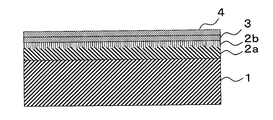
- FIG. 1 is a schematic cross-sectional view schematically showing the structure of an aluminum substrate for magnetic recording media according to the present invention.
- an aluminum substrate for a magnetic recording medium has an anodic oxide film 2a, 2b having a thickness of 7 ⁇ m or more and 25 ⁇ m or less formed on an aluminum substrate 1, and the anodic oxide film 2a, 2b.
- An organic-inorganic hybrid silica film 3 is formed on the organic-inorganic hybrid silica film 3
- an inorganic silica film 4 is formed on the organic-inorganic hybrid silica film 3.
- a part of the anodized film is formed on the porous part. It is characterized by being an anodized film 2b filled with silica.
- the aluminum alloy used as a substrate in the present invention (sometimes simply referred to as “aluminum”) has a chemical composition that is necessary for magnetic recording media and can be used to form an anodized film.
- aluminum has a chemical composition that is necessary for magnetic recording media and can be used to form an anodized film.
- Mg 3.5 wt% or more and 6 wt% or less
- Cu 0.02 wt% or more and 0.5 wt% or less
- Si 0.05 wt% or less Fe: 0.05 wt% or less
- Cr 0.05 wt% or more and 0.6 wt% or less
- Mn 0.05 wt% or more and 1.5 wt% or less
- Zr 0.05 wt% At least one selected from the group consisting of not less than 0.6% by weight and not more than 0.6% by weight, the balance being an aluminum alloy consisting of Al and inevitable impurities, and the maximum length of the intermetallic compound on the surface being 10 ⁇ m A
- the anodized film in the present invention is an anodized film having a thickness of 7 ⁇ m or more and 25 ⁇ m or less formed on an aluminum substrate, and the entire surface of the aluminum alloy substrate is covered with this anodized film.
- an anodizing solution for forming the anodized film an anodizing solution containing at least oxalic acid is preferably used.
- the anodic oxide film forms an oxalic acid-based film on the aluminum alloy substrate, so that the hardness is high and the high-temperature crack resistance can be improved.
- organic acids such as oxalic acid and formic acid, and inorganic acids such as phosphoric acid, chromic acid, and sulfuric acid are mentioned, but the hardness is high and the occurrence of cracks at high temperature is remarkably reduced. From the viewpoint, it is preferable to use an anodizing solution containing at least oxalic acid.
- the oxalic acid concentration in the anodizing treatment solution may be appropriately controlled so that the desired effect can be effectively exhibited.
- the lower limit of the oxalic acid concentration in the anodizing solution is preferably 10 g / L, more preferably 15 g / L.
- the upper limit of the oxalic acid concentration is preferably 50 g / L, and more preferably 40 g / L.
- anodization As a method for increasing the thickness of the anodized film and speeding up the film formation, it is preferable to perform anodization with a mixed acid solution (anodizing solution) containing at least oxalic acid.
- the other acid solution mixed with oxalic acid at this time is not particularly limited. Examples thereof include organic acids such as formic acid, inorganic acids such as chromic acid, sulfuric acid and phosphoric acid, and one or more acid solutions can be selected and used from these.
- an anodizing solution the porous anodic oxide film to be formed is less dissolved by the processing solution, and the anodic oxide film can be made thicker. , It becomes a film excellent in crack resistance (characteristic in which cracks do not occur).
- the temperature at which the anodizing treatment is performed may be set within a range that does not impair the productivity of the anodized film and the anodized film is not significantly dissolved.
- the temperature is preferably 0 to 50 ° C.
- the treatment time for performing the anodic oxidation treatment can be appropriately set in the same manner, and is not particularly limited. For example, it can be carried out for 10 to 300 minutes.
- the electrolytic voltage (anodized film formation voltage) and current density when anodizing treatment may be appropriately adjusted so as to obtain a desired anodized film.
- the electrolysis voltage if the electrolysis voltage is low, the current density becomes small and the film formation rate is slow. On the other hand, if the electrolysis voltage is too high, an anodic oxide film tends not to be formed due to dissolution of the film due to a large current. . Since the influence of the electrolysis voltage is related to the composition of the electrolytic treatment solution (anodization treatment solution) to be used, the temperature at which the anodization film is applied, etc., it may be set as appropriate.
- the electrolysis voltage at the time of anodizing is preferably about 5 to 150V, more preferably about 20 to 120V.
- the current density flowing at the time of the anodic oxidation treatment is preferably 100A / dm 2 or less, more preferably 50A / dm 2 or less, and more preferably 30A / dm 2 or less.
- the thickness of the anodized film formed as described above is an important factor responsible for scratch resistance, and is preferably 7 ⁇ m or more, more preferably 9 ⁇ m, from the viewpoint of obtaining good scratch resistance. It is above, More preferably, it is 12 micrometers or more. In the case of the anodic oxide film alone, the thickness of the anodic oxide film is 15 ⁇ m or more, and a scratch resistance equivalent to that of Ni—P plating can be obtained. However, in the present invention, it is combined with a silica converted film (silica film). Therefore, the above effects can be obtained if the thickness is 7 ⁇ m or more.
- the thickness of the anodic oxide film is preferably 25 ⁇ m or less, more preferably 20 ⁇ m or less.
- a hard film is formed on the anodized film to achieve the same scratch resistance as NiP plating, it is necessary to form a hard film having a thickness of 10 ⁇ m or more.
- a thickness of 10 ⁇ m or more cannot be realized by a technique alone such as coating of a precursor to be a silica film and silica conversion. This is due to shrinkage during the silica conversion of the precursor to be a silica film and the limit of the H 2 O supply depth necessary for the silica conversion.
- anodized film that can easily achieve a thickness of 10 ⁇ m or more with a silica film, it is possible to realize a scratch resistance and surface hardness equivalent to NiP plating. That is, since the anodized film is porous and includes defects in the aluminum alloy and inclusions and crystallized substances, it cannot be used as it is as a surface treatment for a magnetic recording medium. Therefore, in the present invention, at least a part of the porous portion of the anodized film is filled with organic-inorganic hybrid silica so as to cover the pores and defects of the anodized film, thereby achieving excellent smoothness, scratch resistance, Get heat resistance. An organic-inorganic hybrid silica film is formed on the anodized film.
- Organic-inorganic hybrid silica (film)>
- the organic-inorganic hybrid silica that fills at least a part of the porous portion of the anodized film and the organic-inorganic hybrid silica film formed on the anodized film are formed simultaneously. That is, the organic-inorganic hybrid silica and the precursor to be the organic-inorganic hybrid silica film are coated on the anodic oxide film to perform silica conversion.
- the silica After applying the precursor, the silica is converted by heat treatment in an atmosphere containing water vapor.
- the obtained organic-inorganic hybrid silica can clog pores of the anodic oxide film, inclusions in the alloy, and pits derived from the crystallized substance, so that defects can be eliminated. Further, by forming a smooth surface such as an organic-inorganic hybrid silica film thereon, the scratch resistance and heat resistance can be improved.
- the anodized film and the inorganic silica film independently have high heat resistance of 500 ° C. or higher and 450 ° C. or higher. However, when they are combined, the heat resistance remains at about 350 ° C. The reason for this is thought to be that the inorganic silica penetrates into the porous portions (pores and defects) in the anodized film to reduce the flexibility of the film.
- the porous portion is filled with organic-inorganic hybrid silica, and the surface of the anodized film is covered with the organic-inorganic hybrid silica film, thereby reducing the flexibility of the anodized film due to the penetration of inorganic silica. It can be prevented, and it is considered that the heat resistance has been improved.
- the precursor has a solution viscosity of about 1 mPa ⁇ s or more and 10 mPa ⁇ s or less, it can easily penetrate into the porous portion of the anodized film, and is converted into silica as it is, so that organic-inorganic hybrid silica is introduced into the porous portion. Is preferable because it is filled.
- the effective concentration of the solution composition is preferably 10% by mass or more and 50% by mass or less. This is because if the concentration is too high, the viscosity increases and coating becomes difficult, and if the concentration is too low, a sufficient film thickness cannot be obtained after solvent drying.
- the precursor of organic-inorganic hybrid silica and organic-inorganic hybrid silica film contains methylhydropolysilazane
- the scuff resistance is improved as compared with the anodic oxide coating alone, so that a polysilazane solution containing methylhydropolysilazane Is preferred.
- the polysilazane solution containing methylhydropolysilazane is more preferably a mixture of methylhydropolysilazane and perhydropolysilazane from the viewpoint of further improving the film hardness.
- Polysilazane is synthesized as a polymer having a Si—N bond by mainly reacting H 2 SiCl 2 with NH 3 , and is often expressed as the following formula (1). Actually, it is not a one-dimensional linear chain but includes a cyclic structure as shown in the following formula (2).
- Perhydropolysilazane a compound in which Si is bonded to all hydrogen atoms other than the Si—N bond.
- the compounding ratio of perhydropolysilazane and methylhydropolysilazane is preferably in the range of 0:10 to 7: 3 (weight ratio), more preferably 2: 8 to 5: 5 (weight ratio).
- a flexible silica skeleton in which a part of the three-dimensional network of Si—O—Si is terminated with a methyl group can be formed.
- a moderately flexible film relieves the stress caused by the difference in thermal expansion from the aluminum substrate, and is expected to improve heat resistance.
- ⁇ Inorganic silica film> The surface hardness of the organic-inorganic hybrid silica film decreases as the proportion of the organic silica film increases. Therefore, in the present invention, an inorganic silica film is further formed on the organic-inorganic hybrid silica film to increase the surface hardness of the obtained aluminum substrate for a magnetic recording medium.
- the inorganic silica film is preferably formed by applying perhydropolysilazane and converting the silica.
- the organic-inorganic hybrid silica film and the inorganic silica film (hereinafter sometimes collectively referred to as “silica film”) preferably have a total thickness of 0.3 ⁇ m or more from the viewpoint of scratch resistance, and 0 More preferably, it is 5 ⁇ m or more. Moreover, in order to make it react with water and to fully convert into silica, 3 micrometers or less are preferable and 2 micrometers or less are more preferable.
- the thickness of the organic-inorganic hybrid silica film is preferably 0.05 ⁇ m or more from the viewpoint of preventing the inorganic silica from entering the anodized film, and more preferably 0.1 ⁇ m or more. Moreover, in order to fully advance a silica conversion reaction, 1.5 micrometers or less are preferable and 1 micrometer or less is more preferable.
- the organic-inorganic hybrid silica film is obtained by impregnating at least part of the porous portion of the anodized film with the precursor when the precursor is coated on the anodized film and converted to silica. Therefore, the thickness of the organic-inorganic hybrid silica film is thinner than the thickness of the actual coating.
- the preferred amount of organic-inorganic hybrid silica filled in the porous portion of the anodized film varies depending on the porosity, pores, defect size, distribution, etc. of the anodized film.
- the amount of filled organic-inorganic hybrid silica is determined by the amount of the precursor coated on the anodized film and the amount of the organic-inorganic hybrid silica film after the silica conversion formed on the anodized film. An approximation can be made by taking the difference.
- the thickness of the inorganic silica film is preferably 0.2 ⁇ m or more from the viewpoint of hardness, and more preferably 0.5 ⁇ m or more. Moreover, 3 micrometers or less are preferable from a heat resistant point, and 2 micrometers or less are more preferable.
- the film thicknesses of the anodized film, silica film, organic-inorganic hybrid silica film, and inorganic silica film can all be measured by observing the section of the film with a scanning electron microscope (SEM) and element mapping. .
- the aluminum substrate for magnetic recording media according to the present invention can be obtained through the following steps. That is, (A) forming an anodic oxide film having a thickness of 7 ⁇ m or more and 25 ⁇ m or less on an aluminum substrate; (B) coating an organic-inorganic hybrid silica film precursor on the anodized film; (C) A step of applying a precursor of an inorganic silica film on the outermost surface, and (d) a step of converting to silica by heating.
- the anodic oxide film and the silica film may be formed on at least one surface of the aluminum substrate, but are preferably formed on both surfaces from the viewpoint of efficient use of the substrate surface.
- the step (d) for converting the silica may be performed once after the step (b) and the step (c), the step (d) is performed after the step (b), and then the step (c). Although it may be performed twice again with the step (d), it is preferable to perform the steps once after the step (b) and the step (c) from the viewpoint of cost.
- an aluminum alloy serving as the substrate is made of an organic acid such as oxalic acid or formic acid, an inorganic acid such as phosphoric acid, chromic acid, or sulfuric acid. It can be formed by energizing in a solution containing etc. In this case, the anodized film thickness can be adjusted by the energization time.
- an anodizing solution containing at least oxalic acid from the viewpoint of improving the voltage resistance while significantly reducing the occurrence of cracks at high temperatures.
- the preferred kind, concentration, etc. of the precursor solution of the organic-inorganic hybrid silica film are as described above.
- a polysilazane solution containing methylhydropolysilazane is preferred.
- the preferred concentration and the like of the precursor of the inorganic silica film are as described above.
- the organic-inorganic hybrid silica film precursor or the inorganic silica film precursor When the organic-inorganic hybrid silica film precursor or the inorganic silica film precursor is applied, it can be applied by dip coating, spray coating, spin coating or the like. Among these, spin coating is preferable from the viewpoint that a uniform film thickness can be realized.
- alcohols containing a hydroxyl group (—OH) in the molecular structure cannot be used because they react with polysilazane.
- Preferred are petroleum organic solvents, aromatic solvents such as xylene, and alkyl ethers such as dibutyl ether.
- the concentration may be set in an appropriate range depending on the coating method and conditions, but the polysilazane concentration is generally 10% by weight or more and 50% by weight or less. If the concentration is high, the viscosity becomes high and coating becomes difficult. On the other hand, if the concentration is too low, a sufficient film thickness cannot be obtained after solvent drying.
- the precursor After coating the precursor, it can be converted into silica (SiO 2 ) by heating to form a silica film. Further, the precursor impregnated in the porous portion of the anodized film is filled as organic-inorganic hybrid silica by the heating. Polysilazane conversion to silica requires a reaction with water, and water vapor may be introduced into the heating atmosphere.
- the heating temperature is preferably 200 to 370 ° C. from the viewpoint of efficiently promoting the silica conversion.
- the heating time is preferably 20 minutes to 2 hours from the viewpoint of sufficient silica conversion and productivity.
- an aluminum alloy When forming an anodized film and a silica film on both surfaces of an aluminum substrate, for example, an aluminum alloy is immersed in an anodizing solution and energized to form an anodized film on both surfaces of the aluminum alloy. It can be obtained by coating a polysilazane solution containing methylhydropolysilazane on the surface and subjecting it to silica conversion by heat treatment, and then subjecting the other surface to silica conversion by coating and heat treatment. Alternatively, both sides of the polysilazane solution can be converted to silica at a time by applying the polysilazane solution on one surface and drying it, and then applying the polysilazane solution to the other surface and then performing a heat treatment. Furthermore, the polysilazane solution may be applied to both surfaces at once, and silica conversion may be performed by heat treatment.
- Example 1 An aluminum alloy was used as a substrate, and the substrate was energized in a 30 ° C. solution containing 30 g / L of oxalic acid to form an anodized film having a thickness of 10 ⁇ m.
- the formed organic-inorganic hybrid silica film had a thickness of 0.2 ⁇ m, the inorganic silica film had a thickness of 1.0 ⁇ m, and the total silica film had a thickness of 1.2 ⁇ m.
- the obtained aluminum substrate for magnetic recording media had a surface hardness of 5.6 GPa and a heat resistant temperature of 450 ° C.
- the formed organic-inorganic hybrid silica film had a thickness of 0.2 ⁇ m, the inorganic silica film had a thickness of 1.0 ⁇ m, and the total silica film had a thickness of 1.2 ⁇ m.
- the obtained aluminum substrate for magnetic recording media had a surface hardness of 5.8 GPa and a heat resistant temperature of 450 ° C.
- the formed organic-inorganic hybrid silica film had a thickness of 0.1 ⁇ m, the inorganic silica film had a thickness of 0.4 ⁇ m, and the total silica film had a thickness of 0.5 ⁇ m.
- the obtained aluminum substrate for magnetic recording media had a surface hardness of 5.3 GPa and a heat resistant temperature of 475 ° C.
- the formed organic-inorganic hybrid silica film had a thickness of 0.1 ⁇ m, the inorganic silica film had a thickness of 0.5 ⁇ m, and the total silica film had a thickness of 0.6 ⁇ m.
- the obtained aluminum substrate for magnetic recording media had a surface hardness of 5.2 GPa and a heat resistant temperature of 450 ° C.
- the formed organic-inorganic hybrid silica film had a thickness of 0.4 ⁇ m, the inorganic silica film had a thickness of 0.8 ⁇ m, and the total silica film had a thickness of 1.2 ⁇ m.
- the obtained aluminum substrate for a magnetic recording medium had a surface hardness of 6.4 GPa and a heat resistant temperature of 450 ° C.
- the aluminum substrate for magnetic recording media of the present invention is very excellent in heat resistance, scratch resistance and surface hardness, and is useful for magnetic recording media.
Landscapes
- Chemical & Material Sciences (AREA)
- Engineering & Computer Science (AREA)
- Metallurgy (AREA)
- Inorganic Chemistry (AREA)
- Chemical Kinetics & Catalysis (AREA)
- Electrochemistry (AREA)
- Materials Engineering (AREA)
- Organic Chemistry (AREA)
- Magnetic Record Carriers (AREA)
- Application Of Or Painting With Fluid Materials (AREA)
- Other Surface Treatments For Metallic Materials (AREA)
Abstract
アルミニウム基板と、前記アルミニウム基板上に形成された厚さ7μm以上25μm以下の陽極酸化皮膜と、前記陽極酸化皮膜上に形成された有機-無機ハイブリッドシリカ膜と、前記有機-無機ハイブリッドシリカ膜上に形成された無機シリカ膜とを備え、前記陽極酸化皮膜の多孔質部分の少なくとも一部に有機-無機ハイブリッドシリカが充填された、磁気記録媒体用アルミニウム基板。
Description
本発明は、磁気記録媒体用の基板として好適な皮膜が形成されたアルミニウム基板、およびその製造方法に関する。
磁気記録媒体用アルミニウム基板としては、もっぱらJIS H4000-2014に規定されたA5086合金が使われている。この合金単独では、磁気記録媒体に適した表面平滑性や表面無欠陥性、耐疵付性などが不十分であるため、表面処理として無電解NiPめっきが施されている。
無電解NiPめっきを施すことで、表面に現れる晶出物や介在物を覆い隠し表面無欠陥性を実現することができる。また、結晶粒界を覆うことで研磨により高い平滑性を実現することができる。さらには、表面硬度を高くすることで耐疵付性を改善することができる。
しかしながら、従来使われているNiPめっきは、300℃以上に加熱処理されると結晶化し、表面の平滑性が劣化するだけでなく、強磁性を示すことになり磁気記録媒体用基板として不適切となる。
一方で、磁気記録媒体に求められる性能として高記録密度が挙げられ、そのためには磁性層成膜時の温度条件の緩和が求められている。
一方で、磁気記録媒体に求められる性能として高記録密度が挙げられ、そのためには磁性層成膜時の温度条件の緩和が求められている。
特許文献1では、NiPめっきのもつ300℃以上の温度での熱処理による磁性の発現を抑制するために、Ni-P-Wめっきが提案されている。
NiPめっき以外の表面処理として、例えば特許文献2では、アルマイト基板の表面処理として、酸化シリコンを塗布し熱処理することでアルマイト基板表面を平滑化する表面処理方法が提案されている。
NiPめっき以外の表面処理として、例えば特許文献2では、アルマイト基板の表面処理として、酸化シリコンを塗布し熱処理することでアルマイト基板表面を平滑化する表面処理方法が提案されている。
また、高記録密度に対応するためには、記録ヘッドの基板表面への衝突に伴う疵発生を抑制することも重要である。磁気記録では、記録媒体の表面を高さ数nmで記録再生ヘッドが高速で移動しており、ヘッドと基板との衝突により基板表面の変形を防ぐことが重要である。そのため、厚さ10μm程度のNiPめっきが用いられている。基板表面に要求される硬度は、耐疵付性を実現するために求められる。
特許文献3では、アルミニウム基板上に窒化珪素質連続薄膜が形成された磁気ディスク基板が開示されている。当該基板の製造方法として、アルミニウム基板上に無機ポリシラザンを塗工した後、大気中200℃で1時間熱処理することで、厚さ約1μmでニッケルリンめっき基板よりも高い硬度と平滑性を実現できることが開示されている。
特許文献3では、アルミニウム基板上に窒化珪素質連続薄膜が形成された磁気ディスク基板が開示されている。当該基板の製造方法として、アルミニウム基板上に無機ポリシラザンを塗工した後、大気中200℃で1時間熱処理することで、厚さ約1μmでニッケルリンめっき基板よりも高い硬度と平滑性を実現できることが開示されている。
しかしながら、特許文献1に記載のNi-P-Wめっきでも、耐熱温度は320℃に留まる。また、特許文献2には、アルマイト処理を行ったアルミニウム基板上にオルガノシロキサン溶液を塗工し、150℃から350℃で焼付けを行うことで、アルマイト表面を平滑にできることは開示されている。すなわち、陽極酸化処理により生じる表面の凹凸や微細気孔を有機シリコンで塗工、熱処理することにより平滑化できることが開示されている。しかしながら、磁気記録媒体用基板として特に重要な耐熱性や耐疵付性に関しては何ら言及されていない。また、塗工される有機シリコンとして適した組成、物性等にも何ら言及されていない。
また、特許文献3に記載の磁気ディスク基板は、アルミニウム基板上に硬度の高い皮膜を形成しても、厚さが1μmである場合には、現行汎用されているNiPめっき(厚さ~10μm)基板に比べて耐疵付性は大きく劣る。
そこで、アルミニウム基板に陽極酸化皮膜を形成し、磁気記録媒体用基板として利用する試みはこれまでも種々提案されてきたが、NiPめっき以上の耐熱性を有し、代替可能な耐疵付性や表面硬度を兼ね備えたものは見出されていない。
本発明は、このような状況を鑑みてなされたものであり、耐熱性、耐疵付性及び表面硬度に優れた磁気記録媒体用アルミニウム基板を提供することを目的とする。
本発明者らは、鋭意研究を重ねた結果、アルミニウム合金の少なくとも一方の表面に、特定の厚みの陽極酸化皮膜を形成し、その上に特定のシリカ膜を形成し、さらに、陽極酸化皮膜の多孔質部分に特定のシリカを充填することにより、耐疵付性、表面硬度及び耐熱性に優れた磁気記録媒体用アルミニウム基板が得られることを見出し、本発明を完成するに至った。
すなわち、本発明は、以下の[1]~[7]に係るものである。
[1] アルミニウム基板と、前記アルミニウム基板上に形成された厚さ7μm以上25μm以下の陽極酸化皮膜と、前記陽極酸化皮膜上に形成された有機-無機ハイブリッドシリカ膜と、前記有機-無機ハイブリッドシリカ膜上に形成された無機シリカ膜とを備え、前記陽極酸化皮膜の多孔質部分の少なくとも一部に有機-無機ハイブリッドシリカが充填された、磁気記録媒体用アルミニウム基板。
[2] 前記有機-無機ハイブリッドシリカ膜及び前記有機-無機ハイブリッドシリカの前駆体がメチルヒドロポリシラザンを含むポリシラザン溶液であり、前記無機シリカ膜の前駆体がパーヒドロポリシラザンである前記[1]に記載の磁気記録媒体用アルミニウム基板。
[3] 前記メチルヒドロポリシラザンを含むポリシラザン溶液がメチルヒドロポリシラザンとパーヒドロポリシラザンとの混合物である前記[2]に記載の磁気記録媒体用アルミニウム基板。
[4] 前記有機-無機ハイブリッドシリカ膜及び前記有機-無機ハイブリッドシリカの前駆体において、パーヒドロポリシラザンとメチルヒドロポリシラザンとの配合比が重量比で0:10~7:3である前記[3]に記載の磁気記録媒体用アルミニウム基板。
[5] 前記有機-無機ハイブリッドシリカ膜と前記無機シリカ膜との合計の厚さが0.5μm以上である前記[1]~[4]のいずれか1に記載の磁気記録媒体用アルミニウム基板。
[6] 前記[1]~[5]のいずれか1に記載の磁気記録媒体用アルミニウム基板を製造する方法であって、
アルミニウム基板上に厚さ7μm以上25μm以下の陽極酸化皮膜を形成する工程、
前記陽極酸化皮膜上にメチルヒドロポリシラザンを含むポリシラザン溶液を塗工する工程、
最表面にパーヒドロポリシラザンを塗工する工程、及び
加熱によりシリカに転化する工程
を含む磁気記録媒体用アルミニウム基板の製造方法。
[7] 前記陽極酸化皮膜を形成する工程がシュウ酸溶液により形成される前記[6]に記載の製造方法。
[1] アルミニウム基板と、前記アルミニウム基板上に形成された厚さ7μm以上25μm以下の陽極酸化皮膜と、前記陽極酸化皮膜上に形成された有機-無機ハイブリッドシリカ膜と、前記有機-無機ハイブリッドシリカ膜上に形成された無機シリカ膜とを備え、前記陽極酸化皮膜の多孔質部分の少なくとも一部に有機-無機ハイブリッドシリカが充填された、磁気記録媒体用アルミニウム基板。
[2] 前記有機-無機ハイブリッドシリカ膜及び前記有機-無機ハイブリッドシリカの前駆体がメチルヒドロポリシラザンを含むポリシラザン溶液であり、前記無機シリカ膜の前駆体がパーヒドロポリシラザンである前記[1]に記載の磁気記録媒体用アルミニウム基板。
[3] 前記メチルヒドロポリシラザンを含むポリシラザン溶液がメチルヒドロポリシラザンとパーヒドロポリシラザンとの混合物である前記[2]に記載の磁気記録媒体用アルミニウム基板。
[4] 前記有機-無機ハイブリッドシリカ膜及び前記有機-無機ハイブリッドシリカの前駆体において、パーヒドロポリシラザンとメチルヒドロポリシラザンとの配合比が重量比で0:10~7:3である前記[3]に記載の磁気記録媒体用アルミニウム基板。
[5] 前記有機-無機ハイブリッドシリカ膜と前記無機シリカ膜との合計の厚さが0.5μm以上である前記[1]~[4]のいずれか1に記載の磁気記録媒体用アルミニウム基板。
[6] 前記[1]~[5]のいずれか1に記載の磁気記録媒体用アルミニウム基板を製造する方法であって、
アルミニウム基板上に厚さ7μm以上25μm以下の陽極酸化皮膜を形成する工程、
前記陽極酸化皮膜上にメチルヒドロポリシラザンを含むポリシラザン溶液を塗工する工程、
最表面にパーヒドロポリシラザンを塗工する工程、及び
加熱によりシリカに転化する工程
を含む磁気記録媒体用アルミニウム基板の製造方法。
[7] 前記陽極酸化皮膜を形成する工程がシュウ酸溶液により形成される前記[6]に記載の製造方法。
本発明によれば、耐熱性、耐疵付性及び表面硬度に非常に優れた磁気記録媒体用アルミニウム基板を提供することができる。
本発明に係る磁気記録媒体用アルミニウム基板は、図1に示すように、アルミニウム基板1上に、厚さ7μm以上25μm以下の陽極酸化皮膜2a,2bが形成され、前記陽極酸化皮膜2a,2b上に有機-無機ハイブリッドシリカ膜3が形成され、前記有機-無機ハイブリッドシリカ膜3上に無機シリカ膜4が形成されており、前記陽極酸化皮膜はその一部が、多孔質部分に有機-無機ハイブリッドシリカが充填された陽極酸化皮膜2bであることを特徴とする。
<アルミニウム基板>
本発明で基板として用いるアルミニウム合金(単に「アルミニウム」と称することもある。)は、その化学成分組成については、磁気記録媒体用として必要な強度を持ち陽極酸化皮膜の形成に用いられうるものである限り、特に限定されるものではないが、例えば、Mg:3.5重量%以上6重量%以下、Cu:0.02重量%以上0.5重量%以下、Si:0.05重量%以下、Fe:0.05重量%以下含有し、かつCr:0.05重量%以上0.6重量%以下、Mn:0.05重量%以上1.5重量%以下、およびZr:0.05重量%以上0.6重量%以下よりなる群から選ばれる少なくとも一つを含有し、残部がAlおよび不可避的不純物からなるアルミニウム合金であり、かつ、表面における金属間化合物の最大長さが10μm以下であり、基板表面1mm2当たりの、最大長さが5μm以上である金属間化合物の個数が1個以下のアルミニウム合金などを例示することができる。
本発明で基板として用いるアルミニウム合金(単に「アルミニウム」と称することもある。)は、その化学成分組成については、磁気記録媒体用として必要な強度を持ち陽極酸化皮膜の形成に用いられうるものである限り、特に限定されるものではないが、例えば、Mg:3.5重量%以上6重量%以下、Cu:0.02重量%以上0.5重量%以下、Si:0.05重量%以下、Fe:0.05重量%以下含有し、かつCr:0.05重量%以上0.6重量%以下、Mn:0.05重量%以上1.5重量%以下、およびZr:0.05重量%以上0.6重量%以下よりなる群から選ばれる少なくとも一つを含有し、残部がAlおよび不可避的不純物からなるアルミニウム合金であり、かつ、表面における金属間化合物の最大長さが10μm以下であり、基板表面1mm2当たりの、最大長さが5μm以上である金属間化合物の個数が1個以下のアルミニウム合金などを例示することができる。
<陽極酸化皮膜>
本発明における陽極酸化皮膜は、アルミニウム基板上に形成された膜厚7μm以上25μm以下の陽極酸化皮膜であり、アルミニウム合金基材の全面がこの陽極酸化皮膜で覆われている。
本発明における陽極酸化皮膜は、アルミニウム基板上に形成された膜厚7μm以上25μm以下の陽極酸化皮膜であり、アルミニウム合金基材の全面がこの陽極酸化皮膜で覆われている。
陽極酸化皮膜を形成する時の陽極酸化処理液としては、少なくともシュウ酸を含む陽極酸化処理液を用いることが好ましい。これは陽極酸化皮膜がアルミニウム合金基材にシュウ酸系皮膜を形成することで、硬度が高く高温耐クラック性を向上させることができるからである。
即ち、一般的な陽極酸化処理液として、シュウ酸、ギ酸等の有機酸、リン酸、クロム酸、硫酸などの無機酸が挙げられるが、硬度が高く高温でのクラックの発生を著しく低減させるという観点から、少なくともシュウ酸を含む陽極酸化処理液を用いることが好ましい。陽極酸化処理液中のシュウ酸濃度は、所望とする作用効果を有効に発揮することができるように適宜適切に制御すれば良い。陽極酸化処理液中のシュウ酸濃度の下限は、好ましくは10g/Lであり、より好ましくは15g/Lである。また、当該シュウ酸濃度の上限は、好ましくは50g/Lであり、より好ましくは40g/Lである。
即ち、一般的な陽極酸化処理液として、シュウ酸、ギ酸等の有機酸、リン酸、クロム酸、硫酸などの無機酸が挙げられるが、硬度が高く高温でのクラックの発生を著しく低減させるという観点から、少なくともシュウ酸を含む陽極酸化処理液を用いることが好ましい。陽極酸化処理液中のシュウ酸濃度は、所望とする作用効果を有効に発揮することができるように適宜適切に制御すれば良い。陽極酸化処理液中のシュウ酸濃度の下限は、好ましくは10g/Lであり、より好ましくは15g/Lである。また、当該シュウ酸濃度の上限は、好ましくは50g/Lであり、より好ましくは40g/Lである。
陽極酸化皮膜の厚膜化や皮膜形成の高速化の方法として、少なくともシュウ酸を含む混酸溶液(陽極酸化処理液)による陽極酸化処理を行うことが好ましい。このときの、シュウ酸と混ぜる他の酸溶液は、特に限定されない。例えば、ギ酸等の有機酸、クロム酸、硫酸、リン酸などの無機酸等が挙げられ、これらの中から一つ以上の酸溶液を選んで用いることができる。このように、少なくともシュウ酸を含む溶液(陽極酸化処理液)を用いることによって、形成される多孔質の陽極酸化皮膜は処理溶液による溶解が少なく、陽極酸化皮膜の厚膜化が可能になると共に、耐クラック性(クラックが生じない特性)に優れる皮膜となる。
上述した混酸溶液(シュウ酸を含む溶液)による陽極酸化処理では、各種酸濃度、処理温度、電解電圧、電流密度は特に定めるものではなく、適宜処理条件を選択すればよい。
その他の陽極酸化処理条件についても、特に定めるものではないが、例えば陽極酸化処理を行う際の温度は、生産性を損なうことなく、また陽極酸化皮膜の溶解が顕著に起こらない範囲で設定すればよく、おおむね、0~50℃とすることが好ましい。また、陽極酸化処理を行う際の処理時間も、同様に適宜設定することができ、特に限定されないが、たとえば10~300分行うことができる。
陽極酸化処理を行うときの電解電圧(陽極酸化皮膜形成電圧)や電流密度は、所望の陽極酸化皮膜が得られるように、適宜適切に調節すればよい。このうち電解電圧については、電解電圧が低いと電流密度が小さくなって成膜速度が遅くなり、一方、電解電圧が高すぎると大電流により皮膜の溶解によって陽極酸化皮膜が形成されなくなる傾向がある。電解電圧による影響は、使用する電解処理液(陽極酸化処理溶液)の組成や、陽極酸化皮膜を行う温度などにも関係するため、適宜設定すればよい。陽極酸化処理時の電解電圧は、具体的には5~150V程度が好ましく、より好ましくは20~120V程度である。また、陽極酸化処理時に流す電流密度は、100A/dm2以下であることが好ましく、50A/dm2以下であることがより好ましく、30A/dm2以下であることが更に好ましい。
上記のようにして形成される陽極酸化皮膜の厚みは、耐疵付性を担う重要な因子であり、良好な耐疵付性を得る観点から、7μm以上とすることが好ましく、より好ましくは9μm以上であり、さらに好ましくは12μm以上である。なお、陽極酸化皮膜単独の場合には陽極酸化皮膜の厚さが15μm以上でNi-Pめっきと同等の耐疵付性が得られるが、本発明においてはシリカ転化した膜(シリカ膜)と組み合わせることから、7μm以上であれば上記効果を得ることができる。
一方、陽極酸化皮膜の厚みがあまり厚くなると、コストが増大し、かえって耐疵付性が低下することから、25μm以下とすることが好ましく、より好ましくは20μm以下である。
陽極酸化皮膜に硬質皮膜を形成してNiPめっきと同等の耐疵付性を実現しようとすると、厚さ10μm以上の硬質皮膜の形成が必要となる。しかしながら、硬質皮膜としてシリカ膜を形成しようとすると、シリカ膜となる前駆体の塗工とシリカ転化といった手法単独では、10μm以上という厚さは実現できない。
これは、シリカ膜となる前駆体のシリカ転化時の収縮や、シリカ転化に必要なH2O供給深さの限界に起因する。
これは、シリカ膜となる前駆体のシリカ転化時の収縮や、シリカ転化に必要なH2O供給深さの限界に起因する。
そこで、本発明では、容易に10μm以上の厚さを実現可能な陽極酸化皮膜とシリカ膜とを組み合わせることで、NiPめっきと同等の耐疵付性や表面硬度を実現する。
すなわち、陽極酸化皮膜は多孔質でありアルミニウム合金中の介在物や晶出物由来の欠陥が形成されることから、そのまま磁気記録媒体用表面処理として用いることができない。
そこで本発明では、陽極酸化皮膜における多孔質部分の少なくとも一部に有機-無機ハイブリッドシリカを充填することで、陽極酸化皮膜の孔や欠陥を覆うことにより、優れた平滑性、耐疵付性や耐熱性を得る。また、該陽極酸化皮膜上には有機-無機ハイブリッドシリカ膜を形成する。
すなわち、陽極酸化皮膜は多孔質でありアルミニウム合金中の介在物や晶出物由来の欠陥が形成されることから、そのまま磁気記録媒体用表面処理として用いることができない。
そこで本発明では、陽極酸化皮膜における多孔質部分の少なくとも一部に有機-無機ハイブリッドシリカを充填することで、陽極酸化皮膜の孔や欠陥を覆うことにより、優れた平滑性、耐疵付性や耐熱性を得る。また、該陽極酸化皮膜上には有機-無機ハイブリッドシリカ膜を形成する。
<有機-無機ハイブリッドシリカ(膜)>
前記陽極酸化皮膜の多孔質部分の少なくとも一部に充填する有機-無機ハイブリッドシリカ及び前記陽極酸化皮膜上に形成される有機-無機ハイブリッドシリカ膜は同時に形成される。
すなわち、有機-無機ハイブリッドシリカ及び有機-無機ハイブリッドシリカ膜となる前駆体を陽極酸化皮膜上に塗工し、シリカ転化を行う。
前記陽極酸化皮膜の多孔質部分の少なくとも一部に充填する有機-無機ハイブリッドシリカ及び前記陽極酸化皮膜上に形成される有機-無機ハイブリッドシリカ膜は同時に形成される。
すなわち、有機-無機ハイブリッドシリカ及び有機-無機ハイブリッドシリカ膜となる前駆体を陽極酸化皮膜上に塗工し、シリカ転化を行う。
前駆体を塗工後、水蒸気を含む雰囲気にて熱処理をすることにより、シリカ転化する。
得られた有機-無機ハイブリッドシリカが、陽極酸化皮膜の細孔や合金中の介在物、晶出物由来のピットを目詰めすることができることから、欠陥を無くすことができる。またその上に有機-無機ハイブリッドシリカ膜という平滑な面を形成することで、耐疵付性及び耐熱性を改善することができる。
得られた有機-無機ハイブリッドシリカが、陽極酸化皮膜の細孔や合金中の介在物、晶出物由来のピットを目詰めすることができることから、欠陥を無くすことができる。またその上に有機-無機ハイブリッドシリカ膜という平滑な面を形成することで、耐疵付性及び耐熱性を改善することができる。
陽極酸化皮膜に有機-無機ハイブリッドシリカ膜を介さずに直接無機シリカ膜を形成した場合、陽極酸化皮膜と無機シリカ膜がそれぞれ単独では500℃以上、450℃以上の高い耐熱性を有するにも関わらず、両者を組み合わせると耐熱性は350℃程度に留まってしまう。
この理由として、陽極酸化皮膜中の多孔質部分(孔や欠陥)に無機シリカが侵入することで膜の柔軟性を低下させるためであると考えられる。
そこで本発明においては、有機-無機ハイブリッドシリカで多孔質部分を充填し、さらに有機-無機ハイブリッドシリカ膜で陽極酸化皮膜表面を覆うことにより、無機シリカの侵入による陽極酸化皮膜の柔軟性の低下を防ぐことができ、耐熱性の改善ができたものと考えられる。
この理由として、陽極酸化皮膜中の多孔質部分(孔や欠陥)に無機シリカが侵入することで膜の柔軟性を低下させるためであると考えられる。
そこで本発明においては、有機-無機ハイブリッドシリカで多孔質部分を充填し、さらに有機-無機ハイブリッドシリカ膜で陽極酸化皮膜表面を覆うことにより、無機シリカの侵入による陽極酸化皮膜の柔軟性の低下を防ぐことができ、耐熱性の改善ができたものと考えられる。
前記前駆体は1mPa・s以上10mPa・s以下程度の溶液粘度であれば、陽極酸化皮膜の多孔質部分に容易に侵入でき、そのままシリカ転化することによって、該多孔質部分に有機-無機ハイブリッドシリカが充填されることとなるため好ましい。
また、溶液組成の有効濃度(溶剤以外の薬剤成分)は10質量%以上50質量%以下が好ましい。これは、濃度が高すぎると粘度が高くなり塗工しにくくなり、濃度が低くなり過ぎると溶剤乾燥後に十分な膜厚さを得ることができないためである。
また、溶液組成の有効濃度(溶剤以外の薬剤成分)は10質量%以上50質量%以下が好ましい。これは、濃度が高すぎると粘度が高くなり塗工しにくくなり、濃度が低くなり過ぎると溶剤乾燥後に十分な膜厚さを得ることができないためである。
有機-無機ハイブリッドシリカ及び有機-無機ハイブリッドシリカ膜となる前駆体は、メチルヒドロポリシラザンを含むことにより陽極酸化皮膜単体に比べて耐疵付性が改善されることから、メチルヒドロポリシラザンを含むポリシラザン溶液が好ましい。中でも、さらに膜硬度を向上できる点から、メチルヒドロポリシラザンを含むポリシラザン溶液はメチルヒドロポリシラザンとパーヒドロポリシラザンとの混合物であることがより好ましい。
なお、ポリシラザンとは、主にH2SiCl2とNH3を反応させて、Si-N結合を有するポリマーとして合成されるものであり、下記式(1)のように表されることが多いが、実際には一次元の直鎖ではなく、下記式(2)のように環状の構造を含む。
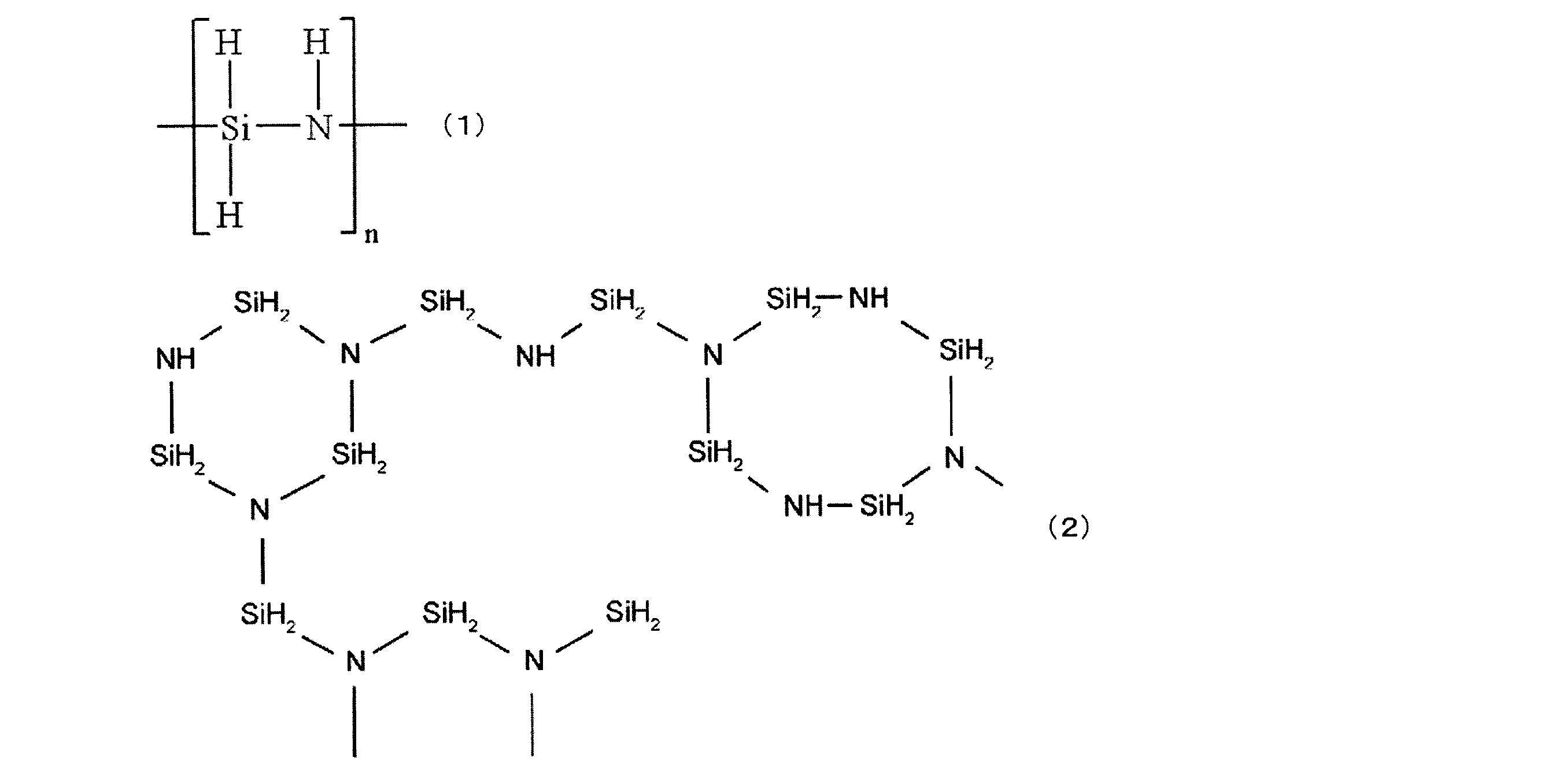
このように、SiがSi-N結合以外、全て水素原子と結合した化合物をパーヒドロポリシラザン(Perhydropolysilazane)と呼ぶ。
パーヒドロポリシラザンとメチルヒドロポリシラザンとの配合比は0:10~7:3(重量比)の範囲であることが好ましく、2:8~5:5(重量比)がより好ましい。
パーヒドロポリシラザンは水蒸気と反応し、SiO2に転化することは良く知られている。この場合、Si-O-Siが3次元のネットワークでつながり、溶融石英類似の構造となるため、硬く柔軟性に欠ける皮膜となる。
これに対して、シリコン原子にメチル基が結合したメチルヒドロポリシラザンを水蒸気と反応させると、Si-O-Siの骨格がメチル基のために硬い構造を作ることができず、柔軟性を有する膜となる。両者を適当な割合で混合し、水蒸気と反応させることにより、Si-O-Siの3次元ネットワークの一部をメチル基で終端させた柔軟性を有するシリカ骨格を形成させることができる。
適度に柔軟性を持つ膜は、アルミニウム基板との熱膨張差に起因する応力を緩和するので、耐熱性の改善が期待される。
これに対して、シリコン原子にメチル基が結合したメチルヒドロポリシラザンを水蒸気と反応させると、Si-O-Siの骨格がメチル基のために硬い構造を作ることができず、柔軟性を有する膜となる。両者を適当な割合で混合し、水蒸気と反応させることにより、Si-O-Siの3次元ネットワークの一部をメチル基で終端させた柔軟性を有するシリカ骨格を形成させることができる。
適度に柔軟性を持つ膜は、アルミニウム基板との熱膨張差に起因する応力を緩和するので、耐熱性の改善が期待される。
<無機シリカ膜>
有機-無機ハイブリッドシリカ膜は有機シリカ膜の割合が多くなるにつれて、その表面硬度が低下する。そこで、本発明においては、有機-無機ハイブリッドシリカ膜上にさらに無機シリカ膜を形成することで、得られる磁気記録媒体用アルミニウム基板における表面硬度を高くする。
無機シリカ膜はパーヒドロポリシラザンを塗工し、シリカ転化することで形成することが好ましい。
有機-無機ハイブリッドシリカ膜は有機シリカ膜の割合が多くなるにつれて、その表面硬度が低下する。そこで、本発明においては、有機-無機ハイブリッドシリカ膜上にさらに無機シリカ膜を形成することで、得られる磁気記録媒体用アルミニウム基板における表面硬度を高くする。
無機シリカ膜はパーヒドロポリシラザンを塗工し、シリカ転化することで形成することが好ましい。
<シリカ膜>
有機-無機ハイブリッドシリカ膜及び無機シリカ膜(以下、まとめて「シリカ膜」と称することがある。)は、合計で厚さ0.3μm以上であることが耐疵付性の点から好ましく、0.5μm以上がより好ましい。また水と反応させて十分にシリカ転化させるためには3μm以下が好ましく、2μm以下がより好ましい。
有機-無機ハイブリッドシリカ膜及び無機シリカ膜(以下、まとめて「シリカ膜」と称することがある。)は、合計で厚さ0.3μm以上であることが耐疵付性の点から好ましく、0.5μm以上がより好ましい。また水と反応させて十分にシリカ転化させるためには3μm以下が好ましく、2μm以下がより好ましい。
有機-無機ハイブリッドシリカ膜は厚さ0.05μm以上が無機シリカの陽極酸化皮膜への侵入を防ぐ点から好ましく、0.1μm以上がより好ましい。またシリカ転化反応を十分に進行させるためには1.5μm以下が好ましく、1μm以下がより好ましい。
なお、有機-無機ハイブリッドシリカ膜は、その前駆体を陽極酸化皮膜上に塗工してシリカ転化した際に、陽極酸化皮膜の多孔質部分の少なくとも一部に該前駆体が含浸し、シリカ転化により有機-無機ハイブリッドシリカとして充填されることから、実際に塗工した厚みよりも有機-無機ハイブリッドシリカ膜の厚みは薄くなる。
なお、有機-無機ハイブリッドシリカ膜は、その前駆体を陽極酸化皮膜上に塗工してシリカ転化した際に、陽極酸化皮膜の多孔質部分の少なくとも一部に該前駆体が含浸し、シリカ転化により有機-無機ハイブリッドシリカとして充填されることから、実際に塗工した厚みよりも有機-無機ハイブリッドシリカ膜の厚みは薄くなる。
陽極酸化皮膜の多孔質部分に充填される有機-無機ハイブリッドシリカの好ましい量は、陽極酸化皮膜の空隙率や孔、欠陥の大きさ、分布等によって異なる。なお、充填された有機-無機ハイブリッドシリカの量は、陽極酸化皮膜上に塗工した前駆体の量と、陽極酸化皮膜上に形成されたシリカ転化後の有機-無機ハイブリッドシリカ膜の量との差を取ることによって概算が可能である。
無機シリカ膜は厚さ0.2μm以上が硬度の点から好ましく、0.5μm以上がより好ましい。また耐熱性の点から3μm以下が好ましく、2μm以下がより好ましい。
なお、陽極酸化皮膜、シリカ膜、有機-無機ハイブリッドシリカ膜、無機シリカ膜の膜厚はいずれも、皮膜の断面を走査型電子顕微鏡(SEM)観察及び元素マッピングを行うことによって測定することができる。
なお、陽極酸化皮膜、シリカ膜、有機-無機ハイブリッドシリカ膜、無機シリカ膜の膜厚はいずれも、皮膜の断面を走査型電子顕微鏡(SEM)観察及び元素マッピングを行うことによって測定することができる。
<磁気記録媒体用アルミニウム基板の製造方法>
本発明に係る磁気記録媒体用アルミニウム基板は、以下の工程を経ることにより得ることができる。
すなわち、
(a)アルミニウム基板上に厚さ7μm以上25μm以下の陽極酸化皮膜を形成する工程、
(b)前記陽極酸化皮膜上に有機-無機ハイブリッドシリカ膜の前駆体を塗工する工程、
(c)最表面に無機シリカ膜の前駆体を塗工する工程、及び
(d)加熱によりシリカに転化する工程。
本発明に係る磁気記録媒体用アルミニウム基板は、以下の工程を経ることにより得ることができる。
すなわち、
(a)アルミニウム基板上に厚さ7μm以上25μm以下の陽極酸化皮膜を形成する工程、
(b)前記陽極酸化皮膜上に有機-無機ハイブリッドシリカ膜の前駆体を塗工する工程、
(c)最表面に無機シリカ膜の前駆体を塗工する工程、及び
(d)加熱によりシリカに転化する工程。
陽極酸化皮膜及びシリカ膜はアルミニウム基板の少なくとも一方の表面に形成されていればよいが、基板表面の効率的利用の点から、両方の表面に形成されていることが好ましい。
また、シリカ転化する工程(d)は、工程(b)及び工程(c)の後にまとめて一度で行ってもよく、工程(b)の後に工程(d)を、次いで工程(c)の後に再度工程(d)と、二度行ってもよいが、コスト面から、工程(b)及び工程(c)の後にまとめて一度で行うことが好ましい。
また、シリカ転化する工程(d)は、工程(b)及び工程(c)の後にまとめて一度で行ってもよく、工程(b)の後に工程(d)を、次いで工程(c)の後に再度工程(d)と、二度行ってもよいが、コスト面から、工程(b)及び工程(c)の後にまとめて一度で行うことが好ましい。
好ましいアルミニウム基板、陽極酸化皮膜、シリカ膜は先述したとおりである。
アルミニウム基板に陽極酸化皮膜を形成する工程は、公知の方法により行うことができるが、例えば基板となるアルミニウム合金を、シュウ酸、ギ酸等の有機酸、リン酸、クロム酸、硫酸などの無機酸等を含む溶液中で通電することにより形成することができる。この場合、陽極酸化皮膜厚さは、通電時間により調整することが可能である。
ここで、前述したように、高温でのクラックの発生を著しく低減させつつ耐電圧性を向上させるという観点からは、少なくともシュウ酸を含む陽極酸化処理液を用いることが好ましい。
アルミニウム基板に陽極酸化皮膜を形成する工程は、公知の方法により行うことができるが、例えば基板となるアルミニウム合金を、シュウ酸、ギ酸等の有機酸、リン酸、クロム酸、硫酸などの無機酸等を含む溶液中で通電することにより形成することができる。この場合、陽極酸化皮膜厚さは、通電時間により調整することが可能である。
ここで、前述したように、高温でのクラックの発生を著しく低減させつつ耐電圧性を向上させるという観点からは、少なくともシュウ酸を含む陽極酸化処理液を用いることが好ましい。
有機-無機ハイブリッドシリカ膜の前駆体溶液の好ましい種類、濃度等は先述したとおりであるが、例えばメチルヒドロポリシラザンを含むポリシラザン溶液が好ましい。無機シリカ膜の前駆体についても同様に、好ましい濃度等は先述したとおりである。
有機-無機ハイブリッドシリカ膜の前駆体や無機シリカ膜の前駆体を塗工する際には、ディップコート、スプレーコート、スピンコート等によって塗工することができる。中でもスピンコートが均一な膜厚さを実現できる点から好ましい。
なお、ポリシラザン溶液の濃度を調整する場合に用いる溶剤としては、分子構造中に水酸基(-OH)を含むアルコール類はポリシラザンと反応するために使用できない。石油系有機溶剤、キシレン等の芳香族溶剤、ジブチルエーテル等のアルキルエーテルが好ましい。濃度は、塗工方法や条件によって適切な範囲に設定すれば良いが、ポリシラザン濃度として10重量%以上50重量%以下が一般的である。濃度が濃いと粘度が高くなり塗工しにくくなる。一方、濃度が低くなり過ぎると溶剤乾燥後に十分な膜厚さを得ることができない。
前駆体を塗工後、加熱によりシリカ(SiO2)に転化し、シリカ膜とすることができる。また、陽極酸化皮膜の多孔質部分に含浸した前駆体は、該加熱により有機-無機ハイブリッドシリカとして充填される。
ポリシラザンのシリカ転化には水との反応が必要であり、加熱雰囲気に水蒸気を導入すれば良い。加熱温度は200~370℃がシリカ転化を効率的に進める点から好ましい。また、加熱時間は20分~2時間が十分なシリカ転化と生産性の点から好ましい。
ポリシラザンのシリカ転化には水との反応が必要であり、加熱雰囲気に水蒸気を導入すれば良い。加熱温度は200~370℃がシリカ転化を効率的に進める点から好ましい。また、加熱時間は20分~2時間が十分なシリカ転化と生産性の点から好ましい。
陽極酸化皮膜及びシリカ膜をアルミニウム基板の両方の面に形成させる場合、例えばアルミニウム合金を陽極酸化処理液に浸漬、通電を行うことでアルミニウム合金の両面に陽極酸化皮膜を形成し、その後、一方の表面にメチルヒドロポリシラザンを含むポリシラザン溶液に塗工、熱処理によるシリカ転化を行い、次いで他方の表面についても同様に塗工、熱処理によるシリカ転化を行うことにより得ることができる。
また、一方の表面に該ポリシラザン溶液を塗工して乾燥させ、他方の表面にも該ポリシラザン溶液を塗工した後に熱処理をすることにより、両面を一度にシリカ転化させることもできる。さらには、両方の表面に一度に該ポリシラザン溶液を塗工し、熱処理によるシリカ転化を行ってもよい。
また、一方の表面に該ポリシラザン溶液を塗工して乾燥させ、他方の表面にも該ポリシラザン溶液を塗工した後に熱処理をすることにより、両面を一度にシリカ転化させることもできる。さらには、両方の表面に一度に該ポリシラザン溶液を塗工し、熱処理によるシリカ転化を行ってもよい。
以下に、実施例及び比較例を挙げて本発明をさらに具体的に説明するが、本発明は、これらの実施例に限定されるものではなく、その趣旨に適合し得る範囲で変更を加えて実施することも可能であり、それらはいずれも本発明の技術的範囲に包含される。
<実施例1>
アルミニウム合金を基板とし、該基板をシュウ酸を30g/L含む30℃の溶液中で通電することにより、厚さ10μmの陽極酸化皮膜を形成させた。その上にメチルヒドロポリシラザン:パーヒドロポリシラザン(Merck Performance Materials(旧AZ Electronic Materials社製、NL120A-20およびHTA1500)=8:2(重量比)の混合物(有効濃度36重量%)をスピンコート法により塗工した。さらにその上にパーヒドロポリシラザンをスピンコート法により塗工した。
次いで300℃で水蒸気存在下、60分加熱することで、シリカ転化を行い、磁気記録媒体用アルミニウム基板を得た。
アルミニウム合金を基板とし、該基板をシュウ酸を30g/L含む30℃の溶液中で通電することにより、厚さ10μmの陽極酸化皮膜を形成させた。その上にメチルヒドロポリシラザン:パーヒドロポリシラザン(Merck Performance Materials(旧AZ Electronic Materials社製、NL120A-20およびHTA1500)=8:2(重量比)の混合物(有効濃度36重量%)をスピンコート法により塗工した。さらにその上にパーヒドロポリシラザンをスピンコート法により塗工した。
次いで300℃で水蒸気存在下、60分加熱することで、シリカ転化を行い、磁気記録媒体用アルミニウム基板を得た。
形成された有機-無機ハイブリッドシリカ膜の厚さは0.2μm、無機シリカ膜の厚さは1.0μm、合計のシリカ膜の厚さは1.2μmであった。
また、得られた磁気記録媒体用アルミニウム基板の表面硬度は5.6GPa、耐熱温度は450℃であった
また、得られた磁気記録媒体用アルミニウム基板の表面硬度は5.6GPa、耐熱温度は450℃であった
<実施例2>
実施例1と同じように陽極酸化皮膜を形成させたアルミニウムディスク上に、メチルヒドロポリシラザン:パーヒドロポリシラザン(Merck Performance Materials(旧AZ Electronic Materials社製、NL120A-20およびHTA1500)=8:2(重量比)の混合物(有効濃度36重量%)をスピンコート法により塗工した。次いで300℃で水蒸気存在下、60分加熱することでシリカ転化を行った。さらにその上にパーヒドロポリシラザンをスピンコート法により塗工した。
再度300℃で水蒸気存在下、60分加熱することで、シリカ転化を行い、磁気記録媒体用アルミニウム基板を得た。
実施例1と同じように陽極酸化皮膜を形成させたアルミニウムディスク上に、メチルヒドロポリシラザン:パーヒドロポリシラザン(Merck Performance Materials(旧AZ Electronic Materials社製、NL120A-20およびHTA1500)=8:2(重量比)の混合物(有効濃度36重量%)をスピンコート法により塗工した。次いで300℃で水蒸気存在下、60分加熱することでシリカ転化を行った。さらにその上にパーヒドロポリシラザンをスピンコート法により塗工した。
再度300℃で水蒸気存在下、60分加熱することで、シリカ転化を行い、磁気記録媒体用アルミニウム基板を得た。
形成された有機-無機ハイブリッドシリカ膜の厚さは0.2μm、無機シリカ膜の厚さは1.0μm、合計のシリカ膜の厚さは1.2μmであった。
また、得られた磁気記録媒体用アルミニウム基板の表面硬度は5.8GPa、耐熱温度は450℃であった
また、得られた磁気記録媒体用アルミニウム基板の表面硬度は5.8GPa、耐熱温度は450℃であった
<実施例3>
実施例1と同じように陽極酸化皮膜を形成させたアルミニウムディスク上に、メチルヒドロポリシラザン:パーヒドロポリシラザン(Merck Performance Materials(旧AZ Electronic Materials社製、NL120A-20およびHTA1500)=8:2(重量比)の混合物(有効濃度36重量%)をスピンコート法により塗工した。次いで350℃で水蒸気存在下、60分加熱することでシリカ転化を行った。さらにその上にパーヒドロポリシラザンをスピンコート法により塗工した。
再度350℃で水蒸気存在下、60分加熱することで、シリカ転化を行い、磁気記録媒体用アルミニウム基板を得た。
実施例1と同じように陽極酸化皮膜を形成させたアルミニウムディスク上に、メチルヒドロポリシラザン:パーヒドロポリシラザン(Merck Performance Materials(旧AZ Electronic Materials社製、NL120A-20およびHTA1500)=8:2(重量比)の混合物(有効濃度36重量%)をスピンコート法により塗工した。次いで350℃で水蒸気存在下、60分加熱することでシリカ転化を行った。さらにその上にパーヒドロポリシラザンをスピンコート法により塗工した。
再度350℃で水蒸気存在下、60分加熱することで、シリカ転化を行い、磁気記録媒体用アルミニウム基板を得た。
形成された有機-無機ハイブリッドシリカ膜の厚さは0.1μm、無機シリカ膜の厚さは0.4μm、合計のシリカ膜の厚さは0.5μmであった。
また、得られた磁気記録媒体用アルミニウム基板の表面硬度は5.3GPa、耐熱温度は475℃であった
また、得られた磁気記録媒体用アルミニウム基板の表面硬度は5.3GPa、耐熱温度は475℃であった
<実施例4>
実施例1と同じように陽極酸化皮膜を形成させたアルミニウムディスク上に、メチルヒドロポリシラザン:パーヒドロポリシラザン(Merck Performance Materials(旧AZ Electronic Materials社製、NL120A-20およびHTA1500)=8:2(重量比)の混合物(有効濃度36重量%)をスピンコート法により塗工した。さらにその上にパーヒドロポリシラザンをスピンコート法により塗工した。但し、実施例1とは、前駆体溶液のスピンコート条件を変えた。
次いで300℃で水蒸気存在下、60分加熱することで、シリカ転化を行い、磁気記録媒体用アルミニウム基板を得た。
実施例1と同じように陽極酸化皮膜を形成させたアルミニウムディスク上に、メチルヒドロポリシラザン:パーヒドロポリシラザン(Merck Performance Materials(旧AZ Electronic Materials社製、NL120A-20およびHTA1500)=8:2(重量比)の混合物(有効濃度36重量%)をスピンコート法により塗工した。さらにその上にパーヒドロポリシラザンをスピンコート法により塗工した。但し、実施例1とは、前駆体溶液のスピンコート条件を変えた。
次いで300℃で水蒸気存在下、60分加熱することで、シリカ転化を行い、磁気記録媒体用アルミニウム基板を得た。
形成された有機-無機ハイブリッドシリカ膜の厚さは0.1μm、無機シリカ膜の厚さは0.5μm、合計のシリカ膜の厚さは0.6μmであった。
また、得られた磁気記録媒体用アルミニウム基板の表面硬度は5.2GPa、耐熱温度は450℃であった
また、得られた磁気記録媒体用アルミニウム基板の表面硬度は5.2GPa、耐熱温度は450℃であった
<実施例5>
実施例1と同じように陽極酸化皮膜を形成させたアルミニウムディスク上に、メチルヒドロポリシラザン:パーヒドロポリシラザン(Merck Performance Materials(旧AZ Electronic Materials社製、NL120A-20およびHTA1500)=8:2(重量比)の混合物(有効濃度36重量%)をスピンコート法により塗工した。次いで350℃で水蒸気存在下、60分加熱することでシリカ転化を行った。さらにその上にパーヒドロポリシラザンをスピンコート法により塗工した。但し、実施例3とは、前駆体溶液のスピンコート条件を変えた。
再度350℃で水蒸気存在下、60分加熱することで、シリカ転化を行い、磁気記録媒体用アルミニウム基板を得た。
実施例1と同じように陽極酸化皮膜を形成させたアルミニウムディスク上に、メチルヒドロポリシラザン:パーヒドロポリシラザン(Merck Performance Materials(旧AZ Electronic Materials社製、NL120A-20およびHTA1500)=8:2(重量比)の混合物(有効濃度36重量%)をスピンコート法により塗工した。次いで350℃で水蒸気存在下、60分加熱することでシリカ転化を行った。さらにその上にパーヒドロポリシラザンをスピンコート法により塗工した。但し、実施例3とは、前駆体溶液のスピンコート条件を変えた。
再度350℃で水蒸気存在下、60分加熱することで、シリカ転化を行い、磁気記録媒体用アルミニウム基板を得た。
形成された有機-無機ハイブリッドシリカ膜の厚さは0.4μm、無機シリカ膜の厚さは0.8μm、合計のシリカ膜の厚さは1.2μmであった。
また、得られた磁気記録媒体用アルミニウム基板の表面硬度は6.4GPa、耐熱温度は450℃であった
また、得られた磁気記録媒体用アルミニウム基板の表面硬度は6.4GPa、耐熱温度は450℃であった
<比較例1>
実施例1と同じように陽極酸化皮膜を形成させたアルミニウムディスク上に、パーヒドロポリシラザン(Merck Performance Materials(旧AZ Electronic Materials社製、NL120A-20)をスピンコート法により塗工した。次いで300℃で水蒸気存在下、60分加熱することでシリカ転化を行った。
得られた磁気記録媒体用アルミニウム基板の耐熱性を調べたところ、350℃の熱履歴で皮膜全体に亀裂が生じた。同様に処理した磁気記録媒体用アルミニウム基板のシリカ膜の厚さは0.6μm、表面硬度は5.6GPaであった。
実施例1と同じように陽極酸化皮膜を形成させたアルミニウムディスク上に、パーヒドロポリシラザン(Merck Performance Materials(旧AZ Electronic Materials社製、NL120A-20)をスピンコート法により塗工した。次いで300℃で水蒸気存在下、60分加熱することでシリカ転化を行った。
得られた磁気記録媒体用アルミニウム基板の耐熱性を調べたところ、350℃の熱履歴で皮膜全体に亀裂が生じた。同様に処理した磁気記録媒体用アルミニウム基板のシリカ膜の厚さは0.6μm、表面硬度は5.6GPaであった。
<比較例2~4>
実施例1と同じように陽極酸化皮膜を形成させたアルミニウムディスク上に、メチルヒドロポリシラザン:パーヒドロポリシラザン(Merck Performance Materials(旧AZ Electronic Materials社製、NL120A-20およびHTA1500)=8:2、6:4、4:6(重量比)の各混合物(有効濃度36重量%)をスピンコート法により塗工した。次いで300℃で水蒸気存在下、60分加熱することでシリカ転化を行った。
得られた磁気記録媒体用アルミニウム基板はいずれも400℃の熱履歴を加えても、膜に亀裂や剥離は発生しなかった。膜硬度は、混合比8:2の場合が2.6GPa、6:4の場合が3.2GPa、4:6の場合が3.9GPaであった。シリカ膜の厚さはいずれも0.5μmであった。
実施例1と同じように陽極酸化皮膜を形成させたアルミニウムディスク上に、メチルヒドロポリシラザン:パーヒドロポリシラザン(Merck Performance Materials(旧AZ Electronic Materials社製、NL120A-20およびHTA1500)=8:2、6:4、4:6(重量比)の各混合物(有効濃度36重量%)をスピンコート法により塗工した。次いで300℃で水蒸気存在下、60分加熱することでシリカ転化を行った。
得られた磁気記録媒体用アルミニウム基板はいずれも400℃の熱履歴を加えても、膜に亀裂や剥離は発生しなかった。膜硬度は、混合比8:2の場合が2.6GPa、6:4の場合が3.2GPa、4:6の場合が3.9GPaであった。シリカ膜の厚さはいずれも0.5μmであった。
本発明を詳細にまた特定の実施態様を参照して説明したが、本発明の精神と範囲を逸脱することなく様々な変更や修正を加えることができることは当業者にとって明らかである。
本出願は、2016年2月24日出願の日本特許出願(特願2016-033235)に基づくものであり、その内容はここに参照として取り込まれる。
本出願は、2016年2月24日出願の日本特許出願(特願2016-033235)に基づくものであり、その内容はここに参照として取り込まれる。
本発明の磁気記録媒体用アルミニウム基板は、耐熱性、耐疵付性及び表面硬度に非常に優れており、磁気記録媒体用として有用である。
1 アルミニウム基板
2a 陽極酸化皮膜
2b 多孔質部分に有機-無機ハイブリッドシリカが充填された陽極酸化皮膜
3 有機-無機ハイブリッドシリカ膜
4 無機シリカ膜
2a 陽極酸化皮膜
2b 多孔質部分に有機-無機ハイブリッドシリカが充填された陽極酸化皮膜
3 有機-無機ハイブリッドシリカ膜
4 無機シリカ膜
Claims (7)
- アルミニウム基板と、前記アルミニウム基板上に形成された厚さ7μm以上25μm以下の陽極酸化皮膜と、前記陽極酸化皮膜上に形成された有機-無機ハイブリッドシリカ膜と、前記有機-無機ハイブリッドシリカ膜上に形成された無機シリカ膜とを備え、前記陽極酸化皮膜の多孔質部分の少なくとも一部に有機-無機ハイブリッドシリカが充填された、磁気記録媒体用アルミニウム基板。
- 前記有機-無機ハイブリッドシリカ膜及び前記有機-無機ハイブリッドシリカの前駆体がメチルヒドロポリシラザンを含むポリシラザン溶液であり、前記無機シリカ膜の前駆体がパーヒドロポリシラザンである請求項1に記載の磁気記録媒体用アルミニウム基板。
- 前記メチルヒドロポリシラザンを含むポリシラザン溶液がメチルヒドロポリシラザンとパーヒドロポリシラザンとの混合物である請求項2に記載の磁気記録媒体用アルミニウム基板。
- 前記有機-無機ハイブリッドシリカ膜及び前記有機-無機ハイブリッドシリカの前駆体において、パーヒドロポリシラザンとメチルヒドロポリシラザンとの配合比が重量比で0:10~7:3である請求項3に記載の磁気記録媒体用アルミニウム基板。
- 前記有機-無機ハイブリッドシリカ膜と前記無機シリカ膜との合計の厚さが0.5μm以上である請求項1~4のいずれか1項に記載の磁気記録媒体用アルミニウム基板。
- アルミニウム基板上に厚さ7μm以上25μm以下の陽極酸化皮膜を形成する工程、
前記陽極酸化皮膜上にメチルヒドロポリシラザンを含むポリシラザン溶液を塗工する工程、
最表面にパーヒドロポリシラザンを塗工する工程、及び
加熱によりシリカに転化する工程
を含む磁気記録媒体用アルミニウム基板の製造方法。 - 前記陽極酸化皮膜を形成する工程が少なくともシュウ酸を含む溶液により形成される請求項6に記載の製造方法。
Applications Claiming Priority (2)
| Application Number | Priority Date | Filing Date | Title |
|---|---|---|---|
| JP2016-033235 | 2016-02-24 | ||
| JP2016033235A JP2017150033A (ja) | 2016-02-24 | 2016-02-24 | 磁気記録媒体用アルミニウム基板およびその製造方法 |
Publications (1)
| Publication Number | Publication Date |
|---|---|
| WO2017145751A1 true WO2017145751A1 (ja) | 2017-08-31 |
Family
ID=59686095
Family Applications (1)
| Application Number | Title | Priority Date | Filing Date |
|---|---|---|---|
| PCT/JP2017/004501 Ceased WO2017145751A1 (ja) | 2016-02-24 | 2017-02-08 | 磁気記録媒体用アルミニウム基板およびその製造方法 |
Country Status (3)
| Country | Link |
|---|---|
| JP (1) | JP2017150033A (ja) |
| TW (1) | TWI639728B (ja) |
| WO (1) | WO2017145751A1 (ja) |
Citations (2)
| Publication number | Priority date | Publication date | Assignee | Title |
|---|---|---|---|---|
| JPH0273520A (ja) * | 1988-09-08 | 1990-03-13 | Fujitsu Ltd | 磁気記録用アルマイト基板の表面処理方法 |
| JP2013020670A (ja) * | 2011-07-08 | 2013-01-31 | Kobe Steel Ltd | 磁気記録媒体用アルミニウム基板の製造方法 |
Family Cites Families (1)
| Publication number | Priority date | Publication date | Assignee | Title |
|---|---|---|---|---|
| JP2001126237A (ja) * | 1999-10-21 | 2001-05-11 | Mitsubishi Chemicals Corp | 記録媒体用基板および記録媒体ならびに情報記録装置 |
-
2016
- 2016-02-24 JP JP2016033235A patent/JP2017150033A/ja active Pending
-
2017
- 2017-02-08 WO PCT/JP2017/004501 patent/WO2017145751A1/ja not_active Ceased
- 2017-02-23 TW TW106106182A patent/TWI639728B/zh active
Patent Citations (2)
| Publication number | Priority date | Publication date | Assignee | Title |
|---|---|---|---|---|
| JPH0273520A (ja) * | 1988-09-08 | 1990-03-13 | Fujitsu Ltd | 磁気記録用アルマイト基板の表面処理方法 |
| JP2013020670A (ja) * | 2011-07-08 | 2013-01-31 | Kobe Steel Ltd | 磁気記録媒体用アルミニウム基板の製造方法 |
Also Published As
| Publication number | Publication date |
|---|---|
| TW201800612A (zh) | 2018-01-01 |
| JP2017150033A (ja) | 2017-08-31 |
| TWI639728B (zh) | 2018-11-01 |
Similar Documents
| Publication | Publication Date | Title |
|---|---|---|
| TWI421373B (zh) | 一種金屬母材之鎢塗層方法 | |
| TWI576472B (zh) | Graphite crucible for single crystal pulling device and method for manufacturing the same | |
| JP5825897B2 (ja) | 絶縁膜被覆金属箔 | |
| JP6043269B2 (ja) | 絶縁性に優れた陽極酸化処理アルミニウム合金部材 | |
| JP6136861B2 (ja) | 断熱層の形成方法 | |
| JP5681580B2 (ja) | 磁気記録媒体用アルミニウム基板の製造方法 | |
| WO2017145751A1 (ja) | 磁気記録媒体用アルミニウム基板およびその製造方法 | |
| WO2019082240A1 (ja) | 溶融金属浴用部材の製造方法 | |
| JP3371083B2 (ja) | コロナ放電処理用セラミックロール及びその製造方法 | |
| JP6535242B2 (ja) | 磁気記録媒体用アルミニウム基板およびその製造方法 | |
| JP6406753B2 (ja) | セラミックス部材とアルミニウム部材とを接合する方法 | |
| KR102215074B1 (ko) | 산화안정성이 향상된 코팅층을 가진 탄소재 및 그 제조 방법 | |
| JP7281747B2 (ja) | 溶射加工品の製造方法 | |
| KR101138440B1 (ko) | 실리콘카바이드 강화 다공성 모재 및 그 형성방법 | |
| CN119877062B (zh) | 一种含Al2O3涂层的不锈钢材料及其制备方法 | |
| TWI584277B (zh) | Aluminum substrate for magnetic recording medium and method for manufacturing the same | |
| TWI895226B (zh) | 用於形成陽極氧化被膜的電解液、陽極氧化被膜及其形成方法、及半導體裝置用部件 | |
| CN116065141B (zh) | 一种钛铝合金表面改性的方法及其应用 | |
| JP2013117061A (ja) | 溶融亜鉛耐食性金属ガラス | |
| JP4071091B2 (ja) | 耐食性被膜形成方法及びその利用法 | |
| JPH04130099A (ja) | BN被覆Si↓3N↓4ウィスカー及びその製造方法 | |
| JPS6385076A (ja) | シリコンウエハ−加熱用治具 | |
| JP2018044227A (ja) | 耐電圧性に優れた陽極酸化アルミニウム合金部材 | |
| CN112174698A (zh) | 一种碳材料表面抗氧化防护涂层及其制备方法 | |
| JP2018044233A (ja) | 絶縁性アルミニウム合金部材 |
Legal Events
| Date | Code | Title | Description |
|---|---|---|---|
| NENP | Non-entry into the national phase |
Ref country code: DE |
|
| 121 | Ep: the epo has been informed by wipo that ep was designated in this application |
Ref document number: 17756192 Country of ref document: EP Kind code of ref document: A1 |
|
| 122 | Ep: pct application non-entry in european phase |
Ref document number: 17756192 Country of ref document: EP Kind code of ref document: A1 |