WO2017104248A1 - チオエステルニトロン化合物、その製造方法、変性剤組成物、変性ポリマー及びその製造方法 - Google Patents
チオエステルニトロン化合物、その製造方法、変性剤組成物、変性ポリマー及びその製造方法 Download PDFInfo
- Publication number
- WO2017104248A1 WO2017104248A1 PCT/JP2016/080604 JP2016080604W WO2017104248A1 WO 2017104248 A1 WO2017104248 A1 WO 2017104248A1 JP 2016080604 W JP2016080604 W JP 2016080604W WO 2017104248 A1 WO2017104248 A1 WO 2017104248A1
- Authority
- WO
- WIPO (PCT)
- Prior art keywords
- group
- thioester
- nitrone
- compound
- present
- Prior art date
- Legal status (The legal status is an assumption and is not a legal conclusion. Google has not performed a legal analysis and makes no representation as to the accuracy of the status listed.)
- Ceased
Links
Classifications
-
- C—CHEMISTRY; METALLURGY
- C07—ORGANIC CHEMISTRY
- C07C—ACYCLIC OR CARBOCYCLIC COMPOUNDS
- C07C327/00—Thiocarboxylic acids
- C07C327/20—Esters of monothiocarboxylic acids
- C07C327/26—Esters of monothiocarboxylic acids having carbon atoms of esterified thiocarboxyl groups bound to carbon atoms of six-membered aromatic rings
-
- C—CHEMISTRY; METALLURGY
- C08—ORGANIC MACROMOLECULAR COMPOUNDS; THEIR PREPARATION OR CHEMICAL WORKING-UP; COMPOSITIONS BASED THEREON
- C08F—MACROMOLECULAR COMPOUNDS OBTAINED BY REACTIONS ONLY INVOLVING CARBON-TO-CARBON UNSATURATED BONDS
- C08F8/00—Chemical modification by after-treatment
- C08F8/30—Introducing nitrogen atoms or nitrogen-containing groups
Definitions
- the present invention relates to a thioester nitrone compound, a production method thereof, a modifier composition, a modified polymer, and a production method thereof.
- modified polymers modified with various nitrones are known as polymers contained in rubber compositions used for tires and the like (for example, Patent Document 1).
- the present inventors have found that a predetermined effect can be obtained by a thioester nitrone compound having a thioester group, and have reached the present invention.
- the present invention is based on the above knowledge and the like, and specifically, solves the above problems by the following configuration.
- a method for producing a thioester nitrone compound wherein the thioester nitrone compound according to any one of 1 to 5 above is produced by reacting a carboxy nitrone compound having a carboxy group and a nitrone bond with a thiol.
- R 21 and R 22 are each independently a hydrocarbon group
- a21, a22, b21 and b22 are each independently 0 or more
- a21 + a22 is 1 or more
- b21 + b22 is 0 or more. is there.
- R 31 and R 32 are each independently a hydrocarbon group, a31, a32, b31 and b32 are each independently 0 or more, a31 + a32 is 1 or more, and b31 + b32 is 0 or more. is there. 10. 10. The modified polymer according to 8 or 9 above, wherein the main chain is at least one selected from the group consisting of styrene butadiene rubber, butadiene rubber, isoprene rubber, acrylic butadiene rubber and natural rubber. 11. 11. The modified polymer according to any one of 8 to 10 above, further having an unsaturated bond. 12 12. The modified polymer as described in 11 above, wherein the content of the modifying group is 0.01 to 2 mol% with respect to the total amount of the modifying group and the unsaturated bond.
- the modified polymer according to any one of 8 to 12 above is reacted with the raw material polymer having an unsaturated bond and the thioester nitrone compound according to any one of 1 to 5 above or the modifier composition according to 7 above.
- a method for producing a modified polymer is reacted with the raw material polymer having an unsaturated bond and the thioester nitrone compound according to any one of 1 to 5 above or the modifier composition according to 7 above.
- the thioester nitrone compound of the present invention is excellent in the productivity of the modified polymer.
- ADVANTAGE OF THE INVENTION According to this invention, the manufacturing method of a thioester nitrone compound, a modifier composition, a modified polymer, and its manufacturing method can be provided.
- (meth) acrylate represents acrylate or methacrylate
- (meth) acryloyl represents acryloyl or methacryloyl
- (meth) acryl represents acryl or methacryl.
- a numerical range expressed using “to” means a range including numerical values described before and after “to” as a lower limit value and an upper limit value.
- the content of the above components refers to the total content of two or more types of substances.
- the fact that it is superior to the productivity of the modified polymer is sometimes referred to as “superior the effect of the present invention”.
- the thioester nitrone compound of the present invention (hereinafter also referred to as “the compound of the present invention”) is a thioester nitrone compound having a thioester group and a nitrone bond.
- the compound of the present invention does not have a hydrolyzable silyl group or silanol group.
- the compound of the present invention can modify a polymer having an unsaturated bond (specifically, thioester modification). That is, the compound of the present invention can introduce a thioester group into the polymer.
- reaction of polymer having unsaturated bond with compound of the present invention In the present invention, when a polymer having an unsaturated bond is reacted with the compound of the present invention, the unsaturated bond of the polymer and the nitrone bond of the compound of the present invention react to form a thioester group on the polymer. Can be introduced.
- the thioester group is derived from the compound of the present invention.
- a modified group having, for example, a ring structure (for example, a 5-membered ring such as an isoxazolidine ring) can be formed in the polymer having an unsaturated bond by the reaction of the unsaturated bond and the nitrone bond.
- the modifying group has a thioester group in addition to the ring structure.
- the thioester group is derived from the compound of the present invention.
- the modified polymer of the present invention has a modified group (for example, a modified group having a ring structure and a thioester group as described above) formed by the compound of the present invention.
- the modified polymer of the present invention can be obtained by reacting the compound of the present invention with a polymer having an unsaturated bond.
- unsaturated bond in the raw polymer having an unsaturated bond or the modified polymer further having an unsaturated bond means an unsaturated carbon-carbon bond.
- the unsaturated bond include a double bond (C ⁇ C) and a triple bond (C ⁇ C), and a double bond is mentioned as one of preferred embodiments.
- Examples of the double bond include —C ⁇ C— or —C ⁇ C (double bond at the end).
- Each carbon atom constituting the double bond can be independently bonded to a hydrogen atom or a substituent.
- Each of the carbon atoms is preferably bonded to a hydrogen atom.
- the compound of the present invention Since the compound of the present invention has such a configuration, it is considered that a desired effect can be obtained. The reason is not clear, but it is presumed that it is as follows. Conventionally, a nitrone compound having no functional group other than a nitrone bond such as diphenylnitrone has a low modification rate. On the other hand, the modification rate by the nitrone compound further having a functional group other than the nitrone bond may be low. This is because the conventional nitrone compound further having the above functional group has a high melting point, and unless the modification temperature is increased, the nitrone compound does not melt into the system and hardly reacts with the raw material polymer, and the modification temperature is increased. This was considered to be the cause of the gelation of the raw material polymer.
- the compound of the present invention was excellent in the productivity of the modified polymer. It was speculated that this was because the melting point of the nitrone compound could be greatly lowered by introducing a thioester group into the nitrone compound. For this reason, it is considered that the compound of the present invention is easier to dissolve in the system than the conventional nitrone compound at the same modification temperature (about 170 ° C.) as the conventional one, and the modification rate with the raw material polymer is increased. Further, it was verified that when the compound of the present invention is used, a modification rate similar to the modification under the condition of 170 ° C. can be obtained under the condition of the modification temperature of 130 ° C.
- the natural rubber was difficult to modify with conventional nitrone compounds.
- the natural rubber can be efficiently modified by reacting the natural rubber with the compound of the present invention.
- the compound of the present invention does not contain gelation due to the absence of a self-condensing functional group such as a hydrolyzable silyl group or silanol group, it is considered to be excellent in productivity.
- the compound of the present invention has a predetermined functional group (thioester group). Since the compound of the present invention has a low melting point due to the thioester group, the productivity of the modified polymer (for example, the modification temperature is lowered). Even if it is excellent in modification rate, natural rubber can be modified efficiently, etc.).
- the compounds of the present invention have a thioester group.
- the thioester group is a group represented by —CO—S—.
- a thioester group can couple
- R organic group
- the organic group bonded to the sulfur atom of the thioester group is not particularly limited.
- a hydrocarbon group is mentioned.
- the hydrocarbon group include aliphatic hydrocarbon groups (including linear, branched and cyclic), aromatic hydrocarbon groups, and combinations thereof.
- the hydrocarbon group may have an unsaturated bond.
- the hydrocarbon group may have 1 to 20 carbon atoms.
- the hydrocarbon group as R is preferably an aliphatic hydrocarbon group, and more preferably a linear aliphatic hydrocarbon group.
- the aliphatic hydrocarbon group is preferably a saturated aliphatic hydrocarbon group.
- the hydrocarbon group as R preferably has 20 or less carbon atoms, more preferably 5 to 15 carbon atoms.
- hydrocarbon group as R examples include a methyl group, an ethyl group, a butyl group, a hexyl group, an octyl group, a decyl group, and a dodecyl group.
- the compound of the present invention can have 1 to 4 thioester groups in one molecule.
- the number of thioester groups in one molecule of the compound of the present invention is preferably one from the viewpoint that it is excellent due to the effect of the present invention.
- the compounds of the present invention have a nitrone bond.
- the nitrone bond is a group represented by the following formula (1).
- * represents a bonding position.
- the nitrone bond may be represented by the following formula. * Represents a bonding position.
- the compound of the present invention can have 1 to 3 nitrone bonds in one molecule.
- the number of nitrone bonds in one molecule of the compound of the present invention is preferably one from the viewpoint of being excellent due to the effect of the present invention.
- the thioester group and the nitrone bond can be bonded via an organic group.
- the organic group is not particularly limited.
- the hydrocarbon group which may have a hetero atom is mentioned.
- the hydrocarbon group is the same as above. Of these, an aromatic hydrocarbon group is preferable, and a benzene ring is more preferable.
- hetero atom examples include an oxygen atom, a nitrogen atom, a sulfur atom, and a halogen.
- a heteroatom may combine with another heteroatom, carbon atom or hydrogen atom to form a functional group.
- Examples of such a functional group include a carboxy group. It is mentioned as one of the preferable aspects that the compound of this invention does not have the said functional group.
- the number of functional groups can be 1 to 6 per molecule of the thioester nitrone compound.
- Examples of the compound of the present invention include compounds represented by the following formula (I).
- R 11 and R 12 are each independently a hydrocarbon group.
- the hydrocarbon group as R 11 and R 12 is the same as R. a1, a2, b1, and b2 are each independently 0 or more.
- a1 and a2 are each preferably preferably 3 or less.
- a1 + a2 is 1 or more and can be 4 or less, and 1 is preferable. It is mentioned as one of the preferable embodiments that a1 is 1 and a2 is 0.
- b1 and b2 can be independently 6 or less, and preferably 1 or less.
- One preferred embodiment is that b1 and b2 are 0 at the same time.
- b1 + b2 is 0 or more, can be 6 or less, and 0 is preferable.
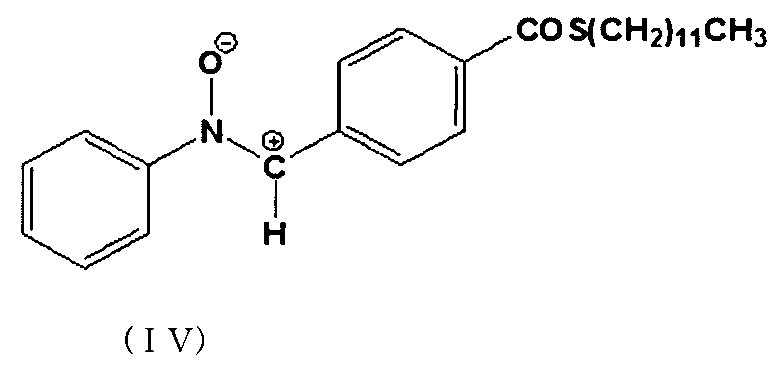
- thioester nitrone compound examples include compounds represented by the following formula (IV).
- the compound of the present invention does not have a hydrolyzable silyl group or silanol group. Since the compound of the present invention does not have a self-condensing functional group such as a hydrolyzable silyl group or a silanol group, gelation can be suppressed when the raw material polymer is modified, and the productivity is excellent.
- the hydrolyzable silyl group is a group in which a hydrolyzable group is bonded to a silicon atom.
- Examples of the hydrolyzable group include a group represented by —OR 51 .
- R 51 is a hydrocarbon group.
- the hydrocarbon group is the same as R in the thioester group.
- Examples of —OR 51 include an alkoxy group such as a methoxy group and an ethoxy group; and a phenoxy group.
- Examples of the hydrolyzable silyl group include an alkoxysilyl group and a phenoxysilyl group.
- One hydrolyzable silyl group can have 1 to 3 hydrolyzable groups.
- the group other than the hydrolyzable group bonded to the silicon atom is not particularly limited.
- a hydrocarbon group is mentioned.
- silanol group is a group in which a hydroxy group is bonded to a silicon atom.
- One silanol group can have 1 to 3 hydroxy groups.
- the group other than the hydroxy group bonded to the silicon atom is not particularly limited.
- a hydrocarbon group is mentioned.
- the melting point of the compound of the present invention is preferably 80 to 230 ° C.
- the melting point of the thioester nitrone compound can be measured according to JIS 0064-1992 (a method for visually measuring the melting point).
- the compound of the present invention can modify a polymer having an unsaturated bond.
- the thioester group of the compound of the present invention is formed by a carboxy nitrone compound having a carboxy group and a nitrone bond and a thiol.
- the carboxynitrone compound and thiol will be described later.
- the manufacturing method of the thioester nitrone compound of this invention is a manufacturing method of the thioester nitrone compound which manufactures the thioester nitrone compound of this invention by making the carboxy nitrone compound and thiol which have a carboxy group and a nitrone bond react.
- the reaction of the carboxy nitrone compound and thiol may be referred to as “the above reaction”.
- the carboxynitrone compound used in the production method of the thioester nitrone compound of the present invention is a compound having a carboxy group (—COOH) and a nitrone bond.
- the carboxy group and the nitrone bond can be bonded via an organic group.
- the organic group is not particularly limited. For example, it is the same as the above-described organic group via a thioester group and a nitrone bond.
- m and n are each independently 0 or more. m and n can be independently 4 or less, and 2 or less is preferable. The sum of m and n is 1 or more. The sum of m and n can be 10 or less, preferably 4 or less, and more preferably 1.
- carboxynitrone compound examples include compounds represented by the following formulas (3-1) to (3-6).
- the thiol used in the method for producing the thioester nitrone compound of the present invention is a compound having a mercapto group.
- the group to which the mercapto group is bonded is not particularly limited.
- an organic group is mentioned.
- the organic group is the same as R that can be bonded to the sulfur atom of the thioester group.
- the number of mercapto groups possessed by one molecule of thiol is not particularly limited.
- One preferred embodiment is that one thiol molecule has one mercapto group.
- thiol examples include alkyl thiols such as methane thiol, ethane thiol, butane thiol, hexane thiol, octane thiol, decane thiol, and dodecane thiol.
- the amount of the carboxynitrone compound and thiol used can be such that the molar ratio (SH / COOH) of the mercapto group of the thiol to the carboxy group of the carboxynitrone compound is 0.2 to 1.2.
- One preferred embodiment of the reaction of the carboxynitrone compound with the thiol is to further use a catalyst such as N, N-dimethyl-4-aminopyridine, for example.
- a catalyst such as N, N-dimethyl-4-aminopyridine, for example.
- the amount of catalyst used is not particularly limited.
- the temperature of the reaction can be 0 to 30 ° C.
- the above reaction can be carried out in a solvent.
- the solvent is not particularly limited as long as it is inert to the above reaction.
- an organic solvent such as dichloromethane can be used.
- One preferred embodiment of the reaction of the carboxynitrone compound with the thiol is to further use a carbodiimide such as dicyclohexylcarbodiimide.
- a carboxy nitrone compound and a carbodiimide can be coupled to form an ester, and the ester and thiol can react to produce a thioester nitrone compound.
- the carbodiimide can be used in an amount of 0.8 to 1.5 mol with respect to 1 mol of the carboxy group of the carboxynitrone compound.
- the polymer (raw polymer) having an unsaturated bond (for example, a double bond) to which the compound of the present invention can be applied is not particularly limited.
- Examples of the raw material polymer having an unsaturated bond include diene rubbers.
- Specific examples thereof include natural rubber (NR) (NR includes deproteinized natural rubber), isoprene rubber (IR), butadiene rubber (BR), aromatic vinyl-conjugated diene copolymer rubber (for example, Examples thereof include styrene butadiene rubber (SBR), acrylonitrile-butadiene copolymer rubber (NBR), butyl rubber (IIR), halogenated butyl rubber (Br-IIR, Cl-IIR), and chloroprene rubber (CR).
- NR natural rubber
- IR isoprene rubber
- BR butadiene rubber
- aromatic vinyl-conjugated diene copolymer rubber for example, Examples thereof include styrene butadiene rubber (SBR), acrylonitrile-butadiene copolymer rubber (NBR), butyl rubber (IIR), halogenated butyl rubber (Br-I
- the modifier composition of the present invention is a modifier composition that contains the compound of the present invention and a synthetic zeolite and modifies a polymer having an unsaturated bond. Since the modifier composition of the present invention contains the compound of the present invention, a polymer having an unsaturated bond can be modified. In addition, the polymer which has the said unsaturated bond is synonymous with the said raw material polymer.
- the raw material polymer to which the compound of the present invention or the modifier composition of the present invention is applied may contain impurities.
- impurities contained in natural rubber include protein.
- the present inventors have found that impurities as described above may degrade the compound of the present invention, thereby reducing the productivity of the modified polymer.
- the present inventors have found that the synthetic zeolite adsorbs impurities contained in the raw material polymer when the modifier composition of the present invention contains the synthetic zeolite.
- the impurities contained in the raw material polymer are inactivated with synthetic zeolite, and the compound of the present invention is prevented from being decomposed by the impurities, thereby increasing the reaction efficiency of the compound of the present invention and It is presumed that production has become more efficient.
- the thioester nitrone compound contained in the modifier composition of the present invention is not particularly limited as long as it is a compound of the present invention.
- the synthetic zeolite contained in the modifier composition of the present invention is not particularly limited.
- Specific examples of synthetic zeolites e.g., Na 2 O ⁇ Al 2 O 3 ⁇ 2SiO 2 ⁇ sH 2 O (2 ⁇ s ⁇ 7), Na 2 O ⁇ Al 2 O 2 ⁇ 3SiO 2 ⁇ sH 2 O (2 ⁇ s ⁇ 7), and aluminosilicates such as CaO.Al 2 O 2 .3SiO 2 .sH 2 O (2 ⁇ s ⁇ 7).
- the synthetic zeolite is preferably a powder.
- the average particle size of the synthetic zeolite is preferably 10 ⁇ m or less.
- the average particle size of the synthetic zeolite can be determined by measuring the volume-based particle size distribution using a laser diffraction particle size distribution analyzer, and the particle size at 50% cumulative (50% volume cumulative diameter).
- a laser diffraction type particle size distribution measuring apparatus for example, an apparatus according to LA-500 (trade name) manufactured by HORIBA, Ltd. may be mentioned.
- Synthetic zeolite is not particularly limited in its production method. For example, a conventionally well-known thing is mentioned. Synthetic zeolites can be used alone or in combination of two or more.
- the mass ratio of the synthetic zeolite to the compound of the present invention is preferably 1.5 to 30, more preferably 2 to 15, and still more preferably 3 to 10.
- the modifier composition of the present invention can further contain an additive.
- the additive include modifiers other than the compound of the present invention and inorganic substances other than synthetic zeolite.
- the content of the additive can be 0 to 1% by mass with respect to the total amount of the modifier composition of the present invention.
- the modifier composition of the present invention can contain only the compound of the present invention and a synthetic zeolite.
- the production method of the modifier composition of the present invention is not particularly limited. For example, it can manufacture by mixing the compound of this invention, a synthetic zeolite, and the additive which can be used as needed.
- the raw material polymer to which the modifier composition of the present invention can be applied is not particularly limited as long as it has an unsaturated bond.
- natural rubber is one preferred embodiment.
- the raw material polymer to which the modifier composition of the present invention can be applied is, for example, protein as an impurity from the viewpoint that the synthetic zeolite can remove impurities (for example, proteins derived from natural rubber) contained in the raw material polymer.
- One preferred embodiment is natural rubber which may contain
- the modified polymer of the present invention is a modified polymer having a modifying group by the thioester nitrone compound of the present invention (the compound of the present invention).
- the modified polymer of the present invention has a modifying group derived from the compound of the present invention.
- the modifying group has a ring structure (for example, a 5-membered ring such as an isoxazolidine ring) and a thioester group.
- One preferred embodiment of the modified polymer of the present invention is to have a modifying group in at least one selected from the group consisting of a main chain and a side chain. Moreover, it is mentioned as one of the preferable embodiments that at least a part of the main chain or at least a part of the side chain of the modified polymer of the invention has a modifying group.
- Examples of the modifying group possessed by the main chain include a group represented by the following formula (II).
- Examples of the modifying group possessed by the side chain include a group represented by the following formula (III).
- R 21 and R 22 are each independently a hydrocarbon group, a21, a22, b21 and b22 are each independently 0 or more, a21 + a22 is 1 or more, and b21 + b22 is 0 or more.
- R 21 , R 22 , a21, a22, b21, b22, a21 + a22, b21 + b22 in the formula (II) are R 11 , R 12 , a1, a2, b1, b2, a1 + a2, b1 + b2 in the formula (I), respectively. It is the same.
- R 31 and R 32 are each independently a hydrocarbon group, a31, a32, b31 and b32 are each independently 0 or more, a31 + a32 is 1 or more, and b31 + b32 is 0 or more. .
- R 31 , R 32 , a31, a32, b31, b32, a31 + a32, b31 + b32 in the formula (III) are R 11 , R 12 , a1, a2, b1, b2, a1 + a2, b1 + b2 in the formula (I), respectively. It is the same.
- the main chain (main chain skeleton) of the modified polymer of the present invention is preferably at least one selected from the group consisting of styrene butadiene rubber, butadiene rubber, isoprene rubber, acrylic butadiene rubber, acrylonitrile butadiene rubber and natural rubber.
- the modified polymer of the present invention preferably further has an unsaturated bond (for example, a double bond).
- the unsaturated bond may be present in either the main chain or the side chain.
- the content (modification rate) of the modifying group is 0.01 to 2 mol% with respect to the total amount of the modifying group and unsaturated bond (for example, double bond) possessed by the modified polymer of the present invention. Is preferable, and 0.05 to 1.5 mol% is more preferable.
- the main chain of the modified polymer is natural rubber, the content of the modifying group is 0.01 to 2 with respect to the total amount of the modifying group and unsaturated bonds (for example, double bonds) the modified polymer has.
- the mol% is preferable, 0.03 to 1.5 mol% is more preferable, and 0.05 to 1.5 mol% is still more preferable.
- the content of the modifying group is 0.01 to the total amount of the modifying group and unsaturated bonds (for example, double bonds) of the modified polymer.
- the content is preferably 2 mol%, more preferably 0.05 to 1.5 mol%, still more preferably 0.1 to 1.5 mol%.
- the modification rate means the content (mol%) of the modifying group with respect to the total amount of the modifying group and unsaturated bond (for example, double bond) of the modified polymer.
- the modification rate may be referred to as the modification rate of the modified polymer or the content of the modifying group as described above.
- the method for producing a modified polymer of the present invention comprises a modified polymer for producing a modified polymer of the present invention by reacting a raw material polymer having an unsaturated bond with the thioester nitrone compound of the present invention or the modifier composition of the present invention. It is a manufacturing method.
- the compound of the present invention or the modifier composition of the present invention used in the method for producing the modified polymer of the present invention may be referred to as “modifier or the like”.
- the thioester nitrone compound contained in the modifier composition of the present invention is synonymous with the compound of the present invention.
- the raw material polymer used in the method for producing a modified polymer of the present invention is not particularly limited as long as it is a polymer having an unsaturated bond (for example, a double bond).
- An example is diene rubber.
- diene rubber at least one selected from the group consisting of styrene butadiene rubber, butadiene rubber, isoprene rubber, acrylic butadiene rubber, acrylonitrile butadiene rubber and natural rubber is preferable.
- the weight average molecular weight of the raw material polymer is not particularly limited.
- the raw material polymers can be used alone or in combination of two or more.
- the thioester nitrone compound used in the method for producing the modified polymer of the present invention is not particularly limited as long as it is the thioester nitrone compound of the present invention (the compound of the present invention).
- the thioester nitrone compounds can be used alone or in combination of two or more.
- the amount of the thioester nitrone compound used is preferably 0.1 to 5.0 parts by mass, and more preferably 1.0 to 3.0 parts by mass with respect to 100 parts by mass of the starting polymer.
- the modifier composition that can be used in the method for producing the modified polymer of the present invention is not particularly limited as long as it is the modifier composition of the present invention.
- the modifier compositions can be used alone or in combination of two or more.
- the amount of the modifier composition used is preferably 0.5 to 25 parts by mass, more preferably 0.5 to 20 parts by mass, and still more preferably 1 to 15 parts by mass with respect to 100 parts by mass of the starting polymer.
- the unsaturated bond (for example, double bond) of the raw material polymer is modified with the thioester nitrone compound.
- a modifying group can be formed by the unsaturated bond (for example, double bond) and the thioester nitrone compound.
- 0.01 to 2 mol% is preferably modified with a thioester nitrone compound, more preferably 0.05 to 1.5 mol%.
- the raw material polymer is natural rubber, it is preferable that 0.01 to 2 mol% of unsaturated bonds (for example, double bonds) of the raw material polymer are modified with a thioester nitrone compound, and 0.03 to 1.
- the raw material polymer is other than natural rubber, it is preferable that 0.01 to 2 mol% of the unsaturated bonds (for example, double bonds) of the raw material polymer are modified with a thioester nitrone compound, 0.05 to 1 0.5 mol% is more preferable, and 0.1 to 1.0 mol% is still more preferable.
- the unsaturated bond of the starting polymer is, for example, —CH ⁇ CH—
- the unsaturated bond can react with the nitrone bond of the thioester nitrone compound represented by the following formula (4).
- the unsaturated bond of the starting polymer is, for example, —CH ⁇ CH 2
- the unsaturated bond can react with the nitrone bond of the thioester nitrone compound represented by the following formula (5).
- the unsaturated bond (for example, a double bond) of the raw material polymer can be modified to produce the modified polymer of the present invention.
- a modified group having a thioester group can be formed by a reaction between the unsaturated bond of the raw material polymer and the modifying agent of the present invention.
- the temperature during modification can usually be 130 to 200 ° C., preferably 150 ° C. or higher.
- the modification temperature is preferably 160 to 170 ° C.
- the modification temperature is preferably 170 ° C. or lower.
- the modified polymer of the present invention may contain an unreacted thioester nitrone compound.
- modified polymer of the present invention is not particularly limited.
- it can be used for a rubber composition.
- the melting point of the compound represented by the formula (IV) was 92 ° C.
- each component shown in each table is used in the composition (parts by mass) shown in the table, and these are mixed with a mixer and reacted at the modification temperature and modification time shown in the table to give each modified polymer. Manufactured.
- the number of moles of the thioester nitrone compound and the comparative nitrone compound used in the following tables is the same.
- Modification rate of modified polymer (mol%) Specifically, the modification rate of each modified polymer obtained in the examples was determined as follows. That is, 1 H-NMR (nuclear magnetic resonance spectroscopy) of the raw polymer and the modified polymer was measured (solvent CDCl 3 , 400 MHz, standard substance TMS: tetramethylsilane). From the above measurement, the peak area around 8.08 ppm (attributed to two protons adjacent to the carbonyl group) of the compound of the present invention or the comparative nitrone compound 2 was measured, and the modification rate of the modified polymer was determined from the results. . The modification rate determined as described above is shown as “modification rate” in each table.
- each modified polymer by comparative nitrone compound 1 was heated using a suggested operation calorimetry (DSC) apparatus (DSC823e manufactured by METTTLER TOLEDO) at a temperature rising rate of 10 ° C / min from -130 ° C to 40 ° C, or The glass transition temperature (unit: ° C.) of the unmodified polymer (raw polymer) was measured.
- DSC suggested operation calorimetry
- Nitron reaction rate (mol%) The nitrone reaction rate (reaction efficiency of the nitrone compound) is the mol% of the nitrone compound introduced into the modified polymer with respect to the nitrone compound reacted with the raw material polymer.
- Raw material polymer 3 (NR); natural rubber. PT.NUSIRA (SAD). Protein has not been removed.
- Raw material polymer 4 deproteinized NR: natural rubber from which protein has been removed.
- Product name Pureprene Made by The Malaysian Rubber Board (MRB)
- Thioester nitrone compound A thioester nitrone compound produced as described above. Melting point 92 ° C
- Comparative nitrone compound 1 diphenylnitrone produced as described above. Diphenylnitrone has no functional group other than the nitrone bond. Melting point 114 ° C Comparative nitrone compound 2: Carboxynitrone compound represented by the above formula (4) produced as described above. Does not have a thioester group. The carboxynitrone compound was decomposed at 240 ° C. or higher.
- Synthetic zeolites 1 trade name molecular sieve 5A, Tomoe Engineering Co. Ltd., average particle diameter of 10 ⁇ m or less, Na 2 O ⁇ Al 2 O 3 ⁇ 2SiO 2 ⁇ sH 2 O (2 ⁇ s ⁇ 7)
- Example 1 and 2 using the compounds of the present invention in the modification of diene rubbers other than natural rubber were able to maintain a high modification rate and were excellent in productivity of modified polymers. Further, when Examples 1 and 2 were compared, Example 2 had a modification temperature lower than that of Example 1, but the modification rate and nitrone reaction rate of Example 2 were almost the same as Example 1.
- Examples 3 and 4 using the compounds of the present invention in the modification of natural rubber and Examples 5 to 8 in Table 2 (Note that Example 3 in Table 2 is the same as Example 3 in Table 1. The same can be applied to the natural rubber, and the productivity of the modified polymer is excellent. Comparing Examples 3 and 4 in Table 1, natural rubber can be modified more efficiently even when the modification temperature is lower than that of Example 3, and the productivity of the modified polymer is superior. As described above, the compound of the present invention is excellent in the productivity of the modified polymer.
- Example 5 in which the deproteinized natural rubber is modified with the compound of the present invention in the absence of the synthetic zeolite is modified with the non-deproteinized natural rubber.
- the productivity of the modified polymer was superior to that of Example 3. This was considered to suggest the possibility that the compound of the present invention is decomposed by impurities such as proteins contained in the raw polymer.
- Example 6 when the modifier composition of the present invention was used (Examples 6 to 8), the productivity of the modified polymer was superior to Example 3 in which no synthetic zeolite was used. Thus, by using the modifier composition of the present invention, the productivity of the modified polymer (especially when the raw material polymer is natural rubber) was superior.
Landscapes
- Chemical & Material Sciences (AREA)
- Organic Chemistry (AREA)
- General Chemical & Material Sciences (AREA)
- Health & Medical Sciences (AREA)
- Chemical Kinetics & Catalysis (AREA)
- Medicinal Chemistry (AREA)
- Polymers & Plastics (AREA)
- Addition Polymer Or Copolymer, Post-Treatments, Or Chemical Modifications (AREA)
Abstract
本発明は、変性ポリマーの生産性に優れるニトロン化合物、その製造方法、変性剤組成物、変性ポリマー及びその製造方法の提供を目的とし、本発明は、チオエステル基とニトロン結合とを有するチオエステルニトロン化合物(ただしチオエステルニトロン化合物は加水分解性シリル基又はシラノール基を有さない)及びその製造方法、上記チオエステルニトロン化合物と合成ゼオライトとを含有する変性剤組成物、並びに、チオエステルニトロン化合物による変性基を有する変性ポリマー及びその製造方法である。
Description
本発明はチオエステルニトロン化合物、その製造方法、変性剤組成物、変性ポリマー及びその製造方法に関する。
従来、タイヤ等に用いられるゴム組成物に含まれるポリマーとして、各種のニトロンで変性された変性ポリマーが知られている(例えば特許文献1)。
このようななか、特許文献1を参考にニトロン化合物でジエン系ゴムを変性したところ、変性する際の温度が低いと変性率が低い場合があることが明らかとなった。
また、従来のニトロン化合物で天然ゴムを変性することは困難であることが明らかとなった。
そこで、本発明は変性ポリマーの生産性に優れるニトロン化合物を提供することを目的とする。
また、本発明はニトロン化合物の製造方法、変性剤組成物、変性ポリマー及び変性ポリマーの製造方法を提供することも目的とする。
また、従来のニトロン化合物で天然ゴムを変性することは困難であることが明らかとなった。
そこで、本発明は変性ポリマーの生産性に優れるニトロン化合物を提供することを目的とする。
また、本発明はニトロン化合物の製造方法、変性剤組成物、変性ポリマー及び変性ポリマーの製造方法を提供することも目的とする。
本発明者らは、上記課題を解決すべく鋭意研究した結果、チオエステル基を有するチオエステルニトロン化合物によって所定の効果が得られることを見出し、本発明に至った。
本発明は上記知見等に基づくものであり、具体的には以下の構成により上記課題を解決するものである。
本発明は上記知見等に基づくものであり、具体的には以下の構成により上記課題を解決するものである。
1. チオエステル基とニトロン結合とを有するチオエステルニトロン化合物。ただし上記チオエステルニトロン化合物は加水分解性シリル基又はシラノール基を有さない。
2. 下記式(I)で表される化合物である、上記1に記載のチオエステルニトロン化合物。
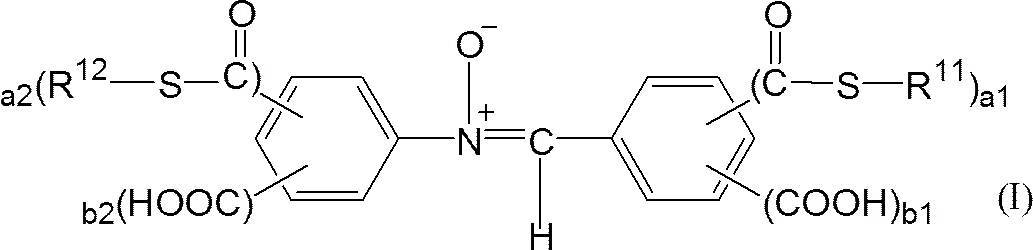
上記式(I)中、R11、R12はそれぞれ独立に炭化水素基であり、a1、a2、b1、b2はそれぞれ独立に0以上であり、a1+a2は1以上であり、b1+b2は0以上である。
3. 1分子中、上記ニトロン結合の数が1個である、上記1又は2に記載のチオエステルニトロン化合物。
4. 1分子中、上記チオエステル基の数が1個である、上記1~3のいずれかに記載のチオエステルニトロン化合物。
5. 上記チオエステル基が、カルボキシ基とニトロン結合とを有するカルボキシニトロン化合物とチオールとによって形成される、上記1~4のいずれかに記載のチオエステルニトロン化合物。
2. 下記式(I)で表される化合物である、上記1に記載のチオエステルニトロン化合物。
上記式(I)中、R11、R12はそれぞれ独立に炭化水素基であり、a1、a2、b1、b2はそれぞれ独立に0以上であり、a1+a2は1以上であり、b1+b2は0以上である。
3. 1分子中、上記ニトロン結合の数が1個である、上記1又は2に記載のチオエステルニトロン化合物。
4. 1分子中、上記チオエステル基の数が1個である、上記1~3のいずれかに記載のチオエステルニトロン化合物。
5. 上記チオエステル基が、カルボキシ基とニトロン結合とを有するカルボキシニトロン化合物とチオールとによって形成される、上記1~4のいずれかに記載のチオエステルニトロン化合物。
6. カルボキシ基とニトロン結合とを有するカルボキシニトロン化合物とチオールとを反応させることによって上記1~5のいずれかに記載のチオエステルニトロン化合物を製造する、チオエステルニトロン化合物の製造方法。
7. 上記1~5のいずれかに記載のチオエステルニトロン化合物と合成ゼオライトとを含有し、不飽和結合を有するポリマーを変性する、変性剤組成物。
8. 上記1~5のいずれかに記載のチオエステルニトロン化合物による変性基を有する変性ポリマー。
9. 主鎖及び側鎖からなる群から選ばれる少なくとも1種に上記変性基を有し、上記主鎖の変性基が下記式(II)で表される基であり、上記側鎖の変性基が下記式(III)で表される基である、上記8に記載の変性ポリマー。
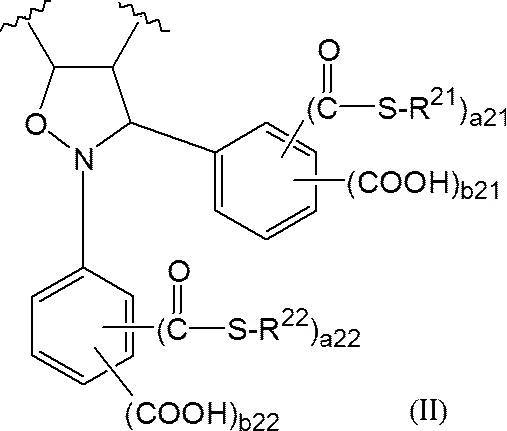
上記式(II)中、R21、R22はそれぞれ独立に炭化水素基であり、a21、a22、b21、b22はそれぞれ独立に0以上であり、a21+a22は1以上であり、b21+b22は0以上である。

上記式(III)中、R31、R32はそれぞれ独立に炭化水素基であり、a31、a32、b31、b32はそれぞれ独立に0以上であり、a31+a32は1以上であり、b31+b32は0以上である。
10. 主鎖が、スチレンブタジエンゴム、ブタジエンゴム、イソプレンゴム、アクリルブタジエンゴム及び天然ゴムからなる群から選ばれる少なくとも1種である、上記8又は9に記載の変性ポリマー。
11. 更に不飽和結合を有する、上記8~10のいずれかに記載の変性ポリマー。
12. 上記変性基の含有量が、上記変性基と上記不飽和結合との合計量に対して、0.01~2モル%である、上記11に記載の変性ポリマー。
9. 主鎖及び側鎖からなる群から選ばれる少なくとも1種に上記変性基を有し、上記主鎖の変性基が下記式(II)で表される基であり、上記側鎖の変性基が下記式(III)で表される基である、上記8に記載の変性ポリマー。
上記式(II)中、R21、R22はそれぞれ独立に炭化水素基であり、a21、a22、b21、b22はそれぞれ独立に0以上であり、a21+a22は1以上であり、b21+b22は0以上である。
上記式(III)中、R31、R32はそれぞれ独立に炭化水素基であり、a31、a32、b31、b32はそれぞれ独立に0以上であり、a31+a32は1以上であり、b31+b32は0以上である。
10. 主鎖が、スチレンブタジエンゴム、ブタジエンゴム、イソプレンゴム、アクリルブタジエンゴム及び天然ゴムからなる群から選ばれる少なくとも1種である、上記8又は9に記載の変性ポリマー。
11. 更に不飽和結合を有する、上記8~10のいずれかに記載の変性ポリマー。
12. 上記変性基の含有量が、上記変性基と上記不飽和結合との合計量に対して、0.01~2モル%である、上記11に記載の変性ポリマー。
13. 不飽和結合を有する原料ポリマーと上記1~5のいずれかに記載のチオエステルニトロン化合物又は上記7に記載の変性剤組成物とを反応させることによって上記8~12のいずれかに記載の変性ポリマーを製造する、変性ポリマーの製造方法。
本発明のチオエステルニトロン化合物は、変性ポリマーの生産性に優れる。
本発明によれば、チオエステルニトロン化合物の製造方法、変性剤組成物、変性ポリマー及びその製造方法を提供することができる。
本発明によれば、チオエステルニトロン化合物の製造方法、変性剤組成物、変性ポリマー及びその製造方法を提供することができる。
本発明について以下詳細に説明する。
なお、本明細書において、(メタ)アクリレートとは、アクリレートまたはメタクリレートを表し、(メタ)アクリロイルとは、アクリロイルまたはメタクリロイルを表し、(メタ)アクリルとは、アクリルまたはメタクリルを表す。
また、本明細書において「~」を用いて表される数値範囲は、「~」の前後に記載される数値を下限値および上限値として含む範囲を意味する。
本明細書において、成分が2種以上の物質を含む場合、上記成分の含有量とは、2種以上の物質の合計の含有量を指す。
本明細書において、変性ポリマーの生産性により優れることを「本発明の効果より優れる」という場合がある。
なお、本明細書において、(メタ)アクリレートとは、アクリレートまたはメタクリレートを表し、(メタ)アクリロイルとは、アクリロイルまたはメタクリロイルを表し、(メタ)アクリルとは、アクリルまたはメタクリルを表す。
また、本明細書において「~」を用いて表される数値範囲は、「~」の前後に記載される数値を下限値および上限値として含む範囲を意味する。
本明細書において、成分が2種以上の物質を含む場合、上記成分の含有量とは、2種以上の物質の合計の含有量を指す。
本明細書において、変性ポリマーの生産性により優れることを「本発明の効果より優れる」という場合がある。
[チオエステルニトロン化合物]
本発明のチオエステルニトロン化合物(以下これを「本発明の化合物」とも称する。)は、チオエステル基とニトロン結合とを有するチオエステルニトロン化合物である。ただし本発明の化合物は加水分解性シリル基又はシラノール基を有さない。
本発明のチオエステルニトロン化合物(以下これを「本発明の化合物」とも称する。)は、チオエステル基とニトロン結合とを有するチオエステルニトロン化合物である。ただし本発明の化合物は加水分解性シリル基又はシラノール基を有さない。
(変性)
本発明の化合物は、不飽和結合を有するポリマーを変性(具体的にはチオエステル変性)することができる。つまり、本発明の化合物は、上記ポリマーにチオエステル基を導入することができる。
(不飽和結合を有するポリマーと本発明の化合物との反応)
本発明において、不飽和結合を有するポリマーと本発明の化合物とを反応させると、上記ポリマーが有する不飽和結合と本発明の化合物が有するニトロン結合とが反応することによって、上記ポリマーにチオエステル基を導入することができる。上記チオエステル基は本発明の化合物に由来する。
(変性基)
本発明において、上記不飽和結合と上記ニトロン結合との反応によって、不飽和結合を有するポリマーに例えば環構造(例えば、イソオキサゾリジン環のような5員環)を有する変性基を形成することができる。上記変性基は上記環構造の他にチオエステル基を有する。上記チオエステル基は本発明の化合物に由来する。
(変性ポリマー)
本発明において、本発明の変性ポリマーは本発明の化合物で形成される変性基(例えば、上記のような環構造及びチオエステル基を有する変性基)を有する。
本発明の化合物と不飽和結合を有するポリマーとを反応させることによって、本発明の変性ポリマーを得ることができる。
(不飽和結合)
本発明において、不飽和結合を有する原料ポリマー又は不飽和結合を更に有する変性ポリマーにおける不飽和結合は不飽和炭素炭素結合を意味する。不飽和結合としては、二重結合(C=C)、三重結合(C≡C)が挙げられ、二重結合が好ましい態様の1つとして挙げられる。二重結合としては-C=C-又は-C=C(端部の二重結合)が挙げられる。二重結合を構成する炭素原子はそれぞれ独立に水素原子又は置換基と結合することができる。上記炭素原子はそれぞれ水素原子と結合することが好ましい。
本発明の化合物は、不飽和結合を有するポリマーを変性(具体的にはチオエステル変性)することができる。つまり、本発明の化合物は、上記ポリマーにチオエステル基を導入することができる。
(不飽和結合を有するポリマーと本発明の化合物との反応)
本発明において、不飽和結合を有するポリマーと本発明の化合物とを反応させると、上記ポリマーが有する不飽和結合と本発明の化合物が有するニトロン結合とが反応することによって、上記ポリマーにチオエステル基を導入することができる。上記チオエステル基は本発明の化合物に由来する。
(変性基)
本発明において、上記不飽和結合と上記ニトロン結合との反応によって、不飽和結合を有するポリマーに例えば環構造(例えば、イソオキサゾリジン環のような5員環)を有する変性基を形成することができる。上記変性基は上記環構造の他にチオエステル基を有する。上記チオエステル基は本発明の化合物に由来する。
(変性ポリマー)
本発明において、本発明の変性ポリマーは本発明の化合物で形成される変性基(例えば、上記のような環構造及びチオエステル基を有する変性基)を有する。
本発明の化合物と不飽和結合を有するポリマーとを反応させることによって、本発明の変性ポリマーを得ることができる。
(不飽和結合)
本発明において、不飽和結合を有する原料ポリマー又は不飽和結合を更に有する変性ポリマーにおける不飽和結合は不飽和炭素炭素結合を意味する。不飽和結合としては、二重結合(C=C)、三重結合(C≡C)が挙げられ、二重結合が好ましい態様の1つとして挙げられる。二重結合としては-C=C-又は-C=C(端部の二重結合)が挙げられる。二重結合を構成する炭素原子はそれぞれ独立に水素原子又は置換基と結合することができる。上記炭素原子はそれぞれ水素原子と結合することが好ましい。
本発明の化合物はこのような構成をとるため、所望の効果が得られるものと考えられる。その理由は明らかではないが、およそ以下のとおりと推測される。
従来、ジフェニルニトロンのようなニトロン結合以外の官能基を有さないニトロン化合物は変性率が低かった。
一方、ニトロン結合以外の官能基を更に有するニトロン化合物による変性率は低い場合があった。これは、上記官能基を更に有する従来のニトロン化合物は融点が高く、変性温度を高くしなければ上記ニトロン化合物が系内に溶融せず原料ポリマーと反応しにくいこと、また、変性温度を高くすることによって原料ポリマーがゲル化する場合があることが原因と考えられた。
従来、ジフェニルニトロンのようなニトロン結合以外の官能基を有さないニトロン化合物は変性率が低かった。
一方、ニトロン結合以外の官能基を更に有するニトロン化合物による変性率は低い場合があった。これは、上記官能基を更に有する従来のニトロン化合物は融点が高く、変性温度を高くしなければ上記ニトロン化合物が系内に溶融せず原料ポリマーと反応しにくいこと、また、変性温度を高くすることによって原料ポリマーがゲル化する場合があることが原因と考えられた。
これに対して本発明の化合物は変性ポリマーの生産性に優れた。これは、ニトロン化合物にチオエステル基を導入することによってニトロン化合物の融点を大幅に下げることができたためであると推測された。このため、従来と同じ程度の変性温度(170℃程度)において、本発明の化合物は従来のニトロン化合物よりも系内で溶解しやすく、原料ポリマーとの変性率が高くなったと考えられる。また、本発明の化合物を用いれば変性温度130℃の条件下で、170℃の条件下での変性と同様な変性率を得ることができることが検証された。
さらに、天然ゴムは従来のニトロン化合物では変性しにくかった。本発明においては天然ゴムと本発明の化合物とを反応させることによって、天然ゴムの変性を効率的に実現させることができた。
また、本発明の化合物は加水分解性シリル基又はシラノール基のような自己縮合官能基を含まないことによってゲル化が発生しないため、生産性に優れると考えられる。
このように、本発明の化合物は所定の官能基(チオエステル基)を有し、チオエステル基を有することよって本発明の化合物は融点が低くなるため、変性ポリマーの生産性(例えば、変性温度を低くしても変性率に優れる。天然ゴムを効率的に変性することができる。等)に優れると考えられる。
<チオエステル基>
本発明の化合物はチオエステル基を有する。チオエステル基は-CO-S-で表される基である。
本発明の化合物はチオエステル基を有する。チオエステル基は-CO-S-で表される基である。
チオエステル基はチオエステル基が有する硫黄原子において有機基(R)と結合することができる。
(R:有機基)
チオエステル基の硫黄原子に結合する有機基は特に制限されない。例えば、炭化水素基が挙げられる。
炭化水素基としては、例えば、脂肪族炭化水素基(直鎖状、分岐状、環状を含む。)、芳香族炭化水素基、又はこれらの組合せが挙げられる。炭化水素基は不飽和結合を有してもよい。炭化水素基の炭素数は1~20とすることができる。
(R:有機基)
チオエステル基の硫黄原子に結合する有機基は特に制限されない。例えば、炭化水素基が挙げられる。
炭化水素基としては、例えば、脂肪族炭化水素基(直鎖状、分岐状、環状を含む。)、芳香族炭化水素基、又はこれらの組合せが挙げられる。炭化水素基は不飽和結合を有してもよい。炭化水素基の炭素数は1~20とすることができる。
Rとしての炭化水素基は脂肪族炭化水素基が好ましく、直鎖状の脂肪族炭化水素基がより好ましい。脂肪族炭化水素基は飽和脂肪族炭化水素基が好ましい。
Rとしての炭化水素基の炭素数は20以下が好ましく、5~15がより好ましい。
Rとしての炭化水素基の炭素数は20以下が好ましく、5~15がより好ましい。
Rとしての炭化水素基としては、例えば、メチル基、エチル基、ブチル基、ヘキシル基、オクチル基、デシル基、ドデシル基が挙げられる。
本発明の化合物は1分子中にチオエステル基を1~4個有することができる。本発明の化合物1分子中のチオエステル基の数は本発明の効果により優れるという観点から1個が好ましい。
<ニトロン結合>
本発明の化合物はニトロン結合を有する。ニトロン結合は下記式(1)で表される基である。
本発明の化合物はニトロン結合を有する。ニトロン結合は下記式(1)で表される基である。

式(1)中、*は結合位置を表す。
なお、本発明において、ニトロン結合は下記式で表される場合がある。*は結合位置を表す。

本発明の化合物は1分子中にニトロン結合を1~3個有することができる。本発明の化合物1分子中のニトロン結合の数は本発明の効果により優れるという観点から1個が好ましい。
(チオエステル基とニトロン結合とを介する有機基)
チオエステル基とニトロン結合とは有機基を介して結合することができる。
有機基は特に制限されない。例えば、ヘテロ原子を有してもよい、炭化水素基が挙げられる。
チオエステル基とニトロン結合とは有機基を介して結合することができる。
有機基は特に制限されない。例えば、ヘテロ原子を有してもよい、炭化水素基が挙げられる。
炭化水素基は上記と同様である。なかでも、芳香族炭化水素基が好ましく、ベンゼン環がより好ましい。
有機基が有してもよいヘテロ原子としては、例えば、酸素原子、窒素原子、硫黄原子、ハロゲン等が挙げられる。ヘテロ原子は別のヘテロ原子、炭素原子又は水素原子と結合して官能基を構成してもよい。このような官能基としては、例えば、カルボキシ基が挙げられる。
本発明の化合物は上記官能基を有さないことが好ましい態様の1つとして挙げられる。
本発明の化合物が更に上記官能基を有する場合、官能基の数は、チオエステルニトロン化合物1分子中、1~6個とすることができる。
本発明の化合物は上記官能基を有さないことが好ましい態様の1つとして挙げられる。
本発明の化合物が更に上記官能基を有する場合、官能基の数は、チオエステルニトロン化合物1分子中、1~6個とすることができる。
本発明の化合物としては、例えば、下記式(I)で表される化合物が挙げられる。
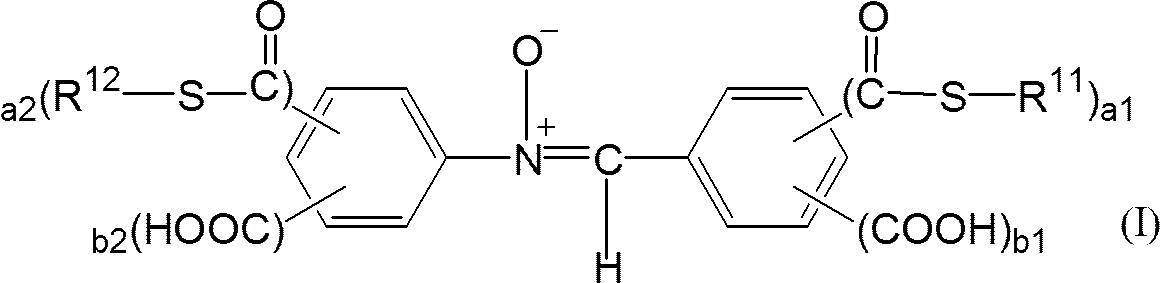
式(I)中、R11、R12はそれぞれ独立に炭化水素基である。R11、R12としての炭化水素基は上記Rと同様である。
a1、a2、b1、b2はそれぞれ独立に0以上である。
a1、a2、b1、b2はそれぞれ独立に0以上である。
a1、a2はそれぞれ独立に3以下が好ましい。
a1+a2は1以上であり、4以下とすることができ、1が好ましい。
a1が1であり、a2が0であることが好ましい態様の1つとして挙げられる。
a1+a2は1以上であり、4以下とすることができ、1が好ましい。
a1が1であり、a2が0であることが好ましい態様の1つとして挙げられる。
b1、b2はそれぞれ独立に6以下とすることができ、1以下が好ましい。b1、b2が同時に0であることが好ましい態様の1つとして挙げられる。
b1+b2は0以上であり、6以下とすることができ、0が好ましい。
b1+b2は0以上であり、6以下とすることができ、0が好ましい。
チオエステルニトロン化合物としては、具体的には例えば、下記式(IV)で表される化合物が挙げられる。
本発明の化合物は、加水分解性シリル基又はシラノール基を有さない。
本発明の化合物は、加水分解性シリル基又はシラノール基のような自己縮合官能基を有さないことによって、原料ポリマーを変性する際、ゲル化を抑制することができ、生産性に優れる。
本発明の化合物は、加水分解性シリル基又はシラノール基のような自己縮合官能基を有さないことによって、原料ポリマーを変性する際、ゲル化を抑制することができ、生産性に優れる。
(加水分解性シリル基)
加水分解性シリル基は、ケイ素原子に加水分解性基が結合した基である。
加水分解性基としては、例えば、-OR51で表される基が挙げられる。R51は炭化水素基である。炭化水素基はチオエステル基が有するRと同様である。-OR51としては例えば、メトキシ基、エトキシ基のようなアルコキシ基;フェニノキシ基が挙げられる。
加水分解性シリル基としては、例えば、アルコキシシリル基、フェノキシシリル基が挙げられる。
加水分解性シリル基は、ケイ素原子に加水分解性基が結合した基である。
加水分解性基としては、例えば、-OR51で表される基が挙げられる。R51は炭化水素基である。炭化水素基はチオエステル基が有するRと同様である。-OR51としては例えば、メトキシ基、エトキシ基のようなアルコキシ基;フェニノキシ基が挙げられる。
加水分解性シリル基としては、例えば、アルコキシシリル基、フェノキシシリル基が挙げられる。
1個の加水分解性シリル基が有する加水分解性基は1~3個とできる。
1個の加水分解性シリル基が有する加水分解性基が1~2個である場合、上記ケイ素原子に結合する、加水分解性基以外の基は特に制限されない。例えば、炭化水素基が挙げられる。
1個の加水分解性シリル基が有する加水分解性基が1~2個である場合、上記ケイ素原子に結合する、加水分解性基以外の基は特に制限されない。例えば、炭化水素基が挙げられる。
(シラノール基)
シラノール基は、ケイ素原子にヒドロキシ基が結合した基である。
1個のシラノール基が有するヒドロキシ基は1~3個とできる。
1個のシラノール基が有するヒドロキシ基が1~2個である場合、上記ケイ素原子に結合する、ヒドロキシ基以外の基は特に制限されない。例えば、炭化水素基が挙げられる。
シラノール基は、ケイ素原子にヒドロキシ基が結合した基である。
1個のシラノール基が有するヒドロキシ基は1~3個とできる。
1個のシラノール基が有するヒドロキシ基が1~2個である場合、上記ケイ素原子に結合する、ヒドロキシ基以外の基は特に制限されない。例えば、炭化水素基が挙げられる。
本発明の化合物の融点は80~230℃が好ましい。チオエステルニトロン化合物の融点はJIS 0064-1992(目視による融点測定方法)に準じて測定することができる。
本発明の化合物は、不飽和結合を有するポリマーを変性することができる。
本発明の化合物は、不飽和結合を有するポリマーを変性することができる。
本発明の化合物が有するチオエステル基は、カルボキシ基とニトロン結合とを有するカルボキシニトロン化合物とチオールとによって形成されることが好ましい態様の1つとして挙げられる。カルボキシニトロン化合物、チオールについては後述する。
[チオエステルニトロン化合物の製造方法]
本発明のチオエステルニトロン化合物の製造方法は、カルボキシ基とニトロン結合とを有するカルボキシニトロン化合物とチオールとを反応させることによって、本発明のチオエステルニトロン化合物を製造する、チオエステルニトロン化合物の製造方法である。
なお、本明細書の[チオエステルニトロン化合物の製造方法]において、上記カルボキシニトロン化合物とチオールとの反応を「上記反応」と称する場合がある。
本発明のチオエステルニトロン化合物の製造方法は、カルボキシ基とニトロン結合とを有するカルボキシニトロン化合物とチオールとを反応させることによって、本発明のチオエステルニトロン化合物を製造する、チオエステルニトロン化合物の製造方法である。
なお、本明細書の[チオエステルニトロン化合物の製造方法]において、上記カルボキシニトロン化合物とチオールとの反応を「上記反応」と称する場合がある。
<カルボキシニトロン化合物>
本発明のチオエステルニトロン化合物の製造方法に使用されるカルボキシニトロン化合物は、カルボキシ基(-COOH)とニトロン結合とを有する化合物である。
本発明のチオエステルニトロン化合物の製造方法に使用されるカルボキシニトロン化合物は、カルボキシ基(-COOH)とニトロン結合とを有する化合物である。
カルボキシ基とニトロン結合とは有機基を介して結合することができる。
有機基は特に制限されない。例えば、上述の、チオエステル基とニトロン結合とを介する有機基と同様である。
有機基は特に制限されない。例えば、上述の、チオエステル基とニトロン結合とを介する有機基と同様である。
カルボキシニトロン化合物としては、例えば、下記式(3)で表される化合物が挙げられる。

式(3)中、mおよびnはそれぞれ独立に0以上である。mおよびnはそれぞれ独立に4以下とすることができ、2以下が好ましい。
mとnとの合計は1以上である。mとnとの合計は10以下とすることができ、4以下が好ましく、1がより好ましい。
式(3)中、mおよびnはそれぞれ独立に0以上である。mおよびnはそれぞれ独立に4以下とすることができ、2以下が好ましい。
mとnとの合計は1以上である。mとnとの合計は10以下とすることができ、4以下が好ましく、1がより好ましい。
カルボキシニトロン化合物としては、具体的には例えば、下記式(3-1)~式(3-6)で表される化合物が挙げられる。


<チオール>
本発明のチオエステルニトロン化合物の製造方法に使用されるチオールは、メルカプト基を有する化合物である。
メルカプト基が結合する基は特に制限されない。例えば、有機基が挙げられる。上記有機基は、上述のチオエステル基の硫黄原子に結合できるRと同様である。
本発明のチオエステルニトロン化合物の製造方法に使用されるチオールは、メルカプト基を有する化合物である。
メルカプト基が結合する基は特に制限されない。例えば、有機基が挙げられる。上記有機基は、上述のチオエステル基の硫黄原子に結合できるRと同様である。
1分子のチオールが有するメルカプト基の数は特に制限されない。チオール1分子が有するメルカプト基の数は1個であることが好ましい態様の1つとして挙げられる。
チオールとしては、例えば、例えば、メタンチオール、エタンチオール、ブタンチオール、ヘキサンチオール、オクタンチオール、デカンチオール、ドデカンチオールのようなアルキルチオールが挙げられる。
カルボキシニトロン化合物とチオールとの使用量は、カルボキシニトロン化合物が有するカルボキシ基に対する、チオールが有するメルカプト基のモル比(SH/COOH)が0.2~1.2となる量とすることができる。
カルボキシニトロン化合物とチオールとの反応には、例えば、N,N-ジメチル-4-アミノピリジンのような触媒を更に用いることが好ましい態様の1つとして挙げられる。触媒の使用量は特に制限されない。
上記反応の温度は、0~30℃とすることができる。
上記反応の温度は、0~30℃とすることができる。
また、上記反応は溶媒中で行うことができる。溶媒は上記反応に不活性であれば特に制限されない。例えば、ジクロロメタンのような有機溶媒を用いることができる。
カルボキシニトロン化合物とチオールとの反応には、例えば、ジシクロヘキシルカルボジイミドのようなカルボジイミドを更に用いることが好ましい態様の1つとして挙げられる。カルボキシニトロン化合物とカルボジイミドがカップリング反応してエステルを形成し、上記エステルとチオールとが反応してチオエステルニトロン化合物を生成することができる。
カルボジイミドの使用量は、カルボキシニトロン化合物が有するカルボキシ基1モルに対して、0.8~1.5モルとすることができる。
上記反応が完了した後、精製によって本発明のチオエステルニトロン化合物を得ることができる。精製の方法は特に制限されない。
カルボジイミドの使用量は、カルボキシニトロン化合物が有するカルボキシ基1モルに対して、0.8~1.5モルとすることができる。
上記反応が完了した後、精製によって本発明のチオエステルニトロン化合物を得ることができる。精製の方法は特に制限されない。
(本発明の化合物を適用することができる原料ポリマー)
本発明の化合物を適用することができる、不飽和結合(例えば二重結合)を有するポリマー(原料ポリマー)は特に制限されない。
本発明の化合物を適用することができる、不飽和結合(例えば二重結合)を有するポリマー(原料ポリマー)は特に制限されない。
不飽和結合を有する原料ポリマーとしては、例えば、ジエン系ゴムが挙げられる。その具体例としては例えば、天然ゴム(NR)(NRは脱タンパクされた天然ゴムを含む。)、イソプレンゴム(IR)、ブタジエンゴム(BR)、芳香族ビニル-共役ジエン共重合体ゴム(例えばスチレンブタジエンゴム(SBR))、アクリロニトリル-ブタジエン共重合ゴム(NBR)、ブチルゴム(IIR)、ハロゲン化ブチルゴム(Br-IIR、Cl-IIR)、クロロプレンゴム(CR)などが挙げられる。
なかでも、ブタジエンゴム、芳香族ビニル-共役ジエン共重合体ゴム、天然ゴムが好ましい。
なかでも、ブタジエンゴム、芳香族ビニル-共役ジエン共重合体ゴム、天然ゴムが好ましい。
[変性剤組成物]
本発明の変性剤組成物は、本発明の化合物と合成ゼオライトとを含有し、不飽和結合を有するポリマーを変性する、変性剤組成物である。
本発明の変性剤組成物は、本発明の化合物を含有するため、不飽和結合を有するポリマーを変性することができる。なお、上記不飽和結合を有するポリマーは上記原料ポリマーと同義である。
本発明の変性剤組成物は、本発明の化合物と合成ゼオライトとを含有し、不飽和結合を有するポリマーを変性する、変性剤組成物である。
本発明の変性剤組成物は、本発明の化合物を含有するため、不飽和結合を有するポリマーを変性することができる。なお、上記不飽和結合を有するポリマーは上記原料ポリマーと同義である。
本発明の化合物又は本発明の変性剤組成物を適用する原料ポリマーは、不純物を含有する場合がある。原料ポリマーが天然ゴムである場合、天然ゴムに含有される不純物としては例えばタンパク質が挙げられる。本発明者らは、上記のような不純物が本発明の化合物を分解し、これによって、変性ポリマーの生産性を低下させる場合があることを知見した。
このような問題に対し、本発明者らは、本発明の変性剤組成物が合成ゼオライトを含有することによって、合成ゼオライトが原料ポリマーに含有される不純物を吸着することを見出した。このように、原料ポリマーに含有される不純物を合成ゼオライトで不活性化し、本発明の化合物が不純物によって分解されることを抑制することによって、本発明の化合物の反応効率を高くし、変性ポリマーをより効率的に生産できるようになったと推測される。
このような問題に対し、本発明者らは、本発明の変性剤組成物が合成ゼオライトを含有することによって、合成ゼオライトが原料ポリマーに含有される不純物を吸着することを見出した。このように、原料ポリマーに含有される不純物を合成ゼオライトで不活性化し、本発明の化合物が不純物によって分解されることを抑制することによって、本発明の化合物の反応効率を高くし、変性ポリマーをより効率的に生産できるようになったと推測される。
<チオエステルニトロン化合物>
本発明の変性剤組成物に含有されるチオエステルニトロン化合物は本発明の化合物であれば特に制限されない。
本発明の変性剤組成物に含有されるチオエステルニトロン化合物は本発明の化合物であれば特に制限されない。
<合成ゼオライト>
本発明の変性剤組成物に含有される合成ゼオライトは、特に制限されない。
合成ゼオライトの具体例としては、例えば、Na2O・Al2O3・2SiO2・sH2O(2≦s≦7)、Na2O・Al2O2・3SiO2・sH2O(2≦s≦7)、CaO・Al2O2・3SiO2・sH2O(2≦s≦7)のようなアルミノケイ酸塩が挙げられる。
本発明の変性剤組成物に含有される合成ゼオライトは、特に制限されない。
合成ゼオライトの具体例としては、例えば、Na2O・Al2O3・2SiO2・sH2O(2≦s≦7)、Na2O・Al2O2・3SiO2・sH2O(2≦s≦7)、CaO・Al2O2・3SiO2・sH2O(2≦s≦7)のようなアルミノケイ酸塩が挙げられる。
合成ゼオライトは粉末であることが好ましい。
合成ゼオライトの平均粒子径は10μm以下が好ましい。
本発明において、合成ゼオライトの平均粒子径は、レーザー回折式粒度分布測定装置を用いて体積基準の粒度分布を測定して求めることができる、累積50%における粒子径(50%体積累積径)をいう。このようなレーザー回折式粒度分布測定装置としては、例えば、堀場製作所製のLA-500(商品名)に準ずる装置が挙げられる。
合成ゼオライトの平均粒子径は10μm以下が好ましい。
本発明において、合成ゼオライトの平均粒子径は、レーザー回折式粒度分布測定装置を用いて体積基準の粒度分布を測定して求めることができる、累積50%における粒子径(50%体積累積径)をいう。このようなレーザー回折式粒度分布測定装置としては、例えば、堀場製作所製のLA-500(商品名)に準ずる装置が挙げられる。
合成ゼオライトはその製造方法について特に制限されない。例えば従来公知のものが挙げられる。合成ゼオライトはそれぞれ単独でまたは2種以上を組み合わせて使用することができる。
本発明の化合物に対する合成ゼオライトの質量比(合成ゼオライト/本発明の化合物)は1.5~30が好ましく、2~15がより好ましく、3~10が更に好ましい。
本発明の変性剤組成物は、更に、添加剤を含有することができる。添加剤としては例えば、本発明の化合物以外の変性剤、合成ゼオライト以外の無機物が挙げられる。上記添加剤の含有量は本発明の変性剤組成物全量に対して、0~1質量%とすることができる。
また、本発明の変性剤組成物は、本発明の化合物と合成ゼオライトとだけを含有するものとすることができる。
また、本発明の変性剤組成物は、本発明の化合物と合成ゼオライトとだけを含有するものとすることができる。
本発明の変性剤組成物はその製造方法について特に制限されない。例えば、本発明の化合物と、合成ゼオライトと、必要に応じて使用することができる添加剤とを混合することによって製造することができる。
本発明の変性剤組成物を適用することができる原料ポリマーは不飽和結合を有するものであれば特に制限されない。例えば、上記と同様のものが挙げられる。なかでも天然ゴムが好ましい態様の1つとして挙げられる。
本発明の変性剤組成物を適用することができる原料ポリマーは、合成ゼオライトが原料ポリマーに含まれる不純物(例えば、天然ゴムに由来するタンパク質)を除去することができるという観点から、不純物として例えばタンパク質を含んでもよい天然ゴムが好ましい態様の1つとして挙げられる。
本発明の変性剤組成物を適用することができる原料ポリマーは、合成ゼオライトが原料ポリマーに含まれる不純物(例えば、天然ゴムに由来するタンパク質)を除去することができるという観点から、不純物として例えばタンパク質を含んでもよい天然ゴムが好ましい態様の1つとして挙げられる。
[変性ポリマー]
本発明の変性ポリマーは、本発明のチオエステルニトロン化合物(本発明の化合物)による変性基を有する変性ポリマーである。
本発明の変性ポリマーは、本発明のチオエステルニトロン化合物(本発明の化合物)による変性基を有する変性ポリマーである。
<変性基>
本発明の変性ポリマーは、本発明の化合物による変性基を有する。上記変性基は、環構造(例えばイソオキサゾリジン環のような5員環)及びチオエステル基を有する。
本発明の変性ポリマーは、主鎖及び側鎖からなる群から選ばれる少なくとも1種に変性基を有することが好ましい態様の1つとして挙げられる。
また、本発明の変性ポリマーの主鎖の少なくとも一部又は側鎖の少なくとも一部が変性基を有することが好ましい態様の1つとして挙げられる。
本発明の変性ポリマーは、本発明の化合物による変性基を有する。上記変性基は、環構造(例えばイソオキサゾリジン環のような5員環)及びチオエステル基を有する。
本発明の変性ポリマーは、主鎖及び側鎖からなる群から選ばれる少なくとも1種に変性基を有することが好ましい態様の1つとして挙げられる。
また、本発明の変性ポリマーの主鎖の少なくとも一部又は側鎖の少なくとも一部が変性基を有することが好ましい態様の1つとして挙げられる。
主鎖が有する変性基としては、例えば、下記式(II)で表される基が挙げられる。
側鎖が有する変性基としては、例えば、下記式(III)で表される基が挙げられる。
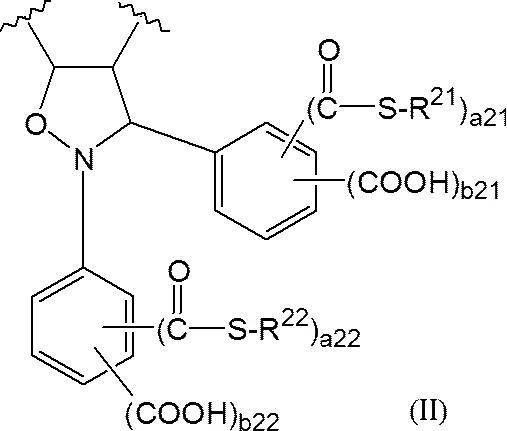
式(II)中、R21、R22はそれぞれ独立に炭化水素基であり、a21、a22、b21、b22はそれぞれ独立に0以上であり、a21+a22は1以上であり、b21+b22は0以上である。
式(II)の、R21、R22、a21、a22、b21、b22、a21+a22、b21+b22は、それぞれ、式(I)の、R11、R12、a1、a2、b1、b2、a1+a2、b1+b2と同様である。
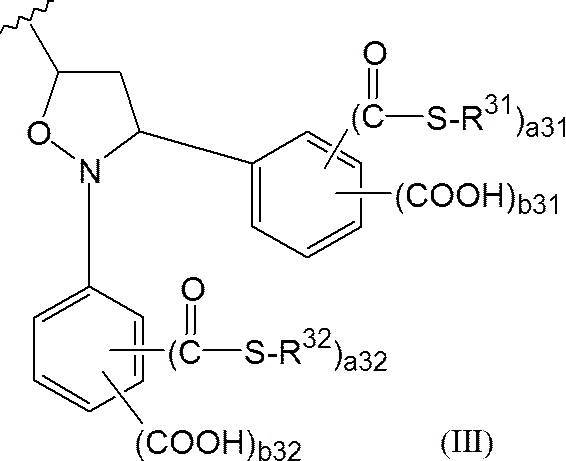
式(III)中、R31、R32はそれぞれ独立に炭化水素基であり、a31、a32、b31、b32はそれぞれ独立に0以上であり、a31+a32は1以上であり、b31+b32は0以上である。
式(III)の、R31、R32、a31、a32、b31、b32、a31+a32、b31+b32は、それぞれ、式(I)の、R11、R12、a1、a2、b1、b2、a1+a2、b1+b2と同様である。
側鎖が有する変性基としては、例えば、下記式(III)で表される基が挙げられる。
式(II)中、R21、R22はそれぞれ独立に炭化水素基であり、a21、a22、b21、b22はそれぞれ独立に0以上であり、a21+a22は1以上であり、b21+b22は0以上である。
式(II)の、R21、R22、a21、a22、b21、b22、a21+a22、b21+b22は、それぞれ、式(I)の、R11、R12、a1、a2、b1、b2、a1+a2、b1+b2と同様である。
式(III)中、R31、R32はそれぞれ独立に炭化水素基であり、a31、a32、b31、b32はそれぞれ独立に0以上であり、a31+a32は1以上であり、b31+b32は0以上である。
式(III)の、R31、R32、a31、a32、b31、b32、a31+a32、b31+b32は、それぞれ、式(I)の、R11、R12、a1、a2、b1、b2、a1+a2、b1+b2と同様である。
(変性ポリマーの主鎖)
本発明の変性ポリマーの主鎖(主鎖骨格)は、スチレンブタジエンゴム、ブタジエンゴム、イソプレンゴム、アクリルブタジエンゴム、アクリロニトリルブタジエンゴム及び天然ゴムからなる群から選ばれる少なくとも1種であることが好ましい。
本発明の変性ポリマーの主鎖(主鎖骨格)は、スチレンブタジエンゴム、ブタジエンゴム、イソプレンゴム、アクリルブタジエンゴム、アクリロニトリルブタジエンゴム及び天然ゴムからなる群から選ばれる少なくとも1種であることが好ましい。
本発明の変性ポリマーは、更に不飽和結合(例えば、二重結合)を有することが好ましい。上記不飽和結合は主鎖及び側鎖うちのいずれにあってもよい。
(変性基の含有量:変性率)
変性基の含有量(変性率)は、本発明の変性ポリマーが有する、変性基と不飽和結合(例えば、二重結合)との合計量に対して、0.01~2モル%であることが好ましく、0.05~1.5モル%がより好ましい。
変性ポリマーの主鎖が天然ゴムである場合、変性基の含有量は、変性ポリマーが有する、変性基と不飽和結合(例えば、二重結合)との合計量に対して、0.01~2モル%であることが好ましく、0.03~1.5モル%がより好ましく、0.05~1.5モル%が更に好ましい。
変性ポリマーの主鎖が天然ゴム以外である場合、変性基の含有量は、変性ポリマーが有する、変性基と不飽和結合(例えば、二重結合)との合計量に対して、0.01~2モル%であることが好ましく、0.05~1.5モル%がより好ましく、0.1~1.5モル%が更に好ましい。
なお、本発明において、変性率は、変性ポリマーが有する変性基と不飽和結合(例えば二重結合)との合計量に対する上記変性基の含有量(モル%)を意味する。変性率を、変性ポリマーの変性率、または、上記のように変性基の含有量と称する場合がある。
変性基の含有量(変性率)は、本発明の変性ポリマーが有する、変性基と不飽和結合(例えば、二重結合)との合計量に対して、0.01~2モル%であることが好ましく、0.05~1.5モル%がより好ましい。
変性ポリマーの主鎖が天然ゴムである場合、変性基の含有量は、変性ポリマーが有する、変性基と不飽和結合(例えば、二重結合)との合計量に対して、0.01~2モル%であることが好ましく、0.03~1.5モル%がより好ましく、0.05~1.5モル%が更に好ましい。
変性ポリマーの主鎖が天然ゴム以外である場合、変性基の含有量は、変性ポリマーが有する、変性基と不飽和結合(例えば、二重結合)との合計量に対して、0.01~2モル%であることが好ましく、0.05~1.5モル%がより好ましく、0.1~1.5モル%が更に好ましい。
なお、本発明において、変性率は、変性ポリマーが有する変性基と不飽和結合(例えば二重結合)との合計量に対する上記変性基の含有量(モル%)を意味する。変性率を、変性ポリマーの変性率、または、上記のように変性基の含有量と称する場合がある。
[変性ポリマーの製造方法]
本発明の変性ポリマーの製造方法は、不飽和結合を有する原料ポリマーと本発明のチオエステルニトロン化合物又は本発明の変性剤組成物とを反応させることによって、本発明の変性ポリマーを製造する、変性ポリマーの製造方法である。本発明の変性ポリマーの製造方法において使用される、本発明の化合物又は本発明の変性剤組成物を「変性剤等」と称する場合がある。また本発明の変性剤組成物に含有されるチオエステルニトロン化合物は本発明の化合物と同義である。
本発明の変性ポリマーの製造方法は、不飽和結合を有する原料ポリマーと本発明のチオエステルニトロン化合物又は本発明の変性剤組成物とを反応させることによって、本発明の変性ポリマーを製造する、変性ポリマーの製造方法である。本発明の変性ポリマーの製造方法において使用される、本発明の化合物又は本発明の変性剤組成物を「変性剤等」と称する場合がある。また本発明の変性剤組成物に含有されるチオエステルニトロン化合物は本発明の化合物と同義である。
<原料ポリマー>
本発明の変性ポリマーの製造方法に使用される原料ポリマーは不飽和結合(例えば二重結合)を有する重合体であれば特に制限されない。例えば、ジエン系ゴムが挙げられる。
なかでも、スチレンブタジエンゴム、ブタジエンゴム、イソプレンゴム、アクリルブタジエンゴム、アクリロニトリルブタジエンゴム及び天然ゴムからなる群から選ばれる少なくとも1種が好ましい。
原料ポリマーの重量平均分子量は特に制限されない。
原料ポリマーはそれぞれ単独でまたは2種以上を組み合わせて使用することができる。
本発明の変性ポリマーの製造方法に使用される原料ポリマーは不飽和結合(例えば二重結合)を有する重合体であれば特に制限されない。例えば、ジエン系ゴムが挙げられる。
なかでも、スチレンブタジエンゴム、ブタジエンゴム、イソプレンゴム、アクリルブタジエンゴム、アクリロニトリルブタジエンゴム及び天然ゴムからなる群から選ばれる少なくとも1種が好ましい。
原料ポリマーの重量平均分子量は特に制限されない。
原料ポリマーはそれぞれ単独でまたは2種以上を組み合わせて使用することができる。
(チオエステルニトロン化合物)
本発明の変性ポリマーの製造方法に使用されるチオエステルニトロン化合物は本発明のチオエステルニトロン化合物(本発明の化合物)であれば特に制限されない。
チオエステルニトロン化合物はそれぞれ単独でまたは2種以上を組み合わせて使用することができる。
本発明の変性ポリマーの製造方法に使用されるチオエステルニトロン化合物は本発明のチオエステルニトロン化合物(本発明の化合物)であれば特に制限されない。
チオエステルニトロン化合物はそれぞれ単独でまたは2種以上を組み合わせて使用することができる。
チオエステルニトロン化合物の使用量は、原料ポリマー100質量部に対して、0.1~5.0質量部であることが好ましく、1.0~3.0質量部がより好ましい。
(変性剤組成物)
本発明の変性ポリマーの製造方法に使用することができる変性剤組成物は本発明の変性剤組成物であれば特に制限されない。
変性剤組成物はそれぞれ単独でまたは2種以上を組み合わせて使用することができる。
本発明の変性ポリマーの製造方法に使用することができる変性剤組成物は本発明の変性剤組成物であれば特に制限されない。
変性剤組成物はそれぞれ単独でまたは2種以上を組み合わせて使用することができる。
変性剤組成物の使用量は、原料ポリマー100質量部に対して、0.5~25質量部が好ましく、0.5~20質量部がより好ましく、1~15質量部が更に好ましい。
上記反応によって、原料ポリマーが有する不飽和結合(例えば二重結合)はチオエステルニトロン化合物で変性される。上記不飽和結合(例えば二重結合)とチオエステルニトロン化合物とによって、変性基を形成することができる。
原料ポリマーが有する不飽和結合(例えば二重結合)のうちの0.01~2モル%がチオエステルニトロン化合物で変性されることが好ましく、0.05~1.5モル%がより好ましい。
原料ポリマーが天然ゴムである場合、原料ポリマーが有する不飽和結合(例えば二重結合)のうちの0.01~2モル%がチオエステルニトロン化合物で変性されることが好ましく、0.03~1.5モル%がより好ましく、0.05~1.5モル%が更に好ましい。
原料ポリマーが天然ゴム以外である場合、原料ポリマーが有する不飽和結合(例えば二重結合)のうちの0.01~2モル%がチオエステルニトロン化合物で変性されることが好ましく、0.05~1.5モル%がより好ましく、0.1~1.0モル%が更に好ましい。
原料ポリマーが有する不飽和結合(例えば二重結合)のうちの0.01~2モル%がチオエステルニトロン化合物で変性されることが好ましく、0.05~1.5モル%がより好ましい。
原料ポリマーが天然ゴムである場合、原料ポリマーが有する不飽和結合(例えば二重結合)のうちの0.01~2モル%がチオエステルニトロン化合物で変性されることが好ましく、0.03~1.5モル%がより好ましく、0.05~1.5モル%が更に好ましい。
原料ポリマーが天然ゴム以外である場合、原料ポリマーが有する不飽和結合(例えば二重結合)のうちの0.01~2モル%がチオエステルニトロン化合物で変性されることが好ましく、0.05~1.5モル%がより好ましく、0.1~1.0モル%が更に好ましい。
原料ポリマーが有する不飽和結合が例えば-CH=CH-である場合、上記不飽和結合はチオエステルニトロン化合物が有するニトロン結合と下記式(4)で表される反応をすることができる。
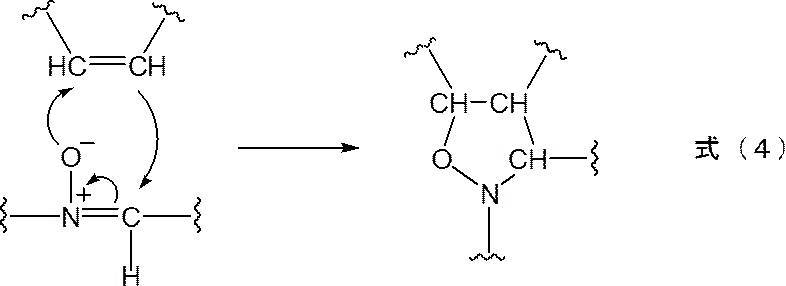
原料ポリマーが有する不飽和結合が例えば-CH=CH2である場合、上記不飽和結合はチオエステルニトロン化合物が有するニトロン結合と下記式(5)で表される反応をすることができる。

原料ポリマーと上記変性剤等を混合して加熱することによって、原料ポリマーが有する不飽和結合(例えば二重結合)を変性し、本発明の変性ポリマーを製造することができる。原料ポリマーが有する不飽和結合と本発明の変性剤との反応によって、チオエステル基を有する変性基を形成することができる。
変性する際の温度(変性温度)は、通常、130~200℃とすることができ、150℃以上が好ましい。
原料ポリマーがスチレンブタジエンゴムである場合、変性温度は160~170℃が好ましい。
原料ポリマーが天然ゴムである場合、変性温度は170℃以下が好ましい。
本発明の変性ポリマーは未反応のチオエステルニトロン化合物を含んでもよい。
変性する際の温度(変性温度)は、通常、130~200℃とすることができ、150℃以上が好ましい。
原料ポリマーがスチレンブタジエンゴムである場合、変性温度は160~170℃が好ましい。
原料ポリマーが天然ゴムである場合、変性温度は170℃以下が好ましい。
本発明の変性ポリマーは未反応のチオエステルニトロン化合物を含んでもよい。
本発明の変性ポリマーの用途は特に制限されない。例えば、ゴム組成物に使用することができる。
以下に実施例を示して本発明を具体的に説明する。ただし本発明はこれらに限定されない。
(カルボキシニトロン化合物の合成)
2Lナスフラスコに、40℃に温めたメタノール(900mL)を入れ、ここに、下記式(3)で表されるテレフタルアルデヒド酸(30.0g)を加えて溶かした。この溶液に、下記式(2)で表されるフェニルヒドロキシアミン(21.8g)をメタノール(100mL)に溶かしたものを加え、室温で19時間撹拌した。撹拌終了後、メタノールからの再結晶により、下記式(4)で表されるカルボキシニトロン化合物(N-フェニル-α-(4-カルボキシフェニル)ニトロン)を得た(41.7g)。収率は86%であった。
(カルボキシニトロン化合物の合成)
2Lナスフラスコに、40℃に温めたメタノール(900mL)を入れ、ここに、下記式(3)で表されるテレフタルアルデヒド酸(30.0g)を加えて溶かした。この溶液に、下記式(2)で表されるフェニルヒドロキシアミン(21.8g)をメタノール(100mL)に溶かしたものを加え、室温で19時間撹拌した。撹拌終了後、メタノールからの再結晶により、下記式(4)で表されるカルボキシニトロン化合物(N-フェニル-α-(4-カルボキシフェニル)ニトロン)を得た(41.7g)。収率は86%であった。
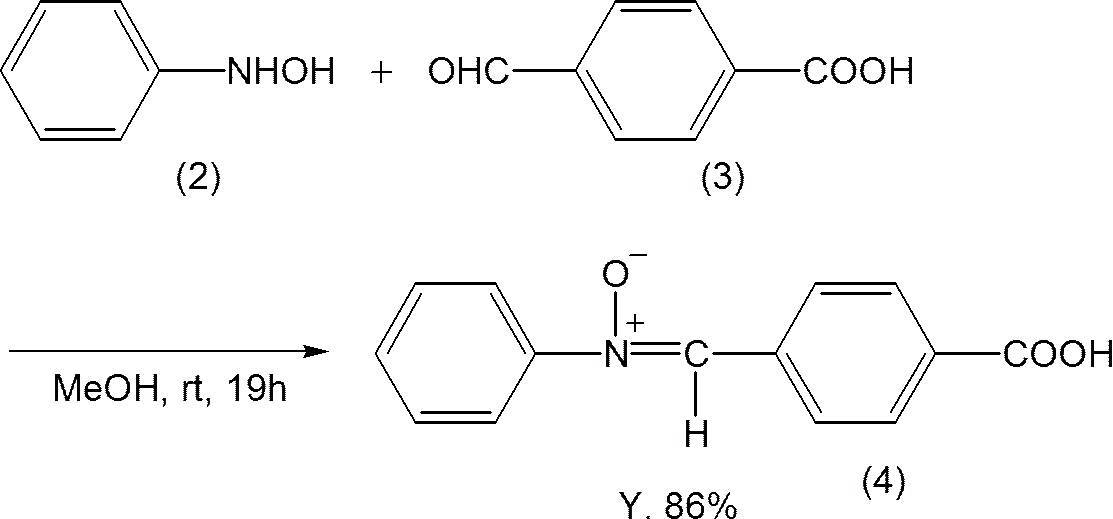
<チオエステルニトロン化合物の製造>
まず、200mLのナスフラスコ内で、上記のとおり合成されたカルボキシニトロン化合物12g、ジメチルアミノピリジン(東京化成社製)0.72g及び1-ドデカンチオール(東京化成社製)11gをCH2Cl2(関東化学社製)120mLに溶かし混合液とした。
次に、上記混合液を攪拌しながら、上記混合液にジシクロヘキシルカルボジイミド(関東化学社製)13.2gを少量ずつ5分かけて加えた。その後、常温で3日間攪拌してN-フェニル-α-(4-カルボキシフェニル)ニトロンと1-ドデカンチオールとを反応させた。
反応完了後、反応液をシリカゲルでろ過して、ろ過によって得られた固体を酢酸エチルで洗浄し、最後に溶媒を留去して、目的のチオエステルニトロン化合物(ニトロンチオエステル。下記式(IV)で表される化合物。)を得た(15g、収率70%)。
まず、200mLのナスフラスコ内で、上記のとおり合成されたカルボキシニトロン化合物12g、ジメチルアミノピリジン(東京化成社製)0.72g及び1-ドデカンチオール(東京化成社製)11gをCH2Cl2(関東化学社製)120mLに溶かし混合液とした。
次に、上記混合液を攪拌しながら、上記混合液にジシクロヘキシルカルボジイミド(関東化学社製)13.2gを少量ずつ5分かけて加えた。その後、常温で3日間攪拌してN-フェニル-α-(4-カルボキシフェニル)ニトロンと1-ドデカンチオールとを反応させた。
反応完了後、反応液をシリカゲルでろ過して、ろ過によって得られた固体を酢酸エチルで洗浄し、最後に溶媒を留去して、目的のチオエステルニトロン化合物(ニトロンチオエステル。下記式(IV)で表される化合物。)を得た(15g、収率70%)。
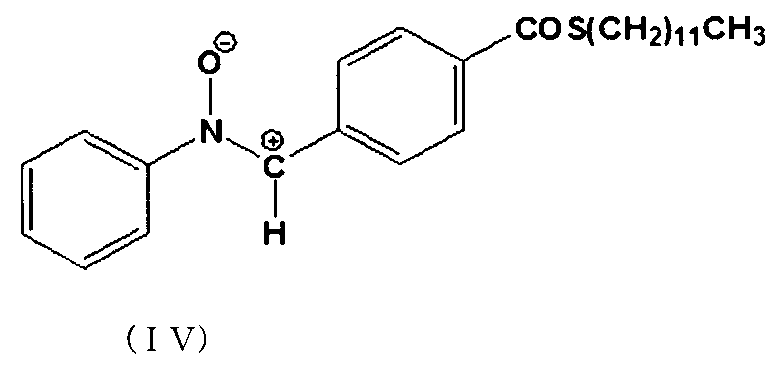
式(IV)で表される化合物の1H-NMR(nuclear magnetic resonance)の化学シフトは以下のとおりであった。
δ(ppm)(溶媒CDCl3、400MHz、標準物質TMS:テトラメチルシラン):8.45(2H, d)、8.09(2H, d)、8.00(1H, s)、7.80(2H, m)、7.52(1H, m)、3.15(2H, t)、1.78(2H, m)、1.27(18H, m)、0.87(3H, t)
δ(ppm)(溶媒CDCl3、400MHz、標準物質TMS:テトラメチルシラン):8.45(2H, d)、8.09(2H, d)、8.00(1H, s)、7.80(2H, m)、7.52(1H, m)、3.15(2H, t)、1.78(2H, m)、1.27(18H, m)、0.87(3H, t)
式(IV)で表される化合物の融点は92℃であった。
<比較ニトロン化合物1(ジフェニルニトロン)の合成>
300mLナスフラスコに、下記式(6)で表されるベンズアルデヒド(42.45g)およびエタノール(10mL)を入れ、ここに、下記式(5)で表されるフェニルヒドロキシアミン(43.65g)をエタノール(70mL)に溶かしたものを加え、室温で22時間撹拌した。撹拌終了後、エタノールからの再結晶により、下記式(7)で表されるジフェニルニトロンを白色の結晶として得た(65.40g)。ジフェニルニトロンの融点は114℃であった。
300mLナスフラスコに、下記式(6)で表されるベンズアルデヒド(42.45g)およびエタノール(10mL)を入れ、ここに、下記式(5)で表されるフェニルヒドロキシアミン(43.65g)をエタノール(70mL)に溶かしたものを加え、室温で22時間撹拌した。撹拌終了後、エタノールからの再結晶により、下記式(7)で表されるジフェニルニトロンを白色の結晶として得た(65.40g)。ジフェニルニトロンの融点は114℃であった。

<変性ポリマーの製造>
下記各表において、各表に示す各成分を同表に示す組成(質量部)で用いて、これらをミキサーで混合し、同表に示す変性温度、変性時間で反応させて、各変性ポリマーを製造した。
なお、下記各表において使用されたチオエステルニトロン化合物と比較ニトロン化合物とのモル数は同じである。
下記各表において、各表に示す各成分を同表に示す組成(質量部)で用いて、これらをミキサーで混合し、同表に示す変性温度、変性時間で反応させて、各変性ポリマーを製造した。
なお、下記各表において使用されたチオエステルニトロン化合物と比較ニトロン化合物とのモル数は同じである。
<評価>
上記のとおり製造された各変性ポリマーについて以下の評価を行った。結果を各表に示す。
上記のとおり製造された各変性ポリマーについて以下の評価を行った。結果を各表に示す。
・変性ポリマーの変性率(モル%)
実施例で得られた各変性ポリマーの変性率は、具体的には以下のとおり求めた。すなわち、原料ポリマー及び変性ポリマーの1H-NMR(nuclear magnetic resonance spectroscopy)を測定した(溶媒CDCl3、400MHz、標準物質TMS:テトラメチルシラン)。
上記測定により、本発明の化合物又は比較ニトロン化合物2について、8.08ppm付近(カルボニル基に隣接する2つのプロトンに帰属する)のピーク面積を測定し、その結果から変性ポリマーの変性率を求めた。上記のとおり求められた変性率を各表において「変性率」として示す。
実施例で得られた各変性ポリマーの変性率は、具体的には以下のとおり求めた。すなわち、原料ポリマー及び変性ポリマーの1H-NMR(nuclear magnetic resonance spectroscopy)を測定した(溶媒CDCl3、400MHz、標準物質TMS:テトラメチルシラン)。
上記測定により、本発明の化合物又は比較ニトロン化合物2について、8.08ppm付近(カルボニル基に隣接する2つのプロトンに帰属する)のピーク面積を測定し、その結果から変性ポリマーの変性率を求めた。上記のとおり求められた変性率を各表において「変性率」として示す。
比較例で得られた、比較ニトロン化合物1による各変性ポリマーの変性率について、本出願人は以前、変性ポリマーの変性率(単位:モル%)とTg(ガラス転移温度)の変化率との間に比例関係が成り立つことを見出した。本明細書においてはこの知見に基いて、下記式から、比較例で得られた、比較ニトロン化合物1による各変性ポリマーの変性率(単位:モル%)を求めた。
変性率=ΔTg/3.6
ΔTg=(比較例で得られた、比較ニトロン化合物1による各変性ポリマーのTg)-(未変性ポリマーのTg)
なお、示唆操作熱量測定(DSC)装置(METTLER TOLEDO社製 DSC823e)を用いて、昇温速度10℃/分で-130℃から40℃まで加熱して、比較ニトロン化合物1による各変性ポリマー、又は、未変性ポリマー(原料ポリマー)のガラス転移温度(単位:℃)を測定した。
変性率=ΔTg/3.6
ΔTg=(比較例で得られた、比較ニトロン化合物1による各変性ポリマーのTg)-(未変性ポリマーのTg)
なお、示唆操作熱量測定(DSC)装置(METTLER TOLEDO社製 DSC823e)を用いて、昇温速度10℃/分で-130℃から40℃まで加熱して、比較ニトロン化合物1による各変性ポリマー、又は、未変性ポリマー(原料ポリマー)のガラス転移温度(単位:℃)を測定した。
・ニトロン反応率(モル%)
ニトロン反応率(ニトロン化合物の反応効率)は、原料ポリマーと反応させたニトロン化合物に対する、変性ポリマーに導入されたニトロン化合物のモル%である。
ニトロン反応率(ニトロン化合物の反応効率)は、原料ポリマーと反応させたニトロン化合物に対する、変性ポリマーに導入されたニトロン化合物のモル%である。
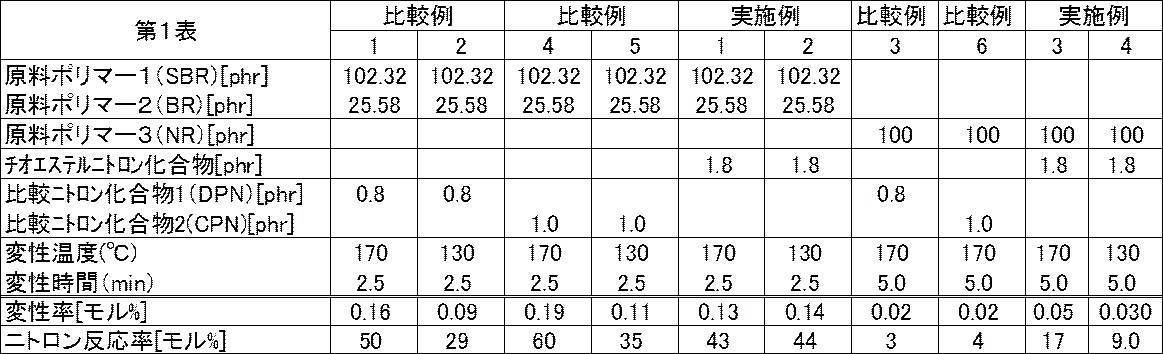
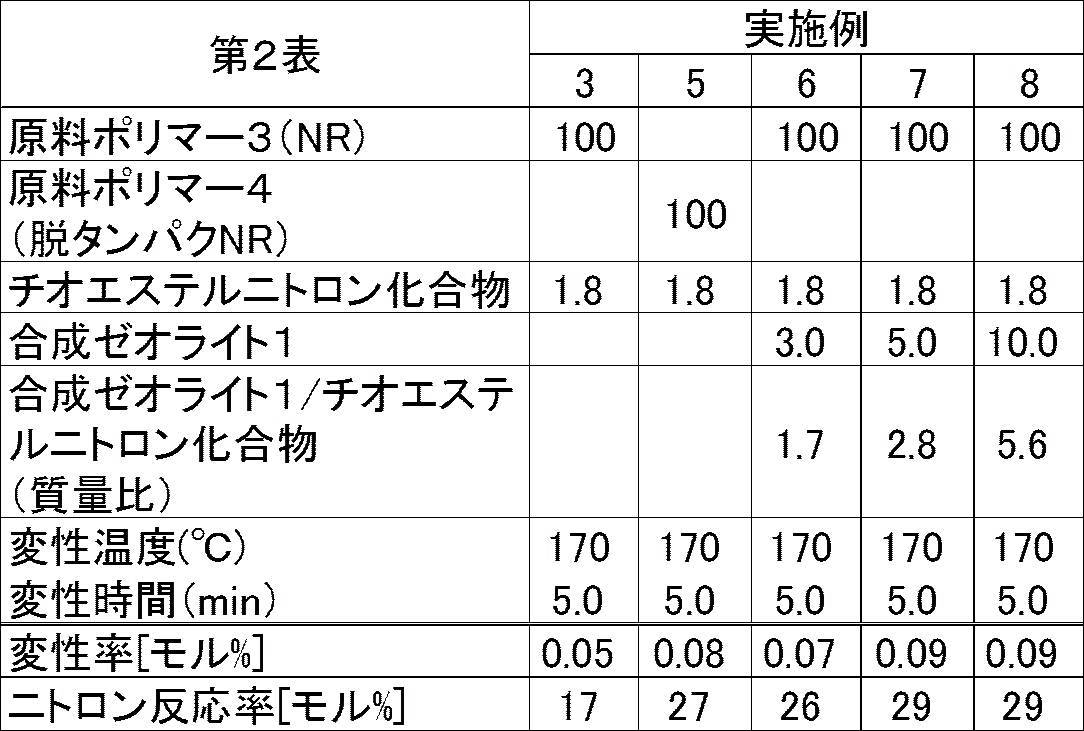
第1表及び第2表に示した各成分の詳細は以下のとおりである。
・原料ポリマー1(SBR):溶液重合によって製造されたスチレンブタジエンゴム。商品名E581、旭化成ケミカルズ社製。正味のSBR100質量部に対する油展量37.5質量部。重量平均分子量1,200,000。
・原料ポリマー2(BR):ブタジエンゴム。商品名UBEPOL VCR412、宇部興産社製。重量平均分子量850,000。
・原料ポリマー1(SBR):溶液重合によって製造されたスチレンブタジエンゴム。商品名E581、旭化成ケミカルズ社製。正味のSBR100質量部に対する油展量37.5質量部。重量平均分子量1,200,000。
・原料ポリマー2(BR):ブタジエンゴム。商品名UBEPOL VCR412、宇部興産社製。重量平均分子量850,000。
・原料ポリマー3(NR);天然ゴム。PT.NUSIRA(SAD)社製。タンパク質が除去されていない。
・原料ポリマー4(脱タンパクNR);タンパク質が除去された天然ゴム。商品名Pureprene、The Malaysian Rubber Board(MRB)社製
・原料ポリマー4(脱タンパクNR);タンパク質が除去された天然ゴム。商品名Pureprene、The Malaysian Rubber Board(MRB)社製
・チオエステルニトロン化合物:上記のとおり製造したチオエステルニトロン化合物。融点92℃
・比較ニトロン化合物1(DNP):上記のとおり製造したジフェニルニトロン。ジフェニルニトロンはニトロン結合以外に官能基を有さない。融点114℃
・比較ニトロン化合物2:上記のとおり製造した上記式(4)で表されるカルボキシニトロン化合物。チオエステル基を有さない。上記カルボキシニトロン化合物は240℃以上で分解した。
・比較ニトロン化合物2:上記のとおり製造した上記式(4)で表されるカルボキシニトロン化合物。チオエステル基を有さない。上記カルボキシニトロン化合物は240℃以上で分解した。
・合成ゼオライト1:商品名モレキュラーシーブ5A、巴工業社製、平均粒子径10μm以下、Na2O・Al2O3・2SiO2・sH2O(2≦s≦7)
第1表に示す結果から明らかなように、天然ゴム以外のジエン系ゴムの変性において本発明の化合物以外のニトロン化合物を使用する場合(比較例1、2)、変性温度が170℃から130℃に下がると、これに伴って、変性率、ニトロン反応率が大きく低下した。比較例4、5も同様の結果であった。
これに対して、天然ゴム以外のジエン系ゴムの変性において本発明の化合物を使用する実施例1、2は高い変性率を維持することができ、変性ポリマーの生産性に優れた。
また、実施例1、2を比較すると、実施例2は実施例1よりも変性温度が低いものの、実施例2の変性率、ニトロン反応率は実施例1とほぼ同等であった。
また、実施例1、2を比較すると、実施例2は実施例1よりも変性温度が低いものの、実施例2の変性率、ニトロン反応率は実施例1とほぼ同等であった。
次に、天然ゴムの変性において本発明の化合物以外の比較ニトロン化合物1又は2を使用する比較例3、6は変性率が低かった。
これに対して、天然ゴムの変性において本発明の化合物を使用する実施例3、4及び第2表の実施例5~8(なお第2表の実施例3は第1表の実施例3と同じである。)は天然ゴムを効率的に変性することができ、変性ポリマーの生産性に優れた。
第1表において実施例3、4を比較すると、実施例4は実施例3よりも変性温度が低くとも、天然ゴムをより効率的に変性することができ、変性ポリマーの生産性により優れた。
以上のとおり、本発明の化合物は変性ポリマーの生産性に優れる。
第1表において実施例3、4を比較すると、実施例4は実施例3よりも変性温度が低くとも、天然ゴムをより効率的に変性することができ、変性ポリマーの生産性により優れた。
以上のとおり、本発明の化合物は変性ポリマーの生産性に優れる。
また、第2表に示す結果から明らかなように、合成ゼオライトがない条件において、脱タンパクされた天然ゴムを本発明の化合物で変性する実施例5は、脱タンパクされていない天然ゴムを変性する実施例3よりも変性ポリマーの生産性により優れた。
このことは、原料ポリマーに含有されるタンパク質のような不純物によって本発明の化合物が分解される可能性を示唆すると考えられた。
このことは、原料ポリマーに含有されるタンパク質のような不純物によって本発明の化合物が分解される可能性を示唆すると考えられた。
これに対して、本発明の変性剤組成物を使用する場合(実施例6~8)、合成ゼオライトを使用しない実施例3よりも変性ポリマーの生産性により優れた。
このように、本発明の変性剤組成物を使用することによって、変性ポリマー(特に原料ポリマーが天然ゴムである場合)の生産性により優れた。
このように、本発明の変性剤組成物を使用することによって、変性ポリマー(特に原料ポリマーが天然ゴムである場合)の生産性により優れた。
Claims (13)
- チオエステル基とニトロン結合とを有するチオエステルニトロン化合物。ただし請求項1のチオエステルニトロン化合物は加水分解性シリル基又はシラノール基を有さない。
- 下記式(I)で表される化合物である、請求項1に記載のチオエステルニトロン化合物。

上記式(I)中、R11、R12はそれぞれ独立に炭化水素基であり、a1、a2、b1、b2はそれぞれ独立に0以上であり、a1+a2は1以上であり、b1+b2は0以上である。 - 1分子中、前記ニトロン結合の数が1個である、請求項1又は2に記載のチオエステルニトロン化合物。
- 1分子中、前記チオエステル基の数が1個である、請求項1~3のいずれか1項に記載のチオエステルニトロン化合物。
- 前記チオエステル基が、カルボキシ基とニトロン結合とを有するカルボキシニトロン化合物とチオールとによって形成される、請求項1~4のいずれか1項に記載のチオエステルニトロン化合物。
- カルボキシ基とニトロン結合とを有するカルボキシニトロン化合物とチオールとを反応させることによって請求項1~5のいずれか1項に記載のチオエステルニトロン化合物を製造する、チオエステルニトロン化合物の製造方法。
- 請求項1~5のいずれか1項に記載のチオエステルニトロン化合物と合成ゼオライトとを含有し、不飽和結合を有するポリマーを変性する、変性剤組成物。
- 請求項1~5のいずれか1項に記載のチオエステルニトロン化合物による変性基を有する変性ポリマー。
- 主鎖及び側鎖からなる群から選ばれる少なくとも1種に前記変性基を有し、前記主鎖の変性基が下記式(II)で表される基であり、前記側鎖の変性基が下記式(III)で表される基である、請求項8に記載の変性ポリマー。
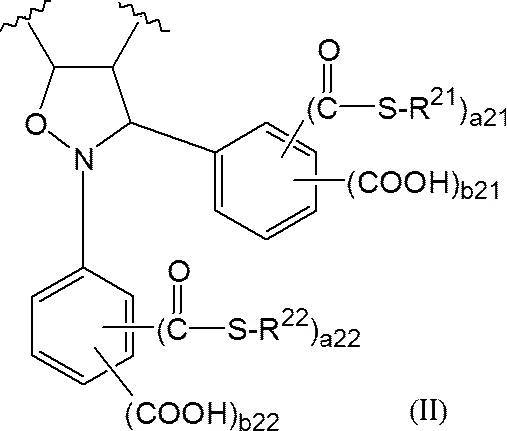
上記式(II)中、R21、R22はそれぞれ独立に炭化水素基であり、a21、a22、b21、b22はそれぞれ独立に0以上であり、a21+a22は1以上であり、b21+b22は0以上である。

上記式(III)中、R31、R32はそれぞれ独立に炭化水素基であり、a31、a32、b31、b32はそれぞれ独立に0以上であり、a31+a32は1以上であり、b31+b32は0以上である。 - 主鎖が、スチレンブタジエンゴム、ブタジエンゴム、イソプレンゴム、アクリルブタジエンゴム及び天然ゴムからなる群から選ばれる少なくとも1種である、請求項8又は9に記載の変性ポリマー。
- 更に不飽和結合を有する、請求項8~10のいずれか1項に記載の変性ポリマー。
- 前記変性基の含有量が、前記変性基と前記不飽和結合との合計量に対して、0.01~2モル%である、請求項11に記載の変性ポリマー。
- 不飽和結合を有する原料ポリマーと請求項1~5のいずれか1項に記載のチオエステルニトロン化合物又は請求項7に記載の変性剤組成物とを反応させることによって請求項8~12のいずれか1項に記載の変性ポリマーを製造する、変性ポリマーの製造方法。
Applications Claiming Priority (4)
| Application Number | Priority Date | Filing Date | Title |
|---|---|---|---|
| JP2015-245106 | 2015-12-16 | ||
| JP2015245106 | 2015-12-16 | ||
| JP2016151323A JP2017109985A (ja) | 2015-12-16 | 2016-08-01 | チオエステルニトロン化合物、その製造方法、変性剤組成物、変性ポリマー及びその製造方法 |
| JP2016-151323 | 2016-08-01 |
Publications (1)
| Publication Number | Publication Date |
|---|---|
| WO2017104248A1 true WO2017104248A1 (ja) | 2017-06-22 |
Family
ID=59056051
Family Applications (1)
| Application Number | Title | Priority Date | Filing Date |
|---|---|---|---|
| PCT/JP2016/080604 Ceased WO2017104248A1 (ja) | 2015-12-16 | 2016-10-14 | チオエステルニトロン化合物、その製造方法、変性剤組成物、変性ポリマー及びその製造方法 |
Country Status (1)
| Country | Link |
|---|---|
| WO (1) | WO2017104248A1 (ja) |
Cited By (1)
| Publication number | Priority date | Publication date | Assignee | Title |
|---|---|---|---|---|
| CN108164767A (zh) * | 2018-02-10 | 2018-06-15 | 中国热带农业科学院农产品加工研究所 | 一种无臭味天然橡胶及其制备方法和一种胶料 |
Citations (4)
| Publication number | Priority date | Publication date | Assignee | Title |
|---|---|---|---|---|
| JP2008163283A (ja) * | 2007-01-05 | 2008-07-17 | Bridgestone Corp | ゴム組成物及びそれを用いた空気入りタイヤ |
| JP2008163125A (ja) * | 2006-12-27 | 2008-07-17 | Bridgestone Corp | ゴム組成物およびそれを用いた空気入りタイヤ |
| WO2009044697A1 (ja) * | 2007-10-01 | 2009-04-09 | Bridgestone Corporation | 有機珪素化合物及びそれを用いたゴム組成物 |
| JP2014101400A (ja) * | 2012-11-16 | 2014-06-05 | Yokohama Rubber Co Ltd:The | 変性ポリマー |
-
2016
- 2016-10-14 WO PCT/JP2016/080604 patent/WO2017104248A1/ja not_active Ceased
Patent Citations (4)
| Publication number | Priority date | Publication date | Assignee | Title |
|---|---|---|---|---|
| JP2008163125A (ja) * | 2006-12-27 | 2008-07-17 | Bridgestone Corp | ゴム組成物およびそれを用いた空気入りタイヤ |
| JP2008163283A (ja) * | 2007-01-05 | 2008-07-17 | Bridgestone Corp | ゴム組成物及びそれを用いた空気入りタイヤ |
| WO2009044697A1 (ja) * | 2007-10-01 | 2009-04-09 | Bridgestone Corporation | 有機珪素化合物及びそれを用いたゴム組成物 |
| JP2014101400A (ja) * | 2012-11-16 | 2014-06-05 | Yokohama Rubber Co Ltd:The | 変性ポリマー |
Non-Patent Citations (3)
| Title |
|---|
| JINJUN LIU ET AL.: "The Pictet-Spengler Reaction of Nb-Hydroxytryptamines and Cysteinals. I. Isolation of Tetracyclic Intermediates and Formation of Optically Active Nb-Hydroxytetrahydro-beta-Carbolines", TETRAHEDRON, vol. 45, no. 24, 1989, pages 7729 - 42 * |
| JINJUN LIU ET AL.: "The Pictet-Spengler Reaction of Nb-Hydroxytryptamines and Cysteinals. II. Temperature Effects", STEREOCHEMISTRY AND MECHANISM, CHEMICAL & PHARMACEUTICAL BULLETIN, vol. 39, no. 7, 1991, pages 1672, XP055285469, DOI: doi:10.1248/cpb.39.1672 * |
| MASAKO NAKAGAWA ET AL.: "Total Synthesis of (-)-Eudistomin L and (-)-Debromoeudistomin L", JOURNAL OF THE AMERICAN CHEMICAL SOCIETY, vol. 111, no. 7, 1989, pages 2721 - 2722, XP055393412 * |
Cited By (2)
| Publication number | Priority date | Publication date | Assignee | Title |
|---|---|---|---|---|
| CN108164767A (zh) * | 2018-02-10 | 2018-06-15 | 中国热带农业科学院农产品加工研究所 | 一种无臭味天然橡胶及其制备方法和一种胶料 |
| CN108164767B (zh) * | 2018-02-10 | 2019-11-19 | 中国热带农业科学院农产品加工研究所 | 一种无臭味天然橡胶及其制备方法和一种胶料 |
Similar Documents
| Publication | Publication Date | Title |
|---|---|---|
| CN104781284B (zh) | 改性聚合物 | |
| JP3498559B2 (ja) | 短鎖ポリスルフィドシラン混合物の製造方法 | |
| JP5772361B2 (ja) | ゴム組成物 | |
| JP5279708B2 (ja) | 臭化3(r)−(2−ヒドロキシ−2,2−ジチエン−2−イルアセトキシ)−1−(3−フェノキシプロピル)−1−アゾニアビシクロ[2.2.2]オクタンの製造方法 | |
| TW200902541A (en) | Silated core polysulfides, their preparation and use in filled elastomer compositions | |
| JP2012532132A (ja) | アニオン重合開始剤とその製法 | |
| JP5661600B2 (ja) | ニトリルオキシド化合物、変性高分子材料並びにその製造方法及び成形体 | |
| WO2009084538A1 (ja) | スルフェンアミド、このスルフェンアミドを含むゴム用加硫促進剤およびその製造方法 | |
| JP2010285405A (ja) | アミノ基を有するビニルシラン化合物及びその製造方法 | |
| WO2017104248A1 (ja) | チオエステルニトロン化合物、その製造方法、変性剤組成物、変性ポリマー及びその製造方法 | |
| JP5954504B1 (ja) | 変性ゴム及びその製造方法、ゴム組成物、並びにタイヤ | |
| JP2015098591A (ja) | ゴム組成物およびゴム製品 | |
| WO2015114845A1 (ja) | ゴム組成物、変性ポリマー及びタイヤ | |
| JP2017109985A (ja) | チオエステルニトロン化合物、その製造方法、変性剤組成物、変性ポリマー及びその製造方法 | |
| JP4432249B2 (ja) | ジエン系ゴム用新規加硫剤およびそれを用いたゴム組成物 | |
| JP6766438B2 (ja) | 変性剤、変性剤組成物、変性ポリマー及びその製造方法 | |
| JP6125323B2 (ja) | ゴム組成物及び空気入りタイヤ | |
| JP5247997B2 (ja) | メタクリロキシ基またはアクリロキシ基含有有機ケイ素化合物の製造方法 | |
| JP2025500462A (ja) | エポキシ基を含む1,3-双極子化合物及びその合成中間体 | |
| JP2017081849A (ja) | ビスシリルアミノ基を有するイミン化合物及びその製造方法 | |
| JP2013216612A (ja) | 新規な構造を有する含硫黄有機珪素化合物とその製造方法 | |
| JP2010059290A (ja) | 加硫促進剤、ゴム組成物およびそれを用いたタイヤ | |
| JP7015451B2 (ja) | ペルオキシカーバメート化合物の製造方法 | |
| JP2718065B2 (ja) | 新規なカップリング剤およびそれを用いる加硫ゴムの物性改良方法 | |
| CN120590432A (zh) | 一种二苯胺丙基三乙氧基硅烷及其制备方法和应用 |
Legal Events
| Date | Code | Title | Description |
|---|---|---|---|
| 121 | Ep: the epo has been informed by wipo that ep was designated in this application |
Ref document number: 16875233 Country of ref document: EP Kind code of ref document: A1 |
|
| NENP | Non-entry into the national phase |
Ref country code: DE |
|
| 122 | Ep: pct application non-entry in european phase |
Ref document number: 16875233 Country of ref document: EP Kind code of ref document: A1 |