WO2017077834A1 - フルオロポリエーテル基含有ポリマー変性有機ケイ素化合物、表面処理剤及び物品 - Google Patents
フルオロポリエーテル基含有ポリマー変性有機ケイ素化合物、表面処理剤及び物品 Download PDFInfo
- Publication number
- WO2017077834A1 WO2017077834A1 PCT/JP2016/080399 JP2016080399W WO2017077834A1 WO 2017077834 A1 WO2017077834 A1 WO 2017077834A1 JP 2016080399 W JP2016080399 W JP 2016080399W WO 2017077834 A1 WO2017077834 A1 WO 2017077834A1
- Authority
- WO
- WIPO (PCT)
- Prior art keywords
- group
- containing polymer
- formula
- integer
- represented
- Prior art date
- Legal status (The legal status is an assumption and is not a legal conclusion. Google has not performed a legal analysis and makes no representation as to the accuracy of the status listed.)
- Ceased
Links
Classifications
-
- C—CHEMISTRY; METALLURGY
- C08—ORGANIC MACROMOLECULAR COMPOUNDS; THEIR PREPARATION OR CHEMICAL WORKING-UP; COMPOSITIONS BASED THEREON
- C08G—MACROMOLECULAR COMPOUNDS OBTAINED OTHERWISE THAN BY REACTIONS ONLY INVOLVING UNSATURATED CARBON-TO-CARBON BONDS
- C08G77/00—Macromolecular compounds obtained by reactions forming a linkage containing silicon with or without sulfur, nitrogen, oxygen or carbon in the main chain of the macromolecule
- C08G77/42—Block-or graft-polymers containing polysiloxane sequences
- C08G77/46—Block-or graft-polymers containing polysiloxane sequences containing polyether sequences
-
- C—CHEMISTRY; METALLURGY
- C08—ORGANIC MACROMOLECULAR COMPOUNDS; THEIR PREPARATION OR CHEMICAL WORKING-UP; COMPOSITIONS BASED THEREON
- C08G—MACROMOLECULAR COMPOUNDS OBTAINED OTHERWISE THAN BY REACTIONS ONLY INVOLVING UNSATURATED CARBON-TO-CARBON BONDS
- C08G65/00—Macromolecular compounds obtained by reactions forming an ether link in the main chain of the macromolecule
- C08G65/02—Macromolecular compounds obtained by reactions forming an ether link in the main chain of the macromolecule from cyclic ethers by opening of the heterocyclic ring
- C08G65/32—Polymers modified by chemical after-treatment
- C08G65/321—Polymers modified by chemical after-treatment with inorganic compounds
- C08G65/323—Polymers modified by chemical after-treatment with inorganic compounds containing halogens
- C08G65/3233—Molecular halogen
- C08G65/3236—Fluorine
-
- C—CHEMISTRY; METALLURGY
- C08—ORGANIC MACROMOLECULAR COMPOUNDS; THEIR PREPARATION OR CHEMICAL WORKING-UP; COMPOSITIONS BASED THEREON
- C08G—MACROMOLECULAR COMPOUNDS OBTAINED OTHERWISE THAN BY REACTIONS ONLY INVOLVING UNSATURATED CARBON-TO-CARBON BONDS
- C08G65/00—Macromolecular compounds obtained by reactions forming an ether link in the main chain of the macromolecule
- C08G65/02—Macromolecular compounds obtained by reactions forming an ether link in the main chain of the macromolecule from cyclic ethers by opening of the heterocyclic ring
- C08G65/32—Polymers modified by chemical after-treatment
- C08G65/329—Polymers modified by chemical after-treatment with organic compounds
- C08G65/336—Polymers modified by chemical after-treatment with organic compounds containing silicon
-
- C—CHEMISTRY; METALLURGY
- C08—ORGANIC MACROMOLECULAR COMPOUNDS; THEIR PREPARATION OR CHEMICAL WORKING-UP; COMPOSITIONS BASED THEREON
- C08L—COMPOSITIONS OF MACROMOLECULAR COMPOUNDS
- C08L83/00—Compositions of macromolecular compounds obtained by reactions forming in the main chain of the macromolecule a linkage containing silicon with or without sulfur, nitrogen, oxygen or carbon only; Compositions of derivatives of such polymers
- C08L83/10—Block- or graft-copolymers containing polysiloxane sequences
- C08L83/12—Block- or graft-copolymers containing polysiloxane sequences containing polyether sequences
-
- C—CHEMISTRY; METALLURGY
- C09—DYES; PAINTS; POLISHES; NATURAL RESINS; ADHESIVES; COMPOSITIONS NOT OTHERWISE PROVIDED FOR; APPLICATIONS OF MATERIALS NOT OTHERWISE PROVIDED FOR
- C09D—COATING COMPOSITIONS, e.g. PAINTS, VARNISHES OR LACQUERS; FILLING PASTES; CHEMICAL PAINT OR INK REMOVERS; INKS; CORRECTING FLUIDS; WOODSTAINS; PASTES OR SOLIDS FOR COLOURING OR PRINTING; USE OF MATERIALS THEREFOR
- C09D183/00—Coating compositions based on macromolecular compounds obtained by reactions forming in the main chain of the macromolecule a linkage containing silicon, with or without sulfur, nitrogen, oxygen, or carbon only; Coating compositions based on derivatives of such polymers
- C09D183/10—Block or graft copolymers containing polysiloxane sequences
- C09D183/12—Block or graft copolymers containing polysiloxane sequences containing polyether sequences
-
- C—CHEMISTRY; METALLURGY
- C09—DYES; PAINTS; POLISHES; NATURAL RESINS; ADHESIVES; COMPOSITIONS NOT OTHERWISE PROVIDED FOR; APPLICATIONS OF MATERIALS NOT OTHERWISE PROVIDED FOR
- C09K—MATERIALS FOR MISCELLANEOUS APPLICATIONS, NOT PROVIDED FOR ELSEWHERE
- C09K3/00—Materials not provided for elsewhere
- C09K3/18—Materials not provided for elsewhere for application to surfaces to minimize adherence of ice, mist or water thereto; Thawing or antifreeze materials for application to surfaces
Definitions
- the present invention relates to a fluoropolyether group-containing polymer-modified organosilicon compound, a surface treatment agent containing the organosilicon compound, and an article surface-treated with the surface treatment agent.
- the conventional water / oil repellent layer has high water / oil repellency and excellent dirt wiping property, but has a problem that the antifouling performance deteriorates during use.
- performance may vary depending on the coating method, and adhesion may be inferior depending on the substrate to be coated.
- many of the surface treatment agents used so far show good surface properties for glass, but surface properties such as adhesion, water and oil repellency, and wear resistance are sufficient for the resin surface. There was nothing to show.
- a fluoropolyether group-containing compound has water and oil repellency, chemical resistance, lubricity, releasability, antifouling property and the like because its surface free energy is very small. Utilizing its properties, it is widely used industrially for water and oil repellent and antifouling agents such as paper and fiber, lubricants for magnetic recording media, oil repellents for precision equipment, mold release agents, cosmetics, and protective films. ing. However, the property means that it is non-adhesive and non-adhesive to other substrates at the same time, and even if it can be applied to the surface of the substrate, it was difficult to make the film adhere to it. .
- a silane coupling agent is well known as a material for bonding a substrate surface such as glass or cloth and an organic compound, and is widely used as a coating agent for various substrate surfaces.
- the silane coupling agent has an organic functional group and a reactive silyl group (generally a hydrolyzable silyl group such as an alkoxysilyl group) in one molecule.
- the hydrolyzable silyl group causes a self-condensation reaction with moisture in the air to form a film.
- the coating becomes a strong coating having durability by chemically and physically bonding the hydrolyzable silyl group to the surface of glass or metal.
- Patent Documents 1 to 8 Japanese Patent Application Laid-Open No. 2003-238777, Japanese Patent No. 2860979, Patents) No. 4672095, JP-T 2008-534696, JP-T 2008-537557, JP 2012-072722, JP 2012-157856, JP 2013-136833).
- a film is formed on the substrate using various coating methods.
- the hydrolysis reaction is promoted by high temperature conditions such as 80 ° C. and 120 ° C. and under humidification.
- a cured film can be formed by reacting gradually with moisture in the air even at room temperature.
- the curing process has a problem that it may become a rate-limiting factor (delay factor) in manufacturing, such as requiring high-temperature humidification conditions and taking time when curing at room temperature.
- a film (water / oil repellent layer) cured in a short time under a mild condition such as room temperature curing has a problem that the anti-fouling performance deteriorates during wear resistance and use.
- Patent Document 9 Japanese Patent Laid-Open No. 2008-144144
- film formation is performed in a short time under mild conditions by adding a fluorinated carboxylic acid as a curing catalyst in the coating composition to promote curing.
- a fluorinated carboxylic acid as a curing catalyst in the coating composition to promote curing.
- the wear resistance is inferior, and if the amount of the catalyst is increased, the initial performance is lowered.
- there is a high possibility that a carboxyl group which is a polar group appears on the outermost surface of the film and in that case, the performance is lowered.
- Patent Document 10 Japanese Patent Application Laid-Open No. 2004-145283 proposes a fluoropolyalkylene ether group-containing silane.
- the lens treated with the fluoropolyalkylene ether group-containing silane is excellent in oil repellency and fingerprint wiping, but has insufficient wear resistance.
- JP 2003-238777 A Japanese Patent No. 2860979 Japanese Patent No. 4672095 Special table 2008-534696 Special table 2008-537557 JP 2012-072272 A JP 2012-157856 A JP 2013-136833 A JP 2008-144144 A JP 2004-145283 A
- the present invention has been made in view of the above circumstances, and particularly on the resin surface, a fluoropolyether group capable of forming a water- and oil-repellent layer having excellent wear resistance even in a short time under mild conditions such as room temperature. It is an object of the present invention to provide a containing polymer-modified organosilicon compound, a surface treatment agent containing the organosilicon compound, and an article surface-treated with the surface treatment agent.
- the present inventors have found that the surface treatment agent using the fluoropolyether group-containing polymer-modified organosilicon compound represented by the general formula (1) described below has a terminal functional group. Even if it does not exist, it has been found that a water- and oil-repellent layer excellent in abrasion resistance can be formed on a resin product such as a resin film or a plastic lens even under a mild condition such as room temperature. It came to.
- the present invention provides the following fluoropolyether group-containing polymer-modified organosilicon compound, surface treatment agent and article.
- the following general formula (1) [Wherein Rf is a monovalent fluorooxyalkyl group or divalent fluorooxyalkylene group-containing polymer residue, Y is independently a divalent hydrocarbon group, and Q is independently a divalent linear chain.
- X is independently a hydrogen atom, an alkyl group having 1 to 4 carbon atoms or a phenyl group
- Z is independently a hydrogen atom
- R is independently an alkyl group having 1 to 4 carbon atoms or a phenyl group.
- Q ′ is a divalent group having a structure selected from a siloxane bond, a silalkylene structure and a silarylene structure.
- each repeating unit may be linear or branched, and each repeating unit is randomly And d is an integer of 1 to 3, and the unit may be linear or branched.
- ⁇ is 2
- the Rf group is a group represented by the following general formula (3).
- each repeating unit may be linear or branched, and each repeating unit is randomly And d is an integer of 1 to 3, and the unit may be linear or branched.
- Y is an alkylene group having 3 to 10 carbon atoms.
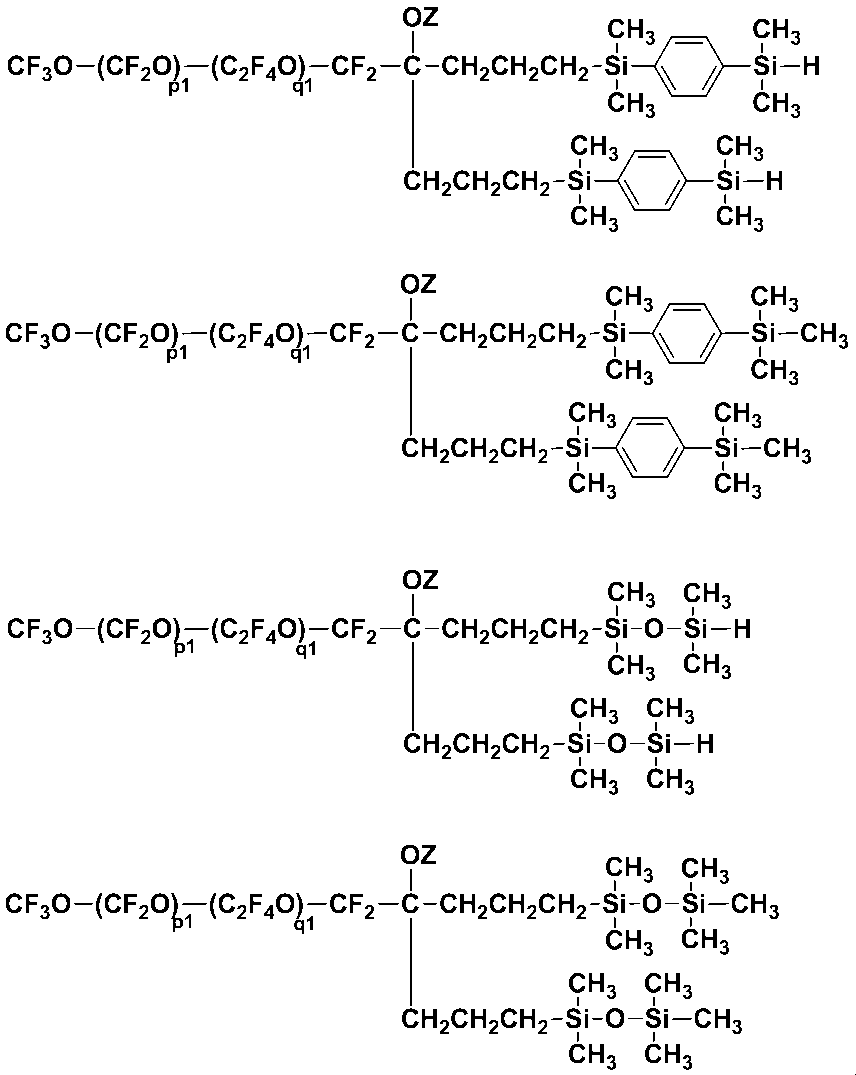
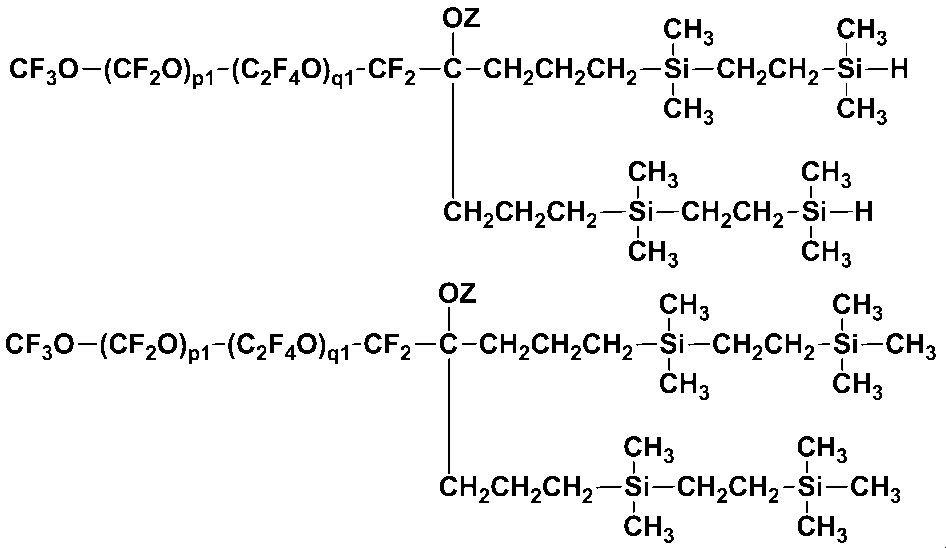
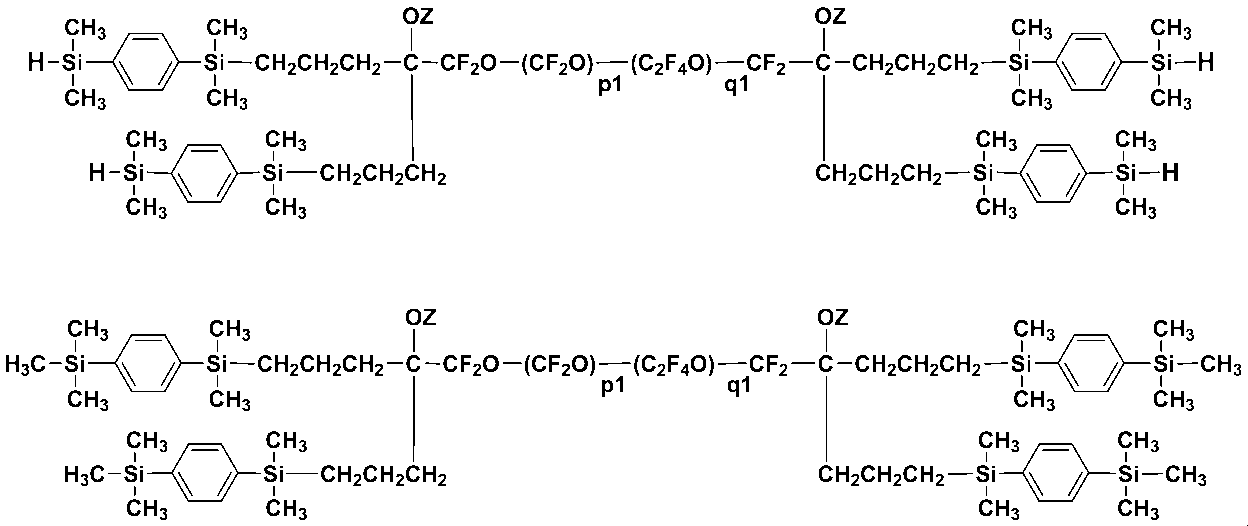
- the fluoropolyether group-containing polymer-modified organosilicon compound represented by the above formula (1) is represented by any one of the following formulas: [1] to [6] Ether group-containing polymer-modified organosilicon compound.
- a surface treating agent comprising the fluoropolyether group-containing polymer-modified organosilicon compound according to any one of [1] to [7].
- the surface treatment agent is further represented by the following general formula (4) (In the formula, A is a monovalent fluorine-containing group whose terminal is a —CF 3 group, and Rf ′ is a divalent fluorooxyalkylene group-containing polymer residue.)
- the film formed from the surface treatment agent containing the fluoropolyether group-containing polymer-modified organosilicon compound of the present invention has high water and oil repellency, and in particular, the film formed in a short time under mild conditions such as room temperature. Excellent wear resistance. Since the surface treatment agent containing the fluoropolyether group-containing polymer-modified organosilicon compound of the present invention has specific adhesion particularly to the resin surface, a resin film or glasses can be obtained by treating with the surface treatment agent. Excellent water and oil repellency, low dynamic friction and wear resistance can be easily imparted to resin products such as lenses in a short time.
- the fluoropolyether group-containing polymer-modified organosilicon compound of the present invention is represented by the following general formula (1). [Wherein Rf is a monovalent fluorooxyalkyl group or divalent fluorooxyalkylene group-containing polymer residue, Y is independently a divalent hydrocarbon group, and Q is independently a divalent linear chain.
- X is independently a hydrogen atom, an alkyl group having 1 to 4 carbon atoms or a phenyl group
- Z is independently a hydrogen atom
- R is independently an alkyl group having 1 to 4 carbon atoms or a phenyl group.
- X is the same as above, W is a single bond or a divalent hydrocarbon group, Q ′ is a divalent group having a structure selected from a siloxane bond, a silalkylene structure and a silarylene structure. is there.)
- ⁇ is 1 or 2.
- Rf is preferably a monovalent fluorooxyalkyl group represented by the following general formula (2).
- Rf is preferably a divalent fluorooxyalkylene group represented by the following general formula (3).
- d is an integer of 1 to 3, preferably 1 or 2, and the unit may be linear or branched.
- a film having a low dynamic friction coefficient can be formed.
- a linear polymer having a fluoropolyether structure in the main chain and containing a siloxane bond, a silphenylene bond or a silalkylene bond at one end of the molecular chain ( ⁇ is 1, Rf is represented by the formula (2)
- the monovalent fluorooxyalkyl group is a linear polymer containing a siloxane bond, a silphenylene bond or a silalkylene bond at both ends ( ⁇ is 2 and Rf is represented by the formula (3)). Compared with the fluorooxyalkylene group), it is possible to impart excellent abrasion resistance to the resulting film.
- Y is independently a divalent hydrocarbon group, and includes a propylene group (trimethylene group, methylethylene group), butylene group (tetramethylene group) having 3 to 10 carbon atoms, particularly 3 to 8 carbon atoms. , A methylpropylene group), a hexamethylene group, an octamethylene group and the like are preferable, and a trimethylene group is particularly preferable.
- X is independently a hydrogen atom, an alkyl group such as a methyl group having 1 to 4 carbon atoms, an ethyl group, a propyl group or a butyl group, or a phenyl group, preferably a hydrogen atom or a methyl group.
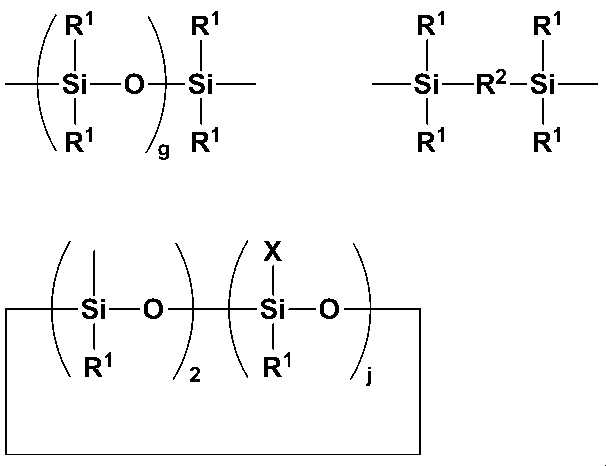
- Q is independently a divalent linear or cyclic organosiloxane residue, a silalkylene group or a silarylene group, and is preferably a group selected from the groups represented by the following formulae. .
- R 1 is independently a methyl group having 1 to 4 carbon atoms, an ethyl group, a propyl group, an alkyl group or a phenyl group and a butyl group
- R 2 is C 1 -C
- An alkylene group such as a methylene group of 4 to 4, an alkylene group such as an ethylene group, a propylene group or a butylene group, or an arylene group such as a phenylene group having 6 to 12 carbon atoms
- g is an integer of 1 to 20, preferably 1 to 10
- j is an integer of 1 to 8, preferably 1 to 3.
- Q include the following groups. (Wherein g1 is an integer of 2 to 20, preferably 2 to 10.)
- Z is independently a hydrogen atom, the following formula —SiR 3 (In the formula, R is independently an alkyl group having 1 to 4 carbon atoms or a phenyl group.) Or a group represented by the following formula -WQ'-X Wherein X is the same as above, W is a single bond or a divalent hydrocarbon group, Q ′ is a divalent group having a structure selected from a siloxane bond, a silalkylene structure and a silarylene structure. is there.) It is group represented by these.
- R is an alkyl group such as a methyl group having 1 to 4 carbon atoms, an ethyl group, a propyl group, or a butyl group, or a phenyl group. Among them, a methyl group or an ethyl group is preferable.
- W is a single bond or a divalent hydrocarbon group
- the divalent hydrocarbon group includes an ethylene group having 2 to 10 carbon atoms, particularly 2 to 8 carbon atoms, Alkylene groups such as propylene group (trimethylene group, methylethylene group), butylene group (tetramethylene group, methylpropylene group), hexamethylene group, octamethylene group and the like can be mentioned, and W is a single bond or trimethylene group. Is preferred.
- X is the same as described above, and is preferably a hydrogen atom or a methyl group.
- Q ′ is a divalent group having a structure selected from a siloxane bond, a silalkylene structure and a silarylene structure, and the divalent linear or cyclic organosiloxane residue exemplified in Q above, a silalkylene structure, Those having a silarylene structure are preferred.
- Specific examples of Q ′ include the following groups. (Wherein g1 is the same as above)
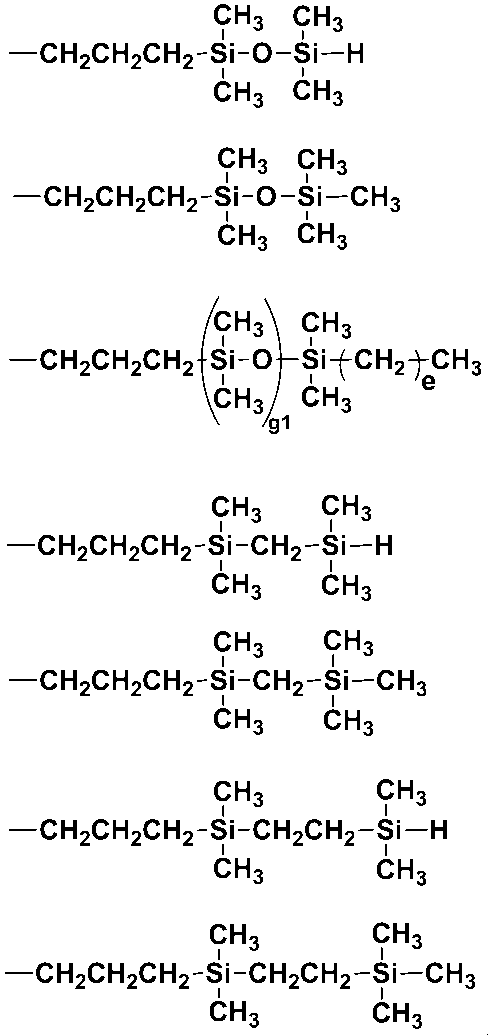
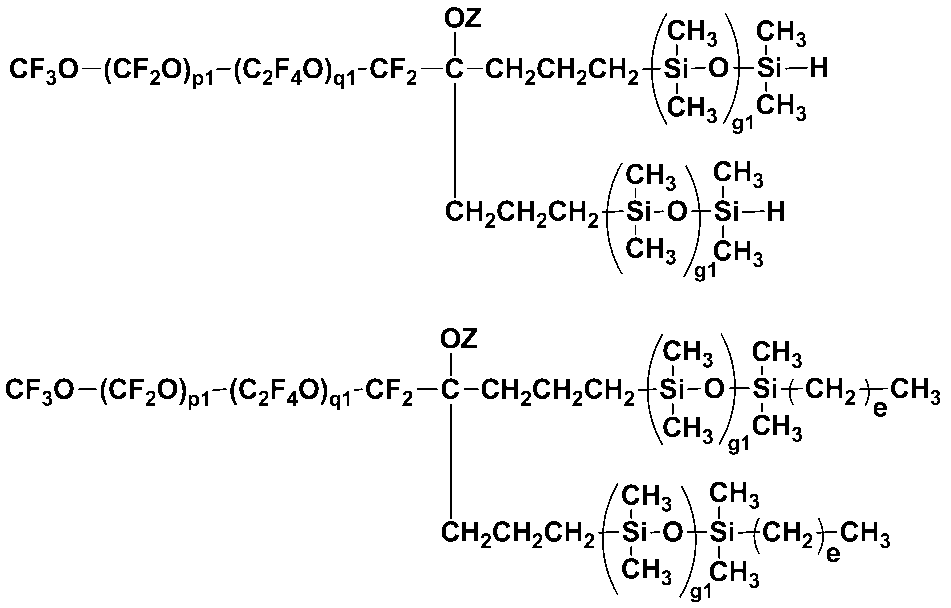
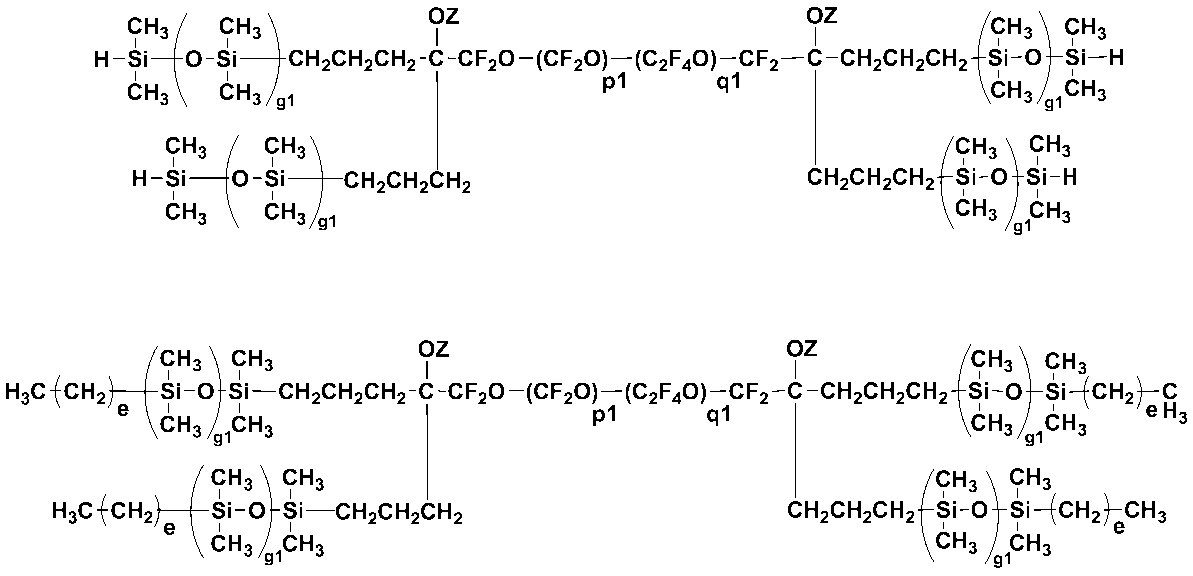
- Z include a hydrogen atom and those shown below. (In the formula, g1 is the same as above, and e is an integer of 0 to 3.)
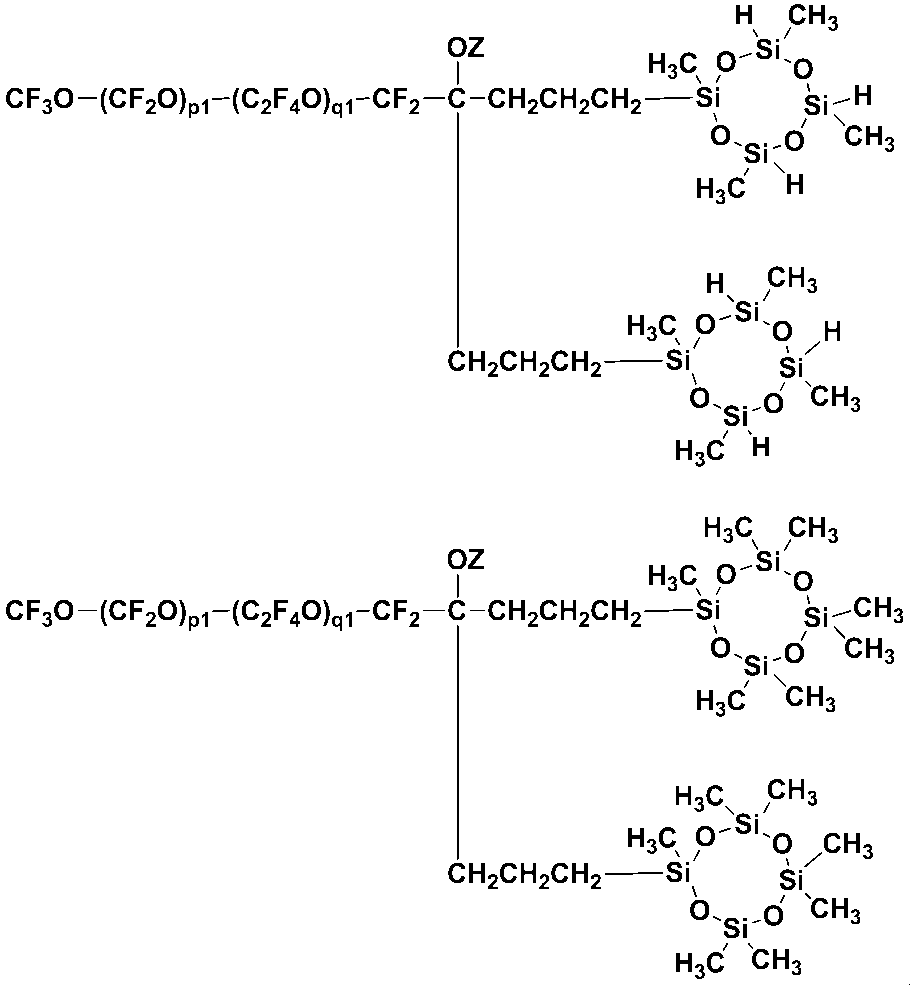
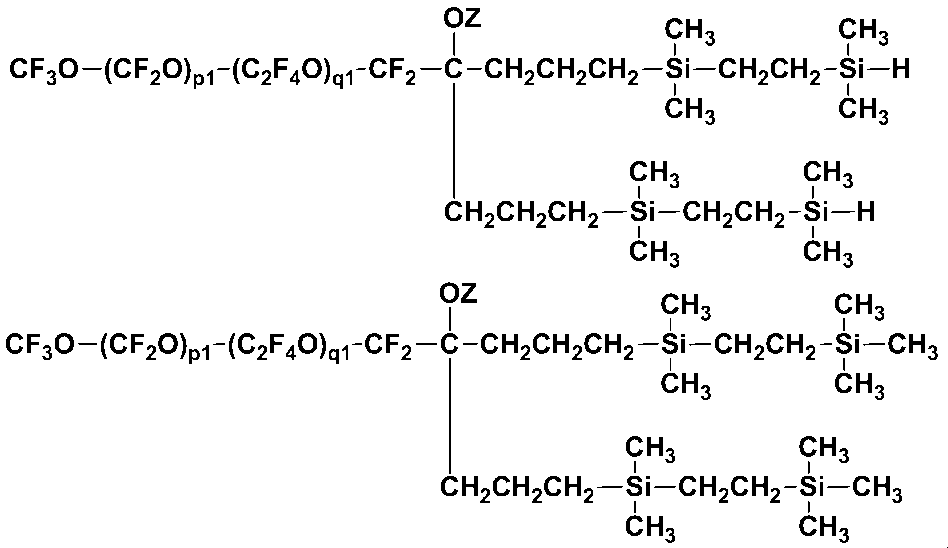
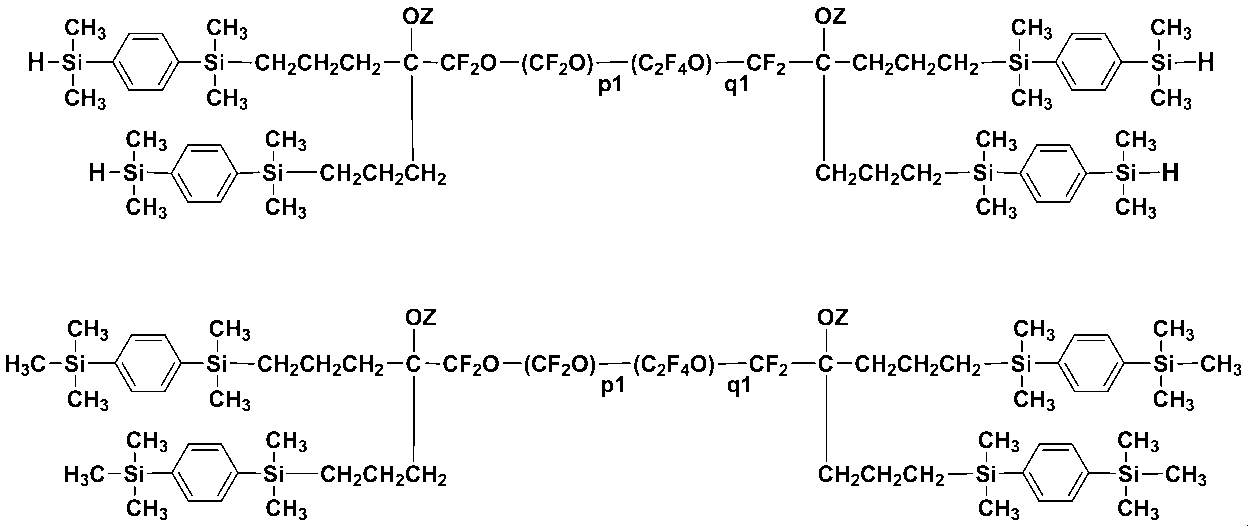
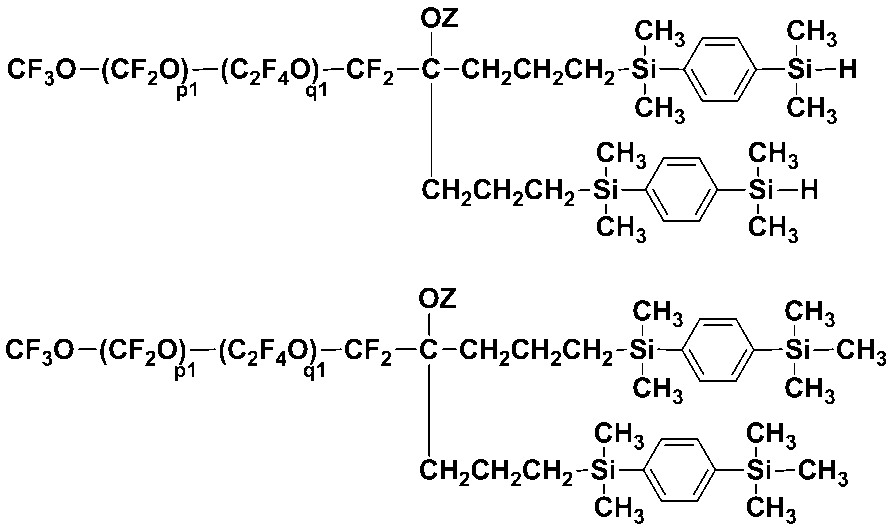
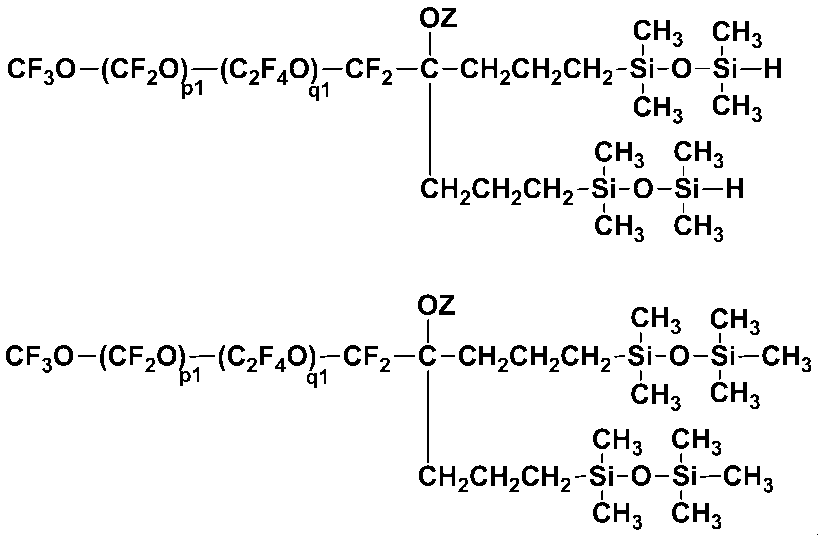
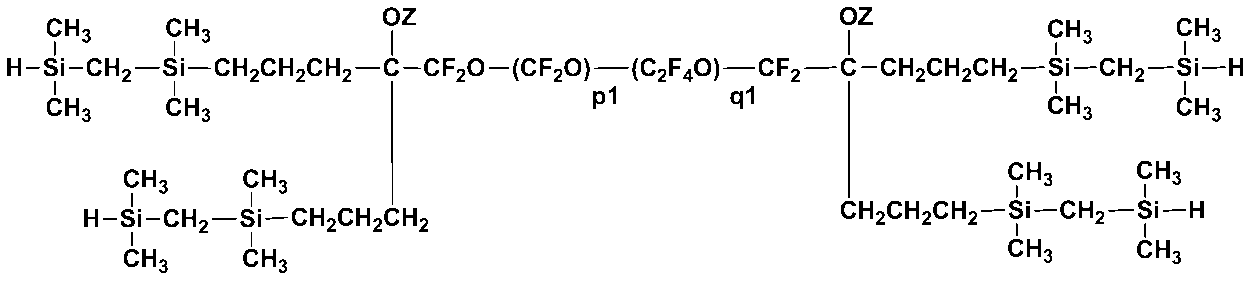
- Examples of the fluoropolyether group-containing polymer-modified organosilicon compound represented by the above formula (1) include those represented by the following formula.
- the number of repeating units (or the degree of polymerization) constituting the fluorooxyalkyl group or fluorooxyalkylene group can take any number satisfying the above formulas (2) and (3). It is. (In the formula, Z, g1, and e are the same as above, p1 is an integer of 5 to 100, q1 is an integer of 5 to 100, and p1 + q1 is an integer of 10 to 105.)
- Examples of the method for preparing the fluoropolyether group-containing polymer-modified organosilicon compound represented by the above formula (1) include the following methods.
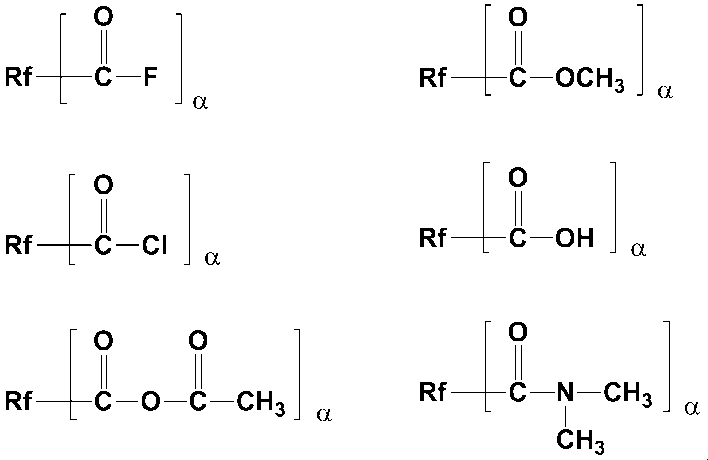
- a fluoropolyether group-containing polymer having a reactive group such as an acid fluoride group, an acid halide group, an acid anhydride group, an ester group, a carboxylic acid group, an amide group at the molecular chain end, a nucleophile, and a solvent
- a reactive group such as an acid fluoride group, an acid halide group, an acid anhydride group, an ester group, a carboxylic acid group, an amide group at the molecular chain end, a nucleophile, and a solvent
- 1,3-bis (trifluoromethyl) benzene and tetrahydrofuran are mixed and mixed at 0 to 80 ° C., preferably 50 to 70 ° C., more preferably about 60 ° C., for 1 to 6 hours, preferably 3 to 5 hours. More preferably, it is aged for about 4 hours.
- fluoropolyether group-containing polymer having a reactive group at the molecular chain terminal include the following. (In the formula, Rf and ⁇ are the same as above.)
- nucleophile allyl magnesium halide, 3-butenyl magnesium halide, 4-pentenyl magnesium halide, 5-hexenyl magnesium halide and the like can be used. It is also possible to use a corresponding lithium reagent.
- the amount of the nucleophilic agent used is 2 to 5 equivalents, more preferably 2.5 to 3.5 equivalents, relative to 1 equivalent of the reactive group of the fluoropolyether group-containing polymer having a reactive group at the molecular chain end. More preferably, about 3 equivalents can be used.
- U is a divalent hydrocarbon group, specifically, a methylene group, an ethylene group, a propylene group (trimethylene group, methylethylene group), a butylene group (tetramethylene group, methylpropylene group). ), An alkylene group having 1 to 8 carbon atoms such as a hexamethylene group or an octamethylene group, or an alkylene group containing an arylene group having 6 to 8 carbon atoms such as a phenylene group (for example, an alkylene / arylene group having 7 to 8 carbon atoms) ) And the like.
- U is preferably a linear alkylene group having 1 to 4 carbon atoms.
- the hydrogen atom of the hydroxyl group of the fluoropolyether group-containing polymer having a hydroxyl group and an olefin moiety at the molecular chain end represented by the formula (a) obtained above is substituted with another group.
- Examples of a method for substituting a hydrogen atom of a hydroxyl group with a silyl group represented by —SiR 3 include, for example, a fluoropolyether group-containing polymer having a hydroxyl group and an olefin moiety at the molecular chain end represented by the formula (a) and a silylating agent And in the presence of a base such as amines or alkali metal bases, if necessary, using a solvent such as a fluorine-based solvent or an organic solvent, and a temperature of 0 to 80 ° C, preferably 40 to 60 ° C, more preferably about 50 ° C Aging is carried out at a temperature for 1 to 24 hours, preferably 2 to 10 hours, more preferably about 3 hours.
- a base such as amines or alkali metal bases
- the presence of a dehydrogenation catalyst such as a platinum group metal catalyst or a boron catalyst may be prepared by combining a fluoropolyether group-containing polymer having a hydroxyl group and an olefin moiety at the molecular chain end represented by formula (a) with hydrosilane.
- a solvent such as a fluorine-based solvent or an organic solvent at 0 to 60 ° C., preferably 15 to 35 ° C., more preferably about 25 ° C., for 10 minutes to 24 hours, preferably 30 minutes to 2 hours, More preferably, the dehydrogenation reaction is performed for about 1 hour.
- silylating agent for example, silyl halide, silyl triflate, and the like can be used, and specifically, trimethylsilyl chloride, triethylsilyl chloride, tert-butyldimethyl chloride, triisopropylsilyl chloride, triphenylsilyl chloride. , Trimethylsilyl bromide, trimethylsilyl triflate, triethylsilyl triflate, tert-butyldimethyl triflate, triisopropylsilyl triflate, etc.
- the amount used may be a full amount having a hydroxyl group and an olefin moiety at the molecular chain end represented by the formula (a).
- 1 to 10 equivalents On 1 equivalent of hydroxyl group of the Roporieteru group-containing polymer, 1 to 10 equivalents, more preferably 1 to 4 equivalents, can be used more preferably about 2 equivalents.
- hydrosilanes include trimethylsilane, triethylsilane, tert-butyldimethylsilane, triisopropylsilane, triphenylsilane, and the like, and the amount used thereof is a hydroxyl group and an olefin at the molecular chain end represented by the formula (a).
- 1 to 5 equivalents, more preferably 1.5 to 3 equivalents, and still more preferably about 2 equivalents can be used with respect to 1 equivalent of hydroxyl group of the fluoropolyether group-containing polymer having a moiety.
- Examples of the method for substituting the hydrogen atom of the hydroxyl group with a group represented by —WQ′-X include, for example, a fluoropolyether group having a hydroxyl group and an olefin moiety at the molecular chain end represented by the formula (a).
- a polymer and an organosilicon compound having a SiH group are mixed at 0 to 60 ° C., preferably 15 to 35 ° C., more preferably using a solvent such as a fluorine-based solvent or an organic solvent in the presence of a dehydrogenation catalyst such as a boron catalyst.
- the dehydrogenation reaction is carried out at a temperature of about 25 ° C. for 10 minutes to 24 hours, preferably 30 minutes to 2 hours, more preferably about 1 hour.
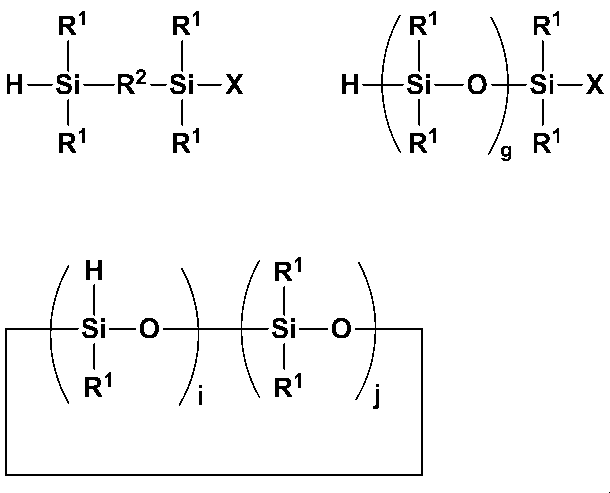
- organosilicon compound having a SiH group for example, those shown below can be exemplified.
- g and e are the same as above, and c is an integer of 1 to 4.
- the amount used is 1 to 10 equivalents, more preferably 1.2 to 5 with respect to 1 equivalent of the hydroxyl group of the fluoropolyether group-containing polymer having a hydroxyl group and an olefin moiety at the molecular chain end represented by the formula (a).
- An equivalent amount can be used.
- the hydrogen atom of the hydroxyl group is substituted with a terminal unsaturated group, and then the terminal unsaturated group ( Examples thereof include a method of reacting an olefin moiety) with an organosilicon compound having a SiH group together with other olefin moieties.
- Examples of a method for substituting a hydrogen atom of a hydroxyl group with a terminal unsaturated group include, for example, a fluoropolyether group-containing polymer having a hydroxyl group and an olefin moiety at the molecular chain end represented by the formula (a), and an olefin introducing agent.
- an olefin introducing agent 0-90 using additives such as tetrabutylammonium halide and alkali metal halide, and solvents such as fluorine-based solvents and organic solvents, if necessary, in the presence of bases such as alkenyls and alkali metal bases.
- bases such as alkenyls and alkali metal bases.
- allyl halide and the like can be used as the olefin introducing agent.
- allyl chloride, allyl bromide, allyl iodide, 4-chloro-1-butene, 4-bromo-1-butene, 4 -Iodo-1-butene, 5-chloro-1-pentene, 5-bromo-1-pentene, 5-iodo-1-pentene, etc., and the amount used is a molecular chain represented by the formula (a) 1 to 10 equivalents, more preferably 2.5 to 6 equivalents, and still more preferably about 5 equivalents can be used per 1 equivalent of hydroxyl group of the fluoropolyether group-containing polymer having a hydroxyl group and an olefin moiety at the terminal.
- V is a single bond or a divalent hydrocarbon group.
- the divalent hydrocarbon group include a methylene group, an ethylene group, and a propylene group (trimethylene group, methylethylene group). ), Butylene groups (tetramethylene group, methylpropylene group), hexamethylene groups, octamethylene groups and other alkylene groups having 1 to 8 carbon atoms, and alkylene groups containing 6 to 8 carbon atoms arylene groups such as phenylene groups (for example, And an alkylene / arylene group having 7 to 8 carbon atoms).
- V is preferably a methylene group.
- the organosilicon compound having a SiH group in the molecule is preferably a compound represented by the following formula.
- R 1 , R 2 , X, g and j are the same as above, i is an integer of 1 to 6, preferably 1 to 4, and i + j is an integer of 3 to 10, preferably 3 to 5. .
- organosilicon compounds having a SiH group in the molecule include those shown below. (Wherein g, g1, and e are the same as above)
- the amount of the organosilicon compound having a SiH group in the molecule is 1 equivalent of the terminal unsaturated group of the fluoropolyether group-containing polymer having an olefin moiety at the molecular chain end represented by the above formulas (a) to (d).
- 5 to 20 equivalents, more preferably 7.5 to 12.5 equivalents, and still more preferably about 10 equivalents can be used.
- the fluoropolyether group-containing polymer-modified organosilicon compound represented by the above formula (1) can be obtained by distilling off the solvent and unreacted substances under reduced pressure.
- the reaction mentioned above can be performed independently or continuously.
- the surface treating agent of the present invention contains a fluoropolyether group-containing polymer-modified organosilicon compound represented by the above formula (1).
- the surface treatment agent of the present invention further includes the following general formula (4).
- A is a fluorine atom or a monovalent fluorine-containing group whose terminal is a —CF 3 group
- Rf ′ is a divalent fluorooxyalkylene group-containing polymer residue.
- the polymer may contain a fluoropolyether group-containing polymer (hereinafter referred to as a non-functional polymer).
- A is a fluorine atom or a monovalent fluorine-containing group having a terminal —CF 3 group, preferably a fluorine atom, a linear perfluoroalkyl group having 1 to 6 carbon atoms, Of these, —F, —CF 3 , —CF 2 CF 3 and —CF 2 CF 2 CF 3 are preferred.
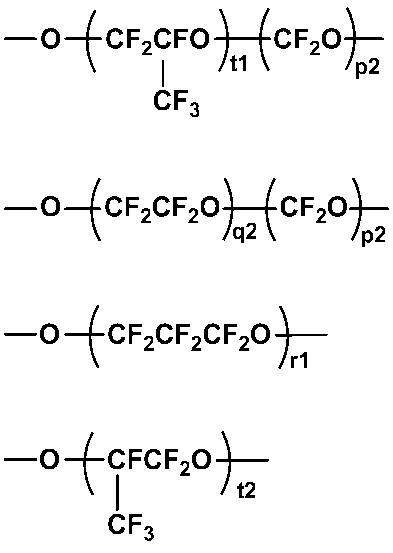
- Rf ′ is a divalent fluorooxyalkylene group-containing polymer residue, and Rf ′ is preferably the following.
- p2 is an integer of 5 to 200, preferably 10 to 100
- q2 is an integer of 5 to 200, preferably 10 to 100
- r1 is an integer of 10 to 200, preferably 20 to 100
- t1 is an integer of 5 to 200, preferably an integer of 10 to 100
- t2 is an integer of 10 to 200, preferably 20 to 100
- t1 + p2 is an integer of 10 to 205, preferably 20 to 110
- q2 + p2 is 10 to 205, preferably 20 to 110 Is an integer.
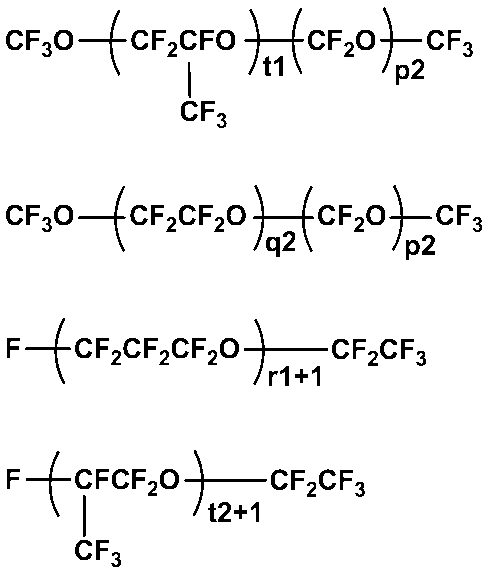
- non-functional polymer represented by the formula (4) examples include the following. (Wherein p2, q2, r1, t1, and t2 are the same as described above.)
- blending the nonfunctional polymer represented by Formula (4) is not specifically limited, It is 0.00 with respect to the mass of the fluoro polyether group containing polymer modified organosilicon compound represented by Formula (1).
- a range of 1 to 60% by mass, particularly 10 to 40% by mass is preferable, and if it is too large, an adhesion problem may occur.
- the surface treatment agent may contain a suitable solvent.
- suitable solvents include fluorine-modified aliphatic hydrocarbon solvents (perfluoroheptane, perfluorooctane, etc.), fluorine-modified aromatic hydrocarbon solvents (m-xylene hexafluoride (1,3-bis (trifluoro) Methyl) benzene), benzotrifluoride, etc.), fluorine-modified ether solvents (methyl perfluorobutyl ether, ethyl perfluorobutyl ether, perfluoro (2-butyltetrahydrofuran), etc.), fluorine-modified alkylamine solvents (perfluorotributylamine, Examples thereof include perfluorotripentylamine), hydrocarbon solvents (petroleum benzine, mineral spirits, toluene, xylene, etc.), and ketone solvents (acetone, methyl ethyl ketone,
- fluorine-modified solvents are desirable in terms of solubility and wettability, and in particular, m-xylene hexafluoride, perfluoro (2-butyltetrahydrofuran), perfluorotributylamine, ethyl perfluoro Butyl ether is preferred. Two or more of these solvents may be mixed, but it is preferable to uniformly dissolve the fluoropolyether group-containing polymer-modified organosilicon compound.
- the optimum concentration of the fluorooxyalkylene group-containing polymer dissolved in the solvent varies depending on the treatment method, but is preferably 0.01 to 40% by mass, particularly 0.05 to 25% by mass in the surface treatment agent.
- the surface treatment agent of the present invention is used to treat a resin product such as a resin film or a spectacle lens.
- a resin product what consists of a thermoplastic resin is preferable, and specifically, the thermoplastic resin film (hard coat film) by which the hard coat process was carried out, it is more than pencil hardness 4H, and the hard coat is not given.
- a thermoplastic resin film (high hardness resin film) or a thermoplastic resin film (antireflection film) provided with an antireflection layer is preferably used.
- SiO 2 process those SiO 2 treated by sputtering is preferred from the viewpoint of improving the adhesion between the resin product and process agent.
- the surface treatment agent of the present invention can be applied onto a substrate by a known method such as brushing, dipping, spraying, or vapor deposition.
- the heating method during the vapor deposition process may be either a resistance heating method or an electron beam heating method, and is not particularly limited.
- the post-treatment conditions vary depending on the post-treatment method. For example, when applied by vapor deposition or spray coating, when a resin film treated with SiO 2 is used as a base material, from room temperature (25 ° C.) The temperature can be in the range of 200 ° C. for 5 minutes to 24 hours, particularly 10 minutes to 12 hours, and post-treatment may be performed under humidification. Particularly in the present invention, 10 minutes to 24 hours, particularly 30 minutes to 12 hours are sufficient even at room temperature.
- the thickness of the coating is appropriately selected depending on the type of substrate, but is usually 0.1 to 100 nm, particularly 1 to 25 nm.
- Examples of the resin product treated with the surface treatment agent of the present invention include car navigation, mobile phone, digital camera, digital video camera, PDA, portable audio player, car audio, game device, glasses lens, camera lens, lens filter, Sunglasses, medical equipment such as stomach cameras, copiers, PCs, liquid crystal displays, organic EL displays, plasma displays, touch panel displays, protective films, hard coat films, high-hardness resins, antireflection films, wearable devices, etc.
- an optical article, a touch panel, an antireflection film, a quartz substrate, and the like used as a part are preferable.
- the surface treatment agent for surface-treating the resin product of the present invention can form a film on the article under a mild condition such as room temperature even for a short time, and the film has excellent water and oil repellency and durability. Therefore, it is particularly useful as a water / oil repellent layer for eyeglass lenses, touch panel displays, hard coat films, high-hardness resins, antireflection films, wearable terminals and the like.
- the high-hardness resin is, for example, a product obtained by molding a resin having a pencil hardness of 4H or higher, such as a product name Sylplus manufactured by Nippon Steel Chemical Co., Ltd., or a product name HD film manufactured by Gunze Co., which is promoted as a glass substitute film.
- it refers to a resin film obtained by molding the resin, but is not particularly limited to the above products.
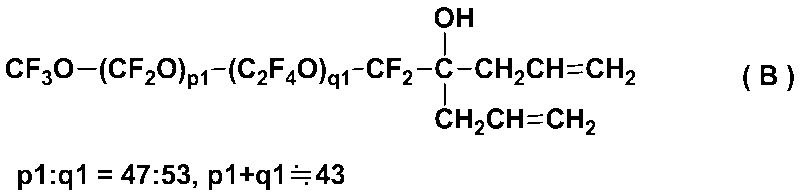
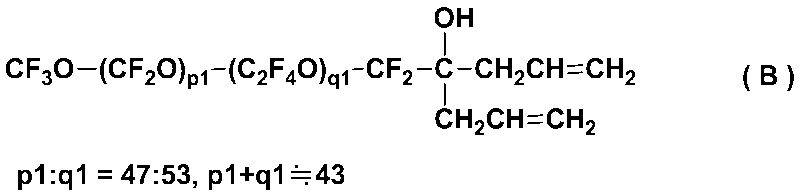
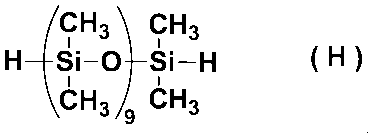
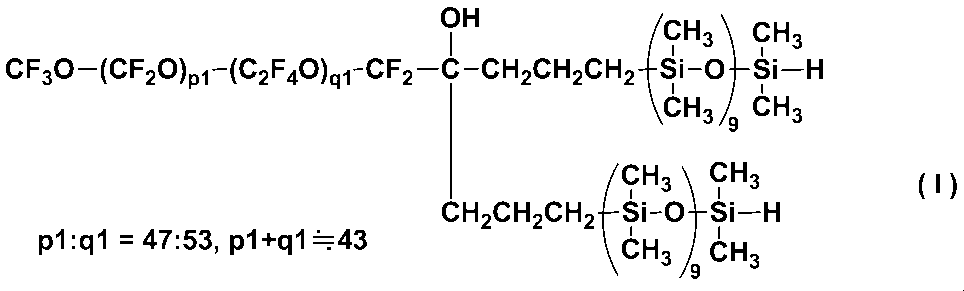
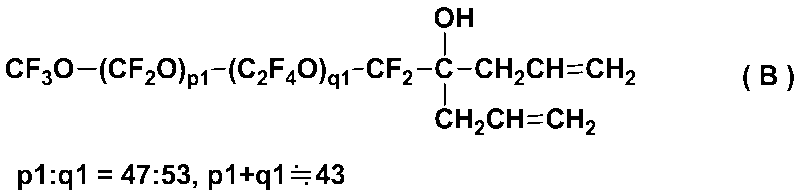
- Synthesis Example 4 Synthesis of Compound 4 In a reaction vessel, the following formula (B) Compound represented by putting 50g (1.4 ⁇ 10 -2 mol) in 1,3-bis dissolved in (trifluoromethyl) benzene 50 g, toluene solution 8.0 ⁇ 10 chloroplatinic acid / vinylsiloxane complex -2 g (containing 1.3 ⁇ 10 ⁇ 6 mol as a simple substance of Pt) and 40 g (1.4 ⁇ 10 ⁇ 1 mol) of 1,1,3,3,5,5,7,7-octamethyltetrasiloxane ) And aged at 80 ° C.
- formula (B) Compound represented by putting 50g (1.4 ⁇ 10 -2 mol) in 1,3-bis dissolved in (trifluoromethyl) benzene 50 g, toluene solution 8.0 ⁇ 10 chloroplatinic acid / vinylsiloxane complex -2 g (containing 1.3 ⁇ 10 ⁇ 6 mol as a
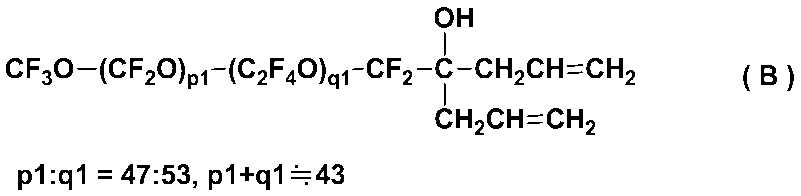
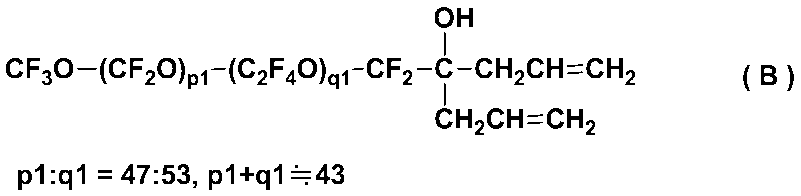
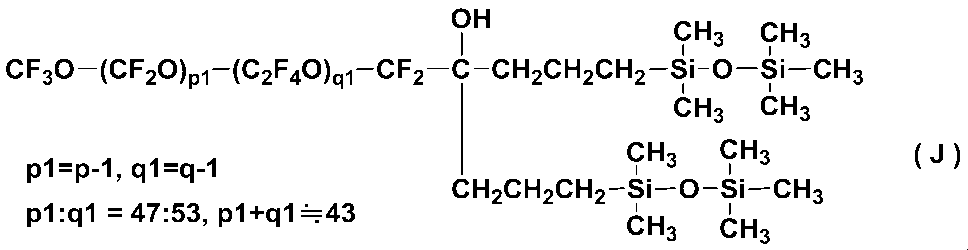
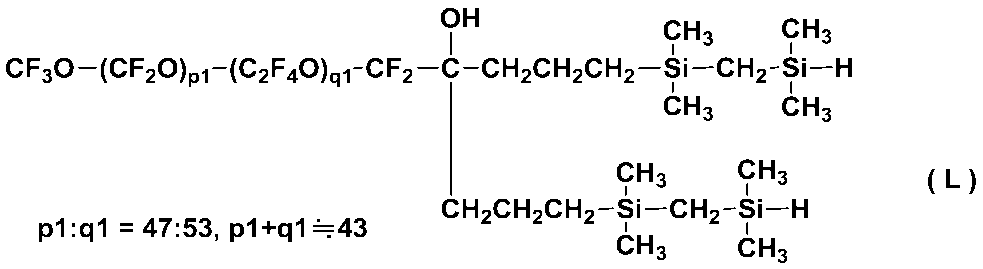
- Synthesis Example 6 Synthesis of Compound 6 In a reaction vessel, the following formula (B) Compound represented by putting 50g (1.3 ⁇ 10 -2 mol) in 1,3-bis dissolved in (trifluoromethyl) benzene 50 g, toluene solution of chloroplatinic acid / vinyl siloxane complex 5.0 ⁇ 10 -2 g (containing 1.4 ⁇ 10 ⁇ 6 mol as a simple substance of Pt) and 20 g (1.4 ⁇ 10 ⁇ 1 mol) of pentamethyldisiloxane are mixed and aged at 80 ° C. for 8 hours.
- formula (B) Compound represented by putting 50g (1.3 ⁇ 10 -2 mol) in 1,3-bis dissolved in (trifluoromethyl) benzene 50 g, toluene solution of chloroplatinic acid / vinyl siloxane complex 5.0 ⁇ 10 -2 g (containing 1.4 ⁇ 10 ⁇ 6 mol as a simple substance of Pt) and 20
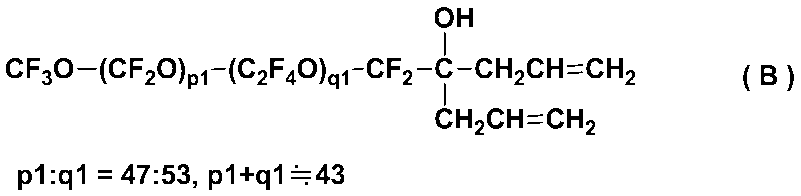
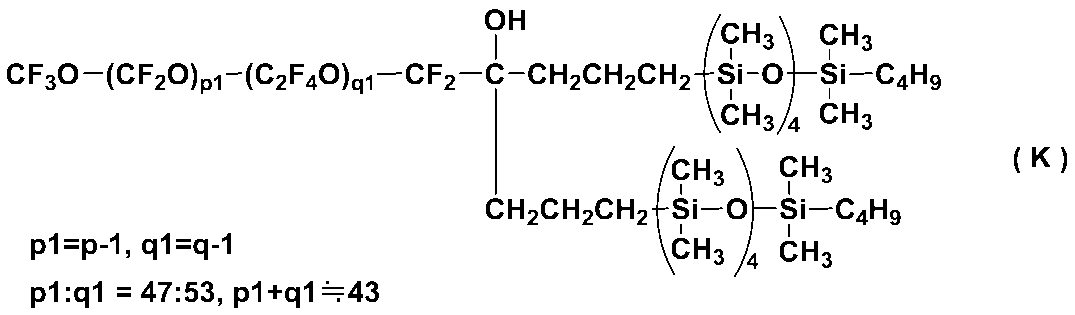
- Synthesis Example 7 Synthesis of Compound 7 In a reaction vessel, the following formula (B) Compound represented by putting 50g (1.3 ⁇ 10 -2 mol) in 1,3-bis dissolved in (trifluoromethyl) benzene 50 g, toluene solution 1.0 ⁇ 10 chloroplatinic acid / vinylsiloxane complex -1 g (containing 2.8 ⁇ 10 ⁇ 6 mol as a simple substance of Pt) and 13 g of 1-butane-decamethylpentasiloxane (3.2 ⁇ 10 ⁇ 2 mol) and aged at 80 ° C.
- formula (B) Compound represented by putting 50g (1.3 ⁇ 10 -2 mol) in 1,3-bis dissolved in (trifluoromethyl) benzene 50 g, toluene solution 1.0 ⁇ 10 chloroplatinic acid / vinylsiloxane complex -1 g (containing 2.8 ⁇ 10 ⁇ 6 mol as a simple substance of Pt) and 13
- the obtained compound 9 was confirmed by 1 H-NMR to have a structure represented by the following formula (N).
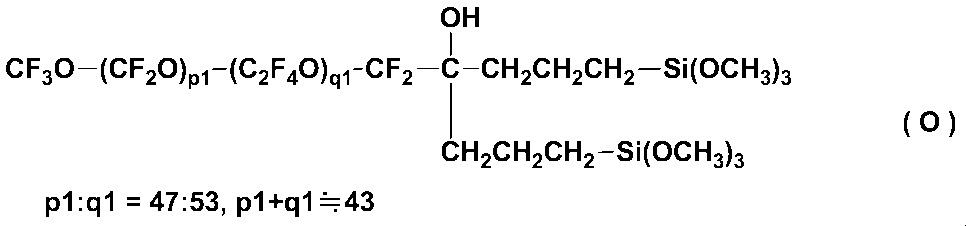
- the obtained compound 10 was confirmed by 1 H-NMR to have a structure represented by the following formula (O).
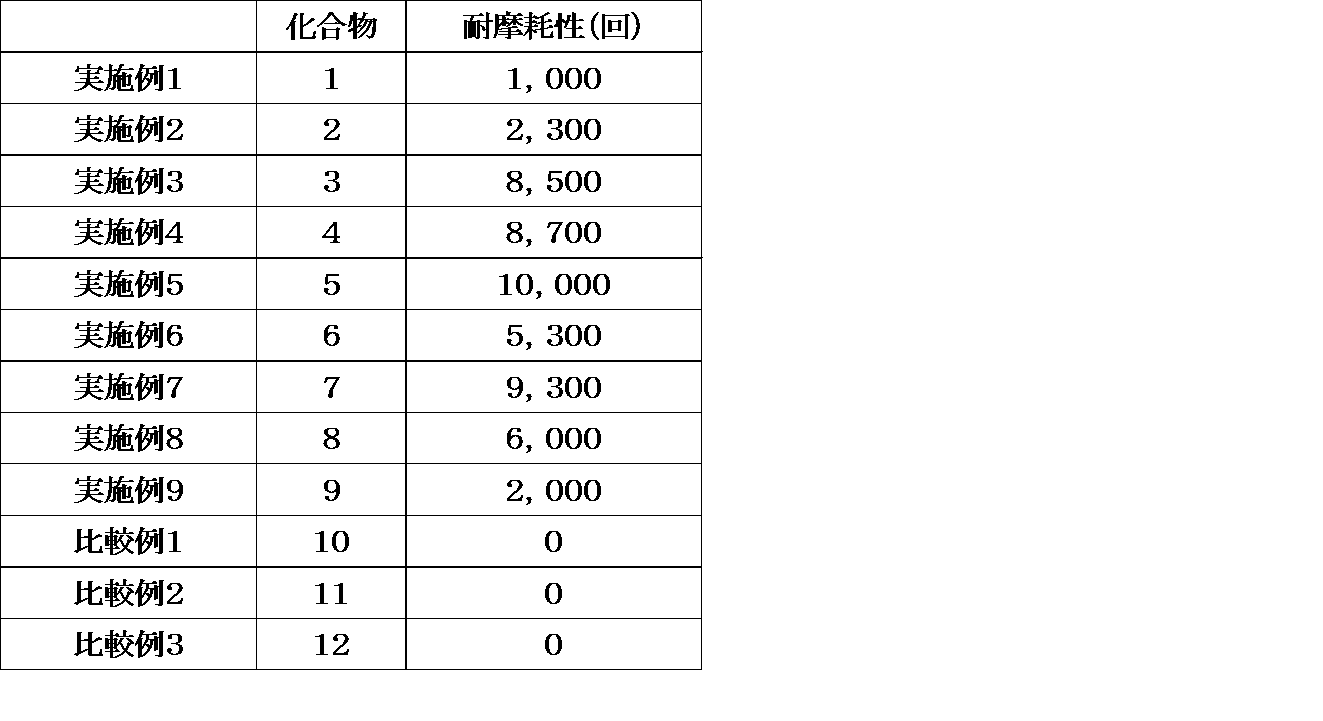
- the resin film (manufactured by Tygold) is washed by plasma treatment (Ar: 10 cc, O 2 : 80 cc, output: 250 W, time: 30 seconds), and 10 mg of the surface treatment agent is vacuumed thereon Vapor deposition was performed (processing conditions were pressure: 2.0 ⁇ 10 ⁇ 2 Pa, heating temperature: 700 ° C.), and a film having a thickness of 15 nm was formed after 24 hours in an atmosphere of 25 ° C. and humidity 50% RH.
- the resin film was made of polyethylene terephthalate, and the surface of the film was subjected to an acrylic hard coat treatment, and then the outermost surface was subjected to sputtering treatment with SiO 2 with a thickness of 100 nm. Films formed using compounds 1-9 were designated as Examples 1-9, and films formed using compounds 10-12 were designated as Comparative Examples 1-3.
- Example 1 to 9 and Comparative Examples 1 to 3 were evaluated by the following methods. All tests were performed at 25 ° C. and humidity 50% RH.
- Examples 1 to 9 have a siloxane bond, a silphenylene structure, or a silalkylene structure at the end of the molecular chain (the linking group portion of the molecule), so that the SiCH 3 portion of the linking group portion is the SiO 2 layer on the substrate surface.
- the surface of the comparative example does not have a hydrolyzable group at the end group. It seems that the adhesion to the substrate is improved compared to the treatment agent.
- the resin in which the antifouling surface layer is formed by the surface treatment agent containing the fluoropolyether group-containing polymer-modified organosilicon compound of the present invention can exhibit excellent wear durability.
- the resin in which the antifouling surface layer is formed by the surface treatment agent of the present invention can be suitably used particularly for applications requiring antifouling treatment on the surface, such as eyeglass lenses, sunglasses, touch panel displays, and antireflection films.
- the article surface-treated with the surface treating agent containing the fluoropolyether group-containing polymer-modified organosilicon compound of the present invention exhibits excellent wear durability.
- the resin product surface-treated with the surface treatment agent of the present invention is particularly effective as a resin product that is assumed to be attached with oils and fats, such as a touch panel display, an antireflection film, and a spectacle lens.
Landscapes
- Chemical & Material Sciences (AREA)
- Organic Chemistry (AREA)
- Chemical Kinetics & Catalysis (AREA)
- Health & Medical Sciences (AREA)
- Polymers & Plastics (AREA)
- Medicinal Chemistry (AREA)
- Engineering & Computer Science (AREA)
- General Chemical & Material Sciences (AREA)
- Materials Engineering (AREA)
- Wood Science & Technology (AREA)
- Life Sciences & Earth Sciences (AREA)
- Inorganic Chemistry (AREA)
- Combustion & Propulsion (AREA)
- Polyethers (AREA)
- Silicon Polymers (AREA)
- Materials Applied To Surfaces To Minimize Adherence Of Mist Or Water (AREA)
- Compositions Of Macromolecular Compounds (AREA)
Abstract
Description
〔1〕
下記一般式(1)

-SiR3
(式中、Rは独立に炭素数1~4のアルキル基又はフェニル基である。)
で表される基、又は下記式
-W-Q’-X
(式中、Xは上記と同じであり、Wは単結合又は2価の炭化水素基であり、Q’はシロキサン結合、シルアルキレン構造及びシルアリーレン構造から選ばれる構造を有する2価の基である。)
で表される基であり、αは1又は2である。]
で表されるフルオロポリエーテル基含有ポリマー変性有機ケイ素化合物。
〔2〕
前記式(1)において、αが1であり、Rf基が下記一般式(2)で表される基であることを特徴とする〔1〕記載のフルオロポリエーテル基含有ポリマー変性有機ケイ素化合物。

〔3〕
前記式(1)において、αが2であり、Rf基が下記一般式(3)で表される基であることを特徴とする〔1〕記載のフルオロポリエーテル基含有ポリマー変性有機ケイ素化合物。

〔4〕
前記式(1)において、Yが、炭素数3~10のアルキレン基である〔1〕~〔3〕のいずれかに記載のフルオロポリエーテル基含有ポリマー変性有機ケイ素化合物。
〔5〕
前記式(1)において、Qが、下記式で示される基から選ばれる基である〔1〕~〔4〕のいずれかに記載のフルオロポリエーテル基含有ポリマー変性有機ケイ素化合物。

〔6〕
前記式(1)において、Zが、水素原子、及び下記に示す基より選ばれる基である〔1〕~〔5〕のいずれかに記載のフルオロポリエーテル基含有ポリマー変性有機ケイ素化合物。


〔7〕
上記式(1)で表されるフルオロポリエーテル基含有ポリマー変性有機ケイ素化合物が、下記式のいずれかで表されるものである〔1〕~〔6〕のいずれか1項に記載のフルオロポリエーテル基含有ポリマー変性有機ケイ素化合物。


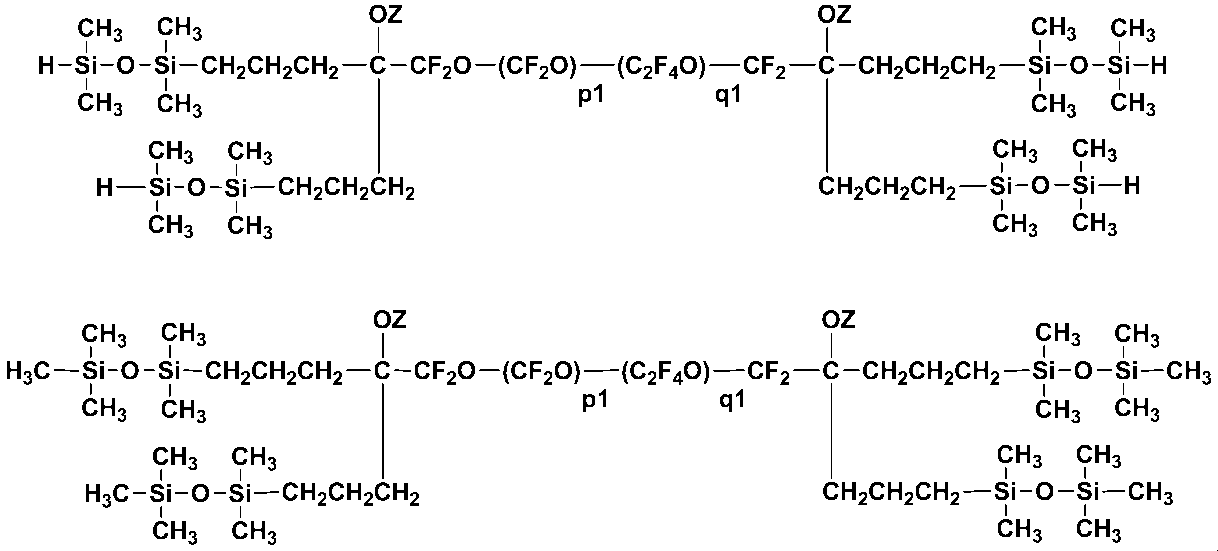
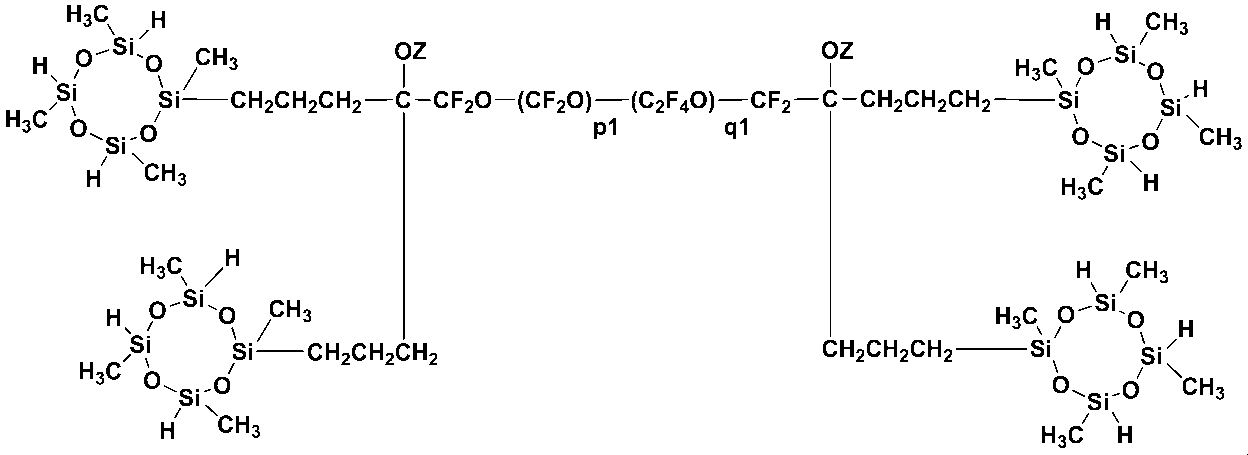

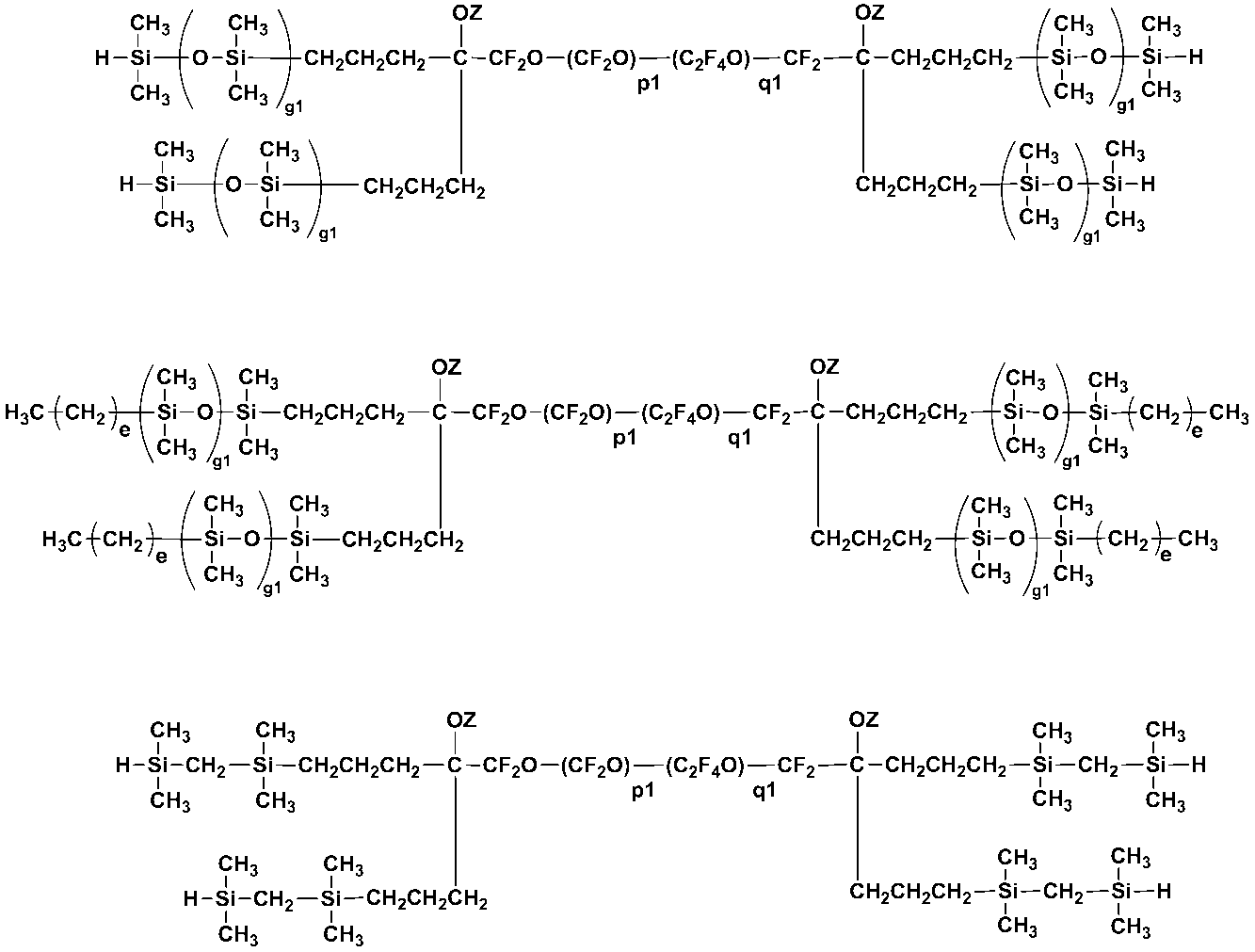


〔8〕
〔1〕~〔7〕のいずれかに記載のフルオロポリエーテル基含有ポリマー変性有機ケイ素化合物を含む表面処理剤。
〔9〕
表面処理剤が、更に下記一般式(4)

で表されるフルオロポリエーテル基含有ポリマーを含有することを特徴とする〔8〕に記載の表面処理剤。
〔10〕
〔9〕記載の表面処理剤で表面処理された物品。

-SiR3
(式中、Rは独立に炭素数1~4のアルキル基又はフェニル基である。)
で表される基、又は下記式
-W-Q’-X
(式中、Xは上記と同じであり、Wは単結合又は2価の炭化水素基であり、Q’はシロキサン結合、シルアルキレン構造及びシルアリーレン構造から選ばれる構造を有する2価の基である。)
で表される基であり、αは1又は2である。]


上記式(2)、(3)において、dは1~3の整数であり、好ましくは1又は2であり、該単位は直鎖状でも分岐状であってもよい。
また、主鎖にフルオロポリエーテル構造を有し、分子鎖の片末端にシロキサン結合、シルフェニレン結合又はシルアルキレン結合を含有する直鎖状ポリマー(αが1で、Rfが式(2)で表される1価のフルオロオキシアルキル基)は、両末端にシロキサン結合、シルフェニレン結合又はシルアルキレン結合を含有する直鎖状ポリマー(αが2で、Rfが式(3)で表される2価のフルオロオキシアルキレン基)と比較して、得られる被膜に優れた耐摩耗性を付与することができる。


-SiR3
(式中、Rは独立に炭素数1~4のアルキル基又はフェニル基である。)
で表される基、又は下記式
-W-Q’-X
(式中、Xは上記と同じであり、Wは単結合又は2価の炭化水素基であり、Q’はシロキサン結合、シルアルキレン構造及びシルアリーレン構造から選ばれる構造を有する2価の基である。)
で表される基である。
Xは上記と同じであり、水素原子、メチル基が好ましい。
Q’の具体例としては、例えば、下記の基が挙げられる。
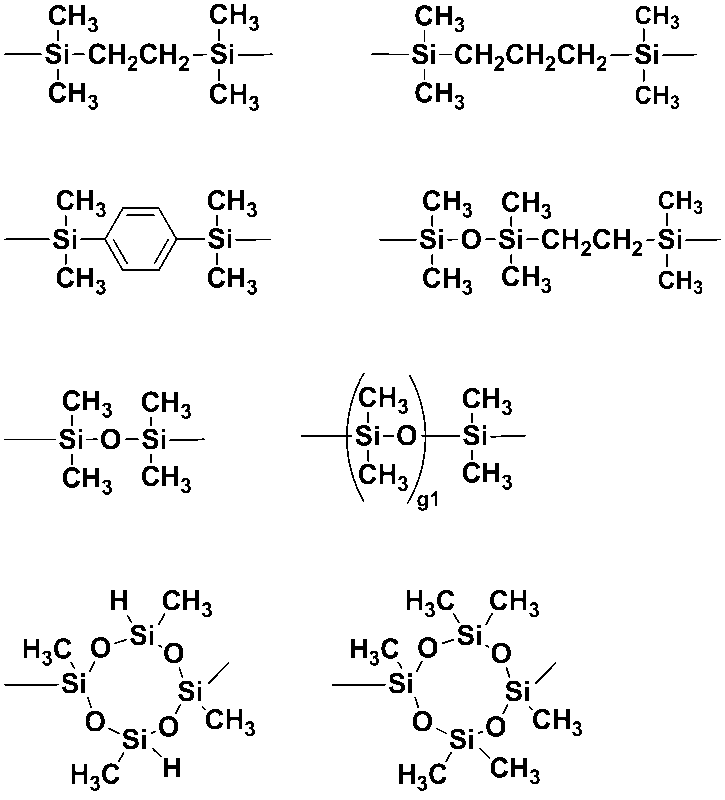


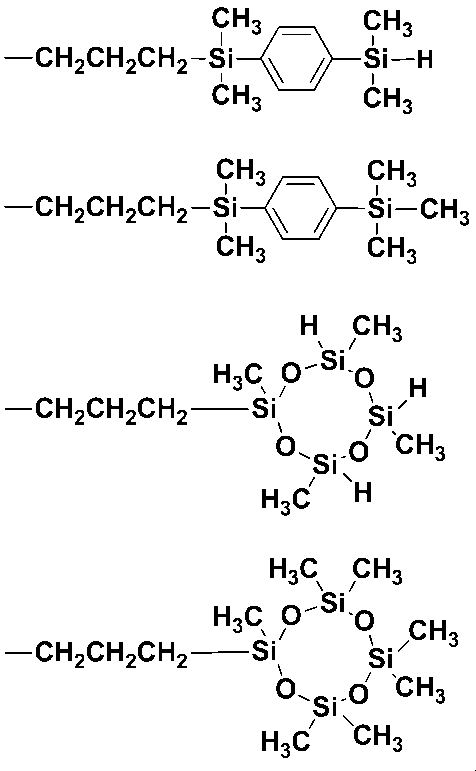
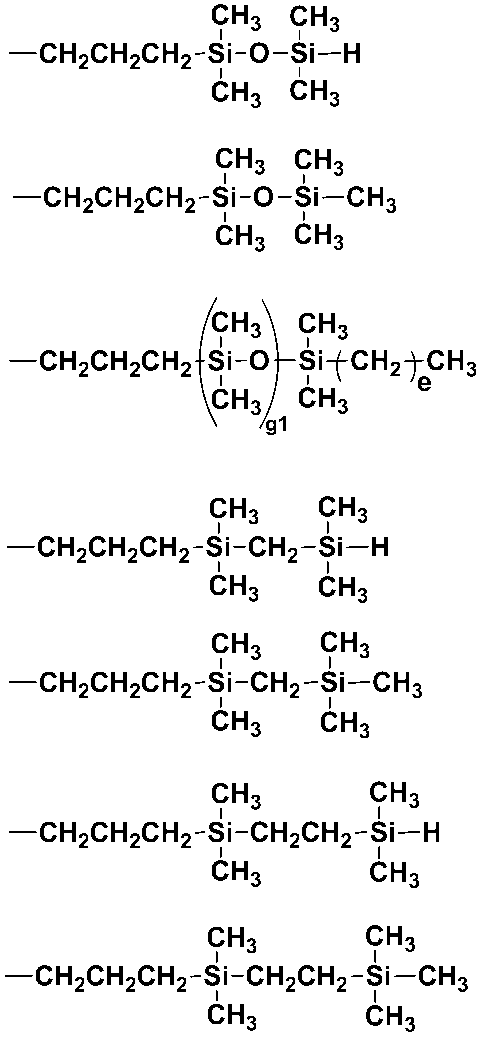





求核剤の使用量は、上記分子鎖末端に反応性基を有するフルオロポリエーテル基含有ポリマーの反応性基1当量に対して、2~5当量、より好ましくは2.5~3.5当量、更に好ましくは約3当量用いることができる。

また、別法として、式(a)で表される分子鎖末端に水酸基及びオレフィン部位を有するフルオロポリエーテル基含有ポリマーとヒドロシランとを、白金族金属系触媒やホウ素触媒などの脱水素触媒の存在下、フッ素系溶剤、有機溶剤などの溶剤を用いて0~60℃、好ましくは15~35℃、より好ましくは約25℃の温度で、10分~24時間、好ましくは30分~2時間、より好ましくは約1時間脱水素反応を行う。
また、ヒドロシランとしては、トリメチルシラン、トリエチルシラン、tert-ブチルジメチルシラン、トリイソプロピルシラン、トリフェニルシランなどが挙げられ、この使用量は、式(a)で表される分子鎖末端に水酸基及びオレフィン部位を有するフルオロポリエーテル基含有ポリマーの水酸基1当量に対して、1~5当量、より好ましくは1.5~3当量、更に好ましくは約2当量用いることができる。


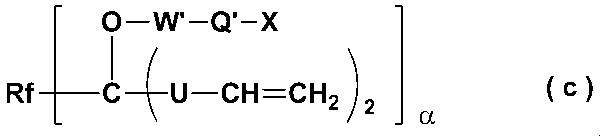
水酸基の水素原子を末端不飽和基に置換する方法としては、例えば、式(a)で表される分子鎖末端に水酸基及びオレフィン部位を有するフルオロポリエーテル基含有ポリマーとオレフィン導入剤とを、アミン類やアルカリ金属系塩基などの塩基の存在下、必要によりテトラブチルアンモニウムハライド、アルカリ金属系ハライドなどの反応性を向上させる添加剤や、フッ素系溶剤、有機溶剤などの溶剤を用い、0~90℃、好ましくは60~80℃、より好ましくは約70℃の温度で、1~25時間、好ましくは3~10時間、より好ましくは約6時間熟成する。




で表されるフルオロポリエーテル基含有ポリマー(以下、無官能性ポリマーと称す)を含有してもよい。
また、Rf’は2価のフルオロオキシアルキレン基含有ポリマー残基であり、Rf’としては下記に示すものが好ましい。
上記溶剤はその2種以上を混合してもよいが、フルオロポリエーテル基含有ポリマー変性有機ケイ素化合物を均一に溶解させることが好ましい。なお、溶剤に溶解させるフルオロオキシアルキレン基含有ポリマーの最適濃度は、処理方法により異なるが、表面処理剤中0.01~40質量%、特に0.05~25質量%であることが好ましい。
また、本発明においては、上記樹脂製品を予めSiO2処理したものを用いることが好ましい。ここで、SiO2処理は、スパッタ法によりSiO2処理されたものが、上記樹脂製品と処理剤との密着性を向上させるという点から好ましい。
実施例及び比較例は、下記合成例により得られる化合物を使用した。
反応容器に、テトラヒドロフラン150g、1,3-ビス(トリフルオロメチル)ベンゼン300gを混合し、0.7Mのアリルマグネシウムブロミド160mlを滴下した。続いて、下記式(A)


δ0-0.2(-Si(CH 3)2)24H
δ0.4-0.6(-CH2CH2CH 2-Si)4H
δ1.3-1.6(-CH2CH 2CH2-Si)4H
δ1.6-1.9(-CH 2CH 2 CH2-Si)4H
δ3.6-4.2(-SiH)2H
δ6.6-7.1(-C6 H 4)8H
反応容器に、1,3-ビス(トリフルオロメチル)ベンゼン100g、DBU(ジアザビシクロウンデセン)8.2g(5.4×10⁻²mol)、下記式(B)

δ0-0.2(-OSi(CH 3)3)9H
δ2.4-2.6(-CH 2CH=CH2)4H
δ5.0-5.2(-CH2CH=CH 2)4H
δ5.7-5.9(-CH2CH=CH2)2H


δ0-0.2(-OSi-CH 3、-OSi(CH 3)3)36H
δ0.5-0.8(-CH2CH2CH 2-Si)4H
δ1.3-2.2(-CH 2CH 2CH2-Si)8H
δ4.3-5.2(-SiH)6H
反応容器に、下記式(B)

δ0-0.2(-OSi(CH 3)2)36H
δ0.3-0.6(-CH2CH2CH 2-Si)4H
δ1.3-1.8(-CH 2CH2CH2-Si,-CH2CH 2CH2-Si)8H
δ3.3-3.6(-SiH)2H
反応容器に、下記式(B)

δ0-0.2(-OSi(CH 3)2)48H
δ0.3-0.6(-CH2CH2CH 2-Si)4H
δ1.3-1.8(-CH 2CH2CH2-Si,-CH2CH 2CH2-Si)8H
δ3.3-3.6(-SiH)2H
反応容器に、下記式(B)

δ0-0.2(-OSi(CH 3)2)120H
δ0.3-0.8(-CH2CH2CH 2-Si)4H
δ1.3-1.8(-CH 2CH2CH2-Si,-CH2CH 2CH2-Si)8H
δ4.7-5.0(-SiH)2H
反応容器に、下記式(B)

δ0-0.2(-Si-CH 3)30H
δ0.2-0.4(-CH2CH2CH 2-Si)4H
δ1.0-1.6(-CH 2CH2CH2-Si,-CH2CH 2CH2-Si)8H
反応容器に、下記式(B)
δ0-0.2(-Si-CH 3)60H
δ0.3-0.6(-CH2CH2CH 2-Si)8H
δ0.6-0.8(-CH2CH2CH2-CH 3)6H
δ1.1-1.3(-CH2CH 2CH 2-CH 3)8H
δ1.4-1.8(-CH 2CH 2CH2-Si)8H
反応容器に、下記式(B)

δ0-0.4(-OSi(CH 3)2,-Si-CH 2-Si)28H
δ0.4-0.8(-CH2CH2CH 2-Si)4H
δ1.2-2.0(-CH 2CH 2CH2-Si)8H
δ3.8-4.2(-SiH)2H
反応容器に、下記式(M)


δ0-0.4(-OSi(CH 3)2)72H
δ0.4-0.8(-CH2CH2CH 2-Si)8H
δ1.2-2.0(-CH 2CH 2CH2-Si)16H
δ3.8-4.2(-SiH)4H
反応容器に、下記式(B)

δ0.2-2.2(-CH 2 CH 2 CH 2 -)12H
δ3.0-3.5(-Si(OCH 3 )3)18H
[化合物11]


表面処理剤の調製及び被膜の形成
上記化合物1~12を、濃度20質量%になるようにNovec 7200(3M社製、エチルパーフルオロブチルエーテル)に溶解させて表面処理剤を調製した。表面処理剤調製後、樹脂フィルム(タイゴールド社製)をプラズマ処理(Ar:10cc、O2:80cc、出力:250W、時間:30秒)で洗浄し、その上に上記表面処理剤10mgを真空蒸着し(処理条件は、圧力:2.0×10⁻²Pa、加熱温度:700℃)、25℃、湿度50%RHの雰囲気下で24時間後に膜厚15nmの被膜を形成した。なお、樹脂フィルムはポリエチレンテレフタレート製で、フィルム表面にアクリルハードコート処理を施した後、最表面にSiO2を100nmの厚さでスパッタ処理したものを用いた。
化合物1~9を用いて形成された被膜を実施例1~9、化合物10~12を用いて形成された被膜を比較例1~3とした。
得られた被膜において、布(ベンコット)に対する耐摩耗性を、トライボギアTYPE:30S(新東科学社製)を用いて測定した。
下記の条件により、水接触角が100°未満になった時点で試験終了とした。水接触角100°以上を保つ摩耗回数により耐摩耗性の評価とした。
接触面積:10mm×30mm
荷重:1.5kg
耐布摩耗性
布:BEMCOT M-3II(旭化成社製)
移動距離(片道)20mm
移動速度1,800mm/分
荷重:0.5kg/cm2
また、水接触角は、接触角計DropMaster(協和界面科学社製)を用いて、被膜の水(液滴:2μl)に対する接触角を測定した。なお、水接触角は、2μlの液滴をサンプル表面に着滴させた後、1秒後に測定した。
Claims (10)
- 下記一般式(1)

-SiR3
(式中、Rは独立に炭素数1~4のアルキル基又はフェニル基である。)
で表される基、又は下記式
-W-Q’-X
(式中、Xは上記と同じであり、Wは単結合又は2価の炭化水素基であり、Q’はシロキサン結合、シルアルキレン構造及びシルアリーレン構造から選ばれる構造を有する2価の基である。)
で表される基であり、αは1又は2である。]
で表されるフルオロポリエーテル基含有ポリマー変性有機ケイ素化合物。 - 前記式(1)において、αが1であり、Rf基が下記一般式(2)で表される基であることを特徴とする請求項1記載のフルオロポリエーテル基含有ポリマー変性有機ケイ素化合物。

- 前記式(1)において、αが2であり、Rf基が下記一般式(3)で表される基であることを特徴とする請求項1記載のフルオロポリエーテル基含有ポリマー変性有機ケイ素化合物。

- 前記式(1)において、Yが、炭素数3~10のアルキレン基である請求項1~3のいずれか1項に記載のフルオロポリエーテル基含有ポリマー変性有機ケイ素化合物。
- 前記式(1)において、Qが、下記式で示される基から選ばれる基である請求項1~4のいずれか1項に記載のフルオロポリエーテル基含有ポリマー変性有機ケイ素化合物。
- 前記式(1)において、Zが、水素原子、及び下記に示す基より選ばれる基である請求項1~5のいずれか1項に記載のフルオロポリエーテル基含有ポリマー変性有機ケイ素化合物。


- 上記式(1)で表されるフルオロポリエーテル基含有ポリマー変性有機ケイ素化合物が、下記式のいずれかで表されるものである請求項1~6のいずれか1項に記載のフルオロポリエーテル基含有ポリマー変性有機ケイ素化合物。




- 請求項1~7のいずれか1項に記載のフルオロポリエーテル基含有ポリマー変性有機ケイ素化合物を含む表面処理剤。
- 表面処理剤が、更に下記一般式(4)

で表されるフルオロポリエーテル基含有ポリマーを含有することを特徴とする請求項8に記載の表面処理剤。 - 請求項9記載の表面処理剤で表面処理された物品。
Priority Applications (3)
| Application Number | Priority Date | Filing Date | Title |
|---|---|---|---|
| CN201680064424.1A CN108350168B (zh) | 2015-11-06 | 2016-10-13 | 含有氟聚醚基的聚合物改性有机硅化合物、表面处理剂和物品 |
| JP2017548692A JP6521091B2 (ja) | 2015-11-06 | 2016-10-13 | フルオロポリエーテル基含有ポリマー変性有機ケイ素化合物、表面処理剤及び物品 |
| KR1020187011940A KR102648003B1 (ko) | 2015-11-06 | 2016-10-13 | 플루오로폴리에터기 함유 폴리머 변성 유기 규소 화합물, 표면 처리제 및 물품 |
Applications Claiming Priority (2)
| Application Number | Priority Date | Filing Date | Title |
|---|---|---|---|
| JP2015218122 | 2015-11-06 | ||
| JP2015-218122 | 2015-11-06 |
Publications (1)
| Publication Number | Publication Date |
|---|---|
| WO2017077834A1 true WO2017077834A1 (ja) | 2017-05-11 |
Family
ID=58662388
Family Applications (1)
| Application Number | Title | Priority Date | Filing Date |
|---|---|---|---|
| PCT/JP2016/080399 Ceased WO2017077834A1 (ja) | 2015-11-06 | 2016-10-13 | フルオロポリエーテル基含有ポリマー変性有機ケイ素化合物、表面処理剤及び物品 |
Country Status (5)
| Country | Link |
|---|---|
| JP (1) | JP6521091B2 (ja) |
| KR (1) | KR102648003B1 (ja) |
| CN (1) | CN108350168B (ja) |
| TW (1) | TWI717412B (ja) |
| WO (1) | WO2017077834A1 (ja) |
Cited By (5)
| Publication number | Priority date | Publication date | Assignee | Title |
|---|---|---|---|---|
| WO2018216406A1 (ja) * | 2017-05-25 | 2018-11-29 | 信越化学工業株式会社 | フルオロポリエーテル基含有ポリマー変性有機ケイ素化合物、表面処理剤及び物品 |
| WO2019176458A1 (ja) * | 2018-03-14 | 2019-09-19 | 信越化学工業株式会社 | 含フッ素コーティング剤組成物、表面処理剤及び物品 |
| CN111630123A (zh) * | 2018-01-22 | 2020-09-04 | 信越化学工业株式会社 | 涂布剂组合物、包含该组合物的表面处理剂和用该表面处理剂表面处理过的物品 |
| CN114276741A (zh) * | 2020-10-01 | 2022-04-05 | 信越化学工业株式会社 | 含有氟聚醚基的聚合物的组合物、涂布剂和物品 |
| WO2022244874A1 (ja) * | 2021-05-21 | 2022-11-24 | ダイキン工業株式会社 | 熱交換器 |
Families Citing this family (3)
| Publication number | Priority date | Publication date | Assignee | Title |
|---|---|---|---|---|
| JP6919626B2 (ja) * | 2018-05-17 | 2021-08-18 | 信越化学工業株式会社 | シルフェニレン骨格及びポリエーテル骨格を含むポリマー |
| KR20220010452A (ko) * | 2020-07-17 | 2022-01-25 | 신에쓰 가가꾸 고교 가부시끼가이샤 | 플루오로폴리에테르 변성 아미드실란 화합물, 표면처리제 조성물, 및 물품 |
| KR20240054382A (ko) * | 2021-10-28 | 2024-04-25 | 다이킨 고교 가부시키가이샤 | 표면 처리제 |
Citations (5)
| Publication number | Priority date | Publication date | Assignee | Title |
|---|---|---|---|---|
| JP2014105235A (ja) * | 2012-11-26 | 2014-06-09 | Shin Etsu Chem Co Ltd | パーフルオロポリエーテル変性ポリシラザン及びその製造方法、表面処理剤並びに該表面処理剤で処理された物品 |
| CN104945615A (zh) * | 2014-03-31 | 2015-09-30 | 信越化学工业株式会社 | 含氟丙烯酸系化合物及其制造方法以及固化性组合物、基材 |
| US20150274888A1 (en) * | 2014-03-31 | 2015-10-01 | Shin-Etsu Chemical Co., Ltd. | Fluoropolyether-containing polymer |
| US20150274889A1 (en) * | 2014-03-31 | 2015-10-01 | Shin-Etsu Chemical Co., Ltd. | Fluoropolyether-containing polymer-modified silane, surface treating agent, and article |
| WO2016101185A1 (en) * | 2014-12-24 | 2016-06-30 | E. I. Du Pont De Nemours And Company | Perfluoropolyether silanes and method of forming the same |
Family Cites Families (16)
| Publication number | Priority date | Publication date | Assignee | Title |
|---|---|---|---|---|
| JP4412450B2 (ja) | 2001-10-05 | 2010-02-10 | 信越化学工業株式会社 | 反射防止フィルター |
| JP4197472B2 (ja) | 2002-08-29 | 2008-12-17 | 信越化学工業株式会社 | 防汚性表面層を有するレンズ |
| JP4632399B2 (ja) * | 2003-01-09 | 2011-02-16 | 信越化学工業株式会社 | 高純度ポリエーテルシリコーン |
| JP5074927B2 (ja) | 2005-04-01 | 2012-11-14 | ダイキン工業株式会社 | 表面改質剤およびその用途 |
| JP5274839B2 (ja) | 2005-04-01 | 2013-08-28 | ダイキン工業株式会社 | 表面改質剤 |
| JP2008144144A (ja) | 2006-11-15 | 2008-06-26 | Shin Etsu Chem Co Ltd | コーティング剤組成物 |
| JP5165644B2 (ja) * | 2009-07-02 | 2013-03-21 | 信越化学工業株式会社 | オルガノポリシロキサン組成物及びその製造方法 |
| JP5235026B2 (ja) | 2010-09-28 | 2013-07-10 | 信越化学工業株式会社 | フルオロオキシアルキレン基含有ポリマー組成物および該組成物を含む表面処理剤並びに該表面処理剤で表面処理された物品 |
| JP2012157856A (ja) | 2011-01-13 | 2012-08-23 | Central Glass Co Ltd | 防汚性物品及びその製造方法 |
| JP5748292B2 (ja) * | 2011-04-21 | 2015-07-15 | 信越化学工業株式会社 | フルオロオキシアルキレン基含有ポリマー組成物および該組成物を含む表面処理剤並びに該表面処理剤で表面処理された物品 |
| JP2013006819A (ja) * | 2011-05-26 | 2013-01-10 | Shin-Etsu Chemical Co Ltd | 含フッ素有機ケイ素化合物及びその製造方法並びに防汚性付与剤及びハードコート材料 |
| JP5857942B2 (ja) | 2011-11-30 | 2016-02-10 | 信越化学工業株式会社 | 蒸着用フッ素系表面処理剤及び該表面処理剤で蒸着処理された物品 |
| JP2014077836A (ja) * | 2012-10-09 | 2014-05-01 | Shin Etsu Chem Co Ltd | 表面処理方法および表面処理された物品 |
| JP5799930B2 (ja) * | 2012-10-19 | 2015-10-28 | 信越化学工業株式会社 | 硬化性フルオロポリエーテル系ゲル組成物及びその硬化物を用いたゲル製品 |
| CN103044687B (zh) * | 2012-12-21 | 2015-03-11 | 江苏美思德化学股份有限公司 | 一种含氟有机硅聚醚共聚物及其制备方法 |
| JP5614509B1 (ja) * | 2013-04-15 | 2014-10-29 | ダイキン工業株式会社 | 含フッ素含ケイ素ポリマーおよび表面処理剤 |
-
2016
- 2016-10-13 JP JP2017548692A patent/JP6521091B2/ja active Active
- 2016-10-13 CN CN201680064424.1A patent/CN108350168B/zh active Active
- 2016-10-13 KR KR1020187011940A patent/KR102648003B1/ko active Active
- 2016-10-13 WO PCT/JP2016/080399 patent/WO2017077834A1/ja not_active Ceased
- 2016-11-03 TW TW105135749A patent/TWI717412B/zh active
Patent Citations (5)
| Publication number | Priority date | Publication date | Assignee | Title |
|---|---|---|---|---|
| JP2014105235A (ja) * | 2012-11-26 | 2014-06-09 | Shin Etsu Chem Co Ltd | パーフルオロポリエーテル変性ポリシラザン及びその製造方法、表面処理剤並びに該表面処理剤で処理された物品 |
| CN104945615A (zh) * | 2014-03-31 | 2015-09-30 | 信越化学工业株式会社 | 含氟丙烯酸系化合物及其制造方法以及固化性组合物、基材 |
| US20150274888A1 (en) * | 2014-03-31 | 2015-10-01 | Shin-Etsu Chemical Co., Ltd. | Fluoropolyether-containing polymer |
| US20150274889A1 (en) * | 2014-03-31 | 2015-10-01 | Shin-Etsu Chemical Co., Ltd. | Fluoropolyether-containing polymer-modified silane, surface treating agent, and article |
| WO2016101185A1 (en) * | 2014-12-24 | 2016-06-30 | E. I. Du Pont De Nemours And Company | Perfluoropolyether silanes and method of forming the same |
Cited By (17)
| Publication number | Priority date | Publication date | Assignee | Title |
|---|---|---|---|---|
| CN110678497B (zh) * | 2017-05-25 | 2022-09-16 | 信越化学工业株式会社 | 含有氟聚醚基的聚合物改性有机硅化合物、表面处理剂和物品 |
| US11820912B2 (en) | 2017-05-25 | 2023-11-21 | Shin-Etsu Chemical Co., Ltd. | Fluoropolyether group-containing polymer-modified organic silicon compound, surface treatment agent, and article |
| CN110678497A (zh) * | 2017-05-25 | 2020-01-10 | 信越化学工业株式会社 | 含有氟聚醚基的聚合物改性有机硅化合物、表面处理剂和物品 |
| WO2018216406A1 (ja) * | 2017-05-25 | 2018-11-29 | 信越化学工業株式会社 | フルオロポリエーテル基含有ポリマー変性有機ケイ素化合物、表面処理剤及び物品 |
| CN111630123A (zh) * | 2018-01-22 | 2020-09-04 | 信越化学工业株式会社 | 涂布剂组合物、包含该组合物的表面处理剂和用该表面处理剂表面处理过的物品 |
| CN111630123B (zh) * | 2018-01-22 | 2023-02-17 | 信越化学工业株式会社 | 涂布剂组合物、包含该组合物的表面处理剂和用该表面处理剂表面处理过的物品 |
| CN111886306A (zh) * | 2018-03-14 | 2020-11-03 | 信越化学工业株式会社 | 含氟涂布剂组合物、表面处理剂和物品 |
| CN111886306B (zh) * | 2018-03-14 | 2022-05-17 | 信越化学工业株式会社 | 含氟涂布剂组合物、表面处理剂和物品 |
| JPWO2019176458A1 (ja) * | 2018-03-14 | 2021-03-11 | 信越化学工業株式会社 | 含フッ素コーティング剤組成物、表面処理剤及び物品 |
| KR20200131258A (ko) * | 2018-03-14 | 2020-11-23 | 신에쓰 가가꾸 고교 가부시끼가이샤 | 함불소 코팅제 조성물, 표면처리제 및 물품 |
| WO2019176458A1 (ja) * | 2018-03-14 | 2019-09-19 | 信越化学工業株式会社 | 含フッ素コーティング剤組成物、表面処理剤及び物品 |
| US11987723B2 (en) | 2018-03-14 | 2024-05-21 | Shin-Etsu Chemical Co., Ltd. | Fluorinated coating agent composition, surface treatment agent, and article |
| KR102688455B1 (ko) | 2018-03-14 | 2024-07-26 | 신에쓰 가가꾸 고교 가부시끼가이샤 | 함불소 코팅제 조성물, 표면처리제 및 물품 |
| CN114276741A (zh) * | 2020-10-01 | 2022-04-05 | 信越化学工业株式会社 | 含有氟聚醚基的聚合物的组合物、涂布剂和物品 |
| WO2022244874A1 (ja) * | 2021-05-21 | 2022-11-24 | ダイキン工業株式会社 | 熱交換器 |
| JP2022179454A (ja) * | 2021-05-21 | 2022-12-02 | ダイキン工業株式会社 | 熱交換器 |
| JP7260830B2 (ja) | 2021-05-21 | 2023-04-19 | ダイキン工業株式会社 | 熱交換器 |
Also Published As
| Publication number | Publication date |
|---|---|
| JPWO2017077834A1 (ja) | 2018-07-26 |
| KR102648003B1 (ko) | 2024-03-18 |
| TW201734086A (zh) | 2017-10-01 |
| CN108350168A (zh) | 2018-07-31 |
| CN108350168B (zh) | 2021-03-23 |
| KR20180081052A (ko) | 2018-07-13 |
| JP6521091B2 (ja) | 2019-05-29 |
| TWI717412B (zh) | 2021-02-01 |
Similar Documents
| Publication | Publication Date | Title |
|---|---|---|
| JP6260579B2 (ja) | フルオロポリエーテル基含有ポリマー変性シラン、表面処理剤及び物品 | |
| TWI711649B (zh) | 含氟聚醚之聚合物改質矽烷、表面處理劑及經處理物件 | |
| CN109312150B (zh) | 含有氟聚醚基的聚合物、表面处理剂和物品 | |
| JP6521091B2 (ja) | フルオロポリエーテル基含有ポリマー変性有機ケイ素化合物、表面処理剤及び物品 | |
| JP6680350B2 (ja) | フルオロポリエーテル基含有ポリマー変性シラン、表面処理剤及び物品 | |
| JP6642589B2 (ja) | フルオロポリエーテル基含有ポリマー変性シラン、表面処理剤及び物品 | |
| TWI714662B (zh) | 經表面處理之樹脂製品 | |
| CN114746475A (zh) | 含有氟聚醚基的聚合物、表面处理剂及物品 | |
| JP6984656B2 (ja) | フルオロポリエーテル基含有ポリマー変性有機ケイ素化合物、表面処理剤及び物品 | |
| JP6384394B2 (ja) | フルオロオキシアルキル基含有ポリマーを含む表面処理剤及び該表面処理剤で処理された物品 |
Legal Events
| Date | Code | Title | Description |
|---|---|---|---|
| 121 | Ep: the epo has been informed by wipo that ep was designated in this application |
Ref document number: 16861901 Country of ref document: EP Kind code of ref document: A1 |
|
| ENP | Entry into the national phase |
Ref document number: 2017548692 Country of ref document: JP Kind code of ref document: A |
|
| ENP | Entry into the national phase |
Ref document number: 20187011940 Country of ref document: KR Kind code of ref document: A |
|
| NENP | Non-entry into the national phase |
Ref country code: DE |
|
| 122 | Ep: pct application non-entry in european phase |
Ref document number: 16861901 Country of ref document: EP Kind code of ref document: A1 |