WO2017051653A1 - 無線通信装置 - Google Patents
無線通信装置 Download PDFInfo
- Publication number
- WO2017051653A1 WO2017051653A1 PCT/JP2016/074731 JP2016074731W WO2017051653A1 WO 2017051653 A1 WO2017051653 A1 WO 2017051653A1 JP 2016074731 W JP2016074731 W JP 2016074731W WO 2017051653 A1 WO2017051653 A1 WO 2017051653A1
- Authority
- WO
- WIPO (PCT)
- Prior art keywords
- service
- channel
- wireless communication
- collision
- information
- Prior art date
- Legal status (The legal status is an assumption and is not a legal conclusion. Google has not performed a legal analysis and makes no representation as to the accuracy of the status listed.)
- Ceased
Links
Images







Classifications
-
- H—ELECTRICITY
- H04—ELECTRIC COMMUNICATION TECHNIQUE
- H04W—WIRELESS COMMUNICATION NETWORKS
- H04W72/00—Local resource management
- H04W72/50—Allocation or scheduling criteria for wireless resources
- H04W72/51—Allocation or scheduling criteria for wireless resources based on terminal or device properties
-
- H—ELECTRICITY
- H04—ELECTRIC COMMUNICATION TECHNIQUE
- H04W—WIRELESS COMMUNICATION NETWORKS
- H04W24/00—Supervisory, monitoring or testing arrangements
- H04W24/08—Testing, supervising or monitoring using real traffic
-
- H—ELECTRICITY
- H04—ELECTRIC COMMUNICATION TECHNIQUE
- H04W—WIRELESS COMMUNICATION NETWORKS
- H04W4/00—Services specially adapted for wireless communication networks; Facilities therefor
- H04W4/30—Services specially adapted for particular environments, situations or purposes
- H04W4/40—Services specially adapted for particular environments, situations or purposes for vehicles, e.g. vehicle-to-pedestrians [V2P]
- H04W4/44—Services specially adapted for particular environments, situations or purposes for vehicles, e.g. vehicle-to-pedestrians [V2P] for communication between vehicles and infrastructures, e.g. vehicle-to-cloud [V2C] or vehicle-to-home [V2H]
-
- H—ELECTRICITY
- H04—ELECTRIC COMMUNICATION TECHNIQUE
- H04W—WIRELESS COMMUNICATION NETWORKS
- H04W4/00—Services specially adapted for wireless communication networks; Facilities therefor
- H04W4/80—Services using short range communication, e.g. near-field communication [NFC], radio-frequency identification [RFID] or low energy communication
-
- H—ELECTRICITY
- H04—ELECTRIC COMMUNICATION TECHNIQUE
- H04W—WIRELESS COMMUNICATION NETWORKS
- H04W74/00—Wireless channel access
- H04W74/08—Non-scheduled access, e.g. ALOHA
- H04W74/0833—Random access procedures, e.g. with 4-step access
- H04W74/0841—Random access procedures, e.g. with 4-step access with collision treatment
-
- H—ELECTRICITY
- H04—ELECTRIC COMMUNICATION TECHNIQUE
- H04W—WIRELESS COMMUNICATION NETWORKS
- H04W4/00—Services specially adapted for wireless communication networks; Facilities therefor
- H04W4/02—Services making use of location information
- H04W4/023—Services making use of location information using mutual or relative location information between multiple location based services [LBS] targets or of distance thresholds
Definitions
- the present disclosure relates to a wireless communication device, and more particularly, to a wireless communication device that performs communication using two types of channels, a control channel and a service channel.
- WAVE Wireless Access in Vehicular Environments
- a vehicle wireless communication apparatus and a roadside device communicate using two types of channels, a control channel and a service channel.
- the service channel is a channel used for transmission / reception of information for executing a service (hereinafter referred to as service execution information).
- service execution information There are a plurality of types of services, and service channels include a plurality of channels having different frequencies. Each service is associated with one of a plurality of service channels.
- Information is used not only as a countable noun but also as a countable noun, and is equivalent to an information item.
- One information item is equivalent to one information item, and a plurality of information items are equivalent to a plurality of information items.
- the control channel is a channel used for the roadside device to transmit various information (hereinafter referred to as service start information) that needs to be notified in order to start communication with the vehicle wireless communication device using the service channel.
- service start information is usually called WSA (Wave Service Advertisement).
- the WSA includes information that determines a service channel to be set as a reception channel.
- the reception channel is usually not fixed to the service channel, but the reception channel is alternately set to the service channel and the control channel. Switch.
- the WSA transmitted by one roadside unit is detected, the area where the vehicle wireless communication device can receive with a detectable intensity, and the WSA transmitted by other roadside units are detected. It is also conceivable that the areas that can be received by the vehicular wireless communication apparatus overlap with possible strength.
- an area where a signal can be detected with an intensity that can be detected by the vehicular wireless communication apparatus is defined as a reception area.
- the two WSAs collide and the vehicular wireless communication device may receive the WSA. Can not.
- a technique called CSMA / CA is widely known, and a certain radio device receives a signal on a channel to be transmitted before transmitting the signal and checks whether the channel is used. Then, when it is detected that the channel is used, the transmission timing is changed. This avoids signal collisions.
- the two roadside machines are referred to as a first roadside machine and a second roadside machine. If the second roadside device is not in the WSA reception area transmitted by the first roadside device, and the first roadside device is not in the WSA reception area transmitted by the second roadside device, the first roadside device The roadside machine and the second roadside machine cannot detect that the WSA transmitted by themselves collides with each other. Therefore, even if the CSMA / CA technique is used, signal collision cannot be avoided. As a result, in an area where the reception areas of the two WSAs overlap, there is a possibility that the state where the two WSAs collide continues.
- a wireless communication device different from the roadside device detects the collision of the WSA, and directly or in the center of the roadside device. It is necessary to notify indirectly through etc.
- the service providing station is not a roadside device.
- WAVE is a standard for vehicle wireless communication devices, but it is also assumed that wireless communication devices other than those for vehicles are used instead of vehicle wireless communication devices.
- An object of the present disclosure is to provide a wireless communication apparatus that enables a service providing station to acquire that service start information has collided.
- a wireless communication device is provided as follows.
- service start information including information for determining the service channel is provided as a service.
- the narrow area receiver When receiving from the provider station and setting the reception channel as the service channel, the narrow area receiver that receives service execution information for executing the service from the service provider station, and the reception channel alternately between the control channel and the service channel A service providing station based on the channel switching unit to be switched and the fact that the service execution information can be received with the reception channel set to the service channel and the reception error has been detected with the reception channel set to the control channel But
- a signal collision notification indicating that a plurality of service start information has collided based on the determination that the service providing station or the service start information has collided.
- a collision notification processing unit that transmits the information to a management device that can notify the service providing station.
- the wireless communication device includes a collision determination unit that determines that a plurality of pieces of service start information have collided. Then, based on the fact that the collision determination unit has determined that the plurality of service start information has collided, the service providing station or the service start information indicates a signal collision notification indicating that the plurality of service start information has collided. There is also provided a collision notification processing unit for transmitting to the management device capable of notifying the service providing station that there is a collision. Accordingly, the service providing station can know that the service start information has collided.
- the collision determination unit was able to receive service execution information rather than determining that multiple service start information had collided just by detecting a reception error with the reception channel set to the control channel.
- the cause of the reception error is not limited to a case where a plurality of pieces of service start information collide with each other, but may be a failure of a narrow-band receiver or superposition of radio noise flying from the surroundings.
- the reception error detected on the control channel may be due to the failure of the narrow receiver or the superimposition of radio noise coming from the surroundings. It is unlikely. Therefore, according to the present disclosure, it is possible to accurately determine that a plurality of service start information has collided.
- the wireless communication system 1 includes a roadside device 2 and an in-vehicle device 3.
- vehicle equipment 103 is also shown in FIG. 1, the vehicle equipment 103 means the vehicle equipment of 2nd Embodiment.
- the in-vehicle devices 3 and 103 correspond to wireless communication devices, and the roadside device 2 corresponds to a service providing station.
- FIG. 1 shows only one in-vehicle device 3 mounted on the vehicle 4 (also referred to as the host vehicle 4), but a plurality of on-vehicle devices 3 mounted on each of the plurality of host vehicles 4. Any one of them may be used.
- the roadside device 2 and the vehicle-mounted device 3 communicate with each other in accordance with the WAVE standard.
- the wireless communication system 1 sets one control channel and a plurality of service channels as communication channels.
- the control channel and the plurality of service channels are set to different predetermined frequency channels. Both of these control channels and service channels belong to the 5.8 GHz band and the 5.9 GHz band.
- the roadside device 2 notifies WSA through the control channel.
- This WSA corresponds to service start information, and includes various information that the in-vehicle device 3 needs to acquire in order to start the service.
- the WSA includes channel information that specifies a service channel.
- the roadside device 2 transmits service execution information through the service channel specified by the WSA.
- the roadside machine 2 may be fixed to the roadside or may be a mobile type.
- the service execution information is information that needs to be communicated between the roadside device 2 and the vehicle-mounted device 3 in order to execute the service, and includes information transmitted by the roadside device 2 and information transmitted by the vehicle-mounted device 3. However, for some services such as a road traffic information distribution service, the service execution information is only information transmitted by the roadside device 2.
- the in-vehicle device 3 is mounted on the vehicle 4. Therefore, the in-vehicle device 3 is a mobile type.
- the in-vehicle device 3 receives WSA and service execution information, and can also perform inter-vehicle communication with other in-vehicle devices 3.
- the vehicle 4 includes various vehicles that travel on the road, such as passenger cars, buses, and trucks. Moreover, although the four-wheeled vehicle is illustrated as the vehicle 4 in FIG. 1, the vehicle 4 may be a two-wheeled vehicle. Two-wheeled vehicles include bicycles.
- the roadside device 2 performs road-to-vehicle communication with the in-vehicle device 3 existing in the wireless communication area formed by the roadside device 2, and transmits various information to the in-vehicle device 3 and obtains various information from the in-vehicle device 3. To execute a predetermined service.
- the wireless communication area is an area where a signal transmitted by the roadside device 2 reaches a predetermined intensity or more that can be detected by the in-vehicle device 3.
- the roadside machine 2 is provided at a position suitable for the service provided by the roadside machine 2.
- the roadside machine 2 is provided at an intersection, a middle of a road connecting the intersection and the intersection, an entrance to a specific facility (for example, a parking lot, a store, a toll road), or the like.
- the wireless communication area 6 of the roadside device 2 can be set according to the service provided by the roadside device 2.
- the output of the radio wave transmitted by the roadside device 2 can be set according to the service provided by the roadside device 2.
- the set wireless communication area is wide, it may overlap with the wireless communication area 6 of another roadside device 2.
- FIG. 1 also shows the wireless communication area 6A of the roadside device 2A and the wireless communication area 6B of the roadside device 2B. These two wireless communication areas 6A and 6B partially overlap as shown in FIG.
- the two wireless communication areas 6A and 6B are directional areas. However, the wireless communication area may be a non-directional area, that is, a true circular area.
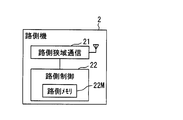
- the roadside device 2 includes a roadside narrow area communication device 21 and a roadside control circuit 22 as shown in FIG.
- the roadside narrow area communication device 21 and the roadside control circuit 22 are connected so that they can communicate with each other.
- the roadside narrow-area communication device 21 performs road-to-vehicle communication with the in-vehicle device 3 existing in the wireless communication area formed by the roadside device 2 by narrow-area communication.
- Narrow-area communication is a communication method in which direct communication is performed without using a relay device.
- the radio communication area formed by the roadside device 2 is often several hundred meters in radius, but depends on the service provided by the roadside device 2 and may have a radius of about 10 meters or may have a radius of about 1 km. .
- the roadside narrow area communication device 21 demodulates the signal received from the in-vehicle device 3 and outputs the demodulated signal to the roadside control circuit 22, modulates the data input from the roadside control circuit 22, further converts it into a radio wave and transmits it.
- the roadside narrow area communication device 21 has two operation modes: a mode in which communication is performed using a control channel and a mode in which communication is performed using a service channel. That is, both communication using the control channel with the vehicle-mounted device 3 and communication using the service channel are performed via the roadside narrow area communication device 21. In any mode, the roadside narrow area communication device 21 transmits information with the same transmission power. Therefore, the wireless communication area 6 formed by the roadside device 2 does not change even when the mode is switched.
- the roadside control circuit 22 is configured as a normal computer, and includes a well-known CPU, a nonvolatile memory such as a ROM and a flash memory, a volatile memory such as a RAM, an I / O, and a bus line connecting these configurations. It has.
- the roadside memory 22M included in the roadside control circuit 22 is a non-volatile storage medium, and is realized by, for example, a flash memory.
- the roadside memory 22M stores program modules and data for executing various processes, a terminal ID assigned to the roadside device 2, and the like.
- Information for generating WSA and information for generating service execution information are also stored in the roadside memory 22M.
- the roadside control circuit 22 includes a time synchronization unit 221, a roadside communication control circuit 222, and a service processing unit 225 as functional blocks realized by executing the above-described program modules, as shown in FIG. Note that some or all of the functions executed by the roadside control circuit 22 may be configured in hardware by one or a plurality of ICs.
- the time synchronization unit 221 performs processing for synchronizing the time information of the roadside control circuit 22 with the reference time.
- the time information held by the roadside control circuit 22 is measured based on the clock signal of the CPU. However, when the time is measured based on the clock signal, there is a possibility that the time information gradually shifts from the reference time. Therefore, the time synchronization unit 221 synchronizes the time information of the roadside control circuit 22 with the reference time.
- the reference time is, for example, a time (hereinafter referred to as GNSS time) used in a global navigation satellite system (hereinafter referred to as GNSS: Global Navigation Satellite System).
- GNSS time a time used in a global navigation satellite system
- the time synchronization unit 221 communicates with an external server to obtain a reference time.
- the roadside device 2 may include a GNSS receiver, and the GNSS receiver may receive a signal including the GNSS time from the GNSS artificial satellite, and the time synchronization unit 221 may acquire the GNSS time from the GNSS receiver.
- the roadside communication control circuit 222 controls the operation of the roadside narrow area communication device 21 and switches between communication using the control channel and communication using the service channel.
- the roadside communication control circuit 222 generates information to be transmitted from the roadside narrow area communication device 21 according to the operation mode of the roadside narrow area communication device 21, and causes the roadside narrow area communication device 21 to transmit the information.
- the data received by the roadside narrow area communication device 21 is acquired and provided to the service processing unit 225.
- the roadside communication control circuit 222 includes a CCH communication processing unit 223 and an SCH communication processing unit 224 as finer functional blocks.
- CCH in the name of each part means a control channel (Control Channel)
- SCH means a service channel (Service Channel).
- the CCH communication processing unit 223 is responsible for communication control using the control channel.
- the CCH communication processing unit 223 generates WSA, sets the transmission channel of the roadside narrow area communication device 21 as a control channel, and transmits the generated WSA to the roadside narrow area communication device 21 by a broadcast method. Also, the CCH communication processing unit 223 acquires data received by the roadside narrow area communication device 21 through communication using the control channel, and provides the data to the service processing unit 225.
- the time for the CCH communication processing unit 223 to transmit WSA is a control channel time zone.
- the roadside communication control circuit 222 divides the time into a control channel time zone and a service channel time zone.
- the control channel time zone and the service channel time zone are set alternately.
- the lengths of the control channel time zone and the service channel time zone are the same time, for example, every 50 milliseconds.
- the start time of the control channel time zone and the service channel time zone is a time determined by the reference time system.
- the SCH communication processing unit 224 is in charge of communication control using a predetermined service channel.
- the SCH communication processing unit 224 generates service execution information, sets the transmission channel of the roadside narrow area communication device 21 to a service channel determined according to the type of service, and sets the generated service execution information to the roadside narrow area communication device 21.
- the time during which the SCH communication processing unit 224 transmits the service execution information is a service channel time zone.
- the transmission method may be any of broadcast, unicast, and multicast, and which communication method is used is determined according to the type of service.
- the SCH communication processing unit 224 acquires data received by the roadside narrow area communication device 21 through communication using the service channel, and provides the data to the service processing unit 225.
- the service processing unit 225 provides a predetermined service to the in-vehicle device 3 based on the data provided from the roadside communication control circuit 222.
- Services to be provided are, for example, an automatic fee collection service when traveling on a toll road, an automatic parking fee collection service when parking, a traffic information distribution service, a location information notification service, an advertisement distribution service, and the like.
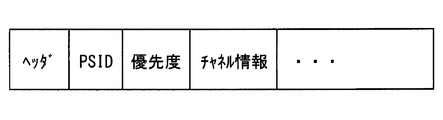
- FIG. 4 illustrates the configuration of WSA generated by the CCH communication processing unit 223.
- WSA includes a header, PSID, priority, and channel information.
- the header is information for recognizing that the received data is WSA in the in-vehicle device 3 which is a device on the receiving side.
- the header includes, for example, information indicating the version of the WAVE standard, information for distinguishing the WSA from other information such as service execution information, and the like.
- PSID is information that determines the type of service provided by the service provider through the roadside device 2.
- the priority is information that determines the priority of the service specified by the PSID among the various services provided by the various roadside devices 2.
- the channel information is a channel number of a service channel that the roadside device 2 uses to provide a service among a plurality of service channels.
- the service channel may be determined according to the service to be provided, and a plurality of services may be associated with the same service channel.
- the in-vehicle device 3 includes a control circuit 31, a narrow area communication device 32, and a GNSS receiver 33.
- the control circuit 31 is connected to the narrow area communication device 32 and the GNSS receiver 33 so that they can communicate with each other.
- the narrow area communication device 32 performs narrow area communication with the roadside narrow area communication device 21 of the roadside machine 2 and the narrow area communication devices 32 included in the other in-vehicle devices 3.
- the communication distance of the narrow area communication device 32 is about several hundred meters, for example.
- the narrow channel communication of this embodiment uses the control channel or the service channel described above.
- the narrow area communication device 32 demodulates the signal received by the antenna and outputs it to the control circuit 31, and modulates the data input from the control circuit 31, further converts it into a radio wave and transmits it to the surroundings
- the narrow-band transmitter 32B is provided.
- the narrow area receiver 32A selects and sets one reception channel, which is a frequency channel for receiving radio waves, from a control channel and a plurality of service channels, and transmits radio waves transmitted from the roadside device 2 through the set reception channel. Receive. Then, the received radio wave is demodulated to extract a signal, and the signal is output to the roadside control circuit 22.
- one reception channel which is a frequency channel for receiving radio waves, from a control channel and a plurality of service channels
- the narrow area transmitter 32B can select one channel from the control channel and a plurality of service channels and set a transmission channel that is a frequency channel for transmitting radio waves.
- the narrow area transmitter 32B modulates the data input from the roadside control circuit 22, further converts it into a radio wave having the frequency of the transmission channel, and transmits it.
- the GNSS receiver 33 is an example of a position detector, and calculates the current position of the GNSS receiver 33 by receiving radio waves from satellites used in the GNSS.
- the current position calculated by the GNSS receiver 33 is expressed by latitude and longitude, for example.
- Information indicating the current position calculated by the GNSS receiver 33 is sequentially provided to the control circuit 31 (for example, every 100 milliseconds).
- the control circuit 31 is also referred to as an electronic control unit.
- the control circuit 31 is configured as a normal computer.
- a known CPU, a nonvolatile memory such as a ROM or a flash memory, a volatile memory such as a RAM, I / O and a bus line connecting these components are provided.
- the memory 31M included in the control circuit 31 is a non-volatile storage medium, and is realized by, for example, a flash memory or a ROM.
- the memory 31M stores program modules and data for executing various processes, and a terminal ID assigned to the in-vehicle device 3.
- the memory 31M temporarily stores the WSA received by the narrow area receiver 32A.
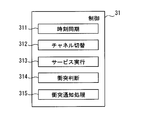
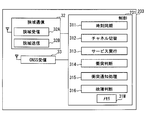
- the control circuit 31 includes a time synchronization unit 311, a channel switching unit 312, a service execution unit 313, a collision determination unit 314, and a collision notification process as functional blocks realized by executing the above program modules.
- a unit 315 also referred to as a time synchronizer 311, a channel switch 312, a service executor 313, a collision determiner 314, and a collision notification processor 315). Note that some or all of the functions executed by the control circuit 31 may be configured by hardware using one or a plurality of ICs.
- the time synchronization unit 311 performs processing for synchronizing the time information held by the control circuit 31 with the reference time. Since the in-vehicle device 3 includes the GNSS receiver 33, the GNSS receiver 33 acquires a signal including the GNSS time received from the GNSS artificial satellite and performs synchronization processing.
- the channel switching unit 312 is also referred to as a channel control unit, and sets the communication channel of the narrow area communication device 32 to either the control channel or the service channel. Therefore, when the communication channel of the narrow area communication device 32 is not set as the service channel, the communication channel is set as the control channel. Then, transmission and reception are performed on the set channel.
- the service execution unit 313 determines a service to be executed based on the WSA. Also, the channel switching unit 312 acquires the service execution information received by the narrow area receiver 32A while the communication channel is the service channel, and determines the data requested by the roadside device 2 based on the service execution information. Then, the determined data is transmitted from the narrow area transmitter 32B to the roadside device 2.
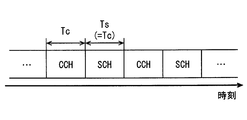
- FIG. 7 is an example of a time change of the communication channel of the narrow area communication device 32.
- the communication channel of the narrow area communication device 32 means a reception channel of the narrow area receiver 32A and a transmission channel of the narrow area transmitter 32B.
- control channel and the service channel are alternately set every certain time (for example, 50 milliseconds).
- the start time and end time of the time zone set for the control channel are the same as the start time and end time of the control channel time zone of the roadside communication control circuit 222.
- the time zone set for the service channel is the same as the start time and end time of the service channel time zone of the roadside communication control circuit 222.
- the collision determination unit 314 determines whether or not a plurality of WSAs transmitted by the plurality of roadside devices 2 are colliding with each other. Detailed processing of the collision determination unit 314 will be described based on the flowcharts shown in FIGS.
- the collision notification processing unit 315 transmits a signal collision notification indicating that the plurality of WSAs are colliding from the narrow area transmitter 32B.
- the narrow area transmitter 32B corresponds to a notification transmitter.
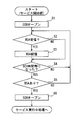
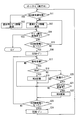
- FIGS. 8 and 9 are flowcharts for explaining processing executed by the control circuit 31.
- FIG. In the control circuit 31, in addition to executing the processes shown in FIGS. 8 and 9, the time synchronization unit 311 periodically performs the synchronization process.
- the described flowchart includes a plurality of sections (or referred to as steps), and each section is expressed as, for example, S1. Further, each section can be divided into a plurality of subsections, while a plurality of sections can be combined into one section.
- Each section can be referred to as a device, or as a proper name, and with structural modifiers, for example, a channel switching section can be referred to as a channel switching device, a channel switcher.
- the section includes (i) not only a section of software combined with a hardware unit (eg, a computer) but also (ii) a section of hardware (eg, an integrated circuit, a wiring logic circuit) and related devices. It can be realized with or without the function.
- the hardware section can be included inside the microcomputer.
- S1 opens the control channel. That is, the reception channel is set as the control channel.
- S2 it is determined whether or not WSA is received. Whether or not WSA has been received is determined from the header of the signal acquired from the narrow band receiver 32A. If it is determined that WSA has been received, the process proceeds to S3.
- the WSA determined to have been received in S2 is stored in the memory 31M.
- S3 is executed, or when the determination at S2 is NO, the process proceeds to S4.
- S4 it is determined whether the service channel time has come. If the determination in S4 is NO, the process returns to S2, and if YES, the process proceeds to S5.
- S5 it is determined whether or not WSA not executed is stored in the memory 31M. Even when this determination is NO, the process returns to S2. On the other hand, if the determination in S5 is YES, the process proceeds to S6.
- SCH is opened. That is, the reception channel of the narrow area receiver 32A is set to the service channel specified by the WSA stored in the memory 31M.
- the service channel is set with reference to the WSA having the highest priority.
- the WSA used for setting the service channel is erased from the memory 31M. Thereafter, the process proceeds to the service execution process shown in FIG.
- S11 and S13 are processes executed by the collision notification processing unit 315
- S12 and S14 are processes executed by the service execution unit 313, and S15 to S19, S23, and S24 are executed by the channel switching unit 312.
- S20, S21, and S22 are processes executed by the collision determination unit 314.
- S11 it is determined whether it is necessary to notify the WSA collision.
- the case where it is determined that it is necessary to notify the WSA collision is a case where the WSA collision is not notified after it is determined in S21 that the WSA has collided. If judgment of S11 is NO, it will progress to S12, and if it is YES, it will progress to S13.
- S12 normal service information communication processing is executed.
- the reception channel is set as the service channel, and service execution information, which is information necessary for executing the service transmitted from the roadside device 2, is transmitted.
- service execution information transmitted from the roadside device 2 is received.
- the transmission channel of the narrow band transmitter 32B is set to the same channel as the narrow band receiver 32A, and various information indicated by the service execution information is transmitted to the roadside device 2.
- service information communication processing at the time of notification is executed.
- the service information communication process at the time of notification is similar to the normal service information communication process, but when the information determined by the service execution information is transmitted to the roadside device 2, it is added to the information and the WSA collides.
- a signal collision notification which is information indicating this, is transmitted to the roadside device 2. Since S11 is determined immediately after the service channel is opened, transmission of information for executing the service has not yet been completed when executing S13. Therefore, since there is an opportunity to transmit information determined by the service execution information to the roadside device 2, a signal collision notification added to the information can also be transmitted to the roadside device 2.
- the CCH communication processing unit 223 randomly changes the time when the WSA transmission starts in the control channel time zone. As a result, there is a possibility that the state where the WSA transmitted by the two roadside devices 2 collide is resolved.
- S14 it is determined whether or not the service execution process is completed.
- the case where the service execution process ends is when transmission / reception of information for executing the service is completed and when service execution information transmitted by the roadside device 2 is not received for a certain period of time. The latter situation occurs when the in-vehicle device 3 leaves the wireless communication area 6 of the roadside device 2. If judgment of S14 is YES, the process of FIG. 9 will be complete
- control channel time it is determined whether or not the control channel time has come. If this determination is NO, the process returns to S12, and if YES, the process proceeds to S16. In S16, the control channel is opened.
- S18 it is determined whether or not the received signal is WSA. If this judgment is YES, it will progress to S19 and will memorize
- S20 it is determined whether or not there is a reception error.
- the predetermined time for determining that a reception error has occurred is set in advance to be shorter than the WSA transmission time.
- S20 If it is determined in S20 that there is a reception error, the process proceeds to S21.
- S21 it is determined whether the service execution information has been received when the reception channel was previously set as the service channel. If this judgment is YES, it will progress to S22 and suppose that several WSA has collided.
- the situation where it is determined that the WSA has collided in S22 is when the vehicle 4 equipped with the vehicle-mounted device 3 travels as indicated by the arrow shown in FIG.
- the vehicle 4 enters the wireless communication area 6A of the roadside machine 2A at a point P1.
- the vehicle equipment 3 can receive WSA which roadside machine 2A transmits.
- the vehicle-mounted device 3 opens the SCH at the SCH time zone.
- the point where the SCH is opened is P2.
- the reception channel is alternately switched between the control channel and the service channel until the service execution process is completed.
- the in-vehicle device 3 can receive the WSA transmitted by the roadside device 2A.
- the wireless communication area 6A of the roadside device 2A and the wireless communication area 6B of the roadside device 2B overlap.
- S22 the process proceeds to S23. Further, when the determination of S20 is NO, when the determination of S21 is NO, or when S19 is executed, the process proceeds to S23. In S23, it is determined whether or not the SCH time zone has been reached. If this determination is NO, the process returns to S17. On the other hand, if the determination in S23 is YES, the process proceeds to S24, and the service channel set as the reception channel before being set as the control channel in S16 is opened again. If S24 is executed, the process returns to S11.
- the vehicle equipment 3 is provided with the collision judgment part 314 which judges that several WSA has collided.
- the collision determination unit 314 determines that a plurality of WSAs are colliding
- the collision determination unit 314 transmits a signal collision notification indicating that the plurality of WSAs are colliding to the roadside device 2 (S13). Thereby, the roadside machine 2 can know that WSA is colliding.
- the collision determination unit 314 does not determine that a plurality of WSAs collide only by detecting a reception error in a state where the reception channel is set as the control channel. It is determined that a plurality of WSAs collide with each other on the condition that the service execution information has been received in the immediately preceding control channel time zone (S21, S22, S23).
- the cause of the reception error is not limited to the case where a plurality of WSAs collide with each other, but the failure of the narrow area receiver 32A, the superimposition of radio noise coming from the surroundings, and the like are also conceivable.
- the service execution information can be received by the service channel that can be switched alternately with the control channel
- the reception error detected by the control channel is caused by the failure of the narrow-area receiver 32A or the superimposition of radio noise flying from the surroundings. Is unlikely. Therefore, in this embodiment, it can be determined with high accuracy that a plurality of WSAs collide.
- the signal collision notification is transmitted from the narrow area transmitter 32B, and when the information necessary for executing the service is transmitted, the signal collision notification is transmitted in addition to the information. (S13).
- time resources can be used more effectively than when a signal collision notification is transmitted separately from information necessary for executing a service.
- FIG. 10 shows a service providing system 101 in the wireless communication system of the second embodiment.
- the service providing system 101 includes a roadside device 102 and a management device 105.
- the roadside device 102 has the same configuration as the roadside device 2 of the first embodiment, and further includes a wide area communication device 123.
- the wide area communication device 123 is connected to a wide area wireless communication network and communicates with other devices connected to the wide area communication network.
- the wide area wireless communication network is, for example, a mobile phone communication network.
- the management device 105 is a device that manages the roadside device 102, and includes a wide area communication device 1051 and a control circuit 1052.
- the wide area communication device 1051 communicates by connecting to a wide area wireless communication network, like the wide area communication device 123 included in the roadside device 102.
- the control circuit 1052 controls the wide area communication device 1051.
- the control circuit 1052 transmits the fact that the WSA is colliding to the roadside device 2 where the WSA is colliding.
- the in-vehicle device 103 in the second embodiment includes a wide area communication device 134 as shown in FIG.
- the wide area communication device 134 can connect to the wide area wireless communication network and communicate with the wide area communication device 1051 provided in the management apparatus 105.
- the control circuit 131 provided in the in-vehicle device 103 includes a time synchronization unit 311, a channel switching unit 312, a service execution unit 313, a collision determination unit 314, and a collision notification processing unit 315, as in the first embodiment. However, some of these processes are different from the first embodiment.
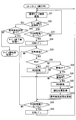
- the control circuit 131 executes the service start pre-processing shown in FIG. 8 as in the first embodiment, but the service execution process executes the processing shown in FIG. 12 instead of FIG. 9 described in the first embodiment. . Further, post-service end processing shown in FIG. 13 is also executed.
- S31 and S32 are processes executed by the service execution unit 313, S33 to S37, and S43 and S44 are processes executed by the channel switching unit 312. S38 to S42 are executed by the collision determination unit 314. S45 is a process executed by the collision notification processing unit 315.
- S32 is the same process as S14 in FIG. 9, and it is determined whether or not the service execution process is completed. If judgment of S32 is NO, it will progress to S33.
- S33, S34, S35, S36, and S37 are the same processes as S15, S16, S7, S18, and S19 in FIG. If the determination in S36 is no, the process proceeds to S38.
- S38, S39, and S40 are the same as S20, S21, and S22 of FIG.
- S40 is executed, the current position is acquired from the GNSS receiver 33 in S41.
- the signal collision interval is updated. If the signal collision interval is not stored in the memory 31M, the signal collision interval is set and stored in the memory 31M.
- the signal collision section is a section where it is determined that the WSA is colliding.
- the signal collision section is a section obtained by sequentially connecting the current position acquired by executing S41 first in the repetition of FIG. 12 to the current position acquired by executing S41 last.
- S43 and S44 are the same as S23 and S24 in FIG. If S44 is executed, the process returns to S31. If the determination in S32 is YES, the process proceeds to S45.
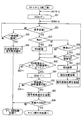
- the post-service end process is a process for transmitting a signal collision notification including a signal collision period determined during service execution.
- S51 to S54, S60, and S61 are processes executed by the channel switching unit 312
- S55 to S59 are processes executed by the collision determination unit 314, and S62 to S66 are executed by the collision notification processing unit 315. It is processing.
- S51 the control channel is opened. Subsequent S52, S53, and S54 are the same processes as S35, S36, and S37 in FIG. 12, and S55 to S59 are the same processes as S38 to S42 in FIG. Therefore, in the second embodiment, even after the service execution process is completed, if a reception error is detected on the control channel and the service execution information can be received on the service channel, the signal collision interval is updated. become. Note that the determination in S56 determines whether or not service execution information has been received on the service channel that was open during service execution.
- S60 it is determined whether WSA is stored in the memory 31M and the SCH time zone has been reached. If the WSA is not stored in the memory 31M and if the SCH time zone is not reached, the determination in S60 is NO. If this determination is NO, the process returns to S52. On the other hand, if judgment of S60 is YES, it will progress to S61.
- the service channel determined by the WSA stored in the memory 31M is opened, and the WSA is deleted from the memory 31M. Note that when a plurality of WSAs are stored in the memory 31M, the WSA having the highest priority is adopted.
- S62 it is determined whether the service channel opened in S61 can communicate with the roadside device 2 using the narrow area transmitter 32B. This determination is made based on, for example, whether or not the narrow area receiver 32A transmits a signal and the narrow area receiver 32A receives a signal from the roadside device 2 that responds to the signal. Further, the narrow area receiver 32A may determine that narrow area communication with the roadside device 2 is possible by receiving service execution information requesting a reply. This is because if it is necessary to send a reply to the roadside device 2, it is considered that the narrowband transmitter 32B can be used to communicate with the roadside device 2 without actually transmitting a signal from the narrowband transmitter 32B.
- the process proceeds to S63.
- a signal collision notification is transmitted from the narrow area transmitter 32B in S63.
- This signal collision notification includes the fact that the WSA has collided and the signal collision section as information.
- S65 it is determined whether or not a certain time has passed since the signal was not received.
- the fixed time is a time during which it can be determined with certainty that the vehicle-mounted device 3 has exited from the wireless communication area 6 of the roadside device 2, and is set to a time at which the control channel time zone repeats several times, for example. If judgment of S65 is NO, it will return to S52, and if it is YES, it will progress to S66.
- a signal collision notification is transmitted from the wide area communication device 134 to the management device 105.
- This signal collision notification includes information identifying that the WSA is colliding, the signal collision section, and the roadside device 2 that has transmitted the colliding WSA.
- the information for identifying the roadside device 2 that transmitted the colliding WSA is, for example, the ID of the roadside device 2.
- the ID cannot be read from the collided WSA, in this embodiment, since the service execution information can be received, if the ID of the roadside device 2 is included in the service execution information, the ID is collided.
- the ID of the roadside device 2 that has transmitted the WSA is used. If the ID of the roadside device 2 is included in the WSA detected before detecting the reception error, the ID of the roadside device 2 that transmitted the colliding WSA may be used.
- the management device 105 that has received this signal collision notification uses the wide area communication device 1051 to determine that the WSA has collided with the wide area communication device 123 of the roadside machine 2 determined based on the signal collision notification and Notice.
- the roadside device 2 that has received this notification reduces the transmission power so that the signal collision section is excluded from the wireless communication area 6 of the roadside device 2.
- the roadside device 2 may change the transmission timing of WSA.
- FIG. 1 A process execution example 1 of the control circuit 131 in the second embodiment will be described. As indicated by the arrow in FIG. 1, when the vehicle 4 equipped with the in-vehicle device 103 travels, the service channel is opened at the point P2, and the control circuit 131 starts the process shown in FIG. From point P3, it is determined that the WSA has collided. Then, it is assumed that the service execution process ends at the point P4.
- the in-vehicle device 3 can receive service execution information when it detects a reception error on the control channel and sets the reception channel as the service channel immediately before. Therefore, the signal collision section is updated to a section from the point P3 to the point P5.
- the in-vehicle device 3 can receive the WSA transmitted by the roadside device 2B.
- the determination in S53 becomes YES, and the process proceeds to S54 to store the WSA in the memory 31M.
- the determination in S60 is YES, and the service channel is opened in S61.
- the point where this S61 is executed is assumed to be, for example, point P6. Since communication with the roadside device 2B is possible at the point P6, the determination in S62 is YES, and S63 is executed to transmit a signal collision notification from the narrow area transmitter 32B. This signal collision notification is received by the roadside device 2B.
- roadside machine 2B can know that WSA which self transmits is colliding. Therefore, the roadside device 2B decreases the transmission power or changes the WSA transmission timing so that the signal collision section included in the signal collision notification is excluded from the wireless communication area 6B of the roadside device 2B.
- the wireless communication area 6C of the roadside device 2C includes the wireless communication area 6D of the roadside device 2D, and the wireless communication areas 6C and 6D are in the vicinity of the point P15.
- the vehicle 4 equipped with the in-vehicle device 103 travels along the arrow shown in FIG.
- Points P11 to P15 are points where the control circuit 131 of the in-vehicle device 103 executes the same process as the points P1 to P5 in the process execution example 1.
- the in-vehicle device 103 does not receive a signal, so the determination in S52 is NO. Thereafter, the state in which no signal is received continues. Assuming that a certain time has elapsed since the signal is no longer received at the point P17, the determination in S65 becomes YES at the point P17, and the signal collision notification is transmitted from the wide area communication device 134 to the management device 105. To do.
- the collision determination unit 314 determines a signal collision section, and the collision notification processing unit 315 transmits a signal collision notification including the signal collision section.
- the roadside machine 2 receives the signal collision notification directly, thereby acquiring the signal collision section or acquiring the signal collision section via the management device 105. Since the signal collision section is acquired, the roadside unit 2 can resolve the WSA collision by reducing the transmission power.
- the in-vehicle device 3 since the in-vehicle device 3 updates the signal collision section while determining that the WSA is colliding, the in-vehicle device 3 determines the longest signal collision section that can be detected by the in-vehicle device 3. Since the signal collision notification including this signal collision section is transmitted, there is a high possibility that the roadside unit 2 that has acquired the signal collision section can resolve the collision of the WSA transmitted by itself.
- the in-vehicle device 3 transmits the signal collision notification after it is determined that the WSA is colliding, the in-vehicle device 3 is exemplified in the processing execution example 2 when transmitting the signal collision notification.
- the signal collision notification can be transmitted by the wide area communication device 134. Therefore, even if the in-vehicle device 3 is not included in the wireless communication area 6 of any roadside device 2, the roadside device 2 can acquire a signal collision notification.
- the in-vehicle device 203 includes a failure determination unit 316 (also referred to as a failure determination unit 316).
- a failure determination unit 316 also referred to as a failure determination unit 316.
- Other configurations are the same as those of the vehicle-mounted device 3 of the first embodiment.
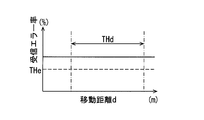
- the failure determination unit 316 determines whether or not the narrow area receiver 32A is out of order based on the error rate of the reception signal received by the narrow area receiver 32A (hereinafter referred to as reception error rate). Specifically, the failure determination unit 316 sequentially acquires the current position calculated by the GNSS receiver 33. And the movement distance d of the vehicle equipment 3 is calculated sequentially from the change of the current position. Since the current position is information for calculating the movement distance d, it corresponds to movement distance information, and the GNSS receiver 33 corresponds to a movement distance information detector.
- the failure determination unit 316 sequentially calculates the reception error rate of the reception signal detected by the narrow area receiver 32A.
- the received signal is a signal of a certain strength or higher that the narrow band receiver 32A determines to be a signal, and is a signal before decoding.
- the reception error rate is a ratio of signals that can be decoded among the received signals.
- the reception error rate is higher than the error rate threshold THe set in advance for determining a failure. If not, it is determined that the narrow area receiver 32A has failed.
- the failure determination distance threshold THd is set to, for example, about the average diameter of the wireless communication area 6 of the roadside device 2.
- the reason why the reception error rate exceeds the error rate threshold THe is considered to be that a plurality of WSAs collide.
- ⁇ Modification 1> when the determination at S20 is YES and the determination at S21 is YES, it is determined that a plurality of WSAs collide. That is, in the first embodiment, a reception error is detected in the control channel, but it is determined that a plurality of WSAs collide when service execution information can be received in the immediately preceding service channel time zone.
- the first modification in addition to detecting a reception error on the control channel, in a control channel time zone for a predetermined number of times (for example, once, a few times) immediately before detecting the reception error.
- a predetermined number of times for example, once, a few times
- the service execution information can be received in the service channel time zone immediately before the control channel time zone in which the reception error is detected.
- the service execution information can be received after the control channel time zone in which the WSA was received and before the control channel time zone in which the reception error is detected. It is a condition to judge that
- the WSA collides based on the change from the state in which the WSA can be received to the state in which the reception error is detected while the state in which the service execution information can be received continues.
- the service channel continues to receive service execution information from the point P1 to the point P4.
- WSA can be received from the point P1 to the point P3, but when the point P3 is passed, a reception error is detected. Therefore, when the example of FIG. 1 is considered as a specific example of the first modification, it is determined that the WSA collides when the vehicle-mounted device 3 passes the point P3.
- the WSA has collided since it is determined that the signal can be normally received from the point P1 to the point P3 in both the service channel and the control channel. To improve accuracy.
- the signal collision notification may be transmitted by including the time zone in which the WSA collides.
- the collision determination unit 314 determines the time zone in which the reception error is detected as the time zone in which the WSA collides. If the time zone in which the WSA is colliding is included in the signal collision notification and transmitted, the roadside unit 2 is notified that the WSA is in collision with the time zone in which the WSA is transmitted in the control channel time zone. It can be changed to a time zone other than the time zone.
- the signal collision section is included in the signal collision notification and transmitted.
- one position determined that the WSA is colliding is included in the signal collision notification and transmitted. Also good.
- the in-vehicle devices 3, 103, and 203 are disclosed as wireless communication devices. Therefore, the wireless communication apparatus is a mobile type.
- the wireless communication device may be a fixed type that is fixed to or near a road. Further, even in the case of a mobile type, it may be used by a moving body other than a vehicle. For example, it may be a wireless communication device of the type used by pedestrians.
- the roadside device 2 is shown as an example of the service providing station, but the service providing station is not limited to this.
- the service providing station may be a terminal carried by a pedestrian.
- the roadside machine 2 may be a mobile type in the above-described embodiment, the mobile type may be a mobile type mounted on a moving body such as a car, and the position at the time of service provision is fixed. It may be a mobile type, that is, a portable type that can be carried and the installation position can be changed.
- the signal collision notification may be transmitted from the wide area communication device 134 to the wide area communication device 123 included in the roadside device 2.
- the management device 105 and the roadside machine 2 may be wired by a communication cable.
- the roadside device 2 does not need to include the wide area communication device 123, and the communication device notifies the roadside device 2 from the management apparatus 105 that the WSA transmitted by the roadside device 2 is colliding.
- ⁇ Modification 8> In the determination of S21 in FIG. 9, it may be determined whether or not the service execution information has been received in the service channel time period immediately after the reception error is determined.
- ⁇ Modification 9> The lengths of the control channel time zone and the service channel time zone do not have to be the same as each other, and the lengths of these time zones may be different.
Landscapes
- Engineering & Computer Science (AREA)
- Computer Networks & Wireless Communication (AREA)
- Signal Processing (AREA)
- Mobile Radio Communication Systems (AREA)
- Traffic Control Systems (AREA)
Abstract
Description
以下、本開示の実施形態を図面に基づいて説明する。図1に示すように、第1実施形態に係る無線通信システム1は、路側機2と、車載機3とを備える。なお、図1には、車載機103も示しているが、車載機103は第2実施形態の車載機を意味する。車載機3、103は無線通信装置に相当し、路側機2はサービス提供局に相当する。
図1には、2つの路側機2A、2Bを示しているが、路側機2は3台以上であってもよい。複数の路側機2A、2Bを区別しないときは、路側機2と表記する。また、図1には、車両4(ホスト車両4とも言及される)に搭載される車載機3を1台のみ示しているが、複数のホスト車両4のそれぞれに搭載された複数の車載機3のうちのいずれか一つであってもよい。路側機2と車載機3はWAVEの規格に準拠して相互に通信する。
路側機2は、路側機2が形成する無線通信エリア内に存在する車載機3と路車間通信を実施し、種々の情報を車載機3に送信したり、車載機3から種々の情報を取得したりすることで所定のサービスを実行する。無線通信エリアは、車載機3が検出可能な所定の強度以上で路側機2が送信する信号が届くエリアである。
次に、車載機3の構成を説明する。車載機3は、図5に示すように、制御回路31、狭域通信機32、GNSS受信機33を備える。制御回路31は、狭域通信機32、GNSS受信機33と相互通信可能に接続されている。
以上、説明した第1実施形態では、車載機3は、複数のWSAが衝突していると判断する衝突判断部314を備える。そして、衝突判断部314が、複数のWSAが衝突していると判断した場合に、複数のWSAが衝突していること表す信号衝突通知を、路側機2へ送信する(S13)。これにより、WSAが衝突していることを路側機2が知ることができる。
次に、第2実施形態を説明する。この第2実施形態以下の説明において、それまでに使用した符号と同一番号の符号を有する要素は、特に言及する場合を除き、それ以前の実施形態における同一符号の要素と同一である。また、構成の一部のみを説明している場合、構成の他の部分については先に説明した実施形態を適用できる。
この第2実施形態における制御回路131の処理実行例1を説明する。図1の矢印で示すように、車載機103を搭載した車両4が走行する場合、地点P2でサービスチャネルをオープンし、制御回路131は図12に示す処理を開始する。地点P3からはWSAが衝突したと判断することになる。そして、地点P4でサービス実行処理が終了したとする。
処理実行例2では、図14に示すように、路側機2Cの無線通信エリア6Cが、路側機2Dの無線通信エリア6Dを包含しており、かつ、無線通信エリア6C、6Dは、地点P15付近で接しているとする。車載機103を搭載した車両4は、図14に示す矢印に沿って走行する。
この第2実施形態では、衝突判断部314は信号衝突区間を決定しており、衝突通知処理部315は、信号衝突区間を含んでいる信号衝突通知を送信する。路側機2は、この信号衝突通知を直接受信することで、信号衝突区間を取得し、あるいは、管理装置105を介して信号衝突区間を取得する。信号衝突区間を取得するので、路側機2は、送信電力を減少させることでWSAの衝突を解消することができる。
第3実施形態の車載機203は、図15に示すように、故障判断部316(故障判断器316とも言及される)を備える。それ以外の構成は第1実施形態の車載機3と同じである。
第1実施形態では、S20の判断がYESとなり、かつ、S21の判断がYESになったことにより、複数のWSAが衝突していると判断していた。すなわち、第1実施形態では、コントロールチャネルでは受信エラーを検出するが、その直前のサービスチャネル時間帯でサービス実行情報を受信できる場合に、複数のWSAが衝突していると判断していた。
信号衝突通知に、WSAが衝突している時間帯を含ませて送信してもよい。この場合、衝突判断部314は、受信エラーを検出している時間帯をWSAが衝突している時間帯に決定する。WSAが衝突している時間帯を信号衝突通知に含ませて送信すれば、路側機2は、WSAを送信する時間帯を、コントロールチャネル時間帯のうち、WSAが衝突していると通知された時間帯以外の時間帯に変更することができる。
第2実施形態では、信号衝突区間を信号衝突通知に含ませて送信していたが、区間ではなく、WSAが衝突していると判断した1つの位置を信号衝突通知に含ませて送信してもよい。
前述の実施形態では、無線通信装置として車載機3、103、203を開示した。したがって、無線通信装置は移動型であった。しかし、無線通信装置は、道路またはその付近に固定される固定型でもよい。また、移動型である場合にも、車両以外の移動体で用いられてもよい。たとえば、歩行者が携帯して用いる形式の無線通信装置でもよい。
前述の実施形態では、サービス提供局の一例として路側機2を示したが、サービス提供局は、これに限られない。サービス提供局が、歩行者が携帯する端末であってもよい。また、路側機2が移動型でもよいことは前述の実施形態で示したが、移動形式は、車等の移動体に搭載される形式の移動型でもよいし、サービス提供時の位置は固定されており、持ち運んで設置位置を変更できる移動型すなわち可搬型でもよい。
広域通信機134から管理装置105が備える広域通信機1051へ信号衝突通知を送信することに代えて、広域通信機134から路側機2が備える広域通信機123へ信号衝突通知を送信してもよい。
管理装置105と路側機2との間は、通信ケーブルにより有線接続されていてもよい。この場合、路側機2は広域通信機123を備える必要はなく、通信ケーブルにより管理装置105から路側機2へ、その路側機2が送信するWSAが衝突していることが通知される。
図9のS21の判断において、受信エラーと判断した直後のサービスチャネル時間帯でサービス実行情報を受信できたか否かを判断してもよい。
コントロールチャネル時間帯とサービスチャネル時間帯の長さは、互いに同じ長さである必要はなく、これらの時間帯の長さが異なっていてもよい。
Claims (10)
- 互いに異なる周波数チャネルであるコントロールチャネルおよび複数のサービスチャネルから選択されたチャネルを受信チャネルに設定し、前記受信チャネルを前記コントロールチャネルに設定したときは、前記サービスチャネルが定まる情報を含んでいるサービス開始情報をサービス提供局から受信し、前記受信チャネルを前記サービスチャネルに設定したときは、サービスを実行するためのサービス実行情報を前記サービス提供局から受信する狭域受信器(32A)と、
前記受信チャネルを前記コントロールチャネルと前記サービスチャネルに交互に切り替えるチャネル切替部(312)と、
前記受信チャネルが前記サービスチャネルに設定された状態で前記サービス実行情報を受信でき、かつ、前記受信チャネルが前記コントロールチャネルに設定された状態で受信エラーを検出したことに基づいて、前記サービス提供局が複数あり、複数の前記サービス提供局が送信する複数の前記サービス開始情報が衝突していると判断する衝突判断部(314)と、
前記衝突判断部が、複数の前記サービス提供局が送信する複数の前記サービス開始情報が衝突していると判断したことに基づいて、複数の前記サービス開始情報が衝突していること表す信号衝突通知を、所定の通知送信器から、前記サービス提供局、または、前記サービス開始情報が衝突していることを前記サービス提供局へ通知可能な管理装置へ送信する衝突通知処理部(315)とを備える
無線通信装置。 - 請求項1において、
前記無線通信装置は移動型であり、
前記衝突判断部は、前記受信チャネルが前記サービスチャネルに設定された状態で、前記狭域受信器が前記サービス実行情報を受信できる状態が継続している間に、前記受信チャネルが前記コントロールチャネルに設定された状態で、前記サービス開始情報を受信できている状態から、前記受信エラーを検出する状態へ変化したことに基づいて、前記サービス提供局が複数あり、複数の前記サービス提供局が送信する複数の前記サービス開始情報が衝突していると判断する
無線通信装置。 - 請求項1または2において、
前記サービス提供局に信号を送信可能な狭域送信器(32B)を備え、
前記衝突通知処理部は、前記狭域送信器を前記通知送信器として用い、前記サービス提供局へ前記信号衝突通知を送信する
無線通信装置。 - 請求項3において、
前記狭域送信器を制御して、前記サービスを実行するための情報を逐次、前記サービス提供局へ送信するサービス実行部(313)を備え、
前記衝突通知処理部は、前記サービス実行部が、前記サービスを実行するために必要な情報の送信を完了していない場合には、前記狭域送信器を前記通知送信器として用いて、前記サービスを実行するための情報に付加して前記信号衝突通知を送信する
無線通信装置。 - 請求項1において、
前記無線通信装置は移動型であり、
前記無線通信装置の現在位置を検出する位置検出器(33)を備え、
前記衝突通知処理部は、前記衝突判断部が複数の前記サービス提供局が送信する複数の前記サービス開始情報が衝突していると判断したときに前記位置検出器が検出した現在位置を含む前記信号衝突通知を送信する
無線通信装置。 - 請求項1~5のいずれか1項において、
前記衝突判断部は、前記狭域受信器が前記受信エラーを検出している時間帯を、複数の前記サービス提供局が送信する複数の前記サービス開始情報が衝突している時間帯に決定し、
前記衝突通知処理部は、前記信号衝突通知に、前記衝突判断部が決定した、複数の前記サービス提供局が送信する複数の前記サービス開始情報が衝突している時間帯を含ませて、前記通知送信器から送信する
無線通信装置。 - 請求項1において、
前記無線通信装置は移動型であり、
前記無線通信装置の現在位置を検出する位置検出器(33)を備え、
前記衝突判断部は、複数の前記サービス提供局が送信する複数の前記サービス開始情報が衝突していると判断したときに前記位置検出器が検出した前記現在位置に基づいて、複数の前記サービス提供局が送信する複数の前記サービス開始情報が衝突している区間である信号衝突区間を逐次更新し、
前記衝突通知処理部は、複数の前記サービス開始情報の衝突を検出しなくなった後に、前記信号衝突区間を含む前記信号衝突通知を送信する
無線通信装置。 - 請求項7において、
広域無線通信網に接続して情報を送信する広域通信機(134)を備え、
前記衝突通知処理部は、前記広域通信機を前記通知送信器として用いて、前記管理装置へ、前記信号衝突通知を送信する
無線通信装置。 - 請求項7において、
前記サービス提供局に信号を送信可能な狭域送信器(32B)を備え、
前記衝突通知処理部は、前記衝突判断部が前記信号衝突区間を更新しなくなった後、前記狭域受信器が、前記サービス提供局が送信した信号を受信できた場合、前記狭域送信器を前記通知送信器として用いて、前記狭域受信器が前記信号を受信できた前記サービス提供局へ、前記信号衝突通知を送信する
無線通信装置。 - 請求項1において、
前記無線通信装置は移動型であり、
前記無線通信装置の移動距離を算出するための情報である移動距離情報を検出する移動距離情報検出器(33)と、
前記受信エラーが検出された場合に前記狭域受信器が故障しているか否かを判断するものであって、前記移動距離情報検出器が検出した前記移動距離情報に基づいて判断される前記無線通信装置の移動距離が予め設定された故障判断距離だけ変化する間に、受信エラー率が、故障と判断するために予め設定されたエラー率閾値を超えている状態から、前記受信エラー率が前記エラー率閾値よりも低い状態となった場合には、前記狭域受信器は故障していないと判断する一方、前記移動距離が前記故障判断距離だけ変化しても、前記受信エラー率が前記エラー率閾値よりも低くならない場合には、前記狭域受信器が故障していると判断する故障判断部(316)とを備える
無線通信装置。
Priority Applications (3)
| Application Number | Priority Date | Filing Date | Title |
|---|---|---|---|
| SG11201709454SA SG11201709454SA (en) | 2015-09-24 | 2016-08-25 | Wireless communication apparatus |
| US15/744,218 US10512090B2 (en) | 2015-09-24 | 2016-08-25 | Wireless communication apparatus |
| CN201680041519.1A CN108029004B (zh) | 2015-09-24 | 2016-08-25 | 无线通信装置 |
Applications Claiming Priority (2)
| Application Number | Priority Date | Filing Date | Title |
|---|---|---|---|
| JP2015-187202 | 2015-09-24 | ||
| JP2015187202A JP6380312B2 (ja) | 2015-09-24 | 2015-09-24 | 無線通信装置 |
Publications (1)
| Publication Number | Publication Date |
|---|---|
| WO2017051653A1 true WO2017051653A1 (ja) | 2017-03-30 |
Family
ID=58386002
Family Applications (1)
| Application Number | Title | Priority Date | Filing Date |
|---|---|---|---|
| PCT/JP2016/074731 Ceased WO2017051653A1 (ja) | 2015-09-24 | 2016-08-25 | 無線通信装置 |
Country Status (5)
| Country | Link |
|---|---|
| US (1) | US10512090B2 (ja) |
| JP (1) | JP6380312B2 (ja) |
| CN (1) | CN108029004B (ja) |
| SG (1) | SG11201709454SA (ja) |
| WO (1) | WO2017051653A1 (ja) |
Families Citing this family (4)
| Publication number | Priority date | Publication date | Assignee | Title |
|---|---|---|---|---|
| JP6354709B2 (ja) * | 2015-09-01 | 2018-07-11 | 株式会社デンソー | 移動体通信システム、移動体側装置 |
| JP6961004B2 (ja) * | 2017-09-19 | 2021-11-05 | 三菱電機株式会社 | 車両用無線通信装置 |
| US12093921B2 (en) * | 2021-06-10 | 2024-09-17 | Shopify Inc. | Method and system for active NFC payment device management |
| US11568386B2 (en) * | 2021-06-10 | 2023-01-31 | Shopify Inc. | Method and system for active NFC payment device management |
Family Cites Families (23)
| Publication number | Priority date | Publication date | Assignee | Title |
|---|---|---|---|---|
| CN1856963B (zh) * | 2003-10-24 | 2011-06-08 | 索尼株式会社 | 无线通信系统、无线通信设备和无线通信方法 |
| JP4271089B2 (ja) * | 2004-06-17 | 2009-06-03 | パナソニック株式会社 | 無線通信方法および無線通信装置 |
| US7720060B2 (en) * | 2006-07-03 | 2010-05-18 | Palo Alto Research Center Incorporated | Information dissemination system having an information layer |
| US8094614B2 (en) * | 2007-03-21 | 2012-01-10 | Kapsch Tafficcom AG | System and method for adaptive queuing for discontinuous wireless channels |
| JP5089506B2 (ja) | 2008-07-02 | 2012-12-05 | 三菱電機株式会社 | 無線通信装置 |
| US8462704B2 (en) | 2009-10-19 | 2013-06-11 | Stmicroelectronics, Inc. | Enabling interoperability of dual-radio and single-radio devices for vehicular multi-channel operations |
| US8995327B2 (en) * | 2009-12-02 | 2015-03-31 | Mitsubishi Electric Research Laboratories, Inc. | Broadcasting messages in multi-channel vehicular networks |
| TWI416967B (zh) | 2009-12-11 | 2013-11-21 | Ind Tech Res Inst | 無線交替切換通道上的資料傳送系統與方法 |
| US8526464B2 (en) * | 2010-01-26 | 2013-09-03 | Kapsch Trafficcom Ag | Adaptive contention window in discontinuous wireless communication channels |
| US8761676B2 (en) | 2010-03-09 | 2014-06-24 | Stmicroelectronics, Inc. | Channel switching for interoperable safety and non-safety communications in wireless environments |
| KR101370047B1 (ko) * | 2010-05-25 | 2014-03-04 | 한국전자통신연구원 | 차량통신 핸드오버 지원을 위한 신호생성 방법 |
| KR102024299B1 (ko) * | 2011-11-18 | 2019-11-04 | 엘지전자 주식회사 | 무선랜 시스템에서 서비스 발견 및 알림 방법과 이를 지원하는 장치 |
| US9178680B2 (en) * | 2012-03-23 | 2015-11-03 | Alcatel Lucent | Control signaling for downlink coordinated multipoint wireless communication |
| JP6113491B2 (ja) * | 2012-12-18 | 2017-04-12 | 三菱重工メカトロシステムズ株式会社 | 車載器、通信方法及びプログラム |
| JP6071550B2 (ja) * | 2012-12-28 | 2017-02-01 | 三菱重工メカトロシステムズ株式会社 | 車両通信システム、車載器、プログラム、及び、通信方法 |
| EP4235603A3 (en) * | 2013-01-09 | 2024-01-24 | Paxgrid Telemetric Systems Inc. | Vehicle communications via wireless access vehicular environment |
| US8837515B1 (en) * | 2013-06-06 | 2014-09-16 | Futurewei Technologies, Inc. | System and method for collision resolution |
| US9699823B2 (en) * | 2013-07-19 | 2017-07-04 | Lg Electronics Inc. | Method and apparatus for performing random access procedure in wireless communication system |
| EP3072342B1 (en) * | 2013-11-20 | 2021-03-24 | Harman International Industries, Incorporated | Channel access in a vehicular communication network |
| CN103702362B (zh) * | 2013-12-20 | 2017-02-01 | 华南理工大学 | 一种wave系统中的多信道操作方法 |
| CN104320859B (zh) * | 2014-11-26 | 2016-02-10 | 中国地质大学(武汉) | 基于ap控制的竞争与分配相结合的mac接入方法 |
| US20160174136A1 (en) * | 2014-12-12 | 2016-06-16 | Qualcomm Incorporated | Traffic advertisement in neighbor aware network (nan) data path |
| EP3275273A1 (en) * | 2015-02-26 | 2018-01-31 | Nec Corporation | System and method for data communication |
-
2015
- 2015-09-24 JP JP2015187202A patent/JP6380312B2/ja not_active Expired - Fee Related
-
2016
- 2016-08-25 SG SG11201709454SA patent/SG11201709454SA/en unknown
- 2016-08-25 WO PCT/JP2016/074731 patent/WO2017051653A1/ja not_active Ceased
- 2016-08-25 CN CN201680041519.1A patent/CN108029004B/zh not_active Expired - Fee Related
- 2016-08-25 US US15/744,218 patent/US10512090B2/en active Active
Non-Patent Citations (1)
| Title |
|---|
| LOTHAR STIBOR ET AL.: "Congestion Control In Ieee 802 11p", IEEE 802.11-06/1534R1, 28 September 2006 (2006-09-28), pages 1 - 18, XP055371916, Retrieved from the Internet <URL:https://mentor.ieee.org/802.11/dcn/06/11-06-1534-01-000p-congestion-control-in-ieee-802-llp.ppt> [retrieved on 20160816] * |
Also Published As
| Publication number | Publication date |
|---|---|
| CN108029004B (zh) | 2020-07-31 |
| JP6380312B2 (ja) | 2018-08-29 |
| US20180263057A1 (en) | 2018-09-13 |
| SG11201709454SA (en) | 2017-12-28 |
| JP2017063289A (ja) | 2017-03-30 |
| CN108029004A (zh) | 2018-05-11 |
| US10512090B2 (en) | 2019-12-17 |
Similar Documents
| Publication | Publication Date | Title |
|---|---|---|
| KR101820262B1 (ko) | 차량 탑재 통신 단말기 및 이동체 통신 시스템 | |
| US20080090522A1 (en) | Display apparatus and display method | |
| US20100198459A1 (en) | In-vehicle communications apparatus | |
| JP6439441B2 (ja) | 車両用通信端末 | |
| WO2017159240A1 (ja) | 通信制御装置 | |
| JP6447554B2 (ja) | 移動体間通信システムおよび移動体用受信制御装置 | |
| WO2017159241A1 (ja) | 通信制御装置 | |
| JP6380312B2 (ja) | 無線通信装置 | |
| US20180279068A1 (en) | Mobile communication system and onboard terminal | |
| JP5211784B2 (ja) | 通信システム | |
| JP6358204B2 (ja) | 無線通信装置 | |
| JP7468091B2 (ja) | 料金決済用車載器、携帯通信端末、料金決済システム、および端末制御プログラム | |
| JP4603910B2 (ja) | 車両間通信システムおよび無線通信装置 | |
| WO2017047217A1 (ja) | 通信装置 | |
| JP6424791B2 (ja) | 無線通信装置、無線通信システム | |
| JP7101836B1 (ja) | 車載通信装置 | |
| JP4399330B2 (ja) | 狭域無線通信システム | |
| JP2004364274A (ja) | 通信装置、通信システムおよび通信方法 | |
| JP2009260781A (ja) | 移動体用通信装置 | |
| JP2005117147A (ja) | 狭域通信用車載器および狭域通信方法 | |
| JP2006067472A (ja) | 無線通信システム |
Legal Events
| Date | Code | Title | Description |
|---|---|---|---|
| 121 | Ep: the epo has been informed by wipo that ep was designated in this application |
Ref document number: 16848441 Country of ref document: EP Kind code of ref document: A1 |
|
| WWE | Wipo information: entry into national phase |
Ref document number: 11201709454S Country of ref document: SG |
|
| WWE | Wipo information: entry into national phase |
Ref document number: 15744218 Country of ref document: US |
|
| NENP | Non-entry into the national phase |
Ref country code: DE |
|
| 122 | Ep: pct application non-entry in european phase |
Ref document number: 16848441 Country of ref document: EP Kind code of ref document: A1 |