WO2017010116A1 - 包油粉体組成物及びその製造方法 - Google Patents
包油粉体組成物及びその製造方法 Download PDFInfo
- Publication number
- WO2017010116A1 WO2017010116A1 PCT/JP2016/055407 JP2016055407W WO2017010116A1 WO 2017010116 A1 WO2017010116 A1 WO 2017010116A1 JP 2016055407 W JP2016055407 W JP 2016055407W WO 2017010116 A1 WO2017010116 A1 WO 2017010116A1
- Authority
- WO
- WIPO (PCT)
- Prior art keywords
- oil
- powder
- component
- powder composition
- enveloping
- Prior art date
- Legal status (The legal status is an assumption and is not a legal conclusion. Google has not performed a legal analysis and makes no representation as to the accuracy of the status listed.)
- Ceased
Links
Images


Classifications
-
- A—HUMAN NECESSITIES
- A61—MEDICAL OR VETERINARY SCIENCE; HYGIENE
- A61K—PREPARATIONS FOR MEDICAL, DENTAL OR TOILETRY PURPOSES
- A61K8/00—Cosmetics or similar toiletry preparations
- A61K8/02—Cosmetics or similar toiletry preparations characterised by special physical form
- A61K8/11—Encapsulated compositions
-
- A—HUMAN NECESSITIES
- A61—MEDICAL OR VETERINARY SCIENCE; HYGIENE
- A61K—PREPARATIONS FOR MEDICAL, DENTAL OR TOILETRY PURPOSES
- A61K8/00—Cosmetics or similar toiletry preparations
- A61K8/02—Cosmetics or similar toiletry preparations characterised by special physical form
- A61K8/0216—Solid or semisolid forms
- A61K8/022—Powders; Compacted Powders
- A61K8/0225—Granulated powders
-
- A—HUMAN NECESSITIES
- A61—MEDICAL OR VETERINARY SCIENCE; HYGIENE
- A61K—PREPARATIONS FOR MEDICAL, DENTAL OR TOILETRY PURPOSES
- A61K8/00—Cosmetics or similar toiletry preparations
- A61K8/02—Cosmetics or similar toiletry preparations characterised by special physical form
- A61K8/0216—Solid or semisolid forms
- A61K8/022—Powders; Compacted Powders
-
- A—HUMAN NECESSITIES
- A61—MEDICAL OR VETERINARY SCIENCE; HYGIENE
- A61K—PREPARATIONS FOR MEDICAL, DENTAL OR TOILETRY PURPOSES
- A61K8/00—Cosmetics or similar toiletry preparations
- A61K8/02—Cosmetics or similar toiletry preparations characterised by special physical form
- A61K8/0241—Containing particulates characterized by their shape and/or structure
- A61K8/0254—Platelets; Flakes
-
- A—HUMAN NECESSITIES
- A61—MEDICAL OR VETERINARY SCIENCE; HYGIENE
- A61K—PREPARATIONS FOR MEDICAL, DENTAL OR TOILETRY PURPOSES
- A61K8/00—Cosmetics or similar toiletry preparations
- A61K8/18—Cosmetics or similar toiletry preparations characterised by the composition
- A61K8/19—Cosmetics or similar toiletry preparations characterised by the composition containing inorganic ingredients
-
- A—HUMAN NECESSITIES
- A61—MEDICAL OR VETERINARY SCIENCE; HYGIENE
- A61K—PREPARATIONS FOR MEDICAL, DENTAL OR TOILETRY PURPOSES
- A61K8/00—Cosmetics or similar toiletry preparations
- A61K8/18—Cosmetics or similar toiletry preparations characterised by the composition
- A61K8/19—Cosmetics or similar toiletry preparations characterised by the composition containing inorganic ingredients
- A61K8/20—Halogens; Compounds thereof
- A61K8/21—Fluorides; Derivatives thereof
-
- A—HUMAN NECESSITIES
- A61—MEDICAL OR VETERINARY SCIENCE; HYGIENE
- A61K—PREPARATIONS FOR MEDICAL, DENTAL OR TOILETRY PURPOSES
- A61K8/00—Cosmetics or similar toiletry preparations
- A61K8/18—Cosmetics or similar toiletry preparations characterised by the composition
- A61K8/19—Cosmetics or similar toiletry preparations characterised by the composition containing inorganic ingredients
- A61K8/25—Silicon; Compounds thereof
-
- A—HUMAN NECESSITIES
- A61—MEDICAL OR VETERINARY SCIENCE; HYGIENE
- A61K—PREPARATIONS FOR MEDICAL, DENTAL OR TOILETRY PURPOSES
- A61K8/00—Cosmetics or similar toiletry preparations
- A61K8/18—Cosmetics or similar toiletry preparations characterised by the composition
- A61K8/19—Cosmetics or similar toiletry preparations characterised by the composition containing inorganic ingredients
- A61K8/26—Aluminium; Compounds thereof
-
- A—HUMAN NECESSITIES
- A61—MEDICAL OR VETERINARY SCIENCE; HYGIENE
- A61K—PREPARATIONS FOR MEDICAL, DENTAL OR TOILETRY PURPOSES
- A61K8/00—Cosmetics or similar toiletry preparations
- A61K8/18—Cosmetics or similar toiletry preparations characterised by the composition
- A61K8/30—Cosmetics or similar toiletry preparations characterised by the composition containing organic compounds
- A61K8/31—Hydrocarbons
-
- A—HUMAN NECESSITIES
- A61—MEDICAL OR VETERINARY SCIENCE; HYGIENE
- A61K—PREPARATIONS FOR MEDICAL, DENTAL OR TOILETRY PURPOSES
- A61K8/00—Cosmetics or similar toiletry preparations
- A61K8/18—Cosmetics or similar toiletry preparations characterised by the composition
- A61K8/30—Cosmetics or similar toiletry preparations characterised by the composition containing organic compounds
- A61K8/55—Phosphorus compounds
-
- A—HUMAN NECESSITIES
- A61—MEDICAL OR VETERINARY SCIENCE; HYGIENE
- A61K—PREPARATIONS FOR MEDICAL, DENTAL OR TOILETRY PURPOSES
- A61K8/00—Cosmetics or similar toiletry preparations
- A61K8/18—Cosmetics or similar toiletry preparations characterised by the composition
- A61K8/92—Oils, fats or waxes; Derivatives thereof, e.g. hydrogenation products thereof
-
- A—HUMAN NECESSITIES
- A61—MEDICAL OR VETERINARY SCIENCE; HYGIENE
- A61Q—SPECIFIC USE OF COSMETICS OR SIMILAR TOILETRY PREPARATIONS
- A61Q1/00—Make-up preparations; Body powders; Preparations for removing make-up
-
- A—HUMAN NECESSITIES
- A61—MEDICAL OR VETERINARY SCIENCE; HYGIENE
- A61Q—SPECIFIC USE OF COSMETICS OR SIMILAR TOILETRY PREPARATIONS
- A61Q1/00—Make-up preparations; Body powders; Preparations for removing make-up
- A61Q1/02—Preparations containing skin colorants, e.g. pigments
-
- A—HUMAN NECESSITIES
- A61—MEDICAL OR VETERINARY SCIENCE; HYGIENE
- A61K—PREPARATIONS FOR MEDICAL, DENTAL OR TOILETRY PURPOSES
- A61K2800/00—Properties of cosmetic compositions or active ingredients thereof or formulation aids used therein and process related aspects
- A61K2800/20—Chemical, physico-chemical or functional or structural properties of the composition as a whole
- A61K2800/28—Rubbing or scrubbing compositions; Peeling or abrasive compositions; Containing exfoliants
-
- A—HUMAN NECESSITIES
- A61—MEDICAL OR VETERINARY SCIENCE; HYGIENE
- A61K—PREPARATIONS FOR MEDICAL, DENTAL OR TOILETRY PURPOSES
- A61K2800/00—Properties of cosmetic compositions or active ingredients thereof or formulation aids used therein and process related aspects
- A61K2800/20—Chemical, physico-chemical or functional or structural properties of the composition as a whole
- A61K2800/30—Characterized by the absence of a particular group of ingredients
- A61K2800/31—Anhydrous
-
- A—HUMAN NECESSITIES
- A61—MEDICAL OR VETERINARY SCIENCE; HYGIENE
- A61K—PREPARATIONS FOR MEDICAL, DENTAL OR TOILETRY PURPOSES
- A61K2800/00—Properties of cosmetic compositions or active ingredients thereof or formulation aids used therein and process related aspects
- A61K2800/40—Chemical, physico-chemical or functional or structural properties of particular ingredients
- A61K2800/41—Particular ingredients further characterized by their size
- A61K2800/412—Microsized, i.e. having sizes between 0.1 and 100 microns
-
- A—HUMAN NECESSITIES
- A61—MEDICAL OR VETERINARY SCIENCE; HYGIENE
- A61K—PREPARATIONS FOR MEDICAL, DENTAL OR TOILETRY PURPOSES
- A61K2800/00—Properties of cosmetic compositions or active ingredients thereof or formulation aids used therein and process related aspects
- A61K2800/40—Chemical, physico-chemical or functional or structural properties of particular ingredients
- A61K2800/42—Colour properties
- A61K2800/43—Pigments; Dyes
-
- A—HUMAN NECESSITIES
- A61—MEDICAL OR VETERINARY SCIENCE; HYGIENE
- A61K—PREPARATIONS FOR MEDICAL, DENTAL OR TOILETRY PURPOSES
- A61K2800/00—Properties of cosmetic compositions or active ingredients thereof or formulation aids used therein and process related aspects
- A61K2800/40—Chemical, physico-chemical or functional or structural properties of particular ingredients
- A61K2800/60—Particulates further characterized by their structure or composition
- A61K2800/61—Surface treated
- A61K2800/62—Coated
- A61K2800/63—More than one coating
Definitions
- the present invention relates to an oil-wrapping powder composition and a method for producing the same, and more particularly to improvement of the surface state of oil-wrapping powder.
- An oil-wrapping powder composition that wraps oil droplets composed of an oil-based component with an oil-wrapping powder and that becomes a paste or oily liquid by rubbing while having the appearance of a powder composition is known (Patent Document 1). ).
- This powder composition wraps an oily component with a large surface tension in the form of oil droplets in a fluorinated powder with high water and oil repellency, and the surface tension of the oil droplets is high and stable. Since the “wetability” of the powder is low, it is possible to maintain the state in which oil droplets are encased in the oil-wrapping powder, and the powder is dispersed in the oil by coating and becomes a paste or liquid, so it is also called dry oil It is.
- the conventional oil wrapping powder composition may become a paste or liquid in the process of manufacturing and transporting the product. It has been found that the proper oil-wrapping state may not be maintained when vibration is applied.
- the present invention has been made in view of the above prior art, and a problem to be solved is to provide an oil-encapsulated powder composition having excellent manufacturing suitability and high stability.
- the oil-wrapping powder composition according to the present invention is A flat powder having a specific surface area of 10 m 2 / g or more with aluminum hydroxide coated on the surface, and an oil-containing powder having a coating of a fluorine compound disposed on the aluminum hydroxide; Oil droplets comprising a hydrocarbon oil of 50% by mass or more of the total oily component and having a surface tension value of 2.0 ⁇ 10 ⁇ 2 N / m or more as a whole of the oily component, Wherein the oil droplets are encapsulated by the oil-encapsulating powder, have an average particle diameter of 10 to 150 ⁇ m, and are liquefied by rubbing.
- the flat powder is preferably sericite.
- the method for producing the oil-wrapping powder composition according to the present invention includes: While stirring the oil-containing powder that has been subjected to fluorine treatment to a plate-like powder having a specific surface area of 10 m 2 / g or more whose surface is coated with aluminum hydroxide,
- the hydrocarbon oil is an oil component of 50% by mass or more of the total oil component, and the surface tension value of the oil component as a whole is 2.0 ⁇ 10 ⁇ 2 N / m or more.
- the oil-encapsulating powder composition according to the present invention, as the oil-encapsulating powder, aluminum hydroxide is deposited on the surface of the plate-like powder to have a specific surface area of 10 m 2 / g or more, and further coated with a fluorine compound.
- the hydrocarbon oil is an oil component of 50% by mass or more of the total oil component, and the surface tension value of the oil component as a whole is 2.0 ⁇ 10 ⁇ 2 N / m or more, and the average particle diameter
- the oil-encapsulating powder suitably used in the present invention is a powder that encapsulates oil droplets to be described later, and is preferably a fluorinated aluminum hydroxide-coated flat plate powder.
- the fluorinated aluminum hydroxide-coated flat powder has aluminum hydroxide deposited on the surface of the flat powder such as sericite and mica, and further has a fluorine group to provide water and oil repellency. Is.
- a flat powder is preferably used as the powder to be treated.
- the plate-like powder include sericite, mica, talc, alumina, silica, plate-like barium sulfate, bismuth oxychloride, boron nitride and the like.
- a plate-like clay mineral is preferably used.
- the flat clay mineral any of natural and synthetic ones can be arbitrarily used.
- sericite microcrystalline hydrated aluminum potassium silicate; K 2 O.3Al 2 O 3 .6SiO 2 , 2H 2 O
- mica hydrated aluminum potassium silicate; KAl 2 .AlSi 3 O 10 (OH 2 ) Talc and the like are preferably used.
- the oily components described later can be blended more highly while maintaining the powdery form, and the usability (no squeaky feeling, no skin roughness, etc.) can be further increased. Improvements can be made.
- the composite pigment illustrated by the titanium oxide sericite etc. which coated the clay mineral with the titanium oxide etc. can be used, for example.
- a plate-like one is preferably used from the viewpoint that the oil can be efficiently pulverized with a small amount of powder.
- Al hydroxide coating In the present invention, aluminum hydroxide is subjected to precipitation treatment before the fluorine treatment.
- the fluorine treatment after the aluminum hydroxide precipitation treatment it is possible to stably and efficiently advance the coating formation of the fluorine compound, and to produce a fluorine-treated powder excellent in water repellency and oil repellency.
- impact stability impact resistance
- the aluminum hydroxide is precipitated on the powder surface by, for example, adding water to the powder to form a slurry, and adding an aqueous solution of the above ionic water-soluble compound of aluminum, such as aluminum chloride or sodium aluminate. These compounds are adsorbed on the powder surface. Next, an acid or alkali solution is added to cause hydrolysis or substitution reaction of these compounds adsorbed on the powder surface, and hydrates, partially dehydrates, and anhydrides of the above metal hydroxides or metal salts. Generate.
- the above-mentioned metal hydroxide or metal is obtained by gradually adding the emulsion compound by adding water to the fluorine compound to the above-mentioned metal-treated powder, and breaking the emulsion by standing at high temperature or acid. Powders coated with a salt hydrate, partially dehydrated or anhydrous can be further coated with a fluorine compound.
- the molecule having a fluorine group is not particularly limited.
- fluorine compounds such as perfluoroalkylethyl acrylate represented by the following general formula (III).
- n represents an integer of 5 to 20, m represents 1 or 2
- a represents an integer of 1 to 12
- b represents an integer of 1 to 5
- X represents a halogen atom, an alkyl group or an alkoxy group
- c represents an integer of 1 to 12
- d represents an integer of 5 to 20
- Y represents an alkyl copolymer containing polyethylene glycol, silicone chain, acrylic group, etc.
- fluorine compounds having a perfluoropolyether group represented by perfluoropolyether dialkyl phosphoric acid and salts thereof, perfluoropolyether dialkyl sulfate and salts thereof, perfluoropolyether dialkylcarboxylic acids and salts thereof, and the like can also be used.
- the “perfluoropolyether group” means a group having at least two oxygen atoms bonded to perfluoroalkylene or perfluoroalkyl, and those having a molecular weight of about 300 to 7,000 are from the viewpoint of oil repellency and water repellency. preferable.
- the method for the fluorination treatment is not particularly limited, and examples thereof include the following methods. That is, after gradually adding an aqueous solution of a fluorine compound to an aqueous dispersion of the powder to be treated, the aqueous solution is adjusted to acidic by adding an aqueous hydrochloric acid solution, aged for about 2 hours, filtered, dried and pulverized to obtain a fluorinated powder. obtain.
- a treatment for further adding a hydrophilic group may be performed.
- the fluorine compound used for the fluorine treatment is also preferably 1 to 30% by mass with respect to the powder. If the amount is less than 1% by mass, the coating of the fluorine compound is insufficient and it is difficult to exhibit water repellency and oil repellency. On the other hand, if it exceeds 30% by mass, the bulk tends to be bulky and the original function of the powder tends to be impaired.
- a powder component that has not been subjected to fluorine treatment, a drug, or the like remains as a powder component. You may mix
- the oil component is composed of one or more oil components, and the surface tension value (average) is 2.0 ⁇ 10 ⁇ 2 N / m or more (against the atmosphere), preferably 2.1 ⁇ 10. -2 N / m or more.
- the surface tension value of the oil component is less than 2.0 ⁇ 10 ⁇ 2 N / m, the oil component easily gets wet with the powder, and the oil component cannot be in a good powder form.
- the “surface tension value of the oily component” refers to the surface tension value of the entire oily component that is in the liquid state. As long as the surface tension value as a whole of the oil component satisfies the above range, each oil component as a constituent component of the oil component should be used even if the surface tension value is less than 2.0 ⁇ 10 ⁇ 2 N / m. Can do.
- the oily component may include an oily component having any property such as solid, semi-solid, and liquid.
- the oily component includes not only a homogeneous solution system but also a dispersion system in which the oil component is dispersed in the oil component.
- the oil component it is preferable to use a hydrocarbon oil such as liquid paraffin, ozokerite, squalene, pristane, paraffin, ceresin, squalane, petrolatum, etc., and particularly preferably the ratio of the hydrocarbon oil in the oil component is 50% by mass or more. It is.
- a hydrocarbon oil such as liquid paraffin, ozokerite, squalene, pristane, paraffin, ceresin, squalane, petrolatum, etc.
- Oil components other than hydrocarbon oils include liquid lanolin, isopropyl myristate, cetyl octanoate, octyldodecyl myristate, isopropyl palmitate, butyl stearate, hexyl laurate, myristyl myristate, decyl oleate, hexyl dimethyloctanoate Decyl, cetyl lactate, myristyl lactate, lanolin acetate, isocetyl stearate, isocetyl isostearate, cholesteryl 12-hydroxystearylate, ethylene glycol di-2-ethylhexylate, dipentaerythritol fatty acid ester, N-alkylglycol monoisostearate, dicaprin Neopentyl glycolate, diisostearyl malate, glycerin di-2-heptylundecanoate, trimethylotri-2-eth
- Silicone oils such as chain silicones such as dimethylpolysiloxane, methylphenylpolysiloxane, and methylhydrogenpolysiloxane with low surface tension, and cyclic silicones such as octamethylcyclotetrasiloxane, decamethylcyclopentasiloxane, and dodecamethylcyclohexasiloxane
- fluorocarbon oil represented by the “fomblin” series also has a small amount in the range where the surface tension value (average) as a whole oil component is 2.0 ⁇ 10 ⁇ 2 N / m or more. Can be used. When a large amount of silicone oil or fluorocarbon oil having a small surface tension value is blended, the surface tension value becomes too small and the oil component may not be sufficiently powdered.
- the surface tension value can be measured by a known method such as a pendant drop method.
- semi-solid oily components such as hardened palm oil, hardened castor oil, and petroleum jelly
- solid oils such as paraffin wax, microcrystalline wax, carnauba wax, and canderia wax have surface tension values in the above range as a whole. Can be used within a range that satisfies the above.
- the oily component is preferably an oily component having a melting point of about 37 ° C. or less so that it dissolves on the skin, but if it is a small amount, a solid oil such as wax or wax may be blended. it can.
- oil-soluble vitamins such as vitamin A and derivatives thereof, sterols, natural and synthetic fragrances, UV absorbers and water-insoluble substances, coloring materials, and fine particle powders Etc. may be blended in the oil component.
- the oil-encapsulated powder composition according to the present invention is preferably prepared by adding the oil component in the form of oil droplets to the oil-encapsulated powder, and mixing and stirring.
- the blending amount of the oil-encapsulating powder is preferably about 10 to 80% by mass, particularly about 20 to 70% by mass in the total amount of the composition. If the blending amount is too small, the oily component that is an oily component cannot be sufficiently pulverized and the intended powdery form may not be obtained, whereas if the blending amount is too large, Even if it is rubbed during use, liquefaction becomes difficult, which is undesirable in terms of functionality.
- the blending ratio of the oil-encapsulating powder to the total powder component is preferably 50 to 100% by mass.
- the blending amount of the oily component can be blended in the remaining amount of the total blending amount of other essential components and optional additional components included in the composition of the present invention, but in the present invention, it is preferably 20 to 90% by mass. If the blending amount of the oily component is too small, liquefaction is difficult when coated, and this is not desirable from the functional viewpoint.
- the oily component in particular, when clay mineral is used as the powder component of the oil-filled powder, the oily component can be blended at a higher level while maintaining the powder form, particularly in the case of powdery cosmetics. It was possible to obtain excellent usability with reduced stickiness and bulkiness.
- various optional components used in normal cosmetics such as fragrances, various powders, oil-soluble drug components, etc.
- the powdered composition of the present invention is substantially free of water, and particularly when used as a powdery cosmetic, it can be formulated without adding an additive such as a preservative, and has been consumed in the cosmetic industry in recent years. Products that meet the safety and security preferences of consumers.
- the powdery composition of the present invention can be formulated without a surfactant.
- a surfactant can be appropriately blended depending on the use of the cosmetic, such as make-up removal for a powdery part.
- Powdered makeup remover containing surfactant as an additive component has a high make-off effect, is easy to use without dripping, and can be washed away with water.
- the amount of the surfactant is preferably about 0.1 to 40% by mass relative to the oil component.
- a surfactant is blended, it is preferably blended with other oils in the oil component.
- any of a nonionic surfactant, an anionic surfactant, and a cationic surfactant can be blended.
- the surfactant may be either hydrophilic or oleophilic.
- a surfactant that does not dissolve in the oil phase may be dispersed and blended in the oil phase in the form of an emulsion or solid powder.
- the powdered composition of the present invention is an oily powder adsorbed around the oily component, and the oily component is pulverized by the oily powder. When force is applied by rubbing, this adsorbed state is destroyed. In addition, the oily component that has been powdered oozes out and liquefies, and the feel and effectiveness of use of the oily component are exhibited.
- the production method of the powdery composition of the present invention is not particularly limited as long as the oily powder is adsorbed around the oily component and the oily component is powdered with the oily powder.
- the oil-based component or a manufacturing method such as adding and mixing the oil-encapsulating powder to a material in which an optional additive is further dissolved, may be mentioned, but it is not limited to these examples.
- composition of the present invention is applied to a powdery paint, for example, an oily dye is used as the oily component, and the powdery paint is applied with a brush or the like by uniformly coating it with a fluorinated powder.
- a powdery paint for example, an oily dye is used as the oily component
- the powdery paint is applied with a brush or the like by uniformly coating it with a fluorinated powder.
- test method and evaluation method used in the present invention will be described.
- A A stable dry oil can be prepared.
- ⁇ Dry oil can be adjusted, but some paste is mixed.
- ⁇ Half or more of the slurry.
- X A slurry is formed and dry oil cannot be produced.
- Encapsulated oil amount The amount of oil immediately before adding oil to a test tube containing 1 g of powder to make a slurry.
- Zinc oxide and bismuth cannot coat metal.
- Table 2 the maximum amount of inclusion oil is higher in the fluorine-treated aluminum hydroxide-coated sericite even though the fluorine-treated titanium hydroxide-coated sericite has a high contact angle with water and oil. It is understood that the high amount of oil contained in the fluorinated aluminum hydroxide-coated sericite is unique.
- the present inventors examined the coating state of aluminum hydroxide. That is, the step of coating sericite with aluminum hydroxide was performed as follows, and the deposition time was sequentially changed. As a result, it is possible to change the precipitated particle diameter (specific surface area) while keeping the coating amount of sericite of aluminum hydroxide substantially constant.
- a suitable specific surface area at the stage of the aluminum hydroxide-coated tabular mineral before fluorine treatment is preferably 10 m 2 / g or more, particularly preferably 15 to 40 m 2 / g. It became clear.
- the present inventors examined the relationship between the oil-encapsulating powder according to the present invention and the surface tension value of the oil. Specifically, liquid paraffin and dimethyl silicon were mixed and the surface tension value was adjusted to evaluate the production and stability of the oil-wrapping powder composition. The results are shown in Table 4.
- an oil component with particularly good production and stability is a hydrocarbon oil.
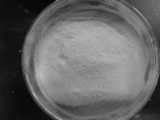
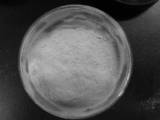
- FIG. 1 shows a state in which an oil-wrapped powder composition is prepared with an average oil droplet size of 40 ⁇ m at the time of spraying
- FIG. 2 shows a state after subjecting the oil-wrapped powder composition to a vibration stability test. Even when both figures are compared, no particular change is observed in the state of the oil-wrapped powder composition.
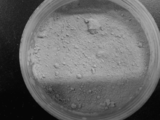
- FIG. 3 shows a state in which the oil-wrapped powder composition is prepared with an average oil droplet size of 100 ⁇ m or more during spraying
- FIG. 4 shows a state after the oil-wrapped powder composition has been subjected to a vibration stability test. From FIG. 3, it is possible to prepare the oil-wrapping powder composition, but it can be understood that a part of the oil-wrapping powder is united by vibration.
- FIG. 5 shows a photomicrograph of the oil-encapsulated powder according to the present invention. Confirmation by such micrographs revealed that the particle size distribution in the product is 10 to 150 ⁇ m, preferably 10 to 120 ⁇ m.
Landscapes
- Life Sciences & Earth Sciences (AREA)
- Health & Medical Sciences (AREA)
- Animal Behavior & Ethology (AREA)
- General Health & Medical Sciences (AREA)
- Public Health (AREA)
- Veterinary Medicine (AREA)
- Birds (AREA)
- Epidemiology (AREA)
- Chemical & Material Sciences (AREA)
- Inorganic Chemistry (AREA)
- Oil, Petroleum & Natural Gas (AREA)
- Cosmetics (AREA)
Abstract
Description
表面に水酸化アルミニウムが被覆された比表面積10m2/g以上の平板状粉末、及び該水酸化アルミニウム上に配されたフッ素化合物の被覆を有する包油性粉末と、
炭化水素油が全油性成分中50質量%以上の油性成分であって、該油性成分全体としての表面張力値が2.0×10⁻²N/m以上のものからなる油滴と、
を含み、前記油滴が前記包油性粉末により包み込まれてり、平均粒子径が10~150μmの粉体状を呈し、塗擦により液化することを特徴とする。
表面に水酸化アルミニウムが被覆された比表面積10m2/g以上の平板状粉末に、フッ素処理を施した包油性粉末を撹拌しつつ、
炭化水素油が全油性成分中50質量%以上の油性成分であって、該油性成分全体としての表面張力値が2.0×10⁻²N/m以上のものからなり、平均粒子径20~80μmの油滴を噴霧し、
前記油滴を前記包油性粉末により包み込むことを特徴とする。
本発明において好適に用いられる包油性粉末は、後述する油滴を包油する粉末であり、フッ素処理水酸化アルミニウム被覆平板状粉末であることが好ましい。ここで、フッ素処理水酸化アルミニウム被覆平板状粉末は、セリサイト、マイカなどの平板状粉末の表面に水酸化アルミニウムを析出させ、さらにフッ素基を付与して撥水性・撥油性をもたせるようにしたものである。
被処理粉末としては、平板状粉末が好ましく用いられる。平板状粉末としては、セリサイト、マイカ、タルク、アルミナ、シリカ、板状硫酸バリウム、オキシ塩化ビスマス、窒化ホウ素などが挙げられ、これらのうち平板状粘土鉱物好ましく用いられる。平板状粘土鉱物としては天然、合成のいずれのものも任意に用いることができる。粘土鉱物としては、セリサイト(微結晶含水ケイ酸アルミニウムカリウム;K2O・3Al2O3・6SiO2、2H2O)、マイカ(含水ケイ酸アルミニウムカリウム;KAl2・AlSi3O10(OH)2)、タルク等が好ましく用いられる。これら粘土鉱物を用いることにより、粉体状形態を維持しつつ、後述する油性成分をより高配合することができ、使用性(きしみ感のなさ、皮膚のかさつきのなさ、等)のより一層の向上を図ることができる。
本発明では、上記フッ素処理を施す前に、水酸化アルミニウムの析出処理を施しておく。このように水酸化アルミニウム析出処理した後に、フッ素処理することにより、フッ素化合物の被覆形成を安定に、効率よく進行させ、撥水性・撥油性により優れたフッ素処理粉末を製造することができる。また、水酸化アルミニウム被覆処理後フッ素化処理した粉末を用いた場合、衝撃安定性(耐衝撃性)が著しく高められる。また肌などへの密着性向上効果にも優れる。
次いで、上記の、表面を金属処理した粉末に、フッ素化合物に水を加えてエマルジョン状態にしたものを徐々に加え、酸または高温静置によってエマルジョンを破壊することにより、上記金属水酸化物または金属塩の水和物、一部脱水物、無水物によって被覆された粉末をさらにフッ素化合物で被覆することができる。



油性成分は、1種または2種以上の油性成分からなるが、その表面張力値(平均)は2.0×10⁻²N/m以上(対大気)であり、好ましくは2.1×10-2N/m以上である。油性成分の表面張力値が2.0×10-2N/m未満では、油性成分が粉末に容易に濡れるために、油性成分を良好な粉体状形態とすることができない。
本発明にかかる包油粉体組成物は、前記包油性粉末に対し、前記油性成分を油滴状にして加え、混合、撹拌して調製することが好ましい。
◎:安定なドライオイルが調製出来る。
〇:ドライオイルが調整出来るが一部ペーストも混合している。
△:半分以上がスラリー化。
×:スラリー化していてドライオイルが出来ない。
ガラス製20mlサンプル管に、各実施例品を口元まで充填し、70cmの高さからゴム板の上に10回落下させたのち、中身の状態を目視で観察し、下記基準により評価した。
◎:変化なし(粉末形状を保っていた)
〇:一部ペースト状物質が管内に付着したが全体として問題なし。
△:ペースト状物質の付着が目立つ。
×:全体がペースト状になっていた。
調製したドライオイル10gを容器に入れて30分間振動させた。
◎:変化なし(粉末形状を保っていた)
〇:一部ペースト状物質が容器に付着したが全体として問題なし。
△:ペースト状物質の付着が目立つ。
×:全体がペースト状になっていた。
粉末1gが入っている試験管に油を添加していき、スラリーになる直前の油分量。
ペンダントドロップ法にて測定した。
BET法にて測定した。
まず、本発明者らは、包油粉体組成物の特徴的な構成要件である包油性粉末について検討を行った。
結果を表1に示す。

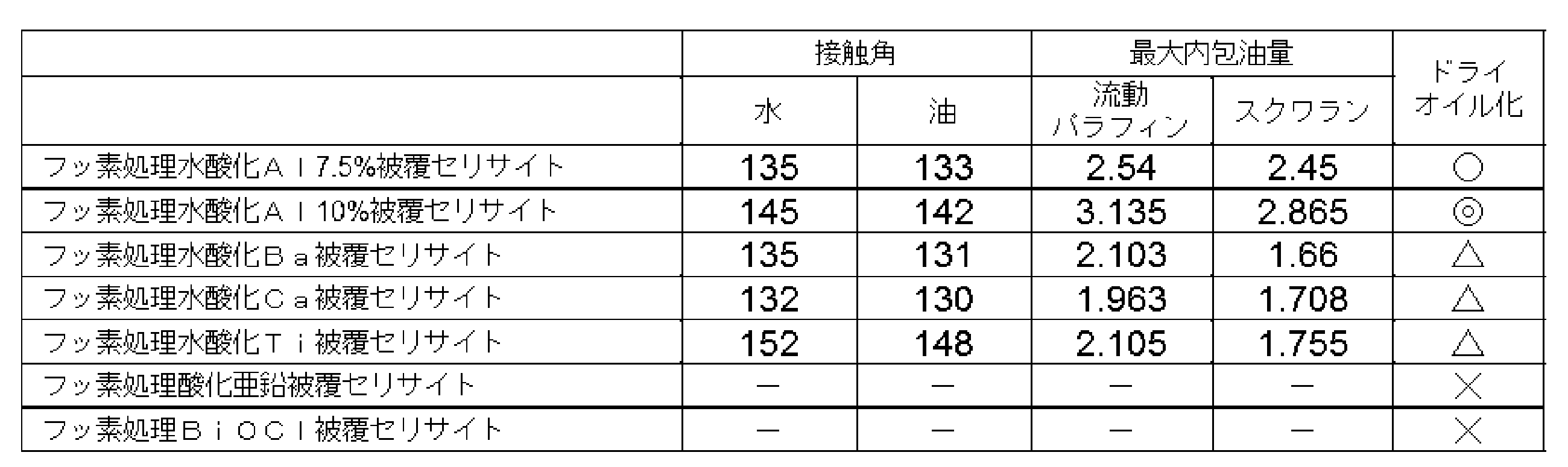
表2より明らかなように、フッ素処理水酸化チタン被覆セリサイトなどは対水、耐油ともに高い接触角を示すにもかかわらず、最大内包油量はフッ素処理水酸化アルミニウム被覆セリサイトの方が高い傾向にあり、フッ素処理水酸化アルミニウム被覆セリサイトの高い内包油量は特異的なものであることが理解される。
析出時間が短い=酸の滴下速度が速いと細かい水酸化アルミニウム粒子が生成する=比表面積が高くなる。
析出時間が長い=ゆっくり酸を滴下すると大きな水酸化アルミニウム粒子が生成する=比表面積が小さくなる。

結果を表4に示す。
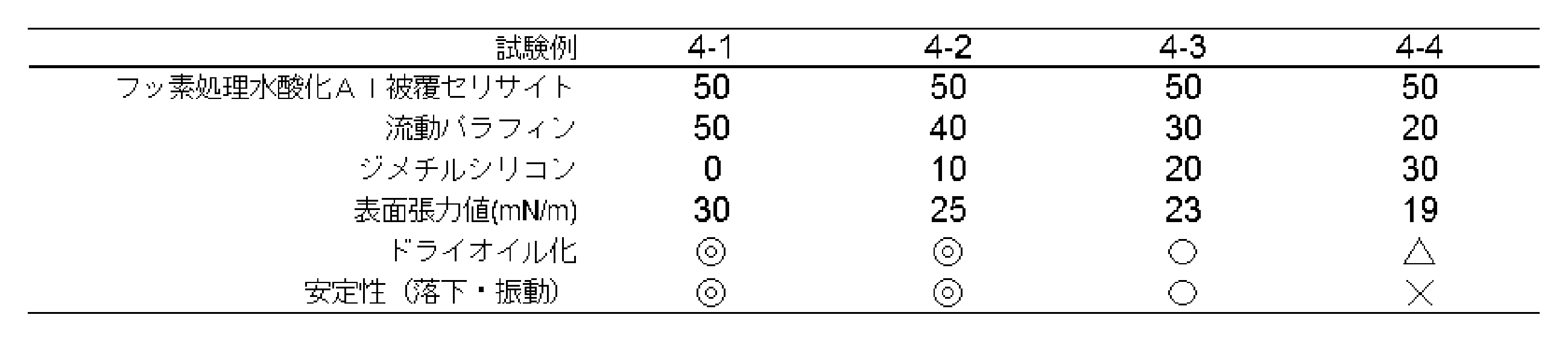
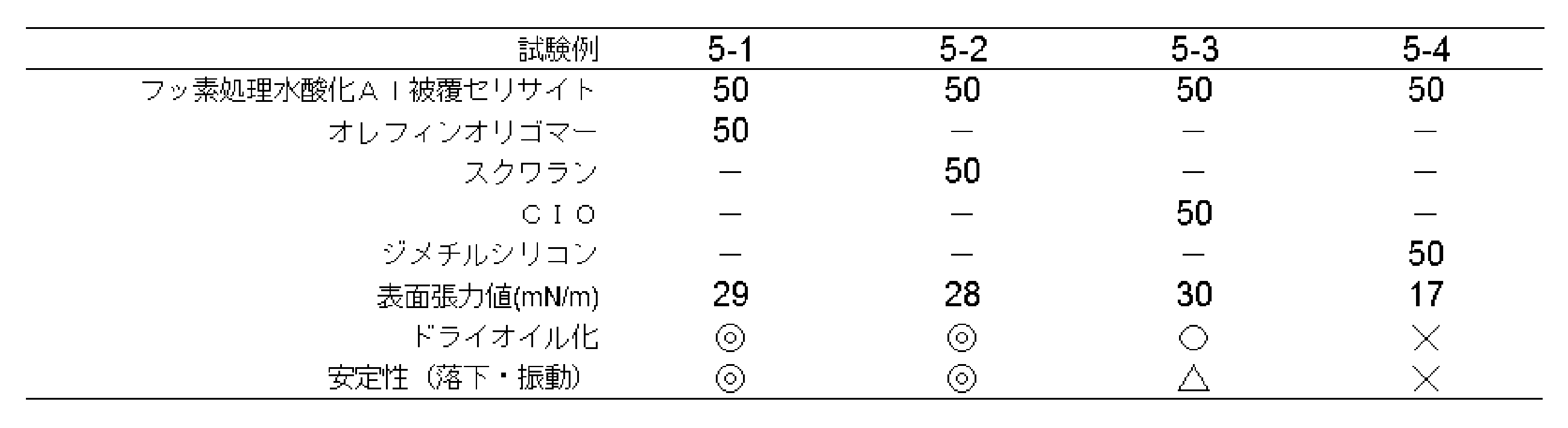

すなわち、平均粒径8~10μmの包油性粉末を撹拌しつつ、所定サイズの油滴を噴霧し、包油粉体組成物を調製した。結果を表7に示す。

Claims (4)
- 表面に水酸化アルミニウムが被覆された比表面積10m2/g以上の平板状粉末、及び該水酸化アルミニウム上に配されたフッ素化合物の被覆を有するフッ素処理を施した包油性粉末と、
炭化水素油が全油性成分中50質量%以上の油性成分であって、該油性成分全体としての表面張力値が2.0×10⁻²N/m以上のものからなる油滴と、
を含み、前記油滴が前記包油性粉末により包み込まれ、平均粒子径が10~150μmである粉体状を呈し、塗擦により液化する包油粉体組成物。 - 請求項1記載の組成物において、平板状粉末はセリサイトであることを特徴とする包油粉体組成物。
- 請求項1または2記載の組成物において、包油性粉末:油性成分=1:9~4:1(質量比)であることを特徴とする包油粉体組成物。
- 表面に水酸化アルミニウムが被覆された比表面積10m2/g以上の平板状粉末に、フッ素処理を施した包油性粉末を撹拌しつつ、
炭化水素油が全油性成分中50質量%以上であって、該油性成分全体としての表面張力値が2.0×10⁻²N/m以上の油性成分からなり、粒子径20~80μmの油滴を噴霧し、
前記油滴を前記包油性粉末により包み込む、包油粉体組成物の製造方法。
Priority Applications (2)
| Application Number | Priority Date | Filing Date | Title |
|---|---|---|---|
| US15/110,908 US20170151134A1 (en) | 2015-07-16 | 2016-02-24 | Oil-Enclosed Powdery Composition and Production Method of the Same |
| KR1020167017601A KR20170020304A (ko) | 2015-07-16 | 2016-02-24 | 포유 분체 조성물 및 그 제조방법 |
Applications Claiming Priority (2)
| Application Number | Priority Date | Filing Date | Title |
|---|---|---|---|
| JP2015142165A JP5922287B1 (ja) | 2015-07-16 | 2015-07-16 | 包油粉体組成物及びその製造方法 |
| JP2015-142165 | 2015-07-16 |
Publications (1)
| Publication Number | Publication Date |
|---|---|
| WO2017010116A1 true WO2017010116A1 (ja) | 2017-01-19 |
Family
ID=56015178
Family Applications (1)
| Application Number | Title | Priority Date | Filing Date |
|---|---|---|---|
| PCT/JP2016/055407 Ceased WO2017010116A1 (ja) | 2015-07-16 | 2016-02-24 | 包油粉体組成物及びその製造方法 |
Country Status (5)
| Country | Link |
|---|---|
| US (1) | US20170151134A1 (ja) |
| JP (1) | JP5922287B1 (ja) |
| KR (1) | KR20170020304A (ja) |
| TW (1) | TW201707674A (ja) |
| WO (1) | WO2017010116A1 (ja) |
Families Citing this family (2)
| Publication number | Priority date | Publication date | Assignee | Title |
|---|---|---|---|---|
| WO2019088186A1 (ja) * | 2017-11-02 | 2019-05-09 | 株式会社 資生堂 | 粉末状組成物 |
| CN111278411A (zh) * | 2017-11-02 | 2020-06-12 | 株式会社资生堂 | 粉末状组合物 |
Citations (6)
| Publication number | Priority date | Publication date | Assignee | Title |
|---|---|---|---|---|
| JP2000247823A (ja) * | 1999-02-26 | 2000-09-12 | Shiseido Co Ltd | 粉末化粧料 |
| JP2002255744A (ja) * | 2001-02-26 | 2002-09-11 | Kose Corp | 化粧料用粉体及びそれを含有するメーキャップ化粧料 |
| JP2004292396A (ja) * | 2003-03-27 | 2004-10-21 | Shiseido Co Ltd | 油中水型乳化組成物及び該組成物を用いた化粧料 |
| JP2005232162A (ja) * | 2004-01-23 | 2005-09-02 | Kose Corp | 粉末組成物及びこれを含有する粉末状化粧料 |
| JP3812733B2 (ja) * | 2001-07-05 | 2006-08-23 | 株式会社資生堂 | 粉末状組成物 |
| JP2007161764A (ja) * | 2005-12-09 | 2007-06-28 | Sakura Color Prod Corp | 粉末色材組成物 |
Family Cites Families (1)
| Publication number | Priority date | Publication date | Assignee | Title |
|---|---|---|---|---|
| JP2003012451A (ja) * | 2001-07-05 | 2003-01-15 | Shiseido Co Ltd | 粉末状化粧料 |
-
2015
- 2015-07-16 JP JP2015142165A patent/JP5922287B1/ja active Active
-
2016
- 2016-02-24 KR KR1020167017601A patent/KR20170020304A/ko not_active Ceased
- 2016-02-24 US US15/110,908 patent/US20170151134A1/en not_active Abandoned
- 2016-02-24 WO PCT/JP2016/055407 patent/WO2017010116A1/ja not_active Ceased
- 2016-03-03 TW TW105106471A patent/TW201707674A/zh unknown
Patent Citations (6)
| Publication number | Priority date | Publication date | Assignee | Title |
|---|---|---|---|---|
| JP2000247823A (ja) * | 1999-02-26 | 2000-09-12 | Shiseido Co Ltd | 粉末化粧料 |
| JP2002255744A (ja) * | 2001-02-26 | 2002-09-11 | Kose Corp | 化粧料用粉体及びそれを含有するメーキャップ化粧料 |
| JP3812733B2 (ja) * | 2001-07-05 | 2006-08-23 | 株式会社資生堂 | 粉末状組成物 |
| JP2004292396A (ja) * | 2003-03-27 | 2004-10-21 | Shiseido Co Ltd | 油中水型乳化組成物及び該組成物を用いた化粧料 |
| JP2005232162A (ja) * | 2004-01-23 | 2005-09-02 | Kose Corp | 粉末組成物及びこれを含有する粉末状化粧料 |
| JP2007161764A (ja) * | 2005-12-09 | 2007-06-28 | Sakura Color Prod Corp | 粉末色材組成物 |
Non-Patent Citations (1)
| Title |
|---|
| SHINGO HIRAOKA: "Foundation no Kenkyu Kaihatsu no Shinpo to Saishin Doko", FRAGRANCE JOURNAL SPECIAL EXTRA ISSUE, NO.21, 20 August 2009 (2009-08-20), pages 44 - 49, ISSN: 0288-9803 * |
Also Published As
| Publication number | Publication date |
|---|---|
| JP2017025000A (ja) | 2017-02-02 |
| US20170151134A1 (en) | 2017-06-01 |
| JP5922287B1 (ja) | 2016-05-24 |
| TW201707674A (zh) | 2017-03-01 |
| KR20170020304A (ko) | 2017-02-22 |
Similar Documents
| Publication | Publication Date | Title |
|---|---|---|
| JP5352064B2 (ja) | ハイドロゲル粒子 | |
| JP6732750B2 (ja) | 複合粒子及びその調製 | |
| JP3107891B2 (ja) | 含水粉末化粧料 | |
| TWI495486B (zh) | W/o乳化化粧料 | |
| TW201944980A (zh) | 化妝料 | |
| JP2017088599A (ja) | 組成物 | |
| JP7356703B2 (ja) | 固形粉末化粧料 | |
| CN111818898A (zh) | 水分释放棒状化妆品 | |
| CN107661280A (zh) | 固态粉末化妆材料的制造方法和固态粉末化妆材料 | |
| JP6039369B2 (ja) | 水中油型乳化化粧料 | |
| TW201427701A (zh) | 油中水型乳化組成物 | |
| JP3812733B2 (ja) | 粉末状組成物 | |
| JP5922287B1 (ja) | 包油粉体組成物及びその製造方法 | |
| JP2005220058A (ja) | 油性固型化粧料 | |
| JP7841198B2 (ja) | 固形粉末化粧料組成物の製造方法 | |
| CN119421691A (zh) | 具有碳酸二烷基酯、椰子油酯、直链c15-c19烷烃、挥发性基于烃的油和聚氧乙烯化二醇脂肪酸酯聚合物的乳液 | |
| JP7488047B2 (ja) | 粉末状組成物 | |
| JP7384670B2 (ja) | 粉末状組成物 | |
| JP4274961B2 (ja) | 粉末状化粧料 | |
| JP2010070459A (ja) | 油性固形化粧料の製造方法及び油性固形化粧料 | |
| JP6403950B2 (ja) | 粘土鉱物を含有する噴霧用の皮膚保湿用組成物 | |
| JP6877996B2 (ja) | 外用組成物 | |
| WO2025229867A1 (ja) | 粉末固形化粧料の製造方法、及び粉末固形化粧料 | |
| TW201717896A (zh) | 紫外線阻斷用化妝品組成物 | |
| JP2015163600A (ja) | 表面処理多孔質無機酸化物粒子およびその製造方法ならびに該粒子を含む化粧料 |
Legal Events
| Date | Code | Title | Description |
|---|---|---|---|
| ENP | Entry into the national phase |
Ref document number: 20167017601 Country of ref document: KR Kind code of ref document: A |
|
| WWE | Wipo information: entry into national phase |
Ref document number: 15110908 Country of ref document: US |
|
| 121 | Ep: the epo has been informed by wipo that ep was designated in this application |
Ref document number: 16824097 Country of ref document: EP Kind code of ref document: A1 |
|
| NENP | Non-entry into the national phase |
Ref country code: DE |
|
| 122 | Ep: pct application non-entry in european phase |
Ref document number: 16824097 Country of ref document: EP Kind code of ref document: A1 |