WO2016203586A1 - 研磨剤、研磨剤用貯蔵液及び研磨方法 - Google Patents
研磨剤、研磨剤用貯蔵液及び研磨方法 Download PDFInfo
- Publication number
- WO2016203586A1 WO2016203586A1 PCT/JP2015/067508 JP2015067508W WO2016203586A1 WO 2016203586 A1 WO2016203586 A1 WO 2016203586A1 JP 2015067508 W JP2015067508 W JP 2015067508W WO 2016203586 A1 WO2016203586 A1 WO 2016203586A1
- Authority
- WO
- WIPO (PCT)
- Prior art keywords
- abrasive
- polishing
- carbon
- based material
- insulating material
- Prior art date
- Legal status (The legal status is an assumption and is not a legal conclusion. Google has not performed a legal analysis and makes no representation as to the accuracy of the status listed.)
- Ceased
Links
Images


Classifications
-
- C—CHEMISTRY; METALLURGY
- C09—DYES; PAINTS; POLISHES; NATURAL RESINS; ADHESIVES; COMPOSITIONS NOT OTHERWISE PROVIDED FOR; APPLICATIONS OF MATERIALS NOT OTHERWISE PROVIDED FOR
- C09G—POLISHING COMPOSITIONS; SKI WAXES
- C09G1/00—Polishing compositions
- C09G1/02—Polishing compositions containing abrasives or grinding agents
-
- B—PERFORMING OPERATIONS; TRANSPORTING
- B24—GRINDING; POLISHING
- B24B—MACHINES, DEVICES, OR PROCESSES FOR GRINDING OR POLISHING; DRESSING OR CONDITIONING OF ABRADING SURFACES; FEEDING OF GRINDING, POLISHING, OR LAPPING AGENTS
- B24B37/00—Lapping machines or devices; Accessories
-
- B—PERFORMING OPERATIONS; TRANSPORTING
- B24—GRINDING; POLISHING
- B24B—MACHINES, DEVICES, OR PROCESSES FOR GRINDING OR POLISHING; DRESSING OR CONDITIONING OF ABRADING SURFACES; FEEDING OF GRINDING, POLISHING, OR LAPPING AGENTS
- B24B37/00—Lapping machines or devices; Accessories
- B24B37/005—Control means for lapping machines or devices
- B24B37/013—Devices or means for detecting lapping completion
-
- B—PERFORMING OPERATIONS; TRANSPORTING
- B24—GRINDING; POLISHING
- B24B—MACHINES, DEVICES, OR PROCESSES FOR GRINDING OR POLISHING; DRESSING OR CONDITIONING OF ABRADING SURFACES; FEEDING OF GRINDING, POLISHING, OR LAPPING AGENTS
- B24B37/00—Lapping machines or devices; Accessories
- B24B37/04—Lapping machines or devices; Accessories designed for working plane surfaces
- B24B37/042—Lapping machines or devices; Accessories designed for working plane surfaces operating processes therefor
- B24B37/044—Lapping machines or devices; Accessories designed for working plane surfaces operating processes therefor characterised by the composition of the lapping agent
-
- C—CHEMISTRY; METALLURGY
- C09—DYES; PAINTS; POLISHES; NATURAL RESINS; ADHESIVES; COMPOSITIONS NOT OTHERWISE PROVIDED FOR; APPLICATIONS OF MATERIALS NOT OTHERWISE PROVIDED FOR
- C09K—MATERIALS FOR MISCELLANEOUS APPLICATIONS, NOT PROVIDED FOR ELSEWHERE
- C09K3/00—Materials not provided for elsewhere
- C09K3/14—Anti-slip materials; Abrasives
-
- C—CHEMISTRY; METALLURGY
- C09—DYES; PAINTS; POLISHES; NATURAL RESINS; ADHESIVES; COMPOSITIONS NOT OTHERWISE PROVIDED FOR; APPLICATIONS OF MATERIALS NOT OTHERWISE PROVIDED FOR
- C09K—MATERIALS FOR MISCELLANEOUS APPLICATIONS, NOT PROVIDED FOR ELSEWHERE
- C09K3/00—Materials not provided for elsewhere
- C09K3/14—Anti-slip materials; Abrasives
- C09K3/1409—Abrasive particles per se
-
- C—CHEMISTRY; METALLURGY
- C09—DYES; PAINTS; POLISHES; NATURAL RESINS; ADHESIVES; COMPOSITIONS NOT OTHERWISE PROVIDED FOR; APPLICATIONS OF MATERIALS NOT OTHERWISE PROVIDED FOR
- C09K—MATERIALS FOR MISCELLANEOUS APPLICATIONS, NOT PROVIDED FOR ELSEWHERE
- C09K3/00—Materials not provided for elsewhere
- C09K3/14—Anti-slip materials; Abrasives
- C09K3/1454—Abrasive powders, suspensions and pastes for polishing
- C09K3/1463—Aqueous liquid suspensions
-
- H—ELECTRICITY
- H10—SEMICONDUCTOR DEVICES; ELECTRIC SOLID-STATE DEVICES NOT OTHERWISE PROVIDED FOR
- H10P—GENERIC PROCESSES OR APPARATUS FOR THE MANUFACTURE OR TREATMENT OF DEVICES COVERED BY CLASS H10
- H10P52/00—Grinding, lapping or polishing of wafers, substrates or parts of devices
-
- H—ELECTRICITY
- H10—SEMICONDUCTOR DEVICES; ELECTRIC SOLID-STATE DEVICES NOT OTHERWISE PROVIDED FOR
- H10P—GENERIC PROCESSES OR APPARATUS FOR THE MANUFACTURE OR TREATMENT OF DEVICES COVERED BY CLASS H10
- H10P52/00—Grinding, lapping or polishing of wafers, substrates or parts of devices
- H10P52/40—Chemomechanical polishing [CMP]
- H10P52/402—Chemomechanical polishing [CMP] of semiconductor materials
-
- H—ELECTRICITY
- H10—SEMICONDUCTOR DEVICES; ELECTRIC SOLID-STATE DEVICES NOT OTHERWISE PROVIDED FOR
- H10P—GENERIC PROCESSES OR APPARATUS FOR THE MANUFACTURE OR TREATMENT OF DEVICES COVERED BY CLASS H10
- H10P95/00—Generic processes or apparatus for manufacture or treatments not covered by the other groups of this subclass
- H10P95/06—Planarisation of inorganic insulating materials
- H10P95/062—Planarisation of inorganic insulating materials involving a dielectric removal step
-
- H—ELECTRICITY
- H10—SEMICONDUCTOR DEVICES; ELECTRIC SOLID-STATE DEVICES NOT OTHERWISE PROVIDED FOR
- H10P—GENERIC PROCESSES OR APPARATUS FOR THE MANUFACTURE OR TREATMENT OF DEVICES COVERED BY CLASS H10
- H10P95/00—Generic processes or apparatus for manufacture or treatments not covered by the other groups of this subclass
- H10P95/06—Planarisation of inorganic insulating materials
- H10P95/062—Planarisation of inorganic insulating materials involving a dielectric removal step
- H10P95/064—Planarisation of inorganic insulating materials involving a dielectric removal step the removal being chemical etching
Definitions
- the present invention provides an abrasive for removing at least a part of a carbon-based material by chemical mechanical polishing (hereinafter, sometimes referred to as “CMP”) a substrate having a carbon-based material having a high carbon content and an insulating material.
- CMP chemical mechanical polishing
- the present invention relates to an abrasive stock solution and a polishing method.
- CMP semiconductor integrated circuits
- a substrate having a substrate 1 and a silicon oxide 2 having a predetermined pattern and formed on the substrate 1 is prepared (FIG. 1A).
- a photoresist 3 is formed on the substrate 1 and the silicon oxide 2 (FIG. 1B).
- the entire surface layer portion of the photoresist 3 is removed by dry etching so that the photoresist 3 having a predetermined thickness remains on the silicon oxide 2 (FIG. 1C).
- a predetermined portion on the silicon oxide 2 in the photoresist 3 is removed by an exposure and development process to form a groove 4 in the photoresist 3 (FIG. 1D).
- the portion of the silicon oxide 2 exposed at the groove 4 is removed by dry etching (FIG. 1 (e)).
- the photoresist 3 is stripped to obtain silicon oxide 2 having a predetermined pattern (FIG. 1 (f)).
- the variation in the thickness of the surface layer portion of the photoresist has been acceptable in the past, but with the recent development of design rules, the influence cannot be ignored.
- the variation in the thickness of the surface layer portion of the photoresist is further increased. Thereby, a device shape may deteriorate, a depth of focus may fall, and a yield may fall.
- the present inventor has conceived a method of using CMP instead of dry etching. Specifically, the present inventor has disclosed a substrate having a predetermined pattern and an insulating material (for example, silicon oxide) formed on the substrate and a carbon-based material having a high carbon content on the insulating material. The surface layer portion of the carbon-based material was removed by CMP after forming the film, and the idea was to stop the polishing of the carbon-based material when the insulating material was exposed.
- an insulating material for example, silicon oxide
- the composition of the polishing slurry for CMP generally differs depending on the object to be polished (the substance to be removed and the substance that remains without being removed).
- Abrasives for CMP of carbon-based materials having a high carbon content are only slightly known (see, for example, Patent Document 3 above). With abrasives for other uses (for example, for glass polishing, STI formation, and metal material polishing), it is difficult to remove a carbon-based material having a high carbon content by polishing.
- polishing agents for CMP are polishing agents for polishing relatively hard materials such as inorganic insulating materials and metal materials, and polishing is advanced by the mechanical action of abrasive grains contained in the polishing agent for CMP. ing.
- a carbon-based material having a high carbon content contains an organic compound as a main component, and is a soft material as compared with an inorganic insulating material and a metal material. Therefore, when a high carbon content carbon-based material is polished using a conventional CMP polishing agent, the mechanical action of the abrasive grains is dispersed. Therefore, the polishing hardly progresses or the polishing proceeds while damaging the carbon-based material having a high carbon content. Therefore, it is difficult to flatten the surface after polishing.
- the present invention is intended to solve the above-described problems, and can remove a high carbon content carbon-based material at a good polishing rate and selectively remove the high carbon content carbon-based material with respect to an insulating material.
- An object of the present invention is to provide an abrasive, a storage liquid for an abrasive, and a polishing method.
- the present inventor has successfully polished a high carbon content carbon-based material by using abrasive grains containing silica and having a positive charge in the abrasive and an allylamine polymer. It was found that the carbon-based material having a high carbon content can be selectively removed with respect to the insulating material while being removed at a speed.
- the abrasive according to the present invention is obtained by chemically mechanically polishing a substrate having a carbon-based material having an amount of carbon of 60 to 95 atm% measured by X-ray photoelectron spectroscopy and an insulating material.
- a polishing agent for removing at least a part of the polishing agent wherein the polishing agent contains abrasive grains containing silica, an allylamine polymer, and water, and the allylamine polymer with respect to the abrasive grain content.
- the mass ratio of the content is 0.002 to 0.400, and the abrasive grains have a positive charge in the abrasive.
- the abrasive according to the present invention can remove a carbon-based material having a high carbon content at a good polishing rate and can selectively remove the carbon-based material having a high carbon content with respect to an insulating material.
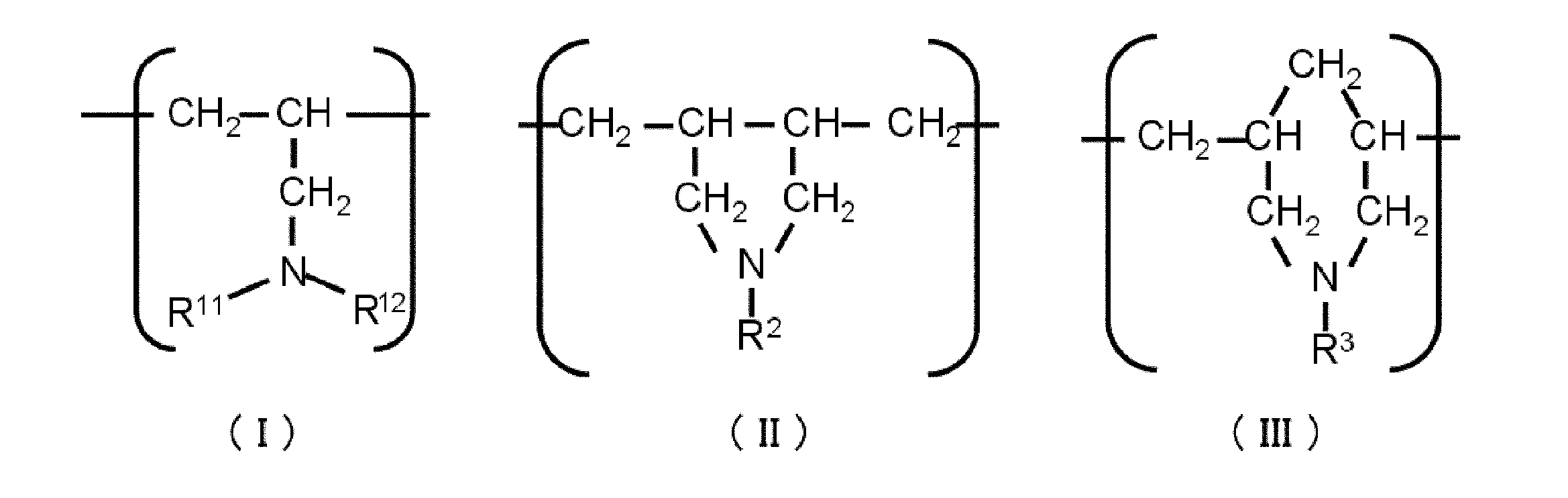
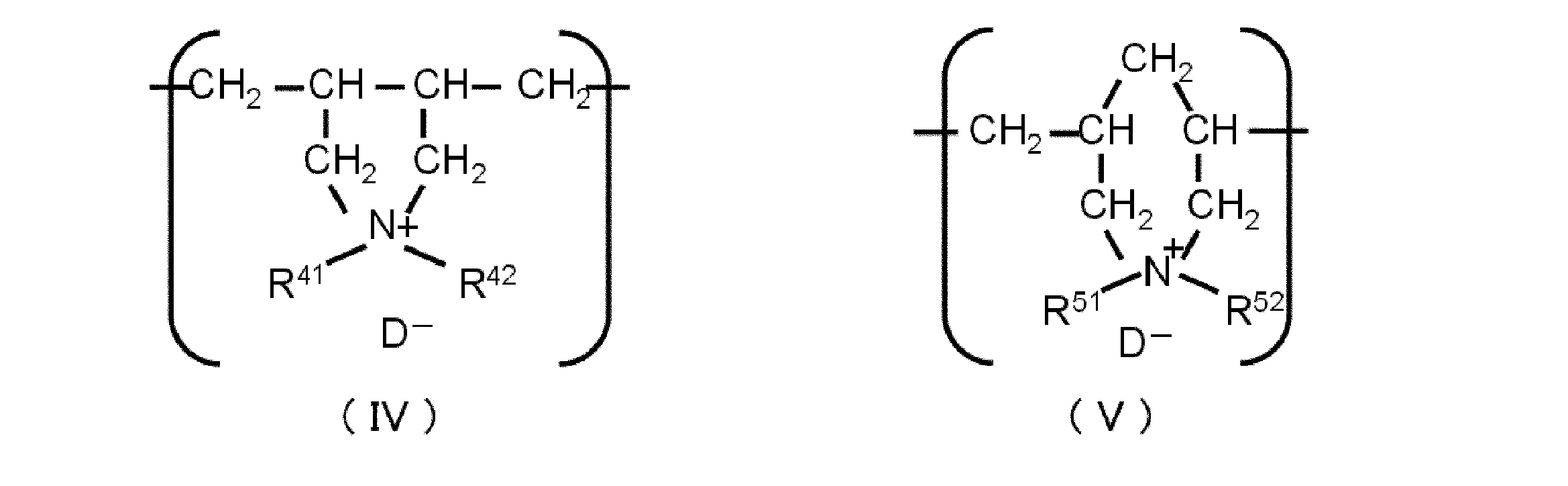
- the allylamine polymer includes a structural unit represented by the following general formula (I), a structural unit represented by the following general formula (II), a structural unit represented by the following general formula (III), and the following general formula ( It is preferable to have at least one selected from the group consisting of a structural unit represented by IV) and a structural unit represented by the following general formula (V).
- the allylamine polymer reduces the contact frequency between the insulating material and the abrasive grains, the polishing rate of the insulating material is further suppressed, so that the carbon-based material having a high carbon content is more selective to the insulating material. Can be removed.
- R 11 , R 12 , R 2 and R 3 each independently represent a hydrogen atom, an alkyl group or an aralkyl group, and the amino group and the nitrogen-containing ring each independently form an acid addition salt. Also good. ] [Wherein, R 41 and R 42 each independently represent an alkyl group or an aralkyl group, R 51 and R 52 each independently represent an alkyl group or an aralkyl group, and D ⁇ represents a monovalent anion. Show. ]
- the silica is preferably colloidal silica.
- polishing scratches referring to scratches appearing on the polished surface after polishing; the same applies hereinafter
- polishing scratches can be reduced while maintaining a high polishing rate of the carbon-based material.
- the abrasive according to the present invention may further contain an organic solvent.
- the polishing rate of the carbon-based material can be further improved by improving the wettability of the abrasive with respect to the carbon-based material having a high carbon content.
- the pH of the abrasive according to the present invention is preferably 1.0 to 8.0.
- the polishing rate of the carbon-based material can be further improved, and dissolution of the abrasive grains can be suppressed.
- the abrasive according to the present invention may further contain an acid component.
- the liquid stability of the abrasive can be increased and the surface to be polished can be further flattened.
- the polishing rate ratio of the carbon-based material to the insulating material is preferably 50 or more.
- the abrasive according to the present invention may be stored as a multi-component abrasive having a first liquid containing abrasive grains and water, and a second liquid containing an allylamine polymer and water. In this case, the liquid stability of the abrasive can be increased.
- the abrasive storage liquid according to the present invention is an abrasive storage liquid for obtaining the abrasive, and the abrasive can be obtained by diluting with water. In this case, the cost, space, etc. required for transportation and storage of the abrasive can be reduced.
- the first embodiment of the polishing method according to the present invention comprises a step of preparing a substrate having a carbon-based material having an amount of carbon of 60 to 95 atm% measured by X-ray photoelectron spectroscopy, and an insulating material; And a polishing step of removing at least a part of the carbon-based material by subjecting the substrate to chemical mechanical polishing using an abrasive.
- a step of preparing a substrate having a carbon-based material whose carbon amount measured by X-ray photoelectron spectroscopy is 60 to 95 atm% and an insulating material A step of diluting an abrasive stock solution with water to obtain an abrasive, and a polishing step of removing at least a part of the carbon-based material by subjecting the substrate to chemical mechanical polishing using the abrasive.
- polishing methods a high carbon content carbon-based material can be removed at a good polishing rate, and a high carbon content carbon-based material can be selectively removed from an insulating material.
- the polishing may be stopped when the insulating material is exposed in the polishing step.
- a high carbon content carbon-based material can be removed at a good polishing rate, and a high carbon content carbon-based material can be selectively (preferentially) removed from an insulating material.
- an abrasive or a storage solution for an abrasive for chemical mechanical polishing of a substrate having a carbon-based material and an insulating material to remove at least a part of the carbon-based material.
- an abrasive or a storage solution for an abrasive for double patterning can provide use of the abrasive
- process includes not only an independent process but also a process in which an intended action of the process is achieved although it cannot be clearly distinguished from other processes.
- each component in the composition is the total amount of the plurality of substances present in the composition unless there is a specific notice when there are a plurality of substances corresponding to each component in the composition. means.
- selective removing material A with respect to material B means that material A is preferentially removed over material B. More specifically, it means that the material A is preferentially removed over the material B in the substrate in which the material A and the material B are mixed.
- “diluting the abrasive stock solution X times” means that when the abrasive is obtained by adding water or the like to the abrasive stock solution, the mass of the abrasive is the amount of the abrasive stock solution. By dilution is meant X times the mass. For example, to obtain an abrasive by adding the same amount of water to the mass of the abrasive stock solution is defined as diluting the abrasive stock solution twice.
- polishing agent which concerns on this embodiment is a composition which touches a to-be-polished surface at the time of grinding
- the abrasive according to the present embodiment includes a carbon-based material (high carbon material, High Carbon Material) having an amount of carbon measured by an X-ray photoelectron spectroscopy (XPS) method of 60 to 95 atm%, and an insulating material (however, And a polishing agent for removing at least a part of the carbonaceous material by CMP.
- polishing agent which concerns on this embodiment contains the abrasive grain containing a silica, an allylamine type polymer, and water.
- the mass ratio of the content of allylamine polymer to the content of abrasive grains is 0.002 to 0.400. It has a positive charge in the abrasive (hereinafter, unless otherwise specified, means a surface charge).
- the carbon-based material for example, a carbon-based material film formed of the carbon-based material
- the carbon-based material has an appropriate hardness, so that the mechanical action of the abrasive grains is dispersed. It can be suppressed. Thereby, the fall of the grinding
- the carbon amount of the carbon-based material is 95 atm% or less, the carbon-based material (for example, the carbon-based material film) is suppressed from having an excessively high hardness, so that the mechanical action of the abrasive is sufficiently active. It is. Thereby, a sufficient polishing rate of the carbon-based material can be obtained.
- the carbon material can be removed at a high polishing rate when the carbon content of the carbon material is 60 to 95 atm%.
- the carbon amount of the carbon-based material is preferably 65 atm% or more, more preferably 70 atm% or more, still more preferably 75 atm% or more, and 80 atm% or more. Is particularly preferable, 85 atm% or more is very preferable, and 87 atm% or more is very preferable.
- the carbon amount of the carbon-based material is preferably 95 atm% or less, more preferably 93 atm% or less, and still more preferably 91 atm% or less.
- the carbon content of the carbon-based material is measured by X-ray photoelectron spectroscopy.
- Analysis by X-ray photoelectron spectroscopy can be performed using, for example, “PHI-5000-VersaProbeII” manufactured by ULVAC-PHI Co., Ltd.
- a monochromatic Al—K ⁇ ray (1486.6 eV) can be used as the X-ray source.
- the detection angle is 45 degrees
- the analysis area is 200 ⁇ m ⁇
- the voltage is 15 kV
- the output is 50 W.
- the amount of carbon can be obtained by measuring the spectrum of C1s (280 to 300 eV), correcting the charge with the obtained C1s peak top being 284.3 eV, and determining the peak area of C1s.
- the carbon material is not particularly limited as long as it satisfies the carbon amount.
- Carbon materials include phenolic resin, epoxy resin, acrylic resin, methacrylic resin, novolac resin, unsaturated polyester resin, polyester resin (excluding unsaturated polyester resin), polyimide resin, polyamideimide resin, polybenzoxazole (PBO) , Resin materials such as polyallyl ether resins, heterocyclic-containing resins (excluding the resins exemplified above), silicone-containing resins, and the like.
- the method for forming the carbon-based material is not particularly limited, and examples thereof include a vapor deposition method and a spine coating method.
- the shape of the carbon-based material is not particularly limited, but is, for example, a film shape (carbon-based material film).
- the insulating material there are no particular limitations on the insulating material, and known materials can be widely used. Specifically, a silicon-based insulating material or the like can be given. Examples of the silicon-based insulating material include silica-based materials such as silicon oxide, fluorosilicate glass, organosilicate glass, silicon oxynitride, and hydrogenated silsesquioxane; silicon carbide; silicon nitride and the like. The insulating material may be doped with an element such as phosphorus or boron.
- the polishing rate of the carbon-based material is likely to be increased by using abrasive grains having a positive charge in the abrasive.
- the abrasive grain containing silica has high affinity with a carbonaceous material compared with another kind of abrasive grain, it is thought that the contact frequency of an abrasive grain and a carbonaceous material increases. Therefore, it is considered that the polishing rate of the carbon-based material is increased by using abrasive grains containing silica and having a positive charge in the abrasive.
- abrasive grains containing silica have a high affinity for insulating materials. Further, since the surface of the insulating material has a negative charge in a wide pH range, abrasive grains having a positive charge in the abrasive are electrostatically adsorbed to the insulating material. Therefore, when abrasive grains containing silica and having a positive charge in the abrasive are used, the polishing rate of not only the carbon-based material but also the insulating material tends to increase.
- the present inventor can significantly reduce the polishing rate of the insulating material and the polishing rate of the carbon-based material only slightly decreases because the abrasive according to the present embodiment contains an allylamine-based polymer. Or they found that it hardly changed.
- the above effect is considered to be obtained for the following reason. That is, it is considered that the allylamine polymer is adsorbed on the surface of the insulating material preferentially over the carbon material. Therefore, the protective film generated due to the allylamine polymer is preferentially formed on the surface of the insulating material rather than the carbon material. Thereby, since the contact frequency of an abrasive grain and an insulating material falls, it is thought that the grinding
- a carbonaceous material can be selectively removed with respect to an insulating material.
- a high polishing rate of the carbon-based material can be obtained, and a high polishing selection ratio of the carbon-based material to the insulating material (polishing rate of the carbon-based material / polishing rate of the insulating material) ) Is obtained.
- the abrasive grains contains the abrasive grain containing a silica.
- the abrasive has a positive charge in the abrasive. It is considered that the contact frequency between the abrasive grains and the carbon-based material is increased because silica has a higher affinity for the carbon-based material than other types of abrasive grains.
- Whether or not the abrasive has a positive charge in the abrasive can be determined by measuring the zeta potential of the abrasive in the abrasive. When the zeta potential of the abrasive grains in the abrasive is measured and the numerical value exceeds 0 mV, it can be determined that the abrasive grains have a positive charge.
- the zeta potential can be measured by, for example, trade name: DELSA NANO C manufactured by Beckman Coulter.
- the zeta potential ( ⁇ [mV]) can be measured by the following procedure. First, in the zeta potential measuring device, the scattering intensity of the measurement sample is 1.0 ⁇ 10 4 to 5.0 ⁇ 10 4 cps (where “cps” means “counts per second”, that is, counts per second.
- the sample is obtained by diluting the abrasive with pure water so that the particle count unit becomes a unit for counting particles. Then, the sample is put into a zeta potential measurement cell and the zeta potential is measured. In order to adjust the scattering intensity to the above range, for example, the abrasive is diluted so that the abrasive grains become 1.7 to 1.8% by mass.
- Examples of the method for adjusting the abrasive grains so as to have a positive charge in the polishing agent include a method for controlling the manufacturing method of the abrasive grains, a method for adjusting the pH of the polishing agent, and a method for performing surface treatment on the abrasive grains. It is done.
- a case where silica is used as the abrasive will be described as an example.
- General silica has a negative charge in the liquid, but tends to have a positive charge by lowering the pH.
- silica can be surface-treated using a coupling agent having a cationic group.
- the zeta potential is preferably 10 mV or more, more preferably 15 mV or more, and still more preferably 18 mV or more from the viewpoint of obtaining a better polishing rate and storage stability.
- the upper limit of the zeta potential is not particularly limited, but is 100 mV, for example.
- silica examples include colloidal silica, fumed silica, and the like. Among these, from the viewpoint of further increasing the polishing rate of the carbon-based material, from the viewpoint of reducing polishing scratches, and from the viewpoint of easy selection of the particle diameter, colloidal silica. Is preferred.
- the abrasive can contain other than silica.
- the abrasive grains may contain particles of alumina, ceria, zirconia, cerium hydroxide, resin or the like.
- the abrasive grains may include composite particles in which particles other than silica particles are attached to the surface of silica particles, or may include composite particles in which silica particles are attached to the surface of particles other than silica particles.
- An abrasive grain can be used individually by 1 type or in combination of 2 or more types.
- the content of silica is preferably more than 50% by mass, more preferably 60% by mass or more, and even more preferably 70% by mass or more based on the total mass of the abrasive grains.
- 80% by mass or more is particularly preferable, 90% by mass or more is very preferable, and 95% by mass or more is very preferable.
- the content of silica is preferably 0.005 parts by mass or more with respect to 100 parts by mass of the abrasive from the viewpoint that sufficient mechanical polishing force can be easily obtained and the polishing rate of the carbon-based material is further increased. More than mass part is more preferable, 0.10 mass part or more is still more preferable, 0.15 mass part or more is especially preferable.
- the content of silica is 100 parts by mass of the abrasive from the viewpoint of easily avoiding an increase in the viscosity of the abrasive, from the viewpoint of easily avoiding agglomeration of abrasive grains, from the viewpoint of easily reducing polishing scratches, and from the viewpoint of easy handling of the abrasive. On the other hand, it is preferably 15 parts by mass or less, more preferably 10 parts by mass or less, still more preferably 5 parts by mass or less, and particularly preferably 3 parts by mass or less.
- the content of the abrasive grains is 0. 0 parts relative to 100 parts by mass of the abrasive from the viewpoint that a sufficiently significant polishing speed of the carbon-based material can be easily obtained as compared with the polishing speed of the carbon-based material when no abrasive grains are included. 01 mass parts or more are preferable, 0.05 mass parts or more are more preferable, and 0.1 mass parts or more are still more preferable.
- the content of abrasive grains is preferably 10 parts by mass or less, preferably 6 parts by mass or less, with respect to 100 parts by mass of the abrasive, from the viewpoint of good dispersion stability of the abrasive grains while improving the polishing rate of the carbon-based material. Is more preferably 4 parts by mass or less, and particularly preferably 3 parts by mass or less.
- the average particle diameter of the abrasive grains is preferably 10 nm or more, more preferably 30 nm or more, and even more preferably 40 nm or more, from the viewpoint that sufficient mechanical polishing power can be easily obtained and the polishing rate of the carbon-based material is further increased.
- the average particle diameter of the abrasive grains is preferably 200 nm or less, more preferably 120 nm or less, still more preferably 100 nm or less, and particularly preferably 90 nm or less, from the viewpoint of good dispersion stability of the abrasive grains.
- the average particle diameter of the abrasive grains can be measured by the photon correlation method.
- the average particle diameter can be measured by a device name: Zetasizer 3000HS manufactured by Malvern Instruments, a device name: N5 manufactured by Beckman Coulter, and the like.
- the measuring method using N5 is as follows. Specifically, for example, an aqueous dispersion in which the content of abrasive grains is adjusted to 0.2% by mass is prepared, and this aqueous dispersion is about 4 mL (L is “liter” in a 1 cm square cell. ) After putting, install the cell in the device. A value obtained by setting the refractive index of the dispersion medium to 1.33, the viscosity to 0.887 mPa ⁇ s, and measuring at 25 ° C. can be adopted as the average particle diameter of the abrasive grains.
- polishing agent which concerns on this embodiment contains an allylamine type polymer.
- the “allylamine polymer” is defined as a polymer having a structural unit obtained by polymerizing a monomer containing an allylamine compound.
- an “allylamine compound” is defined as a compound having an allyl group and an amino group.
- the allylamine polymer may have a structural unit obtained by polymerizing only an allylamine compound, and has a structural unit obtained by copolymerizing an allylamine compound and a compound other than the allylamine compound. It may be. Allylamine compounds can be used alone or in combination of two or more.
- the weight average molecular weight of the allylamine polymer is preferably 500 or more, more preferably 800 or more, and still more preferably 1000 or more, from the viewpoint of easily suppressing the polishing rate of the insulating material.
- the weight average molecular weight of the allylamine polymer is preferably 300000 or less, more preferably 200000 or less, and even more preferably 150,000 or less, from the viewpoint of suppressing the viscosity from becoming excessively high and obtaining good storage stability.
- the weight average molecular weight (Mw) of the allylamine polymer can be measured under the following conditions using, for example, gel permeation chromatography (GPC: Gel Permeation Chromatography).
- the content of the allylamine polymer is preferably 0.001 part by mass or more, more preferably 0.003 part by mass or more with respect to 100 parts by mass of the polishing agent, from the viewpoint of easily suppressing the polishing rate of the insulating material. 004 parts by mass or more is more preferable, and 0.005 parts by mass or more is particularly preferable.
- the content of the allylamine polymer is 0 with respect to 100 parts by mass of the abrasive from the viewpoint of suppressing a decrease in the polishing rate of the carbonaceous material and easily maintaining a high polishing rate ratio of the carbonaceous material to the insulating material. 400 parts by mass or less, preferably 0.300 parts by mass or less, more preferably 0.200 parts by mass or less, and particularly preferably 0.100 parts by mass or less.
- the mass ratio of the content of the allylamine polymer to the content of the abrasive grains is 0.002 or more from the viewpoint of selectively removing the carbon-based material with respect to the insulating material.
- the mass ratio is preferably 0.003 or more and more preferably 0.005 or more from the viewpoint of easily removing the carbon-based material selectively with respect to the insulating material.
- the mass ratio of the allylamine polymer content to the abrasive content is 0.400 or less from the viewpoint of removing the carbon-based material at a good polishing rate.
- the mass ratio is preferably 0.300 or less and more preferably 0.200 or less from the viewpoint of easily removing the carbon-based material at a good polishing rate.
- the allylamine-based polymer contains a structural unit represented by the following general formula (I), the following general formula (II) in the molecule of the polymer. ), A structural unit represented by the following general formula (III), a structural unit represented by the following general formula (IV), and a structural unit represented by the following general formula (V) It is preferable to have at least one selected from the group.
- R 11 , R 12 , R 2 and R 3 each independently represent a hydrogen atom, an alkyl group or an aralkyl group, and the alkyl group and aralkyl group may have a hydroxyl group, And the nitrogen-containing ring may each independently form an acid addition salt, and R 11 and R 12 may be the same as or different from each other.
- R 41 and R 42 each independently represent an alkyl group or an aralkyl group, the alkyl group and the aralkyl group may have a hydroxyl group
- R 51 and R 52 each independently represent an alkyl group.
- a group or an aralkyl group, and D - represents a monovalent anion.
- R 41 and R 42 may be the same as or different from each other.
- R 51 and R 52 may be the same as or different from each other.
- the allylamine-based polymer may have one type as structural units (I) to (V), or may have two or more types.
- the total number of structural units (I) to (V) in the molecule is preferably 5 or more, more preferably 7 or more, and even more preferably 10 or more from the viewpoint of easily suppressing the polishing rate of the insulating material.
- the total number of structural units (I) to (V) in the molecule is an average value of the allylamine polymer contained in the abrasive.
- the alkyl groups of R 11 , R 12 , R 2 and R 3 in the general formulas (I), (II) and (III) may be linear, branched or cyclic.
- the number of carbon atoms of the alkyl group is preferably 1 or more from the viewpoint of easily suppressing the polishing rate of the insulating material.
- the number of carbon atoms in the alkyl group is preferably 10 or less, more preferably 7 or less, still more preferably 5 or less, and particularly preferably 4 or less from the viewpoint of easily suppressing the polishing rate of the insulating material.
- the alkyl groups of R 11 , R 12 , R 2 and R 3 may have a hydroxyl group.
- Examples of the alkyl group of R 11 , R 12 , R 2 and R 3 include methyl group, ethyl group, n-propyl group, isopropyl group, n-butyl group, iso-butyl group, tert-butyl group, cyclohexyl group, and the like. Hydroxyl group adduct (3-hydroxypropyl group etc.) and the like.
- An aralkyl group refers to a group in which one hydrogen atom of an alkyl group is substituted with an aryl group.
- the alkyl group constituting the aralkyl group of R 11 , R 12 , R 2 and R 3 is any of linear, branched or cyclic There may be.
- the number of carbon atoms of the aralkyl group is preferably 7 to 10 from the viewpoint of easily suppressing the polishing rate of the insulating material.
- the aralkyl groups of R 11 , R 12 , R 2 and R 3 may have a hydroxyl group.
- Examples of the aralkyl group include benzyl group, phenethyl group, phenylpropyl group, phenylbutyl group, phenylhexyl group, and hydroxyl group adducts thereof.
- the amino group in the general formula (I) and the nitrogen-containing ring in the general formulas (II) and (III) may form an acid addition salt.
- the acid addition salt include hydrochloride, hydrobromide, acetate, sulfate, nitrate, sulfite, phosphate, amidosulfate, methanesulfonate, and the like.
- hydrochloride, acetate, and amide sulfate are preferable from the viewpoint of obtaining a higher polishing rate ratio of the carbon-based material to the insulating material.
- R 11 , R 12 , R 2 and R 3 are preferably a hydrogen atom, a methyl group and an ethyl group from the viewpoint of good wettability with an insulating material (for example, silicon oxide).
- allylamine polymers having the structural unit represented by the general formula (I), (II) or (III) from the viewpoint of obtaining a higher polishing selectivity of the carbonaceous material relative to the insulating material, the allylamine polymer and A diallylamine polymer is preferred.
- the structural unit containing an acid addition salt diallylamine hydrochloride, methyldiallylamine hydrochloride, ethyldiallylamine hydrochloride, methyldiallylamine acetate and methyldiallylamine amide sulfate are preferable.
- the alkyl groups of R 41 , R 42 , R 51 and R 52 in the general formulas (IV) and (V) may be any of linear, branched and cyclic.
- the number of carbon atoms of the alkyl group of R 41 and R 42 is preferably 1 or more from the viewpoint of easily suppressing the polishing rate of the insulating material.
- the number of carbon atoms of the alkyl group of R 41 and R 42 is preferably 10 or less, more preferably 7 or less, and still more preferably 4 or less, from the viewpoint of easily suppressing the polishing rate of the insulating material.
- the number of carbon atoms of the alkyl group of R 51 and R 52 is preferably 1 or more from the viewpoint of easily suppressing the polishing rate of the insulating material.
- the number of carbon atoms of the alkyl group of R 51 and R 52 is preferably 10 or less, more preferably 7 or less, and even more preferably 4 or less from the viewpoint of easily suppressing the polishing rate of the
- the alkyl group of R 41 and R 42 may have a hydroxyl group.
- Examples of the alkyl group for R 41 and R 42 include a methyl group, an ethyl group, an n-propyl group, an isopropyl group, an n-butyl group, an iso-butyl group, a tert-butyl group, a cyclohexyl group, and a hydroxyl group adduct (3 -Hydroxypropyl group, etc.).
- Examples of the alkyl group for R 51 and R 52 include a methyl group, an ethyl group, an n-propyl group, an isopropyl group, an n-butyl group, an iso-butyl group, a tert-butyl group, and a cyclohexyl group.
- the alkyl group constituting the aralkyl group of R 41 , R 42 , R 51 and R 52 in the general formulas (IV) and (V) may be linear, branched or cyclic.
- the number of carbon atoms of the aralkyl group is preferably 7 to 10 from the viewpoint of easily suppressing the polishing rate of the insulating material.
- the aralkyl group of R 41 and R 42 may have a hydroxyl group.
- examples of the aralkyl group include benzyl group, phenethyl group, phenylpropyl group, phenylbutyl group, and hydroxyl group adducts thereof.
- Examples of the aralkyl group for R 51 and R 52 include a benzyl group, a phenethyl group, a phenylpropyl group, and a phenylbutyl group.
- R 41 , R 42 , R 51 and R 52 are preferably a methyl group, a benzyl group and a phenethyl group from the viewpoint of good wettability with an insulating material (for example, silicon oxide).
- Examples of D ⁇ in the general formulas (IV) and (V) include halogen ions such as Cl ⁇ , Br ⁇ and I ⁇ ; alkyl sulfate ions such as methyl sulfate ion, ethyl sulfate ion and dimethyl sulfate ion.
- N N-dialkylammonium salt
- N-alkyl-N-benzylammonium salts such as N, N-dimethylammonium halide, N, N-diethylammonium halide, N, N-dipropylammonium halide, N, N-dibutylammonium halide, etc.
- N N-dialkylammonium alkyl sulfates such as N, N-dimethylammonium methyl sulfate, N, N-methylethylammonium ethyl sulfate and the like.
- N-alkyl-N-benzylammonium salt examples include N-alkyl-N-benzylammonium halides such as N-methyl-N-benzylammonium halide and N-ethyl-N-benzylammonium halide.
- the partial structure halide include chloride, bromide, and iodide.
- N, N-dimethylammonium chloride and N, N-methylethylammonium ethyl sulfate are preferable from the viewpoint of obtaining a higher polishing rate ratio of the carbon-based material to the insulating material.
- the allylamine polymer may have a structure obtained by copolymerizing an allylamine compound and a compound other than the allylamine compound.
- the allylamine polymer is, for example, selected from the group consisting of a structural unit represented by general formula (I), a structural unit represented by general formula (II), and a structural unit represented by general formula (III) It may have a structure obtained by copolymerizing a monomer that gives at least one structural unit and a monomer other than an allylamine compound.
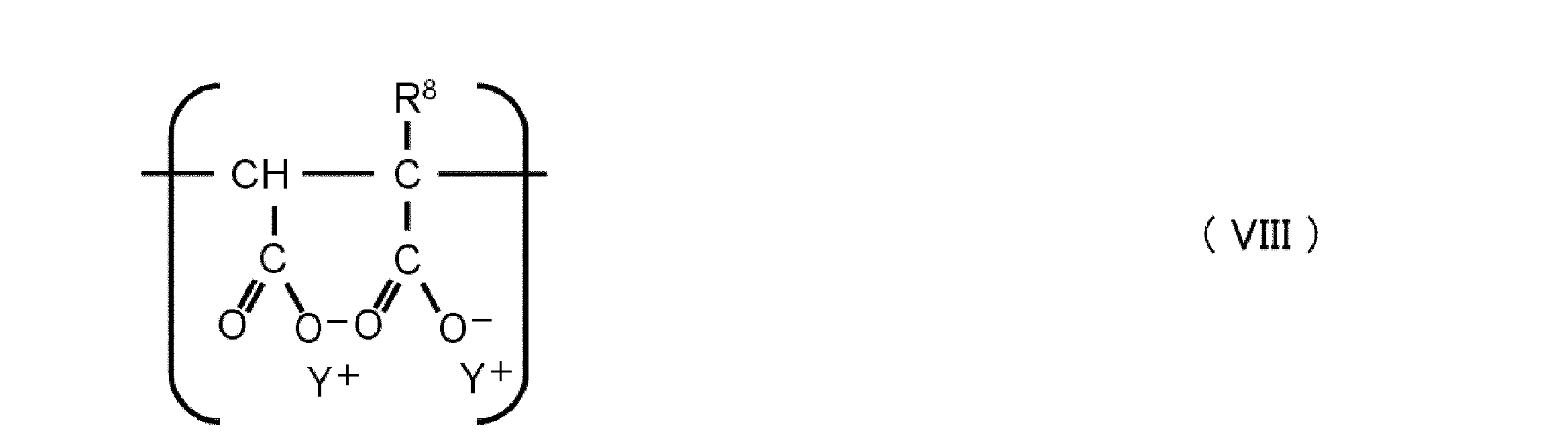
- the allylamine polymer includes a structural unit represented by the following general formula (VI), a structural unit represented by the following formula (VII), a structural unit represented by the following general formula (VIII), and the following general formula ( IX) may further include at least one selected from the group consisting of structural units represented by IX).
- an allylamine polymer is a structural unit represented by general formula (I), a structural unit represented by general formula (II), a structural unit represented by general formula (III), or a general formula (IV).
- Q represents an alkylene group
- R 6 represents a hydrogen atom or an alkyl group
- n represents an average addition mole number of 0 to 30.
- R 8 represents a hydrogen atom or an alkyl group
- Y + represents a cation.
- R 9 represents a hydrogen atom or an alkyl group.
- examples of the monomer that gives the structural unit represented by the general formula (VI) include allyl alcohol.
- examples of the monomer that gives the structural unit represented by the general formula (VI) when n is 1 to 30 include (poly) oxyalkylene monoallyl ether, (poly) oxyalkylene monoallyl monomethyl ether, and the like.
- the alkylene group represented by Q is preferably a linear or branched alkylene group having 2 to 3 carbon atoms from the viewpoint of easily suppressing the polishing rate of the insulating material, and includes an ethylene group, a trimethylene group, and a propylene group. Is more preferable.
- the alkylene group may be introduced alone or in combination of two or more.
- R 6 is preferably a hydrogen atom or a methyl group from the viewpoint of easily suppressing the polishing rate of the insulating material.
- allylamine polymer having the structural unit represented by the general formula (VI) a diallylmethylamine hydrochloride allyl alcohol copolymer is preferable from the viewpoint of further increasing the polishing rate ratio of the carbon-based material to the insulating material.
- Examples of the monomer that gives the structural unit represented by the formula (VII) include sulfur dioxide.
- a diallylamine hydrochloride sulfur dioxide copolymer is preferable from the viewpoint of obtaining a higher polishing rate ratio of the carbonaceous material to the insulating material.
- R 8 in the general formula (VIII) is preferably a hydrogen atom or a methyl group, more preferably a hydrogen atom, from the viewpoint of easily suppressing the polishing rate of the insulating material.
- Y + include alkali metal ions such as sodium ions and potassium ions; hydrogen ions; ammonium ions.
- Examples of the monomer that gives the structural unit represented by the general formula (VIII) include maleic acid, fumaric acid, citraconic acid, itaconic acid, mesaconic acid, 2-allylmalonic acid, and the like.
- Maleic acid is preferable from the viewpoint of easily reducing the amount of water and dispersibility of the allylamine polymer in the abrasive.
- diallylamine hydrochloride maleic acid copolymer and diallylamine are used from the viewpoint of obtaining a higher polishing rate ratio of the carbonaceous material to the insulating material.
- Amide sulfate maleic acid copolymers are preferred.
- R 9 in the general formula (IX) is preferably a hydrogen atom or a methyl group, and more preferably a hydrogen atom, from the viewpoint of easily suppressing the polishing rate of the insulating material.
- Examples of the monomer that gives the structural unit represented by the general formula (IX) include acrylamide.
- the allylamine polymer having the structural unit represented by the general formula (IX) includes diallylmethylammonium chloride acrylamide copolymer and diallyl from the viewpoint of obtaining a higher polishing rate ratio of the carbonaceous material to the insulating material.
- a dimethylammonium chloride acrylamide copolymer is preferred.
- allylamine polymer methyldiallylamine amide sulfate polymer, allylamine polymer, diallyldimethylammonium chloride acrylamide copolymer, and diallylamine hydrochloride are used from the viewpoint of obtaining a higher polishing rate ratio of the carbon-based material to the insulating material.
- a salt sulfur dioxide copolymer is preferred.
- polishing agent which concerns on this embodiment contains water.
- Water is used as a dispersion medium or solvent for other components.
- the water is preferably one containing as little impurities as possible in order to prevent the action of other components from being inhibited.
- the water is preferably pure water or ultrapure water obtained by removing foreign substances through a filter after removing impurity ions with an ion exchange resin, and distilled water.
- the abrasive according to this embodiment is other than abrasive grains, allylamine polymers and water for the purpose of improving the dispersibility of abrasive grains in the abrasive, improving the chemical stability of the abrasive, and improving the polishing rate.
- These components may be further contained.
- Such components include additives such as organic solvents, acid components, corrosion inhibitors and antifoaming agents.
- the content of the additive in the abrasive can be arbitrarily determined as long as the characteristics of the abrasive are not impaired.
- the abrasive according to this embodiment may contain an organic solvent.
- the polishing rate ratio can be adjusted and the wettability of the abrasive can be improved.
- a liquid solvent is preferable at 20 degreeC.
- the solubility of the organic solvent in 100 g of water (20 ° C.) is preferably 30 g or more, more preferably 50 g or more, and even more preferably 100 g or more.
- the organic solvent can be used alone or in combination of two or more.
- Organic solvents include carbonates such as ethylene carbonate, propylene carbonate, dimethyl carbonate, diethyl carbonate, and methyl ethyl carbonate; lactones such as butyrolactone and propyrolactone; ethylene glycol, propylene glycol, diethylene glycol, dipropylene glycol, and triethylene Glycols such as glycol and tripropylene glycol; ethylene glycol monomethyl ether, propylene glycol monomethyl ether, diethylene glycol monomethyl ether, dipropylene glycol monomethyl ether, triethylene glycol monomethyl ether, tripropylene glycol monomethyl ether, ethylene glycol monoethyl ether, propylene glycol Monoe Ether, diethylene glycol monoethyl ether, dipropylene glycol monoethyl ether, triethylene glycol monoethyl ether, tripropylene glycol monoethyl ether, ethylene glycol monopropyl ether, propylene glycol monopropyl
- the content of an organic solvent is with respect to 100 mass parts of abrasive
- the abrasive according to this embodiment may contain an acid component.
- the abrasive according to the present embodiment contains an acid component and the pH is controlled, the liquid stability of the abrasive can be improved and the surface to be polished can be further flattened.
- the acid component is preferably at least one selected from the group consisting of organic acids and inorganic acids from the viewpoint of further improving the dispersibility, stability and polishing rate of the aqueous dispersion.
- the organic acid is not particularly limited, but formic acid, acetic acid, propionic acid, butyric acid, valeric acid, 2-methylbutyric acid, n-hexanoic acid, 3,3-dimethylbutyric acid, 2-ethylbutyric acid, 4-methylpentanoic acid , N-heptanoic acid, 2-methylhexanoic acid, n-octanoic acid, 2-ethylhexanoic acid, benzoic acid, glycolic acid, salicylic acid, glyceric acid, oxalic acid, malonic acid, succinic acid, glutaric acid, adipic acid , Pimelic acid, maleic acid, phthalic acid, malic acid, tartaric acid, citric acid and the like.
- the inorganic acid is not particularly limited, and examples thereof include hydrochloric acid, sulfuric acid, nitric acid, and chromic acid.
- the pH of the abrasive according to this embodiment is preferably 1.0 or more, more preferably 1.5 or more, from the viewpoint that sufficient mechanical polishing power is easily obtained and the polishing rate of the carbon-based material is further improved. Is more preferably 0.0 or more, and particularly preferably 2.3 or more.
- the pH of the abrasive is preferably 8.0 or less, more preferably 5.0 or less, still more preferably 4.0 or less, and particularly preferably 3.5 or less, from the viewpoint of obtaining good dispersion stability of the abrasive grains. 3.0 or less is very preferable.
- the pH of the abrasive may be adjusted with, for example, the acid component; a base component such as ammonia, sodium hydroxide, potassium hydroxide, TMAH (tetramethylammonium hydride), or the like.
- the pH is defined as the pH at a liquid temperature of 25 ° C.
- the pH of the abrasive can be measured by a pH meter using a general glass electrode.
- a pH meter using a general glass electrode.
- trade name: Model (F-51) manufactured by HORIBA, Ltd. can be used.
- a phthalate pH standard solution (4.01), a neutral phosphate pH standard solution (pH 6.86), and a borate pH standard solution (pH 9.18) were used as pH standard solutions, and a pH meter was used.
- the electrode of the pH meter is put in an abrasive and measured after 2 minutes or more has elapsed and measured.
- the liquid temperature of the standard buffer solution and the abrasive is, for example, 25 ° C.
- the blending method and dilution method of the abrasive are not particularly limited, and for example, each component can be dispersed or dissolved by stirring with a blade-type stirrer or ultrasonic dispersion.
- the mixing order of each component with respect to water is not limited.
- the abrasive according to this embodiment may be stored as a one-component abrasive containing at least abrasive grains, an allylamine polymer, and water, and includes a slurry (first liquid) and an additive liquid (second liquid). May be stored as a multi-liquid abrasive.
- polishing agent the structural component of the said abrasive
- the slurry includes at least abrasive grains and water, for example.
- the additive liquid contains, for example, at least an allylamine polymer and water.
- additives such as an organic solvent, an acid component, a corrosion inhibitor, and an antifoaming agent are included in the additive liquid among the slurry and the additive liquid.
- the constituents of the abrasive may be stored in three or more liquids.
- the slurry and additive liquid may be mixed immediately before or during polishing to prepare the abrasive.
- the slurry and additive liquid in the multi-liquid type abrasive may be respectively supplied onto the polishing surface plate, and the surface to be polished may be polished using an abrasive obtained by mixing the slurry and the additive liquid on the polishing surface plate. .
- polishing agent which concerns on this embodiment is a storage solution for obtaining the said abrasive
- the abrasive stock solution is stored with the amount of water reduced compared to the time of use, and is diluted with water before use or at the time of use and used as the abrasive.
- the abrasive stock solution is different from the abrasive in that the water content is less than that of the abrasive.
- the dilution factor is, for example, 1.5 times or more.
- a substrate having a carbon-based material and an insulating material is CMPed to selectively polish the carbon-based material with respect to the insulating material.
- the base includes, for example, an insulating material (for example, an insulating film) having a concave portion and a convex portion on the surface, and a carbon-based material formed on the insulating material along the shape of the insulating material.
- the polishing of the polishing method according to the present embodiment may be polishing that removes at least a part of the carbon-based material in the wiring board.
- the polishing method according to the present embodiment may include, for example, a CMP process in which at least a part of the carbon-based material is removed by CMP using a one-pack type abrasive as a polishing process.
- the substrate may be CMPed using an abrasive obtained by mixing the slurry and additive liquid in the type abrasive, and a CMP process for removing at least a part of the carbonaceous material may be provided.
- the polishing may be stopped when the insulating material is exposed by polishing the carbon-based material.
- the polishing method according to the present embodiment includes a step of preparing a substrate having a carbon-based material whose carbon amount measured by X-ray photoelectron spectroscopy is 60 to 95 atm% and an insulating material before the CMP step. You may have.
- the polishing method according to the present embodiment includes an abrasive preparation step of obtaining an abrasive by mixing a slurry and an additive liquid in the multi-liquid abrasive before the CMP step. May be.
- polishing method which concerns on this embodiment may be equipped with the abrasive
- the surface to be polished of the substrate is pressed against a polishing cloth (polishing pad) of a polishing surface plate, and an abrasive is supplied between the surface to be polished and the polishing cloth, so that the back surface of the substrate (surface to be polished)
- the surface to be polished is polished by moving the substrate relative to the polishing surface plate while applying a predetermined pressure to the surface opposite to the surface.
- the polishing apparatus for example, a general polishing apparatus having a surface plate to which a motor capable of changing the number of rotations and the like, and a polishing cloth can be attached, and a holder for holding the substrate can be used.
- abrasive cloth A general nonwoven fabric, a polyurethane foam, a porous fluororesin, etc. can be used.
- an abrasive is continuously supplied to the polishing cloth with a pump or the like.
- the supply amount is not limited, it is preferable that the surface of the polishing cloth is always covered with an abrasive and the product generated by the progress of polishing is continuously discharged.
- the polishing method according to the present embodiment preferably includes a polishing cloth conditioning step before the CMP step.
- the polishing cloth is conditioned with a liquid containing at least water.
- the polishing method according to this embodiment preferably includes a substrate cleaning step after the CMP step.
- the substrate after polishing is preferably washed in running water, and then dried after removing water droplets adhering to the substrate using spin drying or the like.
- the brush is pressed against the substrate with a certain pressure to remove the deposits on the substrate, and then washed by a known cleaning method and then dried. More preferably.
- a substrate having a carbon-based material having an amount of carbon measured by X-ray photoelectron spectroscopy of 60 to 95 atm% and an insulating material is subjected to CMP to obtain a carbon-based material. At least a portion can be removed.
- the polishing agent according to the present embodiment can sufficiently reduce the polishing rate of the insulating material. Therefore, it is possible to perform polishing such that polishing hardly proceeds after CMP is performed on a substrate having a carbon-based material and an insulating material to remove at least a part of the carbon-based material and a part of the insulating material is exposed.
- Such an abrasive can be rephrased as “abrasive capable of removing the carbon-based material and stopping the polishing when the insulating material is exposed” as a term understood by those skilled in the art.
- the abrasive according to the present embodiment can be used in a polishing method that requires a high polishing rate ratio of a carbon-based material to an insulating material, using the above-described features. Specifically, a double patterning use is mentioned.
- the polishing method according to this embodiment will be described with reference to FIG.
- a base having a substrate 11 and a silicon oxide 12 having a predetermined pattern and formed on the substrate 11 is prepared (FIG. 2A).
- a carbon-based material 13 is applied and cured on the substrate 11 and the silicon oxide 12 (FIG. 2B).
- a pattern similar to the pattern of the silicon oxide 12 is formed on the surface of the carbon-based material 13.
- Such a carbon-based material 13 may be generally referred to as a sacrificial film.
- CMP is performed on the surface layer portion of the carbon-based material 13 until the silicon oxide 12 is exposed, and the surface constituted by the surface of the silicon oxide 12 and the surface of the carbon-based material 13 is planarized (FIG. 2C).
- the surface of the substrate that has been sufficiently planarized by the CMP process has few irregularities formed at the time of applying the photoresist, and it is difficult to reduce the depth of focus and the yield. Further, since the silicon oxide 12 is prevented from being polished after the silicon oxide 12 is exposed, the surface of the substrate can be finished uniformly. Note that an antireflection film (BARC film) may be formed after the step of FIG.
- BARC film antireflection film
- a photoresist 14 is uniformly applied to the surfaces of the silicon oxide 12 and the carbon-based material 13 (FIG. 2D). Then, the mask pattern is transferred to the photoresist 14 using an exposure apparatus. After heat-treating the substrate after pattern transfer, development processing is performed to remove unnecessary portions of the photoresist 14 (FIG. 2E).
- a portion of the silicon oxide 12 exposed between the photoresists 14 is removed by dry etching using a plasma gas or the like (FIG. 2F). Then, the photoresist 14 is stripped using a solution or the like in which ethanolamines and an organic solvent are combined (FIG. 2 (g)). Further, the carbon-based material 13 is removed by wet etching (FIG. 2 (h)). As described above, a line-and-space pattern that is half the pitch of the initial pattern of silicon oxide 12 (FIG. 2A) is formed.
- the polishing rate of the carbon-based material and the insulating material is preferably the following polishing rate from the viewpoint of being suitable for double patterning applications.
- the polishing rate of the carbon-based material is preferably 100 nm / min or more, and more preferably 150 nm / min or more from the viewpoint of shortening the polishing time.
- the polishing rate of the carbon-based material is 1000 nm / min from the viewpoint that the excessive polishing of the concave portion of the carbon-based material is suppressed and the flatness is further improved and the polishing time is easy to adjust. Or less, more preferably 600 nm / min or less, and even more preferably 500 nm / min or less.
- the polishing rate of the insulating material is preferably 4 nm / min or less, more preferably 3 nm / min or less, from the viewpoint of easy adjustment of the polishing time.
- the polishing rate ratio of the carbon-based material to the insulating material is preferably 50 or more, and more preferably 70 or more, from the viewpoint that the progress of polishing of the insulating material is suppressed and the surface of the substrate can be easily finished uniformly.
- the polishing rate ratio is, for example, a polishing rate ratio when a blanket wafer having a carbon-based material formed on a substrate and a blanket wafer having an insulating material formed on the substrate are polished. Further, the polishing rate ratio is, for example, the same polishing cloth for each of a blanket wafer having a carbon-based material formed flat on a substrate and a blanket wafer having an insulating material formed flat on the substrate, It can be evaluated by polishing at the same rotational speed and the same load.
- ⁇ Preparation of abrasive> 0.500 parts by mass of malic acid (acid component), methyl diallylamine amide sulfate polymer (manufactured by Nitto Bo Medical Co., Ltd., PAS-22SA-40, weight average molecular weight: 17000, having a structural unit of the formula (II). (Referred to as “allylamine-based polymer 1”) in a container. Furthermore, after pouring ultrapure water X mass part, it stirred and dissolved each component. Next, 1.000 parts by mass of colloidal silica 1 having an average particle diameter of 70 nm was added to obtain 100 parts by mass of an abrasive.
- the surface of the abrasive grains was positively charged in the abrasive.
- the compounding amount X part by mass of ultrapure water was calculated and adjusted so that the abrasive became 100 parts by mass.
- the zeta potential of silica in the abrasive of Example 1 was 59.4 mV.
- Example 2 An abrasive was obtained in the same manner as in Example 1 except that 4.000 parts by mass of propylene glycol monopropyl ether was added as an organic solvent.
- the zeta potential of silica in the abrasive of Example 2 was 29.7 mV.
- Example 3 As the allylamine polymer, instead of the allylamine polymer 1, an allylamine polymer (manufactured by Nitto Bo Medical Co., Ltd., PAA-01, weight average molecular weight: 1600, having a structural unit of the formula (I). An abrasive was obtained in the same manner as in Example 1 except that 0.005 part by mass of polymer 2) was used. The zeta potential of silica in the abrasive of Example 3 was 18.9 mV.
- Example 4 As an allylamine polymer, instead of allylamine polymer 1, diallyldimethylammonium chloride acrylamide copolymer (manufactured by Nitto Bo Medical Co., Ltd., PAS-J-81, weight average molecular weight: 200000.
- Formula (IV) and Formula (IX) A polishing agent was obtained in the same manner as in Example 1 except that 0.005 part by mass of (hereinafter referred to as “allylamine polymer 3”) was used.
- the zeta potential of silica in the abrasive of Example 4 was 35.7 mV.
- Example 5 As the allylamine polymer, instead of the allylamine polymer 1, diallylamine hydrochloride sulfur dioxide copolymer (manufactured by Nitto Bo Medical Co., Ltd., PAS-92, weight average molecular weight: 200000. Formulas (II) and (VII) A polishing agent was obtained in the same manner as in Example 1 except that 0.005 part by mass (hereinafter referred to as “allylamine polymer 4”) was used. The zeta potential of silica in the abrasive of Example 5 was 27.7 mV.
- Example 6 An abrasive was obtained in the same manner as in Example 1 except that the content of the abrasive grains was changed from 1.000 parts by mass to 0.200 parts by mass.
- the zeta potential of silica in the abrasive of Example 6 was 54.3 mV.
- Example 7 An abrasive was obtained in the same manner as in Example 1 except that the content of allylamine polymer 1 was changed from 0.005 parts by mass to 0.050 parts by mass. The zeta potential of silica in the abrasive of Example 7 was 55.3 mV.
- Example 8 Except for changing the content of abrasive grains from 1.000 parts by mass to 2.000 parts by mass and changing the content of allylamine polymer 1 from 0.005 parts by mass to 0.450 parts by mass.
- An abrasive was obtained in the same manner as in Example 1.
- the zeta potential of silica in the abrasive of Example 8 was 54.8 mV.
- Comparative Example 1 An abrasive was obtained in the same manner as in Example 1 except that the allylamine polymer was not used.
- the zeta potential of silica in the abrasive of Comparative Example 1 was 14.1 mV.
- Comparative Example 2 An abrasive was obtained in the same manner as in Example 1 except that alumina was used instead of silica as the abrasive.
- the zeta potential of silica in the abrasive of Comparative Example 2 was 37.2 mV.
- Example 3 An abrasive was obtained in the same manner as in Example 1 except that ceria (cerium oxide) was used as the abrasive grains instead of silica.
- the zeta potential of silica in the abrasive of Comparative Example 3 was 47.8 mV.
- Comparative Example 4 An abrasive was obtained in the same manner as in Example 1 except that 0.005 part by mass of polyvinylpyrrolidone was used in place of the allylamine polymer 1.
- the zeta potential of silica in the abrasive of Comparative Example 4 was 4.6 mV.
- Comparative Example 5 An abrasive was obtained in the same manner as in Example 1 except that 0.005 parts by mass of polyacrylamide was used in place of the allylamine polymer 1. The zeta potential of silica in the abrasive of Comparative Example 5 was 3.9 mV.
- Example 6 An abrasive was obtained in the same manner as in Example 1 except that the content of the allylamine polymer was changed from 0.005 parts by mass to 0.450 parts by mass.
- the zeta potential of silica in the abrasive of Comparative Example 6 was 50.0 mV.
- Comparative Example 7 An abrasive was obtained in the same manner as in Example 1 except that the content of the allylamine polymer was changed from 0.005 parts by mass to 0.001 parts by mass.
- the zeta potential of silica in the abrasive of Comparative Example 7 was 39.6 mV.
- Comparative Example 8 An abrasive was obtained in the same manner as in Example 1 except that 1.000 parts by mass of colloidal silica 2 (average particle size: 70 nm) whose surface was modified with sulfonic acid was used instead of colloidal silica 1.
- the zeta potential of silica in the abrasive of Comparative Example 8 was ⁇ 0.4 mV.
- a substrate to be polished As a substrate to be polished, a substrate obtained by forming on a silicon substrate a spin-on carbon film (carbon-based material film) having a thickness of 200 nm and having a carbon content of 89 atm% measured by X-ray photoelectron spectroscopy (XPS). A base obtained by forming a silicon dioxide film (insulating film) having a thickness of 1000 nm on a silicon substrate by a CVD method was used. Each of the substrates cut into 2 cm squares was fixed to a holder to which a substrate mounting suction pad of a polishing apparatus (manufactured by Nano Factor Co., Ltd., FACT-200) was attached.
- a substrate mounting suction pad of a polishing apparatus manufactured by Nano Factor Co., Ltd., FACT-200
- a holder was placed on a surface plate on which a polyurethane foam polishing cloth was affixed with the carbon-based material side down.
- a weight was placed so that the processing load was 200 g / cm 2 .
- the surface plate rotation speed was set to 80 min ⁇ 1 and the carbon-based material film and the insulating film were polished for 60 seconds.
- the polishing rate was calculated from the difference in film thickness obtained by measuring the film thickness before and after polishing.
- a film thickness measuring device RE-3000 manufactured by Dainippon Screen Mfg. Co., Ltd.
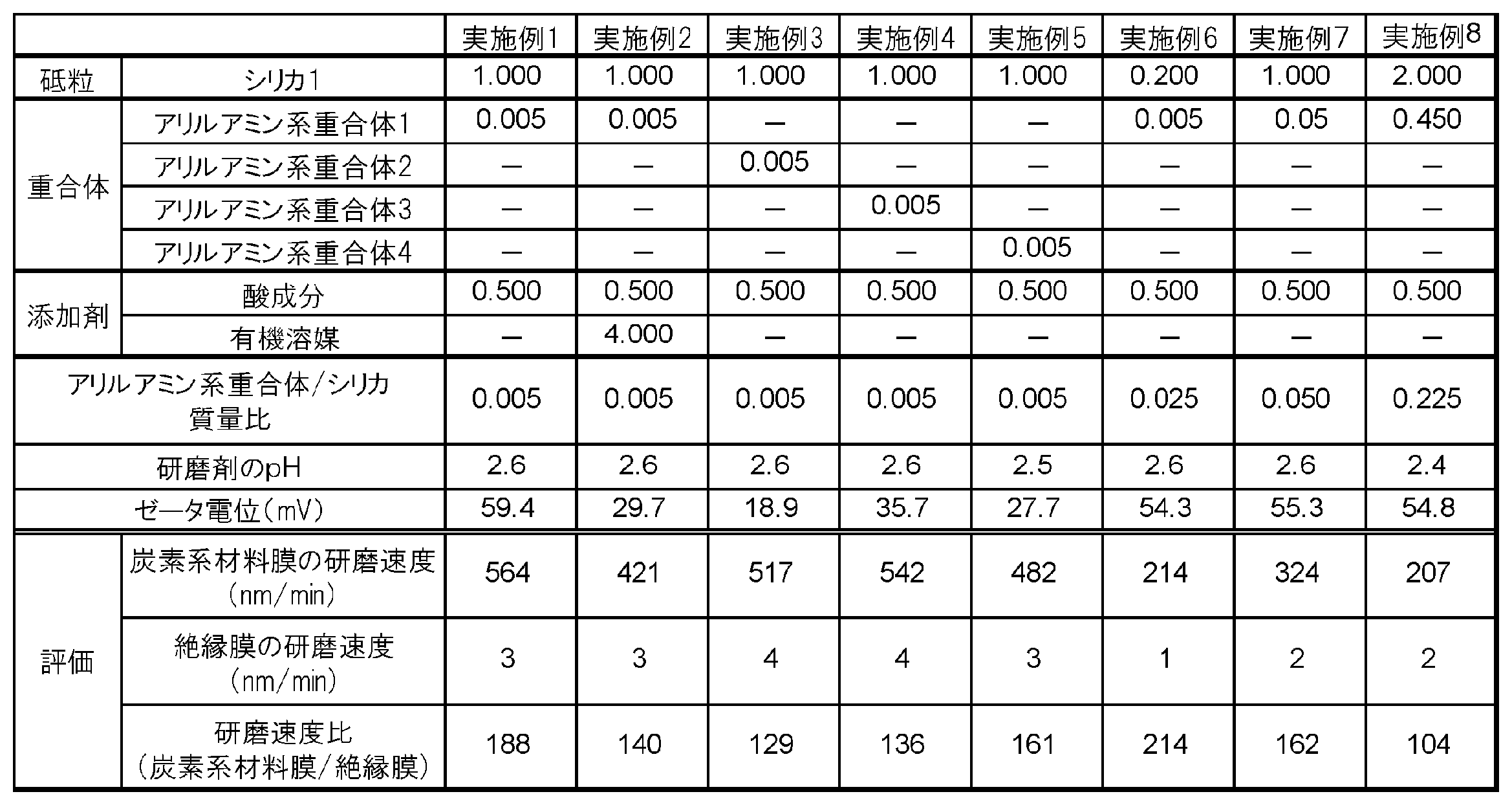
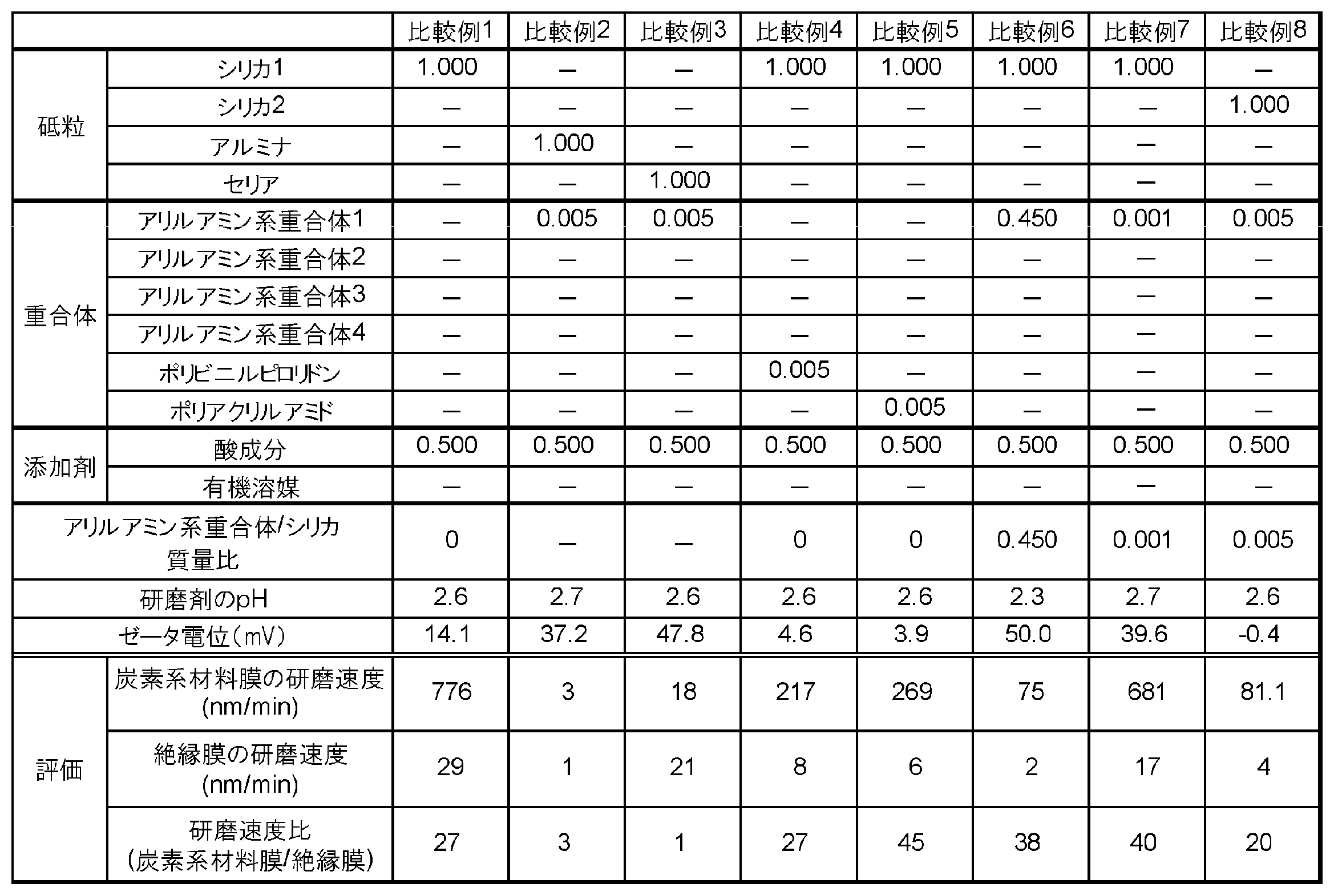
- the polishing rate ratio was calculated by dividing the polishing rate of the carbon-based material film by the polishing rate of the insulating film. The results are shown in Tables 1 and 2.
- the polishing rate of the carbon-based material film with respect to the insulating film is high because the polishing rate of the carbon-based material film is higher and the polishing rate of the insulating film is slower than the comparative example. .
- Example 1 Comparing Example 1 and Example 3, in Example 1, compared with Example 3, the polishing rate of the carbon-based material film is particularly high, and the polishing rate ratio is particularly high. This is presumably because the allylamine polymer of Example 1 is bulkier than the allylamine polymer of Example 3, and a steric hindrance effect is produced, so that the contact frequency between the abrasive grains and the insulating film tends to decrease.
- the allylamine compound forms a copolymer with a compound other than the allylamine compound. That is, compared to the allylamine polymer in Example 1, the amount of structural units derived from the allylamine compound in the allylamine polymer is reduced. From this, it is considered that the polishing rate of the carbon-based material film in Example 1 is faster than that in Example 4 and Example 5 because the amount of structural units derived from the allylamine compound is large. Moreover, in Example 1, the grinding
- Example 8 in which the content of allylamine polymer and the content of abrasive grains are both large, and the mass ratio of the content of allylamine polymer to the content of abrasive grains is in the range of 0.002 to 0.400.
- the polishing rate of the carbon-based material film is slower than that of Example 1, but the polishing rate ratio of the carbon-based material film to the insulating film is higher than that of the comparative example.
Landscapes
- Chemical & Material Sciences (AREA)
- Engineering & Computer Science (AREA)
- Organic Chemistry (AREA)
- Materials Engineering (AREA)
- Mechanical Engineering (AREA)
- Finish Polishing, Edge Sharpening, And Grinding By Specific Grinding Devices (AREA)
- Mechanical Treatment Of Semiconductor (AREA)
- Chemical Kinetics & Catalysis (AREA)
- General Chemical & Material Sciences (AREA)
Abstract
Description

本明細書において「工程」との語には、独立した工程だけでなく、他の工程と明確に区別できないもののその工程の所期の作用が達成される工程が含まれる。
本実施形態に係る研磨剤は、研磨時に被研磨面に触れる組成物であり、例えばCMP用研磨剤である。
本実施形態に係る研磨剤は、シリカを含む砥粒を含有する。砥粒は、研磨剤中で正の電荷を有している。他の種類の砥粒と比較してシリカの炭素系材料への親和性が高いことから、砥粒と炭素系材料との接触頻度が増加すると考えられる。
本実施形態に係る研磨剤は、アリルアミン系重合体を含有する。本明細書において「アリルアミン系重合体」とは、アリルアミン系化合物を含む単量体を重合して得られる構造単位を有する重合体として定義される。本明細書において「アリルアミン系化合物」とは、アリル基及びアミノ基を有する化合物として定義される。アリルアミン系重合体は、アリルアミン系化合物のみを重合して得られる構造単位を有していてもよく、アリルアミン系化合物と、アリルアミン系化合物以外の化合物とを共重合して得られる構造単位を有していてもよい。アリルアミン系化合物は、一種類又は二種類以上を組み合わせて使用できる。
試料:20μL
標準ポリエチレングリコール:ポリマー・ラボラトリー社製標準ポリエチレングリコール(分子量:106、194、440、600、1470、4100、7100、10300、12600、23000)
検出器:昭和電工株式会社製、RI-モニター、商品名「Syodex―RI SE-61」
ポンプ:株式会社日立製作所製、商品名「L-6000」
カラム:昭和電工株式会社製、商品名「GS-220HQ」、「GS-620HQ」をこの順番で連結して使用
溶離液:0.4mol/Lの塩化ナトリウム水溶液
測定温度:30℃
流速:1.00mL/min
測定時間:45min



本実施形態に係る研磨剤は水を含有する。水は、他の成分の分散媒、又は、溶媒として用いられる。水としては、他の成分の作用を阻害することを防止するために不純物を可能な限り含有しないものが好ましい。具体的には、水としては、イオン交換樹脂にて不純物イオンを除去した後にフィルタを通して異物を除去した純水及び超純水、並びに、蒸留水が好ましい。
本実施形態に係る研磨剤は、研磨剤中の砥粒の分散性の向上、研磨剤の化学的安定性の向上、研磨速度の向上等の目的で、砥粒、アリルアミン系重合体及び水以外の成分を更に含有してもよい。このような成分としては、有機溶媒、酸成分、腐食防止剤、消泡剤等の添加剤が挙げられる。添加剤の研磨剤中の含有量は、研磨剤の特性を損なわない範囲で任意に決定できる。
本実施形態に係る研磨剤は、有機溶媒を含有してもよい。研磨剤が有機溶媒を含有することにより、研磨速度比を調整できると共に研磨剤の濡れ性を向上させることができる。有機溶媒としては、特に制限はないが、20℃で液状の溶媒が好ましい。100gの水(20℃)に対する有機溶媒の溶解度は、研磨剤を高濃縮化する観点から、30g以上が好ましく、50g以上がより好ましく、100g以上が更に好ましい。有機溶媒は、一種類又は二種類以上を組み合わせて使用できる。
本実施形態に係る研磨剤は、酸成分を含有してもよい。本実施形態に係る研磨剤が酸成分を含有してpHが制御されることにより、研磨剤の液状安定性を高めることができると共に被研磨面を更に良好に平坦化できる。酸成分は、水系分散体の分散性、安定性及び研磨速度を更に向上させることができる観点から、有機酸及び無機酸からなる群より選ばれる少なくとも一種が好ましい。有機酸としては、特に制限はないが、ギ酸、酢酸、プロピオン酸、酪酸、吉草酸、2-メチル酪酸、n-ヘキサン酸、3,3-ジメチル酪酸、2-エチル酪酸、4-メチルペンタン酸、n-ヘプタン酸、2-メチルヘキサン酸、n-オクタン酸、2-エチルヘキサン酸、安息香酸、グリコ-ル酸、サリチル酸、グリセリン酸、シュウ酸、マロン酸、コハク酸、グルタル酸、アジピン酸、ピメリン酸、マレイン酸、フタル酸、リンゴ酸、酒石酸、クエン酸等が挙げられる。無機酸としては、特に制限はないが、塩酸、硫酸、硝酸、クロム酸等が挙げられる。
本実施形態に係る研磨剤のpHは、充分な機械的研磨力が得られ易く炭素系材料の研磨速度が更に向上する観点から、1.0以上が好ましく、1.5以上がより好ましく、2.0以上が更に好ましく、2.3以上が特に好ましい。研磨剤のpHは、砥粒の良好な分散安定性が得られる観点から、8.0以下が好ましく、5.0以下がより好ましく、4.0以下が更に好ましく、3.5以下が特に好ましく、3.0以下が極めて好ましい。研磨剤のpHは、例えば、前記酸成分;アンモニア、水酸化ナトリウム、水酸化カリウム、TMAH(テトラメチルアンモニウムヒドリド)等の塩基成分などにより調整してもよい。pHは液温25℃におけるpHと定義する。
本実施形態に係る研磨剤用貯蔵液は、前記研磨剤を得るための貯蔵液であり、研磨剤用貯蔵液を水で希釈することにより前記研磨剤が得られる。研磨剤用貯蔵液は、水の量を使用時よりも減じて保管されており、使用前又は使用時に水で希釈されて前記研磨剤として用いられる。研磨剤用貯蔵液は、水の含有量が前記研磨剤よりも少ない点で前記研磨剤と異なっている。希釈倍率は、例えば1.5倍以上である。
次に、本実施形態に係る研磨方法について説明する。
(実施例1)
リンゴ酸(酸成分)0.500質量部と、メチルジアリルアミンアミド硫酸塩重合体(ニットーボーメディカル株式会社製、PAS-22SA-40、重量平均分子量:17000。式(II)の構造単位を有する。以下、「アリルアミン系重合体1」という)0.005質量部とを容器に入れた。さらに、超純水X質量部を注いだ後に攪拌して各成分を溶解させた。次に、平均粒子径が70nmであるコロイダルシリカ1を1.000質量部添加して研磨剤100質量部を得た。砥粒の表面は、研磨剤中において正に帯電していた。なお、超純水の配合量X質量部は、研磨剤が100質量部になるよう計算して調整した。実施例1の研磨剤中におけるシリカのゼータ電位は、59.4mVであった。
有機溶媒としてプロピレングリコールモノプロピルエーテル4.000質量部を加えた以外は実施例1と同様にして研磨剤を得た。実施例2の研磨剤中におけるシリカのゼータ電位は、29.7mVであった。
アリルアミン系重合体として、アリルアミン系重合体1に代えて、アリルアミン重合体(ニットーボーメディカル株式会社製、PAA-01、重量平均分子量:1600。式(I)の構造単位を有する。以下、「アリルアミン系重合体2」という)0.005質量部を用いたこと以外は実施例1と同様にして研磨剤を得た。実施例3の研磨剤中におけるシリカのゼータ電位は、18.9mVであった。
アリルアミン系重合体として、アリルアミン系重合体1に代えて、ジアリルジメチルアンモニウムクロリドアクリルアミド共重合体(ニットーボーメディカル株式会社製、PAS-J―81、重量平均分子量:200000。式(IV)及び式(IX)の構造単位を有する。以下、「アリルアミン系重合体3」という)0.005質量部を用いたこと以外は実施例1と同様にして研磨剤を得た。実施例4の研磨剤中におけるシリカのゼータ電位は、35.7mVであった。
アリルアミン系重合体として、アリルアミン系重合体1に代えて、ジアリルアミン塩酸塩二酸化硫黄共重合体(ニットーボーメディカル株式会社製、PAS-92、重量平均分子量:200000。式(II)及び式(VII)の構造単位を有する。以下、「アリルアミン系重合体4」という)0.005質量部を用いたこと以外は実施例1と同様にして研磨剤を得た。実施例5の研磨剤中におけるシリカのゼータ電位は、27.7mVであった。
砥粒の含有量を1.000質量部から0.200質量部に変えたこと以外は実施例1と同様にして研磨剤を得た。実施例6の研磨剤中におけるシリカのゼータ電位は、54.3mVであった。
アリルアミン系重合体1の含有量を0.005質量部から0.050質量部に変えたこと以外は実施例1と同様にして研磨剤を得た。実施例7の研磨剤中におけるシリカのゼータ電位は、55.3mVであった。
砥粒の含有量を1.000質量部から2.000質量部に変えたこと、及び、アリルアミン系重合体1の含有量を0.005質量部から0.450質量部に変えたこと以外は実施例1と同様にして研磨剤を得た。実施例8の研磨剤中におけるシリカのゼータ電位は、54.8mVであった。
アリルアミン系重合体を用いないこと以外は実施例1と同様にして研磨剤を得た。比較例1の研磨剤中におけるシリカのゼータ電位は、14.1mVであった。
砥粒としてシリカに代えてアルミナを用いたこと以外は実施例1と同様にして研磨剤を得た。比較例2の研磨剤中におけるシリカのゼータ電位は、37.2mVであった。
砥粒としてシリカに代えてセリア(酸化セリウム)を用いたこと以外は実施例1と同様にして研磨剤を得た。比較例3の研磨剤中におけるシリカのゼータ電位は、47.8mVであった。
アリルアミン系重合体1に代えて、ポリビニルピロリドン0.005質量部を用いたこと以外は実施例1と同様にして研磨剤を得た。比較例4の研磨剤中におけるシリカのゼータ電位は、4.6mVであった。
アリルアミン系重合体1に代えて、ポリアクリルアミド0.005質量部を用いたこと以外は実施例1と同様にして研磨剤を得た。比較例5の研磨剤中におけるシリカのゼータ電位は、3.9mVであった。
アリルアミン系重合体の含有量を0.005質量部から0.450質量部に変えたこと以外は実施例1と同様にして研磨剤を得た。比較例6の研磨剤中におけるシリカのゼータ電位は、50.0mVであった。
アリルアミン系重合体の含有量を0.005質量部から0.001質量部に変えたこと以外は実施例1と同様にして研磨剤を得た。比較例7の研磨剤中におけるシリカのゼータ電位は、39.6mVであった。
コロイダルシリカ1に代えて、表面がスルホン酸修飾されたコロイダルシリカ2(平均粒子径:70nm)を1.000質量部用いたこと以外は実施例1と同様にして研磨剤を得た。比較例8の研磨剤中におけるシリカのゼータ電位は、-0.4mVであった。
研磨剤のpHを下記の条件で評価した。結果を表1及び表2に示す。
測定温度:25±5℃
測定装置:株式会社堀場製作所の商品名:Model(F-51)
測定方法:フタル酸塩pH標準液(4.01)と、中性リン酸塩pH標準液(pH6.86)と、ホウ酸塩pH標準液(pH9.18)とをpH標準液として用い、pHメータを3点校正した後、pHメータの電極を研磨剤に入れて、2min以上経過して安定した後のpHを前記測定装置により測定した。
被研磨対象の基体として、X線光電子分光(XPS)法により測定される炭素量が89atm%である厚み200nmのスピンオンカーボン膜(炭素系材料膜)をシリコン基板上に形成して得られる基体と、厚み1000nmの二酸化珪素膜(絶縁膜)をシリコン基板上にCVD法で形成して得られる基体とを用いた。研磨装置(株式会社ナノファクター製、FACT-200)の基体取り付け用吸着パッドを貼り付けたホルダーに、2cm角に切断した前記各基体を固定した。発泡ポリウレタンの研磨布を貼り付けた定盤上に、炭素系材料面を下にしてホルダーを載せた。加工荷重が200g/cm2になるように重しを載せた。定盤上に研磨剤を10mL/minで滴下しながら、定盤回転数を80min-1に設定し、炭素系材料膜及び絶縁膜を60秒間研磨した。
Claims (12)
- X線光電子分光法により測定される炭素量が60~95atm%である炭素系材料と、絶縁材料と、を有する基体を化学機械研磨して、前記炭素系材料の少なくとも一部を除去するための研磨剤であって、
前記研磨剤が、シリカを含む砥粒と、アリルアミン系重合体と、水と、を含有し、
前記砥粒の含有量に対する前記アリルアミン系重合体の含有量の質量比が0.002~0.400であり、
前記砥粒が前記研磨剤中で正の電荷を有する、研磨剤。 - 前記アリルアミン系重合体が、下記一般式(I)で表される構造単位、下記一般式(II)で表される構造単位、下記一般式(III)で表される構造単位、下記一般式(IV)で表される構造単位、及び、下記一般式(V)で表される構造単位からなる群より選択される少なくとも一種を有する、請求項1に記載の研磨剤。

- 前記シリカがコロイダルシリカである、請求項1又は2に記載の研磨剤。
- 有機溶媒を更に含有する、請求項1~3のいずれか一項に記載の研磨剤。
- pHが1.0~8.0である、請求項1~4のいずれか一項に記載の研磨剤。
- 酸成分を更に含有する、請求項1~5のいずれか一項に記載の研磨剤。
- 前記絶縁材料に対する前記炭素系材料の研磨速度比が50以上である、請求項1~6のいずれか一項に記載の研磨剤。
- 前記砥粒及び水を含む第一の液と、
前記アリルアミン系重合体及び水を含む第二の液と、を有する複数液式研磨剤として保存される、請求項1~7のいずれか一項に記載の研磨剤。 - 請求項1~8のいずれか一項に記載の研磨剤を得るための研磨剤用貯蔵液であって、
水で希釈することにより前記研磨剤が得られる、研磨剤用貯蔵液。 - X線光電子分光法により測定される炭素量が60~95atm%である炭素系材料と、絶縁材料と、を有する基体を用意する工程と、
請求項1~8のいずれか一項に記載の研磨剤を用いて前記基体を化学機械研磨して、前記炭素系材料の少なくとも一部を除去する研磨工程と、を備える、研磨方法。 - X線光電子分光法により測定される炭素量が60~95atm%である炭素系材料と、絶縁材料と、を有する基体を用意する工程と、
請求項9に記載の研磨剤用貯蔵液を水で希釈して前記研磨剤を得る工程と、
前記研磨剤を用いて前記基体を化学機械研磨して、前記炭素系材料の少なくとも一部を除去する研磨工程と、を備える、研磨方法。 - 前記研磨工程において前記絶縁材料が露出したときに研磨を停止する、請求項10又は11に記載の研磨方法。
Priority Applications (3)
| Application Number | Priority Date | Filing Date | Title |
|---|---|---|---|
| US15/736,221 US10119049B2 (en) | 2015-06-17 | 2015-06-17 | Polishing agent, storage solution for polishing agent and polishing method |
| PCT/JP2015/067508 WO2016203586A1 (ja) | 2015-06-17 | 2015-06-17 | 研磨剤、研磨剤用貯蔵液及び研磨方法 |
| KR1020177034567A KR102392596B1 (ko) | 2015-06-17 | 2015-06-17 | 연마제, 연마제용 저장액 및 연마 방법 |
Applications Claiming Priority (1)
| Application Number | Priority Date | Filing Date | Title |
|---|---|---|---|
| PCT/JP2015/067508 WO2016203586A1 (ja) | 2015-06-17 | 2015-06-17 | 研磨剤、研磨剤用貯蔵液及び研磨方法 |
Publications (1)
| Publication Number | Publication Date |
|---|---|
| WO2016203586A1 true WO2016203586A1 (ja) | 2016-12-22 |
Family
ID=57545145
Family Applications (1)
| Application Number | Title | Priority Date | Filing Date |
|---|---|---|---|
| PCT/JP2015/067508 Ceased WO2016203586A1 (ja) | 2015-06-17 | 2015-06-17 | 研磨剤、研磨剤用貯蔵液及び研磨方法 |
Country Status (3)
| Country | Link |
|---|---|
| US (1) | US10119049B2 (ja) |
| KR (1) | KR102392596B1 (ja) |
| WO (1) | WO2016203586A1 (ja) |
Cited By (2)
| Publication number | Priority date | Publication date | Assignee | Title |
|---|---|---|---|---|
| JP2021054990A (ja) * | 2019-09-30 | 2021-04-08 | 株式会社フジミインコーポレーテッド | 研磨用組成物および磁気ディスク基板製造方法 |
| WO2021172427A1 (ja) * | 2020-02-28 | 2021-09-02 | 株式会社フジミインコーポレーテッド | ジルコニア粒子と酸化剤を含む研磨組成物 |
Families Citing this family (3)
| Publication number | Priority date | Publication date | Assignee | Title |
|---|---|---|---|---|
| KR101827366B1 (ko) * | 2016-05-16 | 2018-02-09 | 주식회사 케이씨텍 | 고단차 연마용 슬러리 조성물 |
| US11597854B2 (en) * | 2019-07-16 | 2023-03-07 | Cmc Materials, Inc. | Method to increase barrier film removal rate in bulk tungsten slurry |
| JP7327518B2 (ja) * | 2020-01-16 | 2023-08-16 | 株式会社レゾナック | 研磨剤、研磨剤用貯蔵液及び研磨方法 |
Citations (7)
| Publication number | Priority date | Publication date | Assignee | Title |
|---|---|---|---|---|
| JP2007144613A (ja) * | 2005-10-25 | 2007-06-14 | Hitachi Chem Co Ltd | 有機膜研磨用研磨液及びこれを用いた有機膜の研磨方法 |
| JP2008541158A (ja) * | 2005-05-13 | 2008-11-20 | アンジ マイクロエレクトロニクス(シャンハイ)カンパニー, リミテッド | フォトレジスト層除去用組成物及びその使用方法 |
| JP2010056199A (ja) * | 2008-08-27 | 2010-03-11 | Fujifilm Corp | 研磨用組成物及びそれを用いた研磨方法 |
| JP2011060888A (ja) * | 2009-09-08 | 2011-03-24 | Hitachi Chem Co Ltd | 研磨液 |
| JP2012142064A (ja) * | 2010-12-16 | 2012-07-26 | Kao Corp | 磁気ディスク基板用研磨液組成物 |
| WO2012161202A1 (ja) * | 2011-05-24 | 2012-11-29 | 株式会社クラレ | 化学機械研磨用エロージョン防止剤、化学機械研磨用スラリーおよび化学機械研磨方法 |
| JP2015021132A (ja) * | 2013-07-17 | 2015-02-02 | サムスン エレクトロニクス カンパニー リミテッド | 有機膜研磨に用いられるcmp用スラリー組成物、これを利用し、cmp処理を行う方法及びこれを利用する半導体装置の製造方法 |
Family Cites Families (6)
| Publication number | Priority date | Publication date | Assignee | Title |
|---|---|---|---|---|
| US6776810B1 (en) | 2002-02-11 | 2004-08-17 | Cabot Microelectronics Corporation | Anionic abrasive particles treated with positively charged polyelectrolytes for CMP |
| KR100876816B1 (ko) | 2007-06-29 | 2009-01-07 | 주식회사 하이닉스반도체 | 반도체 소자의 미세 패턴 형성 방법 |
| KR100930400B1 (ko) | 2007-08-13 | 2009-12-08 | 주식회사 하이닉스반도체 | 차동 증폭기 및 이를 이용한 입력 회로 |
| EP2330209B1 (en) | 2008-09-30 | 2017-07-19 | Toray Industries, Inc. | Method and apparatus for producing a chemical and continuous culture system |
| JP5621735B2 (ja) | 2010-09-03 | 2014-11-12 | 信越化学工業株式会社 | パターン形成方法及び化学増幅ポジ型レジスト材料 |
| KR101198814B1 (ko) | 2010-12-27 | 2012-11-12 | (주)섬엔지니어링 | 휴대용 기기 및 그 길 안내 방법 |
-
2015
- 2015-06-17 US US15/736,221 patent/US10119049B2/en active Active
- 2015-06-17 KR KR1020177034567A patent/KR102392596B1/ko active Active
- 2015-06-17 WO PCT/JP2015/067508 patent/WO2016203586A1/ja not_active Ceased
Patent Citations (7)
| Publication number | Priority date | Publication date | Assignee | Title |
|---|---|---|---|---|
| JP2008541158A (ja) * | 2005-05-13 | 2008-11-20 | アンジ マイクロエレクトロニクス(シャンハイ)カンパニー, リミテッド | フォトレジスト層除去用組成物及びその使用方法 |
| JP2007144613A (ja) * | 2005-10-25 | 2007-06-14 | Hitachi Chem Co Ltd | 有機膜研磨用研磨液及びこれを用いた有機膜の研磨方法 |
| JP2010056199A (ja) * | 2008-08-27 | 2010-03-11 | Fujifilm Corp | 研磨用組成物及びそれを用いた研磨方法 |
| JP2011060888A (ja) * | 2009-09-08 | 2011-03-24 | Hitachi Chem Co Ltd | 研磨液 |
| JP2012142064A (ja) * | 2010-12-16 | 2012-07-26 | Kao Corp | 磁気ディスク基板用研磨液組成物 |
| WO2012161202A1 (ja) * | 2011-05-24 | 2012-11-29 | 株式会社クラレ | 化学機械研磨用エロージョン防止剤、化学機械研磨用スラリーおよび化学機械研磨方法 |
| JP2015021132A (ja) * | 2013-07-17 | 2015-02-02 | サムスン エレクトロニクス カンパニー リミテッド | 有機膜研磨に用いられるcmp用スラリー組成物、これを利用し、cmp処理を行う方法及びこれを利用する半導体装置の製造方法 |
Cited By (6)
| Publication number | Priority date | Publication date | Assignee | Title |
|---|---|---|---|---|
| JP2021054990A (ja) * | 2019-09-30 | 2021-04-08 | 株式会社フジミインコーポレーテッド | 研磨用組成物および磁気ディスク基板製造方法 |
| JP7458732B2 (ja) | 2019-09-30 | 2024-04-01 | 株式会社フジミインコーポレーテッド | 研磨用組成物および磁気ディスク基板製造方法 |
| WO2021172427A1 (ja) * | 2020-02-28 | 2021-09-02 | 株式会社フジミインコーポレーテッド | ジルコニア粒子と酸化剤を含む研磨組成物 |
| JPWO2021172427A1 (ja) * | 2020-02-28 | 2021-09-02 | ||
| JP7690454B2 (ja) | 2020-02-28 | 2025-06-10 | 株式会社フジミインコーポレーテッド | ジルコニア粒子と酸化剤を含む研磨組成物 |
| US12577430B2 (en) | 2020-02-28 | 2026-03-17 | Fujimi Incorporated | Polishing composition containing zirconia particles and an oxidizer |
Also Published As
| Publication number | Publication date |
|---|---|
| US10119049B2 (en) | 2018-11-06 |
| KR20180019087A (ko) | 2018-02-23 |
| US20180179417A1 (en) | 2018-06-28 |
| KR102392596B1 (ko) | 2022-04-28 |
Similar Documents
| Publication | Publication Date | Title |
|---|---|---|
| JP6879202B2 (ja) | 研磨剤、研磨剤用貯蔵液及び研磨方法 | |
| JP5423669B2 (ja) | 研磨剤及びこの研磨剤を用いた基板の研磨方法 | |
| JP6107826B2 (ja) | 研磨剤、研磨剤セット及び基体の研磨方法 | |
| JP6044630B2 (ja) | 研磨剤、研磨剤セット及び基体の研磨方法 | |
| JP6375623B2 (ja) | 研磨剤、研磨剤セット及び基体の研磨方法 | |
| KR20170032335A (ko) | Cmp용 연마액 및 연마 방법 | |
| TWI683896B (zh) | 研磨用組成物 | |
| WO2013125441A1 (ja) | 研磨剤、研磨剤セット及び基体の研磨方法 | |
| WO2014034379A1 (ja) | 研磨剤、研磨剤セット及び基体の研磨方法 | |
| JP2017149798A (ja) | 研磨液、研磨液セット及び基体の研磨方法 | |
| KR102392596B1 (ko) | 연마제, 연마제용 저장액 및 연마 방법 | |
| JP6349852B2 (ja) | 研磨剤、研磨剤用貯蔵液及び研磨方法 | |
| JP6999714B2 (ja) | シャロートレンチアイソレーション化学機械研磨スラリー | |
| JP6405776B2 (ja) | タングステン用研磨剤、研磨剤用貯蔵液及び研磨方法 | |
| JP7327518B2 (ja) | 研磨剤、研磨剤用貯蔵液及び研磨方法 | |
| TW202330818A (zh) | 提高多晶矽的移除速率之方法 | |
| TWI666308B (zh) | 研磨劑、研磨劑用儲藏液及研磨方法 | |
| TW202012586A (zh) | 研磨用組合物及其製造方法以及研磨方法和基板的製造方法 | |
| JP2016023224A (ja) | 研磨剤、研磨剤セット及び基体の研磨方法 |
Legal Events
| Date | Code | Title | Description |
|---|---|---|---|
| 121 | Ep: the epo has been informed by wipo that ep was designated in this application |
Ref document number: 15895607 Country of ref document: EP Kind code of ref document: A1 |
|
| ENP | Entry into the national phase |
Ref document number: 20177034567 Country of ref document: KR Kind code of ref document: A |
|
| WWE | Wipo information: entry into national phase |
Ref document number: 15736221 Country of ref document: US |
|
| NENP | Non-entry into the national phase |
Ref country code: DE |
|
| NENP | Non-entry into the national phase |
Ref country code: JP |
|
| 122 | Ep: pct application non-entry in european phase |
Ref document number: 15895607 Country of ref document: EP Kind code of ref document: A1 |