WO2016199934A1 - 青果物用の保存剤組成物及び保存液、並びに青果物 - Google Patents
青果物用の保存剤組成物及び保存液、並びに青果物 Download PDFInfo
- Publication number
- WO2016199934A1 WO2016199934A1 PCT/JP2016/067483 JP2016067483W WO2016199934A1 WO 2016199934 A1 WO2016199934 A1 WO 2016199934A1 JP 2016067483 W JP2016067483 W JP 2016067483W WO 2016199934 A1 WO2016199934 A1 WO 2016199934A1
- Authority
- WO
- WIPO (PCT)
- Prior art keywords
- fruits
- glucosamine
- vegetables
- preservative composition
- preservative
- Prior art date
- Legal status (The legal status is an assumption and is not a legal conclusion. Google has not performed a legal analysis and makes no representation as to the accuracy of the status listed.)
- Ceased
Links
Classifications
-
- A—HUMAN NECESSITIES
- A23—FOODS OR FOODSTUFFS; TREATMENT THEREOF, NOT COVERED BY OTHER CLASSES
- A23B—PRESERVATION OF FOODS, FOODSTUFFS OR NON-ALCOHOLIC BEVERAGES; CHEMICAL RIPENING OF FRUIT OR VEGETABLES
- A23B7/00—Preservation of fruit or vegetables; Chemical ripening of fruit or vegetables
- A23B7/10—Preserving with acids; Acid fermentation
-
- A—HUMAN NECESSITIES
- A23—FOODS OR FOODSTUFFS; TREATMENT THEREOF, NOT COVERED BY OTHER CLASSES
- A23B—PRESERVATION OF FOODS, FOODSTUFFS OR NON-ALCOHOLIC BEVERAGES; CHEMICAL RIPENING OF FRUIT OR VEGETABLES
- A23B2/00—Preservation of foods or foodstuffs, in general
- A23B2/70—Preservation of foods or foodstuffs, in general by treatment with chemicals
- A23B2/725—Preservation of foods or foodstuffs, in general by treatment with chemicals in the form of liquids or solids
- A23B2/729—Organic compounds; Microorganisms; Enzymes
-
- A—HUMAN NECESSITIES
- A23—FOODS OR FOODSTUFFS; TREATMENT THEREOF, NOT COVERED BY OTHER CLASSES
- A23B—PRESERVATION OF FOODS, FOODSTUFFS OR NON-ALCOHOLIC BEVERAGES; CHEMICAL RIPENING OF FRUIT OR VEGETABLES
- A23B7/00—Preservation of fruit or vegetables; Chemical ripening of fruit or vegetables
- A23B7/14—Preserving or ripening with chemicals not covered by group A23B7/08 or A23B7/10
-
- A—HUMAN NECESSITIES
- A23—FOODS OR FOODSTUFFS; TREATMENT THEREOF, NOT COVERED BY OTHER CLASSES
- A23B—PRESERVATION OF FOODS, FOODSTUFFS OR NON-ALCOHOLIC BEVERAGES; CHEMICAL RIPENING OF FRUIT OR VEGETABLES
- A23B7/00—Preservation of fruit or vegetables; Chemical ripening of fruit or vegetables
- A23B7/14—Preserving or ripening with chemicals not covered by group A23B7/08 or A23B7/10
- A23B7/153—Preserving or ripening with chemicals not covered by group A23B7/08 or A23B7/10 in the form of liquids or solids
-
- A—HUMAN NECESSITIES
- A23—FOODS OR FOODSTUFFS; TREATMENT THEREOF, NOT COVERED BY OTHER CLASSES
- A23L—FOODS, FOODSTUFFS OR NON-ALCOHOLIC BEVERAGES, NOT OTHERWISE PROVIDED FOR; PREPARATION OR TREATMENT THEREOF
- A23L19/00—Products from fruits or vegetables; Preparation or treatment thereof
-
- A—HUMAN NECESSITIES
- A23—FOODS OR FOODSTUFFS; TREATMENT THEREOF, NOT COVERED BY OTHER CLASSES
- A23L—FOODS, FOODSTUFFS OR NON-ALCOHOLIC BEVERAGES, NOT OTHERWISE PROVIDED FOR; PREPARATION OR TREATMENT THEREOF
- A23L29/00—Foods or foodstuffs containing additives; Preparation or treatment thereof
- A23L29/10—Foods or foodstuffs containing additives; Preparation or treatment thereof containing emulsifiers
-
- A—HUMAN NECESSITIES
- A23—FOODS OR FOODSTUFFS; TREATMENT THEREOF, NOT COVERED BY OTHER CLASSES
- A23V—INDEXING SCHEME RELATING TO FOODS, FOODSTUFFS OR NON-ALCOHOLIC BEVERAGES AND LACTIC OR PROPIONIC ACID BACTERIA USED IN FOODSTUFFS OR FOOD PREPARATION
- A23V2002/00—Food compositions, function of food ingredients or processes for food or foodstuffs
-
- Y—GENERAL TAGGING OF NEW TECHNOLOGICAL DEVELOPMENTS; GENERAL TAGGING OF CROSS-SECTIONAL TECHNOLOGIES SPANNING OVER SEVERAL SECTIONS OF THE IPC; TECHNICAL SUBJECTS COVERED BY FORMER USPC CROSS-REFERENCE ART COLLECTIONS [XRACs] AND DIGESTS
- Y02—TECHNOLOGIES OR APPLICATIONS FOR MITIGATION OR ADAPTATION AGAINST CLIMATE CHANGE
- Y02A—TECHNOLOGIES FOR ADAPTATION TO CLIMATE CHANGE
- Y02A40/00—Adaptation technologies in agriculture, forestry, livestock or agroalimentary production
- Y02A40/90—Adaptation technologies in agriculture, forestry, livestock or agroalimentary production in food processing or handling, e.g. food conservation
Definitions
- the present invention relates to a preservative composition for fruits and vegetables and fruits and vegetables treated with the preservative composition.
- Technology for maintaining the freshness and preservation of fruits and vegetables includes storage technologies that control temperature, humidity, and pressure, packaging materials that contain fruits and vegetables, and freshness that absorbs, removes, or suppresses carbon dioxide and ethylene gas generated by fruits and vegetables. There are a retention agent, and a composition for improving storage stability by addition to fruits and vegetables.
- Patent Document 1 discloses about 0.2 to about 3% by weight of chitosan or modified chitosan, about 0.1 to 1.0% by weight of an organic acid, and about 0.02 to 0.1% by weight of an interface. Coating compositions for the preservation of fresh products comprising aqueous solutions with active agents have been proposed.
- the composition for improving storage stability by addition to fruits and vegetables has the advantage that it can be expected to improve storage stability over a relatively long period of time at a low cost.
- fruits and vegetables can be stored for a long period of time
- consumers and sellers of fruits and vegetables tend to be concerned about safety to the human body.
- the drugs that are prohibited for use in fruits and vegetables vary depending on the country. Even if the use is prohibited in some countries, some drugs are permitted in other countries. This may be a reason for concern.
- the present invention aims to provide a preservative composition and a preservative solution that can improve the preservability of fruits and vegetables and are safer for the human body.
- the inventors of the present invention have examined how long a conventional preservative used in fruits and vegetables will not corrode on the fruits and vegetables due to its use. I noticed that there was a preservative available. Since fruits and vegetables can be stored for a very long period of time, there is a concern that consumers and sellers may be using strong drugs, whether or not they are actually used. The present inventors believe that in the preservatives for fruits and vegetables, the necessity to be able to be preserved for a very long period of several months after the harvest of fruits and vegetables is actually not so high, and the safety to the human body is further increased. As a result, intensive studies were conducted on active ingredients for improving the storage stability. As a result, the present inventors have found that the preservability of fruits and vegetables can be improved by using organic acids and glucosamines as preservative components, and have completed the present invention.
- a preservative composition is provided for fruits and vegetables containing an organic acid and / or a salt thereof and at least one selected from the group consisting of glucosamine, glucosamine derivatives, chitin oligosaccharides, chitosan oligosaccharides, and salts thereof.
- a preservative composition is provided for fruits and vegetables containing the said preservative composition and a liquid medium.
- the preservability of fruits and vegetables can be improved, and a safer preservative composition and preservative solution can be provided for the human body.
- a preservative composition for fruits and vegetables according to an embodiment of the present invention includes an organic acid and / or a salt thereof, glucosamine, a glucosamine derivative, and a chitin oligo. It contains at least one selected from the group consisting of sugars, chitosan oligosaccharides, and salts thereof.
- At least one selected from the group consisting of organic acids and salts thereof is a component for improving the preservability of fruits and vegetables.
- the preservative composition is selected from the group consisting of glucosamine, glucosamine derivatives, chitin oligosaccharides, chitosan oligosaccharides, and salts thereof (hereinafter sometimes referred to as “glucosamine etc.”) in addition to organic acids.
- the preservative composition of the present embodiment contains at least one of organic acids and at least one of glucosamine and the like as an active ingredient for improving the preservability of fruits and vegetables, and is therefore safer for the human body. Is possible.
- the concept of the shelf life improvement of fruits and vegetables is also included in the improvement of the preservability of fruits and vegetables.
- Organic acids that can be used as food additives can be used.
- organic acids include acetic acid, citric acid, lactic acid, malic acid, succinic acid, propionic acid, adipic acid, itaconic acid, gluconic acid, tartaric acid, fumaric acid, and salts thereof.
- Suitable salts include metal salts such as sodium salts, potassium salts, and calcium salts. From the viewpoint of improving the preservability of fruits and vegetables more safely, acetic acid, citric acid, lactic acid, and salts thereof are preferable as organic acids, and acetic acid and salts thereof are more preferable.
- An organic acid and its salt can be used individually by 1 type or in combination of 2 or more types.
- Glucosamine, glucosamine derivatives, chitin oligosaccharides, chitosan oligosaccharides, and salts thereof can be obtained by oxidizing chitin or chitosan with ozone, hydrolyzing with acid or alkali, or hydrolyzing with enzyme.
- Chitin is a kind of polysaccharide contained in cell shells such as crustaceans such as crabs and shrimps, exoskeletons such as insects, organic skeletons such as squids and shellfish, and mushrooms and molds.
- Chitosan is a kind of polysaccharide obtained by deacetylation of chitin by alkali treatment or the like.
- Examples of the salt in glucosamine include inorganic acid salts such as hydrochloride, sulfate, and phosphate.
- Examples of the glucosamine derivative include N-acetylglucosamine and N-methyl-L-glucosamine. Of these, N-acetylglucosamine is preferable from the viewpoint of easy availability.
- the chitin oligosaccharide is an oligosaccharide obtained by decomposing chitin and is also referred to as oligo-N-acetylglucosamine. In the present specification, chitin oligosaccharides include mild degradation products of chitin.
- the chitosan oligosaccharide is an oligosaccharide obtained by decomposing chitosan and is also referred to as oligoglucosamine.
- the chitosan oligosaccharide includes a mild degradation product of chitosan.
- Chitin oligosaccharides and chitosan oligosaccharides preferably have a weight average molecular weight of 300 to 3000, more preferably 300 to 2000, and still more preferably 300 to 1000.
- Both the light degradation product of chitin and the light degradation product of chitosan have a weight average molecular weight of more than 3000.
- Glucosamine etc. can be used individually by 1 type or in combination of 2 or more types.
- the weight average molecular weight is a value in terms of pullulan measured by GPC or HPLC using pullulan as a standard substance.
- glucosamine glucosamine derivatives, chitin oligosaccharides, chitosan oligosaccharides, and salts thereof, glucosamine that is a monosaccharide, and hydrochlorides and sulfates thereof, and N-acetylglucosamine are preferable.
- glucosamines it is more preferable to use glucosamine derived from microorganisms.
- Glucosamine derived from microorganisms has not only the advantage that it is more effective from the viewpoint of improving the storage stability of fruits and vegetables, but also the advantage that there are no allergens derived from crustaceans such as crabs and shrimps.
- Glucosamine derived from microorganisms is produced in a medium by fermenting and producing glucosamine using a genetically modified microorganism such as Escherichia coli or yeast, or by liquid culture using a filamentous fungus capable of producing glucosamine. And can be obtained by an efficient separation method.
- the microorganism-derived glucosamine is more preferably the microorganism-derived glucosamine used for citric acid fermentation.
- This glucosamine can be obtained by decomposing and purifying microbial cells such as filamentous fungi used in citric acid fermentation, particularly chitin contained in the cell wall of the surplus cells (for example, JP 2005-2005). No. 507233).
- Suitable microbial cells include filamentous fungi such as Aspergillus, Penicillium, and Mucor. More preferable fungi include microbial cells belonging to the genus Aspergillus such as Aspergillus terreus, Aspergillus terreus, Aspergillus oryzae, and the like.
- As a medium used for fermentation of these microbial cells a medium containing a sugar such as starch is preferable, and a medium containing a sugar from a plant such as corn starch is more preferable.
- chitosan derived from fruit bodies and mycelium such as shiitake mushroom, enoki, mushroom, maitake, shimeji, and mycelium, which are basidiomycetes, derived from fungal mycelium or yeast cell wall Chitosan (hereinafter sometimes referred to as “cell wall-derived chitosan”) is also preferred.
- Chitosan derived from cell walls is obtained by contacting chitin extracted from fungal mycelium or yeast cell wall with an alkali solution to obtain an alkali-insoluble fraction, and then suspending the alkali-insoluble fraction. It can be obtained by contacting with an acidic solution.
- an alkaline aqueous solution such as sodium hydroxide, potassium hydroxide, lithium hydroxide, and ammonium hydroxide can be used.
- an aqueous acid solution such as hydrochloric acid, acetic acid, and formic acid can be used.
- a cell wall from Aspergillus niger is more preferable, and a cell wall from a by-product of a culture process in which the Aspergillus culture is used to obtain citric acid is more preferable.
- Such a cell wall-derived chitosan is a degradation product of chitin extracted from the cell wall as described above, but has a lower molecular weight than chitosan derived from general crustaceans. It is described as an example of a mild decomposition product of.
- the cell wall-derived chitosan preferably has a weight average molecular weight of 100,000 or less, more preferably 50000 or less, and even more preferably 30000 or less.
- the method for preparing cell wall-derived chitosan is disclosed in JP-T-2005-529191 as a method capable of adjusting low molecular weight chitosan.
- chitosan derived from cell walls (more preferably chitosan derived from Aspergillus cell walls) can exhibit the effect of improving the preservability of fruits and vegetables when used in combination with organic acids, unlike chitosan derived from crustaceans.
- chitin is present in the living body and is deacetylated into chitosan.
- Chitin present in crustaceans and chitin present in cell walls such as fungi have different steric structures and crystallinity, and chitosan with different steric structures and crystallinity may be obtained. .
- Glucosamine etc. may be a commercial item.
- a commercial item of glucosamine a brand name "natural glucosamine G" (made by Yaizu Suisan Chemical Co., Ltd.), a brand name “Koyo glucosamine” (made by Koyo Chemical Co., Ltd.), etc. can be mentioned, for example.
- Examples of commercially available products of microorganism-derived glucosamine include trade names “fermented glucosamine G” and “fermented glucosamine K” (manufactured by Kyowa Hakko Bio).
- N-acetylglucosamine examples include the trade name “Marine Sweet YSK” (made by Yaizu Suisan Kagaku Kogyo Co., Ltd.) and the trade name “Koyo N-acetylglucosamine PG” (made by Koyo Chemical Co., Ltd.). it can.
- examples of commercially available chitin oligosaccharides include the trade name “NA-COS-Y” (made by Yaizu Suisan Chemical Co., Ltd.) and the trade name “oligo-N-acetylglucosamine” (made by Koyo Chemical Co., Ltd.). Can do.
- chitosan oligosaccharides examples include trade name “COS-YS” (manufactured by Yaizu Suisan Chemical Co., Ltd.).
- Commercially available products of cell wall-derived chitosan include trade names “KiOmedine-CsU”, “KiOntrime-CsG” and “KitoGreen” (all manufactured by KitoZyme).
- the preservative composition preferably further contains an emulsifier (surfactant).
- an emulsifier surfactant
- each component contained in the preservative composition can be easily mixed.
- an emulsifier the emulsifier which can be used for a foodstuff as a food additive can be used.
- the emulsifier include glycerin fatty acid ester, sucrose fatty acid ester, sorbitan fatty acid ester, propylene glycol fatty acid ester, polyoxyethylene sorbitan fatty acid ester (polysorbate), and nonionic emulsifiers such as lecithin, and anions such as acylated lactic acid. And emulsifiers.
- Nonionic emulsifiers are preferred because of their low irritation and little impact on the environment.
- glycerin fatty acid ester, sucrose fatty acid ester, sorbitan fatty acid ester, and polyoxyethylene sorbitan fatty acid ester (polysorbate) are more preferable from the viewpoint of improving the miscibility of each component in the preservative composition.
- An emulsifier can be used individually by 1 type or in combination of 2 or more types.
- the emulsifier is preferably mixed or dissolved well with water.
- the HLB of the emulsifier is preferably 8 or more, more preferably 10 or more, and further preferably 12 or more. This HLB value can be determined by the Griffin method, and its upper limit is 20.
- Examples of the glycerin fatty acid ester include monoglycerin fatty acid ester, monoglycerin fatty acid organic acid ester, and polyglycerin fatty acid ester.
- Specific examples of monoglycerol fatty acid esters include monoglycerol monocaprylate, monoglycerol dicaprylate, monoglycerol monocaprate, monoglycerol dilaurate, monoglycerol dimyristate, monoglycerol distearate, Examples thereof include monoglycerin dioleic acid ester, monoglycerin dierucic acid ester, and monoglycerin dibehenic acid ester.
- monoglycerol fatty acid organic acid ester examples include monoglycerol caprylic acid succinate, monoglycerol stearate citrate, monoglycerol stearate acetate, monoglycerol stearate succinate, monoglycerol stearate lactate, Examples thereof include monoglyceryl stearic acid diacetyl tartaric acid ester and monoglycerin oleic acid citrate ester.
- polyglycerin fatty acid ester examples include polyglycerin having an average degree of polymerization of 2 or more (preferably 6 to 15) and fatty acid having 8 to 18 carbon atoms (for example, caprylic acid, capric acid, lauric acid, myristic acid, palmitic acid, Stearic acid, oleic acid, and linoleic acid).
- sucrose fatty acid ester examples include those obtained by esterifying one or more hydroxyl groups of sucrose with fatty acids having 6 to 22 carbon atoms.
- Specific examples of the sucrose fatty acid ester include sucrose palmitate, sucrose stearate, sucrose laurate, sucrose behenate, sucrose erucate, and the like.
- sorbitan fatty acid ester examples include those obtained by esterifying one or more hydroxyl groups of sorbitan with fatty acids having 6 to 18 carbon atoms.
- Specific examples of sorbitan fatty acid esters include sorbitan monocaprylate, sorbitan monolaurate, sorbitan monostearate, sorbitan monooleate, and the like.
- the polyoxyethylene sorbitan fatty acid ester (polysorbate) preferably has 8 to 22 carbon atoms in the fatty acid, and preferably has 2 to 100 moles of added ethylene oxide in the polyoxyethylene portion.
- Specific examples of the polyoxyethylene sorbitan fatty acid ester include polyoxyethylene sorbitan monostearate, polyoxyethylene sorbitan monooleate, polyoxyethylene sorbitan tristearate, and polyoxyethylene sorbitan trioleate.
- the preservative composition preferably further contains a spreading agent.
- the spreading agent is a component that adheres to the surface of the fruit and vegetable for which the preservative composition is used and gives a gloss.
- a spreading agent that can be used as a food additive can also be used.
- the spreading agent include cellulose, cellulose derivatives, polyvinyl pyrrolidone, polyvinyl alcohol, sodium polyacrylate, starch, starch phosphate ester, pectin, gelatin, mannan, and agar.
- these spreading agents cellulose and cellulose derivatives are preferable, and cellulose derivatives such as methylcellulose, hydroxypropylcellulose, hydroxypropylmethylcellulose, carboxymethylcellulose calcium, and carboxymethylcellulose sodium are more preferable.
- a spreading agent can be used individually by 1 type or in combination of 2 or more types.
- the preservative composition preferably contains propylene glycol as a quality-preserving agent in order to maintain the quality of fruits and vegetables or to improve the shelf life.
- This quality maintaining agent together with at least one of the aforementioned organic acids and at least one of glucosamine and the like, it is possible to further enhance the effect of improving the storage stability of fruits and vegetables.
- the preservative composition is a food additive conventionally used in addition to the above-described components.
- a fungicide may be contained.
- preservative compositions include benzoic acids (benzoic acid and sodium benzoate), sorbic acids (sorbic acid and its potassium and sodium salts), paraoxybenzoic acid esters (methyl paraoxybenzoate, ethyl paraoxybenzoate, paraoxybenzoate). It may contain preservatives such as propyl benzoate, isopropyl paraoxybenzoate, butyl paraoxybenzoate, isobutyl paraoxybenzoate), propionic acids (propionic acid and its calcium and sodium salts), and polylysine.
- the preservative composition is a sterilizing / bleaching agent such as hydrogen peroxide, sodium chlorite, hypochlorous acid water, sodium hypochlorite, sodium sulfite, potassium pyrosulfite, sodium pyrosulfite, and sodium hyposulfite. May be contained. Further, the preservative composition may contain an antifungal agent such as imazalyl, orthophenylphenol and its sodium salt, thiabendazole, and fludioxonil.
- an antifungal agent such as imazalyl, orthophenylphenol and its sodium salt, thiabendazole, and fludioxonil.
- the preservative composition of this embodiment contains at least one of organic acids and at least one of glucosamine and the like, thereby improving the preservability of the preservative composition itself.
- it tries to use the resistance of fruits and vegetables themselves. Therefore, the preservatives of fruits and vegetables can be improved without using the above-mentioned preservatives, sterilizing / bleaching agents, and fungicides. Therefore, it is possible to provide a preservative composition that is safer for the human body. From this viewpoint, it is preferable that the preservative composition does not substantially contain the above-mentioned preservatives, sterilizing / bleaching agents, and the respective compounds listed as antifungal agents.
- Containing substantially no preservatives, sterilizing / bleaching agents, and fungicides means that the use of the preservatives, sterilizing / bleaching agents, and antifungal agents has an effect as a preservative, sterilizing / bleaching agent, and fungicides It means that they are not contained in quantity.
- the preservative composition of the present embodiment can be in any form such as liquid, powder, paste, gel, and tablet according to a conventional method.
- Each component such as organic acids and glucosamine contained in the preservative composition may be combined into a single form of the agent, or may be used separately as a set (kit).
- the preservative composition is preferably in the form of a liquid, a paste, or a gel, and more preferably a liquid, among the above-mentioned forms.
- the preservative composition contains a liquid medium.
- a preservative liquid obtained by further diluting the preservative composition with a liquid medium can be easily obtained. it can.
- the fruits and vegetables can be easily treated with the preservation solution by a technique such as spraying, coating, or dipping.
- the liquid medium it is preferable to use water, alcohol (preferably ethanol), or a mixture thereof from the viewpoint of safety to the human body.
- the preservative composition is a high-concentration preservative composition in which the concentration of each component described above is increased, and is used by diluting with a liquid medium such as water at the time of use ( It is preferable to use a preservative composition for preparing a preservative solution in terms of ease of use.
- the content of each component described above is described below so that the preservative composition can be diluted and used, and the effect of each component can be obtained in the preservative solution in which the preservative composition is diluted. A range is preferable.
- the content of glucosamine and the like described above is preferably 0.1 to 20% by mass, more preferably 0.2 to 15% by mass, and still more preferably 0.5 to 15%, based on the total mass of the preservative composition. % By mass.
- the content of the organic acids described above is preferably 1 to 50% by mass, more preferably 2 to 40% by mass, and further preferably 5 to 30% by mass, based on the total mass of the preservative composition.
- the content of the above-mentioned emulsifier is preferably 0.1 to 5% by mass, more preferably 0.2 to 4% by mass, based on the total mass of the preservative composition.
- the content of the spreading agent described above is preferably 1 to 20% by mass, more preferably 2 to 10% by mass, based on the total mass of the preservative composition.
- the content of the quality-preserving agent (propylene glycol) is preferably 1 to 30% by mass, more preferably 5 to 20% by mass, based on the total mass of the preservative composition.
- the content of the liquid medium described above is preferably 40 to 95% by mass, more preferably 40 to 80% by mass, and still more preferably 40 to 75% by mass, based on the total mass of the preservative composition.
- content of each said component is content of the sum total of 2 or more types of the component, when two or more types of the component are contained in the preservative composition.
- the preservative composition is prepared in a liquid state and used as a preservative solution so that the fruits and vegetables can be easily processed during use.
- the preservative composition is diluted with a liquid medium to preserve the preservative solution Can be used as
- the preservative composition is used as a solution preservation solution dissolved in a liquid medium (solvent) or as a liquid medium. It can be used as a dispersion liquid storage liquid dispersed in (dispersion medium).
- save liquid for fruits and vegetables which concerns on one Embodiment of this invention contains the above-mentioned preservative composition and a liquid medium.
- the preservative composition may contain a liquid medium and may be liquid. Therefore, the preservative liquid may be a liquid preservative composition, and the preservative composition may be water in use. It may be diluted with a liquid medium such as In the present specification, a liquid preservative composition that contains at least one of a liquid medium, organic acids, and glucosamine as an essential component, and can be used as it is for fruits and vegetables, It is called a preservation solution. Therefore, after preparing the preservative composition, the preservation solution can be produced by further diluting with a liquid medium, and can also be produced without undergoing dilution work.
- the preservation solution of the present embodiment includes an organic acid and / or a salt thereof, at least one selected from the group consisting of glucosamine, a glucosamine derivative, a chitin oligosaccharide, a chitosan oligosaccharide, and a salt thereof, and a liquid medium. contains. These components are the same as those described in the description of the preservative composition.
- the content of the organic acid and / or salt thereof is preferably 0.1 to 10% by mass, more preferably 0.2 to 9% by mass, and still more preferably 0.3 to 8% by mass, based on the total mass of the preservation solution. It is. From the viewpoint of improving the preservability of fruits and vegetables, the content of the organic acid and / or salt thereof is preferably 0.1% by mass or more, more preferably 0.5% by mass or more, and further preferably 1% by mass or more. In addition, from the viewpoint of safety to the human body and the flavor of fruits and vegetables when used for edible fruits and vegetables, the content of the organic acid and / or salt thereof is preferably 10% by mass or less, and 8% by mass in the total mass of the preservation solution. % Or less is more preferable, and 5 mass% or less is more preferable. In addition, when a preservation
- the content of at least one selected from the group consisting of glucosamine, glucosamine derivatives, chitin oligosaccharides, chitosan oligosaccharides, and salts thereof is preferably 0.01 to 5% by mass in the total mass of the preservation solution.
- the content of glucosamine and the like is preferably 0.01% by mass or more, more preferably 0.02% by mass or more, and further preferably 0.05% by mass or more.
- the content of glucosamine and the like is preferably 5% by mass or less so that glucosamine and the like can be easily mixed in the preservation solution, and if the content of glucosamine and the like is too high, the production cost is increased.
- the following is more preferable, and 1.5% by mass or less is more preferable.
- content of the said glucosamine etc. is content of those total.
- the preservative preferably contains the emulsifier mentioned in the description of the preservative composition described above so that glucosamine and the like can be easily mixed in a liquid medium such as water.
- the content of the emulsifier is not particularly limited, but may be, for example, about 0.01 to 1% by mass in the total mass of the preservation solution so that glucosamine and the like can be easily mixed in a liquid medium such as water.
- save liquid contains 2 or more types of emulsifiers, content of the said emulsifier is those total content.
- the content of the liquid medium is not particularly limited, and can be a remaining amount in which the total content of each component including the liquid medium in the preservation solution is 100% by mass.
- the content of the liquid medium can be 90 to 99.5% by mass in the total mass of the preservation solution.
- content of the said liquid medium is content of those total.
- the preservative solution preferably contains the spreading agent mentioned in the description of the preservative composition described above so that a glazing effect can be obtained for the fruits and vegetables treated with the preservative solution.
- the content of the spreading agent is preferably from 0.1 to 5% by mass, more preferably from 0.2 to 5% by mass, based on the total mass of the preservation solution, so that a glazing effect by the spreading agent can be obtained. More preferably, it is 5 to 5% by mass.
- save liquid contains 2 or more types of spreading agents, content of the said spreading agent is content of those total.
- the preservation solution preferably contains the quality preservation agent (propylene glycol) mentioned in the explanation of the preservative composition.
- the content of the quality-preserving agent (propylene glycol) is preferably 0.1 to 5% by mass, more preferably 0.5 to 5% by mass, based on the total mass of the preservation solution, and 1 to 5% by mass. % Is more preferable.
- the method of using the preservation solution of the present embodiment is not particularly limited, and the preservation solution can be used by contacting the fruits and vegetables to be processed.
- the method for bringing the preservation solution into contact with the fruits and vegetables can be appropriately selected according to the fruits and vegetables.
- a method of immersing the fruits and vegetables in the preservation solution, a method of applying or spraying the preservation solution to the fruits and vegetables, and the like can be mentioned.
- a method of spraying a preservative solution onto the outer fruit skin after harvesting or the fruits and vegetables with the outer skin By taking the technique by spraying, it becomes easy to coat the preserving solution on substantially the entire outer surface of the fruit and vegetables, and thereby, it becomes easier to obtain the effect of improving the preservability of the fruit and vegetables.
- save liquid with respect to fruits and vegetables is not specifically limited, According to the kind etc. of the fruits and vegetables to be processed, it can determine suitably.
- the preservation solution can be used in such an amount that it is evenly applied to the whole fruit and vegetables and does not spill.
- the dry mass of the preservation solution per unit surface area of the fruits and vegetables is preferably 0.05 mg / cm 2 or more, more preferably 0.1 mg / cm 2 or more, and 0.2 mg / cm 2. The above is more preferable.
- the amount of this stock solution from the viewpoint of safety to the human body, preferably 10 mg / cm 2 or less, more preferably 5 mg / cm 2 or less, 2 mg / cm 2 or less is more preferred.
- save liquid is an example, and can be suitably adjusted according to the kind, magnitude
- the preservative composition and the preservative of the present embodiment are used for preserving fruits and vegetables, and preferably used for preserving fruits (fruits) and vegetables.
- the preservative composition and the preservative solution can be used both before and after harvesting of fruits and vegetables. More preferably, it is used for raw fruits or vegetables after harvest from the time the fruits and vegetables are harvested to the consumer, and more preferably for fruits or vegetables with a pericarp or husk after harvest. .
- suitable examples of fruits and vegetables for which the preservative composition and the preservation solution are used include apples, pears, grapes, bananas, mangoes, melons, oranges, mandarin oranges, lemons, limes, pineapples, papayas, avocados, and tomatoes. And so on.
- the preservative composition and the preservative solution of this embodiment described in detail above contain at least one of organic acids and at least one of glucosamine and the like as active ingredients. Therefore, by using this preservative composition or preservative solution, it is possible to improve the preservability of fruits and vegetables while ensuring safety to the human body. By treating the fruits and vegetables with the preservation solution, it is possible to improve the shelf life for several weeks as compared with the case where the fruits and vegetables are not treated at all.
- the fruits and vegetables treated with the preservation solution can be obtained with the preservation solution of the present embodiment.
- the fruits and vegetables can be treated with a storage solution to attach components in the storage solution.
- Fruits and vegetables treated with a preservative solution will last longer than fruits and vegetables not treated with the preservative solution, and corrosion and partial discoloration associated therewith will occur for several weeks (eg, about 1 to 8 weeks) after the fruits and vegetables are harvested. It is possible to obtain fruits and vegetables that are less likely to cause such problems.
- the preservative composition and preservation solution for fruits and vegetables and the fruits and vegetables according to one embodiment of the present invention described above can have the following configurations.
- a preservative composition for fruits and vegetables containing an organic acid and / or a salt thereof and at least one selected from the group consisting of glucosamine, glucosamine derivatives, chitin oligosaccharides, chitosan oligosaccharides, and salts thereof .
- the above [1] to [1] wherein the content of at least one selected from the group consisting of glucosamine, glucosamine derivatives, chitin oligosaccharides, chitosan oligosaccharides, and salts thereof is 0.1 to 20% by mass.
- [5] The preservative composition according to any one of [5].
- [7] The preservative composition according to any one of [1] to [6], wherein the content of the organic acid and / or salt thereof is 1 to 50% by mass.
- [8] For fruits and vegetables containing an organic acid and / or a salt thereof, at least one selected from the group consisting of glucosamine, glucosamine derivatives, chitin oligosaccharides, chitosan oligosaccharides, and salts thereof, and a liquid medium Stock solution.
- the content of at least one selected from the group consisting of glucosamine, glucosamine derivatives, chitin oligosaccharides, chitosan oligosaccharides, and salts thereof is 0.01 to 5% by mass.
- Stock solution [10] The preservation solution according to [8] or [9], wherein the content of the organic acid and / or salt thereof is 0.1 to 10% by mass. [11] Fruits and vegetables treated with the preservation solution according to any one of [8] to [10].
- Preparation of preservative composition (Example 1) Acetic acid: 20% and microorganism-derived glucosamine (trade name “Fermentation Glucosamine K”, manufactured by Kyowa Hakko Bio Inc.): 1% were mixed and dissolved in water to prepare a preservative composition (stock solution) 1.
- the amount of water used (content) was defined as the remaining amount in which the total content of each component including water was 100%.
- the amount of water used (content) is the same in the following examples and comparative examples.
- Citric acid 20% and microorganism-derived glucosamine (trade name “fermented glucosamine K”, manufactured by Kyowa Hakko Bio Inc.): 2% were mixed and dissolved in water to prepare a preservative composition (stock solution) 2.
- Lactic acid 20% and microorganism-derived glucosamine (trade name “Fermentation Glucosamine K”, manufactured by Kyowa Hakko Bio Inc.): 2% were mixed and dissolved in water to prepare a preservative composition (stock solution) 3.
- Example 4 A preservative composition (stock solution) 4 was prepared by mixing and dissolving acetic acid: 20% and N-acetylglucosamine (trade name “Koyo N-acetylglucosamine PG”, manufactured by Koyo Chemical Co., Ltd.): 1% in water.
- Example 5 Acetic acid: 20% and chitin oligosaccharide (trade name “Oligo-N-acetylglucosamine”, manufactured by Koyo Chemical Co., Ltd.): 1% were mixed and dissolved in water to prepare a preservative composition (stock solution) 5.
- chitin oligosaccharide trade name “Oligo-N-acetylglucosamine”, manufactured by Koyo Chemical Co., Ltd.
- Example 6 A preservative composition (stock solution) 6 was prepared by mixing and dissolving acetic acid: 20% and chitosan oligosaccharide (trade name “COS-YS”, manufactured by Yaizu Suisan Chemical Co., Ltd.): 1% in water.
- acetic acid 20%
- chitosan oligosaccharide trade name “COS-YS”, manufactured by Yaizu Suisan Chemical Co., Ltd.
- Example 7 Acetic acid: 20% and chitosan derived from mushroom cell wall (trade name “Kiomedine-CsU”, manufactured by KitoZyme, weight average molecular weight 30000): 1% were mixed with water to prepare a preservative composition (stock solution) 7. did.
- Example 8 Acetic acid: 20%, microorganism-derived glucosamine (trade name “Fermentation Glucosamine K”, manufactured by Kyowa Hakko Bio): 1%, and emulsifier (polyoxyethylene sorbitan monooleate, trade name “Wilsurf TF-80”, Sun (Oil Co., Ltd.): 1.7% was mixed and dissolved in water to prepare a preservative composition (stock solution) 8.
- microorganism-derived glucosamine trade name “Fermentation Glucosamine K”, manufactured by Kyowa Hakko Bio
- emulsifier polyoxyethylene sorbitan monooleate, trade name “Wilsurf TF-80”, Sun (Oil Co., Ltd.
- Example 9 Acetic acid: 20%, microorganism-derived glucosamine (trade name “Fermentation Glucosamine K”, manufactured by Kyowa Hakko Bio): 1%, emulsifier (polyoxyethylene sorbitan monooleate, trade name “Wilsurf TF-80”, NOF 1) 1.7% and hydroxypropyl cellulose: 7% were mixed and dissolved in water to prepare a preservative composition (stock solution) 9.
- microorganism-derived glucosamine trade name “Fermentation Glucosamine K”, manufactured by Kyowa Hakko Bio
- emulsifier polyoxyethylene sorbitan monooleate, trade name “Wilsurf TF-80”, NOF 1
- hydroxypropyl cellulose 7% were mixed and dissolved in water to prepare a preservative composition (stock solution) 9.
- Example 10 Acetic acid: 20%, microorganism-derived glucosamine (trade name “Fermentation Glucosamine K”, manufactured by Kyowa Hakko Bio): 1%, emulsifier (polyoxyethylene sorbitan monooleate, trade name “Wilsurf TF-80”, NOF (Preparation): 1.7% and propylene glycol: 12% were mixed and dissolved in water to prepare a preservative composition (stock solution) 10.
- microorganism-derived glucosamine trade name “Fermentation Glucosamine K”, manufactured by Kyowa Hakko Bio
- emulsifier polyoxyethylene sorbitan monooleate, trade name “Wilsurf TF-80”, NOF (Preparation): 1.7%
- propylene glycol 12% were mixed and dissolved in water to prepare a preservative composition (stock solution) 10.
- Acetic acid 20%
- microorganism-derived glucosamine trade name “Fermentation Glucosamine K”, manufactured by Kyowa Hakko Bio
- emulsifier polyoxyethylene sorbitan monooleate, trade name “Wilsurf TF-80”, NOF (Manufactured by the company): 1.7%
- hydroxypropylcellulose 7%
- propylene glycol 12% were mixed and dissolved in water to prepare a preservative composition (stock solution) 11.
- Citric acid 20%, microorganism-derived glucosamine (trade name “Fermentation Glucosamine K”, manufactured by Kyowa Hakko Bio): 1%, and emulsifier (polyoxyethylene sorbitan monooleate, trade name “Wilsurf TF-80”, NOF Corporation): 1.7% was mixed and dissolved in water to prepare a preservative composition (stock solution) 12.
- microorganism-derived glucosamine trade name “Fermentation Glucosamine K”, manufactured by Kyowa Hakko Bio
- emulsifier polyoxyethylene sorbitan monooleate, trade name “Wilsurf TF-80”, NOF Corporation
- Lactic acid 20%
- microorganism-derived glucosamine trade name “Fermentation Glucosamine K”, manufactured by Kyowa Hakko Bio
- emulsifier polyoxyethylene sorbitan monooleate, trade name “Wilsurf TF-80”, Sun (Oil Co., Ltd.): 1.7% was mixed and dissolved in water to prepare a preservative composition (stock solution) 13.
- Example 14 Acetic acid: 20%, N-acetylglucosamine (trade name “Koyo N-acetylglucosamine PG”, manufactured by Koyo Chemical Co., Ltd.): 1%, and emulsifier (polyoxyethylene sorbitan monooleate, trade name “Wilsurf TF-80”) (Manufactured by NOF Corporation): 1.7% was mixed and dissolved in water to prepare a preservative composition (stock solution) 14.
- N-acetylglucosamine trade name “Koyo N-acetylglucosamine PG”, manufactured by Koyo Chemical Co., Ltd.
- emulsifier polyoxyethylene sorbitan monooleate, trade name “Wilsurf TF-80”
- Example 15 Acetic acid: 20%, chitin oligosaccharide (trade name “Oligo-N-acetylglucosamine”, manufactured by Koyo Chemical Co., Ltd.): 1%, and emulsifier (polyoxyethylene sorbitan monooleate, trade name “Wilsurf TF-80”, NOF Corporation): 1.7% was mixed and dissolved in water to prepare a preservative composition (stock solution) 15.
- chitin oligosaccharide trade name “Oligo-N-acetylglucosamine”, manufactured by Koyo Chemical Co., Ltd.
- emulsifier polyoxyethylene sorbitan monooleate, trade name “Wilsurf TF-80”, NOF Corporation
- Example 16 Acetic acid: 20%, chitosan oligosaccharide (trade name “COS-YS”, manufactured by Yaizu Suisan Chemical Co., Ltd.): 1%, and emulsifier (polyoxyethylene sorbitan monooleate, trade name “Wilsurf TF-80”, Sun (Oil Co., Ltd.): 1.7% was mixed and dissolved in water to prepare a preservative composition (stock solution) 16.
- chitosan oligosaccharide trade name “COS-YS”, manufactured by Yaizu Suisan Chemical Co., Ltd.
- emulsifier polyoxyethylene sorbitan monooleate, trade name “Wilsurf TF-80”, Sun (Oil Co., Ltd.): 1.7% was mixed and dissolved in water to prepare a preservative composition (stock solution) 16.
- Acetic acid 20%
- mushroom cell wall derived chitosan trade name “Kiomedine-CsU”, manufactured by KitoZyme, weight average molecular weight 30000
- emulsifier polyoxyethylene sorbitan monooleate, trade name “Wilsurf TF” ⁇ 80 ”(manufactured by NOF Corporation): 1.7% was mixed with water to prepare a preservative composition (stock solution) 17.
- Example 18 Acetic acid: 5%, microorganism-derived glucosamine (trade name “Fermentation Glucosamine K”, manufactured by Kyowa Hakko Bio): 1%, and emulsifier (polyoxyethylene sorbitan monooleate, trade name “Wilsurf TF-80”, Sun (Oil Co., Ltd.): 1.7% was mixed and dissolved in water to prepare a preservative composition (stock solution) 18.
- emulsifier polyoxyethylene sorbitan monooleate, trade name “Wilsurf TF-80”, Sun (Oil Co., Ltd.
- Acetic acid 30%
- microorganism-derived glucosamine trade name “Fermentation Glucosamine K”, manufactured by Kyowa Hakko Bio
- emulsifier polyoxyethylene sorbitan monooleate, trade name “Wilsurf TF-80”, NOF (Commercially available): 1.7% and hydroxypropylcellulose: 7% were mixed and dissolved in water to prepare a preservative composition (stock solution) 19.
- Example 20 Acetic acid: 20%, microorganism-derived glucosamine (trade name “Fermentation Glucosamine K”, manufactured by Kyowa Hakko Bio): 0.1%, emulsifier (polyoxyethylene sorbitan monooleate, trade name “Wilsurf TF-80”, NOF Corporation): 1.7% and propylene glycol: 12% were mixed and dissolved in water to prepare a preservative composition (stock solution) 20.
- microorganism-derived glucosamine trade name “Fermentation Glucosamine K”, manufactured by Kyowa Hakko Bio
- emulsifier polyoxyethylene sorbitan monooleate, trade name “Wilsurf TF-80”, NOF Corporation
- propylene glycol 12% were mixed and dissolved in water to prepare a preservative composition (stock solution) 20.
- Example 21 Acetic acid: 20%, microorganism-derived glucosamine (trade name “Fermentation Glucosamine K”, manufactured by Kyowa Hakko Bio): 15%, emulsifier (polyoxyethylene sorbitan monooleate, trade name “Wilsurf TF-80”, NOF (Preparation): 1.7%, hydroxypropylcellulose: 7%, and propylene glycol: 12% were mixed and dissolved in water to prepare a preservative composition (stock solution) 21.
- microorganism-derived glucosamine trade name “Fermentation Glucosamine K”, manufactured by Kyowa Hakko Bio
- emulsifier polyoxyethylene sorbitan monooleate, trade name “Wilsurf TF-80”, NOF (Preparation): 1.7%, hydroxypropylcellulose: 7%, and propylene glycol: 12% were mixed and dissolved in water to prepare a preservative composition (stock solution) 21.
- Citric acid 5%
- microorganism-derived glucosamine trade name “Fermentation Glucosamine K”, manufactured by Kyowa Hakko Bio
- emulsifier polyoxyethylene sorbitan monooleate, trade name “Wilsurf TF-80”, NOF Corporation
- Citric acid 30%
- microorganism-derived glucosamine trade name “Fermentation Glucosamine K”, manufactured by Kyowa Hakko Bio
- emulsifier polyoxyethylene sorbitan monooleate, trade name “Wilsurf TF-80”, Japan (Oil Co., Ltd.): 1.7%
- hydroxypropylcellulose 7% were mixed and dissolved in water to prepare a preservative composition (stock solution) 23.
- Citric acid 20%
- microorganism-derived glucosamine trade name “Fermentation Glucosamine K”, manufactured by Kyowa Hakko Bio
- emulsifier polyoxyethylene sorbitan monooleate, trade name “Wilsurf TF-80”
- Wilsurf TF-80 Polyoxyethylene sorbitan monooleate
- propylene glycol 12% were mixed and dissolved in water to prepare a preservative composition (stock solution) 24.
- Citric acid 20%
- microorganism-derived glucosamine trade name “Fermentation Glucosamine K”, manufactured by Kyowa Hakko Bio
- emulsifier polyoxyethylene sorbitan monooleate, trade name “Wilsurf TF-80”, Japan (Oil Co., Ltd.): 1.7%
- hydroxypropylcellulose 7%
- propylene glycol 12% were mixed and dissolved in water to prepare a preservative composition (stock solution) 25.
- Lactic acid 5%
- microorganism-derived glucosamine trade name “Fermentation Glucosamine K”, manufactured by Kyowa Hakko Bio
- emulsifier polyoxyethylene sorbitan monooleate, trade name “Wilsurf TF-80”, Sun (Oil Co., Ltd.): 1.7% was mixed and dissolved in water to prepare a preservative composition (stock solution) 26.
- Lactic acid 30%
- Glucosamine derived from microorganisms trade name “Fermentation Glucosamine K”, manufactured by Kyowa Hakko Bio
- emulsifier polyoxyethylene sorbitan monooleate, trade name “Wilsurf TF-80”, NOF 1
- 1.7% and hydroxypropyl cellulose were mixed and dissolved in water to prepare a preservative composition (stock solution) 27.
- Lactic acid 20%
- microorganism-derived glucosamine trade name “Fermentation Glucosamine K”, manufactured by Kyowa Hakko Bio
- emulsifier polyoxyethylene sorbitan monooleate, trade name “Wilsurf TF-80”, NOF Corporation
- propylene glycol 12% were mixed and dissolved in water to prepare a preservative composition (stock solution) 28.
- Lactic acid 20%
- microorganism-derived glucosamine trade name “Fermentation Glucosamine K”, manufactured by Kyowa Hakko Bio
- emulsifier polyoxyethylene sorbitan monooleate, trade name “Wilsurf TF-80”, NOF (Commercially available): 1.7%
- hydroxypropylcellulose 7%
- propylene glycol 12% were mixed and dissolved in water to prepare a preservative composition (stock solution) 29.
- Comparative Example 1 Acetic acid: 20% and emulsifier (polyoxyethylene sorbitan monooleate, trade name “Wilsurf TF-80”, manufactured by NOF Corporation): 1.7% are mixed and dissolved in water to give a comparative composition (comparative stock solution) 1) was prepared.
- emulsifier polyoxyethylene sorbitan monooleate, trade name “Wilsurf TF-80”, manufactured by NOF Corporation
- Comparative Example 2 Glucosamine derived from microorganisms (trade name “Fermentation Glucosamine K”, manufactured by Kyowa Hakko Bio): 1%, and emulsifier (polyoxyethylene sorbitan monooleate, product name “Wilsurf TF-80”, manufactured by NOF Corporation): 1.7% was mixed and dissolved in water to prepare Comparative Composition (Comparison Stock Solution) 2.
- emulsifier polyoxyethylene sorbitan monooleate, product name “Wilsurf TF-80”, manufactured by NOF Corporation
- Comparative Example 3 Acetic acid: 5% and emulsifier (polyoxyethylene sorbitan monooleate, trade name “Wilsurf TF-80”, manufactured by NOF Corporation): 1.7% are mixed and dissolved in water to give a comparative composition (comparative stock solution) 3) was prepared.
- emulsifier polyoxyethylene sorbitan monooleate, trade name “Wilsurf TF-80”, manufactured by NOF Corporation
- Comparative Example 4 Acetic acid: 30% and emulsifier (polyoxyethylene sorbitan monooleate, trade name “Wilsurf TF-80”, manufactured by NOF Corporation): 1.7% are mixed and dissolved in water to give a comparative composition (comparative stock solution) 4) was prepared.
- emulsifier polyoxyethylene sorbitan monooleate, trade name “Wilsurf TF-80”, manufactured by NOF Corporation
- Comparative Example 6 Glucosamine derived from microorganisms (trade name “Fermentation Glucosamine K”, manufactured by Kyowa Hakko Bio): 25%, and emulsifier (polyoxyethylene sorbitan monooleate, product name “Wilsurf TF-80”, manufactured by NOF Corporation): A comparative composition (comparative stock solution) 6 was prepared by mixing and dissolving 1.7% in water.
- Comparative Example 7 Citric acid: 5%, and emulsifier (polyoxyethylene sorbitan monooleate, trade name “Wilsurf TF-80”, manufactured by NOF Corporation): 1.7% are mixed and dissolved in water to give a comparative composition (comparison) Stock solution) 7 was prepared.
- emulsifier polyoxyethylene sorbitan monooleate, trade name “Wilsurf TF-80”, manufactured by NOF Corporation
- Comparative Example 8 Citric acid: 30% and emulsifier (polyoxyethylene sorbitan monooleate, trade name “Wilsurf TF-80”, manufactured by NOF Corporation): 1.7% are mixed and dissolved in water to give a comparative composition (comparison) Stock solution) 8 was prepared.
- emulsifier polyoxyethylene sorbitan monooleate, trade name “Wilsurf TF-80”, manufactured by NOF Corporation
- Comparative Example 16 Chitosan oligosaccharide (trade name “COS-YS”, manufactured by Yaizu Suisan Chemical Co., Ltd.): 25% and emulsifier (polyoxyethylene sorbitan monooleate, trade name “Wilsurf TF-80”, manufactured by NOF Corporation): A comparative composition (comparative stock solution) 16 was prepared by mixing and dissolving 1.7% in water.
- Comparative Example 17 Crustacean-derived chitosan (trade name “SSA190”, manufactured by Marine Bio Resources Co., Ltd, weight average molecular weight 400000): 1%, and emulsifier (polyoxyethylene sorbitan monooleate, trade name “Wilsurf TF-80”) (Manufactured by NOF Corporation): 1.7% was mixed and dissolved in water to prepare a comparative composition (comparative stock solution) 17.
- SSA190 polyoxyethylene sorbitan monooleate
- Wilsurf TF-80 Manufactured by NOF Corporation
- preservative solutions 1 to 29 obtained from preservative compositions (stock solutions) 1 to 29 prepared in Examples 1 to 29 and comparative compositions (comparative stock solutions) 1 to 17 prepared in Comparative Examples 1 to 17 Comparative solutions 1 to 17 were used to evaluate the storage stability of fruits and vegetables.
- fruits and vegetables pineapples (produced in the Philippines) on the day of harvest were used, and the preservation solutions 1 to 29 and the comparison solutions 1 to 17 were sprayed on almost the entire pineapple from which the crown buds were cut off.
- spraying of the preservative solution and the comparative solution each preservative solution and the comparative solution were sprayed evenly over the entire pineapple using a manual spray, and then excess liquid was applied so as not to spill by applying air.
- the pineapple and the control pineapple sprayed with each preservative solution and the comparison solution are stored in a thermostatic bath at a temperature of 7 ° C. and a humidity of 95% RH, and are visually observed every week for up to 3 weeks.
- discoloration such as partial sunburn (hereinafter referred to as “partial discoloration”).
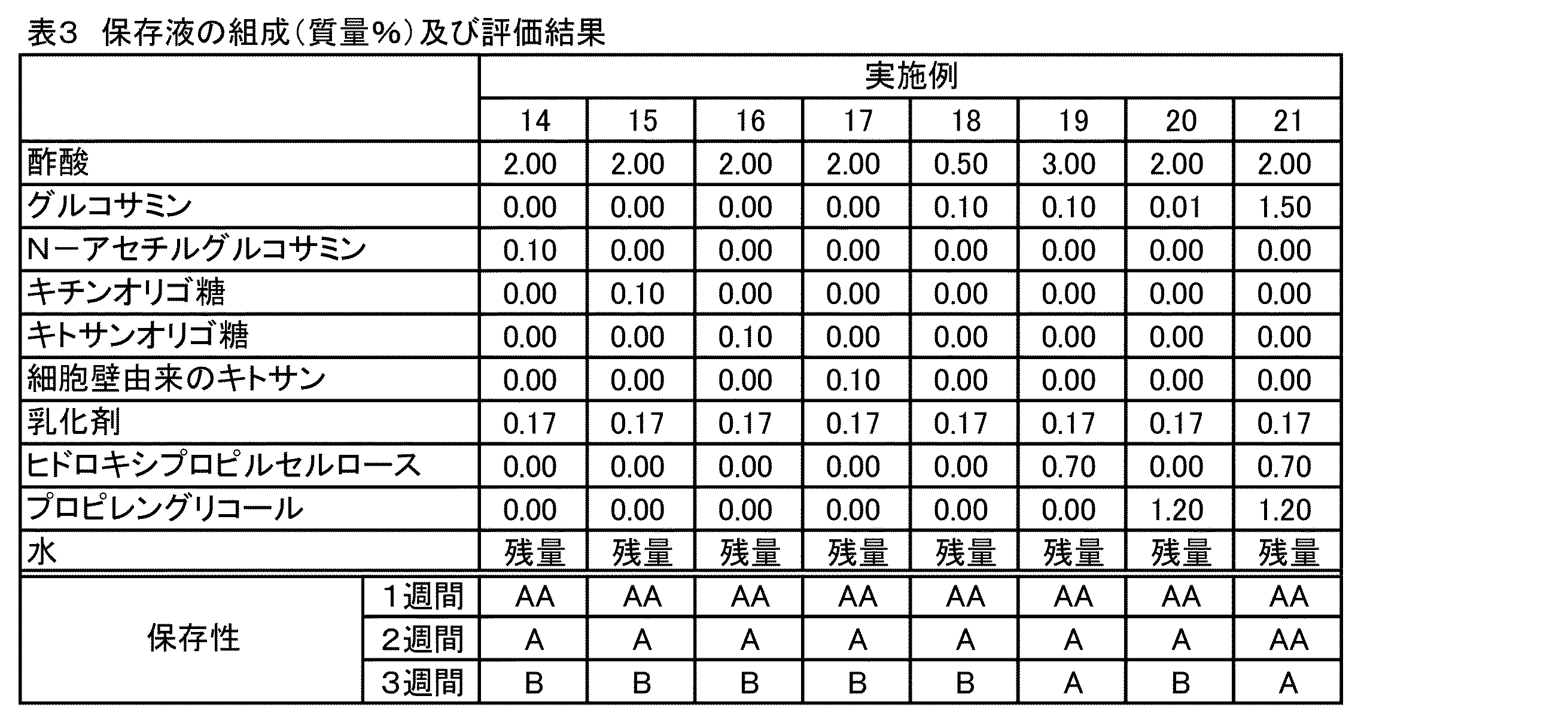
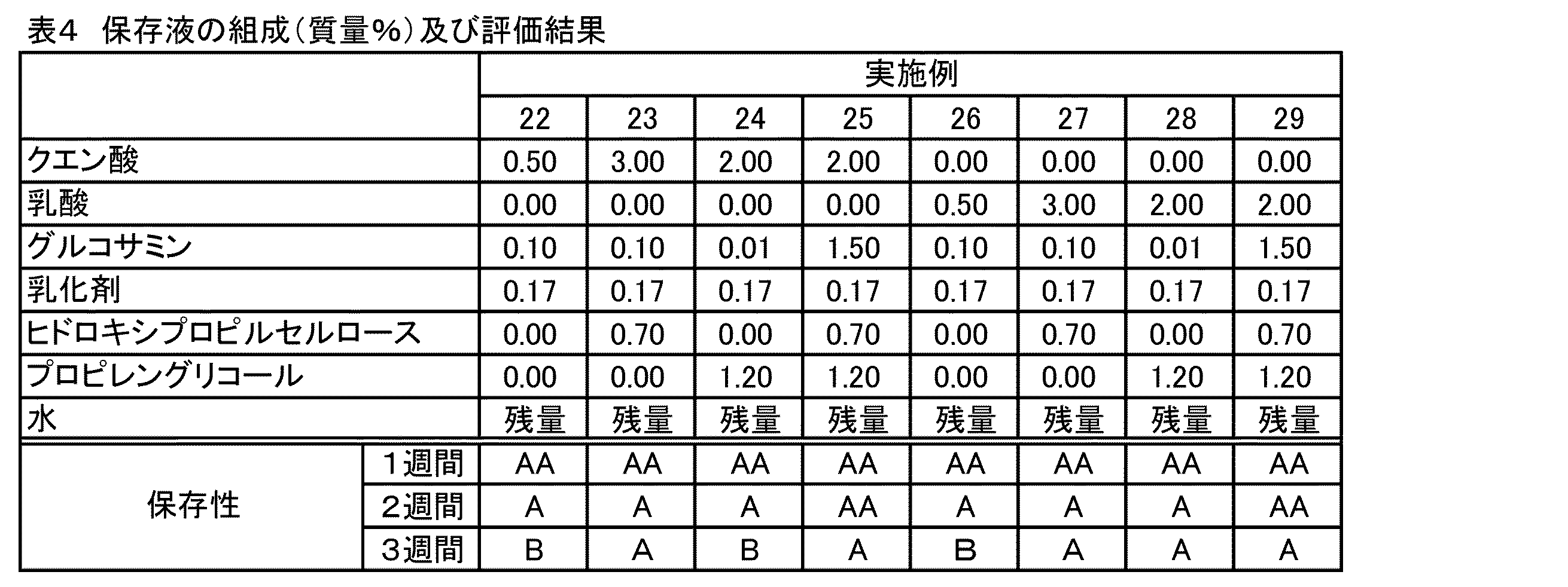
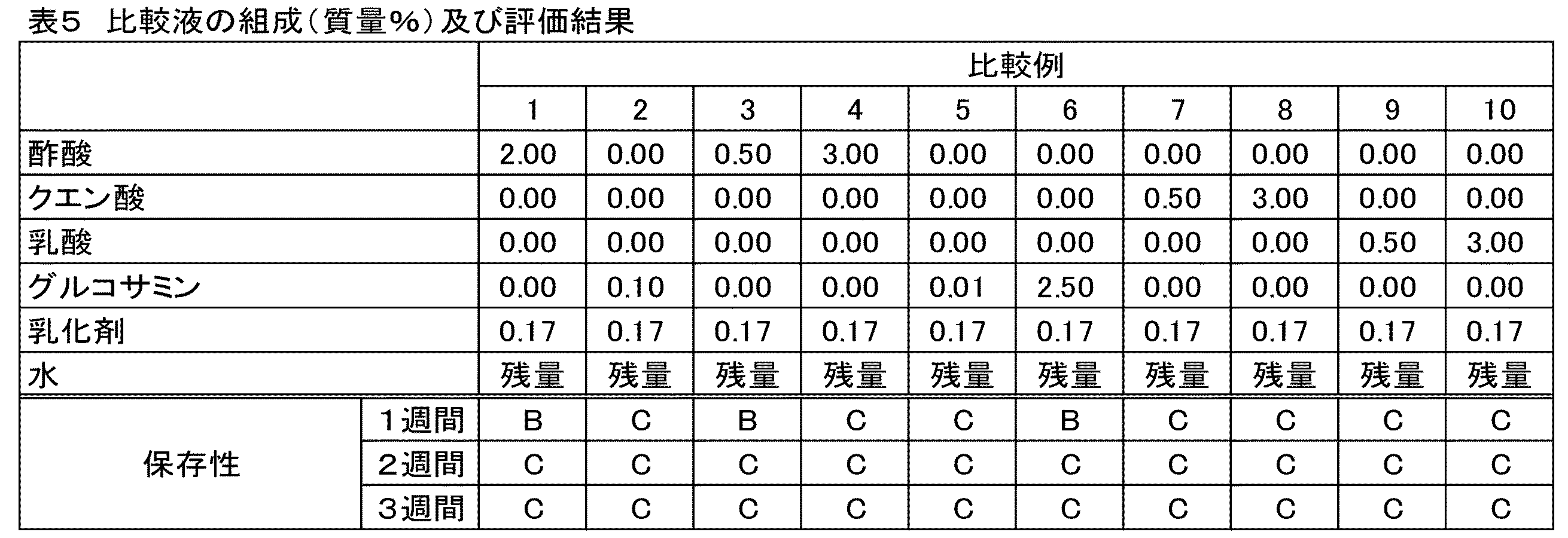
- the effect of improving the storage stability was evaluated according to the following criteria. AA: None of the 18 pineapples were observed to show corrosion, mold, or partial discoloration. A: In more than half of the 18 pineapples, no occurrence of corrosion, mold, or partial discoloration was observed, but in less than half, any of corrosion, mold, and partial discoloration Occurrence was slightly confirmed. B: In more than half of the 18 pineapples, occurrence of corrosion, mold, and / or partial discoloration was confirmed in several places. C: In more than half of 18 pineapples, corrosion, mold, and / or partial discoloration were frequently observed.
- Tables 1 to 6 shows the evaluation results using the preservation solution and the comparison solution of each of the above examples.
- the preservative composition according to the present invention is useful for improving the preservability of fruits and vegetables, preferably fruits and vegetables.
Landscapes
- Life Sciences & Earth Sciences (AREA)
- Engineering & Computer Science (AREA)
- Chemical & Material Sciences (AREA)
- Food Science & Technology (AREA)
- Polymers & Plastics (AREA)
- Zoology (AREA)
- Wood Science & Technology (AREA)
- Chemical Kinetics & Catalysis (AREA)
- General Chemical & Material Sciences (AREA)
- Health & Medical Sciences (AREA)
- Nutrition Science (AREA)
- Storage Of Fruits Or Vegetables (AREA)
- Food Preservation Except Freezing, Refrigeration, And Drying (AREA)
- Agricultural Chemicals And Associated Chemicals (AREA)
- Microbiology (AREA)
Abstract
Description
本発明の一実施形態に係る青果物用の保存剤組成物(以下、単に「保存剤組成物」と称することがある。)は、有機酸及び/又はその塩と、グルコサミン、グルコサミン誘導体、キチンオリゴ糖、キトサンオリゴ糖、及びそれらの塩からなる群から選ばれる少なくとも1種とを含有する。
前述した有機酸類の含有量は、保存剤組成物の全質量中、1~50質量%であることが好ましく、より好ましくは2~40質量%、さらに好ましくは5~30質量%である。
前述した乳化剤の含有量は、保存剤組成物の全質量中、0.1~5質量%であることが好ましく、より好ましくは0.2~4質量%である。
前述した展着剤の含有量は、保存剤組成物の全質量中、1~20質量%であることが好ましく、より好ましくは2~10質量%である。
前述した品質保持剤(プロピレングリコール)の含有量は、保存剤組成物の全質量中、1~30質量%であることが好ましく、より好ましくは5~20質量%である。
前述した液状媒体の含有量は、保存剤組成物の全質量中、40~95質量%であることが好ましく、より好ましくは40~80質量%、さらに好ましくは40~75質量%である。
なお、上記各成分の含有量は、保存剤組成物中にその成分の2種以上が含有されている場合、その成分の2種以上の合計の含有量である。
本発明の一実施形態に係る青果物用の保存液は、前述の保存剤組成物、及び液状媒体を含有する。保存剤組成物は、上述の通り、液状媒体を含有することができ、また、液状でもよいものであるため、保存液は、液状の保存剤組成物でもよく、保存剤組成物が使用時に水などの液状媒体で希釈されたものでもよい。本明細書では、必須成分として、液状媒体、有機酸類のうちの少なくとも1種、及びグルコサミン等のうちの少なくとも1種を含有し、青果物にそのまま使用可能な液状の保存剤組成物を、便宜上、保存液と称する。したがって、保存液は、保存剤組成物を調製した後、さらに液状媒体で希釈して製造することができ、また、希釈の作業を経ることなく製造することもできる。
[1]有機酸及び/又はその塩と、グルコサミン、グルコサミン誘導体、キチンオリゴ糖、キトサンオリゴ糖、及びそれらの塩からなる群から選ばれる少なくとも1種とを含有する、青果物用の保存剤組成物。
[2]前記グルコサミンとして、微生物由来のグルコサミンを含有する前記[1]に記載の保存剤組成物。
[3]前記有機酸及びその塩が、酢酸、クエン酸、乳酸、及びそれらの塩からなる群から選ばれる少なくとも1種である前記[1]又は[2]に記載の保存剤組成物。
[4]さらに乳化剤を含有する前記[1]~[3]のいずれかに記載の保存剤組成物。
[5]さらに展着剤を含有する前記[1]~[4]のいずれかに記載の保存剤組成物。
[6]前記グルコサミン、グルコサミン誘導体、キチンオリゴ糖、キトサンオリゴ糖、及びそれらの塩からなる群から選ばれる少なくとも1種の含有量が、0.1~20質量%である前記[1]~[5]のいずれかに記載の保存剤組成物。
[7]前記有機酸及び/又はその塩の含有量が、1~50質量%である前記[1]~[6]のいずれかに記載の保存剤組成物。
[8]有機酸及び/又はその塩と、グルコサミン、グルコサミン誘導体、キチンオリゴ糖、キトサンオリゴ糖、及びそれらの塩からなる群から選ばれる少なくとも1種と、液状媒体とを含有する、青果物用の保存液。
[9]前記グルコサミン、グルコサミン誘導体、キチンオリゴ糖、キトサンオリゴ糖、及びそれらの塩からなる群から選ばれる少なくとも1種の含有量が、0.01~5質量%である前記[8]に記載の保存液。
[10]前記有機酸及び/又はその塩の含有量が、0.1~10質量%である前記[8]又は[9]に記載の保存液。
[11]前記[8]~[10]のいずれかに記載の保存液で処理された青果物。
(実施例1)
酢酸:20%及び微生物由来のグルコサミン(商品名「発酵グルコサミンK」、協和発酵バイオ社製):1%を、水に混合溶解し、保存剤組成物(原液)1を調製した。水の使用量(含有量)は、水を含めた各成分の含有量の合計が100%となる残量とした。この水の使用量(含有量)は、以下の実施例及び比較例においても同様である。
クエン酸:20%及び微生物由来のグルコサミン(商品名「発酵グルコサミンK」、協和発酵バイオ社製):2%を、水に混合溶解し、保存剤組成物(原液)2を調製した。
乳酸:20%及び微生物由来のグルコサミン(商品名「発酵グルコサミンK」、協和発酵バイオ社製):2%を、水に混合溶解し、保存剤組成物(原液)3を調製した。
酢酸:20%及びN-アセチルグルコサミン(商品名「コーヨーN-アセチルグルコサミンPG」、甲陽ケミカル社製):1%を、水に混合溶解し、保存剤組成物(原液)4を調製した。
酢酸:20%及びキチンオリゴ糖(商品名「オリゴ-N-アセチルグルコサミン」、甲陽ケミカル社製):1%を、水に混合溶解し、保存剤組成物(原液)5を調製した。
酢酸:20%及びキトサンオリゴ糖(商品名「COS-YS」、焼津水産化学工業社製):1%を、水に混合溶解し、保存剤組成物(原液)6を調製した。
酢酸:20%、及びマッシュルームの細胞壁由来のキトサン(商品名「Kiomedine-CsU」、KitoZyme社製、重量平均分子量30000):1%を、水に混合し、保存剤組成物(原液)7を調製した。
酢酸:20%、微生物由来のグルコサミン(商品名「発酵グルコサミンK」、協和発酵バイオ社製):1%、及び乳化剤(ポリオキシエチレンソルビタンモノオレエート、商品名「ウィルサーフ TF-80」、日油社製):1.7%を、水に混合溶解し、保存剤組成物(原液)8を調製した。
酢酸:20%、微生物由来のグルコサミン(商品名「発酵グルコサミンK」、協和発酵バイオ社製):1%、乳化剤(ポリオキシエチレンソルビタンモノオレエート、商品名「ウィルサーフ TF-80」、日油社製):1.7%、及びヒドロキシプロピルセルロース:7%を、水に混合溶解し、保存剤組成物(原液)9を調製した。
酢酸:20%、微生物由来のグルコサミン(商品名「発酵グルコサミンK」、協和発酵バイオ社製):1%、乳化剤(ポリオキシエチレンソルビタンモノオレエート、商品名「ウィルサーフ TF-80」、日油社製):1.7%、及びプロピレングリコール:12%を、水に混合溶解し、保存剤組成物(原液)10を調製した。
酢酸:20%、微生物由来のグルコサミン(商品名「発酵グルコサミンK」、協和発酵バイオ社製):1%、乳化剤(ポリオキシエチレンソルビタンモノオレエート、商品名「ウィルサーフ TF-80」、日油社製):1.7%、ヒドロキシプロピルセルロース:7%、及びプロピレングリコール:12%を、水に混合溶解し、保存剤組成物(原液)11を調製した。
クエン酸:20%、微生物由来のグルコサミン(商品名「発酵グルコサミンK」、協和発酵バイオ社製):1%、及び乳化剤(ポリオキシエチレンソルビタンモノオレエート、商品名「ウィルサーフ TF-80」、日油社製):1.7%を、水に混合溶解し、保存剤組成物(原液)12を調製した。
乳酸:20%、微生物由来のグルコサミン(商品名「発酵グルコサミンK」、協和発酵バイオ社製):1%、及び乳化剤(ポリオキシエチレンソルビタンモノオレエート、商品名「ウィルサーフ TF-80」、日油社製):1.7%を、水に混合溶解し、保存剤組成物(原液)13を調製した。
酢酸:20%、N-アセチルグルコサミン(商品名「コーヨーN-アセチルグルコサミンPG」、甲陽ケミカル社製):1%、及び乳化剤(ポリオキシエチレンソルビタンモノオレエート、商品名「ウィルサーフ TF-80」、日油社製):1.7%を、水に混合溶解し、保存剤組成物(原液)14を調製した。
酢酸:20%、キチンオリゴ糖(商品名「オリゴ-N-アセチルグルコサミン」、甲陽ケミカル社製):1%、及び乳化剤(ポリオキシエチレンソルビタンモノオレエート、商品名「ウィルサーフ TF-80」、日油社製):1.7%を、水に混合溶解し、保存剤組成物(原液)15を調製した。
酢酸:20%、キトサンオリゴ糖(商品名「COS-YS」、焼津水産化学工業社製):1%、及び乳化剤(ポリオキシエチレンソルビタンモノオレエート、商品名「ウィルサーフ TF-80」、日油社製):1.7%を、水に混合溶解し、保存剤組成物(原液)16を調製した。
酢酸:20%、マッシュルームの細胞壁由来のキトサン(商品名「Kiomedine-CsU」、KitoZyme社製、重量平均分子量30000):1%、及び乳化剤(ポリオキシエチレンソルビタンモノオレエート、商品名「ウィルサーフ TF-80」、日油社製):1.7%を、水に混合し、保存剤組成物(原液)17を調製した。
酢酸:5%、微生物由来のグルコサミン(商品名「発酵グルコサミンK」、協和発酵バイオ社製):1%、及び乳化剤(ポリオキシエチレンソルビタンモノオレエート、商品名「ウィルサーフ TF-80」、日油社製):1.7%を、水に混合溶解し、保存剤組成物(原液)18を調製した。
酢酸:30%、微生物由来のグルコサミン(商品名「発酵グルコサミンK」、協和発酵バイオ社製):1%、乳化剤(ポリオキシエチレンソルビタンモノオレエート、商品名「ウィルサーフ TF-80」、日油社製):1.7%、及びヒドロキシプロピルセルロース:7%を、水に混合溶解し、保存剤組成物(原液)19を調製した。
酢酸:20%、微生物由来のグルコサミン(商品名「発酵グルコサミンK」、協和発酵バイオ社製):0.1%、乳化剤(ポリオキシエチレンソルビタンモノオレエート、商品名「ウィルサーフ TF-80」、日油社製):1.7%、及びプロピレングリコール:12%を、水に混合溶解し、保存剤組成物(原液)20を調製した。
酢酸:20%、微生物由来のグルコサミン(商品名「発酵グルコサミンK」、協和発酵バイオ社製):15%、乳化剤(ポリオキシエチレンソルビタンモノオレエート、商品名「ウィルサーフ TF-80」、日油社製):1.7%、ヒドロキシプロピルセルロース:7%、及びプロピレングリコール:12%を、水に混合溶解し、保存剤組成物(原液)21を調製した。
クエン酸:5%、微生物由来のグルコサミン(商品名「発酵グルコサミンK」、協和発酵バイオ社製):1%、及び乳化剤(ポリオキシエチレンソルビタンモノオレエート、商品名「ウィルサーフ TF-80」、日油社製):1.7%を、水に混合溶解し、保存剤組成物(原液)22を調製した。
クエン酸:30%、微生物由来のグルコサミン(商品名「発酵グルコサミンK」、協和発酵バイオ社製):1%、乳化剤(ポリオキシエチレンソルビタンモノオレエート、商品名「ウィルサーフ TF-80」、日油社製):1.7%、及びヒドロキシプロピルセルロース:7%を、水に混合溶解し、保存剤組成物(原液)23を調製した。
クエン酸:20%、微生物由来のグルコサミン(商品名「発酵グルコサミンK」、協和発酵バイオ社製):0.1%、乳化剤(ポリオキシエチレンソルビタンモノオレエート、商品名「ウィルサーフ TF-80」、日油社製):1.7%、及びプロピレングリコール:12%を、水に混合溶解し、保存剤組成物(原液)24を調製した。
クエン酸:20%、微生物由来のグルコサミン(商品名「発酵グルコサミンK」、協和発酵バイオ社製):15%、乳化剤(ポリオキシエチレンソルビタンモノオレエート、商品名「ウィルサーフ TF-80」、日油社製):1.7%、ヒドロキシプロピルセルロース:7%、及びプロピレングリコール:12%を、水に混合溶解し、保存剤組成物(原液)25を調製した。
乳酸:5%、微生物由来のグルコサミン(商品名「発酵グルコサミンK」、協和発酵バイオ社製):1%、及び乳化剤(ポリオキシエチレンソルビタンモノオレエート、商品名「ウィルサーフ TF-80」、日油社製):1.7%を、水に混合溶解し、保存剤組成物(原液)26を調製した。
乳酸:30%、微生物由来のグルコサミン(商品名「発酵グルコサミンK」、協和発酵バイオ社製):1%、乳化剤(ポリオキシエチレンソルビタンモノオレエート、商品名「ウィルサーフ TF-80」、日油社製):1.7%、及びヒドロキシプロピルセルロース:7%を、水に混合溶解し、保存剤組成物(原液)27を調製した。
乳酸:20%、微生物由来のグルコサミン(商品名「発酵グルコサミンK」、協和発酵バイオ社製):0.1%、乳化剤(ポリオキシエチレンソルビタンモノオレエート、商品名「ウィルサーフ TF-80」、日油社製):1.7%、及びプロピレングリコール:12%を、水に混合溶解し、保存剤組成物(原液)28を調製した。
乳酸:20%、微生物由来のグルコサミン(商品名「発酵グルコサミンK」、協和発酵バイオ社製):15%、乳化剤(ポリオキシエチレンソルビタンモノオレエート、商品名「ウィルサーフ TF-80」、日油社製):1.7%、ヒドロキシプロピルセルロース:7%、及びプロピレングリコール:12%を、水に混合溶解し、保存剤組成物(原液)29を調製した。
酢酸:20%、及び乳化剤(ポリオキシエチレンソルビタンモノオレエート、商品名「ウィルサーフ TF-80」、日油社製):1.7%を、水に混合溶解し、比較組成物(比較原液)1を調製した。
微生物由来のグルコサミン(商品名「発酵グルコサミンK」、協和発酵バイオ社製):1%、及び乳化剤(ポリオキシエチレンソルビタンモノオレエート、商品名「ウィルサーフ TF-80」、日油社製):1.7%を、水に混合溶解し、比較組成物(比較原液)2を調製した。
酢酸:5%、及び乳化剤(ポリオキシエチレンソルビタンモノオレエート、商品名「ウィルサーフ TF-80」、日油社製):1.7%を、水に混合溶解し、比較組成物(比較原液)3を調製した。
酢酸:30%、及び乳化剤(ポリオキシエチレンソルビタンモノオレエート、商品名「ウィルサーフ TF-80」、日油社製):1.7%を、水に混合溶解し、比較組成物(比較原液)4を調製した。
微生物由来のグルコサミン(商品名「発酵グルコサミンK」、協和発酵バイオ社製):0.1%、及び乳化剤(ポリオキシエチレンソルビタンモノオレエート、商品名「ウィルサーフ TF-80」、日油社製):1.7%を、水に混合溶解し、比較組成物(比較原液)5を調製した。
微生物由来のグルコサミン(商品名「発酵グルコサミンK」、協和発酵バイオ社製):25%、及び乳化剤(ポリオキシエチレンソルビタンモノオレエート、商品名「ウィルサーフ TF-80」、日油社製):1.7%を、水に混合溶解し、比較組成物(比較原液)6を調製した。
クエン酸:5%、及び乳化剤(ポリオキシエチレンソルビタンモノオレエート、商品名「ウィルサーフ TF-80」、日油社製):1.7%を、水に混合溶解し、比較組成物(比較原液)7を調製した。
クエン酸:30%、及び乳化剤(ポリオキシエチレンソルビタンモノオレエート、商品名「ウィルサーフ TF-80」、日油社製):1.7%を、水に混合溶解し、比較組成物(比較原液)8を調製した。
乳酸:5%、及び乳化剤(ポリオキシエチレンソルビタンモノオレエート、商品名「ウィルサーフ TF-80」、日油社製):1.7%を、水に混合溶解し、比較組成物(比較原液)9を調製した。
乳酸:30%、及び乳化剤(ポリオキシエチレンソルビタンモノオレエート、商品名「ウィルサーフ TF-80」、日油社製):1.7%を、水に混合溶解し、比較組成物(比較原液)10を調製した。
N-アセチルグルコサミン(商品名「コーヨーN-アセチルグルコサミン」、甲陽ケミカル社製):0.1%、及び乳化剤(ポリオキシエチレンソルビタンモノオレエート、商品名「ウィルサーフ TF-80」、日油社製):1.7%を、水に混合溶解し、比較組成物(比較原液)11を調製した。
N-アセチルグルコサミン(商品名「コーヨーN-アセチルグルコサミン」、甲陽ケミカル社製):5%、及び乳化剤(ポリオキシエチレンソルビタンモノオレエート、商品名「ウィルサーフ TF-80」、日油社製):1.7%を、水に混合溶解し、比較組成物(比較原液)12を調製した。
キチンオリゴ糖(商品名「オリゴ-N-アセチルグルコサミン」、甲陽ケミカル社製):0.1%、及び乳化剤(ポリオキシエチレンソルビタンモノオレエート、商品名「ウィルサーフ TF-80」、日油社製):1.7%を、水に混合溶解し、比較組成物(比較原液)13を調製した。
キチンオリゴ糖(商品名「オリゴ-N-アセチルグルコサミン」、甲陽ケミカル社製):1%、及び乳化剤(ポリオキシエチレンソルビタンモノオレエート、商品名「ウィルサーフ TF-80」、日油社製):1.7%を、水に混合溶解し、比較組成物(比較原液)14を調製した。
キトサンオリゴ糖(商品名「COS-YS」、焼津水産化学工業社製):0.1%、及び乳化剤(ポリオキシエチレンソルビタンモノオレエート、商品名「ウィルサーフ TF-80」、日油社製):1.7%を、水に混合溶解し、比較組成物(比較原液)15を調製した。
キトサンオリゴ糖(商品名「COS-YS」、焼津水産化学工業社製):25%、及び乳化剤(ポリオキシエチレンソルビタンモノオレエート、商品名「ウィルサーフ TF-80」、日油社製):1.7%を、水に混合溶解し、比較組成物(比較原液)16を調製した。
甲殻類由来のキトサン(商品名「SSA190」、Marine Bio Resources Co.,Ltd製、重量平均分子量400000):1%、及び乳化剤(ポリオキシエチレンソルビタンモノオレエート、商品名「ウィルサーフ TF-80」、日油社製):1.7%を、水に混合溶解し、比較組成物(比較原液)17を調製した。
実施例1~29、及び比較例1~17において、それぞれで調製した保存剤組成物及び比較組成物に、さらに、各組成物(原液)全体の質量が10倍となる量の水を加えて、各組成物(原液)を希釈し、それぞれ保存液1~29及び比較液1~17を調製した。各保存液中の成分の含有量を後記表1~6の上段に示す。
実施例1~29で調製した保存剤組成物(原液)1~29から得られた保存液1~29、及び比較例1~17で調製した比較組成物(比較原液)1~17から得られた比較液1~17を用いて、青果物の保存性の評価を行った。青果物として、収穫した当日のパイナップル(フィリピン産)を用い、保存液1~29、及び比較液1~17を、それぞれ冠芽を切り落としたパイナップルの略全体に噴霧した。保存液及び比較液の噴霧としては、手動の霧吹きを用いて、各保存液及び比較液をパイナップル全体にまんべんなく噴霧した後、過剰な液については、エアーをあてて液だれしないようにした。各保存液及び比較液につき、18個のパイナップルに対して行った。また、保存液及び比較液を噴霧したパイナップルとは別の18個のパイナップルを、冠芽を切り落とした状態とし、保存性向上の確認のための対照として使用した。
AA・・・18個のパイナップルの全てにおいて、腐食、カビ、及び部分的変色のいずれの発生も確認されなかった。
A・・・18個のパイナップルのうちの半数以上において、腐食、カビ、及び部分的変色のいずれの発生も確認されなかったが、半数未満において、腐食、カビ、及び部分的変色のいずれかの発生がわずかに確認された。
B・・・18個のパイナップルのうちの半数以上において、腐食、カビ、及び部分的変色の少なくともいずれかの発生が数か所程度確認された。
C・・・18個のパイナップルのうちの半数以上において、腐食、カビ、及び部分的変色の少なくともいずれかの発生が多く確認された。



Claims (11)
- 有機酸及び/又はその塩と、グルコサミン、グルコサミン誘導体、キチンオリゴ糖、キトサンオリゴ糖、及びそれらの塩からなる群から選ばれる少なくとも1種とを含有する、青果物用の保存剤組成物。
- 前記グルコサミンとして、微生物由来のグルコサミンを含有する請求項1に記載の保存剤組成物。
- 前記有機酸及びその塩が、酢酸、クエン酸、乳酸、及びそれらの塩からなる群から選ばれる少なくとも1種である請求項1又は2に記載の保存剤組成物。
- さらに乳化剤を含有する請求項1~3のいずれか1項に記載の保存剤組成物。
- さらに展着剤を含有する請求項1~4のいずれか1項に記載の保存剤組成物。
- 前記グルコサミン、グルコサミン誘導体、キチンオリゴ糖、キトサンオリゴ糖、及びそれらの塩からなる群から選ばれる少なくとも1種の含有量が、0.1~20質量%である請求項1~5のいずれか1項に記載の保存剤組成物。
- 前記有機酸及び/又はその塩の含有量が、1~50質量%である請求項1~6のいずれか1項に記載の保存剤組成物。
- 請求項1~5のいずれか1項に記載の保存剤組成物、及び液状媒体を含有する、青果物用の保存液。
- 前記グルコサミン、グルコサミン誘導体、キチンオリゴ糖、キトサンオリゴ糖、及びそれらの塩からなる群から選ばれる少なくとも1種の含有量が、0.01~5質量%である請求項8に記載の保存液。
- 前記有機酸及び/又はその塩の含有量が、0.1~10質量%である請求項8又は9に記載の保存液。
- 請求項8~10のいずれか1項に記載の保存液で処理された青果物。
Priority Applications (3)
| Application Number | Priority Date | Filing Date | Title |
|---|---|---|---|
| US15/568,265 US20180139988A1 (en) | 2015-06-12 | 2016-06-13 | Preservative composition and preservation liquid for fruits and vegetables, and fruits and vegetables |
| JP2017523739A JPWO2016199934A1 (ja) | 2015-06-12 | 2016-06-13 | 青果物用の保存剤組成物及び保存液、並びに青果物 |
| PH12017502269A PH12017502269A1 (en) | 2015-06-12 | 2017-12-11 | Preservative composition and preservation liquid for fruits and vegetables, and fruits and vegetables |
Applications Claiming Priority (2)
| Application Number | Priority Date | Filing Date | Title |
|---|---|---|---|
| JP2015119398 | 2015-06-12 | ||
| JP2015-119398 | 2015-06-12 |
Publications (1)
| Publication Number | Publication Date |
|---|---|
| WO2016199934A1 true WO2016199934A1 (ja) | 2016-12-15 |
Family
ID=57503643
Family Applications (1)
| Application Number | Title | Priority Date | Filing Date |
|---|---|---|---|
| PCT/JP2016/067483 Ceased WO2016199934A1 (ja) | 2015-06-12 | 2016-06-13 | 青果物用の保存剤組成物及び保存液、並びに青果物 |
Country Status (4)
| Country | Link |
|---|---|
| US (1) | US20180139988A1 (ja) |
| JP (1) | JPWO2016199934A1 (ja) |
| PH (1) | PH12017502269A1 (ja) |
| WO (1) | WO2016199934A1 (ja) |
Cited By (3)
| Publication number | Priority date | Publication date | Assignee | Title |
|---|---|---|---|---|
| CN107772194A (zh) * | 2017-10-25 | 2018-03-09 | 石阡县龙腾农牧农民专业合作社 | 一种白芨块茎的保存方法 |
| CN110169444A (zh) * | 2019-06-06 | 2019-08-27 | 福建省亚热带园艺植物研究中心有限公司 | 一种荔枝常温贮藏时海藻寡糖保鲜剂浓度的确定方法 |
| CN111184035A (zh) * | 2020-01-07 | 2020-05-22 | 广东省石油与精细化工研究院 | 一种植物源留树保鲜剂及其使用方法 |
Families Citing this family (2)
| Publication number | Priority date | Publication date | Assignee | Title |
|---|---|---|---|---|
| CN109444438B (zh) * | 2018-10-25 | 2022-03-15 | 宁波瑞源生物科技有限公司 | 一种用于aptt检测试剂的稳定剂及aptt检测试剂 |
| CN111296407A (zh) * | 2020-02-17 | 2020-06-19 | 广东海洋大学深圳研究院 | 一种环保型复合防霉防腐剂及其应用 |
Citations (10)
| Publication number | Priority date | Publication date | Assignee | Title |
|---|---|---|---|---|
| JPS6339569A (ja) * | 1986-08-01 | 1988-02-20 | Ihara Chem Ind Co Ltd | 生鮮食品の鮮度保持剤 |
| JPS63251072A (ja) * | 1987-04-09 | 1988-10-18 | Katakura Chitsukarin Kk | 漬物、野菜、トコロテン、コンニヤクまたは麺類の保存性を向上する方法およびそのための食品添加物 |
| JPS6413946A (en) * | 1987-07-09 | 1989-01-18 | Nanyo Kasei Kk | Polishing and coating agent having air permeability |
| JPH04267867A (ja) * | 1991-02-19 | 1992-09-24 | Takasugi Seiyaku Kk | 食品保存剤 |
| JPH07132045A (ja) * | 1991-04-19 | 1995-05-23 | Kotofumi Tachibana | キトサン溶液による青果生鮮食品の保蔵法 |
| JP2000248276A (ja) * | 1999-03-04 | 2000-09-12 | Yaizu Suisankagaku Industry Co Ltd | 抗酸化剤及び酸化防止方法 |
| JP2002069101A (ja) * | 2000-09-01 | 2002-03-08 | Kyowa Technos:Kk | 中性付近のキトサン水溶液、その乾燥物、およびそれらの製造法 |
| JP2005507233A (ja) * | 2001-02-16 | 2005-03-17 | カーギル、インコーポレイテッド | グルコサミンおよび微生物バイオマスからグルコサミンを製造する方法 |
| JP2007503807A (ja) * | 2003-08-28 | 2007-03-01 | マントローズ−ハウザー カンパニー インコーポレイテッド | 新鮮な農産物を保存するための方法 |
| JP2008530987A (ja) * | 2005-02-03 | 2008-08-14 | スウィートフィールズ,インコーポレイティド | 保存のきく植物由来の装飾品、及びその製造方法 |
Family Cites Families (4)
| Publication number | Priority date | Publication date | Assignee | Title |
|---|---|---|---|---|
| JPH0697943B2 (ja) * | 1985-12-18 | 1994-12-07 | ハウス食品株式会社 | 果物の変色防止方法 |
| JPH03277230A (ja) * | 1989-09-18 | 1991-12-09 | Nippon Oil & Fats Co Ltd | 野菜、果実類の変色防止剤 |
| JP2002034448A (ja) * | 2000-07-28 | 2002-02-05 | Mitsukan Group Honsha:Kk | カット根菜類浸漬用組成物及びカット根菜類の製造方法 |
| JP2015000018A (ja) * | 2013-06-14 | 2015-01-05 | エーザイフード・ケミカル株式会社 | 緑色野菜の日持向上及び退色防止剤、及びその使用 |
-
2016
- 2016-06-13 US US15/568,265 patent/US20180139988A1/en not_active Abandoned
- 2016-06-13 WO PCT/JP2016/067483 patent/WO2016199934A1/ja not_active Ceased
- 2016-06-13 JP JP2017523739A patent/JPWO2016199934A1/ja active Pending
-
2017
- 2017-12-11 PH PH12017502269A patent/PH12017502269A1/en unknown
Patent Citations (10)
| Publication number | Priority date | Publication date | Assignee | Title |
|---|---|---|---|---|
| JPS6339569A (ja) * | 1986-08-01 | 1988-02-20 | Ihara Chem Ind Co Ltd | 生鮮食品の鮮度保持剤 |
| JPS63251072A (ja) * | 1987-04-09 | 1988-10-18 | Katakura Chitsukarin Kk | 漬物、野菜、トコロテン、コンニヤクまたは麺類の保存性を向上する方法およびそのための食品添加物 |
| JPS6413946A (en) * | 1987-07-09 | 1989-01-18 | Nanyo Kasei Kk | Polishing and coating agent having air permeability |
| JPH04267867A (ja) * | 1991-02-19 | 1992-09-24 | Takasugi Seiyaku Kk | 食品保存剤 |
| JPH07132045A (ja) * | 1991-04-19 | 1995-05-23 | Kotofumi Tachibana | キトサン溶液による青果生鮮食品の保蔵法 |
| JP2000248276A (ja) * | 1999-03-04 | 2000-09-12 | Yaizu Suisankagaku Industry Co Ltd | 抗酸化剤及び酸化防止方法 |
| JP2002069101A (ja) * | 2000-09-01 | 2002-03-08 | Kyowa Technos:Kk | 中性付近のキトサン水溶液、その乾燥物、およびそれらの製造法 |
| JP2005507233A (ja) * | 2001-02-16 | 2005-03-17 | カーギル、インコーポレイテッド | グルコサミンおよび微生物バイオマスからグルコサミンを製造する方法 |
| JP2007503807A (ja) * | 2003-08-28 | 2007-03-01 | マントローズ−ハウザー カンパニー インコーポレイテッド | 新鮮な農産物を保存するための方法 |
| JP2008530987A (ja) * | 2005-02-03 | 2008-08-14 | スウィートフィールズ,インコーポレイティド | 保存のきく植物由来の装飾品、及びその製造方法 |
Non-Patent Citations (1)
| Title |
|---|
| MELLEGARD H. ET AL.: "Antibacterial activity of chemically defined chitosans: Influence of molecular weight, degree of acetylation and test organism", INTERNATIONAL JOURNAL OF FOOD MICROBIOLOGY, vol. 148, no. 1, 2011, pages 48 - 54, XP028376083 * |
Cited By (3)
| Publication number | Priority date | Publication date | Assignee | Title |
|---|---|---|---|---|
| CN107772194A (zh) * | 2017-10-25 | 2018-03-09 | 石阡县龙腾农牧农民专业合作社 | 一种白芨块茎的保存方法 |
| CN110169444A (zh) * | 2019-06-06 | 2019-08-27 | 福建省亚热带园艺植物研究中心有限公司 | 一种荔枝常温贮藏时海藻寡糖保鲜剂浓度的确定方法 |
| CN111184035A (zh) * | 2020-01-07 | 2020-05-22 | 广东省石油与精细化工研究院 | 一种植物源留树保鲜剂及其使用方法 |
Also Published As
| Publication number | Publication date |
|---|---|
| US20180139988A1 (en) | 2018-05-24 |
| JPWO2016199934A1 (ja) | 2018-03-29 |
| PH12017502269A1 (en) | 2018-06-11 |
Similar Documents
| Publication | Publication Date | Title |
|---|---|---|
| US5376391A (en) | Method of increasing the stability of fruits, vegetables or fungi and composition thereof | |
| EP1793684B1 (en) | Process for preserving fresh produce and coating composition therefor | |
| CN1088562C (zh) | 荔枝龙眼常温保鲜技术 | |
| WO2016199934A1 (ja) | 青果物用の保存剤組成物及び保存液、並びに青果物 | |
| CH713367B1 (de) | Verfahren zur Verlängerung der Kühllagerdauer geschälter konditionierter Garnelen durch Frischhaltung mit antibakteriell aktivem Material in Kombination mit Frischhaltung unter modifizierter Atmosphäre. | |
| CN110325043A (zh) | 食品涂层 | |
| CN104642528A (zh) | 一种壳寡糖复配制剂及其在延长水果货架期中的应用 | |
| Al Zaemey et al. | Studies on the effect of fruit-coating polymers and organic acids on growth of Colletotrichum musae in vitro and on post-harvest control of anthracnose of bananas | |
| AU780333B2 (en) | Process for preserving fresh produce and coating composition therefor | |
| WO2022080444A1 (ja) | 組成物、被膜付き食品、被膜付き食品の製造方法、被膜形成方法及び食品の出荷方法 | |
| JP3933363B2 (ja) | 抗菌剤及び鮮度保持方法 | |
| CN107223705B (zh) | 一种用于猕猴桃的保鲜剂及其保鲜方法 | |
| Tamer et al. | Chitosan: an edible coating for fresh-cut fruits and vegetables | |
| JP6550139B2 (ja) | 植物の物理的・化学的刺激による変色の抑制剤 | |
| RU2373696C1 (ru) | Способ консервации и хранения продуктов сельского хозяйства и пищевой промышленности | |
| Dhall | Application of edible films and coatings on fruits and vegetables | |
| CN110313518A (zh) | 新的果蔬保鲜剂及其制备方法和应用 | |
| Alam | The evaluation of the physicochemical properties of bananas (Musa acuminate) coated with different polysaccharide-based coating | |
| Sangamesh et al. | Edible coatings and shelf-life extension of fruits | |
| RU2403794C2 (ru) | Состав для защиты поверхности сыра от плесневения | |
| Sortino et al. | Use of chemical treatments to reduce browning color of white fresh-cut peaches, harvested in summer and late crop | |
| JPH02207740A (ja) | 野菜・果実の鮮度保持剤組成物 | |
| Zheng et al. | Physically crosslinked sodium carboxymethyl cellulose/chitosan antifungal coating for litchi preservation | |
| Martínez-Blay et al. | Combination of antifungal edible coatings and MA packaging for postharvest preservation of freshMollar de Elche´ pomegranates | |
| UA147192U (uk) | Спосіб зберігання продукції органічного рослинництва |
Legal Events
| Date | Code | Title | Description |
|---|---|---|---|
| 121 | Ep: the epo has been informed by wipo that ep was designated in this application |
Ref document number: 16807637 Country of ref document: EP Kind code of ref document: A1 |
|
| WWE | Wipo information: entry into national phase |
Ref document number: 15568265 Country of ref document: US |
|
| ENP | Entry into the national phase |
Ref document number: 2017523739 Country of ref document: JP Kind code of ref document: A |
|
| WWE | Wipo information: entry into national phase |
Ref document number: 12017502269 Country of ref document: PH |
|
| NENP | Non-entry into the national phase |
Ref country code: DE |
|
| 122 | Ep: pct application non-entry in european phase |
Ref document number: 16807637 Country of ref document: EP Kind code of ref document: A1 |