WO2016195101A1 - 熱間プレス用めっき鋼板の表面処理液 - Google Patents
熱間プレス用めっき鋼板の表面処理液 Download PDFInfo
- Publication number
- WO2016195101A1 WO2016195101A1 PCT/JP2016/066686 JP2016066686W WO2016195101A1 WO 2016195101 A1 WO2016195101 A1 WO 2016195101A1 JP 2016066686 W JP2016066686 W JP 2016066686W WO 2016195101 A1 WO2016195101 A1 WO 2016195101A1
- Authority
- WO
- WIPO (PCT)
- Prior art keywords
- water
- steel sheet
- hot
- surface treatment
- plated steel
- Prior art date
- Legal status (The legal status is an assumption and is not a legal conclusion. Google has not performed a legal analysis and makes no representation as to the accuracy of the status listed.)
- Ceased
Links
Images

Classifications
-
- C—CHEMISTRY; METALLURGY
- C23—COATING METALLIC MATERIAL; COATING MATERIAL WITH METALLIC MATERIAL; CHEMICAL SURFACE TREATMENT; DIFFUSION TREATMENT OF METALLIC MATERIAL; COATING BY VACUUM EVAPORATION, BY SPUTTERING, BY ION IMPLANTATION OR BY CHEMICAL VAPOUR DEPOSITION, IN GENERAL; INHIBITING CORROSION OF METALLIC MATERIAL OR INCRUSTATION IN GENERAL
- C23C—COATING METALLIC MATERIAL; COATING MATERIAL WITH METALLIC MATERIAL; SURFACE TREATMENT OF METALLIC MATERIAL BY DIFFUSION INTO THE SURFACE, BY CHEMICAL CONVERSION OR SUBSTITUTION; COATING BY VACUUM EVAPORATION, BY SPUTTERING, BY ION IMPLANTATION OR BY CHEMICAL VAPOUR DEPOSITION, IN GENERAL
- C23C28/00—Coating for obtaining at least two superposed coatings either by methods not provided for in a single one of groups C23C2/00 - C23C26/00 or by combinations of methods provided for in subclasses C23C and C25C or C25D
-
- C—CHEMISTRY; METALLURGY
- C09—DYES; PAINTS; POLISHES; NATURAL RESINS; ADHESIVES; COMPOSITIONS NOT OTHERWISE PROVIDED FOR; APPLICATIONS OF MATERIALS NOT OTHERWISE PROVIDED FOR
- C09D—COATING COMPOSITIONS, e.g. PAINTS, VARNISHES OR LACQUERS; FILLING PASTES; CHEMICAL PAINT OR INK REMOVERS; INKS; CORRECTING FLUIDS; WOODSTAINS; PASTES OR SOLIDS FOR COLOURING OR PRINTING; USE OF MATERIALS THEREFOR
- C09D7/00—Features of coating compositions, not provided for in group C09D5/00; Processes for incorporating ingredients in coating compositions
- C09D7/40—Additives
- C09D7/60—Additives non-macromolecular
- C09D7/61—Additives non-macromolecular inorganic
-
- B—PERFORMING OPERATIONS; TRANSPORTING
- B21—MECHANICAL METAL-WORKING WITHOUT ESSENTIALLY REMOVING MATERIAL; PUNCHING METAL
- B21D—WORKING OR PROCESSING OF SHEET METAL OR METAL TUBES, RODS OR PROFILES WITHOUT ESSENTIALLY REMOVING MATERIAL; PUNCHING METAL
- B21D22/00—Shaping without cutting, by stamping, spinning, or deep-drawing
- B21D22/02—Stamping using rigid devices or tools
- B21D22/022—Stamping using rigid devices or tools by heating the blank or stamping associated with heat treatment
-
- B—PERFORMING OPERATIONS; TRANSPORTING
- B21—MECHANICAL METAL-WORKING WITHOUT ESSENTIALLY REMOVING MATERIAL; PUNCHING METAL
- B21D—WORKING OR PROCESSING OF SHEET METAL OR METAL TUBES, RODS OR PROFILES WITHOUT ESSENTIALLY REMOVING MATERIAL; PUNCHING METAL
- B21D22/00—Shaping without cutting, by stamping, spinning, or deep-drawing
- B21D22/20—Deep-drawing
-
- C—CHEMISTRY; METALLURGY
- C09—DYES; PAINTS; POLISHES; NATURAL RESINS; ADHESIVES; COMPOSITIONS NOT OTHERWISE PROVIDED FOR; APPLICATIONS OF MATERIALS NOT OTHERWISE PROVIDED FOR
- C09D—COATING COMPOSITIONS, e.g. PAINTS, VARNISHES OR LACQUERS; FILLING PASTES; CHEMICAL PAINT OR INK REMOVERS; INKS; CORRECTING FLUIDS; WOODSTAINS; PASTES OR SOLIDS FOR COLOURING OR PRINTING; USE OF MATERIALS THEREFOR
- C09D201/00—Coating compositions based on unspecified macromolecular compounds
-
- C—CHEMISTRY; METALLURGY
- C09—DYES; PAINTS; POLISHES; NATURAL RESINS; ADHESIVES; COMPOSITIONS NOT OTHERWISE PROVIDED FOR; APPLICATIONS OF MATERIALS NOT OTHERWISE PROVIDED FOR
- C09D—COATING COMPOSITIONS, e.g. PAINTS, VARNISHES OR LACQUERS; FILLING PASTES; CHEMICAL PAINT OR INK REMOVERS; INKS; CORRECTING FLUIDS; WOODSTAINS; PASTES OR SOLIDS FOR COLOURING OR PRINTING; USE OF MATERIALS THEREFOR
- C09D5/00—Coating compositions, e.g. paints, varnishes or lacquers, characterised by their physical nature or the effects produced; Filling pastes
- C09D5/02—Emulsion paints including aerosols
- C09D5/024—Emulsion paints including aerosols characterised by the additives
-
- C—CHEMISTRY; METALLURGY
- C09—DYES; PAINTS; POLISHES; NATURAL RESINS; ADHESIVES; COMPOSITIONS NOT OTHERWISE PROVIDED FOR; APPLICATIONS OF MATERIALS NOT OTHERWISE PROVIDED FOR
- C09D—COATING COMPOSITIONS, e.g. PAINTS, VARNISHES OR LACQUERS; FILLING PASTES; CHEMICAL PAINT OR INK REMOVERS; INKS; CORRECTING FLUIDS; WOODSTAINS; PASTES OR SOLIDS FOR COLOURING OR PRINTING; USE OF MATERIALS THEREFOR
- C09D7/00—Features of coating compositions, not provided for in group C09D5/00; Processes for incorporating ingredients in coating compositions
- C09D7/40—Additives
- C09D7/66—Additives characterised by particle size
- C09D7/67—Particle size smaller than 100 nm
-
- C—CHEMISTRY; METALLURGY
- C09—DYES; PAINTS; POLISHES; NATURAL RESINS; ADHESIVES; COMPOSITIONS NOT OTHERWISE PROVIDED FOR; APPLICATIONS OF MATERIALS NOT OTHERWISE PROVIDED FOR
- C09D—COATING COMPOSITIONS, e.g. PAINTS, VARNISHES OR LACQUERS; FILLING PASTES; CHEMICAL PAINT OR INK REMOVERS; INKS; CORRECTING FLUIDS; WOODSTAINS; PASTES OR SOLIDS FOR COLOURING OR PRINTING; USE OF MATERIALS THEREFOR
- C09D7/00—Features of coating compositions, not provided for in group C09D5/00; Processes for incorporating ingredients in coating compositions
- C09D7/40—Additives
- C09D7/66—Additives characterised by particle size
- C09D7/68—Particle size between 100-1000 nm
-
- C—CHEMISTRY; METALLURGY
- C23—COATING METALLIC MATERIAL; COATING MATERIAL WITH METALLIC MATERIAL; CHEMICAL SURFACE TREATMENT; DIFFUSION TREATMENT OF METALLIC MATERIAL; COATING BY VACUUM EVAPORATION, BY SPUTTERING, BY ION IMPLANTATION OR BY CHEMICAL VAPOUR DEPOSITION, IN GENERAL; INHIBITING CORROSION OF METALLIC MATERIAL OR INCRUSTATION IN GENERAL
- C23C—COATING METALLIC MATERIAL; COATING MATERIAL WITH METALLIC MATERIAL; SURFACE TREATMENT OF METALLIC MATERIAL BY DIFFUSION INTO THE SURFACE, BY CHEMICAL CONVERSION OR SUBSTITUTION; COATING BY VACUUM EVAPORATION, BY SPUTTERING, BY ION IMPLANTATION OR BY CHEMICAL VAPOUR DEPOSITION, IN GENERAL
- C23C2/00—Hot-dipping or immersion processes for applying the coating material in the molten state without affecting the shape; Apparatus therefor
- C23C2/04—Hot-dipping or immersion processes for applying the coating material in the molten state without affecting the shape; Apparatus therefor characterised by the coating material
- C23C2/12—Aluminium or alloys based thereon
-
- C—CHEMISTRY; METALLURGY
- C23—COATING METALLIC MATERIAL; COATING MATERIAL WITH METALLIC MATERIAL; CHEMICAL SURFACE TREATMENT; DIFFUSION TREATMENT OF METALLIC MATERIAL; COATING BY VACUUM EVAPORATION, BY SPUTTERING, BY ION IMPLANTATION OR BY CHEMICAL VAPOUR DEPOSITION, IN GENERAL; INHIBITING CORROSION OF METALLIC MATERIAL OR INCRUSTATION IN GENERAL
- C23C—COATING METALLIC MATERIAL; COATING MATERIAL WITH METALLIC MATERIAL; SURFACE TREATMENT OF METALLIC MATERIAL BY DIFFUSION INTO THE SURFACE, BY CHEMICAL CONVERSION OR SUBSTITUTION; COATING BY VACUUM EVAPORATION, BY SPUTTERING, BY ION IMPLANTATION OR BY CHEMICAL VAPOUR DEPOSITION, IN GENERAL
- C23C2/00—Hot-dipping or immersion processes for applying the coating material in the molten state without affecting the shape; Apparatus therefor
- C23C2/14—Removing excess of molten coatings; Controlling or regulating the coating thickness
- C23C2/16—Removing excess of molten coatings; Controlling or regulating the coating thickness using fluids under pressure, e.g. air knives
-
- C—CHEMISTRY; METALLURGY
- C23—COATING METALLIC MATERIAL; COATING MATERIAL WITH METALLIC MATERIAL; CHEMICAL SURFACE TREATMENT; DIFFUSION TREATMENT OF METALLIC MATERIAL; COATING BY VACUUM EVAPORATION, BY SPUTTERING, BY ION IMPLANTATION OR BY CHEMICAL VAPOUR DEPOSITION, IN GENERAL; INHIBITING CORROSION OF METALLIC MATERIAL OR INCRUSTATION IN GENERAL
- C23C—COATING METALLIC MATERIAL; COATING MATERIAL WITH METALLIC MATERIAL; SURFACE TREATMENT OF METALLIC MATERIAL BY DIFFUSION INTO THE SURFACE, BY CHEMICAL CONVERSION OR SUBSTITUTION; COATING BY VACUUM EVAPORATION, BY SPUTTERING, BY ION IMPLANTATION OR BY CHEMICAL VAPOUR DEPOSITION, IN GENERAL
- C23C2/00—Hot-dipping or immersion processes for applying the coating material in the molten state without affecting the shape; Apparatus therefor
- C23C2/26—After-treatment
-
- B—PERFORMING OPERATIONS; TRANSPORTING
- B21—MECHANICAL METAL-WORKING WITHOUT ESSENTIALLY REMOVING MATERIAL; PUNCHING METAL
- B21D—WORKING OR PROCESSING OF SHEET METAL OR METAL TUBES, RODS OR PROFILES WITHOUT ESSENTIALLY REMOVING MATERIAL; PUNCHING METAL
- B21D22/00—Shaping without cutting, by stamping, spinning, or deep-drawing
- B21D22/20—Deep-drawing
- B21D22/201—Work-pieces; preparation of the work-pieces, e.g. lubricating, coating
-
- B—PERFORMING OPERATIONS; TRANSPORTING
- B21—MECHANICAL METAL-WORKING WITHOUT ESSENTIALLY REMOVING MATERIAL; PUNCHING METAL
- B21D—WORKING OR PROCESSING OF SHEET METAL OR METAL TUBES, RODS OR PROFILES WITHOUT ESSENTIALLY REMOVING MATERIAL; PUNCHING METAL
- B21D22/00—Shaping without cutting, by stamping, spinning, or deep-drawing
- B21D22/20—Deep-drawing
- B21D22/208—Deep-drawing by heating the blank or deep-drawing associated with heat treatment
-
- C—CHEMISTRY; METALLURGY
- C08—ORGANIC MACROMOLECULAR COMPOUNDS; THEIR PREPARATION OR CHEMICAL WORKING-UP; COMPOSITIONS BASED THEREON
- C08K—Use of inorganic or non-macromolecular organic substances as compounding ingredients
- C08K3/00—Use of inorganic substances as compounding ingredients
- C08K3/18—Oxygen-containing compounds, e.g. metal carbonyls
- C08K3/20—Oxides; Hydroxides
- C08K3/22—Oxides; Hydroxides of metals
- C08K2003/2296—Oxides; Hydroxides of metals of zinc
-
- C—CHEMISTRY; METALLURGY
- C08—ORGANIC MACROMOLECULAR COMPOUNDS; THEIR PREPARATION OR CHEMICAL WORKING-UP; COMPOSITIONS BASED THEREON
- C08K—Use of inorganic or non-macromolecular organic substances as compounding ingredients
- C08K2201/00—Specific properties of additives
- C08K2201/002—Physical properties
- C08K2201/005—Additives being defined by their particle size in general
-
- C—CHEMISTRY; METALLURGY
- C08—ORGANIC MACROMOLECULAR COMPOUNDS; THEIR PREPARATION OR CHEMICAL WORKING-UP; COMPOSITIONS BASED THEREON
- C08K—Use of inorganic or non-macromolecular organic substances as compounding ingredients
- C08K3/00—Use of inorganic substances as compounding ingredients
- C08K3/18—Oxygen-containing compounds, e.g. metal carbonyls
- C08K3/20—Oxides; Hydroxides
- C08K3/22—Oxides; Hydroxides of metals
-
- C—CHEMISTRY; METALLURGY
- C08—ORGANIC MACROMOLECULAR COMPOUNDS; THEIR PREPARATION OR CHEMICAL WORKING-UP; COMPOSITIONS BASED THEREON
- C08K—Use of inorganic or non-macromolecular organic substances as compounding ingredients
- C08K7/00—Use of ingredients characterised by shape
- C08K7/16—Solid spheres
- C08K7/18—Solid spheres inorganic
Definitions
- the present invention relates to a surface treatment solution having excellent water resistance, solvent resistance, and adhesion to a plated steel sheet.
- a material having a high mechanical strength often has a low shape freezing property in a forming process such as a bending process. Therefore, when processing into a complicated shape, the process itself becomes difficult.
- hot pressing method also called hot stamping method, hot pressing method, die quenching method
- the material to be molded is once heated to a high temperature to be softened, cooled after being pressed.
- the material since the material is once heated to a high temperature and softened, it can be easily pressed with a mold, and further, the material is machined by quenching by contact cooling with the molded mold. Increases strength. Therefore, a hot-pressed product can be obtained that has both good shape freezing properties and high mechanical strength.
- the hot pressing method is applied to a steel plate, for example, the steel plate is heated to a high temperature of 800 ° C. or higher, so iron on the surface of the steel plate is oxidized to generate scale (oxide). Therefore, after the hot pressing, a process of removing scale (descaling process) is required, so that productivity is lowered. Further, in the case of a member that requires corrosion resistance, it is necessary to apply a rust prevention treatment or metal coating to the member surface after processing, which further requires a surface cleaning step or a surface treatment step, resulting in reduced productivity.
- a method of suppressing such a decrease in productivity there is a method of coating a steel plate in advance.
- various materials such as organic materials and inorganic materials are used as a coating material for ordinary steel plates.
- zinc-based plated steel sheets that have a sacrificial anticorrosive action on steel sheets are widely used for automobile steel sheets and the like from the viewpoint of corrosion protection performance and production technology.
- the heating temperature (700 to 1000 ° C.) in the hot press is higher than the decomposition temperature of the organic material and the melting point and boiling point of the metal material such as Zn.
- the surface plating layer may melt and evaporate, and the surface properties may deteriorate significantly.
- a steel plate to be hot pressed for example, a steel plate coated with an organic material or a metal coating containing Al having a melting point and a boiling point higher than that of a Zn-based metal coating, a so-called Al-plated steel plate is used. Often to do.
- Patent Document 1 discloses a technique for coating a surface of an Al-plated steel sheet with a wurtzite type compound (ZnO) to improve hot lubricity and chemical conversion treatment (chemical conversion film formation) after hot pressing. It is disclosed. This technique is effective for improving hot lubricity, has excellent chemical conversion properties after hot pressing, and improves post-coating corrosion resistance.
- ZnO wurtzite type compound
- Patent Document 1 a water-soluble resin, a silane coupling agent, or the like is used as a binder for ZnO particles that are a wurtzite type compound, so that the film is inferior in water resistance and solvent resistance. Adhesion with the plated steel sheet is not sufficient. Therefore, hot lubricity, chemical conversion property after hot pressing, and corrosion resistance after coating cannot be stably exhibited at the place where the ZnO film is removed. Furthermore, since the stability of the ZnO particles in the treatment liquid is insufficient, the ZnO particles are likely to aggregate and precipitate, resulting in decreased productivity.
- a plated steel sheet (Al-plated steel sheet) subjected to high melting point Al plating is regarded as promising as a steel sheet for automobiles that require corrosion resistance.
- ZnO particles and water-soluble resins that are wurtzite type compounds The technique which can improve the hot lubricity and the chemical conversion property after a hot press by coat
- sufficient performance as a binder cannot be obtained with a water-soluble resin, so that the water resistance and solvent resistance of the film are inferior, and the adhesion of the ZnO film to the plated steel sheet cannot be obtained.
- the reality is that the chemical conversion properties after hot pressing and the corrosion resistance after coating cannot be expressed stably.
- silica remains after heating, and the chemical conversion treatment property at the time of coating is inhibited, so that post-coating corrosion resistance cannot be obtained.
- the present invention improves the water resistance, solvent resistance, and adhesion with the plated steel sheet in the coated steel sheet, thereby stably forming the hot press and hot press.
- the object is to ensure the later chemical conversion treatment, post-coating corrosion resistance, and spot weldability, and an object is to provide a surface treatment liquid for a hot-pressed plated steel sheet that solves the problems.
- the inventors of the present invention specified a specific ZnO particle and water-dispersible organic resin using a surface treatment liquid containing a specific ZnO aqueous dispersion and water-dispersible organic resin.
- a surface-treated film containing a mass ratio on the surface of the plated steel sheet, the film's water resistance, solvent resistance and adhesion to the plated steel sheet are improved, and stable hot lubrication, after hot pressing It was found that the chemical conversion treatment property, corrosion resistance after coating, and spot weldability were secured. That is, the gist of the present invention is as follows.
- the ZnO aqueous dispersion (A) includes water and ZnO particles having an average particle diameter of 10 to 300 nm,
- the water dispersible organic resin (B) has an emulsion average particle diameter of 5 to 300 nm,
- the mass ratio (W A / W B ) between the mass (W A ) of ZnO particles in the ZnO aqueous dispersion and the solid content (W B ) of the water-dispersible organic resin is 30/70 to 95 / 5, Surface treatment solution for hot-pressed plated steel sheet.
- the water-dispersible organic resin (B) is one or more selected from the group consisting of a water-dispersible polyurethane resin, a water-dispersible epoxy resin, a water-dispersible acrylic resin, and a water-dispersible polyester resin.
- the surface treatment solution for a hot-pressed plated steel sheet according to (1) which is a resin.
- the water-dispersible organic resin (B) has an acid value of 5 to 45 mgKOH / g and is selected from the group consisting of a water-dispersible polyurethane resin, a water-dispersible acrylic resin, and a water-dispersible polyester resin.
- the mass ratio (W C / W A ) between the mass (W A ) of the ZnO particles in the ZnO aqueous dispersion and the mass (W C ) of the additive (C) is 0.05 to 0.
- a specific surface treatment liquid that contains a ZnO aqueous dispersion and a water-dispersible organic resin and has excellent stability during storage.
- this surface treatment film water resistance, solvent resistance and adhesion with the plated steel sheet are secured, stable hot lubrication, chemical treatment after hot pressing, corrosion resistance after coating, A plated steel sheet having excellent spot weldability can be obtained.
- the steel plate to which the surface treatment liquid of the present invention can be used is a plated steel plate, for example, a steel plate in which a plated layer containing at least Al is formed on one side or both sides of the steel plate.
- the steel sheet has the required mechanical properties (tensile strength, yield point, elongation, drawing, hardness, impact value, fatigue strength, creep strength, and other mechanical deformation and fracture properties after hot pressing. .) Is preferred.
- the steel sheet is, for example, mass%, C: 0.1 to 0.4%, Si: 0.01 to 0.6%, Mn: 0.5 to 3%, Ti: 0.01 to 0.1 % And B: at least one of 0.0001 to 0.1% and the balance Fe and unavoidable impurities.
- the hot pressing means, for example, that the steel sheet is heated to 900 ° C. up to 900 ° C. in the atmosphere, then held for 1 minute, and quickly cooled by being sandwiched between molds.
- the plated layer of the plated steel sheet is formed on one side or both sides of the steel sheet.
- the plating layer is formed by, for example, a hot dipping method, but the forming method of the plating layer is not limited to the hot dipping method.
- the purpose of forming the plating layer is to prevent the formation of scale (iron oxide) on the surface of the steel sheet during heating by hot pressing, so the plating layer is formed on both surfaces of the steel sheet. It is preferable.
- the plating layer only needs to contain at least Al, and the content of Al in the plating layer is at least 10% by mass, typically 80% by mass or more.
- Components other than Al are not particularly limited, but Si may be added for the following reasons.
- Si is an element that suppresses the formation of an Fe—Al alloy layer during hot dipping. If the amount of Si added in the Al-containing plating layer is less than 3% by mass, the Fe-Al alloy layer grows thick during hot dipping, and during processing, it may promote cracking of the plating layer and impair corrosion resistance. is there. Moreover, when Si addition amount exceeds 15 mass%, the workability and corrosion resistance of the plating layer containing Al will fall. Therefore, the addition amount of Si in the plating layer containing Al is preferably 3 to 15% by mass.
- the plating layer containing Al having the above component composition prevents corrosion of the steel sheet during transportation before hot pressing, during transportation after hot pressing, or when used as an automobile part. Further, scale (iron oxide) is prevented from being generated on the surface of the steel sheet during heating by hot pressing. These effects are obtained when the Al content in the plating layer is 10% by mass or more, and more preferably 80% by mass or more.
- the presence of a plating layer containing Al on one or both surfaces of the steel sheet can eliminate or simplify the scale removal process, surface cleaning process, surface treatment process, etc. after hot pressing, and productivity is improved. . Moreover, since the plating layer containing Al has a higher melting point and boiling point than coating with an organic material or coating with another metal material (for example, a Zn material), processing at a high temperature during hot pressing is possible. It becomes possible.
- this plating layer is not necessarily formed of a single layer having a constant component composition, and includes a partially alloyed layer (alloy layer).
- the surface treatment liquid for the hot-pressed plated steel sheet of the present invention includes a ZnO aqueous dispersion (A) in which ZnO particles having an average particle diameter of 10 to 300 nm are dispersed in water, and an emulsion average particle diameter of 5 to 300 nm.
- a / W B ) is a surface treatment solution for hot-pressed plated steel sheets having a ratio of 30/70 to 95/5.
- the mass ratio (W A / W B ) here refers to, for example, collecting a predetermined amount (mass W) of the surface treatment liquid and heating it in the atmosphere at 900 ° C., thereby evaporating the water and burning the water-dispersible organic resin. Therefore, (W A / W B ) can be obtained by calculating the amount of remaining ZnO as W A and calculating W B from W ⁇ W A.
- ZnO aqueous dispersion (A) The average particle diameter of ZnO particles contained in the ZnO aqueous dispersion (A) used in the present invention is 10 to 300 nm. It is considered that the ZnO particles are partially aggregated in the ZnO aqueous dispersion (A). Therefore, the average particle diameter here is an average particle diameter including aggregated particles. If the average particle diameter of the ZnO particles exceeds 300 nm, the particles will settle and caking is likely to occur, so the storage stability of the surface treatment liquid cannot be ensured.
- grains is less than 10 nm, it will become easy to raise
- the average particle diameter of ZnO particles in the ZnO aqueous dispersion can be measured, for example, with a dynamic light scattering particle size distribution measuring device Microtrac UPA-EX150, manufactured by Nikkiso Co., Ltd.
- the surface of the coating obtained by applying and drying the surface treatment liquid on the surface of the plated steel sheet is observed with a field emission scanning electron microscope (FE-SEM), and the major axis and minor axis of 100 or more ZnO particles are determined.
- FE-SEM field emission scanning electron microscope
- the method of measuring and obtaining from the average value, or the method of observing the cross section of the coating surface obtained by applying and drying the surface treatment liquid on the surface of the plated steel sheet with a transmission electron microscope (TEM) is also the same. Can be sought.
- the aspect ratio (major axis / minor axis) of the ZnO particles contained in the ZnO aqueous dispersion (A) used in the present invention is preferably 1 to 2.8.
- the aspect ratio exceeds 2.8, good hot lubricity cannot be obtained.
- the aspect ratio is 1 to 2.8, the shape of the ZnO particles is sufficiently spherical, and the flatness of the particle surface is low, so the contact area during hot pressing is reduced, the friction coefficient is reduced, and hot lubricity is achieved. Excellent.
- the aspect ratio of the ZnO particles was determined by observing the surface of the coating obtained by applying a surface treatment solution on the surface of the plated steel sheet and drying it with a field emission scanning electron microscope (FE-SEM).
- FE-SEM field emission scanning electron microscope
- the major axis and the minor axis can be measured and obtained from the average value.
- coating and drying a surface treatment liquid on the surface of a plated steel plate can be similarly obtained by observing with a transmission electron microscope (TEM).
- TEM transmission electron microscope
- an anionic dispersant and a nonionic dispersant as the dispersant for the ZnO aqueous dispersion.
- a cationic dispersant When a cationic dispersant is used, stability as a treatment liquid cannot be ensured when mixed with a water-dispersible organic resin.
- the anionic dispersant that can be used include ammonium naphthalenesulfonate, sodium naphthalenesulfonate, ammonium polyacrylate, sodium polyacrylate, and the like.
- nonionic dispersants that can be used include polyoxyethylene naphthyl ether, polyoxyethylene alkyl ether, and the like.
- Water-dispersible organic resin (B) The film obtained from the water-dispersible organic resin (B) used in the present invention is excellent in water resistance and solvent resistance, further becomes a binder component of ZnO particles, and improves the adhesion to the plated steel sheet.
- the “water-dispersible organic resin” refers to an aqueous dispersion of an organic resin having an emulsion average particle diameter of 5 nm or more.
- the average particle diameter (median diameter) can be measured, for example, with a dynamic light scattering particle size distribution measuring apparatus (Microtrac UPA-EX150, manufactured by Nikkiso Co., Ltd.).
- water-soluble resins represented by polyacrylic acid, polyvinyl alcohol, and the like, and water-soluble polymer precursors represented by silane coupling agent hydrolysates do not form an emulsion, so that “water dispersibility” It is not an “organic resin”.
- the number average molecular weight of the water dispersible organic resin (B) is preferably 10,000 or more. If the number average molecular weight of the water-dispersible resin (B) is 10,000 or more, the barrier property when the film is formed is improved, thereby improving the oxygen non-permeability and water vapor non-permeability, and further resistance to water and solvents. Is easy to obtain.
- the number average molecular weight can be measured using gel permeation chromatography (GPC) or the like.
- the acid value of the water-dispersible organic resin (B) is preferably 5 to 45 mgKOH / g, and more preferably 10 to 25 mgKOH / g.
- the acid value of the water-dispersible organic resin (B) is less than 5 mgKOH / g, the affinity for water becomes low and it becomes difficult to disperse in the liquid as an emulsion, so that sufficient liquid stability cannot be ensured. In addition, adhesion to the plated steel sheet may not be obtained.
- the anionic group which is a hydrophilic group becomes excessive, and when it is used as a film, water tends to be absorbed, water resistance becomes insufficient, and adhesion between the ZnO particles and the plated steel sheet is obtained. It may not be possible.
- the acid value is 5 to 45 mgKOH / g, the storage stability as the treatment liquid can be secured, and the water resistance when the film is formed can be achieved.
- the acid value was measured according to JIS K0070-1992.
- a sample solution was prepared by dissolving a sample in methyl ethyl ketone and adding a phenolphthalein solution.
- the sample solution was titrated with 0.1N potassium hydroxide ethanol solution, and the acid value was calculated from the end point.
- a sample solution containing only methyl ethyl ketone was titrated to obtain a blank value.
- the acid value was calculated by Formula 1.
- Acid value [mg KOH / g] ⁇ 0.1 [N] ⁇ (Titration amount of sample solution ⁇ blank value) [mL] ⁇ 56.11 [g / mol] ⁇ / sample collection amount [g]
- Formula 1 Formula 1
- the average particle size of the emulsion of the water-dispersible organic resin is less than 5 nm, the acid value of the organic resin constituting the emulsion is often too high and / or the molecular weight is often too low. Since the resistance to solvents is low, the water resistance and solvent resistance are insufficient, and the adhesion between the ZnO particles and the plated steel sheet cannot be obtained, it is not suitable as the water-dispersible organic resin (B) of the present application. On the other hand, when the average particle size of the emulsion exceeds 300 nm, the film formation is poor, and an uneven and uneven film is formed, so that sufficient water resistance and solvent resistance cannot be obtained.
- the emulsion particles are larger than the ZnO particles, the ZnO particles become non-uniform in the process of applying and drying the surface treatment liquid and hindering the uniform application of the ZnO particles. Formability during pressing, chemical conversion after hot pressing, corrosion resistance after coating, and spot weldability may not be obtained.
- the mass of the ZnO particles used is 30% by mass to 95% by mass with respect to the total solid content of the surface treatment liquid, more preferably 35%. % By mass to 80% by mass.
- the mass of the water-dispersible organic resin used is 5% to 70% by mass as the resin solid content, more preferably 20% to 65% by mass, based on the total solid content of the surface treatment liquid. It is.
- solid content means the solid component which comprises a membrane
- Solid content of ZnO particles (W A) and the mass ratio of the solid content of the water-dispersible organic resin (W B) (W A / W B) is 30 / 70-95 / 5.
- the type of the water-dispersible organic resin (B) is not particularly limited as long as it has an emulsion average particle diameter of 5 to 300 nm.
- Specific examples thereof include a water-dispersible polyurethane resin and a water-dispersible epoxy.
- examples thereof include resins, water-dispersible acrylic resins, and water-dispersible polyester resins.
- the type of the water-dispersible polyurethane resin is not particularly limited as long as the water-insoluble polyurethane resin is dispersed in water, and a diisocyanate or polyisocyanate having two or more isocyanate groups in one molecule and one molecule
- an aqueous dispersion of a general polyurethane resin such as a condensation polymer with a diol or polyol having two or more hydroxyl groups can be used.
- a dispersion method any of a forced emulsification type that is water-dispersed using a dispersant such as a surfactant or a water-soluble polymer, and a self-emulsification type that includes a hydrophilic group in the structure can be used.
- the type of the water-dispersible epoxy resin is not particularly limited as long as the water-insoluble epoxy resin is dispersed in water.
- the polyglycidyl ether compound of a mononuclear polyhydric phenol compound the polyglycidyl ether compound of a polynuclear polyhydric phenol compound, and the like.
- Aqueous dispersions such as glycidyl ether compounds and polyglycidyl ethers of polyhydric alcohols can be used.
- a part of the epoxy resin may be modified with vinyl, acrylic, phosphoric acid, isocyanate, amine, or silyl.
- a forced emulsification type in which water is dispersed using a surfactant, a water-soluble polymer or the like, or a soap-free self-emulsification type in which a hydrophilic group is introduced by modification can be used.
- the type of the water-dispersible acrylic resin is not particularly limited as long as it is a water-insoluble acrylic resin dispersed in water, and may be obtained by any polymerization method.
- a water-dispersible acrylic monomer homopolymer or copolymer obtained by emulsion polymerization in the presence of a polymerization initiator and an emulsifier, solution polymerization, core-shell type seed polymerization, or the like can be given. .
- the type of water-dispersible polyester resin is not particularly limited as long as a water-insoluble polyester resin is dispersed in water.
- maleic acid, fumaric acid, itaconic acid, succinic acid, glutaric acid, suberic acid, adipine Polybasic acids such as acid, azelaic acid, sebacic acid, dimer acid, trimer acid, isophthalic acid, terephthalic acid, trimellitic acid, trimesic acid, pyromellitic acid, naphthalenedicarboxylic acid, ethylene glycol, diethylene glycol, trimethylolpropane
- Examples thereof include an aqueous dispersion of a condensation resin with a polyol such as neopentyl glycol, 1,4-CHDM, polymer polyol, polycaprolactone polyol, polycarbonate diol, polybutadiene polyol, neopentyl glycol, and methylpentadiol.
- the corrosion resistance improving additive (C) used in the present invention is at least one selected from compounds containing an element selected from B, Mg, Si, Ca, Ti, V, Zr, W, and Ce. Further improve corrosion resistance.
- the content of the corrosion resistance improving additive (C) is preferably 5% by mass to 60% by mass and more preferably 5% by mass to 20% by mass with respect to the mass of the ZnO particles in the surface treatment liquid. If the amount is less than 5% by mass, the effect of improving the post-coating corrosion resistance after hot pressing cannot be sufficiently obtained. If the amount exceeds 60% by mass, the additive (C) inhibits the acid etching effect on the ZnO particles.
- the chemical conversion treatment such as zinc phosphate coating treatment is carried out by contacting an acidic chemical conversion treatment solution with a base material such as a metal and etching the pH of the chemical conversion treatment solution in the vicinity of the contact surface. As the film rises, a film is formed. Therefore, when the etching effect is low, the chemical conversion processability tends to decrease.
- Examples of the corrosion resistance improving additive (C) include boric acid, zinc borate, ammonium magnesium phosphate, magnesium hydrogen phosphate, magnesium oxide, magnesium acetylacetonate, magnesium citrate, magnesium silicate, colloidal silica, and silicic acid.
- the surface treatment liquid of the present invention preferably has a pH of 6 to 12, more preferably 8 to 11. When the pH is within this range, the storage stability of the surface treatment solution is also good. If the pH is too low or too high, the storage stability of the surface treatment liquid may not be obtained.
- pH adjusting agent for adjusting the pH conventionally known ones can be used. Examples include phosphoric acid, hydrofluoric acid, nitric acid, formic acid, acetic acid, lactic acid, glycolic acid, phosphonic acid, citric acid, tartaric acid, ammonia, sodium hydroxide, monoethanolamine, diethanolamine, triethanolamine, and ethylenediamine. .
- solvent Water is used as the solvent for the surface treatment liquid of the present invention, but an aqueous solvent to which an alcohol, ketone, or cellosolve-based water-soluble organic solvent is added may be used as necessary for improving the drying property of the film.
- the amount of solvent in the surface treatment liquid of the present invention is not particularly limited, but is preferably 30% by mass to 99% by mass, and more preferably 50% by mass to 90% by mass with respect to the total mass of the treatment liquid.
- Additives such as waxes, pigments, surfactants, antifoaming agents, leveling agents, thickeners and the like can be added to the surface treatment liquid of the present invention within the range not impairing the spirit and film performance of the present invention. .
- the preparation method of the surface treatment liquid of this invention is not specifically limited, It can manufacture by a well-known method. For example, it can be produced by adding a predetermined amount of the water-dispersible organic resin (B) to the ZnO aqueous dispersion (A), and mixing and stirring.
- the preferable aspect of the steel plate processed using the surface treatment liquid of this invention is demonstrated.
- the ZnO adhesion amount of the above-mentioned hot-pressed plated steel sheet having the surface treatment film of the present invention is preferably 0.3 to 2 g / m 2 per side as Zn, and preferably 0.5 to 1.5 g / m 2. Is more preferable. If the ZnO adhesion amount is less than 0.3 g / m 2 as Zn, the lubricity during hot pressing cannot be obtained, and even if it exceeds 2 g / m 2 , the lubricity during hot pressing can be further improved. On the other hand, spot weldability decreases.
- the manufacturing method of the hot-pressed plated steel sheet having the surface treatment film according to the present invention includes a coating step of coating the surface treatment liquid of the present invention on the surface of the plated steel sheet containing Al, and coating on the surface of the plated steel sheet. And a heating and drying step of heating and drying the surface treatment liquid to obtain a film.
- coating the surface treatment liquid of this invention to the plated steel plate containing Al you may perform the pretreatment aiming at removing an oil component and dirt.
- the pretreatment is not particularly limited, and examples include hot water washing, solvent washing, and alkaline degreasing washing.
- the application means in the application process is not particularly limited.
- commonly used roll coat, shower coat, air spray, airless spray, curtain flow coat, brush coating, dipping and the like can be mentioned.
- the heat drying means in the heat drying step include a dryer, a hot air furnace, a high frequency induction heating furnace, an infrared furnace, and the like.
- the highest drying temperature is preferably 50 to 200 ° C, more preferably 60 to 150 ° C. If the maximum plate temperature is within this range, the moisture evaporation rate is fast and the drying efficiency is better.
- the water resistance, solvent resistance, and adhesion with a plated steel sheet of a film obtained from a water-dispersible organic resin depend on the molecular weight and acid value of the organic resin. If the average particle size of the water-dispersible organic resin is 5 nm or more, the number average molecular weight of the organic resin exceeds 10,000, so that it has a high resistance to water and solvent and can be a tough film.
- the acid value of the water-dispersible organic resin is considered to exhibit not only affinity for water but also adhesion due to interaction with ZnO particles and the plating surface.
- the reason why the surface treatment film containing ZnO particles enables high lubricity is that the crystal structure of ZnO is almost spherical compared to other materials, and the frictional resistance against the mold used for press working is low. Small things are possible. Further, it is considered that ZnO has a high melting point (about 1975 ° C.) and is not melted even at a high temperature in hot pressing (about 800 ° C. or more).
- the reason why the chemical conversion film is favorably deposited by having the ZnO particles on the plated steel sheet containing Al is thought to be that the reactivity to acid changes.
- the pH of the raw material interface is increased by etching into the raw material with acid, and a chemical conversion treatment film is deposited, but when the plated steel sheet containing Al is heated at 800 ° C. or higher, the plating surface is against acid. Therefore, it can be assumed that the Al—Fe alloy layer becomes extremely inactive and the chemical conversion treatment reaction hardly occurs.
- the plated surface after heating becomes an oxide layer of Al-Zn, so that the material can be etched by chemical conversion treatment, so that the chemical conversion treatment film is well deposited, It is thought that corrosion resistance after electrodeposition coating can be expressed.
- Test material A steel strip having the steel components shown in Table 1 is adjusted to a sheet thickness of 1.4 mm through normal hot rolling, pickling, and cold rolling processes, and then a non-oxidizing furnace type continuous hot dipping line. Al plating was performed. The Al plating bath at this time contained 9% Si and 2% Fe. The adhesion amount was adjusted to 40 g / m 2 on one side.
- Pretreatment As a method for producing the test plate, first, the surface of the test plate was treated with Palclean N364S manufactured by Nihon Parkerizing Co., Ltd. to remove oil and dirt on the surface. Next, after rinsing with tap water and confirming that the surface of the metal material is 100% wet with water, further poured pure water (deionized water) and dried the moisture in an oven at 70 ° C. Used as.
- polyester resin (Water-dispersible polyester resin) Synthesis method of polyester resin A Alcohol component consisting of 3.2 parts of ethylene glycol and 30.9 parts of neopentyl glycol, 16.5 parts of isophthalic acid, 38.2 parts of terephthalic acid, 7.8 parts of adipic acid and trimellitic anhydride An anionic polyester resin by a condensation reaction with an acid component composed of 3.4 parts of an acid was synthesized by the following method. A 1000 mL round bottom flask equipped with a Claisen tube and an air cooler was charged with all acid components, all alcohol components and catalyst (calcium acetate 0.25 g, N-butyl titanate 0.1 g), and the system was purged with nitrogen.
- the contents were melted by heating to 180 ° C. Then, the bath temperature was raised to 200 ° C., and the mixture was heated and stirred for about 2 hours to cause esterification or transesterification. Next, the bath temperature was raised to 260 ° C., and after about 15 minutes, the pressure in the system was reduced to 0.5 mmHg, and the reaction was performed for about 3 hours (polycondensation reaction). After completion of the reaction, the mixture was allowed to cool under nitrogen introduction, and the contents were taken out. An appropriate amount of aqueous ammonia with a final pH of 6 to 7 was added to the taken out contents, and the mixture was heated and stirred in an autoclave at 100 ° C. for 2 hours to obtain a water-dispersible polyester resin.
- Epoxy resin A Adeka Resin EM-0430 (manufactured by ADEKA Corporation)
- composition of surface treatment liquid ZnO aqueous dispersion and water-dispersible organic resin are mixed in water so that each component has the composition ratio (mass ratio (W A / W B )) shown in Table 4, and the surface A treatment solution was obtained.
- Table 4 shows the results of measuring the average particle diameter (median diameter) of the water-dispersible organic resin with a dynamic light scattering particle size distribution analyzer (Microtrac UPA-EX150, manufactured by Nikkiso Co., Ltd.).
- the surface-treated steel sheet was rubbed 50 times with a load of 500 g with a gauze soaked with solvent-resistant ethanol, and the residual ratio of ZnO particles before and after the test was measured by XRF.
- ⁇ Excellent: Remaining rate 95-100%
- ⁇ good
- ⁇ possible
- Adhesion of surface-treated film A surface-treated steel sheet was subjected to a peel test using a cellophane (registered trademark) tape, and the residual ratio of ZnO particles before and after the test was measured by XRF.
- ⁇ Excellent: Remaining rate 95-100%
- ⁇ Good
- ⁇ survival rate 90-94%
- ⁇ possible
- Storage stability of surface treatment liquid Storage stability is judged by change in solid content, and storage stability is maintained if the solid content of the surface treatment liquid is 90% or more of the initial solid content. . (If the storage stability is not maintained, the solid content of the surface treatment liquid is reduced to less than 90% due to precipitation of the surface treatment liquid component)
- the surface treatment liquid was stored stationary at 40 ° C., and the period during which the storage stability could be maintained was evaluated. The solid content was calculated from a change in weight when an arbitrary amount of the surface treatment liquid was collected and dried at 110 ° C. for 2 hours in a hot air drying furnace.
- ⁇ (possible) storage stability 1 month or more, less than 3 months
- the hot Bowden apparatus shown in FIG. 1 was used.
- the specimen was inserted into a furnace maintained at 900 ° C. with a 1 kg weight contact placed on the specimen.
- a thermocouple was welded to the test material, and when the temperature reached 900 ° C., the furnace temperature was lowered.
- the furnace body was driven together with the test material, and the load applied at this time was measured with a load cell. .
- the load was divided by the contact weight to obtain a dynamic friction coefficient.
- the judgment criteria were as follows. ⁇ (good): friction coefficient 0.5 or less ⁇ (possible): friction coefficient 0.5 to less than 0.7 ⁇ (impossible): friction coefficient over 0.7
- the spot weldability test plate was heated to 900 ° C. in the atmosphere, held for 1 minute, and rapidly cooled by being sandwiched between molds.
- the welding conditions were AC power, alumina dispersed copper electrode, electrode shape DR (tip 6 ⁇ -40R), pressure 400 kgf, energization time 20 cycles, lower limit nugget diameter 4 ⁇ t, upper limit dust generation appropriate current
- the range was evaluated.
- the evaluation criteria were as follows. ⁇ (good): proper current range 1.5 kA or more ⁇ (impossible): proper current range less than 1.5 kA
- the heated chemical conversion test plate was heated to 900 ° C. in the atmosphere and then held for 1 minute, and then rapidly cooled by being sandwiched between molds.
- the test plate was decontaminated on the surface using an alkali degreasing agent FC-E2001 manufactured by Nippon Parkerizing Co., Ltd. Then, after washing with water and immersing the surface adjuster preparation for preparation of zinc phosphate prepared by Nihon Parkerizing Co., Ltd. in 3 g / L with tap water for 30 seconds at room temperature, Nihon Parkerizing Co., Ltd.
- Zinc phosphate surface treatment agent Palbond SX35 was diluted to 48 g / L with tap water, and immersed in a solution adjusted in total acidity, free acidity and accelerator concentration for 2 minutes at 35 ° C. according to the instruction manual.
- the present invention in hot pressing of a plated steel sheet, by coating a surface treatment film having excellent water resistance, solvent resistance, and adhesion, hot lubricity, chemical conversion treatment after hot pressing, after coating Corrosion resistance and spot weldability can be secured stably. Therefore, the present invention expands the range of application of the plated steel sheet to hot pressing, and increases the applicability of the plated steel sheet to automobiles and industrial machines, which are end uses, and therefore has high industrial applicability. .
Landscapes
- Chemical & Material Sciences (AREA)
- Engineering & Computer Science (AREA)
- Organic Chemistry (AREA)
- Materials Engineering (AREA)
- Mechanical Engineering (AREA)
- Life Sciences & Earth Sciences (AREA)
- Wood Science & Technology (AREA)
- Chemical Kinetics & Catalysis (AREA)
- Metallurgy (AREA)
- Nanotechnology (AREA)
- Inorganic Chemistry (AREA)
- Dispersion Chemistry (AREA)
- Physics & Mathematics (AREA)
- Thermal Sciences (AREA)
- Health & Medical Sciences (AREA)
- Medicinal Chemistry (AREA)
- Polymers & Plastics (AREA)
- Chemical Treatment Of Metals (AREA)
- Paints Or Removers (AREA)
- Other Surface Treatments For Metallic Materials (AREA)
- Application Of Or Painting With Fluid Materials (AREA)
- Laminated Bodies (AREA)
Abstract
Description
前記ZnO水分散液(A)は、水及び平均粒径が10~300nmであるZnO粒子を含み、
前記水分散性有機樹脂(B)は、5~300nmのエマルション平均粒径を有し、
前記ZnO水分散液中のZnO粒子の質量(WA)と、前記水分散性有機樹脂の固形分の質量(WB)との質量比(WA/WB)が30/70~95/5である、
熱間プレス用めっき鋼板の表面処理液。
本発明の表面処理液を用いることができる鋼板は、めっき鋼板であり、例えば、鋼板の片面又は両面に、少なくともAlを含有するめっき層が形成されている鋼板である。
鋼板は、熱間プレス後に所要の機械的特性(引張強さ、降伏点、伸び、絞り、硬さ、衝撃値、疲れ強さ、クリープ強等の機械的な変形及び破壊に関する諸特性を意味する。)を有する鋼板が好ましい。上記鋼板は、例えば、質量%で、C:0.1~0.4%、Si:0.01~0.6%、Mn:0.5~3%、Ti:0.01~0.1%、及び、B:0.0001~0.1%のうちの少なくとも1以上を含有し、かつ、残部Fe及び不可避的不純物を含んでなるものである。熱間プレスとは、例えば鋼板を900℃に大気中900℃まで昇温した後に1分間保定し、金型に挟んで急冷することを意味する。
めっき鋼板のめっき層は、上記の通り、鋼板の片面又は両面に形成される。めっき層は、例えば、溶融めっき法により形成するが、めっき層の形成方法は、溶融めっき法に限定されない。めっき層の形成の目的には、熱間プレスでの加熱の際、鋼板表面にスケール(鉄の酸化物)が生成するのを防止することがあるため、めっき層は鋼板の両面に形成されることが好ましい。
本発明の熱間プレス用めっき鋼板の表面処理液は、平均粒径が10~300nmであるZnO粒子を水に分散させたZnO水分散液(A)と、エマルション平均粒径が5~300nmである水分散性有機樹脂(B)とを含有し、前記ZnO水分散液中のZnO粒子の質量(WA)と前記水分散性有機樹脂の固形分の質量(WB)の質量比(WA/WB)が30/70~95/5である、熱間プレス用めっき鋼板の表面処理液である。
本発明に使用されるZnO水分散液(A)に含まれるZnO粒子の平均粒径は、10~300nmである。ZnO水分散液(A)中でZnO粒子は、一部凝集していると考えられる。したがって、ここでいう平均粒径は、凝集粒子も含めた平均粒径である。ZnO粒子の平均粒径が300nmを超えると沈降し、ケーキングを起こしやすくなるため表面処理液の貯蔵安定性を確保することができない。また、ZnO粒子の平均粒径が10nm未満の場合は凝集を起こしやすくなり、時間と共に沈降して表面処理液の貯蔵安定性を確保することができなくなる。この場合、分散安定化のために分散剤を多く配合することが必要になることがあり、好ましくない。
本発明に使用される水分散性有機樹脂(B)から得られる皮膜は耐水性、耐溶剤性に優れ、さらにZnO粒子のバインダー成分となり、めっき鋼板との密着性を向上させる。ここで「水分散性有機樹脂」はエマルション平均粒径が5nm以上の有機樹脂の水分散体を指す。平均粒径(メジアン径)は、例えば、動的光散乱式粒度分布測定装置(マイクロトラックUPA-EX150、日機装株式会社製)で測定できる。
なお、例えばポリアクリル酸、ポリビニルアルコールなどで代表される水溶性樹脂や、シランカップリング剤の加水分解物などに代表される水溶性の高分子前駆体は、エマルションを形成しないので「水分散性有機樹脂」ではない。
酸価[mgKOH/g]={0.1[N]×(試料溶液の滴定量-ブランク値)[mL]×56.11[g/mol]}/試料採取量[g] 式1
本発明の熱間プレス用めっき鋼板の表面処理液において、使用されるZnO粒子の質量は、表面処理液の全固形分に対して、30質量%~95質量%であり、より好ましくは、35質量%~80質量%である。また、使用される水分散性有機樹脂の質量は、表面処理液の全固形分に対して、樹脂固形分として5質量%~70質量%であり、より好ましくは、20質量%~65質量%である。
なお、固形分とは、皮膜を構成する固形成分を意味し、溶媒などは含まれない。
ZnO粒子の固形分質量(WA)と水分散性有機樹脂の固形分質量(WB)の質量比(WA/WB)は30/70~95/5である。
本発明に使用される耐食性向上添加剤(C)は、B、Mg、Si、Ca、Ti、V、Zr、W、Ceから選ばれる元素を含む化合物から選ばれる少なくとも1種であり、塗装後耐食性をさらに向上させる。耐食性向上添加剤(C)の含有量は、表面処理液中のZnO粒子の質量に対して5質量%~60質量%が好ましく、5質量%~20質量%の範囲がさらに好ましい。5質量%未満では熱間プレス後の塗装後耐食性の向上効果は十分に得られず、60質量%を超えると添加剤(C)がZnO粒子に対する酸のエッチング効果を阻害するため、さらには添加剤(C)に対する酸のエッチング効果が乏しいことから、化成処理の際に必要な酸成分によるエッチングが抑制され、熱間プレス後の化成処理性が不十分となり、却って塗装後耐食性が低下する場合がある。
なお一般的に知られているように、リン酸亜鉛皮膜処理等の化成処理は、酸性の化成処理液を金属等の基材に接触させエッチングした際に、接触面近傍の化成処理液のpHが上昇することにより皮膜が形成される。従って前記エッチング効果が低い場合は、化成処理性は低下する傾向となる。
本発明の表面処理液は、pHが6~12であることが好ましく、8~11であることがより好ましい。pHがこの範囲であれば、表面処理液の貯蔵安定性も良好である。pHが低すぎたり、高すぎたりすると、表面処理液の貯蔵安定性が得られないことがある。
本発明の表面処理液の溶媒としては水を用いるが、皮膜の乾燥性改善など必要に応じて、アルコール、ケトン、セロソルブ系の水溶性有機溶媒を添加した水性溶媒であってもよい。
本発明の表面処理液における溶媒量は特に限定されないが、処理液全質量に対して、30質量%~99質量%であることが好ましく、50質量%~90質量%であることがより好ましい。
本発明の表面処理液には、本発明の趣旨や皮膜性能を損なわない範囲で、ワックス、顔料、界面活性剤、消泡剤、レベリング剤、増粘剤等の添加剤を添加することができる。
本発明の表面処理液の調製方法は特に限定されず、公知の方法によって製造することができる。例えば、ZnO水分散液(A)に、水分散性有機樹脂(B)を所定量添加して、混合、攪拌することによって製造することができる。
<表面処理皮膜を有する熱間プレス用めっき鋼板>
本発明の表面処理皮膜を有する前述した熱間プレス用めっき鋼板のZnO付着量は、Znとして片面あたり0.3~2g/m2であることが好ましく、0.5~1.5g/m2がより好ましい。ZnO付着量がZnとして0.3g/m2未満であると熱間プレス時の潤滑性が得られず、2g/m2を超えても、熱間プレス時の潤滑性がさらに向上することは無く、却ってスポット溶接性が低下する。
本発明の表面処理皮膜を有する熱間プレス用めっき鋼板の製造方法は、本発明の表面処理液を、Alを含むめっき鋼板の表面上に塗布する塗布工程と、当該めっき鋼板の表面上に塗布された表面処理液を加熱乾燥して皮膜を得る加熱乾燥工程と、を含む製造方法である。なお、本発明の表面処理液を、Alを含むめっき鋼板に塗布する前に、油分や汚れを除去することを目的とした前処理を行ってもよい。前処理は特に限定されず、例えば湯洗、溶剤洗浄、アルカリ脱脂洗浄などが挙げられる。
表1に示された鋼成分を有する鋼帯を通常の熱延、酸洗、冷延工程を経て板厚1.4mmに調整した後に無酸化炉型の連続溶融めっきラインにおいてAlめっきをした。このときのAlめっき浴は9%のSi、2%のFeを含有していた。付着量は片面40g/m2 に調整した。
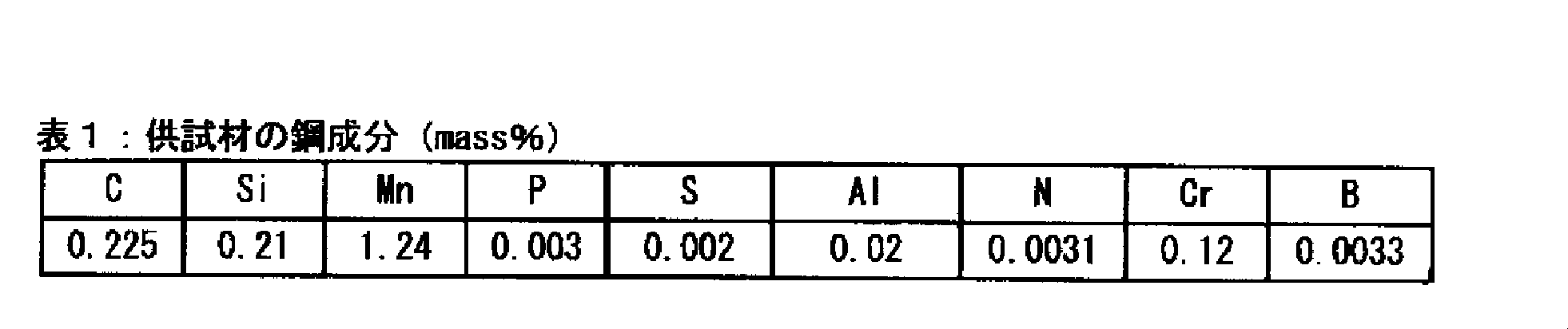
試験板の作製方法としては、まず上記の供試板の表面を、日本パーカライジング(株)製パルクリーンN364Sを用いて処理し、表面の油分や汚れを取り除いた。次に、水道水で水洗して金属材料表面が水で100%濡れることを確認した後、さらに純水(脱イオン水)を流しかけ、70℃雰囲気のオーブンで水分を乾燥したものを試験片として使用した。
ビーズミルに、初期粒径500nmの酸化亜鉛粉末300gと分散剤30gに水670g投入し、直径0.3mmのジルコニアビーズを用いて所定の平均粒径になるまで分散を行った。粒度分布は動的光散乱式粒度分布測定装置(マイクロトラックUPA-EX150、日機装株式会社製)で測定し、メジアン径(d50)を酸化亜鉛の平均粒径とした。
(水分散性ポリウレタン樹脂)
ポリウレタン樹脂A
スーパーフレックス150(第一工業製薬株式会社製)
アクリル樹脂Aの合成方法
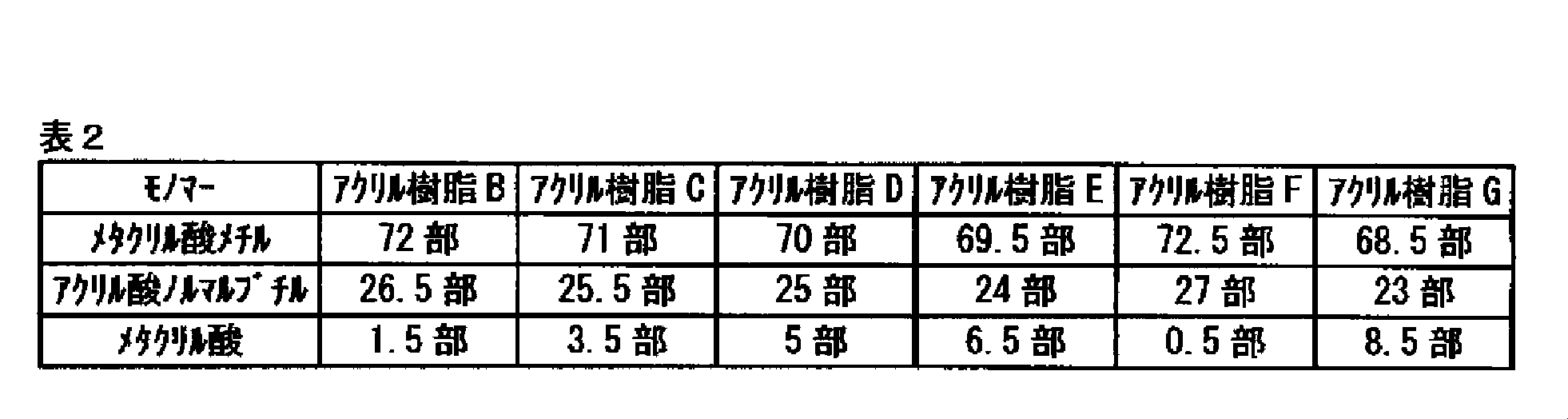
モノマー組成として、メタクリル酸メチル72部、ブチルアクリレート27部、メタクリル酸1部を用いた。合成方法は、反応性ノニオン乳化剤とポリオキシエチレンオクチルフェニルエーテル(HLB17.9)とを6:4で混合した10質量%乳化剤水溶液100部に、上記のモノマーを混合し、ホモジナイザーを用いて、5000rpmで10分間乳化し、モノマー乳化液を得た。続いて、攪拌機、還流冷却器、温度計及びモノマー供給ポンプを備えた四つ口フラスコに、前記の乳化剤水溶液を150部加え、40~50℃に保ち、過硫酸アンモニウムの5質量%水溶液(50部)、及び上記モノマー乳化液をそれぞれ滴下ロートに収め、フラスコの別の口に装着させて、約2時間かけて滴下し、温度を60℃まで昇温して約1時間攪拌した。攪拌しながら室温まで冷却し、アクリル樹脂Aの水分散液を得た。このアクリル樹脂はアニオン性を示す。
アクリル樹脂Aと同様の合成方法で、表2に示すモノマー組成でアクリル樹脂B~Gの水分散液を得た。
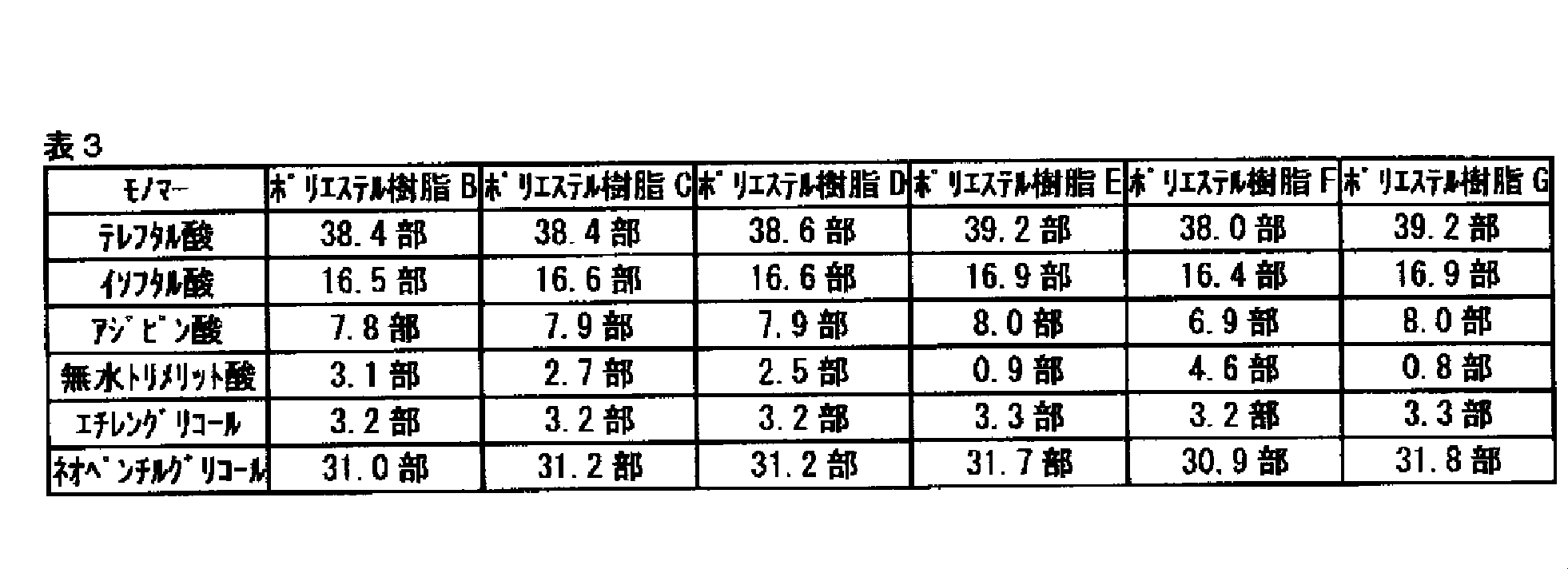
ポリエステル樹脂Aの合成方法
エチレングリコール3.2部及びネオペンチルグリコール30.9部からなるアルコール成分と、イソフタル酸16.5部、テレフタル酸38.2部、アジピン酸7.8部及び無水トリメリット酸3.4部からなる酸成分との縮合反応によるアニオン性のポリエステル樹脂を次の方法で合成した。クライゼン管及び空気冷却器を取り付けた1000mLの丸底フラスコに、全酸成分と全アルコール成分と触媒(酢酸カルシウム0.25g、N-ブチルチタネート0.1g)とを入れ、系内を窒素置換し、180℃に加熱して内容物を融解させた。そして、浴温を200℃に上げ、約2時間加熱撹拌し、エステル化又はエステル交換反応を行わせた。
次に、浴温を260℃に上げ、約15分後に系内を0.5mmHgまで減圧し、約3時間反応(重縮合反応)させた。反応終了後、窒素導入下で放冷し、内容物を取り出した。取り出した内容物に最終pHが6~7になる適当量のアンモニア水を加え、オートクレーブ中で100℃、2時間加熱撹拌し、水分散性のポリエステル樹脂を得た。
ポリエステル樹脂Aと同様の合成方法で、表3に示すモノマー組成でポリエステル樹脂B~Gの水分散液を得た。
エポキシ樹脂A
アデカレジンEM-0430(株式会社ADEKA製)
ポリアクリル酸A
ジュリマーAC-10SL(東亜合成株式会社製)
各成分を表4に示す組成比(質量比(WA/WB))になるように、ZnO水分散液と水分散性有機樹脂を水中で混合し、表面処理液を得た。また、水分散性有機樹脂の平均粒径(メジアン径)を、動的光散乱式粒度分布測定装置(マイクロトラックUPA-EX150、日機装株式会社製)で測定した結果を表4に示す。
前処理を行った試験板の片面に表面処理液をバーコーターにより塗布、加熱乾燥し、表面処理皮膜を得た。形成された表面処理皮膜のZnO付着量(Znとしての値)及び加熱温度(PMT:最高到達板温度)を、表4に示す。得られた表面処理鋼板を以下の方法で評価した。

耐水性
表面処理鋼板を温度50℃、湿度98%の恒温恒湿槽に72時間放置し、試験前後のZnO粒子の残存率をXRFで測定した。
◎(優):残存率95~100%
○(良):残存率90~94%
△(可):残存率50~89%
×(不可):残存率49%以下
エタノールを染み込ませたガーゼで、表面処理鋼板を500g荷重で50往復ラビングし、試験前後のZnO粒子の残存率をXRFで測定した。
◎(優):残存率95~100%
○(良):残存率90~94%
△(可):残存率50~89%
×(不可):残存率49%以下
表面処理鋼板をセロハン(登録商標)テープで剥離試験を行い、試験前後のZnO粒子の残存率をXRFで測定した。
◎(優):残存率95~100%
○(良):残存率90~94%
△(可):残存率50~89%
×(不可):残存率49%以下
貯蔵安定性は固形分の変化で判断することとし、表面処理液の固形分が、初期の固形分の90%以上であれば貯蔵安定性が保たれているとした。(なお貯蔵安定性が保たれていない場合は、表面処理液成分が沈殿することにより、表面処理液の固形分が90%未満に低下した状態である)
表面処理液を40℃の下で静置保管し、貯蔵安定性を保つことができる期間を評価した。
固形分は、表面処理液の任意の量を採取し、熱風乾燥炉にて110℃で2時間乾燥した際の重量変化から算出した。
○(良):貯蔵安定性3ヶ月以上
△(可):貯蔵安定性1ヶ月以上、3ヶ月未満
×(不可):貯蔵安定性1ヶ月未満
図1に示す熱間バウデン装置を使用した。供試材を供試材上に重さ1kgの接触子を配置した状態で900℃に保定された炉内に挿入した。供試材には熱電対を溶接し、900℃に到達した時点で炉温を低下させ、700℃に達した時に供試材ごと炉体を駆動させ、このときに掛かる荷重をロードセルで計測した。前記荷重を接触子重量で除して動摩擦係数とした。判定基準は以下とした。
○(良):摩擦係数0.5以下
△(可):摩擦係数0.5~0.7未満
×(不可):摩擦係数0.7超
試験板を大気中900℃まで昇温した後に1分間保定し、金型に挟んで急冷した。その試験板について、溶接条件は、交流電源、アルミナ分散銅電極、電極形状DR(先端6φ-40R)、加圧400kgf、通電時間20サイクルとして、下限ナゲット径4√t、上限チリ発生として適正電流範囲を評価した。評価基準は以下とした。
○(良):適正電流範囲1.5kA以上
×(不可):適正電流範囲1.5kA未満
試験板を大気中900℃まで昇温した後に1分間保定し、金型に挟んで急冷した。その試験板を、日本パーカライジング(株)製のアルカリ脱脂剤FC-E2001を用いて表面の汚れを取り除いた。その後、水洗を施し、日本パーカライジング(株)製のリン酸亜鉛処理用の表面調整剤プレパレンXを3g/Lに水道水で希釈した液に室温で30秒間浸漬した後、日本パーカライジング(株)製のリン酸亜鉛表面処理剤パルボンドSX35を48g/Lに水道水で希釈し、使用説明書に従い全酸度及び遊離酸度、促進剤濃度を調整した液に35℃で2分間浸漬させた。
〇(良):リン酸亜鉛皮膜が緻密に析出
×(不可):リン酸亜鉛皮膜が析出しない
前記化成処理後に関西ペイント(株)製エポキシ系カチオン電着塗料GT-100を15μm塗装した。クロスカットを付与後、公益社団法人自動車技術会で定めた複合腐食試験JASO-M610を180サイクル(60日)実施し、クロスカットからの片側最大膨れ幅を計測した。評価基準は以下とした。
◎(優):膨れ3mm未満
○(良):膨れ3~6mm
×(不可):膨れ6mm超
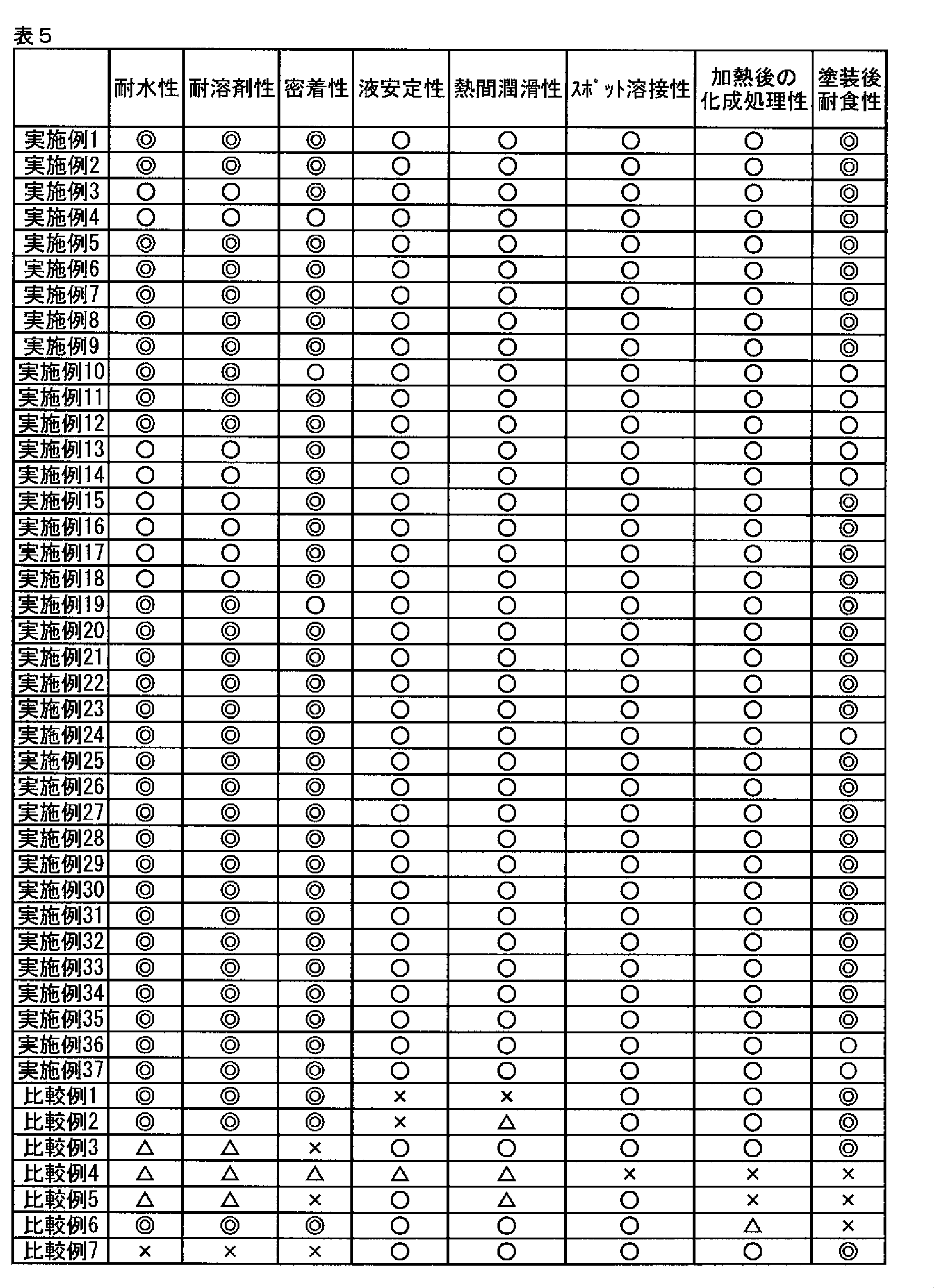
表5に評価結果を示す。
Claims (8)
- ZnO水分散液(A)と水分散性有機樹脂(B)とを含み、
前記ZnO水分散液(A)は、水及び平均粒径が10~300nmであるZnO粒子を含み、
前記水分散性有機樹脂(B)は、5~300nmのエマルション平均粒径を有し、
前記ZnO水分散液中のZnO粒子の質量(WA)と、前記水分散性有機樹脂の固形分の質量(WB)との質量比(WA/WB)が30/70~95/5である、
熱間プレス用めっき鋼板の表面処理液。 - 前記水分散性有機樹脂(B)が、水分散性ポリウレタン樹脂、水分散性エポキシ樹脂、水分散性アクリル樹脂、水分散性ポリエステル樹脂から成る群より選ばれる1種又は2種以上の樹脂である、請求項1に記載の熱間プレス用めっき鋼板の表面処理液。
- 前記水分散性有機樹脂(B)の数平均分子量が、10000以上である、請求項1又は2に記載の熱間プレス用めっき鋼板の表面処理液。
- 前記水分散性有機樹脂(B)が、5~45mgKOH/gの酸価を有し、水分散性ポリウレタン樹脂、水分散性アクリル樹脂、水分散性ポリエステル樹脂から成る群より選ばれる1種又は2種以上の樹脂である、請求項1~3のいずれか一項に記載の熱間プレス用めっき鋼板の表面処理液。
- B、Mg、Si、Ca、Ti、V、Zr、W、Ceから成る群より選ばれる元素を含む化合物から選ばれる少なくとも1種の添加剤(C)を含む、請求項1~4のいずれか一項に記載の熱間プレス用めっき鋼板の表面処理液。
- 前記ZnO水分散液中の前記ZnO粒子の質量(WA)と、前記添加剤(C)の質量(WC)の質量比(WC/WA)が、0.05~0.6である、請求項5に記載の熱間プレス用めっき鋼板の表面処理液。
- 前記ZnO粒子のアスペクト比(長径/短径)が1~2.8である、請求項1~6のいずれか一項に記載の熱間プレス用めっき鋼板の表面処理液。
- 前記ZnO水分散液(A)が、アニオン系分散剤及びノニオン系分散剤のいずれか一方又は両方含む、請求項1~7のいずれか一項に記載の熱間プレス用めっき鋼板の表面処理液。
Priority Applications (9)
| Application Number | Priority Date | Filing Date | Title |
|---|---|---|---|
| KR1020177034057A KR20170141755A (ko) | 2015-06-04 | 2016-06-03 | 열간 프레스용 도금 강판의 표면 처리액 |
| EP16803532.7A EP3305944B1 (en) | 2015-06-04 | 2016-06-03 | Surface treatment liquid for plated steel sheet to be hot-pressed |
| MX2017015525A MX2017015525A (es) | 2015-06-04 | 2016-06-03 | Liquido de tratamiento de superficie para lamina de acero chapada que se prensara en caliente. |
| BR112017025204-0A BR112017025204A2 (ja) | 2015-06-04 | 2016-06-03 | Surface treatment liquid of a plating steel plate for the press between heat |
| CA2987241A CA2987241C (en) | 2015-06-04 | 2016-06-03 | Surface treatment solution for plated steel sheet to be hot-pressed |
| CN201680032380.4A CN107636200B (zh) | 2015-06-04 | 2016-06-03 | 热压用镀层钢板的表面处理液 |
| RU2017146830A RU2687326C1 (ru) | 2015-06-04 | 2016-06-03 | Раствор для поверхностной обработки покрытого стального листа под горячее прессование |
| JP2016561403A JP6121070B1 (ja) | 2015-06-04 | 2016-06-03 | 熱間プレス用めっき鋼板の表面処理液 |
| US15/578,845 US10800933B2 (en) | 2015-06-04 | 2016-06-03 | Surface treatment solution for plated steel sheet to be hot-pressed |
Applications Claiming Priority (2)
| Application Number | Priority Date | Filing Date | Title |
|---|---|---|---|
| JP2015-114043 | 2015-06-04 | ||
| JP2015114043 | 2015-06-04 |
Publications (1)
| Publication Number | Publication Date |
|---|---|
| WO2016195101A1 true WO2016195101A1 (ja) | 2016-12-08 |
Family
ID=57441465
Family Applications (1)
| Application Number | Title | Priority Date | Filing Date |
|---|---|---|---|
| PCT/JP2016/066686 Ceased WO2016195101A1 (ja) | 2015-06-04 | 2016-06-03 | 熱間プレス用めっき鋼板の表面処理液 |
Country Status (11)
| Country | Link |
|---|---|
| US (1) | US10800933B2 (ja) |
| EP (1) | EP3305944B1 (ja) |
| JP (1) | JP6121070B1 (ja) |
| KR (1) | KR20170141755A (ja) |
| CN (1) | CN107636200B (ja) |
| BR (1) | BR112017025204A2 (ja) |
| CA (1) | CA2987241C (ja) |
| MX (1) | MX2017015525A (ja) |
| RU (1) | RU2687326C1 (ja) |
| TW (1) | TWI597386B (ja) |
| WO (1) | WO2016195101A1 (ja) |
Cited By (4)
| Publication number | Priority date | Publication date | Assignee | Title |
|---|---|---|---|---|
| WO2018180986A1 (ja) * | 2017-03-27 | 2018-10-04 | 新日鐵住金株式会社 | Al系めっき鋼板 |
| WO2019066063A1 (ja) * | 2017-09-28 | 2019-04-04 | 新日鐵住金株式会社 | めっき鋼板、めっき鋼板コイル、熱間プレス成形品の製造方法、及び自動車部品 |
| WO2021234790A1 (ja) * | 2020-05-18 | 2021-11-25 | 日本製鉄株式会社 | ホットスタンプ成形体及びその製造方法並びにAlめっき鋼板 |
| KR20220156925A (ko) | 2020-05-18 | 2022-11-28 | 닛폰세이테츠 가부시키가이샤 | Al 도금 핫 스탬프 강재 |
Families Citing this family (6)
| Publication number | Priority date | Publication date | Assignee | Title |
|---|---|---|---|---|
| JP6577361B2 (ja) * | 2015-12-24 | 2019-09-18 | 日華化学株式会社 | 水分散体、コーティング液及び透過型スクリーンの製造方法 |
| US11289700B2 (en) | 2016-06-28 | 2022-03-29 | The Research Foundation For The State University Of New York | KVOPO4 cathode for sodium ion batteries |
| CN112170591B (zh) * | 2020-09-04 | 2024-09-06 | 隆盛通达(天津)钢铁有限公司 | 一种冲压生产冷却机床 |
| CN116949439B (zh) | 2022-04-15 | 2025-09-09 | 宝山钢铁股份有限公司 | 热冲压用镀层钢板及其所用的水性表面处理液 |
| CN116727163B (zh) * | 2023-08-10 | 2023-10-20 | 常州福睿新材料科技有限公司 | 一种聚四氟乙烯板材表层轧碾涂布装置及其加工工艺 |
| CN117867431B (zh) * | 2023-12-26 | 2024-11-05 | 河北燕赵蓝天板业集团有限责任公司 | 一种镀锌钢板加工设备 |
Citations (5)
| Publication number | Priority date | Publication date | Assignee | Title |
|---|---|---|---|---|
| WO2009131233A1 (ja) * | 2008-04-22 | 2009-10-29 | 新日本製鐵株式会社 | めっき鋼板及びめっき鋼板の熱間プレス方法 |
| WO2012147886A1 (ja) * | 2011-04-28 | 2012-11-01 | 堺化学工業株式会社 | 六角板状酸化亜鉛粒子、その製造方法、それを配合した化粧料、放熱性フィラー、放熱性樹脂組成物、放熱性グリース及び放熱性塗料組成物 |
| JP2013194258A (ja) * | 2012-03-16 | 2013-09-30 | Jfe Steel Corp | 表面処理鋼板 |
| WO2013157522A1 (ja) * | 2012-04-18 | 2013-10-24 | 新日鐵住金株式会社 | Al系めっき鋼板、Al系めっき鋼板の熱間プレス方法及び自動車部品 |
| JP2013244696A (ja) * | 2012-05-28 | 2013-12-09 | Jfe Steel Corp | 塗装鋼板およびその製造方法、ならびに加工品および薄型テレビ用パネル |
Family Cites Families (8)
| Publication number | Priority date | Publication date | Assignee | Title |
|---|---|---|---|---|
| WO2005056884A1 (ja) * | 2003-12-09 | 2005-06-23 | Kansai Paint Co., Ltd. | 有機高分子複合電気亜鉛合金めっき液組成物及び該組成物を用いためっき金属材 |
| BE1015823A3 (fr) | 2003-12-17 | 2005-09-06 | Ct Rech Metallurgiques Asbl | Procede de revetement d'une surface metallique par une couche ultrafine. |
| JP5546097B2 (ja) | 2006-06-23 | 2014-07-09 | 新日鐵住金株式会社 | 表面処理金属材及び金属表面処理剤 |
| JP5398134B2 (ja) | 2007-11-15 | 2014-01-29 | 住友金属鉱山株式会社 | 表面処理酸化亜鉛微粒子の製造方法、表面処理酸化亜鉛微粒子、その分散液体および分散固体、並びに酸化亜鉛微粒子被覆基材 |
| JP5564901B2 (ja) * | 2009-11-11 | 2014-08-06 | 住友金属鉱山株式会社 | プライマー層形成用塗布液とプライマー層並びに高耐久性uvカットプラスチック基材 |
| KR20140124805A (ko) | 2012-02-01 | 2014-10-27 | 쓰리엠 이노베이티브 프로퍼티즈 캄파니 | 나노구조화된 재료 및 그 제조 방법 |
| JP6088741B2 (ja) * | 2012-03-16 | 2017-03-01 | 古河電気工業株式会社 | プレス時の金型耐摩耗性に優れた銅合金材およびその製造方法 |
| JP5692148B2 (ja) * | 2012-04-18 | 2015-04-01 | 新日鐵住金株式会社 | 熱間プレス用Al系めっき鋼板及びその熱間プレス方法 |
-
2016
- 2016-06-03 BR BR112017025204-0A patent/BR112017025204A2/ja not_active Application Discontinuation
- 2016-06-03 KR KR1020177034057A patent/KR20170141755A/ko not_active Abandoned
- 2016-06-03 JP JP2016561403A patent/JP6121070B1/ja active Active
- 2016-06-03 CA CA2987241A patent/CA2987241C/en not_active Expired - Fee Related
- 2016-06-03 US US15/578,845 patent/US10800933B2/en active Active
- 2016-06-03 TW TW105117716A patent/TWI597386B/zh not_active IP Right Cessation
- 2016-06-03 EP EP16803532.7A patent/EP3305944B1/en active Active
- 2016-06-03 RU RU2017146830A patent/RU2687326C1/ru not_active IP Right Cessation
- 2016-06-03 CN CN201680032380.4A patent/CN107636200B/zh active Active
- 2016-06-03 WO PCT/JP2016/066686 patent/WO2016195101A1/ja not_active Ceased
- 2016-06-03 MX MX2017015525A patent/MX2017015525A/es unknown
Patent Citations (5)
| Publication number | Priority date | Publication date | Assignee | Title |
|---|---|---|---|---|
| WO2009131233A1 (ja) * | 2008-04-22 | 2009-10-29 | 新日本製鐵株式会社 | めっき鋼板及びめっき鋼板の熱間プレス方法 |
| WO2012147886A1 (ja) * | 2011-04-28 | 2012-11-01 | 堺化学工業株式会社 | 六角板状酸化亜鉛粒子、その製造方法、それを配合した化粧料、放熱性フィラー、放熱性樹脂組成物、放熱性グリース及び放熱性塗料組成物 |
| JP2013194258A (ja) * | 2012-03-16 | 2013-09-30 | Jfe Steel Corp | 表面処理鋼板 |
| WO2013157522A1 (ja) * | 2012-04-18 | 2013-10-24 | 新日鐵住金株式会社 | Al系めっき鋼板、Al系めっき鋼板の熱間プレス方法及び自動車部品 |
| JP2013244696A (ja) * | 2012-05-28 | 2013-12-09 | Jfe Steel Corp | 塗装鋼板およびその製造方法、ならびに加工品および薄型テレビ用パネル |
Non-Patent Citations (1)
| Title |
|---|
| See also references of EP3305944A4 * |
Cited By (14)
| Publication number | Priority date | Publication date | Assignee | Title |
|---|---|---|---|---|
| CN110291226A (zh) * | 2017-03-27 | 2019-09-27 | 日本制铁株式会社 | Al系镀覆钢板 |
| JP6424989B1 (ja) * | 2017-03-27 | 2018-11-21 | 新日鐵住金株式会社 | Al系めっき鋼板 |
| WO2018180986A1 (ja) * | 2017-03-27 | 2018-10-04 | 新日鐵住金株式会社 | Al系めっき鋼板 |
| TWI664299B (zh) * | 2017-03-27 | 2019-07-01 | 日商新日鐵住金股份有限公司 | Al系鍍敷鋼板 |
| JPWO2019066063A1 (ja) * | 2017-09-28 | 2020-08-06 | 日本製鉄株式会社 | めっき鋼板、めっき鋼板コイル、熱間プレス成形品の製造方法、及び自動車部品 |
| CN111148856A (zh) * | 2017-09-28 | 2020-05-12 | 日本制铁株式会社 | 镀覆钢板、镀覆钢板卷材、热压成形品的制造方法及汽车部件 |
| WO2019066063A1 (ja) * | 2017-09-28 | 2019-04-04 | 新日鐵住金株式会社 | めっき鋼板、めっき鋼板コイル、熱間プレス成形品の製造方法、及び自動車部品 |
| WO2021234790A1 (ja) * | 2020-05-18 | 2021-11-25 | 日本製鉄株式会社 | ホットスタンプ成形体及びその製造方法並びにAlめっき鋼板 |
| JPWO2021234790A1 (ja) * | 2020-05-18 | 2021-11-25 | ||
| KR20220156925A (ko) | 2020-05-18 | 2022-11-28 | 닛폰세이테츠 가부시키가이샤 | Al 도금 핫 스탬프 강재 |
| KR20220166353A (ko) | 2020-05-18 | 2022-12-16 | 닛폰세이테츠 가부시키가이샤 | 핫 스탬프 성형체 및 그 제조 방법 그리고 Al 도금 강판 |
| JP7288228B2 (ja) | 2020-05-18 | 2023-06-07 | 日本製鉄株式会社 | ホットスタンプ成形体及びその製造方法並びにAlめっき鋼板 |
| US11905600B2 (en) | 2020-05-18 | 2024-02-20 | Nippon Steel Corporation | Al-plated hot stamped steel material |
| US12344908B2 (en) | 2020-05-18 | 2025-07-01 | Nippon Steel Corporation | Hot stamped body and method for producing same and Al-plated steel sheet |
Also Published As
| Publication number | Publication date |
|---|---|
| EP3305944A4 (en) | 2019-01-30 |
| BR112017025204A2 (ja) | 2018-07-31 |
| TW201718940A (zh) | 2017-06-01 |
| JPWO2016195101A1 (ja) | 2017-06-15 |
| CN107636200B (zh) | 2019-10-18 |
| TWI597386B (zh) | 2017-09-01 |
| EP3305944B1 (en) | 2020-05-13 |
| US20180171164A1 (en) | 2018-06-21 |
| RU2687326C1 (ru) | 2019-05-13 |
| US10800933B2 (en) | 2020-10-13 |
| KR20170141755A (ko) | 2017-12-26 |
| CA2987241A1 (en) | 2016-12-08 |
| JP6121070B1 (ja) | 2017-04-26 |
| CN107636200A (zh) | 2018-01-26 |
| CA2987241C (en) | 2019-04-23 |
| MX2017015525A (es) | 2018-02-21 |
| EP3305944A1 (en) | 2018-04-11 |
Similar Documents
| Publication | Publication Date | Title |
|---|---|---|
| JP6121070B1 (ja) | 熱間プレス用めっき鋼板の表面処理液 | |
| EP3730672B1 (en) | Surface treatment solution composition for ternary hot-dip zinc alloy-plated steel sheet, providing excellent corrosion resistance and blackening resistance, ternary hot-dip zinc alloy-plated steel sheet surface-treated using same, and manufacturing method therefor | |
| CN100577870C (zh) | 金属材料表面处理用组合物和处理方法 | |
| KR101974182B1 (ko) | 열간 프레스용 도금 강판 및 도금 강판의 열간 프레스 방법 | |
| CN107406988B (zh) | 热浸镀锌系钢板 | |
| CN102378827B (zh) | 表面处理剂、使用该表面处理剂的镀覆钢板的制造方法以及镀覆钢板 | |
| JP6551518B2 (ja) | 亜鉛系めっき鋼板 | |
| KR20130051997A (ko) | 아연계 도금 강판용의 표면 처리액 그리고 아연계 도금 강판 및 그의 제조 방법 | |
| TWI604088B (zh) | Zinc plating steel | |
| KR20120127730A (ko) | 아연계 도금 강판용의 표면 처리액 그리고 아연계 도금 강판 및 그의 제조 방법 | |
| KR102314431B1 (ko) | 우수한 내흑변성 및 내알칼리성을 부여하는 삼원계 용융아연합금 도금강판용 표면처리 용액 조성물, 이를 이용하여 표면처리된 삼원계 용융아연합금 도금강판 및 그 제조 방법 | |
| WO2015056355A1 (ja) | 金属材料用表面処理剤、表面処理金属材料の製造方法 | |
| TWI418652B (zh) | A metal plate for coating resin | |
| JP2004338397A (ja) | 加工性に優れた非脱膜型潤滑めっき鋼板 | |
| JP4810515B2 (ja) | ロール成形性に優れた樹脂塗装金属板 | |
| JP2020158845A (ja) | 溶融亜鉛系めっき鋼板用の表面処理液ならびに亜鉛系めっき鋼板およびその製造方法 | |
| JP7099424B2 (ja) | 表面処理皮膜付き亜鉛系めっき鋼板及びその製造方法 | |
| CN117083170B (zh) | 预涂镀覆钢板及成形品 |
Legal Events
| Date | Code | Title | Description |
|---|---|---|---|
| ENP | Entry into the national phase |
Ref document number: 2016561403 Country of ref document: JP Kind code of ref document: A |
|
| 121 | Ep: the epo has been informed by wipo that ep was designated in this application |
Ref document number: 16803532 Country of ref document: EP Kind code of ref document: A1 |
|
| ENP | Entry into the national phase |
Ref document number: 2987241 Country of ref document: CA Ref document number: 20177034057 Country of ref document: KR Kind code of ref document: A |
|
| WWE | Wipo information: entry into national phase |
Ref document number: 15578845 Country of ref document: US Ref document number: MX/A/2017/015525 Country of ref document: MX |
|
| NENP | Non-entry into the national phase |
Ref country code: DE |
|
| WWE | Wipo information: entry into national phase |
Ref document number: 2016803532 Country of ref document: EP |
|
| WWE | Wipo information: entry into national phase |
Ref document number: 2017146830 Country of ref document: RU |
|
| REG | Reference to national code |
Ref country code: BR Ref legal event code: B01A Ref document number: 112017025204 Country of ref document: BR |
|
| ENP | Entry into the national phase |
Ref document number: 112017025204 Country of ref document: BR Kind code of ref document: A2 Effective date: 20171124 |
|
| ENP | Entry into the national phase |
Ref document number: 112017025204 Country of ref document: BR Kind code of ref document: A2 Effective date: 20171124 |