WO2016194937A1 - (メタ)アクリル系共重合体、それを含む粘着組成物および粘着シート、並びにそれを用いた被覆材及び塗装物 - Google Patents
(メタ)アクリル系共重合体、それを含む粘着組成物および粘着シート、並びにそれを用いた被覆材及び塗装物 Download PDFInfo
- Publication number
- WO2016194937A1 WO2016194937A1 PCT/JP2016/066154 JP2016066154W WO2016194937A1 WO 2016194937 A1 WO2016194937 A1 WO 2016194937A1 JP 2016066154 W JP2016066154 W JP 2016066154W WO 2016194937 A1 WO2016194937 A1 WO 2016194937A1
- Authority
- WO
- WIPO (PCT)
- Prior art keywords
- meth
- group
- acrylic copolymer
- macromonomer
- acrylate
- Prior art date
- Legal status (The legal status is an assumption and is not a legal conclusion. Google has not performed a legal analysis and makes no representation as to the accuracy of the status listed.)
- Ceased
Links
Classifications
-
- C—CHEMISTRY; METALLURGY
- C08—ORGANIC MACROMOLECULAR COMPOUNDS; THEIR PREPARATION OR CHEMICAL WORKING-UP; COMPOSITIONS BASED THEREON
- C08F—MACROMOLECULAR COMPOUNDS OBTAINED BY REACTIONS ONLY INVOLVING CARBON-TO-CARBON UNSATURATED BONDS
- C08F290/00—Macromolecular compounds obtained by polymerising monomers on to polymers modified by introduction of aliphatic unsaturated end or side groups
- C08F290/02—Macromolecular compounds obtained by polymerising monomers on to polymers modified by introduction of aliphatic unsaturated end or side groups on to polymers modified by introduction of unsaturated end groups
- C08F290/04—Polymers provided for in subclasses C08C or C08F
- C08F290/046—Polymers of unsaturated carboxylic acids or derivatives thereof
-
- C—CHEMISTRY; METALLURGY
- C08—ORGANIC MACROMOLECULAR COMPOUNDS; THEIR PREPARATION OR CHEMICAL WORKING-UP; COMPOSITIONS BASED THEREON
- C08F—MACROMOLECULAR COMPOUNDS OBTAINED BY REACTIONS ONLY INVOLVING CARBON-TO-CARBON UNSATURATED BONDS
- C08F220/00—Copolymers of compounds having one or more unsaturated aliphatic radicals, each having only one carbon-to-carbon double bond, and only one being terminated by only one carboxyl radical or a salt, anhydride ester, amide, imide or nitrile thereof
- C08F220/62—Monocarboxylic acids having ten or more carbon atoms; Derivatives thereof
-
- C—CHEMISTRY; METALLURGY
- C09—DYES; PAINTS; POLISHES; NATURAL RESINS; ADHESIVES; COMPOSITIONS NOT OTHERWISE PROVIDED FOR; APPLICATIONS OF MATERIALS NOT OTHERWISE PROVIDED FOR
- C09D—COATING COMPOSITIONS, e.g. PAINTS, VARNISHES OR LACQUERS; FILLING PASTES; CHEMICAL PAINT OR INK REMOVERS; INKS; CORRECTING FLUIDS; WOODSTAINS; PASTES OR SOLIDS FOR COLOURING OR PRINTING; USE OF MATERIALS THEREFOR
- C09D151/00—Coating compositions based on graft polymers in which the grafted component is obtained by reactions only involving carbon-to-carbon unsaturated bonds; Coating compositions based on derivatives of such polymers
- C09D151/003—Coating compositions based on graft polymers in which the grafted component is obtained by reactions only involving carbon-to-carbon unsaturated bonds; Coating compositions based on derivatives of such polymers grafted on to macromolecular compounds obtained by reactions only involving unsaturated carbon-to-carbon bonds
-
- C—CHEMISTRY; METALLURGY
- C09—DYES; PAINTS; POLISHES; NATURAL RESINS; ADHESIVES; COMPOSITIONS NOT OTHERWISE PROVIDED FOR; APPLICATIONS OF MATERIALS NOT OTHERWISE PROVIDED FOR
- C09D—COATING COMPOSITIONS, e.g. PAINTS, VARNISHES OR LACQUERS; FILLING PASTES; CHEMICAL PAINT OR INK REMOVERS; INKS; CORRECTING FLUIDS; WOODSTAINS; PASTES OR SOLIDS FOR COLOURING OR PRINTING; USE OF MATERIALS THEREFOR
- C09D155/00—Coating compositions based on homopolymers or copolymers, obtained by polymerisation reactions only involving carbon-to-carbon unsaturated bonds, not provided for in groups C09D123/00 - C09D153/00
- C09D155/005—Homopolymers or copolymers obtained by polymerisation of macromolecular compounds terminated by a carbon-to-carbon double bond
-
- C—CHEMISTRY; METALLURGY
- C09—DYES; PAINTS; POLISHES; NATURAL RESINS; ADHESIVES; COMPOSITIONS NOT OTHERWISE PROVIDED FOR; APPLICATIONS OF MATERIALS NOT OTHERWISE PROVIDED FOR
- C09J—ADHESIVES; NON-MECHANICAL ASPECTS OF ADHESIVE PROCESSES IN GENERAL; ADHESIVE PROCESSES NOT PROVIDED FOR ELSEWHERE; USE OF MATERIALS AS ADHESIVES
- C09J133/00—Adhesives based on homopolymers or copolymers of compounds having one or more unsaturated aliphatic radicals, each having only one carbon-to-carbon double bond, and at least one being terminated by only one carboxyl radical, or of salts, anhydrides, esters, amides, imides, or nitriles thereof; Adhesives based on derivatives of such polymers
- C09J133/04—Homopolymers or copolymers of esters
-
- C—CHEMISTRY; METALLURGY
- C09—DYES; PAINTS; POLISHES; NATURAL RESINS; ADHESIVES; COMPOSITIONS NOT OTHERWISE PROVIDED FOR; APPLICATIONS OF MATERIALS NOT OTHERWISE PROVIDED FOR
- C09J—ADHESIVES; NON-MECHANICAL ASPECTS OF ADHESIVE PROCESSES IN GENERAL; ADHESIVE PROCESSES NOT PROVIDED FOR ELSEWHERE; USE OF MATERIALS AS ADHESIVES
- C09J151/00—Adhesives based on graft polymers in which the grafted component is obtained by reactions only involving carbon-to-carbon unsaturated bonds; Adhesives based on derivatives of such polymers
- C09J151/003—Adhesives based on graft polymers in which the grafted component is obtained by reactions only involving carbon-to-carbon unsaturated bonds; Adhesives based on derivatives of such polymers grafted on to macromolecular compounds obtained by reactions only involving unsaturated carbon-to-carbon bonds
-
- C—CHEMISTRY; METALLURGY
- C09—DYES; PAINTS; POLISHES; NATURAL RESINS; ADHESIVES; COMPOSITIONS NOT OTHERWISE PROVIDED FOR; APPLICATIONS OF MATERIALS NOT OTHERWISE PROVIDED FOR
- C09J—ADHESIVES; NON-MECHANICAL ASPECTS OF ADHESIVE PROCESSES IN GENERAL; ADHESIVE PROCESSES NOT PROVIDED FOR ELSEWHERE; USE OF MATERIALS AS ADHESIVES
- C09J155/00—Adhesives based on homopolymers or copolymers, obtained by polymerisation reactions only involving carbon-to-carbon unsaturated bonds, not provided for in groups C09J123/00 - C09J153/00
- C09J155/005—Homopolymers or copolymers obtained by polymerisation of macromolecular compounds terminated by a carbon-to-carbon double bond
-
- C—CHEMISTRY; METALLURGY
- C09—DYES; PAINTS; POLISHES; NATURAL RESINS; ADHESIVES; COMPOSITIONS NOT OTHERWISE PROVIDED FOR; APPLICATIONS OF MATERIALS NOT OTHERWISE PROVIDED FOR
- C09J—ADHESIVES; NON-MECHANICAL ASPECTS OF ADHESIVE PROCESSES IN GENERAL; ADHESIVE PROCESSES NOT PROVIDED FOR ELSEWHERE; USE OF MATERIALS AS ADHESIVES
- C09J7/00—Adhesives in the form of films or foils
- C09J7/10—Adhesives in the form of films or foils without carriers
-
- C—CHEMISTRY; METALLURGY
- C08—ORGANIC MACROMOLECULAR COMPOUNDS; THEIR PREPARATION OR CHEMICAL WORKING-UP; COMPOSITIONS BASED THEREON
- C08F—MACROMOLECULAR COMPOUNDS OBTAINED BY REACTIONS ONLY INVOLVING CARBON-TO-CARBON UNSATURATED BONDS
- C08F2800/00—Copolymer characterised by the proportions of the comonomers expressed
- C08F2800/20—Copolymer characterised by the proportions of the comonomers expressed as weight or mass percentages
-
- C—CHEMISTRY; METALLURGY
- C09—DYES; PAINTS; POLISHES; NATURAL RESINS; ADHESIVES; COMPOSITIONS NOT OTHERWISE PROVIDED FOR; APPLICATIONS OF MATERIALS NOT OTHERWISE PROVIDED FOR
- C09J—ADHESIVES; NON-MECHANICAL ASPECTS OF ADHESIVE PROCESSES IN GENERAL; ADHESIVE PROCESSES NOT PROVIDED FOR ELSEWHERE; USE OF MATERIALS AS ADHESIVES
- C09J2301/00—Additional features of adhesives in the form of films or foils
- C09J2301/30—Additional features of adhesives in the form of films or foils characterized by the chemical, physicochemical or physical properties of the adhesive or the carrier
- C09J2301/312—Additional features of adhesives in the form of films or foils characterized by the chemical, physicochemical or physical properties of the adhesive or the carrier parameters being the characterizing feature
-
- C—CHEMISTRY; METALLURGY
- C09—DYES; PAINTS; POLISHES; NATURAL RESINS; ADHESIVES; COMPOSITIONS NOT OTHERWISE PROVIDED FOR; APPLICATIONS OF MATERIALS NOT OTHERWISE PROVIDED FOR
- C09J—ADHESIVES; NON-MECHANICAL ASPECTS OF ADHESIVE PROCESSES IN GENERAL; ADHESIVE PROCESSES NOT PROVIDED FOR ELSEWHERE; USE OF MATERIALS AS ADHESIVES
- C09J2433/00—Presence of (meth)acrylic polymer
Definitions
- the present invention relates to a (meth) acrylic copolymer copolymerized with a macromonomer, a pressure-sensitive adhesive composition containing the same, and a pressure-sensitive adhesive sheet.
- the present invention also relates to a coating material and a coated product obtained using a (meth) acrylic copolymer.
- a macromonomer is a high molecular weight monomer having a polymerizable functional group.
- a copolymer obtained by copolymerizing a macromonomer has a characteristic that individual characteristics can be expressed without impairing the characteristics of the macromonomer portion and the monomer unit copolymerized with the macromonomer. Therefore, for example, various copolymers using this type of macromonomer have also been proposed in the field of adhesives.
- Patent Document 1 a macromonomer having a number average molecular weight of 2,000 g / mol to 50,000 g / mol and an ethylenically unsaturated monomer are copolymerized to disperse in an aqueous medium having a specific solid content.
- An adhesive composition comprising the prepared copolymer is disclosed.
- Patent Document 2 discloses a resin composition for an adhesive obtained by copolymerizing an alkyl (meth) acrylate monomer and a macromonomer having a number average molecular weight of 1,000 to 200,000 and a glass transition temperature of 30 to 150 ° C. Things are disclosed.
- the present invention is a (meth) acrylic copolymer (A) having a weight average molecular weight of 1,000 to 1,000,000, where 0.12 ⁇ X when the half-value width of the primary scattering peak in small-angle X-ray scattering measurement is X
- the (meth) acrylic copolymer (A) relates to the adhesion composition containing this (meth) acrylic-type copolymer (A).
- this invention relates to the adhesive sheet using this adhesive composition.
- the present invention relates to a coating material and a coated product obtained by using the (meth) acrylic copolymer (A).
- the (meth) acrylic copolymer (A) of the present invention has the characteristics of each unit consisting of a macromonomer unit and a vinyl monomer (b), the (meth) acrylic copolymer (A) is used.
- the pressure-sensitive adhesive composition can be applied by various coating methods, for example, a hot melt method in which a resin composition is heated and applied as it is, or a solution coating method in which a solvent is added and then applied.
- the pressure-sensitive adhesive sheet obtained using the obtained pressure-sensitive adhesive composition has sufficient holding power and pressure-sensitive adhesive strength. In addition, it is possible to suppress substrate contamination due to adhesive residue.
- the (meth) acrylic copolymer (A) of the present invention satisfies the following conditions. (1) The weight average molecular weight is 1,000 to 1,000,000. (2) The half width X of the primary scattering peak in the small-angle X-ray scattering measurement is 0.12 ⁇ X.
- the specific macromonomer (a) may be added to a polymer comprising the vinyl monomer (b), or the specific macromonomer (a) ) And a monomer mixture containing the vinyl monomer (b) may be polymerized.
- a monomer mixture containing the vinyl monomer (b) may be polymerized.
- the macromonomer (a) includes those having a radical polymerizable group or a functional group such as a hydroxyl group, an isocyanate group, an epoxy group, a carboxyl group, an amino group, an amide group, and a thiol group.
- a radical polymerizable group or a functional group such as a hydroxyl group, an isocyanate group, an epoxy group, a carboxyl group, an amino group, an amide group, and a thiol group.
- those having a radical polymerizable group copolymerizable with the vinyl monomer (b) are preferred.
- Two or more radically polymerizable groups may be contained, but one is particularly preferred.
- either one of the radical polymerizable group and the functional group may be contained.
- the functional group added to the polymer unit composed of the vinyl monomer (b) or the radical polymerizable group copolymerized with the vinyl monomer (b) Two or more functional groups or radical polymerizable groups other than any of them may be used.
- it has a radically polymerizable group what shows the compound which has two or more structural units (henceforth structural unit (a ')) shown by the following formula (a') is mentioned.
- Two or more structural units (a ′) may have the same or different P.
- Q of two or more structural units (a ′) may be the same or different.
- the macromonomer (a) may further have a structural unit other than the structural unit (a ′).
- P represents a hydrogen atom, a methyl group or CH 2 OH.
- Q is selected from the group consisting of OR, O 2 CR, halogen, CO 2 H, COR, CO 2 R, CN, CONH 2 , CONHR, CONR 2, COOCH (CH 3 ) OR and R ′, and R is a hydrogen atom Selected from the group consisting of substituted and unsubstituted alkyl, substituted and unsubstituted aryl, substituted and unsubstituted heteroaryl, substituted and unsubstituted aralkyl, substituted and unsubstituted alkaryl, and substituted and unsubstituted organosilyl, Selected from the group consisting of carboxylic acids, carboxylic esters, epoxies, hydroxyls, alkoxys, primary aminos, secondary aminos, tertiary aminos, isocyanatos, sulphonic acids and halogens,
- the number average molecular weight of the macromonomer (a) in the present invention is preferably 500 or more and 100,000 or less. In view of the balance between adhesive force and coating property, the number average molecular weight is more preferably 30,000 or less, further preferably 800 to 6000, and particularly preferably 1000 to 5500.
- Various monomers can be used as the monomer that forms the structural unit (a ′) of the macromonomer (a) or other structural units in the present invention.
- Examples thereof include methyl (meth) acrylate and (meth) acrylic acid.
- Octoxy polyethylene glycol-polypropylene glycol-methacrylate (ethylene glycol chain is 8 and propylene glycol chain is 6), trade name) and “ “Blenmer 20ANEP-600” (Non-Feng Co., Ltd. nonylphenoxy (ethylene glycol-polypropylene glycol) monoacrylate, trade name), "Blemmer AME-100" (Nippon Corp., trade name), "Blemmer AME- 20 0 ”(manufactured by NOF Corporation, trade name) and“ BREMMER 50AOEP-800B ”(manufactured by NOF Corporation, trade name), Biscote # 150 (trade name, manufactured by Osaka Organic Chemical Industry), Biscote # 190 ( Osaka Organic Chemical Industry, trade name), Biscote # 230 (Osaka Organic Chemical Industry, trade name), 2-methacryloyl ethyl acetate phosphate: Silaplane FM-0711 (trade name, manufactured by JNC Corporation), Silaplan
- methacrylic acid esters are preferable from the viewpoint of improving the glass transition temperature, ease of polymerization, and holding power. More preferably, methyl methacrylate, n-butyl (meth) acrylate, isobutyl (meth) acrylate, t-butyl (meth) acrylate, cyclohexyl (meth) acrylate, isobornyl (meth) acrylate, (meth) acrylic Acid hydroxyethyl and hydroxypropyl (meth) acrylate.
- the macromonomer (a) preferably contains 50 to 100 parts by mass of a methacrylic ester as a constituent component.
- the methacrylic acid ester is 50 parts by mass or more as a constituent component of the macromonomer (a), the molecular weight can be lowered. Further, from the viewpoint of productivity, the constitutional unit derived from the carboxyl group-containing monomer contained in the macromonomer (a) is preferably 0 to 10% by mass or less.
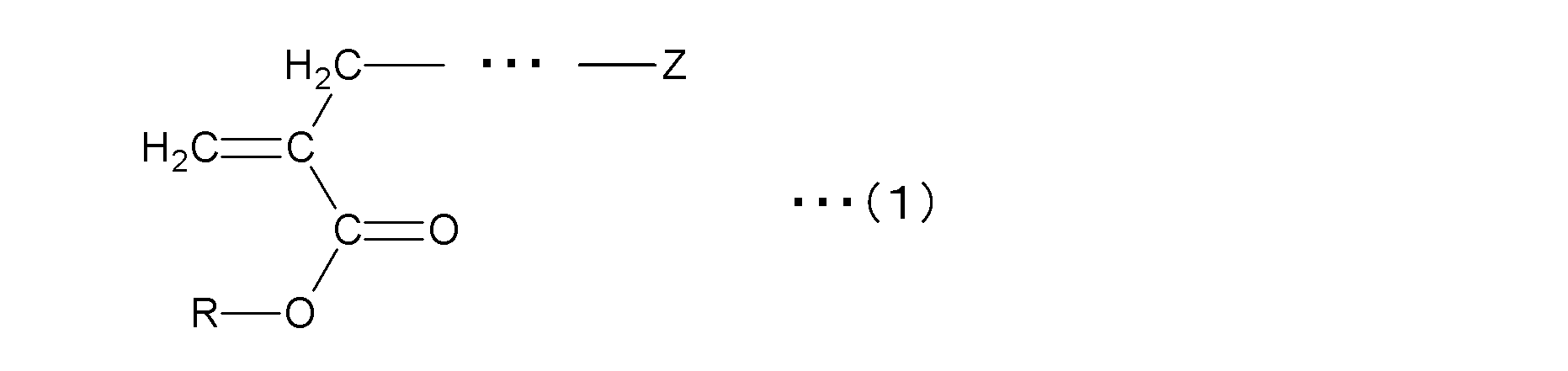
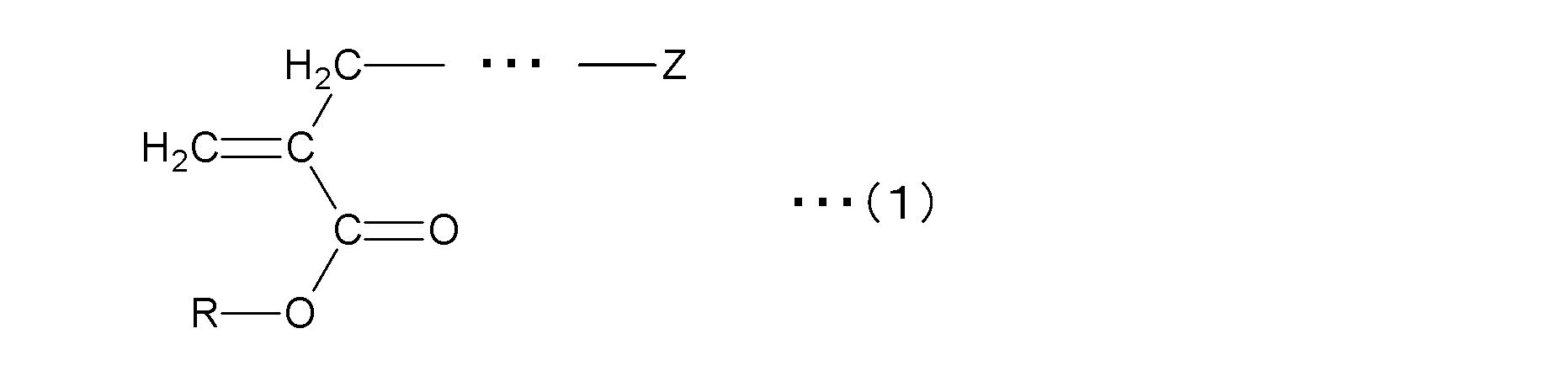
- the macromonomer (a) is preferably one having a radical polymerizable group introduced at the end of the main chain containing two or more structural units (a ′), and having a terminal structure of the following formula (1) Is preferred.
- “...” Represents a main chain portion including two or more structural units (a ′).
- R can have the same thing as said R.
- R is, for example, a branched or straight chain alkyl group having 1 to 20 carbon atoms.
- Specific examples of the branched or straight chain alkyl group having 1 to 20 carbon atoms include methyl group, ethyl group, n-propyl group, i-propyl group, n-butyl group, t-butyl group, i-butyl group, and pentyl.
- methyl, ethyl, n-propyl, i-propyl, n-butyl, t-butyl, pentyl, hexyl, heptyl and octyl groups are preferred because of their availability.
- a methyl group, ethyl group, n-propyl group, i-propyl group, n-butyl group and t-butyl group are more preferable.
- R is, for example, a cycloalkyl group having 3 to 20 carbon atoms.
- the cycloalkyl group having 3 to 20 carbon atoms include a cyclopropyl group, a cyclobutyl group, a cyclopentyl group, a cyclohexyl group, a cycloheptyl group, a cyclooctyl group, and an adamantyl group. From the viewpoint of availability, a cyclopropyl group, a cyclobutyl group and an adamantyl group are preferred.
- R is, for example, an aryl group having 6 to 18 carbon atoms.
- aryl group having 6 to 18 carbon atoms include a phenyl group, a naphthyl group, and a benzophenone structure.
- R examples include a heterocyclic group having 5 to 18 carbon atoms.
- Specific examples of the heterocyclic group for R or R 1 to R n include a ⁇ -butyrolactone group and an ⁇ -caprolactone group.
- R may have include an alkyl group, an aryl group, a carboxyl group, an alkoxycarbonyl group (—COOR ′′), a cyano group, a hydroxyl group, an amino group (—NR ′′ R ′ ′′), A group selected from the group consisting of an amide group (—CONR ′′ R ′ ′′), a halogen, an allyl group, an epoxy group, an alkoxy group (—OR ′′), a siloxy group, or a group exhibiting hydrophilicity or ionicity Or an atom is mentioned.
- R ′′ and R ′′ ′ are the same as those of R independently.
- Examples of the alkoxycarbonyl group for the substituent include a methoxycarbonyl group.
- Examples of the amino group of the substituent include an amino group, a monomethylamino group, and a dimethylamino group.
- Examples of the amide group of the substituent include a carbamoyl group (—CONH 2 ), an N-methylcarbamoyl group (—CONHMe), and an N, N-dimethylcarbamoyl group (dimethylamide group: —CONMe 2 ).
- Examples of the halogen for the substituent include fluorine, chlorine, bromine and iodine.
- the alkoxy group for the substituent include an alkoxy group having 1 to 12 carbon atoms, and specific examples include a methoxy group.
- Examples of the hydrophilic or ionic group of the substituent include an alkali salt of a carboxyl group or an alkali salt of a sulfoxyl group, a poly (alkylene oxide) group such as a polyethylene oxide group and a polypropylene oxide group, and a quaternary ammonium base.
- Z is a terminal group of the macromonomer (a).
- Examples of the terminal group of the macromonomer (a) include a group derived from a hydrogen atom and a radical polymerization initiator, similarly to the terminal group of a polymer obtained by known radical polymerization.
- the macromonomer (a) preferably contains 80% by mass or more of a monomer structural unit having a (meth) acryloyl group, and the structure of the following formula (2) is particularly preferable.
- n is a natural number of 2 to 100,000.
- R and R n each independently can be the same as the aforementioned R.
- the n R n may be the same or different.
- Xn may be the same as P in the above formula (a ′).
- the n X n may be the same or different.
- Z is a terminal group. Examples of Z include the same end groups as Z in formula (1).
- the glass transition temperature (Tga) of the macromonomer (a) is preferably 0 to 150 ° C.
- Tga can be measured with a differential scanning calorimeter (DSC).
- Macromonomer (a) As the macromonomer (a), one produced by a known method may be used, or a commercially available one may be used.
- a method for producing a macromonomer (a) having a polymerizable group capable of radical polymerization include a method for producing using a cobalt chain transfer agent, and an ⁇ -substituted unsaturated compound such as ⁇ -methylstyrene dimer as a chain transfer agent. Examples thereof include a method to be used, a method in which a radical polymerizable group is chemically bonded to a polymer, and a method by thermal decomposition.
- the production method of the macromonomer (a) is preferably a method of producing a macromonomer (a) using a cobalt chain transfer agent in terms of using a catalyst having a small number of production steps and a high chain transfer constant.
- the structure of the macromonomer (a) at the time of manufacturing using a cobalt chain transfer agent corresponds to said Formula (1).
- a method for producing a macromonomer (a) having a functional group that can be added to a polymer comprising the vinyl monomer (b) a method of copolymerizing a vinyl monomer having a corresponding functional group, thioglycol, thioglycol Examples thereof include a method of introducing a functional group using a chain transfer agent such as an acid, and a method of introducing a functional group using an initiator.
- Examples of the method for producing the macromonomer (a) include an aqueous dispersion polymerization method such as a bulk polymerization method, a solution polymerization method, a suspension polymerization method, and an emulsion polymerization method.
- an aqueous dispersion polymerization method is preferred from the viewpoint that the recovery step is simple.
- a method for chemically bonding a radical polymerizable group to a polymer for example, it is produced by substituting a halogen group of a polymer having a halogen group with a compound having a radical polymerizable carbon-carbon double bond.
- a method, a method of reacting a vinyl monomer having an acid group and a vinyl polymer having an epoxy group, a method of reacting a vinyl polymer having an epoxy group and a vinyl monomer having an acid group examples include a method of reacting a vinyl polymer having a hydroxyl group with a diisocyanate compound to obtain a vinyl polymer having an isocyanate group, and reacting this vinyl polymer with a vinyl monomer having a hydroxyl group. Any method may be used.
- the content of the macromonomer (a) is preferably 7 to 40% by mass.
- the content of the macromonomer (a) is 7% by mass or more, the retention tends to be good when used as an adhesive.
- the content of the macromonomer (a) is preferably 8 to 30% by mass, more preferably 9 to 20% by mass.
- Vinyl monomer (b) The vinyl monomer (b) used in the present invention can be the same as the monomer for obtaining the macromonomer (a). Moreover, it can also copolymerize with monomers other than (meth) acrylic. In particular, 2-ethylhexyl acrylate, n-octyl acrylate, isooctyl acrylate, nonyl acrylate, isononyl acrylate, lauryl acrylate, n-butyl acrylate, ethyl acrylate, and the like can exhibit flexibility as an adhesive.
- (meth) acrylic acid, hydroxyethyl (meth) acrylate and hydroxypropyl (meth) acrylate, methyl (meth) acrylate, styrene, isobornyl (meth) acrylate, cyclohexyl (meth) acrylate, etc. preferable.
- One type of vinyl monomer (b) may be used, or two or more types may be combined.
- the vinyl monomer (b) includes those having a functional group capable of reacting with the functional group of the macromonomer (a). Is suitable.
- the (meth) acrylic copolymer (A) is a polymer having a polymer unit comprising the macromonomer (a) unit and the vinyl monomer (b).
- a production method it can be produced by a known polymerization method such as a solution polymerization method, a suspension polymerization method and an emulsion polymerization method.
- a solution polymerization method is preferred because it is used as an adhesive composition.
- the (meth) acrylic copolymer (A) in the (meth) acrylic copolymer (A), a polymer having only repeating units derived from the macromonomer (a), one or more repeating monomers derived from the vinyl monomer (b). It can contain at least 1 sort (s) chosen from the polymer which has a unit, an unreacted macromonomer (a), and an unreacted vinyl monomer (b). Furthermore, the (meth) acrylic copolymer (A) has a block type having repeating units derived from the macromonomer (a) and the vinyl monomer (b) and a repeating unit derived from the macromonomer (a) in the side chain. And at least one selected from graft types having a polymer composed of a vinyl monomer in the main chain.
- the (meth) acrylic copolymer (A) has a weight average molecular weight (Mw) of 1,000 to 1,000,000. When it is 1000 or more, the durability of the pressure-sensitive adhesive composition tends to be good. If it is 1,000,000 or less, the coatability tends to be good. From the viewpoint of coatability, the weight average molecular weight of the (meth) acrylic copolymer (A) is preferably 50,000 to 700,000, more preferably 80,000 to 500,000, and still more preferably 130,000 to 50,000. Ten thousand.
- Small-angle X-ray scattering measurement refers to nanoscale (1 to 100 nm) structural information by observing scattered X-rays with a scattering angle of several degrees or less. It is a technique to obtain.
- the index of the (micro) phase separation state of the copolymer one having a half width X of the primary scattering peak in the small angle X-ray scattering measurement larger than 0.12 is selectively used.
- the holding power and the pressure-sensitive adhesive force are excellent. Nevertheless, adhesive residue when the adhesive sheet is peeled off is also suppressed.
- a preferable range of the half width X is more than 0.12 and 1.0 or less. About the upper limit of the half value width X, More preferably, it is 0.5 or less, More preferably, it is 0.4 or less. In the small-angle X-ray scattering measurement, the ratio X / Y between the half width X and the peak position Y of the scattering spectrum is preferably 0.44 ⁇ X / Y ⁇ 10.
- the (micro) phase separation structure includes a lamellar structure, a gyroid structure, a cylinder structure, a sphere structure, etc., and any of these structures may be used.
- the melt viscosity at 130 ° C. of the (meth) acrylic copolymer (A) of the present invention is preferably 20 to 800 Pa ⁇ s.
- coating can be performed by the hot melt method in which the resin composition is heated and coated as it is.
- the melt viscosity can be measured using, for example, a viscoelasticity measuring device Rheosol-G5000 manufactured by UBM Co., Ltd. In the present invention, a 25 mm ⁇ cone plate was used, and the viscosity ( ⁇ * ) value measured at 0.02 Hz with a strain of 0.7% at 130 ° C. was taken as the value of the melt viscosity at 130 ° C.
- the (meth) acrylic copolymer (A) of the present invention preferably has a relative dielectric constant of 3.5 or less.
- the relative dielectric constant is 3.5 or less, it is possible to reduce the thickness of the adhesive layer when mounted on the touch panel, and the responsiveness of the touch panel is improved.
- the pressure-sensitive adhesive composition of the present invention contains a (meth) acrylic copolymer (A).
- the pressure-sensitive adhesive composition of the present invention may contain known components blended in a normal pressure-sensitive adhesive composition.
- a filler can be added to impart heat resistance, thermal conductivity, flame retardancy, electrical conductivity, and the like.
- the filler include metal powders such as zinc oxide powder and titanium oxide powder, carbon black such as acetylene black, talc, glass powder, silica powder, conductive particles, and inorganic fillers such as glass powder; polyethylene powder, Examples thereof include organic fillers such as polyester powder, polyamide powder, fluororesin powder, polyvinyl chloride powder, epoxy resin powder, and silicone resin powder. These fillers may be used alone or in combination of two or more.
- a functional group can be introduced into the (meth) acrylic copolymer (A) to prepare a pressure-sensitive adhesive composition containing a crosslinking agent or a polymerization initiator, or a cross-linked pressure-sensitive adhesive sheet.
- the crosslinking system include an isocyanate system, an epoxy system, a metal chelate system, a photocuring system, a melamine system, an aziridine system, and the like, and these can also be used in combination.
- isocyanate-based crosslinking agent examples include aromatic polyisocyanates such as xylylene diisocyanate, diphenylmethane diisocyanate, triphenylmethane triisocyanate, tolylene diisocyanate, hexamethylene diisocyanate, isophorone diisocyanate, and hydrogenated products of the above aromatic polyisocyanates.
- aromatic polyisocyanates such as xylylene diisocyanate, diphenylmethane diisocyanate, triphenylmethane triisocyanate, tolylene diisocyanate, hexamethylene diisocyanate, isophorone diisocyanate, and hydrogenated products of the above aromatic polyisocyanates.
- Aliphatic or alicyclic polyisocyanates, dimers or trimers of these polyisocyanates, adducts composed of these polyisocyanates and polyols such as trimethylolpropane, and the like. Or
- epoxy-based crosslinking agent examples include ethylene glycol diglycidyl ether, polyethylene glycol diglycidyl ether, 1,6-hexanediol diglycidyl ether, bisphenol A type epoxy resin, N, N, N ′, N′-tetraglycidyl- Examples thereof include m-xylenediamine, 1,3-bis (N, N-diglycidylaminomethyl) cyclohexane, N, N-diglycidylaniline, N, N-diglycidyltoluidine and the like.
- Examples of the metal chelate-based crosslinking agent include those in which a polyvalent metal is covalently or coordinately bonded to an organic compound.
- Examples of the polyvalent metal include aluminum, nickel, chromium, copper, iron, tin, titanium, zinc, cobalt, manganese, and zirconium.
- Examples of the organic compound that can be covalently or coordinately bonded include those having oxygen in a ketone compound such as acetylacetone, an alkyl ester, an alcohol compound, a carboxylic acid compound, and an ether compound.
- Examples of the melamine-based crosslinking agent include hexamethoxymethyl melamine, hexaethoxymethyl melamine, hexapropoxymethyl melamine, hexaptoxymethyl melamine, hexapentyloxymethyl melamine, hexahexyloxymethyl melamine, and melamine resin.
- aziridine-based crosslinking agent examples include tetramethylolmethane-tri- ⁇ -aziridinylpropionate, trimethylolpropane-tri- ⁇ -aziridinylpropionate, N, N′-diphenylmethane-4,4.
- the pressure-sensitive adhesive composition according to the present invention includes a polyfunctional (meth) acrylate having two or more (meth) acryloyl groups as a crosslinking agent, a vinyl monomer, a reaction initiator such as a photopolymerization initiator. At least one selected from oligomer components and a reaction initiator such as a photopolymerization initiator can be added and crosslinked by ultraviolet irradiation or the like.
- this type of cross-linking agent include polyfunctional (meth) acrylates having two or more (meth) acryloyl groups, or 2 functional groups such as isocyanate groups, epoxy groups, melamine groups, glycol groups, siloxane groups, and amines.
- organometallic compound having metal complex such as zinc, aluminum, sodium, zirconium, calcium, triethylene glycol diacryl
- photopolymerization initiator examples include 2,2-dimethoxy-1,2-diphenylethane-1-one, 1-hydroxycyclohexyl phenyl ketone, 2-hydroxy-2-methyl-1-phenyl-propan-1-one, 1- (4- (2-hydroxyethoxy) phenyl) -2-hydroxy-2-methyl-1-propan-1-one, 2-hydroxy-1- [4- ⁇ 4- (2-hydroxy-2-methyl) -Propionyl) benzyl ⁇ phenyl] -2-methyl-propan-1-one, oligo (2-hydroxy-2-methyl-1- (4- (1-methylvinyl) phenyl) propanone), methyl phenylglyoxylic acid 2-methyl-1- (4-methylthiophenyl) -2-morpholinopropan-1-one, benzophenone, 4-methyl-benzopheno 2,4,6-trimethylbenzophenone, 2,4,6-trimethylbenzophenone, 4-phenylbenzophenone, 3,3′-dimethyl-4
- Examples of the vinyl polymerizable monomer include those similar to those used for the macromonomer (a).
- oligomer component examples include (meth) acrylic, urethane, isoprene, isoprene acrylate, urethane acrylate, polyester acrylate, styrene, epoxy, and olefin. These may have a photopolymerizable reactive group.
- This pressure-sensitive adhesive resin composition can be used in various forms such as tackifier resins, antioxidants, light stabilizers, metal deactivators, anti-aging agents, hygroscopic agents, rust preventives, and hydrolysis inhibitors as required. These additives can also be contained as appropriate.
- a reaction catalyst (a tertiary amine compound, a quaternary ammonium compound, a tin laurate compound, etc.) may be appropriately contained.
- antioxidants examples include phenolic, phosphorus, hydroxylamine, and sulfur. Of these, phenol-based and phosphoric acid-based antioxidants that are less colored after heating are preferable. These may be used alone or in combination of several kinds.
- the amount of the antioxidant is preferably in the range of 0.1 to 5 parts by mass with respect to the (meth) acrylic copolymer (A).
- the pressure-sensitive adhesive resin composition can be used as a pressure-sensitive adhesive sheet after being molded into a sheet.
- the pressure-sensitive adhesive sheet can be applied in a solution state using a solvent or a solution state diluted with a low molecular weight component in the composition, or can be prepared as a hot-melt pressure-sensitive adhesive composition that does not use a solvent. Since a hot-melt adhesive composition that does not use a solvent can be made thicker than an adhesive composition that uses a solvent, for example, to fill a gap between components of an image display device. A sufficient thickness can be provided. Moreover, after diluting and coating with another polymerizable component or a crosslinking agent, it can be cured by ultraviolet irradiation or heating.
- the pressure-sensitive adhesive sheet obtained in the present invention can be used for bonding various substrates, and exhibits very good pressure-sensitive adhesive performance.
- a transparent plastic film or by processing it into an adhesive film it can be used for laminating a vehicle or architectural window pasting film or for laminating labels in label display.
- it can use for bonding of various panels in display displays, such as a liquid crystal panel, and bonding of transparent board materials, such as glass, by processing in a transparent double-sided adhesive sheet form.
- the adhesive resin composition when the adhesive resin composition is applied in a solution state using a solvent or a solution state diluted with a component other than the (meth) acrylic copolymer (A), the adhesive resin composition is used for the same application as the adhesive sheet. Can do.
- MMA was dripped continuously for 75 minutes at the rate of 0.24 part / min using the dripping pump after temperature rising.
- the reaction solution was held at 60 ° C. for 6 hours and then cooled to room temperature to obtain Dispersant 1 having a solid content of 10% by mass as a transparent aqueous solution.
- the inside of the polymerization apparatus was purged with nitrogen, heated to 80 ° C. and reacted for 1 hour, and further heated to 90 ° C. and held for 1 hour in order to increase the polymerization rate. Thereafter, the reaction solution was cooled to 40 ° C. to obtain an aqueous suspension containing a macromonomer. This aqueous suspension was filtered, and the filtrate was washed with deionized water, dehydrated, and dried at 40 ° C. for 16 hours to obtain macromonomer (a-1). The number average molecular weight of this macromonomer (a-1) was 2500, and the glass transition temperature measured by DSC was 80 ° C.
- GPC gel permeation chromatography
- the flow rate was 0.6 ml / min, the eluent was tetrahydrofuran (stabilizer BHT), the column temperature was 40 ° C., and the weight average molecular weight (Mw) was calculated in terms of standard polystyrene.
- the resin solution prepared in the example was coated on a 50 ⁇ m peeled PET film with a 500 ⁇ m applicator, dried at 90 ° C. for 90 minutes, and then the 50 ⁇ m peeled PET film was bonded to the adhesive surface, and the peeled PET-adhesive layer -A release PET adhesive sheet was obtained.
- one release film of the pressure-sensitive adhesive sheet was peeled off, and a PET film was pressure-bonded by a 2 kg hand roller instead.
- the type, thickness, and exposure time of the attenuator were adjusted so that the detector was not damaged by strong X-rays, and the sample was irradiated with X-rays to obtain a two-dimensional scattered image of the sample.
- the background is corrected from the two-dimensional scattered image of the sample obtained by the above procedure. Specifically, a background two-dimensional scatter image obtained by performing the same operation as described above in the absence of a sample is acquired, and the background is obtained from the sample two-dimensional scatter image using image processing software (Image-J). The two-dimensional scattered image was subtracted to obtain a two-dimensional scattered image for analysis. Ring-like scattering was confirmed in the two-dimensional scattered image for analysis.
- the two-dimensional scattered image for analysis is converted into a one-dimensional scattered spectrum.
- a two-dimensional scattered image for analysis is read into X-ray data processing software (Fit2d) and integrated over all azimuth angles, so that the horizontal axis is q [nm ⁇ 1 ] and the vertical axis is the scattering intensity.
- a one-dimensional scattering spectrum was obtained.
- the baseline correction the minimum value of the scattering intensity in the analysis target region was obtained, and the baseline correction was performed by subtracting the minimum value over the entire region.
- the obtained corrected one-dimensional scattering spectrum was fitted with a Gaussian function and a Lorentz function, and the half width of the obtained composite function was set to X and the peak position was set to Y.
- waveform separation software Frak
- MMA Methyl methacrylate
- EHA Acrylic acid-2-ethylhexyl
- AA Acrylic acid
- MA Methacrylic acid
- IPA Isopropyl alcohol
- Example 12 The (meth) acrylic copolymer (A-3) prepared in Production Example 3 was desolvated and formed into a sheet with hot melt, and the half-width of the primary scattering peak in the adhesive strength, holding power, and small-angle X-ray scattering measurement, ratio The dielectric constant was measured.
- Hot melt conditions hot press 0.2 MPa, 100 ° C., 10 minutes, film thickness 150 ⁇ m.
- Comparative Example 1 uses a (meth) acrylic copolymer (A-12) that does not use a macromonomer (a). Comparative Example 1 shows a residue of adhesive, and Comparative Example 2 shows a small-angle X The full width at half maximum of the primary scattering peak in the line scattering measurement was 0.12, which is outside the scope of the present invention, and both were inferior in adhesive strength and holding power as compared with the examples.
- Example 15 and 16 The pressure-sensitive adhesive composition having the composition shown in Table 4 was cured or crosslinked after each test piece was prepared. Even in this case, it had good holding power and adhesive strength. [Curing conditions] 100 ° C 60 minutes
- PETA pentaerythritol triacrylate
- INNA isononyl acrylate
- UV3000B urethane acrylate (trade name, manufactured by Nihon Gosei)
- BP Benzophenone IRG184: "IRGACURE184"
- PIC Polyisocyanate ("Coronate L" Tosoh brand name)
- Al (acac) 3 Aluminum trisacetylacetonate
Landscapes
- Chemical & Material Sciences (AREA)
- Organic Chemistry (AREA)
- Chemical Kinetics & Catalysis (AREA)
- Engineering & Computer Science (AREA)
- Materials Engineering (AREA)
- Wood Science & Technology (AREA)
- Life Sciences & Earth Sciences (AREA)
- Health & Medical Sciences (AREA)
- Medicinal Chemistry (AREA)
- Polymers & Plastics (AREA)
- Macromonomer-Based Addition Polymer (AREA)
- Adhesive Tapes (AREA)
- Addition Polymer Or Copolymer, Post-Treatments, Or Chemical Modifications (AREA)
- Adhesives Or Adhesive Processes (AREA)
Abstract
Description
また、2種以上の共重合体を単に混合しただけでは、共重合体同士は混ざり合うことなく各単量体単位が有する特性よりも劣ることが多かった。
これらの問題を解決するため、マクロモノマーを用いた共重合体の検討が行われてきた。マクロモノマーとは重合可能な官能基を持つ高分子量単量体である。マクロモノマーが共重合された共重合体は、マクロモノマー部分およびマクロモノマーと共重合される単量体単位それぞれの特性を損なうことなく個々の特性が発現できる、という特徴を有する。そのため、例えば粘接着剤分野においても、この種のマクロモノマーを用いた共重合体が種々提案されている。
また特許文献2には、アルキル(メタ)アクリレートモノマーと、数平均分子量が1,000~200,000およびガラス転移温度が30~150℃のマクロモノマーを共重合して得られる粘着剤用樹脂組成物が開示されている。
また、粘着剤の粘着力を高めると、引き剥がした際に粘着剤が貼着面に残る糊残りが発生しやすくなり、十分な保持力と粘着力を維持しながら糊残りの発生を抑制することは困難であった。
また本発明は、この(メタ)アクリル系共重合体(A)を含む粘着組成物に関する。
さらに本発明は、この粘着組成物を用いた粘着シートに関する。
加えて、本発明は上記(メタ)アクリル系共重合体(A)用いて得られる被覆材及び塗装物に関する。
本発明の(メタ)アクリル系共重合体(A)は、下記条件を満たすものである。
(1)重量平均分子量が1000~100万である。
(2)小角X線散乱測定における一次散乱ピークの半値幅Xが0.12<Xである。
本発明に係る(メタ)アクリル系共重合体(A)は、特定のマクロモノマー(a)をビニル単量体(b)からなる重合物に付加してもよいし、特定のマクロモノマー(a)とビニル単量体(b)を含有する単量体混合物を重合してもよい。以下、順に説明する。
<マクロモノマー(a)>
本発明において、マクロモノマー(a)とはラジカル重合性基、またはヒドロキシル基、イソシアネート基、エポキシ基、カルボキシル基、アミノ基、アミド基、チオール基等の官能基を有するものが挙げられる。上述の中で、特にビニル単量体(b)と共重合可能なラジカル重合性基を有するものが好ましい。ラジカル重合性基は二つ以上含有していてもよいが、一つであるものが特に好ましい。マクロモノマー(a)が官能基を有する場合も官能基は二つ以上含有していてもよいが、一つであるものが特に好ましい。また、ラジカル重合性基と官能基はどちらか一方でも、両方含有していてもよい。ラジカル重合性基と官能基を両方含有する場合は、ビニル単量体(b)からなる重合物ユニットとの付加する官能基、またはビニル単量体(b)と共重合するラジカル重合性基の何れか以外の官能基、もしくはラジカル重合性基は二つ以上であってもよい。ラジカル重合性基を有する場合、下記式(a’)で示される構成単位(以下、構成単位(a’)ともいう)を2以上有する化合物を示すものが挙げられる。2以上の構成単位(a’)が有するPはそれぞれ同じでも異なってもよい。2以上の構成単位(a’)が有するQはそれぞれ同じでもよく異なってもよい。マクロモノマー(a)は、構成単位(a’)以外の他の構成単位をさらに有していてもよい。

また、マクロモノマー(a)は構成成分としてメタクリル酸エステルを50~100質量部含むことが好ましい。より好ましくは70~100質量部、さらに好ましくは90~100質量部である。マクロモノマー(a)の構成成分としてメタクリル酸エステルが50質量部以上であれば、分子量を低くすることができる。
また、生産性の観点から、マクロモノマー(a)中に含まれるカルボキシル基含有モノマー由来の構成単位は、0~10質量%以下であことが好ましい。
上記置換基のアミノ基としては、アミノ基、モノメチルアミノ基、ジメチルアミノ基が挙げられる。
上記置換基のアミド基としては、例えば、カルバモイル基(-CONH2),N-メチルカルバモイル基(-CONHMe)、N,N-ジメチルカルバモイル基(ジメチルアミド基:-CONMe2)が挙げられる。
上記置換基のアルコキシ基としては、例えば、炭素数1~12のアルコキシ基が挙げられ、具体例としては、メトキシ基が挙げられる。
上記置換基の親水性又はイオン性を示す基としては、例えば、カルボキシル基のアルカリ塩又はスルホキシル基のアルカリ塩、ポリエチレンオキシド基、ポリプロピレンオキシド基等のポリ(アルキレンオキシド)基及び四級アンモニウム塩基等のカチオン性置換基が挙げられる。
Zは、マクロモノマー(a)の末端基である。マクロモノマー(a)の末端基としては、例えば、公知のラジカル重合で得られるポリマーの末端基と同様に、水素原子及びラジカル重合開始剤に由来する基が挙げられる。

Zとしては、式(1)中のZと同様の末端基が挙げられる。
本発明において、マクロモノマー(a)のガラス転移温度(Tga)は0~150℃であることが好ましい。粘着剤として用いた場合に十分な保持力を発現できる点から10~120℃がより好ましく、30~120℃がさらに好ましい。なお、Tgaは、示差走査熱量計(DSC)で測定することができる。
マクロモノマー(a)は、公知の方法で製造したものを用いてもよく、市販のものを用いてもよい。ラジカル重合可能な重合性基を持つマクロモノマー(a)の製造方法としては、例えば、コバルト連鎖移動剤を用いて製造する方法、α-メチルスチレンダイマー等のα置換不飽和化合物を連鎖移動剤として用いる方法、重合体にラジカル重合性基を化学的に結合させる方法、及び熱分解による方法が挙げられる。
これらの中で、マクロモノマー(a)の製造方法としては、製造工程数が少なく、連鎖移動定数の高い触媒を使用する点でコバルト連鎖移動剤を用いて製造する方法が好ましい。なおコバルト連鎖移動剤を用いて製造した場合のマクロモノマー(a)の構造は前記式(1)に該当するものである。
ビニル単量体(b)からなる重合体に付加できる官能基を持つマクロモノマー(a)の製造方法としては、該当の官能基を有するビニル単量体を共重合する方法、チオグリコール、チオグリコール酸等の連鎖移動剤を用いて官能基を導入する方法、開始剤を用いて官能基を導入する方法などが挙げられる。
重合体にラジカル重合性基を化学的に結合させる方法としては、たとえば、ハロゲン基を有する重合体のハロゲン基を、ラジカル重合性の炭素-炭素二重結合を有する化合物で置換することにより製造する方法、酸基を有するビニル系単量体とエポキシ基を有するビニル系重合体とを反応させる方法、エポキシ基を有するビニル系重合体と酸基を有するビニル系単量体とを反応させる方法、水酸基を有するビニル系重合体とジイソシアネート化合物とを反応させ、イソシアネート基を有するビニル系重合体を得て、このビニル系重合体と水酸基を有するビニル系単量体とを反応させる方法等が挙げられ、いずれの方法によって製造されても構わない。
(メタ)アクリル系共重合体(A)中、マクロモノマー(a)の含有量は7~40質量%が好ましい。マクロモノマー(a)の含有量が7質量%以上であると、粘着剤として用いた場合に保持力が良好となる傾向にある。40質量%以下であると塗工性が良好となる傾向にある。粘着剤の保持力および塗工性の点から、マクロモノマー(a)の含有量は8~30質量%が好ましく、より好ましくは9~20質量%である。
本発明に用いられるビニル単量体(b)は、マクロモノマー(a)を得るための単量体と同等のものを用いることができる。また、(メタ)アクリル系以外のモノマーと共重合することもできる。特にアクリル酸2-エチルヘキシル、アクリル酸n-オクチル、アクリル酸イソオクチル、アクリル酸ノニル、アクリル酸イソノニル、アクリル酸ラウリル、アクリル酸n-ブチル、アクリル酸エチルなどは粘着剤としての柔軟性が発現できる点や、疎水性であるため(メタ)アクリル系共重合体(A)の吸水を抑制したり、(メタ)アクリル系共重合(A)の比誘電率などの電気特性を調整したりすることができるため、好ましい。特に、比誘電率を3.5以下に低く抑えるために、アルキル鎖がC6以上の(メタ)アクリル酸エステルの使用が適している。
また、その他に(メタ)アクリル酸、(メタ)アクリル酸ヒドロキシエチルおよび(メタ)アクリル酸ヒドロキシプロピル、(メタ)アクリル酸メチル、スチレン、(メタ)アクリル酸イソボルニル、(メタ)アクリル酸シクロヘキシル等が好ましい。ビニル単量体(b)は一種類でもよいし、二種類以上を組み合わせてもよい。
また、マクロモノマー(a)をビニル単量体(b)からなる重合体に付加させる場合はビニル単量体(b)はマクロモノマー(a)の官能基と反応できる官能基を有するものを含むことが適している。
(メタ)アクリル系共重合体(A)は、前記マクロモノマー(a)ユニットおよびビニル単量体(b)をからなる重合体ユニットを持つ重合体である。製造方法としては、溶液重合法、懸濁重合法及び乳化重合法等、公知の重合方法によって製造することが可能である。本発明においては粘着組成物として用いるため、溶液重合法が好ましい。
さらに、(メタ)アクリル系共重合体(A)は、マクロモノマー(a)およびビニル単量体(b)由来の繰り返し単位を有するブロック型ならびに側鎖にマクロモノマー(a)由来の繰り返し単位を有し、主鎖にビニル単量体からなる重合体を持つグラフト型から選ばれる少なくとも一種を含む。
(メタ)アクリル系共重合体(A)の重量平均分子量(Mw)は1000~100万である。1000以上であると、粘着組成物としての耐久性が良好となる傾向にある。100万以下であると塗工性が良好となる傾向にある。塗工性の点から、(メタ)アクリル系共重合体(A)の重量平均分子量は5万~70万が好ましく、8万~50万であることがより好ましく、更に好ましくは13万~50万である。
小角X線散乱測定とは、散乱角が数度以下の散乱X線を観察することにより、ナノスケール(1~100nm)の構造情報を得る手法である。本発明では、共重合体の(ミクロ)相分離の状態の指標として、小角X線散乱測定における一次散乱ピークの半値幅Xが0.12よりも大きいものを選択的に使用する。半値幅Xが0.12よりも大きいことで、本発明に係る(メタ)アクリル系共重合体(A)を含む粘着組成物を用いて粘着シートを形成した場合、保持力と粘着力に優れるにも拘わらず、粘着シートを引き剥がした時の糊残りも抑制される。半値幅Xの好ましい範囲は0.12超1.0以下である。半値幅Xの上限については、より好ましくは0.5以下、更に好ましくは0.4以下である。
また、小角X線散乱測定において、半値幅Xと散乱スペクトルのピーク位置Yとの比X/Yが0.44<X/Y<10であることが好ましい。
本発明の(メタ)アクリル系共重合体(A)は、比誘電率が3.5以下であることが好ましい。比誘電率が3.5以下であれば、タッチパネルに搭載された時の粘着層の薄膜化が可能になり、またタッチパネルの応答性が良好になる。
特に限定されないが、上記(1)、(2)の条件を満たす(メタ)アクリル系共重合体(A)の製造方法としては、上述したとおり、マクロモノマー(a)およびビニル単量体(b)を含む単量体混合物を重合して得ることができる。
本発明の粘着組成物は、(メタ)アクリル系共重合体(A)を含むものである。
本発明の粘着組成物には、通常の粘着組成物に配合されている公知の成分を含有してもよい。例えば、耐熱性、熱伝導性、難燃性、電気伝導性等を付与するために充填剤を添加することもできる。充填剤としては、例えば、酸化亜鉛粉末、酸化チタン粉末などの金属系粉末、アセチレンブラックなどのカーボンブラック、タルク、ガラスパウダー、シリカ粉末、導電性粒子、ガラス粉末などの無機充填剤;ポリエチレン粉末、ポリエステル粉末、ポリアミド粉末、フッ素樹脂粉末、ポリ塩化ビニル粉末、エポキシ樹脂粉末、シリコーン樹脂粉末などの有機充填剤などが挙げられる。これらの充填剤は、それぞれ単独で用いてもよく、2種以上を混合して用いてもよい。
メラミン系の架橋剤としては、例えば、へキサメトキシメチルメラミン、ヘキサエトキシメチルメラミン、ヘキサプロポキシメチルメラミン、ヘキサプトキシメチルメラミン、ヘキサペンチルオキシメチルメラミン、ヘキサヘキシルオキシメチルメラミン、メラミン樹脂等が挙げられる。
アジリジン系の架橋剤としては、例えば、テトラメチロールメタン-トリ-β-アジリジニルプロピオネート、トリメチロールプロパン-トリ-β-アジリジニルプロピオネート、N,N’-ジフェニルメタン-4,4’-ビス(1-アジリジンカルボキシアミド)、N,N’-ヘキサメチレン-1,6-ビス(1-アジリジンカルボキシアミド)等が挙げられる。
粘着シートは、溶剤を用いた溶液状態や組成物中の低分子量成分で希釈した溶液状態で塗工することもできるし、溶剤を用いないホットメルト系の粘着組成物として調製することもできる。溶剤を用いないホットメルト系の粘着組成物とすれば、溶剤を用いた粘着組成物に比べて、より厚みを持たせることができるため、例えば画像表示装置の構成部材間の空隙を充填するに足る十分な厚みを持たせることができる。また、他の重合性成分や架橋剤で希釈して塗工した後、紫外線照射や加熱等によって硬化させることもできる。
<分散剤1の製造>
撹拌機、冷却管、温度計を備えた重合装置中に、脱イオン水900部、メタクリル酸2-スルホエチルナトリウム60部、メタクリル酸カリウム10部及びメタクリル酸メチル(MMA)12部を入れて撹拌し、重合装置内を窒素置換しながら、50℃に昇温した。その中に、重合開始剤として2,2’-アゾビス(2-メチルプロピオンアミジン)二塩酸塩0.08部を添加し、更に60℃に昇温した。昇温後、滴下ポンプを使用して、MMAを0.24部/分の速度で75分間連続的に滴下した。反応溶液を60℃で6時間保持した後、室温に冷却して、透明な水溶液である固形分10質量%の分散剤1を得た。
次に、重合装置内を窒素置換し、80℃に昇温して1時間反応し、さらに重合率を上げるため、90℃に昇温して1時間保持した。その後、反応液を40℃に冷却して、マクロモノマーを含む水性懸濁液を得た。この水性懸濁液を濾過し、濾過物を脱イオン水で洗浄し、脱水し、40℃で16時間乾燥して、マクロモノマー(a-1)を得た。このマクロモノマー(a-1)の数平均分子量は2500であり、DSC測定によるガラス転移温度は80℃であった。
分散剤1への添加モノマー、重合開始剤、連鎖移動剤を表1に示す仕込み量(部)に変更した以外は、マクロモノマー(a-1)と同様の方法で製造した。得られたマクロモノマー(a)の数平均分子量(Mn)およびガラス転移温度(Tga)を表1に併せて示した。
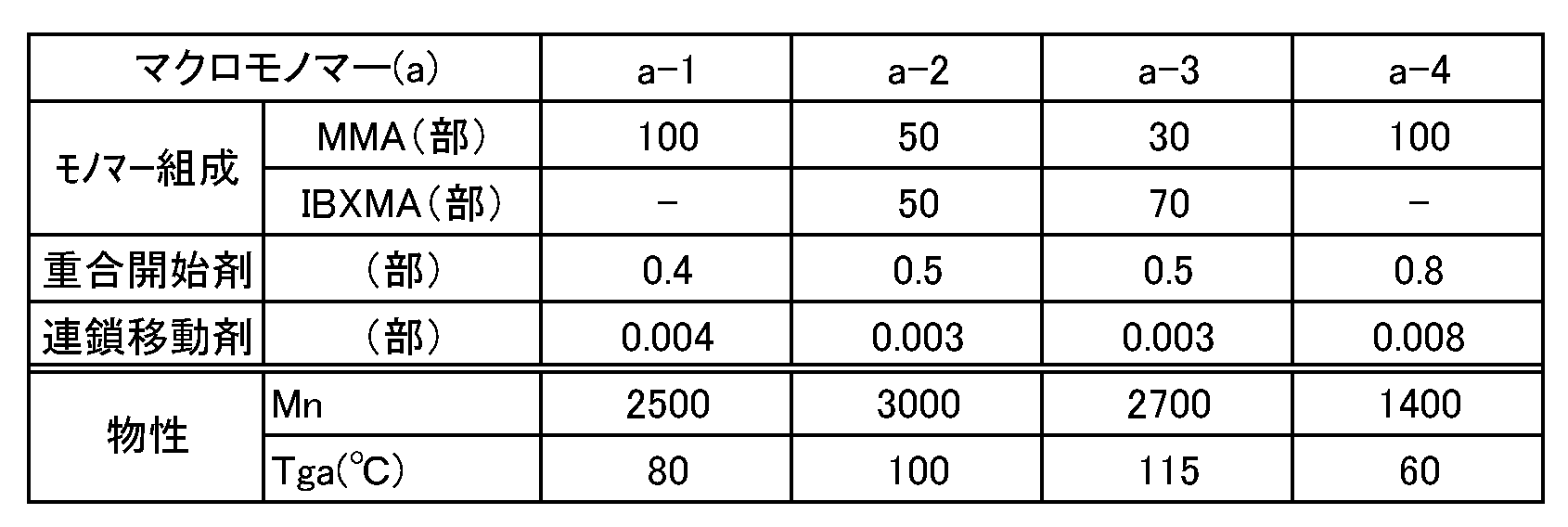
IBXMA:メタクリル酸イソボルニル
マクロモノマー(a)のガラス転移温度(Tga)
示差走査熱量計(Rigaku製DSC SmartRoader)を用いて、窒素雰囲気下、5℃/分の昇温速度で測定した。なお、標準物質としては酸化アルミニウムを使用した。
・マクロモノマー(a)
ゲル透過クロマトグラフィー(GPC)(東ソー株式会社製 HLC-8320)を用いて測定した。マクロモノマー(a)のテトラヒドロフラン溶液0.2質量%を調整後、東ソー社製カラム(TSKgel SuperHZM-M×HZM-M×HZ2000、TSKguardcolumn SuperHZ-L)が装着された装置に上記の溶液10μlを注入し、流量:0.35ml/分、溶離液:テトラヒドロフラン(安定剤BHT)、カラム温度:40℃の条件で測定し、標準ポリスチレン換算にて数平均分子量(Mn)を算出した。
・アクリル系共重合体(A)
ゲル透過クロマトグラフィー(GPC)(東ソー株式会社製 HLC-8120)を用いて測定した。アクリル系共重合体(A)のテトラヒドロフラン溶液0.3質量%を調整後、東ソー社製カラム(TSKgel Super HM-H*4、TSKguardcolumn SuperH-H)が装着された装置に上記の溶液20μlを注入し、流量:0.6ml/分、溶離液:テトラヒドロフラン(安定剤BHT)、カラム温度:40℃の条件で測定し、標準ポリスチレン換算にて重量平均分子量(Mw)を算出した。
実施例で作成した樹脂溶液を50μm剥離PETフィルム上に500μmアプリケーターで塗工し、90℃で90分乾燥した後、粘着面に50μm剥離PETフィルムを貼り合せ、剥離PET-粘着層-剥離PETの粘着シートを得た。JISZ0237に準拠して、この粘着シートの一方の剥離フィルムを剥がし、代わりにPETフィルムを2kgのハンドローラーにて圧着した。これを20mm×100mmの短冊状に裁断し、もう一方の剥離フィルムを剥がして、30mm×100mmのSUS板に2kgのハンドローラーを用いて、貼り合わせ面が20×25mmとなるように水平に貼り合わせた。70℃で30分養生した後、PETフィルムの先に1kgの重りをつけて70℃の恒温層で保持時間を測定した。以下の基準に従って保持力を判定した。
S:保持時間が、20分以上
A:保持時間が、5分以上20分以内
C:保持時間が、5分以内
保持力試験で作成した、剥離PET-粘着層-剥離PETの粘着シートの一方の剥離フィルムを剥がし、代わりに50μmPETフィルムを貼り合せたものを25mm幅短冊状にカットし、JISZ0237に準拠して、剥離角度180°、引張速度60mm/minで、ガラス基材に対する剥離強度(N/25mm)を測定し、粘着力を判定した。また、剥離したガラス基材面を目視で観察し、糊残りの有無を確認した。以下の基準に従って糊残りを判定した。
A:糊残り無し
B:糊残りが多少有るが、実用上問題はない
C:糊残りが有り、実用上問題がある
保持力試験で作成した、剥離PET-粘着層-剥離PETの粘着シートの片面の剥離PETフィルムを剥がし、125μmのPETフィルムを貼り合せ、もう片面の剥離PETフィルム側も同様に50μmのPETフィルムを貼り合せ、測定サンプルを作成した。
AGILENT社製、IMPEDANCE ANALYZER 4294Aに同社製16451Bを接続して、周波数100kHzにおける測定サンプルの静電容量CBを測定した。125μmのPETフィルムの静電容量をCc、50μmのPETフィルムの静電容量CDも測定し、下記式から粘着剤層の静電容量CAを算出した。
上記式から算出した粘着剤層の静電容量CAを下記式に当てはめ、粘着剤層の比誘電率εrを算出した。なお、粘着剤層の厚さはマイクロメーターで測定した。
CA=ε0×εr×π×(L/2)2/d
ε0:真空の誘電率=8.854×10⁻¹²
L:測定電極の直径=38mm
d:粘着剤層の厚さ
小角X線散乱測定は大型放射光施設であるSPring-8のBL03XU(フロンティアソフトマター開発産学連合ビームライン)にて行った。
比誘電率測定で作成した両面を剥離PETで挟まれたサンプルの剥離PETを剥がした粘着層のみを試料用治具に設置した。X線のビーム形状は縦を120μmとして横を120μmに調整した。X線波長は1Åとし、検出器はCCD(Hamamatsu Photonics V7739P + ORCA R2)を用いた。カメラ長は約4mにセットして、標準試料(コラーゲン)を用いて補正を行った。アッテネータ(減衰板)の種類や厚み、露光時間を調整して、強力なX線で検出器が損傷しないよう設定したうえでサンプルにX線を照射してサンプルの2次元散乱像を得た。
前記の手順で得られたサンプルの2次元散乱像からバックグランドの補正を行う。具体的には、サンプルが無い状態で前記手順と同じ操作を行ったバックグランドの2次元散乱像を取得して、画像処理ソフト(Image-J)を用いてサンプルの2次元散乱像からバックグランドの2次元散乱像を差し引いて、解析用の2次元散乱像を得た。解析用の2次元散乱像にはリング状の散乱が確認された。
次に、解析用の2次元散乱像から1次元散乱スペクトルに変換する。具体的には、解析用の2次元散乱像をX線データ処理ソフト(Fit2d)に読み込ませて、全方位角にわたって積分することで、横軸をq[nm-1]、縦軸を散乱強度とした1次元散乱スペクトルを得た。1次元スペクトルにはq=0.2~0.4の間にピークが確認された。
得られた1次元散乱スペクトルから、ピークの半価幅Xやピーク位置Yを求める。1次元散乱スペクトルにはq=0.1付近で極小値をとって原点に向かって散乱強度が高くなる場合と、q=0.1付近で変曲点を経たあと原点に向かって散乱強度が小さくなる場合があった。q=0.1付近で極小値をとって原点に向かって散乱強度が高くなる場合は、極小値のqより大きい領域を解析対象とした。またq=0.1付近で変曲点を経たあと原点に向かって散乱強度が小さくなる場合は、変曲点のqより大きい領域を解析対象とした。次にベースライン補正として、解析対象領域の散乱強度の最小値を求めて、全領域にわたって最小値を差し引いてベースライン補正を行った。得られた補正後の1次元散乱スペクトルをガウス関数とローレンツ関数でフィッティングを行い、得られた合成関数の半価幅をX、ピーク位置をYとした。フィッティングには波形分離ソフト(Fityk)を用いた。
〈(メタ)アクリル系共重合体(A-1)の製造〉
撹拌装置、温度計、冷却管、窒素ガス導入口を備えた四つ口フラスコに、仕込み溶媒として酢酸エチル40部、イソプロピルアルコール8部、マクロモノマー(a-2)12.5部を装入し、窒素ガス通気下で外温を85℃に昇温した。内温が安定した後、酢酸エチル20部、アクリル酸-2-エチルヘキシル74部、アクリル酸3.5部、ベンゾイルパーオキサイド0.04部からなる混合物を4.5時間かけて滴下した。滴下終了後1時間保持した後、「パーオクタO」0.5部と酢酸エチル10部からなる混合物を1時間かけて添加した。その後、2時間保持した後、酸化防止剤として「イルガノックス1010」(BASF社製商品名)0.5部、酢酸エチル22部を添加後、室温まで冷却して(メタ)アクリル系共重合体(A-1)を得た。
〈(メタ)アクリル系共重合体(A-2)~(A-13)の製造〉
用いる単量体混合物(マクロモノマー(a)およびビニル単量体(b))の組成および初期仕込みの溶剤を表2に変更した以外は製造例1と同様にして(メタ)アクリル系共重合体(A-2)~(A-13)を得た。
なお、(A-12)はマクロモノマー(a)を用いなかった例である。

2-EHA:アクリル酸-2-エチルヘキシル
AA:アクリル酸
MA:メタクリル酸
2-HEMA:メタクリル酸-2-ヒドロキシエチル
EtOAc:酢酸エチル
IPA:イソプロピルアルコール
製造例1により作製した(メタ)アクリル系共重合体(A-1)の粘着力、保持力、小角X線散乱測定における一次散乱ピークの半値幅、比誘電率を測定し、表3に結果を示した。同様に製造例2~13の(メタ)アクリル系共重合体(A-2~A-13)についても同様に測定した(表3)。
製造例3で作成した(メタ)アクリル系共重合体(A-3)を脱溶剤し、ホットメルトでシート化して粘着力、保持力、小角X線散乱測定における一次散乱ピークの半値幅、比誘電率を測定した。ホットメルト条件:熱プレス0.2MPa、100℃、10分、膜厚150μm。
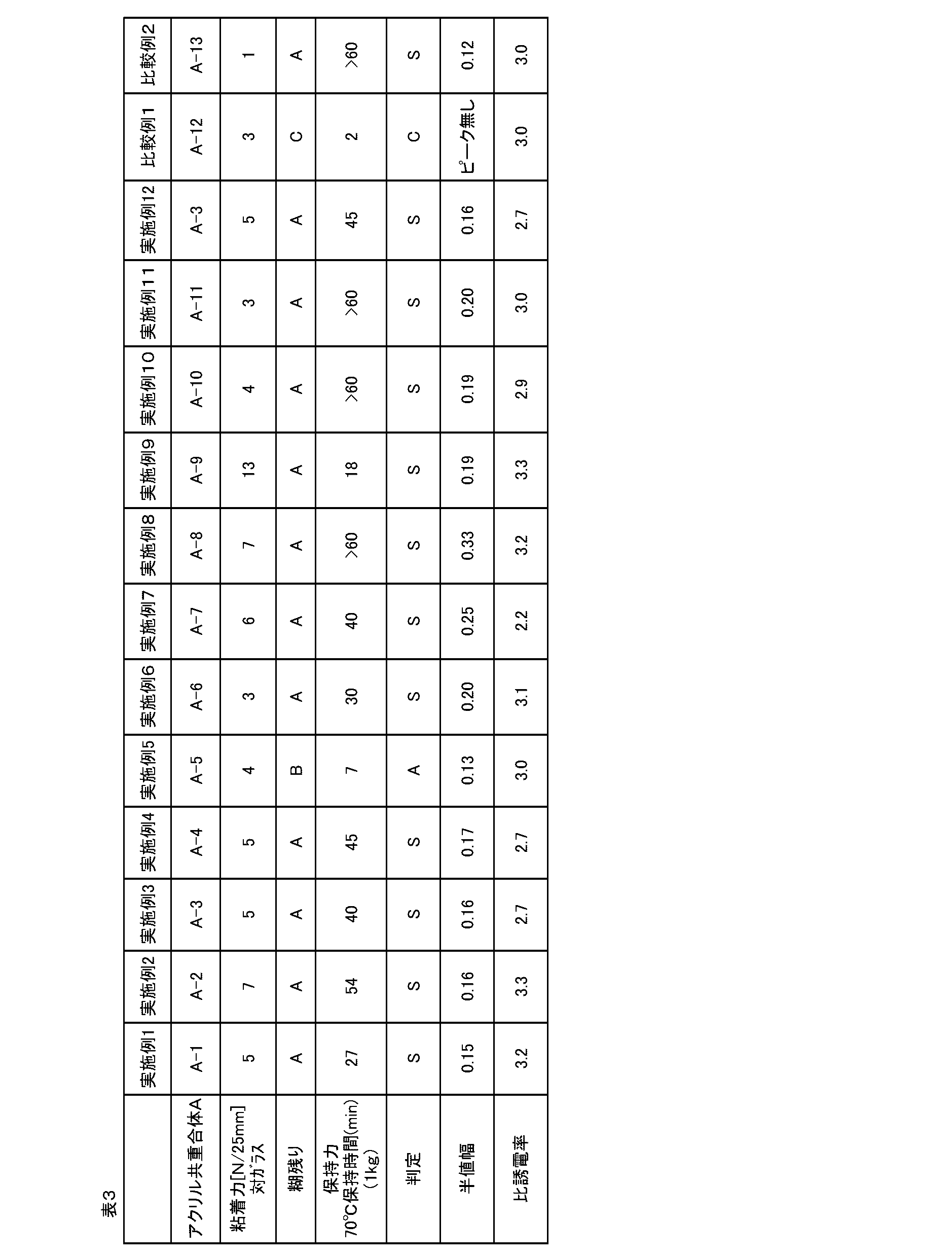
一方、比較例1はマクロモノマー(a)を用いない(メタ)アクリル系共重合体(A-12)を用いたものであり、比較例1は糊残りが確認され、比較例2は小角X線散乱測定における一次散乱ピークの半値幅が0.12と本発明の規定外であり、いずれも、実施例よりも粘着力、保持力に劣っていた。
表4に示す組成の粘着組成物をそれぞれの試験片作成後に硬化又は架橋させた。この場合においても良好な保持力、粘着力を有していた。
[硬化条件]
装置:2P硬化装置、光源:高圧水銀ランプ、照射強度:200mW/cm2、照射量:1000mJ/cm2
表4に示す組成の粘着組成物をそれぞれの試験片作成後に硬化又は架橋させた。この場合においても良好な保持力、粘着力を有していた。
[硬化条件]
100℃60分

INNA:アクリル酸イソノニル
UV3000B:ウレタンアクリレート(日本合成製商品名)
BP:ベンゾフェノン
IRG184:「IRGACURE184」 BASF製商品名
PIC:ポリイソシアネート(「コロネートL」 東ソー製商品名)
Al(acac)3:アルミニウムトリスアセチルアセトナート
Claims (13)
- 重量平均分子量が1000~100万の(メタ)アクリル系共重合体(A)であり、小角X線散乱測定における一次散乱ピークの半値幅をXとするとき、前記(メタ)アクリル系共重合体(A)の半値幅(X)が0.12<Xである、(メタ)アクリル系共重合体(A)。
- 周波数100kHzにおける比誘電率が3.5以下である、請求項1に記載の(メタ)アクリル系共重合体(A)。
- 前記(メタ)アクリル系共重合体(A)は、数平均分子量が500以上10万以下のマクロモノマー(a)由来の構成単位およびビニル単量体(b)由来の構成単位を含む請求項1または2に記載の(メタ)アクリル系共重合体(A)。
- 前記(メタ)アクリル系共重合体(A)は、数平均分子量が500以上10万以下のマクロモノマー(a)およびビニル単量体(b)を含有する単量体混合物の重合物である、請求項3に記載の(メタ)アクリル系共重合体(A)。
- 前記マクロモノマー(a)由来の繰り返し単位を7~40質量%含む、請求項3に記載の(メタ)アクリル系共重合体(A)。
- 前記マクロモノマー(a)のガラス転移温度(Tga)が0~150℃である請求項3に記載の(メタ)アクリル系共重合体(A)。
- 前記マクロモノマー(a)は、ラジカル重合性基を有し、かつ下記式(a’)で示される構成単位を2以上有する、請求項3~6の何れか一項に記載の(メタ)アクリル系共重合体(A)。

- 前記マクロモノマー(a)が、下記式(1)で表される、請求項7に記載の(メタ)アクリル系共重合体(A)。
- 前記マクロモノマー(a)は、(メタ)アクリロイル基を有するモノマー構成単位を80質量%以上含む、請求項8に記載の(メタ)アクリル系共重合体(A)。
- 請求項1~9の何れか一項に記載の(メタ)アクリル系共重合体(A)を含む粘着組成物。
- 請求項10記載の組成物を用いて得られる粘着シート。
- 請求項1~9の何れか一項に記載に(メタ)アクリル系共重合体(A)を用いて得られる被覆材。
- 請求項1~9の何れか一項に記載に(メタ)アクリル系共重合体(A)を用いて得られる塗装物。
Priority Applications (3)
| Application Number | Priority Date | Filing Date | Title |
|---|---|---|---|
| KR1020177037444A KR101984421B1 (ko) | 2015-06-02 | 2016-06-01 | (메트)아크릴계 공중합체, 그것을 포함하는 점착 조성물 및 점착 시트 그리고 그것을 사용한 피복재 및 도장물 |
| US15/578,780 US10479855B2 (en) | 2015-06-02 | 2016-06-01 | (Meth)acrylic copolymer, adhesive composition and adhesive sheet containing same, and coating material and coated product using same |
| JP2016541467A JP7003406B2 (ja) | 2015-06-02 | 2016-06-01 | (メタ)アクリル系共重合体、それを含む粘着組成物および粘着シート、並びにそれを用いた被覆材及び塗装物 |
Applications Claiming Priority (4)
| Application Number | Priority Date | Filing Date | Title |
|---|---|---|---|
| JP2015111997 | 2015-06-02 | ||
| JP2015-111997 | 2015-06-02 | ||
| JP2015-219589 | 2015-11-09 | ||
| JP2015219589 | 2015-11-09 |
Publications (1)
| Publication Number | Publication Date |
|---|---|
| WO2016194937A1 true WO2016194937A1 (ja) | 2016-12-08 |
Family
ID=57441976
Family Applications (1)
| Application Number | Title | Priority Date | Filing Date |
|---|---|---|---|
| PCT/JP2016/066154 Ceased WO2016194937A1 (ja) | 2015-06-02 | 2016-06-01 | (メタ)アクリル系共重合体、それを含む粘着組成物および粘着シート、並びにそれを用いた被覆材及び塗装物 |
Country Status (5)
| Country | Link |
|---|---|
| US (1) | US10479855B2 (ja) |
| JP (1) | JP7003406B2 (ja) |
| KR (1) | KR101984421B1 (ja) |
| TW (1) | TWI738656B (ja) |
| WO (1) | WO2016194937A1 (ja) |
Cited By (6)
| Publication number | Priority date | Publication date | Assignee | Title |
|---|---|---|---|---|
| JP2019085479A (ja) * | 2017-11-06 | 2019-06-06 | 東洋インキScホールディングス株式会社 | 光学用粘着剤および光学粘着シート |
| JPWO2018101252A1 (ja) * | 2016-12-02 | 2019-10-24 | 三菱ケミカル株式会社 | 光硬化性組成物、粘着シート、粘着シート積層体、硬化物、画像表示装置構成用積層体及び画像表示装置 |
| JP2021091790A (ja) * | 2019-12-10 | 2021-06-17 | 三菱ケミカル株式会社 | コーティング剤組成物およびコーティング層 |
| US20210347928A1 (en) * | 2019-01-31 | 2021-11-11 | Mitsubishi Chemical Corporation | (Meth)acrylic Copolymer, Pressure-Sensitive Adhesive Composition, Pressure-Sensitive Adhesive, and Pressure-Sensitive Adhesive Sheet |
| JP2022109835A (ja) * | 2021-01-15 | 2022-07-28 | 三菱ケミカル株式会社 | 組成物、粘着剤、および粘着シート |
| JPWO2022230935A1 (ja) * | 2021-04-30 | 2022-11-03 |
Families Citing this family (3)
| Publication number | Priority date | Publication date | Assignee | Title |
|---|---|---|---|---|
| WO2021193821A1 (ja) * | 2020-03-25 | 2021-09-30 | 三菱ケミカル株式会社 | 重合体組成物、潤滑油添加剤、粘度指数向上剤、潤滑油組成物、重合体組成物の製造方法、及びマクロモノマーの製造方法 |
| WO2021193613A1 (ja) * | 2020-03-26 | 2021-09-30 | 三菱ケミカル株式会社 | 共重合体、樹脂組成物、成形体、フィルム状成形体、及び共重合体の製造方法 |
| AT525487B1 (de) * | 2020-07-08 | 2025-01-15 | Panasonic Ip Man Co Ltd | Harzlage, Prepreg, isolierendes Harzelement und Leiterplatte |
Citations (5)
| Publication number | Priority date | Publication date | Assignee | Title |
|---|---|---|---|---|
| JP2007254758A (ja) * | 1998-06-19 | 2007-10-04 | Kaneka Corp | 枝分かれした重合体の製造方法及び重合体 |
| JP2011122113A (ja) * | 2009-12-14 | 2011-06-23 | Kansai Paint Co Ltd | エマルション樹脂系塗料 |
| WO2014098141A1 (ja) * | 2012-12-18 | 2014-06-26 | 三菱レイヨン株式会社 | ポリマー及びその製造方法、成形材料並びに成形体 |
| WO2014098234A1 (ja) * | 2012-12-20 | 2014-06-26 | 三菱レイヨン株式会社 | ポリマー組成物及び多孔質膜 |
| JP2015131947A (ja) * | 2013-12-11 | 2015-07-23 | 三菱レイヨン株式会社 | 重合体の製造方法、成形材料及び成形体 |
Family Cites Families (8)
| Publication number | Priority date | Publication date | Assignee | Title |
|---|---|---|---|---|
| US3842146A (en) * | 1971-02-22 | 1974-10-15 | Cpc International Inc | Polymerizable diblock macromolecular monomers having a substantially uniform molecular weight distribution and their preparation |
| JPH0222755A (ja) | 1988-07-12 | 1990-01-25 | Mitsubishi Electric Corp | アドレス一致回路 |
| EP0638097B1 (en) | 1992-05-01 | 2007-03-14 | E.I. Du Pont De Nemours And Company | Preparing crosslinkable polymers employing macromonomer chain transfer agents |
| JPH11158450A (ja) | 1997-11-27 | 1999-06-15 | Sekisui Chem Co Ltd | 硬化型粘接着剤組成物及び硬化型粘接着シート |
| CA2335777C (en) | 1998-06-19 | 2008-08-19 | Kaneka Corporation | Process for producing branched polymer and polymer |
| AU2001290977A1 (en) | 2000-09-14 | 2002-03-26 | Rohm And Haas Company | Adhesive compositions containing graft copolymers |
| KR20020022755A (ko) | 2002-03-14 | 2002-03-27 | 김선권 | 카레가 첨가된 감자탕 |
| JP6397286B2 (ja) | 2014-09-24 | 2018-09-26 | 任天堂株式会社 | 情報読取システム、情報読取装置、情報読取プログラム、および情報読取方法 |
-
2016
- 2016-06-01 WO PCT/JP2016/066154 patent/WO2016194937A1/ja not_active Ceased
- 2016-06-01 JP JP2016541467A patent/JP7003406B2/ja active Active
- 2016-06-01 TW TW105117110A patent/TWI738656B/zh active
- 2016-06-01 KR KR1020177037444A patent/KR101984421B1/ko active Active
- 2016-06-01 US US15/578,780 patent/US10479855B2/en active Active
Patent Citations (5)
| Publication number | Priority date | Publication date | Assignee | Title |
|---|---|---|---|---|
| JP2007254758A (ja) * | 1998-06-19 | 2007-10-04 | Kaneka Corp | 枝分かれした重合体の製造方法及び重合体 |
| JP2011122113A (ja) * | 2009-12-14 | 2011-06-23 | Kansai Paint Co Ltd | エマルション樹脂系塗料 |
| WO2014098141A1 (ja) * | 2012-12-18 | 2014-06-26 | 三菱レイヨン株式会社 | ポリマー及びその製造方法、成形材料並びに成形体 |
| WO2014098234A1 (ja) * | 2012-12-20 | 2014-06-26 | 三菱レイヨン株式会社 | ポリマー組成物及び多孔質膜 |
| JP2015131947A (ja) * | 2013-12-11 | 2015-07-23 | 三菱レイヨン株式会社 | 重合体の製造方法、成形材料及び成形体 |
Cited By (11)
| Publication number | Priority date | Publication date | Assignee | Title |
|---|---|---|---|---|
| JPWO2018101252A1 (ja) * | 2016-12-02 | 2019-10-24 | 三菱ケミカル株式会社 | 光硬化性組成物、粘着シート、粘着シート積層体、硬化物、画像表示装置構成用積層体及び画像表示装置 |
| JP7024726B2 (ja) | 2016-12-02 | 2022-02-24 | 三菱ケミカル株式会社 | 光硬化性組成物、粘着シート、粘着シート積層体、硬化物、画像表示装置構成用積層体及び画像表示装置 |
| JP2019085479A (ja) * | 2017-11-06 | 2019-06-06 | 東洋インキScホールディングス株式会社 | 光学用粘着剤および光学粘着シート |
| JP7052298B2 (ja) | 2017-11-06 | 2022-04-12 | 東洋インキScホールディングス株式会社 | 光学用粘着剤および光学粘着シート |
| US20210347928A1 (en) * | 2019-01-31 | 2021-11-11 | Mitsubishi Chemical Corporation | (Meth)acrylic Copolymer, Pressure-Sensitive Adhesive Composition, Pressure-Sensitive Adhesive, and Pressure-Sensitive Adhesive Sheet |
| US12421339B2 (en) * | 2019-01-31 | 2025-09-23 | Mitsubishi Chemical Corporation | (Meth)acrylic copolymer, pressure-sensitive adhesive composition, pressure-sensitive adhesive, and pressure-sensitive adhesive sheet |
| JP2021091790A (ja) * | 2019-12-10 | 2021-06-17 | 三菱ケミカル株式会社 | コーティング剤組成物およびコーティング層 |
| JP2022109835A (ja) * | 2021-01-15 | 2022-07-28 | 三菱ケミカル株式会社 | 組成物、粘着剤、および粘着シート |
| JP7596811B2 (ja) | 2021-01-15 | 2024-12-10 | 三菱ケミカル株式会社 | 組成物、粘着剤、および粘着シート |
| JPWO2022230935A1 (ja) * | 2021-04-30 | 2022-11-03 | ||
| WO2022230935A1 (ja) * | 2021-04-30 | 2022-11-03 | 積水化学工業株式会社 | 粘着テープ |
Also Published As
| Publication number | Publication date |
|---|---|
| JP7003406B2 (ja) | 2022-02-10 |
| TWI738656B (zh) | 2021-09-11 |
| TW201704275A (zh) | 2017-02-01 |
| KR20180012816A (ko) | 2018-02-06 |
| US10479855B2 (en) | 2019-11-19 |
| US20180142055A1 (en) | 2018-05-24 |
| JPWO2016194937A1 (ja) | 2018-03-22 |
| KR101984421B1 (ko) | 2019-09-03 |
Similar Documents
| Publication | Publication Date | Title |
|---|---|---|
| JP7003406B2 (ja) | (メタ)アクリル系共重合体、それを含む粘着組成物および粘着シート、並びにそれを用いた被覆材及び塗装物 | |
| JP2020117735A (ja) | 粘着剤組成物 | |
| KR102276828B1 (ko) | 점착제용 수지 조성물 및 점착 시트 | |
| US12421339B2 (en) | (Meth)acrylic copolymer, pressure-sensitive adhesive composition, pressure-sensitive adhesive, and pressure-sensitive adhesive sheet | |
| JP6996250B2 (ja) | 粘着剤組成物及び粘着シート | |
| TWI739965B (zh) | 黏著劑用樹脂組成物及黏著片 | |
| JP7013822B2 (ja) | 粘着剤用樹脂組成物及び粘着シート | |
| JP2025178318A (ja) | 粘着剤用樹脂組成物 | |
| JP2023147169A (ja) | 粘着剤用樹脂組成物 | |
| JP7106848B2 (ja) | 粘着剤用樹脂組成物及び粘着シート | |
| JP2024126084A (ja) | 粘着剤組成物および粘着剤 | |
| JP2016224327A (ja) | 偏光板 | |
| EP4130081B1 (en) | Compound and polymer composition including said compound | |
| US20240417600A1 (en) | Adhesive sheet, adhesive composition, adhesive sheet with release film, laminate for image display device, and flexible image display device | |
| JP2023147164A (ja) | 粘着シート、離型フィルム付き粘着シート、画像表示装置用積層体及びフレキシブル画像表示装置 | |
| JP2016222839A (ja) | 粘着テープ | |
| JP2024126071A (ja) | 粘着剤組成物、粘着剤、及び粘着シート |
Legal Events
| Date | Code | Title | Description |
|---|---|---|---|
| ENP | Entry into the national phase |
Ref document number: 2016541467 Country of ref document: JP Kind code of ref document: A |
|
| 121 | Ep: the epo has been informed by wipo that ep was designated in this application |
Ref document number: 16803371 Country of ref document: EP Kind code of ref document: A1 |
|
| WWE | Wipo information: entry into national phase |
Ref document number: 15578780 Country of ref document: US |
|
| NENP | Non-entry into the national phase |
Ref country code: DE |
|
| ENP | Entry into the national phase |
Ref document number: 20177037444 Country of ref document: KR Kind code of ref document: A |
|
| 122 | Ep: pct application non-entry in european phase |
Ref document number: 16803371 Country of ref document: EP Kind code of ref document: A1 |