WO2016194847A1 - 熱サイクル用作動媒体、熱サイクルシステム用組成物および熱サイクルシステム - Google Patents
熱サイクル用作動媒体、熱サイクルシステム用組成物および熱サイクルシステム Download PDFInfo
- Publication number
- WO2016194847A1 WO2016194847A1 PCT/JP2016/065818 JP2016065818W WO2016194847A1 WO 2016194847 A1 WO2016194847 A1 WO 2016194847A1 JP 2016065818 W JP2016065818 W JP 2016065818W WO 2016194847 A1 WO2016194847 A1 WO 2016194847A1
- Authority
- WO
- WIPO (PCT)
- Prior art keywords
- mass
- trifluoroethylene
- total amount
- heat cycle
- working medium
- Prior art date
- Legal status (The legal status is an assumption and is not a legal conclusion. Google has not performed a legal analysis and makes no representation as to the accuracy of the status listed.)
- Ceased
Links
Images


Classifications
-
- C—CHEMISTRY; METALLURGY
- C09—DYES; PAINTS; POLISHES; NATURAL RESINS; ADHESIVES; COMPOSITIONS NOT OTHERWISE PROVIDED FOR; APPLICATIONS OF MATERIALS NOT OTHERWISE PROVIDED FOR
- C09K—MATERIALS FOR MISCELLANEOUS APPLICATIONS, NOT PROVIDED FOR ELSEWHERE
- C09K5/00—Heat-transfer, heat-exchange or heat-storage materials, e.g. refrigerants; Materials for the production of heat or cold by chemical reactions other than by combustion
- C09K5/02—Materials undergoing a change of physical state when used
- C09K5/04—Materials undergoing a change of physical state when used the change of state being from liquid to vapour or vice versa
- C09K5/041—Materials undergoing a change of physical state when used the change of state being from liquid to vapour or vice versa for compression-type refrigeration systems
- C09K5/044—Materials undergoing a change of physical state when used the change of state being from liquid to vapour or vice versa for compression-type refrigeration systems comprising halogenated compounds
-
- C—CHEMISTRY; METALLURGY
- C09—DYES; PAINTS; POLISHES; NATURAL RESINS; ADHESIVES; COMPOSITIONS NOT OTHERWISE PROVIDED FOR; APPLICATIONS OF MATERIALS NOT OTHERWISE PROVIDED FOR
- C09K—MATERIALS FOR MISCELLANEOUS APPLICATIONS, NOT PROVIDED FOR ELSEWHERE
- C09K5/00—Heat-transfer, heat-exchange or heat-storage materials, e.g. refrigerants; Materials for the production of heat or cold by chemical reactions other than by combustion
- C09K5/02—Materials undergoing a change of physical state when used
- C09K5/04—Materials undergoing a change of physical state when used the change of state being from liquid to vapour or vice versa
- C09K5/041—Materials undergoing a change of physical state when used the change of state being from liquid to vapour or vice versa for compression-type refrigeration systems
- C09K5/044—Materials undergoing a change of physical state when used the change of state being from liquid to vapour or vice versa for compression-type refrigeration systems comprising halogenated compounds
- C09K5/045—Materials undergoing a change of physical state when used the change of state being from liquid to vapour or vice versa for compression-type refrigeration systems comprising halogenated compounds containing only fluorine as halogen
-
- C—CHEMISTRY; METALLURGY
- C09—DYES; PAINTS; POLISHES; NATURAL RESINS; ADHESIVES; COMPOSITIONS NOT OTHERWISE PROVIDED FOR; APPLICATIONS OF MATERIALS NOT OTHERWISE PROVIDED FOR
- C09K—MATERIALS FOR MISCELLANEOUS APPLICATIONS, NOT PROVIDED FOR ELSEWHERE
- C09K5/00—Heat-transfer, heat-exchange or heat-storage materials, e.g. refrigerants; Materials for the production of heat or cold by chemical reactions other than by combustion
- C09K5/02—Materials undergoing a change of physical state when used
- C09K5/04—Materials undergoing a change of physical state when used the change of state being from liquid to vapour or vice versa
-
- F—MECHANICAL ENGINEERING; LIGHTING; HEATING; WEAPONS; BLASTING
- F25—REFRIGERATION OR COOLING; COMBINED HEATING AND REFRIGERATION SYSTEMS; HEAT PUMP SYSTEMS; MANUFACTURE OR STORAGE OF ICE; LIQUEFACTION SOLIDIFICATION OF GASES
- F25B—REFRIGERATION MACHINES, PLANTS OR SYSTEMS; COMBINED HEATING AND REFRIGERATION SYSTEMS; HEAT PUMP SYSTEMS
- F25B9/00—Compression machines, plants or systems, in which the refrigerant is air or other gas of low boiling point
- F25B9/002—Compression machines, plants or systems, in which the refrigerant is air or other gas of low boiling point characterised by the refrigerant
-
- H—ELECTRICITY
- H02—GENERATION; CONVERSION OR DISTRIBUTION OF ELECTRIC POWER
- H02K—DYNAMO-ELECTRIC MACHINES
- H02K7/00—Arrangements for handling mechanical energy structurally associated with dynamo-electric machines, e.g. structural association with mechanical driving motors or auxiliary dynamo-electric machines
- H02K7/18—Structural association of electric generators with mechanical driving motors, e.g. with turbines
-
- C—CHEMISTRY; METALLURGY
- C09—DYES; PAINTS; POLISHES; NATURAL RESINS; ADHESIVES; COMPOSITIONS NOT OTHERWISE PROVIDED FOR; APPLICATIONS OF MATERIALS NOT OTHERWISE PROVIDED FOR
- C09K—MATERIALS FOR MISCELLANEOUS APPLICATIONS, NOT PROVIDED FOR ELSEWHERE
- C09K2205/00—Aspects relating to compounds used in compression type refrigeration systems
- C09K2205/10—Components
- C09K2205/106—Carbon dioxide
-
- C—CHEMISTRY; METALLURGY
- C09—DYES; PAINTS; POLISHES; NATURAL RESINS; ADHESIVES; COMPOSITIONS NOT OTHERWISE PROVIDED FOR; APPLICATIONS OF MATERIALS NOT OTHERWISE PROVIDED FOR
- C09K—MATERIALS FOR MISCELLANEOUS APPLICATIONS, NOT PROVIDED FOR ELSEWHERE
- C09K2205/00—Aspects relating to compounds used in compression type refrigeration systems
- C09K2205/10—Components
- C09K2205/12—Hydrocarbons
-
- C—CHEMISTRY; METALLURGY
- C09—DYES; PAINTS; POLISHES; NATURAL RESINS; ADHESIVES; COMPOSITIONS NOT OTHERWISE PROVIDED FOR; APPLICATIONS OF MATERIALS NOT OTHERWISE PROVIDED FOR
- C09K—MATERIALS FOR MISCELLANEOUS APPLICATIONS, NOT PROVIDED FOR ELSEWHERE
- C09K2205/00—Aspects relating to compounds used in compression type refrigeration systems
- C09K2205/10—Components
- C09K2205/12—Hydrocarbons
- C09K2205/126—Unsaturated fluorinated hydrocarbons
-
- C—CHEMISTRY; METALLURGY
- C09—DYES; PAINTS; POLISHES; NATURAL RESINS; ADHESIVES; COMPOSITIONS NOT OTHERWISE PROVIDED FOR; APPLICATIONS OF MATERIALS NOT OTHERWISE PROVIDED FOR
- C09K—MATERIALS FOR MISCELLANEOUS APPLICATIONS, NOT PROVIDED FOR ELSEWHERE
- C09K2205/00—Aspects relating to compounds used in compression type refrigeration systems
- C09K2205/10—Components
- C09K2205/13—Inert gases
-
- C—CHEMISTRY; METALLURGY
- C09—DYES; PAINTS; POLISHES; NATURAL RESINS; ADHESIVES; COMPOSITIONS NOT OTHERWISE PROVIDED FOR; APPLICATIONS OF MATERIALS NOT OTHERWISE PROVIDED FOR
- C09K—MATERIALS FOR MISCELLANEOUS APPLICATIONS, NOT PROVIDED FOR ELSEWHERE
- C09K2205/00—Aspects relating to compounds used in compression type refrigeration systems
- C09K2205/10—Components
- C09K2205/132—Components containing nitrogen
-
- C—CHEMISTRY; METALLURGY
- C09—DYES; PAINTS; POLISHES; NATURAL RESINS; ADHESIVES; COMPOSITIONS NOT OTHERWISE PROVIDED FOR; APPLICATIONS OF MATERIALS NOT OTHERWISE PROVIDED FOR
- C09K—MATERIALS FOR MISCELLANEOUS APPLICATIONS, NOT PROVIDED FOR ELSEWHERE
- C09K2205/00—Aspects relating to compounds used in compression type refrigeration systems
- C09K2205/24—Only one single fluoro component present
-
- C—CHEMISTRY; METALLURGY
- C09—DYES; PAINTS; POLISHES; NATURAL RESINS; ADHESIVES; COMPOSITIONS NOT OTHERWISE PROVIDED FOR; APPLICATIONS OF MATERIALS NOT OTHERWISE PROVIDED FOR
- C09K—MATERIALS FOR MISCELLANEOUS APPLICATIONS, NOT PROVIDED FOR ELSEWHERE
- C09K2205/00—Aspects relating to compounds used in compression type refrigeration systems
- C09K2205/40—Replacement mixtures
Definitions
- the present invention relates to a working medium for heat cycle, a composition for heat cycle system, and a heat cycle system using the composition.
- CFC chlorofluorocarbons
- HCFC hydrochlorofluorocarbons
- HFC-32 difluoromethane
- HFC-125 pentafluoroethane
- R410A a pseudo-azeotropic refrigerant mixture having a mass ratio of 1: 1 between HFC-32 and HFC-125
- HFC may cause global warming.
- R410A has been widely used for ordinary air-conditioning equipment called so-called package air conditioners and room air conditioners because of its high refrigerating capacity.
- the global warming potential (GWP) of R410A is as high as 2088. Therefore, development of a low GWP working medium is required.
- GWP global warming potential
- HFOs fluoroolefins
- Patent Document 1 discloses a technique related to a working medium using trifluoroethylene (HFO-1123) that has the above-described characteristics and provides excellent cycle performance.
- HFO-1123 trifluoroethylene
- Patent Document 1 an attempt is made to use HFO-1123 in combination with various HFCs and HFOs for the purpose of improving the nonflammability and cycle performance of the working medium.
- HFO-1123 causes a so-called self-decomposition reaction when there is an ignition source at high temperature or high pressure. Therefore, when a composition containing HFO-1123 is put to practical use as a working medium for heat cycle, there is a problem in improving durability by suppressing the self-degradability of the working medium for heat cycle using HFO-1123. is there.
- Patent Document 1 as an alternative candidate for R410A, there is little influence on global warming, cycle performance such as ability and efficiency that can be substituted for R410A is obtained, and self-degradability is suppressed. Thus, there is no knowledge or suggestion of using HFO-1123 and other compounds as a working medium.
- the present invention has been made from the above viewpoint, and includes trifluoroethylene (HFO-1123).
- HFO-1123 trifluoroethylene
- the excellent cycle performance of HFO-1123 is sufficiently exhibited, self-decomposability is suppressed, and
- the present invention provides a working medium for heat cycle, a composition for heat cycle system, and a heat cycle system having the configurations described in [1] to [28] below.
- the working medium for heat cycle according to [1] or [2] including fluoromethane as the first component.
- the working medium for heat cycle according to [1] or [2] which contains trifluoroiodomethane as the first component.
- the ratio of the total amount of the trifluoroethylene and the first component to the total amount of the working fluid for the heat cycle is more than 90% by mass and 100% by mass or less, and the trifluoroethylene and the first component
- the working medium for heat cycle according to any one of [1] to [6], wherein the ratio of the amount of the trifluoroethylene to the total amount of the components is 20% by mass or more and 95% by mass or less.
- the ratio of the total amount of the trifluoroethylene and the carbon dioxide to the total amount of the working medium for the heat cycle is more than 90% by mass and 100% by mass or less, and the total of the trifluoroethylene and the carbon dioxide
- the working medium for heat cycle according to [3], wherein the ratio of the amount of the trifluoroethylene to the amount is 70% by mass or more and 80% by mass or less.
- the ratio of the total amount of the trifluoroethylene and the fluoromethane to the total amount of the working medium for the heat cycle is more than 90% by mass and 100% by mass or less, and the total of the trifluoroethylene and the fluoromethane
- the working medium for heat cycle according to [4], wherein the ratio of the amount of the trifluoroethylene to the amount is 20% by mass or more and 80% by mass or less.
- the ratio of the total amount of the trifluoroethylene and the trifluoroiodomethane to the total amount of the working medium for the heat cycle is more than 90% by mass and 100% by mass or less, and the trifluoroethylene and the trifluoroethylene
- the working medium for heat cycle according to [5], wherein the ratio of the amount of the trifluoroethylene to the total amount of iodomethane is 60% by mass or more and 80% by mass or less.
- the ratio of the total amount of the trifluoroethylene and the propane to the total amount of the working medium for the heat cycle is more than 90% by mass and 100% by mass or less, and the total amount of the trifluoroethylene and the propane The working medium for heat cycle according to [6], wherein the ratio of the amount of the trifluoroethylene is 20 mass% or more and 95 mass% or less.
- hydrofluorocarbons excluding fluoromethane
- hydrofluoroolefins however, excluding fluoromethane
- IPCC Intergovernmental Panel on Climate Change
- the working medium for heat cycle according to any one of [1] to [11], comprising a second component made of at least one substance selected from (excluding trifluoroethylene).
- the second component comprises at least one substance selected from 2,3,3,3-tetrafluoropropene, 1,3,3,3-tetrafluoropropene and difluoromethane.
- the ratio of the total amount of the trifluoroethylene, the first component, and the second component to the total amount of the working medium for the heat cycle is more than 90% by mass and 100% by mass or less,
- the ratio of the amount of the trifluoroethylene to the total amount of the fluoroethylene, the first component, and the second component is 10% by mass or more and 90% by mass or less, and the trifluoroethylene and the first component
- the ratio of the amount of the first component to the total amount of the first component and the second component is 1% by mass to 50% by mass, and the trifluoroethylene, the first component, and the second component
- the working medium for heat cycle according to any one of [12] to [16], wherein the ratio of the amount of the second component to the total amount of is from 1% by mass to 70% by mass.
- the ratio of the total amount of the trifluoroethylene, the carbon dioxide, and the second component to the total amount of the working fluid for the heat cycle is more than 90% by mass and 100% by mass or less, and the trifluoroethylene
- the ratio of the amount of the trifluoroethylene to the total amount of the carbon dioxide and the second component is 10% by mass or more and 90% by mass or less, and the trifluoroethylene, the carbon dioxide, and the second component.
- the ratio of the amount of the carbon dioxide to the total amount of 1 to 50% by mass, and the second component to the total amount of the trifluoroethylene, the carbon dioxide and the second component The working medium for heat cycle according to any one of [12] to [17], wherein the ratio of the amount is 1 mass% or more and 70 mass% or less.
- the ratio of the total amount of the trifluoroethylene, the carbon dioxide, and the difluoromethane to the total amount of the working medium for the heat cycle is more than 90% by mass and 100% by mass or less, and the trifluoroethylene and the The ratio of the amount of the trifluoroethylene to the total amount of carbon dioxide and the difluoromethane is 10% by mass or more and 90% by mass or less, and the total amount of the trifluoroethylene, the carbon dioxide, and the difluoromethane, The ratio of the amount of the carbon dioxide is 1% by mass or more and 50% by mass or less, and the ratio of the amount of the difluoromethane to the total amount of the trifluoroethylene, the carbon dioxide, and the difluoromethane is 1% by mass or more and 29%.
- the working medium for heat cycle according to [14], which is not more than mass%.
- the ratio of the total amount of the trifluoroethylene, the carbon dioxide, and the 2,3,3,3-tetrafluoropropene to the total amount of the working fluid for the heat cycle is more than 90% by mass and 100% by mass or less.
- the ratio of the amount of the trifluoroethylene to the total amount of the trifluoroethylene, the carbon dioxide, and the 2,3,3,3-tetrafluoropropene is 10% by mass or more and 90% by mass or less.
- the ratio of the amount of the carbon dioxide to the total amount of the trifluoroethylene, the carbon dioxide and the 2,3,3,3-tetrafluoropropene is 1% by mass to 50% by mass, and the trifluoroethylene And 2,3,3,3-tetrafluoropropoxide relative to the total amount of carbon dioxide and 2,3,3,3-tetrafluoropropene Ratio of the amount of propene is 70 wt% or less than 1 wt%, working medium for heat cycle according to [15]. [21]
- the ratio of the total amount of the trifluoroethylene, the carbon dioxide, and the 1,3,3,3-tetrafluoropropene to the total amount of the working medium for the heat cycle is more than 90% by mass and 100% by mass or less.
- the ratio of the amount of the trifluoroethylene to the total amount of the trifluoroethylene, the carbon dioxide and the 1,3,3,3-tetrafluoropropene is 10% by mass or more and 90% by mass or less
- the ratio of the amount of the carbon dioxide to the total amount of the trifluoroethylene, the carbon dioxide and the 1,3,3,3-tetrafluoropropene is 1% by mass to 50% by mass
- the trifluoroethylene And 1,3,3,3-tetrafluoropropoxide relative to the total amount of carbon dioxide and 1,3,3,3-tetrafluoropropene Ratio of the amount of propene is 70 wt% or less than 1 wt%, working medium for heat cycle according to [16].
- the ratio of the total amount of the trifluoroethylene, the propane, and the second component to the total amount of the working medium for the heat cycle is more than 90% by mass and 100% by mass or less, and the trifluoroethylene
- the ratio of the amount of the trifluoroethylene to the total amount of the propane and the second component is 20% by mass to 95% by mass, and the total of the trifluoroethylene, the propane and the second component
- the ratio of the amount of the propane to the amount is 1% by mass or more and 75% by mass or less
- the ratio of the amount of the second component to the total amount of the trifluoroethylene, the propane, and the second component is The working medium for heat cycle according to any one of [12] to [17], which is 1% by mass to 75% by mass.
- the ratio of the total amount of the trifluoroethylene, the propane, and the difluoromethane to the total amount of the working medium for the heat cycle is more than 90% by mass and 100% by mass or less, and the trifluoroethylene and the propane
- the ratio of the amount of the trifluoroethylene to the total amount of the trifluoroethylene and the difluoromethane is 20% by mass or more and 95% by mass or less, and the ratio of the propane to the total amount of the trifluoroethylene, the propane, and the difluoromethane.
- the ratio of the amount is 1% by mass or more and 75% by mass or less, and the ratio of the amount of the difluoromethane to the total amount of the trifluoroethylene, the propane and the difluoromethane is 1% by mass or more and 75% by mass or less.
- the working medium for heat cycle according to [14].
- the ratio of the total amount of the trifluoroethylene, the propane, and the 2,3,3,3-tetrafluoropropene to the total amount of the working fluid for the heat cycle is more than 90% by mass and 100% by mass or less.
- a ratio of the amount of the trifluoroethylene to the total amount of the trifluoroethylene, the propane, and the 2,3,3,3-tetrafluoropropene is 20% by mass to 95% by mass;
- the ratio of the amount of the propane to the total amount of fluoroethylene, the propane and the 2,3,3,3-tetrafluoropropene is 1% by mass to 75% by mass, and the trifluoroethylene, the propane,
- the 2,3,3,3-tetrafluoropropene relative to the total amount of the 2,3,3,3-tetrafluoropropene Ratio of the amount is 75 mass% 1 mass% or more, working medium for heat cycle according to [15].
- the ratio of the total amount of the trifluoroethylene, the propane, and the 1,3,3,3-tetrafluoropropene to the total amount of the working fluid for the heat cycle is more than 90% by mass and 100% by mass or less.
- the ratio of the amount of the trifluoroethylene to the total amount of the trifluoroethylene, the propane, and the 1,3,3,3-tetrafluoropropene is 20% by mass to 95% by mass;
- the ratio of the amount of the propane to the total amount of the fluoroethylene, the propane and the 1,3,3,3-tetrafluoropropene is 1% by mass to 75% by mass, and the trifluoroethylene, the propane,
- the 1,3,3,3-tetrafluoropropene relative to the total amount of the 1,3,3,3-tetrafluoropropene Ratio of the amount is 75 mass% 1 mass% or more, working medium for heat cycle according to [16].
- a composition for a heat cycle system comprising the heat cycle working medium according to any one of [1] to [25].
- [27] A thermal cycle system using the composition for a thermal cycle system according to [26].
- [28] The heat cycle system according to [27], wherein the heat cycle system is a refrigeration / refrigeration device, an air conditioning device, a power generation system, a heat transport device, or a secondary cooler.
- trifluoroethylene HFO-1123
- the excellent cycle performance of HFO-1123 is fully exhibited, self-decomposability is suppressed, and furthermore, for thermal cycles with a low global warming potential Compositions for working media and thermal cycling systems can be provided.
- thermo cycle system that has little influence on global warming and has high cycle performance and durability.
- FIG. 2 is a cycle diagram in which a state change of a working medium for heat cycle in the refrigeration cycle system of FIG. 1 is described on a pressure-enthalpy diagram.
- the working medium for heat cycle of the present invention contains HFO-1123 and a first component.
- the first component is at least one substance selected from carbon dioxide, fluoromethane (HFC-41), trifluoroiodomethane, methane, ethane, propane, helium, neon, argon, krypton, xenon, nitrogen and ammonia.
- the first component may contain one kind of substance alone, or may contain two or more kinds of substances.
- the first component when used together with HFO-1123 as a heat cycle working medium, can suppress the self-degradability of HFO-1123 while exhibiting the high cycle performance of HFO-1123 in the heat cycle working medium. It is an ingredient.
- the working medium for heat cycle of the present invention may further contain a second component.
- the second component is made of at least one substance selected from hydrofluorocarbons other than HFC-41 and hydrofluoroolefins other than HFO-1123 having a global warming potential (GWP) of 2000 or less.
- the second component may contain one kind of substance alone, or may contain two or more kinds of substances.
- the Global Warming Potential (GWP) is 100 years as indicated in the Intergovernmental Panel on climate Change (IPCC) Fourth Assessment Report (2007) or measured according to the method indicated in the report. Is the value of In this specification, GWP refers to this value unless otherwise specified.
- thermo cycle system As the heat cycle system to which the working medium for heat cycle of the present invention is applied, a heat cycle system using a heat exchanger such as a condenser or an evaporator is used without particular limitation.
- a thermal cycle system for example, a refrigeration cycle system, compresses a gaseous working medium with a compressor, cools it with a condenser to create a high-pressure liquid, lowers the pressure with an expansion valve, and vaporizes it at a low temperature with an evaporator. It has a mechanism that takes heat away with heat.
- HFO-1123 Table 1 shows the relative cycle performance (relative coefficient of performance and relative refrigeration capacity) of HFO-1123 contained in the working medium for heat cycle of the present invention.
- the relative cycle performance of HFO-1123 is a relative comparison with R410A (a pseudo-azeotropic refrigerant mixture with a mass ratio of 1: 1 between HFC-32 and HFC-125).
- the cycle performance is a performance required when the working medium for heat cycle is applied to the heat cycle system, and is evaluated by a coefficient of performance and ability.
- the capacity is a refrigeration capacity.
- the refrigeration capacity also referred to as “Q” in the present specification
- the coefficient of performance is a value obtained by dividing the output (kW) by the power (kW) consumed to obtain the output (kW), which corresponds to the energy consumption efficiency. To do. The higher the coefficient of performance, the greater the output can be obtained with fewer inputs.
- the temperature gradient is an important factor in evaluating the thermal cycle working medium, as described later, and it is preferable that the temperature gradient has a smaller value.
- the relative cycle performance of the thermal cycle working medium is an index indicating the cycle performance of the thermal cycle working medium by relative comparison with the cycle performance of R410A as an alternative object.
- the relative cycle performance is indicated by a relative refrigeration capacity (RQ R410A ) and a relative coefficient of performance (RCOP R410A ) obtained by a method described later.
- the reference refrigeration cycle system is used when the relative cycle performance (vs. R410A) is used as an index.
- the reference refrigeration cycle system employs the following temperature conditions in the refrigeration cycle system described below. Under this condition, the relative refrigeration capacity of the working medium for heat cycle with respect to R410A is the relative refrigeration capacity (RQ R410A ) obtained by the following formula (X). Similarly, the relative coefficient of performance relative to R410A of the thermal cycle working medium under this condition is the relative coefficient of performance (RCOP R410A ) obtained by the following equation (Y). In the formulas (X) and (Y), the specimen indicates a working medium to be relatively evaluated.
- the first component contained in the working medium for heat cycle of the present invention is from carbon dioxide, HFC-41, trifluoroiodomethane, methane, ethane, propane, helium, neon, argon, krypton, xenon, nitrogen and ammonia. It consists of at least one selected material. This first component acts as a working medium and suppresses the self-degradability of HFO-1123.
- HFO-1123 has a self-decomposing property
- HFO-1123 when HFO-1123 is used as a working medium for a heat cycle in a heat cycle system, for example, if there is an ignition source at a high temperature or a high pressure, a so-called self-decomposition reaction occurs. You are exposed to a prone situation.
- the evaluation of the self-decomposability of the working medium for heat cycle in the present invention is specifically recommended as equipment for measuring the combustion range in a gas mixed with a halogen-containing gas in the individual notification in the high-pressure gas safety method A
- the following method is used using equipment complying with the law.
- a specimen (thermal cycle working medium) is sealed to a predetermined pressure (gauge pressure of 5 MPa) in a spherical pressure vessel with an internal volume of 280 cm 3 controlled to a predetermined temperature (130 ° C.) from the outside, and then installed inside the pressure vessel.
- An energy of about 30 J is applied by fusing the formed platinum wire.
- the presence or absence of a self-decomposition reaction of the specimen is confirmed by measuring changes in temperature and pressure in the pressure vessel generated after application.
- the fact that no significant pressure increase is observed with respect to the initial pressure of 5 MPaG means that the pressure after application of energy is in the range of 5 MPaG to 6 MPaG. Further, the fact that no significant temperature increase is observed with respect to the initial temperature means that the temperature after energy application is in the range of 130 ° C. or higher and 150 ° C. or lower.
- the first component is mixed with HFO-1123, so that the self-degradability of HFO-1123 is suppressed.
- the working fluid for heat cycle of the present invention suppresses self-decomposition by adjusting the content of the first component, and is exposed to a higher temperature and higher pressure than the above conditions, for example, HFO- Even when exposed to conditions that cause the self-decomposition reaction of 1123, it is possible to reduce the self-decomposition property and to avoid problems such as heat generation without leading to an accelerated self-decomposition reaction. .
- the global warming potential of the first component is 150 or less, which is extremely low compared to the global warming potential (2088) of R410A. Therefore, the working medium for heat cycle of the present invention contains the first component, so that it has excellent durability and cycle performance and has a low global warming potential.
- the first component has a boiling point of ⁇ 269 ° C. or higher and ⁇ 20 ° C. or lower at normal pressure (1.013 ⁇ 10 5 Pa). Since the first component is within the above boiling point range, the working medium for heat cycle of the present invention has a sufficiently small temperature gradient suitable for practical use.
- the working medium for heat cycle of the present invention has, as the first component, carbon dioxide, HFC-, among the above components, from the viewpoint of suppressing self-decomposition while obtaining a low global warming potential and sufficiently excellent cycle performance.
- 41 preferably containing at least one substance selected from trifluoroiodomethane and propane, more preferably containing any one substance selected from carbon dioxide, HFC-41, trifluoroiodomethane and propane. More preferably, it contains carbon.
- the ratio of the total amount of HFO-1123 and the first component to the total amount of the working medium for heat cycle Is preferably more than 90% by mass and 100% by mass or less, more preferably more than 92% by mass and 100% by mass or less, and further preferably more than 95% by mass and 100% by mass or less.
- the ratio of the amount of HFO-1123 to the total amount of HFO-1123 and the first component is preferably 20% by mass to 95% by mass, and preferably 60% by mass to 80% by mass. Is more preferable, and it is more preferable that it is 70 mass% or more and 80 mass% or less.
- the proportion of HFO-1123 is 20% by mass or more, a sufficiently excellent cycle performance can be obtained, and when the proportion of HFO-1123 is 95% by mass or less, the self-degradability of HFO-1123 is obtained. The suppression effect can be improved, and the self-decomposability of the working medium for heat cycle under higher temperature and higher pressure conditions can be suppressed.
- the ratio of the total amount of HFO-1123 and carbon dioxide to the total amount of the thermal cycle working medium is more than 90% by mass and 100% by mass. % Or less, more preferably more than 92% by mass and 100% by mass or less, still more preferably more than 95% by mass and 100% by mass or less. If the ratio of the total amount of HFO-1123 and carbon dioxide is within the above range, sufficiently excellent cycle performance and a low global warming potential can be obtained.
- the ratio of the amount of HFO-1123 to the total amount of HFO-1123 and carbon dioxide is preferably 70% by mass to 95% by mass, and more preferably 70% by mass to 80% by mass. preferable.
- the ratio of HFO-1123 is 70% by mass or more, a sufficiently excellent cycle performance can be obtained, and when the ratio of HFO-1123 is 95% by mass or less, the self-decomposition of the working medium for heat cycle Sex can be further suppressed.
- the ratio of the total amount of HFO-1123 and HFC-41 to the total amount of the heat cycle working medium is 90% by mass. It is preferably more than 100% by mass, more preferably more than 92% by mass and not more than 100% by mass, still more preferably more than 95% by mass and not more than 100% by mass. If the ratio of the total amount of HFO-1123 and HFC-41 is within the above range, sufficiently excellent cycle performance and a low global warming potential can be obtained.
- the ratio of the amount of HFO-1123 to the total amount of HFO-1123 and HFC-41 is preferably 20% by mass to 80% by mass, and more preferably 40% by mass to 80% by mass. More preferred.
- the ratio of HFO-1123 is 20% by mass or more, excellent cycle performance can be obtained, and when the ratio of HFO-1123 is 80% by mass or less, the self-degradability of the working medium for thermal cycle can be improved. Further suppression can be achieved.
- the ratio of the total amount of HFO-1123 and trifluoroiodomethane to the total amount of the working fluid for heat cycle is 90% by mass. It is preferably more than 100% by mass, more preferably more than 92% by mass and not more than 100% by mass, still more preferably more than 95% by mass and not more than 100% by mass.
- the ratio of the total amount of HFO-1123 and trifluoroiodomethane is within the above range, sufficiently excellent cycle performance and a low global warming potential can be obtained.
- the ratio of the amount of HFO-1123 to the total amount of HFO-1123 and trifluoroiodomethane is preferably 60% by mass or more and 80% by mass or less, and 70% by mass or more and 80% by mass or less. Is more preferable.
- the proportion of HFO-1123 is 60% by mass or more, a sufficiently excellent cycle performance can be obtained, and when the proportion of HFO-1123 is 80% by mass or less, the self-decomposition of the working medium for heat cycle Sex can be further suppressed.
- the ratio of the total amount of HFO-1123 and propane to the total amount of the heat cycle working medium is more than 90% by mass and 100% by mass or less. It is preferable that it is more than 92 mass% and is 100 mass% or less, and it is more preferable that it exceeds 95 mass% and is 100 mass% or less. If the ratio of the total amount of HFO-1123 and propane is within the above range, sufficiently excellent cycle performance and a low global warming potential can be obtained.
- the ratio of the amount of HFO-1123 to the total amount of HFO-1123 and propane is preferably 20% by mass to 95% by mass, and more preferably 20% by mass to 80% by mass.
- the proportion of HFO-1123 is 20% by mass or more, a sufficiently excellent cycle performance can be obtained, and when the proportion of HFO-1123 is 95% by mass or less, the self-decomposition of the working medium for heat cycle Sex can be further suppressed.
- the second component that may be contained in the working medium for heat cycle of the present invention is HFC-41 having a global warming potential (100 years) of 2000 or less according to the fourth report of the Intergovernmental Panel on Climate Change (IPCC). And at least one material selected from hydrofluoroolefins (HFO) other than HFO-1123.
- the second component is, for example, a component that has the effect of improving the cycle performance of the working medium for heat cycle, the action of lowering the global warming potential, and the action of reducing the temperature gradient. Keep a good balance.
- the second component has the effect of reducing the self-decomposition reaction of the heat cycle working medium by reducing the content ratio of HFO-1123 in the heat cycle working medium, and the global warming potential is R410A. Low compared.
- the relative refrigeration capacity (RQ R410A ) calculated by the above formula (X) is preferably 0.6 or more, more preferably 0.8 or more. preferable.
- required by the said Formula (Y) is 0.5 or more, and it is more preferable that it is 0.65 or more.
- HFO-1234yf 2,3,3,3-tetrafluoropropene
- HFO-1234ze 1,3,3,3-tetrafluoropropene
- difluoromethane HFC-32
- 1,1,1,2-tetrafluoroethane HFC-134a
- HFC-125 1,2-difluoroethane
- HFC-152 1,2-difluoroethane
- the working medium for heat cycle of the present invention improves the cycle performance, suppresses self-degradability, and lowers the global warming potential.
- As the second component among the above, HFO-1234yf, HFO- It is preferable to include at least one selected from 1234ze and HFC-32, and it is more preferable to include HFC-32.
- the working medium for heat cycle of the present invention is obtained from carbon dioxide, HFC-41, trifluoroiodomethane, and propane as the first component in that the lower global warming potential is obtained and the cycle performance is improved. It is preferable to include at least one substance selected, and to include at least one substance selected from HFO-1234yf, HFO-1234ze and HFC-32 as the second component, and carbon dioxide as the first component. More preferably, the second component contains at least one substance selected from HFO-1234yf, HFO-1234ze, and HFC-32.
- the ratio of the total amount of HFO-1123, the first component, and the second component to the total amount of the heat cycle working medium is 90% by mass. It is preferably more than 100% by mass, more preferably more than 92% by mass and not more than 100% by mass, still more preferably more than 95% by mass and not more than 100% by mass.
- the ratio of the total amount of HFO-1123, the first component, and the second component is within the above-described range, the self-degradability of the heat cycle working medium is suppressed, and a low global warming potential can be obtained. At the same time, the cycle performance can be improved.
- the ratio of the amount of HFO-1123 to the total amount of HFO-1123, the first component, and the second component is 10 mass in that a working medium for heat cycle having a lower global warming potential is obtained.
- the proportion of the amount of the first component is preferably 1% to 50% by mass
- the proportion of the amount of the second component is preferably 1% to 70% by mass
- the proportion of the amount of 1123 is 20% by mass or more and 80% by mass or less
- the proportion of the amount of the first component is 20% by mass or more and 50% by mass or less
- the proportion of the amount of the second component is 1% by mass or more and 29% by mass or less. It is more preferable that
- the ratio of the total amount of HFO-1123, carbon dioxide, and the second component to the total amount of the heat cycle working medium is 90 masses. % To 100% by mass or less, more preferably 92% to 100% by mass, and even more preferably 95% to 100% by mass.
- the self-degradability is suppressed, and a heat cycle working medium having an excellent balance between the cycle performance and the global warming potential is obtained, so that the HFO ⁇ with respect to the total amount of HFO-1123, carbon dioxide, and the second component is obtained.
- the proportion of the amount of 1123 is 10% by mass to 90% by mass
- the proportion of the amount of carbon dioxide is 1% by mass to 50% by mass
- the proportion of the amount of the second component is 1% by mass to 70% by mass.
- the proportion of the amount of HFO-1123 is 20% by mass or more and 80% by mass or less
- the proportion of the amount of carbon dioxide is 20% by mass or more and 30% by mass or less
- the proportion of the amount of the second component is 1% by mass or more. More preferably, it is 29 mass% or less.
- the working medium for heat cycle of the present invention contains carbon dioxide as the first component and HFC-32 as the second component, HFO-1123, carbon dioxide and HFC with respect to the total amount of the working medium for heat cycle
- the ratio of the total amount with -32 is preferably more than 90% by mass and 100% by mass or less, more preferably more than 92% by mass and 100% by mass or less, and more than 95% by mass and less than 100% by mass. More preferably.
- the ratio of the amount of HFO-1123 to the total amount of HFO-1123, carbon dioxide, and HFC-32 is 10% by mass or more in order to obtain a working medium for heat cycle having a lower global warming potential. It is preferable that the ratio of the amount of carbon dioxide is 1% by mass or more and 50% by mass or less, the ratio of the amount of HFC-32 is 1% by mass or more and 29% by mass or less, and the ratio of the amount of HFO-1123 is More preferably, the proportion of the amount of carbon dioxide is 10 to 80% by mass, the amount of carbon dioxide is 20 to 50% by mass, and the proportion of HFC-32 is 1 to 29% by mass. If the content ratios of HFO-1123, carbon dioxide, and HFC-32 are within the above-described ranges, a working medium for heat cycle having a global warming potential of 200 or less can be obtained.
- the working fluid for heat cycle of the present invention contains carbon dioxide as the first component and HFO-1234yf as the second component, HFO-1123, carbon dioxide and HFO with respect to the total amount of the working fluid for heat cycle.
- the ratio of the total amount with ⁇ 1234yf is preferably more than 90% by mass and 100% by mass or less, more preferably more than 92% by mass and 100% by mass or less, and more than 95% by mass and less than 100% by mass. More preferably.
- the ratio of the amount of HFO-1123 to the total amount of HFO-1123, carbon dioxide, and HFO-1234yf is 10% by mass or more and 90% by mass in terms of obtaining a thermal cycle working medium having better cycle performance.
- the proportion of the amount of carbon dioxide is preferably 1% by mass to 50% by mass
- the proportion of the amount of HFO-1234yf is preferably 1% by mass to 70% by mass
- the proportion of the amount of HFO-1123 is 10%.
- the ratio of the amount of carbon dioxide is 20% to 50% by mass
- the ratio of the amount of HFO-1234yf is 1% to 70% by mass.
- the working fluid for heat cycle of the present invention contains carbon dioxide as the first component and HFO-1234ze as the second component, HFO-1123, carbon dioxide and HFO with respect to the total amount of the working fluid for heat cycle.
- the ratio of the total amount with ⁇ 1234ze is preferably more than 90% by mass and 100% by mass or less, more preferably more than 92% by mass and 100% by mass or less, and more than 95% by mass and less than 100% by mass. More preferably.
- the ratio of the amount of HFO-1123 to the total amount of HFO-1123, carbon dioxide, and HFO-1234ze is 10% by mass or more and 90% by mass in terms of obtaining a working medium for thermal cycle having better cycle performance.
- the proportion of the amount of carbon dioxide is preferably 1% by mass or more and 50% by mass or less
- the proportion of the amount of HFO-1234ze is preferably 1% by mass or more and 70% by mass or less
- the proportion of the amount of HFO-1123 is 10%. More preferably, the proportion of the amount of carbon dioxide is 20% by mass or more and 50% by mass or less
- the proportion of the amount of HFO-1234ze is 1% by mass or more and 70% by mass or less.
- the ratio of the total amount of HFO-1123, propane, and the second component to the total amount of the heat cycle working medium is 90% by mass. It is preferably more than 100% by mass, more preferably more than 92% by mass and not more than 100% by mass, still more preferably more than 95% by mass and not more than 100% by mass.
- the self-degradability is suppressed, and a heat cycle working medium having an excellent balance between cycle performance and a global warming potential is obtained, so that HFO-1123 with respect to the total amount of HFO-1123, propane, and the second component is obtained.
- the proportion of the amount of HFO-1123 is 20% by mass or more and 80% by mass or less
- the proportion of the amount of propane is 5% by mass or more and 50% by mass or less
- the proportion of the amount of the second component is 5% by mass or more and 50% by mass. The following is more preferable.
- the working fluid for heat cycle of the present invention contains propane as the first component and HFC-32 as the second component, HFO-1123, propane and HFC-32 with respect to the total amount of the working fluid for heat cycle. Is preferably more than 90% by mass and 100% by mass or less, more preferably more than 92% by mass and 100% by mass or less, and more than 95% by mass and 100% by mass or less. More preferably.
- the ratio of the amount of HFO-1123 to the total amount of HFO-1123, propane, and HFC-32 is 20% by mass or more and 95% by mass in that a working medium for heat cycle having a lower global warming potential is obtained.
- the proportion of the amount of propane is preferably 1% by mass to 75% by mass
- the proportion of the amount of HFC-32 is preferably 1% by mass to 75% by mass
- the proportion of the amount of HFO-1123 is 20% by mass. More preferably, the proportion of propane is 5% to 50% by mass
- the proportion of HFC-32 is 5% to 50% by mass. If the content ratios of HFO-1123, propane, and HFC-32 are in the above-described range, a working medium for heat cycle having a global warming potential of 350 or less can be obtained.
- the working fluid for heat cycle of the present invention contains propane as the first component and HFO-1234yf as the second component, HFO-1123, propane and HFO-1234yf with respect to the total amount of the working fluid for heat cycle. Is preferably more than 90% by mass and 100% by mass or less, more preferably more than 92% by mass and 100% by mass or less, and more than 95% by mass and 100% by mass or less. More preferably.
- the ratio of the amount of HFO-1123 to the total amount of HFO-1123, propane, and HFO-1234yf is 20% by mass or more and 95% by mass in terms of obtaining a working medium for thermal cycle having better cycle performance.
- the proportion of the amount of propane is preferably 1% by mass to 75% by mass
- the proportion of the amount of HFO-1234yf is preferably 1% by mass to 75% by mass
- the proportion of the amount of HFO-1123 is 20% by mass.
- the proportion of the amount of propane is 80% by mass or less
- the proportion of the propane is 5% by mass or more and 50% by mass or less
- the proportion of the amount of HFO-1234yf is 5% by mass or more and 50% by mass or less.
- the working fluid for heat cycle of the present invention contains propane as the first component and HFO-1234ze as the second component, HFO-1123, propane and HFO-1234ze with respect to the total amount of the working fluid for heat cycle. Is preferably more than 90% by mass and 100% by mass or less, more preferably more than 92% by mass and 100% by mass or less, and more than 95% by mass and 100% by mass or less. More preferably.
- the ratio of the amount of HFO-1123 to the total amount of HFO-1123, propane, and HFO-1234ze is 20% by mass or more and 95% by mass in terms of obtaining a working medium for thermal cycle having better cycle performance.
- the proportion of the amount of propane is preferably 1% by mass to 75% by mass
- the proportion of the amount of HFO-1234ze is preferably 1% by mass to 75% by mass
- the proportion of the amount of HFO-1123 is 20% by mass.
- the ratio of the amount of propane is 80% by mass or less
- the proportion of propane is 5% by mass or more and 50% by mass or less
- the proportion of the amount of HFO-1234ze is 5% by mass or more and 50% by mass or less.
- the working medium for heat cycle of the present invention optionally contains a compound used as a normal working medium in addition to HFO-1123, the first component and the second component as long as the effects of the present invention are not impaired. Also good.
- a compound used as a normal working medium in addition to HFO-1123 examples include HFC and HFO (having a carbon-carbon double bond) other than HFO-1123, the first component and the second component contained as necessary. Fluorinated hydrocarbons) and other components that vaporize and liquefy together with HFO-1123 other than these.
- HFC and HFO other than HFO-1123 the first component and the second component are preferable.
- one kind of substance may be used alone, or two or more kinds of substances may be used in combination.
- Optional HFCs include 1,1-difluoroethane (HFC-152a), trifluoroethane, 1,1,2,2-tetrafluoroethane (HFC-134), pentafluoropropane, hexafluoropropane, hepta Fluoropropane, pentafluorobutane, heptafluorocyclopentane and the like can be mentioned.
- HFO examples include 1,2-difluoroethylene (HFO-1132), 2-fluoropropene (HFO-1261yf), 1,1,2-trifluoropropene (HFO-1243yc), 1,2,3,3,3 -Pentafluoropropene (HFO-1225ye), 3,3,3-trifluoropropene (HFO-1243zf) and the like.
- optional components other than the above HFC and HFO include hydrocarbons such as propylene, cyclopropane, butane, isobutane, pentane and isopentane, 1,1-dichloro-2,3,3,3-tetrafluoropropene (CFO— 1214ya), 1,3-dichloro-1,2,3,3-tetrafluoropropene (CFO-1214yb), 1,2-dichloro-1,2-difluoroethylene (CFO-1112), and other chlorofluoroolefins (CFO) ), 1-chloro-2,3,3,3-tetrafluoropropene (HCFO-1224yd), hydrochlorofluoroolefin (HCFO) such as 1-chloro-1,2-difluoroethylene (HCFO-1122), and the like. It is done.
- the optional component a component that has little influence on the ozone layer and little influence on global warming is preferable.
- the total content of the optional components in the working medium for heat cycle is less than 10% by weight with respect to 100% by weight of the working medium for heat cycle. Yes, preferably 8% by mass or less, more preferably 5% by mass or less.
- thermo cycle working medium contains an optional component
- the thermal cycle working medium has a considerable temperature gradient, except when HFO-1123 and the optional component have an azeotropic composition.
- the temperature gradient of the heat cycle working medium varies depending on the type of the optional component and the mixing ratio of HFO-1123 and the optional component.
- azeotropic or pseudo-azeotropic mixture such as R410A
- R410A azeotropic or pseudo-azeotropic mixture
- Non-azeotropic compositions have the problem of causing composition changes when filled from a pressure vessel to a refrigeration air conditioner. Furthermore, when refrigerant leakage from the refrigeration air conditioner occurs, the refrigerant composition in the refrigeration air conditioner is very likely to change, and it is difficult to restore the refrigerant composition to the initial state.
- the working medium for heat cycle is an azeotropic or pseudo-azeotropic mixture, the above problem can be avoided.
- Temperature gradient is generally used as an index for measuring the possibility of using the mixture in the working medium for thermal cycle.
- a temperature gradient is defined as the nature of heat exchangers, such as evaporation in an evaporator or condensation in a condenser, with different start and end temperatures.
- the temperature gradient is 0, and in the pseudo-azeotrope, the temperature gradient of the azeotrope or pseudo-azeotrope is very close to 0, for example, the temperature gradient of R410A is 0.2.
- the temperature gradient of the working medium for the heat cycle is large, for example, the inlet temperature in the evaporator decreases, which increases the possibility of frost formation.
- a heat cycle working medium flowing through the heat exchanger and a heat source fluid such as water or air as a counter flow.
- the temperature difference between the heat source fluids is small. Therefore, when the working medium for heat cycle is a non-azeotropic composition having a large temperature gradient, it is difficult to obtain an energy efficient heat cycle system. For this reason, when using a mixture as a working medium for heat cycles, the working medium for heat cycles which has an appropriate temperature gradient is desired.
- the working medium for heat cycle of the present invention preferably has a global warming potential (GWP) of 250 or less, more preferably 200 or less, from the viewpoint of influence on global warming.
- GWP in the mixture is shown as a weighted average by the composition mass.
- the working medium for heat cycle of the present invention has a relative coefficient of performance of preferably 0.65 or more, and more preferably 0.8 or more, from the viewpoint of obtaining sufficient cycle performance. Further, the relative refrigeration capacity is preferably 0.5 or more, and more preferably 0.8 or more.
- composition for thermal cycle system When the working medium for heat cycle of the present invention is applied to a heat cycle system, the working medium for heat cycle of the present invention can usually be mixed with refrigeration oil and used as the composition for heat cycle system of the present invention. .
- the composition for a heat cycle system of the present invention containing the working medium for heat cycle of the present invention and refrigerating machine oil may further contain known additives such as a stabilizer and a leak detection substance.
- refrigerator oil As the refrigerating machine oil, a known refrigerating machine oil used for a composition for a heat cycle system can be employed without particular limitation, together with a working medium made of a halogenated hydrocarbon. Specific examples of the refrigerating machine oil include oxygen-containing synthetic oils (such as ester-based refrigerating machine oils, ether-based refrigerating machine oils), fluorine-based refrigerating machine oils, mineral-based refrigerating machine oils, and hydrocarbon-based synthetic oils.
- oxygen-containing synthetic oils such as ester-based refrigerating machine oils, ether-based refrigerating machine oils
- fluorine-based refrigerating machine oils such as mineral-based refrigerating machine oils, and hydrocarbon-based synthetic oils.
- ester refrigerating machine oils include dibasic acid ester oils, polyol ester oils, complex ester oils, and polyol carbonate oils.
- the dibasic acid ester oil includes a dibasic acid having 5 to 10 carbon atoms (glutaric acid, adipic acid, pimelic acid, suberic acid, azelaic acid, sebacic acid, etc.) and carbon having a linear or branched alkyl group.
- Esters with monohydric alcohols of 1 to 15 methanol, ethanol, propanol, butanol, pentanol, hexanol, heptanol, octanol, nonanol, decanol, undecanol, dodecanol, tridecanol, tetradecanol, pentadecanol, etc. preferable.
- dibasic ester oil examples include ditridecyl glutarate, di (2-ethylhexyl) adipate, diisodecyl adipate, ditridecyl adipate, di (3-ethylhexyl) sebacate and the like.
- Polyol ester oils include diols (ethylene glycol, 1,3-propanediol, propylene glycol, 1,4-butanediol, 1,2-butanediol, 1,5-pentadiol, neopentyl glycol, 1,7- Heptane diol, 1,12-dodecane diol, etc.) or polyol having 3 to 20 hydroxyl groups (trimethylolethane, trimethylolpropane, trimethylolbutane, pentaerythritol, glycerin, sorbitol, sorbitan, sorbitol glycerin condensate, etc.) Fatty acids having 6 to 20 carbon atoms (hexanoic acid, heptanoic acid, octanoic acid, nonanoic acid, decanoic acid, undecanoic acid, dodecanoic acid, eicosanoic acid, ole
- Polyol ester oils include esters of hindered alcohols (neopentyl glycol, trimethylol ethane, trimethylol propane, trimethylol butane, pentaerythritol, etc.) (trimethylol propane tripelargonate, pentaerythritol 2-ethylhexanoate). And pentaerythritol tetrapelargonate) are preferred.
- hindered alcohols neopentyl glycol, trimethylol ethane, trimethylol propane, trimethylol butane, pentaerythritol, etc.
- trimel propane tripelargonate pentaerythritol 2-ethylhexanoate
- pentaerythritol tetrapelargonate are preferred.
- the complex ester oil is an ester of a fatty acid and a dibasic acid, a monohydric alcohol and a polyol.
- fatty acid, dibasic acid, monohydric alcohol, and polyol the same ones as described above can be used.
- Polyol carbonate oil is an ester of carbonic acid and polyol.
- examples of the polyol include the same diol as described above and the same polyol as described above.
- the polyol carbonate oil may be a ring-opening polymer of cyclic alkylene carbonate.
- ether refrigerating machine oil examples include polyvinyl ether oil and polyoxyalkylene oil.
- Polyvinyl ether oils include those obtained by polymerizing vinyl ether monomers such as alkyl vinyl ethers, and copolymers obtained by copolymerizing vinyl ether monomers and hydrocarbon monomers having olefinic double bonds.
- a vinyl ether monomer may be used individually by 1 type, and may be used in combination of 2 or more type.
- hydrocarbon monomers having an olefinic double bond examples include ethylene, propylene, various butenes, various pentenes, various hexenes, various heptenes, various octenes, diisobutylene, triisobutylene, styrene, ⁇ -methylstyrene, various alkyl-substituted styrenes, etc. Is mentioned.
- the hydrocarbon monomer which has an olefinic double bond may be used individually by 1 type, and may be used in combination of 2 or more type.
- the polyvinyl ether copolymer may be either a block or a random copolymer.
- a polyvinyl ether oil may be used individually by 1 type, and may be used in combination of 2 or more type.
- polyoxyalkylene oil examples include polyoxyalkylene monools, polyoxyalkylene polyols, alkyl etherified products of polyoxyalkylene monools and polyoxyalkylene polyols, and esterified products of polyoxyalkylene monools and polyoxyalkylene polyols.
- Polyoxyalkylene monools and polyoxyalkylene polyols open alkylene oxides (ethylene oxide, propylene oxide, etc.) having 2 to 4 carbon atoms to initiators such as water and hydroxyl group-containing compounds in the presence of catalysts such as alkali hydroxides. Examples thereof include those obtained by a method of cycloaddition polymerization.
- the oxyalkylene units in the polyalkylene chain may be the same in one molecule, or two or more oxyalkylene units may be included. It is preferable that at least an oxypropylene unit is contained in one molecule.
- the initiator used for the reaction examples include water, monohydric alcohols such as methanol and butanol, and polyhydric alcohols such as ethylene glycol, propylene glycol, pentaerythritol, and glycerol.
- the polyoxyalkylene oil is preferably an alkyl etherified product or an esterified product of polyoxyalkylene monool or polyoxyalkylene polyol.
- the polyoxyalkylene polyol is preferably polyoxyalkylene glycol.
- an alkyl etherified product of polyoxyalkylene glycol in which the terminal hydroxyl group of polyoxyalkylene glycol is capped with an alkyl group such as a methyl group, called polyglycol oil is preferable.
- fluorinated refrigerating machine oil examples include compounds in which hydrogen atoms of synthetic oils (mineral oil, poly ⁇ -olefin, alkylbenzene, alkylnaphthalene, etc. described later) are substituted with fluorine atoms, perfluoropolyether oil, fluorinated silicone oil, and the like. It is done.
- mineral-based refrigeration oil refrigerating machine oil fraction obtained by atmospheric distillation or vacuum distillation of crude oil is refined (solvent removal, solvent extraction, hydrocracking, solvent dewaxing, catalytic dewaxing, hydrogenation) Paraffinic mineral oil, naphthenic mineral oil, etc., which are refined by appropriately combining refining, clay treatment, etc.).
- hydrocarbon synthetic oil examples include poly ⁇ -olefin, alkylbenzene, alkylnaphthalene and the like.
- Refrigerating machine oil may be used alone or in combination of two or more.
- the refrigerating machine oil is preferably at least one selected from polyol ester oil, polyvinyl ether oil and polyglycol oil from the viewpoint of compatibility with the working medium for heat cycle.
- the content of the refrigerating machine oil in the composition for a heat cycle system may be in a range that does not significantly reduce the effect of the present invention, and is 10 parts by mass or more and 100 parts by mass or less with respect to 100 parts by mass of the heat cycle working medium. Preferably, 20 parts by mass or more and 50 parts by mass or less are more preferable.
- thermal cycle systems contains arbitrarily is a component which improves the stability of the working medium for heat
- known stabilizers conventionally used in heat cycle systems together with working fluids composed of halogenated hydrocarbons, such as oxidation resistance improvers, heat resistance improvers, metal deactivators, etc. are employed without particular limitation. it can.
- oxidation resistance improver and heat resistance improver examples include N, N′-diphenylphenylenediamine, p-octyldiphenylamine, p, p′-dioctyldiphenylamine, N-phenyl-1-naphthylamine, and N-phenyl-2-naphthylamine.
- the oxidation resistance improver and the heat resistance improver may be used alone or in combination of two or more.
- Metal deactivators include imidazole, benzimidazole, 2-mercaptobenzthiazole, 2,5-dimethylcaptothiadiazole, salicyridin-propylenediamine, pyrazole, benzotriazole, toltriazole, 2-methylbenzamidazole, 3,5- Dimethylpyrazole, methylenebis-benzotriazole, organic acids or their esters, primary, secondary or tertiary aliphatic amines, amine salts of organic or inorganic acids, heterocyclic nitrogen-containing compounds, alkyl acid phosphates Amine salts thereof or derivatives thereof.
- the content of the stabilizer in the composition for a heat cycle system may be in a range that does not significantly reduce the effect of the present invention, and is preferably 5 parts by mass or less with respect to 100 parts by mass of the heat cycle working medium. Part or less is more preferable.
- Examples of leak detection substances optionally contained in the composition for a heat cycle system include ultraviolet fluorescent dyes, odorous gases and odor masking agents.
- the ultraviolet fluorescent dyes are described in U.S. Pat. No. 4,249,412, JP-T-10-502737, JP-T 2007-511645, JP-T 2008-500437, JP-T 2008-531836.
- odor masking agent examples include known fragrances used in heat cycle systems, together with working media composed of halogenated hydrocarbons, such as those described in JP-T-2008-500337 and JP-A-2008-531836. Can be mentioned.
- a solubilizing agent that improves the solubility of the leak detection substance in the working medium for heat cycle may be used.
- solubilizer examples include those described in JP-T 2007-511645, JP-T 2008-500337, JP-T 2008-531836.
- the content of the leak detection substance in the composition for a heat cycle system may be in a range that does not significantly reduce the effect of the present invention, and is preferably 2 parts by mass or less with respect to 100 parts by mass of the heat cycle working medium. .5 parts by mass or less is more preferable.
- the thermal cycle system of the present invention is a system using the composition for a thermal cycle system of the present invention.
- the heat cycle system of the present invention may be a heat pump system that uses warm heat obtained by a condenser, or may be a refrigeration cycle system that uses cold heat obtained by an evaporator.
- thermal cycle system of the present invention examples include refrigeration / refrigeration equipment, air conditioning equipment, power generation systems, heat transport devices, and secondary coolers.
- the thermal cycle system of the present invention can exhibit thermal cycle performance stably and safely even in a higher temperature operating environment, it is preferably used as an air conditioner that is often installed outdoors.
- the thermal cycle system of the present invention is also preferably used as a refrigeration / refrigeration apparatus.
- air conditioners include room air conditioners, packaged air conditioners (store packaged air conditioners, building packaged air conditioners, facility packaged air conditioners, etc.), gas engine heat pumps, train air conditioners, automobile air conditioners, and the like.
- refrigeration / refrigeration equipment include showcases (built-in showcases, separate showcases, etc.), commercial freezers / refrigerators, vending machines, ice makers, and the like.
- a power generation system using a Rankine cycle system is preferable.
- the working medium is heated in the evaporator with geothermal energy, solar heat, waste heat in the middle to high temperature range of 50 ° C to 200 ° C, and becomes high-temperature and high-pressure steam.
- a latent heat transport device As the heat transport device, a latent heat transport device is preferable.
- the latent heat transport device include a heat pipe and a two-phase sealed thermosyphon device that transport latent heat using phenomena such as evaporation, boiling, and condensation of a working medium enclosed in the device.
- the heat pipe is applied to a relatively small cooling device such as a cooling device for a heat generating part of a semiconductor element or an electronic device.
- the two-phase sealed thermosyphon device does not require a wig and has a simple structure. Therefore, the two-phase sealed thermosyphon device is widely used for a gas-gas heat exchanger, for promoting snow melting on roads, and for preventing freezing.
- FIG. 1 is a schematic configuration diagram showing a refrigeration cycle system which is an example of the thermal cycle system of the present invention.
- a method for obtaining the refrigeration capacity and the coefficient of performance of a predetermined working medium for heat cycle will be described using the refrigeration cycle system shown in FIG.
- the refrigeration cycle system 10 is discharged from the compressor 11 and the compressor 11 which compresses the steam A of the heat cycle working medium into steam B of the high temperature and high pressure heat cycle working medium.
- the condenser 12 that cools and liquefies the steam B of the heat cycle working medium to form a low temperature and high pressure heat cycle working medium C, and expands the heat cycle working medium C discharged from the condenser 12 to produce a low temperature and low pressure.
- An expansion valve 13 serving as a heat cycle working medium D
- an evaporator 14 that heats the heat cycle working medium D discharged from the expansion valve 13 to form a steam A of a high temperature / low pressure heat cycle working medium
- evaporation A pump 15 for supplying the load fluid E to the condenser 14 and a pump 16 for supplying the fluid F to the condenser 12.
- the heat cycle working medium C discharged from the condenser 12 is expanded by the expansion valve 13 to obtain a low temperature and low pressure heat cycle working medium D.
- CD process The heat cycle working medium D discharged from the expansion valve 13 is heated by the load fluid E in the evaporator 14 to be steam A of the high temperature and low pressure heat cycle working medium.
- the load fluid E is cooled to become a load fluid E ′ and is discharged from the evaporator 14.
- DA process it is referred to as “DA process”.
- the refrigeration cycle system 10 is a cycle system including adiabatic / isoentropic change, isoenthalpy change, and isopressure change.
- FIG. 2 is a cycle diagram in which the state change of the working medium for the heat cycle in the refrigeration cycle system 10 of FIG. 1 is described on the pressure-enthalpy diagram.
- the state change of the working medium for heat cycle is described on the pressure-enthalpy line (curve) diagram shown in FIG. 2, it can be expressed as a trapezoid having A, B, C, and D as apexes.
- the AB process is a process in which adiabatic compression is performed by the compressor 11 and the steam A of the working medium for high-temperature and low-pressure heat cycle is changed to steam B of the working medium for high-temperature and high-pressure heat cycle, which is indicated by the AB line in FIG. .
- the steam A of the working medium for the heat cycle is introduced into the compressor 11 in an overheated state, and the steam B of the working medium for the heat cycle obtained is also a superheated steam.
- the compressor discharge gas pressure (discharge pressure) is the pressure in the state B in FIG. 2, and is the maximum pressure in the refrigeration cycle.
- the temperature in the state B is the compressor discharge gas temperature (discharge temperature), which is the maximum temperature in the refrigeration cycle.
- the BC process is a process in which isobaric cooling is performed by the condenser 12 and the steam B of the high-temperature and high-pressure heat cycle working medium is used as the low-temperature and high-pressure heat cycle working medium C, which is indicated by a BC line in FIG.
- the pressure at this time is the condensation pressure.
- Pressure - of intersection of the enthalpy and BC lines, intersections T 1 of the high enthalpy side is the condensation temperature
- the low enthalpy side intersection T 2 is the condensation boiling temperature.
- the CD process is a process of performing an enthalpy expansion by the expansion valve 13 to change the low temperature / high pressure heat cycle working medium C into a low temperature / low pressure heat cycle working medium D, and is indicated by a CD line in FIG.
- T 2 -T 3 is (i) ⁇ subcooling degree of working medium for heat cycle in the cycle of (iv) (SC) .
- the DA process is a process of performing isobaric heating in the evaporator 14 to return the low-temperature low-pressure heat cycle working medium D to the steam A of the high-temperature low-pressure heat cycle working medium, and is indicated by a DA line in FIG.
- the pressure at this time is the evaporation pressure.
- Pressure - of intersection of the enthalpy and DA line, intersection T 6 of the high enthalpy side is evaporation temperature. If Shimese the temperature of the steam A thermal cycle for the working medium in T 7, T 7 -T 6 is (i) ⁇ superheat of working medium for heat cycle in the cycle of (iv) (SH).
- T 4 indicates the temperature of the working medium D for heat cycle.
- Q and COP of the heat cycle working medium are A (after evaporation, high temperature and low pressure), B (after compression, high temperature and high pressure), C (after condensation, low temperature and high pressure), and D (low temperature after expansion).
- B after compression, high temperature and high pressure
- C after condensation, low temperature and high pressure
- D low temperature after expansion
- Thermodynamic properties required for calculating the cycle performance of the working medium for thermal cycle can be calculated based on a generalized equation of state (Soave-Redrich-Kwong equation) based on the corresponding state principle and thermodynamic relational equations. If characteristic values are not available, calculation is performed using an estimation method based on the group contribution method.
- Q indicated by the above (h A ⁇ h D ) corresponds to the output (kW) of the refrigeration cycle.
- Q means the ability to freeze the load fluid, and the higher Q means that more work can be done in the same heat cycle system. In other words, when having a large Q, it indicates that the target performance can be obtained with a small amount of the working medium for heat cycle, and the heat cycle system can be downsized.
- problems may occur especially when used at low temperatures. For example, problems such as freezing in the capillary tube, hydrolysis of the working medium for the heat cycle and the refrigerating machine oil, material deterioration due to acid components generated in the cycle, generation of contamination, and the like occur.
- the refrigerating machine oil is a polyglycol oil, a polyol ester oil, etc.
- the hygroscopic property is extremely high, the hydrolysis reaction is likely to occur, the characteristics as the refrigerating machine oil is deteriorated, and the long-term reliability of the compressor is impaired. It becomes a big cause. Therefore, in order to suppress hydrolysis of refrigeration oil, it is necessary to control the water concentration in the thermal cycle system.
- a method for controlling the moisture concentration in the thermal cycle system a method using a moisture removing means such as a desiccant (silica gel, activated alumina, zeolite, etc.) can be mentioned.
- the desiccant is preferably brought into contact with the liquid thermal cycle system composition in terms of dehydration efficiency. For example, it is preferable to place a desiccant at the outlet of the condenser 12 or the inlet of the evaporator 14 to contact the composition for the thermal cycle system.
- a zeolitic desiccant is preferable from the viewpoint of chemical reactivity between the desiccant and the composition for the heat cycle system and the moisture absorption capacity of the desiccant.
- the main component is a compound represented by the following formula (3) from the point of excellent hygroscopic capacity. Zeolite desiccants are preferred.
- M is a Group 1 element such as Na or K or a Group 2 element such as Ca
- n is the valence of M
- x and y are values determined by the crystal structure.
- pore size and fracture strength are important.
- a desiccant having a pore size larger than the molecular diameter of the heat cycle working medium contained in the composition for heat cycle system is used, the heat cycle working medium is adsorbed in the desiccant.
- undesirable phenomena such as generation of non-condensable gas, a decrease in the strength of the desiccant, and a decrease in adsorption ability occur.
- a zeolitic desiccant having a small pore size as the desiccant.
- a sodium / potassium A type synthetic zeolite having a pore diameter of 3.5 angstroms or less is preferable.
- sodium / potassium type A synthetic zeolite having a pore size smaller than the molecular diameter of the heat cycle working medium only moisture in the heat cycle system is selectively absorbed without adsorbing the heat cycle working medium. Can be removed by adsorption.
- the heat cycle working medium is less likely to be adsorbed to the desiccant, thermal decomposition is less likely to occur, and as a result, deterioration of materials constituting the heat cycle system and generation of contamination can be suppressed.
- the shape of the zeolitic desiccant is preferably granular or cylindrical.
- the zeolitic desiccant can be formed into an arbitrary shape by solidifying powdered zeolite with a binder (such as bentonite).
- a binder such as bentonite
- Other desiccants silicon gel, activated alumina, etc.
- the use ratio of the zeolitic desiccant with respect to the composition for a heat cycle system is not particularly limited.
- non-condensable gas when non-condensable gas is mixed in the heat cycle system, it adversely affects heat transfer in the condenser and the evaporator and increases in operating pressure. Therefore, it is necessary to suppress mixing as much as possible.
- oxygen which is one of non-condensable gases, reacts with a heat cycle working medium and refrigeration oil, and promotes decomposition.
- the concentration of the non-condensable gas is preferably 1.5% by volume or less, particularly preferably 0.5% by volume or less in terms of the volume ratio with respect to the heat cycle working medium in the gas phase portion of the heat cycle working medium.
- thermal cycle system of the present invention by using the thermal cycle working medium of the present invention, it is possible to obtain practically sufficient cycle performance while having excellent durability and suppressing the influence on global warming. It is done.
- Example 1 In Example 1, HFO-1123 and the first component, carbon dioxide (CO 2 ), fluoromethane (HFC-41), trifluoroiodomethane (CF 3 I), or propane (C 3 H 8 ), are used.
- a working medium for heat cycle (hereinafter also referred to as “working medium”) mixed at the ratio shown in Table 3 was prepared, and the global warming potential (GWP), relative cycle performance (vs. R410A), self-decomposition by the above method. Sex was measured, calculated and determined. The results are shown in Table 3 together with the composition of the working medium.
- no. 1, no. 9, no. 10, no. 15, no. 16, no. 21, no. 22, no. 27 is a comparative example.
- Example 2 HFO-1123, carbon dioxide (CO 2 ) as the first component, and HFC-32, HFO-1234yf, or HFO-1234ze as the second component were mixed in the ratios shown in Tables 4-6.
- the working medium was prepared, and the global warming potential (GWP), relative cycle performance (vs. R410A), and self-degradability were measured, calculated, and determined by the above-described methods. The results are shown in Tables 4 to 6 together with the composition of the working medium.
- GWP global warming potential
- vs. R410A relative cycle performance
- self-degradability self-degradability
- Example 3 In Example 3, HFO-1123, propane (C 3 H 8 ) as the first component, and HFC-32, HFO-1234yf or HFO-1234ze as the second component in the ratios shown in Tables 7 to 9 A mixed working medium was prepared, and the global warming potential (GWP), relative cycle performance (vs. R410A), and self-degradability were measured, calculated, and determined by the above-described methods. The results are shown in Tables 7 to 9 together with the composition of the working medium.
- GWP global warming potential
- vs. R410A relative cycle performance
- self-degradability self-degradability
- the heat cycle working medium containing HFO-1123 and the first component shown in Table 3 has no self-decomposability, a low global warming potential, and a sufficiently excellent cycle performance for practical use. Further, the heat cycle working medium containing the second component in addition to the HFO-1123 and the first component shown in Tables 4 to 9 is not self-degradable, has a low global warming potential, and is practically used. It can be seen that it has a sufficiently good cycle performance.
- the composition for a heat cycle system of the present invention and the heat cycle system using the composition are refrigeration / refrigeration equipment (built-in showcase, separate-type showcase, commercial refrigeration / refrigerator, vending machine, ice maker, etc.) , Air conditioners (room air conditioners, store packaged air conditioners, building packaged air conditioners, facility packaged air conditioners, gas engine heat pumps, train air conditioners, automotive air conditioners, etc.), power generation systems (waste heat recovery power generation, etc.), heat transport It can be used for equipment (heat pipe, etc.) and secondary coolers.
- refrigeration / refrigeration equipment built-in showcase, separate-type showcase, commercial refrigeration / refrigerator, vending machine, ice maker, etc.
- Air conditioners room air conditioners, store packaged air conditioners, building packaged air conditioners, facility packaged air conditioners, gas engine heat pumps, train air conditioners, automotive air conditioners, etc.
- power generation systems waste heat recovery power generation, etc.
- heat transport It can be used for equipment (heat pipe, etc.) and secondary coolers.
Landscapes
- Chemical & Material Sciences (AREA)
- Engineering & Computer Science (AREA)
- Thermal Sciences (AREA)
- Physics & Mathematics (AREA)
- Materials Engineering (AREA)
- Combustion & Propulsion (AREA)
- Chemical Kinetics & Catalysis (AREA)
- Organic Chemistry (AREA)
- Mechanical Engineering (AREA)
- General Engineering & Computer Science (AREA)
- Power Engineering (AREA)
- Lubricants (AREA)
- Organic Low-Molecular-Weight Compounds And Preparation Thereof (AREA)
Abstract
Description
[2]前記第1の成分は、二酸化炭素、フルオロメタン、トリフルオロヨードメタンおよびプロパンから選ばれる少なくとも1種の物質からなる、[1]に記載の熱サイクル用作動媒体。
[3]前記第1の成分として二酸化炭素を含む、[1]または[2]に記載の熱サイクル用作動媒体。
[4]前記第1の成分としてフルオロメタンを含む、[1]または[2]に記載の熱サイクル用作動媒体。
[5]前記第1の成分としてトリフルオロヨードメタンを含む、[1]または[2]に記載の熱サイクル用作動媒体。
[6]前記第1の成分としてプロパンを含む、[1]または[2]に記載の熱サイクル用作動媒体
[8]前記熱サイクル用作動媒体の総量に対する、前記トリフルオロエチレンと前記二酸化炭素との合計量の割合が90質量%を超え100質量%以下であり、前記トリフルオロエチレンおよび前記二酸化炭素の合計量に対する、前記トリフルオロエチレンの量の割合が70質量%以上80質量%以下である、[3]に記載の熱サイクル用作動媒体。
[9]前記熱サイクル用作動媒体の総量に対する、前記トリフルオロエチレンと前記フルオロメタンとの合計量の割合が90質量%を超え100質量%以下であり、前記トリフルオロエチレンおよび前記フルオロメタンの合計量に対する、前記トリフルオロエチレンの量の割合が20質量%以上80質量%以下である、[4]に記載の熱サイクル用作動媒体。
[10]前記熱サイクル用作動媒体の総量に対する、前記トリフルオロエチレンと前記トリフルオロヨードメタンとの合計量の割合が90質量%を超え100質量%以下であり、前記トリフルオロエチレンおよび前記トリフルオロヨードメタンの合計量に対する、前記トリフルオロエチレンの量の割合が60質量%以上80質量%以下である、[5]に記載の熱サイクル用作動媒体。
[11]前記熱サイクル用作動媒体の総量に対する、前記トリフルオロエチレンと前記プロパンとの合計量の割合が90質量%を超え100質量%以下であり、前記トリフルオロエチレンおよび前記プロパンの合計量に対する、前記トリフルオロエチレンの量の割合が20質量%以上95質量%以下である、[6]に記載の熱サイクル用作動媒体。
[13]前記第2の成分は、2,3,3,3-テトラフルオロプロペン、1,3,3,3-テトラフルオロプロペンおよびジフルオロメタンから選ばれる少なくとも1種の物質からなる、[12]に記載の熱サイクル用作動媒体。
[14]前記第2の成分としてジフルオロメタンを含む、[12]または[13]に記載の熱サイクル用作動媒体。
[15]前記第2の成分として2,3,3,3-テトラフルオロプロペンを含む、[12]または[13]に記載の熱サイクル用作動媒体。
[16]前記第2の成分として1,3,3,3-テトラフルオロプロペンを含む、[12]または[13]に記載の熱サイクル用作動媒体。
[18]前記熱サイクル用作動媒体の総量に対する、前記トリフルオロエチレンと前記二酸化炭素と前記第2の成分との合計量の割合が90質量%を超え100質量%以下であり、前記トリフルオロエチレンと前記二酸化炭素と前記第2の成分との合計量に対する、前記トリフルオロエチレンの量の割合が10質量%以上90質量%以下であり、前記トリフルオロエチレンと前記二酸化炭素と前記第2の成分との合計量に対する、前記二酸化炭素の量の割合が1質量%以上50質量%以下であり、前記トリフルオロエチレンと前記二酸化炭素と前記第2の成分との合計量に対する、前記第2の成分の量の割合が1質量%以上70質量%以下である、[12]~[17]のいずれかに記載の熱サイクル用作動媒体。
[19]前記熱サイクル用作動媒体の総量に対する、前記トリフルオロエチレンと前記二酸化炭素と前記ジフルオロメタンとの合計量の割合が90質量%を超え100質量%以下であり、前記トリフルオロエチレンと前記二酸化炭素と前記ジフルオロメタンとの合計量に対する、前記トリフルオロエチレンの量の割合が10質量%以上90質量%以下であり、前記トリフルオロエチレンと前記二酸化炭素と前記ジフルオロメタンとの合計量に対する、前記二酸化炭素の量の割合が1質量%以上50質量%以下であり、前記トリフルオロエチレンと前記二酸化炭素と前記ジフルオロメタンとの合計量に対する、前記ジフルオロメタンの量の割合が1質量%以上29質量%以下である、[14]に記載の熱サイクル用作動媒体。
[20]前記熱サイクル用作動媒体の総量に対する、前記トリフルオロエチレンと前記二酸化炭素と前記2,3,3,3-テトラフルオロプロペンとの合計量の割合が90質量%を超え100質量%以下であり、前記トリフルオロエチレンと前記二酸化炭素と前記2,3,3,3-テトラフルオロプロペンとの合計量に対する、前記トリフルオロエチレンの量の割合が10質量%以上90質量%以下であり、前記トリフルオロエチレンと前記二酸化炭素と前記2,3,3,3-テトラフルオロプロペンとの合計量に対する、前記二酸化炭素の量の割合が1質量%以上50質量%以下であり、前記トリフルオロエチレンと前記二酸化炭素と前記2,3,3,3-テトラフルオロプロペンとの合計量に対する、前記2,3,3,3-テトラフルオロプロペンの量の割合が1質量%以上70質量%以下である、[15]に記載の熱サイクル用作動媒体。
[21]前記熱サイクル用作動媒体の総量に対する、前記トリフルオロエチレンと前記二酸化炭素と前記1,3,3,3-テトラフルオロプロペンとの合計量の割合が90質量%を超え100質量%以下であり、前記トリフルオロエチレンと前記二酸化炭素と前記1,3,3,3-テトラフルオロプロペンとの合計量に対する、前記トリフルオロエチレンの量の割合が10質量%以上90質量%以下であり、前記トリフルオロエチレンと前記二酸化炭素と前記1,3,3,3-テトラフルオロプロペンとの合計量に対する、前記二酸化炭素の量の割合が1質量%以上50質量%以下であり、前記トリフルオロエチレンと前記二酸化炭素と前記1,3,3,3-テトラフルオロプロペンとの合計量に対する、前記1,3,3,3-テトラフルオロプロペンの量の割合が1質量%以上70質量%以下である、[16]に記載の熱サイクル用作動媒体。
[22]前記熱サイクル用作動媒体の総量に対する、前記トリフルオロエチレンと前記プロパンと前記第2の成分との合計量の割合が90質量%を超え100質量%以下であり、前記トリフルオロエチレンと前記プロパンと前記第2の成分との合計量に対する、前記トリフルオロエチレンの量の割合が20質量%以上95質量%以下であり、前記トリフルオロエチレンと前記プロパンと前記第2の成分との合計量に対する、前記プロパンの量の割合が1質量%以上75質量%以下であり、前記トリフルオロエチレンと前記プロパンと前記第2の成分との合計量に対する、前記第2の成分の量の割合が1質量%以上75質量%以下である、[12]~[17]のいずれかに記載の熱サイクル用作動媒体。
[23]前記熱サイクル用作動媒体の総量に対する、前記トリフルオロエチレンと前記プロパンと前記ジフルオロメタンとの合計量の割合が90質量%を超え100質量%以下であり、前記トリフルオロエチレンと前記プロパンと前記ジフルオロメタンとの合計量に対する、前記トリフルオロエチレンの量の割合が20質量%以上95質量%以下であり、前記トリフルオロエチレンと前記プロパンと前記ジフルオロメタンとの合計量に対する、前記プロパンの量の割合が1質量%以上75質量%以下であり、前記トリフルオロエチレンと前記プロパンと前記ジフルオロメタンとの合計量に対する、前記ジフルオロメタンの量の割合が1質量%以上75質量%以下である、[14]に記載の熱サイクル用作動媒体。
[24]前記熱サイクル用作動媒体の総量に対する、前記トリフルオロエチレンと前記プロパンと前記2,3,3,3-テトラフルオロプロペンとの合計量の割合が90質量%を超え100質量%以下であり、前記トリフルオロエチレンと前記プロパンと前記2,3,3,3-テトラフルオロプロペンとの合計量に対する、前記トリフルオロエチレンの量の割合が20質量%以上95質量%以下であり、前記トリフルオロエチレンと前記プロパンと前記2,3,3,3-テトラフルオロプロペンとの合計量に対する、前記プロパンの量の割合が1質量%以上75質量%以下であり、前記トリフルオロエチレンと前記プロパンと前記2,3,3,3-テトラフルオロプロペンとの合計量に対する、前記2,3,3,3-テトラフルオロプロペンの量の割合が1質量%以上75質量%以下である、[15]に記載の熱サイクル用作動媒体。
[25]前記熱サイクル用作動媒体の総量に対する、前記トリフルオロエチレンと前記プロパンと前記1,3,3,3-テトラフルオロプロペンとの合計量の割合が90質量%を超え100質量%以下であり、前記トリフルオロエチレンと前記プロパンと前記1,3,3,3-テトラフルオロプロペンとの合計量に対する、前記トリフルオロエチレンの量の割合が20質量%以上95質量%以下であり、前記トリフルオロエチレンと前記プロパンと前記1,3,3,3-テトラフルオロプロペンとの合計量に対する、前記プロパンの量の割合が1質量%以上75質量%以下であり、前記トリフルオロエチレンと前記プロパンと前記1,3,3,3-テトラフルオロプロペンとの合計量に対する、前記1,3,3,3-テトラフルオロプロペンの量の割合が1質量%以上75質量%以下である、[16]に記載の熱サイクル用作動媒体。
[26][1]~[25]のいずれかに記載の熱サイクル用作動媒体を含む熱サイクルシステム用組成物。
[27][26]に記載の熱サイクルシステム用組成物を用いた、熱サイクルシステム。
[28]前記熱サイクルシステムが、冷凍・冷蔵機器、空調機器、発電システム、熱輸送装置または二次冷却機である、[27]に記載の熱サイクルシステム。
本発明の熱サイクル用作動媒体は、HFO-1123と、第1の成分を含有する。第1の成分は、二酸化炭素、フルオロメタン(HFC-41)、トリフルオロヨードメタン、メタン、エタン、プロパン、ヘリウム、ネオン、アルゴン、クリプトン、キセノン、窒素およびアンモニアから選ばれる少なくとも1種の物質からなる。第1の成分は、1種の物質が単独で含有されていてもよく、2種以上の物質が含有されていてもよい。第1の成分は、HFO-1123とともに用いて熱サイクル用作動媒体とした場合に、熱サイクル用作動媒体におけるHFO-1123の高いサイクル性能を発揮させながら、HFO-1123の自己分解性を抑制できる成分である。
本発明の熱サイクル用作動媒体が適用される熱サイクルシステムとしては、凝縮器や蒸発器等の熱交換器による熱サイクルシステムが特に制限なく用いられる。熱サイクルシステム、例えば、冷凍サイクルシステムは、気体の作動媒体を圧縮機で圧縮し、凝縮器で冷却して圧力の高い液体をつくり、膨張弁で圧力を下げ、蒸発器で低温気化させて気化熱で熱を奪う機構を有する。
本発明の熱サイクル用作動媒体が含有するHFO-1123の相対サイクル性能(相対成績係数および相対冷凍能力)を表1に示す。HFO-1123の相対サイクル性能は、R410A(HFC-32とHFC-125との質量比1:1の擬似共沸混合冷媒)との相対比較である。
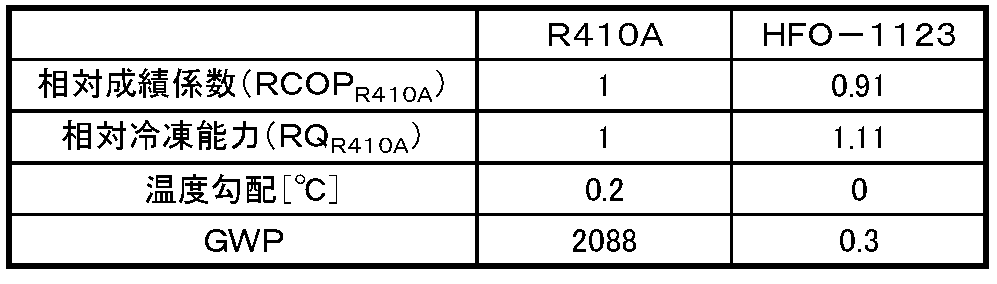
蒸発温度;0℃(ただし、非共沸混合物の場合は、蒸発開始温度と蒸発完了温度の平均温度)
凝縮温度;40℃(ただし、非共沸混合物の場合は、凝縮開始温度と凝縮完了温度の平均温度)
過冷却度(SC);5℃
過熱度(SH);5℃

本発明の熱サイクル用作動媒体に含有される第1の成分は、二酸化炭素、HFC-41、トリフルオロヨードメタン、メタン、エタン、プロパン、ヘリウム、ネオン、アルゴン、クリプトン、キセノン、窒素およびアンモニアから選ばれる少なくとも1種の物質からなる。この第1の成分は、作動媒体として作用するとともに、HFO-1123の自己分解性を抑制する。
本発明の熱サイクル用作動媒体に含有されてもよい第2の成分は、気候変動に関する政府間パネル(IPCC)第4次報告による地球温暖化係数(100年)が2000以下の、HFC-41以外のヒドロフルオロカーボン(HFC)、およびHFO-1123以外のヒドロフルオロオレフィン(HFO)から選ばれる少なくとも1種の物質からなる。第2の成分は、例えば、熱サイクル用作動媒体のサイクル性能を向上させる作用や、地球温暖化係数を下げる作用、温度勾配を小さくする作用を有する成分であり、熱サイクル用作動媒体の特性のバランスを良好に保つ。
本発明の熱サイクル用作動媒体は、本発明の効果を損なわない範囲でHFO-1123、上記第1の成分および上記第2の成分以外に、通常作動媒体として用いられる化合物を任意に含有してもよい。このような任意の化合物(任意成分)としては、例えば、HFO-1123、第1の成分および必要に応じて含有される第2の成分以外の、HFC、HFO(炭素-炭素二重結合を有するフッ化炭化水素)、これら以外のHFO-1123とともに気化、液化する他の成分等が挙げられる。任意成分としては、HFO-1123、第1の成分および第2の成分以外の、HFC、HFOが好ましい。任意成分は1種の物質を単独で用いてもよく、2種以上の物質を組み合わせて用いてもよい。
熱サイクル用作動媒体が任意成分を含有する場合、HFO-1123と任意成分が共沸組成である場合を除いて、熱サイクル用作動媒体は相当の温度勾配を有する。熱サイクル用作動媒体の温度勾配は、任意成分の種類およびHFO-1123と任意成分との混合割合により異なる。
本発明の熱サイクル用作動媒体は、地球温暖化に対する影響の観点から、地球温暖化係数(GWP)が250以下であることが好ましく、200以下がより好ましい。ここで、混合物におけるGWPは、組成質量による加重平均として示す。
本発明の熱サイクル用作動媒体は、充分なサイクル性能を得る点で、相対成績係数は0.65以上であることが好ましく、0.8以上であることがより好ましい。また、相対冷凍能力は、0.5以上であることが好ましく、0.8以上であることがより好ましい。
本発明の熱サイクル用作動媒体の熱サイクルシステムへの適用に際して、通常、本発明の熱サイクル用作動媒体を冷凍機油と混合して、本発明の熱サイクルシステム用組成物として使用することができる。本発明の熱サイクル用作動媒体と冷凍機油とを含む本発明の熱サイクルシステム用組成物は、これら以外にさらに、安定剤、漏れ検出物質等の公知の添加剤を含有してもよい。
冷凍機油としては、従来からハロゲン化炭化水素からなる作動媒体とともに、熱サイクルシステム用組成物に用いられる公知の冷凍機油が特に制限なく採用できる。冷凍機油として具体的には、含酸素系合成油(エステル系冷凍機油、エーテル系冷凍機油等)、フッ素系冷凍機油、鉱物系冷凍機油、炭化水素系合成油等が挙げられる。
熱サイクルシステム用組成物が任意に含有する安定剤は、熱および酸化に対する熱サイクル用作動媒体の安定性を向上させる成分である。安定剤としては、従来からハロゲン化炭化水素からなる作動媒体とともに熱サイクルシステムに用いられる公知の安定剤、例えば、耐酸化性向上剤、耐熱性向上剤、金属不活性剤等が特に制限なく採用できる。
本発明の熱サイクルシステムは、本発明の熱サイクルシステム用組成物を用いたシステムである。本発明の熱サイクルシステムは、凝縮器で得られる温熱を利用するヒートポンプシステムであってもよく、蒸発器で得られる冷熱を利用する冷凍サイクルシステムであってもよい。
(ii)圧縮機11から排出された熱サイクル用作動媒体の蒸気Bを凝縮器12にて流体Fによって冷却し、液化して低温高圧の熱サイクル用作動媒体Cとする。この際、流体Fは加熱されて流体F’となり、凝縮器12から排出される。以下、「BC過程」という。
(iii)凝縮器12から排出された熱サイクル用作動媒体Cを膨張弁13にて膨張させて低温低圧の熱サイクル用作動媒体Dとする。以下、「CD過程」という。
(iv)膨張弁13から排出された熱サイクル用作動媒体Dを蒸発器14にて負荷流体Eによって加熱して高温低圧の熱サイクル用作動媒体の蒸気Aとする。この際、負荷流体Eは冷却されて負荷流体E’となり、蒸発器14から排出される。以下、「DA過程」という。
COP=Q/圧縮仕事=(hA-hD)/(hB-hA) …式(2)
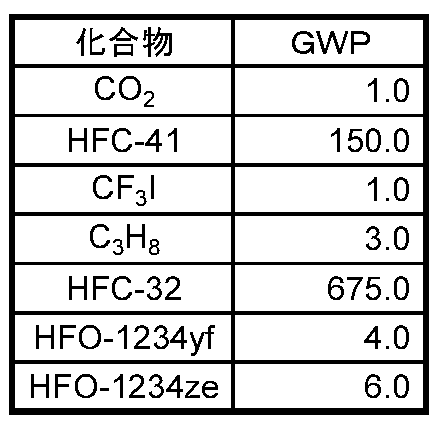
実施例1では、HFO-1123と、第1の成分である二酸化炭素(CO2)、フルオロメタン(HFC-41)、トリフルオロヨードメタン(CF3I)またはプロパン(C3H8)とを表3に示す割合で混合した熱サイクル用作動媒体(以下「作動媒体」ともいう。)を作製し、上記の方法で、地球温暖化係数(GWP)、相対サイクル性能(対R410A)、自己分解性を測定、算出、判定した。結果を、作動媒体の組成と併せて表3に示す。なお、表3において、No.1、No.9、No.10、No.15、No.16、No.21、No.22、No.27は比較例である。
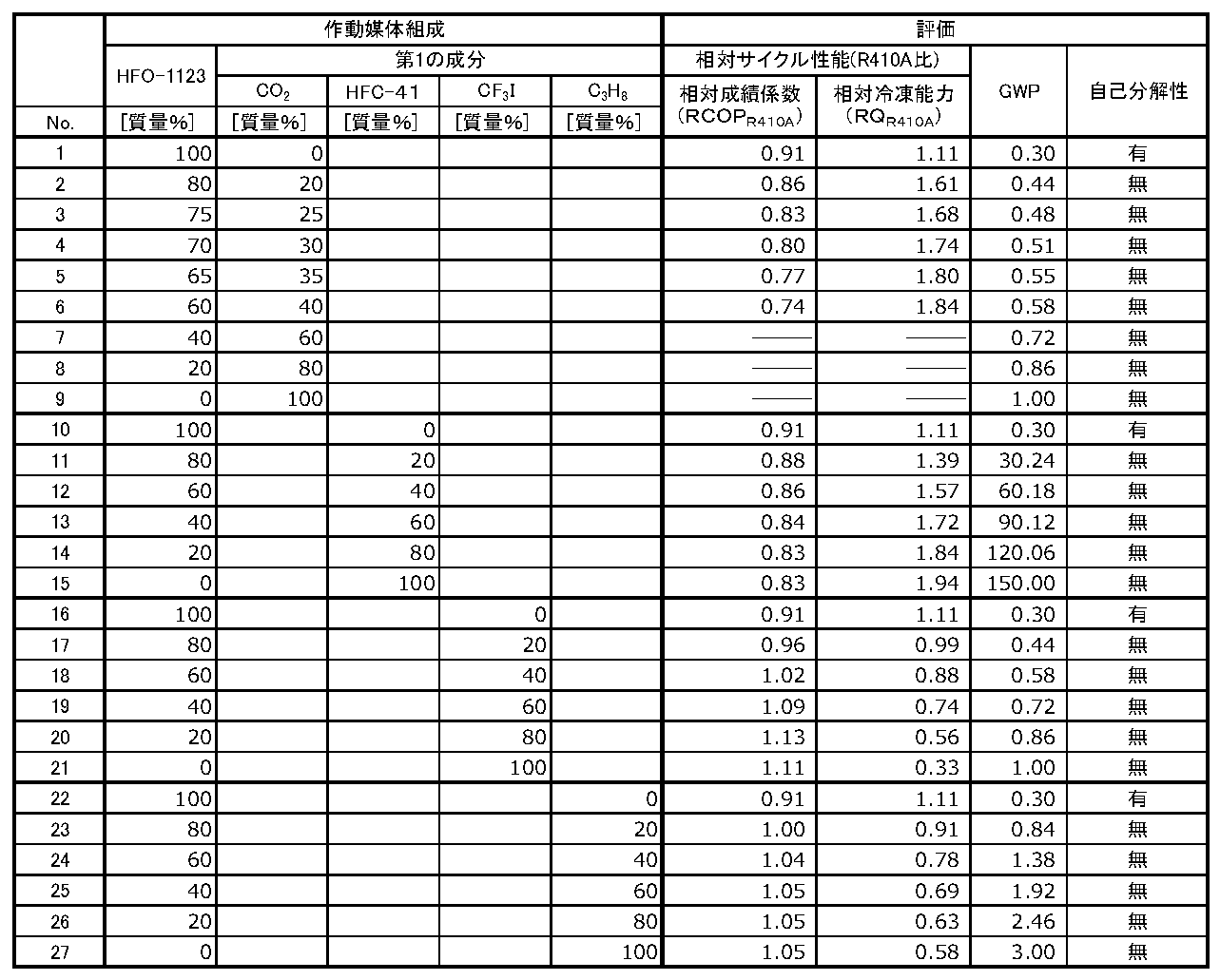
実施例2では、HFO-1123と、第1の成分として二酸化炭素(CO2)と、第2の成分としてHFC-32、HFO-1234yfまたはHFO-1234zeとを表4~6に示す割合で混合した作動媒体を作製し、上記の方法で、地球温暖化係数(GWP)、相対サイクル性能(対R410A)、自己分解性を測定、算出、判定した。結果を、作動媒体の組成と併せて表4~6に示す。


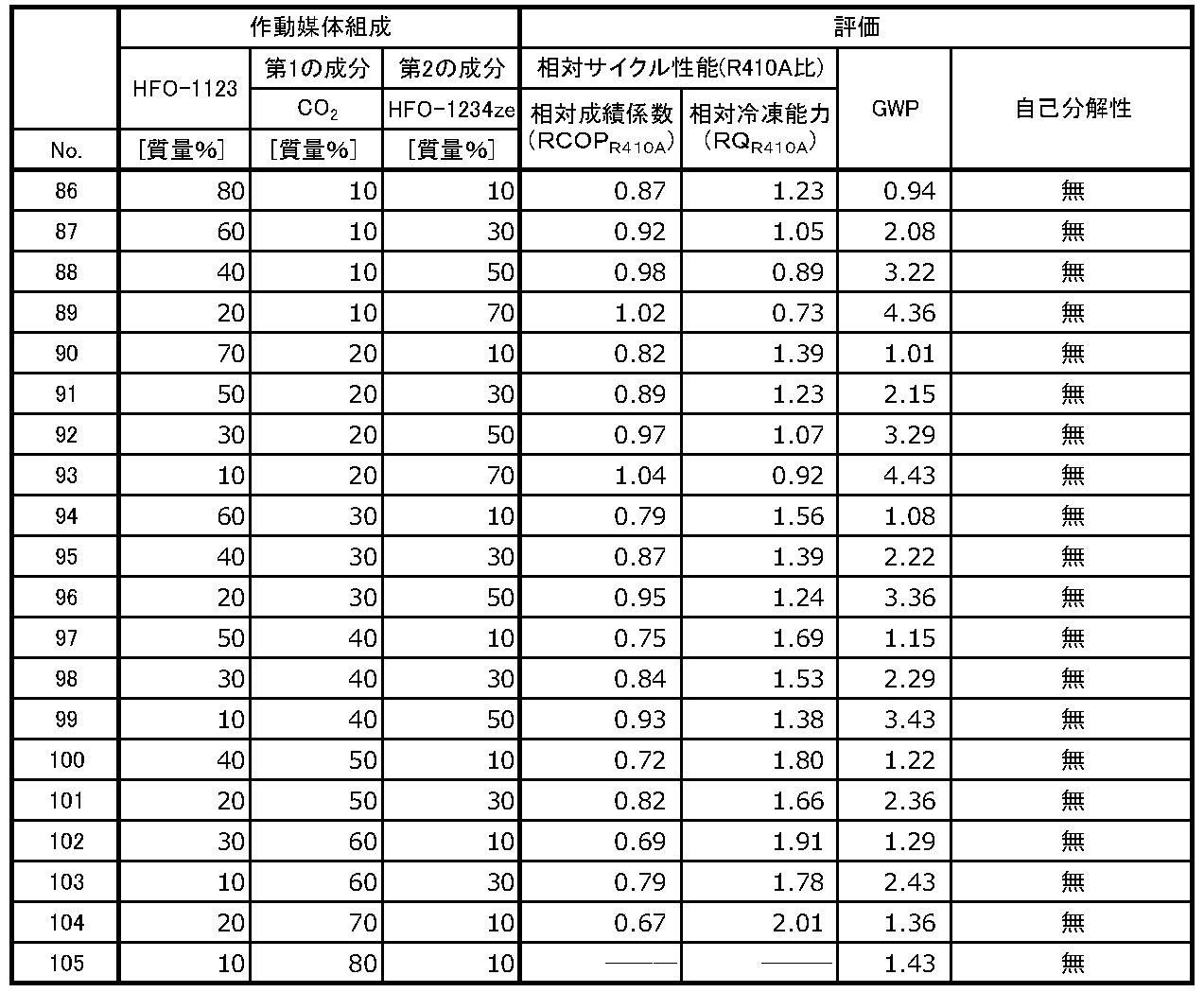
実施例3では、HFO-1123と、第1の成分としてプロパン(C3H8)と、第2の成分としてHFC-32、HFO-1234yfまたはHFO-1234zeとを表7~9に示す割合で混合した作動媒体を作製し、上記の方法で、地球温暖化係数(GWP)、相対サイクル性能(対R410A)、自己分解性を測定、算出、判定した。結果を、作動媒体の組成と併せて表7~9に示す。

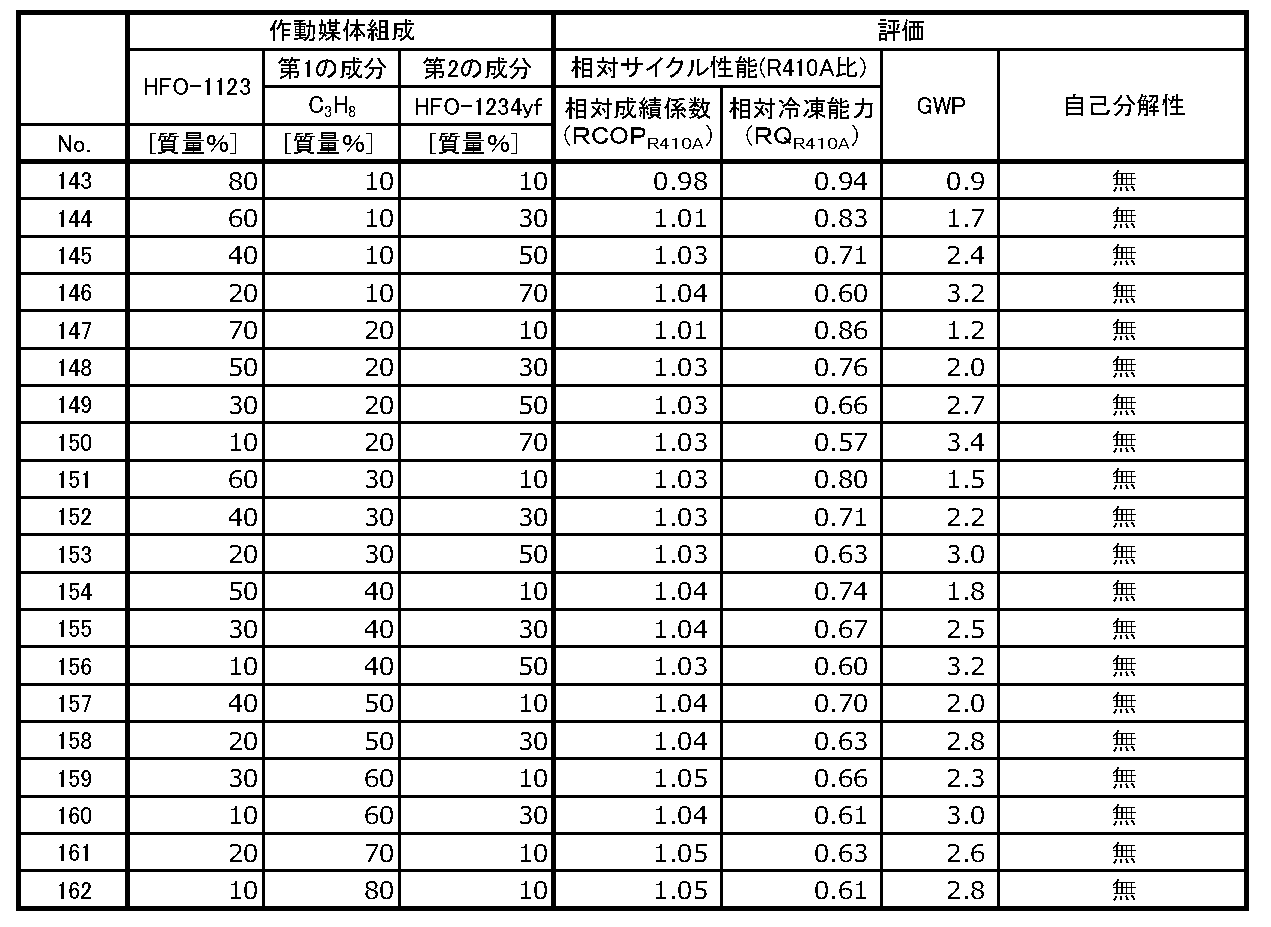

Claims (28)
- トリフルオロエチレンと、
二酸化炭素、フルオロメタン、トリフルオロヨードメタン、メタン、エタン、プロパン、ヘリウム、ネオン、アルゴン、クリプトン、キセノン、窒素およびアンモニアから選ばれる少なくとも1種の物質からなる第1の成分と
を含む熱サイクル用作動媒体。 - 前記第1の成分は、二酸化炭素、フルオロメタン、トリフルオロヨードメタンおよびプロパンから選ばれる少なくとも1種の物質からなる、請求項1に記載の熱サイクル用作動媒体。
- 前記第1の成分として二酸化炭素を含む、請求項1または2に記載の熱サイクル用作動媒体。
- 前記第1の成分としてフルオロメタンを含む、請求項1または2に記載の熱サイクル用作動媒体。
- 前記第1の成分としてトリフルオロヨードメタンを含む、請求項1または2に記載の熱サイクル用作動媒体。
- 前記第1の成分としてプロパンを含む、請求項1または2に記載の熱サイクル用作動媒体。
- 前記熱サイクル用作動媒体の総量に対する、前記トリフルオロエチレンと前記第1の成分との合計量の割合が90質量%を超え100質量%以下であり、
前記トリフルオロエチレンおよび前記第1の成分の合計量に対する、前記トリフルオロエチレンの量の割合が20質量%以上95質量%以下である、請求項1~6のいずれか1項に記載の熱サイクル用作動媒体。 - 前記熱サイクル用作動媒体の総量に対する、前記トリフルオロエチレンと前記二酸化炭素との合計量の割合が90質量%を超え100質量%以下であり、
前記トリフルオロエチレンおよび前記二酸化炭素の合計量に対する、前記トリフルオロエチレンの量の割合が70質量%以上80質量%以下である、請求項3に記載の熱サイクル用作動媒体。 - 前記熱サイクル用作動媒体の総量に対する、前記トリフルオロエチレンと前記フルオロメタンとの合計量の割合が90質量%を超え100質量%以下であり、
前記トリフルオロエチレンおよび前記フルオロメタンの合計量に対する、前記トリフルオロエチレンの量の割合が20質量%以上80質量%以下である、請求項4に記載の熱サイクル用作動媒体。 - 前記熱サイクル用作動媒体の総量に対する、前記トリフルオロエチレンと前記トリフルオロヨードメタンとの合計量の割合が90質量%を超え100質量%以下であり、
前記トリフルオロエチレンおよび前記トリフルオロヨードメタンの合計量に対する、前記トリフルオロエチレンの量の割合が60質量%以上80質量%以下である、請求項5に記載の熱サイクル用作動媒体。 - 前記熱サイクル用作動媒体の総量に対する、前記トリフルオロエチレンと前記プロパンとの合計量の割合が90質量%を超え100質量%以下であり、
前記トリフルオロエチレンおよび前記プロパンの合計量に対する、前記トリフルオロエチレンの量の割合が20質量%以上95質量%以下である、請求項6に記載の熱サイクル用作動媒体。 - さらに、気候変動に関する政府間パネル(IPCC)第4次報告による地球温暖化係数(100年)が2000以下の、ヒドロフルオロカーボン(ただし、フルオロメタンを除く。)およびヒドロフルオロオレフィン(ただし、トリフルオロエチレンを除く。)から選ばれる少なくとも1種の物質からなる第2の成分を含む請求項1~11のいずれか1項に記載の熱サイクル用作動媒体。
- 前記第2の成分は、2,3,3,3-テトラフルオロプロペン、1,3,3,3-テトラフルオロプロペンおよびジフルオロメタンから選ばれる少なくとも1種の物質からなる、請求項12に記載の熱サイクル用作動媒体。
- 前記第2の成分としてジフルオロメタンを含む、請求項12または13に記載の熱サイクル用作動媒体。
- 前記第2の成分として2,3,3,3-テトラフルオロプロペンを含む、請求項12または13に記載の熱サイクル用作動媒体。
- 前記第2の成分として1,3,3,3-テトラフルオロプロペンを含む、請求項12または13に記載の熱サイクル用作動媒体。
- 前記熱サイクル用作動媒体の総量に対する、前記トリフルオロエチレンと前記第1の成分と前記第2の成分との合計量の割合が90質量%を超え100質量%以下であり、
前記トリフルオロエチレンと前記第1の成分と前記第2の成分との合計量に対する、前記トリフルオロエチレンの量の割合が10質量%以上90質量%以下であり、
前記トリフルオロエチレンと前記第1の成分と前記第2の成分との合計量に対する、前記第1の成分の量の割合が1質量%以上50質量%以下であり、
前記トリフルオロエチレンと前記第1の成分と前記第2の成分との合計量に対する、前記第2の成分の量の割合が1質量%以上70質量%以下である、請求項12~16のいずれか1項に記載の熱サイクル用作動媒体。 - 前記熱サイクル用作動媒体の総量に対する、前記トリフルオロエチレンと前記二酸化炭素と前記第2の成分との合計量の割合が90質量%を超え100質量%以下であり、
前記トリフルオロエチレンと前記二酸化炭素と前記第2の成分との合計量に対する、前記トリフルオロエチレンの量の割合が10質量%以上90質量%以下であり、
前記トリフルオロエチレンと前記二酸化炭素と前記第2の成分との合計量に対する、前記二酸化炭素の量の割合が1質量%以上50質量%以下であり、
前記トリフルオロエチレンと前記二酸化炭素と前記第2の成分との合計量に対する、前記第2の成分の量の割合が1質量%以上70質量%以下である、請求項12~17のいずれか1項に記載の熱サイクル用作動媒体。 - 前記熱サイクル用作動媒体の総量に対する、前記トリフルオロエチレンと前記二酸化炭素と前記ジフルオロメタンとの合計量の割合が90質量%を超え100質量%以下であり、
前記トリフルオロエチレンと前記二酸化炭素と前記ジフルオロメタンとの合計量に対する、前記トリフルオロエチレンの量の割合が10質量%以上90質量%以下であり、
前記トリフルオロエチレンと前記二酸化炭素と前記ジフルオロメタンとの合計量に対する、前記二酸化炭素の量の割合が1質量%以上50質量%以下であり、
前記トリフルオロエチレンと前記二酸化炭素と前記ジフルオロメタンとの合計量に対する、前記ジフルオロメタンの量の割合が1質量%以上29質量%以下である、請求項14に記載の熱サイクル用作動媒体。 - 前記熱サイクル用作動媒体の総量に対する、前記トリフルオロエチレンと前記二酸化炭素と前記2,3,3,3-テトラフルオロプロペンとの合計量の割合が90質量%を超え100質量%以下であり、
前記トリフルオロエチレンと前記二酸化炭素と前記2,3,3,3-テトラフルオロプロペンとの合計量に対する、前記トリフルオロエチレンの量の割合が10質量%以上90質量%以下であり、
前記トリフルオロエチレンと前記二酸化炭素と前記2,3,3,3-テトラフルオロプロペンとの合計量に対する、前記二酸化炭素の量の割合が1質量%以上50質量%以下であり、
前記トリフルオロエチレンと前記二酸化炭素と前記2,3,3,3-テトラフルオロプロペンとの合計量に対する、前記2,3,3,3-テトラフルオロプロペンの量の割合が1質量%以上70質量%以下である、請求項15に記載の熱サイクル用作動媒体。 - 前記熱サイクル用作動媒体の総量に対する、前記トリフルオロエチレンと前記二酸化炭素と前記1,3,3,3-テトラフルオロプロペンとの合計量の割合が90質量%を超え100質量%以下であり、
前記トリフルオロエチレンと前記二酸化炭素と前記1,3,3,3-テトラフルオロプロペンとの合計量に対する、前記トリフルオロエチレンの量の割合が10質量%以上90質量%以下であり、
前記トリフルオロエチレンと前記二酸化炭素と前記1,3,3,3-テトラフルオロプロペンとの合計量に対する、前記二酸化炭素の量の割合が1質量%以上50質量%以下であり、
前記トリフルオロエチレンと前記二酸化炭素と前記1,3,3,3-テトラフルオロプロペンとの合計量に対する、前記1,3,3,3-テトラフルオロプロペンの量の割合が1質量%以上70質量%以下である、請求項16に記載の熱サイクル用作動媒体。 - 前記熱サイクル用作動媒体の総量に対する、前記トリフルオロエチレンと前記プロパンと前記第2の成分との合計量の割合が90質量%を超え100質量%以下であり、
前記トリフルオロエチレンと前記プロパンと前記第2の成分との合計量に対する、前記トリフルオロエチレンの量の割合が20質量%以上95質量%以下であり、
前記トリフルオロエチレンと前記プロパンと前記第2の成分との合計量に対する、前記プロパンの量の割合が1質量%以上75質量%以下であり、
前記トリフルオロエチレンと前記プロパンと前記第2の成分との合計量に対する、前記第2の成分の量の割合が1質量%以上75質量%以下である、請求項12~17のいずれか1項に記載の熱サイクル用作動媒体。 - 前記熱サイクル用作動媒体の総量に対する、前記トリフルオロエチレンと前記プロパンと前記ジフルオロメタンとの合計量の割合が90質量%を超え100質量%以下であり、
前記トリフルオロエチレンと前記プロパンと前記ジフルオロメタンとの合計量に対する、前記トリフルオロエチレンの量の割合が20質量%以上95質量%以下であり、
前記トリフルオロエチレンと前記プロパンと前記ジフルオロメタンとの合計量に対する、前記プロパンの量の割合が1質量%以上75質量%以下であり、
前記トリフルオロエチレンと前記プロパンと前記ジフルオロメタンとの合計量に対する、前記ジフルオロメタンの量の割合が1質量%以上75質量%以下である、請求項14に記載の熱サイクル用作動媒体。 - 前記熱サイクル用作動媒体の総量に対する、前記トリフルオロエチレンと前記プロパンと前記2,3,3,3-テトラフルオロプロペンとの合計量の割合が90質量%を超え100質量%以下であり、
前記トリフルオロエチレンと前記プロパンと前記2,3,3,3-テトラフルオロプロペンとの合計量に対する、前記トリフルオロエチレンの量の割合が20質量%以上95質量%以下であり、
前記トリフルオロエチレンと前記プロパンと前記2,3,3,3-テトラフルオロプロペンとの合計量に対する、前記プロパンの量の割合が1質量%以上75質量%以下であり、
前記トリフルオロエチレンと前記プロパンと前記2,3,3,3-テトラフルオロプロペンとの合計量に対する、前記2,3,3,3-テトラフルオロプロペンの量の割合が1質量%以上75質量%以下である、請求項15に記載の熱サイクル用作動媒体。 - 前記熱サイクル用作動媒体の総量に対する、前記トリフルオロエチレンと前記プロパンと前記1,3,3,3-テトラフルオロプロペンとの合計量の割合が90質量%を超え100質量%以下であり、
前記トリフルオロエチレンと前記プロパンと前記1,3,3,3-テトラフルオロプロペンとの合計量に対する、前記トリフルオロエチレンの量の割合が20質量%以上95質量%以下であり、
前記トリフルオロエチレンと前記プロパンと前記1,3,3,3-テトラフルオロプロペンとの合計量に対する、前記プロパンの量の割合が1質量%以上75質量%以下であり、
前記トリフルオロエチレンと前記プロパンと前記1,3,3,3-テトラフルオロプロペンとの合計量に対する、前記1,3,3,3-テトラフルオロプロペンの量の割合が1質量%以上75質量%以下である、請求項16に記載の熱サイクル用作動媒体。 - 請求項1~25のいずれか1項に記載の熱サイクル用作動媒体を含む熱サイクルシステム用組成物。
- 請求項26に記載の熱サイクルシステム用組成物を用いた、熱サイクルシステム。
- 前記熱サイクルシステムが、冷凍・冷蔵機器、空調機器、発電システム、熱輸送装置または二次冷却機である、請求項27に記載の熱サイクルシステム。
Priority Applications (9)
| Application Number | Priority Date | Filing Date | Title |
|---|---|---|---|
| CN201680031860.9A CN107614652B (zh) | 2015-06-01 | 2016-05-27 | 热循环用工作介质、热循环系统用组合物以及热循环系统 |
| EP22186264.2A EP4098714B1 (en) | 2015-06-01 | 2016-05-27 | Working fluid for heat cycle, composition for heat cycle system and heat cycle system |
| JP2017521924A JP6848861B2 (ja) | 2015-06-01 | 2016-05-27 | 熱サイクル用作動媒体、熱サイクルシステム用組成物および熱サイクルシステム |
| EP25195311.3A EP4628559A3 (en) | 2015-06-01 | 2016-05-27 | Working fluid for heat cycle, composition for heat cycle system and heat cycle system |
| EP16803282.9A EP3305869B1 (en) | 2015-06-01 | 2016-05-27 | Working medium for heat cycle, composition for heat cycle system, and heat cycle system |
| CN202311031209.XA CN117050728A (zh) | 2015-06-01 | 2016-05-27 | 热循环用工作介质、热循环系统用组合物以及热循环系统 |
| US15/825,975 US20180079941A1 (en) | 2015-06-01 | 2017-11-29 | Working fluid for heat cycle, composition for heat cycle system and heat cycle system |
| US17/682,416 US12516231B2 (en) | 2015-06-01 | 2022-02-28 | Working fluid for heat cycle, composition for heat cycle system and heat cycle system |
| US19/027,945 US20250171670A1 (en) | 2015-06-01 | 2025-01-17 | Working fluid for heat cycle, composition for heat cycle system and heat cycle system |
Applications Claiming Priority (2)
| Application Number | Priority Date | Filing Date | Title |
|---|---|---|---|
| JP2015111614 | 2015-06-01 | ||
| JP2015-111614 | 2015-06-01 |
Related Child Applications (1)
| Application Number | Title | Priority Date | Filing Date |
|---|---|---|---|
| US15/825,975 Continuation US20180079941A1 (en) | 2015-06-01 | 2017-11-29 | Working fluid for heat cycle, composition for heat cycle system and heat cycle system |
Publications (1)
| Publication Number | Publication Date |
|---|---|
| WO2016194847A1 true WO2016194847A1 (ja) | 2016-12-08 |
Family
ID=57441077
Family Applications (1)
| Application Number | Title | Priority Date | Filing Date |
|---|---|---|---|
| PCT/JP2016/065818 Ceased WO2016194847A1 (ja) | 2015-06-01 | 2016-05-27 | 熱サイクル用作動媒体、熱サイクルシステム用組成物および熱サイクルシステム |
Country Status (5)
| Country | Link |
|---|---|
| US (3) | US20180079941A1 (ja) |
| EP (3) | EP4098714B1 (ja) |
| JP (1) | JP6848861B2 (ja) |
| CN (2) | CN117050728A (ja) |
| WO (1) | WO2016194847A1 (ja) |
Cited By (39)
| Publication number | Priority date | Publication date | Assignee | Title |
|---|---|---|---|---|
| JP2015215112A (ja) * | 2014-05-09 | 2015-12-03 | パナソニックIpマネジメント株式会社 | 冷凍サイクル装置 |
| JP2017145380A (ja) * | 2016-02-18 | 2017-08-24 | パナソニックIpマネジメント株式会社 | 冷凍サイクル用作動媒体および冷凍サイクルシステム |
| JP2018048271A (ja) * | 2016-09-23 | 2018-03-29 | パナソニックIpマネジメント株式会社 | 冷凍サイクル用作動媒体および冷凍サイクルシステム |
| JP2018104566A (ja) * | 2016-12-27 | 2018-07-05 | パナソニック株式会社 | 冷凍サイクル用作動媒体および冷凍サイクルシステム |
| JP2018104565A (ja) * | 2016-12-27 | 2018-07-05 | パナソニック株式会社 | 冷凍サイクル用作動媒体および冷凍サイクルシステム |
| WO2018204860A1 (en) * | 2017-05-05 | 2018-11-08 | Honeywell International Inc. | Heat transfer compositions, methods and systems |
| JP2018177969A (ja) * | 2017-04-13 | 2018-11-15 | パナソニックIpマネジメント株式会社 | 冷凍サイクル装置 |
| JP2018177968A (ja) * | 2017-04-13 | 2018-11-15 | パナソニックIpマネジメント株式会社 | 冷凍サイクル装置 |
| JP2018177966A (ja) * | 2017-04-13 | 2018-11-15 | パナソニックIpマネジメント株式会社 | 冷凍サイクル装置 |
| JP2018177967A (ja) * | 2017-04-13 | 2018-11-15 | パナソニックIpマネジメント株式会社 | 冷凍サイクル装置 |
| JP2018179404A (ja) * | 2017-04-13 | 2018-11-15 | パナソニックIpマネジメント株式会社 | 冷凍サイクル装置 |
| WO2019031370A1 (ja) * | 2017-08-10 | 2019-02-14 | パナソニックIpマネジメント株式会社 | 冷凍サイクル用作動媒体および冷凍サイクルシステム |
| DE102017216363A1 (de) * | 2017-09-08 | 2019-03-14 | Technische Universität Dresden | Kältemittel |
| WO2019108962A1 (en) | 2017-11-30 | 2019-06-06 | Honeywell International Inc. | Heat transfer compositions, methods, and systems |
| CN109988547A (zh) * | 2017-12-29 | 2019-07-09 | 特灵国际有限公司 | 较低gwp制冷剂组合物 |
| WO2019208384A1 (ja) * | 2018-04-25 | 2019-10-31 | ダイキン工業株式会社 | 冷媒を含有する組成物、熱移動媒体及び熱サイクルシステム |
| WO2019240205A1 (ja) * | 2018-06-12 | 2019-12-19 | ダイキン工業株式会社 | 冷媒を含有する組成物、熱移動媒体及び熱サイクルシステム |
| WO2020017521A1 (ja) * | 2018-07-17 | 2020-01-23 | ダイキン工業株式会社 | 冷媒サイクル装置 |
| WO2020017520A1 (ja) * | 2018-07-17 | 2020-01-23 | ダイキン工業株式会社 | 自動車用冷凍サイクル装置 |
| WO2020071380A1 (ja) * | 2018-10-01 | 2020-04-09 | Agc株式会社 | 熱サイクルシステム用組成物および熱サイクルシステム |
| JP2020073696A (ja) * | 2016-09-23 | 2020-05-14 | パナソニックIpマネジメント株式会社 | 冷凍サイクル用作動媒体および冷凍サイクルシステム |
| JP2020193344A (ja) * | 2020-07-27 | 2020-12-03 | パナソニックIpマネジメント株式会社 | 冷凍サイクル用作動媒体の不均化反応の抑制方法および冷凍サイクル用作動媒体の製造方法 |
| CN112437800A (zh) * | 2018-07-17 | 2021-03-02 | 大金工业株式会社 | 含有制冷剂的组合物、热传递介质和热循环系统 |
| US20210155839A1 (en) * | 2018-06-05 | 2021-05-27 | Arkema France | Compositions based on 1,1,2-trifluoroethylene and carbon dioxide |
| JP6924541B1 (ja) * | 2020-11-17 | 2021-08-25 | 株式会社せばた集団 | 熱媒体 |
| JP2021167428A (ja) * | 2018-06-22 | 2021-10-21 | ダイキン工業株式会社 | 冷媒を含む組成物、その使用、並びにそれを有する冷凍機及びその冷凍機の運転方法 |
| JP2022122870A (ja) * | 2017-04-13 | 2022-08-23 | パナソニックIpマネジメント株式会社 | 冷凍サイクル装置 |
| US11525076B2 (en) | 2019-01-30 | 2022-12-13 | Daikin Industries, Ltd. | Composition containing refrigerant, and refrigeration method using said composition, operating method for refrigeration device, and refrigeration device |
| JPWO2023047440A1 (ja) * | 2021-09-21 | 2023-03-30 | ||
| WO2023067934A1 (ja) * | 2021-10-19 | 2023-04-27 | パナソニックIpマネジメント株式会社 | 冷媒組成物、冷凍サイクル作動媒体、及び、冷凍サイクルシステム |
| WO2023100746A1 (ja) * | 2021-12-03 | 2023-06-08 | Agc株式会社 | 作動媒体 |
| JPWO2023181402A1 (ja) * | 2022-03-25 | 2023-09-28 | ||
| US11827833B2 (en) | 2019-02-06 | 2023-11-28 | Daikin Industries, Ltd. | Refrigerant-containing composition, and refrigerating method, refrigerating device operating method, and refrigerating device using said composition |
| US11834601B2 (en) | 2019-01-30 | 2023-12-05 | Daikin Industries, Ltd. | Composition containing refrigerant, refrigeration method using said composition, method for operating refrigeration device, and refrigeration device |
| US11834602B2 (en) | 2019-02-05 | 2023-12-05 | Daikin Industries, Ltd. | Refrigerant-containing composition, and refrigerating method, refrigerating device operating method, and refrigerating device using said composition |
| WO2024090169A1 (ja) * | 2022-10-26 | 2024-05-02 | Agc株式会社 | 熱サイクル用作動媒体、熱サイクル用作動媒体の貯蔵方法、熱サイクル用作動媒体の製造方法、熱サイクルシステム用組成物、及び熱サイクル用作動媒体の貯蔵容器 |
| WO2024247438A1 (ja) * | 2023-05-31 | 2024-12-05 | Agc株式会社 | 熱サイクルシステム及び熱サイクル方法 |
| WO2024262102A1 (ja) | 2023-06-19 | 2024-12-26 | Agc株式会社 | 作動媒体、熱サイクルシステム用組成物、熱サイクルシステム、及び熱サイクル方法 |
| WO2025033061A1 (ja) * | 2023-08-04 | 2025-02-13 | Agc株式会社 | 充填容器及びその保管方法 |
Families Citing this family (17)
| Publication number | Priority date | Publication date | Assignee | Title |
|---|---|---|---|---|
| EP3511392B8 (en) * | 2016-09-07 | 2023-02-15 | Agc Inc. | Working fluid for heat cycle, composition for heat cycle system, and heat cycle system |
| FR3067035B1 (fr) | 2017-06-02 | 2020-10-30 | Arkema France | Compositions a base de trifluoroethylene, et leurs utilisations |
| TWI843706B (zh) * | 2017-09-19 | 2024-06-01 | 美商哈尼威爾國際公司 | 傳熱方法、系統和組成物 |
| CN112673074A (zh) * | 2018-07-17 | 2021-04-16 | 大金工业株式会社 | 汽车用制冷循环装置 |
| CN117384600A (zh) | 2019-04-16 | 2024-01-12 | 大金工业株式会社 | 含有制冷剂的组合物、其用途以及使用其的冷冻机和该冷冻机的运转方法 |
| CN110591651B (zh) * | 2019-09-12 | 2020-09-25 | 珠海格力电器股份有限公司 | 一种制冷剂组合物其可用于家用空调 |
| WO2021075075A1 (ja) * | 2019-10-18 | 2021-04-22 | 三菱電機株式会社 | 冷凍サイクル装置 |
| WO2021230935A2 (en) * | 2020-02-14 | 2021-11-18 | Kidde Technologies, Inc. | Fire suppression blends of cf3i, hcfos and co2 |
| JP7515064B2 (ja) * | 2020-04-01 | 2024-07-12 | パナソニックIpマネジメント株式会社 | 冷凍サイクル用作動媒体および冷凍サイクルシステム |
| CN112011311B (zh) * | 2020-08-13 | 2021-06-18 | 珠海格力电器股份有限公司 | 非共沸环保制冷剂、其制备方法及除湿系统 |
| FR3100538B1 (fr) * | 2020-09-10 | 2024-04-19 | Arkema France | Compositions à base de 1,1,2-trifluoroéthylene et de dioxyde de carbone |
| CN112111249B (zh) * | 2020-09-28 | 2021-07-13 | 珠海格力电器股份有限公司 | 一种混合制冷剂、换热系统和家用电器 |
| CN112300761B (zh) * | 2020-11-13 | 2021-10-29 | 珠海格力电器股份有限公司 | 制冷剂及其制备方法和空调系统 |
| CN114045155B (zh) * | 2021-11-29 | 2022-07-12 | 珠海格力电器股份有限公司 | 一种环保节能型制冷剂组合物及其制备方法和应用 |
| CN118946772A (zh) * | 2022-03-25 | 2024-11-12 | 三菱电机株式会社 | 制冷循环装置 |
| CN114891483B (zh) * | 2022-06-09 | 2023-05-02 | 珠海格力电器股份有限公司 | 一种混合制冷剂和空调系统 |
| CN115612452B (zh) * | 2022-08-08 | 2025-04-04 | 珠海格力电器股份有限公司 | 制冷剂及其用途 |
Citations (7)
| Publication number | Priority date | Publication date | Assignee | Title |
|---|---|---|---|---|
| JP2012505296A (ja) * | 2008-10-10 | 2012-03-01 | イー・アイ・デュポン・ドウ・ヌムール・アンド・カンパニー | 2,3,3,3−テトラフルオロプロペン、2−クロロ−2,3,3,3−テトラフルオロプロパノール、2−クロロ−2,3,3,3−テトラフルオロ酢酸プロピルまたは(2−クロロ−2,3,3,3−テトラフルオロプロポキシ)塩化亜鉛を含む組成物 |
| WO2012157764A1 (ja) * | 2011-05-19 | 2012-11-22 | 旭硝子株式会社 | 作動媒体および熱サイクルシステム |
| WO2014123120A1 (ja) * | 2013-02-05 | 2014-08-14 | 旭硝子株式会社 | ヒートポンプ用作動媒体およびヒートポンプシステム |
| WO2014178353A1 (ja) * | 2013-04-30 | 2014-11-06 | 旭硝子株式会社 | 熱サイクル用作動媒体 |
| WO2014178352A1 (ja) * | 2013-04-30 | 2014-11-06 | 旭硝子株式会社 | トリフルオロエチレンを含む組成物 |
| WO2015005290A1 (ja) * | 2013-07-12 | 2015-01-15 | 旭硝子株式会社 | 熱サイクル用作動媒体、熱サイクルシステム用組成物および熱サイクルシステム |
| WO2015125885A1 (ja) * | 2014-02-24 | 2015-08-27 | 旭硝子株式会社 | 熱サイクルシステム用組成物および熱サイクルシステム |
Family Cites Families (12)
| Publication number | Priority date | Publication date | Assignee | Title |
|---|---|---|---|---|
| US4249412A (en) | 1978-12-11 | 1981-02-10 | Townsend Claude A Iii | Fluorescent leak detection composition |
| US5440919A (en) | 1994-08-29 | 1995-08-15 | Spectronics Corporation | Method of introducing leak detection dye into an air conditioning or refrigeration system |
| EP1751247A2 (en) | 2004-05-26 | 2007-02-14 | E.I.Du pont de nemours and company | 1,1,1,2,2,4,5,5,5-nonafluoro-4-(trifluoromethyl)-3-pentanone compositions comprising a hydrofluorocarbon and uses thereof |
| KR20070090939A (ko) * | 2004-12-21 | 2007-09-06 | 허니웰 인터내셔널 인코포레이티드 | 안정화된 요오드카본 조성물 |
| US9175201B2 (en) | 2004-12-21 | 2015-11-03 | Honeywell International Inc. | Stabilized iodocarbon compositions |
| US8058488B2 (en) | 2007-11-20 | 2011-11-15 | E. I. Du Pont De Nemours And Company | Synthesis of hydrofluoroalkanols and hydrofluoroalkenes |
| RU2010125261A (ru) | 2007-11-20 | 2011-12-27 | Е.И. Дюпон Де Немур Энд Компани (Us) | Синтез гидрофторалканолов и гидрофторалкенов |
| TW201014816A (en) | 2008-10-10 | 2010-04-16 | Du Pont | Synthesis of hydrofluoroalkanols and hydrofluoroalkenes |
| JP2015010058A (ja) * | 2013-06-28 | 2015-01-19 | 旭硝子株式会社 | トリフルオロエチレンの製造方法 |
| WO2015125876A1 (ja) * | 2014-02-20 | 2015-08-27 | 旭硝子株式会社 | 熱サイクルシステム用組成物および熱サイクルシステム |
| JP6260446B2 (ja) * | 2014-05-09 | 2018-01-17 | 旭硝子株式会社 | 熱サイクルシステム |
| JP6393895B2 (ja) * | 2014-05-09 | 2018-09-26 | パナソニックIpマネジメント株式会社 | 冷凍サイクル装置 |
-
2016
- 2016-05-27 CN CN202311031209.XA patent/CN117050728A/zh active Pending
- 2016-05-27 EP EP22186264.2A patent/EP4098714B1/en active Active
- 2016-05-27 JP JP2017521924A patent/JP6848861B2/ja active Active
- 2016-05-27 WO PCT/JP2016/065818 patent/WO2016194847A1/ja not_active Ceased
- 2016-05-27 EP EP25195311.3A patent/EP4628559A3/en active Pending
- 2016-05-27 EP EP16803282.9A patent/EP3305869B1/en active Active
- 2016-05-27 CN CN201680031860.9A patent/CN107614652B/zh active Active
-
2017
- 2017-11-29 US US15/825,975 patent/US20180079941A1/en not_active Abandoned
-
2022
- 2022-02-28 US US17/682,416 patent/US12516231B2/en active Active
-
2025
- 2025-01-17 US US19/027,945 patent/US20250171670A1/en active Pending
Patent Citations (7)
| Publication number | Priority date | Publication date | Assignee | Title |
|---|---|---|---|---|
| JP2012505296A (ja) * | 2008-10-10 | 2012-03-01 | イー・アイ・デュポン・ドウ・ヌムール・アンド・カンパニー | 2,3,3,3−テトラフルオロプロペン、2−クロロ−2,3,3,3−テトラフルオロプロパノール、2−クロロ−2,3,3,3−テトラフルオロ酢酸プロピルまたは(2−クロロ−2,3,3,3−テトラフルオロプロポキシ)塩化亜鉛を含む組成物 |
| WO2012157764A1 (ja) * | 2011-05-19 | 2012-11-22 | 旭硝子株式会社 | 作動媒体および熱サイクルシステム |
| WO2014123120A1 (ja) * | 2013-02-05 | 2014-08-14 | 旭硝子株式会社 | ヒートポンプ用作動媒体およびヒートポンプシステム |
| WO2014178353A1 (ja) * | 2013-04-30 | 2014-11-06 | 旭硝子株式会社 | 熱サイクル用作動媒体 |
| WO2014178352A1 (ja) * | 2013-04-30 | 2014-11-06 | 旭硝子株式会社 | トリフルオロエチレンを含む組成物 |
| WO2015005290A1 (ja) * | 2013-07-12 | 2015-01-15 | 旭硝子株式会社 | 熱サイクル用作動媒体、熱サイクルシステム用組成物および熱サイクルシステム |
| WO2015125885A1 (ja) * | 2014-02-24 | 2015-08-27 | 旭硝子株式会社 | 熱サイクルシステム用組成物および熱サイクルシステム |
Cited By (97)
| Publication number | Priority date | Publication date | Assignee | Title |
|---|---|---|---|---|
| JP2015215112A (ja) * | 2014-05-09 | 2015-12-03 | パナソニックIpマネジメント株式会社 | 冷凍サイクル装置 |
| JP2017145380A (ja) * | 2016-02-18 | 2017-08-24 | パナソニックIpマネジメント株式会社 | 冷凍サイクル用作動媒体および冷凍サイクルシステム |
| JP2020125501A (ja) * | 2016-02-18 | 2020-08-20 | パナソニックIpマネジメント株式会社 | 冷凍サイクル用作動媒体および冷凍サイクルシステム |
| JP2018048271A (ja) * | 2016-09-23 | 2018-03-29 | パナソニックIpマネジメント株式会社 | 冷凍サイクル用作動媒体および冷凍サイクルシステム |
| JP2020073696A (ja) * | 2016-09-23 | 2020-05-14 | パナソニックIpマネジメント株式会社 | 冷凍サイクル用作動媒体および冷凍サイクルシステム |
| JP7320785B2 (ja) | 2016-09-23 | 2023-08-04 | パナソニックIpマネジメント株式会社 | 冷凍サイクル用作動媒体および冷凍サイクルシステム |
| JP2018104565A (ja) * | 2016-12-27 | 2018-07-05 | パナソニック株式会社 | 冷凍サイクル用作動媒体および冷凍サイクルシステム |
| JP2018104566A (ja) * | 2016-12-27 | 2018-07-05 | パナソニック株式会社 | 冷凍サイクル用作動媒体および冷凍サイクルシステム |
| JP2018177968A (ja) * | 2017-04-13 | 2018-11-15 | パナソニックIpマネジメント株式会社 | 冷凍サイクル装置 |
| JP2018177966A (ja) * | 2017-04-13 | 2018-11-15 | パナソニックIpマネジメント株式会社 | 冷凍サイクル装置 |
| JP2018177967A (ja) * | 2017-04-13 | 2018-11-15 | パナソニックIpマネジメント株式会社 | 冷凍サイクル装置 |
| JP2018179404A (ja) * | 2017-04-13 | 2018-11-15 | パナソニックIpマネジメント株式会社 | 冷凍サイクル装置 |
| JP7113185B2 (ja) | 2017-04-13 | 2022-08-05 | パナソニックIpマネジメント株式会社 | 冷凍サイクル装置 |
| JP2018177969A (ja) * | 2017-04-13 | 2018-11-15 | パナソニックIpマネジメント株式会社 | 冷凍サイクル装置 |
| JP2022122870A (ja) * | 2017-04-13 | 2022-08-23 | パナソニックIpマネジメント株式会社 | 冷凍サイクル装置 |
| JP7285404B2 (ja) | 2017-04-13 | 2023-06-02 | パナソニックIpマネジメント株式会社 | 冷凍サイクル装置 |
| WO2018204860A1 (en) * | 2017-05-05 | 2018-11-08 | Honeywell International Inc. | Heat transfer compositions, methods and systems |
| EP3666848A4 (en) * | 2017-08-10 | 2020-07-22 | Panasonic Intellectual Property Management Co., Ltd. | ACTIVE FLUID FOR REFRIGERATION CYCLE AND REFRIGERATION CYCLE SYSTEM |
| CN110997858B (zh) * | 2017-08-10 | 2021-08-24 | 松下知识产权经营株式会社 | 冷冻循环用工作介质和冷冻循环系统 |
| WO2019031370A1 (ja) * | 2017-08-10 | 2019-02-14 | パナソニックIpマネジメント株式会社 | 冷凍サイクル用作動媒体および冷凍サイクルシステム |
| JP2019034983A (ja) * | 2017-08-10 | 2019-03-07 | パナソニックIpマネジメント株式会社 | 冷凍サイクル用作動媒体および冷凍サイクルシステム |
| CN110997858A (zh) * | 2017-08-10 | 2020-04-10 | 松下知识产权经营株式会社 | 冷冻循环用工作介质和冷冻循环系统 |
| US11584875B2 (en) | 2017-09-08 | 2023-02-21 | Weiss Technik Gmbh | Coolant |
| JP7539603B2 (ja) | 2017-09-08 | 2024-08-26 | バイス テヒニク ゲゼルシャフト ミット ベシュレンクテル ハフツング | 冷媒 |
| EP3786255A1 (de) * | 2017-09-08 | 2021-03-03 | WEISS UMWELTTECHNIK GmbH | Kältemittel |
| CN111183201A (zh) * | 2017-09-08 | 2020-05-19 | 伟思环境技术有限公司 | 制冷剂 |
| DE102017216363A1 (de) * | 2017-09-08 | 2019-03-14 | Technische Universität Dresden | Kältemittel |
| WO2019048250A1 (de) * | 2017-09-08 | 2019-03-14 | Weiss Umwelttechnik Gmbh | Kältemittel |
| JP2020533474A (ja) * | 2017-09-08 | 2020-11-19 | バイス ウンベルトテヒニク ゲゼルシャフト ミット ベシュレンクテル ハフツング | 冷媒 |
| WO2019108962A1 (en) | 2017-11-30 | 2019-06-06 | Honeywell International Inc. | Heat transfer compositions, methods, and systems |
| CN109988547A (zh) * | 2017-12-29 | 2019-07-09 | 特灵国际有限公司 | 较低gwp制冷剂组合物 |
| US11220620B2 (en) | 2017-12-29 | 2022-01-11 | Trane International Inc. | Lower GWP refrigerant compositions |
| JP2019194311A (ja) * | 2018-04-25 | 2019-11-07 | ダイキン工業株式会社 | 冷媒を含有する組成物、熱移動媒体及び熱サイクルシステム |
| WO2019208384A1 (ja) * | 2018-04-25 | 2019-10-31 | ダイキン工業株式会社 | 冷媒を含有する組成物、熱移動媒体及び熱サイクルシステム |
| US11352535B2 (en) | 2018-04-25 | 2022-06-07 | Daikin Industries, Ltd. | Composition containing coolant, heat transfer medium and heat cycle system |
| JP2021525823A (ja) * | 2018-06-05 | 2021-09-27 | アルケマ フランス | 1,1,2−トリフルオロエチレンおよび二酸化炭素をベースにした組成物 |
| US20210155839A1 (en) * | 2018-06-05 | 2021-05-27 | Arkema France | Compositions based on 1,1,2-trifluoroethylene and carbon dioxide |
| JP7410888B2 (ja) | 2018-06-05 | 2024-01-10 | アルケマ フランス | 1,1,2-トリフルオロエチレンおよび二酸化炭素をベースにした組成物 |
| US20240247175A1 (en) * | 2018-06-05 | 2024-07-25 | Arkema France | Compositions based on 1,1,2-trifluoroethylene and carbon dioxide |
| US11421137B2 (en) | 2018-06-12 | 2022-08-23 | Daikin Industries, Ltd. | Refrigerant-containing composition, heat transfer medium, and heat cycle system |
| US12473477B2 (en) | 2018-06-12 | 2025-11-18 | Daikin Industries, Ltd. | Refrigerant-containing composition, heat transfer medium, and heat cycle system |
| WO2019240205A1 (ja) * | 2018-06-12 | 2019-12-19 | ダイキン工業株式会社 | 冷媒を含有する組成物、熱移動媒体及び熱サイクルシステム |
| JP2019214720A (ja) * | 2018-06-12 | 2019-12-19 | ダイキン工業株式会社 | 冷媒を含有する組成物、熱移動媒体及び熱サイクルシステム |
| JP7137103B2 (ja) | 2018-06-22 | 2022-09-14 | ダイキン工業株式会社 | 冷媒を含む組成物、その使用、並びにそれを有する冷凍機及びその冷凍機の運転方法 |
| JP2021167428A (ja) * | 2018-06-22 | 2021-10-21 | ダイキン工業株式会社 | 冷媒を含む組成物、その使用、並びにそれを有する冷凍機及びその冷凍機の運転方法 |
| JP2023181171A (ja) * | 2018-07-17 | 2023-12-21 | ダイキン工業株式会社 | 自動車用冷凍サイクル装置 |
| JP7701638B2 (ja) | 2018-07-17 | 2025-07-02 | ダイキン工業株式会社 | 自動車用冷凍サイクル装置 |
| JPWO2020017521A1 (ja) * | 2018-07-17 | 2021-08-02 | ダイキン工業株式会社 | 冷媒サイクル装置 |
| CN112437800A (zh) * | 2018-07-17 | 2021-03-02 | 大金工业株式会社 | 含有制冷剂的组合物、热传递介质和热循环系统 |
| JPWO2020017520A1 (ja) * | 2018-07-17 | 2021-08-02 | ダイキン工業株式会社 | 自動車用冷凍サイクル装置 |
| JP7705058B2 (ja) | 2018-07-17 | 2025-07-09 | ダイキン工業株式会社 | 冷媒サイクル装置 |
| JP7705060B2 (ja) | 2018-07-17 | 2025-07-09 | ダイキン工業株式会社 | 冷媒サイクル装置 |
| JP7705059B2 (ja) | 2018-07-17 | 2025-07-09 | ダイキン工業株式会社 | 冷媒サイクル装置 |
| JP7701636B2 (ja) | 2018-07-17 | 2025-07-02 | ダイキン工業株式会社 | 自動車用冷凍サイクル装置 |
| JP7701637B2 (ja) | 2018-07-17 | 2025-07-02 | ダイキン工業株式会社 | 自動車用冷凍サイクル装置 |
| JP2023181170A (ja) * | 2018-07-17 | 2023-12-21 | ダイキン工業株式会社 | 自動車用冷凍サイクル装置 |
| JP7701639B2 (ja) | 2018-07-17 | 2025-07-02 | ダイキン工業株式会社 | 自動車用冷凍サイクル装置 |
| JP2023181169A (ja) * | 2018-07-17 | 2023-12-21 | ダイキン工業株式会社 | 自動車用冷凍サイクル装置 |
| CN112437800B (zh) * | 2018-07-17 | 2022-05-06 | 大金工业株式会社 | 含有制冷剂的组合物、热传递介质和热循环系统 |
| US11939515B2 (en) | 2018-07-17 | 2024-03-26 | Daikin Industries, Ltd. | Refrigerant-containing composition, heat transfer medium, and heat cycle system |
| WO2020017520A1 (ja) * | 2018-07-17 | 2020-01-23 | ダイキン工業株式会社 | 自動車用冷凍サイクル装置 |
| US11920077B2 (en) | 2018-07-17 | 2024-03-05 | Daikin Industries, Ltd. | Refrigeration cycle device for vehicle |
| US11912922B2 (en) | 2018-07-17 | 2024-02-27 | Daikin Industries, Ltd. | Refrigerant cycle apparatus |
| JP2024009830A (ja) * | 2018-07-17 | 2024-01-23 | ダイキン工業株式会社 | 冷媒サイクル装置 |
| WO2020017521A1 (ja) * | 2018-07-17 | 2020-01-23 | ダイキン工業株式会社 | 冷媒サイクル装置 |
| JP7393667B2 (ja) | 2018-07-17 | 2023-12-07 | ダイキン工業株式会社 | 自動車用冷凍サイクル装置 |
| JP7393668B2 (ja) | 2018-07-17 | 2023-12-07 | ダイキン工業株式会社 | 冷媒サイクル装置 |
| JP2023174718A (ja) * | 2018-07-17 | 2023-12-08 | ダイキン工業株式会社 | 自動車用冷凍サイクル装置 |
| JP2024001081A (ja) * | 2018-07-17 | 2024-01-09 | ダイキン工業株式会社 | 冷媒サイクル装置 |
| JP2024001080A (ja) * | 2018-07-17 | 2024-01-09 | ダイキン工業株式会社 | 冷媒サイクル装置 |
| WO2020071380A1 (ja) * | 2018-10-01 | 2020-04-09 | Agc株式会社 | 熱サイクルシステム用組成物および熱サイクルシステム |
| JPWO2020071380A1 (ja) * | 2018-10-01 | 2021-09-16 | Agc株式会社 | 熱サイクルシステム用組成物および熱サイクルシステム |
| US11447673B2 (en) | 2018-10-01 | 2022-09-20 | AGC Inc. | Composition for heat cycle system, and heat cycle system |
| US11680195B2 (en) | 2018-10-01 | 2023-06-20 | AGC Inc. | Composition for heat cycle system, and heat cycle system |
| JP2024045386A (ja) * | 2018-10-01 | 2024-04-02 | Agc株式会社 | 熱サイクルシステム用組成物および熱サイクルシステム |
| JP7720506B2 (ja) | 2018-10-01 | 2025-08-08 | Agc株式会社 | 熱サイクルシステム用組成物および熱サイクルシステム |
| US11840658B2 (en) | 2019-01-30 | 2023-12-12 | Daikin Industries, Ltd. | Composition containing refrigerant, and refrigeration method using said composition, operating method for refrigeration device, and refrigeration device |
| US11834601B2 (en) | 2019-01-30 | 2023-12-05 | Daikin Industries, Ltd. | Composition containing refrigerant, refrigeration method using said composition, method for operating refrigeration device, and refrigeration device |
| US11525076B2 (en) | 2019-01-30 | 2022-12-13 | Daikin Industries, Ltd. | Composition containing refrigerant, and refrigeration method using said composition, operating method for refrigeration device, and refrigeration device |
| US12221577B2 (en) | 2019-01-30 | 2025-02-11 | Daikin Industries, Ltd. | Composition containing refrigerant, and refrigeration method using said composition, operating method for refrigeration device, and refrigeration device |
| US11834602B2 (en) | 2019-02-05 | 2023-12-05 | Daikin Industries, Ltd. | Refrigerant-containing composition, and refrigerating method, refrigerating device operating method, and refrigerating device using said composition |
| US11827833B2 (en) | 2019-02-06 | 2023-11-28 | Daikin Industries, Ltd. | Refrigerant-containing composition, and refrigerating method, refrigerating device operating method, and refrigerating device using said composition |
| JP7117537B2 (ja) | 2020-07-27 | 2022-08-15 | パナソニックIpマネジメント株式会社 | 冷凍サイクル用作動媒体の不均化反応の抑制方法および冷凍サイクル用作動媒体の製造方法 |
| JP2020193344A (ja) * | 2020-07-27 | 2020-12-03 | パナソニックIpマネジメント株式会社 | 冷凍サイクル用作動媒体の不均化反応の抑制方法および冷凍サイクル用作動媒体の製造方法 |
| WO2022107185A1 (ja) * | 2020-11-17 | 2022-05-27 | 株式会社せばた集団 | 熱媒体 |
| JP6924541B1 (ja) * | 2020-11-17 | 2021-08-25 | 株式会社せばた集団 | 熱媒体 |
| WO2023047440A1 (ja) * | 2021-09-21 | 2023-03-30 | 三菱電機株式会社 | 空気調和装置 |
| JPWO2023047440A1 (ja) * | 2021-09-21 | 2023-03-30 | ||
| JP7850977B2 (ja) | 2021-10-19 | 2026-04-24 | パナソニックIpマネジメント株式会社 | 冷媒組成物、冷凍サイクル作動媒体、及び、冷凍サイクルシステム |
| JP2023060949A (ja) * | 2021-10-19 | 2023-05-01 | パナソニックIpマネジメント株式会社 | 冷媒組成物、冷凍サイクル作動媒体、及び、冷凍サイクルシステム |
| WO2023067934A1 (ja) * | 2021-10-19 | 2023-04-27 | パナソニックIpマネジメント株式会社 | 冷媒組成物、冷凍サイクル作動媒体、及び、冷凍サイクルシステム |
| WO2023100746A1 (ja) * | 2021-12-03 | 2023-06-08 | Agc株式会社 | 作動媒体 |
| JPWO2023181402A1 (ja) * | 2022-03-25 | 2023-09-28 | ||
| WO2024090169A1 (ja) * | 2022-10-26 | 2024-05-02 | Agc株式会社 | 熱サイクル用作動媒体、熱サイクル用作動媒体の貯蔵方法、熱サイクル用作動媒体の製造方法、熱サイクルシステム用組成物、及び熱サイクル用作動媒体の貯蔵容器 |
| WO2024247438A1 (ja) * | 2023-05-31 | 2024-12-05 | Agc株式会社 | 熱サイクルシステム及び熱サイクル方法 |
| WO2024262102A1 (ja) | 2023-06-19 | 2024-12-26 | Agc株式会社 | 作動媒体、熱サイクルシステム用組成物、熱サイクルシステム、及び熱サイクル方法 |
| WO2025033061A1 (ja) * | 2023-08-04 | 2025-02-13 | Agc株式会社 | 充填容器及びその保管方法 |
Also Published As
| Publication number | Publication date |
|---|---|
| EP4628559A2 (en) | 2025-10-08 |
| US20250171670A1 (en) | 2025-05-29 |
| EP3305869A1 (en) | 2018-04-11 |
| EP4098714A1 (en) | 2022-12-07 |
| CN117050728A (zh) | 2023-11-14 |
| EP4098714B1 (en) | 2025-09-03 |
| EP3305869B1 (en) | 2022-09-14 |
| US20180079941A1 (en) | 2018-03-22 |
| EP3305869A4 (en) | 2019-05-01 |
| CN107614652B (zh) | 2023-08-25 |
| US20220177761A1 (en) | 2022-06-09 |
| CN107614652A (zh) | 2018-01-19 |
| EP4628559A3 (en) | 2025-12-17 |
| JP6848861B2 (ja) | 2021-03-24 |
| US12516231B2 (en) | 2026-01-06 |
| JPWO2016194847A1 (ja) | 2018-03-15 |
Similar Documents
| Publication | Publication Date | Title |
|---|---|---|
| JP7435893B2 (ja) | 熱サイクル用作動媒体、熱サイクルシステム用組成物および熱サイクルシステム | |
| US12516231B2 (en) | Working fluid for heat cycle, composition for heat cycle system and heat cycle system | |
| JP6477679B2 (ja) | 熱サイクルシステム用組成物および熱サイクルシステム | |
| JP6848977B2 (ja) | 熱サイクル用作動媒体、熱サイクルシステム用組成物および熱サイクルシステム | |
| JP5783341B1 (ja) | 熱サイクル用作動媒体、熱サイクルシステム用組成物および熱サイクルシステム | |
| JP6330794B2 (ja) | 熱サイクルシステム用組成物および熱サイクルシステム | |
| JP6524995B2 (ja) | 熱サイクル用作動媒体、熱サイクルシステム用組成物および熱サイクルシステム | |
| JP6493388B2 (ja) | 熱サイクル用作動媒体、熱サイクルシステム用組成物および熱サイクルシステム | |
| WO2015186557A1 (ja) | 熱サイクル用作動媒体、熱サイクルシステム用組成物および熱サイクルシステム | |
| WO2015186558A1 (ja) | 熱サイクル用作動媒体、熱サイクルシステム用組成物および熱サイクルシステム |
Legal Events
| Date | Code | Title | Description |
|---|---|---|---|
| 121 | Ep: the epo has been informed by wipo that ep was designated in this application |
Ref document number: 16803282 Country of ref document: EP Kind code of ref document: A1 |
|
| ENP | Entry into the national phase |
Ref document number: 2017521924 Country of ref document: JP Kind code of ref document: A |
|
| WWE | Wipo information: entry into national phase |
Ref document number: 201680031860.9 Country of ref document: CN |
|
| NENP | Non-entry into the national phase |
Ref country code: DE |
|
| WWE | Wipo information: entry into national phase |
Ref document number: 2016803282 Country of ref document: EP |