WO2016194619A1 - 着色感光性樹脂組成物、着色パターンまたはブラックマトリクス、カラーフィルタ、液晶表示装置または固体撮像素子およびカラーフィルタの製造方法 - Google Patents
着色感光性樹脂組成物、着色パターンまたはブラックマトリクス、カラーフィルタ、液晶表示装置または固体撮像素子およびカラーフィルタの製造方法 Download PDFInfo
- Publication number
- WO2016194619A1 WO2016194619A1 PCT/JP2016/064828 JP2016064828W WO2016194619A1 WO 2016194619 A1 WO2016194619 A1 WO 2016194619A1 JP 2016064828 W JP2016064828 W JP 2016064828W WO 2016194619 A1 WO2016194619 A1 WO 2016194619A1
- Authority
- WO
- WIPO (PCT)
- Prior art keywords
- group
- resin composition
- photosensitive resin
- colored photosensitive
- formula
- Prior art date
- Legal status (The legal status is an assumption and is not a legal conclusion. Google has not performed a legal analysis and makes no representation as to the accuracy of the status listed.)
- Ceased
Links
Images


Classifications
-
- G—PHYSICS
- G03—PHOTOGRAPHY; CINEMATOGRAPHY; ANALOGOUS TECHNIQUES USING WAVES OTHER THAN OPTICAL WAVES; ELECTROGRAPHY; HOLOGRAPHY
- G03F—PHOTOMECHANICAL PRODUCTION OF TEXTURED OR PATTERNED SURFACES, e.g. FOR PRINTING, FOR PROCESSING OF SEMICONDUCTOR DEVICES; MATERIALS THEREFOR; ORIGINALS THEREFOR; APPARATUS SPECIALLY ADAPTED THEREFOR
- G03F7/00—Photomechanical, e.g. photolithographic, production of textured or patterned surfaces, e.g. printing surfaces; Materials therefor, e.g. comprising photoresists; Apparatus specially adapted therefor
- G03F7/004—Photosensitive materials
-
- G—PHYSICS
- G02—OPTICS
- G02B—OPTICAL ELEMENTS, SYSTEMS OR APPARATUS
- G02B5/00—Optical elements other than lenses
- G02B5/20—Filters
-
- G—PHYSICS
- G03—PHOTOGRAPHY; CINEMATOGRAPHY; ANALOGOUS TECHNIQUES USING WAVES OTHER THAN OPTICAL WAVES; ELECTROGRAPHY; HOLOGRAPHY
- G03F—PHOTOMECHANICAL PRODUCTION OF TEXTURED OR PATTERNED SURFACES, e.g. FOR PRINTING, FOR PROCESSING OF SEMICONDUCTOR DEVICES; MATERIALS THEREFOR; ORIGINALS THEREFOR; APPARATUS SPECIALLY ADAPTED THEREFOR
- G03F7/00—Photomechanical, e.g. photolithographic, production of textured or patterned surfaces, e.g. printing surfaces; Materials therefor, e.g. comprising photoresists; Apparatus specially adapted therefor
- G03F7/0005—Production of optical devices or components in so far as characterised by the lithographic processes or materials used therefor
- G03F7/0007—Filters, e.g. additive colour filters; Components for display devices
-
- G—PHYSICS
- G03—PHOTOGRAPHY; CINEMATOGRAPHY; ANALOGOUS TECHNIQUES USING WAVES OTHER THAN OPTICAL WAVES; ELECTROGRAPHY; HOLOGRAPHY
- G03F—PHOTOMECHANICAL PRODUCTION OF TEXTURED OR PATTERNED SURFACES, e.g. FOR PRINTING, FOR PROCESSING OF SEMICONDUCTOR DEVICES; MATERIALS THEREFOR; ORIGINALS THEREFOR; APPARATUS SPECIALLY ADAPTED THEREFOR
- G03F7/00—Photomechanical, e.g. photolithographic, production of textured or patterned surfaces, e.g. printing surfaces; Materials therefor, e.g. comprising photoresists; Apparatus specially adapted therefor
- G03F7/004—Photosensitive materials
- G03F7/027—Non-macromolecular photopolymerisable compounds having carbon-to-carbon double bonds, e.g. ethylenic compounds
-
- G—PHYSICS
- G03—PHOTOGRAPHY; CINEMATOGRAPHY; ANALOGOUS TECHNIQUES USING WAVES OTHER THAN OPTICAL WAVES; ELECTROGRAPHY; HOLOGRAPHY
- G03F—PHOTOMECHANICAL PRODUCTION OF TEXTURED OR PATTERNED SURFACES, e.g. FOR PRINTING, FOR PROCESSING OF SEMICONDUCTOR DEVICES; MATERIALS THEREFOR; ORIGINALS THEREFOR; APPARATUS SPECIALLY ADAPTED THEREFOR
- G03F7/00—Photomechanical, e.g. photolithographic, production of textured or patterned surfaces, e.g. printing surfaces; Materials therefor, e.g. comprising photoresists; Apparatus specially adapted therefor
- G03F7/004—Photosensitive materials
- G03F7/038—Macromolecular compounds which are rendered insoluble or differentially wettable
-
- G—PHYSICS
- G03—PHOTOGRAPHY; CINEMATOGRAPHY; ANALOGOUS TECHNIQUES USING WAVES OTHER THAN OPTICAL WAVES; ELECTROGRAPHY; HOLOGRAPHY
- G03F—PHOTOMECHANICAL PRODUCTION OF TEXTURED OR PATTERNED SURFACES, e.g. FOR PRINTING, FOR PROCESSING OF SEMICONDUCTOR DEVICES; MATERIALS THEREFOR; ORIGINALS THEREFOR; APPARATUS SPECIALLY ADAPTED THEREFOR
- G03F7/00—Photomechanical, e.g. photolithographic, production of textured or patterned surfaces, e.g. printing surfaces; Materials therefor, e.g. comprising photoresists; Apparatus specially adapted therefor
- G03F7/20—Exposure; Apparatus therefor
-
- G—PHYSICS
- G03—PHOTOGRAPHY; CINEMATOGRAPHY; ANALOGOUS TECHNIQUES USING WAVES OTHER THAN OPTICAL WAVES; ELECTROGRAPHY; HOLOGRAPHY
- G03F—PHOTOMECHANICAL PRODUCTION OF TEXTURED OR PATTERNED SURFACES, e.g. FOR PRINTING, FOR PROCESSING OF SEMICONDUCTOR DEVICES; MATERIALS THEREFOR; ORIGINALS THEREFOR; APPARATUS SPECIALLY ADAPTED THEREFOR
- G03F7/00—Photomechanical, e.g. photolithographic, production of textured or patterned surfaces, e.g. printing surfaces; Materials therefor, e.g. comprising photoresists; Apparatus specially adapted therefor
- G03F7/26—Processing photosensitive materials; Apparatus therefor
Definitions
- the present invention relates to a colored photosensitive resin composition, a colored pattern or black matrix, a color filter, a liquid crystal display device or a solid-state imaging device, and a method for producing a color filter.
- a photosensitive resin composition For various display devices such as liquid crystal display devices and organic EL elements, colored patterns, black matrices, overcoats, ribs, spacers, and the like are used, and a photosensitive resin composition is used to form these.
- a photosensitive resin composition generally comprises a binder resin, a polyfunctional monomer, a coloring material, a photo radical initiator, other additives, a solvent, and the like, and has adhesion to a substrate, transparency, heat resistance, Various functions such as yellowing resistance and developability are required.
- Patent Document 1 discloses an acrylic colored photosensitive composition using an acrylic polymer containing methyl methacrylate and butyl methacrylate.
- the resin composition as disclosed in the cited document 1 has a residual acrylic resin that is thermally decomposed and adhered to the substrate in the heating process at the time of fixing the pattern for each color, for example, when manufacturing a color filter. There is a concern that it may cause an inspection, or may cause a decrease in the life of an application such as an organic light emitting diode (OLED) or a liquid crystal display panel that requires low outgassing.
- OLED organic light emitting diode
- liquid crystal display panel that requires low outgassing.
- the present inventors provide a colored photosensitive resin composition that is excellent in developability, adhesion, and pattern formability by using a specific polymer as a base resin, and excellent in heat resistance when used as a cured product. And found the present invention.
- R 1 , R 2 , R 3 and R 4 are each independently hydrogen or an organic group having 1 to 30 carbon atoms. N is 0, 1 or 2)
- a colored pattern or a black matrix obtained by curing the colored photosensitive resin composition.
- a color filter provided with the above-described coloring pattern or black matrix is provided.
- a liquid crystal display device or a solid-state imaging device provided with the above color filter is provided.
- the colored photosensitive resin composition of the present invention is excellent in developability, adhesion, and pattern formability, and excellent in heat resistance when used as a cured product. Therefore, the colored photosensitive resin composition of the present invention can be suitably used, for example, in a color filter manufacturing process.
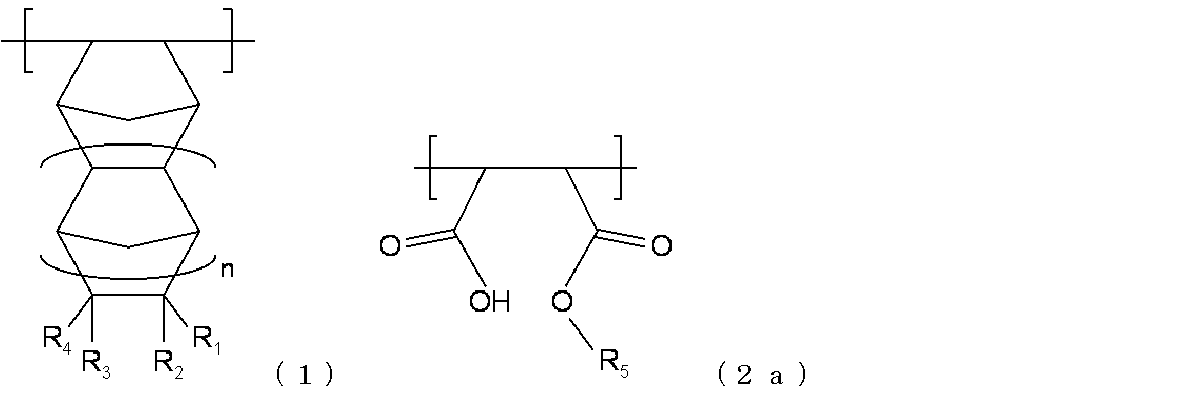
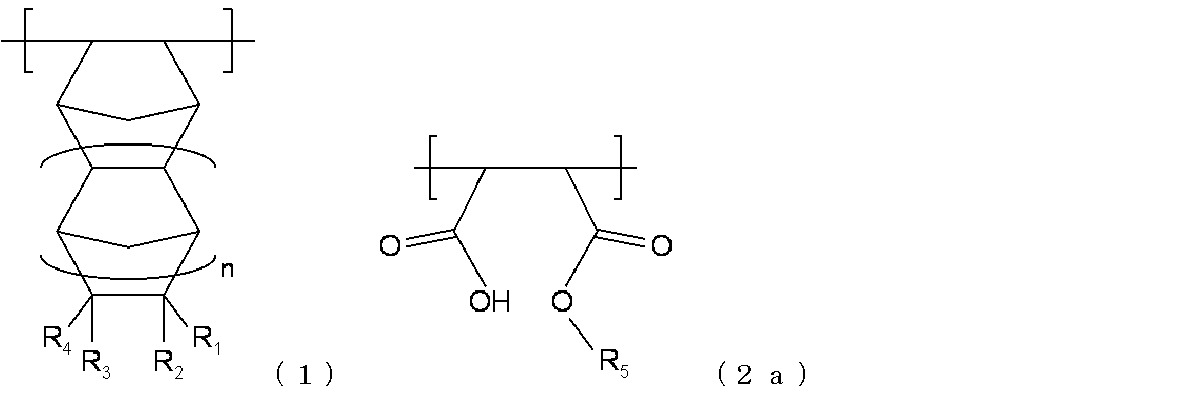
- the colored photosensitive resin composition of the present embodiment includes repeating units represented by the following formulas (1) and (2a), R 5 in the formula (2a) has a radical polymerizable group, and has 2 to A polymer that is 18 organic groups; A radical photopolymerization initiator; And a colorant.
- R 1 , R 2 , R 3 and R 4 are each independently hydrogen or an organic group having 1 to 30 carbon atoms. N is 0, 1 or 2)
- the colored photosensitive resin composition of the present embodiment by using the above-described polymer, in addition to exhibiting various properties such as adhesion to the support, transparency, yellowing resistance, developability, etc., at the time of thermosetting It is possible to provide a photosensitive resin composition that generates very little outgas as a result of decomposition.
- radicals are generated from the radical photopolymerization initiator, and a crosslinking reaction proceeds between the polymers via the radical polymerizable group contained in R 5 of the polymer. To do. Due to this action, a difference in dissolution rate with respect to the developer occurs, and dissolution proceeds in the non-exposed area, whereas a pattern remains in the exposed area. In the subsequent baking step, the remaining pattern is further cross-linked, and a function as a so-called permanent film is exhibited.
- the colored photosensitive resin composition of the present embodiment comprises (A) a copolymer having a radical polymerizability (polymer P), (B) a photo radical polymerization initiator, and (C) a colorant as essential components.
- This colored photosensitive resin composition may further contain (D) a solvent, (E) a radical polymerizable compound, and (F) a crosslinkable compound, if necessary.
- another component may be mix
- blended blended.
- the polymer P includes repeating units represented by the following formulas (1) and (2a), R 5 in the formula (2a) is an organic group having 2 to 18 carbon atoms, and has a radical polymerizable group.
- the polymer P preferably contains a structural unit represented by the following formula (2b) as a repeating unit.
- the acid value of the polymer can be made moderate, and the solubility in an alkali developer can be adjusted.
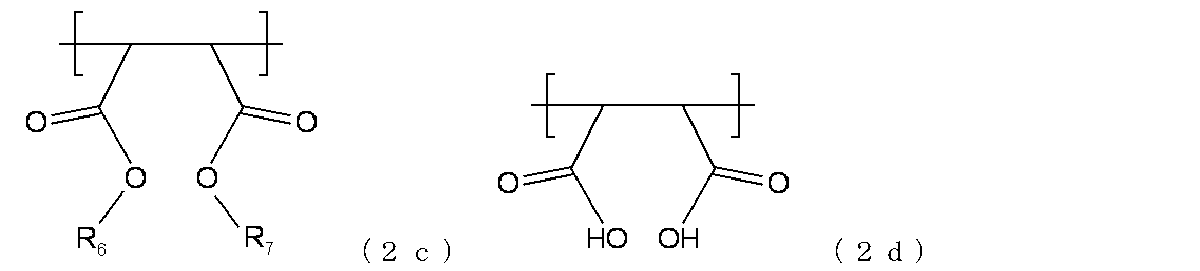
- the polymer P may have a structural unit represented by the following formula (2c) and / or formula (2d).
- R 6 and R 7 are each independently an organic group having 1 to 18 carbon atoms.
- the organic group having 1 to 30 carbon atoms constituting R 1 , R 2 , R 3 and R 4 may contain one or more atoms selected from O, N, S, P and Si in the structure. Good. Moreover, the organic group which comprises R ⁇ 1 >, R ⁇ 2 >, R ⁇ 3 > and R ⁇ 4 > does not have any acidic functional group. Thereby, control of the acid value in the polymer P can be facilitated.
- examples of the organic group constituting R 1 , R 2 , R 3 and R 4 include an alkyl group, an alkenyl group, an alkynyl group, an alkylidene group, an aryl group, an aralkyl group, an alkaryl group, a cycloalkyl group, And heterocyclic groups.
- alkyl group examples include methyl group, ethyl group, n-propyl group, isopropyl group, n-butyl group, isobutyl group, sec-butyl group, tert-butyl group, pentyl group, neopentyl group, hexyl group, heptyl group, An octyl group, a nonyl group, and a decyl group are mentioned.
- alkenyl group examples include allyl group, pentenyl group, and vinyl group. An ethynyl group is mentioned as an alkynyl group.
- Examples of the alkylidene group include a methylidene group and an ethylidene group.
- Examples of the aryl group include a phenyl group, a naphthyl group, and an anthracenyl group.
- Examples of the aralkyl group include a benzyl group and a phenethyl group.
- Examples of the alkaryl group include a tolyl group and a xylyl group.
- Examples of the cycloalkyl group include an adamantyl group, a cyclopentyl group, a cyclohexyl group, and a cyclooctyl group.
- Examples of the heterocyclic group include an epoxy group and an oxetanyl group.
- one or more hydrogen atoms may be substituted with halogen atoms.
- the halogen atom include fluorine, chlorine, bromine, and iodine.
- a haloalkyl group in which one or more hydrogen atoms of the alkyl group are substituted with a halogen atom is preferable.
- any of R 1 , R 2 , R 3 and R 4 is preferably hydrogen, and in particular, R 1 , R 2 , R 3 and R 4 are all preferably hydrogen.
- R 5 is an organic group having 2 to 18 carbon atoms, and has a radical polymerizable group that initiates radical polymerization by a photo radical polymerization initiator.
- R 5 preferably has a carbon-carbon double bond at the terminal, and for example, preferably contains any of a vinyl group, a vinylidene group, an acryloyl group, and a methacryloyl group.
- R 5 include an aliphatic hydrocarbon group having 2 to 18 carbon atoms. In this case, for example, any group of the following formulas (I) and (II) can be employed as R 5 .
- R 5 is preferably the same in the plurality of repeating units represented by the formula (2a), but may be different for each repeating unit represented by the formula (2a).
- R 5 an organic group having 8 to 18 carbon atoms including an aromatic ring may be used.
- a vinylaryl group (—Ar—CH ⁇ CH 2 , Ar represents an aromatic hydrocarbon group) can be employed.
- R 5 may not contain an acidic functional group.
- the organic group having 1 to 18 carbon atoms constituting R 6 and R 7 in the formula (2c) may contain one or more atoms of O, N, S, P, and Si in the structure. Moreover, the organic group which comprises R ⁇ 6 > and R ⁇ 7 > shall not contain an acidic functional group. Thereby, control of the acid value in the polymer P can be facilitated.
- examples of the organic group constituting R 6 and R 7 include an alkyl group, an alkenyl group, an alkynyl group, an alkylidene group, an aryl group, an aralkyl group, an alkaryl group, a cycloalkyl group, and a heterocyclic group. It is done.
- alkyl group examples include a methyl group, an ethyl group, an n-propyl group, an isopropyl group, an n-butyl group, an isobutyl group, a sec-butyl group, a tert-butyl group, a pentyl group, a neopentyl group, a hexyl group, and a heptyl group.
- alkenyl group examples include allyl group, pentenyl group, and vinyl group.
- An ethynyl group is mentioned as an alkynyl group.
- Examples of the alkylidene group include a methylidene group and an ethylidene group.
- Examples of the aryl group include a phenyl group, a naphthyl group, and an anthracenyl group.
- Examples of the aralkyl group include a benzyl group and a phenethyl group.
- Examples of the alkaryl group include a tolyl group and a xylyl group.
- Examples of the cycloalkyl group include an adamantyl group, a cyclopentyl group, a cyclohexyl group, and a cyclooctyl group.
- Examples of the heterocyclic group include an epoxy group and an oxetanyl group.
- one or more hydrogen atoms may be substituted with halogen atoms.
- the halogen atom include fluorine, chlorine, bromine, and iodine.
- a haloalkyl group in which one or more hydrogen atoms of the alkyl group are substituted with a halogen atom is preferable.
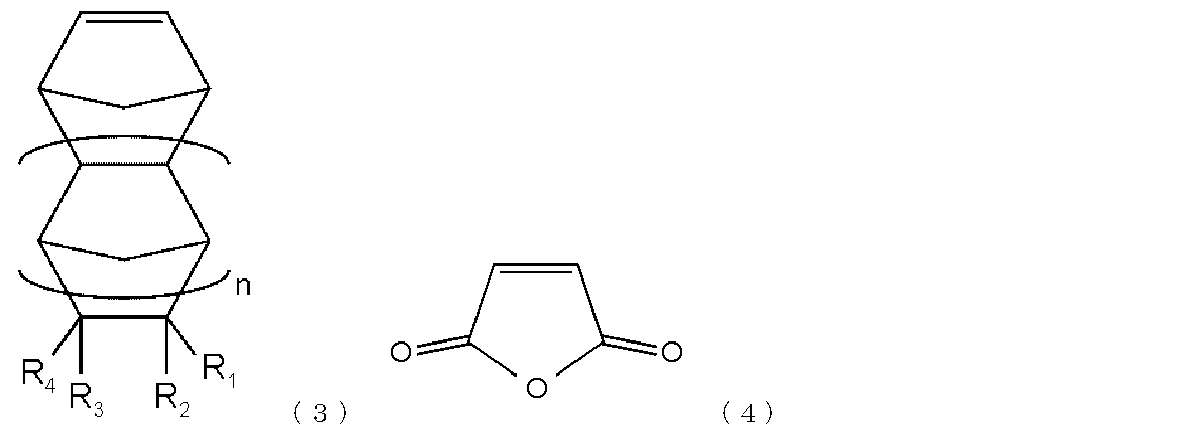
- the polymer P is an alternating copolymer in which repeating units derived from a norbornene-type monomer represented by the following formula (3) and repeating units derived from maleic anhydride represented by the following formula (4) are alternately arranged.
- a polymer is preferred.
- the polymer P may be a random copolymer or a block copolymer.
- the repeating unit derived from maleic anhydride shown in the following formula (4) means a structural unit shown in the above formulas (2a) to (2d).
- n 0, 1 or 2
- R 1 , R 2 , R 3 and R 4 are each independently hydrogen or an organic group having 1 to 30 carbon atoms.
- the polymer P in the present embodiment preferably has an acid value of, for example, 15 mgKOH / g polymer or more and 65 mgKOH / g polymer or less.
- the acid value of the polymer P is derived from the structural unit represented by the formula (2a) (provided that the structural unit represented by the formula (2d) includes the structural unit represented by the formula (2d)).
- This is an index of the amount of carboxyl groups to be produced. That is, the amount of carboxyl groups in the polymer P can be adjusted by controlling the acid value of the polymer P. Therefore, by controlling the acid value of the polymer P, it is possible to adjust the dissolution rate of the polymer P, which varies due to the amount of carboxyl groups, in the alkaline developer. In the photolithography process, it is important to adjust the dissolution rate in an alkali developer in order to achieve desired patterning performance. By setting the acid value of the polymer P in the above range, it is possible to realize an alkali dissolution rate of the colored photosensitive resin composition particularly suitable for patterning a permanent film.
- the polymer P in this embodiment preferably has a peak area at a molecular weight of 1000 or less of 1% or less.
- the present inventor has found that by reducing the amount of the low molecular weight component in the polymer P, the deformation of the pattern at the time of curing can be suppressed for the film formed by the polymer P. For this reason, the pattern shape of the film made of the colored photosensitive resin composition containing the polymer P is made favorable by setting the ratio of the peak area at a molecular weight of 1000 or less in the molecular weight distribution curve obtained by GPC to the above range. Can do.
- the operation reliability can be improved.
- the minimum of the quantity of the low molecular weight component in the polymer P is not specifically limited.
- the polymer P in the present embodiment allows a case where the peak area at a molecular weight of 1000 or less is 0.01% or more of the whole in a molecular weight distribution curve obtained by GPC.
- Mw (weight average molecular weight) / Mn number average molecular weight
- Mw / Mn degree of dispersion indicating the width of the molecular weight distribution.
- the present inventor has found that, by controlling the molecular weight distribution in the polymer P to a certain range, the deformation of the pattern at the time of curing of the film formed from the polymer P can be suppressed. For this reason, the pattern shape of the film
- the Mw (weight average molecular weight) of the polymer P is, for example, 5,000 or more and 30,000 or less.
- Mw weight average molecular weight
- Mn number average molecular weight
- Mw / Mn molecular weight distribution
- the low molecular weight component amount in the polymer P is the area of the component corresponding to the molecular weight of 1000 or less, which occupies the area of the entire molecular weight distribution based on, for example, data on molecular weight obtained by GPC measurement Calculated from the percentage of the sum.
- the polymer P in this embodiment contains an alkali metal, for example.
- the concentration of the alkali metal in the polymer P is, for example, 10 ppm or less (here, ppm means mass ppm).
- ppm means mass ppm.
- the process can be performed in a short time and under mild conditions. Moreover, compared with the process of opening an anhydrous ring using an acid catalyst, control of the ring-opening rate in the polymer P becomes easy.
- the alkali metal concentration in the polymer P is determined by measuring the alkali metal concentration with respect to the polymer solid content diluted with N-methylpyrrolidone, if necessary, using a flameless atomic absorption photometer. Obtained.
- an alkali metal contained in the polymer P in this embodiment Na, K, or Li is mentioned, for example.
- These alkali metals are caused by the aqueous alkali solution in the ring-opening step (treatment S2) for opening the anhydride ring in the maleic anhydride-derived structural unit described later, for example.
- the alkali dissolution rate of the polymer P in the present embodiment is, for example, 500 K / sec or more and 25000 K / sec or less, preferably 500 K / sec or more and 20,000 K / sec or less.
- the alkali dissolution rate of polymer P is, for example, that polymer P is dissolved in propylene glycol monomethyl ether acetate and a polymer solution adjusted to a solid content of 20% by weight is applied onto a silicon wafer by a spin method, and this is applied at 110 ° C. for 100 seconds. It is calculated by impregnating a polymer film obtained by soft baking with a 2.38% tetramethylammonium hydroxide aqueous solution at 23 ° C.
- the alkali dissolution rate of the polymer P By setting the alkali dissolution rate of the polymer P to 500 liters / second or more, the throughput in the development process using an alkali developer can be improved. Moreover, the residual film rate after the image development process by an alkali developing solution can be improved by making the alkali dissolution rate of the polymer P 25,000 kg / second or less. For this reason, it is possible to suppress film loss due to the lithography process.
- the polymer P according to the present embodiment is manufactured as follows, for example.
- n and R 1 to R 4 can be the same as those in the above formula (1).
- norbornene-type monomer represented by the formula (3) include bicyclo [2.2.1] -hept-2-ene (common name: 2-norbornene), which further has an alkyl group.
- 2-norbornene common name: 2-norbornene
- alkenyl group such as 5-methyl-2-norbornene, 5-ethyl-2-norbornene, 5-butyl-2-norbornene, 5-hexyl-2-norbornene, 5-decyl-2-norbornene, etc.
- Examples of those having an alkynyl group such as 5-allyl-2-norbornene, 5- (2-propenyl) -2-norbornene, 5- (1-methyl-4-pentenyl) -2-norbornene, and the like
- Examples of those having an aralkyl group such as -2-norbornene include 5-benzyl-2-norbornene and 5-phenethyl-2-norbornene.
- examples of the norbornene-type monomer include functional groups such as a group having a crosslinkability or a group containing a halogen atom such as fluorine in the structure of R 1 , R 2 , R 3 , and R 4 in the formula (3).
- bicyclo [2.2.1] -hept-2-ene (common name: 2-norbornene) is preferably used from the viewpoint of light transmittance of the polymer.
- the norbornene type monomer represented by the formula (3) and maleic anhydride are subjected to addition polymerization.
- a copolymer (copolymer 1) of the norbornene type monomer represented by the formula (3) and maleic anhydride is formed by radical polymerization.
- the molar ratio of the norbornene-type monomer represented by the formula (3) to maleic anhydride is 0.5: 1 to 1: 0. .5 is preferable.
- the number of moles of the norbornene-type monomer represented by the formula (3): the number of moles of maleic anhydride 0.8: 1 to 1: 0.8.
- a monomer that can be copolymerized in addition to the above-described norbornene-type monomer and maleic anhydride may be added. Examples of such a monomer include compounds containing a group having an ethylenic double bond in the molecule.
- group having an ethylenic double bond examples include an allyl group, an acrylic group, a methacryl group, a maleimide group, and an aromatic vinyl group such as a styryl group and an indenyl group.
- the polymerization method for example, a polymerization method using a radical polymerization initiator and, if necessary, a molecular weight adjusting agent is suitable.
- methods such as suspension polymerization, solution polymerization, dispersion polymerization, and emulsion polymerization can be employed.
- solution polymerization is preferable.
- all the monomers may be charged all at once, or a part of them may be charged into a reaction vessel and the rest may be dropped.
- the norbornene-type monomer represented by the formula (3), the maleic anhydride, and the polymerization initiator are dissolved in a solvent, and then heated for a predetermined time, whereby the norbornene-type monomer represented by the formula (3), Solution polymerization is performed with maleic anhydride.
- the heating temperature is, for example, 50 to 80 ° C., and the heating time is 10 to 20 hours.
- any one or more of diethyl ether, tetrahydrofuran, toluene, methyl ethyl ketone, ethyl acetate and the like can be used.
- any one or more of an azo compound and an organic peroxide can be used.
- the azo compound include azobisisobutyronitrile (AIBN), dimethyl 2,2′-azobis (2-methylpropionate), 1,1′-azobis (cyclohexanecarbonitrile) (ABCN), Any one or more of these can be used.
- organic peroxides include hydrogen peroxide, ditertiary butyl peroxide (DTBP), benzoyl peroxide (benzoyl peroxide, BPO), and methyl ethyl ketone peroxide (MEKP). Any one or more of them can be used.
- the amount (number of moles) of the radical polymerization initiator is preferably 1% to 10% of the total number of moles of the norbornene-type monomer represented by the formula (3) and maleic anhydride.
- the weight average molecular weight (Mw) of the resulting polymer can be adjusted to 5000-30000 by appropriately setting the amount of the polymerization initiator within the above range and appropriately setting the reaction temperature and reaction time.
- the copolymer 1 having a repeating unit represented by the following formula (5) and a repeating unit represented by the following formula (6) can be polymerized.
- R 1 in the structure of the formula (6) is preferably common to each repeating unit, but may be different for each repeating unit. The same applies to R 2 to R 4 .
- n and R 1 to R 4 are the same as those in Formula (1) above. That is, n is 0, 1, or 2.
- R 1 to R 4 are each independently selected. Or hydrogen or an organic group having 1 to 30 carbon atoms.In formula (6), R 1 to R 4 may be the same or different.
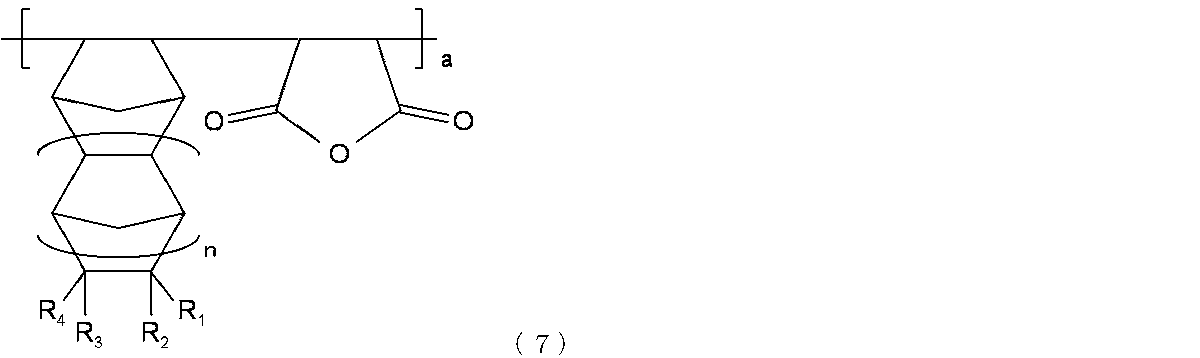
- the repeating unit represented by the formula (5) and the repeating unit represented by the formula (6) may be randomly arranged, or may be alternately arranged. There may be. Moreover, the norbornene-type monomer shown by Formula (3) and maleic anhydride may be block copolymerized. However, from the viewpoint of ensuring the uniformity of solubility of the colored photosensitive resin composition using the polymer P produced in this embodiment, the repeating unit represented by the formula (5) and the formula (6) are used. It is preferable that the repeating unit is alternately arranged. That is, it is preferable that the copolymer 1 has a repeating unit represented by the following formula (7).
- n and R 1 to R 4 are the same as those in the above formula (1). That is, n is 0, 1, or 2.
- R 1 to R 4 are hydrogen or An organic group having 1 to 30 carbon atoms, R 1 to R 4 may be the same or different, and a is an integer of 10 or more and 200 or less.
- R 1 in the structure of the formula (7) is preferably common to each repeating unit, but may be different for each repeating unit. The same applies to R 2 to R 4 .
- a poor solvent for example, hexane or methanol
- low molecular weight components such as residual monomers and oligomers.
- a low molecular weight component a residual monomer, an oligomer, a polymerization initiator, and the like are included.
- filtration is performed, and the obtained coagulum is dried. Thereby, the polymer which has the copolymer 1 from which the low molecular weight component was removed as a main component (main product) can be obtained.
- a metal alkoxide as a base acts on a structural unit derived from maleic anhydride.
- the structural unit derived from maleic anhydride is esterified with an alcohol (metal alkoxide) that is used simultaneously with ring opening. Therefore, in the present specification, this step is also referred to as “esterification step”.
- the degree of esterification of the structural unit derived from maleic anhydride is referred to as “esterification rate”.
- reaction liquid L1 is obtained.
- a part of the anhydride ring of the repeating unit derived from the maleic anhydride of the copolymer 1 is opened, and a part of the terminal formed by the ring opening is esterified. The remaining terminals are not esterified and have a metal salt structure.
- the number of moles of metal alkoxide, alkali metal salt or alkali hydroxide is preferably 50% or less of the number of moles of maleic anhydride used in the polymerization step.
- the number of moles of metal alkoxide, alkali metal salt or alkali hydroxide is preferably 40% or less of the number of moles of maleic anhydride used in the polymerization step, and more preferably 30% or less. preferable.
- the number of moles of metal alkoxide, alkali metal salt, or alkali hydroxide can be 10% or more of the number of moles of maleic anhydride used in the polymerization step.
- metal alkoxide those represented by M (OR 5 ) (M is a monovalent metal and R 5 is an organic group having 1 to 18 carbon atoms) are preferable.
- the metal M include alkali metals, and sodium is preferable from the viewpoint of handleability.
- the R 5, are the same as those for R 5 in formula (2a). Two or more different metal alkoxides may be used. However, from the viewpoint of production stability, it is preferable to use one kind of metal alkoxide.
- the maleic anhydride-derived structure of the copolymer 1 may be opened in the presence of ( ⁇ ) an alcohol and an alkali metal hydroxide as a base.
- an alcohol As the alkali metal salt or alkali hydroxide, sodium hydroxide or sodium acetate is preferable from the viewpoint of handleability.
- the alcohol monovalent alcohol (R 5 OH) is preferable.
- R 5 which is an organic group, those described above can be used.
- Examples of the alcohol or the alcohol as a raw material for the metal alkoxide include allyl alcohol, methallyl alcohol, 3-buten-1-ol, 3-methyl-3-buten-1-ol, 4-penten-1-ol, 5 -Hexen-1-ol, 6-hepten-1-ol, 7-octen-1-ol, 8-nonen-1-ol, 9-decene-1-ol, 10-undecen-1-ol, 2-hydroxy Ethyl acrylate, 2-hydroxyethyl methacrylate, hydroxypropyl acrylate, hydroxypropyl methacrylate, 4-hydroxybutyl acrylate, 4-hydroxybutyl methacrylate, 1,4-cyclohexanedimethanol monoacrylate, and 1,4-cyclohexanedimethanol monomethacrylate Doo and the like, can be used any one or more of these.
- the repeating unit derived from maleic anhydride opened in this ring-opening step (treatment S3) has a structure represented by the following formula (8), and has a structure having a carboxyl group salt moiety. What has this structure of Formula (8) is called the copolymer 2.
- the structure of Formula (8) and the structure shown by Formula (10), which will be described later, describe sodium ions as the corresponding metal ions, other metal ions are adopted in view of the reactivity of the metal alkoxide. You can also
- R 5 is the same as R 5 described above, and is derived from the alcohol or metal alkoxide described above.
- R 5 in the formula (9) is the same as R 5 mentioned above, is derived from an alcohol or a metal alkoxide mentioned above.
- R 5 is the same as R 5 described above.
- the structure has a structure represented by the following formula (12).
- the copolymer 3 obtained by acid-treating the copolymer 2 is represented by the above-described repeating unit represented by the formula (6), the repeating unit represented by the formula (5), and the formula (11). It has a repeating unit and, optionally, a structure of formula (9) and a structure of formula (12). Of the total number of structural units derived from maleic anhydride, the repeating unit represented by the formula (5) is preferably 60% or less, and more preferably 50% or less.
- the structure has the following formulas (13) and (14) as repeating units, and a structure derived from a norbornene monomer and a structure derived from a maleic anhydride monomer are alternately arranged. .
- n and R 1 to R 4 are the same as in the above formula (1). That is, n is 0, 1, or 2.
- R 1 to R 4 are hydrogen or an organic group having 1 to 30 carbon atoms. R 1 to R 4 may be the same or different.
- Z represents either one of —O—H and —O—R 5
- W represents a structure that represents one of the other, although slightly, Z and Any structure in which W is —O—R 5 is included.
- R 5 is the same as R 5 described above.
- the repeating unit represented by the formula (14) may include a structure in which both Z and W are —O—H.
- R 1 is preferably common to each repeating unit, but may be different for each repeating unit. The same applies to R 2 to R 4 .
- R 1 is preferably common to each repeating unit, but may be different for each repeating unit. The same applies to R 2 to R 4 , W, and Z.
- the above-described cleaning step (processing S4) is repeated, for example, 5 times or more, more preferably 10 times. Thereby, the density
- solvent replacement step (Process S5)) After the washing step (processing S4), solvent replacement can be performed. Solvent replacement can be performed, for example, by removing the compounds used in steps S1 to S4 by distillation under reduced pressure and replacing the system while adding a product solvent such as PGMEA (propylene glycol monomethyl ether acetate). .
- PGMEA propylene glycol monomethyl ether acetate
- Heating step (Process S6)
- an alkali developer of polymer P for example, TMAH (tetramethylammonium hydroxide)
- the heating step can be performed when it is necessary to strictly adjust the dissolution rate.
- the dissolution rate of the polymer P in the alkaline developer can be further adjusted by heating the copolymer 3.
- the heating step (processing S6) can be performed, for example, under conditions of 100 ° C. or more and 140 ° C. or less, and 0.5 hours or more and 10 hours or less. These heat treatment conditions can be appropriately adjusted according to the desired dissolution rate.
- this heating step (processing S6) a part of the carboxyl groups of the copolymer 3, that is, the carboxyl groups formed at the ends of the ring-opening structure of the structure derived from maleic anhydride are esterified.
- the ring-opening structure of the structure derived from maleic anhydride of the copolymer 3 is dehydrated and closed again. Therefore, the copolymer 4 obtained through this step has a repeating unit represented by the above formula (6), a repeating unit represented by the formula (5), a repeating unit represented by the formula (11), and the following: And a repeating unit represented by the formula (15).
- R 6 and R 7 are the same as R 6 and R 7 in the formula (2c), comprising a structure which is independent organic group having 1 to 18 carbon atoms.
- R 7 is R 5 described above, and the organic group having 1 to 18 carbon atoms of R 6 is derived from the alcohol used in this heating step (processing S6).
- the structure represented by the formula (15) may include the structure represented by the formula (9).
- R 6 and R 7 in the formula (15) are the same group as R 5 shown in the formula (9).
- the structure represented by Formula (15) may include a structure in which two carboxyl groups are esterified in Formula (12). In this case, R 6 and R 7 are both derived from the alcohol used in the main heating step (processing S6).
- the product (polymer) which uses the copolymer 4 as a main product can be obtained.
- the copolymer 4 preferably has a structure in which a structure derived from a norbornene monomer and a structure derived from a maleic anhydride monomer are alternately arranged. And it is preferable that the copolymer 4 has a structure shown by Formula (16) in addition to Formula (13), (14) mentioned above.
- n and R 1 to R 4 are the same as in the above formula (1). That is, n is 0, 1, or 2.
- R 1 to R 4 are hydrogen or an organic group having 1 to 30 carbon atoms. R 1 to R 4 may be the same or different.
- X represents one of —O—R 6 and —O—R 7
- Y represents the other.
- R 6 and R 7 are the same as in the above formula (15).
- the proportion of the polymer P in the colored photosensitive resin composition is preferably 10% by mass to 70% by mass when the total solid content of the colored photosensitive resin composition (that is, the component excluding the solvent) is 100% by mass. More preferably, it is 20% by mass to 60% by mass.
- the colored photosensitive resin composition of this embodiment contains the photoradical polymerization initiator which generate
- the radical photopolymerization initiator include 2,2-diethoxyacetophenone, 2,2-dimethoxy-2-phenylacetophenone, 1-hydroxycyclohexyl phenyl ketone, 2-hydroxy-2-methyl-1- Phenylpropan-1-one, 1- [4- (2-hydroxyethoxy) phenyl] -2-hydroxy-2-methyl-1-propan-1-one, 2-hydroxy-1- ⁇ 4- [4- (2 -Hydroxy-2-methylpropionyl) benzyl] phenyl ⁇ -2-methylpropan-1-one, 2-methyl-1- (4-methylthiophenyl) -2-morpholinopropan-1-one, 2-benzyl-2- Dimethylamino-1- (4-morpholinophenyl
- the radical photopolymerization initiator is preferably 5 to 20 parts by mass, more preferably 8 to 15 parts by mass with respect to 100 parts by mass of the polymer P. Is preferred.
- a sensitivity and a crosslinking degree can be further improved by using a photosensitizer and a photoradical polymerization accelerator with the said photoradical initiator.
- a photosensitizer and a photoradical polymerization accelerator with the said photoradical initiator.
- dye compounds such as xanthene dyes and coumarin dyes, dialkylaminobenzene compounds such as ethyl 4-dimethylaminobenzoate, 2-ethylhexyl 4-dimethylaminobenzoate, 2-mercaptobenzothiazole, 2-mercaptobenzoimidazole, etc.
- mercapto-based hydrogen donors mercapto-based hydrogen donors.
- the total amount of the photosensitizer and radical photopolymerization accelerator added is not particularly limited, but is preferably 0.001 to 5 parts by weight, preferably 100 to 5 parts by weight with respect to 100 parts by weight of the polymer P from the viewpoint of curability and economy. Is 0.01 to 1 part by weight.
- the colored photosensitive resin composition of the present embodiment contains a conventionally known pigment or dye.
- a pigment an organic pigment or an inorganic pigment can be used.
- Organic pigments include azo pigments, phthalocyanine pigments, polycyclic pigments (quinacridone, perylene, perinone, isoindolinone, isoindoline, dioxazine, thioindigo, anthraquinone, quinophthalone, metal complex System, diketopyrrolopyrrole, etc.), dye lake pigments, etc. can be used.
- Inorganic pigments include white and extender pigments (titanium oxide, zinc oxide, zinc sulfide, clay, talc, barium sulfate, calcium carbonate, etc.) and chromatic pigments (yellow lead, cadmium, chrome vermilion, nickel titanium, chrome titanium) , Yellow iron oxide, bengara, zinc chromate, red lead, ultramarine, bitumen, cobalt blue, chromium green, chromium oxide, bismuth vanadate, etc.), black pigment (carbon black, bone black, graphite, iron black, titanium black, etc.) Bright pigments (pearl pigments, aluminum pigments, bronze pigments, etc.) and fluorescent pigments (zinc sulfide, strontium sulfide, strontium aluminate, etc.) can be used.
- white and extender pigments titanium oxide, zinc oxide, zinc sulfide, clay, talc, barium sulfate, calcium carbonate, etc.
- the pigment colors that can be used include yellow, red, purple, blue, green, brown, black, and white.
- dye for example, known dyes described in JP-A No. 2003-270428, JP-A No. 9-171108, JP-A No. 2008-50599 and the like can be used.
- the above colorants can be used alone or in combination of two or more.
- those having an appropriate average particle diameter can be used according to the purpose and application.
- transparency such as a color resist for color filters
- it is as small as 0.1 ⁇ m or less.
- An average particle diameter is preferable, and when a concealing property such as a paint is required, a large average particle diameter of 0.5 ⁇ m or more is preferable.
- the above-described coloring material is subjected to surface treatment such as rosin treatment, surfactant treatment, resin dispersant treatment, pigment derivative treatment, oxide film treatment, silica coating, wax coating, etc., depending on the purpose and application. Also good.
- the content ratio of the colorant in the colored photosensitive resin composition of the present embodiment may be appropriately set according to the purpose and application.
- the colored photosensitive resin composition When the total solid content of the product (that is, the component excluding the solvent) is 100% by mass, it is preferably 3% by mass to 70% by mass, more preferably 5% by mass to 60% by mass, and even more preferably 10% by mass. % By mass to 50% by mass.
- the colored photosensitive resin composition of the present embodiment may contain a solvent.
- the solvent include propylene glycol monomethyl ether (PGME), propylene glycol monomethyl ether acetate (PGMEA), ethyl lactate, methyl isobutyl carbinol (MIBC), gamma butyrolactone (GBL), N-methylpyrrolidone (NMP), methyl n -Amyl ketone (MAK), diethylene glycol monomethyl ether, diethylene glycol dimethyl ether, diethylene glycol methyl ethyl ether, cyclohexanone, or a mixture thereof can be employed. In addition, it is not limited to what was illustrated here.
- the colored photosensitive resin composition of the present embodiment includes a radical polymerizable compound (also referred to as a first crosslinking agent) that crosslinks with the polymer P by the radical polymerization initiator.
- a radical polymerizable compound also referred to as a first crosslinking agent
- the radical polymerizable compound (first crosslinking agent) is preferably a polyfunctional acrylic compound having two or more (meth) acryloyl groups.
- ethylene glycol di (meth) acrylate diethylene glycol di (meth) acrylate, polyethylene glycol di (meth) acrylate, propylene glycol di (meth) acrylate, butylene glycol di (meth) acrylate, hexanediol di ( (Meth) acrylate, cyclohexanedimethanol di (meth) acrylate, bisphenol A alkylene oxide di (meth) acrylate, bisphenol F alkylene oxide di (meth) acrylate, trimethylolpropane tri (meth) acrylate, ditrimethylolpropane tetra (meth) acrylate , Glycerin tri (meth) acrylate, pentaerythritol tetra (meth) acrylate, dipentaerythritol penta (meth) a Lilate, dipentaerythritol hexa (meth) acrylate
- Allyl group-containing (meth) a Polyfunctionals such as tri (acryloyloxyethyl) isocyanurate, tri (methacryloyloxyethyl) isocyanurate, alkylene oxide-added tri (acryloyloxyethyl) isocyanurate, alkylene oxide-added tri (methacryloyloxyethyl) isocyanurate (Meth) acryloyl group-containing isocyanurates; polyfunctional allyl group-containing isocyanurates such as triallyl isocyanurate; polyfunctional isocyanates such as tolylene diisocyanate, isophorone diisocyanate, xylylene diisocyanate and 2-hydroxyethyl (meth) acrylate Polyfunctional urethane (meth) acrylate obtained by reaction with hydroxyl group-containing (meth) acrylic esters such as 2-hydroxypropyl (meth) acrylate Preparative like; polyfunctional aromatic vinyl compounds such
- trifunctional (meth) acrylates such as trimethylolpropane tri (meth) acrylate and pentaerythritol tri (meth) acrylate
- tetrafunctional (meth) acrylates such as pentaerythritol tetra (meth) acrylate and ditrimethylolpropane tetra (meth) acrylate
- hexafunctional (meth) acrylates such as acrylate and dipentaerythritol hexa (meth) acrylate, and any one or more of these is preferably used.
- the polyfunctional acrylic compound and the polymer P can be cross-linked by radicals generated by the radical polymerization initiator, and the polyfunctional acrylic compound can also be cross-linked. it can.
- membrane with a high degree of crosslinking and high chemical resistance can be formed.
- the content thereof is preferably 30 to 70 parts by mass, more preferably 50 to 100 parts by mass of the polymer P. It is preferably from ⁇ 60 parts by mass.
- the colored photosensitive resin composition of the present embodiment may contain a crosslinkable compound (also referred to as a second crosslinker) different from the radical polymerizable compound (first crosslinker). .
- This crosslinkable compound (second crosslinking agent) crosslinks with the polymer P by heat.
- This crosslinkable compound (second crosslinker) is preferably a compound having a cyclic ether group as a reactive group, and more preferably a compound having a glycidyl group or an oxetanyl group.
- An example of the compound having a glycidyl group is an epoxy compound. More specifically, for example, bisphenol A epoxy resin (for example, “LX-1” manufactured by Daiso Chemical Co., Ltd.), 2,2 ′-((((1- (4- (2- (4- (oxirane-2 -Ylmethoxy) phenyl) propan-2-yl) phenyl) ethane-1,1-diyl) bis (4,1-phenylene)) bis (oxy)) bis (methylene)) bis (oxirane) (eg Purin Co., Ltd.) "Techmore VG3101L” manufactured by Tech Co.), trimethylolpropane triglycidyl ether (for example, "TMPTGE” manufactured by CVC Specialty Chemicals), and 1,1,3,3,5,5-hexamethyl-1,5-bis ( 3- (oxiran-2-ylmethoxy) propyl) trisiloxane (for example, “DMS-E0 manufactured by Gelest
- a polyfunctional alicyclic epoxy resin etc. can also be used from a viewpoint of the transparency of the effect material of a coloring photosensitive resin composition, and a dielectric constant improvement.
- a polyfunctional alicyclic epoxy resin what is shown by the following chemical formula can be used, for example.
- This epoxy resin is, for example, Poly [(2-oxylanyl) -1,2-cyclohexanediol] 2-ethyl-2- (hydroxymethyl) -1,3-propandiol ether (3: 1). Any one or more of the above can be used. In addition, it is not limited to the illustration here.
- R 36 is a hydrocarbon group having 1 to 10 carbon atoms, s is an integer of 1 to 30, and t is an integer of 1 to 6.
- any of the following can be used, for example.
- the content thereof is preferably 10 to 30 parts by mass with respect to 100 parts by mass of the polymer P. Further, it is preferably 15 to 25 parts by mass.
- the colored photosensitive resin composition of the present embodiment includes a filler, a binder resin other than the above-mentioned polymer P, a dispersant, a heat improver, and a development aid depending on the purpose and required characteristics of each application.
- Components other than the above essential components such as coupling agents such as silane, aluminum, and titanium, quinonediazide compounds, polyhydric phenol compounds, cationic polymerizable compounds, and acid generators may be blended.
- the colored photosensitive resin composition of the present embodiment can be produced, for example, by subjecting a colorant to a dispersion treatment step and mixing it with other components. For example, first, a predetermined amount of each of a colorant, a dispersant, a binder resin, and a solvent is weighed, and the colorant is finely dispersed using a disperser such as a paint conditioner, bead mill, roll mill, ball mill, jet mill, homogenizer, kneader, blender, etc. Thus, a liquid colorant dispersion (mill base) is obtained.
- a disperser such as a paint conditioner, bead mill, roll mill, ball mill, jet mill, homogenizer, kneader, blender, etc.
- fine dispersion with a media mill such as a bead mill filled with 0.01 to 1 mm beads.
- a transparent resist solution containing a radical polymerizable compound, a photoinitiator, a binder resin, a solvent, a leveling agent, etc., which has been separately stirred and mixed is added and mixed to obtain a uniform dispersion solution, which is colored photosensitive.
- a resin composition is obtained.
- the obtained colored photosensitive colored resin composition is desirably filtered through a filter or the like to remove fine dust.
- the colored photosensitive resin composition of the present embodiment is preferably used for producing a color filter.
- a color filter to which the colored photosensitive resin composition of the present embodiment is applied will be described with reference to FIG.
- Such a color filter can be applied to a liquid crystal display device or a solid-state imaging device.
- a color filter 100 shown in FIG. 1 is obtained by forming a black matrix 20 and a colored pattern 30 on a support 10. Further, a protective film 40 and a transparent electrode are formed on the black matrix 20 and the colored pattern 30. A layer 50 is provided.
- the support 10 is usually made of a material that transmits light.
- the support 10 is made of a polymer of polyester, polycarbonate, polyolefin, polysulfone, cyclic olefin in addition to glass.
- the support 10 may be subjected to corona discharge treatment, ozone treatment, chemical solution treatment, or the like as necessary.
- the support 10 is preferably made of glass.
- the black matrix 20 is composed of, for example, a cured product of a colored photosensitive resin composition in the case where a black pigment or a black dye is used as the colorant described above.
- this black matrix 20 may be formed by another method.
- the coloring pattern 30 in the color filter 100 usually has three colors of red, green, and blue.
- the colored pattern 30 is composed of a cured product of the colored photosensitive resin composition when a pigment or dye corresponding to this color is used as the above-described colored photosensitive resin composition.
- this colored pattern 20 may be formed by another method.
- This protective film can be appropriately selected from known inorganic materials or organic materials used as protective films for color filters.
- the color filter 100 shown in FIG. 1 includes a transparent electrode layer 50.
- the transparent electrode layer 50 is made of indium tin oxide (ITO), zinc oxide (ZnO), tin oxide (SnO), or an alloy thereof.
- ITO indium tin oxide
- ZnO zinc oxide
- SnO tin oxide
- an alloy thereof As a specific forming method, a known method can be adopted. For example, a sputtering method, a vacuum deposition method, a CVD method, or the like can be adopted.
- a method of manufacturing the color filter 100 is as follows.
- the black matrix 20 and the coloring pattern 30 will be described by taking the case where the colored photosensitive resin composition of the present embodiment is applied as an example.
- the colored photosensitive resin composition of this embodiment is apply
- the colored photosensitive resin composition applied to the support 10 contains a black pigment or a black dye.
- application methods such as spin coating, roll coating, flow coating, dip coating, spray coating, doctor coating, and the like can be used. Among these, spin coating is preferable, and the rotation speed is preferably 1000 to 3000 rpm.
- the support 10 is heated at an appropriate temperature and time to remove almost all of the solvent to form a coating film.
- the heating temperature and time are, for example, 60 to 130 ° C. for 1 to 5 minutes, preferably 80 to 120 ° C. for 1 to 3 minutes.
- the thickness of the colored photosensitive resin composition layer (coating film) is preferably 1.0 to 5.0 ⁇ m.
- Pattern formation on the coating film is performed by irradiating actinic rays or the like using a mask for forming a target pattern.
- active light sources include xenon lamps, halogen lamps, tungsten lamps, high-pressure mercury lamps, ultra-high-pressure mercury lamps, metal halide lamps, medium-pressure mercury lamps, low-pressure mercury lamps, carbon arcs, and fluorescent lamps; argon ion lasers, YAG Laser light sources such as lasers, excimer lasers, nitrogen lasers, helium cadmium lasers, and semiconductor lasers are used.
- the target black matrix 20 can be obtained by further heating (see FIG. 2C).
- Examples of the development method include a shower development method, a spray development method, and an immersion development method.
- the development condition is usually about 1 to 10 minutes at 23 ° C.
- alkali developer examples include alkaline aqueous solutions having a concentration of about 0.1 to 10% by mass such as tetramethylammonium hydroxide, sodium hydroxide, potassium hydroxide and the like.
- the film can be further baked at 150 to 300 ° C. for 30 to 120 minutes and sufficiently cured to obtain a desired pattern.
- the curing conditions are not limited to the above.
- a colored photosensitive resin composition containing any one of red, green, and blue pigments or dyes is applied to the support 10 on which the black matrix 20 is formed, exposed, developed, and cured, so that a colored pattern 30 is obtained. Get. By repeating this operation, both the black matrix 20 and the colored pattern 30 can be formed on the support 10 (see FIG. 2D).
- a protective film 40 is formed on the black matrix 20 and the colored pattern 30 (see FIG. 2E).
- a known method can be adopted according to the material constituting the protective film 40.
- a transparent electrolytic layer 50 is provided on the protective film 40 (see FIG. 2 (f)).
- a method such as a sputtering method, a vacuum vapor deposition method, or a CVD method can be employed as the formation method.
- ⁇ Synthesis Example 2 10.0 g of a copolymer of 2-norbornene and maleic anhydride synthesized in the same manner as in Synthesis Example 1 is dissolved in 30 g of methyl ethyl ketone, and further 40.0 g of 2-hydroxyethyl methacrylate, 0.5 g of hydroquinone, sodium acetate 0 Mixed with 0.5 g and reacted at 80 ° C. for 16 hours. After the reaction, 25 g of acetone and 1.0 g of formic acid were mixed and added dropwise to 750 g of pure water to reprecipitate and purify the polymer.
- the polymer thus obtained had a weight average molecular weight (Mw) of 13,000 and a dispersity of 1.87.
- the alkali dissolution rate was 22800 kg / sec.
- the esterification rate determined by NMR was 90%.
- Example 1 5.0 g of the polymer synthesized in Synthesis Example 1, 0.5 g of Irgacure OXE02 (manufactured by BASF) as a photopolymerization initiator, 7.5 g of a pigment dispersion (NX-501 manufactured by Dainichi Seika Co., Ltd .; pigment content 58%), 15.0 g of cyclohexanone was mixed.
- the white photosensitive resin composition thus prepared was applied on soda glass (100 mm ⁇ 100 mm square, thickness 1.0 mm) by spin coating, and then heated on a hot plate at 100 ° C. for 2 minutes to give a film thickness of 10 ⁇ m. A coating film was obtained.
- This coating film was exposed at 200 mJ / cm 2 with a g + h + i line mask aligner (PLA-501F) manufactured by Canon Inc. through a mask having L / S patterns of 10 ⁇ m, 20 ⁇ m and 50 ⁇ m. This was dip-developed with a 0.1N aqueous potassium hydroxide solution at 23 ° C. for 4 minutes and then rinsed with pure water. Then, the board
- developability, adhesion, and pattern formability were evaluated based on the following evaluation criteria. The evaluation results are summarized in Table 1.
- heat treatment was performed by heating at 230 ° C. for 60 minutes in an oven.
- the pattern after processing was evaluated based on the following evaluation criteria for heat resistance and heat discoloration.
- Example 2 Evaluation was performed in the same manner as in Example 1 except that the polymer was changed to that obtained in Synthesis Example 2. The evaluation results are summarized in Table 1.
- Example 3 5.0 g of the polymer synthesized in Synthesis Example 2, 2.5 g of dipentaerythritol hexaacrylate (A-DPH manufactured by Shin-Nakamura Chemical Co., Ltd.), 0.5 g of Irgacure OXE02 (manufactured by BASF) as a photopolymerization initiator Then, 7.5 g of a pigment dispersion (NX-595 manufactured by Dainichi Seika Co., Ltd.) and 15.0 g of cyclohexanone were mixed.
- A-DPH dipentaerythritol hexaacrylate
- Irgacure OXE02 manufactured by BASF
- the black photosensitive resin composition thus prepared was applied onto soda glass (100 mm ⁇ 100 mm square, thickness 1.0 mm) by spin coating, and then heated on a hot plate at 100 ° C. for 2 minutes to give a film thickness of 10 ⁇ m.
- a coating film was obtained.
- This coating film was exposed at 200 mJ / cm 2 with a g + h + i line mask aligner (PLA-501F) manufactured by Canon Inc. through a mask having L / S patterns of 10 ⁇ m, 20 ⁇ m and 50 ⁇ m.
- PPA-501F g + h + i line mask aligner
- This was dip-developed with a 0.1N aqueous potassium hydroxide solution at 23 ° C. for 4 minutes and then rinsed with pure water.
- substrate was dried by high speed rotation and the L / S pattern was created.
- the developability, adhesion, pattern formability, heat resistance, and heat discoloration here were evaluated based on the above evaluation criteria. The
- Example 4 Evaluation was performed in the same manner as in Example 2 except that the pigment dispersion was changed to Dainichi Seika Co., Ltd .: NX-061 to obtain a green photosensitive resin composition.
- Example 5 Evaluation was made in the same manner as in Example 2 except that the pigment dispersion was changed to NX-053 manufactured by Dainichi Seika Co., Ltd. and the blue photosensitive resin composition was used.
- Example 6 Evaluation was performed in the same manner as in Example 2, except that the pigment dispersion was changed to NX-032 manufactured by Dainichi Seika Co., Ltd. and a red photosensitive resin composition was used.
- ⁇ Comparative Example 1> 6 5.0 g of the polymer synthesized in Comparative Synthesis Example 1, 5.0 g of dipentaerythritol hexaacrylate (A-DPH manufactured by Shin-Nakamura Chemical Co., Ltd.), Irgacure OXE02 (manufactured by BASF) as a photopolymerization initiator 5 g and 15.0 g of cyclohexanone were mixed to obtain a white photosensitive resin composition. Evaluation was performed in the same manner as in Example 1. The evaluation results are summarized in Table 1.
- a colored photosensitive resin composition having excellent developability, adhesion, and pattern moldability, and excellent heat resistance when cured is provided. can do.
Landscapes
- Physics & Mathematics (AREA)
- General Physics & Mathematics (AREA)
- Spectroscopy & Molecular Physics (AREA)
- Optics & Photonics (AREA)
- Addition Polymer Or Copolymer, Post-Treatments, Or Chemical Modifications (AREA)
- Materials For Photolithography (AREA)
- Optical Filters (AREA)
- Liquid Crystal (AREA)
- Solid State Image Pick-Up Elements (AREA)
Abstract
Description
以下の式(1)および式(2a)で示される繰り返し単位を含み、式(2a)のR5がラジカル重合性基を有し、炭素数2~18の有機基であるポリマーと、
光ラジカル重合開始剤と、
着色剤と、を含む着色感光性樹脂組成物が提供される。
上記の着色感光性樹脂組成物を支持体に適用することで着色感光性樹脂組成物の層を形成する、着色感光性樹脂組成物層形成工程と、
前記着色感光性樹脂組成物の層に対して露光する、露光工程と、
アルカリ現像液によりパターンを形成する、現像工程と、
を含むカラーフィルタの製造方法が提供される。
なお、本明細書中において、「~」は特に断りがなければ以上から以下を表す。
まず、はじめに、本実施形態の着色感光性樹脂組成物の概要について説明する。
本実施形態の着色感光性樹脂組成物は、以下式(1)および式(2a)で示される繰り返し単位を含み、式(2a)のR5がラジカル重合性基を有し、炭素数2~18の有機基であるポリマーと、
光ラジカル重合開始剤と、
着色剤と、を含む。
ここで、このような樹脂組成物に対して光を照射することで光ラジカル重合開始剤からラジカルが発生し、ポリマーのR5に含まれるラジカル重合性基を介してポリマー間で架橋反応が進行する。この作用により現像液に対する溶解速度差が生じて、非露光部では溶解が進行するのに対し、露光部ではパターンが残存する。引き続き行われる焼成工程により、残存したパターンの架橋が更に進行し、いわゆる永久膜としての機能を発現することとなる。
以下、本実施形態の着色感光性樹脂組成物を構成する各成分について説明する。
ポリマーPは、以下式(1)および式(2a)で示される繰り返し単位を含み、式(2a)のR5が炭素数2~18の有機基であり、かつ、ラジカル重合性基を有する。


また、ポリマーPは、以下の式(2c)、および/または式(2d)で表される構造単位を有していてもよい。
アルキル基としては、たとえばメチル基、エチル基、n-プロピル基、イソプロピル基、n-ブチル基、イソブチル基、sec-ブチル基、tert-ブチル基、ペンチル基、ネオペンチル基、ヘキシル基、ヘプチル基、オクチル基、ノニル基、およびデシル基が挙げられる。アルケニル基としては、たとえばアリル基、ペンテニル基、およびビニル基が挙げられる。アルキニル基としては、エチニル基が挙げられる。アルキリデン基としては、たとえばメチリデン基、およびエチリデン基が挙げられる。アリール基としては、たとえばフェニル基、ナフチル基、およびアントラセニル基が挙げられる。アラルキル基としては、たとえばベンジル基、およびフェネチル基が挙げられる。アルカリル基としては、たとえばトリル基、キシリル基が挙げられる。シクロアルキル基としては、たとえばアダマンチル基、シクロペンチル基、シクロヘキシル基、およびシクロオクチル基が挙げられる。ヘテロ環基としては、たとえばエポキシ基、およびオキセタニル基が挙げられる。
なお、R1、R2、R3またはR4としてカルボキシル基と架橋しうる官能基を含むことにより、ポリマーPを含む着色感光性樹脂組成物から構成される膜の硬化度を更に向上させることができる。
なお、ポリマーPを含んで構成される膜の光透過性を高める観点からは、R1、R2、R3およびR4のいずれかが水素であることが好ましく、特には、R1、R2、R3およびR4すべてが水素であることが好ましい。

なお、R5は酸性官能基を含まないものとすることができる。
なお、下記式(4)に示す無水マレイン酸に由来した繰り返し単位とは、上述した式(2a)~式(2d)に示される構造単位を意味する。
ポリマーPの酸価の測定は、たとえばJIS K 2501に準じて次のように行われる。まず、合成したポリマーPを溶かした滴定溶剤に対し、N/10KOH水溶液を用いてpH=7.0となるよう滴定を行う。そして、この滴定に要したKOH量を基に、下記の式を用いてポリマーの酸価(樹脂1gに対するKOHのmg数)が算出される。
酸価=滴定量(ml)×KOHのファクターf×0.1×56.1/ポリマー量(固形)
フォトリソグラフィ工程においては、所望のパターニング性能を実現するために、アルカリ現像液への溶解速度を調整することが重要となる。ポリマーPの酸価を上記範囲とすることにより、特に永久膜のパターニングに適した、着色感光性樹脂組成物のアルカリ溶解速度を実現することが可能となる。
本発明者は、ポリマーPにおける低分子量成分の量を低減することにより、当該ポリマーPにより形成される膜について、硬化時におけるパターンの変形を抑制できることを見出した。このため、GPCにより得られる分子量分布曲線の分子量1000以下におけるピーク面積の比率を上記範囲とすることにより、ポリマーPを含む着色感光性樹脂組成物からなる膜のパターン形状を良好なものとすることができる。当該膜を永久膜として備える液晶表示装置、固体撮像素子については、その動作信頼性を向上させることが可能となる。
なお、ポリマーPにおける低分子量成分の量の下限は、特に限定されない。しかし、本実施形態におけるポリマーPは、GPCにより得られる分子量分布曲線において分子量1000以下におけるピーク面積が全体の0.01%以上である場合を許容するものである。
本発明者は、ポリマーPにおける分子量分布を一定の範囲に制御することにより、当該ポリマーPにより形成される膜について、硬化時におけるパターンの変形を抑制できることを見出した。このため、ポリマーPのMw/Mnを上記範囲とすることにより、ポリマーPを含む着色感光性樹脂組成物からなる膜のパターン形状を良好なものとすることができる。なお、このような効果は、同時に上述のようにポリマーPの低分子量成分を低減する場合において特に顕著に表れる。
また、ポリマーPのMw(重量平均分子量)は、たとえば5,000以上30,000以下である。
東ソー社製ゲルパーミエーションクロマトグラフィー装置HLC-8320GPC
カラム:東ソー社製TSK-GEL Supermultipore HZ-M
検出器:液体クロマトグラム用RI検出器
測定温度:40℃
溶媒:THF
試料濃度:2.0mg/ミリリットル
また、ポリマーP中における低分子量成分量は、たとえばGPC測定により得られた分子量に関するデータに基づき、分子量分布全体の面積に占める、分子量1000以下に該当する成分の面積総和の割合から算出される。
ポリマーP中におけるアルカリ金属の濃度を当該範囲とすることにより、永久膜を含む液晶表示装置や固体撮像素子の動作信頼性を向上させることができる。また、上記範囲内であればアルカリ金属がポリマーP中に含有されることを許容できる。すなわち、後述する無水マレイン酸由来の構造単位における無水環を開環する工程を、アルカリ水溶液を用いた処理により行うことが可能となる。この場合、短時間で、かつ温和な条件により当該工程を行うことができる。また、酸触媒を用いて無水環を開環する工程と比較して、ポリマーPにおける開環率の制御が容易となる。
なお、ポリマーP中におけるアルカリ金属濃度の下限は、特に限定されないが、本実施形態はポリマーP中におけるアルカリ金属濃度が0.01ppm以上である場合を許容するものである。
また、本実施形態におけるポリマーP中に含まれるアルカリ金属としては、たとえばNa、KまたはLiが挙げられる。これらのアルカリ金属は、たとえば後述する無水マレイン酸由来の構造単位における無水環を開環する開環工程(処理S2)におけるアルカリ水溶液に起因するものである。
ポリマーPのアルカリ溶解速度を500Å/秒以上とすることにより、アルカリ現像液による現像工程におけるスループットを良好なものとすることができる。また、ポリマーPのアルカリ溶解速度を25,000Å/秒以下とすることにより、アルカリ現像液による現像工程後における残膜率を向上させることができる。このため、リソグラフィ工程による膜減りを抑えることが可能となる。
本実施形態に係るポリマーPは、たとえば以下のように製造される。
はじめに式(3)で示されるノルボルネン型モノマーと、モノマーとなる無水マレイン酸とを用意する。式(3)で示されるノルボルネン型モノマーにおいて、n、R1~R4は、上記式(1)のものと同様とすることができる。
その他、ノルボルネン型モノマーとしては、式(3)のR1、R2、R3、R4の基の構造中に、架橋性を有する基、あるいはフッ素等のハロゲン原子を含む基などの官能基を含むものを採用することができる。
ノルボルネン型モノマーとしては、これらのうち、いずれか1種以上を使用できる。なかでも、ポリマーの光透過性の観点から、ビシクロ[2.2.1]-ヘプト-2-エン(慣用名:2-ノルボルネン)を使用することが好ましい。
式(3)で示されるノルボルネン型モノマーと、無水マレイン酸とのモル比(式(3)で示される化合物のモル数:無水マレイン酸のモル数)は、0.5:1~1:0.5であることが好ましい。なかでも、分子構造制御の観点から、式(3)で示されるノルボルネン型モノマーのモル数:無水マレイン酸のモル数=0.8:1~1:0.8であることが好ましい。
なお、この付加重合に際しては、上述のノルボルネン型モノマーと、無水マレイン酸以外にも共重合できるモノマーを添加してもよい。このようなモノマーとして、分子内にエチレン性二重結合を有する基を含む化合物が挙げられる。ここで、エチレン性二重結合を有する基の具体例としては、アリル基、アクリル基、メタクリル基、マレイミド基や、スチリル基やインデニル基のような芳香族ビニル基等が挙げられる。
アゾ化合物としては、たとえばアゾビスイソブチロニトリル(AIBN)、ジメチル2,2'-アゾビス(2-メチルプロピオネート)、1,1'-アゾビス(シクロヘキサンカルボニトリル)(ABCN)が挙げられ、これらのうち、いずれか1種以上を使用できる。
また、有機過酸化物としては、たとえば過酸化水素、ジターシャリブチルパーオキサイド(DTBP)、過酸化ベンゾイル(ベンゾイルパーオキサイド,BPO)および、メチルエチルケトンパーオキサイド(MEKP)を挙げることができ、これらのうち、いずれか1種以上を使用できる。
ただし、共重合体1において、式(6)の構造のR1は、各繰り返し単位において共通であることが好ましいが、それぞれの繰り返し単位ごとに異なっていてもよい。R2~R4においても同様である。
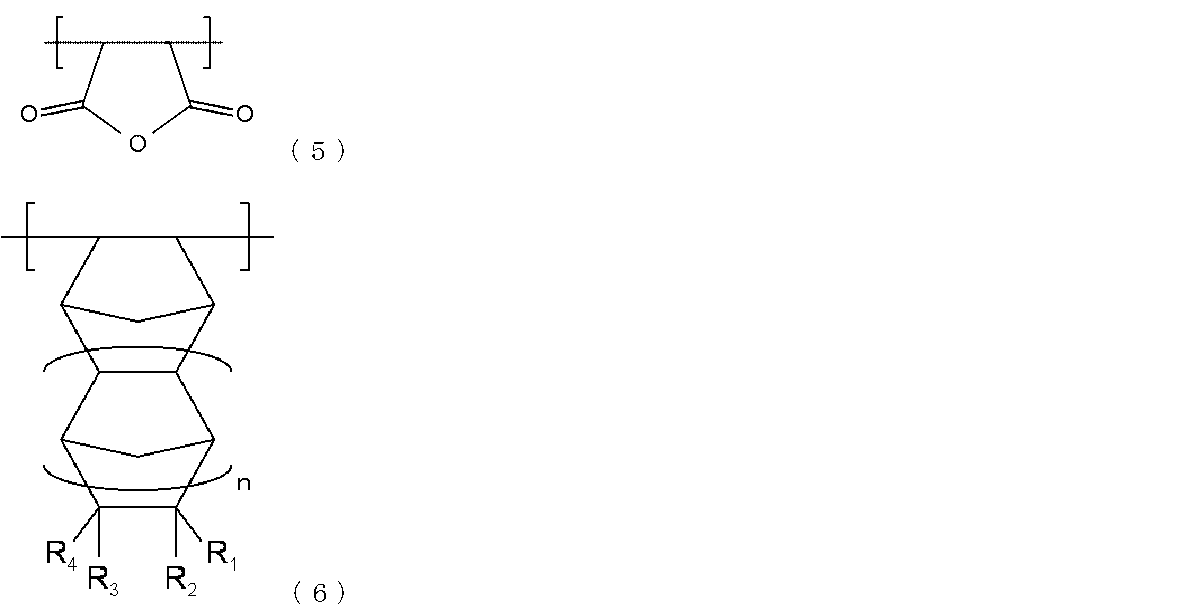
次に、共重合体1と、残留モノマーおよびオリゴマー等の低分子量成分とが含まれた有機層に対して、大量の貧溶媒、たとえば、ヘキサンやメタノールに加えて、共重合体1を含むポリマーを凝固沈殿させる。ここで、低分子量成分としては、残留モノマー、オリゴマー、さらには、重合開始剤等が含まれる。次いで、ろ過を行い、得られた凝固物を、乾燥させる。これにより、低分子量成分が除去された共重合体1を主成分(主生成物)とするポリマーを得ることができる。
次に、得られた共重合体1の無水マレイン酸に由来する環状構造の繰り返し単位のうち、一部の繰り返し単位を閉環した状態としながら、残りの繰り返し単位を開環する。これにより、共重合体1中におけるカルボキシル基の量を調整するともにラジカル重合性基を導入することができる。
本実施形態においては、共重合体1の無水マレイン酸由来の繰り返し単位のうち、たとえば10%以上の繰り返し単位を開環させることが好ましい。なかでも、共重合体1の無水マレイン酸由来の環状構造の繰り返し単位の全個数のうち、20%以上の繰り返し単位を開環することが好ましい。開環率を上記範囲とすることにより、共重合体1に十分なアルカリ現像液を付与するとともに、光ラジカル発生剤による架橋反応をより効率的に進行させることが容易となる。
なお、後述するように、この開環工程は、無水マレイン酸由来の構造単位に対して、(α)塩基としての金属アルコキシドや(β)アルコールおよびアルカリ金属塩またはアルカリ水酸化物等を作用することで行われる。すなわち、この工程では、無水マレイン酸由来の構造単位は、開環すると同時に用いられるアルコール(金属アルコキシド)によりエステル化される。
そのため、本明細書中では、この工程を「エステル化工程」とも称する。また、無水マレイン酸由来の構造単位がエステル化される度合いについて「エステル化率」と称することとする。
エステル化率(%)=エステル化されたカルボキシル基(モル)/(エステル化前の酸無水物基(モル))×100
(α)塩基としての金属アルコキシド、
(β)アルコールおよびアルカリ金属塩またはアルカリ水酸化物、
のいずれか一方を、前記重合工程において、前記共重合体1が重合された反応液に添加するとともに、メチルエチルケトン(MEK)等の有機溶媒をさらに添加し、50~100℃で10~20時間攪拌して、反応液L1を得る。反応液L1中では、共重合体1の無水マレイン酸由来の繰り返し単位の一部の無水環が開環するとともに、開環することで形成された一部の末端がエステル化される。なお、残りの末端はエステル化されずに、金属塩構造となる。
ポリマー中のアルカリ金属濃度を低減することで、このポリマーを使用したデバイスを形成した際に、金属イオンのマイグレートを抑制することができる。
なお、本実施形態において、金属アルコキシドあるいはアルカリ金属塩またはアルカリ水酸化物のモル数は、重合工程で使用した無水マレイン酸のモル数の10%以上とすることができる。
なお、金属アルコキシドとしては、異なるものを2種以上使用してもよい。ただし、製造安定性の観点からは、1種の金属アルコキシドを使用することが好ましい。
アルカリ金属塩またはアルカリ水酸化物としては、取り扱い性の観点から水酸化ナトリウムまたは酢酸ナトリウムが好ましい。
アルコールとしては、1価のアルコール(R5OH)が好ましい。有機基であるR5は、前述したものを使用できる。
前記アルコールあるいは金属アルコキシドの原料となるアルコールは、たとえば、アリルアルコール、メタリルアルコール、3-ブテン-1-オール、3-メチル-3-ブテン-1-オール、4-ペンテン-1-オール、5-ヘキセン-1-オール、6-ヘプテン-1-オール、7-オクテン-1-オール、8-ノネン-1-オール、9-デセン-1-オール、10-ウンデセン-1-オール、2-ヒドロキシエチルアクリレート、2-ヒドロキシエチルメタクリレート、ヒドロキシプロピルアクリレート、ヒドロキシプロピルメタクリレート、4-ヒドロキシブチルアクリレート、4-ヒドロキシブチルメタクリレート、1,4-シクロヘキサンジメタノールモノアクリレート、および1,4-シクロヘキサンジメタノールモノメタクリレートが挙げられ、これらのうちいずれか1以上使用することができる。





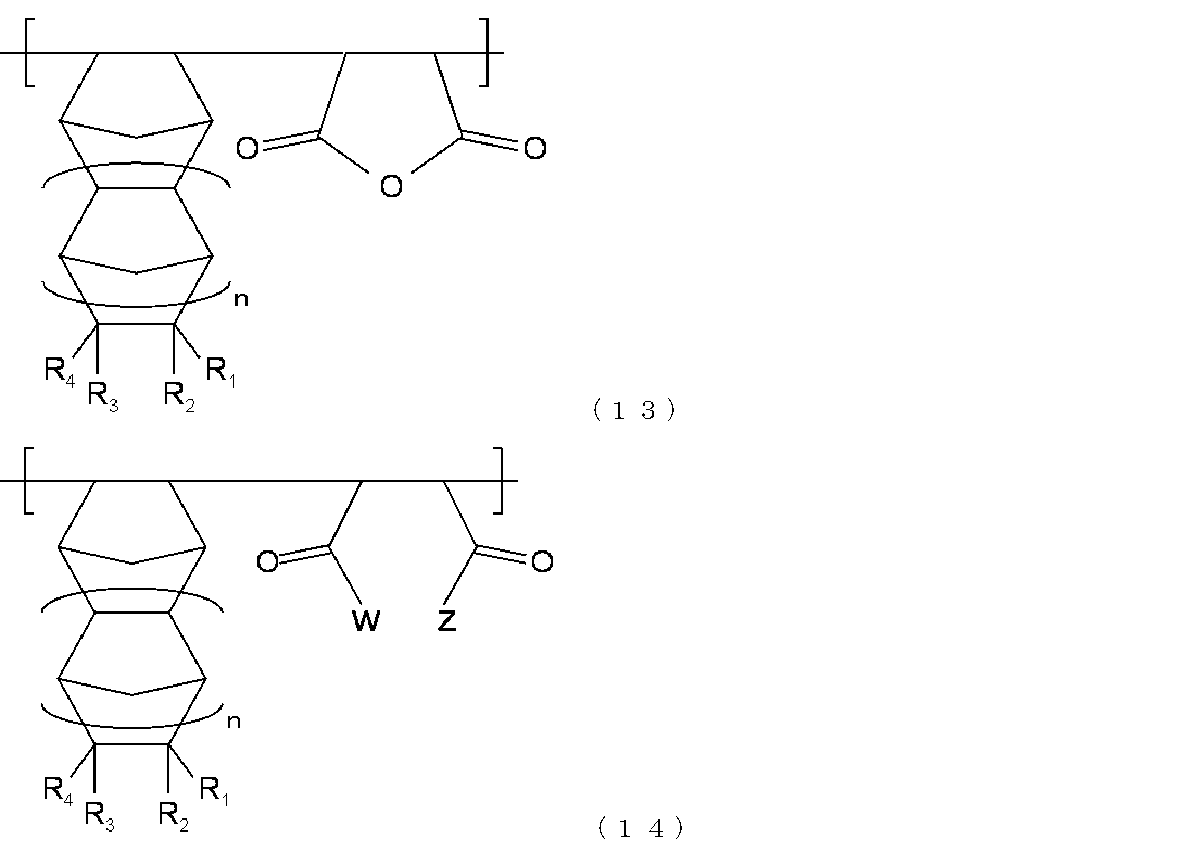
また、わずかではあるが、式(14)で示される繰り返し単位には、ZおよびWがいずれも、-O-Hである構造も含まれる場合がある。
同様に、式(14)が繰り返し単位となる場合には、R1は、各繰り返し単位において共通であることが好ましいが、それぞれの繰り返し単位ごとに異なっていてもよい。R2~R4、W、Zにおいても同様である。
次に、以上の工程により得られた共重合体3を含む溶液を、水への再沈あるいは水洗により残留金属成分や未反応アルコールを除去する。再沈の場合には、大量の水へ共重合体3を含むポリマーを滴下して凝固沈殿させる。次いで、ろ過を行い、得られた凝固物を、捕集し、水による洗浄操作を数回繰り返す。水洗の場合には、水と有機溶媒(たとえば、MEK)との混合物で洗浄して、その後、水層を除去する(第一の洗浄)。その後、再度、有機層に、水と有機溶媒(たとえば、MEK)との混合物を加えて、洗浄する(第二の洗浄)。本実施形態においては、以上のような洗浄工程(処理S4)をたとえば5回以上、より好ましくは10回繰り返す。これにより、共重合体3中におけるアルカリ金属の濃度を、十分に低減することができる。本実施形態においては、共重合体3中のアルカリ金属濃度が10ppm以下、好ましくは5ppm以下となるように洗浄工程(処理S4)を繰り返し行うことが好ましい。
洗浄工程(処理S4)の後において、溶媒置換を行うことができる。溶媒置換は、たとえば減圧蒸留によって処理S1からS4にて使用した化合物を除去し、PGMEA(プロピレングリコールモノメチルエーテルアセテート)等の製品溶媒を添加しながら系内を置換していくことにより行うことができる。
本実施形態では、前述した開環工程(処理S3)にて、無水マレイン酸由来の繰り返し単位の開環率を調整することで、ポリマーPのアルカリ現像液(たとえば、TMAH(水酸化テトラメチルアンモニウム水溶液))に対する溶解速度が調整されているが、さらに、厳密に溶解速度を調整する必要がある場合には本加熱工程(処理S6)を実施することができる。この加熱工程(処理S6)では、共重合体3を加熱することでポリマーPのアルカリ現像液に対する溶解速度をさらに調整することができる。
従って、この工程を経て得られる共重合体4は、前述した式(6)で示す繰り返し単位と、式(5)で示される繰り返し単位と、式(11)で示される繰り返し単位と、以下の式(15)で示される繰り返し単位とを備えるものとなる。

この式(15)で示した構造は、R7が前述のR5であり、R6の炭素数1~18の有機基が本加熱工程(処理S6)で使用するアルコールに由来のものである場合を含む。
また、式(15)で示した構造には、上記式(9)に示す構造が含まれていてもよい。この場合には、式(15)のR6およびR7が、式(9)に示したR5と同一の基となる。
さらに、式(15)で示した構造には、式(12)において二つのカルボキシル基がエステル化した構造が含まれていてもよい。この場合には、R6およびR7は、いずれも本加熱工程(処理S6)で使用するアルコールに由来のものとなる。
この共重合体4においても、共重合体3と同様、ノルボルネン型モノマー由来の構造体と、無水マレイン酸モノマー由来の構造体とが交互に配置された構造であることが好ましい。そして、共重合体4は、前述した式(13)、(14)に加えて式(16)で示される構造体を有することが好ましい。

本実施形態の着色感光性樹脂組成物は、紫外線等の活性光線の照射によりラジカルを発生する光ラジカル重合開始剤を含む。
光ラジカル重合開始剤としては、具体的には、例えば、2,2-ジエトキシアセトフェノン、2,2-ジメトキシー2-フェニルアセトフェノン、1-ヒドロキシシクロヘキシルフェニルケトン、2-ヒドロキシ-2-メチル-1-フェニルプロパン-1-オン、1-〔4-(2-ヒドロキシエトキシ)フェニル〕-2-ヒドロキシー2-メチル-1-プロパン-1-オン、2-ヒドロキシ-1-{4-〔4-(2-ヒドロキシ-2-メチルプロピオニル)ベンジル〕フェニル}-2-メチルプロパン-1-オン、2-メチル-1-(4-メチルチオフェニル)-2-モルフォリノプロパン1-オン、2-ベンジル-2-ジメチルアミノ-1-(4-モルフォリノフェニル)-ブタノン-1、2-(ジメチルアミノ)-2-〔(4-メチルフェニル)メチル〕-1-〔4-(4-モルホリニル)フェニル〕-1-ブタノン等のアルキルフェノン系化合物;ベンゾフェノン、4,4'-ビス(ジメチルアミノ)ベンゾフェノン、2-カルボキシベンゾフェノン等のベンゾフェノン系化合物;ベンゾインメチルエーテル、ベンゾインエチルエーテル、ベンゾインイソプロピルエーテル、ベンゾインイソブチルエーテ等のベンゾイン系化合物;チオキサントン、2-エチルチオキサントン、2-イソプロピルチオキサントン、2-クロロチオキサントン、2,4-ジメチルチオキサントン、2,4-ジエチルチオキサントン等のチオキサントン系化合物;2-(4-メトキシフェニル)-4,6-ビス(トリクロロメチル)-s-トリアジン、2-(4-メトキシナフチル)-4,6-ビス(トリクロロメチル)-s-トリアジン、2-(4-エトキシナフチル)-4,6-ビス(トリクロロメチル)-s-トリアジン、2-(4-エトキシカルボキニルナフチル)-4,6-ビス(トリクロロメチル)-s-トリアジン等のハロメチル化トリアジン系化合物;2-トリクロロメチル-5-(2'-ベンゾフリル)-1,3,4-オキサジアゾール、2-トリクロロメチル-5-〔β-(2'-ベンゾフリル)ビニル〕-1,3,4-オキサジアゾール、4-オキサジアゾール、2-トリクロロメチル-5-フリル-1,3,4-オキサジアゾール等のハロメチル化オキサジアゾール系化合物;2,2'-ビス(2-クロロフェニル)-4,4',5,5'-テトラフェニル-1,2'-ビイミダゾール、2,2'-ビス(2,4-ジクロロフェニル)-4,4',5,5' -テトラフェニル-1,2'-ビイミダゾール、2,2'-ビス(2,4,6-トリクロロフェニル)-4,4',5,5' -テトラフェニル-1,2'-ビイミダゾール等のビイミダゾール系化合物;1,2-オクタンジオン,1-〔4-(フェニルチオ)-,2-(O-ベンゾイルオキシム)〕、エタノン,1-〔9-エチル-6-(2-メチルベンゾイル)-9H-カルバゾール-3-イル〕-,1-(O-アセチルオキシム)等のオキシムエステル系化合物;ビス(η5-2,4-シクロペンタジエン-1-イル)-ビス(2,6-ジフルオロ-3-(1H-ピロール-1-イル)-フェニル)チタニウム等のチタノセン系化合物;p-ジメチルアミノ安息香酸、p-ジエチルアミノ安息香酸等の安息香酸エステル系化合物;9-フェニルアクリジン等のアクリジン系化合物;等を挙げることができる。
こうした増光剤、光ラジカル重合促進剤の添加量の総量としては、特に限定されないが、硬化性、経済性などの観点からポリマーPを100重量部に対して、0.001~5重量部、好ましくは、0.01~1重量部である。
本実施形態の着色感光性樹脂組成物は、従来公知の顔料や染料を含有するものである。
顔料としては有機顔料や無機顔料を用いることができる。
有機顔料としては、アゾ系顔料、フタロシアニン系顔料、多環式顔料(キナクリドン系、ペリレン系、ペリノン系、イソインドリノン系、イソインドリン系、ジオキサジン系、チオインジゴ系、アントラキノン系、キノフタロン系、金属錯体系、ジケトピロロピロール系等)、染料レーキ系顔料等を使用することができる。
無機顔料としては、白色・体質顔料(酸化チタン、酸化亜鉛、硫化亜鉛、クレー、タルク、硫酸バリウム、炭酸カルシウム等)、有彩顔料(黄鉛、カドミニウム系、クロムバーミリオン、ニッケルチタン、クロムチタン、黄色酸化鉄、ベンガラ、ジンククロメート、鉛丹、群青、紺青、コバルトブルー、クロムグリーン、酸化クロム、バナジン酸ビスマス等)、黒色顔料(カーボンブラック、ボーンブラック、グラファイト、鉄黒、チタンブラック等)、光輝材顔料(パール顔料、アルミ顔料、ブロンズ顔料等)、蛍光顔料(硫化亜鉛、硫化ストロンチウム、アルミン酸ストロンチウム等)を使用することができる。
本実施形態の着色感光性樹脂組成物は溶媒を含んでいてもよい。溶媒としては、例えば、プロピレングリコールモノメチルエーテル(PGME)、プロピレングリコールモノメチルエーテルアセテート(PGMEA)、乳酸エチル、メチルイソブチルカルビノール(MIBC)、ガンマブチロラクトン(GBL)、N-メチルピロリドン(NMP)、メチルn-アミルケトン(MAK)、ジエチレングリコールモノメチルエーテル、ジエチレングリコールジメチルエーテル、ジエチレングリコールメチルエチルエーテル、シクロヘキサノン、又は、これらの混合物を採用することができる。なお、ここで例示したものに限定されない。
本実施形態の着色感光性樹脂組成物は、前記ラジカル重合開始剤により、前記ポリマーPと架橋するラジカル重合性化合物(第一の架橋剤ともいう。)を含むことが好ましい。
ラジカル重合性化合物(第一の架橋剤)は、2以上の(メタ)アクリロイル基を有する多官能アクリル化合物であることが好ましい。具体的には、例えば、エチレングリコールジ(メタ)アクリレート、ジエチレングリコールジ(メタ)アクリレート、ポリエチレングリコールジ(メタ)アクリレート、プロピレングリコールジ(メタ)アクリレート、ブチレングリコールジ(メタ)アクリレート、ヘキサンジオールジ(メタ)アクリレート、シクロヘキサンジメタノールジ(メタ)アクリレート、ビスフェノールAアルキレンオキシドジ(メタ)アクリレート、ビスフェノールFアルキレンオキシドジ(メタ)アクリレート、トリメチロールプロパントリ(メタ)アクリレート、ジトリメチロールプロパンテトラ(メタ)アクリレート、グリセリントリ(メタ)アクリレート、ペンタエリスリトールテトラ(メタ)アクリレート、ジペンタエリスリトールペンタ(メタ)アクリレート、ジペンタエリスリトールヘキサ(メタ)アクリレート、エチレンオキシド付加トリメチロールプロパントリ(メタ)アクリレート、エチレンオキシド付加ジトリメチロールプロパンテトラ(メタ)アクリレート、エチレンオキシド付加ペンタエリスリトールテトラ(メタ)アクリレート、エチレンオキシド付加ジペンタエリスリトールヘキサ(メタ)アクリレート、プロピレンオキシド付加トリメチロールプロパントリ(メタ)アクリレート、プロピレンオキシド付加ジトリメチロールプロパンテトラ(メタ)アクリレート、プロピレンオキシド付加ペンタエリスリトールテトラ(メタ)アクリレート、プロピレンオキシド付加ジペンタエリスリトールヘキサ(メタ)アクリレート、ε-カプロラクトン付加トリメチロールプロパントリ(メタ)アクリレート、ε-カプロラクトン付加ジトリメチロールプロパンテトラ(メタ)アクリレート、ε-カプロラクトン付加ペンタエリスリトールテトラ(メタ)アクリレート、ε-カプロラクトン付加ジペンタエリスリトールヘキサ(メタ)アクリレート等の多官能(メタ)アクリレート類;エチレングリコールジビニルエーテル、ジエチレングリコールジビニルエーテル、ポリエチレングリコールジビニルエーテル、プロピレングリコールジビニルエーテル、ブチレングリコールジビニルエーテル、ヘキサンジオールジビニルエーテル、ビスフェノールAアルキレンオキシドジビニルエーテル、ビスフェノールFアルキレンオキシドジビニルエーテル、トリメチロールプロパントリビニルエーテル、ジトリメチロールプロパンテトラビニルエーテル、グリセリントリビニルエーテル、ペンタエリスリトールテトラビニルエーテル、ジペンタエリスリトールペンタビニルエーテル、ジペンタエリスリトールヘキサビニルエーテル、エチレンオキシド付加トリメチロールプロパントリビニルエーテル、エチレンオキシド付加ジトリメチロールプロパンテトラビニルエーテル、エチレンオキシド付加ペンタエリスリトールテトラビニルエーテル、エチレンオキシド付加ジペンタエリスリトールヘキサビニルエーテル等の多官能ビニルエーテル類;(メタ)アクリル酸2-ビニロキシエチル、(メタ)アクリル酸3-ビニロキシプロピル、(メタ)アクリル酸1-メチル-2-ビニロキシエチル、(メタ)アクリル酸2-ビニロキシプロピル、(メタ)アクリル酸4-ビニロキシブチル、(メタ)アクリル酸4-ビニロキシシクロヘキシル、(メタ)アクリル酸5-ビニロキシペンチル、(メタ)アクリル酸6-ビニロキシヘキシル、(メタ)アクリル酸4-ビニロキシメチルシクロヘキシルメチル、(メタ)アクリル酸p-ビニロキシメチルフェニルメチル、(メタ)アクリル酸2-(ビニロキシエトキシ)エチル、(メタ)アクリル酸2-(ビニロキシエトキシエトキシエトキシ)エチル等のビニルエーテル基含有(メタ)アクリル酸エステル類;エチレングリコールジアリルエーテル、ジエチレングリコールジアリルエーテル、ポリエチレングリコールジアリルエーテル、プロピレングリコールジアリルエーテル、ブチレングリコールジアリルエーテル、ヘキサンジオールジアリルエーテル、ビスフェノールAアルキレンオキシドジアリルエーテル、ビスフェノールFアルキレンオキシドジアリルエーテル、トリメチロールプロパントリアリルエーテル、ジトリメチロールプロパンテトラアリルエーテル、グリセリントリアリルエーテル、ペンタエリスリトールテトラアリルエーテル、ジペンタエリスリトールペンタアリルエーテル、ジペンタエリスリトールヘキサアリルエーテル、エチレンオキシド付加トリメチロールプロパントリアリルエーテル、エチレンオキシド付加ジトリメチロールプロパンテトラアリルエーテル、エチレンオキシド付加ペンタエリスリトールテトラアリルエーテル、エチレンオキシド付加ジペンタエリスリトールヘキサアリルエーテル等の多官能アリルエーテル類;(メタ)アクリル酸アリル等のアリル基含有(メタ)アクリル酸エステル類;トリ(アクリロイルオキシエチル)イソシアヌレート、トリ(メタクリロイルオキシエチル)イソシアヌレート、アルキレンオキシド付加トリ(アクリロイルオキシエチル)イソシアヌレート、アルキレンオキシド付加トリ(メタクリロイルオキシエチル)イソシアヌレート等の多官能(メタ)アクリロイル基含有イソシアヌレート類;トリアリルイソシアヌレート等の多官能アリル基含有イソシアヌレート類;トリレンジイソシアネート、イソホロンジイソシアネート、キシリレンジイソシアネート等の多官能イソシアネートと(メタ)アクリル酸2-ヒドロキシエチル、(メタ)アクリル酸2-ヒドロキシプロピル等の水酸基含有(メタ)アクリル酸エステル類との反応で得られる多官能ウレタン(メタ)アクリレート類;ジビニルベンゼン等の多官能芳香族ビニル類等が挙げられる。
なかでも、トリメチロールプロパントリ(メタ)アクリレート、ペンタエリスリトールトリ(メタ)アクリレート等の三官能(メタ)アクリレート、ペンタエリスリトールテトラ(メタ)アクリレート、ジトリメチロールプロパンテトラ(メタ)アクリレート等の四官能(メタ)アクリレート、ジペンタエリスリトールヘキサ(メタ)アクリレート等の六官能(メタ)アクリレートが挙げられ、これらのうちいずれか1以上を使用することが好ましい。
本実施形態の着色感光性樹脂組成物において、第一の架橋剤を用いる場合、その含有量は、ポリマーPを100質量部に対し、30~70質量部であることが好ましく、さらには、50~60質量部であることが好ましい。
本実施形態の着色感光性樹脂組成物は、ラジカル重合性化合物(第一の架橋剤)とは異なる架橋性化合物(第二の架橋剤ともいう)を含んでいてもよい。この架橋性化合物(第二の架橋剤)は熱により、ポリマーPと架橋するものである。
この架橋性化合物(第二の架橋剤)は、反応性基として、環状エーテル基を有する化合物が好ましく、なかでも、グリシジル基あるいはオキセタニル基を有する化合物が好ましい。このような架橋性化合物(第二の架橋剤)を使用することで、本実施形態の着色感光性樹脂組成物で構成される膜の耐薬品性を向上させることができる。
より具体的には、たとえばビスフェノールAエポキシ樹脂(たとえば、ダイソーケミカル株式会社製「LX-1」)、2,2'-((((1-(4-(2-(4-(オキシラン-2-イルメトキシ)フェニル)プロパン-2-イル)フェニル)エタン-1,1-ジイル)ビス(4,1-フェニレン))ビス(オキシ))ビス(メチレン))ビス(オキシラン)(たとえば、株式会社プリンテック社製「Techmore VG3101L」)、トリメチロールプロパントリグリシジルエーテル(たとえば、CVCスペシャリティーケミカルズ社製「TMPTGE」)、および1,1,3,3,5,5-ヘキサメチル-1,5-ビス(3-(オキシラン-2-イルメトキシ)プロピル)トリ・シロキサン(たとえば、ゲレスト社製「DMS-E09」)等を挙げることができる(これらの構造式は以下に示したものである。)。
その他、チバガイギー社製「アラルダイトMT0163」および「アラルダイトCY179」、ダイセル化学工業株式会社製「EHPE-3150」および「Epolite GT300」等を挙げることができる。

以上のうち、いずれか1種以上を使用できる。なお、ここでの例示に限定されない。

例えば1,4-ビス{[(3-エチルー3-オキセタニル)メトキシ]メチル}ベンゼン、ビス[1-エチル(3-オキセタニル)]メチルエーテル、4,4'-ビス[(3-エチル-3-オキセタニル)メトキシメチル]ビフェニル、4,4′-ビス(3-エチル-3-オキセタニルメトキシ)ビフェニル、エチレングリコールビス(3-エチル-3-オキセタニルメチル)エーテル、ジエチレングリコールビス(3-エチル-3-オキセタニルメチル)エーテル、ビス(3-エチル-3-オキセタニルメチル)ジフェノエート、トリメチロールプロパントリス(3-エチル-3-オキセタニルメチル)エーテル、ペンタエリスリトールテトラキス(3-エチル-3-オキセタニルメチル)エーテル、ポリ[[3-[(3-エチル-3-オキセタニル)メトキシ]プロピル]シラセスキオキサン]誘導体、オキセタニルシリケート、フェノールノボラック型オキセタン、1,3-ビス[(3-エチルオキセタンー3-イル)メトキシ]ベンゼン等が挙げられるが、これらに限定されない。これらは単独でも複数組み合わせて用いてもよい。
本実施形態の着色感光性樹脂組成物は、各用途の目的や要求特性に応じて、フィラー、先述のポリマーP以外のバインダー樹脂、分散剤、耐熱向上剤、現像助剤、可塑剤、重合禁止剤、紫外線吸収剤、酸化防止剤、艶消し剤、消泡剤、レベリング剤、帯電防止剤、分散剤、スリップ剤、表面改質剤、揺変化剤、揺変助剤、シラン系やアルミニウム系、チタン系などのカップリング剤、キノンジアジド化合物、多価フェノール化合物、カチオン重合性化合物、酸発生剤等の上記の必須成分以外の成分が配合されても良い。
本実施形態の着色感光性樹脂組成物は、たとえば、着色剤に対し分散処理工程を行い、これを他の成分と混合することにより製造することができる。
たとえば、まず、着色剤、分散剤、バインダー樹脂、および溶剤を各所定量秤量し、ペイントコンディショナー、ビーズミル、ロールミル、ボールミル、ジェットミル、ホモジナイザー、ニーダー、ブレンダー等の分散機を用い、着色剤を微粒子分散させて液状の色材分散液(ミルベース)とする。
ここで、好ましくは、ロールミル、ニーダー、ブレンダー等で混練分散処理をしてから、0.01~1mmのビーズを充填したビーズミル等のメディアミルで微分散処理をする。
得られたミルベースに、別途攪拌混合しておいた、ラジカル重合性化合物、光開始剤、バインダー樹脂、溶剤、レベリング剤などを含む透明レジスト液を加えて混合、均一な分散溶液とし、着色感光性樹脂組成物を得る。得られた着色感光性着色樹脂組成物は、フィルター等によって、濾過処理をして微細なゴミを除去するのが望ましい。
本実施形態の着色感光性樹脂組成物は、好ましくは、カラーフィルタの製造に用いられる。以下、本実施形態の着色感光性樹脂組成物を適用したカラーフィルタの例について図1を示しながら説明する。なお、このようなカラーフィルタは液晶表示装置や固体撮像素子に適用することができる。
また、この支持体10は必要に応じて、コロナ放電処理、オゾン処理、薬液処理等が施されたものであってもよい。
なお、本実施形態において、この支持体10は好ましくはガラスにより構成される。
具体的な形成方法は、公知の方法を採用することができるが、たとえば、スパッタリング法、真空蒸着法、CVD法等の方法を採用することができる。
以下、図2を参照しながらカラーフィルタ100の製造方法について説明する。
本実施形態のカラーフィルタ100の製造方法は、
本実施形態の着色感光性樹脂組成物を支持体10に適用することで着色感光性樹脂組成物の層15を形成する、着色感光性樹脂組成物層形成工程と、
前記着色感光性樹脂組成物の層に対して露光する、露光工程と、
アルカリ性現像液によりパターンを形成する、現像工程と、を含む。
この着色感光性樹脂組成物を支持体10に塗布する方法としては、スピンコート、ロールコート、フローコート、ディップコート、スプレーコート、ドクターコート等の塗布方法を用いることができる。これらの中でもスピンコートが好ましく、その回転数は1000~3000rpmが好ましい。
塗膜上へのパターン形成は、目的のパターンを形成するためのマスクを用いて、活性光線等を照射して行う。活性光線の光源としては、例えば、キセノンランプ、ハロゲンランプ、タングステンランプ、高圧水銀灯、超高圧水銀灯、メタルハライドランプ、中圧水銀灯、低圧水銀灯、カーボンアーク、蛍光ランプ等のランプ光源;アルゴンイオンレーザー、YAGレーザー、エキシマレーザー、窒素レーザー、ヘリウムカドミウムレーザー、半導体レーザー等のレーザー光源等が使用される。
現像方法としては、例えば、シャワー現像法、スプレー現像法、浸漬現像法等を挙げることができる。現像条件としては通常、23℃で1~10分程度である。
この形成方法は、先述の通り、たとえば、スパッタリング法、真空蒸着法、CVD法等の方法を採用することができる。
また、本発明は前述の実施形態に限定されるものではなく、本発明の目的を達成できる範囲での変形、改良などは本発明に含まれるものである。
撹拌機、冷却管を備えた適切なサイズの反応容器に、無水マレイン酸(735g、7.5mol)、2-ノルボルネン(706g、7.5mol)およびジメチル2,2'-アゾビス(2-メチルプロピオネート)(69g、0.3mol)を計量し、メチルエチルケトンおよびトルエンに溶解させた。この溶解液に対して、窒素バブリングにより系内の溶存酸素を除去した後、撹拌しつつ60℃、15時間の条件で熱処理を施した。これにより、2-ノルボルネンと無水マレイン酸の共重合体を得た。次いで、室温まで冷却した上記溶解液を大量のメタノールを用いて再沈させた後、析出物をろ取し、真空乾燥機にて乾燥させ、1100gの白色固体を得た。こうして得られた2-ノルボルネンと無水マレイン酸の共重合体10.0gをメチルエチルケトン30gに溶解させ、更に、4-ヒドロキシブチルアクリレート18.8g、ヒドロキノン0.5g、酢酸ナトリウム0.5gと混合し、80℃で16時間反応させた。反応後にアセトン25gとギ酸1.0gを混合した後、750gの純水に滴下してポリマーを再沈精製した。ヌッチェでろ過した後、真空乾燥機にて乾燥させ、白色固体14.6gを得た。
このようにして得られたポリマーの重量平均分子量(Mw)は16200であり、分散度2.36であった。また、アルカリ溶解速度は18300Å/secであった。またNMRにより定量したエステル化率は80%であった。
合成例1と同様にして合成した2-ノルボルネンと無水マレイン酸の共重合体を10.0gをメチルエチルケトン30gに溶解させ、更に、2-ヒドロキシエチルメタクリレート40.0g、ヒドロキノン0.5g、酢酸ナトリウム0.5gと混合し、80℃で16時間反応させた。反応後にアセトン25gとギ酸1.0gを混合した後、750gの純水に滴下してポリマーを再沈精製した。ヌッチェでろ過した後、真空乾燥機にて乾燥させ、白色固体13.6gを得た。
このようにして得られたポリマーの重量平均分子量(Mw)は13000であり、分散度1.87であった。また、アルカリ溶解速度は22800Å/secであった。またNMRにより定量したエステル化率は90%であった。
ブチルメタクリレート4.0g、ヒドロキシエチルメタクリレート2.0g、メタクリル酸2.0gを30gのプロピレングリコールモノメチルエーテルに溶解させ、0.75gのV-601(油溶性アゾ重合開始剤)を添加、溶解させた後、窒素で反応容器内部を置換した。その後、70℃まで昇温し、12時間反応させた。反応後を大量のヘプタンに再沈させ、白色粉末を得た。このポリマーの分子量80,700であった。
合成例1で合成したポリマーを5.0g、光重合開始剤としてイルガキュアOXE02(BASF社製)0.5g、顔料分散液(大日精化社製NX-501;顔料分58%)7.5g、シクロヘキサノン15.0gを混合した。
こうして調製した白色感光性樹脂組成物をソーダガラス(100mm×100mm正方,厚さ1.0mm)上にスピンコート法で塗布し、その後ホットププレート上で100℃で2分間加熱して膜厚10μmの塗布膜を得た。この塗布膜を10μm、20μm、50μmのL/Sパターンを有するマスクを介して、キャノン社製g+h+i線マスクアライナー(PLA-501F)により200mJ/cm2で露光した。これを23℃の0.1N水酸化カリウム水溶液で4分間ディップ現像した後、さらに純水でリンスした。その後、高速回転にて基板を乾燥させ、L/Sパターンを作成した。
ここでの現像性、密着性、パターン成形性について下記評価基準に基づいて評価した。
評価結果は表1にまとめた通りである。
○:残差なくはっきりパターン形成している。
△:残差が少しあるがパターン形状は良好。
×:パターン形成せず。
○:はがれやパターン欠損はなく良好。
△:20μm以下のパターンで欠損やはがれがみられる。
×:はがれがみられる。
○:ほそりなどがみられず良好。
×:著しいライン細りがみられる。
○:硬化塗膜の外観に異常なし。
×:硬化塗膜の外観に変色、割れ、剥離等の異常あり。
○:現像後の色と同様。
×:黄変など、色の変化がみられる。
ポリマーを合成例2で得られたものに変更した以外は実施例1と同様の手順にて評価した。評価結果は表1にまとめた通りである。
合成例2で合成したポリマーを5.0g、ジペンタエリスルトールヘキサアクリレート(新中村化学工業社製A-DPH)を2.5g、光重合開始剤としてイルガキュアOXE02(BASF社製)0.5g、顔料分散液(大日精化社製NX-595)7.5g、シクロヘキサノン15.0gを混合した。
こうして調製した黒色感光性樹脂組成物をソーダガラス(100mm×100mm正方,厚さ1.0mm)上にスピンコート法で塗布し、その後ホットププレート上で100℃で2分間加熱して膜厚10μmの塗布膜を得た。この塗布膜を10μm、20μm、50μmのL/Sパターンを有するマスクを介して、キャノン社製g+h+i線マスクアライナー(PLA-501F)により200mJ/cm2で露光した。これを23℃の0.1N水酸化カリウム水溶液で4分間ディップ現像した後、さらに純水でリンスした。その後、高速回転にて基板を乾燥させ、L/Sパターンを作成した。
ここでの現像性、密着性、パターン成形性、耐熱性、耐熱変色性について上記評価基準に基づいて評価した。
評価結果は表1にまとめた通りである。
顔料分散液を大日精化社製:NX-061に変更し、緑色感光性樹脂組成物とした以外は実施例2と同様の手順で評価した。
顔料分散液を大日精化社製:NX-053に変更し、青色感光性樹脂組成物とした以外は実施例2と同様の手順で評価した。
顔料分散液を大日精化社製:NX-032に変更し、赤色感光性樹脂組成物とした以外は実施例2と同様の手順で評価した。
比較合成例1で合成したポリマーを5.0g、ジペンタエリスルトールヘキサアクリレート(新中村化学工業社製A-DPH)を5.0g,光重合開始剤としてイルガキュアOXE02(BASF社製)7.5g、シクロヘキサノン15.0gを混合して、白色感光性樹脂組成物を得た。実施例1と同様の手順にて評価した。評価結果は表1にまとめた通りである。

Claims (9)
- 以下の式(1)および式(2a)で示される繰り返し単位を含み、式(2a)のR5がラジカル重合性基を有し、炭素数2~18の有機基であるポリマーと、
光ラジカル重合開始剤と、
着色剤と、を含む着色感光性樹脂組成物。

- 請求項1に記載の着色感光性樹脂組成物において、
前記ポリマーは、以下の式(2b)で示される繰り返し単位を含む、着色感光性樹脂組成物。

- 請求項1または2に記載の着色感光性樹脂組成物において、
前記R5は、末端に炭素-炭素二重結合を有する、着色感光性樹脂組成物。 - 請求項1乃至3のいずれか1項に記載の着色感光性樹脂組成物において、
前記式(2a)中のR5は、その構造中に、ビニル基、ビニリデン基、アクリロイル基、メタクリロイル基からなる群より選ばれるいずれかの基を含む、着色感光性樹脂組成物。 - 請求項1乃至4のいずれか1項に記載の着色感光性樹脂組成物において、
前記光ラジカル重合開始剤により、前記ポリマーと架橋する2以上の(メタ)アクリロイル基を有する多官能(メタ)アクリル化合物をさらに含む、着色感光性樹脂組成物。 - 請求項1乃至5のいずれか1項に記載の着色感光性樹脂組成物を硬化させてなる、着色パターンまたはブラックマトリクス。
- 請求項6に記載の着色パターンまたはブラックマトリクスを備えるカラーフィルタ。
- 請求項7に記載のカラーフィルタを備える液晶表示装置または固体撮像素子。
- 請求項1乃至5のいずれか1項に記載の着色感光性樹脂組成物を支持体に適用することで着色感光性樹脂組成物の層を形成する、着色感光性樹脂組成物層形成工程と、
前記着色感光性樹脂組成物の層に対して露光する、露光工程と、
アルカリ現像液によりパターンを形成する、現像工程と、
を含むカラーフィルタの製造方法。
Priority Applications (4)
| Application Number | Priority Date | Filing Date | Title |
|---|---|---|---|
| JP2017521792A JPWO2016194619A1 (ja) | 2015-05-29 | 2016-05-19 | 着色感光性樹脂組成物、着色パターンまたはブラックマトリクス、カラーフィルタ、液晶表示装置または固体撮像素子およびカラーフィルタの製造方法 |
| HK18103523.0A HK1244066A1 (zh) | 2015-05-29 | 2016-05-19 | 着色感光性树脂组合物、着色图案或黑矩阵、滤色器、液晶显示装置或固体摄像元件和滤色器的制造方法 |
| CN201680031343.1A CN107615167A (zh) | 2015-05-29 | 2016-05-19 | 着色感光性树脂组合物、着色图案或黑矩阵、滤色器、液晶显示装置或固体摄像元件和滤色器的制造方法 |
| KR1020177037236A KR20180012313A (ko) | 2015-05-29 | 2016-05-19 | 착색 감광성 수지 조성물, 착색 패턴 또는 블랙 매트릭스, 컬러 필터, 액정 표시 장치 또는 고체 촬상 소자 및 컬러 필터의 제조 방법 |
Applications Claiming Priority (4)
| Application Number | Priority Date | Filing Date | Title |
|---|---|---|---|
| JP2015-110611 | 2015-05-29 | ||
| JP2015110611 | 2015-05-29 | ||
| JP2015-162910 | 2015-08-20 | ||
| JP2015162910 | 2015-08-20 |
Publications (1)
| Publication Number | Publication Date |
|---|---|
| WO2016194619A1 true WO2016194619A1 (ja) | 2016-12-08 |
Family
ID=57440574
Family Applications (1)
| Application Number | Title | Priority Date | Filing Date |
|---|---|---|---|
| PCT/JP2016/064828 Ceased WO2016194619A1 (ja) | 2015-05-29 | 2016-05-19 | 着色感光性樹脂組成物、着色パターンまたはブラックマトリクス、カラーフィルタ、液晶表示装置または固体撮像素子およびカラーフィルタの製造方法 |
Country Status (6)
| Country | Link |
|---|---|
| JP (1) | JPWO2016194619A1 (ja) |
| KR (1) | KR20180012313A (ja) |
| CN (1) | CN107615167A (ja) |
| HK (1) | HK1244066A1 (ja) |
| TW (1) | TW201708376A (ja) |
| WO (1) | WO2016194619A1 (ja) |
Cited By (8)
| Publication number | Priority date | Publication date | Assignee | Title |
|---|---|---|---|---|
| JP6332583B1 (ja) * | 2017-01-10 | 2018-05-30 | 住友ベークライト株式会社 | ネガ型感光性樹脂組成物、樹脂膜及び電子装置 |
| WO2018131351A1 (ja) * | 2017-01-10 | 2018-07-19 | 住友ベークライト株式会社 | ネガ型感光性樹脂組成物、樹脂膜及び電子装置 |
| US20180284609A1 (en) * | 2017-03-28 | 2018-10-04 | Promerus, Llc | Photosensitive compositions, color filter and microlens derived therefrom |
| JP2020126117A (ja) * | 2019-02-04 | 2020-08-20 | 三菱ケミカル株式会社 | 感光性着色樹脂組成物、硬化物、及び画像表示装置 |
| WO2021060080A1 (ja) * | 2019-09-26 | 2021-04-01 | 住友ベークライト株式会社 | ポリマー、感光性樹脂組成物、樹脂膜、および電子装置 |
| JP2021063933A (ja) * | 2019-10-16 | 2021-04-22 | 住友ベークライト株式会社 | 樹脂組成物、感光性樹脂組成物、フィルム、カラーフィルタ、ブラックマトリクス、表示装置および撮像素子 |
| JP2021063222A (ja) * | 2019-10-10 | 2021-04-22 | 住友ベークライト株式会社 | ポリマー、ポリマーの製造方法、感光性樹脂組成物、および硬化物 |
| KR20250146181A (ko) | 2024-03-29 | 2025-10-13 | 아티엔스 가부시키가이샤 | 감광성 조성물, 경화막, 광학 필터, 컬러 필터, 화상 표시 장치, 고체 촬상 소자, 및 적외선 센서 |
Families Citing this family (5)
| Publication number | Priority date | Publication date | Assignee | Title |
|---|---|---|---|---|
| KR102686332B1 (ko) * | 2018-03-05 | 2024-07-17 | 스미또모 가가꾸 가부시키가이샤 | 착색 경화성 수지 조성물, 컬러 필터 및 표시 장치 |
| WO2020158741A1 (ja) * | 2019-01-31 | 2020-08-06 | 住友ベークライト株式会社 | 感光性樹脂組成物、ポリマー、パターン、カラーフィルタ、ブラックマトリクス、表示装置および撮像素子 |
| KR102925365B1 (ko) * | 2019-10-16 | 2026-02-09 | 스미또모 베이크라이트 가부시키가이샤 | 수지 조성물, 및 감광성 수지 조성물 및 그 경화물 |
| CN114599686B (zh) * | 2019-10-16 | 2024-11-12 | 住友电木株式会社 | 聚合物及树脂组合物 |
| WO2022065225A1 (ja) * | 2020-09-23 | 2022-03-31 | 住友ベークライト株式会社 | ポリマー、ポリマー溶液および感光性樹脂組成物 |
Citations (4)
| Publication number | Priority date | Publication date | Assignee | Title |
|---|---|---|---|---|
| JPH10293402A (ja) * | 1997-04-21 | 1998-11-04 | Mitsubishi Rayon Co Ltd | 感光性樹脂組成物、これを用いたカラーフィルター及び液晶表示装置と、カラーフィルターならびに液晶表示装置の製造方法 |
| WO2011129182A1 (ja) * | 2010-04-13 | 2011-10-20 | 昭和電工株式会社 | 付加共重合体、感光性樹脂組成物及びカラーフィルター |
| JP2012083753A (ja) * | 2010-10-07 | 2012-04-26 | Dongwoo Fine-Chem Co Ltd | 着色感光性樹脂組成物、カラーフィルター及び液晶表示装置 |
| JP2015007762A (ja) * | 2013-05-29 | 2015-01-15 | 住友ベークライト株式会社 | ネガ型感光性樹脂組成物、電子装置およびポリマー |
Family Cites Families (2)
| Publication number | Priority date | Publication date | Assignee | Title |
|---|---|---|---|---|
| JP5484173B2 (ja) * | 2010-04-20 | 2014-05-07 | 富士フイルム株式会社 | 着色感光性樹脂組成物、パターン形成方法、カラーフィルタの製造方法、カラーフィルタ及びそれを備えた表示装置 |
| KR101998449B1 (ko) * | 2012-03-26 | 2019-07-09 | 도레이 카부시키가이샤 | 감광성 흑색 수지 조성물 및 수지 블랙 매트릭스 기판 |
-
2016
- 2016-05-19 HK HK18103523.0A patent/HK1244066A1/zh unknown
- 2016-05-19 KR KR1020177037236A patent/KR20180012313A/ko not_active Ceased
- 2016-05-19 CN CN201680031343.1A patent/CN107615167A/zh active Pending
- 2016-05-19 JP JP2017521792A patent/JPWO2016194619A1/ja active Pending
- 2016-05-19 WO PCT/JP2016/064828 patent/WO2016194619A1/ja not_active Ceased
- 2016-05-24 TW TW105116040A patent/TW201708376A/zh unknown
Patent Citations (4)
| Publication number | Priority date | Publication date | Assignee | Title |
|---|---|---|---|---|
| JPH10293402A (ja) * | 1997-04-21 | 1998-11-04 | Mitsubishi Rayon Co Ltd | 感光性樹脂組成物、これを用いたカラーフィルター及び液晶表示装置と、カラーフィルターならびに液晶表示装置の製造方法 |
| WO2011129182A1 (ja) * | 2010-04-13 | 2011-10-20 | 昭和電工株式会社 | 付加共重合体、感光性樹脂組成物及びカラーフィルター |
| JP2012083753A (ja) * | 2010-10-07 | 2012-04-26 | Dongwoo Fine-Chem Co Ltd | 着色感光性樹脂組成物、カラーフィルター及び液晶表示装置 |
| JP2015007762A (ja) * | 2013-05-29 | 2015-01-15 | 住友ベークライト株式会社 | ネガ型感光性樹脂組成物、電子装置およびポリマー |
Cited By (23)
| Publication number | Priority date | Publication date | Assignee | Title |
|---|---|---|---|---|
| TWI759378B (zh) * | 2017-01-10 | 2022-04-01 | 日商住友電木股份有限公司 | 負型感光性樹脂組成物、樹脂膜及電子裝置 |
| WO2018131351A1 (ja) * | 2017-01-10 | 2018-07-19 | 住友ベークライト株式会社 | ネガ型感光性樹脂組成物、樹脂膜及び電子装置 |
| KR102614402B1 (ko) | 2017-01-10 | 2023-12-15 | 스미또모 베이크라이트 가부시키가이샤 | 네거티브형 감광성 수지 조성물, 수지막 및 전자 장치 |
| CN110178085B (zh) * | 2017-01-10 | 2022-10-21 | 住友电木株式会社 | 负型感光性树脂组合物、树脂膜和电子装置 |
| CN110178085A (zh) * | 2017-01-10 | 2019-08-27 | 住友电木株式会社 | 负型感光性树脂组合物、树脂膜和电子装置 |
| KR20190101460A (ko) * | 2017-01-10 | 2019-08-30 | 스미또모 베이크라이트 가부시키가이샤 | 네거티브형 감광성 수지 조성물, 수지막 및 전자 장치 |
| JP6332583B1 (ja) * | 2017-01-10 | 2018-05-30 | 住友ベークライト株式会社 | ネガ型感光性樹脂組成物、樹脂膜及び電子装置 |
| JP7051893B2 (ja) | 2017-03-28 | 2022-04-11 | プロメラス, エルエルシー | 感光性組成物、カラーフィルタ及びそれに由来するマイクロレンズ |
| WO2018183413A1 (en) | 2017-03-28 | 2018-10-04 | Promerus, Llc | Photosensitive compositions, color filter and microlens derived therefrom |
| US10915019B2 (en) | 2017-03-28 | 2021-02-09 | Promerus, Llc | Photosensitive compositions, color filter and microlens derived therefrom |
| US20180284609A1 (en) * | 2017-03-28 | 2018-10-04 | Promerus, Llc | Photosensitive compositions, color filter and microlens derived therefrom |
| CN110462512A (zh) * | 2017-03-28 | 2019-11-15 | 普罗米鲁斯有限责任公司 | 感光性组合物、彩色滤光片及由其衍生的微透镜 |
| JP2020515893A (ja) * | 2017-03-28 | 2020-05-28 | プロメラス, エルエルシー | 感光性組成物、カラーフィルタ及びそれに由来するマイクロレンズ |
| CN110462512B (zh) * | 2017-03-28 | 2021-07-06 | 住友电木株式会社 | 感光性组合物、彩色滤光片及由其衍生的微透镜 |
| JP2020126117A (ja) * | 2019-02-04 | 2020-08-20 | 三菱ケミカル株式会社 | 感光性着色樹脂組成物、硬化物、及び画像表示装置 |
| JP7331371B2 (ja) | 2019-02-04 | 2023-08-23 | 三菱ケミカル株式会社 | 感光性着色樹脂組成物、硬化物、及び画像表示装置 |
| WO2021060080A1 (ja) * | 2019-09-26 | 2021-04-01 | 住友ベークライト株式会社 | ポリマー、感光性樹脂組成物、樹脂膜、および電子装置 |
| JPWO2021060080A1 (ja) * | 2019-09-26 | 2021-04-01 | ||
| JP7639688B2 (ja) | 2019-09-26 | 2025-03-05 | 住友ベークライト株式会社 | ポリマー、感光性樹脂組成物、樹脂膜、および電子装置 |
| JP2021063222A (ja) * | 2019-10-10 | 2021-04-22 | 住友ベークライト株式会社 | ポリマー、ポリマーの製造方法、感光性樹脂組成物、および硬化物 |
| JP7552223B2 (ja) | 2019-10-10 | 2024-09-18 | 住友ベークライト株式会社 | ポリマー、ポリマーの製造方法、感光性樹脂組成物、および硬化物 |
| JP2021063933A (ja) * | 2019-10-16 | 2021-04-22 | 住友ベークライト株式会社 | 樹脂組成物、感光性樹脂組成物、フィルム、カラーフィルタ、ブラックマトリクス、表示装置および撮像素子 |
| KR20250146181A (ko) | 2024-03-29 | 2025-10-13 | 아티엔스 가부시키가이샤 | 감광성 조성물, 경화막, 광학 필터, 컬러 필터, 화상 표시 장치, 고체 촬상 소자, 및 적외선 센서 |
Also Published As
| Publication number | Publication date |
|---|---|
| CN107615167A (zh) | 2018-01-19 |
| TW201708376A (zh) | 2017-03-01 |
| KR20180012313A (ko) | 2018-02-05 |
| HK1244066A1 (zh) | 2018-07-27 |
| JPWO2016194619A1 (ja) | 2018-03-22 |
Similar Documents
| Publication | Publication Date | Title |
|---|---|---|
| JPWO2016194619A1 (ja) | 着色感光性樹脂組成物、着色パターンまたはブラックマトリクス、カラーフィルタ、液晶表示装置または固体撮像素子およびカラーフィルタの製造方法 | |
| JP7074051B2 (ja) | ポリマーの製造方法、ネガ型感光性樹脂組成物の製造方法、樹脂膜の製造方法、電子装置の製造方法およびポリマー | |
| CN114599686B (zh) | 聚合物及树脂组合物 | |
| JP6398310B2 (ja) | ネガ型感光性樹脂組成物、電子装置、ネガ型感光性ポリマーの製造方法、およびネガ型感光性樹脂組成物の製造方法 | |
| KR102840141B1 (ko) | 감광성 수지 조성물, 폴리머, 패턴, 컬러 필터, 블랙 매트릭스, 표시 장치 및 촬상 소자 | |
| KR102925365B1 (ko) | 수지 조성물, 및 감광성 수지 조성물 및 그 경화물 | |
| JP2020023654A (ja) | ポリマー、ポリマーの製造方法、感光性樹脂組成物、パターン、カラーフィルタ、ブラックマトリクス、液晶表示装置および固体撮像素子 | |
| JP7200532B2 (ja) | 感光性樹脂組成物、及び、電子装置 | |
| JP6661929B2 (ja) | ネガ型感光性樹脂組成物、樹脂膜および電子装置 | |
| JP7790090B2 (ja) | ポリマー溶液、感光性樹脂組成物、およびその用途 | |
| JP7647069B2 (ja) | ポリマー、ポリマー溶液、感光性樹脂組成物およびその用途 | |
| JP7552223B2 (ja) | ポリマー、ポリマーの製造方法、感光性樹脂組成物、および硬化物 | |
| JP2022046309A (ja) | ポリマー溶液、感光性樹脂組成物およびその用途 | |
| JP7631834B2 (ja) | ポリマー、ポリマー溶液、感光性樹脂組成物、および硬化物 | |
| JP2021196596A (ja) | ポリマー溶液 | |
| JP7631766B2 (ja) | ポリマー、ポリマー溶液、感光性樹脂組成物およびその用途 | |
| JP7676904B2 (ja) | 感光性樹脂組成物および硬化膜 | |
| JP7669703B2 (ja) | ポリマー、ポリマー溶液、感光性樹脂組成物、および硬化物 | |
| JP7631832B2 (ja) | ポリマー、ポリマー溶液、感光性樹脂組成物、および硬化物 | |
| JP7559421B2 (ja) | カラーフィルタまたはブラックマトリクス形成用ポリマー溶液 | |
| JP2024062255A (ja) | ポリマー、ポリマー溶液、感光性樹脂組成物、および硬化物 | |
| JP2025174013A (ja) | ポリマー、ポリマー溶液、感光性樹脂組成物、および硬化物 | |
| JP2025135819A (ja) | ポリマー、ポリマー溶液、感光性樹脂組成物、および硬化物 | |
| JP2024110932A (ja) | ポリマー、ポリマー溶液、感光性樹脂組成物、および硬化物 | |
| JP2021116406A (ja) | ポリマー溶液 |
Legal Events
| Date | Code | Title | Description |
|---|---|---|---|
| 121 | Ep: the epo has been informed by wipo that ep was designated in this application |
Ref document number: 16803054 Country of ref document: EP Kind code of ref document: A1 |
|
| ENP | Entry into the national phase |
Ref document number: 2017521792 Country of ref document: JP Kind code of ref document: A |
|
| NENP | Non-entry into the national phase |
Ref country code: DE |
|
| ENP | Entry into the national phase |
Ref document number: 20177037236 Country of ref document: KR Kind code of ref document: A |
|
| 122 | Ep: pct application non-entry in european phase |
Ref document number: 16803054 Country of ref document: EP Kind code of ref document: A1 |