WO2016190338A1 - アリルフェノキシシクロホスファゼン化合物及びその製造方法 - Google Patents
アリルフェノキシシクロホスファゼン化合物及びその製造方法 Download PDFInfo
- Publication number
- WO2016190338A1 WO2016190338A1 PCT/JP2016/065410 JP2016065410W WO2016190338A1 WO 2016190338 A1 WO2016190338 A1 WO 2016190338A1 JP 2016065410 W JP2016065410 W JP 2016065410W WO 2016190338 A1 WO2016190338 A1 WO 2016190338A1
- Authority
- WO
- WIPO (PCT)
- Prior art keywords
- group
- cyclophosphazene
- compound
- mixture
- carbon atoms
- Prior art date
- Legal status (The legal status is an assumption and is not a legal conclusion. Google has not performed a legal analysis and makes no representation as to the accuracy of the status listed.)
- Ceased
Links
- 0 C*C(C1*C(*)=*)c2cc1cc(C)c2 Chemical compound C*C(C1*C(*)=*)c2cc1cc(C)c2 0.000 description 1
- YXFVVABEGXRONW-UHFFFAOYSA-N Cc1ccccc1 Chemical compound Cc1ccccc1 YXFVVABEGXRONW-UHFFFAOYSA-N 0.000 description 1
Classifications
-
- C—CHEMISTRY; METALLURGY
- C07—ORGANIC CHEMISTRY
- C07F—ACYCLIC, CARBOCYCLIC OR HETEROCYCLIC COMPOUNDS CONTAINING ELEMENTS OTHER THAN CARBON, HYDROGEN, HALOGEN, OXYGEN, NITROGEN, SULFUR, SELENIUM OR TELLURIUM
- C07F9/00—Compounds containing elements of Groups 5 or 15 of the Periodic Table
- C07F9/02—Phosphorus compounds
- C07F9/547—Heterocyclic compounds, e.g. containing phosphorus as a ring hetero atom
- C07F9/6564—Heterocyclic compounds, e.g. containing phosphorus as a ring hetero atom having phosphorus atoms, with or without nitrogen, oxygen, sulfur, selenium or tellurium atoms, as ring hetero atoms
- C07F9/6581—Heterocyclic compounds, e.g. containing phosphorus as a ring hetero atom having phosphorus atoms, with or without nitrogen, oxygen, sulfur, selenium or tellurium atoms, as ring hetero atoms having phosphorus and nitrogen atoms with or without oxygen or sulfur atoms, as ring hetero atoms
- C07F9/65812—Cyclic phosphazenes [P=N-]n, n>=3
- C07F9/65815—Cyclic phosphazenes [P=N-]n, n>=3 n = 3
-
- C—CHEMISTRY; METALLURGY
- C09—DYES; PAINTS; POLISHES; NATURAL RESINS; ADHESIVES; COMPOSITIONS NOT OTHERWISE PROVIDED FOR; APPLICATIONS OF MATERIALS NOT OTHERWISE PROVIDED FOR
- C09K—MATERIALS FOR MISCELLANEOUS APPLICATIONS, NOT PROVIDED FOR ELSEWHERE
- C09K21/00—Fireproofing materials
- C09K21/06—Organic materials
- C09K21/12—Organic materials containing phosphorus
-
- C—CHEMISTRY; METALLURGY
- C07—ORGANIC CHEMISTRY
- C07F—ACYCLIC, CARBOCYCLIC OR HETEROCYCLIC COMPOUNDS CONTAINING ELEMENTS OTHER THAN CARBON, HYDROGEN, HALOGEN, OXYGEN, NITROGEN, SULFUR, SELENIUM OR TELLURIUM
- C07F9/00—Compounds containing elements of Groups 5 or 15 of the Periodic Table
- C07F9/02—Phosphorus compounds
- C07F9/547—Heterocyclic compounds, e.g. containing phosphorus as a ring hetero atom
- C07F9/6564—Heterocyclic compounds, e.g. containing phosphorus as a ring hetero atom having phosphorus atoms, with or without nitrogen, oxygen, sulfur, selenium or tellurium atoms, as ring hetero atoms
- C07F9/6581—Heterocyclic compounds, e.g. containing phosphorus as a ring hetero atom having phosphorus atoms, with or without nitrogen, oxygen, sulfur, selenium or tellurium atoms, as ring hetero atoms having phosphorus and nitrogen atoms with or without oxygen or sulfur atoms, as ring hetero atoms
- C07F9/65812—Cyclic phosphazenes [P=N-]n, n>=3
- C07F9/65817—Cyclic phosphazenes [P=N-]n, n>=3 n = 4
-
- C—CHEMISTRY; METALLURGY
- C07—ORGANIC CHEMISTRY
- C07F—ACYCLIC, CARBOCYCLIC OR HETEROCYCLIC COMPOUNDS CONTAINING ELEMENTS OTHER THAN CARBON, HYDROGEN, HALOGEN, OXYGEN, NITROGEN, SULFUR, SELENIUM OR TELLURIUM
- C07F9/00—Compounds containing elements of Groups 5 or 15 of the Periodic Table
- C07F9/02—Phosphorus compounds
- C07F9/547—Heterocyclic compounds, e.g. containing phosphorus as a ring hetero atom
- C07F9/6564—Heterocyclic compounds, e.g. containing phosphorus as a ring hetero atom having phosphorus atoms, with or without nitrogen, oxygen, sulfur, selenium or tellurium atoms, as ring hetero atoms
- C07F9/6581—Heterocyclic compounds, e.g. containing phosphorus as a ring hetero atom having phosphorus atoms, with or without nitrogen, oxygen, sulfur, selenium or tellurium atoms, as ring hetero atoms having phosphorus and nitrogen atoms with or without oxygen or sulfur atoms, as ring hetero atoms
- C07F9/65812—Cyclic phosphazenes [P=N-]n, n>=3
- C07F9/65818—Cyclic phosphazenes [P=N-]n, n>=3 n > 4
-
- C—CHEMISTRY; METALLURGY
- C08—ORGANIC MACROMOLECULAR COMPOUNDS; THEIR PREPARATION OR CHEMICAL WORKING-UP; COMPOSITIONS BASED THEREON
- C08F—MACROMOLECULAR COMPOUNDS OBTAINED BY REACTIONS ONLY INVOLVING CARBON-TO-CARBON UNSATURATED BONDS
- C08F212/00—Copolymers of compounds having one or more unsaturated aliphatic radicals, each having only one carbon-to-carbon double bond, and at least one being terminated by an aromatic carbocyclic ring
- C08F212/34—Monomers containing two or more unsaturated aliphatic radicals
-
- C—CHEMISTRY; METALLURGY
- C08—ORGANIC MACROMOLECULAR COMPOUNDS; THEIR PREPARATION OR CHEMICAL WORKING-UP; COMPOSITIONS BASED THEREON
- C08F—MACROMOLECULAR COMPOUNDS OBTAINED BY REACTIONS ONLY INVOLVING CARBON-TO-CARBON UNSATURATED BONDS
- C08F287/00—Macromolecular compounds obtained by polymerising monomers on to block polymers
-
- C—CHEMISTRY; METALLURGY
- C08—ORGANIC MACROMOLECULAR COMPOUNDS; THEIR PREPARATION OR CHEMICAL WORKING-UP; COMPOSITIONS BASED THEREON
- C08F—MACROMOLECULAR COMPOUNDS OBTAINED BY REACTIONS ONLY INVOLVING CARBON-TO-CARBON UNSATURATED BONDS
- C08F290/00—Macromolecular compounds obtained by polymerising monomers on to polymers modified by introduction of aliphatic unsaturated end or side groups
- C08F290/02—Macromolecular compounds obtained by polymerising monomers on to polymers modified by introduction of aliphatic unsaturated end or side groups on to polymers modified by introduction of unsaturated end groups
- C08F290/06—Polymers provided for in subclass C08G
- C08F290/062—Polyethers
-
- C—CHEMISTRY; METALLURGY
- C08—ORGANIC MACROMOLECULAR COMPOUNDS; THEIR PREPARATION OR CHEMICAL WORKING-UP; COMPOSITIONS BASED THEREON
- C08K—Use of inorganic or non-macromolecular organic substances as compounding ingredients
- C08K5/00—Use of organic ingredients
- C08K5/49—Phosphorus-containing compounds
- C08K5/5399—Phosphorus bound to nitrogen
-
- C—CHEMISTRY; METALLURGY
- C08—ORGANIC MACROMOLECULAR COMPOUNDS; THEIR PREPARATION OR CHEMICAL WORKING-UP; COMPOSITIONS BASED THEREON
- C08L—COMPOSITIONS OF MACROMOLECULAR COMPOUNDS
- C08L101/00—Compositions of unspecified macromolecular compounds
-
- C—CHEMISTRY; METALLURGY
- C08—ORGANIC MACROMOLECULAR COMPOUNDS; THEIR PREPARATION OR CHEMICAL WORKING-UP; COMPOSITIONS BASED THEREON
- C08L—COMPOSITIONS OF MACROMOLECULAR COMPOUNDS
- C08L35/00—Compositions of homopolymers or copolymers of compounds having one or more unsaturated aliphatic radicals, each having only one carbon-to-carbon double bond, and at least one being terminated by a carboxyl radical, and containing at least one other carboxyl radical in the molecule, or of salts, anhydrides, esters, amides, imides or nitriles thereof; Compositions of derivatives of such polymers
- C08L35/06—Copolymers with vinyl aromatic monomers
-
- C—CHEMISTRY; METALLURGY
- C08—ORGANIC MACROMOLECULAR COMPOUNDS; THEIR PREPARATION OR CHEMICAL WORKING-UP; COMPOSITIONS BASED THEREON
- C08L—COMPOSITIONS OF MACROMOLECULAR COMPOUNDS
- C08L53/00—Compositions of block copolymers containing at least one sequence of a polymer obtained by reactions only involving carbon-to-carbon unsaturated bonds; Compositions of derivatives of such polymers
- C08L53/02—Compositions of block copolymers containing at least one sequence of a polymer obtained by reactions only involving carbon-to-carbon unsaturated bonds; Compositions of derivatives of such polymers of vinyl-aromatic monomers and conjugated dienes
-
- C—CHEMISTRY; METALLURGY
- C09—DYES; PAINTS; POLISHES; NATURAL RESINS; ADHESIVES; COMPOSITIONS NOT OTHERWISE PROVIDED FOR; APPLICATIONS OF MATERIALS NOT OTHERWISE PROVIDED FOR
- C09K—MATERIALS FOR MISCELLANEOUS APPLICATIONS, NOT PROVIDED FOR ELSEWHERE
- C09K21/00—Fireproofing materials
- C09K21/14—Macromolecular materials
-
- C—CHEMISTRY; METALLURGY
- C08—ORGANIC MACROMOLECULAR COMPOUNDS; THEIR PREPARATION OR CHEMICAL WORKING-UP; COMPOSITIONS BASED THEREON
- C08F—MACROMOLECULAR COMPOUNDS OBTAINED BY REACTIONS ONLY INVOLVING CARBON-TO-CARBON UNSATURATED BONDS
- C08F222/00—Copolymers of compounds having one or more unsaturated aliphatic radicals, each having only one carbon-to-carbon double bond, and at least one being terminated by a carboxyl radical and containing at least one other carboxyl radical in the molecule; Salts, anhydrides, esters, amides, imides, or nitriles thereof
- C08F222/36—Amides or imides
- C08F222/40—Imides, e.g. cyclic imides
- C08F222/402—Alkyl substituted imides
-
- C—CHEMISTRY; METALLURGY
- C08—ORGANIC MACROMOLECULAR COMPOUNDS; THEIR PREPARATION OR CHEMICAL WORKING-UP; COMPOSITIONS BASED THEREON
- C08L—COMPOSITIONS OF MACROMOLECULAR COMPOUNDS
- C08L2201/00—Properties
- C08L2201/02—Flame or fire retardant/resistant
-
- C—CHEMISTRY; METALLURGY
- C08—ORGANIC MACROMOLECULAR COMPOUNDS; THEIR PREPARATION OR CHEMICAL WORKING-UP; COMPOSITIONS BASED THEREON
- C08L—COMPOSITIONS OF MACROMOLECULAR COMPOUNDS
- C08L2207/00—Properties characterising the ingredient of the composition
- C08L2207/04—Thermoplastic elastomer
Definitions
- the present invention relates to an allylphenoxycyclophosphazene compound and a method for producing the same.
- cyclophosphazenes substituted with an allylphenoxy group can be used for flame retardants, flame retardant resin compositions, molded articles using the same, electronic parts, and the like (see Patent Documents 1 and 2).
- the cyclophosphazene has an allyl group double bond that undergoes a Diels-Alder addition cyclization reaction with a dienophile such as bismaleimide, thereby obtaining excellent thermosetting polymers.
- a dienophile such as bismaleimide
- chlorocyclophosphazene which is a raw material for producing cyclophosphazene, is usually produced by reacting phosphorus pentachloride and ammonium chloride (or ammonia gas) in an organic solvent, and the product obtained by this method is 3 It is a mixture of chlorocyclophosphazene from a monomer to a 15-mer.
- Cyclophosphazene substituted with an allylphenoxy group is obtained by using chlorocyclophosphazene having a single degree of polymerization obtained by purifying the mixture of chlorocyclophosphazene as described above by distillation, recrystallization or the like as a raw material. Have been manufactured.
- a cyclophosphazene substituted with an allylphenoxy group is produced from a mixture of chlorocyclophosphazenes, and the products (mixtures) are produced. If it can be used for an application, it is considered economically preferable.
- the present inventors examined a method for introducing an allylphenoxy group into a generally known chlorocyclophosphazene, for example, the method described in Patent Document 1 or a similar method.
- a method for introducing an allylphenoxy group into a generally known chlorocyclophosphazene for example, the method described in Patent Document 1 or a similar method.
- a trimer or a mixture of chlorocyclophosphazene or 4 There was obtained a compound in which the allylphenoxy group was not substituted at all or only one allylphenoxy group was substituted in one molecule.
- an object of the present invention is to provide a mixture of cyclophosphazene compounds in which a phenoxy group having a polymerizable functional group such as an allyl group is appropriately substituted on a phenyl ring, and a method for producing the mixture.
- Another object of the present invention is to use a mixture of the cyclophosphazene compound as a flame retardant and a crosslinking agent, and a resin composition and a molded body excellent in flame retardancy, particularly a printed wiring excellent in low dielectric property. It is to provide a circuit board such as a board.
- the present inventors have produced a method for producing a mixture of cyclophosphazene compounds in which a phenoxy group having an allyl group as a polymerizable functional group is appropriately substituted on a phenyl ring.
- the resulting composition comprising a mixture and a resin exhibits excellent flame retardancy, and in particular, a molded product obtained by Diels-Alder addition cyclization reaction from a mixture of cyclophosphazene compound and dienophile is The inventors have found that it has not only sufficient hardness but also excellent low dielectric properties, and has completed the present invention.
- R 1 and R 2 are the same or different and each represents an alkyl group having 1 to 4 carbon atoms, an alkoxy group having 1 to 4 carbon atoms, an alkenyl group having 2 to 7 carbon atoms, or an alkenyl group having 2 to 7 carbon atoms.
- One or two or more substituents selected from the group consisting of an oxy group, a cycloalkyl group having 3 to 8 carbon atoms, a cycloalkoxy group having 3 to 8 carbon atoms, a nitro group, and a cyano group are substituted.
- An optionally substituted phenyl group is shown.
- a cyclophosphazene compound in which three structural units are bonded is represented by the general formula (IA):
- R 3 represents a hydrogen atom or an alkyl group having 1 to 4 carbon atoms.
- R 4 represents an alkyl group having 1 to 4 carbon atoms or an alkoxy group having 1 to 4 carbon atoms.
- m represents an integer of 0 to 4. When m represents an integer of 2 or more, m R 4 s may be the same or different.
- a cyclophosphazene compound (I-A2), and three cyclophosphazene compounds (I-A3) of the above group (II), and (3) the cyclophosphazene compound (I-A2) and cyclophosphazene Compound (IA3) is a mixture of cyclophosphazene compounds that is contained in the cyclophosphazene compound (IA) in a proportion of 80% by weight or more in total.
- Item 2 Formula (I):
- R 1 and R 2 are the same or different and each represents an alkyl group having 1 to 4 carbon atoms, an alkoxy group having 1 to 4 carbon atoms, an alkenyl group having 2 to 7 carbon atoms, or an alkenyl group having 2 to 7 carbon atoms.
- One or two or more substituents selected from the group consisting of an oxy group, a cycloalkyl group having 3 to 8 carbon atoms, a cycloalkoxy group having 3 to 8 carbon atoms, a nitro group, and a cyano group are substituted.
- An optionally substituted phenyl group is shown.
- the mixture of the cyclophosphazene compound includes a compound represented by the general formula (IA):
- R 3 represents a hydrogen atom or an alkyl group having 1 to 4 carbon atoms.
- R 4 represents an alkyl group having 1 to 4 carbon atoms or an alkoxy group having 1 to 4 carbon atoms.
- m represents an integer of 0 to 4. When m represents an integer of 2 or more, m R 4 s may be the same or different.
- a cyclophosphazene compound (I-A2), and three cyclophosphazene compounds (I-A3) of the above group (II), and (3) the cyclophosphazene compound (I-A2) and cyclophosphazene Compound (IA3) is a mixture of cyclophosphazene compounds that is contained in the cyclophosphazene compound (IA) in a proportion of 80% by weight or more in total.
- the cyclophosphazene mixture according to Item 2 wherein the cyclophosphazene compound (IA2) and the cyclophosphazene compound (IA3) are contained in the cyclophosphazene compound (IA) in a total proportion of 85% by weight or more. .
- Item 4 A mixture of cyclophosphazene compounds according to Item 2, (1) The mixture of the cyclophosphazene compound has the general formula (IB):
- R 1 and R 2 are the same or different and each represents an alkyl group having 1 to 4 carbon atoms, an alkoxy group having 1 to 4 carbon atoms, an alkenyl group having 2 to 7 carbon atoms, or an alkenyl group having 2 to 7 carbon atoms.
- One or two or more substituents selected from the group consisting of an oxy group, a cycloalkyl group having 3 to 8 carbon atoms, a cycloalkoxy group having 3 to 8 carbon atoms, a nitro group, and a cyano group are substituted.
- An optionally substituted phenyl group is shown.
- R 3 represents a hydrogen atom or an alkyl group having 1 to 4 carbon atoms.
- R 4 represents an alkyl group having 1 to 4 carbon atoms and an alkoxy group having 1 to 4 carbon atoms.
- m represents an integer of 0 to 4. When m represents an integer of 2 or more, m R 4 s may be the same or different.
- a cyclophosphazene compound (I-B3) Four cyclophosphazene compounds (I-B4) which are allylphenyl groups represented by the group (II) and five cyclophosphazene compounds (I-B4) which are allylphenyl groups represented by the group (II) And (3) the cyclophosphazene compound (I-B3), cyclophosphazene compound (I-B4) and cyclophosphazene compound (I-B5) in the cyclophosphazene compound (IB), A mixture of cyclophosphazene compounds contained in a proportion of 80% by weight or more in total. Item 5. Item 5.
- the allyl phenolate compound has the general formula (IV):
- R 3 represents a hydrogen atom or an alkyl group having 1 to 4 carbon atoms.
- R 4 represents an alkyl group having 1 to 4 carbon atoms and an alkoxy group having 1 to 4 carbon atoms.
- m represents an integer of 0 to 4. When m represents an integer of 2 or more, m R 4 s may be the same or different.
- M represents an alkali metal.
- the phenolate compound is represented by the general formula (V):
- R 5 represents an alkyl group having 1 to 4 carbon atoms, an alkoxy group having 1 to 4 carbon atoms, an alkenyl group having 2 to 7 carbon atoms, an alkenyloxy group having 2 to 7 carbon atoms, or a cycloalkyl group having 3 to 8 carbon atoms. Represents a C3-C8 cycloalkoxy group, nitro group or cyano group.
- n represents an integer of 0 to 5. When n represents an integer of 2 or more, n R 5 s may be the same or different.
- the manufacturing method which is a compound represented by these. Item 9.
- a method for producing a mixture of cyclophosphazene compounds according to Item 8 The production method, wherein the first step comprises a step (1-1A) of adding a mixture of halocyclophosphazene compounds to a slurry of allyl phenolate compound.
- the first step comprises a step (1-1A) of adding a mixture of halocyclophosphazene compounds to a slurry of allyl phenolate compound.
- Item 10 The production method according to Item 9, wherein the step (1-1A) is performed by adding the mixture of the halocyclophosphazene compound to the allylphenolate compound slurry all at once.
- a method for producing a mixture of cyclophosphazene compounds according to Item 8 The production method, wherein the first step comprises a step (1-1B) of adding an allyl phenolate compound to a mixture of halocyclophosphazene compounds.
- Item 12. The method according to Item 11, wherein the step (1-1B) is performed by adding the allyl phenolate compound to the mixture of the halocyclophosphazene compounds gradually or in two portions or more.
- a method for producing a mixture of cyclophosphazene compounds according to Item 8 The first step is a step (1-1A) of adding a mixture of halocyclophosphazene compounds to a slurry of allyl phenolate compound, and a step (1-2A) of stirring the solution obtained in step (1-1A). And a step (1-3A) of heating the solution obtained in the step (1-2A).
- Item 14 A method for producing a mixture of cyclophosphazene compounds according to Item 8, The first step includes a step (1-1B) of adding an allylphenolate compound to a mixture of halocyclophosphazene compounds, and a step (1-2B) of heating the solution obtained in the step (1-1B). Production method.
- Item 8. A flame retardant containing a mixture of cyclophosphazene compounds according to any one of Items 1 to 7.
- Item 8. A flame retardant resin composition comprising a mixture of the cyclophosphazene compound according to any one of Items 1 to 7 and a resin.
- Item 17. Item 16.
- a flame retardant resin composition according to Item 16 A flame retardant resin composition, wherein the blending amount of the cyclophosphazene compound mixture is 0.1 to 100 parts by weight with respect to 100 parts by weight of the resin.
- Item 18. Item 18.
- thermosetting resin composition containing the mixture of cyclophosphazene compounds according to any one of Items 1 to 7 and a dienophile compound.
- Item 20. Item 20. A molded article obtained by molding the thermosetting resin composition according to Item 19.
- Item 21. Item 20. A low dielectric circuit board material obtained from the thermosetting resin composition according to Item 19.
- thermosetting resin composition obtained from the mixture of cyclophosphazene compounds of the present invention and dienophile has not only flame retardancy but also excellent hardness and low dielectric properties. Therefore, it is useful as an electronic substrate material such as a printed wiring board.
- R 1 , R 2 , R 3 , R 4 , and R 5 are as follows.
- halogen atom For example, a fluorine atom, a chlorine atom, a bromine atom, and an iodine atom are mentioned.
- the alkyl group having 1 to 4 carbon atoms is not particularly limited, and examples thereof include a methyl group, an ethyl group, an n-propyl group, an isopropyl group, an n-butyl group, an isobutyl group, a sec-butyl group, and a tert-butyl group. And a linear or branched alkyl group having 1 to 4 carbon atoms.
- the alkoxy group having 1 to 4 carbon atoms is not particularly limited, and examples thereof include carbon such as methoxy group, ethoxy group, n-propoxy group, isopropoxy group, n-butoxy group, sec-butoxy group, tert-butoxy group and the like. Examples thereof include linear or branched alkoxy groups of 1 to 4.
- the alkenyl group having 2 to 7 carbon atoms is not particularly limited, and examples thereof include a vinyl group, 1-propenyl group, allyl group, isopropenyl group, 2-butenyl group, 3-butenyl group, and 1-methyl-2-propenyl.
- the alkenyloxy group having 2 to 7 carbon atoms is not particularly limited, and examples thereof include a vinyloxy group, 1-propenyloxy group, allyloxy group, isopropenyloxy group, 2-butenyloxy group, 3-butenyloxy group, 1-methyl- 2-propenyloxy group, 1,3-butadienyl group, 1-pentenyl group, 2-pentenyloxy group, 3-pentenyloxy group, 4-pentenyloxy group, 1,1-dimethyl-2-propenyloxy group, 1- Ethyl-2-propenyloxy group, 1-methyl-2-butenyloxy group, 1-methyl-3-butenyloxy group, 1-hexenyloxy group, 2-hexenyloxy group, 3-hexenyloxy group, 4-hexenyl group, 5 -Hexenyloxy group, 1,1-dimethyl-2-butenyloxy group, 1,1-dimethyl-3-but Linear or branched alkenyl group
- the cycloalkyl group having 3 to 8 carbon atoms is not particularly limited, and examples thereof include cyclic alkyl groups having 3 to 8 carbon atoms such as cyclopropyl group, cyclobutyl group, cyclopentyl group, cyclohexyl group, cycloheptyl group, and cyclooctyl group. Is mentioned.
- the cycloalkoxy group having 3 to 8 carbon atoms is not particularly limited, and examples thereof include carbon numbers such as cyclopropyloxy group, cyclobutyloxy group, cyclopentyloxy group, cyclohexyloxy group, cycloheptyloxy group, cyclooctyloxy group, and the like. Examples include 3 to 8 cyclic alkoxy groups.
- n- means normal, “sec-” means secondary, and “tert-” means tertiary.
- cyclophosphazene mixture The mixture of cyclophosphazene compounds of the present invention (hereinafter sometimes referred to as “cyclophosphazene mixture”) is represented by the general formula (I):
- R 1 and R 2 are the same or different and each represents an alkyl group having 1 to 4 carbon atoms, an alkoxy group having 1 to 4 carbon atoms, an alkenyl group having 2 to 7 carbon atoms, or an alkenyl group having 2 to 7 carbon atoms.
- One or two or more substituents selected from the group consisting of an oxy group, a cycloalkyl group having 3 to 8 carbon atoms, a cycloalkoxy group having 3 to 8 carbon atoms, a nitro group, and a cyano group are substituted.
- An optionally substituted phenyl group is shown.
- a cyclophosphazene compound in which three structural units are bonded is represented by the general formula (IA):
- R 3 represents a hydrogen atom or an alkyl group having 1 to 4 carbon atoms.
- R 4 represents an alkyl group having 1 to 4 carbon atoms or an alkoxy group having 1 to 4 carbon atoms.
- m represents an integer of 0 to 4. When m represents an integer of 2 or more, m R 4 s may be the same or different.
- the mixture of cyclophosphazene compounds of the present invention is a mixture of cyclophosphazene compounds having a plurality of the above general formula (I) as structural units, and a cyclohexane formed by bonding three of the structural units in the mixture.
- a phosphazene compound, a cyclophosphazene compound in which four of the structural units are bonded, and a cyclophosphazene compound in which five of the structural units are bonded are included.
- the cyclophosphazene compound in which three structural units are bonded is a cyclophosphazene compound (IA) in which three structural units represented by the general formula (I) are bonded to form a ring structure.
- a cyclophosphazene compound (IA) in which three structural units represented by the general formula (I) are bonded to form a ring structure.
- the cyclophosphazene compound in which four of the structural units are bonded is a cyclophosphazene compound (IB) in which four of the structural units represented by the general formula (I) are bonded to form a ring structure (hereinafter, "Tetramer” or “cyclophosphazene compound (IB)").
- cyclophosphazene compound in which five of the structural units are bonded is a cyclophosphazene compound (IC) (hereinafter referred to as “cyclic structure”) in which five of the structural units represented by the general formula (I) are bonded to form a cyclic structure.
- IC cyclophosphazene compound
- the mixture of cyclophosphazene compounds of the present invention may contain at least the cyclophosphazene compounds (IA), (IB) and (IC).
- the mixture of cyclophosphazene compounds of the present invention in addition to the above cyclophosphazene compounds (IA), (IB) and (IC), there are 6 structural units represented by the general formula (I).
- a cyclophosphazene compound formed by bonding more than one may be included, and the number of constituent units (in what number) of the cyclophosphazene compound in that case is not particularly limited.
- a cyclophosphazene compound (ID to IN) in which 6 to 15 structural units represented by the general formula (I) described later are bonded hereinafter referred to as “hexamer to 15mer”, or All of the “cyclophosphazene compound (ID to IN)” or at least one of the cyclophosphazene compound (ID to IN), for example,
- cyclophosphazene compounds (ID to IK) hexamer to 12-mer
- a multimer formed by binding the structural units in a number larger than 15 such as a 16-mer or a 17-mer may be contained.
- the mixture of the cyclophosphazene compound includes a compound represented by the general formula (IA):
- a cyclophosphazene compound (I-A2), and three cyclophosphazene compounds (I-A3) of the above group (II), and (3) the cyclophosphazene compound (I-A2) and cyclophosphazene Compound (IA3) includes a mixture of cyclophosphazene compounds that are contained in the cyclophosphazene compound (IA) in a proportion of 80% by weight or more in total.
- the above-mentioned “mixture of cyclophosphazene compounds in which 3 to 15 structural units represented by the general formula (I) are bonded” refers to the above-mentioned trimers to 15-mers, that is, cyclophosphazene compounds.
- the mixture of cyclophosphazene compounds formed by bonding 3 to 15 structural units represented by the above general formula (I) preferably has the following composition.
- the cyclophosphazene compound (IA) in which three structural units represented by the general formula (I) are bonded contains 60% by weight or more, preferably 60 to 80% by weight in the mixture of cyclophosphazene compounds. It is.
- the cyclophosphazene compound (IB) formed by bonding four structural units represented by the general formula (I) is 10 to 30% by weight, preferably 10 to 25% by weight, in the mixture of cyclophosphazene compounds. included.
- the cyclophosphazene compound (IC) formed by bonding five structural units represented by the general formula (I) is contained in the mixture of cyclophosphazene compounds in an amount of less than 20% by weight.
- the cyclophosphazene compound (ID to IN) in which 6 to 15 structural units represented by the general formula (I) are bonded is contained in the mixture of cyclophosphazene compounds in an amount of less than 20% by weight.
- cyclophosphazene compound (IC) and the cyclophosphazene compound (ID to IN) are contained in a total of less than 20% by weight in the mixture of cyclophosphazene compounds.
- cyclophosphazene compounds (IA), (IB), (IC), and (ID to IN) each have a content within the above range and total 100% by weight. Is appropriately selected.
- the cyclophosphazene compound in the mixture of cyclophosphazene compounds of the present invention has an allylphenyl group represented by the group (II), and the allylphenyl group undergoes an additional cyclization reaction with dienophile. Is possible.
- the cyclophosphazene mixture of the present invention has a plurality of the allylphenyl group in one molecule of the cyclophosphazene compound having the structural unit represented by the general formula (I), whereby the cyclophosphazene compound, the dienophile, React to obtain a strong thermosetting resin.
- the cyclophosphazene compound (trimer) formed by bonding three structural units represented by the general formula (I) has six substitutable sites because of its structure.
- a cyclophosphazene compound in which ⁇ 5, preferably 2 to 4, more preferably 2 or 3 are substituted with an allylphenoxy group represented by the group (II) can give a strong and tough resin .
- the cyclophosphazene compound (tetramer) formed by bonding four structural units represented by the general formula (I) has 8 substitutable sites because of its structure, but 2 of the substitutable sites.
- a cyclophosphazene compound in which ⁇ 8, preferably 3 to 7, more preferably 3 to 5 are substituted with an allylphenoxy group represented by the group (II) can give a strong and tough resin. .
- Cyclophosphazene compound (IA) (trimer)
- the cyclophosphazene compound (trimer) formed by bonding three structural units represented by the general formula (I) is not only the cyclophosphazene compound (I-A2) and the cyclophosphazene compound (I-A3), A cyclophosphazene compound (IA0) in which 0 out of 3 R 1 and 3 R 2 represented by the general formula (IA) is a group (II);
- the cyclophosphazene compound (IA5) in which 5 is the group (II) and / or the cyclophosphazene compound (IA6) in which 6 is the group (II) can be included.
- the mixture of the cyclophosphazene compound of the present invention is such that the cyclophosphazene compound (IA2) and the cyclophosphazene compound (IA3) are in a proportion of 80% by weight or more in the cyclophosphazene compound (IA).
- the cyclophosphazene compound (IA2) and the cyclophosphazene compound (IA3) are included in the cyclophosphazene compound (IA), It is preferably present at 85% by weight or more, more preferably 87% by weight or more.
- the trimer includes the cyclophosphazene compound (I-A2), the cyclophosphazene compound (I-A3) and the cyclophosphazene compound (I-A4), and the cyclophosphazene compound More preferably, (IA2), cyclophosphazene compound (IA3) and cyclophosphazene compound (IA-4) are present in the cyclophosphazene compound (IA) in a total amount of 80% by weight or more. More preferably, it is 90% by weight or more.
- Cyclophosphazene compound (IB) (tetramer)
- a cyclophosphazene compound (tetramer) formed by bonding four structural units represented by the general formula (I) includes the cyclophosphazene compound (I-B3), the cyclophosphazene compound (I-B4), and the cyclophosphazene compound.
- the cyclophosphazene compound (I-B3), cyclophosphazene compound (I-B4) and cyclophosphazene compound (I-B5) are a total of 80% by weight or more in the tetramer. It is preferably contained in a proportion, and more preferably in a proportion of 85% by weight or more.
- R 1 and R 2 have an allylphenyl group represented by the group (II) as described above, but the substituents other than the allylphenyl group are the same.
- a phenyl group (provided that the group (II) in which at least one substituent selected from the group consisting of a cycloalkoxy group having 3 to 8 carbon atoms, a nitro group, and a cyano group may be substituted.
- Group is one or more which may be substituted phenyl group, more preferably an unsubstituted phenyl group.
- R 3 is the same as defined above.
- a substituted phenyl group a phenyl group in which the group (A) is substituted in the ortho or para position is preferable, and a phenyl group substituted in the ortho position is particularly preferable.
- R 3 is a hydrogen atom or an alkyl group having 1 to 4 carbon atoms. Among them, a hydrogen atom or a methyl group is preferable, and a hydrogen atom is more preferable.
- R 4 represents at least one substituent selected from the group consisting of an alkyl group having 1 to 4 carbon atoms and an alkoxy group having 1 to 4 carbon atoms, which is substituted at a substitutable position on the phenyl ring.
- substituents a methyl group or a methoxy group is preferable, and a methyl group is more preferable.
- n represents the number of substituents of R 4 and is an integer of 0 to 4. Among them, m is preferably 0 or 1, more preferably 0.
- n represents the number of substituents of R 5 and is an integer of 0 to 4. Among them, n is preferably 0 or 1, more preferably 0.
- the acid value measured based on JIS K6751 is preferably 0.5 mgKOH or less, more preferably 0.1 mgKOH or less with respect to 1 g of the cyclophosphazene mixture.
- the hydrolyzable chlorine measured based on JIS K7243-2 is preferably 0.05% or less, more preferably 0.01% or less.
- the hydrolyzable chlorine is a generic name for substances that are contained as impurities in the cyclophosphazene mixture and generate hydrochloric acid by hydrolysis.
- Method for producing cyclophosphazene mixture comprises: General formula (III):
- halocyclophosphazene mixture A mixture of halocyclophosphazene compounds in which a plurality of structural units represented by, for example, 3 to 15 are bonded (hereinafter also referred to as “halocyclophosphazene mixture”) and an allylphenolate compound.
- the first step is a step of reacting the halocyclophosphazene mixture with an allyl phenolate compound.
- the halocyclophosphazene mixture is a mixture of halocyclophosphazene compounds in which a plurality of, for example, 3 to 15, structural units represented by the above general formula (III) are bonded.
- a halocyclophosphazene mixture for example, Cyclophosphazene compound (III-A) formed by combining three structural units represented by general formula (III) to form a ring structure (hereinafter sometimes referred to as “halocyclophosphazene compound (III-A)”) ); Cyclophosphazene compound (III-B) formed by combining four structural units represented by general formula (III) to form a ring structure (hereinafter sometimes referred to as “halocyclophosphazene compound (III-B)”) ); Cyclophosphazene compound (III-C) formed by combining five structural units represented by the general formula (III) to form a cyclic structure (hereinafter sometimes referred to as “halocyclophospha
- the halocyclophosphazene mixture can be produced by a known method.
- dehydrochlorination by first reacting ammonium chloride and phosphorus pentachloride (or ammonium chloride, phosphorus trichloride and chlorine) at about 120 to 130 ° C. in chlorobenzene or tetrachloroethane. Can be manufactured.
- the allyl phenolate compound has the general formula (IV):
- allyl phenolate compound examples include sodium 2-allyl phenolate, sodium 4-allyl phenolate, potassium 2-allyl phenolate, lithium 2-allyl phenolate, sodium 2-allyl-6- Methyl phenolate, sodium 2-allyl-6-ethyl phenolate, sodium 4-allyl-2-methyl phenolate, sodium 4-allyl-2-methoxy phenolate, sodium 4-allyl-3-methyl phenolate, sodium 4 -Allyl-3-methyl-2-methoxyphenolate and the like.
- These phenolate compounds can be used individually by 1 type, or can use 2 or more types together.
- the ratio of the halocyclophosphazene mixture to the allylphenolate compound represented by formula (IV) is about 0.1 to 1 equivalent, preferably 0.3 to 0.8, with respect to the latter. About equivalent, more preferably about 0.4 to 0.6 equivalent is used.
- the use ratio is calculated based on the structural unit (unit) represented by the general formula (I) in the halocyclophosphazene mixture as a raw material. For example, 0.5 equivalent means an amount in which one of the two chlorine atoms represented by the general formula (I) is replaced by the allyl phenolate compound.
- the first step can be performed in the absence of a solvent or in an organic solvent.
- organic solvent examples include aromatic hydrocarbon solvents such as benzene, naphthalene, chlorobenzene, bromobenzene, dichlorobenzene, toluene, xylene, ethylbenzene, isopropylbenzene, and nitrobenzene.
- aromatic hydrocarbon solvents such as benzene, naphthalene, chlorobenzene, bromobenzene, dichlorobenzene, toluene, xylene, ethylbenzene, isopropylbenzene, and nitrobenzene.
- preferable organic solvents are chlorobenzene, toluene, and xylene, and more preferably chlorobenzene.
- organic solvents can be used alone or as a mixture of two or more as required.
- the first step preferably includes a step (1-1) of reacting a mixture of a halocyclophosphazene compound and an allylphenolate compound in a slurry state or a suspension state.
- the amount used is not particularly limited as long as the allyl phenolate compound represented by the general formula (IV) forms an slurry or suspension.
- the amount is usually about 0.01 to 100 parts by weight, preferably about 0.1 to 10 parts by weight per 1 part by weight of the allyl phenolate compound represented by IV).
- the addition method in the first step is not particularly limited as long as the cyclophosphazene mixture of the present invention is obtained.
- a method comprising adding a mixture of halocyclophosphazene compounds to an allylphenolate compound slurry (1-1A) (addition method 1), and a step of adding allylphenolate compounds to a mixture of halocyclophosphazene compounds (1-1B) is a method (addition method 2).
- an allyl phenolate compound can be produced by reacting an allylphenol with an alkali metal hydroxide such as sodium hydroxide or potassium hydroxide or a base such as sodium hydride.
- the allylphenolate compound in a slurry state can be produced, for example, by producing the allylphenolate compound in an aromatic hydrocarbon solvent and cooling and / or concentrating (solvent evaporation) the produced allylphenol. it can.
- Step (1-1A) is a step of adding the mixture of halocyclophosphazene compounds to the slurry of allyl phenolate compound. Among these, it is preferable to add the halocyclophosphazene mixture to the aromatic hydrocarbon solution all at once.
- the addition method 1 includes a step (1-2A) of stirring the solution obtained in the step (1-1A) and a step (1-3A) of heating the solution obtained in the step (1-2A).
- a method comprising:
- the halocyclophosphazene mixture is preferably added in a short time in its solid state or in a solution obtained by dissolving in an aromatic hydrocarbon solvent.
- the temperature of the solution in the addition step (1-1A) in the first step is preferably 50 ° C. or less, and more preferably 40 ° C. or less.
- the reaction in the step (1-2A) is an exothermic reaction, and a gradual increase in temperature is observed.
- the temperature at this time varies depending on the type or amount of the allylphenolate compound used or the type of the solvent, and is usually in the range from room temperature to the boiling temperature of the solvent used, preferably from 40 ° C. to the solvent used. Is the boiling temperature range. In consideration of safety, it is preferable to carry out the reaction while appropriately cooling to 100 ° C. or lower.
- the reaction temperature in the step (1-3A) is the reflux temperature of the solvent used for the reaction.
- the reaction time of the first step is usually 0.5 to 24 hours, preferably 0.5 to 3 hours in the step (1-2A), and preferably 0.5 to 48 hours in the step (1-3A). It is preferably 1 to 24 hours.
- Addition method 2 Another method (addition method 2) of the first step is a method including the step (1-1B) of adding the allyl phenolate compound to the halocyclophosphazene mixture. Among them, it is preferable to add the allyl phenolate compound to the halocyclophosphazene mixture gradually or by two or more times by means such as dropping.
- the number of times of adding in a divided manner is not particularly limited as long as it is 2 times or more. For example, it may be an appropriate number of 10 times or less.
- step (1-1B) an increase in temperature is observed when the halocyclophosphazene mixture is added.
- the amount or rate of addition of the halocyclophosphazene mixture is set so that the temperature is not higher than the boiling point of the solvent. It is preferable to adjust.
- the temperature of the step (1-1B) is more preferably 100 ° C. or less, and further preferably 80 ° C. or less.
- a method including the step (1-2B) of heating the solution obtained in the step (1-1B) is more preferable.
- the reaction temperature in the step (1-2B) is 40 ° C. to the boiling temperature of the solvent used, and more preferably the reflux temperature of the solvent used in the reaction.
- the reaction time in the step (1-2B) is usually 0.5 to 48 hours, preferably 1 to 24 hours.
- the first step may be performed in a closed container.
- a closed container There is no restriction
- the first step may be performed in an atmosphere of an inert gas such as nitrogen or argon.
- the reaction pressure is not particularly limited, and the reaction can be carried out under atmospheric pressure, or the reaction can be carried out under pressure.
- the compound obtained in the first step can be used in the second step without any particular purification. Further, after completion of the reaction in the first step, excess reagents, raw material compounds, etc. are removed from the resulting reaction mixture by a conventional separation method such as distillation, filtration, centrifugation, silica gel chromatography, etc. It can also be taken out.
- a conventional separation method such as distillation, filtration, centrifugation, silica gel chromatography, etc. It can also be taken out.
- the second step is a step of reacting the compound obtained in the first step with the phenolate compound.
- the second step for example, by heating the compound obtained in the first step and the phenolate compound represented by the general formula (V) in the absence of a solvent or in the presence of a solvent, the target general formula (I A mixture of cyclophosphazene compounds in which 3 to 15 structural units represented by (1) are bonded can be obtained.
- the phenolate compound has the general formula (V):
- phenolate compound represented by general formula (V) A well-known thing can be used as a phenolate compound represented by general formula (V).
- the phenolate compound include phenol, cresol, xylenol, carbchlor, thymol, 4- (1,1-dimethylethyl) phenol, 2-vinylphenol, 3-vinylphenol, 4-vinylphenol, 2- (1-propenyl).
- the phenolate compound is used in an amount of usually 0.5 to 1 with respect to the mixture of halocyclophosphazene compounds formed by bonding 3 to 15 structural units represented by the formula (III) used in the first step. About 5 equivalents, preferably about 0.8 to 1.2 equivalents.
- the second step can be performed without a solvent or in a solvent.
- ether solvents such as tetrahydrofuran, 1,4-dioxane, 1,2-dimethoxyethane, butyl methyl ether, diisopropyl ether, 1,2-diethoxyethane, diphenyl ether; dimethylformamide (DMF), Amide solvents such as dimethylacetamide; aromatic hydrocarbon solvents such as benzene, naphthalene, chlorobenzene, bromobenzene, dichlorobenzene, toluene, xylene, ethylbenzene, isopropylbenzene, nitrobenzene; aliphatics such as octane, nonane, undecane, and dodecane Examples include hydrocarbon solvents. Among these, preferred solvents are aromatic hydrocarbon solvents, more preferably toluene, xylene, chlorobenzen
- the reaction temperature in the second step varies depending on the type of target reaction and the thermal stability of the product. Usually, the reaction temperature in the second step is a temperature from 40 ° C. to the boiling point of the solvent system. The reaction temperature in the absence of a solvent is in the range of 40 to 200 ° C, preferably 110 to 190 ° C. The reaction time in the second step varies depending on the reaction temperature, etc. and cannot be generally specified, but this reaction is usually completed in about 0.5 to 24 hours.
- the second step can be performed in a closed container.
- a closed container There is no restriction
- the second step may be performed in an atmosphere of an inert gas such as nitrogen or argon.
- the reaction pressure is not particularly limited, and the reaction can be carried out under atmospheric pressure, or the reaction can be carried out under pressure.
- the flame retardant and flame retardant resin composition of the present invention contain a mixture of cyclophosphazene compounds represented by the above general formula (I).
- the mixture of cyclophosphazene compounds has a high flame retardant effect, and the resin composition or molded product obtained by blending a mixture of cyclophosphazene compounds with the resin exhibits excellent flame retardancy. It can be suitably used as a flame retardant for resins.
- resin used for a flame-retardant resin composition For example, various resin, such as a thermoplastic resin and a thermosetting resin, can be used. As these resins, natural resins or synthetic resins can be used.
- thermoplastic resin is not particularly limited.
- (meth) acrylate means “at least one of acrylate and methacrylate”.
- thermosetting resin is not particularly limited.
- thermosetting resins polyurethane, phenol resin, melamine resin, epoxy resin and the like are preferable, and epoxy resin is particularly preferable.
- thermoplastic resin and the thermosetting resin can be used alone or in combination of two or more.
- energy rays such as heat, ultraviolet rays, electromagnetic waves such as visible rays, electron beams such as electron beams, etc.
- a monomer and / or oligomer having a property of curing itself thermal or photopolymerizable.
- these monomers and oligomers natural or synthetic monomers and oligomers can be used.
- thermopolymerizable / photopolymerizable monomers and / or oligomers examples include vinyl compounds, vinylidene compounds, diene compounds and cyclic compounds such as lactones, lactams, cyclic ethers, acrylic compounds, and epoxy compounds.
- styrene, butadiene, an epoxy acrylate resin precursor, a urethane acrylate resin precursor, a polyester acrylate resin precursor, and the like are preferable. These can be used individually by 1 type or can use 2 or more types together.
- the flame-retardant curable resin composition of this invention mixes and uses the thermoplastic resin and thermosetting resin which are used in the said flame-retardant resin composition. it can.
- the amount of the flame retardant in the flame retardant resin composition of the present invention is not particularly limited, the type of resin to be blended, the presence or absence of other additives, the use of the obtained flame retardant or flame retardant resin composition, and the like. Can be appropriately selected from a wide range. Considering flame retardancy, particularly long-term flame retardancy, the amount of the flame retardant is usually about 0.1 to 100 parts by weight, preferably 0.5 to 50 parts per 100 parts by weight of the resin. About 1 part by weight, more preferably about 1 to 40 parts by weight.
- thermoplastic or thermosetting resin By blending the flame retardant of the present invention into a thermoplastic or thermosetting resin, excellent flame retardancy at the V-0 level defined in the UL-94 standard can be imparted.
- the flame retardant resin composition of the present invention Since the flame retardant resin composition of the present invention hardly bleeds out from the resin to the surface, the flame retardant resin composition of the present invention maintains excellent flame retardancy at the same level as the initial compounding in the resin. Exhibits excellent characteristics of being able to.
- the flame retardant resin composition of the present invention may be blended with a fluororesin, an inorganic filler, etc. for the purpose of further improving its flame retardant performance, particularly the ability to prevent dripping (spreading by dripping during combustion). it can. Any of these can be blended alone, or both can be blended simultaneously.
- PTFE polytetrafluoroethylene
- FEP tetrafluoroethylene-hexafluoropropylene copolymer
- PFA ethylene-perfluoroalkyl vinyl ether copolymer
- ETFE tetrafluoroethylene-ethylene copolymer
- CFE poly (trifluorochloroethylene)
- PVdF polyfluorovinylidene
- a fluororesin can be used individually by 1 type, or can use 2 or more types together.
- the blending amount of the fluororesin is not particularly limited, and the usage amount of the cyclophosphazene mixture of the present invention, the type of resin to be blended, the type or blending amount of other additives, the use of the obtained flame retardant resin composition, etc. It can be appropriately selected from a wide range according to various conditions.
- the amount of the fluororesin is usually about 0.01 to 2.5 parts by weight, preferably about 0.1 to 1.2 parts by weight with respect to 100 parts by weight of the resin.
- the inorganic filler has the property of enhancing the dripping prevention effect and improving the mechanical strength of the resin composition.
- the inorganic filler is not particularly limited, and known inorganic fillers for resins can be used.
- those having shape anisotropy such as fibrous material, mica, flaky (or plate-like) titanate, flaky titanium dioxide are preferable, fibrous alkali metal titanate, fibrous borate.
- Zinc oxide fiber, calcium silicate fiber, flaky titanate, flaky titanium dioxide and the like are particularly preferable.
- These inorganic fillers can be used alone or in combination of two or more. Further, for the purpose of suppressing deterioration of the base resin, the surface can be coated with a silane coupling agent for surface treatment.
- the blending amount of the inorganic filler is not particularly limited, the type of resin to be blended, the amount used of the cyclophosphazene mixture of the present invention, the type of other additives, the blending amount, the use of the obtained flame-retardant resin composition, etc. Depending on the various conditions, it can be appropriately selected from a wide range. Considering the balance between improvement in flame retardancy and improvement in mechanical properties, the amount is usually about 0.01 to 50 parts by weight, preferably about 1 to 20 parts by weight with respect to 100 parts by weight of the resin.
- the flame retardant resin composition of the present invention when used as a material for electric and electronic parts, in addition to the inorganic filler for improving the mechanical strength of these resin compositions, Electrical performance (eg, insulation, conductivity, anisotropic conductivity, dielectric, moisture resistance, etc.), thermal performance (eg, heat resistance, solder heat resistance, thermal conductivity, low heat shrinkage, low thermal expansion, Low stress, thermal shock resistance, heat cycle resistance, reflow crack resistance, storage stability, temperature cycle characteristics, etc.), workability / formability (fluidity, curability, adhesiveness, adhesiveness, pressure bonding, adhesion)
- Additives can be used.
- spherical / powdered materials such as fused silica, crystalline silica, alumina, talc, aluminum nitride, boron nitride, silicon nitride, titanium oxide, and barium sulfate can be used.
- spherical / powdered materials such as fused silica, crystalline silica, alumina, and aluminum nitride are particularly preferable.
- These inorganic fillers are usually used in combination of two or more in order to satisfy a plurality of required performances, but one kind may be used alone.
- the surface can be coated with a silane coupling agent for surface treatment.
- the amount of the inorganic filler blended is the type of resin to be blended, the amount of flame retardant used in the present invention, the type of other additives, the amount blended, and the flame retardant resin composition obtained. Depending on various conditions such as the application, it can be appropriately selected from a wide range. Considering the balance between improvement in flame retardancy and required improvement in electrical characteristics, it is usually about 0.01 to 90 parts by weight, preferably about 1 to 80 parts by weight with respect to 100 parts by weight of the resin.
- Various flame retardants or anti-dripping agents can be blended with the flame retardant resin composition of the present invention as long as the preferable characteristics are not impaired.
- the flame retardant or anti-dripping agent is not particularly limited, and known ones can be used, and examples thereof include phosphazene compounds other than those disclosed in the present invention, organophosphorus compounds containing no halogen, inorganic flame retardants and the like. These can be used individually by 1 type or can use 2 or more types together.
- a general resin additive can be blended with the flame retardant resin composition of the present invention as long as the preferable characteristics are not impaired.
- the resin additive is not particularly limited, and examples thereof include ultraviolet absorbers (benzophenone, benzotriazole, cyanoacrylate, triazine, etc.), light stabilizers (hindered amine, etc.), antioxidants (hindered phenols).
- shading agent rutile titanium oxide, zinc oxide, chromium oxide, cerium oxide, etc.
- the flame retardant resin composition of the present invention comprises a thermoplastic resin or a thermosetting resin, a predetermined amount of the flame retardant of the present invention and, if necessary, a fluororesin, an inorganic filler, another flame retardant, and other additives.
- an appropriate amount can be produced by mixing and / or kneading by a known method. For example, a mixture of powder, beads, flakes or pellets of each component, a single screw extruder, an extruder such as a twin screw extruder, a Banbury mixer, a pressure kneader, a two roll, a three roll, etc. Can be mixed and / or kneaded.
- thermosetting resin composition of the present invention contains a mixture of the cyclophosphazene compound of the present invention and a dienophile.
- the dienophile used in the thermosetting resin composition of the present invention is not particularly limited.
- Dienophile can be used alone or in combination of two or more.
- a preferred dienophile is 4,4'-bismaleimide diphenylmethane.
- the use ratio of the dienophile to the mixture of the cyclophosphazene compound of the present invention is in a wide range according to various conditions such as use, types of other additives, resins, etc. Can be selected as appropriate. Usually about 0.5 to 5 equivalents, preferably 0.8 to 3.5 equivalents, more preferably 1 to the allyl group on the allylphenyl group represented by the formula (II) of the cyclophosphazene mixture of the present invention. 0.0 to 2.5 equivalents.
- diallyl bisphenol A (2,2-bis (3) is used as long as it does not impair the toughness and low dielectric effect of the polymer or molded product that is the cured product.
- -Allyl-4-hydroxyphenyl) propane allyl derivatives such as dimethallylbisphenol A (2,2-bis (3-methallyl-4-hydroxyphenyl) propane), 2,2-bis (4-cyanatophenyl) Cyanate ester derivatives such as propane, 4,4′-methylenebis (2,6-dimethylphenyl) cyanato, or vinyl obtained by vinylating the terminal of a bifunctional phenylene ether oligomer described in Japanese Patent Publication No. 2009-161725 A compound can be used in combination. It is preferable to use these derivatives together because the ratio of the cyclophosphazene mixture of the present invention to dienophile can be reduced.
- thermosetting resin composition of the present invention a fluororesin, an inorganic filler and the like can be blended within a range that does not impair the preferable characteristics. These can mix
- a fluororesin and an inorganic filler what can be used with the said flame-retardant resin composition can be illustrated.
- thermosetting resin composition eg, insulation, conductivity, anisotropic conductivity, dielectric, moisture resistance, etc.
- thermal performance eg, heat resistance, Solder heat resistance, thermal conductivity, low thermal shrinkage, low thermal expansion, low stress, thermal shock resistance, heat cycle resistance, reflow crack resistance, storage stability, temperature cycle characteristics, etc.
- workability / formability Fluidity, curability, adhesiveness, tackiness, adhesiveness, adhesion, underfill, void-free, wear resistance, lubricity, releasability, high elasticity, low elasticity, flexibility, flexibility
- known inorganic resin fillers and various additives can be used.
- spherical / powdered materials such as fused silica, crystalline silica, alumina, talc, aluminum nitride, boron nitride, silicon nitride, titanium oxide, and barium sulfate can be used.
- spherical / powdered materials such as fused silica, crystalline silica, alumina, and aluminum nitride are particularly preferable.
- These inorganic fillers are usually used in combination of two or more in order to satisfy a plurality of required performances, but one kind can also be used alone.
- the surface can be coated with a silane coupling agent for surface treatment.
- the amount of the inorganic filler is determined depending on the type of resin to be blended, the amount of flame retardant used in the present invention, the type of other additives, the amount blended, and the thermosetting resin (heat It can be appropriately selected from a wide range depending on various conditions such as the use of the curable polymer.
- the amount is usually about 0.01 to 90 parts by weight, preferably about 1 to 80 parts by weight with respect to 100 parts by weight of the resin.
- thermosetting resin composition of the present invention can be blended with the thermosetting resin composition of the present invention as long as the preferable characteristics are not impaired.
- the resin additive is not particularly limited, and examples thereof include ultraviolet absorbers (benzophenone, benzotriazole, cyanoacrylate, triazine, etc.), light stabilizers (hindered amine, etc.), antioxidants (hindered phenols).
- shading agent rutile titanium oxide, zinc oxide, chromium oxide, cerium oxide, etc.
- the mixture of cyclophosphazene compounds of the present invention can react with dienophile to form a polymer.
- the formation of the polymer is considered that the allylphenyl group represented by the group (II) and the dienophile in the mixture of cyclophosphazene compounds of the present invention are polymerized by an ene addition reaction or Diels-Alder reaction. It progresses by heating.
- thermosetting polymer of the present invention can be obtained by heating the thermosetting resin composition of the present invention.
- thermosetting resin composition of the present invention is heated to about 100 to 200 ° C., preferably 120 to 180 ° C., more preferably 130 to 160 ° C.
- 1 equivalent of dienophile can be polymerized to the allyl group on the allylphenyl group represented by the group (II) of the cyclophosphazene mixture of the present invention.
- the heating time in this case is appropriately adjusted depending on the amount of the cyclophosphazene mixture, dienophile, other additives and the like of the present invention, and is usually about 0.1 to 10 hours, preferably 0.5 to About 5 hours.
- heating to about 180 to 300 ° C., preferably about 190 to 270 ° C., more preferably about 200 to 250 ° C. is performed to represent the group (II) of the cyclophosphazene mixture of the present invention.
- Two equivalents of dienophile can be polymerized with respect to the allyl group on the allylphenyl group.
- the heating time in this case is appropriately adjusted depending on the amount of the cyclophosphazene mixture, dienophile, other additives and the like of the present invention, and is usually about 0.1 to 10 hours, preferably 1 to 8 hours. About 3 to 6 hours.
- thermosetting polymer As described above, by adjusting the blending ratio of dienophile and the reaction temperature, the degree of polymerization of the resulting thermosetting polymer can be adjusted, and the strength of the polymer can be adjusted according to the application. Further, the obtained thermosetting polymer is excellent in low dielectric property.
- the flame-retardant resin composition of the present invention or the thermosetting resin composition of the present invention can be produced by, for example, a known molding method such as press molding, injection molding, extrusion molding, cast molding, or the like.
- a molded body having an arbitrary shape such as a single-layered or multiple-layered resin plate, sheet, film, spherical shape, square shape, or irregular shape can be obtained by irradiating with heat, ultraviolet rays or electron beam.
- the flame retardant resin composition of the present invention or the thermosetting resin composition of the present invention can be applied in any field where a resin or a thermosetting polymer can be used, for example, electrical and electronic equipment, communication equipment, precision equipment.
- Transportation equipment such as automobiles, textile products, various production machinery, food packaging films, containers, agriculture, forestry and fisheries fields, construction materials, medical supplies, and furniture components.
- Specific applications include, for example, printers, computers, word processors, keyboards, small information terminals (PDAs), telephones, mobile phones, facsimiles, copiers, electronic cash registers in electrical and electronic devices and communication devices.
- ECR electronic calculators, electronic notebooks, electronic dictionaries, cards, holders, stationery and other office and office equipment; washing machines, refrigerators, vacuum cleaners, microwave ovens, lighting equipment, game machines, irons, bags, and other household appliances;
- Examples include electronic components, contactless data carrier package systems,
- the molded article of the present invention is excellent in low dielectric properties and can be preferably used for applications in electrical and electronic component materials.
- the printed circuit board material using the flame retardant resin composition of the present invention or the thermosetting polymer of the present invention is of a rigid type or a flexible type, and the shape thereof is a sheet or film, Any type of printed circuit board material can be suitably used without limitation using a known method.
- printed wiring boards have become multi-layer structures, and resin layers (interlayer insulation) that add insulation to the interlayer resin layers between layers.
- IC elements there are parts such as IC elements, solder balls, lead frames, heat spreaders, stiffeners, adhesive (adhesive) adhesive layers for bonding the function-imparting films (layers) to each other, and surface protective layers such as coverlay films. It is necessary. Functions such as resin bumps (including resin-coated bumps), conductive resin layers inside through-holes, and stress relaxation resin layers formed for the purpose of protecting elements from various thermal and mechanical external stresses A grant layer is also required.
- the flame-retardant resin composition of the present invention or the thermosetting polymer of the present invention can be suitably used in these various interlayer forming layers / parts without any limitation.
- the flame-retardant resin composition of the present invention contains a flame-retardant curable resin that is cured by energy rays such as heat, ultraviolet rays, and electron beams.
- a flame retardant curable resin composition especially solder resist material (solder resist ink) that can be developed and printed with energy rays, transparent conductive ink for EL, ink for pattern formation used in TFT liquid crystal, etc.can be suitably used.
- a semiconductor element mounting method for example, lead frame package, SOP (Small Outline Package), SOJ (Small Outline J-leaded Package), QFP (Quad Flat Package), BGA (Ball GridArray) Surface mount package represented by various types, various miniaturized CSP (chip size package, etc.), circuit connection methods (wire bonding, TAB (Tape Automated Automated Bonding) connection, flip chip connection, etc.), and process differences
- the sealing resin are also used in the capillary flow type liquid sealing material used as the underfill material from the solid used in conventional molding compounds, the secondary underfill material for secondary mounting, and the pressure welding method.
- the flame retardant resin composition can be suitably used without limitation in any type of encapsulant, and without reducing the performance for which the encapsulant is required, the encapsulant resin Can fully exhibit the flame retardancy.
- Battery sealing parts, transformer insulating materials, motor insulating materials, and antenna coil insulating materials are called casting materials because they are mainly sealed by injecting resin into the mold.
- the casting material is required to have various performances such as high heat dissipation (thermal conductivity), heat resistance, and impact resistance.
- the flame retardant resin composition of the present invention or the thermosetting resin composition of the present invention or a polymer thereof can be suitably used without any limitation even in these cast material applications.
- lead-free solder Sn / Ag / Cu, Sn / Ag / (Bi), Sn / Zn / (Bi), Sn / Ag.
- the flame retardant resin composition of the present invention is a composition comprising a compound obtained by reacting a polymerizable compound, and has a characteristic of high heat resistance. Even in an electronic component, it can be suitably used without any limitation.
- the flame-retardant resin composition of the present invention is also used in optical materials represented by various types of displays such as the above-mentioned liquid crystal displays, EL displays, plasma displays, active matrix liquid crystal displays, and optical coupling semiconductor devices such as photocouplers and optoisolators.
- displays such as the above-mentioned liquid crystal displays, EL displays, plasma displays, active matrix liquid crystal displays, and optical coupling semiconductor devices such as photocouplers and optoisolators.
- adhesive (layer) between components such as polarizing plate / glass substrate / (transparent) electrode substrate / alignment film / liquid crystal layer / filter / reflector plate / conductive substrate / conductive film for electrode / barrier layer, insulation
- resin parts such as layers, spacers, and sealing materials.
- Example 1 Production of cyclophosphazene mixture in which R 1 is a 2-allylphenyl group and R 2 is a phenyl group
- First step (addition method 1) A 2-liter 2-neck flask equipped with a Dean-Stark trap equipped with a reflux condenser and a dropping funnel was charged with 381 g of 2-allylphenol and 1000 mL of monochlorobenzene and heated under a nitrogen stream. A sodium hydroxide aqueous solution (107 g / 110 mL of water) was added dropwise thereto, and the mixture was heated to reflux for 6 hours.
- Step 2 Phenol 314 g and monochlorobenzene 2000 mL were charged into a 3 liter four-necked flask equipped with a Dean-Stark trap equipped with a reflux condenser and a dropping funnel, and heated under a nitrogen stream. A solution of sodium hydroxide 130 g, potassium hydroxide 5 g and water 135 mL was added dropwise thereto, and the mixture was heated to reflux for 15 hours. During this time, water in the reaction system was removed from the system by azeotropy with monochlorobenzene, and only monochlorobenzene was returned to the system.
- a distillation column was attached to the flask, and the reaction solution was heated to remove monochlorobenzene out of the system, and the reaction product obtained in the first step was added in three portions. The heating was continued and 1500 mL of monochlorobenzene was removed from the system, and then heated at 170 to 180 ° C. (internal temperature 130 to 150 ° C.) for 15 hours under a nitrogen stream.
- the aqueous phase was removed, and 400 mL of ion exchange water was added to the organic phase for washing.
- the obtained organic phase was dried over anhydrous magnesium sulfate and then concentrated at 60 ° C. under reduced pressure of 13.3 to 40 hPa.
- Monochlorobenzene was further removed from the resulting concentrated residue at 150 ° C. under a reduced pressure of 1.3 hPa to obtain 680 g of a yellow to brown oily target product.
- generation ratio was calculated
- LC-MS liquid chromatograph mass spectrometry
- Example 2 Production of cyclophosphazene mixture in which R 1 is 2-allylphenyl group and R 2 is phenyl group
- First step (1) A 2-liter two-necked flask equipped with a Dean-Stark trap equipped with a reflux condenser and a dropping funnel was charged with 381 g of 2-allylphenol and 1000 mL of monochlorobenzene and heated under a nitrogen stream. A sodium hydroxide aqueous solution (107 g / 110 mL of water) was added dropwise thereto, and the mixture was heated to reflux for 6 hours.
- Step 2 Phenol 314 g and monochlorobenzene 2000 mL were charged into a 3 liter four-necked flask equipped with a Dean-Stark trap equipped with a reflux condenser and a dropping funnel, and heated and stirred under a nitrogen stream. A solution of sodium hydroxide 130 g, potassium hydroxide 5 g and water 135 mL was added dropwise thereto, and the mixture was heated to reflux for 15 hours. During this time, water in the reaction system was removed from the system by azeotropy with monochlorobenzene, and only monochlorobenzene was returned to the system.
- a distillation column was attached to the flask, and the reaction solution was heated to remove monochlorobenzene out of the system, and the reaction product obtained in the first step was added in three portions. Heating was continued to remove all the monochlorobenzene from the system, and then heated at 170 to 180 ° C. (internal temperature 130 to 150 ° C.) for 15 hours under a nitrogen stream.
- the obtained organic phase was dried over anhydrous magnesium sulfate and then concentrated at 60 ° C. under reduced pressure of 13.3 to 40 hPa.
- Monochlorobenzene was further removed from the resulting concentrated residue at 150 ° C. under a reduced pressure of 1.3 hPa to obtain 680 g of a yellow to brown oily target product.
- HPLC analysis conditions are the same as in Example 1.
- Sodium 2-allylphenoxide was produced by gradually adding 3.80 g of sodium hydride to a solution of 12.7 g of 2-allylphenol and 150 mL of acetone (cooled to 15 ° C. or lower). To this solution, a solution of 10 g of cyclochlorotriphosphazene prepared in the same manner as in the first step (1) of Example 1 and 30 mL of acetone was added. The resulting mixture was stirred for 15 hours under a nitrogen stream.
- HPLC analysis conditions are the same as in Example 1.
- Example 3 Production of cyclophosphazene mixture in which R 1 is a 2-allylphenyl group and R 2 is a 4-nitrophenyl group
- First step (addition method 1) A 1-liter four-necked flask equipped with a Dean-Stark trap equipped with a reflux condenser and a dropping funnel was charged with 121 g of 2-allylphenol and 400 mL of monochlorobenzene and heated under a nitrogen stream. At 90 ° C. or higher, an aqueous sodium hydroxide solution (35.9 g / 40 mL of water) was added dropwise, and the mixture was heated to reflux for 6 hours.
- aqueous sodium hydroxide solution 35.9 g / 40 mL of water
- Step 2 165 g of p-nitrophenol and 600 mL of monochlorobenzene were charged into a 2 liter 4-necked flask equipped with a Dean-Stark trap equipped with a reflux condenser and a dropping funnel, and heated under a nitrogen stream. A solution of 44 g of sodium hydroxide, 2.4 g of potassium hydroxide and 50 mL of water was added dropwise thereto, and the mixture was heated to reflux for 15 hours. During this time, water in the reaction system was removed from the system by azeotropy with monochlorobenzene, and only monochlorobenzene was returned to the system.
- a distillation column was attached to the flask, and the reaction solution was heated to remove monochlorobenzene out of the system, and the reaction product obtained in the first step was added in three portions. Heating was continued and 600 mL of monochlorobenzene was removed from the system, and then heated at 170 to 180 ° C. (internal temperature 130 to 150 ° C.) for 15 hours under a nitrogen stream.
- the aqueous phase was removed, and 400 mL of ion exchange water was added to the organic phase for washing.
- the obtained organic phase was dried over anhydrous magnesium sulfate and then concentrated at 60 ° C. under reduced pressure of 13.3 to 40 hPa.
- Monochlorobenzene was removed from the concentrated residue thus obtained at 150 ° C. under a reduced pressure of 1.3 hPa to obtain 250 g of a yellow semi-solid target product.
- Example 4 Production of cyclophosphazene mixture in which R 1 is 2-allylphenyl group and R 2 is p-tolyl group
- First step (addition method 1) A 1-liter four-necked flask equipped with a Dean-Stark trap equipped with a reflux condenser and a dropping funnel was charged with 121 g of 2-allylphenol and 400 mL of monochlorobenzene and heated under a nitrogen stream. At 90 ° C. or higher, an aqueous sodium hydroxide solution (35.9 g / 40 mL of water) was added dropwise, and the mixture was heated to reflux for 6 hours.
- aqueous sodium hydroxide solution 35.9 g / 40 mL of water
- Second Step 128 g of p-cresol and 600 mL of monochlorobenzene were charged into a 2-liter 4-neck flask equipped with a Dean-Stark trap equipped with a reflux condenser and a dropping funnel, and heated under a nitrogen stream.
- a solution of 44 g of sodium hydroxide, 2.4 g of potassium hydroxide and 50 mL of water was added dropwise thereto, and the mixture was heated to reflux for 15 hours.
- water in the reaction system was removed from the system by azeotropy with monochlorobenzene, and only monochlorobenzene was returned to the system for dehydration.
- a distillation column was attached to the flask, and the reaction solution was heated to remove monochlorobenzene out of the system, and the reaction product obtained in the first step was added in three portions. Heating was continued and 600 mL of monochlorobenzene was removed from the system, and then heated at 170 to 180 ° C. (internal temperature 130 to 150 ° C.) for 15 hours under a nitrogen stream.
- the aqueous phase was removed, and 400 mL of ion exchange water was added to the organic phase for washing.
- the obtained organic phase was dried over anhydrous magnesium sulfate and then concentrated at 60 ° C. under reduced pressure of 13.3 to 40 hPa.
- Monochlorobenzene was removed from the resulting concentrated residue at 150 ° C. under reduced pressure of 1.3 hPa to obtain 240 g of a yellow to brown oily target product.
- Example 5 Production of cyclophosphazene mixture in which R 1 is 2-allylphenyl group and R 2 is 4-methoxyphenyl group
- First step (addition method 1) A 1-liter four-necked flask equipped with a Dean-Stark trap equipped with a reflux condenser and a dropping funnel was charged with 121 g of 2-allylphenol and 400 mL of monochlorobenzene and heated under a nitrogen stream. At 90 ° C. or higher, an aqueous sodium hydroxide solution (35.9 g / 40 mL of water) was added dropwise, and the mixture was heated to reflux for 6 hours.
- aqueous sodium hydroxide solution 35.9 g / 40 mL of water
- Second Step 146 g of p-methoxyphenol and 600 mL of monochlorobenzene were charged into a 2-liter 4-neck flask equipped with a Dean-Stark trap equipped with a reflux condenser and a dropping funnel, and heated under a nitrogen stream.
- a solution of 44 g of sodium hydroxide, 2.4 g of potassium hydroxide and 50 mL of water was added dropwise thereto, and the mixture was heated to reflux for 15 hours. During this time, water in the reaction system was removed from the system by azeotropy with monochlorobenzene, and only monochlorobenzene was returned to the system.
- a distillation column was attached to the flask, and the reaction solution was heated to remove monochlorobenzene out of the system, and the reaction product obtained in the first step was added in three portions. Heating was continued and 600 mL of monochlorobenzene was removed from the system, and then heated at 170 to 180 ° C. (internal temperature 130 to 150 ° C.) for 15 hours under a nitrogen stream.
- the aqueous phase was removed, and 400 mL of ion exchange water was added to the organic phase for washing.
- the obtained organic phase was dried over anhydrous magnesium sulfate and then concentrated at 60 ° C. under reduced pressure of 13.3 to 40 hPa.
- Monochlorobenzene was removed from the concentrated residue thus obtained at 150 ° C. under a reduced pressure of 1.3 hPa to obtain 250 g of a yellow semi-solid target product.
- Example 6 Preparation of cyclophosphazene mixture in which R 1 is 2- (2-methyl-2-propenyl) phenyl group and R 2 is phenyl group
- First step (addition method 1) A 1-liter four-necked flask equipped with a Dean-Stark trap equipped with a reflux condenser and a dropping funnel was charged with 63 g of 2-methallylphenol and 400 mL of monochlorobenzene and heated under a nitrogen stream. At 90 ° C. or higher, an aqueous sodium hydroxide solution (16.1 g / 20 mL of water) was added dropwise, and the mixture was heated to reflux for 6 hours.
- Second Step A 2-liter 4-neck flask equipped with a Dean-Stark trap equipped with a reflux condenser and a dropping funnel was charged with 51 g of phenol and 600 mL of monochlorobenzene and heated under a nitrogen stream. Thereto was added dropwise a solution of 21 g of sodium hydroxide, 1.2 g of potassium hydroxide and 30 mL of water, and the mixture was heated to reflux for 15 hours. During this time, water in the reaction system was removed from the system by azeotropy with monochlorobenzene, and only monochlorobenzene was returned to the system.
- a distillation column was attached to the flask, and the reaction solution was heated to remove monochlorobenzene out of the system, and the reaction product obtained in the first step was added in three portions. Heating was continued and 600 mL of monochlorobenzene was removed from the system, and then heated at 170 to 180 ° C. (internal temperature 130 to 150 ° C.) for 15 hours under a nitrogen stream.
- the aqueous phase was removed, and 400 mL of ion exchange water was added to the organic phase for washing.
- the obtained organic phase was dried over anhydrous magnesium sulfate and then concentrated at 60 ° C. under reduced pressure of 13.3 to 40 hPa.
- Monochlorobenzene was further removed from the obtained concentrated residue at 150 ° C. under reduced pressure of 1.3 hPa to obtain 94 g of a yellow to brown liquid target product.
- Example 7 Production of cyclophosphazene mixture in which R 1 is 2-methoxy-4-allylphenyl group and R 2 is phenyl group
- First step (addition method 1) A 1 liter four-necked flask equipped with a Dean-Stark trap equipped with a reflux condenser and a dropping funnel was charged with 74 g of eugenol and 500 mL of monochlorobenzene and heated under a nitrogen stream. At 90 ° C. or higher, an aqueous sodium hydroxide solution (17.8 g / 20 mL of water) was added dropwise, and the mixture was heated to reflux for 6 hours.
- Second Step 56 g of phenol and 400 mL of monochlorobenzene were charged in a 2-liter 4-neck flask equipped with a Dean-Stark trap equipped with a reflux condenser and a dropping funnel, and heated under a nitrogen stream.
- a solution of 22.4 g of sodium hydroxide, 1.2 g of potassium hydroxide and 30 mL of water was added dropwise and heated to reflux for 15 hours.
- water in the reaction system was removed from the system by azeotropy with monochlorobenzene, and only monochlorobenzene was returned to the system.
- a distillation column was attached to the flask, and the reaction solution was heated to remove monochlorobenzene out of the system, and the reaction product obtained in the first step was added in three portions. The heating was continued and 500 mL of monochlorobenzene was removed from the system, and then heated at 170 to 180 ° C. (internal temperature 130 to 150 ° C.) for 15 hours under a nitrogen stream.
- the aqueous phase was removed, and 400 mL of ion exchange water was added to the organic phase for washing.
- the obtained organic phase was dried over anhydrous magnesium sulfate and then concentrated at 60 ° C. under reduced pressure of 13.3 to 40 hPa.
- Monochlorobenzene was removed from the obtained concentrated residue at 150 ° C. under reduced pressure of 1.3 hPa to obtain 129 g of a yellow semi-solid target product.
- Table 8 shows the production ratio of trimers in which 0 to 6 2-methoxy-4-allylphenyl groups represented by the group (II) were substituted in the cyclophosphazene mixture produced in Example 7.
- the HPLC analysis conditions are the same as in Example 1.
- Comparative Example 2 A cyclophosphazene compound substituted with a phenoxy group and an allylphenoxy group was produced using only a trimer as a raw material chlorocyclophosphazene compound.
- the chlorocyclophosphazene trimer used as a raw material was isolated and purified from chlorocyclophosphazene produced in the same manner as in Production Example 1.
- Second Step 113.4 g of phenol and 500 mL of monochlorobenzene were charged into a 3 liter four-necked flask equipped with a Dean-Stark trap equipped with a reflux condenser and a dropping funnel, and heated under a nitrogen stream.
- a solution of 44.8 g of sodium hydroxide, 2.8 g of potassium hydroxide and 135 mL of water was added dropwise thereto, and the mixture was heated to reflux for 15 hours.
- water in the reaction system was removed from the system by azeotropy with monochlorobenzene, and only monochlorobenzene was returned to the system.
- a distillation column was attached to the flask, and the reaction solution was heated to remove monochlorobenzene out of the system, and the reaction product obtained in the first step was added in three portions. The heating was continued and 500 mL of monochlorobenzene was removed from the system, and then heated at 170 to 180 ° C. (internal temperature 130 to 150 ° C.) for 15 hours under a nitrogen stream.
- the aqueous phase was removed, and 200 mL of ion exchange water was added to the organic phase for washing.
- the obtained organic phase was dried over anhydrous magnesium sulfate and then concentrated at 60 ° C. under reduced pressure of 13.3 to 40 hPa.
- Monochlorobenzene was removed from the obtained concentrated residue at 150 ° C. under reduced pressure of 1.3 hPa to obtain 230 g of a yellow to brown oily cyclophosphazene compound.
- Comparative Example 3 The cyclophosphazene mixture was made by adding the chlorophosphazene mixture to the mixed phenolate. The details of the manufacturing method are as follows.
- the aqueous phase was removed, and 200 mL of ion exchange water was added to the organic phase for washing.
- the obtained organic phase was dried over anhydrous magnesium sulfate and then concentrated at 60 ° C. under reduced pressure of 13.3 to 40 hPa.
- Monochlorobenzene was removed from the resulting concentrated residue at 150 ° C. under reduced pressure of 1.3 hPa to obtain 116.9 g of the objective product as a yellow to brown oil.
- Examples 8-10 As a raw material chlorocyclophosphazene compound, a cyclophosphazene mixture was produced using a compound having a ratio of trimer and tetramer different from that produced in Production Example 1 above.
- chlorophosphazene (Example 8) having a higher proportion of trimer than Production Example 1 is a trimer isolated and purified from chlorocyclophosphazene produced in the same manner as Production Example 1, and produced in Production Example 1. 30% chlorocyclophosphazene (trimer: 70%, tetramer: 19%, pentamer or higher chlorocyclophosphazene: 11%) was added to a monochlorobenzene solution.
- Chlorophosphazene (Examples 9 and 10) having a smaller proportion of trimer than Production Example 1 was prepared by removing the trimer to some extent from chlorocyclophosphazene produced in the same manner as Production Example 1. The ratio of trimer to tetramer was determined by measuring the prepared solution with 31 P-NMR.
- Second Step 113.4 g of phenol and 500 mL of monochlorobenzene were charged into a 3 liter four-necked flask equipped with a Dean-Stark trap equipped with a reflux condenser and a dropping funnel, and heated under a nitrogen stream.
- a solution of 44.8 g of sodium hydroxide, 2.8 g of potassium hydroxide and 135 mL of water was added dropwise thereto, and the mixture was heated to reflux for 15 hours.
- water in the reaction system was removed from the system by azeotropy with monochlorobenzene, and only monochlorobenzene was returned to the system.
- a distillation column was attached to the flask, and the reaction solution was heated to remove monochlorobenzene out of the system, and the reaction product obtained in the first step was added in three portions. The heating was continued and 500 mL of monochlorobenzene was removed from the system, and then heated at 170 to 180 ° C. (internal temperature 130 to 150 ° C.) for 15 hours under a nitrogen stream.
- Example 11 113 g of 4,4′-bismaleimide diphenylmethane was added to 85 g of the cyclophosphazene mixture prepared in Example 1, and after stirring, the mixture was placed in an aluminum pan. Thereafter, this was heated to 140 ° C. in an oven and melted, and stretched into a film. Subsequently, after heating at 150 degreeC for 1 hour, it heated at 230 degreeC for 5 hours, and obtained the dark brown polymer of the film form of thickness 0.44mm.
- Example 12 A film-like dark brown polymer was obtained in the same manner as in Example 11 except that the amount of the cyclophosphazene mixture used was changed to 68 g.
- Example 13 113 g of 4,4′-bismaleimide diphenylmethane and 30 g of diallyl bisphenol A were added to 13.5 g of the cyclophosphazene mixture prepared in Example 1, placed in an aluminum pan, melted by heating to 140 ° C. in an oven, and film And heated at 150 ° C. for 1 hour and then at 230 ° C. for 5 hours to obtain a 0.44 mm thick film-like brown polymer.
- Example 14 A film-like dark brown polymer was obtained in the same manner as in Example 13 except that the amount of diallyl bisphenol A used was changed to 77 g and the amount of the cyclophosphazene mixture used was changed to 13.2 g.
- Comparative Example 4 113 g of 4,4′-bismaleimide diphenylmethane was added to 85 g of diallyl bisphenol A, placed in an aluminum pan, melted and mixed in an oven at 140 ° C., stretched into a film, heated at 150 ° C. for 1 hour, Heating at 230 ° C. for 5 hours gave a 0.44 mm thick film polymer.
- Example 15 40.8 g of 3,3′-dimethyl-5,5′-diethyl-4,4′-diphenylmethane bismaleimide (BMI-70, manufactured by KAI Kasei Co., Ltd.), according to Synthesis Example 1 of JP2009-161725
- a separable flask equipped with a stirrer was prepared by 51.2 g of the produced vinyl compound [B], 16.2 g of the cyclophosphazene mixture produced in Example 1 and 30 g of a styrenic thermoplastic elastomer (Septon SEBS8007, manufactured by Kuraray Co., Ltd.). Toluene was added so that the solid concentration would be 20%, heated to 60 ° C.
- the varnish was applied to a polytetrafluoroethylene (PTFE) film, dried at 50 ° C., then heated at 150 ° C. for 1 hour and at 250 ° C. for 5 hours to obtain a cured product with a substrate, and then the PTFE film of the substrate was peeled off to obtain a film polymer (thickness 0.4 mm).
- PTFE polytetrafluoroethylene
- Example 16 Example 15 except that 33.4 g of 3,3′-dimethyl-5,5′-diethyl-4,4′-diphenylmethane bismaleimide and the cyclophosphazene mixture prepared in Example 1 were changed to 10.8 g. In the same manner as above, a film-like polymer was obtained.
- Comparative Example 6 In addition to 8.5 g of cyclophosphazene trimer prepared in Comparative Example 2, 11.3 g of 4,4′-bismaleimide diphenylmethane was placed in an aluminum pan and melted by heating to 140 ° C. in an oven to form a film. The film was stretched and heated at 150 ° C. for 1 hour, and then heated at 230 ° C. for 5 hours to obtain a film-like dark brown polymer having a thickness of 0.44 mm.
- Test example 1 The dielectric properties at 3 GHz of the film polymers obtained in Examples 11 to 16 and Comparative Examples 4 to 6 were measured (cavity resonator method). The results are shown in Table 12.
- Example 17 In Example 11, five semi-cured polymer films obtained by heating and melting at 140 ° C. were put into a mold and vacuum-pressed (vacuum press machine, manufactured by Kitagawa Seiki Co., Ltd.) The test piece 1 having a thickness of 1/16 inch was manufactured by heating at 230 ° C.
- test piece 2 using the semi-cured film-like polymer obtained in Example 12 test piece 3 using the semi-cured film-like polymer obtained in Example 13, Test pieces 4 were produced using the semi-cured film-like polymer obtained in Example 14, respectively.
- Example 18 The varnish produced in Example 15 was impregnated with a glass fiber cloth (thickness: 50 ⁇ m), air-dried, air-dried at 50 ° C., 20 sheets were stacked, 150 ° C. for 1 hour, and 20 kgf / cm 2 at 40 hPa or less.
- the test piece 5 having a thickness of 1/16 inch was manufactured by vacuum pressing under a vacuum of Similarly, the test piece 6 was produced using the varnish produced in Example 16.
- Test example 2 A flame retardancy evaluation test was performed using the test pieces 1, 2, 3, and 4 obtained in Example 17 and the test pieces 5 and 6 obtained in Example 18. The results are shown in Table 13.
- the flame retardant evaluation is based on UL-94 standard (Test for Flammability of Plastic, Materials, for Parts, Devices, and Appliances UL94, Fourth Edition, 1/16 inch thick, 5 inches long, 0.5 inch wide). A test piece was prepared and an evaluation test for flame retardancy was performed.
- After-frame After flame contact (after removing the fire), the framing of the material (burning with flames) lasts.
- After-flame time The length of time that the material will continue to burn after being flamed under the test conditions.
- After glowing After flaming is complete, or if flaming does not occur, after the flame comes into contact, the glowing of the material (which does not burn with flames but remains as a red hot flame) persists.
- Afterglow time the length of time that the material remains as a red hot flame under the test conditions after flame contact and / or after framing is complete.
- t1 After-frame time after the first framing operation.
- t2 After frame time after the second framing operation.
- t3 Afterglow time after the third framing operation.
- V-0 (1) The after frame time t1 or t2 of each test piece is 10 seconds or less. (2) The total after frame time (t1 + t2) of five test pieces is 50 seconds or less. (3) The total (t2 + t3) of the after frame time and after glow time of each test piece after the second framing operation is 30 seconds or less. (4) The after frame or after glow of any test piece does not reach the clamping clamp. (5) The cotton label is not ignited by the flaming grains or the dripping material. V-1: (1) The after frame time t1 or t2 of each test piece is 30 seconds or less. (2) The total after frame time (t1 + t2) of five test pieces is 250 seconds or less.
- Test example 3 The film polymer produced in Example 11 was pulverized in a mortar, and 23.5 mg of the pulverized product was suspended in 10 mL of acetonitrile and allowed to stand for 15 hours. The supernatant was filtered through a microfilter, and the elution state of the compound was confirmed by HPLC and 31 P-NMR.
- Example 11 As a comparative example, the elution state was also confirmed for the film polymer produced by the same operation as in Example 11 using the product obtained in Comparative Example 1.
- the HPLC analysis conditions were the same as the analysis conditions in Example 1.
- the cyclophosphazene mixture of the present invention quantitatively reacts with the dienophile compound to form a strong polymer and prevents bleed out.
Landscapes
- Chemical & Material Sciences (AREA)
- Organic Chemistry (AREA)
- Health & Medical Sciences (AREA)
- Chemical Kinetics & Catalysis (AREA)
- Medicinal Chemistry (AREA)
- Polymers & Plastics (AREA)
- Life Sciences & Earth Sciences (AREA)
- Biochemistry (AREA)
- General Health & Medical Sciences (AREA)
- Molecular Biology (AREA)
- Engineering & Computer Science (AREA)
- Materials Engineering (AREA)
- Compositions Of Macromolecular Compounds (AREA)
- Polymers With Sulfur, Phosphorus Or Metals In The Main Chain (AREA)
- Fireproofing Substances (AREA)
Abstract
Description
項1.
一般式(I):
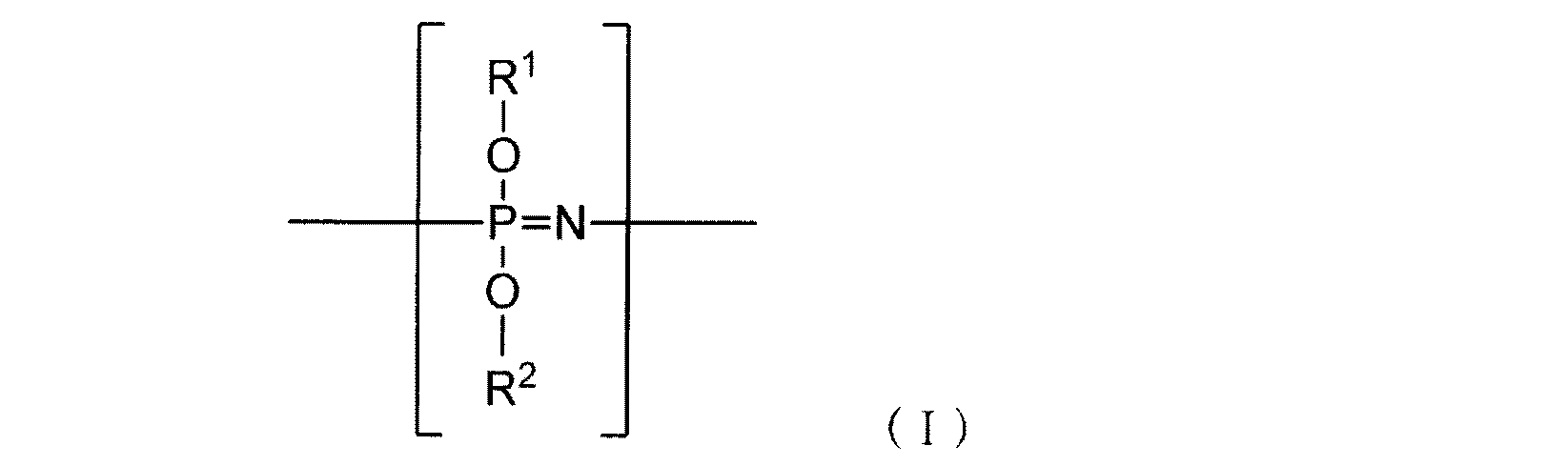
で表される構成単位が複数個結合してなるシクロホスファゼン化合物の混合体であって、
当該構成単位が3個、4個及び5個結合してなるシクロホスファゼン化合物を含み、
(1)前記構成単位が3個結合してなるシクロホスファゼン化合物は、一般式(I-A):
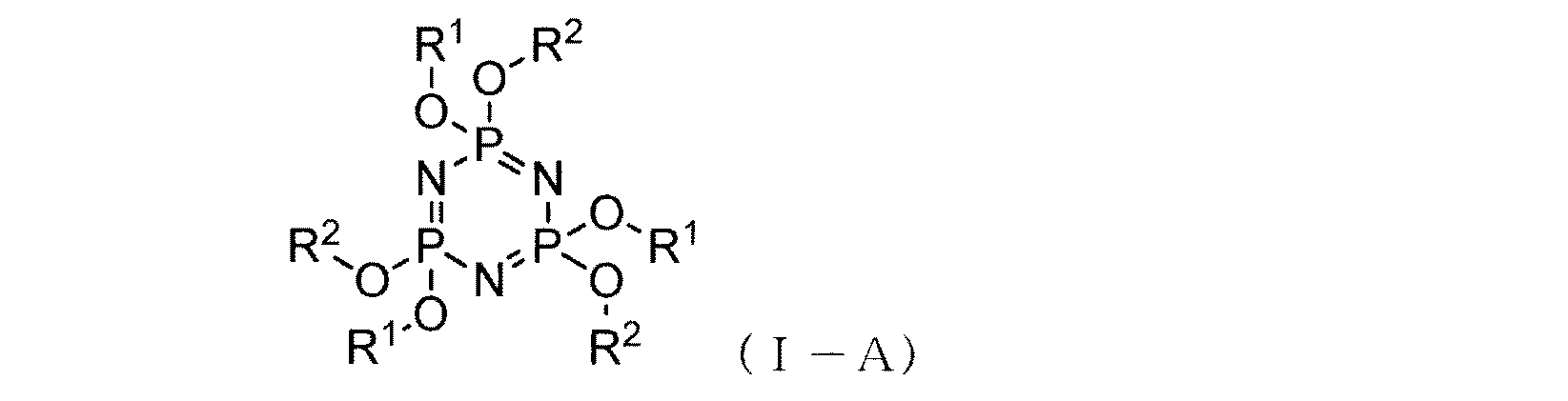
で表されるシクロホスファゼン化合物(I-A)であり、
(2)該シクロホスファゼン化合物(I-A)には、3個のR1及び3個のR2のうち、2個が下記基(II):
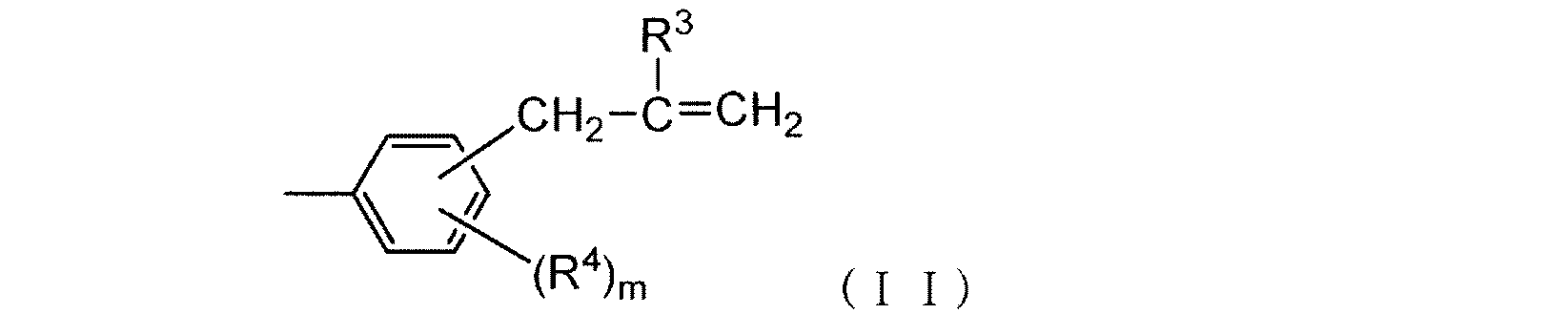
R4は、炭素数1~4のアルキル基又は炭素数1~4のアルコキシ基を示す。
mは0~4の整数を示す。
mが2以上の整数を示す場合、m個のR4は、同一又は異なっていてもよい。]
であるシクロホスファゼン化合物(I-A2)、及び
3個が上記基(II)であるシクロホスファゼン化合物(I-A3)が含まれ、かつ
(3)該シクロホスファゼン化合物(I-A2)及びシクロホスファゼン化合物(I-A3)は、上記シクロホスファゼン化合物(I-A)中に、合計で80重量%以上の割合で含まれる、シクロホスファゼン化合物の混合体。
項2.
一般式(I):
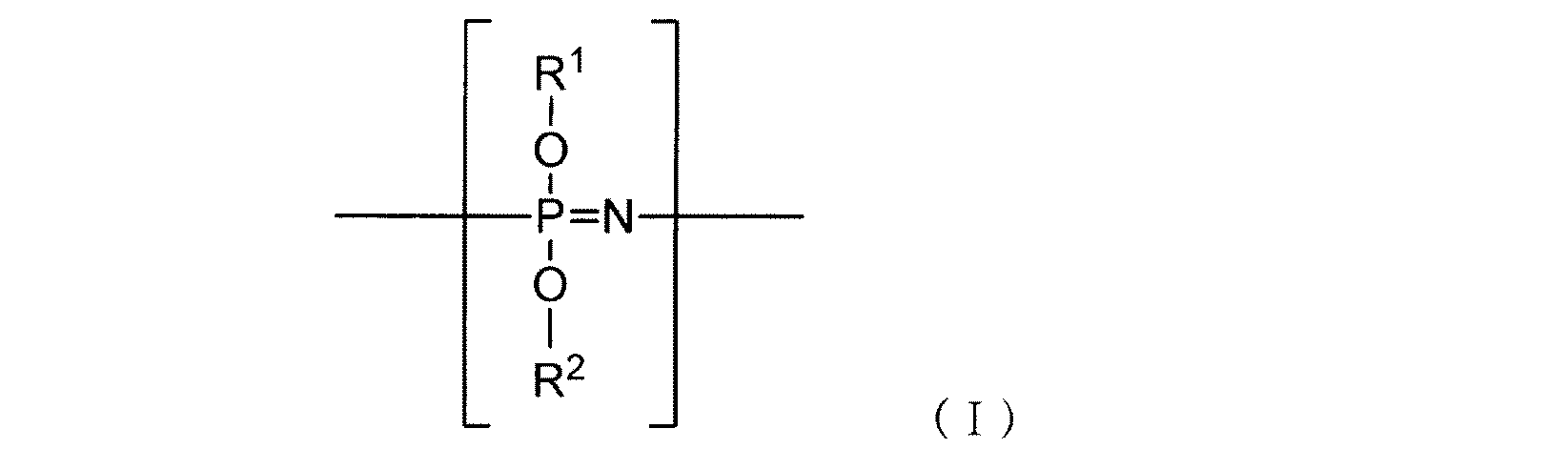
で表される構成単位が3~15個結合してなるシクロホスファゼン化合物の混合体であって、
(1)該シクロホスファゼン化合物の混合体には、一般式(I-A):

で表されるシクロホスファゼン化合物(I-A)が含まれ、
(2)該シクロホスファゼン化合物(I-A)には、3個のR1及び3個のR2のうち、2個が下記基(II):
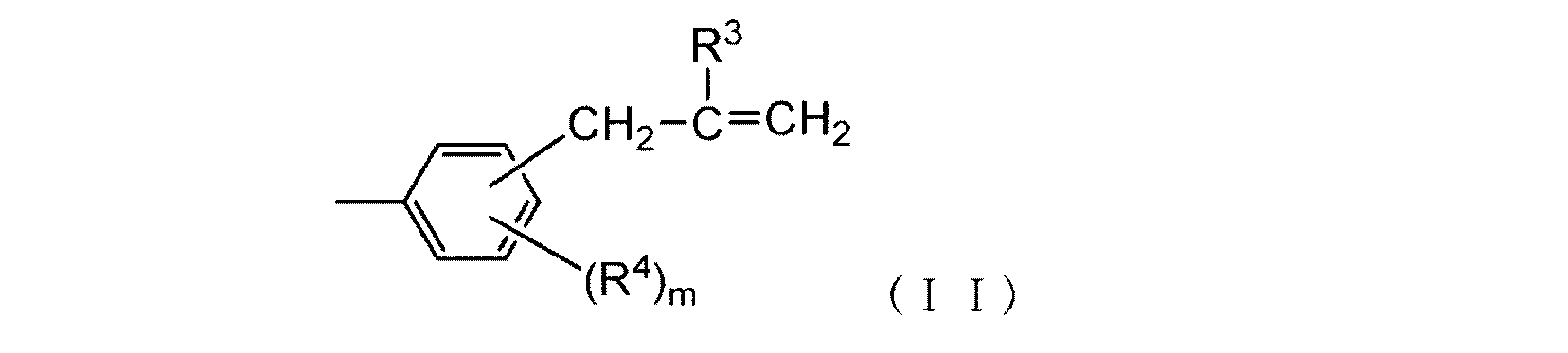
R4は、炭素数1~4のアルキル基又は炭素数1~4のアルコキシ基を示す。
mは0~4の整数を示す。
mが2以上の整数を示す場合、m個のR4は、同一又は異なっていてもよい。]
であるシクロホスファゼン化合物(I-A2)、及び
3個が上記基(II)であるシクロホスファゼン化合物(I-A3)が含まれ、かつ
(3)該シクロホスファゼン化合物(I-A2)及びシクロホスファゼン化合物(I-A3)は、上記シクロホスファゼン化合物(I-A)中に、合計で80重量%以上の割合で含まれる、シクロホスファゼン化合物の混合体。
項3.
シクロホスファゼン化合物(I-A2)及びシクロホスファゼン化合物(I-A3)が、シクロホスファゼン化合物(I-A)中に、合計で85重量%以上の割合で含まれる、項2記載のシクロホスファゼン混合体。
項4.
項2に記載のシクロホスファゼン化合物の混合体であって、
(1)該シクロホスファゼン化合物の混合体は、一般式(I-B):
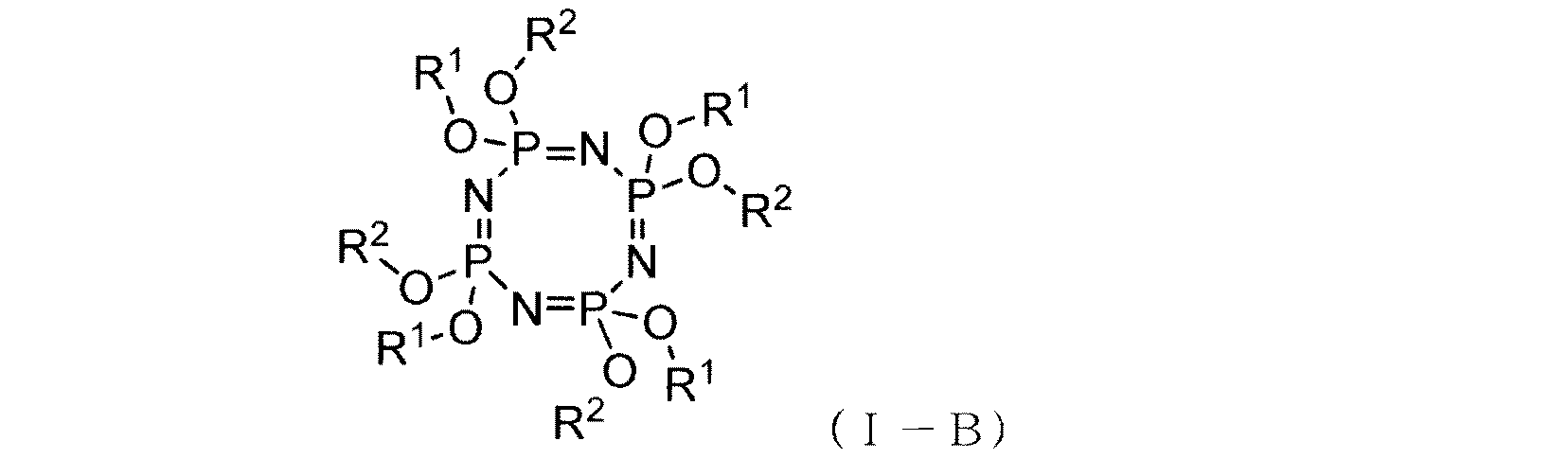
で表されるシクロホスファゼン化合物(I-B)が含まれ、
(2)該シクロホスファゼン化合物(I-B)には、4個のR1及び4個のR2のうち、3個が下記基(II):
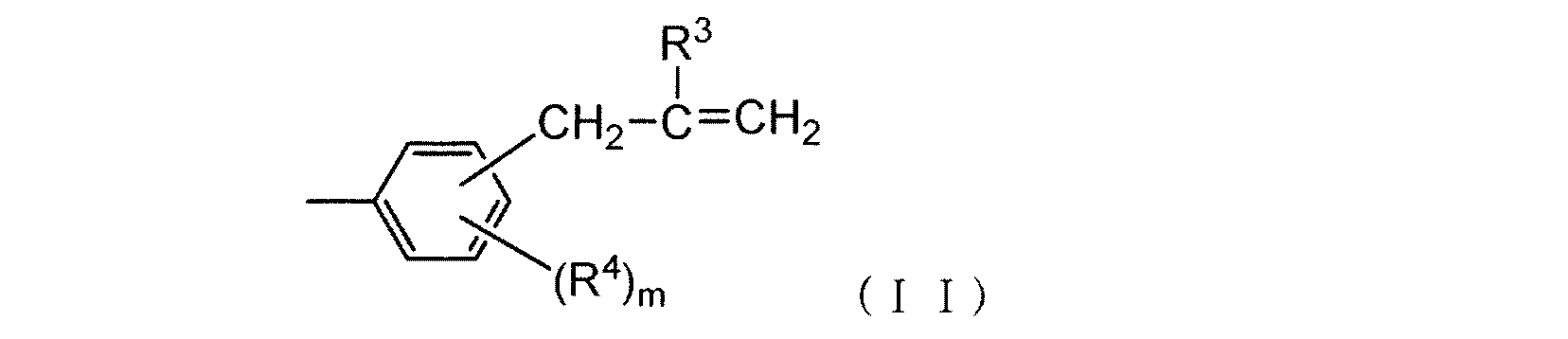
R4は、炭素数1~4のアルキル基及び炭素数1~4のアルコキシ基を示す。
mは0~4の整数を示す。
mが2以上の整数を示す場合、m個のR4は、同一又は異なっていてもよい。]
であるシクロホスファゼン化合物(I-B3)、
4個が上記基(II)で表されるアリルフェニル基であるシクロホスファゼン化合物(I-B4)、及び
5個が上記基(II)で表されるアリルフェニル基であるシクロホスファゼン化合物(I-B5)が含まれ、かつ
(3)該シクロホスファゼン化合物(I-B3)、シクロホスファゼン化合物(I-B4)及びシクロホスファゼン化合物(I-B5)は、シクロホスファゼン化合物(I-B)中に、合計で80重量%以上の割合で含まれる、シクロホスファゼン化合物の混合体。
項5.
前記一般式(I)で表される構成単位が6~15個結合してなるシクロホスファゼン化合物の少なくとも1種が含まれる、項1~4の何れか一項に記載のシクロホスファゼン化合物の混合体。
項6.
酸価が0.5mgKOH/g以下である、項1~5の何れか一項に記載のシクロホスファゼン化合物の混合体。
項7.
酸価が0.1mgKOH/g以下である、項1~5の何れか一項に記載のシクロホスファゼン化合物の混合体。
項8.
項1~7の何れか一項に記載のシクロホスファゼン化合物の混合体を製造する方法であって、
一般式(III):

で表される構成単位が3~15個結合してなるハロシクロホスファゼン化合物の混合体と、アリルフェノラート化合物とを反応させる第1工程、及び
第1工程で得られた化合物とフェノラート化合物とを反応させる第2工程を備え、
該アリルフェノラート化合物が、一般式(IV):

R4は、炭素数1~4のアルキル基及び炭素数1~4のアルコキシ基を示す。
mは0~4の整数を示す。
mが2以上の整数を示す場合、m個のR4は、同一又は異なっていてもよい。
Mは、アルカリ金属を示す。]
で表される化合物であり、かつ
該フェノラート化合物が、一般式(V):

R5は、炭素数1~4のアルキル基、炭素数1~4のアルコキシ基、炭素数2~7のアルケニル基、炭素数2~7のアルケニルオキシ基、炭素数3~8のシクロアルキル基、炭素数3~8のシクロアルコキシ基、ニトロ基又はシアノ基を示す。
nは0~5の整数を示す。
nが2以上の整数を示す場合、n個のR5は、同一又は異なっていてもよい。]
で表される化合物である、製造方法。
項9.
項8に記載のシクロホスファゼン化合物の混合体を製造する方法であって、
第1工程が、ハロシクロホスファゼン化合物の混合体を、アリルフェノラート化合物のスラリーに添加する工程(1-1A)を備える、製造方法。
項10.
前記工程(1-1A)が、前記ハロシクロホスファゼン化合物の混合体を、前記アリルフェノラート化合物のスラリーに一度に加えることにより行われる、項9に記載の製造方法。
項11.
項8に記載のシクロホスファゼン化合物の混合体を製造する方法であって、
第1工程が、アリルフェノラート化合物を、ハロシクロホスファゼン化合物の混合体に加える工程(1-1B)を備える、製造方法。
項12.
前記工程(1-1B)が、前記アリルフェノラート化合物を、前記ハロシクロホスファゼン化合物の混合体に、徐々に、又は2回以上に分けて加えることにより行われる、項11に記載の製造方法。
項13.
項8に記載のシクロホスファゼン化合物の混合体を製造する方法であって、
第1工程が、ハロシクロホスファゼン化合物の混合体を、アリルフェノラート化合物のスラリーに添加する工程(1-1A)、工程(1-1A)で得られた溶液を撹拌する工程(1-2A)、及び該工程(1-2A)で得られた溶液を加熱する工程(1-3A)を備える、製造方法。
項14.
項8に記載のシクロホスファゼン化合物の混合体を製造する方法であって、
第1工程が、アリルフェノラート化合物を、ハロシクロホスファゼン化合物の混合体に加える工程(1-1B)、工程(1-1B)で得られた溶液を加熱する工程(1-2B)を備える、製造方法。
項15.
項1~7の何れか一項に記載のシクロホスファゼン化合物の混合体を含有する難燃剤。
項16.
項1~7の何れか一項に記載のシクロホスファゼン化合物の混合体と、樹脂とを含有する難燃性樹脂組成物。
項17.
項16に記載の難燃性樹脂組成物であって、
シクロホスファゼン化合物の混合体の配合量が、樹脂100重量部に対して、0.1~100重量部である、難燃性樹脂組成物。
項18.
項16又は17に記載の難燃性樹脂組成物を成形して得られる成形体。
項19.
項1~7の何れか一項記載のシクロホスファゼン化合物の混合体とジエノフィル化合物とを含有する熱硬化性樹脂組成物。
項20.
項19に記載の熱硬化性樹脂組成物を成形して得られる成形体。
項21.
項19に記載の熱硬化性樹脂組成物から得られる低誘電性回路基板材料。
本明細書において、R1、R2、R3、R4、及びR5で示される各基は、次のとおりである。
本発明のシクロホスファゼン化合物の混合体(以下、「シクロホスファゼン混合体」ともいうことがある。)は、一般式(I):
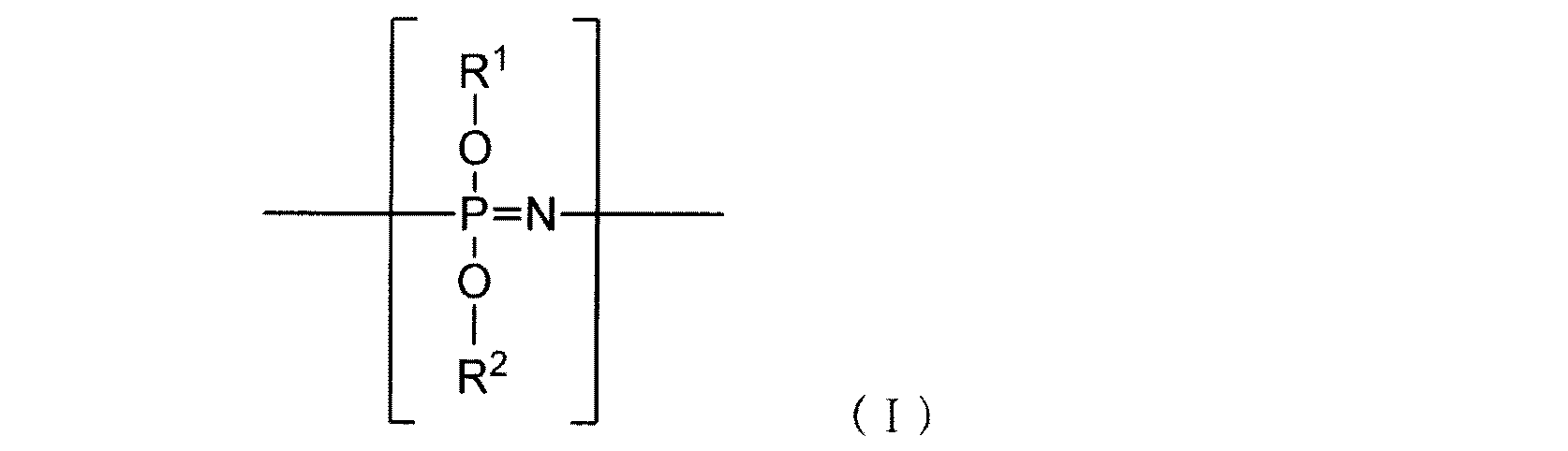
で表される構成単位が複数個結合してなるシクロホスファゼン化合物の混合体であって、
当該構成単位が3個、4個及び5個結合してなるシクロホスファゼン化合物を含み、
(1)前記構成単位が3個結合してなるシクロホスファゼン化合物は、一般式(I-A):

で表されるシクロホスファゼン化合物(I-A)であり、
(2)該シクロホスファゼン化合物(I-A)には、3個のR1及び3個のR2のうち、2個が下記基(II):
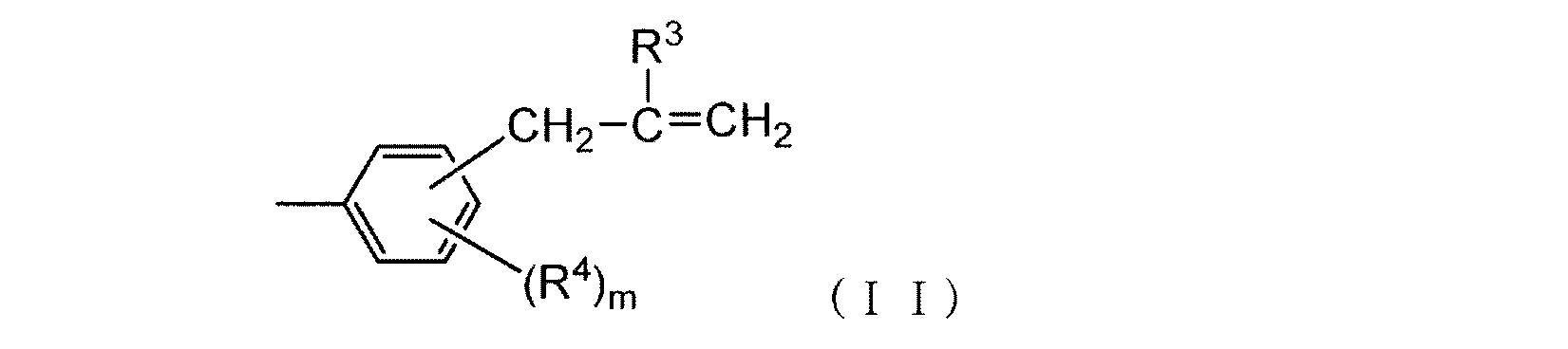
R4は、炭素数1~4のアルキル基又は炭素数1~4のアルコキシ基を示す。
mは0~4の整数を示す。
mが2以上の整数を示す場合、m個のR4は、同一又は異なっていてもよい。]
であるシクロホスファゼン化合物(I-A2)、及び
3個が上記基(II)であるシクロホスファゼン化合物(I-A3)が含まれ、かつ
(3)該シクロホスファゼン化合物(I-A2)及びシクロホスファゼン化合物(I-A3)は、上記シクロホスファゼン化合物(I-A)中に、合計で80重量%以上の割合で含まれている。
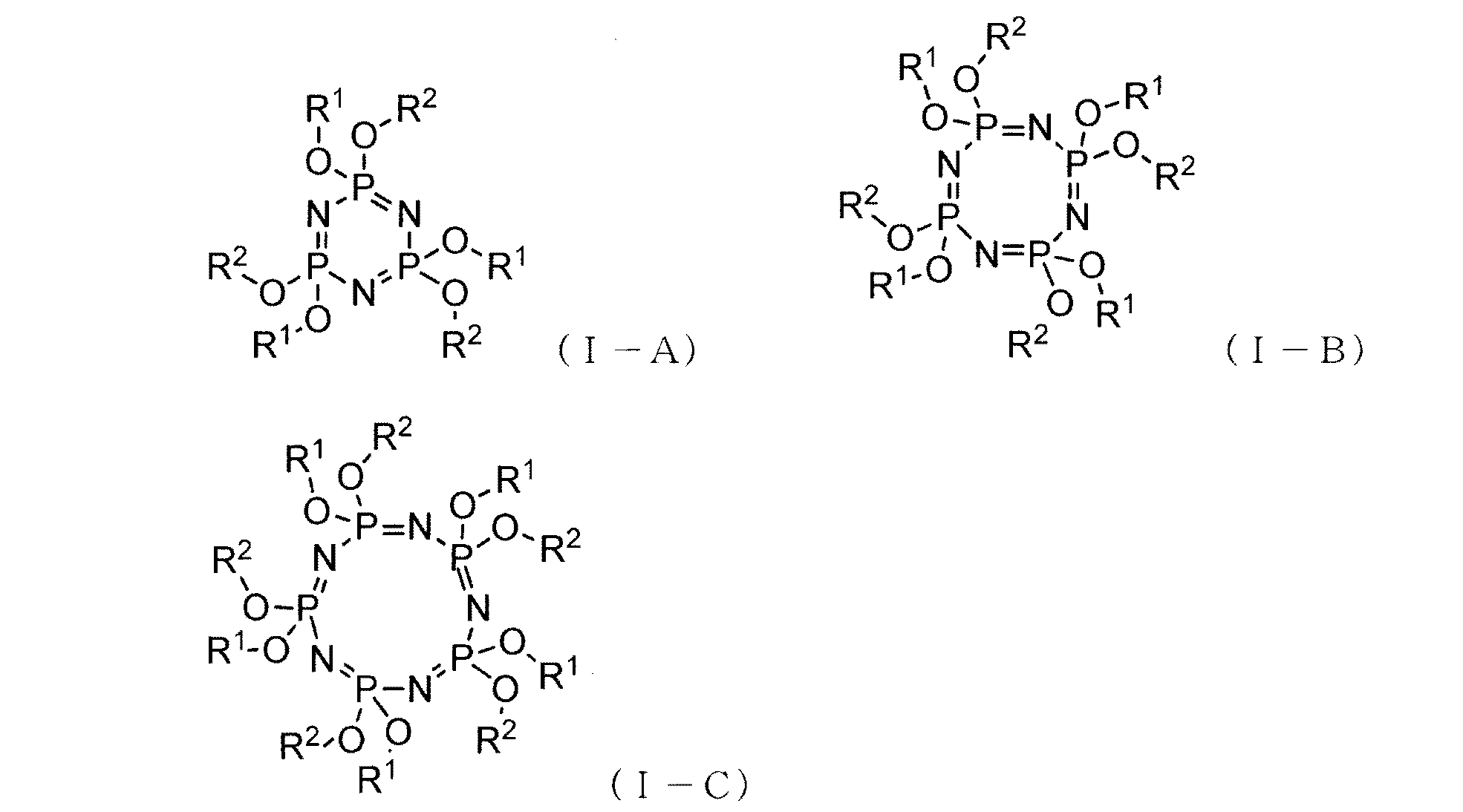
本発明のシクロホスファゼン化合物の混合体は、少なくとも上記シクロホスファゼン化合物(I-A)、(I-B)及び(I-C)を含んでいればよい。本発明のシクロホスファゼン化合物の混合体には、上記シクロホスファゼン化合物(I-A)、(I-B)及び(I-C)に加えて、一般式(I)で表される構成単位が6個以上結合してなるシクロホスファゼン化合物が含まれていてもよく、その場合のシクロホスファゼン化合物の構成単位の数(何量体であるか)は特に制限されない。例えば、後述する一般式(I)で表される構成単位が6~15個結合してなるシクロホスファゼン化合物(I-D~I-N)(以下、「6量体~15量体」、又は「シクロホスファゼン化合物(I-D~I-N)」ということもある)が全て含まれていてもよいし、又は、前記シクロホスファゼン化合物(I-D~I-N)の少なくとも1種、例えば、シクロホスファゼン化合物(I-D~I-K)(6量体~12量体)が含まれていてもよい。あるいは、例えば、16量体、17量体等の該構成単位が15より多い数で結合してなる多量体が含まれていてもよい。
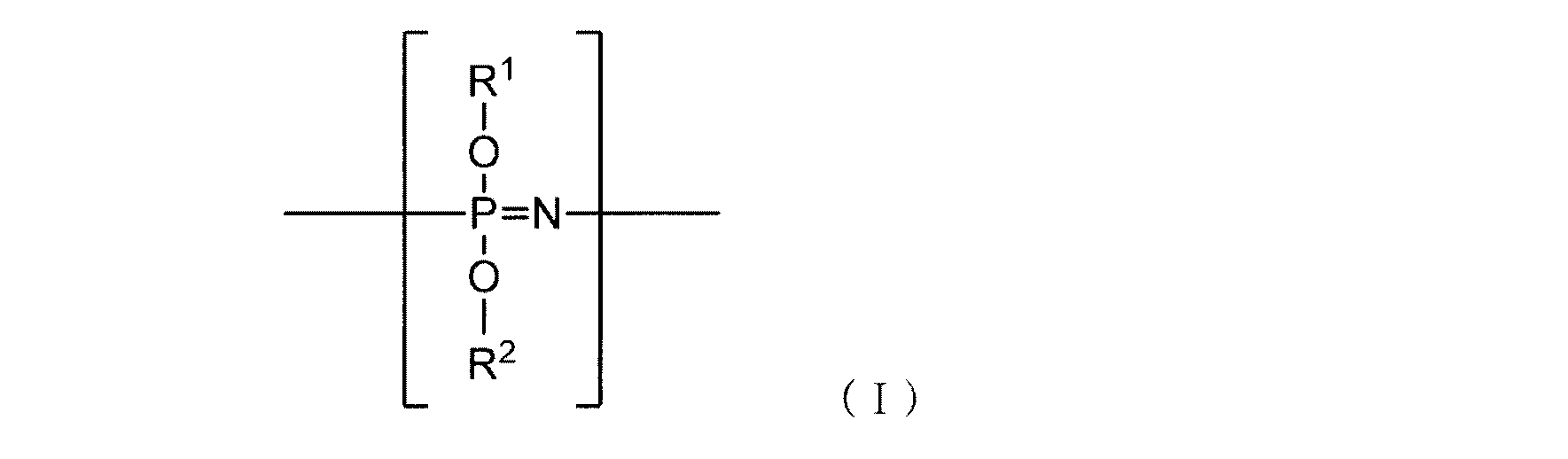
で表される構成単位が3~15個結合してなるシクロホスファゼン化合物の混合体であって、
(1)該シクロホスファゼン化合物の混合体には、一般式(I-A):

で表されるシクロホスファゼン化合物(I-A)が含まれ、
(2)該シクロホスファゼン化合物(I-A)には、3個のR1及び3個のR2のうち、2個が下記基(II):

であるシクロホスファゼン化合物(I-A2)、及び
3個が上記基(II)であるシクロホスファゼン化合物(I-A3)が含まれ、かつ
(3)該シクロホスファゼン化合物(I-A2)及びシクロホスファゼン化合物(I-A3)は、上記シクロホスファゼン化合物(I-A)中に、合計で80重量%以上の割合で含まれている、シクロホスファゼン化合物の混合体が挙げられる。
上記シクロホスファゼン化合物(I-A)と上記シクロホスファゼン化合物(I-B)とが、シクロホスファゼン化合物の混合体中に、合計で80重量%以上存在する混合体がより好ましく;
上記シクロホスファゼン化合物(I-A)と上記シクロホスファゼン化合物(I-B)とが、シクロホスファゼン化合物の混合体中に、合計で85重量%以上存在しているのが更に好ましい。
一般式(I)で表される構成単位が3個結合してなるシクロホスファゼン化合物(3量体)は、上記シクロホスファゼン化合物(I-A2)及びシクロホスファゼン化合物(I-A3)だけでなく、一般式(I-A)で表される3個のR1及び3個のR2のうち、0個が基(II)であるシクロホスファゼン化合物(I-A0)、
1個が基(II)であるシクロホスファゼン化合物(I-A1)、
4個が基(II)であるシクロホスファゼン化合物(I-A4)、
5個が基(II)であるシクロホスファゼン化合物(I-A5)、及び/又は
6個が基(II)であるシクロホスファゼン化合物(I-A6)を含むことができる。
一般式(I)で表される構成単位が4個結合してなるシクロホスファゼン化合物(4量体)は、上記シクロホスファゼン化合物(I-B3)、シクロホスファゼン化合物(I-B4)及びシクロホスファゼン化合物(I-B5)だけでなく、一般式(I-B)で表される4個のR1及び4個のR2のうち、
0個が基(II)であるシクロホスファゼン化合物(I-B0)、
1個が基(II)であるシクロホスファゼン化合物(I-B1)、
2個が基(II)であるシクロホスファゼン化合物(I-B2)、
6個が基(II)であるシクロホスファゼン化合物(I-B6)、
7個が基(II)であるシクロホスファゼン化合物(I-B7)、及び/又は
8個が基(II)であるシクロホスファゼン化合物(I-B8)を含むことができる。

が置換したフェニル基であれば、特に限定はなく、基(A)がオルト位又はパラ位に置換したフェニル基が好ましく、オルト位に置換したフェニル基が特に好ましい。
本発明のシクロホスファゼン混合体の製造方法は、
一般式(III):

で表される構成単位が複数個、例えば3~15個結合してなるハロシクロホスファゼン化合物の混合体(以下、「ハロシクロホスファゼン混合体」ということもある。)と、アリルフェノラート化合物とを反応させる第1工程、及び
第1工程で得られた化合物とフェノラート化合物とを反応させる第2工程を備える。
第1工程は、上記ハロシクロホスファゼン混合体と、アリルフェノラート化合物とを反応させる工程である。
一般式(III)で表される構成単位が3個結合して環構造を形成してなるシクロホスファゼン化合物(III-A)(以下、「ハロシクロホスファゼン化合物(III-A)」ということもある);
一般式(III)で表される構成単位が4個結合して環構造を形成してなるシクロホスファゼン化合物(III-B)(以下、「ハロシクロホスファゼン化合物(III-B)」ということもある);
一般式(III)で表される構成単位が5個結合して環状構造を形成してなるシクロホスファゼン化合物(III-C)(以下、「ハロシクロホスファゼン化合物(III-C)」ということもある);及び
一般式(III)で表される構成単位が6~15個結合してなるハロシクロホスファゼン化合物(III-D~III-N)等を含んでいるハロシクロホスファゼン化合物の混合体が挙げられる。
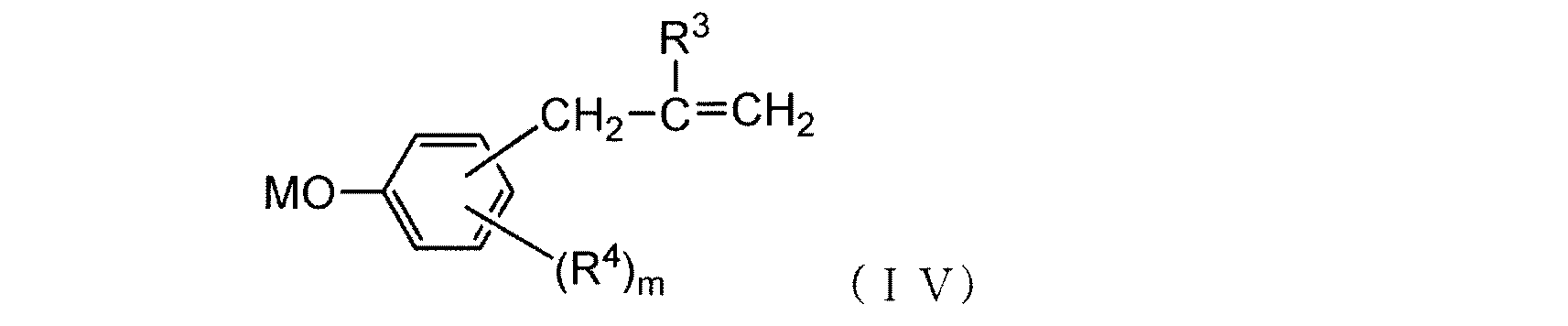
で表される化合物(IV)である。具体的には、該アリルフェノラート化合物としては、例えば、ナトリウム 2-アリルフェノラート、ナトリウム 4-アリルフェノラート、カリウム 2-アリルフェノラート、リチウム 2-アリルフェノラート、ナトリウム 2-アリル-6-メチルフェノラート、ナトリウム 2-アリル-6-エチルフェノラート、ナトリウム 4-アリル-2-メチルフェノラート、ナトリウム 4-アリル-2-メトキシフェノラート、ナトリウム 4-アリル-3-メチルフェノラート、ナトリウム 4-アリル-3-メチル-2-メトキシフェノラート等が挙げられる。これらフェノラート化合物は1種を単独で使用でき、又は2種以上を併用できる。
ハロシクロホスファゼン化合物の混合体を、アリルフェノラート化合物のスラリーに添加する工程(1-1A)を備える方法(添加方法1)、及び
アリルフェノラート化合物を、ハロシクロホスファゼン化合物の混合体に加える工程(1-1B)を備える方法(添加方法2)である。
通常、アリルフェノラート化合物は、アリルフェノールに水酸化ナトリウム、水酸化カリウム等のアルカリ金属水酸化物又は水素化ナトリウム等の塩基を反応させることにより製造することができる。
第1工程の別法(添加方法2)としては、アリルフェノラート化合物を、ハロシクロホスファゼン混合体に加える工程(1-1B)を備える方法である。中でも、該アリルフェノラート化合物を、ハロシクロホスファゼン混合体に、滴下等の手段で徐々に、又は2回以上に分けて加えるが好ましい。分けて加える場合の回数は2回以上であれば特に制限はなく、例えば10回以下の適当な回数とすればよい。
第2工程は、第1工程で得られた化合物とフェノラート化合物とを反応させる工程である。第2工程では、例えば、第1工程で得られた化合物と一般式(V)で表されるフェノラート化合物とを無溶媒下又は溶媒の存在下で加熱することで、目的とする一般式(I)で表される構成単位が3~15個結合してなるシクロホスファゼン化合物の混合体を得ることができる。

で表される化合物である。
本発明の難燃剤及び難燃性樹脂組成物は、上記一般式(I)で表されるシクロホスファゼン化合物の混合体を含有する。上記シクロホスファゼン化合物の混合体は、高い難燃効果を有し、樹脂にシクロホスファゼン化合物の混合体を配合することで、得られた樹脂組成物、又は成形体は、優れた難燃性を示し、樹脂用の難燃剤として好適に使用できる。
本発明の熱硬化性樹脂組成物は、本発明のシクロホスファゼン化合物の混合体とジエノフィルとを含んでいる。
本発明の難燃性樹脂組成物又は本発明の熱硬化性樹脂組成物は、例えば、プレス成形、射出成形、押出成形、注型成形等の公知の成形方法により、また用途に応じて熱又は紫外線、電子線を照射して硬化成形することにより、単一層又は複数層の樹脂板、シート、フィルム、球状、方状、異形品等の任意の形状の成形体とすることができる。本発明の難燃性樹脂組成物又は本発明の熱硬化性樹脂組成物は、樹脂又は熱硬化性重合体が使用可能なあらゆる分野で適用でき、例えば、電気及び電子機器、通信機器、精密機器、自動車等の輸送機器、繊維製品、各種製造機械類、食品包装フィルム、容器、農林水産分野、建設用資材、医療用品、家具類の構成部品等が挙げられる。
還流冷却器、温度計、撹拌機及び滴下器を備えた100Lのフラスコにモノクロロベンゼン40L、塩化アンモニウム790g及び塩化亜鉛2.5gを仕込んで混合分散液を得た。これに五塩化リン2.9kgをクロロベンゼン10Lに溶解させた溶液を20時間かけて滴下した。五塩化リンを供給した後、20時間加熱還流した。次いで吸引濾過して未反応の塩化アンモニウムを除去し、濾液を13.3~40hPaの減圧下にて30~40℃でクロルベンゼンを留去してクロロシクロホスファゼン1460g(ヘキサクロロシクロトリホスファゼン:70%、オクタクロロシクロテトラホスファゼン:19%、五量体以上のクロロシクロホスファゼン:11%)を得た(収率約90%)。これをモノクロロベンゼンに再溶解させて、約30%のクロロシクロホスファゼン溶液を調製した。
第1工程(添加方法1)
還流冷却器を付けたディーンスタークトラップ及び滴下ロートを備えた2リットルの2口フラスコに2-アリルフェノール381g及びモノクロロベンゼン1000mLを仕込み、窒素気流下で加熱した。そこへ水酸化ナトリウム水溶液(107g/水110mL)を滴下して加え、6時間加熱還流した。この間、反応系中の水はモノクロロベンゼンとの共沸により系外へ除去し、モノクロロベンゼンのみを系内へ戻した。脱水完了後、反応液を40℃以下に冷却し、結晶を析出させてスラリー状態とした。
還流冷却器を付けたディーンスタークトラップ及び滴下ロートを備えた3リットルの4口フラスコに、フェノール314g及びモノクロロベンゼン2000mLを仕込み、窒素気流下で加熱した。そこへ水酸化ナトリウム130g、水酸化カリウム5g及び水135mLの溶液を滴下して加え、15時間加熱還流した。この間、反応系中の水はモノクロロベンゼンとの共沸により系外へ除去し、モノクロロベンゼンのみを系内へ戻した。
31P-NMR(500MHz,CDCl3,δppm):8.4~9.3(3量体),-14~-12(4量体),-22~-17(5量体以上)
なお、3量体、4量体、5量体以上の各ピーク面積の割合は、それぞれ70.36%、19.32%、10.32%であった。
5%分解温度(TG/DTA): >350℃
加水分解性塩素の量:0.0007%
酸価:0.01mgKOH/g(サンプル重量)
本実施例で製造されたシクロホスファゼン化合物の混合体において、基(II)で表されるアリルフェニル基(2-アリルフェニル基)が0~6個置換した3量体の生成割合を表1に示した。
カラム:GLサイエンス株式会社製 InertSustain(登録商標) C18 3mm×25cm溶離液:アセトニトリル:水=95:5
流速:0.5mL/min
検出:UV(254nm)
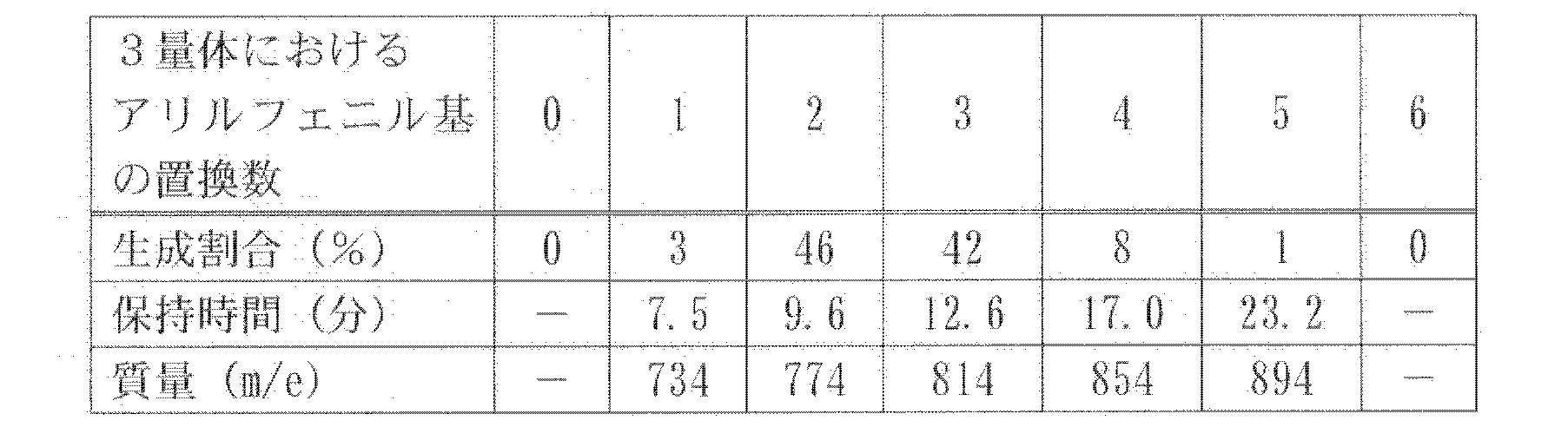
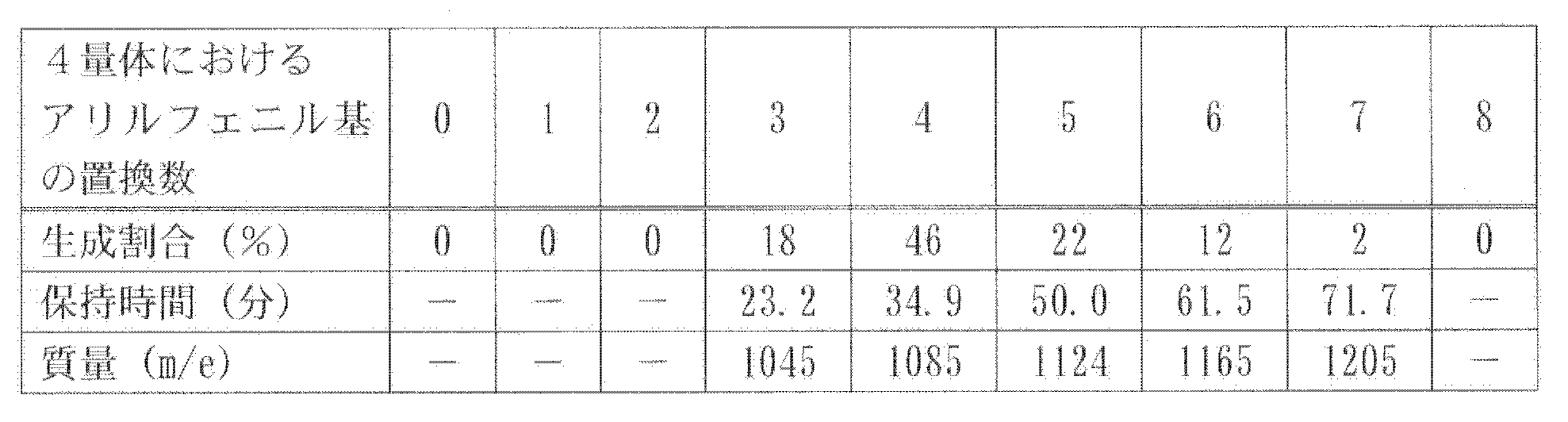
第1工程(添加方法2)
(1)還流冷却器を付けたディーンスタークトラップ及び滴下ロートを備えた2リットルの2口フラスコに2-アリルフェノール381g及びモノクロロベンゼン1000mLを仕込み、窒素気流下で加熱した。そこへ水酸化ナトリウム水溶液(107g/水110mL)を滴下して加え、6時間加熱還流した。この間、反応系中の水はモノクロロベンゼンとの共沸により系外へ除去し、モノクロロベンゼンのみを系内へ戻した。反応液中の水分含量が1000ppm以下であることを確認した後、懸濁液を100℃程度に冷却した。
還流冷却器を付けたディーンスタークトラップ及び滴下ロートを備えた3リットルの4口フラスコに、フェノール314g及びモノクロロベンゼン2000mLを仕込み、窒素気流下で加熱撹拌した。そこへ水酸化ナトリウム130g、水酸化カリウム5g及び水135mLの溶液を滴下して加え、15時間加熱還流した。この間、反応系中の水はモノクロロベンゼンとの共沸により系外へ除去し、モノクロロベンゼンのみを系内へ戻した。フラスコに蒸留塔を取り付け、反応液を加熱して、モノクロロベンゼンを系外に除去しながら、第1工程で得られた反応物を3回に分けて投入した。加熱を継続してモノクロロベンゼンを全て系外に除去した後、窒素気流下で170~180℃(内温130~150℃)で15時間加熱した。
31P-NMR(500MHz,CDCl3,δppm):8.4~9.3(3量体),-14~-12(4量体),-22~-17(5量体以上)
なお、3量体、4量体、5量体以上の各ピーク面積の割合は、それぞれ70%、19%、11%であった。
5%分解温度(TG/DTA): >350℃
加水分解性塩素:0.003%
酸価:0.02mgKOH/g
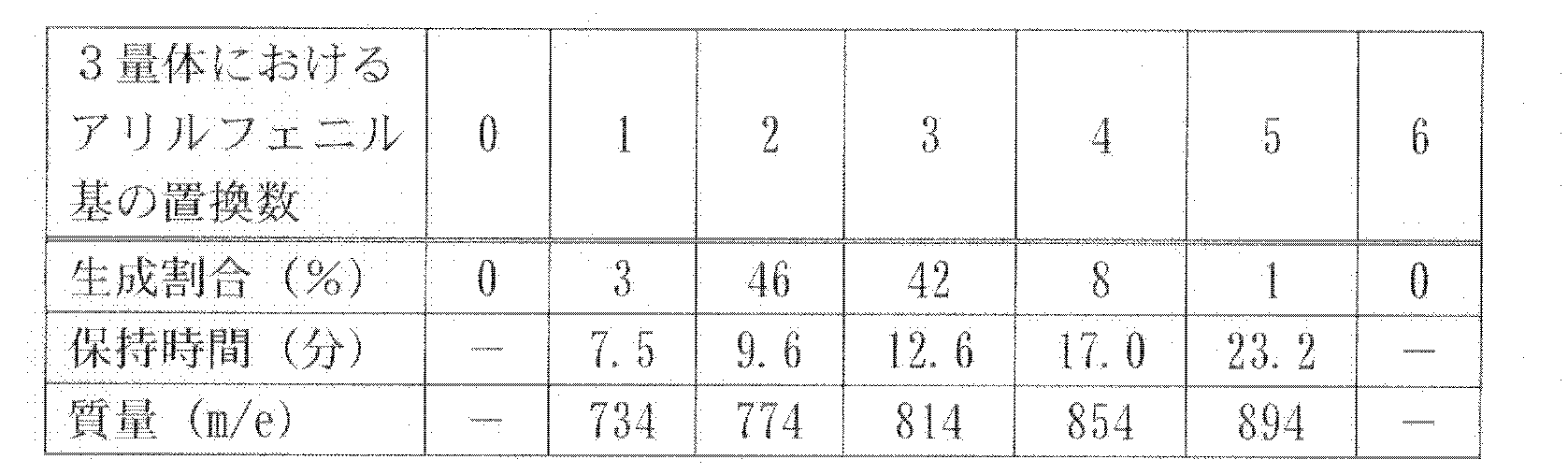

特開平1-158041の例3に準じて、以下シクロホスファゼン混合体の製造を行った。
加水分解性塩素:0.2%
酸価:0.2mgKOH/g
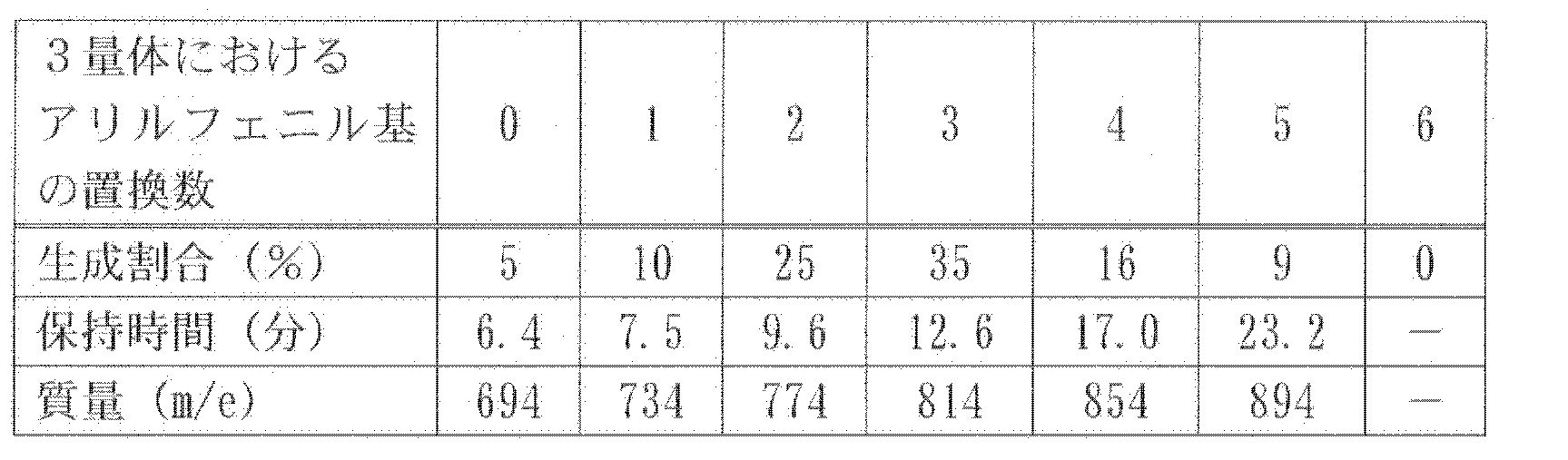
本比較例によれば、従来法での製造方法で得られたシクロホスファゼン化合物の混合体は、アリルフェニル基の置換数が1以下の化合物が、3量体中に、15%を占めることわかった。
第1工程(添加方法1)
還流冷却器を付けたディーンスタークトラップ及び滴下ロートを備えた1リットルの4口フラスコに2-アリルフェノール121g及びモノクロロベンゼン400mLを仕込み、窒素気流下で加熱した。90℃以上で、水酸化ナトリウム水溶液(35.9g/水40mL)を滴下して加え、6時間加熱還流した。この間、反応系中の水はモノクロロベンゼンとの共沸により系外へ除去し、モノクロロベンゼンのみを系内へ戻した。脱水完了後、反応液を40℃以下に冷却し、結晶を析出させてスラリー状態とした。
還流冷却器を付けたディーンスタークトラップ及び滴下ロートを備えた2リットルの4口フラスコに、p-ニトロフェノール165g及びモノクロロベンゼン600mLを仕込み、窒素気流下で加熱した。そこへ水酸化ナトリウム44g、水酸化カリウム2.4g及び水50mLの溶液を滴下して加え、15時間加熱還流した。この間、反応系中の水はモノクロロベンゼンとの共沸により系外へ除去し、モノクロロベンゼンのみを系内へ戻した。
31P-NMR(500MHz,CDCl3,δppm):7.0~10.0(3量体),-12~-17(4量体),-17~-24(5量体以上)
3量体、4量体、5量体以上の各ピーク面積の割合は、それぞれ68.35%、20.84%、10.81%であった。
第1工程(添加方法1)
還流冷却器を付けたディーンスタークトラップ及び滴下ロートを備えた1リットルの4口フラスコに2-アリルフェノール121g及びモノクロロベンゼン400mLを仕込み、窒素気流下で加熱した。90℃以上で、水酸化ナトリウム水溶液(35.9g/水40mL)を滴下して加え、6時間加熱還流した。この間、反応系中の水はモノクロロベンゼンとの共沸により系外へ除去し、モノクロロベンゼンのみを系内へ戻した。脱水完了後、反応液を40℃以下に冷却し、結晶を析出させてスラリー状態とした。
還流冷却器を付けたディーンスタークトラップ及び滴下ロートを備えた2リットルの4口フラスコに、p-クレゾール128g及びモノクロロベンゼン600mLを仕込み、窒素気流下で加熱した。そこへ水酸化ナトリウム44g、水酸化カリウム2.4g及び水50mLの溶液を滴下して加え、15時間加熱還流した。この間、反応系中の水はモノクロロベンゼンとの共沸により系外へ除去し、モノクロロベンゼンのみを系内へ戻して脱水を行った。
31P-NMR(500MHz,CDCl3,δppm):7.0~10.0(3量体),-12~-16(4量体),-16~(5量体以上)
3量体、4量体、5量体以上の各ピーク面積の割合は、それぞれ70.36%、19.32%、10.32%であった。
第1工程(添加方法1)
還流冷却器を付けたディーンスタークトラップ及び滴下ロートを備えた1リットルの4口フラスコに2-アリルフェノール121g及びモノクロロベンゼン400mLを仕込み、窒素気流下で加熱した。90℃以上で、水酸化ナトリウム水溶液(35.9g/水40mL)を滴下して加え、6時間加熱還流した。この間、反応系中の水はモノクロロベンゼンとの共沸により系外へ除去し、モノクロロベンゼンのみを系内へ戻した。脱水完了後、反応液を40℃以下に冷却し、結晶を析出させてスラリー状態とした。
還流冷却器を付けたディーンスタークトラップ及び滴下ロートを備えた2リットルの4口フラスコに、p-メトキシフェノール 146g及びモノクロロベンゼン600mLを仕込み、窒素気流下で加熱した。そこへ水酸化ナトリウム44g、水酸化カリウム2.4g及び水50mLの溶液を滴下して加え、15時間加熱還流した。この間、反応系中の水はモノクロロベンゼンとの共沸により系外へ除去し、モノクロロベンゼンのみを系内へ戻した。
31P-NMR(500MHz,CDCl3,δppm):5.0~11.0(3量体),-12~-15(4量体),-17~(5量体以上)
3量体、4量体、5量体以上の各ピーク面積の割合は、それぞれ71.03%、21.12%、7.85%であった。

第1工程(添加方法1)
還流冷却器を付けたディーンスタークトラップ及び滴下ロートを備えた1リットルの4口フラスコに2-メタリルフェノール63g及びモノクロロベンゼン400mLを仕込み、窒素気流下で加熱した。90℃以上で、水酸化ナトリウム水溶液(16.1g/水20mL)を滴下して加え、6時間加熱還流した。この間、反応系中の水はモノクロロベンゼンとの共沸により系外へ除去し、モノクロロベンゼンのみを系内へ戻した。脱水完了後、反応液を40℃以下に冷却した。
還流冷却器を付けたディーンスタークトラップ及び滴下ロートを備えた2リットルの4口フラスコに、フェノール51g及びモノクロロベンゼン600mLを仕込み、窒素気流下で加熱した。そこへ水酸化ナトリウム21g、水酸化カリウム1.2g及び水30mLの溶液を滴下して加え、15時間加熱還流した。この間、反応系中の水はモノクロロベンゼンとの共沸により系外へ除去し、モノクロロベンゼンのみを系内へ戻した。
31P-NMR(500MHz,CDCl3,δppm):7.0~10.0(3量体),-12~-15(4量体),-17~(5量体以上)
3量体、4量体、5量体以上の各ピーク面積の割合は、それぞれ73%、17%、10%であった。

第1工程(添加方法1)
還流冷却器を付けたディーンスタークトラップ及び滴下ロートを備えた1リットルの4口フラスコにオイゲノール74g及びモノクロロベンゼン500mLを仕込み、窒素気流下で加熱した。90℃以上で、水酸化ナトリウム水溶液(17.8g/水20mL)を滴下して加え、6時間加熱還流した。この間、反応系中の水はモノクロロベンゼンとの共沸により系外へ除去し、モノクロロベンゼンのみを系内へ戻した。脱水完了後、反応液を40℃以下に冷却した。
還流冷却器を付けたディーンスタークトラップ及び滴下ロートを備えた2リットルの4口フラスコに、フェノール56g及びモノクロロベンゼン400mLを仕込み、窒素気流下で加熱した。90℃以上で、水酸化ナトリウム22.4g、水酸化カリウム1.2g及び水30mLの溶液を滴下して加え、15時間加熱還流した。この間、反応系中の水はモノクロロベンゼンとの共沸により系外へ除去し、モノクロロベンゼンのみを系内へ戻した。
31P-NMR(500MHz,CDCl3,δppm):7.0~11.0(3量体),-11~-15(4量体),-17~(5量体以上)
3量体、4量体、5量体以上の各ピーク面積の割合は、それぞれ68.05%、19.62%、12.33%であった。

原料のクロロシクロホスファゼン化合物として、3量体のみを使用して、フェノキシ基及びアリルフェノキシ基が置換したシクロホスファゼン化合物の製造を行った。なお、原料となるクロロシクロホスファゼンの3量体は、製造例1と同様に製造したクロロシクロホスファゼンから単離及び精製したものを使用した。
還流冷却器を付けたディーンスタークトラップ及び滴下ロートを備えた2リットルの2口フラスコに2-アリルフェノール127g及びモノクロロベンゼン500mLを仕込み、窒素気流下で加熱した。そこへ水酸化ナトリウム水溶液(34.5g/水40mL)を滴下して加え、6時間加熱還流した。この間、反応系中の水はモノクロロベンゼンとの共沸により系外へ除去し、モノクロロベンゼンのみを系内へ戻した。脱水完了後、反応液を40℃以下に冷却し、結晶を析出させてスラリー状態とした。
還流冷却器を付けたディーンスタークトラップ及び滴下ロートを備えた3リットルの4口フラスコに、フェノール113.4g及びモノクロロベンゼン500mLを仕込み、窒素気流下で加熱した。そこへ水酸化ナトリウム44.8g、水酸化カリウム2.8g及び水135mLの溶液を滴下して加え、15時間加熱還流した。この間、反応系中の水はモノクロロベンゼンとの共沸により系外へ除去し、モノクロロベンゼンのみを系内へ戻した。
31P-NMR(500MHz,CDCl3,δppm):7.0~10.0(3量体)
3量体、4量体、5量体以上の各ピーク面積の割合は、それぞれ100%、0%、0%であった。

混合フェノラートへクロロホスファゼン混合物を加えることにより、シクロホスファゼン混合体の製造を行った。製造方法の詳細は、以下のとおりである。
31P-NMR(500MHz,CDCl3,δppm):7.0~10.0(3量体) ,-17以下(5量体以上)
3量体、4量体、5量体以上の各ピーク面積の割合は、それぞれ69%、19%、11%であった。

原料のクロロシクロホスファゼン化合物として、上記製造例1で製造したものとは3量体と4量体との比が異なるものを使用して、以下シクロホスファゼン混合体の製造を行った。なお、製造例1よりも3量体の割合の多いクロロホスファゼン(実施例8)は、製造例1と同様に製造したクロロシクロホスファゼンから単離及び精製した3量体を、製造例1で製造した30%クロロシクロホスファゼン(3量体:70%、4量体:19%、5量体以上のクロロシクロホスファゼン:11%)のモノクロロベンゼン溶液に添加することにより調製した。製造例1よりも3量体の割合の少ないクロロホスファゼン(実施例9及び10)は、製造例1と同様に製造したクロロシクロホスファゼンから3量体をある程度除くことにより調製した。3量体と4量体との比は、調製した溶液を31P-NMRで測定することにより求めた。
還流冷却器を付けたディーンスタークトラップ及び滴下ロートを備えた2リットルの2口フラスコに2-アリルフェノール127g及びモノクロロベンゼン500mLを仕込み、窒素気流下で加熱した。そこへ水酸化ナトリウム水溶液(34.5g/水40mL)を滴下して加え、6時間加熱還流した。この間、反応系中の水はモノクロロベンゼンとの共沸により系外へ除去し、モノクロロベンゼンのみを系内へ戻した。反応液を40℃以下に冷却し、結晶を析出させてスラリー状態とした。
還流冷却器を付けたディーンスタークトラップ及び滴下ロートを備えた3リットルの4口フラスコに、フェノール113.4g及びモノクロロベンゼン500mLを仕込み、窒素気流下で加熱した。そこへ水酸化ナトリウム44.8g、水酸化カリウム2.8g及び水135mLの溶液を滴下して加え、15時間加熱還流した。この間、反応系中の水はモノクロロベンゼンとの共沸により系外へ除去し、モノクロロベンゼンのみを系内へ戻した。
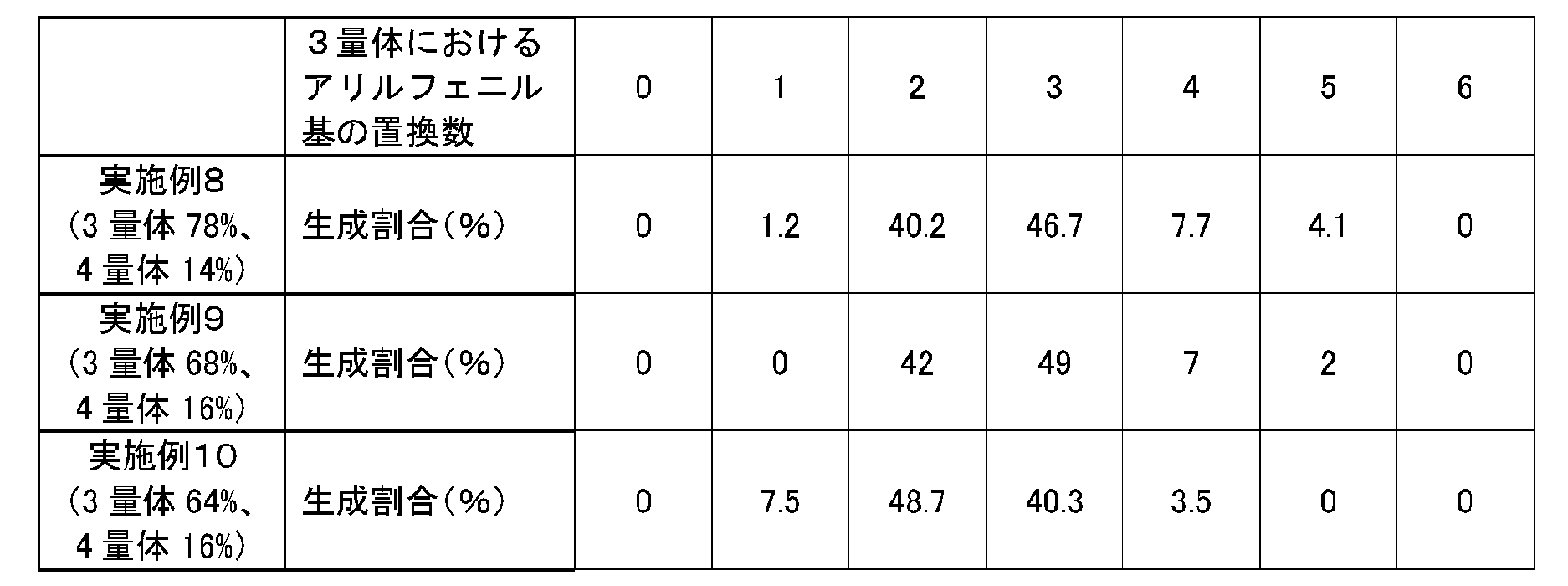
4,4’-ビスマレイミドジフェニルメタン113gを実施例1で製造したシクロホスファゼン混合体85gに加えて、撹拌後、この混合物をアルミパンに入れた。その後、これをオーブンで140℃に加熱して溶融させて、フィルム状に伸ばした。次いで、150℃で1時間加熱した後、230℃で5時間加熱して、0.44mm厚のフィルム状の暗褐色重合体を得た。
シクロホスファゼン混合体の使用量を68gに変更した以外は実施例11と同様にしてフィルム状の暗褐色重合体を得た。
4,4’-ビスマレイミドジフェニルメタン113g及びジアリルビスフェノールA 30gを実施例1で製造したシクロホスファゼン混合体13.5gに加えてアルミパンに入れ、オーブンで140℃に加熱して溶融混合させて、フィルム状に伸ばし、150℃で1時間加熱した後、230℃で5時間加熱して、0.44mm厚のフィルム状の褐色重合体を得た。
ジアリルビスフェノールAの使用量を77gに、シクロホスファゼン混合体の使用量を13.2gに変更した以外は実施例13と同様にしてフィルム状の暗褐色重合体を得た。
4,4’-ビスマレイミドジフェニルメタン113gをジアリルビスフェノールA 85gに加えて、アルミパンに入れ、オーブンで140℃に加熱して溶融混合させて、フィルム状に伸ばし、150℃で1時間加熱した後、230℃で5時間加熱して、0.44mm厚のフィルム状の重合体を得た。
3,3’-ジメチル-5,5’-ジエチル-4,4’-ジフェニルメタンビスマレイミド(BMI-70、ケイ・アイ化成株式会社製)40.8g、特開2009-161725号公報 合成例1に従って製造したビニル化合物[B]51.2g、実施例1で製造したシクロホスファゼン混合体16.2g及びスチレン系熱可塑性エラストマー(セプトンSEBS8007、株式会社クラレ製)30gを、撹拌装置を備えたセパラブルフラスコに仕込み、固形分濃度が20%となるようにトルエンを加えて60℃に加熱して1時間撹拌し、「ワニス」を調整した。ワニスをポリテトラフルオロエチレン(PTFE)フィルムに塗布し、50℃で乾燥した後、150℃で1時間、250℃で5時間加熱して基材付き硬化物を得た後、基材のPTFEフィルムを剥離してフィルム状重合体(厚み0.4mm)を得た。
3,3’-ジメチル-5,5’-ジエチル-4,4’-ジフェニルメタンビスマレイミドを33.4g、実施例1で製造したシクロホスファゼン混合体を10.8gに変更した以外は、実施例15と同様にしてフィルム状重合体を得た。
3,3’-ジメチル-5,5’-ジエチル-4,4’-ジフェニルメタンビスマレイミドを18.8gに変更し、実施例1で製造したシクロホスファゼン混合体を添加しない以外は、実施例7と同様にしてフィルム状重合体を得た。
4,4’-ビスマレイミドジフェニルメタン11.3gを比較例2で製造したシクロホスファゼン3量体8.5gに加えて、アルミパンに入れ、オーブンで140℃に加熱して溶融させて、フィルム状に伸ばし、150℃で1時間加熱した後、230℃で5時間加熱して、0.44mm厚のフィルム状の暗褐色重合体を得た。
実施例11~16及び比較例4~6で得られたフィルム状重合体の3GHzでの誘電特性を測定(空洞共振器法)した。その結果を表12に示した。
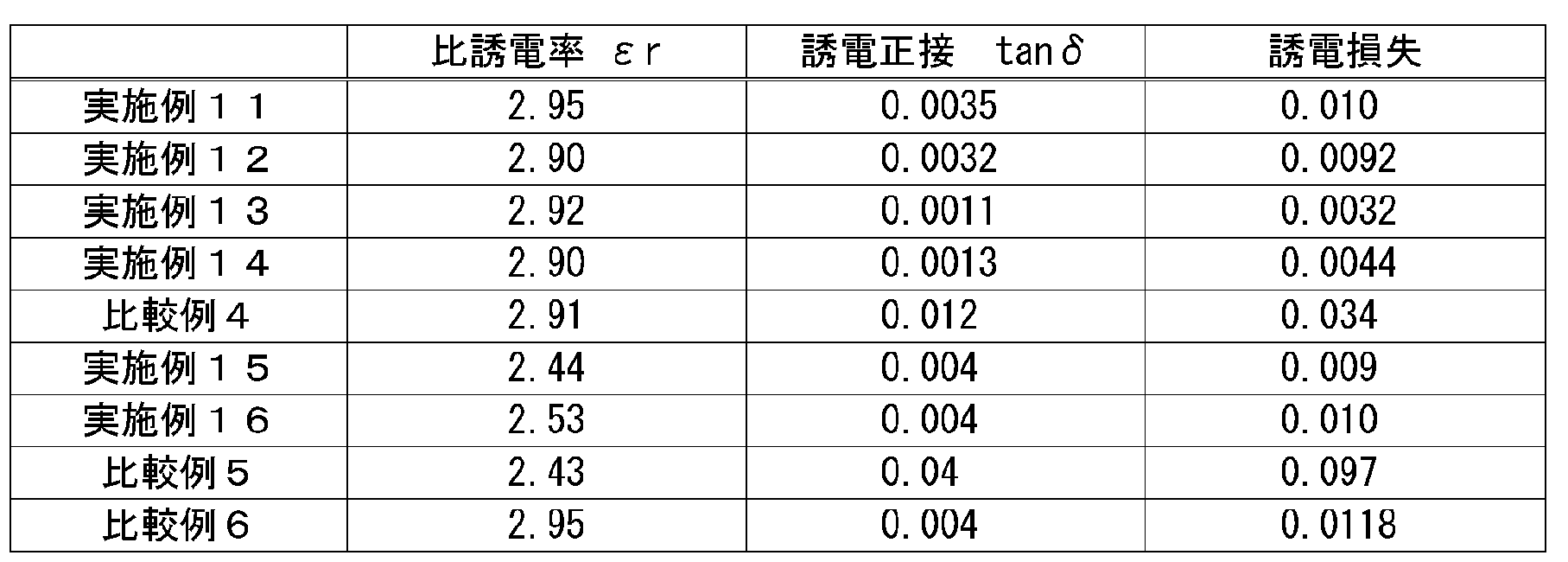
実施例11において、140℃で加熱して溶融させて得られた半硬化状態のフィルム状の重合体を5枚重ねて型枠に入れて、真空プレス(真空プレス機械、北川精機株式会社製)で230℃で加熱して1/16インチ厚の試験片1を製造した。
実施例15で製造したワニスにガラス繊維の布(厚さ50μm)に含浸させ、風乾した後、50℃で送風乾燥し、20枚を重ねて150℃で1時間、20kgf/cm2で40hPa以下の真空下で真空プレスし、続いて230℃で加熱して1/16インチ厚の試験片5を作製した。同様に実施例16で製造したワニスを用いて試験片6を作製した。
実施例17で得られた試験片1、2、3及び4、及び実施例18で得られた試験片5及び6を用いて難燃性評価試験を行った。結果を表13に示した。
アフターフレーム:接炎後(火種を取り除いた後)、材料のフレイミング(炎を上げて燃えること)が持続すること。
アフターフレーム時間:接炎後、試験条件下で、材料が炎を上げて燃え続ける時間の長さ。
アフターグロー:フレイミングが終わった後、又はもしフレイミングが起こらなければ接炎後、材料のグローイング(炎を上げて燃えないが、赤熱した火種として残ること)が持続すること。
アフターグロー時間:接炎後及び/又はフレイミングが終わった後、試験条件下で、材料が赤熱した火種として残り続ける時間の長さ。
t1:1回目のフレイミング操作後のアフターフレーム時間。
t2:2回目のフレイミング操作後のアフターフレーム時間。
t3:3回目のフレイミング操作後のアフターグロー時間。
V-0:
(1)各試験片のアフターフレーム時間t1又はt2が10秒以下。
(2)5つの試験片のアフターフレーム時間の合計(t1+t2)が50秒以下。
(3)2回目のフレイミング操作後の、各試験片のアフターフレーム時間とアフターグロー時間との合計(t2+t3)が30秒以下。
(4)いずれの試験片のアフターフレーム又はアフターグローも、固定用クランプにまで及ばない。
(5)フレイミング粒又は滴下物によって、木綿の標識が発火しない。
V-1:
(1)各試験片のアフターフレーム時間t1又はt2が30秒以下
(2)5つの試験片のアフターフレーム時間の合計(t1+t2)が250秒以下
(3)2回目のフレイミング操作後の、各試験片のアフターフレーム時間とアフターグロー時間との合計(t2+t3)が60秒以下
(4)いずれの試験片のアフターフレーム又はアフターグローも、固定用クランプにまで及ばない。
(5)フレイミング粒又は滴下物によって、木綿の標識が発火しない。
V-2:
(1)各試験片のアフターフレーム時間t1又はt2が30秒以下
(2)5つの試験片のアフターフレーム時間の合計(t1+t2)が250秒以下
(3)2回目のフレイミング操作後の、各試験片のアフターフレーム時間とアフターグロー時間との合計(t2+t3)が60秒以下
(4)いずれの試験片のアフターフレーム又はアフターグローも、固定用クランプにまで及ばない。
(5)フレイミング粒又は滴下物によって、木綿の標識が発火する。

実施例11で製造したフィルム状重合体を乳鉢で粉砕し、その粉砕物23.5mgをアセトニトリル10mLに懸濁させた後15時間放置した。上澄みをマイクロフィルターでろ過してとり、HPLC及び31P-NMRで化合物の溶出状態を確認した。
Claims (15)
- 一般式(I):
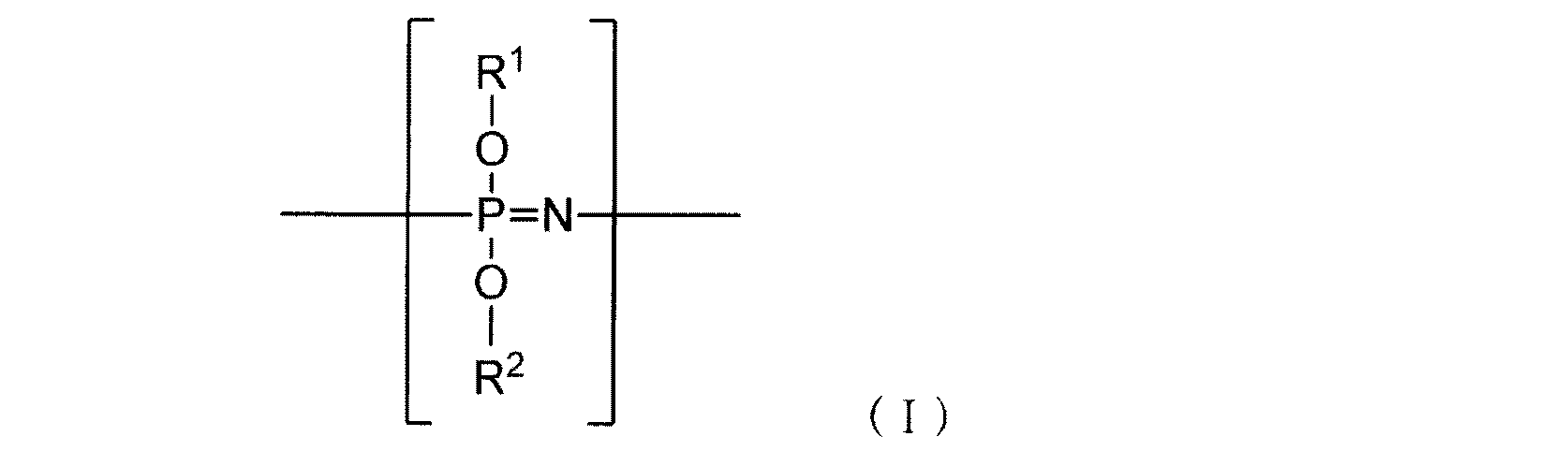
で表される構成単位が複数個結合してなるシクロホスファゼン化合物の混合体であって、
当該構成単位が3個、4個及び5個結合してなるシクロホスファゼン化合物を含み、
(1)前記構成単位が3個結合してなるシクロホスファゼン化合物は、一般式(I-A):
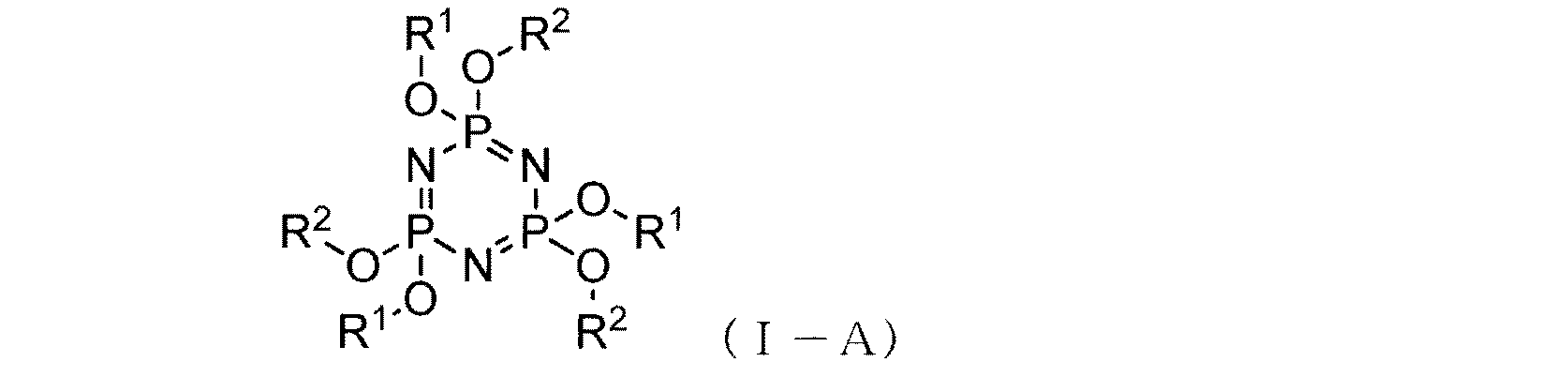
で表されるシクロホスファゼン化合物(I-A)であり、
(2)該シクロホスファゼン化合物(I-A)には、3個のR1及び3個のR2のうち、2個が下記基(II):
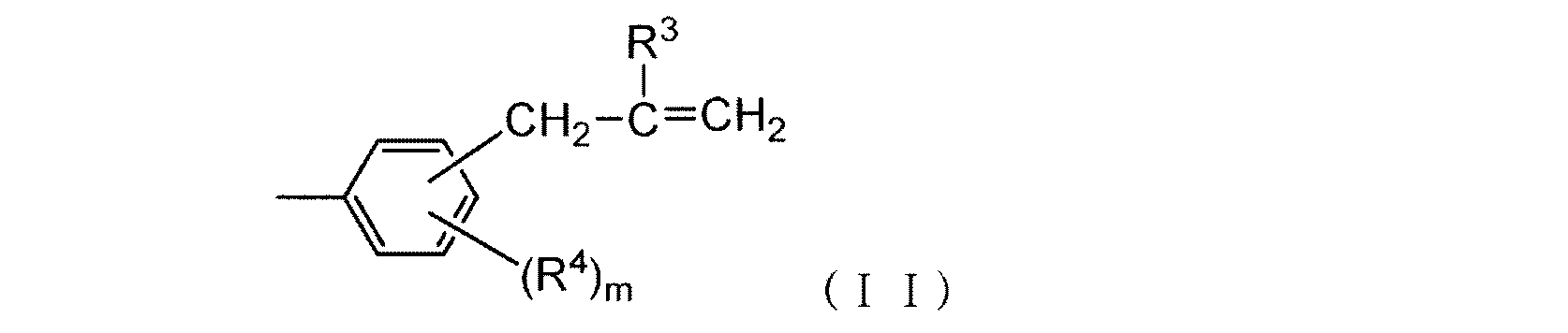
R4は、炭素数1~4のアルキル基又は炭素数1~4のアルコキシ基を示す。
mは0~4の整数を示す。
mが2以上の整数を示す場合、m個のR4は、同一又は異なっていてもよい。]
であるシクロホスファゼン化合物(I-A2)、及び
3個が上記基(II)であるシクロホスファゼン化合物(I-A3)が含まれ、かつ
(3)該シクロホスファゼン化合物(I-A2)及びシクロホスファゼン化合物(I-A3)は、上記シクロホスファゼン化合物(I-A)中に、合計で80重量%以上の割合で含まれる、シクロホスファゼン化合物の混合体。
- 一般式(I):

で表される構成単位が3~15個結合してなるシクロホスファゼン化合物の混合体であって、
(1)該シクロホスファゼン化合物の混合体には、一般式(I-A):
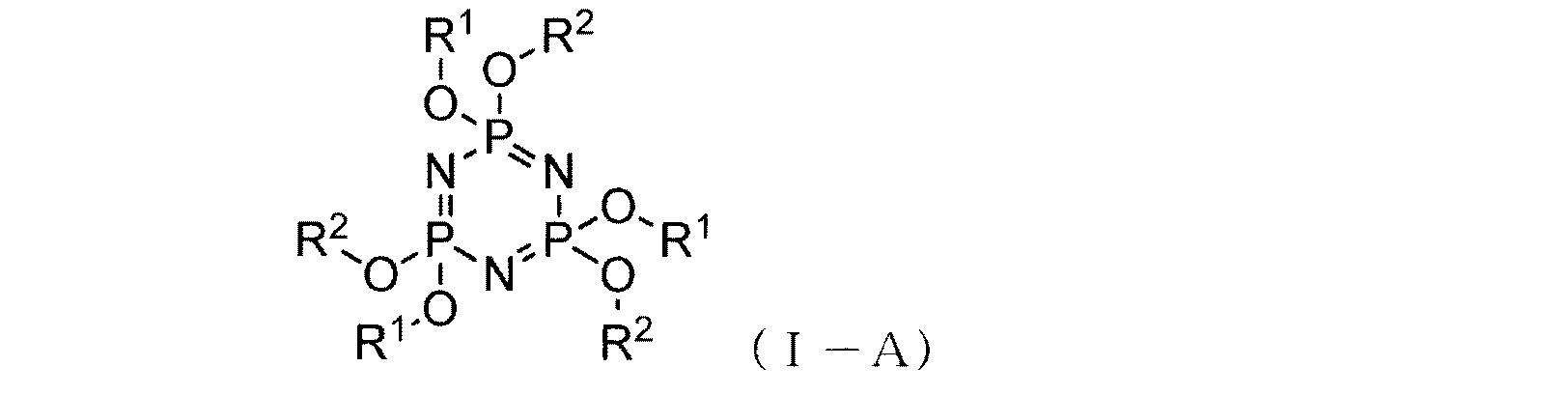
で表されるシクロホスファゼン化合物(I-A)が含まれ、
(2)該シクロホスファゼン化合物(I-A)には、3個のR1及び3個のR2のうち、2個が下記基(II):
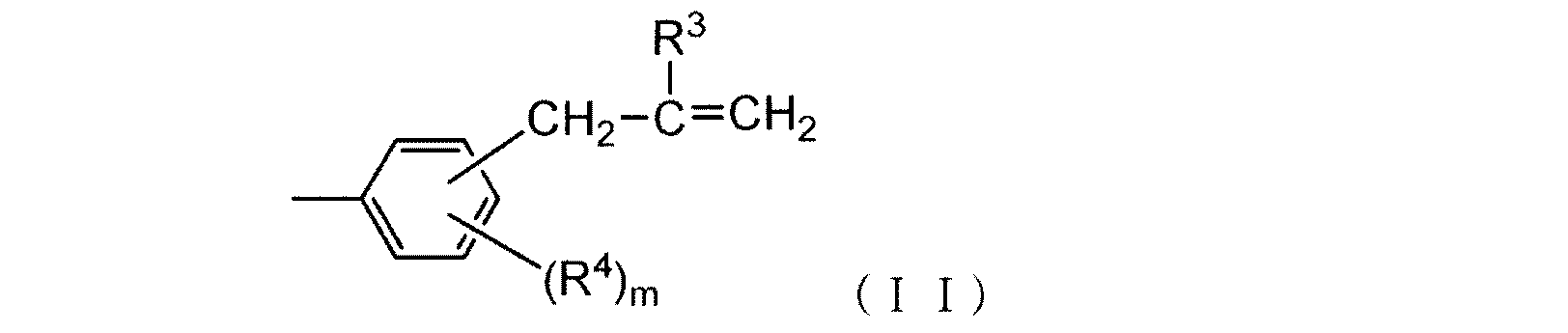
R4は、炭素数1~4のアルキル基又は炭素数1~4のアルコキシ基を示す。
mは0~4の整数を示す。
mが2以上の整数を示す場合、m個のR4は、同一又は異なっていてもよい。]
であるシクロホスファゼン化合物(I-A2)、及び
3個が上記基(II)であるシクロホスファゼン化合物(I-A3)が含まれ、かつ
(3)該シクロホスファゼン化合物(I-A2)及びシクロホスファゼン化合物(I-A3)は、上記シクロホスファゼン化合物(I-A)中に、合計で80重量%以上の割合で含まれる、シクロホスファゼン化合物の混合体。 - シクロホスファゼン化合物(I-A2)及びシクロホスファゼン化合物(I-A3)が、シクロホスファゼン化合物(I-A)中に、合計で85重量%以上の割合で含まれる、請求項2記載のシクロホスファゼン混合体。
- 請求項2に記載のシクロホスファゼン化合物の混合体であって、
(1)該シクロホスファゼン化合物の混合体は、一般式(I-B):

で表されるシクロホスファゼン化合物(I-B)が含まれ、
(2)該シクロホスファゼン化合物(I-B)には、4個のR1及び4個のR2のうち、3個が下記基(II):
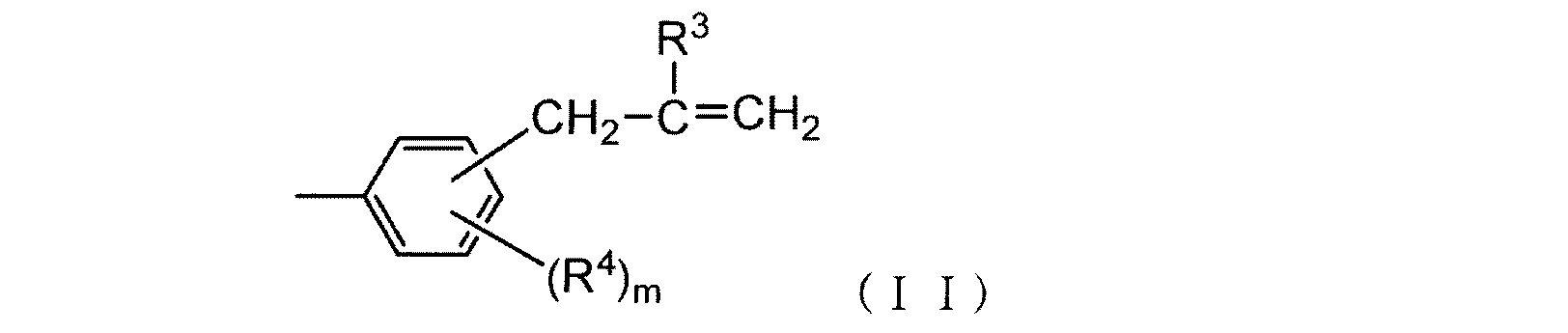
R4は、炭素数1~4のアルキル基及び炭素数1~4のアルコキシ基を示す。
mは0~4の整数を示す。
mが2以上の整数を示す場合、m個のR4は、同一又は異なっていてもよい。]
であるシクロホスファゼン化合物(I-B3)、
4個が上記基(II)で表されるアリルフェニル基であるシクロホスファゼン化合物(I-B4)、及び
5個が上記基(II)で表されるアリルフェニル基であるシクロホスファゼン化合物(I-B5)が含まれ、かつ
(3)該シクロホスファゼン化合物(I-B3)、シクロホスファゼン化合物(I-B4)及びシクロホスファゼン化合物(I-B5)は、シクロホスファゼン化合物(I-B)中に、合計で80重量%以上の割合で含まれる、シクロホスファゼン化合物の混合体。 - 酸価が0.5mgKOH/g以下である、請求項1~4の何れか一項に記載のシクロホスファゼン化合物の混合体。
- 請求項1~5の何れか一項に記載のシクロホスファゼン化合物の混合体を製造する方法であって、
一般式(III):

で表される構成単位が3~15個結合してなるハロシクロホスファゼン化合物の混合体と、アリルフェノラート化合物とを反応させる第1工程、及び
第1工程で得られた化合物とフェノラート化合物とを反応させる第2工程を備え、
該アリルフェノラート化合物が、一般式(IV):

R4は、炭素数1~4のアルキル基及び炭素数1~4のアルコキシ基を示す。
mは0~4の整数を示す。
mが2以上の整数を示す場合、m個のR4は、同一又は異なっていてもよい。
Mは、アルカリ金属を示す。]
で表される化合物であり、かつ
該フェノラート化合物が、一般式(V):

R5は、炭素数1~4のアルキル基、炭素数1~4のアルコキシ基、炭素数2~7のアルケニル基、炭素数2~7のアルケニルオキシ基、炭素数3~8のシクロアルキル基、炭素数3~8のシクロアルコキシ基、ニトロ基又はシアノ基を示す。
nは0~5の整数を示す。
nが2以上の整数を示す場合、n個のR5は、同一又は異なっていてもよい。]
で表される化合物である、製造方法。 - 請求項6に記載のシクロホスファゼン化合物の混合体を製造する方法であって、
第1工程が、ハロシクロホスファゼン化合物の混合体を、アリルフェノラート化合物のスラリーに添加する工程(1-1A)を備える、製造方法。 - 請求項6に記載のシクロホスファゼン化合物の混合体を製造する方法であって、
第1工程が、アリルフェノラート化合物を、ハロシクロホスファゼン化合物の混合体に加える工程(1-1B)を備える、製造方法。 - 請求項1~5の何れか一項に記載のシクロホスファゼン化合物の混合体を含有する難燃剤。
- 請求項1~5の何れか一項に記載のシクロホスファゼン化合物の混合体と、樹脂とを含有する難燃性樹脂組成物。
- 請求項10に記載の難燃性樹脂組成物であって、
シクロホスファゼン化合物の混合体の配合量が、樹脂100重量部に対して、0.1~100重量部である、難燃性樹脂組成物。 - 請求項10又は11に記載の難燃性樹脂組成物を成形して得られる成形体。
- 請求項1~5の何れか一項記載のシクロホスファゼン化合物の混合体とジエノフィル化合物とを含有する熱硬化性樹脂組成物。
- 請求項13に記載の熱硬化性樹脂組成物を成形して得られる成形体。
- 請求項13に記載の熱硬化性樹脂組成物から得られる低誘電性回路基板材料。
Priority Applications (7)
| Application Number | Priority Date | Filing Date | Title |
|---|---|---|---|
| CN201680030300.1A CN107614509B (zh) | 2015-05-28 | 2016-05-25 | 烯丙基苯氧基环磷腈化合物及其制造方法 |
| JP2017520732A JP6762933B2 (ja) | 2015-05-28 | 2016-05-25 | アリルフェノキシシクロホスファゼン化合物及びその製造方法 |
| HK18106928.4A HK1247205B (zh) | 2015-05-28 | 2016-05-25 | 烯丙基苯氧基环磷腈化合物及其制造方法 |
| CA2987234A CA2987234A1 (en) | 2015-05-28 | 2016-05-25 | Allyl-phenoxy-cyclophosphazene compound, and production method therefor |
| US15/575,491 US10435422B2 (en) | 2015-05-28 | 2016-05-25 | Allyl-phenoxy-cyclophosphazene compound, and production method therefor |
| KR1020177037009A KR102577615B1 (ko) | 2015-05-28 | 2016-05-25 | 알릴페녹시시클로포스파젠 화합물 및 그의 제조 방법 |
| US16/542,068 US11040991B2 (en) | 2015-05-28 | 2019-08-15 | Allyl-phenoxy-cyclophosphazene compound, and production method therefor |
Applications Claiming Priority (2)
| Application Number | Priority Date | Filing Date | Title |
|---|---|---|---|
| JP2015108854 | 2015-05-28 | ||
| JP2015-108854 | 2015-05-28 |
Related Child Applications (2)
| Application Number | Title | Priority Date | Filing Date |
|---|---|---|---|
| US15/575,491 A-371-Of-International US10435422B2 (en) | 2015-05-28 | 2016-05-25 | Allyl-phenoxy-cyclophosphazene compound, and production method therefor |
| US16/542,068 Division US11040991B2 (en) | 2015-05-28 | 2019-08-15 | Allyl-phenoxy-cyclophosphazene compound, and production method therefor |
Publications (1)
| Publication Number | Publication Date |
|---|---|
| WO2016190338A1 true WO2016190338A1 (ja) | 2016-12-01 |
Family
ID=57393241
Family Applications (1)
| Application Number | Title | Priority Date | Filing Date |
|---|---|---|---|
| PCT/JP2016/065410 Ceased WO2016190338A1 (ja) | 2015-05-28 | 2016-05-25 | アリルフェノキシシクロホスファゼン化合物及びその製造方法 |
Country Status (7)
| Country | Link |
|---|---|
| US (2) | US10435422B2 (ja) |
| JP (1) | JP6762933B2 (ja) |
| KR (1) | KR102577615B1 (ja) |
| CN (1) | CN107614509B (ja) |
| CA (1) | CA2987234A1 (ja) |
| TW (1) | TWI698443B (ja) |
| WO (1) | WO2016190338A1 (ja) |
Cited By (1)
| Publication number | Priority date | Publication date | Assignee | Title |
|---|---|---|---|---|
| WO2022085475A1 (ja) * | 2020-10-21 | 2022-04-28 | 株式会社Adeka | 組成物、硬化物、硬化物の製造方法及び添加剤 |
Families Citing this family (16)
| Publication number | Priority date | Publication date | Assignee | Title |
|---|---|---|---|---|
| US10707531B1 (en) | 2016-09-27 | 2020-07-07 | New Dominion Enterprises Inc. | All-inorganic solvents for electrolytes |
| US10584213B2 (en) | 2018-08-10 | 2020-03-10 | International Business Machines Corporation | Phosphazene-containing polyhexahydrotriazine elastomers |
| CN109400877B (zh) * | 2018-09-29 | 2020-10-23 | 华南农业大学 | 一种阻燃、透明生物基光固化树脂及其制备方法与应用 |
| TWI813790B (zh) * | 2018-10-09 | 2023-09-01 | 日商大塚化學股份有限公司 | 環狀膦氮烯化合物、樹脂用阻燃劑、包含其之樹脂組成物、及其成形體 |
| TWI700332B (zh) | 2018-12-06 | 2020-08-01 | 台燿科技股份有限公司 | 無鹵素低介電樹脂組合物,使用彼所製得之預浸漬片、金屬箔積層板及印刷電路板 |
| CN110954628B (zh) * | 2019-12-19 | 2022-05-03 | 山东泰星新材料股份有限公司 | 一种六苯氧基环三磷腈的高效液相检测方法 |
| CN111848963B (zh) * | 2020-07-14 | 2022-05-27 | 北京化工大学 | 一种可重复加工且高温热固的阻燃树脂的制备方法 |
| WO2022123431A1 (en) | 2020-12-07 | 2022-06-16 | Oti Lumionics Inc. | Patterning a conductive deposited layer using a nucleation inhibiting coating and an underlying metallic coating |
| CN112552346B (zh) * | 2020-12-25 | 2024-02-06 | 厦门产业技术研究院 | 一种六氯环三磷腈衍生物及其制备方法和应用、聚双环戊二烯复合材料及其制备方法 |
| CN112979707B (zh) * | 2021-03-03 | 2022-09-02 | 威海金威化学工业有限责任公司 | 一种三(2-烯丙基)苯氧基三苯氧基环三磷腈的制备方法 |
| KR102451262B1 (ko) * | 2021-03-25 | 2022-10-06 | 금오공과대학교 산학협력단 | 복합경화형 방염가공조성물, 이를 이용한 직물방염가공방법 및 이를 이용한 방염가공직물 |
| CN113406229B (zh) * | 2021-06-17 | 2022-11-29 | 山东泰星新材料股份有限公司 | 一种苯氧基环磷腈合成反应终点判定方法 |
| CN114874610A (zh) * | 2022-04-21 | 2022-08-09 | 苏州科技大学 | 一种红蓝双峰增益的转光材料组合物及其制备方法与应用 |
| CN117843685B (zh) * | 2023-12-29 | 2025-08-08 | 浙江万盛股份有限公司 | 一种氯代磷腈中间体混合物溶液的制备方法、苯氧基磷腈混合物阻燃剂的制备方法 |
| CN118931107B (zh) * | 2024-08-13 | 2025-05-02 | 泰州市天润合成化工有限公司 | 一种增韧改性环氧树脂及其制备方法 |
| CN119752187A (zh) * | 2024-10-21 | 2025-04-04 | 无锡杰科新材料有限公司 | 一种充电桩液冷电缆用阻燃交联辐照电缆料及其制备方法 |
Citations (5)
| Publication number | Priority date | Publication date | Assignee | Title |
|---|---|---|---|---|
| JPH01158041A (ja) * | 1987-10-01 | 1989-06-21 | Hercules Inc | 耐熱性、熱硬化性ホスファゼン−イミド共重合体 |
| JPH0680882A (ja) * | 1992-02-21 | 1994-03-22 | Hercules Inc | 有機シリコン組成物 |
| JPH10168428A (ja) * | 1996-11-04 | 1998-06-23 | Daimler Benz Ag | ホスフアゼン誘導体及び架橋剤を持つ硬化可能な組成物 |
| JPH11181429A (ja) * | 1997-02-14 | 1999-07-06 | Otsuka Chem Co Ltd | 難燃剤、難燃性樹脂組成物及び難燃性樹脂成形体 |
| JP2010053086A (ja) * | 2008-08-28 | 2010-03-11 | Fushimi Pharm Co Ltd | 反応性基含有環状ホスファゼン化合物およびその製造方法 |
Family Cites Families (6)
| Publication number | Priority date | Publication date | Assignee | Title |
|---|---|---|---|---|
| JPS6080882A (ja) * | 1983-10-11 | 1985-05-08 | Casio Comput Co Ltd | 画像形成装置 |
| JP3886206B2 (ja) | 1997-04-28 | 2007-02-28 | 日華化学株式会社 | 合成繊維の耐久防炎加工方法 |
| BR9806712A (pt) | 1997-10-15 | 2000-04-04 | Otsuka Chemical Co Ltd | Composto de fenoxifosfazeno reticulado, retardadores de chamas, composições de resina retardadora de chamas, de moldagens de resinas retardadoras de chamas |
| TW445276B (en) * | 1998-08-13 | 2001-07-11 | Otsuka Chemical Co Ltd | Crosslinked phenoxyphosphazene compounds, process for the preparation thereof, flame retardants, flame-retardant resin compositions, and moldings of flame-retardant resins |
| JP3637277B2 (ja) | 2000-03-21 | 2005-04-13 | 大塚化学ホールディングス株式会社 | 難燃剤、及び難燃性樹脂組成物、及び成形物、及び電子部品 |
| CN102718802B (zh) | 2012-05-31 | 2015-05-20 | 四川东材绝缘技术有限公司 | 芳氧基取代三聚磷腈环氧化合物及其制备方法和用途 |
-
2016
- 2016-05-25 JP JP2017520732A patent/JP6762933B2/ja active Active
- 2016-05-25 US US15/575,491 patent/US10435422B2/en active Active
- 2016-05-25 CA CA2987234A patent/CA2987234A1/en not_active Abandoned
- 2016-05-25 WO PCT/JP2016/065410 patent/WO2016190338A1/ja not_active Ceased
- 2016-05-25 KR KR1020177037009A patent/KR102577615B1/ko active Active
- 2016-05-25 CN CN201680030300.1A patent/CN107614509B/zh active Active
- 2016-05-27 TW TW105116700A patent/TWI698443B/zh active
-
2019
- 2019-08-15 US US16/542,068 patent/US11040991B2/en active Active
Patent Citations (5)
| Publication number | Priority date | Publication date | Assignee | Title |
|---|---|---|---|---|
| JPH01158041A (ja) * | 1987-10-01 | 1989-06-21 | Hercules Inc | 耐熱性、熱硬化性ホスファゼン−イミド共重合体 |
| JPH0680882A (ja) * | 1992-02-21 | 1994-03-22 | Hercules Inc | 有機シリコン組成物 |
| JPH10168428A (ja) * | 1996-11-04 | 1998-06-23 | Daimler Benz Ag | ホスフアゼン誘導体及び架橋剤を持つ硬化可能な組成物 |
| JPH11181429A (ja) * | 1997-02-14 | 1999-07-06 | Otsuka Chem Co Ltd | 難燃剤、難燃性樹脂組成物及び難燃性樹脂成形体 |
| JP2010053086A (ja) * | 2008-08-28 | 2010-03-11 | Fushimi Pharm Co Ltd | 反応性基含有環状ホスファゼン化合物およびその製造方法 |
Cited By (2)
| Publication number | Priority date | Publication date | Assignee | Title |
|---|---|---|---|---|
| WO2022085475A1 (ja) * | 2020-10-21 | 2022-04-28 | 株式会社Adeka | 組成物、硬化物、硬化物の製造方法及び添加剤 |
| JPWO2022085475A1 (ja) * | 2020-10-21 | 2022-04-28 |
Also Published As
| Publication number | Publication date |
|---|---|
| US20180155376A1 (en) | 2018-06-07 |
| US20190367543A1 (en) | 2019-12-05 |
| TWI698443B (zh) | 2020-07-11 |
| HK1247205A1 (zh) | 2018-09-21 |
| CN107614509A (zh) | 2018-01-19 |
| KR20180013988A (ko) | 2018-02-07 |
| TW201704248A (zh) | 2017-02-01 |
| CA2987234A1 (en) | 2016-12-01 |
| JPWO2016190338A1 (ja) | 2018-03-15 |
| CN107614509B (zh) | 2020-05-12 |
| KR102577615B1 (ko) | 2023-09-11 |
| US10435422B2 (en) | 2019-10-08 |
| JP6762933B2 (ja) | 2020-09-30 |
| US11040991B2 (en) | 2021-06-22 |
Similar Documents
| Publication | Publication Date | Title |
|---|---|---|
| US11040991B2 (en) | Allyl-phenoxy-cyclophosphazene compound, and production method therefor | |
| KR100750972B1 (ko) | 난연제 및 난연성 수지 조성물 및 성형물 및 전자부품 | |
| JP4407823B2 (ja) | 新規なシアネートエステル化合物、難燃性樹脂組成物、およびその硬化物 | |
| CN102781950B (zh) | 包含磷和氰氧基的热固性单体以及组合物 | |
| CN106459559A (zh) | 环氧组合物 | |
| JP7453917B2 (ja) | 環状ホスファゼン化合物、樹脂用難燃剤、それを含む樹脂組成物、及びその成形体 | |
| JP5104312B2 (ja) | シアン酸エステル重合体 | |
| EP3061789B1 (en) | Resin composition, prepreg, laminated sheet, and metal-foil-clad laminated board | |
| JP5213017B2 (ja) | エポキシ化合物組成物 | |
| CN102858786A (zh) | 包含磷和氰氧基基团的热固性单体以及组合物 | |
| JP3723899B2 (ja) | エポキシ樹脂、難燃剤、難燃性樹脂組成物及び難燃性樹脂成形体 | |
| JP2021021004A (ja) | 樹脂用分散剤、樹脂組成物及びその成形体 | |
| HK1247205B (zh) | 烯丙基苯氧基环磷腈化合物及其制造方法 | |
| JP2003342339A (ja) | ホスファゼン変性フェノール樹脂、難燃剤、難燃性樹脂組成物及び難燃性樹脂成形体 | |
| JP2022099861A (ja) | ビスマレイミド系樹脂組成物及びその成形体 | |
| WO2021020553A1 (ja) | 熱硬化性ポリイミド樹脂組成物及びその成形体 | |
| JP2004323864A (ja) | ホスファゼン変性フェノール樹脂の製造方法 | |
| TW201514217A (zh) | 乙烯基聯萘化合物、其組成物及其用途 |
Legal Events
| Date | Code | Title | Description |
|---|---|---|---|
| 121 | Ep: the epo has been informed by wipo that ep was designated in this application |
Ref document number: 16800042 Country of ref document: EP Kind code of ref document: A1 |
|
| ENP | Entry into the national phase |
Ref document number: 2017520732 Country of ref document: JP Kind code of ref document: A |
|
| WWE | Wipo information: entry into national phase |
Ref document number: 15575491 Country of ref document: US |
|
| ENP | Entry into the national phase |
Ref document number: 2987234 Country of ref document: CA |
|
| NENP | Non-entry into the national phase |
Ref country code: DE |
|
| ENP | Entry into the national phase |
Ref document number: 20177037009 Country of ref document: KR Kind code of ref document: A |
|
| 122 | Ep: pct application non-entry in european phase |
Ref document number: 16800042 Country of ref document: EP Kind code of ref document: A1 |