WO2016177695A1 - Utilisation de nouveaux composés pour l'extraction sélective de terres rares de solutions aqueuses comprenant de l'acide phosphorique et procédé d'extraction associé - Google Patents
Utilisation de nouveaux composés pour l'extraction sélective de terres rares de solutions aqueuses comprenant de l'acide phosphorique et procédé d'extraction associé Download PDFInfo
- Publication number
- WO2016177695A1 WO2016177695A1 PCT/EP2016/059827 EP2016059827W WO2016177695A1 WO 2016177695 A1 WO2016177695 A1 WO 2016177695A1 EP 2016059827 W EP2016059827 W EP 2016059827W WO 2016177695 A1 WO2016177695 A1 WO 2016177695A1
- Authority
- WO
- WIPO (PCT)
- Prior art keywords
- branched
- saturated
- group
- unsaturated
- linear
- Prior art date
- Legal status (The legal status is an assumption and is not a legal conclusion. Google has not performed a legal analysis and makes no representation as to the accuracy of the status listed.)
- Ceased
Links
Classifications
-
- C—CHEMISTRY; METALLURGY
- C22—METALLURGY; FERROUS OR NON-FERROUS ALLOYS; TREATMENT OF ALLOYS OR NON-FERROUS METALS
- C22B—PRODUCTION AND REFINING OF METALS; PRETREATMENT OF RAW MATERIALS
- C22B3/00—Extraction of metal compounds from ores or concentrates by wet processes
- C22B3/04—Extraction of metal compounds from ores or concentrates by wet processes by leaching
- C22B3/06—Extraction of metal compounds from ores or concentrates by wet processes by leaching in inorganic acid solutions, e.g. with acids generated in situ; in inorganic salt solutions other than ammonium salt solutions
-
- C—CHEMISTRY; METALLURGY
- C07—ORGANIC CHEMISTRY
- C07F—ACYCLIC, CARBOCYCLIC OR HETEROCYCLIC COMPOUNDS CONTAINING ELEMENTS OTHER THAN CARBON, HYDROGEN, HALOGEN, OXYGEN, NITROGEN, SULFUR, SELENIUM OR TELLURIUM
- C07F9/00—Compounds containing elements of Groups 5 or 15 of the Periodic Table
- C07F9/02—Phosphorus compounds
- C07F9/28—Phosphorus compounds with one or more P—C bonds
- C07F9/38—Phosphonic acids [RP(=O)(OH)2]; Thiophosphonic acids ; [RP(=X1)(X2H)2(X1, X2 are each independently O, S or Se)]
- C07F9/40—Esters thereof
- C07F9/4003—Esters thereof the acid moiety containing a substituent or a structure which is considered as characteristic
- C07F9/4006—Esters of acyclic acids which can have further substituents on alkyl
-
- C—CHEMISTRY; METALLURGY
- C22—METALLURGY; FERROUS OR NON-FERROUS ALLOYS; TREATMENT OF ALLOYS OR NON-FERROUS METALS
- C22B—PRODUCTION AND REFINING OF METALS; PRETREATMENT OF RAW MATERIALS
- C22B3/00—Extraction of metal compounds from ores or concentrates by wet processes
- C22B3/20—Treatment or purification of solutions, e.g. obtained by leaching
- C22B3/26—Treatment or purification of solutions, e.g. obtained by leaching by liquid-liquid extraction using organic compounds
-
- C—CHEMISTRY; METALLURGY
- C22—METALLURGY; FERROUS OR NON-FERROUS ALLOYS; TREATMENT OF ALLOYS OR NON-FERROUS METALS
- C22B—PRODUCTION AND REFINING OF METALS; PRETREATMENT OF RAW MATERIALS
- C22B59/00—Obtaining rare earth metals
-
- Y—GENERAL TAGGING OF NEW TECHNOLOGICAL DEVELOPMENTS; GENERAL TAGGING OF CROSS-SECTIONAL TECHNOLOGIES SPANNING OVER SEVERAL SECTIONS OF THE IPC; TECHNICAL SUBJECTS COVERED BY FORMER USPC CROSS-REFERENCE ART COLLECTIONS [XRACs] AND DIGESTS
- Y02—TECHNOLOGIES OR APPLICATIONS FOR MITIGATION OR ADAPTATION AGAINST CLIMATE CHANGE
- Y02P—CLIMATE CHANGE MITIGATION TECHNOLOGIES IN THE PRODUCTION OR PROCESSING OF GOODS
- Y02P10/00—Technologies related to metal processing
- Y02P10/20—Recycling
Definitions
- the present invention relates to the field of rare earth extraction of acidic aqueous phases in which said rare earths are present.
- It relates more particularly to the use of at least one specific compound as an extractant, for extracting at least one rare earth from an aqueous acid phase in which the at least one rare earth is present.
- the invention also relates to a method for recovering at least one rare earth present in an acidic aqueous phase, said process using this specific compound.
- the acidic aqueous phase from which can be extracted, or from which can be recovered, the rare earth or rare earths is an aqueous solution comprising phosphoric acid.
- an aqueous solution may in particular be an acid etching solution of a concentrate of ores or waste comprising said at least one rare earth.
- the present invention finds particular application in the treatment of natural ores and / or industrial waste in order to enhance the rare earth present therein.
- the present invention finally relates to certain specific compounds whose use is mentioned above.
- the rare earths include metals characterized by neighboring properties, namely scandium (Se), yttrium (Y) and all the lanthanides, the latter corresponding to the chemical elements listed in the periodic table of the elements of Mendeleyev which have an atomic number ranging from 57 for lanthanum (La) to 71 for lutetium (Lu).
- Rare earths are generally classified into two categories: the ceric earths, or rare earths, which include Se, Y as well as metals ranging from lanthanum (La) to neodymium (Nd), and heavy rare earths, or yttric group, which include metals ranging from promethium (PM) to lutetium (Lu).
- the neighboring properties of the rare earths are notably related to their electronic configuration, in particular to the specificity of their electronic sub-layer 4f which allows numerous optical transitions and gives them particular magnetic and catalytic properties. Because of these remarkable properties, rare earths are used in many high-tech applications such as lasers, permanent magnets, batteries or low energy bulbs.
- Rare earths are, therefore, part of so-called "technological" metals whose supply is strategic, but also threatened by the growth in world demand for these particular metals.
- Rare earth sources include deposits of hard bastnaesite rocks and alluvial deposits of monazite and xenotime.
- these ores which contain the highest concentrations of rare earths
- the ores which have just been mentioned and which contain rare earths in greater or lesser quantities are designated by the term "natural ores”.
- Rare earths are also present in a large number of technological equipment, the recovery by recycling of industrial waste from such equipment, including from waste electrical and electronic equipment, denoted “WEEE” or “D3E” represents a unconventional and alternative source of access to rare earths. In the rest of this description, these industrial wastes that contain rare earths are referred to as "industrial minerals”.
- the processes currently used to recover the rare earths of these natural or industrial ores consist in subjecting these ores, previously ground, to chemical treatments, by acidic or basic reagents, to obtain a mineral concentrate.
- This mineral concentrate is then subjected to a chemical attack to allow the dissolution of the rare earth contained therein.
- This chemical attack is conventionally carried out using one or more acidic reagents, among which nitric acid, sulfuric acid, phosphoric acid or hydrochloric acid.
- the so-called “acid etching solution” solution thus obtained is then subjected to a hydro-metallurgical treatment based on the liquid-liquid extraction technique, which technique consists in bringing the aqueous phase constituted by this acid etching solution into contact with each other. with an organic phase comprising one or more extractants, to obtain a rare earth extraction, such an extraction to be preferably simultaneously efficient and selective.
- TBP tri-n-butyl phosphate
- H DEHP allows extraction of the rare earths present in a strongly acidic aqueous phase (pH ⁇ 1) while the H EHEH P allows extraction of the rare earths present in an acidic aqueous phase having a 2 ⁇ pH ⁇ 3
- these three extractants H DEHP, HEHEHP and TBP are characterized by a selective extraction of heavy lanthanides corresponding to lanthanides whose atomic number is 61 or more (up to 71).
- the publication [1] reports that the extraction by the TODGA can cause the formation of a third phase, which is unacceptable for an implementation on an industrial scale of an extraction process.
- the publication [1] proposes to associate the TODGA with a phase modifier, in this case the TBP.
- a phase modifier in this case the TBP.
- Example 8 the inventors have found that the extraction performance described in publication [1], with the TODGA as extractant and the extraction being carried out from an aqueous phase. comprising nitric acid, were not transposable to an extraction made from an aqueous phase comprising phosphoric acid.
- Extraction using this new family of extractants must be able to extract most of the rare earths present in the aqueous phase or, on the contrary, some of these rare earths, for example according to their atomic number.
- the extraction with these extractants must also tend to be selective with respect to the elements which are also likely to be present in the acidic aqueous phase but which are not rare earths.
- the inventors have also set themselves the goal that this extraction can advantageously be carried out in a range of concentrations of phosphoric acid in the aqueous phase which is as wide as possible.
- the inventors have also set a goal that this extraction can be advantageously implemented with a single extractant and this, without a third phase is formed, allowing to consider favorably a transposition on an industrial scale of the process of corresponding extraction.
- n an integer equal to 0, 1 or 2
- R 1 and R 2 represent, independently of each other, a hydrogen atom, a saturated or unsaturated, linear or branched, C 1 to C 12 aliphatic hydrocarbon group or a saturated or unsaturated cyclic aliphatic hydrocarbon group; , optionally branched, C 3 to C 8 ,
- R 3 and R 4 has the following formula (II): in which R 5 and R 6 represent, independently of one another, a saturated or unsaturated, linear or branched, C 1 to C 12 aliphatic hydrocarbon group, a cyclic, saturated or unsaturated, optionally branched, hydrocarbon-based hydrocarbon group; C 3 to C 8 , a hydroxyl group -OH or an alkoxyl group -OR, with R representing a saturated or unsaturated, linear or branched, C 1 -C 12 aliphatic hydrocarbon group or a cyclic aliphatic hydrocarbon group, saturated or unsaturated, optionally branched, C 3 to C 8 , and
- R 5 'and R 6 ' represent, independently of one another, a saturated or unsaturated, linear or branched, C 1 -C 12 aliphatic hydrocarbon group, a cyclic hydrocarbon group, saturated or unsaturated, optionally branched; at C 3 to C 8 , a hydroxyl group -OH or an alkoxy group -OR ', with R' representing a linear or branched, saturated or unsaturated, C 1 -C 12 aliphatic hydrocarbon-based group or a cyclic aliphatic hydrocarbon group, saturated or unsaturated, optionally branched, C 3 -C 8 or the following formula (I II):
- R 7 and R 8 represent, independently of each other, a hydrogen atom, a saturated or unsaturated, linear or branched, C 1 to C 2 aliphatic hydrocarbon group or a saturated cyclic aliphatic hydrocarbon group; or unsaturated, optionally branched, C 3 to C 8 .
- linear or branched, saturated or unsaturated aliphatic hydrocarbon group in i ⁇ C 12 ", any linear or branched chain alkyl, alkenyl or alkynyl group, which comprises in total from 1 to 12 carbon atoms;
- cyclic aliphatic hydrocarbon group saturated or unsaturated, optionally branched, C 3 -C 8 ", any non-aromatic hydrocarbon group comprising at least one ring, said ring comprising from 3 to 8 carbon atoms, this ring being saturable or , on the contrary, to include one or more unsaturations, this or these cycles being able to in addition to being branched, the branched chain or chains then comprising from 1 to 6 carbon atoms.
- this group can in particular be a cycloalkyl group (cyclopropane, cyclopentane, cyclohexane, etc.), a cycloalkenyl group (cyclopropenyl, cyclopentenyl, cyclohexenyl, etc.) or a cycloalkynyl group;
- cyclic hydrocarbon group saturated or unsaturated, optionally branched, C 3 -C 8 ", any non-aromatic hydrocarbon group comprising at least one ring as defined in the preceding paragraph and any aromatic hydrocarbon group comprising at least one ring this ring comprising from 3 to 8 carbon atoms and satisfying Hûckel's aromaticity rule with a number of delocalized ⁇ electrons equal to 4n + 2.
- This or these rings may also be branched, the branched chain or chains then comprising 1 to 6 carbon atoms.
- this group may in particular be a cycloalkyl group, a cycloalkenyl group, a cycloalkynyl group or a cycloaromatic group such as a phenyl or benzyl group.
- the inventors have indeed found that, surprisingly and unexpectedly, the use of the compounds corresponding to the general formula (I) above makes it possible to efficiently and selectively extract at least one rare earth present, and advantageously at least one lanthanide present in an aqueous solution further comprising phosphoric acid.
- R 1, R 2 , R 3 and R 4 are as defined above.
- the present invention relates to the use of the compound which corresponds to the following specific formula (Ia):
- R i; R 2 , R 5, R 5 'and R 6 ' are as defined above, it being specified that R 5 and / or R 6 represent a hydroxyl group -OH.
- R 5 and R 6 represents a hydroxyl group -OH and the other of R 5 and R 6 represents an alkoxy group -OR, with R representing a linear or branched C 2 -C 8 alkyl group; , advantageously C 4 , and
- R 5 'and R 6 ' represent, independently of one another, a linear or branched, C 4 to C 0 , advantageously C 8 , alkyl group.
- R 1 and R 2 each represent a hydrogen atom.
- R 1 and R 2 each represent a hydrogen atom.
- At least one of R 1 and R 2 represents a linear or branched C 1 to C 0 alkyl group, advantageously Ci at C 8 .
- R 1 and R 2 each represent a linear or branched C 1 to C 0 , advantageously C 1 to C 8 , alkyl group.
- one of R 1 and R 2 represents a hydrogen atom and the other of R x and R 2 represents a linear alkyl group. or branched, C x to C 10 , advantageously C 1 to C 8 .
- the present invention relates to the use of the compound which corresponds to the following specific formula (I-b):
- R 1, R 2 , R 5 , R 6 , R ? and R 8 are as defined above, it being understood that R 5 and / or R 6 represent a hydroxyl group -OH.
- one of R 5 and R 6 represents a hydroxyl group -OH and the other one
- R 5 and R 6 represent a linear or branched C 4 to C 10 alkyl group, advantageously C 8 or an alkoxy group -OR, with R representing an alkyl group, linear or branched, C 2 -C 8 , advantageously C 4 , and
- R 7 and R 8 preferably represent, independently of one another, a linear or branched C 4 to C 10 alkyl group, advantageously C 8 .
- the compound of particular formula (Ib) corresponds to a bifunctional compound comprising a phosphinate group -PO (OH) R 6 or -PO (OH) R 5 and an amide group -COR 7 R 8 .
- the compound of particular formula (Ib) corresponds to a bifunctional compound comprising a phosphonate group -PO (OH) (OR) and an amide group -COR 7 R 8 .
- R 1 and R 2 each represent a hydrogen atom.
- R 1 and R 2 each represent a linear or branched C 1 to C 10 , advantageously C 1 to C 8 , alkyl group.
- one of R 1 and R 2 represents a hydrogen atom and the other of R 1 and R 2 represents an alkyl group, linear or branched, C 1 -C 10 , advantageously C 1 -C 8 .
- the compound of particular formula (Ib) is advantageously that in which R 2 represents a hydrogen atom.
- the compounds corresponding to the general formula (I) and, among these, the compounds corresponding to the particular formulas (Ia) and (Ib), are used, in accordance with the present invention as extractants for extracting at least one rare earth from an aqueous phase wherein said at least one rare earth is present, said aqueous phase further comprising phosphoric acid.
- the aqueous phase is an acid etching solution, typically with one or more inorganic acids, of a concentrate of a natural or urban ore comprising said at least one rare earth.
- the presence of phosphoric acid in this acid etching solution results from the use of phosphoric acid as inorganic acid and / or its in situ formation in view of the presence of precursors of such an acid, such as the natural phosphates.
- the aqueous phase comprises at least 0.1 mol / l, advantageously from 0.2 mol / l to 8 mol / l, and preferably from 0.5 mol / l to 5 mol / l.
- L phosphoric acid.
- the extraction is carried out by the technique of liquid-liquid extraction, a technique which brings into contact this aqueous phase comprising the rare earth (s), advantageously the lanthanide (s), and the acid phosphoric compound with an organic phase comprising one or more of these compounds mentioned above, preferably only one of these compounds.
- this liquid-liquid extraction is carried out by means of an organic phase comprising at least 10 -3 mol / l, advantageously from 5 ⁇ 10 -3 mol / l to 1 mol / l, and preferentially from 10 ⁇ 2 mol / L to 10 "1 mol / L, of the compound in solution in an organic diluent.
- This organic diluent is advantageously of the aliphatic type, and may especially be n-docedane, hydrogenated tetrapropylene (TPH), kerosene or an isoparaffin such as lsane ® IP 185 sold by Total.
- the present invention relates, secondly, to a process for recovering at least one rare earth present, and advantageously at least one lanthanide present, in an aqueous phase, said aqueous phase comprising, in addition, Phosphoric acid.
- this recovery method comprises the following steps:
- step a) of this process according to the invention the compound present in the organic phase is the compound as defined above, it being specified that the advantageous characteristics of this compound can be taken alone or in combination.
- aqueous and organic phases used during step a) of the process according to the invention may be as defined above, in relation to the use of the compound, and may have the advantageous characteristics. described above for these aqueous and organic phases, alone or in combination.
- step a) at least one salt, such as a salt of nitrate, or of sulphate, of an alkali metal or alkaline metal, is added to the aqueous phase. earthy, which increases the ionic strength of this aqueous solution.
- Such a salt may especially be chosen from sodium, lithium or potassium nitrate. This salt is advantageously sodium nitrate.
- the molar concentration of salt (s) in the aqueous phase is from 0.01 mol / L to 4 mol / L, advantageously from 0.05 mol / L to 3 mol / L and, preferentially, from 0.1 mol / L to 2 mol / L.
- the aqueous phase implemented during step a) is a solution for acid attack, by phosphoric acid, of a concentrate of a natural or urban ore comprising said at least one rare earth.
- the present invention relates, in the third place, to particular compounds which, to the knowledge of the inventors, have not been described to date.
- the compound according to the invention corresponds to the following particular formula (la):
- R 1 and R 2 represent, independently of each other, a hydrogen atom, a saturated or unsaturated, linear or branched, C 1 to C 12 aliphatic hydrocarbon group or a saturated or unsaturated cyclic aliphatic hydrocarbon group; , optionally branched, C 3 to C 8 ,
- R 5 and R 6 represents a hydroxyl group -OH and the other of R s and R 6 represents a linear or branched, C 1 -C 12 aliphatic, saturated or unsaturated hydrocarbon-based group, a cyclic hydrocarbon group saturated or unsaturated, optionally branched C 3 -C 8, a hydroxyl group -OH or an alkoxy group -OR, where R represents an aliphatic hydrocarbon group, saturated or unsaturated, linear or branched Ci-Ci 2 or cyclic aliphatic hydrocarbon group, saturated or unsaturated, optionally branched, C 3 to C 8 , and
- R 5 'and R 6 ' represent, independently of one another, a saturated or unsaturated, linear or branched, C 1 to C 12 aliphatic hydrocarbon group, a cyclic hydrocarbon group, saturated or unsaturated, optionally branched, at C 3 to C 8 , a hydroxyl group -OH or an alkoxyl group -OR ', with R' representing a saturated or unsaturated, linear or branched, C 1 -C 12 aliphatic hydrocarbon group or a saturated cyclic aliphatic hydrocarbon group; or unsaturated, optionally branched, C 3 to C 8 .
- R 5 and R 6 represents a hydroxyl group -OH and the other of R 5 and R 6 represents an alkoxy group -OR, with R representing a linear or branched C 2 -C 8 alkyl group; , advantageously C 4 , and
- R 5 'and R 6 ' represent, independently of one another, a linear or branched C 1 -C 10 alkyl group, advantageously C 8 .
- R 1 and R 2 each represent a hydrogen atom.
- At least one of R 1 and R 2 represents a linear or branched alkyl group, in C to Ci 0 , advantageously in Ci at C 8 .
- R 1 and R 2 each represent a linear or branched C 1 to C 0 , advantageously C 1 to C 8 , alkyl group.
- one of R 1 and R 2 represents a hydrogen atom and the other of R x and R 2 represents a linear alkyl group. or branched, Ci to Ci 0 , advantageously Ci to C 8 .
- R 1 and R 2 represent, independently of each other, a hydrogen atom, a linear or branched, saturated or unsaturated, C 1 to C 2 aliphatic hydrocarbon group or a saturated or unsaturated cyclic aliphatic hydrocarbon group; , optionally branched, C 3 to C 8 ,
- R 5 and R 6 represents a hydroxyl group -OH and the other of R 5 and R 6 represents a linear or branched, C 1 -C 12 aliphatic, saturated or unsaturated hydrocarbon-based group, a cyclic hydrocarbon group , saturated or unsaturated, optionally branched, C 3 to C 8 , a hydroxyl group -OH or an alkoxy group -OR, with R representing a saturated or unsaturated, linear or branched, C 1 to C 12 aliphatic hydrocarbon group or a cyclic aliphatic hydrocarbon group, saturated or unsaturated, optionally branched, C 3 to C 8 , and
- R 7 and R 8 represent, independently of one another, a hydrogen atom, a linear or branched, C 1 -C 12 aliphatic, saturated or unsaturated hydrocarbon-based group, or a cyclic aliphatic hydrocarbon group, saturated or unsaturated, optionally branched, C 3 to C 8 .
- R 5 and R 6 are such that:
- R 5 and R 6 represents a hydroxyl group -OH and the other of R 5 and R 6 represents a linear or branched C 4 to C 10 alkyl group, advantageously C 8 , or a group alkoxy -OR, with R representing a linear or branched C 2 -C 8 alkyl group, advantageously C 4 , and
- R 7 and R 8 represent, independently of one another, an alkyl group, linear or branched, C 4 to C 0 , advantageously C 8 .
- the compound of particular formula (I-b) may correspond to a bifunctional compound which comprises:
- R 5 and R 6 represents -OH and the other from R 5 and R 6 represents an alkyl group as specified above,
- R 1 and R 2 each represent a hydrogen atom. Also preferably, in the particular formula (Ib) above, and according to a second variant, at least one of R 1 and R 2 represents a linear or branched C 1 to C 10 alkyl group, advantageously Ci at C 8 .
- R 1 and R 2 each represent a linear or branched C 1 to C 10 , advantageously C 1 to C 8 , alkyl group.
- one of R 1 and R 2 represents a hydrogen atom and the other of R 1 and R 2 represents an alkyl group, linear or branched, C 1 -C 10 , advantageously C 1 -C 8 .
- the compound of particular formula (Ib) is advantageously that in which R 2 represents a hydrogen atom.
- the synthesis uses an alcohol-phosphine oxide with a chloride-phosphine oxide, according to the Williamson reaction, in the presence of sodium hydride (NaH) in tetrahydrofuran (THF).
- NaH sodium hydride
- THF tetrahydrofuran
- Di-octylphosphine bis-oxide is obtained by carrying out the following reaction (2):
- Di-octyl phosphine oxide is synthesized from diethyl phosphite, according to the following reaction (3): EtO H Oct H
- reaction (3) The operating procedure followed for the implementation of reaction (3) is as follows: to a suspension of magnesium n-octyl (denoted Oct-MgBr) at 2 mol / l in ether (100 ml, ie about 3 eq. ) is added dropwise, at 0 ° C and with stirring, diethyl phosphite (1 eq, 13.5 g or 70 mmol). After total addition, the mixture is slowly brought to ambient temperature and then to 45 ° C. for 4 hours. The mixture is then acidified with 25% aqueous H 2 S0 4 sulfuric acid solution added dropwise at 0 ° C. Once the effervescence is stopped, the same amount of water and ether is added to the mixture.
- the organic phase is then separated and washed successively with a solution of potassium carbonate K 2 CO 3 at 10% (2 times), with water (2 times) and then with brine (2 times).
- the organic phase is then dried over Na 2 SO 4 sodium sulphate ; filtered and concentrated to give the di-octyl phosphine oxide (95% yield) which is in the form of a white powder.
- reaction (4) The operating protocol followed for the implementation of reaction (4) is as follows: to a solution of di-octylphosphine oxide (1 eq) in ethanol (0.5 mol / L) are added, with stirring, sodium Na (previously activated in methanol) and then paraformaldehyde (1.2 eq). The mixture is then refluxed (80 ° C.) for 2 hours. The solvent is then evaporated. The mixture is then taken up in dichloromethane (DCM), then washed with water (twice) and with brine (twice). The organic phase is dried over Na 2 SO 4 , filtered and concentrated to give 1- (hydroxymethyl) -dioctyl phosphine oxide (80% yield) which is in the form of a very viscous oil.
- DCM dichloromethane
- the operating procedure followed for carrying out reaction (5) is as follows: to a solution formed of 1 - (hydroxymethyl) -dioctyl phosphine oxide (1 eq) in anhydrous toluene (0.5 mol / l). L) is added, at 0 ° C and with stirring, phosphorus pentachloride PCI 5 (2 eq) in small portions. After complete addition, the mixture is slowly brought to room temperature and then refluxed (110 ° C.) for 2 hours. The excess of PCI 5 is then neutralized by adding, dropwise, water at 0 ° C. Once the effervescence stopped, a quantity of water equal to half the volume of toluene is added and the mixture is stirred for 10 min.
- (2 ') is as follows: to a suspension of sodium hydride NaH (4 eq, previously washed twice with pentane) in anhydrous THF (1 mol / L), a solution formed by the aqueous solution is added dropwise. 1- (hydroxymethyl) -dioctyl phosphine oxide in THF (1 eq to 0.5 mol / L). After complete addition, the mixture is stirred for 1 h and then a solution of 1- (chloromethyl) -dioctyl phosphine oxide (1.2 eq) in THF is added dropwise. The mixture is then stirred for 12 hours.
- the crude is then acidified with a hydrochloric acid solution HCl (3M), added dropwise at 0 ° C. The solvent is then evaporated.
- the crude is taken up in ethyl acetate and then washed with HCl (3M) (2 times) and with water (2 times).
- the organic phase is dried over Na 2 SO 4 , filtered and then concentrated on a rotary evaporator.
- the crude product obtained is then purified by recrystallization from ethyl acetate to give di-octylphosphine bis-oxide (with a yield of 82%) which is in the form of a white powder.
- the characterization data of this di-octylphosphine bis-oxide are the following:
- the synthesis employs an alcohol phosphonate with a chloride phosphine oxide, according to the Williamson reaction, in the presence of sodium hydride (NaH) and potassium iodide (KI) in tetrahydrofuran (TH F).
- NaH sodium hydride
- KI potassium iodide
- R 5 , 6 alkoxy groups
- R 5 ', 3 ⁇ 4' alkyl groups
- reaction (7) The operating procedure followed for the implementation of reaction (7) is as follows: a mixture of dibutyl phosphite (1 eq) and formaldehyde (1.2 eq) in triethylamine NEt 3 is refluxed (90 °). C) with stirring for 2 h. The triethylamine is then evaporated. The crude is taken up in DCM and then washed with a saturated solution of NaHCO 3 (twice) and with brine (2 times). The organic phase is dried over Na 2 SO 4 and then concentrated on a rotary evaporator. Excess formaldehyde is distilled in a ball oven under reduced pressure.
- the crude product obtained is then purified by flash chromatography on a column of silica gel (eluent: cyclohexane / ethyl acetate 100/50 to 50/100, v / v) to obtain 1- (hydroxymethyl) -di-butyl- phosphonate (68% yield) which is in the form of a viscous oil.
- the operating protocol followed for carrying out this reaction (6 ') is as follows: to a suspension of sodium hydride NaH (4 eq, previously washed twice with pentane) in anhydrous THF (1 mol / L) and in the presence of potassium iodide K1 (1 eq) is added dropwise a solution formed by 1- (hydroxymethyl) -di-butyl phosphonate in THF (1 eq to 0.5 mol / l). After complete addition, the mixture is stirred for 1 h and then a solution of 1- (chloromethyl) di-octyl phosphine oxide (1.2 eq) in THF is added dropwise. The mixture is then stirred for 12 hours.
- the crude is then acidified with a hydrochloric acid solution HCl (3M), added dropwise at 0 ° C. The solvent is then evaporated.
- the crude is taken up in ethyl acetate and then washed with HCl (3M) (2 times) and with water (2 times).
- the organic phase is dried over Na 2 SO 4 , filtered and then concentrated on a rotary evaporator.
- the crude obtained is then purified by recrystallization from ethyl acetate to give butyl ((((octyltanoylphosphoryl) -2-oxoethoxy) methyl) phosphonate (in a yield of 36%) which is in the form of a white powder.
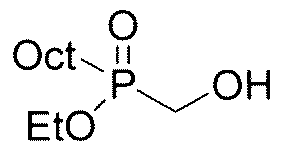
- Ethyl octanoyl phosphinate, or octyl ethoxyphophinate is synthesized from triethylphosphite, according to the following reaction (8):
- reaction (8) The operating procedure followed for the implementation of reaction (8) is as follows: to a suspension of magnesium n-octyl (denoted Oct-MgBr) at 2 mol / L in ether (20 mL, ie about 1, 5 eq) is added dropwise, over a period of 1 h at 0 ° C and under argon atmosphere, triethyl phosphite (10 mL or 57.5 mmol). After complete addition, the mixture is vigorously stirred and then a solution of 1M HCl (50 ml) is added until the salts are completely dissolved (addition of ether may be necessary). The mixture is slowly brought to ambient temperature and then to 45 ° C. for 4 hours.
- An alcohol phosphonate can be obtained by the phosphite reaction with an aldehyde according to the following reaction (9):
- the crude product obtained is then purified by flash column chromatography on silica gel (eluent: cyclohexane / ethyl acetate 100/50 to 50/100, v / v) to obtain the corresponding alcohol-phosphonate (with a higher yield). 50%) which is in the form of a viscous oil or a white powder, as the case may be.
- An alcohol phosphinate can be obtained by the reaction of a phosphinate with an aldehyde according to the following reaction (9 '):
- R 5 , 6 alkoxy groups
- R 7 , R 8 alkyl groups
- the crude is then acidified with a saturated solution of ammonium chloride (NH 4 Cl), added dropwise at 0 ° C. Once the effervescence stopped, a quantity of this solution equal to half the volume of THF is added and the mixture is stirred for 15 min. The solvent is then evaporated.
- the crude is taken up in ethyl acetate and then washed with saturated NH 4 CI (2 times) and with water (2 times). The organic phase is dried over Na 2 SO 4 and then concentrated on a rotary evaporator.
- amido-phosphinate uses an alcohol-phosphinate with a halide-amide, according to the Williamson reaction, in the presence of sodium hydride (NaH) and potassium iodide (KI) in tetrahydrofuran ( THF).
- NaH sodium hydride
- KI potassium iodide
- the extracting properties of the compounds were evaluated by measuring the distribution coefficients of the species in solution by Inductively Coupled Plasma (Optic Emission Spectrometry or ICP-OES) optical emission spectrometry, after dilution. aqueous solutions at measurable levels (between 0 and 20 ppm), before and after contact, with the organic phase.
- ICP-OES Inductively Coupled Plasma
- D M the distribution coefficient of a metal element M, denoted D M , between an organic phase and an aqueous phase is determined by the following equation:
- [] ot / . concentration of the metallic element in the aqueous phase at the equilibrium of extraction (in mg / L).
- a / 0 ratio between the volumes of the aqueous and organic phases.
- these metallic elements M comprise a transition metal (Fe) as well as lanthanides, denoted Ln, 5 in number (La, Nd, Gd, Dy and Yb).
- compositions of the aqueous and organic phases, before contact are the following, it being specified that the unit "M” used here and hereinafter corresponds to the abbreviation of the unit of the International System "mol / L":
- Aqueous phases :
- Each aqueous solution is brought into contact with an organic solution p comprising the extractant considered in the dodecane.
- the extractant used in the present example is effective for the extraction of Yb in a phosphoric medium, especially at 0.5 M.
- the extractant used is the following compound (see paragraph 6.1 above):
- the extractant used in the present example is efficient for the extraction of all the lanthanides tested (except La), with a more pronounced performance for the lanthanides of the highest atomic numbers (Dy and Yb).
- the extractant used is the following compound (see paragraph 6.6 above):
- the extractant used in the present example remains efficient for the extraction of Yb in a phosphoric medium, this extraction performance being inversely proportional to the molar concentration of [H 3 PO 4 ].
- Example 11 it is observed that the increase in the molar concentration of this extractant as well as the addition of NaN0 3 makes it possible to increase the performance of the extraction of all the lanthanides, in particular the lanthanides of lower atomic number (La and Nd) and this, while maintaining good separation factors vis-à-vis iron.
- the extractant used is the following compound (see paragraph 6.3 above):
- Table 7.2 The calculated values of the FS selectivity factors of the element Yb with respect to each element M, denoted FS Y / M, are reported in Table 7.3 below:
- the extractants comprising an alpha branch of the phosphonate group or the amide group therefore have interesting performances for the extraction of Yb with a good selectivity with respect to Fe.
Landscapes
- Chemical & Material Sciences (AREA)
- Engineering & Computer Science (AREA)
- Organic Chemistry (AREA)
- Life Sciences & Earth Sciences (AREA)
- Materials Engineering (AREA)
- Manufacturing & Machinery (AREA)
- Metallurgy (AREA)
- Environmental & Geological Engineering (AREA)
- General Life Sciences & Earth Sciences (AREA)
- Geology (AREA)
- Mechanical Engineering (AREA)
- Geochemistry & Mineralogy (AREA)
- Molecular Biology (AREA)
- Health & Medical Sciences (AREA)
- Biochemistry (AREA)
- General Health & Medical Sciences (AREA)
- Inorganic Chemistry (AREA)
- Manufacture And Refinement Of Metals (AREA)
- Extraction Or Liquid Replacement (AREA)
Abstract
Description




Claims


Priority Applications (8)
| Application Number | Priority Date | Filing Date | Title |
|---|---|---|---|
| CA2984579A CA2984579C (fr) | 2015-05-07 | 2016-05-03 | Utilisation de composes pour l'extraction selective de terres rares de solutions aqueuses comprenant de l'acide phosphorique et procede d'extraction associe |
| BR112017023820-9A BR112017023820B1 (pt) | 2015-05-07 | 2016-05-03 | Uso de pelo menos um composto, método de recuperação de pelo menos uma terra rara e compostos da fórmula específica |
| CN201680026542.3A CN107636178B (zh) | 2015-05-07 | 2016-05-03 | 新颖化合物从含磷酸的水溶液中选择性萃取稀土元素的用途及相关萃取方法 |
| US15/571,967 US10450629B2 (en) | 2015-05-07 | 2016-05-03 | Use of novel compounds for selectively extracting rare earths from aqueous solutions including phosphoric acid and associated extraction method |
| RU2017142529A RU2718439C2 (ru) | 2015-05-07 | 2016-05-03 | Применение новых соединений для селективного экстрагирования редкоземельных металлов из водных растворов, содержащих фосфорную кислоту, и соответствующий способ экстракции |
| AU2016258868A AU2016258868B2 (en) | 2015-05-07 | 2016-05-03 | Use of novel compounds for selectively extracting rare earths from aqueous solutions including phosphoric acid and associated extraction method |
| MA41356A MA41356B1 (fr) | 2015-05-07 | 2016-05-03 | Utilisation de nouveaux composés pour l'extraction sélective de terres rares de solutions aqueuses comprenant de l'acide phosphorique et procédé d'extraction associé |
| US16/559,972 US10934604B2 (en) | 2015-05-07 | 2019-09-04 | Use of novel compounds for selectively extracting rare earths from aqueous solutions including phosphoric acid and associated extraction method |
Applications Claiming Priority (2)
| Application Number | Priority Date | Filing Date | Title |
|---|---|---|---|
| FR1554119A FR3035880B1 (fr) | 2015-05-07 | 2015-05-07 | Utilisation de nouveaux composes pour l'extraction selective de terres rares de solutions aqueuses comprenant de l'acide phosphorique et procede d'extraction associe |
| FR1554119 | 2015-05-07 |
Related Child Applications (2)
| Application Number | Title | Priority Date | Filing Date |
|---|---|---|---|
| US15/571,967 A-371-Of-International US10450629B2 (en) | 2015-05-07 | 2016-05-03 | Use of novel compounds for selectively extracting rare earths from aqueous solutions including phosphoric acid and associated extraction method |
| US16/559,972 Division US10934604B2 (en) | 2015-05-07 | 2019-09-04 | Use of novel compounds for selectively extracting rare earths from aqueous solutions including phosphoric acid and associated extraction method |
Publications (1)
| Publication Number | Publication Date |
|---|---|
| WO2016177695A1 true WO2016177695A1 (fr) | 2016-11-10 |
Family
ID=54014955
Family Applications (1)
| Application Number | Title | Priority Date | Filing Date |
|---|---|---|---|
| PCT/EP2016/059827 Ceased WO2016177695A1 (fr) | 2015-05-07 | 2016-05-03 | Utilisation de nouveaux composés pour l'extraction sélective de terres rares de solutions aqueuses comprenant de l'acide phosphorique et procédé d'extraction associé |
Country Status (9)
| Country | Link |
|---|---|
| US (2) | US10450629B2 (fr) |
| CN (1) | CN107636178B (fr) |
| AU (1) | AU2016258868B2 (fr) |
| BR (1) | BR112017023820B1 (fr) |
| CA (1) | CA2984579C (fr) |
| FR (1) | FR3035880B1 (fr) |
| MA (1) | MA41356B1 (fr) |
| RU (1) | RU2718439C2 (fr) |
| WO (1) | WO2016177695A1 (fr) |
Cited By (1)
| Publication number | Priority date | Publication date | Assignee | Title |
|---|---|---|---|---|
| FR3086302A1 (fr) | 2018-09-26 | 2020-03-27 | Commissariat A L'energie Atomique Et Aux Energies Alternatives | Utilisation d'un melange synergique d'extractants pour extraire des terres rares d'un milieu aqueux comprenant de l'acide phosphorique |
Families Citing this family (4)
| Publication number | Priority date | Publication date | Assignee | Title |
|---|---|---|---|---|
| FR3055906B1 (fr) | 2016-09-15 | 2018-09-28 | Commissariat A L'energie Atomique Et Aux Energies Alternatives | Nouvel extractant, utile pour extraire des terres rares d'une solution aqueuse d'acide phosphorique, et ses applications |
| CN110029371A (zh) * | 2019-04-25 | 2019-07-19 | 江西自立环保科技有限公司 | 一种铜电解液开路铁离子的方法 |
| CN111471860B (zh) * | 2020-06-17 | 2021-07-13 | 济南大学 | 一种利用酰胺荚醚萃取剂从混合稀土中分离镧铈的方法 |
| CN111961849B (zh) * | 2020-09-02 | 2022-04-19 | 济南大学 | 一种萃取分离钪的方法 |
Citations (2)
| Publication number | Priority date | Publication date | Assignee | Title |
|---|---|---|---|---|
| EP0079258A1 (fr) * | 1981-10-30 | 1983-05-18 | Rhone-Poulenc Specialites Chimiques | Procédé d'extraction et de séparation de l'uranium, du thorium et des terres rares par traitement de solutions aqueuses de chlorures de ces éléments |
| EP0284504A1 (fr) * | 1987-03-23 | 1988-09-28 | Rhone-Poulenc Chimie | Procédé de séparation des terres rares par extraction liquide-liquide |
Family Cites Families (15)
| Publication number | Priority date | Publication date | Assignee | Title |
|---|---|---|---|---|
| SU283588A1 (ru) * | 1969-03-24 | 1978-07-30 | Институт Физической Химии Ан Ссср | Способ экстракционного разделени редкоземельных элементов |
| GB2101601B (en) * | 1981-05-28 | 1985-10-02 | Johnson Matthey Plc | Bisphosphine synthesis |
| US4574072A (en) * | 1983-07-26 | 1986-03-04 | The United States Of America As Represented By The United States Department Of Energy | Method for extracting lanthanides and actinides from acid solutions by modification of purex solvent |
| US4770807A (en) * | 1985-07-31 | 1988-09-13 | Commissariat A L'energie Atomique | Novel extraction agents and novel propane diamides |
| RU2165653C1 (ru) * | 1999-08-09 | 2001-04-20 | Государственное унитарное предприятие Научно-производственное объединение "Радиевый институт им. В.Г. Хлопина" | Способ экстракционного извлечения трансплутониевых и редкоземельных элементов из кислых растворов и их разделения |
| CN1298030A (zh) * | 1999-11-25 | 2001-06-06 | 罗狄亚稀土公司 | 稀土的液-液分离方法 |
| RU2180868C2 (ru) * | 1999-12-07 | 2002-03-27 | Государственное унитарное предприятие Научно-производственное объединение "Радиевый институт им. В.Г. Хлопина" | Способ экстракционного выделения цезия, стронция, технеция, редкоземельных и актинидных элементов из жидких радиоактивных отходов |
| WO2003074538A1 (fr) * | 2002-03-04 | 2003-09-12 | Japan Science And Technology Agency | Nouveaux phosphonamides, procede de production correspondant, et utilisation associee |
| WO2004089920A2 (fr) * | 2003-04-07 | 2004-10-21 | Solvias Ag | Diphenyldiphosphines substituees par amine |
| RU2441087C1 (ru) * | 2010-12-30 | 2012-01-27 | Государственное образовательное учреждение высшего профессионального образования "Санкт-Петербургский государственный горный институт имени Г.В. Плеханова (технический университет)" | Способ экстракции редкоземельных элементов иттрия (iii), церия (iii) и эрбия (iii) из водных растворов |
| CN102512848B (zh) * | 2011-12-07 | 2014-09-24 | 中国科学院过程工程研究所 | 一种大相比液液两相连续萃取装置 |
| RU2544731C2 (ru) * | 2013-07-17 | 2015-03-20 | Федеральное государственное бюджетное учреждение науки Ордена Ленина и Ордена Октябрьской революции Институт геохимии и аналитической химии им. В.И. Вернадского Российской академии наук (ГЕОХИ РАН) | Способ извлечения редкоземельных элементов из экстракционной фосфорной кислоты |
| CN103435649B (zh) * | 2013-07-31 | 2015-12-02 | 宁波大学 | 一种双齿膦功能化离子液体及其合成方法 |
| CN103773954B (zh) * | 2014-01-27 | 2015-10-14 | 中国科学院长春应用化学研究所 | 中性磷酰胺萃取剂用于萃取分离Ce4+的用途 |
| JP6573115B2 (ja) * | 2015-11-25 | 2019-09-11 | 国立研究開発法人日本原子力研究開発機構 | アミド化リン酸エステル化合物、抽出剤、及び抽出方法 |
-
2015
- 2015-05-07 FR FR1554119A patent/FR3035880B1/fr active Active
-
2016
- 2016-05-03 CA CA2984579A patent/CA2984579C/fr active Active
- 2016-05-03 MA MA41356A patent/MA41356B1/fr unknown
- 2016-05-03 AU AU2016258868A patent/AU2016258868B2/en not_active Ceased
- 2016-05-03 CN CN201680026542.3A patent/CN107636178B/zh not_active Expired - Fee Related
- 2016-05-03 US US15/571,967 patent/US10450629B2/en active Active
- 2016-05-03 WO PCT/EP2016/059827 patent/WO2016177695A1/fr not_active Ceased
- 2016-05-03 BR BR112017023820-9A patent/BR112017023820B1/pt not_active IP Right Cessation
- 2016-05-03 RU RU2017142529A patent/RU2718439C2/ru active
-
2019
- 2019-09-04 US US16/559,972 patent/US10934604B2/en not_active Expired - Fee Related
Patent Citations (2)
| Publication number | Priority date | Publication date | Assignee | Title |
|---|---|---|---|---|
| EP0079258A1 (fr) * | 1981-10-30 | 1983-05-18 | Rhone-Poulenc Specialites Chimiques | Procédé d'extraction et de séparation de l'uranium, du thorium et des terres rares par traitement de solutions aqueuses de chlorures de ces éléments |
| EP0284504A1 (fr) * | 1987-03-23 | 1988-09-28 | Rhone-Poulenc Chimie | Procédé de séparation des terres rares par extraction liquide-liquide |
Non-Patent Citations (9)
| Title |
|---|
| H. NARITA ET AL., SOLVENT EXTRACTION RESEARCH AND DEVELOPMENT, JAPAN, vol. 20, 2013, pages 115 - 121 |
| H. NARITA ET AL.: "Separation of Rare Earth Elements from Base Metals in Concentrated HN0 , H S0 and HCI Solutions with Diglycolamide", SOLVENT EXTRACTION RESEARCH AND DEVELOPMENT, vol. 20, 2013, pages 115 - 121 |
| HAEMERS ET AL: "Synthesis of beta- and gamma-oxa isosteres of fosmidomycin and FR900098 as antimalarial candidates", BIOORGANIC & MEDICINAL CHEMISTRY, PERGAMON, GB, vol. 16, no. 6, 8 December 2007 (2007-12-08), pages 3361 - 3371, XP022558569, ISSN: 0968-0896, DOI: 10.1016/J.BMC.2007.12.001 * |
| M. IQBAL ET AL., NEW J. CHEM., vol. 36, 2012, pages 2048 - 2059 |
| M. IQBAL ET AL.: "Synthesis and evaluation of ligands with mixed amide and phosphonate, phosphinoxide, and phosphonothioate sites for An(III)/Ln(III)i extraction", NEW J. CHEM., vol. 36, 2012, pages 2048 - 2059 |
| MUDASSIR IQBAL ET AL: "Synthesis and evaluation of ligands with mixed amide and phosphonate, phosphinoxide, and phosphonothioate sites for An(iii)/Ln(iii) extraction", NEW JOURNAL OF CHEMISTRY, vol. 36, no. 10, 1 January 2012 (2012-01-01), GB, pages 2048, XP055220813, ISSN: 1144-0546, DOI: 10.1039/c2nj40330g * |
| S. ANSARI ET AL., CHEM. REV., vol. 112, 2012, pages 1751 - 1772 |
| S. ANSARI ET AL.: "Chemistry of Diglycolamides : Promising Extractants for Actinide Partitioning", CHEMICAL REVIEWS, vol. 112, 2012, pages 1751 - 1772 |
| VALENTIJN A R P M ET AL: "Synthesis of Pyrophosphonic Acid Analogues of Farnesyl Pyrophosphate", TETRAHEDRON, ELSEVIER SCIENCE PUBLISHERS, AMSTERDAM, NL, vol. 51, no. 7, 13 February 1995 (1995-02-13), pages 2099 - 2108, XP004104839, ISSN: 0040-4020, DOI: 10.1016/0040-4020(94)01083-C * |
Cited By (3)
| Publication number | Priority date | Publication date | Assignee | Title |
|---|---|---|---|---|
| FR3086302A1 (fr) | 2018-09-26 | 2020-03-27 | Commissariat A L'energie Atomique Et Aux Energies Alternatives | Utilisation d'un melange synergique d'extractants pour extraire des terres rares d'un milieu aqueux comprenant de l'acide phosphorique |
| WO2020065201A1 (fr) | 2018-09-26 | 2020-04-02 | Commissariat A L'energie Atomique Et Aux Energies Alternatives | Utilisation d'un mélange synergique d'extractants pour extraire des terres rares d'un milieu aqueux comprenant de l'acide phosphorique |
| US12037660B2 (en) | 2018-09-26 | 2024-07-16 | Commissariat à l'énergie atomique et aux énergies alternatives | Use of synergistic mixture of extractants for extracting rare earth elements from an aqueous medium comprising phosphoric acid |
Also Published As
| Publication number | Publication date |
|---|---|
| US20190390297A1 (en) | 2019-12-26 |
| CA2984579A1 (fr) | 2016-11-10 |
| BR112017023820A2 (pt) | 2018-07-31 |
| US10450629B2 (en) | 2019-10-22 |
| CN107636178B (zh) | 2019-12-20 |
| BR112017023820B1 (pt) | 2021-09-21 |
| MA41356A1 (fr) | 2018-11-30 |
| AU2016258868A1 (en) | 2017-11-30 |
| FR3035880B1 (fr) | 2017-06-02 |
| CN107636178A (zh) | 2018-01-26 |
| RU2718439C2 (ru) | 2020-04-06 |
| AU2016258868B2 (en) | 2021-04-01 |
| CA2984579C (fr) | 2023-12-12 |
| RU2017142529A3 (fr) | 2019-11-01 |
| US10934604B2 (en) | 2021-03-02 |
| FR3035880A1 (fr) | 2016-11-11 |
| RU2017142529A (ru) | 2019-06-07 |
| MA41356B1 (fr) | 2019-12-31 |
| US20180142321A1 (en) | 2018-05-24 |
Similar Documents
| Publication | Publication Date | Title |
|---|---|---|
| CA2872084C (fr) | Composes bifonctionnels carbamoyl/acide phosphonique ou phosphonate utiles comme ligands de l'uranium(vi), leurs procedes de synthese et leurs utilisations | |
| WO2016177695A1 (fr) | Utilisation de nouveaux composés pour l'extraction sélective de terres rares de solutions aqueuses comprenant de l'acide phosphorique et procédé d'extraction associé | |
| JP2007327085A (ja) | 希土類金属の抽出剤と抽出方法 | |
| WO2008088576A2 (fr) | Procédé d'extraction d'actinide et compositions de séparation d'actinide | |
| WO2014139869A1 (fr) | Utilisation de composés à fonctions amide et phosphonate pour extraire l'uranium(vi) de solutions aqueuses d'acide sulfurique, issues notamment de la lixiviation sulfurique de minerais uranifères | |
| EP3334846A1 (fr) | Procédés d'extraction et de récupération du tantale présent dans une phase aqueuse acide au moyen d'un liquide ionique, et utilisation d'un tel liquide ionique pour extraire le tantale d'une phase aqueuse acide | |
| JP4130980B2 (ja) | ニッケル含有水溶液からのニッケル回収方法 | |
| JP5007983B2 (ja) | 白金族金属の分離試薬及びそれを用いた白金族金属の分離回収方法 | |
| JP2011125840A (ja) | アミド含有3級アミン化合物及びそれを用いた白金族金属分離回収 | |
| EP0104967A1 (fr) | Procédé de préparation de triarylphosphines sulfonées | |
| OA18460A (fr) | Utilisation de nouveaux composés pour l'extraction sélective de terres rares de solutions aqueuses comprenant de l'acide phosphorique et procédé d'extraction associé | |
| JP6368482B2 (ja) | 有機溶媒中のリン酸エステル系抽出剤の除去方法 | |
| WO2016156593A1 (fr) | NOUVEAUX COMPOSÉS BIFONCTIONNELS, UTILES COMME LIGANDS DE L'URANIUM(VI), ET LEURS UTILISATIONS, NOTAMMENT POUR EXTRAIRE l'URANIUM(VI) DE SOLUTIONS AQUEUSES D'ACIDE PHOSPHORIQUE | |
| WO2022117948A1 (fr) | Procédé de récupération sélective des terres rares et de l'uranium(vi) d'une solution aqueuse d'acide phosphorique | |
| FR3069539B1 (fr) | Composes bifonctionnels a fonction thiophosphine, utiles comme extractants de l'uranium(vi), leurs procedes de synthese et leurs utilisations | |
| JP6693646B2 (ja) | ニッケル元素の回収方法 | |
| FR3140634A1 (fr) | Utilisation de dérivés lipophiles d’acides aminopolycarboxyliques pour l’extraction de terres rares d’une solution aqueuse acide | |
| JPH0948788A (ja) | チオリン酸のo,o′−ジエステル、その塩の製造及びその使用 | |
| FR3164480A1 (fr) | Procede de preparation d'hydroxydes de nickel, manganese et/ou cobalt |
Legal Events
| Date | Code | Title | Description |
|---|---|---|---|
| 121 | Ep: the epo has been informed by wipo that ep was designated in this application |
Ref document number: 16724311 Country of ref document: EP Kind code of ref document: A1 |
|
| DPE1 | Request for preliminary examination filed after expiration of 19th month from priority date (pct application filed from 20040101) | ||
| WWE | Wipo information: entry into national phase |
Ref document number: 41356 Country of ref document: MA |
|
| ENP | Entry into the national phase |
Ref document number: 2984579 Country of ref document: CA |
|
| WWE | Wipo information: entry into national phase |
Ref document number: 15571967 Country of ref document: US |
|
| NENP | Non-entry into the national phase |
Ref country code: DE |
|
| ENP | Entry into the national phase |
Ref document number: 2016258868 Country of ref document: AU Date of ref document: 20160503 Kind code of ref document: A |
|
| WWE | Wipo information: entry into national phase |
Ref document number: 2017/1134.1 Country of ref document: KZ |
|
| WWE | Wipo information: entry into national phase |
Ref document number: 2017142529 Country of ref document: RU |
|
| REG | Reference to national code |
Ref country code: BR Ref legal event code: B01A Ref document number: 112017023820 Country of ref document: BR |
|
| 122 | Ep: pct application non-entry in european phase |
Ref document number: 16724311 Country of ref document: EP Kind code of ref document: A1 |
|
| ENP | Entry into the national phase |
Ref document number: 112017023820 Country of ref document: BR Kind code of ref document: A2 Effective date: 20171106 |