WO2016171073A1 - 成型発熱体 - Google Patents
成型発熱体 Download PDFInfo
- Publication number
- WO2016171073A1 WO2016171073A1 PCT/JP2016/062056 JP2016062056W WO2016171073A1 WO 2016171073 A1 WO2016171073 A1 WO 2016171073A1 JP 2016062056 W JP2016062056 W JP 2016062056W WO 2016171073 A1 WO2016171073 A1 WO 2016171073A1
- Authority
- WO
- WIPO (PCT)
- Prior art keywords
- heating element
- granulated product
- molded
- volume
- powder
- Prior art date
- Legal status (The legal status is an assumption and is not a legal conclusion. Google has not performed a legal analysis and makes no representation as to the accuracy of the status listed.)
- Ceased
Links
Images
Classifications
-
- B—PERFORMING OPERATIONS; TRANSPORTING
- B01—PHYSICAL OR CHEMICAL PROCESSES OR APPARATUS IN GENERAL
- B01J—CHEMICAL OR PHYSICAL PROCESSES, e.g. CATALYSIS OR COLLOID CHEMISTRY; THEIR RELEVANT APPARATUS
- B01J2/00—Processes or devices for granulating materials, e.g. fertilisers in general; Rendering particulate materials free flowing in general, e.g. making them hydrophobic
- B01J2/02—Processes or devices for granulating materials, e.g. fertilisers in general; Rendering particulate materials free flowing in general, e.g. making them hydrophobic by dividing the liquid material into drops, e.g. by spraying, and solidifying the drops
- B01J2/04—Processes or devices for granulating materials, e.g. fertilisers in general; Rendering particulate materials free flowing in general, e.g. making them hydrophobic by dividing the liquid material into drops, e.g. by spraying, and solidifying the drops in a gaseous medium
-
- B—PERFORMING OPERATIONS; TRANSPORTING
- B22—CASTING; POWDER METALLURGY
- B22F—WORKING METALLIC POWDER; MANUFACTURE OF ARTICLES FROM METALLIC POWDER; MAKING METALLIC POWDER; APPARATUS OR DEVICES SPECIALLY ADAPTED FOR METALLIC POWDER
- B22F3/00—Manufacture of workpieces or articles from metallic powder characterised by the manner of compacting or sintering; Apparatus specially adapted therefor ; Presses and furnaces
- B22F3/02—Compacting only
-
- C—CHEMISTRY; METALLURGY
- C09—DYES; PAINTS; POLISHES; NATURAL RESINS; ADHESIVES; COMPOSITIONS NOT OTHERWISE PROVIDED FOR; APPLICATIONS OF MATERIALS NOT OTHERWISE PROVIDED FOR
- C09K—MATERIALS FOR MISCELLANEOUS APPLICATIONS, NOT PROVIDED FOR ELSEWHERE
- C09K5/00—Heat-transfer, heat-exchange or heat-storage materials, e.g. refrigerants; Materials for the production of heat or cold by chemical reactions other than by combustion
- C09K5/16—Materials undergoing chemical reactions when used
- C09K5/18—Non-reversible chemical reactions
-
- F—MECHANICAL ENGINEERING; LIGHTING; HEATING; WEAPONS; BLASTING
- F24—HEATING; RANGES; VENTILATING
- F24V—COLLECTION, PRODUCTION OR USE OF HEAT NOT OTHERWISE PROVIDED FOR
- F24V30/00—Apparatus or devices using heat produced by exothermal chemical reactions other than combustion
Definitions
- the present invention relates to a molded heating element utilizing a metal redox reaction.
- Patent Document 1 proposes a heating element obtained by compression molding a mixed powder of ferrosilicon powder, ferric oxide, and lower-order iron oxide powder.
- ferric oxide and lower-order iron oxide act as an oxygen donor for silicon in ferrosilicon, and thus self-combustion without supplying oxygen from the outside.
- Patent Document 2 proposes a technique for improving the strength of a heating element by adding an aqueous solution of an alkaline compound to a self-combustible powder composed of iron oxide powder and an alloy powder of silicon and iron and press-molding. ing.
- the present invention has been made in view of such conventional problems, and an object of the present invention is to provide a heat-generating body that is compression-molded and does not expand or crack even when the temperature becomes high due to combustion. There is.
- Another object of the present invention is to provide a method for producing a heating element that does not expand or crack even when the temperature is increased by self-combustion.
- Another object of the present invention is to provide a granulated product that can be produced by compression molding a heating element that does not expand or crack even when heated to a high temperature.
- heating element is a compression-molded heating element containing a metal powder and a metal oxide powder,
- the porosity is 35 volume% or more and 60 volume% or less, and the crushing strength is 100 kg / cm 2 or more.
- the density of the heating element is preferably in the range of 1.90 g / cm 3 or more and 2.70 g / cm 3 or less.
- a step of adding a metal powder and a metal oxide powder into a dispersion medium to obtain a slurry a step of spray-drying the slurry to obtain a spherical granulated product, and the granulation
- a method of manufacturing a molded heating element comprising the step of compression molding an object.
- the circularity calculated from the following formula (1) of the granulated product is 0.75 or more.
- Circularity 4 ⁇ ⁇ (A / L 2 ) (1) (Where, L: perimeter of the granulated product, A: projected area of the granulated product)
- the volume average particle size of the granulated product is preferably in the range of 25 ⁇ m to 400 ⁇ m.
- a spherical granule containing a metal powder and a metal oxide powder which is a heating element by compression molding, and the circularity calculated from the following formula is 0.75.
- the volume average particle diameter of the granulated product is preferably in the range of 25 ⁇ m to 400 ⁇ m.
- a heating element that does not expand or crack even when the temperature is high due to self-combustion can be manufactured.
- the granulated product of the present invention is used for compression molding, a heating element that does not cause expansion or cracking even at high temperatures due to self-combustion can be produced.
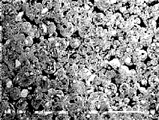
- Example 3 is a cross-sectional SEM photograph of a heating element of Example 1.
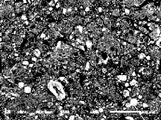
- 4 is a cross-sectional SEM photograph of a heating element of Comparative Example 1.
- the heating element of the present invention contains metal powder and metal oxide powder and is compression molded.
- metal powders used in the present invention include metal powders such as iron and aluminum, single metal powders of semimetals such as boron and silicon, and ferrosilicon powders. Of these, ferrosilicon is preferably used. Ferrosilicon preferably has a silicon content of 70% or more and an average particle size of 20 ⁇ m or less. The content of the metal powder is preferably in the range of 20% to 35% by weight. If the content of the metal powder is less than 20% by weight, the combustion may not proceed smoothly. On the other hand, if the content of the metal powder exceeds 35% by weight, the calorific value per unit weight may be reduced. .
- Examples of the metal oxide powder used in the present invention include metal oxide powders such as ferric oxide, tin oxide, and titanium oxide, and lower-order oxide powders. Among these, ferric oxide powder and lower-order iron oxide powder are preferably used.
- the average particle diameter of the metal oxide powder is preferably 10 ⁇ m or less, more preferably 5 ⁇ m or less.
- the content of the metal oxide is preferably in the range of 10% to 70% by weight. If the content of the metal oxide powder is less than 10% by weight, the strength after compression molding may be reduced. On the other hand, if the content of the metal oxide powder exceeds 70% by weight, the calorific value per unit weight May decrease.
- Magnetite Fe 2 O 3-X , X: 0.33 is preferably used as the lower-order iron oxide powder than ferric oxide.
- the average particle size of the low-order iron oxide powder is desirably 20 ⁇ m or less.
- the content of the low-order iron oxide powder is preferably in the range of 10% by weight to 60% by weight. When the content of the low-order iron oxide powder is less than 10% by weight, combustion may not proceed smoothly, while when the content of the low-order iron oxide powder exceeds 60% by weight, the unit weight There is a possibility that the amount of heat generated per hit decreases and the strength of the heating element also decreases.
- additives such as a combustion rate adjusting agent may be added within a range that does not impair the effects of the present invention, if necessary.
- One of the major features of the heating element according to the present invention is a compression-molded heating element that has a porosity of 35% to 60% by volume and a crushing strength of 100 kg / cm 2 or more.
- the crushing strength can be increased by increasing the compression force, but in this case, the porosity is reduced.
- the porosity of the heating element is small, the heating element expands or cracks due to the gas generated by the high heat generated during combustion of the heating element.
- the porosity of the heating element is increased, the crushing strength is reduced.
- a high crushing strength can be obtained while obtaining a predetermined porosity by a manufacturing method described later.
- the porosity of the heating element according to the present invention is in the range of 35 volume% to 60 volume%. If the porosity of the heating element is less than 35% by volume, a sufficient escape path for gas generated during combustion of the heating element is not ensured, and expansion and cracking occur in the heating element. On the other hand, when the porosity of the heating element exceeds 60% by volume, the strength of the heating element rapidly decreases. A more preferable heating element porosity is in the range of 40 to 60 volume%.
- the crushing strength of the heating element according to the present invention is 100 kg / cm 2 or more. If the crushing strength of the heating element is less than 100 kg / cm 2 , the compression molded heating element may be damaged in actual use. A more preferable crushing strength is 110 kg / cm 2 or more.
- the density of the heating element according to the present invention is preferably in the range of 1.90 g / cm 3 to 2.70 g / cm 3 . If the density of the heating element is less than 1.90 g / cm 3 , the heat generation amount per volume may decrease. On the other hand, if the density of the heating element exceeds 2.70 g / cm 3 , the heat generation proceeds rapidly and there is a risk that continuous heat generation may not be obtained.
- a more preferable heating element density is in the range of 1.90 g / cm 3 to 2.50 g / cm 3 .
- the production method of the heating element according to the present invention is not particularly limited, but the production method described below is preferable.
- the metal powder raw material and the metal oxide powder raw material are weighed.
- the raw material is charged into a dispersion medium to prepare a slurry.
- Water is preferred as the dispersion medium used in the present invention.
- a binder, a dispersant and the like may be blended in the dispersion medium as necessary.
- polyvinyl alcohol can be suitably used as the binder.
- the binder content is preferably about 0.5% by mass to 2% by mass in the slurry.
- polyether, ammonium polycarboxylate, etc. can be used conveniently, for example.
- the blending amount of the dispersant is preferably about 0.5% by mass to 2% by mass in the slurry.
- the solid content concentration of the slurry is desirably in the range of 50% by mass to 90% by mass. More preferably, it is 60% by mass to 80% by mass.
- the slurry prepared as described above is wet pulverized.
- wet grinding is performed for a predetermined time using a ball mill or a vibration mill.
- the average particle diameter of the raw material after pulverization is preferably 5 ⁇ m or less, more preferably 1 ⁇ m or less.
- the vibration mill or ball mill preferably contains a medium having a predetermined particle diameter.
- the material of the media include iron-based chromium steel and oxide-based zirconia, titania, and alumina.
- any of a continuous type and a batch type may be sufficient.
- the particle size of the pulverized product is adjusted depending on the pulverization time and rotation speed, the material and particle size of the media used, and the like.
- the pulverized slurry is spray-dried and granulated.
- the slurry is introduced into a spray dryer such as a spray dryer, and granulated into a spherical shape by spraying into the atmosphere.
- the atmospheric temperature during spray drying is preferably in the range of 100 ° C to 300 ° C.
- the circularity of the granulated product calculated from the formula (1) is preferably 0.75 or more. If the circularity is less than 0.75, the flowability of the granulated product is poor, and the mold is not filled to every corner during compression molding, and there is a possibility that a sufficient shape such as chipping may not be obtained. There is.
- the obtained granulated product is classified using a vibration sieve to produce a granulated product having a predetermined particle size range.
- the average particle size of the granulated product is preferably in the range of 25 ⁇ m to 400 ⁇ m. If the average particle size is less than 25 ⁇ m, the fluidity of the granulated product is poor, and the mold is not filled to every corner during compression molding, and there is a possibility that a sufficient shape cannot be obtained, such as chipping in the molded product. is there. When the average particle diameter exceeds 400 ⁇ m, a sufficient density cannot be obtained when filling the mold, and there is a possibility that sufficient strength as a molded body cannot be obtained.
- the molding pressure is not particularly limited to the extent that the molded heating element which satisfies the porosity and crushing strength of the obtained usually in the range of 200kg / cm 2 ⁇ 500kg / cm 2 is preferred.
- the shape of the molded heating element is not particularly limited, and may be appropriately determined in consideration of an actual usage form such as a columnar shape, a disc shape, or a cylindrical shape.
- Example 1 As starting materials, 9 kg (30 parts by weight) of ferrosilicon (Fe 28%) with an average particle diameter of 11 ⁇ m, 18 kg (60 parts by weight) of Fe 2 O with an average particle diameter of 2 ⁇ m, and magnetite powder (Fe 2 O with an average particle diameter of 15 ⁇ m) 3-X , X: 0.33) was mixed with 3 kg (10 parts by weight), dispersed in 10 kg of pure water, and 450 g of a polyether-based dispersant was added as a dispersant to obtain a mixture. This mixture was pulverized by a wet ball mill (media diameter 2 mm) to obtain a slurry. This slurry was sprayed into hot air at about 160 ° C.
- FIG. 1 shows a cross-sectional SEM photograph of the heating element.
- Example 2 A heating element was produced in the same manner as in Example 1 except that a granulated product having an average particle size of 27.1 ⁇ m was used. Then, in the same manner as in Example 1, the shape retention property, density, porosity, crushing strength, and presence / absence of cracks after combustion were measured and observed. The results are summarized in Table 1.
- Example 3 A heating element was produced in the same manner as in Example 1 except that a granulated product having an average particle size of 304.1 ⁇ m was used. Then, in the same manner as in Example 1, the shape retention property, density, porosity, crushing strength, and presence / absence of cracks after combustion were measured and observed. The results are summarized in Table 1.
- Example 4 A heating element was produced in the same manner as in Example 1 except that the molding pressure at the time of producing the molded body was 500 kg / cm 2 . Then, in the same manner as in Example 1, the shape retention property, density, porosity, crushing strength, and presence / absence of cracks after combustion were measured and observed. The results are summarized in Table 1.
- Comparative Example 2 A granulated product and a molded product were prepared and evaluated for properties in the same manner as in Comparative Example 1 except that the molding pressure at the time of forming the molded product was 100 kg / cm 2 . The evaluation results are shown in Table 1.
- the volume average diameter (D 50 ) of the granulated product was measured using “HELOS” manufactured by SYMPATEC.
- Circularity made the average value of 100 granulated material the circularity of the granulated material.
- Circularity 4 ⁇ ⁇ (A / L 2 ) (1) (Where, L: perimeter of the granulated product, A: projected area of the granulated product)
- the density of the heating element The density was calculated from the weight and volume of the heating element.
- the solid content volume in the heating element is calculated from the density of the heating element and the true density of the granulated material measured using the Ultrapycnometer 1000 model manufactured by Quantachrome, and subtracted from the volume of the heating element by the solid content volume. The void volume was determined, and the porosity of the heating element was determined.
- a heating element is placed on the heat insulating material, and 0.2 to 0.3 g of mixed powder of iron powder, ferrosilicon, copper oxide, and barium peroxide is used as an igniting agent in the center of the heating element. Ignited. Then, the heat generation state and whether or not the heat generating body after the heat generating body burned were visually observed were observed.
- the heating element of Comparative Example 1 produced by compression molding without granulating the starting material had a low porosity of 31.1% by volume and a high density of 2.96 g / cm 3 . For this reason, in the combustion test of the heating element, the gas generated by the combustion cannot smoothly escape to the outside of the heating element, and cracks were confirmed after the heating element was expanded and burned.
- Comparative Example 2 produced at a molding pressure smaller than that of Comparative Example 1, the porosity was 54.5% by volume, but the compressive strength showed a low value of 73 kg / cm 2. The lack was confirmed.
- the heating element of the present invention is a compression molded heating element, it is useful without causing expansion or cracking due to combustion.
Landscapes
- Chemical & Material Sciences (AREA)
- Engineering & Computer Science (AREA)
- Chemical Kinetics & Catalysis (AREA)
- Mechanical Engineering (AREA)
- Thermal Sciences (AREA)
- Combustion & Propulsion (AREA)
- Physics & Mathematics (AREA)
- Organic Chemistry (AREA)
- General Engineering & Computer Science (AREA)
- General Chemical & Material Sciences (AREA)
- Materials Engineering (AREA)
- Manufacturing & Machinery (AREA)
- Powder Metallurgy (AREA)
- Resistance Heating (AREA)
Abstract
金属粉末と金属酸化物粉末とを含有し、圧縮成型された発熱体であって、空隙率が35体積%以上60体積%以下であり、圧壊強度が100kg/cm2以上であることを特徴とする。これにより、燃焼によって高温となっても膨張や割れが生じないようになる。
Description
本発明は、金属の酸化還元反応を利用する成型発熱体に関するものである。
食品の加温や加熱調理に用いる発熱体として、酸素供与体を含む自己燃焼型の発熱体が開発されている。例えば、特許文献1には、フェロシリコン粉末と、酸化第2鉄とこれより低次の酸化鉄粉末の混合粉末を圧縮成形した発熱体が提案されている。このような発熱体では、酸化第2鉄とこれより低次の酸化鉄がフェロシリコン中の珪素に対して酸素供与体として作用するので、外部から酸素を供給しなくても自己燃焼する。
ところが、このような粉末原料を混合して加圧成形しただけの発熱体では、発熱体の燃焼時の高熱によって水分や炭素分などに起因して発生するガスによって発熱体に膨張や割れが発生する。
特許文献2には、酸化鉄粉末と、珪素と鉄の合金粉末とからなる自己燃焼性粉末に、アルカリ性化合物の水溶液を添加してプレス成形することによって発熱体の強度を向上させる技術が提案されている。
しかしながら、このような提案技術によっても燃焼時の発熱体の膨張や割れを十分に抑制することはできない。
本発明はこのような従来の問題に鑑みてなされたものであり、その目的は、圧縮成型された発熱体であって、燃焼によって高温となっても膨張や割れが生じない発熱体を提供することにある。
また本発明の他の目的は、自己燃焼によって高温となっても膨張や割れが生じない発熱体の製造方法を提供することにある。
そしてまた本発明の他の目的は、燃焼によって高温となっても膨張や割れが生じない発熱体を圧縮成型することによって作製できる造粒物を提供することにある。
前記目的を達成する本発明に係る成型発熱体(以下、単に「発熱体」と記すことがある)は、金属粉末と金属酸化物粉末とを含有し、圧縮成型された発熱体であって、空隙率が35体積%以上60体積%以下で且つ圧壊強度が100kg/cm2以上であることを特徴とする。
ここで、発熱体の密度としては、1.90g/cm3以上2.70g/cm3以下の範囲であるのが好ましい。
また本発明によれば、金属粉末と金属酸化物粉末とを分散媒中に投入してスラリーを得る工程と、前記スラリーを噴霧乾燥して球形状の造粒物を得る工程と、前記造粒物を圧縮成型する工程とを有することを特徴とする成型発熱体の製造方法が提供される。
ここで、前記造粒物の、下記式(1)から算出される円形度は0.75以上であるのが好ましい。
円形度=4π×(A/L2)・・・・・・(1)
(式中、L:造粒物の周囲長,A:造粒物の投影面積)
円形度=4π×(A/L2)・・・・・・(1)
(式中、L:造粒物の周囲長,A:造粒物の投影面積)
また、前記造粒物の体積平均粒径は25μm以上400μm以下の範囲であるのが好ましい。
そしてまた本発明によれば、圧縮成型によって発熱体とされる、金属粉末と金属酸化物粉末とを含有し球形状の造粒物であって、下記式から算出される円形度が0.75以上である成型発熱体用の造粒物が提供される。
円形度=4π×(A/L2)
(式中、L:造粒物の周囲長,A:造粒物の投影面積)
円形度=4π×(A/L2)
(式中、L:造粒物の周囲長,A:造粒物の投影面積)
ここで前記造粒物の体積平均粒径としては25μm以上400μm以下の範囲であるのが好ましい。
本発明の発熱体によれば、圧縮成型された発熱体であっても燃焼による膨張や割れが生じない。
また本発明の製造方法によれば、自己燃焼によって高温となっても膨張や割れが生じない発熱体を製造方法できる。
そしてまた本発明の造粒物を用いて圧縮成型すれば、自己燃焼によって高温となっても膨張や割れが生じない発熱体を製造できる。
本発明の発熱体は、金属粉末と金属酸化物粉末とを含有し圧縮成型されたものである。
本発明で使用する金属粉末としては、鉄やアルミニウムなどの金属粉末、ホウ素や珪素などの半金属の単体粉末、フェロシリコンの粉末などが挙げられる。これらの中でもフェロシリコンが好適に使用される。フェロシリコンとしては、シリコン含有量70%以上で、平均粒径20μm以下であるのが望ましい。金属粉末の含有量としては、20重量%~35重量%の範囲が好ましい。金属粉末の含有量が20重量%未満であると、燃焼が円滑に進まないおそれがある一方、金属粉末の含有量が35重量%を超えると、単位重量当たりの発熱量が低下するおそれがある。
本発明で使用する金属酸化物粉末としては、酸化第2鉄、酸化スズ、酸化チタンなどの金属酸化物粉末及びこれらよりも低次の酸化物粉末が挙げられる。これらの中でも酸化第2鉄粉末及びこれよりも低次の酸化鉄粉末が好適に使用される。金属酸化物粉末の平均粒径は10μm以下が好ましく、より好ましくは5μm以下である。また金属酸化物の含有量としては、10重量%~70重量%の範囲が好ましい。金属酸化物粉末の含有量が10重量%未満であると、圧縮成型後の強度が低下するおそれがある一方、金属酸化物粉末の含有量が70重量%を超えると、単位重量当たりの発熱量が低下するおそれがある。
酸化第2鉄よりも低次の酸化鉄粉末としてはマグネタイト(Fe2O3-X,X:0.33)が好適に使用される。前記低次の酸化鉄粉末の平均粒径は20μm以下であるのが望ましい。また前記低次の酸化鉄粉末の含有量としては、10重量%~60重量%の範囲が好ましい。前記低次の酸化鉄粉末の含有量が10重量%未満であると、燃焼が円滑に進まないおそれがある一方、前記低次の酸化鉄粉末の含有量が60重量%を超えると、単位重量当たりの発熱量が低下するとともに発熱体の強度も低下するおそれがある。
その他、燃焼速度調整剤などの添加剤を必要により本発明の効果を害さない範囲において添加してもよい。
本発明に係る発熱体の大きな特徴の一つは、圧縮成型された発熱体であって、空隙率が35体積%~60体積%で且つ圧壊強度が100kg/cm2以上である点にある。これまでの圧縮成型された発熱体では、圧縮力を強くすることによって圧壊強度を高くすることはできたが、この場合、空隙率は小さくなる。発熱体の空隙率が小さいと、発熱体の燃焼時の高熱によって発生するガスによって発熱体に膨張や割れが発生する。反対に、発熱体の空隙率を大きくすると、圧壊強度が低下する。これに対して、本発明の発熱体では、後述する製造方法によって、所定の空隙率を得ながらしかも高い圧壊強度が得られるようになった。
本発明に係る発熱体の空隙率は35体積%~60体積%の範囲である。発熱体の空隙率が35体積%未満であると、発熱体の燃焼時に発生するガスの抜け道が十分には確保されず発熱体に膨張や割れが発生する。一方、発熱体の空隙率が60体積%を超えると発熱体の強度が急激に低くなる。より好ましい発熱体の空隙率は、40体積%~60体積%の範囲である。
本発明に係る発熱体の圧壊強度は100kg/cm2以上である。発熱体の圧壊強度が100kg/cm2未満であると、圧縮成型された発熱体が実使用において損壊するおそれがある。より好ましい圧壊強度は110kg/cm2以上である。
また、本発明に係る発熱体の密度は1.90g/cm3~2.70g/cm3の範囲が好ましい。発熱体の密度が1.90g/cm3未満であると、体積当たりの発熱量が低下するおそれがある。一方、発熱体の密度が2.70g/cm3を超えると、発熱が急速に進行し持続的な発熱が得られないおそれがある。より好ましい発熱体の密度は1.90g/cm3~2.50g/cm3の範囲である。
本発明に係る発熱体の製造方法に特に限定はないが、以下に説明する製造方法が好適である。
まず、金属粉体原料、金属酸化物粉体原料を秤量する。次いで、原料を分散媒中に投入しスラリーを作製する。本発明で使用する分散媒としては水が好適である。分散媒には、前記原料の他、必要によりバインダー、分散剤等を配合してもよい。バインダーとしては、例えば、ポリビニルアルコールが好適に使用できる。バインダーの配合量としてはスラリー中の濃度が0.5質量%~2質量%程度とするのが好ましい。また、分散剤としては、例えば、ポリエーテルやポリカルボン酸アンモニウム等が好適に使用できる。分散剤の配合量としてはスラリー中の濃度が0.5質量%~2質量%程度とするのが好ましい。その他、本発明の効果を阻害しない範囲で従来公知の添加剤を配合してもよい。スラリーの固形分濃度は50質量%~90質量%の範囲が望ましい。より好ましくは60質量%~80質量%である。
次に、以上のようにして作製されたスラリーを湿式粉砕する。例えば、ボールミルや振動ミルを用いて所定時間湿式粉砕する。粉砕後の原材料の平均粒径は5μm以下が好ましく、より好ましくは1μm以下である。振動ミルやボールミルには、所定粒径のメディアを内在させるのがよい。メディアの材質としては、鉄系のクロム鋼や酸化物系のジルコニア、チタニア、アルミナなどが挙げられる。粉砕工程の形態としては連続式及び回分式のいずれであってもよい。粉砕物の粒径は、粉砕時間や回転速度、使用するメディアの材質・粒径などによって調整される。
そして、粉砕されたスラリーを噴霧乾燥させて造粒する。具体的には、スプレードライヤーなどの噴霧乾燥機にスラリーを導入し、雰囲気中へ噴霧することによって球形状に造粒する。噴霧乾燥時の雰囲気温度は100℃~300℃の範囲が好ましい。これにより、球形状の造粒物が得られる。前記式(1)から算出される造粒物の円形度としては0.75以上であるのが好ましい。円形度が0.75未満であると、造粒物の流動性が悪く、圧縮成型時に型へ充填が隅々まで行われず、成型体に欠けが発生するなど、十分な形状が得られないおそれがある。次いで、得られた造粒物を振動ふるいを用いて分級し所定の粒径範囲の造粒物を作製する。造粒物の平均粒径は25μm~400μmの範囲が好ましい。平均粒径が25μm未満であると、造粒物の流動性が悪く、圧縮成型時に型へ充填が隅々まで行われず、成型体に欠けが発生するなど、十分な形状が得られないおそれがある。平均粒径が400μmを超える場合は、型へ充填時に十分な密度がえられず、成型体として十分な強度が得られないおそれがある。
次に、得られた造粒物を所定の型に投入し圧縮成型して本発明の成型発熱体とする。成型圧力としては、前記の空隙率及び圧壊強度を満足する成型発熱体が得られる範囲において特に限定はないが、通常、200kg/cm2~500kg/cm2の範囲が好適である。成型発熱体の形状に特に限定はなく、円柱形状や円板形状、円筒形状など実際の使用形態を考慮し適宜決定すればよい。
以下、本発明を実施例によりさらに詳しく説明するが本発明はこれらの例に何ら限定されるものではない。
(実施例1)
出発原料として、平均粒径11μmのフェロシリコン(Fe28%)を9kg(30重量部)、平均粒径2μmのFe2Oを18kg(60重量部)、平均粒径15μmのマグネタイト粉末(Fe2O3-X,X:0.33)を3kg(10重量部)混合し、純水10kg中に分散し、分散剤としてポリエーテル系分散剤を450g添加して混合物とした。この混合物を湿式ボールミル(メディア径2mm)により粉砕処理してスラリーを得た。
このスラリーをスプレードライヤーにて約160℃の熱風中に噴霧し、粒径10μm~100μmの造粒物を得た。この造粒物から、粒径100μmを超える粗粒は篩網を用いて除去した。得られた造粒物の平均粒径及び円形度を後述の方法で測定した。
次いで、この造粒物15gを直径2cmの円柱状凹部が形成された金型に入れ、圧力300kg/cm2で圧縮成型し、厚さ1.5cmの円柱形状の発熱体を得た。目視観察において、得られた発熱体に割れ、欠け、形状の崩れは確認されず、形状保持性は良好であった。発熱体の密度、空隙率、圧壊強度、燃焼後の割れの有無を下記方法で測定及び観察した。結果を表1にまとめて示す。また図1に、発熱体の断面SEM写真を示す。
出発原料として、平均粒径11μmのフェロシリコン(Fe28%)を9kg(30重量部)、平均粒径2μmのFe2Oを18kg(60重量部)、平均粒径15μmのマグネタイト粉末(Fe2O3-X,X:0.33)を3kg(10重量部)混合し、純水10kg中に分散し、分散剤としてポリエーテル系分散剤を450g添加して混合物とした。この混合物を湿式ボールミル(メディア径2mm)により粉砕処理してスラリーを得た。
このスラリーをスプレードライヤーにて約160℃の熱風中に噴霧し、粒径10μm~100μmの造粒物を得た。この造粒物から、粒径100μmを超える粗粒は篩網を用いて除去した。得られた造粒物の平均粒径及び円形度を後述の方法で測定した。
次いで、この造粒物15gを直径2cmの円柱状凹部が形成された金型に入れ、圧力300kg/cm2で圧縮成型し、厚さ1.5cmの円柱形状の発熱体を得た。目視観察において、得られた発熱体に割れ、欠け、形状の崩れは確認されず、形状保持性は良好であった。発熱体の密度、空隙率、圧壊強度、燃焼後の割れの有無を下記方法で測定及び観察した。結果を表1にまとめて示す。また図1に、発熱体の断面SEM写真を示す。
(実施例2)
平均粒径が27.1μmの造粒物を用いた以外は実施例1と同様にして発熱体を作製した。そして作製した発熱体の形状保持性、密度、空隙率、圧壊強度、燃焼後の割れの有無を実施例1と同様にして測定及び観察した。結果を表1にまとめて示す。
平均粒径が27.1μmの造粒物を用いた以外は実施例1と同様にして発熱体を作製した。そして作製した発熱体の形状保持性、密度、空隙率、圧壊強度、燃焼後の割れの有無を実施例1と同様にして測定及び観察した。結果を表1にまとめて示す。
(実施例3)
平均粒径が304.1μmの造粒物を用いた以外は実施例1と同様にして発熱体を作製した。そして作製した発熱体の形状保持性、密度、空隙率、圧壊強度、燃焼後の割れの有無を実施例1と同様にして測定及び観察した。結果を表1にまとめて示す。
平均粒径が304.1μmの造粒物を用いた以外は実施例1と同様にして発熱体を作製した。そして作製した発熱体の形状保持性、密度、空隙率、圧壊強度、燃焼後の割れの有無を実施例1と同様にして測定及び観察した。結果を表1にまとめて示す。
(実施例4)
成型体作製時の成型圧力を500kg/cm2と得た以外は、実施例1と同様にして発熱体を作製した。そして作製した発熱体の形状保持性、密度、空隙率、圧壊強度、燃焼後の割れの有無を実施例1と同様にして測定及び観察した。結果を表1にまとめて示す。
成型体作製時の成型圧力を500kg/cm2と得た以外は、実施例1と同様にして発熱体を作製した。そして作製した発熱体の形状保持性、密度、空隙率、圧壊強度、燃焼後の割れの有無を実施例1と同様にして測定及び観察した。結果を表1にまとめて示す。
(比較例1)
出発原料として、平均粒径11μmのフェロシリコン(Fe28%)を9kg(30重量部)、平均粒径2μmのFe2Oを18kg(60重量部)、平均粒径15μmのマグネタイト粉末(Fe2O3-X,X:0.33)を3kg(10重量部)ヘンシェルミキサーを用いて混合し、実施例1と同様の条件で圧縮成型して発熱体を作製した。作製した発熱体の形状保持性、密度、空隙率、圧壊強度、燃焼後の割れの有無を実施例1と同様にして測定及び観察した。結果を表1にまとめて示す。また図2に、発熱体の断面SEM写真を示す。
出発原料として、平均粒径11μmのフェロシリコン(Fe28%)を9kg(30重量部)、平均粒径2μmのFe2Oを18kg(60重量部)、平均粒径15μmのマグネタイト粉末(Fe2O3-X,X:0.33)を3kg(10重量部)ヘンシェルミキサーを用いて混合し、実施例1と同様の条件で圧縮成型して発熱体を作製した。作製した発熱体の形状保持性、密度、空隙率、圧壊強度、燃焼後の割れの有無を実施例1と同様にして測定及び観察した。結果を表1にまとめて示す。また図2に、発熱体の断面SEM写真を示す。
(比較例2)
成型体作製時の成型圧力を100kg/cm2とした以外は、比較例1と同様にして造粒物、成型体を作製し、特性評価を行った。評価結果を表1に合わせて示す。
成型体作製時の成型圧力を100kg/cm2とした以外は、比較例1と同様にして造粒物、成型体を作製し、特性評価を行った。評価結果を表1に合わせて示す。
(造粒物の体積平均径の測定)
造粒物の体積平均径(D50)をSYMPATEC社製の「HELOS」を用いて測定した。
造粒物の体積平均径(D50)をSYMPATEC社製の「HELOS」を用いて測定した。
(造粒物の円形度測定)
走査型電子顕微鏡(日本電子製「JSM-6510LA」)を用いて、加速電圧は5kV、スポットサイズは45,倍率は30倍~150倍(粒径に対応して変化)として、粒子が重ならないように造粒物を分散させて撮影した。そして、その画像情報を、インターフェースを介してメディアサイバネティクス社製「画像解析ソフト(Image-Pro PLUS)」に導入して解析を行い、A(造粒物の投影面積)及びL(造粒物の周囲長)を求め、下記式(1)から造粒物の円形度を算出した。なお、円形度は、100個の造粒物の平均値をその造粒物の円形度とした。
円形度=4π×(A/L2)・・・・・・(1)
(式中、L:造粒物の周囲長,A:造粒物の投影面積)
走査型電子顕微鏡(日本電子製「JSM-6510LA」)を用いて、加速電圧は5kV、スポットサイズは45,倍率は30倍~150倍(粒径に対応して変化)として、粒子が重ならないように造粒物を分散させて撮影した。そして、その画像情報を、インターフェースを介してメディアサイバネティクス社製「画像解析ソフト(Image-Pro PLUS)」に導入して解析を行い、A(造粒物の投影面積)及びL(造粒物の周囲長)を求め、下記式(1)から造粒物の円形度を算出した。なお、円形度は、100個の造粒物の平均値をその造粒物の円形度とした。
円形度=4π×(A/L2)・・・・・・(1)
(式中、L:造粒物の周囲長,A:造粒物の投影面積)
(発熱体の密度)
発熱体の重量及び体積から密度を算出した。
発熱体の重量及び体積から密度を算出した。
(発熱体の空隙率)
発熱体の密度と、Quantachrome社製のウルトラピクノメータ1000型を用いて測定した造粒物の真密度とから発熱体中の固形分体積を算出し、発熱体の体積から固形分体積より差し引いて空隙体積を求め、発熱体の空隙率を求めた。
発熱体の密度と、Quantachrome社製のウルトラピクノメータ1000型を用いて測定した造粒物の真密度とから発熱体中の固形分体積を算出し、発熱体の体積から固形分体積より差し引いて空隙体積を求め、発熱体の空隙率を求めた。
(発熱体の圧壊強度)
造粒物15gを直径20mmの金型に入れ、300kg/cm2で圧縮成型した発熱体に軸方向から力を加えて圧壊強度を測定した。
造粒物15gを直径20mmの金型に入れ、300kg/cm2で圧縮成型した発熱体に軸方向から力を加えて圧壊強度を測定した。
(燃焼試験)
発熱体を断熱材の上に載せ、発熱体のほぼ中央部に、鉄粉、フェロシリコン、酸化銅、過酸化バリウムの混合粉末0.2~0.3gを着火剤としておき、マッチで着火剤に点火した。そして、発熱状態、発熱体が燃焼した後の発熱体に割れなどがあるかどうかを目視にて観察した。
発熱体を断熱材の上に載せ、発熱体のほぼ中央部に、鉄粉、フェロシリコン、酸化銅、過酸化バリウムの混合粉末0.2~0.3gを着火剤としておき、マッチで着火剤に点火した。そして、発熱状態、発熱体が燃焼した後の発熱体に割れなどがあるかどうかを目視にて観察した。

表1から明らかなように、空隙率及び圧壊強度が本願発明の規定範囲を満足している実施例1~4の発熱体では、圧縮成型時の割れ・欠け・崩れは見られなかった。また、発熱状態は良好で、発熱体の膨張や燃焼後の割れも見られなかった。
これに対して、出発原料を造粒せずに圧縮成型して作製した比較例1の発熱体では空隙率が31.1体積%と低く、密度は2.96g/cm3と高かった。このため、発熱体の燃焼試験では、燃焼によって生じた気体が発熱体の外部に円滑に抜け出ることができず、発熱体の膨張及び燃焼後に割れが確認された。
また、比較例1と比較し小さい成型圧力で作製した比較例2の発熱体では、空隙率が54.5体積%であったが、圧縮強度が73kg/cm2と低い値を示し、発熱体に欠けが確認された。
本発明の発熱体は、圧縮成型された発熱体であるが燃焼による膨張や割れが生じず有用である。
Claims (7)
- 金属粉末と金属酸化物粉末とを含有し、圧縮成型された発熱体であって、
空隙率が35体積%以上60体積%以下であり、
圧壊強度が100kg/cm2以上である
ことを特徴とする成型発熱体。 - 密度が1.90g/cm3以上2.70g/cm3以下の範囲である請求項1記載の成型発熱体。
- 金属粉末と金属酸化物粉末とを分散媒中に投入してスラリーを得る工程と、前記スラリーを噴霧乾燥して球形状の造粒物を得る工程と、前記造粒物を圧縮成型する工程とを有することを特徴とする成型発熱体の製造方法。
- 下記式(1)から算出される前記造粒物の円形度が0.75以上である請求項3記載の成型発熱体の製造方法。
円形度=4π×(A/L2)・・・・・・(1)
(式中、L:造粒物の周囲長,A:造粒物の投影面積) - 前記造粒物の体積平均粒径が25μm以上400μm以下の範囲である請求項3又は4記載の成型発熱体の製造方法。
- 圧縮成型によって発熱体とされる、金属粉末と金属酸化物粉末とを含有し球形状の造粒物であって、下記式から算出される円形度が0.75以上である成型発熱体用の造粒物。
円形度=4π×(A/L2)
(式中、L:造粒物の周囲長,A:造粒物の投影面積) - 体積平均粒径が25μm以上400μm以下の範囲である請求項6記載の造粒物。
Applications Claiming Priority (2)
| Application Number | Priority Date | Filing Date | Title |
|---|---|---|---|
| JP2015-087990 | 2015-04-23 | ||
| JP2015087990A JP6539098B2 (ja) | 2015-04-23 | 2015-04-23 | 成型発熱体 |
Publications (1)
| Publication Number | Publication Date |
|---|---|
| WO2016171073A1 true WO2016171073A1 (ja) | 2016-10-27 |
Family
ID=57143926
Family Applications (1)
| Application Number | Title | Priority Date | Filing Date |
|---|---|---|---|
| PCT/JP2016/062056 Ceased WO2016171073A1 (ja) | 2015-04-23 | 2016-04-15 | 成型発熱体 |
Country Status (2)
| Country | Link |
|---|---|
| JP (1) | JP6539098B2 (ja) |
| WO (1) | WO2016171073A1 (ja) |
Citations (5)
| Publication number | Priority date | Publication date | Assignee | Title |
|---|---|---|---|---|
| JPH0660304B2 (ja) * | 1989-03-03 | 1994-08-10 | 新日本製鐵株式会社 | 発熱体の成形方法 |
| JP2832226B2 (ja) * | 1990-11-01 | 1998-12-09 | パウダーテック株式会社 | 発熱成形体 |
| JP2862364B2 (ja) * | 1990-11-10 | 1999-03-03 | 同和鉄粉工業株式会社 | 発熱体 |
| JP2006111518A (ja) * | 2004-09-16 | 2006-04-27 | Neomax Co Ltd | ソフトフェライトコアの製造方法 |
| JP2006206349A (ja) * | 2005-01-25 | 2006-08-10 | Tosoh Corp | Ito造粒粉末及びito焼結体並びにその製造方法 |
-
2015
- 2015-04-23 JP JP2015087990A patent/JP6539098B2/ja active Active
-
2016
- 2016-04-15 WO PCT/JP2016/062056 patent/WO2016171073A1/ja not_active Ceased
Patent Citations (5)
| Publication number | Priority date | Publication date | Assignee | Title |
|---|---|---|---|---|
| JPH0660304B2 (ja) * | 1989-03-03 | 1994-08-10 | 新日本製鐵株式会社 | 発熱体の成形方法 |
| JP2832226B2 (ja) * | 1990-11-01 | 1998-12-09 | パウダーテック株式会社 | 発熱成形体 |
| JP2862364B2 (ja) * | 1990-11-10 | 1999-03-03 | 同和鉄粉工業株式会社 | 発熱体 |
| JP2006111518A (ja) * | 2004-09-16 | 2006-04-27 | Neomax Co Ltd | ソフトフェライトコアの製造方法 |
| JP2006206349A (ja) * | 2005-01-25 | 2006-08-10 | Tosoh Corp | Ito造粒粉末及びito焼結体並びにその製造方法 |
Also Published As
| Publication number | Publication date |
|---|---|
| JP2016205711A (ja) | 2016-12-08 |
| JP6539098B2 (ja) | 2019-07-03 |
Similar Documents
| Publication | Publication Date | Title |
|---|---|---|
| JP4326916B2 (ja) | 球状鋳物砂 | |
| JP6771078B1 (ja) | アルミナ粒子材料及びその製造方法 | |
| JP5690474B2 (ja) | 磁性粉末 | |
| JP6278148B1 (ja) | フライアッシュ、セメント組成物及びフライアッシュの製造方法 | |
| CN104311075A (zh) | 一种合金结合的不烧滑板 | |
| JP2016104901A (ja) | 焼結鉱製造用改質炭材およびそれを用いた焼結鉱の製造方法 | |
| JP5567353B2 (ja) | 球状耐火粒子及びそれからなる鋳物砂並びにそれを用いて得られた鋳型 | |
| CN111018492B (zh) | 发泡陶瓷制品制备方法及发泡陶瓷制品 | |
| JP6311220B2 (ja) | 低温焼成セメントクリンカーの製造方法 | |
| WO2016171073A1 (ja) | 成型発熱体 | |
| JP4603463B2 (ja) | 球状鋳物砂 | |
| WO2013058152A1 (ja) | 鋳造用中子、その製造方法およびその中子を用いる鋳造方法 | |
| JP4877514B2 (ja) | フェライト焼結磁石の製造方法 | |
| JP6414873B2 (ja) | セメント組成物の製造方法 | |
| JP2017109906A (ja) | スラグ粉及びスラグ粉の製造方法 | |
| JPS5939333A (ja) | 微細粉コークスの造粒法 | |
| WO2023145548A1 (ja) | 酸化マグネシウム粒子及びその製造方法 | |
| CN114736008A (zh) | 一种铸造型芯用高透气性球形陶瓷颗粒砂及其制备方法和应用 | |
| JP7171973B1 (ja) | 窒化ケイ素粉末、スラリー、及び窒化ケイ素焼結体の製造方法 | |
| JP2000212679A (ja) | Fe―Si系軟磁性焼結合金用原料粒体およびその製造方法ならびにFe―Si系軟磁性焼結合金部材の製造方法 | |
| JP2999968B2 (ja) | 酸化物永久磁石及びその製造方法 | |
| JP2009001868A (ja) | 圧粉磁心用磁性粉の製造方法 | |
| JPH0745346B2 (ja) | セラミックの泥漿鋳込成形法 | |
| JPS6060930A (ja) | フエライト球状粉の製造法 | |
| KR102936873B1 (ko) | 산화마그네슘 분말 및 그의 제조 방법 |
Legal Events
| Date | Code | Title | Description |
|---|---|---|---|
| 121 | Ep: the epo has been informed by wipo that ep was designated in this application |
Ref document number: 16783094 Country of ref document: EP Kind code of ref document: A1 |
|
| NENP | Non-entry into the national phase |
Ref country code: DE |
|
| 122 | Ep: pct application non-entry in european phase |
Ref document number: 16783094 Country of ref document: EP Kind code of ref document: A1 |