WO2016159238A1 - 熱拡散シート - Google Patents
熱拡散シート Download PDFInfo
- Publication number
- WO2016159238A1 WO2016159238A1 PCT/JP2016/060664 JP2016060664W WO2016159238A1 WO 2016159238 A1 WO2016159238 A1 WO 2016159238A1 JP 2016060664 W JP2016060664 W JP 2016060664W WO 2016159238 A1 WO2016159238 A1 WO 2016159238A1
- Authority
- WO
- WIPO (PCT)
- Prior art keywords
- adhesive layer
- sheet
- sensitive adhesive
- thickness
- pressure
- Prior art date
- Legal status (The legal status is an assumption and is not a legal conclusion. Google has not performed a legal analysis and makes no representation as to the accuracy of the status listed.)
- Ceased
Links
Images
Classifications
-
- B—PERFORMING OPERATIONS; TRANSPORTING
- B32—LAYERED PRODUCTS
- B32B—LAYERED PRODUCTS, i.e. PRODUCTS BUILT-UP OF STRATA OF FLAT OR NON-FLAT, e.g. CELLULAR OR HONEYCOMB, FORM
- B32B9/00—Layered products comprising a layer of a particular substance not covered by groups B32B11/00 - B32B29/00
- B32B9/04—Layered products comprising a layer of a particular substance not covered by groups B32B11/00 - B32B29/00 comprising such particular substance as the main or only constituent of a layer, which is next to another layer of the same or of a different material
-
- H—ELECTRICITY
- H05—ELECTRIC TECHNIQUES NOT OTHERWISE PROVIDED FOR
- H05K—PRINTED CIRCUITS; CASINGS OR CONSTRUCTIONAL DETAILS OF ELECTRIC APPARATUS; MANUFACTURE OF ASSEMBLAGES OF ELECTRICAL COMPONENTS
- H05K7/00—Constructional details common to different types of electric apparatus
- H05K7/20—Modifications to facilitate cooling, ventilating, or heating
- H05K7/2039—Modifications to facilitate cooling, ventilating, or heating characterised by the heat transfer by conduction from the heat generating element to a dissipating body
- H05K7/20436—Inner thermal coupling elements in heat dissipating housings, e.g. protrusions or depressions integrally formed in the housing
- H05K7/20445—Inner thermal coupling elements in heat dissipating housings, e.g. protrusions or depressions integrally formed in the housing the coupling element being an additional piece, e.g. thermal standoff
- H05K7/20472—Sheet interfaces
- H05K7/20481—Sheet interfaces characterised by the material composition exhibiting specific thermal properties
-
- B—PERFORMING OPERATIONS; TRANSPORTING
- B32—LAYERED PRODUCTS
- B32B—LAYERED PRODUCTS, i.e. PRODUCTS BUILT-UP OF STRATA OF FLAT OR NON-FLAT, e.g. CELLULAR OR HONEYCOMB, FORM
- B32B27/00—Layered products comprising a layer of synthetic resin
- B32B27/28—Layered products comprising a layer of synthetic resin comprising synthetic resins not wholly covered by any one of the sub-groups B32B27/30 - B32B27/42
- B32B27/281—Layered products comprising a layer of synthetic resin comprising synthetic resins not wholly covered by any one of the sub-groups B32B27/30 - B32B27/42 comprising polyimides
-
- B—PERFORMING OPERATIONS; TRANSPORTING
- B32—LAYERED PRODUCTS
- B32B—LAYERED PRODUCTS, i.e. PRODUCTS BUILT-UP OF STRATA OF FLAT OR NON-FLAT, e.g. CELLULAR OR HONEYCOMB, FORM
- B32B27/00—Layered products comprising a layer of synthetic resin
- B32B27/36—Layered products comprising a layer of synthetic resin comprising polyesters
-
- B—PERFORMING OPERATIONS; TRANSPORTING
- B32—LAYERED PRODUCTS
- B32B—LAYERED PRODUCTS, i.e. PRODUCTS BUILT-UP OF STRATA OF FLAT OR NON-FLAT, e.g. CELLULAR OR HONEYCOMB, FORM
- B32B7/00—Layered products characterised by the relation between layers; Layered products characterised by the relative orientation of features between layers, or by the relative values of a measurable parameter between layers, i.e. products comprising layers having different physical, chemical or physicochemical properties; Layered products characterised by the interconnection of layers
- B32B7/04—Interconnection of layers
- B32B7/06—Interconnection of layers permitting easy separation
-
- B—PERFORMING OPERATIONS; TRANSPORTING
- B32—LAYERED PRODUCTS
- B32B—LAYERED PRODUCTS, i.e. PRODUCTS BUILT-UP OF STRATA OF FLAT OR NON-FLAT, e.g. CELLULAR OR HONEYCOMB, FORM
- B32B7/00—Layered products characterised by the relation between layers; Layered products characterised by the relative orientation of features between layers, or by the relative values of a measurable parameter between layers, i.e. products comprising layers having different physical, chemical or physicochemical properties; Layered products characterised by the interconnection of layers
- B32B7/04—Interconnection of layers
- B32B7/12—Interconnection of layers using interposed adhesives or interposed materials with bonding properties
-
- B—PERFORMING OPERATIONS; TRANSPORTING
- B32—LAYERED PRODUCTS
- B32B—LAYERED PRODUCTS, i.e. PRODUCTS BUILT-UP OF STRATA OF FLAT OR NON-FLAT, e.g. CELLULAR OR HONEYCOMB, FORM
- B32B9/00—Layered products comprising a layer of a particular substance not covered by groups B32B11/00 - B32B29/00
- B32B9/005—Layered products comprising a layer of a particular substance not covered by groups B32B11/00 - B32B29/00 comprising one layer of ceramic material, e.g. porcelain, ceramic tile
- B32B9/007—Layered products comprising a layer of a particular substance not covered by groups B32B11/00 - B32B29/00 comprising one layer of ceramic material, e.g. porcelain, ceramic tile comprising carbon, e.g. graphite, composite carbon
-
- B—PERFORMING OPERATIONS; TRANSPORTING
- B32—LAYERED PRODUCTS
- B32B—LAYERED PRODUCTS, i.e. PRODUCTS BUILT-UP OF STRATA OF FLAT OR NON-FLAT, e.g. CELLULAR OR HONEYCOMB, FORM
- B32B9/00—Layered products comprising a layer of a particular substance not covered by groups B32B11/00 - B32B29/00
- B32B9/04—Layered products comprising a layer of a particular substance not covered by groups B32B11/00 - B32B29/00 comprising such particular substance as the main or only constituent of a layer, which is next to another layer of the same or of a different material
- B32B9/045—Layered products comprising a layer of a particular substance not covered by groups B32B11/00 - B32B29/00 comprising such particular substance as the main or only constituent of a layer, which is next to another layer of the same or of a different material of synthetic resin
-
- H—ELECTRICITY
- H10—SEMICONDUCTOR DEVICES; ELECTRIC SOLID-STATE DEVICES NOT OTHERWISE PROVIDED FOR
- H10K—ORGANIC ELECTRIC SOLID-STATE DEVICES
- H10K85/00—Organic materials used in the body or electrodes of devices covered by this subclass
- H10K85/10—Organic polymers or oligomers
-
- H—ELECTRICITY
- H10—SEMICONDUCTOR DEVICES; ELECTRIC SOLID-STATE DEVICES NOT OTHERWISE PROVIDED FOR
- H10K—ORGANIC ELECTRIC SOLID-STATE DEVICES
- H10K85/00—Organic materials used in the body or electrodes of devices covered by this subclass
- H10K85/10—Organic polymers or oligomers
- H10K85/141—Organic polymers or oligomers comprising aliphatic or olefinic chains, e.g. poly N-vinylcarbazol, PVC or PTFE
-
- H—ELECTRICITY
- H10—SEMICONDUCTOR DEVICES; ELECTRIC SOLID-STATE DEVICES NOT OTHERWISE PROVIDED FOR
- H10W—GENERIC PACKAGES, INTERCONNECTIONS, CONNECTORS OR OTHER CONSTRUCTIONAL DETAILS OF DEVICES COVERED BY CLASS H10
- H10W40/00—Arrangements for thermal protection or thermal control
- H10W40/10—Arrangements for heating
-
- H—ELECTRICITY
- H10—SEMICONDUCTOR DEVICES; ELECTRIC SOLID-STATE DEVICES NOT OTHERWISE PROVIDED FOR
- H10W—GENERIC PACKAGES, INTERCONNECTIONS, CONNECTORS OR OTHER CONSTRUCTIONAL DETAILS OF DEVICES COVERED BY CLASS H10
- H10W40/00—Arrangements for thermal protection or thermal control
- H10W40/20—Arrangements for cooling
- H10W40/25—Arrangements for cooling characterised by their materials
-
- H—ELECTRICITY
- H10—SEMICONDUCTOR DEVICES; ELECTRIC SOLID-STATE DEVICES NOT OTHERWISE PROVIDED FOR
- H10W—GENERIC PACKAGES, INTERCONNECTIONS, CONNECTORS OR OTHER CONSTRUCTIONAL DETAILS OF DEVICES COVERED BY CLASS H10
- H10W40/00—Arrangements for thermal protection or thermal control
- H10W40/20—Arrangements for cooling
- H10W40/25—Arrangements for cooling characterised by their materials
- H10W40/255—Arrangements for cooling characterised by their materials having a laminate or multilayered structure, e.g. direct bond copper [DBC] ceramic substrates
-
- B—PERFORMING OPERATIONS; TRANSPORTING
- B32—LAYERED PRODUCTS
- B32B—LAYERED PRODUCTS, i.e. PRODUCTS BUILT-UP OF STRATA OF FLAT OR NON-FLAT, e.g. CELLULAR OR HONEYCOMB, FORM
- B32B2250/00—Layers arrangement
- B32B2250/02—2 layers
-
- B—PERFORMING OPERATIONS; TRANSPORTING
- B32—LAYERED PRODUCTS
- B32B—LAYERED PRODUCTS, i.e. PRODUCTS BUILT-UP OF STRATA OF FLAT OR NON-FLAT, e.g. CELLULAR OR HONEYCOMB, FORM
- B32B2250/00—Layers arrangement
- B32B2250/40—Symmetrical or sandwich layers, e.g. ABA, ABCBA, ABCCBA
-
- B—PERFORMING OPERATIONS; TRANSPORTING
- B32—LAYERED PRODUCTS
- B32B—LAYERED PRODUCTS, i.e. PRODUCTS BUILT-UP OF STRATA OF FLAT OR NON-FLAT, e.g. CELLULAR OR HONEYCOMB, FORM
- B32B2307/00—Properties of the layers or laminate
- B32B2307/30—Properties of the layers or laminate having particular thermal properties
-
- B—PERFORMING OPERATIONS; TRANSPORTING
- B32—LAYERED PRODUCTS
- B32B—LAYERED PRODUCTS, i.e. PRODUCTS BUILT-UP OF STRATA OF FLAT OR NON-FLAT, e.g. CELLULAR OR HONEYCOMB, FORM
- B32B2307/00—Properties of the layers or laminate
- B32B2307/30—Properties of the layers or laminate having particular thermal properties
- B32B2307/302—Conductive
-
- B—PERFORMING OPERATIONS; TRANSPORTING
- B32—LAYERED PRODUCTS
- B32B—LAYERED PRODUCTS, i.e. PRODUCTS BUILT-UP OF STRATA OF FLAT OR NON-FLAT, e.g. CELLULAR OR HONEYCOMB, FORM
- B32B2307/00—Properties of the layers or laminate
- B32B2307/50—Properties of the layers or laminate having particular mechanical properties
- B32B2307/54—Yield strength; Tensile strength
-
- B—PERFORMING OPERATIONS; TRANSPORTING
- B32—LAYERED PRODUCTS
- B32B—LAYERED PRODUCTS, i.e. PRODUCTS BUILT-UP OF STRATA OF FLAT OR NON-FLAT, e.g. CELLULAR OR HONEYCOMB, FORM
- B32B2307/00—Properties of the layers or laminate
- B32B2307/70—Other properties
- B32B2307/706—Anisotropic
-
- B—PERFORMING OPERATIONS; TRANSPORTING
- B32—LAYERED PRODUCTS
- B32B—LAYERED PRODUCTS, i.e. PRODUCTS BUILT-UP OF STRATA OF FLAT OR NON-FLAT, e.g. CELLULAR OR HONEYCOMB, FORM
- B32B2307/00—Properties of the layers or laminate
- B32B2307/70—Other properties
- B32B2307/72—Density
-
- B—PERFORMING OPERATIONS; TRANSPORTING
- B32—LAYERED PRODUCTS
- B32B—LAYERED PRODUCTS, i.e. PRODUCTS BUILT-UP OF STRATA OF FLAT OR NON-FLAT, e.g. CELLULAR OR HONEYCOMB, FORM
- B32B2307/00—Properties of the layers or laminate
- B32B2307/70—Other properties
- B32B2307/732—Dimensional properties
-
- B—PERFORMING OPERATIONS; TRANSPORTING
- B32—LAYERED PRODUCTS
- B32B—LAYERED PRODUCTS, i.e. PRODUCTS BUILT-UP OF STRATA OF FLAT OR NON-FLAT, e.g. CELLULAR OR HONEYCOMB, FORM
- B32B2307/00—Properties of the layers or laminate
- B32B2307/70—Other properties
- B32B2307/748—Releasability
-
- B—PERFORMING OPERATIONS; TRANSPORTING
- B32—LAYERED PRODUCTS
- B32B—LAYERED PRODUCTS, i.e. PRODUCTS BUILT-UP OF STRATA OF FLAT OR NON-FLAT, e.g. CELLULAR OR HONEYCOMB, FORM
- B32B2309/00—Parameters for the laminating or treatment process; Apparatus details
- B32B2309/08—Dimensions, e.g. volume
- B32B2309/10—Dimensions, e.g. volume linear, e.g. length, distance, width
- B32B2309/105—Thickness
-
- B—PERFORMING OPERATIONS; TRANSPORTING
- B32—LAYERED PRODUCTS
- B32B—LAYERED PRODUCTS, i.e. PRODUCTS BUILT-UP OF STRATA OF FLAT OR NON-FLAT, e.g. CELLULAR OR HONEYCOMB, FORM
- B32B2457/00—Electrical equipment
- B32B2457/20—Displays, e.g. liquid crystal displays, plasma displays
- B32B2457/206—Organic displays, e.g. OLED
-
- H—ELECTRICITY
- H10—SEMICONDUCTOR DEVICES; ELECTRIC SOLID-STATE DEVICES NOT OTHERWISE PROVIDED FOR
- H10K—ORGANIC ELECTRIC SOLID-STATE DEVICES
- H10K59/00—Integrated devices, or assemblies of multiple devices, comprising at least one organic light-emitting element covered by group H10K50/00
- H10K59/80—Constructional details
- H10K59/8794—Arrangements for heating and cooling
-
- H—ELECTRICITY
- H10—SEMICONDUCTOR DEVICES; ELECTRIC SOLID-STATE DEVICES NOT OTHERWISE PROVIDED FOR
- H10W—GENERIC PACKAGES, INTERCONNECTIONS, CONNECTORS OR OTHER CONSTRUCTIONAL DETAILS OF DEVICES COVERED BY CLASS H10
- H10W40/00—Arrangements for thermal protection or thermal control
- H10W40/20—Arrangements for cooling
- H10W40/25—Arrangements for cooling characterised by their materials
- H10W40/251—Organics
Definitions
- the present invention relates to a thermal diffusion sheet used for heat dissipation, and more particularly to a thermal diffusion sheet that diffuses heat in the spreading direction of the thermal diffusion sheet.
- the method of diffusing the heat generated by the CPU to a large area as quickly as possible aims to increase the cooling efficiency, and is the most realistic cooling method for electronic devices such as mobile phones and personal computers. It is.
- sheet-like graphite has attracted a great deal of attention as a heat conductive sheet used for such a heat dissipation purpose.
- the reason is that a high-quality graphite sheet has a very high thermal conductivity of 100 W / (m ⁇ K) or more and 1000 W / (m ⁇ K) or less, and other gel-like heat dissipation materials or sheet-like heat dissipation. This is because the performance is remarkably higher than that of the thermal conductivity of the material, and it is optimal for diffusing heat.
- Patent Document 1 describes a heat conductive sheet for directly transferring heat from a heating element to a heat radiating member.
- Patent Documents 2 and 3 diffuse heat from a heating element in a planar direction. A thermal diffusive thermal conductive sheet is described.
- the heat conductive sheet not the one of Patent Document 1, but the heat conductive sheet described in Patent Document 2 or Patent Document 3 is attracting attention, and in particular, a so-called graphite sheet in which graphite is made into a sheet is attracting attention.
- the graphite sheet has a high thermal conductivity of 100 W / (m ⁇ K) or more and 1000 W / (m ⁇ K) or less in the plane direction, and diffuses the heat from the heating element to increase the temperature inside the electronic device.
- the function of the components arranged in the device is prevented from being deteriorated by making the temperature uniform.
- Embodiment 3 of Patent Document 2 (paragraph 0048), a double-sided tape in which an adhesive layer is formed on both sides of a substrate such as a PET film is previously attached to one side of a graphite sheet, Although a technique for applying to a surface (hereinafter referred to as an adherend surface) of an electronic device is disclosed, the adhesive layer usually does not have thermal conductivity and tends to reduce the thermal diffusion effect of the entire sheet. It is in. Moreover, in the acrylic adhesive layer normally used as an adhesive layer, it is difficult to peel off because of reattachment.
- Patent Document 3 by providing a graphite sheet (Claim 1) in which a thermal conductive material is contained in an elastic layer (corresponding to an adhesive layer) such as silicone rubber on one side of the graphite sheet, the thermal conductivity is provided. Attempts are made to prevent the deterioration of the film and to facilitate peeling for reattachment.
- an elastic layer corresponding to an adhesive layer
- an image display panel particularly an image display panel such as an OLED panel (organic EL panel)
- OLED panel organic EL panel
- the adhesive layer contains a heat conductive material.
- irregularities are formed on the surface of the pressure-sensitive adhesive layer. This decrease in adhesion contributes to the ease of peeling, but the ratio of the resin component constituting the pressure-sensitive adhesive layer is relatively decreased, so that the reliability of adhesion is unavoidable (Problem 1).
- the thickness of the graphite sheet is 300 ⁇ m or less, it does not matter so much. However, if the thickness of the graphite sheet is more than that, the rigidity of the entire sheet becomes high, so that it is difficult to bend the sheet when peeling. It becomes. Therefore, when the graphite sheet is peeled off from the surface to which the graphite sheet is attached, the angle between the graphite sheet and the surface will not be increased, but it will be pulled upward. Tends to coagulate and break down, resulting in a tendency to remain on the adherend surface (Problem 2).
- an object of the present invention is to provide a re-peelable heat diffusion sheet that can efficiently propagate the heat generated by elements and devices while sufficiently ensuring excellent thermal conductivity. It is to provide. Another object of the present invention is to provide a heat diffusion sheet having high adhesion reliability. Moreover, the objective of this invention is providing the thermal diffusion sheet which can be made to peel without making a silicone adhesive layer cohesive failure.
- the invention according to the present invention for achieving the above object is a thermal diffusion sheet having a graphite sheet and a composite pressure-sensitive adhesive film disposed on the surface of the graphite sheet, wherein the thickness of the graphite sheet is 20 ⁇ m or more.
- the composite adhesive film has a thickness of 5 ⁇ m or more and 15 ⁇ m or less, and the composite adhesive film is disposed on the graphite sheet and includes an acrylic adhesive layer containing no thermally conductive material;
- the polyester film is disposed on the acrylic pressure-sensitive adhesive layer and has a thickness in the range of 5 ⁇ m to 30 ⁇ m, and the polyester film is disposed on the polyester film and is thinner than the polyester film and has a thickness in the range of 2 ⁇ m to 25 ⁇ m.
- Yes does not contain heat conductive material, and peel strength is 0.005 N / cm or more
- a thermal diffusion sheet and having a silicone adhesive layer is not more than 1.0 N / cm.
- the present invention is a thermal diffusion sheet using a composite pressure-sensitive adhesive film having a composite pressure-sensitive adhesive layer with respect to a graphite sheet.
- a thermal diffusion sheet first, the use of a graphite sheet has an excellent thermal conductivity in the spreading direction, and the heat generated from the heating element is transmitted in the spreading direction of the thermal diffusion sheet, Even if the diffusion sheet has a uniform temperature and the adherend to which the thermal diffusion sheet is attached partially generates heat, the temperature can be uniformly increased.
- the silicone adhesive layer is firmly adhered to the polyester film on one side, and the other side is peelable from the adherend such as a glass plate. It can be reused later.
- the thermal conductivity of the composite adhesive film is low, the thickness is thin, and the thermal resistance in the film thickness direction of the composite adhesive film is reduced, so the heat generated from the adherend is the graphite sheet. Easy to be transmitted to.
- FIG. 1 Graphite Sheet with Adhesive of the Present Invention>
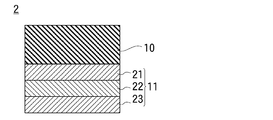
- Reference numeral 2 in FIG. 1 is a thermal diffusion sheet of the present invention, which has a graphite sheet 10 and a composite pressure-sensitive adhesive film 11.
- This thermal diffusion sheet 2 is affixed in and on equipment such as a display device represented by an organic EL element, and plays a role of diffusing heat from the heat source.
- the graphite sheet 10 used in the present invention is manufactured mainly from natural graphite, has high thermal conductivity, and has a characteristic that it can be adjusted to an arbitrary thickness of several tens to several thousand microns.
- the graphite sheet 10 used in the present invention has anisotropy in heat conduction due to its crystallinity, has low heat conductivity in the thickness direction, is difficult to transfer heat, and is spread (parallel to the sheet surface).
- Direction has a high thermal conductivity, making it easy to conduct heat.
- the thermal conductivity in the spreading direction is several times that of copper and aluminum, and the graphite sheet 10 is lighter than the metal sheet.
- the thickness of the graphite sheet is usually in the range of 50 ⁇ m or more and 2000 ⁇ m or less. However, in the case of the graphite sheet 10 used for the thermal diffusion sheet 2 of the present invention, it is required to make it thin like an OLED image panel. The thickness is preferably less than 80 ⁇ m in order to cope with the purpose of being used in a machine and the problem that the flexibility of the sheet itself is impaired and wrinkles are likely to occur. And the composite adhesive film 11 of this invention is suitable for thickness reduction when the thickness of the graphite sheet 10 is 20 micrometers or more, especially 30 micrometers or more, and generation
- the thermal conductivity of the graphite sheet 10 is 200 W / (m ⁇ K) or more and 2000 W / (m ⁇ K) or less, and the thermal conductivity is affected by the orientation of graphite, molecular weight, rolling density, and the like.
- the composite pressure-sensitive adhesive film 11 of the present invention is formed on one side of the graphite sheet 10 described above, and has a role of sticking the graphite sheet 10 to the surface of the object to be pasted.
- the overall thermal conductivity of the composite adhesive film 11 is 0.05 W / (m ⁇ K) or more and 0.5 W / (m ⁇ K) or less.
- the total thickness of the composite pressure-sensitive adhesive film 11 is in the range of 20 ⁇ m to 100 ⁇ m, The range of 22 ⁇ m or more and 55 ⁇ m or less is preferable.
- the composite pressure-sensitive adhesive film 11 is configured such that an acrylic pressure-sensitive adhesive layer 21 is provided on one side of a polyester film 22 and a silicone pressure-sensitive adhesive layer 23 is provided on the opposite side of the one side.
- the surface of the acrylic pressure-sensitive adhesive layer 21 is in contact with the surface of the graphite sheet 10 and the graphite sheet 10 and the composite pressure-sensitive adhesive film 11 are bonded.
- the material constituting the acrylic pressure-sensitive adhesive layer 21 includes an acrylic copolymer (a) serving as a base polymer, a tackifier (b) that is compatible with the base polymer and develops tackiness, and an acrylic copolymer (a ) Containing a curing agent (c) for adjusting the cohesive force of the acrylic copolymer (a) and the curing agent (c) before the acrylic adhesive layer 21 contacts the graphite sheet 10. It's not complete, but it's finished.
- acrylic copolymer (a) as a monomer having a functional group such as a methacryloyl group, a hydroxyl group, a carboxyl group, a methylol group, or an amide group, in addition to 2-hydroxyethyl methacrylate, acrylic acid, methacrylic acid, Acrylic copolymers selected from monomers consisting of 2-hydroxyethyl or propyl acrylate, 2-hydroxypropyl methacrylate, N-methylol acrylamide, N-methylol methacrylamide, acrylic or methacrylamide and the like can be used.
- a functional group such as a methacryloyl group, a hydroxyl group, a carboxyl group, a methylol group, or an amide group
- 2-hydroxyethyl methacrylate acrylic acid, methacrylic acid
- tackifier (b) a low molecular polymer made of a phenol resin, a terpene resin, a rosin resin, a hydrogenated rosin resin, a xylene resin, or an acrylic resin can be used.
- an isocyanate type curing agent or the like when a monomer having a hydroxyl group or the like is contained as a component of the acrylic copolymer (a), an isocyanate type curing agent or the like can be used. In the case of containing a monomer having a functional group, an ethyleneimine type curing agent or the like can be used.
- the thickness of the acrylic pressure-sensitive adhesive layer 21 is 5 ⁇ m or more and 15 ⁇ m or less, and particularly 10 ⁇ m or less. If the thickness is less than 5 ⁇ m, there is a problem that the adhesion to the adherend is insufficient. On the other hand, if the thickness is greater than 15 ⁇ m, the thermal resistance increases depending on the thickness of the polyester film 22. There is a problem that conduction cannot be obtained. When it is 10 ⁇ m or less, the thermal resistance is further reduced. In addition, it is the same as that of the below-mentioned silicone adhesive layer 23 that does not contain a heat conductive material.
- polyester film 22 can generate the strength of the composite pressure-sensitive adhesive film 11 as a whole, and has a role that facilitates peeling from the relationship with the thickness of the silicone pressure-sensitive adhesive layer 23 described later. In addition, when the acrylic pressure-sensitive adhesive layer 21 and the silicone pressure-sensitive adhesive layer 23 are directly laminated, the two layers are also prevented from being mixed.
- PET Polyethylene terephthalate
- the thickness thereof is preferably in the range of 5 ⁇ m to 30 ⁇ m, particularly preferably 10 ⁇ m or more, and preferably 25 ⁇ m or less.
- the tensile strength is preferably in the range of 100 MPa to 300 MPa in the longitudinal stretching direction and in the range of 10 MPa to 50 MPa in the lateral stretching direction.
- the range of 1000 Pa or more and 10,000 MPa or less is good.
- the silicone pressure-sensitive adhesive layer 23 is made of an addition reaction type silicone resin, and is selected from the viewpoint that the adhesion (peel strength) to an image panel (glass) such as an OLED is 0.005 N / cm or more and 1.0 N / cm or less. . Specifically, organosiloxane such as dimethylsiloxane can be used.
- the present invention does not require the silicone pressure-sensitive adhesive layer 23 to be formed thick, and specifically, the silicone pressure-sensitive adhesive layer 23.
- the thickness of is preferably 2 ⁇ m or more, particularly preferably 5 ⁇ m or more because adhesion is required, and preferably 25 ⁇ m or less, particularly preferably 20 ⁇ m or less from the viewpoint of improving peelability.
- the silicone pressure-sensitive adhesive layer 23 does not contain a heat conductive material, like the acrylic pressure-sensitive adhesive layer 21 described above.
- polyester film and silicone adhesive layer> Unlike the acrylic pressure-sensitive adhesive layer 21, the polyester film 22 and the silicone pressure-sensitive adhesive layer 23 affect the peelability, but the thickness relationship can be changed according to the thickness of the graphite sheet 10 and the desired area. preferable.
- the thickness of the polyester film 22 is 10 ⁇ m or more.
- the thickness of the silicone pressure-sensitive adhesive layer 23 is preferably less than the thickness of the polyester film 22 and is preferably 5 ⁇ m or more and 10 ⁇ m or less. That is, it is preferable that the thickness of the polyester film 22 is greater than 1.0 times and not more than 4.0 times the thickness of the silicone pressure-sensitive adhesive layer 23.
- the thickness of is preferably greater than 10 ⁇ m and 25 ⁇ m or less under conditions that are thinner than the thickness of the polyester film 22. That is, the thickness of the polyester film 22 is preferably greater than 1.0 times and less than or equal to 3.0 times the thickness of the silicone pressure-sensitive adhesive layer 23.
- the method for producing a graphite sheet with pressure-sensitive adhesive prepares the graphite sheet 10 described above, and sequentially forms an acrylic pressure-sensitive adhesive layer 21, a polyester film 22, and a silicone pressure-sensitive adhesive layer 23 on the graphite sheet 10. It may be formed, and double-sided pressure-sensitive adhesive in which an acrylic pressure-sensitive adhesive layer 21 in contact with the polyester film 22 is formed on one side of the polyester film 22 and a silicone pressure-sensitive adhesive layer 23 in contact with the polyester film 22 is formed on the other side.
- a composite pressure-sensitive adhesive film 11 as a sheet is prepared, the acrylic pressure-sensitive adhesive layer 21 side of the composite pressure-sensitive adhesive film 11 and the graphite sheet 10 are brought into contact, and the composite pressure-sensitive adhesive film 11 is attached to the graphite sheet 10 in the present invention.
- Heat diffusion sheet (graphite sheet with adhesive) 2 It may be.
- the intermediate sheet A in which the silicone pressure-sensitive adhesive layer 23 is formed on the polyester film 22 is formed, while the intermediate sheet B in which the acrylic pressure-sensitive adhesive layer 21 is formed on the release film is formed.
- the surface of the polyester film 22 and the surface of the acrylic pressure-sensitive adhesive layer 21 of the intermediate sheet B are brought into contact with each other, and the intermediate sheet A and the intermediate sheet B are pasted to create the double-sided pressure-sensitive adhesive film 11.
- the release film on the acrylic adhesive layer 21 side is removed, the exposed surface of the acrylic adhesive layer 21 is brought into contact with the surface of the graphite sheet 10, and the composite adhesive film 11 is attached to the graphite sheet 10.
- the heat diffusion sheet 2 of the present invention may be manufactured.
- the surface of the polyester film 22 of the intermediate sheet A is exposed, and the surface of the acrylic pressure-sensitive adhesive layer 21 of the intermediate sheet C is attached to the exposed surface so as to adhere to the heat diffusion sheet of the present invention. 2 may be manufactured.
- thermowave analyzer capable of measuring the thermal diffusivity in the plane direction
- the coating liquid is applied at a coating amount of 1.0 g / m 2 to form a silicone adhesive layer 23 having a thickness of 20 ⁇ m, and a 1/4 adhesive amount is applied to form a silicone adhesive layer 23 having a thickness of 5 ⁇ m. Formed.
- ⁇ Method for producing acrylic pressure-sensitive adhesive layer 5 parts by weight of a hydrogenated rosin [trade name “KE311” manufactured by Arakawa Chemical Industries, Ltd.] as a tackifier is added to and mixed with 55 parts by weight of a resin liquid in which an acrylic monomer and an acrylic polymer are mixed. 40 parts by weight of toluene was added and mixed until uniform. To this, 2 parts by weight of [trade name “Coronate L” manufactured by Nippon Polyurethane Industry Co., Ltd.], which is a TDI-based isocyanate-modified crosslinking agent, was added and mixed until further uniform.
- This coating solution is applied onto a release film having a thickness of 38 ⁇ m at a coating amount of 10 g / m 2 using a Mayer bar # 3, dried at 130 ° C. for 120 seconds, and an acrylic pressure-sensitive adhesive layer 21 having a thickness of 10 ⁇ m. Was formed on a release film.
- an acrylic pressure-sensitive adhesive layer 21 having a thickness of 5 ⁇ m was formed on the release film with a half coating amount.
- composition is laminated with an apparatus that can be heated at a linear pressure of 1 kg / cm, a silicone pressure-sensitive adhesive layer 23 is disposed on one side of the polyester film 22, and an acrylic pressure-sensitive adhesive layer 21 is provided on the opposite side.
- a composite pressure-sensitive adhesive film 11 having a structure in which is arranged was prepared.
- the acrylic pressure-sensitive adhesive layer 21 is prepared by vacuum heating pressing the graphite sheet 10 (including both the expanded graphite rolled sheet and the carbonized graphite sheet) and the composite pressure-sensitive adhesive film 11 manufactured in the above-described steps. Obtained a thermal diffusion sheet 2 fixed in contact with the graphite sheet 10.
- the thermal diffusion sheet 2 was a laminate, and a thermal diffusion sheet 2 (Examples 1 and 4) having a polyester film of 25 ⁇ m and a thermal diffusion sheet 2 (Examples 2, 3, and 5) having a thickness of 12 ⁇ m were prepared.
- a double-sided pressure-sensitive adhesive sheet (“commercially available product 1") that does not contain a heat conductive material and has an acrylic pressure-sensitive adhesive layer formed on both sides is combined with a composite pressure-sensitive adhesive.
- An adhesive film was attached to one side of the graphite sheet 10 to prepare a heat diffusion sheet.
- an acrylic pressure-sensitive adhesive layer is formed on the graphite sheet side and the adherend side
- an acrylic pressure-sensitive adhesive is formed on the graphite sheet side and the adherend side.
- the layer is formed with a thickness of 30 ⁇ m, and the thickness of the graphite sheet layer is 106 ⁇ m and 127 ⁇ m. Since the acrylic pressure-sensitive adhesive layer is affixed to the adherend, the peelability is poor.
- ⁇ Comparative Example 3> A 10 ⁇ m thick acrylic pressure-sensitive adhesive layer and a 20 ⁇ m thick silicone pressure-sensitive adhesive layer were formed on a 12 ⁇ m thick polyester film, and the acrylic pressure-sensitive adhesive layer was attached to a 127 ⁇ m thick graphite sheet.
- a silicone pressure-sensitive adhesive sheet [trade name T4082S] manufactured by Dexerials Co., Ltd. was used.
- the silicone adhesive layer is thicker than the polyester film, is difficult to peel off, and the polyester film may be deformed, resulting in poor workability.
- ⁇ Measurement test> The following tests were conducted on the thermal diffusion sheets of Examples 1 to 5 and Comparative Examples 1 to 4.
- ⁇ Thermal diffusivity test When a thermal diffusion sheet is cut out with a punch to 15 mm x 15 mm and an equilibrium state is reached at a temperature of 25 ° C using a thermal diffusivity measuring device (Thermo Wave Analyzer TA3: manufactured by Bethel Co., Ltd.) The thermal diffusivity of was calculated. The higher the numerical value, the better.
- the thermal diffusivity is preferably 10 ⁇ 4 m 2 / s or more.
- Adhesion reliability test A heat diffusion sheet was laminated to a glass plate (soda lime glass) at a linear pressure of 1 kg / cm, put into an atmospheric temperature and humidity oven adjusted to 60 ° C. and 75% RH, and after 1000 hours had elapsed. Appearance was confirmed.
Landscapes
- Engineering & Computer Science (AREA)
- Ceramic Engineering (AREA)
- Chemical & Material Sciences (AREA)
- Materials Engineering (AREA)
- Physics & Mathematics (AREA)
- Thermal Sciences (AREA)
- Microelectronics & Electronic Packaging (AREA)
- Laminated Bodies (AREA)
- Cooling Or The Like Of Semiconductors Or Solid State Devices (AREA)
- Adhesive Tapes (AREA)
- Adhesives Or Adhesive Processes (AREA)
- Cooling Or The Like Of Electrical Apparatus (AREA)
Abstract
広がり方向の熱伝導率が高く、被着体から剥離させても再使用できる熱拡散シートを提供する。 グラファイトシート10の厚みを20μm以上80μm未満にし、厚みが5μm以上15μm以下の範囲であり、熱伝導性材料を含有しないアクリル系粘着剤層21と、厚みが5μm以上30μm以下の範囲であるポリエステルフィルム22と、前記ポリエステルフィルムよりも薄く、厚みが2μm以上25μm以下の範囲であり、熱伝導性材料を含有せず、且つ剥離強度が0.005N/cm以上1.0N/cm以下であるシリコーン粘着剤層23を、グラファイトシート10から順次積層してなる熱拡散シート2を提供する。シリコーン粘着剤層23を貼付する被着体の発熱がグラファイトシート10に伝達されやすく、また、剥離して再利用もしやすい。
Description
本発明は、放熱に用いる熱拡散シートに係り、特に、熱を、熱拡散シートの広がり方向に拡散させる熱拡散シートに関する。
近年、パソコン、携帯電話、PDAなどの電子機器の性能向上は著しく、それはCPUの著しい性能向上によっている。この様なCPUの性能向上に伴い、CPUの発熱量も著しく増加し、電子機器における放熱をどの様に行うかが重要な課題になっている。
熱対策としてはファンによる空冷やヒートパイプ、水を用いた水冷などの方法があるが、これらはいずれも新たな放熱のための装置を必要とし、機器の重量増加を招くだけでなく、騒音や使用電気量の増加などを招くという欠点がある。
一方で、CPUの発生する熱を出来るだけ迅速に広い面積に拡散させる方法は冷却効率を上げることを目的としたもので、携帯電話やパソコンなどの電子機器における冷却方法としては最も現実的なものである。
ところで、有機EL素子に代表されるディスプレイデバイスでは、近年、大型化が進み、デバイスの精度、特に均一性が重要視されている。特に有機EL素子においては、素子自体が有機物で構成されている為、熱による劣化が素子の寿命、特に、発光特性、及び色度変化に影響を与えることが知られており、デバイスを構成する駆動回路などの発熱により、経時変化を伴うことがある。
この様な放熱目的に使用される熱伝導シートとして、近年では、シート状のグラファイトが大きな注目を集めている。
その理由は、良質のグラファイトシートは100W/(m・K)以上1000W/(m・K)以下の非常に高い熱伝導性を有しており、他のゲル状の放熱材料やシート状の放熱材料の熱伝導度の特性に比べて著しく高性能であり、熱を拡散させるためには最適だからである。
その理由は、良質のグラファイトシートは100W/(m・K)以上1000W/(m・K)以下の非常に高い熱伝導性を有しており、他のゲル状の放熱材料やシート状の放熱材料の熱伝導度の特性に比べて著しく高性能であり、熱を拡散させるためには最適だからである。
特許文献1には、発熱体からの熱を放熱部材に直接伝達するための熱伝導性シートが記載されており、特許文献2や特許文献3には、発熱体からの熱を平面方向に拡散させる熱拡散性の熱伝導性シートが記載されている。
熱伝導性シートとしては、特許文献1のものではなく、特許文献2や特許文献3に記載された熱伝導性シートが注目され、特に、グラファイトをシート化したいわゆるグラファイトシートが注目されている。
すなわち、グラファイトシートは、平面方向に100W/(m・K)以上1000W/(m・K)以下の高い熱伝導性を有しており、発熱体からの熱を拡散させて電子機器内の温度を均一化させることで、機器内の配置された部品の機能低下を防止している。
特許文献2の実施の形態3(段落0048)には、PETフィルムなどの基材の両面に粘着剤層を形成した両面テープをグラファイトシートの片面に予め貼付しておき、その粘着剤層により、電子機器の貼付対象の表面(以下、被着面と言う)に貼付する技術が開示されているが、通常粘着剤層は熱伝導性を有さず、シート全体の熱拡散効果を低下させる傾向にある。また、通常粘着剤層として使用されるアクリル系粘着剤層では、貼り直しのために剥離することが困難である。
そのため、特許文献3では、グラファイトシートの片面にシリコーンゴム等の弾性層(粘着剤層に相当)に熱伝導性材料を含有させたグラファイトシート(請求項1)を提供することで、熱伝導率の低下防止と、貼り直しのための剥離を容易にすることを試みている。
しかし、画像パネル、とりわけ、OLEDパネル(有機ELパネル)のような画像表示パネルは、そのパネルを構成する表面がガラスであり非常に平滑であるが、粘着剤層に熱伝導性材料を含有させると粘着剤層表面に凹凸が形成されるため、初期の密着性が低下する不具合がある。この密着性の低下は、剥離の容易性には貢献するものの、相対的に粘着剤層を構成する樹脂成分の割合が低下するから、接着信頼性の低下は避けられない(課題1)。
また、グラファイトシートの厚みが300μm以下の場合には、それほど問題にはならないが、グラファイトシートの厚みがそれ以上厚くなると、シート全体の剛性が高くなる結果、剥離する際にシートを曲げることが困難となる。そのために、グラファイトシートを、グラファイトシートが貼付されている表面から剥離する際に、グラファイトシートと表面とが成す角度が大きくならないようにしながら上方側に引っ張ることになるが、その場合シリコーン粘着剤層が凝集破壊しやすく、その結果、被着面に残りやすい結果となる(課題2)。
上記の問題点を克服するために、本発明の目的は、優れた熱伝導率を十分確保したまま、素子やデバイスが発生する熱を効率よく伝播することのできる再剥離可能な熱拡散シートを提供することにある。
また、本発明の目的は、接着信頼性が高い熱拡散シートを提供することにある。
また、本発明の目的は、シリコーン粘着剤層を凝集破壊させずに剥離させることができる熱拡散シートを提供することにある。
また、本発明の目的は、接着信頼性が高い熱拡散シートを提供することにある。
また、本発明の目的は、シリコーン粘着剤層を凝集破壊させずに剥離させることができる熱拡散シートを提供することにある。
上述の目的を達成するための本発明に係る発明は、グラファイトシートと、前記グラファイトシートの表面に配置された複合粘着剤フィルムとを有する熱拡散シートであって、前記グラファイトシートの厚みは20μm以上80μm未満であり、前記複合粘着剤フィルムの厚みは5μm以上15μm以下の範囲であり、前記複合粘着剤フィルムは、前記グラファイトシート上に配置され、熱伝導性材料が含有されないアクリル系粘着剤層と、前記アクリル系粘着剤層上に配置され、厚みが5μm以上30μm以下の範囲であるポリエステルフィルムと、前記ポリエステルフィルム上に配置され、前記ポリエステルフィルムよりも薄く、厚みが2μm以上25μm以下の範囲であり、熱伝導性材料を含有せず、且つ剥離強度が0.005N/cm以上1.0N/cm以下であるシリコーン粘着剤層とを有することを特徴とする熱拡散シートである。
上述の通り、本発明はグラファイトシートに対して、複合化された粘着剤層を有する複合粘着剤フィルムを用いた熱拡散シートである。このような熱拡散シートにおいては、まず、グラファイトシートの使用により、広がり方向に優れた熱伝導率を有しており、発熱素子から発生した熱は、熱拡散シートの広がり方向に伝達され、熱拡散シートが均一な温度になり、熱拡散シートが貼付された被着体が部分的に発熱しても、均一に温度上昇する効果を奏する。
また、シリコーン粘着剤層は、片面はポリエステルフィルムと強固に粘着されており、他方の面は、ガラス板等の被着体から剥離可能な粘着力にされているので、被着体から剥離した後、再利用することができる。
複合粘着剤フィルムの熱伝導率は低いが、厚さは薄く形成されており、複合粘着剤フィルムの膜厚方向の熱抵抗が小さくされているから、被着体から発生する熱は、グラファイトシートに伝達されやすい。
本発明の実施の形態を下記の項目にしたがって述べる。
1.本発明の熱拡散シート(粘着剤付きグラファイトシート)
2.グラファイトシート
3.複合粘着剤フィルム
4.アクリル系粘着剤層
5.ポリエステルフィルム
6.シリコーン粘着剤層
7.ポリエステルフィルムとシリコーン粘着剤層の関係
8.粘着剤付きグラファイトシートの製造方法
1.本発明の熱拡散シート(粘着剤付きグラファイトシート)
2.グラファイトシート
3.複合粘着剤フィルム
4.アクリル系粘着剤層
5.ポリエステルフィルム
6.シリコーン粘着剤層
7.ポリエステルフィルムとシリコーン粘着剤層の関係
8.粘着剤付きグラファイトシートの製造方法
<1.本発明の粘着剤付きグラファイトシート>
図1の符号2は、本発明の熱拡散シートであり、グラファイトシート10と、複合粘着剤フィルム11とを有している。
この熱拡散シート2は、有機EL素子に代表されるディスプレイデバイスのような機器内及び部位に貼付され、その熱源からの熱を拡散する役割を果たすものである。
図1の符号2は、本発明の熱拡散シートであり、グラファイトシート10と、複合粘着剤フィルム11とを有している。
この熱拡散シート2は、有機EL素子に代表されるディスプレイデバイスのような機器内及び部位に貼付され、その熱源からの熱を拡散する役割を果たすものである。
<2.グラファイトシート>
本発明に用いられるグラファイトシート10は、主に天然黒鉛から製造され、高い熱伝導性を有し、且つ数十ミクロンから数千ミクロンの任意の厚みに調整できるという特性を持っている。
本発明に用いられるグラファイトシート10は、その結晶性から、熱伝導に異方性があり、厚み方向の熱伝導率は低く、熱が伝わりにくくされており、広がり方向(シートの表面と平行な方向)の熱伝導率は高く、熱が伝わりやすくされている。広がり方向への熱伝導率は、銅やアルミニウムの数倍の大きさを有しており、また、グラファイトシート10は金属シートに比べて軽い。
本発明に用いられるグラファイトシート10は、主に天然黒鉛から製造され、高い熱伝導性を有し、且つ数十ミクロンから数千ミクロンの任意の厚みに調整できるという特性を持っている。
本発明に用いられるグラファイトシート10は、その結晶性から、熱伝導に異方性があり、厚み方向の熱伝導率は低く、熱が伝わりにくくされており、広がり方向(シートの表面と平行な方向)の熱伝導率は高く、熱が伝わりやすくされている。広がり方向への熱伝導率は、銅やアルミニウムの数倍の大きさを有しており、また、グラファイトシート10は金属シートに比べて軽い。
グラファイトシートの厚みは、通常、50μm以上2000μm以下の範囲内であるが、本発明の熱拡散シート2に使用されるグラファイトシート10の場合には、OLEDの画像パネルのように薄型化が要請される機器に使用されるという目的や、シート自体の柔軟性が損なわれシワが発生しやすいと言う不具合に対処するためには、80μm未満が好ましい。そして、本発明の複合粘着剤フィルム11は、後述するように、グラファイトシート10の厚さが20μm以上の場合、特に30μm以上の場合に薄型化に適しており、シワの発生も防止される。
なお、グラファイトシート10の熱伝導率は、200W/(m・K)以上2000W/(m・K)以下であり、その熱伝導率は、グラファイトの配向、分子量や圧延密度などにより影響を受ける。
<3.複合粘着剤フィルム>
本発明の複合粘着剤フィルム11は、上記のグラファイトシート10の片面に形成され、グラファイトシート10を、貼付対象物の表面に貼付する役割を持つ。
本発明の複合粘着剤フィルム11は、上記のグラファイトシート10の片面に形成され、グラファイトシート10を、貼付対象物の表面に貼付する役割を持つ。
また、複合粘着剤フィルム11は、後述するように熱伝導性材料を含有していないため、複合粘着剤フィルム11の全体の熱伝導率は0.05W/(m・K)以上0.5W/(m・K)以下の範囲である。
したがって、グラファイトシート10の熱伝導性を損なわないように、また本発明の他の効果に影響を与えないようにするため、複合粘着剤フィルム11の総厚みを20μm以上100μm以下の範囲、特に、22μm以上55μm以下の範囲とするのが好ましい。
複合粘着剤フィルム11は、ポリエステルフィルム22の片面にアクリル系粘着剤層21が設けられ、その片面の反対側の面にシリコーン粘着剤層23が設けられて構成されており、熱拡散シート2は、アクリル系粘着剤層21の表面がグラファイトシート10の表面に接触してグラファイトシート10と複合粘着剤フィルム11とが接着されたものである。
<4.アクリル系粘着剤層>
アクリル系粘着剤層21を構成する材料は、ベースポリマーとなるアクリル共重合体(a)と、ベースポリマーに相溶し粘着性を発現させる粘着付与剤(b)と、アクリル共重合体(a)の凝集力を調整する硬化剤(c)を含んでおり、グラファイトシート10にアクリル系粘着剤層21が接触する前に、アクリル共重合体(a)と硬化剤(c)との反応は、完全ではないが、終了している。
アクリル系粘着剤層21を構成する材料は、ベースポリマーとなるアクリル共重合体(a)と、ベースポリマーに相溶し粘着性を発現させる粘着付与剤(b)と、アクリル共重合体(a)の凝集力を調整する硬化剤(c)を含んでおり、グラファイトシート10にアクリル系粘着剤層21が接触する前に、アクリル共重合体(a)と硬化剤(c)との反応は、完全ではないが、終了している。
アクリル共重合体(a)としては、メタクリロイル基、水酸基、カルボキシル基、メチロール基、またはアミド基などの官能基を有する単量体として、2-ヒドロキシエチルメタクリレートの他に、アクリル酸、メタクリル酸、2-ヒドロキシエチルまたはプロピルアクリレート、2-ヒドロキシプロピルメタクリレート、N-メチロールアクリルアミド、N-メチロールメタクリルアミド、アクリルまたはメタクリルアミドなどからなるモノマーから選択されたアクリル共重合体を使用することができる。また、粘着付与剤(b)としては、フェノール系樹脂、テルペン系樹脂、ロジン系樹脂、水添ロジン系樹脂、キシレン樹脂、アクリル樹脂からなる低分子のポリマーを使用することができる。
硬化剤(c)としては、アクリル共重合体(a)の成分として水酸基などを有するモノマーなどを含有している場合には、イソシアネート型硬化剤などを使用することができ、その一方、エポキシなどの官能基を有するモノマーなどを含有している場合には、エチレンイミン型硬化剤などを使用することができる。
アクリル系粘着剤層21の厚みは、5μm以上15μm以下であり、特に、10μm以下である。5μmよりも薄い場合には、被着体との接着力不足となる不具合があり、その一方15μmよりも厚い場合には、ポリエステルフィルム22の厚みにもよるが、熱抵抗が上昇し良好な熱伝導が得られない不具合がある。10μm以下の場合は更に熱抵抗が小さくなる。
なお、熱伝導性材料を含有しないのは、後述のシリコーン粘着剤層23と同様である。
なお、熱伝導性材料を含有しないのは、後述のシリコーン粘着剤層23と同様である。
<5.ポリエステルフィルム>
ポリエステルフィルム22は、複合粘着剤フィルム11全体の強度を発生させることができ、後述するシリコーン粘着剤層23の厚みとの関係から、剥離が容易となる役割がある。
また、アクリル系粘着剤層21とシリコーン粘着剤層23を直接積層する際に両層が混合されるのを防止する役目も果たしている。
ポリエステルフィルム22は、複合粘着剤フィルム11全体の強度を発生させることができ、後述するシリコーン粘着剤層23の厚みとの関係から、剥離が容易となる役割がある。
また、アクリル系粘着剤層21とシリコーン粘着剤層23を直接積層する際に両層が混合されるのを防止する役目も果たしている。
ポリエステルフィルム22には、ポリエチレンテレフタレート(PET)を好ましく使用することができ、その厚みは5μm以上30μm以下の範囲がよく、特に、10μm以上がよく、また、25μm以下の範囲がよい。二軸延伸加工されたPETフィルムを用いる場合は、引っ張り強度については、縦延伸方向で100MPa以上300MPa以下の範囲がよく、横延伸方向で10MPa以上50MPa以下の範囲がよい。
そして、貯蔵弾性率については1000Pa以上10000MPa以下の範囲がよい。
そして、貯蔵弾性率については1000Pa以上10000MPa以下の範囲がよい。
<6.シリコーン粘着剤層>
シリコーン粘着剤層23は、付加反応型シリコーン樹脂からなり、OLED等の画像パネル(ガラス)に対する付着力(剥離強度)が0.005N/cm以上1.0N/cm以下となる観点から選択される。具体的には、ジメチルシロキサンなどのオルガノシロキサンを使用することができる。
シリコーン粘着剤層23は、付加反応型シリコーン樹脂からなり、OLED等の画像パネル(ガラス)に対する付着力(剥離強度)が0.005N/cm以上1.0N/cm以下となる観点から選択される。具体的には、ジメチルシロキサンなどのオルガノシロキサンを使用することができる。
なお、上述の通り、複合粘着剤フィルム11はポリエステルフィルム22によって強度が向上されているから、本発明はシリコーン粘着剤層23を厚く形成する必要がなく、具体的には、シリコーン粘着剤層23の厚みは、接着性が必要であるから2μm以上の厚み、特に5μm以上が好ましく、剥離性を良好にする観点から25μm以下、特に、20μm以下の厚みが好ましい。
また、シリコーン粘着剤層23は、前述のアクリル系粘着剤層21と同様に、熱伝導性材料を含有しない。
また、シリコーン粘着剤層23は、前述のアクリル系粘着剤層21と同様に、熱伝導性材料を含有しない。
<7.ポリエステルフィルムとシリコーン粘着剤層の関係>
ポリエステルフィルム22とシリコーン粘着剤層23は、アクリル系粘着剤層21とは異なり、剥離性を左右するが、グラファイトシート10の厚みや所望の面積に伴って、その厚みの関係を変更することが好ましい。
ポリエステルフィルム22とシリコーン粘着剤層23は、アクリル系粘着剤層21とは異なり、剥離性を左右するが、グラファイトシート10の厚みや所望の面積に伴って、その厚みの関係を変更することが好ましい。
例えば、グラファイトシート10の厚みが50μm以上80μm未満であり、その面積が、25cm2以上300cm2以下(例えば、12cm×6.7cm)と比較的小さい場合には、ポリエステルフィルム22の厚みは10μm以上20μm以下の範囲とし、シリコーン粘着剤層23の厚みはポリエステルフィルム22の厚みよりも薄く、5μm以上10μm以下とすることが好ましい。
すなわち、シリコーン粘着剤層23の厚みに対して、ポリエステルフィルム22の厚みを1.0倍より大きく4.0倍以下の範囲とするのが好ましい。
すなわち、シリコーン粘着剤層23の厚みに対して、ポリエステルフィルム22の厚みを1.0倍より大きく4.0倍以下の範囲とするのが好ましい。
また、グラファイトシート10の面積が、4000cm2以上15000cm2以下(例えば121.7cm×68.5cm)と比較的大きい場合には、ポリエステルフィルム22の厚みは20μm以上30μm以下とし、シリコーン粘着剤層23の厚みはポリエステルフィルム22の厚みよりも薄い条件の下、10μmより大きく25μm以下とすることが好ましい。すなわち、シリコーン粘着剤層23の厚みに対して、ポリエステルフィルム22の厚みは1.0倍よりも大きく3.0倍以下とするのが好ましい。
<8.粘着剤付きグラファイトシートの製造方法>
本発明の粘着剤付きグラファイトシートの製造方法は、上記に説明したグラファイトシート10を用意し、そのグラファイトシート10に対して、アクリル系粘着剤層21、ポリエステルフィルム22及びシリコーン粘着剤層23を順次形成してもよく、また、ポリエステルフィルム22の片面に、ポリエステルフィルム22と接触するアクリル系粘着剤層21を形成し、他面にポリエステルフィルム22と接触するシリコーン粘着剤層23を形成した両面粘着シートである複合粘着剤フィルム11を用意し、その複合粘着剤フィルム11のアクリル系粘着剤層21側とグラファイトシート10とを接触させ、グラファイトシート10に複合粘着剤フィルム11を貼付して本発明の熱拡散シート(粘着剤付きグラファイトシート)2を製造しても良い。
本発明の粘着剤付きグラファイトシートの製造方法は、上記に説明したグラファイトシート10を用意し、そのグラファイトシート10に対して、アクリル系粘着剤層21、ポリエステルフィルム22及びシリコーン粘着剤層23を順次形成してもよく、また、ポリエステルフィルム22の片面に、ポリエステルフィルム22と接触するアクリル系粘着剤層21を形成し、他面にポリエステルフィルム22と接触するシリコーン粘着剤層23を形成した両面粘着シートである複合粘着剤フィルム11を用意し、その複合粘着剤フィルム11のアクリル系粘着剤層21側とグラファイトシート10とを接触させ、グラファイトシート10に複合粘着剤フィルム11を貼付して本発明の熱拡散シート(粘着剤付きグラファイトシート)2を製造しても良い。
また、ポリエステルフィルム22にシリコーン粘着剤層23を形成した中間シートAを形成し、他方、剥離フィルム上にアクリル系粘着剤層21を形成した中間シートBを形成しておき、前記中間シートAのポリエステルフィルム22の表面と、前記中間シートBのアクリル系粘着剤層21の表面とを接触させて、中間シートAと中間シートBとを貼付させて両面粘着シートである複合粘着剤フィルム11を作成し、そのアクリル系粘着剤層21側の剥離フィルムを除去し、露出したアクリル系粘着剤層21の表面をグラファイトシート10の表面に接触させて、複合粘着剤フィルム11をグラファイトシート10に貼付し、本発明の熱拡散シート2を製造しても良い。
また、ポリエステルフィルム22にシリコーン粘着剤層23が設けられた中間シートAと、グラファイトシート10にアクリル系粘着剤層21の材料が塗布されてアクリル系粘着剤層21が設けられた中間シートCとを用意し、中間シートAのポリエステルフィルム22の表面を露出させ、その露出された表面に、前記中間シートCのアクリル系粘着剤層21の表面を接触させて貼付し、本発明の熱拡散シート2を製造しても良い。
以下、本発明を実施例により具体的に説明する。
<膨張黒鉛圧延シートの調整方法>
過マンガン酸カリウムを濃硫酸に溶解した混液約15重量部に対し、天然黒鉛100重量部を浸漬して得た鱗片状黒鉛を約900℃に加熱し、容積比で約150cm3/gに膨張させた膨張黒鉛をプレス成形して密度約1.5g/cm3の膨張黒鉛を得た。上述の膨張黒鉛から、さらに不純物を取り除き、密度約1.7g/cm3の膨張黒鉛を得た。これをさらに圧延処理し、厚み0.127mm、0.106mm、0.076mm、0.051mm、0.040mmのフィルム状の膨張黒鉛圧延シートを得た。これを平面方向の熱拡散率を測定できるサーモウェーブアナライザーで測定したところ、熱拡散率は、それぞれ4×10-4m2/s、4×10-4m2/s、4×10-4m2/s、3×10-4m2/s、3×10-4m2/sであった。
<膨張黒鉛圧延シートの調整方法>
過マンガン酸カリウムを濃硫酸に溶解した混液約15重量部に対し、天然黒鉛100重量部を浸漬して得た鱗片状黒鉛を約900℃に加熱し、容積比で約150cm3/gに膨張させた膨張黒鉛をプレス成形して密度約1.5g/cm3の膨張黒鉛を得た。上述の膨張黒鉛から、さらに不純物を取り除き、密度約1.7g/cm3の膨張黒鉛を得た。これをさらに圧延処理し、厚み0.127mm、0.106mm、0.076mm、0.051mm、0.040mmのフィルム状の膨張黒鉛圧延シートを得た。これを平面方向の熱拡散率を測定できるサーモウェーブアナライザーで測定したところ、熱拡散率は、それぞれ4×10-4m2/s、4×10-4m2/s、4×10-4m2/s、3×10-4m2/s、3×10-4m2/sであった。
<炭化黒鉛シートの調整方法>
市販のポリイミドフィルム((株)カネカ製・アピカルAHの厚さ25、50、75、125、225μm)を黒鉛板に挟み、電気炉を用いて窒素雰囲気下で、1000℃まで昇温した後、1000℃で1時間熱処理して炭化処理(炭素化処理)を行い得られた炭素化フィルムを板状の平滑なグラファイトで上から挟んだ状態で、直方体状の黒鉛容器内に保持し、容器をコークスを主成分とするカーボン粉末で覆い、雰囲気加熱ではなく、容器及びカーボン粉末全体に直流電圧を通電することで3000℃まで加熱し、厚み0.040mm、0.025mmのグラファイトフィルムを作製した。これを平面方向の熱拡散率を測定できるサーモウェーブアナライザーで測定したところ、熱拡散率は、どちらも1×10⁻³m2/sであった。
市販のポリイミドフィルム((株)カネカ製・アピカルAHの厚さ25、50、75、125、225μm)を黒鉛板に挟み、電気炉を用いて窒素雰囲気下で、1000℃まで昇温した後、1000℃で1時間熱処理して炭化処理(炭素化処理)を行い得られた炭素化フィルムを板状の平滑なグラファイトで上から挟んだ状態で、直方体状の黒鉛容器内に保持し、容器をコークスを主成分とするカーボン粉末で覆い、雰囲気加熱ではなく、容器及びカーボン粉末全体に直流電圧を通電することで3000℃まで加熱し、厚み0.040mm、0.025mmのグラファイトフィルムを作製した。これを平面方向の熱拡散率を測定できるサーモウェーブアナライザーで測定したところ、熱拡散率は、どちらも1×10⁻³m2/sであった。
〈シリコーン粘着剤層の作製方法〉
アルケニル基としてビニル基を有するオルガノジメチルポリシロキサンとオルガノハイドロジェンポリシロキサンとからなる付加型オルガノポリシロキサン[信越化学(株)製:商品名「KS-847H」;固形分30質量%]10質量部に、トルエンとメチルエチルケトンとの混合溶剤(質量比で6:4)15質量部と、白金触媒[信越化学(株)製:商品名「PL-50T」]0.1質量部とを添加して調製した塗工液(固形分12質量%)を、厚さ12μmと、厚さ20μmの二種類のポリエステルフィルム22[帝人デュポンフィルム(株)製のポリエチレンテレフタレートフィルム:商品名「G2」]に、マイヤーバー#3を用いてそれぞれ塗布し、160℃で60秒間乾燥させ、シリコーンエラストマーからなり、微粘着性を有するシリコーン粘着剤層23をポリエステルフィルム22上に形成した。
アルケニル基としてビニル基を有するオルガノジメチルポリシロキサンとオルガノハイドロジェンポリシロキサンとからなる付加型オルガノポリシロキサン[信越化学(株)製:商品名「KS-847H」;固形分30質量%]10質量部に、トルエンとメチルエチルケトンとの混合溶剤(質量比で6:4)15質量部と、白金触媒[信越化学(株)製:商品名「PL-50T」]0.1質量部とを添加して調製した塗工液(固形分12質量%)を、厚さ12μmと、厚さ20μmの二種類のポリエステルフィルム22[帝人デュポンフィルム(株)製のポリエチレンテレフタレートフィルム:商品名「G2」]に、マイヤーバー#3を用いてそれぞれ塗布し、160℃で60秒間乾燥させ、シリコーンエラストマーからなり、微粘着性を有するシリコーン粘着剤層23をポリエステルフィルム22上に形成した。
塗工液は、塗布量1.0g/m2で塗布し厚さ20μmのシリコーン粘着剤層23を形成し、また、その1/4の塗布量を塗布し厚さ5μmのシリコーン粘着剤層23を形成した。
〈アクリル系粘着剤層の作製方法〉
アクリルモノマー及びアクリルポリマーを混合した樹脂液55重量部に、粘着付与剤として、水添ロジンである[荒川化学工業(株)社製 商品名「KE311」]を5重量部加えて混合し、更にトルエン40重量部を加えて均一になるまで混合した。これに、TDI系イソシアネート変性架橋剤である[日本ポリウレタン工業(株)社製:商品名「コロネートL」]を2重量部加えて、さらに均一になるまで混合した。この塗工液を厚さ38μmの離型フィルム上に、マイヤーバー#3を用いて塗布量10g/m2で塗布し、130℃で120秒間乾燥させ、厚さ10μmのアクリル系粘着剤層21を離型フィルム上に形成した。また、半分の塗布量で、厚さ5μmのアクリル系粘着剤層21を離型フィルム上に形成した。
アクリルモノマー及びアクリルポリマーを混合した樹脂液55重量部に、粘着付与剤として、水添ロジンである[荒川化学工業(株)社製 商品名「KE311」]を5重量部加えて混合し、更にトルエン40重量部を加えて均一になるまで混合した。これに、TDI系イソシアネート変性架橋剤である[日本ポリウレタン工業(株)社製:商品名「コロネートL」]を2重量部加えて、さらに均一になるまで混合した。この塗工液を厚さ38μmの離型フィルム上に、マイヤーバー#3を用いて塗布量10g/m2で塗布し、130℃で120秒間乾燥させ、厚さ10μmのアクリル系粘着剤層21を離型フィルム上に形成した。また、半分の塗布量で、厚さ5μmのアクリル系粘着剤層21を離型フィルム上に形成した。
〈複合粘着剤フィルム〉
得られた上記組成物を、1kg/cmの線圧で加熱できる装置にてラミネートし、ポリエステルフィルム22の片面にシリコーン粘着剤層23が配置され、その反対側の面にアクリル系粘着剤層21が配置された構造の複合粘着剤フィルム11を作成した。
得られた上記組成物を、1kg/cmの線圧で加熱できる装置にてラミネートし、ポリエステルフィルム22の片面にシリコーン粘着剤層23が配置され、その反対側の面にアクリル系粘着剤層21が配置された構造の複合粘着剤フィルム11を作成した。
<実施例1~5>
上述の工程で製造したグラファイトシート10(このグラファイトシート10には膨張黒鉛圧延シートと炭化黒鉛シートの両方が含まれる。)と複合粘着剤フィルム11とを真空加熱プレスにより、アクリル系粘着剤層21がグラファイトシート10に接触して固定されている熱拡散シート2を得た。
上述の工程で製造したグラファイトシート10(このグラファイトシート10には膨張黒鉛圧延シートと炭化黒鉛シートの両方が含まれる。)と複合粘着剤フィルム11とを真空加熱プレスにより、アクリル系粘着剤層21がグラファイトシート10に接触して固定されている熱拡散シート2を得た。
この熱拡散シート2は積層体であり、ポリエステルフィルムが25μmの熱拡散シート2(実施例1、4)と12μmの熱拡散シート2(実施例2、3、5)を作成した。
<比較例1、2>
本発明に用いた複合粘着剤フィルム11に替えて、熱伝導性材料が含有されておらず、両面にアクリル系粘着剤層が形成された両面粘着シート(「市販品1」)を、複合粘着剤フィルムとしてグラファイトシート10の片面に貼付し、熱拡散シートを作成した。この両面粘着シートは、比較例1では、グラファイトシート側と被着体側とにアクリル系粘着剤層が10μm形成されており、比較例2では、グラファイトシート側と被着体側とにアクリル系粘着剤層が30μm形成されており、グラファイトシート層の厚さは106μmと127μmである。
被着体にアクリル系粘着剤層が貼付されるので、剥離性は悪い。
本発明に用いた複合粘着剤フィルム11に替えて、熱伝導性材料が含有されておらず、両面にアクリル系粘着剤層が形成された両面粘着シート(「市販品1」)を、複合粘着剤フィルムとしてグラファイトシート10の片面に貼付し、熱拡散シートを作成した。この両面粘着シートは、比較例1では、グラファイトシート側と被着体側とにアクリル系粘着剤層が10μm形成されており、比較例2では、グラファイトシート側と被着体側とにアクリル系粘着剤層が30μm形成されており、グラファイトシート層の厚さは106μmと127μmである。
被着体にアクリル系粘着剤層が貼付されるので、剥離性は悪い。
<比較例3>
厚さ12μmのポリエステルフィルムに、厚さ10μmのアクリル系粘着剤層と、厚さ20μmのシリコーン粘着剤層とを形成し、アクリル系粘着剤層を、厚さ127μmのグラファイトシートに貼付した。シリコーン粘着剤層には、デクセリアルズ(株)製のシリコーン粘着剤シート[商品名T4082S]を用いた。
シリコーン粘着剤層の厚みがポリエステルフィルムよりも厚く、剥離が困難であり又ポリエステルフィルムが変形することがあり、作業性が悪い。
厚さ12μmのポリエステルフィルムに、厚さ10μmのアクリル系粘着剤層と、厚さ20μmのシリコーン粘着剤層とを形成し、アクリル系粘着剤層を、厚さ127μmのグラファイトシートに貼付した。シリコーン粘着剤層には、デクセリアルズ(株)製のシリコーン粘着剤シート[商品名T4082S]を用いた。
シリコーン粘着剤層の厚みがポリエステルフィルムよりも厚く、剥離が困難であり又ポリエステルフィルムが変形することがあり、作業性が悪い。
<比較例4>
上述の工程で製造したグラファイトシートに、上述のシリコーン粘着剤層用の塗工液を塗布・乾燥させ、シリコーン粘着剤層23を形成し、熱拡散シートを得た。複合粘着剤フィルムは用いていない。
上述の工程で製造したグラファイトシートに、上述のシリコーン粘着剤層用の塗工液を塗布・乾燥させ、シリコーン粘着剤層23を形成し、熱拡散シートを得た。複合粘着剤フィルムは用いていない。
<測定試験>
各実施例1~5と比較例1~4の熱拡散シートについて、下記試験を行った。
○熱拡散率試験
熱拡散シートを15mm×15mmにポンチで切り抜き、熱拡散率測定装置(サーモウェーブアナライザーTA3:(株)ベテル製)を用いて、25℃の温度下で平衡状態に達した時の熱拡散率を算出した。熱拡散率は数値が高いほど好ましく、10-4m2/s以上が望まれる。
各実施例1~5と比較例1~4の熱拡散シートについて、下記試験を行った。
○熱拡散率試験
熱拡散シートを15mm×15mmにポンチで切り抜き、熱拡散率測定装置(サーモウェーブアナライザーTA3:(株)ベテル製)を用いて、25℃の温度下で平衡状態に達した時の熱拡散率を算出した。熱拡散率は数値が高いほど好ましく、10-4m2/s以上が望まれる。
○剥離性試験
熱拡散シートをガラス板(ソーダライムガラス)に、1kg/cmの線圧でラミネートし、常温にて7日経過後、複合粘着剤シートをガラス板から剥離出来るかを確認した。さらに、剥離後の剥離残渣がガラス板の表面上に残っていないかを確認した。
熱拡散シートをガラス板(ソーダライムガラス)に、1kg/cmの線圧でラミネートし、常温にて7日経過後、複合粘着剤シートをガラス板から剥離出来るかを確認した。さらに、剥離後の剥離残渣がガラス板の表面上に残っていないかを確認した。
○接着信頼性試験
熱拡散シートをガラス板(ソーダライムガラス)に、1kg/cmの線圧でラミネートし、60℃75%RHに調整された大気恒温恒湿オーブンに投入し、1000Hr経過後の外観を確認した。
熱拡散シートをガラス板(ソーダライムガラス)に、1kg/cmの線圧でラミネートし、60℃75%RHに調整された大気恒温恒湿オーブンに投入し、1000Hr経過後の外観を確認した。
<試験結果>
○測定値
各試験の結果を、下記表1、2に示す。
○測定値
各試験の結果を、下記表1、2に示す。


○剥離性の評価
表1、2中の剥離性の欄には、下記の評価が示されている。
A良好:ガラス板から少ない力で剥離でき、ガラス板から剥離した面に残渣が残らない
B可能:ガラス板から一応剥離できる。ガラス板から剥離した面に残渣が残らないが、ポリエステルフィルムの変形が発生する。
C不良:ガラス板から剥離するのにかなり力が必要。ガラス板から剥離した面に残渣が残る
○接着信頼性の評価
表1,2中、接着信頼性の欄には、下記の評価が示されている。
A良好:浮きの発生が全く無く、端部もきちんと接着している
B可能:浮きの発生はほぼ無いが、端部が一部盛り上がっている
C不良:浮きの発生があり、端部が盛り上がっている
表1、2中の剥離性の欄には、下記の評価が示されている。
A良好:ガラス板から少ない力で剥離でき、ガラス板から剥離した面に残渣が残らない
B可能:ガラス板から一応剥離できる。ガラス板から剥離した面に残渣が残らないが、ポリエステルフィルムの変形が発生する。
C不良:ガラス板から剥離するのにかなり力が必要。ガラス板から剥離した面に残渣が残る
○接着信頼性の評価
表1,2中、接着信頼性の欄には、下記の評価が示されている。
A良好:浮きの発生が全く無く、端部もきちんと接着している
B可能:浮きの発生はほぼ無いが、端部が一部盛り上がっている
C不良:浮きの発生があり、端部が盛り上がっている
2……熱拡散シート
10……グラファイトシート
11……複合粘着剤フィルム
21……アクリル系粘着剤層
22……ポリエステルフィルム
23……シリコーン粘着剤層
10……グラファイトシート
11……複合粘着剤フィルム
21……アクリル系粘着剤層
22……ポリエステルフィルム
23……シリコーン粘着剤層
Claims (1)
- グラファイトシートと、前記グラファイトシートの表面に配置された複合粘着剤フィルムとを有する熱拡散シートであって、
前記グラファイトシートの厚みは20μm以上80μm未満であり、
前記複合粘着剤フィルムの厚みは5μm以上15μm以下の範囲であり、
前記複合粘着剤フィルムは、
前記グラファイトシート上に配置され、熱伝導性材料が含有されないアクリル系粘着剤層と、
前記アクリル系粘着剤層上に配置され、厚みが5μm以上30μm以下の範囲であるポリエステルフィルムと、
前記ポリエステルフィルム上に配置され、前記ポリエステルフィルムよりも薄く、厚みが2μm以上25μm以下の範囲であり、熱伝導性材料を含有せず、且つ剥離強度が0.005N/cm以上1.0N/cm以下であるシリコーン粘着剤層とを有することを特徴とする熱拡散シート。
Priority Applications (3)
| Application Number | Priority Date | Filing Date | Title |
|---|---|---|---|
| CN201680015565.4A CN107409480B (zh) | 2015-03-31 | 2016-03-31 | 热扩散片 |
| KR1020177021237A KR101982953B1 (ko) | 2015-03-31 | 2016-03-31 | 열확산 시트 |
| US15/722,762 US20180037001A1 (en) | 2015-03-31 | 2017-10-02 | Heat diffusion sheet |
Applications Claiming Priority (2)
| Application Number | Priority Date | Filing Date | Title |
|---|---|---|---|
| JP2015-073547 | 2015-03-31 | ||
| JP2015073547 | 2015-03-31 |
Related Child Applications (1)
| Application Number | Title | Priority Date | Filing Date |
|---|---|---|---|
| US15/722,762 Continuation US20180037001A1 (en) | 2015-03-31 | 2017-10-02 | Heat diffusion sheet |
Publications (1)
| Publication Number | Publication Date |
|---|---|
| WO2016159238A1 true WO2016159238A1 (ja) | 2016-10-06 |
Family
ID=57006914
Family Applications (1)
| Application Number | Title | Priority Date | Filing Date |
|---|---|---|---|
| PCT/JP2016/060664 Ceased WO2016159238A1 (ja) | 2015-03-31 | 2016-03-31 | 熱拡散シート |
Country Status (6)
| Country | Link |
|---|---|
| US (1) | US20180037001A1 (ja) |
| JP (1) | JP6726504B2 (ja) |
| KR (1) | KR101982953B1 (ja) |
| CN (1) | CN107409480B (ja) |
| TW (1) | TW201704713A (ja) |
| WO (1) | WO2016159238A1 (ja) |
Families Citing this family (4)
| Publication number | Priority date | Publication date | Assignee | Title |
|---|---|---|---|---|
| CN104701353A (zh) * | 2015-03-27 | 2015-06-10 | 京东方科技集团股份有限公司 | 有机发光显示面板和显示装置 |
| US20190212792A1 (en) * | 2018-01-05 | 2019-07-11 | Lander LLC | Thermally Resistive Electronics Case |
| US10872840B2 (en) * | 2018-01-19 | 2020-12-22 | Wuhan China Star Optoelectronics Semiconductor Display Technology Co., Ltd. | Thermal conductive sheet |
| KR102376005B1 (ko) * | 2018-10-24 | 2022-03-17 | 주식회사 엘지화학 | (메트)아크릴레이트계 열전도 시트, 방열 필름 및 방열 필름의 제조 방법 |
Citations (6)
| Publication number | Priority date | Publication date | Assignee | Title |
|---|---|---|---|---|
| JP2007261087A (ja) * | 2006-03-28 | 2007-10-11 | Kaneka Corp | グラファイト複合フィルム |
| WO2008149920A1 (ja) * | 2007-06-07 | 2008-12-11 | Kaneka Corporation | グラファイト複合フィルム |
| JP2010001191A (ja) * | 2008-06-20 | 2010-01-07 | Kaneka Corp | グラファイト複合フィルム |
| JP2010219290A (ja) * | 2009-03-17 | 2010-09-30 | Shin-Etsu Chemical Co Ltd | 熱伝導性複合シート及びその製造方法 |
| JP2010254979A (ja) * | 2009-03-31 | 2010-11-11 | Dic Corp | 放熱シート用粘着テープ及び放熱シート |
| WO2015151613A1 (ja) * | 2014-03-31 | 2015-10-08 | デクセリアルズ株式会社 | 熱拡散シート |
Family Cites Families (4)
| Publication number | Priority date | Publication date | Assignee | Title |
|---|---|---|---|---|
| JP2007012913A (ja) | 2005-06-30 | 2007-01-18 | Polymatech Co Ltd | 放熱シート及び放熱構造 |
| JP4741947B2 (ja) | 2005-12-28 | 2011-08-10 | ソニーケミカル&インフォメーションデバイス株式会社 | 電子部品組立体 |
| JP4807302B2 (ja) | 2006-08-03 | 2011-11-02 | パナソニック株式会社 | 放熱部品 |
| EP2345316A1 (en) * | 2008-07-10 | 2011-07-20 | Graftech International Holdings Inc. | Improved heat dissipation for low profile devices |
-
2016
- 2016-03-25 TW TW105109417A patent/TW201704713A/zh unknown
- 2016-03-31 JP JP2016071067A patent/JP6726504B2/ja active Active
- 2016-03-31 WO PCT/JP2016/060664 patent/WO2016159238A1/ja not_active Ceased
- 2016-03-31 KR KR1020177021237A patent/KR101982953B1/ko active Active
- 2016-03-31 CN CN201680015565.4A patent/CN107409480B/zh active Active
-
2017
- 2017-10-02 US US15/722,762 patent/US20180037001A1/en not_active Abandoned
Patent Citations (6)
| Publication number | Priority date | Publication date | Assignee | Title |
|---|---|---|---|---|
| JP2007261087A (ja) * | 2006-03-28 | 2007-10-11 | Kaneka Corp | グラファイト複合フィルム |
| WO2008149920A1 (ja) * | 2007-06-07 | 2008-12-11 | Kaneka Corporation | グラファイト複合フィルム |
| JP2010001191A (ja) * | 2008-06-20 | 2010-01-07 | Kaneka Corp | グラファイト複合フィルム |
| JP2010219290A (ja) * | 2009-03-17 | 2010-09-30 | Shin-Etsu Chemical Co Ltd | 熱伝導性複合シート及びその製造方法 |
| JP2010254979A (ja) * | 2009-03-31 | 2010-11-11 | Dic Corp | 放熱シート用粘着テープ及び放熱シート |
| WO2015151613A1 (ja) * | 2014-03-31 | 2015-10-08 | デクセリアルズ株式会社 | 熱拡散シート |
Also Published As
| Publication number | Publication date |
|---|---|
| TW201704713A (zh) | 2017-02-01 |
| US20180037001A1 (en) | 2018-02-08 |
| CN107409480A (zh) | 2017-11-28 |
| KR101982953B1 (ko) | 2019-05-27 |
| CN107409480B (zh) | 2019-10-18 |
| KR20170125012A (ko) | 2017-11-13 |
| JP6726504B2 (ja) | 2020-07-22 |
| JP2016195252A (ja) | 2016-11-17 |
Similar Documents
| Publication | Publication Date | Title |
|---|---|---|
| KR101574344B1 (ko) | 양면 점착 시트 및 그 제조 방법 | |
| JP5199250B2 (ja) | 粘着シート | |
| JP5110113B2 (ja) | 放熱シート用粘着テープ及び放熱シート | |
| JP6419631B2 (ja) | 熱拡散シート | |
| JP5396073B2 (ja) | 導電性粘着シートおよびその製造方法 | |
| TWI790190B (zh) | 積層體 | |
| TW200951197A (en) | Removable processing film | |
| JP6726504B2 (ja) | 熱拡散シート | |
| WO2017022749A1 (ja) | 粘着テープ、放熱シート、電子機器及び粘着テープの製造方法 | |
| TWI704206B (zh) | 遮蔽用黏著帶 | |
| JP2016155950A (ja) | 粘着シート、その製造方法及び電子機器 | |
| JP6583152B2 (ja) | 粘着テープ、放熱シート、物品及び粘着テープの製造方法 | |
| JP2021134226A (ja) | 両面粘着シート | |
| JP7685354B2 (ja) | 両面粘着シート | |
| JP6601294B2 (ja) | 粘着テープ、放熱シート、物品及び粘着テープの製造方法 | |
| JP6660292B2 (ja) | 剥離シートおよび粘着体 | |
| JP4214703B2 (ja) | 両面粘着フィルム | |
| JP6670742B2 (ja) | 剥離シートおよび粘着体 | |
| JP6674707B2 (ja) | 剥離シートおよび粘着体 | |
| WO2016002614A1 (ja) | 粘着テープ、電子機器及び物品の解体方法 | |
| WO2015156258A1 (ja) | 熱伝導性感圧接着性積層シートの製造方法、熱伝導性感圧接着性積層シート、及び、電子機器 |
Legal Events
| Date | Code | Title | Description |
|---|---|---|---|
| 121 | Ep: the epo has been informed by wipo that ep was designated in this application |
Ref document number: 16773118 Country of ref document: EP Kind code of ref document: A1 |
|
| ENP | Entry into the national phase |
Ref document number: 20177021237 Country of ref document: KR Kind code of ref document: A |
|
| NENP | Non-entry into the national phase |
Ref country code: DE |
|
| 122 | Ep: pct application non-entry in european phase |
Ref document number: 16773118 Country of ref document: EP Kind code of ref document: A1 |